WOMEN’S BASKETBALL
Tufts dining chefs discuss their journeys in food services at Tufts see FEATURES / PAGE 4
SEE SPORTS / BACK PAGE
A strong cast of characters traveling with Caitlyn Jenner deepen the political, personal discussions in “I Am Cait.” see ARTS AND LIVING / PAGE 7
Jumbos to play in NCAA D.III championship final tonight
THE
INDEPENDENT
STUDENT
N E W S PA P E R
OF
TUFTS
UNIVERSITY
E S T. 1 9 8 0
T HE T UFTS DAILY
VOLUME LXXI, NUMBER 45
tuftsdaily.com
Monday, April 4, 2016
MEDFORD/SOMERVILLE, MASS.
University hosts two-day symposium on climate change by Hannah Uebele
Assistant News Editor
Tufts administration, faculty, students and guest speakers gathered on March 31 and April 1 for a two-day symposium on climate change, titled “Climate Change: The Role of the University.” The event was sponsored by the Tufts Office of the Provost and the Tufts Institute of the Environment (TIE) in collaboration with Tufts Climate Action (TCA). Luke Sherman, a member of the symposium’s planning committee and a panelist, said the idea for the symposium was originally created as a result of last spring’s TCA sit-ins protesting Tufts’ decision not to divest. “[This symposium] was one of the compromises reached between TCA and the administration in terms of how to respond to the Tufts student demands for divestiture,” Sherman, a senior, said. The symposium came together after an October 2015 meeting, during which Tufts administration and staff discussed fossil fuel divestment and the actions which the university could take on specific environmental issues with TCA, according to the symposium’s website. see CLIMATE CHANGE, page 2
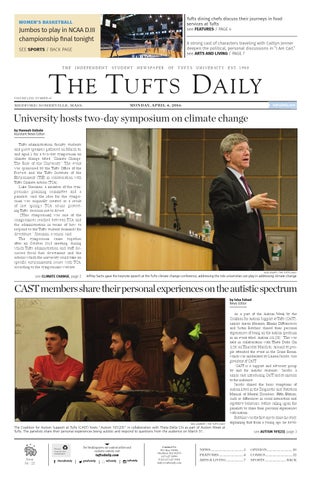
ALEX KNAPP / THE TUFTS DAILY
Jeffrey Sachs gave the keynote speech at the Tufts climate change conference, addressing the role universities can play in addressing climate change
CAST members share their personal experiences on the autistic spectrum by Isha Fahad News Editor
MIA LAMBERT / THE TUFTS DAILY
As a part of the Autism Week by the Coalition for Autism Support at Tufts (CAST), juniors Aaron Herman, Emma DiFrancesco and Justin Robbins shared their personal experiences of being on the autism spectrum in an event titled “Autism 101(23).” This was held in collaboration with Theta Delta Chi (123) on Thursday, March 31. Around 50 people attended the event in the Crane Room, which was moderated by Lauren Jacobs, vice president of CAST. “CAST is a support and advocacy group by and for autistic students,” Jacobs, a junior, said, introducing CAST and its mission to the audience. Jacobs shared the basic symptoms of autism listed in the Diagnostic and Statistical Manual of Mental Disorders, Fifth Edition, such as differences in social interaction and repetitive behaviors, before calling upon the panelists to share their personal experiences with autism. Robbins was the first one to share his story, explaining that from a young age, he devel-
The Coalition for Autism Support at Tufts (CAST) hosts “Autism 101(23)” in collaboration with Theta Delta Chi as part of Autism Week at Tufts. The panelists share their personal experiences being autistic and respond to questions from the audience on March 31.
see AUTISM 101(23), page 3
Please recycle this newspaper
Snow 34 / 22
/thetuftsdaily
For breaking news, our content archive and exclusive content, visit tuftsdaily.com @tuftsdaily
tuftsdaily
tuftsdaily
Contact Us P.O. Box 53018, Medford, MA 02155 617 627 3090 FAX 617 627 3910 daily@tuftsdaily.com
NEWS............................................1 FEATURES.................................4 ARTS & LIVING....................... 7
OPINION...................................10 COMICS.....................................12 SPORTS............................ BACK
2
THE TUFTS DAILY | News | Monday, April 4, 2016
T HE T UFTS D AILY Sarah Zheng Editor-in-Chief
EDITORIAL Nicholas Golden Mengqi Sun Managing Editors Nicholas Pfosi Associate Editor Arin Kerstein Executive News Editor Isha Fahad News Editors Abby Feldman Melissa Kain Sophie Lehrenbaum Emma Steiner Ariel Barbieri-Aghib Assistant News Editors Kyle Blacklock Gil Jacobson Robert Katz Liam Knox Catherine Perloff Vibhav Prakasam Hannah Uebele John “Joe” Walsh Kendall Todd Executive Features Editor Nicole Brooks Features Editors Nina Joung Jake Taber Diane Alexander Assistant Features Editors Constantinos Angelakis Emily Cheng Emma R. Rosenthal John Gallagher Executive Arts Editor Lancy Downs Arts Editors Justin Krakoff Josh Podolsky Jonah Allon Assistant Arts Editors Cassidy Olsen Eran Sabaner Hannah Hoang Dorie Campbell Emily Karl Erin Sifre Stephen Dennison Abigail Feldman Shannon Geary Allison Merola Cassie Bardos Miranda Chavez Frances DeFreitas Jake Goldberg Emma Henderson Michael Lefkowtiz Anita Ramaswamy Noah Weinflash
Executive Op-Ed Editor Op-Ed Editor Cartoonists
Editorialists
Maclyn Senear Executive Sports Editor Ray-Paul Biron Sports Editors Ross Dember Phillip Goldberg Alex Schroeder Chris Warren Yuan Jun Chee Assistant Sports Editors Maddie Payne Eddie Samuels Noah Smith Sofie Hecht Executive Photo Editor Alex Knapp Caroline Ambros Picture Tufts Editor Ray Bernoff Staff Photographers Laura DeArmas Maria Ferraz Henry Hintermeister Katlyn Kreie Mia Lambert Jiaxun Li Nora Nord Nicholas Pfosi Julia Press Evan Sayles Angelie Xiong
PRODUCTION Julie Doten
Production Director Astrid Weng Executive Layout Editor Jewel Castle Layout Editors Abbie Gantner Leila Li Allie Merola Brianna Mignano Mandip Pokharel Ellie Powers Annabelle Roberts Emily Sharp Andrew Stephens Sebastian Torrente Shirley Wang Petrina Chan Allison Merola Dana Pek Belinda Xian Jack Ronan Dan Strauss Meagan Adler Alison Beach Arthur Beckel Lancy Downs Alison Epstein Andrew Kager Melissa Kain Sarah Kalinowski Reena Karasin Sophie Lehrenbaum Rachel Salzberg Arielle Sigel Caroline Watson Maxwell Bernstein Nitesh Gupta Evan Sayles
Creative Director Executive Graphics Editor Graphics Editors Executive Copy Editors Copy Editors
04
TODAY
“From Punched Cards to Social Media: Observations on Entrepreneurship and Technology” Details: Entrepreneur and investor Jeff Rothschild will discuss his experiences in the field, focusing on the entrepreneurial habits that appeal to investors. Rothschild is a co-founder of the storage software company Veritas Software and the online gaming company Mpath Interactive and also served as vice president of infrastructure engineering at Facebook from 2005 to 2015. When and Where: 12:00 – 1:00 p.m., Distler Performance Hall, Granoff Music Center Sponsors: School of Engineering Roundtable Discussion with U.S. Secretary of Transportation Anthony Foxx Details: During his visit to Boston, U.S. Secretary of Transportation Anthony Foxx will attend a roundtable discussion with students from across the university. Space is limited. Interested students should contact Jen McAndrew at Tisch College for more information.
tuftsdaily.com
VISITING the
hill THIS WEEK
When and Where: 11:00 – 11:45 a.m., Rabb Room, Lincoln Filene Center Sponsors: Tisch College, School of Engineering
05
TUESDAY
“Alan D. Solomont Lecture on Citizenship & Public Service: U.S. Congressman John Lewis” Details: Congressman John Lewis (D-Ga, fifth district), an acclaimed civil rights leader, will speak on his personal experiences in the movement and in politics. Lewis has served in his position since 1987 and is known for his dedication to social justice and public service. When and Where: 6:30 – 7:30 p.m., Cohen Auditorium Sponsors:Tisch College
06
WEDNESDAY
“‘The Hilltop:’ A Reading and Discussion with Assaf Gavron” Details: As a part of the Center for the Humanities at Tufts Distinguished
Writer Series, Israeli author Assaf Gavron will be reading from and discussing his prize-winning novel, “The Hilltop,” which examines the lives of the “Hilltop youth” in the West Bank. When and Where: 5:30 p.m., Granoff Family Hillel Center Sponsors: Center for the Humanities at Tufts (CHAT), Hebrew program, Tufts Hillel
07
THURSDAY
“Purpose Led Innovation” with Former Apple CEO John Sculley Details: Businessman and entrepreneur John Sculley will serve as the keynote speaker in the Alan Shapiro Entrepreneurial Lecture Series as a part of the 12th annual $100K New Ventures Competition. Sculley, who previously served as Apple CEO and as president of Pepsi Co., will speak on “Purpose Led Innovation” in the lecture, which is a part of the Tufts Entrepreneurship Showcase. When and Where: 6:00 – 8:00 p.m., 51 Winthrop St. Sponsors: Tufts Entrepreneurial Leadership Program, Tufts Gordon Institute
Climate change symposium examines the university’s position in addressing the problem CLIMATE CHANGE
continued from page 1 The event opened on Thursday evening in Pearson Hall with a keynote address given by Jeffrey Sachs, special advisor to Ban Ki Moon. Sachs spoke to a full room about climate change and its role as a pressing concern. “It is absolutely one of the most important issues that you will face in your lives,” Sachs said. Sachs discussed the urgent need to end fossil fuel use but explained that it is difficult to do so since the modern world economy grew up on fossil fuels. “There’s nothing intrinsically wrong with fossil fuels…and so fossil fuels are good [because] they made the modern world, but they now threaten everything we have, so it’s a paradox. Nothing’s wrong with fossil fuels except that they could wreck the world,” Sachs said. Sachs then spoke on the matter of divestment and praised the Tufts students who protested the university to divest from fossil fuels. “When the students protested about this, you did right, because it’s important we behave as a moral community,” he said. “I do believe every investor needs to [divest] for two reasons: one is ethics, the second is that it’s a lousy investment in my view…because the whole coal sector is bankrupt…because there’s no future for coal.” He concluded that promoting divestment was the proper stance for students to take. Friday’s events consisted of three panel discussions, titled “Climate Research at Tufts University,” “Institutional Social Responsibility: Divestment and Other Actions” and “The University after Paris,” all held in the Alumnae Lounge.
University President Anthony Monaco began the day-long event with a welcome address, in which he spoke about the part Tufts has played and is currently playing in helping to solve the issue of climate change. “The role of universities will only increase in the next couple of years… [and we will] address the role universities and Tufts in particular can play,” he said. Monaco also commended the role which Tufts has historically played in addressing climate change and the efforts currently being made by the university. “We can also be proud in our efforts in campus sustainability,” he said. “We’re making important steps to ensure Tufts uses energy responsibly.” Sherman summarized the discussion topics of the three Friday panels, explaining that the first panel dealt with specific climate change research professors were involved in, then the following panel discussed the role of universities in transitioning economies toward low carbon resources. The third panel focused on how Tufts can operationally reduce its carbon footprint. In the second panel, Tufts Urban and Environmental Policy and Planning lecturer Ann Rappaport discussed the position Tufts currently takes on divestment. “One of the consequences of the administrative decisions to postpone divestment…was a commitment to put resources behind researching and teaching on climate change and climate justice … we’re still waiting,” she said. “One of the most important aspects of justice is about future generations in terms of our commitment to provide a future in which we’re not compromising the future generations to meet their needs.” However, Tufts economics professor Dan Richards spoke about divestment from an economic perspective, explaining that it is a low benefit, high cost choice
that could hurt future Tufts students seeking scholarships or financial aid. “Divestment is costly; it is shooting ourselves in the foot so we can claim something we haven’t achieved,” he said. “We’ve had no impact on fossil fuel use… and it’s unfair to future generations at Tufts for students who cannot afford to come here.” In the third panel, Colin Orians, director of the Environmental Studies program, added that there is more to the matter of climate change than just divestment. “I think we sometimes forget that climate is more than carbon. I think that we want to prepare our leaders to have the communication skills, the expertise, to tackle many issues,” he said. “My hope is that as an institution climate is one part of that mission, but it’s not the only mission. Remember it’s more than carbon.” Panelists at the symposium and attendees alike said they hope to continue productive conversation on the topic of alleviating climate change. In an email to the Daily, Dr. Antje Danielson, administrative director of TIE and member of the symposium’s planning committee, explained the impact she wanted out of the symposium. “I want to encourage everyone in the university to approach his or her research and teaching by asking, ‘how does this relate to climate change or how will climate change effect my work and the work of my students,’” she explained. Danielson also added that Tufts can lead the way for other universities on the issue of climate change. “I certainly think Tufts can be a leader. In fact, Tufts is already seen as a leader in interdisciplinary environmental research and education,” she wrote. “All universities need to look at their role; in fact, all organizations need to reevaluate their roles.”
First-year student unexpectedly dies Saturday morning by Arin Kerstein
News Editor and Features Editor
Executive Tech Manager Online Editor Social Media Editor
BUSINESS Yiran Xu Executive Business Director Qinyue Yu Receivables Manager Evan Sayles Online Advertising Eva Sachar Ad Managers Jay Hayes
First-year Alex Bhak passed away in downtown Boston early on the morning of Saturday, April 2, according to an email sent to the Tufts community by University President Anthony Monaco, Dean of the School of Arts and Sciences James Glaser, Dean of the School of Engineering Jianmin Qu, Dean of Student Affairs Mary Pat McMahon and University Chaplain The Reverend Greg McGonigle.
According to the email, the details related to Bhak’s death are currently under investigation. Bhak, a student in the School of Arts and Sciences, was part of a closeknit community at the university, the authors explained. “His parents and friends say he loved being at Tufts, and we know his sudden passing will be deeply felt by those who knew and loved this bright and talented young man,” they wrote.
The authors added that there will be additional communication to the community in the coming days as details regarding plans to honor Bhak are solidified. The authors of the email also noted that Counseling and Mental Health Services (CMHS) will have drop-in hours available throughout the week. They also listed resources in the Office of Student Affairs, the University Chaplaincy Office, the Tufts University Police Department and elsewhere within the university.
Monday, April 4, 2016 | News | THE TUFTS DAILY
News
3
Students part of the autistic community share stories in second annual event AUTISM 101(23)
continued from page 1 oped a passion for astronomy. He noted that his peers in school perceived him as the “weird smart kid.” If anyone asked Robbins how he felt, he said he would reply with a “1202.” “It was easier to explain myself with a 1960s computer code rather than words,” Robbins said. He also explained that he was bullied endlessly at his school and summer camps and noted that he could not participate in everyday conversations or express what was on his mind, even with friends. “[Friends] were just a nice incidental bonus,” Robbins said. “I was more curious about learning more and more, rather than building a relationship with them.” Robbins shared that his parents were always supportive of his interests, which encouraged him to follow them enthusiastically. After elementary school, he said that he started developing more socially. “I came to know that not everyone likes astronomy, and so I started listening to others,” he said, noting that his social experience in college has surpassed his previous schooling experiences. “There are a lot of people out there, some of them with similar interests as yours and will respect you for it,” Robbins said. “I made more friends at my orientation than during my four years at [high] school.” Having found a variety of people with both unique and like-minded interests at Tufts, Robbins concluded that being passionate about something, in general, is a good thing. Herman, who was diagnosed with Autism Spectrum Disorder at the age of six, next explained that he had an obsession with atlases and maps at an early age. “My relationship with autism is quite complicated,” Herman said. “My experience with
autism now is quite different from that when I was young.” Herman recounted a Halloween party where he dressed up as Hodor, a simple-minded character from the Game of Thrones, who was capable of saying only one word, ‘Hodor.’ “Since I was always talking about Hodor, I couldn’t engage in meaningful conversations or even initiate a conversation,” Herman said. “People who knew about Hodor were more understanding of my behavior, but even they weren’t easy for me.” This Halloween party was Herman’s first prominent social encounter with others, he said. Herman shared that even if people accepted his company, he could not keep up with their conversations, or process what they were saying, even if those people genuinely wanted to be helpful. “People in middle school initiated very basic small talk with me,” Herman said. “It was easier, more predictable, but quite boring.” According to Herman, people who knew that he had autism reacted in more understanding ways, but Herman still could not tell them what he wanted from them. “I am never able to stop being autistic, and frankly, I don’t want to,” Herman said. “I feel my social skills, around which this world greatly revolves, are lacking, but there are also certain things I understand better than other human beings. Autism is portrayed as a tragedy; it really is not.” Herman expressed hopes for others to adopt a similar understanding to autism as his understanding. He also expressed concerns and apprehensions centered around autism, especially expectations regarding job interviews where making eye contact is considered extremely important. Herman admitted that while it is difficult to lead a life with an autism diagnosis,
SCHOOL OF ENGINEERING INAUGURAL DEAN’S LECTURE
JEFF ROTHSCHILD Jeff Rothschild was VP of Infrastructure Engineering at Facebook from 2005 to 2015. He has been a serial entrepreneur and investor and was co-founder of the storage sooware company Veritas Sooware and the online gaming company Mpath Interaccve. This talk will address lessons learned over 30 years as an entrepreneur and technology investor, including the aaributes of successful entrepreneurial efforts and the qualiies that make a project and team aaraccve to venture investors. Jeff will also provide advice on managing a young company and building a successful team, using anecdotes from projects that he has been involved with, including Facebook, Veritas, and Mpath.
a lot can be done to alleviate the problems faced by the autistic. “People not on the spectrum can make things easier,” Herman said. “I really don’t see that as much as I would like.” DiFrancesco next explained that her specialized interest in ballroom dancing helped her through her autism journey. She shared that she was diagnosed with Asperger’s Syndrome, a high-functioning form of autism, at the age of two. She was not allowed to talk about her diagnosis outside of family, she said. “People back then didn’t know much about autism,” DiFrancesco said. “My parents didn’t want me to be treated differently.” DiFrancesco revealed that she did share her autism diagnosis with a few friends in school and was also able to make a few neuro-atypical friends because of that. “I started telling people my ‘deepest darkest secret,’ despite my parents’ wishes,” DiFrancesco said. “It helped me ‘fix’ my camp friends.” DiFrancesco shared that, although she received a “girl scout” training to accept differences in other people, she could not accept differences in her own self. Having a tough time socially, both in her boarding school and high school, DiFrancesco explained how college provided her with a hugely liberating social justice environment once she arrived. “I found autistic community on the internet, and it made me realize how my journey was so unique,” DiFrancesco said. “This journey of self-acceptance is a bit challenging, but I started acknowledging similarities between myself and other neuro-divergent friends.” DiFrancesco expressed gratitude and happiness over meeting her first female autistic friend during a trip to California. “Now that I know so many people on the spectrum, I know how to treat other people and not let other people mistreat me,” she
said. “It’s really nice to know how to protect myself and protect others.” The event culminated in a question and answer session with the three panelists. Guests asked the CAST members ways in which neurotypicals can be more accommodating of the autistic, why CAST and 123 decided unanimously this year not to donate to Autism Speaks and how people in the autistic community prefer to be referenced. “We prefer to be known as the autistic community,” Robbins said. “Calling anyone as a ‘person with autism’ is really as if a part can be removed from us; now we wouldn’t say ‘people with gay,’ would we?” DiFrancesco believes that trying to separate this part of autism from the autistic can actually lead to their trauma or physical harm. “It is not a healthy approach to address autistic people as ‘people with autism,’ as if they are people with cancer or some other disease,” Herman said. The panelists also addressed their concerns and sentiments about Autism Speaks, an organization which aims to increase advocacy, research and awareness surrounding autism, according to its About Us page. Robbins noted that this is the second year CAST arranged this event, after its joint decision with Theta Delta Chi to no longer donate to Autism Speaks. “They are a renowned organization, yet they term autism as a ‘global health crisis’ in their mission statement,” DiFrancesco said. “They say that something is missing in all of us, [the autistic community].” According to Robbins, Autism Speaks terms autistic people as if they have an affliction worse than HIV. “Since they don’t have any autistic people in their structure, they push very, very hard toward the idea of a cure.” Robbins said. “The community is quite clear on that, we don’t want that.”
4 tuftsdaily.com
Features
Monday, April 4, 2016
Tufts chefs discuss their culinary journeys
by Constantinos Angelakis Features Assistant Editor
When Richard Morgan started working at Tufts in 1973, the Dewick-MacPhie Dining Center was different from today’s current setup that was inspired by the Marché restaurant chain — more similar to a traditional cafeteria system. “You had two choices when I first got here,” he said. “There wasn’t even a salad bar. That was an option for a meal — a chef salad.” A sous chef in Dewick, Morgan has been working at Tufts for almost 43 years. His daily responsibilities include running the kitchen, assigning work and organizing. Discussing the changes Dewick has undergone during his time there, he pointed out in particular the major renovation which occurred in 1995. “They literally gutted the whole building,” he said. “All that was left was the roof and the four walls; everything else was taken out. They rearranged everything and built what you see out here today.” The change reflected trends in campus dining towards a new concept of university dining, a path which Tufts helped pioneer. “We were leaders in that way,” Morgan said. “I mean, there were a couple of others because we visited other schools when we were looking for what works and what doesn’t, so we were trying to pick the best of everything of people that did recent renovations.” Along with changes in the infrastruc-
ture, the menu has changed over the years. Morgan said his favorite dish to prepare is chicken and penne with Cajun cream sauce, a popular dish among students at Dewick. He had the idea for the recipe after eating a similar dish in a T.G.I. Friday’s restaurant, and he later experimented with ingredients to create the dining center dish. “I’ve seen a million changes around here,” Morgan said. In addition to Morgan, behind the dining halls, cafés and other food service locations on campus, an extensive team of cooks and chefs prepare the food for the Tufts community. Depending on the type of food, it could come from Central Culinary, which is located under Dewick, where items like soups and pastries are prepared, or from kitchens in each dining area. Paul Rudolph, a culinary production chef, has also been here for 32 years. Working in the Central Culinary kitchen, he specializes in preparing soups. “When I went to high school, I decided I wanted to cook,” Rudolph said. “I worked here as a high school worker, and then I left for about a year, went to college and then I came back. The day after I graduated college, I came right back and said, ‘Hey, have you got another job full-time?’” Rudolph recently drew attention for his award-winning chili recipe, which he entered into the Chili Cook Off to benefit RESPOND, a Somerville-based non-profit that works to end domestic violence. According to Rudolph, last year he submitted both a beef and a vegetarian chili in the competitions,
but the vegetarian option was unable to be judged as it was the only vegetarian submission. This year, there were others who submitted in that category. “It’s a big thing, you know, vegetarian food,” Rudolph said. “It’s not necessarily a major part of everybody, but a lot of people like to eat a little bit more exotic or organic, university-wide.” Central Culinary also prepares foods for catering events in the Tufts community. The events can range from anything from a department lunch to a formal function to a baby shower, Ghiloni explained. “We mostly serve Tufts alumni and the different departments,” Rudolph said. The menus for these events are ordered and prepared within a certain timeframe, but chefs can have some more sway over the catering menu than that of the dining hall, which is predetermined. Rudolph said that chefs can suggest items and also make special recipes for catering. Susan Ghiloni, the pastry chef with Tufts Dining, works in Central Culinary and prepares pastries for several eateries on campus, including cash locations like the Commons Marketplace and the Hotung Café. She talked about her experience working in the Boston Harbor Hotel for several years and then Davio’s Cucina in Chesnut Hill before coming to Tufts. “College was the time that I really got into baking and pastry, and when I was working at Davio’s, coming from a hotel, I was used to lots of units and a lot going on,” she said. “Going back to a restaurant, it was awesome to be part of the opening team, but it’s just one thing
going on, and I really like having all the different units. So when this job came up, I said, ‘I think that’s something I’d like to try next.’” Ghiloni also explained that she must account for portability when creating new recipes for pastries. Some items have to be conveyed in a truck to Carmichael and must be processed and served by the staff there. Additionally, quantity is a concern for storage space. “Space is always a concern,” she said. “Do we have enough refrigeration? Do we have enough anything? So we can’t we can’t give them so many things that need to be refrigerated because they run out of space too.” Ghiloni explained that she enjoys making more complex pastries. “I would say it’s more delicate [to make] pastry,” she said. “Something that has a lot of components, a lot of different textures. A lot of baking takes time. It’s not ‘you mix something, you bake it and it’s done.’” When Ghiloni first started, she said that she generally followed the recipes which the dining center had previously served. However, over time, she has developed the menu and hopes to add some new options in the upcoming summer. “Now that I’ve been here a little longer, I know that a lot of these things have been running for a very long time,” Ghiloni said. “Some of them are still good, and some of them have just kind of run their course, so that’s actually what I try to do in the summer. I have a lot of things set up to test the summer so that we can start making some changes and vary the menu a little bit.”
Monday, April 4, 2016 | ADVERTISEMENT | THE TUFTS DAILY
tuftsdaily.com
1/4 AD
1/8 AD 1/2 AD
5
6
THE TUFTS DAILY | ADVERTISEMENT | Monday, April 4, 2016
tuftsdaily.com
TISCH COLLEGE DISTINGUISHED SPE AKER SERIES 2016
1/4
1/8
4th Annual Alan D. Solomont Lecture on Citizenship and Public Service
U.S. Congressman
John Lewis
1/2
April 5, 2016 6:30 pm Cohen Auditorium Aidekman Arts Center Medford/Somerville Campus
Tickets are available at the Cohen Auditorium Box Office activecitizen.tufts.edu
Monday, April 4, 2016
ARTS&LIVING TV REVIEW
Politics take center stage in second season of ‘I Am Cait’ by Lancy Downs Arts Editor
In its second season, “I Am Cait” (2015 – present) remains, like its star Caitlyn Jenner herself, a confusing mess of contradictions. After a much-discussed first season, which aired on the heels of Jenner’s very public coming out, Caitlyn is back for another go with her the group of trans friends she — or perhaps more accurately, the show’s producers — brought together last year. This time around, they pile into a luxury coach bus to embark on a rather contrived road trip — both the point of which and final destination remain somewhat murky. But Jenner’s companions hope that this time on the road will give them an opportunity to continue to educate their friend about the trans community and about trans issues. Among Jenner’s companions — “the girls,” as she calls them — are Jenny Boylan, Candis Cayne, Chandi Moore, Zackary Drucker, Kate Bornstein and Ella Giselle, all of whom, with the exception of Bornstein, are trans women. Bornstein, who was born male and received gender confirmation surgery, identifies as neither male nor female. They all settle easily into their respective roles: Zackary is the consummate diplomat and peacemaker, while Jenny and Kate are the often-sparring academictypes. Ella is the young ingenue; only 18 years old, she fits in naturally with the older crowd. Chandi, meanwhile, brings charm, energy and a
frank honesty to her every interaction. It is Candis Cayne, however, who arguably is the show’s heart and soul, and “I Am Cait” often centers around Candis more than it does her famous friend. The actress and performer is open and vulnerable on camera in a way that Caitlyn herself is reluctant to be. In some moments, Jenner is simply not willing to engage with the tough questions her friends ask of her, and, in others, it is clear that she is not yet ready to share these most intimate thoughts and feelings publicly. Whatever the reason, this reticence on the part of the show’s would-be star leaves Candis as the show’s emotional center — a role she fills with ease. Beautiful and vivacious, a born performer, Candis lets down that glamorous façade and allows the camera crew capture her more private moments: shyly, almost hesitantly, flirting with handsome young rock climbing instructors, getting stood up on a date, retreating to the back of the bus flustered and upset after a fight with Caitlyn. And so far, fights with Caitlyn have occupied much of the show’s screentime. With the presidential campaign kicking into full gear, Jenner’s friends are increasingly anxious about her stubbornly conservative political beliefs and her support of Republican candidates like Donald Trump, whose policies would endanger rather than support, trans Americans. None of these debates reflect particularly well on Caitlyn, who comes across as small-minded, hostile and, frankly, somewhat deluded. White,
rich, famous, well-respected, she is the most privileged member of the trans community in the United States, if not the world. Though Jenner may know this on a rational level, it has not yet worked its way into her politics, much to the alarm of her friends. Not insignificantly, “I Am Cait” is acutely aware that Jenner has been thrust into a position of spokesperson for the trans community — and that she has been widely deemed unsuitable for the role. What makes “I Am Cait” worth watching, however, is that the show cleverly works to problematize the very idea that the trans community could ever be represented by a sole voice. The show gives the supporting cast, particularly longtime trans activists and scholars Boylan and Bornstein, an opportunity to air their disagreements and conversations about the word “tranny” or drag culture and give their opinions room to breathe and flow. These arguments — heartfelt, articulate and loving — illustrate the diversity of opinions and experience within the trans community and in doing so, point to the fallacy of appointing Jenner, or any one person for that matter, the spokesperson for trans Americans. “I Am Cait” can be frustrating to watch, and, with a protagonist who comes off as alternately sympathetic and distressingly intolerant, it is easy to see why viewers might be turned off. But this season, Caitlyn is not the real reason to tune into the show — her friends are.
MOVIE REVIEW
Superhero blockbuster ‘Batman v Superman: Dawn of Justice’ is worth skipping by Justin Krakoff Arts Editor
In one of the many trailers for “Batman v Superman: Dawn of Justice,” which hit theaters on March 25, Lex Luthor (a poorly casted Jesse Eisenberg) sums up the impending matchup between the Dark Knight and Man of Steel as the “the greatest gladiator match in the history of the world.” For those expecting anything but a slugfest, prepare to be disappointed; this movie is simply an affront to both moviegoers and comic book fans across the world. Compared to the relatively spotless cinematic universe built by Marvel Studios over the past couple of years, Warner Bros. Pictures has not been even remotely successful in creating something similar for its DC Comics properties. The critically acclaimed “The Dark Knight” trilogy ended up being just that: three self-contained, gritty Batman films that represented a complete arc for the character. Other attempts to get DC superheroes on the silver screen resulted in the utter catastrophes that were “Superman Returns” (2006) and “Green Lantern” (2011). 2013’s “Man of Steel” was supposed right the ship in regard to
Warner Bros.’ failed efforts, yet even that effort was not warmly received, to say the least. “Batman v Superman: Dawn of Justice” thus represents the latest attempt by Warner Bros. to actually forge a cinematic universe for DC Comics. However, with a $250 million budget, this superhero matchup is far too unstable for Warner Bros. to place bet on entirely. Leading up to the release of the film, Warner Bros. seemingly sought to market its movie in such a way that it would be “too big to fail” on release; trailers included everything but the film’s lackluster ending, which left little to surprise the viewer. Yet it is the directorial decisions of Zack Snyder that really stop “Batman v Superman” from being anything close to a joyful movie. Snyder has always been known for his highly stylized approach to filmmaking, most noticeably on display in the myth he constructs with “300” (2007) and the comic book aesthetic he uses in “Sucker Punch” (2011). Even though Snyder’s style is unequivocally unique, the glaring problem lies in his lack of understanding both good characterization and his past mistakes. In particular, Snyder repeats many of the same crimes he committed in directing
“Man of Steel” in his newest project: “Batman v Superman” is overburdened by its 151-minute runtime and utterly misuses characters like Jimmy Olsen (Michael Cassidy). Another fundamental problem with this DC blockbuster is the casting for its two leads. Both Henry Cavill (Superman) and Ben Affleck (Batman) simply fail to understand what drives their respective characters. While Superman is supposed to be a beacon for humanity, Cavill seems to reject this notion in an effort to embrace the character’s godlier aspects, which only works to create boredom and flat emotions. Even more egregious is Affleck’s characterization of Batman. His take borders on the juvenile and completely misses the mark on the character’s intellectual prowess. Thankfully, the saving graces of the film come in the form of its two lead actresses, Amy Adams and Gal Gadot. After being one of the few positives in “Man of Steel,” Adams returns once more to play a Lois Lane who, though a mere human, is much more capable than her superhero co-stars. Yet if there is one reason to see this almost-unwatchable film it is the big screen debut see SUPERMAN, page 8
7 tuftsdaily.com
Isaac Brown Pop Filter
The learning cliff
M
any people tell me that they really want to get started arranging, but that pesky learning curve is like trying to learn Dwarf Fortress. If you want to have an easier time getting started out, here’s a few things I recommend you do: Learn music theory. A good way to get started with that is to take “Music 10: Introduction to Music Theory” or a similar course. It’s relatively straightforward material for non-music majors, and you learn all of the basics of notation so that you can become familiar with chord progressions and inversions, which will help you with some of the most integral aspects of arranging such as chord construction. Once you’ve got this foundation down, it’s easier to identify an unconventional chord and explain why it sounds that way so that you can avoid unpleasant dissonance. Tufts has a great music department; take advantage of it! Ear training is invaluable. Practice with a friend or using free online software so that you can identify intervals quickly and sight sing them if need be. Other aspects like determining pitch and rhythm by ear are useful but not necessary. Learning these skills is a gradual process, but the payoff is worth it because of how much faster you will learn new music and how much easier it is to edit and polish the arrangement. Listen to other groups. As many as you can find. Buy books, do research online, absorb all the info you can get your hands on. Listen to every group you can find on the internet, iTunes and Spotify (even the lesser-known ones) in order to cast as wide a net as possible. Old episodes of “The Sing-Off” (2009 – 2014) are a treasure trove of information and inspiration on the subject. Be your own worst critic. Part of the beauty of an arrangement is that it’s a living document and evolves as you learn it. If some measures sound dissonant in an unpleasant way, fix them or throw them out. Don’t stand by a harsh-sounding section of music just because it took time and effort. Sometimes the best solution to unpleasant sections is nuking it from orbit. Back to square one. Even when you think an arrangement is done, you’re not done. Put it down, work on something else for a few week, and come back to it. Chances are you’ll be able to review it with a more objective eye. Seek peer editing and comments from your fellow arrangers. Arrangers within my group regularly exchange drafts and provide each other with constructive feedback. Altering parts after people have sunk time into learning them can be frustrating for the rest of the group, so the more pairs of eyes on your work double checking everything, the better. Even when I think something sounds perfect, others never fail to find more stuff to improve. Music is best created in collaboration; none of my favorite arrangements would have been possible without the help of others. Isaac Brown is a junior, an English major and a contributing writer at the Tufts Daily. He an be reached at isaac.brown@ tufts.edu.
8
THE TUFTS DAILY | Arts & Living | Monday, April 4, 2016
tuftsdaily.com
‘Batman v Superman: Dawn of Justice’ misses the point SUPERMAN
continued from page 7 of Wonder Woman, played by Gadot. Almost four decades have passed since the Amazon Princess last appeared on the television series “Wonder Woman” (1975-1979), but Gadot does not let the audience down with her spectacular
portrayal of the iconic superheroine. Her fight scene is alone the absolute highlight of the movie as she embodies the grace and strength of Diana in a way that leaves Cavill and Affleck completely in the dust. Despite the negative response of critics towards “Batman v Superman: Dawn
of Justice,” the superhero extravaganza has somehow managed to shatter box office records and make over $500 million worldwide. Moreover, Warner Bros. still has subsequent DC films in the pipeline, including “Wonder Woman” (2016) and “Justice League Part One” (2017). As viewers anxiously wait to see
if Warner Bros. can avoid yet another screw-up, this reviewer suggests saving one’s money and time by instead re-watching the classic cartoon series “Justice League” (2001-2004). Not only is it infinitely more enjoyable, but the show perfectly captures the essence of superheroes: hope.
WARNER BROS. ENTERTAINMENT VIA TRIBUNE NEWS SERVICE
Ben Affleck and Henry Cavill in “Batman vs. Superman: Dawn of Justice.”
Monday, April 4, 2016 | ADVERTISEMENT | THE TUFTS DAILY
tuftsdaily.com
EXPLORE
new cultures
at UMass Boston this summer
1/4 AD
1/8 AD
Register Now!
Learn more at: summer.umb.edu
700+ courses, many with stops across the globe
Service learning in France and Haiti
Session I begins: 5/31 Session II begins: 7/18
Field studies, from Plymouth to New Mexico
Study abroad programs, from Italy to Belize
Hundreds of courses in languages, business, science and more
CANDIDATES MEETING Monday, April 4th @ 9 pm in Barnum 008 Bring all signed petitions to this MANDATORY meeting! Find them on ecom.tufts.edu under “documents.” CONTACT ECOM@TUFTS.EDU
9
Opinion
10 tuftsdaily.com
Monday, April 4, 2016
EDITORIAL
Reflections on Sexual Assault Awareness Month This April is Sexual Assault Awareness Month. The National Sexual Violence Resource Center (NSVRC) has taken the lead to promote dialogue pertaining to sexual misconduct throughout this month for the cause of preventing sexual assaults. Prior to engaging in such dialogue, it is important to understand the history and current context that make up the pillars of how sexual misconduct has been combated on college campuses. There is a pressing question to ask: how did campuses become adjudicators of sexual assault in competition with police? In 1972, President Nixon signed into law Title IX of the Education Amendments, which was designed to prohibit sex-based discrimination in higher education: “No person in the United States shall, on the basis of sex, be excluded from participation in, be denied the benefits of or be subjected to discrimination under any education program or activity receiving federal financial assistance.” Nevertheless, it took many years for this amendment to embody the
protections it provides today against sexual misconduct: initially, it only governed federally funded colleges’ athletic policies; it was not until several years later that student to student conduct was governed by Title IX too. Shortly after Title IX’s inception, the Department of Education’s Office for Civil Rights (OCR) was tasked with overseeing its implementation, and since 2001 it has taken the necessary steps to provide schools with compliance training and students with much needed resources to combat sexual assault and sexual harassment on their campuses. Over 40 years after Title IX’s passage, the push to end sexual misconduct has come a long way. However, the movement faces severe setbacks due to recent events. In April of 2011, OCR sent a nationwide letter out to colleges and universities, often referred to as the Dear Colleague Letter (DCL). In short, the DCL mandated the broadening of the disciplinary processes of sexual misconduct cases on college and university campuses. Additionally, DCL’s
regulations has also broadened the dialogue of sexual assault to include victims of administrative malpractice. Designed to enhance the safety of those who suffer from sexual violence on these campuses, the implementation of the DCL has led instead to the creation of a whole new controversy. In schools’ efforts to remain in compliance with OCR’s new guidelines under the DCL, many overlooked and neglected the need to provide constitutionally or contractually protected procedural safeguards for all parties involved in a sexual assault case. As a result, within just the past five years, over 100 lawsuits have been filed in state and federal courts from students whose due process and other protected rights were allegedly violated in the procedures of their campuses’ sexual assault disciplinary proceedings. This number is also far lower than the actual amount of administrative due process violations, as many such cases do not get filed due to the cost and time necessary for the pursu-
ance of such legal action. By precipitating a trend of administrative malpractice that has led to the publicizing of these personal cases in public courts, victims of sexual violence now have to contend with the possibility that their traumatic experiences are made public. Movements in prevention of sexual assaults, while being motivated by good intentions, should prioritize the privacy and interests of victims of sexual assault. The decision to report a sexual assault should be made with the knowledge that one won’t suffer more for having pursued justice; all too often that is not the case. During this Sexual Assault Awareness Month, it is important to review the current situation regarding Tufts’ progress in compliance with Title IX, to inform the members of Tufts community about the consequences of violation and to mobilize them to join in the effort of combating sexual assaults on campus.
EDITORIAL CARTOON BY SHANNONGEARY
The Tufts Daily is a nonprofit, independent newspaper, published Monday through Friday during the academic year, and distributed free to the Tufts community. The content of letters, advertisements, signed columns, cartoons and graphics does not necessarily reflect the opinion of The Tufts Daily editorial board. EDITORIALS Editorials represent the position of The Tufts Daily. Individual editors are not necessarily responsible for, or in agreement with, the policies and editorials of The Tufts Daily. OP-EDS The Op-Ed section of The Tufts Daily, an open forum for campus editorial commentary, is printed Monday through Thursday. The Daily welcomes submissions from all members of the Tufts community; the opinions expressed in the Op-Ed section do not necessarily represent the opinions of the Daily itself. Opinion articles on campus, national and international issues should be 600 to 1,200 words in length and submitted to oped@tuftsdaily. com. The editors reserve the right to edit letters for clarity, space and length. All material is subject to editorial discretion and is not guaranteed to appear in the Daily. Authors must submit their telephone numbers and day-of availability for editing questions. ADVERTISING All advertising copy is subject to the approval of the Editor-in-Chief, Executive Board and Executive Business Director.
11
Monday, April 4, 2016 | Opinion | THE TUFTS DAILY
Opinion OP-ED
Thank You, Mom by Anna Robling Feminism. Gender-equality. Pay gap. Discrimination. The patriarchy. These phrases, amongst many others, constantly occupy our ever-lively campus dialogue. However, as a young woman I am often disappointed with the time we waste complaining when we could be out there doing. The only way to inch closer to progress is through action. Although it is important and imperative that we voice our grievances and concerns, this voice is lost without concrete illustration. Regrettably, we often let our own statements limit us even further. At times we sit anxiously yet motionless. We allow the limitations to persist in believing in their existence. Many will read this and ask, how could this be? You will be offended because I am telling you that you bear some responsibility for your own injustice. The system is f*cked up; no doubt, but until it changes we must learn to live and grow within it. Fortunately, there are more opportunities for us than there were for our mothers. However, we would not be graced with them if it hadn’t been for their determination. I have witnessed this tenacity first-hand as I watched my mother leave for work every day. Early each morning she would depart, a fore-
cast of meetings with men ominously in front of her. When people asked my me what my mom did, I proudly told them she was a Chief Marketing Officer (CMO): a woman in an acronym position. In other words, I thought she was, and still think she is, a total bad ass. Still, we often associate these classic posts of seniority with men. Women with letters, more commonly known as women in leadership positions, continue to be a tiny minority. In 2014, only 5.2 percent of Fortune 500 CEOs were women. As I grew older, the weight this figure bore on my mother and women in similar position became more evident, especially when she switched jobs. This time she had a new set of letters, EVP (executive vice-president). But something else didn’t change, she was the only woman in a set of five senior executives. A nosy, and perceptive 13-year-old, I asked her why she seemed so sad sometimes upon returning home from work. Most of the time, she proudly shared stories of victory and triumph, so instances that reflected a different attitude were readily evident. She told me stories of male coworkers who told her to stop being so “emotionally invested” and “motherly” when it came to workplace decisions and projects. This made me upset and confused. I was just beginning to become aware of the biases I faced as a girl. In class, boys told me it
was weird that I spoke up so much, that I was being too opinionated for a girl. I had not realized that this sentiment would stealthily linger throughout every stage of my life. More important than the upsetting stories she told me was how she dealt with them. She said, “You are not in control of what others do or say, but you are in control of your reaction to it.” What I took away was that our reactions and responses to challenges are what help us overcome them. At times we hope that they will just be instantly vanquished, but their elimination will not materialize without experience. My mother showed me that the system won’t change unless we learn how to defeat it as it already exists. When Pinnacle released their 10K (SEC filings), a document where the salaries of the top five highest compensated executives must be disclosed, my mother was the only woman on it. This marvelous accomplishment was tainted when the report revealed a glaring 14.5 percent pay gap. My mother’s contributions were valued 14.5 percent less than those of a man in a lesser position. 14.5 percent less than a man who ran a smaller division. 14.5 percent less. They told her she didn’t negotiate aggressively enough. As she told me this story, my blood boiled, I was nearly in tears. She looked at me and said, “I didn’t.” I exploded. I wondered
how she could let them tell her she was wrong. How they could tell her it was her fault. But, despite my anger, I quickly realized her commendable self-awareness. My mother understood her personal responsibility to willfully change the circumstances women everywhere are presented with. She revealed to me that her failure to be accordingly aggressive throughout every salary negotiation in her entire career lead to this aggregate result. Although the circumstances she was presented with were not ideal, there were things she could do to strategically manipulate the procedure in her favor. As women, it is a given that we have to fight harder and longer. Many tasks, goals and desires are not achieved without the assiduous conviction required to surmount additional hindrances. We cannot expect change to happen because we want it to; we must will change to realize. We cannot idly denounce the injustices presented to us. They are not grounds for pity or special treatment. They are opportunities for growth and triumph. They are challenges, not defined boundaries. The indisputable obstacles we are presented with as women will only prevent our progress if we allow them to do so. Anna Robling is a freshman majoring in international relations and economics, and can be reached at Anna.Robling@ tufts.edu.
Want to get campus news the moment it happens? Follow us on Twitter and Facebook! /thetuftsdaily @tuftsdaily
/tuftsdaily /tuftsdaily
76130
1/4 AD
WE HELP THOSE WHO DO GOOD DO WELL.
Rediscover what makes us a different kind of financial partner at the new TIAA.org
INVESTING
ADVICE
BANKING
RETIREMENT
BUILT TO PERFORM. CREATED TO SERVE.
C28789
5021A0113 Campus News_WE HELP THOSE WHO DO GOOD DO WELL_REDISCOVER_C28789_10x12_Various_1.indd Cyan Magenta Yellow Black
12
THE TUFTS DAILY | Comics | Monday, April 4, 2016
Comics
tuftsdaily.com LATE NIGHT AT THE DAILY Julie (yelling to the printer in the office): “There’s paper. EAT MY PAPER!!”
Comics
SUDOKU
JUMBLE
Difficulty Level: Experiencing four seasons within one week in Boston.
Friday’s Solution
NON SEQUITUR BY WILEY MILLER
CROSSWORD
Friday’s Solution
Monday, April 4, 2016 | ADVERTISEMENT | THE TUFTS DAILY
tuftsdaily.com
1/4 AD
1/8 AD
GIM Monday4/4 @ Noon Olin 112
1/2 AD
Come learn how you can connect Palestinians and Israelis on a grassroots level while connecting with new students on campus! There will be pizza!
13
14
THE TUFTS DAILY | Sports | Monday, April 4, 2016
tuftsdaily.com
MEN'S CREW
Jumbos sweep first regatta of the spring season by Andre Chuong Sports Editor
Returning to its home waters of the Malden River after a week long spring training trip in DeLand, Fla., the men’s rowing team raced in its first regatta of the spring season on Saturday. Tufts hosted teams from Hamilton College and the U.S. Coast Guard Academy at the Shoemaker Boathouse in a morning three-way meet before facing the University of MassachusettsAmherst (UMass Amherst) head to head in the early evening, making Saturday a full day of racing for the Jumbos. Gloomy weather conditions coupled with light rain in the morning were no impediment to the team’s ability to sweep the competition and walk away with wins across the board. The first varsity eight entry, consisting of sophomore stroke Andrew MacMillen, senior Andrew Warren, junior Doug Burt, senior tri-captain Jon Williams, first-year Richard Gilland, sophomore Tyler Hagedorn, junior tri-captain Zach Merchant, firstyear bow Ryan Bell and first-year coxswain Hannah Frankel, secured their win against Hamilton very early into their 2,000-meter race. Leading the Continentals by one boat length halfway into the course, the Jumbos surged to victory by four seconds with a time of 5:56.8. “[Against Hamilton] the power was really good. We were feeling fresh and tensed up a little too much, so…it RAY BERNOFF / THE TUFTS DAILY
see MEN'S CREW, page 15
The first varsity eight in their race against Hamilton College on Saturday.
TUFTS SUMMER SESSION 2016 prepare. eXpaND. Develop. school of arts and sciences | school of engineering
Three sessioNs: May 25–July 1 | July 5–augusT 12 | May 25–augusT 12 go.tufts.edu/summer Follow us on facebook:
College & Pre-College Programs Day & Evening Classes Affordable Tuition
Outstanding Tufts Faculty Online Courses
Monday, April 4, 2016 | Sports | THE TUFTS DAILY
Sports
Tufts challenges defending national champion Thomas More in NCAA finals WOMEN'S BASKETBALL
continued from back but we’re also there to win a basketball game,” coach Carla Berube said. “So there’s that focus that we need to keep throughout the weekend.” After a few weeks of rest and practice, Tufts will take on defending national champion Thomas More, to whom it lost in the Final Four last year, for the NCAA Div. III national championship tonight at 6 p.m. In the year that separates this season from last season, Thomas More has gone undefeated at 32-0 while the Jumbos sit at 28-3. The Saints average over 90 points per game (PPG), while the Jumbos allow just 44.8 PPG. A championship of this nature, featuring two powerhouses dominant in their own respective ways, represents a clash of formidable offensive strength characteristic of Thomas More and Tufts’ shutdown defense. “It is kind of like defense versus offense. Let’s see who wins out,” Berube said. That’s not to say either team really has a particularly weak spot. The Thomas More roster allows just over 50 PPG and averages over 13 takeaways. For Tufts, junior Michela North, a Women’s Basketball Coaches Association AllAmerican and D3hoops.com Second Team All-American, and sophomore Melissa Baptista, have been pacing the Jumbos, averaging over 10 PPG each. Just as much as Tufts needs to stifle Thomas More’s offense, they need to convert those stops into baskets on the other end. “We also have to score the ball. We’re not going to shut them out in the first quarter. I’m pretty sure of that,” Berube said. “So we have to be able to score the basketball and make plays for each other. We have a Michela North that they don’t have either, so we’ll look for places where we think we can score the ball and we’ll put it there, and hopefully the team makes the plays that we need to make.” One key for the Jumbos will be slowing down the Saints’ leading scorer and three-time NCAA Div. III Player of the Year Sydney Moss. The senior averages 22.4 PPG and put up 39 against Amherst in the other Final Four matchup. The Jumbos
have not really seen a scorer of this ability all season. “Sydney Moss is playing at a high level,” Berube said. “If you saw her in the Amherst game, I mean, she’s able to just take over a game.” Because the Jumbos advanced all the way to the Final Four and got the matchup with the Saints last year, though, they will be well-equipped to handle both the national spotlight and their specific opponent. “Most of the players that are playing now have played against Thomas More, so we have that experience from last year,” Berube said. “I think that’s even more important to have that in-game experience against a Thomas More team who is somewhat the same as last year.” As far as game plans go, although Tufts needs to adjust specifically for competition against such a well-rounded and multidimensional opponent like Thomas More, the team also wants to focus on the core values they have depended upon and worked at to get this far. “I think we’re going to stick to a lot of what we always do,” sophomore point guard Lauren Dillon said. “We don’t really change too much depending on who we’re playing. Our defense is Tufts basketball, and we pretty much do the same thing every time. I think we know we have to have a huge defensive game, and I’m not sure that Thomas More has faced a defense like ours this whole season, which is one of our biggest assets.” Both Tufts and Thomas More have progressed and changed since the NCAA semifinals last year, meaning this game could look a lot different that the last time the Jumbos and Saints met. Coach Berube is proud of how the Jumbos have developed into a championship-caliber team this year. “I think we’re different: we don’t have two 6 ft. 2 in. centers in the post [referring to North and last year’s tri-captain Haley Kanner (LA’ 15)],” she said. “We didn’t have the Melissa Baptista that we have this year. We have a more experienced Lauren Dillon and a Michela North that’s our go-to in the paint. And we’ve got a
really great senior class, a bunch of leaders that are doing an unbelievable job this year leading our team off the court and on the court and making sure we’re prepared day in, day out — practice, games — to be at our very best. It’s hard to compare from one team to the next team, but I’m just really happy with what we’ve grown into this year.” One of the more interesting storylines of this championship season is the fact that on the year of the 35th anniversary, both Tufts and the University of Connecticut (UConn) have advanced to the Div. III and Div. I championships, respectively. Not only, then, is it a special time to be playing in any of the three divisions’ national title games, but it’s particularly exciting for Berube. While she is on the sidelines looking for her first national title, her former college coach, Geno Auriemma, and the Huskies will be aiming for a championship of their own in the same location in the same 48-hour span. “I mean it’s my alma mater, so there’s a lot of pride there ... And that we’re there, too, at the same pinnacle, but just at our level, at Div. III, is pretty special,” Berube said of the coinciding championship runs for both Tufts and UConn. “I know coach [Auriemma] has said that he’s going to try to get to [Tufts’] game, which is awesome too because he’s never seen me coach.” Ultimately, coach Berube stressed how much this championship game means to her team, to Tufts athletics, to fans and friends of the team and to the program’s members, past and present, who all worked so hard to make Tufts a perennial contender at that national level. “A lot of hard work has gone into this. My players — not just this year but years past — have kind of built to this championship,” she said. “It’s thrilling for everyone involved that we’re finally making it to this game. I’m proud of our alumni base. There’s going be about 25 of them coming to the game [today] so I feel like this is for all of the Jumbos of the past to feel really excited about this game, and that these 14 players I have are very fortunate to be able to play in this.”
Men's novice crew looks varsity-like in first weekend of spring season MEN’S CREW
continued from page 14 didn’t feel as light or as smooth as it should have been,” Macmillen said. “In the second race [against Coast Guard] we took our stroke down to a lower rate ,and it felt a lot smoother, even though time-wise it was slower.” Rounding out a full day of wins and impressive times, in the Thufts’ subsequent races, the first varsity eight clocked times of 6:05.6 against Coast Guard (6:18.6) and 5:54.35 against UMass (5:58.42). Despite these victories, members of the team highlighted areas in which they could improve for future races in the season. “There were a lot of things that didn’t go as well as we would have liked. In our second piece [against Coast Guard], we were definitely more relaxed and got all our adrenaline out of the way,” Frankel said. “We were definitely excited [about these races] since we just got back from Florida, where we made a huge amount of progress.” The second varsity eight experienced a similar string of victories in their own races. The entry, composed of firstyear stroke Chandler Glass, senior J.J. Zhou, first-year Isaac Mudge, senior tri-captain Jonathan Lapadula, first-
year Rohail Rai, senior Spencer Moslow, sophomore Matt Cohen, senior bow Jackson Horwitz and junior coxswain Connor Fallon, led the visiting crews by huge margins on Saturday. Both Frankel and Lapadula noticed the crews’ increased skill at navigating difficult weather and water conditions. In the second varsity eight race against Hamilton, the race started with the Continentals drifting into the Jumbos’ lane due to the wind. “[Our races] felt really great. In the first race, we clashed oars with [Hamilton], but our team maintained our cool,” Lapadula said. “We could tell the other boat was frazzled by it but we were surprisingly calm.” “[The crews are] used to rowing in this weather … We go out in every type of weather and in Florida we practiced with a lot of waves so we really got a chance to prepare for today,” Frankel added. The second varsity eight clocked in at 6:02.5 to Hamilton’s 6:26.2 and later that afternoon at 6:08.83 against UMass’ 6:23.93, crossing the finish line several lengths ahead of their competition. To finish out a day of winning performances by the varsity men, the novice four entry of first-year stroke
Alec Whipple, first-year James Miller, first-year Toby Glover, sophomore bow Josh Kaltman and sophomore coxswain Annelise Ryan surged to victory in their two races with a 20-second lead of 7:28.0 over Hamilton (7:48.4) and a time of 7:02.40 against UMass (7:06.95). The impressive showing by the novice men marks a change in the attitude of the rowing program at Tufts, a sentiment echoed by Fallon. “The biggest difference that I’ve seen [in Tufts crew] has been with the novice program,” Fallon said. “There’s been a switch in mentality in the novice program – [the novices] are now thinking, ‘we’re training to actually be rowers.’” Overall, Saturday’s races at Shoemaker Boathouse not only reaffirmed the success of the men’s varsity and novice crews’ offseason training but also showed the novice program’s bright prospects and significant promise as the team moves forward into the spring season. Looking ahead, the crews hope to continue their winning streak as they face Wesleyan, Bates and University of New Hampshire at the Shoemaker Boathouse next Saturday in their next home regatta, followed by a duel with Amherst on the Malden again on Sunday.
15
Yuan Jun Chee On the Spot
Why April will define this Premier League season
W
e go all the way now. No more of those international weekend interruptions that Ryan and I dislike until the title is decided. First order of business: will Leicester be able to hang on? As things stand, Leicester could seal the title at the home of the League’s most successful team, Manchester United, on May 1. Their last five league victories have all been by 1-0 scores. It’s not pretty, but they’ve been able to get the job done. They have been resolute in defense, and it seems they have the mental strength to do so. It’s not going to be easy, though — West Ham, chasing a European place, will be difficult opponents, while United, for all their travails this year, are still a quality team. Spurs and Arsenal, though both three victories behind, may still be able to nick the title with games that are winnable on paper. But of course, the game is not played on paper, as their opponents also need the points. Yet the race for “runners-up” remains interesting. For Spurs, finishing above arch-rivals Arsenal for the first time in a generation would be cause for celebration. They’d have to watch their backs though, because Arsenal has finished the season strong in recent seasons; the Gunners look to stave off the end of St. Totteringham’s Day (the day when the Gunners are mathematically guaranteed to finish the season ahead of Spurs), the only other way they could salvage an otherwise disappointing campaign. The fight for the last Champions League place is also still on. It’s a testament not only to how ridiculous the two Manchester clubs have been all season, but also to the improvement the Hammers have made. The Red Devils still have to go to hostile places like Spurs and West Ham. That second match, played in May, would be the Hammers’ last at Upton Park — expect no favors there. Right below them, in a separate minileague of their own, Liverpool, Stoke, Southampton and even 10th-placed Chelsea are battling it out to try and finish “best of the rest.” The seventh place might end up with a Europa League spot, depending on who wins the FA Cup. Then there’s the relegation race. As ridiculous as this may sound, Crystal Palace is still winless in the League in 2016. The Eagles have been dragged into this relegation quagmire, a far cry from the form in the earlier part of the season that had them dreaming about European football. Palace will next play Norwich, while the Canaries play Sunderland in relegation six-pointers. Nineteenth-placed Newcastle host Palace on the last day of the month. Swansea, Watford, Bournemouth and Everton, the teams above them, are not fully out of the vortex that is the relegation dogfight yet either. Sunderland go to Leicester next week, while on April 30, Norwich play Arsenal. The races for the title, for Europe and to avoid relegation remain impeccably intertwined. As two types of teams battle for points for various reasons, this season will go down to the wire. In a season that has seen many ups and downs, there might just be one or two more fairytales waiting to happen. Fasten your seatbelts. It’s squeakybum time. Yuan Jun Chee is a first-year majoring in history. He can be reached yuan.chee@ tufts.edu.
Sports
16 tuftsdaily.com
Monday, April 4, 2016
WOMEN'S BASKETBALL
After historic tournament run, Jumbos are set to play in Indianapolis for Div. III championship by Alex Schroeder Sports Editor
The NCAA women’s basketball championships this year provide an especially valuable opportunity to all of the teams that advanced to the Div. I, II and III semifinals and title games in Indianapolis. The commemoration of the 35th anniversary of these collegiate championships will include celebrations, the opportunity to meet and watch some of the country’s biggest stars on the court and a chance to play for a national title on one of the biggest stages imaginable: the Bankers Life Fieldhouse, home to the Indiana Pacers of the NBA and the Indiana Fever of the WNBA. Amidst the spectacles and festivities will also be fierce competition. Teams will be vying to reach the pinnacle of their respective divisions by bringing home a national championship. The Jumbos, for all of the incredible experience they will get off the court, are also on a mission with a single goal in mind. “It’s a special time, and it’s a really incredible weekend that I’m just thrilled for my players to experience. We’ve told them a little bit about what’s going to happen and what’s going to unfold, see WOMEN'S BASKETBALL, page 15
EVAN SAYLES/TUFTS DAILY
Tufts tri-captain and guard Nicole Brooks (LA’16) shoots a free throw during a practice at Bankers Life Fieldhouse on Sunday, April 3.
Tufts Entrepreneurship Showcase Breed Memorial Hall | 51 Winthrop St. April 7: 5pm-8:30pm Shapiro Keynote Lecture with John Sculley, $100k New Ventures Awards Ceremony and Reception Register: bit.ly/newventures2016
TUFTS ENTREPRENEURSHIP CENTER
jo
! s u n i