Alumni and Senior Awards honor service, leadership achievements see FEATURE / PAGE 4
MEN’S TRACK
Jumbos poised to win another NESCAC title this Saturday
A$AP Ferg’s ‘Always Strive’ a bizzare hopdgepodge of styles, moods see ARTS AND LIVING / PAGE 5
SEE SPORTS / BACK PAGE
THE
INDEPENDENT
STUDENT
N E W S PA P E R
OF
TUFTS
UNIVERSITY
E S T. 1 9 8 0
T HE T UFTS DAILY
VOLUME LXXI, NUMBER 61
tuftsdaily.com
Tuesday, April 26, 2016
MEDFORD/SOMERVILLE, MASS.
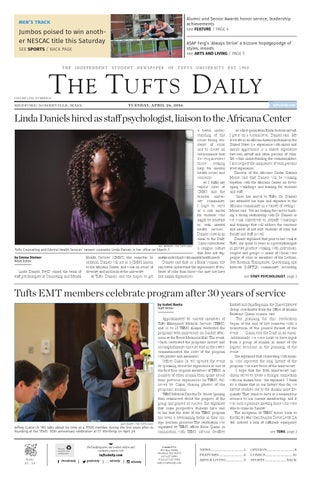
Linda Daniels hired as staff psychologist, liaison to the Africana Center a better understanding of the issues facing students of color and to create an environment that de-stigmatizes those seeking help for mental health issues and concerns. “As I fulfill my various roles at CMHS and the broader university community, I hope to serve as a role model for students who might be reluctant to seek mental health services,” Daniels wrote in an email to the Daily. “I also wish to foster RAY BERNOFF / THE TUFTS DAILY a campus culture Tufts Counseling and Mental Health Services’ newest counselor Linda Daniels in her office on March 7. that does not stigby Emma Steiner Health Services (CMHS) this semester. In matize individuals with mental health needs.” News Editor addition, Daniels will act as a CMHS liaison Daniels said that, as a Black woman, she to the Africana Center, and work on issues of can better understand the experiences of stuLinda Daniels, Psy.D. joined the team of diversity and inclusion at the university. dents of color than those who may not have staff psychologists at Counseling and Mental At Tufts, Daniels said she hopes to get had similar experiences.
“As a first-generation Black student myself, I ‘get it’ on a visceral level,” Daniels said. “My lived life as an African-American female in the United States (i.e. experience with micro and macro aggressions) is a shared experience between myself and other persons of color. Yet, while understanding the commonalities, I also respect the uniqueness of each person’s lived experience.” Director of the Africana Center Katrina Moore said that Daniels will be working together with the Africana Center on developing workshops and training for students and staff. “Since her arrival to Tufts, Dr. Daniels has extended her time and expertise to the Africana community in a variety of settings,” Moore said. “We are looking forward to building a strong relationship with Dr. Daniels as we work collectively to identify workshops and trainings that will address the concerns and needs of not only students of color but faculty and staff as well.” Daniels explained that prior to her work at Tufts, she spent 20 years as a psychotherapist in private practice working with individuals, couples and groups — many of whom were people of color or members of the Lesbian, Gay, Bisexual, Transgender, Questioning and Intersex (LGBTQI) community. According see STAFF PSYCHOLOGIST, page 2
Tufts EMT members celebrate program after 30 years of service by Isabel Banta Staff Writer
ALEX KNAPP / THE TUFTS DAILY
Jeffrey Cukor (A ’90) talks about his time as a TEMS member during the first years after its founding at the TEMS’ 30th anniversary celebration at 51 Winthrop on April 24.
Please recycle this newspaper
Rainy 43 / 34
/thetuftsdaily
For breaking news, our content archive and exclusive content, visit tuftsdaily.com @tuftsdaily
tuftsdaily
tuftsdaily
Approximately 30 current members of Tufts Emergency Medical Services (TEMS) and 10 to 15 TEMS alumni celebrated the program’s 30th anniversary on Sunday afternoon at the Breed Memorial Hall. The event, which celebrated the program’s history and accomplishments since its start in the 1980s, commemorated the roots of the program with photos and memories. Jeffrey Cukor (A ’90) opened the event by speaking about his experience as one of the first four original members of TEMS. A number of other alumni then spoke about their previous experiences on TEMS, followed by Cukor sharing photos of the program’s alumni. TEMS Medical Director Dr. Stacey Sperling then reminisced about the progress of the group and praised its success. She explained that some prospective students have said to her that the state of the TEMS program has been a determining factor in their college decision processes.The celebration was organized by TEMS officer Rosie Quinn, in conjunction with TEMS’ advisor Geoffrey
Contact Us P.O. Box 53018, Medford, MA 02155 617 627 3090 FAX 617 627 3910 daily@tuftsdaily.com
Bartlett and Gina Regonini, the Shared Interest Group coordinator from the Office of Alumni Relations, Quinn, a junior, said. “The planning for this celebration began at the end of last semester with a brainstorm of the general format of the event …” Quinn told the Daily in an email. “Additionally, we were lucky to have input from a group of alumni in many of the logistic decisions in the planning of the event.” She explained that connecting with alumni, who represent the long history of the program, was a key focus of the anniversary. “I hope that the 30th Anniversary luncheon serves to create a stronger connection with our alumni base,” she explained. “I think it’s a shame that in our history thus far, we haven’t reached out to the alumni more frequently. They stand to serve as a tremendous resource to our current membership, and it was such a pleasure meeting those who were able to come on Sunday.” The inception of TEMS traces back to the fall of 1984 when founder David Levitt (LA ’88) noticed a lack of sufficient emergency
NEWS............................................1 FEATURES.................................4 ARTS & LIVING.......................5
see TEMS, page 2
OPINION.....................................8 COMICS.....................................10 SPORTS............................ BACK
2
THE TUFTS DAILY | News | Tuesday, April 26, 2016
Undergraduate tuition, fees to rise in upcoming academic year
T HE T UFTS D AILY Sarah Zheng Editor-in-Chief
EDITORIAL Nicholas Golden Mengqi Sun Managing Editors Nicholas Pfosi Associate Editor Arin Kerstein Executive News Editor Isha Fahad News Editors Abby Feldman Melissa Kain Sophie Lehrenbaum Emma Steiner Ariel Barbieri-Aghib Assistant News Editors Kyle Blacklock Gil Jacobson Robert Katz Liam Knox Catherine Perloff Vibhav Prakasam Hannah Uebele Joe Walsh Kendall Todd Executive Features Editor Nicole Brooks Features Editors Nina Joung Jake Taber Diane Alexander Assistant Features Editors Constantinos Angelakis Emily Cheng Emma R. Rosenthal John Gallagher Executive Arts Editor Lancy Downs Arts Editors Justin Krakoff Josh Podolsky Jonah Allon Assistant Arts Editors Cassidy Olsen Eran Sabaner Hannah Hoang Dorie Campbell Emily Karl Erin Sifre Stephen Dennison Abigail Feldman Shannon Geary Allison Merola Cassie Bardos Miranda Chavez Frances DeFreitas Jake Goldberg Emma Henderson Michael Lefkowtiz Anita Ramaswamy Noah Weinflash
Executive Op-Ed Editor Op-Ed Editor Cartoonists
Editorialists
Maclyn Senear Executive Sports Editor Ray-Paul Biron Sports Editors Ross Dember Phillip Goldberg Alex Schroeder Chris Warren Yuan Jun Chee Assistant Sports Editors Maddie Payne Eddie Samuels Noah Smith Sofie Hecht Executive Photo Editor Alex Knapp Caroline Ambros Picture Tufts Editor Ray Bernoff Staff Photographers Laura DeArmas Maria Ferraz Henry Hintermeister Katlyn Kreie Mia Lambert Jiaxun Li Nora Nord Nicholas Pfosi Julia Press Evan Sayles Angelie Xiong
PRODUCTION Julie Doten
Production Director Astrid Weng Executive Layout Editor Jewel Castle Layout Editors Abbie Gantner Leila Li Allie Merola Brianna Mignano Mandip Pokharel Ellie Powers Annabelle Roberts Emily Sharp Andrew Stephens Sebastian Torrente Shirley Wang Petrina Chan Allison Merola Dana Pek Belinda Xian Jack Ronan Dan Strauss Meagan Adler Alison Beach Arthur Beckel Lancy Downs Alison Epstein Andrew Kager Melissa Kain Sarah Kalinowski Reena Karasin Sophie Lehrenbaum Rachel Salzberg Arielle Sigel Caroline Watson Maxwell Bernstein Nitesh Gupta Evan Sayles
Creative Director Executive Graphics Editor Graphics Editors Executive Copy Editors Copy Editors
Executive Tech Manager Online Editor Social Media Editor
BUSINESS Yiran Xu Executive Business Director Qinyue Yu Receivables Manager Evan Sayles Online Advertising Eva Sachar Ad Managers Jay Hayes
tuftsdaily.com
by Gil Jacobson
Assistant News Editor
James Glaser, dean of the School of Arts and Sciences, and Jianmin Qu, dean of the School of Engineering, sent out an email update to Tufts undergraduate students on April 12, detailing the projected increased tuition and fees for the 2016-17 academic year in an effort to help family financial planning. Undergraduate tuition will increase by $1,784 to $51,304. After factoring in room, board and other fees, the overall cost per student will be $65,996, an increase of 3.6 percent. “The university engages in careful planning to keep tuition as affordable as possible for our students and their families,” Glaser and Qu wrote in the email. While the university has not sent out
emails explaining such tuition increases in the past, Qu explained that he and Glaser decided to send out an update about this matter for the first time. “In setting the tuition and other costs, Tufts looks closely at what resources are needed to deliver the kind of educational experience that our students expect,” Qu wrote in an email to the Daily. “We do our best to control the costs. But many factors are beyond our control.” According to Glaser, the university budget for the upcoming year has already been set, which includes a significant increase in financial aid. “The financial aid budget has increased at a much higher rate than the tuition rate over the past decade,” he wrote in an email to the Daily. According to Glaser, this aid increase allows Tufts to provide students with the
best possible education. “A diverse student body — diverse on many different dimensions — enables students to learn from each other,” he said. “In order to increase financial aid, we have to control our costs and sometimes decide that we can’t do certain things. This is one of the biggest challenges of our jobs as deans.” According to Paul Tringale, secretary of the corporation in the Tufts Office of the Trustees, this tuition increase was the smallest possible option. “Our trustees review all of the factors identified by the deans and senior administrative leadership and approve the smallest possible tuition increase that allows the university to achieve its long- and short-term goals,” Tringale wrote in an email to the Daily.
New CMHS hire aims to address issues of diversity, inclusion STAFF PSYCHOLOGIST
continued from page 1 to Daniels, she worked at the Center for Multicultural Training in Psychology at the Boston University School of Medicine training psychologists and served as director of the People of African Descent Program at the Massachusetts School of Professional Psychology (MSPP), in addition to working in various other roles. Daniels is also currently on the Board of Visitors at Fenway Community Health, a Boston-based medical and research organization that focuses on providing for the medical and behavioral health needs of the LGBTQI community, she said. Her hiring comes after the Blackidentifying student group #TheThreePercent issued a list of demands to the university in resistance to campus racism. The list of demands included one that asked the university to support the mental health of students of color in a more adequate way. “We demand that Tufts be better prepared to address the mental health needs of Black students,” the second demand read. The name #TheThreePercent refers to the percentage of Black students on campuses in Boston. According to an April 24, 2015 Boston Globe article, only three percent of students at Tufts, Boston University, the Massachusetts Institute of Technology (MIT) and Northeastern University are Black. The university’s diversity dashboard indicates that 3.9 percent of undergraduates enrolled in fall 2015 were Black/African American, according to the federal categorization method. Last November, #TheThreePercent movement held a rally and publicly read its demands in during an on-campus march. Other demands included an increase in
the Black student and faculty population to 13 percent to mirror the percentage of Black people in the United States, an end to increased surveillance of predominantly Black events on campus and an an increase in the budget of the Africana Center, among several others. “We, the Black students of Tufts University, united under the name #TheThreePercent, have come together to demand that Tufts address our treatment as second class citizens by the university,” a student at the November march was quoted as saying in a Nov. 18, 2015 Daily article. “The ‘Three Percent’ refers not only to our underrepresentation here as undergraduate students, but also to the same numerical underrepresentation that we have with Tufts faculty.” The student added that the demands are not comprehensive, but reflect the voices of past students of color at Tufts. “We have been silenced, forgotten, heard and ignored,” the student said. Chief Diversity Officer and Associate Provost Mark Brimhall-Vargas said that when the demands were made, CMHS was already in the process of searching for a staff psychologist to address the needs of a more diverse population, and in the past has had psychologists of color and LGBTQI psychologists available. Brimhall-Vargas said that he and Daniels will also be working on a project to identify and compile the resources that exist at Tufts for students who need monetary support. “We are starting to bridge resources that exist at Tufts that provide support for first-generation students or students that have different financial capacity,” Brimhall-Vargas said. “My task to Linda in the coming year is to really do a mapping of the kinds of resources
that exist…and figure out where is the right place to put all of this information … I’m talking everything from you arrive here and didn’t realize it snowed in Boston and need some new clothes, to the kinds of support to get medications or eye glasses, or the ability to get some funds to participate in intramural sports or whatever.” Daniels said that the staff at CMHS is currently working to better address the needs of students of color. “The entire CMHS staff is working together to be able to comprehensively address the mental health service needs of students of color, which will be informed by my work with the broader university community,” Daniels said. “As a result, we expect to see an increase in requests for mental health services at CMHS, and we are all committed to meet that demand.” Director of CMHS Julie Ross, Ph.D., said that Daniels will be working both with individual students and with the university as a whole to improve Tufts’ ability to address the mental health needs of students of color. “Here at Tufts, Dr. Daniels is working with students in individual counseling, serving as the CMHS liaison to the Africana [C]enter, and meeting regularly with students and staff of the center to get to know the community,” Ross wrote to the Daily in an email. She explained that Daniels is also meeting with some of the Groups of Six centers and student groups on campus to better understand the experiences and needs of students of color at Tufts. “Dr. Daniels is also working with administration on issues of diversity and inclusion on campus, including looking at the impact of socioeconomic status and financial need on the student experience,” Ross said.
TEMS celebrates 30th anniversary TEMS
continued from page 1 medical care on campus, according to an article in the Spring 2016 edition of The Pulse, TEMS’ semesterly newsletter. He and fellow EMT Craig Vinch subsequently worked to gain TCU recognition for the group, which began to fully operate in the spring of 1986. “At its start, TEMS only had four members, together managing to cover every night shift during the week and 24 hour shifts every weekend,” the article reads. “They worked out of a small office in what we now know as the Women’s Center. Due to their lack of a vehicle, TEMS members either left their supplies in TUPD cruisers, or carried the bags themselves, walking (or running) to every call they received.” Now, thirty years later, TEMS has a total
of 42 members, with 17 of them being new additions in the 2015-2016 academic year. Since its inception, the 24-hour service officers have responded to over 9,300 calls, according to The Pulse article. During the celebration, TEMS’ leadership members shared plans for the program’s future. “TEMS has grown by the hard work of each year’s board and members, coming up with new ideas to improve our presence on campus, as well as improving the resources we can offer,” TEMS Executive Director Hank Weinstock told the Daily in an email. “Looking towards the future, we are revamping our use of alumni to provide higher level medical trainings, as well as increasing the number of CPR instructors and size of the PE 131 EMT class so that we can offer more training to the community.
Weinstock added that the group is also working to improve internally. “One example of this is now having two in-house certified Emergency Vehicle Operator Course (EVOC) instructors,” he explained. The addition of CPR instructors and EMT classes has allowed further advancement of the program, he said. Maeve Byrne, a first-year in PE 131 EMT, explained that while these EMT classes are not required for acceptance into the TEMS program, they are an excellent resource. “All of our teaching assistants are on TEMS, so talking to them about their experience encourages students to apply,” Byrne said. “Once you go through the course, you test for an EMT license and afterwards you can apply to TEMS if you want to. As far as I know, most people in the class want to apply.”
Tuesday, April 26, 2016 | News | THE TUFTS DAILY
News
Human Rights Advocate
ALICIA YAMIN
TODAY Tuesday, April 26, 5:45-6:45pm Eaton 204 Refreshments will be provided! “Ranging from Colombia to Uganda and Peru to South Africa, Yamin provides examples of how human rights-based approaches can be applied to ‘destabilize and disentrench’ practices and systems that perpetuate
Join BUILD: India for a discussion with Alicia Yamin, Policy Director at the François-Xavier Bagnoud Center for Health and Human Rights at Harvard University about her new book, Power, Suffering, and the Struggle for Dignity: Human Rights Frameworks and Why They Matter. Trained in both law and public health at Harvard, Yamin’s career, at the intersection of health and human rights, has bridged academia and activism. Using Yamin’s personal and professional experiences from a life abroad, we will engage with how human rights can be applied to people’s lived experiences.
inequality and injustice.” -- Paul Farmer, MD Founder of Partners in Health
3
4 tuftsdaily.com
Features
Tuesday, April 26, 2016
Alumni and Senior Awards recognize Jumbos’ achievements on and off campus by Constantinos Angelakis Features Assistant Editor
As the academic year comes to an end, Tufts departments often take time to acknowledge the achievements graduating seniors have made within the Tufts community during their time on the Hill. Alongside these acknowledgements, the Alumni Awards Committee and the Office of Alumni Relations give out the annual Alumni and Senior Awards, highlighting the achievements of graduating seniors and the widespread accomplishments and impacts made by Tufts Alumni. This year, the Alumni Awards were presented on April 2 and the Senior Awards on April 9. The Alumni Awards were started in 1941 by volunteers from the Tufts Alumni Association, according to Mini Jaikumar, who completed her graduate studies at Tufts in 1997, who is the senior associate director for the Alumni Association and Volunteer Management in the Office of Alumni Relations. According to the Alumni Award website, the mission to acknowledge the achievements of alumni within the awards is to both inspire students and “bring honor and a source of pride to Tufts University.” On the other side, the Senior Awards were established in 1955 to honor students who are preparing to become part of the alumni network, as well as to enhance Tufts’ reputation in the world, Jaikumar said. “I think alumni [realized] that they wanted to build strong and positive relationships with the students, especially if they were getting ready to graduate and become part of the alumni world,” Jaikumar said. Throughout their long history, the Alumni Awards have honored generations of graduates from a variety of fields. Past recipients of the awards include Edith L. Bush ( J’ 1903), the first female professor to teach in the School of Engineering, in 1941; Jester Hairston (LA’ 29), the grandson of slaves who became a Hollywood actor and composer, in 1990; and Jonathan Tisch (LA ’76), businessman and co-chairman of the Board of Trustees, in 1997. The Alumni Awards are divided into eight categories based upon the criteria for each award. These include the Distinguished Service and Achievement Awards and the Young Alumni Service and Achievement Awards, the latter of which is set aside for those who’ve graduated within the last 10 years. While today a professional staff in the Office of Alumni Relations is in charge of the Awards, the Awards Committee, which selects the recipients from the nominees, is still composed of volunteers. The Alumni Association also has 16 other committees, includ-
ing the Career Services Committee and the Homecoming Committee, which are also staffed by alumni volunteers. Jaikumar said that the Office of Alumni Relations begins the process of selecting honorees for the Alumni Awards by compiling nominations. These nominations are chosen after reaching out to a variety of different members within the Tufts community. “We will send out [requests for] nominations to all the different graduate and professional schools as well as to all the different people at Tufts, the faculty … and development officers, everybody who works with alumni,” she said. “And we put out a call to all 100,000 alumni.” Nominations for the Senior Awards are compiled in a similar fashion. The Office of Alumni Relations reaches out to academic departments, athletic offices, the Office of Undergraduate Admissions and the Office of Student Life, according to Jaikumar. “We try to reach out to every department and every office at Tufts … where people come into contact with students and again ask them to nominate talented students,” she said. “In the case of Senior Awards, there were 57 nominations this year.” There are several stages in the process of selecting recipients for the Senior Awards, spanning several months beginning at the start of the school year, according to Jaikumar. Submissions are first processed in the Office of Alumni Relations. “Once the nominations all come in, our office is responsible for putting everything together into one big folder,” Jaikumar said. The nominees are then sent to the Awards Committee, which is appointed in July by the president of the Alumni Association, according to Jaikumar. The committee then sorts through the nominations by award category. The members of this committee are all also part of the Alumni Council, which is the governing body of the Alumni association, according to Nancy Pinn (LA ’88), co-director of the Alumni Council’s Awards Committee. Pinn stressed the difficulty of the selection process due to the high number of accomplished nominees the committee receives each year. “For each of the awards, there are so many incredibly accomplished, impressive, humbling stories of individual achievement and community contribution,” Pinn said. “It’s just so hard to choose among so many amazing individual stories.” The process of reviewing applications is meticulous and requires sorting through a large amount of supplementary materials. According to Jaikumar, Alumni Relations compiles hundreds of
Melissa Feito The Story of Stories
pages of applications in total. The Alumni Award applications are selected in December, and the awards committee then goes through the same process with the nominations for Senior Awards in February, according to Jaikumar. Following the committee’s selection process, recipients are notified that they’ve received the honor. As part of the conditions for accepting an Alumni Award, the honoree must be able to come to campus to receive their award at the annual Awards Ceremony. “There’s a bit of logistics that goes into [the ceremony] too … which is a wonderful embodiment of the work that the committee does,” Pinn said. “Even more amazing [is] to have gone through these truly impressive packets, read these stirring stories and then go to the ceremony and actually meet the people behind them. In many cases, people bring families, significant others, et cetera. It’s extraordinarily touching.” In addition to the ceremony, for the first time this year, honorees were invited to engage with students directly through classes and organizations on campus, according to Emma Daniels, an Alumni Relations assistant. “Given these wonderful people coming to campus, it would be such a waste if we didn’t try to engage them with students in some way,” Jaikumar said. For example, Judge R. Guy Cole (A ’72), Chief Judge of the U.S. Court of Appeals for the Sixth Circuit and a 2016 alumni recipient of the Distinguished Achievement Award, visited a political science class focusing on constitutional law on April 1, according to Daniels. “They were very, very excited about it,” Jaikumar said. “We wanted the students to have an opportunity to meet these wonderful people but also wanted these honorees to feel like we really valued them and wanted them to engage with the Tufts community.” The organization of these visits by the alumni reflects the goals of the Awards Committee: to further connect the alumni and students of Tufts, who will one day join the alumni community themselves. “For the Alumni Awards, we’re continuing to think about how best to connect these alumni award recipients to the campus and what’s going on in the life of undergraduates or soon-tobe graduates,” Pinn said. “Similarly, for the Senior Awards, we hope to do our best to encourage Senior Award recipients, but really all graduating seniors, to take an active role in the alumni community, because Tufts is such a great network of people who really care about the world around them and about the university.”
Take the pledge at ItsOnUs.org
IOU_AdCouncil_Celeb_Consent_BW_11.5x21.indd 1
9/3/15 9:52 PM
A 21st century bard
I
’ll admit that music is probably the medium of art I know least about. Despite having played some sort of instrument on and off for most of my life, I am just not as music savvy as I would like to be. Music is very meaningful to me, and I spend my day listening to an insane hodgepodge of playlists, but I don’t nerd out about it with as much glee and detailed precision as much as I do over literature, games or films. That is, except for Joanna Newsom. It probably comes as no surprise it’s partially because Newsom’s albums aren’t just a collection of songs, but a journey, a narrative in their own right, from the first track to the last. The best way I can find to describe Newsom is a indie-folk epicist. She’s the closest thing we’ll have to a bard in the 21st century, and she both performs and writes in the tradition of music storytelling, sometimes following the myth of a specific figure, sometimes exploring a broader emotion or experience through a created character. When she pairs her twangy, uneven voice with her melodic harp, the raw, joyful and haunting effect only enhances the intricate stories Newsom writes into her music. She could be either just a musician, a singer or a poet, and she would already be amazing. But instead, she combines all three of her talents to create truly incredible music. To give an example, the first time I listened to the title track off of her 2010 album, “Have One On Me,” which follows the downfall of dancer Lola Montez, the mistress of King Ludwig I of Bavaria, I was blown away by Newsom’s ability to weave a story worthy of a novel into an 11-minute song. In the climax of the song, which is honestly film-worthy, Lola is hidden away on the train with her lover, racing through the night, drunk and slipping into a frantic sleep while the realization dawns upon her that she has been expendable this whole time. To be frank, I could cite some lyrics, but the written word doesn’t do them full justice. Just go listen. In October of 2015, Newsom released her first album is five years, “Divers.” In this album, Newsom’s character moves through several meditations of death and impermanence in the face of love, her anxiety mounting as she moves through bustling but crumbling human creations in songs such as “Sapokanikan” and “Leaving the City.” The title track of the album, about three quarters through, describes the agony of waiting, through the metaphor of the women who wait for their fishermen husbands to surface. Newsom’s character rejects the notion that men use women as a point of return, a light at the end of the tunnel, not taking into account that she too, is alive and not an anonymous signal of life and love. Last October I was lucky enough to see Newsom live in Boston. I’ve been to a lot of concerts in my time, but never had I had an experience so transcendental as this. She wasn’t just playing songs off a set; Newsom created an intentional narrative experience for everyone in the audience that day.
Melissa Feito is a senior majoring in English. She can reached at melissa.feito@ tufts.edu.
Tuesday, April 26, 2016
ARTS&LIVING
5 tuftsdaily.com
ALBUM REVIEW
A$AP Ferg’s latest, ‘Always Strive and Prosper,’ reveals another side to the rapper by Jonah Allon
Assistant Arts Editor
soul eulogies to his family members like “Grandma.” When it does settle into a tonal register, especially on the bafflingly upbeat “Strive,” the listener might feel as though they’ve stumbled onto the set of a religious infomercial, with “DIAL NOW” flashing over their heads in all caps. Compounding this impression is the album’s title, which, with its strange prosperity gospel overtones, sounds like a Joel Osteen sign-off. Ferg has harnessed his confrontational, disorienting style to brilliant effect on previous projects; take the strangely unsettling banger “Shabba” (2013), or the grittily surreal “Cocaine Castle” (2013). Little of that exhilarating rawness is on display here. The one truly disorienting thing about “Always Strive” is how uncharacteristically vanilla it can get at its lowest points. Granted, Ferg still shows flashes of the technical virtuosity that catapulted him to stardom on tracks such as “Let You Go” and “Yammy Gang.” He even gets some assists from Missy Elliot, Future and Chris Brown, who all bring a unique flavor to the album. But these cameos, enjoyable though they may be, aren’t enough to prop up a sagging effort. If anything, the wide-ranging features end up being a double-edged sword. “Always Strive” might tantalize listeners with its who’s-who of hip-hop and R&B giants, but it serves more as a forum for these artists to showcase their work than a unified vision. Like a piece of cloth stretched past breaking point in all directions, the result is something
The old adage holds that there’s no such thing as bad publicity. But when A$AP Ferg fired off a hasty tweet mistakenly trying to correct hip-hop manager Michael C. Clark on his use of the word “forthcoming” to describe his second studio album, triggering the customary Internet pile-on (“A$AP Ferg getting bodied by a reading error,” read one caption to a screencap of the exchange), it probably wasn’t the type of pre-release buzz he was hoping to generate. Worse, it seemed to put the sophomoric in “sophomore effort.” Putting a more generous spin on an obvious gaffe, Ferg’s new anagrammatic album, “Always Strive and Prosper,” which dropped this past Friday, is a kind of second coming for the Harlemborn rapper. The man who once flatly declared to Pitchfork writer Corban Goble “I wanna be as known as Jesus” has always been heavy-handed with religious allusions, dating back to his self-designation as “Trap Lord” on his studio debut. On the opener to the new album, not-so-subtly titled “Rebirth,” he’s even more blunt: “Now that you’re no longer a lord that’s trap / You have graduated to the Hood Pope.” As entertaining as it is to imagine Ferg decked out in white robes while trading verses with unabashed hedonists like Schoolboy Q and Rick Ross — two of the many high-profile guests featured on “Always Strive” — the vibe on the album is much closer to a megachurch revival than a somber papal proceeding. The term “vibe,” by the way, is used loosely here, shorn of its usual connotations of something fully realized and cohesive. Unlike its predecessor, “Always Strive” is a bizarre, haphazard hodgepodge of styles and moods, veering between Skrillex fever dreams like “Hungry Ham” and unexpectedly heartfelt neo- A$AP Ferg at a show in March of 2013.
transparent and insubstantial. What thrilled rap aficionados about “Trap Lord” was the emergence of a fresh, idiosyncratic voice. Here that voice is muted, drowned out by the bigger, more established guns. Which isn’t necessarily a problem — it’s always fun to hear Schoolboy Q spit a monster verse, as he does on “Let It Bang” — but if the guest verses are your album’s biggest draw, you’re doing something wrong. On the rare occasions where Ferg is allowed to shine through, however, he manages to produce some solid work. And though longtime fans might knock him for going soft, grappling with emotionally charged topics like an unstable uncle and the tragic death of fellow A$AP Mob member A$AP Yams, that brand of wounded vulnerability has always been latent in his music. In “Hood Pope,” Ferg envisioned himself as a positive role model for the wayward black youth of his community who find themselves spiritually adrift. He expands on this theme in the album’s centerpiece, “Beautiful People,” which nods to the Black Lives Matter movement in its uplifting spoken word intro: “If our lives don’t matter, no lives matter/ Thus, life is our future, dying is unacceptable / Living for what we believe in is life itself.” It’s a message at once simple and profound, intuitive and layered. While it may be a little premature for A$AP Ferg to start wrapping himself in the vestments of Hood Pope, “Always Strive” shows that he is more than ready to assume the role of humble messenger.
ELI WATSON VIA FLICKR
Want to get campus news the moment it happens? Follow us on Twitter and Facebook! /thetuftsdaily @tuftsdaily
/tuftsdaily /tuftsdaily
Natalie Girshman ABC's of Literature:
I
V. E. Schwab
’ve read a lot of fantasy over the years, from the time that I was a little girl devouring the works of Diana Wynne Jones to my current complicated relationship with “A Song of Ice and Fire” (1996 – present) from George R. R. Martin (yes, I’m still waiting for “The Winds of Winter”). As a result, I can be a little jaded. Mysterious older wizard who likes to offer unsolicited life advice? Same old story. Dragon ravaging the land? Been there, done that. Farm boy with a mysterious destiny who’s surprisingly good with a sword? Yesterday’s news. (Of course, I still will happily consume any and all of these tropes when they’re offered to me.) But the novels of V. E. Schwab all offer something completely different. “Vicious” (2013), Schwab’s take on the superhero genre, flashes back and forth in time to tell the story of two ambitious college roommates. In their senior year, Eli and Victor’s research in adrenaline, neardeath experiences and people with powers leads them from the theoretical into the real and the dangerous. Ten years later, Victor has broken out of prison, and there’s only one thing he wants: revenge on Eli. Superheroes are often the province of comics and movies, but “Vicious” makes a compelling case for the superhero novel. Schwab’s writing delivers clever plot twists and striking images without ever sacrificing the forward momentum of the plot or the delicious moral ambiguity of the characters. This book takes established ideas about heroes and villains and flips them all on their heads. There’s experiments gone wrong, and menacing sidekicks and dramatic final confrontations, but somehow they’re nothing like all the ones you’ve seen before. “Vicious” is original, daring, and will inevitably leave you hoping for a sequel. “A Darker Shade of Magic” (2015) is equally, if not more so, creative and is quite possibly one of the best books I read all last year. It takes place throughout three iterations of London: Grey London, which is without magic and ruled by a mad King George; Red London, where magic thrives and the royal dynasty presides over a vibrant city; and White London, where magic and power belong to whoever’s cruel enough to take them. There’s also Black London, but traveling there is forbidden, and the city’s name is never spoken. Kell is one of those with the rare power to travel between all three worlds, officially a royal messenger and unofficially a smuggler. When he runs into Delilah Bard, a cross-dressing thief with ambitions of piracy, in Grey London, she robs him and convinces him to take her on an adventure. Kell and Lila are both downright delightful main characters, particularly if you have a weakness for thieves and rogues. The world is endlessly creative and packed with thoughtful details that had me yearning to see even more of each and every London and spend hundreds more pages with this world and these characters. Although the first third or so is a little slower, the plot builds and builds until it’s impossible to put down and the conclusion both satisfies the reader and leaves hints for the next book. The novel’s a must-read for all fantasy fans. Natalie Girshman is a senior majoring in history and drama. She can be reached at natalie.girshman@tufts.edu
6
THE TUFTS DAILY | Arts & Living | Tuesday, April 26, 2016
tuftsdaily.com
CONCERT REVIEW
Father John Misty proves he is a modern-day rockstar at Boston show by Eran Sabaner
Assistant Arts Editor
It is 8:50 p.m. and the crowd is eagerly waiting for Father John Misty at House of Blues. The venue is fully packed, it is impossible to move in the general area. As the stage crew raises the microphone to nearly 6.5 feet, the audience is unable to comprehend what’s to come. Yet, when J. Tillman walks on stage, the height of the microphone makes sense. Impressively tall, wavy haired and bearded, Tillman looks like Jesus from a medieval painting. With all weightiness, he starts singing “Every Man Needs A Companion,” an expected, and yet also an odd choice for the opener. While “Every Man Needs A Companion” has always been the opener, it is peculiar
since a large portion of the audience is not familiar with Tillman’s (as Father John Misty) debut album “Fear Fun” (2012). Also, although it is a brilliantly affecting song, “Every Man Needs A Companion” is not necessarily the liveliest. The song was certainly not a presage of the rest of the show, which was unexpected, dynamic and thoroughly entertaining. Tillman has released only two albums as Father John Misty, so he is able to get through most of his repertoire over the course of a show. When live, Tillman sounds even better. He is able to alter his songs and add a certain twist to them. The only disappointment of the concert would be fan-favorite “Chateau Lobby #4,” which unfortunately lacked the trum-
pet that made the recording of the song stand out. That said, Tillman succeeded in altering many of his songs for the stage, “True Affection” being the best example. Tillman transformed “True Affection,” recorded as an electronic song, to a rock jam that truly roused the audience. Finding the perfect venue for a Father John Misty concert is tricky. Tillman loves audience participation, yet the venue also has to be able to accommodate a large group. House of Blues is the perfect middle ground; it’s neither an arena like TD Garden nor a small establishment like the Sinclair. Audience participation was especially necessary for “Bored in the USA,” as it provided the necessary laughing tracks on the song.
Tillman closed the show with “True Affection,” but returned to the stage for a three-song encore. The first of which, “I Went to the Store One Day”, was hauntingly beautiful yet very simple. Tillman performed by himself with his guitar. The big surprise was Tillman’s rendition of the iconic Nine Inch Nails song “Closer.” Although Father John Misty’s overall sound is indeed different from Nine Inch Nails, the sex appeal of Tillman matched perfectly with the provocative lyrics of “Closer.” The final song of the encore was “The Ideal Husband,” and it featured a bizarre dance performance that was uniquely Tillman. In a sense, the performance of “The Ideal Husband” was an encapsulation of the show: loud, eccentric and sexy. It was one of a kind.
LUIS SINCO VIA TRIBUNE NEWS SERVICE
Father John Misty performs at the Coachella Music and Arts Festival on April 14, 2013, in Indio, CA.
Tuesday, April 26, 2016 | ADVERTISEMENT | THE TUFTS DAILY
tuftsdaily.com
EXPLORE
the possibilities
at UMass Boston this summer
Register Now!
Learn more at: summer.umb.edu 700+ courses to help you reach higher and look beyond
Accelerate your studies Complete requirements Mornings, afternoons, evenings and online
Session I begins: 5/31 Session II begins: 7/18
Earn biology, history and environmental science credits on Nantucket Island Study abroad, field study and service learning Gain new perspectives
Halls Close @ 12pm on Saturday, 5/14
ALL STUDENTS:
for all non-graduating students! Halls Close @ 12pm on Monday, 5/23 for all graduating and remaining students!
Make sure all furniture is accounted for
in your room.
Return your keys to
one of the following locations before you leave campus:
Carmichael Hall Room 158 Hill Hall Lobby Key Box
South Hall Lobby Key Box TPD, Dowling Garage (24/7) Residential Facilities, 520 Boston Ave (Monday - Friday, 9am - 5pm ONLY)
Defrost and clean out Microfridge and
contact TSR for pick up instructions. Throw away/take home all food. Empty and clean all closets, desks,
drawers, etc. Remove all personal trash and dispose in
the dumpsters outside your building. Sweep and vacuum your room. Remove any tape residue from doors
and walls. Remember to take home your bike! Remove any non-Tufts furniture from
your room/suite before you leave. Complete a Room Checkout with your
RA, ARD, ORLL or Facilities staff member. ..
The earliest continuing undergraduates can return to campus is Friday, September 2, 2016 at 9:00am
Important Dates Monday, 5/2 - Classes End Tuesday, 5/3-Thursday, 5/5 Reading Period
Friday, 5/6 – Friday, 5/13 - Final Exams
Saturday, 5/14 - Halls close at 12noon for all non-graduating students
Continuous
Monday, 5/23 - Halls close promptly at 12pm for all remaining students.
Quiet Hours Begin at 11pm on May 2nd Please be respectful of your fellow students as they prepare for finals. Have questions about the above?
Tufts Residential Life and Learning Office
Call us at 617-627-3248 or email at reslife@tufts.edu
7
8 tuftsdaily.com
Opinion EDITORIAL
The choice to place Harriet Tubman on the $20 bill Treasury Secretary Jack Lew (the man who signs all of your dollar bills) announced last week that Harriet Tubman will be placed on the front of the new $20 bill. While initial news had it that President Andrew Jackson would be removed completely, it turns out that Tubman will share the bill with him. The news was received well by many, easing fears that Alexander Hamilton, the Founding Father without a father and the creator of many of the United States’ financial systems, would be removed from the face of the $10 bill. However, others were not quite as pleased. Shouts of Lew attempting to “erase history” have been sounded, and politicians like Donald Trump have criticized the Secretary for altering American tradition due to politics and “pure political correctness.” The irony of Jackson’s placement on legal tender is not lost on everyone — Jackson fought hard to abolish the Bank of United States and even spoke outwardly against the establishment of a national paper currency. For many, having him become the face of the $20 bill in the
first place seems counterintuitive. On top of this, criticisms of Jackson, particularly from the left, are endless. From orchestrating the Trail of Tears to instituting the so-called “Spoils System,” Jackson’s demonstrations of inhumanity and corruption have turned many modern day liberals against him. Unfortunately for his most ardent opponents, Jackson’s image will still be featured on the back of the bill alongside the current image of the White House. Surprisingly, the most striking criticism of Tubman’s placement on the $20 bill has come from the left. Tubman’s act of leading slaves to freedom was ultimately a subversion of the American capitalist system, under which she and millions of others had been enslaved. Many have therefore claimed that making Tubman a symbol of capitalism would be a downright insult to her legacy. Tubman’s placement on the $20 bill and Jackson’s relegation to the back demonstrates that the oppressor can legitimize their system with images of the oppressed. Certainly, there is still work to do in
America, but having Tubman on the front is still remarkable as a symbol for both the positive changes we have already made as well as those we can accomplish in the future. Further, the effort to put Tubman’s image on our currency was jump-started last year by an activist group for historic change called “Women on 20s.” This makes the decision proof that at least some of our government agencies listen to the people’s voice and are willing to push for citizen-driven change. Perhaps the most remarkable detail regarding Tubman’s placement on the $20 bill is the fact that it is the same denomination her father paid to buy his wife’s freedom in the late 1840s. Secretary Lew is not “erasing history.” He is emphasizing a chapter of history that has been downplayed among official narratives for far too long. In the words of Thomas Jefferson, “If a law is unjust, a man is not only right to disobey it, he is obligated to do so.” Our government should not ignore the civil disruptors of the past, but should instead acknowledge and prioritize them.
EDITORIAL CARTOON BY ABIGAIL FELDMAN
The Tufts Daily is a nonprofit, independent newspaper, published Monday through Friday during the academic year, and distributed free to the Tufts community. The content of letters, advertisements, signed columns, cartoons and graphics does not necessarily reflect the opinion of The Tufts Daily editorial board. EDITORIALS Editorials represent the position of The Tufts Daily. Individual editors are not necessarily responsible for, or in agreement with, the policies and editorials of The Tufts Daily. OP-EDS The Op-Ed section of The Tufts Daily, an open forum for campus editorial commentary, is printed Monday through Thursday. The Daily welcomes submissions from all members of the Tufts community; the opinions expressed in the Op-Ed section do not necessarily represent the opinions of the Daily itself. Opinion articles on campus, national and international issues should be 600 to 1,200 words in length and submitted to oped@tuftsdaily.com. The editors reserve the right to edit letters for clarity, space and length. All material is subject to editorial discretion and is not guaranteed to appear in the Daily. Authors must submit their telephone numbers and day-of availability for editing questions. ADVERTISING All advertising copy is subject to the approval of the Editor-in-Chief, Executive Board and Executive Business Director.
Tuesday, April 26, 2016
Luke Sherman Earth On Fire
An energy crossroads
R
egional environmentalists scored a huge victory last week. After years of protesting energy giant Kinder Morgan Inc.’s proposed natural gas pipeline that would have crossed though eastern New York, northwestern Massachusetts and southern New Hampshire, community activists successfully exerted enough pressure on state and federal lawmakers to publicly oppose the 188-mile pipeline, which ultimately led to the project’s demise. A broad coalition of powerful elected officials, grassroots environmental groups and established non-profit organizations proved too much for the Texas-based company to overcome. Had Governor Charlie Baker (R-Mass.) declined to endorse the highly controversial measure of charging electric ratepayers for the pipeline’s construction costs, a step approved by the Department of Public Utilities (DPU) last fall, Kinder Morgan would likely never have put forward the plan in the first place. Democratic politicians in Massachusetts, including Senate President Stan Rosenberg of Amherst, lined up against the proposal, aided by the Conservation Law Foundation appeal of the DPU’s decision, which company executives cited as one of the main reasons it opted to shelve the project. This development only intensifies the debate concerning Massachusetts’ energy future. A number of corporations and the Baker administration argue that the state needs new natural gas pipelines to lower the Bay State’s energy costs, which rank among the highest in the nation. Alternatively, environmentalists — and many Democratic elected officials — contend that Massachusetts can satisfy its electricity demands by investing in renewable energy sources and energy efficiency. Last year, Attorney General Maura Healey (D-Mass.) buttressed their arguments when her office released a landmark study indicating that the state does not need new fossil fuel infrastructure projects to meets its demands. “This study demonstrates that we do not need increased gas capacity to meet electric reliability needs, and that electric ratepayers shouldn’t foot the bill for additional pipelines,” Attorney General Healey said in a statement in 2015. “A much more cost-effective solution is to embrace energy efficiency and demand response programs that protect ratepayers and significantly reduce greenhouse gas emissions.” Invigorated by their recent victory, environmental activists will meet in West Roxbury, a neighborhood in Boston, this Saturday to protest the construction of another major pipeline project, this time proposed by Houston-based Spectra Energy. On May 3, No Fracked Gas in Mass, a reference to the highly polluting process known as hydraulic fracturing, and Mass Power Forward will rally at the steps of the Statehouse and pack an oversight hearing convened by the Senate Committee on Global Warming and Climate Change. Massachusetts currently stands at a crossroads: either it can lock itself into a future powered by fossil fuels or spur the growth of the wind and solar industries. Governor Baker and Attorney General Healey have made their positions on this issue known. Have you? Luke Sherman is a senior majoring in Environmental Studies. He can be reached at Luke.Sherman@tufts.edu.
Tuesday, April 26, 2016 | Opinion | THE TUFTS DAILY
Opinion
9
OP-ED
Letter to Monaco by Luis Del Rosario Dear President Monaco, Dean Glaser, Dean Qu and the Board of Trustees, We, the student leaders signed below, are writing to express our concern over the recent tuition hikes announced via the email titled, “2016-2017 Tuition Update,” sent to the undergraduate student body by Dean James Glaser and Dean Jianmin Qu on April 12, 2016. The announcement of an increase in tuition, room, board and fees by 3.6 percent to $65,996 is deplorable. We are aware that this is the smallest tuition hike in the past four years, but these exorbitant fees and recurring increases continue to burden students and families unable to keep up with them. Just five years ago, as the Class of 2011 matriculated, the cost of attendance at Tufts University was $52,866. We are currently the fourth most expensive private college in the United States. If Tufts continues the trend of increasing tuition by 3.6 percent each year, the projected tuition for the 2019-2020 academic year will be $73,383.25. This projection is only a modest one, considering that this 3.6 percent increase “is the lowest in the past four years.” Academic Year
Projected Tuition
2015 - 2016
$63,698
2016 - 2017
$65,996
2017 - 2018
$68,372
2018 - 2019
$70,833
According to the US Department of Commerce Economics & Statistics Administration, the median household income in 2014 was $53,657, well below the 2014-2015 academic year price for tuition, room, board and fees of $61,277. The widening gap between the rising cost of attendance at Tufts University and the decreasing median household income is problematic for a growing and more diverse student body. While we are pleased that Tufts has accepted its “most diverse class of admitted students in more than a decade,” it is not enough to simply accept a diverse class. There must be a strong commitment to keeping tuition low and providing students with substantial financial aid so that students are empowered not only to enroll, but also to complete their degrees. We are alarmed at the costs of attending this institution and have been calling for greater transparency for years with little to no response from the university. We cannot continue to sit by as we watch our
tuition rise each year without any justification or explanation. This university must be more transparent about where our money is being spent and must include more student voices in conversations surrounding tuition increases, university budgeting and fiscal priorities. We request a prompt and public response to the concerns outlined in this letter, and to the demands found on the petition attached. Sincerely, Fatima Ajose LA ’18, former TCU Senate Africana Community Representative Parker Breza LA ’19, TCU Senate LGBTQ+ Community Representative Jacqueline Chen LA ’19, TCU Senate Asian American Community Senator Anna Del Castillo LA ’18, former Diversity and Community Affairs Officer Luis Del Rosario LA’18, former TCU Senator Benya Kraus LA ’18, TCU Senator Emily Sim LA ’19, TCU Senator Charlie Zhen LA ’19, TCU Senator Through conversations with many students across this university, including those involved with the First-Generation College Student Council, BLAST Scholars and Questbridge Scholars, student leaders have compiled the following demands. We have circulated a petition throughout the student body to show our united concern about the increasing financial burden being placed on students. We demand the following: We demand justification and explanation for all tuition increases In the email mentioned above, there was no explanation as to why tuition rose. We demand an itemized and public rationale for where this money is being allocated, and why we, as students, are footing the bill. We demand families be notified of tuition hikes It is concerning that this email was only sent to the undergraduate student body and not to our parents, many of whom are key stakeholders in financing students’ educations. It is not our responsibility to deliver financial decisions made by our university and explain the increase of $2,298 to our families. We demand Tufts continue to meet 100 percent demonstrated financial need While we appreciate that this is the current admissions policy, and demand that it continue to be, we also demand greater transparency in how “demonstrated financial need” is calculated. We demand that this process also reflect and support the changing nature of students’ financial needs throughout their time at Tufts.
We demand that Tufts move to a needblind admission policy While not institutionalized, the classes of 2011 and 2012 were admitted under a need-blind admissions policy. Under President Emeritus Larry S. Bacow, the university was able to mount an expansive capital campaign that allowed a significant boost in financial aid grants. It was accomplished once and it can be accomplished again. President Monaco once said he “regrets the limits he has set on the aid budget,” noting that being needaware has contributed to a plateau in the diversity of the student body. “We would like to do better,” he said. We demand that the university move to an official needblind admissions policy beginning with the Class of 2021 and beyond. We demand a tuition freeze per class year When a class of students is admitted to this university, the tuition price they are admitted under is subject to increases such as this one. Students should not be fearful every spring that their bills will rise as tuition continues to increase. We demand that the tuition price, under which each matriculating class is admitted, remain constant and locked throughout their time at Tufts. We demand clarity on bills The current billing process does not provide a detailed outline of what we are being charged for. Bills fluctuate every term and it is difficult to understand what we are paying for. Many students do not know what resources, if any, are available to help them make sense of their bills and financial aid packages. We demand that university bills include clearer and more thorough explanations per line item charged.
We demand greater support from the financial aid office The financial aid office is inaccessible due in part to its inconvenient and insufficient drop-in hours. Financial aid officers do an inadequate job of reaching out to students, and the recent replacement of counselor Al Mangini without proper notification demonstrates the lack of communication between the office and the student body. We demand that the university actively ensure that students are provided better support to better understand and analyze their financial documents. We refuse to allow our tuition to be leveraged We will not allow Tufts University to pit workers on campus, students on financial aid, students of color, undocumented students and other members of the Tufts and wider communities, of which we are a part, against one another. We will not entertain excuses that workers on this campus cannot be paid living wages or that we cannot enroll a racially and economically diverse undergraduate student body while also keeping tuition low and financial aid high. These things are not mutually exclusive. In the event that any of these demands are unable to be met, we demand the university make a public response explaining the explicit rationale for their noncompliance.
Luis is a sophomore majoring in international relations. He can be reached at luis. del_rosario@tufts.edu.
Do you live off campus? Planning a Party for Spring Fling?
FREE
y t r a P Pack
Wednesday, April 27th Thursday, April 28th 12:00-1:30pm Campus Center
TUFTS SUMMER SESSION 2016 prepare. eXpaND. Develop. school of arts and sciences | school of engineering
Three sessioNs: May 25–July 1 | July 5–augusT 12 | May 25–augusT 12 go.tufts.edu/summer Follow us on facebook:
College & Pre-College Programs Day & Evening Classes Affordable Tuition
Outstanding Tufts Faculty Online Courses
In keeping with the spirit of fun on Spring Fling, we want to ensure your safety and good decision making during your event. FREE Safe Party Packs are stocked with snacks, essential party supplies, and tips for safe and responsible party hosting.
10
THE TUFTS DAILY | Comics | Tuesday, April 26, 2016
Comics
tuftsdaily.com LATE NIGHT AT THE DAILY Jack: “I would do filthy things for $50 an hour.”
Comics
SUDOKU
JUMBLE
Difficulty Level: Losing track of your friends at Spring Fling.
Monday’s Solution
NON SEQUITUR BY WILEY MILLER
CROSSWORD
Monday’s Solution
our contact (617) 440-7361 or
bostonburgerco.com
our hours
our location 37 davis square somerville, ma 02144
mon - wed:
11 AM to 10 PM
thurs - sat: 11 AM to 11 PM sun: 12 PM to 8 PM
Tuesday, April 26, 2016 | Sports | THE TUFTS DAILY
Sports
After earning tough win, Jumbos prepare for final stretch of regular season, NESCAC tournament MEN'S TENNIS
continued from back page play well on their home courts, and that’s what ended up happening.” Singles play started with split results. Bates came out with the first match win at the No. 1 spot, as Glickman was swept 6-2, 6-0 by Rosen. Junior Kevin Kelly of Tufts countered with a win at the No. 6 spot, taking down junior Brent Feldman in straight sets 6-3, 6-4. The final four matches of the day, even more closely contested, finished in three sets. Scott outlasted Jacobson, 3-6, 6-2, 6-2, in the No. 3 position after the Tufts senior took the first set. Cary, however, shifted the match momentum back in Tufts’ favor with a 2-6, 6-0, 6-2 over Quijano at No. 4. This set the stage for the final two matches for Coran and Ali. Coran, playing at No. 5, eked out a win against Ordway in a tiebreaker after losing the first set, 4-6, 7-6 (5), 7-6 (6). Ali and his No. 2 singles opponent Ellis played out to 2-6, 6-3, 6-3 in Tufts’ favor. The gritty play from Tufts, clawing back for a victory in such a close match, has been characteristic of the team this year. “One thing that’s huge from this year, and that’s different from last year, is that last year we actually lost three matches 5-4 and this year we won all four matches that we’ve gone 5-4,” Ali said. “Being in that circumstance, being down, we knew we could come back because we’ve done it a couple of times this season.” With all of the other matches completed, everyone’s attention turned to those final two deciding courts, as Tufts fought to take over the lead. This dynamic — with both teams watching in anticipation, everything riding on the last matches — provided a thrilling ending to the day. “I mean it’s so fun. That’s my favorite part of Div. III tennis in the main season is those clinching matches,” Glickman said. “It’s a position that you want to see your team in. It makes the whole atmosphere more fun, everybody’s really loud and into it, and supporting our teammates is huge in a situation like that. That really makes a big difference
in the momentum of the matches, really carrying your teammates through. We were very supportive of both Zain and Danny in their matches.” “Honestly, what I thought was the best thing about that day, was the energy between the courts,” Ali added. “Danny and I never played together in doubles, that was the first time we played together, and we were the last two courts to play on singles, too. So just from winning that doubles match, Danny and I just had so much energy. Me and him were screaming between courts. We had a fence between us, but we were going like — I kept screaming to Danny, ‘You and me D, we’re coming back, we’re bringing this match back to Tufts.’ Like we just kept yelling at each other, screaming at each other.” Ali continued on about the high-intensity atmosphere, citing that his Bates opponent even tried to instigate a fight during the match, as Ali was continuously questioning line calls that Ellis was making regarding whether shots were landing in or out. Emotions running high, each player wanted to do every little thing possible to pick up points or knock his respective opponent out of rhythm. In the end, it was Tufts’ momentum that led both Ordway and Ellis of Bates to double-fault, sealing the win for the Jumbos. “Everyone knew how big of a match it was,” Ali said. “Bates needed it because they needed to get into the NESCAC tournament. We needed it to save our season and stay in the NESCAC tournament … It was probably one of the most fun dual college matches that I’ve had in my two years.” Tufts has just two regular season matches remaining, one at MIT on Friday and one at home on Sunday. The team will enjoy an extended break this week with no competition scheduled until Friday. Though the Jumbos have been playing without some usual starters — such as sophomore Rohan Gupte and senior Nik Telkedzhiev — out of the lineup due to injury or personal issues off the court, according to Ali, they’ve fought hard to adjust and pick up the wins they needed to extend play into May. With the win against Bates,
Tufts almost guarantees itself a NESCAC seed in the tournament. Though the team has put itself in a good position to qualify for postseason play, the road ahead will be no easier and the team must continue preparing. “At this point, I think we’re in a good position to make NESCACs,” Glickman said. “The Bates match was a crucial match for us to kind of solidify our position … I think as of right now we’re the No. 5 seed going in. The NESCAC is really tough. I talked about this before, but there are six teams that are going to make NESCACS that are all ranked top 15 in the country.” The Bowdoin match, specifically, will be a great test heading into the postseason. “If we can beat [Bowdoin] on Sunday, that would be amazing because last year we went 5-4 with them and they’re pretty much the same team … and we’re pretty much the same team too,” Ali said. “They’re competing a lot better this year, but we don’t really care. We know we can beat them. We’ve taken out big teams like Amherst this year, and people didn’t expect that. People aren’t expecting us to beat Bowdoin either. I’m hoping that we have a lot of good energy, people firing on every court.” Over the next couple of days, the Jumbos will have plenty of time for individual players to focus in on what specific issues and improvements they would like to address before the weekend’s matches. Rest will play in heavily as the team prepares for one last push over the end of the regular season and into conference championship play. “I think the key for the matches this weekend, especially the Bowdoin match on Sunday, is just going in with the right mindset because at this point in the season I feel like a lot of people are mentally fatigued and maybe a little bit physically fatigued as well, and this end part of the season with the last two matches and also NESCACs will be a great test for us to kind of prove our endurance,” Glickman said. “And in my opinion, our team definitely has that endurance. We’ve worked hard this entire season and offseason to make sure that at this point in the season we’re playing our best tennis.”
Jumbos look to stay on top the NESCAC in upcoming conference championships MEN'S TRACK
continued from back page Henry Hintermeister finished first and second in the 400-meter hurdles as Tufts continued the impressive streak. Swett was also a big part of the Jumbo domination in the throws as he won the shot put and came in second in two more events. His 13.89 meter performance in the shot put was first out of 15. Swett was the runner-up in the discus throw and the javelin throw. In discus, he fell to Jason Beauregard of WPI and was bested by Aaron Weeks of WPI in the javelin. Nearing the end of the day, the 4×100 relay team ran a 43.06-second race to win that event as well and give Tufts its eighth event win on the day. Hoover-Hankerson, Clark, Miller and first-year Anthony Kardonsky were part of the team that topped UMass Boston, Amherst and Mass. Maritime. “It was raining for most of the meet, but the sun came out at the end it was a good way to finish off the meet and begin a tradition,” Kardonsky said. Kardonsky also noted that even though it was cloudy and rainy for most of the day, which certainly affected the performances and marks, the sun did come out as the men’s long and triple jump events began. “A lot of the guys were treating this meet as a miniature NESCACs and everyone was getting very competitive,” Paloian said. “It was a lot of just mental preparation and set the stage for NESCACs. I know a lot of people had
to hit marks that were above their personal records to qualify. Thankfully, a lot of guys PR’d and qualified for NESCACs. We have four guys in hammer and shot [put] so we don’t have to wild card any throwers into any of those events, which is huge.” Arguably the team’s top performers were not in action on Saturday, having competed Friday night on a much bigger stage. Three-time NCAA champion and AllAmerican senior tri-captain Mitch Black led the Jumbo effort at Princeton, posting the top time in Div. III this season in his signature 800-meter event. His 1:48.60 time was also the ninth-fastest mark all-time in Div. III. Joining Black in the national top 15 ranks were junior Luke O’Connor, who ran the fourth-fastest time in the 3,000meter steeplechase, and senior Veer Bhalla, whose 1:52.64 in the 800 was 15th in Div. III. The experienced duo of Black and Bhalla in particular, in addition to being the name of a sick rap group, seems poised to dominate the 800 meters at this weekends NESCACs once again. Track and field athletes rarely concern themselves with the team’s overall finish at most meets, instead focusing more on the strength of and improvement in individual performances, but this weekend will mark one of those rare times when the overall team result and point tally is the only thing that matters. This Saturday, the Jumbos look to defend their status on top of the conference
and win their fourth consecutive NESCAC title. Following some of the most successful indoor and outdoor seasons in program history, the team is both excited and ready for the chance to cement itself as one of the winningest programs in Tufts athletics history. Another NESCAC title would give men’s track and field six titles overall, tying them with men’s lacrosse for the second highest total across all Tufts sports behind softball. Two of this week’s biggest performers are ready to repeat that success next weekend. Paloian, one of many seniors on the team, will be looking to continue his dominance from this past weekend into his final NESCAC performance. “I feel good heading into NESCACs. The confidence is definitely there,” Paloian said. “I’m confident in myself and when the moment comes, when you’re in the circle, I know my teammates and I will be there performing and let it all hang loose,” For the first-years, many of whom will be counted on to be key contributors this weekend, their first NESCAC championship represents a unique challenge and opportunity. Etkind, on of the team’s first-year phenoms and a reliable point contributor all season long, says he is confident in his ability to perform under the high pressure of NESCACs. The whole season has been building to April 30 at Amherst, and the Jumbos are in a prime position to take the NESCAC crown once again.
11
Nicole Brooks Jersey Over Apron
Youth Sports
W
ith the popularity and heightened discussion around collegiate and professional athletics today, fans must use a critical eye to be able to give the necessary push back against sport’s interactions with society, specifically regarding sports’ negative connections with violence, corruption and of course, the various social inequalities. Throughout this column, I have largely focused on these broad trends within both collegiate and professional athletics. However, when we discuss sports, we should also consider the beginning amateur level. Whether it is your local Pop Warner league or Little League team, how we first experience sports at the youth level provides a context for acceptable behavior, relationships and what kind of participation is expected. By understanding the overall progression from these local and amateur levels, we can better discover details that can help us change negative aspects of sports while also furthering the positive values that are cherished at a youth level. The beauty of youth sports often lies in the amateurism of the game. For some spectators, however, watching young sixyear olds play organized soccer for the first time may strictly resemble chaos. With tiny toddlers running around in reckless abandon, numerous miniature collisions making novice soccer moms shriek and of course, the countless tears shed following a loss, youth sports are often mislabeled as a trivial affair. Nonetheless, this level does something that is often overlooked. The introduction of the game to a young child not only gives them context for their relationship with sports, but it’s also the first time that they are learning sporting behaviors and values from their first coach. Youth coaches are probably some of the most overlooked factors in the development of an athlete. What’s true with any athlete at any level is how their youth coach first introduced them to the game. Introducing a sport to a child can seem minor, but the first experience of sport can change a child’s perspective on sport for life. Beginning athletes are taught the skills of the game along with elements of sportsmanship and teamwork, while they are also introduced to a competitive environment for first time. However, with any youth there are various factors that can influence these coaching. This includes a coaches’ own experience with youth sports, demanding parents and of course the culture of the community the team is functioning within. In shows like “Friday Night Tykes,” young athletes’ experiences with highly demanding and yelling coaches demonstrate how toxic youth sports can become as players were instructed to rip opponents heads off and run until they pass out and were reprimanded severely in front of their teammates. Although “Friday Night Tykes” may show an extreme example of how coaching youth sports can be arguably abuse some of the belief that the coaches’ approach originally was sincere — they just wanted to get the best out of their players. Nonetheless, the impact of the coaching on these athletes has changed their outlook on the game forever. It’s more than just fun and games. By looking at the contexts and strategies adopted at the youth level, we can better combat issues of violence and bullying that are so often connected with sport. But first we have to acknowledge how much youth sports matter. Nicole Brooks is a features editor at the Tufts Daily. She is a senior majoring in history and minoring in communications and media studies and can be reached at nicole.brooks@tufts.edu.
12 tuftsdaily.com
Sports
Tuesday, April 26, 2016
MEN'S TENNIS
Tufts men’s tennis completes comeback with win at Bates by Alex Schroeder Sports Editor
Tufts tennis had been trailing for the entirety of its matchup against Bates going into the final two singles matches on Friday. At No. 5 singles, sophomore Danny Coran of the Jumbos was locked in battle against junior co-captain Pat Ordway of the Bobcats, and at No. 2, Tufts sophomore Zain Ali took on Bates junior Chris Ellis. Down 3-4, the visiting Jumbos needed to pick up the remaining two contests in order to come away with the victory. With come-from-behind wins by first Coran and then Ali, Tufts did just that. The No. 13 Jumbos escaped from Lewiston, Maine with a 5-4 win over the No. 24 Bobcats, further securing a potential spot in this year’s NESCAC tournament. After Bates jumped out to a 2-1 lead in doubles play, Tufts was put in a tough position to overcome an early deficit. Led by resilient play in the singles sets, Tufts regained control and took back the match. “We came back together, we were down 2-1,” Jay Glickman, a senior, said. “We had been playing great singles this entire year. That’s kind of been a big strength of our team, and I think that going into the singles we just felt like we were mentally and physically prepared to play that day. We came out kind of firing on all cylinders, started singles pretty strong, but I think we lost a
couple of first sets. What ultimately determined the match was our ability to stay out there and fight … Our team is just a lot of fighters and they don’t give up.” Bates kicked off play with wins at No. 1 and 2 doubles. Ellis and sophomore Ben Rosen beat Tufts senior tri-captains Nick Cary and Rob Jacobson at the top doubles spot, 8-4. In the second position, Ordway and sophomore Fergus Scott beat Glickman and sophomore Griffin Brockman by the same score. Tufts was able to secure one doubles win in the third spot, as Ali and Coran teamed up for the first time in their careers to take down sophomore Josh Leiner and first-year Josh Quijano of Bates by a score of 8-6. Over the course of the season, Bates has played strong doubles competition due, in part, to relatively static lineups and steady performance, whereas Tufts has switched positions more frequently. When the teams met Friday, Bates’ consistency triumphed. “In doubles this year, we’ve kind of mixed up our doubles lineup a lot, and it takes some time to build chemistry,” Glickman said. “And I think the Bates teams have been playing together for the entire year. In my opinion, they ended up getting up 2-1 because they’ve been playing solid doubles this year. I wouldn’t say they’re necessarily better teams, but they see MEN'S TENNIS, page 11
COURTESY ROB JACOBSON
Zain Ali (LA ’18) of the men’s tennis team hits the ball in a match against Colby in Palm Springs, CA on March 24.
MEN'S TRACK
Jumbos dominate Sunshine Classic, look strong ahead of NESCAC Championships by Soven Bery
SOFIE HECHT / THE TUFTS DAILY
The big performance of the day came from first-year Josh Etkind, who competed in the 110-meter hurdles and the triple jump. His 15.39 second time in the 110-meter hurdles final is Tufts’ best performance of the season to date. Junior Thomas Wang and first-year Henry Hintermeister finished second and third, respectively, in the event as well. Etkind was also part of a Jumbo sweep in the triple jump where his first place 13.91 meter performance was followed by Stefan Duvivier’s 13.30 meters and Linus Gordon’s 13.01 meters. Impressively, this was Etkind’s first time competing in the triple jump this season, but his first-place mark was good for 30th nationally. “I’m proud … I think I did pretty well,” Etkind said. “I put up strong marks and it looks like I am in pretty good shape heading into [the NESCAC Championships] next Saturday.” Senior Michael Paloian also had a big day for the Jumbos. The former football player delivered a personal best 49.15-meter hammer throw that was also a 2016 team-best performance. “Personally, without regard for marks or distances, I think I threw pretty well just in terms of my technique,” Paloian said. “It’s always nice to get that personal record for the season, but that wasn’t my main goal.” Other big performances came from seniors Bryson Hoover-Hankerson and Atticus Swett and sophomores Tom DePalma and Drew DiMaiti. Hoover-Hankerson won the 100meter dash with a 11.12 time, and sophomore Peter Clark and first-year Thomas Miller were not far behind in second and third with times of 11.23 and 11.24, respectively. Tufts’ domination continued in the 800-meter event as DePalma posted a winning time of 1:55.19 with senior Alex Apostolides coming in third with a time of 1:55.19. DiMaiti and first-year
Thomas Wang (LA’17) and Josh Etkind (E’19) compete in the 110-meter Hurdles at the Tufts Sunshine Classic at the Dussault Outdoor Track on April 23.
see MEN'S TRACK, page 11
Staff Writer
This Saturday, the men’s track and field team hosted the first annual Sunshine Classic at the Dussault Track, a relatively small event which served as the team’s final tune-up before this weekend’s heavily anticipated NESCAC Championships at Amherst. The sixteam meet also featured cameo performances from notable Tufts alumni and athletes from
the Greater Boston Track Club, who competed in certain events at the de facto alumni event, and despite the fairly relaxed nature of the meet, the host Jumbos unquestionably dominated the competition. A small contingent of the team’s most elite runners also travelled to Princeton on Friday evening to compete in the Larry Ellis Invitational, giving them more experience against some of the strongest competition in the nation across all divisions.
In the weekend’s main event, the Sunshine Classic, Tufts came away with its fourth first-place finish of the year — and its third out of its four home meets — with a 315 point total score, which was more than double second-place Worcester Polytechnic Institute’s 152 points. University of Massachusetts Boston (68 points), Amherst (52), Massachusetts Maritime Academy (34) and Jumbo Alumni (27) rounded out the rest of the field.