THE TUFTS DAILY
Heavy Rain 55/41
VOLUME LXV, NUMBER 33
Where You Read It First Est. 1980 TUFTSDAILY.COM
Tuesday, March 12, 2013
Faculty declines vote on CSL ‘justified departure’ policy by James
Pouliot
Daily Editorial Board
While the Tufts Christian Fellowship announced its decision yesterday to decline applying for re-recognition by the Tufts Community Union ( TCU) Judiciary under the Committee on Student Life’s (CSL) “justified departure” policy, the CSL policy still holds for any group willing to implement it as an Arts, Science and Engineering (AS&E) faculty committee and University President Anthony Monaco have so far declined to overturn the policy. Members of the AS&E Faculty Executive Committee decided not to carry through on a vote on whether to strike down the CSL’s “justified departure” policy — despite a TCU Senate resolution calling for such a vote — because of a lack of a admin-
istrative precedent to do so, according to Faculty Executive Committee co-chair Steven Hirsch, an associate professor of classics. Hirsch explained that the Faculty Executive Committee did not see it as within its purview to intervene in the implementation of the CSL decision. The Committee, which is responsible for setting the full faculty meeting agenda, found no legal basis for adding the issue of the CSL decision to the list of concerns the faculty would address. “There’s no appeal beyond an appeal,” he said. “You don’t get to keep having more bites at the apple.” The CSL in December created the new policy for religious groups after TCF appealed to the committee in protest of their de-recognition by the see CSL, page 2
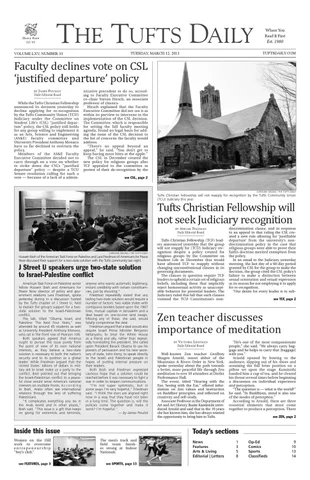
caroline geiling / The Tufts daily
Tufts Christian Fellowship will not reapply for recognition by the Tufts Community Union (TCU) Judiciary this year.
Tufts Christian Fellowship will not seek Judiciary recognition by
Abigail Feldman
Daily Editorial Board
Caroline Geiling / The Tufts Daily
Hussein Ibish of the American Task Force on Palestine and Lara Friedman of Americans for Peace Now discussed their support for a two-state solution with the Tufts community last night.
J Street U speakers urge two-state solution to Israel-Palestine conflict American Task Force on Palestine senior fellow Hussein Ibish and Americans for Peace Now director of policy and government relations Lara Friedman, spoke yesterday during in a discussion hosted by the Tufts chapter of J Street U, held to explain the group’s support for a twostate solution to the Israeli-Palestinian conflict. The talk, titled “Obama, Israel, and Palestine: The Next Four Years,” was attended by around 45 students as well as University President Anthony Monaco, who sat in the front row of Pearson 106. Both speakers agreed that America ought to pursue this issue purely from the point of view of its own national interests, as they believe a two-state solution is necessary to both the nation’s security and to its position as a global leader. While Friedman argued that the United States’ billions of dollars in military aid to Israel make us a party to the conflict, Ibish pointed out that bringing the Israeli-Palestinian conflict to a peaceful close would serve America’s national interests on multiple fronts. A c c o r d i n g to Ibish, Arabs often see international relations through the lens of suffering Palestinians. “It complicates everything you do in the Arab world and in other places,” Ibish said. “This issue is a gift that keeps on giving for extremists and terrorists,
anyone who wants automatic legitimacy, instant credibility with certain constituencies, just by shouting.” Friedman repeatedly stated that any lasting two-state solution would require a number of factors: two viable states with contiguous borders based upon the 1967 lines, mutual capitals in Jerusalem and a deal based on one-to-one land swaps. Missing any of these, she said, would fatally compromise the deal. Friedman argued that a deal would also require Israeli Prime Minister Benjamin Netanyahu to treat the White House as a friend and ally, rather than repeatedly humiliating the president. She called upon President Barack Obama to use his powers of persuasion and his new secretary of state, John Kerry, to speak directly to the Israeli and Palestinian people in hopes of putting internal pressure on their leaders. Both Ibish and Friedman expressed cautious hope that a solution could be reached before it was necessary to fight a war in order to reopen communications. “I’m not super optimistic, but in some ways I’m very hopeful,” Friedman said. “I think the stars are aligned right now in a way that they have not been in a long time. The question is, will the policies come together and make it work? I’m hopeful.” — by James Pouliot
Inside this issue
Tufts Christian Fellowship (TCF) leaders announced yesterday that the group will not reapply for (TCU) Judiciary recognition despite a policy created for religious groups by the Committee on Student Life in December that would have allowed TCF to reapply without changing unconstitutional clauses in its governing documents. The clauses in question require TCF leaders to uphold a certain set of religious beliefs, including those that implicitly reject homosexual activity as unacceptable behavior for potential leaders. The Judiciary ruled this fall that such clauses violated the TCU Constitution’s non-
discrimination clause, and in response to an appeal to that ruling the CSL created a new rule allowing for ‘justifiable departure’ from the university’s nondiscrimination policy in the case that religious groups were able to prove their faith’s doctrine merited exemption from the policy. In an email to the Judiciary yesterday morning, the last day of a 60-day period granted by CSL for the group to make the decision, the group cited the CSL policy’s failure to make a distinction between sexual orientation and sexual expression as its reason for not employing it to apply for re-recognition. “Our desire for every leader is to subsee TCF, page 2
Zen teacher discusses importance of meditation by Victoria
Leistman
Daily Editorial Board
Well-known Zen teacher Geoffrey Shugen Arnold, sensei abbot of the Mountains & Rivers Order in New York, spoke yesterday about the path towards a better, more peaceful life through Zen meditation to over 50 attendees at Distler Performance Hall. The event, titled “Hearing with the Eye, Seeing with the Ear,” offered information on Zen values and instruction on Buddhist principles, and reflected on creativity and self-study. Associate Professor in the Department of Art and Art History Ikumi Kaminishi introduced Arnold and said that in the 10 years she has known him, she has always wanted the opportunity to bring him to Tufts.
“He’s one of the most compassionate people,” she said. “We always carry baggage and he helps to carry that [baggage] with you.” Arnold opened by bowing to the audience, slipping out of his shoes and assuming the full lotus position on a pillow set upon the stage. Kaminishi handed him a cup of tea, and he cleared his throat several times before beginning a discussion on individual experience and perception. “The question is — what is the world?” he said. “In Buddhism, mind is also one of the modes of perception.” According to Arnold, there are three essential elements that must come together to produce a perception. There see ZEN, page 2
Today’s sections
Women on the Hill work to overcome entrepeneurship “boy’s club.”
The men’s track and field team finishes strong at Indoor Nationals.
see FEATURES, page 3
see SPORTS, page 13
News Features Arts & Living Editorial | Letters
1 3 5 8
Op-Ed Comics Sports Classifieds
9 10 13 14