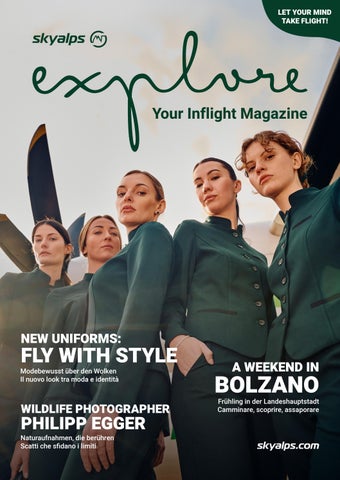
Modebewusst über den Wolken Il nuovo look tra moda e identità

Frühling in der Landeshauptstadt Camminare, scoprire, assaporare
![]()
Modebewusst über den Wolken Il nuovo look tra moda e identità

Frühling in der Landeshauptstadt Camminare, scoprire, assaporare
Naturaufnahmen, die berühren Scatti che sfidano i limiti


Frühling bedeutet Aufbruch, frische Luft, längere Tage und … neue Reiseideen! Wir nehmen Sie mit zu blühenden Landschaften in Südtirol und verraten Ihnen schon jetzt, wohin die Sonne Sie diesen Sommer begleiten wird: Mit Thessaloniki und Preveza warten zwei neue Destinationen in Griechenland auf Sie.
In dieser Ausgabe unseres Bordmagazins lernen Sie außerdem wieder interessante Persönlichkeiten kennen: Philipp Egger erzählt Ihnen von seiner Faszination für die Naturfotografie, Jakob Zeller teilt seine Leidenschaft für eine weltoffene Küche und Lotte Zemmer lässt Sie in ihr Rosenparadies auf 1500 m eintauchen. Darüber hinaus haben wir wie immer Tipps für Events sowohl in Südtirol als auch außerhalb zusammengetragen.
Lehnen Sie sich zurück, genießen Sie den Blick aus dem Fenster, sammeln Sie Ideen für Ihre Frühlings- und Sommerabenteuer und lassen Sie sich von der Leichtigkeit der Saison inspirieren.
Gute Lektüre und bis zu Ihrem nächsten Flug mit SkyAlps
La primavera è sinonimo di rinascita, esperienze all’aperto, giornate più lunghe e… nuove idee di viaggio! Noi vi accompagniamo tra i paesaggi in fiore dell’Alto Adige e vi sveliamo sin d’ora dove splenderà il sole quest’estate: ad attendervi ci sono Salonicco e Preveza, le nostre nuove destinazioni in Grecia.
In questa edizione della nostra rivista di bordo incontrate ancora una volta personalità interessanti: Philipp Egger vi fa immergere nel fascino della fotografia naturalistica, Jakob Zeller condivide la sua passione per una cucina cosmopolita e Lotte Zemmer vi accoglie nel suo paradisiaco roseto a 1500 m. Come sempre, trovate anche i nostri consigli sugli eventi da non perdere in Alto Adige e oltre i confini della regione.
Mettetevi comodi, godetevi la vista dal finestrino e prendete spunto per le vostre prossime avventure primaverili ed estive, lasciandovi ispirare dalla leggerezza della bella stagione.
Buona lettura e buon viaggio con SkyAlps!


Spring signifies new beginnings, fresh air, longer days and... new travel inspirations! Allow us to introduce you to the blossoming landscapes of South Tyrol –and provide a sneak preview of where the sun will greet you this summer: two new destinations in Greece are waiting for you, Thessaloniki and Preveza.
You can also meet some interesting personalities in this issue of our in-flight magazine: Philipp Egger shares his fascination with nature photography, Jakob Zeller talks about his passion for cosmopolitan cuisine, and Lotte Zemmer invites you to experience her rose paradise at 1,500 m above sea level. Last but not least, we have compiled a selection of events in South Tyrol and beyond – as per usual.
Lean back, enjoy the view from your window, gather inspiration for your spring and summer adventures, and let yourself be motivated by the lightness of the season.
Happy reading, and see you on your next flight with SkyAlps


Authors & Translations
Martina Bocek, Eleonora Dellantonio, Sara Iezzi, Iman Joy El Shami-Mader, Sara Penasa, Linda Pizzini, Christina Scharf, Katharina Weiss
Project Lead tt• Tanja Götsch
Project Team SkyAlps Nicole Platzer Silvia Santorum Kathrin Bradlwarter Maya Gostner
Design
Magdalena Egger
Sales Tanja Götsch M. +39 375 7903785 tanja.goetsch@tt-consulting.com

Photos Cover: Gerd Eder


Ansitz Plantiz, Karl Steinegger | TV Dorf Tirol, Benjamin Pfitscher | TV Klausen, Thomas Rötting | Parc Hotel am See, Alpup | Loacker, Rieper | Col Raiser, Diego Moroder | Vigilius Mountain Resort, Tobias Kaser | Redmoon, so.you | Schloss Freudenstein, Lukas Hanifle | Belvedere, Alex Filz | Südtirol Wein, IDM Südtirol-Alto Adige/Benjamin Pfitscher, IDM Südtirol-Alto Adige/David Haase | Maximilian | Kellerei Schreckbichl, AnamCara | Paradies Sulden, Hannes Niederkofler | Andreus Resorts, Nicho de Biasio


Un fine settimana nel capoluogo altoatesino A Weekend in South Tyrol’s Provincial Capital
Promenaden mit Dolomitenblick, historische Gassen und Meisterwerke der Architektur: Besonders im Frühling lädt Bozen mit seinem mediterranen Klima zum Flanieren und Entdecken ein. Begeben Sie sich mit uns auf einen Streifzug durch die Stadt und entschweben Sie in luftige Höhen.
Passeggiate con vista sulle Dolomiti, vicoli carichi di storia e capolavori architettonici: complici le piacevoli temperature primaverili, Bolzano invita a essere scoperta a piedi. Venite con noi per fare un giro della città… e più in quota – per prospettive sempre diverse.
Promenades offering views of the Dolomites, historic alleyways and architectural masterpieces: with its Mediterranean climate, Bolzano is the perfect place to stroll through and explore in springtime. Join us on a tour of the city and ascend to lofty heights.
Vor weniger als drei Stunden hupte Berlin noch unter mir. Nun stehe ich, umgeben von blühenden Bäumen und Blumenbeeten, mitten in Bozens neuem Lifestyle-Quartier. Die 15-minütige Taxifahrt vom Flughafen ins Zentrum war ebenso angenehm wie mein Flug mit SkyAlps. Südtirols Hauptstadt empfängt mich mit Eleganz, Innovation und einem Ambiente, das vor Leben und Möglichkeiten sprüht. Im neuen WaltherPark, einem architektonischen Meisterwerk von Sir David Chipperfield, könnte man locker einen ganzen Tag verbringen. Zum Beispiel erstmal einen Cappuccino und ein ofenwarmes Croissant im Mercato Centrale genießen, der mit seinen abwechslungsreichen Essensständen an eine quirlige italienische Piazza erinnert. Danach vielleicht durch die Einkaufsgalerie mit ihren Mode-
boutiquen und nachhaltigen Geschäften flanieren oder sich beim Bouldern ausprobieren. Während mein Blick über die eleganten Fensterfronten nach oben schweift, regt sich tief in mir ein Wunsch: Bei meinem nächsten Besuch könnte ich mit meinem Lieblingsmenschen hoch über den Dächern der Stadt bei einem romantischen Dinner auf uns, den Urlaub und das Leben anstoßen. Jetzt aber zieht es mich erstmal weiter. Ich lasse den neuangelegten Park hinter mir, wo Kinder zwischen kleinen Wasserfontänen Fangen spielen und ältere Herren auf den Parkbänken beisammensitzen, und begebe mich zum Namensgeber des modernen Stadtquartiers nur wenige Meter weiter. Als 1889 errichtete Statue aus weißem Laaser Marmor steht Walther von der Vogelweide mit seiner Fiedel in der Hand mitten auf dem Waltherplatz. Er ist nicht das einzige historische Zeugnis. Durch einen Torbogen geht es hinein in einen kleinen Innenhof, der von einem Palast, dem Palais Campofranco, umgeben ist. Edle Bars und Restaurants reihen sich um einen riesigen Ginkgobaum, einem Geschenk von Kaiserin Sissi.
Ich lasse mich vom Flair Bozens weitertreiben, von den Herzögen hin zu den Kaufleuten, die im Mittelalter unter den Lauben ihre Waren anboten. Schon damals galt Bozen als Tor zum Süden und als eine der wichtigsten Handelsstädte. Seiden und Leinen aus dem Süden trafen auf Stoffe und Pelze aus dem Norden. Viele Geschäfte unter den Lauben sind seit Jahrzehnten in Familienbesitz. Die Häuser verfügen neben schicken Erkern auch über Kellergewölbe, die mehrere Stockwerke tief in die Erde reichen. Hier befindet sich auch das Merkantilmuseum, in dem Kunstgegenstände, antike Möbel und Originalurkunden von der wirtschaftlichen Hochblüte erzählen. An die Laubengasse schließt sich der lebhafte Obstplatz an, den bereits Goethe auf seiner Italienreise beschrieb und wo seit 500 Jahren Obst und Gemüse verkauft werden. Inzwischen haben sich Spezialitäten aus Südtirol und dem restlichen Italien sowie Blumenhändler dazugesellt. Mit einer Packung Trockenobst schlendere ich die Museumsstraße entlang, an deren Ende der berühmteste und zugleich älteste Kriminalfall Südtirols untersucht wird: Ötzi wurde in der Kupferzeit mit einer Pfeilspitze aus Feuerstein ermordet. Im Archäologiemuseum Südtirol kann man sich auf Indiziensuche begeben und erfährt Erstaunliches über die prähistorische Zeit.
Über die im Jahr 1900 erbaute Talferbrücke verlasse ich die Altstadt. Während unter mir das Wasser gurgelt und der Rosengarten in meinem Rücken verschneit in den Himmel ragt, taucht vor mir das Siegesdenkmal auf. Der wuchtige Bau entstand während des Faschismus und beherbergt unterirdische Räume, in denen vom Leben zur damaligen Zeit erzählt wird. Ich aber wende mich nach links und spaziere unter schattenspendenden Baumkronen die Talferpromenade entlang. Mit ihren weiten Wiesen, den Sportund Spielplätzen sowie Fahrradwegen gilt sie als grüne Lunge Bozens und zieht sich vom Norden durch die ganze Stadt. Mit Flussrauschen im Ohr und Blütenduft in der Nase erreiche ich nach wenigen Minuten eine geschwungene Brücke, auf deren gegenüberliegenden Seite ein futuristischer Kubus aus Glas steht. Das Museion ist mehr als ein Museum für mo-
derne und zeitgenössische Kunst. Es ist ein Ort der Begegnung mit wechselnden Ausstellungen und rund 4500 Werken internationaler und regionaler Kunstschaffender. In der warmen Jahreszeit finden hier regelmäßig Aperitivoabende statt, bei denen Studierende und Kunstinteressierte Bozen zum Leben erwecken. Ob ein klassischer Hugo, ein funkelnder Veneziano oder ein Weißwein aus dem Eisacktal, dazu vielleicht ein kleiner Bauerntoast oder eine Bruschetta … In Bozen hat der Aperitivo Kultstatus. Nach getaner Arbeit trifft man sich in den Lokalen und Weinbars der Stadt und stößt auf den Feierabend an. Während ich die Eiswürfel im Glas klirren lasse und die ersten warmen Sonnenstrahlen des Jahres genieße, läuft auf meinem Handy die Suche nach dem perfekten Gasthaus für heute Abend. Die Entscheidung fällt schwer, denn in Südtirols Hauptstadt versteht man es, die regionale Küche auf den Teller zu bringen: mit Spinat gefüllte Schlutzkrapfen, Speckknödel mit Krautsalat oder – gerade jetzt im Frühling – frischer Spargel aus Terlan mit Bozner Sauce. Es sind Gerichte, die an die bäuerliche Tradition anknüpfen und genügend Energie für die Feldarbeit schenken. Genau diese Energie brauche auch ich. Morgen nämlich wird es mich mit der Seilbahn direkt vom Stadtzentrum aus zu einer Wanderung auf den Ritten ziehen. Dorthin, wo der Bozner Adel schon seit Jahrhunderten die heißen Monate verbringt. Laut dem Dichter Karl Theodor Hoeniger muss ein richtiger Bozner auf jeden Fall über ein Sommerfrischehaus auf dem Ritten verfügen. Ich werde zwischen den prächtigen Villen dahinspazieren und vom herrschaftlichen Leben träumen. Und wenn mein Blick von den Dolomitenfelsen am Horizont über die Blumenwiesen bis hinunter ins Tal schweift, wird mir klar werden, warum sich die Städter gerade Maria Himmelfahrt als Rückzugsoase ausgesucht haben. Ein kleines Paradies oberhalb einer Stadt, die mit ihrem kulturellen Reichtum und der Nähe zur Natur der ideale Ort für ein verlängertes Wochenende ist.
Meno di tre ore fa Berlino brulicava ancora sotto di me, mentre ora mi trovo tra alberi in fiore e aiuole rigogliose nel cuore del nuovo quartiere lifestyle di Bolzano.
I quindici minuti di taxi dall’aeroporto al centro sono stati piacevoli quanto il volo con SkyAlps. Il capoluogo altoatesino mi trasmette subito eleganza, innovazione e un’atmosfera vibrante di possibilità. Al nuovo WaltherPark, un capolavoro architettonico firmato da Sir David Chipperfield, si potrebbe tranquillamente trascorrere una giornata intera. Ad esempio, cominciando con un cappuccino e un croissant ancora caldo al Mercato Centrale, che ricorda una vivace piazza all’italiana con i suoi diversi banchi enogastronomici. Dopodiché, si potrebbe fare un giro tra le boutique di moda e i negozi di prodotti sostenibili oppure cimentarsi nel boulder. Il mio sguardo vaga verso l’alto seguendo le estetiche vetrate e dentro di me prende forma un desiderio: la prossima volta potrei prenotare una cena romantica sopra i tetti della città per brindare con la mia persona preferita alla vacanza, alla vita, a noi due. Ma adesso proseguo la mia visita. Mi lascio alle spalle il parco – anch’esso di recente realizzazione –, dove dei bambini giocano a rincorrersi tra le fontanelle e dei signori anziani conversano sulle panchine, e mi dirigo al monumento che ha ispirato il nome di questo moderno quartiere, pochi metri più avanti. Eretta nel 1889 in marmo di Lasa, la statua
al poeta cantore Walther von der Vogelweide, rappresentato con in mano il suo violino, si erge in mezzo all’omonima piazza. Ma non è l’unica testimonianza storica. Attraverso un arco accedo a un cortiletto interno sul quale si affacciano un palazzo, il Palais Campofranco, così come raffinati bar e ristoranti; al centro si impone un enorme albero di ginkgo, dono della principessa Sissi.
Mi lascio guidare dal fascino di Bolzano, spostandomi dalle residenze nobiliari ai portici dove i mercanti esponevano le proprie merci nel Medioevo. Già al tempo la città era considerata uno dei più importanti fulcri commerciali per via della sua po-

sizione strategica tra nord e sud del continente, dove la seta e il lino dal meridione si scambiavano con le pellicce e i tessuti dei Paesi settentrionali. Molti dei negozi sotto i portici appartengono alle stesse famiglie da decenni. Oltre a sfarzosi bovindi, gli edifici presentano cantine a volta interrate e profonde più piani. Qui si trova anche il Museo Mercantile, che custodisce opere d’arte, mobili d’antiquariato e atti originali che raccontano l’epoca d’oro dell’economia cittadina. Via Portici sfocia nell’animata Piazza delle Erbe, descritta già da Goethe nel suo Viaggio in Italia e dove, da cinquecento anni, si tiene un mercato di frutta e verdura. Oggi si vendono anche fiori così come specialità altoatesine e dal resto d’Italia. Con un sacchetto di frutta secca in mano, cammino lungo via Museo, in fondo alla quale si “indaga”
sull’omicidio più antico e famoso della regione: quello di Ötzi, assassinato nell’Età del rame con una freccia dalla punta in selce. Al Museo archeologico dell’Alto Adige è possibile andare a caccia di indizi e apprendere sorprendenti fatti sulla preistoria.
Supero il ponte Talvera, risalente al 1900, uscendo così dal centro storico. Sotto di me sento l’acqua gorgogliare, alle mie spalle le vette innevate del Catinaccio si stagliano contro il cielo, mentre davanti a me spunta il Monumento alla Vittoria. L’imponente complesso venne costruito dal regime fascista e nelle sue sale sotterranee illustra le controversie di quel periodo storico. Io decido tuttavia di svoltare a sinistra e cammino all’ombra di alberi frondosi sul Lungo Talvera. Per i suoi
ampi spazi verdi, i campi sportivi, i parchi giochi e le ciclabili quest’area è considerata il polmone verde della città, che attraversa da nord a sud. Con il mormorio del fiume nelle orecchie e sentori floreali nel naso, dopo una manciata di minuti arrivo a una passerella ondulata che porta davanti a un futuristico cubo di vetro. Il Museion è molto più di un museo d’arte moderna e contemporanea: si propone infatti come luogo d’incontro con mostre itineranti e circa 4500 opere di artisti locali e internazionali. Durante la bella stagione qui vengono organizzati regolarmente aperitivi conviviali per studenti e appassionati di arte, che ravvivano le serate bolzanine. Che sia un classico hugo, un agrumato aperol spritz o un vino bianco della Valle Isarco, accompagnato da qualche bruschetta o un mini toast di segale con speck e formaggio: a Bolzano l’aperitivo è un vero e proprio rito. Ogni giorno, dopo lavoro, ci si ritrova nei locali e nelle enoteche della città per brindare. Mentre faccio tintinnare il ghiaccio nel bicchiere e mi godo il primo sole caldo dell’anno, comincio a cercare su internet un ristorante per la cena. La decisione si prospetta ardua, perché nel capoluogo altoatesino sanno bene come portare in tavola il meglio della regione, tra mezzelune ripiene di spinaci, canederli allo speck con insalata di cappuccio e – tipici di questa stagione – gli asparagi freschi di Terlano con la salsa bolzanina. Queste ricette affondano le loro radici nella tradizione contadina, in quanto dovevano fornire l’energia necessaria per il duro lavoro nei campi. E anche a me domani servirà una buona dose di energia. Infatti, ho in programma di prendere la funivia che dal centro sale sull’altopiano del Renon e fare un’escursione là dove la nobiltà del posto si reca da secoli e secoli per sfuggire alla calura estiva. Secondo il poeta Hoeniger, non si è autentici bolzanini se non si possiede una casa di villeggiatura sul Renon. Gironzolerò tra le sontuose ville signorili e fantasticherò di lussi e vite agiate. E quando il mio sguardo scivolerà dall’orizzonte con le guglie dolomitiche ai prati verdeggianti fino a valle, mi sarà evidente perché sia stata prediletta proprio la frazione di Maria Assunta come luogo di ritiro. Un piccolo paradiso sopra una città che, tra ricchezza culturale e
vicinanza alla natura, è perfetta per un weekend lungo.
Less than three hours ago, Berlin was still rumbling beneath me. And now, surrounded by blossoming trees and flower beds, I find myself in the heart of Bolzano’s new lifestyle district. The 15-minute taxi ride from the airport to the city centre was just as pleasant as my SkyAlps flight. South Tyrol’s capital welcomes me with elegance, innovation and an atmosphere that is bursting with life and possibilities. One could easily spend an entire day in the new WaltherPark, an architectural masterpiece designed by Sir David Chipperfield. Start by enjoying a cappuccino and a warm croissant at Mercato Cen-

trale, which is reminiscent of a lively Italian piazza with its diverse food stalls. Afterwards, perhaps stroll through the shopping gallery with its fashion boutiques and sustainable shops, or try your hand at bouldering. As my gaze drifts upwards over the elegant window fronts, a desire stirs deep within me: on my next visit, I want to raise a glass to us, to our holiday and to life itself with my favourite person, high above the rooftops of the city, over a romantic dinner. But for now, it is time to move on. I leave the newly landscaped park behind me, where children are playing tag among small water fountains and elderly gentlemen are sitting together on park benches. My destination

is the namesake of this modern city quarter, just a short walk away. Walther von der Vogelweide stands in the middle of Piazza Walther: a statue made of white Lasa marble erected in 1889, depicting him with his fiddle in hand. However, this statue is not the only historical monument. After passing through an archway, I enter a small courtyard surrounded by a palace, the Palais Campofranco. Elegant bars and restaurants line it, surrounding a massive ginkgo tree – a gift from Empress Sissi.
I let myself be swept along by Bolzano’s charm, moving on from the noble residences of dukes to the arcades, under which merchants displayed their wares during the Middle Ages. Bolzano was al-

ready considered the gateway to the south and one of the most important trading cities back then. Silk and linen from the
south met fabrics and furs from the north. Many shops under the arcades have been family-owned for decades. In addition to chic bay windows, these buildings also have vaulted cellars that reach down many storeys underground. Here you will also find the Mercantile Museum, which
the South Tyrol Museum of Archaeology. I leave the old town via one of the bridges over the Talvera River, built in 1900. As the water gurgles beneath me and the snow-covered Catinaccio mountains rise up behind me, the Victory Monument appears before me. This imposing structure was built during the Fascist era and houses underground rooms that chronicle life at that time. But I turn left and stroll along the Talvera Promenade under the shade of the trees. With its wide meadows, sports fields, playgrounds and cycle paths, it is considered to be the green lung of Bolzano, and stretches from the north through the entire city. With the sound of the river in my ears and the scent of flowers in my nose, I reach a
wine bars to toast the end of their working day. As I let the ice cubes rattle in my glass and enjoy the first warm rays of sunshine of the year, I use my mobile phone to search for the perfect restaurant for tonight. It is a tough decision, because in South Tyrol’s capital, they know how to deliciously bring regional cuisine to the table: spinach-filled Schlutzkrapfen (ravioli), bacon dumplings with coleslaw or – especially at this time of year – fresh asparagus from Terlano with Bolzano Sauce (similar to Hollandaise). These are dishes that draw on rural traditions and provide sufficient energy for working in the fields. That is precisely the kind of energy I need. Tomorrow, I will be taking the cable car directly from the city cen-

houses art objects, antique furniture and original documents that recount the region’s economic heyday. Adjacent to the Via dei Portici alley, you can find the lively Piazza delle Erbe Market, the same one that Goethe described during his travels through Italy, where fruit and vegetables have been sold for 500 years. Nowadays, the market also offers specialities from South Tyrol and the rest of Italy, as well as flower stalls. I stroll along Via Museo with a packet of dried fruit. It leads to the oldest and most famous criminal case in South Tyrol: Ötzi, who was murdered with a flint arrowhead during the Copper Age. You can search for clues and learn amazing facts about prehistoric times at
curved bridge after a few minutes. On the other side of it stands a futuristic glass cube. The Museion is more than just a museum of modern and contemporary art. It is a meeting place with changing exhibitions and around 4,500 works by international and regionally based artists. Aperitivo evenings are regularly held here during the warmer months, at which students and art lovers bring Bolzano to life. Whether with a classic Hugo, a sparkling Veneziano or a white wine from the Isarco Valley, perhaps accompanied by a small toasted rustic local bread with Speck and cheese or a bruschetta... Aperitivo has cult status in Bolzano. When work is done, people meet in the city’s pubs and
tre to go hiking on the Renon. That is where the Bolzano aristocracy has been spending the hottest months for centuries. According to the poet Karl Theodor Hoeniger, a true Bolzano native must have a summer retreat on the Renon. I will stroll among the luxurious villas and dream of a life of luxury. And when my gaze wanders from the Dolomite rocks on the horizon across the flower-filled meadows and all the way down to the valley, I will understand why city dwellers have chosen Maria Assunta as their haven. A little piece of paradise overlooking a town that, with its cultural riches and proximity to nature, is the ideal destination for a long weekend.
Für Naturverliebte
Der Kalterer See an der Südtiroler Weinstraße zählt nicht nur zu den wärmsten Badeseen der Alpen, sondern beherbergt auch ein Biotop mit einem Naturerlebnisweg. In der Nähe befindet sich das Frühlingstal, wo die warme Jahreszeit besonders früh beginnt. Leberblümchen, Schneeglöckchen, Krokusse, Schlüsselblumen und Veilchen verwandeln das kleine Tal in ein Blütenmeer und lassen sich bei einer Wanderung von 3,5 Stunden bestaunen.
Für Erholungsuchende
Die Kohlerer Bahn war die erste freischwebende Personenseilbahn der Welt. Heute bringt sie Einheimische und Urlauber in wenigen Minuten ins Naherholungsgebiet auf 1000 m, wo Wälder und Wiesen zum Wandern einladen. Besonders sehenswert: die Titschenwarte, ein Panoramapunkt mit Blick auf Schlern, Rosengarten, Latemar und Zanggen.
Für Mystikbegeisterte
Oberhalb von Sarnthein auf 2000 m sollen einst die Hexen getanzt haben. Hier wurden um 1540 auch erste Figuren aus Sandsteinplatten aufgeschichtet, die heute zu hunderten die Landschaft zieren. Der Kraftort rund um die „stoanernen Mandln“ (Männchen aus Stein) lässt sich von Sarntal oder Mölten aus erreichen.
Per chi cerca natura pura
Oltre a essere uno degli specchi d’acqua balneabili più caldi delle Alpi, il lago di Caldaro lungo la Strada del vino ospita anche un biotopo con un sentiero naturalistico. Poco distante si trova la Valle della primavera, dove la bella stagione si mostra con particolare anticipo. Erba trinità, campanellini, crochi, primule e violette tramutano i boschi in una meravigliosa distesa floreale, tutta da ammirare durante un’escursione di circa 3,5 ore.
Per chi desidera quiete La funivia del Colle è stata la prima al mondo destinata al trasporto di persone. Oggi conduce in pochi minuti tanto abitanti del posto quanto turisti su a 1000 m, lontano dal trambusto della città, dove boschi e prati invitano a esplorare camminando. Da non perdere: il punto panoramico Titschenwarte con vista su Sciliar, Catinaccio, Latemar e Pala Santa.
Per chi ama le leggende
Sopra il paese di Sarentino, a circa 2000 m, si narra che si riunissero le streghe per ballare. Quassù, dal lontano 1540 a oggi, sono stati ammucchiati centinaia di piccoli cumuli di lastre arenarie, conosciuti appunto come “omini di pietra”. Questo luogo carico di energia si raggiunge dalla Val Sarentino o da Meltina.
For Nature Lovers
Lake Caldaro on the South Tyrolean Wine Road is not only one of the warmest swimming lakes in the Alps, but it is also home to a biotope with a nature adventure trail. Not far away you can find the Spring Valley, where the warm season begins particularly early. Beautiful little flowers like liverworts, snowdrops, crocuses, primroses and violets transform this small valley into an ocean of blossoms, which can be admired on a 3.5-hour hike.
The Funivia del Colle was the world’s first free-floating passenger cable car. Today, it takes locals and visitors to the resident recreation area located at 1,000 m in just a few minutes. Here, forests and meadows invite you to go hiking. Highlight: the Titschenwarte, a panoramic viewpoint overlooking the Sciliar, Catinaccio, Latemar and Pala di Santa.
For Lovers of the Mystic
Above Sarentino, at an altitude of 2,000 m above sea level, witches are said to have once danced. The first figures made of sandstone slabs were stacked here around 1540, and today hundreds of them adorn the landscape. This place of power surrounding the stoanernen Mandln (stone men) can be reached from Sarentino or Meltina.

Discover the new public park, over 80 shops, Il Mercato Centrale - the square of goodness at the 2° floor.
In the heart of Bolzano.
Im Sommer fliegt SkyAlps zwei neue Ziele in Griechenland an: Einmal wöchentlich geht es ab Ende Mai nach Thessaloniki und Preveza. Früh buchen lohnt sich!
Da fine maggio, SkyAlps raggiunge due nuove mete in Grecia: una volta a settimana si vola rispettivamente a Sa -
lonicco e Preveza. Prenotate sin d’ora, conviene!
SkyAlps will be flying to two new destinations in Greece this summer: from the end of May, there will be weekly flights to Thessaloniki and Preveza. Booking early pays off!

Familien aufgepasst: Diesen Sommer fliegen Kinder wieder zum halben Preis ans Meer. Das Angebot gilt für Flüge mit Start in Bozen. Ab in den Familienurlaub!
Cari genitori, anche quest’estate i bambini viaggiano a metà prezzo su tutti i voli verso il mare con partenza da Bolzano. Via libera alle vacanze in famiglia!
Calling all families: children will once again fly to the seaside for half price this summer. This offer only applies to flights departing from Bolzano. Get ready for your family vacation!

Wir haben gute Nachrichten für Vielreisende: In Kürze startet SkyAlps sein langersehntes „Frequent Traveller“-Programm. Behalten Sie unsere Kanäle im Blick und bleiben Sie immer up-to-date!
Buone notizie per chi viaggia spesso: a breve parte il tanto atteso programma Frequent Traveller di SkyAlps. Tenete d’occhio i nostri canali per non perdere gli ultimi aggiornamenti.
Good news for frequent flyers: SkyAlps will soon be launching its long-awaited “Frequent Traveller” programme. Keep an eye out for updates on our channels!


… jetzt gratis Gin & Tonic Cocktail auf Ihrem SkyAlps Flug genießen!
… gustate ora un Gin & Tonic gratuitamente sul vostro volo SkyAlps !
… enjoy a delicious Gin & Tonic cocktail for free on your SkyAlps flight!


In auto d’epoca nello charme di Merano Time Out in Merano – Classic Car Bliss Included

Wenn die Frühlingssonne Südtirol in goldenes Licht taucht, heißt es im Ansitz Plantiz einen Blick ins Roadbook werfen, sich im Ledersessel zurücklehnen und den Motor starten. Mit dem Picknickkorb auf dem Rücksitz und den Wind in den Haaren geht es vom Villenviertel der Kurstadt Meran durch das mediterrane Blütenmeer und über die Serpentinen hoch auf die Dolomitenpässe. Das 5-Sterne-Hotel ist Treffpunkt für alle, die sich nach besonderen Erlebnissen sehnen: mit eigener Oldtimerkollektion zum Verleih, monatlichen geführten Oldti-

mer- und Sportcar-Ausfahrten mit Gastgeber Johannes und entspannten Benzingesprächen bei einem etwas anderen Aperitif in der Oldtimer-Garage. Wer es noch nostalgischer mag, der steigt in den VW-Bulli und lässt sich bei der Weintour zu exklusiven Plätzchen mitten in den Weinbergen bringen. Nach all den Eindrücken wartet pure Entspannung im Infinitypool, bei hochwertigen Spa-Treatments und beim ganzheitlichen Body- und Mind-Programm. In den lauschigen Rückzugsorten der Gartenoase fällt das Abschalten leicht und die Vorfreude auf das Dinner im Gourmetrestaurant wächst, wo feinste Zutaten meisterhaft kombiniert werden. Danach ein Whiskey an der Cocktailbar oder ein Besuch in der Zigarrenlounge. Und wenn der Abend ausklingt, bleibt dieses stille Glücksgefühl zurück: das Gefühl, an einem Ort angekommen zu sein, der Körper und Geist gleichermaßen berührt und sich wie zuhause anfühlt.
Quando il sole primaverile indora i paesaggi altoatesini, all’hotel Ansitz Plantiz è tempo di aprire il roadbook, mettersi al volante e avviare il motore. Con il cestino del picnic sul sedile posteriore in pelle e il vento tra i capelli, si parte dal quartiere delle ville di Merano e si attraversano inebrianti distese floreali fino ad arrivare alle serpentine dei passi dolomitici. Questo hotel a cinque stelle, infatti, è perfetto per vivere esperienze uniche: dalla possibilità di noleggiare un’auto d’epoca o sportiva dalla collezione dei proprietari, alle uscite mensili insieme al padrone di casa Johannes alla guida di questi gioiellini, fino all’aperitivo nel garage delle vetture vintage per quattro chiacchiere sui motori. Per i veri nostalgici, c’è inoltre il wine tour a bordo dell’iconico VW Bulli alla volta di esclusivi posticini immersi nei vigneti. Al rientro, ci si può abbandonare al relax tra infinity pool, lussuosi trattamenti spa e sessioni olistiche di fitness e mental training. Nell’atmosfera romantica del giardino paradisiaco staccare la spina viene naturale, mentre si fantastica sulla cena
gourmet che verrà servita al ristorante, dove ingredienti raffinati vengono trasformati con maestria. Poi un whisky al bar o una fumata meditativa nella cigar lounge. E nel silenzio della sera, si insinua dolcemente una sensazione appagante: la gioia di aver trovato un luogo dove corpo e mente si sentono a casa.
When the spring sunshine bathes South Tyrol in golden light, it is time to check out the road book at Ansitz Plantiz. Lean back in your leather seat and start the engine. The picnic basket is on the back seat and the wind caresses your hair as you set off from the villa district of the spa town of Merano: through a Mediterranean ocean of blossoms and along winding roads to the Dolomite passes. The 5-star hotel is the place to be for unique experiences, as they offer an in-house classic cars collection available for hire, monthly guided classic car and sports car tours with host Johannes… and relaxed aperitifs and petrolhead chats in the classic car garage. Prefer a more nostalgic experience? Hop aboard a VW minibus and enjoy a wine tour that will take you to exclusive locations amidst the vineyards. After this memorable experience, pure relaxation is on the agenda: treat yourself to the infinity pool, premium spa sessions and a holistic body and mind programme. Unwinding comes easily in the secluded corners of the garden oasis, while the anticipation for dinner in the gourmet restaurant grows, where finest ingredients are masterfully combined for you. Finally, enjoy a whisky at the cocktail bar or visit the cigar lounge. As the evening draws to a close, a quiet feeling of happiness remains: having arrived in a place that touches both body and soul – and feels like home.


Il piacere della vacanza già in aereo Indulgence on Cloud 9
Südtirol genießen Sie bei uns nicht nur mit einem Blick aus dem Fenster bei Start oder Landung, sondern auch während des Fluges: Wir präsentieren Ihnen einige regionale Spezialitäten, die Sie gerne an Bord probieren können – ohne Zusatzkosten!
Al decollo o all’atterraggio potete apprezzare la bellezza dell’Alto Adige attraverso il finestrino, mentre durante il volo potete assaporarne il gusto: ecco alcune delle specialità regionali che vi serviamo a bordo – tutte incluse nel prezzo!
With us, you can enjoy South Tyrol not only by looking out of the window during take-off or landing, but also during the flight. Here are some regional specialities that you are welcome to try on board – at no additional cost!

Südtirol Wein | Vini Alto Adige
Auswahl an regionalen Rot- und Weißweinen
Selezione di vini regionali
Selection of regional red and white wines
Forst | 1857 & 0,0%
Bier, auch alkoholfrei
Birra, anche analcolica
Red Moon Sparkling
Alkoholfreier Apfelaperitif
Aperitivo analcolico a base di mele
Non-alcoholic apple-based aperitif
Limestone
Bio Tonic Water in verschiedenen
Geschmacksrichtungen
Acqua tonica bio a vari gusti
Organic tonic water in various flavours
Pompadour
Hochwertiges Teesortiment
Roner | Gin Z44
Alpiner Gin mit frischer Zirbe
Gin alpino con note di cirmolo
Alpine gin with fresh stone pine
Beer, also non-alcoholic Froomy
Fruchtpüree aus Bio-Obst
Purea di frutta bio
Puree from organic fruit
Ultner Brot
Traditionelles Schüttelbrot
Tipico pane croccante di segale
Typical crunchy rye bread
Leni’s
Apfelsaft aus den Dolomiten
Succhi di mela delle Dolomiti
Apple juices from the Dolomites
Mila
Saisonale Joghurtsorten
Yogurt a vari gusti stagionali
Yogurt in various seasonal flavours
Selezione di tè e infusi di qualità
Selection of quality teas and infusions
Loacker
Unverwechselbare Waffeln seit 1925
I wafer inimitabili dal 1925
Inimitable wafers since 1925
Alps Coffee
Gerösteter Kaffee aus Südtirol
Caffè tostato con cura in Alto Adige
Coffee roasted with care in South Tyrol
Meraner Mineralwasser
Wasser, still oder prickelnd
Acqua naturale o frizzante
Still or sparkling water
Milchhof Sterzing | Latteria Vipiteno
Joghurt aus Bergmilch
Yogurt da latte di montagna
Mountain milk yoghurt


Un aperitivo tra i meli in fiore di Tirolo An aperitif amongst the apple blossoms of Tirolo Weiß-rosa – diese Farbe trägt Dorf Tirol im Frühling, wenn Abertausende Apfelblüten die Hänge der Umgebung zieren. Ihr süßlicher Duft erfüllt die Luft – sanft, unaufdringlich, wie ein Seidentuch, das sich um die Schultern legt und Glücksgefühle weckt. Spazierwege führen mitten durch die Apfelwiesen hindurch. Und selbst wenn man den Blick nicht von dem Blütenmeer abwenden möchte, weil es wie das schönste Naturparadies auf Erden scheint, lohnt es sich, immer mal wieder stehenzubleiben, die Augen zu schließen und den Duft tief einzuatmen. An manchen Tagen, wenn der Frost morgens ins Land zieht, glitzern die Blüten wie Diamanten. Dann haben die Bauern in weiser Voraussicht nachts die Bewässerungsanlage eingeschaltet, um die zarten Blüten unter
einer dünnen Eisschicht vor der Kälte des ausklingenden Winters zu schützen. Früher wurden die üppigen Obstwiesen im Meraner Land durch die sogenannten Waale mit Wasser versorgt. Heute führen familienfreundliche Spazierwege an den eigens angelegten Wasserkanälen entlang. Ab Dorf Tirol lässt es sich wunderbar entlang des Algunder oder Kuenser Waalwegs wandern, mitten durch grüne Mischwälder und sonnige Weinberge, begleitet vom sanften Plätschern des Wassers, Kinderlachen und einer grandiosen Aussicht auf Berg und Tal. Sollten nach diesem Ausflug noch keine Frühlingsgefühle aufgekommen sein – ein sehr unwahrscheinlicher Fall –, dann nehme man auf einer Terrasse mitten in Dorf Tirol Platz und genieße den ersten Aperitivo des Jahres. Die
Eiswürfel klirren im Glas, die Sonne streichelt das Gesicht, Spatzen nähern sich neugierig und in der Ferne und doch zum Greifen nah erheben sich die mächtigen Mauern von Schloss Tirol. In der mittelalterlichen Burganlage können sich kleine und große Entdecker auf die Spuren der Südtiroler Kultur- und Landesgeschichte machen und den Rittersaal erkunden, wo die Grafen einst prunkvolle Feste feierten. Zwischen Marmorportalen, jahrhundertealten Artefakten und gotischen Wandmalereien schweift der Blick durch die Burgöffnungen immer wieder nach draußen. Von hier oben erscheint das Meraner Land wie ein Aquarellgemälde, in dem sich der Frühling von seiner farbenfrohesten Seite zeigt und die Sehnsucht nach Erlebnissen in der Natur weckt.
Bianco e rosa: sono queste le delicate nuance di cui si veste Tirolo a primavera durante la fioritura dei meli. Migliaia di boccioli adornano gli alberi e riempiono l’aria con il loro profumo, che accarezza i sensi lieve e discreto come una stola di seta attorno alle spalle. Diverse sono le passeggiate attraverso i meleti. E anche se non si smetterebbe mai di ammirare questo mare di petali color pastello – idillio allo stato puro – di tanto in tanto vale la pena fermarsi, chiudere gli occhi e inspirarne la dolce fragranza. Alcune mattine, dopo le notti più fredde, i boccioli scintillano come diamanti. Questo perché i coltivatori, con lungimiranza, hanno azionato l’impianto di irrigazione antibrina che, formando un sottile strato di ghiaccio sui fiorellini, li protegge dalle ultime gelate dell’inverno. Un tempo, l’acqua veniva convogliata ai lussureggianti frutteti del Meranese tramite i cosiddetti Waale, dei canali irrigui appositamente scavati a mezzacosta, divenuti oggi itinerari escursionistici tranquilli e panoramici. I sentieri delle rogge di Lagundo e Caines, tra i più belli intorno a Tirolo e adatti a tutti, invitano a camminare tra boschi verdeggianti e vigneti assolati, accompagnati dal sommesso gorgoglio dell’acqua e da grandiose vedute. E se dopo questa passeggiata lo spirito primaverile non fosse ancora sbocciato – ipotesi davvero remota –, allora ci si può accomodare su una terrazza nella piazza del paese e gustare il primo aperitivo dell’anno all’aperto. I cubetti di ghiaccio tintinnano nel bicchiere, il tepore del sole bacia la pelle, i passerotti si avvicinano curiosi e, sullo sfondo eppure così vicine, si stagliano le possenti mura di Castel Tirolo. Nella fortezza medievale piccoli e grandi esploratori possono ripercorrere la storia dell’Alto Adige, approfondire la cultura regionale e visitare la Sala dei cavalieri, dove i conti solevano tenere sontuose feste. Tra portali in marmo, reperti secolari e affreschi gotici, lo sguardo si spinge più volte anche oltre le finestre del maniero. Da questa prospettiva i paesaggi che incorniciano Merano sembrano un dipinto ad acquerello, dove la primavera si mostra dal suo lato più vivace e risveglia il desiderio di immergersi nella natura.
White and pink: the colours that Tirolo bears in spring, when thousands upon thousands of apple blossoms adorn the

surrounding hillsides. Their sweet scent fills the air – gentle and unobtrusive, like a silk scarf that gently wraps itself around your shoulders and awakens feelings of happiness. Leisurely walking paths lead you right through the apple orchards. And even if you do not want to take your eyes off the ocean of blossoms, because it truly feels like a magical paradise, it is still worth stopping every now and then, closing your eyes and inhaling a deep breath of the fragrance. Some mornings, when frost descends on the land, the blossoms glisten like diamonds. This is because farmers have wisely turned on the irrigation system during night, to protect the delicate blossoms from the cold of the fading winter with a thin layer of ice. In earlier days, the lush orchards in the Merano region were supplied with water by the so-called Waal irrigation channels. Today, family-friendly walking trails lead along these specially constructed waterways. From the village of Tirolo, you can enjoy wonderful walks along the irrigation channels of Lagundo or Caines, leading through green mixed forests and sunny vineyards. The gentle splashing of water, kid’s laughter and magnificent views of the mountains and valleys will accompany you along the way. If you still have not caught spring fever after this outing – which is highly unlikely – then take a seat on a terrace in the centre of Tirolo and enjoy the first aperitif of the year. The ice cubes swirl in your glass, the sun www.dorf-tirol.it

caresses your face, sparrows approach curiously – and in the distance, yet within reach, the mighty walls of Tyrol Castle tower above you. Explorers of all ages can follow in the footsteps of South Tyrolean culture and history in the medieval castle complex. Explore the Knights’ Hall, where counts once celebrated magnificent feasts. Between marble portals, centuries-old artefacts and Gothic murals, your gaze will wander outside through the castle openings again and again. From up here, the Merano countryside looks like a watercolour painting, with spring showing its most colourful side that awakens a longing for experiences in nature.
Tutti i vostri viaggi in un’unica app All Your Journeys in One App
Reisen leicht gemacht: Die neue SkyAlps-App bringt Ihnen die besten Tarife direkt aufs Smartphone und ermöglicht noch schnellere und unkompliziertere Buchungen. Ab März 2026 downloaden und direkt von den Vorteilen profitieren.
Die aktuellsten Informationen immer im Blick
Informazioni sempre aggiornate, a portata di mano
The latest information at a glance
In wenigen Klicks zur idealen Flugverbindung
La vostra rotta ideale, prenotabile in pochi clic
The ideal flight connection is just a few clicks away
Ob als Solo-Traveller oder mit der ganzen Familie
Perfetta sia per chi viaggia in solitaria che in famiglia
For solo travellers or for the entire family
Buchungen jederzeit einsehen und verwalten
Prenotazioni consultabili e gestibili in ogni momento
View and manage bookings whenever you want
+ Persönliches Kundenprofil für noch schnellere Buchungen
+ Push-Nachrichten zu aktuellen Reisen
+ Digitaler Boardingpass immer griffbereit
+ Mit Handgepäck direkt durch den Sicherheitscheck
+ Boardingpass in Apple Wallet speichern
Con la nuova app SkyAlps viaggiare è ancora più facile: le migliori tariffe e un sistema di prenotazione rapido e intuitivo arrivano direttamente sul vostro smartphone. Disponibile da marzo 2026: scaricatela e scoprite tutti i vantaggi.

Travel made easy: with the new SkyAlps app, you can access the best fares directly on your smartphone, allowing you a faster and easier booking experience. Download from March 2026 and benefit from the advantages immediately.
Available for iOS and Android from March 2026
Gutscheincodes direkt eintragen und Rabatt sichern Possibilità di inserire codici promo e ottenere sconti
Use the voucher codes directly and get your discount
+ Account personale per prenotazioni ancora più rapide
+ Notifiche push sui vostri viaggi in tempo reale
+ Carta d’imbarco digitale sempre disponibile
+ Accesso diretto ai controlli di sicurezza con bagaglio a mano
+ Carta d’imbarco scaricabile su Apple wallet
Daten speichern, noch einfacher buchen und Meilen sammeln (in Kürze verfügbar) Area profilo per salvare i vostri dati, prenotare e accumulare miglia (disponibile a breve)
Save your details, book even more easily and collect miles (available soon)
FAQ konsultieren oder Kundenservice kontaktieren
FAQ e servizio clienti a vostra completa disposizione
Review the FAQ or contact customer service
+ Personal customer profile for even faster bookings
+ Push notifications with the latest travel information
+ Your digital boarding pass always at hand
+ Walk straight through security with your hand luggage
+ Save your boarding pass in your Apple Wallet


Il nuovo look di SkyAlps SkyAlps’ New Look
2026 präsentiert SkyAlps die neue Uniform des Bordpersonals: eine gelungene Verbindung aus zeitgemäßer Eleganz, Hightech-Komfort und lokaler Tradition. Die Kollektion, die gemeinsam mit dem Südtiroler Unternehmen Waldstein entwickelt wurde, spiegelt die Stärke der Fluggesellschaft durch ein raffiniertes Markendesign wider.
Nel 2026 SkyAlps presenta le nuove uniformi del personale di bordo: una sapiente combinazione di eleganza contemporanea, comfort high-tech e tradizione locale. Realizzata in collaborazione con l’azienda altoatesina Waldstein, la collezione racconta l’essenza della compagnia attraverso un design raffinato e identitario.
In 2026, SkyAlps presents its new cabin crew uniforms, which skilfully combine contemporary elegance, high-tech comfort, and local tradition. Created in collaboration with the South Tyrolean company Waldstein, the collection’s stylish and unique design represents the airline’s essence.
Noch bevor die Sicherheitsgurte festgezogen und die Motoren eingeschaltet werden, gibt es einen Moment, in dem sich die Stärke einer Fluggesellschaft zeigt. Dann nämlich, wenn die Passagiere an Bord gehen und zum ersten Mal auf die Cabin-Crew treffen: auf präzise Bewegungen, eine sichere Haltung und eine Farbpalette, die wortlos eine Botschaft vermittelt. In diesem Augenblick wird die Uniform von einem Kleidungsstück zur visuellen Sprache und stilistischen Aussage. Für SkyAlps war die Neugestaltung der Crew-Uniform eine logische Folge. Zwei Jahre waren seit der Einführung der letzten Kollektion vergangen und durch den Umstieg auf die grüne Flugzeuglackierung war dieser Schritt konsequent
feranten, sondern zu einem kreativen Partner, der originelle und maßgeschneiderte Kleidungsstücke anfertigte. Für Simon Kritzinger, Gründer und Creative Director von Waldstein, war der Auftrag klar und eine große Inspiration: Im Herzen des Projekts stand eine Südtiroler Fluggesellschaft, die global denkt und den Mut hat, sich über das Design zu erzählen. Mit Eifer machte sich das Team von Waldstein daran, eine Bildwelt zu entwickeln und ein neues Kapitel für die Marke zu schreiben. Der unangefochtene Protagonist der neuen Uniform ist die Farbe Grün: ein tiefer Farbton, der Sicherheit, Zuverlässigkeit und Ruhe ausstrahlt. Ausgehend davon wurde ein Stil entwickelt, der auf subtile und ausgewo -
Beim Tragen der neuen Uniform fühlen wir uns auf authentische Weise repräsentiert.
und notwendig. Denn so wie das Flugzeug die Fluggesellschaft verkörpert, so ist die Crew Sinnbild für die Menschen, die dahinterstehen. Sie ist der Schnittpunkt zwischen den Reisenden und den komplexen Vorgängen, die sich hinter den Kulissen eines jeden Fluges abspielen. Es ging nicht nur darum, eine makellos elegante Kleidung zu schaffen, sondern die tiefe Verbundenheit der Fluggesellschaft SkyAlps mit ihrem Herkunftsgebiet sichtbar zu machen und zugleich ein klares Bild von Professionalität und Modernität zu zeichnen; diese Vision hatte Bruna Mück, Head of CabinCrew, von Anfang an klar vor Augen. Südtirol sollte durch ein frisches, wiedererkennbares und natürliches Design ohne folkloristische Akzente dargestellt werden; man wollte Vielflieger überraschen, ohne an Zurückhaltung zu verlieren, und das Zugehörigkeitsgefühl der Crew stärken. Wie so oft bei Erfolgsgeschichten entstand die Zusammenarbeit mit Waldstein beinahe wie durch Zufall. Bereits nach den ersten Gesprächen zeigte sich eine gemeinsame Vision. Das Brixner Unternehmen, eine angesehene Adresse für Corporate Fashion mit hoher technischer Kompetenz und feinem ästhetischem Gespür, wurde nicht nur zum Lie-
gene Weise Bezug auf die Südtiroler Kultur nimmt. Details und Linienführungen erinnern an die Tracht, die traditionelle Kleidung des Landes, und fügen sich neuinterpretiert in den Kontext der Luftfahrt ein. Das Ergebnis ist eine moderne Uniform von natürlicher Eleganz mit alpinen Nuancen und harmonischen Farbtönen. Hinter den gelungenen Kleidungsstücken versteckt sich jedoch ein technisch anspruchsvoller Prozess. Eine Airline-Uniform muss temperaturausgleichend sein, Bewegungsfreiheit ermöglichen sowie den hohen Sicherheitsanforderungen und langen Tragezeiten entsprechen. Aus diesem Grund setzte Waldstein auf Hightech-Stoffe, die atmungsaktiv, elastisch und langlebig sind, in Form bleiben und stundenlagen Tragekomfort garantieren. Die größte Herausforderung bestand darin, Funktionalität und Ästhetik in Einklang zu bringen. „Die Uniform der Cabin-Crew muss maximale Leistung ermöglichen, ohne dass dabei auf ein ikonisches Design verzichtet wird“, betont Simon Kritzinger. „Vielleicht ist es gerade das Finden dieser komplexen Balance, das den kreativen Prozess so anspruchsvoll und spannend machte.“ Der entscheidende Moment kam, als die Prototypen das Ate -
lier verließen und die Mitglieder der Cabin-Crew die neue Uniform zum ersten Mal anprobierten; denn erst im täglichen Einsatz wird klar, ob das Ziel erreicht wurde. Die Uniform von SkyAlps sieht nicht nur gut aus, sondern verleiht Haltung, stärkt die Präsenz der Marke und vermittelt Sicherheit. Als sie vom Designentwurf in den Berufsalltag wechselte, wurde sie zu einem Statement, das begeistert. Auch die Details tragen wesentlich dazu bei. Das modern geschnittene, ausdrucksstarke Jackett betont die Silhouette auf subtile Weise. Jedes textile und farbliche Element spricht eine erkennbare, kohärente Sprache, die Eindruck hinterlässt. Dieselbe Sorgfalt zeigt sich in den Styling-Guidelines mit klar definierten Frisuren- und Make-up-Vorgaben für ein durchgehend professionelles Erscheinungsbild. Accessoires wie Ohrringe und Haarspangen vervollständigen das Outfit und machen die Crewmitglieder zu visuellen Botschaftern der Fluggesellschaft. Die Reaktion des Bordpersonals lässt keinen Zweifel: Der anfängliche Enthusiasmus verwandelte sich rasch in Identifikation. „Beim Tragen der neuen Uniform fühlen wir uns auf authentische Weise repräsentiert“, erzählt Bruna Mück. Das Ergebnis, so die Head of Cabin-Crew, ist eine Uniform, die auf Eleganz, Markenidentität und Professionalität fußt und uns vereint. Eine klare und starke Botschaft, die den Passagieren vom ersten Moment an vermittelt wird. Genau so erzählt sich SkyAlps: als ein junges Unternehmen, das eng mit seinen Wurzeln verbunden ist und gleichzeitig zukunftsorientiert handelt. Die neue Uniform ist der Beweis, dass Stil selbst auf tausenden Metern Höhe zur Geschichte werden kann – und Geschichte zur Vision.
Prima ancora del decollo, prima delle cinture allacciate e dell’accensione dei motori, c’è un momento in cui l’identità di una compagnia aerea si rivela. Accade quando i passeggeri salgono a bordo e lo sguardo si posa su chi li accoglie: movimenti calibrati, posture sicure, una palette cromatica che comunica un messaggio senza bisogno di parole. È proprio lì che un’uniforme smette di essere un semplice capo d’abbigliamento e diventa
linguaggio visivo e dichiarazione di stile. Per SkyAlps, ripensare l’uniforme del proprio equipaggio significava accogliere un’evoluzione naturale. A oltre due anni dalla presentazione della preceden -
lo dell’identità del brand. Il concept prende forma attorno a un protagonista indiscusso: il verde. Una tonalità profonda, scelta per la sua capacità di evocare sicurezza, affidabilità e calma. Partendo
te collezione e con l’introduzione della nuova livrea verde sugli aeromobili, il cambiamento si è imposto come un passaggio coerente e necessario. Perché se l’aereo è l’emblema della compagnia, la crew ne rappresenta il volto umano: il punto di contatto tra chi viaggia e il lavoro complesso che prende forma, silenziosamente, dietro le quinte di ogni volo. Non si trattava perciò di creare un capo dall’eleganza impeccabile, ma di dare forma al rapporto profondo che lega SkyAlps al suo territorio, trasmettendo al contempo una visione univoca di professionalità e modernità – un obiettivo che Bruna Mück, head of cabin crew, aveva ben chiaro fin dall’inizio. L’ambizione era rappresentare l’Alto Adige senza accenti folkloristici, sorprendere i frequent flyer senza rinunciare alla sobrietà e rafforzare il senso di appartenenza dell’equipaggio, offrendo un’immagine fresca, riconoscibile e capace di distinguersi con naturalezza. Come spesso accade nei progetti più riusciti, la collaborazione con Waldstein nasce quasi per caso. Fin dai primi incontri, però, emerge con chiarezza una visione condivisa. Un’eccellenza nel mondo del corporatefashion dotata di solide competenze tecniche e della giusta sensibilità estetica, la virtuosa azienda di Bressanone non ambisce al ruolo di semplice fornitore, bensì a quello di partner creativo, disposto a sviluppare un lavoro originale e realizzarlo –letteralmente – su misura. Per Simon Kritzinger, fondatore e direttore artistico di Waldstein, il brief è chiaro e stimolante: al centro del progetto vi è una compagnia aerea altoatesina con una mentalità internazionale e il coraggio di raccontarsi attraverso il design. E così, il suo team procede con entusiasmo alla costruzione di un immaginario, di un nuovo capito -
da questo colore si sviluppa un linguaggio estetico che attinge alla cultura sudtirolese in modo sottile ed equilibrato. I richiami allo stile delle trachten – gli abiti tipici della regione – emergono nei dettagli e nelle linee, reinterpretati per inserirsi con disinvoltura nel contesto aeronautico contemporaneo. Il risultato è un capo in grado di veicolare un sottotesto alpino dal carattere moderno, fatto di toni armoniosi ed eleganza naturale. Dietro l’impatto visivo si cela però una procedura tecnica rigorosa. Un’uniforme di bordo deve resistere ai cambi di temperatura, accompagnare movimenti continui, sostenere turni lunghi e rispettare standard di sicurezza particolarmente elevati. Per questo, Waldstein ha scelto tessuti high-tech, traspiranti, elastici e durevoli, in grado di mantenere forma e comfort per molte ore. La sfida più grande, in effetti, è stata trovare il punto d’incontro tra funzionalità ed estetica. “In una compagnia aerea, l’uniforme deve garantire il massimo delle prestazioni senza rinunciare a un design iconico”, sottolinea Simon Kritzinger. “Forse è proprio la complessità di questo equilibrio a rendere il processo creativo così ambizioso e affascinante.”
Il momento decisivo arriva quando i prototipi escono dallo studio e vengono indossati per la prima volta dal personale. Vederli in movimento, durante il lavoro reale, è la conferma definitiva che il progetto ha centrato l’obiettivo. L’uniforme non è solo bella, ma sostiene la postura, rafforza la presenza, trasmette sicurezza. È qui, nel passaggio da capo disegnato a strumento quotidiano, che la proposta diventa uno statement e conquista. A fare la differenza sono anche i dettagli. La giacca, dal taglio moderno e deciso, definisce la silhouette senza


costringerla. Ogni elemento cromatico e tessile sembra plasmare l’alfabeto di un linguaggio visivo coerente, pensato per lasciare il segno. La stessa attenzione si riflette nelle linee guida di styling, con modelli di acconciature e make-up volti a garantire un’immagine professionale. Gli accessori forniti in dotazione, come gli orecchini e gli elastici per capelli, completano l’outfit e trasformano i membri dell’equipaggio in ambasciatori visivi della compagnia aerea. La risposta del personale di bordo non lascia spazio a dubbi: l’entusiasmo iniziale si trasforma rapidamente in identificazione. “Indossare la nuova uniforme ci fa sentire rappresentati in modo autentico”, spiega Bruna Mück. Come evidenzia la head of cabin crew, il risultato è un’immagine coerente e condivisa, radicata nei pilastri di eleganza, identità e professionalità. Un messaggio che risuona limpido e potente, raggiungendo i passeggeri sin dal momento in cui salgono a bordo. SkyAlps si racconta così: una compagnia giovane, saldamente legata al proprio territorio e al tempo stesso orientata al futuro – la prova che, anche a migliaia di metri dal suolo, lo stile può diventare racconto e il racconto, visione.
Long before take-off, before seat belts are fastened and engines are started, there is a moment when an airline’s greatest quality is revealed. It happens when passengers board the plane and catch sight of those welcoming them: measured movements, confident posture and a colour palette that communicates a message … no words needed. In that moment, a uniform ceases to be a simple item of clothing and becomes a visual language and a statement of
ting and necessary. After all, while the aircraft is the company’s emblem, the crew represents the people behind it: they are the interface between passengers and the complex work that goes on quietly behind the scenes on every flight. It was, therefore, not a question of creating an impeccably elegant garment, but of giving shape to the deep relationship that binds SkyAlps to its home region, while conveying a unique vision of professionalism and modernity – a goal that Bruna Mück, head of cabin crew, was clear about from the very beginning. The aim was to represent South Tyrol without folkloric accents, to surprise frequent flyers without sacrificing simplicity, and to strengthen the crew’s sense of belonging by offering a fresh, recognisable image that stands out effortlessly. As is often the case with the most successful projects, the collaboration with Waldstein came about almost by chance. From the very first meetings, however, there was a clear shared vision. As a leader in the world of corporate fashion with extensive technical expertise and the right eye for aesthetics, this virtuous company based in Bressanone does not aspire to be a mere supplier, but rather a creative partner, willing to develop original work and tailor it to the client’s specific requirements. Simon Kritzinger, founder and artistic director of Waldstein, found the task at hand clear and stimulating: the project centres on a South Tyrolean airline with an international mindset and the courage to express itself through design. With this in mind, his team enthusiastically set about creating a new image, a new chapter in the brand’s identity. The concept revolves around one undisput-
Wearing the new uniform feels like an authentic representation of who we are.
style. For SkyAlps, redesigning its crew uniform means embracing a natural evolution. More than two years after launching its previous collection and introducing a new green livery on its aircraft, SkyAlps felt that a change was both fit-
ed protagonist: green. A deep shade, chosen for its ability to evoke a sense of security, reliability and calm. Starting with this colour, a subtle and balanced aesthetic language that draws on South Tyrolean culture was developed. Refer-
ences to the style of Trachten – the region’s traditional costumes – emerge in the details and lines, which were reinterpreted to fit seamlessly into the contemporary aeronautical context. This resulted in a garment that conveys an alpine undertone with a modern character, made up of harmonious tones and natural elegance. However, there is a rigorous technical process behind this visual impact. An airline crew uniform must withstand temperature changes, support continuous movement, endure long working hours and comply with particularly high safety standards. For this reason, Waldstein has chosen high-tech, breathable, elastic and durable fabrics which maintain their shape and are comfortable to wear for many hours. In fact, the biggest challenge was finding the right balance between functionality and aesthetics. “Airline uniforms must guarantee maximum performance without sacrificing iconic design,” emphasises Simon Kritzinger. “The complexity of striking this balance may be what makes the creative process so ambitious and fascinating.” The decisive moment comes when the prototypes leave the studio and are worn by staff for the first time. Seeing them in motion, during actual work, is the definitive confirmation that the project’s objective has been achieved. Not only is the uniform beautiful, but it also supports posture, reinforces presence and conveys confidence. It is here, in the transition from a designed garment to an everyday tool, that the design becomes a statement and a success. The details also make a difference. The jacket, with its modern and bold cut, defines the silhouette without constricting it. Each chromatic and textile element seems to shape the design’s coherent visual language, intended to leave a lasting impression. The same attention is reflected in the styling guidelines, with hairstyles and make-up looks designed to ensure a professional image. The accessories provided, such as earrings and hair bands, complete the outfit and transform the crew members into visual ambassadors for the airline. The cabin crew’s response leaves no room for doubt: their initial enthusiasm quickly turns into a sense of identity. “Wearing


the new uniform feels like an authentic representation of who we are,” explains Bruna Mück. As the head of cabin crew points out, the result is a consistent and shared image, rooted in the pillars of elegance, identity and professionalism. It is a message that resonates with passengers clearly and powerfully from the
moment they board the aircraft. This is how SkyAlps describes itself: a young company, firmly rooted in its region and, at the same time, oriented towards the future – proof that, even thousands of metres above the ground, style can become a story, and the story can become a vision.

Emozioni di primavera in Valle Isarco The Many Faces of Spring in the Isarco Valley

Frühling in Klausen fühlt sich nicht nach Neubeginn an, sondern nach Ankommen. Man steht zwischen Reben, hebt den Blick – und sieht die Dolomiten. Still in ihrer Schönheit, ganz präsent. Wie der Wein im Glas. Rund um Klausen ist der Frühling kein einzelner Moment, sondern ein Zusammenspiel. In Barbian leuchtet die Zwetschgenblüte die Hänge weiß und rosa aus, kurz, intensiv, jedes Jahr ein kleines Ereignis. Nicht weit davon stürzt der Barbianer Wasserfall über die Felsen ins Tal – gespeist vom Schmelzwasser, kraftvoll und doch beruhigend, ein hörbares Zeichen des Frühlings. In Feldthurns führt der Kastanienweg durch erste grüne Schatten, vorbei an Wiesen und Wäldern, die langsam wieder Leben zeigen. Direkt bei Klausen ziehen sich die Weinberge den Hang
hinauf, während hoch oben auf der Villanderer Alm der Winter noch nicht ganz loslassen will. Zwischen den letzten Schneeresten schieben sich Krokusse ans Licht – leise Zeichen dafür, dass auch dort der Frühling erwacht. Dazwischen liegt Klausen. Mit seinen Gassen, dem Kloster Säben hoch über der Stadt und dieser besonderen Mischung aus Ruhe und Offenheit. Der Wein ist dabei nie Beiwerk. Eisacktaler Weißwein gehört hier einfach dazu. Sylvaner, Kerner, Grüner Veltliner – gewachsen in Höhenlagen, die Frische und Klarheit verlangen. Man trinkt ihn nicht zum Anlass, sondern zum Moment. In den Gassen von Klausen, zwischen den Reben, auf Terrassen mit Dolomitenblick. Die Winzerinnen und Winzer erzählen von ihren Lagen, von kühlen Nächten, von Jahrgän -
gen, für die man sich Zeit genommen hat. Ohne große Gesten, aber mit Überzeugung. Diese selbstverständliche Herzlichkeit ist kein Konzept, sie ist Alltag. Der Genussfrühling bringt Menschen zusammen – beim Kräutermarkt, bei Verkostungen, bei Begegnungen, die nicht geplant wirken. Wildkräuter landen auf Tellern, Weingläser füllen sich. Bewegung passiert ganz nebenbei: beim Spaziergang unter blühenden Bäumen, bei einer Radtour entlang des Eisacks, bei einem Abstecher hinauf zur Alm, wo die Luft noch ein bisschen kühler ist. Und irgendwann bleibt man sitzen. Die Gespräche dehnen sich, die Gastgeberinnen und Gastgeber schenken nach. Und plötzlich weiß man: Frühling in Klausen ist ein Gefühl, dem man nur allzu gern ein weiteres Glas widmet.
A Chiusa e dintorni, la primavera non sembra un nuovo inizio, ma piuttosto un traguardo. Qui, si alza lo sguardo e si vedono le Dolomiti che ammaliano con la loro muta bellezza: insieme ai vigneti, sono le protagoniste indiscusse del paesaggio. Qui, la primavera non è un momento puntuale, bensì un susseguirsi di sensazioni. A Barbiano i fiori di prugno adornano i pendii di rosa e bianco: uno spettacolo tanto effimero quanto intenso che emoziona ogni anno. Le cascate poco distanti dal paese, alimentate dalle acque di disgelo, scrosciano tra le rocce manifestando l’arrivo della bella stagione con il loro fragore quasi rilassante. A Velturno, il Sentiero del castagno conduce attraverso prati e boschi che cominciano lentamente a verdeggiare. Più in alto, invece, verso l’Alpe di Villandro, l’inverno non è ancora pronto a cedere la scena. Tuttavia, tra gli ultimi lembi di neve spuntano già i crochi, timido annuncio che la primavera si fa strada anche lassù. A valle, sorge Chiusa – con i pendii ricamati dalle viti, i vicoli pittoreschi, il monastero di Sabiona che troneggia sulla città e un’atmosfera quieta eppure vivace. E poi c’è il vino bianco, che in Valle Isarco non funge da contorno, ma è parte integrante del territorio: Sylvaner, Kerner, Grüner Veltliner… vitigni cresciuti in quota, all’aria fresca e pura. Non serve un’occasione speciale per assaporarli, con essi si brinda al presente. Per le vie di Chiusa, tra i vigneti, su una terrazza vista Dolomiti. Viticoltori e viticoltrici raccontano del terroir, dell’escursione termica, delle annate che hanno richiesto grande cura. Senza ostentazione, ma con convinzione: la loro cordialità è autentica, tutt’altro che studiata. Il programma Gustodiprimavera, infine, unisce le persone: con il mercatino delle erbe, degustazioni ed esperienze che creano legami inaspettati. Piante selvatiche, vino, lunghe conversazioni. Non mancano le occasioni per muoversi, in modo naturale e spontaneo: una passeggiata tra gli alberi in fiore, una gita in bici lungo l’Isarco, un’escursione in malga dove fa ancora freschetto. A un certo punto, ci si siede. L’oste riempie il calice, si chiacchiera senza fretta. E d’un tratto si realizza che a Chiusa la primavera è una sensazione meravigliosa… alla quale si brinda di buon grado con un altro bicchiere.

When spring arrives in Chiusa it feels less like a new beginning and more like a homecoming. Stand among the vines, look up, and you will see the Dolomites. Silent in their beauty and ever-present. Like the wine in your glass. In Chiusa and the surrounding area, spring is not a single moment, but rather an interplay of many. The plum blossoms in Barbiano light up the hillsides in white and pink, lasting only a short time, but making a big impression – a special little event every year. Not far away, the Barbiano waterfall plunges over the rocks into the valley. It is fed by melting snow, powerful yet soothing. An audible sign of spring. In Velturno, the Chestnut Trail leads through the first green shadows, passing meadows and forests that are slowly coming back to life. The vineyards stretch up the hillside just outside Chiusa. Meanwhile, high up on the Villandro Alp, winter is still reluctant to let go. Crocuses are pushing through the last remnants of snow – a quiet sign that spring is awakening here, too. In between lies Chiusa. With its narrow streets, the monastery of Sabiona high above the town and that special blend of tranquillity and openness. Wine is never just an afterthought here: white wine from the Isarco Valley is simply part of the experience. Sylvaner, Kerner, Grüner Veltliner – grown at altitudes that call for freshness and clarity. These wines are not just to be drunk on a special occasion, but for the present moment. In the alleys of Chiusa, amongst the vines, on terraces with views of the Dolomites. The winegrowers talk about www.klausen.it

their vineyards, about cool nights, about vintages that required patience. No grand gestures, just conviction. This natural warmth is not a concept, it is everyday life. The spring season brings people together: to herb markets, tastings and chance encounters. Wild herbs end up on plates, wine glasses are filled, conversations continue late into the night. Physical activity happens almost incidentally: during a walk under blossoming trees, on a bike ride along the Isarco River, or on a detour up to the alpine pastures, where the air is still a little cooler. Then, at some point, you decide to sit down. Another glass. Conversations that linger. Hosts and hostesses pour more drinks. And suddenly you understand: spring in Chiusa is a feeling. A feeling that is worth toasting to with another glass.


volo
Hallo! Ich bin Bert. Heute steht ein wichtiger Flug für mich an, den ich auf keinen Fall verpassen darf. Aber stell dir vor: Mein Besen ist gerade in der Werk statt. Kannst du mir helfen, damit ich trotzdem pünktlich starten kann?

Ciao! Mi chiamo Bert. Oggi mi aspetta un volo importantissimo e non posso perderlo per nessuna ragione al mondo.
Hello! My name is Bert. I have a very important flight today that I absolutely cannot miss. Unfortunately, my broom is


2. Bert

1.
D: Oh nein! Plötzlich erscheint eine böse Fee und will mich verzaubern. Nur wenn du das geheime Codewort findest, kann ich mich retten!

I: Oh no! All’improvviso appare una fata malvagia che vuole lanciarmi un incantesimo. Solo se scopri la parola in codice potrò salvarmi.
E: Oh no! All of a sudden, an evil fairy appears and wants to cast a spell on me. I can only be saved if you find the secret code word!


D: Geschafft! Jetzt muss ich über den Berg zum Flughafen – doch am Waldrand lauern Hexen, die mich aufhalten wollen. Ziehe einen magischen Kreis um alle versteckten Hexen.


I: Ottimo lavoro! Ora devo oltrepassare la montagna per arrivare all’aeroporto. Ma nel bosco ci sono delle streghe pronte a fermarmi. Traccia un cerchio magico attorno a tutte le streghe che trovi nell’immagine.

E: Mission accomplished! Now I have to cross the mountain to get to the airport. However, witches are lurking at the edge of the forest, trying to stop me. Draw a magic circle around every witch hidden in the picture.


3.
D: Puh, die Hexen sind gebannt! Aber vor mir steht ein fürchterlicher Troll. Nur ein Zaubertrank kann mir helfen, über ihn hinwegzuspringen. Sammle die Pilze und weitere Zutaten von der Wiese und male sie in den Kessel.
I: Meno male, le streghe sono bloccate! Però un orribile troll mi sbarra la strada. Con una pozione magica potrei riuscire a saltare oltre: raccogli i funghi e gli altri ingredienti sul prato e disegnali nel pentolone.

4.
D: Der Troll ist besiegt! Jetzt muss ich schnell den Flugschalter der Zauberwelt finden. Der Weg dorthin führt durch einen geheimnisvollen Irrgarten. Hilfst du mir?


E: Phew, the witches are under a magic spell. But now I am facing a terrifying troll! Only a magic potion can help me jump over him. Collect the mushrooms and other ingredients from the meadow and paint them inside the cauldron.


D: … ist die Autorin dieser Geschichte. Mit nur elf Jahren veröffentlichte die junge Pustertalerin 2025 ihren ersten Fantasyroman unter dem Titel „Runa Lumari und das Symbol der Magie“.
I: … è l’autrice di questa storia. Nel 2025, a soli undici anni, la giovane pusterese ha pubblicato il suo primo romanzo fantasy Runa Lumari und das Symbol der Magie (“Runa Lumari e il simbolo della magia”, disponibile solo in tedesco).


E: ... is the author of this story. At just eleven years of age, the young lady from the Pusteria Valley published her first fantasy novel in 2025. It is titled “Runa Lumari und das Symbol der Magie” (Runa Lumari and the Symbol of Magic, only available in German).

I: Perfetto, troll superato! Ora non mi resta che trovare il banco dei voli per il regno magico. Per raggiungerlo devo attraversare un misterioso labirinto… Mi aiuti?
E: The troll is defeated! Now I must quickly find the flight switch of the magic world. The way there leads through a mysterious maze. Will you help me?


Dove la primavera è tutta nostra Where Spring Is Ours to Enjoy

Die Sonne taucht den Kalterer See in warmes Licht, als ich mich auf die Holzbank setze und die Frühlingsluft einatme. Beinahe lautlos zieht ein SUP an mir vorbei, die Wellen schwappen gegen den Steg. Weiter draußen schaukelt ein Tretboot friedlich auf dem Wasser. Hier im Parc Hotel am See mit seinem 100 m langen Privatstrand und dem von Palmen gesäumten Garten umgibt mich angenehme Stille. Nur hin und wieder summt eine Biene an mir vorbei oder begrüßt mich ein Schmetterling mit seinem Flügelschlag. Hinter dem spiegelglatten See ziehen sich die Weinberge bis zum Horizont, wo die Winzer der Region ihren berühmten Kalterersee keltern. Beim Gedanken an die gestrige Verkostung höre ich erneut das Klingen der Gläser, als wir auf unsere Auszeit angestoßen haben. Ein Blick über die Schulter. Mit einem Roman, den du schon lange lesen wolltest, hast du es dir auf einer Sonnenliege gemütlich gemacht. Ich liebe es, dass wir hier beides haben: Zeit zu zweit und die Gelegenheit, unsere eigenen Träume wahr werden zu lassen. Noch immer spüre ich das warme Öl auf der Haut, mit dem mich erfahrene Hände bei der Ayurveda-Massage verwöhnt haben. Danach das Gläschen Sekt mit dir
auf der Sonnenterrasse am Koi-Teich. Du wolltest mir ein Stück hausgemachte Torte holen, doch ich habe gelächelt und abgewinkt. Du weißt nicht, dass ich für heute Abend eine Überraschung gebucht habe. Für welches Outfit du dich wohl entscheiden wirst, wenn ich dir von unserem Candle-Light-Dinner erzähle?
Il sole avvolge il lago di Caldaro con la sua luce dorata mentre mi accomodo su una panchina di legno e inspiro a fondo l’aria primaverile. Un SUP mi sfila davanti silenzioso, le onde si infrangono sul pontile. Più in là un pedalò dondola tranquillo, cullato dall’acqua. Qui al Parc Hotel, con una spiaggia privata di cento metri e un giardino incorniciato dalle palme, c’è tutta la quiete di cui ho bisogno. Solo un’ape solitaria si fa vedere di tanto in tanto e una farfalla mi saluta con il suo battito d’ali. Al di là delle acque tranquille del lago, i vigneti si estendono a perdita d’occhio – è il terroir del famoso vino Kalterersee. Ripensando alla degustazione di ieri, mi sembra di sentire ancora il tintinnio dei calici mentre brindavamo alla nostra vacanza. Mi volto e ti vedo lì, su una comoda sdraio, alle prese con il romanzo per il quale non riuscivi mai a tro-
vare un attimo. Adoro che qui possiamo avere entrambe le cose: tempo da trascorrere insieme, ma anche l’opportunità di realizzare ciascuno i propri desideri. Sulla pelle avverto ancora il calore dell’olio, steso da mani esperte durante un rigenerante massaggio ayurvedico. Poi, un calice di bollicine e noi due sulla terrazza panoramica, accanto allo stagno koi. Volevi prendermi una fetta di torta, ma io, sorridendo, l’ho rifiutata. Ancora non sai che ho prenotato una sorpresa per stasera. Quale outfit sceglierai, quando ti svelerò della nostra cena a lume di candela?
The sun bathes Lake Caldaro in a golden light as I sit down on the wooden bench and enjoy the spring air. A stand-up paddleboarder glides past me, making barely a sound – only waves lapping against the jetty. Further out, a pedal boat bobs peacefully across the water. I am surrounded by pleasant silence here at the Parc Hotel am See, with its 100-metre-long private beach and palm-lined garden. From time to time, a bee buzzes past me or a butterfly greets me with the flutter of its wings. The vineyards stretch out behind the mirror-like lake all the way to the horizon. This is where the region’s winegrowers press their famous Kalterersee wine. As I reminisce about yesterday’s tasting, I can still hear the clinking of glasses as we toasted to our holiday. A glance over my shoulder. You have made yourself comfy on a sun lounger with a novel that you have been wanting to read for ages. I love that we get to do both here: spend time together and have the chance to make our own dreams come true. I can still feel the warm oil left on my skin by the experienced hands that pampered me during the Ayurvedic massage. Afterwards, a glass of sparkling wine with you on the sun terrace by the koi pond. You wanted to bring me a slice of homemade cake, but I just smiled and signalled no. Little do you know that I have booked us a surprise for tonight. I wonder what outfit you will decide on when I tell you about our candlelight dinner?


www.parchotel.info


Un patrimonio che risuona Resounding Cultural Heritage
Stellen Sie sich einen Klang vor, der nach dem letzten Akkord weiterhallt: in den Straßen einer Stadt, in den Herzen der Menschen, in den Schritten derer, die zuhören, und jener, die neue Melodien erschaffen. Das ist die Musik der Stiftung Haydn: Sie geht über die Performance hinaus und wird zu einem gemeinsamen Erlebnis, das Erinnerung und Zukunft verbindet.
Immaginate un suono che non si esaurisce con l’ultimo accordo, ma continua a riecheggiare nelle strade di una città, nei cuori delle persone, nei passi di chi ascolta e in chi decide di creare nuove armonie. Una realtà in cui la musica non è solo performance, ma un’esperienza condivisa, tra memoria e futuro: questa è la Fondazione Haydn.
Imagine a sound that does not fade after the last chord, but continues to echo in the city streets, in people’s hearts, in the footsteps of those who listen and within those who create new harmonies. A reality in which music is not just a performance, but a shared experience, bridging memory and future – that is the Haydn Foundation.
Stille vor der Aufführung. Instrumente, die sich einstimmen. Ein gemeinsamer Atemzug. Vorfreude, die in der Luft vibriert. Dann eine Melodie, die Gestalt annimmt und zu Dialog und Vision wird. In dieser Atmosphäre erwacht die Stiftung Haydn zum Leben. Aus dem gleichnamigen Orchester hervorgegangen, zählt sie heute zu den renommiertesten Kulturinstitutionen der Region. Seit ihren Anfängen steht sie für eine grundlegende Idee: Musik als Brücke zwischen Kulturen und Generationen zu schaffen, getragen von gegenseitigem Respekt. Ausgangspunkt bildet die Verbindung zu den Austragungsorten: Das Orchester spiegelt die Region wider, interpretiert die identitäre Vielfalt und öffnet sich zugleich dem nationalen und internationalen Austausch. Die Musik verlässt die Theatersäle und füllt neue Räume, die nicht nur aufgrund ihres kulturellen Wertes ausgewählt werden, sondern auch wegen ihrer tiefen Verbundenheit zur Landschaft und Geschichte. So entstand auch das Programm „Haydn’s Summer“, mit dem die Stiftung den Zugang zur Musik gezielt erweitert und sinfonische sowie opernhafte Meisterwerke auf Plätze, in Kirchen, Gärten und Orte des gesellschaftlichen Lebens in Trentino-Südtirol bringt. Exemplarisch dafür steht die Oper „Il combattimento di Tancredi e Clorinda“ von Monteverdi, die die neue Ausgabe des Festivals „Tanz Bozen“ sowie das Sommerprogramm des Orchesters eröffnet. Nicht verpassen sollte man außerdem das Konzert unter der Leitung von Michele Mariotti im Rahmen der Musikwochen in Toblach, die dem großen österreichischen Komponisten und Dirigenten Gustav Mahler gewidmet sind – jenem Künstler, der hier Inspiration für einige seiner berühmtesten Werke fand. Die Konzerttätigkeit führt weiter in den Semirurali-Park in Bozen, zum Weingut Castel Sallegg in Kaltern, zur Rocca di Riva del Garda und ins Gadertal und wird zu einem kontinuierlichen Geflecht aus Tönen, Architektur, Natur und Gemeinschaft. Es ist eine Klangreise durch Epochen und Stile, die vor Augen führt, dass Musik uns allen gehört. In einem Grenzgebiet wie Südtirol wird das Musikerlebnis zu einem Raum, in dem unterschiedliche Traditionen aufeinander treffen und feinsinnig miteinander in Dialog treten. Die Arbeit der Stiftung nimmt somit auch eine soziale Rolle ein und trägt zur Verbindung der Ge-
nerationen bei, wie der künstlerische Leiter Andrè Comploi betont: „Wir müssen stets nach höchster Qualität streben, unabhängig vom Ort oder vom Publikum. Wir wollen anregende musikalische Kombinationen und neue Perspektiven bieten, die Tradition respektieren und uns dem Neuen öffnen. Diesen Weg gilt es gemeinsam zu gehen und möglichst viele Menschen einzubeziehen. Die Stiftung Haydn soll ein Raum für alle sein.“ Bei den Konzerten begegnen sich langjährige Musikliebhaber, junge Zuhörer, Familien, Einheimische und Gäste. Kurz gesagt: ein vielfältiges Publikum, das die Gegenwart in all ihren Facetten widerspiegelt. Die Prinzipien von Respekt und Offenheit zeigen sich auch im Orchester selbst, wo jeder Musiker Teil eines lebendigen Miteinanders ist. Junge Talente und etablierte Meister formen ein Ensemble, das die Performance in ein gemeinsames Erlebnis verwandelt. So folgt die Stiftung Haydn auch in der kommenden Saison ihrer Berufung: Musik nicht nur als Aufführung zu verstehen, sondern als ganzheitlichen kulturellen Weg.
Il silenzio prima dell’inizio. Gli strumenti che si accordano, un respiro condiviso, l’attesa che vibra nell’aria. Poi la melodia prende forma e diventa interazione e visione. È in questo spazio sospeso che si concretizza l’esperienza della Fondazione Haydn. Nata dall’omonima orchestra, è oggi una delle realtà culturali più autorevoli della regione, che sin dagli esordi ha incarnato un’intuizione fondamentale: fare della musica un ponte tra culture e generazioni, basato sul rispetto dell’altro. Il dialogo con i luoghi è il punto di partenza: l’orchestra riflette il territorio, ne interpreta la pluralità identitaria e, contemporaneamente, si apre al confronto con il panorama nazionale e internazionale. Ed ecco che la musica esce dai teatri per incontrare nuovi spazi, scelti non solo per il loro valore culturale, ma anche per il legame profondo con il paesaggio e con la storia locale. In questo contesto si inserisce il programma Haydn’s Summer, tramite cui la fondazione rafforza il proprio impegno nell’outreach, portando capolavori sinfonici e operistici in piazze, chiese, giardini e luoghi della comunità del Trentino-Alto Adige. Emblematico è Il combattimento diTancredi e Clorinda di Monteverdi, che inaugurerà la nuova edizione di
Bolzano Danza e il programma estivo dell’orchestra. Da non perdere, a Dobbiaco il concerto diretto da Michele Mariotti nell’ambito delle Settimane Musicali dedicate al grande compositore e direttore d’orchestra austriaco Gustav Mahler, che proprio in questa terra trovò ispirazione per alcune delle sue opere più celebri. Successivamente l’attività concertistica raggiungerà il parco delle Semirurali di Bolzano, la vineria Castel Sallegg a Caldaro sulla Strada del vino, la Rocca di Riva del Garda e la Val Badia, creando un intreccio continuo tra suono, architettura, natura e comunità. Sarà un viaggio sonoro attraverso epoche e stili, riflettendo l’idea che la musica è un bene di tutti. In un territorio di confine come l’Alto Adige, l’esperienza musicale diventa uno spazio in cui tradizioni lontane possono conoscersi e dialogare con sensibilità. È in questa prospettiva che il lavoro della fondazione assume anche un valore sociale, contribuendo a connettere le generazioni. Come ricorda il direttore artistico Andrè Comploi: “Dobbiamo puntare sempre alla massima qualità, indipendentemente dal luogo o dal pubblico per cui suoniamo. Desideriamo offrire combinazioni musicali stimolanti e prospettive fresche, nel rispetto della tradizione e con apertura verso il nuovo. È fondamentale percorrere questo cammino insieme, coinvolgendo quante più persone possibile: la Fondazione Haydn deve essere uno spazio per tutti”. Ai concerti, di fatto, si incontrano appassionati di lunga data, giovani spettatori, famiglie, residenti e turisti, dando vita a una platea eterogenea che rispecchia appieno i tempi attuali. I principi di rispetto e apertura si manifestano anche nel lavoro con l’orchestra, in cui ogni musicista partecipa a un dialogo vivo. Giovani talenti e maestri affermati si incontrano e si confrontano, creando un ensemble capace di trasformare l’esecuzione in un’esperienza condivisa. Così, nella ventura stagione, la Fondazione Haydn rinnova la propria vocazione: fare della musica non solo uno spettacolo, ma un percorso culturale a tutto tondo.
The silence before it begins. Instruments being tuned. A shared breath. Anticipation vibrating in the air. Then the melody takes shape and turns into interaction and vision. The Haydn Foundation comes to life in this momentary limbo. Founded by the
orchestra of the same name, it is now one of the most influential cultural institutions in the region. From the very beginning, it has embodied the fundamental idea of using music as a bridge between cultures and generations, based on mutual respect. It all starts with the connection to the venues: the orchestra reflects this region, interpret-
ries will also feature iconic venues, such as the Semirurali Park in Bolzano, the wine bar at Sallegg Castle in Caldaro on the South Tyrolean Wine Road, the Rocca Castle in Riva del Garda, and the Badia Valley, interweaving sound, architecture, nature and community. It will be a musical journey through eras and styles, from classical tra-

ing its diverse identity and, at the same time, opening itself up to national and international exchanges. As a result, music leaves the theatres to encounter new spaces, chosen not only for their cultural value, but also for their deep connection with the landscape and local history. This is the context for the Haydn's Summer concert series, through which the foundation is strengthening its commitment to community outreach, bringing symphonic and operatic masterpieces to squares, churches, gardens and cultural venues in Trentino-Alto Adige. Monteverdi’s Il combattimento di Tancredi e Clorinda is a symbol of this and will inaugurate the new edition of Bolzano Danza and the orchestra’s summer programme. A must-see in Dobbiaco is the concert conducted by Michele Mariotti as part of the Music Weeks dedicated to the great Austrian composer and conductor Gustav Mahler, who found inspiration for some of his most famous works in this very region. Subsequently, the concert se-

dition to contemporary influences, reflecting the idea that music is for everyone. In a border region like South Tyrol, the musical experience becomes a space where differing traditions can meet and interact respectfully. With this in mind, the foundation’s artistic work also takes on social value, helping to build bridges between
generations. As artistic director André Comploi points out: “We must always strive for the highest quality, regardless of the venue or the audience. We want to offer stimulating musical combinations and fresh perspectives, while respecting tradition and being open to new ideas. It is essential that we pursue this path together and involve as many people as possible: the Haydn Foundation must be open to everyone.” In fact, concerts bring together long-time enthusiasts, young audiences, families, residents and tourists, creating a diverse audience that fully reflects the multi-faceted nature of modern times. The principles of respect and open-mindedness also manifest themselves in the work with the orchestra. Young talents and established masters meet and exchange ideas, creating an ensemble capable of trans-

forming the performance into a shared experience. Thus, during the coming season, the Haydn Foundation will renew its commitment to making the musical experience not just a performance, but a well-rounded cultural journey.

Die Veranstaltungen der Stiftung Haydn finden Sie hier.
Scannerizzate per scoprire tutti gli eventi della Fondazione Haydn.
Scan this QR code to discover all the Haydn Foundation’s events.


Ingrediente principale: sostenibilità Basic Ingredient: Sustainability

Im Loacker-Werk in Heinfels steht Markus Valersi, Technical Project Manager, vor einer riesigen Backmaschine und kontrolliert die Parameter am Bildschirm. Ein Lächeln umspielt seine Lippen. „Das hier ist OptiBake, der weltweit erste Waffelbackofen mit Induktionsheizung, komplett emissionsfrei und mit bis zu 50 % geringerem Energieverbrauch“, erklärt er. „Seit letztem Sommer testen wir den Backofen und die ersten Ergebnisse übertreffen unsere Erwartungen bei Weitem – sowohl in Bezug auf die Funktionsweise als auch auf die Qualität der Waffeln.“ Der innovative Backofen ist Teil des Nachhaltigkeitsbestrebens von Loacker. Das Unternehmen, das 2025 sein hundertjähriges Bestehen feierte, ist seit kurzem eine „Società Benefit“ (Benefit-Unternehmen), eine im italieni-
schen Recht existierende Gesellschaftsform, die Ethik, Nachhaltigkeit und Transparenz in ihren Statuten verankert. Vier Bereiche spielen dabei eine zentrale Rolle: Klimaschutz, Verpackungskreislauf und Umweltverantwortung; ethische Beschaffung und Stärkung von lokalen Gemeinschaften; Verantwortung für Menschen im Unternehmen und Genuss ohne Reue. „Wer in den Bergen aufwächst, lernt, Ressourcen mit Respekt und Weitblick zu nutzen. So haben wir in Zusammenarbeit mit dem Südtiroler Familienunternehmen Rieper und anderen Mühlen neue Richtlinien für den Weizenanbau definiert. Dabei streben wir geringere Umweltbelastungen, enge Beziehungen zu den Produzenten und kurze Lieferketten an“, fügt Wanda Hager hinzu, die bei Loacker als Managing Direc-
tor Agriculture & Procurement arbeitet. Zu den wichtigsten Maßnahmen zählen das Verbot von Glyphosat und Neonicotinoiden, die Bevorzugung integrierter Pflanzenschutzmethoden sowie eine möglichst naturnahe Landwirtschaft. „Auch unser Partner Rieper ist überzeugt: Spitzenqualität beginnt bereits auf dem Feld“, fährt sie fort. Darüber hinaus setzt das Unternehmen auf eine neue Inline-Drucktechnologie, die Etiketten überflüssig macht und so Material und Abfall reduziert. „Durch die Zusammenarbeit verschiedener Abteilungen konnten wir unser Engagement für Nachhaltigkeit immer weiter ausbauen. In Zukunft wird uns auch das neue Forschungsund Entwicklungszentrum von Loacker dabei unterstützen“, sagt Wanda Hager abschließend.
Nello stabilimento Loacker di Heinfels, il Technical Project Manager Markus Valersi controlla i parametri di un enorme forno. Mentre guarda lo schermo, spunta un sorriso sulle sue labbra. “Questo è OptiBake, il primo forno per wafer a induzione, completamente privo di emissioni, che può arrivare a dimezzare il consumo di energia”, spiega. “Lo stiamo testando dalla scorsa estate e i primi risultati superano di gran lunga le aspettative sia in termini di funzionamento che di qualità dei wafer.” Questa innovazione si inserisce nella politica di sostenibilità dell’azienda. Loacker, che ha celebrato il suo centenario nel 2025, è divenuta recentemente una società benefit, includendo dunque nel suo statuto i principi di eticità, trasparenza e sostenibilità. Quattro sono gli ambiti a cui rivolge particolare attenzione: la salvaguardia del clima e dell’ambiente così come il ciclo degli imballaggi; il rifornimento etico e il supporto delle comunità locali; la tutela del personale e la capacità di creare prodotti gustosi, senza compromessi. “Chi cresce in montagna impara a utilizzare le risorse con rispetto e lungimiranza. Questo principio ci ha spinto a definire nuove direttive per l’approvvigionamento di farine in collaborazione con l’impresa altoatesina Rieper, a conduzione familiare, e altri mulini. Ci prefiggiamo un minor impatto ambientale, un legame più stretto con i produttori e una filiera corta”, spiega Wanda Hager, Managing Director Agriculture & Procurement presso Loacker. In questo senso l’azienda ha adottato importanti misure, come la rinuncia all’uso di glifosato e neonicotinoidi oltre che l’impiego di metodi integrati per la protezione delle colture e di un’agricoltura quanto più naturale. “Anche il nostro partner Rieper ne è convinto: l’eccellenza nasce già nei campi”, prosegue la direttrice. Loacker ha altresì investito in una tecnologia di stampa flessibile in linea che permette di stampare direttamente sulle confezioni, eliminando le etichette e riducendo materiali e sprechi. Conclude Wanda: “Grazie alla collaborazione tra i vari settori, continuiamo a farci strada verso un futuro sempre più sostenibile. E il nuovo centro di ricerca e sviluppo Loacker ci sosterrà ulteriormente nei nostri progetti”.

Markus Valersi, Technical Project Manager, stands in front of a huge baking machine at the Loacker factory in Heinfels and checks parameters on the screen. A smile lights up his face. “This is OptiBake, the world’s first waffle oven with induction heating, completely emission-free and with up to 50 % lower energy consumption,” he explains. “We have been testing the oven since last summer, and the initial results far exceed our expectations – both in terms of functionality and the quality of the wafers.” The innovative oven is part of Loacker’s sustainability initiatives. Celebrating its centenary in 2025, the company recently became a “Società Benefit” (benefit corporation), an Italian legal form that enshrines ethics, sustainability, and transparency in its statutes. Four areas play a central role in this: climate protection, circular packaging, and environmental responsibility; ethical sourcing and strengthening local communities; responsibility for people within the company; and indulgence without regret. “People who grow up in the mountains learn to use resources with respect and foresight. We have therefore worked with the South Tyrolean family business Rieper and other mills to define new guidelines for wheat cultivation. Our aim is to reduce environmental impact, build close relationships with producers, and shorten supply chains,” adds Wanda Hager, Managing Director of Agriculture & Procurement at Loacker. The most important measures include banning glyphosate and neonico- www.loacker.it

tinoids, favouring integrated plant protection methods, and practicing agriculture that is as close to nature as possible. “Our partner Rieper is also convinced that top quality begins in the fields," she continues. Furthermore, the company is utilising a new inline printing technology that eliminates the need for labels, thereby reducing material and waste. “Through collaboration between various departments, we have been able to continuously expand our commitment to sustainability. In the future, Loacker's new research and development centre will also support us in this endeavor,” Wanda Hager concludes.
Le meraviglie di un’escursione in Val Gardena A magical hike in the Gardena Valley

Es muss nicht immer die große Gipfeltour sein. Manchmal genügt es, Schritt für Schritt durch Wald und Wiesen zu spazieren und Augen und Herz für die Wunder der Natur zu öffnen – und Wunder gibt es im Wandergebiet am Col Raiser so einige. Es beginnt mit dem fabelhaften Ausblick von der Gondel: Je höher wir schweben, desto kleiner werden die Häuser von St. Christina. Grüne Berghänge treffen auf dichte Wälder, bis sich schließlich die Dolomitenfelsen am Horizont eröffnen. Nach einem „Boah, ist das schön!“ und „Warum sind wir nicht schon früher nach Gröden gekommen?“ setzen sich die Beine in Bewegung. Immer wieder schweift der Blick zu den steinernen Riesen, doch wie heißen die vielen Gipfel eigentlich? Antwort auf diese Frage gibt’s nach etwa 20 Minuten: an der UNESCO-Welterbeterrasse auf der
Mastlé Alm. Hier auf 2200 m wurde ein Panoramabalkon gebaut, der die Gipfel der Umgebung beim Namen nennt. Das nächste Wunder auf unserem Weg entpuppt sich als ein gigantischer Hinkelstein. 60 m hoch ragt der Felsen inmitten der Almwiesen in den Himmel. Sein Name: Pieralongia, was auf Ladinisch „langer Felsen“ bedeutet. Vor Tausenden von Jahren löste sich der Felsbrocken von den steilen Fermedawänden und bietet nun wagemutigen Kletterern einen kleinen Abenteuerspielplatz. Gleich nebenan gackern die Hühner, meckern die Ziegen und warten die Esel auf eine Streicheleinheit. Sie alle gehören zur familienfreundlichen Pieralongia Alm. Die Jausenstation versorgt Wanderer mit Leckereien wie hausgemachtem Joghurt, einer typischen Südtiroler Marende oder einem Glas frischer
Milch. Gestärkt geht es direkt unter den mächtigen Geislerspitzen weiter. Immer wieder hallt der Pfiff eines Murmeltiers durch die Stille und wer genau hinschaut, kann die pelzigen Tiere auf den sonnigen Felsen inmitten der Wiesen entdecken. Sie sind nicht die einzigen lebenden Wunder der alpinen Landschaft: Edelweiß zieren den Wegesrand und erinnern daran, wie schützenswert die Natur ist. Begleitet vom Schattenspiel vorbeiziehender Wolken nähern wir uns schließlich unserem letzten Stopp. Die Regensburger Hütte wurde 1888 als eine der ersten Berghütten Grödens errichtet. Wir genießen einen Kaffee und ein Stück hausgemachten Kuchen, bevor es nach einer Gesamtgehzeit von etwa zwei Stunden mit der Col-RaiserBahn und einem Rucksack voller wundersamer Erlebnisse zurück ins Tal geht.
Non sempre occorre sia una grandiosa escursione in vetta. A volte basta camminare tra prati e boschi per scoprire i piccoli miracoli che la natura sa regalare. E nell’area escursionistica del Col Raiser non mancano di certo, a partire dalla vista che ci attende a bordo della cabinovia: più saliamo in alto, più il paese di Santa Cristina si fa piccino. I pendii verdi delle montagne incontrano boschi fittissimi, fino all’orizzonte dove si stagliano imponenti i massicci delle Dolomiti. Dopo un inevitabile “Che spettacolo!” e un “Perché non siamo venuti prima in Val Gardena?”, ci rimettiamo in marcia. Lo sguardo si posa sui giganti di roccia: ma come si chiamano tutte quelle cime? La risposta arriva dopo una ventina di minuti, quando giungiamo alla piattaforma panoramica UNESCO dell’Alpe Mastlé. Qui, a 2200 metri, impariamo a conoscere nome per nome i monti che ci circondano. La meraviglia successiva appare sotto forma di un enorme monolite. Nel mezzo dei prati alpini, la Pieralongia, “pietra lunga” in ladino, si innalza per ben sessanta metri verso il cielo. Migliaia di anni fa si staccò dalle ripide pareti della Fermeda e oggi regala emozioni intense agli amanti dell’arrampicata. Poco distante, sentiamo i versi di galline, capre e asinelli in cerca di coccole: siamo arrivati alla malga Pieralongia, la meta perfetta per le famiglie. In questo punto di ristoro si possono gustare dell’ottimo yogurt fatto in casa, un tipico tagliere altoatesino o un buon bicchiere di latte fresco. Ricaricate le energie, riprendiamo il sentiero ai piedi delle maestose Odle. Nel silenzio, di tanto in tanto risuona il fischio di una marmotta: basta aguzzare un po’ la vista per scorgere gli animaletti tra i prati, intenti a prendere il sole sui massi. Queste piccole creature pelose non sono l’unica meraviglia vivente: ai bordi del sentiero spuntano le stelle alpine che ci ricordano quanto sia importante preservare la natura. Accompagnati dai giochi d’ombre delle nuvole che scorrono sopra le nostre teste, raggiungiamo l’ultima tappa. Il rifugio Firenze, uno dei primi in Val Gardena, fu fondato nel 1888. Qui ci concediamo un caffè e una fetta di torta fatta in casa prima di fare ritorno dopo circa due ore di cammino. Mentre la cabinovia Col Raiser ci riporta a valle, il nostro bagaglio si arricchisce di un pomeriggio fatto di piccole meraviglie e ricordi indelebili.

It need not always be a challenging summit tour. Sometimes it is enough to simply stroll through the forest and meadows, step by step, opening our eyes and heart to the wonders of nature... And there is many a wonder in the Col Raiser hiking area. It starts with the fabulous view from the gondola: the higher we go, the smaller the houses of Santa Cristina become. Green mountain slopes meet dense forests. Finally, the Dolomite rocks frame the horizon. After exclaiming “Wow, that is gorgeous!” and “Why did we not come to the Gardena Valley sooner?”, our legs set us in motion. Our eyes keep wandering back to the stone giants, but what are the names of all these peaks? The answer to this question is provided after about 20 minutes: at the UNESCO World Heritage Terrace on the Alpe Mastlé. A panoramic balcony has been built here at 2,200 m above sea level, naming all the peaks in the surrounding area. The next marvel on our route is a gigantic menhir. The mighty rock towers some 60 m into the sky amid the alpine pastures. Its name is Pieralongia, which in Ladin means “long rock”. Thousands of years ago, the boulder broke away from the steep walls of the Fermeda and now offers daring climbers a small adventure playground. Nearby, chickens cluck, goats bleat, and donkeys await a gentle pat. They all belong to the family-friendly Pieralongia Hut. The snack bar provides hikers with delicacies like homemade yoghurt, a typical South Tyrolean Marende (a snack, usually charcuterie board with Speck and cheese), or a glass of fresh www.colraiser.it

milk. Refreshed, we continue directly beneath the mighty Odle peaks. The whistles of marmots reverberate through the silence again and again. If you look closely, you might even spot the furry animals on the sunny rocks amongst the meadows. They are not the only living jewels of the alpine landscape: Edelweiss adorn the path’s edge and remind us how vital it is to protect nature. Accompanied by the shadow play of passing clouds, we finally approach our last stop. The Firenze Hut, one of the first mountain huts in the Gardena Valley, was built in 1888. After walking around two hours total, we enjoy a coffee and a slice of homemade cake. At the end of our hike, the Col Raiser cable car takes us back to the valley with a rucksack filled with magical experiences.
FROM/TO
22.05.26 – 05.10.26
Bari Mon, Fri
29.03.26 – 22.10.26 up to 3 /week 2 /week
Milan Bergamo Mon, Fri
Antwerp Thu, Sat, Sun
29.03.26 – 24.10.26 4 /week
22.05.26 – 05.10.26 2 /week
Palermo Mon, Fri
Rome Mon, Fri
Brac Fri 05.06.26 – 11.09.26 1 /week
Rome
29.03.26 – 31.08.26 7/ week
Mon, Tue, Wed, Thu, Fri, Sat, Sun
22.05.26 – 05.10.26 2 /week Kefalonia
16.05.26 – 26.09.26 3 /week
22.05.26 – 05.10.26 2 /week Dresden Wed, Sun
Brindisi Wed, Sat, Sun
16.05.26 – 10.10.26 4 /week
Cagliari
17.05.26 – 27.09.26 2 /week
Catania Wed, Sun
29.05.26 – 25.09.26 up to 2 /week
29.03.26 – 21.10.26 2 /week
29.03.26 – 24.10.26 up to 5 /week
Düsseldorf Mon, Tue, Thu, Sat, Sun
29.03.26 – 24.10.26 4 /week
Hamburg Tue, Thu, Sat, Sun
30.03.26 – 22.10.26 2 /week
Hanover Mon, Thu
Ibiza
Thu, Sun 28.05.26 – 04.10.26 up to 3 /week
Kassel
29.05.26 – 25.09.26 1 /week
Fri 01.05.26 – 23.10.26 up to 2 /week
16.05.26 – 26.09.26 up to 3 /Week
29.03.26 – 21.10.26 up to 3 /week Corfu Tue, Fri
Lamezia Terme Tue, Thu, Sat
Menorca Tue, Fri
29.05.26 – 25.09.26 up to 2 /week
16.05.26 – 11.10.26 up to 5 /week
Olbia Tue, Wed, Fri, Sat, Sun
–
Preveza

Quando la fotografia rispecchia l’arte della natura The Art of Nature Photography
Philipp Egger ist kein Fotograf im klassischen Sinn. Seine Bilder entstehen oft fernab von Wegen und Komfortzonen – in hochalpinen Landschaften, in Nächten voller Kälte, in Momenten, in denen sich Natur nicht zeigt, sondern prüft. International ausgezeichnet, erzählen sie von Vergänglichkeit, Transformation und der tiefen Verbindung zwischen Mensch und Landschaft.
Philipp Egger è un fotografo fuori dal comune. Le sue immagini prendono forma lontano dal comfort dei sentieri battuti, tra paesaggi d’alta quota, notti gelide e attimi in cui la natura, più che mostrarsi, sembra sfidare chi la osserva. Premiate a livello internazionale, parlano di caducità, trasformazione e del legame profondo tra l’essere umano e il paesaggio.
Philipp Egger is not a photographer in the traditional sense. His photographs are often taken far off the beaten tracks and comfort zones – in high Alpine landscapes, during freezing cold nights, at moments in which nature does not reveal itself, but tests us. Internationally acclaimed, they tell tales of transience, transformation and the deep connection between humans and landscapes.
Herr Egger, für Ihre Bilder klettern Sie auf die steilsten Felsen und haben sich sogar in Gletscherspalten abgeseilt. Wie gehen Sie mit dieser Herausforderung um?
Die Landschaften, in denen ich arbeite, sind oft anspruchsvoll und führen mich immer wieder an Grenzen – an körperliche, mentale und auch an persönliche Angstgrenzen. In hochalpinen Räumen wird einem sehr bewusst, wie nah Schönheit und Gefahr, Leben und Tod beieinanderliegen. Ich suche diese Situationen nicht aus Abenteuerlust. Aber um meine Visionen zu verwirklichen, muss ich mich manchmal bewusst über Grenzen hinwegbewegen. Entscheidend ist dabei, Verantwortung zu übernehmen und sehr genau zu spüren, wo Risiko beginnt und wo es nicht mehr vertretbar ist. Fotografieren ist für mich eine konzentrierte Auseinandersetzung mit der Landschaft. Die Nähe zur Grenze schärft meine Wahrnehmung und meine Haltung. Sie ist kein Selbstzweck, sondern Teil des künstlerischen Prozesses.
Welche Begegnungen haben Sie emotional besonders berührt?
Es gab viele berührende Momente, aber besonders prägend waren jene Begegnungen, in denen mir bewusst wurde, dass ich nicht nur Beobachter bin, sondern selbst Teil des Geschehens. Ein solcher Moment war die lange Begleitung eines verendeten Tieres im Hochgebirge. Über Monate hinweg kehrte ich immer wieder an denselben Ort zurück. Ich sah, wie aus dem Tod neues Leben entstand – wie Vögel, Insekten und schließlich die Landschaft selbst diesen Ort veränderten. Was mich dabei tief berührte, war die Würde dieses natürlichen Kreislaufs und die Ruhe, mit der er geschieht. Derartige Begegnungen haben mir gezeigt, dass meine Bilder nicht vom Festhalten eines Augenblicks leben, sondern vom Verstehen von Zeit, Vergänglichkeit und Verbundenheit.
Um einen Steinadler zu fotografieren, haben Sie eine Woche lang in einem Versteck aus Schnee und Ästen ausgeharrt. Woher nehmen Sie die Geduld und das Durchhaltevermögen?
Geduld ist für mich kein Mittel zum
Zweck, sondern ein zentraler Teil meiner Arbeit. Über die Jahre ist sie zu einer Art Kunstform geworden. Wenn man viel Zeit draußen verbringt, verändert sich der Blick. Man lernt zuzuhören, zu warten und nicht alles kontrollieren zu wollen. Oft entstehen die wichtigsten Momente gerade dann, wenn scheinbar nichts passiert. In diesen Phasen wird Geduld zu einer Form von Aufmerksamkeit. Licht, Geräusche und kleinste Veränderungen treten in den Vordergrund und auch die eigenen Gedanken werden ruhiger. Die Natur gibt das Tempo vor, nicht ich. Wenn man das akzeptiert, wird das Warten nicht zur Belastung, sondern zu einem wesentlichen Teil des Prozesses.
Was oder wen möchten Sie unbedingt mal vor die Linse kriegen?
Besonders reizen mich Tiere und Landschaften in Momenten des Übergangs – in der Dämmerung, im Winter, im Vergehen. Dort, wo sich Ruhe und Spannung überlagern. Wenn es einen Wunsch gibt, dann ist es, diese stillen, oft übersehenen Momente weiter erfahrbar zu machen. Nicht als spektakuläres Bild, sondern als Begegnung, die bleibt.
Gibt es auch Momente, in denen Sie die Kamera bewusst senken, um den Augenblick zu genießen?
Ja, diese Momente sind mir sehr wichtig. Manchmal spürt man, dass ein Augenblick nicht festgehalten werden will. Dass er nur für diesen Moment da ist. In solchen Situationen senke ich die Kamera, beobachte, höre zu und nehme die Umgebung bewusst wahr. Diese Erfahrungen prägen meine Arbeit oft stärker als jedes einzelne Bild. Für mich entsteht gute Fotografie nicht aus dem ständigen Auslösen, sondern aus der Fähigkeit, präsent zu sein. Die Kamera ist ein Werkzeug –nicht der Mittelpunkt. Wenn ich sie bewusst weglege, schärft das meinen Blick und vertieft die Beziehung zur Natur.
Was hat Ihnen die Naturfotografie über das Leben gelehrt?
Die Naturfotografie hat mich vor allem gelehrt, dass sich vieles im Leben nicht erzwingen lässt. Geduld, Aufmerksamkeit und Vertrauen sind oft wichtiger als Kontrolle oder Geschwindigkeit. In der Natur
wird einem sehr klar, dass alles einem Rhythmus folgt – Entstehen und Vergehen, Nähe und Distanz. Diese Zyklen lassen sich beobachten, aber nicht beeinflussen. Das hat meinen Blick auf das Leben verändert. Ich habe gelernt, achtsamer zu sein, genauer hinzusehen und auch Unsicherheiten auszuhalten. Vielleicht ist das Wichtigste, was ich gelernt habe, Demut. Die Natur funktioniert unabhängig von uns. Wenn man ihr mit Respekt begegnet, beginnt man zu verstehen, dass man Teil eines größeren Zusammenhangs ist, nicht dessen Mittelpunkt.
Welche Botschaft versuchen Sie, durch Ihre Bilder zu vermitteln?
Meine Bilder sollen der Natur eine Stimme geben – leise, respektvoll und ohne sie zu vereinnahmen. Sie laden dazu ein, innezuhalten, zu spüren und sich daran zu erinnern, dass wir Teil von etwas Größerem sind. Tiere und Landschaften erscheinen nicht als Motive, sondern als Gegenüber: eigenständig, würdevoll und manchmal fremd. Wenn Menschen meine Bilder betrachten, wünsche ich mir kein lautes Staunen, sondern ein Innehalten. Vielleicht Ruhe, vielleicht Ehrfurcht, vielleicht auch ein leises Unbehagen. Wenn ein Bild über den Moment hinaus nachhallt, dann hat es seine Aufgabe erfüllt.
Wo begegnen Menschen Ihren Bildern?
In Ausstellungen, Galerien und musealen Räumen, aber ebenso in privaten Wohnräumen, Hotels und architektonischen Umgebungen. Mich interessiert dabei weniger das einzelne Bild als der Dialog zwischen Werk, Raum und Licht. Ich spiele bewusst mit Materialien und Präsentationsformen: von klassischen Fine-Art-Prints bis hin zu Verglasungen, Lichtbildern, Kunsttapeten und raumbezogenen Arbeiten, die speziell für einen Ort entwickelt werden. Auf meiner Website findet sich ein Überblick über aktuelle Projekte, Editionen und Möglichkeiten der Zusammenarbeit. Ich verstehe meine Arbeit als offenen Prozess. Entscheidend ist, dass das Bild wirkt, berührt und seinen eigenen Raum bekommt.
Sie fotografieren nicht nur in den Alpen, sondern waren auch am Ätna unterwegs. Was ist für die nächsten Jahre geplant?
Die Alpen sind und bleiben mein künstlerischer Kern. Sie sind der Raum, in dem ich gelernt habe zu beobachten, zu warten und Zusammenhänge zu verstehen. Gleichzeitig zieht es mich immer wieder an Orte, an denen diese Grundthemen in einer anderen Form sichtbar werden. So wie am Ätna, wo man die Kräfte von Entstehung und Zerstörung sehr unmittelbar erlebt. Für die nächsten Jahre plane ich keine klassische geografische Erweiterung, sondern eine inhaltliche Vertiefung. Mich interessieren Orte, an denen Zeit, Vergänglichkeit und Wandel besonders spürbar sind. Dabei arbeite ich zunehmend in langfristigen Serien, die weniger vom einzelnen Bild leben als vom Dialog zwischen den Bildern. Wo genau diese Arbeiten entstehen, ist oft zweitrangig. Entscheidend ist, dass sie ehrlich bleiben und meiner Haltung entsprechen.
Wohin sollte Sie SkyAlps mit Ihrer Kameraausrüstung bringen?
Nach Island! Nicht wegen der Größe oder der Dramatik, sondern wegen der Stille zwischen den Kräften. Island ist ein Ort, an dem Entstehung und Vergänglichkeit ständig nebeneinander existieren – Feuer, Eis, Wind und Zeit. Mich interessieren
dort weniger die bekannten Landschaften als die leisen Übergänge: Nebel über Lavafeldern, Lichtwechsel, Spuren von Leben in einer scheinbar kargen Umgebung. Es ist ein Ort, an dem man sehr schnell lernt, zuzuhören. Und genau das suche ich auch mit meiner Arbeit.
Signor Egger, per i suoi scatti si è arrampicato su pareti ripide e persino calato nei crepacci dei ghiacciai. Come affronta queste sfide?
I paesaggi in cui lavoro sono spesso impegnativi e mi portano continuamente a testare i miei limiti fisici, mentali ed emotivi. In alta quota si percepisce con grande chiarezza quanto siano vicini bellezza e pericolo, vita e morte. Non ricerco queste situazioni per il semplice spirito d’avventura. Tuttavia, per realizzare le mie visioni, talvolta devo oltrepassare consapevolmente determinati confini. Per riuscirci, è fondamentale assumersi la responsabilità delle proprie azioni e riconoscere con precisione dove il rischio è ancora accettabile e dove, invece, non lo è più. Per me la fotografia implica un confronto intenso con il paesaggio. Avvicinarsi al limite affina la percezione e il modo stesso di comportarsi. Non è un’operazione fine a sé stessa, ma parte integrante del processo artistico.
Quali incontri L’hanno colpita di più dal punto di vista emotivo?
Ci sono stati molti momenti toccanti, ma i più significativi sono stati quelli in cui ho capito di non essere un semplice osservatore, bensì parte di ciò che accadeva. Ricordo in particolare il lungo periodo trascorso a documentare il corpo di un animale deceduto in alta montagna. Per
Lärchenlicht: Landschaft als Bildfläche für Zeit. Licht und Nebel lösen den Wald aus seiner konkreten Verortung und machen ihn zu einem symbolischen Raum.
Luce tra i larici: il paesaggio come cornice temporale. Luce e nebbia svincolano il bosco dalla sua dimensione reale e lo trasformano in uno spazio simbolico.
Larch light: landscape as a surface for time. Light and mist release the forest from its specific location, transforming it into a symbolic space.


mesi sono tornato nello stesso luogo, osservando come dalla morte nascesse nuova vita: uccelli, insetti e infine il paesaggio stesso trasformavano la scena. Quel che più mi ha commosso è stata la dignità di questo ciclo naturale e la naturalezza con cui si compiva. Esperienze simili mi hanno insegnato che le mie immagini non puntano a immortalare un istante, ma a comprendere il tempo, la trasformazione e i legami che uniscono i vari elementi.
Per fotografare un’aquila reale è rimasto per un’intera settimana in un nascondiglio di neve e rami. Dove trova la pazienza e la perseveranza necessarie?
Per me la pazienza non è un mezzo per raggiungere uno scopo, ma una parte essenziale del mio lavoro. Con gli anni è diventata quasi una forma d’arte. Quando si trascorre molto tempo all’aperto, cambia anche la visione del mondo: si impara ad ascoltare, ad attendere e a non voler controllare tutto. Spesso è proprio quando sembra che non stia accadendo nulla che si verificano i momenti più cruciali. In quei frangenti la pazienza si trasforma in attenzione pura. La luce, i suoni, i minimi cambiamenti passano in primo piano, mentre i pensieri si fanno più quieti. È la
natura a dettare il ritmo, non io. Quando si accetta questa legge, l’attesa non è più un peso, ma una parte centrale del processo.
Cosa o chi vorrebbe fotografare almeno una volta?
Mi affascinano molto gli animali e i paesaggi nei momenti di transizione: al crepuscolo, in inverno, quando qualcosa sta finendo. Sono istanti in cui quiete e tensione convivono. Il mio desiderio è quello di continuare a rendere percepibili questi attimi silenziosi e spesso trascurati. Non come immagini spettacolari, ma come incontri che restano.
Ci sono momenti in cui abbassa volutamente la fotocamera per vivere l’istante?
Sì, e sono momenti fondamentali. A volte si ha l’impressione che un istante non voglia essere catturato. Che esista solo in quel momento. In quei casi metto via l’obiettivo, osservo, ascolto e mi immergo completamente nell’ambiente. Spesso sono proprio queste esperienze a influenzare il mio lavoro più di qualsiasi scatto. Credo che una buona fotografia non nasca dall’azionare continuamente l’otturatore, ma dalla capacità di essere presenti. La fotocamera è uno strumento, non il
Kunst im Flug: Ein wandernder Botschafter zwischen Kontinenten. Der Flug des Wiedehopfs wird zur Linie, das Licht zum Pinsel.
Arte in volo: un’ambasciatrice errante tra i continenti. Il battito d’ali dell’upupa disegna lo spazio, la luce lo trasforma in pittura.
Artistic flight: a wandering ambassador between continents. The flight of the hoopoe becomes a line, the light a brush.
centro dell’attività. Allontanarla mi aiuta a vedere meglio e a rafforzare il mio legame con la natura.
Cosa Le ha insegnato la fotografia naturalistica sulla vita?
La fotografia naturalistica mi ha insegnato soprattutto che molte cose non si possono forzare. Pazienza, attenzione e fiducia sono spesso più decisive della velocità o del controllo. In natura ogni cosa segue un ritmo: nascita e morte, vicinanza e distanza. Questo ha cambiato il mio modo di prendere la vita. Ho imparato a
essere più consapevole, a osservare con maggiore profondità e ad accettare persino l’incertezza. Tuttavia, la lezione più grande potrebbe essere l’umiltà. La natura prosegue il suo corso, con o senza di noi. Quando la si rispetta, si comprende anche il proprio ruolo: siamo piccole parti in un grandissimo spettacolo, non certo i protagonisti.
Quale messaggio desidera trasmettere attraverso le Sue immagini?
Le mie opere nascono per dare una voce alla natura, in modo discreto e rispettoso, senza volersi sostituire ad essa. Le immagini che realizzo invitano a fermarsi, a sentire, a ricordare che siamo parte di un insieme più ampio. Animali e paesaggi non sono soggetti, ma presenze autonome, con una loro dignità, talvolta anche estranee. Quando le persone contemplano le mie opere, vorrei che trovassero uno spazio di riflessione piuttosto che mero stupore. Magari un senso di quiete, reverenza o persino un leggero disagio. Se un’immagine continua a risuonare nel tempo, allora il suo scopo è raggiunto.
Dove si possono ammirare le Sue fotografie?
All’interno di mostre, gallerie e musei, ma anche in abitazioni private, hotel e ambienti architettonici. Quel che più mi interessa non è tanto la singola immagine, quanto il dialogo che si instaura tra spazio, opera e luce. Sperimento consapevolmente con i materiali e le forme espositive: dalle stampe fine art alle superfici in vetro, dalle installazioni luminose alla carta da parati artistica fino ai lavori pensati appositamente per il luogo che li ospita. Sul mio sito è presente una panoramica su progetti attuali, edizioni e collaborazioni. Considero il mio lavoro un processo aperto. Ciò che conta davvero è che l’immagine tocchi nel profondo e trovi lo spazio giusto per esprimersi.
Oltre alle Alpi, ha lavorato anche sull’Etna. Cos’ha in programma per i prossimi anni?
Le Alpi restano il mio centro artistico. È lì che ho imparato a osservare, aspettare e comprendere i nessi tra i vari elementi. Al contempo, mi sento costantemente at-
tratto da luoghi in cui questi fenomeni si manifestano sotto forme diverse. Come sull’Etna, dove le forze di creazione e distruzione sono realmente tangibili. Per i prossimi anni non penso tanto a espandermi geograficamente, quanto ad approfondire i contenuti che mi interessano. In particolare, vorrei concentrarmi su quei luoghi in cui il tempo, la transitorietà e il cambiamento sono maggiormente evidenti. Per questo lavoro sempre di più su progetti a lungo termine, dove il dialogo tra le diverse fotografie conta più del singolo scatto. Il luogo esatto in cui vengono alla luce queste immagini è spesso secondario. Ciò che importa è che l’opera rimanga autentica e rispecchi la mia prospettiva.
Dove volerebbe con la Sua macchina fotografica a bordo di SkyAlps?
In Islanda! Non tanto per la spettacolarità, quanto per il silenzio che intercorre tra le forze della natura. Si tratta di un territorio in cui nascita e dissoluzione coesistono fianco a fianco in elementi come fuoco, ghiaccio, vento e tempo. A incuriosirmi non sono i paesaggi più celebri, ma le transizioni meno evidenti – la nebbia sui campi di lava, i cambiamenti di luce, le tracce di vita in ambienti apparentemente ostili. È un luogo che insegna ad ascoltare. Ed è proprio questo l’obiettivo del mio lavoro.
Mr Egger, to take your photographs, you climb the steepest cliffs and have even rappelled down glacier crevasses. How do you deal with these challenges?
My working environments are often challenging and consistently push me to my limits – physical, mental, and personal fear thresholds. In high Alpine environments, one becomes acutely aware of how closely beauty and danger, life and death, are intertwined. I do not seek out these experiences for the sake of adventure. However, in order to materialise my visions, I sometimes have to consciously cross boundaries. The decisive factor here is to take responsibility and to be very aware of where risk begins and where it is no longer justifiable. Photography is a concentrated confrontation with the landscape for me. Being close to the boundary sharpens my perception and my attitude. It is not self-serving, but
part of the artistic process.
Which encounters have particularly moved you emotionally?
There were many touching moments, but the encounters that left the deepest impression on me were those in which I realised that I was not just an observer, but part of the action myself. One such moment was when I spent a long time observing a dead animal in the high mountains. I returned to the same spot again and again over a period of months. I saw how new life emerged from death – how birds and various insects changed the very landscape itself. What touched me deeply was the dignity of this natural cycle and the calmness with which it took place. Encounters like these have shown me that my photographs are not about capturing a moment, but about understanding time, transience and connectedness.
In order to photograph a golden eagle, you spent a week holed up in a hide made of snow and branches. Where do you find the patience and stamina?
For me, patience is not a means to an end, but rather a central part of my work. Over the years, it has become a type of art form. When you spend a lot of time outdoors, your perspective changes. You learn to listen, to wait and not to want to control everything. Oftentimes, the most important instances occur precisely when nothing seems to be happening. Throughout these phases, patience becomes a form of attentiveness. Light, sounds, and the slightest changes take centre stage, and even one’s own thoughts become calmer. Nature sets the pace, not me. Once one accepts this, waiting becomes less of a burden and more of an essential part of the process.
What or who would you really like to get in front of your lens?
I am particularly fascinated by animals and landscapes in moments of transition – at dusk, during winter, and in moments of passing and decay. Where tranquillity and tension overlap. If I have one wish, it is to render these quiet, often overlooked moments more tangible. Not as spectacular images, but as encounters that linger in the memory.

Are there also moments in which you consciously lower the camera to enjoy the moment?
Yes, these moments are very important to me. You sometimes feel that a moment does not want to be captured. That it is only meant to be there for that specific time. In such situations, I put the camera down, observe, listen and consciously take in my surroundings. These experiences often influence my work more than any individual photograph. To me, good photography is not about constantly pressing the shutter button, but about the ability to be present. The camera is a tool – not the focus. When I consciously put it away, it sharpens my gaze and deepens my relationship with nature.
What has nature photography taught you about life?
Above all, nature photography has taught me that many things in life cannot be forced. Patience, attentiveness and trust are often more important than control or speed. In nature, it becomes very clear that everything follows a rhythm – creation and decay, closeness and distance. You can observe these cycles, but you
cannot influence them. This has changed my outlook on life. I have learned to be more mindful, to observe more closely and to endure uncertainty. Perhaps the most important thing I have learned is humility. Nature functions regardless of us. When you treat it with respect, you begin to understand that you are part of a larger context, not its centre.
What message are you trying to convey with your pictures?
I want my pictures to give nature a voice – quietly, respectfully and without appropriating it. They invite us to take a moment, to feel and to remember that we are part of something bigger. Animals and landscapes do not appear as motifs, but as counterparts: independent, dignified and sometimes alien. I do not want people to look at my pictures and gasp in amazement, but rather to stop and reflect. Perhaps tranquillity, perhaps awe, perhaps even a quiet unease. If a picture resonates beyond the moment, then it has fulfilled its purpose.
Where can people see your work?
Exhibitions, galleries and museum
Mitternachtstanz: Zwei Schneehasen im nächtlichen Ritual. Licht und Silhouetten lassen ihr verborgenes Leben nur erahnen – flüchtig, still, geheimnisvoll.
Ballo di mezzanotte: due lepri bianche catturate durante un rituale notturno. La luce e le sagome lasciano appena intuire la loro vita nascosta – sfuggente, silenziosa e piena di mistero.
Midnight dance: two snow hares performing their nocturnal ritual. Light and silhouettes offer only a glimpse into their hidden lives –fleeting, silent, mysterious.
spaces, but also private living spaces, hotels and architectural environments. I am less interested in the individual image than in the dialogue between the work, the space and the light. My work involves a deliberate exploration of materials and presentation formats, ranging from traditional fine art prints, to glazing, light images, artistic wallpaper,
and site-specific installations developed specifically for a particular location. My website provides an overview of current projects, editions, and opportunities for collaboration. I view my work as an ongoing process. The key factor is that the image has an impact, resonates with the viewer, and is given its own space.
You not only take photos in the Alps, but have also been to Mount Etna. What are your plans for the next couple of years?
The Alps are and will remain my artistic core. They are the place in which I learned to observe, to wait and to understand connections. At the same time, I am repeatedly drawn to places that reveal these fundamental themes in a different form. Like Mount Etna, where you can experience the forces of creation and destruction first-hand. In the coming years, I am not planning any classic geographical expansion, but rather an in-
depth exploration of content. I am interested in places where time, transience and change are particularly noticeable. In doing so, I am increasingly working in long-term series that thrive less on individual images and more on the dialogue between them. Where exactly these works are created is often secondary. The decisive factor is that they remain honest and reflect my attitude.
Where would you like SkyAlps to take you and your camera equipment?
To Iceland! Not because of its size or dramatic nature, but because of the silence between the forces. Iceland is a place of constant coexistence between creation and decay – fire, ice, wind and time. I am less interested in the wellknown landscapes than in the quiet transitions: fog over lava fields, changes in light, traces of life in a seemingly barren environment. It is a place that
quickly teaches you to listen. And that is exactly what I am looking for in my work.
Gletscherhöhle: Ein flüchtiger Raum aus Licht, Eis und Zeit. Entstanden in einer sternklaren Nacht – zwischen untergehendem Mond, blauem Eis und vergänglicher Stille.
Caverna di ghiaccio: un luogo transitorio, fatto di luce, ghiaccio e tempo. Lo scatto risale a una notte stellata, tra luna calante, ghiaccio azzurro e un fugace silenzio.
Glacier cave: An impermanent space of light, ice and time. Created on a starry night – between the setting moon, blue ice and fleeting silence.


Con SkyAlps Travel, viaggiare non è mai stato così semplice
Ob Familienurlaub, Pärchenauszeit oder Solo-Abenteuer: Bei SkyAlps Travel finden Sie Ihr Traumangebot. Das neue Büro am Flughafen Bozen ist Ihre Anlaufstelle für professionelle Urlaubsplanung. Kommen Sie vorbei und lassen Sie sich beraten.
Travelling Has Never Been Easier –Thanks to SkyAlps Travel
Una vacanza in famiglia, una fuga romantica o un’avventura solitaria: con i pacchetti SkyAlps Travel ogni desiderio è già realtà. Venite a trovarci nel nuovo ufficio presso l’aeroporto di Bolzano per ricevere un’assistenza professionale!

Whether for a family holiday, a romantic getaway, or a solo adventure, SkyAlps Travel has the perfect offer for you. The new office at Bolzano Airport is your onestop shop for professional holiday planning. Stop by and let us advise you.


Al roseto più in quota d’Europa A Journey to Europe’s Highest Rose Garden
So zart und doch so kraftvoll: Auf 1500 m, umgeben von schroffen Berggipfeln, blüht Europas höchster Rosengarten. Zwischen Dolomitenlicht und Blütenduft erstreckt sich ein stilles Reich in den schönsten Farben –eine Hommage an das Symbol der Liebe, an Geduld, Widerstandskraft und die zeitlose Schönheit der Rose.
Così delicato eppure altrettanto rigoglioso e tenace: a 1500 m di quota, nell’abbraccio di imponenti vette, fiorisce il roseto più alto d’Europa. Sotto il sole delle Dolomiti prospera un tripudio di profumi e cromie – un omaggio alla pazienza, alla resilienza e all’intramontabile bellezza della rosa, simbolo dell’amore.
So delicate yet incredibly powerful: Europe’s highest rose garden blooms at 1,500 m altitude, surrounded by rugged mountain peaks. Bathed in the light of the Dolomites and immersed in the scent of flowers, this tranquil realm is a celebration of the rose’s symbolism of love, patience, resilience and timeless beauty.
Die Sonne tastet sich langsam über die Dolomiten, kitzelt die ersten Blüten wach und legt ein warmes Licht über Pufels, nur wenige Kilometer von St. Ulrich in Gröden entfernt. Die Luft duftet süß und zart. Am Hang unterhalb des Uhrerhofes beginnt es zu schimmern: rosa, rot, apricot. Reihen von Rosen öffnen ihre Blüten in Richtung Sonne. Wir befinden uns im höchstgelegenen Rosengarten Europas auf 1500 m. Nicht im sagenhaften Reich von König Laurin, sondern in jenem von Lotte Zemmer. Was sie hier geschaffen hat, ist mehr als ein Garten: Es ist eine Liebeserklärung an die Natur und an die Rose, ein zugleich zartes und widerstandsfähiges Gewächs, und das Ergebnis jahrelanger Hingabe, Sorgfalt und stiller Achtsamkeit.
Die ersten Rosen kamen leise in ihr Leben. Zehn Rosenstöcke, geschenkt von einem Gast. Später erfuhr Lotte Zemmer, dass es sich um den ehemaligen Generalvertreter einer renommierten deutschen Rosenzuchtfirma gehandelt hatte. Die Pflanzen wuchsen erstaunlich gut in dieser Höhenlage. Mit ihnen begann ein Traum Gestalt anzunehmen, der lange in ihr geschlummert hatte, aber zu groß war, um ihn auszusprechen. Bis zu diesem Zeitpunkt hatte Lotte mit ihrem Mann jahrzehntelang als Gastwirtin des Uhrerhofs gearbeitet und mit viel Mut, Ausdauer und Zusammenhalt das Haus zu einem Vier-Sterne-Hotel heranwachsen lassen. 2008 erkrankte ihr Mann an einer schweren Form von Parkinson und das Leben änderte sich schlagartig. „Ich konnte nicht mehr die vielen Stunden arbeiten und brauchte eine Aufgabe, die mir mehr Zeit mit meinem Mann ermöglichte und mir Halt gab“, erinnert sich Lotte. Zum 60. Geburtstag setzte sie ihren Herzenswunsch in die Tat um: Sie entschied sich gegen ein neues Auto und für ihren eigenen Rosengarten. Einen Ort der Stille nur für sich. Der steile Hang unterhalb des Hofes, auf dem einst Schafe und Ziegen weideten, wurde mit Baggern terrassiert. Mit Unterstützung von Familie und Freunden begann sie, die ersten tausend Rosen zu pflanzen. Heute gedeihen hier gut 7000 Rosenstöcke rund 250 verschiedener Sorten. Schmale Wege führen durch das Farbenmeer, dazwischen kleine Bänke zum Verweilen. Schon früh am Morgen ist Lotte im Garten anzutreffen, sam-
melt Rosenblätter, schneidet Verblühtes, beobachtet das Öffnen der Knospen. „Die Arbeit mit den Rosen ist für mich wie Meditation“, sagt sie. „Ich erhole mich hier. Die Ruhe, der Duft, die Farben, all das gibt mir so viel zurück.“
Mit dem Rosengarten wuchs auch die Aufmerksamkeit. Immer mehr Menschen fanden den Weg nach Pufels, wollten diesen besonderen Ort erleben. Lotte heißt sie willkommen, unter einer einzigen Voraussetzung: Es muss ruhig sein. „Ein Rosengarten ist kein Ort der Eile“, sagt sie. „Hier wird man still.“ Zwischen den Rosen verlangsamt sich der Schritt von selbst. Man setzt sich, hört das Summen der Bienen, lässt Farben und Formen wirken. Es geht nicht um ein schnelles Erinnerungsfoto, sondern um Präsenz. Die Rose, seit jeher Königin der Blumen, blühte bereits von den Gärten des Orients bis zu den Klöstern des Okzidents und steht für die Schönheit der Vergänglichkeit und Erneuerung. Auch in Pufels erzählt sie dieselbe Geschichte, leise, aber eindrücklich. Sie zeigt, dass Schönheit Widerstandskraft braucht, um
250 VERSCHIEDENER SORTEN.
in rauer Höhenlage zu bestehen. Sie lehrt Geduld, weil sie ihren eigenen Rhythmus hat. Vielleicht ist es genau das, was diesen Garten so besonders macht. Für Lotte Zemmer ist er eine Quelle der Freude und der Heilung.
Aus den Blüten entstehen Marmeladen, Sirup, Rosenwasser und Cremes – kleine Essenzen dieses Ortes. 2011 wurde im Rosarium eine besondere Rose auf den Namen „Dolomiti“ getauft und Simona Senoner gewidmet, einer 17-jährigen Skispringerin aus Gröden, die viel zu früh verstarb. Auch das gehört zu diesem Garten: erinnern, würdigen, weitertragen. Lotte Zemmer
wünscht sich, dass der Rosengarten auch nach ihr weiterbesteht – als Ort der Ruhe, der Heilung und der stillen Begegnung, frei von jedem Anspruch auf Perfektion. Denn die Natur folgt ihren eigenen Gesetzen, ihrem Kreislauf aus Werden, Erhalt und Vergehen. Und doch liegt genau darin ihre Wahrheit: in der Vergänglichkeit, im Neubeginn und in jener stillen Schönheit, die bleibt.
Il sole spunta dietro le guglie dolomitiche, risvegliando teneramente i boccioli e illuminando coi suoi raggi caldi la frazione di Bulla, a pochi chilometri dal paese di Ortisei in Val Gardena. L’aria si riempie di un profumo dolce e soave. Il pendio sotto l’hotel Uhrerhof comincia a punteggiarsi di sfumature rosate, cremisi, albicocca: migliaia di rose schiudono i loro petali al sole. Ci troviamo nel roseto più alto d’Europa, a quota 1500 m. Non si tratta del leggendario giardino di Re Laurino, bensì del regno di Lotte Zemmer: un eden delle rose – così fragili eppure così resistenti – e una dichiarazione d’amore verso la natura, risultato di anni e anni di dedizione e attenzioni costanti.
Tutto nacque quasi per casualità: un ospite dell’albergo – che solo in seguito si rivelò essere l’ex rappresentante di un rinomato vivaio tedesco – le regalò dieci rosai. Contro ogni aspettativa, le piante dimostrarono di crescere molto bene anche a quell’altitudine. Così iniziò a prendere forma un sogno che Lotte aveva custodito a lungo nel cassetto, ma ancora non aveva avuto il coraggio di tirare fuori. Fino ad allora, si era dedicata interamente alla gestione dell’Uhrerhof insieme al marito, che nel corso dei decenni, con determinazione e lavoro affiatato, riuscirono a trasformare in un hotel a quattro stelle. Nel 2008, tuttavia, il coniuge si ammalò gravemente di Parkinson e la loro vita cambiò di colpo. “Non potevo più lavorare così tante ore e necessitavo un’occupazione che mi permettesse di trascorrere più tempo con lui e, al contempo, mi desse forza”, racconta Lotte. Per il suo sessantesimo compleanno, dunque, decise di esaudire questo grande desiderio: anzi-

ché un’automobile, si regalò un roseto. Un luogo di pace e armonia, tutto per sé. Sullo scosceso prato sottostante all’albergo, un tempo adibito a pascolo per pecore e capre, vennero realizzati dei terrazzamenti con macchine escavatrici, dove Lotte mise a dimora i primi mille rosai aiutata da familiari e amici. Oggi il giardino è un trionfo di oltre settemila rose di duecentocinquanta varietà diverse, con viottoli zigzaganti e panchine dove sostare per apprezzarne le molteplici screziature e fragranze. Lotte si aggira per le aiuole già di primo mattino: raccoglie petali, pota i boccioli sfioriti, osserva le nuove gemme schiudersi. “Accudire le rose per me è come meditare”, afferma. “Mi rigenera. La quiete, i profumi, i colori… mi riempiono il cuore.”
Con il rosarium, col tempo è cresciuto anche il numero di persone che giungono a Bulla per ammirarlo. Lotte accoglie tutti i visitatori… a un’unica condizione: mantenere intatta la tranquillità del luogo. “Un roseto non si addice a chi va di fretta”, afferma. “Qui tutto è pace.” Tra le rose, il passo rallenta naturalmente. Ci si siede, si ascolta il ronzio delle api, si contempla il gioco di colori e forme. L’obiettivo non è catturare lo scatto più accattivante, ma praticare la consapevolezza. La rosa, regina dei fiori, adorna da tempo immemore i
giardini d’Oriente quanto i chiostri d’Occidente e simboleggia la bellezza effimera così come l’eterna rinascita. Anche a Bulla racconta la medesima storia, sottovoce ma in modo eloquente. Dimostra che la meraviglia trova compimento attraverso la resilienza, specie a quella quota. Insegna la pazienza, perché segue un ritmo tutto suo. E forse proprio questo rende il rosarium tanto speciale, un’autentica fonte di gioia e benessere per Lotte.
Dai fiori si ottengono marmellate, sciroppi, acqua di rose e creme, distillando l’essenza di questo posto incantato. Nel 2011, una rosa del giardino venne battezzata “Dolomiti” e dedicata alla gardenese Simona Senoner, un’atleta di salto con gli sci deceduta quell’anno, appena diciassettenne. Anche questo rientra nella filosofia del roseto: ricordare, omaggiare, tramandare. Lotte si augura che il suo gioiello continui a esistere anche dopo di lei – come luogo di quiete, contempla-
and casting a warm light over Bulla, just a few kilometres from Ortisei in the Gardena Valley. There is a sweet, delicate scent in the air. The slope below the Uhrerhof begins to shimmer: pink, red, apricot. Row upon row of roses turn their blossoms towards the sun. We are in Europe’s highest situated rose garden, at an altitude of 1,500 m above sea level. This is not the legendary realm of King Laurin, but that of Lotte Zemmer. What she has created here is more than a mere garden: it is a decla-

zione e incontro, ben lungi da qualsiasi pretesa di perfezione. Perché è la natura a dettare legge, nel suo incessante ciclo di nascita, crescita e deterioramento. Proprio questo la rende una vera maestra di vita, con la sua caducità, la capacità di ricominciare e la sua intramontabile bellezza.
The sun slowly peeks over the Dolomites, tickling the first blossoms awake
ration of her love for nature – and for the rose, a plant that is both delicate and resilient. It is the result of many years of dedication, care and silent mindfulness. The first roses entered her life quietly: ten rose bushes, gifted by a guest. Later, Lotte Zemmer learned that this guest was the former general representative of a renowned German rose-growing company. The plantings adapted remarkably well to this altitude. They helped her realise a
dream that had laid dormant inside of her for a long time, but was too big to put into words. Up until then, Lotte had worked as the hostess of the Uhrerhof with her husband for decades. She put a lot of courage, perseverance, and teamwork into building the house into a four-star hotel. Then, in 2008, her husband got a serious case of Parkinson’s, and life changed in a flash. “I could no longer work long hours and needed a job that would let me spend more time with my husband
a good 7,000 rose bushes of around 250 different varieties blooming here. Narrow paths lead through the sea of colours, with small benches in between for visitors to linger. Lotte can be found in the garden early in the morning, collecting rose petals, cutting off wilted flowers and monitoring the opening of the buds.
“Working with roses is like meditating for me,” she says. “I recharge my batteries here. The silence, the scent, the colours – it all gives me so much joy.”

while still giving me something to hold on to,” Lotte remembers. On her 60th birthday, she decided to fulfil her heart’s desire: she opted against buying a new car and instead chose to plant her own rose garden. A quiet place that was just for her. The steep slope below the farm, where sheep and goats once grazed, was terraced with excavators. Supported by family and friends, she began planting her first thousand roses. Today, there are
Interest in the rose garden grew along with it. More and more people found their way to Bulla, wanting to see this special place for themselves. Lotte welcomes them – on one condition: they
have to keep quiet. “A rose garden is no place for rushing around,” she says. “Here, one grows quiet.” Among the roses, one’s pace slows down automatically. You sit down, listen to the buzzing of the bees, and let the colours and shapes work their magic. This is not just about taking a quick souvenir photo, it is about being present. Since time immemorial, the rose, queen of flowers, has bloomed everywhere: from the gardens of the Orient to the monasteries of the Occident, and it symbolises the beauty of ephemerality and renewal. It tells the same story in Bulla – quietly, but impressively. The garden demonstrates that beauty requires resilience to survive in harsh, high-altitude environments. It teaches us patience, because it follows its own rhythm. Perhaps that is precisely what makes this garden so special. For Lotte Zemmer, it is a source of joy and healing.
TODAY, THERE ARE A GOOD 7,000 ROSE BUSHES OF AROUND 250 DIFFERENT VARIETIES BLOOMING HERE.
The blossoms are used to make jams, syrups, rose water and lotions – they are like little essences of this place. Back in 2011, the rose garden introduced a special rose called “Dolomiti”. This was done in honour of Simona Senoner, a 17-year-old ski jumper from the Gardena Valley, who tragically passed away way too soon. That is also part of the garden’s story: remembering, honouring and preserving what is important. It is Lotte Zemmer’s wish that the rose garden will continue to delight people long after she is gone – as a place of tranquillity, healing and quiet encounters, free from any claim to perfection. For one thing is certain: nature follows its own laws. It is a cycle of becoming, preservation and decay. And yet this is precisely where its truth lies: in its transience, in new beginnings and in the quiet beauty that remains.
ROSENSTRÄUCHER RICHTIG
WÄSSERN
Obwohl Rosen einen sonnigen und luftigen Standort brauchen, sollte man sie nie bei praller Sonne gießen, da die Blätter ansonsten verbrennen können. Am besten gießt man die Rose früh morgens mit abgestandenem, lauwarmem Wasser direkt im Wurzelbereich. Staunässe unbedingt vermeiden!
HAUSMITTEL ZUM STÄRKEN UND DÜNGEN
Lotte Zemmer versorgt ihre Rosensträucher jedes Jahr mit neuer Komposterde. Außerdem gießt sie die Rosen hin und wieder mit Brennesselwasser, um sie zu stärken.
SO BLEIBEN SCHNITTROSEN LÄNGER FRISCH
Den Stiel am unteren Ende mit einem scharfen, sauberen Messer 3 cm lang und schräg anschneiden, um die Wasseraufnahme zu verbessern. Die Rose in eine saubere Vase geben. Die Blätter dürfen nicht ins Wasser ragen, da sie ansonsten schnell faulen. Direktes Sonnenlicht und die Nähe von Obst vermeiden. Das Wasser regelmäßig wechseln und den Stiel neu anschneiden.
ANNAFFIARE
CORRETTAMENTE
Sebbene le rose prediligano luoghi assolati e ventilati, non bisogna mai innaffiarle nelle ore più calde, altrimenti le foglie potrebbero bruciarsi. Idealmente si dovrebbe dar loro acqua tiepida, meglio se lasciata decantare, al mattino presto direttamente alla base. Evitare i ristagni.
CONCIMI E FERTILIZZANTI NATURALI
Lotte Zemmer concima ogni anno i suoi rosai con del compost maturo. Inoltre, annaffia di tanto in tanto le piante con del macerato di ortica che le irrobustisce.
COME MANTENERE
FRESCHE LE ROSE RECISE
Con una cesoia pulita e affilata recidere lo stelo alla base con un taglio obliquo di circa 3 cm, così assorbirà meglio l’acqua. Mettere la rosa in un vaso con acqua fresca, facendo attenzione a non immergere le foglie che altrimenti marciscono velocemente. Sistemare il vaso lontano dalla luce diretta del sole e dalla frutta. Cambiare spesso l’acqua e recidere ripetutamente il gambo.
Although roses need a sunny and airy growing spot, you should never water them in direct sunlight, as this could burn the leaves. The best time to water roses? Early in the morning, ideally using lukewarm, settled water, and pouring it directly into the root area. Please avoid waterlogging at all costs!
HOME REMEDIES TO STRENGTHEN AND FERTILISE
Lotte Zemmer supplies her rose bushes with new compost every year. She also waters the roses with nettle water from time to time to strengthen them.
Cut the stem diagonally at the bottom with a sharp, clean knife, cutting around 3 cm – this will significantly help improve water absorption. Place the roses in a clean vase. Be careful not to submerge the leaves in water, as they otherwise will quickly rot. Avoid direct sunlight and proximity to fruit. Change the water regularly and re-cut the stem every couple of days.


Un luogo in cui sentirsi bene A Wholesome Place

Ein Ort, der guttut, das ist das vigilius mountain resort. Wer mit der Seilbahn am Vigiljoch ankommt, spürt, dass hier andere Maßstäbe gelten. Der Lärm des Tals bleibt zurück, ebenso das Tempo des Alltags. Auf 1500 m öffnet sich ein autofreies Hochplateau, das nicht beeindrucken will, sondern beruhigt. Wälder, Almwiesen und weite Blicke bestimmen den Rhythmus des Tages. Schon nach kurzer Zeit wird spürbar, warum das Vigiljoch ein Ort ist, an dem Longevity ganz natürlich entsteht. Bewegung geschieht hier nicht aus Vorsatz, sondern aus Lust. Ein Spaziergang wird länger als geplant, eine Wanderung endet auf einer Bank in der Sonne. Ohne Ziel, ohne Leistungsdruck. Das Gehen, Atmen und bewusste Wahrnehmen bringen Körper und Geist zurück in ein Gleichgewicht, das im Alltag oft verlo-
ren geht. Gesundheit und Lebensqualität stellen sich dabei nicht als Ergebnis von Disziplin ein, sondern als Folge von Leichtigkeit und innerer Ruhe. Diese Haltung prägt auch das vigilius mountain resort. Die enge Verbindung zur Natur ist hier keine Inszenierung, sondern Grundlage jeder Entscheidung. Sie zeigt sich in der Architektur aus Lärchenholz, Naturstein und Lehm ebenso wie in der bewussten Zusammenarbeit mit regionalen Bauern und Produzenten. Materialien, Wege und Abläufe sind so gewählt, dass sie sich zurücknehmen und dem Ort seinen Charakter lassen. Die Natur ist Partnerin und formt ein Haus, das sich nicht als klassischer Rückzugsort versteht, sondern als Ort der Begegnung. Am Tisch, im Spa oder beim gemeinsamen Unterwegssein entstehen Gespräche, die Tiefe haben.
Fremde werden zu Bekannten, Bekanntschaften zu Freundschaften. Soziale Nähe gilt als einer der wichtigsten Faktoren für ein langes und erfülltes Leben. Am Vigiljoch entsteht sie ganz selbstverständlich, ohne Programm und ohne Inszenierung. Auch Genuss hat hier seinen Platz. Im vigilius bedeutet gutes Essen kein Verzichten, sondern bewusste Freude. Saisonale Zutaten, sorgfältig ausgewählt und achtsam verarbeitet, machen jede Mahlzeit zu einem Moment, der nährt. Ein Glas Wein am Abend gehört ebenso dazu wie die Stille der Berge. Beides schafft Raum für Entspannung und für das Hier und Jetzt. So verbinden sich am Vigiljoch Bewegung und Ruhe, Natur und Nähe, Achtsamkeit und Lebenslust zu einer Erfahrung, die bleibt. Nicht als Versprechen, sondern als Gefühl.
Un luogo in cui sentirsi bene: questo è il vigilius mountain resort. Chi sale con la funivia al monte San Vigilio percepisce subito che quassù il tempo segue un ritmo diverso. Il rumore della valle si allontana, insieme alla frenesia del quotidiano. A 1500 m si apre un altopiano privo di automobili che non desidera stupire, ma rasserenare. Boschi, prati alpini e ampie vedute scandiscono le giornate. Bastano pochi istanti per capire che questo è il posto giusto per dedicarsi alla longevity in modo naturale. Qui il movimento non è un obbligo, ma un autentico piacere. Senza rendersene conto, si indugia un po’ più a lungo in una passeggiata e ci si gode una pausa spontanea su una panchina baciata dal sole. Senza una vera meta, senza pressione. Camminare, respirare e osservare con attenzione riportano corpo e mente a un equilibrio che spesso si perde. Dalle nostre parti, la salute e la qualità della vita non sono il risultato di una dura disciplina, ma la conseguenza della leggerezza e del benessere interiore. È la stessa filosofia che guida il vigilius mountain resort. Per noi, il legame con la natura è una bussola che orienta le nostre scelte, non certo un’ostentazione. Si riflette negli elementi architettonici in legno di larice, pietra e argilla così come nella collaborazione con agricoltori e produttori locali. Materiali, percorsi e processi si integrano con discrezione, lasciando al luogo la sua autenticità. La natura diventa così parte attiva di una struttura che non è solo un rifugio, ma uno spazio d’incontro. A tavola, nella spa o durante una camminata nascono conversazioni sincere. I visi sconosciuti si trasformano in volti familiari e le conoscenze in amicizie. La vicinanza tra le persone è uno dei presupposti per una vita lunga e appagante, e quassù si sviluppa con naturalezza, senza programmi fissi né forzature. Anche il gusto ha ruolo importante: al vigilius mangiar bene non implica rinunce, ma scelte consapevoli. Ingredienti stagionali, scelti con cura e preparati con amore, rendono ogni pasto nutriente e genuino. Un calice di vino al tramonto, il silenzio delle montagne, l’aria fresca della sera: piccole cose che invitano a vivere appieno il presente. Così, sul monte San Vigilio, movimento e quiete, natura ed empa-

tia, consapevolezza e gioia di vivere si intrecciano, regalando un’emozione che rimane nel tempo.
A wholesome place is what you find at vigilius mountain resort. When you arrive in San Vigilio by cable car, you sense that things are different up here. The noise of the valley is left behind, as is the stress of everyday life. At 1,500 m above sea level, a car-free high plateau opens up. Rather than aiming to impress, it calms the soul. Forests, alpine meadows and sweeping views set the rhythm of the day. After just a short time, it becomes clear why San Vigilio is a place of natural longevity. Here, movement is not a matter of willpower, but of desire. A stroll takes longer than planned, a hike concludes on a bench in the sunshine. No destination, zero pressure to perform. Walking, breathing and mindful awareness restore balance to body and mind – otherwise often lost in everyday life. Well-being and quality of life are not achieved through discipline, but as a result of lightness and inner peace. This attitude also characterises the vigilius mountain resort. The close connection to nature is not just for show here, but is the basis for every decision. It is evident in the architecture – which features larch wood, natural stone and clay – as well as in the conscious partnership with local farmers and producers. Materials, routes and processes have been chosen to be unobtrusive and allow the location to retain its character. Nature is a partner, shaping a house that is not intended as a classic retreat, but rather as a place for encounters. www.vigilius.it

At the table, in the spa or when out and about together: deep conversations arise. Strangers become acquaintances, acquaintances become friends. Close social ties are considered one of the most important factors for a long and fulfilling life. This happens quite naturally here in San Vigilio, without any programme or orchestration. Indulgence also has its place: At vigilius, good food does not mean abstinence, but conscious enjoyment. Seasonal ingredients, carefully selected and mindfully prepared, transform every meal into a nourishing experience. A glass of wine is just as essential as the silence of the mountains. Both create space for relaxation and for living in the now. At San Vigilio, movement and peace, nature and connectedness, mindfulness and joie de vivre merge into an experience that stays with you. Not as a promise, but as a feeling.
Un brindisi spumeggiante alla primavera A Sparkling Toast to Spring

Es gibt diesen einen Moment im Jahr, in dem man plötzlich länger draußen sitzen bleibt und denkt: Ein Aperitif wäre jetzt perfekt. Ob barfuß auf der Terrasse, leicht schaukelnd in der Hängematte am Balkon oder ausgestreckt auf einer Picknickdecke: Hauptsache, es prickelt! Und das tut der Red Moon® 99.6 Sparkling auf jeden Fall. Feine Bläschen erheben sich im Glas,

während sich am Gaumen eine harmonische Balance aus sanfter Süße und einer dezenten, prickelnden Säure entfaltet. Mit seiner Schaumkrone und der tiefroten Farbe wird der alkoholfreie Erfrischungsdrink zum funkelnden Hingucker im Sonnenlicht. So rot, wie die Äpfel, aus denen er – wie der Name schon sagt – zu 99,6 % besteht. Wer solch einen Apfel in der Mitte durschneidet, den überrascht das rote Fruchtfleisch, manchmal sogar mit einem fast schmetterlingsartigen Muster. Diese roten Pigmente verleihen der Frucht eine antioxidative Wirkung. Außerdem steckt der Red Moon®-Apfel, der auf den eigenen Obstwiesen in Südtirol und Venedig angebaut wird, voller Vitamin C; das boostet das Immunsystem und vertreibt die letzte Wintermüdigkeit – perfekt, um den Frühling in all seiner Pracht zu erleben. Und wenn der Sommer kommt? Da wird der Red Moon® in seiner eleganten Champagnerflasche zum alkoholfreien Hit auf Grillpartys oder Geburtstagfeiern im Garten. Doch jetzt heißt es erstmal: Das erste Sonnenlicht des Jahres genießen und auf den Frühling anstoßen. Cheers!
C’è un momento dell’anno in cui ci si ritrova a restare più a lungo all’aria aperta e pensare: ora ci vorrebbe proprio un aperitivo. Che vi godiate la vista in terrazza, vi lasciate cullare da un’amaca o vi rilassiate su una coperta da picnic, poco importa: basta che ci siano le bollicine! Red Moon® 99.6 Sparkling è qui per esaudire il vostro desiderio. Un fine perlage fluttua leggero nel calice, mentre all’assaggio si svela un’armonia di delicate note dolci e frizzanti sfumature acidule. Con la sua schiuma invitante, questo drink analcolico rinfresca il palato e cattura lo sguardo con un rosso brillante. Il nome ne anticipa l’essenza: la tonalità è quella intensa delle mele che lo compongono per il 99,6%. In effetti, tagliando una Red Moon® è facile sorprendersi alla vista della polpa rossa, talvolta attraversata da motivi che ricordano una farfalla. È il suo colore profondo, ricco di pigmenti naturali, a conferirle preziose
proprietà antiossidanti. Coltivata in meleti di proprietà in Alto Adige e vicino Venezia, questa varietà è anche ricca di vitamina C, utile per rafforzare le difese immunitarie e scrollarsi di dosso la stanchezza invernale. L’alleato perfetto per iniziare la bella stagione. E in estate? Grazie all’elegante bottiglia, l’analcolico Red Moon® 99.6 Sparkling diventa l’ospite d’onore di compleanni e grigliate all’aperto. Ma per ora, godetevi i primi raggi di sole gentili e brindate alla primavera. Alla salute!
Every year, there comes a moment when you suddenly find yourself sitting outside a little longer and thinking: an aperitif would be perfect right now. Be it barefoot on the terrace, gently swaying in a hammock on the balcony or stretched out on a picnic blanket: the main thing is that it fizzes! And Red Moon® 99.6 Sparkling certainly does that. Delicate bubbles rise in the glass, while a harmonious balance of gentle sweetness and subtle, sparkling acidity unfolds on your palate. With its frothy head and deep crimson colour, this non-alcoholic soft drink is a sparkling eye-catcher in the sunlight. It is as red as the apples from which it is made – as the name suggests, 99.6% of its content is apples. If you cut such an apple in half, the red flesh comes as a surprise – sometimes it even has an almost butterfly-like pattern. These red pigments give the fruit antioxidant properties. Furthermore, the Red Moon® apple, which is grown in our own orchards in South Tyrol and Venice, is packed with vitamin C, boosting the immune system and banishing the last traces of winter fatigue. It is the perfect way to experience spring in all its glory. And when summer arrives? That is when Red Moon® in its elegant champagne bottle becomes the non-alcoholic star of barbecue parties or birthday celebrations in your garden. For now, however, it is time to enjoy the first sunshine of the year and raise a glass to spring. Cheers!
www.redmoonsparkling.com


Una dimora senza tempo nel cuore dell’Oltradige A Timeless Residence in the Heart of Oltradige

Umgeben von Weinbergen und einem warmen, mediterranen Licht, fasziniert Schloss Freudenstein seit hunderten von Jahren. Im 13. Jahrhundert in Eppan erbaut und zu einer eleganten Renaissance-Residenz weiterentwickelt, bewahrte das Schloss seinen ursprünglichen Charakter und versteht sich heute als exklusiver Ort für Hochzeiten, Firmenevents und Veranstaltungen für Luxury-Brands. Zwischen Zinnentürmen und eindrucksvollen Treppenhäusern finden private Feierlichkeiten von zeitloser Eleganz statt, wo jedes Detail pure Emotio-

nen entfacht. Die eleganten und vielseitig nutzbaren Räumlichkeiten eignen sich auch für Meetings, Retreats und professionelle Präsentationen und bieten abseits konventioneller Locations einen diskreten und ansprechenden Rahmen. Austausch und strategische Vision werden eins und machen jede Corporate-Veranstaltung zu einer wertvollen Erfahrung. Für Luxury-Brands ist Schloss Freudenstein eine außergewöhnliche Kulisse: Die authentische Architektur, das prachtvolle Interieur und die blühende Landschaft im Überetsch machen das Schloss zum perfekten Ort für Modeschauen, Produktpräsentationen und Events, bei denen Eleganz zu gelebter Realität wird. Ergänzt wird das Erlebnis durch sechzehn Suiten von einzigartigem Design, die Veranstaltern sowie Teilnehmern einen Rückzugsort mit modernem Komfort versprechen und somit über das Event hinaus wirken. Schloss Freudenstein ist mehr als eine Eventlocation. Es ist ein Ort, der Begegnungen vertieft und sie in Geschichten verwandelt.
Circondato dai vigneti e da una calda luce mediterranea, Schloss Freudenstein custodisce un fascino che supera le epoche. Costruito ad Appiano nel XIII secolo e trasformato nel corso del tempo in una raffinata residenza rinascimentale, il castello conserva la sua bellezza originaria e offre oggi una cornice esclusiva per matrimoni, convention e progetti dedicati ai luxury brand. Tra torri merlate e scalinate scenografiche, le celebrazioni private risplendono in un’atmosfera intima e raffinata, dove ogni dettaglio contribuisce a creare emozioni durature. Allo stesso tempo, gli spazi eleganti e versatili accolgono meeting, retreat e presentazioni di alto profilo, offrendo un contesto discreto e suggestivo, lontano dai format convenzionali. Qui, dialogo e visione strategica si intrecciano, trasformando gli eventi corporate in esperienze di valore. Per i brand di lusso, Schloss Freudenstein rappresenta un palcoscenico narrativo d’eccezione: l’autenticità dell’architettura, la ricchezza degli interni e il rigoglioso paesaggio d’Oltradige creano
l’ambiente ideale per sfilate, lanci di prodotto e appuntamenti in cui l’eleganza non è costruita, ma vissuta in modo naturale. A completare il tutto, sedici suite dal design unico accolgono ospiti e organizzatori in un contesto di assoluta privacy e comfort contemporaneo, prolungando il valore dell’evento oltre i suoi momenti ufficiali. Schloss Freudenstein non è semplicemente una location, ma un luogo capace di amplificare il significato di ogni incontro e trasformarlo in una storia da vivere e condividere.
Surrounded by vineyards and basked in warm Mediterranean light, Schloss Freudenstein exudes a charm that transcends time. The castle in Appiano was originally built in the 13th century and later transformed into a Renaissance residence. It has remained true to its original beauty and now offers an exclusive setting for weddings, conventions, and luxury brand projects. Amidst crenellated towers and spectacular staircases, private celebrations unfold in an intimate and refined atmosphere, where every detail contributes to creating lasting emotions. At the same time, the elegant and versatile spaces welcome high-profile meetings, retreats and presentations, offering a discreet and inspiring setting, far from conventional formats. Here, dialogue and strategic thinking intertwine and transform corporate events into meaningful experiences. For luxury brands, Schloss Freudenstein represents an exceptional stage for storytelling: its authentic architecture, opulent interiors and the lush landscape of Oltradige create the ideal setting for fashion shows, product launches, and events where elegance is not constructed, but experienced naturally. Complementing the whole experience, sixteen uniquely designed suites welcome guests and event organisers, offering complete privacy and modern comfort, and extending the impact of the event beyond its scheduled programme. Schloss Freudenstein is not just a venue, but a place that amplifies the significance of every gathering, turning it into a story worth living and sharing.


Auf dieser Seite finden kleine und große Entdecker unsere Highlights, um ihre Koffer mit Spiel und Spaß, Erlebnissen und ganz viel Magie zu füllen.
Ecco alcune attrazioni perfette per piccoli esploratori e grandi che hanno ancora voglia di giocare – per riempire la valigia di scoperte, divertimento e un tocco di magia.
Attractions that are perfect for little adventurers and grown-ups with a sense of wonder. Fill your suitcase with new discoveries, fun and a touch of magic.
Up to 3 /week on Wednesday, Saturday and Sunday
Feiern Sie vom 7. Mai bis 7. September das 25. Jubiläum von „Harry Potter und der Stein der Weisen“ im Warner Bros Studio in London. Bewundern Sie Kulissen wie die Winkelgasse und erfahren Sie mehr über die Hintergründe des Films. Und jetzt alle zusammen: Revelio!
Dal 7 maggio al 7 settembre celebrate il 25° anniversario di Harry Potter e la pietra filosofale agli studi Warner Bros di Londra: ammirate set iconici come Diagon Alley e scoprite tutti i retroscena del film. E lancerete voi l’incantesimo Revelio!
Celebrate the 25th anniversary of Harry Potter and the Philosopher’s Stone at Warner Bros Studios in London from 7th May to 7th September! Admire iconic sets like Diagon Alley and learn all the behindthe-scenes secrets. Here, you will cast the Revelio spell!


Up to 3 /week on Thursday, Saturday and Sunday
Kein gewöhnliches Museum, sondern ein Erlebnis im Stil von Willy Wonka, bei dem Sie alles über belgische Schokolade erfahren – inklusive Verkostung von zehn Sorten! Kinder können in jedem Raum nach dem Petit Chocolatier suchen und einen süßen Preis gewinnen.
Non un museo qualunque, ma un’esperienza immersiva in stile Willy Wonka per scoprire tutto sul cioccolato belga – con l’assaggio di ben dieci varietà! I bambini, inoltre, possono cercare in ogni stanza il Petit Chocolatier per vincere un dolce premio.
Not just any old museum: an immersive, Willy Wonka-style experience to learn all about Belgian chocolate! You even get to taste up to ten different varieties. Moreover, children can search for the Petit Chocolatier in each room and win a sweet prize.
Bolzano > Hanover
2 /week
Until 31 st March: Wednesday, Sunday
From 1 st April: Monday, Thursday
Vom legendären Pac-Man bis zur Play Station 5 Pro: Hi-score beherbergt über 190 Originalkonsolen von 1972 bis heute, von denen mehr als 60 noch spielbar sind. Im Museum werden regelmäßig Turniere und Events für echte Nerds organisiert.
Dal leggendario Pac-Man alla PlayStation 5 Pro: Hi-score ospita oltre 190 console originali dal 1972 a oggi, di cui più di sessanta giocabili. Al museo vengono organizzati regolarmente anche tornei ed eventi speciali per veri nerd.
From legendary Pac-Man to the PlayStation 5 Pro – Hi-score houses over 190 original consoles dating from 1972 to the present day. More than 60 of these can be played. The museum also regularly organises tournaments and special events for true gamers.
Crotone > Rome

Im Kindermuseum in Rom wird spielerisch gelernt. Es gibt für jedes Alter etwas zu entdecken und es warten spannende Ausstellungen von Wasserkraft bis Wirtschaft. Vom 14. bis 19. April findet außerdem das Wissenschaftsfestival mit besonderen Aktivitäten statt.
Al museo dei bambini di Roma il gioco diventa strumento di apprendimento –con esposizioni stimolanti per ogni età, da quelle sulla forza dell’acqua all’economia. E dal 14 al 19 aprile apre le porte al Festival delle scienze con attività mirate.
At Explora, Rome’s kids museum, play becomes a learning tool. There are stimulating exhibitions for all ages: from the power of water to economics. From 14th to 19th April the museum opens its doors to the Science Festival with special activities.
Jakob Zeller: un cosmopolita torna a casa
Jakob Zeller –A Cosmopolitan Homecoming

Und er ist nicht allein: Gemeinsam mit seiner Partnerin Ethel Hoon, Köchin aus Singapur, und einem Koffer voller Ideen hat er in seiner Heimat nach einem neuen Platz gesucht. Nach dem großen Erfolg im Klösterle in Vorarlberg und einem kurzen Zwischenstopp im Ottmanngut in Meran haben die beiden diesen Platz nun im Pramol Alto gefunden und wurden von Gault-Millau prompt als „Newcomer des Jahres“ ausgezeichnet.
E non è tornato da solo, ma con la sua compagna Ethel Hoon, chef originaria di Singapore, e una valigia piena di idee. Cercava un posto tutto suo nella terra natia e, dopo il grande successo ottenuto al ristorante Klösterle nelle Alpi austriache e una breve tappa all’Ottmanngut a Merano, sembra averlo trovato al Pramol Alto. Il riconoscimento non si è fatto attendere: la prestigiosa guida Gault&Milleu ha già premiato il locale come Newcomer dell’anno.
And he is not alone: together with his partner and fellow chef from Singapore, Ethel Hoon, and a suitcase packed with ideas, they set out to find a place for themselves here. Following their great success at Restaurant Klösterle in Vorarlberg (AT) and a brief stopover at the Ottmanngut in Merano, the couple found their ideal location at Pramol Alto – and were promptly named Newcomers of the Year by Gault-Millau.

Ist das Restaurant Pramol Alto nach dem Pop-up im Ottmanngut schon das Ziel oder ein weiterer Zwischenstopp?
Anfangs hatten wir das Pramol Alto in Eppan nur als vorübergehenden Standort vorgesehen, aber nachdem wir einige Monate hier verbracht hatten, verliebten wir uns in den Charme des Ortes und die Lage, ganz zu schweigen von der spektakulären Aussicht auf Bozen und die Dolomiten im Hintergrund. Deshalb werden wir langfristig hierbleiben.
Nach der Gault-Millau-Auszeichnung „Newcomer des Jahres“: Macht ihr einfach euer Ding weiter oder ist der Stern im Hinterkopf?
Wir sind immer dankbar für Anerkennung und Bestätigung für die Arbeit, die wir leisten. Wir konzentrieren uns weiterhin auf das, was wir bisher getan haben: auf der einen Seite mit regionalen Produzenten zusammenzuarbeiten, die die gleichen Werte in Bezug auf Qualität und Nachhaltigkeit teilen; auf der anderen Seite mit Ehrgeiz und Technik zu kochen und eine Atmosphäre zu schaffen, in der sich unsere Gäste willkommen fühlen. Und wir versuchen natürlich auch, stets ein bisschen besser zu werden.
Was erwartet die Gäste auf den Tellern des Pramol Alto?
Regionale und saisonale Zutaten mit internationalem Einfluss. Pilze und Kräuter aus den umliegenden Wiesen und Wäldern treffen auf Gemüse und Obst aus unserem Marktgarten, verfeinert mit hausgemachten Misos, Sojasoßen und Currys. Es sind Gerichte, die die Alpen repräsentieren, aber auch einige unserer Lieblingszubereitungsarten und -aromen widerspiegeln, die wir aus den unterschiedlichen kulturellen Hintergründen oder von unseren Reisen mitgebracht haben.
Bei so viel Regionalität und Saisonalität, wie geht ihr da mit den kurzen Erntezeiten in einer Bergregion um?
Eigentlich finden wir, dass wir in Südtirol sogar eine recht lange Erntesaison haben. Hier, wo die Alpen auf den Süden treffen, haben wir das nördlichste mediterrane Klima. Noch dazu haben wir das Glück, mit passionierten Produzenten der Umgebung zusammenzuarbeiten, die ein gutes
Verständnis dafür haben, die Wachstumsund Erntezeit voll auszunutzen. Das bietet uns eine große Vielfalt an Gemüse- und Obstsorten, mit denen wir in der Küche arbeiten können. Die Auswahl reicht von Spargel und Radieschen, reifen Sommertomaten und Pfirsichen, Feigen im Spätsommer, Kürbissen und Süßkartoffeln im Herbst bis hin zu Winterkohlgemüse.
Egal ob selbstgekocht oder serviert, was ist euer absolutes Leibgericht? Brot mit richtig guter Butter!
Unterwegs mit SkyAlps: Welche Destination steht noch auf der Wunschliste? Jakob hat in Barcelona angefangen zu kochen und die Stadt fühlt sich bis heute für ihn wie ein zweites Zuhause an. Es wäre daher schön, wenn wir öfter dorthin reisen könnten.
Considerate il ristorante Pramol Alto la meta finale o un’altra tappa intermedia dopo l’esperienza pop-up all’Ottmanngut?
Inizialmente avevamo immaginato il Pramol Alto di Appiano come una soluzione temporanea. Poi, col passare dei mesi, il fascino di questo luogo ci ha conquistati, per non parlare della posizione e della vista spettacolare su Bolzano e verso le Dolomiti. Quindi abbiamo deciso di restare, e contiamo di farlo a lungo.
Dopo aver ottenuto il premio da Gault&Millau come Newcomer dell’anno, state continuando sulla stessa linea oppure volete alzare l’asticella per puntare alla stella?
Ogni forma di riconoscimento è una conferma preziosa del nostro lavoro. Continuiamo a lavorare come abbiamo fatto finora: collaborando con produttori locali che condividono i nostri valori di qualità e sostenibilità, cucinando con tecniche all’avanguardia e tanta dedizione nonché creando un’atmosfera che faccia sentire gli ospiti a proprio agio. Naturalmente, puntiamo a migliorarci ogni giorno un po’ di più.
Cosa trovano gli ospiti in tavola al Pramol Alto?
Una cucina regionale e stagionale con influenze internazionali. Combiniamo funghi ed erbe spontanee raccolti nei prati e


nei boschi circostanti con la frutta e la verdura di nostra coltivazione, rifinendoli con miso, salse di soia e curry fatti in casa. Il risultato sono piatti che rappresentano le Alpi, ma riflettono anche gli aromi e le tecniche di cottura che abbiamo imparato ad apprezzare durante le nostre sfaccettate esperienze in giro per il mondo.
Come riuscite a conciliare una filosofia culinaria così legata al territorio con la stagionalità relativamente breve di alcuni ingredienti freschi in una regione montana come l’Alto Adige?
In realtà, la stagione di raccolta non è poi così corta in Alto Adige, al contrario. Qui, infatti, il clima alpino incontra quello mediterraneo, creando una biodiversità unica. Inoltre, abbiamo la fortuna di collaborare con produttori locali davvero ambiziosi e appassionati che sanno come valorizzare al meglio le stagioni. Per noi si traduce in un’ampia varietà di frutta e verdura da trasformare in cucina: asparagi e ravanelli a primavera; pomodori, pesche e fichi d’estate; zucche e patate dolci in autunno; ogni genere di cavolo durante l’inverno.
Qual è il vostro piatto preferito in assoluto, preparato da voi o da altri?
Del buon pane con burro di qualità!
In viaggio con SkyAlps: c’è qualche meta in particolare sulla vostra lista dei desideri?
Jakob è molto legato a Barcellona, perché è dove ha cominciato la sua carriera – per lui è come una seconda casa. Sarebbe bello poterci andare più spesso.
Is the Restaurant Pramol Alto the final destination after the Ottmanngut pop-up, or is it just another stop along the way? Initially, we only planned to stay at Pramol Alto in Appiano on a temporary basis, but after spending a few months here, we fell in love with the charm of the place and its location – not to mention the spectacular view of Bolzano and the Dolomites as a backdrop. Therefore, we will be staying here long term.
After winning the Gault-Millau award for Newcomer of the Year: Will you keep doing your thing, or is a star twinkling in the back of your minds?
We are always grateful to receive recognition and affirmation for the work we do. We continue to focus on what we have been doing so far: firstly, collaborating with regional suppliers who share our same values in terms of quality and sustainability; secondly, cooking with ambition and technique and creating an atmosphere in which our guests feel welcome. And, of course, we always strive to improve.
What dishes can guests expect at Pramol Alto?
Regional and seasonal ingredients infused with international influences. Mushrooms and herbs from the surrounding meadows and forests are combined with vegetables and fruit from our market garden, refined with homemade miso, soy sauces and curries. Our dishes represent the Alps, but also reflect some of our favourite preparation methods and flavours, which we brought back with us from different cultural backgrounds, or from our travels.
How do you deal with the short harvest seasons in a mountain region given the emphasis on regionality and seasonality? Actually, we think that we have a rather long harvest season in South Tyrol. Here, where the Alps meet the south, we have the northernmost Mediterranean climate. Furthermore, we are fortunate to work with passionate local producers who understand how to fully exploit the growing and harvesting season. This allows us to work with a wide variety of vegetables and fruits in our kitchen. The selection ranges from asparagus and radishes in spring, ripe summer tomatoes and peaches, figs in late summer, pumpkins and sweet potatoes in autumn, all the way to winter cabbage vegetables.
Whether home-cooked or served in a restaurant, what is your all-time favourite dish?
Bread with really good butter!
Travelling with SkyAlps: What destinations are still on your wish list?
Jakob started cooking in Barcelona, and the city feels like a second home to him to this day. It would therefore be nice if we could travel there more often.

COPENHAGEN | WILDERSGADE 10B
Sehr naturverbundenes Konzept, das mit zwei Michelin-Sternen ausgezeichnet wurde
Dal concept fortemente ispirato alla natura, premiato con due stelle Michelin
A very nature-oriented concept, awarded with two Michelin stars
Kleines Bistro mit typisch sardischen Spezialitäten und guter Weinauswahl
Un piccolo bistrò con specialità sarde e un’ottima selezione di vini
A small bistro offering typical Sardinian specialties and a great wine selection
Authentisch italienische Trattoria mit Gerichten wie von Nonna höchstpersönlich
Un’autentica trattoria all’italiana dove si cucina ancora come farebbe la nonna Authentic Italian trattoria offering dishes that taste like Nonna herself made them
4. KOYA
Noodle-Bar mit frischen Udon-Nudeln
Un noodle bar con spaghetti udon fatti in casa
Noodle-Bar with fresh Udon
| VIA LODOVICO BAYLLE 6
| VIA DELLA CONCORDIA 185


Original viktorianische Fisch- und Austernbar mit Guiness und Wein
LONDON | 39 QUEEN VICTORIA ST.
Un tipico locale vittoriano specializzato in pesce e ostriche, con vino e birra Guinness
Original Victorian fish and oyster bar; wash down with Guiness and wine
ROME | SALITA DE’ CRESCENZI 31
Traditionsreiche Osteria im Zentrum von Rom mit klassisch-römischen Familienrezepten
Osteria storica in centro con specialità romanesche preparate secondo le ricette di famiglia
Tradition-steeped osteria in the centre of Rome serving classic Roman family recipes
Saisonale Gerichte und tolle Weinauswahl
Piatti di stagione e interessante lista vini
Seasonal dishes and a great wine selection
BERLIN | ODERBERGER STR. 56
COPENHAGEN | REFSHALEVEJ 213B
Hausgemachtes Brot aus Getreide von kleinen Bauernhöfen der Umgebung; mittags gibt es tolle Bistrogerichte
Fa pane con cereali da piccoli coltivatori locali e propone un ottimo menù bistrò a pranzo
Home made bread using flours from neighbouring farms; delicious bistro dishes for lunch
MILAN | LARGO DELLA CROCETTA 1
Moderne italienische Küche aus handverlesenen Produkten im Herzen von Mailand In centro, con cucina italiana contemporanea da materie prima selezionate
Modern Italian cuisine made with hand selected produce in the heart of Milan

BERLIN | LINDENSTR. 34 – 35
Yakitori-Restaurant (japanische Grillspieße) im Berliner Zentrum mit Zubereitung auf Holzkohlengrill
Ristorante di yakitori (spiedini giapponesi) grigliati su barbecue a carbonella, in centro (Japanese grill) Yakitori restaurant in the centre of Berlin, using charcoal grills
Un breve profilo Mini bio

Jakob stammt aus Südtirol und bringt über ein Jahrzehnt Erfahrung aus renommierten Küchen in Spanien, Frankreich und Schweden mit. Ethel wurde in Singapur geboren und entwickelte ihre tiefe Verbundenheit zum Kochen durch Familienfeiern, bei denen das Essen im Mittelpunkt stand. Sie verfeinerte ihre Fähigkeiten in Spitzenrestaurants in Singapur, Paris, Hongkong und Japan. Die beiden lernten sich in Schweden kennen, als sie unter Magnus Nilsson im Fäviken arbeiteten. Danach haben Jakob und Ethel ihre unterschiedlichen Hintergründe und Erfahrungen gebündelt und von 2019 bis 2023 das Klösterle in den österreichischen Alpen geführt. Nun verwirklichen sie ihre gemeinsame Vision mit Pramol Alto im Überetsch, einem lang ersehnten Projekt, das ihre Liebe zur Natur und zum Kochen widerspiegelt.
Jakob è originario dell’Alto Adige e vanta un’esperienza ultradecennale presso rinomati ristoranti in Spagna, Francia e Svezia. Ethel è nata e cresciuta a Singapore, dove ha coltivato la sua passione per la cucina in occasione delle feste di famiglia, durante le quali il buon cibo era protagonista. Ha affinato le sue abilità in vari ristoranti prestigiosi, a Singapore, Parigi, Hong Kong e in Giappone. I due si sono conosciuti in Svezia mentre lavoravano al Fäviken di Magnus Nilsson. In seguito, hanno deciso di unire i loro diversi background gestendo il ristorante Klösterle nelle Alpi austriache dal 2019 al 2023. Ora stanno realizzando la loro visione comune al Pramol Alto, in Oltradige, un progetto a lungo accarezzato che riflette tutto il loro amore per la natura e l’enogastronomia.
Jakob was born in South Tyrol and draws on over a decade of experience working in renowned kitchens in Spain, France and Sweden. Ethel was born in Singapore and developed her deep connection to cooking through family celebrations that revolved around food. She honed her skills in high-end restaurants in Singapore, Paris, Hong Kong and Japan. The two met in Sweden while working under Magnus Nilsson at Fäviken. Jakob and Ethel then joined forces, combining their different backgrounds and experiences, and ran the Klösterle in the Austrian Alps from 2019 to 2023. Nowadays, they are making their shared vision a reality with Pramol Alto in the Oltradige, a much-anticipated project that reflects both their love of nature and for cooking.


Un’oasi di quiete sopra la città Far Away and Yet so Close

Nur wenige Minuten nach der Landung beginnt etwas, das heute selten geworden ist: echte Ruhe. Begleitet vom Rauschen des Windes in den Baumwipfeln und dem weiten Blick über das Tal erfüllt eine tiefe Zufriedenheit das Herz. Hier, hoch über Bozen, im schönen Dorf Jenesien mit den angezuckerten Dolomiten am Horizont, darf man einfach mal sein – und sich von den Serviceleistungen des familiengeführten 5-Sterne-Hotels Belvedere verwöhnen lassen. Beim Morgenspaziergang kitzelt das taufrische Gras unter den Füßen, süßlicher Frühlingsduft weckt die Sinne und die frische Brise vertreibt den letzten Rest an Müdigkeit. Ein Tag voller Möglichkeiten wartet: vormittags bei einem Cappuccino in Bozen verweilen und sich vom mediterranen Lebensgefühl durch die Gassen trei-
ben lassen, vorbei an edlen Boutiquen und kulturellen Schätzen. Nachmittags Almwiesen, Mountainbike-Touren, Wanderwege, Tennisplätze direkt vor dem Hotel oder vielleicht ein Golfausflug zu den renommierten Plätzen der Umgebung. Besonders darf es sein, individuell. So wie bei einem privaten Segeltörn mit Skipper und Koch auf dem Gardasee, den das Belvedere gerne für seine Gäste organisiert. Denn Kraft schöpfen kann man auf vielfältige Weise und echte Ruhe spricht ihre ganz eigene Sprache. Eine Sprache, die man hier oben zu übersetzen weiß. Die sich auf subtile Weise in den rund 50 Zimmern und Suiten zeigt. In den klaren Linien, natürlichen Materialien und Räumen, die nicht beeindrucken wollen, sondern wirken und gemeinsam mit den Architekten von berg-
meisterwolf persönlich und aufmerksam gestaltet wurden. Sie haben ein zeitloses Ambiente geschaffen, wo die Entspannung in den Indoor- und Outdoorpools vor sich hinplätschert und den Körper in den Panorama-Saunen mit Wärme, Licht und Stille umhüllt. Die bei hochwirksamen Behandlungen tief unter die Haut geht, regeneriert und ein neues Gefühl hinterlässt –eine fast schon heilsame Verschmelzung aus Wohlbefinden, Selbstbewusstsein und Eleganz. Und dann ist da noch dieses Panorama. Beim Aufwachen, beim Frühstück, beim Schwimmen, wenn die Dolomiten zum Greifen nah scheinen. Ein Anblick, der bleibt, lange über die Abreise hinaus. Der echte Ruhe schenkt, auch dann noch, wenn man längst wieder im Alltag angekommen ist.
Poco dopo l’atterraggio a Bolzano, si inizia già ad avvertire una sensazione che al giorno d’oggi raramente si prova: serenità allo stato puro. Cullato dallo stormire del vento tra gli alberi e dal panorama aperto sulla valle, il cuore si riempie di una gioia profonda. Quassù, dal suggestivo paese di San Genesio, contemplando la città verso il basso e le Dolomiti innevate all’orizzonte, sembra quasi di mettere in stand by ogni cosa per lasciarsi coccolare dall’hotel a cinque stelle Belvedere. Durante le passeggiate mattutine, l’erba fresca di rugiada solletica la pelle, l’aria primaverile risveglia i sensi e la brezza cancella delicatamente le ultime tracce di stanchezza. È l’alba di una giornata ricca di opportunità: come prima cosa vi concedete un cappuccino a Bolzano e ne esplorate le vie pittoresche, passando accanto a raffinate boutique e tesori culturali. Nel pomeriggio, invece, vi dilettate tra prati alpini, tour in mountain bike, escursioni, campi da tennis a due passi dall’hotel o magari una partita a golf in uno dei rinomati club nei dintorni. Esperienze uniche, a misura di desiderio. Come una gita in barca a vela sul lago di Garda con skipper e chef, che il Belvedere organizza con gioia per i suoi ospiti. Perché le energie si possono ricaricare in modi diversi, e la serenità più autentica parla un linguaggio tutto suo. Un linguaggio che in quest’hotel a conduzione familiare è di casa, e si traduce nel design discreto di circa 50 camere e suite. Nelle linee essenziali, nei materiali naturali e negli ambienti ideati con cura dagli architetti dello studio bergmeisterwolf. L’obiettivo non è stupire, ma sortire un effetto preciso: si tratta di luoghi in cui il relax scorre nelle acque delle piscine indoor e outdoor, dove il corpo si lascia avvolgere dalla quiete di una sauna panoramica calda e luminosa, che rigenera e penetra in profondità anche grazie ai trattamenti. Una nuova sensazione prende forma. È la fusione perfetta di benessere, consapevolezza ed eleganza. E poi c’è questa vista: al risveglio, a colazione, durante una nuotata… le Dolomiti sembrano così vicine da poterle toccare. Un’immagine che si incide nella memoria e rimane anche dopo la partenza, donando un tocco di serenità nella vita di tutti i giorni.

Within minutes after landing, something that has become rare these days takes hold: genuine peace and quiet. Accompanied only by the sound of the wind rustling through the treetops and the sweeping view over the valley, a deep sense of contentment fills your heart. Up here, high above Bolzano, in the beautiful village of San Genesio and with the snowcapped Dolomites on the horizon, you can simply be yourself. You can also enjoy the services offered by the family-run 5-star Hotel Belvedere. The dewy grass tickles your feet during your morning walk, the sweet scent of spring awakens your senses and the fresh breeze dispels any remaining tiredness. An exciting day full of possibilities awaits: spend the morning sipping a cappuccino in Bolzano and let the Mediterranean lifestyle carry you through the narrow streets, past elegant boutiques and cultural treasures. In the afternoon, enjoy alpine meadows, mountain bike tours, hiking trails, tennis courts right in front of the hotel, or a golf outing to the renowned courses in the surrounding area. Maybe something special, personalised. A private sailing trip with a skipper and chef on Lake Garda? The team at Belvedere is happy to organise this for guests. After all, there are many ways to recharge your batteries. True relaxation speaks its own language – one that is understood up here. And which is subtly reflected in the 50 or so rooms and suites: in their clean lines, natural materials and spaces that do not seek to im- www.belvedere-hotel.it

press, but rather to be experienced. They were designed in close collaboration and with great attention to detail together with the architects from bergmeisterwolf. The result is a timeless ambience in which guests can relax in the indoor and outdoor pools and envelop their bodies in warmth, light and tranquillity in the panoramic saunas. This relaxation will penetrate deep beneath your skin during highly effective treatments, regenerating you and leaving you with a new feeling – a nearly therapeutic fusion of well-being, self-confidence and elegance. And then there is the view. When you wake up, during breakfast, when you go swimming... The Dolomites seem close enough to touch. They will stay with you long after you have left, and give you a feeling of peace even when you are back home and caught up in your routine again.
Dove c’è vino c’è cammino Where Wine Leads the Way

In Südtirol beginnt jede Weinwanderung mit einem leisen Perspektivwechsel. Wer den Wegen folgt, taucht tief in eine Landschaft ein, die von Reben geformt ist und bei jedem Schritt ihre Geschichte offenbart. Unterwegs öffnen sich ruhige Plätze mit weitem Blick über die Dolomiten und das Etschtal, wo Winzer Kostproben reichen, von ihrer Arbeit erzählen und kleine Vinotheken Momente des Innehaltens bieten. Hier wird Genuss nicht gesucht, sondern gefunden – unaufgeregt, ursprünglich und nah an dem, was die Landschaft schenkt. Der Blauburgunderweg etwa führt von Auer über Montan bis nach Neumarkt und windet sich durch Terrassen voller tief verwurzelter Pinot-NoirRebstöcke, die im Frühlicht besonders intensiv leuchten. Rund um Kaltern erzählt
der wein.weg von historischen Lagen, kalksteinernen Schwellen und einem Ort, in dem Weinbau und Dorfleben seit Jahrhunderten miteinander verwoben sind. Hoch über Tramin zieht sich der Gewürztraminerweg durch Steillagen, aus denen der aromatische Duft der Rebsorte aufsteigt, nach der der Weg benannt ist und die hier ihre Heimat gefunden hat. In Klausen umrundet der Leitacher Weg die Eisacktaler Weinberge, begleitet von Tafeln, die über Terroir, Flora und Fauna informieren und jede Kurve zu einer Entdeckung machen. Der Terlaner Weinweg wiederum verbindet Terlan, Andrian, Siebeneich und Vilpian und lenkt den Blick auf die Ursprünge des Anbaus und der Verarbeitung, wie in Andrian, der ersten Kellereigenossenschaft Südtirols, die den Weinbau
der Region maßgeblich geprägt hat. Wer schließlich zwischen Kurtatsch, Margreid und Kurtinig unterwegs ist oder von Signat nach Rentsch die sogenannte „Weintreppe“ erklimmt, erlebt die Vielfalt der Südtiroler Böden, die besonderen Höhenlagen und großen Temperaturunterschiede mit jedem Schritt – eine Reise, die sich im Glas ebenso spiegelt wie im eigenen Erinnerungsbild. Auf diesen Wegen zeigt sich Südtirol von seiner stilleren Seite. Es ist ein Land, das nicht drängt, sondern einlädt; das Geschichten im Wind der Reben trägt und jedem, der sich Zeit nimmt, Eindrücke schenkt, die bleiben. Wer hier wandert, reist nicht nur durch eine Landschaft, sondern auch durch Kultur, Herkunft und die tiefe Verbundenheit der Menschen mit ihrem Wein.
Ciascuno dei percorsi enologici in Alto Adige invita a un lento cambio di prospettiva. Passo dopo passo, si entra dentro il paesaggio plasmato dai vitigni, custode di storie sfaccettate. Lungo gli itinerari si incontrano angoli di quiete con una vista spettacolare sulla Val d’Adige e le Dolomiti, piccole enoteche dove concedersi una pausa così come viticoltori pronti a chiacchierare del loro lavoro e a servire assaggi dei prodotti. Qui il piacere non si cerca, si trova – naturale, autentico e fedele al luogo. Il Sentiero del Pinot nero, ad esempio, si snoda tra Ora, Montagna ed Egna lungo vitigni terrazzati, con filari saldamente radicati che di primo mattino risplendono di una luce particolarmente intensa. Attorno a Caldaro, il Sentiero del vino racconta di vigneti storici, soglie di pietra calcarea e di un paese dove la viticoltura è diventata, nei secoli, parte integrante dello stile di vita. Il Sentiero del Gewürztraminer attraversa i pendii sopra Termeno, inebriando col profumo aromatico delle uve bianche a cui deve il nome, che trovano qui le condizioni ideali per prosperare. Il Sentiero del vino di Chiusa, invece, illustra il terroir, la flora e la fauna della Valle Isarco con pannelli informativi, regalando sorprese a ogni curva. C’è poi la Via del vino di Terlano, che collega i comuni di Terlano, Andriano, Settequerce e Vilpiano e approfondisce le origini della coltivazione e vinificazione. Proprio ad Andriano, infatti, nacque la prima cantina sociale dell’Alto Adige, la quale influenzò in modo determinante la produzione vinicola della regione. Infine, camminando tra Cortaccia, Magré e Cortina oppure risalendo la scenografica “scala del vino” dalla frazione di Signato a Rencio, sulle pendici del Renon, si osserva da vicino la varietà dei suoli altoatesini dovuta alle diverse zone climatiche e geologiche. Un viaggio che si riflette tanto nel calice quanto nelle impressioni che restano nel cuore. Lungo questi percorsi l’Alto Adige mostra il suo lato più intimo e vero: un territorio che non si impone, ma conquista in silenzio. Le sue storie sono lì, sospinte dal vento, per chiunque sappia fermarsi ad ascoltare. Perché percorrendo questi itinerari si scoprono non solo panorami da favola, ma anche la cultura locale e il legame profondo tra gli abitanti e il loro vino.

Every wine hike in South Tyrol begins with a subtle change of perspective. If you follow the designated paths, immersed in a landscape shaped by vines, each step reveals their history. Along the way, secluded spots open up with sweeping views of the Dolomites and the Adige Valley. Here, winemakers offer tastings, talk about their work, and small wine shops provide refreshment. This is not a place where pleasure is sought, but rather found – unhurried, authentic and close to what the landscape has to offer. The Pinot Noir Trail, for example, leads from Ora via Montagna to Egna, and winds its way through terraces covered with deep-rooted Pinot Noir vines, which have a particularly intense glow in the early morning light. Around Caldaro, the Caldaro Wine Trail tells the story of historic vineyards, limestone thresholds and a place where viticulture and village life have been intertwined for centuries. High above Termeno, the Gewürztraminer Trail winds its way through steep slopes. It is named after the fragrant grape variety that has found its home here. In Chiusa, the Leitacher Trail circles the Isarco Valley vineyards. There are information boards providing details about the terroir, flora and fauna, turning every bend into a discovery. The Terlano Wine Trail, on the other hand, connects Terlano, Andriano, Settequerce and Vilpiano and draws attention to the origins of cultivation and processing. In Andriano, for example, South Tyrol’s first wine cooperative was founded – and it has had a www.suedtirolwein.com

significant influence on viticulture here. Finally, anyone travelling between Cortaccia sulla Strada del Vino, Magrè and Cortina or climbing the so-called “wine staircase” from Signato to Rencio, will experience the diversity of South Tyrolean soils, the altitude and significant temperature differences with every step. It is a journey that is reflected in the glass as well as in your memories. These trails reveal South Tyrol’s quieter side. The region does not rush you, it rather invites you in. It carries stories through the windswept vineyards and offers lasting impressions to anyone who takes the time to appreciate them. Anyone hiking here is not only traversing a landscape, they are also exploring the culture, heritage and deep connection between the people and their wine.

Bozen / Bolzano | Meran / Merano | Brixen / Bressanone | Bruneck / Brunico | Sterzing / Vipiteno
Marie Profanter und Melanie Zanesco, Style-Expertinnen, Buyerinnen und Teil der neuen Führungsgeneration des renommierten Fashion-Retailers MAXIMILIAN, verraten uns die Highlights. „Wir werden die pure Freude am Anziehen genießen! Es wird romantisch, verspielt, wild und bewegend. Mit Inspirationen aus der Vergangenheit, wie den 80er Jahren oder der Hippie-Zeit, blicken wir voller Vorfreude in die Zukunft. Und wer sehnt sich im Sommer nicht nach Leichtigkeit, Freiheit und Unbeschwertheit? Genau das zeigt sich heuer in den Womenswear-Fashiontrends: Glanzvolle Kleider, romantische StatementBlusen, softe Farbnuancen wie Vanille, Rosa oder Hellblau. Animalier und Polka-Dots werden zum Lieblingsprint, Boho-Chic und Wild-
leder-Pieces sorgen für den richtigen Vibe und viktorianische Silhouetten verleihen Leichtigkeit“, erzählt Melanie Zanesco. „Auch beim Uomo bleibt es locker“, so Marie Profanter. „Fließende Stoffe, entspannte Shapes und ein unbeschwerter Mood geben den Ton an. Denn Kleidung soll sich gut anfühlen: wie ein Sommer voller Freiheit, Spaß und Lässigkeit. Großes Thema ist hier das ,Soft Tailoring‘, sprich weit fallende Schnitte, die tragbar und stylisch sind. Ganz oben auf der Trendliste stehen heuer Ensembles in lockeren Shapes. Top-Piece ist die Bermuda, cool und legerer interpretiert, gestylt zu Bootsschuhen. Und passend zur Saison wählen wir Pastelltöne und erdig-kerniges Braun. Eines ist klar: Die Saison wird (ent)spannend!“
Marie Profanter e Melanie Zanesco, esperte di stile, buyer e rappresentanti della nuova generazione alla guida del rinomato fashion retailer MAXIMILIAN, ci svelano gli highlight più interessanti. “Riscopriremo il puro piacere di vestirci, tra suggestioni romantiche, giocose, selvagge ed emozionanti. Ispirandoci al passato – dall’estetica hippie agli anni ’80 – guardiamo al futuro con entusiasmo. In estate, del resto, chi non desidera un po’ di libertà e spensieratezza? È proprio questo spirito a riflettersi nelle collezioni femminili: abiti glamour, bluse romantiche dal design audace, toni delicati come vaniglia, rosa o azzurro danno vita a una moda che fa sentire a proprio agio. Pois e animalier si attestano come i motivi più amati, mentre i
capi boho-chic e in suede trasmettono le giuste vibe e la leggerezza trionfa nelle silhouette vittoriane”, racconta con slancio Melanie Zanesco. “Anche per l’uomo il mood rimane rilassato”, aggiunge Marie Profanter. “Dominano la scena tessuti fluidi, linee morbide e un’attitudine casual. Perché vestirsi dovrebbe sempre far stare bene, come un’estate senza pensieri, vissuta all’insegna del divertimento. Qui un tema centrale è il softtailoring: tagli ampi e scivolati, comodi e chic. In cima alla lista dei trend troviamo completi dal profilo rilassato; il capo protagonista sono i bermuda, rivisitati in chiave cool e abbinati a mocassini. In perfetta sintonia con la stagione, prevalgono infine le tonalità pastello e il marrone naturale. Sarà un’estate vibrante… ma anche rilassata!”
Marie Profanter and Melanie Zanesco, style experts, buyers and part of the new generation of managers at the renowned fashion retailer MAXIMILIAN, reveal the season’s highlights to us. “We will delight in the sheer joy of dressing up! It will be romantic, playful, wild and moving. With inspiration from the past, such as the 80s or the hippie era, we look forward to the future with anticipation. After all, who does not yearn for lightness, freedom and cheerfulness in the summer? This is precisely what this year’s womenswear fashion trends reflect: glamorous dresses, romantic statement blouses, soft shades such as vanilla, pink or light blue – fashion that feels good. Animal prints and polka dots will be our favourites, boho chic and suede pieces will create the right vibe,


and Victorian silhouettes will lend a sense of lightness,” Melanie Zanesco explains enthusiastically. “The men’s collection also has a relaxed feel,” according to Marie Profanter. “Flowing fabrics, comfortable shapes and a carefree mood are the key features. After all, clothes should feel good: like a summer filled with freedom, fun and laid-back vibes. The big theme here is ‘soft tailoring’, i.e. loose-fitting cuts that are both wearable and stylish. These slightly baggy ensembles are at the top of this year’s trend list. The musthave garment? Bermuda shorts, interpreted in a cool and casual way and styled with boat shoes. And in keeping with the season, we are choosing pastel shades and earthy, rich browns. One thing is certain: the season will be exciting in the most relaxed way!”


Eine Kellerei ist mehr als ein Ort, an dem sonnengereifte Trauben zu edlen Tropfen gekeltert werden. Sie ist eine Einladung zum Verweilen, Verkosten … und Staunen. In Südtirol zeigt dies kaum jemand so gut wie die Kellerei Schreckbichl, die jetzt in neuem architektonischem Glanz erstrahlt. Wer hier an einer Verkostung teilnimmt, darf sich auf visionäre Säle freuen, die vom Architekturbüro bergmeisterwolf entworfen wurden. Da ist der stilisierte Turm aus schwarzem Sichtbeton, der sich harmonisch in die Landschaft integriert und in der

obersten Etage einen Verkostungssaal mit 360°-Panoramablick bietet. Ein besonderes Highlight bildet die weitläufige, begrünte Dachterrasse – ein Ort zum Innehalten. Von hier kann man bis zur Texelgruppe sehen, die in der Ferne majestätisch in den Himmel ragt. Ein weiterer Verkostungssaal befindet sich direkt über dem neuen Wine Shop. Dank der Verglasung eröffnet sich den Besuchern nicht nur ein Blick auf die weite Rebenlandschaft der Girlaner Weinberge, sondern auch auf die Regale mit den hochwertigen Tropfen der Kellerei. An einem edlen Terrazzo-Tresen im lichtdurchfluteten Wine Shop mit seinen raumhohen Fensterfassaden werden Weine verkostet und gemütliche Sitzecken laden zum Genießen ein. Vielleicht nach einer Führung durch die modernen Kellerräumlichkeiten, bei der man Wissenswertes über die Geschichte und Philosophie der Kellerei erfährt. Ein Erlebnis für Liebhaber von Wein, Design und Architektur gleichermaßen.
Una cantina è molto più di un luogo in cui vengono prodotti vini pregiati da uve maturate al sole. È un invito a fermarsi, assaporare e… lasciarsi stupire. In Alto Adige, pochi riescono a interpretare questa esperienza come la Cantina Colterenzio, che oggi risplende in una nuova veste architettonica. I visitatori scoprono ambienti dal carattere visionario, progettati dallo studio bergmeisterwolf; tra questi spicca la torre stilizzata in cemento nero a vista, perfettamente integrata nel paesaggio, che ospita all’ultimo piano una sala degustazione con vista panoramica a 360°. Un altro highlight è l’ampia terrazza verde sul tetto, pensata per concedersi un momento di contemplazione: lo sguardo si spinge fino al Gruppo di Tessa, il cui profilo maestoso si staglia all’orizzonte contro il cielo. Una seconda sala degustazione si trova direttamente sopra il nuovo wine shop. Grazie alle ampie superfici vetrate, da qui gli ospiti possono ammirare non solo i vigneti di Cornaiano, ma anche gli scaffali che custodiscono le etichette
più pregiate della cantina. Inoltre, nel luminoso spazio dell’enoteca con finestre panoramiche a tutta altezza, si assaporano i vini presso l’elegante bancone in seminato veneziano o nelle accoglienti aree lounge. Il tutto, magari, al termine di una visita guidata nella moderna cantina per approfondire la storia e la filosofia dell’azienda. Un’esperienza completa, capace di affascinare allo stesso modo gli amanti del vino, del design e dell’architettura.
A winery is more than just the place that turns sun-ripened grapes into fine wines. Wineries are places that invite you to linger, taste and marvel. In South Tyrol, few places exemplify this better than the Colterenzio Winery, recently restored to new architectural splendour. Anyone taking part in a tasting here can look forward to visionary rooms designed by the architectural firm bergmeisterwolf. There is an elegant tower made of exposed black concrete that blends harmoniously into the landscape and offers a tasting room with a 360° panoramic view on the top floor. Another particular highlight: the spacious, green roof terrace – the perfect spot for a moment of calm. You can see all the way to the Tessa Group mountains from here, rising majestically into the sky in the distance. A second tasting room is located directly above the new wine shop. Glass walls offer visitors a view of not only the vast vineyards of Cornaiano, but also of the shelves stocked with the winery’s high-quality wines. In the lightfilled wine shop with its floor-to-ceiling windows, visitors can taste a selection of elegant drops at a sophisticated terrazzo counter, while cosy seating areas invite you to linger and indulge. Why not start with a guided tour of the modern cellar facilities, where you can learn interesting facts about the history and philosophy of the winery?
An experience for wine, design and architecture enthusiasts alike.
www.colterenzio.it

Lussuosa armonia con la montagna
Effortless Luxury and Alpine Authenticity

Sind Sie bereit, mit Schwung ins Abenteuer zu starten oder das Dolce Vita der Alpen in vollen Zügen zu genießen? Im faszinierenden Westen Südtirols, wo die Berge 3000 m hoch in den Himmel ragen, finden Sie Ihr Refugium in Sulden am Ortler, an dem sich beides perfekt kombinieren lässt. Nach einem reichhaltigen Frühstück fühlt sich ein tiefer Atemzug in der Gletscherluft wie eine wohltuende Umarmung für Körper und Geist an. Auf stillen Pfaden entdecken Sie beeindruckende Wasserfälle und bizarre Felsformationen, während der majestätische König Ortler (3905 m) stets Ihr Begleiter ist. Nach einem Tag voller Entdeckungen sehnen sich Ihre Muskeln nach Erholung – ideal, um das neue Wellness-Areal kennenzulernen. Lassen Sie sich im Hallenbad mit Erlebnis-Grotte treiben und genießen Sie den
einzigartigen „Adults only“-SkyPool. Auch in den Außen-Whirlpools mit 360°-GradBlick können Gäste wahrhaft regenerieren. Die Saunawelt besticht mit der Nature Sauna, dem Zitrus-Dampfbad und der Kräuter-Biosauna. Der großzügige Silent Room dient der stillen Erholung und befindet sich direkt neben dem MySpa. Dort können kosmetische Behandlungen, Massagen und Signature-Treatments, basierend auf der Kraft der Weintraube, gebucht werden. Das Wellnesshotel ist auf Erwachsene und Jugendliche ab zwölf Jahren ausgerichtet: Die zentrale Lage direkt an der Skipiste und mitten im Wandergebiet machen das MyPARADIES unwiderstehlich. Dank des neuen All-inclusiveKonzeptes sind die Gäste rundum versorgt: Bereits ab 13:00 Uhr lädt das Mittagsbuffet mit Showküche zu einem
luftig-leichten Snack ein. Ab 15:00 Uhr überrascht die Patissier-Crew mit hausgemachten Köstlichkeiten. Das Dinner im Restaurant 1865 bietet ein erlesenes 4-Gänge-Menü, wobei auch hier alkoholische Getränke und Softdrinks inkludiert sind. Vielleicht noch ein abendliches Schach-Match in der Chamin Lounge, ein fruchtiger Cocktail zu später Stunde, um sich dann genüsslich in die eigene Suite zurückzuziehen. Wo auch immer sich die Gäste im Hotel aufhalten, finden sie ein Gefühl ausgewogener Balance. Die Renovierung im Jahr 2025 jagte keinen Trends nach; sie verfeinerte, was bereits da war. Das Ziel war es, einen modern(en) alpinen Zufluchtsort zu schaffen, der sich sowohl zeitlich als auch echt anfühlt: diskret, bewusst und in tiefer Verbindung mit der Landschaft der Umgebung.
Bramate l’adrenalina o preferite abbandonarvi al relax nel fascino dell’atmosfera alpina? A Solda, ai piedi dell’Ortles e di maestose vette di tremila metri, vi attende il vostro rifugio: un luogo speciale dove avventura e relax si incontrano in perfetta armonia. Dopo una ricca colazione per rinvigorire il corpo, nutrite anche l’anima inspirando a pieni polmoni l’aria fresca del ghiacciaio. Lungo i sentieri silenziosi, poi, scoprite cascate spettacolari e curiose formazioni rocciose, mentre l’Ortles, con i suoi 3905 m, si mostra da ogni prospettiva in tutta la sua maestosità. E se al termine della giornata i muscoli chiedono un po’ di riposo, approfittatene per scoprire la nuova area wellness. Lasciatevi cullare dall’acqua della piscina coperta con grotta esperienziale o godetevi l’esclusiva Sky Pool adults only e il potere rigenerante degli idromassaggi esterni con vista panoramica a 360°. Il mondo del benessere prende forma tra la Nature Sauna, il bagno turco agli agrumi e la biosauna alle erbe; mentre la Silent room offre uno spazio di quiete assoluta, proprio accanto alla MySpa. Qui, potete prenotare trattamenti cosmetici, massaggi e signature treatments che sfruttano il potere rigenerante dell’uva. Pensato per adulti e ragazzi a partire dai dodici anni, questo wellness hotel conquista con la sua posizione direttamente sulle piste da sci e, in estate, a pochi passi dalle escursioni più celebri – rendendo il MyPARADIES una meta semplicemente irresistibile. Grazie al nuovo concetto All-Inclusive, gli ospiti sono coccolati tutto il giorno: a partire dalle 13:00, il buffet del pranzo con show cooking invita a concedersi un pasto leggero e raffinato, mentre dalle 15:00 la brigata di pasticceria delizia con dolci fatti in casa. Per la cena, il Ristorante 1865 propone un esclusivo menu di quattro portate con bevande incluse, sia alcoliche che analcoliche. E magari, a seguire, dedicatevi a una partita a scacchi nella Chamin lounge o bevete un cocktail fruttato prima di ritirarvi con piacere nella vostra suite. In ogni angolo dell’hotel si respira una piacevole sensazione di armonia, risultato della ristrutturazione del 2025, pensata non per inseguire le tendenze, ma per valorizzare e perfezionare ciò che già esisteva. L’obiettivo?

Creare un rifugio alpino contemporaneo, autentico e senza tempo: discreto, consapevole e in profonda sintonia con il paesaggio circostante.
Are you ready to launch yourself into adventure or enjoy the dolce vita lifestyle of the Alps to the fullest? In the fascinating west of South Tyrol, where the mountains stretch 3000 m into the sky, you will find a wonderful hideaway in Solda – the perfect place to combine both. After a hearty breakfast, a deep lungful of glacier air feels like a soothing embrace for body and soul. You can discover impressive waterfalls and bizarre rock formations on quiet paths, while the majestic Ortles (3,905 m) stands guard the entire time. Following a day of exploration, your muscles will crave relaxation – the ideal opportunity to discover the new wellness area. Let yourself drift away in the indoor pool with its adventure grotto and enjoy the unique adults only SkyPool. The outdoor whirlpools with 360° views also offer guests a chance to truly regenerate. The sauna world impresses with its nature sauna, citrus steam bath and herbal organic sauna. The spacious silent room is designed for quiet relaxation and is located right next to MySpa. There, guests can book massages, cosmetic and signature treatments that harness the power of grapes. The wellness hotel is tailored to adults and young people aged 12 and above: its central location right next to the ski slopes and in the heart of the hiking area is what makes MyPARADIES so irresistible. Thanks to the new all-inclusive www.hotel-paradies.it

concept, guests are well looked after: from 1 pm, the lunch buffet with show kitchen invites you to enjoy a light and fresh snack. From 3 pm onwards, the patissier crew surprises guests with homemade delicacies. An exquisite four-course dinner is served at Restaurant 1865 – alcoholic beverages and soft drinks included. How about an evening chess match in the Chamin Lounge, followed by a fruity cocktail in the late evening, before retreating to your own suite? Wherever guests are in the hotel, they will experience a feeling of perfect balance. Rather than chasing trends, the 2025 renovation refined what was already there. The goal was to create a modern alpine retreat that feels both timeless and authentic: discreet, mindful and deeply connected to the surrounding landscape.
Mille possibilità, un obiettivo: longevity 1000 Possibilities, One Goal: Longevity

Longevity ist in den Andreus Resorts kein Trendwort, sondern eine Einladung, sich Zeit für sich selbst zu nehmen. Eine Frage steht dabei im Mittelpunkt: Was braucht mein Körper gerade? Für die einen beginnt alles mit sanftem Yoga, für die anderen mit intensiven Workouts, begleitet von erfahrenen Aktiv-Trainern. Manchmal führt der Weg aber auch erst in den Beautybereich zur Cryo-Therapie in der Kältekammer, die dem Anti-Aging, der Regeneration und der Stärkung des Immunsystems dient, bevor es zum Beispiel zu einer Gesichtsbehandlung oder Physiotherapie geht. Ein besonderes Erlebnis für die Sinne sind die Showaufgüsse in der Event-Sauna, während bei den Spezialwochen wie Yoga- oder AchtsamkeitsRetreats oder den Shaolin-Wochen Körper und Geist in Einklang gebracht werden. Ein weiteres Highlight ist die Gesundheitswoche mit Dr. Spitzbart im September, um wertvolle Inspiration für ein langes, gesundes Leben mitzunehmen. Alle Treatments basieren auf einem ganzheitlichen Ansatz. Es sind sanfte, aber wirkungsvolle Impulse, individuell abgestimmt, die neue Energie schenken – umgeben von der Südtiroler Natur und vielleicht zwischen Golfpartien direkt vor der Tür, Tennismatches, einem Sprung in den Pool oder Genussmomenten im Panorama-Restaurant. Und weil Longevi-
ty auch durch kleine Rituale im Alltag seine Kraft entfaltet, hält Dr. Daniele Rizzo wöchentlich Vorträge zum Thema Vorsorge und Nahrungsergänzungsmittel. So wird Longevity in den Andreus Resorts zu einer Haltung, die auch zuhause noch lange nachwirkt.
Agli Andreus Resorts, il concetto di longevity è un invito a prendersi del tempo per sé. Il primo passo? Domandarsi di cosa abbia bisogno il proprio corpo in questo esatto momento. C’è chi sceglie di dedicarsi allo yoga e chi si cimenta in un allenamento più intenso, sotto la guida di coach esperti. Altri, invece, si avventurano nell’area beauty, dove la crioterapia nella cold room rafforza il sistema immunitario e stimola naturalmente il corpo con effetto anti-aging, ideale ad esempio prima di un trattamento al viso o della fisioterapia. I suggestivi rituali di aufguss nella event sauna regalano un’esperienza sensoriale unica, mentre durante le settimane dedicate allo yoga e alla mindfulness o le Shaolin fighting week , corpo e mente ritrovano equilibrio. A settembre si tiene inoltre la Settimana della salute, in cui il dott. Spitzbart offre spunti preziosi, in lingua tedesca, per una vita più sana e longeva. Tutti i trattamenti seguono un approccio olistico: stimoli dolci ma efficaci che donano nuova energia. Nel cuore della natura al-
toatesina, il benessere fiorisce grazie a programmi personalizzati tra una partita a golf o a tennis nei campi dei resort, un tuffo in piscina o un momento di gusto al ristorante panoramico. E poiché la salute si coltiva anche con piccoli gesti quotidiani, ogni settimana il dott. Daniele Rizzo propone incontri dedicati alla prevenzione e agli integratori alimentari. Così, agli Andreus Resorts la longevity diventa un autentico stile di vita che accompagna gli ospiti ben oltre il soggiorno.
Longevity is not just a buzzword at Andreus Resorts, but an invitation to carve out time for yourself. There is one key question: what does my body need right now? For some, it all starts with gentle yoga, for others with intensive workouts accompanied by experienced activity trainers. However, sometimes the path first leads to the beauty area for cryotherapy in the cold chamber: it helps with anti-ageing, regeneration and strengthening the immune system. Then, you might head to a facial or physiotherapy session. A special sensory experience is provided by the show infusions in the event sauna, while special weeks – such as yoga or mindfulness retreats, or the Shaolin weeks – bring harmony to body and mind. Yet another highlight of the year is the health week with Dr Spitzbart in September, providing valuable inspiration for a long and healthy life (in German). All treatments are based on a holistic approach. These gentle yet effective treatments are individually tailored to you and will give you new energy –all while surrounded by South Tyrolean nature and perhaps between rounds of golf right outside the door. Or tennis matches, a dip in the pool, or moments of enjoyment in the panoramic restaurant... And since longevity also derives its power from small rituals that can be incorporated into everyday life, Dr Daniele Rizzo holds weekly lectures on preventive healthcare and nutritional supplements. And so, at Andreus Resorts, longevity becomes an attitude that continues to have an impact long after guests return home.
Andreus wellness, golf, family
Golf Lodge adults only
Sonnenalm feel good active hotel

YOUR SMALL & LUXURY HOTELS

11.000 m² spa & wellness, sauna & infusions
sports area, fitness tower, tennis, riding, minigolf...
directly by the 18 hole golf course
Le nostre tariffe a colpo d’occhio Our Fares at a Glance
• Ein persönlicher Gegenstand (max. 40 x 30 x 20 cm)
• Ein Handgepäck zu 8 kg (max. 55 x 40 x 23 cm)
• Bordservice
• Umbuchung und Erstattung nicht möglich
• Un oggetto personale (max 40 x 30 x 20 cm)
• Un bagaglio a mano fino a 8 kg (max 55 x 40 x 23 cm)
• Servizio di bordo
• Nessuna modifica o rimborso
• Ein persönlicher Gegenstand (max. 40 x 30 x 20 cm)
• Ein Handgepäck zu 8 kg (max. 55 x 40 x 23 cm) Ein Aufgabegepäck zu 15 kg (Gesamtgröße von max. 158 cm)
• Bordservice
• Sitzplatzreservierung
• Umbuchung gegen Gebühr (€ 80 pro Passagier), zuzüglich Tarifdifferenz
• Erstattung nicht möglich
• Un oggetto personale (max 40 x 30 x 20 cm)
• Un bagaglio a mano fino a 8 kg (max 55 x 40 x 23 cm)
• Un bagaglio da stiva fino a 15 kg (dimensioni totali di max 158 cm)
• Servizio di bordo
• Prenotazione posto a sedere
• Modifiche consentite a fronte di € 80 a passeggero più eventuale differenza tariffaria
• Non rimborsabile
• One personal item (max. 40 x 30 x 20 cm)
• One piece of hand luggage, 8 kg (max. 55 x 40 x 23 cm)
• On-board service
• No rebooking and refund
• One personal item (max. 40 x 30 x 20 cm)
• One piece of hand luggage, 8 kg (max. 55 x 40 x 23 cm)
• One checked bag, 15 kg (max. total dimensions of 158 cm)
• On-board service
• Seat reservation
• Rebooking for a fee (€ 80 per passenger), a fare difference may apply
• No refunds
• Ein persönlicher Gegenstand (max. 40 x 30 x 20 cm)
• Ein Handgepäck zu 8 kg (max. 55 x 40 x 23 cm)
• Ein Aufgabegepäck zu 15 kg (Gesamtgröße von max. 158 cm)
• Bordservice
• Sitzplatzreservierung in bevorzugter Zone
• Umbuchung ohne Gebühr möglich, zuzüglich Tarifdifferenz
• Volle Erstattung, abzüglich € 70 pro Passagier
• Un oggetto personale (max 40 x 30 x 20 cm)
• Un bagaglio a mano fino a 8 kg (max 55 x 40 x 23 cm)
• Un bagaglio da stiva fino a 15 kg (dimensioni totali di max 158 cm)
• Servizio di bordo
• Posto a sedere preferenziale
• Modifiche consentite, corrispondendo solo eventuale differenza tariffaria
• Rimborso completo, al netto di € 70 a passeggero
• One personal item (max. 40 x 30 x 20 cm)
• One piece of hand luggage, 8 kg (max. 55 x 40 x 23 cm)
• One checked bag, 15 kg (max. total dimensions of 158 cm) On-board service
• Seat reservation in preferred zone
• Possibility of rebooking free of charge, a fare difference may apply
• Full refund, minus € 70 per passenger


