Specification Magazine April 2026

Page 1


SPECIFICATION Magazine

This month’s features:

Sector Reports:

• Hotel, Sport & Leisure • Offsite Construction

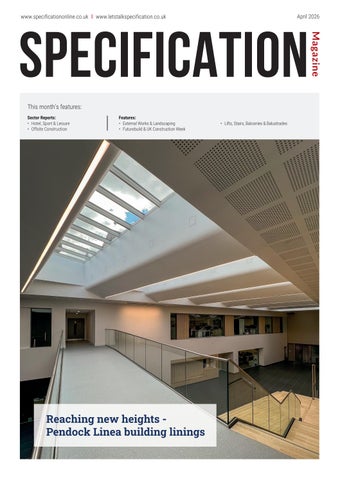
Reaching new heightsPendock Linea building linings

CIAT, Guernsey CPD Event

Guernsey Yacht Club

In February 2026, we held an event for CIAT (Channel Islands Charted Institute of Architectural Technologist’s) at Guernsey Yacht Club.

The CPD was carried out over lunch with 37 attendees from different disciplines, a mix of architects, quantity surveyors and contractors.

Our session, “Render Systems for Timber Frame Construction”, sparked some great technical discussions and valuable feedback from the Channel Islands’ construction community.

“It was a fantastic day with lots of engagement and great feedback.”

NEW 2026 CPD SEMINARS

Attend an independently certified CPD seminar arranged and hosted by Fassa Bortolo.

• An Informative Guide to Render Solutions

• Solutions for Render in Very Severe Locations

• Render Systems for Timber Frame Construction

• A Guide to Modern Systems

• Essential Guide to External Wall Insulation

• A Guide to Subfloor Preparation

BDA Agrément

Welcome

Cracking down on unsafe and unregulated building products

Major proposals to strengthen the construction products used in buildings across the country have been published in a crackdown on unregulated practices and weaknesses that are undermining the construction sector.

The Construction Products Reform White Paper sets out that all products must be properly assessed before being used in the building process.

Currently only around a third of constructions products are regulated - the new general safety requirement will mean that all products undergo the proper checks, not only keeping people safe in their homes, but boosting the economy and providing confidence to developers to build the 1.5 million homes this country needs.

The Government has published a consultation on this requirement, with secondary legislation expected later this year and all changes coming in as soon as Parliamentary time allows.

Minister for Building Safety, Fire and Democracy Samantha Dixon said: “The failings outlined by the inquiry exposed fundamental issues in product, building and fire safety standards and through the Construction Products White Paper and our work to implement all the recommendations of the inquiry, we will create a better system for millions of people across the country.”

Interim Chief Construction Advisor, Thouria Istephan, said: “We must strive to continue to make lasting and progressive change that improves the safety and quality of both new and existing buildings and, crucially, place people who live and work in buildings at the centre of our thinking.”

It comes as a new framework designed to strengthen product safety and support regulatory reform across the built environment sector has been published.

PAS 2000, Construction products- Bringing safe products to market – Code of practice, published by BSI and sponsored by the Office for Product Safety and Standards (OPSS), sets a practical framework for construction product manufacturers to adopt to demonstrate that they have taken reasonable steps to best ensure the products they place on the market are safe for their intended use.

WE PROTECT WHAT MATTERS

We’re huge stockists of fire and safety glass, offering fast delivery from local branches. Our team provides technical help and specification support, with options for supply-only or supply-and-fit to suit your project and budget needs.

Enquiry 3

Reaching new heightsPendock Linea

The Pendock Linea name, introduced over 25 years ago, covers nine separate bespoke manufactured building lining products.

In addition to the original perimeter casings products, Linea now includes wall linings, ceiling rafts, lift reveals and soffit linings, alongside bulkheads, parapet capping and pilasters.

Specialised rooflight linings and atrium beam casings, as featured on our cover, complete the range line-up.

See page 18-19 to find out more.

Enquiry - 13

TSP Media Ltd, Grosvenor House, Central Park, Telford, TF2 9TW

T: 01952 234000 E: info@tspmedia.co.uk www.tspmedia.co.uk

Future Homes Standard is a key milestone but only the first step

The much-anticipated new rules implementing the Future Homes Standard, which includes measures to ensure the majority of new homes are built cheaper to run, with solar panels and clean heating as standard, has received industry-wide support.

The Future Homes Standard Essentials set out seven critical actions to help homebuilders and their advisors to de-risk the delivery of more sustainable homes that are comfortable, healthy, low-energy, zero carbon ready and aligned with the future energy system.

Housing Secretary Steve Reed said: “Building 1.5 million new homes also means building high-quality homes that are cheaper to run and warmer to live in. As we make the switch to clean, homegrown energy, today’s standard is what the future of housing can and should look like.”

Simon McWhirter, Chief Executive of the UK Green Building Council, welcomed the Government’s decision to adopt the more ambitious Future Homes Standard, putting new homes firmly on a path away from

fossil fuels and ensuring rooftop solar and improved levels of energy efficiency are the new norm.

“This will help lower household energy bills, reduce pressure on the electricity system, and give industry the confidence to invest in skills, supply chains and innovation,” he explained.

“Making high levels of solar readily available is a clear win for households, the energy system and the climate, particularly at a time when global instability is once again driving up fossil fuel prices and exposing the risks of relying on gas for our homes. It’s a practical, cost-effective measure that will pay back for residents from day one. However, this must be the start of the journey, not the end. Government must maintain this momentum and set out a clear timetable for the next iteration of building regulations. Many developers are already building to higher standards, and are eager to help ensure the next update delivers genuinely future-ready homes by the early 2030s – comfortable, affordable to run, climate-resilient and zero-carbon.”

Manchester digital campus confirmed

The government has taken a major step forward on the Manchester Digital Campus (MDC) today, with the outline business case formally approved by the Treasury.

Built on brownfield land in central Manchester, the campus will bring together approximately 8,800 people from multiple government departments with a focus on digital work. It is a significant driver for the government digital and data strategy and a key commitment by the government's Places for Growth programme.

It is a Cabinet Office programme principally delivered by the Government Property Agency (GPA) in close collaboration with the multiple government departments involved.

Once operational - targeted for 2032 - MDC will provide approximately 900,000 sq ft of purpose-built workspace across two buildings. The new campus demonstrates Places for Growth in action, helping to harness the North West's digital expertise and fostering collaboration across departments and the wider digital sector in the region.

The introduction of the Future Homes and Buildings Standard provides long overdue clarity on what builders will be expected to deliver from 2028, with new homes set to include low carbon heating, stronger energy efficiency measures and on site renewable generation as standard. According to the Federation of Master Builders (FMB) these changes should help cut running costs for households and improve build quality, but the shift will only work if the transition is practical and backed by clear guidance for smaller firms.

The ECA welcomed speeding up lower bills, but the trade body has significant concerns about ‘plug-in solar panels’.

Many of these products available internationally are poorly manufactured, inadequately tested and are not designed for the UK electrical environment, it said. This means variable build quality, no consistent UK safety standards, questionable long-term reliability, and connectors and cabling that are not designed for prolonged outdoor exposure in UK conditions.

Enquiry 4

Specifiers need digital tools for upfront embodied carbon tracking

When materials are selected for a project, the project team determines emissions that cannot be changed once construction completes. This is upfront embodied carbon, and it represents one of the most significant environmental impacts specifiers can control, as Dr Lee Jones, Head of Sustainability at Hubexo, explains.

Upfront embodied carbon accounts for all emissions from material extraction, manufacture, storage, transport and installation. Unlike operational carbon, which building users can influence through behaviour and retrofits, upfront embodied carbon is permanent. The materials we specify today create emissions affecting our climate for decades, even centuries.

The built environment contributes two-fifths of global carbon emissions. UK construction alone generates three-fifths of all waste, which also accounts for a large portion of those carbon emissions. For specifiers, tracking upfront embodied carbon has moved from optional to essential practice.

Something significant is happening across the construction sector. According to the NBS Digital Construction Report 2025, three in five professionals now use digital technology to measure upfront embodied carbon. Just three years ago, that figure was two in five. This represents a fundamental shift in how construction

professionals approach sustainability. The same research reveals that nine in ten professionals agree that digital technologies are having a positive environmental impact. The industry has moved beyond aspiration to practical implementation, with digital tools enabling faster, more consistent and more accurate measurement of sustainability metrics.

This acceleration matters because upfront embodied carbon often represents the largest environmental impact of a building. For a typical office building, upfront embodied carbon comprises around 35% of whole-life carbon emissions, and for energy-efficient structures, that figure can reach 75%. Without accurate measurement and reporting of upfront embodied carbon, any claim to sustainable construction remains incomplete.

The regulatory landscape is shifting. Reporting upfront embodied carbon is a key enabler of the UK government’s Carbon Budget and Growth Delivery Plan, crucial for achieving net zero targets. Whole-life carbon assessments will be essential for meeting Carbon Budget 5 from 2028 onwards.

This represents a fundamental change in how construction projects will be evaluated, specified and delivered.

Early adopters are already gaining competitive advantage. Construction professionals who develop upfront embodied carbon capabilities now will lead the market whilst others scramble to respond. Clients increasingly demand environmental transparency, and sustainability-minded professionals prefer working with firms that demonstrate genuine carbon competency.

Nearly nine in ten construction professionals work on projects with sustainable outcome targets. In respect to limiting climate change, meeting these commitments requires understanding the full carbon picture, and that means addressing upfront embodied carbon from project inception.

Digital technologies provide the foundation for reliable upfront embodied carbon tracking, but they require accurate data inputs. Environmental Product Declarations (EPDs) offer standardised assessments of products’ full lifecycle impacts, but comparing EPDs can be complex when manufacturers use different scopes or units.

The specification community stands at the centre of construction’s sustainability transformation. Digital technologies provide the tools to measure and compare upfront embodied carbon across products and materials.

CONSULTANT

ON THE NEW CITY MULTI R32 VRF YXM RANGE

Delivering market-leading performance, our enhanced and expanded range helps you plan for the future.

Mitsubishi Electric’s City Multi R32 VRF range is evolving and will soon be available in system capacities from 12 to 112kW, with both Heat Pump and Heat Recovery options. We’ve re-engineered our popular plug and play VRF system with a new ultra-compact modular YXM chassis design, flexible piping configurations, market-leading low noise levels and BS EN 378 part 3 compliant safety measures. Incorporating a unique patented Vertical Flat Tube (VFT) heat exchanger, the new City Multi R32 VRF YXM range delivers high seasonal efficiencies, low operational costs and a significant reduction in whole life carbon.

Available to install from Spring 2026, if you are a Consultant and have a medium to long term specification project suitable for our new City Multi R32 VRF YXM range and would like to speak to a Mitsubishi Electric Account Manager, or simply to register for future updates, please visit:

Invisible security design in hospitality and leisure architecture

In well-designed hospitality and leisure environments, the most effective operational systems are often the least noticeable. Guests move intuitively through spaces, staff workflows remain efficient behind the scenes, and valuable assets are protected without disrupting the atmosphere of openness that defines these settings.

Elisabeth Whitefield, Vice President Gunnebo Safe Storage Europe, highlights how operational efficiency in such environments relies on aligning architectural layout, interior detailing and secure building management. This ensures protection is integrated into daily routines rather than imposed as a separate control layer.

Smart hospitality and leisure buildings support diverse user groups moving through the same spaces at different times. Guests, members, athletes, event staff, medical teams and contractors each require tailored access to facilities and equipment within overlapping zones.

Operational efficiency is enhanced when systems support consistent workflows, reduce unnecessary movement and streamline staff coordination. Digital access controls, integrated monitoring and intelligent scheduling allow personnel to focus on service delivery rather than operational oversight.

Design considerations ensure these systems remain unobtrusive and seamlessly blend with their surroundings. Panels, card readers and secure storage can be concealed within joinery, integrated into wall or ceiling details and coordinated with lighting and signage. Material selection is critical, as bespoke finishes,

coordinated palettes and careful detailing allow operational components to blend seamlessly into the architectural language, preserving both the visual and tactile quality of spaces. Facilities management considerations increasingly influence specification decisions. Hotels and leisure venues are long-life assets to remain operational throughout refurbishment and upgrade cycles.

Durable, adaptable systems reduce the need for invasive interventions while maintaining consistent performance. Elements integrated into the building fabric rather than applied superficially are more easily maintained, upgraded or replaced over time. This approach minimizes disruption to both staff and visitors and preserves the spatial integrity of public-facing areas.

Physical resistance, certification and compliance remain essential, but architects increasingly balance these criteria with placement, accessibility and visual integration. Coordinating safe storage early allows it to be incorporated into furniture layouts, service zones and circulation planning while maintaining sightlines, proportions and finish

quality without compromising functionality. In hospitality and leisure contexts, safe storage including safes and cabinets are required across a wide range of locations, including reception desks, guest rooms, changing facilities, medical spaces and back-of-house zones. Each location demands a tailored response, yet all share a common requirement for discretion.

Solutions such as Chubbsafes’ safes and secure cabinets as part of the Gunnebo Safe Storage portfolio, can support the structured management of cash, guest valuables, master keys and sensitive documentation, while also providing designated, fire resistant storage for security battery storage for those used in radios, tablets and maintenance equipment.

By combining certified burglary and fire protection with clearly defined access control, hotels and leisure venues can strengthen accountability, reduce risk and maintain compliance without disrupting front of house service.

When safe storage solutions are aligned with a building’s overall building management strategy, they become part of a coherent operational framework rather than isolated security measures. Within contemporary hotel, sports and leisure projects, safe storage supports accountability, enables efficient workflows and reinforces operational order while respecting architectural intent. Its value for architects, specifiers and facilities managers lies in how effectively it integrates into the wider design and management framework of the building, demonstrating that security and operational efficiency can be achieved without compromising spatial quality, material integrity or user experience.

Specification professionals can now access key products from EJOT’s fastening and anchoring portfolio via the NBS Source platform. Products and relevant data include:

• High Performance Anchoring Systems

• Safety Critical and Seismic Anchoring Systems

• Specialist Roofing and Facade Fastening Systems

• Third Party ETA test verification

Project: The Oren, London

Architects: Stanton Williams

Suppliers: Schuco; Bauder; Domus; Dulux; Havwoods; Tobermore

Creating a timeless project immersed in nature in the heart of the city

Located on the edge of London's Hampstead Heath, Stanton Williams’ first retirement living development is designed with a strong focus on adaptability, sustainability and community.

Situated on a unique site surrounded by mature trees and bordering Golders Hill Park, within Hampstead Heath, The Oren is designed to encourage community whilst respecting individual privacy.

The development comprises 46 residences – two and three bedroom apartments, including four penthouses and two guest suites– thoughtfully arranged across four interlinked volumes, with facades and balconies oriented to capture different aspects of the spectacular landscape views.

The site presented several design challenges, including a sloping and overgrown wooded landscape that made access difficult, combined with the need to minimise overlooking, maintain visual amenity and mitigate traffic noise from neighbouring roads.

“The architectural concept ingeniously addressed these constraints by developing four distinct but connected elements that that follow the natural contours of the site,” explained Stanton Williams. “The ground

floor is carefully nestled into the terrain, ensuring that homeowners can move freely and comfortably throughout the space. Strategic ‘setbacks’ of the upper floors help the building blend into its surroundings, reducing visual impact and preserving the area's natural character.

“This approach not only gives the development a more human scale, but also ensures that each apartment benefits from a private outdoor space – either a balcony or terrace – offering homeowners beautiful views over the treetops or gardens. The result is a thoughtful living environment that celebrates its natural surroundings.

“The building offers varying levels of sociability and support, from amenities such as a hydrotherapy pool to relaxed social spaces for dining and entertainment. Circulation routes have been meticulously planned to ensure ease of movement throughout, with particular attention paid to accessibility. Natural daylight floods the generous circulation spaces, avoiding the institutional character of long, dark corridors.” >>

UNIFOLD

Enquiry 7

>> Inspired by North London's outstanding legacy of modernist residential architecture, The Oren aims to make a meaningful contribution to this tradition of exemplary design. The careful integration of building and landscape has been achieved through close collaboration with renowned landscape architect Christopher Bradley-Hole.

Together we have created thoughtfully designed communal gardens and facilities that foster a strong sense of community, while creating a seamless dialogue between indoor and outdoor spaces.

Sustainability is embedded in every aspect of the design. Built to last and to be adaptable in the long term, the all-electric building incorporates on-site renewable energy through rooftop photovoltaic panels, while the passive design approach maximises daylight while minimising solar gain.

A fabric-first strategy ensures high thermal performance through high levels of insulation and airtightness.

The scheme also features green roofs, water attenuation tanks and bird boxes integrated into the brickwork.The material palette emphasises natural, responsibly sourced materials, with brick and timber creating warm, tactile surfaces throughout. Generous ceiling heights in communal areas and carefully considered details contribute to the building's residential rather than institutional character.

The Oren offers homeowners – many of whom have long-standing connections to Hampstead and North London – the opportunity to remain in their cherished neighbourhood while becoming part of a supportive community. It is a building that feels grounded in its context and which strives to create a genuine sense of home for all its residents.

Solving the High-Temperature Headache: Why Specification Matters for Commercial Kitchens

For specifiers, the challenge is clear: modern appliances like high-speed dishwashers, glasswashers, and boiling water taps (such as Zip taps) discharge water at temperatures that can reach 90°C. Most domestic-grade pumps are rated for a maximum of 35 C to 40 C. When these standard units are installed in high-temp environments, the results are predictable: seal failure, motor burnout, and costly facility downtime.

The DrainMajor 730HES was engineered specifically to bridge this gap. Powered by a Jung Pumpen US73HES submersible pump, this system is a dedicated hot water pumping station designed for continuous, reliable performance where others fail.

In commercial specification, what’s “standard” doesn’t always mean it’s right, and it can often come at the expense of reliability. This is never truer than in modern commercial kitchens, laboratories, or laundry facilities where wastewater temperatures frequently exceed the limits of standard pumping equipment.

Key Technical Advantages for the Specifier:

• Extreme Temperature Resilience: Unlike standard units, the Jung Pumpen 730HES is built to handle wastewater up to 90°C. This makes it the "safe bet" for commercial kitchen fit-outs where boiling water discharge is a daily reality.

• Vortex Hydraulics & Solids Handling: The system features a 30mm solids handling capacity. By using a vortex impeller, the pump minimises the risk of clogging from food debris or fibrous materials, ensuring the "fit and forget" reliability that clients demand.

• Advanced Sealing Technology: Reliability starts at the shaft. The 730HES utilises a Silicon Carbide mechanical seal, providing a robust barrier against the abrasive and thermal stresses of hot wastewater.

• Ready-to-Install Design: Time on site is critical. The DrainMajor arrives as a complete, compact package with a sealed polyethylene tank and high-level alarm, ensuring a fast and compliant installation.

Beyond the Pump: A Technical Partnership

We know that a pump is only as good as its specification. Choosing the DrainMajor 730HES, powered by Jung Pumpen, isn't just about buying hardware; it’s about ensuring the long-term integrity of the building’s drainage system.

We provide full support to UK specifiers, from initial sizing and 3D BIM library access to rapid UK-based stock availability. When you specify Jung, you are choosing German engineering backed by UK technical expertise. Don’t let hightemperature waste be the weak link in your next project. Specify the DrainMajor 730HES for proven, scalding-water performance.

Pump Technology – Enquiry 9

Proven Solutions for Demanding Sites

Compli 1010: The "fit and forget" lifting station for large-scale residential & commercial

Specifying with Confidence: Expert Insights at Fassa Bortolo’s Guernsey CPD Event

Fassa Bortolo delivered a highly engaging and technically focused CPD event in February 2026 at the prestigious Guernsey Yacht Club, bringing together 37 architects, surveyors and contractors for an in-depth exploration of render systems for timber frame construction. Presented by Daniel Baxter, the session formed part of the company’s ongoing commitment to professional education and best practice within the built environment.

Set against the coastal backdrop of Guernsey, the event provided an ideal setting for knowledge sharing and professional networking. Attendees from across the region gathered to deepen their understanding of one of the industry’s most critical and often challenging areas: the specification and application of render systems on timber frame substrates.

Daniel Baxter led the session with a clear, practical, and specification-driven approach, ensuring the content was both informative and directly applicable to real-world projects. The CPD focused on the key considerations when working with timber frame construction, including movement, moisture management, substrate preparation, and the importance of system compatibility. Emphasis was placed on how incorrect detailing or product selection can lead to long-term performance issues, highlighting the need for a fully integrated system approach.

The presentation also explored the latest advancements in render technology, including flexible basecoats, mesh reinforcement strategies and breathable

finishes that accommodate the natural movement of timber structures. Attendees were guided through compliant system build-ups, with reference to current standards and best practice guidance, ensuring they left with confidence in specifying robust and durable solutions.

A key highlight of the session was the discussion around risk mitigation. Baxter outlined common on-site challenges and failures, offering practical solutions to avoid cracking, debonding and moisture ingress. This practical insight resonated strongly with the audience, many of whom are actively involved in timber frame projects across residential and commercial sectors.

The interactive nature of the CPD encouraged open discussion, with attendees contributing their own experiences and raising project-specific queries. This collaborative environment not only enhanced the learning experience but also reinforced Fassa Bortolo’s role as a trusted technical partner within the construction industry. In addition to the technical content, the event provided valuable networking opportunities, allowing professionals from different disciplines to connect and exchange ideas. The turnout of 37 industry professionals reflects the growing demand for high-quality, technically robust CPDs that address the evolving challenges of modern construction methods.

Fassa Bortolo continues to invest in educational initiatives such as this, recognising the importance of supporting specifiers and contractors with up-to-date knowledge and guidance. As timber frame construction continues to gain momentum across the UK and Channel Islands, the need for reliable, high-performance render systems has never been greater. The Guernsey Yacht Club CPD event stands as a testament to Fassa Bortolo’s commitment to excellence, combining technical expertise with practical insight to support better building outcomes.

If you want to find out more about our CPD events and what we can offer, please call 01684 218305 or email info.fassauk@fassabortolo.com

Fassa Bortolo – Enquiry 11

Improving fire detection systems in ventilated homes, with Flagship Housing

For UK social housing providers, the challenge of maintaining indoor air quality and ensuring robust fire safety is a constant evolution. Flagship Housing, which manages over 33,000 homes across the East of England, is currently leading the way in addressing a specific, often overlooked risk: the interaction between mechanical ventilation and smoke spread.

Positive Input Ventilation (PIV) and Mechanical Ventilation with Heat Recovery (MVHR) systems are increasingly used within social housing to improve indoor air quality and address damp and mould. While these systems deliver clear health benefits, they also introduce important fire-safety considerations, particularly around ductwork, compartment penetrations, and the potential for smoke movement within a dwelling.

The Integrated Solution

The primary drivers of the project were the need to improve resident safety, as well as providing live compliance data and remote notification of fire alarm activations.

“Due to the potential for mechanical ventilation and interconnected ductwork to accelerate the spread of smoke and fire, enhanced detection ensures earlier warning for occupants, mitigates ventilation-related risks, and provides an appropriate level of life safety, particularly for vulnerable residents.”

– Davin Gee, Compliance Manager (Electrical) at Flagship Housing.

To achieve this, Flagship Housing adopted a standardised specification for all properties fitted with PIV or MVHR systems. The integrated approach utilises:

• Ei3024 Multi-Sensor Fire Alarm - Provides enhanced smoke and heat detection.

• Ei428 RadioLINK Relay ModuleIsolates the ventilation system upon alarm activation, helping limit smoke and fire spread.

• Ei1000G The Gateway - Enables remote notification of alarm activations and provides live compliance data.

Implementation and Installation

The installation is being completed by Karma Electrical & Fire Systems Ltd, an Aico Platinum Partner. By using installers trained through the Aico Expert Installer program and City & Guilds assured courses, Flagship ensures that every system meets the rigorous intent of BS 5839-6.

“The Aico system is incredibly straightforward to install. From an installer’s perspective it’s well designed, logical, and easy to integrate with ventilation systems. More importantly, it gives the Registered Social Landlord far greater visibility of compliance and resident safety than traditional standalone alarms.” - Karl Sharman, Managing Director at Karma Electrical & Fire Systems Ltd

A New Standard for Safety

is now the minimum standard for all Flagship Housing new builds and retrofits. This project highlights the value of strong collaboration between housing providers, manufacturers, and competent contractors.

The project, initially covering 150 ventilated homes, is nearing its 2026 completion date. However, the impact is more permanent: this specification

By focusing on smoke containment, automatic ventilation isolation, and real time data, Flagship Housing has implemented a proactive, resident focused fire safety solution that goes beyond basic compliance.

Aico – Enquiry
Ei1000G
Ei3024

Reaching new heightsPendock Linea building linings

The Pendock Linea name was introduced over 25 years ago, for use solely with the company’s HVAC system perimeter casings. Today, Linea covers nine separate bespoke manufactured building lining products. We take a detailed look inside the Linea family.

In addition to the original perimeter casings products, Linea now includes wall linings, ceiling rafts, lift reveals and soffit linings, alongside bulkheads, parapet capping and pilasters. Specialised rooflight linings & atrium beam casings complete the line-up.

Each provides a practical and aesthetic solution for specific applications, while retaining a high degree of versatility, as all are bespoke manufactured to meet individual project dimensions and specifications. This product scope also benefits architects by allowing several lining elements for a project to be specified from a single source, rather than each item being unlisted or ‘floating’ within different sections of a specification document.

Wall linings

Used for interior and exterior applications requiring decorative or protective solutions, they are particularly effective in areas of high pedestrian traffic, such as airports, public transport, retail and commercial buildings to resist scuffing and damage to internal walls.

Stainless steel and aluminium are commonly specified, although they can also be manufactured from other materials including plywood; MDF or compact laminate, as well as textured metallics and a range of finishes from specialists including Rimex, Trespa and Formica. Clearly, the material specification is dependent on the individual application and whether it’s an exterior or interior project. As all wall linings are bespoke manufactured, unique designs, shapes, sizes and curved forms can be specified along with special requirements, such as acoustic performance; perforations; backlighting or specialised illumination.

Ceiling rafts

Pendock ceiling rafts, islands and linings are already used within retail and commercial environments, as well as performance venues and other large spaces to provide a decorative suspended solution.

Circular, elliptical and square, plus bespoke designs, can be specified and manufactured from plywood, glass-reinforced gypsum (GRG) or glass-reinforced plastic (GRP), as well as acoustically lined perforated aluminium or stainless steel options, which help enhance acoustic performance by damping reverberations or problem frequencies. Integral lighting can also be incorporated within the ceiling raft design, which should be considered when specifying, as it may affect the choice of material.

Lift reveals

Decorative lift reveals can be specified in aluminium, stainless steel, compact laminate (CL) and ply/MDF. For aluminium and stainless steel, respective standard thicknesses of 2mm and 1mm are available, while bespoke thicknesses can also be specified along with brushed, polished and textured finishes.

High pressure laminate (HPL) finishes from leading manufacturers including Polyrey; Abet and Formica can be specified on CL reveals, which combine high durability with versatility to integrate with building colour schemes. HPL finishes can also be specified on the ply/MDF range, as well as real wood veneers and a paint grade substrate for onsite finishing. Bespoke finishes can be specified on all ranges together with further

options, such as the inclusion of call button apertures, indicator signage and dry riser openings.

Soffit linings

Linea soffit linings provide a versatile and high quality finish for exterior applications. Manufactured from aluminium for its low weight and inherent weather resistant properties, they can be specified with PPC finishes and to create a uniform and attractive result.

Dedicated accessories are also incorporated within the range which includes internal & external corners, as well as flashing and trims to complement the panels.

Rooflight linings & atrium beam casings

The range incorporates decorative casings for external upstands, as well as interior rooflight lining and finishing solutions, which can be manufactured from PPC aluminium and moulded GRP for interior and exterior use, plus moulded GRG for interior projects only.

Wall Linings
Ceiling rafts
Soffit lining

As GRP and GRG rooflight linings are bespoke manufactured, they provide a high level of fit and finish to meet individual project requirements, while GRP casings can also help enhance weather resistance.

Linea atrium beam casings are used primarily to conceal structural roof beams or glazing bars and are designed to blend seamlessly with the atrium and building interior. Typically manufactured from aluminium with a PPC finish, they can be produced in a range of bespoke forms such as ellipses, semi-circles and shallow curves plus parabolic and rectangular profiles.

Manufactured from 2mm thick sheet aluminium and incorporating a PPC finish, the parapet and wall capping product range incorporates flat and sloping options, which can be face-fixed or use concealed fasteners.

Manufactured to suit individual project specifications, they can be specified in single lengths of up to 4,000mm, and a range of dedicated accessories is available, including internal & external corners; T-sections and stop ends.

Bulkheads & fascias

GRP and metal bulkheads can be specified for interior and exterior use, while GRG and ply/MDF core options can only be used for interior applications.

Moulded bulkheads can accommodate curved forms and tend to be made from GRG or GRP, allowing a seamless integrated finish to be achieved. Metal bulkheads, are bespoke manufactured and can be specified in a range of PPC finishes, as well as brushed, polished or textured options.

Pilaster

Used almost exclusively in shopping malls to conceal steelwork and roller shutter guides between shops, Linea pilaster linings give a uniform look and finish to retail environments. GRG and HPL finished plywood are commonly specified material choices with the former providing additional fire safety and material compatibility with other drylined elements.

Radiused corners and semi-circular forms can further improve safety by removing sharp edges.

Stainless steel kickplates can be specified for added durability, while specifiers can choose to make pilasters blend-in or contrast with their surroundings through colour and material choices, including wood grain laminates and metal effects.

Perimeter casings

The original Linea product, perimeter casings are designed to conceal building services along interior walls and below windows in long continuous runs or within bays between columns.

In general, they are manufactured from preformed plywood with a hard-wearing HPL finish and incorporate pre-cut convection grilles in the top and front face when used to conceal HVAC components.

Suitable for both new build and refurbishment projects, their design helps maximise office space while enabling them to incorporate electrical and communication network cable management systems. Pendock – Enquiry 13

Parapet capping
linings
Atrium beam casings
Parapet capping
Bulkheads & fascias
Pilaster lining
Perimeter casings

Education Estates® 2026: aligning specification, policy and delivery across the UK education estate

This year’s event comes at a pivotal moment, following the Department for Education’s recently published Education Estates Strategy: a decade of national renewal. The strategy sets out a long-term vision to improve the condition, sustainability and suitability of education buildings, reinforcing the need for coordinated, evidence-based decision-making across the sector. For those involved in specification and delivery, aligning with these priorities will be critical. With over 5000 attendees expected, Education Estates® connects stakeholders across the full project lifecycle, from funding and procurement through to design, construction and long-term asset management. Delivered in partnership with the Department for Education, the event provides direct insight into policy, standards and frameworks influencing both new build and refurbishment programmes.

Across more than 29,000 schools, 380 colleges and 142 universities, the scale of investment required presents both opportunity and complexity. Compliance, building safety, net zero targets and whole-life performance are now central to project success, placing increased responsibility on specifiers and project teams to make informed, future-ready decisions. The event’s role as a platform for collaboration and shared learning is reflected by Ian Whalley, Partner at Farrell and Clark LLP, who commented, “Really enjoyed Education Estates® - it’s always one of those events that leaves you feeling inspired. Loved seeing some innovative new products, hearing different perspectives, and meeting so many great people all working towards the same goal: making education environments better for everyone.”

Specification-led insight and CPD

The CPD-accredited conference spans six stages, offering practical, project-led insight to support specification, procurement and delivery. Sessions address key areas aligned to Department for Education guidance and

wider regulatory requirements, including building safety, energy performance, retrofit strategies, digital construction and modern methods of construction.

Grounded in live education projects, the programme provides a valuable opportunity to benchmark approaches, understand evolving requirements and reduce design and compliance risk. For architects, engineers and consultants, it supports more confident, evidence-based specification. For contractors and surveyors, it offers clarity on delivery, cost control and whole-life value.

A marketplace for informed specification

At the heart of Education Estates® is a highly targeted exhibition, designed to support specification-led decision-making. Manufacturers, distributors and service providers present solutions aligned with current regulatory requirements, performance standards and budget constraints.

With 55% of attendees visiting the exhibition only, alongside conference delegates, it offers a valuable opportunity for early-stage engagement between suppliers and project teams. These conversations enable architects, engineers and contractors to evaluate products in context, supporting compliance, performance validation and programme certainty. The commercial value of these interactions is clear, as highlighted by Simon Hassett, Founder of Vape Guardian, who explained, “We left with a lot of qualified leads and immediate meetings in the diary. In the last day alone, new connections have already turned into real opportunities to expand our reach. We are now lining up trials with national installers and presenting to a major academy trust about detection and air quality.”

The presence of organisations such as the Modular & Portable Building Association (MPBA) further reflects the growing role of modern methods of construction in education

Education Estates® returns to Manchester Central on 20th and 21st October 2026, bringing together the professionals responsible for specifying, designing and delivering the UK’s education estate. As the sector’s most established event, it provides a focused forum for architects, contractors, engineers, surveyors and clients to engage directly with the technical, regulatory and commercial pressures shaping education infrastructure and learning environments.

One venue, Two days Thousands of specifiers

delivery. As demand increases for faster, more sustainable and cost-effective solutions, modular approaches are becoming an integral part of the specification conversation, particularly in addressing programme pressures and estate condition challenges.

Benchmarking excellence and best practice

The Education Estates® Awards Dinner recognises excellence across the sector, showcasing projects and teams delivering measurable impact in the design, construction and operation of education environments. For specifiers and project teams, these case studies provide valuable benchmarks in quality, innovation and whole-life performance.

Why attend?

1. Gain CPD aligned to current DfE policy and regulatory requirements

2. Discover specification-ready, compliant products and systems

3. Benchmark live projects and best practice across the sector

4. Engage with clients, framework providers and delivery partners

5. Reduce risk through informed, evidencebased decision-making

As the education estate enters a new phase of national renewal, Education Estates® provides a vital platform for the industry to align policy with practice, strengthen collaboration and deliver better outcomes across schools, colleges and universities.

For more information about exhibiting or sponsorship opportunities, please call Rebecca on 01892 351626 or visit www.educationestates.com. Due to high demand, the floorplan has been extended, with stand rates set to increase from 22nd May.

Join the national conversation around the education estate

Schools | Colleges | Universities

Education Estates® is the UK’s leading event for education infrastructure, focussing on the funding, design, build, maintenance and management of schools, colleges and universities.

Gain unprecedented access to senior professionals from central and local government, multi academy trusts, schools, colleges, universities, architects, consultants/advisers and contractors from across the UK.

Enquiry 15

Timber Frame: Where to Start –new digital guide unveiled

Three leading organisations in the construction sector – Timber Development UK (TDUK), the Structural Timber Association (STA) and Swedish Wood – have launched a new digital platform that makes timber frame construction easier for built environment professionals to understand and adopt.

Timber Frame: Where to Start is a practical, accessible guide that provides a clear introduction to timber frame construction and its principal elements. The purpose of the guide is simple: to give users a quick and easy way to understand how timber frame works, while signposting them to credible and accessible information.

Designed for anyone interested in timber frame construction, the guide supports a wide audience. It will be particularly useful for architects, specifiers, engineers, timber frame suppliers, building operators, home builders and contractors.

It also serves as a straightforward introduction for those new to timber frame who want reliable information in one place.

Timber frame is a proven, reliable and mainstream method of construction, fully supported by warranty providers, lenders and insurers. In Scotland, 92% of all new-build homes are constructed using timber frame. Seven of the top ten UK homebuilders operate their own timber frame manufacturing facilities, and it has been predicted that as many as one in three UK homes could be timber frame by 2030.

With the top construction companies now moving towards greater use of timber frame, and many smaller firms beginning that

Andrew Orriss, CEO of the Structural Timber Association, added: “There is a growing appetite across the sector to build more in timber. The challenge for many organisations is knowing where to begin. ‘Timber Frame: Where to Start’ provides a clear route in, backed by trusted industry bodies and credible information.”

transition, the demand for clear and practical guidance is clear. This new digital guide has been created to help companies build confidently in timber, providing the insight needed to deliver successful projects and positive experiences with the system.

Dave Hopkins, Chief Executive of Timber Development UK, said: “Timber frame is no longer an alternative method of construction. It is a mainstream solution that supports productivity and sustainability. This guide brings together the information businesses need to get started, all in one accessible place.”

Stephen King, UK Project Manager, Swedish Wood, commented: “As a long-standing supplier of structural timber to the UK market, we’re seeing strong growth in demand for timber frame construction. By supporting this initiative, we’re helping ensure that companies looking to build in timber have the confidence, knowledge and supply chain support they need to do it well.”

The digital platform reflects a shared commitment from TDUK, STA and Swedish Wood to support industry growth, encourage informed decision-making and promote high standards across the sector.

To access the Timber Frame: Where to Start guide, visit www.timber-frame.uk – Quick Start Timber Frame Design Guide.

STA – Enquiry 16

SIMONSWERK Concealed Pivot Hinge Shortlisted for Product Design & Innovation Award

SIMONSWERK’s VT 845 concealed pivot hinge, featuring an integrated self-closing mechanism for rebated frame doors, has been recognised for innovation in architectural ironmongery.

The VT 845 concealed self-closing pivot hinge for aluminium framed doors within a rebated frame has been shortlisted at this year’s GAI Specification Awards 2026 in the Mechanical Product Design & Innovation category.

Part of SIMONSWERK’s VERTO range of self-closing pivot systems, the VT 845 combines a concealed pivot hinge with an integrated self-closing mechanism, eliminating the need for additional door control hardware while maintaining a clean architectural aesthetic.

Fully concealed within the door profile, the system supports the minimal detailing increasingly specified in contemporary interior design.

Compact in design, the hinge delivers automatic, controlled closing alongside precise adjustability, including height adjustment and adjustable closing speeds. With minimal installation dimensions, the VT 845 offers a discreet yet highly engineered solution, ideally suited to modern residential and commercial environments where both aesthetics and performance are paramount. Andrew Kite, Managing Director of

hinge solutions. It offers architects and specifiers a discreet self-closing solution that supports contemporary interior design while delivering the quality and reliability expected from SIMONSWERK.”

SIMONSWERK UK, commented: “Being shortlisted at the GAI Specification Awards is a fantastic achievement for our team, and we are delighted that the VT 845 has been recognised by the industry. The VT 845 is a unique product within our range and reflects our continued focus on developing innovative

High level roof ventilation for mortar bedded ridge tiles

Suits all common ridge tile types

The Guild of Architectural Ironmongers (GAI), in conjunction with the Royal Institute of British Architects (RIBA), hosts the Specification Awards to celebrate excellence in architectural ironmongery. Winners will be announced at the ceremony on 15th May 2026 at IET London: Savoy Place.

SIMONSWERK – Enquiry 17

Protected by pending patent application No. 2417868.3 and registered design rights

Specifiers often run into recurring obstacles when planning shower and wetroom drainage for high-footfall leisure facilities. Common consequences can be odours, slow drainage, damage to finishes from standing water, inaccessible fixtures, and costly remedial work.

Pressure fluctuations can impact wetrooms when several outlets operate simultaneously, while undersized channels or poorly optimised trap layouts increase the risk of siphonage, and seal loss. Low floor build-up and difficult pipe routes in refurbishments restrict where traps or standard gradients can be used.

For successful projects, specifiers must address three overlapping concerns:

1. Serviceability

Gullies and traps need to be accessible – without specialist tools – for routine cleaning. The shape and layouts of the final installation should minimise debris build up, so removable traps and grates are an advantage. Similarly, surfaces that can be disinfected easily make maintaining a high standard of hygiene far more achievable.

Three considerations for hotel, gym and leisure drainage

Specifying shower and wetroom drainage in hotel, gym and leisure facilities requires consideration of several factors; hygiene, hydraulic reliability and installation constraints. Erik Mul, Product Manager at ACO Building Drainage, breaks down why good specification must balance maintenance, flow performance and installation flexibility.

2. Hydraulic Capacity

To help prevent siphonage, specify channel and gully systems with proven discharge performance. In communal facilities, continuous channel runs can help manage larger water volumes, and optimised trap positioning and channel capacity reduce standing water as well as the risk of seal loss during peak flow conditions.

3. Installation adaptability

Where floor build-up is limited or pipework access is constrained, lowprofile solutions and adaptable outlet orientations help prevent compromises to trap depth or falls. Rotating or horizontal gullies, modular channels and height-adjustable products let installers align drainage to the current substrate and membrane without bespoke onsite fabrication.

ACO Building Drainage has developed new solutions in its latest ShowerDrain range to address the challenges of drainage specification in hotel, gym, and leisure facility showers and wetrooms. The new range was designed and tested specifically to tackle the challenges that specifiers come up against, including serviceability, hydraulic capacity and adaptability. These include the Modular 125 system for continuous runs in communal showers or poolside changing areas. Specifiers can accommodate complex or irregular layouts by using ACO’s custom channel and gully arrangements.

Low-build height solutions in the range are designed for constrained floor heights, and hydro-formed gullies in ShowerDrain C enable higher flows and easier cleaning.

ShowerDrain E is compatible with flexible floors and features a horizontal gully body capable of 360° rotation for tight or irregular spaces. ShowerDrain B offers a channel system with a rotatable gully solution for tiled floor installations.

The Passino gully, incorporates a two-piece removable foul-air trap and has an updated design to optimise the flow rate. The Passino gully fits directly into a DN100 outlet pipe for faster installation. The ACO range gives specifiers and installers more options to suit their application, and avoid common trade-offs in aesthetics, hygiene and flow performance, which – in hotels and leisure facilities – can make all the difference.

For more on ACO’s new ShowerDrain range, see ACO.co.uk

Complete Wetroom Protection with Marmox’s Updated Wetroom Range

A truly reliable wetroom starts from the floor up.

Creating a reliable wetroom requires more than great design - it demands a fully waterproof system that performs from the structure upward.

Marmox’s reworked Showerlay provides a fully waterproof, durable base that keeps floors dry, safe, and comfortable. With flexible drainage options, improved installation features, and a design built for both modern homes and commercial spaces, it makes creating a highperforming wetroom faster, simpler, and more adaptable than ever.

Redesigned from the ground up, the Marmox Multiboard Showerlay now features a fleece that overhangs by 100mm, making tanking joints between floor and walls faster and more reliable.

Fully trimmable on all sides, each panel can be adjusted on site by up to 100mm, fitting tight or unusual layouts with ease.

The reworked Showerlays continue to offer layout flexibility, with centre or offset positions for point drains and offset options for linear drains—making it easier to plan around room design and drainage requirements. Grates are available in stainless steel, black, white, copper, or gold, allowing the drain to complement the overall wetroom style.

A tileable linear option creates a clean, seamless finish that blends effortlessly with floor tiles.

For walls and additional surfaces, Marmox Multiboards provide a lightweight, waterproof, and thermally insulated base that can be tiled, plastered, or rendered. Easy to cut and fit around plumbing or corners, they help reduce condensation, maintain warmth, and work perfectly with underfloor heating. Tileable Basins and Niche storage solutions

are also part of the Multiboard range. Four basin styles offer flexibility—including an Infinity style, linear drain style, push plug style and a shelf version which can be used independently or as an extension piece. New Niche sizes (1200 x 400mm & 600mm x 300mm) provide integrated storage that is ideal for shower areas.

Together, Marmox Showerlays, Multiboards, Tileable Basins, and Niche options provide a complete toolkit for wetrooms that are fully waterproof, simple to install, and visually clean. Whether it’s an ensuite, a luxury wetroom, or a full bathroom renovation, Marmox ensures installations are reliable, practical, and built to last.

For further information: Visit www.marmox.co.uk or contact us on T: 01634 835290 or E: sales@marmox.co.uk

Marmox – Enquiry 22

Explore the new ACO ShowerDrain Range Wetroom solutions for every application

With products ideally suited to leisure centres, hotels, spas, care homes and domestic applications.

Learn more about the ACO range of Shower and wetroom channels and gullies.

Find out more about ACO’s new showerdrain range at www.aco.co.uk/wetroom-showers

Elevating performance and safety: The advanced role of sports flooring beyond standard vinyl

The quality of an indoor sports sheet vinyl floor can give specifiers a sporting advantage, with a key function of sports flooring being to help protect players from injury and enhance their athletic performance. A sports floor surface is arguably the most important element of a sporting facility to its players, and to those who design, build and manage indoor sports premises (whether this be in the education,

leisure, fitness market), their requirements high on the agenda is the need for a high quality and sustainable sports flooring that consistently delivers the comfort, safety and performance aspects that are so crucial to everyone taking part in sport.

The fundamental importance of the role of indoor sports floorings to environments like clubs, gyms, sports halls, leisure centres

and multi-use facilities can therefore not be underestimated, regardless of whether they are low-impact or elite performance sports locations. This also extends to educational establishments like schools, colleges and universities where long-term injuries to the bones, joints and ligaments of budding athletes, especially those still growing, could cut short a potential sporting career.

Clearly aesthetics, acoustics, hygiene, resistance to wear, easy maintenance and good indoor air quality are key factors to sports venues.

But when it comes to reducing the risk of injury, minimising the severity of an injury should it occur, and helping to prevent both short and long-term impact injuries, then the choice of sports flooring is critical.

Gerflor – Enquiry 24

It’s...WhereChampionsPlay.

Taraflex® is the most widely specified indoor sports surface in the world. Its’ unique construction and technical performance is unrivalled, it has been fitted at every Olympic Games since 1976.

Taraflex® delivers optimum safety and comfort for all users, and is widely recognised and installed in the education sectors. Over 8 million pupils everyday enjoy the benefits of Taraflex® sports flooring.

If you have an education facility and require more than just sports flooring, Gerflor also have other resilient floor coverings for your project, including Tarasafe Safety Flooring, Powershock Rubber Tiles, and DLW Linoleum.

+44 (0) 1625 428 922 contractuk@gerflor.com www.gerflor.co.uk CONTACT US FOR FURTHER INFORMATION

Dunfermline Learning Campus
DLW Marmorette Linoleum
Tarasafe Safety Flooring Powershock 300 Rubber Tiles
Taraflex Performance Sports

Offsite Construction

Watertightness classification: key for membrane specification

Glidevale Protect covers all bases to explain membrane watertightness classifications a nd why manufacturer transparency is important when specifying for structural timber construction. Read more on page 34.

Delivering sustainable timber and steel hybrid solutions for sports centre

Cozenton Park Sports Centre; a state-of-the-art leisure facility that exemplifies sustainable and innovative design. The project, located in Rainham, Medway, replaced the aging 1990s ‘Splashes’ pool complex with an energy-efficient and aesthetically striking hybrid structure, setting a benchmark for leisure developments in the UK.

B&K Hybrid Solutions, leading specialists in engineered timber and hybrid construction, have played a pivotal role in the creation of Cozenton Park Sports Centre.

Commissioned by Medway Council as part of their commitment to delivering high-quality community facilities, the new £23.6 million Cozenton Park Sports Centre is designed to meet the highest energy efficiency standards. The building includes a modern fitness gym, a multi-purpose exercise studio,

a main pool, and a children’s play pool with flume and beach area, meeting both family and fitness needs for the community.

B&K Hybrid Solutions (BKHS) were appointed to manufacture and install the hybrid engineered timber and steelwork elements which underpin the facility’s design, combining the visual appeal and natural warmth of timber with the strength of steel. Working in collaboration with specialist supply chain partners Stora Enso for the Cross Laminated Timber (CLT) and Rubner for the glulam

components, BKHS delivered a precisionengineered solution tailored to the project’s sustainability and performance goals.

The project team, led by architects Space & Place and main contractor Willmott Dixon, prioritised offsite construction methods to optimise build quality, energy performance, and delivery schedules. The pool hall features glulam columns and beams measuring 1700 x 240mm at 5m intervals, creating a clear 26.3m span. Stainless steel flitch plates ensure structural precision, while CLT wall panels and roof decks complete the elegant environment. The adjoining twostorey building incorporates a steel frame with CLT roof panels and profiled metal decking to support the intermediate concrete floor, housing the gym and exercise studio.

BKHS’ contribution to the project was integral to achieving Medway Council’s ambitious sustainability targets. The CLT walls and roof decks provide exceptional airtightness and thermal performance, reducing energy consumption and carbon emissions.

Key sustainability highlights of the hybrid approach include: 72% lower carbon emissions compared to conventional construction methods; CLT’s insulation properties reduces operational energy costs, with projected annual savings of approximately £30,000; and the timber structure locks in over 314 tonnes of CO2, demonstrating its role in supporting a circular economy.

B&K Hybrid
B&K Hybrid

Leveraging offsite manufacturing techniques was a key part of the project delivery, to ensure millimetre accuracy, minimise waste, and reduce on-site build times. The prefabricated CLT and glulam components were delivered to site ready for rapid assembly, reducing construction traffic by approximately 40% compared to traditional methods.

BKHS’ precise installation processes and advanced logistics on site contributed to a seamless and efficient build phase, ensuring the project remained on schedule and was delivered to an exceptional standard. The use of hybrid timber and steel also ensures minimal maintenance requirements while providing a visually stunning and biophilic environment for visitors.

The project is being funded by Royal London Asset Management.

Across the UK, rising house prices and private rents are creating acute challenges for key workers, particularly in healthcare, where staff shortages are being exacerbated by a lack of suitable, affordable local accommodation. Developments such as Oak House play a critical role in supporting recruitment, retention and wellbeing by enabling essential workers to live close to their place of work.

Delivered under a design and build contract, Oak House represents GOLDBECK’s first residential project in the UK. It also cements the company’s credentials as a leading supplier of residential buildings, available in a wide range of different sizes and designed to meet an equally wide range of construction solutions.

Nic Bryant, Lead Architect at Space & Place, praised the contribution of engineered timber on Cozenton, stating: “Timber not only looks fantastic in a swimming pool environment but offers exceptional performance in terms of insulation, airtightness, and durability. B&K Hybrid Solutions’ expertise with the structure ensured the project’s success, and the result is a building that will serve the community for decades to come.”

Cozenton Park Sports Centre demonstrates the potential of engineered timber and hybrid structures to deliver sustainable, high-performance buildings. The project sets a benchmark for leisure developments in the UK, matching elegance with optimal performance and a keen focus on sustainability.

Vital key worker housing

GOLDBECK, a leading European construction and development company that focuses on systemised, industrialised building methods and Prime plc, a UKbased specialist developer of health and care property, have announced a significant new partnership to help address the growing shortage of affordable housing for key workers, with the delivery of a major new project, Oak House in Poundbury Road in Dorchester.

The 79-unit residential development will provide purpose-built accommodation for key workers, responding to increasing pressure on essential workers who are being priced out of the communities they serve. Construction is scheduled for completion in early 2027.

Prime are making a long-term commitment to deliver high-quality and affordable key worker housing across the country. For both partners, the Oak House scheme is not a standalone development, but part of a broader programme focused on addressing structural housing shortages through more efficient delivery models.

The scheme will comprise a mix of studio, one, two and three-bedroom apartments, designed to offer comfortable, durable and practical homes tailored to the needs of key workers. Located close to a local hospital, Oak House aims to reduce commuting times, improve work-life balance and support the resilience of local healthcare services. The building will be operated by not-for-profit property management company, Hyve by Prime.

GOLDBECK

Why tightening up on watertightness claims is key for specifiers

Developers in the UK are facing increasing demands to reach net zero goals which has led to a rise in structural timber construction. With growth in this area expected to continue in 2026 and beyond, it’s important that specifiers have access to transparent technical information to ensure products specified will provide the required performance.

Here, John Mellor, Head of Marketing at building products manufacturer Glidevale Protect explores the area of watertightness classification and why this matters when it comes to wall construction membranes being used with cavity-facing structural timber wall panels.

Breather membranes serving a dual purpose

The breather membrane on a timber wall panel has two critical roles. Firstly, it allows water vapour to pass into the cavity to reduce interstitial condensation risk, while also acting as a temporary second line of defence against water penetration during construction.

that manufacturers provide accurate and transparent technical information relating to the watertightness classification of their products, and that specifiers, designers and timber frame manufacturers clearly understand the difference to be able to choose the most appropriate solution.

Simply put, Class W2 is suitable for the majority of applications where continuous rainscreen cladding is used without gaps (for example, masonry or render board). Glidevale Protect's Class W2 membranes have a proven track record, as well as offering confirmation of zero leakage in the aged condition to BS 13859-2.

Covering all bases - W1 and W2 products

Glidevale Protect’s range of Class W1 and W2 reflective and non-reflective construction wall membranes, all independently third party certified by BM TRADA, align with the requirements of STA Advice Note 18 for structural timber construction. The highperformance range includes:

• Protect TF200 Thermo - a Class W2 (no leak) breather membrane providing protection to external walls during the build process. Featuring a highly reflective and durable surface to enhance the thermal performance of the final wall design. An Environmental Product Declaration (EPD) is also available for this product.

• Protect Thermo Extreme – a robust, reflective external wall breather membrane which achieves a Class W1 water penetration resistance for suitability in severely exposed and highaltitude areas.

• Protect TF200 – a water resistant breather membrane with Class W2 (no leak) water penetration resistance, available in a variety of standard colours and widths to suit factory installation. An Environmental Product Declaration (EPD) is also available for this product.

• Protect TF200 Extreme - a non-reflective breather membrane ideal for buildings sited in severely exposed locations, where a Class W1 water penetration resistance is recommended.

While the guidance covers areas such as exposure, thermal performance and fixing requirements, one area that deserves particular attention is watertightness and the resistance to water penetration, especially the requirement for using a membrane either with Class W1 or W2 performance depending on the location of the project.

To ensure the correct specification of breather wall membranes it’s essential

Its reflective membranes also feature technical 'R value' performance based on the worst-case scenario of aged thermal resistance values with these low surface emissivity values achieved using the correct fixing centres and incorporating printed logos.

Class W1 watertightness is recommended for very severely exposed sites such as high- altitude locations, cliff-top or seafront sites, westerly coastal regions across England, Ireland, Wales and Scotland as well as projects in areas subject to frequent high winds and driving rain. Glidevale Protect offers two membranes suitable for these environments to help protect timber structures where exposure risk is highest.

In all structural timber applications, specifying Class W1 or W2 isn’t just about compliance, it’s also about safeguarding timber structures from real-world weather conditions. Glidevale Protect’s Technical team is on hand to support specifiers and designers regarding the appropriate type of construction membrane to use depending on specific site conditions.

To find out more, visit www.glidevaleprotect.com, call +44 (0)161 905 5700, or email technical@glidevaleprotect.com Follow Glidevale Protect on LinkedIn.

The Structural Timber Association’s STA Advice Note 18 provides a useful guide on selecting external breather membranes for cavity-facing structural timber wall panels.

The UK housing crisis: could precast concrete be the missing link?

It's no secret that the UK has been facing a prolonged uphill battle when it comes to housing, especially when government targets remain ambitious at 300,000 new homes per year – a figure not achieved since the 1970s. In the 12 months to September 2025, Energy Performance Certificate (EPC) registration data indicates just over 200,000 new homes were built in England but with much focus on volume, the risk then lies with quality.

The question facing the construction industry is no longer simply how quickly we can build; it’s whether the methods and techniques we have relied upon for centuries are still capable of meeting the demands of today.

Quality caught in the crossfire

The pressure to increase housing supply has created a complicated relationship between speed and quality, and too often, quality has suffered. With so many components, trades, and variables involved in traditional construction, monitoring correct specification throughout the process remains genuinely difficult.

So, how is demand met whilst also ensuring that new homes are built to deliver on energy efficiency and protect against damp, mould, and fire? This is where precast concrete –an established modern method of offsite construction – comes in.

Simplifying construction

Rather than assembling all the building components on site, offsite construction helps by doing this in advance, saving time and simplifying application. Weather delays are minimised and project timelines can be significantly shortened, as large structural elements arrive on site ready for immediate installation.

As the UK construction industry faces a severe skills shortage – needing over 250,000 more labourers by 2028 to meet demand – offsite construction offers a viable solution, with reduced reliance on multiple specialist trades. But perhaps most importantly, offsite construction creates genuine confidence that the design intent of a building is delivered in the end result.

The specification advantage

One of the most significant benefits of offsite construction is the ability to prespecify performance-critical materials at the manufacturing stage. This is especially obvious in precast concrete panels, allowing stone wool insulation to be inserted during production – guaranteeing successful delivery on fire protection and thermal regulations the Building Safety Act requires today. This removes the risk of installation errors, insulation gaps, or unintended thermal bridges that can compromise building performance.

A recent example demonstrates what this approach can achieve. Guildford Crescent, a 30-storey, £52 million built-to-rent development in Cardiff delivered 272 homes, using offsite-manufactured precast concrete panels with pre-specified stone wool insulation pre-integrated. The installation process of the panels was completed in just 34 weeks – well within the 44-week deadline – delivering long-term fire resistance, low maintenance requirements, a high-quality finish, and now, the tallest building in Cardiff.

Due to its non-combustible nature, stone wool can withstand temperatures up to 1,000°C without any loss of efficiency and

provides effective insulation – supporting the building’s long-term durability. Thermally, stone wool insulation helps maintain a consistent temperature indoors – reducing the need for heating and cooling – while its internal structure also improves acoustics, creating a better building environment.

The future of housebuilding

The UK housing crisis requires reform, and the championing of new ways of thinking. Today, many countries have embraced offsite manufacturing and construction at scale – Sweden leading with 85% of its annual residential buildings being constructed offsite. Could we see the same in the UK, where new home construction dominates the headlines?

For architects and specifiers, this means reconsidering design approaches and trialling new processes. Precast concrete, with performance-specified materials integrated at the manufacturing stage, represents exactly that: a proven, scalable methodology capable of delivering the next generation of high-quality, durable, compliant homes.

Find out more information on precast concrete panels with pre-specified stone wool insulation here: https://coresolutions.rockwool.com/ solutions-and-applications/stone-woolfor-offsite-construction/#precast

Images: Creagh Concrete

Leading landscape and garden design organisations have come together to agree a coordinated, industry-wide approach to supporting the implementation of the new British Standard BS 7533102, following a meeting hosted by the Horticultural Trades Association (HTA).

Representatives from the HTA’s Association of Professional Landscapers (APL), the British Association of Landscape Industries (BALI), the Landscape Institute (LI) and the Society of Garden and Landscape Designers (SGLD) met at Horticulture House to discuss how the industry can work together to help members, educators and the wider landscape sector understand and adopt the Standard effectively.

Launched in March 2025, BS 7533-102 represents a significant milestone for

Industry bodies agree on a new landscaping standard

The growing importance of landscaping to the success of projects across the construction industry, from residential schemes to large-scale commercial developments, has seen a more professional approach adopted.

landscape and garden construction.

For the first time, the Standard includes traffic categories 1-3, making it directly applicable to areas such as pathways, patios, residential driveways, and parking bays, covering a wide range of settings, from domestic gardens to extensive networks delivered and maintained by local authorities, highways, and public spaces.

The Standard provides a clear benchmark for fit-for-purpose installation and construction, helping to define best practice across the sector. While not a legal requirement, it may be used as a reference point in the event of disputes, highlighting its importance in protecting clients and supporting high-quality professional practice.

The meeting between leading garden, landscape and design organisations focused

on developing a shared, practical approach to implementation that reflects the realities of the sector. In particular, discussions explored how guidance could cover the whole process from design and specification through to construction and delivery, and how this could be aligned across organisations to support consistency, training and education.

It was agreed that, as first steps, the industry should recognise BS 7533-101 and BS 7533102 as benchmarks for landscape design and construction, and use them to explore the development of a shared industry Code of Practice or Best Practice framework.

It was also agreed that the group should prioritise education as the primary route to achieving industry-wide adoption.

This cross-industry collaboration will ensure consistency of messaging and standards.

It will also link with suppliers to ensure they are fully aware of the requirements and that supplies are available.

Phil Tremayne, General Manager of the Association of Professional Landscapers (APL), said: “This is an exciting step for the industry. It is often thought that the associations should work collaboratively, and this standard has brought us together. There is a lot to do, but together we will be able to provide solutions and support that benefit all sectors.”

Wayne Grills, Chief Executive of BALI, said: “This is a landmark moment for the industry, with leading bodies coming together to provide clarity and consistency across the sector. BALI is proud to have supported the development and implementation of BS 7533-102, which closely reflects our long-standing commitment to upholding the highest industry standards of workmanship and fostering trust between landscape professionals and their clients. Further collaboration across the industry will be vital to ensuring effective education and adoption, and this unified approach demonstrates our shared ambition to raise standards, strengthen professionalism and build lasting confidence in the value of quality landscaping.”

Tracy Whitfield, Technical & Research Manager for the Landscape Institute, said: “The Landscape Institute is proud to be part

of this collaborative approach, giving the landscape industry a clear, shared benchmark for quality and practical guidance to raise standards across the sector. By working together, we’re enabling professionals to deliver beautiful, consistent and well-built spaces, supporting low-impact sustainable practices that last.”

John Wyer, Vice Chair of the Society of Garden and Landscape Designers (SGLD), said: “This is an important moment. We are firm believers in working together with our sister organisations, particularly on the issue of standards. Supporting the integration of this standard into the everyday activities of our professional bodies will improve quality for everyone. The parallel Code of Practice is an equally important document, allowing us to look forward together and address many of the issues facing us, such as climate change, biodiversity loss, and diversity and inclusion.”

All parties agreed that this meeting represents an important first step in a longer-term programme of collaboration.

By working together, the industry aims to raise standards, strengthen professionalism, support future licensing ambitions, and build greater confidence among clients and the public in the quality and value of domestic landscaping.

New hard landscaping support service

Tobermore has launched Create & Construct, the most comprehensive hard landscaping support hub on the market.

The service is designed to give landscape architects, architects, civil engineers, local authority teams and groundworkers access to a comprehensive range of tools, services, resources and advice at every stage of their project.

“Our research has shown that 71% of hard landscaping specifiers use a design service on most of their projects, and they value being able to access the support they need quickly,” said Lisa Gow, Head of Specification at Tobermore. “We have designed the Create element of Create & Construct specifically to meet these needs by giving our customers instant access to a suite of free online tools and resources that help simplify the design and specification of hard landscaping projects.

“These online tools are supported by our design and technical teams, as well as our civil engineering partners, who are on hand to give tailored advice about how to address the specific challenges of each project.”

Create is suitable for use during the early concept, planning, detail design and specification stages of a project. It combines 15 different services to help users shape ideas, specify the correct products, and design sustainably.

There’s also comprehensive technical support, including fully indemnified permeable paving design and retaining wall design.

Create works in conjunction with Construct, which is designed to help contractors and installers take projects from tender through construction to post completion.

Repointing randomsized joints in random-sized, stone paving

This prestige holiday home overlooks the beautiful River Avon estuary in South Devon, and it underwent a major refurbishment in 2018, including repointing the extensive original natural slate pathways, patios and terraces, which were repointed using traditional cement-based pointing by the builders.

Unfortunately, this feature paving continued to need more repairs and repointing in some areas every year, to the extent that by summer 2025, it was also becoming unsightly, with the patches and more areas of cracked, failing pointing, breaking up in the joints.

As well as unsightly, it had also become dangerous and was potentially a hazard for guests, so the owners turned to Gorah Stone, specialist stone restoration contractors, and asked them for a more durable and permanent solution.

This original slate paving was laid with random sized, shaped, and thickness of slate slabs, and the work had to be done quickly in October 2025, with a high risk of wet conditions in this exposed coastal location, which together presented several critical issues for successful paving jointing:

• Firstly, the joints between the slabs were not uniform and extremely varied in both width and depth, plus for most of the joint lengths, the joint arrises

(edges) and sides were also varied, not parallel. Paving joint dimensions of this nature have a very high risk of failure, especially for cement-based mortars, due to the unavoidably high levels of differential shrinkage stress created during the cement hydration and hardening process, leading to initial cracking, as well as to further stress cracking from thermal movement in service.

• Secondly, as the property is always heavily booked for guests, the repointing works had to be carried out and completed quickly during a short closure in October 2025, ready for new guests arriving the next week. This meant that during the pointing works, wet weather conditions were almost inevitable in this location, but all cement-based materials and ‘resin’-based jointing compounds, must be applied in dry conditions, with no residual water in the joints. They must then be allowed to harden before exposure to any rainfall, or run-off, otherwise, shrinkage cracking and premature failure is once again inevitable.

To find a solution for all these issues, Gorah Stone contacted NCC Streetscape, the leading paving jointing specialists, for expert advice and fortunately, they had the answer.

GftK - The Only Truly Wet-Weather Paving Jointing

• No wet weather delays

• No concerns over water in joints

• Easy wet-slurry application

• Very high flow & self-compacting

• No tooling or finishing required

• Easy clean off - No waiting

• No haze & No efflorescence

• Fast curing & hardening

• Suitable for random sized joints

• No shrinkage cracks

• Optimum strengths & flexibility

• Fully resistant to traffic, de-icing salts, and jet-washing

This was to use GftK vdw 850 plus, a unique, 2nd-generation, epoxy jointing mortar, which is reaction hardening, free of physical shrinkage, and the only truly wet-weather paving jointing.

Variable joint dimensions are therefore also no problem, and it can be used in wet conditions, even in the rain! NCC Streetscape’s Technical Service manager also arranged to support Gorah on site with their first use of GftK vdw 850 plus, and they quickly and efficiently completed all the necessary preparation and repointing, despite the weather, and it is now good for many years to come.

For more information, visit www.NCCStreetscape.co.uk

NCC Streetscape – Enquiry 29

Specifying pedestals: Wallbarn ups the choice

Well-executed paved or decked spaces form the crowning glory of many public and private projects involving the transformation of open areas.

These suspended floors, supported by a system of pedestals hidden from sight, are a cost-effective solution with a number of benefits:

• they are quick and clean to install, with no requirement for sand, cement or heavy lifting equipment and no ground fixings required.

• they deliver finished surfaces that are perfectly flat even if ground levels vary, the site includes changes in height thresholds or there are immovable objects/features that need accommodating.

• small gaps between the paving/decking ensure the space drains efficiently and effectively.

• the void created beneath the surface is perfect for services, including electrical, heating, ventilation etc.

• they future proof projects, allowing easy access to the void for adding or accessing services, drains etc.

• some of the best systems allow for pedestal height to be fine-tuned post installation and offer Class A fire performance where compliance with Building Regulations, NHS HTM’s etc is required.

• the finished area is strong, hard-wearing and long-lasting, with paving or decking appropriately specified - for example non-slip or cool-to-the-touch in warm locations.

Specification is key to success, and that means understanding how the space will be used to ensure that the completed project is fit for purpose and strong enough to withstand the weight tolerances placed upon it long-term. This is especially important for public areas and if designers expect heavy use, planters, street art or heavy furniture on the suspended surface. Understanding usage lays the groundwork for selecting the most appropriate and cost-effective substructure to support the decking or paving chosen.

It must also be remembered that all elements of the paving/decking system must be suitable for exterior use, so only weatherproof and rot-proof solutions should be considered.

Choice

For the majority of applications, standard plastic pedestals offer the performance required for exterior applications at, or around, ground level. Look for a weight tolerance of around 680kg/pedestal and temperature tolerance of ‐40 C to +75 C to ensure a hard-wearing and long-lasting installation. If heavier traffic is anticipated, heavy duty plastic pedestals offer a weight tolerance of more than 1.5 tonnes each, with a breaking point of two tonnes. Standard metal pedestals can withstand two tonnes.

Market-leader Wallbarn offers both plastic and metal pedestals in fixed head and self-balancing systems, allowing any ground unevenness to be counteracted and imperfections, such as variations in paving slab thickness, to be smoothed out. Wallbarn prides in having a pedestal system suitable for almost any project, from 25mm to 1m+ in both plastic and Class A metal. This wide choice allows contractors to cherry pick the precise heights and features they require, sourcing the entire system from one supplier with the benefits that delivers - one point of contact for customer support, site deliveries perfectly timed etc.

Systems include:

• MiniPad: the ultra low height solution suitable for paving, decking and rail systems with different headpieces. Its height ranges from 10mm to 40mm, with special grips allowing installers to adjust height whilst the slab is in situ. MiniPad is ideal for achieving exact levels between 10mm and 25mm. Clip-on 5mm extension plates provide additional height flexibility, particularly

when the finished surface height is uncertain during the planning phase.

• Mega Balance: the ultimate one-stop solution with a weight tolerance of three tonnes and a height range of 25mm to 1025mm, Mega Balance offers unrivalled flexibility on site for paving, decking or the Wallbarn rail system. This self-levelling or fixed head pedestal reduces the need for multiple products, streamlining specification and installation. In addition, it can handle slopes of use to 5% and a ‘top key’ system allows in-situ height adjustments for paving.

• Mini Mega Balance: a game-changer pedestal system delivering an ultra heavy-duty pedestal accommodating 25mm to 75mm height requirements with no wastage. Suitable for paving, decking and rail systems.

• Balance: engineered to counteract unevenness, Balance has a telescopic stem twisted by hand to achieve the height required to millimetric precision, from 25mm to 392mm.

Wallbarn also offers the Class A rated MetalPad EX; fixed height pedestals (5mm to 17mm); the Universal range for paving and decking; rail system; accessories (including edging plates and slope correctors) plus a range of paving and decking finishes, including ExaDeck, cement fibre deckboards, and Bamboo Elegance.

Conclusion

Pedestal systems create stunning finishes for urban areas, patios/terraces, at-height podium decks and balconies. Not only do they look great, they facilitate the straightforward re-purposing of existing areas to increase a building’s usable space, creating versatile, low-maintenance spaces.

Wallbarn – Enquiry 30

• Keep jointing in wet weather

• No delays - No waiting to joint

• No concerns over water in joints

• Keep jointing in cold (> 3oC)

• Easy wet-slurry application

• Very high flow & self-compacting

• No tooling or finishing required +

• No waiting to clean off

• No washboy required

• No haze & No efflorescence

• Fast curing & hardening +

• No shrinkage cracks

• Highest joint performance

• Optimum strengths & flexibility

• Fully resistant to traffic, de-icing salts, and jet-washing

Rock-Tite from Palace Chemicals capitalises on external porcelain and stone trends

Palace Chemicals offers the Rock-Tite 3-part system for fixing on-trend 20mm external porcelain and stone tiles.

Rock-Tite is designed for use by garden designers and landscapers to capitalise on the popular trend to extend internal tiled space to terrace or patio areas outside, enhancing living areas by making better use of external space.

of Brush-In or Flow Grout. The mortar is available either as a pre-blend or a concentrate that requires the addition of sand, as the user prefers. For more information, visit: www.palacechemicals.co.uk

Greener Car Parking

For commercial builds looking for an extension of the green envelop turning to a green car park can provide the perfect combination of green vista with sustainable urban drainage system.

Grassed car parks can be specified using either cast onsite Grasscrete or the precast Grassblock, both cater for regular traffic on the busiest car parks or heavyduty vehicles.

Rock-Tite Exterior Porcelain & Stone System comprises a Primer, a Mortar and a choice

Palace Chemicals – Enquiry 32

Cast on site Grasscrete or precast Grassblock provide durable alternatives to achieve maximum and sustainable grass cover.

Grass reinforcement car parking

Both Grasscrete and Grassblock offer substantial capacity for soils and root systems to promote maximum grass coverage. The permeability features of Grasscrete and Grassblock grass paving directly address SuDS issues, permeable grass paving mitigates surface water run-off and its implications for the local storm water network.

Grass Concrete Ltd enjoys the benefit of offering both concrete and plastic varieties of grass permeable paving and operates a strict fit for purpose policy. Where heavy-duty and load bearing vehicles require fire access roads, then Grasscrete is essential over plastic systems. For light trafficked areas plastic Grassroad is suitable for secondary parking in driveways and grass verge hardening and embankments.

Talk to the experts of 50 years to find out more. Visit, www.grasscrete.com or call, 01924 379443

Sir James Cleverly MP announced as keynote speaker at UK Construction Week London

UK Construction Week (UKCW), the UK’s largest and most comprehensive construction event, has announced that Rt Hon Sir James Cleverly MP, Shadow Secretary of State for Housing, Communities & Local Government, will headline as a keynote speaker at its London show next month.

Sir James will speak at the Housing Action Hub on Thursday May 14th at 12.30pm, addressing some of the most pressing challenges and opportunities currently facing the UK housing sector. He will be joined by a strong line-up of senior policymakers, including Mike Reader MP, the Department for Business and Trade’s Business Construction Champion, and Chris McDonald MP, Minister for Industry at the Department for Energy Security and Net Zero and the Department for Business and Trade.

Further high-profile speakers confirmed for UKCW London include:

• Mark Farmer - Founder & Board Executive, Cast Consultancy

• Fiona Henderson - Director of Social Value, Mace Group

• Alex Small - Digital Platforms & Innovation Lead, Tata Steel

• Emma Whigham - Alliance Operations Director, New Hospitals Programme

From May 12th-14th, UK Construction Week London will come together with Futurebuild and The Stone & Surfaces Show, creating the UK's largest event uniting the entire built environment, attracting over 25,000 industry professionals, where every stage of a project gets decided.

As the largest and most comprehensive construction event in the UK calendar, the show will bring together 25,000 industry professionals, 600+ exhibitors and 700+ speakers across six dedicated stages - all under one roof.

Attendees can expect a packed programme of CPD-accredited panels and seminars tackling the sector’s most

pressing issues, covering everything from innovation in construction methods, to product testing and assurance; housing insights to workforce capacity; workplace culture to data-driven project management.

Sam Patel, Divisional Director at UK Construction Week London, commented: “Securing Sir James Cleverly as a speaker highlights the scale and influence of UK Construction Week. Alongside an exceptional line-up of industry leaders, policymakers and innovators, it reinforces our position as the UK’s leading platform for shaping the future of the built environment.”

Sponsored by Sage, Wyre, HotelPlanner, Zurich Resilience Solutions and Build Warranty, UKCW London will feature over 300 leading brands; over 25 trade bodies and associations, including the Federation of Master Builders, CIBSE, and the National Association of Air Duct-Cleaners UK.

Following the London Show in May 2026, UKCW Birmingham will return to the NEC from 29th September to 1st October 2026.

To learn more and to register, visit www.ukconstructionweek.com

UK Construction Week – Enquiry 35

Sir James Cleverly

Cedral fibre cement facades and roofing for design, resilience and future-proofing

We anticipate that advancements in sustainable construction will continue at a rapid pace, transforming home design.

Cedral’s survey of 250 architects and installers for its recent White paper, ‘Building the future’ examines how the increasing focus on sustainability and climate resilience has brought about a shift towards eco-friendly materials. The majority (96%) of respondents say climate change is affecting facade design and specification choices in one or more ways. Nearly a third of the architects say they anticipate more retrofit projects over the next three years.

A ventilated facade, where the cladding doesn’t sit directly against the insulation, improves energy efficiency, enabling the rapid drying of external walls, reducing condensation and humidity.

Why choose Cedral fibre cement

Sustainable building products are more important than ever for as architects and developers seek to ensure that their projects are responsibly designed, resourced and built.

The study also reports on the rise of durable, non-combustible cladding to enhance energy efficiency and climate resilience. Upgrading tired timber facades to fibre cement cladding is becoming an increasingly common retrofit choice across the UK. Retrofitting from timber to fibre cement is more than a cosmetic upgrade. Cladding can preserve the life of older buildings by providing a stylish contemporary update for unsightly faded paintwork or render.

The innovations in fibre cement technology are creating high performing materials which are lighter, thinner and ultimately stronger. Fibre cement which is made of cement, water, cellulose, textile fibres and air can help improve circularity and carbonation impact. A strong, versatile and sustainable material, it uses fewer raw materials and less energy in its manufacture and produces less waste than some traditional building materials.

Cedral slates and facades, part of Etex, has a deep-rooted history and heritage of over 100 years’ experience, perfecting the manufacturing of fibre cement building materials. Cedral is committed to continuously improving existing materials and to driving innovation. Whether it’s for a new build or a renovation project, Cedral has a range of products for facades and roofs of exceptional quality and high performance.

Features of Cedral include:

• Fire Performance Classification: Cedral products are Class 0 and EN 13501-1 fire performance classified to A2-s1, d0 which is one of the best classification ratings that can be achieved.

• Low maintenance, resistant to rot and warping: Fibre cement doesn’t rot or rust and lasts longer than traditional cladding materials. Thanks to its thermal stability it will not warp or crack under high temperatures.

• Stands up to the harshest weather conditions: Fibre cement can withstand severe frosts, torrential rain, high heat and direct sunlight and has a minimum life expectancy of 50 years.

• Light-weight building material: With the layered production and fibre matrix supporting the cement, fibre cement roof tiles are thinner than concrete, but have the same performance benefits.

• Style and creativity for a home’s exterior: Cedral cladding is available in a wide variety of finishes and colour choices. Boards can be mounted vertically or horizontally to create a contemporary aesthetic or a more traditional look.

For more information, visit www.cedral.world/en-gb/

Cedral – Enquiry 36

INSPIRING FACADES TO BRING YOUR VISION TO LIFE

Introducing the Cedral Collections. Four unique collections designed to help bring your vision to life. Based on research into the latest colour trends, they offer a suite of stunning contemporary options, that can be viewed in situ with our Cedral Visualiser app.

EXPLORE

INTRODUCING THE COLLECTIONS

New Stannah Lifts website streamlines product selection to support contractors, architects and project teams

Stannah Lifts Distribution & Service (LD&S), a leader in the UK lift sector, has launched a new commercial website that makes it easier for construction professionals to find the right lift solution.

Developed around the needs of architects, contractors and consultants, the site features a simplified structure, improved navigation, clearer product pages and more consistent data, making it easier to access technical information and identify the right lift solutions for different building types.

Replacing a website that served the industry for nearly a decade, the new platform responds to the growing need for accurate, accessible product data in building design and construction, which is essential for demonstrating compliance with building regulations.

Key improvements include:

• Easy to navigate view of the complete Stannah product range in one place

• Enhanced on-page product

specifications that make comparing lift types, configurations and aesthetic options quicker and more intuitive

• Sleek, unified product pages packed with consistent, project-ready information to support confident decision-making

• Faster access to product technical documentation and gated resources that help architects, contractors and consultants specify with certainty

This updated approach ensures faster, more confident decision-making, whether customers are researching products, comparing specifications or downloading documentation.

Archie Hungwe, CEO of Stannah Lifts Distribution & Service, said: “Our new

website gives the construction sector clearer technical information, simplifies specification and helps project teams quickly find the right lift solution. As construction demands evolve and our product offering has become more complex, we’re committed to supporting contractors, architects and consultants with the tools and resources they need to deliver high-quality, compliant lift installations.”

Built on a more flexible and scalable digital architecture, the website now allows Stannah to introduce new products and technical content more easily as the business expands its portfolio.

To explore the new website and Stannah’s lift solutions, visit: www.stannahlifts.co.uk Stannah – Enquiry 38

Sapphire launches free resource centre for architects and specifiers

Sapphire has announced the launch of its new, free, web-based Resource Centre, developed specifically for architects, specifiers, and design professionals designing balcony systems for residential and mixed-use developments.

The Sapphire Resource Centre brings together all of Sapphire’s digital specification tools, case studies, and technical documentation into one easy-toaccess online platform.

Designed to simplify and accelerate the design and specification process, it provides access to detailed technical drawings, 3D models, compliance guidance, the latest fire-safety innovations, and a clever 3D Visualiser, which allows users to view and refine balcony configurations in a fully rendered digital environment, giving users everything they need to design fully compliant, high-performing balcony solutions.

The Resource Centre supports every stage of the balcony design journey, from early concept to detailed specification. Users can browse and download Sapphire’s full range of innovative balcony systems, each designed for smarter

A bold industrial centerpiece for AlphaSights

Commissioned by ODB Group for the AlphaSights London offices, this feature dog-leg staircase is a masterclass in structural honesty.

Its robust PFC stringer configuration and flat plate closed riser treads celebrate the raw strength of industrial materials, while side-mounted weld mesh balustrades optimise light and airflow throughout the workspace. Drawing on our 40 years of experience, this project exemplifies our ability to deliver high-impact, precisionengineered circulation cores that serve as striking, transparent focal points in prime commercial interiors.

installation, long-lasting durability, and contemporary aesthetics. For early-stage design work, interactive configuration tools and calculators help architects and engineers explore design options, assess compliance, and understand how design choices impact project cost and performance.

Pürra modular

Quick access is also provided to Sapphire’s full suite of technical documentation, including CAD and Revit models, specification sheets, carbon performance data, and fire-safety and thermal-break solutions.

Sapphire – Enquiry 39

Redefine your hallway with Pürra®, the UK’s first fully modular timber stairparts system.

This modular handrail system and modular spindle solutions combine sustainably sourced pine with a revolutionary slot-and-fix design. Achieve a premium, customisable finish for a faster, cleaner installation at an accessible price point.

Pürra® represents a next-generation approach to staircase design.

Traditionally, a staircase renovation could require over 100 intricate saw cuts; Pürra® reduces this to fewer than 10, dramatically cutting down on-site time without compromising on quality or joint integrity. By choosing a modular system, you are investing in a precisionengineered solution that ensures consistent, reliable results every time.

Designed to complement the leading interior trends of 2026, from the minimalist lines of Nordic styles and Scandi style staircases to the timeless character of Shaker style staircases and Mid-Century Modern interior designs, Pürra® empowers you to be the designer.

Pürra® is engineered for trade professionals, yet styled for the home. For the professional, Pürra® means more jobs can be completed in less time. For the homeowner, it means a durable, strength-tested system that meets all domestic regulations while serving as a beautiful architectural focal point.

Pürra – Enquiry 41

Spiral – Enquiry 40
pine stair systems

Senior opens up to greater transparency with new EPD releases

Senior Architectural Systems has expanded its suite of independently verified Environmental Product Declarations (EPDs) to give architects and contractors even greater confidence and clarity when assessing the environmental impact of some of the manufacturer’s most popular fenestration systems.

Following the publication of the EPD for its SF52 mullion drained curtain wall, Senior has now released new declarations for its PURe® Commercial Door, PURe® Casement and PURe® Tilt & Turn aluminium windows, plus the zone drained version of its SF52 curtain wall system.

Senior has been keen to challenge the traditional format of EPDs, and specifically

those for aluminium fenestration systems, which has been underpinned by the company’s pledge to customers that ‘what you see is what you spec’.

The new publications continue Senior’s commitment to providing transparent, specification-ready data that reflects the true performance of the fenestration systems being designed into a project and each new

James Hardie opens advanced manufacturing plant

James Hardie Europe has officially opened its most advanced fermacell fibre gypsum manufacturing line in Orejo, Spain.

With a total investment of over €150m, the new facility will strengthen James Hardie’s ability to supply the entire European market with high quality fermacell flooring and wall solutions, including the rapidly growing prefabrication sector. “This investment demonstrates our long-term commitment to the European market and to sustainable construction,” says Christian Claus, CEO & President of James Hardie Europe. “The new line allows us to deliver more capacity, more innovation, and more reliability for customers across Europe.”

James Hardie – Enquiry 43

EPD follows the same methodology that set the SF52 mullion drained curtain wall EPD apart. By removing insulated glass units from the calculations, the data focuses solely on the aluminium system itself. This prevents artificially low carbon figures and gives a more accurate representation of the product’s impact per square metre.

Senior’s UK sustainability lead Luke Osborne said: “The expansion of our EPD portfolio reflects Senior’s long - term commitment to responsible manufacturing and meaningful sustainability reporting. Our commitment to providing greater transparency is matched by our desire to help specifiers to better understand the complex information presented in the EPDs.”

All new EPDs are available to download directly from the company’s sustainability team.

Senior Architectural Systems – Enquiry 42

Elevating expertise for over 70 consultancies

Construction professionals from leading architects’ practices to fire engineers and major contractors are signing up in increasing numbers to receive a significant new CPD seminar from Stephen Neville, the Specification Sales Manager for FIREFLY® keen to understand the technicalities of compartmentation and other key fire safety considerations.

Leveraging a comprehensive portfolio of barrier products and fire hatches employed across commercial, industrial, healthcare, and other building sectors, FIREFLY ® offers unmatched expertise to deliver enhanced RIBA-accredited CPD seminar on these crucial topics.

Stephen Neville highlights the overwhelming demand: “We launched our core CPD seminar, ‘The Design & Understanding of Passive Fire Barriers and Compartmentation,’ over six months ago. Since then, interest has steadily surged among architects, building surveyors, and multidisciplinary consultancies. By December this year, we had delivered it to over 70 practices, with over 50 more already booked for 2026. Crucially, beyond explaining the paramount importance of compartmentation in building design, we meticulously cover all relevant aspects of BS 476 and detail diverse pathways to achieving compliance.”

The RIBA certified seminar covers a 45-minute presentation plus a further quarter hour for questions, giving a full hour’s CPD time in total.

Sales team that is a cut above

West Fraser has enhanced its sales team as 2026 sees it focus on further developing connections with regional and national developers and contractors, helping merchant partners unlock new opportunities and drive growth.

The business development manager team is central to ensuring strategic priorities are aligned.

It now comprises Dom West, sales director UK and Ireland; Nigel Morris, national sales manager; Daniel Clarke and Daniel Andrew, senior key account managers; Mark LewisRanwell, Sarah Burmingham, and Mercedes Scott, key account managers; Andy Byer, Miso Petrovich, Demetrios de Freitas, Emma Burton, and Lauren Cooper, business development managers.

West Fraser – Enquiry 45

Rediscover the power of >B< Oyster

Exciting

A new Commercial Director has joined the Proctor Group, marking another important step in the company’s continued growth across the construction and building materials sectors.

Barbara Massie brings a wealth of experience, a strong commercial skillset, and a proven track record of driving growth. She will work closely with the Board to deliver sustainable commercial growth, strengthen customer and supply

>B< Oyster, launched by Conex Bänninger back in 2002, is becoming increasingly popular amongst a new generation of installers. Suitable for a wide range of applications, including the installation of transitional adaptors and valves; it can also be used to quickly repair damaged sections of pipe.

As a flame-free fitting, no hot works permit is required. Installation is quick and easy using >B< Oyster pliers and a standard adjustable spanner. Two EPDM O-rings seal against the tube and fitting ensuring a reliable leak-free joint is achieved.

>B< Oyster is available in nickelplate, as well as yellow and red brass. Designed with male parallel threads, this allows connection to a wide variety of ISO 228 parallel female threaded fittings.

Once the tube is fitted, it can be rotated through 360° whilst maintaining a reliable, leak-free joint. This makes it ideal for installers when working in tight spaces. >B< Oyster is demountable.

WRAS approved, >B< Oyster is available in sizes from 15mm to 54mm and has a maximum operating pressure of 16 bar. When installed correctly, it is guaranteed for 25 years.

Conex Banninger – Enquiry 47

chain relationships, and support the ongoing development of the Proctor Group’s people, products, and market presence.

Barbara joins from Kirkwood Timber Frame, where she held the position of Business Development Director for over two years.

Prior to this, she held senior Directorlevel roles with Travis Perkins and NorDan, giving her an exceptional breadth of industry knowledge and an impressive range of transferable skills, having developed significant expertise in merchanting, manufacturing, and the wider construction supply chain.

Keira Proctor, Managing Director of the Proctor Group, commented: “Her deep understanding of the construction sector, combined with her commercial leadership experience, will be instrumental in helping us strengthen relationships with our customers and partners while identifying new opportunities for growth.

“Barbara’s appointment reinforces our commitment to supporting the industry with innovative solutions, trusted partnerships, and a long-term focus on performance and service.”

A. Proctor Group – Enquiry 46

James Hardie opens state-of-the-art training centre

James Hardie has unveiled a state-of-theart training facility at its UK headquarters in Sutton Coldfield, as part of its commitment to setting new benchmarks in training and development within the construction sector.

The company will hold training sessions at the centre where installers will learn about the full range of Hardie products, and receive hands-on installation training from a James Hardie technical expert.

Built to accommodate large group training sessions, the centre will deliver pre-project training, reducing the number of on-site visits required throughout the installation process - delivering considerable cost and time efficiencies for construction firms.

James Hardie – Enquiry 48

REHAU enhances service offering with new software

Polymer pipe systems provider REHAU is rolling out a new software and support package aimed at supporting ESCOs and consultants dealing with heat network projects, elevating its service and support for all elements of technical design.

Operating within the framework of the Department for Energy Security and Net Zero’s Heat Network Technical Standard (TS1),[1] the new software plays a critical role in supporting potential projects from the ‘feasibility’ stage through the ‘design’ phase, ready for the construction phase, quickly and efficiently. This allows key considerations such as hydraulics, pipe sizing and material lists to be explored in depth and accurately calculated.

ACV UK’s free commissioning promotions return

ACV UK has announced the continuation of its free commissioning offers into 2026, alongside the introduction of a new enhanced loyalty scheme designed to reward customers.

ACV’s commissioning promotion continues to offer customers valuable savings across the full ACV product range. With a diverse selection of products available, customers can choose from combinations such as the Heat Master Evo, Evo S, and Smart L320 to qualify for free commissioning on all three or more ACV products.

New for 2026, ACV UK is building on its existing loyalty scheme with a refreshed, tiered structure offering customers increased benefits and exclusive rewards ACV UK – Enquiry 50

Franz Huelle, Head of Technical at REHAU Building Solutions, said: “For many heat network projects, the design phase is make or break – examining the finer details of a concept, and all of the technical considerations that are required to bring it into reality.

“This is an area where we identified a fundamental gap in the development of new heat networks. There are many software tools out there to aid with initial concepts and early feasibility, and again with analysing and optimising existing network operations, but nothing to bridge the gap between them.

Heat

pumps transform hospital

“This was the rationale behind the development of the new software. In this sense, it will serve as the missing piece of the puzzle that will help ESCOs and consultants fully realise their concepts, with the knowledge and support of the manufacturer providing vital technical guidance at this crucial stage of heat network roll out.”

REHAU – Enquiry 49

Vital Energi has partnered with Tameside and Glossop Integrated Care NHS Foundation Trust on a £14m decarbonisation project that will cut carbon emissions at Tameside General Hospital by over 2,000 tonnes a year.

Having designed and developed the scheme, Vital Energi will construct a new energy centre housing a 2MW heat pump system, comprising four air source heat pumps and two water source heat pumps, supported by two efficient low temperature hot water boilers. A new air source heat pump will also be installed within the Pathology block, replacing the old and inefficient gas boiler.

Vital – Enquiry 51

ECOMOD heat pump range capacity increases

Building on the success of its ECOMOD 290HT natural refrigerant commercial heat pumps, Ideal Commercial Heating has expanded the range to include a 65kW model to meet demand for higher output systems. ECOMOD 290HT monobloc air source heat pumps have an exceptionally low global warming potential (GWP) of just three, thanks to the use of R290 natural refrigerant. Furthermore, with the 2014 F-Gas Regulations and, more recently, the EU’s Regulation 2024/573 pushing for a refrigerant phase-down, the use of low-GWP refrigerants helps future proof investments made in natural refrigerant heat pumps.

Ideal Commercial Heating – Enquiry 52

Recofloor celebrates strong performance in 2025

Sustainable flooring recycling scheme Recofloor welcomed 38 new members in 2025, rounding off an award winning year in which it collected 563 tonnes of flooring – enough material to cover 26 regulation sized football pitches.

This marks a 6% year on year rise in material recovered and brings the total collected since the scheme was founded by Altro and Polyflor in 2009 to 8,016 tonnes (the same weight as 5,726 black rhinos).

In addition to the flooring gathered in 2025 for recycling into products, 21 tonnes were

New extended use Stopgap 300

End the postcode lottery with Beauflor Flooring

able to be repurposed for reuse; this was made possible through valuable logistical and operational support from Headlam Group.

Throughout the year, Recofloor supported 126 collectors and expanded its availability in Northern Ireland, reinstating collections for waste vinyl flooring in the Belfast area through distributor Provincial Floorcoverings (PFL).

F. Ball and Co. Ltd. has extended the use of its popular Stopgap 300 heavy-duty smoothing compound so that it can also now be used as a standalone wearing surface where such surface finishes are required.

Stopgap 300 offers a high compressive strength making it suitable for creating a perfectly smooth base when installing floorcoverings in areas that will be subject to high traffic and heavy loads. It can now also be used as a standalone wearing surface where floorcoverings are not required, making it perfect for upgrading and renovating new and existing floors in a wide range of environments.

F. Ball and Co. – Enquiry 54

Alongside its core recycling activities, the Recofloor team remains at the centre of encouraging progress and collaboration across the industry. This included exhibiting at The Flooring Show for the first time and hosting its in person Sustainability and Awards event at the Belfry Hotel, featuring talks from several key industry voices and attended by representatives of Altro and Polyflor.

Recofloor also celebrated receiving both a Green World Ambassador and a CSR Award, recognising its commitment to achieving best practice in environmental and corporate social responsibility.

Carla Eslava, Project Manager at Recofloor, said: “Over the next year we will continue to increase support for our members and their clients through the implementation and deployment of Recofloor at project sites; additionally, we are looking at how we can improve operational efficiencies so that we further reduce the environmental impact of flooring across the industry.”

Recofloor – Enquiry 53

More than just bathrooms and kitchens

Sheet vinyl floors from IVC Commercial provide social housing with a flooring option that’s suitable for more than just bathrooms and kitchens. IVC Commercial sheet vinyl floors can help providers in achieving a better quality of life for tenants affordably. Jake Parks, national sales manager – commercial, IVC, explains, “sheet vinyl is chosen for bathrooms and kitchens because of its affordability and ease of installation, but those factors also make it a great option elsewhere in social housing”. Along with benefits such as durability and easy maintenance, it gives providers the chance to create homes that go beyond adhering to regulation.

IVC Commercial – Enquiry 56

With the recent announcement that the revised Decent Homes Standard for England will not mandate floor coverings in all rooms of social housing, Beauflor asks whether the provision of flooring should be a postcode lottery. Beauflor sheet vinyl floors raise the quality of living for tenants and reduce the postcode lottery style provision they face today. Beauflor has a wide range of sheet vinyl floors suitable for social housing. Cost-effective, simple and fast to install, as well as water-resistant and durable, these floors are found in bathrooms and kitchens but are just as appropriate for bedrooms, living spaces and hallways.

Beauflor – Enquiry 55

SUSTAINABILITY: OUR COMMITMENT

Recycling and recovery of materials waste management

Bio-Architecture SUSTAINABLE

Sustainable architecture and environmental issues have become rooted in popular culture and the work of building professionals.

Sustainable building means promoting ecological awareness through the image of the building, with its features being related to its relationship with the environment.

Sustainable building means reducing environmental impact and setting energy efficiency as design goals, improving the health, comfort and quality of life of inhabitants, objectives that can be achieved by incorporating appropriate structures and technologies into the building.

ENERGY AND EMISSIONS

BUILDING

TO FIND OUT MORE about Fassa Bortolo and its range of render systems and building products. Visit www.fassabortolo.co.uk or call 01684 218 305

WATER RESOURCES MANAGEMENT

product environmental Footprint assessment

Sustainable building means managing a building that satisfies the needs and demands of its owner, taking into account natural rhythms and resources right from the initial stages of the project, without causing damage or inconvenience to others and the environment, striving to fit harmoniously into the context and thus also thinking about the ability to totally reuse spaces and materials.

Efficiency and circularity are key issues when it comes to sustainability. At Fassa Bortolo we are committed to optimising the use of resources, reducing waste and promoting a circular economy in the building industry. Only through responsible business practices can we create a better future.

Turn static files into dynamic content formats.

Create a flipbook
Specification Magazine April 2026 by TSPMediaLtd - Issuu