VOL. CXXXVIII NO. 1
FRIDAY, SEPTEMBER 25, 2026
CLAREMONT, CA
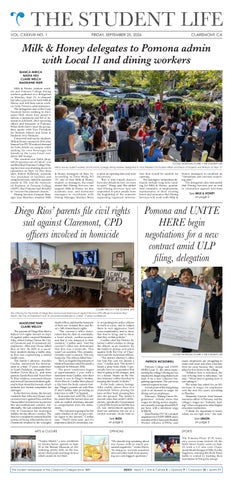
Milk & Honey delegates to Pomona admin with Local 11 and dining workers BIANCA MIRICA NADIA HSU CLAIRE WELCH MADELEINE FARR Milk & Honey student workers and Pomona College dining workers gathered as a delegation on Monday, Sept. 21, to demand fair labor practices for both Milk & Honey and full-time union workers from Pomona administrators. The delegation met at the Coop Fountain before walking to Alexander Hall, where they aimed to deliver a statement and list of de ȱ ȱ ěȱ ǰȱ ȱ ȱ Ĝ ȱ ȱ ȱ ȱ ǯȱ When Roth didn’t meet the group, they spoke with Vice President ȱ ȱ ě ȱ ȱ ȱ ȱ Students Avis Hinkson. Conceived and run by students, Milk & Honey opened in 2016 after Samuel Lin PO ’20 noticed demand for boba drinks on campus while making his own beverages for friends in the Lyon Court residence hall lounge. The student-run boba shop, which operates out of Café 47, was ę ȱ ȱ ȱ ȱ ȱ ȱ ȱ Ĵ ȱ ȱ ȱ operations on Sept. 10. Five days later, Robert Robinson, assistant vice president of facilities and campus services, stated in separate emails to TSL and the Associated Students of Pomona College (ASPC) that Pomona had decided to “reverse the planned closure.” Dining Services General Manager Jose Martinez emailed Milk
CLOUD MORGAN CLARK • THE STUDENT LIFE Milk & Honey student workers and Pomona College dining workers delegated to Vice President for Student Affairs and Dean of Students Avis Hinkson on Sept. 21
& Honey managers on Sept. 16. According to Dora Wang PO ’27, one of four Milk & Honey student co-managers, the email stated that Dining Services can support Milk & Honey for this academic year, and instructed managers to coordinate with Dining Manager Marilyn Mora
to plan an opening date and start the process. “But it [the email] doesn’t have any details on how we were to open,” Wang said. She added that Dining Services had not responded to prior emails from the beginning of the semester requesting logistical informa-
,QMOW :QW[¼ XIZMV\[ ÅTM KQ^QT ZQOP\[ []Q\ IOIQV[\ +TIZMUWV\ +8, WٻKMZ[ QV^WT^ML QV PWUQKQLM
tion that would be needed for opening. The managers’ immediate demands include long-term funding for Milk & Honey, guaranteed continuity of employment, maintenance of their existing hours and assurance that Dining Services will work with Milk &
Honey managers to establish an “immediate and concrete reopening date.” The delegation also demanded that Dining Services put an end to retaliation against full-time
See MILK & HONEY on page 2
Pomona and UNITE HERE begin negotiations for a new contract amid ULP ÅTQVO LMTMOI\QWV
CLAIRE WELCH • THE STUDENT LIFE The attorney for the family of Diego Rios announced their lawsuit against the two CPD officers involved in Rios’ death, the City of Claremont and 10 unnamed employees in a Sept. 17 press conference.
MADELEINE FARR CLAIRE WELCH ȱ ȱ ȱ ȱ ȱę ȱ ȱ federal civil rights lawsuit on Sept. 16 against police corporal Benjamin ǰȱ Ĝ ȱ ȱ ǰȱ ȱ ¢ȱ of Claremont and 10 unnamed city employees. Alba and Orona killed Rios on Nov. 28, 2025, in a use-of ȱ ȱ ȱ ȱ Ĝ ȱ ǰȱ as Rios was experiencing a mental health crisis. ȱ ¢Ȃ ȱ Ĵ ¢ǰȱ ȱ Casillas, announced the development in a Sept. 17 press conference in South Pasadena, alongside Rios’ brother Victor Rios Jr., and their parents Zarela Boza and Victor Rios Sr. Rios’ relatives, concerned citizens and several Claremont students gathered to hear about the lawsuit, which ȱę ȱ ȱ ȱ ȱ damages. ȱ ȱę ȱ ȱ ǰȱ ȱ ȱ contends that Alba and Orona used excessive force against Rios, and that Orona failed to intervene to prevent this unconstitutional conduct. Additionally, the suit contends that the City of Claremont has municipal ¢ȱ ȱ ȱ Ĝ Ȃȱ ǯȱ ȱ ę ȱ ȱ ȱ ȱ ȱ ȱ actions of Orona, Alba and the city of Claremont resulted in the wrongful
death of Rios, and that the homicide of their son violated Rios and Boza’s 14th Amendment rights. “The coroner’s office determined that he died of, essentially, a heart attack, cardiovascular, and that it was temporal to their restraint,” Casillas said. “And the coroner’s office has determined that this was a homicide. This wasn’t an accident. This certainly, certainly wasn’t a suicide. This was ǯȱ ȱ Ĝ ȱ ȱ ǯȄȱ The Los Angeles Department of Medical Examiner ruled the death a homicide in February 2026. The press conference began at approximately 1 p.m. with a statement from Casillas, who then turned it over to Diego’s brother, Victor Rios Jr. Casillas then played a clip from the body camera footage. Diego’s parents sat with Rios Jr. and Casillas, later providing an interview to ABC7 in Spanish. In an interview with TSL, Casillas stated that the lawsuit does not seek an explicit monetary amount in compensation from the defendants. “The outcome is going to be the same whether or not we put a dol ȱę ȱ ȱ ȱ ǰȄȱ ȱ said. “That’ll come later, and it’s important, [but] it’s secondary, tru-
ARTS & CULTURE “Tender Shield,” a new exhibition by Davina Semo, opened on Sept. 19 at the Benton Museum of Art, featuring artistic bells on the museum’s back patio and large bronze reliefs inside its Art Hall.
The student newspaper of the Claremont Colleges since 1889
¢ǰȱ ȱǽ Ĵ Ǿȱ ȱ ȱ Ĝ ȱ in front of a jury, and to subject them to very aggressive, hard cross-examination, and to show that they’re lying, and to show that they violate policies.” Casillas cited the District At ¢Ȃ ȱ Ĝ Ȃ ȱ ȱ ȱ ȱ the officers as an incentive for the family to pursue civil action against both the City of Clare ȱ ȱ ȱ ȱ Ĝ ǯȱ ȃ ȱ ȱ Ĵ ¢Ȃ ȱ Ĝ ȱ has had this case for almost a year,” Casillas said. “We haven’t heard a peep from them. I personally have no expectation that ¢Ȃ ȱ ȱ ȱę ȱ ǰȱ ȱ it’s a shame. Shame on the Dis ȱ Ĵ ¢Ȃ ȱ Ĝ ȱ ȱ ¢Ȃ ȱ keeping this family in limbo.” In the body camera footage, Alba visibly places Rios in a chokehold, before placing his knee on Rios’ back, pressing him into the ground. The family’s lawsuit notes that under Califor ȱ ǰȱ ę ¢ȱ ȱ Code §7286.5(a)(1) and §7286.5(a) (2), law enforcement agencies shall not authorize the use of a carotid restraint, choke hold or
See RIOS on page 3
CLOUD MORGAN CLARK • THE STUDENT LIFE
PATRICK MCDOWELL Pomona College and UNITE HERE Local 11, the union representing the college’s dining service employees, began negotiations on Sept. 8 for a new collective bargaining agreement. The previous contract expired in June. A focal point of this bargaining cycle is an increase in wages for dining service employees. Pomona’s “Dining Union Negotiations” website states that wages for dining service employees currently average about $28.21 per hour, with a minimum wage of $26.50. Elias Pluecker PO ’28, a student organizer for UNITE HERE and a member of the Claremont Student Worker Alliance (CSWA), said
many employees are struggling to make ends meet and often commute from far away because they cannot ě ȱ ȱ ȱ ȱ ȱ ȱ ǯȱ ȃ Ě ȱ ȱ ȱ ǰȱ ȱ cost of living here is ridiculous,” he ǯȱ ȃ ȱ ¢Ȃ ȱ Ĵ ȱ ȱ ȱ ȱ Ĵ ȱ ǯȄ The union has asked for an $11 increase in wages for employees over the next two years, according to Pluecker. Alejandra Gayton, chief human ȱ Ĝ ȱ ȱ ǰȱ ȱ ȱ college’s wages are “industry leading” when compared to other higher education institutions. “I think it’s important to know where we are right now,” she said.
See UNION on page 3
OPINIONS
SPORTS
“We should stop speaking about our classes with so much presumed negativity,” writes Davis. “In doing so, we hold ourselves and each other back from answering our own biggest questions.”
The Pomona-Pitzer (P-P) women’s soccer team kicked off the Sixth Street rivalry week on Sept. 23 with a 1-0 win over Claremont-Mudd-Scripps (CMS). For the Sagehens, winning this Sixth Street battle is rooted in trusting their teammates to bring the energy.
INDEX: News 1 | Arts & Culture 5 | Opinions 9 | Crossword 10 | Sports 11
News
PAGE 2
SEPTEMBER 25, 2026
5143 076-A" ?WZSMZ[ LMUIVL TWVO \MZU []XXWZ\ Continued from page 1 workers for union activity, and pay workers for the time they spend participating in contract negotiations. Student workers at Milk & Honey belong to UNITE HERE Local 11, the same union that represents all full-time Pomona dining staff, as well as student workers at Café 47 and the Coop Fountain, both of which are run by Pomona. The planned closure of Milk & Honey came shortly after the union began contract renewal negotiations with Pomona on Sept. Şǰȱ ȱ ę ȱ ȱ ȱ ȱ ǭȱ Honey workers would be included under since they joined Local 11 in Fall 2024. “We’ve always been on the same team,” Wang said of full-time and student union workers. At 10:41 a.m. on Sept. 10, Dining Manager Norma Castillo emailed Milk & Honey student managers requesting an 11:00 a.m. “Extraordinary Meeting.” During that meeting, Dining Services representatives informed the managers that Dining Services would no longer provide financial and logistical support. According to the meeting notes compiled by Milk & Honey managers, Martinez cited a 50% decrease in sales at Café 47 and the Coop Fountain as a primary reason for closure. “[Martinez] kept it pretty vague, which is essentially deĚ ȱ ǰȄȱ ¢ ȱ ǰȱ ȱ student manager at Milk & Honey, said. “Framing it as inevitable, as something they’re not doing will ¢ǰȱ ȱ ȱ Ȃ ȱ ę ¢ȱ ȱ decision and a choice.” In an interview with TSL on Sept. 21, Robinson said he was not involved in, or previously aware of, the decision to close Milk & Honey. He recalled Milk & Honey’s transition from ASPC funding to Dining Services in 2021, then said funding and budget cuts were not a primary motivation for closing Milk & Honey. “It loses money, but the money it loses is kind of immaterial, frankly, from what I’ve discovered,” Robinson said. “So we’re going to restart the project.” Managers recalled that in the meeting, Martinez stated that Milk & Honey would often make more money in three hours than Café 47 would make in 12. He additionally stated that Dining Services, as a ę ǰȱ ȱ ȱ ȱ ȱ every year. In an email sent out to the Pomona student body on Sept. 14, ASPC representatives reported that Milk & Honey “consistently recoups their cost of labor, and only required $6,170.45 in supplemental funding from [Dining Services] last year.” Managers recalled that Martinez emphasized the role of the ȱ ȱ ȱ ¢ Ĵȱ in declining sales, and a resulting need to cut Milk & Honey’s program in order to “prioritize the ȱ ȱ ȱ Ȭ ȱ ȱ ěȱ who work at Coop and Café 47.” Sejpal noted that Martinez’s reference to the union confused the managers present.
“It’s very evidently, in our opinion and the union’s opinion, ȱ Ĵ ȱ ȱ ȱ ȱ ȱǭȱ Honey workers against the fulltime union workers, who are actually aligned with us and on our side” she said. Lina McRoberts PO ’27, a Milk & Honey barista and a Claremont Student Workers Alliance (CSWA) organizer involved in the Students against Starbucks ¢ Ĵǰȱ ȱ ȱ ing the closure as the result of ę ȱ ȱ ȱ ȱ ¢ Ĵǯȱ ‘There is nothing inevitable about ‘protecting full-time union ȱ ¢ȱ Ĵ ȱ ȱ ȱ jobs,’” McRoberts said. “That is a choice that Pomona is making and then laundering as necessity.” Wang expressed similar concerns, noting that Dining Services and Local 11 began new contract negotiations on Sept. 8. “I think [Pomona] believes that union negotiations for [Pomona] might be easier to navigate if students do not participate in them,” Wang said. Although Café 47 and Coop Fountain student workers are also unionized under Local 11, students are hired at the beginning of every semester. In contrast, once a barista is hired ȱ ȱǭȱ ¢ǰȱ ¢ȱ ě ¢ȱ retain their job for the rest of their time at Pomona. Technically, however, all student employees are terminated and rehired at the beginning of each semester. “I personally believe that the closure decision has more to do with union busting than with profit or community input,” Wang said. “Especially because Coop Fountain didn’t open when they sent out the closure email. So I think since no one was working at the Coop, [closing Milk ǭȱ ¢Ǿȱ ȱ ȱ ě ¢ȱ removing all students from negotiations.” During the delegation on Sept. 21, TSL reporters asked Frank Dining Hall custodian Gloria Hernandez whether Milk & Honey’s operations posed a problem for full-time workers, and how she interpreted the claim that the need to prioritize full-time workers motivated Milk & Honey’s closure. Hernandez said that Milk & Honey posed “no problem at all” to full-time dining employee operations. After the Sept. 10 meeting, Milk & Honey staff began actively communicating with their union representatives at Local 11. On Sept. 14, Local 11 Lead Organizer Roberto Mazariegos emailed Martinez on behalf of Milk & Honey. “The closure of Milk & Honey is a unilateral change that impacts the work, income and livelihood of Union members,” Mazariegos wrote. “The Union demands that you cease all changes and submit your proposal to change operations to collective bargaining.” The following day, on Sept. 15, Robinson informed TSL and ASPC in separate emails that “the
CLOUD MORGAN CLARK • THE STUDENT LIFE
College has decided to reverse the planned closure, while we work with students to evaluate a range of options for its longterm future. We look forward to continuing these discussions in the coming weeks and months.” McRoberts and other Milk & Honey workers said that the closure has given them a deeper understanding of the importance of Milk & Honey’s union membership. “I think what’s happening now, Pomona Dining all of a sudden being able to cut Milk & Honey, and the union being the one to show up and show how this is illegal … all of a sudden, I think we understand the importance and extent of the power that Milk & Honey has because we are a part of the union,” McRoberts said. As Milk & Honey student workers continue to advocate for the boba shop’s future, they plan to keep working closely with the union to advocate for the rights of both student workers and fulltime workers at Pomona. “Now … we understand that the union is instrumental in ensuring Milk & Honey’s long-term future and success,” Sejpal said. Throughout the process of communicating with Local 11 and planning the joint delegation, student workers said they’ve learned more about what the union can provide. “The current moment is vulnerable, but it also presents a lot of opportunities for change,” Wang said. “And we are trying to seize those opportunities.” Those opportunities, she said, include pushing against the College’s unilateral decision-making, which Rodriguez similarly condemned in an interview with TSL. “Any changes in working conditions, including hours, schedule changes or closure, must be negotiated and agreed upon through collective bargaining,” Rodriguez said. “We’re in that process now. But the college didn’t wait for that process; they just did it … A unilateral change is, in the union’s view, illegal.” Wang and other Milk & Hon ¢ȱ ȱ ȱ ȱ ȱ Ĵ ȱ union negotiation meetings to
CLOUD MORGAN CLARK • THE STUDENT LIFE
advocate for workers’ rights and the long-term stability of Milk & Honey. Since Milk & Honey baristas are technically terminated and then rehired every semester, Dining Services’ effective termination of all 13 baristas isn’t ¢ȱ ȱ ȱę ǯȱ These 13 baristas rely on Milk & Honey for income, including ę Ȭ ȱ ȱ Ȭ ȱ students, which students noted in the delegation. In response to this legal technicality, Wang and McRoberts ȱ ȱ Ĵ ȱ ȱ ȱ and advocate for adding the practice of recall to the union’s contract with Pomona College. This would ensure that Milk & Honey workers are guaranteed continuous employment. When asked in an interview with TSL whether Milk & Honey will receive stable funding, Robinson said that the shop will be a “subsidized program.” “When you say stable funding, that would depend on the students buying the boba, wouldn’t it?” he said. “So I don’t think there will ever be stable funding for that program. It’s probably going to be a subsidized program.” Martinez’s Sept. 16 email to Milk & Honey managers also said that Dining Services could support the program “for this academic year.” “Looking ahead, we also intend to work with the student managers to develop mutually agreed-upon criteria for evaluating the program,” Robinson said in a Sept. 17 email to TSL. “This will allow us to consider factors such as student partici ǰȱ ę ȱ ¢ǰȱ Ĝ ȱ ȱ ȱ ȱ ȱ ȱ program provides to the campus community.” Wang and other Milk & Honey baristas emphasized that the student workers and Pomona have not yet met to discuss Milk & Honey’s future. “So until we meet with [Pomona] and have a concrete plan of how Milk & Honey’s future is going to look, we are going to be continuing all actions,” Wang said. In the past two weeks, students across the 5Cs and alumni have mobilized in support of Milk & Honey, signing the official petition to keep it open, which the student managers launched on Sept. 13. At the time ȱ ȱ ȱ ę ȱ ǰȱ the petition had garnered 955 signatures. Wang also estimated that Milk & Honey had received 20 to 30 direct messages on their Instagram account, from customers sharing memories of the program to expressing support for its reopening, and credited students’ ȱ ě ȱ ȱ ȱ ȱ Pomona’s reconsideration of the closure. “We believe that the decision to reverse the closure of Milk & Honey is a direct response to that support that we’ve had,” Wang said. Following Pomona’s decision to reverse the closure, ASPC also sought to support the student-run boba business and, on Sept. 17, passed a preliminary resolution, in conjunction with Milk & Honey managers, opposing “Pomona College Dining Ser-
vices’ unilateral decision-making.” Senators condemned both the closure of Milk & Honey and recent changes to students’ meal plans. In the resolution, ASPC called for “Dining Services to immediately reopen Milk & Honey in the Fall 2026 semester, acknowledge the harm caused to Milk & Honey’s business by planning its demise ȱ ȱ ȱę ¢ȱ ing the business long term.” ASPC President Malu Estoducto PO ’27 said ASPC would continue pressing administrators to uphold the college’s shared-governance commitments, urging Pomona to consult students before ȱ Ĝ ȱ ǯ ASPC Vice President of Academic Affairs Tendo Lumala PO ’28 said those conversations should have begun before Dining Services decided to withdraw support. “From a student body perspective, to engage in a decision like this without any consultation of the student body, I think it spits in the face in some ways of the notions of shared governance that have been a large part of administrative discourse over the past year,” Lumala said. ASPC plans to continue meeting with Milk & Honey’s managers to identify their priorities and advocate for those requests with administrators. “I want ASPC to help them with what is going to serve them best,” Estoducto said. “So, hearing their complaints and hearing their asks, which is what we will keep doing throughout this process.” In his Sept. 17 email to TSL, Robinson said that the college is Ĵ ȱ ȱ ȱ ȱ ǭȱ Honey and working with its student managers. “The student management team is currently developing its operating plan for this semester and expects to establish a firm opening date within the next three weeks. For context, Milk & Honey began operations on Oct. 7 last academic year,” Robinson said. “We anticipate a schedule generally similar to last year, although ȱę ȱ ȱ ¢ ȱ ȱ ȱ will be determined in consultation with the Milk & Honey managers.” Multiple students who regularly visited Milk & Honey said that they hope to see the shop’s continued operation. For Kira Frey SC ’27, regular visits to get boba with her roommate led her to connect with Wang. “We just built a friendship, kind of, around Milk & Honey,” Frey said. Frey said she appreciated being able to walk to the boba shop and use her Flex dollars, the dining currency included in students’ meal plans. She often brought textbooks and a laptop to study with friends, but said they frequently spent the time talking instead. Luke Chakmakian PO ’29 also frequented Milk & Honey, stopping by nearly every Tuesday and Thursday after his choir rehearsals. “It’s just this space that I know so many people go to just hang out and have a sweet treat,” Chakmakian, who signed the petition opposing the closure, said. “I’m grateful that they [Pomona] have decided to go back on it [the closure] because I think [Milk & Honey] is really important for the community,” Chakmakian said.
;MVQWZ ;\Iٺ
Editorial Board CLAIRE WELCH, Editor-in-Chief MADELEINE FARR, Managing Editor NADIA HSU, Managing Editor
TSL’s Editorial Board consists of the editor-in-chief and two managing editors. Aside from the editorial, ȱ ȱ ¡ ȱ ȱ ȱ ȱ ȱ ȱ ȱ ¢ȱ Ě ȱ ȱ ȱ ȱ ȱ ȱ ǯ Single copies of TSL are free and may be obtained at news stands around campus. Multiple copies may be purchased for $0.47 per copy with prior approval by contacting editor@tsl.news. Newspaper theft is a crime; perpetrators may be subject to disciplinary action as well as civil and/or criminal prosecution.
FLORIA AUERBACH Creative Director
MELINDA QERUSHI Graphics Editor
AUDREY GREEN Opinions Editor
ADAM AKINS Business Manager
TAHI WILTON GEARY Lead Production Editor
AVA FLEISHER News Editor
JUN KWON Opinions Editor
OTTO FRITTON Social Media Manager
NICHOLAS STEINMAN Production Editor
KAHANI MALHOTRA News Editor
TALBOTT CHESLEY Sports Associate
CHARLOTTE RENNER Copy Chief
BIANCA MIRICA News Associate
ZACHARY LEBLANC Sports Editor
CELESTE CARIKER Events & Alumni Engagement Director
JOSEPH WOO CHAN Copy Chief
PATRICK MCDOWELL Investigative Associate
JAKE CREELAN Sports Editor
SARAH ZIFF Photo Editor
CORINA YI Arts & Culture Editor
JESSICA LEVIN Data Editor
GABRIELLE RICCIARDI Photo Editor
SIENA GIACOMA Arts & Culture Editor
EVELYN HAO Data Editor
PJ JAMES Graphics Editor
ANANYA VINAY Arts & Culture Associate
ILA ASSEGAF Special Projects Editor
ROCHELLE LU DEI & Outreach Director RIYA SAINI Distribution Manager
News
SEPTEMBER 25, 2026
PAGE 3
:17;" 8IZMV\[ []M +TIZMUWV\ +8, WٻKMZ[ Continued from page 1 methods that involve a “substantial risk” of positional asphyxia. Positional asphyxia occurs when one is situated “in a manner that compresses their airway and reduces the ability to sustain adequate breathing.” The family’s decision to include the City of Claremont in the lawsuit, in addition to Alba and Orona, stems from a conviction that the city ȱ ȱ ¢ȱ ȱ Ĝ ȱ ȱ follow California law, as it pertains to chokeholds and positional asphyxia. “To put something in your polices without having some meaningful training, that’s window dressing,” Casillas said. “And this is window
dressing.” Rios Jr. recalled how his brother “was a gentle soul,” and condemned the excessive response. “If those cops had the slightest smidgen of sympathy and empathy as human beings, they would have seen that all it would have taken was a simple 30-second conversation, a human-to-human conversation to de-escalate that situation,” he said. Following the press conference’s formal proceedings, many Ĵ ȱ ȱ ȱ ȱ ȱ the family. Jocelyn “Joz” Sida, who is run ȱ ȱ ȱ Ĵ ȱ ȱ ȱ ¢ ȱ ȱ ǰȱ Ĵ ȱ ȱ
press conference and expressed concern about Alba’s role on Fontana’s Parks, Community, and Human Services Commission, as well as Warren’s failure to remove him. ȱ ȱ ȱę ȱ members appointed by the Fontana City Council for a one-year term. The commission’s website indicates that Alba served a term from April 2025–2026, and city council records state that he was reappointed on December 9, 2025, 11 days after Rios’ death. “It was a homicide, and [Alba] was one of the parties responsible,” Sida said in an interview with TSL, adding that Alba should be given his due process, and in the
meantime be removed from the commission. “It’s not the time to cover up or protect anyone …” Sida said. “Somebody lost a son, a brother.” ȱ Ĵ ȱ ȱȂŘŝǰȱ ȱ ber of the 5C Prison Abolition Collective – known on campus as ȃ ȄȱȮȱ Ĵ ȱ ȱ ȱ ¢ȱ Council meeting last semester to advocate for Alba’s removal from the commission. She also spoke to ȱ ȱ ȱ Ĵ ȱ ȱ in the Justice for Diego campaign in the spring. ȃ ȱ ȱ ¢ȱ ȱ ě ȱ organizations at Claremont have been helping us, you know, for, like, you know, almost a year since
December of last year now,” Rios Jr. said. “And it seems like a long time, ȱ ȱ ȱ ȱ ¢ȱ ȱ Ĵ ȱ going.” Ĵ ȱ ȱ ȱ ȱ ȱ ing up to the majority of city council meetings last semester. “The family wanted students to come give public comment to show that students were on their side and were equally up in arms about the brutality and misconduct of Claremont police, which is not a new thing, and has happened in many instances, many instances in the past,” she said. Rios Jr. said that the Justice for Diego campaign will continue hosting events, including one to commemorate one year since Rios’ death.
=6176" 6MOW\QI\QWV[ JMOQV IUQL =48 KPIZOM Continued from page 1 “Over the last two contracts, most of our dining employees have received wage increases of at least 60%. Some of the positions got increases of over 70%.” Pomona first reached out to UNITE HERE to begin negotiations in April. UNITE HERE did not respond ȱ Ȃ ȱ ě ȱ ȱ ǯ “We don’t operate by the college’s schedule; we operate by the union’s schedule,” Noel Rodriguez, organizing director at UNITE HERE, said. He noted that many workers, particularly student workers, are often gone over the summer and cannot participate in the bargaining process. On Sept. 17, the union filed an unfair labor practice (ULP) charge against Pomona, alleging the college was “discriminating against employee(s) engaged in protected, concerted activity,” according to a copy of the
charge obtained by TSL. “The College is aware of the unfair labor practice charge recently ę ȱ ¢ȱ ȱ ȱ ȱ ȱ ȱ Labor Relations Board,” a Pomona ȱ ǯȱ ȃ ȱ ę ȱ ȱ a charge represents an allegation, which the College unequivocally denies.” Luis Martinez, a cook at Frank Dining Hall and union leader, said he received two warnings from the ȱ ȱ ȱ ȱ Ĵ ȱ at work. “We have the right to talk to workers about the union inside the workplace,” Martinez said. He said he now has to stay quiet for fear of a third warning, which would put him at risk of termination. “It’s a crime for any employer to conduct surveillance of workers engaged in union activity,” Rodriguez said. “It’s illegal for them to inter-
rogate workers about their union activity. It’s illegal to threaten or to discipline workers for engaging in union activity. And here, they did all of those things at least twice.” The Pomona spokesperson said the college does not discipline employees for engaging in protected union activities, which include discussing union matters. The spokesperson noted, however, that interruptions that disrupt employees’ work or operations are not considered protected. Last winter, Rolando “Rolo” Araiza, a long-time cook and union leader at Frary Dining Hall, was fired by the College, leading to student protests. His case remains in arbitration. “I feel they’re doing the same thing with any person that talks about the union,” Martinez said. “As union leaders, they target it more. They’re micromanaging, looking at
Ĵ ǰȱ Ĵ ȱ ȱ ȱ ȱ ȱ you.” Martinez presented the ULP at a Sept. 21 delegation at Alexander Hall, which hosts the college’s ad ȱ ěǯ At the delegation, dining service employees, Milk & Honey student workers and union representatives presented a list of demands including an end to retaliation by the college for union activity, pay for employees’ time spent at negotiations and the immediate reopening of student-run boba shop Milk & Honey. Compensation for employees’ time spent at negotiations has been standard practice in previous bargaining cycles between the college and the union, according to Pluecker and Rodriguez. In this cycle, however, the college has not paid employees for hours spent at negotiations.
“It’s a unilateral change,” Rodriguez said. “It’s been the practice for really ever since we became a union … I mean, this is the problem, right? They want to close down Milk & Honey, they want to change past practice, they want to go after workers, discipline workers for protected union activity. I think we’re dealing with an administration that is ignorant or power hungry.” £ȱ ȱ ȱę ȱ ȱ ȱ legally allows for a strike and that “everything is on the table.” He said the union will give Pomona the chance to address these ȱ ȱ ȱ ȱ ę ȱ additional ULPs. “We’re coming to the table from a strong competitive starting point, but at the same time, we are listening to our employees’ concerns, and we are ¢ȱ Ĵ ȱ ȱ ȱ ȱ good faith with the union,” Gayton said.
?QTTQIU ,]LTMa SQKS[ W ٺÅZ[\ [MUM[\MZ I[ +5+¼[ [Q`\P XZM[QLMV\ NATE LITTELL HIROKO ROSE KAHANI MALHOTRA William Dudley took on the mantle of president at Claremont ȱ ȱ ȱ ¢ǰȱ Ĝ ly succeeding Hiram Chodosh. Originally a philosophy professor and most recently the president of Washington and Lee University (W&L), Dudley will be the college’s sixth president. In an exclusive interview with TSL, Dudley said he plans to take a year or two to get to know CMC before jumping into new initiatives. “I didn’t come here with an agenda and a list of projects,” he said. “My job, the way I see it, is to ȱ ȱ ȱ ȱ ȱ Ĵ ȱ version of itself over time — we don’t want to become some other school that we’re not.” Dudley also emphasized his goals of improving access and affordability. “One of the most important ȱ ȱ ȱ ¢ȱ ȱ ȱę ȱ aid, to make it possible for the best students from all financial backgrounds to come to the college,” he said. Last May, more than 600 colleges and universities co-signed a statement opposing the Trump administration’s overreach in higher education. Dudley’s former school, ǭ ǰȱ ȱ ȱ ȱ ȱ ȱ Ĵ ǰȱ and neither did CMC, making them two of the only prominent liberal arts colleges in the country not to sign. Dudley said he did not sign ȱ ȱ Ĵ ȱ ȱ ȱ ȱ ȱ ǭ ȱ
because it was more of a “symbolic” gesture. “Statements like that rarely have a practical impact,” he said. Instead, Dudley said he was focused on petitioning against an increase on the tax on university endowments in the One Big Beautiful Bill Act, even spending two days in Washington, D.C. to convince senators to oppose it. ȃ ȱ ȱ ȱ ȱę ȱ ȱ ȱ ȱ ȱ ¢ȱ Ĵ ǰȱ ȱ ȱ ȱ ȱ ȱ ȱ ě ȱ than signing a statement,” he said. Dudley graduated from Williams College in 1989 with a Bachelor of Arts in mathematics and philosophy. After earning both a Master of Science and doctorate in philosophy from Northwestern University, he returned to Williams as a professor of philosophy in 1998. In 2011, he was promoted to provost, before moving to Virginia to serve as president of W&L in 2017. Dudley’s predecessor at CMC, Chodosh, oversaw the construction of the Robert Day Sciences Center and Kravis Department of Integrated Sciences, doubled CMC’s footprint under an expanded campus master plan and led a record-breaking fundraising campaign that surpassed $1 billion. Associated Students of Claremont McKenna College President Amrit Dhaliwal CM ’27 has worked with both Chodosh and Dudley in her time in student government. ȃ ¢Ȃ ȱ ¢ȱ ě ȱ ǰȱ but I think CMC’s very lucky to have President Dudley here,”
Dhaliwal said. “He brings a really warm, inviting energy to campus. He is so ready and willing to listen to students.” Dudley said his main goal now is to listen to students, faculty, ěǰȱ ȱ ȱ ȱ ȱ ȱ about their “collective hopes and dreams” for CMC. In the past few weeks, he’s met with resident ǰȱ ę Ȭ¢ ȱ ȱ ȱ ȱ ȱ ȱ Ĵ ȱ ȱę ȱ faculty meetings. CMC government professor John Pitney is entering his 40th year teaching at CMC, and has seen the tenures of four CMC presidents. He said he is optimistic about Dudley as president, particularly because his friends at W&L “speak very, very highly of him as a leader.” “Not everybody in academia can be a successful college president,” Pitney said. “But [Dudley] was very successful at Washington and Lee, and that bodes very well for his prospects at CMC.” Roman Williams CM ’30 sat with Dudley during a dinner event for his class and said he seemed like a strong leader who will bring positive change to CMC. “He was very articulate and good at driving conversation,” Williams said. At W&L, Dudley taught philosophy classes alongside managing his presidential responsibilities. He said he hopes to eventually teach classes at CMC as well. “It sends a really good signal to the community about the importance of teaching … and ę ¢ǰȱ Ȃ ȱ ¢ȱ ȱ ȱ ȱǽ -
COURTESY: CLAREMONT MCKENNA COLLEGE
ȱ Ǿȱ ȱ ȱ ę ȱ ǰȄȱ Dudley said. The new president said he looks forward to helping CMC grow into a “really excellent version” of itself.
“I wouldn’t have come if I didn’t think it was a really excellent place,” Dudley said. “But I also wouldn’t have come if I didn’t think I [could] help it continue to ȱ Ĵ ǯȄ
8WUWVI _MTKWUM[ JIKS [MVQWZ KQ\QbMV I]LQ\WZ[ IN\MZ +)44¼[ PQI\][ CHARLOTTE PREUSS ELLIE BYUN This fall, senior citizens from the city of Claremont were eligible to audit select Pomona College courses through the Claremont Avenues for Lifelong Learning Program ǻ Ǽȱ ȱ ȱę ȱ ȱ ȱ ¡ȱ¢ ǰȱ since the program was suspended during the COVID-19 pandemic. “People were really, really excited about this program because it had been a few years since we’ve
offered it,” said Jennifer Helé, the senior recreation and human services supervisor at the city of Claremont. “People in this community are really passionate about lifelong learning, and this is such a unique opportunity to be able to take college-level courses, especially at [institutions] such as the Claremont Colleges.” The program offers seniors tuition-free college-level courses, creating opportunities for intergenerational connections. Audi-
The CALL Program is back and running after its suspension following the COVID-19 pandemic.
ALEXANDRA GRUNBAUM • THE STUDENT LIFE
tors can choose from three levels of participation: level one classes allow auditors to only listen to discussions, level two classes let seniors join in discussions and activities without completing assignments or exams, and level three classes involve full participation, including coursework and assessments. Under the newly digitized registration process, seniors can now select courses online instead of waiting in long lines on registration day. CALL provides those aged 60 and older with the opportunity to audit certain classes at Pomona. The program began in ŘŖŖŘȱ ȱ ȱ ȱ ȱę ȱ ȱ over several years. This year, classes are available only at Pomona, with Tomás Summers Sandoval, a history and Chicana/o Latina/o studies professor at the college, overseeing the program. Helé said they’re looking to expand the program to other schools in the consortium, as they did pre-pandemic. “It’s very much our hope that it does get extended,” Helé said. “I know that professor Sandoval is working on that to broaden the reach. That would really be more
of a return to how the program was in the past when we did get ȱ ȱ ȱ ȱę ȱ colleges.” Over the summer, the city of Claremont published a public-facing online interest form available to senior citizens aged 55 and older for fall registration, which received around 200 responses. Prospective auditors received a randomized time slot and digitally selected their top three courses based on availability, which auditors described as a more fair process compared to doing so in person. Previously, auditors would line up and courses would ȱ ȱ ȱ ȱę Ȭ ǰȱę Ȭ served basis. Helé said the new registration method also allows seniors to familiarize themselves with online platforms. “I think it makes a lot more sense that we’ve really tried to emphasize this to our participants: that to be successful in this program they need to be comfortable with email and online and accessing materials online,” Helé said. In class, seniors can join discussions and interact with students interested in similar topics. Ezekiel Chavez, a returning longtime
participant in the program, is excited for its return. “When you retire, you say, ‘what am I going to do?’ ... So this program was available. I signed up, and my friends signed up, and we would take two classes, one in the morning, and one somewhere in between,” Chavez said. “After that, we would go to eat lunch. What a life.” For many Claremont retirees, auditing classes makes their daily lives more dynamic. “It, in terms of our lives as retired people, does add something to our schedule that isn’t a doctor’s appointment or golf, and we look forward to it on Monday and Wednesday,” Anne Ellwanger, a CALL auditor, said. Pomona alumna and CALL auditor Julianne Flora-Tostado PO ‘76 said she was excited to return to her alma mater for the course “Death, Dying, and the Afterlife in East Asian Religions,” where she can share her experiences and engage with current students. “As someone who got their degree at Pomona 50 years ago, it’s in ȱ ȱ ȱ ě ȱ tives too,” Flora-Tostado said. “We have a lot of lessons we’ve learned over the course of our lives.”
News
PAGE 4
SEPTEMBER 25, 2026
8WUWVI \M[\[ *WWLTMJW` )1 QV KTI[[ZWWU M[\IJTQ[PM[ )1 KWUUQ\\MM WALTER GIESEN
peers’ work and collaborative assignments, while faculty can use its built-in bots for syllabus creation, email revision and grant proposals. Mary Paster, a linguistics and cognitive science professor at Pomona, said she did not like BoodleBox when she tried it and is skeptical about AI in academia. “I didn’t go in thinking I was going to like it, but I was just curious,” Paster said. “I found it kind of ě ǯȱ Ȃ ȱ ȱ ȱ ȱ Ĵ ȱ ȱ [there are] things I feel a professor should do for their class and not outsource to a machine.” Echoing a similar sentiment, Tendo Lumala PO ’28, Associated Students of Pomona College vice ȱ ȱ ȱ ě ǰȱ ȱ AI use might devalue professors’ work. “If you decide to be a teacher, a professor, you spend your entire life being like, ‘I kind of want to help these kids,’ and it’s almost like cheapening the work,” Lumala said. According to Paster, Boodle ¡ȱ ȱ ě ȱ ȱ ȱ generators, including for Socratic seminars. She said this defeats the purpose of Socratic learning, which is to center student-led discussion. “[I thought] the whole point of the Socratic method is it’s dynamic and you can’t just have a list of
This semester, Pomona College is navigating a rapidly evolving ę ȱ ȱ ǯȱ ȱ college is currently deciding whether to implement BoodleBox AI, a collaborative platform built for higher education, and has also formed a committee to address AI’s role in students’ and faculty members’ lives. According to BoodleBox’s website, the “workspace” has a smaller carbon footprint than standard AI virtual assistants. It claims to aggregate information from popular AI chatbots to assist college students and professors with common academic tasks. Pomona introduced BoodleBox to some faculty members last spring. According to a Pomona spokesperson, the college is now deciding whether to release BoodleBox campuswide. “The pilot program’s goal was to Ĵ ȱ ȱ ȱ ȱ ǰȱ adoption and support needs, and to gather feedback that will inform decisions about potential broader, campus-wide support,” the spokesperson said in a statement to TSL. “The College’s ITS Department is currently analyzing that feedback.” BoodleBox advertises that it helps students with coursework, including reading comprehension, reviewing
questions up front,” Paster said. “I just found that really depressing.” Lumala additionally expressed concern that the money the college would spend on BoodleBox could ȱ Ĵ ȱ ȱ ǯȱ “There are a lot of tools hidden around this college that are ostensibly for the help of faculty and their curricular processes, but they’re not very well used,” Lumala said. Through a growing committee of self-nominated faculty and administrators, Pomona plans to address broader AI concerns both in the classroom and after graduation. “The committee’s charge is DZȱ ȱ ¡ ȱ ȱ ę ȱ intelligence impacts teaching and learning, and to consider how the College can best prepare students for a world in which AI is increasingly pervasive,” the Pomona spokesperson said in the statement to TSL. Feng Xiao, an associate professor of Asian languages and literatures who studies AI-supported language learning at Pomona, emphasized that AI literacy in general is a “must” for students, regardless of personal opinions on its role in the classroom. ȃ ȱ Ȃ ȱ Ĵ ȱ ȱ¢ ȱ like [AI in the classroom] or you don’t like it,” Xiao said. “I think we need to understand this technology
enough and its potential impact on higher education in general.” Paster said the committee is necessary to develop a cohesive AI policy down the road. “I think people are kind of adrift right now,” she said. “Individuals
are just making decisions about [what] kind of AI policy they want to have for their class, and without having any guidance from the institution or really any collective agreement about how we want to approach it.”
SHIXIAO YU • THE STUDENT LIFE
+5+ ZIVS[ [MKWVL QV .1:- NZMM [XMMKP ZIVSQVO[ W\PMZ +[ ZMKMQ^M NIQTQVO OZILM[ CAPRICE BIELBY
evaluated this year received a failing grade. Over 150 students participated in FIRE’s CMC survey, which included questions about political violence, self-expression and protest. Sixty-two percent of CMC respondents said it is either “very clear” or “extremely clear” that the college administration protects free speech on campus. Multiple students described an emphasis on open dialogue at CMC. Eli Jobrack Lundy CM ’27, 5C Democrats president, noted important discussions often occur outside the classroom in places like The Hub. “Even just on a day-to-day basis, [students are] participating in or overhearing really difficult conversations about foreign policy or economic policy, you know, various societal questions,” Jobrack Lundy said. Some students also noted that the Open Academy contributes to a campus environment of free speech. The Open Academy aims to give 5C students opportunities to engage in constructive dialogue. The program
Earlier this month, the Foundation for Individual Rights and Expression (FIRE) ranked Claremont McKenna College second on its 2027 College Free Speech Rankings, a report that rates the free speech climate on college campuses nationwide. CMC received a passing “B-” grade from FIRE, while the other 5Cs received failing grades. Of the 261 colleges surveyed, ĵ ȱ ȱ ȱŗŜŖ ǰȱ ȱ College ranked 167th, Harvey Mudd College ranked 184th and Pomona College ranked 226th. While these Claremont Colleges saw increases in their rankings compared to last year, CMC dropped by one rank, losing ȱ ę Ȭ ȱ ȱ ȱ ȱ ¢ȱ of Chicago. FIRE evaluates educational institutions on their free speech climates based on student surveys and the institutions’ free speech policies, including whether or not they have adopted the Chicago Statement for Free Speech. According to a FIRE press release, 121 of the 261 — or 46 percent — of colleges and universities 100
Claremont Colleges FIRE rankings from 2025 to 2026 81.3
Year
80.1
2025
2026
Campus Speech Climate Score
75
56.6
57.8
58.8 55.1
52
54.6
56.1
58.4
50
25
0
Claremont McKenna
Harvey Mudd
Pitzer
Pomona
Scripps
Schools
JOANNA LAM • THE STUDENT LIFE
invites guest speakers to the Marian Miner Cook Athenaeum and hosts community events to discuss controversial sociopolitical issues. Ioannis Evrigenis, a government and ethics professor at CMC, has been director of the Open Academy since last summer. He emphasized the importance of free speech on college campuses. “[Freedom of speech] is an essential element of what you would need for any kind of serious education, certainly a liberal arts education,” Evrigenis said. “So, if the aim of a liberal arts education is to cultivate a free person in every sense of the term, free speech would be an indispensable part of it.” According to the press release, ȱȃ ȱ Ĝ ȱ Ȅȱ ȱ dents to discuss on campus this year were the “Israeli-Palestinian conflict, Donald Trump, Charlie Kirk, and abortion.” Evrigenis said he is concerned about how self-po ȱ ȱ ȱ ȱ ¢ȱ ě ȱ students at the Claremont Colleges. “I’m very concerned about self-censorship and the fact that people don’t feel safe expressing their opinion, especially around controversial issues,” Evrigenis said. “It’s a very tough nut to crack.” CMC received a $300,000 grant from the Arthur Vining Davis Foundations (AVDF) for the Open Academy last year. Evrigenis said the AVDF grant will fund the development of a new Open Academy curriculum over the next three years, ȱ ȱ ¢ȱ Ĵ ȱ ȱ stand-alone course modules that can be used in any classroom, regardless of subject. The courses are intended to promote constructive dialogue and will eventually be available across the 5Cs. Open Academy Student Manager Shiv Parihar CM ’28 spoke about the institution’s positive impact on
PJ JAMES • THE STUDENT LIFE The Foundation for Individual Rights and Expression (FIRE) announced Claremont McKenna as No. 2 in the 2027 FIRE Rankings, significantly outperforming the other 5Cs.
CMC, noting that the Athenaeum often features a diverse range of ȱ ȱ ě ȱ ǯȱ “We have really focused on getting people real, actual practice in dialogue,” Parihar said. “[It] is really, really useful for people to talk to speakers that they don’t agree with.” Jobrack Lundy also spoke about the importance of political dialogue ȱ ȱ ȱ ě ȱ ǯ “I think broadly, there is a lot of value in free speech on campus and in encouraging students who are very passionate politically to engage with people who are just completely either passionate in the opposite direction, or just are not as interested, at least talk to them and engage,” Jobrack Lundy said. “I have learned a lot from my conservative peers.” Although Parihar said he agrees with CMC’s ranking, he said he was skeptical of how FIRE ranked other colleges’ free speech climates — Pomona’s in particular. “Pomona’s ranking was low, way
lower than it should be,” Parihar said. A Pomona spokesperson underscored the college’s commitment to free speech in an email to TSL. “Pomona College believes that free speech is critical to its mission as an educational institution,” the spokesperson wrote. “As outlined in the college’s Speech Code, speech and other forms of expression are protected and Pomona’s disciplinary policies are based on disruptive or intrusive conduct, not one’s viewpoint.” Veronica Mnatsakanian PZ ’30 ȱ ȱ ĵ ȱ ȱ ȱ ¢ȱ in the FIRE rankings. “I was honestly really surprised,” Mnatsakanian said. “When you ¢ȱ ǽ ȱ ĵ Ǿǰȱ ¢ ȱ ȱ ȱ ȱ the sense that the whole school is about freedom of speech, because you have the free wall and I feel like everyone’s very opinionated and open about what they want. So, I feel like we deserve a higher score.”
8WUWVI ,QVQVO ;MZ^QKM[ UMIT XTIV KPIVOM[ ZIQ[M KWVKMZV W^MZ [PIZML OW^MZVIVKM NADIA HSU Pomona College Dining Services rolled out new changes and restrictions to the Pomona Dining Plan, which is required for all students living on campus, at the beginning of the fall semester. In a resolution passed on Sept. 24, the Associated Students of Pomona College (ASPC) condemned Dining Services’ lack of discussion with students prior to
implementing the new plan and called for Pomona to renew their commitment to shared governance. The plan initially reduced Pomona students’ weekly cross-campus meal swipes, which can be used to eat at other 5Cs’ dining halls, from 19 to 10 meal swipes. In an email to the Pomona student body on Sept. 14, Robert Robinson, assistant vice president of facilities and campus services, announced that students
ANNA CHOI • THE STUDENT LIFE
will now have 14 cross-campus meal swipes. Other changes to the plan, which is now referred to as “continuous” rather than “universal” on the Pomona website, includes increased flexibility at the Coop Fountain, meal equivalency of up to $7.00 at Cafe 47 and a 30-minute pause between all meal swipes. According to new signage in Frank and Frary, the dining halls are also limiting to-go protein servings and prohibiting self-serve protein. This change has not been communicated as part of the new meal plan. Robinson said in an interview with TSL that the protein allowance restriction had been in place previously. When asked about the motivation behind the cross-campus meal restriction, Robinson described a need to divert resources towards Pomona’s dining halls. “We’re trying to keep the resources we have within our program so we can serve our students Ĵ ǰȄȱ ȱ ǯ Robinson noted that for each ěȬ ȱ ȱ ȱ ȱ ȱ uses, Pomona must pay that school
the value of the meal. Students use ȱ ȱ ȱ ȱ ěȬ ȱ ȱ swipes per week, according to data provided by Robinson. Sinan Walji PO ’28, a member of Claremont Student Worker Alliance (CSWA), noted that Pomona’s payout to other dining halls has been used as a tactic in past CSWA campaigns. “I believe that [Pomona] knows that since the contract is renewing, realistically more pickets are coming if negotiations don’t go the right way,” Walji said. “And because of that, they want to incentivize students to feel like they have to go to their school’s dining hall more. Because it costs them I think over $20 every time someone swipes into another dining hall.” The changes were informed by Dining Services’ ongoing consultation with Webb Foodservice Design Group, a consulting group that Pomona hired in January 2026 to implement wider changes within Dining Services across the next two years. “You have to look at the entire program. We’ve gone through a series of changes or issues over the
last three or four years,” Robinson said. “We brought in a group [Webb Foodservice Design Group] to redeę ȱ ȱ ȱ ȱ ȱ ȱ ȱ look like.” Goals for this year outlined by the group also include reorganizing Dining Services management, Coop Fountain and Cafe 47 “retail concept ę ǰȄȱ ȱ ȱ ȱ Ȃȱę ȱ ȱ ȱ expense management, according to Robinson. TSL requested that Robinson provide the full 125-page report compiled by Webb Foodservice Design Group, and had not received it by press time …
CONTINUE READING ONLINE
Arts & Culture
SEPTEMBER 25, 2026
PAGE 5
Low-rise jeans and limeade bring 2000s vibes back to The Motley RASHEL ARELLANO A line of people snaked out of The Motley Coffeehouse on Sept. 18, where students dressed in bright colors, fishnet gloves and striped clothing waited for specialty drinks, dancing to the beat of early-2000s music. Colored beams of light shone through the coffeehouse onto the “MOPEN15” sign. T h e u s u a l l y c o z y , l i v i n groom-style space was transformed by streamers of thongs hung above doorways, and people danced and jumped to the beat on the stage, alongside the DJ. Many students got creative with their outfits. Some wore bright star clips in their hair and
bold apparel inspired by Maya and Anna, including low-rise pants, striped clothing and visible undergarments. Motley barista Madeline Park SC ’29 embodied the 2000s style in low-rise jeans, a zip up sweater, bright-colored anime apparel and a fluffy rainbow Pusheen backpack with a baseball hat and braids. “I have a highlighter fit going,” Park said. “It’s everything I’ve ever wanted to be. I’m fulfilling my middle school girl dream. I love it. A whole anime fan.” Every semester, The Motley staff plan a themed opening party. Prior themes have included “shipwreck,” a “shotgun
wedding” and The Matrix. This semester, the theme was “Back 2 Skool,” inspired by the Hulu show “PEN15.” The event provided a space for students to celebrate The Motley’s opening, marking the true beginning of the school year. On Sept. 15, The Motley announced the event and theme on their instagram with a list of “PEN15” inspired drinks. The names lived up to the theme, including “Creamy Pen15-ade,” a Brazilian limeade that included coconut milk and lemonade. The “Flymiamibro’s Juul” was a Miami mint mango Italian soda, and “Babyspice666” was a ginger cardamom latte. Taking a stab at humorous puns, The
Baristas serve drinks at the Motley’s “Back 2 Skool”-themed opening party on Sept. 18
Motley also served a “Blood Maya” which was cherry cranberry soda akin to a Shirley Temple. The hit Hulu show that inspired the theme follows two actors, Maya Erskine and Anna Kronkle, playing their teenage selves in 2000. Following them through their coming-of-age journeys, main characters Maya and Anna attempt to fit in as they traverse the junior high school social scene. The Motley’s themed decorations were a nod to key moments in the show: the streamers of thongs was a reference to an episode when they start wearing thongs, and one of the specialty drinks was inspired by the episode where they try a
CLOUD MORGAN CLARK • THE STUDENT LIFE
cigarette for the first time. Midway through the event, a fire alarm was triggered. Despite the blaring alarm, the piercing sound had no apparent effect on student attendees, who continued to dance along to the beat of the music. For first-year students, the event offered a way to establish what The Motley is and its significance at the 5Cs. “I knew what The Motley was coming to Pitzer [College] and it’s amazing to see what the environment is like,” Hadia Ali PZ ’30 said. Similarly to Ali, many firstyears had heard murmurings from returning students about The Motley and their drinks. This event allowed new students to scope out a coffee and hangout spot for the rest of the semester. “I will definitely be coming here before and after classes since I have a Scripps class,” Randy Garcia PZ ’30 said. “I have heard great things about [The Motley] from my Orientation Adventure leaders.” Though some didn’t quite grasp the theme and wore everyday clothing, there was plenty of room to enjoy the party and beverages. Alex Berlind PZ ’29 found the theme “hard to match.” “A lot of people have been creative,” Berlind said. “This is one of the best ways you could advertise something like [The Motley]. Just throwing a party that people can show up to.” This semester’s opening is the first since the Scripps administration appointed Stacey Miller as administrative advisor to the historically student-run cafe. The Motley staff has continued to host events amidst their discussions with administrators. Motley employees brought positive energy to the opening event. While serving students the delicious themed drinks, they cracked jokes with each other and danced in elaborate middleschool-themed outfits. From the streamer of thongs to the dancing students, The Motley opening more than met expectations and certainly brought the eclectic, irreplaceable vibes of a middle school dance to the 5Cs.
UNBOXD
the summer’s accidental obsession — PW_ \PQ[ QVLQM ÅTU ]X[\IOML »*IKSZWWU[¼ QUINCY QU
If you spent enough time online this summer, you probably saw the doors. Outlined in strips of black tape, they appeared against blank walls and in places where doors shouldn’t have been. Then came ȱ Ě ȱ ¢ ȱ ¢ ǰȱ grainy footage and that low, droning soundtrack. They all led to the same place: “Backrooms.” On the contrary, by the time “Obsession” came out, I had already decided I wasn’t going to watch it. From the trailer alone, I thought I knew where “Obsession” was headed. Infatuation would ǰȱ ě ȱ ȱ ȱ ȱ things would inevitably get ugly. This summer’s horror event, as far as I was concerned, was going to be “Backrooms.” And really, how could it not be? Its eerie soundtrack crept into my TikTok feed; grainy, sickly yel ȱ ¢ ȱ Ě ȱ ȱ ¢ȱ screen. After years of living online as one of the internet’s strangest collective nightmares, A24 had ę ¢ȱ ȱȃ Ȅȱ ȱ ȱ date. Its marketing never had to tell ȱ ȱ ȱ ȱę Dzȱ ȱ ¢ȱ ȱ the door open. And, God, did the internet walk through it. Meanwhile, “Obsession” was looming somewhere in the back of my mind. Then, out of the blue, I decided to watch it one day.
As “Obsession’s” strange, al ȱ ¢ ȱ ȱĚ ȱ to life, we meet Bear (Michael Johnston), a hopeless romantic quietly in love with his friend and co-worker Nikki (Inde Na Ĵ Ǽǯȱ ȱ ȱ ȱ ȱ heart, Bear breaks an ominous “One Wish Willow” and wishes for Nikki to love him more than anyone else in the world. It works. She becomes completely and relentlessly obsessed with him. Somewhere between my premature refusal and the ending credits, this dark anti-rom-com I ȱ ȱ ȱ ȱę ȱ ȱ couldn’t stop ruminating over. I ę ȱ ȱ ȱ ȱ ȱ esting than deciding which horror ę ȱ ȱ ¢ȱ Ĵ ǯ There is a peculiar danger in waiting too long for something. Anticipation. It drips like honey, sweetened by everything we imagine is coming. Kane Parsons spent years building “Backrooms” on YouTube, where viewers decoded clues and collectively pieced together its mythology. For longtime followers, the feature was a homecoming; for everyone else, entering those Ě ȱ ¢ ȱ ȱ ȱ like arriving late to a conversation already in progress. “Obsession” offers no such history. Its premise is almost embarrassingly universal. Bear
FLORIA AUERBACH • THE STUDENT LIFE Comic: “Average Scripps College couple”
wishes for Nikki to love him, and she does. Far too much. The supernatural object may appear unfamiliar, but the impulse behind it is only human. Who hasn’t wished for something as badly? A ǵȱ ȱ ǵȱ ȱ Ĵ ȱ ȱ ȱ ourselves? No lore is needed to understand “Obsession.” You just need to have wanted something. Desire has a funny way of making archivists out of us. We collect scraps of evidence and invent possibilities, becoming Ĵ ȱ ȱ ȱ ȱ ȱ ȱ anything has actually happened. Then comes the embarrassment: ȱ £ ȱ ȱ Ĵ ȱ ȱ ȱ become and suddenly want nothing more than to be rid of it. And then there’s Curry Barker’s take. I’ve watched enough horror and thrillers to recognize their rhythms: the ominous silence before the jump scare; the slow escalation; the inevitable moment when someone makes the spectacularly stupid decision to investigate the noise downstairs. “Obsession” borrows that rhythm, then interrupts it. The film begins with the grammar of a crush: Michael Johnston nails the all-too-relatable, painful awkwardness of infatuation. The tonal modulation is the trick — Barker lets comedy and horror contaminate each other. As the audience, we know Ȃ ȱ ě ȱ ȱ ǰȱ coerced and stripped of free will. ȱ ȱ ę ȱ ȱ ȱ ȱ ȱ with the velocity and intimacy that romance grants. Bear easily gets what countless rom-com protagonists spend 90 minutes chasing. The difference is that “Obsession” grants the fantasy early enough to ask the question those movies rarely do: What ȱ ȱ ¢ȱę ¢ȱ loves you as much as you wanted them to? Really though, this film be ȱ ¢ȱ ȱ ȱ Ĵ ǯȱ She had my blood running cold, every second she was on screen. Not once could I predict her next move because of the range of emotion she elicits in her perfor ǯȱ ȱ ȱ Ĵ Ȃ ȱ ȱ moments come when the old Nik ȱ Ě¢ȱ ȱ ȱ ȱ obsession. Her smile drops into confusion, then fear, before she
ALEX BERLIND • THE STUDENT LIFE
is pulled under again. The horror then lies in watching two versions ȱ ȱę ȱ ȱ ȱ ȱ ǯȱ Ĵ Ȃ ȱ ȱ ȱ ȱ ȱ ę Ȃ ȱ ȱ ǯȱ Tenderness becomes discomfort, discomfort turns comical and, before the laugh has left your throat, the scene turns frightening. “Obsession” repeatedly releases tension only to sneak it back in from another direction, leaving us unsure whether to laugh, recoil or lean closer. “Backrooms,” by contrast, is deliberately alienating. Its horror depends upon distance: cavernous spaces, anonymous corridors and obtrusively large architecture. That impersonality is part of what made Parsons’ ȱ ȱ ȱ ě ǯȱ ȱ ȱ ȱ ȱ ȱ ę ǰȱ the same quality creates an emotional distance. I could admire the scale of the hallways, or dread
what might follow around the next corner. What I struggled to do was recognize myself inside them. On the other hand, “Obsession” gave me the opposite problem; I recognized myself far too easily. We are inexhaustible in the ways we love. We choose our people and crown them kings. We replay conversations, reread messages, build entire futures from a single pinpoint of devotion. We love obsessively, incessantly, sometimes with a maddening hunger. Perhaps most dangerously, we love to love. It is indeed through this self-recognition that “Obsession” finds its horror. Quincy Qu PO ’29 is hardly a seasoned horror watcher, though curiosity ȱ ȱ ȱ ȱ Ĵ ȱ ȱ ǯȱ ȱ ȱ ę ȱ ȱȃ ¡ Ȅȱ ¡ ȱ ȱ gets under our skin, why we let it lin ȱ ȱ ȱ ȱ ¢ ¢ȱ ȱ ȱę ȱ ȱ Ȃ ȱ ǯ
Arts & Culture
PAGE 6
SEPTEMBER 25, 2026
CONTINUUM EXPLODER
Smile lines, business blouses and a bisexual Britpop classic CHLOE MOSSEY
This past month, I’ve frequently found myself staring into any reflective surface I can find, desperately seeking to envision an older version of myself. I mentally paste my face over my mother and professors, test out smart casual attire and discuss the weather with increasing fervor. Yet nothing seems to stick. All I’m left with is a growing collection of silky button-up tops and the nebulous fear of the monotony awaiting me. In my attempts to find adulthood, I’ve not become mature, but horrifically boring. As much as I would like to believe that the anxious business casual lifestyle emerging among my friends and me is a new phenomenon brought on by the inventors of LinkedIn, I have reason to believe that this isn’t anything new. That reason just so happens to be Britpop band Pulp’s 1994 single, “Do You Remember the First Time?,” a song about convincing a woman to cheat on her boring, stable boyfriend, but more importantly, about the battle to grasp onto youthful frivolity when adult corporate pressure begins to swallow up one’s world. I’ve listened to it 24 times this week — and do not plan on stopping. Upon first listen, “Do You Remember the First Time?” is an invigorating, slow-burn pop-rock track that ever so carefully seems to take the listener from the nervous outskirts of the dance floor to the ecstatic center. The song shimmers with ambient synthesizers and an addictively cheerful guitar riff, only to be haunted by the repeated line, “you want to go home.” This line seems to suggest that lead singer Jarvis Cocker’s subject has chosen an early night in with her suffocatingly stable lover rather than returning to a lost, messy romance. I find this repetition particularly moving, because it begs the question: What is home? Is it to be found in the cold, modern spaces we mould ourselves into for the sake of a prosperous future, or the chaos and nostalgia of our youthful experiments in maturity? Maybe home is just
5CS AFTER DARK
as unfathomable as the image of yourself any older than you are now. Whatever the case, there is an eerie sense of placelessness in being just old enough to start figuring out what forever should look like while still learning how to become a functioning human being in the present. One can insist that they have grown, but what does this concretely mean beyond a desire to retire your spontaneity for the sake of potential financial and emotional security? The chorus of “Do You Remember the First Time?” helps us ponder this very question: ȱ¢ ȱ ȱ ȱ ȱ ǵ ȱ Ȃ ȱ ȱ ȱ ȱ Oh, but you know that we’ve ȱ ȱ ȱ ȱ Oh yeah, we’ve grown This is where Freud comes into the picture. In “Civilization and its Discontents,” he writes that “humanity is wont to reduce its demands for happiness” when faced with the pressures of its external environment. Against a backdrop of the economic discontent experienced by the vast majority of the world, we sideline joy to hone in on our survival. With lowered expectations, we begin to consider ourselves happy if we have evaded immediate dissatisfaction or trouble. We learn to conflate desperate grasps at security with pleasure, allowing the words “consulting” and “networking” to guide us towards salvation. Just as the love interest in “Do You Remember the First Time?” escapes economic precarity via an uninteresting, unpleasurable man, we seek out not what will thrill us, but what will allow us to persist under capitalism. Bleak! That being said, I refuse to believe that our lowered psychic standards for joy are set in stone. In his 1940 essay “On the Concept of History,” philosopher Walter Benjamin suggests that every second in time is a gate through which one can choose to walk, reigniting something revolutionary from a repressed past. In the same way that Cocker can look upon the growing
boredom of the present while pondering the perils and the delights of the past, so can we begin to deconstruct what is so seductive about a job in finance while also growing out of the objectively bad decisions of our past. Rather than insisting upon the linear progression of a life into dullness, we can, as Benjamin suggests, “explode the continuum of history.” It is possible to make space for joy amid
a state of financial, geopolitical and social peril which attempts to steamroll through the radical present. I suppose all I want to leave you with is the practical thought that there is time in the ever-quickening present moment to learn how to exist with oneself, with all of the dreams and poor choices of the past and all of the cloudiness of the future. My final, and almost certainly
more useful suggestion, is to listen to Pulp’s “Do You Remember the First Time?” 24 times in a week and see what sorts of revelations arise. At the very least, you will enjoy yourself, and that’s what really matters in the end. Chloe Mossey PO ’29 loves tender, ¢ȱ ȱ ȱ ȱ ǰȱ ǰȱ ¢ȱ ȱ ȱ ȱ ȱ ȱ ȱ ȱ ȱ ȱ ȱ ȱ ȱ ǯȱ ȱ ȱ ǯ
JINYUAN CHARLEY HU • THE STUDENT LIFE
;]UUMZ [Q\]I\QWV[PQX X[aKPW[Q[
ARIANNA KAPLAN SIENA GIACOMA Siena: Hey Claremont, good to be back. In “5Cs After Dark,” Ari and I are taking a new approach: personal anecdotes you want to hear! If you have a dating horror story or an issue on your mind, send us an anonymous text on Signal, an encrypted messaging app, at +1 (774) 608-6018. This week’s topic is summer situationship psychosis: The delusion that, come autumn, everything will ȱ ȱ ȱ¢ ȱ ȱĚ ǯȱ Raise your hand if you’ve been in a situationship recently! Oh, is that a hand? Go ahead, Ari. Ari: Ha. Okay. This past summer, like every summer, I fell into the trap of the classic summer situationship. I don’t know if it’s a ¢ȱĚ ȱ ȱ ȱ ǰȱ ȱ Ȃ ȱ ȱ ȱ ȱ Ĵ ȱ ¢ȱ ȱ ȱ ȱ the accelerated timeline of a shortterm romance. This summer, I was transplant ȱ ȱ Ĵ ȱ ȱ ȱ mates and a magazine internship. Then, in a stroke of luck, I landed a second job and a boyfriend in the same go. I threw myself into the role of capital g-Girlfriend, ignoring the suspicion that we were doomed. We did the nice dinners and late-night bar crawls; we met each other’s friends and traveled upstate to my childhood home. When it ended, I felt a physical punch of nausea that sent me running to the bathroom. Weeks later, the sense of loss still hounded me. ȱ ȱ ȱ ȱ ȱĚ ȱ ȱ hurt so badly? Siena: I feel you. I was in my own summer situationship psychosis that still makes me stare at the ceiling. Ari, your story is textbook: the deadline, delusion — and let me guess, the crash and burn? Ari: Absolutely. Long distance, ¢ ȱ ě ǰȱȃ¢ ȱ ȱ Ĵ Ȅȯȱ ȱ ȱ ǯȱ ȱ even cut my key to his place in half, giving me a piece with the suggestion that maybe, someday, we’d put it back together again. I was blind to the facts: I was in a ȱ ǯȱ ȱ Ĵ ȱ how hard I tried to make it real, I had found the perfect cocktail of a three-month timeline and high emotional stakes until I realized how clouded my judgment had become. When strong emotions and an accelerated timeline mix, it hurts. That’s how you make declarations like “let’s stay together forever” to people you barely know. Siena: My summer situationship psychosis was similar. I’d asked the dreaded “What are ǵȄȱ ȱ ȱ Ĵ ȱ ȱ ȃ Ȃ ȱ talk about it before you leave.” I
received a deadline, the opposite of the answer I had expected. All summer, I had collected evidence that we were real. Between the hours tangled together in bed and the tiny details about me he remembered days later, I started developing feelings. I rehearsed answers to questions he had never asked. In my head, it was a sweet summer romance. Except summer only lasts 90 days. I just kept thinking that, somehow, before September, we would be on the same page and everything would make sense. But it didn’t, and September came anyway, and suddenly, all the meaning I had assigned to the summer had nowhere to go. The late nights were just late nights, and the future I had spent three weeks imagining had existed almost entirely in my head. Ari:ȱ ȱĚ ¢ȱ ȱ ȱ ble termination makes it interesting: It’s never a fully closed door
because you were never together to begin with, so it remains open just enough to keep you wondering. Siena: Exactly. And I’ll add that his “let’s talk about it later” actually meant “maybe,” which of course means “no.” I mistook being wanted for being chosen. I knew deep down I was being played, but I stayed hooked be ȱ ȱ Ȭ ȱ ȱ Ĵ ȱ than leaving. ȱ ȱę ȱ ȱ ȱ ¢DZȱ It was summer, we were having fun and there was still time. The ambiguity became part of the romance, and there was something intoxicating about not knowing what would happen next. I enjoyed lying beside someone and imagining that maybe this was the night things would finally change, until I had to actually confront the truth that summer was over. That’s my psychosis. I con-
vinced myself that if I waited long enough, “maybe” would become “yes.” Ari: I know people for whom “maybe” worked out. But for most, it doesn’t. That’s the stickler: It’s the loss of potential that’s so poignant, the wistful “whatifs” that grab and don’t let go. Siena: I spent August in blue striped sheets, tortured by anxiety about the end. In the aftermath, psychosis or not, I am left wondering: Am I mourning him, or am I mourning the imaginary house with the imaginary dog and the imaginary version of myself who was loved so much by someone? One person always wants more, and that’s what sucks. Ari: Cheers to that. Some advice: Whatever you do, don’t text them just because you’re sad and lonely. If timing works out, maybe you’ll cross paths again. More likely, you won’t. While you wait
for the hurt to lessen, listen to house music. Go hiking, join frisbee. Have goofy themed events. Eventually, you’ll look back and laugh, because really, what even was that? Nothing is ever that serious. Siena: And if you’re currently in a situationship — summer ones notwithstanding — ask yourself: Is this tenderness or intention? Proximity or commitment? Are you wanted or chosen? If you can’t answer, you might have situationship psychosis, just like me. Ari: The only cure is time, distance and maybe a new hobby or two. Siena: Or a column. That’s why we’re here. ȱ ȱ ȱ ȂŘŝȱ ȱ ȱ ȱ ȱ ȂŘŝȱ ȱ ȱ ȱ Ȃ ȱ ȱ ȱ ȱ ȱ ȱ ¢ȱ ǯȱ They cordially invite you to read con ȱ ȱ ȱ ¢ȱ ȱ ȱ ǰȱ ȱ ȱ ȱ ¡ ȱ ȱ ȱ ȱ ǯȱ
ZOE TANG • THE STUDENT LIFE
Arts & Culture
SEPTEMBER 25, 2026
PAGE 7
*MTT[ ÅVL \PMQZ ^WQKM Desire as danger in ‘Sympathy for Wild Girls’ QV *MV\WV M`PQJQ\QWV
OFF THE SHELF
MARIA ALEJANDRA HERNANDEZ
PENELOPE LINK • THE STUDENT LIFE
CORINA YI I keep returning to this line by poet Ocean Vuong: “To be gorgeous, you must first be seen, but to be seen allows you to be hunted.” This ingenious paradox — bargaining ȱ¢ ȱ ȱ ¢ȱȯȱ Ĵ ȱ throughout Demree McGhee’s debut short story collection, “Sympathy for Wild Girls.” Published in 2025, the collection traces fragmented narratives depicting young, queer Black women who crave intimacy and belonging while confronting the dangers of being seen and wanted. McGhee centers themes of class consciousness, female friendship, grief, desire and love, mobilizing a Black feminist lens to explore desire as a form of danger. Some stories inhabit realist Ĵ ǰȱ ȱ ȱ ȱ ȱ strange, surrealist territories that remind me of writers like Carmen Maria Machado and K-Ming Chang. The characters in McGhee’s collection are hyperconscious of their bodies and uncomfortable in their own skin. After all, isn’t every story about girlhood and queerness also a story about the body? ȱ ȱę ȱ ȱ ȱ ȱ ȱ ȱ collection, McGhee offers insight into the mind of a teenage girl who is afraid to be seen, who “thinks of every pair of eyes that could have possibly raked across her body.” In one of her increasingly extreme Ĵ ȱ ȱ ȱ ȱ ȱ to the human eye, she eventually runs away from home to seek shelter with a pack of coyotes. When the protagonist is confronted with the decision to stay home or run away, she must choose between two forms of violence. This dilemma reminded me of the man-versus-bear debate that circulated online earlier this year. There exists the explicit violence of the coyotes scraping the protagonist’s body open with their fangs and claws, but there’s also the implicit, ongoing violence of an often predatory, lingering gaze on her body. In the end, our protagonist runs away with the coyotes, choosing death at the hands of the wilderness. I often think about the visibility and representation that women of
ȱ ȱ ȱ ȱ ę ǰȱ ȱ and mainstream media. “Sympathy for Wild Girls” reminds me again that the spectrum of visibility, from invisibility to hypervisibility, is a slippery slope for Black women. If invisibility renders one voiceless and unseen, then hypervisibility takes the form of exaggerated seeing — objectifying and overexposing the body. For many women of color, hypervisibility often manifests in sexualization and fetishization. As Vuong implies in his quote about beauty, being seen carries the risk of being misunderstood and turned into a spectacle. To McGhee, simply being seen is not enough. Some of the characters in the collection desperately want to be seen and acknowledged; others want to hide away from the world and avoid being seen entirely; most wander about this in-between space. As one character says, “I was invisible when I wanted to be seen and a light post when I wanted to go unnoticed.” The collection is undeniably concerned with girlhood, queerness and visibility, but it is also ¢ȱ Ĵ ȱ ȱ ȱ ȱ realities of who gets to survive. Class is politically and culturally uncomfortable and often overlooked in contemporary literature because, unlike other markers of identity — race and gender, for ¡ ȱȯȱ ȱ ȱ ȱĚ ǯȱ Often, it isn’t something you can decipher at a glance (unless they’re decked out in designer from head to toe). McGhee’s girls are vulnerable not only because of their race or queerness, but also because of the material conditions and economic realities that push them to live precariously in the margins. “Throwing Up in a Gated Community” explores the friendship between a young Black protagonist and her white best friend. What struck me most about this story wasn’t the girls’ quietly queer intimacy they couldn’t quite come to terms with, or even the white Ȃ ȱ ȱę¡ ȱ ȱ ¢ǯȱ It was the way McGhee captured ȱ ȱ ȱ ě -
ences through smell. When her friend comes over to hang out at her unglamorous, low-income apartment complex, she’s visibly repulsed by the smells of garbage trucks, dumpsters and boys who reek of kitchen grease. Smell becomes a marker of class, distinguishing those privileged enough to distance themselves from waste and labor. As the narrator becomes increasingly aware of her feelings for her best friend, that class difference manifests as internalized shame: “Sometimes I worried ȱ ȱ ȱ ěȱ ȱ ȱ ȱ one day she would hold her breath and turn away from me.” Even before the girls can articu ȱ ȱ ě ȱ ȱ ǰȱ their bodies register these signs. McGhee’s critiques of class are powerful in part because the publishing industry itself has a ę ȱ ȱ ǯȱ ¢ȱ of today’s most accomplished and successful writing talents come from highly educated, privileged backgrounds. It makes sense that those with wealthy ȱ ȱ ȱę ȱ ¢ȱ ȱ would have greater access to resources like private schooling and an expensive MFA, and would be more likely to pursue the career and succeed as writers. And while anyone can write a great story about class, the collection raises valid critiques of whose voices are heard and how class is represented. “Sympathy for Wild Girls” refuses the assumption that visibility is inherently liberating. Visibility of all kinds can be painful. It can be dehumanizing, confusing, fraught, lonely, disorienting and absurd. Yet, how can we survive if we aren’t seen at all? These stories remind us that the central question is not simply whether people are seen, but how they are seen, by whom and at what cost. As McGhee says, “society’s violence against us is hell, but we ȱ ȱę ǯȄ ȱ ȱ ȱȂŘŞȱ ȱ ȱ ¢ȱ ȱ ¢ ȱ ȱ ǯȱ ȱ ȱ ȱ ȱ ȱ ȱ ȱ ǯ
Twelve bells hang from heavy black chains in the Benton Museum of Art’s outdoor sculpture patio. Some are cast in dark, textured bronze. Others are made from translucent blue, green, pink and violet glass that catches the changing afternoon light. Together, they resemble a collection of familiar objects made strange by their variations in material, proportion and sound. About 30 visitors gathered at the Benton Museum of Art at Pomona College on Saturday, Sept. 19, for a reception and conversation celebrating the opening of a new exhibition by San Francisco artist Davina Semo. “Tender Shield” places the bells in the museum’s back patio and large bronze reliefs inside its Art Hall. Organized by Director of the Benton Museum Victoria Sancho Lobis and former curatorial intern Tristen Alizée Leone PO ’26, the exhibition is one of three that opened last month and will be on view through June 27, 2027. The other two, which center on artists Saul Steinberg and Mavis Pusey, respectively, held opening receptions in August. “We’ve been planning this exhibition for a long time now, and ȱ ȱ ȱę ȱ ȱ Ȃ ȱ ¡ ȱ my work outdoors,” Semo said. “I’m really grateful for this opportunity because it really opened up my practice.” At the beginning of the reception, Semo gave a talk where she discussed the process behind the exhibit. Planning for the patio prompted her to make bells with glass, a material she had never used for the form before. Visible through the museum windows, natural light moved across the bronze reliefs. Semo encouraged visitors to walk past them while it was still light outside to see their surfaces change. Layla Virji PO ’27 noticed that ě ȱ ȱ ȱ ȱ ǯȱ “The big bronze pieces are really intriguing to me, especially in the lighting,” Virji said. Outside, the bells hung at different heights beneath a wooden structure. Sunlight passed through the glass, while the wooden beams cast rectangular shadows across ȱ ȱĚ ǯȱ ȱ ȱ making the heavy bronze bells as messy, physical work, though the ę ȱ ȱ ȱ ȱĚ ȱ ȱ visitors. “I think the bell, for me, does embody this metaphorically in a
certain way, because it’s really stoic but really passionate when you ring it,” Semo said. ȱ ȱę ȱ ȱ Ȃ ȱ ȱ as a bronze vessel while she was working in a foundry almost 10 years ago. Her interest grew into what she called an obsession: she read about bells, noticed their shapes in everyday objects and traveled to Europe to work with a bell foundry and learn to tune them. “I’ve never worked with a form before that’s been such a big part of history,” Semo said. “Everyone has a bell story that they share with me.” Bells can mark time, summon a congregation or sound across a city. Semo said people bring those associations with them when they encounter her sculptures. Some have even sent her photographs of bells they found while traveling. The reception gave visitors a chance to ask Semo about her materials, career and process. Students, faculty members and Claremont residents moved between the museum and patio with food and wine, gathering around her with questions. Earlier that week, Semo spoke with students in classes at Pomona and Scripps College. One student, Hazel Kurian SC ’30, was visiting the Benton for the ę ȱ ǯȱ ȱ ȱ ȱ ȱ ȱ exhibition’s promotional materials ¢ȱ ȱ ȱ Ĵ ǰȱ ȱ ȱ found herself drawn to the glass bells once she reached the patio. “I think that art always should be viewed outside too, beyond just being in a gallery with walls,” Kurian said. “They’ve done a really good job organizing an exhibit, making it accessible and engaging.” During an “activation,” visitors gathered in the patio as Semo rang the bells one by one, each producing ȱ ě ȱ ǯȱ As Semo rang the bells, church bells began to sound elsewhere in Claremont at the same time. For a few ǰȱ ȱ ȱ Ĝ ȱ ȱ ȱ ȱ sounds came from the installation and which had traveled to the patio from beyond the museum. During the conversation, Semo recalled a passage by Annie Dillard in her book “Pilgrim at Tinker Creek” about discovering one’s capacity to ring. Dillard wrote, “I had been my whole life a bell, and never knew it until at that moment I was lifted and struck.” Semo connected the line to her sculptures, which hold the possibility of sound until they are rung. “Sometimes things are in their latent state, and they’re beautiful in that latent state,” she said. “But they also have this other capacity to make music or to vibrate in this way that is really unique.”
CLOUD MORGAN CLARK • THE STUDENT LIFE People observe Davina Samo’s “Tender Shield” exhibition at its Sept. 19 opening.
)OZQ^WT\IQK[" ;XIZSQVO QVVW^I\QWV QV I KWZVÅMTL VMIZ aW] ISABELLA NEWCOMER A group of innovators crowded around the Hive on the evening of Sept. 17 to learn about sustainable farming in Southern California. The big idea on the agenda? Agrivoltaics. ȱ ȱ Ȃ ȱ ȱ Ȭę ȱ ȱ ȱ ȱ ȱ Ĵ ȱ ȱ ȱ ȱ the world — it’s a scene right here in Claremont. The Hive and Innovate Claremont (inClaremont), a grassroots organization supporting local entrepreneurship, co-sponsored the evening. Titled “Agrivoltaics: Farming Food and Energy and Together,” the event centered on agrivoltaics pioneer Rose Olivas, who presented her research to a crowd of 7C students and Claremont community members. As one of the agrivoltaics principal
investigators at the Robert Redford Conservancy, Olivas works on ¢ ȱ ȱ ě ȱ ȱ ȱ ȱ shading on crops at a farm site ȱ ȱ ĵ ȱ ȱ ȱ Cal Poly Pomona. Agrivoltaics is the dual use of land for solar energy and agriculture. Rows of solar panels are interspersed with rows of crops, providing benefits like heat mitigation, water conservation, soil health and labor safety. After a brief history of agrivoltaics and global examples of its implementation, Olivas explained how this niche can both spark job growth, and increase renewable energy sources, right here in California. “With the fight against global warming and to mitigate climate change comes another solution,
Rose Olivas giving a presentation on agrivoltaics
which is the agrivoltaics system,” Olivas said. “It gives me hope.” The numbers are promising: from 2012 to 2019, a surge in agrivoltaic development in Japan increased renewable energy supply by 76%. Amidst rising energy costs and sweltering heat in Southern California and globally, agrivoltaic systems represent a new frontier of opportunity. Olivas described how some manufacturers are creating new types of ȱ ȱ ȱ ę ¢ȱ ȱ ȱ ȱ Ě ¡ ǰȱ able and translucent panels. The technology has even made its way ȱ Ĵ ȱ ǰȱ ȱ ȱ solutions like installing brushes on panel infrastructure to keep cows happy while generating renewable power.
VIET PHAM • THE STUDENT LIFE
However, California has been slow to adopt agrivoltaics, largely owing to a lack of statewide support ȱ ȱ ȱ Ĵ ȱ ǯȱ Paired with roadblocks like cost and adapting solar panels to existing farming practices, transitioning farms to agrivoltaic systems is no easy task, even in the California sun. Olivas expressed hope that her presentation would inspire the crowd of innovators to create new ȱ ȱ ę ȱ ȱ ȱ ȱ design. “There’s no urban planning in Los Angeles County that surrounds agrivoltaics,” she said. “It is needed.” For Olivas, agrivoltaics demon ȱ ȱ ȱ Ĵ ȱ ȱ ȱ an idea is on its own, collaboration is the only way to turn it into reality. As a multifaceted area for creativity and innovation available for students across all 7Cs, the Hive is the perfect venue for this type of collaboration. Trevor Grant, the assistant director of creative facilities at the Hive, explained that the Hive is more than a quirky space for events and fundamentally aims to make innovation accessible for everyone. “What we’re trying to really help students understand is that innovation and entrepreneurship isn’t necessarily just for those in Silicon Valley,” Grant said. Making innovation accessible beyond Silicon Valley is precisely the vision of inClaremont. Molly Schmid, a consultant who spends her free time co-leading the organization, has worked at startups in Toronto and Silicon Valley, but believes that Claremont’s mix of students and a growing business community makes the city special. “The thing that keeps coming up
about what makes Claremont unique ǽ ȱ Ǿȱ ȱ ȱ ȱ Ĵ¢ȱ ȱ students who are right in our midst, who are trying to figure out what their next step is,” Schmid said. “And we want to show them what fun this can be.” Thursday’s talk is part of an event series hosted by inClaremont meant to build bridges between students and local innovators. The audience was evenly split between students and members from the Claremont community, and inspiration brimmed in every corner. Tessa Tsai HM ’29, whose interest in environmental design led her to Ĵ ȱ ȱ ȱ ǰȱ ȱ ȱ day with a newfound curiosity about the technical aspects of agrivoltaics. She had mixed views on the entrepreneurial approach to combating climate change. “It’s not a direction that I’m completely sold on, personally, but it’s still interesting to see how people are implementing [the approach] in spaces like these,” Tsai said. “[It’s] knowledge for myself to take into other spaces ȱ ȱ ȱ ȱ ȱę ȱ ȱ ǯȄ Jewelle Gomez, an international student advisor at Keck Graduate Institute, noted that this event captured her interest because of the way it connected to both the local community and her background in business. She was especially interested in the dual-use aspect of agrivoltaics. “My interest was how you can use the land for multiple things at once,” Gomez said. “It’s just something that I never really thought about. ” You don’t need to be in Silicon Valley to turn big ideas like agrivoltaics into reality. The secret sauce for innovation is collaboration and community, and there is plenty of that buzzing around right here at the Hive.
PAGE 8
Arts & Culture
SEPTEMBER 25, 2026
)^I 6MIT ZMTMI[M[ LMJ]\ ITJ]U ¹=X[\ZMIUº TESS TARCHAK It’s common to see college students briskly walking to their next class with headphones on. Music is a central piece of college culture — from “darty” playlists to alma maters — but few students take the initiative to release music of their own. This isn’t the case for singer-songwriter Ava Neal SC ’28, who dropped her folk album “Upstream” on Aug. 30. With a total of eight songs, Neal’s debut folk album features lyrical writing and melodic harmonies. The album art, which depicts Neal’s body transforming into a branching stream, is a nod to the central theme of her album: the unpredictable river of life. Over the course of working on this album for several years, Neal’s creative approach has been influenced by her philosophy major and writing classes. From guitar to violin to varied vocal performances, “Upstream” explores a diverse musical landscape. “It’s the river of fate and circumstances,” Neal said “All the things that lead people to where they end up: That’s the current. The way you were raised … the events that led you to where you are [is]the river. When you’re able to dig your feet in and go upstream, I find that to be the strongest thing imaginable.” Neal described how, in releasing this album, she felt like she released herself. “Upstream” is centered around personal experience, but Neal hopes its melodies and mission will feel universal to both listeners and those who assisted her with the album. Working with a wide range of creatives and supporters, from fellow students to French producers, helped bridge the concepts of persistence and acceptance that young adults face. For Neal, this collaboration makes the creative process feel healing and inspiring. Songwriter Katherine Lurie SC ’27 assisted Neal as a background vocalist during production after initially meeting her through the
5C acapella group One Night Stanza. Lurie expressed her admiration of Neal’s vulnerability. “[The album] feels very much representative of the point [Neal is] at in her life,” Lurie said. “The biggest thing is that, especially with music, people generally have gone through what you’ve gone through and they understand it.” Neal wasn’t actively seeking widespread approval. She spoke to her hope that listeners will empathize with and understand the intention of her work. “[Music] just makes me feel much less alone, and all I want to do is give that to others: [To] be another touchstone during a rough time,” Neal said. Even when it seemed insurmountable, taking the time to perfect the craft of songwriting was crucial. Sometimes the words were congruent but not comprehensive, or the melody was missing what would make it truly reflective. “Upstream” reflected that battle of selfdoubt and the impossible task of perfecting music. Still, existing isn’t flawless and neither is creating. Neal emphasized the need to keep pushing through. “I always think of [songwriting] as a tap that you have to run until it’s clear,” Neal said. “So you might have it blocked up [by] self doubt or too much outside influence. I just run the tap, I write.” By having the courage to be free and explorative, Neal showcases the beauty of not knowing — and being okay with that. Mara Welch SC ’28, a classically trained violinist who contributed to “Upstream,” learned how to embrace the freedom of music beyond meticulousness. She especially embraced the role of improvisation in her collaboration with Neal. “For me, music has mostly been about learning notes to perfection,” Welch said. “However, playing with Ava has allowed me to be a lot more free with my music.”
COURTESY: AVA NEAL
Ava Neal SC ’28 sits with her guitar
She emphasized the role of improvisation in her collaboration with Neal. It was difficult to avoid the college environment’s constant game of comparison, but Neal highlighted that creative com-
munities are a mode of inspiration and community. “If I thought this much, felt this much, and I couldn’t write songs, I would explode,” Neal said. “It’s my way of synthesizing and digesting what I
[learn].” “Upstream” demonstrates that art and music can allow anyone to work through the unavoidable upstream battles of young adulthood and resist the river of expectations.
A LITTLE WRITE MUSIC
An obscure Italian opera comes to Los Angeles AKSHAY SEETHARAM In a year when the most prestigious classical music institutions — from Boston to San Francisco — appear to be cannibalizing them ȱ ȱ ę ȱ Ĵ ǰȱ ȱ ȱ refreshing to see a local institution ȱ ȱ ȱ ȱ Ě ȱ out charging a month’s worth of a college student’s salary for a ticket. ȱ ę ȱ ȱ ȱǻ Ǽǰȱ a local Los Angeles-based organization devoted to reviving opera for ȱ ǰȱ ¢ȱ ę ȱ ȱ description. Tickets to their performances of ȱ £ Ĵ Ȃ ȱ ȱ ǰȱ “Il fortunato inganno” (The Happy Deception), have prices in the low double digits. Having previously seen them perform a gloriously fun Auber’s “Fra Diavolo,” I looked forward to what they would have ȱ ȱ ȱ £ Ĵ ǯȱȃ ȱ ȱ inganno” depicts the tricks an opera company plays on a snobbish aris ǰȱ ȱ ¢ȱ ȱ Ĵ ǯ Seats at a table started at $35 and included a satisfactory plate of pasta and a glass of wine. At the LA Opera, each item might have individually exceeded the cost
of a POP ticket. However, if we subtract the cost of the pasta and wine from the ticket, we arrive at a remarkably economical price for the actual performance. ȱ ǰȱ ȱ ȱ ȱ ȱę ȱ ȱ point on it, was apparent from its quality. To be fair, the problems are not all on the part of POP. The work itself, as the program’s brochure reads, is quite obscure among £ Ĵ Ȃ ȱ ȱȯȱ ȱ ȱ ȱ that even finding a legitimate score was quite an arduous task for their artistic director. There is undoubtedly a reason why this opera is not as well-known as ȱ ȱ ¢ȱ £ Ĵ ǯȱ It would be a dereliction of duty not to mention the several positives of the show. Most obviously, this is not an opera that you would have seen anywhere else in the country: This was actually the American premiere of the work! “Il fortunato inganno” went entirely ignored for 175 years between its publication in 1823 and its (oddly enough, Swedish) ȱ ȱŗşşśǰȱ ȱ ȱ ȱ ȱę ȱ time it has been performed in the Western Hemisphere.
The set design and costumes were simple, but entirely appropriate for an opera that never takes itself too seriously, with each ensemble member identifiable by a single color they wore from ȱ ȱ Ĵ ǯȱ ǰȱ ȱ ǰȱ ȱ venue itself was quite distinctive. The Società Garibaldina di Mutua ę £ ȱ ȱ ȱ ȱ ȱ ȱ 1877 and has a history dramatic enough to warrant an opera. As the oldest Italian American cultural center in the western United States, it was the perfect place to watch the American premiere of a Ĵ ȱ ȱ ǯ ȱ Ĵ ǰȱ ȱ ȱ ¢ȱ hijinks instead of hard-hitting emotional resonance, does not ȱ ȱ ȱ ȱ Ě ǯȱ The music can often sound repetitive, a parody of the classical tendency to devolve into cutesy melodic fragments that never truly coalesce into a memorable ǯȱ ȱ ȱ Ĵ ȱ ȱ ȱ matic development through form or harmony. The orchestration is not notable, and the singers are scarcely given a chance to show ěǯȱ ȱ ȱȃ ȱ ȱ ganno” makes it clear how stale
The Pacific Opera Project performs Gaetano Donizetti’s comic opera “Il fortunato inganno”
Italian opera was growing in this time period. Yet, there are still some bright ȱ ȱ ȱ ę ȱ ȱ of this era. The trios in both acts are delightfully light, with a strong bassline providing a solid foundation for airy interactions in the upper voices. Moreover, the scenes in which the singers complain self-referentially about the inadequacy of their musical writing justify a description as a “comic” opera. One might even be ȱ ȱ ȱ £ Ĵ ȱ ȱ ȱ for his faults in this work as the ¢ȱ ę ȱ ȱ ȱ ȱ jokes land so successfully. The performance itself was broadly successful, but was still plagued by some avoidable errors. Some inadequacies, to be fair, are structural. It would be vindictive ȱ £ ȱ ȱ Ȃ ȱ Ě Ĵ ȱ acoustics or the orchestra’s rather slight sound. POP coped well enough with the limited space. The quality of the singing, unfortunately, was noticeably variable, both across scenes and among cast members. Throughout the ę ȱ ǰȱ ȱ ȱ ȱ ȱ ȱ singers were constantly behind the
orchestra. When it was necessary, no individual singer had a powerful enough voice to sit above the remainder of the chorus. While this was certainly not a perfect performance, opera has survived through imperfect performances, and POP plays an important role in the local classical ȱ ǰȱ ȱ Ĵ ȱ ȱ little-known works and staging them with enthusiasm in unique locations with particular local histories. Despite my curmudgeonly tone towards the musical merits of the performance, I was thoroughly entertained. Their next run will be over Halloween with Sweeney Todd, and I recommend seeing what else they ȱ ȱ ě ȱ ȯȱ ȱ ¢ȱ Ȃ ȱ break the bank. ¢ȱ ȱ ȱȂŘŝȱ ȱ ȱ ȱ ȱ ȱ ȱ ȱ ȱ ȱŗŞŘŖȱ ȱ ȱŗŞŝŖǯȱ ȱ ȱ ȱ ȱ ¢ȱ ȱ¢ ȱ ȱ ȱ advantage in solving his crosswords, which are now the longest-running way ȱ ȱ¢ ȱ ȱ ȱ ǯȱ ¢ȱ ȱ ȱ ȱ ȱ ¡ ȱ ȱ ȱ ȱ ȱ ȱ ¡ ȱ ȱ ȱ ¢ȱ ȱ Ĵ ȱ ȱ ȱ ǯ
COURTESY: HAE-GYUNG HAN
OpiniOns
SEPTEMBER 25, 2026
PAGE 9
Memetic warfare — when comedy gets deadly CALLI TAFFEL Think back to Sept. 10, 2026, the one-year anniversary of the death of conservative political commentator Charlie Kirk. Did you kiss your partner’s neck in the same place Kirk was shot? Did you follow the “protect your neck” dress code and wear a ȱ Ĵ ȱ ǵȱ ¢ȱ ȱ ȱ ȱ Claremont Colleges suggested such trends on Fizz, an anonymous social media app, on what was dubbed the Kirkaversary. The colleges were abuzz when Libs of TikTok, a right-wing account on X, posted a compilation of Fizz posts wherein students joked about celebrating Kirk’s assassination. The posts were leaked by 1AmericanExcept, a self-described anonymous ȱ ȱ ȱ Ȭ year who has since disabled their account. The original X post from Libs of TikTok garnered 18,000 likes. It summed up their thoughts on the matter, reading, “These messages are absolutely vile. I am sick to my stomach.” I don’t share the political ideology ȱ ȱ ȱ ǰȱ ȱ ȱ ȱ ȱ ȱ Ĵ ȱ queasy scrolling through many of ȱ ȱ ȱ ££ǯȱ ¢ȱ ȱ ¢ȱ told me it was all in good fun, a reassurance often followed by questions like, “Wait, but you didn’t like Charlie Kirk, did you?” For the record, I did not. Nor, however, do I like what appears to be a growing trend online: the me ę ȱ ȱ ȱ ǰȱ ȱ ȱ ȱ violence, war crimes, assault, deportation or any other harm to one’s life. ȱ ¢ȱ ȱ ȱ Ȭ ȱ concept. However, particularly after the COVID-19 pandemic in 2020, and again following the brief TikTok ban of 2025, social media and memes have taken on increasingly serious content. As access to a relatively free platform for speech has grown, political jokes within these apps have also spiked. Consider the current state of our country: political parties and opinions are incredibly polarized, and political conversations are often fraught with tension or an outright lack of civility. As this hostility in real-life discussions continues, resorting to ǰȱ ę ȱ ȱ ȱ can feel like an easier alternative than working with the issues in good faith. However, I believe these brief, simple forms of online political humor downplay genuine causes for concern. I love a good giggle as much as the
GAEL GUERRERO • THE STUDENT LIFE
next person, but making light of ȱ ȱ ȱ ȱ ě ȱ ȱ foster apathy toward more productive discourse about the changes we can make to the situations we love to joke about. Nowadays, many Gen Zers are familiar with this particular variant of humor: the political meme. Satire of political events has long been a successful and entertaining way to mobilize viewers through popular media and gain public Ĵ ǯȱ ȱ ȱ ȱ ȱ ȱ show, a thoughtfully structured form of political commentary or a quippy protest sign used to take direct political action, the memes in question are, essentially, catchy ¢ ȱ ę ȱ ȱ ȱ ȱ commentary. This phenomenon is ȱ ȱ ȃ ȱ ǰȄȱ ȱ which “memes function as tools of information warfare, shaping how power is projected, contested, and perceived.” The danger lies in normalizing disengagement from
serious, newsworthy topics. Because we access newsworthy information more readily on social media than by watching the news or listening to a podcast, our knowledge of current events is more likely to come as jokes or other rudimentary content. Kirkaversary is the tip of the memetic iceberg. Social media platforms are overrun with misguided political memes. These memes are not exclusive to a single political party or generation. On Sept. 9, for ¡ ǰȱ ȱ Ĝ ȱ ȱ ȱ Instagram account posted an image captioned “Transformers: Age of Deportation” with a fiery, brutal image of a Transformer protagonist bearing the ICE logo, a mocking threat to continue violence against immigrants in the U.S. Additionally, a recent online trend terms personal dislikes, such as an undesirable teacher or a disliked celebrity, as being “spiritually Israeli.” This term emerged as a way for users to show disdain for
ȱ ¢Ȃ ȱ ¢ȱ Ĵ ȱ ȱ associating them with something unlikeable but much less significant. Since 2023, roughly 73,910 people in Gaza have been killed by ȱ Ĵ ǯȱ ȱ ȱ ȱ of Israel is ideologically in support of a free Palestine, these sorts of comments detract from the impact of the message itself. A pumpkin ȱ Ĵ ȱ ȱ Ȃ ȱ ȱ ȱ being coined “spiritually Israeli” just ȱ ȱę ȱ ȱ ȱ ȱ individual commercially hallowed ȱ ȱ ěȱ ȱ ȱ ȱ ě ǯȱ ȱ ¢ȱ ǰȱ ȱ Ĵ ȱ ȱ Ȃ ȱ ȱ ȱ Ĝ ǰȱ ȱ see the same formula for disaster: meme-ifying conflict dilutes the severity of genuine crises, reducing our understanding of them and our ability to generate a compassionate response. For many, our online identity is the curated avatar of the self, where we can express our thoughts at any given moment through a post or a
comment, often anonymously. This makes it especially easy to use these ȱ ȱ ȱ ȱ Ĝ ȱ without needing formal involvement in material political action like protests or community support. However, Ȃ ȱ ȱ ȱ Ě ȱ ȱ ȱ short-form online humor simply helps people avoid the responsibility of working toward genuine education and change, beyond the screen. ȱ Ȭ ȱ ȱ ȱ cannot be the primary method of political change. Anyone engaging with, creating or redistributing memes on the internet should recognize that, inadvertently, such content raises the palatability of violence and lowers our motivation to take greater action against it. And there’s nothing funny about that. ȱ ě ȱ ȱȂřŖȱ ȱ ȱ ¢ ǰȱ Ĵ ǯȱ ȱ ȱ ȱ ȱ ȱ ¢ȱ ȱ ȱ ǰȱ ȱ ȱ ȱ ȱ ȱ ȱ ȱ ȱ ȱ ȱ ȱ ȱ ȱ ȱ ȱ ǯȱ
OPINION: Stop hating on your classes LUCA DAVIS Lately, everyone seems to speak as if time spent on classwork is like washing the dishes: do it quickly so you can move on. If a friend says they are going to the library to work on a paper, I offer sympathy: “That sucks,” and when I head off to seminar, they extend their condolences: “I’m sorry.” Claremont’s dialect around academics defaults to prejudice. Sometimes, in the midst of the menial work that almost inevitably comes with college, this dialect feels true. But this is precisely why it becomes important not to succumb to the belief that all work must be like this — to seek out the instances when work defies bullshit and becomes exciting.
Ask anyone a question or two, and they will likely start gushing about how their Bible class is “actually really interesting” and how they “can’t wait to get to the New Testament.” There’s no getting away from the fact that sincere interest resides just beneath the exterior of many Claremont students — I believe it sustains these campuses’ fervent academic pace. But partaking in unsolicited distaste around class and classwork threatens our ability to develop a satisfying relationship with our work. While this collective habit is warranted by the nature of our work and structures of college life, it also just keeps us stuck. Realistically, much, even most, of our time perishes to meaningless academic labor that
is absolutely worthy of our condemnation. I’m talking about the bloated readings, hollow reflections, administrative emails and uncontested champion discussion posts. This assembly-line of tasks is suspiciously good preparation for what anthropologist David Graeber calls “bullshit jobs,” where bureaucratic button-pressing takes the seat of substantive thinking. We can agree that this kind of work ought to be met with dismay. Although college work mirrors much of what Graeber references as bullshit, the hard truth is that not all of it does. But our passing conversations show a failure to separate our condemnations from what we cherish. This habit only amplifies work exhaustion and minimizes
ROY SHIN • THE STUDENT LIFE
the chance that we end up with anything positive to say about class and our time here. Our language can serve to nurture or impede us in fostering meaningful work throughout college. Sorting our language is crucial in a triumph over bullshit work. ¢ȱ ȱ¢ ȱ ȱ ȱ can be thought of as a course of discovery toward rewarding questions. But the path is marked by obstacles and frustrations. Connection with work, where school feels real, did not seek me out; I wandered across the expanse of hyperschedule as California’s State Reptile, the Agassiz Desert Tortoise, does ȱ DZȱ Ȭ ¢ǯȱ I’ve realized I can’t bear another bio lab; I sat through hours of student presentations (why is it that we present them to each other?) and days chartering a class code of conduct (what does respect mean to you???) — I’ve changed course so many times, wanting to be an environmental science major, an environmental design major, environmental policy, political studies, PPE, EEP. Structurally, we are tasked with meeting graduation requirements for majors we approach with earnest, but likely theoretical interest; consolidating those budding curiosities into a genuine intellectual connection feels secondary; maybe it will occur incidentally, but it’s never a primary goal. This tumult was exhausting and only occasionally rewarding. All this work felt like a trial of my capabilities where the sole mission became crossing the finish line. Headed toward that chequered flag, I cursed all that was slowing me down, which was… everything: classes, papers and projects. Whether methodically searching or tranquilly grazing, as the Agassiz, we all travel the academic landscape, meeting our duties as a slew of soulless tasks until finally purpose emerges: readings and lectures change. It’s still work, but it can become more than work, assuming a sequence of clues that inch you closer, not just to your
baccalaureate, but to answering your big questions. The external layer of negative sentiment keeps us from our own curiosity: becoming the detectives of our academic lives. It’s not easy to develop a connection with work, but harder still when your friend “hates that professor.” Premature sympathy or disdain helps create a haze of wary expectation; maybe we go into each class, each assignment, pinching our noses, ready to wash the dishes, or perhaps we are simply more ready to succumb to antagonism once we encounter a dry reading or two. By doing so, we minimize something invaluable, the sole factor that gets us out of this mess: possibilities. With every class and assignment, there is a chance to uncover or clarify even just a granule of what’s important to you. This prospect animates all of academic life, making hollow work worth wading through. The words we use as a community can create the conditions for this; we should not weigh down but lift intellectual possibilities for each other where we can. We need to swap our prejudice for class with curiosity. Next time someone bids farewell to go to class, don’t spill unsolicited lamentation, ask them if they like that class, and if such lamentation is spilled on you, correct it. Once you’ve gotten to the point where you can’t even separate what others like and what they don’t — deeming all classwork regrettable — you’ve already accepted defeat, already resigned to the bullshit work. To linguistically parse the good from the bad is not so much courtesy as it is an insistence that classwork is not all burdensome preparation for more professional, more real work — to accept this is depressing. Don’t stop looking for it, keep roaming oh desert tortoise. Though the reward of reading 100 pages is remote indeed, we must allow that intellectual satisfaction to take root. We must be determined to enjoy class. ȱ Ȃȱ ȱ ȂŘŝȱ ¢ȱ ȱ ȱ ǯ
OpiniOns
PAGE 10
SEPTEMBER 25, 2026
OPINION: Break it off — nightlife isn’t your whole life LEILANI FERNANDEZ Trust me when I say this: You do not want to see me break. No, I’m not talking about seeing me break down and let the alpha out, but instead seeing me take the opening break shot to start a game of pool. Oftentimes, I’ll strike the triangle of balls totally wrong, stretching out games even longer ȱ ¢ȱ ȱ ȱ Ĵ ǰȱ ȱ future shots harder. Even after the break, my mediocre abilities have ȱ ě ȱ ȱ ȱ ȱ ȱ ȱ feel delightfully challenging. ȱ ȱ ¢ȱ ȱ ȱę ǰȱ ȱ spend most nights in the Wig Hall lounge playing pool with friends, devoted to improving my skill. On weekends, we often see people leave for parties or socials. When I look up from the pool table, I love seeing the energy and excitement in their eyes as they’re leaving the building — the kind that makes it obvious they’re about to have a night full of dancing, music and laughs. But now and then, I see something slip through: a hint of exhaustion, the weight of conformity seen in a glimpse of tension. All of a sudden, they don’t seem as happy to go out anymore. But aren’t they supposed to be? The simple answer is that not everyone enjoys going out. However, college culture places high value on nightlife as the primary way to socialize. Students view partying as a core part of the college experience, yet they don’t see staying in as an equally acceptable way to spend free nights. If anything, they make staying in seem like a sort of problem, often approaching it with pity and negativity. But I’d like to argue that staying in is just as valuable as a night out, if not more. There is far too much pressure to experience nightlife as a college ǰȱ ¢ȱ ȱ ȱę Ȭ¢ ǯȱ Even calling it out feels controversial, and its prevalence in our social climate is fueled by a largely overlooked factor: the media we ȱ ę ȱ ¢ ȱ ȱ ȱ core of the college experience. I can name a few popular shows and movies that do just that: “Pitch Perfect,” “The Sex Lives of College Girls,” “Grown-ish” and “Room ǯȄȱ ȱ ȱ ȱ ę ¢ȱ a part of college, popular culture ę ȱ ȱ ȱ ȱ ȱ ȱ ȱ ȱ feel required and quintessential.
MEIYA ROLLINS • THE STUDENT LIFE
ǰȱ ȱ ȱ ¡ ȱę Ȭ years have had to the college experience is through media like this, which can give us the preconceived notion that it’s con ȱ ǯȱ ¢ ȱ¢ ȱ ȱ ę ȱ ȱ ȱ ȱ ȱ ¢ȱ every weekend, but this doesn’t ȱ¢ ȱ ȱ ǯȱ ȱ ě ȱ so much more than nightlife, and treating a night out like a require ȱ ȱ ȱ ě ȱ ȱ of enjoyable. The norm that makes nightlife feel obligatory is reinforced through the pressure created by party culture on college campus ǯȱ ¢ȱ ȱ ȱ porate party culture into their own social growth, making it a personal goal to go out whenever possible, often landing in uncom ȱ Ĵ ȱ ȱ ȱ ¢ǯȱ ȱ a few conversations with friends who have faced this firsthand, they report that succumbing to pressure made parties fall flat; they realized the group they were with “just wasn’t right,” even
when they initially expected a fun time. Party culture can also open the door to peer pressure. A noted ȱ Ě ȱ ȱ ȱ sure is its effect on self-image, with students experiencing anxi ¢ǰȱ ȱ ȱ ȱ ę ȱ ȱ ȱ self-esteem that keeps students from staying true to themselves. I constantly hear about students feeling pressured to fit in, and have watched my own friends hesitantly accept a night out after others practically begged them to come. The fear of disappointing others, or even missing out on a chance to get closer to certain people, is enough to change their minds. There’s an implicit ostracism for those who prefer staying in ȱ ȱ ȱ ȱ ěȱ ȯȱ ȱ is framed as a loss rather than what it is: just another evening plan. Telling others you won’t be Ĵ ȱ ȱ ¢ȱ ȱ ȱ ȱ looks and remarks about “missing out” on the fun ahead. When my
pool table friends and I recently joked about lacking the “full college experience” for not going out as much as others, I realized there’s a silent but present negative connotation around those who don’t enjoy partying. But as fun as a night out sounds, there is ȱ ȱ ȱę ȱ ȱ ¢ ȱ to spend that time. Consider your health and priorities for the week ahead. If you need more sleep or to relax one weekend, take the opportunity to stay in and get rest. When an open weekend comes along, I can guarantee you I’m spending it sleeping in rather than living it up at the next party. Skipping a night out might also contribute to your self-care. I recently felt the most at peace staying in and doing some light studying with a group of friends in a dim single dorm room. A record player was blasting some Tame Impala, and nice breaks brought on so many laughs that I forgot all about my worries. That kind of relief is a form of healing
that a night out just can’t match for me. Whatever that level of calm is for you, try to achieve it in a way that feels most enjoyable. If you’re feeling up to going out, ȱ¢ ȱ ȱ Ĵ ¢ȱ ȱ ¢ȱ ȱ good condition, then perhaps that is your self-care. If that’s the case, party to your heart’s content — but don’t look down on those who view ¢ ȱ ě ¢ǯȱ ȱ ȱ just aren’t feeling it should feel that staying in is an equally rewarding choice. Ȃ ȱ ¢ȱ ȱ Ĵ ȱ in bed, silently writing poetry in my dorm room or spending my evenings in the Wig Hall lounge with my fellow homebodies. Everyone has the right to feel this way too, and they deserve to. So, although I may be terrible at starting a game of pool, you’ll never see me failing to take a break. ȱ £ȱ ȱ ȂřŖȱ ȱ ȱ ¢ Ȭ ȱ ǯȱ ȱ ȱ ȱ ȱ ȱ ȱ ȱ ȱ ¢ǰȱ ¢ȱ ȱ ȱ ǯȱ
Adam’s Cryptic 1
2
3
4
5
6
7
8
9
DOWN 1. ȱ for bird (4) [anagram] 2. ȱ units (6) [anagram] 4. Cartoon character ¢ ȱ (4, 5) [assemblage] 5. ȱ clothes (4) [reversal] 6. ȱ ȱ ȱ ¢ for judges (9) [anagram] 9. ȱ ȱ ? Try again! (6) [hidden word] 11. Between ǰȱ ȱ ȱ (4) [hidden word] 13. Dutch cheese ȱ (4) [reversal]
This is a cryptic crossword.
swer is theoretically hyphenated:
Every clue in a cryptic crossword puzzle consists of two parts (with two exceptions*): the ę portion and the ¢ portion.
[Digital story ȱ ȱ ¢ ǰȱ ȱ ȱ ȱ (1-4)]
10 11
12
13
14
The ę portion always appears at either the beginning or end of a clue and hints at a ȱ ȱ ȱ ȱ Ĵ ȱ count matches the given in parentheses after the clue.
15
13
The ¢ portion makes use of anagrams, hidden words, abbreviations, etc. to generate a word that matches the ę tion.
C E 7 17 • THE STUDENTM S ADAM TEETS 6 5 D A LIFE 16 L L A I 4 3 M N 2 20 1 N T The following is an example of a O A 15 A B I C P I S O H E 23 14 E S cryptic clue, where the wordplay B L M A 19 S U A S O ȱ ȱ ȱ ȱ ȱ ę ȱ ȱ L E 22 R T 27R N T 18 S in bold for the solver’s conS B O S S A G I G L I M I L O I A 33 M E 32 P 26 E S T E S O N I O N A R A BI L venience—cryptic clues don’t O F H T H E L O V E O F T H E G A M21E U Y ¢ ¢ȱ ȱ ȱ Ĵ ǰȱ T S 25 G R S A T A N I S T S A S I S A Y E E 29 30 31 P E R A A S P S 39E 40 A C O but today’s puzzle will: P E R M A T I V I T Y T E 2 T4 B A Y R G A O A B E R E A L G O R E A X E S 28 C C I R W I N W I T S W U H A N D[ ȱ ȱ of the Bard U N 37 38 O U 43 A R I R O V E G O G O L D E A (11)] I ȱ ȱ ȱ ȱ¢ ȱ R E T S O N N E V E R F O R G E T A 36 N 35 A 46 E N E R E D 34 I D ȱ ££ ȱ Ƿȱ D C 42 E R D C P A U L I E W A I T L I S T S C G A The solution to this clue is N 45 S P R I N G T I M E H I T L E R I 0E 51 1 L O A I D E E N D I N S T I L T 4 N SHAKESPEARE: O 5 G E T A U S S T E E D T Y P E A T O E S 56 57 58A W N 44 K G A 48 49 S P SHAKES ( ) + PEAR O R 54 55 O R T P F S S + E ( abbr.) = SHAKE63 47 E ( ) S 62I P 53 LAST ISSUE’S L E K SPEARE, also known as the P 52 A C E R 60 61 S C Bard. D ANSWERS N I L 66 V A H 6A A L C T 9 E Y 59 65 D I E NHere’s another—the (1-4) enuI S R A H A D meration indicates that the anE 72 64 E S I M 68 D A R T L T A O 7N I S 1 L 67 10
8
1
ACROSS 3. Branch ȱ ȱ (4) [hidden word] 5. ȱ gizmo (6) [anagram] 7. Ȃ ȱę ȱ £ digital cases (11) [anagram] 8. Food that ȱ ȱ … (4) [hidden word] 10. … ȱ ȱ -government organization (4) [reversal] 12. ȱ chess player (11) [assemblage] 14. Crushed by ȱ ¢ (6) [anagram] 15. ȱ ȱ ȱ ȱ animal (4) [hidden word]
2
3
4
5
6
15
7
8
9
11
12
13
14
30
31
32
56
57
22
26
24
27
28
33
29
34
36
35
37
40
38
41
43
47
51
52
58
ȱǻ ȱ ¢ȱ ȱ ȱ indicative of jumbling-up, e.g. “wild” or “disorganized”) ȱǻ ȱ ¢ onyms or abbreviations of words in the clue to yield the answer)
39
45
46
50
This week’s clues will involve:
42
44
49
I
20
23
25
L
12
*One exception to this rule is ȱ ę clues. As the name suggests, these clues consist of ȱ ę ǰȱ ȱ ȱǽTest case (5)] yielding TRIAL. The other, much less common exception is the “&lit” clue—”and literal meaning!”—in which the clue entirely is both the wordplay and ȱ ę ǯ
17
19
21
48
10
16
18
9
11
ȱ ȱ¢ ȱ Ȭ ȱǻę ȱ Ĵ ǰȱ ȱ ȱȃ ǰȄȱ ȱe ¢ ǰ b o o K ), which is indeed a digital story!
53
54
59
60
61
62
63
64
65
55
HIDDEN WORDS (the answers themselves will appear in the clue, spanning two or more words; indicators include “hides,” “within,” …) REVERSAL (reverse a word or phrase in the clue to yield the answer; indicators include “counter,” “around,” …) Happy solving!
SportS
SEPTEMBER 25, 2026
PAGE 11
Back on the course: Stags golf looks to defend their title DAVID KASSABIAN On May 15, as most of campus packed up their dorms for the summer, the Claremont-Mudd-Scripps (CMS) Men’s golf team was 2,500 miles away in Florida, busy winning the 2026 NCAA Division III national championship. After taking home their 17th SCIAC championship in April, the team made their way to the Mission Resort in Howey-in-theHills, Florida, to battle for the Stags’ second national DIII title. The team’s performance landed them in a playoff shootout with the Illinois Wesleyan University Titans, and they ended the day 15 below par to win the championship title. Sebi Aliaga CM ’29 had a standout performance at the tournament. Aliaga shot 10 under par, placing him a stroke ahead of Washington and Lee University’s Jonathan McEwen to win the na-
tional individual title, the first for CMS since Brad Shigezawa CM ’14 in 2013. Aliaga recalled a key moment for himself, and the team, during their championship campaign. “I saw that our team was kind of struggling, and I was in it as myself for an individual title, and I knew both of them were going to be pretty close,” he said. “I hit two really great shots, about 15 feet for eagle, and I was able to convert the eagle putt.” Aliaga’s performance allowed both him and the Stags to pull ahead and secure the title. “I think it was just a huge swing of momentum to really unleash the final charge for the team and give us one last effort coming down that back nine,” Aliaga said. With the fall semester underway, maintaining last season’s success is no easy task. For head
coach Mitchell Fedorka, the key to keeping that momentum up as the team enters a new campaign is to prepare the same way they did before they became reigning champions. “We had a good formula that seemed to work,” Fedorka said. “A part of it is not to get complacent. Last year was exceptional, but right now it doesn’t mean anything to an extent, so [we are] just focusing on what we have to do to prepare for each event throughout this new season and go about things like we never won.” Aliaga, now a captain alongs i d e J a m i s o n Ta n C M ’ 2 7 , stressed the importance of leaning on the tight-knit, competitive nature of the team as they chase the back-to-back titles. “Guys want to beat each other, which is phenomenal,” Aliaga said. “It really pushes everyone to be the best, but once
CMS Men’s Golf, led by Sebi Aliaga, looks to repeat last season’s championship success
we’re off the course, we’re just like any other amazing group of friends. Being on the golf team, you spend a lot of time together and I think we’ve really just grown to fall very fond of each other.” For Teddy Turo CM ’30, the sole first-year on the team, Aliaga has led the way in making him feel at home on the team. “[Aliaga has] honestly been a great teammate,” Turo said. “Coming into Claremont, he’s really been the guy I’ve been going to for help and asking him all the questions. He’s been super supportive and always tries to include me in everything that we’re doing team-wise.” Turo has already made some statement efforts in adjusting to the culture, in line with team expectations. In his first tournament with the program earlier this week, he suffered a deep cut on his right index finger. With much determination (and two
gloves), he played through the entire course. “He could have packed it in, and shot a higher number,“ Fedorka said. “But in the second round, he went four under in his last five holes to basically save our team two strokes.” If the team can attack this season the way they did last year, they are certainly at the start of something great. But that doesn’t mean dominance will come easy. The team lost several key contributors from last year, including former team captain Jack Rende CM ‘26. However, the foundation that carried CMS to the top remains firmly in place; strong leadership, a competitive culture and an eager roster are paramount for the road ahead. With Aliaga and Tan leading the way and newcomers already embracing the team’s identity, the Stags have their sights set on the championship in Williamsburg next May.
COURTESY: CLAREMONT-MUDD-SCRIPPS ATHLETICS
CMS unveils Stag-ering new sports complex ANDREA CENTENO
Building on the Biszantz Family Tennis Center, established in 2009, and the Roberts Pavilion in 2016, Claremont McKenna College introduced the Sports Bowl at the Roberts Campus this fall. The facilities mark a new milestone for Claremont-Mudd-Scripps (CMS) Athletics. On Sept. 5, at the new Patrick G. Rogan Stadium, CMS football emerged victorious after facing the University of Northwestern (Minn.). With this win, CMS marked the start of competition in the complex. “All of our fans showed up and brought great energy, and it helped fuel the team to victory,” CMS football captain George Kruger CM ’27 said. “It was a cool feeling to get a win in the first game ever played on that field.” For many athletes, seeing the facility that was once a distant plan come to fruition offered a tangible reminder of how dedicated CMS’ institutions are to supporting them. “Walking in for the first time, I was blown away by the new stadium and the scale of the entire athletic complex,” Kruger said. “CMS has always spoiled its athletes with great facilities, but this field and stadium took it to a new level. It also says a lot about how seriously this school and our alumni take athletics, and the athletes are appreciative of that.” The Patrick G. Rogan Stadium is only one of the many facilities in the new Sports Bowl. The construction covers approximately 35 acres and also includes the Athenas Field for softball, the Arce Field for baseball and a golf training center. Kruger said the multi-sport environment brings a sense of community. As a multi-sport athlete who has also competed
as a thrower for the Stags track and field team, Kruger spoke to what it is like to have people mastering different abilities in the same space. “During our practices, we often see the cross-country team training on the track or other teams working with our strength coach, and it’s motivating for everyone to be training in the same area,” Kruger said. In addition to creating a sense of community, the Sports Bowl also provides teams with their own year-round space, according to Director of Athletic Communications Jeremy Kniffin. “We used to share locker rooms,” Kniffin said. “Volleyball would have them in the fall, they would move out, and then lacrosse would come in … The teams would lose their locker room space when they weren’t in season, but now everybody has their own designated space.” For Stags baseball, having their own space to call home is especially important. The team has spent the last four seasons playing their designated “home” games off campus, using facilities at Biola University and Azusa Pacific University, amongst others. “It is going to be nice to see baseball have a home field again,” Kniffin said. “They have had a great four-year run of success. They won NCAA regionals in the last two years, so being able to put some of those banners on a new stadium will be exciting.” CMS Athletics’ investment in its teams doesn’t end there. The men’s and women’s soccer programs now have a new home venue, Nakasone Field, located next to Roberts Pavilion. “It’s a great reflection on the
CMS unveiled the new Sports Bowl at Roberts Campus. The new $30 million facility plays host to CMS football, baseball, softball and a golf practice facility. SARAH ZIFF • THE STUDENT LIFE
way that CMS athletics are run from the top down, and I think the level of investment that we have in our facilities is probably some of the highest in Division III,” CMS men’s soccer captain Dane Knudsen CM ’28 said. Another CMS men’s soccer captain, Zeno Bang CM ’28, echoed that sentiment, adding that the investment in new facilities raised expectations for the Stags and the Athenas. “We now can’t have any excuses,” Bang said. “We are super grateful and we want to take
advantage of the opportunity to have such amazing resources.” The Sports Bowl’s impact extends beyond the athletes playing on its fields. For those responsible for documenting and broadcasting, the new facilities have made their operations easier. “The football press box was too cramped to try to run everything,” Kniffin said. “For baseball, soccer and softball, there was no weather protection. I know it doesn’t rain much in Southern California, but when
it does…” E ve n a s e x p e c t a t i o n s r i s e alongside the new construction, CMS teams are staying grounded and focusing on achieving their goals, both as athletes and as examples for those around them. “Our focus has really stayed internal,” Kruger said. “We’re doing everything we can to get better as a team without worrying too much about the outside noise. We know we have everything we need within our locker room walls to be successful and reach our goals.”
SportS
PAGE 12
SEPTEMBER 25, 2026
Sagehens women’s soccer take down Athenas in rivalry week opener LENA BIBBLER PARKER
ȱ Ȭ ĵ ȱ ǻ Ȭ Ǽȱ Ȃ ȱ ȱ ȱ ȱ ěȱ ȱ ¡ ȱ ȱ rivalry week on Sept. 23 with a 1-0 win over Claremont-Mudd-Scripps (CMS). In a game where the teams entered tied in the SCIAC standings, everyone in the benches and ȱ ȱ Ȭ ĵ ȱ ȱ ȱ showed up knowing it was going to ȱ ȱ ȱę ǯ For the Sagehens, winning this Sixth Street battle is rooted in playing within themselves and trusting their teammates to keep bringing the energy. “We’ve been talking about the two things that we can control,” Sagehen ę ȱ ȱ ȱ ȱ ȱȂŘşȱ ǯȱȃ ȱ ȱ ȱ ě ȱ ȱ ȱ Ĵ ǰȱ and so we want to continue with that and just have good qualities on ȱ ěȱ ȱę ȱ ȱ ȱ ȱ ȱ ȱ environment and team culture.” Although neither team scored in the ę ȱ ǰȱ ȱ ȱ ¢ȱ ě ȱ ȱ ȱ ȱ ǰȱ ȱ Ȭ ȱ ȱę ȱ ȱ to CMS’ four. P-P forward Imogen Jenkyn PO ’28 and Page Sander each tested CMS goalie Andra Marinescu HM ’27 to no avail. Sagehen goalkeeper Patricia DePalma PO ’27 made two early saves, keeping her ȱ ȱ ȱ ȱ Ȭ ȱ Ĵ ǯȱ CMS women’s soccer head coach David Nolan stressed consistency ȱ Ĵ ȱ ȱ ȱ ȱ ȱ ǯȱ Their discipline shined through for most of the night as they limited
Pomona-Pitzer women’s soccer team defeats Athenas 1-0 SARAH ZIFF • THE STUDENT LIFE
ȱ Ȭ ȱ Ĵ ȱ ȱ ȱ ȱ ȱ on goal. “We try to be very consistent,” Nolan said. “We do exactly what we do for every game, whether it’s a Sixth Street rivalry or it’s a lower-level team in our conference … But obviously, [P-P is] a good team, so you still have to take into account the analysis of how they play.” In the 57th minute, to the sound of applause from the crowd, forward Brooke Bailey PO ’27 scored
Claremont women’s tennis SQKS[ W_ ٺQ\P invitational IRIKAA MEHOTRA The 2026 CMS/PP women’s pre-season tennis invitational ȱ ěȱ ȱ ȱ ȱ ȱ ǯȱ 18 to 19. Hosted across both campuses, the matches provided a glimpse of the season to come. With teams hailing from around Southern California, from CSU Northridge to Concordia University Irvine, both Claremont-Mudd-Scripps (CMS) and Pomona-Pitzer (P-P) got their ę ȱ ȱ ȱ ȱ ȱ ȱ upcoming fall season. For CMS, the team looked to build on their successful campaign last year, in which they won both the ITA National Indoor Championships and the SCIAC championship. With a combined 23-3 singles record across the invitational, the squad did not miss a beat, picking ȱ ȱ ȱ ¢ȱ ȱ ěǯȱ After joining the team this fall, Anika Malik CM ’30 was enthusiastic about the opportunity to be part of a CMS team positioned for success. “I was really excited, honestly,” Malik said. “Being with this team and being able to compete, I wasn’t even nervous about it. I may have felt nervous initially. But then, once you come out and you start playing, it gets a lot easier and more fun. Prior to her singles match, Malik competed in a riveting doubles match with her teammate Leah Baroudi HM ‘29, winning 6-0 and emerging as a top CMS pairing to look out for. She addressed the ȱ ȱ Ĵ ȱ ¢ ȱ ȱ foot forward as a tennis player competing at the collegiate level. “Before this match, someone on the team said, ‘play like you’ve never lost before and train like you’ve never won before,’” Malik said. “So I think it’s important to ȱ ę ȱ ȱ ȱ ȱ ȱ give it your all.” That she did. Across the span of the two-day invitational, Malik ȱę ȱ ȱ ȱ ¡ȱ ǰȱ ȱ
the sole goal of the game, assisted by midfielder Anya Offenbacher-Jones PO ’28. Bailey, who has scored in her last three games, was ȱ ȱ Ȃ ȱ ȱ ě ȱ Player of the Week. Following a timeout with 19 minutes left in the game, the P-P team was feeling the energy. Players on the bench stood, following their ȱ ȱ ȱ ȱ ȱ ȱę ȱ and chanting their signature “chirp Ȅȱ Ĵ ȱ ¢ǯȱ Ȭ ȱ ȱ ȱ ȱ Ĵ ȱ ȱ Ȃ ȱ
success to their constant rotation of the players on the bench. “We have a lot of really good players, and so we are able to rotate players more and stay fresh and keep pressure on the opponent,” Armstrong said. “It’s really important that we stay connected and supportive of each other.” Armstrong noted that P-P women’s soccer has worked hard to not only develop their technical skills but their team chemistry. “We try to do a lot of team-building
activities and silly things where we can get to know each other,” she said. “It’s something we can always do more of, because team culture and team chemistry is really what’s going to propel you in these big games like it did today.” On the opposite sideline, the Athenas remained focused on their broader goal for the season –– to win a SCIAC championship –– despite this week’s loss. “We have a game in two days, and that’s the luxury of playing in a conference like this; you can’t really dwell on the results too long,” Nolan said. “We allow the players to be pissed off and frustrated, but we don’t want to dwell too much on the loss. We can’t.” The Sagehens are looking to carry the success they had on Wednesday forward into the rest of the schedule, as they aim for their eighth consecutive SCIAC championship. “[It’s] always so awesome to play teams that are on campus, and we’re just really proud of our team as a whole,” midfielder Ellie Peterson PO ’29 said. “We really worked hard this game and played for each other, ¢ ȱ ȱ ę ǰȱ ¢ ȱ ȱ joy, and we’re just really excited for the rest of the season.” The teams’ nailbiting matchup ȱ ȱę ȱ ȱ ȱ ȱ Ȃ ȱ Sixth Street series, sure to bring even more intensity to the upcoming football and volleyball rivalry games on Saturday and Tuesday nights, respectively.
Geoff Hamill
DRE# 00997900
Broker Associate, crs, srs, grl, sres, green Serving the Foothills Community #1 Claremont Sales & Listings Geoff@GeoffHamill.com GeoffHamill.com | 909-621-0500 Extraordinary Representation Since 1988!
in singles and two in doubles. Following the loss of several seniors to graduation last spring, the invitational presented an op ¢ȱ ȱ Ȭ ȱ ȱ ę ȱ ȱ new identity. The team looks to build on their NCAA win over No. 24 Colorado College last year, part of an 11-9 season that ultimately saw them fall to CMS ȱ ȱ ȱę ǯ As each team ramps up for their upcoming matches, Grace Kersenbrok PO ’30 emphasized ȱ ę ȱ ȱ ¢ȱ ȱ petition. ȃ ȱ ę ¢ȱ ȱ ȱ ȱ we need to work on and what we need to keep practicing,” Kersenbrok said. “But overall, I think it went really well. We learned a lot.” Alex Dewey SC ’30 said that in tournaments spanning multiple days, it’s important for the team to keep up with the pacing of a multi-match day. “The main thing on my mind is, ‘how can I help my team?’” Dewey said. “How can I be the best player that will support the team?” Emily Gao CM ’30, talked about her own mindset going into a match: one that prioritizes the mental side of the sport and being sure to maintain conditioning throughout a tough match day. “It’s really you against yourself and you just have to play like you want it and [as if] you’re fresh on the court everytime,” Gao said. “But obviously, also rest after every match, hydrate [and] eat well.” Although it is clear that the pressure is on, at its core, players compete to enjoy the game. ȃ ȱ ȱ ȱ ȱ ȱę ǰȄȱ ȱ said. ȃ ȱ ȱ ȱ ȱę ǰȄȱ ¢ȱ said, laughing as she interrupted Gao. Braving the sweltering heat, Athenas and Sagehens have their game faces on.
Picture this: students at The Claremont Colleges get unlimited, FREE rides on Foothill Transit! Ride to class, ride to a show, ride to a meal… ride wherever inspiration strikes. It’s all free with the Foothill Transit Class Pass. Get yours with your school ID at The Connection now! foothilltransit.org/claremont
CMS and P-P women’s tennis collaborated to host a preseason invitational. GABI RICCIARDI • THE STUDENT LIFE