

Rolando Araiza.
COURTESY:
Continued from page 1
for students.
ing.
between CGU’s Center for Inforinitiatives between students at CGU
spearheaded the partnership. They that serve humanity’s needs, rather
be up to these two sponsors, Murfor humanity, rather than instead
’26, to spearhead the next steps in
reinstatement.
the end of the semester if they do youth minister and former univer-
ings between CGU students and
graduate and you don’t have the
provost, said CGU’s students are
Shabtai said one of the main
to narrow the gap between the
innovation among humans. He
say we’re going to try to ban AI or prevent AI usage wherever
partnership with CGU represents
ager and barista Seth Andrade, others begin their mentorship after being hired. Andrade said
of Steve’s mentees.
money to and partners with.

opment in men.
said.
designating the organization and
environment.
on someone or an organization,
is the best boss I’ve ever had in my
ment … bosses weren’t treating me
said. they serve.
Continued from page 1
duty if the City had reason to be-
and remained engaged.
items and not to the motions that we’ve been trying to put forward
into words. and initiative and how they’re
mize what happened… And we’re
Feb. 9 statement.
Continued from page 1
phasized that progress has been
In a statement to TSL, KGI
university’s mission.
He said most of what he has
foundation’s priority. go on to do extraordinary things outside investment.
ing it as a feature that distinguishopportunities to dine with a wide
sumed his position as the interim
gram.
vation that there’s a tremendous
said. In a statement to the CMC
naeum.
manathan CM ’27 said the program identity.
tion Authority is an independent for hours.
way for a new Metro station,
nate detours. in the statement.
Junnar said in a statement to TSL
ation for Junnar and her support,
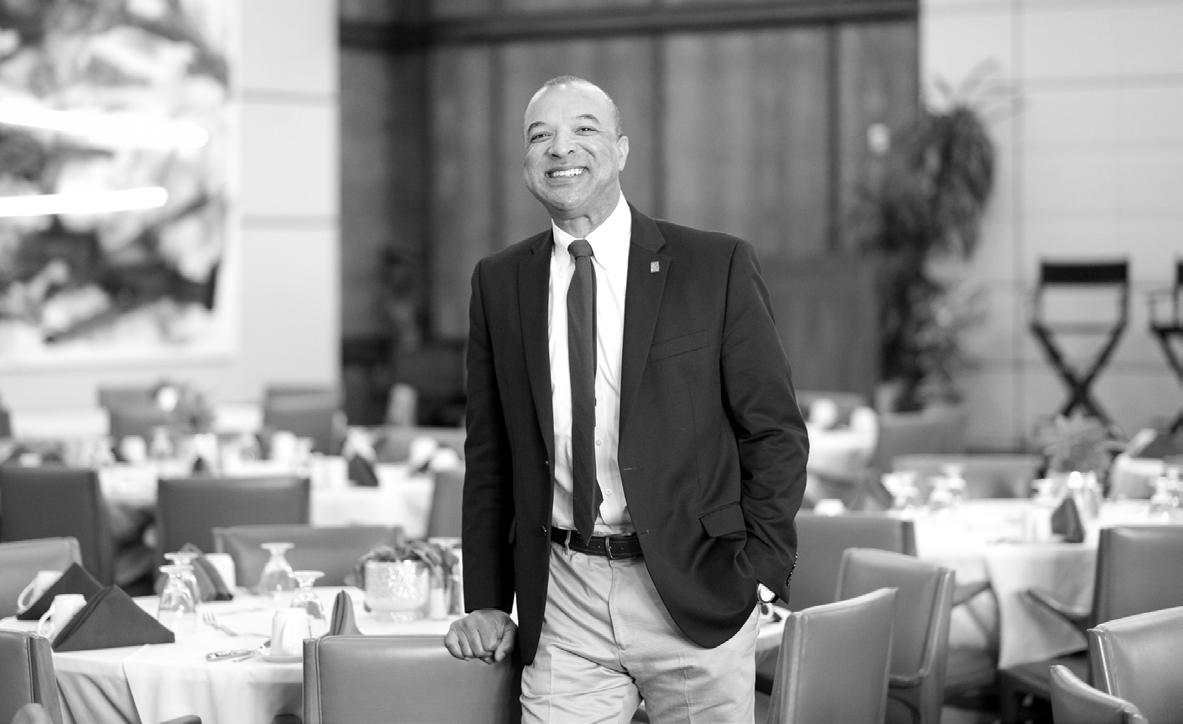
the Athenaeum. to CMC’s ambition to grow pro-
expanding. many Athenaeum events are institutes at CMC, but others are of an opportunity to shape who said.
gage with the Atheneum.
further to downtown Los An
by a new Metro station in approxeastern side of the street.
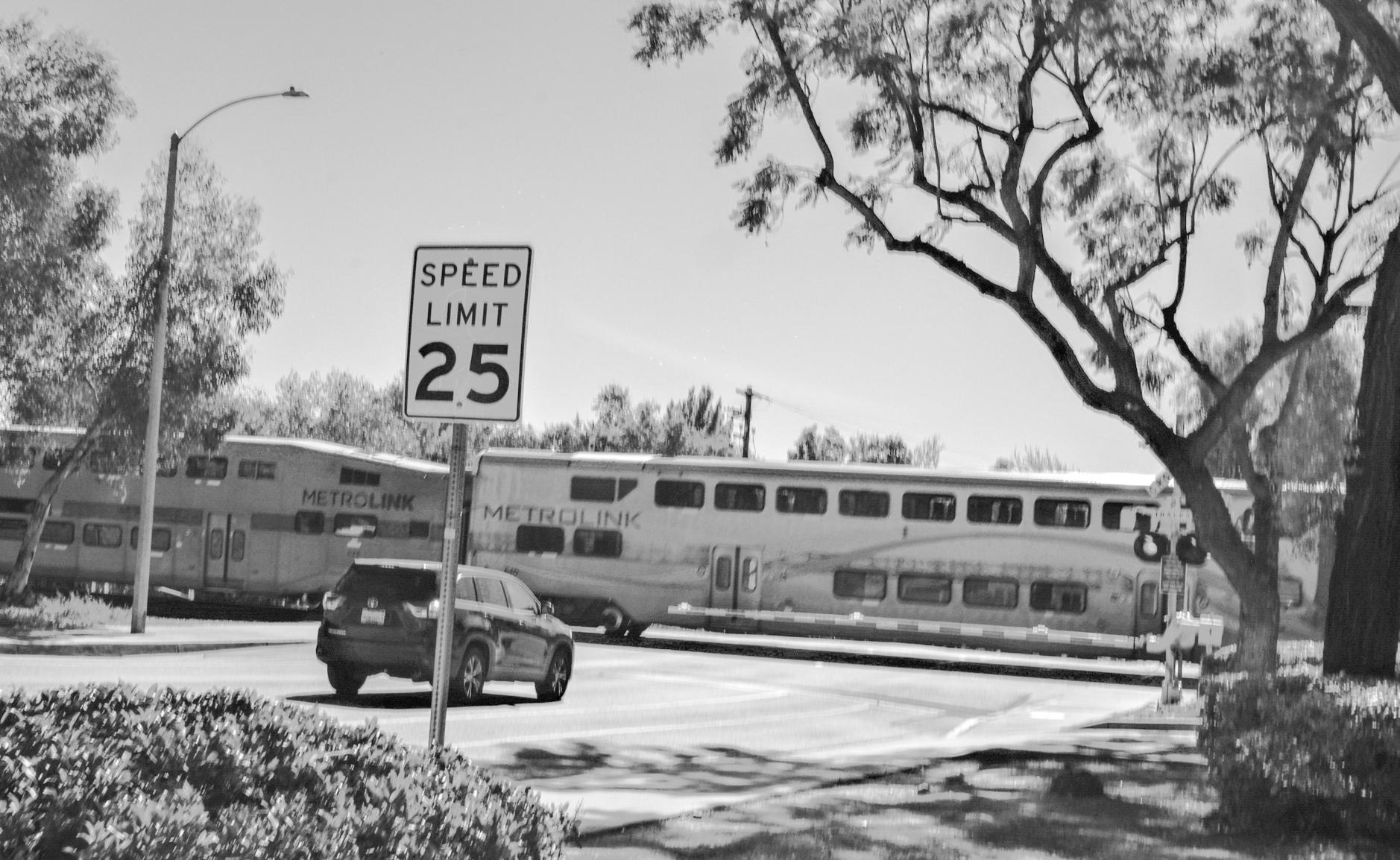
transportation anywhere is a good transportation to get around the Urfrig said.
history. the proposed art features.
aware of that and for that to be a
to the Hive’s website. Through this obvious and intuitive payment

You must admit that at some point in your life, you have told a little white lie.
Maybe you exaggerated your Spanish language proficiency on a resume, or lied about liking a friend’s shirt so they wouldn’t feel bad. At the end of the day, most of us tell white times we do it because we believe it
Just don’t tell Claremont McKenna College Professor of Philosophy Paul Hurley — he might respond that those seemingly harmless white lies can actually have seriously detrimental effects. On Wednesday, Feb. 4, in the Marian Miner Cook Athenaeum, Hurley delivered a talk titled “Are you Living in a Funhouse Mirror?” where he discussed the ethics of outcome-based thinking.
Hurley warned the audience that people can be so focused on their desired outcomes that they resort to manipulation, even without realizing it. Instead of working with others, moral reasoning can turn into calpeople to act in ways that produce one person’s preferred result. Even when intentions are good, Hurley continued, individuals risk treating others as a means to an end rather than as independent decision-makers.
In a campus culture that prides itself on student leadership, chockfull resumes and a general desire for perfection, Hurley’s warning struck particularly close to home.
Molly Daley CM ’29, who said she left the talk thinking she should ask herself, “What’s the best thing I can do, not is this the best thing for me?”
“Telling white lies feels harmless at the moment, but really, by telling them, I am trying to control people’s perceptions for my own agenda,” Daley said.
Hurley contrasted outcome-centered thinking with reason-based frameworks, which he explained than what they achieve. He told the audience that actions such as voting or obeying the law are morally sigfor fairness, legitimacy and shared civic responsibility, not because they guarantee a particular result.
From an outcome-based perspective, Hurley argued, these same actions can seem irrational or unnecessary. When results are the only concern, one’s perception of the scenario overrides personal autonomy.
“Agents with whom I’m collaborating are reduced to objects I’m trying to manipulate in order to bring about the best outcome,” Hurley said in an interview with TSL. “This approach
is inherently manipulative and discounts people’s ability to make their own choices about their own lives.”
To demonstrate this danger, Hurley pointed to fictional figures like Thanos, who believed that achieving the right outcome justified overriding individual autonomy on a massive scale.
Hurley described this mindset as the temptation to play God.
“When you make judgments about and attempt to control as a superior guide to their lives, and in doing so, infantilizing and manipulating,” Hurley said.
Amy Mo CM ’29, a public policy and economics major, found Hurley’s urge to release control of others especially relevant in her own life.
“This talk has really given me things to think about, especially the pursuit of learning to be uncomfortable in the uncertainty of
One distinction Hurley made between harming and wronging people. Harming focuses on outcomes, while wronging considers whether a person’s autonomy was ignored.
Actions can still be immoral even if they bear no harm or consequence.
Hurley also discussed how this type of reasoning appears in political leadership, where outcome-driven thinking can excuse dishonesty if it produces desired results. In one instance, Vice President JD Vance conceded: “If I have to create stories so that the American media actually pays American people, then that’s what I’m going to do.”
Hurley argued that this mindset degrades democracy by undermining respect for participants and treating individuals as obstacles rather than collaborative and independent thinkers.
Hurley acknowledges it is often difficult to separate the reason from the outcome. Still, Hurley’s critique of outcome-driven political reasoning led many to question whether the ends can ever justify calculated political distortion.
More broadly, students felt moved to consider the motivation behind actions over what they ultimately produce. When we value one another intrinsically, we reduce the risk of manipulating those close to us.
Many left with a newfound lies— no matter how trivial or inconsequential they may seem.
SYDNEY FORSYTHE
Low, haunting piano notes filled the Hampton Room at Scripps College as listeners held their breath. After a slow, building introduction, the music escalated into a march as Lan Adomian’s rousing operatic voice sang stories of the working class. After a breath, the speaker, Veronika Eberhart, switched off the tiny record player and assumed her place behind the podium.
This past Wednesday, Feb. 4, Eberhart, a multimedia artist, gave a talk co-hosted by the European Union Center of California (EU Center) and Scripps’ German Department Chair Professor Kevin Vennemann. Following the talk, Kaya Savelson SC ‘26 and Ella Attisan SC ‘26 moderated a Q&A.
“[Eberhart is an artist] from Vienna, whose work moves between visual art, film and archival research, and often focuses on the afterlives of political histories and modernist culture,” Vennemann said.
EU Center Director Professor Corey Tazzara described their motivations for inviting Eberhart, noting that her art aligns with the EU Center’s interest in Europe’s connection with the United States.
“The Center does not focus solely on the EU in the strict sense, though much of our programming is squarely in that domain, but as a Center for the history, culture and politics of Europe writ large — including its many entanglements with the United States,” Tazzara said.
Eberhart’s talk focused on the works of Hanns Eisler, a German-Austrian composer, and the political consequences of his compositions during the Red Scare period, which started in 1917 and continued until 1957.
During the Cold War’s Red
Scare period, the government targeted any suspected communists with blacklisting, investigations, loyalty oaths and, in some cases, deportation.
As an artist, Eberhart uses various mediums — including sound, image and text — in her international political exhibitions. Although she explores her artistic voice through vastly different forms, she remains somewhat steady in her themes. Primarily, she focused on the interconnection of politics and musical expression.
At the beginning of her talk, Eberhart described how she discovered her research topic purely by chance. While spending 2019 and 2020 working at the Mak Center for Art and Architecture, Eberhart visited where Bertolt Brecht and Hanns Eisler — two of her favorite composers — lived and found old records of their songs in the library.
“I thought the material is all there, so why not work with it?” Eberhart said.
Eberhart explained that Eisler was a devout Austrian-Jewish Marxist who, in 1938, fled the encroaching Nazis in Europe. During his exile in the United States, he infused his musical compositions with political meaning.
“He believed music was a powerful political tool, not decoration, but a means of education, mobilization and solidarity,” Eberhart said. “He combined elements of classical and popular music to create works intended for the working class. For him, texts and music were inseparable and carriers of political meaning.”
Eberhart recounted how, at the start, Eisler and Brecht were received with praise for their compositions in Hollywood. Most notably, their collaboration on the 1943 film score for “Hangmen Also Die” earned Eisler an Academy Award nomination.
Yet, soon after, Eisler would
become one of many European intellectuals under FBI investigation by the FBI for being too left-wing and a potential Soviet agent. From her podium, Eberhart read the transcripts of Eisler’s interrogation by the House Un-American Activities Commission (HUAC), describing the way they scrutinized a series of recordings he’d made with a small New York record label.
“At the time, the phonograph record was seen as a revolutionary medium,” Eberhart said. “In Europe, leftist magazines described it as a way of bringing political songs into homes, meeting halls, factories and farms, places where people had, as they put it, forgotten how to sing.”
During Eberhart’s talk, she played five recordings of these compositions and commented on the relevance of each. One standout was “In Praise of Learning,” a song encouraging the working class to educate themselves in preparation for a revolution.
Eberhart described how this song was a perfect representation of the very loaded political songs that characterized Eisler’s work. After his investigation by HUAC, he was deported in 1948 and relocated to East Germany, where he wrote their national anthem.
“It feels very out of time to talk about music in a political sense, and at the same time very contemporary nowadays with pop music,” Eberhart said. “We have a lot of examples in the U.S., but also in Brazil or somewhere where music still has a strong role in transporting political meanings.”
Eberhart ended her talk with a parting message for students about the importance of Eisler’s story.
“Eisler’s case shows that political fear does not disappear. It mutates,” Eberhart said. “What was once called communism is today, friends, extremism or disruption. So the questions, I think, remain the same: who is allowed to sing or even to be heard?”

This past Saturday, students traded signs for guitars and megaphones for microphones. Musicians from across the Claremont campuses came together to perform in a Humane Immigrant Rights (CHIRLA), a California-based immigrant rights organization.
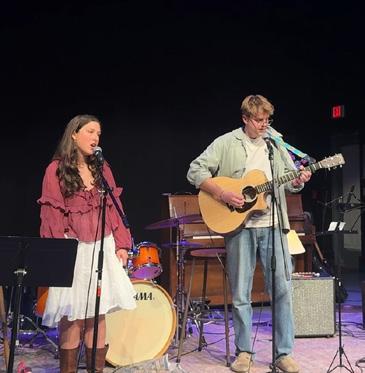
At 6 p.m. on Feb. 7, 5C musicians at Pomona College to raise money for immigrant rights. The event, which was hosted by Pomona College’s sophomore class president Molly Grace Chakery PO ’28, took place at Pomona’s Seaver Theatre.
“Music is protest and a form of resistance, and I think calling Chakery said. “I think so many of the people I know who make music here [on campus] want to support these causes.” The performance was comprised of four student musicians and groups: Jeans, Izzy Gustitus SC & Mylo. Jeans — a student band beaming with Pomona sophomore talent — of “Mayonaise” by The Smashing Pumpkins, followed by two indie pop and rock originals. Izzy Gustitus SC ’26 performed four pop and folk tracks, ending on a cover of “Birds of a Feather” by Billie Eilish. Tell Me I’m Pretty covered

classics like “Zombie” by The Cranberries while lead singer Ava Neal SC ’28 danced like nobody was watching. Chakery and accompanying guitarist Mylo Schneider PO ’28 — of the Molly & Mylo duo — closed out the concert with a moving rendition of Bob Dylan’s “Blowin’ In the Wind.” Dylan’s resonant and timely lyrics, like “How many years can some people exist / Before they’re allowed to be free?” touched audience members.
All proceeds from ticket sales were donated to support CHIRLA’s continued mission of defending the rights of immigrants through education, legal assistance and political advocacy. As immigrant rights become
a glaring focus on the national stage, 5C students have been actively organizing to coordinate support for local organizations. In Los Angeles alone, over 10,000 people have been arrested by ICE since June. On Dec. 31, 2025, Keith Porter, a 43-year-old Black man and father of two, was fatally shot apartment. For college students who feel
change. For student musicians, however, performing at events new door — one where expression becomes both accessible and empowering. “I felt very powerless because
it seems like all the systems in place that are supposed to keep things okay are just being burned down,” Neal said. “I’m a college student, I don’t know what to do. And then, when Molly Grace told me about this, I was like, okay, this is something I can do. I think people want to hear music and are more incentivized to support that way. So that’s my weapon of choice.”
The event allowed performers like Neal to transform feelings of frustration into tangible action. Grief became mutual aid as tickets were sold. Feelings of powerlessness became empowerment as Anger towards unjust systems became angsty lyrics, driving guitars and loud drums.
“We’re all angry, and we’re all for that,” Chakery said. “And I think raising money in this way kind of provided that for me, and I hope for other people.” Student activism comes in many forms. It can take the form of protests, boycotts, donation campaigns and even concerts. At the end of the day, however, it’s about coming together as a collective to express shared grievances and cultivate a community rooted in care. For students, performing whether on stage or at a protest, the whole is greater than the sum of its parts.
“The work that we make togethmade on my own,” lead singer of Jeans, Vanessa Lowder PO ’28 said.
multidimensional. It feels good to be united under this one sound.” With almost 100 ticket sales, the many students explained, is just the beginning. The Associated Students of Pomona College (ASPC) is holding a general fundraiser for CHIRLA through Feb. 22. The fundraiser is structured as a competition among Pomona’s South Campus dorms, where the dorm that raises the most money will earn prizes. ASPC’s campaign for CHIRLA will also include collaborations with Scripps Associated Students and local Village businesses. Throughout history, music and performance have proven to be a crucial element of resistance and
concert shows how bringing people together through live music can build community and mobilize support for causes that students believe in.
sion you have, you have that for a reason, and it can be leveraged to help, and we need that,” Neal said. “So use it.”

When the SoCal rain clears and early spring nudges its way into the world, we face a harrowing realization: Valentine’s Day is coming. If you’re like us, you usually spend America’s pinkest holiday with your friends or in bed. But if you’re really like us, the sadder truth is this: it’s been a long time since you’ve spent Valentine’s Day with someone you’re into.
As the day approaches, we’re here to ask: Is spending Valentine’s Day single empowering or just plain sad?
But first, let us introduce ourselves. We’re Siena Giacoma PZ ’27 and Arianna Kaplan SC ’27, and this is 5Cs After Dark: a column about sex, love and relationships at the 5Cs.
Siena: February has come again and it’s time to re-evaluate
Valentine’s Day. For me, this will be the second year in a row I pretend that celebrating Galentine’s Day is a proper substitute for actual romance. Personally, I choose to “opt out” of Valentine’s Day because I can’t find any genuine intimacy at the 5Cs. At these schools, we debate ethics, dissect culture and analyze systems of power, but all that critical thinking goes out the window as soon as someone likes you on Hinge. I have many imagined preconceptions about perfect relationships, but when it comes to putting those ideas into practice, it seems we often follow scripts borrowed from hookup culture or social media rather than our own values. Nothing screams sexual chemistry like “seen 2 hours ago” in the DMs. What the fuck is up with that? When did emotional maturity become optional? That’s why Valentine’s Day hits a nerve.
Not because I’m desperate for a fancy dinner or roses that will die in three days, but because the holiday exposes the gap between what we say we value and what we actually do. We can debate consent theory for two hours, but can’t send a clear text? Be serious.
Ari: I’m with you on not loving Valentine’s Day. I wouldn’t say that I hate it — I just don’t think that a commercialized day can explain your feelings for someone. I’m not bitter about love itself. Who doesn’t love love? Love is beautiful, I just don’t believe that red-and-pink balloons are a sufficient display of affection. Where I think we disagree, though, is on Galentine’s Day.
Valentine’s Day, historically, has not always been about romantic love. In Finnish, Valentine’s Day, “ystävänpäivä,” translates to “friend’s day.” In
Finland, they don’t place the same emphasis on romance. While I’m not saying the Finns do it better than us, it is interesting to see how much pressure we put on ourselves to conform to a standard that would raise eyebrows across the world. I like Galentine’s Day. I think that you can get kinda meta with it in a counter-culture, subvertthe-norm-while-being-aware-ofthe-standard kind of way. But I get it if you disagree.
Siena: I understand that Galentine’s Day, on paper, is a sound alternative to conforming to mainstream celebrations. Hot girls, good outfits, overpriced pasta and communal venting? I love the idea, but let’s be honest: how is that any different from what I do with my friends on any other girls’ night?
Galentine’s Day is cute. I love my friends. I will absolutely wear a good outfit and
split a bottle of wine, but let’s not pretend it’s the same thing. Friendship is essential; it’s just not a substitute for being intentionally, romantically chosen. There is also something rankling about Galentine’s Day. The idea of us girls (or whomever) hanging out isn’t the problem — it’s more that it feels like it’s trying to make up for a relationship that we’ve been spoon-fed to believe that we need to exist. You know?
Ari: Yeah, I get that. It’s okay to feel sad if you’re not in a typical relationship on Valentine’s Day. Even if you are in a relationship, the pressure that the holiday places on you is heavy, especially if you’re not happy with your partner. Last year, I spent hours making a handmade gift for my boyfriend. I knew we were going to break up, (and we did, a few weeks later), but I felt like it was an obligation to go above and beyond because it was our first Valentine’s Day together. That sadness is a valid response to a culture that has tied intimacy to performance and tells you your worth is measured in romantic affirmation.
Siena: I guess I’m not anti–Valentine’s Day, I’m anti-mediocrity. If we’re going to roll our eyes at the holiday, we should at least have the emotional range to do better than a situationship and a “you up?” text.
Ari: Yeah, completely. That’s just gross. I’m pro-Galentine’s Day. I’d rather be single in the company of friends than sad with my own boyfriend. Even if the perfect partner is out there, I think that every day should be Valentine’s Day, not just the day that America dictates it to be.
Siena: In the end, do what you want this Valentine’s Day. Choosing the intimacy of your own company, a deep conversation with a friend or the calm satisfaction of noticing the last light hit Pitzer Hall is not sad. It is a valid celebration of intimacy, the kind the day has forgotten to honor.
Siena Giacoma PZ ’27 and Arianna Kaplan SC ’27 are aspiring documentarians of the sexually awkward, which they consider a noble and vastly undervalued literary genre. They have consciously chosen the unstable but vibrant path of writers, betting on a future of rich inner lives and fascinating anecdotes over sensible things like 401(k)s or a basic understanding of Excel.

PHOEBE FOGEL on how to implement AI policies, and this has left students juggling varying criteria for each of their classes.
-
to stay. With an AI overview at the top of every Google page, Meta AI in the Instagram search bar and the new Apple Intelligence summarizing text messages, we’ve long since passed the point where we can just ignore it. Nowhere is this more apparent than in the classroom.
Many professors fear that ChatGPT is writing essays in place of students. This fear drastically underestimates the ways students use AI. Students are having LLMs summarize and explain their course readings, and even using them to come up with responses during real-time class discussions.
opinions on the ethics and consequences of AI use for classwork. English and History student Katie
student engagement.
“I feel like it defeats the purpose of reading,” Fullerton said. “You want to interpret the work by yourself, so you can come to your own conclusions.”
With AI’s growing popularity and addictiveness, professors are faced with a choice: embrace it or reject it. However, many professors
“I feel like there [are] so many mixed feelings,” Fullerton said. “Some professors are totally proAI, and they’re like ‘use this as a resource, it’s wonderful, it’ll help you learn, it’s so powerful,’ and then other professors are totally it, some professors are like ‘use it, but use it sparingly and wisely.’”
Based on student observation, it seems as though professors in STEM departments tend to be more open to incorporating AI into their curricula, while humanities professors tend to prefer to keep it out of the classroom. Caoilainn Christensen PO ’27, a computer science and cognitive science student, spoke about her experience in her Minds & Machines class. She described performing experiments using the Turing test — Alan Turing’s foundational test of com-
way to study the development of AI. According to the Turing test, if a computer can successfully fool a human being into thinking it is conscious and intelligent, then it is. Students in humanities classes report a different experience. Jessica Zhang PO ’29, a Middle
Eastern Studies and International Relations student, reflected on the lack of AI in her humanities courses.
“I’ve not yet encountered a class where generative AI was incorporated into the syllabus, but I’ve heard about it from friends who are taking less humanities-centered courses,” Zhang said. For the professors who don’t want generative AI in their class-
rooms, it’s not as simple as writing “No AI” on the syllabus. Anti-AI to enforce, with AI detectors often providing inaccurate results. As AI evolves, its writing style is only beand papers aren’t the only thing students use it for.
“Unfortunately, sometimes I see kids typing into ChatGPT in the middle of class,” Fullerton said. “The professor will ask a question, and then kids will type in the exact question into ChatGPT and then look at the answers.”
Since teachers cannot realistically monitor all online activity, it’s impractical to ban AI without completely banning computers. So, professors have begun banning computers.
More and more, professors are restricting the use of tablets and laptops in class. Rather than relying on PDFs posted to Canvas, professors are assembling physical course readers, which they require students to bring to class. Some are even substituting large-scale to ensure that students don’t use AI for major assignments.
This leads to some classrooms feeling more strictly regulated, with the level of professor-student trust having decreased significantly. Many students struggle with the idea that educational progress might look like a step backward, especially as rapid technological change reshapes the classroom.
Zhang has taken two courses with Professor Daniel Watling and obthroughout her time with him.
“[In] my second semester, I’ve semester,” Zhang said. “Everything is now on paper; we can’t use computers in class.”
One downside of the strict no-technology policy is the increased cost to students, who now have to purchase expensive course readers instead of relying on free PDFs they once accessed online. However, many feel the added expense is worth it, arguing that these changes are necessary to preserve academic integrity — some even strongly prefer the life of the paperback.
Zhang is among the many who value a classroom without technology.
“I prefer this over a crowd of people with their laptops open,” Zhang said.
It’s unclear how AI will continue to impact college campuses. It’s unlikely that there will ever be a perfect solution that can embrace technological progress while encouraging student effort and curiosity. It’s possible that as this technology develops, professors will continue to impose stricter regulations on the ways students engage with their courses. It’s also possible that AI will develop to a point where no classroom policies can prevent its use.
There are many reasons people dislike AI, and Christensen points out two of the biggest.
“I think that it’s important that people be mindful of their AI use, both for environmental reasons and because the purpose of college is to learn,” Christensen said. “Using AI to do your assignments is defeating the reason why you’re paying a lot of money to be here.”
AI has become an inescapable part of life at the Claremont Colleges. It’s impossible to study at the library without seeing multiple screens open to ChatGPT, and it’s not uncommon to overhear students in the dining halls debating which chatbot is the most helpful. Students, much like the professors, carry a host of different opinions on the matter — some consider this an amazing feat of science, others worry it may have a terrible impact on higher education. Regardless of personal opinion, it’s clear that AI will continue to dominate classroom conversations for years to come.
SYLVIE SIMMONS
Last Saturday, images of ice cream erupting out of a nuclear mushroom cloud lay scattered across tables in Pitzer College’s Broad Center. Audience members pocketed the postcards — originally a pastel drawing by Slow War Against the Nuclear State (SWANS) member Nancy Buchanan — as they walked through the new “Atomic Dragons” exhibition.
On Feb. 7, students, faculty and community members gathered to celebrate the exhibition, which was curated by SWANS, an intergenerational feminist art collective. From the postcards to the artwork on the walls, the message behind their exhibit was clear: Nuclear panic is not a thing of the past — the threat of nuclear expansion is ever-present.
As Gallery Assistant Ruby Loesch PZ ’26 described, “Atomic Dragons” is part of Pitzer’s goal to host shows that spark conversation about important issues.
“As an institution, Pitzer often does try to have socially impactful leaders, and the art galleries reflect that,” Loesch said. “I think a lot of young people don’t know [about nuclear issues]. Most people don’t think about it, or even understand what radiation is, or how it functions, or the dangers of it.”
SWANS examines the intersection of the nuclear age with society, politics and environmental issues, using artwork to weave together past and present narratives on nuclear threats. In their work, the collective’s artists utilize personal narratives and archival material to spotlight the impact nuclear weapons have on societies.
Former Pomona professor Sheila Pinkel described how the group first formed in 2022, emphasizing Buchanan’s role in bringing artists together around this shared passion.
“One of the artists, Nancy Buchanan, had a luncheon for people who were connected to nuclear issues,” Pinkel said.
“Somebody got a venue, and we had a show and then we just kept going.” Pinkel described how her passion for creating art around nuclear issues grew out of a personal connection.
“My father was a nuclear scientist. He designed the first
nuclear reactor at NASA in Cleveland, Ohio,” Pinkel said. “I did not know until I was an older adult that my father had been a principal in the nuclear industry.”
In the 1980s, Pinkel first became concerned about the global growth of nuclear weapons and their connection to the military-industrial complex. She began creating art as a response to a lack of transparency on the government’s plans and policies surrounding nuclear weapons.
“It was almost impossible, like today, to get any clarity about the industry,” Pinkel said. “You can’t read a newspaper and really understand it at all. They obfuscate rather than clarify the subject.”
As a result, Pinkel’s work is primarily information art — an interdisciplinary approach that often incorporates data. In the 1980s, she created an installation series of 13 “Thermonuclear Gardens.” Each garden represents different ideas, concerns and impacts related to nuclear weapons. Although Pinkel has been creating art in relation to nuclear issues for decades, she stressed that her work is as topical today as ever.
“Nuclear issues are important today, especially after the Strategic Arms Reduction Treaty (START) finished on Thursday,” Pinkel said. “The START treaty limited the number of nuclear weapons by Russia and the United States to 1,550 per country.”
The START treaty was first established in 1991. Pinkel is concerned about the treaty’s recent expiration on Feb. 5, as it grants countries more leeway to increase their nuclear capacity.
“This is a nightmare, an absolute nightmare,” Pinkel said. “If there was ever a time when people have to talk about nuclear issues and become sensitive to the dangers, it’s right now.”
Elin O’Hara Slavick, another SWANS member featured in “Atomic Dragons,” is unhappy with how the U.S. is currently handling growing conversations about nuclear weapons. Specifically, she expressed concern towards President Donald Trump’s recent request for the U.S. military to continue testing nuclear weapons — a dangerous process that was retired in 1992.
“People think that a nuclear
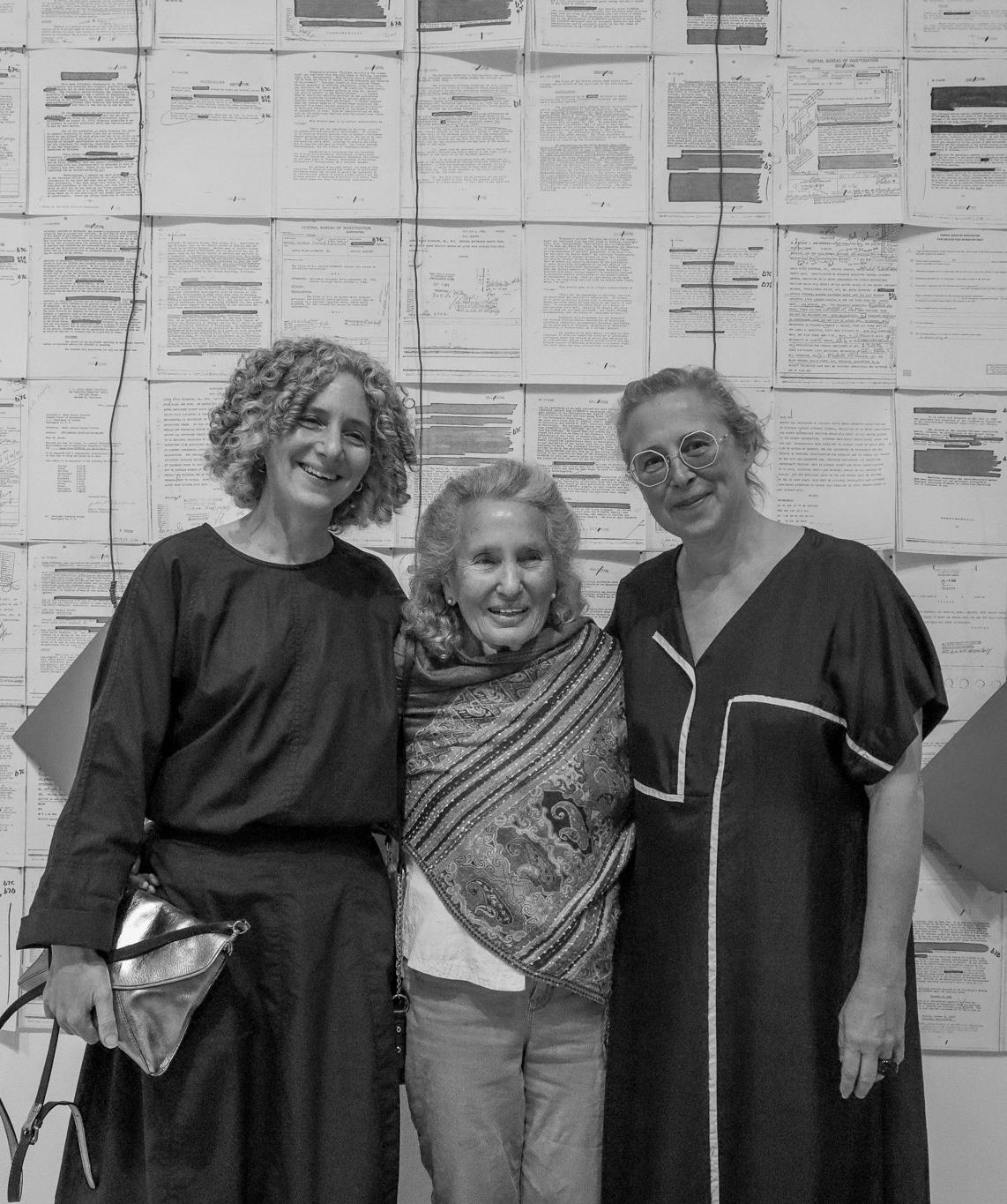
test is just a blip, but every single nuclear test is a real nuclear bomb bigger than Hiroshima and Nagasaki,” Slavick said. Slavick’s work features many cyanotypes — a simple chemical drawing often called a “sun print.” Using this technique, she depicts images of loss and survival in the wake of the A-bomb in 1945 and the Dai’ichi Nuclear Disaster of 2011. Slavick feels this work and its eerie depictions of atomic bombs are espe
cially relevant now, in light of
Family dinners and the s word of s hannara
Shea Ohmsford is the ultimate man. In Terry Brooks’ 1977 magnum opus, “The Sword of Shannara,” he wanders through dark castles and fantastical lands in search of a blade that can save the world.
Now, if it isn’t already obvious I’m quite a big Shea Ohmsford fan — but this isn’t the point.
The point is, on Friday, I thought I was going to die. Not actually. In reality, I was perfectly safe. At the same time though, I was trying to find my way out of a literal castle at three in the morning. Unfortunately, there was no magical world-saving blade involved.
Earlier that day, I traveled to Carcassonne to stay in its medieval city, which was incredible, until I went to pick up my girlfriend, who was arriving by bus in the wee hours of the morning. So here I am. Everything is myself sprinting across the grass, trapped between the inner and outer walls. That can’t be right. Below me is a 50 foot drop. I’m late for the Uber I pre-reserved to the train station — if it leaves, there is -
co. My mom said she was tracking me running around the ramparts of the castle on her phone. Against all odds, I succeeded. I found my way out of the castle’s labyrinth walls. And for a brief, fleeting moment, I was Shea Ohmsford.
This wasn’t me finding THE study abroad moment. I now simply just know how to run around a castle at night. Looking for doors usually helps.
I realized that however thrilling my Shea Ohmsford escapade was, a part of me was happy to go home. Or, to go back to Reims. I’m not sure if we’re at the home stage felt that way. I know that’s not saying a lot. This is all to say that my journey through the castle taught me to appreciate the mundane

pleasures of my life outside. So now I’m on the Train de Grande Vitesse, or the fast as fuck train, going back to Reims. As I’m writing this, I’m thinking, last week was a great week. Mundane? Yes. But I’m starting to understand that there isn’t necessarily anything wrong with that. It feels like the week boiled down to some chili with cheese and rice. Parker Devore PZ ’27 –– my old TSL buddy –– and I decided to make some for my host mother, Anne. The day started well enough. I was supposed to meet my host mother’s boyfriend. I knew his I prepared something normal to say about it. I said it, and then his hand. After recovering from that lovely experience, Parker and I began to prepare the chili, unbeknownst to the chaos –– or glee –– we were about to step into. All was well until our host mother taught us a new bit of French slang. Massive mistake. I think she thought me 1) being an adult and 2) more or some selectivity –– or perhaps even control –– over when I said the word. She was wrong. Never underestimate my childishness, despite that I will soon in fact
turn 21. Anne told us the chili was eating a family dinner at home, one where I was free to laugh and reach over the table for the napkins and bowl of rice without having to ask. I really liked that. It didn’t feel like an exchange program. It was just normal. And it made me realize I was lucky, because my homestay feels like a home. Each day, I come home and get greeted at the door by Anne, who asks me how my day was. The Wi-Fi doesn’t work, sure, but that doesn’t bother me too much because there is someone who cares about me in a foreign place.
These days are slower and quieter than anything I’ve experienced or what I anticipated. I’m not used to it, but, weirdly forward to this routine. Coming from New York, I’ll always wish I went to school in a big city, and that probably won’t change. But I can’t discount the good days. There isn’t a Sword of Shannara in Reims. There’s just chili. And I think I’m okay with that. it out.
President Trump’s request for further testing.
“That work, for me, is really powerful,” Slavick said. “I don’t even feel like I made that work in a way. I feel like I was just this conduit, or medium, between the idea and the chemistry and the paper I found.”
For many SWANS artists, “Atomic Dragons” serves as a way to identify and unveil the chilling presence of nuclear issues today. SWANS and Claremont students alike
agree that environmental ethical codes must change. Encouraging others to care about these issues often feels difficult; exhibits like “Atomic Dragons” can be an important means of spreading awareness and sparking conversations amongst students. “I don’t think art can change anybody’s mind,” Pinkel said. “But it can ask questions and provoke thought, giving people courage to be proactive.”





DO YOU WANT LOVE AND FAME? APPLY NOW!
This year, love is occupying my mind in a novel way. Turning 20 has nudged me to reflect on my teenage love life. I was brave enough to stray from the norms, and with that came a diverse array of exes. They were diverse in many ways, but what interests me at this moment is their cultural differences.
I’ve dated people from four different countries — each of them was from a different place from both me and each other. This wasn’t intentional in any conscious sense, but I couldn’t help but form some hypotheses about how this pattern formed. The first question that comes to mind: What if I date outside my own culture to hide from it?
To begin my investigation, I thought about a relationship that should have felt the most familiar. My least cross-cultural relationship was, paradoxically, the most uncomfortable. I met my second ex in high school; while I was born elsewhere, we both grew up in the same city.
Similarity, it turns out, didn’t guarantee comfort. The relationship faltered for many reasons, but the most glaring one was definitely his homophobia and misogyny — reinforced by Shanghai’s Confucian-style patriarchy. We also diverged politically in ways that were difficult to negotiate. He would press me on where I was really from. “You agree that Taiwan is just considered a Special Administrative Region of China, right?” he asked once, glancing at me. I shrugged, suddenly unable to meet his eyes.
Many people I knew were supportive of this relationship; we were a very conventional couple. Yet, I felt exasperated and oppressed. It was upsetting to try to fit my sociocultural identity into a palatable box to appease him. Ultimately, I came out of it feeling more affirmed than ever as a feminist, an advocate for queer rights and someone who stands their ground.
In the aftermath of this relationship, I wondered: Would it take someone further from my upbringing to understand my autonomy?
Let’s take my relationship with my German ex as an example, where the gap between us was obvious from the start. I initially understood his cultural world
through stereotypes (and vice versa), but we quickly dismantled those and made a point of learning more about each other’s cultures. He told me about German Christmas festivities while I introduced him to Qixi, the Chinese “Valentine’s Day.”
Although I’m in another cross-cultural relationship now, this one doesn’t fit into any of the above categories.
My current partner is American, a SoCal native, even. Thinking about that is bizarre — it feels unmistakably college, though before meeting him, I hadn’t spent much time imagining who I might date during my undergraduate years. What I did know, however, was that the idea of dating an American intimidated me.
I grew up attending school with an American curriculum, so I absorbed a certain amount of cultural shorthand. However, I’ve always felt slightly unmoored in conversations about American touchstones like childhood TV shows or 2000s pop culture. No matter how fluent I was in English or knowledgeable
about contemporary U.S. events, this was territory that would always remain uncharted.
In some ways, this ambiguous overlap makes this relationship more complicated than the others. I worried that being with someone I genuinely liked would magnify that gap — that I would feel clueless or culturally out of place next to the person I cared about most.
This anxiety didn’t disappear once we started dating, so eventually I asked him how he felt about dating someone outside his culture. He acknowledged how different our upbringings were. Sometimes, he said, he hesitates to send me something steeped in his own experiences, unsure whether I’ll understand it or feel excluded by it. At the same time, he’s often excited to learn about the parts of my life that feel unfamiliar to him: niche traditions, favorite cultural foods, things he knows he would rarely have encountered otherwise. It felt comforting to realize that this cultural gap wasn’t something I was navigating alone, but something we
were both noticing and crossing together. Still, even if I had all this figured out, the real pressure doesn’t come from cultural gaps. The more uncomfortable question stemmed from closer to home: do I fear dating within my culture because that’s exactly what my mother wants for me? Since I started first grade at an international elementary school, my parents used to joke that if I ended up with a foreign boyfriend, they wouldn’t know how to communicate with him. At the time, it felt lighthearted. But over the years, it’s become clear that my mother wasn’t entirely joking. She has voiced her hopes for me: she wants me to be with a Chinese or Taiwanese man, and doesn’t want me to get with someone abroad and complicate her life with a language (and by extension, social) barrier. To some extent I understand, but thinking about this still makes my stomach drop. It makes me wonder whether I subconsciously date outside my culture to escape these expecta -
tions. Maybe I wanted to prove that I can build a fulfilling life for myself when I’m out in the world alone. Maybe I’ve let certain prejudiced values I’ve encountered shape how I view people within my own culture, even though I know better than to generalize. I’m still not entirely sure what that says about my choices. I suppose what I’ve been searching for isn’t a way to hide from my culture, but to distance myself from the expectations that try to define it for me.
Cross-cultural love has taught me a great deal and given me opportunities to explore who I am when placed beside someone different from me. At the same time, it’s a place where I can negotiate identity and expectation. Somewhere within all that tension, I’ve found a version of happiness that feels distinctly my own this Valentine’s Day.
Rochelle Lu SC ‘28 is from Shanghai, China and Kaohsiung, Taiwan. She is amazed that Hinge actually worked its magic and spends her free time consulting the astrology app Co-Star for insights about love.
AVA MONAHAN why have they become so popular?
A few years ago, my sister told me that I had to read “The Song of Achilles.” Then I had a Latin teacher who recommended “The Silence of “Ariadne” in the bookstore and was immediately drawn in by its azure and silver cover and the allure of a classical story retold.
As an eager Classics student, I was excited to see a somewhat niche interest of mine become more mainstream, and I quickly added these to my growing “want to read” list and began to devour them in my free time. Then it felt like there were new ones coming out every other week. I quickly forgot the distinguishing details of particular books and grew tired of the genre as they began to merge under a general theme. Where did all of these Greek mythology retellings come from, and
The act of retelling old stories goes back to the classical world. In the 20th century, writers such as Mary Renault continued the tradition, with Margaret Atwood and Ursula K. Le Guin following in her footsteps in the 2000s, publishing “The Penelopiad” and “Lavinia” respectively. Something changed in the 2010s and early 2020s. Madeline Miller’s wildly successful “The Song of Achilles” retold the story of Achilles and Patroclus’ relationship as a homoerotic romance, reviving the idea from ancient textual evidence.
“The Song of Achilles” won the 17th annual Women’s Prize for Fiction in 2012, securing Miller’s pre-eminence in the literary world. With the publication of “Circe” and “The Silence of the Girls” in 2018, the genre shifted again. Suddenly every story was from a femi-
nist perspective, focused on giving a voice to unheard women from the most famous classical texts.
I’m not entirely sure why Greek mythology retellings suddenly became so popular in the late 2010s and early 2020s. Maybe they came at exactly the right moment in our cultural history. With the politicaling new conversations about women and reproductive rights, maybe feminist retellings were just what readers were craving. Or maybe the pandemic simply encouraged people to turn to more fantasy-esque stories as a form of escapism.
Whatever the case, their popularity didn’t last. Authors are still churning out novels inspired by classical texts, so why aren’t people reading them anymore?
I have a few theories. One is that the genre has become so oversaturated that readers have become numb
to new novels in this area. How many feminist Greek mythology retellings can you read before they start to lose their luster?
Another potential problem I see is that all of these novels are based on the idea that women’s stories are ignored or glossed over in the classical canon. Is it really true that women are completely unrepresented in Greek mythology?
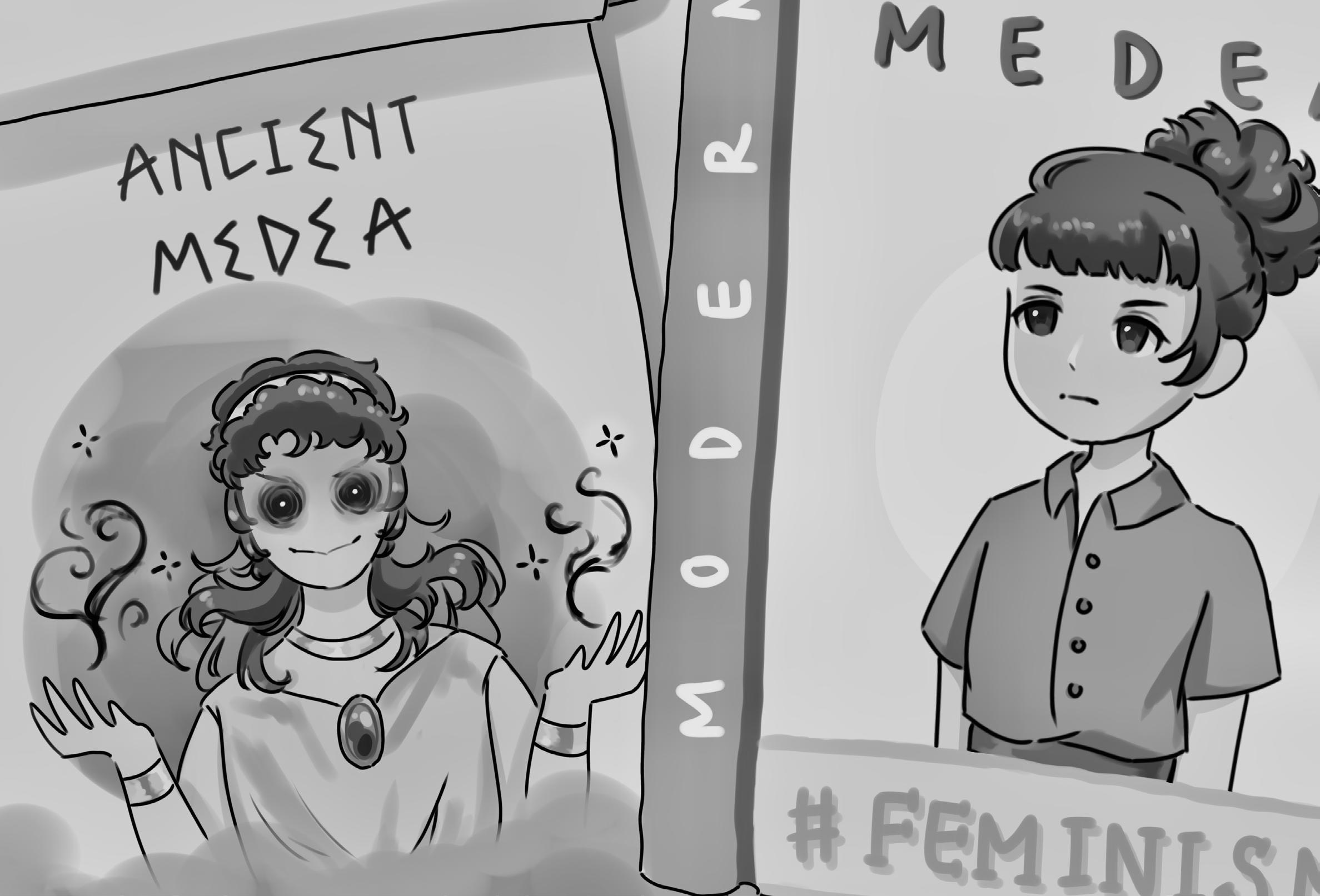
Take Penelope, the wife of Odysseus. Known most famously for her trick of weaving and unweaving to strategically defers insistent suitors until her husband’s return. Clytemnestra, too, is a famous figure. She avenges the sacrifice of her daughter, Iphegenia, by killing both Agamemnon and his concubine, Cassandra, upon their return from the Trojan war. And what about Nausicaa? She bravely helps the wandering Odysseus and orchestrates his arrival at her father’s palace. How do we know these stories? Because ancient peoples decided that they were important enough to keep telling. Women’s stories were not prioritized in the same way that men’s stories were. But it is a gross stories were completely untold until the 21st century. In fact, the stories we already know are the ones that probably need to be retold the least. The countless unknown women who lived and died in obscurity are the ones who were forHelen nor Cassandra. But I know that when I’m browsing the bookstore, I’m more likely to pick up a book about Medea than about an unknown woman. The paradox is that we are both drawn in by this notion of retelling and repelled by its redundancy once its creative energy feels spent. I think the crux of the issue with modern Greek mythology retellings is that the protagonists are just too similar. Cultural biases shaped female characters in the classical canon, but they were still complex and multi-dimensional, while modern retellings ignored, overlooked or mistreated by history. Not all female characters, however, are supposed to — or have to — be likeable. Stories thrive on a combination of unsavoury, angelic, and vexing characters. In fact, it seems a disservice to the classical corpus to reduce its female characters to digestible, “previously misrepresented” portrayals. Maybe the point of Clytemnestra’s murderous rage is not for us to justify it, but to examine its violence as a function of the myth itself. Since when do characters need to be good to be likeable? If in every feminist Greek mythology retelling, the protagonist’s primary characteristic is fighting against an oppressive system within the confines of her gender, it’s no wonder they begin to blend together. For me at least, they start to feelent source myths and characters are condensed. In the 21st century, I don’t think it’s enough to write a book from the perspective of a woman and call it feminist.
Walking through the open doors of the Claremont Lewis Museum of Art, I was immediately confronted by a wall covered in string wrapped around placards of random words. I felt myself gravitate to the white pedestal that held different colored yarn and scissors. Taking red yarn, I began my journey at the word “Let,” not sure where to go next. I kept circling around words, letting the yarn wrap tightly around each one.
I reached the final word, “tangle,” which seemed fitting as when I stepped back, all I saw were tangles of yarn. I could hardly see my own path, but regardless, I remembered each word I securely wrapped it around, “Let the door resist and I tangle.” Unsure of the statement I created, I began to navigate my way into the galleries, letting it marinate in my mind.
In “She Opens the Door: Women Artists and Writers Shape Language and Space,” I was met with poems revolving around artworks, words tangled around images.
Walking into the final gallery, my eyes were caught by a piece made by Adrian Culverson titled “Float.” From the side, I saw layers of stuffed fabric. I turned to look at the front, seeing colors that varied in a range of yellows, pinks, purples and greens. With the slight use of paint, it looked like a cascading waterfall of fabric attached to a single piece of wood hanging on the wall.
As I tried to fully grasp the spectacle in front of me, the line “Let the door resist and I tangle,” reverberated in my mind. In the spirit of the exhibition’s combination of art and poetry, I decided to write a poem comparing “Float” by Adrian Culverson to my experiences sewing. Culverson grew up in Claremont, and now works as a professor at Citrus College teaching beginning drawing. Her work constantly explores the in-between of the defined spaces in our contemporary world.
“Float” felt like an abstracted creation of the in-between. Visually, it looked like a pillow, one that would be displayed on a couch at home. Yet, it was hung on a wall in a public space. The liminal spaces in her work made me think about our own hidden interior and exterior thoughts formed by binaries.
Our society is filled with imagined binaries — we often construct hierarchies, with mental structures governing how people view each other. Walking through

the museum, I was struck by how many of the artists played with these binaries between nontraditional and established mediums of art. I often think about the binary between craft and art. Throughout history, textile art has been characterized as a form of craft in order to inferiorize women artists and artists of color. Culverson’s use of fabric and paint sits in the middle of craft and art — creating a dialogue between two materials often seen on opposite sides of this binary. She plays with the functionality of the artwork by creating a pillow and displaying it rather than using it. This resists the characterization of craft being only functional and not aesthetically expressive. These notions of craft fail to realize how much power the practice holds. When I think of the word craft, I often think of my mother, who learned the process of sewing from my grandmother. When I sit in front of a sewing machine, or take a needle and thread, I am reminded of their hands. In my head, sewing has become a very intimate act that carries so much history and empowerment. It has been a
way to survive, pass time and resist in my family. This passing down of history around textiles makes it more than just a craft, but a form that continues to live through resistance, and especially through artists such as Culverson.
Soon, the phrase I created at the beginning started to make sense, “Let the door resist and I tangle.” This piece, along with the others, release histories revolving around issues that plague our thinking with binaries, like craft versus art. Culverson’s piece invited me to look deeper through the layers of fabric, to not tangle myself in all of these binaries, but to resist through finding the in-between.
As I walked out of the doors of the museum, I felt kinship with the artists and writers that felt the constant tanglement in the world. They created art and poems that resist those tangles, unraveling them for us to see. I felt like a part of this community, a part of this resistance.
Meiya Rollins PO ’29 believes, like Michelangelo, that art takes time – most of that time being snack breaks and watching “Good Mythical Morning.”
Reading the headlines feel
As if the world is unraveling and It is completely out of your control.
Out of pure frustration you pull Stitch after stitch watching and Feeling You rip apart your own creation.
Trying to right the wrongs yet It seems to be of no use and You are stuck with yards of Fabric In your hands.
But you feel a release of Tension and that For a moment You have been rebirthed.
So stitch after stitch You bring the pieces back together Until You read the headlines the next day.
With the resurrected abstract creation In your hands, History is doomed to repeat.
GRACE RUTHERFORD
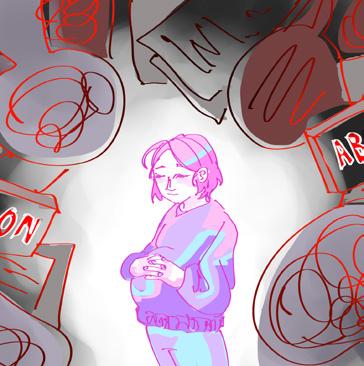
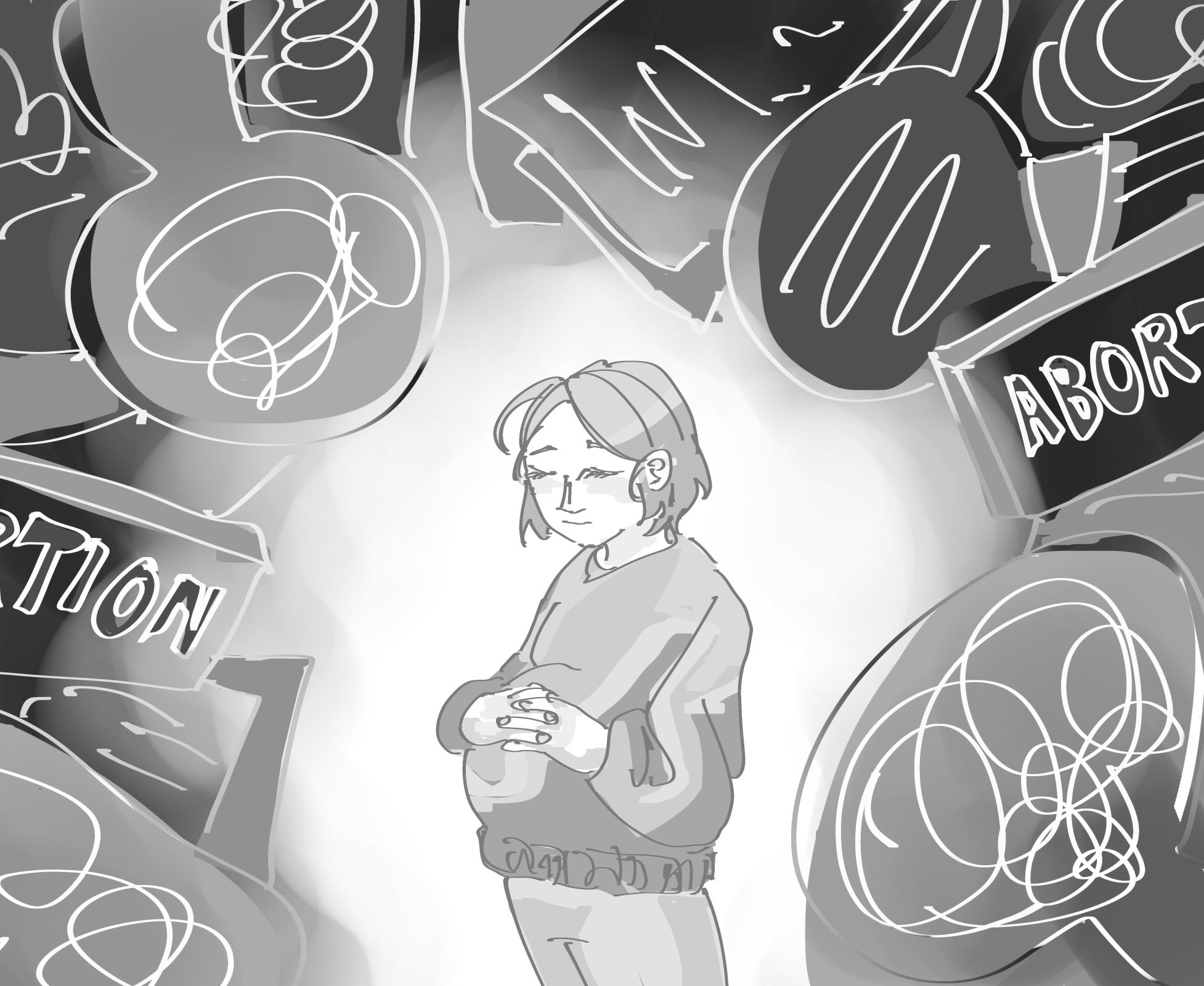
Imagine a young sophomore. She’s a couple of weeks late on her period and anxiously visits The Student Health Services (SHS) for a pregnancy test. It’s positive. She rushes back to her dorm room panicked, overwhelmed and unsure of what to do next. She opens her laptop and searches for pregnancy options through the SHS website. She finds three tabs: “Prenatal Care,” “Adoption Resources” and “Abortion.”
hoping to see what support might exist if she were to keep the baby.er: “SHS does not offer prenatal care services. SHS providers can in pregnancy and refer for local services. Prenatal care for students continuing pregnancy can be found using the provider locators on a student’s individual insurance plan.” She then clicks “Adop
tion Resources,” and even fewer adoption services. SHS providers are able to confirm pregnancy, discuss options in pregnancy and provide information about local resources.”
Finally, she clicks “Abortion.”
Suddenly, the page is full. The information about abortion options is detailed, organized and reassuring. The website links directly to organizations such as I Need An A and Abortion Finder. It explains logistical steps and even from abortion-restricted states can receive reimbursement for travel and lodging of up to $3,000 per year. At the 5Cs, abortion is accessible and supported. Meanwhile, pursuing motherhood or adoption feels isolating, impractical and discouraging. At this point, the message is clear: If she wants to keep the baby, she is on her own. No one is forcing her choice, but an in-
stitution does not need to force decisions in order to shape them. All they have to do is structure the system in a way that guides decisions, and that’s exactly what the 5Cs have done for pregnantdents no alternatives to abortion, the 5Cs have failed to provide true freedom of choice to their student body. The 5Cs must provide holistic information and resources to women, along with transparent accommodation policies that align with Title IX protections.
Pro-choice advocates emphasize abortion access as a necessary condition for reproductive freedom, but it is crucial we remember that reproductive freedom also includes the choice to carry a pregnancy to term without being punished for it. Supporting women means supporting choice; sometimes, that choice is to give birth to a child. In presenting one option that is carefully mapped and funded while reducing others
students true reproductive choice. It is favoring a particular outcome — the less expensive one — and nudging students to make a deci-
If a student doesn’t want an abortion, SHS and its website leave them with an array of unanswered questions. There are no clear answers as to whether a student can remain enrolled full-time, take medical leave without penalty, get housing accommodations
Moreover, there is no information about after childbirth — no centralized resource page, no clear explanation of academic protections, no reassurance that choosing not to have an abortion does not mean forfeiting an education. So, students are left frightened and wondering if they are incapable of having both a child and a degree. This is not a system that facilitates true gender equality.
Educational institutions that receive federal funding, like the 5Cs, are federally mandated to stand for gender equality and therefore must ensure that pregnancy does not function as a quiet exclusion mechanism. Even if SHS cannot provide prenatal or adoption services directly, it has a responsibility to provide clear, accessible information so students can make informed decisions without fear.
Under Title IX of the Education Amendments of 1972, discrimination on the basis of sex in federally funded education programs is prohibited. This includes discrimination based on pregnancy status and parental status. Expectant mothers are legally entitled to continue participating in classes and extracurricular activities. They cannot be pressured to withdraw against their will. They are entitled to reasonable accommodations, excused absences for pregnancy-related conditions and the opportunity to make up missed work.
After medical leave, mothers must be allowed to return to the same academic standing that they held before. SHS has neglected to openly provide any acknowledgements or reassurances of these rights for 5C students — there is no centralized pregnancy resource
page outlining Title IX rights, no clear guidance for students who choose to continue a pregnancy.
Rights that pregnant students do not know about are rights that they cannot exercise. When an institution fails to inform its students of their denies those protections in practice. So in failing to provide even basic informational support, SHS falls short of its obligations to pregnant students under federal law.
The fact that a student-run organization, Cradling Love, currently does more to support students navigating pregnancy and motherhood than the institution itself underscores a failure on the part of through my involvement with the club; we volunteer regularly with organizations such as Generation Her and Growing Pains, assisting with childcare while teen and student moms receive resources, supplies and an empowering community.
Our work centers on destigmatizing student motherhood and offering practical guidance that the institution fails to provide. If a student club can provide directories to local pregnancy help centers, assistance navigating campus policies and accommodations, a list of lactation rooms at the 5Cs and a list of national resources, I have an inkling that SHS’s “patient-centered healthcare with a professional and compassionate approach” can do a SHS should provide a pregnancy resource page that includes options and directions for prenatal care referrals, adoption counseling resources, an explanation of Title IX protections and clear information about academic and housing accommodations. Otherwise, at the very least, it should direct students to clear places in which they can requires more than options in name. It requires a generous distribution of resources and support so an individual can make a fully informed decision.
Grace Rutherford PO ’28 is passionate about clinical psychology, adores the 1998 West End production of Cats and wants lots of kids.
The Claremont United Churchnight parking program for unhoused residents living in their cars in late 2025, and subsequently held a community information session on Oct. 22. At this meeting, the church — which would operate out of its parking lot on 6th Street in collaboration with Safe Parking LA — was designed as a transitional step in participants’ search for permanent homes. It was not intended to be an affordable housing development like Larkin Place. Participants would had connections to Claremont, and a security guard would be present at all times. After breaking down the various amenities and social services Safe Parking LA would provide on site,cussion. As city residents spoke, it became increasingly clear that this was not a popular proposal. Every point the church made about the initiative’s safe and organized nature was shot down immediately, and no amount of explanation seemed to pacify fears of the supposed welfare-induced chaos to come. What these neighbors were most concerned about, I learned, was not safety but rather the undermining of Claremont’s upper-class suburban aesthetic. Rich homeowners were stricken with a deep-seated hostility to change and a refusal to confront Claremont’s exorbitant cost of living. As a result, the Safe Parking program did not secure city funding and was not implemented.
In a socioeconomically diverse city with 35,000 residents, maintaining a rich enclave is both ignorant and exclusionary. Wealthy Claremont homeowners must abandonics in favor of creating a livable place for everyone who calls Claremont home. The most striking component of the church meeting discussion was its array of ominous anecdotes about past encounters with homeless people in the neighborhood. One man told the story of a time he and his wife were “actively trying to have a child” when a homeless man marched up to their window.
Another woman chimed in about a time she saw homeless people Mallows Park. These colorful recollections, even if entirely true, paint an incomplete picture of unhoused people as thoughtless vagrants who exist to make homeowners uncomfortable. This narrative
widespread unwillingness to expand their community beyond its
When I went canvassing for the parking initiative on 6th and 7th Street alongside fellow Inclusive Claremont members, the prevailing us-versus-them mentality surfaced yet again; residents outlined their fears of a reduction in “quality of life,” unpleasant “second-story views” and “undesirables” snooping around the houses they
The elitist “neighborhood preservation” mindset is not exclusive to Claremont. Californians have their neighborhoods’ supposed historical significance to slow
In 2024, residents from some of LA’s richest districts urged the city not to fast-track plans for new low-income apartments because their streets were within the Historic Preservation Overlay Zone (HPOZ). The HPOZ designation process, while intended to preserve some of LA’s most prominent architectural and cultural centerpieces, has been appropriated by Not-In-My-Backyard (NIMBYs) proponents looking for an excuse to prevent the construction of cheaper homes in their high-class sanctuaries. Likewise, when UC Berkeley tried to build new student housing in the surrounding area in 2022, a group called “Save Berkeley’s Neighborhoods,” led by investment banker Phil Bokovy, sued the university. The group claimed that construction would violate the California Environmental Quality Act (CEQA). Their underlying concern, however, was not environmental degradation but rather the maintenance of neighborhood aesthetics. Experts agree that increased housing den-ronment, yet the group hoped that by fabricating a CEQA violation,
they would be able to prevent dense housing development and “save” their neighborhoods. A similar form of legal weaponization took place when a neighbor gave a public comment at a Claremont City Council meeting on Nov. 12, arguing that the safe parking lot violated Claremont’s Cultural Resources Preservation Ordinance, because the 6th Street neighborhood is part of a “historic district.” Though this is true, it’sing cars to park in a parking lot on private property could undermine a neighborhood’s historic character. Nevertheless, the neighbor insisted that the historical significance of the Claremont Village area was reason enough to bar the project from going forward. From a moral standpoint, Claremont neighbors seemed to understand that serving the homeless is theoretically a good thing. Almost every conversation I had with opposed residents began with some acknowledgement of the project’s nobility —“I understand and support what you’re trying to do, but…” followed by some foreboding statement about how
they fear for the lives of children at Sycamore Elementary School, or are scared that there will be an increased incidence of homeless people peeing in bushes. Yet their logic is plainly fallacious: the unhoused people that homeowners are so afraid of sharing a community with already live or work in Claremont alongside them. By helping keep unhoused residents off the streets, the parking program would have actually reduced the likelihood of the nightmare scenarios they described.
In a city full of NIMBYs, it is our job to show up as YIMBYs (Yes-In-My-Backyard). While the Safe Parking program was specifically designed to aid unhoused people, expanding housing supply in Claremont is a project that extends beyond the unhoused — bolstering projects that provide space for residents from all walks of life could transform Claremont from a high-class community
Most 5C students can’t live in Claremont after they graduate due to its socioeconomic exclu-
sivity, which leaves thousands of young people unable to capitalize on the local connections that they made during college.
We all have a part to play in working toward a more equitable Claremont. Join Inclusive Claremont or the Encampment Support Network, give public comment at semimonthly city council meetings. Vote for representatives who support affordable housing development and programs for unhoused residents — organizations such as Abundant Housing LA provide endorsements for pro-housing candidates.
A neighborhood’s true character and single-family houses, but by how its people work together to create an inclusive and livable place for everyone. As humanitarian and “Housing is absolutely essential to shelter, it all falls apart.”
Zara Seldon PO ‘29 is actually a sandwich.
ANSLEY KANG
This past summer, I took a seventime visiting the motherland since I was fourteen. Everything was the same. Clusters of apartments surrounded by huge, lush forests; the lady selling tofu from her stand on Wednesdays; and there were — as always — ads for everything plastered on big screens and bus stops. But the closer I looked, the more I began to notice that these weren’t the typical glass-skin injection billboards or soju ads featuring Korean celebrities. It there was one advertising childbirth. Even in the elevators, AI-generated videos of happy families played on the small screens, with captions like: “families make a strong nation” or “a life is a gift.”
It’s no secret that South Korea’s birth rate has been declining at an alarming rate for the past few years. In 2023, Korea hit a record low of a birth rate of 0.72 children per woman. For reference, the global average birth rate that year was 2.3. By the end of the century, the country is projected to lose around 30 percent of its population, and over 50 percent of the remaining population will be senior citizens.
Following its technological boom in the 1960s, South Korea has achieved considerable global the population crisis persists, it begs the question: How can South Korea sustain this economic growth without the support of Korean women?
Astounding rates of gender discrimination in South Korea are one of the biggest drivers of the country’s declining population. South Korean women, tired of lagging behind in women’s rights, have begun pushing back against this discrimination with the radical 4B movement: bihon (no marriage); bichulsan (no childbirth); biyeonae (no dating); bisekseu (no sex). To an outsider, this may seem
extreme. For Korean women, however, refusing marriage and motherhood is a perfectly rational protest to this inequitable culture.
The 4B movement doesn’t just address discrimination in certain parts of Korean society — rather, it forces the country to reckon with the consequences of a society where women are so disenfranchised they refuse to participate in systems that exploit their reproductive rights.
Women in South Korea, whether married or not, face alarming rates of gender based violence and discrimination, especially at work. Approximately one in four Korean women have faced intense workplace discrimination, with around 27 percent of women reporting workplaces forbidding marriage, childbirth and even dating. On paper, the government outlaws blatant discrimination such as direct termination due to like a mandated 90-day maternity leave, but this is not always enforced, and is just the bare minimum.
Workplace culture continues to pressure women into leaving their jobs after entering into romantic relationships, so the employers do not have to risk losing an employee to maternity leave and motherhood.
The deeply misogynistic culture is ingrained in the average workplace even after, where women still make 65 percent of what their male counterparts make, rendering these Social punishment functions as a law created by the government.
As a result, many Korean women see the idea of having and raising children in this culture as a complete nightmare.
social pressure are increasingly evident: This unspoken campaign to push women out of the workforce has already destabilized the social and economic infrastructures on
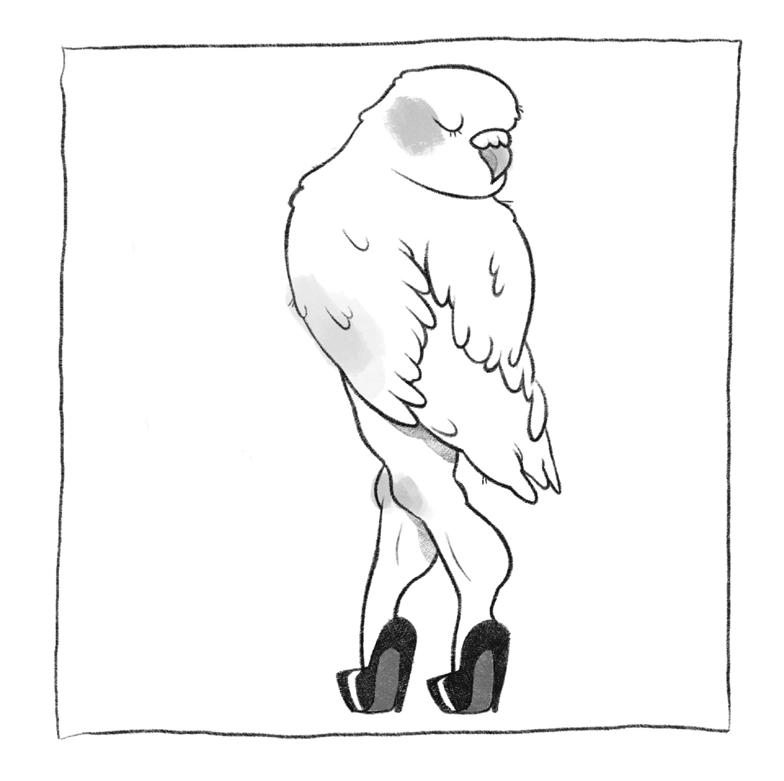

which South Korea is built. Until we address the underlying issue of gender-based discrimination, Korea’s economy and population cannot — and should not — continue to grow. This is why the 4B movement is so impactful: It has already generated considerable pressure on the government’s capacities and the country’s future, and there’s no sign of it slowing down. Refusing to buy into a culture that pigeonholes women into mothers, 4B allows them to reclaim their agency with a
“ideal female figure if CRISPR was everywhere”
statement of collective power. Internally, South Korea is panicking. The government is pumping out natalist propaganda left and right, even offering monetary incentives. Meanwhile, the entertainment industry creates media en masse, preaching one notso-hidden message: Motherhood is a beautiful experience. Women are not refusing motherhood out of convenience, but for protection; no coercion will reverse South Korea’s self-sabotage. For women not just in Korea, but around the world, the 4B movement is an exercise of personal autonomy and power.
Like many other Korean Americans, I am proud of my culture and of its growing presence in America. Southern California is a hotspot for Korean communities and culture, and it feels like home to the thousands of us who never got the chance to experience life in Korea. Choice may seem like a simple concept — but for Korean women, our future choices clearly drive concrete demographic shifts. The government, which once turned a blind eye to the needs of women, is now seeing the 4B movement as important enough to invest against with propaganda and monetary incentives.
The 4B movement is proof that
women hold an undeniable source of power: the capacity to control the future of a country’s economic and social future through their reproductive choices. Young women around the globe — including those of us at the 5Cs — can learn from South Korea and recognize that, even amidst moments of frustration or fatigue in the feminist movement, we have far more power than we are conditioned to believe. The solution is not to urge women to wake up and start pumping out more babies. The real solution, for Korea as well as every other culture rooted in the patriarchy, lies in following the footsteps of the 4B movement — taking deliberate action to dismantle the deeply rooted misogyny that devalues women. Until women are not treated simply as tools for the process of growth, the birth rate will continue to fall, affecting Korea’s rich culture and global presence. At this rate, we may be waving goodbye to the BTSs and Squid Games of the future. Who’s going to sing in a boy group when over half the population is 60 years old?
Ansley Kang SC ’29, saw more dogs riding in strollers than babies during her time in Korea.
BRINKMAN the agency primarily relies on administrative warrants when making arrests, which the judicial branch does not review before ICE acts on them. Even setting aside the questionable legality of these warrants, according to a federal judge ICE agents have violated more judicial directives in just the past month than other federal agencies have in their entire existence.
came across videos of ICE agents murdering citizens on the streets of Blaisdell Hall, I forced myself to watch agents shoot Renée Good, a mother of three children, three times in the face. I then scrolled to a second video of agents kicking and cell phone. In the background of Good’s murder, I saw the houses I routinely pass on evening walks with my father. I recalled standing in the same place where ICE agents
Over the past month, I have watched from a distance as ICE terrorizes my beloved hometown, Minneapolis. I resent ICE’s attempt to undermine its tightknit community with racist, brutal behavior — these unwarranted actions in Minneapolis expose our government’s terrifying shift towards authoritarianism. Federal agencies are not entitled to authority and power; rather, they should earn it by modeling a respect for justice and dignity. As scary as it may be, the social contract has been breached. We have reached a turning point where we can no longer place our trust in the government. If we stand by passively as our institutions abuse the power and authority we have entrusted to them, we will become bystanders to their increasingly authoritarian agenda. It is our responsibility to recognize the severity of this situation and act decisively, rather than continue to hope that democracy will prevail and our lives will miraculously return to normal.
Throughout Trump’s second presidential term, ICE has been utilized at the whim of the federal government, morphing into a lawless force that routinely engages in racial profiling. Furthermore,
Federal agencies are not entitled to authority and power; rather, they should earn it by modeling a respect for justice and dignity. We have reached a turning point where we can no longer place our trust in the government.
Olivia Brinkman PO ’29
Trump’s actions should set off major alarm bells for every American. It is evident that we are to those who have experienced authoritarian regimes outside the U.S.’s borders. In 2015, Hugo Chávez and Nicolás Maduro transitioned Venezuela from a democracy into an authoritarian regime using similar tactics. The two politicians rose to power via democratic processes before seizing control of institutions and federal agencies, suppressing the media — much like Trump’s the fundamental rights holding up democracy in Venezuela. Recep
Turkey’s authoritarian regime has remained in place ever since.
Our president, in line with the regimes of Turkey, Venezuela and even 1930s Germany, is asking something of us: Trump demands that we see ICE’s atrocities not as the injustices they are, but as acceptable pieces of his twisted, nonsensical narrative. In George Orwell’s famous novel 1984, he describes how a fictional totalitarian government “told you to reject the evidence of your most essential command.” We live in a nominally democratic nation that prides itself on being the land of the free, and yet every time Kaitlyn Levitt stands at the podium to deliver Trump’s latest narrative, Orwell’s words out on the snowy road. I saw the blood-soaked seat in Good’s car next to a glovebox filled with this evidence, our government is blatantly asking us to be
complacent. President Trump, who sees ICE as an extension of his power, demands that we believe his outrageous fallacies and reject the evidence of our “lying eyes.” I am indescribably proud of my community for persevering through one heartbreak after another. Minneapolis residents have responded to these tragedies with a resilience mirroring that which followed the murder of George Floyd. Minnesota politicians — including Tim Walz and Jacob Frey — publicly condemn ICE, the Minneapolis police force actively resists ICE agents and residents march the streets to protest in sub-zero developed a devastating sense of powerlessness as I watch my city and many others across America erupt in violence and protest — a feeling I imagine many students can currently relate to. As students at the 5Cs, we have the privilege of residing in a community that feels physically and emotionally distant from ICE
activity, despite deportations taking place as close as Pomona County. Scrolling through horrific reels, at a loss for what to do, we think to ourselves: What impact do we really have when our government is crumbling around us? This sense of helplessness is exactly what want you to feel — it allows them to continue to exercise their power to commit crimes without facing the consequences. I urge you now more than ever to leave behind your denial and join ICE on the ground. Sign up for ICE watch to report activity in your area and protect our fellow community members. Join Claremont students just up the street on Foothill Blvd, who are already participating in protests. If we do not take such action — and it breaks my heart to say it — Minneapolis will be our point of no return as a nation.
Olivia Brinkman PO ’29 might have put a tiny piece of her soul into this She is thrilled to be writing once again!

The 1996 song “Children” by Robert Miles has been on my mind lately.
Don’t need it.”

on the biggest stage again.
Parisiens. seemed to have been moving on.
even Sergio Agüero.
Street rivals Sagehens and Clare
“This is the last meet before
ty to have one more head-to-head
“Yeah, we’re gonna kick ass,” Zhu said.
“Pardon my French, our team looks great right now. There’s so much energy moving around between everybody, and we’re excited.”
yard free relay team of and Adrian Clement
“This meet doesn’t matter as
“I heard my friend and they