Pomona College to drop Starbucks pending faculty approval
Pomona College may drop Star-
bucks as a provider for Cafe 47 following a Feb. 25 meeting between members of Associated Students of Pomona College’s (ASPC) Food Committee and Assistant Vice President of Facilities & Campus Services Bob Robinson, according
According to Soren Murphy-Pearson PO ’29, a Claremont Student Worker Alliance (CSWA) member and co-chair of ASPC’s -
might not see changes until the 2027-28 school year.
Pomona signed a contract with Nestlé last spring, following the company’s alliance with Starbucks in 2018, which allows it to distribute Starbucks-branded products outside of retail cafes.
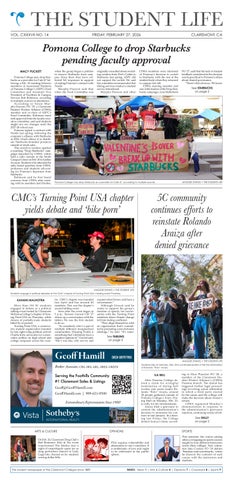
This switch in vendors sparked a yearlong “Drop Starbucks” campaign launched by CSWA, which held a rally outside of the Smith Campus Center on Feb. 20 to further rally heard speeches from CSWA, professors and students advocating for Pomona’s departure from Starbucks.
Robinson said he first heard concerns from CSWA after meeting with its members last October,
when the group began a petition to remove Starbucks from campus. Since then, they have collected 541 responses in support of ending Pomona’s contract with Nestlé. Murphy-Pearson said that
originally consulted about switchStarbucks last spring, ASPC did not support the switch. He said dining services conduct a student survey beforehand. Murphy-Pearson and other
CSWA members were informed of Pomona’s decision to switch to Starbucks with the rest of the student body when they returned to campus last fall.
CSWA steering member and one of the leaders of the Drop Starbucks campaign, Lina McRoberts
PO ’27, said that the lack of student feedback considered in the decision was hypocritical to Pomona’s ethics about shared governance.
“There’s this obvious, ‘We know
More than 150 5C students engaged in debate at a political tabling event hosted by Claremont McKenna College’s chapter of Turning Point USA on Thursday, while dozens of partially-nude students biked by in protest.
Turning Point USA, a conservative student organization founded by late right-wing political activist Charlie Kirk, advocates for conservative politics on high school and college campuses across the coun-
Feb.
try. CMC’s chapter was founded last April and has around 40 members. This was the chapter’s second tabling event.
Soon after the event began at 5 p.m., Tanveer Grewal CM ’27 struck up a conversation with the to do so.
“As somebody who’s a part of communities, [Turning Point] is negative opinion of,” Grewal said.
conversation.”
Although Grewal said he wants to support the group’s freedom of speech, his conversation with the Turning Point members about climate change
“They align themselves with an organization that’s committed to promoting a non-inclusive -
See TABLING on page 3
After Pomona College denied a claim for wrongful termination of dining hall worker and union leader Rolando “Rolo” Arazia, around 30 people gathered outside of Pomona College’s Frary Dining Hall on Monday, Feb. 23, to rally for his reinstatement. Araiza filed a grievance to contest the administration’s decision to terminate his coning last Friday, the College denied Araiza’s claim, accord -
requires vulnerability and
ing to Elias Pluecker PO ’28, a member of the Claremont Student Worker Alliance’s (CSWA) Pomona branch. The denial has triggered further legal proceedings involving union arbitration in which a third party elected by the union and the college will make the decision about Araiza’s return.
CSWA organized Monday’s demonstration in response to the administration’s grievance rejection, continuing weeks of lob-
MAGGIE ZHANG • THE STUDENT LIFE
Pomona College may drop Starbucks as a provider for Cafe 47, according to multiple sources.
Students engage in political debates at the CMC chapter of Turning Point USA’s tabling event Thursday.
KAHANI MALHOTRA
MAGGIE ZHANG • THE STUDENT LIFE
MAGGIE ZHANG • THE STUDENT LIFE
Students rally on Monday, Feb. 23 in continued protest of the the termination of Rolando “Rolo” Arazia.
MACY PUCKETT
STARBUCKS: Pomona reassesses
Continued from page 1
Continued from page 1 that students are going to oppose it, and so if we just don’t ask them, they can’t oppose it because they didn’t have the option,’” McRoberts said. “Not only is it that [Pomona] should not contract with Starbucks and Nestlé because of their obvious labor rights abuses, but it’s also that [Pomona] didn’t even give us an opportunity to speak about it in
are moving, and we’re making our voices heard,” Alperin said.or to his meeting with ASPC on Wednesday, Robinson said that improving his department’s communication with the student body would be a key focus for him in the coming year.
Jason Alperin PO ’28, a rally attendee, similarly said that Pomona should be doing more to implement its principles of shared governance and noted that many students are still left in the dark by the college. students, or 5C students, who aren’t really aware that suddenly Cafe refreshing because … now things
bying for Araiza’s reinstatement.
Students attending the rally held cardboard signs reading “Rehire Rolo” and “Rolo Back Now.”
The 30-minute demonstration was led by Pluecker, who described Araiza’s labor dispute over recent weeks and urged students to spread the word.
“Please tell your friends, please get your friends to come to our college. This is a very long fight, we’re counting on each and every one of you to stand up, keep fighting for Rolo so we’re able to get his job back,” Pleucker said in his speech at the rally.
Araiza’s termination, which sparked controversy due to his
meetings when it was discussed about moving away from Peet’s … but it was my understanding that it was discussed with the in agreement,” Robinson said.
“Now, that process is murky … that dynamic and have a much operation.”
Robinson said the contract with Nestle provided Pomona with certain incentives, such as a
free $14,000 espresso machine and funding a sustainability program for reusable cups.
“That’s why it’s a complicatedability practice important to us in reaching carbon neutrality by 2030? Yes.”
According to Murphy-Pearson, ASPC is currently working to approve a resolution drafted by CSWA, which he hopes will solidify ASPC’s position to replace Starbucks with another vendor in a timely manner.
“When you complete this change fast, it kind of restores trust throughout the community as a whole and in administration,” Murphy-Pearson said. “We want changes that students care about to happen quickly.”
CSWA member Damien Star-
ling PO ’29 said the resolution encourages administration to consider Klatch Coffee, a fair trade-certified vendor that The Nayeli Arizpe SC ’26, who a cashier and barista at the Coop Fountain and a former CSWA member who said Starbucks has union busted in multiple shops across the country and engaged in unfair labor practices.
to hear those stories [about Starbucks], and to hear why people
others to be more aware of the situation and to continue standing up for workers and to continue fighting these institutions that fail to serve the workers and fail to serve the students.”
McRoberts said that in their meeting with Robinson last fall, CSWA members were urged to “keep the workers in mind,” which she said implied that a vendor change would require retraining and temporarily reduced hours. However, McRoberts said that CSWA’s efforts directly support Cafe 47 workers.
“We entered that meeting as the same organization that fought for workers’ rights and job security on campus,” McRoberts said. “And it is precisely in their interest, as well as the interest of baristas nationwide, that we oppose a partnership with labor violations.”
As of Feb. 27, ASPC will discuss the Drop Starbucks resolution atleased to the student body for open comment.
efforts to reinstate Araiza.
“Rolo’s co-workers will not abandon him, the students will not abandon him,” rally attendee Sage Santomenna PO ’26 said. “And ultimately, it will be the college that folds, as it is every time that this happens, every time, so we’re in it for the long haul, and we’ll do it again.”
Pluecker, who has spearheaded student efforts to reinstate Araiza, said that since the administration affirmed their decision to terminate him last
Friday, CSWA has ramped up protest efforts.
“We know this is going to be a long fight, so we just wanted to hold a rally today to try to make sure we can spread the word as best we’re able, and to try to keep people’s energy up,” Pleucker said. “People need to feel strengthened, need to be fortified, need to see that there’s a community with us, around us, who are willing to fight alongside us.”
Several dining hall workers and former co-workers of Araiza joined the crowd on Monday. more than two years,” Pomona dining hall staff member Hamilton Velasquez said. “He is one
of my best friends here.” Velasquez said he feels Araiza was treated unfairly by Pomona’s administration. power,” Velasquez said. Pomona previously denied any correlation between Araiza’s termination and his role as a union organizer, and declined to comment further. Students who demonstrated said they hope the administration will reassess their decision.
tion is to realize that, yet again, they found themselves on the wrong side of a labor dispute,” Santomenna said. Santomenna also hopes to see more students participating in
“We’re incredibly privileged here at the Claremont Colleges,” Santomenna said. “And it’s really on behalf of the students to stand up for someone who’s going through much more, who’s lost their livelihood, has lost their community, all of these things, it is really kind of a small ask for us as students.”
CSWA plans to host a teach-iner Lounge to educate students on unions, along with the history of union organizing and student support of unions, specifically at the 5Cs. CSWA plans to continue organizing protests and gatherings to push for Araiza’s reinstatement.
Amid Claremont housing crisis, 5C students
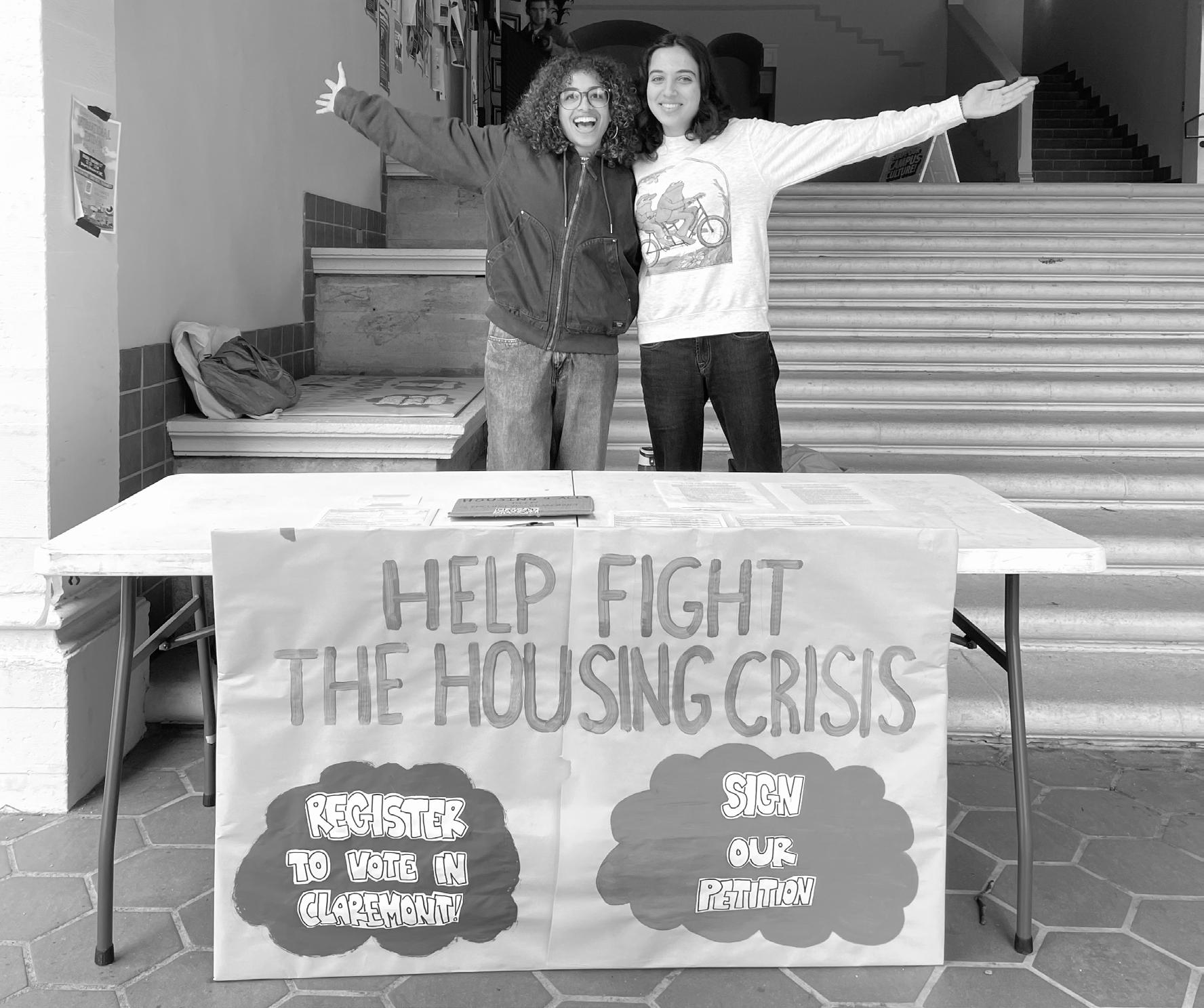
Claremont housing advocate groups tabled outside of Frary collecting signatures for a tenant protection petition and registering students to vote in the city’s Nov. 3 election. The groups’ outreach corresponds with ongoing debate over Claremont’s housing policy,
Two organizations spearheaded a coalition of 5C students and community members advocating for affordable housing and broader civic participation in the city and Claremont Tenants United, a local grassroots organization of renters seeking stronger tenant protections and policies to prevent displacement. The petition circulating across Claremont and the 5Cs, created by Tenants United, calls for a tenant protection measure to be placed on a future municipal ballot, as well as stronger restrictions on evictions and limits on annual rent increases. of a rental registry, which would help monitor rent stabilization and increase market transparency — a proposal City Council rejected earliroughly one-third of households are renter-occupied, rent increases of up to 10 percent annually are rental market is above the national average.
Jose Ochoa, a Claremont resident and co-leader of Tenants United, said the group formed about three years ago, when Claremont had no local renter protections. He said the petition seeks to show elect-
stronger regulations.
“We’re collecting signatures to show how many people in Claremont want rent stabilization,” Ochoa said. “Then we negotiate with the City Hall.”
Noa Polish SC ’26, president to the consortium’s historical connection with the city, arguing that students have a responsibility to engage with local housing issues. She said the club’s voter registragoals of Tenants United.
“We are working on gathering signatures for a petition that seeks to strengthen tenant protections in Claremont, and in order to show Claremont City Council that there are vested stakeholders in Claremont who care about housing,” Polish said.
Ochoa said that any proposal suggested by the petition would likely face opposition from landlords, but Claremont Tenants United plans to continue organizing as it did in 2022, when memmeetings to advocate for tenant protections.
City Council has tightened local ‘just cause’ eviction rules in the past and provided tenants with additional safeguards beyond state requirements, and has funded programs to stabilize housing for renters. However, in 2025, the council rejected a proposal to establish a citywide rental registry — a database designed to track local rental housing — after advocates and opponents clashed over its cost and potential impact.
Miranda Elder PO ’29, memthat Claremont’s housing policy reveals a disconnect between the role as a union leader, has been a centerpoint of student activism in recent weeks. Through rallying, students hoped to engage the larger 5C community and further pressure on the administration for change.
city’s public image and its lived realities.
“You’ll walk around Claremont and see signs that encourage inclusion,” Elder said. “But when it comes to homelessness and even people who just rent their homes, Claremont is not very inclusive at all.”
and purchasing power of the Claremont Colleges influence housing availability, land use and local priorities, making student engagement in municipal politics pivotal.
PO ’26, that connection between
the Colleges and the city underscores why students should be involved.
nity building and local engagement so often promoted in 5C academic spaces, we should be practicing that now, not once college ends,”
BIANCA MIRICA
MAGGIE ZHANG
Continued from page 1 thing to reckon with.”
Soon, more individuals began gathering at the tables covered in red “We are Charlie Kirk” wristbands and pins with images of the White House reading “the future is bright.”
event “look[ed] kind of pathetic.”
“There’s three people, they’re in the middle of the walkway, there’s like 10 things on the table and people are coming up just to record them and see what crazy “This is actually insane.”
Sid Goldfader-Duffy PZ ’28 heard about the event through the Turning Point mailing list last Thursday. He questioned the language the email used to describe the tabling event, particularly its claim to host “productive and thoughtful conversations.”
“They wield this narrative that they’re the people that want to have productive conversations,” he said. this organization does.”
Nicholas Coughlin PZ ’29 said that while there was a very valid
reason for people who are often “violated” by Turning Point’s rhetoric to avoid such events, he of his identity. “As a white, straight, cis man, feel like it’s my duty to come out here and engage,” he said. An aspiring politician, Coughlin stayed at the event and debated Turning Point members for over
to be able to understand them,” he said.
Many students said it felt like some of the tablers were being purposefully divisive. Quinley Wise CM ’29 was one of them, calling the organization “anti-intellectual.”
“They want to have discussions about issues that are intentionally divisive to divide people,” Wise be allowed on campus.”
although he had some “great debates” with some of the tablers, he felt that others were simply trying one of the tablers, who was wear-
ing a Make America Great Again hat, told him he didn’t actually agree with the Trump administration, but was simply wearing it to get engagement.
upon by Claremont McKenna, by the 5Cs, that people are coming here for inflammatory reasons, rather than academic debates,”
Evan Lichtblau CM ’29 pushed back, emphasizing the need for campus.
basically all of their viewpoints,” he said. “At worst, people can just ignore it.”
Lichtblau said the hard line for discourse would be “outright hate.” Emily Thompson CM ’29 echoed a similar sentiment and said that allowing healthy discourse was a “part of the spirit of CMC.”
and open discussion in a respectful way of everyone’s beliefs,” she said. “They’re entitled to be on campus … as long as they’re respecting other people’s opinions
and not being derogatory.”
But a majority of students interviewed by TSL, including Aidan Evans PZ ’28, argued that Turning Point’s belief system is “deplorable” at its core. of white supremacist, fascist bethem on my campus.”
Turning Point student leaders said the organization prohibited them from interviewing with TSL. Other student members declined to comment.
At 6:20 p.m., the event was interrupted by more than 70 students biking by the tables wearing little clothing, who then raced around the Cube several times while blasting music. The event, dubbed “bike porn,” happens a few times each semester. Luca Davis PZ ’27 introduced College’s Student Talk email listserv, hoping to turn the biking tradition into a mini protest by riding past the Turning Point event. Bike Program saw the message announced the event.
That evening, student bikers gathered at the Bauer Center. Davis said it was the biggest ‘bike porn’ he’s ever been a part of. The bikers then finalized their plans: they would ride silently until they got fully past the event.
tion,” Davis said. “We just wanted to completely ignore them.” As the bikers passed the tabling event, many students cheered them on. Then, once the riders got to the Cube, they began singing, whooping and riding in circles in the water around the Cube. have a good time and be with all of our friends and be silly [to] counteract those bad vibes,” Davis said. Davis said the point of the event was to emphasize the contrast between the riders and the tablers.
doing than rage-baiting.”
The event was set to end at 7:30 p.m., but dozens of students kept debating with the tablers. Even after the organizers took down the tent and tables at 8 p.m., several with the tablers.
CMC’s Gould Center celebrates 40th anniversary
Claremont McKenna College’s Gould Center for Humanistic Studies celebrated its 40th anniversary last Monday, Feb. 23, hosting an open house, speeches and a Q&A panel for more than 50 attendees. The Gould Center, located in CMC’s Kravis Lower Court, provides humanities-centered research and project opportunities
for CMC students.
Four decades since its establishment, the center continues alignment with their misson: “At its founding, the center concerned itself with understanding contemporary problems from a humanistic and historical perspective, with its research focusing on the major forces, attitudes and values that have formed the modern world,” the
5Cs
event’s pamphlet read.
The center invited 5C community members and alumni to engage in conversations about its growth at the celebration. There, a panel of alumni —Will Grant CM ’94, Rev. Canon Norman S. Hull CM ’85, Hon. Susan H. Segal (Ret.) CM ’82 — offered insight into the value of humanistic research, and current students presented research projects at the event’s open house.
implement
lectures, seminars and artistic performances, the center offers summer, winter and semester-long passion project opportunities for students.
Gould Humanities passion project fellow Sydney Nate CM ’28 conducted a winter break project in 2025, where she researched and interviewed women in her family about the evolution of religious and cultural practices across generations. She and wrote a paper synthesizing her findings.
Nate, who presented her project along with other fellows at the open house, noted how the center’s support helped her craft and pursue a project that felt authentic and meaningful. amazing about letting me do both that personal and generalized research and representing photographs, art, writing.”ing, the center also offers opportunities for CMC students to participate in cultural and through their Gould Fellowship program. This year, 12 first-year and sophomore fellows have attended plays, museums and concerts, and have connected with speakers with careers in the humanities. According to fellow Crystal Qin CM ’29, the Gould Fellows
network and enhance their learning, such as meeting Athenaeum speakers before their talks.
speakers] and being able to have one-on-one conversations with them,” Qin said.
Amalie Wong CM ’28, student manager of social media and publicity at the Gould Center, highlighted the importance of providing humanities-centered resources to students at a school where most students study social sciences.
that there’s a space for humanities [students] to both find each other and find a space where their voices are amplified and given projects to work on and opportunities,” Wong said.
Amy Kind, Director of the Gould Center and Professor of Philosophy at CMC, said she by increasing opportunities for student-faculty relationships on campus and continuing to provide cultural events.
the other research institutes run would love to put together some kind of humanities networkingtunity both to meet with industry professionals in a variety of industries, but also to soak up in art and culture and city and music, which are also things that the Gould Center really cares about.”
‘Know Your Rights’ immigration and workplace protections
5C human resources departments have begun to implement California’s Workplace Know Your Rights Act (SB 249) after it with the Act, 5C employees will receive notice of key workplace rights and have the opportunity to indicate emergency contacts, but question if the Act will adequately support them.
Under the Act, all California employers must provide employees with a written “Know Your Rights” notice by Feb. 1 each year, which outlines protections such as workers’ compensation rights, immigration-protections, the right to engage in concerted activity and constitutional rights when interacting with law enforcement. New employees must receive the notice upon hiring.
By March 30, employers are also required to give employees the opportunity to designate an if they are arrested or detained at work. Employees may choose to designate separate contacts for immigration-related detention and other emergencies.
At the 5Cs, the law has prompted email notices to students and employees — Pomona College sent its notice Feb. 16, Harvey Mudd College Feb. 23, Claremont McKenna College Feb. 24 and Scripps yet to inform its workers, but Tricia Milford-Hoyt, vice president for communications and marketTSL that the college will send out notice in early March. Despite the email outreach, several students said they were unaware of the new law or had
Jordan Becknell SC ’26, who Center, said she didn’t see thefrom various college departments.
but only so helpful if it’s not one of 30 emails you get a day,” could be how that [information be priority messages.”
Although Becknell wishes theparent, she said she does not feel that immigration issues directly impact her at her job. place,” she said.
Lu Lo PZ ’28, an international student, said she does not feel like immigration issues directly impact her in the workplace either.
[employment] processes are face any immigration [issues].”
Although Lo doesn’t feel directly impacted by the threat she said she supports SB 294 but questions how much it willcation, it is great,” she said. “But [of students], because normally we don’t have this problem.”
vey Mudd, said they comply with the law and how employees can
While these three colleges said they have not received employ-
ee concerns about Know Your Rights or immigration rights in the campus workplace, Becknell said she’s worried that the colleges will not do enough to protect emergency information
security and privacy,” she said.
to an employer if you feel like you’re in an unstable situation. about how the 5Cs are making sure they’re protecting their students’ identities.”
Becknell said she would like to see the colleges collaborate with student interest groups and support mutual aid funds.
A Pomona spokesperson said in an email to TSL that the college via compliance with the state’s Sending Alerts to Families in Education Act (SB98), which requires colleges to notify students and faculty if federal law enforcement is on campus. She said that additional student resources are available.
“The College also provides citizenship, residency and immigration-related resources, including legal resources and emergency funds and grants, and has made an immigration lawyer available for a Q&A session and individual consultations withson wrote. Dana Nagengast, assistant vice president of human resources at HMC, said in an email to TSL that employees can look at the resources posted on the college’s website.
The site contains a Know Your Rights notice and information
about community-based immigration resources such as the American Civil Liberties Union,Center. engaged with our community and will remain responsive to questions as they arise,” Tricia Milford-Hoyt, vice president of communications and marketing Scripps declined to comment and CMC did not respond for comment.
CHLOE KIPARSKY
The Gould Center for Humanistics Studies celebrates 40 years of passion projects.
ANDREW YUAN • THE STUDENT LIFE
CARYS HARDY
SACSE holds Ath talk on the question: ‘Who Fuels the Sex Trade?’
An estimated 27.6 million people are trapped in forced sexual exploitation worldwide. Behind that number is a system sustained by demand — buyers whose anonymity exempts them from scrutiny.
At CMC, the Mgrublian Center for Human Rights hosts a student-led task force that directly deals with this issue: Students Against Commercial Sexual Exploitation (SACSE). In light of the ongoing national focus on theident of the task force Vivienne Arndt CM ’28 described how her team works to address many of the questions this scandal has brought to the forefront of public debate.
“I think that with Epstein in the news right now, we can see people feeling angry about this … feeling like it’s a very political issue,” Arndt said. “But [there are] also so many things to remember. Like, why do we feel that way? Is it because the victims look a certain way? Is it because the buyers look a certain way and because they’re in positions of power? And does perceiving Epstein in this way make us forget about gender-based violence that can exist all around us?”
On Friday, Feb. 20, Arndt and other members of SACSE hosted Cristian Eduardo and Yasmin Vafa at The Marian Miner Cook Athenaeum for a talk titled “Dismantling Demand: Who Fuels the Sex Trade and at What Cost?” At the fully booked lunch event, the speakers discussed the severity of issues surrounding the sex trade and shared insight on ways to minimize harm and ultimately dismantle the system.
Eduardo and Vafa each bring
their own unique expertise to the conversation. Eduardo is a prominent advocate dedicated to advancing the rights of the LGBTQIA+ community as well became a survivor of sex trafto the United States, which later motivated him to help others in similar situations.
Conversely, Vafa approaches the work from a legal background; she is an activist and a lawyer, and additionally cofounded the national human rights organization Rights4Girls.
At the end of 2025, the organization published a report titled “Buyers Unmasked” that examined the people who purchase commercial sex. These buyers ultimately create the demand that drives the sex trade. In addition to highlighting the lived experiences of some of the exploited people, the report redirects the spotlight onto the men who buy sex.
Eduardo and Vafa began their talk by explaining why it’s crucial we use informed language when engaging in advocacy work. Often, people refer to the industry as “sex work,” and the people exploited as “sex workers.” Using the term “work,” Vafa explained, falsely equates this form of incredibly exploitative and dangerous labor with typical jobs.
“Child labor is work,” Vafa said, highlighting the absurdity of referring to clearly immoral labor arrangements as “work.”
Unlike most economic transactions, buyers in the sex trade have some degree of anonymity, which allows them to act more directly and, in some cases, more
violently. This anonymity can make the buyer’s role disappear completely, which is why we as a society often place sole blame on the people who sell sex.
Many people — especially across the internet — often perpetuate the idea that people selling sex are immoral, and the root of this problem. The truth, as the speakers explained, is that the demand for sex lies at the core of the sex trade industry. Vafa grounded the claim in structural analysis, explaining how legal systems, cultural narratives and economic inequality intersect to sustain demand.
Eduardo’s personal anecdotes contextualized Vafa’s statistical claims, making the talk intense, educational and necessarily explicit. He explained that his succeed” and “no one will hire you,” to strike fear into him and keep him where they wanted him.
As Vafa and Eduardo acknowledged, the politics of how we talk about and advocate against the sex trade are part of a larger conversation around the roles of sex and empowerment in our society. There are
many groups on campus, such as Scripps Advocates, that work of these issues, acknowledging the larger questions while also focusing on avenues for advocacy at the Claremont Colleges.
“Being an advocate for survivors of sexual assault is deeply both require centering those most impacted and actively working to transform the systems that enable harm.” Scripps Advocate Blake Weld ’26 said.
SACSE members and Scripps Advocates alike acknowledged that discussions about the sex trade are often very heated. One central tension within this debate is what many perceive as the clash between the right to autonomously choose what you do with your body and the exploitative nature of the sex trade.
As SACSE event planner and researcher Ava Fleisher SC ’28 explained, however, arguments about this tension are often not rooted in the material facts of the sex trade.
“The task force centers our work on survivor experiences and statistics that show that
the sex trade is an intersecting oppressive system that reinforces racial, gender and socioeconomic hierarchies [and preys] on the most vulnerable people in society,” Fleisher said. “If entering the sex trade was really a choice, then the least privileged people [would] not be the ones who are being bought and sold.”
Her statement captured the nuance many students grapple with while recognizing and fighting against exploitation and power imbalances.
For students at the Claremont Colleges, the panel underscored that conversations about sex autonomy and empowerment must also include accountability and recognition of power imbalances. Even after the event ended and the speakers stepped down from the stage, the conversation lingered. Ultimately, it left students with a sense of responsibility to scrutinize how systems of exploitation are sustained and how they might be disrupted.
In addition to working as a researcher and event planner for the SACSE task force, Ava Fleisher SC ’28 is a news editor at TSL.
Welcoming Lunar New Year with reminders of home
KATE YOO
As you step into the Gold Student Center, laughter and conversation reverberate through the large room, and smiling faces greet you from behind a row of tables. You pick up a bright red envelope with a horse emblazoned in gold from the end of the table and walk past a pyramid of orange mandarins, stepping into the swiftly moving line. As you step forward, someone scoops out steaming spoonfuls of small, mochi-like balls — tang yuan — from a boiling pot into a paper bowl and hands it to you.
This scene welcomed students on Feb. 20 to a Lunar New Year celebration event hosted by the Taiwanese American Students Association (TASA), Claremont Cantonese Club (Canto Club) and Claremont Buddhism & Tea Circle. The three clubs collaborated to create a space where 5C students could come together and enjoy crafts and snacks to celebrate the new year of the Horse.
“We try to have a Lunar New Year event every year because it’s a big deal for anyone who celebrates,” Canto Club board member Josephine Yip PO ’26 said. [We] found out that [TASA was] planning something very similar … so we decided to make it a collab with Tea Circle as well and just pool our resources and budget together.”
Through weekly meetings and discussions, the clubs orchestrated a wide range of traditional activities
Year celebrations.
“[This] year we wanted to have tang yuan, snacks on the side [and] focus more on bonding and commu-bles of crafts,” TASA board member Alexandrea Li PZ ’27 said. missing home during this holiday. These clubs make it possible for those who celebrate to ring in the new year surrounded by friends, laughter and traditions reminiscent of home.
“My family has its own traditions … But I think it’s really about building community and coming together and seeing people you might not otherwise see during the normal year,” Yip said. “I think, here in Claremont, it’s also about giving that community to people when they’re not necessarily home with family.”
Because the Claremont Colleges do not officially host any Lunar New Year events, the responsibility
for planning this celebration falls residents. The diligence of these student organizations is the reason this holiday remains alive across the 5Cs. While putting on these celethe deep connections to cultural traditions and with the Claremont community make preparation hardly feel like work.
“[Lunar New Year is] just a big day of family and spending time with each other, and you can feel the same warmth of home here, which is nice,” TASA board member Candece Lee SC ’28 said.
The clubs were intentional in making this Lunar New Year celebration extend beyond just those with ethnic heritage or personal connections to the holiday. The event embraced all students across the 5Cs, as the clubs were eager to share the beauty of East Asian cultures.
“[The event] was really open and welcoming to someone who’s
not Taiwanese or East Asian, and I could just have fun and do the traditions for the New Year that I otherwise would not have been Iram PZ ’27 said. Red has always been a symbolic color of Lunar New Year. Its significance is rooted in mythology. In some Chinese folklore, the story goes that every Lunar New Year’s Eve, a beast called Nian rises from the sea to eat people and livestock until a celestial being, disguised as an old man dressed in red, chases it away. He informed the people thatcrackers would keep Nian away. Remnants of this mythological story are preserved in modern celebration with red decorations and activities covering each table at the event. At the calligraphy table, blank red squares were splayed out for people to write on. Many wrote common phrases such as “good fortune,” “auspicious” and “blessings” to usher in prosperity for the
coming year. In addition to the calligraphy table, there was a crafting area where students diligently cut outters from folded red construction paper sheets to later put on their walls. Similar to the red papers, these decorations bring luck and
“We had instructions for fun Wu SC ’27 said. “[But] one of the more traditional words [that translates to spring — similar to renewal and warm, [like] life after winter. Lunar New Year is also often called the Spring Festival.” At the knot-tying table, people cut and twisted brightly colored cords into clovers, agonizing over the slippery material and revelloops were pulled, decorating the ends with beads. These knots are meant to be carried around and are symbols of luck and good fortune. Mahjong is another staple for
Lunar New Year celebrations. The activity started at a designated taas the group of intrigued players continued to grow.
This growing game of Mahjong, students respite from the academic grind during an incredibly busy time of the semester.
“I think it’s great that we can bring a piece of home, community, during a really stressful week,” Lee said. At the end of the event, the mahjong sets were packed away, and all the paper scraps and empty bowls were tossed into trash cans. People gathered their bags, their knots, their calligraphy and their red paper-cuts, packed up their lucky crafts. As people trickled out of the room, the Mandarin phrases “Gong Xi Fa Cai” (wishing you prosperity) and “Xin Nian Kuai Le” (Happy New Year)
SHANNON BIGELOW
PJ JAMES • THE STUDENT LIFE
echoed throughout the room.
ZHONGYI CHEN • THE STUDENT LIFE
JESSICA LEVIN • THE STUDENT LIFE
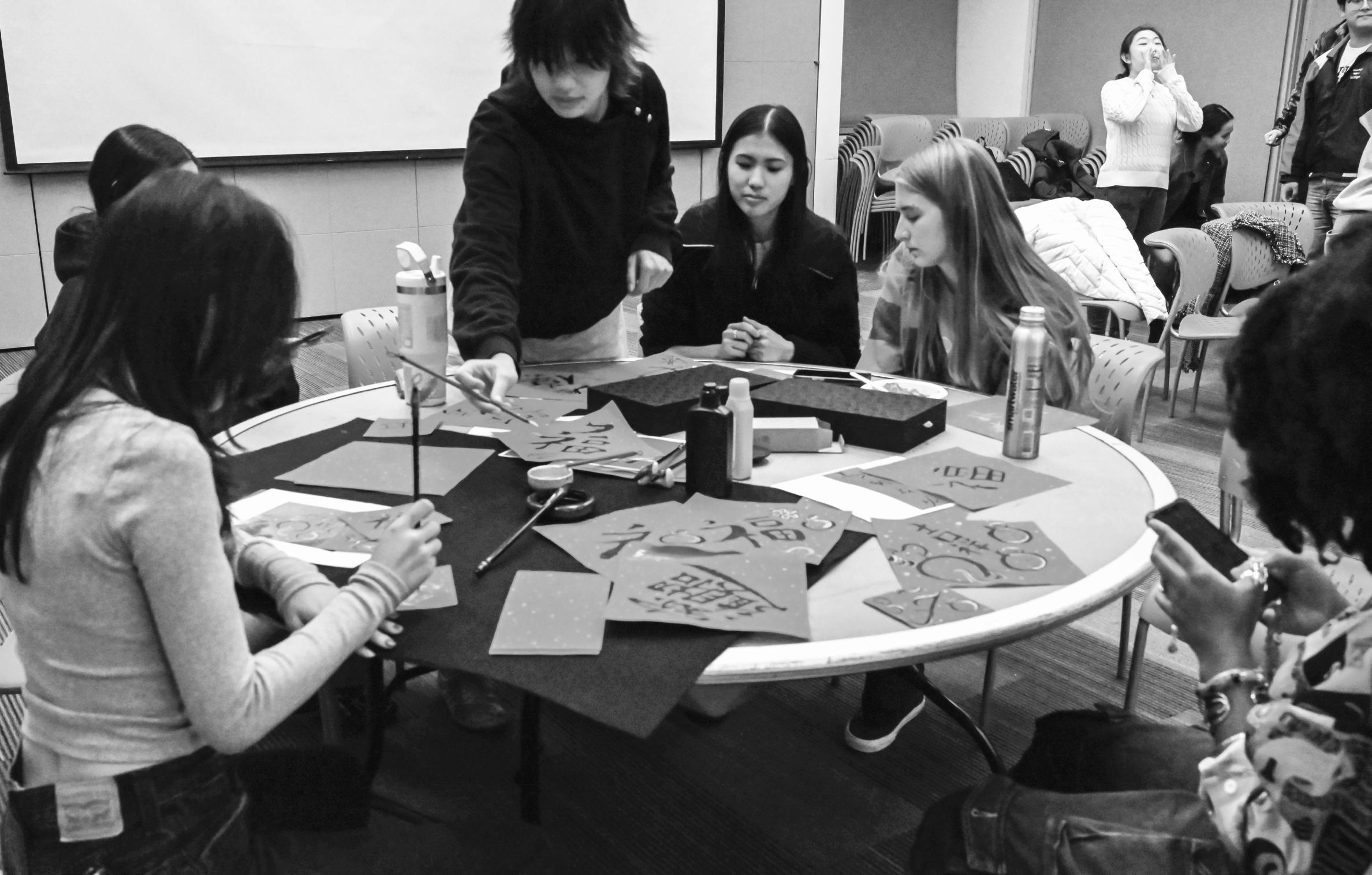
Students engage in traditional Chinese ink writing at the Lunar New Year event hosted by TASA, Canto Club, and Claremont Buddhism & Tea Circle on Feb. 20.
Open Mic Night brings together student creatives from across the 5Cs
Against the dimly lit backdrop of Dom’s Lounge, students stepped onto the stage one by one, reciting personal poems and performing songs that ranged from covers of popular tracks to original music.
CORINA YI value of academic guidance in poetic craft, while also describing the act of performing poetry as entirely classroom setting. Many student that it’s vital that artists at the 5Cs have spaces like this to breathe life
On Tuesday, Feb. 24, students gathered for the Open Mic Night co-hosted by the Pens & Poetry Club and Pomona Student Union (PSU). This event was first launched last semester in November, making this their second collaboration in an ongoing series.
The open mic night featured various poets, singer-songwriters and musicians, highlighting both performers.
The evening opened with a performance by Casey Ippolito PO ’29, who shared a freshly drafted spoken-word poem that touched on themes surrounding coming of age and shifting perceptions of the self. This was followed by several other captivating performers, from acoustic guitar covers of Milk’s “Sweet Trip” and Phoebe Bridgers’ “Georgia” by Joseph Morco PO ’27, to a lighter, humorous poem
One student, Diego Zavala-Morineau PO ’28, performed four poems — a mixture of works from his recent collection, a zine he had assembled in his advanced poetry class last semester and a standalone piece. He credited Pomona English Professor Prageeta Sharma as an inspirational and supportive mentor, as well as the 5C literary magazine Agave Review for publishing his poems in their fall 2025 issue.
Zavala-Morineau recognized the
“When you can hear your poetry — when you bring it into the physthe classroom or when it resonates off of these halls — you have to come out of that impossible melody of your mind,” Zavala-Morineau said.
He explained that performing poetry in front of an audience was a way to translate his thoughts and words into something tangibly shared and to express himself in a low-stakes environment.
“When you come to class, you bring a draft, you bring something that you want to critique, something that you want to deconstruct,” Zavala-Morineau said. “Here, you know, the only responsibility is just to be present, and I think poetry is one way that we can be present to one another as a community at the 5Cs.”
Drawn by the performances’ indescribed the event as a welcoming space to share stories and experiences through language.
“Everyone is [here] to listen to music, to hear whatever poems Kyan PO ’28 said. “It’s like a third space, and I think we need more spaces like this on campus.”
Julia Aceron PO ’28, a singer in
the 5C student band Love, Pluto, agreed that the open mic night
“The vibes are very intimate, very welcoming, very just — very beautiful — obviously very poetic,” Aceron said. “You know, it’s full of people with diverse backgrounds, and they have their own stories to tell, and I think poetry is such a beautiful way to describe that, and to me personally, poetry to me is like songwriting, so that’s also kind of why I wanted to try open mic.”
Much of the appeal of open mic nights comes from this spontaneity and imaginative energy — this sense that the next time someone takes the stage, anything could happen.
The leadership of Pens & Poetry embodies this spirit of spontaneity, stepping up to ensure everything from the food to the schedule felt cohesive. When faced with a last-minute scheduling mishap, Juan Andres Rodriguez Fuentes PO ’29 — executive board member of the Pens & Poetry Club — rose to the occasion and recited a poem he of high school.
“I wasn’t planning on performing tonight,” Fuentes said. “My team let me know, ‘Hey, we have going to be a bit of an awkward pause — do you have anything you wanna come up and perform?’ I had spoken word poetry competitions in high school, and it’s a really important poem to me because it talks about my experience as an immigrant and sort of what it means to be an immigrant right now.”
Fuentes described his untitled poem as a meditation on immithe process and intentions behind writing it during uncertain, shifting political climates.
“I was writing [the poem] right as it got announced that Trump was going to become president again, and I was seeing how, you know, sort of immigrant cultural contributions are treated in such a disposable way where it’s sort of taken and watered down and incorporated into American culture, and then discarded at another second,” Fuentes said.
Alongside individual performers, the open mic night featured a partial set by the student band, Love, Pluto, Black a cappella group at the 5Cs. In the spirit of their preparation for the 2026 International Championship of Collegiate A Cappella this upcoming Saturday, Earthtones prepared a couple of numbers from their set, in addition to fun vocal exercises and an improv performance. Future open mic nights by Pens & Poetry and PSU are to be held at least sustained space to come together and showcase their creativity.
Claremont Drag Club celebrates queer joy and chosen family in ‘Bad Romance’
ZOE CHIN The Motley, waving dollar bills and screaming as their favorite performers strutted down the aisle toward them. The show’s “Bad Romance” theme was in response to an inundation of romantic celebrations on campus. For some students, those traditional Valentine’s Day celebrations can feel inapplicable to their lived experiences. “Bad Romance” took steps to reclaim the holiday.
While drag is under attack nationwide, 5C students are cheering louder than ever. On Friday, Feb. 20, the Claremont Drag, Art and Performance Club, or more widely known as Claremont Drag, hosted Bad Romance: Kiki & Tea at The Motley Classic Lady Gaga anthems like “Bad Romance,” “Applause” and “Poker Face,” along with relatively new hits like “One of Your Girls” by drag queens and kings took turns on stage. Student attendees piled into
STORIES RETOLD
“It’s the weekend after Valentine’s Day,” club co-president Yuankai Gao PO ’28, also known as Miss Cerebellum, said. “Single people are sad, aro[mantic] people are
so done. Society has inundated this materialistic need to do somethingentine’s Day. The show [gave] people something else to look forward to and another source of enjoyment that’s non-romantic or queer.”
Gao’s words clearly illustrate that Claremont Drag shows provide more than just entertainment. For performers and students attending events, the club creates a safe space for self-expression and community.
“I just love being able to express myself in a way that is just so out there,” beginner performer EJ Chadbourne PZ ’29, otherwise known as Miss Demeanor, said. “You can do what I just did and fuck up your whole thing and still have a great time. I don’t know of any other type of performance where your entire costume falls apart, and you still have a great time.”
Chadbourne was not the only performer who experienced malfunctions. During “Bad Romance,” and costume changes required some extra hands. However, the show’s imperfections only added to its charm.
“The drag shows that we host are a little bit messy,” Gao said. “They’re not purely polished, not like what you see on mainstream television. It’s that imperfection that I feel makes it a really important place.”
In fact, co-presidents Gao and Jordan Arroyo Cruz CM ’28, or Miss Amanita, prefaced the show by stat-
ing that when a performer falls, the audience must cheer even louder.
“We’re trying to remove competition from this community,” Gao said. “There’s enough infighting already within leftist spaces. When you get sucked into this deeply competitive mindset, it becomes unhealthy. It’s not what we as a club are trying to do.”
This culture of collaboration and support reaches into many aspects of the club. At Claremont Drag, new club members are mentored by more seasoned performers. When a student joins, they are taken under the wing of a “drag mom” or “drag dad,” and become their “drag daughter” or “drag son.” This mentorship structure provides both practical coaching and emotional and social support.
“It’s provided me an opportunity for mentorship, for building people up and seeing how they grow,” Gao said. “Seeing them feeling comfortable in their own bodies is just something that I cannot articulate through words.”
For some queer students, non-traditional kinship and chosen family can provide identity-based support when it is lacking at home. that a lot of immigrant households hold certain beliefs and cultural values that aren’t very conducive to their queer children,“ Gao said.
“A lot of people are facing rejection of their queerness within their birth families, and as such, are seek -
mentorship amongst fellow queer individuals.”
Anti-transness and rejection of queer gender expression have been on the rise. Drag performance, in particular, has been targeted over concerns about exposure to children. Over the past few years, many conservative politicians from across the country have introduced legislation that would ban public drag performances. President Donald Trump’s administration has only made matters worse. In January 2025, Trump issued an executive order titled “Defending Women from Gender Ideology Extremism and Restoring Biological Truth to the Federal Government,” an overt attempt at transgender erasure and an advancement of anti-trans rhetoric. To little surprise, in June 2025, GLAAD found a “dramatic rise” in anti-trans attacks.
For Arroyo Cruz, the founder of the club, today’s political climate and attitudes toward gender nonconformity are a driving factor in his involvement in drag.
“I want to be able to do it here, because I know [there are] people who can’t,” Arroyo Cruz said. “It’s a privilege for me to be able to perform the way that I do, to receive support the way that I do, to get funding from the administration the way that I do at [Claremont McKenna College]. There are places where people are dying because of that, and so I want to be able to do that for them, and to continue to be loud and be proud.”
‘Wuthering Heights’ reaches new lows
AVA CHAMBERS
“Wuthering Heights” was certainly an experience. A twisted, dark, seductive romance based on the novel by Emily Brontë, director Emerald Fennell’s reimagination of the story as a Yorkshire-bred bodice-ripper is full of innuendo and intrigue. With respect to the imagery, it is beautiful. The costumes are gorgeous and feel purposeful, always conveying something meaningful about the narrative. They are striking and luxurious, not historically accurate but also not trying to be. No one was wearing shiny pink cellophane in the 18th century, but it doesn’t really like, surrealist atmosphere of the movie in a way that communicates its clothing could have done.
There has been much controversy about the casting. Fennell has faced by casting Jacob Elordi, who in the book is described as having dark skin and being of racially ambiguous descent. His identity is rooted in his otherness; his status and his skin-color, permanently intertwined, mark him as separate. Erasing this crucial part of his character feels reductive, turning him into a cut-and-paste Byronic hero sweeping around the moors with his one gold hoop earring, instead of a multi-dimensional protagonist.
Fennell claimed to have portrayed Heathcliff as her 14-year-old self envisioned him, while casting director Kharmel Cochrane defended the decision by saying, “You really don’t need to be accurate. It’s just a book. That is not based on real life.
It’s all art.” Some of the most successful adaptations radically change the original source material. But in this case, it feels more like a decision based on marketing and popularity, hidden behind claims of artistic license. Ultimately, it ended up feeling like Jacob Elordi was cast just because he’s Jacob Elordi. If Fennell wanted identity, there should have been a stronger intention and purpose, rather than just a realization of her teenage fantasy.
Fennell has no issue with casting non-white actors in supporting roles. Edgar Linton is played by Shazad Latif, and Nelly is played by Vy Nguyen and Hong Chau as her younger and older selves. Unfortunately, these characters feel underdeveloped and end up as either non-entities or obstacles to the
It’s also unclear whether their racial identities have any impact on their narratives, considering the insouci-
Aside from the casting issues, the plot leaves much to be desired.
Brontë portrays the relationships between all of the characters in the novel as a complex web of interactions that unfold over multiple generations. This complexity is lost two main characters, with peripheral figures entering and exiting in relation to the two protagonists. The peripheral characters have practically no bearing whatsoever on the main plot, unlike in Brontë’s story, which locates the primary re-
lationship within a subtle labyrinth of motives and dynamics. developing supporting characters, such as Nelly. There is a moment where she interacts with a servant at the Earnshaw residence and her status in the household is left ambiguous. But this glance at Nelly’sstance and feels like a perfunctory We never fully understand her motivations or her place in the story, as back toward the twinging lovers. Fennell obsesses over the central dynamic of the lovers at the expense of the other characters. But is “Wuthering Heights” the book even a love story? There are certainly some romantic themes, its most compelling complexities.
Catherine and Heathcliff’s relationship, the reasons for their being apart feel less convincing. There are no stakes — once Heathcliff returns as a rich man, it seems that Catherine wouldn’t lose much by leaving Edgar. There is no ‘society’ imposing customs and traditions on them, and we never see any of the world beyond Wuthering Heights and Thrushcross Grange. The few other characters seem to simply exist in the same space as Catherine star-crossed lovers, as Fennell seems to imply, their strained dynamic is unexplained. Why couldn’t they just run off together across the moors? What stars were crossed?
I certainly have many issues with the plot, yet there is still something of substance. At one point, amidst Catherine’s lamentations, Nelly points out that Catherine actually likes to cry. She likes to winge and be in pain, to be drenched in the icy chill of Yorkshire rain, to feel torn apart by divisive desires. Here, there certainly is a touch of the gothic. Fennell does well at mixing the sensations of pleasure and pain from the outset. The relationship between Catherine and and their sexually charged connection is always undercut by the dark, the morose and the monstrous.
In fact, I think Fennell could have gone even further with the gothic tragedy elements. I wanted more haunting, more melodrama, more windy expanses of bare land. But, I also understand that Fennell’s vision was much more stylized and surreal: more disturbing for its outright eroticism and viscerality than for an undercurrent of disquietude and dread.
“Wuthering Heights” was a somewhat intriguing fantasy of lethal obsession and sadism mixed with a sort of love between kindred evils — in their cruelty, and there is a constant push and pull between them. Yet something about it feels empty. There is so much eroticism that it and the condensation of an interwoven, multi-generational plot into a in the moment, but their relationship doesn’t compel me to ruminate on it and bask in its delicate complex of violence and obsession. It’s both too much and not enough.
Ava Chambers PO ’28 enjoys watching movies, eating breakfast foods and adding books to her ‘want to read’ list.
MAGGIE ZHANG • THE STUDENT LIFE
Joseph Morco PO ‘27 performs at Pens & Poetry Club and PSU’s Open Mic Night.
MAGGIE ZHANG • THE STUDENT LIFE
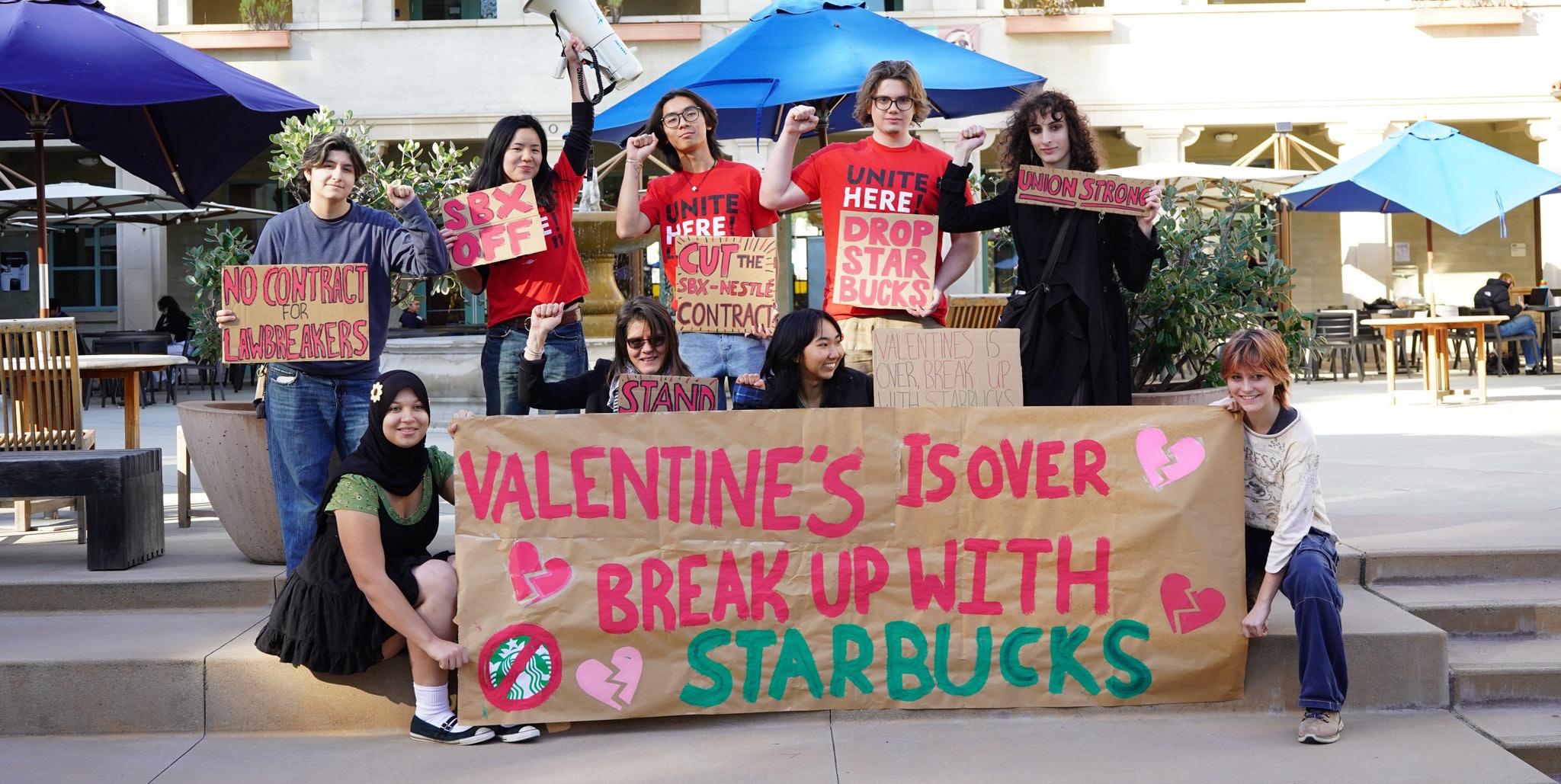
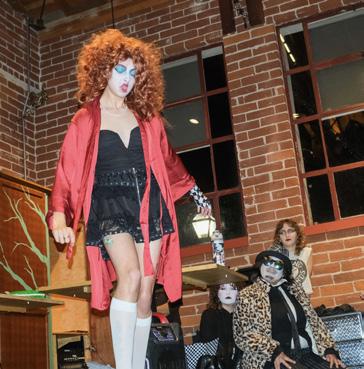
A drag performer on the runway at Bad Romance: Kiki & Tea at The Motley.
MEIYA ROLLINS • THE STUDENT LIFE
‘Leave Society’ and scabies
LIAM RILEY
Sometimes the content of a book is completely irrelevant. It’s recommended to read books, but they are sometimes equally as valuable as decoration or the legs of a table. You can chuck books at people’s heads, and if you have a copy of “The Bell Jar,” you can pretend to read it at Malott brunch. I remember very little about “Leave Society” by Tao Lin, and it was a complete headache to finish, but it is still one of my favorites. The words on the page struggle to produce any kind of complementary mental image, but, for me, the physical book elicits an intense experience entirely separate from the text. Instead of sitting down to read it. I will tell the story of how I found it and use it as a stage prop.
I probably had too much fun my junior year. It was my type of fun, which normally culminates in disaster or shreds years off my life. My buddies and I built a miniature steam room out of plywood, a steel tube and a garbage can. The heating element was faulty, so the entire box would fill with smoke whenever we got it running and fire would shoot out the chimney. I went on a road trip in a vehicle referred to as the ‘goon van’ and got it stuck in the mud twice. I got scabies from sharing a blanket with my friend on a particularly cold night in said van. In addition to scabies, I got horrendous poison oak on a backpacking trip to Big Sur that went off-trail. The prednisone I was prescribed for the poison ivy complemented the general feeling of mania I felt that year and I became so sleep deprived I started hallucinating.
I saw very few issues with my extreme risk-taking because every horrendous failure was accompanied by an equally epic victory. I remember the brief moment when the steam room worked, how beautiful Big Sur was and finally driving the van out each mud pit.
The moment I laid eyes on “Leave Society” was the moment I realized my rollercoaster of a year had been designed by a complete lunatic. It wasn’t bringing me to a gentle stop back where I started, but was flinging me clean off a cliff into a sea of sharp twisted metal.
Due to everything that was happening that year, I hadn’t put too much thought into finding a job for the summer. About a month before school was out, I found a job working on a farm in Humboldt County through the World Wide Opportunities on Organic Farms (WWOOF) program. I had met other WWOOFers while working on my uncle’s farm last winter, and I didn’t vet the hosts as much as I should have. Also, I was itching so bad I could barely think.
That was my first issue. My second issue was that I had sold my car to buy the van I got scabies in. My only transportation was my girlfriend at the time, who was dropping me off on her way up to Oregon. The relationship was under some strain from the poison ivy, the scabies, my lack of planning, my insistence on repairing a smoker all day instead of packing, her concern that the van was a ticking time bomb and my
various fermentation projects.
Another issue revealed itself on the drive up to the RV I was supposed to be living in. It was right next to a pond littered with other RVs, broken down cars and weeds. The main house was located on top of a hill overlooking the pond, and a dense forest surrounded the property. The cattle ranch and glamping operation advertised was notably missing from the scene. The host helped clear up our confusion and gave us a quick tour of the place.
“Yeah … so the cattle rancher is actually my brother-in-law … he lives about an hour down the road but this is our little operation here [points to a patch of dirt]. Yeah … we used to have a little grow operation here, but you know with legalization it’s so hard to turn any kind of profit anymore. Sorry … the place is a bit of a mess. The last guy who used to live here was an ex-tweaker and was living off his girlfriend’s disability and just smoked pot and cigarettes all day [points to a jumble of rusty implements, a swarm of flies and an RV with a massive hole in its door] so it’d be nice if you could clean up a bit.”
I nodded my head like everything he was saying made perfect sense, while my girlfriend stared at the RV in horror.
The inside of the RV was so thick with grime, dust and bugs
scurrying about that it looked like the Upside Down from “Stranger Things.” I wouldn’t be shocked if a cobweb reached out from the cabinet and lashed me to the bed to be devoured by spiders. I decided I didn’t want to be devoured by spiders so I got the hell out of there. Before I left, I grabbed the only souvenir that didn’t seem to pose a health risk: a copy of “Leave Society” lying on the kitchen counter, which I think the previous tenant kept around for swatting pests. Escaping the property with no real form of transportation or cell service was quite an ordeal, and so was a good chunk of the summer that followed. A good majority of these ordeals weren’t tempered by victories the way they had been that school year. I keep the book around as a reminder of that summer and how horrendously some of my antics backfired. “Leave Society” is a paperback, but it’s about 400 thick pages. The book has some real heft. Looking at it on my bookshelf, I can imagine someone whacking me over the head with it in an attempt to knock some sense into me.
Liam Riley PO ’26 is from East Tennessee. He likes giving book recommendations, the outdoors and labyrinths.
The architecture of reinvention
Making my way around the Underground felt impossible I frequently double-checked directions and counted stops under my breath. I thought I lacked navigational instincts, but within a couple of weeks, I was moving through the system almost automatically. I no longer count stops sardine-packed 5 p.m. train. For most of my life, I’ve considered myself adaptable and observant. I can read rooms quickly and adjust. Reinvention has always felt like evidence of resilience, proof that I can handle unfamiliar environments by learning their rules and following out a way to live there and make the best of it. But adaptability and reinvention have varied motives, and not all of them are healthy.
Growing up in a semirural community that valued cohesion, I quickly internalized how to take up space, be composed and prevent my true self from slipping out. With few opportunities to widen my radius of exposure, I
communities can be deeply supportive, but mostly for those who it’s easy to stand out, and I often did. In conversations, my voice sometimes carried too far and other times, receded when I lost the courage to speak. The feedback wasn’t always subtle. I faced overt rejections, unambiguously closed social circles and invitations made to everyone but me at the table. I was “too much” — too loud, too blunt, too unpolished. Over time, I learned to disappear and became the quiet one, surprising people when I did in fact speak. Those moments became evidence. If I felt friction, I assumed I was the friction. I learned to soften, to polish, to lower my volume before anyone else could. Reinvention felt proactive and protective. When I arrived at college, I doubled down, determore composed. Perhaps careful calibration could secure likability. Instead, I began to question whether likability was a fixed destination at all. To my surprise, in the right rooms, the traits I edited away and buried were not liabilities. Directness was clarity, and intensity was commitment. In some friendships, I didn’t feel the need to rehearse what I was going to say before speaking. Gradually, I noticed that I wasn’t monitoring my tone as closely.
Around the same time, I began experimenting with fashion, reaching for color and frills instead of neutral sweaters and leggings. I told myself that if I dressed to be visible, I could no longer let my personality be invisible. I became louder and more outgoing, and now, there’s not a day I don’t plan a fun of it. I was breathing more fully in time in years, I liked myself. That realization destabilized how I saw myself, demonstrating that perhaps have just been a mismatch with the people in my hometown.
More importantly, I learned not to force belonging but to give it the chance to bloom. The beginning of this process can sometimes be writing features for TSL, I doubted whether my introverted self could interview strangers, or if I would ever feel a sense of community among my fellow staff members. Now, both are true.
The past few years and London have taught me not to automatically assume that I don’t belong in a space. The city’s anonymity has been particularly instructive in this regard. Whether on the Underground or lost in the city, mistakes and hesitation end when I stand still for a moment believe I will be welcome in every room I step into. I’ve simply realized there’s still value in taking a chance. It still feels like holding my breath every time I take a step, but this time, I am taking a step towards reinventing myself from a growth perspective instead of fear. When adaptability is driven by fear, you treat every room as a referendum on your worth. The exhaustion isn’t only social; it’s existential, reshaping the world into something to anticipate rather than trust. When it is driven by exploration, you still observe and adapt, but enter at your natural register. This is
Navigating college and London have taught me that rooms have architectures of their own. Some are expansive; others are narrow. Liking yourself means accepting your edges and choosing deliberately whether you want to smooth them or not, without reading every mismatch as a verdict or every adjustment as defeat. The map has not changed, nor have the rooms. What has changed is the quiet assumption I carry into them.
Ananya Vinay PO’27 is currently learning to navigate the London Unher reading novels and creating chaotic,
Cracking open a desolate world
This review will contain spoilers for the “Angel’s Egg” movie. Despite it being 40 years old, I recommend that you go into it blindly if you have any interest in seeing it. Proceed with caution.
Ten years before becoming famous for his work on the movie
“Ghost in the Shell” (1995), director Mamoru Oshii came out with the surreal haunting masterpiece that stands out for its incredibly restrained dialogue, focus on visuals and an ambiguous narrative. Set in a ruined city surrounded by a desolate land, “Angel’s Egg” is centered around two unnamed characters: a young girl and an older boy. The young girl navigates this mysterious city carrying an egg, which she is deeply protective of. In spite of the girl’s hesitance to share, the boy grows curious as to what is inside the egg and wishes to hatch it. Initially the two clash, but by the end they manage to form a bond. As mentioned previously, one among other anime movies is its limited dialogue. Minutes go by
JOON KIM silence. There are only a couple scenes in which the characters speak. These scenes give the viewmotivations. Since the film has a much higher emphasis on its visuals, it would have been a massive shame if it wasn’t able to deliver on that front. Thankfully, it absolutely does. Even though it is the oldest far for this column, its animation and art style have hardly aged since its release. I would go as far as to say that the rougher style aesthetic. The backgrounds are the absolutely dismal look of the characters’ world, with the twistand the fossils of deceased birds. It is barren and apocalyptic, yet it never becomes bland or dull to look at.
for themselves. Most of the time, all you can hear is haunting choral music, noises coming from the environment or even just complete
I found the relationship between the boy and the girl to be fascinating and tragic. Their desires initially clash with each other, with the boy wanting to see what’s inside the egg while the girl — understandably — doesn’t trust him. Later on, she seems to become more comfortable with him and even shows him around their world. There’s a sense that perhaps even with their contradicting desires, they will manage
to form a strong bond. However, it all goes out the window when the boy cracks open the egg behind the girl’s back. Devastated, she chases after him, only to fall and drown in a body of water. Honestly, this ending was deeply unsettling. It made me question the boy’s feelings up to this point. Did his curiosity simply overwhelm his bond with the girl? Did he ever see her as a
The mystery shrouding the movie is never resolved as the viewer never actually sees what was inside the egg. Nothing in this movie is ever fully explained and each detail seems to only raise more questions. For example, the movie places a high emphasis on locations, bodies of water are frequently shown and at one point, the boy recounts the story of Noah’s Ark. Although it frustrated
me initially, I appreciated this ambiguity. It left me pondering long after I had seen the movie. It is also own views on its possible meaning. Unfortunately, there is one small problem I have with “Angel’s Egg.” good, there are a few scenes that went on for much longer than they should be. A particularly egregious case comes after the boy tucks the girl in for bed. After this moment, the film captures the boy sitting This single moment lasts up to two minutes and nothing substantial really happens. I am all for slow moments in films, yet I felt this was a step too far. It almost came considering the movie is not that how much I loved the movie. “Angel’s Egg” is a movie like no other, with its lack of dialogue, mysterious story and world-building that leaves you with questions long after viewing. If you’re seeking to watch something more artsy and less mainstream, I’d say give this movie a shot.
Joon Kim PO ’26 doesn’t have a preference between subs or dubs in anime and would rather stay away from the debate. Sometimes, he will watch the subbed version. Other times, he’s in the mood to watch with a dub.
ANANYA VINAY
ALEXANDRA GRUNBAUM • THE STUDENT LIFE
MAGGIE ZHANG • THE STUDENT LIFE
A friend of Liam Riley enjoys the homemade backyard sauna him and his buddies built in his junior year, with fire shooting out the chimney.
ROY SHIN • THE STUDENT LIFE
ANIME FILM FEATURES
Have you been in pain? If so, care about pregnancy
We were all born and we will all die. How can we alleviate the pain and prevent the harm we experience in between?
I appreciated issue two’s op-ed “The 5Cs support abortion but not pregnancy — what about choice?” for making me dwell on a topic I’m scared of — pregnancy. I agree with the author’s argument that the Claremont Colleges should support pregnant students. However, presenting the Claremont Colleges as having bad prenatal care and good abortion care is a false binary. It is incorrect to imply, as the title of the op-ed does, that the Claremont Colleges provide adequate support for abortion or claim to be prochoice at all.
-
cient support for pregnant students, whether they carry a pregnancy to term, have a miscarriage or seek an abortion, is both indicative of and an inadequate response to the American legal and medical system. The Claremont Colleges must ensure that its Title IX and Accessibility
VIVIAN FAN offices are involved in shaping the healthcare available at SHS, given the changing landscape of pregnancy in the United States. The United States has the highest rate of maternal mortality of any high-income nation, with Black, Native American and low-income mothers at the greatest risk of dying. We are also living in a postDobbs America in which thirteen states have complete bans on abortion. This list includes my home state of Tennessee, in which Republican lawmakers have recently introduced a bill that would allow prosecutors to pursue the death penalty for women who have an abortion. Restrictive abortion policies act as a dangerous double bind: The states with the most restrictive policies also have the least comprehensive and inclusive public infrastructure to support children, women and families.
In light of this context, the SHS’s limited information on pregnancy services appears even more lacking. The portal’s links to websites about abortion and
a five bullet point list of what expenses students can or cannot get a reimbursement for when seeking an out-of-state abortion, which seems more like an imperfect attempt made by SHS and the student insurance provider to provide care after the overturning of Roe v. Wade rather than the “carefully mapped and funded” plan which the author of the op-ed describes it as.
While other academic institutions have acted to support abortion rights, the Claremont Colleges have chosen not to act in accordance with California’s College Student Right to Access Act, which requires student health services at public California universities to provide on-campus access to abortion pills.
Let’s not be afraid to acknowledge that the systems we’re part of can harm multiple groups of people at once. When advocating for more comprehensive healthcare, it is crucial to recognize commonalities and build solidarity among those harmed by the system, which encompasses people with various medical conditions. Expanding support for pregnant students goes hand-inhand with expanding support for all students.
Though pregnant people are not automatically protected by the Americans with Disabilities Act, pregnancy can be disabling. Symptoms of pregnancy, including frequent vomiting and nausea, shortness of breath and back pain, participating in daily activities of the op-ed wants to make easily available for pregnant students — excused absences, medical leave, mobility accommodations and mental health services — are helpful for a variety of students dealing with challenging circumstances.
Although I don’t think I’ve met a pregnant student at the Claremont Colleges, I know students these resources. I also know that accessing these resources is not necessarily easy. I agree with the op-ed’s author’s argument that the SHS should support students’ Title IX rights. But, more expansively, I believe that the Title IX and Acthemselves must play an active
embodied love
We all have an image in mind of the “cringe couple”: The lovey-dovey, head-over-heels, picture-perfect pair that we love to hate, but kind of wish we were. I myself have had conversations with friends about being sick to our stomachs when we see someone swoon.
It is quite popular to hate on public perceive as happy. PDA is cringe, and while we largely refuse to confront those engaged in it, we have disdain for it anyway. Some may say that PDA is too normalized, that it does not need defense, but as Gen Z retreats from love — and from the public sphere generally — we must recognize PDA’s role in our society. PDA can and should be a normal part of life. It is emblematic of love and ought to be celebrated. At its most basic form, PDA requires a level of bravone’s emotions that is scantily found elsewhere. As a generation, we must cultural conceptions of PDA and rid ourselves of any stigmas against it. The act of physically expressing your love for an individual — or individuals if you so please — combined with the comfort of allowing it to be seen by others, is somewhat radical. I am not saying that PDA is a substantive political act. I do believe, however, that the visible presentation of love one another, and for broader society. Love has often worked as the bedrock
ALEX BENACH of social movements seeking greater liberation. Queer and women’s liberation movements stick out as examples of the necessity of love — both expanded the framework of love to include those who had been Objectors to PDA often bring up the “get a room” argument, boiling this issue down to a distinction between acceptable behavior in the private and public realm. With this point of view, actions involving romantic feelings should be relegated to the private, away from our collective perception.
Allow me to make clear that there are certain behaviors that necessitate privacy, mostly due to issues of consent. For example, nudity and sexual acts are acceptable in places where that is the expectation when one enters the space, but that ought not to be extended to public spaces where that consent does not exist. For my purposes, I am focused on the PDA that typically populates college campuses, general behaviors such as hand-holding, cuddling or pecking.
While it can be uncomfortable to witness PDA, and in some ways insulting for those of us who have no one to engage in PDA with, that does not mean PDA should be shunned or removed from daily life. We have a collective problem — not only of loneliness, but of an inability to celebrate the manifestation of real love upon exposure to it. There is nothing in this world that is more important or essential
role in shaping how students navigate the healthcare system.
The Title IX and Accessibility ofto ensure that students, regardless of whether or not they carry a pregnancy to term, are able to access relevant resources and comprehensive healthcare. In order to be successful, these initiatives must seek student input and have the backing of college administration. A step in the right direction would be advocating for the Claremont Colleges to bring California’s College Student Right to Access Act to our schools. Considering how we should support pregnant people is not only about pregnant people — it means considering how we all would like to be treated when we are in pain. We must ask ourselves how comprehensive and available we want the healthcare, anti-discrimination, disability and accessibility policies that shape our lives to be. at least for me. But only once westand pain can we begin to treat it. Vivian Fan PO ’28 stayed up really late to write this. She hopes you will also read other things she wrote, and that you take a Gender and Women’s Studies course.
to our humanity than love. As James Baldwin once put it: “Love cannot live without and know we cannot live within.” Participating in love already requires an enormous amount of compromise, and it is no wonder that something so powerful
should carry a physical representation with it. We seek to hold the hands and kiss the cheeks of our lovers be-
We want to convey the love we feel and we want to feel that love reciprocated. This embodiment of love is the crux; without it, there is no vehicle toward the quest of growth that is loving someone.
Cartoon Caption Winner: Daniel Ives ’84
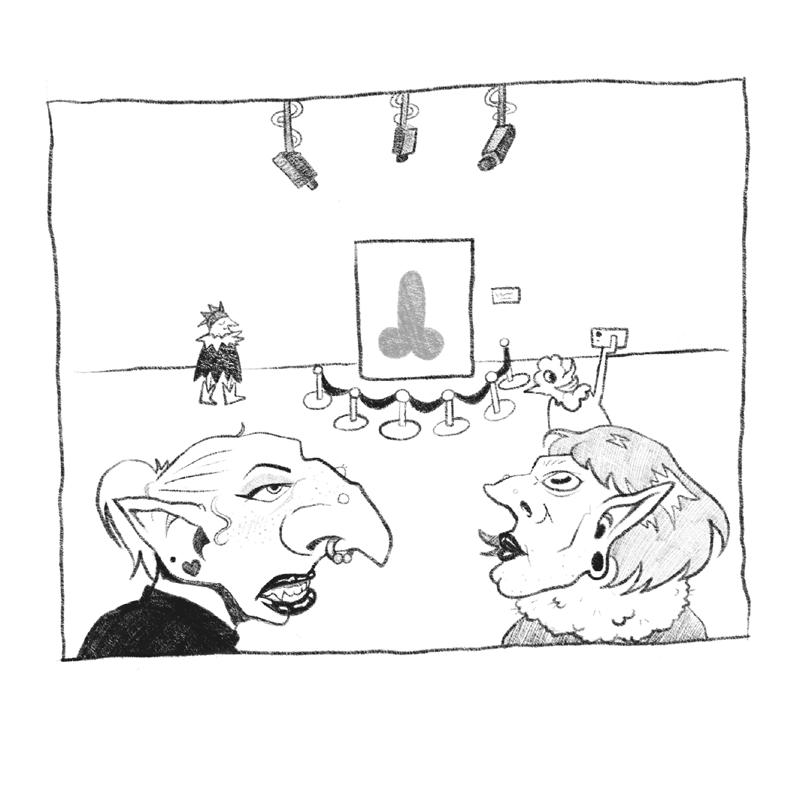
Cartoon Winner: Anonymous Mudd student ’28
“ideal female figure if CRISPR was everywhere”
“Me and the boys at the Penis Museum”
PDA, as an embodiment of love, is something that should be shared. It is for that reason that I rise today in defense of PDA. When we see others engaged in this type of love, we become more open to it ourselves. It becomes merely another part of public life that we witness or participate in. In other words, seeing love represented can act as a medicine for our repulsion to love.
Gen Z must seriously relearn how to love. As many have documented, the loneliness epidemic is ravaging our generation and we are entrenched in Situationshipgate. When we remove or
distance ourselves from love, we reduce ourselves as human beings. Through a more positive embrace of physical love, we can work toward a world in which Gen Z feels more comfortable navigating the challenging, depressing and at times hopeful and romantic landscape. While it may seem harmless — and in some ways funny — to dog on the kissy couple and do a gagging motion when we pass by two cuddly companions, it perpetuates a culture devoid of love. So, the next time you feel so inclined to express your love, you should! It does not have to be romantic or limited to one romantic partner. Hold hands as you skip to class with your boyfriend or your best friend. Share a plate of pasta ala Lady and the true joy and connection that comes with PDA.
Alex Benach, PO ’28 is
ZARA SELDON
I first discovered flash mobs when I was twelve. As I descended into a rabbit hole of ASMR slime videos and day-in-the-lives, I paused on a groundbreaking clip: around 200 women and girls wearing vests over pastel blouses on top “I Believe” by Yolanda Adams in the middle of a crowded shopping mall. There was a lot of enthusiastic shimmying, some syncopated arm waving and a sprinkle of walkinglike-an-Egyptian. I was charmed by the dorky humanness of it all, how effective it was in making every shopper stop what they were doing and gather around to watch. To my dismay, I discovered that the life-altering video I had just seen hadn’t been trending for a decade. With the rise of social media “cringe culture” and the death of third places, we simply aren’t motivated to organize spontaneous dance numbers that unite strangers in shock and delight. Instead, we sit alone at home, scrolling through single-person TikTok content, eating dry tortilla chips and developing parasocial relationships with celebrities (not saying I would do any of this). Our world is lonelier than ever. Flash mobs are the perfect chance to engage in the unapologetic, out-in-the-open whimsy necessary to harness the power of communal joy and lift us out of our digital slump.
Flash mobs originated as a social experiment, before social media platforms took over our lives. Writer and cultural critic Bill Wasik wanted to test strangers’ willingness to gather in public for a prescribed purpose, so he started the MOB project in 2003. In Wasik’s words, the project was a “demonstration of social networks,” showcasing “how you can use fun and a sense of being a secret agent on a mission to get people together in large numbers.” Wasik would desout mass emails or text messages with the date, time and location of occurrence. These messages would then be forwarded countless times across platforms until a sizable mob took shape.
Wasik’s project was also, most strikingly, a form of resistance to early social media-induced isolation. As Facebook became increasingly popular, Wasik grew disillusioned with the fact that the “friendships” people made online were purely transactional and built
to end. He decided that the best way to counter this loneliness trend was to orchestrate large gatherings for the sake of performance art. “[Flash mobs] remind us that we are still people who have bodies and still people who have the ability to create change in the physical world.”
is its surprise factor. Participants begin as unassuming passersby — they push shopping carts, dig through their purses, type on their phones — then, boom! Someone busts a move. Someone else follows. Next thing you know, a hundred people are doing the Funky Chicken. Because they happen in casual and public spaces, and because there is never a formalingly down-to-earth art form. The dancers move freely amongst the crowd as if to say, “Hey, I was just one of you! A stranger navigating the world. And now I’m rolling my wrists and shaking my hips to ‘Wobble’ by V.I.C!” By 2008, flash mobs were a cultural phenomenon — people began using them to bring hope to those struggling with loss or
illness, build school spirit and raise awareness about social issues. My personal favorite kind, the marriage proposal, epitomizes everything good and pure about the art form. It is so moving (and a little bit awkward) to watch people profess their eternal love for their partners through extravagant dance numbers, with “Marry You” by Bruno Mars providing foolproof reinforcement. In a cringe-allergic society, where pub-
see such wholesome declarations of love on full display. Flash mobs were ultimately killed by the very force they
Although factors such as crime
tic corporate sponsorships also mobs around 2012, the true blame lies with the isolationist box that is your iPhone. As digital platforms grew increasingly curated, people traded zest and whimsy for unbothered, nonchalant self-projections. It has become easier and easier to declare anything that
seems genuinely human — take imperfect dancing, for example — as “cringe.” We all dance alone in our rooms, and most of us suck, joyful moments on social media. curated images of our lives. We want our followers to believe thatman. When we dance on TikTok, we rerecord the same routine a million times until we get it just right. There is no sense of spontaneity, no earnestness, no carefree fun. So of course it’s easy to see a group of people in multicolored clothes dancing gleefully and imperfectly, and dismiss them mobs force us to face our discomself-acceptance in the cringe.
None of this is to say that I am an expert in displays of unbridled public happiness. I am a relentlessly cynical person. I think the world is mostly bad, people are corrupt and the planet would be better off without humans.
America’s rapid descent into fascism depresses me, and I, like
ACROSS
1. City southwest of Kabul
9. American oil company named for a celestial body
15. “Headless Body in Topless Bar,” e.g.
16. Like some patches
17. Flustered
18. Dormant
19. Scoreless, in soccer
20. Alt subgenre sometimes bearing an umlaut
22. Kinda
23. STAT
25.
26. Canadian prarie nation
27. Earth to France
29. Singer Winehouse
30. What Australians call a slipper
31. Regard
33. Italian city on the Bay of Naples
35. Grand ___
37. Ja’s counterpart
38. ??????
42. Festival on the Riviera
46. A canary might signal one
47. Sweet potato relative
49. Author Field of “Furious Minds”
50. Corpus
51. Have, as one might in the Bible
53.tance of praise
54. Clay alternative?
55. Matadors, by another name
57. QB Newton
58. Benjamin Franklin replaced this word with “self-evident”
60. Syllabary related to Katakana
62. Wrestler George “The Animal”
63. Charges (with)
64. Assents
65. Inquisitiveness, to a fault
DOWN
1. Chagatai or the Golden Horde
2. Shields carried by Athena and Zeus
3. Painting near a bed?
4. Subj. of “Silent Spring”
5. Computer scientist Turing
6. Ask someone for something
Common ailment for vegetarians
Exchanges for rewards
“____ Marner”
Many a peak between Europe and Asia
Golf club with the lowest surface area
Permit
Itinerant, in a sense
Popularizer of Thornton’s “Hound Dog”
so many others, have no idea what to do about it. But here I am, camwhat the heck! They may not have the power to topple authoritarian regimes, but there is a unifying quality to dancing in public spaces, especially when the dancing is raw and jubilant and imperfect. I call upon you to embrace week. You are stressed out of your mind, so you open Instagram for a passive doom scroll. Then, out of the blue, a crowd of performers materializes on Marston Quad, executing a series of joyful and uncoordinated dance moves. You feel the urge to recoil, but you resist. Cecil the Sagehen holds out his feathered hand and invites you to join in on the festivities. You oblige, windmill without a care in the universe. There is no ulterior motive to this movement, no image you’re trying to project. You are simply existing in a vibrant community, and that is enough.
Zara Seldon PO ’29 is going to orgainvited.
26. City formerly known as Madras
28. Catcher of slippery aquatic beings
30. Test 32. Indicative or present form of “might” 34.
36. Mobster Lansky
38. Institution residing in a chancery 39. Cross, as a boundary 40. i and j in while loops, perhaps
Cecil, e.g. 43. Loon 44. Wandering knights 45. Go through the Kyrie, Gloria, Credo, Sanctus, and Agnus Dei 48. Sheep with soft fur
SEMINAR AND SCOREBOARDS
Athenas brave power outage, defeat Sagehens
OnFeb.22,Claremont-Mudd-Scripps (CMS) softball claimed a 2-1 series victory against rivals Pomona-Piter (P-P). A hard-fought slate of games stretched across two weekends due to a stadium lighting malfunction.
SCIAC preseason rankings placed the Athenas tied for second place with Chapman, while the Sagehens placed fourth. The Athenas took two of three in last season’s series, the second consecutive year they had done so.
The Athenas dominated game one, led by the eforts of infelder Averi O CM ’27. O’s two-run hit in the seventh inning, alongside an RBI double from frst baseman Alex Wedemeyer SC ’28, ensured a comfortable 4-1 victory. For the Sagehens, outfelder Natalie Murguia PO ’26 came home for their only score of the day on a hit of the bat of catcher Kylie Liu PO ’26 in the sixth.
In an atempt to rebound in game two, Murguia led the way for P-P with one run and an RBI, while Liu and Gianna Phillips PO ’29 added two hits each to give the Sagehens a 4-0 lead.
The Athenas responded late, with frst baseman Avia Tuguldur CM ’28 and outfelder Giselle Lai CM ’27 each driving in runs. Undeterred, the Sagehens closed out the game through the eforts of relief pitcher Ava Bautista PO ’29, who secured the game’s fnal out, securing the 4-3 victory.
Refecting on the team’s performance in game two, Phillips concluded that the team needed to improve their play to increase their chances of victory in the decider.
“We clutched up,” Phillips said. “Going into game three, we thought we really needed to push ourselves
further and get that win for the series.”
Accordingly, game three proved a competitive afair. Although CMS took an early lead of the eforts of Tuguldur, the Sagehens quickly responded, with frst baseman Sophia Roberts PO ’27 scoring of a hit by Bautista.
Both Liu and Phillips drove in second baseman Sadie Huryn PO ’29 on separate occasions to give P-P a 3-2 lead going into the 5th. Huryn scored again in the 7th, thanks to a Roberts single.
At the end of regulation, however, it was all CMS; Tuguldur’s hit tied the score at 4-4, plating outfelder
Ana Federico CM ’27 and outfelder
Delanie Stevens CM ’27. However, neither team scored again before the game was suspended due to a lighting malfunction in the darkness, with play resuming the following Sunday, Feb. 22.
Both teams stressed the importance of the deciding win despite the week-long gap between regulation and the extra innings. For O, it was important for her team to stay focused despite the delay, even as the Athenas played another opponent prior to concluding the match against P-P.
“We really put emphasis on trying to be in the mindset [as] if we had played the game continuously,”
O said. “We also played Chapman all weekend, and we were coming of of a lot of softball, which helped.”
That preparation over the week certainly paid of in the end. Four pitches were all it took for the Athenas to walk it of. Stevens hit a drive to left-center feld to bring in second baseman Hina Usuda CM ’29 and
close out the rivalry series with an extra-innings win. Celebration ensued, with the Athenas rejoicing in the victory a week in the making.
“Especially after today, we’re super excited,” O said. “It’s always especially nice to beat Pomona[-Piter], but we’re always focused right away on the next series.”
Despite the loss, P-P was undeterred. Instead, the Sagehens found new motivation in their defeat, eagerly looking forward to their next series.
“Everyone is super excited and fired up to just play,” Murguia said. “Typically, we don’t open up with CMS or any SCIAC school for our home opener, and in these next few games, people will be super fred up, especially playing under a litle less pressure against a non-SCIAC opponent.”
For Murguia and her fellow seniors, seting an early example is important for success through the rest of the spring and for enjoying every moment of their fnal season.
“As a senior leader, seting the tone is something that I feel responsible for, but I also am having a lot of fun with it, given that it’s my senior season,” Murguia said. “Every opportunity is a chance to shine, and just do what I love.”
P-P returns to the diamond at Wig Field on Friday, Feb. 27, to kick of a two-game set against Lewis and Clark, the 2025 Northwest Conference runner-ups. CMS will take two weeks of before facing the 1-5 Hamline University Pipers on Friday, March 13, on Athena Field.
Sports and politics
Every other spring, Pomona politics professor and department chair, Tom Le, teaches Sports and Politics as an upper-division elective. The course’s objective, in addition to its heavy emphasis on public speaking, is to provide a gateway for discussing political theory through contemporary professional sports. From nationalism to inequality, Le believes sports are a medium that makes dense theory more digestible.
“When I design courses, I have core theoretical readings and things I want students to learn, like power inequality, how states extract from people, among other political questions,” Le said. “Then I think of bait. Sports are easy bait because they’re fun and interesting to students. So you give them the popular things that get them in the class, and then you trick them into reading really hard stuf.”
The intersection of sports and political theory drew great atention, Le said; the course garnered over 40 PERM requests in an allotted enrollment slot of 12 students.
Holden Tsai PO ’27 said that the sports “bait” Le describes is what most excites him. Each week, the class looks at a diferent political issue like gender and race, using readings on sports to discuss, dissect and understand the issue as a collective.
“Sports has been a really amazing medium to use, especially because everyone comes in with some sort of prior knowledge about it,” Tsai said. “Politics can defnitely seem very inaccessible, but the second you boil it down to questions like ‘why does this athlete get this contract?’ that makes it really easy to understand.”
Le hopes that, through this exploration of politics in sports, students can walk away feeling more confident in their public speaking skills.
“We really work on [public speaking], and I grill them on it,” Le said. “We work on hand gestures and eye contact. When they do their midterm, I’ll stop them, adjust their hand, adjust their head and really get in their face about how to present.”
When asked about his favorite moment in the class so far, Tsai quickly recalled an impromptu speech, with a smile on his face. He normally avoids public speaking, but Sports and Politics pushed him to challenge his preconceived limits.
“At frst, I just blanked because [Le] wanted me to be very specifc about my hand motions, and so I was just stutering up there,” Tsai said. “But I feel like once I got that
out of the way, I thought to myself, ‘this class has seen me at my worst.’ There’s a very good atmosphere, and looking back, I’m glad he pushed me out of my comfort zone.”
Moments like that — uncomfortable and deeply refective — are included in the course by design.
Rather than simply analyzing sports from afar, students are asked to confront how power, performance and presentation shape the games they follow and love.
Charlote Patel PO ’28, a member of the Pomona-Piter women’s basketball team, said she appreciated the critical discussions, specifcally on youth sports. The class discussed how programs are becoming more intense with more club and travel teams.
“It’s really interesting to look at sports through more of a critical lens, because that’s how I grew up,” Patel said. “For me, sports have always been super positive. It’s great to look at the counter side and realize that there are a lot of sides of sports that could totally use reform.”
Le is trying to change perspectives. As a sports fan himself, he said that sports ofer two key reasons for examining politics today.
First, sports serve as a magnifying glass for political issues in today’s America, illuminating those that are often overlooked or normalized.
“Sports themselves are a very good insight into politics and power for two reasons,” Le said. “One is looking at things that are absurd, like [Shohei] Ohtani being paid $700 million for 10 years. That’s bigger than some economies of a country, so how does that happen? In this way, sports make the absurd very obvious, and then we can study it.”
Beyond the absurd, for Le, sports ofer a candid lens into American politics, presenting an often uncensored view of many issues today.
“Sports lets us be really honest. For instance, a topic like nationalism. You [can] get canceled for being patriotic or nationalistic. In the normal world, those [can be] bad things, but in sports, you can love your team and throw a punch. No one cares. Sports lets us look at politics in an unfltered way.”
Through this lens, Le is paving the way for a more complex view of sports as a political tool.
“Sports is just war without bullets,” Le said.
paulo Dybala and the art of being second
Paulo Dybala is a frustrating player. There is a particular kind of pain reserved for good but not quite good enough, and the Argentine forward emulates just that. Across 13 seasons spent primarily in Serie A, Dybala has neted 198 goals and 95 assists. If we count the extra 10 goals and assists that came from 40 caps with the Argentinian badge, he grabbed 304 goal contributions and counting across his career. Those stats make me shake my head. They look, well, average, and compared to the entire tier of players that sit just below Lionel Messi and Cristiano Ronaldo, the numbers look even worse. Dybala is completely out of place in a room with Neymar, Robert Lewandowski or Luis Suarez.
But the stats don’t really do Dybala much justice. Dybala’s early career — and the YouTube highlight videos I fell in love with — are incredibly topheavy. Under the gloss of his incredible left foot, slicked back hair and iconic celebration, it’s easy to imagine a world where Dybala is still at the top of the league. At age 21, the sky was the limit for Dybala. He didn’t exactly burst onto the scene, but, after notching 23 goal contributions during his fourth year at Palermo F.C., Dybala secured a big move to Juventus. For the next three years, the world witnessed all that Dybala could ofer. 32 goals and assists in 2015-16, 27 in 2016-17 and 30 in 2017-18. Dybala was everything the Italian giants could ask for. He had come of the best season of his career in 2018, one in which Juventus won the Serie A and the Coppa Italia and fell just one win short of the treble. To top it of, they announced the signing of his friend Ronaldo from Real Madrid. But Dybala was never quite the same after Ronaldo joined. Dybala never again scored more than 20 goals in his fnal four years at Juventus. The quality was still there — 17 and 15 goal seasons came in 2019-20 and 2021-22 respectively — but Dybala wasn’t Juventus’ star anymore. Transfer rumors surrounded Dybala, with
injuries and Ronaldo’s arrival forcing him out of position, and soon out of the spotlight. But perhaps most importantly, Dybala was always a luxury player. You fell in love with how he played the game, not his results.
Ronaldo, Messi,Neymar, Lewandowski and Suarez were all inevitable, bona fde superstars.
Dybala was a spark in the pan.
In his day, Dybala was incredible, but he never bent the game, nor did he have a system built around him.
Now, his career at Juventus wasn’t bad. A season with 26 goals, five Serie A titles, four Coppa Italias, two Supercoppa Italianas and a UEFA Champions League runners-up medal are honors many players dream of.
Even still, when Dybala left Juventus at age 29 to join Roma, it felt like an unfnished story. It didn’t help that he never quite found his Juventus form there,
where he has struggled with a long list of minor injuries. At age 32, he is still playing and still capable of a fash of brilliance, but never in conversations. His international career, too, was much the same. Four goals across 40 games only hinted at the quality present, with Dybala constantly competing with Messi for playing time. Sure, he won the World Cup in 2022, but he started just one game in that competition. Just like Neymar, it’s difficult when the competition is a compilation of the greatest players ever. Neymar had his struggles, and he didn’t reach his true potential either. The diference is that Dybala left things on the table; Neymar didn’t.
It’s easy to paint your own ambitions on a player like Dybala. Take me, for example. I’m currently studying abroad in France, and after practice on Friday, one of the players asked me if I was
playing Division III or Division I. I wasn’t exactly sure how to respond to that. Quite literally, I didn’t know what to say in French. More importantly, though, it made me a litle sad. For a while in high school, I could see the vision of playing college soccer. In fact, I was prety close — one ofer that never materialized; two walk-on spots at liberal arts colleges I never got into. It sounds prety similar to Dybala. I was good enough to be in the system, but never the frst-choice option. So I lied. I told my friend I played DIII, but wasn’t geting too many minutes, to his chagrin. I spent the rest of the weekend thinking about how things could have been diferent. Perhaps if I were a few inches taller or had taken things a bit more seriously, I could still have been playing the sport I love. We can look back at that one tryout when we had a debilitat -
ing head cold and didn’t make that travel team, or at the guest player tournament experience that amounted to nothing. The truth is, most of us have been Dybala before. Being second is painful. The belief tends to kill you because you were close enough to clearly see what you wanted. But prety good doesn’t mater. Someone was better. And that idea seems to mater far more than any of your eforts. It’s a frustrating, lingering type of pain. Dybala was prety close. I’ve been prety close, and I’m sure you have too. But isn’t that life?
Oto Friton PZ ’27 –– unfortunately dubbed “OF” by his close friends –– is an avid Peanuts fan. He fnds Charles M. Schulz’s portrayal of Charlie Brown and the Litle Red-Haired Girl fantastic; the perfect example of unrequited love. He wonders if Charlie will ever truly succeed, and suspects that’s exactly the point.
TALBOTT CHESLEY
SHIXIAO YU • THE STUDENT LIFE
OTTO FRITTON
PJ JAMES • THE STUDENT LIFE
JAKE CREELAN
COURTESY: CLAREMONT-MUDD-SCRIPPS ATHLETICS
Claremont-Mudd-Scripps (CMS) Athenas celebrate a walk-of hit by Delanie Stevens CM ‘26 in a 2-1 series victory over the Pomona-Pitzer Sagehens.
Sagehens water polo avenges January loss, wins second of three sixth street matches
ANNE REARDON
On Wednesday, Feb. 25, Pomona-Pitzer (P-P) and Claremont-Mudd-Scripps (CMS) women’s water polo batled in the most recent iteration of the Sixth Street Rivalry, which saw P-P reclaim bragging rights in a nail-biting game with a fnal scoreline of 12-11. This was their second matchup of three regular-season games, following CMS winning the first game in a triumphant defensive efort.
That defeat on Jan. 31. broke the 14-year win streak the Sagehens held over the Athenas, suggesting a possible shift in the competitive balance between the two teams. Entering the second matchup, the Athenas and Sagehens shared sub-0.500 records at 3-6 and 4-8, respectively. Losses on both sides primarily came from several Division I opponents at preseason tournaments.
“I think we got beter throughout the game [through] communication,” atacker Katie Hugar PZ ’29 said. “We’re a prety talkative team, and the more the game went on, we talked and helped each other, we really fed of each other’s energy.”
CMS started strong and ended the frst quarter with a lead of 4-3, with P-P equalizing to enter halftime tied at 7-7. This intense backand-forth was nothing new — the close score was reminiscent of prior meetings between the SCIAC’s top two teams from past seasons.
“Our last game against CMS was defnitely hard on us, and it really afected us as a team,” atacker Layla Szymczak PO ’28 said. “We knew that we had the potential to win, but it just didn’t result that way. This game really meant a comeback, and it tells us we have the ability to continue.”
To begin the second half, the Athenas came out hot with two consecutive goals by atacker Christina Marlow CM ’28 and utility player Jordan LaCour CM ’28. Following CMS’s two quick goals, Hugar and utility player Sydney Bowns PO ’28 brought the score back to
a tie at 9-9 with just over two minutes to go in the third.
Nearing the end of the third quarter, attacker Tatum Dwyer CM ’28 brought the Athenas back to a lead with a goal, breaking the tie to lead 10-9. The go-ahead -goal boosted the energy entering the fnal quarter.
“I think we did a really good job lifting each other up and working together as a team,” atacker Valerie Wraith CM ’27 said.
Fresh into the pool for the fnal frame, P-P seemed to close in on the victory by scoring three consecutive goals right at the beginning of the fourth quarter. Right-side player Mia Amberger PO ’26 scored
less than a minute in, then Hugar drew an exclusion, and shortly after, a goal. That was the tiebreaker to give the Hens a one-goal lead, to which Szymczak expanded to bring the score to 12-10.
“My favorite moment was when we got up right after we tied,” Hugar said. “I think that really brought us over the hump and just got us where we needed to be. It gave us the push that we needed to win.”
While P-P got on a roll, scoring three unanswered goals in the fourth quarter and eventually winning the game, CMS continued to put up a good fght, underscoring the high potential the team sees for
its season.
“There was a lot that went right, and there was also a lot that went wrong, but the stuff that went wrong, we will look at that and hopefully reverse that for next time,” Wraith said.
With just 14 seconds left in the fourth quarter, Caitlin Muñoz CM ’26 took a 5-meter penalty shot and brought the fnal score to 12-11, but that efort was too late for an Athena comeback.
Finding their groove will be key for the Sagehens going forward this season, as the energy maintained in the pool directly afects performance.
“I think we should really focus on keeping our energy up,” Hugar said. “We’re a team that really feeds of each other, and I think the more that we just are positive with each other and have a lot of energy, the better we do, and the more fun we have.”
As for the Athenas, they will look to regroup after this loss that evened their overall season record with P-P at one win each. CMS will host La Verne on Saturday, Feb. 28, at the Axelrood Pool, whereas P-P will travel to Pasadena to face Occidental on the same day. The two teams will face of again on April 8, when CMS hosts them for a regular-season fnale.
How 5C chess players love the game Kasparov hated
Grandmaster Garry Kasparov once likened chess to “mental torture.” He believes the sport is inherently violent.
This may sound overdramatic in the context of a pastime enjoyed by seniors at the local park. But in the silence of a tournament hall, with ticking clocks and heavy breathing, the pressure can accumulate to sufocating levels.
For Tendai Nyamuronda PO ’26, who plays both for leisure and competition, Kasparov’s words ring somewhat true. Starting in primary school in Harare, Zimbabwe, Nyamuronda played casually with friends before eventually fnding a coach at a community club. With time and training, he climbed steadily through the ranks. Most competitive players begin with a chess rating below 1200, advance to the intermediate level between 1200 and 1600 and reach expert territory beyond that. Nyamuronda’s bullet chess
rating is in the 2200s, and his official rating is around 1800. His progress earned him entry into national-level tournaments and into the mental batleground Kasparov described.
“It’s usually hours and hours of preparation, playing games and trying to memorize a lot of openings, middlegames and endgames,” Nyamuronda said.
“You also need to make sure that you’re in the right mental space because … If you’re not in the right state of mind, you might not be able to perform as well as someone else who’s in a very calm and composed mental state.”
Nyamuronda recognizes chess’s torturous nature. In high-stakes setings surrounded by complete silence, the need for perfection is especially magnifed.
“Even the slightest noise or the slightest distraction can take away [a player’s] atention from the game,” Nyamuronda said.
“You cannot blame anyone else
… [when you blunder,] it’s just between you and your mindset and the mentality that you had at that time.”
However, Nyamuronda is quick to insist that chess does not feel like this all the time; when the stakes are lower, players can derive much joy from the mental challenge.
Sophia Rosenholtz SC ’28 learned chess from her father at four years old and boasts an ofcial rating around the same as Nyamuronda’s, 1800. However, her stance on the stress of com
petitive chess difers from that of her fellow competitor.
“I would not agree with that statement [of psychological torture],” Rosenholt said. “I love chess … It’s a mental break from everything. It’s very fun for me [whether] I win or lose.”
She thanks her parents, who encouraged her to love the game, not the outcome. At her first girls’ nationals in fourth grade, her parents assured her that they’d be proud of her either
way. She entered with litle pressure and low expectations for her performance, but still placed in the top ffteen.
“It’s honestly all just about the mindset you go in with,” Rosenholt said.
Juan Florido PO ’29, a former cross-country runner and wrestler with an online rating around 1100, said that even at a casual level, pressure pierces.
“Losing hurts way more in chess than it does in, say, another sport,” Florido says. “It’s an intelligence game … Making a mistake hurts so much, because when you realize it, [I say] ‘how can I be so stupid?’”
“Grandmaster Garry Kasparov compares chess to “mental torture” — a statement that at first glance seems overdramatized for a leisure activity enjoyed by seniors at the local park — but to budding competitive chess players, could be an emerging reality.”
Florido chooses to play chess
casually. By choosing not to chase rankings or titles, he avoids the burnout that drove him away from other sports. “Always, always do things in moderation and just do it for yourself, for pleasure,” Florido said. Rosenholtz also demonstrates remarkable strength in surviving chess’s male-dominated setting. Starting around 2010, before the release of “The Queen’s Gambit” on Netfix, which led to spikes in female participation, she was often the only girl at tournaments. She faced boys who insisted they had “gone easy” on her or sulked after losses. Rather than retreating, she embraced being underestimated.
“I’ve always liked being underestimated and proving people wrong,” Rosenholt said.
This composure shielded her from the dropout trap that claims many girls due to a lack of representation.
Florido now engages in the sweetest side of chess. He often sets up boards in his hometown park with older gentlemen, and they share stories between moves. This community turns what could be a solitary grind into bonding across generations. For him, these casual park games are pure delight, as there are no clocks racing nor egos being chased, with just laughter over clever traps and mutual respect. And if Kasparov is right — he is a grandmaster, after all — chess could also teach us a lesson about dealing with the roadblocks of life. Chess tests how we endure pressure, how we recover from blunders and how we play despite knowing we’ll lose sometimes.
Nyamuronda, Rosenholt and Florido choose to love chess for its play, not its demands, and that reminds us to choose joy over unatainable perfection.
COURTESY: POMONA-PITZER ATHLETICS
Isabella Dova PZ’29 sets to throw during P-P’s 12-11 win over rival CMS