
THE STUDENT LIFE
With Proposition 50 on the ballot, voter
Proposition 50 will appear on Californians’ ballots on Nov. 4, deciding whether or not the state will draw new, temporary congressional district maps starting in 2026. Among 5C community members, this measure has underscored the importance of student participation in state and national politics.
Ken Miller, a government professor and director of the Rose Institute for State and Local Government at Claremont McKenna College, has focused on nonpartisan public education with students to help them make informed voting choices.
“The terms of the debate are whether California should just stand up to Trump by whatever means necessary, or whether they should hesitate and try to preserve the independent redistricting system that we have in place,” Miller said.
In August, President Trump successfully urged Texas lawmakers to redraw district lines that are expected to increase the number of Republican House seats in the 2026 midterm elections. In response, Governor Gavin Newsom and other Democratic leaders advocated for a redrawing of California’s congressional lines to increase the number of Democratic House seats, counteracting Texas. But because of California’s independent redistricting system, this measure must be brought to the ballot.
Powell Mathewson PZ ’25, the president of the 5C Democrats and a California voter, said he’ll be voting “yes” on Proposition 50, despite being a fan of California’s redistricting model.
“If Prop. 50 didn’t exist in the context of the Texas, Ohio and

Missouri GOP redrawing their maps to try to swing more republican votes for 2026, then I would never support anything like this,” he said.
California’s constitution states that every ten years, after new census information is published, the California Citizens Redistricting Commission meets to redraw district maps to accu-
tion. Proposition 50 would stray from this standard, but some see it as necessary to hold Trump accountable.
Miller referred to Proposition 50 as a way that Democrats could put a “check on Trump.”
way the modern Republican party has refuted democratically
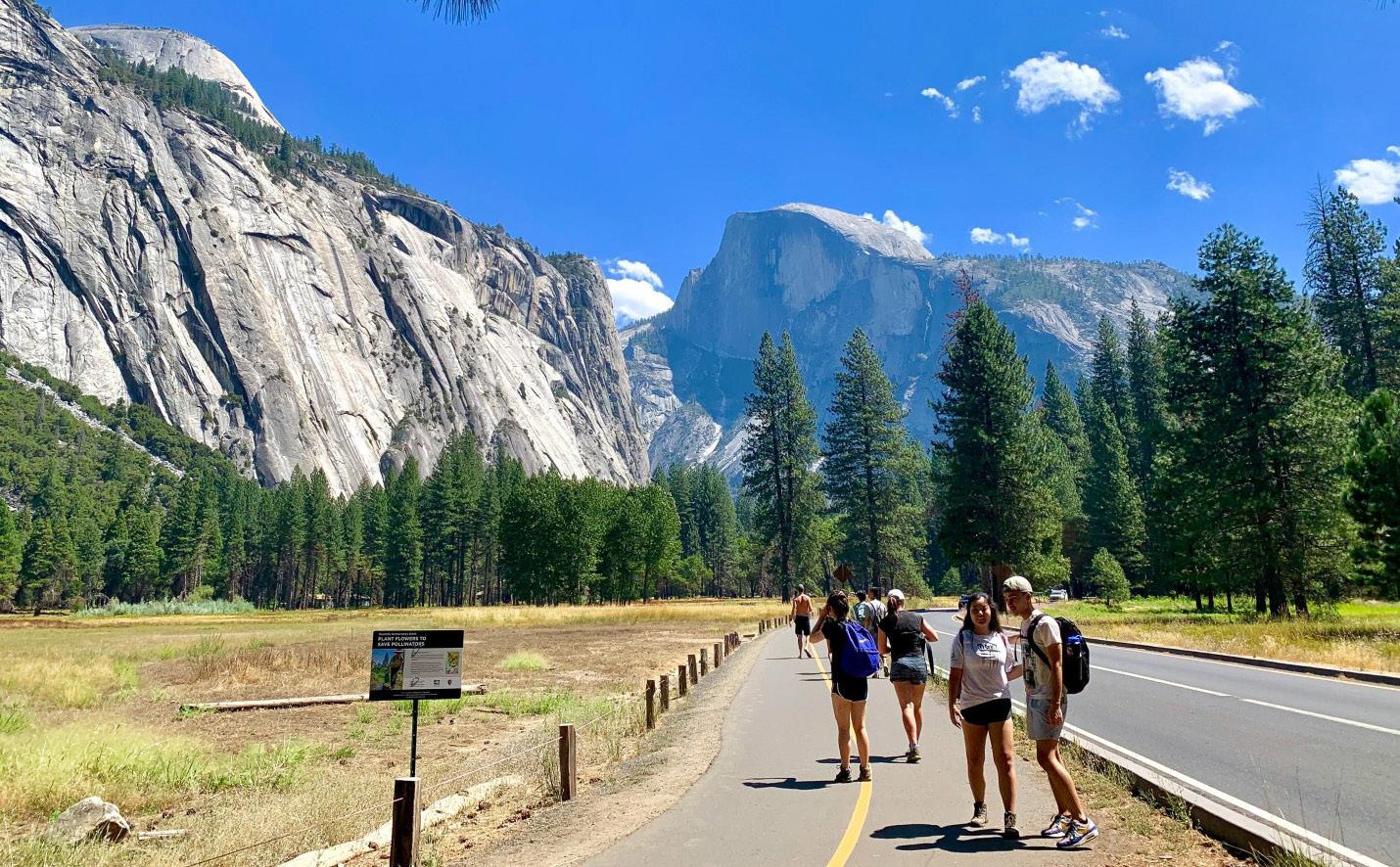
U.S. national parks have been running on skeleton crews and dipping into their emergency funds to continue operations since the government shutdown began Oct. 1, impacting students and clubs across the 5Cs.
By day six of the shutdown, nearly two-thirds of park employees had been furloughed. Those who remain are working without knowledge of when they will receive their next paycheck. Many of the 5C students who visited parks over fall shutdown.
“It felt very understaffed,” Eliza Cole SC ’28, who went to both Sequoia and King’s Canyon, said. “There were a lot of people there, but every
single one of the visitor centers running, there was maybe one gift shop open across both parks, and I think we saw maybe two park rangers the entire time.” in national parks likely wouldn’t deter her from returning, but she feels like this results from her comfort in the outdoors.
“I feel like I have more experience outside,” she said. “I have my Wilderness First Aid (WFA) more prepared in cases of emerlike your average person would
5C outdoor clubs have also seen the shutdown’s effects on national park services. On The Loose (OTL) is a club that runs a variety of free outdoor trips for
ARTS & CULTURE

The Haunted Tiny Patio Concert transformed the Hive into a Halloween haven last Friday, Oct. 24 — the second Hive fall concert this semester. A large Scream-themed Haunted Tiny Patio poster hung on the wall, framed by bat and pumpkin garlands, while an elaborate spread of Halloween-themed food
5C students; staff member Alida Lissak SC ’28 said the shutdown has created confusion for people involved in the club.
“I think uncertainty is probably the biggest way we’ve been impacted,” she said.
Lissak said that recreation.gov, one of the primary websites OTL leaders use to plan trips, doesn’t have updated information on the status of national park campsites.
“You don’t want to plan this whole trip and then get there and not even have a campground,” she said.
Looking beyond planning, as the shutdown continues, safety may become a greater concern for of participants to WFA/Wellness

established norms and institutions “disconcerting,” and sees Proposition 50 as a possible way to mitigate this. “What do you get by trying to play fair against the team thatence?” Mathewson said.
Miller pointed out that those voting “no” on Proposition 50 are likely concerned that break-
ing the state’s norm of drawing district lines with a non-partisan, independent redistricting commission could lead to future gerrymandering in California and other states, resulting in a misrepresentation of voters across the country.
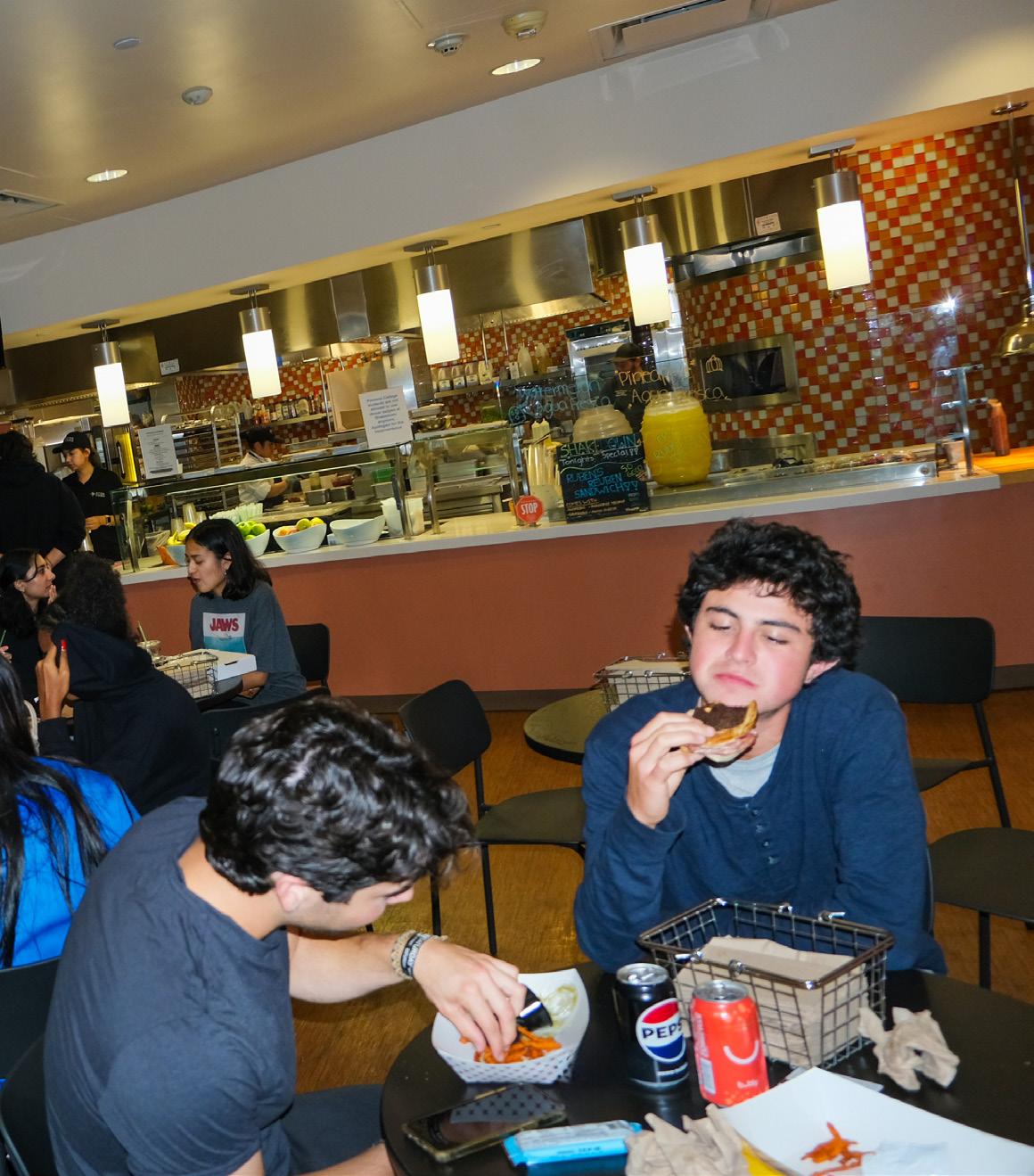
Popular late-night dining option on Pitzer College’s campus, The Shakedown Café, announced on Oct. 20 that Pomona students will no longer be able to use a meal swipe at the establishment. Previously, all 5C students were able to use a standard meal swipe to pay for food at The Shakedown. Pomona College made the decision and said in email correspondence with TSL that “crossover meals” are only meant to be used at 5C dining halls during standard meal times.
“Recently, we learned that
some dining locations outside of these times, like retail shops on other campuses, have been accepting crossover swipes,” Chief Communications Officer Eric Abelev wrote on behalf of Pomona. “To align with our original dining policy, crossover meals will now be accepted only during official dining hall meal periods at 5C dining halls.” Miguel Menjivar, Pitzer College dining services general manager, said that he received
ALI MERZ
5C community members anticipate the vote on Proposition 50.
COURTESY: OUTDOOR EDUCATION CENTER
U.S. national parks have been running on skeleton crews and dipping into their emergency funds to continue operations since the government shutdown began Oct. 1, impacting students and clubs across the 5Cs.
MAGGIE ZHANG • THE STUDENT LIFE
Pitzer College’s The Shakedown Café announced Oct. 20 that Pomona students will no longer be able to use a meal swipe at the establishment.
AVA FLEISHER
PROPOSITION 50:
Continued from page 1
“There’s sort of a downward spiral we might enter into,” he said. California’s League of Women Voters (LWV) originally opposed mid-cycle redistricting but has since taken a neutral stance on Proposition 50; the Claremont College’s LWV chapter has followed suit. Leading up to this election, the group has hosted and particiinform both California voters on the ballot measure and out-ofstate students who are interested in the issue.
Alex Benach PO ’28, along with other members of 5C LWV, held an event with Miller and Pomona College politics professor Sarah Sadhwani earlier this month to answer questions about the topic.
Rather than advocating directly for or against Proposition 50, the event at large focused on education.
“I view [the event] as being a said. “Working through the issues can be very helpful even if [we’re] not saying that you should vote ‘yes’ or ‘no’.”
lack of political participation among 5C students, which he described as “apathy,” although he’s found the majority of those who are voting to have positive
“I think if you were to poll a bunch of people at the 5Cs and force them to make a choice between ‘yes’ or ‘no’ on Prop. 50, I think ‘yes’ wins,” he said. “But if you give them the option of not
doing it at all, I think that’s going to be the biggest demographic.”
Benach emphasized the importance of voting, especially because it’s typically very easy to do so in California.
“I believe very much in the sentiment that if voting didn’t matter, they wouldn’t try so hard to stop us from doing it,” he said.
As to whether or not Proposition 50 will pass, Miller feels positive, citing recent polling and the fact that it’s an “anti-Trump measure” in an “anti-Trump state.”
While the voter registration deadline was on Oct. 20, eligible voters can still complete sameday registration in person on Election Day, Nov. 4. Voting Election Day.
DINING CHANGe: Pomona
institutes new meal swipe policy at shakedown Café
Continued from page 1
a note from Pomona notifying him of the change; however, he did not have input in the decision as meal swipe policies are determined by school administration.
“Shakedown has always been a small, extra place where people who either get out of classes late or get out of their practices late can still go and use their [swipe] to have a full meal,” Menjivar said. Wade Lawson PO ’25 said he feels both disappointed and frustrated with the decision as an athlete who relies on The Shakedown for late meals.
“A lot of times, with practice and stuff, we don’t have the option to get full meals at the dining halls, so we rely on things like Shakedown to get an ample amount of food,” Lawson said.
Lawson said many other athletes share a similar frustration with the decision and are struggling to find alternative dining options.
The Coop Fountain, Pomona College’s campus cafe, only accepts meal equivalency from 3 p.m. to 5 p.m. During later hours, from 5 p.m. to 11 p.m., only Flex Dollars (also known as Board Plus Dollars) are accepted.
“It’s hard to want to spend $10 on an entrée at the Coop Fountain
when I would get less food than I was getting at Shakedown and I wasn’t even having to spend Flex,” Lawson said. Ben Fox PZ ’28 said that he understands the upset among Pomona students by the news, as they lose a late-night dining option.
“I feel like I want to be able to use a meal swipe at the Shakedown whenever, because that’s our only late-night option,” Fox said. “Especially because people have classes or sports which prevent them from going to the meal at the normal time.”
Fox said that places on campus such as The Hub Grill at Claremont McKenna College have similar policies that only allow their students to use a substituting meal swipe to pay.
“At the same time, I think that Pomona students still have three options a day for meals and two options during the weekend, and I don’t think it’s a huge loss,” Fox said. According to Menjivar, Pomona students only account for around 20 to 30 of the couple hundred “swipes” they get per night, most of which are athletes. He said that although business at The Shakedown has remained steady since the change was implemented, as the semester goes on, students will
begin to run out of Flex.
Though this change will likely decrease the number of Pomona students eating at The Shakedown, Menjivar said he still hopes to see students from the college at the café.
“I’m always happy to welcome people from other places too,” he said. “I really enjoy seeing people that I don’t really know at the door.”
Looking forward, Lawson said that he will have to assess how he can have full meals during the week in the absence of The Shakedown.
“Now I have to plan ahead and think about what I’m going to do with every meal, and I’m going to have to meal prep more than I thought I would with having a dining hall plan,” he said.
Lawson said that with a lack of adaptations to the Coop Fountain’s menu or meal equivalency, many Pomona students feel disappointed by the loss of dining options.
“Instead of limiting our students, if we really want people to go to the Coop Fountain, I think we should be promoting things at the Coop Fountain, instead of taking away stuff that has become a quintessential part of your college experience,” Lawson said.
Oct. 22
WORLD NEWS
• United Nations Secretary-General António Guterres warns it is “inevitable” the world will face “devastating consequences” from climate change; to support this, Guterres cited 2024 as the first time the planet’s average temperature exceeded 1.5 degrees Celsius over pre-industrial levels for the whole year
Oct. 24
• The United States Department of Agriculture (USDA) announces that the Supplemental Nutrition Assistance Program (SNAP) will pause new benefit issuances on Nov. 1 unless federal funding is restored; the USDA will not be using their emergency funds for this program
Oct. 26
• The New York City Board of Elections announces that there has been a record amount of early ballots
submitted for the New York mayoral race (160,000+); New York-registered college students have started receiving and returning mail-in ballots
Oct. 27
• of the San Bernardino County shot while responding to a domestic violence report; Inland Empire residents mourn, Rancho Cucamonga sheriff’s station
Oct. 28
• Governor Gavin Newsom orders a preemptive deployment of 129 firefighting personnel and resources to Los Angeles and Ventura counties ahead of forecasted high winds, heat and low humidity — critical
UPCOMING
• The last day to vote on Proposition 50 is Nov. 4
PARK PROBLEMS: Government shutdown threates access to outdoors
Continued from page 1
First Responder (WFR)-trained individuals for backcountry trips, and all backpacking trips have satellite devices so they can reach their club adviser in the event of an emergency. However, the lack of communication between park rangers and to running safe trips.
People of Color Outside (POCO), a club that runs trips to local outdoor spots and national parks for students of color at the 5Cs, has also felt the impacts of the shutdown.
“It’s so important that these parks are able to operate as normal,” Sey Wong PO ’27, the president of POCO, said. “It’s a big concern for us because I feel like with the government shutdown, it’s just another barrier of entrance to these wonderful outside spaces.”
Students attending POCO trips haven’t yet expressed any major concerns about the shutdown, Wong said.
“But I think if the government stays shut down, concerns may arise because at a certain point park rangers will stop showing up to work or things like that
will happen, and we might have to adjust some trips just to be safe and make sure that we’re keeping in mind everyone’s best interest,” Wong said.
For Mariana Barr SC ’28, a founding member of the 5C mountain biking club, the shutdown means a loss of communication with other stakeholders in public land use. mountain bikers to have access to well-maintained trails that are public and that include cohesionnities,” she said. Now, with the government shutdown, it has only become more difficult for public land to serve everyone and still be maintained.
“The cuts to public land and work in public land sectors [make] it harder to have cohesive conversations that actually make progress towards public land use that is
As the government shutdown and funding cuts continue, Barr encouraged people to take action to protect the lands they use.
“Sign petitions, advocate, talk about it, make sure to go out and use the land, because it shows that people want to have access to public land,” she said.
Canvas and power outages hit 5Cs on same day
On Monday, Oct. 20, the Claremont Colleges experienced a dual outage by day, and a power outage by night.
Amazon Web Services (AWS) is a cloud-computing platform that hosts online services like Venmo, Snapchat and Canvas. Early Monday morning, AWS had a massive outage, bringing down thousands of websites and applications across the Internet.
Kit Kumar CM ’26 said their experience in a finance course Kumar said that students are usually required to download materials from Canvas to use during the class. Their professor also didn’t material in his Google Drive.
“The professor tried to draw out an Excel spreadsheet on the to say, did not really go as well as he had hoped.” John Pitney, a government professor at Claremont McKenna College, escaped the Canvas shutdown relatively unscathed due to his blog.
For 15 years, Professor Pitney had uploaded all of his lecture notes and syllabi on a Blogger site for his students. Although Canvas was shut down, he and his students were able to access all the material they needed.
“I just sort of got into the habit of using Blogger, and that enabled me
went down, and now Canvas,” he said. Pitney said he has never had an issue with Blogger, which, during previous shutdowns of learning
management systems, has been like a “Lexus lane” during a
“Students sometimes roll their eyes when I mention Blogger, because it’s associated with blogs, which is the kind of technology that people’s grandparents use,” he said. “But it’s handy, it works and I expect to keep using it.”
AWS repaired major issues by around 4 p.m., but the day’s hurdles were far from over. At around most areas of the 7Cs. Repair work was scheduled from 9 p.m. until 2 a.m. by the electric utility company Southern California Edison. For this, power would be shut down momentarily at 9 p.m., but substation generators across the campuses were expected to kick in for the duration of the work, according to an email sent to Scripps College students. “A brief outage of less than 1 minute is expected as we transition from SCE power to generator power,” the email read. “It is not expected that this outage will in the residential system.”
But Edison initiated the drop 30 minutes early, disrupting the 7C electrical system and “resulting in a malfunction,” according to an email from The Claremont Colleges Services (TCCS) Vice President of Finance Vanessa H. Aguirre.
“Because the power was cut earlier than planned, the substation electrical equipment did not transition,” Aguirre wrote.
Marian Mahasantipiya PZ ’27 had an econometrics midterm scheduled for the day after the outages. Initially, with the Canvas outage, she said that she was able

to “go back and forth” with her professor to send her the necessary documents. But two hours after she got them, the power went out.
“I really needed to sit down and focus and learn material in the short time frame before the exam, so the outage and Canvas not working interrupted those
With her phone and iPad close to dying, Mahasantipiya also said she was worried she “wouldn’t be able to study and do well on the midterm.”
Following their troubles with
Canvas shutdown, Kumar said that they had to confront the issue of their medication, which requires refrigeration, during the ensuing power outage. During planned power outages, they said they can prepare for the outage by stocking extra ice in their freezer or moving medication into an icebox. This unexpected outage took them by surprise.
“I wasn’t concerned for the it was not good,” Kumar said. “As time went on, I was like, ‘Okay,
well, there’s not a lot I can do because if my power is out, everyone else’s power is out.’” They said the lack of updates from the administration and Edison Power was understandable but still unfortunate.
“I only got all their communication when power was restored,” they said. “I appreciate they tried to communicate, but also, fundamentally, that’s not terribly helpful.” TCCS told Edison to cancel repairs and “restore power to the campuses as soon as possible,” according to Aguirre. At around 10 p.m., the power returned.
NERGIS ALBOSHEBAH • THE STUDENT LIFE
The Claremont Colleges experienced a Canvas outage by day and a power outage by night on Monday, Oct. 20
KAHANI MALHOTRA
Adrianne’s Crossword:
10. Accidentally reveal a secret
Three-wheel ride
Red ___ (cinnamon candies)
Second degree, maybe
Bad blood
Redding who wrote “Respect”
Downhill trail
41. Father, to a baby
“Oh,

Center
Second word in most fairy tales
Reduces, like anxiety
College admin
* They’re out for blood
Big jerk
401(k) alternative
Airport ticket info
Keep score
Showed the show again
day to dress up as the starts of 16A, 25A, 39A, or 51A?
66. Thing you don’t want to
‘Progress, not perfection’: Body Compassion Week at the 5Cs
Body Compassion Week kicked of six body-positivity events over four days across the Claremont College campuses.
According to the assistant director of Health and Wellness at Tiernan Field House, Mayra Mendoza, Body Compassion Week is organized by the ED-RISE (Eating Disorder Recovery, Inclusion, Support & Education) team led by Whitney Tawney, in collaboration with partners across the Claremont Colleges. Tawney is a registered dietitian at Nutrition Services at the Claremont Colleges’ Student Health Services (SHS).
“The main goal of Body Compassion Week is to remind students that body acceptance is a journey, and that compassion, not criticism, is what helps us feel more at home in our bodies,” Mendoza said. “The week promotes the idea that everybody deserves care, rest and respect, regardless of shape, size, ability or where someone is in their wellness journey.”
Maristella Valore-Caplan SC ’28, who serves as body image and diet culture peer health educator at Tiernan, co-hosted the Body Diversity Pumpkin Painting Event on Wednesday, Oct. 29. The event took place on Elm Tree Lawn in collaboration with ED-RISE. According to Mendoza, the event aimed to on the beauty of diversity, like in sizes.
“The goal isn’t to change people’s relationships with their bodies in one week,” Valore-Caplan said. “Instead, it’s to be a positive reminder that how your body looks
has no impact on your worth as a person and that you deserve to celebrate yourself.”
While the pumpkin painting took place at Scripps, more events were hosted across the 5Cs, including Roberts Pavilion, the Poand Wellness (CARW), McConnell Dining Hall, the TCCS Library and Flamson Plaza at Claremont
McKenna College.
According to Mendoza, the idea for Body Compassion week stemmed from NEDA’s (National Eating Disorders Association) annual Body Acceptance Week.
“Body Acceptance Week is a reminder that all people and bodies are worthy of acceptance and empowerment,” NEDA CEO Liz Thompson wrote in a statement when the project launched in 2021.
ED-RISE has adapted the idea behind the week to prioritize compassion rather than the journey of acceptance.
“We want to remind everyone how important it is to show compassion to our bodies, no Mendoza said. According to Mendoza, many students experience body dissatisor stress related to appearance in high-achieving college environments. Valore-Caplan said that Body Compassion week helps to counterbalance constant pressure on bodies and how they look in society. She thinks people’s language can subconsciously further these issues.
“When people joke about beinging the idea that fatness is a negative trait,” Valore-Caplan said. “I hope these events can serve as a

space for people to recognize that all bodies deserve kindness.”
Mendoza said that one challenge associated with Body Compassion Week is ensuring that all messaging remains inclusive and sensitive to the varied experiences students have with their bodies and eating, as well as reaching students who might be struggling privately.
“Body Compassion Week is about progress, not perfection,” Mendoza said. “Our hope is that every student walks away with one small act of kindness they can rest, nourishment, movement or gratitude.” Nutrition Services is overseen by SHS, and provides individualized nutrition counseling and sup-
port to students with various health and nutrition-related concerns. Students can access free nutrition therapy services by calling SHS or Monsour Counseling Services (MCAPS) to set up an appointment. According to Mendoza, Tiernan Field House’s Peer Health Educators can also connect students focused on nutrition and recovery.
Aliens, dismemberment, and psychosexual terror

and morph under Anna’s care.
contains discussion surrounding sexual content, and miscarriage.*natural psychological horror film
The main character, Anna, abandons her family and her husband, -
grotesque and otherworldly than -
analysis of the film — examining its plot, central themes, and cinematography — before concluding consider its most powerful scene. For Liu, the film centers around the breakdown of marriage — but there is an underlying theme of repression. This repression manifests in the characters, but tentacled creature we watch grow
festation of Anna’s desires and partnership, tender and paswhich she can find in the cold, Instead, she finds them in the creature, hidden away in her secret apartment, a grotesque, pulsating lump of flesh. Anna’s become this monstrous entity. The more she represses her desires, the more the creaturecomplex throughout the film, its metamorphosis speeding up to match the pace of her deteriorating marriage. As such, an unhealthy relationship dynamic exists, Samson argues, ultimately leading to the deterioration of the two protagonists’ psyches. As their marriage progresses, a discrepancy grows between their true identities and their idealized counterparts.
An integral aspect of this theme is witnessed in their standards they hold each other their son Bob’s schoolteacher, who is a spitting image of Anna. how Helen’s demeanor symbolizes the docile, compliant, madesired in Anna.
is a grotesque, alien-like creature with whom Anna shares a hidden intimacy. This peculiar character symbolizes Anna’s guilt and detachment from her the monster repulses outsiders, it offers solace and normalcy to Anna amid the chaos of her marriage.
Their marriage, and the film itself, are dominated by bleak the characters act increasingly more irrational and the occurmore surreal.
There is an ongoing sense of as they sink deeper into self-destruction throughout the film’s progression. Samson best labels -
a fourth wall between actors and scenes where Anna stares directly into the camera, daring us to judge her.
The unsettling crescendo culminates in an ending scene that oozes apocalyptic dread, with the reality constructed for expectations upending and tearing apart. Liu sees the finale as jarring because no rational bounds of the film’s constructed reality, can account for what we are left with a sense of impending doom. Contributing to the bleak and eerie nature of the film are the symbolism and imagery used
no logical purpose in the plot but are placed deliberately to audience. In a scene where her extramarital affair, intense sensory imagery transforms an ordinary domestic scene of a housewife preparing dinner into a sinister one.
The kitchen they stand in is clinically white and clean, noticeably marred by the startling red of the bloody meat that Anna hacks at with anxious urgency. As the atmosphere of the scene swells with tension and
the dreadful wail of the meat grinder, as pulpy red ribbons ooze from its mouth.
Anna does not utter a word throughout the sequence, permeating the scene with a palpa-
ble tipping point. Additionally, we found the experimental camerawork in-
most sterile manner, with some scenes being recorded in full with little to no stylistic camera
As their relationship proof tracking shots, wide-angle composition becomes increasingly utilized in a manner that feels almost irrationally disorganized.
Towards the film’s climax, when Anna runs haphazardly through the subway station, the camerawork becomes so disorderly that it almost feels out of step with the chronological plotline. But this enigmatic style of filmography is entirely
audience to a performance not meant to be seen.
One prominent scene in the film is the infamous subway scene, where Anna experiences a miscarriage, aimlessly running alone throughout the station and yelling out in pain. It is
rage, fear and hysteria at its mostgraphed expression of emotion that is so disturbing because it is so raw.
objectified and dismissed in her roles as both mother and presence, he abandons Anna tobility during her miscarriage in the subway. In many respects, Samson sees this moment as both transfor -
release as she unearths the most profound depths of her psychological agony.
The typical depiction of female presented with palatability in their makeup remains in full tact, of collectedness and ultimately fall apart in a sterile, unthreatening manner that I feel strips rage of its true nature.
Anna’s breakdown is dissporadic mannerisms are not spectacle, but rather to shock and disgust, and most fundamentally, to resist.
The irony is that despite the

It feels like Anna is being tortured, her body and mind subjected to abuses beyond com prehension. She is possessed by a force beyond rationaltion and free will as she slams into walls and emits noises of pure despair. Simultaneously, her body seizes with increasing passion, as if she’s relishing in the expression of her emotion. She loses her grasp on reality while simultaneously letting it go by choice. It is both terrifying and liberating. Ava Samson PZ ’28, recommends David Lynch’s “Inland Empire,” and Angelina Liu PZ ’28 recommends Satoshi Kon’s “Perfect Blue” if you are intersted in more unerving and scary watches this October.
A matter of right person, wrong time
KASSIA ZABETAKIS
It’s strange how two people can be so perfect for each other, but it just can’t work because the timing isn’t right. Think Jim and Pam from for them.
quite literally met at the wrong time — she’s in the future while he’s in the past.
book publicist who pours herself into her work and is aiming for a and hates new things. She has a whimsical aunt, Analea, with whom woman who danced in the rain and Analea passed away six months ago and Clementine inherited her Upper East Side apartment.
Clementine’s aunt always told her the apartment was magical. She explained how the apartment could take you forward or backward in can control when it happens, though the apartment always seems to know when the time is right. Clementine
Clementine paints in the bathtub and is a terrible cook. Thankfully, 25-year-old gray-eyed man aspiring to become a professional chef. She initially thinks he’s a criminal trying to kidnap or murder her. Slowly, she Southern accent. I know a meet-cute when I see one.
Clementine realizes there was truth in her aunt’s legends. She realizes that Iwan is genuinely staying in her apartment for the summer, exthe past, when the apartment still belonged to her aunt, who was abroad at the time. She walks through the door and is transported to the past, before her aunt passed away, before she became a book publicist and For as long as Clementine can remember, her aunt has had two
and commitment in Clementine. It was quite painful to watch her interrupt her romantic moments with

thoughts about losing Iwan and for him because it would only end poorly. I wanted to scream at her his delicious food and let the cute guy kiss you!
I enjoyed the romance between Iwan and Clementine. The two hit
was a burglar. Things between them only got more comfortable. Their banter was playful and cute, and it was fun to see Clementine
while also fantasizing about what colors she would use to paint his eyes and blush at the sound of his nickname for her.
After a dreamy weekend spent eating Iwan’s fajitas and lemon pie,ment and go back to her present real world. In this real world, Iwan
is a 32-year-old famous chef opening a new restaurant and Clementine is in the running to work with him on his new book. He’s changed a lot — he’s no longer the wideeyed boy he was. Clementine thinks he’s lost important parts of himself, but I think she just needed to realize
A lot of things can change after because I knew about the time a rom-com with a unique twist. the uniqueness of it, and enjoyed how lessons about grief and change were shown throughout the book. I got to watch Clementine learn that it’s okay for things to be ephemeral, for people to change. I especially enjoyed watching her realize that the career path she’s going down isn’t what she truly wants. It was reassuring
as an unsure college student who hates the question, “So what do you Some of me feels like the book Iwan and Clementine had one that), but it felt like things were not ending up happily together. As frustrated as I get, I think a good my tongue in stress until I’m sure protagonist. But then again, maybe I’d complain if things were too complicated. I sure would be frustrated if I had to read this story from only had to wait months for this sto-
years for you. Sure, he dated other he remembered her yearly birthday she liked.
books with only corny writing that makes reading an exercise in cringe of cliche, who doesn’t, it’s nice when it’s limited. And I’d say this book had a good ratio of cliche to serious to beautiful writing. The book nicely touched on grief and loss through Clementine’s aunt. It was heartwarming to read about their relationship and how Analea
It’s always nice to see when a rule-follower has a rule-breaker to balance Analea, a part of me kept thinking to Clementine learning life lessons from By the end, Clementine learns to accept 32-year-old Iwan for who he is, rather than noticing all the things accept the changes in life while also book was an uplifting reminder that we’re all constantly growing, and that may be scary but should also be exciting!
It was a quick and easy read, and I liked the plot. I would recommend it! I feel that this is one of those books time reading, because I’m sure there eggs to notice in both timelines. The true magic lies in the lesson that a strong connection isn’t always enough — sometimes, two people
life and people to change, and that you from choosing the right path. I to anyone looking for a fun rom-com with a touch of wisdom.
Kassia Zabetakis PZ ’28 loves speeding through romance novels in only days, but usually ends up hating them after she’s done.
ANGIE LU & AVA SAMSON
SHIXIAO YU • THE STUDENT LIFE
MEIYA ROLLINS • THE STUDENT LIFE
BOOKS ‘N LOVE
DEEP FRIED CINEMA WITH ANGIE AND AVA
s cripps Advocates evolve amid renewed 5C collaboration

COURTESY: SCRIPPS ADVOCATES
tens to another, sharing resources andcates, a peer support program training misconduct. The program, long es-
paired with mentors and focus on community building. Their goal is it easier to ask for help, and easier to are extending their mission beyond Scripps. They are strengthening ties across the Claremont Colleges, build-
ing bridges in a fragmented system where each campus has its own
her freshman year, she quickly realized how urgent the work felt on campus. “I became aware right away of
the gray area where there is alcohol or consent for some things but not others. People feel shame and think their situation is not serious enough As co-head, Akhmetshin has decision-making, instituted mentorship for new members and re-nity bonding. Akhmetshin is also focused on expanding support for queer students.
our students of color and queer
recently collaborated with campus groups like Scripps Communities of Resources and Empowerment, the Queer Resource Center and
members share this spirit of in-
school.
member a time when the group felt
misconception about the scope of the “Sometimes people think we do not really do anything because we are not Title IX, but our support
also broadened practical support on campus. They expanded harm
gency contraception and menstrual products in residence halls and
In addition to this practical support, current leaders are focused on rebuilding trust with the student body. Junior co-head Hanna Shi-
Haunted Tiny Patio Concert: The Hive’s celebration of student creativity
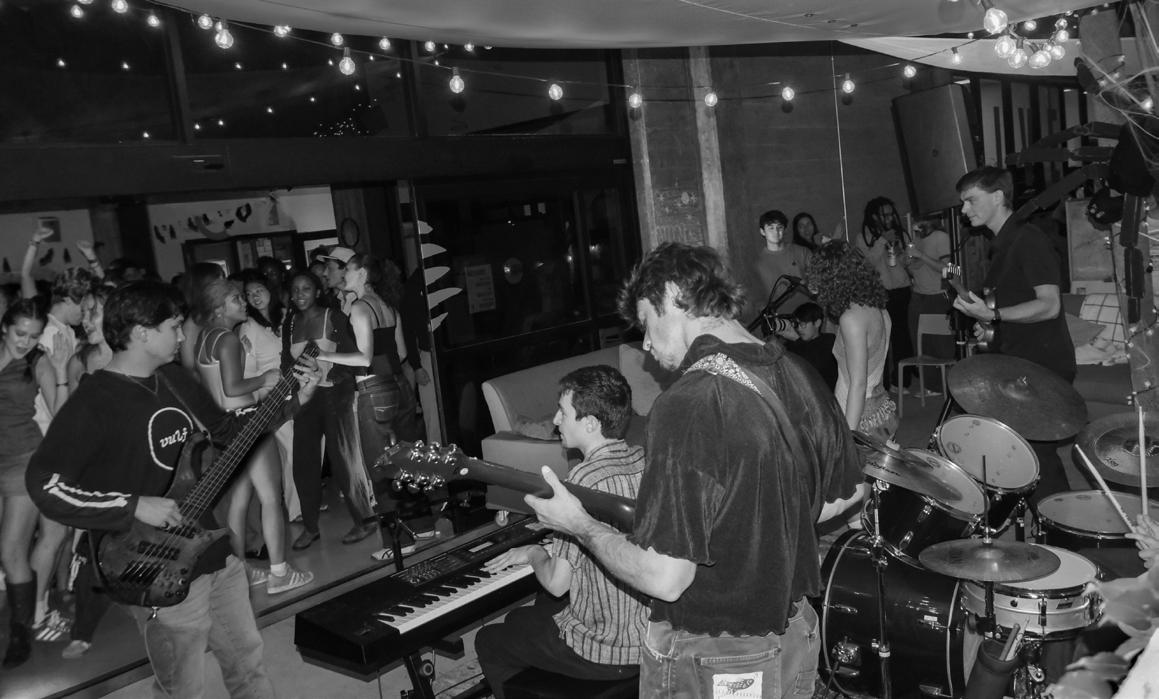
last Friday. They saw a small outdoor stage framed by rows of chairs on either side, while cobwebs and a giant fake spider added to the spooky Halloween atmosphere.
The Haunted Tiny Patio Concert, held on Oct. 24, was the second fall
to share their music in an open and by friends and familiar faces.
Reese Roseback PO ’25 and Salina Concerts in addition to their many other responsibilities. They describe anyone from the Claremont Colleges can design, work on academic and Tiny Patio began two years ago -
it did not disappoint.
Tiny Patio Concerts are an example
Last Friday, the space was completely transformed from the bright, open studio students are used to. A Tiny Patio poster hung on the wall, framed by bat and pumpkin garlands, while an elaborate spread of Halloween-themed food and drinks greeted
By the end of the night, the nearly empty boards made it clear that the charcuterie spread was a crowd fa-
“They had hot apple cider and -
rows of chairs outside were empty and only a few people were gathered
stopping to grab a themed snack before sliding into their spots. By the end of the night, the Tiny Patio concert was packed.
The concert opened with a per-
song, something shifted — the eyes of the audience disappeared into the naturally. Inspired by their dad’s guitar was poetic, rhythmic and folky.
The original songs they shared are a blend of emotion and inspiration.
“Original songs are capsules of
After attending the first Tiny Patio concert in September, they
sign-up for performers, something that they assumed would be highly
two original songs that stirred a though untitled, carried a story that she shared briefly after finishing her song.
an equally heartbreaking and lyrically jarring piece — one that lingered long after the last note.
they swapped the soft, folky tones
of the two guitarists for bass and raw intensity. Their set included three
the audience with an original song that showcased their unique sound and group chemistry. Although they were introlater turned to the audience for help choosing a new name.
silence — half amusement, half second-hand embarrassment — before the lead singer broke the silence and quipped, “I think that’s
lem Dafunk’d closed out the night pop. The band of six came together in the beginning of this school year connections.
group, there was no sign of ner-
Drummer Emerson Laporta quickly gained confidence and music.
sphere of jamming with a bunch Laporta said.
Their contagious energy radiated into the crowd — across the audience, smiles spread wide and heads nodded along to the rhythm. The excitement reached an all-time song, prompting the audience to burst into cheers and chants of
up and dance. And dance they did.
performers stopped focusing on remembering the lyrics and the audience stopped caring about let loose and danced.

skepticism remains — especially among upperclassmen who rememIn past years, low participation able to accomplish as much or build Akhmetshin said. Shigemitsu agrees that the group needs to focus on consistency and
Part of the student confusion stems from the colleges’ independent operations. Each campus’s Adbudgets and training, so when a case crosses college lines, students can be unsure where to turn. This year, Akhmetshin and Har-
that campus culture shapes each program’s focus. For example,
foster a culture of consent.
campus’s distinct culture.
“It [represented] a recommitment to tackling the issue from multiple
explaining that the meeting represented a broader commitment towards consent culture and community building that isn’t limited by campus boundaries.
“I hope we can help all 5C students feel safe, welcome and familiar with all campuses, especially when
a Halloween safe-partying workshop
come in increments. As Akhmetshin and Shigemitsu note, change is often slow and ongo-
begin to talk, meet and listen more, the circle of care — a reminder that real change rarely comes all at once, but often starts with someone willing to listen.
Neurodiverse Pitzer alum Joshua Corwin flips the script on the adversity he’s faced
When Joshua Corwin PZ ’19 was a student at Pitzer, he once got a 13 out of 100 on a midterm.
On Wednesday, Oct. 22, the
As they prepare to enter the Corwin studied math and the Month award and a Pushcart students.
thought is the worst things that going on and who you are, how you discrimination at one of the graduate other programs and was accepted at Corwin emphasized how these am autistic,’ and identifying with that determination and persistence in his

JOSEPH WOO CHAN
MAGGIE ZHANG • THE STUDENT LIFE
KIRA HELLER
MARIA ALCANTARA
Joshua C orwin spoke at Pitzer.
SASHA MATTHEWS • THE STUDENT LIFE
C andy Summoning, Wizards Wizard Weekly
T he Hive held a Haunted T iny Patio C oncert on Oct. 24.
Scripps Advocates support survivors at the college.
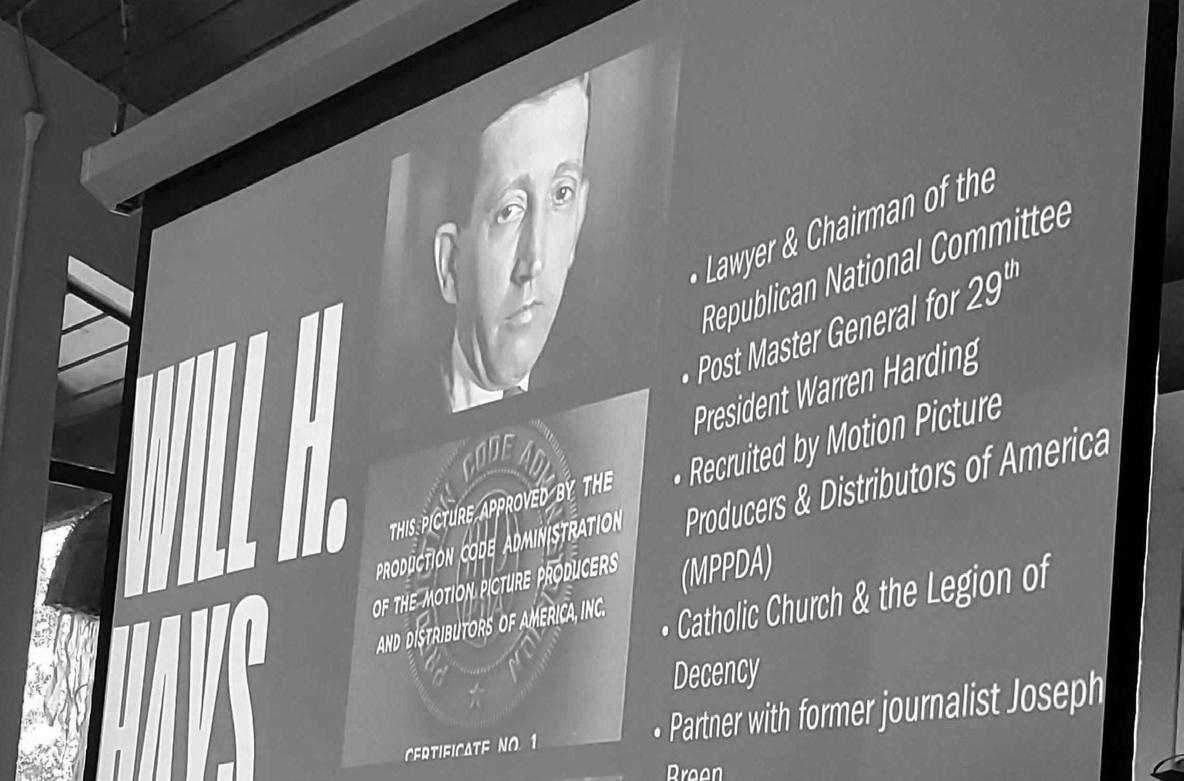
A talk with Marley Duncan on the Hays Code: Censorship and queer-coding
AUDREY GREEN
these traits ground the characters’ coding.
the president of the Motion Picture America at the time. The Hays Code aimed to
Under the Hays Code, characters
astonishment at the thought of this
Crush course in crushing

Pichu said.
crush and how, when we get crushes,
fantasy. is yes.
happens when a guy has a crush on he said.
the same gender as the person we emotions with that same depth. My friend Pichu reinforced
Though terrifying in nature, sometimes we are forced to con front the issue of confessing to a with, which another one of my guy friends mentioned in passing. form of temporary insanity that in the same way.
“while it is impossible to make a competent writer out of a bad writer, and while it is equally impossible to make a great as much as the next person, but I am not here to argue with can outlast truth. He isn’t wrong.
Arguably the most important register of writing, it is also the cruelest. The ugly truth is that can study syntax and rhythm, editing your sentences until they pop. when one doesn’t exist. Hence
week.
if you read it again, the quote
actly is the word ‘while’ doing there? Isn’t that an incomplete
words.
make a competent writer out of a bad writer, and while it is equally impossible to make a great writer out of a good one, it is possible, with lots of hard work, dedication and timely help, to make a good writer out
next American literary giant, probably not into a genius either, but into something sharpthe interest of our short time
The simple answer is you should read and write more.
in the absence of natural talent, there aren’t many other cards work. There is no enchanted will transform your writing
For most writers who face these problems, reading is the sole most important thing for write well if you don’t read. Reading is how you absorb instinct, how you learn rhythm, pacing, structure and syntax, transition to your writing. widely, the mind starts to subconsciously internalize dialogue is structured, how pacing works. In short, you begin to feel what good writing sounds like, far before you can produce it.
COURTESY: QUEER RESOURCE CENTER OF THE CLAREMONT COLLEGES said.
content warnings. This is another
tropes as a means of representation Hays Code.
identity.
Why writing is unfair — and why that’s ok!
Perhaps most importantly, reading multiplies experience. Reading broadens your emotional and intellectual ranges, otherwise be exposed to. If the best writing stems from experience, then you cannot write well if you don’t know what good read more!
of the puzzle, the physical act of writing. As important as reading is, it means zilch if you don’t translate is where you transition your learned instincts into muscle memory. It is a trying process sentences that almost work. But it should teach you patience, or at least endurance, amidst the frustration.
one thing to read 5,000 words in a day; it’s another thing entime-consuming and it sucks sometimes, but through the efown tics, habits and blind spots, repetition. Reading and writing must -
reading is like trying to play jazz Armstrong or Duke Ellington. Reading without writing is like studying those same musiciansment.
the writing and reading begin to blur together, until something strange happens. The
sentences begin to feel like you. It’s a quiet transfor - mation until it isn’t. One day, you’ll wake up, sit down and notice that the sentenc es that once felt forced feel natural, that the dialogue you when that happens, you should feel incredible, because you fought so hard for it.

this absurd statement make his mock aspiring writers, but to reach possessing a relentless work ethic. them. They aren’t grand (no pixie dust!), but they are real, teaching grammar, sentence structure isn’t promising genius, instead, stripping down writing to the and write. or Jonathan Lethem. But you’ll be something, that’s for sure.
fantastic; the perfect example of unwill ever truly succeed, and suspects that’s exactly the point.

OTTO FRITTON
COURTESY: KEVIN PAYRAVI, WIKIMEDIA COMMONS
SHIXIAO YU • THE STUDENT LIFE
TOM CAT
NO SEX IN THIS CITY
Otto Fritton shares about problems that
process.
WRITING PROCESS
Behind The Claremont Independent: Its origins, funding and wider impact
MYERS
SOPHIE
NADIA HSU
AKINS
ADAM
The Claremont Independent (The CI) describes itself on its website as “a national thought leader and a powerful voice on behalf of those too few or too quiet to defend their own right to speak and be heard.”
with any of the 5Cs and reports primarily on campus news, with an emphasis on in-depth investigative pieces and op-eds that tend to lean conservative. They currently only publish online and list their physClaremont.
The CI recently came into national focus after The U.S. House Education and the Workforce senting student disciplinary records related to alleged “occurrences of antisemitism” on campus to be turned over by April 10, 2025.
The letter, sent on March 27, -
of the May 2024 student encampGabrielle Starr’s house and the April 2024 arrests of students at The CI now boasts that their news coverage “has even reached the halls of the U.S. Congress.”
lished an article titled “5 Hours in Carnegie Hall - A Full Account of includes names of professors and dozens of identifying photos of students at the protest.
Given their national spotlight, this article seeks to dive deeper into The CI as an organization. Where did they originate? As the only student-run newspaper based at the 5Cs that receives funding entirely from private donors, where does their funding come from? And what role do they play in the political landscape on campus and beyond?
Origins
The current CI was founded in 1996 by two Claremont McKenna College students, John Nelson CM ’98 and Ashwin Navin CM ’99. Both Navin and Christopher Skinnell CM ’99, who together served as the paper’s inaugural editors-in-chief, currently sit on the Board of Governors of CMC’s Rose Institute.
The CI began as a revitalization of a previous “Claremont Indepennewspaper started by several conIn their first issue, published in November 1996, the editors of The CI write that the earlier Claremont Independent disappeared when their donors “grew disenchanted diverse” and turned into a “homogenous left-wing freak festival.”
’27, current editor-in-chief of The -
Before leading The CI, Navin had previously published an opinion in The Collage, a weekly 5C paBuchanan rally. Navin bemoaned the close-mindedness of his liberal peers, writing, “Not one of them could cite evidence of their claims,

and tragically, not one of them was thinking for themselves.” He would go on to co-found The CI a few months later.
In their founding issue, The CI’s editors cite disagreement with The Collage as a key impetus for starting their own publication, referencing the paper’s “halftruths and liberal lies.”
a special elections issue, especially focusing on the divisive California Civil Rights Initiative
ifornia — and the 5C campus protests against it, which reportedly became violent. Since their founding, The CI has provided space for conservative thought in the midst of campus-wide protest and unrest.
While The CI no longer mar-servative publication, they still emphasize themselves as a space for controversial, or unpopular, opinions.
Their website states that “college campuses have become increasingly hostile to reasoned debate and the discussion of unpopular views,” but that with the help of donations “we can keep
Funding
The original “Claremont Independent” was founded after receiving a grant from The Institute of Educational Affairs (IEA) as part of their Collegiate Network, a conservative “counterintelligensia” project started by Bill Simon and Irving Kristol in 1978. Simon was the former U.S. Secretary and Ford, and Kristol has been credited with the founding of “neoconservativism.”
The Collegiate Network served to promote “Western values” and “free-market” philosophy on college campuses by funding dozens of right-wing university publications, including The Harvard Salient, The Dartmouth Review and The Stanford Review.
While the IEA was dissolved in 1990, administration of their Collegiate Network passed to the Intercollegiate Studies Institute (ISI) in 1995, a year before The CI was restarted. A nonprofit dedicated to promoting conservatism on college campuses, the ISI currently funds over 70 student publications through the Network — including The CI.
Today there is minimal readily available information on who funds “The Claremont Independent” or how much funding the publication receives, beyond the fact that they receive no money from the Claremont Colleges. In
the “About” section of their website The CI states, “we are grateful for the generous support of private foundations and individualsnalism possible.”
The CI operates a 501c3 organization, Friends of the Claremont Independent, which reports annual gross receipts under $50,000, which do not include donor lists.
According to White, The CI receives donations primarily from 5C alumni and from two institutions: the ISI and The Fund For American Studies (TFAS).
“The Independent receives most of its donations from private donors, who are usually alumni of the colleges,” White said. “We also have two institutional donors that contribute small grants to The CI: The Fund for American Studies and the Intercollegiate Studies Institute.”
Like the ISI, TFAS is a think tank founded to push patriotic and conservative agendas in the states that they were established in response to “the counterculture and many youth movements of the 1960s,” which “rejected the American political tradition.” They now seek to instill “ideas of individual liberty, personal responsibility and economic freedom” in new generations.
In 2023, TFAS founded Theism (CEJ). Similar to the Collegiate Network — and headed by a former director of the Network, Ryan Wolfe — the CEJ targets student journalism. The initiative provides grants and support to select campus publications, and early-career opportunities to “conservative- and libertarian-minded journalists.”
The CI’s article “Anonymous Statement Defends Disruption of College” via their LinkedIn.
The ISI’s Collegiate Network is part of their overall mission to bring conservatism into higher state that “our nation’s civic life should be grounded in the full heritage of Western civilization.”
The ISI was also listed on the Ad-
Samuel Alito and Ed Feulner, founder of the Heritage Institute.posal authored by the Heritage Institute, one of the most prominent far-right think tanks in Washington, which gave the Trump Administration a pathway to a Christian Nationalist vision of America, championing rollbacks on minority rights and unprecedented consolidation of political power into the hands of
the president.
2025 agenda was halfway completed. The project represents the consolidation of the most powerful conservative voices in America today, and directly connects the Trump Administration to The CI’s sponsors.
online is a 2014 990 form, reporting around $32,000 in net assets. That 990 form also lists Anthony Fucaloro and Christopher Nadon directors and key employees. Fucaloro and Nadon were both CMC professors at the time, though Nadon left the college this year. Fucaloro and Nadon also both boast past articles in the “Claremont Review of Books,” a publication of the Claremont Institute, which Board member. White said that “The CI occasionally consults with faculty members for advice and guidance,” but that Nadon and Fucalassociated with the publication.
Broader Political Context
The CI is sponsored by the same forces that are targeting the activism of students and professors across America today. It is one branch of a broader network of student newspapers set up to advance a conservative agenda on campuses. Roger Ream, the president of TFAS, spoke in an interview this year about the motivations behind the organization’s funding of student publications.
“These newspapers accomplish two objectives,” Ream said. “They provide a training ground for conservative students interested in careers in journalism, and they inform students about what is happening on campus, which was particularly important
covering things on campus like they should have.”
legiate Network beyond The CI protests in ways that reveal participant identities. “The Harvard Salient” published identifying photos of their Spring 2024 student encampment, and “The Stanford Review” did the same campus rally.
Hall,” The CI itself had already covered the Carnegie Hall storying occupation. During that same time period, they published 24
additional stories, meaning that the Carnegie Hall occupation alone had already made up 31.4 percent of the 7, 2024 up until April 6, 2025.
The level of scrutiny on this one event feeds neatly into wider national narratives of campus antisemitism — narratives which materialize as federal and administrative repression of student stories about supposedly out-ofcontrol universities serve to justify government overreach into spheres of higher education.
Trump administration’s broader speech across college campuses. This repression has included threatening the residential status of students and scholars suspected activism, and revoking international students’ visas.
Öztürk, a doctoral student at Tufts University and Turkish national, was kidnapped by ICE agents in retaliation for an op-ed she wrote in a school newspaper criticizing Tufts’ administration’s response Months later, the pressure on universities, students and pro -
the university had given their personal information over to the Trump Administration as part of their cooperation with a federal investigation into alleged campus antisemitism.
Although they have distanced themselves from their more reactionary and blatantly conservative roots, The CI remains part of a nationwide project of student journalism meant to sow conservatism on college campuses and support the repression of student activism. Comment from The Claremont Independent:
“Donors, whether individual or institutional, do not have anydependent’s news coverage or editorial positions.”
“The request for comment which was provided to the Claremont Independent by TSL was overly comment on the CI’s ‘history’ or elements of those two things we are being asked to respond to. That we only had 24 hours to provide comment on such sweeping themes is a further source of frustration, particularly as TSL has been working on this article for over two months.”

Why San Quentin’s reform model doesn’t do
LEILI KAMALI a few career-training programs
In the class, we listened to with women held at the Central Chowchilla. We read the writingformers, California Department
on isolation and control cannot,
onto the yard, I realized how mispaint the walls softer colors, add
instead. To do that, we need to first
harm to others? If we define
path toward it.
core, economic, medical or psyman they can point fingers at rather than address the root of
any nation on Earth.

the trick
within the same year. Despite this pattern, Cal -
cycle of incarceration, operate
harm directly.
repairing the damage. When
Fewer than 7 percent of partici
pants are rearrested within two
The men I met that day are fathers, sons and friends. They are artists, singers and pro -
connection at all. To that end, it
Second, and most importantly,
ory from elementary school.
mother since he was two. Most
and reflection to accept that they At first, I felt an immense sense of pride for these men,
the inside. So, if we want more program-
First, these types of proeryone. There are long waitlists released within the same year.
more typical for the national is often limited to Alcoholics
peer-led circles for healing are
lated areas and positioned intral Valley, leading to limited
programming or interpersonal
pand incarceration, creating new carceral footprint.
to temporarily forget why we centers in the first place, and implications and aftermath of incarceration.
trapped in a system that defines
care. The moral test of a society is not how many people it can
Leili Kamali PO ’29 is a volunteer editor with “The Beat Within Magazine,” a publication disseminating the writing of incarcerated individuals across prisons and juvenile detention centers.
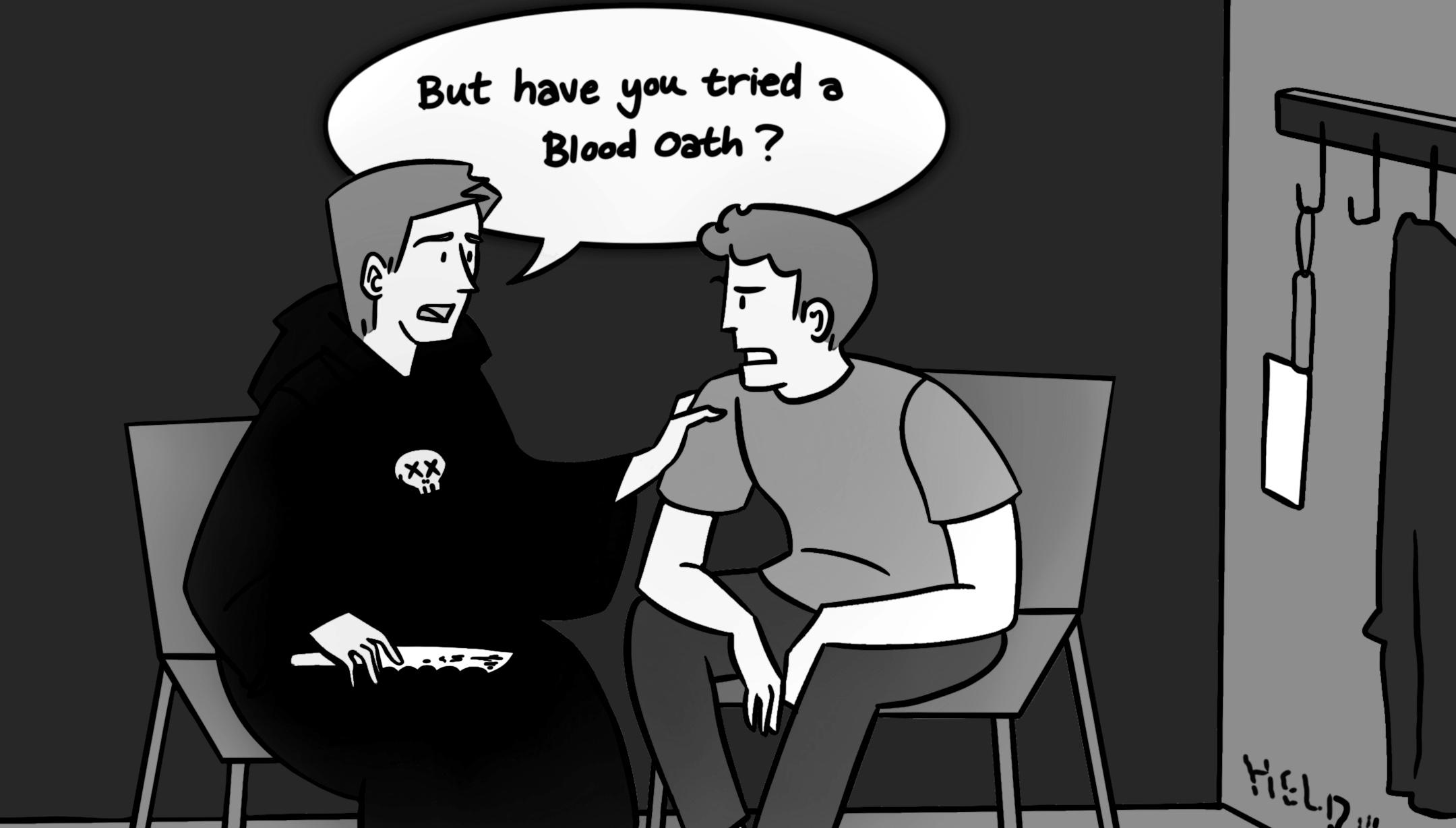
Chosen family is not enough, we must be blood brothers
ALEX BENACH
Last Friday, I was at a party with all my closest friends in the world: and Töhötöm. We were hanging
dence that there is a clear desire
dancing in candlelit circles are all
memorating important moments oaths are not solely a demonic practices is essential for fostering
identity.
COVID plays a role too, and may-
This imperfect storm has earned generation.
The male loneliness epidemic is life.
Other, potentially more tradi-
practice as a whole. Blood oaths stem from the em-

as necessary responses to this as it relates to social interaction.
reconnecting as a generation, we history
this too. parties or want to do something
MELINDA
Trump’s authoritarianism doesn’t listen to your No Kings Day cardboard signs
JASON MURILLO
smiles in the footage and posts from of this day.
forced disappearances. From my its many towns and cities with disappearances that constantly
ICE does not restrict its nationwide forced disappearances to The mass showcase of
he has made it clear that he does not care. In addition to his apparent
ICE agents to racially profile immigrants, threatens the free to his image.

not doing anything other than streets to defend against this
the law and recognize their Los Angeles, Portland, Memphis, demands that we do more than
Cartoon Caption Winners:
1st: Gabriel Dalton PO ‘25
“Y’Know I had always wondered what would happen if you hotboxed in there.”
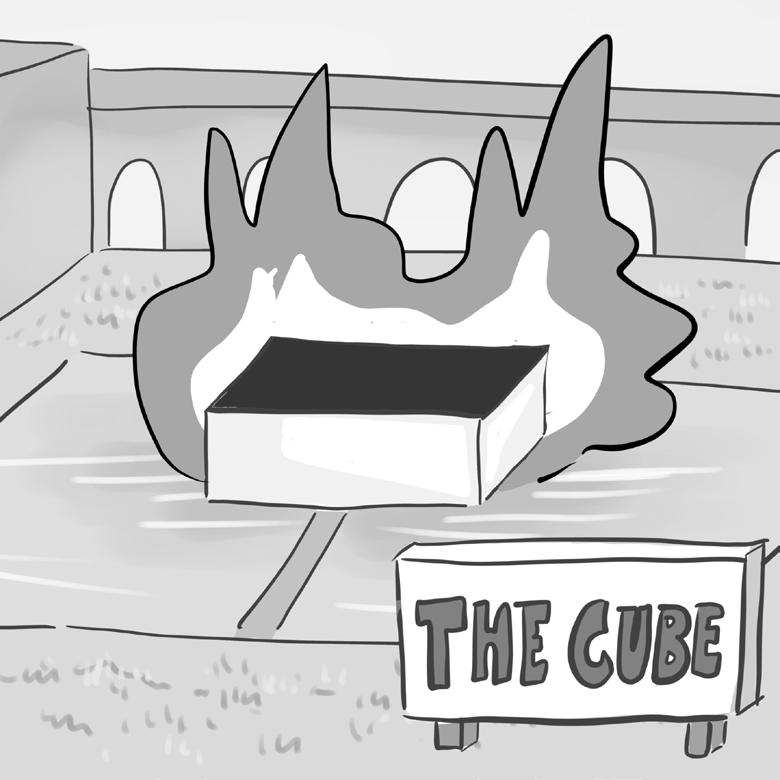
2nd: Joon Kim PO ‘26
“More tolerable than the heat waves at least.”
3rd: Leili Kamali PO ‘29
“BREAKING: Pitzer student [REDACTED] [REDACTED] sets fire to Cube in the days following implementation of ‘ShoesRequired’ policy at the 5Cs.”
to report local ICE presence
these actions. ICE agents engage
do not tolerate this disregard for
anger cannot. We need to diminish the morale
politicians showcased at town
local Los Angeles demonstrations and real action will.
Jason Murillo PO ‘28 is from Worcessay it like the sauce, and, no, it is not anywhere near Boston.
Aesthetic feminism is super anti-feminist
some sort of social commentary role for women has long since departed from the era of Charlie
ninity from glossy, aestheticized feminism.
with women across the internet:

One of the main goals of the
a place of immense potential
Anyone has access to feminist scholars and ideas, or at least
with the speed comes a need for of feminism, and from this, the
ingly prominent.
goes against the idea of intersectionality and independence, mindset that women are not as financially competent as men. in common is that they place commodified aesthetic instead
inspiration on Pinterest. While,ates the
answers or watered-down nar
accepting the fact that the reality of patriarchy is inherently complicated for women, and that flattening the realities de -
fragile female that goes directly and proclaims that there is only one right aesthetic in order to and aesthetics, intentionality and rage are what we need more than -
Now that is the real thief in the progress for women.
Ansley Kang SC ’29 is a feminist from Portland, Oregon. Shocking, right?
Back on deck: CMS generations collide at the 2025 alumni swim meet
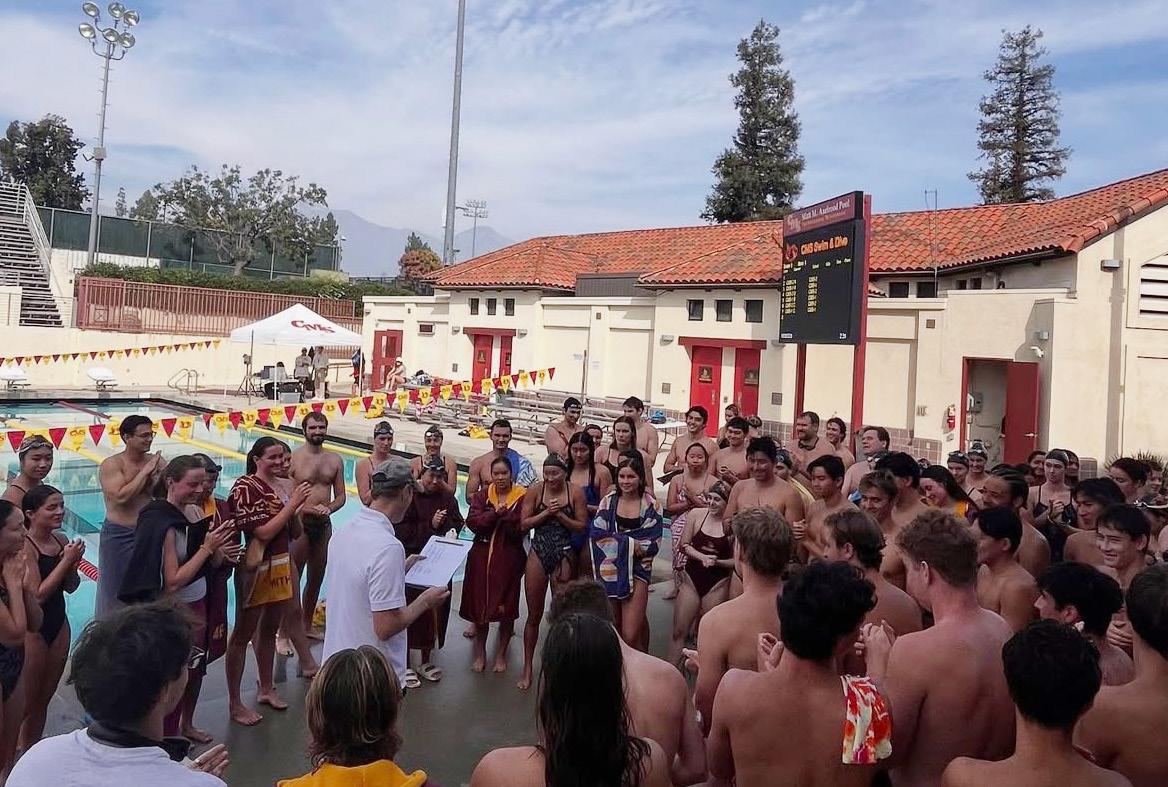
On Saturday, Oct. 25, the Claremont-Mudd-Scripps (CMS) swim & dive team hosted its annual Alumni Swim Meet at Axelrood Pool. As generations collided, partly for competition and partly for a reunion, the strong spirit of CMS athletics emerged.
The alumni meet was a chance for old Stags and Athenas to rekindle bonds, and the teams were arranged by odd and even graduation years, allowing current Stags and Athenas to get to know those who have already walked their paths.
“There were some guys who to meet some of us as well, which was great,” Alexander Davies CM ’28, a current member of the CMS swim and dive team, said. “We just tried to make the relays as broad as combinations of people as possible, which made it really enjoyable racing with some people who are the same age as my dad.”
For Thayer Breazeale CM ’24, being back in Claremont did not feel too
“It feels really comfortable,” Breazeale said. “I think we kept a really strong culture of connectedness through the years … we got a big alumni group, we organized ahead of time, got an Airbnb together and so it feels like being back on deck in the past.” Breazeale, who graduated as the fourth-ranked swimmer in the 200 each year for the meet. For him, it’s not about remembering what made those years so special.
“There are so many great memories,” Breazeale said. “Part of the everyday experience, like showing up and seeing your friends at practice, all culminate together. But then some highlights came from the peak of our undefeated in for my time there.”
He joined the program in the opportunity to swim alongside his twin brother, Anderson Breazeale CM ’24. One moment he reminisces about to this day is when his teammate and close friend Frank Applebaum CM ’24 broke a Division III national record.
“I remember just jumping up and down with my teammates beside me, cheering him on,” Breazeale said. “That was one of those moments that just sticks forever.” Davis shared a similar sentiment, explaining that his favorite memory from the meet didn’t actually hap-
Pomona-Pitzer football falls to La Verne at home
On the cool evening of Saturday, Oct. 25, Pomona-Pitzer (P-P) football fell 8-26 in an upset loss against the University of La Verne. The game, which was the third straight loss for P-P, saw the Sagehens drop to 3-4 overall on the season and 2-3 in SCIAC program win in nearly two years.
While it was a historic night for the Leopards, it was an unexpected one for P-P. The Sagehens have historically been 13-7 against La Verne, and earlier this season, on Oct. 4, they beat La Verne handily, 34-12.
Head coach John Walsh discussed his feelings about the game, acknowledging that, in his eyes, the Sagehens had underperformed.
“It’s a tough loss,” Walsh said. “We did not play our best throughout the whole game. Every team in [the SCIAC] is good, and La Verne outplayed us tonight.”
For Walsh and the Sagehens, this frustration was understandable given their recent scoring success against La Verne in previous matchups. On Saturday, though, the scoreboard didn’t
From the onset, the Sagehens struggled to find their offensive the fourth quarter when quarterback Nick Kim PO ’26 completed a teardrop pass to wide receiver Jack Sobota PO ’27 for a touchdown.
Wide receiver Michael Ryan PO that only came to life towards the end of the game.
“We were clicking too late,” Ryan all cylinders.” At the beginning of the game, it seemed as though the Sagehens were poised to play their typical brand of fiery football. The defense started
-
ty to score was quickly halted when, on 2nd and seven at the P-P 14 line, Kim’s pass was intercepted, handing the ball over to La Verne in Sagehen territory. From there, the offensive struggles continued to mount.
According to Walsh, many of thesively stemmed from their quarterback rotation. Throughout the game, the Sagehens alternated between Kim quarterback. Grady Russo PO ’27, who leads the Hens in passing yards this season, did not see a snap.
up].
We’re trying to come up with a formula to get back to [our] championship ways. We have a whole room of unbelievable quarterbacks … [but]
Ryan commented on how Saturday’s game against La Verne was a chance for the Sagehens to continue critical position.
“We’re trying to play our best guys,” Ryan said. “Each one of our quarterbacks has a very different
-

skillset … so we try to rotate them through to get the best advantage. Sometimes it works, sometimes … we don’t execute fully.” It was not just the quarterthough, that faced problems on Saturday.
The Sagehen defense also had a tough night against La Verne, as they spent substantial amounts of up with the Leopards’ quick pace and formidable passing game. The their last match against the Hens, in which they were held to 160 the ground. Other than three sacks on the night from the P-P defense, as well PO ’27, the Sagehens were unable which ended up executing five scoring drives.
Like both Walsh and Ryan, linebacker Jake Sugawara PO ’26 expressed sentiments of disappointment from his side of the ball.
“As a defense, we take pride in our standard,” Sugawara said.
“And tonight wasn’t our standard.”
Despite the defensive troubles, as well as the Sagehens’ thwarted quarterback rotation strategies, the team believes that Saturday’s game will provide the necessary motivation.
“I believe our guys are going to come back tomorrow, work Ryan said.
With the Sagehens vying for a winning record and another SCIAC championship, each coming game is vital. Even with the loss, Saturday’s game showed the Sagehens that they still have depth and potential that can help them play their best brand of football leading into next season, now that they are no longer eligible to make the
“We have three opportunities to make the most of it,” Sugawara said.
The Sagehens will visit the Chapman Panthers next on Saturday, Nov. 1, in hopes of starting in their penultimate game of the regular season.
pen in the pool.
“We got to see [the alumni] and grab dinner with them,” Davies said. “Catching up with everyone, seeing … what career path they’ve out fully being an adult was just a really great experience, and it when I graduate, everything’s gonna be okay.”
Over time, these meets prove to be more and more important for students, building their sense of belonging in the community.
“When I was a freshman, I didn’t really know any of the returning alumni, so it didn’t havevies said. “This year, I was really close with a lot of seniors who’d
just graduated, so getting to see them again was honestly kind of emotional.”
Rachel Wander HM ’22 was another alumnus who swam with the students, coaches and alumni. She was a former breaststroker CMS history in the 100 breaststroke. the meet, marking her fourth time back as an alum.
“It’s great to be back,” Wander said. “I love the pool. I have so many great memories here. Just jumping in feels great. I’ve got a lot of people that are still here to connect with, and it’s really great to see them, especially them are in California.”
She recalled one meet in par-
the Stags and the Athenas took home trophies.
actually the only year while I was on the team, where both the Stags and the Athenas won,” Wander said. “The Stags only won by about 13 points. It was really close to the wire down to the end, and it’s just really special when the entire team wins, and you kind of all feel that excitement and joy together.”
For Wander, being part of CMS it was about the camaraderie that came with being on swim and dive.
“I think for me, being a part of CMS meant being a part of the community,” she said. “I had people to hang out with, we’d get meals together, we’d do parties together, we’d see each other every day. It was really great to feel like a part of a group that is just that strong, cohesive.”
At this year’s meet, that community was easily recognizable. Alumni mingled with current athletes and coaches, trading stories about old practices, cheering each other on and teasing each other with jokes.
As the afternoon wrapped up, swimmers stayed on deck to catch up with coaches, some already planning next year’s reunion. For CMS, the alumni meet remains one of the most on the calendar, reminding students and alumni alike of the deep connections that run between generations of swimmers.
When Davies was asked if he pictured himself returning for a future alumni meet, he didn’t hesitate.
“A hundred percent,” Davies said. “Even just to see my friends, but also to keep that tradition going so the younger swimmers want to come back as well. Seeing them all come back this year has made me want to come back, and I think that’s a trend that’s going to continue.”
5C students keep At The Buzzer’s spirit alive
The Claremont McKenna Black Student Association (BSA) and the Pitzer Athletics commissioner held their annual At The Buzzer event on Oct. 24, filled with enthusiastic MCs and spirited fans as the squeak of sneakers echoed across the court.
The annual event, hosted at the outdoor Pitzer basketball courts, is a tournament where anyone, regardless of experience level, can enter in a team of four. Henry Burke CM ’25, a player in the tournament, felt that the event had both good organization and high energy.
“It was executed very well,” Burke said. “We were a play-in team, which meant we signed up at the very last second, and another team signed up at the last second with us. Instead of just kicking us out of the tournament, they allowed us to play a game, which was very nice.”
The experience Burke had was exactly what Charlie Morris PZ ’25, the Pitzer Athletics commissioner, wanted to bring
“Jaida McCullough [CM ’27], Mary [Ariri SC ’27] and I met three weeks prior to the October 24th event date,” Morris said. “With Halloween approaching and midterms on the horizon, this event allowed players and spectators alike to enjoy the music and nonstop entertainment of a raw competitive environment.”
Morris believes what made this event such a success was the effective communication between him and his fellow organizers.
“Communication between the lead organizers of the event, myself, Jaida and Mary was a special opportunity to be able to work with such a vibrant and passionate team. Ibukun [Owolabi CM ’28] also played a large role in connecting the tournament with CMS [Recreation], who provided referees
and equipment for the event.”
Initially, the planning team due to budget constraints and staffing shortages. However, thanks to help from external organizations and many hands on deck, Morris saw success in mitigating those challenges.
“The 5Cs are incredibly resourceful and connecting with organizations like Pitzer’s Events Board team and CMC BSA allowed for the event to include a wide variety of engaging activities for fans and players alike, including a half-court competiMorris said.
Another one of Morris’ initial concerns was recruiting enough players, but changing the tournament to 12 teams of four, rather than in previous years with eight in registered teams. The change also inspired participation from more players across different experience levels to enter the tournament.
To drive that participation, the planning team deployed an advertising strategy, mainly through social media.
“A large part of this [event’s success] was due to our leadership team’s willingness to promote the event via social media, collaborate with other organizations across campus and most importantly, connect with CMS [Recreation], who has a vital role in the 5C athletic whirlpool,” Morris said.
the CMC Recreation team, which Owolabi is a part of, made a conboth on campus and online.
“[CMC Recreation] helped get the word out there,” Owolabi said. “We put [At The Buzzer] in it on Instagram. We put it on ourers were placed on the front desk to advertise for them.”
Owolabi and the CMC Recreation team assisted with event marketing, providing the necessary technical skills and equip-
ment. “We supported them by bringing the scoreboard and a bit of the electrical setup, for example,” Owolabi said. “The referees for the event were my co-worker, Marcella [Bustamante SC ’25], and I … at the intramural sports program as well as CMS Recreation.”
That strategy of constant promotion was well received by the participants, as Burke recalled his experience learning about and signing up for the competition.
“I saw [the post] on Instagram, heard people talking about it around campus when I played basketball in the gym and the sign-up out a Google Form,” Burke said. According to Morris, At The Buzzer differed greatly from a standard basketball game.
“Unlike other basketball or athletic tournaments I’ve organized in the past, At The Buzzer is designed to be a scrappy, streetball style format,” Morris said. “Music blasting, announcer instigating on the mic, opponents trash-talking. It’s challenging to curate such a special environment by yourself, so the collaboration really helped bring this to life.”
Burke experienced that same intensity from a player’s perspective, describing the atmosphere as both electric and competitive.
“I really loved the people at the top who were speaking during the tournament, as well as the music,” Burke said. “It’s just a really fun atmosphere. A core moment was when my friend Luke Jacobson [CM ’25] drained a three-pointer against some of our best friends was amazing.”
As Morris looks back at the his primary goal: to have the tournament bring together students from all over the 5Cs, and to be present during a special time of the semester.
As At The Buzzer continues to grow, its legacy will linger not just in the memory of highlight plays but in the lasting sense of collaboration, creativity and connection it fosters within the community.

NOAH BREWSTER
ISABELLE CARLSEN
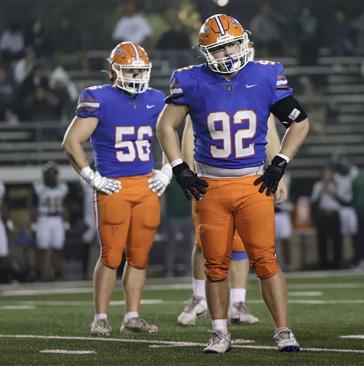
Defensive linemen prepare for a play as the Sagehens fall short to La Verne on Saturday, Oct. 25
COURTESY: POMONA COLLEGE BLACK STUDENT UNION
The Pitzer Athletics commissioner and the Claremont McKenna Black Student Association co-hosted their annual At the Buzzer tournament, filled with music, community bonding and streetball.
COURTESY: CLAREMONT-MUDD-SCRIPPS ATHLETICS
CMS swim and dive alumni returned to Axelrood Pool for the annual alumni swim meet, filled with friendly competition and mentorship.
COURTESY: POMONA-PITZER ATHLETICS