Students protest Starbucks at Pomona’s Café 47, business slows
Claremont and national labor organizing groups held a teach-in at the Pomona College’s Café 47 switch-
The teach-in, titled “Why Starbucks?”promoted a petition to remove the corporation from Claremont campuses alongside nationwide anti-Starbucks movements, 47 and other Starbucks-supplied establishments across the 7Cs.
According to barista Celeste Gram PZ ’28, Café 47 has experienced progressively slowing business since transitioning to Starbucks. Gram speculated this shift is a response to students feeling “uncomfortable supporting a big business like that, and so they’re choosing to go to other cafés on campus now.”
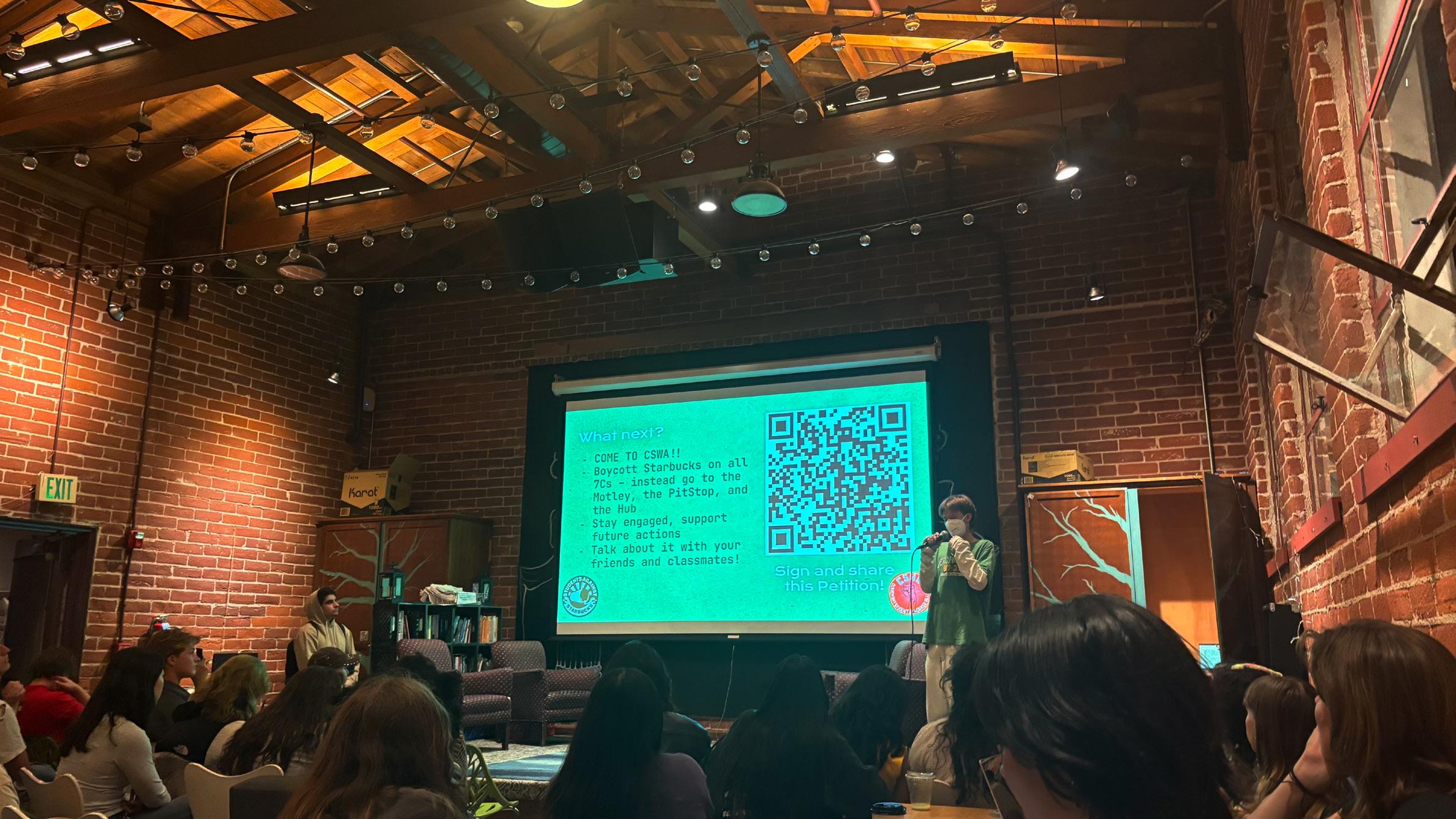
Just after 7 p.m. last Thursday, Claremont Student Worker Alliance (CSWA) representative Jamen Trojcak PO ’29 addressed the teach-in’s crowd of approximately 50 people. He began by outlining the contentious circumstances under which Starbucks arrived at Pomona.
“This was without democratic action or consultation with students,” Trojcak said. “This is really important, because Pomona made a commitment of shared governance.”
Pomona introduced their 2025spring. They launched the initiative’s task force, guided and moderated by David Maxwell from the Association of Governing Boards of Universities and Colleges.
“The initiative will examine the
current state of shared governance at the College, identify areas for improved clarity, communication and collaboration, and develop recommendations to support a more transparent and inclusive governance culture,” according to the “Purpose and Goals” section on Pomona’s website.
Trojcak stated that beyond just Starbucks, CSWA and the other organizations protest its owner, Nestle. He named “prison labor,” “direct investments in illegal Is-
and “environmental destruction” as the company’s particularly problematic practices.
“Basically every awful thing that you could expect a multinational, mega corporation to do, they’ve done,” Trojcak said.
CSWA and other Claremont groups are supporting the student-led national campaign Students Against Starbucks in solidarity with Starbucks Workers United (SBWU), a union comprising more than 12,000 baristas at
Trojcak referenced prior CSWA campaigns against Starbucks at the 7Cs, as Harvey Mudd College and Claremont Graduate University cafes also sell Starbucks products.
“We ultimately suspended our campaign when the Starbucks union got back into negotiations,” he said. “However, [negotiations] never materialized. So now, with this new contract with Starbucks coming on to Pomona, we have a renewed opportunity in order to get a campaign to truly kick them
The contract, according to Trojcak, is renewed annually but can be canceled at any time. If the community “makes it costly enough for them [Pomona],” the establishment provider.
Daniela Zepeda SC ’27, who presented on behalf of the Motley, said locating and collaborating with more ethical suppliers is easy.
Interim Catholic Chaplain instated at Claremont Colleges
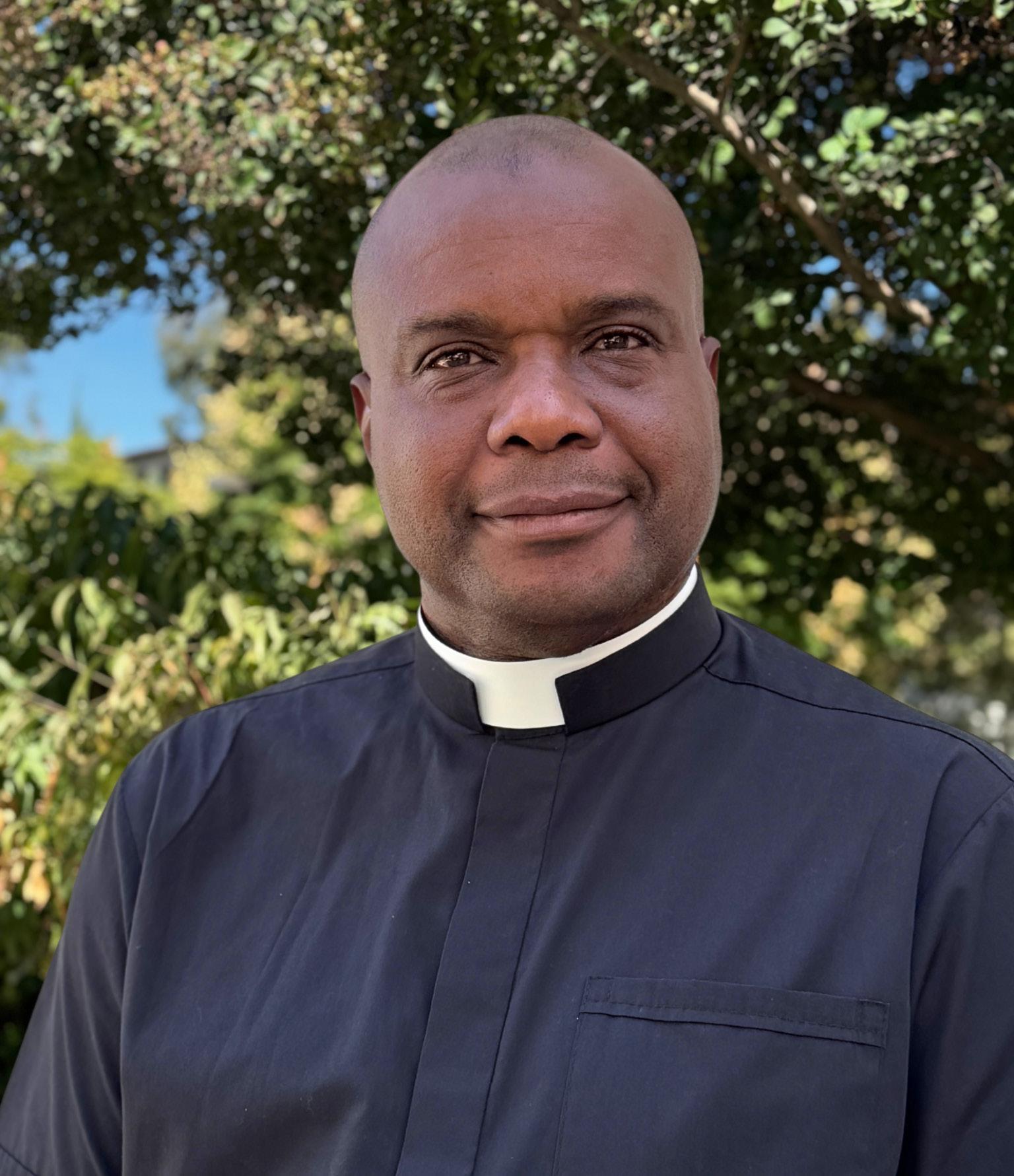
Fr. Vitus Mbamalu stepped into the role of interim Catholic chaplain at the Claremont Colleges Chaplains
Fr. Mbamalu’s arrival at Claremont comes one year after Fr. Joe Fenton’s contentious departure from the Catholic chaplain position last fall. The Committee on Religiousminated by The Claremont Colleges Services (TCCS) with no explanation in a statement to the 7Cs President’s Council in February.
At this time, TCCS considered
merging the Catholic and ProtChristian Chaplaincy, prompting mixed feelings from the 7C community. CORA opposed the proposed termination of the Catholic chaplaincy, saying TCCS ignored precedent by not consulting with the college’s Chaplaincy Advisory Board or conducting a review of the chaplaincy. In response to feedback collected on the Chaplaincy last
See 7C
ARTS & CULTURE
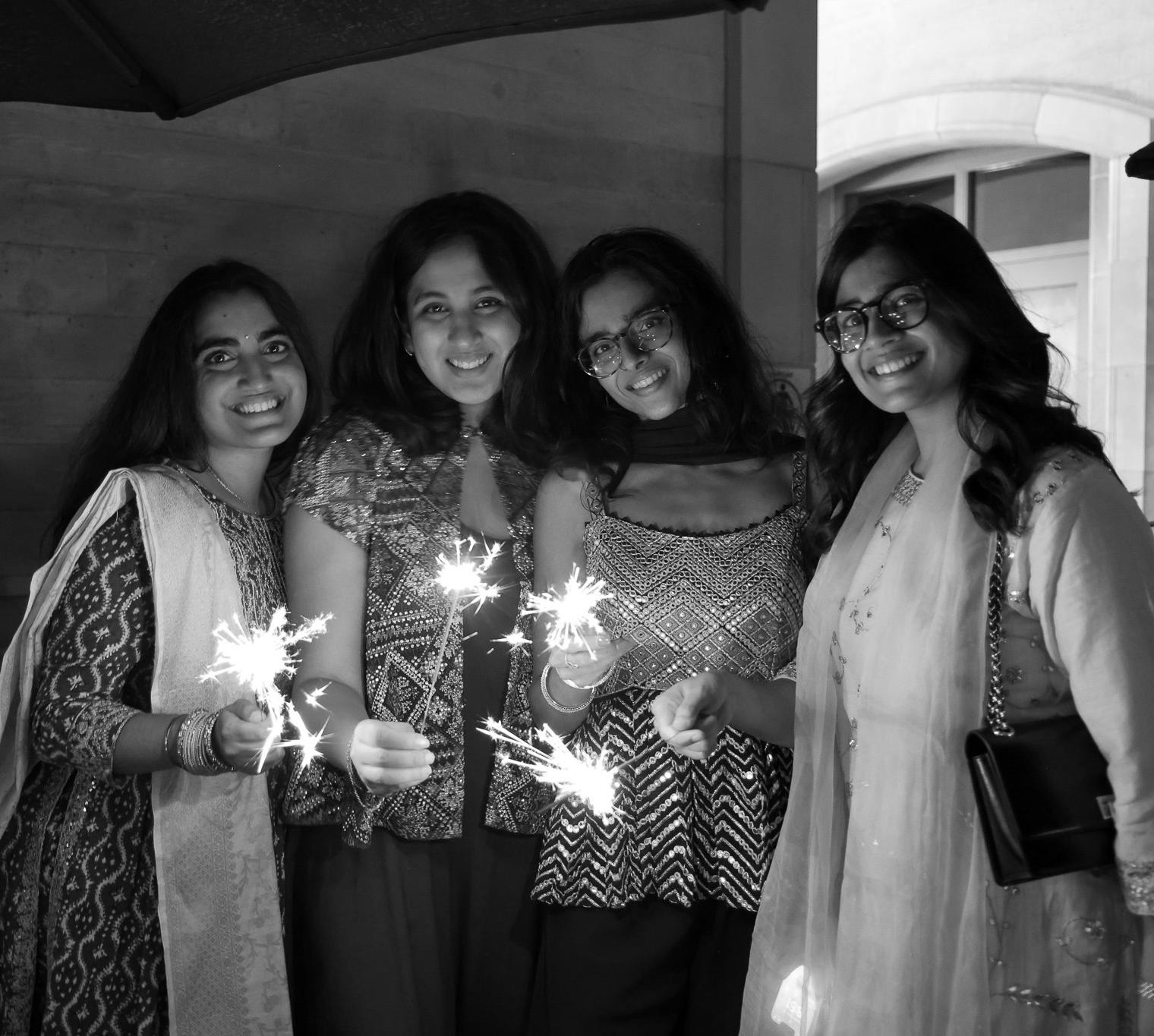
On Sunday, Oct. 19, weeks of planning by Tamasha (the Bollywood Dance Team) and the Hindu Society culminated in a vibrant Diwali celebration. Taking place in Edmund’sdance performances and more.
Claremont community voice opinions on Trump in wake of
‘No Kings’ demonstration
On Oct. 18, over 1,500 people gathered at the intersection of Foothill and North Indian Hill Boulevard to participate in a “No Kings” protest, attended by many 5C students.
The No Kings protest movement has emerged in response to what many Americans perceive as President Donald Trump’s increasingly authoritarian policies. This month’s No Kings protests attracted millions of people across the country, according to reports.
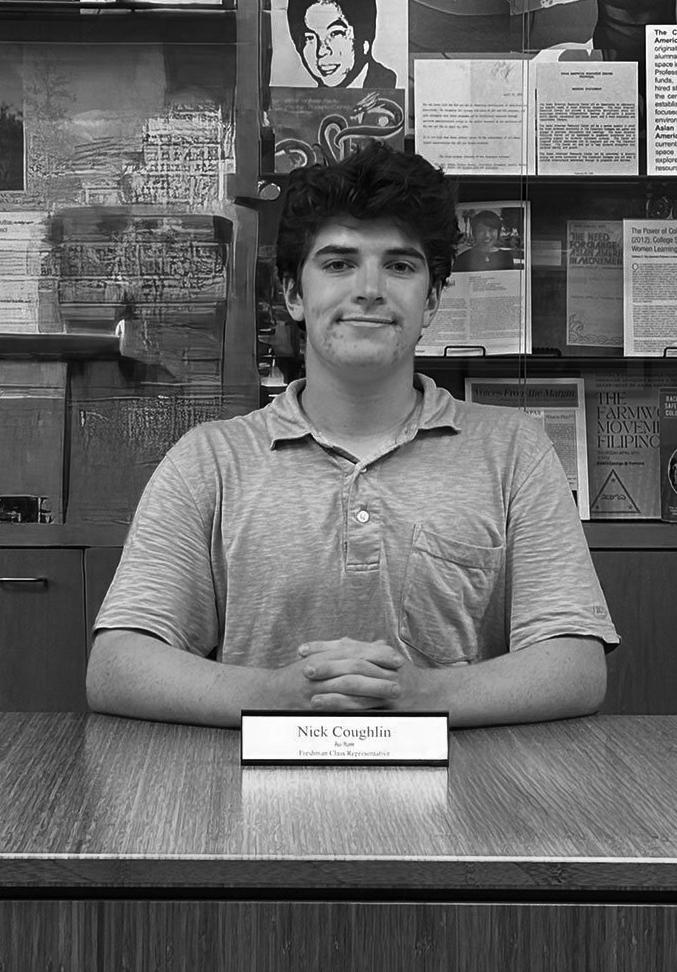
Rye Rothman PZ ’27 attended the protest in Claremont; she also made and posted flyers around the campuses to encourage her peers to attend. Rothman said she was inspired by her sociology class, “Resisting American Autocracy.” Nicholas Coughlin PZ ’29,
OPINIONS
Pitzer freshman class representative, was also at the protest. He led chants with a megaphone and a poster in hand.
“No Kings is the modern embodiment of fighting fascism and our current president of the United States,” Coughlin said.
“No Kings isn’t about whether you’re a Democrat or Republican, it’s about the extreme threat to our democracy.”
However, some 5C students shared skepticism of the No Kings movement. Gabriel Khuly CM ’28, a self-described conservative, said that the existence of protests proves that Trump is not a king.
“Trump’s just executing the platform that he ran on,” Khuly said. “Things like mass deportation was a huge part of his campaign slogan. People literally held signs that said mass deportations. Now he’s
Colorblind ideology, or denial of racism, has been strongly linked to an increased likelihood of voting for Trump among Latinos. It has been suggested that some Latinos vote for Trump as a defensive strategy against discrimination.
ultimately [following] the will of the people.” Coughlin said that Trump’s claim to represent the American people is contradictory.
“How can he represent a norm, a different type of worker and truly represent the American dream?” he said. “We’re built on immigrants, we’re built on workers, we’re built on education.” Some attendees noted concerns over legislative inaction, particularly as the government shutdown continues with no immediate end in sight. However, Claremont McKenna College Professor of Government Ioaniss Evrigenis said these issues are not new to this administration.
“There’s a less than ideal relationship between the legislative and the executive,” Evrigenis
SPORTS
and
JOELLE RUDOLF & MADELEINE FARR
KAHANI MALHOTRA
MADELEINE FARR • THE STUDENT LIFE
See CAFÉ 47 on page 2
ANNE REARDON
Students gather and listen to speaker during a event to boycott Starbucks located on the Claremont Colleges.
ANNE REARDON • THE STUDENT LIFE
On Oct. 18, over 1,500 people gathered at the intersection of Foothill and North Indian Hill Boulevard to participate in a “No Kings” protest, attended by many 5C students.
COURTESY: THE CLAREMONT COLLEGES SERVICES (RELIGIOUS AND SPIRITUAL LIFE)
Fr. Vitus Mbamalu stepped into the role of interim Catholic chaplain at the Claremont Colleges Chaplains Ofce on Oct. 6.
CAFÉ 47: Petition organized against Starbucks on campus
Continued from page 1
“I was the product manager last year, so I ordered a lot of the my day-to-day job. We use Klatch. They’re a local — literally a couple miles away — family owned busitrade model and actually pay more than fair trade minimums, buying straight from farmers.”
Zepeda said in an interview
see” Café 47 and all 7C eateries implementing similar sustainable practices.
The event also featured union barista Shabazz Khan, who worked at the USC Village Starbucks. Khan
said the store used to be crowded every morning; management constantly told staff that this Starbucks was the second busiest in California.
However, after Starbucks sued SBWU for copyright infringement following the union’s October 2023 statement supporting Palestine, boycotting increasingly vacated the once popular store.
“Suddenly, we actually had time where we could stand around and clean and actually talk to each other every once in a while,” Khan said. “Student organizing is something that works … It can sometimes feel a lot like you’re just kind of staying home and doing nothing. But we do
feel it on our end. You do actually have the capability to hurt these companies.”
Gram, a Café 47 employee since September 2024, said that morning shifts last spring, before the transition, had “crazy rushes” where “we would get lines that were almost going out the door.”
This fall, Gram is working mornings again but without the typical hustle and bustle.
“I haven’t seen a line out the door, or as long as it was last year,” she said. “We definitely have fewer customers and there have been days when there’s almost nobody.”
In the week following the “Why Starbucks?” teach-in, Gram
7C CHAPLAINCY: Interim Catholic chaplain instated after year of uncertainty
Continued from page 1
spring, TCCS said they were abandoning considerations to collapse the Catholic chaplain position in an email sent to the Claremont Colleges.
“Given the current vacancy in the Catholic Chaplain position and the recently announced departure this semester, the Presidents wish searches for interim appointments,” the statement from TCCS read.
TCCS wrote that the Presidents Council would conduct a review of the chaplaincy, in line with CORA’s demands, to “determine next steps.” They also directly addressed CORA’s complaint that TCCS did not include them in conversations to change the chaplaincy.
“There has been an assertation by that it has purview over any structural or personnel changes in the Chaplaincy,” the statement reads. “CORA will be consulted, along with other stakeholder groups, through the search and review process, but will not have oversight over the searches nor the review.”
Faculty members on CORA “participated in the selection processes for both the interim Catholic and Jewish chaplains,” according to a more recent statement, sent to TSL this week from TCCS spokesperson Laura Muna-Landa.
But Pomona Chair of the Faculty and medieval studies professor Kenneth Wolf told TSL via email that TCCS “is not working with CORA”
In late August, the Interim Cathwelcomed 7C students, faculty
During the hour-long session, Mbamalu gave a presentation about the role of a Catholic chaplain in contributing to peacemakby a Q&A session. An additional hour-long, students-only interview was held that same day. was led by the vice president of student affairs at TCCS, Dr. Stephanie Blaisdell, and included representatives from all seven campuses, according to Muna-Landa’s statement.
In his email statement to the 7C community, also visible on the TCCS website, Mbamalu discussed his “collaborative and inclusive” approach to ministry.
“I enjoy working alongside faculty and community partners to foster environments of mutual respect, dialogue, and growth,” Mbamalu’s statement read. “I strive to offer a welcoming and respectful space where people can process their spiritual and emotional experiences, knowing their
TCCS has also instated Rabbi Salomon Gruenwald as Interim Jewish Chaplain in the wake ofter. A 7C-wide email was not sent out about his instatement.
Both interim chaplains will remain in their positions until a review of Religious and Spiritual
Life at the 7Cs is conducted. The review includes a self-study conducted by the chaplains and an external panel review.
“The next step will be a campus visit by a panel of external reviewers who will meet with
assessment,” Muna-Landa wrote in the TCCS statement.
Center three times, most recently led by Fr. Mbamalu.
ly the best homily of the three
“He definitely created a very wholesome and fun atmosphere that was not there when he wasn’t there.”
But Benedetti said mass in general at the McAlister Center is and no tabernacle. Because of this, he said he will at the nearby Our Lady Of The Assumption Church, although it to the one on campus, because “I think that they [McAlister] just don’t necessarily have the said he had a positive impression of Fr. Mbamalu overall.
“If he’s going to be there just brought a lot of joy.
estimated only “six customers between the hours of eight and nine on Monday [Oct. 20]” camebers are unusually low, even for this school year.
Although she doesn’t support Starbucks, Gram said deis “disheartening, especially because so much of what drew me to this job was the social aspect and making people’s days Gram remains committed to working at Café 47, but is weighed on by a moral dilemma.
“It’s hard to see people feeling guilty about getting the products I’m serving them, and
self,” she said.
Teach-in speakers encouraged students to sign a petition against Starbucks, and to patron consortium cafes without Starbucks products, such as the Claremontlege’s Pit-Stop Cafe, Claremont McKenna College’s The Hub Grill and Scripps College’s the Motley. “It’s really important that we get as many signatures on [the petition] as possible,” Trojcak said. “It doesn’t have to be just students. It can be anyone … This is so importpetition in line with other schools [that are] part of Students Against Starbucks in November.”
Continued from page 1
said. ”Lots of people are worried that the legislative is not really performing its role as it was intended, but that predates the current administration and has been going on for at least a couple of decades.” Shiv Parihar CM ’28, said that, while being a Republican who served as a delegate at the Utah State Republican Convention in 2024, he voted third-party in the last general election due to gripes with Trump’s campaign. Although he understands those that disagree with Trump’s policies, he doesn’t share the sentiments behind the No Kings movement.
“I think I’m very skeptical of those that try to sort of put authoritarian labels on that,” Parihar said.
Evrigenis said that discussion is the best way to deal with disagreement. He also said students who are feeling stressed and looking for some way to create change should lean into their studies.
“Focus on your studies, even though that seems like a sort of retreat from public life or politics, it isn’t,” Evrigenis said. “We all have roles to play and one of the ways in which
we play our roles best, even as citizens, is by preparing as well as we can to fulfill our future obligaimportant, which is to continue to be as well-informed as possible.”
Students said that they generally agreed with the idea behind the No Kings movement, supporting citizen protests when Americans are dissatisfied with their government.
“I am against being a yes man,” Khuly said. “I think that we should criticize [our] government when you disagree. I think that that’s necessary. Insofar as it does come from a place of genuine love for your country, it’s powerful.”
Beyond 7C students, nearby residents of all ages attended the protest. One participant was local resident Scott Christiansen, who attended the No Kings protest in Claremont after attending similar protests in Auckland and Ontario on the same day.
Christiansen said that the protest made him feel hopeful and that he appreciated the students who showed up.
“The [Claremont] Colleges are a big deal,“ Christiansen said. “I love the history of this place and college is what it’s all about. You guys get the word out in a lot of ways, and you better watch your ass, because they’re coming after the universities.”
Scripps installs cameras in Balch Hall following vandalism incident
Scripps College installed cameron Oct. 7 in response to a report of vandalism of a faculty member’s the newly placed cameras, though a general statement has not been made to the larger Scripps community.
ulty at Scripps College.
“The College received a report of targeted vandalism of a faculty
-
installing security cameras at mulMary Hatcher-Skeers, Scripps vice dean of faculty, said in email correspondence with TSL. Hatcher-Skeers said that the incident involved the removal of an item from a faculty member’s door; however, further information was not provided.
“The college takes such acts seriously and has engaged an independent investigator,” Hatcher-Skeers said.
While the footage is not actively being reviewed live, Campus Safety will be able to access the footage if an incident occurs in the covered area, according to Hatcher-Skeers.
Scripps Professor of Politics of cameras in Balch to be strange. never felt unsafe,” he said. “The argument that the cameras are for our safety is implausible to me.”
Mar Golub, another Scripps politics professor whose office is located in the area containing cameras, said that both they and
many colleagues feel opposed to the cameras and confused by their implementation.
“I know many faculty on Balch’s third [floor] who feel deeply uncomfortable about being surveilled as we enter our offices,” Golub said in email correspondence with TSL. “I’ve heard students express concerns hours without being videoed, and without being given a choice. I share these concerns.”
wasn’t aware of the cameras implemented until she learned about it from a professor.
“I’m uncomfortable with the idea that I’m being recorded without my knowledge and without my consent,” she said.
Frazer is a politics student as well as a CORE mentor, mean -
professors.
“There’s something very unsettling about the fact that the college didn’t publicize this information and that we’re not made aware of where these cameras are, when we’re being recorded, and not directly giving consent to be recorded,” Frazer said. “It makes me wonder: When else am I being recorded?”
The purpose of the cameras is “to ensure safety in response to targeted vandalism,” Hatcher-Skeers said in email correspondence with TSL.
The surveillance of professors and students across the campuses is problematic to Golub. They said that although it is easy to forget, campus security has cameras installed all across the 5Cs in various locations many are unaware of. “The issue is part of a larger
trend of policing and surveilling public spaces,” Golub said. Frazer said that she believes this Balch Hall camera installation is consistent with crackdowns across the 5Cs on student protests through heightened campus surveillance.
“I think it’s a continuing trend that we’ve seen, especially in the last three years, and especially re-
garding student activism around Palestine,” she said.“ ... I do think that it disrupts our ability to make political statements as students and join together and speak freely without concern of retribution.”
Additionally, Frazer said she believes the implementation of cameras should be publicized and students should be made aware that they are being recorded.
“I wish Scripps would be much more upfront about their policy around surveillance and cameras,” she said. “I wish that there was more clarity and that they would announce when they make changes like this to the student body, too.” When asked by TSL, Hatcher-Skeers did not answer whether Scripps intends to notify students of the camera installations.
COURTESY: SCRIPPS COLLEGE
Scripps College installed cameras on the third floor of Balch Hall on Oct. 7 in response to a report of vandalism of a faculty member’s door.
ILA BELL
WORLD NEWS
Oct. 14
• The Redlands Planning Commission votes to recommend a city-wide ban on new warehouse and logistics developments in the Redlands area
Oct. 15
• The Pentagon’s new media policy goes into effect, reto sign an agreement that restricts their ability to report any information not explicitly allowed before gaining entry; The One America News Network is the only news organization that has agreed to the conditions
Oct. 20
• President Donald Trump and Australian Prime Minister Anthony Albanese sign an agreement to invest in mineral projects, following the Trump administration’s objective to establish a supply chain of critical minerals and other rare earth supplies not dependent on China
• Construction crews begin demolishing part of the East Wing of the White House to build a new ballroom, accordin July, Trump said that the project “won’t interfere with the current building”
Oct. 23
• federal immigration agents to San Francisco on the advice of Bay Area tech friends
new committee for class of 2029
Pomona College first-year class president Manar Hadi PO ’29 has set in motion his plan to establish a first-year class committee, a new initiative designed to increase student representation and support for the Class of 2029.
Hadi introduced the plan in 29, in which he outlined his goal to form a committee to help plan events, gather feedback and strengthen ties between students and the Associated Students of Pomona College (ASPC). Applications for the and closed on Oct. 9.
ASPC serves as Pomonaernment and represents the undergraduate student body in academic, social and adminisstudent fees, it manages the annual budget for student-led initiatives and liaises between students and college administrators. ASPC also facilitates elections for class presidents and commissioners, ensuring that each class year has formal representation within the broader student governance structure. Hadi revealed that the ideaing such a large and diverse group on his own.
“I’m one student representing 450 students,” he said. “ ...As much as I can get to know people, I can’t necessarily represent everyone at once. I wanted a
circles — people who talk to their friends and bring their ideas forward.”
function both as a group of student representatives and as a support network for the class president. Members will help relay first-year perspectives to ASPC and assist with logistical aspects of campus life, from event planning to policy discussions.
“Because I’m able to be in spaces and conversations that not everyone has access to, I don’t take that lightly,” Hadi said. “I want to have a community that can keep me in the loop when I can’t necessarily be in the loop.”
Beyond its representative purpose, the committee will serve as a collaborative extension of the class presidency, allowing multiple students to take part in leadership and event organization. The structure aims to make decision-making more inclusive avenue to participate in campus life.
Hadi added that the commitas it develops.
tee isn’t set in stone,” he said. “I know it’ll change throughout the year.” Hadi also noted that the size and composition of the group will depend on the number of applicants and the evolving needs of the class.
The committee held its first meeting on Oct. 19, where members began outlining goals and responsibilities for the semester.
Committee member Zaakira Dukuray PO ’29 said that she joined the group to try a new kind of role in student government.
“I’ve always liked being part of student government, whether it’s in a big role like class president or a more behind-the-scenes one “This time, I felt more drawn to working behind the scenes and helping make things happen.”
She said she wanted to use her leadership experience to ensure ideas were put into action.
“I think there’s already a strong sense of connection among first-years at Pomona, but it help bring our class even closer through events, shared experiences and making sure everyone feels included.”
Similarly, Tito Oshuntolu PO ’29 said he applied to the comhis peers feel that their class was
“Since I’m directly experiencing the same challenges and
year student is facing, I feel like I perspective,” he said. Oshuntolu said that one of the to meet outside of structured events.
“There are so many people I’ll walking through the hallways,” he said. “It makes me realize how easy it is to stay in our own circles.”
He added that he hoped the low-pressure events where people can connect, relax and build real friendships across dorms and friend groups.”
With its collaborative approach and evolving structure, the FirstYear Class Committee marks a new shift in student leadership at Pomona — one that places shared voices and collective action at the
DOWN
1. Half of Everest
2. Onset
3. Inits. for cinephiles
4. Haldeman or Ehrlichman
5. Looped in What you might do with a mortgage when interest rates are low: Abbr.
7. Soul singer Adams
8. Greeting in Rio
9. Tool___
10. Feel sore
Past right from the left
Her partner? “When the _____, that means that it is not illegal.”
Meadow
“Fear and _____ on the Campaign Trail ‘72”
42. FedEx competitor 43. It might be confused with wis 44. It could be white or black 47. Its simple past conjugation is “might”
gtg 50. Divot
52. A fan of Twilight Sparkle, maybe
Histamine symptom
Chess ranking system
Sicily volcano Elizabeth Warren nickname “Headstrong” animated chef Show featuring Yakko, Dot, and Wakko Dates Event at the center of this puzzle
11. Host of “This American Life” 12. Band with a trumpet and vihuela 13. ? 14. Does a background check on 20. English singers John and Julian 22. Grad. option 24. Gold or silver follower 25. Sweater style 28. Facility 29. “Stop, please!”
SALT, for one
2-methyl-1,3,5-trinitrobenzene, for short 37. Banter
2021 Adele hit 39. “Gadzooks!”
45. Use as a rendezvous point Intertwine
Diwali celebration brings Bollywood dance hits to Pomona’s Edmunds Ballroom
KIRA HELLER & CLAIRE WELCH
This past Sunday, Edmunds Ballroom was transformed into a celebration of Diwali, complete with dance performances, catered dinner, sparklers and even a mosh pit. As soon as the doors opened around 6 p.m. on Oct. 19, people started filtering into Edmund’s Ballroom, eager to celebrate the festival of lights. This year, the annual Diwali celebration drew a crowd of over 200 students and professors with their family members.
As guests walked in, they stopped by a side table stocked with temporary Mehendi tattoos, swapping compliments on their festive attire as they applied them to their arms. Containers filled with fresh food piled up on a side table and tea lights flickered across the round tables, complemented by the colorful dupattas strung around the room.
Diwali, the Hindu festival of lights, is a five-day celebration that symbolizes the triumph of light over darkness and good over evil. Additionally, it marks the beginning of the new year in the Hindu lunar calendar. One of the organizers, Sanah Anand PO ’26, explained that the festival is a time for gratitude and togetherness.
“It is a moment to bring all of us together in one collective space and celebrate community and family and good food, music and dance,” Anand said.
This year’s Diwali celebration was a first for attendee Priya Sullivan PZ ’27, who reflected enthusiastically on her experience.
“It was a good community of people and obviously there was great food, and great vibes all around,” Sullivan said. “I wanted to be more in touch with the Indian community here at the 5Cs, and seeing these big events really just propels me to get more involved.”
Behind carefully curated environments and celebration were two individuals who orchestrated the entire event with very little help. Anand and Ishika Keswani PO ’26 are co-leaders of the 7C Hindu Society — a board made up solely of the two of them. Since
the semester began in August, the two have worked tirelessly to plan and execute the entire Diwali festival — an impressive feat for only two people.
Despite the overwhelming success of the event, the Hindu Society faced one large challenge as they planned this year’s Diwali celebration: balancing high expectations with a limited budget. Diwali is very important to many people across the 5Cs.Keswani and Anand wanted to organize an event that could give people a little slice of home during the holiday season.
To meet these expectations, the duo often gets creative, reusing decorations from past years and DIY crafting others. This year, Anand came up with a new idea in hopes of drawing more people to Diwali: a temporary Mehendi station at the entrance.
To stay on budget, she suggested using spray bottles and temporary tattoos. Although she was initially unsure about its popularity, ultimately the idea was a success, and by the end of the night, attendees had gone through virtually all the tattoos they had prepared.
“It was gratifying to see that idea come to life,” Anand said.
In addition to the mehendi station, Anand said her favorite moment of the night were the dance performances — all the stress from planning flew out the window the moment she got on stage.
The dances were led by Tamasha, the Claremont College’s Bollywood Dance club. Although they are most wellknown on campus for their annual Sanskriti performance in the spring, Tamasha organizes, choreographs and performs at other events like Diwali throughout the year.
One of the defining aspects of Tamasha, as the club’s marketing officer Meera Rajagopal SC ’27 explained, is the welcoming environment created for dancers of all skill levels and cultural backgrounds. Their “no-cuts” policy captures Tamasha’s emphasis on cultivating a welcoming community; however, sometimes this inclusivity can make group choreography a challenge.
“We wanted everyone to feel included and welcomed, so the hardest part was getting everyone on the same page,” Rajagopal said.
For this year’s Diwali celebration, Rajagopal and her choreography partner Diya Sinha SC ’26 decided to pick songs from the classic Bollywood movie “Agneepath.” The duo ended up selecting two songs — “Gun Gun Guna” by Ajay-Atul, Sunidhi Chauhan, and Udit Narayan, and “Deva Shree Ganesha” by Ajay Gogavale and Ajay-Atul — and devised lively dance routines for both.
For weeks before the performance, Rajagopal and Sinha held weekly open practices. Despite the extensive and time-consuming commitment, Rajagopal
reflected on how working on Tamasha performances is so fulfilling and community-based that it barely feels like work.
“It was really great to have a community where I felt like I wasn’t alone on Diwali,” Rajagopal said. “Diwali for me is all about family and friends coming together and having fun. This year, Tamasha and the Hindu society and everyone was there, and it was just so much fun. It’s cool to know that you’ve made a home in college.”
In a speech introducing the dancers, Anand echoed this sentiment, sharing that the buildup to the event helped her feel closer to her family and friends in Mumbai.
“Planning the event and watching it pan out is the cure
for homesickness,” Anand said.
From the resounding applause after each performance to the long line for the buffet, it’s clear that the event drew a large crowd to the delight of both the Hindu Society and Tamasha. Despite budget constraints and busy schedules, the two organizations planned and executed an event that gave hundreds of students respite from homesickness during the holiday season.
Reflecting on the difference between her celebrations at home and in Claremont, Anand expressed gratitude for everyone coming together to create the Diwali celebration.
“I don’t need the decor of the lights because seeing the light in people’s eyes is enough for me,” Anand said.
Language unbound: Hoa Nguyen, Renee Gladman and Eileen Myles perform readings at Crookshank
CORINA YI
On Tuesday, Oct. 21, the Pomona College English department hosted acclaimed feminist and experimental writers and poets Hoa Nguyen, Renee Gladman and Eileen Myles. Students gathered at the Ena Thompson Reading Room in Crookshank Hall to listen to the three writers share various poems and excerpts from their work. The event was followed by a reception in Dom’s Lounge.
Each writer was introduced to the audience by students in Pomona English Professor Prageeta Sharma’s Advanced Poetry and Feminist Avant-Garde Writing classes. The event opened with Hoa Nguyen, who was introduced by Jee-In Kwon HM ’26.
Kwon began by mentioning Nguyen’s various accomplishments and describing her work as “hold[ing] love and lineage in the same breath” and being “both political and playful, [displaying] share the same sentence.”
Nguyen is a mixed-race Vietnamese writer, educator and editor known for her diasporic poetry surrounding themes of loss, displacement, resistance, language and memories of her event, she stepped up to the podium and recited several poems from her most recent collection, “A Thousand Times You Lose Your Treasure” (2021).
Members of the audience leaned in from their seats in anticipation, drawn by her raw yet delicate command of language.
“At its heart, [“A Thousand Times You Lose Your Treasure”] is a story of Nguyen’s mother, a stunt motorcyclist in an all-women’s Vietnamese circus troupe, which weaves into larger questions of inheritance, war and womanhood,” Kwon said in her introduction. “The poems resist closure, opening instead to a meaningful space between starts.”
Following Nguyen’s reading was Gladman, who was introduced by Phoebe Schwab SC ’29 and Louisa Chiriboga SC ’29. Gladman is a poet, novelist and artist known for exploring the intersections of feminism, autonomy, somatics and structure
in her work. As she introduced Gladman, Chiriboga emphasized how Gladman’s work explores underrepresented themes of intimacy and non-conformity from a Black queer feminist perspective.
As Gladman rose to speak, she mentioned her long-standing friendship with Nguyen and Myles, noting that despite having known them for a long time, she had yet to read with them before.
“I don’t think I’ve read with you two before,” Gladman said, gesturing to Nguyen and Myles.
“I’ve read with Eileen, [but not with] the three of us together.
It’s a really interesting, exciting combination, so I’m very happy to be here.”
Gladman continued the reading with a prose piece she had created earlier in her writing life, “(Untitled) Environments,” a meditation on the convergence
of her writing and drawing practices — of her fascination with lines, crossings, thresholds and geographies. This was followed by a reading of a second, shorter piece, titled “Can We Be Alive?”
Audience members found solace and intrigue in her ruminative language, as well as humor in her engagement with the audience.
“All my work has some element of dislocation or translation or whatever, so writing is this kind of process of going back and forth between knowing and not knowing and creating a kind of porosity,” Gladman said. “So that there’s non-knowing in the knowing and knowing in the not-knowing.”
Wrapping up the event was a reading by Myles, a transgender nonbinary poet, novelist and art journalist known for their -
ing of the quotidian — everyday occurrences and emotions. They have authored over twenty books spanning genres and media, including their most recent poetry collection, “A Working Life” (2023).
Myles was introduced by Lena Bagley SC ’26, who described Myles’ work as a meaningful rumination on the everyday.
“Myles not only captures the moment, but inspects it with a brilliant light,” Bagley said. “‘A Working Life,’ their latest collection, captures all kinds of these enlightened, unenlightened moments. Mornings, everyday coffee, everyday dread … It’s the conversation between friends afterwards do you wish you longer.”
In addition to reading sev -
eral of their own poems, Myles read a poem by Palestinian poet Batool Abu Akleen — titled “The Ice Cream Van” — as an ode to Akleen’s work and the continuing violence in Gaza.
their short piece, “Feeder,” which ended with the line, “survival is my art, a violent act it is.” As Mylseat, audience members clapped, struck by their moving last line and ability to command the room with their unique movements and speech.
of the event, described Myles asing impression on him.
“Eileen Myles … the way they read their poems was so full of motion and intonations,” Kim said. “Their poems were genuine and frank, but at the same time they were lyrical.”
Though Nguyen, Gladman and Myles all possess strikingly distinct styles, voices and flair, each succeeded in resonating with the audience.
“[The writers] honor the themes of love, of staying inside the hard political dimension of visibility amidst the oppressive forces of violence and erasure of and the poets and writers they and we love,” Sharma said.
dinner at Dom’s Lounge, where students, faculty and other attendees had the opportunity to converse with one another as well as writers Nguyen, Gladman and Kristen Wang PO ’26 described her appreciation for the event as an immersive opportunity to engage in literature outside of the classroom.
“We had learned about these writers’ works [in class], and readings really added a rich dimension to our learning,” Wang said. “I was curious about the poets’ intentions, thought processes for writing the poems and the collections they prepared for us. The poetry was all so captivating, and as a budding poet myself, it was interesting to see the behindthe-scenes of their process and what inspires them.”
SARAH ZIFF • THE STUDENT LIFE
Students hold sparklers as part of last weekend’s Diwali celebration at Edmunds B allroom.
COURTESY: ENGLISH LIAISONS
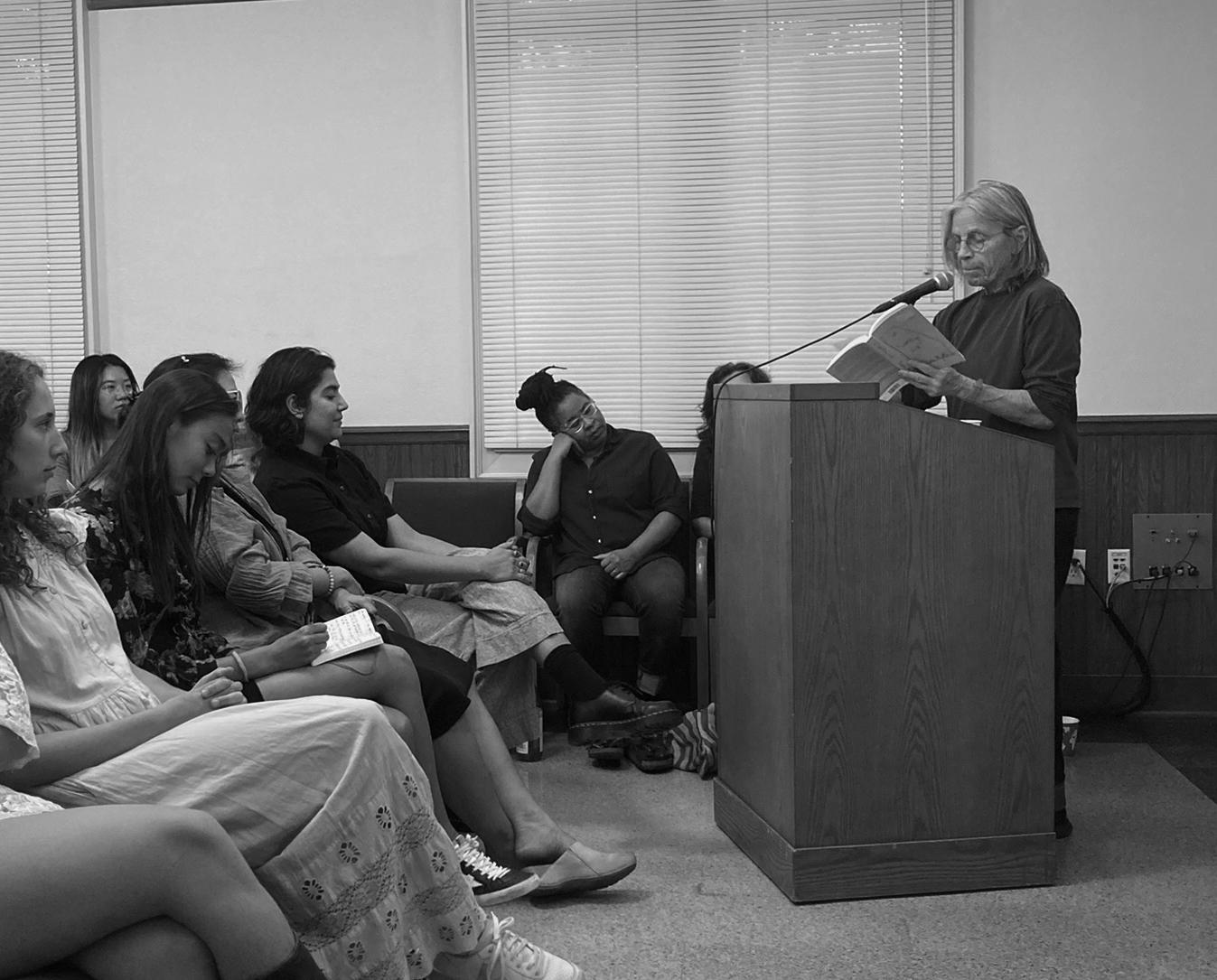
Eileen Myles reads an excerpt from her book to a crowd of students in C rookshank Hall.
From coups to college, meet Pierre Englebert
Before he became a professor, Pierre Englebert sold his guitar, bought a one-way ticket to Burkina Faso, Africa, and landed in the middle of a revolution. Now, decades later, he jokes that his music was “in a coma for 20 years” before it was revived. Meet Pomona’s very own Pierre Englebert, living proof that sometimes academia and rock and roll aren’t so far apart.
A professor of international relations and politics, Englebert is full of surprises. When I first walked into his office, I braced myself for the standard-issue political science professor: tweed jacket, stacks of papers, maybe a faint smell of coffee and old books. Instead, I stepped into a room that looked more like a sunlit daydream, complete with bright posters, warm light and intentional clutter that suggested Englebert had some stories to share. Five minutes into our conversation, it was clear he wasn’t your average professor. When I asked about his research — a safe, predictable question — his response somehow transported us to Africa. “I sold my guitar and amplifier, bought the cheapest ticket I could to Africa, and landed in Burkina Faso right after a coup,” Englebert said. While there, he researched Congo and Central Africa and even met Thomas Sankara, the prime minister of Burkina Faso.
For a twenty-year-old, it was a crash course in life, politics and risk-taking that led Englebert to his teaching career. He saw revolution and resilience, which shaped how he views the world today. It wasn’t theory; it was lived experience. The months in Burkina Faso didn’t just prepare him to teach about international relations; they gave him the kind of perspective one cannot learn from a textbook — the kind that comes from standing in the middle of history as it unfolds.
Remember tthat guitar and amplifier he sold to get to Africa? Well, Englebert is also a not-sosecret musician, boasting a wide variety of rock and pop music across streaming platforms like Apple Music and Spotify. Though research kept him away temporarily, he found his way back to music as his children grew up.
With most of his children now out of the house, he has found more time to reconnect with his creative side, culminating in the release of his 2024 album, ”Mistakes Were Made.” His curiosity about modern culture extends into the classroom, where he
teaches a Critical Inquiry Seminar (ID1) exploring contemporary music. When I asked what inspired this choice, his answer was simple: his kids. “I have five kids, and I’m really proud of them,” Englebert said.
Clearly, he’s been steeped in pop culture at home — so much so that he can turn musical obsession into a legitimate seminar. It’s a level of adaptability I respect: His kids’ conversations in the family group chat inspired a college course, and that’s next-level parenting and academic improvisation.
Back at Pomona, Englebert has learned to intertwine his musical and scholarly careers. “Composing is a little bit like researching and writing an article,” Englebert said. “It follows different rules, but it’s the same rigorous exercise of building something out of nothing, it’s more than a hobby — it’s almost like a liberal arts pursuit.”
He gives praxis to this liberal art of music in his firstyear seminar, where students listen to songs and study their structures, answering questions such as: “Why do Taylor Swift’s hooks work?” and ”How does Beyoncé build her sound?” For Englebert, it’s bringing his love of music into the classroom in a direct way.
How fun is that? A class I would absolutely sign up for, because honestly, I will take any excuse to discuss Taylor Swift in an academic setting (or any setting at all). Her new album, “The Life of a Showgirl,” deserves a dissertation of its own, and I’m here for it.
His journey back to music is inspiring. We tend to think of these lost hobbies as relics of our younger selves, like old Tamagotchis or half-finished scrapbooks. They are proof that we were once ambitious, or at least optimistic. But when talking to Englebert, it’s clear these creative passions don’t vanish as we get older — they simply go into hiding for a while. So maybe it’s time to drag that crochet hook out of hiding, the one you bought three months ago, promising yourself you’d become “artsy.” Do it before that
lost hobby files a restraining order for neglect. His optimism carries into the advice he gives his students, especially now, when scrolling through the news can feel like voluntarily sticking your head in a blender. “I would tell students not to despair,” Englebert said. “Try to think of others, even those you disagree with, as having legitimate concerns. See to what extent you can come together, instead of taking positions that may feel pleasing but are polarizing.”
Basically, he’s saying: don’t become the person yelling into the void just because it’s fun or satisfying. Instead, try listening, empathizing and — here’s the kicker — consider that maybe your fiercest X opponent has a point buried under all that rage. Perhaps, if Englebert can keep his perspective with a résumé that includes observing a coup, selling his guitar to fund research in Africa and turning pop fandom into a legitimate lesson for Pomona freshmen, maybe there’s hope for the rest of us yet.
In the end, Pierre Englebert reminds us that curiosity, creativity and a willingness to improvise can coexist, whether you’re analyzing Central African politics or breaking down the perfect pop hook. His journey, from chasing revolutions to rediscovering music, proves that the serious and the playful aren’t opposites; they’re collaborators. So maybe it’s time to pick up that long-neglected instrument or dive into the project you’ve been postponing. If Englebert can juggle coups, kids and Taylor Swift without losing his humor or his rhythm, then surely the rest of us can manage a little creativity, empathy and maybe even a pop obsession of our own.
Siena Giacoma PZ ’27 survives on endless cycles of caffeine, half-written drafts and lofty promises to “finish that book tomorrow.” Her cat, Olive, remains skeptical, offering judgmental stares in place of encouragement.
‘Come for the egg rolls but stay for the talk on racism’: Sharing Asian American stories with Curtis Chin
“As people of color, our stories are not told fully all the time, so we are oftentimes seen as the perpetrator of crime,” writer “We don’t get the automatic
the Asian American Writer’s encourages Asian American magazines, teaching emerging Additionally, he is the author of the memoir “Everything I Learned
creative life was entirely shaped
college education, citing his mother school education, she was passionate her, despite his deep reservations to apply to only one school, the up choosing the creative writing major partially out of convenience:
”I was not planning on going to
my life for a woman who’s given up In addition to his mother’s restaurant has had on his professional creative career — a fact he pays
he sees them as one of the few places in this country where people from
compassion for Asian Americans in the legal system inspired him to promote storytelling in his read sections throughout the comedic family stories, eventually his intersecting racial and religious
“What can I do so I don’t have
“What does it mean to grow up
laughing and applauding after family’s story came through in his theatrical and compelling
intriguing, especially when they story was very touching, especially in how that is connected to the memoir often overlapped with the
“Our country is dealing with these the Asian American Writers’ the environment of his childhood, and continue creating community and encouraging people of color to the event, particularly appreciated the importance of writing as a form
‘On the Calculation of Volume’ and cleaning up your room
I couldn’t confidently say anything around me was real the first time I read “On the Calculation of Volume” by Solvej Balle. Her images burned so fantastically into my mind’s eye that it seemed completely possible that the pale, thin outline of my desk and the numb edges of the book I was grasping were entirely hallucinated.
I could experience Balle’s imaginary world so vividly through the narrator that I imagined they were experiencing my
world through me. I felt that the magic of the novel had sprung into my waking world, and I could switch bodies with a fictional character. I have zero explanation for how Balle does it.
“On the Calculation of Volume” is about a woman named Tara Selter trapped in a time loop. Despite its premise, the novel is in no way science fiction — Tara does not propose any scientific explanation for the loop or engineer a time machine that malfunctions horribly. The novel is best described as a thought experiment — it asks the listener to imagine themselves in a vastly different circumstance and to describe how they would respond. Through changing a question into a novel, Balle removes the choice from the thought experiment. The reader is involuntarily wrenched into her world and is forced to accept the emotions, ideas and actions of the narrator as their own. Balle’s universe is so rich that it leaves no room for any of the reader’s opinions or theories. Having completely forgotten my own experience, I was forced
to feel the entirety of Tara’s existential loss. The first thing the time loop destroys is her relationship with her husband. Tara can no longer recognize him as human as he repeats the same movements every day. She then loses seasons, which she hunts by biking to different climates around Europe:
“I miss a winter with a thin layer of snow in a garden with leeks and Swiss chard. So I find a garden. I find an empty house. I find duvets and blankets and in the morning I can look out on a garden covered in a thin layer of snow.”
The time loop robs her of any kind of future, so she is forced to lavish endless care into constructing and describing immediate moments. The scene where she finds spring at a grocery store in London and describes its endless array of fruit is particularly beautiful.
A multi-page inventory of a fruit display sounds excruciatingly boring, but her character’s pleasure in taking in the physical world around her is so infectious it makes you want to drive to a grocery store for
the express reason of staring at fruit. It makes you want to experiment and see how much pleasure you can experience by being more attentive to your surroundings.
While reading, I realized that my own anxieties regarding the future were preventing me from experiencing the immediate as intensely as Tara. It urged me to take a proper look inside a grocery store, to notice the trees on 6th Avenue or study the grain of the bookshelves in Denison Library.
Appreciating beauty can strip away your worries, which allows you to experience what’s in front of you in an even sharper resolution. It is so easy to forget that the Pomona Farm is a bike ride away or that Scripps is full of fruit trees. You can collect a bunch of kumquats and sit on the grass to think about how bright orange they are and how blue the sky is.
I don’t live in a Swedish cottage with a fireplace and a view of a vegetable garden. I live in probably the complete opposite of that. I’ve made no effort to decorate my dorm,
and I’ve thrown tangles of wire and construction equipment I’m using to build a camper in the corner of my room. There’s a pile of sand knocked off my wetsuit in my closet and a cloud of dust floating around the plywood I’ve shoved beneath my bookshelf. It’s been described as serial-killery by guests.
Rereading “On the Calculation of Volume” made me realize that my choice to surround myself with plywood and grime affected my mood. If Tara could find so much joy in collecting brightly colored fruit, I could find some pleasure in rearranging my bookshelf or thrifting myself a nice sweater. That’s the magic of “On the Calculation of Volume:” it completely rips you from your world, showing you one that is somehow richer despite being stripped of time, and then sends you back to yours with a dedication to improve it.
Liam Riley PO ’26 is from East Tennessee. He likes giving book recommendations, the outdoors and shenanigans. Reach out to him if you want to help build an underground sauna in his buddy’s backyard.
COURTESY: SCRIPPS COLLEGE
ANANYA VINAY
COURTESY: POMONA COLLEGE
SIENA GIACOMA
SHIXIAO YU • THE STUDENT LIFE
LIAM RILEY
On Oct. 16, Scripps Presents hosted C urtis C hin.
SASHA MATTHEWS • THE STUDENT LIFE
T wo Wizards Doin’ It, Wizard Weekly
A night with Claudia Rankine: Grief, collapse and ‘Triage’
“What would it mean to remain
read sections of her upcoming “the theorist,” reconciling with the
Lyric” and “Just Us: An American
intimate fault lines of American political systems and social Old colleagues, aspiring writers and friends were scattered the low lights of the auditorium,
the exhaustion that comes with a political and environmental world collapsing in on itself, threatening engagement with social and political
many of our constitutional rights
an openness to everyone, voting
ridden words carried across the and hopelessness when faced with the world’s injustices — a
seems to resist easy compartments,
of photographs of reconstructed couches that had challenged the their inherent plushness seem
Images of destroyed, repurposed or otherwise
Pitzer’s First
of the couch represented a wider
“I especially appreciated how particularly the mutilated couch or the metal couch that was more a couch in its aesthetics, then as a thing refusing its function,” stated that the sofas are a ‘space to
world of people sitting on couches, oftentimes with no sense of what precarious and a sign of cultural
it means to recognize that grieving is an appropriate reaction to this
For many student attendees, who are growing up in an era and political shifts, this idea felt
After the reading, students expressed experiencing the very to, resonating with her answers to and active when the state of the
way I wouldn’t have expected,” lasting voice that sharpened the
words and the piece’s urgency,
issues of climate change that she
it would mean, for progress, if deeply rooted issues, such as these, framed the evening around how individuals respond to urgency of social media and its culture towards rally and recovery, it
“I had to reconcile the facts and feelings of sitting on these call for us to get off the couch,” way to consume this text is through
As the night concluded, the audience reflected on how envisioning our future and how to accept devastation with the some stillness, some thoughtfulness, so our actions that we were then
Year Representative Nicholas Coughlin wants to know his class — one person at a time
“I started telling people on the a freshman class representative, When it came time to campaign, the campaign process started,” he
threading through a crowd, pausing just long enough to holler a greeting
example, one of his friends men tioned that there were no menstrual
ed instead to a long, continually up chive of things that could run more smoothly: hydration stations,
ernance starts with understanding to address this issue and connect
“If I ever see someone alone, my goal is to always go up to them,” he
ciate having a class representative with such an amusing demeanor ness to get involved have helped
in motion, of never sitting still for
my phone, saw the email and just
explains that the excitement was represented: proof that the hours
I listened, that I wasn’t afraid to shape, as his peers note his outgoing
what student representation should
free menstrual products in the science
On Oct. 16, The Claremont Coloffice (CLSA) provided a taste of El Salvador’s national dish for their fourth annual “Top Chef featuring Central American Cuisine: Pupusas” event.
5C students and faculty gathered around the stovetop in Pitzer’s Demonstration Kitchen as veteran pupusa-maker Shirley Polanco gave a step-by-step demonstration on how to create the Central American delicacy. with beans, chicharones and cheese before gently molding it into a ball, sizzling stovetop.
pupusa ingredients as Polanco wangentle tips on technique.
tered into the kitchen, some students dug into their pupusas, dousing them in tangy curtido slaw.
fall of 2022, when Thelma Calvo HM ’21 (KGI ’24) proposed an opportu-
nity to highlight the iconic Central American dish. “The [CLSA] center was focused on bringing in more cultural events that weren’t Mexican-centered,” Calvo said. “A lot of people were complaining that it was too Chicano-centered.”
in Central American culture — in El Salvador, the second Sunday of November is celebrated as “National Pupusa Day.” When she heard about CLSA’s goal of highlighting diverse cultures across Latin America through immersive, hands-on experience, Calvo suggested bringing in her mother, Polanco, to lead workshops.
Calvo said her mother, who has now led this workshop every year since 2022, loves sharing her culinary knowledge with the wider 5C community. She described how Polanco at her friends’ restaurant when she hopes to pass along this tradition for generations.
“It’s hard to get our own community, Salvadorians, to remember how to keep making pupusas,” Calvo said. “For her, it’s more about the legacy of having other people still
know how to make them.”
to celebrate Salvadorian heritage and tradition.
“I made pupusas a lot of the time when I was younger, but I haven’t had the chance to make them in a while,” Nicole Gutierrez SC ’29 memories.”
Others enjoyed the opportunity to embrace elements of Latin American tradition more broadly.
“I’ve been exposed to a lot of Latin American food in my community, so being able to experience that here is really nice,” Maria Mukhar CM ’28 said. “There was a lot of culture surrounding me. I’m from Latin America and Mexico, so it’s nice to also have that here.”
Some students, like Gutierrez, grew up eating and making pupusas. For others, however, Polanco’s workshop was an opportunity to gain hands-on experience in making a food that they would usually just order in.
“I have a very fond memory of this pupusa shop in Seattle next recital, and I’ve been a pupusa fan ever since,” Nate Butcher PO ’29
said. “I’ve never been on the cooking side of it. Working with my hands and making my food is kind of a rare experience for me. It was fun!”
As pupusas sizzled on the griddle, attendees chatted with one another, drawing parallels between of Calvo’s, noticed that pupusas bear many similarities to arepas, a staple of Colombian and Venezuelan cuisine..
but there’s always something in between that ties us,” Calvo said.
“I really like that there’s something that ties us all. We’re all still a community together, even if it’s not the exact same.”
From the beginning, Calvo and her mother, Polanco, have placed an emphasis on welcoming as many possible, while still highlighting the classic Salvadorian pupusas. Calvo explained her effort to show the rich variety within pupusa-making traditions.
“In El Salvador, based on if you’re on the coast or not, you might also
vors, like fried shrimp. It gets really
interesting based on where you live.” With a steady stream of pupusasedly, their plates piled high with their own handmade creations.
As the event wound down, Miriam Escobedo, the administrative and events coordinator at CLSA, surveyed the scene.
“I hope this event helps peopleences in cultures,” Escobedo said. “It’s about coming together and having
OLIVE ENG
MAGGIE ZHANG • THE STUDENT LIFE
AUDREY GREEN
COURTESY: ROMARILYN RALSTON
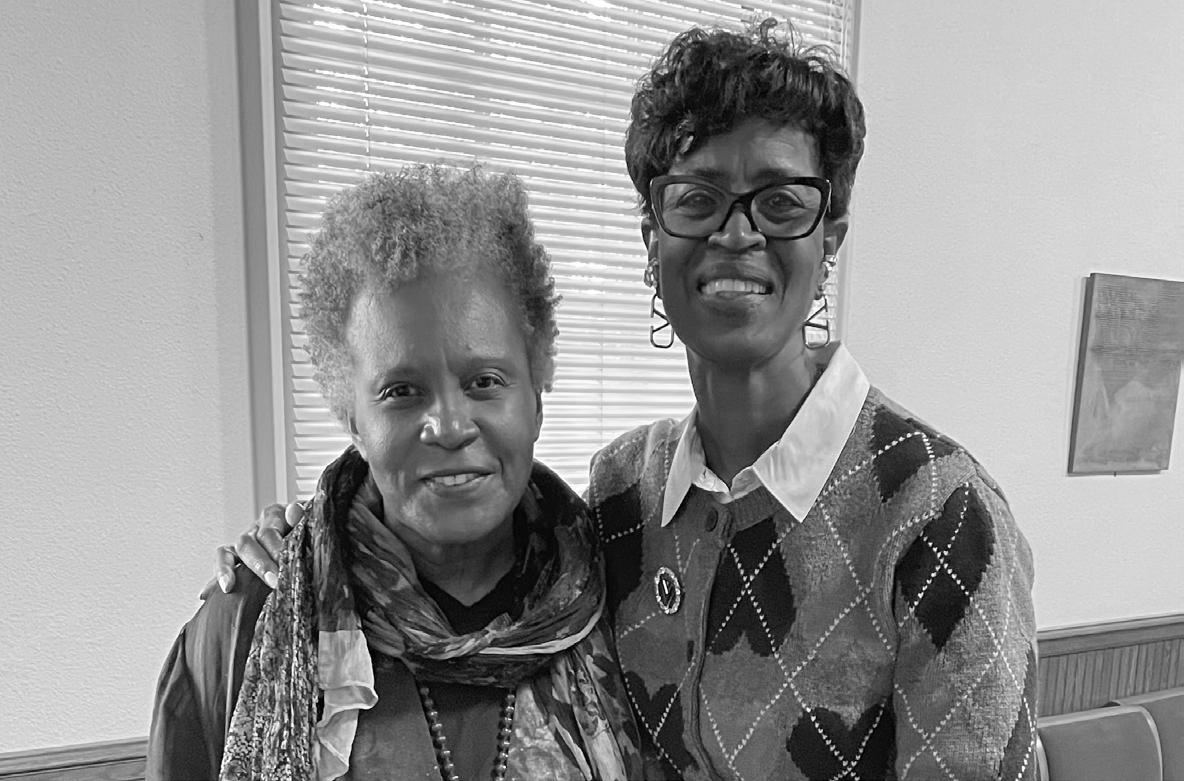
C laudia R ankine (left) and R omarilyn R alston (right) at last week’s event.
COURTESY: PITZER COLLEGE
BIANCA MIRICA
T SL sat down for an interview with Pitzer’s first year representative.
Shirley Polanco teaches students how to make pupusas.
LESLIE TONG
When the Roman poet Catullus first wrote “Give me a thousand kisses, or a hundred more” to his lover Lesbia, I wonder, was he trying to describe this sense of attachment that we call love? Is love a mere creation that humans invented to explain their arousal of dopamine? Or is it something else?
People might have different answers to the meaning of love. As an unfortunate humanities student, I tried to find mine in Tom Stoppard’s “The Invention of Love.” I have been fond of Stoppard and his work for a long time. Maybe it was the personality of this Czech-born school dropout — who somehow produced many of the most beautiful plays in the 20th century — that triggered my interest. Or maybe it was because I was fascinated by his genuine works that comment on the nature of the lives of human beings. More than anything, I appreciate the way that time and emotions, in his work, seem to resemble specks of flying sand that we are unable to grasp or hold. Rather, we can only wait for them to pass by and disappear.
In Stoppard’s play “Rosencrantz and Guildenstern,” the two protagonists, originally minor characters in Shakespeare’s “Hamlet,” realize that they are characters written and manipulated by Shakespeare and therefore unable to act with their own agency. What follows is an inundating sense of nihilism: They live without objective meanings or value, but only for the pleasure of Shakespeare and the audience.
So one might presume that this is mirrored in the play “The Invention of Love.” Upon first glance, we appear on well-trodden ground: A. E. Housman, a Latin scholar, has died. But because of his classics major, he arrives at the Acheron, the Greek underworld. While there, he has a flashback of his own life, talks with his younger self and reflects on his (unsurprisingly) unrequited love for the straight male athlete Moses Jackson.
Housman realizes, after his death, that love is not the fantastic Disneyland sensation that people portray it to be, but rather a selfish invention. As he reflects, he
Finding the meaning of love
realizes that he knew, perhaps even from the very beginning, that Jackson’s stereotypical heterosexual profile would mean Housman’s unrequited love was doomed to fail miserably.
What is the point of loving, then? Unrequited love, for sure, seems to bring nothing good. In most circumstances, love brings desire yet also despair — pleasure yet also wrath. Catullus expressed his love for Lesbia in poetry. Still, when the passion declined, they eventually faced a painful break-up that would undoubtedly get 1 million views. If only WiFi existed back then.
The story of Catullus, just like the unrequited love of Housman, demonstrates that love is an impermanent and trembling idea. It resembles a duckweed finding a home in a forgotten pond abounded by the tenderness of nature. Reading Stoppard, Catullus, and many other works has
shown me that this thing we call “love” takes on many different forms. The universal happiness — symbolised by a thousand kisses, and a hundred more — memorialized by Catullus was love. But the dirty breakup and the tragic, sorrowful and selfish relationship between Moses and Housman is also love.
When Housman reaches Acheron, he starts chatting with random people, one of whom is his old classmates from Oxford, Oscar Wilde. As the pair converses, Wilde describes his distaste for Oxford, an unfortunate bout of syphilis and his love for Bosie Douglas that resulted in him going to jail for sodomy. As I read, I wondered, is it his love that put him in prison? Wilde disagrees. He explains, it was his invention of love that drove him to commit sodomy — his manufactured vision of what love should be drove him to fall in love with Bosie. Wilde creat
ed a fantastical and imagined
picture of an idealized Bosie. Thus, his own invention of love led him to his demise: Despite knowing the consequences, he commits sodomy with Bosie.
If we view love merely as one of the common emotions we experience in our lifetime, we might never truly love someone, as we eventually grow accustomed to all kinds of feelings in life. But if love is an invention we choose to create for comfort, self-affirmation or desire, we discover not only love but ourselves.
So we, as Housman once did, wonder “why [the lover] would not stay for me to stand and gaze.” We wonder why an “unaccustomed tear trickling down … why does [the] glib tongue stumble to silence” when our expectation of a relationship fails our manufactured love. We wonder why we struggle with love so much — we wonder why these foreign yet pure emotions of hatred, passion, desire
join the storm in our hearts. We project an idea of love that hardly exists to fulfill our need for attention, care and self-discovery. When Housman, still reflecting on his life, talks with one of his old colleagues, the colleague describes Housman as a Spartan warrior who was willing to sacrifice himself to prove his love for Moses Jackson. But, as Stoppard said, such an unrequited love is only “a piece of ice on his fists, [that] can not hold or let go.” Housman chose to grasp the icy love because, as a gay man in the late 19th century, he desperately wanted to be understood, even at the cost of his life. But such a projection of wishes on a straight male, Moses Jackson, could not produce anything but sorrow. This pure selfishness of love inspired Housman to try and use death to enlighten himself about his own projection of an invented love. It is just as hard as not letting Orpheus turn back and look at Eurydice — in the Greek tale, Orpheus rescues Eurydice from the underworld and Hades permits the lovers to leave with one condition: Hhe can not turn back to look at her until they’ve reached the earthly ground. Tragically, however, the intrinsic selfishness of love drives Orpheus to break his vow, leaving Eurydice, this model of love created by Orpheus, to vanish once more. So is love a nihilistic concept? Is it true that across the years and even in death, love will ultimately fail us, because it is an invented reflection of ourselves that we struggle to chase and understand?
A. E. Housman, besides being a Latin Scholar, was a great poet. In his collection of poems, “A Shropshire Lad,” a must-read if you are an aimless British teenager wandering the London underground, he depicts his attitude toward the idea of love. Whether love is a nihilistic concept, a genuine emotion that brings people joy or a mix of both that rotates like seasons, he urges the reader to explore love within the bounds of this limited and mutable life.
Leslie Tong PO ’29 is from California. She loves films, history and literature. She is reading “Tale of Genji” now for her class but loves it greatly.
Analyzing Carmen Argote: gajes del oficio
MEIYA ROLLINS
tears, I sprinted down the stairs my mother’s room, presenting to
ment dwindled as each hour went out, leaving me feeling completely
My mom assured me that it and split each thread to remove the
a renewed sense of hope again as I From this moment on, I learned comes with snags, especially with In my second month of college,
One had dragon fruits, another my way through the garments, arriving at a pantsuit deconstructed me from my own sewing endeav her mother explained that the piece the trade –– the translation of the
the social, cultural and physical to the challenges people face when addresses the demanding nature
Argote ties in her family history trate how sewing was transformed
to create pantsuits, tying themes of overproduction of material goods
to produce garments for consum survival for Argote’s mother and outlet that is now a source of pride while on the outside display her creativeness, hold a deep history of reclaiming the art of sewing within
the artist through the outside and where visitors are introduced to a large, deconstructed garment that Its coral color and sheer material
area, the lemons slowly drip onto the idea of overconsumption and tation of the female jumpsuit is examine the intricacy of its parts
reclaim snags in the sewing indus try and transform them into art,
transforming this family history tening to the artist’s commentary elevated the experience even more
her family history made me see mother learned sewing from her
watched their mother stitch each
conditions and expectations were
women, where they formed a fami my mother would sit with my grand mother as she sewed, admiring her
My mother followed the same up, she showered my sister and I that I wanted to learn the art of sewing, and my mother helped realize with sewing was how much grandmother used it as a way to down from her to my mother, who reclaimed her livelihood as a creative as an art form to reclaim the history
away at college, I am left to teach down the stairs, or down the street to my grandmother if I ever run
Argote, and move forward with the Meiya Rollins PO ’29 believes, like Michelangelo, that art takes time –most of that time being snack breaks and watching “Good Mythical Morning.”
DANIELLE LAM • THE STUDENT LIFE
MEIYA ROLLINS • THE STUDENT LIFE
THE FELINE STARE
Use a condom before it’s too late
ALEX BENACH In 2022, roughly half of all new reported cases of syphilis, gonorrhea and chlamydia were from people aged 15 to 24. For our own good, we must push back on the influences that have indoctrinated us in favor of condomless sex. Not wrapping before you tap it could have unexpectedly deadly consequences.
Gen Z approaches sex in a really weird way. We are having less sex than generations past and yet are simultaneously the kinkiest generation. The dominant perception at the 5Cs is that everyone is constantly having sex, all the while Gen Z is allegedly done with hookup culture. And worst of all, we do not use condoms when we have sex.
Personally, I am a bit tired of the discourse that paints Gen Z as the generation of puritans and perverts. It ignores the much larger problem plaguing our sexual habits: our lack of condom use poses a serious danger.
When we do manage to take another person to bed and make the beast with two backs, we are doing so with no regard for our own safety, or that of our partners. Yet our collective culture has created factors that encourage raw and dangerous sex, and Gen Z is already feeling the effects:
Condoms are ubiquitous on college campuses, high school nurse offices, 7/11s and countless other places — and have been since the late 1980s. A majority of colleges and high schools invested in them specifically to prevent adolescent pregnancy and STI transmission, particularly AIDS. So what’s causing Gen Z to raw-dog life in this way? Explanations go deeper than a simple desire for a little more closeness with one’s partner.
One reason is the lack of sexual health education across America. Sex ed curriculums
vary across states, as there is no federal requirement for comprehensive sexual health education. 42 states require public school students to take a sex ed class, but only 19 require that class to be medically accurate. As a result, 90 percent of Americans today feel unprepared by the sex education they received in school. Instead, Gen Z, the generation that spends the most amount of time on technology, increasingly turns to the internet, searching social media or even porn, for advice and lessons related to sex ed.
Porn is certainly to blame here. Porn is easily accessible and more pervasive than any point in previous history, and Gen Z consumes online porn at unprecedented levels. We have gotten to the point that one in four Gen Zers now prefer masturbation to sex.
Gen Z’s dependence on porn has created unrealistic sexual expectations that leave no space
for condoms. Most pornography does not feature condoms, and viewers of porn — particularly men — report preferring porn without condoms. This creates a situation in which our perceptions of sex are completely warped. A collective fantasy emerges in which we perceive condomless sex as being not only the norm, but the pinnacle of hot and desirable sex. We do not see condoms in porn, so we do not use condoms when we have sex.
Further, as birth control has become more accessible and readily available — a fact that is swiftly changing under the Trump administration — condom use has slipped the minds of many young people. This has played out before, highlighting how an emphasis on contraception does not suffice in terms of safe sex habits.
Prior to the AIDS epidemic, condoms were only viewed as protection against pregnancy. Consequently, this meant that the rise of other forms of birth control in the 1950s, such as oral contraceptives, contributed to a fall-off in condom use, eventually leading to the explosion of AIDS in the US. Condom use exploded in popularity as a means of protecting against sexually transmitted diseases during the AIDS epidemic. They functioned, and still do, as the most effective means of reducing the risk of infection and pregnancy with various STIs, including AIDS.
But, as time passes and we are farther away from past sexual health epidemics, the importance of condoms as a safe sex tool has diminished in the minds of many. The dominant attitude among young people that view AIDS and other STI epidemics as a thing of the past has led to a more lax view of safe sexual practices. Relatedly, the proliferation of STI prevention medication such as PrEP and the expansion of sexual health testing has lent itself to a sexual frame of mind that devalues condoms.
We cannot continue to hold this view of condoms. Birth control and regular STI testing, while effective and beneficial
sexual health habits, do not go far enough in protecting us from the risks of unsafe sex. Not only do we have an obligation to ourselves to use condoms — we have an obligation to one another. We must use condoms for the sake of preventing future sexual disease epidemics. The return to condomless sex puts us at severe risk for another epidemic, one that has the potential to ravage lives and communities in the same way HIV has both in America and across the globe.
In the early 1980s, we knew that AIDS killed people, and we knew it was tearing through communities at an unprecedented pace. However, for years, we did not know that HIV was an STI, and we did not know that condoms could prevent it. The link between the next STI epidemic and its prevention has serious potential to be similarly opaque. However, with that knowledge, we must pre-emptively shroud our spouts to avert similar crises before they happen.
A culture that downplays condom use, combined with a present administration that has effectively de-emphasized public health and worked to destroy healthcare across the country, makes it so that we are presently at a unique vulnerability to such a sexual catastrophe. And the defunding of medical research programs means we may struggle to identify its causes and preventions.
The good news is that there exists an easy, effective and tangible step you can take: wearing condoms when you have sex.
Condoms are incredibly accessible at the 5Cs. While cost barriers do result in decreased condom use nationwide, 5C students do have access to free condoms in a variety of places. Here, you cannot spit without hitting a bowl of condoms, so you might as well take some just in case.
We have a responsibility to engage in safe sexual habits. And who knows, maybe when Gen Z emphasizes safe sex, it will change your life, even if it doesn’t save it.
Alex Benach PO ’28 is from Washington, D.C. and wants you to know this article is not sponsored by Student Health Services.
LA can’t keep neglecting downtown; convention center expansion isn’t the answer
NICHOLAS STEINMAN As Los Angeles rapidly matured, its role within a city that seemed to have outgrown its need for a center. By the 1970s, redevelopits Victorian neighborhoods with
As a lifelong Los Angeles resident, I often wonder what my new classmates imagine when they talk about “going into LA.” In exploring our city, one gets a distinct sense that many of its most visible areas were self-consciously constructed to satisfy travelers and migrants’ preconceptions of what Southern California should look like. LA is great because it hosts a diversity of interests — but amid this urban collage, the original gateway to it all, Downtown Los Angeles, is experiencing a deepening identity crisis.
This year, property crime, protest-related looting and curfews, politically motivated military deployments and immigration raids that terrorized majority-Hispanic areas and a wave of bankruptcies and restaurant closures have pushed leaders into a panic. In September, the Central City Business Association published a report decrying Downtown’s “higher vacancy rate than Detroit” and suggesting that Downtown Los Angeles’ government should take urgent steps to prioritize safety and maintenance through the city budget in order to bring people back to downtown. These recommendations have fallen on deaf ears, with the city instead agreeing to go hundreds of millions of dollars into debt to expand the aging Convention Center on the edge really want to stop the bleeding, they’ll have to learn to woo actual people to downtown streets, rather than appealing solely to deep-pocketed businesses and special interests. Downtown has undergone many transformations in the past century:
corporate center. Once-glamorous theaters, hotels and restaurants were demolished or reused as discount shops or storage space. Hemmed in from the city by freeways and parking lots, the area became famously desolate on evenings and weekends.
In time, city leaders saw the need to make Downtown LA a real attraction once again. The construction of the Staples Center (now the Crypto.com Arena), which opened in 1999, and of the adjacent LA Live entertainment district ten years later, were major turning points that enticed reliable flows of visitors to a formerly industrial area with the appeal of concerts, events and major league sports. Further north, the city and county joined with high-profile donors to inaugurate the world-famous Walt Disney Concert Hall in 2003 and The Broad art museum in 2015. These government-led projects were outstandingly successful in making Downtown a vibrant neighborhood before the pandemic — but only because the area wastive residents as well as businesses. In the year 2000, less than 30,000 people called Downtown home; tripled. However, the COVID-19 pan-
demic destabilized the area’splexes that remain at the heart of Downtown are less than half surrounding shops and eateries. At the same time, inflation and to a downturn in the broader city social scene, evinced by a spate of restaurant closings, a retail vacancy rate consistently above the national average and reduced crowds across the entirety of downtown. Yet, as the Center City Association’s September “Revive DTLA” report points out, LA has systematically diverted funding from maintenance of area’s streets and public spaces in recent years, and to ignore. The deepening housing crisis is partly to blame — skyrocketing prices and largely corrupt or thousands of Angelenos to reside on the streets in and around Skid Row. Meanwhile basic maintenance is often deferred by the city. As the report notes local Business Improvement Districts and large employers have been forced to pick up much of the bill for what repairs do get done. LA politicians have continued construction projects to put their names on — while neglecting the less impressive preliminary or preservatory steps necessary to make them usable for actual people. For example, the city spent nearly $600 million to replace the long Sixth Street Bridge crossing the Los Angeles River from the hills of Boyle Heights into Downtown, dubbing the new bridge
SCAN QR CODE BELOW TO SUBMIT A CAPTION:
a “Ribbon of Light” because the majestic street lighting from its arches was meant to double as an icon of the area. Shortly after the new bridge’s opening, though, copper wire thieves managed to disable all of the lighting along the entire bridge, leaving half a mile of Sixth Street completely dark every night since. The city estimates that it will cost millions to repair the lighting, and currently hopes to complete the project by the 2028 Olympics, stolen. With no temporary lighting solutions announced to enhance safety in the meantime, it is clear that LA prioritizes optics over serving its residents.
The Center City Association’s report recommends addressing these issues by increasing city services for Downtown: more patrols, more street lighting repairs and graffiti removals, more services for the homeless (per the report, almost a quarter of the city’s shelter beds are located downtown), and streamlined regulatory processes to encourage businesses large and small to locate themselves downtown.
On the contrary, Mayor Bass and the City Council hoped to draw headlines by breaking ground on the troubled and long-delayed expansion of the Los Angeles Convention Center to the south of
the Crypto.com Arena, which will add a new wing to the space and at a cost of over $2 billion. time for the Olympics — instead, construction will have to be paused during the games, since multiple Olympic events will happen inside the half-renovated Convention Center. Meanwhile, the city will have to pay back between about $90 million and $110 million a year for more than 30 years to service the debt from the project. More fundamentally, as the city falls further behind on basic maintenance of Downtown, the approval of the Convention Center project shows that LA leaders don’t understand that what makes that welcome everyone to participate in its vibrant culture. The of LA’s few truly urban-feeling neighborhoods from the rest of most of the year. The local govbuilding a taller wall; it has to create policies that encourage people to come back to the community. Nicholas Steinman CM ‘28 had a parasocial relationship with Downtown Los Angeles in his youth and night after leaving his dorm for a quick study break.
Trump’s bigotry drove Latino conservatism
RAFAEL HERNANDEZ GUERRERO
On a visit to Mexico, my older sister brought along her six-monthold so my grandma could meet her. When my grandma held my niece for was, “I thought she was going to be darker, but she is a good olive tone.” My siblings and I started laughing: We knew we weren’t going to talk the colorism out of a 90-year-old, light-skinned Mexican. No, we didn’t
Latinos are increasingly leaning toward the Republican Party in the era of Donald Trump. Democrats are shocked that, despite Trump’s anti-immigrant and anti-Latino of Latinos voted for him, with the share growing between each of the 2016, 2020 and 2024 presidential elections. It’s hard to pin this on any single reason; however, one of the many culprits is racialization. Racialization is the process by which race is constructed, particularly as groups become defined by their “otherness” to the dominant strata of a population. As Latinos continue assimilating into the American racial system, the concurrent rise in antiLatino and anti-immigrant sentiments has led some to defend their selfcolorist hierarchy by means of voting conservative.
The Latino right is not a new phenomenon. Many analysts predicted that Trump would inspire
limited Latino support due to his anti-Latino and anti-immigrant rhetoric, yet that wasn’t the case. Trump received around 28 percent of the Latino vote in 2016, 32 percent in 2020, and around 39 percent in 2024.
It’s not just about Trump; a meaningful proportion of Latinos have historically supported the Republican Party. Since the 1970s, Republicans have received roughly one-third of the Latino vote in presidential elections, which is significantly more than other racial minorities such as African Americans. The origins of Latino conservatism are deeply rooted in the American history of Latino racialization and their reaction to discrimination.
In 1848, following Mexico’s defeat in the Mexican-American War and the cession of Texas in 1845, the Treaty of Guadalupe Hidalgo led to the Mexican Cession, adding all of California, Nevada and Utah, most of Arizona, and parts of Wyoming, Colorado and New Mexico to the Union. Under the treaty, all Mexican residents who stood to be integrated into the United States territory emigration or full citizenship and a legal status of whiteness. Many chose to stay.
The Mexicans who remained in the Southwest after the Treaty were already subjected to racial hierarchies under Spanish colonial occupation. Latin American societies are characterized by
deep socioeconomic inequalities stemming from the colonial caste system, in which Spaniards occupied the top of the social hierarchy, mixed-race mestizos the middle and Indigenous and Black have persisted, continuing to harm Indigenous and Black Latin Americans. At the same time, the mestizo majority internalized white supremacy, resulting in the prevalence of deep-seated colorism in this diverse population.
In 1929, the League of United Latin American Citizens (LULAC) was founded in Corpus Christi, Texas. LULAC was mostly composed of middle-class, American-born Latinos of Mexican descent. In its early years, LULAC distanced Mexican immigrants and African Americans because its members believed that association would degrade their American identity and their “whiteness.” To fight for Latino civil rights, LULAC’s principal strategy consisted of using Mexicans’ legal status as “white” under U.S. law. Yet Latinos, while legally “white,” did not enjoy the same benefits that this status conferred for others.
South Texas, where LULAC was founded, is predominantly Latino, on the Mexican border, is 97.68 percent Latino, and all counties along the southern tip of Texas in the Rio Grande Valley are around 90 percent Latino or more. From
Cartoon Caption Winners:
1st: Jo Erickson SC ‘27
“Yeah, they hired such good engineers that there wasn’t a budget for architects.”
2nd: Robel Elias PO ‘29
“Studies show that students learn best when their environment challenges them. Stay with me now...”
3rd: Stella Shah SC ‘26
“The administration says it’s on purpose. They’re calling it ‘Proof by contradiction’ — the foundation is slanted but you won’t notice until the 4th floor!”
the very beginning, Latinidad was characterized by competing racial narratives. A large proportion of Latinos in the Rio Grande Valley white in the U.S. Census, while at the same time identifying with other labels in all other contexts.
However, as anti-Latino sentiments, especially in these nearborder regions, are on the rise, Latinos may deny or minimize their experiences with discrimination in It is primarily when interacting with government institutions that they choose to identify as white. This identification stems from a “colorblind” ideology regarding race, meaning they reject the idea shaping their lives.
Colorblind ideology, or denial of racism, has been strongly linked to an increased likelihood of voting for Trump among Latinos. It has been suggested that some Latinos vote for Trump as a defensive strategy against discrimination. At a time of heightened anti-Latino and anti-immigrant sentiment among white Americans, many Latinos have concluded that the best way to secure their social status is to align with white populations and vote and thus avoid discrimination.
In Julie Dowling’s “Mexican Americans and the Question of Race,” she interviews various South Texas Latinos who hold this colorblind ideology. One interviewee, a man in his midtwenties whom she calls Ruben Perez (a pseudonym), was born in the United States and believes that racism is a thing of the past and doesn’t need to be addressed. Perez describes how he is often mistaken for an immigrant at the many Homeland Security checkpoints throughout South Texas and is
questioned about his legal status more frequently than many members of his own family. However, when asked whether he has experienced discrimination, he insists he has not. It should not be surprising that many Latinos in the United States have adapted to American culture by implicitly accepting its racist attitudes. As American culture under Trump increasingly villainizes Latinos, it is increasingly common and understandable that they seek escape from these labels, adopting colorblind and right-wing ideology to avoid this vitriol. To this effect, amid Trump’s increasing rhetoric against Latino communities, South Texas experienced one of the largest swings toward the Republican Party in the 2024 presidential election. Starr County had not voted for a Republican since 1892, but it did so in 2024, when Trump won it with 57.74 percent of the vote, compared to losing it with 47.06 percent in 2020. As Latinos struggled for dignity in the decades that followed adoption into the American caste system, they hung onto the only tool at their disposal: Legal whiteness. In the eyes of many liberals and even many left-leaning Latinos, Latinos for Trump is an oxymoron. But Latino conservatives are not dumb; their voting behavior can be reasoned to stem from a need to defend their selfperceived social status. The legacies of racism will continue to shape American politics and will do so for the foreseeable future. Likewise, Latino conservatism will remain significant and shape American politics as Latinos become an even larger minority, wielding substantial political power.
Rafael Hernandez Guerrero, PZ ’29 is from El Refugio, San Luis Potosí, México and immigrated to Boulder, Colorado as a child. He doesn’t really know what’s going on and hopes you do.
Under media oligarchy, TikTok isn’t the problem
NICOLE TEH action from a 23-year-old activist on TikTok. A skull symbol that served as a symbol of liberation in the 1997 Japanese manga, “One Piece,” has circulated across nations, appearing in recent Indonesian, Filipino and Nepalese protests, representing the transnational solidarity that the platform has given us.
Since TikTok merged with its competitor Musical.ly in 2017, the app has been perpetually scrutinized and its survival has been perpetually threatened from both sides of the aisle. Citing concerns about the Chinese government accessing Americans’ data through the app, former President Biden signed a bill demanding that TikTok be sold to a U.S.-approved buyer or face a nationwide ban.
The current administration still threatens to ban it if a U.S.-approved buyer doesn’t take over from its Chinese owners ByteDance. The goal of the takeover, however, has seemingly shifted: Trump has cozied up with TikTok’s CEO, as he simultaneously turned many other social media moguls to his side, those whose apps have now decreased moderation for hate speech under his permission. As a result, many worry that the app may be pressured to become a right-wing propaganda machine if Trump’s acquisition plan goes through. Others share the views of the administration, concerned about its Chinese ownership and any potential CCP propaganda that might consequently be pushed. Better just get rid of it and be done with the whole mess, right?
However, irrespective of whether you are worried about Chinese or American alt-right propaganda, TikTok isn’t your real enemy. A lack of media literacy education is. If TikTok was banned, a whole vehicle for social change would be eliminated, issues of user privacy would still exist and national security might be even worse. Instead of attacking a single head of the social media hydra, we should prioritize legislation that protects user data, as well as accelerate media literacy education in schools. As long as we stay informed and think critically, the app has proven to unite global voices in a way that mainstream media can’t. TikTok has already played a pivotal role in social movements. The Black Lives Matter movement that gained traction in 2020 was largely popularized on TikTok. Recent protests in Nepal against political elitism and corruption began with a call to
In this current time of political uncertainty and isolation, the decentralized, globalized and participatory nature of TikTok forges interpersonal connections that no billionaire-owned news broadcast ever could. When we learn about liberation in other countries, we learn how to achieve it in ours. Furthermore, when media companies are being increasingly consolidated, spaces for local and diverse voices are diminishing. This app allows us to hold onto the independent voices that are not necessarily accessible Amazon Prime. The revolution will not be turned into an HBO mini-series.
Similarly, mutual aid has helped address the root causes of our sysgaps and meeting individual needs in the fight against systemic inequality, and TikTok provides a vehicle for it. Every day, Palestinian families in Gaza needing money for transportation away from their devastated homes come up on my For You Page, and I’m able to regularly contribute a portion of my weekly budget to their GoFundMes. TikTok’s powerful algorithm allows users to dive deeper into social causes than other apps because it relentlessly pushes similar content, making it the perfect vehicle for building momentum in movements.
Banning the app would eliminate a misunderstood force for good.
The administration’s motivation to ban TikTok is to protect Americans’ data privacy in the name of national security; however, just banning TikTok would barely make a dent in protecting online users. When its Chinese ownership is its banning only TikTok would likely heighten tensions between the U.S. and China. This sounds antithetical
to national security to me.
According to Palleon Lin, a researcher at the University of Toronto’s Citizen Lab, “Governments should try to better protect user information, instead of focusing on one particular app without good evidence.” Instead of being selective about which apps to ban to “protect privacy” while endorsing the CEOs of others, Trump should introduce nationwide legislation across all apps to protect user data. But other Big Tech companies that use the same data tracking tools are cozying up to Trump. Google and Meta’s CEOs were both seated front row at the President’s inauguration. Furthermore, Jeff Bezos, as the owner of Amazon, doesn’t directly trade in information. Yet, he now owns and is increasingly involved with one of the nation’s leading newspaper outlets, The Washington Post. Bezos’ acquisition, following the playbook of Rupert Murdoch, has established
mainstream media as just another victim of the Big Tech oligarchy.
Moreover, any concerns of propaganda on the app could be better addressed with the same media literacy education that’s sorely needed in this biased media oligarchy. As AI becomes more prevalent, our generation is spending less time using their brains and simply having whatever answers they want handed to them. As a largely unmoderated social media app becomes the dominant form of communication, more and more people have begun taking what they see online at face value. However, it isn’t too late to save our critical thinking skills. Some states have already taken action,
ganda as soon as possible, we need to accelerate the process.
Gov. Gavin Newsom signed a law incorporating media literacy instruction at every grade level in California in 2023. Delaware, New
Jersey and Texas have the same requirements. If we continue on this path in education, as well as emphasize the importance of teaching media literacy skills when raising children, the generations to follow will be equipped with the skills to deeply engage, discuss and challenge the content they come across on apps like TikTok.
TikTok was never the real problem. If schools were required to teach media literacy more and earlier, we’d be able to see that those in power who say they’re protecting our data privacy and national security might not quite know what they’re doing, either. If they did, they’d protect our user data nationwide instead. Holding onto TikTok means holding onto the voices that matter.
Simon Leonard is a fun guy who loves fungi
At six foot eight, Simon Leonon campus, whether he’s walking around with the Pomona-Pitzer basketball team or playing guitar with him, though, was at a less popular spot on campus: the Indonesian language table at Oldenborg Dining Hall.
When I asked him why he wanted to learn my native language, he and fungi.
This was a far cry from the answers I was used to hearing (“for work” or “for a friend”), and though I knew that Indonesia was a great place to surf and eat rambutan, I wasn’t quite sure where
It wasn’t until I bumped into him again — on a day where his plans included working at an entomology lab and stopping by a “love and masculinity” discussion group the extent of his fungi-fanaticism.
A prospective Biology major from the North Bay, Leonard’s interest in Indonesia and its traditional uses of fungi — much of which, he noted, has been neglected by Western mycology — is just one facet of his mycological enthusiasm.
He became curious about fungi in the seventh grade, when he noticed a mushroom on the ground and thought “it would be really cool” if he could just pick it up and eat it.
Instead of giving into his impulse, Leonard checked out myas mildly poisonous. When he began scouring forests in addition to pages, he found many mushrooms that he could actually eat, his favorite among them being sweet-tasting candy caps.
Hidden
MAYA ZHAN
If you talk to Leonard, it won’t take long for him to tell you about David Arora, his mycologist hero.
Besides having read all of Arora’s books (which contain interviews with mycologists from all over the world) and watched all his recorded lectures, Leonard once drove eight hours to see him speak in person.
“He has the coolest paper I’ve ever read, if you want to throw out a cool paper for the audience to read,” he told me. “It’s mindblowing.”
Arora’s study on “communalrooms in the Yunnan province in China, is one of many papers Leonard read for fun in high school and has been re-reading ever since.
Despite Leonard’s reservoir of knowledge, I noticed that he doesn’t frame himself as a fungi expert. He focuses much more on what he doesn’t know than what he does.
“It’s a familiar component of life to us,” Leonard told me. “Seeing a mushroom is a dayto-day occurrence. But there’s so much you don’t know about a mushroom. There’s so much we don’t know as a species, as humans, that it’s really just a never-ending race to learn everything that you can.”
— and mysterious — mycorrhizal symbiotic relationships between fungi and plants are.
tualistic relationship that fuels capacities,” Leonard said. “It’s an incredibly dense network ofent species of life that’s happening underground that we’re just totally unaware of. And there’s a lot that we still don’t understand about it.”.
I’ve never met anyone who
shared Leonard’s passion for fungi, so I was surprised to hear that his high school’s mycology club, of which he was the president, drew in over forty members. Many of them were even willing to meet at 4 a.m. in the winter to go mushroom foraging in Point Reyes.
Evidently, Leonard’s love for fungi doesn’t dissuade him from connecting with people. His most recent Instagram post was captioned “I have so mushroom in my heart”; like a true biology major, his heart welcomes all forms of life.
Of Henry David Thoreau’s “Walden,” for example, Leonard related to Thoreau’s connectiontudes towards other people.
With regards to Thoreau’s cynicism on society, Leonard said, “It kinda turned me off to the idea that you had to be so strict be cool and open and accepting.”
When he’s not foraging, Leonard plays bluegrass on his guitar. Being “open and accepting” is an ingredient of bluegrass, which Leonard describes as “a weird genre of music.” Bluegrass places less emphasis on original composition — songs are passed down and more on group dynamics and choosing songs that everyone will sing.
“It’s the coolest feeling in the world,” he said. “You’re in a group of people and you’ve never played with someone before, but you all know the same songs and you can all understand the structure of how to play together really well.”
When I mentioned that the previous subjects of my “Claremont Characters” column had both been passionate about music the weirdos, for sure.”
Sharing passions with other people is equally important to him on the basketball court. He’s been grateful for his team not just because, at their similar heights, he doesn’t struggle to hear them, but also because of their shared dedication.
“It’s been really fun to be able to be with a group of people who all want to take something at the same level of seriousness as you,” he said. Though it seems like Leonard
has put a lot of his passions into action, he told me that he has “a lot of dreams and ambitions that often don’t come to fruition.” These include building a banjo skinhead out of mushrooms. As for more feasible plans, Leonard is eager to start a Claremont mycology club and meet more people to play bluegrass with.
“Find me,” he encouraged, “I’m tall.”
curriculum, community and visibility: A look into the 5C first-gen experience
First-generation students (firstbackgrounds and can’t be reduced to a single narrative, many share the experience of entering a space in which the institutional values diverge from those of their upbringing. At the Claremont Colleges, this disparity can be daunting. Many and resourcefulness out of necessity, including navigating academic institutions with unfamiliar norms.
me who I am,” Nina Ude PZ ’28, a student representative of the First Gen Steering Committee (FGSC), said. “It’s made me such a motivated person and also someone who wants to help other people too. We want to see each other succeed.” College is fraught with competition both in and outside the classroom for all students, and it can be hard to form relationships without ulterior motives.liaison at Harvey Mudd College, the of the zero-sum mentality that so frequently characterizes college life. making it through together,” Sanchez said. “First-gens are applying and
That’s when it’s really helpful.”ship programs are student-led, while most administrations run separate houses the First-Gen Low Income (FLI) Scholars which works closely with the head mentors of the student-run FLI Mentorship program; Claremont McKenna College is home to a student-run club 1Gen; Harvey Mudd administration’s “I’m a First” initiative collaborates with the student-run First-Gen Low Income Students at Harvey Mudd College (FLISHMC); First-Gen @ Scripps is a part of Scripps Communities of Resources and Empowerment (SCORE); Gen Club after the founding of the administrative First-Gen Program. in 2023-24 on a trial structure.
student: Collectivism is a double-edged sword. The competitive, zero-sum mentality within college coexists with the pressure that stems from familial duties.
“I’m not doing this just for me, I’m doing this for everyone younger than me, all my cousins … if I fail, then I’m failed,” Sanchez said. “There’s no room to make a mistake.”
Self-discovery and academic exploration are cardinal parts of the students, though, are children of im-
migrants, and may have been raised in households that devalue nonSTEM or non-practical disciplines.
According to Sanchez, when students enter spaces where the dominant values diverge from those of their upbringing, they often experience cognitive dissonance.
as well as the oldest sibling in my family, there is a really big pressure for me to graduate with a ‘respectable’ major and be very economically stable postgrad,” Nguyen said.
“To support my family, to pursue restricted a lot of my friends from really taking advantage of the liberal arts college experience.”
tion, assuming adult responsibilities as children. Many students, for example, translate documents or help family members navigate unfamiliar systems.
tion can often build adaptability and communication skills, emotionalsible for others’ emotions — can create lasting pressure. These pressures coexist with expectations for
“I actually came in as a biology major,” Nguyen said. “And now I’m PPA-economics. I definitely huge part of it was explaining it to my mom. I could not, for the life of me, translate what PPA was in Vietmy mother who hasn’t had access to spaces like these before. It’s a lot harder, and for the longest time prevented me from making that transition to pursuing the academic interests that I wanted to.”
On-campus resources and funding for research and internship opportunities alleviate the burden of explanation for many students, especially non-STEM students, of first-gen and other marginalized groups.
“A lot of what made it easier for that allowed me to pursue these passions,” Nguyen said.
gen students often frame their identity through struggle, whether as individuals constantly overcoming outsiders in unfamiliar spaces.
“I have realized that part of being beliefs, a lot of feeling less than, or feeling like we need to shrink certain parts of ourselves in order to be successful,” Sanchez said.
First-gen students may internalize these common narratives that focus only on the burdens, and not the joys, that students face.
“There’s always this narrative that we’re so resilient … because we had to do X, Y and Z to get here and that we’re going through X, Y and Z while we’re in college,” Angel
student representative, said. “Yes, while all of that is true … it goes beyond just our resilience.”
Sanchez emphasized the joy that comes with a community you know you can rely on and where you know other people can rely on to reframe things typically seen as weaknesses to be strengths.
Daniella Reyes CM ’26 and Anahi Ramos CM ’26 are vice presidents of 1Gen, which fills in gaps for college socially, academically and professionally.
“I’m much more part of the community now,” Reyes said. “I used to run the diversity program at CMC came to campus it’s like, ‘Oh, let me help you, let me take care of you.’ giving back, that I wasn’t necessarily community.”
At Mudd, “I’m a First” initiative programming includes dinner conversations, which Sanchez has led, as well as socials, study hours and joint events with the student-run FLISHMC.
Pomona, Scripps and CMC have also partnered with Questbridge, an organization that matches high-achieving, low-income high school students with colleges and universities across the United States.
With the transition from Quest Scholars to FLI Scholars in the 201718 academic year, FLI has expanded their resources and structured programming, according to FLI co-president Vicki Cao PO ’27.
Filling gaps for first-gen students:
students at the 5Cs has grown sig-
elite institutions are not a spacecome students have historically been welcomed or accepted.
Many of these challenges are the institutional norms of higher education.
“Sometimes it’s not the easiest to go and text our parents and be like, ‘I’m having a hard time because of this’ because our parents didn’t go to college, so there’s like this sense that they don’t fully understand,” Rodriguez said. “And so I think being able to talk to an upperclassman … they see you because they were just in your place.”
Spaces like FLI Scholars not only provide support, mentorship and informal guidance, they also delineate “hidden curriculum” — institutional norms in elite higher education that, while not explicitly taught, students are expected to know already.
“It’s not about just showing up to class and doing the work, but it’s about building those relationships,” Rachel Nguyen PO ’26, co-president of FLI Scholars, said. “That’s an example of what a hidden curriculum looks like in education … if it’s not on the syllabi, you don’t know that that’s something that’s expected of you.” These dissonances, Sanchez explained, also contribute to a sense of imposter syndrome from constantly feeling pressured to prove themselves.
First-gen groups take these struggles into account when developing programming, and provide resources in advance of the most stressful times in the semester.
“In previous years, we’ve done workshops on overcoming imposter management courses so that even
if our students don’t feel comfortable stating that they’re struggling or don’t feel like they belong, they at least know there are resources available,” Cao said.
Mentors like Reyes and Ramos also work to counteract this uncertainty by encouraging students to assert their place on campus. their ability to make a space for themselves,” Reyes said. “Because you’re here to … tap into the people your voice.” and administrative programs work to counter the dissonances that come from the hidden curriculum and other challenges.
students are supported by the FirstGen Program, the First Gen Club and the recently founded FGSC. Pitzer’s administration established FGSC in the 2023–24 academic year as a trial structure. FGSC arose following tensions between the administration-run First-Gen Program and student-run First Gen Club. In First-Gen program interns due to protests.
Scan to read the full story online:
C OU RT ESY: SIMON LEONA R D
Simon Leonard poses while biting a mushroom.
Second Sixth Street game ends in stalemate as
Pomona-Pitzer and ClaremontMudd-Scripps women’s
soccer tie
In 90 minutes of disciplined defense and back-and-forth attacking on Wednesday, Oct. 22, the Pomona-Pitzer (P-P) women’s soccer team and Claremont-Mudd-Scripps (CMS) Athenas ended their second edition of the Sixth-Street matchup in a 0-0 deadlock after the Hens’ 1-0 victory on Sept. 24. Throughout the game, both teams were active on offense, but the rivalry showcased rock-solid defenses that ultimately thwarted attacking efforts. As a testament to the evenness of the two teams, the Hens and the Athenas had an
almost identical number of shot totals — 11 and 12, respectively.
Both teams have started the season strong; P-P entered the game undefeated with an 11-0-2 record. CMS boasted a similarly confident 12-2-1 record. Given their early success, both teams knew the importance of game planning before the match.
“It was obviously a really big game against a really good team,” P-P captain Hannah Hong PO ’26 said. “They’re ranked, so we definitely prepared a lot coming into the game. We came off a win against them, but we didn’t want that to get in our heads, so we really wanted to
train hard this past weekend.”
P-P coach Jennifer Scanlon further stressed the importance of the Hens’ pre-game preparation and their mentality in setting the team up for success.
“We prepared by really talking through our tactics and game plan,” Scanlon said. “The rest of it is that it is obviously a big game, so we had to bring focused energy and not get too overwhelmed with the excitement and all the rivalry stuff.”
Both teams made adjustments and traded blows on offense, with coaching staffs strategizing around their opponents’ familiar strengths and weaknesses in
an attempt to find the breakthrough.
“It was a chess match for sure,” Scanlon said. “They made adjustments at halftime, and so did we. We know the coaching staff very well. They used to coach here. These are two teams that are very, very similar and have a lot of really good soccer players that play with a similar style of good defense and great attacking.”
Goalkeeper Hadley Johnson PO ’26 shared this mutual respect, explaining that luck wasn’t on their side despite the adjustments they made throughout the game.
“I think we had a good offense,” Johnson said. “We got a little unlucky and didn’t score, but credit to their defense. They’re a good team. We definitely tried to change our formation a couple of times and tried to just keep our energy positive on the field.”
This sentiment was echoed by CMS forward Sena Howell SC ’28. For her, this game continued the team’s resilient efforts, staying undefeated since suffering early losses to P-P and Cal Lutheran back-to-back in September.
“I think we played really well,” Howell said. “There were a few games where we were not playing like ourselves, but we were kind of getting that back, and we really showed that today.”
Despite a promising offensive performance with four shots on goal, Hong wished her team had capitalized on their opportunities more throughout the game.
“We tried to come in with new tactics and information, and I think we executed well,” Hong said. “I think we could have done a little better in the final third. We had some good chances, but we weren’t able to finish all of them. I think in the second half it got better, but they’re a good team.”
After the goalless draw, the Sagehens are still undefeated at 11-0-3, while the Athenas trail closely behind with a record of 12-2-2, sitting at 1st and 3rd place in SCIAC, respectively.
Moving forward, both teams are looking to learn from this game and apply the lessons on a potential rematch in the postseason.
“If we face them again in the postseason or SCIAC tournament, I’m even more motivated to get the win,” Hong said.
Both teams will return to the field on Saturday, Oct. 25. P-P will face the Occidental Tigers away, a rematch following their 1-1 tie on Sept. 20. CMS will face the Cal Lutheran Regals, a chance to avenge their 0-1 loss on Sept. 20. Both with near-perfect records, the Hens and the Athenas hope to build on their momentum in the SCIAC title race.
The Smashing Machine: The Rock’s fragile reinvention of a MMA Fighter
The “Smashing Machine,” directed by Benny Safdie in his solo directorial debut and starring Dwayne Johnson, a.k.a. The Rock, and Emily Blunt, documents the violent life and drug-addled times of former MMA fighter Mark Kerr.
It draws its title from the 2002 HBO documentary of the same name, but takes a distinct anti-documentary approach to tell Kerr’s story by picking up from the peak of his career instead of giving us a narrative from scratch.
The movie begins with a monologue from The Rock, delivered in a much softer, more sombre tone than audiences are accustomed to; it’s a stark contrast to the usual rough, foolhardy lines you’ll hear in a Fast and Furious or Jumanji production.
In fact, the best part of this film is The Rock’s very un-Rocklike performance amid a plot one might expect from him in his aggressive, bland style. Instead, through snippets of Kerr’s life, we see The Rock liven up natural, domestic moments with his most nuanced performance yet. Despite the impressive work of Oscar-winning prosthetic artist Kazu Hiro to complete The Rock’s insanely buffed-up transformation, Johnson shines through with his subtle mannerisms. Kerr, portrayed to be a gentle giant offscreen — except when he’s on narcotics — is done justice by Johnson.
In scenes with his girlfriend, Dawn Staples (played by Blunt), Johnson’s reactions are controlled and finessed, even while fighting with her, which the
couple often does. He employs softening eyes and subtle gestures that I wasn’t sure he still had, given that his most popular work involves him flexing his muscles to break free of a plaster.
Safdie takes quite a bold approach to a sports documentary, going in a diametrically opposite direction to some other big-name sports flicks this year, such as “F1: The Movie.” “The Smashing Machine” seems to be suspended, ironically, in an air of delicateness; each shot chosen with such fragility and care that one questions whether they’re watching a sports movie or a chronicle of everyday life. That is, until the scenes in the pentagonal ring of the UFC.
Belgian experimental jazz musician Nala Sinephro’s woozy, synth-y compositions are a
brave choice for the brief fights, helping portray a fuller image of Kerr rather than reducing him to a one-dimensional character. This, too, is a fitting character arc for The Rock, who seems to finally break out of merely playing himself as he did in his rinse-and-repeat past projects.
Unfortunately, this grace in writing and in character is not extended to Blunt’s on-screen persona, who seems to exist purely to start arguments with Kerr. She slowly becomes an unlikeable character, almost torturously haunting the scenes with her flashbacks. Safdie excels with the uncomfortable — as seen in “Uncut Gems” — but Blunt’s overbearing, hedonistic character borders on annoying rather than unsettling. She attempts to portray Staples and her unstable nature throughout the film, but her character’s flaws lie in the script, not her performance.
Where Staples falls short, the supporting cast shines in stellar performances. Ryan Bader and Bas Rutten, big names within the MMA world, deliver crucial performances as trainers to Johnson’s character — performances that the film would not be complete without. As a non-MMA watcher with only basic knowledge of the sport, I was unable to fully appreciate the significance of Rutten and Bader’s roles, in addition to the appearances of fighters Oleksandr Usyk and Stoshi Ishii, without doing some research after watching the movie. Still, it’s difficult to grasp the importance of these performances and the actors’ contributions to UFC, since the film does a lackluster job of focusing on the actual MMA aspect of the story. Safdie’s shortfall also lies in his attempt to merge A24’s arthouse with a classic sports picture. The VHS camera and 16/70mm shots of Tokyo in the 2000s give the film a superior elegance and panache that the sports genre is not used to.
But these shots neglect the gory, bloody aspects of the movie that also deserve their fair time, given Johnson’s impressive representation of Kerr at the peak of his career.
This is all surprising considering Safdie is not one to shy away from the coarser parts of filmmaking. The film veers toward a fever dream rather than a sharp K.O. in the interactions between Blunt and Johnson, whose relationship seems to come before MMA.
Mark Kerr is a pioneer in the MMA world, with a personal life riddled with hardships. His story is commendable, and at the back of my mind, I’m kept waiting for a moment in the film that recognises all he’s been through. That moment never arrives, and I would gladly trade off scenes with Staples to get it. Instead, the appreciation for Kerr’s life is put on the back burner, and the film feels hollow.
In the last scene, where Kerr is at a grocery store, it feels like a convoluted attempt to imbue an “everyday” quality to Kerr’s MMA story, as though his UFC days were not defining parts of his life but instead a fun side story to tell to his grandchildren.
This does not detract from the poignant performance Johnson delivers, the beautiful cinematography and the impressive attempt by Safdie to unconventionally tackle the daunting, formulaic “Great Sports Movie.”
For all those who have had to digest recent lacklustre performances by The Rock while knowing that he can act, this is a breath of fresh air, considering the next projects he’s been linked to are a Scorsese film and another flick with Safdie. Are we on the verge of a generational run by The Rock? After watching “The Smashing Machine,” I’m inclined to say yes.
Lavanya Aditi Puri CM ’29 spent the midterms and fall break watching films. Her top three The Rock performances are “Pain & Gain,” “Ballers” (TV) and “Moana.”
JAKE CREELAN
LAVANYA ADITI PURI
SHIXIAO YU • THE STUDENT LIFE
SARAH ZIFF • THE STUDENT LIFE
Pomona-Pitzer’s Lucia Page Sander PO ’29 dribbles past Claremont-Mudd-Scripps’ Ava Allen CM ’27 in a 0-0 draw during the Sixth Street Rivalry.
CMS volleyball continues win streak in four set win against P-P
On the quiet evening of Sat -
urday Oct. 11, as students were beginning to depart campus for fall break, Voelkel Gymnasium played host to the first Sixth Street volleyball matchup of the season. In the end it was the Claremont-Mudd-Scripps (CMS) Athenas who ended up taking the Pomona-Pitzer (P-P) gym by storm, winning 3-1 and extending their hot streak.
The Athenas came into the game on a run of three consecutive victories. The Sagehens, however, had only one win in their last four games, having lost two earlier in the week.
These trends seemed to continue from the get-go, with the Athenas’ blistering 20-3 start in the first set, which they ultimately took 25-11.
After CMS brushed past them in the first set, P-P responded and kept the match close. Fueled by a 4-0 run to make it 15-7, the Sagehens won the second set 25-18.
Setter Hayden Lin CM ’28, who finished with 24 assists and 11 digs, acknowledged that the Athenas lost momentum in the second set as the Sagehens momentarily found their groove.
“At that moment, we knew that they didn’t have a great first set, and I think we kind of pulled away a little bit, started making our own mistakes,” Lin said. “We got challenged in that second [set].”
P-P head coach Valerie Townsend commented on her team’s lack of intensity in the first set and how they were able to improve in the second.
“I feel like there was a little anxiety stepping on the court, [but] once we got … the nerves out of our system, we were able to play,” Townsend said.
In the third set, the Sagehens continued to feed off their momentum from the second, going ahead 8-1 early to take a comfortable lead. However, this was quickly stifled by the Athenas. CMS came out on top, scoring
seven points in a row to win the set 25-21.
Middle hitter Natalie Potter PZ ’26, who notched three kills in the game, reflected on losing the third set and the fatigue that affected the Sagehens’ performance in the fourth and final set, which they lost 19-25.
“A lot of the time on our team, in the third and fourth sets, we get a little bit tired, and so I think, losing by that little bit honestly … was definitely hard for our team to come back from,” Potter said. “I think that’s probably why we started the fourth set a little bit slower.”
CMS head coach Kurt Vlasich commended his team’s performance and stressed that it was their collective effort that carried them through a game where they relied heavily on both their starters and their bench.
“The match had a lot of highs, a lot of lows,” Vlasich said. “Both teams gained momentum [at] certain points. We came out really hot, then [P-P] figured it out. It took a few key subs for us to get it, but at the end of the day, it was nice to see those subs come in and be really productive.”
Lin echoed her coach’s sentiments about the contribution from a variety of Athenas in the rivalry win.
“We’ve worked really hard on sticking together over the entire season,” Lin said. “I think that really pulled [us] through. So many different people contributed to this win. And everyone played a really big role.”
Despite losing the second set, Vlasich reflected on the importance of the Athenas getting ahead early and their ability to adapt to the Sagehens’ surges.
“I think when we played with the lead, we [were playing] a little bit better, but I liked our effort on the defensive end,” Vlasich said. “Even when we were down, we were still fighting.”
While the Athenas added to their winning streak, the Sagehens continued their skid. Although the loss was the third
in a row for P-P, Townsend felt encouraged by her team’s performance.
“The thing is, actually, even with this loss, we played better than we did all of last week,” Townsend said. “I felt really proud of our serving and our blocking today. We did a really nice job with that.”
Seeing her team’s progress has excited Townsend for the rest of the season, and she believes that the Sagehens have plenty to learn from their performance against CMS.
“I think it’s [the loss] teaching them that we’ve got to be consistent, right, reduce errors and stay aggressive on the court,” Townsend said.
On the Athenas’ side, their winning streak has continued to fuel their excitement and heighten their expectations for the rest of the season.
“I think the winning streak shows us we can do it, we have the skill,” Lin said. “As long as we work together, we can have the confidence to keep moving forward.”
For Vlasich and CMS, this confidence also stems from the team’s levelheadedness. As Vlasich noted, there is still room to improve.
“We’re gonna win a certain amount of points, we’re gonna lose a certain amount of points,” Vlasich said. “I think we’re finding [that] it’s all those points in the middle that are gonna start meaning the most for us, and so going into the second half [of the season], I think it’s learning from the moments where we didn’t execute at our best and just try to be better in that aspect.”
CMS, who now sits at 13-5 overall after sweeping Cal Lutheran on Tuesday, Oct. 21, is set to take on the Caltech Beavers at home on Friday, Oct. 24. The Sagehens, who are now 9-11 after their fiveset win against the Beavers on Tuesday, Oct. 21, will also be at home on Friday Oct. 24, against La Verne.
5C Spikeball Club makes its debut to foster community through the sport of roundnet
ed with the EmPOWER Center for the Picnic of Power.
In an atempt to combat the dread that comes with the looming presence of a new Monday, Gavin Doig PO ’27, a co-founder of 5C Spikeball Club, recommends that people consider joining them for a game, asking, “Why not take a few hours [to] get your wiggles out, reset and then head into Monday like a champ?”
Every Sunday from 3 to 5 p.m., the Spikeball Club sets up its nets at Walker Beach to bring together new and seasoned players of the sport. Founded by Doig, Fox Kloske PO ’27, Mathew Lewis PO ’27 and Jalen DeLoney PO ’27, the club made its debut this semester to bring spikeball, also known as roundnet, to the 5Cs.
Despite being relatively new, the club has already become popular among the student body, with overwhelming interest from atendees at the 5C Club Fair on Sept. 3. According to the captains, a consistent number of eager players have been showing up each meeting.
“We’re a growing club,” Lewis said. “It’s been nice to see a bunch of new faces and make friends across grades and schools … having them bring their friends and really building a very inclusive spikeball environment.”
Before the idea of starting the Spikeball Club came to fruition, Doig, Kloske, Lewis and DeLoney originally played the sport together at Marston Quad, using it as an opportunity to escape from their other commitments.
While their games were initially just between them, they eventually caught the attention of passersby who asked to join. When including these people, some of whom they had never met before, the co-captains felt rewarded by how the sport connected with more students.
“We thought [it] would be great if we could meet some new people through the game of spikeball … so we decided to start the club,” DeLoney said. As part of their mission to build a community around the sport, the captains are prioritizing creating the club as a space where members can take breaks from their busy lives as students. Therefore, the co-leaders chose Sunday to host their weekly meetings so that members could decompress before starting the following week.
“As juniors, [we are] starting to understand the importance of a work-life balance,” Doig said. “Taking time out on Sundays every weekend, to pause and spend some time outside with our friends, is really the goal.”
In addition to their weekly meetings, the Spikeball Club is working to collaborate with clubs across campus. On Friday, Oct. 17, the Spikeball club, along with the Scripps Advocates and Tiernan Peer Health Educators, collaborat-
Held at the Bowling Green Lawn at Scripps College, the event served as a discussion where people shared ways to stand up against coercion and manipulation that can occur in all types of relationships.
To go with Nothing Bundt Cakes and Trader Joe’s drinks, the Spikeball Club brought their nets for a collaborative activity that promoted wellness and brought participants closer together. With the positive experience of this joint efort under their belt, the club hopes to continue hosting events with other spaces across the colleges.
“We really want to reinforce spikeball as a positive communal activity and we’d love to do that with lots of clubs around the 5Cs,” Kloske said.
The club is still in its infancy, but the founders have many plans in store for the future. In addition to their regular meetings and scrimmages, where members have mainly been playing casual games so far, the co-captains hope to embark on more competitive ventures through organized tournaments and intercollegiate competitions.
To jumpstart that efort, according to Kloske, the team is planning a bracket-style tournament among the Claremont Colleges, with winners walking away with a $500 cash prize. In addition to providing a more competitive experience, the club leaders hope that students in the audience with litle to no spikeball experience will consider giving the sport a chance.
When the club can gather enough students interested in playing competitively, it aims to form a spikeball team to compete against other institutions across Southern California, including USC and UC Irvine.
While many of these plans are still in development, 5C Spikeball Club has already established a loyal community in the short time it has been around. Most importantly, the club hopes to keep growing so more people can experience the sport’s positive efects.
“We’re really excited about the membership we’ve got going … and [we are] looking forward to [continuing to] host these Sunday gatherings,” Kloske said.
Friday, October 24
Volleyball vs. Caltech
Saturday, October 25
Men’s Water Polo vs. Cal Lutheran
Men’s Swim/Dive Alumni Game
Friday, October 24
Volleyball vs. La Verne
Saturday, October 25
Men’s Soccer vs. Occidental
Women’s Swim vs. Cal Baptist & USD
Men’s Swim vs. Cal Baptist & USD
Women’s Swim/Dive Alumni Game
Volleyball @ La Verne
Men’s Soccer @ La Verne
Men’s Water Polo
@ Julian Fraser Memorial Tournament
Volleyball @ Redlands
Women’s Soccer @ Occidental
Football vs. La Verne
Football @ Chapman
Women’s Soccer vs. Cal Lutheran
Sunday, October 26
Men’s Water Polo
@ Julian Fraser Memorial Tournament
COURTESY: 5C SPIKEBALL
JOSEPH WOO CHAN
IVAN RUGAMBA
T he 5 C Spikeball C lub began this year at the C laremont C olleges.
SARAH ZIFF • THE STUDENT LIFE
Brooke McKee CM ’26 rises above the net to spike the ball as the Athenas took down the Sagehens 3-1 on Oct. 11.