MADELEINE
FARR
MADELEINE
FARR
Several groups across the Claremont Colleges hosted events and held vigils this week to commemorate the two-year anniversary of Oct. 7, 2023, when Hamas and other militant groups launched a coordinated attack on southern Israel, in which they killed approximately 1,200 people and abducted 251 as hostages.
Israel has launched a military
campaign in response that has killed over 67,000 Palestinians and resulted in widespread famine, leading numerous humanitarian groups and a UN commission to label it a genocide.
Among the Claremont organizations that recognized Oct. 7 were Claremont Hillel, 5C Chabad, the Muslim Students Association (MSA), Claremont Students for Justice in Palestine (SJP) and Faculty for Justice in Palestine (FJP).
Many more co-hosted events, while several joined SJP in organizing an all-day general strike; in an Oct. 5 Instagram post, SJP called on community members not to attend work or classes, “sending the message that on a day marking two years of intensified genocide there will be NO BUSINESS AS USUAL!”
Approaches to events commemorating Oct. 7 varied widely
among the different groups.
“While many days could be used to honor Palestinian suffering, the ‘martyrs’ commemorated on Oct 7th are Hamas militants involved in brutal attacks on Israel,” Claremont Hillel Executive Director Bethany Slater wrote in an email to the Hillel community on Oct. 3. “A vigil for them sends a hurtful message to Jewish students — that their pain and humanity are disregarded.

remain mostly unscathed as government shutdown threatens research
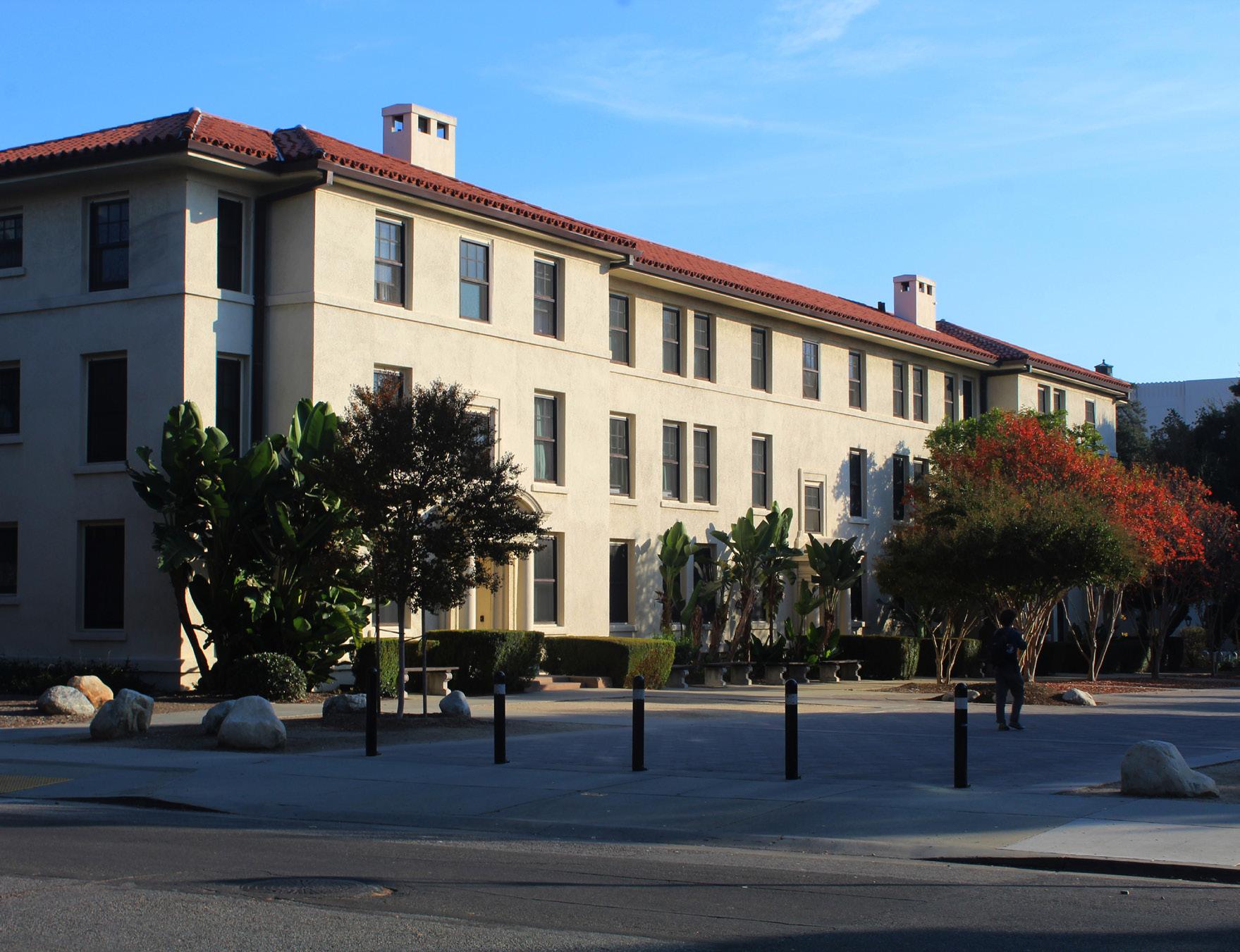
A government shutdown began on Oct. 1 after Congress failed to reach an agreement over the federal budget. Although funding for most current research projects at the 5Cs remains untouched, the shutdown could cause uncertainty regarding funding for new research grant applications.
Dean Gerstein, director of sponsored research at Pomona College, wrote in an email to Pomona faculty on Monday morning that Pomona grants are fully funded upon grant receipt, and funds that have already been issued will not be impacted.
“Agency program personnel can-
not review or process new applications or approve reports,” Gerstein wrote in the email. “Many federal contractors, like grantees, are forward-funded and able to operate normally.”
In the email, Gerstein said that consequences for research initiatives remain uncertain given the length of the shutdown.
“Much is subject to change over time, especially if the shutdown goes on and on and on and on,” he wrote. “For example, the administration has said that instead of temporary furloughs, it may permanently suspend certain operations by terminating the employment of all the personnel
ARTS & CULTURE

Claremont Hillel refuses to add to this cycle of hurt. We are here as agents of peace.”
In the same email, Slater highlighted the act of antisemitic violence that occurred on Yom Kippur at the Heaton Park Synagogue in Manchester.
“We stand with this commitment to solidarity, rejecting hatred, and ensuring every Jew feels safe and valued,” she wrote. She noted Israeli artist Gilad Segev’s visit to the consortium on Oct. 5, and announced more events in the coming week.
“Oct 15–16, the Hebrew anniversary of Oct 7, we will remember the victims and hostages of the recent attacks, hearing from a survivor of the NovaFestival and praying for those still captive,” Slater wrote. At the start of the week, on Oct. 6, FJP held their vigil at the south entrance of the Honnold-Mudd Library. Faculty speakers read testimonies from artists and activists to the crowd, highlighting the plight of the Palestinian people amid Israeli occupation.
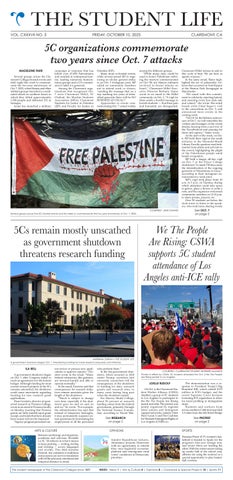
SJP held a longer, all-day vigil on Oct. 7 at the Pitzer College clocktower “to mark 730 days since the intensification of the ongoing genocide of Palestinians in Gaza,” according to their Instagram announcement a week prior.
SJP’s vigil took place from 10 a.m. to 5 p.m. on Tuesday, during which attendees could take space to grieve, place a flower or write a note, and the organizers welcomed community members at 12:15 p.m. to share poems, prayers, etc. Over 50 students sat below the clock tower to listen to the speakers, who took turns sharing words
who perform them.” In the last government shutdown, which occurred in 2018 under Trump, scientists and university researchers felt the consequences of the shutdown of funding for data, research grants and research sites, in many cases lasting long past when the shutdown ended.
For Harvey Mudd College, about 95 percent of research funding comes from the federal government, primarily through the National Science Foundation, according to Nicole Wal-


See OCT. 7 on page 2 On Oct. 4, the Claremont Student Worker Alliance (CSWA) shuttled a group of 5C students to Los Angeles to participate in the We The People Are Rising march and rally. The protest was jointly organized by regional labor unions and immigrant support networks, namely Unite Here! Local 11 and The Coalition for Humane Immigrant Rights of Los Angeles (CHIRLA).
Between mythology and migration, academia and activism, Rochelle Lu SC ’28 reflects on what it means to keep pushing — writing, feeling and existing — across languages and worlds. This Mid-Autumn Festival, she considers if traditions and purpose can survive translation with all the physical, emotional and temporal distance in mind. Amidst Republican failures, Abundance presents Democrats with an opportunity to refresh their once-neglectful economic platform and reinvigorate rural voters’ confidence in Democratic priorities.
The demonstration was a response to President Trump’s Big Beautiful Bill, which added $170 million to ICE’s budget, and the recent Supreme Court decision loosening ICE regulations to allow for racial profiling in immigration stops.
Students and workers from across southern California marched 1.5 miles from the 6th Street Bridge
Oct. 2
until around 12:45 p.m. When everyone had spoken, the organizers resumed playing a recording that read the names of Palestinians who had been killed by Israel in the past two years.
“I’m proud to be a part of a clear-sighted community who recognize[s] Palestinian genocide and mourn[s] collectively for the tens of thousands of murdered souls that fortify the walls of Israeli oppression, apartheid, and ethic cleansing,” Graham Hynes PZ ’27, who attended and spoke at the vigil, said.
Hynes shared the final words of late Palestinian journalist Anas Al-Sharif, who was killed in an Israeli airstrike in August.
“It is vital to remember and commemorate the names of the martyrs as people in Palestine continue to die under complete siege, incessant bombing, and even through the signing of the ceasefire,” they said.
At around 3 p.m., a small group seated themselves on the grass across from SJP’s vigil, carrying signs calling for the release of Israeli hostages.
continued from page 1 to the Japanese American National Museum to show support for affected Angelenos and take a stand against these recent actions.
“We just wanted to show support for the hostages that were taken on this day,” Noah F. PZ ’26, who declined to provide his full last name, said. He added that they hoped for a quick end to the war.
The Pitzer College Free Wall also represented the tensions associated with Oct. 7 on campus. That day, the Free Wall displayed a Palestinian flag across it. Painted in yellow over the flag were symbols including the awareness ribbon and the Star of David, with the phrase “TERRORISTS ≠ MARTYRS” written underneath.
Later that evening, MSA held their vigil at 5:30 p.m. on Bowling Green Lawn at Scripps College. Over 130 community members were in attendance as two professors and four students shared stories, poems and prayers.
“We stand here because we recognize the difference between good and evil, between oppressor and oppressed,” the vigil’s facilitator said. “We stand together with one another, with the global masses rising for Palestine and with the valiant, resilient people of Gaza.”
In addition to commemorating
the lives lost, the vigil’s speakers repeatedly emphasized what they said was the Claremont Colleges’ complicity in Israel’s genocide in Gaza. “We have become numb to the crushed skulls, dismembered limbs, and toddlers burnt alive in their sleep,” the facilitator said. “Do not forget Gaza, even for just a second. Never legitimize Zionism.”
Professor of anthropology at Scripps College and MENA Studies Department Chair Lara Deeb was one of the first speakers.
“First, I appreciate the space and the thought and care you all put into creating a space for collective grief,” she said. “I have no idea how to grieve a genocide. I don’t think anyone does. How do we grieve hundreds of thousands of people? How do we grieve deaths caused by unfathomable cruelty? How do we grieve mass graves?”
Noa Polish SC ’26 and Willa Umansky PZ ’27 shared a prayer on behalf of 5C Nishmat, a Jewish spiritual collective. Polish and Umansky recited the Mourner’s Kaddish.
“It’s an ancient prayer origi -
nally written in Aramaic, and it’s a prayer that we say in memory of the dead to comfort the bereaved, but it itself actually makes no mention of death,” Umansky said. The two invited vigil attendees to join them in the final amen of the prayer. At the end of the vigil, leaders invited attendees to go over to the People’s Fund market by the Motley Coffeehouse, which sold items like keffiyehs and posters. The People’s Fund Claremont is a “collective of students and community members who aim to monetarily support people building power (through mutual aid) in Sudan, Gaza, and Eastern Congo,” according to their donations page. As Claremont continues to reckon with the enduring effects of Oct. 7 on campus and abroad, the Israeli Cabinet has approved President Donald Trump’s plan for a ceasefire, which includes the release of hostages and the partial withdrawal of Israeli troops. A brief Oct. 9 statement from Prime Minister Benjamin Netanyahu’s office said that they approved an “outline” of a deal to release the hostages.
continued from page 1
“We’re here to uplift, we’re here to say no to the raids, no to the hate and attacks on people of color,” Pedro Trujillo, director of organizing at CHIRLA, said. “What we’ve noticed is that the majority of the time it’s brown people who are being pulled over, and it’s racial profiling because you’re speaking Spanish or because you’re working at a Home Depot or a car wash.”
Trujillo underscored the significance of student attendance at this rally and wider participation in the fight against the increasing pervasiveness of ICE.
“Every social movement that has been successful has been intergenerational,” he said. “It requires the leadership of young people. It requires the creativity of young people. The power of the youth block has grown so much that if it’s unutilized, unorganized, we’re just doing a favor to the opposition.”
CSWA has a long tradition of collaboration with the Unite Here! Local 11 union, which represents Pomona and Pitzer dining hall workers and Pitzer grounds keepers. Vanessa Kusel PZ ’27, CSWA steering leader, said that 5C students supporting Unite Here! specifically is crucial, especially in the more geographically isolated community of Claremont.
“This protest is in LA, where there’s a lot of union density,” Kusel said. “But out here, in the Inland Empire, there aren’t as many
unions. So it’s really important that these unions have student support because there aren’t a lot of unions around them to support them.”
At the rally, attending students were uniformed in red “Unite Here! Local 11” T-shirts and mingled within the pack of union members. Organization leaders shared concerns that the 2028 Los Angeles Olympics will put immigrants at greater risk of deportation, and outlined their efforts to hold the city accountable. The Los Angeles Alliance for A New Economy (LAANE), in collaboration with Unite Here!, distributed clipboards with QR codes to 5C students; the code directed people to sign up to send emails to the 2028 Olympics planning committee, “essentially telling them that they need to guarantee that the Olympics will not put immigrants at more risk.”
“We were walking around getting people to sign on to demonstrate to the Olympics planning committee that they need to take into account their impact on the community and defend the people who are going to actually support and have been supporting the city,” Kai Chen PO ’26, CSWA member and rally attendee, said.
Chen said that it was “really cool” to have the opportunity to play a key role in the union’s efforts and be at the forefront of tangible social change.
“That’s just what happens when you go out into a place and you start engaging in it,” they said. “The first thing you have to do is just get out there.”
Interest in attending Saturday’s
event reached CSWA members and the general 5C student body alike. Will Polin SC ’29 heard about the rally through social media and jumped at the chance to get free transportation down to LA with an official student group.
“I’m really motivated to get involved, but as a student, it’s hard to find ways to do that through class schedules,” Polin said. “The opportunities just feel kind of limited.”
Kusel said she finds new student interest in CSWA initiatives promising, echoing the sentiment that while “a lot of people care about immigration rights,” they often “just don’t know what they can do about it.”
The rally on Saturday was one way to give students an “outlet” where they can express their frustrations with current immigration policies in a “healthy and productive way,” according to Kusel.
Oliver Spaulding HM ’29 attended the rally because he wants college to be a place where he can explore political activism.
“I wanted to go and show up for protests, not just be knowledgeable about issues that are going on, but actually be trying to make a difference and make the world better,” Spaulding said.
Kusel emphasized how, while ignorance may be bliss, the privilege to turn a blind eye to greater social issues is fleeting.
“As 5C students, we have the privilege to not be aware, but there are people, thousands of people, all around our city and our county who are staying in their house because they’re afraid of being
kidnapped,” Kusel said. “With this new influx of money that ICE is getting, we know these kidnappings are only going to ramp up. So it’s better for us all to be aware now, because it could start to affect our [Claremont] community more.”
Social tease: On Oct. 4, the Claremont Student Worker Alliance (CSWA) shuttled a group of 5C students to Los Angeles to participate in the We The People Are Rising march and rally. The protest was jointly organized by regional labor unions and immigrant support networks, namely Unite Here! Local 11 and The Coalition for Humane Immigrant Rights of Los Angeles (CHIRLA).
The demonstration was a response to President Trump’s Big Beautiful Bill, which added $170 million to ICE’s budget, and the recent Supreme Court decision loosening ICE regulations to allow for racial profiling in immigration stops. “As 5C students, we have the privilege to not be aware, but there are people, thousands of people, all around our city and our county who are staying in their house because they’re afraid of being kidnapped,” Vanessa Kusel PZ ’27, CSWA steering leader, said. “With this new influx of money that ICE is getting, we know these kidnappings are only going to ramp up. So it’s better for us all to be aware now, because it could start to affect our [Claremont] community more.”
• Oregon Attorney General Dan Rayfield files suit against the federal government in an attempt to block President Trump from deploying the National Guard to the state; a hearing is set for Oct. 29
Oct. 4
• Unidentified individual carries out mass shooting in Montgomery, Alabama; there are multiple suspects, no arrests have been made
Oct. 6
• Gaza ceasefire talks begin in Egypt; Hamas and Israel later sign first phase of deal
Oct. 7
• The Texas National Guard arrives in Illinois; U.S. District Judge April Perry later temporarily blocks the Trump administration from mobilizing and deploying National Guard troops in the state
• 10 more UN officials detained in Yemen
Oct. 8
• FBI Director Kash Patel fires several FBI agents and dismantles the bureau’s public corruption unit after Fox News reported that those agents monitored Republican senators Astronomers predicted an enhanced Draconid meteor shower on this day
Oct. 9
• Israel and Hamas sign firstphase ceasefire agreement, including the release of hostages, prisoner exchanges and partial withdrawal of Israeli troops
Oct. 1–9
• The government is still shut down because Democrats and Republicans cannot agree on healthcare reform issues; President Trump has also moved to deny backpay to furloughed workers
• Various organizations and individuals such as Public Citizen, Democracy Defenders Fund, Rep. Robert Garcia and Rep. Jamie Raskin have accused the current administration of violating the Hatch Act. This accusation stems from the written claims on official government sites that state the current government shutdown is because of Democrats
continued from page 1
lens, director of sponsored research at HMC.
While HMC is heavily reliant on federal aid for research, Wallens said funding allocations have remained untouched so far.
“That, of course, could change as things in Washington evolve,”
Wallens said.
As undergraduate liberal arts colleges, the 5Cs are unlikely to face the same challenges as large research universities, according to Geoffrey Herrera, a professor of political science at Pitzer College.
“I think for now, it’s more of a concern for universities or higher education institutions that have
graduate programs, that have professional schools that really rely on government research money to support the institution,” Herrera said.
Though there may be a loss of funding for new grants at the moment, Herrera said, it won’t significantly change operations at the colleges.
“Our institutions are heavily dependent on tuition,” he said. “It would be annoying for research money to be cut off … but all that would do is stop the research projects of faculty that depend upon federal funding, which is not insignificant, but the work of the university would go on.”
A greater concern for the Cla-
remont Colleges, Herrera said, is the potential for further cuts to education similar to what occurred with DOGE in early 2025. In the recent shutdown, the Department of Education furloughed almost 90 percent of its staff. Faculty are concerned about how permanent layoffs may affect college operations as the shutdown continues.
Her parents are facing deportation; she raised over $50,000 to support them
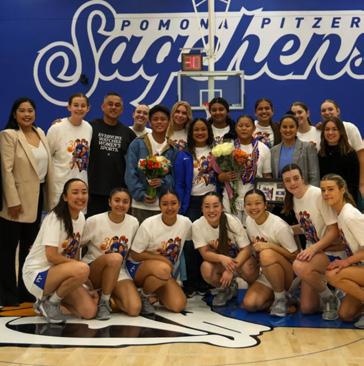
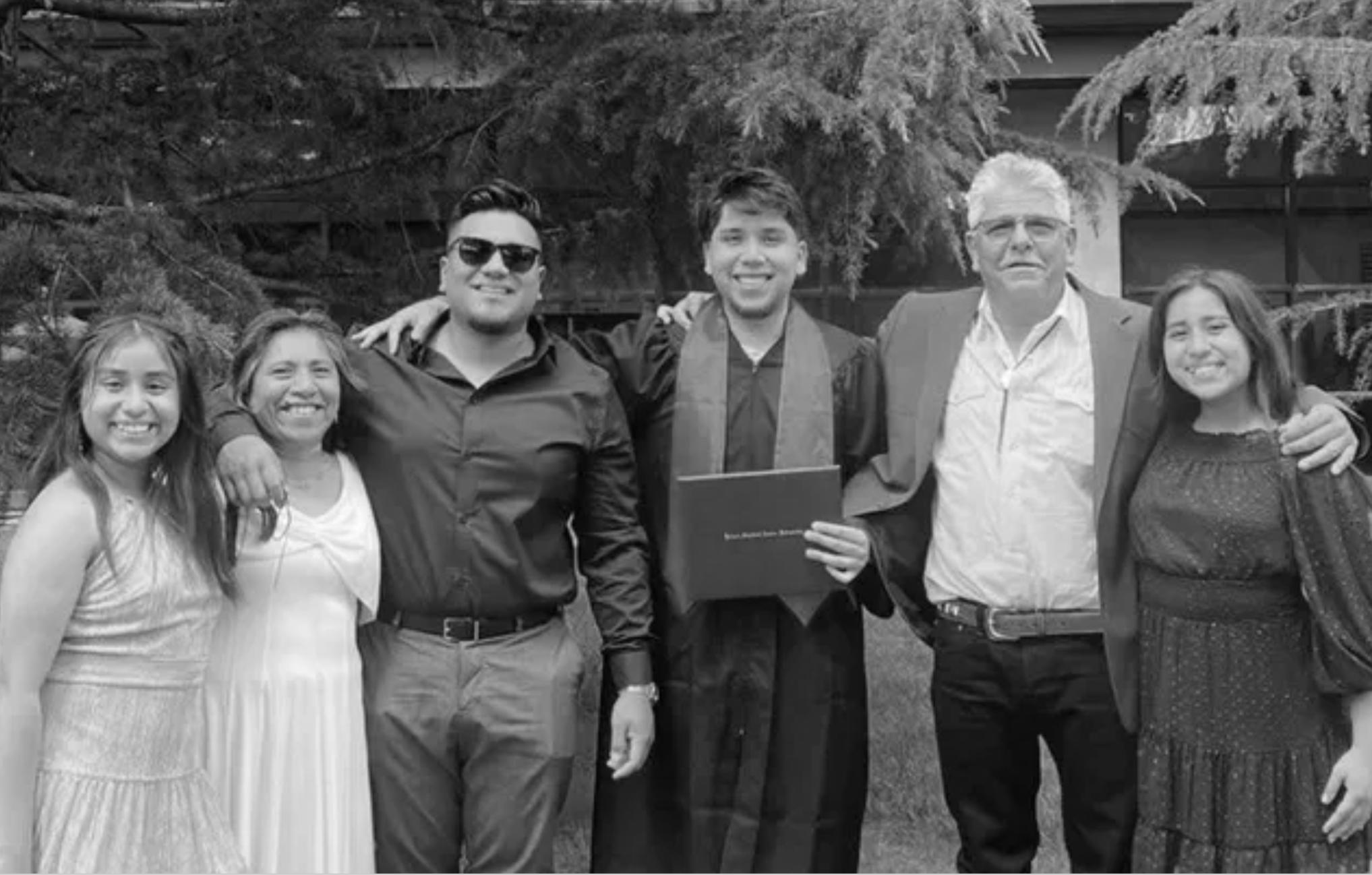
Aracely Duarte Perez HM ’29 raised more than $50,000 in two weeks for her parents as they face a move to Tijuana following a deportation order issued Monday, Sept. 22. Perez started the GoFundMe campaign on Sept. 24 with the goal of raising $17,500 to help her parents transition to life in Tijuana, Mexico. 1,400 people have donated since, nearly tripling the campaign’s original goal.
Her family’s story has gone viral on social media. Perez shared a TikTok video last month in which her father, Francisco Javier Duarte, spoke about his and his wife’s imminent deportation. The post has received over 180,000 likes as of Oct. 9. In the video, Duarte said he loved living in the United States and serving ice cream to his San Diego community. However, the past eight years in the country have proven difficult due to his family’s battle with deportation authorities.
In 2017, Duarte was detained by immigration authorities for seven months. Although he was eventually released, it only marked the beginning of a long legal battle.
“We were holding onto the hope that everything would turn out fine,” Duarte said in the video, his voice breaking. “It didn’t.”
Although Duarte said he has thirty days to appeal the judge’s decision, he won’t be doing so.
“For my health, for my children’s, for my wife’s, we’ve decided it would be better to part ways from this beautiful country that gave us so much,” he said.
After donations began rolling in, Perez said support from the community was astounding in an updated description on her original TikTok video.
“I can’t even begin to comprehend the overwhelming outpouring of support and love via kind words, offers of help and donations,” she wrote. “I would have never imagined, especially via TikTok and the community.
God bless.”
Scripps College students have reported being repeatedly approached by two non-5C-affiliated males who have lingered around Malott, making them feel uneasy. Scripps Advocates for Survivors of Sexual Assault and the EmPOWER Center were informed of these incidents on Sept. 3.
On Sept. 25, Campus Safety was informed that the males were back on campus at Scripps’ Bowling Green Lawn. The unidentified individuals were walking around as Be Well Thursday was taking place, a monthly wellness fair facilitated by Scripps Advocates, the EmPOWER Center and the Sallie Tiernan Field House.
Sally Glaskell SC ’27, an EmPOWER Center intern and Scripps Advocate, said she watched Campus Security walk the men off campus.
“The campuses are public and everybody has the right to be [here] and they’re beautiful, like I would spend time on the campuses even if I wasn’t a student here,” Glaskell said. “But after they’ve been talked to multiple times, harassing people who present as female, they haven’t shown that they know any of the students, [it is unsettling].”
Miriam Akhmetshin SC ’26, Scripps Advocates co-leader, expressed similar concerns.
“When we’re on our own college campus, we expect to feel safe, to be in the comfort of our peers, our community, and not outsiders, especially at a historically women’s college,” she said. “The [harassment] is a mirroring of an experience that we have in our daily
lives, but we might not expect to find here in Claremont.”
Laura Muna-Landa, the assis
tant vice president for communications & community relations at The Claremont Colleges Services (TCCS), discussed the incidents in a Sept. 12 email to the college community.
“The safety and well-being of our students is our highest priority,” she wrote. “[TCCS] Department of Campus Safety is aware of the September 3, 2025, report involving individuals not affiliated with The Claremont Colleges who approached students near Malott and engaged in harassing behavior that caused students to feel unsafe.”
Muna-Landa added that while officers were dispatched and made contact with the individuals, the perpetrators ultimately left campus before more information could be gathered. She also reiterated that the 5Cs are private property where harassment is not tolerated.
“If the individuals return, Campus Safety will take appropriate steps, including issuing trespass notices to bar them from campus,” she said. “We encourage students to remain aware of their surroundings, secure their belongings and take advantage of available resources such as the LiveSafe App and the safety escort service.”
Akhmetshin said that harassment can induce fears about personal safety, bring up past traumas, cause sleep loss and affect one’s attention span and capacity to be present in friendships, class and routine activities.
“All of our students deserve to
feel safe on campus, and if that’s not the case, if they’re feeling harassed, then there are steps that need to be taken to prevent that, and we hope to be there as a support resource to the many people who have been impacted by this,” Akhmetshin said.
Gaskell said that these incidents disrupt what generally feels like a secure environment at the consortium.
“It’s a reminder that these campuses are really good in the
sense that I personally feel pretty safe and my first instinct when somebody comes up to me is that they don’t have any bad intentions,” Glaskell said. “[However, these instances] can induce anxiety. I’m sure that people who have been approached are probably more on the lookout for these people, which can obviously lead to stress.”
Glaskell also encouraged community members to attend Advocates’ support hours, as they are trained to help and ready to address any issue, large or small.
“There’s a reason why we chose this close-knit community,” Akhmetshin said. “We’re here to look out for another, that means not letting random people you don’t know into the dorms, not doing things that could jeopardize the safety of your peers. So we encourage everyone to, if they see these two individuals, to call Campus Safety, because they are aware of the situation.”
On Wednesday, Oct. 8, students across the Claremont Colleges gathered at Walker Beach to explore various newly launched and revived clubs at the 5C Fresh Club Fair. As the autumn sun set across the lawn, students conversed and wandered around different club tables with flyers, banners, QR codes and candy.
The new club fair welcomed around a dozen new and revived student-run clubs in addition to those that were unable to attend the first 5C club fair on Sept. 3. The event featured a wide array of clubs — including the 5C Pens & Poetry Club, The Women’s Network, GRAFT, iGem, FLIP (Financial Literacy and Investing at Pomona), 5C Cheer Team, Claremont

Close your eyes, and you can already picture the scene: a circle of foldable chairs, an eerie clinical glow of studio lights, maybe even an oversized clock sitting ominously in the center of the room. A bell rings and, almost immediately, debaters rush to the table, fighting to be the first to hit a button and begin spewing vitriol.
In one form or another, these dramatized political debates have spread across the internet, reaching just about everyone with a social media account.
In recent years, companies like Jubilee have gained attention for their debate videos, creating a daunting new form of debate culture. Today, the Jubilee YouTube channel has over 10 million subscribers, with some videos reaching up to 30 million views. With their popularity continuing to rise, a growing number of students, myself included, have begun to question the implications of this sensationalised form of debate on campus culture.
When students open their phones to see clips of everything from “Candace Owens vs 20 Feminists” to “Can You Stop Being Gay,” what does that say about what structured debate and political discourse should look like?
“I do not generally watch Jubilee because they don’t platform healthy debates or bridging divides,” politics major Emma Sweeney SC ’27 said. “Instead, they feed off of our increasingly polarized political sphere.”
What’s more is that lots of students and people our age now turn to these shows for information and education. It is almost effortless to defer to the figureheads, the winners and losers of such debates, who seem to be omnipresent within the digital age. In wrongfully awarding them a sense of political authority, we absorb the rhetoric that follows.
On YouTube, Jubilee’s description reads: “provoke understanding & create human connection.” The deep division that has ensued makes this sentiment almost laughable. They have swapped “understanding” for aggression, and “human connection” for monetized extremism. Gilding this as a true form of “debate” just makes this kind of propaganda more palatable.
Jubilee is not the only perpetrator. Many echo the same formula with “debate me” culture and how-to debate classes, titled by absurdities such as “how to destroy anyone in an argument” or “debate as a weapon.” Debate is no longer defined by a legitimate exchange of ideas.
“It makes me worried about how polarized our country is becoming,” Sweeney said. “And although I believe, or maybe hope, that most people are not actually this diametrically opposed, Jubilee is telling us we are.” It is no coincidence that prominent “debate me” figureheads, such as Charlie Kirk and his “Turning Point” following, have made the liberal arts out to be some big joke.
Kirk always relied on his repertoire of statistics and talking points to execute a guerrilla attack on his opponents. This incredibly fast-paced dynamic, oftentimes
Muay Thai and the Food Recovery Network.
Pens & Poetry, a creative writing club that seeks to foster an environment of student writers with workshops, writing circles, open mics and guest speakers, made their first public appearance at the fair. Sakeenah Abraham PO ’29, the chief commissioner of Pens & Poetry, expressed the club’s goal to make creative writing more accessible and inclusive to students at the 5Cs.
“We wanted to make [a club] that really values creative writing,” Abraham said. “Students of all different skill levels [are] important to us. I don’t think you necessarily need to have published poetry or have even taken a class before.”
Pherell Washington PO ’29 agreed with Abraham, in addition to noting the importance of club involvement on campus as an outlet for community building.
“I think it’s so important to get involved with things on campus, keeping yourself occupied, building that community, building those new connections,” Washington said. “[It’s important] just having somewhere be an outlet for you — like poetry is an outlet for me, and I feel like it can be for a lot of other people.”
Another club at the fair, GRAFT, was established this semester as the first multilingual magazine at the
unallowing depth, made a spectacle of students who struggled to deliver counterpoints fast enough. Arguments became sensationalized clips, and suddenly people all over the internet are reducing students’ complex thoughts to a three second clip of their stammered reply.
Previous debate competitor and coach Floria Auerbach SC ’27 described how, in her experience, student debate culture has changed over the last decade.
“I literally watched someone laugh at another person for not knowing a fact,” Auerbach said. “It really reminded me of the way that people converse with each other on Jubilee because it was like ‘oh, you don’t know that? You dumb, dumb idiot.’”
The dismissive laugh that’s meant to communicate intellectual superiority. Words spoken without any pauses followed by the smirk that creeps onto their face when you slip up. These are the moments that mimic Jubilee. In an instant of confusion, you are made out to be a fool by a performative sharpness of the intellect. This hostility towards uncertainty has become so oddly fashionable, even in institutions of higher education.
“We are in class — we shouldn’t walk into a classroom knowing everything,” Auerbach said. “If you need to scoff at someone, laugh at them, put them down in order to feel like your argument has legs, then you don’t have a good argument.”
Debate is becoming increasingly less about open discussion and more about domination – a critical shift that many, like Auerbach, believe is reshaping the entire institution of learning.
Auerbach argued that this emphasis on the domination and the villainization of your debate opponent is deeply connected to a common concern in the world of academia right now — students are losing the art of active listening.
Our desire to engage in complex discussion is diminishing. In its place lies the drive to win.
The need to defeat your enemy not only leads to a breakdown in classroom discussions and debates but also fundamentally misconstrues the goal of debate and political discourse in general. For Auerbach, students lose the nuance of an argument if they view their opponent as wholly wrong.
“When we teach students that winning and losing is the most important thing [in a debate], it’s teaching them to have complete faith and trust in incomplete ideas,” Auerbach said.
Jubilee’s systematic sensationalization of debate culture can serve as both a symptom and a driving cause of the growing political polarization across the country. In valorizing winning and stampeding while presenting confusion as weakness, the prevalence of Jubilee-esque content has already seeped into the spectre of political discussions on campus, in and out of the classroom.
“Why have we gotten to a point that we’re so afraid of being wrong?” Auerbach said.
Maybe because wrongness is no longer treated as a step closer to the truth, but as evidence of intellectual failure and justified grounds for public humiliation.

5Cs, aimed at celebrating linguistic diversity and providing a platform for students who speak more than one language.
“The purpose of our club is to ultimately create a magazine that features writings from different languages, across the 5Cs,” Peter Zhang PO ’29, a club leader of GRAFT, said. “The name means an intersection between two clubs that are connected together, and ‘graft’ is also a medical term which means to sew two sections together.”
In addition to freshly launched clubs, several previously frozen clubs that were revived this semester made their appearance at the fair. Revived clubs included the 5C chapter of The Women’s Network and FLI Scholars.
The 5C chapter of The Women’s Network, which became frozen sometime during the pandemic, was revived and reorganized by Kate Humphreys SC ’27 this semester.
The Women’s Network is the largest national women’s networking organization that aims “to cultivate and celebrate women’s ambition by connecting members to industry leaders, professional development resources and career opportunities,” according to their website.
“We’re really into setting up women for success within their ca-
reer paths,” Humphreys said. “We do LinkedIn workshops, resume workshops, we’re hoping to do some speaker panels, but I know that career stuff can get kind of stressful, so we’re also hoping to do community workshops or community events as well.”
Unlike other revived clubs that had been inactive for years, FLI Scholars — a club for first-generation and/or low-income students — was frozen temporarily last semester due to funding constraints. Leaders of FLI Scholars appeared at the new club fair as they were unable to attend the first club fair on Sept. 3.
“It’s nice to have students alongside you who have similar experiences in life and know that when you’re talking about filling out FAFSA — they know what that is or they know what it’s like to be on public benefits,” Bayarmaa Bat-Erdene PO ’26 said. “I like community building because it’s low stress and it just lets people hang out.”
Juan Fuentes PO ’29, an executive board member on Pens & Poetry, emphasized how the small student population at the 5Cs has resulted in potential downfalls but also created new opportunities for students to take initiative.
“Because student population is a lot lower than other colleges or universities [at the 5Cs], sometimes
clubs can die out if the leadership dies out,” Fuentes said. “But I think that also creates an opportunity for new students in that while there’s a large amount of diversity, there’s also a few gaps from things that have maybe fallen over the years, or that aren’t as active anymore, and there are opportunities for new students to go into leadership and to start these initiatives and hopes.”
With dozens of club leaders and countless students, the 5C Fresh Club Fair fostered a sense of community on campus –– bringing students together around shared passions and the potential for new experiences.
During the fair, student attendees shared their support for the new clubs and sense of community on campus.
“A couple of our friends [are] starting a club, so we just wanted to show up and support them,” attendee Shadrack Martin PO ’29 said.
For leaders, the fair was an opportunity to promote their club and connect with other new clubs on campus. For attendees, the fair was an opportunity to discover and explore interests outside the classroom and beyond what the first club fair had to offer. The 5C Fresh Club Fair not only highlighted a diversity of student-led organizations, but it also reflected a highly driven and collaborative campus culture rooted in initiative and innovation.
Mapping the history and future of the BD s movement with s haheen Nassar’s presentation of ‘Beyond recognition’
ADAM AKINS & CLAIRE WELCH
Tuesday, Oct. 7 marks the second year of the Israel-Hamas war. Vigils commemorating lives lost to the conflict, walk outs and strikes occurred across the 5C campuses. In solidarity and interest, students and community members met in The Motley Coffeehouse — closed due to staffing shortages on a day where the Boycott, Divest and Sanction movement (BDS) issued national calls for strikes — to hear Shaheen Nassar, a lifelong Palestinian activist, speak in a talk titled “Beyond Recognition.”
The event was cohosted by six organizations: the 7C South West Asian and North African (SWANA) club, the Pitzer Center for Asian Pacific American Students, Pomona’s Asian American Resources Center, Scripps’ Anthropology Department, the Intercollegiate Department of Asian American Studies and the 5C Asian American Advisory Board.
Many students were drawn to the talk out of a desire to learn more about the history of the BDS movement from Nassar, who has been organizing in Pro-Palestinian spaces since the 2000s.
“I think it’s really important to have speakers like this to break out of this bubble and also just further education,” attendee Junee Manandhar SC ’27 said. “At least for me specifically, I haven’t had the chance to talk to anyone who is Palestinian before, and getting that specific perspective was really enlightening for me. It just opened my eyes to a different view.”
In 2010, Nassar and 10 other students — nicknamed the “Irvine 11” — were arrested for staging a protest during a speech by the Israeli ambassador Michael Oren at the University of Irvine. The Irvine 11’s protest, in which each student stood during Oren’s talk to recite sections of international law they believed Israel had violated, was inspired by Israel’s large military campaign in Gaza in 2008.
Nassar and his fellow students were convicted of misdemeanors in 2011 and sentenced to community service and informal probation. Since then, Nassar has continued organizing for the Palestinian cause in the LA area, and often writes Opinion-Editorial pieces for Al Jazeera.
7C SWANA official and event organizer Lena Abed PO ’26 noted that Nassar has had a working relationship with advocacy groups across the 5Cs for years, and previously spoke at other 5C events, including the Pitzer Encampment. Abed stressed the importance of having the 7C SWANA space for students on campus, and their ability to facilitate relationships with

community organizers such as Nassar.
“[7C SWANA] is sort of like a hub for cultural cultivation, community or appreciation of culture,” Abed said. “Post Oct. 7, I feel I’ve been more interested in the political aspect of what the SWANA community could bring … particularly because I think SWANA identities are very politicized in and of themselves.”
Before his talk officially began at 3 p.m., a crowd of students had gathered around the entrance to the Motley, browsing tables of keffiyehs, student artwork, prints and educational materials. 7C SWANA organizers explained to students that they were selling the keffiyehs and other artwork at a sliding, pay-whatyou-can rate to fundraise for the People’s Fund.
In his introduction to Nassar’s talk, 7C SWANA President Saif El Mosalami PZ ’26 explained that the People’s Fund is a local collective established to provide discounted and free medicine to Palestinians facing genocide in the Gaza strip, as well as Sudanese and Congolese people who are also facing critical humanitarian situations.
The crowd applauded as El Mosalami and organizers took their seats, and Nassar stepped up to the microphone. As the last few students trickled in from outside, every seat in the Motley and much of the floor space was covered. Nassar began by leading the crowd in a call-and-response chant. “Free, free Palestine, long live Palestine.”
Over the hour and half of his talk, Nassar touched on everything from the lived experiences of his relatives in the Gaza Strip, to his story of arrest, to his goals for the future of the BDS movement and the Palestinian cause in general.
After echoing El Mosalami’s call to donate to the People’s Fund, Nassar highlighted the importance of direct action, arguing that mass protests are critical to both gaining support for the movement
and undermining the hegemonic control of American mainstream media. He followed this point by highlighting the symbolic limitations of forms of activism that exclusively include mass protests.
“I love protests. However, there is a counterrevolutionary aspect to leading protests,” Nassar said.
“Unfortunately, some of these people who are drawn to these protests, they get out, they shout, they create a public spectacle. However, sometimes it ends at that.”
Nassar’s comments did not critique mass protests, but rather encouraged activists to explore other avenues in conjunction with them, such as leveraging political pressure to engage with politicians.
“I think there are certain politicians that are a bit squirmish,” Nassar said. “And [they] can be pushed reluctantly into doing the right thing by exercising our organizing strength, and a combination of a two pronged approach with limited diplomacy and a whole lot of pressure.”
In addition to outlining his practical approach to activism, Nassar devoted much of his time to discussing the history of Palestine and its struggle to achieve statehood. He explained that the title of his talk, “Beyond Recognition,” refers to his desire to devalue and strive beyond the goal of lobbying Western countries to recognize Palestinian statehood.
Throughout his talk, Nassar drew from over 15 years of experience with organizing in activist circles. Despite the roadblocks and challenges he has faced in that time, he maintains a dedication to situating the struggles of Palestinians within the larger historical context of the world.
“I want you to understand,” Nassar said, “in every formally colonized area in the world — in Africa, Asia, and South America — our oppressors did not leave of their own free will. They were evicted by the collective strength of our people.”

In the past few weeks, whenever I catch myself grumbling about the midday California sun, relentless even in late September, I quickly remind myself: thank God I’m not back in Shanghai, where the humidity clings like a second skin. It slicks your hair to your temples until you feel half-dissolved.
Or maybe I should say: thank God Houyi shot down nine of the 10 suns once upon a time, saving humanity from drought and famine. That’s the story I grew up with, Chinese mythology stitched into the fabric of how I learned to understand the world. It must’ve been unbearable with that many suns.
But where there’s Houyi’s sun, there’s also Chang’e’s moon. One myth leads to the other, day folds into night, and before I know it, the seasons have slipped forward. As dusk settled over the sky this brisk October night, I realized that the moon’s out early — a waxing gibbous, pale and patient. I thought of Chang’e, the Moon Goddess, and then, only then did it hit me. The Mid-Autumn Festival is right around the corner and I had almost forgotten.
I never paid much attention to this holiday when I was still back in China, before I came to college. It signified a three day weekend, sure, but the compensatory working system, or tiaoxiu, ensured we paid it back the following week by going to school for an extra day. Only after leaving did I realize how much those quiet routines had shaped me. From afar, I felt a pang of cultural dissonance, the distance sharpening habits I once took for granted into something tender and irreplaceable.
The story goes that Chang’e was the wife of the heroic archer Houyi. As a reward, Houyi received an elixir of immortality, which Chang’e swallowed alone to keep it from falling into the hands of a villainous apprentice. She ascended to the moon, where she still resides. Each year, on the 15th day of the eighth lunar month — Mid-Autumn — people honor her by offering food, hoping to catch a glimpse of her face in the full moon. This year, it fell on October 6.
On this day, it’s supposedly a tradition to share mooncakes with your loved ones while moongazing after dinner. Yet, many families rarely bought mooncakes just for themselves, mine included. Those were reserved for others — relatives, business partners or anyone important. You would present them with a lavish box, the lid fringed with golden lining. Even then, it was more a gesture of respect and generosity than celebration. Now, in the States, I find myself circling back to Mid-Autumn. I never imagined how tangible my identity as a Chinese and Taiwanese international student would be until I got here. As we inch toward October 31st, every Target aisle is bursting with pumpkins, skeletons and candy corn, things that were never part of the landscape back home. Meanwhile, I still get
push notifications from Chinese apps reminding me of mooncake gift discounts, or new boba flavors released just for the holiday. I can almost picture the ancient supermarket around the corner from our apartment complex, with a pyramid of mooncakes stacked by the entrance right now. When home — and everything it holds — is so far away, it’s hard to grasp its realness. It becomes slippery in my mind, like trying to hold water in my hands. In a way, I feel like a child struggling to grasp object permanence. Sometimes I wonder: what exactly am I doing here, all the way across the Pacific, studying in a foreign language and trying to advocate for all my intersecting identities in ways that often feel abstract?
As a Writing & Rhetoric (and perhaps sociology) major, most of what I write and research ultimately serves my own curiosities. Still, I can’t help thinking of Sisyphus, a figure from Greek mythology punished by the gods tasked with rolling a boulder up a hill only for it to roll back down each time, a frustrating and futile endeavor. Just like him and his boulder: am I really shifting anyone’s views on race, gender or identity by writing about them in English? In America?
If I am, it would have to be people from English-speaking backgrounds. The people who might understand my actual perspective best, as those back home are locked out by the language itself. So what are my goals really? And how much of that ambition is bound up with my identity as an international student here, as someone whose presence always feels provisional?
Why am I not back in China or Taiwan, where activism might feel more immediate, where my foreign identity wouldn’t color every conversation about belonging?
These feelings extend beyond myself. Every now and then, I see elderly shoppers at the Asian supermarket — lugging vegetables in their rolling carts, debating soy sauce brands, picking up jars of Lao Gan Ma priced 10 times higher than at home. I start to wonder what brought them here. What trade-offs once felt worth the distance? After decades of building lives abroad, do they still think of their home countries the way I do, or have they already made peace with where they are?
Why am I here? Why is anyone here, there, all existing at once?
But think about it. The moon is hanging above us right now, and somewhere up there, Chang’e is gazing down at us buzzing about. Beyond her, planets spin quietly in their own orbits, and farther still lie realities we can’t even begin to comprehend. Maybe no one can truly answer these questions, and in the end, our answers to these contemplations are probably as varied as the fillings of mooncakes. Red bean paste for sweetness and salted egg yolk for completeness. We live such distinct lives, and you’ll never even graze a billionth of the ones that exist, have existed or will exist in the world.
So despite all the physical, emotional and temporal distance during Mid-Autumn, when people look up at the same full moon from different corners of the world, I’ve started to feel a strange sort of closeness.
Mid-Autumn can’t quite be about family reunions anymore; I’m too far away, and I never appreciated the ease of togetherness enough when I had it. It’s become more about realizing that familiar concepts surrounding traditions don’t vanish when I move, and existential crises about purpose or identity don’t have to feel so panicky.
I can be in a Halloween aisle in Claremont and still get a push notification for new taro-latte-flavored mooncakes in Shanghai. I can be an international student and still try my best to get my voice out there in English. That duality becomes its own kind of belonging, surpassing the cultural dissonance.
Truly, one must imagine Sisyphus happy, maybe even holding a mooncake.
The holiday might have felt like just another long weekend back home. But here, I’m musing that no matter how scattered our lives are, no matter how much “purpose” we serve or how much we feel that we “belong,”we’re all somehow under the same full moon.
Happy (belated) Mid-Autumn Festival!
Rochelle Lu SC ’28 is from Shanghai, China and Kaohsiung, Taiwan. Her favorite mooncake flavor is red bean paste with salted egg yolk.

“Sound and music are so much more than things that we have the vocabulary to use and talk about,” Nina Sun Eidsheim said. “There exists also the inner material vibrational practice around sound, namely the material that sound has to travel through to exist.”
On Oct. 2, the Humanities Studio at Pomona College hosted Eidsheim for a conversation on her upcoming book that discusses the work of musician and composer Wadada Leo Smith. The talk was titled, “Nina Sun Eidsheim on the Sounds, Art, & Philosophy of Wadada Leo Smith.”
Eidsheim is currently a Professor of Musicology at the UCLA Herb Alpert School of Music and the director of the UCLA Practice-based Experimental Epistemology Lab. In addition to her current work, Eidsheim previously published “The Race of Sound: Listening, Timbre, and Vocality in African American Music” in 2019.
This event was a part of The Humanities Studio’s annual lecture series; this year, the theme is “The Gift of Sound + Vision.”
As the director of the studio, English Professor Kevin Dettmar emphasized the importance of each year’s broad themes in furthering the studio’s mission.
“We try to pick themes that don’t too narrowly focus on one part of the faculty or the curriculum,” Dettmar said. “We want people from different disciplines and different methodological perspectives.”
Each year since their establishment in 2018, Dettmar and the Humanities Studio staff have worked hard to cultivate the upstairs corner of The Hive as a space celebrating interdisciplinary study within the humanities. Their events often draw Claremont community members and students from all over the 5Cs, like Arie Lewis Pugh PO ’26.
“This year, they’ve been focusing a lot on sound, and what it means as a cultural artifact, as a technology, as something that connects us,” Lewis-Pugh said.
“[Sound] is something that we each separately perceive, and that’s really interesting.”
Eidsheim’s body of work, right at the intersection of music and language, is the epitome of this year’s “Sound + Vision” theme. In her research, she often ties together scientific and psychological research with human-centered studies, drawing on visuals to illustrate her arguments.
“Eidsheim’s book demonstrates the symbiotic relationship between playing music and writing language,” Bill Boyer, a fellow at the Humanities Studio, said. “Nina is a trained singer and is keenly attuned to the phenomenology of hearing.”
Eidsheim began by discussing her interest in how aspects of our identities, such as race and gender, shape how we produce and hear sounds. As Eisheim elaborated on her point, she gave the example of one’s inability to pronounce sounds from languages that are foreign to them.
“Even when you are born, you are cultured into languages and sounds,” Eidsheim said. “The voice we have has been given to us
from other voices. Even in vitro babies will know the language of the person carrying them; therefore, we are never fresh to sound.”
As she continued, Eidsheim explained that each musical sign does not tell musicians what exact sound to play, but rather provides them a starting point for musical expression. From the same set of symbols, every individual produces a different set of sounds.
Tying together her thoughts on spoken language and music, Eidsheim shared that she often thinks in images and does not try to express her thoughts through words too early. Although she recognizes that language is the currency of scholarship and would like to participate in this exchange, she’s careful not to limit her thinking to ideas that can only be expressed linguistically.
Wadada Leo Smith, the subject of Eidsheim’s latest book, is an esteemed composer and trumpet player who has spent over 50 years developing his own musical language. Instead of traditional notation, Smith’s musical language favors symbolic compositions of color, line and shape.
“Since the 1960s, Wadada Leo Smith has developed a musical philosophical language that is based on relations called Ankhrasmation,” Eidsheim said. “Everything depends on references. We can never objectively define the sounds of Wadada’s music; it is all based on references.”
In 2017, Eidsheim approached Smith, and they soon began putting his theories into words. The book, which they completed this summer, combines images and words in dialogue form. Eidsheim explained that the artistic duo chose this style in order to give readers space to reflect on the text.
Throughout her talk, Eidsheim read selections of their work to the audience. This book defies genre, blending musical theory and philosophy with biographical stories detailing their individual childhoods and relationships to music and language. There was an emphasis, both in Eidsheim’s book and her talk, of viewing one’s relationship with music — everything from single notes to entire pieces — within the context of their identity and life story.
“The sensation that you experience with sounds will be part of your history with sound,” Eidsheim said in response to one attendee’s question. “In my next project, I am trying to figure out how to write different sounds and sensations.”
As she discussed Smith, Eidsheim explained that behind each note played is a compilation of all the notes an individual has heard. Sonic expressions pull from an archive of previously heard sounds.
“I would’ve assumed that the reference would be the tempo, or the reference would be the other notes in the piece, but it was interesting for her to think of the reference as past things you’ve listened to,” attendee Lina McRoberts PO ’27 said. “So I liked that I was thinking about things in new ways.”

Doja Cat, the popstar who forgot her audience
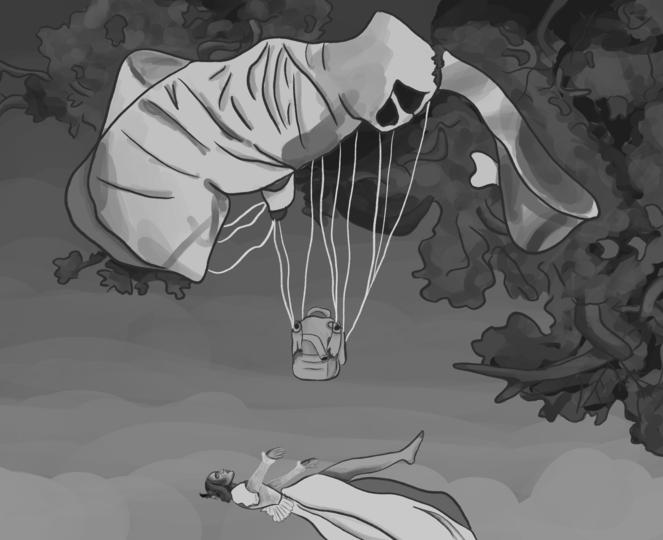
Can a widely known artist retain their popularity while being rude to her audience? “Vie,” Doja Cat’s fifth album, released on Sept. 26, may answer that question.
In Doja Cat’s previous album, “Scarlet,” she strove to demonstrate her genius as a rapper, claiming the pop albums she previously released before were mere cash grabs. She stated that pop music no longer sounded exciting for her anymore, and that she’d stop making pop songs. However, in “Vie,” Doja Cat appears to have backtracked, returning to the pop influences that made her famous and produced hits like “Say So” and “Kiss Me More.” The singer admitted that the
album is “a pop-driven project,” and that she perceives herself as a rapper who makes pop music. “I know that I can make pop music, and pop is just that it’s popular,” Doja Cat said in V Magazine. Is she implying she returned to pop only to gain more commercial success?
Throughout her career, Doja Cat has shown she can move effortlessly across genres, and this album confirms her versatility. The 1980s-inspired production blends with her cheeky, ironic and lustful lyrics to reiterate that she can be both a creative rapper and a fairly skillful singer.
“Jealous Type” was the lead single, and it perfectly anticipated the direction of the album and its lyrical content: an ode to romance while holding on to jealousy, yearning and regret. “You’re my person, this my first time, I’m in love / Those men were practice in my past / Don’t be dramatic, let’s have kids,” she adorably sings in “Silly! Fun!” In this, we get a more introspective Doja Cat than the mainly banal or performative storytelling that filled her previous albums. Still, she doesn’t abandon her sexually blunt lyrics in songs like “Cards”: “He’s turned on when I fill this tank up / No bra,
fresh beat, watch him scrunch his face up.”
“I’m doing what I was perfecting in the beginning, I’m doing what I know I know how to do,” Doja Cat stated about her last album in Pitchfork. She was best known for her ability to take on challenges and cross genre boundaries and structured barriers unpredictably. However, that’s not the case in “Vie.”
After the first couple of songs, the album starts sounding monotonous, unmemorable and formulaic. “If I wasn’t paying close enough attention, I wondered if I was listening to the same song,” Elle’s content strategy manager noted about the album, expressing what I felt perfectly. It seems that her adaptability got lost in the focus of creating a pop album. Although the album was highly anticipated and she even performed “Jealous Type” at the VMAs to promote it, “Vie” fell short of commercial expectations, considering Doja Cat is one of the most influential artists of our generation.
The recording debuted at No. 4 on the Billboard 200 chart, but “Jealous Type” is the only track on the Billboard Hot 100, and it
couldn’t even re-enter Spotify’s Global Top 100 Songs after the album’s release. The second single, “Gorgeous,” debuting at No. 56th on the Billboard Hot 100 doesn’t suggest a stronger commercial performance ahead either.
This initial lack of interest from the public in reaction to “Vie’s” release simply demonstrates that listeners have raised their voices: the audience has had enough of her arrogance and disrespect.
In 2023, Doja Cat called out her fanbase in a since-deleted Threads rampage after they started referring to themselves as “kittenz.”
“My fans don’t get to name themselves s–t. If you call yourself a ‘kitten,’ that means you need to get off your phone and get a job and help your parents with the house,” Doja Cat wrote on Threads.
This came after her alleged negligence toward fans waiting for her in the rain in Paraguay, followed by her complaints that nobody had waited for her. On Threads, she also went as far as to categorize some fans as “miserable h**s” after they accused her partner of emotional abuse, forgetting that listeners are the reason artists like her have a platform.
Her disrespectful attitudes may have once been interpreted as fun and carelessly authentic, but after several instances, we grew weary of listening to an artist who, despite claiming she doesn’t hate her fans, proves the opposite with unexpected emotional outbursts.
“If, for any reason, a project of mine does a little less good than the last one, I don’t want to be up in arms and upset about it. I want to embrace that,” the artist said. Well, it is time for Doja Cat to face the music and acknowledge that her new album is unlikely to have any lasting cultural impact.
With “Vie,” Doja Cat sought to regain her place as a mainstream pop star. Her return to the genre, motivated by the notion that “pop’s what is popular now,” was undermined, as the risks of being recklessly harsh alienated her fans. If Doja Cat wants to regain her cultural and commercial acclaim, she’ll need to stop taking her streams for granted and start hitting the right chords — not just in her lyrics, but in how she engages with fans online and in real life.
With Halloween right around the corner, nothing screams holiday spirit like good old fashioned horror. This October, Pomona College’s theatre department is getting ready for the spooky season with their first production of the semester: “Hookman.”
Premiering Thursday, Oct. 2 at the Allen Theatre, “Hookman” turns the slasher genre on its head through its incorporation of horror and comedy in discussions on the heavier topics of grief, guilt and micro-aggressions. The play ran for four nights, and had its last show on Sunday, Oct. 5.
The narrative follows college freshman Lexi, played by Fiona Larsen-Teskey SC ‘26 , as she navigates her complex feelings over the death of her high school best friend Jess — while also being haunted by the titular Hookman. The story also features Lexi’s connection to her community during her grieving process, such as her roommate Yoonji and classmate Chloe.
Originally written by Chinese American playwright Lauren Yee, with the Pomona production being directed by visiting assistant professor of theater at Pomona, Talya Klein.
Attendee Joshua Lin PZ ’29 appreciated how the narrative was different from the typical horror films he was familiar with.
“A lot of slashers are just your typical, run-of-the-mill cheap horror,” Lin said. “But this one
really feels like it’s got some depth to it … it’s got something that you’re able to look back and ruminate about.”
While the play borrows many elements from the mainstream slasher and horror genres — the titular Hookman killing and mutilating victims with his hook — it also parodies the genre through its satirical nature.
For example, when the Hookman cuts off Yoonji’s face, the utterly gruesome sequence is comically exaggerated and drawn out, causing the crowd to erupt with laughter.
Despite these lighthearted moments, the performance also contains many scenes that reflect Lexi’s inner thoughts and feelings, blurring the line between objective reality and her imagination.
The story is told through a series of scenes that switch between the present day and flashbacks to the night of Jess’ death. To reflect Lexi’s denial and inaccuracies in her memory, the set designers covered most of the stage in sheets of plastic to illustrate her foggy mental state.
However, as Lexi begins to remember more details from that night, the set gradually morphs to more clearly resemble the inside of her vehicle, the site of Jess’ death. With each succeeding flashback, the stage crew removed pieces of plastic, symbolizing Lexi’s growing mental clarity and inability to continue to deny what occurred.
Ultimately, audiences learn
that the Hookman was never a real person to begin with. Rather, he is a manifestation of Lexi’s guilt over her involvement in Jess’ death, which was caused by Lexi’s reckless driving. Additionally, the audience discovers that the scene where the Hookman claws off Yoonji’s face was also just a figment of Lexi’s imagination.
In the final scene, Lexi finally confronts the Hookman faceto-face, which symbolizes her newfound conviction to confront her guilt head on.
Larsen-Teskey, who studies both theatre and psychology, chose to present this production for her senior thesis due to her fascination with the characters’ internal struggles.
“[One] part that really drew me to the show was the psychological aspects of it, because I am a psychology major,” LarsenTeskey said. “I was like — her guilt and grief [are] manifested as this character of the Hookman who’s chasing her, but actually, [the Hookman] ends up being the one who … is just trying to help her see the truth.”
Nate Garcia PO ’26, who played the Hookman, commented on how this aspect of the narrative subverts the troupe of mainstream horror villains as forces of nature that cannot be reasoned with.
“[The Hookman]’s a very menacing character in the beginning of the play … looming over the scenes, even if he’s not in them,” Garcia said. “And then by the end, as it goes to the final

confrontation, I think it subverts the expectations of what you think would happen when [Lexi] finally meets the Hookman.”
Although the story is centered on Lexi’s journey overcoming trauma and guilt, some students were drawn to the play’s subtle commentary on micro-aggressions and racial stereotyping in mainstream media. Through much of her work, the original playwright, Yee, calls attention to misconceptions people have about Asian Americans, including the model minority myth — an assumption that all Asian Americans are academically gifted and hard working.
“Lauren Yee typically writes plays that are commentaries
on how Asian Americans are treated in the United States, and I think Yoonji is sort of a great example of a bunch of stereotypes that people have about Asian Americans,” Natalie Choi SC ’29, who played Yoonji, said. “I think her character at face value seems a little discriminatory, but it is actually a commentary on how [Asian Americans are] treated.”
The “Hookman” team hopes that audiences walked out of the theatre with some things to reflect on.
“I’d say, just for anyone who sees this show: process your trauma, process your grief … because if you don’t, it will come back to haunt you in other ways,” Larsen-Teskey said. “It always manifests in other ways.”
‘TforX: A Chronoscape’ brings student-made slitscreen photography to Harvey Mudd Gallery
In the Sprague Gallery at Harvey Mudd College, gray floors and white walls dissolve into the background as light and color ripple across the projection. The moving images, closer to paintings than film, wash over the space while calm music hums in the air.
The minimalist setting heightens the effect: There’s nothing to distract from the way “TforX” transforms time itself into the subject of the art.
This fall, the Sprague Gallery presented “TforX: A Chronoscape,” the first solo exhibition of the artist duo Nolan Windham CM ‘25 and Jasper Eliot, a London-based artist and writer.
Curated by Arts Director Julia Hong of Harvey Mudd’s Department of Humanities, Social Sciences, and the Arts, the exhibition ran from September 6 to October 10, with gallery hours Monday through Friday from 8 a.m. to 5 p.m.
“TforX: A Chronoscape” featured 18 videos drawn from everyday scenes — the metro, escalators, clouds drifting overhead, public crowds. Each setting becomes raw material for the duo’s experiment in collapsing time and space into single frames.
Windham traces the project’s origins back to one night in 2021.
“Jasper asked what a slit-scan photograph would look like in motion, what that would even mean,”

If you were suddenly able to live for hundreds of years, how would you spend those days? How would you interact with the people around you, knowing that you will outlive every single one of them? Would you shun yourself from society to avoid having to experience inevitable losses, or cherish the interactions you do have with others? These are the types of questions that are explored in the anime film “Maquia: When the Promised Flower Blooms.”
Written and directed by Mari Okada in her directorial debut, whom anime fans may recognize for her work on “Anohana” and “Toradora!”, the movie centers around the titular character Maquia, a girl who hails from a race called the Iorphs.
After soldiers from the neighboring Mezarte kingdom invade the Iorph village, Maquia finds herself separated from her own people who possess incredibly long lifespans. The film immediately put viewers on the back foot, picturing the eponymous character completely lost, contemplating jumping off a cliff. Even though prior scenes made it clear that this movie wasn’t afraid to get dark, a suicide attempt was a stark directorial move, especially this early on.
Thankfully, she doesn’t go through with her choice, interrupted by crying in the distance. Encoun-
Windham said in email correspondence with TSL. “Neither of us knew how to approach that question, but we tried anyway.”
That singular question became the foundation of “TforX.” Slit-scan photography captures motion over time through a narrow strip of the scene, turning movement itself, rather than a single instant, into the image.
“Slit-scan photography unites everyone through its disorientation,” Windham wrote. “It reconfigures a system like time that we often assume we fully understand.”
To translate that idea into video, the pair built custom software that let them scan footage from different angles, slicing it into strips of time and space.
“Our early experiments were chaotic,” Windham wrote. “We relied on novelty to captivate viewers. Over time, though, our taste and intuition developed. Now, when capturing a new piece, we can perceive moments of time and space within the transformed perspective. It feels as if a different part of the mind is active.”
Windham, who majored in economics and data science, sees little divide between his academic background and his artistic practice.
“Art and science have shared a fascinating relationship since their inception,” Windham wrote. “New technologies, particularly computing, are merging with art in more explicit ways, blending aesthetics with entirely new mediums.”
That fusion of logic and imagination shapes how Windham conceptualises “TforX.”
“Time, and how we perceive it, is a system like any other; a subway line, a bus route, a commute,” he wrote. “These are all rigid structures that can feel inescapable. ‘TforX,’ at its best, offers a glimpse of escape.” At the opening reception, that same quiet intensity carried through the space. Outside the gallery, alum Max Plush PZ ’25 set the tone with a DJ set of lo-fi and coffeehouse mixes that matched the show’s quiet flow.
“It was important to create a calm but interesting atmosphere so people could mingle and talk about the art,” Plush said.
Inside the Gallery, the long rectangular room glowed with slow-moving color as Plush DJ’d outside. “Despite it being very minimal, [‘TforX’] felt like being in a movie theater,” Plush said. “Because it was on a continuous loop, you could really take your time with it.”
For many attendees, though, “TforX” wasn’t just about experimental video; it was about what it means for student work to occupy professional space.
“It’s very powerful for students to have their work shown alongside professional artists,” an attendee, Stella Kazanjian SC ’27, said. “It shows that the colleges value student art as much as they value artists who’ve already made a name for themselves. In this case, the students aren’t necessarily art majors, which makes it even more meaningful.”
tering an ambushed caravan, she finds an orphaned human baby inside and decides to raise him as her own, naming him Ariel. From this point forward, the movie follows the two over a lengthy period of time as Ariel grows from a newborn to an adult. As the movie continues, Maquia reunites with a few of her fellow long-lifespan Iorphs, Krim and Leilia, under unfortunate circumstances. Krim is working to save Leila, who was forced into an arranged marriage with the prince of Mezarte, with the hopes that she’ll birth a child with the lifespan of an Iorph. This sub-plot takes a back seat to the battle between Mezarte and the surrounding nations. In fact, the kingdom’s eventual downfall is not even caused by the main characters. Clearly showing that the down-to-earth bond between Maquia and Ariel is centered first and foremost. I found Leilia to be a rather tragic foil to Maquia, as she also has a child of her own, yet is forbidden from ever seeing her. This only makes her lonelier than before, unlike Maquia, who becomes closer to her adopted son. It was also saddening to see how these two characters change due to their circumstances, to the point that it feels like they’ve swapped roles by the end of the movie. While
Maquia goes from being shy and withdrawn to more outwardly extroverted, Leilia, used as a tool by the monarchy, becomes emotionally devastated, abandoning her previously energetic self. Moving to the main part of the story, I found the relationship between Maquia and Ariel to be absolutely sweet, with the two constantly looking out for each other, even if things become rocky between them. Even though Maquia’s decision to take in Ariel may have seemed impulsive, this moment displays her selflessness, kindness and dedication. She tries her best to be a good mother to Ariel despite her complete inexperience. Though Ariel himself frequently acts like a brat, he never comes across as overly annoying. The arc of his growth is evident and complete; he even admits in his teenage years that he wants to protect his mother in return for the sacrifices she makes to protect him. Unfortunately, Maquia eventually chooses to leave Ariel to reunite with Leilia once she is finally freed from her forced marriage. I am still quite unsure why Maquia left him at this specific moment, but it was nice to see the remaining two Iorphs meet again after so long. The final scene left me feeling especially emotional, and I do believe that it is a wonderful cul-
mination of Maquia and Ariel’s relationship. Years later, Maquia finally returns to meet her adopted son. It’s shown that he now has a granddaughter, with Ariel himself being an old man lying on his deathbed. Maquia shares some parting words with him during his final moments before leaving, having finally faced the inevitable. What truly got me was what’s shown afterwards. A montage of her memories with Ariel plays onscreen, fully highlighting just how much he meant to her and made up her life to this point. I knew early on that Maquia was going to outlive Ariel, yet it didn’t make the ending any less heartwrenching. The execution of the scene was simply that powerful.
One of my biggest praises for this movie goes to the visuals. This film has numerous shots that are absolutely gorgeous, making great use of color and lighting to emphasize the mood and atmosphere of each scene. The artists of this film capture moments with an almost blinding white light, highlighting Maquia’s Iorph nature and former innocence. To demonstrate the solemnity of Maquia’s separation, the directors chose to dull the brightness of her once-strikingly blond hair as a stark contrast between her mystical origins to the grounded nature of the outside world, effectively communicating
Kazanjian and Plush both tied that idea to the value of a liberal arts education in general.
“You have a little bit of everything here,” Kazanjian said. “The colleges really push students to try things outside their area of study, and then they support and showcase that work.”
Plush, in a similar line of thought, called the show a “full-circle moment.”
“Even though Nolan and I both have interests outside of art and humanities, the liberal arts experience gives you so many overlaps,” he said. “I’m sure plenty of people walked through that gallery and didn’t even realize it was by a Claremont student, which makes it all the more special.”
Windham credits that same community for helping the project come to life. He emphasized his appreciation for Sebastian Blue, who composed the exhibition’s score, and for curator Julia Hong for believing in the duo’s vision and supporting them through the preparation process.
“The Harvey Mudd CIS team provided the resources and encouragement that made this display a reality,” Windham wrote.
By opening its walls to student work like “TforX,” Sprague Gallery reminds the Claremont community that art doesn’t have to be confined to professional circles. Here, experimentation and curiosity open new ways of seeing.
“We have no prescribed hope for what perspective someone might reach,” Windham said. “Only that one is reached.”
the hardships Maquia faced raising Ariel.
“Maquia: When the Promised Flower Blooms” is an emotional journey chronicling the life of someone who chose to raise a child despite knowing full well that she will eventually far outlive him. While watching, I found myself fully immersed in this fantasy setting and the characters that inhabit it. The emotional core of this movie, the bond between Maquia and Ariel, is where it absolutely shines, leaving my cold heart aching long after the film ends. Regardless of whether you’re a fan of anime, animated films or even just films in general, I highly recommend checking out “Maquia: When the Promised Flower Blooms.”
Joon Kim PO ’26 doesn’t have a preference between subs or dubs in anime and would rather stay away from the debate. Sometimes, he will watch the subbed version. Other times, he’s in the mood to watch with a dub.

QUINCY QU
In the late-night study rooms and buzzing first-year seminars across the Claremont Colleges, first-years wrestle with a familiar challenge this fall: learning to write the “college way.”
First-year writing programs across the Claremont Colleges aim to ease the transition into college-level writing by helping students unlearn old habits and develop voices that fit the rhythm of higher education.
For many, this shift feels both daunting and exhilarating. High school essays had rewarded structure and formulaic work, whereas students are told that college work requires more critical thought. Gone are the days of five-paragraph arguments and tidy conclusions. In their place come questions of tone, credibility, as well as how to make an argument breathe and come alive on the page.
For many students, Pomona’s Critical Inquiry Seminar (ID1) program feels less like a single class and more like a constellation of possibilities. Each fall, firstyear students scroll through a list of more than fifteen seminar titles, a catalogue that almost reads like a campus storybook — “Geology of Cold Places,” “Angels and Demons in Literature,” “Disneyland and American Dreams.”
For a moment, the anxiety of college work is replaced by genuine excitement. It’s not every day that a required writing course promises to take you from the Arctic to the afterlife to Anaheim.
After years of writing countless essays in high school, students are often surprised at the independence and self-chartered discovery that comes with college writing. Martin Wu PO ’29 believes, for example, that his ID1 — “Leaning About Bad Music” — has enlightened him in ways he didn’t expect.
“I was exposed to diverse music genres and unique instruments,” Wu said. “The readings and discussions about music’s role in society and religion were especially insightful and eye-opening.”
Just across Sixth Street at Cla -

remont McKenna College, firstyear students choose between a humanities seminar and a writing seminar for each semester of their first year. Each student ranks six course options, and if they aren’t satisfied with their placement, they can petition to switch into another class.
Arianna Hu CM ’29 opted for “Blue Humanities: The Black Aquatic,” a course that explores the human relationship with water through history, geography, feminism and cultural theory.
“It’s very diverse,” Hu said. “We talk about everything from water epistemology to environmental justice. I’m really intrigued with the philosophical content of my class specifically.”
This year, Scripps College introduced a newly redesigned Core Curriculum for first-years, structured as a two-part sequence: Core A in the fall and Core B in the spring. Incoming students rank their top seven choices for Core A, though
placement is ultimately randomized.
All Core courses revolve around the theme “Histories of the Present.” However, each is taught by a different professor who contextualizes that broader theme within their own field of expertise.
Caitlin Kim SC ’29, who was placed in “Christian Her-Story” — a feminist perspective on the Bible — said the class has been inspiring.
“It gives us a great opportunity to learn about different cultures from a religious stand
point,” Kim said, “but it also encourages us to form our own interpretations after reading the texts in their most authentic form.”
At Pitzer, similarly to Scripps, Pomona and CMC, first-years rank their top choices out of a catalogue of courses that vary in content but share an emphasis on developing writing skills. At Harvey Mudd, due to the emphasis on STEM, the core re -
quirements of first-years differ drastically from other schools — students take all of their first-semester courses pass/ fail, and have a set schedule of math, computer science and science classes that includes one writing class. Although many first-years across the 5Cs have reported enjoying and benefitting from their first-year writing courses, students also note that their experiences differ drastically depending on the course.
For Pomona, Scripps and Claremont McKenna, each student’s experience depends heavily on the introductory course they land in. While that range offers freedom, it also introduces variation in expectations and grading — an issue that has become increasingly visible as students compare workloads and feedback across different sections.
Nina Haque PO ’29, whose ID1 course is “Education as Freedom,” described the general
workload for each specific course as “all over the place”— from film analysis to twelve-page papers to creative mapping assignments — explaining that the content and homework vary widely depending on which ID1 course a student is placed in.
“My ID1 is quite challenging, and I think I’d enjoy it more if grades weren’t such a big deal,” Haque said. “It’s supposed to introduce us to the liberal arts, but the pressure kind of overshadows that.”
Haque added that while the class is meant to teach writing, “some of the given assignments assume we already know how [to write.]”
The wide range of course content has sparked conversations among students about what these writing classes are really meant to measure. Some argue that a pass/ fail system, such as the one Harvey Mudd uses in the fall, would level the playing field and allow students to focus on growth rather than grades. Within Pomona’s Academic Affairs Committee, members of the politics and curriculum subgroups have already begun to consider what such a change might look like.
The goal of ASPC’s committee discussion is oriented less toward easing rigor and more toward giving students space to take risks without the weight of constant grading. Jolin Yu PO ’29, a member of the Academic Affairs Politics Committee, explained that the group has discussed the possibility of extending “shadow grading” to ID1 courses.
“Students have reflected that there’s a wide variation of rigor between classes,” Yu said. “[Some] STEM courses like chemistry and biology already use shadow grading for first-years, so humanities might eventually take that route as well.”
Halfway through the semester, the conversation around grading continues, but so does the steady learning taking place within these courses. For most first-years at the Claremont Colleges, the introductory classes serve as a crash course in not only college writing but also in discovering their own voices and new approaches to writing.
ALISON BARRERA
She texted me “I love you.” My glowing phone screen was the only thing I could see. I didn’t respond to her message. Either I didn’t know what to say, or I didn’t want to say anything. That was the entire dream. At that point, we hadn’t talked for months. When I woke up, I thought to myself, “Why?”
If you’ve ever been blessed with a random dream like this, you too might relate to asking yourself: “Is this normal?” or “Am I losing my shit?” Throughout the day, I find myself listening to voice memos I’ve recorded right after waking up, attempting to pick apart my nonsensical dreams, searching for some kind of meaning. When I think of dreams, I historically have thought about it in two categories: good dreams and bad dreams — or nightmares. Funnily enough, for many of us, this mindset has developed from
fairy tales or movies we read as children — mine personally coming from Rise of the Guardians. Nightmares such as getting chased by zombies, or finding a monster under the bed. As kids, our imagination created fantastical dreams. As one freshman put it:
Alec Kong PO ’29: Shit would just start coming alive. That’s how he described his childhood dreams – spontaneous and surreal. But, are your dreams as spunky, weird and colorful as they used to be?
So I asked: What are your dreams like now?
AK: They are more like “what-if” scenarios.
Alison: Can you elaborate?
AK: I think I had a dream where my family died entirely. I was the only person left. It was just me, at home, but without my family.
Dreams like Alec’s represent a new version of our dreams in adulthood. Not exactly the boogy man nightmare kind of
deal, but still heavy, emotional and unpleasant. They deal more with fears that we think about yet don’t say out loud, like losing people we love. Fears we hold subconsciously. Fears we could benefit from talking about.
From the range of interviews that I conducted, and my own personal experiences, dreaming about loss is common. I asked another freshman about her most memorable dream.
Aria Zhang PO ’29: I dreamt about losing my mom and I remember I woke up crying. I was shocked because I didn’t know I could wake up crying like that.
As we grow, our dreams start to mirror our emotional evolution as we enter adulthood, the years when we begin to understand what loss is. While we’re not thinking about our best friends and family dying everyday, these are fears that continue to exist in the back of our mind. Now, as college students, all of us are at a point where we’ve likely grieved or

lost something. Maybe you’ve experienced losing a close family member, a distant relative or a pet. Or perhaps a loss that’s not as explicit: the end of a childhood friendship; breaking up with your boyfriend; saying goodbye to a place you called home. And sometimes, our dreams represent our current fears. Fears that are less “what-if” scenarios, but rather fears that are real. Fears about the political climate. About profiling. About what happens to our families when we aren’t around to protect them. In order to cope or attempt to understand our realities, we tend to dream about potential outcomes.
Anonymous: I had one dream about my sister dying. I’ve always been paranoid for her safety, especially since the recent news in Chicago. These fears can come up in dreams more commonly as we move away from home for the first time. We have less control and awareness of what’s happening around our family. As we think about them on the daily — stemming from homesickness or concern for safety — unstoppable hypotheticals enter our dreams.
Or maybe you have good experiences, positive dreams you can just laugh about.
Kate Kuan PO ’29: My sister and I both dreamed about a door to a magic martial arts school opening on the same wall of our bedroom. For my sister, it was a normal door. For me I had to do a code knock. We both dreamt that my sister got an award. And the lady who ran it was kinda creepy.
So while our dreams can reflect our fears in life, in some ways they still are representative of our imagination. Of the mini-you that’s still kicking. For me, one of the dreams that I remember most vividly from my childhood takes place in Mexico. Except, I have no idea where in Mexico. I just know that my parents rented out the most epic Airbnb I could have imagined. This thing was like the fucking Pantheon, a straight up masterpiece. I must’ve really loved bath-tubs at this time, be -
cause the only thing I remember about the inside is the bathroom. With a bathtub in perfect condition for bubble baths. It was so close to the ceiling. With stairs leading to it that were as tall as I was. I literally had to climb to get to this bathtub. And a liquid rainbow poured from the faucet. Best. Dream. Ever.
Most recently, I had a dream on campus that was not so joyful. I was at a birthday party for this girl from high school I didn’t like (if you’re my friend reading this, I’m talking about Leila), and I was avoiding socializing, so I went into the bathroom. That’s when I realized the door had extensive locks. An assortment of deadbolts. I leave the bathroom, and go outside. I’m drawn by a game of tag I hear going on. I run and I run because it’s a fun game, but at some point, it’s no longer fun. It turns into kidnapping. And all of a sudden, I’m running away from these masked men. Who, honestly, look like teletubbies. They get a hold of me. Grip my arms until I can’t escape. While my childhood dream is a fun read, I think the second is an exact reflection of what I’m afraid of. I think I hold a lot of guilt for leaving my family back in Texas. For what could happen to them right now.
I think that’s what makes dreams worth paying attention to. The ones we remember usually stick with us for a reason. They show us what we think of subconsciously, what we care about more than we realize. Or maybe it’s a magic martial arts school. Whatever your dreams are, they are uniquely yours. Next time you have a dream, don’t just brush it off. Write it down. Pull out your voice memo app or share it with a friend. You might find yourself laughing, crying or realizing, “oh shit, I think I have a crush on that guy.”
Alison Barrera PO ’29 has an obsession with drawing things on her face. Something about face paint on a random day with water-color eyeliner brings her joy like never before. Flowers, stars, hearts, even dots. Even though she painted it on, she still forgets she’s wearing it.
HERNANDEZ
RAFAEL
GUERRERO
Often I lay awake in my bed at night thinking about how neoliberalism and its consequences have been a disaster for mankind. This habit has increased my happiness exponentially, and I suggest you try it out.
Neoliberal economic policies, imposed first in Chile under Augusto Pinochet’s dictatorship and later championed in the United States, have eroded the material and political foundations of democracy. By subordinating public needs to market logic, neoliberalism worsened the material conditions of the working class and opened space for the far-right. American and Chilean politics, embodied at their worst in Donald Trump’s and José Antonio Kast’s rise, illustrate how neoliberal structures breed disillusionment and reactionary backlash in practice. To confront this crisis, the center-left must move beyond superficial reform and crush neoliberalism once and for all.
In the wake of the Great Depression, conservative economists criticizing the New Deal spending that defined the era outlined the original theories behind neoliberalism. Their philosophy favored free-market capitalism and rejected state intervention, particularly the Keynesianism and socialism that dominated America’s and much of the world’s domestic economic policy through the 1970s until Ronald Reagan implemented neoliberal reforms in the United States. However, Americans were not the first to broadly adopt neoliberalism.
On Sept. 11, 1973, the Chilean Armed Forces under Pinochet
“And that’s why the optimal fiscal policy is government investment in balls of
Cartoon Caption Winner: Akshay Seetharam HM ’27
overthrew Chile’s democracy, then led by President Salvador Allende. The ensuing military junta, which ruled until 1989, reorganized Chile’s economy under the influence of the Chicago Boys, a group of Chilean economists trained at the University of Chicago under Milton Friedman and other advocates of neoliberalism. The results were immediate, but mixed at best: They dismantled public pensions, decentralized and privatized healthcare and cut taxes. Unemployment surged to 19.6 percent and GDP fell by 13.4 percent during the Crisis of 1982. Under the extreme pressure of an already struggling economy further threatened by revolution, the regime offered a choice between continued military rule or new elections; 55 percent of Chileans voted for new elections, effectively ending the dictatorship.
Compared with much of Latin America, Chile’s economy underperformed for much of the dictatorship and by its end 48 percent of Chileans lived in poverty. But when political democracy was ushered in, Chile rapidly emerged as one of the most politically and economically stable nations in Latin America. Liberalism, among other factors, allowed Chile much freer access to the market that its despotic leadership so lauded. Yet this stability came at a cost for the poorer strata of society: The democratic governments that followed failed to dismantle the neoliberal foundations laid by Pinochet.
The center-left Concertación coalition, governing from 1990 to 2010, promised “growth with equity.” Its leadership, who were middle-class professionals de -

tached from labor unions and grassroots organizations, managed the flaws of the neoliberal system rather than replacing it. Pensions remained privatized, healthcare dualized and higher education market-based.
Healthcare funding relied on higher taxes for poorer individuals, and the privatized pension industry became more concentrated, which often meant higher prices for the pensioners. University costs soared, making Chileans pay three to four times more relative to income than students in many European countries.
Discontent erupted in 2019, when millions protested for a new constitution to replace Pinochet’s 1980 charter. The protesters rejected not only specific policies but the broader neoliberal model that had governed Chile for nearly five decades.
Gabriel Boric’s 2021 presidential victory seemed a turning point. His coalition promised transformative change, including a new constitution. Yet both constitutional drafts were rejected, and Boric’s government has since struggled to deliver on its promises. The endurance of neoliberal institutions and the dominance of the professional class in the left wing stymied reform.
Meanwhile, the far right has resurged. José Antonio Kast, leader of the Republican Party, narrowly lost to Boric in 2021 and now leads the polls for the upcoming November 16 presidential contest. Kast has defended aspects of the Pinochet regime, denied its human-rights violations, and campaigns on an anti-immigrant, socially conservative platform. His proposals, such as closing Chile’s northern border and even digging a trench to prevent crossings, combine nationalism and authoritarian nostalgia.
Kast’s background underscores a darker past. His father, Michael Kast Schindele, was a lieutenant in the German Army and a Nazi Party member who emigrated to Chile after World War II. Kast’s success reflects the enduring power of Pinochet’s neoliberal institutions, which have forced disillusioned voters to compromise morals and turn toward figures
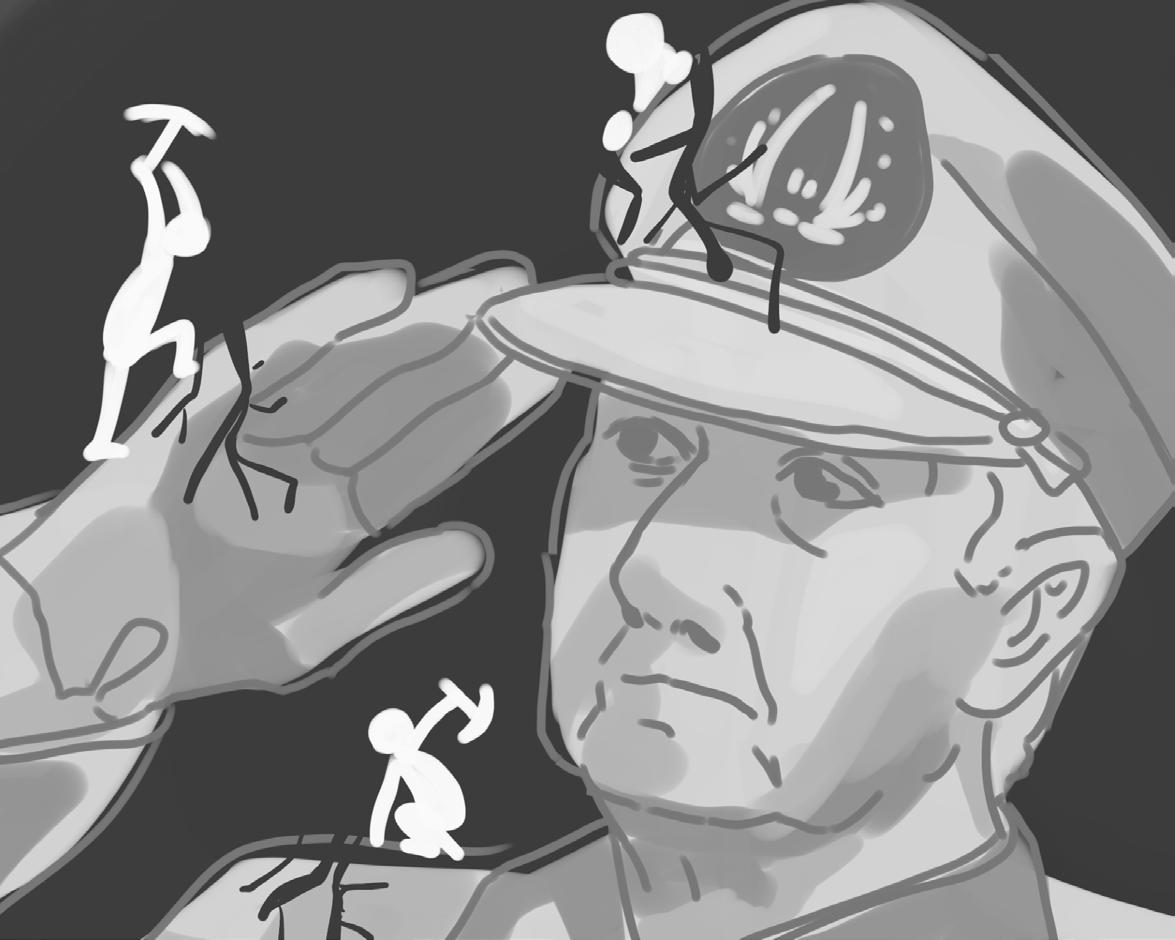
promising order and simplicity.
The Chilean center-left has struggled to articulate a credible alternative. Jeannette Jara, the Communist Party candidate now leading the Chilean center-left coalition, represents a technocratic professionalism that fails to inspire the Chilean working class. Rejecting ideological labels, Jara projects the image of a detached liberal elite. Polls suggest she may win the first round of voting but would lose decisively to Kast in the runoff.
The Chilean example exposes a broader truth: A political system directed by and for the people is incompatible with market fundamentalism. The endurance of Pinochet’s political and economic institutions, even under leftist administrations, shows that political democracy without economic democracy, and political liberalism without economic liberalism, is inherently fragile.
Economic democracy means collective control over production through strong unions, cooperatives and public investment. It gives workers and citizens real power over their economic lives, leveling the playing field between rich and poor. Such a model prioritizes welfare over profit and rebuilds the social contract that neoliberalism destroyed.
To secure democracy, we must
create institutions of solidarity. Labor unions, worker cooperatives and welfare systems, not promises, should protect working and middle classes. Superficial reforms cannot fix decades of inequality. Only genuine structural transformation can reverse the alienation empowering the far right.
Chile’s history demonstrates how economic foundations endure once established, surviving in both dictatorship and democracy. The economic model forged under Pinochet persists not because it works for the majority, but because the political class is not sufficiently responsive to the masses. The rise of the far right is not an anomaly; it is the inevitable backlash to decades of unmet promises and deepening inequality.
If the center-left wishes to defend democracy, it must do more than manage the status quo. It must democratize the economy itself. Only through economic democracy can nations like Chile, and indeed all politically democratic nations, restore faith in the idea that economic freedom and equality are one struggle.
Rafael Hernandez Guerrero, PZ ’29 is from El Refugio, San Luis Potosí, México and immigrated to Boulder, Colorado as a child. He doesn’t really know what’s going on and hopes you do.
On the fateful afternoon of Sept. 26, I was greeted to a surprise upon opening my phone: dozens of texts from various friends, all regarding a photo of me. A few days before, several friends and I decided to, badly, alter our hair and go out into the world dubiously styled as a joke. No, I won’t explain why. It was personal, yet our photo was posted extremely publicly on the official Scripps College Instagram page. Screenshots of it soon plastered my texts.
I was met with an image captioned “#NationalSunsetDay with our students,” featuring my friends and I sporting deep side parts, half grimaces and looking generally disheveled. I was horrified. People told me I looked like “the world’s tallest four year old.”
Pardon my vanity, but it was humiliating to have such a bad photo posted so publicly.
Of course, I’m not alone in this experience. In the digital age, our reality is that we cannot control how we are seen on social media. An unflattering photo is pretty tame. Videos lampooning people doing things marginally out of the norm go viral on social media every single day. While we might not personally feel comfortable posting others without their consent, many seem to hold fewer qualms against placing judgment and even outrage on these strangers thus victimized. But parallel to these declining social customs, our digital footprint is increasingly important for our futures. Colleges, jobs, potential friends, roommates, love interests and more — these are all opportunities that social media could give us, or take away.
KATE EISENREICH a cost. It allows us to meet people who we would have never met otherwise. It has created communities of all different kinds of people. It pushes us towards interests and ideas we might have never come across, influencing everything from our fashion choices to our political beliefs. However, that constant access has given us too much power. Instead of creating a digital culture where diverse expression is more normalized, social media has simultaneously made us all more judgmental and more aware of judgment others might pass on us. Gone are the ubiquitous celebrity tabloids and melodramatic soap operas. Now we get our schadenfreude from dissecting the quirks of average people, and to feed the virality machine we encourage this surveillance with likes. Often, people end up victims to the algorithm, going viral after being posted without their consent by a stranger who thought their behavior, or even appearance, were funny enough to share and ridicule.
Because of social media, not only are we more able to observe others, but we are also more aware of our differences in ways both good and bad. Without social media, you were just a weird guy who liked to, say, dress up as a cat or wear all black and listen to sad music. Now you can be connected to a community of people who share similar interests and feel less alone. But if you had never heard of a furry, then the guy on your block who liked to don a tail would have seemed like an oddball. Social media made everyone aware of furries and gave people tools to categorize and ostracize them for their differences.
Social media has connected us to what feels like the whole world, at
Because being on social media means that you are much more
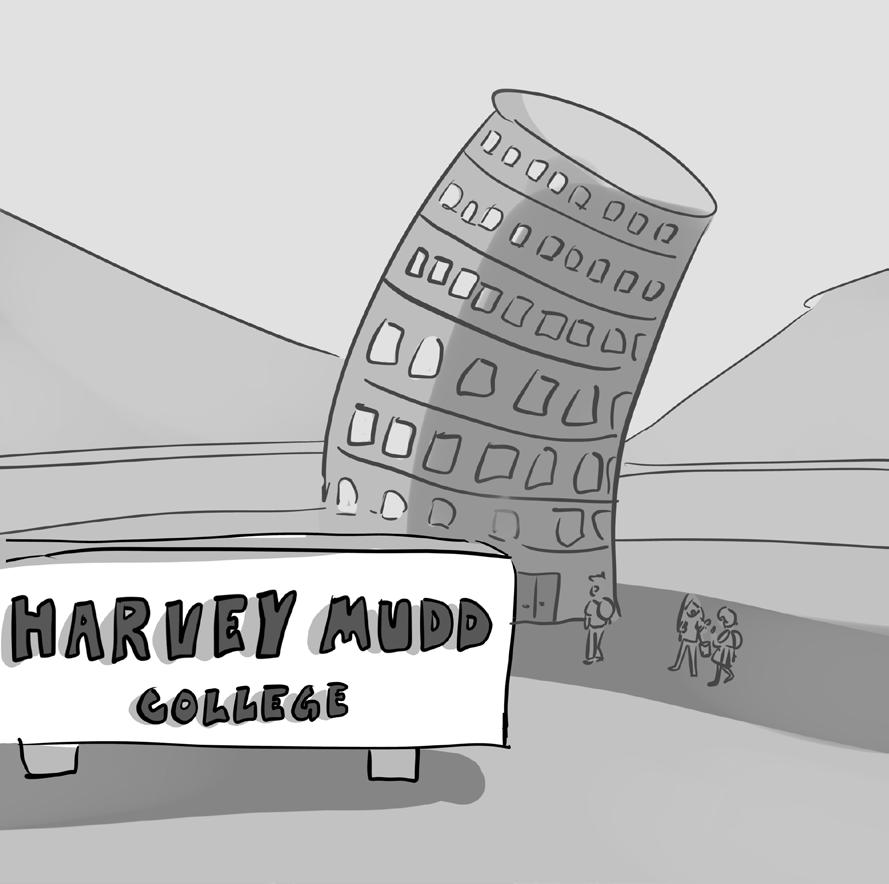
visible, and vulnerable, subcultures of today appear more surface-level and vapid than the more underground ones of the past. As social media algorithms demand visuals, the focus of these subcultures tends to be aesthetic, not value-based, prioritizing consumption rather than actual rebellion. Our subcultures become a bit more accessible but a lot less interesting.
In his work, “Discipline and Punish: The Birth of the Prison”, French philosopher Michel Foucault explores what the feeling of constant observation does to the psyche using a conceptual prison which he called the Panopticon. The prison functions by trapping all of the prisoners in cells that open towards a central guard tower. The prisoners cannot see into the guard tower, so they can never know if they specifically are being observed at any given moment.
Instead, they live under the possibility, and therefore the assumption, that they are constantly being observed. Foucault explains, “He who is subjected to a field of visibility, and who knows it, assumes responsibility for the constraints of power … he becomes the principle of his own subjection.” A prisoner living in the Panopticon becomes his own observer, with no choice but to enforce the expected standards of behavior on himself, or risk being labeled as part of a delinquent class.
In our increasingly surveilled lives, the Panopticon feels more and more like our society. Social media invites us to observe and ultimately traps us in its surveillance. The only difference between Foucault’s Panopticon and Instagram is that there isn’t just a single guard in the guard post.
SCAN QR CODE BELOW TO SUBMIT A CAPTION

We are all simultaneously both the victim of observation, and the unseen observer. Our phones are always within arm’s reach, able to label our peer’s behavior as delinquent at a moment’s notice. We have created a cage where the rules and norms are set up by an algorithm that has trained us to expect perfection or performance.
One of the clearest consequences of this observation is Gen Z’s conservative attitude towards sex and dating. Conservatives love to fear-monger about the hookup culture “epidemic,” but Gen Z’s problem when it comes to sex is too much shame and fear.
We are the most sexually puritanical generation in decades: Less than 30 percent of Gen Z have reported ever having had sexual intercourse, a 17 percent drop from about ten years earlier. We are dating less, with less than 56 percent of Gen Z men reporting having been in a romantic relationship during their teenage years.
No one wants to be a thot, bop, lose aura or, worse, have their failures, intimate information and photos spread. More fear and more judgment equals less con-
nection. Less connection equals less sex. This deficiency creates problems far beyond romance. Gen Z is sad and lonely: We feel less socially connected and are significantly less content with our lives than young people of the past.
If we want to get back to being sexy as a society, we need to let one another be weird.
Social media has created an environment where humiliating others on the internet is okay and where judgement is far too normalized, but we aren’t trapped forever. So if you ache to stop being such a loser and be freer to be ‘such’ a freak, be the change you want to see in the world. Next time you go into McConnell try to resist the urge to post photos of the shoeless hippies on Fizz. Ask your friends before you post sweaty photos of them on the internet. And for the love of god, please stop taking videos of strangers and posting them on TikTok. We all want to talk to strangers, have more sex, be messy, wear outrageous outfits, make more mistakes and worry less. The only problem is that we all have to give each other the necessary grace.
Kate Eisenreich SC ’27 is a lesbian who studies politics and hates boring people.
JOELLE RUDOLF fatness is less of a choice.
Meghan Trainor, in the words of a recent TikTok hate comment, is “all treble, no bass.” Lizzo is a diet culture “sell-out.” Adele, called out by fans for her 100-pound drop in 2022, is “fatphobic.” Clearly, people are thrown off by these pop stars’ recent dramatic body transformations. As fans, we see these celebrities’ weight loss journeys as a betrayal of their curvy queen attitude: explicit unapologetic acceptance of their larger bodies. If body positivity means always being happy with the way you look, then a celebrity’s pursuit of substantial weight loss is inconsistent with calling herself body positive, right? Actually, the two are not mutually exclusive. No celebrity owes us a long-term commitment to a plus-size body to continue to preach values of body positivity.
A celebrity’s body often comprises a key component of their artistic brand. Meghan Trainor’s most career-defining song, “All About That Bass,” is literally all about her “bass” (bigger body) and learning to love it unconditionally. For plussize celebrities in particular, the conflation between body and brand is especially pressured. Because their body so obviously sticks out from the socially accepted beauty standard, acknowledging their
A scene from 2012’s Pitch Perfect illustrates this best: when first introduced, Rebel Wilson’s character refers to herself as “Fat Amy” so “twig bitches like you don’t do it behind my back.” In other words, plus-size celebrities may opt to preemptively embrace their fatness — whether or not they are actually happy with their weight — in an attempt to limit body beration from the public.
Plus-size celebrities lean into their fatness as a means of protection, but a society obsessed with diet culture misattributes having a large body as a necessary qualification for the practice of body positivity.
So — like with Meghan Trainor, Lizzo and Adele — the first sign of weight loss causes people to jump to ‘hypocrite’ accusations. A plus-size celebrity’s appearance is so forcibly tied to their career trajectory that any obvious physical changes inspire fans to critique their authenticity.
Society likes to overgeneralize that plus-size celebrities lose weight solely for aesthetic appeal, but this harmful simplification lacks holistic consideration. Meghan Trainor said her weight-loss journey helped her discover newfound strength and life balance after giving birth. Lizzo said that working out saved
My entire life, dancing was a requirement I never signed up for. At my over-crowded Iranian family gatherings — or mehmoonies — you could find me hitting the Bandari with my aunts, or learning to snap the Beshkan with the cousins. After dinner but always before dessert, the auxiliary cord could be heard crackling as an uncle plugged the JBL into an ancient iPod touch. As soon as the speaker was connected and the queue was lined up with
her mental health and alleviated her unbearable back pain. Adele said that incorporating regular exercise habits helped her cope with crippling anxiety.
These pop stars didn’t shed pounds to blindly adhere to societal beauty standards. They adopted lifestyle changes in order to feel healthier and more comfortable in their skin. They may look different, but this doesn’t inherently mean their values have been compromised.
Beyond the superficiality of looks, body positivity emphasizes wellness and functionality. It means having the courage to listen to your body’s needs and respond to them; it allows for growth and change. Shape and size are relevant but only part of the definition — body positivity also encompasses skin color, gender, sexuality and physical ability.
True body positivity is a praxis that we must uphold amidst the larger fight against structural inequality, inspired by fat activists and women of color in the 1960s and 1970s. As Lizzo put it in her recent Women’s Health feature, “body positivity is the radical act of daring to exist loudly and proudly in a society that told you you shouldn’t exist.” Body positivity is a mindset, an approach and a movement, independent of one’s physical appearance.
Celebrities can represent body positivity regardless of their weight or history with weight loss.
Take Taylor Swift: strutting across stadium stages in skintight bedazzled bodysuits, unapologetically inserting herself in the male-dominated football scene, boldly standing up for her bodily autonomy in court when it is violated. She shows up with confidence and tenacity, values that the size of her body does not determine. Now consider Adele: consistently exposing herself emotionally through raw and vulnerable lyrics, bravely confronting her anxiety and prioritizing her health after crushing heartbreak, maintaining confidence in her choices despite public scrutiny. Adele stated she was “body positive then, and I’m body positive now.” Her values were never dictated by her size. At the end of the day, Meghan Trainor, Lizzo, Adele and others with similar stories have had to tune out the noise and reflect on what is best for their well-being. Prioritizing self-love is a practice of body positivity. They opted to undergo major weight loss journeys, a personal and private decision that I respect, and their fans should too. A celebrity’s body is not indicative of their belief system. To anyone feeling

butthurt over Meghan Trainor’s lack of “bass” or Lizzo losing some “Juice”: butt out! Why must Adele’s weight hold so much weight? Her butt, her business — no ifs, ands or buts about it!
Joelle Rudolf SC ’28 is a self-proclaimed “diet culture dropout.” She is tired of society’s obsession with weight, and hopes one day we can place a similarly silly level of importance on more interesting traits like juggling ability or having a flawless moonwalk worthy of MJ reincarnation.
LEILI KAMALI a hodge-podge of Benyamin and Pitbull, Shakira and Arash, all of us kids could expect to be dragged into a circle of dancing relatives stomping to a hurricane of familiar music.

On the first day of class, as I watched myself freeze-pose in the floor-to-ceiling mirror of Studio 101, I wondered how I managed to end up in a Sunday night breakdancing class my first semester at Pomona College. As my instructor yelled “Three-andfour-and kick to pretzel!”, my childhood mehmoonies felt like a distant memory. I wouldn’t consider myself a bad dancer, (Paint Party aside) but I couldn’t help but feel out of place here. “Why did I sign up for this again?”
After agonizing over the rest of my schedule, when it came time to register for PE classes, I just wanted to get my requirements over with — maybe a yoga class, maybe some jogging or even a little pickleball. Instead, I now find myself kick-ball-chain-ing to Justin Timberlake alongside 30 other students, all with different levels of experience under their belts.
Students at the 5Cs have well over 100 different physical education classes available to them, along with an excess of extra curricular options. So for those of us looking for something to do after class, why spend an evening trying something new like breakdancing, archery or acapella when
you could be engaging with a skill you’re already confident in?
We’re obsessed with filling our schedules with activities that present as productive and sound practical: lift to get stronger, run to get faster. For me, breakdancing has been the antidote to my efficiency complex — it’s messy, social, awkward and unpredictable. That’s exactly why I need it so badly. It reminds me to be present, to embrace imperfection and to find joy in the act of engaging with something without really being sure what I’m doing or how well I’m doing it. Dance class has forced me to connect with new people all across the 5Cs. Most importantly though, it’s forced me to fail (and fail publicly).
What started as a box to check off my general education requirements quickly turned into the best stress relief I could have asked for, along with being the highlight of my week. Even when I’m at least a beat behind or getting distracted when I accidentally catch my reflection mid-windmill, I’ve found myself enjoying the process of genuinely struggling through something I’m objectively not good at. It feels like the first time in a while I’ve voluntarily done something I’m completely, unapologetically “bad” at — and that feels kind of freeing. Honestly, that’s something every 5C student could use a little more of. In a world where
we’re constantly working to be measurable, productive and “impressive,” engaging in something new and unfamiliar gives us permission to just exist. And that’s a hard thing for us to let ourselves do. After our usual end-of-class round of fistbumps, I told the instructor that this was the first dance class I had ever taken, and he smiled. “I believe we were all created to move,” said breakdancing and hip-hop instructor Don Sevilla. “In that case, everyone is a dancer, in my opinion.” He calls dancers “God’s athletes,” not just because dancing often demands strength and flexibility, but because movement itself is a fundamental part of being human, no matter the culture or time period. And while I’m not sure if I can claim to be one of “God’s athletes” just yet, I’m sure I’ll feel like a real B-Girl once Professor Sevilla teaches us how to spin on our heads to the rhythms of Rob Base & DJ EZ Rock.
This mentality doesn’t just apply to dance though, sign up for your own version of break dancing. Find something that feels unfamiliar, uncomfortable and completely outside your comfort zone. Whatever it might be, commit to it fully, and commit to being bad at it. Let yourself try something you won’t get graded on, won’t list on a resume and potentially never master. And try
to be okay with that. It could be anything. Join an improv group even if public speaking terrifies you. Pick up pottery despite your total lack of artistic experience and dexterity. Audition for an acapella group when you’ve only ever sung in showers. Let it be the way you rediscover the joy of learning for its own sake. Did I think I’d be practicing my freeze pose in the mirror instead of finishing the Spanish homework I’d been putting off all weekend? Definitely not. Am I now able to do a six-step into a Zulu Spin? Kind of, and I’m cool with that.
So, when spring registration time rolls around, consider filling your evenings with something completely unpredictable and unusual — try taking something that will make you laugh, stumble over your own feet and possibly even fall flat on your face. It’s about diving headfirst into something new, embracing the discomfort of it all and discovering that being terrible at something can be unexpectedly fun — potentially even a little addictive. Either way, you can find me in Studio 101 trying my hand at the Bachata in “Dance - Latin Night Club” come January.
Leili Kamali PO ’29 is a novice B-Girl workshopping her freestyle breakdancing skills every Sunday at Robert’s Pavillion. She hopes to learn to do a headspin by the end of term.
CALEB RASOR
For decades, The Democratic Party has aimed to form a wide geographical coalition, ranging from the low-income inner-city neighborhoods of Los Angeles to the highly educated suburbs of Washington, D.C. But there is one population they consistently lose: rural America.
I’ve long found this tragic. Rural people represent precisely the working-class constituency that the left hopes to champion. Sure, on cultural flashpoints such as abortion and gun rights, there can be ideological distance between city-dwelling liberals and their country counterparts. But the central economic promises of the left — affordable healthcare and housing, quality public education and reducing inequality — can and should speak to rural and urban Americans alike.
That’s why I’m a strong believer in the Abundance agenda. This new platform, popularized by the book “Abundance” by Ezra Klein and Derek Thompson, seeks to invigorate the political left with new emphases on effective government, removal of bureaucratic red tape and innovative growth. While this movement could speak volumes to rural communities, Abundance has so far focused only on urban audiences. Abundance proponents must now change their rhetoric to include solutions for small town America, or risk sacrificing this platform’s potential as the future of the Democratic Party.
Let’s consider the Abundance movement’s foremost concern: housing shortages. Abundance scholars believe two phenomena are to blame. First, wealthy urbanites and suburbanites weaponize zoning laws and legal statutes to block affordable housing development in their neighborhoods. Second, endless layers of bureaucracy, the result of well-intentioned but superfluous construction codes
and regulations, have delayed much-needed construction. Abundance liberals hope to dismantle these barriers through targeted deregulation, unleashing both private and public urban development processes in order to ease costs.
This laser-focus on new housing creation could be a boon for rural residents — over half of rural renters pay more than 50 percent of their income towards housing costs. Just as in cities, many rural government housing programs have been hampered by bureaucratic sludge. Take the USDA Section 515, which provides Rural Development (RD) loans to construct and maintain affordable housing. If a developer wants to sell an RD property, they must endure an arduous, months or years-long process involving three costly appraisals and a USDA application requiring over 40 separate documents. It’s no wonder one property owner declared, “the best way to get out of an RD property is to die.” Abundance scholars could have offered the perfect solution to small towns starved of housing: slash red tape, and you’ll end up with a surplus of affordable units in your community. So, what have Abundance writers actually proposed to politicians with regards to rural abundance? Nothing! In fact, they argue that America should strive to move all of its residents into dense, urban housing to improve productivity and reduce carbon footprints. Further Abundance initiatives would fit seamlessly into rural communities. Take another top issue, energy. Abundance scholars see the solution to climate change not as mere conservation, but innovation: combining public capital with private ingenuity to help clean energies outcompete fossil fuels on cost. A taste of this vision could be seen with the passage of the Inflation Reduction Act in
2022, which brought $129 billion in wind and solar investment and generated over 115,000 jobs in largely rural regions. Abundance proponents would want to boost those numbers and make investments in the reliable and efficient energy sources, such as nuclear and geothermal. Alas, they make almost no mention of the fact that rural America would reap these rewards. Now, to be clear, Abundance only became a formalized “movement” a few months ago; beforehand, its ideas were responses to the particular problems of large coastal cities. Nonetheless, Abundance writers such as Ezra Klein, Derek Thompson and Misha Chellam are clear in their aim to influence the national Democratic Party, and ultimately, federal policy. In taking on this mantle, the Abundance movement must pivot away from urban elitism and make room for the boondocks. You may ask: if Abundance proponents want to influence Democratic politics, why even bother winning over rural Americans? Contrary to popular belief, rural voters are key to Democratic performance. In critical presidential swing states such as Wisconsin and North Carolina, over onethird of the population is rural, and some of the most competitive House races of 2024 were rural battles. Democrats’ deterioration among rural voters played a large role in their 2024 losses — and this was largely of their own making. Starting around 2015, the Democratic National Committee began to intentionally starve rural county offices of resources in favor of urban and suburban centers, and hasn’t turned back. If the left considers rural voters a lost cause, they will be — but the right messaging can win them back. Believe it or not, the most successful rural Democrats today are just Abundance liberals by a different name.

Take Andy Beshear, the Democratic governor of Kentucky, a largely rural state where President Donald Trump won almost two-thirds of the 2024 vote. Governor Beshear’s office has collaborated with modular housing manufacturers and streamlined the state’s housing agency to create more affordable rural units. Under Beshear’s purview, Kentucky has attracted companies building hydroelectric storage, EV batteries and residential solar. All told, these moves have added tens of thousands of rural jobs and made Beshear popular even among diehard rural Republicans.
The conclusion from Beshear’s success is simple: rural voters are hungry for a platform that brings economic prosperity to places they call home. Where Democrats have abandoned rural places, Republicans have filled the vacuum, appealing to these grievances and winning with little opposition.
Yet, time and again, Republican policies, from sky-high tariffs to Medicaid and food stamp cuts, have only further harmed their rural constituents. Democrats won’t win back rural voters by getting swept into cul-
ture wars or class warfare. Instead, they must focus on bread-and-butter economics, alleviating the skyrocketing costs of housing, childcare, healthcare and transportation that impact all working class people. Amidst Republican failures, Abundance presents Democrats with an opportunity to refresh their once-neglectful economic platform and reinvigorate rural voters’ confidence in Democratic priorities. The critical challenge for the movement now – as with the whole Democratic party – is branding. Will Abundance come to be seen as the champion agenda for small town families? Or will it stay relegated to the coffee chats of D.C. policy wonks and Bay Area tech-bros? The answer will lie in whether or not it embraces rural America with open arms.
Caleb Rasor CM ’28 is studying economics and mathematics. On campus, Rasor is a data journalist at the Lowe Institute, a podcast host at Free Food for Thought and co-founder of Claremont Students for Abundance. Back home in Tucson, Arizona, he spends much of his free time hiking, camping, foraging and fishing with friends and family.
Kumar SC ’27 6TH PLACE
Ryan Ensminger PZ ’26 7TH PLACE
Grace Trautwein SC ’28 8TH PLACE
Marcel Astrakhan CM ’29 9TH PLACE
At Pomona College, Jonathan Lethem remains curious — and he’s teaching his students to be, too
For Jonathan Lethem, curiosity is central to the writing process.
I sat down to interview the novelist and professor who’s spent a lifetime crafting prose that feels alive in its own skin.
At Pomona College, that curiosity defines both his teaching and his work. Lethem came to Pomona in 2010, succeeding David Foster Wallace as the Roy Edward Disney ’51 Professor of Creative Writing. A 2025 Guggenheim Fellow in Fiction, Lethem is best known for “Motherless Brooklyn,” which won the National Book Critics Circle Award, and “The Fortress of Solitude,” a coming-of-age story rooted in the streets of Brooklyn. His most recent novel, “Brooklyn Crime Novel” (2023), returns to that borough to map the intersection of memory, gentrification and identity.
But his impact at Pomona stretches beyond his books. Last year, Lethem co-curated the Benton Museum of Art’s 2024 exhibition “Parallel Play,” which explored the intersection between visual art and written narrative.
His mentorship has shaped emerging writers like Tom Lin PO ’18, whose debut, “The Thousand Crimes of Ming Tsu,” won the Carnegie Medal for Excellence in Fiction, and Francesca Capossela PO ’18, whose novel “All the Way to Summer” grew out of early drafts written in Lethem’s fiction workshop.
My conversation with Lethem
drifted from the present to the past, from the stillness of Pomona’s campus to the streets of Brooklyn, the borough that shaped him.
“Brooklyn was a very different place in the time that I was a kid,” Lethem said. “The diversity, the chaos, the juxtapositions and the energy of the street life at that time were just astonishing.”
The city, as he described from his childhood in 1964, seemed to refuse coherence. Scribbling down notes, I tried to keep up with the pace of his memory as he reminisced about the sensory overload of his hometown, which found its way into his fiction before he could even name it.
Describing what first drew him to writing, Lethem didn’t mention some extreme epiphany. Instead, he talked about his mother and how reading was simply part of life, something ordinary that turned out to be essential.
“The talk in my house was great, the books were exciting and the two things became one thing for me,” he said. “I was always in a conversation with my mother about the books that I was reading and pulling off her shelves.”
There was no single moment that made him a writer; there was just constant exposure to language. He grew up reading across genres, without hierarchy or hesitation, and the eclecticism stuck.
“The right word for it is love,” he said. “I was writing towards
things that I was excited about, things that seemed irresistible and bottomlessly rich and strange.”
The word “love” lingered for a moment before he continued, widening the scope of his affection beyond the page itself.
“I’m just permanently awake to my own sense of amazement and desire in respect to things that interest me,” Lethem said. “The existence of art to me is a matter of permanent awe.”
For Lethem, curiosity is a way of being.
“I’m excited by the existence of a world, a subcultural world built around the same things and enthusiasms that I have,” he said.
It made sense that he’d find a home in teaching, another way of being surrounded by people who care deeply about things.
In his introductory fiction seminars, students begin with exercises that dismantle conventional storytelling — rewriting scenes from different perspectives, removing dialogue to test rhythm or fusing two incompatible genres to see what emerges in the collision. In his advanced workshops, the focus shifts from imitation to transformation. Students circulate full-length short stories or chapters of novels each week, their peers responding with meticulous written feedback.
The classes are less about technique than about perspective: how to see a story’s structure, how to listen to its language and how to recognize when a piece is trying to become something else.

“I’m very grateful for [teaching] because it keeps me from settling into certainties about what matters or what operates,” Lethem said.
“Because of my students, I read more young writers and I’m more able to understand what they are doing.”
He smiled. “Every time I mention something in the classroom that I think goes without saying, and I see the blank stares, I have to revise my sense of reality. And that’s a very healthy moment for me,” he said.
As an answer to what he wants his students to take from his classes, I was surprised when he talked about permission.
“Permission, fundamentally, to play, to experiment,” he said. “Even if it seems very deep and important, it’s got to have this polymorphous freedom underneath it — to self-invent, to pretend, to put on masks.”
Highlighting the importance of experimenting while crafting fiction, Lethem also regards reading as the foundation of starting out as a young writer.
“Read, read, read, read, read, read, read, read, read,” he said. “Every chance you get, even as you’re trying to write or being a college student. Don’t ever let go of it.”
His approach to writing quietly dismantles the idea of it as a solemn pursuit. Imagination is something to be used, stretched and molded. That same openness extends to how he teaches.
“I don’t take it for granted, nor do I expect my students to read my fiction,” he said. “I’m here as an instructor, and I have to meet the student on the terms that are meaningful to them.”
It’s rare to hear a writer talk about his work without trying to make it the center of the room, and rarer still to hear one place the act of listening above the act of speaking. Perhaps that’s what keeps Lethem’s work, and his presence in the classroom, from ever feeling static: the sense that he’s still learning how to look at fiction.
“It’s changed a lot in 15 years here at Pomona,” he said. “The world is remorseless in its transformations. It won’t sit still. And so I always know that I’m entering into that space on new terms every time.”
For him, teaching, like writing, is about adjustment, the ongoing work of helping his students amidst these transformations.
“[The current political moment] is not something you can exclude,” he said. “The world is going to make itself a part of that. You have
no option, really.”
Art isn’t an escape from the world, but a reaction to it.
“Art clings to the edges of the fact of existence and tries to make a home there,” he said.
His novels have long been deeply rooted in the political state of the world. He described “Brooklyn Crime Novel,” for example, as partly in reaction to the 2016 transition from the Obama to Trump administrations.
Right now, he’s currently crafting a novel set in Southern California.
“Each one [of my books] is a corrective to the one that goes before it.
‘Brooklyn Crime Novel’ takes place over four decades,” Lethem said. “This one is all set in one night, from dusk to overnight to the next morning, like an overnight movie. Maximum concentration on one ticking clock.”
Each book rewrites the rules of the one before it — a lifelong case of creative restlessness. In an age of endless content and quick consumption, what do novels still do that nothing else can?
“It’s the art form that is the most outside of time structures,” he said. “You operate at your own pace. You enter into them and you swim like in an ocean of language until you’re tired and then you crawl onto the beach and then you go back in.”
As both a reader and a writer, novels let you experience the importance of failure.
“All novels are imperfect,” he said. “By its nature. It’s full of little signs of its making, flaws, interruptions, inconsistencies.”
Lethem acknowledged that imperfection is the writer’s natural state.
“Failure is a risk,” he said. “It’s about inhibition, not being willing to dive in because something might be rejected. Failure is a feeling in the body of the writer.”
Lethem seems to value a single reader understanding exactly what he means more than a crowd applauding something that he didn’t.
“In the doing, in the process [of writing], I learn things. It’s always in itself a sensation of surprise — and a wonderful one,” Lethem said.
He speaks the way he writes: alert, generous and unwilling to pretend that the world makes sense, but endlessly compelled to keep looking anyway. And perhaps his curiosity is what makes his presence — both on the page and in the classroom — so magnetic. He isn’t trying to explain the world, he’s simply learning, with the rest of us, how to live inside it.
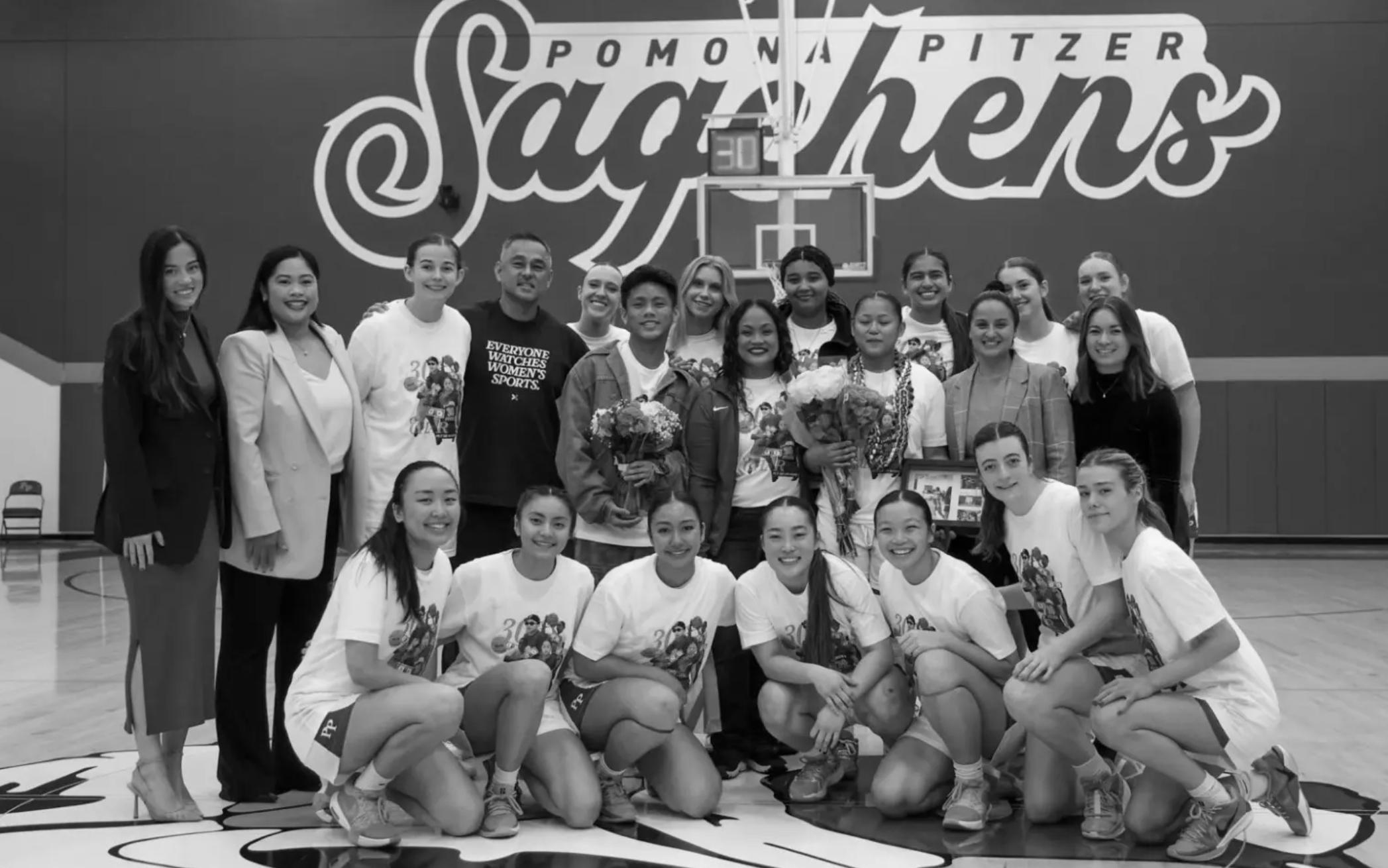
As junior year approaches for students at the Claremont Colleges, discussions about top study abroad destinations begin for many. Whether a semester in the mountains of Ecuador or in the bustling metropolis of Taipei, excitement arises in anticipation of a three-month break from the City of Trees and PhDs.
For those on the Pomona-Pitzer (P-P) women’s basketball team, study abroad is not always an option. As their practices begin in late September and playoffs take place the following March, most players choose to stay on campus year-round.
However, this year, the Sagehens are on a mission to have their own ad-
venture abroad. They are coordinating a 10-day foreign tour to Spain just a few days after commencement in May, which combines the best of travel and basketball.
“Study away ends up being really challenging for basketball players, because our sport stretches two semesters, so it’s really hard to feel like you can fully participate in women’s basketball,” head coach Alaina Woo said. “What’s really great about the foreign tour is that we have an opportunity as a program to go see another part of the world.”
The planned international tour is the first in program history, so when Woo pitched the idea to the current graduating class, Katie Drais PO ’26
and her fellow seniors started working to make that dream a reality. They initially created presentations for possible destinations and eventually decided on a trip to Spain.
“Coach Woo went to the senior class about early choices [of destinations] and then decided to form a committee that is specifically focused on fundraising,” Drais said.
The trip is not fully paid for, so donations are key to reducing outof-pocket costs for all 17 players on the team.
Three players volunteered to be on the committee responsible for fundraising — Shea Joko PZ ’28, Charlotte Patel PO ’28 and Abigail Homan PO ’27 — each with specific duties. Although the annual Giving
Day supported the team financially in previous seasons, Patel says the team is taking it a step further this year.
“Fundraising as a team is unprecedented for women’s basketball outside of Giving Day,” Patel said. “Abby [Abigail], Shea and I meet a lot. We’ve got a very active group chat and taken on different roles, like heading more of the concession, bake sale-type of organizing … Abby’s taking on some more of our tournament-style events, like three-on-three basketball and pickleball, and Shea’s really heading our clinics that we’re hosting.”
The team has set up a table at a few sports games so far, including Sixth Street football and men’s water polo. Through the two sell-out bake sales and the sports events, the Sagehens have already raised a total of $2,500 just two months into the school year.
In addition to on-campus outreach, the team also aims to cultivate connections with local businesses and families.
“I think some of my favorite [fundraisers] are reaching out to the community through just cold emailing, and then some Facebook mom sites to get people to come to our trainings that we’re hosting on Thursdays and weekends,” Patel said. “And it’s super fun to engage with youth in the community to do something we love — basketball — and also help fundraise for this greater trip.”
The Sagehens’ dedication to supporting the community and developing youth basketball is a mission they plan to continue in Spain. During the trip, their itinerary is more than just travel. The team has three games scheduled in Valencia, Madrid and Barcelona on top of a basketball clinic hosted by
the players for local youth.
“It just makes me so excited thinking about it,” Drais said. “It would be so, so special. I’m still trying to frame it in hypothetical terms, because I’m so excited I can barely believe it’s happening.”
For underclassmen like Patel, who will step into leadership roles in upcoming seasons, the opportunity to create lasting memories with the entire team is especially meaningful.
“It’s the team that makes the sport, especially at the [Division III] level,” Patel said. “You’re all choosing to be here, and we’re not getting paid to be here, so what makes it enjoyable is making those connections and creating a lasting memory. Right after our seniors graduate, we go on this trip together, and it’s kind of like the icing on the cake.”
Sagehen basketball has nearly a month until its first exhibition game, followed by another month of preparation for its first SCIAC action. However, they aren’t letting their foot off the pedal with events planned the whole school year, featuring pickleball tournaments and sweet treats.
Despite a long journey ahead, Drais expressed her gratitude for the support the team has received from the community thus far, both in the form of donations and through newly established relationships.
“Thank you already for paying attention to women’s basketball, especially at the DIII level,” Drais said. “It’s so exciting that there are people who are so interested in our journey. I am lucky, and I know everybody else is, to be a part of a community like that. … And any donation is much appreciated, but just spreading the word [that] we’re doing as much as we can … to get there as a unit, and just any recognition about what we’re working on goes a long way.”
Under the bright California sun, the Claremont Colleges hosted some of the two dozen teams attending the Gary Troyer Invitational for men’s waterpolo at the Axelrood and Haldeman Pools on the weekend of Oct. 3. In its annual iteration of the tournament, the Claremont-Mudd-Scripps (CMS) Stags faced off against Mount St. Mary’s, UC Irvine, the U.S. Air Force Academy and McKendree University. Just across the street, the Pomona-Pitzer Sagehens matched up against California Baptist, UC San Diego, Concordia University Irvine and Biola University.
The Stags finished the weekend with an impressive 4-0 record, featuring two dramatic victories versus Division I programs. The Sagehens, on the other hand, struggled to make a splash as they exited the weekend with just one win.
According to Asher Engelberg CM ’28, the DI and DIII distinction did not stop the Stags from bringing their best performance in the pool, even against their strongest opponents.
“I think we did a really great job of [competing] this weekend,” Engelberg said. “We went into the game with a great attitude and the belief that we can hang with these DI teams, that we’re really a cohesive and talented unit that has a shot against these guys.”
On their first day of competition on Sunday, CMS took care of business against Mt. Saint Mary’s with a dominant 19-7 win and then entered a highly anticipated game with DI powerhouse UC Irvine.
At the end of the third quarter, the game was tied at nine goals each. Thomas Walker CM ’26 scored two goals in the fourth to tie the game at 11, and Nick Kennedy CM ’27 came to the rescue at the last minute to place the game-winner in the back of the net.
“We had played a decent first three quarters of water polo against [UC Irvine],” Engelberg said. “Obviously, coming into the game, they were ranked higher than us. And I think it was a game that a lot of people expected us to lose, but morale was decently high because we were hanging in it with them, so we knew that we could beat them and that we were the better team that day.”
Before his game-winner, Kennedy had already scored five goals. He had half of CMS’s goal tally, and he was recognized for his leading efforts, earning the SCIAC Offensive Player of the Week. To him, winning the game versus UCI was an unprecedented feeling.
“I personally haven’t experienced an upset like that, I’d say, in my time
here at Claremont,” Kennedy said.
“Getting that win was super fun, not just for the team, but also for all the fans. We actually had a pretty, pretty packed fan row for that game, and so it was great to be able to experience that.”
For Tobias Schoenwald CM ’28, the pre-SCIAC tournaments are key to pointing out the key differences between a DIII and DI program, helping the team prepare for tougher competition that SCIAC may not provide.
“The main difference is that their programs are a lot more intense than ours,” Schoenwald said.
“I mean, they do it year-round.
They’re much more conditioned than we are, and something that we see a lot when we play DI teams, is that their stamina and endurance is a lot better than ours … but if we keep them in the half court longer, then we can use what we learn in practice and film to outplay [them].”
As the Stags entered day two of the tournament undefeated, their job was nowhere near finished. They had another dominant showing against the McKendree University Bearcats, finishing 26-
13, and had one last DI opponent remaining: the Air Force Academy Falcons.
CMS was neck-and-neck with the Falcons, ending the half with a lead of two goals. The Stags emerged from the locker room energized and ran away with the game in the second half, outscoring the Falcons by eight goals to win 21-11.
Engelberg emphasized the importance of strategy in their victory over the Falcons to keep the Stags’ winning streak alive and come out of the tournament undefeated.
“Credit to our team and our coaches, specifically, they really helped us gameplan for the Air Force game,” Engelberg said. “Coming into [the game], they had the leading scorer in the NCAA on their team, and we did a really good job of game planning for him and shutting him down … I don’t want to say riding the win off UCI, but we came into it very confident and motivated.”
For Kennedy, the team’s poise under pressure was the standout factor that helped the Stags conquer moments when they fell behind.
“One thing that we did really
well at was just keeping our composure,” Kennedy said. “It’s pretty easy for other teams to go on momentum runs or, when something’s not going your way, it’s easy to get frustrated. But this weekend, we really focused on keeping our composure for when those moments did inevitably happen. And you know, even if a goal or two got scored on us in a row, we did a good job keeping level heads and attacking the play after.”
Thanks to a successful weekend, the Stags are breaking superstitions that have held them back in regular-season play against SCIAC opponents. According to Schoenwald, the team has consistently struggled in its second conference game over the past three seasons. This year, that has changed.
“Knowing [the superstition], it doesn’t matter what happened last weekend; anything could happen in SCIAC,” Schoenwald said. “Every team is coming for us at this point. We’re ranked 16th in the country now, and no other DIII program is close to us … If they can manage to pull out a win, then they think they’re in the lead … But we are going to prove that that’s
not going to happen, especially for Pomona-Pitzer.”
The Stags have successfully warded off the second-SCIAC-game curse in a 17-11 victory over Chapman University on Wednesday, Oct. 8. Led by Gavin Netherton HM ’27, Kennedy and Jeffrey Koretz CM ’27, who combined for a total of 15 points, CMS improved to a record of 11-4 and remained undefeated in conference play.
The team has 10 SCIAC games left and is hoping for a strong finish to return to the DIII National Championships. With a long stretch still to go, Engelberg emphasized the importance of staying concentrated even during a win streak.
“Last year, with a couple of SCIAC teams, we came into it thinking that we were going to just roll over them, but we lacked the correct attitude,” Engelberg said. “But I think we’re doing a good job this year of going into every game very focused and not trying to overlook any of the teams.”
After their sweep, the Stags will return to conference play vs. the University of La Verne on Saturday, Oct. 11, at Axelrood Pool.

JOSEPHINE MILIOTO
“Dart, Esso, Bubbles, Airbud, Rocket, Tune, Tricks and Sprite.”
Those would be the code names of your teammates when you walk onto the field for your first day of practice with the Greenshirts. The real names of your teammates will be a mystery plaguing you throughout your journey — at least until you have a codename of your own. For the Claremont Greenshirts, nicknames aren’t just playful; they’re a rite of passage, a symbol of belonging in a team built on community and spirit.
The Greenshirts — or “Greenies,” as they affectionately call themselves — are the women and gender-expansive ultimate frisbee team at the Claremont Colleges. One of their defining features is that they are an entirely student-run club team with no coaches, limited institutional funding and little to no formal staff support.
But they’ve never allowed that to become a barrier. Instead, the Greenshirts have used these obstacles as a source of motivation, enthusiastically compensating for the lack of resources with creativity and grit.
Greenshirt practices are held three times a week at Scripps College’s Alumni Field or Claremont McKenna College’s Parents Field, and always have a vivacious energy that draws in everyone who’s near. Without a formal coach, the Greenies rely on each other. The most experienced and committed players mentor newer ones, while everyone contributes ideas for drills and plays.
Willa Polin SC ’29, a new member of the Greenshirts, talked about the benefits of this system.
“It’s cool because you’re learning from your teammates,” Polin said. “The [more experienced players] actively participate in what they’re implementing, making the drills more effective.”
One of the team’s practice captains, Grace Flikke SC ’28, also discussed the self-directed nature of the Greenshirts and how it has helped them continue to develop as a cohesive team.
“We’re completely student-run,” Flikke said. “That means we plan practices, schedule tournaments, book housing — everything. It takes a lot of work, but it’s also what makes every achievement so rewarding.”
Instead of a traditional hierarchy, the Greenshirts operate under what they call the “Bowl of Greens”: a horizontal leadership structure that spreads out responsibilities among practice, logistics and finance. Decisions are made collectively, with players sharing ownership over the team’s direction.
Because no one person is in charge, everyone’s invested, highlighting one of the more unique aspects of the Greenshirts.
“It’s empowering to know how tight-knit the community is,” Flikke said.
From those who’ve never touched a disc to members with successful high school careers in the sport, the Greenshirts have utilized their diversity as a way to set them apart from other teams. That sense of shared responsibility, although unconventional, has translated into remarkable success, coming from players of all skill levels.
Last season, the Greenshirts beat Occidental in the Southwest Sectionals, earning themselves a spot at the USA Ultimate DIII college championships in Bellingham, Washington.
Looking ahead to this season, the team is currently preparing for a one-day tournament at UCLA on Oct. 26, where they will play against USC, Occidental and several other Southern California schools. Many more tournaments will take place throughout the fall and spring seasons, with the ultimate aim of qualifying for and placing in the top 10 at nationals, which will be held in Waukegan, Illinois, at the end of next May.
Beyond the Greenies’ competitive objectives, some of their long-term goals include expanding their roster to accommodate leisurely players in addition to the competitive traveling team, which has already grown by 10
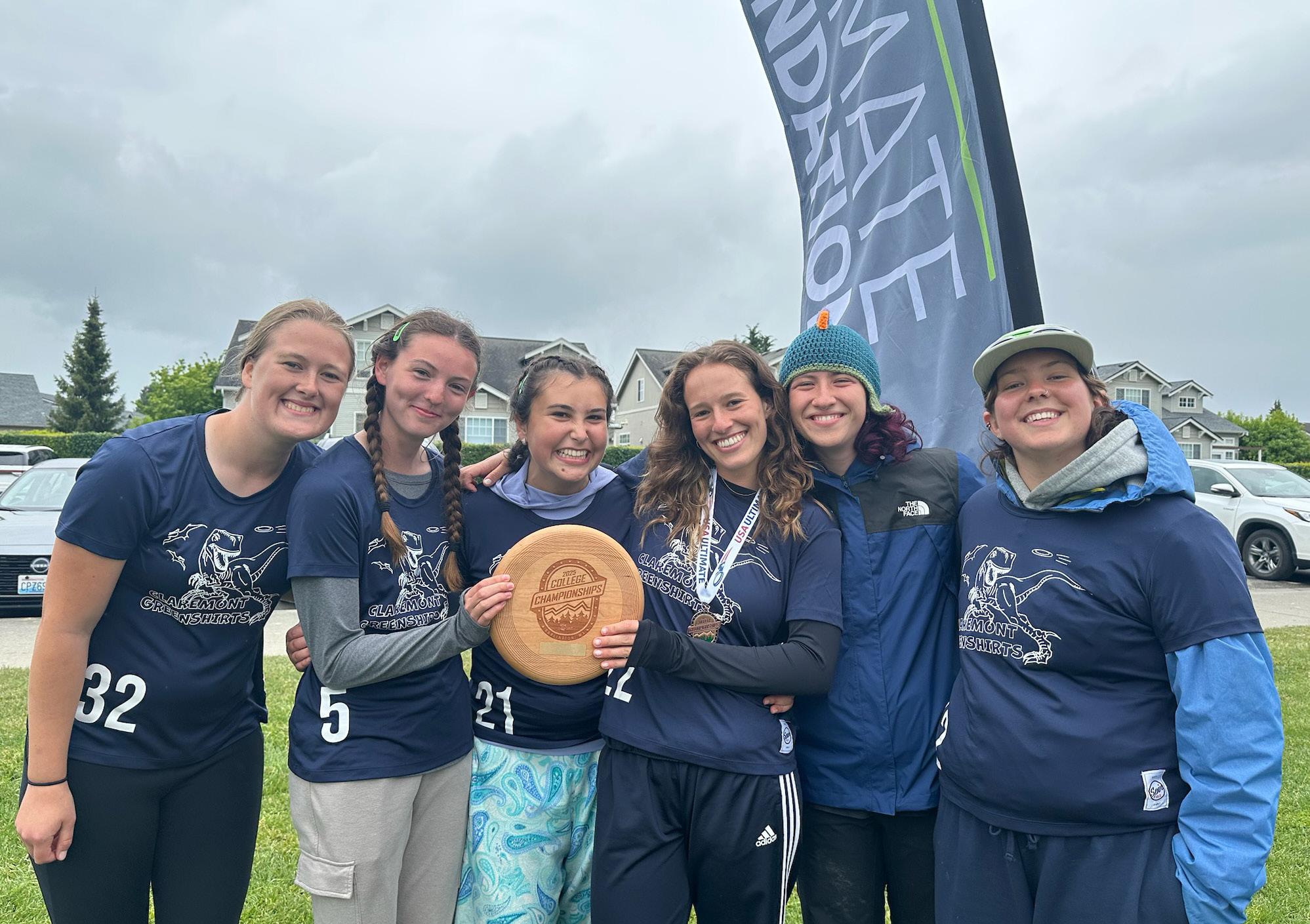
people this fall.
Moreover, the Greenies hope to strengthen leadership transitions and secure more reliable funding to sustain the program.
Establishing the structures necessary for future program success, though, starts with having an inviting atmosphere for new members who may be less experienced.
Talia Rosen SC ’29 is a firstyear player who, like Polin, hasn’t yet earned her code name.
Rosen said that the team’s welcoming culture is what draws people in and what ultimately makes their success possible. This was immediately noticeable for Rosen, even as a first-year student.
“It’s not intimidating, you feel so excited to join,” Rosen said.
Polin expressed a similar sentiment, noting that even with such competitive goals, there is never too much pressure.
“Everyone’s so welcoming,” Polin said. “There’s this energy
that makes you want to show up and get better, but you never feel like you have to prove yourself. You just have fun and belong.”
Unlike Polin, Rosen joined the team this fall having no previous ultimate frisbee experience. And yet, thanks to the spirit of the Greenshirts, she also said she felt right at home.
That spirit of belonging runs deep in the Greenshirts’ identity. One of the cornerstones of ultimate Frisbee is the spirit of the game, which emphasizes respect, sportsmanship and trust between opponents, especially since the games are entirely self-officiated.
For the Greenies, this respect for the game and what it brings is crucial. The Greenies bring the same enthusiasm to practices as they do to tournaments, often showing up painted in glitter and with green in their hair. These tenets were on full display at last year’s nationals, where the Greenshirts won the
Spirit Award, one of USA Ultimate’s highest honors, for their outstanding sportsmanship and respect shown throughout the championships.
While many of their opponents at those championships have their own coaches and institutional funding, the Greenies rely financially on their own initiatives, like bake sales and T-shirt sales. Nevertheless, the Greenies have managed to cement themselves not just as a successful group in Claremont, but as a nationally recognized club team. What makes the Greenshirts remarkable isn’t just that they win without a coach or a significant budget — it’s that they’ve built something so much bigger than a team.
They’ve created a space where joy, care and inclusivity are the foundation. They’ve shown that trust and cooperation can replace conventional leadership hierarchies, and that respecting the spirit of the game can go a long way.
It’s not often that you hear of school records getting broken. For a program as successful as Pomona-Pitzer (P-P) cross-country, which has won three NCAA national titles since 2019, it is especially less frequent. And yet, Jack Stein PO ’26 has etched his name into the P-P cross-country history books with a new record.
On Sept. 27 at the UC Riverside Invitational, Stein set a new program record of 23:45.4 for the 8-kilometer run, breaking the previous record by 7 seconds and coming within 5 seconds of the men’s SCIAC conference record in the process.
This achievement is a milestone for Stein, who was already an established runner in Piedmont, CA, before coming to Pomona. At
Piedmont High School, he had received numerous accolades in cross-country and track and field, in addition to setting two school records in the 1,600 meter and 3,200 meter race. Stein’s recent record for the Sagehens has prompted a moment of reflection for the P-P cross-country team, all of whom are very proud of his accomplishment. Head coach Emma Delira expressed her excitement about Stein’s record and his start to the 2025 season.
“It [was] something he was hoping to achieve this season,” Delira said.
“It’s great to see all [the] years of hard work he has put in. It’s reached the point where he is able to break a very prestigious school record. Breaking the 24-minute barrier is an amazing accomplishment.”
Stein’s history with Pomona-Pitzer athletics is robust. Just last track season, Stein finished second in the 10-kilometer race at the SCIAC track and field championships with a time of 30:57.88.
Last fall, he placed fourth at the SCIAC championships with a time of 24:42.6 and sixth at the NCAA regional meet where he finished with a time of 24:22.6.
On top of that, Stein was one of three Sagehens who received All-American honors at last year’s Cross Country NCAA Championships, where he finished 28th.
According to Stein, consistency has afforded him great success in cross-country. Since his freshman year, Stein has aimed to be nationally competitive in cross-country. Now, as a senior,

he has finally realized his vision.
“It’s been a long time coming … four years of steady growth to knock my time down,” Stein said. “It’s an honor to hold [the] record. To think that I have the fastest 8K in the program’s history is special.”
Stein’s progress in cross-country is observable throughout his years as a Sagehen. He broke his junior year personal best by 37 seconds, which he had set at the NCAA Cross Country Regional meet. In 2023, Stein finished eighth in SCIAC.
On top of Stein’s impressive stats and personal achievements, Delira attested to his importance as a low scorer. In cross country, each individual’s score corresponds to their place in the race, and the top five runners on each team contribute to the team’s overall score. In the postseason this is especially crucial, given the heightened competition.
“With cross-country, the team component is very important,” she said. “And when you have a low-stick like Stein … someone [who is] in the talks of being a top-ten, even top-five individual in [Division III] … it gives the team confidence moving forward.”
Stein’s leadership has proven crucial for the P-P cross-country team. Teammate Nate Wehner PO ’28 spoke about Stein’s team-focused mindset that is a core part of his character as a leader.
“When it gets tough in a race, ultimately, what you lean back on is your team, and Stein is one of the biggest team players you’ll ever meet,” Wehner said.
Delira also spoke on how the rest of the team is able to draw on Stein’s recent achievement.
“[They say] ‘if Stein can do this, we can do this as well,’” she said. “It gives the younger guys on the team [the] awareness that each year … you keep getting better and better.” While the Sagehens are feeling the boost from Stein’s accomplishments, they are eager
to continue building on this momentum.
On Saturday, Oct. 4, P-P hosted the 16th annual Pomona-Pitzer Cross Country Invite. The Sagehens placed third overall amongst some strong Division II and NAIA competition. Stein and teammates Amir Barkan CG ’26, Peter Neid PO ’27 and Jefferson Wright PO ’28 all placed in the top 15.
Despite their season accomplishments thus far, Stein and company are remaining poised, remembering when their efforts count the most.
“Cross-country is funny,” Stein said. “These meets leading up to the post-season are important, but, at the end of the day, all that matters is what you run in November. You don’t want to burn out [or] get too excited too early. [We must] keep our mind on the NCAA.”
This veteran patience, among other things, is what makes Stein a prominent leader on the P-P cross-country team. Wehner commented on Stein’s influence on the team since becoming a Sagehen himself.
“As his teammate, you see the consistent work he puts in year after year,” Wehner said. “His improvements this year are a culmination of the 90 plus mile weeks he’s been logging since his sophomore year.” The accolades may speak for themselves, but Stein is looking to be remembered for more than just his achievements on the course.
“I am trying to do my best and leave a legacy that is not only athletic, but also [about] being a good leader and being someone who is a part of [the] community,” Stein said. “Pomona-Pitzer men’s cross-country … we’re just a community of guys that all have a common interest. That’s a big part of the legacy I want to [leave] — being a well-rounded individual.”
Stein and Pomona-Pitzer cross-country’s next meet will be on Oct. 18, where they will travel to Rock Island, Illinois for the Augustana Cross