All five undergraduate Claremont Colleges earned national recognition in recently released
Arts College rankings. Both sets of evaluations assess academic institutions on factors such as strongly constructed academic curricula,graduate outcomes. Across research on higher education, evidence suggests college
ment in rankings can correlate with
underscored the limits of rankings
stem from changes in methodology, graduation rates, faculty resources or alumni earnings, rather than sudden changes in institutional quality.
For the Claremont Colleges, nation’s leading liberal arts institutions.
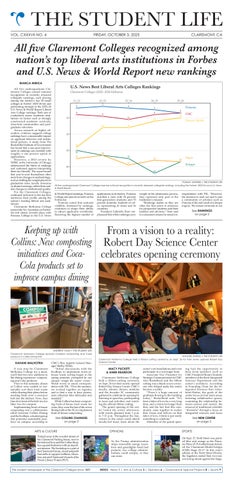
U.S. News Best Liberal Arts Colleges Rankings Claremont Colleges (2022 2026 Editions)
Claremont McKenna College Forbes list. Pomona noted that national visibility, bolstered by rankings,
countries.
McKenna College for a meal, -
Prior to this semester, diners at Collins were unable to sustainably sort their food waste stacking them onto a conveyor belt into the kitchen. Now, four
effort between Collins Dining -
“Initial discussions with the house waste sorting began in the annual ‘weigh the waste’ event,”we worked together on logisticsnent collection bins fabricated and installed.”
ing back-of-house food waste for years, they were the last of the seven
See COLLINS CHANGES on page 2
ARTS & CULTURE
Tucked away in the wooden atrium of the Claremont Packing house, next to
tion, arts and Claremont’s branch of the Prison Library Project (PLP).
Harvey Mudd
Scripps
institution’s mission. in a statement shared in email corthe decision to seek out and to join a community of scholars such as
Claremont McKenna College held a ribbon-cutting ceremony faculty, alumni, donors, students in tours and activities, and watch-
ter lasted the entire afternoon, faculty-led tours, learn about the
can resist.
center’s art installations and even
Associate Vice President for Alex Boekelheid said the ribbonbecome a reality.
“There’s a huge amount of today,” Boekelheid said. “It’s been a labor of love for a very long time, and a vision for longer than that, and the fact that this community came together to realize that vision and deliver on that labor of love, I think is just really something to celebrate.”
CMC President Hiram Chodosh, members of the Keck Integrated center’s architects. According to Founding Chair for the Inkind-Hadas, the goals of the center focus on four main areas;tween science and society, the “divisions” through a focus on integrated sciences and focus
KAHANI MALHOTRA
C laremont McKenna C ollege recently installed composting and C oke products in Collins Dining Hall.
TOMMY MATHEIS • THE STUDENT
the Forbes’ 2025 list
MAGGIE ZHANG • THE STUDENT LIFE
Claremont McKenna College held a ribbon-cutting ceremony on Sept. 26 for their newly opened Robert Day Science Center.
RANKINGS: 5Cs place among top liberal arts colleges in country
Continued from page 1
world, regardless of need, to this thirteenth on Forbes’ list and secured
national liberal arts standings,
also underscoring the limits of such measures.
recognition,” Marcus-Newhall told
and best value rankings; these
tion for more students regardless Marcus-Newhall also noted
both academic and residential life, strength lies in the generosity of -
In addition, Pitzer President
“Pitzer’s strong showing in various rankings this year is an afliberal arts excellence with meaningful student outcomes,” Thacker
Thacker noted that the rankings demonstrate the work of both faculty and students and underscore
nity that values bold thinking and social innovation.
American liberal arts institutions.
quality, student outcomes and the distinct model of under -
Harvey Mudd College and Claremont McKenna College did -
N ew Ce NT e R: CMC cuts ribbon on Robert Day Science Center
Continued from page 1
The building will house CMC’s class requirement at CMC launchedulum reflects CMC’s new inte -
chemistry or biology; beginning could only choose the “Integrated
the vision behind the center, and “It’s not just a building, it’s
this center to each and every one of you here, to the broader members of our outstanding crown colleges and the broad community and the small businesses who will be nourishing us here tonight, and so many others, our civic Bjarke Ingel, the head archicenter as a building that has no
said the center aimed to cultivate conversation and collaboration. that even if you are working in aroom, you will always have this on another level,” Ingel said. “And this might encourage you curriculum and actually start conversations.”
Boekelheid said the social can come together, meet and
share ideas.
“It’s becoming a bit of a crossroads for the college in that way, so it’s just a really fantastic
According to Boekelheid, the center’s layout aids CMC’s the sciences.
“There is a new way of thinking about how we teach the sciences here that is multidisaries, that traditionally exists,” Boekelheid said. “And that for students and for the future to be able to have some new knowledge come here.”
COLLINS CHANGES: Composting and Coke products come to CMC
Continued from page 1
to ensure that the infrastructure and signage for front-of-house waste could succeed long-term.”
the community, but that there were some drawbacks to the new bins.
Physical student IDs are now
with a debit or credit card.
you don’t have your card with you, seconds to two minutes,” Miguel services general manager, said. “It could take a long time and meanThe dining services announced the change on Instagram and with dining services, informing students about two weeks in advance that
ing here,“ Menjivar said. “I guess nobody really likes change, but I think if you look at the bigger
bins narrows the Collins exit hallway, making it more chaotic and congested,” Pai said.
He said there has been similar
In the Hub, signs announcing Coca-Cola as the “official will have to go back to their dorm more often to get their IDs.
adjust to the idea of being forcedhata said. “I think it’s going to be a transition for a lot of students, and I think it’s something that we’re going to have to get used to.” make a greater effort to arrive time saved by fellow students and be well worth it.
Nakahata said. Menjivar said students with-when they can’t remember the mishear them.
Collins late last week advertising the same headline.
the sign reads. this year. “Our engagement with both
of the fall semester.”ucts at the start of the year to continue serving students with-ucts are consumed, they will inventory, which includes a “wider selection of beverages,”
Sept. 22–26
• U.N. leaders gather in New
Sept. 29 • • The last segment between in California for HighwaySept. 30 •in decades; most have already •sumer website from the been announced to launch
Oct. 1
• continuing resolution before
gering a federal government shutdown
more convenient,” Nakahata said. “It’s gonna make their job a lot easier, and for everything that they do for us, I think that this is a very reasonable thing.”
into their dining halls but cannot is a key and unique feature at the Claremont Colleges.
nice long lines, and we’re just trywe can streamline it and make it easier for you to come get your meal and enjoy it,” Menjivar said.
ANNE REARDON
Lessons on advocacy and athletics from Aly Raisman
ANANYA VINAY
“When I first started to speak out, I was so surprised and so devastated by the amount of people who would stop me and tell me they could relate to my experience. I struggle to find a female in my life who hasn’t had a bad experience with a man,” Aly Raisman said.
On Oct. 2, Raisman, a six-time Olympic gold medalist and twotime gymnastics team captain, took the stage at Scripps Presents to share lessons from her athletic journey and trauma healing process. Raisman came forward as a survivor of sexual abuse in 2017 and is now an avid advocate for sexual assault survivors.
“She was one of my favorite people I’ve listened to speak,” Winnie Macaulay SC ’28 said. “She was a really engaging speaker, and she had an extremely powerful message regarding the importance of advocacy and her experience as a survivor.”
Macaulay attended the event along with the entire CMS women’s lacrosse team.
“Speaking for my team, we were all extremely impacted by her message,” Macaulay said. “I now understand more about how I’ve been feeling coming into college athletics, and the importance of prioritizing my own mental health and valuing what I put in every day at practice.”
Raisman began the talk by describing the lessons she took away from her 11year professional gymnastics career. She emphasized how important practicing patience and cultivating passion have been throughout her life, noting that she always performs best when she isn’t putting too much pressure on herself.
“I wasn’t always the kid that you would pick out to say she’s going to be the best, and when I was six years old, I was the worst in my class and had to repeat another year,” Raisman said. “I just loved [gymnastics] so much. There’s a lot of magic in loving something and being passionate about it.”
When asked to give advice to her younger self, Raisman underscored the difficult process of learning to trust her own judgment and cultivate her inner voice, regardless of others’ opinions. Gymnastics is notoriously a high-pressure sport. Raisman, like many gymnasts, was raised to prioritize external approval, which often meant questioning her own intuition and suppressing her inner voice.
“I’ve had to learn since my gymnastics career how to reflect and make sure that I’m living in alignment with my values and what feels right to me,” Raisman said. “Recognizing that something feels off [is important] even if other people are telling us we’re wrong.”
In November 2017, Raisman revealed that Olympic team physician Larry Nassar had
sexually abused her during “therapeutic” treatments.
Following testimony by Raisman and other survivors, including record-breaking gymnast Simone Biles, Nassar was sentenced to up to 175 years in prison.
For over thirty years, Nassar took advantage of his position to systematically abuse at least 156 women. When Raisman and the others’ stories went public in 2017, the survivors suddenly had millions of people all over the world discussing their intimate sexual trauma.
Raisman described this day to the captivated audience in Garrison Theatre, detailing the severe physical effects of the publicization of her story – for hours, she endured an unbearable migraine.
In telling her story, Raisman noted how devastatingly common abuse is, and emphasized that speaking out can be extremely terrifying. There is always the risk of retaliation and the fear of not being taken seriously.
“I wish that we lived in a world where more people felt safer speaking out,” Raisman said. “But I also wish we lived in a world where people didn’t have to.”
In the wake of this experience, she learned the importance of setting up her own boundaries and taking care of her body.
“Healing is a roller coaster,” Raisman said. “There are moments where I feel more relaxed and there are moments out of the blue that trigger me. I’m working hard on recognizing that if I have a bad day or a bad week, I’m not going to feel like this forever.”
Attendee and Scripps
alum Kathleen Muniz SC ’97 was particularly struck by Raisman’s mental health journey.
“It just speaks to her desire to seek help and get better, and that you have to be able to advocate for yourself and be open to talking to so many people and find the right outlet to help heal you,” Muniz said.
Raisman underscored how much stress can impact one’s health and believes that we don’t need a valid reason to be tired. In fact, after competing at the Olympics, there were periods of time when she experienced severe brain fog and would be unable to walk for periods of time.
“Most people are fighting their own battle and that is exhausting,” Raisman said. “Especially when we live in a world where not everyone is supportive when people talk about their trauma, their stress, their mental health.”
Hannah Conte CM ’26 appreciated how Raisman supported and validated others’ experiences.
“I love that her emphasis was on kindness and how she wants to change the world and have everyone be empathetic and kind,” Conte said.
Being kind doesn’t always mean performing grand gestures. As she reflected on her retirement from gymnastics, Raisman emphasized that constantly striving towards high achievement can be a trap — sometimes it’s better to aim to create smaller, positive impacts in your community.
The natural reaction to human activity depicted by Anne Covell
In the summer of 2012, Anne Covell and her family were peacefully gliding through a lake buried in the wilderness of Montana when her tour guide pointed out something strange. 20 feet wide and stretching out as far as the eye can see, a clear-cut swath of barren land splits the wild northern forest into its American and Canadian sides. She returned home curious, and discovered in her research that this patch of land — aptly named “The Slash” — stretched for all 5,525 miles of the United StatesCanadian border.
Covell was immediately hooked. All of a sudden, she’d become fascinated by borderlands: the intersections between the wildness of nature and the boundaries we build. This research culminated in her piece, “Towards a Just Landscape,” which Covell presented to the 5C community this last week.
Covell explores the connections between humanity and its surrounding world through her intricate book art — manipulating the book’s materials to express the ways in which the human race shapes its environment.
On Sept. 29, audiences filed into the Bette Cree Edwards Humanities Building for Covell’s presentation, “Artist’s Books and Environment: How Humans Shape the Natural World.” This presentation was hosted by Scripps College as a part of their fall 2025 Frederic W. Goudy Lecture series. Throughout the lunchtime talk, Covell showcased a selection of works depicting environmental issues such as invasive species, rising sea levels and deforestation. She discussed the different techniques, prior research and inspirations that contributed to her pieces, highlighting “Towards a Just Landscape” and “History of a Felling.”
These pieces both drew inspiration from that summer afternoon when she first discovered “The Slash,” and her subsequent fascination with the borders between humanity and wilderness.
Christina Ranney, the assistant to the core director and administrative coordinator of core curriculum at Scripps, especially resonated with these pieces.
“I am Canadian and found the piece a beautiful representation of the space that divides the U.S. and Canada,” Ranney said. “[It] touched my memory of what the border represents, and the physical lovely.”
While much of Covell’s work human activity in the natural world, much of her other artwork provides insight into the future of this complex relationship. She showcased, for example, the piece “Sea Change,” a collection of
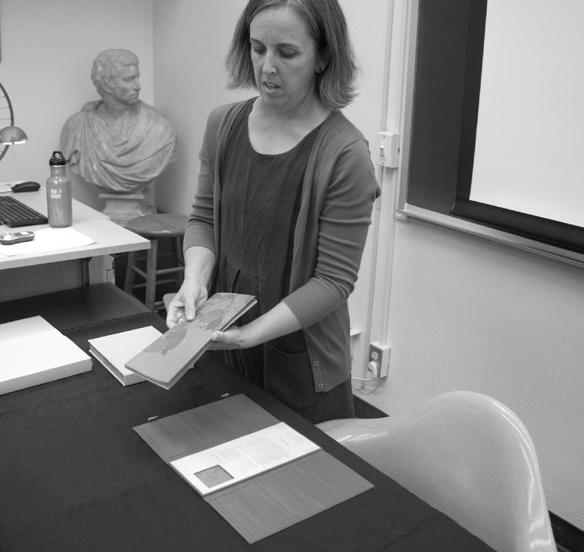
hypothetical maps that depict what the state of Florida would look like at varying heights of the sea level rising. Covell worked on this piece during her fellowship with the University of for Book Arts program, which invites artists to explore resources from the Special and Area Studies Collections (SASC) at the George A. Smathers Libraries.
During this time, she was invited to create a piece of book art related to Florida, which led her to want to depict the impact of sea level rising on the state’s geography.
When browsing through the SASC, Covell came across an anthology of Sanborn Maps, a format for maps commonly used to depict the layouts of cities across the United States throughout the 19th and 20th centuries. Seeing the evolution of urban areas inspired Covell to create a similar system for theoretical scenarios of what Florida could look like if the sea level were to rise between 2 to 10 feet.
“I had an epiphany,” Covell said. “This is the perfect way to talk about sea change, the perfect way to talk about sea level rise, because we are sitting with these predictions for what is possible,” Covell said.
This piece stood out to Tia Blassingame, associate professor of art at Scripps, who praised Covell’s creative process.
whole process of ‘Sea Change’... just sort of tying archival research through research as well,” Blassingame said.
“And I felt like [the presentation] really encapsulated her process really well. I feel like it was very timely as well.”
When the floor opened for questions, one audience member asked Covell if she plans to use her justice, or if she is creating purely as an outlet for self-expression. While Covell explained that her work leans more towards the latter, she hopes that it can be an instrument for change in the future.
“I think it comes from a place of needing to get it out of my body because I just have to make it, so I do, but [it would be] wonderful if it can make an impact,” Covell said. “I think [if] more people get into special collections, see the work and experience it, more exhibitions can get [this kind of] work out there.”
Reform through reading: The Prison Library Project
Walking through the wooden atrium of the Claremont Packing House, past the famed Iron and Kin bookshop tucked in the back corner. Beneath the quaint exterior — exposed ceilings, tall bookshelves and an eclectic array of books — lies an important mission.
The bookshop is a part of the Claseeks to support wellness, education and arts. In an interview with TSL, bookshop manager Eva Lopez explained that the bookshop is essential to supporting the Claremont Forum’s Prison Library Project (PLP), one of the nation’s largest books-to-prisoners initiatives. Since being taken over by the Claremont Forum in 1985, the PLP has mailed almost a million books to incarcerated people throughout the country.
“The prison library project sends books and educational resources out to incarcerated individuals across 400 prisons in the United States,” Lopez said. “We receive over 1000 letters a month requesting books and educational resources, and we do
The PLP granted TSL access to thank-you letters incarcerated people have written to the project, some of which are displayed on the bookshop’s shelves. One unnamed incarcerated person discussed how for him, reading became a treasured escape.
“Imagine being locked in a 8×10 box for months with little to occupy your time,” he wrote. “Imagine how slowly the hours pass as the monotony of your mere existence drives you closer to the edge of the abyss of insanity.”
Not only does the PLP provide incarcerated people with practical
tools like dictionaries or legal books, it also provides access to novels or other creative works.
“Yet there exists a respite[e] that allows us to travel to distant lands, to experience the world through the eyes of another, real or fantastical, to escape the oppression we find ourselves in,” the unnamed thank-you letter writes. “The Prison Library Project provides more than just books. It provides a lifeline to a world physically beyond reach.”
While the bookshop is the physical base of operations for the PLP, Lopez explained how the weekly farmers market, a 5C student staple, plays a key role in the program’s operations.
“The Claremont Farmers Market is the sister project of the Claremont Prison Library Project,” Lopez said. “We really do depend on the Claremont Farmers Market for a lot of the program.”
While the funds raised through the Bookshop and the Farmer’s market are important, the PLP would not function without a strong volunteer network and community donations.
Volunteers at the bookshop come are 5C students, but others get involved through their local churches or community groups, such as The Pilgrim Place retirement community. Lopez emphasized that volunteers are integral to every step of the process of getting books to incarcerated people.
Their procedure begins as the bookshop takes in donations from people in the community. Then, volunteers sort through the donated to send out to prisons. At this point, volunteers also reference letters
they receive to see how they can books with their future recipients, packages, place postage stamps and mail out the books.
The process of approving books for shipment, however, can be very strenuous. Most prisons have very strict standards for what books they allow incarcerated individuals to receive. At many facilities, any damaged books, hardcovers or texts dealing with certain topics may be turned away. Working with limited resources, the PLP tries to be very strict in following this standard, as any books that are rejected represent a loss of time and money. volunteers to make sure that the parcels we’re sending out are in perfect condition in order to be received and not rejected,” Lopez said. Despite the challenges, the letters PLP receives illustrate the impact of each book and its ability to plant seeds of hope in the prisons it serves.
“Dear Library Project; I am a 63-year-old [Pennsylvania] prisoner who is dying of cancer … Your books are vital and my last link to a peaceful and pain-free outside world. All of my old friends are either deceased or gone,” one letter from Ryan read. “When I am too sick to do anything else, I can still open a book and lose myself for a little while. Thank you so much for your service.”
In addition to the evident impact on incarcerated individuals, working with the PLP often leaves volunteers with many important takeaways. After volunteering with them during her freshman year Orientation Adventure (OA), Aria Zhang PO ’29 reflected on her preconceived notions about incar-
cerated people.
“For me, [working with the PLP] dismantled the idea of thinking of someone who is incarcerated, as a prisoner, as that being their entire personality,” Zhang said. “You get to see a little bit more of the actual person underneath.”
Traditionally, OA trips have involved outdoorsy or touristy activAngeles. This year, however, the Pomona OA team pioneered a new on campus, the Draper Center for Community Partnerships connected freshmen with community organisations like the PLP.
In addition to student partnerships through the Draper Center, Lopez highlighted the many ways the Claremont community can get involved and support the PLP’s mission. Community members can donate books, provide charitable donations or volunteer directly with the program. Supporters can also help out by purchasing from the Forum Bookshop, open Saturday and Sunday from 10 a.m. to 4 p.m., stopping by their popup stand at Claremont Forum Farmer’s Market open every Sunday from 8 a.m. to 1 p.m., or by volunteering from 10 a.m. to 4 p.m. on Mondays and Wednesdays.
“All of the proceeds of our shop go directly back into our wonderful project,” Lopez said. “[Tell] friends by word of mouth that we are here, [and] that this space is an exciting [place] where people can come browse new books every single week.”
to get involved with the PLP on their Instagram page @prisonlibraryproject and at www.claremontforum.org/ prisonlibraryproject.
TERESA CHANG • THE STUDENT LIFE
JOSEPH WOO CHAN
COURTESY: SCRIPPS COLLEGE
TERESA CHANG • THE STUDENT LIFE
JUAN ANDRES RODRIGUEZ FUENTES
B ook artist and papermaker Anne C ovell showing her work.
Arts & Culture
Terror and beauty in Big Sur
LIAM RILEY
Before Jack Kerouac slid into complete alcoholic psychosis, he spent a month transcribing the attempt to dry out, he hid away at his friend’s cabin in Big Sur. Hein rested on, sit on the beach and sound out the noises the waves made in a notebook. He later published poems that included these transcriptions:
“Shoo — Shaw — Shirsh”
“Go on die rock light”
“You billion yeared”
“Rock knocker”
“Big Sur” by Jack Kerouac includes these poems, chronicling his slow descent into insanity. While he is troubled by unwanted fame and dealing with alcoholism at the beginning of the novel, he still manages to keep a cheery tone and remain functional. He spends a good majority of the novel painting a beautiful image of the paradisiacal wildlife and nature around his cabin. But by the end, Kerouac is so wrought with anxiety and confusion that it seems impossible he could live through it and remain coherent enough to capture it in writing. What results is an unnerving quality that makes you want to tuck it away in your closet instead of displaying it on your bookshelf.
The primary question the novel begs you to ask is: “Oh my god, how did it get this bad?” Unfortunately for Kerouac, there was even less understanding of psychiatry
STUCK IN THE MARGINS
in the 1950s than there is today. In writing, the only medical term he uses is “alcoholic,” and he suggests that his alcoholism might be his way of treating a deeper psychiatric disorder, forcing the reader to consider the nature of Kerouac’s anguish outside of a modern psychiatric lens.
I believe you can begin to chisel away at the question of what drove Kerouac’s descent into madness by linking it to his study of the ocean.. He had spent his entire life seeking spiritual truth, hopping trains across the United States. He tried Catholicism, Buddhism and psychedelics in his quest to understand the universe. Finally, he found himself battered from years of alcoholism and vagrancy — nowhere closer to the truth — listening to the waves in some desperate plea to understand the universe.
When interpolating the sea sounds failed to reveal anything, Kerouac began to hallucinate because he had already read, seen, heard and drank anything he possibly could conceive to seek the truth. The bats, the UFO and the vulture people all serve as portals for Kerouac’s sick mind to peer into an imagined reality. Sometimes an obsession with discovering ultimate truth can spring from a deep dissatisfaction with everyday reality. In the case of Kerouac, this obsession increased the misery of his everyday existence, which in turn, fed his obsession. Maybe this ex-
planation is just as lazy as calling Kerouac manic depressive and scrubbing his memory clean in an institution with insulin shock treatments — that’s actually what they did back then — but I think this model is helpful because it leads to another question: “Why was Jack Kerouac so obsessed
Maybe I should ask myself the same thing. Last semester, I visited Big Sur. I stared off into the same sunset Kerouac saw shrouded in nightmare and listened to the same waves he transcribed. My friend told me that Big Sur was one of the only places in the United States where told me, “As the last of the sun melted into the sea, some miracle of light turned the entire sky bright green.”
So, we sat and waited. After the sun disappeared and the stars poked their way through tufts of clouds, we realized we the conditions weren’t right, or it wasn’t real. I was deeply disappointed, whereas my friend couldn’t care less. The night sky was beautiful, we had a delicious meal of potatoes, sausage and carrots cooked in aluminum foil, and my other friend was yammering about something hilarious that I can no longer remember.
I should have been perfectly content, but I wanted to see the sky turn green, or the sun peel
or a pitch-black ceiling panel fall out of the sky to reveal an embarrassed alien onlooker. I often approach a book looking for some hidden image in the text, which strips the surface of the story away from the page and reveals a clever collage of symbols. This attitude towards literature seeps into my life, and I find myself looking for the “point” in what’s happening around me, as if I’m looking at a painting I don’t understand.
I can’t understand Kerouac’s dissatisfaction through mine, or my dissatisfaction through Kerouac’s perspective, but I can understand the connection
Baboon on East Bonita
Two weeks ago, an elderly white man on East Bonita Ave said to a friend and me: “Gee. Don’t you two look happy.” The exchange took place amidst our Tuesday 7 a.m. latte runs, and while the wording was certainly a bit odd, we replied with a cordial good morning and continued on with our day. A week later, we ran into the jokester once more, who expectedly exclaimed, “you guys look too happy, again,” though this time, it was in a mocking tone, like he was scolding a child. Don’t get me wrong, I don’t mean to criticize a perfectly kind Claremont resident, seeking connection along with his breakfast delicacy from
Crepes of Wrath. What I do hope to point out is that most women have an allotted amount of time before their joy, or sadness, or excitement, or nonchalance, or anger is critiqued a man. “You should smile more” is the age-old classic, but there are also countless other renditions. Being hypervisible as a Black woman is no novel experience. Early mornings, when Claremont is sacred periods. Then, I can throw on clip back my hair and migrate to Nosy Neighbors with friends. Perhaps this is why the relatively lackluster exchange took hold of me. Is there ever a place or time where
I’m not monitored? Should joy be denied to me? Or forced on me, considering my privileges? Why am I overthinking a well-meant interaction? From that moment forth, the but also mental silence. titled “Baboon on East Bonita.”
Two dimples, you’re lucky. No dimples, you’re cursed.
Swaying hips I’m perverted, and ready to nurse.
Tired eyes I’m ungrateful. My Wild eyes I’m aggressive, but
So let it be spoken, this morning, I’ll bite.
If thrice I hear tune of, your well-meaning croon. For, dimples, hips, eyes, equip
The hush of the forenoon, shattered by a baboon.
If you deem the tone of “Baboon on East Bonita” as stemming from a triggered place, you’d be correct. I don’t understand why men’s persistence in analyzing, judging and counseling women’s emotions irritates me so profoundly. I assume it’s because I consider feelings the most natural and sacred part of being a human. Following this line of thought, when men so adamantly seek to control the emotions of women, it seems to strike at our humanity, our soul, and not just our “state of well-being.”
It’s easy to “get used to” men
dominating politics, the media and just about every industry, even those directly impacting the lives of women. However, I can’t get used to male dominion over my regulatory sphere, the mental space that ensures that I can feel and survive through a healthy balance of emotions.
I also don’t mean to imply that I haven’t felt personally involved or Just this past Sunday, I was on a Laguna Beach trip and found myself on one of their free beach trolleys. I was enjoying the estheticized and manicured “authenticity” of the trolleys, along with the wondrous views of the shoreline, until a group of Orange County’s drunken upper echelons boarded, boisterous and cackling. I found it to be a little early for such expansive extraversion, as they bickered loudly and swayed across the aisles. They’d likely boarded from a brunch of bottomless mimosas based on their colorful, formal attire. All in all, a little annoying, but nothing my peers commented on. Presumably, referencing how I described the experience in my journal, I involved myself emotionally: From the back of the tram, their hysterics were louder than the air horn, signaling each stop. The color-infested summer dresses, the drunken dance their limbs made as the train gained speed: “whoooo … woah there … ‘cackle, cackle, cackle.’” The occurrence was certainly obnoxious on a few levels, but in some ways, I did involve myself in their wealthy, exaggerated joy —
between the two, which has made me realize the vicious cycle that led Kerouac to the end of “Big Sur” is in no way unique to him. Of course, there is value in searching for truth, but sometimes that can distract us from the beauty that is directly in front of us. Right now, I’m going to stop worrying about Jack Kerouac and what color the and go get some sunlight.
Liam Riley PO ’26 is from East Tennessee. He likes giving book recommendations, the outdoors and shenanigans. Reach out to him if you want to help build an underground sauna in his buddy’s backyard.
At night, when campus finally exhales, I put on Sampha’s “Process.” The hall lights hum, someone drags their laundry bag past my door and the first notes land like a breath of fresh air. I used to think that grief announced itself with violins and a capital-s Sadness. “Process” waits there in the background, until I’m quiet enough to hear it. When I first heard the album back in 2022 — which Sampha released after years of collaboration and the loss of his mother — I couldn’t imagine how much I’d come to rely on it. I remember thinking it would follow a cliche arc: collapse, revelation, recovery. Instead, it moves through smaller, messier spaces of doubt, submersion and recognition, culminating in the slow return to routine. Nothing gets resolved and grief just meanders through your mind.
“Reverse Faults” is a track I return to when my thoughts are getting repetitive in a way that feels dangerous. It feels like someone is trying to rewrite a memory — looping and rewinding it, hoping it’ll sound different the next time.
We all know that loop. It’s walking home, replaying conversations in my head that didn’t end well, rearranging the blame until the puzzle pieces fit. The
song doesn’t attempt to solve this issue, just as I cannot fix my words, but rather it lets the loop exist without rushing it out of frame.
I don’t always notice when a day starts to get away from me until I’m already under it.
That’s the word Sampha keeps repeating: under, under, under. His voice folds in on itself like he’s being pulled down further each time. It’s less of a chorus and more of a reminder that the ground you thought was under your feet is suddenly gone.
I’ve felt that exact sensation before. Most recently, it was this summer, when I realized the relationship I thought was grounding me had already slipped away. The song doesn’t give me a way back onto my feet; instead it forces me to sit with that unsettling drop into somewhere I didn’t plan to be. I resonate most with “(No One Knows Me) Like the Piano” as a performance. Sampha’s voice lies bare, accompanied only by his keys and the reverberation of the room around him. When I put it on, it feels more like I’m overhearing someone playing it at home, down the stairs in the living room. Sampha’s voice carries that same uneven quality, almost breaking in places as if he isn’t sure if he’ll make it through the line.
I feel like the spaces between the notes are just as important as the notes themselves, not because they’re dramatic, but because they hold the risk of silence swallowing the song altogether. That fragility is what makes the song hit for me, as my grief often arrives in those same unsteady waves.
This summer, I ended a relationship that carried me through two years. She was my high school sweetheart, the first person who felt like everything to me. We had been through so many “firsts” together that breaking up felt less like walking away and more like leaving a version of myself behind. I told her in person — there was no possibility for silence between us, or unread messages piling up. I said the words out loud, and I watched the shape of our lives split in two.
I didn’t call it grief at the time. I thought that belonged strictly to funerals and hospital rooms, not a relationship I had decided to end. But being home over the summer made it impossible to avoid. Every corner seemed to hold a version of us that still existed there. I caught myself looking for a sign that I was handling the loss correctly.
“Process” reminded me that there isn’t one solution or one way to handle the process cor-
rectly. Sampha’s songs never resolve in the same way twice, and they don’t try to. They make space for my spiraling, sinking, pausing and starting again. Listening has been a way of loosening my own grip on how my grief is supposed to look. The record doesn’t offer me any definitive answer, but leaves enough room for me to keep going.
Some days I still wonder if I should be further along, quieter about it or less caught up in these small reminders of what
the very behavior I condemn. Even I sometimes resonate with the male emotional puppeteers, extending myself into the lives of others, just to
the crepe-lover on E. Bonita Ave., or the devout-of-love middle-aged “you should smile more” utterer, is that I said nothing aloud. All of my judgments remained inside, where they the joy, ecstasy or mental tranquility of others. All of this to say: If you’re a man and you comment on my
as I typically do. However, this isn’t something I’m proud of, nor a trait I wish to preserve. I hope to challenge myself, and my readers, to recognize that there are appropriate times and spaces to advise, mentor, or console women — or anyone, for that matter.mendations” in public spaces is simply inappropriate and antithetical, We are human, and therefore, of course, we need external support, face lapses of judgement and forget the beauty of life. But there must be boundaries around how much our lives are publicly annotated. After all, we already carry enough notes in the margins from ourselves.
Zena Almeida-Warwin PO ‘28 is from Brooklyn, New York. After years at a tiny Manhattan private school, she has perfected the art of diplomatic self-regulation in the face of awkward social interactions — almost to a fault.
once was. Other days I forget for a while, and then it all returns in an instant. I don’t know if I’m grieving the right way, but that isn’t the point. What I do know is that I’m still here, carrying it, learning how to live with what’s gone.
Sinan Walji PO ’28 has made peace with the fact that Blonde might be the last Frank Ocean album. He finds the wait painful and a little ridiculous. He wonders if Frank is laughing. He almost hopes he is.
SHIXIAO YU• THE STUDENT LIFE
ZENA ALMEIDA-WARWIN
AMIRTHASAI GUSSENHOVEN • THE STUDENT
SINAN WALJI
MEIYA ROLLINS • THE
JAZZ THAT BREATHES
From New York to Motley Coffee Shop: Meet Skye
Georgiadis, Scripps’ first-year class president
Opening her phone during a cross-country practice outside of Claremont McKenna College’s Parents Field, Skye Georgiadis SC ‘29 was shocked to see her name, bolded in the Scripps Associated Students (SAS) election email. Georgiadis immediately sprinted towards her teammates, eager to share the news that she had just been elected Scripps
As a first-generation, biracial student from a predominantly white area in upstate New York, Georgiadis said she often felt out of place in her hometown. Her upbringing pushed her to seek out spaces where she could encounter diversity and opportunities for growth. So at 14, she moved away from home to
This same determination to push herself out of her comfort zone led Georgiadis all the way across the country to Scripps, where
class president after only two unfamiliar campus, Georgiadis saw the campaign as an opportunity to meet her classmates. For Georgiadis, campaigning meant knocking on doors, introducing herself to strangers in faces that felt more familiar with each conversation.
“What I wanted to take out of my campaign was new faces to meet and new people to say hi to across campus,” Georgiadis said. “I just really wanted to meet new people, especially being [from] across the country.”
president was chosen in a process past: SAS swapped polished campaign videos for live speeches designed to push candidates into the community they hoped to lead.
“It’s a lot more intimidating,” SAS president Simran Sethi SC ’26 said. “It’s only been two weeks and you’re already being asked to give a speech about who you are and why people should vote for you.”
For Sethi and the other senior members of SAS, however, this shift was exactly the point. That ability to hold your own on a stage in front of others, Sethi explained, carries into the role itself.
“The new batch of students is a lot more outgoing and willing to connect with peers,” Sethi said. “You need to be a very outgoing person, confident, with energy that brings people together [to be
It’s a quality Sethi already sees reflected in this year’s SAS meetings. For Sethi, this year has marked a shift — people seem to be much more willing and ambitious to voice their opinions even when it means opposing others.
Even in her first month in voice within Scripps’ student government. One of her initiatives, she explained, is to tackle what she describes as Scripps’ reputation for “cliquishness.”
“Upperclassmen told me Scripps can get really cliquey,” Georgiadis said. “That surprised me, and it’s one of my main goals to break down those boundaries.”
During her campaign, she organized a game of musical chairs which she calls a “Trojan horse” for community building. “You come thinking you’re just going to laugh and play a silly game,” Georgiadis said. “Secretly, I’m making sure you meet someone new.”
This mix of lightheartedness and intentionality has already shaped Georgiadis’s leadership style. She believes student government policy-making, but should also focus on laying the groundwork for belonging.
When asked what most shaped her as a leader, her mind went straight to her three older sisters.
“They’re my role models,” Georgiadis said. “They’re strong, outspoken and inspiring. Honestly, I do this as much for them as for
anyone else.”
In higher education, especially at a historically women’s college like Scripps, representation is often a key aspect of fostering this sense of belonging. Georgiadis explained how she approaches her role with awareness of the intersecting identities on campus.
“There are nonbinary students, color,” Georgiadis said. “I don’t expect myself to encompass all of that, but I’m glad SAS is such a diverse organization that can. I’m glad I can bring my background as a first-gen [student] and as a person of color into student government, but I also know it’s not just about me, it’s about making sure everyone has someone in SAS who sees them.”
Georgiadis’s hopes, explaining
that from her perspective as a freshman, SAS has been visible and approachable from the start.
“I think SAS does a really good they host,” Pytel said. isn’t always enough. That’s where the class president comes in. One of their main responsibilities is groups on campus so that everyone feels comfortable showing up and branching out. Many in the class of 2029 felt the elections themselves were a rare moment of unity so early in the semester. class came together to decide,” Pytel said. “She has so much energy and is always searching for ways to include people; I don’t think we could have our freshman class.”
Taylor Swift’s rise from glitter gel pens to pop-icon phenomenon
The scream caught in my throat before I even realized it had left me. One second, I was scrolling aimlessly, my thumb drifting across and Instagram stories, and the next — there it was. I was staring at Taylor Swift’s newest announcement. I blinked once, twice, convinced I was hallucinating from the tragic lack was real. A new album: “The Life of a Showgirl.” Apparently, Swifties never get a break. And Taylor Swift is never resting either. To be part of this fandom is to live in this constant state of vigilance: half fan, half detective. From announcing “The Tortured Poets Department” in her acceptance speech for her fourth ‘Album of the Year’ Grammy to taking over the football world by guest-appearing on Travis and Jason Kelce’s podcast, “New Heights,” Taylor Swift has perfected the art of omnipresence. She is everywhere all at once, a cultural force as comfortable dismantling industry records as she is dropping the casual news of her 12th studio album to an audience full of NFL bros.
Let’s begin by being blunt: Taylor Swift commands gravity. Her it radiates outwards into commerce, politics, journalism, fashion, city governments and yes, fandom (otherwise known as the Swifties). And Eras Tour is now the highest-grossing tour of all time, pulling in over
$2.2 billion across 149 shows. Economists estimate her United States leg alone added $4.3 billion to GDP, the kind of statistic you’d expect from a Fortune 500 company, not a woman with a rhinestoned guitar.
Which brings us to Swifties.
In the late 2000s, when Swift was still a teenage country singer penning songs with glitter gel pens, her listeners were mostly teenage girls who saw their own diaries mirrored back at them:
“Taylor Swift” (her debut), “Fearless” and “Speak Now” sounded like crushes, heartbreak and the kind of melodrama you feel in your bones at sixteen. If you were a fan then, you are what we call a pureblood Swiftie.
laughed at by the guy you thought was cute, and that disappointment hardened when people dismissed her writing as juvenile. That ridicule hardened into a die-hard commitment, one that has never really gone away. If you loved Swift, you learned to defend her — and by extension, yourself.
In building the mythos of Swift, every song and every lyric was a potential clue. Every detail might be pointing toward the next album, the next single or some secret only the most attentive would catch. Music videos were paused frame by frame, with color palettes, background props and even the tilt of Swift’s head catalogued as evidence. A single Instagram post could set off a frenzy: The
of emojis in the caption, the shade of lipstick. All of it was fair game.
This is the Swiftie paradox: Loving Swift means streaming her songs until you know every word and then immediately shifting into she’s hiding between the lines. It’s faithfulness mixed with vigilance, joy mixed with obsession. Swift feeds this dynamic, seeding Easter eggs into interviews, public announcements and even Spotify canvas animations — knowing fully well that fans will eat it up every single time.
“Fangirl” was an insult, shorthand for being unserious, overemotional and basic. Yet, Swifties built one of the most mobilized and visible fandoms in the world — one that media scholars describe
From the start, being a Swiftie was about carving out space in a culture that said your girlhood didn’t bone-deep. You were defending your own right to take yourself seriously. The group branded itself, and with that self-naming came an identity: You weren’t just “a fan of Taylor Swift.” You were part of an organized collective, a “Swiftie.”
So when the feud involving Kanye West, Kim Kardashian and Taylor Swift started, we learned
On Sept. 12, 2009, in New York City, 19-year-old Taylor Swift was at the MTV Video Music Awards, accepting the Best Female Video award for the unrequited love anthem “You Belong with Me.”
During her acceptance speech, Kanye West jumped up on the stage and grabbed the mic, interrupting with the now-immortal words: “Yo, Taylor, I’m really happy for you and I’mma let you best videos of all time. One of the best videos of all time!” Fast forward to 2016. West drops “Famous” with the lyric, “I feel like me and Taylor might still have sex / Why? I made that bitch famous.” Then Kim Kardashian jumped in, posting a secretly recorded phone call between Swift and West, cut to make it look like Swift had lied about not approving the lyric. The backlash was immediate and merciless. “Taylor Swift is over party” trended worldwide. Comment sections filled with snake emojis, articles framed her as a manipulator caught in the act. For nearly a year, Swift vanished. The Swifties, however, didn’t. They quickly noted the edits and missing context in the recording, insisting it never showed Swift approving it. When the real, unedited call leaked right all along. By then, she had already rewritten the narrative herself. “Reputation” (2017) was the rebirth of who’d been humiliated, but as a genius who knew exactly how to weaponize this narrative. The lead single, “Look What You Made Me Do,” debuted with a music video full of self-burials and a phone call where “the old Taylor” is declared dead. It was both a parody and a
proclamation: if you think you’ve killed me, watch what comes next. By the end of this era, Swifties carried a new conviction: if the world came for Taylor Swift, it
At its heart, being a Swiftie is about reclaiming the right to take young women seriously — their feelings, their words, their art. The Kanye West and Kim Kardashian dispute made that clear: Swift’s her narrative undermined by edited receipts and the world rushed to believe everyone but her.
The Swiftie experience is a validation of girlhood, a demonstration of the power of female voices and Theter, the heartbreak you felt at sixteen perspective deserve to take up space. To be part of this community is to be reminded that what the world calls frivolous can, in fact, be powerful. In loving Taylor Swift openly, women carve out permission to love themselves boldly too.
That’s why every announcement still makes me scream. Because it’s not just about Taylor Swift anymore. It’s about us — the fans who built this world with her and who will be there, wide awake at midnight, ready to do it all again.
Bianca Mirica PO ’29 lives on absurd amounts of cold brew, loves cats and knows far too many Taylor Swift lyrics by heart. She’s always writing, from late-night essays to columns, poetry or stories, buys clothes impulsively and has an opinion on just about everything.
BIANCA MIRICA
COURTESY: SCRIPPS COLLEGE
BIANCA MIRICA
NERGIS ALBOSHEBAH • THE STUDENT LIFE
BLUEPRINT OF FANDOM
SASHA MATTHEWS • THE STUDENT LIFE Wizard Weekly.
MAGA conservatism has no place in Christianity
In the wake of his assassination, the day of the Glendale, Arizona vigil for Charlie Kirk. President Trump, JD Vance and RFK Jr. were just a few of the notables in unique and long history of assassination. However, at that rally, Kirk was compared to neither Lincoln nor Lennon. Instead, the leaders of our country likened him to Jesus. RFK Jr., in the most literal of terms, compared the death of Kirk to the death of Christ, saying his death “changed the trajectory of history” just as Jesus’ death did.
The Republicans, amidst pushing a narrative that characterizes
ANSLEY KANG them as the Christian party, have simultaneously descended into borderline blasphemy. No RFK, Kirk cannot be compared to Christ. I don’t know how appreciative Christ would be after being compared to someone who supported the bombing and genocide in the Christian homeland. In the same memorial, Trump referred to Kirk as a “martyr” — someone who dies for their religious beliefs — “for American freedom.” It’s more than a stretch to call someone a martyr when much of their preaching was based on hatred and division. I mean, Donald Trump, who is a member of this supposedly Christian party, righteously stated at Kirk’s memorial:
“That’s where I disagree with [Kirk] ... I hate my opponent and don’t want the best for them.” Despite Trump’s testimonial, it’s not at all crazy to say that Kirk held much the same viewpoint. After all, there are countless videos and quotes of him using racial slurs, being apologetic of gun violence in order to keep the “second amendment to protect our God-given rights” and openly expressing his distaste towards anyone who disagreed with him. Having grown up in the church, and still regularly attending, I don’t remember a single Sunday service or verse in the Bible encouraging this level of animosity.
Regardless of denomination, the core teachings of Jesus Christ
Three years
ago,
are love, compassion and empathy. Most Christians would agree that life well lived is built on these foundational principles, but in MAGA’s brand of conservative Christianity I’ve noticed that a majority of its members fail to display — or even denounce — these Christ-like values. Instead, they choose to self-promote and self-aggrandize. With MAGA’s hostile yet non-secular presence in America, it is becoming more and more common that non-Christians associate Christianity with hate and exclusion. In order to oppose MAGA’s co-opting and perversion of the name of Christianity, there is no higher use of our time, even as Christians, than to vehemently support the separation of church and state. MAGA, more and more so, seems to practice political idolanow Kirk. Yet isn’t one of the ten commandments “you shall have no other God?” the face of this commandment with the quantity of praise, even worship, its followers have for Trump and his truly anti-Christian agenda. The MAGA party itself is slowly beginning to take its “Christian” views and branch that puts Trump and other party loyalists on the same pedestal astion is alarming, but I think one of the greater points of concern is the fact that Trump and his cronies, despite their ascent to conservative Christian demi-god status, do not display any semblance of the human decency that Christ preached. The fundamentals of Christianity and the MAGA ideology cannot and will never be comparable to each other. MAGA’s members revere the example of Trump, whose agenda is built on the idea of domination and exclusion of outsiders. Captioning a video of immigrants in shackles, “ASMR: Illegal alien deportationcial White House account doesn’t seem like it fulfills any part of Christ’s teachings, yet MAGA supremacists eat it up.
Christ teaches compassion and kindness towards others, while MAGA embraces power, fear and hatred as a way to control and divide. The MAGA party cannot
claim to be devoted members of the church while also supporting everything that the church condemns. Christianity is one of the largest religions in the world, but in order for Americans to really understand Christ’s ideology, there must be a recognition that MAGA conservatism does not align with a single thing said in the Bible. In a speech given as part of the U.N. meeting on Sept. 23, Trump decried his view that Christians were “the most persecuted religious denomination in the world.” While there’s no doubt that thousands of Christians around the world face violence and discrimination, Trump needs to acknowledge that his hateful, distorted Christian agenda only fuels more hostility towards the religion, further injuring those who strive to follow the teachings of Christianity. Throughout his presidency, Trump has done so much to spread his own hateful political agenda while calling it “Christian teachings” that he has painted Christianity with a label of hate and cruelty.
The lines between church and state have become more blurred than ever, but the “church” that is invading the state is one that Trump created in order to implement his hateful agenda. Pushing towards the separation of church and state is crucial in a time when our nation is governed by an anti-Christian agenda masked behind false preaching.
To “love thy neighbor” was one of Christ’s greatest commandments, and this is just one of the many teachings that stand in direct opposition to the hostility and division promoted by MAGA conservatism. Yes, Kirk was brutally and senselessly murdered in front of a crowd of innocent onlookers. But to be very clear, this was not martyrdom. Kirk was not the reincarnation of Christ, nor is Trump. Both are just people who think that practicing empathy “does a lot of damage” and who need to learn how to be decent human beings.
Resisting MAGA conservatism’s false Christian teachings is an essential step in separating church and state. MAGA conservatism has brought a surge of hateful ideology to our nation, and in a time when we need love, compassion and empathy more than ever. To call this hate ‘Christian values’ is moral decay.
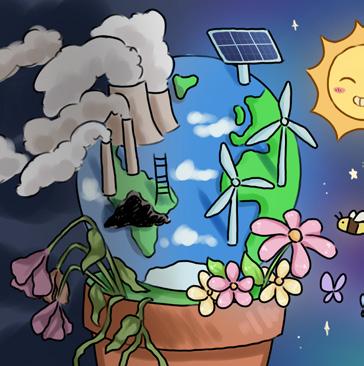
the Claremont Colleges opted out of 100 percent renewable energy purchasing; this fall, they must opt in
5C ENVIRONMENTAL JUSTICE
In 2022, the Claremont City Council acted according to the city’s stated values. It voted to enroll in the Clean Power Alliance’s (CPA) 100% Green Power Plan. CPA is a community choice aggrecustomers to select from multiple combinations of energy sources. Customers who enroll in CPA’s 100% Green Power Plan receive electricity associated with zero (literally zero) pounds of greenhouse gas emissions. Peer institutions like Pepperdine University and the UCLA Santa Monica Medical Center have taken the right step and partnered emissions. The non-profit currently procures energy for more than three million residents in 38 communities, but when the City of Claremont opted in, the Claremont Colleges opted out. Wait, what?! Climate change is a daunting reality. Creating alternatives to fossil fuel dependency is intimidating. But if the Claremont Colleges want to make good on their professed ethos of environmental and social consciousness, the role they must play is simple. This fall, as CPA prices become more competitive, facilities directors and Chief Financial purchasing away from Southern California Edison’s (SCE) dirty and obscurely-sourced electricity to the CPA’s 100% Green Power Plan. We have another chance to make the right choice, but only if decision-makers know you care.
Our utility company, SCE, sources a mere 37 percent of renewable energy. As a result, our colleges consume a lot of fossil the atmosphere for every thousandsumed by our college. Every year, our switch to CPA’s Green Power Plan would reduce CO2 emissions by a degree equivalent to the annual energy consumption of over 1,800 US households.
The colleges’ complacency in continuing business with SCE enables the company to prolong its fossil fuel dependence until 2045, per California’s net-zero goal. While SCE bides its time and our colleges fail to act, California will face the consequences. By 2050, Californians will experience a daily maximum temperature rise of 4.4°F-5.8°F. Fossil fuel extraction, processing, transport and combus-
tion will continue to pollute air and water, while majority-people of color and low-income communities bear the brunt of the burden.
As the Trump administration strips renewable energy incentives and greenlights fossil fuel projects, our college administrations could comply, or they can resist. SCE faces multiple tens-of-million dollar lawsuits that allege faulty SCE power lines contributed to the 2025 LA of negligence resulting in death [and] destruction.”
Why are the Claremont Colleges cooperating with energy companies that profit from us while destroying our environment and our communities?
Considering the consortium’s stated commitments to social responsibility and environmental sustainability, we envision the shift away from fossil fuels energy at the Claremont Colleges as a form of economic and social justice.
When we invest in fossil fuels, we trap ourselves in multi-decade life cycles incompatible with state-outlined emissions goals and marked by volatile prices. Short-term, we ignore that dirty energy simply passes emissions to another part of the economy, transferring long-term costs at multiples while endangering livelihoods. Neglecting the consequences of our actions because they seem to fall beyond job titles neither socially nor financially responsible.
To be clear, we appreciate that facilities staff and sustainability officers coordinate creative solutions to reduce consumption and engage students, all while keeping our campuses running. Their hard work is undeniable and impactful. However, their while our college administrations struggle to take systemic action.
As it stands, Pomona intends to meet its 2030 carbon neutrality goal by escalating investment in for their lack of accountability and preference for growth over the lives and livelihoods of Indigenous people, tenants and workers.
2025, electricity emissions were responsible for 29 percent of Pomona’s carbon footprint. That’s the largest share of emissions, with air travel representing 26
percent and natural gas at 21 percent. Can we really reconcile CMC’s 2050 carbon neutrality goal with its plans to double its campus size? Meanwhile, Scripps clear plan to reach zero emissions, or even carbon neutrality. Mudd has made investments in solar power but lacks a clear path to further change. In our classes, we talk about climate change and our responsibility to address it. How can we use this rhetoric while we prepare to act like Shell and Amazon, making small short-term investcan keep powering our commitment to business-as-usual?
As of September 2025, the initial switch to 100 percent renewable energy meant an 8 percent increase in the utilities bill, split between the six colleges that purchase electricity together (Keck Graduate Institution purchases its energy separately). That put the Colleges’ total energy bill at $13,897,822 per year: 33 percent for Pomona, 18 percent for Claremont McKenna, 13 percent for Scripps, 12 percent for Harvey Mudd, 11 percent for Pitzer, 7 percent for the Claremont Colleges Services and 6 percent for
Claremont Graduate University. But SCE keeps hiking prices. Over the past 10 years, SCE electricity rates have risen by an average of 8.2 percent per year.
As recently as earlier this month, SCE announced plans to further increase residential rates by 10 percent. When those rates were hiked on October 1, costs went up by closer to 13 percent, further emphasizing the volatility of SCE’s energy. Since the Claremont Colleges received their initial estimate on clean energy purchasing in May embracing renewable energy with CPA and maintaining the status quo with SCE decreased by 7 percent, down from 15 percent. And with the latest rate hikes, that number will be smaller, making the Colleges’ decision to switch to renewables even easier. Across the country, a growing number of jurisdictions are joining community choice aggregators to challenge their role as passive consumers of energy. They are challenging the dominance — and the whims — of investor-owned utility services funding the growth of renewable energy today, rather than waiting
in hopes that local utilities meet the uncertain state renewable energy deadlines. After months of discussions with key stakeholders — facilities directors, sustainability directors, students, faculty, energy experts and more — we believe that this drastic emissions reduction would be a meaningful step in our transition away from fossil fuel dependency. While it is by no means a perfect solution, climate action is incremental, not all-or-nothing. The catastrophe is complacency. Everyone here has a responsibility to support our shift to renewable energy, but we expect key decision-makers to set an example for students and treat these commitments like the serious obligations that they are, not marketing tools that can be obscured or extended action today, our colleges can be leaders in higher education. Join us — tell our administrators that you care.
Sign the petition to switch our electricity purchasing and commit to 100 percent renewable energy.
SASHA MATT HEWS • T HE S T UDEN T LIFE
Hey Jonas Brothers, you man-children cannot revive the dying boy band trend!
JOELLE RUDOLF
As teenagers in the early 2000s, the Jonas Brothers had the makings of a classic “boy band.” In order of importance: first, they were good-looking; second, they could sing. They packed sold-out stadiums with obsessive girls screaming and toppling over one another for the mere chance to catch a brother’s eye. There was Joe Jonas, “the hot one”— shaggy side-swept bangs perfectly placed despite frequent one” — baby-face poking through an unruly mop of curls. Kevin Jonas was “the third one”— the eldest, concert, the Jonas Brothers are in the midst of their 14th tour, supporting their seventh (and most disappointing) studio album, “Greetings From Your Hometown.” Last month, Disney Channel announced the brothers’ return
to their original roles for a third Camp Rock movie. In the words of Yogi Berra, “it’s deja vu all over again.” Rather than embrace the inevitable next midlife crisis, the brothers are smoothing out their wrinkles and masking theirbornly prolong an image of teen stardom.
Faithful fans unhesitatingly accept the band’s career stagnation. The Jonas Brothers represent one of the last vestiges of the “American boy band” — once a ubiquitous pop culture phenomenon — and fans look to theserection-sized hole in their hearts.
To the chagrin of middle-school girls everywhere, the current cultural and musical environment has evolved beyond this fad. NSYNC broke up in 2016. While rumors of revival may circulate, these bands knew
The
when to call it quits. Six years after their exciting reunion in 2019, the Jonas Brothers are back where they started. Although no longer physically prepubescent, the brothers self-identify as a “boy” band, prioritizing a formulaic, nostalgic image over genuine creative evolution. If they refuse to either quit and save face or evolve to match their maturity, the Jonas Brothers — mirroring a trend of similarly uninspired pop culture audience and facing imminent cultural irrelevance.
Joe Jonas — a recently divorced father of two — is still channeling “the hot one,” although he ditched the side bangs for a more classy textured fringe. Nick Jonas — with his own baby-faced three-year-old daughter waiting at home — still plays into being “the cute one,” his curly mop tamed, apparently having discovered hair gel. Kevin Jonas — celebrating his 16th wedding anniversary in December — while still “the third one,” is now distinguishing himself as a more prominent member through increased on-stage solos and leading vocals.
The brothers are pushing 40, rocking rakish whiskerage and probably plagued with bouts of lower back pain. Yet, all are strenuously squeezing into a mold set by their 15-year-old selves. With such a heavy dependence on product, the Jonas Brothers risk that their appeal and cachet will continue to decay with age.
When “Greetings From Your Hometown” came out in August, my best friend (and lifetime Jonas Brothers superfan) sat me down and insisted we give it a girl bubbled up excitedly, curious what new direction the brothers might take their well-established lead single “I Can’t Lose” began: basic backbeat, punchy synth, punchy synth, basic backbeat,other at random. “Backwards”: enough! I quickly closed the tab and smiled politely but tellingly at my friend. Repetitive and safe, previous work had an impact on
the musical landscape comparable to that of a singular dust particle in a vast sandstorm. Their new album’s lack of artistic merit aside, the Jonas Brothers’ 20th anniversary tour is drawing in die-hard fans. My best friend, though admittedly unimpressed with their recent recordings, missed multiple daysnale: “I mean, it’s the Jonas Brothers.” In a post-concert debrief, she told me the handful of “Greetings From Your Hometown” songs played were obscured by a setlist almost entirely consisting of old hits. The brothers are well aware of what they are valued for; they ensure that attending a Jonas Brothers concert is like stepping inside a time machine set to a Y2K predating their present mediocrity. Fans young and old enthusiastically embody giddy tweens, recalling the innocence and excitement of boy-crazy adolescence, and the band is eager to enable this charade.
The Jonas Brothers are a musical representation of a greater dependent on consumers who fall prey to nostalgia without regard for the product’s quality. This ultimately disincentivizes the brand from evolving alongside the changing societal landscape, remaining stuck in their outdated origins.
This year, Lululemon, the longstanding supreme leader in women’s athleisure, idolized for its high-end and sleek designs, was slapped in the face with a 15 percent decrease in stock price alongside a plethora of product complaints. As quality declines, the brand is confronting its diminishing status as the queen of workout clothes while its custommore accessible alternatives like Fabletics. Innovation prevents obsolescence. A passive strategy works, at least until the next thing comes along. If a brand, or a band, remains stuck in the past, it’s easier for their relevance to fade in the shadow of the new and exciting.
As fate would have it, grown men pretending to be young boys on stage is as off-putting as it sounds — six stadium shows had
to be canceled and replaced with smaller venues due to soft ticket sales. The Jonas Brothers have confronted a harsh reality: The mass allure of a boy band is tied to its freshness and the retention of that elusive “it” factor. The brothers can botox the situation all they like, but the cracks in their youthful facade are undeniably breaking through. Their unwillingness to take creative risks is ultimately limiting the evolution of the Jonas Brothers’ musical legacy.
Justin Bieber, a similar product of the 2000s pop machine, did what the Jonas Brothers couldn’t. This summer, he released his new album “Swag,” transcending teen pop stardom by introducing a new sound that dives deep into the alternative R&B genre. On Sept. 15, the Coachella Festival announced Bieber as a headliner for next Spring’s event.
Any woes the Jonas Brothers face are not for lack of talent — all are accomplished multi-instrumentalists, vocalists and songwriters. Instead, they are limited by intentionally playing it safe, holding onto an image frozen in time — one that is slowly slipping through Hometown” is boring, unoriginal and ultimately unnecessary. The Camp Rock 3 movie will likely meet a similar fate.
For overgrown boy bands and out-of-style fashion brands alike, the only thing that keeps them in this rut — and can get them out of it — is themselves. The way I see it, the Jonas Brothers have two options: break up for good and cement their boy band legacy before their looks fail them, or take a creative risk their future selves will thank them for. Here’s hoping Nick Jonas grows his hair Hozier-long and explores the guitar strumming intricacies of indie folk rock.
Joelle Rudolf SC ’28 is a boy band fanatic. Her go-to Karaoke song is “What Makes You Beautiful”; she spent weeks Payne’s untimely death, and she often Timberlake’s golden curls. Her best friend is the reason why she appreciates the young Nick, Joe and Kevin. However, Joelle will not be caught dead wasting her time or money on a “Greetings From Your Hometown” tour concert ticket.
Mexicanization of American politics,
brought to you by Trump and the libs
RAFAEL HERNANDEZ
GUERRERO
Ever since Donald Trump won the presidency in 2016, the Democratic Party establishment has accused him of being a populist. The term “populist” gets thrown liberals to characterize a plethora of politicians across the political spectrum, as an almost derogatory term to describe progressives like Bernie Sanders and “conservatives” like Donald Trump alike. However, the usage of the word is inaccurate in both instances.
Trump does not represent a threat to democracy because he is a populist; in fact, the term is not suited for him at all. He should instead be described as a “caudillo,” and the rise of this cauinstitutional challenges faced by working-class Americans today. The election of Trump signals a threat to representative democracy because it is the end result of fundamental, inequitable economic changes that the working class has endured for decades.
ticipatory politics demands the presence of a large electorate population with the time and resources that enable mobilization. To prevent the working class’ misplacement of faith in caudillo-like politicians in future elections, the country must undergo vast democratic economic reform that prioritizes leveling the economic playing field for working-class citizens.
Caudillo is a Spanish word that refers to a military leader who assumes dictatorial powers in times of crisis. A notable example is Mexican caudillo, Antonio López de Santa Anna, who held the presto 1853. His era, the “Age of Santa Anna,” was marked by Texan independence and the proceeding war with the United States, which resulted in Mexico losing half its territory.
er through democratic means, unlike Trump, who rose to power via election, yet their rhetoric is strikingly similar: Both leaders sold the populace the idea that they alone could save citizens from a real or perceived threat. Santa Anna told 19th-century Mexicans that he alone could save them from the American invaders, and Trump in the 21st century tells Americans
that he alone can save them from the perceived economic threat posed by Mexican immigration.
Post-independence 19th-century Mexico was fragile, withidential contests were rarely decided by popular vote, but rather by which general was best positioned to march troops into Mexico City and dethrone the incumbent. Politicians of Mexico’s northern neighbor, the United States, looked on in disgust. In their view, the Anglo-Saxon
The narrative shifted after the American Civil War. Politicians realized they had fallen to the level of their despised southern neighbor, and theorists declared the “Mexicanization of American politics.” Many feared that thetiple crises that would spiral into continuous civil wars. The period of “Mexicanization” culminated in the 1876 presidential election, when multiple electoral votes were contested.
The tensions between the Democratic and Republican parties rose to the point where President Ulysses S. Grant mobilized the army in Washington, D.C., fearing both sides might take up arms. Ultimately, the crisis was resolved through an Electoral Commission and a series of closed-door meetings in which Republican candidate Rutherford B. Hayes promised Democrats he would withdraw federal forces from the South, effectively ending Reconstruction. It has been 149 years since 1876, and American institutions are now more capable of managing the types of crises that led to the Civil War and the subsequenter that the institutions relied on to maintain peace and stability did not appear out of nowhere; they were constructed and polished as the nation matured. Institutional stability is not guaranteed. All citizens are needed to safeguard national institutions, to protect them against erosion and to raise up a supportive pillar when necessary. For decades, economic elites have neglected to provide the working class with basic necessities that would enable them to be active constituents who could take the time to advocate for and uphold democratic safeguards.
The Great Recession of 2007 was an inevitable consequence of decades of deregulation and rampant speculative corporate practices, and political leaders responded to the suffering of the American people by bailing out the same corporations that engaged in speculation that led
The Democratic Party further alienated working-class voters by shifting their platform focus from rural areas to suburban middle-class enclaves, creating conditions ripe for caudillo appeal in the since-overlooked rural voters were primed to believe that one strong leader alone could remedy their maladies. These structural conditions were essential to Trump’s mass rural success in the 2016 and 2024 elections.
Though, Trump never wielded a mystical “populist” sway over the American populace, having never won a majority vote in his three-election run. By comparison, in 1972, Richard Nixon won 60.2 percent of the popular vote, yet Nixon was never called a populist — despite having clearly captured the popular imagination far more passionately than Trump ever has. This is due to the fact that both parties’ policies were broadly social democratic in
the post-WWII era; bipartisan support for welfare reform programs left elections to hinge on candidate character, producing landslide victories. However, free market economics reigned supreme in the Reagan and post-Reagan political era, with the implementation of trickle-down “Reaganomics.” Legislation passed under the New Democrats, such as the Welfare Reform Act of 1996 and the North American Free Trade Agreement, marked the demise of the working class in American politics. The Supreme Court case Citizens United v. The Federal Election Commission represented yet another loss for the working class as it reformed allowed corporations greater and policy reform. Through this lens, Trump as a caudillo: a leader whose power stems not from broad popular support but rather from the failure of institutions to represent key economic interests. He is president because political party establishments refuse to endorse transformative reform as a result of campaign funding ties to economic elites, whose interests run contrary to those of the working class. If America is to endure, the
lesson is clear: Neglecting the working class destabilizes both politics and social well-being. For a long time now, America has needed Economic Democracy. That is, the empowerment of the worker within the workplace through policies that improve conditions for the creation and expansion of unions and worker cooperatives. These policies would democratize the national economy, while at the same time creating a more economically sound workers’ bloc that would be better supplied to take the time to represent its interests in government. Political democracy alone has proper living standards for the working class. Economic democracy must be expanded and workers must be uplifted; otherwise, our representative democracy cannot survive. The inalienable rights espoused by our Founding Fathers have failed to actualize, due to widespread economic inequality. The time has come to realize life, liberty and the pursuit of happiness in the undeniably intertwined political and economic sphere.
Rafael Hernández Guerrero PZ ’29 México and immigrated to Boulder, Colorado as a child. He doesn’t really know what’s going on and hopes you do.
ALISON
Claremont Characters: Zoe Dorado’s cultures of probiotics and poetry
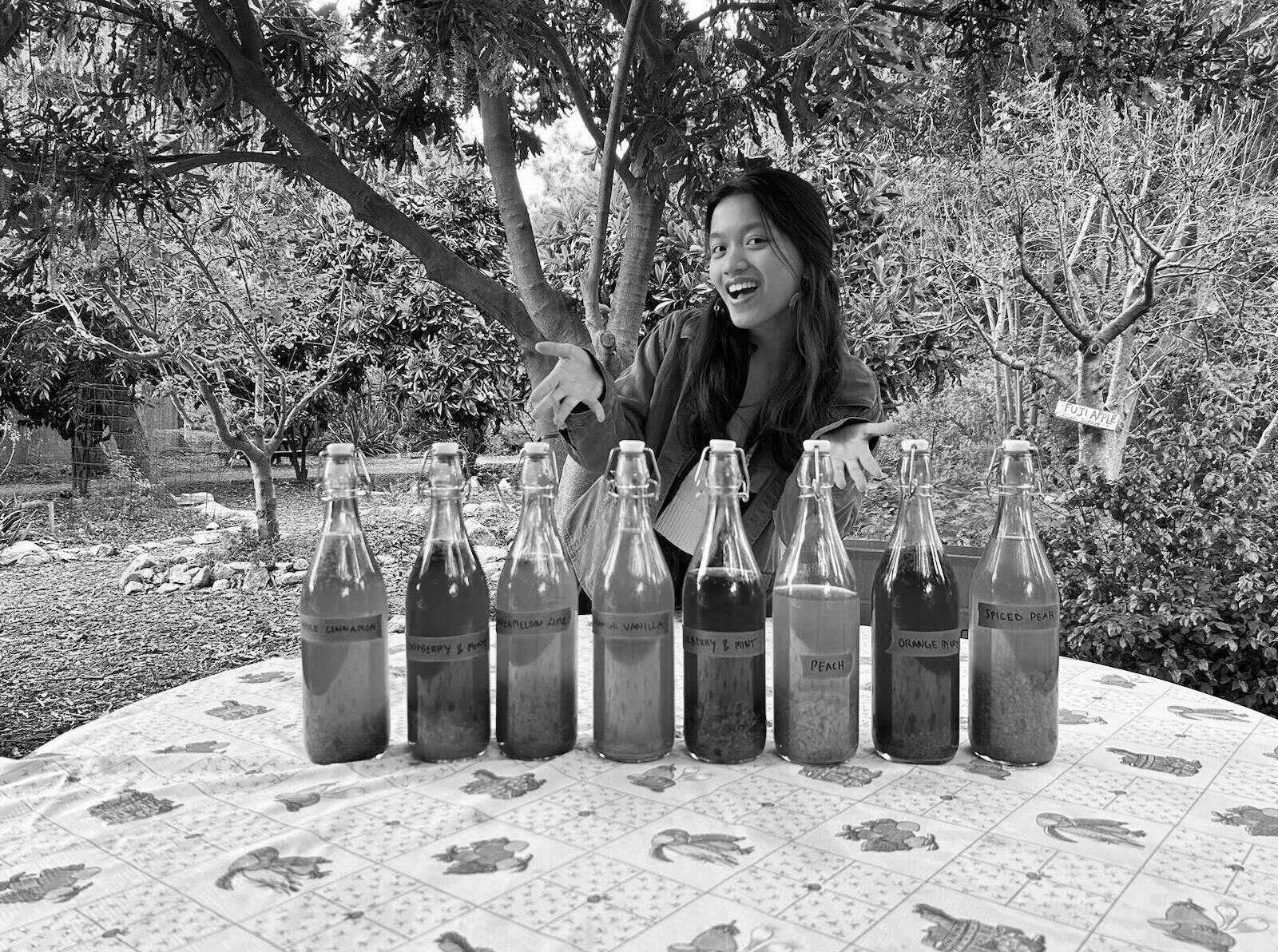
Zoe Dorado PO ’27 sometimes adds “scheming” to her calendar.
“Because that’s what one does,” she said to me. “They scheme.”
At one particular scheme last semester, Dorado and her friend, Annika Weber PO ’27, hosted a “fermentation party” at the Pomona College Farm, complete with homemade sourdough, kombucha and a pickling workshop. To prepare, Dorado spent a month growing a SCOBY (symbiotic culture of bacteria and yeast) by the heater in her room.
people who are very motivated in silly projects, that at the end of the day, are about creating community,” Dorado told me.
Dorado, an English and politics major — as well as poet, drummer and abolitionist — from the East Bay, has dedicated much of her time at Pomona to these oddly speyear, Dorado and her roommate Kai Chen’s PO ’26 high-ceilinged, church-like Clark III dorm room became the venue for two “Catholic Guilt” themed parties.
For “Volume One: Original Sin,” Dorado and Chen turned a confessional booth. For “Volume Two: Resurrections,” held on Good Friday, the dress code was “medieval or cunty, or both.”
They had guests LARP (live action role-play) the Passion of Christ, projected images of stained glass across the room (at Dorado’s dad’s suggestion) and plastered the walls with “WANTED: Jesus Christ” posters featuring pictures of Hozier, Keanu Reeves and the like.
Dorado also stacked 20 Bibles around the room, which she had borrowed from Honnold Mudd Library. To seem less suspicious, into her tote bag each day.
“It’s fun to invest in a project that you’re just doing because it’s interesting and fun,” Dorado said. “I can’t put ‘Catholic Guilt’ on LinkedIn.”
You could spend a long time out about her more LinkedIn-appropriate achievements, like how she was the runner-up for the 2024 U.S. National Youth Poet Laureate, or that she’s a poetry editor for the Adroit Journal.
But once you know, it adds up; I couldn’t help but notice that she chooses her words like a writer.
“There’s something wonderful — no, not wonderful, striking,” she said to me at some point. Or, when explaining her thought
process of inviting people: “Who will dance? No, not dance –– who will get down?” She treats her conversations with as much care as she would a poem. For Dorado, though, the poetry scene isn’t free from critique. In her freshman fall, she started investigating the Teen Writing Industrial Complex, which she gave the shorthand “TWIC.”
“Survivors of TWIC know what it is when they hear it,” Dorado said.
“TWIC” diagnoses the institutional prestige and unequal access that underwrite the competitive culture of teen writing. For her project, along with Mulan Pan PO ’27, Dorado mapped connections between various youth writing magazines, competitions, programs and organizations, and where they get their funding.
“I study English because I want to keep loving things,” Dorado told me, while her other major, politics, often “makes [her] sad.”
Her research in TWIC prompted her to put the “politics part of
[her] brain with the English part of [her] brain.” She said that it’s important for her to “remain suspicious” of the things that bring her joy, like the poetry world. okay with ambivalence,” Dorado said. “I’m not trying to reach a sort of cathartic moment of ‘Aha! This is how I feel about the writing world!’”
This idea of ambivalence played a role in a research project she did this summer, where she compared Asian American spoken word poetry with Asian American stand-up.
“I was really interested in the idea of poetic closure versus a punchline, and how often there’s this pressure to end on a neat, cathartic moment of realization or triumph, especially when the speaker is a woman or person of color,” Dorado described.
“There’s this pressure to end on ‘Yes, I have done it! I have crushed racism with my bare hands!’” she continued.
Contrary to this expectation, Dorado doesn’t think that resolution should be the aim of life or
art; there is value in remaining in what she called “weird rooms of ambivalence.”
She recalled the ending of Geoffrey Chaucer’s “House of Fame,” which she, like JaQ Lai PO ’26 and I, read for a class last semester. Chaucer’s poem, often considered seeing “a man of great authority” who never gets to speak. Dorado was struck by how the reader is abandoned in a “hovering place of uncertainty.” Even if we try to escape uncertainty, she explained,ent world of uncertainties.”
Dorado’s artistry isn’t limited to poetry. She’s also a longtime drummer, and has taught for Filipinx Girls Rock Camp and played for Call Ur Mom, a jazz-adjacent band at the 5Cs. Though she’s used to spoken word performance, she thinks music allows for something
“My favorite thing is when you can actively feel yourself learning from other musicians,” she told me. When “jamming out,” people are “sharing something simulta-
neously.”
Recently, her band-mate DJ Posillico PO ’27 invited her to try
A conversation between the two about the “indie man epidemic”tion with Dorado as director. The film, which features the guitar-playing, women’s-literature-reading, tote-bag-wearing type of male character we’ve all grown familiar with, culminates in a party scene modeled after Dorado’s fermentation party.
Not just a fermentation party, though; she decided the scene should be a “feminist fermentation” party. When I asked Dorado what that even meant, she said she liked the concept of “bell hooks eating Greek yogurt.”
This film was Dorado’s entry into directing, and she was happy brought to fruition.
“That’s why I love poetry, music, loving and throwing oddly just making things possible with other people.”
ILA ASSEGAF
Sagehens surge through storm to claim Sixth Street trophy
IMOGEN JENKYN
As heavy rain poured down on Merritt Field, turning the turf slick and the sky dark, the Pomona-Pitzer (P-P) football team kept its footing in the long-awaited rematch of the annual Sixth Street Rivalry. The Sagehens beat the Claremont-Mudd-Scripps (CMS) Stags 25-17, reclaiming the historical trophy after losses in two consecutive seasons and opening SCIAC play 1-0.
The game kicked off at 7 p.m. on Saturday, Sept. 27. In this year’s iteration of the rivalry, the Sagehens’ fourth-quarter efforts seized the lead and lifted the trophy to narrow the Stags’ historic edge in the matchup 15-12.
Wide receiver Jackson Irons PO ’27 spoke on the significance of the rivalry and the win against CMS.
“One of our preseason goals as a team was to bring the Sixth Street Trophy home this year,” Irons said. “To have all of the off-season preparation and in-season grind pay off is super rewarding.”
Jack Walker PO ’27 opened the scoring on Saturday night with a 28-yard field goal in the 11th minute of the first quarter, but CMS responded quickly with a field goal of their own.
In the second quarter, defensive back Kalani Pickett PO ’26 hauled in an 8-yard touchdown pass from quarterback Nick Kim PO ’26, giving the Sagehens a 10-3 lead.
Pickett, who contributed a
touchdown and a two-point conversion for P-P, applauded the efforts of his teammates after the game.
“It was a great team win,” Pickett said. “You see the energy, all the boys brought it. Every single guy stepped up.”
Despite this strong start from P-P, CMS responded with a series of unanswered scores, including two field goals and a safety, going into the third quarter. They maintained a slim 11-10 lead heading into the fourth quarter.
Linebacker and defensive captain Gabe Gangi-Saroukhanioff CM ’26 spoke on the Stags’ focus during this stretch, despite the loss.
“You get into these modes where it’s like a flow state … you’re so locked in,” Gangi-Saroukhanioff said. “Defensively, it’s ‘how are we gonna get this next stop?’ And offensively, it’s ‘how are we gonna put points on the board?’”
For the Sagehens, those tense minutes became a test of resilience.
“This game showcases our team’s grit,” Irons said. “There were moments where we weren’t executing, and the momentum seemed to be shifting away from us, but we never once thought we were going to lose.”
The Sagehens responded quickly in the fourth and did not look back. Quarterback Luke Levitt PO ’29 powered into the endzone from a yard out, and Pickett caught the two-point conversion to push the lead to 18-11. Minutes later, the Sagehen defense delivered its final blow.
Alden Kling PO ’27, who recovered a CMS fumble on the first play from scrimmage, came up big again with a strip sack. Jacob Whiting PO ’25 scooped up the loose ball and sprinted 39 yards
for a touchdown. Walker’s extra point stretched the margin to 25-11.
CMS closed the gap soon after with a 28-yard touchdown pass at the end of the fourth, but the Sagehens stood firm to finish off the 25-17 win.
Even after the loss, the Stags were able to leave with some valuable lessons.
Gangi-Saroukhanioff called the rivalry loss “a humbling experience,” but one that would fuel CMS going forward.
“We still have control over our fate at this point,” he said. “[The loss] has given us some hunger and now we’re ready to attack … we’re gonna use that to fuel a good week of practice and go into our next game ready,
prepared and ready to conquer.”
For Pickett and the Sagehens, the proximity to their rivals made the victory that much sweeter.
“This means the world to me,” Pickett said. “We go to class with [CMS players], we go to dining halls with them. And every time we see them now, we’ll be proud we are Sagehens.”
P-P head coach John Walsh also emphasized the high stakes of a Sixth Street matchup and the reward that comes with securing the victory.
“It’s a great win for our assistant coaches [and] our players,” Walsh said. “We work really hard. This game’s important. It’s the most unique rivalry in the country, so a lot of pride
goes into this game. We got our trophy back … it’s a good start to the SCIAC season.”
Irons echoed that the balance of pride and focus is a mindset that the Sagehens will look to implement throughout the rest of the season.
“This is, of course, a big win for the team, but it’s also behind us, so we are now fully looking to keep this momentum rolling to La Verne and how to prepare for that game because the end goal isn’t just beating the school across the street, it’s going back-to-back as SCIAC champions,” Irons said. Both P-P and CMS continue their SCIAC play this Saturday, Oct. 4, away from Claremont. The Sagehens travel to La Verne while the Stags visit Cal Lutheran.
Let’s get local: How to admire more than just the
Southern California has long been one of the most prominent sports hubs in the world. The NFL, for example, became the frst coastto-coast professional sports industry thanks to the Rams and the city of Los Angeles in 1946.
Even afer the Rams relocated to St. Louis, Los Angeles and the greater Southern California region remained home to a diverse and booming professional sports market. Today, there are well over 10 professional clubs in LA and San Diego that help fuel the industry. LA is also world-renowned on the sports stage, having hosted two Summer Olympic Games with a third on the horizon in 2028.
Despite a thriving professional sports scene, the heart of Southern California sports lies in the local, unembellished student stories.
At the collegiate level, for example, audiences witness not only the honing of athletic skills, sometimes as a prelude to a professional future, but also the unfolding of a player’s fuller story, which is ofen much more complex than what appears on the feld.
However, it is at the high school level where these stories are especially intricate. And when it comes to these localized sports
endeavors, no one is more dedicated than sports columnist Eric Sondheimer.
Sondheimer has covered high school sports for the LA Times since 1997, and has done so in Southern California for over four decades. People ofen enjoy discussing legacy when it comes to sports, and Sondheimer has been crucial in building a legacy for high school sports coverage in Southern California. I was fortunate to have the chance to briefly speak with Sondheimer about his time covering high school sports and what that has meant to him. This conversation has been edited for length and clarity.
TSL: I would love to know how you got into covering sports in general, but more specifcally, high school sports.
Sondheimer: Well, I started in high school. The year I graduated, I became a stringer for the Daily News, reporting scores and doing short stories. I’ve always done high school [sports coverage], but I started out doing other things, you know, NBA championships, NFL.
The key I believed in was being versatile, but I’ve always stuck with high school because there are so many stories to tell;
it’s local, so it’s essential to most newspapers. It helps you stay local amidst national issues. Just some great stories to tell of people overcoming adversity, or people who are really good, and you’ll hear later on in their careers when they’re on TV. The key for me is that I think about what the reader wants to read.
TSL: Do you think that social media and, at the same time, NIL deals and sponsorships, have changed your approach to talking with athletes and covering stories?
Sondheimer: [Those things] haven’t changed my approach. I’m sticking with my approach, but now I’m shocked when an agent calls me up and recommends a story because they’re doing NIL with a particular person.
It kind of makes me concerned that … the kids’ and parents’ interests are not the same as everybody else’s. And during the high school experience, they’re already focused on the next level.
So, I don’t really like those stories. I’m not interested in stars.
I go and see a player, if I think they’re good based on my observation and my experience, that is what I would rate over somebody who gets stars. The star system is so misleading and inaccurate.
headlines
But, it’s changing things about loyalty. Fans don’t know who to root for because these kids are only spending one year at a school. It’s still early, things will change again, but I’m not changing the way I cover high school sports at all.
Sondheimer’s answers about the evolution of high school sports coverage in a changing sponsorship environment really stuck with me.
There was also something deeply heartening in listening to Sondheimer speak about high school sports in Southern California and the lasting impact they have on so many young, aspiring athletes. This especially rang true for me, as I am both a sports journalist and a varsity cross-country runner.
Throughout my time as a high school athlete, much of what Sondheimer described was very present. There was always a part of sports for me that was centered around developing for the next level and preparing for collegiate athletics. And there still is a large part of me that approaches sports in college with this same mindset.
I ofen have to remind myself that running for Pomona-Pitzer is likely the last phase in my competitive athletic career. In the past, that was a hard notion to grapple with. And yet, thanks in large part to the journalistic projects that I have undertaken here in Claremont, I’ve become much more aware of the fact that there is so much more to sports, and to my sports story, than its mere competitive nature.
Sondheimer created a series of articles over a year ago, called PREP Talk, which is dedicated to covering something upbeat and encouraging within the Southern California high school sports scene. Many of these stories do not deal with the accomplishments of a specifc player or team, but rather seek to cover the more unique and uplifing actions of those in the high school sports community. In an article Sondheimer wrote last year, he shared why he thought this was such an important initiative.
“It’s something I’ve tried to do for 48 years, and now it’s going to be a daily notebook,” Sondheimer wrote. “Sometimes it will be short. Sometimes it will be long. It will be like being on social media but without the second-guessing and accusations of having an agenda. The only agenda will be focusing on the positives of high school sports.”
Whether it’s an athlete trying out a new sport, a student performing the national anthem at a game or a trainer saving a coach in cardiac arrest, Sondheimer’s PREP Talk articles are inserting some necessary enthusiasm back into a world where negativity has recently been a dominant force.
Afer three years of participating on a varsity sports team at Pomona, I have learned that our culture here in Claremont is fortunate in many ways, as it resembles the parts of high school sports that Sondheimer fnds so valuable. We have many stories to tell, due to both the diversity of talent and the boundless interests present at the 5Cs.
It is also true that most of those stories have a great deal to do with resilience, because facing and overcoming adversity is an inextricable part of both college life and sports. There are many things to learn from Sondheimer’s decades of dedication to high school sports. Perhaps none are more valuable than honoring the local stories, which are now threatened by outside pressures on student athletes.
As Sondheimer wrote earlier this year, “I’ve always treated high school sports as diferent than college or pros. These are teenagers, with criticism of coaches and athletes mostly of limits. But times are changing. Players are geting paid. Coaches are engaging in ethical lapses … I will continue to respect the tradition of high school sports being about having fun but insist on rules being followed.”
As an athlete and a journalist, I have been fortunate enough to share the stories of other 5C students, and have seen the combination of talent and enjoyment in Claremont collegiate sports. We as students should be more appreciative of the fact that we do get to see all of those dimensions of sports. Because outside of high school sports, as Sondheimer has shown, this coexistence can be hard to fnd.
Sondheimer’s story inspires me to focus more on the unsung, sanguine moments of Claremont sports, rather than the headline stories or popularly discussed narratives that exist within the 5C sports realm — I don’t particularly enjoy those stories. Sebastian Groom PO ’26 loves to watch and talk about sports. Unfortunately, he struggles playing any sport that involves an additional object or lateral movement. For that reason, he has stuck to running in circles. Speaking of circles, he once dreamt of geting a tatoo of the Olympic rings … looks like that one may have to wait.
SARAH ZIFF • THE STUDENT LIFE
Luke Levitt PO ‘29 prepares for
snap as Sagehens football defeat the Stags 25-17 in Sixth Street R ivalry on Saturday, Sept. 27th.
SEBASTIAN GROOM
SARAH ZIFF • THE STUDENT LIFE
LA T imes writer E ric Sondheimer has learned to appreciate local sports by covering Southern C alifornia high school athletics for 40 years.
TAHI WILTON GEARY • THE STUDENT LIFE
Sixth Street rivalry week
P-P men’s soccer defeat CMS 2-1 to continue strong start to season
Fans roared from the hills behind the goal as the Pomona-Pitzer (P-P) men’s soccer team took down the Claremont-Mudd-Scripps (CMS) Stags in the frst episode of the Sixth Street Rivalry, keeping their season’s hot start alive.
In the frst matchup between the two teams on Wednesday, Sept. 24, at the Pomona-Pitzer Soccer Stadium, the Sagehens defeated the Stags in a nail-biting 2-1 victory, thanks to a late goal from Sebastian Lee Jara PO ’29. Tension ran high throughout the 90 minutes, keeping fans on their toes.
The frst 30 minutes of the half resulted in a stalemate as the teams exchanged possession back and forth in midfeld. However, a cross from Alex Greenstein PZ ’26 set up Colin Eugster PO ’26 to break the deadlock and give the Sagehens the initial lead around the 33rd minute.
It didn’t take long for the Stags to answer back. Just three minutes into the second half, Sean Lee CM ’29 found the back of the net to even the score and shif the momentum back to CMS.
For P-P goalkeeper Jasper Broad PZ ’26, the goal was not a setback but rather a test of the Sagehens’ ability to stay in the game.
“[Being] tied 1-1, that was really hard when they had momentum, so sticking to our game plan and not giving up was really crucial,” Broad said. “We came together and realized that we were playing beter than them and mobilized of of that.”
That message of resilience was central to the team as they looked for a breakthrough. For the next 30 minutes following the CMS equalizer, the teams were at a gridlock as neither could fnd the net. But the Sagehens weren’t done yet.
With just 10 minutes remaining in the game, defender Chris Chow PO ’26 drove down the field and found Lee Jara cuting into the box. In dramatic fashion, Lee Jara chipped it up over the goalie and provided the critical go-ahead.
Lee Jara’s goal in the 79th minute capped of a neck-and-neck game.
Afer a heated 90 minutes of rivalry play, there were fve yellow cards and 18 fouls across both teams.
Midfelder Guy Fuchs PO ’27 emphasized the need to stay composed when chasing the comeback amid intense physicality.
“I think one of the main keys to the game was staying together,” Fuchs said. “Even though it was a dirty game, we managed to stay together and fight through until
the very end. We try to focus on encouragement, support and not geting down.”
For Broad, playing for the team is essential to staying calm in games as high-stakes as Sixth Street.
“I think we came together by just trusting our own abilities,” Broad said. “In these huge games, it’s really easy to let your emotions get the best of you, but I think we were able to keep a level head, which they were not.”
The Sixth Street victory marked the Hens’ eighth game undefeated, an unprecedented feat for the team in the last few seasons.
“We are really, really happy with where we are at, and are hoping to keep it going,” Fuchs said.
The same cannot be said for the start to the Stags’ season, as the Sixth Street defeat dropped their record to 2-5-3. The United Soccer Coaches preseason poll ranked CMS soccer No. 17 in the nation. Despite high expectations, the projected conference champions have started SCIAC play with a record of 1-2-1.
“It’s been a litle bit of a rough start to the season,” midfelder Bo Gardner CM ’28 said. “I think we just had mental lapses and weren’t really sticking to our principles.”
According to Gardner, the Stags are holding onto hope that they can return to their anticipated peak in the coming games.
“We’ve learned a lot of lessons because we’ve had a lot of tough games so far this year,” Gardner said. “I think it’s mainly about [continuing to work] together as a group and not dwelling on the loss.”
Afer the rivalry matchup on Sept. 24, both teams had SCIAC games on Saturday, Sept. 27.
The Hens fell to the Caltech Beavers in a 0-1 loss, unable to repeat their Sixth Street comeback. They gave up a goal in the 84th minute, placing them in second in SCIAC behind the Chapman Panthers.
The Stags bounced back to defeat the Redlands Bulldogs 2-0 for their frst conference victory of the season on Sept. 27. The following Wednesday, Oct. 1, the Stags held Chapman to a 1-1 draw.
Both teams continue their chase for the SCIAC title on Saturday, Oct. 4, as the Sagehens play at the Poets at Whitier College and the Stags host the La Verne Leopards for their senior night.