Pitzer College Inside-Out program faces uncertainty due to CRC closure
MACY PUCKETT
The California Rehabilitation Center (CRC) in Norco, California will close in October 2026, according to an Aug. 4 statement released by the California Department of Corrections and Rehabilitation (CDCR).
The CDCR’s statement cited lower incarceration rates and the state’s behind the prison’s closure.
The closure brings uncertainty for the future of Pitzer College’s Inside-Out program and the accelerated bachelor’s program for incarcerated students.
Pitzer’s Inside-Out program and its accompanying bachelor’s degree program both run through the Claremont Colleges’ Justice Education Center, currently only operating in the Norco CRC. The B.A. Pathway program allows incarcerated individuals to pursue an accelerated degree over the course of three semesters, according to Romarilyn Ralston, the senior director of the Justice Education Center.
The Inside-Out model was developed by a professor at Temple University, but Pitzer is the first college to develop an Inside-Out curriculum that grants a BA for incarcerated students. However, the prison’s closure means that 11 incarcerated students currently pursuing their BA will not have the summer
“It’s going to be a challenge to get folks graduated by May,” Ralston said. “But if [incarcerated students] are up for the challenge, and they said that they were, we can do it.”
5C “outside” students are no
longer allowed to enter the CRCing as the prison begins to deactivate. Pomona College professor Erin Runions, who teaches an Inside-Out course called “Prison, Punishment, and Redemption,” has begun hosting the class on
Zoom from the prison every other week, alternating between virtual and in-person instruction. Ralston said the virtual modality will likely continue until the prison closes for good.
Sasha Matthews PO ’26, a student in Runions’ course, said that
being on Zoom makes it a lot harder to connect on an interpersonal level with the “inside” students.
While the Inside-Out program currently only exists at the Norco CRC, Ralston said the Justice Education Center is hoping to launch additional Inside-Out and
B.A. programs at a women’s prison and two other men’s prisons in the spring. The B.A. program will be on pause until the center is able to launch another one.
University on Wednesday, Sept. 10. At 8 p.m., students gathered at the Veteran’s Fountain in Kravis Lower Court and candles were passed out. Around 10 minutes later, speeches began in honor of Kirk and his legacy. “He was one of the most incredible, most fearless people in this generation,” Grace Rutherford PO ’28 said at to wear my truth on my sleeve.” Students spoke about Kirk’s impact and what he represented to them. After the speeches, there was a
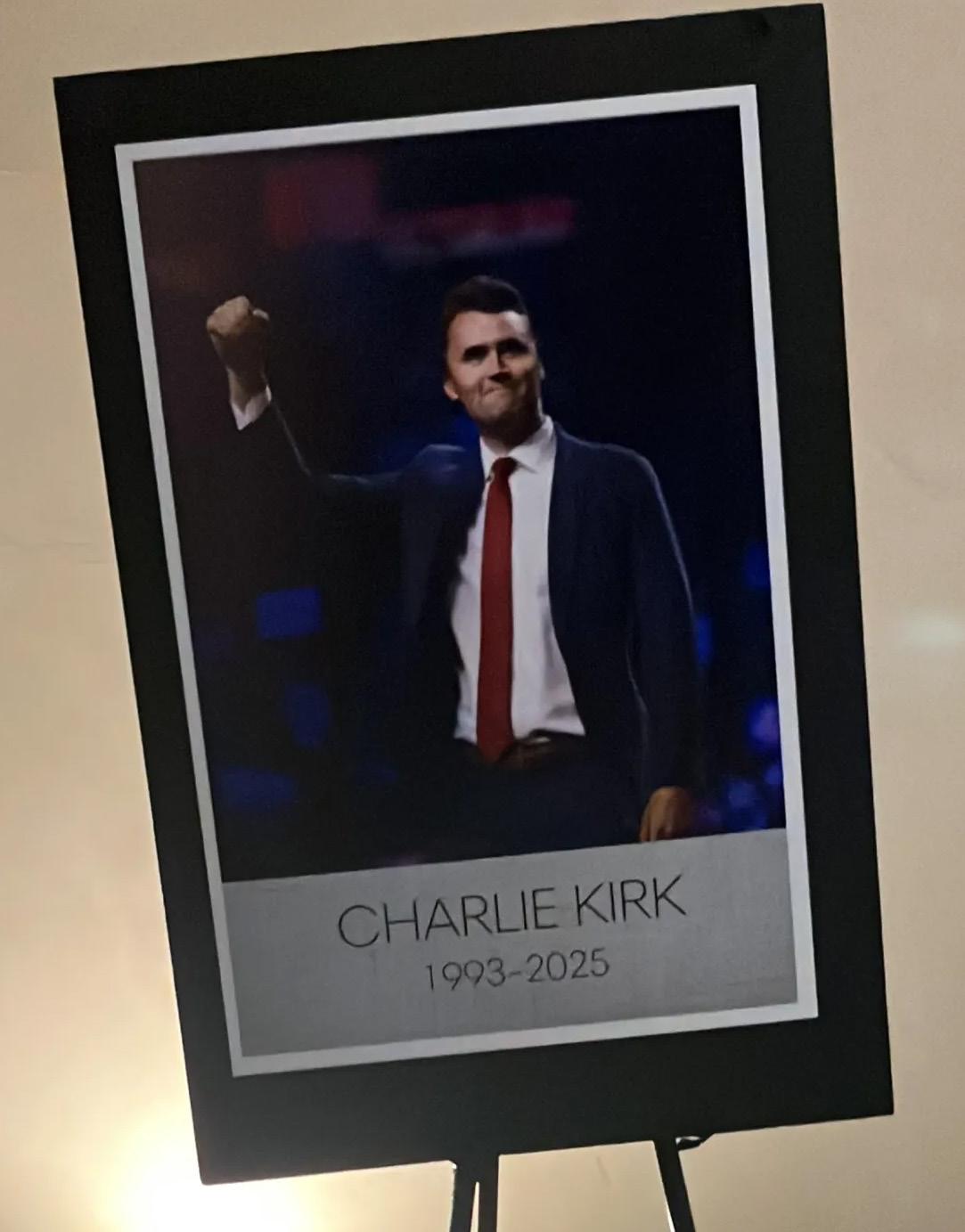
Over 20 5C students gathered in memory of conservative political activist Charlie Kirk at Claremont McKenna College on Thursday night.
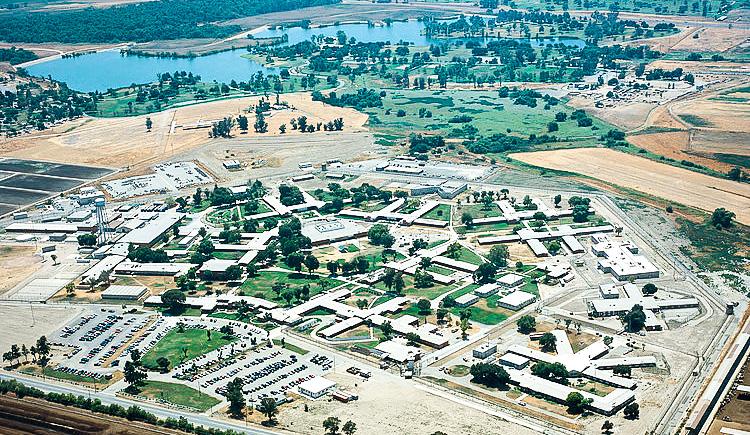
The California Rehabilitation Center (CRC) in Norco, California will close in October 2026, spelling uncertainty for Pitzer’s Inside-Out program.
NORCO CLOSING: NORCO prison closure threatens 5C Inside-Out program
Continued from page 1 the closure of the CRC as a good thing. But Runions and Ralston said the closure came as a surprise.
“There are lots of [prisons] interested in bachelor’s programs, college courses,” Ralston said. “So I believe we’ll be able to successfully relaunch at other prisons and provide a type of quality education that is recognized not only by CDCR, but by those who know about the Claremont Colleges.”
In her six years teaching the Inside-Out program, Runions said the the connections formed between “inside” and “outside” students that contributed to changes in perspective about the prison industrial complex.
“There’s a lot of investment in learning, and that’s partly spurred on by this inside out relationship because everybody wants to be on their best learning behavior for everybody else,” Runions said.
Despite the uncertainty for the Inside-Out program, Ralston, Runions and many within the prison see
“All of the chaos, the confusion, the movement that happens to people, the job loss, the families that live in this area now concerned with where their loved ones are going to be transferred to … it becomes an issue,” Ralston said. “But at the same time, it’s something to celebrate. The savings to the state and the taxpayer are incredible, and we hope that money is reinvested in communities.”
Runions said that there were some prison abolitionist concerns about the Inside-Out program regarding support for the prison’s existence.
“Education is always non-reformist,” Runions said. “But we certainly don’t want it to be propping up prisons. So in that sense, I think it’s great that [the Inside-Out program] hasn’t prevented the prison from closing.”
with new wearable tech
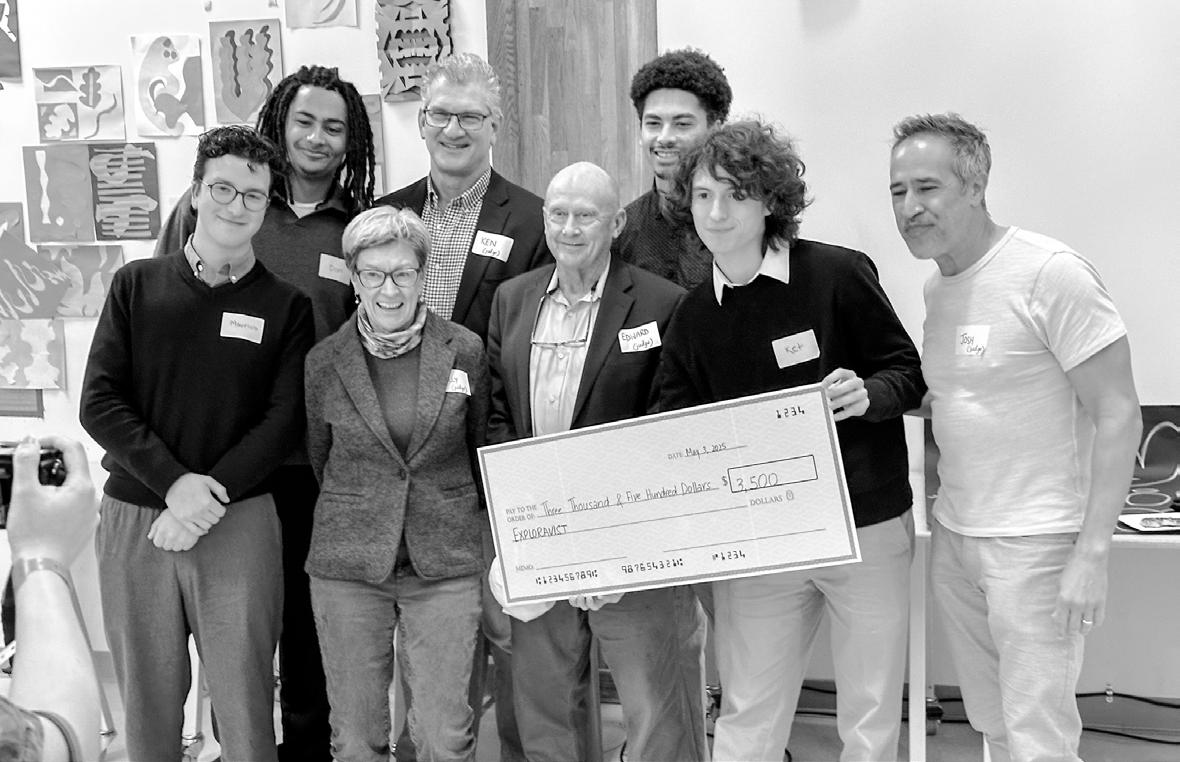
Two years ago, Harvey Mudd College students Ket Hollingsworth HM ’25 and Dominick Quaye HM
device built to empower the blind and visually impaired. Now, they’ve completed a market-ready prototype and are preparing to launch their product.
Technology startup ExploraVist is constructing a device that attaches to any pair of glasses, capturing photos and then audibly describing the user’s
surroundings. The device can be used for a variety of everyday tasks, from reading a menu to grocery shopping. ExploraVist was founded by Hollingsworth and Quaye with current Mudd student Bilal Abraham HM ’27.
Hollingsworth said that inspiration struck when OpenAI released its multi-model capabilities in 2023. “What that means is that it was able to describe really well, with contextual understanding, what’s in an image,” Hollingsworth said. “I was -
MADELEINE FARR
As a new semester at the Claremont Colleges begins, a new semester of TSL follows suit. The oldest student newspaper in Claremont is entering its 135th year serving our community, led this fall by Editor-in-Chief Jada Shavers SC ’26 and managing editors Adam Akins PZ ’27 and Charlotte Renner PZ ’27. Shavers is returning to TSL’s editorial board after her stint as managing editor of arts and culture and opinions last semester — a role Akins now holds proudly. A double anthropology and writing and rhetoric major from Portland, semester working for TSL. at TSL, is an English and biology double major hailing from Sacramento, California. Completing the trio is Renner, managing editor of news and sports. She is an environmental science major, entering her fourth semester at TSL, having previously served three semesters as sports editor.
Shavers said she didn’t expect to be on the editorial board, much lessplied to TSL as an underclassman.
“I kind of applied to TSL on a whim just because I had a friend who was doing it, I felt like I was half-committed at the time,” Shavers said. “But now, I feel like I’ve really grown at TSL. I didn’t expect that I would be on [the editorial board] for two semesters. But it feels right.”
Akins said that he began considering larger responsibilities after spending two semesters on
the paper.
“I wanted to be a part of trying to make that positive impact last in this community and trying to make the paper continue to grow and reach more people,” he said.
Renner agreed.
“I was so positively shaped by the newsroom and everybody on part of making other people feelnitely not as a freshman. I applied to be a writer and was like, ‘Wow, there’s no way they’re going to accept me.’”
Fast forward a couple of semesters: now, Shavers, Akins and Renner are behind the wheel and they want the 5C community to know that TSL is a forum for collaboration.
For Shavers, fostering more engagement with on-campus organizations is a priority.
“If there are events happening, we would much rather have them reach out to us and then we can said. “We’re meant to be the 5C newspaper, so really working with [on-campus organizations] to ensure that they’re feeling seen and heard in our newspaper is really important.”
Akins said that he wants 5C community members to know that TSL is a welcoming recipient of their thoughts and opinions.
“They can write in the paper, if they have an issue with the school, we want to hear those stories, we want to hear those pitches,” he said. “We want to be able to tell them with the most depth and the most outreach in the community,
Rachel Gonzales, whose husband Richard is currently incarcerated at CRC, said she couldn’t be more relieved and thankful that the prison is closing. In a statement shared with TSL, Mrs. Gonzales detailed neglect and corruption within the prison that her husband and her family had experienced.
“The closure of CRC is far more than the end of a building — it marks a profound step toward justice, healing and the long-overdue change our system so desperately needs,” Mrs. Gonzales wrote. “When demolition day comes, it will be deeply personal for me and my family.”
In a statement shared with TSL, Richard Gonzales also celebrated the closure of the prison, but said the largest protest of the closure from inside the prison has been from the many incarcerated people involved with higher education, as
“We should not lose sight of the historical context that prisons
symbolize in our country, one that keeps the imbalanced power structure in place and that has terrorized generations of families of minority descent simultaneously,” Mr. Gonzales wrote. “We should listen to the protests and the transformative and restorative justice education programs that so many incarcerated people yearn for wherever they are going to be transferred.”
According to Ralston, the CRC has long been on a short list of prisons that are dangerous or beyond remodeling, and that abolitionists have been advocating for Governor Gavin Newsom to close. In her statement, Mrs. Gonzales wrote that the incarcerated were crammed into overcrowded spaces, denied basic sanitation, left without proper medical or mental health care, and that their well-being was constantly at risk.
“This facility was never built to be a prison, yet it has been
forced to function as one while the building itself is falling apart,” Mrs. Gonzales wrote. “These conditions are not isolated incidents or unfortunate oversights; these are systemic failures that dehumanize our loved ones and rob them of their dignity, their health, and their hope. We, as a community, are demanding change.”
Ralston said that the closure of the CRC was not the end of the Justice Education Center or its programs.
“As we continue to buy higher education and education programs for incarcerated people, we will continue to work towards our North Star, which is abolition and justice,” Ralston said. “I think that’s what abolition is all about. It’s about dismantling systems of oppression while we build those things in our community, for our people that help them to thrive and have good lives and sustainability.”
cation [of] providing descriptions of what’s in front of you … people who can’t see.’”
He then crossed through the Jack-and-Jill bathroom he shared with his suitemate, Quaye, and pitched the idea for a mobile app using the technology.
Quaye responded positively to the idea, but noted that a visual interface might not be the best medium for visually impaired individuals. Thus, the wearable concept was born.
“It’s super easy to use, you click one button and it describes what’s in front of you and it can read out text and help you,” Hollingsworth said. “For example, in a restaurant, [it can] read out what’s on the menu.”
In their early days, ExploraVist’stypes to the Inland Empire Lighthouse for the Blind, a non-profit organization dedicated to teaching legally and totally blind individuals independent daily living skills and providing them with social recreational services. ExploraVist has since cemented their relationship with the Inland Empire Lighthouse for the Blind, visiting the center on seven occasions to date.
Then, last summer, ExploraVist became more intertwined with the founders’ home campus.
“We were able to sign up and
and that we can be a trusted way of doing that.”
Renner added that she’s excited to expand beyond the weekly news cycle into deeper, more investigative stories that can incorporate TSL’s multimedia and data experts.
“The cool thing about journalism is capturing what’s happening at the time,” she said. “In 20 years people can see what people were thinking and feeling.”
Each member of the editorial board underscored the importance of student journalism, especially as a forum for discussion.
“Over the past year and a half, student journalism has really opened up in coverage of what’s with the activism happening on campus,” Shavers said. “It’s really interesting now to continue those efforts as a newspaper being a forum for people to express concerns of the school community, which I think is really important.”
Despite widespread recognition in the United States of journalism’s importance for democratic discourse and accountability, many student journalists face nearly negligible wages.
“It’s really disappointing, honestly,” Shavers said when asked about the issue. She stated that in her past two semesters on ed board, she and her team gave their own roles a pay cut in an attempt to more equally distribute comincludes over 20 paid members.
“It does certainly determine who can be on ed board or who
get funding from The Hive and they gave us $60,000 to be able to enroll in [Mudd’s] Clinic program,” Hollingsworth said. Hollingsworth said that working with The Hive allowed ExploraVist to focus on human-centered design and build a greater understanding of its consumer base, as there are many types of blindness and visual impairment that require various treatments.
In spring 2024, the company took second place at Pomona College’s annual SageTank startup pitch competition; one year later, they returned SageTank as well as the Claremont Accelerator, CMC’s Randall Lewis Center for Innovation and Entrepreneurship and The Hive, ExploraVist now has multiple investors and advisors. When allocating their funds, ExploraVist continues to prioritize
“We’re dedicated to keeping the price low-cost,” Abraham said, adding that connecting with investors who agreed on this point was crucial. “[Comparable products] can start at $2,000 to $3,000, which is usually not realistic for a proportion of the population.”
In the two years since they began, ExploraVist has taken on over a dozen new team members, including Max Conine HM ’28.
Conine got involved with ExploraVist last spring as a software intern, stating that he applied because the company’s mission resonated with him.
“I come from a high school [FIRST Robotics Competition] background, and I love programming physical systems and watching them work,” Conine said. “There’s something satisfying to me about writing code that a physical device can use, I love it.”
When the end of the 2025 spring semester arrived, the team agreed that there was more work to do. Conine invited them all to his house in Boston,ing their product.
“At the end of those weeks we had our initial requirements with a few small bugs,” Conine said.
Now, with the fall semester underway, the company has continued to source investments and is planning to release a beta version of their product in late October.
ExploraVist is also planning on sending out 50 devices as a part of their beta testing program.
“We are always looking for users to work with and get feedback,” Hollingsworth said. “We are planning on initiating our beta testing program late October, so if you know someone who may be interested, send them our way at exploravist@exploravist.net.”
noting that many students might be forced to choose between a passion for journalism and a minimum-wage job.
“There are students who want to do this, and it’s a shame that we can’t be an option for people who want to contribute to the from and use in their marketing,” Shavers said.
However, this semester’s editorial board remains optimistic and excited for the future of the paper.
“I’m super excited about how
“We were all the new kids on the block for a long time and it’s super trippy to be the person who’s curating TSL. Hopefully we’ve done a good job and I’m excited to see the next generation of TSL.”
MADELEINE FARR
COURTESY: EXPLORAVIST
Harvey Mudd startup ExploraVist is constructing an AI-powered wearable device for the blind and visually impaired.
Jada Shavers SC ’26 is TSL’s editor-in-chief this fall, working with managing editors Adam Akins PZ ’27 and Charlotte Renner PZ ’27.
CMC North Quad gets A/C: A tumultuous and rewarding journey
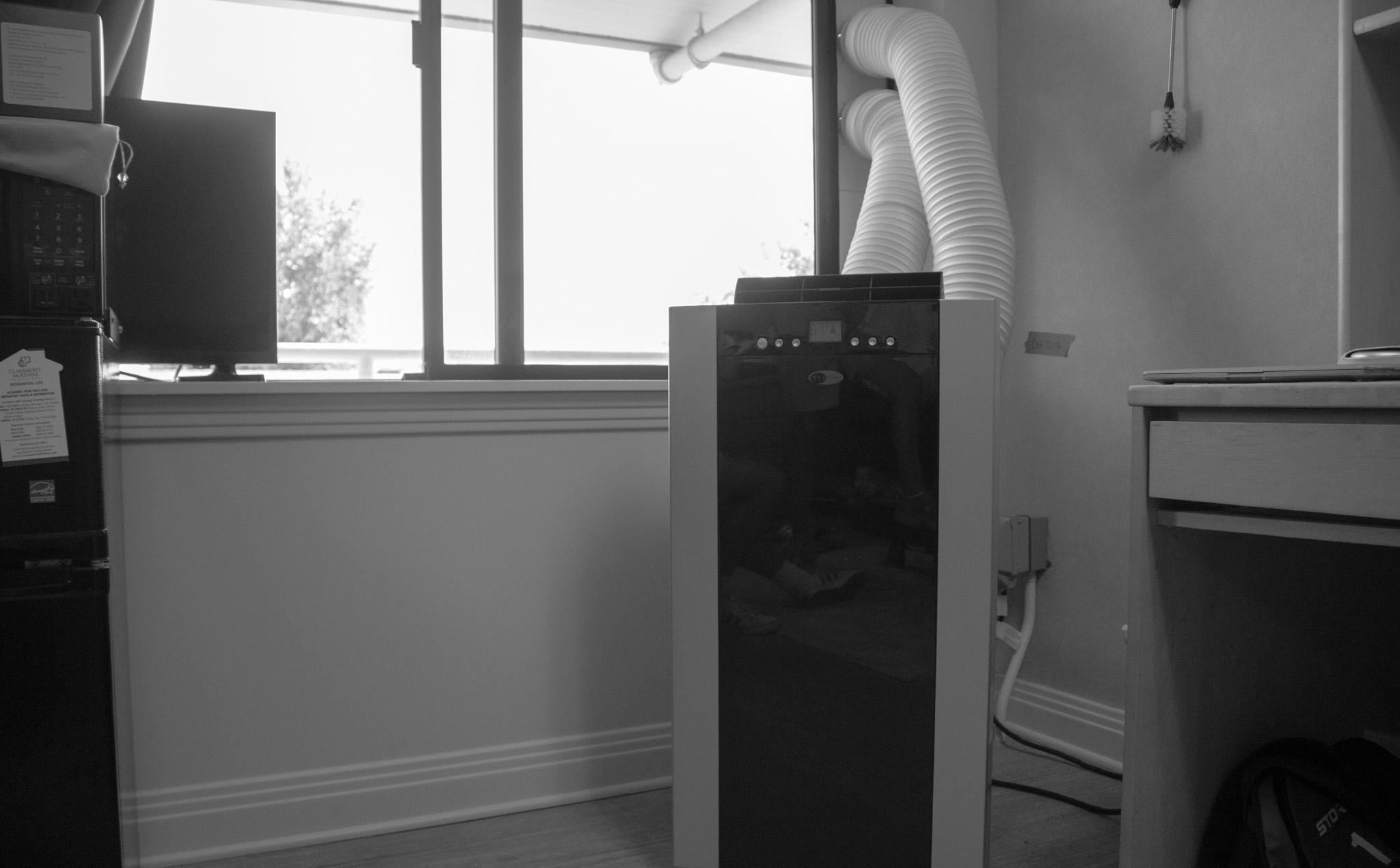
Living at Claremont McKenna College’s North Quad dorms — Appleby, Boswell, Green and Wohlford — has always had one major drawback: no air conditioning. However, after summer efforts and some preliminary complications during the first week of school, August 28 marked the first time in CMC history that North Quad residents could enjoy fully functioning A/C.
The North Quad A/C development was announced in an email from Jenny Tyniec, CMC senior assistant dean of students for residential life and student engagement, prior to last spring’s room draw. The email described the college’s plans to upgrade the north residential area’s power grid capabilities, allowing for future permanent A/C installation. Tyniec said that since this large project will likely take years to complete, CMC planned to use the summer to install portable A/C units for North Quad residents in the meantime.
“CMC has recognized the need to add air conditioning to the North Quad area as a means of ensuring a comfortable living and learning environment for students housed in these facilities,” Alex Boekelheide, associate vice president of strategic communications & marketing, said in a statement to TSL.
The administration did not comment on their reasoning behind the timing of this A/C installation.
In August, when some students arrived on campus early, the individual A/C units were
still in their experimental stages.
“There was probably like two hours a day where the A/C was working,” Wohlford resident Luke Gildred CM ’27 said.
Gildred moved in on Aug. 12 alongside fellow Stag football players. Being out at practice during the day, Gildred said the evening was when reliable A/C was the most important.
“I wear a WHOOP to track my sleep and my recoveries and I definitely saw like a drop in my recovery by about at least 25 percent for my sleep scores once the A/C turned off at night,” he said.
Although Gildred chose to brave the heat, some North Quad residents got creative with their sleeping arrangements.
Jenner Baumhackl CM ’28 relocated to his friends’ dorms for the night. He said that the fan the dean of students gave him wasn’t enough to combat the heat and he wasn’t interested in the alternatives the administration provided: a temporary second room or sleeping in Roberts on an air mattress.
“It was hard because you want to just have your own space and just sleep in your own room, and it would feel weird to be displaced, like in the gym,” Baumhackl said. “The next best thing was to find other people’s rooms, but even then, it’s not very fun living out of your backpack.”
Evan Gerber CM ’27 and his roommate took up CMC’s makeshift housing offer, temporarily relocating to Allen dorm at night.
“We just had sheets and a
blanket in there and we would come back to the [North Quad] room for everything else during the day,” Gerber said.
Escaping North Quad at night also meant avoiding the risk of electrical issues. Baumhackl said that when the A/C wasn’t working, some residents would try unplugging and replugging it into a different outlet, sometimes causing a short circuit.
“I heard stories of, like a freshman blowing up their outlet from overrunning the A/C or something,” Baumhackl said.
“And another resident said that
KIRK VIGIL: Charlie Kirk vigil held at CMC
Continued from page 1 minute of silence, followed by a few students singing the national anthem.
A member of the Claremont Colleges Campus Safety (CCCS) department was also present at the event. Organizers said this was due in part to its “conservative” nature. During the vigil, there were multiple altercations between an organizer and an attendee. The organizer had asked a rhetorical question about whether anyone deserved violent retribution for their political voice and actions, to which the attendee responded sarcastically, according to an anonymous source who attended the event.
The source said the organizer then event to escort the attendee off the premises.
“They used campus security toaging Kirk or providing alternative insights,” the source said. “Campus security was effectively running interference on what people were allowed to say [at] the organizers’ whims.”
After that incident, the organizer continued to goad on the attendee, leading to multiple altercations with yelling, according to an eyewitness account from a TSL reporter.
A reporter from Pitzer College’s Outback Newsprint Magazine was also present, but was escorted out of the event during the vigil.
A handful of bystanders watched the event from above at ground level, heckling at times.
According to eyewitness accounts from TSL reporters, some of the bystanders got into an altercation with
event organizers after its conclusion. The bystanders claimed that the organizers had been filming them, sparking the altercation.
The vigil was organized by Turning Point USA (TPUSA) at CMC — a chapter of the conservaand the Claremont Colleges College Republicans. Both organizations declined to provide comment on this story.
TPUSA leadership said the organization barred its members from speaking to the media. According to accounts from a TSL reporter, the organizer threatened that any violation of the media policy could result in the reporter being sued “personally.”
they got a personal text from the dean of students to turn it off.”
Although the process was “annoying,” as Baumhackl put it, Gildred said communication from the administration was consistent and transparent.
“It did feel like it kept on getting pushed back, but sometimes that’s how those things work I guess,” Gildred said.
At the end of the first week of classes, following weeks of electrical testing and frequent email updates from Jimmy Don, CMC dean of students, Gerber and Baumhackl were able to permanently reside in their respective
North Quad dorms comfortably.
“It’s been really nice having the A/C units in and they work really well now,” Baumhackl said. “Like, sometimes I have to turn it off, it’s so cold in the room, which is kind of crazy to think about.”
Gerber echoed this sentiment.
Having lived in Crown and Faucet previously, he said the A/C in Wohlford is now “way better” in comparison.
“I say that North is one of the better dorms now just because that A/C is so valuable,” Gerber said.
“The A/C goes down to 61 and I keep my room at 61 all day long; it’s like an ice box.”
In world news
September 3rd
• with Oregon, Washington
September 4th
•gia auto plant marks the largest single-site immigration enforcement operation Security Investigations.
September 5th
• President Trump formally announces plans to hold Doral golf resort.
Northwest Wildland Fireing personnel, equipment and resources with eight other U.S. states and five
• President Trump signs an
executive order to give the Department of Defense a secondary, informal name: the Department of War. This does not change the legal name of the department.
September 8th
• apparent race/ethnicity, occupation, accent, and location can now be included in the reasoning for an investigatory stop.
September 9th
• Nepal revolts against their corrupt government, beginning earlier this week. Prime Minister K.P. Sharma Oli resigned after public humiliation; previous social media bans were lifted; several government buildings were burned down.
September 10th
• neck during Utah Valley University presentation.
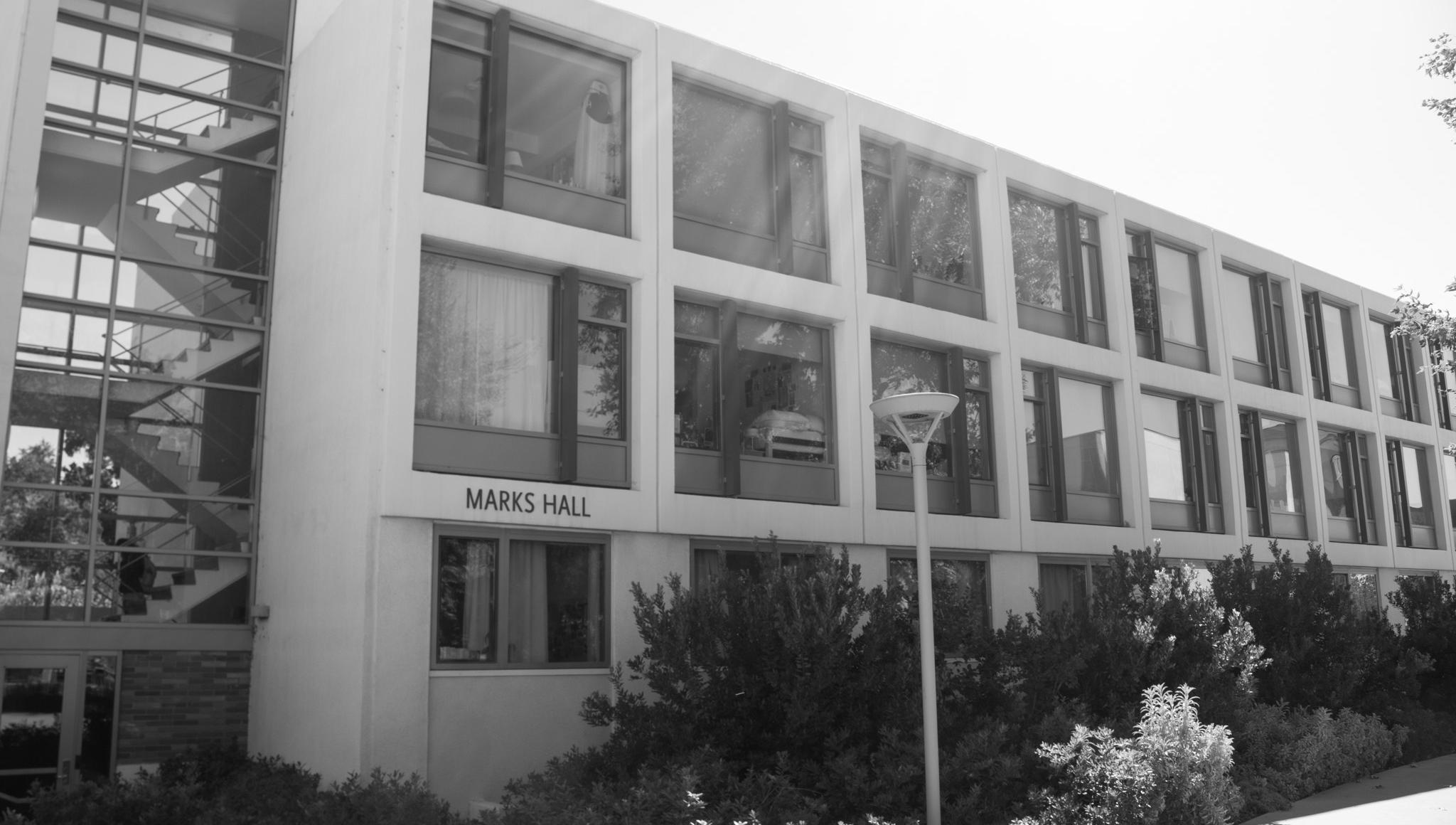
of her roommates to wake up when the a.m. in Marks Hall at Claremont McKenna College last Tuesday.
“All our beds are lofted to the highest height,” she said. “So we jumped like spiderwomen and ran.” According to Agarwal, as she and the hallway, they were enveloped by smoke.
was probably caused by a malfunctioning portable power bank being charged through a power strip, CMC’s Executive Vice President and Chief Operating the campus community last Tuesday.
Although most residents were able to reenter their dorms after 9:30 a.m., 11 students living in the west wing on into a meeting with members of CMC’s Dean of Students (DOS) team.
These students were told that there residence rooms due to the sprinklers, and that they would have to be moved to temporary housing while repairs were being conducted.
“That’s when it […] hit me that this was actually real,” Katie Luong CM ’29 said. The 11 students were quickly moved into temporary rooms in Mid Quad, and the DOS team provided short-term necessities like chargers, bathroom essentials and snacks.
“I was kind of shocked by how fast they were able to take a hold of the situation,” Amber Zhang CM ’29 said. “We were moved into a new room, maybe an hour or two after everything had happened. They’ve done a lot to
make sure that we have everything we need.”
spoke to TSL said that because of the sprinklers, anything they left on the in water, some to the point of being unsalvageable. Lost or damaged items included clothes, shoes, rugs, furniture and electronic items.
However, the DOS team worked closely with impacted students to start the reimbursement process for damaged items, launder any salvageable wet items and shuttle them to Target to purchase essentials throughout the week, all paid for by CMC. There was one more immediate concern — legal documents. According to Agarwal, international stuhad additional cause for concern about the safety of their documents.
“The one thing that was the most scary for us was passports,” Agarwal said. “We at one point did not care about anything else, and we just ran — when they allowed us to go back ensure that those were safe.”
The DOS team stayed in constant communication with the displaced spoke to TSL, whether over email, through individual calls or during in-person meetings.
“We were constantly emailed about what is happening currently in the dorms,” Agarwal said. “[DOS regular messaging, regular contact with them.”
Saanvi Sakthivel CM ’29 also said the dorm’s Resident Assistants provided immense support, and that they immediately made a group chat
door hours and brought donuts for the entire dorm.
“That kind of presence is very appreciated,” Sakthivel said. “It makes it a little easier, with everything going on.”
After hearing that Luong’s parents were worried about the situation, CMC Dean of Students Jimmy Doan asked if he could have her mom’s phone number so he could personally
“I think my mom’s phone call with Jimmy actually made her feel a lot more comfortable with the situation,” Luong said. “That just goes to show how much DOS and the CMC community in general really cares about their students and students’ families.”
Despite the support and communication, the temporary housing situation wore students down.
“I was just under the impression that we’d be back in [Marks] by the end of the week,” Sakthivel said. “But as the week kept going on, I [realized] we’re not going to be back very soon.”
Assistant Dean of Students for Residential Life and Student Engagement Jenny Tyniec notified displaced students via email that all of their rooms were ready to be reoccupied — with the exception of one of the single rooms. “You are able to move back to your rooms right away,” Tyniec
wrote. “Please keep in mind that there will be ongoing construction in the lounge, stairwell and hallways over the next few days.”
Although Luong said that she felt unsure about when she and her roommates would be able to move back into their dorm during the week
“We didn’t have a super clear timeline or framework on how long rehousing would take, but I think they physically [and] emotionally supported us as much as they could,” Luong said. “If it were any other school, we wouldn’t have gotten the same kind of support.” The student who lives in the roomment on this story.
KAHANI MALHOTRA
ANDREW YUAN • THE STUDENT LIFE
ANDREW YUAN • THE STUDENT LIFE
JOELLE RUDOLF
Claremont McKenna College’s North Quad dorms install A/C for the first time in CMC history.
Following a small fire in Claremont Mckenna College’s Marks Hall on Sept. 2, 11 residents were forced to temporarily relocate during water damage repair eforts.
Monica Lewinsky in conversation: Reclaiming the narrative
“In my family, we call [1998] The Brainwashing. The younger generations said — ’wait, the 24-year-old young woman had more consequences than the 50-year-old most powerful man in the world.’ That insistence to revisit the story and to revisit me as a person created this current [of change]” Monica Lewinsky said.
On Wednesday, Sept. 10, Scripps Presents hosted Monica Lewinsky for a discussion on her journey of healing from trauma and her subsequent work as an antibullying advocate and
COURTESY: SCRIPPS COLLEGE
ANANYA VINAY storyteller. She was interviewed by Jennifer Groscup, a Scripps psychology professor. Lewinsky is most well-known for having an intimate relationship with Bill Clinton in 1998, and the widely publicised federal investigation that followed. She has since earned a degree in psychology from the London School of Economics, and anti-bullying advocate. In February 2025, Lewinsky debuted her podcast “Reclaiming” — a series of conver-
purpose and sense of self.
To open the conversation, Lewinsky touched on her personal growth since she became spotlighted, highlighting her challenges with accepting traumatic experiences and their long-lasting consequences.
“The hope was that I would trade in this identity of Monica Lewinsky, the intern in a global scandal, for Monica Lewinsky, the graduate student,” Lewinsky said. “I came to realize that what I needed to do was integrate what had happened and accept that these are all parts of me. I like to joke that I was silent for a decade and now nobody can get me to shut up.”
Lewinsky’s remarks were greeted by a long standing ovation. Among others, Claremont community member Karla Maez particularly admired Lewinsky’s resilience.
”I learned what a remarkable woman she is, how she’s overcome everything that she had to go through with that whole event,” Maez said.
In January of 1998, the story of Lewinsky and Clinton’s relationship broke in the Washington Post. a grand jury. The House of Representatives impeached Clinton for committing perjury when asked to describe their intimate relationship.
Nationwide backlash led to unprecedented online harassment. This experience motivated Lewinsky to pursue antibullying advocacy, and she has since created several anti-bullying campaigns for variousnouncement “In Real Life” was even nominated for an Emmy in 2018.
”There’s a deep kind of soul loneliness when you don’t have a purpose … [This work] has been
very meaningful for me, being able to give a purpose to your past and someone’s way,” Lewinsky said. She emphasized the role of her family and friends in helping her endure the aftermath. Attendee Lily Frasier SC ’28 found this part of her talk to be particularly touching.
”I loved the stories about all the people that had helped her over thepists and friends. I thought that was really beautiful,” Frasier said.
Given the constant surveillance on social media, Lewinsky highlighted the importance of remembering advised making a daily list of concrete accomplishments, however small, to ground oneself.
“My therapist said not [to] judge your insides by other people’s outsides. You’re seeing a window into their fantasy life,” Lewinsky said. “If you make [everything on your list], you will be blown away by how much you have actually contributed to the world.”
Outside of advocacy, Lewinsky worked as an executive producer on The Twisted Tale of Amanda Knox. Lewinsky became involved with the project after seeing how cruelly the media and public treated Knox. She underscored the importance of recognizing the harmful impacts of scandals on victims, especially for women on a broader scale. For both Lewinsky and Knox, being constantly reminded of the trauma made moving forward much more
“I saw so many of the same patterns that happened to me as a young woman thrown on a global stage and being feasted on by the media. All women become collateral damage
when we see women being treated and torn apart this way online,” Lewinsky said. “It was very important that we come to understand the detritus that’s left after the scandal. The blast radius is big. It happens to a family. It happens to a community.”
Attendee Riya Saini SC ’27 was intrigued by Lewinskiy’s perspective on sensationalized media.
“The narratives and gossip that get a lot of attention — we are the ones clicking on these articles and stories on social media. Without us as consumers, these misleading narrow stories would probably not be popularized as much,” Saini said.
When Lewinsky first began reclaiming her narrative in 2014, many were suspicious that she would use the publicity to pursue political and profit-related aspirations. She acknowledged her economic privilege in being able to turn down various that would have held back her healing process.
”What we always see are the choices of things that people say yes to. We don’t actually see all the things people say no to,” Lewinsky said. “I’ve turned down over 11 million dollars over the years. It’s not always easy to make that choice, to not have to take but I also learned to not judge women who have to do that.” experiences, she pondered the absurdity of being involved in one of the largest scandals that reshaped political culture. Her story provided a window heal under scrutiny.
“It’s very weird to be a cultural touchstone. It means sometimes that underneath everything, I can never totally feel safe,” Lewinsky said.
Pomona’s performative male contest: Voting between
sincerity and satire
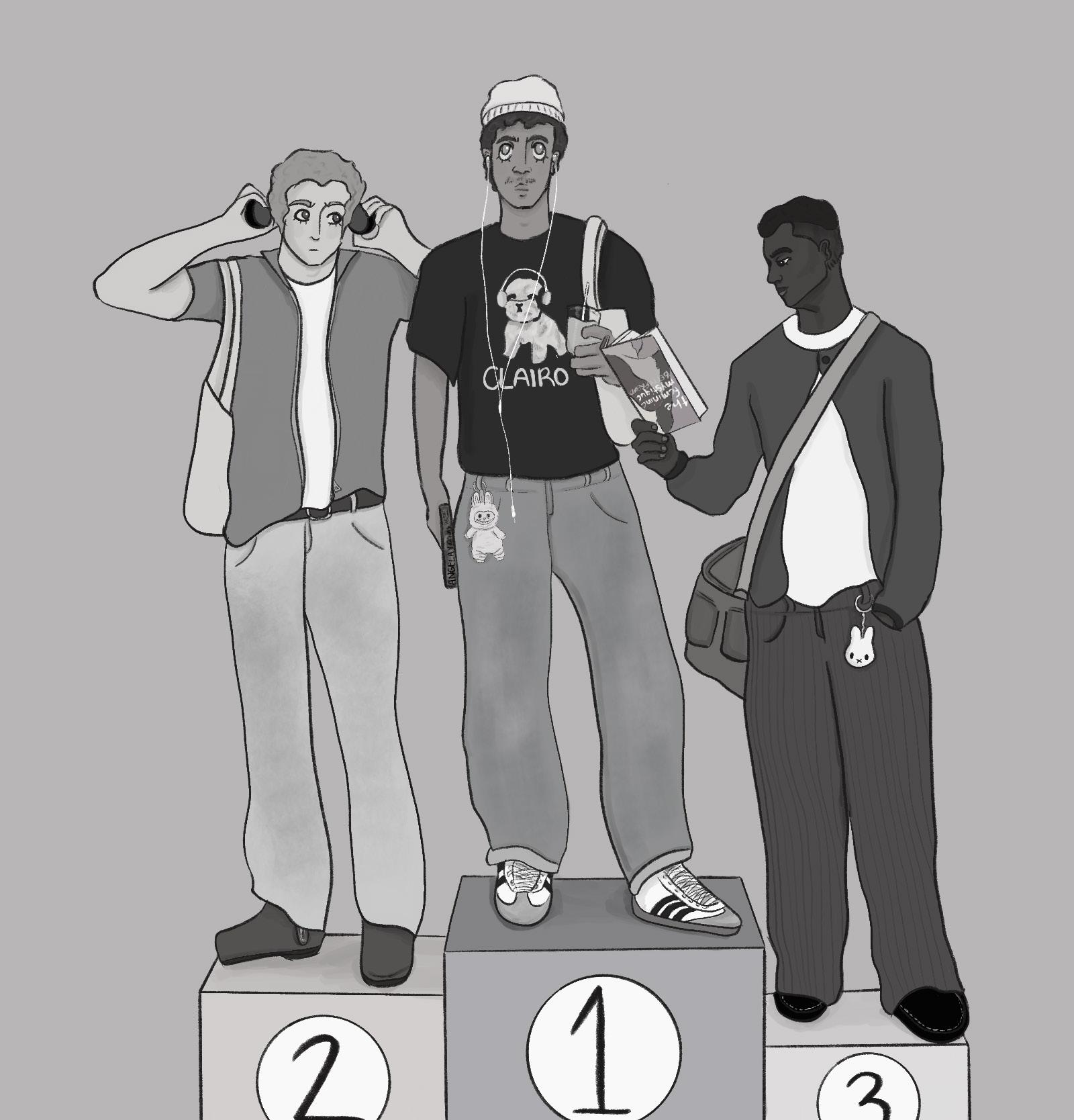
He walks among us. One may think that he’s just another Claremont student with a love for literature and a sweet treat, but the truth is something far more calculated. In fact, that tote bag full of Angela Davis and Labubus that he’s always carrying around — purely ornamental. They stand as props in the act that many have come to call “the performative male.”
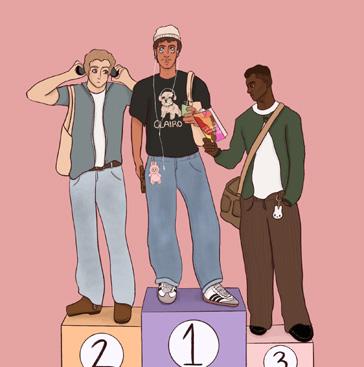
On Saturday, Sept. 6, students across the Claremont Colleges gathered at Pomona to compete in a performative male contest. The occasion was convened to address the pressing question of who could best emulate the infamous performative male archetype — someone who uses graphic totes and drinks matcha purely for the aesthetic value.
“Woman-loving, woman-respecting, Labubus, matcha, feminist literature, guitars, wired earbuds, rock climbing accessories and always something vintage and something environmentally conscious,” Ethan Vicknair PO ’28 said when asked to describe a performative male. His words seemed to come to life as students flocked to the lawn. Pants sagged low across Smith Campus Courtyard, weighed down by carabiners strung with countless trinkets. Some had even positioned pads and tampons to poke out from their pockets.
The contest started with spectators huddled around as the judges interviewed contestants, having
them answer questions in character. Draped in hand-cropped collared shirts and Arcteryx beanies, they humorously bemoaned period cramps and the patriarchy. Some offered up sections of their poetry, others began reading aloud from their favorite novels and one contestant performed a guitar solo.
For the final round, judges asked contestants to bring up a woman who could speak on their behalf. Allegedly, contestants had made emergency period product runs, bought spontaneous gifts and even delivered heating pads to their female friends in need. The competition was brought to a close with Manar Hadi PO ’27 kneeling at the feet of his friend, placing his Trader Joe’s tote bag and watered-down matcha to the side. The crowd cheered rapturously at the sight of such adoration.
“The free matcha was definitely a huge draw, but I think the popularity [of this event] also ties into a broader cultural moment,” Renee Tian PO ’27, the only female judge of the event, said. “The satire of ‘performativity’ offers us the space to critique gender performance, social validation and identity-creation, while subverting toxic masculinity in a lighthearted way.”
In addition to being lively and fun, the event raised questions and thoughts for attendees on how this stereotype arose and why it has become so popular.
Most students were familiar with the exact archetype the contes -
tants sought to impersonate, due to its potent presence on social media platforms. Some claimed to have seen performative men across the colleges.
“[The label performative male] can work either way. If anyone genuinely likes listening to Clairo and reading feminist literature, that’s good. But I think also, if your intention is to kind of use that art and media for very bad purposes, then I guess it could be bad,” contestant Omar Cabello PO ’26 said.
“Not knowing the context of a situation is one thing, because I think, you might be like, ‘Oh yeah, I love Maya Angelou,’ but you may not know the context in which Maya Angelou came up in, or her literature. So it could be a disservice to actual good academia and other art.”
Although people agree it is nice when men are interested in things that were previously viewed to be exclusively feminine, from American singer Clairo to advocacy in reproductive rights, the main point of tension is when they do so with ulterior motives — namely, to hit on women.
“There is a point where we can make fun of it, and that is when a man tries to capitalize [on it] or gain something out of doing these things without it being their personality. [That is] when it is actually performative.” Mauro Gutierrez Muniz PO ’28 said while spectating. However, there is also something deeper to be said about
jumping to the conclusion of performance simply because it is unfamiliar. Some noted that this label has been inflated to a point where it makes it difficult for men to seem genuine when liking things of this genre.
“The performative male is
such a big thing right now because we love to [ridicule] anything that is feminine in society — when we see a man doing feminine things, we think that’s funny or we think that’s performative,” Gutierrez Muniz said. “This is a symptom of us going back to stricter gender roles. We got to a point where the barrier was starting to be broken, and then it broke too much.”
Some students also reflected on how much pressure there is for men to stay within a category of masculinity. They had discussed how it had been nice to see people get in touch with their feminine sides. Setting aside the performative aspects, everyone just appreciated that interests could be shared within a wider community.
“Before the contest began, one contestant introduced himself and read us some of his own poetry,” Tian said. “It was unexpected, catching a glimpse of his sincerity amidst the performances.” Similarly, contestant Anbo Li PO ’26 revealed that the Haruki Murakami and Byung-Chul Han books, which he had brought as props for his costume, were genuinely annotated and some of his favorite reads.
The contest was lighthearted, but lingering moments like these revealed why the performative male resonates with so many. The event gave Pomona’s matcha-drinkers the opportunity to lean into a joke, and proved that people are quick to judge one another. More than anything, it showed just how thin the line is between sincerity and performance.
MAGGIE ZHANG • THE STUDENT LIFE
AUDREY GREEN
T wo contestants in Pomona’s performative male contest compare notes on their scintillating (upside-down) reading. On September 6th, students gath-
ered in Smith Campus Courtyard with their Labubus and matcha lattes to compete for the title of “Most Performative Male.”
TOMY HELMAN
On Sunday, the fan-voted MTV Video Music Awards (VMAs) were hosted by LL Cool J. Though the three-hour event seemed to drag, slogging through constant advertisements, I found LL Cool J to be the best host in recent years.
His professional and charismatic nature maintained overall engagement throughout the VMAs, which are a better and more genuine barometer than the Grammy Awards for measuring artists’ cultural relevance.
As the public transparently votes for the artists and records, there’s no way a nominee can be “robbed” of a win. This avoids people like me complaining about a group of unknown individuals’ selection criteria and sociopolitical biases in their voting. After all, the public outnumbers the critics, and they are the ones who shape anding musical landscape.
Starting off the night, Lady Person, winning the award for “Best Artist.” I’m skeptical she was truly the Artist of the Year, but it was a unifying choice meant to please everyone — considering more controversial figures like Taylor Swift, Beyoncé and Morgan Wallen were among the other candidates.
Moreover, her speech was moving and inspiring: “Being an souls of people all over the world [...] It is a method of building understanding and celebrating community,” Gaga said, alongtivational board. “I hope as you navigate through the mayhem of daily life, you are reminded of the importance of the art of your life, that you can count on yourself and your simple skills to keep you whole.” Alex Warren’s win for Best New Artist actually surprised me. Sombr, the 20-year-old singer-songwriter, was the obvious bet, and he appeared to have a larger fan base. However, Sombr did take home some silverware of his own, winning “Best Alternative.” He’s the breakthrough artist who achieved widespread
Arts & Culture
recognition with his alternative sound, threatening the pop and rap monotony on the charts. Sombr’s “Back To Friends”and “Undressed” peaked at No. 1 and No. 6 on Spotify Charts, respectively, and still remain on top. On the other hand, Alex Warren’s hit, “Ordinary,” is the only song he’ll be remembered for. His second, most successful single, “Eternity,” couldn’t stay more than three weeks in the Global Top 50.
At least history and streams will give Sombr the honor he deserves when, soon enough, Alex Warren fades into memory as just another generic ballad singer. When that moment comes, we’ll still be listening and crying to Sombr’s emotionally relatable lyrics.
Later that night, Sombr delivered a breathtaking debut of “Back to Friends” and “12 to 12,” where he screamed at the top of his lungs on stage. Although his interpretation was hindered at times by dominant backing tracks, a few risky vocal shifts and visible nervousness, it’s worth highlighting that this was his first-ever award show performance.
Ricky Martin was the recipient of the Latin Icon Award introduced this year, but his performance was outshined by Tate McRae’s VMA debut immediately after him. She sang “Revolving Door” and “Sports Car,” dancing captivatingly on a runway surrounded by suspended men before descending into a sand pool.
McRae showed her distinctive moves while setting the stage on fire—both figuratively and literally. Her performance was named by Billboard as the best of the night and established her as one of the most accomplished performers in the current music scene.
Thankfully, Sabrina Carpenter didn’t appear on stage as overly sexualized as I feared, after her problematic new album cover and some daring costumes in past shows. She sang “Tears,” from “Man’s Best Friend,” and danced in the rain wearing a glittery bra paying homage to
from her 2001 Dream Within a Dream Tour.
Sabrina Carpenter took home the Moon Person for “Best Album” for Short N’ Sweet, and although she seemed surprised to win the award a year after the album’s release, she unquestionably deserved it. Short N’ Sweet is this decade’s Teenage Dream by Katy Perry, and few albums had as much impact last year. Despite the Grammys’ opinion, Beyoncés’ “Cowboy Carter” doesn’t even come close.
Similarly, Rosé and Bruno Mars won “Song of the Year” with their No. 1 hit, “APT.”
There’s little doubt that any other song in 2025 was as iconic or resonated in such a culturally impactful way. In particular, Rosé’s win symbolizes this year’s rise of K-pop stars in mainstream pop — from Blackpink members releasing solo albums, to the surging popularity of the girl group Katseye, formed through K-pop development methods, and even the soundtrack of the animated film “KPop Demon Hunters” dominating the charts.
Mariah Carey was the recipi-
ent of the Video Vanguard Award this year. Her medley led tribute to her biggest hits — like “Obsessed,” “It’s Like That” and “We Belong Together.” However, her performance fell short compared to Katy Perry’s unmatched one last year. Carey looked uncomfortable and lacked the energy to light up the stage. Even I put more enthusiasm into my 9 p.m. hip-hop class last semester. Still, her vocals were impressive. She’s an outstanding singer, but not quite a strong performer. “Videos evolve, but fun is eternal,” she remarked when receiving the Moon Person. I know we’re in September, but I’d have liked her to sing the eternal “All I Want For Christmas Is You,” her greatest legacy. Maybe then she would’ve felt fully in her element.
Finally, the ceremony saw Ariana Grande on her tiptoes as she accepted the Moon Person for “Video of the Year” with “Brighter Days Ahead” — a compilation of videos from her album Eternal Sunshine that also won “Best Pop” and “Best Long Form Video.” The award couldn’t
have gone to anyone else. “Brighter Days Ahead” is not just a music video; it’s a 20-minute movie, with a plot, climax and cinematic scenery. It proves the survival of music videos, reminding us of the power of visual storytelling. The public itself rewarded it for demonstrating that there’s still room for sophisticated productions in this age, defying the industry’s belief that content more engaging.
The MTV VMAs accomplished what the 2025 Grammy Awards could not: honoring recordings for their excellence and impact. As listeners, we judged each one on its
Unsurprisingly, we have a music talent and artistic transcendence than those selected voters who call themselves “experts.” Let the man on the street decide. We’re generally right. Democracy works. The music is safe.
Tomy Helman PO ’28 is a music columnist from Argentina, interested in media, culture and politics. His Duolingo streak is over 1630 days.
A place of my own (kind of)
An hour after deciding to drive back to Tennessee in one sleepless stretch, I had all of my possessions packed into trash bags and piled in the back of the van. I explained why I was leaving in a short breathless sentence. Saying my goodbyes out the window of the van, I only took the time to leave my host a copy of “A Place of My Own.” I told him to “take it, it’s a gift” rather than explaining what the book (and as an extension him) meant to me.
“A Place of My Own” by Michael Pollan is a collection of essays about an author building a writing shack in his backyard. He divides the building of the shack into “here” and “there”. The “here” represents the properties of the shack that are a response to the function of the space and its immediate surrounding area. Pollan discusses the depth of the footings — a component of foundation determined by the pitch of the hill, the weather and the firmness of the soil. The “there”
elements of the shack are its aesthetic qualities, determined by architectural language, ideals found in nature, feng shui and Pollan’s individual taste.
Within the first chapter, Pollan stresses his lack of DIY knack. As a writer, he concerns himself with concepts, language and ideas rather than actual physical things:
“Apart from eating, gardening, short-haul driving, and sex, I generally prefer to delegate my commerce with the physical world to specialists; things seemed to work out better that way,” Pollan writes.
As one of my favorite “there” details, he explains the shack with stout side walls, which made it look like it was wedged between two bookshelves. The “there” sounds much less interesting than the “here,” but the process through which Pollan collapses his abstract vision of the shack into an actual physical object that has to withstand the weather, meet the requirements of building codes and stay under
budget is fascinating.
I faced a similar task when I set out to convert a beat-up van into a camper. I had sold my car and bought it off my buddy that spring. His family was kind enough to host me and provide power tools until the van was roadworthy and livable. I spent my days working on the van, and in the afternoons I would review stories for a literary journal.
My buddy’s dad, who had worked as a programmer, frequently popped into the driveway to offer ““here”” advice. I had learned what an amp was a week before, and he helped me design a wiring harness hooked up to a 300-amp hour battery that easily could have barbecued me.
Despite my inexperience with actual construction, I had a definitive vision for the van. I included many of the traditional elements of a camper — a cooktop, an outdoor shower, a fridge — but I also designed a bed that folded into a bench and
a bookshelf inspired by Pollan’s shack construction.
A bookshelf is incredibly impractical in any kind of moving vehicle. I drilled in a plywood veneer with rectangular openings smaller than the shelf itself to form a kind of lip that held the books in place. Their combined weight pitched the van to its left, but it is difficult for me to let go of books (a “here” issue I neglected).
Converting the van itself was in complete disregard to an almost infinite list of “here” issues. The van was painted about 12 different shades of off-white, the headlights were covered in a thick cataract of condensation and the engine made a horrific screech as you turned it over. It had an intense anthropomorphic quality that I might have hallucinated during my long hours spent baking in its cargo space. As I approached it each morning, its tired visage seemed to beg me not to invest so much time, money and effort into its rusting body. Despite the
impracticality of the project, I never once considered abandoning it.
Pollan would have supported my project wholeheartedly. I came to love “A Place of My Own” by rereading dogeared passages that explored Pollan’s irrational desire to build the shack. He traces his desire for the shack all the way back to a treehouse his parents gifted him, which he loved because only a kid could shimmy up its rope ladder and crawl through its narrow trap door. His parents designed his “temple of privacy and independence” to specifically be inaccessible to them. Influencing the construction of his new home, which he built in the traditional “post and beam” style, he required a group of helpers to raise the heavy timber beams.
I think the complicated dynamic between wanting a “place of your own” and inevitably having to rely on the help of others occupies a lot of college students, especially those about to graduate. The intense desire to “strike out on your own” is often antithetical to the need for community support. This irony was even more intense in my scenario. I had built the camper to be completely offgrid, drawing energy from solar panels and the car’s alternator — I even considered designing a rainwater collection system — but I was entirely reliant on my buddy’s family’s tools, driveway and tolerance for chaos. Building my temple of independence involved me operating a circular saw that made a high-pitched whine and spraying sawdust all over their driveway.
I gifted my buddy’s dad “A Place of My Own” to capture how meaningful his help was. On the way back to school, I swung by the house to say hi. I showed him the improvements made to the van, and he showed me a tool shed he had built in the backyard. I may be overly sentimental, but the tool shed felt reminiscent of Pollan’s writer shack. Despite entering retirement and seeing his youngest son enter his senior year of college, he still felt a pull to construct a little corner of his backyard that felt entirely his own.
Liam Riley PO ’26 is from East Tennessee. He likes giving book recommendations, the outdoors and shenanigans. Reach out to him if you want to
LIAM RILEY
SHIXIAO YU • THE STUDENT LIFE
LAVANYA ADITI • THE STUDENT LIFE
Learning “you don’t matter” from Professor Fanthome
Walk into Professor Eduard
to talk about ancient ruins, and you might walk out with advice about joy, softness or why “you don’t you’ll ever hear. Sure, this semester he’s teaching Space and GIS, Intro to Archaeology and Ancient(ish) Urbanisms, but the real syllabus he’s handing out isn’t about ancient ruins or map-making. It’s about how to live.
Fanthome’s own teaching originries: His parents were the founding teachers of a high school in Bhutan, where his dad taught English and his mom taught chemistry. More than genetics, however, what he really inherited was the conviction that teaching changes lives. For decades, his parents weren’t just educators; they were pillars of their community, guiding entire generations of Bhutanese students. Growing up with that legacy left him both deeply inspired and acutely aware can have.
When it came time to choose his own path, Fanthome didn’t dream of chasing prestige or stacking publications on a CV. In fact, he swerved hard away from research, dismissing it as “competitive and gross.” Instead, he chose the messier, more human route: being in the classroom, hanging out with students and embracing the everyday time. It wasn’t the traditional choice, but for Fanthome, it was the only one that felt alive.
When I asked Fanthome what advice he’d give his 20-year-old self, he didn’t hesitate or reach for something polished. He went straight to a word most people avoid: softness.
“Being soft and strong at theome said, “but it would’ve made me
It wasn’t the kind of answer you’d expect from a professor who spends his time talking about cities and maps. No “follow your passion,” no “network early,” no checklist of professional moves. Instead, it was raw and vulnerable, the sort of honesty that doesn’t usually make it onto syllabi.
The best advice he’s ever reyes, sounds like the world’s harshest fortune cookie, but Fanthome swears it’s anything but depressing. In his mind, it’s liberating. If no one’s ranking you on some cosmic leaderboard, then the pressure to measure up, to compete, to perform according to someone else’s rules,
evaporates. “You stop trying to live up to hierarchies that were never worththome said. Suddenly, the rules you grades, the accolades, the approvals — aren’t chains; they’re optional. You’re free to decide what actually matters: the work you care about, the relationships you nurture, the small joys you pursue. It’s not nihilism; it’s permission. Permission to fail spectacularly, permission to change course, permission to craft a life on your own terms. And sometransformed a slap of cold reality into a rallying cry: You don’t have you. You get to build your own.
Much of Fanthome’s life philosophy can be traced back to an
unlikely source: a Snoopy comic strip. In it, the question is posed: What do you want to be when you grow up? The answer is simpler than most think. Not a career or a title, but to be happy. Simple. Obvious. Yet revolutionary if you actually stop to think about it.
For Fanthome, this small comic carried a huge lesson: life isn’t a checklist of achievements, promotions or accolades. It’s about the
that the end goal isn’t a résumé, it’s a life you actually want to live. He carries that lesson into the classroom, showing students that the pursuit of knowledge, curiosity and connection can be about far more than grades.
While Fanthome might roll his eyes at the competitive “grossness” of academia, he’s profound-
in teaching. Sure, there’s a special kind of satisfaction when a student finally grasps a tricky concept, when the gears click and they see the world in a new way. But there’s something far more meaningful to him: the moment a student recognizes that the thought they’ve been nursing, perhaps doubting themselves for weeks, isn’t just valid — it’s brilliant.
So yes, Professor Fanthome is the guy who teaches classes with titles such as Critical Cartography (punk band name pending). But the real curriculum? How to be soft without breaking, how to be strong without hardening, how to laugh at hierarchies that don’t deserve your energy and how to remember that “happiness” is a perfectly good life plan.
Siena Giacoma PZ ’27 survives on that book tomorrow.” Her cat, Olive, stares in place of encouragement.
Fanthome watches them light up with that realization, a mix of relief, pride and surprise. It is in those bursts that teaching becomes more than a job. For Fanthome, this is the reason he keeps showing up, day after day, to classes, office hours and conversations and why he chooses to spend his time with students rather than chasing publications or prestige. The tiny sparks of validation, he says, are the real currency of happen one-on-one, it can happendent scenes that you can have as a teacher.”
Pouches of Petals delivers care packages to Claremont community
As the American population’s life expectancy continues to balloon, the United States is faced with a concerning demographic crisis. The Elder Swell is reshaping the landscape of our economy, with birthrates lagging as the nation’s aging population outpaces the rate at which the care economy can scale.
Increasingly, the elders of our community are forecasted as a crisis, a threat to America’s economic neglect. According to the John A Hartford Foundation, over 70% of older adults are unwilling to live in a nursing home in the near future.
neglect as overloaded systems and illness.
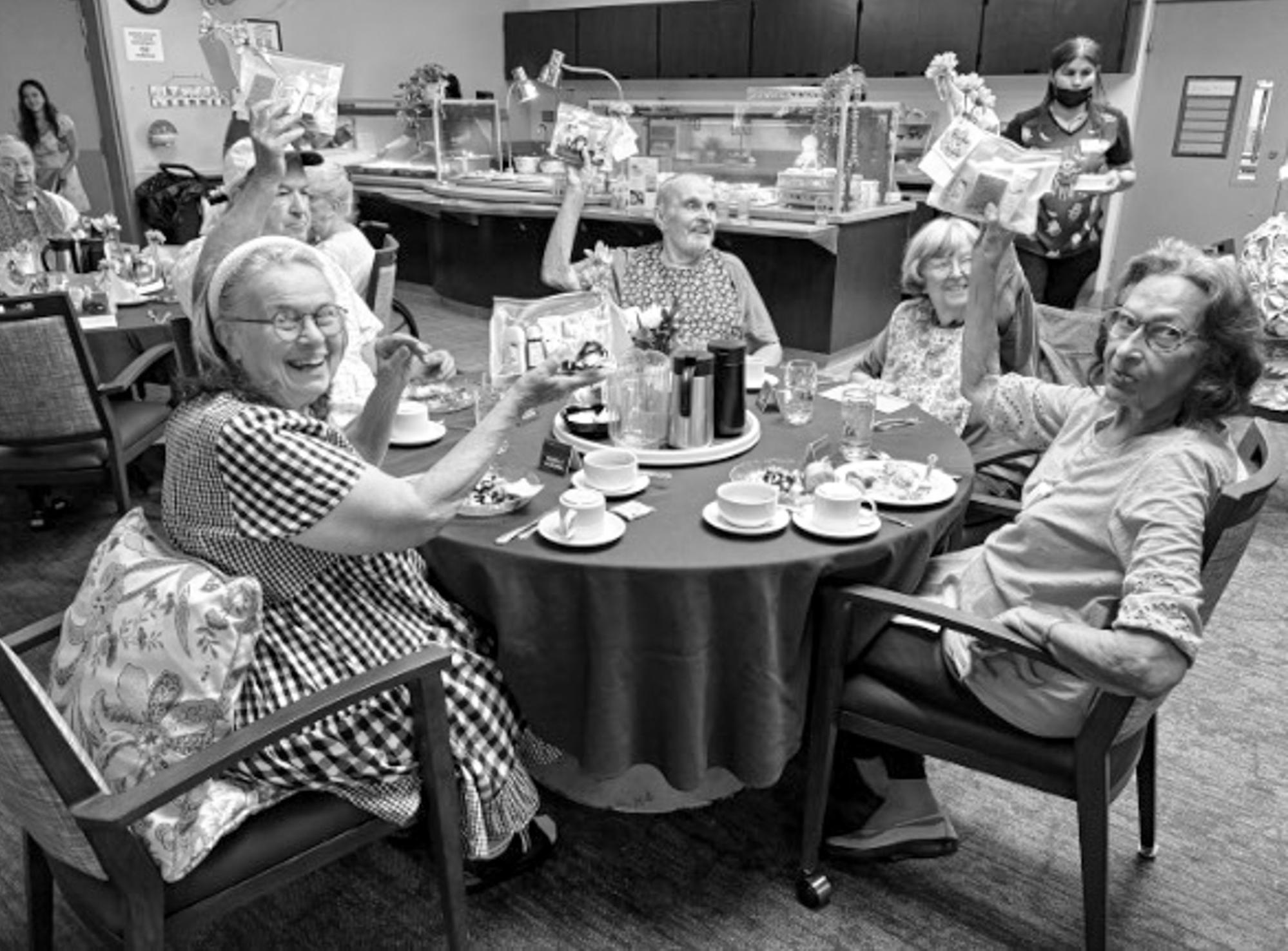
After experiencing the realities of the care economy, Michelle Ogasawara, PZ ‘27, is dedicating her time to bringing comfort to elders in the Claremont community through herawara and her team are working to break down barriers to essentials for elders in our community by delivering hygiene products.
Ogasawara decided to create the organization after volunteering at hospice centers and working as a phlebotomist — a blood drawer/ health care professional responsible for drawing blood —throughout her time in college. As a part of the care economy, she experienced the scarcity of standard necessities and saw how shortages served as a roadblock for elders already contending/struggling with illness.
“[For many elders] taking a shower is an accomplishment, that’s their marathon, just being clean,” Ogaswara said. “It takes a while for somebody to stand up, walk to the shower, wash their hair by
themselves as they have to get cleared by a doctor. So when they finally have that opportunity, there should be no reason at all why they can’t do that.”
Beyond delivering essential hygiene supplies, Ogasawara wants elders to feel cared for and empowered when they receive donations. As an Orange County native, Ogasawara has partnered with the faith-based organizations she grew up in and reached out to the greater Japanese community in her area to gather donations of hygiene products. To add a personal touch, Petals of Pouches partnered with Pomona Florist Mia’s Fiore to symbolize hope and, like, life outside of the state that [many elders] are in right now, which is very important, you know?” Ogasawara said, “ Your body is to take care of it, make sure it gets enough sun.”
Beyond petals, each package continued a hand written note courtesy of Ogasawara’s friends and team.
“I really liked that she [Ogasawara] was doing it. I thought it was sweet and I thought it was impactful,” Elizabeth Wang, PZ’ 27 said. ”For the letters, I just wrote things that I wanted to say to my grandma.”
As soon as the team returned to campus, they spent days assembling their pouchescare before
5 — 55 personalized packages to Pilgrim Place, a service-based Continuing Care Retirement Community (CCRC) in the village of Claremont.
Ogasawara and Petals of Pouches volunteers, like Lilianna Costello-Wiginton PZ’27, spent the morning distributing care
residents of Pilgrim Place.
“Many years ago, my grandma was in one of those places, in a retirement facility, in a home like assisted care, and it was not a great place for her.” Said Costello-Wiginton, “I think a lot of people, especially when they’re older, are isolated. It can make people sad, to make them depressed. I think she would have really liked something like that, especially the
After the first distribution cycle, Ogasawara was refreshed
by the intimacy and relationship building that she was able to engage in, and enjoyed a reprieve from the routine and coldness she experienced during her time on the provider side of the care economy.
“Patient interaction is great, you know, like in a hospital, like, drawing people’s blood was great,” Ogasawara said. “But also, today we felt like friends. It was so peacefulso, like, peaceful, refreshing. And I didn’t have to poke them and be like, ‘Okay, so today we’re testing for your
thrombin’ and remind them of their poor cholesterol.”
Pouches of Petals’ impact was felt immediately. Pilgrim Place requested another order of care packages before the team had even left the facility. Ogasawara’s dorm,of late night assemblings and Friday deliveries. , involved, follow pouches of petals @ pouchesofpetals on instagram or inquire at pouchesofpetalscom.com.
NERGIS ALBOSHEBAH • THE STUDENT LIFE
SIENA GIACOMA
ADAM AKINS
M ichelle Ogasawara PZ ’27 is dedicating her time to bringing comfort to elders in the Claremont community through her non-profit, Pouches of Petals.
aspiring women and non-binary writers
JOSEPH WOO CHAN
On Saturday, Sept. 6, women and non-binary students across the 5Cs gathered together at Lucky’s Coffee Roasters for the Women Who Submit (WWS) Party.
Co-hosted by the 5C WWSlege Writing Center, the Submission Party celebrates female and non-binary students working to submit their writing to major publications. From poetry to jourspace empowers writers across the spectrum to come together and discuss the publication process.
“I think it’s amazing what Emily Kuhn PZ ’22 said. “Trying to confront that by creating these identity-specific spaces for us to write, submit, band together, share resources and try to bridge those gaps.”
she has often experienced feeling out of place as a queer female writer.
“I feel like something that [women and non-binary writers] often share is an experience of imposter syndrome,” Kuhn said. “As a writer, you can be so dedicated to your craft, but as you’re going through the process of sharing your work, there’s all these different voices that can come up just because of our social conditioning and because the publication rates for women are so much lower.”
Despite WWS being in its early stages, members have already felt the impact of the club’s mission. For many, being in a space in which they are surrounded by other women and non-binary writers with similar goals makes them feel less alone.
Professor Melissa Chadburn began the event by facilitating a workshop for anyone new to the writing and publication process. further along in their writing journey used the cozy ambience of the space to make progress on their current projects.
Often known to students in her creative writing classes as “Professor Honeybee,” Chadburn is currently a visiting professor of English and World Literature at Pitzer. Despite now being a published author, she spoke about how she faced various struggles throughout her journey as a youngance on how to go through the publishing process.
“I have a PhD, but I went through all my education without
ever really being shown these basic things, like how to submit work for publication, where to submit work for publication and what that looks like,” Chadburn a bio look like? So I really want to take away any barriers for women submitting their work for publication.” Throughout her career, Chadburn also joined various writing communities. During her time with VIDA: Women in Literarynization dedicated to amplifying the voices of marginalized writers, Chadburn came in contact with the larger WWS group. Both organizations share the same mission of supporting women and non-binary writers through
published.
The national organisation of Women Who Submit was created in 2011 in response to the VIDA count, a yearly inventory of the total number of women and non-binary writers published in major journals relative to their male counterparts. This statistic showed a large gender disparity in the publishing world. Since then, WWS has evolved into an organization that hosts workshops and submission parties to increase the number of published women and non-binary writers.
To bring that mission to the 5Cs, Chadburn approached Pitzer Writing Center director Stephanie Liu-Rojas with the space. With the help of Pitzer Writing Center student fellows,
place in Spring 2025. Due to the success of each event, Chadburn has continueding Student Fellows Lennon Nuttall PZ ’27 and Daisy Schemeling -
Nuttall serves as President of WWS while Schemeling has taken on the role of social media coordinator.
“Until I had women to support me, I didn’t really feel like I even had a space in the publishing world,” Nuttall said. “So, that’s why I’m really passionate about Women Who Submit.” In addition to educating their peers on the publishing process, Nuttall and Schemeling are working to build WWS into a
supportive space to workshop ideas and drafts.
Schemeling is working on a poem that she hopes will evoke a child-like sense of wonder in readers. Since it is currently in the editing phase, she hopes that it will be ready to be issued at the next WWS event and be part of a larger poetry portfolio. Like her fellow members, she appreciates having a supportive space to work on her writing.
“I think that women are often very underestimated, especially in use fake names to publish under so that they’re taken seriously,” Schemeling said. “And to have a space carved out where you will be taken seriously regardless of your writing experience or how you write is really important.”
Books ‘n Love: When fake dating gets too real
We all love a good black cat and golden retriever duo, right? When one partner is always brooding, never smiles and hates practically everyone. And, of course, where the other loves rom-coms and chocolate.
Scientists Olive Smith and Adam Carlsen, “known ass” and “destroyer of research careers,” give us something of the sort. He only drinks black coffee — she loves sugary pumpkin spice lattes. She gets overjoyed at conveyor belt sushi — he thinks it doesn’t count as real food.
Adam is a professor at Stanford, and Olive is a grad student there. Not his grad student, but it is odd enough to receive some side-eye from me. They strike up a deal where they will fake date for both of their benefits, and I’m sure we can all imagine where it goes from there.
Throughout “The Love Hypothesis,” Ali Hazelwood puts a lot of emphasis on Adam’s size — a bit too much for my taste. He is broad, towering and even “as tall as Mount Everest.” I wonder, is that really the sexiest tall thing she could compare him to? The whole thing felt a bit too feeble and perhaps cliché, where a petite woman finds her big and strong savior.
Speaking of our strong man, Adam’s character was also just too bland for me. He had the tall, moody guy thing down, but that was pretty much it. I wanted to see more, and found myself wishing that the characters in this book went beyond being scientists and their one other surface-level trait assigned to them.
As their fake dating goes on, Olive sees past Adam’s moody guy front. She catches herself noticing his abs and his dimples, but continues denying her attraction to him. She digs herself
into a deeper and deeper hole as her lies build up. Once she realizes she’s falling for Adam, she even leads him to believe she’s in love with someone else. Even though he often goes out of his way to help her and is clearly in love with her, Olive is convinced she’s a nobody that Adam would never truly want.
I didn’t love Olive and got immensely frustrated with her while reading. To me, she’s a classic romance protagonist type, beautiful, smart and funny, with friends who remind her how great she is. Yet, she constantly thinks she’s nothing special and not good enough for anything. She’s the type to throw her hair in a messy bun
and slap on whatever clothes she finds first, looking effortlessly beautiful to everyone but herself.
Olive’s insecurity doesn’t make her feel relatable — instead it feels like a plot device. The story needs her to stay oblivious and self-deprecating to stretch out the tension, but it undercuts her intelligence and self-awareness. I felt like I was watching her hold herself back for no reason. Look, I understand being insecure, but insecurity paired with a protagonist who is otherwise presented as perfect without trying reads less like depth and more like cliché. However, though I found myself screaming at her for not
seeing what’s so obviously right in front of her, I weirdly rooted for her throughout the entire book. Maybe her stubbornness made her eventual happiness feel earned.
I wish we got to see deeper into Anh, Olive’s best friend. She is a Vietnamese woman in a male-dominated field, always trying to make things more inclusive. Yet, she didn’t feel very fleshed out. It sort of felt like her only character trait was being a woman of color in STEM, and even that didn’t feel very explored. Olive describes Anh as “her person,” yet we watch her lie to Anh for most of the book. I wish Hazelwood had given Anh more dimension — her
perspective as a woman of color navigating academia could have added depth to the story, and her friendship with Olive could have provided a stronger emotional anchor beyond the romance. At the same time, some parts of the book felt overly drawn out. The sex scene in the book lasted about two and a half chapters, which felt far too long and fleshed out. I found myself no longer absorbed in the book and waiting for it to end. The scene also fell into the unfortunate trope of an older, powerful man guiding the innocent, younger woman. Despite this, I liked that sex wasn’t a main focus of Olive and Adam’s relationship! However, this scene could have been trimmed without losing anything important. Overall, this book has a lot of miscommunication, so if you aren’t a fan of that trope, it will probably make you very angry. It’s painful to watch two people not realize they’re madly in love — think “Pride and Prejudice” levels, where if they just spoke honestly for a few minutes, everything would be fine. Despite its flaws, “The Love Hypothesis” has its charms. Do I think this was a fun read that was easy to get through? Yes! I can admit that I did find Adam and Olive cute at times. Definitely cute in a corny way, but I can appreciate that. Did this book kind of feel like fan fiction? Also yes! Would I recommend this book? Sure, if you like silly rom-com novels that you can’t really take seriously. If not, then I would tell you to pass on this one. Either way, it’s the kind of book you can enjoy with a pumpkin spice latte in hand, no deep thinking required.
KASSIA ZABETAKIS
MELINDA QERUSHI • THE STUDENT LIFE
Kassia Zabetakis PZ ’28 loves speeding through romance novels in only days, but usually ends up hating them after she’s done.
BOOKS ‘N LOVE
We should all be ashamed of our monolingualism
ALEX BENACH
In the 2020 census, roughly 20 percent of native-born Americans reported being able to speak two or more languages. This is the highest percentage ever reached in America, but America becoming more multilingual is not a result of Americans seeking out language learning. In fact, the opposite has occurred.
language class enrollment has fallen at an alarming rate. This is clearly a failure on behalf of us college students. By not seeking out language learning, we fail to put our money where our mouths are. We must work to realize an inclusive and diverse vision of America, one many claim to value deeply.
I do not raise this point to scold, the unfolding crisis of language learning. Rather, I argue the essentiality of even attempting to learn languages other than English. America does not “have room for but one language” as Theodore Roosevelt may have you believe. We must take an active part in creating an America in which multilingualism and cultural diversity abounds.
The value of learning a language other than your native tongue cannot be overstated. Not only does it it opens one up to deeper levels of connection and communication with more people. Further, language is cultures, learning the day-to-day experience of others and exercising empathy.
More than 1.5 billion people speak English across the globe, and 75 percent of those people speak it as a second language. While this may seem beneficial — for trade and business agreements, particularly — this could prove culturally dangerous and could lead to a decline in global language diversity. Preserving languages that have deep historical, cultural and societal roots needs to be a priority. Practicing a variety of languages contributes to their continued existence and prevalence, especially as we shift to a monocultural world.
At the Claremont Colleges, we are uniquely situated to exercise a praxis of acquisition of foreign languages. We can engage with people at the 5Cs who are fluent in a language other than English, and more people should. Speaking in the native tongue of your peers, dining hall workers, maintenance
on campus is an excellent way of practicing this. In a more academic fashion, the Claremont Colleges collectively languages. It is my personal opinion that more languages should Tagalog, Swahili are a few that come to mind). It is not sufficient to simply meet the language requirement and end your foreign language journey there. For one, the language requirement is not expansive enough and should be heightened. Students should be encouraged skills in literature comprehension in other languages. Further, the
language requirement should include a number of classes that students must take in addition
The leniency currently present represents a lack of care and dedication to cultivating multilingualism. Students must take advantage of the plethora of resources at their disposal. Attend Oldenborg language tables, study abroad in a non-English speaking country and seek out people who speak the language that you are wanting to learn. In doing so, you gain an understanding of the world that is otherwise inaccessible or lost to history. Further, we must be engaging with literature and the written
language as forcefully as we engage with the spoken aspects of learning language. Reading news articles, blog posts, books, plays – really any form of written material — in the original language facilitates your understanding of the language. Translators have an incredibly valuable place in society, but to read the original words, as produced by the author, brings one much closer to understanding the work as a whole. We can do better than this. We must engross ourselves in languages other than our native tongue. Itcially given the fact that language as a person ages, but it is work that is worthwhile. Our community as
appreciation of cultural diversity. Monolingualism is deeply shameful and a moral stain on those of us who emphasize understanding and connection. In this current moment, learning languages serves as push back against authoritarian efforts to make our nation less diverse.
Alex Benach PO ’28 es de Washington D.C. Ha estado tratando de leer Don Quijote en español durante seis meses, pero es realmente difícil.
Teaching about the America that is
LINUS YAMANE
Trump is my fault. Almost 40 years ago, I began teaching economics at Pitzer College. Coming from the World Bank, I was invited to give a talk on international trade at Claremont McKenna College early in my time at the 5Cs. I spoke enthusiastically about free trade — how it drives economic growth and raises living standards.
Only briefly did I mention the complications; some sectors and workers would lose out. But I reassured my audience that with smart policies — job training, regional support, education investment — we could support those left behind, and everyone would be better off.
decade, we failed to support those marginalized by our economic policies. Our college graduates did very well, but our high school graduates went nowhere. The understandable frustration by median Americans paved the way for the election of President Trump. Since 1970 average income tripled. Real GDP per capita rose from $25,710 in 1970 to $69,302 In part, this growth was due to increasing free trade and globalization. World trade as a percent of world GDP tripled during this period. But most of this growth was due to increasing technological change. With automation, our factories became much more productive.
If you visited a Detroit auto plant in 1970, you saw hundreds of workers on the assembly line. Today you’ll find hundreds of robots, supervised by a few highly skilled technicians. While average incomes rose, the benefits of international trade and technological change were unevenly distributed. Lower-skilled workers — especially those in manufacturing — lost their jobs either to automation or cheaper overseas labor. The standard of living increased steadily for college graduates. But those with less education saw their real wages stagnate or decline. Americans without a high school diploma had a higher standard of living in 1970 than they did 50 years later. Income inequality increased decade by decade. Our Gini coefficient, a measure of inequality, rose from 34.7 in 1980
to 41.8 in 2023. We now have more income inequality than in 85 percent of the countries in the OECD. As income inequality grew, so did life inequality. There’s now an 11-year life expectancy gap between college graduates and high school dropouts. “Deaths of despair” — from suicide, drugs, alcohol — are symptoms of this deep crisis. Remember that most Americans, 25 and older, do not have college degrees. This didn’t have to happen. But people like me failed to speak up clearly, loudly and early enough. I used to separate positive economics — the study of what is — from normative economics — the study of what should be. I avoided discussing
my values in the classroom. That was a mistake. Economists, policymakers and educators have a responsibility to ensure that progress is broadly shared. International trade and technological advancement are powerful forces for good — but only if we put policies in place to prevent whole communities from being left behind. We didn’t. For decade after decade, administration after administration, Republican and Democratic, we failed to ensure that the benefits of growth were distributed to everyone. Communities devastated by half a century of lost factories and broken promises understandably lost faith in traditional Republican
and Democratic leaders. Into that vacuum stepped Donald Trump, with his empty bluster, xenophobic scapegoating and sham solutions like trade wars and mass deportations. Our prosperity depends, first and foremost, on our productivity here at home, not on what other countries or people do. But populist demagogues always point the finger at someone else: China, Mexico, immigrants. By blaming foreigners and immigrants, our policies are now causing enormous harm without dealing with any of the actual underlying problems. I can’t pretend that a single lecture, or even a career of them, could have changed the course of American politics. But I regret not doing more — not warning
my students more forcefully about the need for us to bring everyone along and not sharing my values when they mattered most. We can’t undo the past. But we must do better now.
Let’s stop pretending that rising GDP alone means progress. Let’s remember that good policy must be both smart and fair. We should open the door for global and technological change, but we can’t leave half the country standing outside.
Linus Yamane is an economics professor at the World Bank and the Development Bank of Japan. He has a Ph.D. in Economics from Yale University.
Adrianne’s Crossword: Hopecore
ACROSS 1. Apt rhyme of “crude” 5. 9. Makes a dress at the Makerspace
Land line?
15. Raven relative *Like some supportive shoes
Tomato type 19. Chrome alternative
21. *Majors held annually in
29. Accessory that might read “Prom Queen”
“sauce”
*They have lots of aura Something charged in chemistry class? Aired again
Cheese in Indian cuisine
51. Mothers of colts
52. Wicker material Slushy treat 55.
starred entries indicate
59. Silverstein Polite refusal
Mudd!
5. “The Thinker” creator Push-up target 9. Collage material Wear 11. 12.
Sooo many 21. Most decorated player in the history of soccer 22.
25. It may have highlights the Hoch confusing”
D.C.
perhaps
Russian rulers Duos + one
What a stressed student might
Revolutionary items?
Parker aka Spider-Man
The “A” of LAC
Like many residents of Lancaster County, Pennsylvania Chip to dip
Home of the Dior Museum
55.
Type of “plan” at a college DOWN
1. 2. Mess up
Support SB 79 to begin addressing California housing, transportation crises
NICHOLAS STEINMAN
California likes to market itself movie stars and opportunity — the sunniest, most glamorous manifestation of the American Dream. Still, some imagine it as a desolate, trash-
cost of living.
tion, this narrative contains a grain of truth. Despite stagnant economic during the height of the COVID-19 pandemic, our state continues to feel
fornians are priced out.
legislature that aims to address these
ments and dense, multi-family hous-
is nearing the end of the legislative process: an amended version passed morning of Sept. 12, and the senate the end of the legislative session. It
from local governments, including the Mayor and City Council of Los Angeles, still threatens to stop this progress in its tracks.
homelessness and remedy its no-
campaign for its passage.
of living, the demand to live here increases to outpace inflation. population has slightly declined
people. The cause of this shortage is long-term policy failure. For decades, California has failed to
and other forms of multi-family
over 95 percent of land designated reserved for single-family home developments. This leads to the
residents to drive ever-longer supercommutes to seek the same
ilar restrictions have also reduced the effectiveness of California
les voters approved Proposition
along major streets in the city, dramatically reducing its housing ”capacity” and kneecapping the
scent Metro Rail system.
store a modest element of planning
constructed on commercial and residential plots. At the moment,
their mass transportation systems. Unfortunately, small groups
hope to preserve the “character” of often a smokescreen, thinly veiling people might move into changing hastily erected near the core of
and infrastructure must evolve in order to respect their roots. The -
housing and commerce surroundmust reinvigorate in the modern age.
More sympathetically, many -
fall victim to the fallacy that the housing crisis in California can
ifornia is not full, as infrastructural value. The homeless population in
displaced as the apartment supply demand continues to rise.
passed the state senate once, local governments and special interests are still pressuring sympathetic
live and study in the state, please
Nicholas Steinman CM ’28 is a lifelong Los Angeles resident and incoming transfer student. In his spare time, he enjoys taking long, contemplative walks and yelling at clouds about public policy.
Performative men are the lesser evil
LEILI KAMALI & ANSLEY KANG
“Performative Men” have invaded the imagination of 5C students. At our local Performative Male to emulate — or live their truth as — gender, year and archetype of 5C
very, very hard.
social media, the Performative
ing the values he projects. Matchas. electric guitar. Crossing the digital-physical of the Performative Male centers around a vision of a comic manipulator, mocked for his femininity and derided for his perceived inmanipulators — is likely destined
culate, they uphold the dated norms of machismo. Understanding thegender performance.
face value, these self-proclaimed “feminists” pose as enlightened
sive — it makes you parasitic. As a result, feminism is appropriated as
rights to vote.
in the familiar dance of gender performance. What makes him much ridicule, is the fact that his performance is actually aimed at unlike other microtrends of male
In elementary school, the most charming thing my crush could
proving toughness, dominance or other men, this softer matcha-musfake, manipulative or cringey. The Performative Male threatens the traditional gender dynamnatural all of our lives. The real issue of the Performative Maleor another. The issue lies in the see men shifting their performance masculine. Perhaps this shift in
truly Performative Male or miscollect vinyls, the Performative of a larger trend of gender perfor-
performance itself is framed as emthen, is less a villain than a mirror performance itself, and forcing us
male they deem performative.
dominant culture of our society
A Swiftie’s “Picture To Burn”
to speak to each other anymore. since promoted other smaller indie-pop artists, including inCarpenter to open for her
lacks depth. Despite all this, her music holds a special place for me. morning “evermore” dropped out of parents for it years later.
as revolutionary. Ultimately, her she is too much of a money-hungry egotist to deserve her platform.
close, mentor-mentee relationship. merch in old social media posts and posted on social media looking like on “Deja Vu.” Rodrigo mentions
from Lana Del Rey to Hayley Williams. All not included. As of today, “SOUR” has 15 on Spotify, of any female artist on the app. It has surpassed ev-
let another young female artist succeedtached, demanding Vu” and revealing her self-interested character.icism and an indie-pop-rock
sure.” I understand that her career depends on her image — she much success, it is clear that her to feed her ego. In her documentary, “Missmidterm elections portray her asimage, eventually concluding that
eryone. Relentlessly mocking the result? A culture that punishes
feminists? It might get harder to -
Leili Kamali PO ’29 is a recent Iron and Kin promoter from San Francisco, California. She enjoys the smooth rhythms of and the occasional pump of lavender
Ansley Kang SC ’29 is a Clairo-loving, Smiski-collecting Portlander who may or may not have been traumatized by the Performative Male. She is currently trying to get her hands on the Checkmate Labubu series, and will always be at banana cream matcha deal.
icana” came out, she has made just
commented on elections, rights and gun
risk and mostly impact
silence seems to speak as loud as her sparse statements. This is particularly true in contrast to
turned the O2 vegan in honor of a climate-centered event, forcing all speech to validate the Trans com-
to protect
selves. She struggles to address current
issues like the Palestinian
“nice girl.”diversifying my listening activity and calling out perpetuating actors them, and I refuse to put her on the pedestal that I used to.
of
NICOLE TEH -
Nicole Teh SC ’27 is from Hong Kong. This month, she has been listening to version
“Diet Pepsi”.
MJ Newsom debuts as fulltime P-P sports broadcaster
JACK HE
A buzzer-beater? A running forehand down the line on match point? A one-handed catch for a touchdown? For fans, a great call is essential to reliving the moment, and for their rivals, it lives rent-free in their heads. For the longest time, Pomona-Pitzer (P-P) relied solely on student broadcasters — until this fall.
Meet 22-year-old MJ Newsom, P-P’s new in-house, play-by-play sports broadcaster. He’s here to explain his role and why sports broadcasting is so much more than a free front-row seat with a side of yapping.
TSL: What do you actually do?
Newsom: When you tune into the game on FloSports, I’m the one talking. I’m the one describing everything and giving you the story lines, the stats, the player names and bringing the game to life for the viewers and listeners. whether it’s on TV, and you can actually see it, or on the radio, where I’m having to be more descriptive and paint a picture in the listener’s head.
TSL: How do you do research for upcoming games?
Newsom: When I do preparation for games, I make spotting boards, which are charts that have the player’s name, their position, number, height, weight, where they’re from, their year in school and their stats.
For football, I was working on Grady Russo, the starting quarterback. I have his last game stats versus Willamette at the top, and then I have a bunch of notes beneath that for things that I can bring up during the broadcast.terviewing a coach, by researching on the internet. One thing that is really powerful in today’s age is using AI to streamline and make your research a lot quicker.
TSL: When and how did you become interested in being a sports broadcaster?
Newsom: I was probably 8 years old when I decided that maybe this is what I want to do. I think it always started as a fantasy, sometimes my dad and I would hit mute, and we would do the game ourselves for fun in the living room.
When I was a sophomore in high the wall for a sports broadcasting club, and I was like, “This is interesting.” So I joined this club of three people. It’s year because it didn’t have enough members, but it gave me that gateway to get into sports commentary.
TSL: What did you do in college that furthered your interest and expertise in sports broadcasting? Did you meet anyone you could call a mentor?
Newsom: I was the co-sports director of our student radio station, KXSC, during my senior year. Throughout college, I also called games on campus. football, basketball, baseball and then also called some games on Big Ten Plus.
My biggest mentor’s name is Roger Hoover. He’s the women’s basketball and baseball broadcaster at the Univer-
sity of Alabama. I’ve known Roger for pretty much my whole college career. I’ll send him a six-to-ten-minute segment of me calling a football game, a basketball game, a baseball game, whatever it might be [and] he would go through and critique it.
TSL: What’s the time commitment like being a broadcaster for all sports?
Newsom: Let’s say that today is Monday, 5 p.m. I’ve got a basketball game that I’m calling on Wednesday. hours to prepare for one team if I do it the right way. I’m looking at spotting boards for that game, and then another three when it comes to memorizing names and numbers make sure I know what the players look like.
What do they wear? Do they have an arm sleeve? Do they have black hair? What color shoes do they wear? Those are things that can really help when you can’t see anything.
TSL: What’s your favorite part of your job?
Newsom: I’ll give you two answers.
to life. It’s really impactful. Every time there’s a big play, a call is associated with it. If you’re watching the 2016 NBA Finals, LeBron James has the block against Andre Iguodala. Everyone associates that play with “Oh! Blocked by James!” when Mike Breen called it. Whatever kind of moments they are, I am helping bring those to life, to the listener, to the viewer, to build up more emotion.
The second part of the answer is the relationships you get to build, whether it’s with coaches, athletes, other broadcasters or other people in sports. No matter what your role is within sports, everyone’s there because they love it.
money-wise if we’re going to work 9-to-5 at J.P. Morgan. But that’s not what we want to do with our lives. We want to be in sports, and just being around those people makes the job more enjoyable, because everyone shows up to work just excited.
TSL: Why did you come to Pomona-Pitzer?
Newsom: I knew in my soph-
omore year of college, at the radio station, that I wasn’t really at the top of the totem pole. I was towards the bottom, and it was going to take a little while for me to get my start because I had people in front of me. I wanted to get reps and get better, so I reached out to a ton of small schools in the LA area, and Pomona was actually the only school to get back to me.
I called some football, some basketball, off and on. This past summer, I reached back out… [Associate Athletic Director of Communications and Operations Sam Porter] and I met, we talked multiple times, probably for over a span of nailed something down for me to come back.
TSL: What are some of your future goals/aspirations?
Newsom: The loftiest and the biggest goal for me is to be broadcasting games on a big network — ESPN, CBS, FOX — those outlets would be awesome. My favorite sports broadcast is basketball, so I think working for an NBA team as a broadcaster is a huge goal, whether it be on TV or radio.
I would love to be the voice of a big-time athletic program, obviously, Pomona-Pitzer, [Division III], but it’s still being the voice of a school, which I love. But being the voice of an Alabama, a Texas or a USC would be really cool.
TSL: Do you have any words of advice for aspiring sports broadcasters?
Newsom: you want to become a sports broadcaster is to give it a shot. If you want to try being a sports broadcaster, you don’t have to have all the fancy equipment. You can just grab your phone, you can pull up Voice Memos and you can go sit in the stands and just do it.
Outside of student radio, seeking out some kind of professional menpeople have been in the business way longer than I have, and they’ve seen more things, called more games and experienced more to help mold and shape me to become a professional like I am now.
This interview has been edited for length and clarity.
New era, same pride: PomonaPitzer Athletics unveils new logo
As most Sagehens were away from campus this summer, Pomona-Pitzer (P-P) Athletics was hard at work behind-the-scenes updating the school’s athletic brand.
On Aug. 1, the public was introduced to a new era of P-P athletics with the launchworked Sagehen design and an updated Cecil. With the new logos came reworked jerseys, apparel and merchandise. For many, it was a full-scale redesign of the P-P emblem.
The design process consisted of feedback from the P-P community. It was not a decision taken lightly, according to Sam Porter, the associate athletic director of communications and operations.
“It’s been in the works for quite some time,” Porter said. “We took groups of students, staff, coaches, stakeholders and alumni that met with our redesign group and came up with ideas and ideals that we thought would go into the new logo that represented Pomona and Pitzer.”
Despite the excitement of the unveiling, it received mixed feedback from the student body. Charlie Treene PO ’26 of P-P basketball talked of how many student athletes were quick to question the refashioned logos.
“I think some people were a little against it at first, but I think that’s just an initial reaction to change,” Treene said.
Ella Bowers PO ’26, a member of the women’s Track and Field team, described her initial hesitancy towards the change.
“I would say at this point it has grown on me a bit more,” Bowers said. “I think for a lot of us, it was jarring at first, but I get it a bit more now.”
According to Porter, the athletics department felt the update was long overdue.
“We needed something that was a little bit more modern,” Porter said. “We haven’t touched that logo or anything on the brand for 50 plus years, so I think it was time.”
For the athletics department, the rebrand reflects a larger shift into a new era of P-P athletics. Alongside newer facilities like the Center for Athletics, Recreation, and Wellness (CARW), this update demonstrates an investment in the future of P-P athletics.
“I think with the timing of it, of the recent success of athletics, the new building and the investment in the Pomona Pitzer athletics, I think the rebrand is right on cue
with moving us from where we competing at the highest level of Division III,” Porter said.
Yet, as the athletics department worked to rebrand the logos as part of a larger commitment to athletic success in the future, some thought they lost track of the school’s identity as a DIII liberal arts institution.
“I think some of the logos they released are more simplified than the old ones,” Treene said. “The original logo is a lot more traditional, and it fits Pomona as a traditional liberal arts school type of vibe.”
JT Bard PZ ‘26, a member of the Men’s Cross Country Team, agreed, wondering if the new logos went with the tradition and history of the colleges.
“Part of my problem with the head of the Cecil is that it feels like the design doesn’t fit the vibe of the school,” Bard said. “To me, the logo kind of goes in a much more modern direction…in like a very sterilized kind of form. It feels like something that would fit an NFL team or something, whereas I don’t feel like it matches the vibe of the schools.”
Despite some skeptical first impressions, many student-athletes thought the modernized change was warranted and offered exciting new possibilities for the future of the athletics department. Treene particularly enjoyed Cecil’s revamped design.
“We’re trying to go for a more modern look, so it’s cool…I kind of like the more complex look,” Treene said.
Despite the complexity of the new design, Bowers felt as though it still retained some of its authenticity that was core to the old Cecil.
“[Change] is always going to be uncomfortable, but looking back now, that did look outdated,” Bowers said. “It is a nice refresh and it still maintains the integrity for sure.”
With the updated branding also comes new excitement and school spirit centered around the logos themselves.
“There’s definitely some pride in representing the logo, because it’s a concrete image of our athletic program,” Treene said. “It represents [our] time together and everything [we] work towards throughout each season.”
Running on empty: F1: The Movie is all show, no speed
As a Formula One (F1) enthusiast, I’ve followed the sport since 2020, and I have since pledged my allegiance to the red house of Ferrari. So when “F1: The Movie” was announced, I was ecstatic. With a star-studded cast led by the Damson Idris, anticipation grew as at real Grand Prix on weekends throughout 2023 and 2024. If that much star power was not enough, this 2-hour 35-minute ode to the sport was co-produced by Sir Lewis Hamilton, star of “Cars 2,” part-time model and seven-time F1 World Champion.
Fans rallied together in excitegetting an accurate, immersive representation of one of the world’s fastest and most glamorous sports dramatised and controversial show, “Drive To Survive” — but it seems they thought wrong. Early reviews trickled in leading up to the release date, and there was a clear consensus among fans: “F1: The Movie” was unwatchable for those with prior knowledge of the sport. Friends who were also longtime watchers of the sport advised me to
uninspiring sports movies that have come before, I had regular experience in that department. I expected the usual inaccuracies that riddle rules, plot holes and metaphorical last-minute buzzer beaters.
Sonny Hayes, a grizzled, battle-hardened driver played by Brad Joshua Pearce, played by Damson Idris, the new rookie starboy of
APXGP F1 Team. The motley bunch is led by Hayes’ old teammate, Rubén Cervantes, who seems to be the only person who sees past his rough exterior and recognises the waning embers of greatness in him.
APXGP’s goal for the season is clear enough: win the bare minimum to avoid going bankrupt. F1 is the world’s most expensive sport, with a car costing around $15 million to develop. That doesn’t account for the many replacement parts required throughout the season that can add up to $150,000. Hayes’s strategy to win is at the team and the rules of the track. Reluctantly working with Pearce, Hayes uses the tactic of spamming weapon of destruction — allowing Pearce to pull ahead.
ism,” Hayes’s antics would have likely warranted a race ban by the governing body, the Fédération Internationale de l’Automobile (FIA). He would’ve faced a ban from coming within 10 miles of a circuit, given that the FIA has as trivial as foul language. falls short, and the forced mentor-mentee routine feels like a shortcoming is simple: it’s trying sloppy dialogue and plot, and the mentor-mentee dynamic feels like Take Hayes’s love interest, Kerry Condon: His hookup-turned-girlfriend being the technical director of his F1 team should’ve never made the cut.
where only one woman has ever worked as a race engineer, it’s essential to set some positive standards, especially because Hamilton himself has championed women’s equity in F1. Reducing a woman to a conveniently placed plot device to check a box is lazy writing. Instead, Simone Ashley out of the movie) would’ve faredfriend of Pearce. Viewers are instead forced to sit through some of the most childish dialogue of the year, with Pearce glibly delivering one-liners that seem to have been inspired by early Central Cee songs. Idris, despite delivering a stellar performance in “Snowfall,” was knifed by predictable writing and a largely one-dimensional role. However, joy can be found in the most unexpected places in the story. Think easter egg shots of the now-retired Haas team principal, Guenther Steiner, in various stages of shock and rage. Small cameos by drivers such as Fernando Alonso and Carlos Sainz were a welcome change amid tense interactions between Hayes and Pearce. Director Joseph Kosinski takes full advantage of his Paddock Pass+ access to the other twenty teams. He tastefully intersperses Idris, and taps pundit Will Buxton in for commentary. To his credit, the movie is accurate in all of its glossy parts:torhomes leading up to a Grand Prix, the breathless exhilaration of every start and the glamour that surrounds the world’s most expensive sport. Another highlight was the races themselves, produced artfully
with edited montages of snappy gear shifts, tight turns and dramatic crashes through custom-developed Apple cameras in helmets and cars.
It’s easy for me to break into my “um, actually” throughout the film as someone who’s followed F1 for half a decade, but it is undeniable that it’s going to be the entry point for many new fans. Since most talent is recruited from Europe, Australia and Asia, untapped audiences in America often unfairly perceive the sport to be fast cars going maniacally around the track in never-ending circles. -
ship for non-American audiences, such as those in Australia, reached 1.10 million people in 2025, a 103 percent increase from 2024.
In an uncertain but exciting era of the sport marked by new regulations, a new team (Cadillac) and emerging rivalries between fresh talent such as Lando Norris and Oscar Piastri, the movie does well
to counteract the boring allegations of the sport.
However, it could have focused more on the tense politics between drivers and correctly represented the strenuous training that they a track. The directors trade that for shots of Hayes.
that are unafraid of dissecting the technicalities of the matter. The potential of “F1: The Movie” to be
of Hayes. A simple solution for the directors? Dropping the fuss and leaving it all out on the track.
Lavanya Aditi Puri CM ’29 is from India, intending to major in a variation of Economics with a minor in Clash Royale. She has survived Xavi’s Barcelona and is weathering through Ferrari’s antics since 2020. She is currently in pursuit of Diamond in Merge Tactics.
JAKE CREELAN
COURTESY: MJ NEWSOM
MJ Newsom is Pomona-Pitzer Sagehens’ new play-by-play sports broadcaster