Pomona responds to false bomb threat before Shen Yun performance
ILA BELL
A bomb threat targeting Shen Yun’s March 30 performance at Pomona College’s Big Bridges Auditorium triggered an emergency evacuation amid increased scrutiny of the controversial non-profit dance company. Authorities ultimately determined there to be no suspicious activity at the college, and the performance took place at its scheduled 2:00 p.m. time.
5C students received a Campus Safety alert warning them about a “building safety issue” at the auditorium prior to Shen Yun’s second day of performances at Pomona. The exact safety issue in the auditorium remained unspecified in the following notifications. However, an X post by Shen Yun on the same day said that a bomb threat had targeted the building.
The X post featured a video of dancer Jason Zhu evacuating the auditorium; the post also quoted Zhu, who said that it was the fifth threat to Shen Yun that he had witnessed. According to the Shen Yun-affiliated Falun Dafa Infocenter report, the company has received over 130 threats since 2007.
Shen Yun is a non-profit dance company that has been touring globally since the early 2000s. Known for what critics describe as its “ultra-conservative” practices and its strong opposition to the Chinese Communist Party, Shen Yun was banned from China in 1999.
Since then, it has faced significant criticism for its practices and messaging, most recently in a 2024 New York Times investigation that found the company employees to be working under abusive conditions.
When Pomona learned about the bomb threat before Shen Yun’s March 30 performance, the
college took immediate action.
According to Laura Muna-Landa, assistant vice president of communications and community relations for The Claremont Colleges Services, Campus Safe-
The Trump administration’s federal policy regarding immigration has sparked a wave of visa cancellations, detentions and deportation concerns, prompting advocacy organizations and 5C community members to address the protocols related to students’ rights. On Jan. 20, the Trump administration issued an executive order titled “Protecting the United States from Foreign Terrorist and Other National Security and Public Safety
See ICE on page 2
ty quickly enacted emergency protocols and began coordinating with the Claremont Police Department. After reviewing security footage of the building, Campus
Safety determined there to be no suspicious activity and concluded that there was no risk to people in the surrounding area. They did not notify students about what the suspected safety
PATRICK MCDOWELL
With students at the 5Cs beginning to submit their financial aid applications and federal funding for higher education growing increasingly uncertain under the Trump administration,
many students have begun to question how their aid packages might be affected.
The Claremont Colleges frequently rank among the most expensive colleges in the U.S. All 5Cs boast a tuition fee of at least $60,000 annually and a total cost
issue had been.
“This was part of a coordinated response to ensure safety while minimizing unnecessary alarm,”
of attendance averaging around $90,000.
As such, aid programs remain vital to the 5C community, with the colleges offering between 42 percent and 70 percent of their student
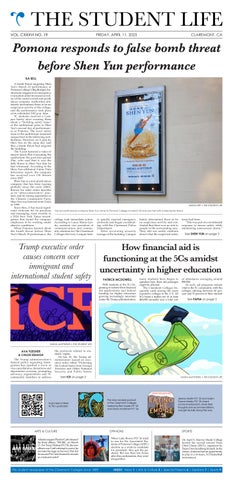
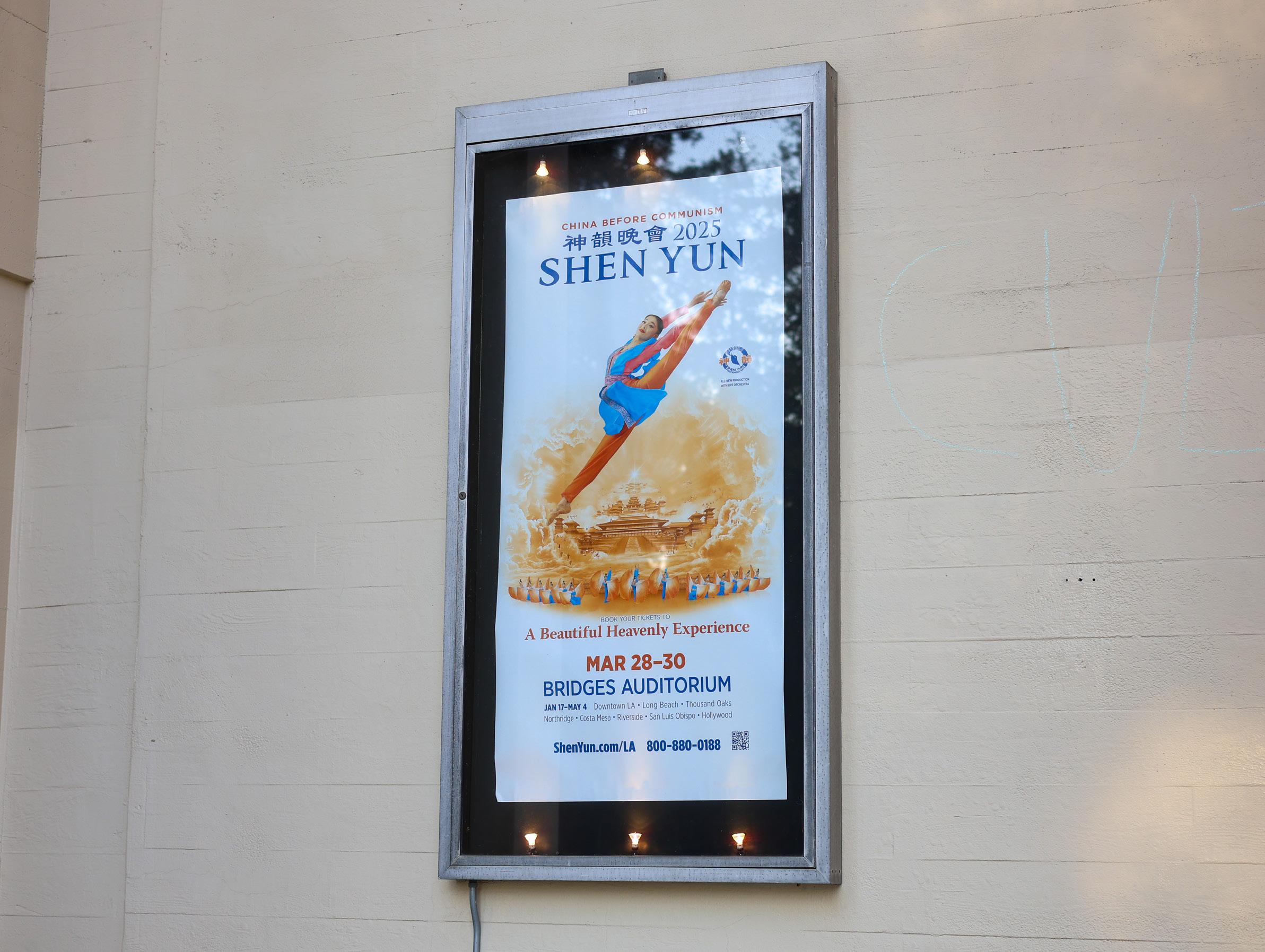
The non-profit dance company Shen Yun came to Pomona College on March 30 and was met with a false bomb threat.
SARAH ZIFF • THE STUDENT lIFE
sH e N YUN: Bomb threat at Pomona prompts emergency evacuation
Continued from page 1
Muna-Landa said in a statement to TSL. “Consistent with standard emergency procedures, limited information was shared to reduce the risk of panic, prevent misinformation and allow authorities to complete their investigation without interference.”
Nora Wilcox PO ’28 said that she heard about the bomb threat through a fellow student, rather than through the college. She added that she understood why Pomona didn’t release any specifics during the investigation — especially after the recent swatting incident at Claremont McKenna College — but that there should be better forms of communication during situations like these.
“If there’s not actually a bomb, then that’s more unnecessary action,” she said. “But also, I think after the fact, I feel like there was some disconnect with how [Pomona] dealt with the situation, and how all the schools deal with this. I think there could be better forms of communication.”
Beyond raising concerns about campus security, Shen Yun’s visit to Pomona provoked student questions about the company’s
practices and their place performing at the college.
“I do not agree with the philosophies of Shen Yun and what it represents, and what they stand for,” Wilcox said. “I’m just kind of conflicted because, yes, I think it’s totally uncool to have them perform on our campus — I don’t support them. I also feel like, if we’re in a space where we’re welcoming all perspectives, maybe in that way I can understand welcoming them on campus.”
Prior to hosting Shen Yun, Muna-Landa said that Pomona was aware of potential threats that the group could bring to campus and worked with Campus Safety to determine safety measures.
“In advance of the event, Campus Safety collaborated closely with Pomona College administration and Bridges Auditorium staff to assess potential security considerations related to hosting Shen Yun,” she said.
Pomona has not indicated whether it will host Shen Yun in the future in light of the controversy and threat.
Continued from page 1
bodies some form of financial assistance. For many of these students, it is crucial to their ability to attend.
“Financial aid was pretty much the whole reason I came to Pomona,” Ben Surosky PO ’26 said. “Without the level of aid Pomona gives, I would not be here.”
However, the Trump administration has threatened federal funding for dozens of higher education institutions across the country — including Pomona and Scripps Colleges — who they claim have failed to adequately respond to instances of antisemitism.
But according to a Feb. 6 email that Acting President of Pomona Robert Gaines sent to Pomona students, financial aid commitments for both incoming and returning students will remain the same.
Paul Dieken, director of financial aid at Pomona, shared a similar reassurance, saying that students should remain calm and that commitments for the coming year will be unaffected.
“The way we determine students’ eligibility for aid is going to stay the same,” Dieken said.
“We are not going to be making any changes.”
Dieken also underscored the college’s commitment to programs such as QuestBridge and the American Talent Initiative, which act as a bridge to overcome financial barriers for high-achieving students from low-income backgrounds.
“Those are points of pride for the college,” he said.
In an email to TSL, Scripps made similar commitments to protecting aid for students while continuing to monitor the situation in Washington, D.C.
They also said that the Department of Education has confirmed that they will continue to fund programs such as Federal Pell Grants and Federal Direct Loans for the 2025-26 academic year, and that Federal Work-Study and other grants will remain unaffected.
Beyond the threats to higher education funding, recent staff cuts at the Department of Education could impact the speed at which loan and aid applications can be processed.
Dieken said he expects delays from the federal government and believes students should look to submit FAFSA and all other documents related to federal funding as soon as possible.
“We’ve been trying to encourage students to be really pro -
active,” Dieken said. “Anything involving the federal government — do it now, get it done, don’t wait and don’t assume.”
Amidst all these changing variables, there is an air of uncertainty for both students and members of administration, but Dieken said that we know far too little about what is to come to stress about hypotheticals.
Nick Owchar, editorial director and interim marketing and communications lead at Pitzer College, reiterated much of the same messaging in an email to TSL.
Owchar said that college leadership is “actively discussing and collaborating on potential outcomes.”
However, they are currently unable to give concrete answers, as such answers may not appropriately address a quickly evolving situation.
Dieken said important updates will continue to be shared with the student body and college community as they are known. That clarity can provide some sense of calm amidst the storm of updates that students receive.
“I have appreciated the consistent, frequent, detailed updates [from Pomona],” Surosky said. Harvey Mudd College and Claremont McKenna College did not respond for comment in time for publication.
5C STEM students face uncertain futures amidst NIH funding freeze
Following the Trump administration’s funding freeze on the National Institutes of Health (NIH), 5C students are facing uncertainty as research budgets decrease across the nation.
NIH funding, a critical resource for research at universities across the country, has faced reductions since President Trump’s inauguration. Programs that involve funding for summer internships or postgraduate research have been directly affected.
Kim Rush PO ’26, a biology major aspiring to go into medicine, said she felt these impacts. Following a lengthy application process, which included acquiring letters of recommendations from professors, writing personal statements and participating in interviews, Rush had two acceptances rescinded due to a lack of funding.
One email from a summer internship program dedicated to research on HIV in transgender and non-binary populations commended her for her “thoughtfulness, dedication to health equity and demonstrated commitment to underserved populations.” But according to the email, changes to the program’s grant funding meant that it was unable to offer the financial support necessary for the interns.
Rush received a similar email from an infectious disease research program. Despite facing these setbacks, she was subsequently accepted to a summer research internship
that utilizes non-governmental funding from a private donor.
Another rejection email that a 5C student received detailed specific factors that led to the cancellation of the Kidney, Urology and Hematology research program at the Yale School of Medicine.
“The NIH has yet to release the R25 funding, which has created uncertainty around the program’s ability to move forward,” the email read, adding that the program has not received information on when or if the funding will be released. According to the NIH, R25 funding is dedicated to educational projects for the purposes of biomedical research.
Citing the inability to hold the research program without the funding, as well as an indefinite travel ban instituted by the Trump administration on NIH officials, the email stated its apologies for the inconvenience to the recipient.
For recent 5C alumni, the lack of funding nationwide has also made it difficult to pursue postgraduate studies. Aly Alvey PZ ’24, a current lab technician at the Department of Natural Sciences of Pitzer and Scripps Colleges, said she faced difficulty in her PhD application process as she received rejections due to institutional funding impacts.
“It went from hearing back from lots of people, and having some sort of sense of certainty and optimism, to not hearing back,” Alvey said. “I got the sense that the admissions were in chaos from some of the colleges.”
Alvey was able to secure acceptances to programs, but she cited frustrations over the prior uncertainties she faced regarding her education.
“Things have been kind of unpredictable lately,” she said about the amount of funding institutions have the capacity to provide.
Jon Moore, an associate pro-
fessor of biology and laboratory coordinator at Pomona College, detailed the impacts he has seen on graduating seniors and recent alumni. According to Moore, some alumni have been laid off from NIH jobs and current seniors have lost opportunities to pursue postgraduate education.
“It stands to reason that between all these people with some experi-
ence after college, who are now out of a job … or graduate admissions, they’re now all looking for the same job, and it’s going to be harder,” he said.
However, Moore said that he still has hope for 5C students looking for research opportunities in the sciences.
“The Claremont Colleges are generally well thought of,” he said. “In that context, even though things are not where people would like them to be … you’re going to land on your feet.”
The uncertain future of research led Rush to worry about the potential widespread impacts of a decrease in scientific investigation.
“The fact that they’re no longer prioritizing health research is deeply concerning given the fact that we just came off of a global pandemic,” she said. “We had done so much extensive infectious disease research [which] enabled us to have such a quick response. It’s looking pretty bleak.”
Alvey also speculated over the trajectory of scientific research: “It can get really hard for the general public to see academics and scientists as trustworthy … and I think we’ll really have to work very hard on having good and accessible science communication in order to combat that.” Moore echoed these concerns over the long-term impacts of the funding cuts.
“Even if this doesn’t last terribly long, this is going to have ripple effects that we are going to see down the road in American science for a very long time.”
Continued from page 1
Threats” made to “protect its citizens from aliens who intend to commit terrorist attacks.”
The administration is enforcing this by evaluating all visa programs to see whether they’re being used by “hostile actors to harm the security, economic, political, cultural, or other national interests of the United States.”
This raises a risk for some international and undocumented students; those who participate in protests that vandalize college campuses could face an even greater risk.
According to Secretary of State Marco Rubio, the administration is looking to target people involved in these kinds of protests. He argued that such actions contradict the foreign policy interests of the United States.
“We don’t want people in our country that are going to be committing crimes and undermining our national security or the public
safety,” Rubio said in a March 16 airing of CBS’s weekly news program. “It’s that simple, especially people that are here as guests.”
At the 5Cs, some community members are expressing concern over the Trump administration’s recent immigration policy changes. Rachel VanSickle-Ward, a professor of political studies at Pitzer College, said that those who are undocumented are most at risk of facing legal action, but that the administration has not drawn the line at targeting them.
“The current administration has shown a willingness to target legal residents and U.S. citizens,” she wrote in an email to TSL. “This illustrates that attacks on immigrants can ultimately be shifted to attacks on anyone the administration deems dangerous, with little to no due process.”
VanSickle-Ward’s sentiment aligns with concerns raised by various educational and advo -
cacy-based organizations across the U.S, including the Association of International Educators and the American Association of University Professors. The latter organization addressed the legal implications of sharing personally identifiable information about students and faculty with the government.
“We write to you to … make clear that you are under no legal compulsion to comply with such a request, and to strongly urge you not to comply, given the serious risks and harms of doing so,” they wrote in a letter to colleges and universities across the nation.
In December, Director of Campus Safety Mike Hallinan issued a statement to the Claremont Colleges emphasizing Campus Safety’s dedication to protecting the safety of students and faculty. They added that they do not inquire about students’ documentation or take any action based on their
immigration status.
“The Claremont Colleges Campus Safety Department does not and will not assist in any immigration-related enforcement or issues,” Hallinan wrote. “Our role is focused solely on ensuring the safety, security, and well-being of our community members.”
Beyond this 5C-wide statement, Pomona and Pitzer have been the only 5Cs to release official statements to students regarding immigration-related concerns.
On Feb. 19, Pitzer President Strom Thacker addressed the concern over changing immigration policies in a message to the community.
“We have identified an immigration attorney to advise undocumented students and the College, increased outreach to individual students and employees, reinforced key support mechanisms, and planned and begun sharing informa -
tion around ‘know your rights’” training and protocols,” Thacker wrote.
Then, in an April 3 email to Pomona students, Acting President Robert Gaines wrote that the college is monitoring updates regarding ICE enforcement actions near college campuses nationwide. He added that Pomona is unaware of any such actions taking place at the 5Cs.
“I assure you that if we learn of ICE’s having conducted any enforcement action at Pomona, we will inform you of that fact,” Gaines wrote. “I also want to assure you that should such actions develop, the College will do everything in its power to protect each and every student’s legal rights.”
Students interested in learning more about how to deal with law enforcement and ICE in the Inland Empire can access “know your rights” guidelines released by the Inland Coalition for Immigrant Justice.
DANIA ANABTAWI
EMMA CHOY • THE STUDENT lIFE
The politics of on-campus waving
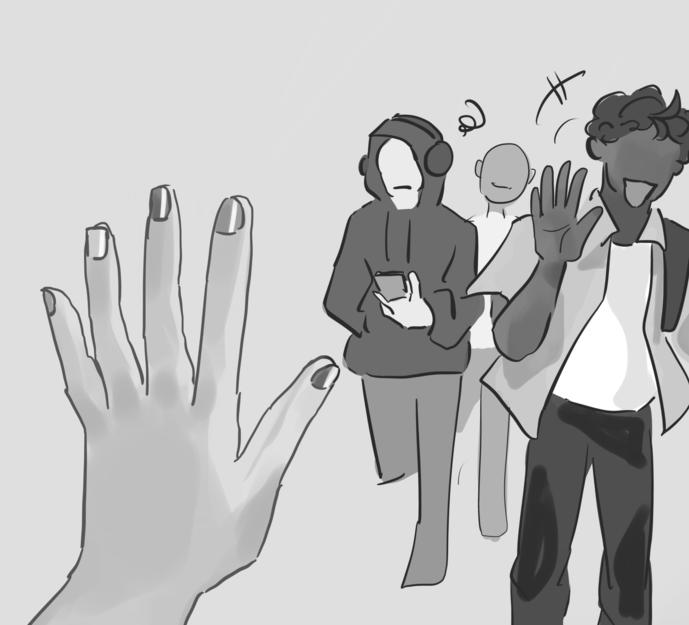
It’s a normal day at Pomona College. You are walking through Marston Quad to get to your class. A girl smiles as she passes you by. She offers a quick “hi.” You might reply to her. You might not. You do a double take: Do you two even know each other?
Well, if she’s a 5’4” white girl with curly blond hair, that’s probably me. And the answer is: maybe not.
Let me explain myself: In my home country of Brazil, it’s standard to say hello to people on the street. Even people you don’t know. It’s not like you stop and strike up a conversation with every stranger that passes, but you usually slip a quick “good morning” or acknowledge them with a smile or nod. And when it’s someone you know, be it a distant acquaintance or a close friend, it’s considered rude not to wave at them or ask them how their day has been.
Coming to the United States, I quickly noticed that’s not how things work.
At first, I was surprised by how rarely people said hello to the cleaning staff or dining hall staff. But I was even further surprised to see that no one waves to each other on campus. Even if they are friends with the person, they just pass each other by, no smile, no wave, nothing.
In a conversation with my older sister, who also went to college in the United States, she mentioned having a similar shock.
“Several times I talked to someone at a party for hours, then the next day they ignored me when I waved at them,” she told me. “Sometimes they acted like they didn’t know me.”
When I decided to go to Pomona, I knew that U.S. culture would be different from the culture I’d encountered in Brazil. After all, if the two were the same, why would I even come to the States in the first place?
I’ve dealt with other cultural shocks, such as the tipping culture or the size of food portions. But these shocks barely affected me as I rarely went to any restaurants in my first semester, and quickly adjusted to the 5C portion sizes.
Waving (or not waving) to people on campus, however, seemed to hit me the hardest.
People in my hallway looked
rEVErB
at me kind of weird when I said “hey” as I passed them by. My “good morning” would be left unanswered by my classmates. Acquaintances ignored me when I waved across campus, and even friends would sometimes pretend not to see me so they wouldn’t need to stop and say “Hi.” It was as if I was doing something I wasn’t meant to do.
Tired of feeling both invisible and embarrassingly visible whenever I tried to greet someone, I finally decided to ask one of my American friends for advice.
“If it’s an acquaintance, I usually hesitate to say hi,” she admitted, “But if we lock eyes, then I need to acknowledge them somehow. Otherwise, it’s awkward. Usually I just smile at them. If I wanna be friends with them, I wave. And if
Playboi Carti — Guest of his own ‘Music’?
TOMY HELMAN
The incomprehensible mumbling in Camila Cabello’s “I Luv It” outro, the deep voice in Travis Scott’s “Fe!n” and the baby yells in “M3tamorphosis.” It’s impressive to realize all of these voices come from the same rapper: Playboi Carti.
On March 15, Atlanta’s rapper Playboi Carti released his third album, “MUSIC,” which debuted at #1 on the Billboard 200 chart. It also had the biggest streaming week for an album since Taylor Swift’s “The Tortured Poets Department.” Carti’s album includes collaborations with artists like Kendrick Lamar, The Weeknd and Lil Uzi Vert. The artist has a 10-year-long career, breaking into the mainstream with“Whole Lotta Red,” which debuted at #1 on the Billboard 200 chart in 2021. However, rather than his own songs, his most successful tracks came from features on Drake and Trippie Redd’s releases. I completely forgot about him until his feature in The Weeknd’s 2023 “Popular,” after which every artist wanted to feature him. For example, he was featured in “Carnival,” by Kanye West and Ty Dolla $ign, “Type Shit,” by Future and Metro Boomin and reunited with The Weeknd for the recent smash hit ”Timeless,” from The Weeknd’s last album.
From 2021 to 2024, he only released “All Red” as a solo single, but he has been featured in around 10 songs from other artists. Thus, it makes sense for me to believe that “MUSIC” was the artist’s attempt to prove he can take the stage on his own with a solo album. If I’m being honest, “Music” lacks narrative cohesion, reflective lyrics and dynamic production. The album is extremely long, lasting 1 hour and 16 minutes with 30 songs. Carti is a criminal and openly misogynistic. He doesn’t try to hide it in his songs; in “Fine Shit,” he sings “Don’t say you’ll die for me, lil’ bitch, just die.” Still, his straightforward tone sounds devilishly humorous in songs like
the standout “Evil J0rdan”: “I think she’s a fling / I think she’s a playmaker / She should be on my team / She should get her a ring / Shit, it can’t be me / But she can be on the team.” What astonishes me about Carti’s records is his characteristic vocal diversity across genres and catchy lyrics that make him a uniquely remarkable performer. The tracks “Radar” and “Like Weedy” provide a clear example of his singular artistry. I was in disbelief when I found out these songs had no other collaborators, as Carti excelled at delivering chameleonic vocal performances. However, “Music” only reinforced my idea that he needs other artists to capture the spotlight. Almost half of the album’s songs are collaborations. At times, it seems like he’s just a feature in his own songs. For example, in the album track “We Need All The Vibes,” with Young Thug and Ty Dolla $ign, he only sings one verse at the end.
Carti’s greatest strength — his musical versatility — turns against him in this album, stripping away the distinctive identity he would need to sustain a career of his own. On “Charge Dem Hoes a Fees,” with Future and Travis Scott, it becomes hard to tell when Carti begins singing, as his vocals blend almost indistinguishably with Future’s. Ultimately, the artist gets lost among so many voices, both his and his collaborators.
Playboi Carti is an exceptional artist. I’m excited to listen to his unique appearance in every release in which he’s featured. However, for the reasons I outlined, I find it hard to think of him as a solo artist. Let’s accept it: Some artists, like some people, are born to be protagonists, while others are supporting characters. With no means to undermine his vocal range or aesthetic vision, Playboi Carti is of the latter — and maybe there’s nothing he can do about it.
Tomy Helman PO ’28 is a music columnist from Florida, Argentina. He’s interested in culture and politics and currently speaks Spanish, English, French, Indonesian and Italian.
I want to be friends and they are walking close to me, I ask how they’re doing. I mean, if it looks like they want to talk. If not, I just … ”
And she went on and on, talking about countless scenarios, possibilities and conditions. I never imagined there would be such intricate politics behind waving to people on campus. To me, it had always been an instinctive, effortless gesture.
I thanked my friend for her detailed insight. Though I found it a little weird, I decided to follow her lead. If I really wanted to adapt to life in the United States, I should stop rejecting this aspect of culture that I didn’t understand. Instead, I should embrace it and allow myself to have the whole American experience, including the social neurotics.
My plan was going well: I was no longer waving dumbly at some-
NO SEX iN THiS CiTY
Ignore
SHiXiAO YU • THE STUDENT liFE
one who would pretend not to see me. Every now and then, I had my slip-ups and would be ignored. But overall, I didn’t feel like an idiot. That is, until last week. As I was walking to my class, I noticed a classmate was walking some steps ahead of me. We’ve never spoken much, but the little we’ve interacted has always been nice. Then, suddenly, he turned around to get something from his backpack and locked eyes with me. I panicked. Should I look the other way or smile at him? Were we close enough for a wave?
Before I could do anything, he waved and smiled at me — two actions I reciprocated. I thought that was the end of our interaction, after all, we’d see each other in class soon. However, he stopped: He was
waiting for me. I stopped in my tracks for a second. Then I caught up to him and we walked to class together, chatting about the readings.
As I entered the classroom, I felt a cozy sense of nostalgia. For the first time since I’d come to Pomona, I had what would be considered a normal interaction in Brazil.
But then it dawned on me: I hadn’t been the one to initiate it. I couldn’t help but wonder: In my process of adapting to American culture, had I lost my “Brazilianness”? Were a few months enough to change a crucial aspect of my Brazilian cultural identity, one I’ve had for 18 years?
I had finally been able to adapt to this aspect of American culture. Finally, I was “on the in” for the politics of waving to people. But I didn’t feel happy. Once again I felt like an idiot, but this time, it was an even deeper feeling: In my desperate attempt to embrace American culture, I accidentally rejected my own Brazilian culture.
Living in another culture is a tug of war. If you don’t adjust to it, you get singled out. You feel distant from your peers, and you isolate yourself even further. And if you adjust, fear of Americanization eventually finds a way to keep you on your toes. Though it was a small interaction, I felt myself questioning my Brazilian identity. To what extent should I suppress my culture and change myself in order to fit in?
Unfortunately, I don’t have the answer. In the meantime, I’ll stick to what I know. The feeling I had when my classmate stopped me was undeniably happiness. Though it was mere small talk, I was glad to share that moment with him. His action, too, gave me the courage I needed to go back to saying hi to people on campus without overthinking. So the next time I wave at you on campus, I hope that you wave back. Sure, you can also just ignore me. I know we probably haven’t met, I know it’s kind of weird. But wouldn’t you want to know a little bit of my Brazilian culture, too?
Anna Ripper Naigeborin PO ’28 is from São Paulo, Brazil. Her favorite Brazilian superstition is that if you want a guest to visit you again, you must open the door for them when they leave.
everything I said — I know I did
I spent the last two columns laying out all of the lessons that I recently learned about attraction and relationships. First, that distance doesn’t make the heart grow fonder, it makes the heart grow delusional. And second, that you should, no matter what, try not to shit where you eat. I learned both of these lessons the hard way, and these are both conclusions that I stand by wholeheartedly — or at least I did.
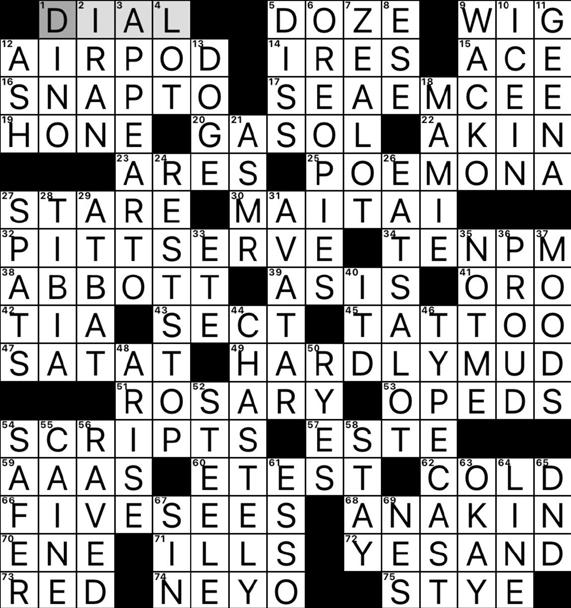
I thought I had finally cracked the code. I came out of these experiences with insights, newfound maturity and confidence. Now, I was ready to share all of my revelations with the world. That was until I found myself going against my own words. I have a crush. A non-puppy-love crush that makes me giggle and kick my feet when I think about him. We’ll call him Emile. And unlike the ghost of my first column, the person I only liked when not around them, I enjoy every second I spend with this crush. We’ll talk for ages, watch TV together and stay up until the depths of night doing the weekly TSL crossword puzzle. I was 100 percent sure the feeling was mutual.
Then, disaster struck. I asked a mutual friend of ours to ask Emile what he thought about me (romantically). He then proceeds to laugh and respond with, “Oh hell nahhhh. She’s homie.”
The friend zone, or should I say, the homie zone, gets a reputation for being the worst-case scenario. By that standard, I am in the worstcase scenario. My hopes of a romance with Emile have just been stomped on, and now it’s time to emotionally detach while I still have my dignity. However, I’m not sure if the credits have rolled on our romance, or if this is just the
intermission. I’ll admit, “she’s homie” isn’t exactly the most romantic term of endearment I’ve ever heard, but isn’t homie-status somewhat foundational for developing a solid romantic relationship?
If we already have a connection built on laughter, comfort and friendship, isn’t that a better starting point than sliding up on one of my stories with three see-no-evil monkey emojis? Maybe this is the perfect start to my ultimate friends-tolovers pipeline? Or maybe I’m just searching for silver linings to soften the blow to my ego? This whole situation made me feel silly. I was so sure that I would stand by what I said in my first column. But now, not long after publishing my thoughts to the public, I’m going back on what I said. Not only that, I’m going back on my word for a guy who thinks I’m homie! After sitting with my embarrassment for a while, I do still believe in what I said, only in theory. But putting your belief into practice is a lot harder. Keeping that in mind, I have a conclusion, one a bit more universal than my last two. Here it is … Do NOT take anything I say to heart.
You can read as many selfhelp books as you want, watch all the YouTube essays, listen to all the podcasts, but none of that matters. Because life, and especially love, is not one size fits all. I know firsthand that the heart does not work in the same way the mind does. The mind internalizes romantic cultural norms: the talking stage, the three-month rule … the friend zone. The heart, however, sees someone call you homie and thinks it’s just a hurdle to overcome.
Using my heart and mind, I say there are no set rules. There are only stories and tales of past experiences that can help guide us in making decisions. But not everyone’s past experiences are applicable to your own. Sometimes you don’t take advice, and that’s okay. I was extremely hesitant to write about this experience. Maybe I’m delusional. Maybe I have a chance. Maybe I’ll look back at this column in a year and bash my head against the wall. But for now, I’m ignoring the rules. Because what’s life without a little risk?
Tom Cat will (hopefully) have lots more to share with you all next semester! I am Plotting and Scheming!!!
ANNA RIPPER NAIGEBORIN
EMMA CHOY • THE STUDENT liFE
TOM CAT
‘Our Future is Ancestral’: Summit explores Indigenous knowledge and community
KASSIA ZABETAKIS
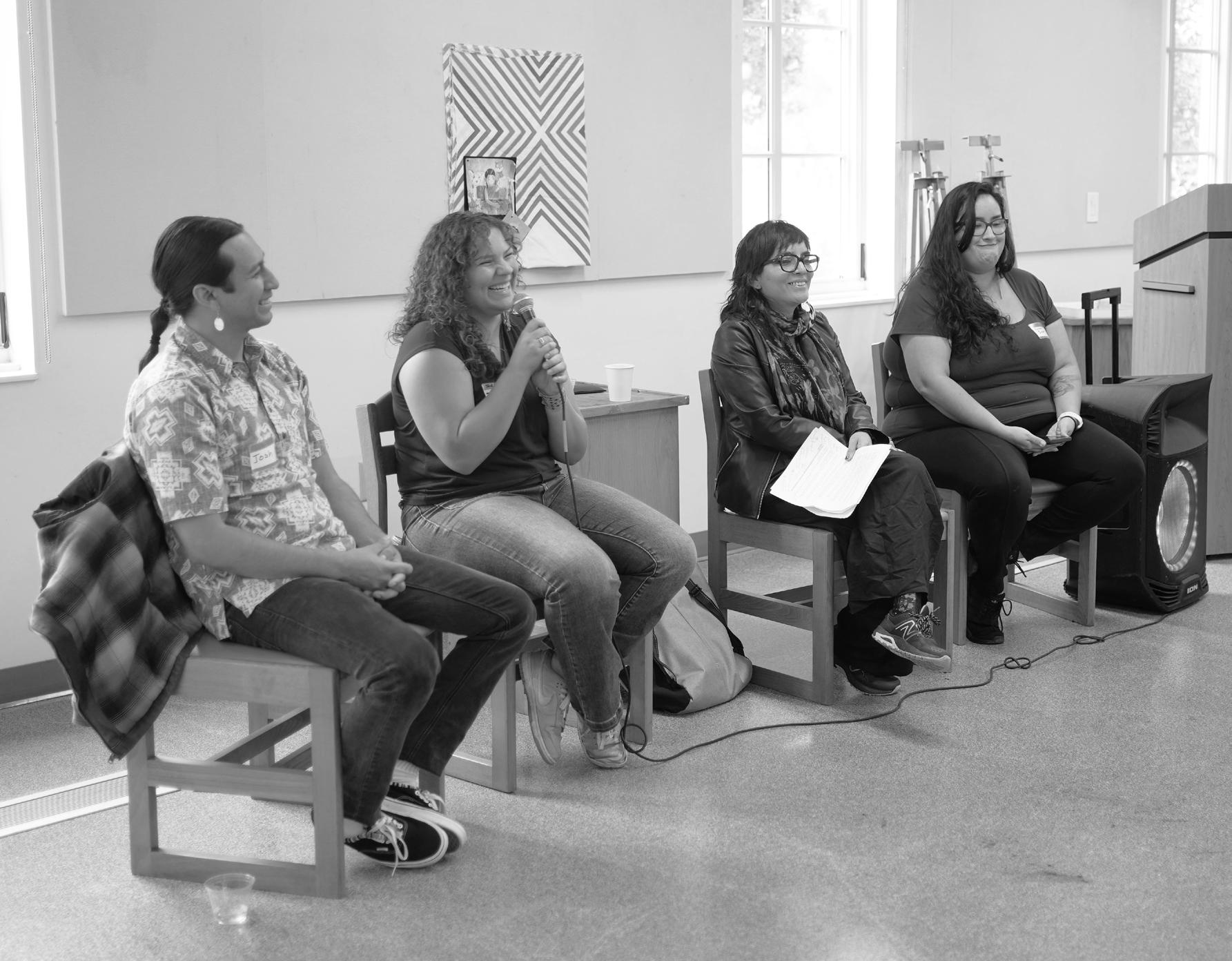
Pitzer College’s Native and Indigenous Initiatives (NII) program held a summit titled “Our Future is Ancestral: Uplifting Indigenous Knowledge Systems” at the Robert Redford Conservancy on March 29. A day of hands-on workshops and discussions about Indigenous identity and knowledge, the summit provided a space for Native and Indigenous students and community members to gather and connect.
The event opened with words from Virginia Carmelo (Gabrielino/ Tongva, Kumeyaay), a dedicated advocate for reviving the Tongva language and culture. Attendees then participated in interactive workshops, choosing from beading with Birdie Pulskamp, tule mat weaving with Citlali Arvizu, soapstone carving with Lazaro Arvizu or zine making with Laurie Steelink, according to the event flyer.
Following a communal lunch, attendees gathered for a panel discussion on Indigenous identity moderated by Meranda Roberts (Yerington Paiute, Chicana), a visiting professor with Pomona College’s Art History Department and former Native Scholar in Residence with NII.
Panelists included Joshua Thunder Little (Oglala Lakota, Tongva), the assistant director of Pomona College’s Native Indigenous Resource Center (NIRC), Claudia Arteaga, associate professor and chair of Scripps College’s Department of Spanish, Latin American and Caribbean Literatures and Cultures and Jansikwe Medina-Tayac PZ ’25 (Piscataway, Colombian), the NII coordinator at Pitzer’s Community Engagement Center.
The panelists began by discussing Indigenous methodology as a community-centered, intergenerational approach to knowledge. They emphasized the importance of learning from Native people and learning about whose land you live on.
The Claremont Colleges are located on the traditional land of the Tongva/Gabrieleno.
“It can be really difficult for people to understand how to meaningfully incorporate Indigenous
methodologies or ways of being into their work,” Roberts said.
“We wanted this summit to be a space where that conversation could start.”
Arteaga reflected on the importance of collaboration when engaging with Indigenous knowledge.
“I have learned that there is no way to do work about Indigenous folks without them,” she said.
“That means that collaboration and reciprocity has to be there the whole time.”
Medina-Tayac, who also helped to organize the summit alongside Sara Orr PZ ’25 (Osage), critiqued the commonly held belief that traditional Indigenous practices are from and belong to the past.
”Our practices are more modern than any form of technology that has been created, of any systems that currently exist,” Medina-Tayac explained. “[This is] because we are thinking of how to do things sustainably, and we’re thinking of how to pass down things to future generations … I think that’s the most modern thing you can have as a society.”
Arteaga echoed this sentiment.
She added that Indigenous relationships with non-human beings involve responsibility.
“There is a responsibility to build a reciprocal relationship with those non-human beings that are the surrounding of the human community,” Arteaga said. She suggested showing respect to ancestors through rituals and ceremonies.
The panel also discussed the diversity of experiences, perspectives and traditions within Native and Indigenous communities, and addressed the challenges of being Indigenous in academic spaces.
“Indigenous identity is layered and shaped by history, community and personal experience,” Roberts said. “There are many Indigenous students on this campus whose identities fall outside of how the institution tends to define Indigeneity. When those definitions are too narrow, the institution ends up overlooking, if not outright erasing, their presence and lived realities.”
When asked about her experience as an Indigenous student at the Claremont Colleges, Medina-Tayac brought up a lack of Native and Indigenous representation and resources on campus, including limited Indigenous faculty and the absence of a Native American/Indigenous Studies (NAIS) major.
Scripps is currently the only 5C offering a minor in NAIS, which was introduced in 2021 after several years of student advocacy.
In 2022, Medina-Tayac and Orr co-founded the Claremont Colleges’ Native Indigenous Student Union (NISU), a group dedicated to promoting community for Native and Indigenous students and celebrating Native heritage.
“We had to take it upon ourselves to create a space for our-
selves where we felt safe because that space didn’t exist for us already,” Medina-Tayac explained.
“It’s a lot of labor … [but] I feel this intense obligation to create that space, not just for myself, but for other students.”
Besides NISU, Pitzer College’s NII program at the Community Engagement Center works to develop the relationship between Pitzer and local tribes, while the NIRC is a Pomona College-facing office and hub offering support, resources and a sense of community to Native and Indigenous students. Leaders from each were present at the summit.
Medina-Tayac, as an organizer of the summit, reflected on her goals for the event.
She emphasized the importance of creating a space where
attendees could both learn and, through the workshop portion, create something meaningful. She hopes people can see things like basketry and beading as more than a craft, but also as forms of resilience that deserve to be uplifted and respected in institutional spaces.
“Community building is an important part of learning,” she pointed out. “Learning is way more productive and valuable when you are all talking to each other and learning from each other.”
The “Our Future is Ancestral” summit provided a space for Native and Indigenous students to learn in community, and encouraged the recognition of Indigenous traditions as living, evolving practices.
It highlighted the importance of making space for Indigenous voices — past, present and future.
A word from your stylish classmates
What better way to end this column than with the words of our very own campus fashionistas? This week, I have taken to giving ink to the printless, badgering my friends for their hottest fashion takes and peeking inside their closets. These brave souls have given me a much-needed insight into the minds of some of our most stylish classmates, and for this we thank them. Although some of their looks may appear effortless at first, these icons are putting a lot of thought into creating unique outfits that reimagine the pieces they already own.
Skylar Cohen SC ’27 told me her style is “basic but with a flair of weirdness … My favorite article of clothing is a loose-knit grey sweater,” she said. “It is perfect for any day, can be dressed up or down and matches almost anything. Super versatile and super comfortable.”
I have seen this beautiful sweater
styled by her in a myriad of intriguing ways. It has become, for me, a Cohen staple that she likes to dress up with a cool chunky necklace and cute black bra or keep it casual with a white tank and her green Onitsuka Tigers. A layering piece like this lends itself well to endless reinvention.
Cohen’s girlfriend, SJ Caldwell HM ’27, is also a massive fan of knitwear. Perhaps this was the thread that tied them together? Good knits are quite romantic after all … “My current favorite article of clothing is a green crochet vest I made,” Caldwell said. “I like to wear it with a white tank top and either jeans or a skirt.”
Pairing a piece like this with a simple base allows the craftsmanship of the sweater to be illuminated.
Further, sage green is evergreen for Caldwell, who creates a go-to uniform: “I base a lot of outfits around wearing my favorite color, which is green.”
Karina Klein SC ’25, on the other hand, sticks to a more subdued palette of neutrals that she can mix and match infinitely.
“My style is undone, polished, classic,” she told me. Her favorite piece, a loose-fitting pair of dark denim jeans like Cohen’s, is rooted in versatility. “I think this is an article of clothing that you could use to make an outfit for any occasion and always look put together,” Klein said.
“Going to a nice dinner? Throw on a silk top and a kitten heel or heeled boot and you’re good to go. Going to the movies? Add a knit sweater and some cute sneakers and you’re comfy, casual and cute!”
Alongside versatility and subtle flair, these style aficionados value an outfit’s ability to dictate and reflect their mood.
“The way I dress has a big impact on my day,” Cohen said.
“It’s a way to express yourself and your mood,” Klein echoed.
“How I dress and what I wear changes my whole day and it makes me a lot more productive when I’m wearing something cute,” Caldwell said.
I am hearing nothing but facts. Fashion truly is transformative and has strong manifestation powers to change the whole course of your day. Choose wisely!
“I’m a very shy, quiet person naturally, so clothes are my way that I can show who I am without having to necessarily use words,” Klein said. Your outfit choices can sow confidence into your day and yourself. Picking pieces that you love, that feel like you and that you can curate in a plethora of ways is crucial to building your personal style.
“When I started dressing more how I wanted to dress, I started to feel a lot more confident in my day-to-day,” Caldwell said. “Being who I am is a lot easier when I am wearing an outfit that outwardly
shows who I am.”
These fashionistas are choosing to break normative boundaries stylishly and transcend traditional gender roles. “I love taking a masculine-style piece of clothing and making it feminine,” Klein told me.
Both Caldwell and Cohen also noted that across the campuses, people utilize dress to express themselves and their sexuality by disregarding gendered clothing. Fashion is a form of art and play, so be true to yourself and break those ancient rules!
“I am also happy to be seeing a more mature look trending: layering, classy tops, ballet flats, leather bags, leather jackets, chill colors, etc.,” Cohen said. “Especially considering the years of aggressive fast fashion that included really intense patterns and colors.”
Choosing versatile pieces is the golden lesson here! Caldwell echoed the desire to pursue fashion in ways that set aside consumerism by telling me all about her magical thrifting adventures. This diva knows where the good stuff is hidden!
“One of my favorite trends is denim on denim. I think people are changing the narrative of the unkept Canadian tuxedo and turning it into a chic western twist style,” Klein said. Klein, like me, is a fan of the tried and true blue jeans but seeks to reimagine a classic and thereby unlock a new avenue for the clothing you already own and love.
I align myself very strongly with these style stars due to our shared love of the old being reinterpreted and re-envisioned. PSA: You do not need to buy a whole new wardrobe, just start reimagining the pieces you have. Create new combinations or get funky and wear your pieces in untraditional ways. Who says a shirt can’t be turned around and worn in an entirely new way? Get crafty, kids! I am a huge advocate for scissors and some thread (or the more beginner-friendly safety pin)! My sweet friends have been incredibly kind by preaching to us from their style soapboxes. So if you feel like repaying them, I will be leaving their wish lists here: a pair of boots, a Fendi baguette bag and a black mini skirt for Cohen, an oversized dark denim button down/jacket for Klein and a pair of brown Mary Jane docs for Caldwell. Stay cool, stay kind, stay stylish besties! It has been a pleasure sharing my fashion advice with you all, thanks for bearing with me and for giving me such great looks to write about! Claremont closets, over and out … at least until next time!
ELLEN CHAPMAN
AlEXANDrA GrUNBAUM • THE STUDENT liFE
COUrTESY: JANSiKWE MEDiNA-TAYAC
Native and indigenous students and community members came together on March 29 for a summit titled “Our Future is Ancestral: Uplifting indigenous Knowledge Systems.”
ClArEMONT ClOSETS
‘Code to Connect’: Hackathon highlights innovation at the 5Cs
ANANYA VINAY
Though pulling all-nighters is not uncommon in college, students at this year’s 5C Hackathon took this 24-hour time period to channel their creative energy in a coding marathon.
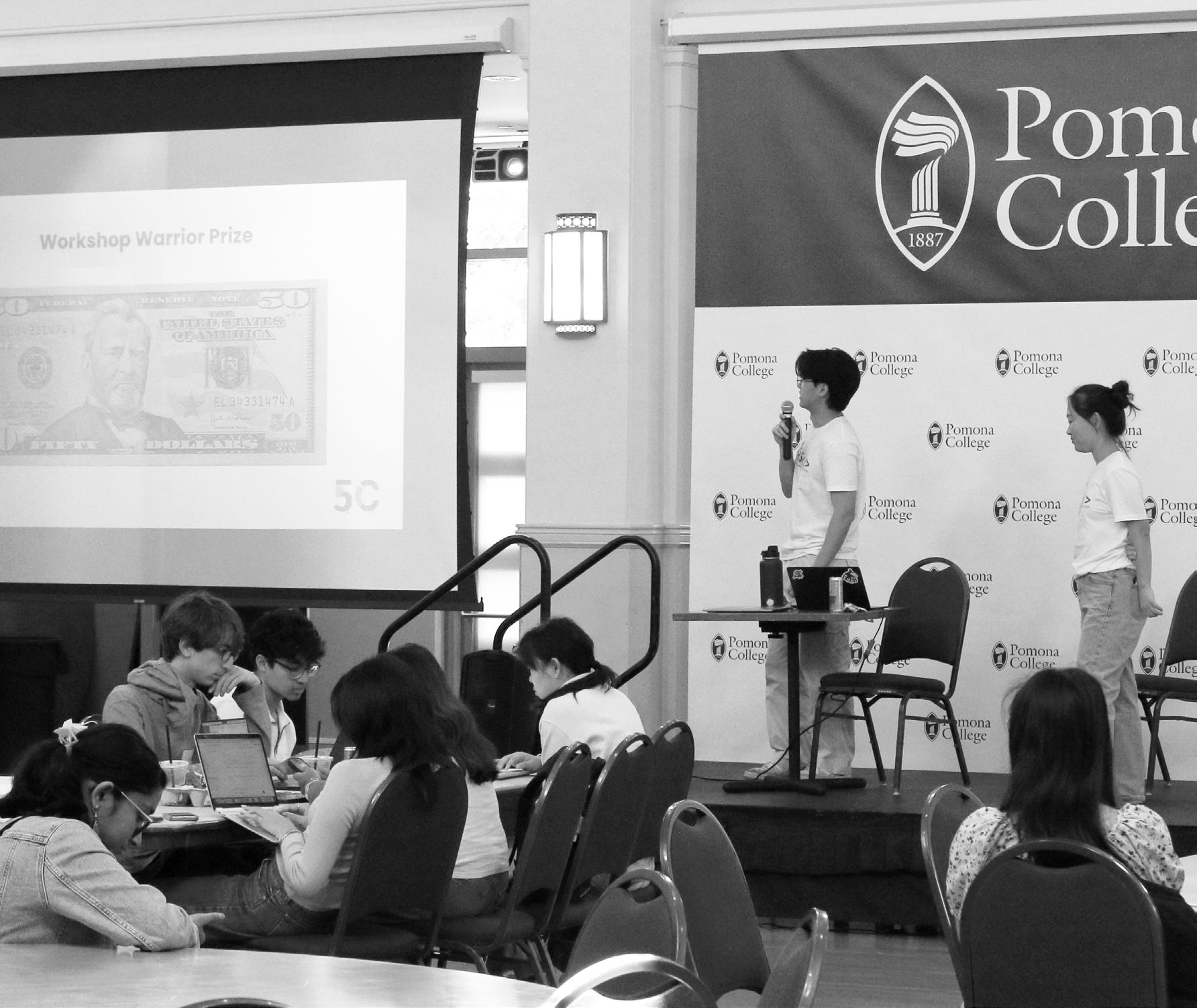
On April 5 and 6 in Edmunds Ballroom, participants came together to code innovative product ideas and proposed potential scalable apps. The contest, which has been held annually since 2011, was organized by co-directors Sangeon
Park HM ’26 and Catherine Byen PO ’25. In addition to ASPC, the Sustainability Office and Claremont Accelerator, several corporate sponsors were attached to the event, including Bloomberg, Perplexity and Notion.
This year’s Hackathon, themed “Code to Connect,” focused on using technology to build community, spark connection and drive change. Participants could compete in two tracks: the Innovation track, where they would propose scalable solutions for
real-world problems, or the Maker Track, which entailed coding machine learning models, apps and websites. Students could also submit their projects to overlay categories, such as Best Sustainability, Health and Humanity, 5C Community, and Beginner Hacks.
This year, in addition to the coding marathon, the Hackathon also offered workshops on data visualization and winning investors for start-ups.
Park described the Hackathon as important to encouraging in-
rOOTED AND rESTlESS
novation outside the classroom.
“I think a hackathon is a good way for people with no experience to get experience in technical aspects,” Park said. “People need incentives to build things outside of their classroom.”
During Park’s freshman year, the Hackathon was temporarily inactive, and he helped to re-establish it in 2023.
66 students working on 23 projects participated in the Hackathon. 40 percent of the students had little to no technical experience, according to data from the co-directors. The Hackathon aimed to make technology and innovation accessible to every student, particularly those who are underrepresented in the field of technology.
Before the Hackathon began, Alison Wang SC ’27 noted that she was looking forward to the event after participating in the 5C Datathon, a data analysis competition. Her team’s project ended up winning the Best Beginner Hack award.
”We’re excited for the process of creating for the Hackathon, and I think this is a pretty good learning opportunity,” Wang said.
Gabby Clavell, an engineer from Bloomberg and one of the judges, thought the students’ projects were innovative.
“The ideas are really original. One of them even built out a prototype, which was really cool … I appreciate the effort that they put into presenting their projects,” Clavell said.
These projects ranged from a reimagined housing portal to a medical imaging AI assistant.
Emily Gao PO ’26 and Selina Lu HM ’26, for example, designed a mobile app meant to foster intentional emotional connection in long-distance relationships.
The pair faced challenges in designing the aesthetics of the app demo titled “LOOOP!”: “There
were some challenges in some of the features that we wanted to visually be presented, and it wasn’t matching our expectations,” Lu said. However, the team ended up winning the Innovation Track award.
“O-live,” an assistive tool for real-time fall detection for older adults, earned Ellie Lian PO ’27, Chau Vu PO ’26, Kartika Santoso PO ’26 and Steven Kim PO ’26 the Maker track award.
Zurayna Fatima Saif PZ ’27 won the Workshop Warrior Prize for her engagement in the workshops. Other projects approached climate change and sustainability, with “RecycLens” and “EcoHabit: Competitive Sustainability” winning Best Sustainability Hack and Best Beginner Hack, respectively.
“RecycLens,” an AI-powered trash segregation tool with a 5C-based sustainability progress leaderboard, was designed by Ishita Jain HM ’27 and Sadhvi Narayanan HM ’27. “EcoHabit,” a community-focused app that lets users log sustainable actions, earn badges and rank campuses in order to encourage participation, was designed by Anika Pandey HM ’27, Livia Ordonez HM ’27 and Wang. Students also created projects aiming to foster community and well-being. Mehrezat Abbas CM ’25 won the Best Health and Humanity Hack for “howWefeel,” an emotional tracker meant to encourage emotional awareness, while “Branch,” designed by Alex Nasoni CM ’25, Yotam Twersky PO ’25 and Arjun Govind PO ’25, was the 5C Community winner. The mobile app aims to increase the ease of forming connections by placing users into communities with similar interests. Opportunities like the 5C Hackathon allow students to apply theoretical knowledge from classes to a fun practical challenge, and in only 24 hours of coding, students created surprising and innovative solutions for real-world issues.
Navigating the turbulence of family ties
ROCHELLE LU
Hopping off the Metrolink train at L.A. Union Station, my friend and I perched on a bench, waiting for the Flyaway shuttle to whisk us to LAX. It was an unusually cold day in SoCal, our breath visible in the drizzly air. As we waited, we started talking about being so close to going home for spring break — both of us international students.
A while back, we were faced with the questionable decision to fly back across the world for just over a week. Was it worth it to endure 11 to 15 hours in the air (if you’re lucky enough to snag a direct flight), only to be home for such a short time, battling jet lag? But after all, home is home, right?
“I think I needed this, honestly, to recharge,” my friend said. I nodded slowly, but my feelings were more complicated. Going home stirred something uneasy in me — a feeling I usually avoided thinking about until I was on the plane.
When the bus finally pulled up at the airport, we said our goodbyes. As I navigated TSA alone, the usual pre-flight jitters crept in. People who know me might call me a plane crash fanatic, an identity I picked up as a way to cope with my fear of flying. I thought learning about the nuts and bolts of all the ways a flight could go wrong would prove just how rare catastrophic errors are. Instead, it only made me more aware that while these disasters are unlikely, they’re still possible — and that lingering possibility haunted the flight I was about to board.
I haven’t always been a nervous flyer. When I was younger, I frequently flew from Shanghai to Taiwan with my family during holidays and my dad was the one who silently bore the weight of flight anxiety, his expression deadpan. He wouldn’t speak until we touched down; later, he told me it was the only way he could deal with how nervous flying made him.
I was still too young to notice, too focused on the grape-flavored Hi-Chews my mom gave me during takeoff to help with my ears popping. But over time, I’ve started spotting traces of my father in my behavior, especially after obsessively researching plane crashes following a devastating crash in China in 2022.
Now, despite knowing that planes are the safest form of travel, I can’t stop imagining every possible scenario where things could go wrong. Like the plane stalling from ice accumulation on its wings. Or a mid-air collision with another aircraft due to faulty ATC communication. Or a decades-long maintenance issue soundlessly waiting to turn into a tragedy. As I found my seat on the plane,
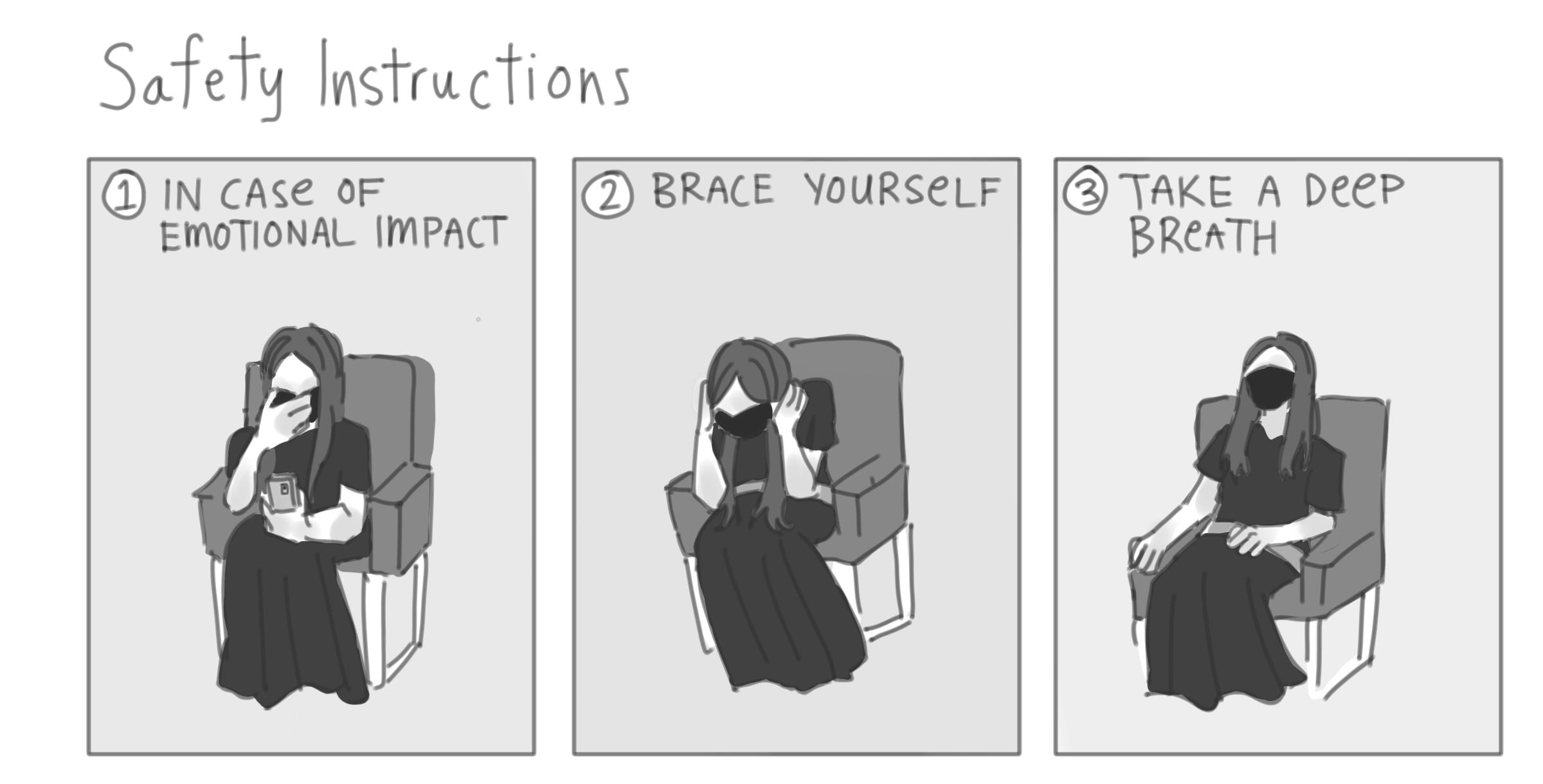
I started my usual pre-flight ritual: googling airline safety records, memorizing brace positions and triple-checking that I knew how to inflate a life vest. But even with all this preparation, my mind spiraled with fear. It’s ironic: I know too much, and yet here I am, with no choice but to fly. Once in the air, the plane’s turbulence hit almost immediately. I clenched the armrests, breath catching in my throat. My mind was jumping from idea to idea: Were my feelings more than just a nervousness for flying, and instead something that always surfaced when I was on my way home?
The plane’s instability layered itself over an already shaky emotional landscape — I was returning to a place where love and tension coexisted in uncomfortable ways. It wasn’t just the plane’s unsteadiness that unsettled me, but the weight of the emotions tied to this flight. When my mother texted me in February asking if I wanted to go home for spring break, a part of me screamed “of course,” while the other part hesitated for days. Now that I’m in college, although I do miss home at times, the thought of actually going back and staying with my parents evokes a sense of anticipation. I first left China over seven months ago, longing for freedom from a society and household that, to me then, was steeped in nothing but misogyny and bigotry. As a queer woman, all I wanted was out.
In many ways, I got what I wanted: space to be myself, to speak freely, to exist without shrinking.
But I didn’t realize how heavy that freedom would feel when it meant leaving parts of myself and my family behind, and how each return now comes with a strange mix of comfort and confrontation. My mother, in particular, sees a version of me that no longer exists. Despite knowing about my progressive beliefs, she clings to the image of the “sweet, traditional daughter” I used to be — or perhaps the version of me she always wished I were (cue “Pink Pony Club”!) This idealized version of me creates tension between us whenever I visit, leading to inevitable arguments.
So why is it that, after each visit, as I fly through 16 time zones, I find myself missing my mother’s presence?
On the flight back to California after winter break, I sobbed to “Lady Bird” (2017), thinking about the familiar tension and longing that defined my relationship with my mom. I looked out the window, realizing this is what flying feels like to me: suspended, disconnected, caught between departure and arrival, reality and memory. Always liminal. Always shadowed by the fear of crashing. Like figures in the clouds: disappearing and reappearing, again and again, just as my mother sees me. As the plane leveled off at its cruising altitude, I realized that this ride was no different from the emo-
tional turbulence I feel every time I go home. The ups and downs, the unpredictability — it all mirrored my relationship with my family and the complicated feelings that surface with each return.
The seatbelt sign finally turned off, and the flight attendants began their drink service. But before I could relax, the turbulence returned, catching everyone off guard. This time, though, I was ready.
Turbulence still unsettles me, but I’m learning to accept that I’m not always in control of what happens around me. The same goes for navigating the complex emotions around home. It’s not about “fixing” everything, but about accepting that things will be rocky — and that’s okay as long as I understand my own emotions. Over time, the distress of leaving and returning begins to settle, much like how turbulence and my fear of flying eventually calm as we progress through the flight. I drifted off for the rest of the flight. When I woke up, the cabin lights were on, signaling our descent into Shanghai. My parents met me at the airport, and as we exchanged chatty greetings, I noticed that this time, my mother’s grip on my arm felt a little looser — maybe a sign that she was beginning to accept that the idealized version of me she clings to is fading. Or maybe I was the one changing, slowly learning that my identity and my relationship with her could coexist without suffocating either of us, held together by something steady
and unspoken: family ties.
Back at home, collapsing in the comfort of my childhood bed, I reminisced on how I survived yet another plane ride and texted my friends, “I didn’t crash!” — the kind of joke I could only make in jest once I wasn’t afraid of jinxing it anymore. Maybe conquering the fear of flying isn’t just about trusting the plane; it’s about making peace with the complicated reality of home. Each visit shapes me in new ways, for better or worse. It turns out that during this brief spring break visit, I noticed a shift — I wasn’t as anxious to be back. Conversations with my parents felt more like banter than battles, and I realized that I didn’t need to turn every disagreement into friction. Maybe I could offer a new perspective without triggering a fight.
No matter how far I travel, my home and family will continue to shape me. Whether I’m reflecting on feminism at my women’s college, sitting quietly with my parents in the car or feeling the jolt of a bumpy descent onto the runway, these ties, complicated as they may be, will always be with me. The turbulence doesn’t go away, but I’m gradually learning how to ride through it.
Rochelle Lu SC ’28 is from Kaohsiung, Taiwan, and Shanghai, China. Her advice: In the event of emotional impact, assume the brace position, take a deep breath and keep an open mind. Secure your own well-being before assisting others. The nearest exit may be behind you, but growth is always ahead.
ANDrEW YUAN • THE STUDENT liFE
Pluralism, progress, problems: 50 years of interfaith chaplaincy
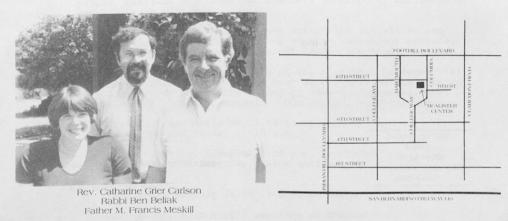
At the intersection of Scripps College, Pomona College and Claremont McKenna College stands the McAlister Center for Religious Activities (also called the McAlister Center for Spiritual Life), an institution many students pass by every day. However, according to former Protestant Chaplain Naima Lett, 75 percent of the community she encountered during the 2021-2022 school year was unaware of the center’s chaplain services, which provide counseling for all students and faculty of the Claremont Colleges regardless of religion. Even less known is the chaplaincy system’s fifty years of complex history, representing both the cutting edge of inclusive college campuses and archaic systems no longer relevant to student needs.
Origins of the interfaith chaplaincy model
The McAlister Center for Religious Activities opened in 1959 as a hub for students of all religions to hold activities. However, a Protestant minister was the only clergyperson on the consortium’s payroll providing on-campus religious services. By 1971, Chaplain Gordon Verplank PO ’62, the fifth minister to hold the campus chaplain position, realized that his expertise wasn’t sufficient to serve all student religious needs on campus. Verplank began enlisting the help of a Jewish rabbi, a Jewish activities coordinator and a Catholic priest, according to Pomona College Chair of the Faculty Ken Wolf’s “A Brief History of the Claremont Chaplaincy.”
This interfaith partnership led Verplank to write a proposal in 1972 asking for the rabbi and priest to receive equal status to himself as co-chaplains of the colleges. This proposal raised budgetary concerns, but local Jewish organizations such as the Jewish Community Federation and Hillel (In Wolf’s history and the Interfaith Chaplaincy 10th anniversary pamphlet, it is not clear whether this is a Claremont Colleges specific Hillel, a regional group or national group) stepped up to help pay the rabbi and the Archdiocese of Los Angeles helped pay and house the priest. Verplank’s assistant chaplain also agreed to resign, while Verplank agreed to reduce his salary to help pay the other two chaplains, according to Wolf’s history and E. Howard Brooks’s statement at the interfaith chaplaincy’s 10th anniversary celebration in 1985. By summer 1973, Verplank’s proposal was actualized. Some brochures on the interfaith chaplaincy from the 1980s name 1974 as the start date rather than 1973, perhaps indicating that some services took a few months to become fully functional.
Wolf’s history indicates that giving faith leaders of three different religions coequal roles in a college chaplaincy was an unprecedented move for the early 1970s. As far as both Wolf and Verplank were concerned, the interfaith chaplaincy in Claremont was the only program of its kind in the entire U.S. at its inception.
Moving into the 21st century, however, the chaplaincy’s structure struggled to support an ever-increasing range of student religious beliefs.
Early evolutions of interfaith programming
Aside from some more conservative figures objecting to the Rabbi receiving equal status at McAlister with Catholic and Protestant clergy, the new chaplaincy model was generally well received at its onset in the 1970s.
Throughout this first decade, the three chaplains collectively sponsored various activities: extracurricular classes on a variety of religious and philosophical subjects, movie screening study breaks, a talent show and speaker talks with Chaim Potok and Elie Wiesel, among some of the most notable. Each chaplain also provided religious services from their respective tradition at least once a week, according to brochures.
By 1975, Latter-day Saints, Baha’i and Christian Science student groups began meeting independently of the chaplains. Muslim meetings appeared
in chaplaincy pamphlets by 1980 — albeit with the potentially inaccurate designation “Islam Worship,” which was changed to a more precise “Islamic Prayer” in 1982. Meanwhile, an Eastern Orthodox group became active on campus in 1985.
In the early 1980s, the chaplains also sponsored weekly forums on religious and political issues. These forums included religious topics such as “Saint Francis: A Saint for the 80s” and “Understanding Judaism: The Nature of Jewish Spirituality” alongside more secular topics like “Campus Relationships: Making Them Work” and “The Films and Television Shows of the 80s: What are They Saying?” These programs often featured 5C faculty members or consortium staff members such as Dr. Karem J. Monsour, former director of counseling at the Claremont Colleges and namesake of Monsour Counseling and Psychological Services.
In addition to these forums, chaplains worked with faculty while leading religious services and teaching classes. A “courses of Jewish Interest” list from a mid-1970s Hillel pamphlet indicates that chaplains Fr. Frank Meskill, Rev. Gordon Verplank and Rabbi Ben Beliak co-taught an Introduction to Religious Thought course at CMC alongside a religious studies faculty member.
In 1986, CMC philosophy professor and Presbyterian minister Steve Davis preached at a start-of-semester college Protestant church meeting sponsored by the chaplaincy. Additionally, Pomona physics professor and ordained priest Catalin Mitescu helped start Eastern Orthodox activity on campus. Rabbi Beliak also wrote multiple letters encouraging Jewish faculty to make themselves known to Jewish students by attending chaplaincy-sponsored lecture events and High Holy Day services.
Major budget cuts impacted the chaplaincy services in 1993, but much of its programming — such as weekday and Sunday masses, Friday evening Shabbat services, Bible studies and Torah studies — appeared to remain relatively unchanged based on the chaplaincy brochures from 1992, 1994 and 1998 archived at Honnold Mudd Library’s special collections.
Starting in the late 1980s and gaining particular momentum in the 1990s, chaplains also connected students with local off-campus volunteer opportunities. An advertisement-like insert from the 1989-1990 chaplains’ report called for students to volunteer at local senior homes, Pomona Valley Council of Churches shelter and food pantry, Casa Colina physical therapy program, the Crippled Children’s Society, SOVA East-Hillel food pantry and as tutors and coaches at the Claremont Unified School District. The chaplains’ office had lists of students who participated in various volunteer activities each semester throughout the 1990s and early 2000s.
Limits on inclusivity: Religions outside of chaplains’ traditions and students of color Despite the growth, there were limited attempts to include traditions other than Judaism and Christianity in the chaplaincy programming.
The chaplains made some efforts to include speakers outside of their specific religious and cultural traditions in their event programming, as the “Open College” extracurricular classes offered in 1975 included classes on the Baha’i faith, “biofeedback” and pre-Christian Greek philosophy. Meanwhile, in 1989, they co-sponsored a conversation with Dr. Lina Gupte, a Claremont Graduate School alumna and professor of Asian and comparative philosophy at California State University Long Beach, on peace and justice in the Hindu tradition. They did not, however, appear to be involved in Nara University Professor Masao Abe’s 1976 talk on Shinto and Buddhism in Japan or the Dalai Lama’s 1979 visit to Claremont, despite dense documentation of the
Claremont Colleges, Blaisdell Institute, and the Claremont School of Theology’s involvement in the latter event. Programs such as “Korean Students’ Sunday Worship” in the 1980-1981 school year and worship and fellowship events specifically for Black students documented in chaplaincy brochures for the 19801981 and 1998-1999 school years indicate that the chaplaincy supported Christian gatherings for racial minorities — but that the Protestant and Catholic chaplaincy’s primary services were likely based in white church traditions.
There were also several structural differences between the chaplaincies. At some points in the interfaith chaplaincy’s early history, the Jewish chaplain seemingly received lower levels of institutional support compared to Catholic and Protestant chaplains. Catholic chaplain Fr. Frank Meskill began holding Mass in 1971, while no records of Jewish chaplains holding services exist before 1975 in Honnold Mudd Library’s archives. The archives also show Fr. Jerry Stack and Seminarian Laura Loving serving as assistant chaplains in 1975 from Catholic and Protestant traditions, respectively, but no similar assistant existed for the Jewish community.
Primary assistance for Jewish chaplains arose from part-time Hillel program directors, Hillel’s student leadership and local synagogues throughout the 1970s, 80s and 90s. After the 1970s, however, the assistant Catholic and Protestant chaplain positions disappeared.
As time progressed, the chaplaincy also supported more and more student faith group meetings outside of their respective traditions. For instance, in 2013, Jewish chaplain Rabbi Daveen Litwin helped a Pitzer College student start a pagan worship group at McAlister. Coverage of this group also mentioned that Unitarian Universalist, Buddhist and Quaker organizations had been started with assistance from the chaplains around this time.
The 2015 Chaplaincy review and its causes
Despite their support for diverse new religious groups, concerns in the community about the inclusivity of a three-person Chaplaincy persisted among the campus population. This became particularly evident when the chaplains themselves submitted a request to add a part-time Muslim chaplain in 2014. Unfortunately, their request was denied for “budgetary reasons.”
Instability also marked the chaplains’ office in the early 2010s when their longest-serving member, Protestant chaplain Catharine Grier Carlson, retired in 2011. According to Wolf’s history, the Claremont University Consortium (CUC) — the entity in charge of consortium services like the chaplains, Student Health Services, Office of Black Student Affairs and Chicano-Latino Student Affairs — hired a new replacement with special administrative responsibilities. The issue, however, was that the CUC did not clearly state to whom the additional administrative power would fall: between the three chaplains or with the new Protestant chaplain.
Consequently, the Catholic and Jewish chaplains feared that this new hiring decision elevated the Protestant chaplain above the others, destroying the cherished coequal model that had existed for over forty years.
This tension, along with renewed requests for a Muslim chaplain, led to a review in spring 2015 where a committee led by Wolf assessed existing chaplaincy activities and considered alternate models for the chaplaincy going forward.
Some members of the committee, such as Jose Ruiz PO ’16, argued that the chaplaincy should be replaced by a single dean of religious life who would be more “efficient” at matching students to religious services based on their specific cultural backgrounds.
and two years, respectively. Previously, four rabbis and one interim sabbatical replacement served in the position between 1973 and 2011, with Ben Beliak, the longest-serving Rabbi, holding his position for about 15 years.
Two Muslim Life Coordinators, Safa Plenty and Shaila Andrabi, and one Imam, Adeel Zeb, have entered and left their position since 2015. Pandemic and post-pandemic challenges Challenges continued in 2020 when all programming moved online due to COVID-19-related lockdowns. Adeel Zeb, Muslim Chaplain prior to fall 2023, equated the process of quickly switching from in-person to virtual programming to “cramming for an exam.”
“A lot of Latino Catholics go to a church right down Bonita Avenue that has a mass in Spanish, making it more familiar to Latino students than, say, going to McAlister for mass, which is just in English and the music is a little less upbeat,” Ruiz told The Student Life.
Many others, including Wolf, other faculty, students on the review committee and the TSL editorial board at the time, believed that the chaplains served a key role in the campus community and that CUC should maintain the core aspects of its current structure.
For instance, a May 2015 TSL opinion by Pomona Associate Dean Fernando Lozano, Pomona physics professor David Tanenbaum and Pomona government and politics professor David Menefee-Libey emphasized the role of the chaplaincy at McAlister.
“A review with an overly narrow conception of the stakeholders at McAlister could have an adverse effect on a remarkably multi-layered community, where faculty and staff develop long-lasting relationships with students, different from the traditional hierarchical professor-student relationship,” they wrote. “At McAlister, we create a community by building bridges across ranks, generations and colleges.”
This view ultimately won.
By October 2015, the CUC affirmed that the coequal multi-chaplain structure would remain. A search process for full-time Muslim and Protestant chaplains began by December that year, setting the stage for the beginning of a four-chaplain model at McAlister. Ahead of these new chaplains’ arrival, CUC hired McAlister’s first interim Muslim Life Coordinator and an interim part-time Protestant chaplain.
The search wasn’t easy, however, as Wolf expressed concerns to TSL in February and March 2016 about limited transparency from CUC toward the existing chaplains and the review committee members.
Umar Farooq CM ’17, a representative for the Review Committee’s Muslim Student Association, expressed similar concerns regarding the search process.
“The CUC made an announcement last summer about its commitment to hiring a new Protestant and Muslim chaplain,” Farooq said in a 2015 email to TSL. “But they have yet to come forward with an announcement or search committee, a prospective timeline, or approach members of the Muslim Students Association to serve on the committee.”
Wolf also believed that the communications from CUC ignored any resolution of the “interpersonal” issues which, alongside the budget and expansion problems, had prompted the 2015 review.
Continued chaplaincy turnover
In May 2022, Rev. Lett wrote to several people involved in the chaplaincy hiring process about interpersonal issues in more detail, stating that the “reported code of conduct violations, bullying, chauvinism, intimidation, micro and macro aggressions, implicit and explicit bias,” as well as “competition, territorialism, alliances and power struggles” were not addressed by those supervising the chaplaincy. Lett also expressed concerns that future non-white and female chaplains would receive similar treatment. According to Lett, four people have served and left the position of Protestant chaplain since 2011 (after Rev. Catherine Grier Carlson’s nearly 30-year tenure) and none appear to have served longer than 2.5 years. Lett highlighted that the Protestant chaplaincy would continue experiencing high chaplain turnover if the chaplaincy office’s internal operations held onto their status quo. The Jewish chaplain position also appears to have been somewhat unstable since 2011. Changing hands three times, the last two former chaplains, Danny Shapiro and Hannah Elkin, served approximately four
Nonetheless, TSL coverage of virtual religious programming found that Zeb in particular created multiple well-received virtual events for the students he served. Zeb provided spaces such as an international Muslim hangout in the early morning to accommodate time zone differences, as well as to discuss mental health, watch movies or discuss “relevant Islamic topics” during Thursday evening Halaqa (study circle).
It is unclear whether any lasting changes result from these innovations, as chaplaincy events appear to be primarily in-person, based on flyers and the chaplaincy event calendar. Aside from the Catholic Chaplain Fr. Joe Fenton, who retired in October 2024, none of the other chaplains at McAlister have served in their positions for more than two years. More recently, the Jewish Chaplaincy has seen some major shifts. A 1992 Jewish life brochure and a notice about the departure of Rabbi Daveen Litwin in 2015 appear to indicate that within the second half of the interfaith chaplaincy’s first 50 years, many Jewish chaplains have held dual roles as the director of Claremont Hillel. In 2023, however, the Claremont Hillel website indicated that the two roles were separated so that the Jewish chaplain could focus on “pastoral care, interfaith work and religious life.”
For some students, the separation of Hillel and the chaplaincy was essential to their comfort with chaplaincy services in light of political developments on campus.
“Hillel doesn’t feel like a … Jewish space that’s meant for me. In my political organizing work and the complexity of my Jewish … Identity, Ezra Levinson PZ ’27 said. “[It] just isn’t a space I feel comfy in because of their … standards of partnership which limits the types of speech that their members and partners can express and also because of their history of surveilling and repressing student organizing.”
Levinson also knew of people who were “involved with Hillel, even planning their events … and have essentially either left the organization or been pushed out over political disagreements regarding Palestine and regarding campus protests for Palestine and I think that’s just another illustration of why it’s so important that Hillel not be … a central part of Jewish life on campus.”
The chaplaincy, however, held a strongly positive image for Levinson as “trying very hard to collaborate with other Jewish organizations and just … bring in the largest possible community and be as much of a resource as they can.”
She also highlighted the “consistent Shabbat services” which she attends “almost every Friday.”
Consequently, the Jewish chaplaincy became more inclusive of students critical of Hillel’s stance on Israel after the Jewish Chaplain and Hillel director positions split. Hillel still engages with chaplaincy services, but the chaplain no longer prioritizes Hillel over other Jewish student organizations with possibly contrasting outlooks on religion and politics as they would when serving in both the Hillel director and Jewish Chaplain roles.
Chaplaincy Services At Present
The chaplaincy currently hosts a variety of weekly events, including Catholic masses on either Sunday morning or afternoon, Muslim Jumma prayer followed by lunch on Friday late morning and afternoon and Muslim Halaqa with the Imam on Thursday evenings. Muslim chaplain Hadi Qazwini also holds office hours for students and faculty to “ask questions, share concerns or just chat” from 2 to 4 p.m. every Tuesday.
The chaplains also usually offer special programming for holidays such as the Jewish High Holy Days, Ramadan and Easter. Buddhist, Sikh, Hindu, Baha’i, Zen meditation, Latter-DaySaints, Protestant and Jewish student organizations are also recognized on the chaplaincy website and may hold events at the McAlister center with and without direct chaplain participation. Through its five decades of operation on campus, the chaplaincy has provided valuable connections between students and the larger Claremont community as well as opportunities for learning about religious traditions. The future of the chaplaincy is still mired in staff turnover and the problem of expansion or revision lingers, but meaningful communities and events still develop within McAlister’s walls through its support.
LYDIA JUNG
COUrTESY: HONNOlD/MUDD liBrArY SPECiAl COllECTiONS
The McAlister Center Chaplaincy system exemplifies fifty years of complex history representing both the cutting edge of more inclusive college campuses and archaic systems no longer relevant to student needs.
Your vote for ASPC president didn’t matter.
Here’s why
LUKE BROWN
This election, you did not need to vote for the president. Specifically, the president of the Associated Students of Pomona College (ASPC). There was only one candidate. You could not write anybody in. There was no opposition. That is what the ASPC’s ballot told you. The reason that the race was uncontested is that I was disqualified. You maybe would not have written my name, “Luke Brown,” in the write-in space, but because of ASPC, you could not write anything in. I was disqualified for many reasons: arrogance, malice and purposeful misinterpretation of rules come to mind. Your voice — and mine — never had a chance.
On Wednesday, April 2, at 9:16 a.m., the ASPC elections commissioner wrote to me: “We have come to a unanimous decision that you are allowed to run as a write-in candidate.” I informed the entire public through flyers and social media that I was a candidate. I let Pomona students — the voters — know that I was running for ASPC.
My obligation was to inform the elections commissioner by 11:59 p.m. on Saturday, April 5, to be eligible as a write-in candidate and have votes for me counted. I did. At 9:14 p.m. that same day, the commissioner wrote back: “You are more than welcome to host campaign events, put up flyers, and post on social media as long as you abide by the elections code.” Great — I had been doing all this. The elections code seemed simple enough: write-in candidates “are allowed to and encouraged to host campaigning events,” according to Article III, Section 2.
But at 11 p.m., less than two hours after the elections commissioner con-
DANIEL HAN TAE CHOI
“Yeah, we’re doomed.” It’s a phrase my friends and I have said to each other half-jokingly, half-seriously. In light of current events, I keep wondering how true this sentiment is. And I keep asking myself: Is there any hope left in the world?
The idea of hope in American society has drastically become harder to grasp and understand — almost like learning a new language. This difficulty has only deepened with Donald Trump returning to the U.S. presidency and enacting a wave of executive orders that directly contradict past legislation.
It’s almost impossible to go a day without another bombshell article detailing senseless mandates and violations of civil liberties. To name a few: limiting free speech and press, doubling down on immigration enforcement practices and escalating radical protectionist economic policies. And that’s just the tip of the iceberg.
We are watching the pillars of democracy slowly crack under pressure, and it feels as if in spite of a two-party system, nothing is stopping the decline of our government.
But there’s still hope. Quietly and powerfully, the courts have said that not all levers of power bend in the same direction. State court judges have ruled against the administration’s aggressive and unlawful actions. These rulings remind us to not only hold hope but to stay engaged in protecting our rights and that justice is not just defended, but demanded, by the bench.
firmed my eligibility to run, the committee unanimously disqualified me for breaking a rule of the elections code: Write-in candidates are not allowed to campaign before they notify the elections commissioner they are running; if they do, they must be disqualified. Unfortunately, that rule does not exist at all in the elections code. Perhaps that is why they did not quote it. Elton John might say that’s like trying to drink whiskey from a bottle of wine (although they clearly found something, being so drunk with power). I, Luke Brown, might call it an unconscionable abuse of power by people overseeing a $775,000 budget and claiming democratic
legitimacy. Potato, potato.
I know what you’re thinking — it is very impressive that the elections committee, overseen by the elections commissioner, managed such an enormous backflip in such a short time span. I am referring, of course, to the one hour and 46 minutes between being told I could campaign and being unanimously disqualified for campaigning “for numerous days.” Forget the fact that they unanimously qualified me three days before! With unbelievable speed, they had assembled a team of world-class mental gymnasts. Look out, Los Angeles — we have homegrown gold medalists ready for 2026! These
semi-professionals play by their own rulebook, and voters don’t have a choice. As to how they got away with this blatant game-fixing, there is a clear reason. It involves two sets of two words: “due process” and “questionable practices.”
Enter “due process.” ASPC’s elections code will not tell you much about it. In Article I, Section 5, it specifies that “candidates may appeal decisions of the Elections Committee to the Senate … disqualifications may also be appealed.” This is reasonable. Governments — yes, even student governments — thrive on procedural review. They thrive when there are evidence standards. They thrive when evidence is preserved. They thrive when attendance is taken, when nothing is rushed, when there is a common respect and interest in giving people a fair judicial chance. This is due process and ASPC’s lack of it disqualifies it from being a thriving government.
None of those things mattered. In my opinion, they needed me off the ballot. I appealed, requesting information on the process due to me — by another name, due process. I asked for key information: What was the text of the complaint made against me? Which ASPC officials are on the committee? Was disqualification necessary? Finally, I asked for a formal statement by the elections commissioner on whether he, or anyone on the committee, knew about my campaign before encouraging me to campaign, then deciding to disqualify me.
Unfortunately, they did not provide any of these things. None of this is onerous — it’s basic. I suspect that the senate releasing the committee’s work would embarrass them. The current president is on the elections
Finding hope in the courts
Some of these decisions have been publicized, but many have flown under the radar. While these decisions may seem inconsequential in the grand scheme of things, they’re proof the judiciary branch can still hold power to challenge authority. Especially in a time of political fatigue, the courts may just be our last line of defense against the claws of authoritarianism.
Recently, I found glimpses of hope in the story of Kilmar Abrego Garcia, a Salvadoran man legally residing and working in Maryland. However, on March 15, 2025, he was indiscriminately deported to a supermax prison without due process or any decency due to Trump’s invocation of the 1798 Alien Enemies Act — an outdated act originally intended to deport any individuals from nations at war with the U.S.
In a rare turn of justice, Richmond-based 4th U.S. District Judge Paula Xinis ordered the U.S. government to return Garcia to the United States within three days. Judge Xinis stated that the deportation of Garcia was a clear violation of the rule of law. Beyond Xinis’ action, the Department of Justice attorney Erez Reuveni, arguing the government’s case against Garcia, concluded that he should not have been removed.
In response to what the Trump administration has labeled as insubordination, Reuveni and his supervisor have been placed on leave, and the deadline for Garcia’s immediate return has been paused by Supreme Court action. Unfortunately, their sac -
rifices are required to defend the constitutional values built to resist attempts at tyranny.
Despite the U.S. Supreme Court ruling 5-4 to lift all lower court injunctions blocking Trump’s invocation, the unified action of the lower courts proves just how indispensable the judicial system is to preserving justice. They added crucial caveats like prior notice and habeas corpus in possible deportation situations. Because of earlier state-level injunctions, the Supreme Court was forced to directly engage with the constitutionality of the executive order, and in doing so, it added necessary components safeguarding individual rights.
This isn’t an isolated incident. One of the most significant federal rulings came just a couple of months ago, where judges blocked Trump’s executive order ending birthright citizenship. Since 1868, the 14th Amendment guarantees any child born on U.S. soil full citizenship. Trump’s executive order misapplied clauses and had wrong interpretations of it, aiming to fundamentally terminate the right to citizenship.
In response, the courts took action. Several judges issued preliminary injunctions to stop the order’s enforcement. These judges all concluded that undermining the Constitution was not only unlawful but a violation of our rights.
These court decisions were all a tremendous victory for those who believe in democracy and equal rights under the law. They serve as a symbol of hope,
and that despite the chaos of politics, the judicial branch still has our back.
These victories must not be taken for granted. Watching our decades of hard-won policies, progress and rights be stripped away has been upsetting. Nonetheless, these rulings against Trump’s orders came from the hands of those who value democracy and the Constitution. The battle was fought by immigrants, students and concerned citizens who had the courage to stand their ground. The rulings show us that democracy is simply bruised, not destroyed.
But what now?
It’s easy to feel defeated, slammed by disappointment or filled with anger — those feelings are real and valid. But they don’t define the end of our story.
Every time a judge checks power, every time the law is up -
committee. It’d have been even more embarrassing, I believe, if I had replaced him.
In my appeal to the ASPC Senate, I had looped in over 90 people who had liked my campaign content on social media. You would think that would inspire some transparency. It did not. They muddied the waters. Rapidly, another complaint appeared. The ASPC president informed me that I had broken yet another rule of the elections code: I had received a complaint for engaging in a “questionable practice.”
What exactly is a questionable practice? The elections code does not say. Perhaps that is why the president, who is on the elections committee, could not cite it. The full Senate denied my appeal, upholding my disqualification in a 9–2 vote. They did not identify what questionable practices I engaged in, or even how this evidence was considered. I still don’t know their reason for denying my appeal. This due process was influenced by what I believe was a malicious disdain for being challenged, and the questionable practice of disqualification by our student government. The real loser in all this isn’t me. It is you. Not everyone can be president, I certainly don’t need to be. But you never had a choice in the matter since they got rid of your write-in. They don’t care about the rules, and they don’t care about your voice. As an outsider, you can’t even try to join their club. There is no entry into their system unless they invite you in. Good luck trying.
Luke Brown PO ’26 is from West Virginia — a place where this type of behavior would not be tolerated. They enjoy knitting and other humanizing descriptions.
held in the face of injustice, every time a child’s future is protected because the courts protect their rights — that is hope. That is democracy fighting for breath. But, the courts can only do so much. We must pay attention to the larger project ahead of protecting the liberties that make America worth fighting for. Every decision — every violation or victory — is a call to action. To raise our voices. To organize. To vote. To support one another. To hold your representatives and senators accountable.
In the face of injustice, we must refuse to give up on a country that sometimes feels like it has already given up on you. Hope remains our greatest tool in these times of darkness, so don’t let go of it.
Daniel Choi PO ’28 is from Chino Hills, California, and is hopeful that he will pass his philosophy class. Registration opens March 24
SASHA MATTHEWS • THE STUDENT liFE
EMMA CHOY • THE STUDENT liFE
The real cost of administrative bloat
ERIC LU
In a 2024 piece penned in The Washington Post, Pomona Economics Professor Gary Smith presented a satirical “modest proposal” in response to Pomona’s administrative bloat. The punchline? A call for the college to rid itself of all faculty and students at Pomona, instead fulfilling its destiny as an institution that serves to employ and uplift non-teaching administrators.
According to calculations from his piece, from 1990 to 2024, the number of students has increased by 17%, with the number of administrators increasing nearly sixfold. During the period, Pomona’s professor-to-administrator ratio plummeted from 3.21 to 0.56. That incredible growth isn’t a result of student need, but of an unchecked bureaucratic expansion.
A clear price of this endless expansion is the continually rising costs of college. In 2025-26, Pomona’s tuition rose by 5% from $65,000 per year to $68,000 per year. But the college’s financial struggles do not end there. On campus, budget shortfalls have impacted students with budget cuts in academic departments, leaving many student liaisons to work without pay, as well as less funding for important student-led programs like On the Loose (OTL).
As Pomona continues to slash funding from student groups, one source of funding continues to rise: administration.
While Pomona justifiably lauds its generous financial aid and boasts an endowment exceeding $3 billion, it simultaneously spends a staggering amount of its resources on an ever-expanding administrative apparatus. This rise is funding deans and additional staff whose salaries sometimes match or exceed those of faculty.
An oversized administration can siphon power from instructors and researchers who are core to
Pomona’s mission of education and research.
Liberal arts colleges like Pomona pride themselves on facilitating close relationships through small class sizes, dedicated professors and intellectual mentorship. Yet, as administrative offices assume roles once held by professors — like helping students explore their interests, resolve conflicts and build community — they distance students and faculty while simultaneously disempowering faculty from helping students.
It goes without saying that organizational infrastructure is necessary to run a college effectively and inclusively. These budgetary changes are not all in service of bureaucracy, and our community has benefited from adopting cultural, political and community responsibilities, as evidenced by Pomona’s Draper Center and Pomona College Community Engagement Center.
To bridge gaps in equity and fulfill the college’s role in this regard necessitates some forms of administrative oversight. But at a certain point, administrative growth becomes a burden, not a benefit. Like any industry, higher education reaches diminishing returns when investments cease to improve outcomes. Excess administrators often take on redundant roles, begetting further bureaucratic oversight and administration and siphoning away important funds from the college.
At Pomona, it’s hard to argue we haven’t reached that point. Since 2008, the number of non-instructional professional administrators has increased by roughly 69% despite the fact that the number of students at the college hasn’t dramatically increased. Nor has the six-year graduation rate, nor has the number of instructional staff, nor has the average financial aid
package size as a proportion of tuition. In other words, there is no measurable academic gain to justify this bloat.
As the federal government escalates its financial and political war on higher education, Professor Smith’s modest proposal becomes more relevant than ever.
Pomona needs to make a choice: Will it become a bureaucratic institution for administrators, or remain a college dedicated to education?
The answer is not to construct
costly bureaucratic fortresses in response to the federal government. It’s to be fiscally responsible, and to instead redirect funding to students who rely on financial aid and underpaid faculty, groups vulnerable to reckless government actions and ought to be protected.
Shrinking the administrative apparatus will take strong leadership from the top and a recognition that an overgrown administration undermines the core mission of the college. Iron -
ically, it will take administrative courage to rein in administrative excess. Hopefully, Pomona will return academic control back to the faculty who are closest to the learning and education process. This will be a difficult shift, but one that is essential to ensuring Pomona’s success in a murky future for American higher education.
Eric Lu PO ‘28 is a first-year at Pomona College from Salt Lake. He enjoys playing tennis, skiing and exploring LA.
pJ JAMES • THE STUDENT liFE
Sagehens stumble against Chapman, look to recover ahead of Sixth Street faceoff
Pomona-Pitzer (P-P) softball was swept by Chapman University over the three-game series beginning Friday, April 4, to drop their fifth straight game in what has otherwise been a strong season. Despite the losing streak, the Sagehens remain five games over .500, in search of their best season since 2019 and a shot at earning P-P its first-ever SCIAC softball championship.
Coach JoAnne Ferguson said
that she sees something special in this team, especially in the batting lineup, which is tied for first in home runs and third in slugging percentage in SCIAC.
“We have a lot of power throughout the entire lineup,” Ferguson said. “That’s really been propelling our success this year, because anybody can get the job done that we have in the lineup.”
The lineup and the pitching rotation are both led by senior Devin Waddell PO ’25, who leads
the SCIAC with 11 home runs, an OPS of 1.266 and an ERA of 2.01. Waddell spoke of the team’s united front and the support they all hold for one another.
“I think our team camaraderie and chemistry is the best it’s ever been,” Waddell said. “We really make a focus to be really good friends outside of softball, hold each other accountable, [and] communicate well.”
Waddell pitched two complete games in the series, putting up 13
innings with only four earned runs against the No. 1 SCIAC Chapman Panthers. She also added her eleventh home run in game one of the series. Throughout the weekend — and in their prior two losses to No. 13 Williams — the Sagehens fell just a few plays short, struggling with their consistency in key moments. Friday’s game, a 4-3 loss, saw two runners thrown out on the bases in the eighth inning: one at third and the other at home. Coach Ferguson
said that they need to tighten things up.
“They just have to be consistent,” Ferguson said. “We just need to continue to secure the ball on defense, continue to do what we do well, which is crush the ball on offense and put ourselves in a position to score RBIs, kind of scrap any way that we can hit that ball hard and get on base.”
Ferguson’s team should be well primed to rebound from their recent struggles. This is thanks to the team’s positive attitude, according to starting outfielder Violet Burnham PO ’28.
“Something that makes our team special is our team humor and the way we can always make each other laugh both on and off the field,” Burnham said. “It makes the team fun and helps us to get through hard times in games and practice.”
Waddell agreed, saying that the team’s passion for softball propels them forward, especially coming from the senior athletes.
“[We’re] just playing out of gratitude and love for the game,” Waddell said. “I mean, all our seniors, just it being the last year, just really having fun with it and knowing that every moment matters.”
Moving forward, the team is getting to the heart of their SCIAC schedule with the Sixth Street Rivalry coming up on April 25 and 26. Ferguson said that she sees the team’s work, both this year and in years prior, serving them well down the stretch.
“We have four seniors that have really committed to elevating this program every year, and so they’ve put their hearts and souls into it,” Ferguson said. “The team has worked very hard in the weight room and in the off-season. So I think we have the most talent that we’ve ever had.”
That hard work has paid off so far this season, with Burnham summing up their path to success.
“We know that we all have our individual strengths,” Burnham said. “And we collectively use them to work toward our shared goal of winning SCIAC.”
Listen close! 5C sports commentators change how we hear the game
RENNER
CHARLOTTE
“Up for the layup, oh, blocked by James!”
“Curry, way downtown, BANG! BANG!”
“Agueroooo!” Regulars in the sports world are all familiar with some of these forever immortalized broadcasting calls of our time, and reasonably so. Sports commentary can be used to make a story out of a game. And yet, sports commentators are not often talked about. Instead, more often than not, their work falls under the radar.
At the 5Cs, a Division III sports hub, student sports commentators are entrusted with the formidable yet rewarding job of commentating on games that are often intricate and complicated to understand, with the added pressure of being on the mic.
Although this is no easy task, the Claremont student broadcasters agree that announcing games for friends and family is a rewarding and memorable adventure.
For Matt Eichner PO ’26, a former member of the Pomona-Pitzer (P-P) baseball team, announcing P-P baseball has been a meaningful way to continue interacting with the game after an injury forced him to stop playing.
“I get to be around the guys, kind of be around the game, since I’m not playing,” Eichner said.
Beyond staying connected to the P-P baseball world, Eichner explained how the reactions from parents and players is his favorite part of broadcast commentary.
“We dress up, we kind of make it a production, and we always get parents from out of town come up to us and thank us,” Eichner said. “They love hearing us.”
Notable for Eichner, too, is the commentary’s reach outside of the current P-P team sphere.
“We get alumni watching the games, and they’ll text us stuff if they know something about the batter,” Eichner said. “We get to hear from guys that graduated a couple years ago who are watching the stream, that’s always cool.”
Kaitlyn Helfrich CM ’25 and Annie McKinley CM ’25, both members of the Claremont-Mudd-Scripps (CMS) women’s soccer team, normally commentate on CMS women’s lacrosse. For this duo, connecting with students’ parents and adding a voice to 5C sports has been a rewarding aspect of the job.
“We meet a lot of the parents,
which is really fun, connecting with them,” McKinley said.
Helfrich shared a similar sentiment.
“I think it’s beneficial to the parents and the students, and it’s beneficial to make sports a vocal thing,” she said. “It’s a very connective device.”
For McKinley and Helfrich, recognizing student commentating as an instrument for connection has been key in how they go about approaching games. Especially alongside each other, they acknowledge both their impact and the entertainment they provide.
“It’s so easy when you have someone else with you, because
you just bounce off of each other,” McKinley said. “Even if the game gets boring, we treat it like a podcast sometimes.”
McKinley, the color commentator offering supplemental insight to Helfrich’s play-by-play, also expressed the lightheartedness she tries to apply to the job.
“I feel like it should be taken lightly,” Helfrich said. “I feel like it can be kind of scary to think, ‘Oh, I’m going to put on the headset and people are going to listen to me’… But if you’re passionate about it … try it.”
Though McKinley, Helfrich and Eichner find lighthearted enjoyment in their jobs, they still devote significant amounts of
energy to studying up on players and matchups. For a sport like baseball, where there are many quiet moments during the game, it becomes crucial for the commentator to feel prepared and well-versed in the statistics.
“We have lineup cards, so we write out the lineups, do some research on the stats for both teams,” Eichner said.
For Helfrich, there is a connection between her approach to athletics and her commentating.
“I’m a pretty aggressive player, I would say, and I feel like that translates into being confident and feeling in control of what I’m saying,” she said.
While applying her knowledge
to her commentating, Helfrich also described the importance of showcasing the dedication of the athletes that she is covering.
“I do it to be able to amplify the voices, just the hard work that everyone puts in, because I feel like DIII athletes go unnoticed,” Helfrich said. “They put in so much time … and it’s good to have someone narrating the story.”
Eichner, McKinley and Helfrich’s commentating has clearly been an impactful addition to the 5C sports realm. It’s the stories they tell, though, that do more than simply provide entertainment.
“I want to be a facilitator, someone that brings sports to people, in some way,” Helfrich said.
ZACHARY LEBLANC
pomona-pitzer (p-p) softball was defeated 3-0 in their series against Chapman, bringing them to a .600 overall record.
SArAH ZiFF • THE STUDENT liFE
More March Madness?
The second annual Dean Chris Classic
In the past month, we have witnessed collegiate basketball at the highest level, from Maryland Terrapin Derik Queen’s buzzer-beater over Colorado State to Paige Bueckers’s 40-point performance to defeat Oklahoma in the Elite 8.
Yet, none of these performances have been as incredible as what the Claremont Colleges have put on display. On April 5, students had their very own opportunity to play in a 16-team, 5v5 basketball tournament — the second annual Dean Chris Classic (DCC), hosted by Harvey Mudd College and the Linde Activities Center (LAC).
On Saturday, students showed up in teams of five or six players, both co-ed and closed, and competed in their respective brackets.
Students who weren’t confident in their full-court, 5v5 abilities — but who knew that they could shoot lights-out beyond the arc — had no need to worry. The tournament also had a 3-point and half-court shot contest, as well as a 1v1 competition.
The DCC worked alongside MuddLife’s Springfest carnival event, so students from all over the 5Cs could enjoy more than just the tournament — there were also food trucks and various fun activities like bubble soccer, ping-pong, spike ball, bouncy houses and more.
Though only in its second year of founding, DCC has been in the works for quite some time. Associate Dean for Students and Director of Campus Life Chris Sundberg — the “Dean Chris” behind DCC — began hosting a physical education course, “Dean Chris’s Thursday Night Basketball,” nearly 25 years ago.
Sundberg credited Charlie Morris PZ ’26 and Bryce Bailey HM ’25 for translating what was once a mere PE class into a full-scale basketball tournament.
“We never really got it together till Bryce Bailey and Charlie Morris went, ‘Hey, let’s do a tournament,’” Sundberg said, reminiscing about the tournament’s founding last year.
“I said, ‘Okay … I’ll play, just let me know how I can help.’” Bailey and Morris said that they had been wanting to create a student-led 5C tournament for a while.
They added that Sundberg, whom they referred to as “DC,” brought the idea to life.
“Anyone who knows DC knows he is a selfless and caring member of the Mudd and greater Claremont basketball community,” Morris said.
“Although he credited Bryce and me for bringing the tournament to life, his leadership and involvement in the organizing, collaborating and marketing of the event is not to be understated. It was a no-brainer that the tournament should be named after him to honor his ongoing legacy in the 5C basketball community.”
In the second rendition of the event, the organizers made huge strides. Last year, the tournament only had a men’s bracket; this year, organizers added a co-ed one. Still, there were some challenges.
Morris claimed that the biggest obstacle was getting close to a hundred students to commit to three hours of basketball on a Saturday afternoon. However, he added that MuddLife’s SpringFest — which brought games, raffles, activities and food to the LAC — helped.
The tournament’s open registration meant that players of every skill level could enter into a melting pot of five-person rosters for the weekend. From first-timers to DIII athletes on the varsity team, the event brought together a wide range of athletes.
For Kayla Malek PO ’28, a guard on Pomona-Pitzer (P-P) women’s basketball team, the DCC was an experience like no other. She said she first heard about the tourna-
On Wednesday, April 2, Holly Shankle CM ’25 made 10 saves — including two in the final minutes — to secure a 12-11 CMS victory against the University of Redlands. Three days later, on Saturday, April 5, Shankle made 12 saves as the Athenas toppled Occidental College 19-8 on senior day. As a junior, Shankle landed on the SCIAC All-Academic Team, posting a 9.96 goals against average in 10 games, two of which were starts. In 2023, Shankle compiled 53 saves, with a seasonhigh nine saves coming in a Sixth Street Rivalry matchup against Pomona-Pitzer. As a freshman, the three-time SCIAC All-Academic selection appeared in 18 games, starting six, securing 68 saves and an 8.77 goals against average in the process. Before attending CMS, Shankle was a team captain and Team MVP for Kent Denver High School. Shankle also obtained team Defensive MVP honors in 2018, as well as being named second-team all-conference.
ment from her teammate, who wanted to join with several of her friends and some members of the club basketball team.
“I said yes, because I wasn’t doing anything this Saturday afternoon — that’s how I got on the team,” Malek said.
For Malek, the best part about the tournament was seeing everyone come together as a community in a 5C-wide event outside of basketball season.
“I do feel united and joyful with this, within the community,” Malek said. “This is my first time really participating in a 5C event, and I think it’s been really fun.”
Even for non-varsity athletes like Seth Horn PO ’27, the DCC was a blast. He returned for a second run at the tournament after playing last year, but he said this time, he was more focused on enjoying the experience than winning.
“Sometimes it’s nice to just come out here and have fun … the under-
Oswego, OR
Men’s Golf
Friday, April 11
Women’s Tennis @ California l utheran University
Softball vs. University of r edlands
Baseball vs. p omona- p itzer @ A p U
Friday, April 11
Baseball @ Claremont-Mudd-Scripps
Softball @ University of la Verne
Women’s Tennis @ University of redlands
Saturday, April 12
Baseball @ p omona- p itzer
Softball @ University of r edlands
Men’s Track and Field @ p omona- p itzer i nvitational
Saturday, April 12
Men’s Track and Field @ pomona-pitzer invite
Women’s Track and Field @ pomona-pitzer invite
Baseball vs. Claremont-Mudd-Scripps
Women’s Track and Field
lying thing is just companionship, coming and playing basketball on a really nice day like today,” Horn said. “I’ma still try to get my dunks off and all that stuff, but it’s just fun to come and not have to worry about whether your record is clean.”
By the end of the weekend, the tournament championed one team that remained undefeated in the bracket.
Kayla’s Koalas — consisting of Malek, Morris, Emily Lee PZ ’26, Sharon Nejad PO ’26, Talbott Chelsey PO ’28 and Dejean Sypher CM ’26 — were winners of the co-ed tournament, walking away with DCC-branded shirts printed by NyceDays. Sundberg was also a member of this team, having decided to participate in his tournament.
Now that the tournament is over, Morris said the turnout was greater than expected. But with one of two organizers graduating this summer, he says the DCC faces some uncertainties moving forward.
“Bryce [Bailey]’s contributions to the tournament are, simply put, irreplaceable,” Morris said. “From media management to tournament logistics, Bryce’s attention to detail … is truly inspiring.”
Although the leading and planning crew of the DCC may look slightly different next year, the tournament’s overall goal — uniting the Claremont Colleges through a shared love of basketball — will persist.
In the meantime, players will look back at the weekend at DCC and remember an atmosphere that emphasized unity and fun, even over the tournament’s fierce competition. Whether one left the court with the championship (and some bragging rights) or zero points scored, the DCC did its job: bringing together passionate students who committed to creating a community over some pickup ball.
At the second SCIAC Invitational in Palmdale, CA, Nilay Naik PO ’28 received top individual medalist honors, helping the Pomona-Pitzer men’s golf team to an overall victory. The freshman starred on Friday, shooting 67, five strokes below par. On Saturday, Naik would stay even, shooting 72 and ensuring his status as only one of two players to remain under par for the event. Naik’s strong performance was capped off by three eagles over the weekend, or holes completed two strokes below par. Naik attended Lakeridge High School, where he played both golf and soccer, and was named the Three Rivers League Player of the year. He played on Lakeridge’s first varsity team during every year of high school, also being named an Oregon Junior Amateur Champion. The Sagehens, who are ranked #19 in the latest Division III golf rankings, will continue their season at the SCIAC Championships from April 27 to April 29 in Costa Mesa, CA.
@ p omona- p itzer i nvitational
Softball
@ University of r edlands
Baseball @ p omona- p itzer
Women’s l acrosse @ Chapman University
Softball vs. University of la Verne
Softball vs. University of la Verne
Baseball vs Claremont-Mudd-Scripps
JUN KWON
COUrTESY: HArVEY MUDD COllEGE
Students from all levels across the 5Cs came together to play basketball in the Dean Chris Classic.