Copy of ‘New York War Crimes’ newspaper found in Lincoln Hall; sparks controversy
MACY PUCKETT & MADELEINE FARR
On Feb. 12, a Jewish student found a newspaper entitled “New York War Crimes,” which they alleged contained antisemitic content, in a hallway at Pomona College’s Lincoln Hall. The student reported the newspaper to Haverim, a Jewish student organization, which formally reported the incident to Pomona’s administration on Feb. 14.
Pomona College Acting President Robert Gaines addressed the incident in an email to the Pomona community that same day.
“Pomona College values and protects freedom of speech and acknowledges that may include deeply offensive and concerning expressions of hateful bias,” the email read. “We want to make clear, however, the College strongly condemns such hate speech, including antisemitic statements and all other forms of discriminatory and harassing content.” Gaines added that Pomona launched a bias incident review according to the college’s Hate Crimes and Bias-Related Incident Protocol within 24 hours of receiving the report. He also said that Pomona would not disclose the contents of the newspaper in hopes of mitigating harm to the community and that updates about the report would only be shared with the individuals involved.
The newspaper — it remains unclear who distributed it — was designed as a spoof of the New York Times.
Dated Oct. 7, 2024, the paper’s front page featured a headline reading: “ONE YEAR SINCE AL-AQSA FLOOD: REVOLUTION UNTIL VICTORY.”
The newspaper, whose quotes were highlighted in a Feb. 17 post by Haverim, included a note from its editors titled “Memorializing October 7.”
“Hamas’ operation on October 7 was a moment of rupture,” the note read. “It revealed Israel’s permanence to be an expensive facade, and ex-
posed the Zionist project’s fragility … the entity is frail, weak, rotting — a death cult.”
Haverim Vice President Emilio Bankier PO ’27 said that he was initially shocked to hear about the newspaper.
“It was not just something posted online but physical, in an academic area — an academic setting — just right next to the Scripps Voice like any other newspaper; just like casual reading,” Bankier said. “[Jewish and Israeli students] see it as a personal attack,” Bankier said. “I see it as a personal attack.”
Claremont’s chapter of Jewish Voice for Peace (JVP) shared a different perspective in a statement to TSL, saying that the newspaper’s finding in Lincoln Hall was not alarming nor surprising.
“Ethnic studies and the fields within it were born from social movement organizing and are rooted in an analysis of power structures and a commitment to collective liberation that uplifts Palestinians, Jews, and other marginalized groups alike,” the statement read. “If students and faculty are reading, studying, and critiquing materials
from current protest movements, that is a good thing.”
Claremont Hillel Director Bethany Slater sent out an email about the incident to members on Feb. 13.
“We have asked the administration to make a public statement to condemn the paper and affirm that Jewish students are valued as a part of the Pomona community,” she wrote. “Additionally, we have suggested that administration work with us to provide antisemitism training to the Pomona community to foster greater inclusivity on campus.”
In an email to TSL, Hillel Director of Community Relations elaborated on the group’s hopes to collaborate with the Pomona administration in the future.
“Propaganda materials that glorify violence against Jews threaten Jewish students,” she wrote. “We appreciated Acting President Gaines’ swift response in condemning antisemitism. This incident underscores the need for dialogue and for the wider Claremont Colleges community to better understand the
‘A constitutional crisis’: Chaplaincy Board slams TCCS
Both the Claremont McKenna College Model United Nations (CMCMUN) and Pomona College Model United Nations (PCMUN) teams traveled to Boston this past weekend to attend the “Super Bowl of Model UN,” as characterized by The New York Times. In a standout performance, CMCMUN walked away with the award for Best Large Delegation,
conference
the conference’s top honor. The event, hosted by Harvard National Model United Nations (HNMUN), took place at the Boston Marriott Copley Place in Boston, Massachusetts, from Feb. 20 to Feb. 23. The event boasted over 2,000 participants from colleges across the United States and the world at large, according to
See MODEL UN on page 3
begun collecting input from student governments, hosting listening sessions with
ANDReW YuAN • THe STuDeNT LIFe
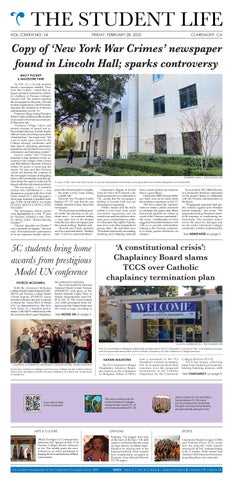
A copy of the ‘New York War Crimes’ in Lincoln Hall sparked controversy among students and raised allegations of antisemitism.
Pomona responds to contentious publication
Continued from page 1
Jewish experience; we look forward to working closely with Acting President Gaines as a resource in countering antisemitism.”
While Bankier said he did not know who put the newspaper in Lincoln Hall and that the paper itself did not seem to be otherwise associated with the Claremont Colleges, he noted, “Presumably, at least one person responsible for that area of the building would have seen it … and should have been wise enough to say, ’This doesn’t belong here.’”
However, JVP maintained that the newspaper’s placement in Lincoln Hall was not antisemitic.
“The goal of these allegations of antisemitism from Claremont Hillel and Haverim is not to protect Jewish students on campus, but rather to create a moral panic and stifle criticism of Israel and Zionism,” JVP’s statement read. “Claremont Hillel and Haverim’s continued conflation of Judaism with Zionism endangers Jews in the name of protecting Israel.”
The statement elaborated that “the current effort to scare and discipline members of the university community who criticize Israel and Zionism” was mirrored nationwide in right-wing attacks on ethnic studies programs and universities overall. “It is our responsibility as scholars, and in JVP as Jews, to oppose the moral panic these groups are working to create,” the statement said.
In a statement to TSL, Dean of Students and Vice President of Student Affairs Avis Hinkson encouraged all students to reach out to resources such as class deans, Monsour Counseling, 7C Health/ Timely MD, the Office of Chaplains and Campus Safety.
Harvey Mudd professor awarded Teaching Green Fellowship for chemistry
ILA BELL
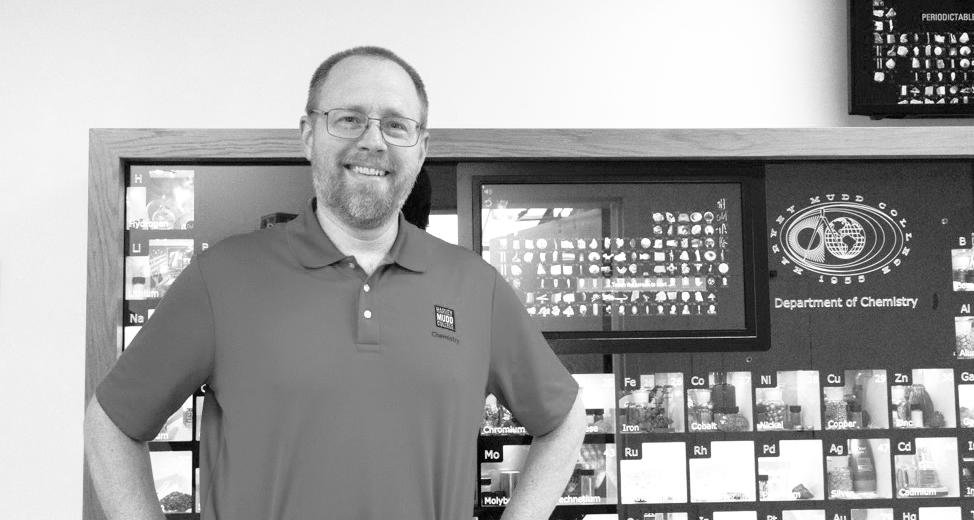
David Vosburg, a chemistry professor at Harvey Mudd College, was awarded the 2025 Teaching Green Fellowship for his efforts to incorporate sustainability concepts and practices into the college’s chemistry curriculum.
The award includes a certificate granting $10,000 for faculty summer salaries and $5,000 for student summer stipends. Additionally, Vosburg will be honored at the 29th annual Green Chemistry and Engineering Conference, where he will be a featured speaker. He will also serve on the judging panel for next year’s fellowship.
“It’s very encouraging,” Vosburg said. “It validates the work we’ve been doing at Harvey Mudd, not just me, but us as chemists.” The award is given annu -
ally by the American Chemical Society (ACS) and the Green Chemistry Institute (GCI). The ACS and GCI selected Vosburg for his extensive work in redesigning the chemistry curriculum to better prepare students for addressing sustainability issues.
Vosburg said that education on sustainable practices and methods in chemistry is extremely important across STEM disciplines.
“I think even more important than doing green things here is helping students develop that mindset about thinking critically,” he said. Since he began working at Harvey Mudd College in 2005, Vosburg said he has worked to implement sustainable practices into his chemistry courses. His efforts have included replacing toxic solvents, reducing environmental hazards and produc
ing energy-efficient reactions.
According to Vosburg, his classes have added a collaborative element to his goal of developing sustainability practices in chemistry.
“One of the nice things is I’m not the only one generating ideas,” Vosbug said. “My students are, too. So they’re true partners in the work.”
He added that he feels lucky to have the support of the chemistry department.
“It’s fun to have a really supportive department and college that are on board with things like green chemistry and sustainability,” Vosburg said. “It is great to have administration, colleagues, and students really stoked about it.”
Chemistry Department Head Karl Haushalter expressed his appreciation for Vosburg’s work.
“Professor Vosburg has been a leader in the green chemistry movement here at Harvey Mudd
and on the national scene as well,” he said. “Vosburg’s work, developed in his research lab, has been brought to his teaching labs and is now being taught nationally.”
Haushalter said that sustainability plays a big role in Harvey Mudd’s chemistry curriculum and that the department is continuously working to adapt and create new sustainable experiments and teaching lessons.
“I think it is an excellent recognition of the good work that’s being done by Professor Vosburg and by his students, and work that’s going to spread throughout our department,” he said.
He added that sustainability will remain a priority in the college’s chemistry curriculum.
“I think it’s really our responsibility as scientists, especially as scientists training in the next generation of scientists, to have this be central to our thinking,” Haushalter said.
Pitzer College removes AI-generated image amid growing concerns
In the wake of recent legislation targeting the transgender community, some students expressed concern last week over an AI-generated stock image displayed on Pitzer College’s LGBTQIA+ support page, which has since been removed.
Ezra Levinson PZ ’27 called attention to the AI-generated image in a Feb. 18 email to Student Talk — a listserv available to Pitzer
students who sign up — with the subject line, “AI-generated queers.”
The stock photo is on Adobe Stock and is named “LGBTQ College Students Studying in Academic Background, LGBTQ college students, studying, academic background.”
“The header of the page where Pitzer brags about being LGBT-friendly is an AI-generated stock photo with pride flags in it that don’t exist,” Levinson
wrote.
In an email to TSL, Nick Owchar, Pitzer College’s editorial director and interim marketing and communications lead, explained why Pitzer used the AI-generated image and why it has since been removed.
“Recently we heard from staff colleagues about some student concerns regarding the image being used on the Pitzer LGBTQIA+ page, so we removed it,” he wrote. “We use
different kinds of stock imagery to respect the privacy of our students. It isn’t something unique to the LGBTQIA+ page.”
In an interview with TSL, Levinson argued that the image is harmful to the student population.
“It falls short of Pitzer values in just about every way that I can think of,” she said. “Almost worse than that, it prioritizes marketing and, like, surface level image over Pitzer’s values
in this very grave moment where we need to be doing the opposite of that.”
According to Levinson’s email to Student Talk, it was especially disheartening to discover the image given the current political climate; she wrote that it would “really make a difference if I felt like my college had my back.” Recent legislative activity regarding the connection between gender and biological sex has raised some concerns among students. As of Feb. 25, 11 bills have been passed, including measures that prioritize sex-based identifications in legal documents and on sports teams.
“There’s no shortage of research from the Trevor Project and other organizations that’s shown that when anti-trans legislation is passed, it has a really grave effect on mental health,” Levinson said in her interview. “There’s also research showing that support at the community and the school level for trans students and the trans community can help to counteract those mental health effects.”
Though it was not in response to the AI photo, Pitzer President Strom Thacker expressed support for the trans community, as well as other vulnerable groups, in an email to Pitzer students on Feb. 19.
“Recent and proposed federal policies have impacts across a wide range of issues that affect our community and individuals within it,” Thacker wrote. “It is important to note that Pitzer does not engage in identity-based or other forms of illegal discrimination. On the contrary, we maintain an unwavering commitment to inclusivity and equity. While we may need to adapt to new policies, our core values remain unchanged.”
Both Levinson and Thacker said that they want to keep Pitzer a place that prioritizes community well-being and safety, specifically students vulnerable to recent legislation.
“We need each other,” Levsinson said. “Not only do trans students need the support of our college administrators, but college administrators are going to need the support of their students and their communities.”
CHLOE ESHAGH
COuRTeSY: ADObe STOCK
COuRTeSY: HARVeY MuDD COLLeGe
Harvey Mudd College Professor David Vosburg received the 2025 Teaching Green Fellowship award and will be honored at the 29th annual Green Chemistry and engineering Conference in June 2025.
MODe L UN: Awards run rampant for 5C students at Harvard’s national conference
Continued from page 1
HNMUN.
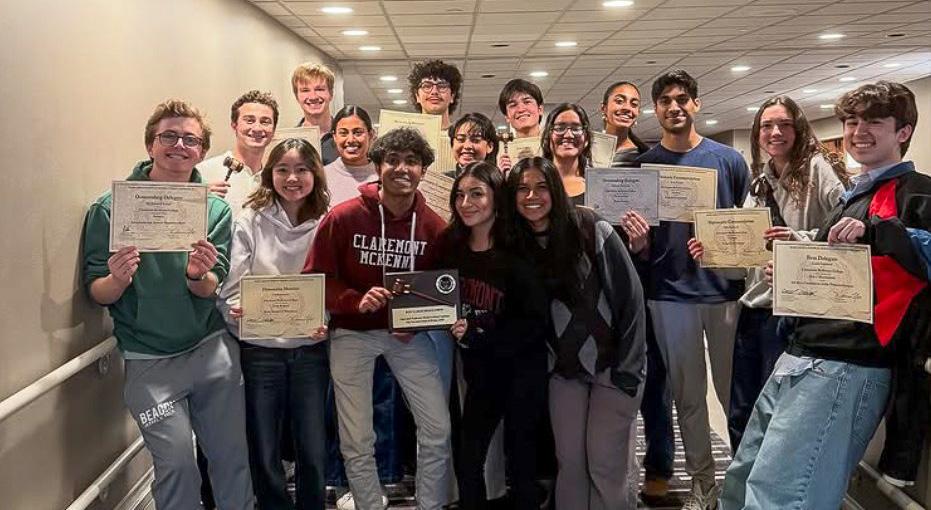
At the conference, 12 of the 16 delegates from CMCMUN won awards, including three Best Delegate awards — the equivalent of first place — to Josh Morganstein CMC ’25, Louis Layman CM ’26 and Tom Inouye CM ’26.
In a Feb. 25 Instagram post, CMCUN highlighted their group-wide achievement: “CONGRATULATIONS to our Harvard team … They won Best Large Delegation at the conference for the first time in CMCUN history.”
Representing the other 4Cs, PCMUN sent five delegates, with Joshua Mosley PO ’26 winning a Diplomatic Commendation within his committee.
HNMUN, along with many other East Coast conferences, tends to take
on a more serious tone than their West Coast counterparts, according to Morganstein and Mosley. With that serious tone, however, comes greater weight regarding end-ofseason rankings.
“HNMUN is the most competitive domestic conference for American schools, so in that sense, it is the Super Bowl of MUN,” Morganstein, the club president, said in reference to The New York Times’ attribution. “It’s the highest ranked in terms of weighting for awards.”
Yet Mosely said that his willingness to have fun amidst the highstakes circumstances helped him in the end.
“East Coast conferences are typically known for being a little more serious,” Mosley said. “I think that having those fun hooks in committee with your speeches makes you
CHAPLAINCY: TCCS faces criticism for proposed termination
Continued from page 1
faculty and staff and meeting with the Catholic Student Association. They aim to gather feedback by the end of February, craft a proposal for 7C presidents by March and begin a search to fill the vacancy by April, with the Chaplain hired by summer.
According to CORA’s statement, by beginning this process without consulting the Chaplaincy Advisory Board or conducting another review of the chaplaincy, as was done in 2015, the vice president of student affairs at TCCS, Dr. Stephanie Blaisdel,l bypassed precedent.
“CORA was established by Dr. Blaisdell’s predecessor, Janet Smith Dickerson, and approved by the 7C President’s Council to serve an advisory role for all major issues regarding the chaplaincy,” CORA faculty said in their statement. “CORA has served in an advisory capacity for more than 45 years and her course of action undermines our confidence in her leadership.”
The Catholic chaplain position is currently vacant after Father Joe Fenton announced his retirement in October of last year. But CORA said that Fenton’s retirement was not as cut-and-dry as TCCS made it out to be.
“Father Joe Fenton was terminated without any formal announcement, explanation, or consultation with the CORA Chaplaincy Advisory Board,” CORA wrote. “While Dr. Blaisdell announced to the 7Cs community that he ‘retired,’ Father Fenton stated that she told him on October 2, 2024, that he was ‘terminated’ and to this day she has never told him why he was terminated.”
Fenton attended a recent CORA meeting and shared how his termination was spun into a retirement, according to Pomona Chair of the Faculty and Professor of Medieval Studies Kenneth Wolf.
He said that Fenton’s final paycheck is being withheld by TCCS — which includes vacation time accrued — until he agrees to sign a document saying that he will not discuss his termination openly.
“I know how history works, and there’s two sides to every story,” Wolf said in an interview with TSL. “I just wish he had been given a better exit so that he doesn’t have this bad taste in his mouth at the end of so many years of service.”
Blaisdell allegedly told faculty she will not be moving forward with a review of the chaplaincy.
“The problem is really a jurisdictional one, that the VP of student services would decide to do something like this without having a full, ten-year review,” Professor Wolf said in the interview. “We’re due for another one, where they could get all the stakeholders, not just go door-todoor and ask people: ‘Well, which chaplain would you like?’”
He emphasized, however, that a review does not guarantee any measures. For instance, the 2015 review — which included fourteen people encompassing student deans, CORA members, students and staff — said the chaplains needed more money and less oversight by the deans and more by the presidents.
“Neither one of those things happened; that’s why we have this problem,” Wolf said.
The Claremont Chaplaincy was established in 1949. In the early 1970s, the chaplains reported directly to the then-6C presidents. In
[more] noticeable.”
That West Coast attitude appeared to be shared amongst many participating institutions, with Morganstein and Mosley both noting a sense of camaraderie with their fellow West Coast schools. They said that the similar competitions and tournaments they participate in foster a sense of familiarity that can help when it comes time to make alliances in committee.
“It’s always nice when you walk in a committee and see a friendly face,” Morganstein said.
These friendly faces are made through other means too, such as famed Saturday night socials at conferences, where Morganstein said that the West Coast schools often come together for a regional celebration. They also perform exhibition runs, which help members get
a feel for the atmosphere and faces that are sure to follow throughout the Model UN season.
CMC’s success at HNMUN left Morganstein excited for the remainder of the season and the club’s future. He said he recognizes the value of their award but is most proud of what he believes it represents about the club.
“More important than the awards and the ranking is what it represents about the talent we have on our team, the hard work that people are putting in, culturally how strong we are and how well we get along,” Morganstein said.
He also expressed his confidence in the members who will carry the group forward once his term as president ends, emphasizing the camaraderie that the organization has carefully cultivated over the years.
The bonds within the Model UN teams have opened up special opportunities, such as CMCMUN guaranteeing members the opportunity to attend two conferences over the course of the semester, something Morganstein said is unique on the Model UN circuit. With the season still in full swing, both teams are looking to finish strong. The Harvard World Model United Nations (HWMUN) conference coming up in Manila, Philippines, which Morganstein cited as the “Olympics” of Model UN, provides another chance for CMCMUN to maintain momentum following their performance at HNMUN.
“Our goals are to do as well as possible, to keep the streak going and to hopefully achieve our highest competitive ranking yet,” Morganstein said.
World Without Exploitation
Claremont sparks discussion about sex positivity and the sex trade
2001, the TCCS restructured itself, and the chaplaincy began reporting to the vice president of student services.
“The problem is the chaplaincy began as not a student service, but as a chaplaincy,” Wolf said in the interview. “[It] then was folded bureaucratically under the student services branch of the college, rather than the president.”
Because of this change, Professor Wolf said that he finds the Chaplain’s Office to be inhibited from serving the 7C population. He cited the chaplains’ inability to speak to student reporters without getting permission from TCCS and the “muted” response after Hamas’ Oct. 7 attack on Israel as examples of its current ineffective structure.
“The chaplaincy, from a CORA perspective, should be the conscience of the colleges,” Wolf said. “I imagine a free chaplaincy being able to sit down and say: ‘What should we do as a chaplaincy in the face of this?’ But instead, there are restrictions on what they can do.” Wolf added that if TCCS was “truly operating in good faith,” they would have approached CORA immediately with the possibility of not replacing the Catholic chaplain with another Catholic chaplain; he said that there is a “constitutional crisis” within the chaplaincy that is of utmost concern to him.
“If Stephanie had met with CORA, the 7C Committee of Religious Affairs, before setting out on this path, she would have seen how her approach is, in a very real sense, unconstitutional,” Wolf said in a “report out” email to Pomona faculty on Monday, Feb. 17, which he forwarded to TSL.
“At the very least, it flies in the face of process and precedent.”
Apart from the current constitution of the chaplaincy, other professors have raised concerns about the proposed combination of the Protestant and Catholic chaplaincies into a “Christian chaplaincy.”
When asked about possible next steps, Wolf said another review must be done of the chaplaincy, similar to the one he led in 2015, from which a Muslim Imam was added to the Chaplains Office.
CORA has received a default response from the 7Cs Presidents Council regarding their statement, specifically from Scripps College President Amy Marcus-Newhall, who spoke on behalf of the council.
“She acknowledged receiving the letter, and that’s about all she did,” Wolf said.
“It wouldn’t be typical for a president to tip their hand: They take that information and decide. I’m just hoping that it’s not something they leave to the deans of students and let them decide, because I think then there’ll be some repercussions.” Ultimately, CORA staff called on the 7C presidents to give Fenton a “proper retirement ceremony.” They further requested that presidents issue a statement that the Catholic chaplaincy will not be terminated and conduct another official review in coordination with the Chaplaincy Advisory Board to “assess the current needs” of the chaplaincy and 7C community.
World Without Exploitation
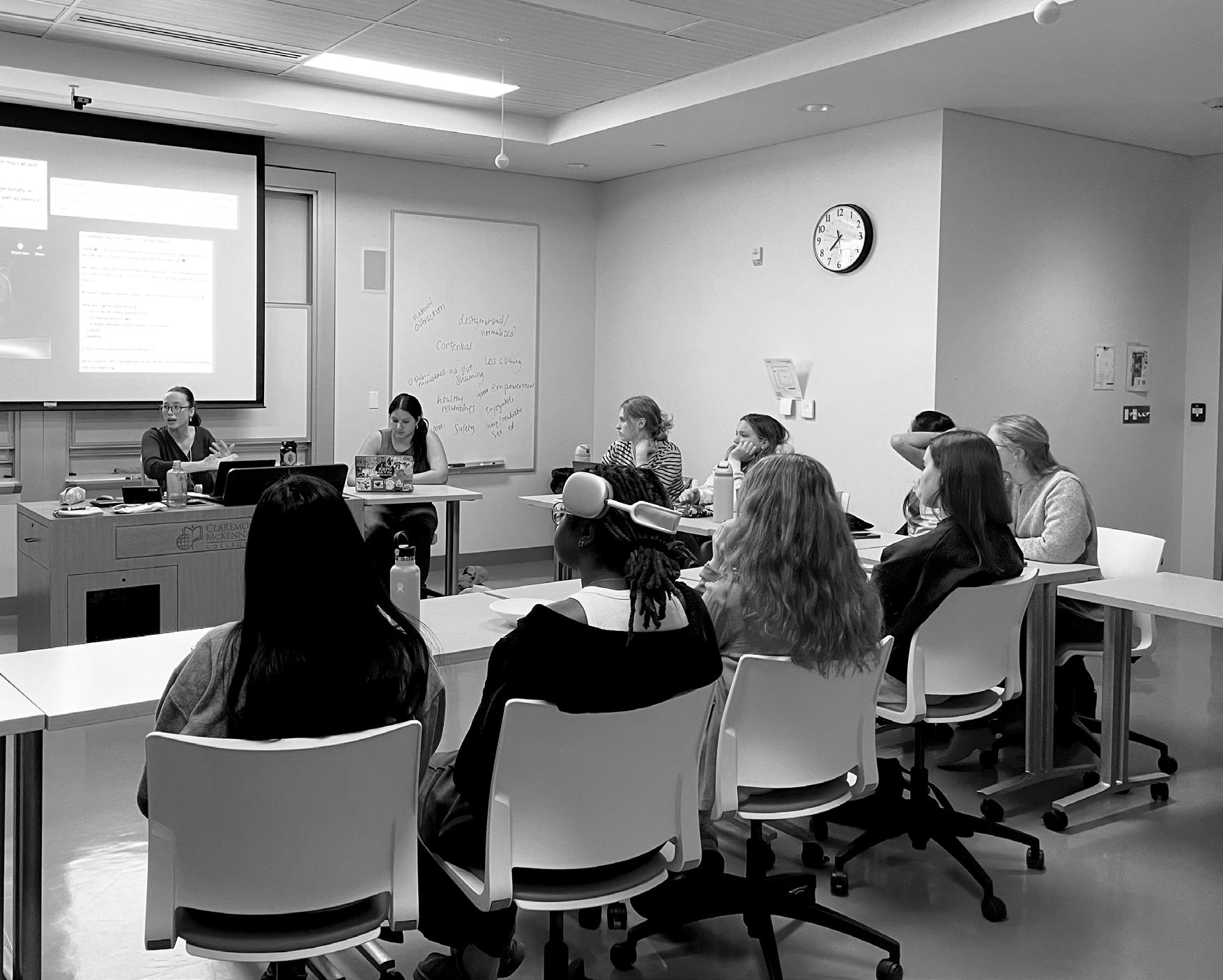
Claremont (WWE 5C), the 5C branch of a national anti-sex trafficking organization, gave its first presentation of the semester on Feb. 18. Presenters Reese Rosebeck PO ’25 and Nayla Dayal SC ’25 delivered a clear message: “Sex positivity” is not a term that should be associated with the sex trade.
During their hour-long presentation, entitled “Sex Positivity And The Sex Trade,” the presenters discussed the pornography industry, OnlyFans and stripping. At the start of the event, attendees wrote down words that they associated with “sex positivity,” such as “healthy,” “consensual” and “destigmatized.”
WWE 5C follows the protocol of its parent organization, World Without Exploitation, in using the term “sex trade” as opposed to “sex work.”
“If someone were to selfidentify themselves as a sex worker, then of course, we would use that terminology,” Dayal said during the presentation. “But I think to assume that everyone is a sex worker or would choose to identify that way erases the sort of structural physical and emotional violence that occurs within the sex trade.”
The presenters began by playing three clips highlighting male producers and actors in the porn industry. One video displayed a porn director stating that the spread of STDs was not a concern and that performers knew what they were getting themselves into.
“That line that they knew what they were getting themselves into implies a level of agency that, when talking about the sex trade, we don’t necessarily believe,” Dayal said. “Compensation is a form of coercion. It’s hard to leave when that’s how you’re making your living.”
According to Rosebeck, out of 4,000 porn videos, 80 percent depicted verbal or physical violence towards women.
Rosebeck said that there’s a science to violence demanded by the porn industry: The brain receives dopamine from watching it; watching repeatedly reduces the dopamine intake; viewers ultimately seek out more “exciting” material.
“That ‘exciting’ material that’s available to people to watch — for men to watch, specifically — is increasingly more violent, more kinky,” Rosebeck said. “And usually kinky in the context of porn means physically aggressive towards women; domination over women.”
Attendee Katie Fullerton, SC ’28, who attended two WWE 5C meetings last semester, compared the addiction of violent porn to smoking, allowing her to ultimately walk away with some hope for solutions.
“At first you feel the buzz of it, and then the buzz fades,” Fullerton later said in an interview with TSL. “So then you need more. But I think if we start to see that as an addiction, not judge people for getting sucked in … there are ways to get at the core of the problem. Now, I feel like there are solutions.”
During the presentation, Dayal reminded attendees that while watching porn often feels like watching a performance, the violence the women are experiencing is real. She said that people often accuse her of not being sex-positive when she questions someone who watches porn.
“It’s not one individual’s fault for believing that [watching porn is sex-positive] because it’s being marketed as ‘something’ porn,” Dayal said. “People label porn as sex-positive. It’s not.”
Dayal and Rosebeck went on to debunk common misconceptions about the OnlyFans industry, including the idea that OnlyFans is a safe alternative to the commercial sex trade.
“This alternative to selling sex appears distinct from that in-person, physical violence that you would experience in the commercial sex trade, for instance, which is why a lot of people opt to do it,” Dayal said. According to Dayal, OnlyFans takes 20 percent of the minimum wages that content creators make. While the CEO of OnlyFans has a net worth of $3 billion, Dayla said that only five percent of OnlyFans creators are making more than $100 a day.
“It’s operating like it’s a digital pimp,” she said.
Rosebeck said that the competitive sex market in OnlyFans forces women to objectify themselves so they can keep up with the market on the platform.
“That is what a competitive sex industry market makes you do in order to make money,” Rosebeck said. “They must compete. They must engage in this process of selfobjectification.”
The presenters concluded with a conversation on violence in the stripping industry, using the example of the film Anora to highlight the normalcy associated with the stripping industry. But according to Rosebeck, experiencing empowerment as a stripper is the exception, not the rule.
“The sex trade cannot be sexpositive because what occurs within the sex trade is not sex,” Rosebeck said. “It’s something else corrupted entirely. It’s not, by any definition, consensual.”
Fullerton said the presentation made her realize that the sex trade was worse than she initially thought.
“There’s so much I don’t know about it and there’s so many underlying evils in it … I feel like the more you dig, the more complicated it gets,” Fullerton said.
She added that she wished there had been more men at the meeting and that more of these discussions took place in classrooms, adding that “This needs to be common knowledge.”
MACY PUCKETT
MACY PuCKeTT • THe STuDeNT LIFe
On Feb. 18, Reese Rosebeck PO ’25 and Nayla Dayal SC ’25 led World Without Exploitation Claremont’s first presentation of 2025, discussing the reality of the sex trade.
ASPC launches ‘Eco-Olympics’ to foster sustainable competition at Pomona
PATRICK MCDOWELL & KALIA MANAYAN
On Feb. 12, the Associated Students of Pomona College (ASPC) kicked off a two-week-long energy consumption reduction competition for the dorms across Pomona’s campus.
The event, dubbed the “Eco-Olympics,” encouraged students to take “simple actions” such as turning off lights when leaving their rooms, unplugging unused devices and being mindful of their energy usage.
The three Pomona dorms with the highest reduction in energy consumption will be awarded various prizes, namely an Xbox console for first place, an air hockey table for second and a ping pong table for third.
Commissioner of Facilities and Environment Devansh Taliyan PO ’27 and Commissioner of Wellness Sidney Eramil PO ’27 spearheaded the initiative, hoping to foster a friendly yet competitive cross-dorm battle for the prizes.
Both said that they hope the event will increase awareness about energy consumption while simultaneously promoting a greater sense of community within the dorms through prize incentives.
Taliyan acknowledged the challenge behind encouraging behavioral changes, noting that people are often reluctant to let go of old habits. He said he’s hopeful that in a competitive setting, students will be more motivated to work towards growth.
Inspired by a similar inter-dorm competition at his previous school, Taliyan decided to launch the “Eco-Olympics” at Pomona. He said that he hopes the competition will promote community amongst the dorms, a point that Eramil also brought up.
“We noticed that for some of the dorms, especially the larger ones, it’s harder to form a community outside of your sponsor groups,” Eramil said. “We believe [these prizes] can help foster a sense of community.”
Some students across campus have begun to take notice of the competition and are hopeful that
the efforts will be effective, including Elaine Suh PO ’28, who lives in the Mudd-Blaisdell residence hall. Suh said she already reduces energy in her dorm by turning off her lights and air conditioning when they’re not needed and ensuring the sink water doesn’t run longer than needed.
She said that spreading awareness through competitions like this could make sustainability efforts more widespread across campus. “I think it’s a creative incentive and it’s nice that the school is trying to raise excitement around the competition,” Suh said.
ASPC also recently implemented other environmental initiatives, including a requirement that compost bins be present at campus events. Taliyan said that before this initiative, many events generated excess waste because food was simply tossed in the trash. Now, the requirement is helping to offset
that excess waste.
As they look to the future, Taliyan and Eramil said they hope to find new initiatives that balance the often delicate act of engaging students and generating real impact.
“We are trying to reignite that passion for sustainability,” Eramil said.
7C International Festival celebrates global cultures with food, music and performance
CASTILLON Colombia.
The 7C International Student Community Programs Council (ISCPC) hosted its third annual International Festival at Claremont’s Flamson Plaza on Feb. 22, offering a celebration of global diversity.
The lively event showcased traditions, food and performances from 24 different countries, including Jamaica, Turkey, Kenya, Poland, Japan and
Attendees had the opportunity to explore various booths representing each nation, where they could register for a plate and sample traditional dishes from across the world. Among the offerings were Colombian soda, Finnish blueberry oat dessert, Palestinian warak dawali (stuffed grape leaves), Vietnamese banh beo (rice cakes) and Nigerian fried rice.
The festival also featured international performances, with the Los Angeles musical group “Colombia Latin Soul” filling the plaza with vibrant Latin sounds. 7C students and staff later took the stage to showcase their talents, while a colorful parade of traditional clothing highlighted the diversity of cultures at the event.
Luis Angel Mendoza CM ’25 expressed his appreciation for the festival’s inclusivity in its tabling selection.
“It was nice to see countries like Colombia, Palestine and others,” he said. “It’s really nice to see that they included as many countries as they can, just given the fact that CMC and the overall population is very diverse.”
He added that it was pleasant to see so many different people from across the consortium come together on such a nice day, with temperatures in the low 70s.
Throughout the day, students passing through the plaza took time to engage with the festival, sampling food, watching performances and enjoying the atmosphere.
Bernice Sule PO ’26 shared her appreciation for the opportunity to connect with fellow Nigerians at her booth.
“It’s a nice opportunity to be in community with other Nigerians because we’re pretty spread out across the campuses,” Sule said. “Most people come and ask, ‘Are you making jollof rice?’ because it’s one of the most famous Nigerian dishes, but we have other things to offer. Today, we’re showcasing chicken, fried rice, mocktails and other kinds of drinks.”
For Megan Tran HM ’28, the festival was a special opportunity to share her culture with others.
“This is my first time at IFest, and I think it’s a really good opportunity for students to come out and enjoy different cultures and interact with each other,” Tran said.
“For the Vietnamese Student Association booth, we’re serving cha gio [egg rolls] and banh beo,” she said. “It’s really nice to see people try my culture’s food and enjoy it.”
Representing Finland, Mai Hoglund PO ’28 was thrilled to share a piece of her heritage with the campus community.
“I’m really proud to have a table here. I’m one of the few Finnish students, and I’m really happy to represent my country at the colleges,” Hoglund said. “It’s a great chance to showcase that there are more than just Americans here and to share some great food with people.”
The 7C International Festival brought together students from across the Claremont Colleges to celebrate cultural diversity through food and performance. The event provided an opportunity for attendees to engage with a wide range of traditions, fostering understanding and connection within the community.
SHIXIAO Yu • THe STuDeNT LIFe
In Issue 13, the photo included in the article “So nice, they had to do it twice: Stags defeat the Sagehens 90-77” was incorrectly attributed to Sarah Ziff. The correct photographer is Leslie Ahuatzi.
YAHJAIRI
ANDReW YuAN • THe STuDeNT LIFe
On Feb. 22, the 7C International Student Community Programs Council hosted its third annual International Festival at Claremont’s Flamson Plaza, offering a celebration of global diversity.
Distance makes the delusion grow deeper
In the last two weeks of the 2024 spring semester, I asked out this guy who I had thought was cute for a while. From now on, this guy will be called Roddy. We had a great first date that lasted from noon to the depths of the night. We agreed that we’d have fun and see what happened but not to rush anything, considering that there were only two weeks of school left.
The rest of our time together was spent taking walks, lying in bed chatting, watching TV, and, of course, making out. A week after our first date, I finally decided I was ready to do the devil’s tango — sex — for the first time ever. Unfortunately, due to unforeseen circumstances, the tango was not deviled. Roddy was sweet about it, though, and for the last week of finals, we continued to see each other.
We kept in touch during the beginning of summer, but sometime in late May, the responses got scarce. Then, in June, I was the only one putting in any effort to carry the conversation. We’d send the occasional photo, but at the beginning of my semester abroad, we officially stopped talking for three months.
Come my winter break, I visited campus and he asked if he could see me. When we met up again for the first time in eight months, we talked exactly like we did back in the day and we sat side by side with his arm wrapped around me.
After Roddy hinted that we
should continue our fling upon arrival back in Claremont, I became skeptical, thinking of a popular saying that I’m sure everyone has heard at least once in their life: “Absence makes the heart grow fonder.”
It was inevitable that Roddy and I would see each other back on campus — after all, our extracurriculars and friend groups were the same. Had my heart grown fonder?
Last weekend, I spent a whopping 10 hours stuck in a car with him and a few other
Sista-2-Sista: A resource for young Black girls in high school
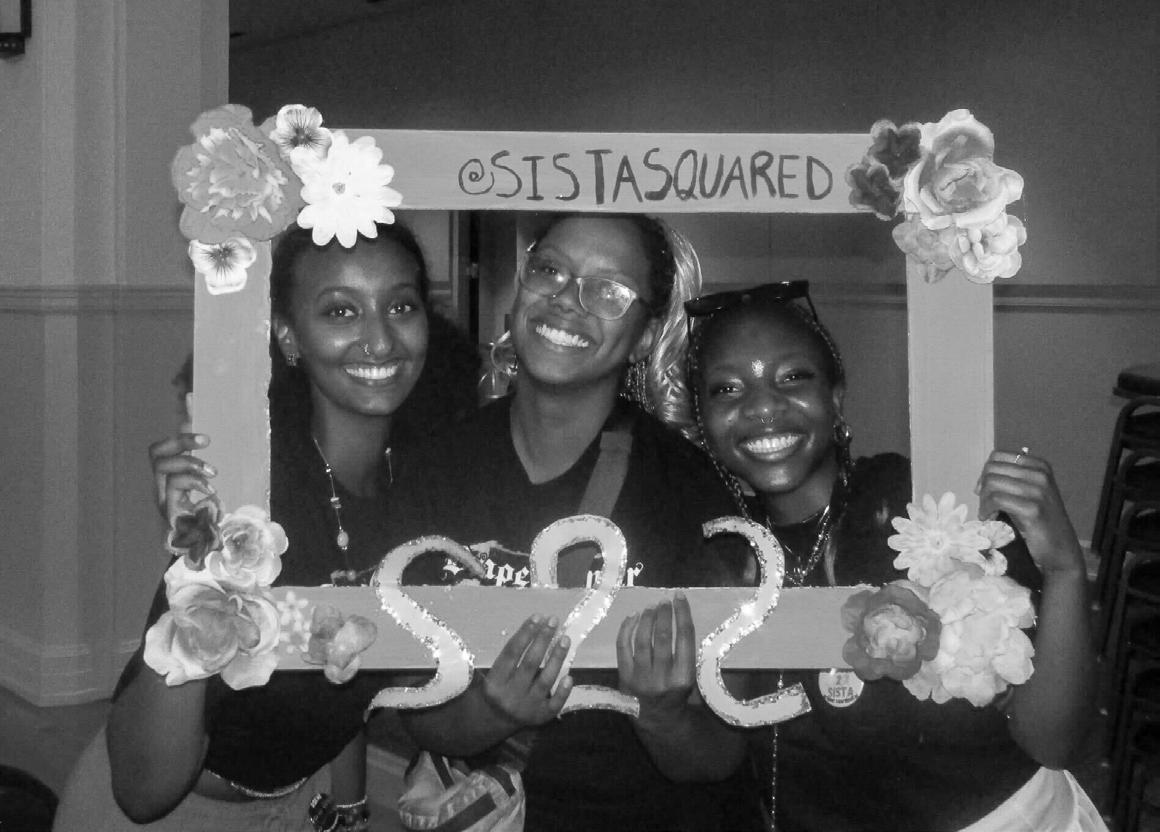
At Pomona College’s Draper Center for Community Partnerships, you will find Sista-2-Sista, a student-run, volunteer-based program that supports young Black women in high school. Through group-led discussions, workshops and mentorship, Sista-2-Sista works to build safe spaces for the high schoolers with which they partner.
Last semester, the Draper Center celebrated 15 years since its founding. Established in 2009, the center originally focused on outreach to low-income neighborhoods outside the Claremont Colleges and has since expanded to oversee 15 programs. Sista-2-Sista has been an active part of the center since 2016, according to Kristin Walters, a post-baccalaureate fellow for educational outreach who helps oversee Sista-2-Sista and other Draper Center programming.
Sista-2-Sista partners with local high schoolers with the goal “to heighten students’ understanding of what it means to be a Black woman in American society,” according to their mission statement.
Oluwasemilore Osunkeye PO ’28, Nadiya Muhammad PO ’25, Edidya Solomon PO ’26 and Werlie Cius PO ’26 are the program’s coordinators this year. While the latter two are studying abroad this semester, Osunkeye and Muhammad oversee recruitment events on campus, host office hours at the Draper Center and plan discussions and workshops for upcoming high school visits.
Every Thursday, Sista-2-Sista visits Colony High School in Ontario to host a space that brings together the Black community and have conversations that center Black voices.
According to a U.S. News and World Report, Colony High School has a total minority enrollment of 93 percent, including 10.5 percent Black students.
“Something I got inspired by from being a Posse Scholar is teaching these girls about de-escalation,” Muhammad said. “I want to teach
these girls about different ways to handle conflict and how to make spaces more comfortable for everybody.”
In high school, Osunkeye was part of an organization similar to Sista-2-Sista that focused on mentoring girls and joined Sista-2-Sista to continue her involvement throughout college.
“We’re privileged to go to schools like the 5Cs,” Osunkeye said. “We want to be role models for these high school girls and give them advice on future career paths or life.”
Last semester, Sista-2-Sista hosted workshops on hair braiding and bracelet making, as well as a “How to Get Ready for College” day on campus. Students had the opportunity to participate in workshops, ask professors questions and listen to a talk from Dr. Adrienne Hilliard, a counselor at Monsour Counseling and Psychological Services.
“We also want to hold space for talking about current events,” Muhammad said. “A lot of the time, we’re expected to go about with underlying stress, and this space is meant for students to decompress themselves.”
While Sista-2-Sista currently only visits Colony High School, they are hoping to expand to other high schools in the area and continue on and off-campus programming.
Some events they hope to do this semester are field trips to the California African American Museum (CAAM), a tour of the Pomona campus, study sessions and a partnership with a predominantly young Black Girl Scout troop in Pomona.
Sista-2-Sista is currently in the recruitment process, and Osunkeye encourages students to volunteer with the program.
“Meeting these girls is so fun; they are so smart and so open to having these conversations, so I’m sure a lot of people would enjoy this opportunity,” she said.
people. Leading up to the trip, I thought about the what-ifs: What if being together makes that old spark rekindle? What if we get a moment alone and I tell him how I’ve been feeling about him for the past two weeks that we’ve been back on campus?
What if this trip is finally my breaking point?
During the trip, Roddy was impatient, rude and overall in a pissy mood. He refused to compromise on where to eat, was passive-aggressive about when we had to leave and only
thought about himself. Attempting to rekindle the flame of the spring, Roddy’s change of behavior made me feel the exact same way I felt when he first started going cold on me. By the end of my extremely long three-day weekend, I was infuriated. I wanted nothing to do with anyone I sat in that car with, especially Roddy. All I could think of now was how excited I was to go back to my dorm and sleep my anger away.
I don’t know how and I don’t know why, but the following
Tuesday when I saw him sitting alone in the Smith Campus Center lounge, my heart skipped a beat. Without thinking, I went to sit with him. Barely a day later and my aversion to being around him completely disappeared. How could that be? How is it that one day I want to strangle him to death but the next I want to go for a walk and act like old times?
As I stared deeply into his eyes, I wondered: Does absence make the heart grow fonder, or does absence make the heart grow delusional?
The 10 consecutive hours he and I spent together forced me to see how Roddy truly was, or at least could be. My delusion had shielded me from Roddy’s inconsiderate, impatient and self-centered behaviors. Yet in the one day we spent apart, nostalgia crept in and I started rewriting the story in my head. I let myself remember how he held me while we slept, how we’d laugh together, how we’d talk for hours.
It was easy to forget why I was angry with him in the first place.
I waited months to be close to Roddy again, but now I realize that closeness was the problem all along. At the end of the day, Roddy isn’t just bad at texting, he’s bad at communicating. Absence never made the heart grow fonder, it made me forget why we stopped talking in the first place.
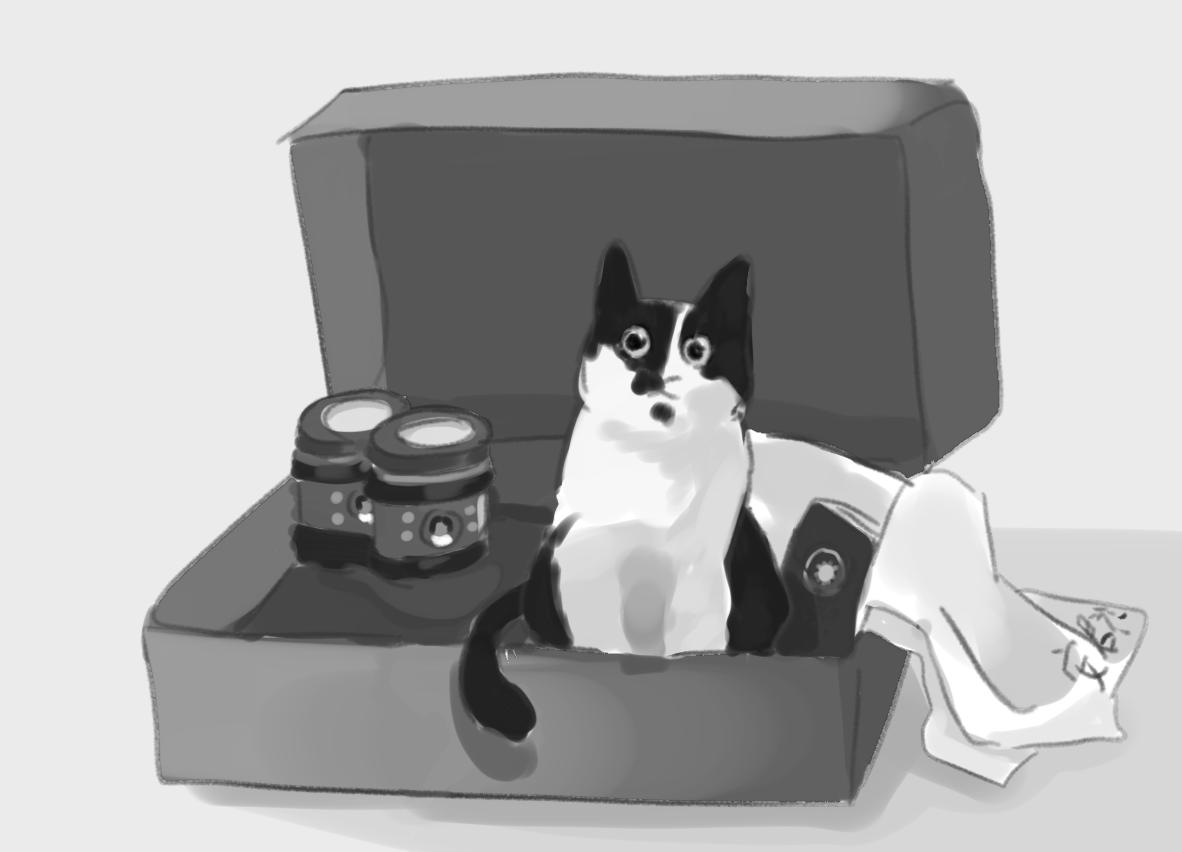
Tom Cat is a cat who owns a summer home in New Mouse City. Roddy lives on loser island, and is now dead to me. Meow meow meow.
The 61st Robbins Lecture: Carolyn Bertozzi on bioorthogonal chemistry
ANANYA VINAY & GABRIEL BRENNER
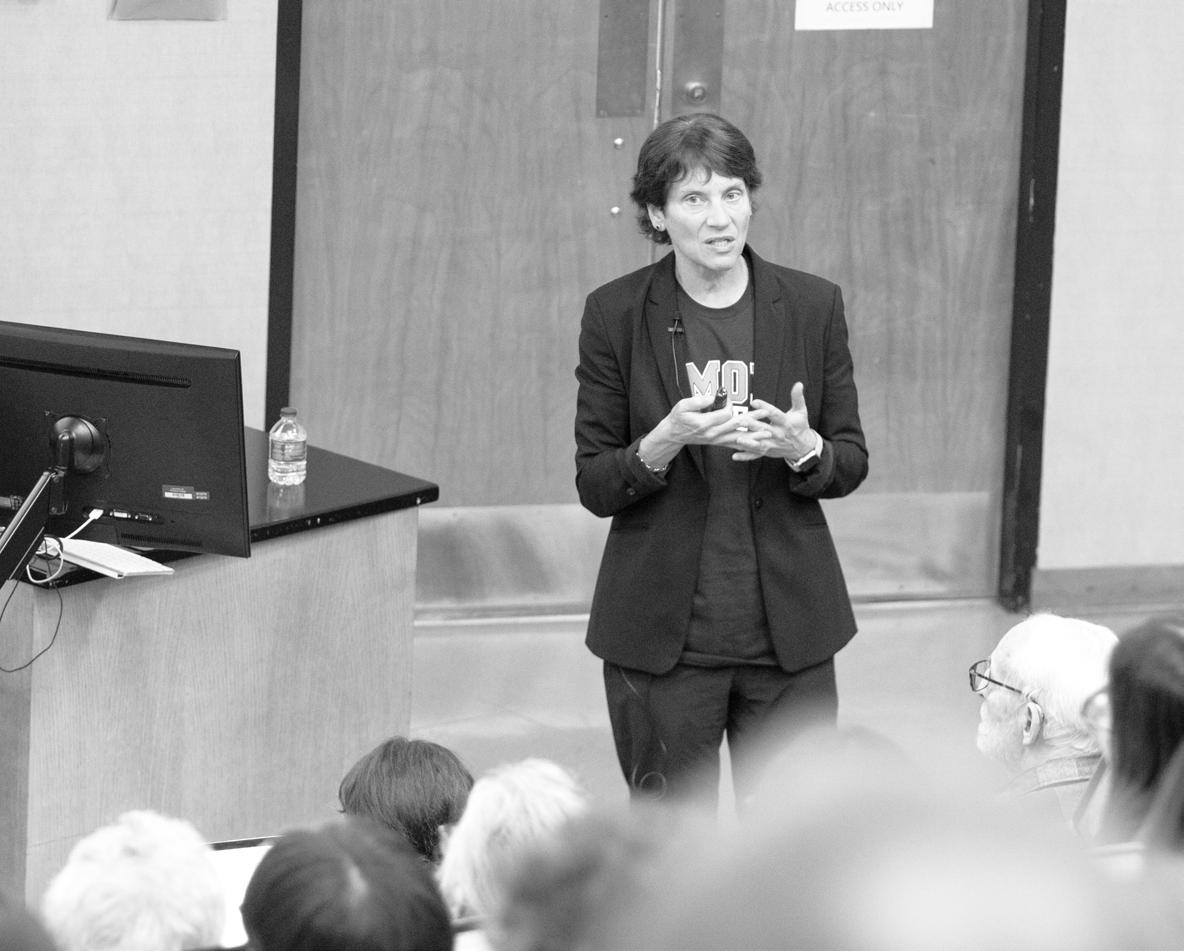
“[We] have heard over and over these debates about what’s more important, [basic or translational science],” Carolyn Bertozzi said. “The truth is, if you don’t do curiosity-driven basic science, you have nothing to translate.”
From Feb. 24 to 26, Bertozzi — Baker Family Director of Stanford ChEM-H, professor of chemistry at Stanford University and a recipient of the 2022 Nobel Prize in Chemistry — took the stage for the Pomona College Chemistry Department’s 61st annual Robbins Lecture Series.
Alongside another scientist, Bertozzi was the only woman awarded a Nobel Prize in the sciences in 2022 as well the first out queer recipient of a Nobel Prize in the sciences.
Bertozzi shared the scientific journey of how she helped create an entirely new field of chemistry, called bioorthogonal chemistry, and pioneered its wide-ranging applications.
The goal of the Robbins Lecture Series is to help increase students’ access to world-renowned scientists, which was made possible by a donation from Frederick Robbins, according to Professor Charles J. Taylor, chair of the Pomona Chemistry Department.
“I really hope that people will walk away from tonight’s talk realizing the importance of science and the diversity of scientific problems that people approach,” Taylor said.
While traditional chemistry requires controlled environments that would destroy living tissue, bioorthogonal chemistry operates by creating chemical reactions that function within living systems.
“Healthy cells have a well-manicured garden of sialic acids (sugars),” Bertozzi explained. “But cancers have a tropical jungle.”
This difference creates an opportunity: If we could see these sugar jungles in the body, we could detect tumors earlier and more accurately.
For decades, this challenge remained unsolved — until a chance encounter set Bertozzi on the path to change that.
“My advisor at the time was supposed to go to England to give a talk at the Irish Joint Anatomical Society,” she said. “As the date approached, he realized he did not want to go, and asked who in the lab wanted a free trip to Europe, so I raised my hand.”
Although she said that most of the conference left her bored, Bertozzi was captivated by one presentation by Dr. Werner Reutter about how cells build sugar molecules in a method akin to an assembly line.
The assembly line method, or how biosynthetic machinery sugar is produced within a cell, inspired Bertozzi’s idea: modify starter molecules with special “handles” that cells would pro-
cess normally until they reach the cell surface. Then, attach imaging molecules to these handles, making them visible in medical scans.
In developing their first method for attaching imaging molecules, her team initially turned to a century-old reaction, the Staudinger reduction (1919), but it was not fast enough to react in living beings.
“Once you’re in the body of an animal, it’s not an equilibrium system,” she explained. “In a round-bottom flask, you can mix chemicals with a stir bar and have a reaction happen in a few hours. But a rat is metabolizing. The reactions have to be really fast.”
Around this time, chemists Morten Meldal and K. Barry Sharpless — the other two recipients of the 2022 Nobel Prize in chemistry — had independently discovered that adding copper could dramatically speed up certain chemical reactions in what became known as “copper-catalyzed click chemistry.”
Meldal and Sharpless’ findings revolutionized how chemists could join molecules. Bertozzi realized that by harnessing molecular strain instead of copper, she could create a similar reaction that worked inside living cells.
“We thought these guys had solved our problem, but copper catalysts are toxic to living cells. Nonetheless, these guys shared the Nobel Prize with me,” Bertozzi said with a laugh.
Bertozzi expanded on their work by developing a version of catalysts that don’t need copper, making it safe for living cells. Her final breakthrough came from an unexpected source: teaching her sophomore organic chemistry class about ring strain, an instability in molecular structures.
Bertozzi wondered if molecules with ring strain could speed up reactions without the toxic copper that could threaten living cells.
“I called my graduate student while on a layover in Chicago and asked him to check if anyone had ever tried this approach,” she recounted. “By the time I landed in
San Francisco, he found a paper from 1961 by a German chemist named Georg Wittig.”
The paper was in German, which Bertozzi couldn’t read, but one phrase jumped out — “Phenylazid mit cyclooctin explosionsartig” — describing the reaction she was interested in. This became the foundation for her Nobel Prize-winning work.
Attendee Jake Cole PO ‘26 was intrigued by the scientific discovery process.
“Imagine your breakthrough coming from basically just seeing ‘explosion’ in some paper you can’t even read. That’s real science right there, not textbook stuff,” Cole said.
Bertozzi’s team developed several versions of these “strained ring” molecules. The new molecules allowed scientists to image sugar molecules in living organisms. Imaging transparent zebrafish, for example, or creating antibody-drug conjugates, vaccines and cell therapies. Bertozzi discussed these applications during Tuesday and Wednesday’s lectures.
Attendee Kevin Ye PO ’27 was fascinated by how biochemical research could translate to the development of therapeutic methods.
“It is not common to have a chance to listen to a Nobel Laureate’s lecture,” Ye said. “Just cutting down specific types of glycoproteins could [help] develop powerful immunotherapies.”
At the intersection of basic science and clinical research, Bertozzi’s lab has done significant work on making a faster, more accurate tuberculosis test that can detect whether cells are alive or dead.
“Not only could you tell a patient ‘you’ve got tuberculosis,’ you could also tell them an hour later, we think these drugs are healing you,” she said. Transformative science often begins with nothing more than curiosity, chance encounters and asking simple questions.
“This is why we need to support basic science,” Bertozzi said. “You never know which seemingly obscure discovery might save lives a century later.”
TOM CAT
SaSHa MaTTHeWS • THe STuDeNT LIFe
aNDreW yuaN • THe STuDeNT LIFe
KEEANA A. VILLAMAR
COurTeSy: SISTa-2-SISTa
a recipient of the 2022 Nobel Prize in Chemistry, Carolyn bertozzi spoke at the 61st annual robbins Lecture Series.
Sista-2-Sista is a student-run mentorship program with local high schoolers, creating community and fostering spaces that prioritize black sisterhood.
All mixed up: 5C DJs on campus nightlife
GEORGIA
ALFORD & AMELIA BERTSCH
“If you think about it, 50,000 years ago in a small hunter-gatherer tribe, there would be one person with his drum and a bunch of people gathered around him,” Oscar Howe CM ’25 said. “We DJs are essentially that figure but for the campus tribe.”
On any given Saturday night — or if you are at Green Beach, Thursday at 2 p.m. — 5C students can expect to hear the buzz of JBL speakers and see the familiar glow of the LED DJ board. Every poster and every event advertises a DJ. Sometimes even more than one.
DJs have proven to be a mainstay of campus nightlife. What exactly makes them so important?
Luke Weigle CM ’26 has made his name on campus as the electric DJ Bear. As both a DJ and a partygoer, Weigle appreciates the role of a live DJ in making a good party.
“A party without good music usually sucks,” Weigle said. “I don’t think we’re technically necessary, as someone auxing on a big speaker can do the same stuff. However, there’s just something about seeing someone mixing live; it adds a whole other layer to the party.”
Chelsea Luo CM ’25 got into DJing after buying a mixing board off Amazon for her birthday as a first-year student. As someone who started DJing as a hobby, she thinks that new DJs keep popping up because they want to hear music no one is paying attention to.
“People say the scene is oversaturated, but I think it’s great that more people are getting into it,” Luo said. There is not a clear consensus on what makes a set good. Even 5C DJs disagree over the function of a DJ at a party.
“Of course, DJs should play their own style and not just the hits — but
the crowd is everything,” Luo said. “You can be technically skilled, but if your song selection isn’t on point and you’re not reading the room, it won’t land. Especially in college, DJing feels more about picking the right tracks than pulling off complex transitions.”
Weigle agrees with Luo. A good set isn’t just about good music; a DJ should pay attention to what the audience wants to hear.
“A good set is one that, first and foremost, caters to the crowd and feeds off the crowd’s energy,” Weigle said. “A great DJ will play a couple of different genres at the beginning of a set to see how the crowd reacts. If they like it, the DJ will incorporate it more.”
Weigle ends up playing a mix of rap and house music, especially from the 2010s, only straying from these genres when the crowd is unresponsive.
DJ Aaron Wu PO ’25 also singled out 2000s and 2010s throwback hits as a surefire way to play a successful
Scrolling through Instagram recently, you may have stumbled across Ryann Beckham SC ’27, Chimuanya Chukwuocha PO ’28 or Shiraz Smith CM ’27 posing in editorial-style photographs. No, they aren’t in Vogue yet: This is BLAREMONT MAG.
BLAREMONT MAG is a magazine project highlighting Black 5C students, pioneered by Creative Director and Editor-in-Chief Rahim Chilewa PZ ’27 and sponsored by the Pitzer Black Student Union (BSU) and the Office of Black Student Affairs (OBSA). The magazine features important parts of students’ identities through photographs, videos and written stories.
“It’s a magazine about Black people for Black people, with the images of Black people, the stories of Black people and the realities that they inhabit,” Chilewa said. “We’re dropping weekly stories covering students, covering their realities.”
Stories from BLAREMONT MAG have been released weekly on OBSA and Pitzer BSU’s Instagram accounts for the past month. OBSA, where Chilewa works as a fellow, is funding and distributing the magazine, whose first print issue will drop in early March.
A goal of BLAREMONT MAG is to help Claremont’s Black community see each other on campus and in a magazine.
“I think the image is really powerful,” Chilewa said. “To have a visual representation of that demographic is extremely important because it does something for people. When you see someone that looks like you on a magazine, it opens up a whole realm of possibilities.”
Each story in BLAREMONT MAG features a Black 5C student discussing their passions. Past topics have included fashion, family and creating music. The photos and videos in the magazine use props, wardrobe, lighting and skillful editing to create aesthetically interesting magazine pages.
“Behind the final image, behind the final story, is hours of research,” Chilewa said. “How do I wanna tell the story? What colors do I want [featured students] to wear? What setting do I want them to be in? How do I want to write the caption to tell their story?”
While each story has its own distinct characteristics, their overall style is cohesive.
When photographing Beckham, his first model, Chilewa decided to focus on style, which Beckham describes as a pillar of her identity. For her cover, Beckham models several outfits — which she chose herself —
alongside text describing her style inspirations.
“It’s one of those little things that I take the time to do every morning,” Beckham said, “to decide how I want to embellish myself and how I wanna show up in the world creatively. This way of expressing creative ideas without actually having to produce anything or speak a certain way, but rather something that’s just self-implied and self-stated, is really empowering for me.”
Beckham was struck by how well a creative project like BLAREMONT MAG was able to create community.
“There’s something very unique and important and revitalizing that comes with artistry,” she said. “I think that Black artistry really kind of runs the world in a certain sense, and that is such an important part of what I consider to be Blaremont. I think it’s the perfect creative reflection of that.”
The magazine has been building community not only within those who helped create it but also between those who follow and support its features as they are released. Beckham described the excitement surrounding her own feature:
“There’s the work of supporting [the magazine], and there’s the work of knowing about it and talking to each other about it,” she said. “That is absolutely a part of creation and art and getting it out there. It’s just another beautiful thing that brings people together.”
The magazine also aims to affirm the 5C Black community by highlighting their stories outside of solely an academic or extracurricular setting. While academia is not always designed around “highlighting identity or humanness,” Beckham said, “that is instead the work of creativity, the work of art.”
“There’s something really special about having a college student magazine that highlights parts of our identity or parts of our lived experiences that we sometimes have to drop off at the door to actually participate in academia,” she said.
Being featured in the magazine has also helped Beckham realize aspects of her own identity.
“I don’t know if I always see myself necessarily as that person that would be on the cover of a magazine, but I think the beautiful joy in creating student art like this is that there’s a lot of identity-building happening within the process,” Beckham said. “That part of me is there, and it’s just a matter of bringing that out in a creative way.”
BLAREMONT MAG reveals and platforms the identities and stories of Black students through art, as Chilewa envisioned.
“In a lot of ways, the goal of beauty and the goal of art is to reveal a truth,” Chilewa said, “especially when we’re talking about Black communities and Black stories.”
set at the 5Cs.
“Getting into DJing on campus was actually harder than it seemed,” Wu said. “I felt like I was trying to get a job by the amount of emails I wrote to club presidents and organizers.”
According to Wu, consistently getting gigs at the 5Cs is a matter of making connections with event planners and organizers. After the initial uphill climb, it gets easier to stay booked.
Like Luo and Weigle, Wu takes a democratic approach to DJing.
“Only at big clubs and festivals do people expect to hear songs and beats that they don’t know,” Wu said.
“What makes a DJ useful in college settings is taking a set of songs that people know and ordering them and transitioning in and out of them in a way that makes logical sense and that will best fit the vibes and emotions of the crowd throughout the night.”
Colin Scanlon CM ’25 — one half of the DJ duo Chiquita Banana — disagrees.
“What I think makes a really good DJ is if they play something I’ve never heard before,” Scanlon said. “I hate going out and hearing songs I always already know because then I feel like I’m just reliving another night I had.”
Scanlon often feels frustrated by musical close-mindedness at the 5Cs.
“If [students] go out and they don’t hear a song that they know, they’re not gonna stay around,” Scanlon said.
Scanlon’s musical style includes a lot of retro, disco and funk music. His tracklists are outside the listening breadth of the average 5C student.
Howe, who performed at last month’s Club Claremont, said his DJing philosophy falls somewhere between Scanlon’s and the other DJs’.
“[A good set is] about, I think, two things. It’s about the independence of your taste, so you need to be able to play things that people both like, but don’t hear too often,” Howe said.
“The second thing is being really aware of when to play the right song and when not to play certain songs. So it’s about timeliness and independence of taste.”
When it comes to venues, some colleges curate spaces better than others. Luo, Scanlon, Weigle and Wu had mixed opinions on their favorite places to play.
“Has to be Scripps. They always treat their DJs well: super professional, friendly and great to work with,” Luo said. “Their parties are incredibly well-planned with so much effort put into making it a great experience for everyone.”
“Grove House is really fun,” Scanlon said. “I’ll lock in with Sontag [Greek Theatre].”
“I haven’t really gotten the chance to perform [on all campuses],” Weigle said, “but I’m always willing. Hit my line.”
“Dom’s Lounge is cool, but of-
tentimes it gets way too packed and sweaty to the point where I’m struggling to keep my equipment on the table,” Wu said. “I really loved doing the Daze festival on Walker Beach and the Scripps Boiler Room.”
Having five different campuses means diversity in setlists and musical styles. This begs the question: Are 5C DJs representative of campus musical tastes? When students go out, can they find what they are looking for?
Not according to Scanlon.
“I feel like the 5Cs also don’t have a mainstream culture where people just go out and dance,” he said.
Echoing the same sentiment, Luo said she is waiting for new DJs to “bring back dancing.”
There is a unique sense of camaraderie among on-campus DJs. They have a collaborative relationship with one another, sharing job opportunities and generating enthusiasm for new talent. There are even formal DJ collectives, like 5C Tablemanners.
A good DJ can not only make or break a night out, but they can also inspire the next generation of campus talent.
“I saw some of these DJs in action and was like, these guys are so cool,” Scanlon said; it’s why he became a DJ.
A culture of connection seems to be growing among 5C DJs, but at the same time, students are observing a fragmented dance culture and vastly different musical styles. It’s up to the partygoer to find their favorite DJs and embrace groupie-hood.
As long as there are parties at the 5Cs, there will be DJs. This heart-pounding, self-sustaining world of strobe lights and soundboards is here to stay.
No DJ? No nightlife. In the rankings of society’s most important jobs:
“DJs are probably second to, like, doctors, shortly followed by humanitarian aid workers,” Howe said.
A relationship made void in ‘As She Climbed Across The Table’
Let’s say I’m offering you a pomegranate, a replica of the Statue of Liberty, anthracite, light bulbs and a fountain pen. Which of these would you accept and which would you reject? Is knowing your taste, your likes and dislikes, the same as knowing you?
If you would have kept all of the objects listed previously, congratulations! You have the same preferences as a fictional void called “Lack,” an empty universe created as a result of a university physics experiment who is the central character of Pomona College professor
Jonathan Lethem’s 1995 sci-fi novel, “As She Climbed Across the Table.”
Lack is a multidisciplinary mystery whose entrance lies in the physics laboratory. Contrary to the expectations of the physicists testing Lack’s properties, Lack doesn’t just have different preferences for the particles they try to send through it, but also accepts and rejects human items in an indecipherable pattern.
Alice, a physicist involved in the experiment, describes Lack’s human-like biases as “vacuum intelligence.” And like the artificial intelligence black boxes of today, which rely on human input but do not make clear to humans their decision-making processes, Lack’s existence provokes a range of responses, from excitement to deep unease.
The novel’s narrator, Phillip, an anxiously verbose anthropology professor, is one of those who feel deep unease with Lack’s possibilities. His relationship with Lack, whom
he describes as “an explosion of metaphor into the literal world,” is one of bewildered jealousy.
Why? Alice is Phillip’s girlfriend. And she’s not just studying Lack — she’s falling in love with Lack and out of love with Phillip.
For me, observing this strange love triangle between a physicist, an anthropologist, and an intelligent experiment brought up questions of desirability and bias.
The different approaches of Lack’s multidisciplinary researchers reminded me of how STEM and humanities disciplines treat bias differently. It made me think of a recent conversation I had with pre-med friends about what kinds of classes were easier; I preferred opinions and papers, whereas they preferred objectivity and exams.
The idea of bias as incongruous to science is what causes the unexpected relationship problems of Alice and Phillip in “As She Climbed Across the Table.”
The two develop strong biases — love and jealousy — toward Lack, an experiment that they are expected to be able to observe impartially.
The novel explores this bias with the physics concept of the observer effect, which Alice calls the “observer problem.”
The observer effect is when a system is altered due to the act of observation. This means that observation can easily verge into participation, thus changing the system meant to be objectively observed.
The influence of observers’ bias isn’t just a question limited to academia, and it isn’t just a void-human-human love triangle. It’s also, in this age of
artificial intelligence, a question of understanding our relationship with a nonhuman observer of human behavior. Because AI actually amplifies biases and makes users more likely to exhibit racial and gendered bias, AI is not merely observing human behavior but also changing it.
In “As She Climbed Across the Table,” the items Alice feeds to Lack grow increasingly emotionally charged. Alice offers Lack her apartment key and is accepted. Alice offers her hair to Lack and is rejected. Alice offers Lack her self-portraits and is rejected. Alice grows distraught.
But we, the readers and secondary observers of the void, may be unsympathetic to Alice. We have our own experiences with being offered things we don’t want — just think about the last time the algorithm failed you. In a sort of inversion of “As She Climbed Across The Table’s” human-void relationship, we’re constantly being fed a stream of things to like or dislike.
Different from the protagonists of “As She Climbed Across The Table,” who have no idea what’s happening to the random things they’ve thrown into the void, we know what is happening to all the content that we consume. It informs what we decide to talk about, what we decide to buy, who we decide to vote for, if at all. Our attention is then turned into profit.
If you were thrown a copy of “As She Climbed Across The Table,” I’d say you should keep it and find out if Alice’s love is ever acceptable for Lack’s void.
COurTeSy: CHeLSea LuO
VIVIAN FAN
MALIN MOELLER
Home is where the accent slips: First-year international students ponder cultural shift
Is cultural drift inevitable? For international students navigating life in a new country, the balance between holding onto their roots and embracing change is a constant negotiation. At what point do these shifts stop being temporary adjustments and become fundamental parts of who we are?
Having moved to the U.S. alone just over half a year ago, I still constantly think about the city I grew up in: Shanghai, China. Oceans away, nestled in an uptown neighborhood, our apartment was quaint, yet it was undeniably home for 18 years.
Even now, waking up in my Scripps College triple dorm, I sometimes forget where I am, mistaking the vacuum cleaner in the hall for the familiar whir of my mother’s coffee machine. It’s in those moments of disorientation that I reach for the small reminders of home — my drawers hold a bottle of chili oil from a famous dumpling chain, the packaging of disposable face towels marked with Chinese characters and other knick-knacks that anchor me to my roots. Because of all of this, I believed my connection to home was unshaken.
But during winter break, stepping off a 16-hour flight, I stumbled. At the immigration counter, I stuttered, struggling to explain to a skeptical officer in Mandarin that my fingerprints were already in the system. My mind went blank. I wanted to shove my travel permit at the officer — proof of 20 years in Shanghai — but the words wouldn’t come. A thin layer of sweat gathered on my forehead as I resorted to frantic gestures. The officer let me through, but my stomach churned. I had grown up speaking Chinese fluently, yet after just one semester in Claremont, my mother tongue had slipped from me without even noticing.
I felt an unfamiliar dissonance, like I was caught between two versions of myself. This wasn’t a mere brain fart, but a more unsettling realization: After just a few months in the U.S., had I already changed more than I thought?
Many international students experience this shift in cultural identity, often without realizing it until they return home, a phenomenon known as reverse culture shock. Living in the U.S. means absorbing new habits,
new ways of thinking and sometimes even a new rhythm of speech. But what happens when those changes make home feel just a little less familiar? For some, it’s exciting — proof of personal growth and adaptability. For others, it’s disorienting, a reminder that they are no longer the same person who left.
This gradual development in identity doesn’t happen all at once — it unfolds in stages, sometimes subtly, sometimes jarringly. Theories of cultural adaptation attempt to map this journey, offering a framework for understanding the emotional highs and lows of adjusting to a new environment.
The process of cultural adaptation is often described through models like the W-Curve Model, where individuals first experience a “honeymoon phase” in a new culture, followed by culture shock, gradual adjustment and eventual biculturalism. At first, everything feels novel and exciting, but over time, the dissonance of being in a foreign environment sets in, often in unexpected ways.
One of the starkest signs of this shift is language attrition. Even fluent bilinguals can experience temporary language loss when immersed in an environment where their native language is rarely spoken. A few weeks into break, I was having dinner with my mom’s best friend when I blanked on a Chinese word.
My parents had come to accept my occasional lapses, but in front of an elder to whom I should show deference, it was humiliating. She didn’t let it slide. “Oh, so you’ve forgotten how to speak Chinese!” she teased. The shame hit instantly— I hadn’t wanted to admit it, but she had done it for me. Tomy Helman PO ’28, an Arts & Culture columnist for TSL from Buenos Aires, described a similar experience, where those back home started perceiving his Spanish as “anglicized” after studying in the U.S.
Beyond language, cultural identity itself becomes more fluid. The concept of Third Culture Kids captures this in-betweenness — students shaped by multiple cultures often struggle to feel fully at home in any of them. I felt this isolation not just
back home but also continuously in the U.S., whether hesitating when my Chinese accent slipped out mid-presentation or feeling lost in conversations filled with American pop culture references I didn’t understand. But for some, these shifts are a privilege rather than a loss.
“Even though my upbringing is very different from the majority of people at the 5Cs, I’m grateful that I now have an understanding I can exchange with others,” said Nesserine Bouda SC ’28, an international student from London. Indeed, having roots in multiple cultures is an asset — it fosters broader perspectives, deeper connections and the ability to navigate different spaces with ease.
For others, cultural transition is further complicated by racial and ethnic identity. Liyenna Khaderi SC ’28, who is from Dubai, spoke of the challenges of suddenly becoming part of a racial minority: “I’m used to being surrounded by majority South and West Asian as well as North African people and cultures, which is nothing like Claremont or the 5Cs. That’s probably been the biggest culture shock for me — being part of the minority.” She described an underlying fear of discrimination, a concern often unspoken but ever-present at Scripps, her predominantly white home institution. Research has long shown the harmful effects of perceived racial discrimination on mental and physical health, making her concerns far from unfounded. For many international students, navigating a predominantly white environment adds another layer of cultural adjustment.
So, what does all this reveal about our identity?
Cultural identity is not a static construct; it is fluid, constantly evolving as we navigate different environments. Many international students come to realize that their identities are not binary. They do not have to choose between being fully American or fully tied to their home culture. Instead, they exist in the in-between, shaping a cultural identity that is uniquely their own. This hybridity can feel unsettling at first, but over time, it becomes a strength — an ability to move between cultures with ease, to draw from multiple worldviews and to redefine what home truly means.
Perhaps the next time I stutter in Chinese, instead of feeling shame, I’ll remind myself that language may falter, but home is something I carry with me. As long as I know where my roots are, I can feel grounded — no matter where I am or what words escape me.
And to my fellow international first-years: We are not lost. We are becoming more.
Rochelle Lu SC ’28 is from Kaohsiung, Taiwan, and Shanghai, China. Tucked in the back of her phone case, she carries a Polaroid photo of her and her cat from the day she left for college — along with a strand of fur from her other cat.
MOMeNTS TO SaVOr
Finding ways not to wine about thesis
EMILY KIM
Lately, while embracing my senior year, I’ve been thinking about my first year at Pomona College. Two vivid memories come to mind. First, I fondly remember befriending six seniors. Second, I remember developing a love-hate relationship with Pomona’s introductory computer science class, CS 051. The first memory brings me back to time spent with these six seniors: laughing with them, learning from them and listening to them talk (and sometimes rant and cry) about their senior theses.
I remember that my firstyear self was always in awe of my friends talking about their chemistry, neuroscience and public policy analysis projects. Even when they were complaining about their theses, their intelligence made me think, “Am I really going to be able to pull off a whole thesis in four years?”
CS 051 was required for my cognitive science major and was also my first exposure to computer science. The difficulty of the course material overwhelmed me. I remember dreading my Monday evening CS lab in the spring, wanting to bang my head against the wall when a single problem took me the entire three-hour time block.
At the same time, I also remember using what I had learned in class to build my own Korean drama recommender in Python. I hated my lab and yet sometimes coded for fun; it was a love-hate relationship indeed. Still, after finishing my first year, I remember hoping that I would never have to code for a class again.
Four years have gone by quickly, and now, in my senior year, I am working my way through my own cognitive science thesis. Perhaps ironically, for this thesis, I am knee-deep in Python code again.
Though the last time I opened a Python file was during that fateful first-year spring, my thesis has required me to reimmerse myself in the world of while loops, if statements and frightful indentation errors. In order to build my experimental task, I’ve had to re-engage my
debugging skills that have lain dormant for seven semesters. Honestly, when I’m sitting in front of PsychoPy with code that won’t run, I heavily relate to my senior friends who have since graduated. Like they did with me in my freshman year, sometimes all I want to do is rant or cry to my friends about this damn thesis. So, I have made silly efforts to romanticize my thesis process this semester — with one such effort being sometimes pairing my PsychoPy screen with a nice glass of wine. I put on my headphones, quietly let my favorite music fill my ears, and as I write a line of code, sip. As I debug, sip. As I cross my fingers and run my code, sip. As I disheartenedly discover that the program still doesn’t do what I want, big sip. The wine is not nearly enough to interfere with my ability to write code (though my coding skills are already weak to begin with), but rather, it romanticizes my working ambience. The image itself is also rather funny — me spending my Saturday night in front of my Python code, Dear Evan Hansen’s “For Forever” sweetly permeating my ears and a glass of wine in hand.
I’ve come to realize that there are some weekends like this that call for an evening of studying, homework and work — especially when you feel stressed about your thesis like me — but that doesn’t mean that the time has to be completely dull. Sometimes, a fun little beverage (note: any little beverage) can add a little sparkle to the ambience and your mood. Writing my thesis is still daunting to me. Thinking further into the spring, I am stressed about how I am going to test all of my participants in time, analyze the data and write the whole paper. I’d much rather write a big English paper than a big cognitive science paper, but I also know deep down that I will make it through and that all of us cognitive science seniors will make it through.
I also know that years from now, I’ll probably laugh at the thought of college-me coding away while drinking chardonnay.
Emily Kim PO ’25 is from Irvine, California. Her current favorite item from her snack hauls is the chocolate churro Turtle Chips, which she believes is the perfect crunchy sweet treat.
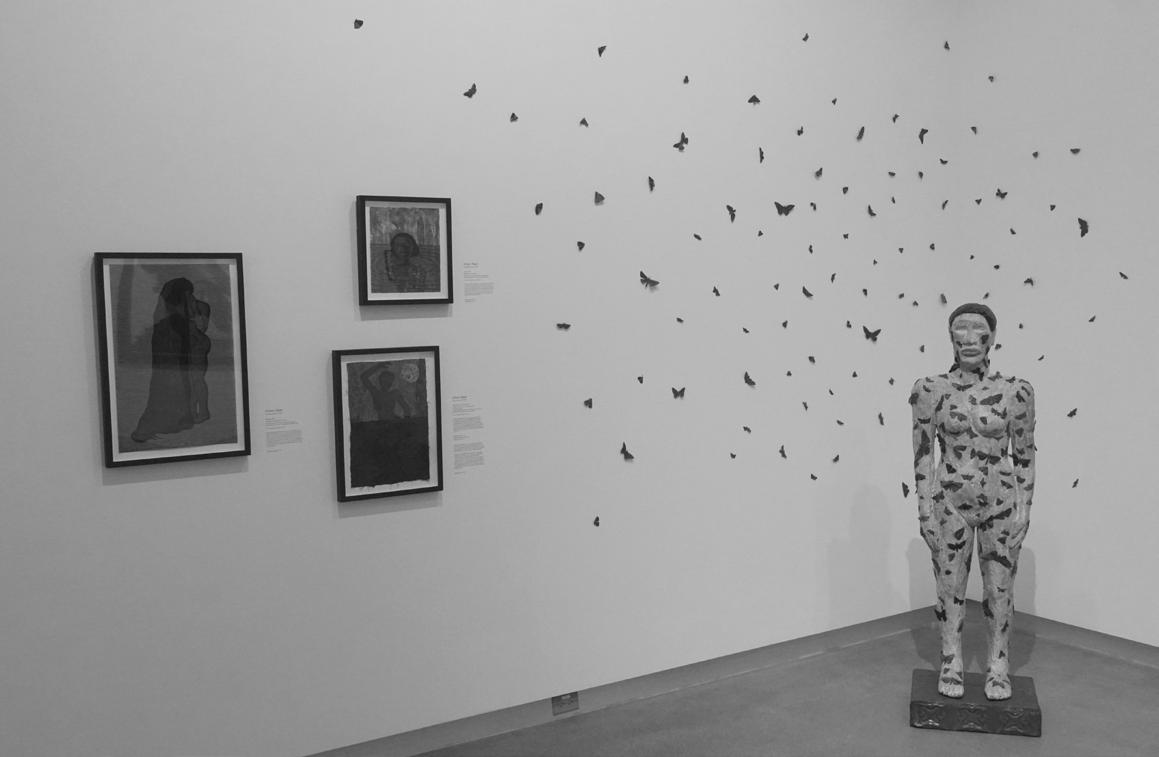
‘Black Ecologies’: The Black body and nature
Collections of black-and-white photographs and etchings hang on white walls. Further on into the gallery space, a colorful figurative painting occupies a whole wall.
“The air, thick with the collective histories of resistance and trauma, lies over the landscape conspicuously absent of people,” reads the caption — written by Aaron Morgan PO ’25 and Maëlle Thomelin PZ ’25 — on the plaque of one of these photos, Dawoud Bey’s “Light on the Swamp.” “Nature becomes less a universal background but a local, storied actor in the lives of both ancestors and the living.”
Bey’s photos are some of the many artworks included in “Black Ecologies in Contemporary American Art” at Pomona College’s Benton Museum of Art. The multimedia, interdisciplinary exhibit dissects the relationships between
Black people and their environments — whether natural or constructed.
“Black Ecologies” opened on Feb. 13 and runs until June 19. The Benton celebrated the show with a culinary workshop on Feb. 25, featuring Chef Martin Draluck of the Black Pot Supper Club, before its opening reception. On the 28th, the Benton, the Office of Black Student Affairs (OBSA) and the Intercollegiate Department of Africana Studies (IDAS) are hosting students to explore the galleries.
Each of the exhibit’s curators — J Finley, an associate professor of Africana Studies; Cherene Sherrard-Johnson, chair of English and E. Wilson Lyon professor of the Humanities; and Victoria Sancho Lobis, the Sarah Rempel and Herbert S. Rempel ’23 director of the Benton Museum and associate professor of Art History — worked together despite coming from
separate academic disciplines. Curatorial intern Tristen Alizée Leone PO ’26 also assisted in organizing the exhibit.
“All of the works deal with so many different fields, like geography and photography,” Sherrard-Johnson explained. “It brings together so many disciplines under this question of how we experience the natural and the constructed world.”
“Black Ecologies” includes a wide range of work — spanning photos, drawings, prints, paintings and sculpture — yet each comes back to a central theme: the Black body within the natural world. Colonialism, plantation slavery, urban development, climate change and other facets of racial capitalism are common references throughout the exhibit.
“[It’s] about the lens that the humanities gives us into what’s happening in the world,” Finley said. “People don’t necessarily think about the connection between art and climate change or more political issues. I think [the exhibit] gives people a way to enter that conversation in a different way.”
Many of the pieces have multiple accompanying exhibition texts, reflecting the interdisciplinary and expansive nature of the exhibit. Each label provides an interpretation of its artwork and was written by students from either Finley’s or Sherrard-Johnson’s classes, “Unruly Bodies: Black Womanhood” and “Race, Gender, and the Environment,” respectively.
“We wanted people to take different disciplinary approaches and to bring in some of the knowledge they were learning in the class,” Sherrard-Johnson said. “Whether it’s around theories of the body, around understanding
environmental justice, we wanted to see them taking those ideas and filtering them through their own ideas of the work.”
Each piece seems to invite the viewer to question what nature means to them. The museum labels reflect multiple understandings and interpretations of a single work, whilst the art itself exudes history, clueing the audience into the legacies and contexts of how each Black figure depicted arrived at this present moment.
“It’s called ‘Black Ecologies in Contemporary Art,’” Finley said. “So you’ve got contemporary art, but what does it mean to look at contemporary art but to also see history?”
“Harper’s Pictorial History of the Civil War (Annotated)”, a series of prints by acclaimed artist Kara Walker, inscribes silhouetted figures on top of 1860s illustrations of the Civil War. Through this layering, Walker corrects Harper’s history via the inclusion of Black figures. One of the first works viewers see when entering the gallery, Firelei Báez’s painting “Atabey (Or change the body that destroys me),” also superimposes a figure over a historically referential background. Painted on a nautical chart lays the Caribbean goddess Atabey; her inclusion overlays the map, correcting it, obscuring the chartered European world. In its own correction of history, The Black Pot Supper Club held a workshop at the Benton before the “Black Ecologies” reception.
Draluck cooked and served chicken and dumplings while sharing history about James Hemings and Hercules, two Black chefs who were each enslaved by Founding Fathers — Jefferson and
Washington, respectively— and are responsible for many dishes still popular today.
Lobis, Finley and Sherrard-Johnson spoke about the processes behind “Black Ecologies.”
“The exhibition is a major source of joy for me,” Lobis said. “In part because it’s the realization of a vision that I had together with Professor Sherrard-Johnson on the occasion of her course and lecture series of the same name.”
Besides the varied style and interdisciplinary approach of the exhibition itself, its development was also deeply collaborative. Starting off as a class and accompanying lecture series related to Sherrard-Johson’s research, the idea of “Black Ecologies” as an exhibit came from Lobis, who then sought Finley and Sherrard-Johnson as collaborators.
“We were really thinking about what kinds of works really exemplify this complex relationship between Blackness, Black bodies and nature or the environment from a variety of angles,” Finley said. Given the recent wildfires in Southern California, especially within the predominantly Black neighborhood of Altadena, these themes of the complex relationship between Black bodies and the environment feel especially pertinent.
“We were getting ready to open [‘Black Ecologies’],” Sherrard-Johson said, “the fires had just taken place, especially in Altadena, and I was thinking about the ways in which you can have this environmental catastrophe that can erase history.”
The histories that “Black Ecologies” dissects remain present not only in contemporary American art but in the environment that surrounds us.
NICKOLAS MORALES
NICKOLaS MOraLeS • THe STuDeNT LIFe
SHIXIaO yu • THe STuDeNT LIFe
ROCHELLE LU
MaX raNNey • THe STuDeNT LIFe
Blending the personal and political: Professor Sean Diament’s journey from homelessness and addiction to higher education
Nestled behind his desk in Carnegie Hall, between scattered house plants and a color coordinated display of writing utensils to my left, I bore witness to what keeps students coming back to Professor Sean Diament time and time again: an unfiltered, personable nature. For Diament, a visiting assistant politics professor at Pomona College, the line between his expertise in politics and his life experience, in many ways, seamlessly blend.
Diament stands apart from many others, not just in appearance — his signature look is hard to miss, usually sporting a monochrome ensemble composed of a matching neon shirt, beanie and socks — but in the deeply personal nature of each of his classes. Throughout the semester, he slowly pulls back the layers of his own life, an act of vulnerability that brings the teaching of politics from the abstract to the concrete.
“I wear some colorful ass sweater, and I curse all the time, and my beard is large and gray, I’m cracking jokes. We’re having fun as we’re learning,” he said.
Born and raised by his mother in the multicultural neighborhood of Culver City, California, the foundation of Diament’s passion for politics was built through his lived experiences. Diament described his mother, who raised him alone, as dedicated and an extremely hard worker. But ample love was not fungible. By the age of 18, the pair had moved seven times, often the result of eviction. Despite this, he reflects on his upbringing positively. “I did have a good childhood. I was pretty happy.”
In middle school, after a gang shooting in front of his elementary school, his mother prioritized safety, moving him to a wealthy, predominately white beach town where he started middle school. This period of unexpected adversity proved fundamental to who Diament is today. Struggling to adapt to his new environment, the move soon cascaded into a series of absences from school, as well as a period of intense self-loathing.
“I was not in a position to hear anyone back then. I really hated myself, and I couldn’t fit in,” he recalled. By high school, his feelings of low self-esteem, coupled with a poor school environment — one he compared to “glorified daycare” due to the lack of challenging material — made him feel completely detached from learning.
The little school he did attend during this period was spent submerged in ceramics, a coveted hobby but far from the intellectual push he needed. “Had they given me a politics course or philosophy course, or, like, economics anything, I might have arrived to where I am now, a decade earlier.”
It was a combination of these factors that led then 16-year-old Diament to drop out of high school, a decision that contradictorily proved invaluable to his intellectual development. With an abundance of free time now readily available, boredom-induced curiosity soon transformed his relationship with knowledge.
“I am drinking Coca Cola … flat coke from a two-liter, you know, and you get so bored and have so little that something happens in the brain where, out of necessity, it unlocks,” he said.
Without the money for video games or the ability to leave his house, the world around him transformed. An artistic side was unlocked: He began painting, creating murals on his walls. His appreciation for the small things blossomed. Books became his entry into another world; he’d stay up all night on his balcony, submerged in texts by great thinkers.
“My mom would go to the Manhattan Beach library and bring back Kierkegaard and Nietzsche and a book on the Big Bang that was 900 pages, Richard Feynman’s lectures and Huey Newton’s Revolutionary Suicide, philosophy, physics, astronomy, politics,” he said. “And as a 16-yearold, I benefited from almost two years of just
being home all the time … teaching myself shit and growing. It was an amazing privilege.”
Diament’s solo intellectual journey soon came to a halt when, while hanging out with some friends, he got caught in possession of marijuana. One of the stipulations required to get off probation was to get a high school diploma, a seemingly restorative sentence compared to the monetary penalty received by his friends.
17-year-old Diament was opposed, to say the least: “I told [the juvenile court judge], it’s cooked. It’s totally cooked. It’s not going to happen.”
Soon after, still on probation for possession of an illegal substance, he was faced with another challenge. Not yet 18, Diament, his mother and their cat became homeless as a result of what would be their final eviction. The pair became insomniacs, sleeping during the day in a storage unit to avoid getting thrown out and staying up through the night.
The first night, after loitering in a hotel lobby and a 24-hour Ralphs, Diament and his mother were forced to stay on the streets.
“It was extremely traumatizing, probably the most traumatizing experience of my life,” he recalled. During this three-month period, he also developed an opioid addiction that he fought for 10 years, referring to himself as a functioning addict, permanently existing in a state he described as one in which he never really “[felt] awake.”
came. Diament got a job at the Taco Bell near his former high school. His mom resumed working, too. Shortly after, he took the GED test required of him to get off probation. His results showed not just intellectual promise but a future beyond the service industry, one where his mind was just as valuable as his physical labor. Perhaps most importantly, his impressive results gave him a sense of self-confidence wholly unknown to him.
“I [believed] in myself, for, like, the first time,” he said. “I already knew I had passions, but no real evidence that I was worth anything other than my labor. My labor is worth something.”
trademark to his own teaching style through his beloved ethics professor, Joan Thureson. “She was investing so heavily in me, it was personalized, it’s not everyone’s amazing, it’s not this blanket shit. She took the time to understand me, she built me up, she engaged me intellectually, told me I can amount to a lot of things, and really inspired me, incredibly.”
I didn’t realize I loved teaching until maybe my third semester of doing it, and then I really caught the bug.
Sean Diament, Pomona College visiting assistant professor of politics
All the while, Diament dove into his innate interest in politics. In high school, this was through C-SPAN. Plagued by insomnia, he would put it on to lull him to sleep (a night routine that did, indeed, work). After long shifts at Taco Bell, he had it playing in the background as he journaled. He watched, entranced, as Bernie Sanders addressed Congress on universal healthcare, expertly weaving comparative and historical analysis. Soon, he was tuning in frequently for fun.
“[Sanders’ words] got in my brain, and I started feeling represented in politics. I saw there was someone who was fighting for something I care about. I caught some interest,” he said.
A break, although begrudgingly accepted, finally
Still, it wasn’t until Diament returned to school that the extent of his interest in politics would be realized. Encouraged by the promising results of his GED test, he enrolled in El Camino College in Torrance, California, the community college he defined as his hometown’s “burnout wasteland.” Not for him. He loved it. Despite being able to graduate after a year, he stayed for three, leaning more and more into his passion for politics. He revived the El Camino College Political Science Club, where he organized voter registration drives and held debates. It was there that Diament picked up what would later become a
Following his time at El Camino College, he transferred to the University of California, Berkeley, where he continued his study of politics, graduating in 2012. Graduate school had never come to mind until, while helping two professors — T.J. Pempel and Eric Schickler — with research following his senior year at Berkeley, his mentors encouraged him to consider it. Not long after, he applied to schools, eventually enrolling at Northwestern University where his focus in politics narrowed to the politics of poverty. This concentration, in many ways, reflected the arc of Diament’s life up until this point: the study of politics, a mirror of his life and his life, a mirror of politics — the two inextricably linked. Had his family known about food stamps, perhaps his mother would have had more spare cash. Had they known about Section 8 vouchers, perhaps the pair wouldn’t have moved as frequently during his childhood. In many ways, it was Diament’s upbringing that brought him to teaching, too. After a period of volunteer and advocacy work in nonprofits and labor unions, he soon found himself student-teaching classes at Northwestern during graduate school. The financial security of a job as a professor was something entirely unknown to him,
Passing the torch: Alison Saar and evolving Black legacies at The Benton
Turning the corner at The Benton Museum of Art, viewers are struck by a life-size female statue covered head to toe with metal butterflies; they surround her wholly, resting on her wooden skin and splattering the white walls of the gallery. Despite the way they engulf her, she stands calm. Questioning the body’s relationship with the natural environment, “Sea of Serenity” is making its first appearance from The Benton’s permanent collection. However, it is far from the first 5C showcase for the piece’s creator, Alison Saar SC ’78.
Saar is one of five artists featured in The Benton’s latest exhibit, “Black Ecologies in Contemporary American Art” which focuses on the relationships among Black people, land and the environment. While Saar is just one piece of this show, she stands as a leader of the cultural canon of the Claremont Colleges, continuing the efforts of her family and mentors to uplift Black art at the 5Cs and beyond.
Saar has four works in the exhibit: a sculpture and three prints that focus on the nature of Black femininity and the body. Her prints are muted, using earthy blues, greens and browns to create scenes of women in and of nature.
“The theme of ‘Black Ecologies’ considers how African Americans have … built environments in distinct ways to allow themselves to survive and thrive … against adverse conditions,” Victoria Sancho Lobis, director of the Benton Museum, said. “Alison Saar’s work has, for many years, been informed by the effects of the natural environment or even natural disasters.”
Her 2016 work
“Deluge” partially covers her subject’s body with her hair. Against a green backdrop, her subject becomes part of her landscape, her hair growing as a tree does, both obscuring her while ensuring her outline shows through.
On “Lethe,” another of Saar’s prints in the exhibition, Cherene Sherrard-Johnson, one of the curators of “Black Ecologies,” described its connections to a natural collective consciousness.
“I like to think Lethe’s rings represent the limits of memory,” Sherrard-Johnson wrote in “In Here: Conversations on Solitude,” a book published by the Benton during the pandemic. “Like the concentric circles revealed on an ancient tree
stump, each marks a decade, a romance, a career, an entire lifespan.”
Her work may only take up one corner of the exhibition space, but this is far from the first time the Claremont Colleges have seen Saar’s work. She attended Scripps as an undergraduate, graduating with a B.A. in Art History in 1978, and has found great acclaim in the art world since.
Saar was born in 1956 to Betye and Richard Saar, who were both impactful artists in their own right.
After attending Scripps, she attended the Otis College of Art and Design and received her master of fine arts. Her work has been shown at the Museum of Modern Art, the Metropolitan Museum of Art and the Brooklyn Art Museum, and she was commissioned by the International Olympic Committee for the Paris 2024 Olympic Games.
Saar has also been an artist in residence at Studio Museum in Harlem, and one of her larger pieces, “Swing Low: A Memorial to Harriet Tubman,” lives on West 122nd Street in New York. Saar gifted a reduced version of this piece to Scripps in 2010, which can be found in the sculpture garden outside the Ruth Chandler Williamson Gallery.
“Black Ecologies” is the most recent showcase of her works at the Claremont Colleges. In 2000, she and her sister showcased their work in the exhibition “Spirit in Matter: Works by Alison and Lezley Saar” at Scripps’ Ruth Chandler Williamson Gallery. The exhibition was the first to showcase the sisters’ works together and was a testament to their family’s continued
legacy, as both of their works were influenced by their upbringing.
“Alison and Lezley saw in their mother’s art a fusion of the material and the spiritual, and this merger is something that they have reinterpreted in distinctive ways in their own art,” Mary Davis MacNaughton, then Director of the Ruth Chandler Williamson Gallery, wrote in the catalogue for “Spirit in Matter.”
More recently, the Williamson Gallery hosted a solo showing of Saar’s work with “Mirror, Mirror: The Prints of Alison Saar” in 2020.
Though Saar’s connection to Scripps is clear, in the past half-decade, she has found her home at the Benton. Her solo show, “Of Aether and Earthe,” was the museum’s first exhibit during its intended opening in 2020 and was on display for 14 months through December 2021. Her statue, “Imbue” permanently stands outside the museum’s main entrance. Her works also populate the museum’s permanent collection. Her presence is felt so deeply throughout the Benton that there is a smaller version of her statue tucked away on the shelves of the museum’s staff offices.
Describing the importance of Saar’s relationship with the museum, Lobis cited Saar’s mentor and professor at Scripps, the legendary artist, scholar and curator, Samella Lewis.
“I’m honored and delighted that I get to see the work of Alison Saar every day when I come to work, in part because I think she embodies the spirit of Samella Lewis,” Lobis said. “Alison also has a commit-
ment to engaging with students and to giving back … It’s a lovely way to mark the legacy of impactful teachers.”
Saar knew Lewis as a family friend long before she came to Scripps. A prominent scholar and artist in the Los Angeles area during the Black Arts Movement, Lewis collaborated with Saar’s mother, Betye, numerous times during the 1970s, including for the iconic Los Angeles gallery The Woman’s Building — then called Womanspace — in 1973 and an exhibition at Scripps.
Curated by Lewis and featuring work from Betye Saar, “Benny, Bernie, Betye, Noah and John — Black Artists,” ran from Dec. 1970 to Feb. 1971 at Scripps’ Lang Galleries. According to a Dec. 17, 1970, article in the Los Angeles Sentinel, the exhibition was, at the time, “one of the largest and most comprehensive group exhibits of black artists’ work to be shown in Southern California.”
A few years later, Lewis would be a key influence in Saar’s decision to attend Scripps, she explained in an interview with Riot Material.
“When I got out of high school, I was kind of neither here nor there, and she said, well, why don’t you apply to Scripps College?” Saar said in the Riot Material interview.
“I don’t think I would have applied otherwise, and it was phenomenal working with her.”
Throughout her career, Saar has regularly named Lewis as one of her most important mentors. In a
2023 Ursula essay written in memory of Lewis following her passing, Saar described how Lewis tailored her teaching style specifically for 5C students.
“Scripps was a small school, and one of the things Samella did for students was give us the ability to work with the college’s art collection, to study and to curate it,” Saar wrote. “So much knowledge about artwork comes from the textures and the patinas and the overall feel, that objects should not be stagnant and sealed off. Being able to see the pieces close-up — not just as an image on a slide — and even sometimes to handle them, was a formative experience for me and for many other young artists at the school.”
According to Lobis, Saar’s prints and sculptures in the Benton’s permanent collection are regularly requested for class visits. Additionally, the descriptions in “Black Ecologies” are all written by students, who, in line with Lewis’ teaching philosophy, studied the artwork in a less formal setting, engaging with them out of their frames.
“My hope is that students have not only the chance to interact with the works directly themselves, but
EVAN PENN BROWN & BEN LAUREN
COurTESy: SEAN DIAMENT
KAITLYN ULALISA
Pomona College Visiting Assistant Professor of Politics Sean Diament.
at
Museum of Art’s
You vape because the world is on fire
BENACH
ALEX
Few days pass on the modern college campus without seeing a vape. Youth nicotine use, which declined by as much as 50% in the early 2000s, has seen a massive resurgence. Just last semester, The Student Life posted an opinion piece practically endorsing the addictive habit.
Our generation could have kicked the habit for good, but two harbingers of doom conditioned our generation to be vulnerable to this new addiction. You may cry hearsay razor, but I believe that the modern climate crisis, coupled with the invasion of Iraq, caused the modern vaping epidemic among Gen Z.
We know that vaping is bad for us; we know that it causes lung complications and carries with it long-term health risks. But we still do it. Experts have identified peer pressure, exposure to e-cigarette marketing and fun flavors as the drivers. But I don’t think this is the entire story. A modern epidemic can not be explained by “Watermelon Strawberry Ice.”
Now, I do not believe that every time a teen hits a Geek Bar, they do so with the Iraq War and climate change in mind. That’s ridiculous. Rather, what I am arguing is that these two events have shaped what it means to grow up as Gen Z, and that they have engineered the conditions necessary to cause the vaping epidemic.
In a survey conducted by Common Sense Media, one-third of Gen Z respondents aged 12 to 17 said that
their life was going well. Compared with other generations, Gen Z is less likely to rate the prospect of their future lives highly.
It’s no wonder, then, that a generation that feels as though the world is falling apart around them turns to the quick gratification granted by vapes, regardless of the health risks.
This level of dread can be, in my eyes, directly correlated to climate anxiety and the level of despondency associated with the Iraq War.
More than half of Gen Z believes that humanity is doomed as a result of climate change. Thus, a generation that feels betrayed by its political leaders, with their futures sold
Cashing paychecks or passions?
The cost of fear at CMC
ELIZAVETA GORELIK
“What would you be if you could be anything and money didn’t matter at all?”
This is the question that journalist Farah Stockman used to open her book “American Made: What Happens To People When Work Disappears,” which documented the paths of three steel factory workers in Indiana after their plant was shut down.
The lives and prospective careers of students at the Claremont Colleges are drastically different than those of the factory workers. While many of us have asked ourselves and our peers the same question, our possibilities are entirely different: We have been given the opportunities to fulfill our dreams of being anything we want to be — and we are wasting them.
We have decided that money does matter and perhaps far too much.
The Forum, an open-submission publication at Claremont McKenna College (CMC), recently published an article urging its readers to reconsider why they want a career in finance. It warns about the dangers of mimetic desire or the tendency to mimic the aspirations of your peers and rival them.
Although I believe that the article brings an important concern to light, I argue that it is not mimesis that is forcing so many bright and capable students at CMC to pursue the wornout path of a career in finance but, rather, it is fear.
In his social criticism, “Excellent Sheep: The Miseducation of the American Elite and the Way to a Meaningful Life,” William Deresiewicz argues that elite liberal arts colleges, just like ours, have failed in their mission to foster individuality and critical thinking in their students. Instead, they became “trade schools” for white-collar professions.
Deresiewicz highlights how the existential fear of failure forces students onto the conveyor belt of lucrative careers on Wall Street: “The prospect of not being successful terrifies them, disorients them, defeats them. They have been haunted their whole lives by a fear of failure.”
And, of course, the definition of “successful” comes down to one metric here, which is — you guessed it — the number on your paycheck.
The chances of making a six-figure salary as a management consultant are exponentially higher than bringing in a stable, high income as a writer or an academic — so why even bother trying for the latter?
Forging your own path and turning your passion into a career is riskier than putting in the hours for interviews and case preparation, networking with alumni and chatting up your friends’ wealthy parents. The criteria is clear: Fulfill these commandments and thou shall be bestowed with a six-figure salary.
That is not to say that students who go into the world of finance are not hardworking. They are, especially
the low-income, first-generation students who work twice as hard to secure these positions and fight for class mobility, rather than striving to retain their membership in circles of elites.
But many of the students who come from families with generational wealth are terrified of not being able to maintain the lifestyle with which they have grown up. They are unwilling to pursue their dreams and, maybe, fail. The fear of failure limits postgraduate pursuits and forces many to conform to the careers that guarantee financial success, even if they are not fulfilling.
When did we become so cynical about our own abilities? When did we become so lazy and paralyzed by fear? The chances of becoming a successful writer or restauranter, videographer, fashion designer, academic, artist or entrepreneur are still there. Sure, there is no clear-cut path to success in these pursuits, but don’t we, elite liberal arts-educated students, have enough drive, ability and passion to at least try to figure it out?
Why not redirect the effort and time you spend sweating over a job that you couldn’t care less about into building the career that you actually want?
We are lucky enough to have the resources, connections and support around us in Claremont, so why are we not using them? Why are we letting the fear of failure rule our lives?
I am not advocating for an idealization or even acceptance of downward class mobility, but I am challenging the assumption that trailblazing your own path must always lead to failure. As cliche as it may sound, be confident; be brave.
The factory workers in Indiana are putting in relentless hours of hard manual labor to get a toehold on the middle class because they do not have the luxury of a career choice. Meanwhile, we have endless possibilities laid out in front of us, but we are throwing away our passions, principles and years of our lives to secure our position in the utopic 1%.
The aspiring linguistics major turned investment banker, the non-profit founder converted to private equity, the wanna-be farm owner now an incoming management consultant — is this really what we are doing with the gift of a liberal arts education? The choice is yours to make. But before you make it, ask yourself the question that I opened this article with.
Are you going to be one of the sheep or are you going to be the shepherd?
Elizaveta (Lisa) Gorelik CM ’25 is from Moscow, Russia. She is graduating this semester with a degree in philosophy & literature. She does not have her life figured out and she’s okay with it.
out for immediate profit, looks for easy and quick ways to escape those feelings. With the existential threat of growing global temperatures, forced migration, mass extinction and rising sea levels, young people are more comfortable opting for vapes. Any instincts for self-preservation have been kicked to the side.
The fact that Gen Z has never seen a moment in which the U.S. was not involved in war in the Middle East has cemented a dissatisfaction and overall disillusionment with the government.
The U.S. government going to war under shoddy pretenses is not a new concept — think of Vietnam.
Gen Z was taught young, early and often who the government prioritizes.
During the Vietnam War, drug addiction shot up among both soldiers and those at home, a parallel to the Iraq War that should not be ignored. When governments place people’s lives at risk for little to no actual gain, our population suffers.
The Iraq War dominated the news cycle from 2003 to 2011 and provided a constant backdrop of warfare and despair for Gen Z’s childhood. Having been disillusioned with the prospects of the future, we are filled with a level of existential dread that encourages a habit that slowly kills us.
The politics of the 21st century have been stained by death, creating the perfect conditions for such a deadly emergence.
Growing up with endless war and climate devastation, the end of humanity seems to be approaching at an increasingly rapid rate. In 2020, the Doomsday clock — a device used to warn the public about how close we are to human-made global catastrophe — jumped 20 seconds closer to midnight, an indication of the threats posed by climate change and modern warfare. This is not a normal perception of current events. The prospects of our future have been fundamentally mutilated.
Gen Z is the unhappiest generation ever, and whether that unhappiness is justified or not, this has
led to an embrace of sweet-flavored vapes. This is not a novel concept, as dropping mood levels and addiction have been frequently linked. But we must examine this generational depression as causal to an epidemic that has led to addiction and poor health outcomes for many — regardless of emerging information about the real dangers they pose.
The idea that these larger-than-life political phenomena breed a new addiction within Gen Z may seem speculative; however, by placing this seemingly unexplainable habit among its contemporary backdrop of climate issues and global wars — the defining features of the 21st century — one can draw a clear connection and offer more robust explanations for vape addiction than peer pressure and tasty flavors.
This is why Gen Z must resist vaping. Not only is it a detrimental habit, but it is a political imperative not to vape. A generation that has given up on themselves, through an embrace of nihilistic habits because of nihilistic thought, cannot aptly stand up for their own futures. Vaping is waving the white flag, embracing trepidation and gloom, when we must fight back against it.
In order to address the forces that compel us to vape, we must first put down the vape.
Alex Benach PO ’28 is a first-year at Pomona from Washington, DC. He argues that quitting vaping is the first step to fighting fascism.
On Friday, Jan. 24, Claremont McKenna College (CMC) faculty recommended ending test optional admission. As the Board of Trustees adjourns this spring to make a final decision, I want to remind the institution of the importance of a test-optional policy.
When applying to top colleges, I knew I wasn’t just going up against my peers. I was going against a system that favored privilege.
Growing up in a one-room apartment in Queens, New York, I understand the first-hand challenges of navigating the U.S. education system. My family, having immigrated from South Korea, worked tirelessly to provide for me, but college prep wasn’t something we had the luxury to afford. I didn’t have access to expensive tutors, expert college counseling and the ability to take standardized tests multiple times. Instead, I studied late into the night, balancing school work with my passions, and I poured my all into excelling academically.
Test-optional policies allowed students like me to be seen for our potential, for the work we put in, and most importantly, for what we may contribute to the college. Without a test-optional policy, students like me, who have the ability but not the resources, would be unfairly judged by a flawed metric.
The controversial debate over standardized testing is not new. Over 1,000 four-year colleges and universities, including Ivy League schools and highly selective colleges like Pomona, have instituted test-optional policies. Now, as some institutions are returning to test-required policies, we must come to a quantitative answer: Does standardized testing measure merit, or does it reinforce systematic inequities?
The Claremont Independent Editorial Board has argued that standardized tests are the most objective metric in predicting college success, but this claim ignores
substantial evidence demonstrating their flaws.
First, they referenced a Dartmouth study to argue that standardized scores are more predictive of academic performance in college and that it helps identify more high-achieving students. This study is incredibly context-specific. Dartmouth’s analysis relies on internal admissions data from an already selected applicant pool, meaning it doesn’t account for students who were dissuaded from applying by the barrier of standardized testing. If standardized tests were truly a measure of student ability, there would be a clear difference between those who didn’t submit test scores — but the data tells a different story.
A 2020 American Educational Research Journal analysis of 100,000 students across 28 test-optional U.S. universities found that students who didn’t submit standardized test scores performed just as well in college as those who did. It showed that high school GPA was a stronger predictor of college success than SAT or ACT scores, illustrating that standardized testing isn’t as effective a predictor as it is made out to be.
A landmark study from the University of Chicago found that after implementing the test-optional policy for the first time, first-year students performed at the same academic level as those who submitted test scores without reducing retention rates. Most importantly, the test-optional policy at UChicago led to a 24 percent increase in first-generation and low-income student enrollment. By eliminating test barriers, colleges were able to foster a more diverse applicant pool still able to excel at an elite institution. Research conducted by Opportunity Insight indicates that standardized tests have a stronger correlation with total family income than with college success. In fact, “children of the wealthiest 1 percent of Americans were 13 times likelier than the children of low-income families to score 1300 or higher on SAT/ACTs.” Likewise, the University of California System reports
that requiring standardized testing largely eliminates high-achieving, low-income applicants. By adopting test-optional policies, universities cultivate a more diverse applicant pool — regardless of financial privilege, everyone has a fair shot at higher education.
This isn’t objectivity, no matter how you spin it; when standardized test scores align more with socioeconomic status, they cease to be an objective measure of potential. Test-optional policies aren’t just about making college admissions more fair, they’re about making sure potential isn’t wasted due to circumstances beyond a student’s control.
Nonetheless, test-optional policies must also be instituted with a comprehensive and equitable process to evaluate students, particularly in light of grade inflation. If we truly care about a meritocracy, we must measure merit in ways that account for all paths to success.
Rather than going back to outdated barriers like test-required policies, colleges must work to strengthen holistic admissions through contextual data on student backgrounds and school profiles. Application measures should focus more on real-world skills, lauding depths of engagement in activities or miles traveled, a metric weighing what barriers to education students have had to overcome. A high SAT or ACT score cannot possibly define the full context of a student’s lived experience.
I believe no admissions process is perfectly fair, but relying on a flawed metric like standardized testing won’t improve the system.
CMC and other institutions that are looking to go back to test-required policies can continue to uphold rigorous standards and prove that true academic excellence comes from expanding, not restricting, access. Now, more than ever, colleges must prioritize an equitable system that sees students for who they truly are, beyond test scores. Daniel Han Tae
DANIEL HAN TAE CHOI
21-year-old Lagos-born, U.K.based drill rapper Ceechynaa’s latest single, “Peggy,” opens with an image that is as shocking as it is symbolic: “I’m peggin’ that man at the back of the bus.” The line is a brash declaration of power, placing men in the helpless, hypersexualized role usually inhabited by women. It’s audacious, explicit and intentional.
Hip-hop has always been a battleground for power and control, with MCs and producers innovating new styles, flows and ideas.
Ceechynaa is flipping a long-standing norm of the male-dominated rap scene: objectifying women.
If it is the norm for rappers to degrade and objectify women, what happens when women turn that same energy against them?
Enter Ceechynaa, sporting micro denim shorts and skimpy bikini top, strutting the streets of London. Her appearance is the least provocative thing about her. The rising star’s lyrics unapologetically use misandry and emasculation as weapons to assert their autonomy.
popping a perc,” she raps. Rather than simply asserting agency within the existing power structure, she flips the script entirely, making men the spectacle in a way that forces listeners to confront the genre’s long-standing double standard.
A 2009 study found that 67 percent of the examined rap lyrics sexually objectified women. Male rappers can be problematic while still retaining their credibility and personhood. Rappers like 21 Savage, Playboi Carti and Dr. Dre consistently diss others and objectify women in their lyrics, yet those traits don’t define their public perception and artistry.
Male rappers have built empires on explicit content, yet when women like Ceechynaa do the same, it’s suddenly deemed excessive, improper or a stain on the genre. rap, a genre defined by nonconformity, has instead become conformist: it has normalized the objectification of women.
Ceechynaa is not alone in this movement. Artists like Sexyy Red, Megan Thee Stallion and Cardi B have already pushed the boundaries of female rap and sexuality. Following in the footsteps of Lil’ Kim and Adina Howard, who faced similar backlash for their unapologetic sexual liberation in the ‘90s, these artists have certainly amplified the sexual liberation of women in hip-hop.
Ceechynaa takes it a step further. Female rap artists have reclaimed their own pleasure but have rarely used the genre to directly upend male dominance. Ceechynaa turns men into the spectacle in the same ways men have historically done with women.
“I’m in the back of the car with your daddy and he’s twerking and
Male rappers have built empires on explicit content, yet when women like Ceechynaa do the same, it’s suddenly deemed excessive, improper or a stain on the genre. Rap, a genre defined by nonconformity, has instead become conformist: it has normalized the objectification of women.
Detractors argue that misandry and emasculation are just as bad as misogyny. However, this argument ignores the power imbalance that has shaped the rap industry. Female rappers have historically lacked the institutional backing to challenge these dynamics on a large scale.
Rarely garnering mainstream attention, female rappers often conform to industry expectations — fueling rivalries and degrading one another through rap beef. Rivalries like Cardi B versus Nicki Minaj reflect how competition becomes a necessity to claim the few coveted spots available for women in hip-hop.
By taking a risk, Ceechynaa pushes for the same thematic and lyrical freedoms afforded to male artists. Female rappers shouldn’t have to choose between degrading other women or crafting a limited,
singular image of themselves.
Ceechynaa’s approach is less an attack and more a necessary disruption of the status quo. As she puts it, “These men wanna act like a beast, so I put these men in a cage.”
Ceechynaa’s defiance goes well beyond her lyrics — she rejects industry expectations in every sense, from sound to appearance. “I want women to know that they don’t have to fit into what society tells them they need to fit into,” she said in an interview with British Vogue.
Simply put, Ceechynaa refuses to follow the rules — whether they involve lyrics, style or power — regardless if they’re dictated by men or quietly enforced by women.
The Black experience in America has always been controlled and confined by white America. Therefore, Black freedom will always entail breaking boundaries. Black
artistry should not enforce conformity to an arbitrary moral standard that demands Black women remain quiet and non-threatening.
As she boldly states in Peggy, “Someone tell their pappy that Chyna said that she don’t give a shit.” Her deliberate rejection of established norms confronts not only rap’s misogyny but also the broader cultural forces that have long boxed Black women in.
Instead of dismissing Ceechynaa as another vulgar rapper, we should recognize her as a cultural disruptor who forces us to question the deeply ingrained norms in hip-hop and the wider entertainment industry. She is not setting us back — she is a reclamation of agency and an expansion of what Black artistry can be.
If we can celebrate the audacity of male rappers who have built careers on provocative and controversial content, then it’s high
time we applaud women who dare to take up space, break the rules and rewrite the game on their own terms.
The rap scene has been cutthroat since its inception: Rap battles are the heart of the genre and many rappers loathe convention as much as they do other rappers. Now, we suddenly have a problem with women entering the ring dishing blows with the same aggression. Ceechynaa forces us to confront that what we crave from male artists is what we critique in female artists.
Art begins with change and ends with conformity; why should we expect women to conform and stand idly by while men are celebrated for being opinionated, sexual and aggressive?
We should find her lyrics jarring because they are. Chechynaa is here to dish what we have been served for decades. If you can’t take it, don’t dish it.
ZENA ALMEIDA-WARWIN
Gyms with Jun: Episode Three
JUN KWON
The past two episodes of Gyms with Jun have covered the Claremont Colleges’ flagship gyms: Claremont McKenna Colleges’s Roberts Pavilion and Pomona College’s Center for Athletics, Recreation and Wellness (CARW). As the two gyms house Pomona-Pitzer and Claremont-Mudd-Scripps’ athletic facilities, they are naturally the two biggest facilities on campus.
However, the three other schools also boast smaller gyms of their own, and this episode will focus on Pitzer College’s Gold Student Health & Wellness Center, also known as the GSC.
Compared to the stricter securities of the CARW and Roberts, the GSC was quite easy to enter. There was no ID to scan and no line of questioning from the front desk workers; it seemed like the gym was accessible to all 5C students — though policies outline it is only open to Pomona and Pitzer students.
Entering the gym, my first impression was that the gym was certainly a notch down from the other two gyms. The GSC did not boast a trophy case, nor did it have a multi-floor weight facility.
The equipment was visibly older, and it felt packed into a small room. The dumbbells and barbell grips were somewhat rusty, though the ‘Pitzer College’ brand on the dumbbells was a nice touch —; I didn’t see anything similar at Pomona or CMC.
Despite the GSC’s older age and more worn-down condition, I was pleasantly surprised to see an impressive variety of equipment and features that I had not previously seen in the other gyms. For example, the facility contains a pendulum squat, a deadlift platform, a smith machine, a hack squat and a weight sled.
I was most excited about the deadlift platform. While the different types of squat machines are valuable, a deadlift platform changes the game for many weightlifters. The platform at the
GSC allows people to drop the weights after lifting their max amount, something that isn’t always possible at other gyms.
The second floor of the GSC does not include any other spaces for weightlifting, but students can still access fitness-related activities through the Yoga Room and Pilates Studio. There, Pomona and Pitzer students can sign up for instructor-led classes. Pitzer students can even sign up for a free personal training session.
Additionally, the second floor is decorated with some snapshots of Pomona-Pitzer athletics on the wall. Most of the trophies are housed at Pomona’s CARW, but it was great to see Pitzer still attempting to stay in touch with their varsity athletics.
Personally, despite the GSC’s size, I enjoyed the Pitzer gym. Yes, it may be a downgrade in the quality of equipment from Pomona and CMC’s gyms since the two have been remodeled quite recently. However, this does not mean the equipment is unusable — in fact, it is likely in better condition than that of a local LA Fitness.
A huge upside to the GSC is the amenities that are attached to the gym itself. For instance, the famous GSC Pool is directly next to the gym. While it may seem unfair that I am evaluating the GSC while also including the pool, Pomona’s Pendleton Pool is half a mile away from Pomona and Axelrood Pool at CMC is only open for three hours a day. So, I think Pitzer deserves some credit. Additionally, the GSC encompasses the Shakedown Cafe.
As an extension of my remarks above — I would have rated Roberts and the CARW higher if they were attached to The Hub and The Coop. The Shakedown allows students to grab snacks until 11 p.m. and boasts its famous $2 tacos, arguably one of the best deals at 5C restaurants. It was also interesting to see some offices and rooms that one
would usually not see at the gym. For example, the Pitzer Student Senate and Campus Life Office is right across from a huge multi-purpose event space with lots of chairs and a projector screen in the front. Downstairs, the first room in the GSC is the Latinx Student Union.
Translated into numerical scores, my review is as follows:
Quality of the facility: 7/10. As mentioned above, the facility is comparatively older than the Roberts Pavilion and the CARW. Lifters will inevitably find rust and aging in some equipment. However, I cannot gloss over some of Pitzer’s machines, including weight sleds and a deadlift platform, which are not offered at the other gyms.
Amenities: 10/10. Shocker
— the first gym to receive a 10 in amenities. The selection of classes is limited, but students can still access yoga, pilates and personal training. I simply cannot rate the GSC under a 10 given that there is an entire restaurant and a pool attached to the gym. Size: 5/10. The actual size of the gym itself is not very spacious. Most machines have little separation between each other, and even the walkways are quite narrow. The building itself, including the second floor, is still a notch down from the other gyms on campus. Non-exercise-related value: 7.5/10. Realistically, there is not a lot of space to study in either the Shakedown or the gym. However, given that the Student Senate Campus Life Office and the Latinx Student Union are housed there, the facilities will still host
various non-fitness-related events and crowds, such as Sunday NFL viewings, as well as a Super Bowl watch-along.
The Gold Student Health & Wellness Center at Pitzer College landed third with an average score of 7.38 out of 10. This was an unfortunate and unfair match-up — to be placed in comparison with the two powerhouses. As I look forward to the two remaining gyms at the 5Cs, I hope Pitzer’s strengths will not be overlooked in the final rankings.
Jun Kwon PO ’28 is glad he started the ‘Gyms with Jun’ series as it keeps him accountable and forces him into a workout for the TSL articles. However, despite pretending to be a fitness and gym enthusiast, it’s really difficult to hide his dislike for the 18-minute walk from Pomona’s south campus to Pitzer’s gym.
5C Ski and Board slices up the slopes at regionals, qualifies 19 athletes for nationals
In case you didn’t hear, Michaela Shiffrin just claimed her 100th career World Cup victory on Sunday. Though that wasn’t the only big ski story to come out of the weekend.
Last weekend, the 5C Ski and Board team carved its way through the regional championships at China Peak, California, booking multiple trips to nationals after an impressive showing on the slopes. For a dynamic group of seasoned skiers and first-time racers, this was nothing out of the ordinary.
Hopes were high ahead of the regional championships. Carolyn Coyne PO ’25, who skied in the Giant Slalom (GS) race at the regional competition, described
the team’s enthusiasm and confidence for the weekend.
“I think we’re looking pretty good for regionals,” Coyne said.
“I feel like we’ll qualify for nationals because we have the past couple years.”
The team did not disappoint, qualifying 19 athletes across alpine, freeski and snowboard events for the national championships at Mount Bachelor, Oregon, next month.
“I just think the more people you have, the more likely it’s going to be that the team is going to be good,” Coyne said.
With a significant increase in membership since its formation less than a decade ago, the team has continued to perform at a high level both regionally and nationally. This season, though,
it has proved itself to be especially notable for one reason in particular.
Prior to regionals, the team had the opportunity to compete at the international level. In January, they sent 13 athletes to the FISU World University Games in Torino, Italy, where they competed against some of the world’s top-rated young skiers from various countries.
The 5C representatives likened the experience to their version of the Olympic Games, which will be held in Italy next winter.
While it can be intimidating to compete alongside such esteemed skiers, team captain Cayman Chen CM ’25 talked about how valuable the experience was.
“It was a once in a lifetime experience,” Chen said. “Obviously, the other athletes were like, future olympians. I met one person who was like, yeah, this is just my training for the Olympics next year.”
Aside from exchanging team pins, jackets and shells, Chen said that the team was able to take away many invaluable lessons and perspectives from the experience.
It’s one thing to meet some of these elite athletes, but it’s an entirely different challenge to compete alongside them. For Will Sedo HM ’26, also a team captain, and the rest of the Claremont skiers and boarders, this challenge was indispensable.
“It was a really high level of competition, and I think it
helped kind of push all of us,” Sedo said.
And push them it did. The athletes showcased the competitive lessons learned in Italy this past weekend at China Peak.
The results speak for themselves: The women’s freeski combined slopestyle and rail jam team came second, while the men’s team came fourth. The men’s alpine combined GS and Slalom group finished second overall, while the women were fifth. One athlete competing in the men’s snowboard rail jam, Kai Yeung PZ ‘28, was strong enough to place seventh, while the women came out on top as a whole.
The value of the group, however, extends beyond their competitive performances. According to Sedo, the community is a big part of 5C Ski and Board’s appeal.
“Skiing and alpine racing in particular can be a very solitary sport … there’s not a whole lot of the team aspect,” Sedo said. “But we really try and bring that team aspect.”
Coyne also highlighted the importance of community for the team.
“There are a lot of people who join when they are juniors or seniors, and they have so much fun,” she said.
This community is further enhanced by the fact that 5C Ski and Board team membership is well-mixed, offering a welcoming atmosphere to those who may not be as experienced.
For Chen, who was too intimidated to join the team freshman year, the 5C Ski and Board community has made a lasting mark on his college experience.
“People can be a little intimidated about competing,” Chen said. ”It’s a really welcoming environment for people who want to get into that type of skiing, and [we] have a really tight community of people who just like to ski and snowboard.”
It’s not often that a Southern California winter sports team thrives at such a consistent level, and it’s especially less frequent to see that team send winter sport athletes to compete internationally in such large numbers. And yet, for Chen and the rest of the 5C Ski and Board community, it all means more than just the results.
“I wish people knew how easy it is, and how accessible it is, to be able to get into this stuff,” Chen said. “Because once you get here, it’s so fun.”
COurTeSy: PITZer COLLeGe
Jun Kwon PO ‘28 reviews Pitzer College’s Gold Student Health & Wellness Center, tackling his third 5C gym.
SEBASTIAN GROOM
COurTeSy: 5C SKI & SNOWbOarD
Trophies all around: CMS and P-P swim into nationals as champions
Between repeat championships on the women’s side and a continued reign of over half a decade of dominance on the men’s side, the 2025 SCIAC Swim and Dive Championship had it all for 5Cs fans.
From Feb. 19 to 22 at Eastern Los Angeles College, the Pomona-Pitzer (P-P) women’s team won it all to go back-to-back, and the Claremont-Mudd-Scripps (CMS) men’s team took home the trophy to win their sixth con -
secutive championship. Over the four-day tournament, the SCIAC teams competed in 26 events, resulting in dominant performances, tight finishes and record-breaking swims.
“It feels absolutely incredible to be back-to-back champions,”
Valerie Mello PZ ’25 said. “As seniors, this victory is a perfect way to cap off our season, and I couldn’t be prouder of my fellow seniors and everything we’ve built together.”
The P-P women’s team clinched first place by a large margin, with their 1,051.5 points
easily beating out second-placed CMS, who scored 886 points. The Sagehens had several standout performances.
Mello was the women’s 200yard freestyle champion with a commanding performance. She set a new SCIAC conference record with a time of 1:49.78. She was also named the SCIAC Women’s Swim and Dive Athlete of the Year.
“Being named Athlete of the Year was an absolute surprise,” Mello said. “The SCIAC is filled with so many talented and hardworking women, and I be -
lieve each one of them is just as deserving.” Francesca Coppo PO ’27 was the women’s 50-yard freestyle champion, setting a meet record with a time of 22.84 seconds. Izzy Yoon PO ’28 won both the 100 back and 200 back, setting a new SCIAC record of 2:00.6. Yoon was also named SCIAC Women’s Swim and Dive Newcomer of the Year at the championships. On the other side of Sixth Street, the Athenas finished as the runners-up in the women’s championship. Izzy Doud CM ’25, Mackenzie Mayfield CM ’26, Katy Shaw HM ’26, Revere Schmidt CM ’27 and Sun Young Byun CM ’26 highlighted a strong all-around showing.
For Doud, who was named SCIAC Diver of the Year, success came on the first day of the championships, where she overcame a failed dive to take her first title since 2023. The Athenas continued their strong performances the following day, as Shaw claimed her third 500 free title in as many years, with a time of 4:58.89 — five seconds faster than the second-placed team. Mayfield also repeated as the 200 IM champion with a time of 2:03.57.
Additionally, Shaw won the 1,650-yard freestyle with a time of 17:05.49. Schmidt finished second, fifteen seconds behind, racing at 17:20.06. On the CMS men’s side, the Stags clinched first place with 979 points, winning their sixth straight championship and beating out second-placed P-P, who scored 751 points. Weston Crewe CM ’25 emphasized the pressure on the team, specifically the seniors, to keep the streak alive.
“Our class is definitely feeling very proud of the fact that we won all four of our years,” Crewe said. “I think we all definitely take pride in that fact and sort of carry that burden a little bit in training. You don’t want to be the class that loses the streak. The other classes are really amped up for next year to keep that momentum going.”
Lucas Lang HM ’25 had an excellent showing for CMS, breaking his own 2022 meet record in the 1,650-meter freestyle with a time of 15:22:23. Crewe attributed the team’s success in part to moments of failure in the regular season. He noted a loss in the CMS vs P-P dual meet on Feb. 8 leading up to the SCIAC championship meet.
“We were definitely hungry because we lost the duel meet,” Crewe said. “Because if you lose the dual meet, it’s a worry sign that you’re not going to win SCIAC, obviously. So none of us wanted to experience that. We wanted to jump in the pool with the trophy.”
Despite finishing as the runners-up, the Sagehens men’s team also saw some standout performances.
Casey Jacobs PO ’27 was the men’s 50-yard freestyle champion, setting a meet record of 20.14 seconds. Jacobs, Adrian Clement PO ’26, Diego Hodge PO ’28 and Kyle Huang PO ’27 were champions in the men’s 400-yard freestyle relay. Huang showed his versatility, also winning the men’s 400-yard individual medley with a 3:58.62 time. Huang’s standout performance throughout the meet earned him the award for SCIAC Men’s Swim and Dive Athlete of the Year.
Tommy Matheis PO ’28 was the men’s 3-meter diving champion. He was also named SCIAC Men’s Swim and Dive Newcomer of the Year and Diver of the Year. Matheis spoke about his season and the stakes in a tournament like this.
“Well, first of all, no competition is perfect, and there’s definitely lots of room for improvement,” Matheis said. “With that being said, I had a great performance and I am super proud of how my season went. I’m very glad I ended it on such a positive note.” With the SCIAC championships over, the Sagehens and Stags are now turning their attention to the NCAA championships, where they will send those who achieved NCAA ‘B’ cuts or secured automatic qualifying times to compete on the Division III national level.
P-P lacrosse off to flying start on the back of NCAA Elite Eight appearance
The Pomona-Pitzer (P-P) lacrosse team entered this season ranked No. 10 nationally following two consecutive Elite Eight appearances. The Sagehens, whose 2024 season concluded after losing to eventual tournament champion Middlebury College, now sit atop the SCIAC and boast a 3-0 record with a point differential of plus 49.
For captain Hannah Gough PO ’25, the reason for their early success is simple.
“When you boil down those two words, ‘program’ and ‘culture,’ you realize these phrases fundamentally refer to the people,” Gough said. “At the end of the day, the teams that love what they do more, and love the people they do it with more, win.”
The Sagehens are led by a three-pronged senior scoring trio: Sydney Landauer PZ ’25, Fiona Lewis PO ’25 and Shoshi Henderson PO ’25. Last season, they were all named First-Team All-SCIAC and have each averaged at least three points during their first three games this season.
Landauer, in particular, has started strong, leading the league with 16 points. In a recent showdown against No. 24 University of Chicago, she added a goal and an assist in a 14-10 Sagehen victory.
Prior to the game, Landauer said that having the University of Chicago travel to California to play the Sagehens was a big deal.
“In previous years, everyone has kind of underestimated us a little bit,” Landauer said. “So I think it’s really nice to have teams want-
ing to play against us, not only in SCIAC, but out of SCIAC.”
This game was just the start of a high-profile, out-of-conference schedule for the Sagehens this year. Per the Intercollegiate Women’s Lacrosse Coaches Association preseason poll, the game against the No. 24 Maroons is the first of four non-conference top25 matchups this season.
In mid-March, the Sagehens will host No. 15 Trinity and No. 24 Williams and travel to face No. 19 Colorado College.
For Gough, elite competition is always welcome.
“Those games not only challenge us physically but also strategically and emotionally, which is critical in preparing for the NCAA postseason,” she said. “There is nothing like travel and motel bonding to truly bring a team together.”
The University of Chicago game — as well as the 22-2 and 25-0 victories against Redlands and Whittier, respectively — have given the Sagehens a dominant position going into the rest of their season.
After Gough scored the opening goal, the two teams went back and forth in a game that stayed within two goals for the first 55 minutes. There were eight non-zero ties and five lead changes, with the outcome of the game in doubt before a late, fourth-period Sagehen flurry.
After the Maroons took their largest lead of the game, up two, with a goal to end the third, the Sagehens scored six unanswered in the fourth, including two from
Buechner — who totaled four on the day — and two from Lewis. Taylor Glanville PZ ’26 sank the game-winning goal, her third of the afternoon, with eight minutes and fifty-four seconds to go.
On the other side of the game, Caroline Welch PO ’25, Rhyan Gohzh PO ’27, Scarlett Lang PO ’27 and Izzy Sabatino PO ’26 applied pressure and executed clears. Goalies Cailey Brousseau PO ’27 and Ruby Lesch PZ ’26
contributed four and two saves, respectively. Through three games, Brousseau, the starter to this point, has saved just under 53 percent of the shots she has faced.
Starting attacker Callie Cross PZ ’28, the team’s fifth leading scorer, credits the team’s cohesion and success so far to the coaches’ emphasis on the fundamentals.
“Our coaches are really great and we focus a lot on the little things and the fundamentals
versus super complicated, crazy stuff,” Cross said. “We work from the bottom up, which I think, in turn, makes us better at all the complicated things, and it makes us, as a whole, stronger.”
While coaches Sarah and Sylvia Queener declined to comment for the article, preferring to highlight their players’ voices, Landauer shared her appreciation for the way they lead the team yearround.
“I mean on the field, but [also] off the field, they really, really help us with life in general,” Landauer said. “That’s really nice to have: a safe environment to share anything with them, even out of season.”
If you see a women’s lacrosse player on game day, you may notice “DIFYT” written across their wrist. Gough explained what the mantra means to the team.
“Our motto [is] ‘DIFYT’— Do It For Your Team,” Gough said. “We try to make everything we do with, and for, our teammates. Whenever you struggle to find the energy or commit to being better at any part of being a lacrosse player, find strength in your teammates and do it for them.”
Their high-flying offense, stingy defense and endless energy make this team one to watch.
P-P lacrosse will continue their strong season on Saturday, March 1, when they travel to Cal Lutheran. Following that, the Sagehens will face the 2024 SCIAC runners-up Claremont-Mudd-Scripps Athenas in the next rendition of the Sixth-Street Rivalry on Wednesday, March 5, at Merritt Field.
ZACHERY LEBLANC
SaraH ZIFF • THe STuDeNT LIFe
Hannah Gough PO ‘25 races past a uChicago defender in the Sagehens’ 14-10 victory on Sunday, Feb. 23, bringing their record to 3-0.