ASCMC Senate votes to keep executive vice president after investigatory committee accuses her of misappropriating funds
KAHANI MALHOTRA
On Monday, April 21, the As-
sociated Students of Claremont McKenna College Senate (ASCMC) voted 18:14:1 to remove Executive Vice President (EVP) Amrit Dhaliwal CM ’27 from her position for misappropriating funds. Because the vote did not meet the required three-quarters majority, Dhaliwal retained her position as EVP, although in a limited capacity.
The meeting began at 8:05 p.m. and was attended by over 160 students. After moving through two budget requests, the Senate welcomed an investigatory committee — constituted of ASCMC President Kylee Tevis CM ’26, Chief Ethics and Procedural Officer Paloma Oliveri CM ’26 and Chief Financial Officer Thomas Walker CM ’26 — to discuss their findings on Dahliwal’s situation.
Their investigation centered around two events: a Pirate Party class pregame hosted by Dhaliwal in her former role as CMC sophomore class president last April, and the 4 Corners party hosted on March 29.
At the former, Dhaliwal paid an individual to be a DJ and play music at the party at the standard $60 per hour for two hours, amounting to $120. The DJ immediately spent the money on alcohol for the party. Walker emphasized that this particular event was not under scrutiny but rather “important to bring up” for context.
Dhaliwal’s misappropriation of funds at 4 Corners was the main subject of investigation.
“The EVP submitted a fabricated invoice for DJ services,” an ASCMC Executive Board statement, sent to the student body on Saturday, read.
“The person listed on the invoice did not perform any DJ services, and the purpose of the falsified invoice
was to reimburse the individual for alcohol expenses from a class event. Manufacturing of an invoice for services not rendered is fraudulent conduct, and in direct violation of ASCMC’s Constitution.”
It was confirmed during the Senate meeting that the same individual was funded to perform DJ services at both events, with $120 being invoiced to them each time. While the DJ did perform at the Pirate Party pregame, they did not
perform at or attend the 4 Corners party. The Dean of Students Office (DOS) initially brought the issue to ASCMC, after which the investigatory committee was formed. ASCMC’s Executive Board moved their regular Sunday meet-
ing to Friday last week, during which they discussed the results of the investigatory committee. They voted unanimously to censure — or express strong disapproval of
Some students at Scripps College have expressed concern over their college’s housing process after Scripps informed them last month that their housing accommodations, requested through the Academic Resources and Services (ARS) offices, were denied.
Students received an email explaining that their accommodations were not approved: “Upon review, at this time your request has been denied. If you’d like, you can always reapply at your convenience.”
The emails did not include reasoning for the decision, but said to reach out if students had questions or needed further elaboration.
“As the number of enrolled Scripps students with documented disabilities is increasing, the number of requests for accommodation has also increased,” Hebert, vice president for student affairs and interim director of ARS, wrote
CHLOE ESHAGH
SHIXIAO YU • THE STUDENT lIFE
On April 13, environmental organizations from across the 5Cs banded together to host Claremont’s first-ever Sustainability summit.
Pomona’s Asian Studies program to offer new grants to students thanks to anonymous donor
YUHANG XIE
Pomona College’s Asian Studies program has established a set of grants and prizes for its students, made possible by an anonymous donor who gave a $200,000 gift to the program over the course of the last year.
According to history professor and Asian Studies coordinator Samuel H. Yamashita, the gift will support a new set of awards for distinctive coursework and projects conducted by students.
“It’s first of all a way of recognizing good students; there’ll be a first-year prize, second-year prize, third-year prize, fourthyear prize,” Yamashita said. “We already have a senior thesis prize called the Chanya Butts Senior Thesis Prize, and we’re going to create a parallel senior essay prize.”
The new grants will also fund travels to conferences, internships and research. Yamashita said that he hoped to provide a summer project grant to every rising senior majoring in Asian Studies.
“This gift was given for current use,” he said. “We think that with careful management, this gift will last for five or six years.”
These new opportunities will integrate into the long history of Pomona’s Asian Studies program. In his essay “Asian Studies at American Private Colleges 1808-1990,” Yamashita delineated the founding of the program in historical context.
“After World War II … Asia had to be rediscovered, this time as an object of academic
inquiry,” Yamashita wrote.
“Colleges also began to hire Asia specialists … Pomona may have been the first.”
According to Pomona’s webpage recording the institution’s history, the Oriental Studies program at Pomona College was established in 1936, one of the first to be created at an American liberal arts college.
“Up to now, probably 70 percent or 80 percent [of our Asian Studies students] have gone to graduate school, law school, or the State Department of Foreign Service,” Yamashita said. “On a college level, I think we have one of the best Asian Studies programs in the country.”
Serena Li PO ’26, an Asian Studies major and head liaison, said that she cherishes the department’s interdisciplinary
curriculum and academic freedom. She sees the new gift as arriving at a particularly opportune time.
“There’s been a lot of concern recently around budgets for student activities and research,” Li said. “It’s nice to know that there’s this opportunity for students to be able to receive funding and pursue what they want to pursue.”
Li emphasized how grants and scholarships from the Asian Studies program have eased the financial burden of her academic travels, enabled her to focus on academic pursuits and opened up new possibilities.
“I really appreciate that, and I hope more students will be able to have that experience,” Li said.
A sCMC: senate overlooks executive vice president’s misappropriation of funds
Continued from page 1 an ASCMC Officer when they have breached ASCMC’s constitution — Dhaliwal at the meeting. As a result, she received a severe stipend deduction, loss of voting rights and removal of oversight over EVP discretionary funding.
Dhaliwal was given the option to resign from her position, but she decided to move forward with the official removal process.
“The question that we’re asking here is not whether the funds were misappropriated, that fact is pretty much undisputed — we talked about this with Amrit [Dhaliwal], and she agreed on all the facts,” Tevis said at Monday’s meeting. “The question is whether this is a serious violation of our Constitution that merits removal.” Afterwards, Dhaliwal was invited to speak to the crowd.
“I did commit fraud, I’m not trying to hide that fact,” Dhaliwal said. “I was really strongly suggested that I should resign, but I chose not to, because I really do love ASCMC and I want to keep being part of it.”
She emphasized how she wanted to continue serving in her role despite being censured.
“Take away the stipend, I really don’t care,” Dhaliwal said. “I really love ASCMC.”
At 8:28 p.m., a Q&A opened to allow students to ask questions both to the investigatory committee and to Dhaliwal directly. A voting form was simultaneously sent to confirmed senators, who are the only ones permitted to vote on issues
during ASCMC Senate meetings.
“What do you have left?” Caleb Rasor CM ’28 inquired of Dhaliwal’s situation given the censure.
Dhaliwal responded by outlining her goals to appeal the decision.
“Full disclosure, I do plan on appealing that, because you guys did elect me,” Dhaliwal, who ran unopposed for EVP, said. She added that it would be difficult to collaborate with coworkers in the future with the current restrictions on her role.
In response to a question about how Dhaliwal would cooperate with the Executive Board after her censure and investigation, she made a point that received backlash from current and former members of the Board.
“Well, transparently, they all knew this was happening the whole time,” Dhaliwal said.
“What’s the difference between that and saying, ‘You know what, my friend really needs $30, I’m going to write a check from ASCMC’s fund and I’m going to pass it off as something that I was doing in their best interest,’” Kopp said.
Kopp also discussed her relationship with Dhaliwal and her opinions about her continued role on ASCMC’s Board.
“I really admire you, I’ve gotten to know you for the past year in ASCMC and have loved working for you,” Kopp said. “But this is not something that I am okay with, and I don’t think that it warrants being in office.”
I did commit fraud, I’m not trying to hide that fact. I was really strongly suggested that I should resign, but I chose not to, because I really do love ASCMC and I want to keep being part of it.
Former ASCMC Executive President Ava Kopp CM ’25 responded by saying that the so-called “DJ loophole” was technically permitted, but “paying somebody for services they didn’t perform” was fraud and explicitly forbidden by ASCMC’s Constitution.
Amrit Dhaliwal CM ‘27
Multiple former and current Board members chimed in, echoing sentiments that Dhaliwal remaining in office was not “respectable,” and that in accordance with precedent, she should be removed from office.
Aria Fafat CM ’27 was one of many students to defend Dhaliwal.
“This feels like we’re scapegoating one person because DOS found out about it,” Fafat said. “That does not seem like it’s accountable, that does not seem like it’s transparent.”
Many others spoke in favor of
Dhaliwal’s leadership skills and service, calling her “amazing” and “a responsible leader.”
Zubin Khera CM ’27, former freshman class president — who Dhaliwal beat in last year’s sophomore president elections — spoke to the pressures felt by representatives within ASCMC.
“Unfortunately, there are times when even I was advised when I was president to exploit the loopholes, from my seniors as well as other freshmen class presidents,” Khera said. “It’s an institutional problem, or maybe even a problem with the culture of our school, but I think Amrit deserves a second chance.”
Fafat later added that Dhaliwal’s removal proceedings were “just incentiviz[ing] taking advantage of loopholes.”
“We seem to be pointing the finger at one person … because she didn’t take advantage of the loophole well enough,” Fafat said. Walker clarified that the main issue is not with Dhaliwal’s use of the loophole last year, but rather her misappropriation of funds for 4 Corners. He also said that ASCMC “will be changing what is defined as a DJ” in light of these events, and will need to establish further checks to ensure the specified services are actually performed.
The Q&A continued until 9:15 p.m., when Oliveri halted proceedings after a student complimented Amrit and said she was “the best person” to be EVP.
“Well, then, I have something
to say that might make you happy,” she said. “The motion didn’t pass. Amrit is still our vice president.” The announcement was met with applause from many in the room.
One senator — who requested anonymity due to their active working relationship with Dhaliwal — spoke to TSL about their reactions to the Senate meeting. They said that Dhaliwal had an unfair advantage during the vote because of how Senate confirmation works.
CMC students usually obtain senator status by either attending the first senate of the term or attending three consecutive Senate meetings. No students have attended three consecutive Senate meetings in the new administration, which began on March 31. Thus, the only people eligible to vote on Monday were those who attended the first Senate meeting of the newly elected administration, which Dhaliwal led and advertised.
“I could see the people in the crowd, I know that those people were her friends … who showed up in support,” the source said.
The source also expressed concerns about ASCMC’s relationship with the Board of Trustees. CMC’s tuition recently increased — a change that typically leads to a raise in ASCMC’s funding — but both the source and several executive board members at the meeting shared concerns that Dhaliwal’s appropriation of funds could be a reason for the Board not to raise ASCMC’s funds.
Dhaliwal declined TSL’s request for comment.
Admitted students days bring incoming freshmen to 5C campuses
Over the past two weeks, the 5Cs hosted their respective annual admitted students days, where hundreds of prospective freshmen swarmed the campuses to see what the Claremont Colleges have to offer. Claremont McKenna College’s ‘Inside CMC’ Days were held on April 5 and 18; Pitzer College’s admitted students days were on April 12 and 18; Harvey Mudd College’s were on April 6; Scripps College’s took place on April 11; Pomona College’s was on April 14. Though each college features unique activities for students during their annual admitted students days, most of them include student or faculty panels, community-building time, department fairs, meals at the respective dining halls and tours. The programming also aims to encourage admitted students to interact with
their prospective future classmates.
Scripps admissions counselor Kyla Fisher said that Admitted Students Day is a highlight of her job.
“It’s my favorite day on campus every year,” she said. “It’s really become my baby that I’m very proud of. There is a lot of effort and work and people that go into making this event happen.”
Fisher said that admitted students days enable prospective students to develop a more concrete idea of the school and their college decision. Scripps students, for example, can sit in on student panels and Q&As in the morning, and participate in activities such as scavenger hunts and school traditions like Scripps Tea.
Students can also speak with professors about programs during an academic open house, held in the morning sessions of the day.
“We had about 25 different departments and offices represented, and they were able to answer questions about their departments, the majoring and minoring process, or just taking classes in their departments,” Fisher said.
In the short time that prospective students spent with professors and administration, Fisher said they were able to connect with their academic community.
“It’s so beautiful to already see the student-to-faculty connection built,” she said.
Prospective Scripps student Leah Kerner said being able to meet people and see the 5Cs in person was the best part of the day.
Similarly, Venice Harrison, another Scripps prospective student, said that she enjoyed meeting the community.
“My favorite thing has been just how awesome and amazing the people are,” they said. “I’ve just gotten to know so many people that are already committed or considering, it’s been really cool.”
Prospective student Natalia Federighi said that Scripps being both a women’s college and a liberal arts college attracted her to the school, describing the experience as uplifting. She added that she’s looking forward to independence in her first year in college.
“[I’m excited about] creating my own identity for myself, outside of seeing the same people every day for 13 years,” she said. Harrison also said that they were excited for new independence and new connections in college.
“I’m super excited to meet new people,” Harrison said. “Also, living on my own for the first time. I’m
definitely very independent, so I’m excited for that.” Pomona’s Admitted Students Day brought similarly positive reactions from students and faculty members. According to Director of Admissions Adam Sapp, 294 high school seniors took part in the activities for the prospective Class of 2029.
In addition to a giant “Cecil the Sagehen” inflatable on the lawn of the Smith Campus Center, the admissions office planned extensive programming like Admitted Students Day panels meant to showcase unique aspects of campus culture. Further activities included a financial aid Q&A, lunch with current students at the Frank and Frary dining halls and an activities fair in which on-campus clubs and organizations advertised themselves to future Sagehens.
Of these students, approximately 80 visited Pomona’s campus as an extension of the previous day’s spring Perspectives on Pomona (POP) program. This fly-in program offers prospective students a deeper glimpse into the Pomona College experience at no additional cost through admissions programming both before and after Admitted Students Day. Additionally, POP students spend time living in the dorms alongside current students as a way to experience college life. According to tour guide Charles Liu PO ’28, this year’s POP attendance came out to 80 admitted students, twice what it was the year before.
“POP helps students from different backgrounds, especially first-generation or low-income, have a special programming,” Liu
said. “They live with current Pomona students to get a more personal and immersive experience while also having special panels that’s just for them.”
One POP student was Ben Foley, a current high school senior from Cypress, Texas. Drawn to Pomona because of the liberal arts college atmosphere and personalized attention from professors, Foley immediately registered for the Spring POP program after opening his acceptance letter.
“I had already visited Pomona, and I loved the campus and wanted to go back,” Foley said. “I also really wanted to meet other Pomona students to get a glimpse of what the campus culture would be like.”
During Admitted Students Day, Foley attended a panel, explored the activities fair and attended a volleyball class with friends he’d made over the course of the program.
“At Pomona, I feel like everyone is really smart and motivated, but at the same time, they seem like they’re there to help you be your best and support you,” Foley said. “I didn’t really see that at a lot of other colleges I visited, so that felt very distinct in the moment.”
In administering and planning Admitted Students Day for Scripps, Fisher said it is “incredibly special” to watch the potential future class be welcomed onto campus and to meet each other.
“It’s a really wonderful day for everybody, and it’s so great to see faculty and staff be really involved in welcoming students to campus,” she said. “We’re the people who’ve met these students and read their applications and sign[ed] their admissions letters, and now it’s so nice to see the rest of the community take it from there.”
COURTESY: pOMONA COllEGE
ILA BELL & RHEA SETHI
p omona College’s Asian Studies program received a $200,000 gift from an anonymous donor.
HOUsING: some scripps students denied accommodations
Continued from page 1
in an email to TSL. “ARS utilizes best practices from the Association for Higher Education and Disabilities (AHEAD) and the other consortium schools.”
But some students say those practices fall short. Two concerned students, Olivia Burkhalter SC ’27 and Fiona Portmore SC ’27, sent a letter to Scripps President Amy Marcus Newhall that addressed the issues they had with how housing accommodations were handled.
“This follows a trend of a lack of transparency and communication with students regarding housing accommodations,” Burkhalter and Portmore wrote in the letter to the president. “This caused undue stress on one of the most vulnerable groups at Scripps College.” Their letter detailed a list of requests on behalf of the concerned students, including better communication about ARS policies, clarity on expectations for information in accommodations letters and reasons for
denied accommodations.
“The disabled students on campus deserve to have their needs taken seriously and prioritized,” Burkhalter and Portmore wrote. “Anything less than these asks would be insufficient to accomplish this.”
Burkhalter and Portmore also sent out a survey to Scripps students, collecting anecdotes about general experiences with ARS and this year’s housing accommodations. The data was detailed in the letter to Marcus-Newhall.
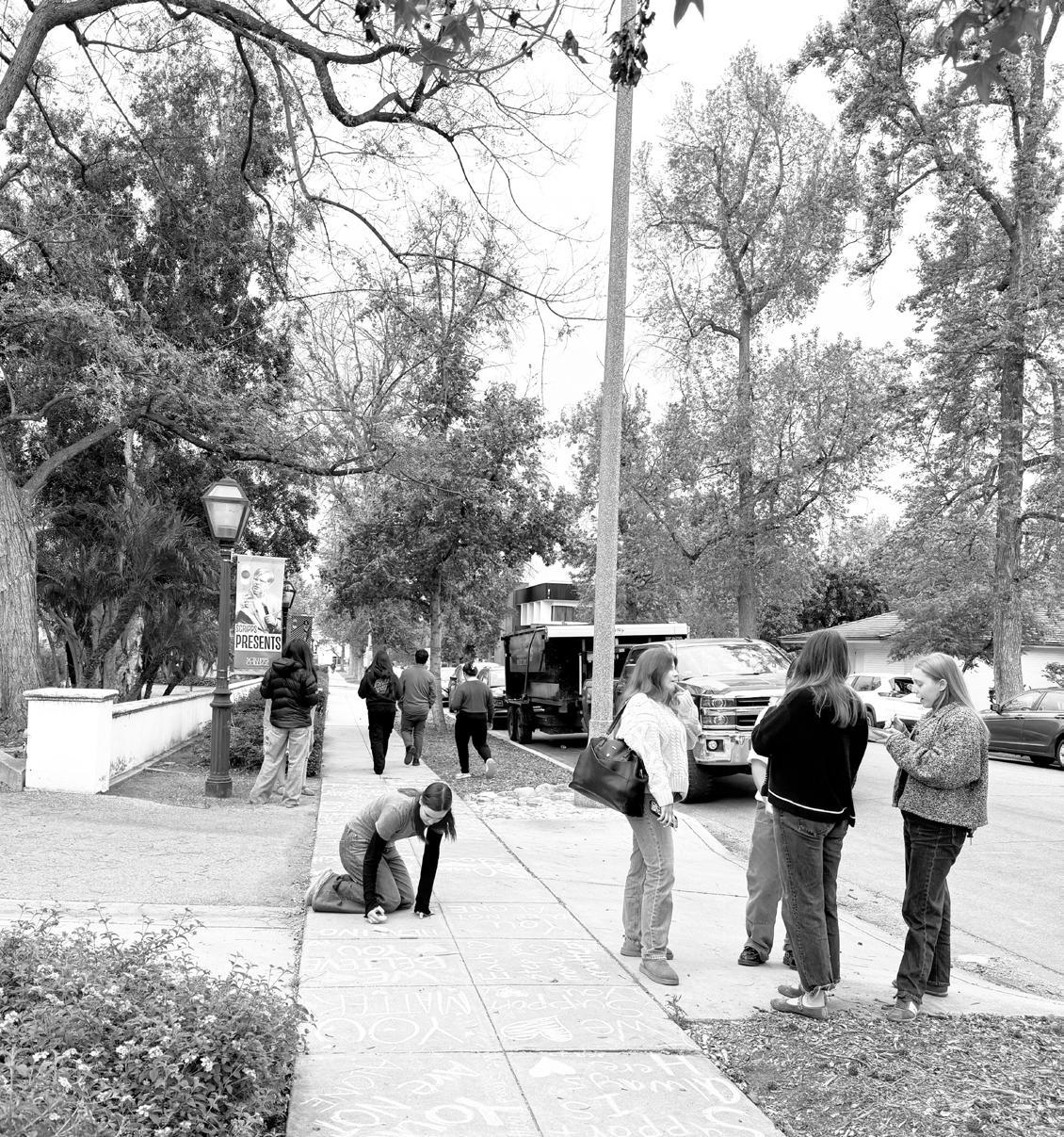
The EmPOWER Center, a 7C resource for support and advocacy, held an event on April 19 in recognition of Sexual Assault Awareness Month. Dozens of community members gathered outside the center to write encouraging affirmations over a Chipotle-catered lunch.
Organized by student interns and supported by consortium partners, the event served as a symbolic and tangible reminder that survivors are not alone and that the 7C community stands with them.
“We wanted to provide more support for survivors and really get the community involved,” Ava Hinz SC ’25, a Scripps Advocate, said. “We want to provide more encouragement and love, and help people feel more supported wherever they’re at in their process. These events are important reminders that these occurrences happen regularly, and we need to check in with each other and support one another.”
Director of the EmPOWER Center Rima Shah said the event’s purpose was to raise awareness about sexual assault and to support survivors.
“We invited the 7C community to join us to stand in solidarity with survivors of sexual assault by creating chalk messages of support, healing and community on the sidewalk outside the EmPOWER Center,” Shah wrote in an email to TSL. “Our goal was to raise awareness about this topic and support survivors. Their story matters, and we are here for them.” Shah credited student interns Macy Puckett SC ’28 and Sally Ruth Gaskell SC ’27 for their leadership in organizing the event.
Shah said she and Puckett began planning for a lunchtime event, envisioning something simple yet powerful. After reaching out to the EmPOWER’s consortium partners, she said they were excited by the enthusiasm and interest in collaboration that they received.
Gaskell said she hoped the event helped create a positive atmosphere for survivors.
“We hope the chalk stays for a few days leading up to the center,” Gaskell said. “It can be really daunting to ask for help. These messages can give people the courage to reach out.”
For Belén Padilla SC ’25, co-pres-
COURTESY: SAllY RUTH GASKEll
ident of Scripps Advocates and a survivor herself, the event hit close to home.
“I wrote, ‘Love surrounds you.’
That’s what this is about — building a campus culture that’s survivor-friendly,” Padilla said. “People think at a liberal arts college, this isn’t a big issue, but it very much is. This lets survivors know they’re supported, even by people they may not know.”
The event also caught the attention of students from Claremont’s graduate institutions. Izzy Reilly, a third-year occupational therapy (OT) student at Keck Graduate Institute, attended as part of her doctoral capstone project on sexual violence within the OT field. She said she wanted to raise awareness and show support.
“The affirmations are powerful,” Reilly said. “People know there are investigations and Title IX, but it’s also important to highlight confidential resources and supportive communities.”
Hinz echoed the message of inclusivity and action, adding that
KALIA MANAYAN venues ever since.
On April 11, Claremont McKenna College’s Gould Center hosted an AI vs. Human Roast Battle at McKenna Auditorium, where students and faculty faced off against AI-generated celebrity avatars.
The event was curated and presented by ComedyBytes, a New York-based group behind what they described as “the galaxy’s first AI vs. Human roast battle,” according to their website.
ComedyBytes produces sketch comedy shows using AI technology, generating every element of the performance, from scripts to background music, with artificial intelligence. The event featured three roast battles between humans and AI celebrities, along with interludes of AI-programmed sketches. Eric Doyle, a co-founder of ComedyBytes, hosted the roast battles on stage. Doyle said that after the release of ChatGPT in November 2022, his team explored ways to collaborate with the technology to create something unique. ComedyBytes launched its first show in February 2023 and has continued producing performances at colleges and different
“We looked at what we could do with AI and said to ourselves, ‘How can we work with this and produce something interesting?’” Doyle told TSL. “After our first show, we realized just what AI was capable of.” Doyle highlighted that the humor in the show came more from the reactions of and interactions between the humans, less from the AI alone.
“It can be used to reflect on what it means to be human and what it means to be funny,” Doyle said.
The first two battles featured current CMC student body president Ava Kopp CM ’25 and Vice President for Student Affairs
D.T. Graves, followed by a third round with philosophy professor Edward J. Sexton. They faced off against AI-generated versions of Drake, Nicki Minaj and an AI recreation of the professor himself, respectively. Winners were determined by audience applause.
In between these battles, segments of AI-produced music, AI mashup images and an AItalking Greek goddess Athena were showcased. Additionally,
“Most people complained about a clear lack of communication and transparency from ARS to students,” Burkhalter said in an interview with TSL. “There was also a big issue of a lack of empathy from ARS workers. Students were explicitly told that their diagnosis wasn’t bad enough.”
Additionally, Portmore said that many students come to Scripps College for the small college community and the easy access to accommodations and support from admin and staff,
adding that many of her friends are struggling to make plans for the next semester because of their issues with housing accommodations.
“I feel in a lot of their marketing that it’s like a really small school, so everything is pretty easy to access in terms of resources, and that they care about us and stuff like that,” Portmore said. “I feel like [this year] directly goes against those things because they’re putting up so many barriers to access those resources that they’re advertising.”
there are always steps the community can take to support a friend or build a healthier campus climate.
“If we all work together, we can make a really big difference in making people feel safe, respected, and cared for,” Hinz said.
Looking ahead, Shah said the EmPOWER Center hopes to continue expanding its programming.
“Seeing the success of this event, we hope to do it again next year for Sexual Assault Awareness Month,” Shah wrote. “In addition, next year we plan to continue and expand our programming around healthy boundaries, healthy situationships, bystander engagement, healing and restoration and survivor support.”
For now, the colorful affirmations outside the EmPOWER Center remain, inviting passersby to pause, reflect and even add their own message. A bowl of chalk sits nearby, alongside a sign explaining the event’s purpose; people can continue leaving messages so that survivors know they are seen, heard and supported.
She said she first came up with the idea for the summit in the fall of 2024 after recognizing the distance between sustainability clubs and organizations throughout the 5Cs.
“I thought that there was a need to have all these different groups in one space,” Allbritton said. “Because something that I have learned is that if you have multiple people working on similar projects and coming together, they’re going to figure out how they can make that project stronger, especially with things like environmental initiatives.”
As a sustainability assistant for the Scripps Office of Sustainability, Allbritton said she was able to propose the idea for the summit to the rest of the staff and bring her vision to life in the spring.
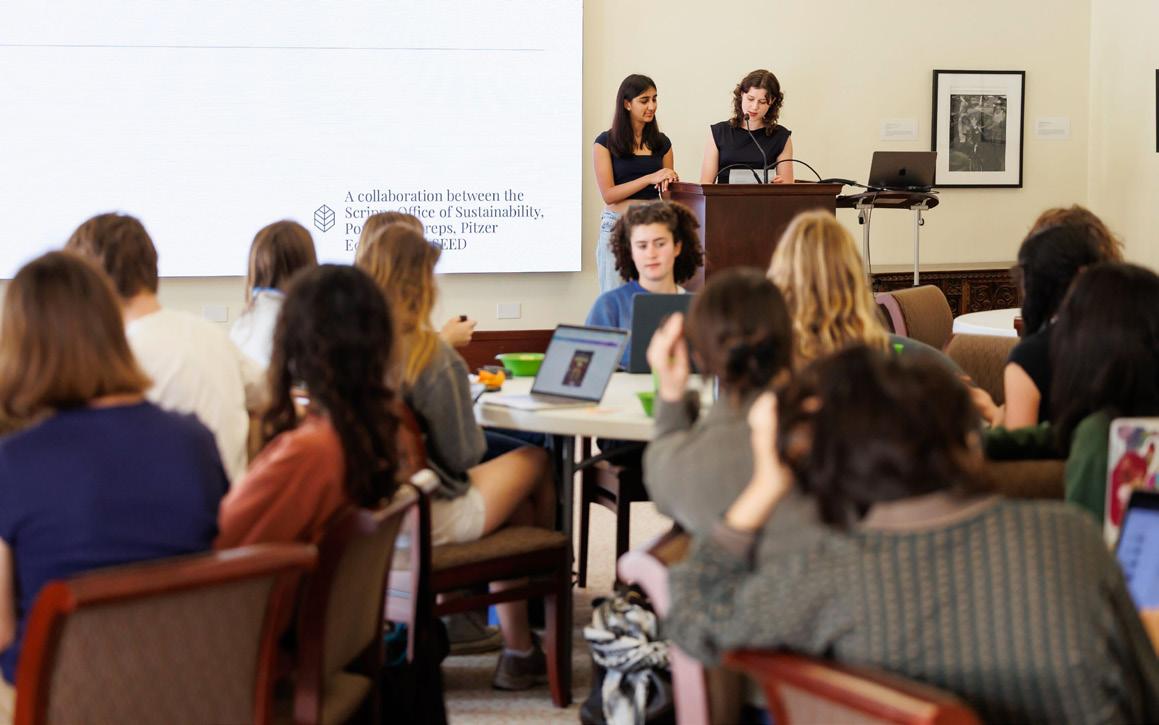
Working alongside CMC and Pomona’s EcoReps, as well as members from Scripps Environmental Education and Development (SEED), Allbritton organized the first 5C Sustainability Summit. Over the course of five hours, sustainability organizations and interested students participated in a series of discussions, workshops and community-building.
The summit offered three 45-minute discussion blocks that covered topics including “Reducing Consumption as a College Student,” “Communicating Climate,” “Evaluating Campus Impact” and “Climate Involvement off Campus: 5Cs in the Community.”
Wilbur Moffitt PZ ’28, who attended the summit with Claremont Environmental Justice (CEJ), said he appreciated the opportunity for the environmental groups on campus to have open discourse and work together towards their shared causes.
Moffitt echoed Allbritton’s observations from the fall, sharing his surprise to find that all the organizations felt disconnected.
“It’s insane, the idea that we are not communicating as much as we can be, or like exchanging ideas, if not just presenting ourselves as a unified front on every issue,” Moffitt said. “To me, it’s the easiest
thing to fix in the world.”
For Isabella Newcomer SC ’27, the summit provided that solution. Through extensive discussions, Newcomer said she was able to share her own knowledge and takeaways from her time with the Scripps Sustainabiliteam and learn from other members of clubs that had similar interests and initiatives.
“It was really cool to talk to people [who] kind of shared that common interest and figure out other ways I can get involved with other specific sectors,” she said.
Moffitt said that this summit is only the beginning of cross-organization sustainability work.
“This will happen again, which is exciting,” Moffitt said.
Newcomer also shared her hopes for including other student-led organizations, such as the Motley Coffeehouse, in summits to come.
Similarly, Allbritton said she envisions including new voices in these upcoming discussions, including incoming first-years and those with minimal experience in the environmental field.
Allbritton also shared that a new student government working group was established at the summit and had their first meeting during one of the discussion blocks Sunday afternoon.
“We were just discussing how we want to collaborate and how we should have a lot more frequent meetings to figure out how we can plan with each other, support and brainstorm with one another,” Allbritton said.
She added that many projects in a specific organization cannot be accomplished due to a lack of resources and time, but the emerging working group will hopefully find ways to offer cross-organization support to make these initiatives happen.
According to multiple organizers and attendees, the summit was a success and offers a window into what is to come for sustainability groups across the campuses.
“I think everyone’s just very excited to keep working as a larger group and not just feel disconnected,” Allbritton said. “I’m really happy to know so many other passionate people who are gonna help me out, and people who, moving forward, I know together we can make a change.”
another segment included an AI dating show, featuring Lucy Thompson CM ’25 with three “eligible, handsome” AI bachelors for Thompson to choose from.
Behind the scenes was Aman Chopra, who worked on the technology and creative aspects for the comedy shows. Chopra said the creation process was all about learning how to communicate with the AI and getting the right response. He added that he made all of the music for the show completely with Suno AI and that every song was new and completely original.
“It’s getting really, really good really fast,” Chopra said. However, he noted that AI will enhance creativity, not replace it.
Graves said the script she was given to read was AI-generated. However, she and the other human contestants were not told ahead of time how the AI celebrities would roast them.
“The show raises interesting questions about human emotions and humor,” she said.
Doyle commented on the broader implications of AI in
AUDREY PARK
AUDREY pARK • THE STUDENT lIFE
Claremont McKenna College’s Gould Center hosted an “AI vs. Human Roast Battle” on April 11 at McKenna Auditorium, where students, faculty and AIgenerated celebrities went head-to-head in a comedy showdown.
The EmpOWER Center held a sidewalk chalk drawing event in recognition of Sexual Assault Awareness Month.
Meet Pomona and Scripps Colleges’ 2025-2026 student body presidents
ANABTAWI & PATRICK MCDOWELL
Earlier this month, Pomona and Scripps Colleges elected their student governments for the 2025-2026 academic year. This election cycle, Pomona gathered a turnout of 1,001 students, and Scripps cited a record number of voters. Grace Zheng PO ’26, the incoming Associated Students of Pomona College (ASPC) president, and Simran Sethi SC ’26, the incoming Scripps Associated Students (SAS) president, sat down with TSL to reflect on the election and discuss their goals for next year.
The following conversations have been lightly edited for clarity.
Grace Zheng is currently serving as the head chair of Pomona’s Judicial Council. She has previously served on ASPC as the senate secretary and director of operations.
TSL: What inspired you to run for ASPC president, and what do you hope to achieve during your term?
Grace Zheng: I was actually on ASPC staff for my first two years of college, and my decision to run was really based on all my experience in those roles. During that time, I worked on initiatives like 4/7 day and Candy Grams, which were tangible and concrete projects that I really felt made an impact on people’s days, like seeing people’s smiling faces, and I got to be a part of the process. And so I saw how our student government can really have these initiatives that improve the quality of students’ lives. It was those small moments where you see people light up.
I think my other decision to run was because this is a very turbulent time nationally. I think we all agree with that. My experience with J-Board, with handling policy changes, really helped me see how important it is. This role has allowed me to be in spaces to make a difference. I’m an international student myself, and so I’m very closely tied to all the events that have been happening on campus. So I think a privilege this role comes with is to be in spaces with people and to be able to have conversations — I really treasure the opportunity to be able to advocate and speak to people.
TSL: How do you plan to foster a sense of community and inclusivity among students from diverse backgrounds?
GZ: When I made my platform, I knew that a lot of the initiatives I wanted to work on would always be in tandem with other commissioners and student bodies on campus. I was an AAMP [Asian American Mentor
Program] mentor previously, and during that time, I was a part of the affinity group committee, so I got to work with the BSU [Black Student Union] and LXA [Latinx Alliance] to run inter-affinity group events. I want to designate more funding to having culturally grounded events working with affinity groups, which I’ll definitely be doing with the Commissioner of Diversity, Equity and Inclusion.
TSL: How do you plan to collaborate with other student leaders and organizations to address challenges facing the college, including impacts to federal funding and uncertainty for international students?
GZ: I’ve had several meetings already with current senators who are working on initiatives for undocumented and international students. We’ve been corresponding with IDEAS and we’ve been in conversations, which is work I hope to take on. Because of the Trump presidency, we’ve been focused on student groups, and this is something I will be working with the Vice President of Academic Affairs on.
TSL: How will you continue to work with the Pomona president moving forward, whether Gabi Starr returns from sabbatical or Interim President Gaines stays in the position?
GZ: I appreciate how Gaines has been more proactive with communication. When we were kind of expecting FERPA to come up, it did, which was reassuring. Having that communication is important, and it’s something I’ll continue to work on if President Starr comes back. I have met with the outgoing ASPC president about the meetings I attend and the kind of exposure I get. I obviously hope to navigate that relationship respectfully, but I’ve also had conversations with senators, and I think it’s important to hold them accountable. I’m not afraid to do that. Of course, I want to do that in a respectful way because I don’t want to alienate anyone, especially when federal issues are affecting campuses across the country. It’s tough.
TSL: Looking ahead, what legacy do you hope to leave behind as student body president?
GZ: In terms of student life and school spirit, it’s kind of cheesy, but I want to bring back old traditions that we used to have, like Frary Snack and Harwood Halloween, but also make new traditions. In terms of campus culture and spirit, that’s been lacking in recent years. And from my understanding, alumni funding — espe-
cially from recent graduates — has also been declining. During alumni events, I want to interview people and build on promoting institutional memory, and bring back some of the things that, according to alumni, really made the Pomona experience special, unique and meaningful for them.
I think a lot of that energy was lost during COVID, and obviously we’ve had political issues on campus, so I definitely want to bring back some of that campus culture, especially now, when we have even more coming. These days, a lot of what we do is reactive rather than proactive.
My first year at Pomona, I really saw a lot of the potential for what ASPC can do. So in the long term, I want to push for structural changes from within ASPC, ensuring that it’s more transparent. I want to challenge senators with what they can achieve and leave that legacy. It’s our vision, not just mine.
Simran Sethi is currently serving as vice president of student activities for SAS. She has previously served on SAS as DEI Chair and on multiple committees.
TSL: What inspired you to run for student body president?
SS: I’ve been on SAS for the last two and a half years. I randomly applied. My freshman year, there was a student who dropped being the DEI Chair. So then an email got sent out to the student body, being like, “Hey, we have a spot open.”
I hadn’t been as involved on campus before, just focusing on classes and getting accumulated into the social life of college. I hopped on this team of so many upperclassmen, people I never met before, all with the same passion, the same drive of making change to the school,
building community and a space where marginalized voices can come to light and we can work on issues that people come to us with. Student government became really important to me.
This last year, I ran to be VPSA, which is vice president of student affairs, so now I’m on the executive team, overseeing events, clubs and everything. I just started touching into the more managerial side of student government, so when it came around to elections, I was like, “Wait, I think it just makes sense for me to run to be president.”
TSL: Is there anything in particular that you want to achieve during your term this upcoming school year?
SS: One of our big accomplishments this year was that there were more events around campus … and a lot more people know of the student government and the events that we host. A lot more engagement on that end.
I’ve been seeing people becoming more comfortable with one another in larger spaces and more willing to step out of their dorms and attend events. I definitely want to continue to bring that in next year.
Also, the Trump administration, all the changes that are happening across the nation — how are we as a student government going to advocate for our student body, work with the administration or work against, based on what decisions are being made, and also just continue to work on transparency?
TSL: You mentioned trust from the student body. How do you plan to continue to foster that sense of community and trust from the student body, given the uncertainty of the moment? Do you think there are any unique challenges to fostering that
sense of community and trust with the student body in this current moment?
SS: One thing that SAS has done is the Be Heard forums. They’re once a month, hosted in the Motley, so a very in-and-out space for the Scripps community. It’s a space for Scripps students to talk about any concerns that they may have, or things that they’re really liking or want to see more of. You can say anything during this time. Along with that, all of our meetings are open to any Scripps students. Student government is also very involved in other spaces around campus … so because we’re sprinkled around campus as well, we’re also hearing or having conversations about what students are feeling.
TSL: How do you plan to work with the Scripps president and other members of the administration moving forward, and how do you plan to continue to be an effective advocate for student voices when communicating with administration?
SS: We’re in a tricky place right now because of federal funding, and we’re also a historically women’s college, so we’re on much thinner ice than the other 5Cs. But SAS doesn’t have the government on our backs; we get to be that voice, we get to say whatever we want, and show the support to the students, through in-person conversation with administration, where we then relay the information to the student body. We want to keep a good relationship with the administration, but then it goes back to frustration. This is the lack of transparency that we’ve been facing for the last two semesters, starting with the Motley shutting down. It’s been really hard to get a clear answer of “Okay, fine. You know, we will start communicating with our student body more clearly.” But unfortunately, that’s not what they’re going to do. They’ve made that very clear.
TSL: Do you think the student government can provide that clarity and transparency by being an intermediary and delivering the information to the administration?
SS: I definitely do think that by sitting on student government, you have a level of respect from administration by being a student body-elected leader. The students elected everyone on SAS to be in the position they are, and for as long as SAS has been the student government at Scripps, they’ve always had a relationship with administration. It’s written in the bylaws that I will be sitting on these committees. Anyone who’s elected to this position will be sitting on these committees, and that’s a relationship that has been built by the administrative committees and by SAS over the years.
Shark Mutulili named Pomona’s first Rhodes Scholar in 20 years
RHEA SETHI
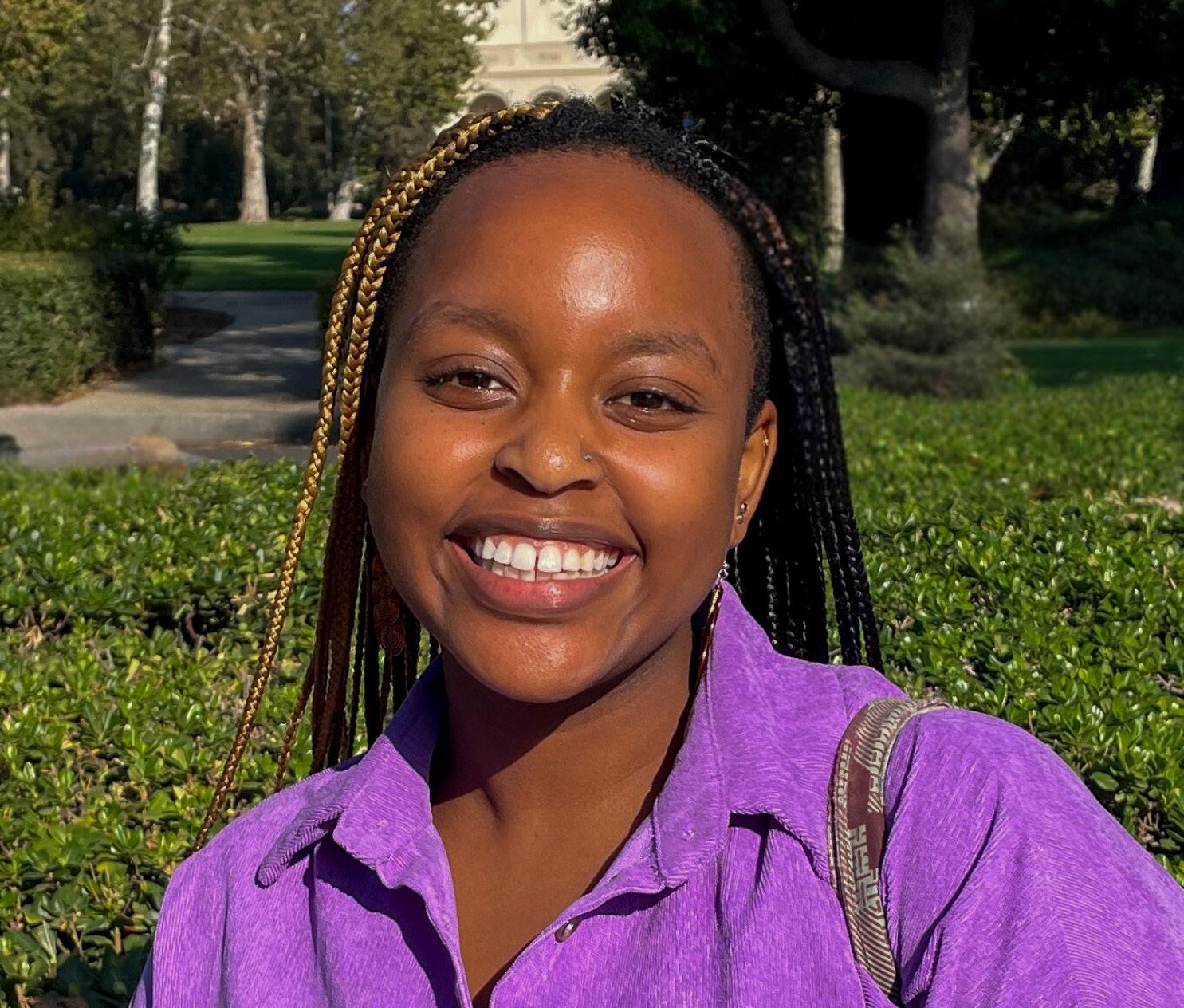
When Shark Mutulili PO ’25 became Pomona College’s first Rhodes Scholar in over 20 years, she kept the news to herself.
Though she was thrilled to learn in November that she had earned one of the world’s most prestigious international post-graduate scholarships, Mutulili knew her application process was far from over. She still had to apply to Oxford University, where two years of graduate study would be fully covered by the Rhodes Scholarship — if she was admitted.
The Rhodes Scholarship, established in 1902, enables students from around the world to further their graduate studies at Oxford.
In March, Mutulili received her Oxford acceptance letter and finally shared the news with her friends and community. She is the 13th Rhodes Scholar in Pomona’s history, with the last Pomona recipient earning the scholarship in 2003.
In her four years at Pomona, Mutuili has deeply integrated herself into campus life. This year, she has assumed the role of senior class president. She has also taken leadership positions in Resident and Housing Life, Mock Trial, Pomona’s boba cafe, Milk and Honey and the InterVarsity and First Love Christian fellowships.
According to Mutulili’s friends and co-workers, her accomplishment was unsurprising given her hard work and talent.
“She’s an amazing co-worker and leader in general,” ASPC Vice President of Finance Liz Giwa PO ’25 said. “She’s very selfless, God-fearing and just a ray of sunshine.”
As senior class president, Mutulili hosts weekly class events, oversees the class budget and sits on various ASPC committees and leadership boards. She recently organized the senior class trip to Las
Vegas, a highly anticipated celebration for the graduating class.
She’s been working really hard, and she’s such a great leader,” ASPC President Devlin Orlin PO ’25 said. “[Giwa] and I take a leadership class with her at Harvey Mudd, and everyone is so impressed by her. Everyone always looks to Shark for measured leadership.”
Mutulili is a public policy analysis major, and ultimately aims to work as a public servant in her native Kenya, supporting marginalized and vulnerable groups.
“I do consider women and children especially in the African context because they tend to be silenced in their voice, their achievements, their beliefs, and the like,” Mutulili said. “I am a woman, and I have grown up in Kenya. I’ve been considered as somebody who is not worth listening to.”
Mutulili applied for the Rhodes Scholarship to further explore the world of public policy after graduation instead of immediately joining the workforce. She was drawn to Oxford’s Public Policy 1 + 1 Program, an accelerated two-year program combining a master’s of public policy with a master’s of science in public policy research.
just two. Mutulili applied through the Kenyan Rhodes Constituency, not through Pomona College or the U.S. Constituency.
She submitted her preliminary application at the end of August, one of approximately over a thousand applicants for the Kenyan Constituency. Throughout the fall semester, Mutulili waited to see if she would be one of the ten finalists for Kenya. As November approached, she began to lose hope — until she received an email on Oct. 26 confirming her as a finalist.
“It was almost poetic,” Mutulili said. “I received the email after organizing senior brunch. I was walking back to my room around 2 a.m. when I looked up and saw a shooting star, and I thought about how lucky I was.
I don’t believe that I got these opportunities to use them on myself in any way, shape, or form. They’re blessings and also tools that were given to me from the work my community had put into me for a particular purpose.
Shark Mutulili PO ‘25
Of the 100 annual Rhodes scholars, the Rhodes Trust accepts a specific number per country; the United States produces 32 scholars, while Kenya produces
Then I thought that I’m not lucky — I have put in work and God has been on my side through all of this. Right after I thanked God, the email popped up on my phone.”
Each country’s Rhodes Constituency conducts finalist interviews in person. With a finalists dinner Nov. 6 and the interview the next day, Mutulili had only a week to secure a flight to Kenya. Professor of politics David Menefee-Libey advised her to email the President’s Office to arrange flight expenses through the President’s Fund. “He said that I was also repre-
senting Pomona,” Mutulili said, “And that they should support me.” After securing the money for the flight, Mutulili landed Nov. 5. She said that though the atmosphere was tense, she aimed to present her authentic self throughout her interview. The day after the interview, Nov. 8, as she prepared to return to Pomona, she received the email that she had been selected as one of Kenya’s two Rhodes Scholars.
Four months later, her post-graduate future was confirmed with her Oxford acceptance letter. In her last months at Pomona, Mutulili reflected upon her undergraduate experience.
“I think of the people in this college who welcomed me, supported me and opened doors to experiencing new things,” Mutulili said. “I skydived at Pomona. I
went bungee jumping for the first time at Pomona. I went skiing for the first time. So I’m so grateful to Pomona, ultimately, or just to my friends and family who’ve pushed me to be here.
“ In the future, as a public servant in Kenya, Mutulili said she hopes to use sex education as a tool to change attitudes about gender norms and stereotypes and to mitigate gender-based violence.
“I don’t believe that I got these opportunities to use them on myself in any way, shape, or form,” Mutulili said. “They’re blessings and also tools that were given to me from the work my community had put into me for a particular purpose. What that purpose is, I’m not sure, but the larger goal is to give back and to continue to support and share love.“
DANIA
SASHA MATTHEWS • THE STUDENT lIFE
COURTESY: SHARK MUTUlIlI
Shark Mutulili PO ’25 is Pomona College’s first Rhodes Scholar in over 20 years and the 13th Rhodes Scholar in the college’s history.
‘The 25th Annual Putnam County Spelling Bee’ delivers a spellbinding performance
Premiering from April 10 to April 13 at Pomona College’s Seaver Theatre, “The 25th Annual Putnam County Spelling Bee” delivered a tale of ambition, humor and vulnerability that kept audiences on the edge of their seats from start to finish.
The musical tells the stories of six quirky students competing in the titular spelling competition, where only one can emerge victorious. Based on the Broadway show of the same name, the Pomona production, directed by Fran de Leon, performed the musical’s original score composed by the late William Finn and narrative written by Rachel Sheinkin.
Though lighthearted on the surface, the production weaves in moments of deeper emotional resonance, exploring the pressures of childhood, identity and belonging.
In each production, members from the crowd are randomly selected to play contestants, providing improvised comedy and a unique experience every showing.
Ryan Chen PZ ’27, who played the wholesome counselor Mitch Mahoney, shared his enthusiasm for performing the number “Prayer of the Comfort Counselor,” which features audience participation.
“I love to do my number,” Chen said. “It’s a lot of fun. I get to mess with an audience member on stage. And it’s a rare song where you get to sing your heart out.”
When on standby, cast members would often sit in the front row, allowing spontaneous interactions with the audience members seated behind them.
Attendee Jamie Miller PZ ’26 said this unique experience made him want to return for a second show.
“I want to come [again] because of the audience interaction,” Miller said. “I was sitting in the first row behind where all the cast members were sitting. So it was fun to hear them talk, and they talked to me a little bit too.”
Beyond the humor and chaos of the bee, the musical also tugs at the audience’s heartstrings
Preserving our past: A look at the CAPAS Archive Project
COUrTESY: NATASHA YEN
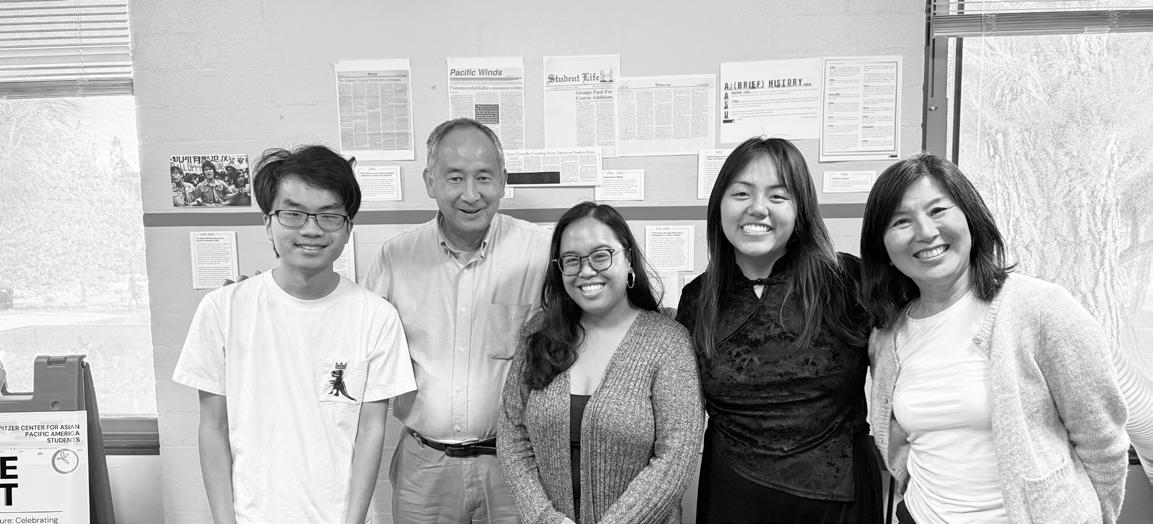
On April 21, the Pitzer Center for Asian Pacific American Students (CAPAS) space transformed into a vibrant display of the Asian Pacific Islander Desi American (APIDA) Archive Project. An ongoing research project by students at CAPAS, the initiative collects and preserves APIDA history across the 5Cs.
The CAPAS space was flooded with students eager to see the first public showcase of the project, which was curated by CAPAS Archive Interns Natasha Yen PZ ’25 and Aaron Ong PZ ’27. The display featured a timeline of events on the walls, ranging from political activism to key cultural milestones, spanning from 1968 to the present day.
The APIDA Archive Project aims to conserve APIDA history at the 5Cs by gathering and examining documents, photos and narratives. The project was originally co-created by Yen and Jasmine Caniban PZ ’25 with development starting in spring 2023. While serving on the Pitzer Pacifica Asian Student Union (PASU) executive board, they noticed gaps in documentation of 5C APIDA history, particularly in the aftermath of the COVID-19 pandemic.
“I think [PASU] really lacked the capacity to function as usual after COVID, and saw a need to draw from historical records of what [APIDA] affinity groups and spaces had done in the past, and we didn’t have those resources there,” Yen explained.
Yen and Caniban launched the project in response to this gap.
“So that’s where the APIDA Archive Project emerged from,” Yen continued. “The need for remembering the histories of APIDA activism at the 5Cs to inform our present moment and also the future of our work.”
In fall 2023, the project’s administration moved to CAPAS to have access to more resources, including funding to hire interns, in order to solidify it as a long-term initiative. Since then, Yen, Ong and other CAPAS contributors have drawn from existing records at the Honnold/Mudd Library and across the 5Cs to compile a complete record of APIDA history.
These efforts have culminated in the form of the timeline, with other ventures still in the works.
The project also included adding a
Pitzer APIDA history timeline on the CAPAS section of the college’s website. Current CAPAS Director Dominique (Nikki) Acosta shared that, before she started the position in January, the timeline helped her better understand the APIDA community she would be joining.
“When I was actually learning about the role and in the interview process, I chose to look at the [Pitzer] website for information about the center and Pitzer,” Acosta said. “I stumbled upon the timeline, which was really helpful for me to understand the history of the students and the community that I was going to be entering.”
As the APIDA Archive Project continues to grow, CAPAS hopes to expand its scope and accessibility.
“We’d like a permanent place on the Pitzer website, or an independent website where we can not only have the [complete 5C] timeline [showcased at this gallery], but also more stuff, like oral histories and interviews,” Ong said. “So that’s our long-term goal. We’re still in the early stages of that, but I think that in a few years, it’ll be really important.”
Ong also expressed hope that others will use the archive as a resource for their own projects.
“If someone wants to use this archive as a resource as a starting point for writing a book, I think that would be a really great use of it,” Ong said. “And that would basically make everything we’ve done here worth it.”
As Yen prepares to graduate this spring, she reflected on her experience with the project and shared her hopes for its future.
“I’m really grateful to have had this opportunity to make this project, and I really do hope that it’s able to continue in the future,” Yen said. “I’ve been able to work with Nikki [Acosta] to ensure that the Archive Project will continue to hire student interns who are passionate about our history.”
The APIDA Archive Project stands as a testament to the power of student initiative and the importance of preserving community histories for generations to come.
through its characters’ relatable backstories, which lend emotional weight to the cast’s performances.
Nicholas Russell PO ’26, who played William Barfée, described his character as someone who resonates with those who feel like outsiders.
“Barfée is a child of divorce,” Russell explained. “He has a stepmom who he doesn’t get along super well with. But what really speaks to the soul of his
SpECUlATiVE
FiXATiONS
character is that he’s kind of just a nerd. He’s a love letter to every outcast that didn’t fit in because they loved certain fandoms, certain classes in school and aspects of life that aren’t appreciated.”
While the spotlight shone on the actors, the crew also played a crucial role in making the show a success behind the scenes. Philo Judson PZ ’26, the lead sound engineer, particularly enjoyed mixing the audio for the Act Two number “Woe is Me.”
“With the mix of the band members we have and the instruments they play, and the actress whose voice just really fits, it’s a fun song,” Judson said. “It all just comes together really well.”
Bringing it all to life was no simple task. With a production spanning two months and rehearsals totaling twenty hours a week, the team worked hard to deliver their final performance. This long process fostered a tight-knit community among the cast and crew.
“There’s a lot of time and effort that goes into a production like this, and when we come out the other side, we have the production that we’ve made,” Chen said. “But we also have the relationships we’ve developed with each other.” Russell echoed the sentiment and offered encouragement to anyone interested in theater.
“We strive for a more professional caliber of what we’re doing, but I would say to anybody who’s interested in theater: just go out and audition,” Russell said. “Even if it doesn’t go the way you necessarily want it to, it’s such a valuable experience. And you meet people [who] become friends for your entire life.”
With a positive reception from attendees and a fulfilling experience for the cast and crew, some hope that this production will open the door for more musicals in the future.
“I love musicals,” Judson said. “I wish this department did more of them. We only have one every other year, so every eight shows is a musical. And every time we have a musical, tons of people want to do it.”
‘Sunrise on the Reaping’: Will the revolution be televised?
Double the deaths, double the fun, double the propaganda.
This is the premise of “Sunrise on the Reaping,” by Suzanne Collins, a prequel to “The Hunger Games” book series. Published just a month ago, in a time where America gets closer to dystopia every day, “Sunrise on the Reaping” sold a record 1.5 million copies in its first week.
To further testify to its popularity, I know five other people who’ve read this new release, which is five more than the other books I’ve written a column on.
The novel follows Haymitch Abernathy, who readers have previously known as Katniss Everdeen’s mentor, and his tragic backstory as a competitor in the Hunger Games. In the 50th Hunger Games, which he competes in, twice as many teenage tributes are sent from each province of the dystopian, pseudo-American Republic of Panem. In this state-sponsored battle royale, only one of the 48 can win — everyone else must die.
In a situation where no one is doing great, the poorly trained tributes of District 12, the impoverished coal-mining, moonshine-making province where Haymitch is from, have it the worst.
“Don’t let them paint their posters with your blood” is the advice that Haymitch’s father gives a District 12 tribute. This advice — don’t let your oppressors turn your suffering into spectacle — stays with Haymitch throughout the story.
He and his fellow District 12 tributes — notably May -
silee Donner, who is excellently snarky and stylish and my personal favorite character — have to constantly consider how to portray themselves to the media. Whatever they say or do can easily be omitted or twisted.
The atmosphere of surveillance, which turns every act into a performance, is particularly well written.
Additionally, the exploration of propaganda in “Sunrise on the Reaping” is increasingly relevant.
In today’s America (thanks, President Trump!), we’re no stranger to misinformation by politicians and media personalities alike, perhaps most concerningly about violence. Lies popularized by conservatives both sensationalize and distort violence, from the claim that Black Lives Matter is a hate group to the claim that January 6 rioters were righteous.
The popularization of misinformation is likely related to how blurry the line between politician and media personality is getting.
The characters of “Sunrise on the Reaping” encapsulate this blurriness well. We get to see how powerful propagandistic narratives are created by charismatic politicians like President Snow and ridiculous television personalities like Drusilla Sickle.
I wish “Sunrise on the Reaping” focused more on how ordinary people buy into and spread propaganda. The power of propaganda is that it’s propagated; spread not just top-down, but also horizontally among the very people who are the intended victims of misinformation.
The people of District 12 still bet on the Hunger Games, viewing teenagers fighting to the death as another form of entertainment.
Though from Haymitch’s perspective, no one native to District
12 is sympathetic to the Capitol. I wanted more insight into this dynamic; it would’ve been interesting to have the perspective of a District 12 character who was completely brainwashed by Capitol propaganda. The cognitive dissonance of ordinary people under an authoritarian regime, simultaneously abiding by and despising the government, could’ve been more fleshed out. I did see this to an extent in how Haymitch buys into some Capitol propaganda. He views the Careers, trained tributes who have a higher chance at survival, as animalistic and inhuman, even though he and the Careers are victims of the same system. Yet his projection of the Capitol’s narrative onto the Careers is largely unexamined. And from a reader standpoint, Haymitch’s dehumanization of the Careers makes their eventual deaths, though sufficiently bloody, insufficiently emotional.
Even the deaths of the lovable characters could do with more nuance. In the psychologically torturous world of the Hunger Games, I expected the government-orchestrated deaths to better address each character’s fears. Good characters don’t deserve disappointing deaths — I won’t spoil it, but one particular character’s method of death, instead of feeling cruel, felt borderline comical, affecting my immersion in the story.
Still, “Sunrise on the Reaping” does what it’s meant to do — it’s an entertaining prequel which explores the nature of propaganda with engaging characters and a page-turner plot. I’m glad I read it, despite a couple of lackluster deaths, and I’d say you should too — don’t you also want to spectate a teenager battle royale?
Vivian Fan PO ’28 is accepting book requests: https://bit.ly/tslbookrec
JOSEPH WOO CHAN
SArAH ZiFF • THE STUDENT liFE
VIVIAN FAN
JOSEPH WOO CHAN
From April 10 to April 13, “The 25th Annual putnam County Spelling Bee” premiered at pomona College’s Seaver Theatre.
The Pitzer Center for Asian Pacific American Students space transformed into the Asian Pacific Islander Desi American (APIDA) Archive Project.
Arts & Culture
Spring on the Mounds: Swap, shop, reflect
KASSIA ZABETAKIS
With the SoCal sun in full swing this spring, the Pitzer College Mounds have become a lively weekend hotspot. On Saturday, April 12, the Mounds buzzed with activity as students gathered to enjoy live music, an art exhibition, clothing vendors, printmaking and more. On one side of the Mounds was the third biannual Mounds Bazaar, co-hosted by Thread5 and Pitzer EcoReps, which presented a student-run sustainable fashion market. Across the way was another pop-up art exhibition titled “(re) Location: Real and Imaginative Displacement.”
Despite differing in form, both events centered on themes of exchange — of clothing, culture and ideas — and turned the Mounds into a space for reflection and connection.
“It’s just a fun kind of gathering where we can also promote sustainable fashion,” Iza Harris PZ ’26, president of the 5Cs’ fashion club Thread5, said of this semester’s Bazaar.
5C students sat on the grass, spreading out an array of floral maxi skirts, vibrant T-shirts and bedazzled jeans as they waited for buyers to approach. There was also a donation box provided for those uninterested in selling.
Harris was happy to hold an inclusive event for everyone, not only those interested in fashion.
“I think it’s a way to introduce people to the club and the other stuff that we have going on,” she said. “People who … maybe aren’t necessarily that interested in learning about fashion, but just have stuff they want to sell. It’s not super deep but just a fun time.”
While the Mounds Bazaar brought students together through fashion and sustainability, just steps away was another expression of community and consciousness.
Organized by the Pitzer College Art Galleries Fellows in partnership with the Racial Justice Initiative, “(re)Location: Real and Imaginative Displacement” uniquely displayed art inside two U-Haul trucks.
MOMENTS TO SAVOr
The use of U-Hauls was both a clever way to avoid a lack of gallery space for students in the spring semester, as most galleries are occupied by senior thesis exhibitions, while also conveying themes of movement and displacement.
The Fellows sourced art from Claremont Heritage, an organization documenting and preserving local history, the Honnold Library’s special collection and Claremont Canopy, a local organization supporting people who come to Claremont due to displacement from their home country. The exhibition also featured student submissions, including three zines created by 5C artists.
“We got community input, and then went out and did our own research in archives,” Arianne Ohara PZ ’25 explained, one of the Art Galleries Fellows and event organizers.
The Fellows worked with Lydia Henry and John Dominguez, two longtime residents of El Barrio (also known as Arbol Verde), who helped them find a direction for the exhibition.
“[El Barrio] is the neighborhood that’s South of [Claremont McKenna College (CMC)],” Ohara explained. “Longtime residents still call it El Barrio, and it’s a whole discussion of whether El Barrio is still a thing or not, because it’s been mostly bought out by CMC at this point.”
The story of El Barrio’s shifting identity speaks directly to the exhibition’s themes of movement and displacement.
A historically Mexican-American neighborhood developed in the early 20th century, El Barrio was once a vibrant community of laborers, families and students. However, starting in the 1960s, CMC began acquiring property in the area, displacing residents and erasing the neighborhood’s physical presence. The exhibition featured pieces that reflect this ongoing displacement.
Some pieces displayed included a Padua Hills Theater program for a comedy from 1958 called “Las Canacuas,” a planning map
AI’m feeling nostalgic today — four years, eight semesters and 40 pieces later (yes, I counted), I am writing my final entry for my column, Moments to Savor.
In the sunny month of August 2021, I remember seeing a flyer for TSL in my freshman dorm, Pomona’s Wig Hall. I had never written for a school newspaper before, but as someone who enjoyed writing, the flyer piqued my interest. When I looked up TSL’s available positions on its website later that night, the “Food Columnist” position seemed intriguing — I thought writing about food could be fun. But I also remember thinking to myself, “If I don’t have
outlining land use in and around
El Barrio from 1981. Another was a Syrian necklace gifted to Claremont Canopy by a family who fled Syria in 2012.
The Fellows hope that visitors can learn from their exhibition and better understand the land they are living on.
“I think the main thing is that we want people to be more aware of the history of Claremont,” Evie Burrows White PZ ’26, another Fellow and event organizer, said. “I think we want people to be aware … that this is still ongoing.”
Besides examining the story of El Barrio, the sections also traced local histories of cultural and agricultural production,
connections between Indigenous presence and the region’s natural landscape and the lasting impact of displacement, migration and community on Claremont today. Annika Salomonsson PZ ’25, an attendee of the exhibit opening, emphasized the importance of learning these stories.
”I think it’s really important for Claremont students to acknowledge the past histories of this land and sort of know what came before colonization and development,” she said. “It’s really important for us to confront these pasts but also do it in a really open and accessible way.”
Ohara pointed out that the Claremont Colleges can become a
small bubble for students, despite the closeness of Claremont Heritage, free archives available and the abundant history of the area.
“[It’s important] just like being more aware of the resources that are out there for you to learn about where you live,” she said.
While the U-Haul exhibition invited critical engagement with Claremont’s past, the Mounds Bazaar offered connection through exchange, encouraging students to reflect on their consumption, share resources and build community. In a single afternoon, the Pitzer Mounds became a space for creativity and reflection, reminding students that community can be both expressive and thoughtful.
bittersweet farewell
much journalism experience, could I actually do it? Is it worth applying and taking that risk?”
Looking back four years later, I am so happy that my hesitant freshman self took that risk. Writing this column allowed me to explore meaningful memories through the lens of food. It gave me a break from academic writing, and I so enjoyed the biweekly rhythm of reflecting on a food or drink and its significance in my life.
In my mind, even if I (and my editors) were the column’s only readers, I was still content.
While brainstorming column topics, I’d make a list of everything I ate or drank over the last two weeks. Malott surf and
turf, a cocktail in the Claremont Village, oranges and Hi-Chews in my Asian American Literature and Cultural Critique class — I laugh because my notes app is filled with lists of possible “TSL ideas,” and many of these list entries became the columns that people read today.
One week in my freshman year, I took the words “eggs at Frary brunch” from my list and wrote about a humorous debate my friends and I had one Sunday about the best way to eat an egg. During my sophomore year, I once focused on the bucket of mini donuts I had safely transported from Claremont to Orange County in my car. My junior year, the list entry of “LAVENDER
LATTE” (in all caps) made its way into a reprise of my first-year “Caffeination Meditation.” And in my senior year, the haphazardly-typed phrase “salty ramen salty tears” inspired my first piece of the fall semester.
Every piece shared a snippet of my college life through the lens of food, and as I write my last one, I feel incredibly grateful. I’m grateful for the ways in which this column allowed me to inscribe into memory so many sweet moments of Claremont life. Had I not written them down, my feeble mind would eventually forget.
I’m grateful for the ways in which searching my mind (and taste buds) for what foods or
drinks to write about each week led me to remember not necessarily the big, flashy moments of college, but the sweetness of the everyday. About how thinking about my Sunday Frary omelet suddenly made me remember a silly conversation about scrambled versus soft-boiled eggs. How the slew of snacks in my room led me to recall the morning I literally ran to Trader Joe’s. I’m grateful that this column allowed me to share these memories with others, too. As the semesters passed, it filled my heart with delight to connect with avid readers of my work. I loved hearing about how my pieces sparked conversations about the joys of Malott cold brew and the creativity inherent in charcuterie-building. I loved chatting with other seniors about our shared affinity for Iron & Kin’s Graceful Matcha and our similar sentiment toward second-semester senior year.
Someone even told me that they pinned one of my pieces on their fridge, once. That made me smile so widely — that’s the best compliment ever.
So, as my last spring semester slowly comes to a close, I’m sad to leave Moments to Savor behind. Writing this column has been one of my greatest joys in college, and it’s bittersweet to see it come to an end. To all my readers, thank you for holding these memories with me.
As I leave this silly archive of mine behind, I encourage you, whether in writing or some other form (my friends know I also love voice memos), to record your daily college moments. Jot down the absurd conversation you had with a friend. Take photos with the people you love. Maybe even make a list of everything you ate and drank from the week in your notes app — because I assure you that memories from those meals will start flooding back.
As for me, though this is my final column entry for TSL, I know I will continue making these lists. After all, I still have almost a whole month’s worth of meals left in cozy Claremont. And who knows, maybe I’ll write a little something more. Just for me. You know, just to remember.
Emily Kim PO ’25 is from Irvine, California. She (happily) wrote this piece instead of revising her cognitive science thesis. She also hopes to continue writing about food and life and memory even as she attends speech-language pathology graduate school in the fall.
EMILY KIM
SASHA MATTHEWS • THE STUDENT liFE
KASSiA ZABETAKiS • THE STUDENT liFE
The pitzer Gallery Art Fellows showcased their pop-up art exhibition, uniquely displayed inside two U-Haul trucks.
A mole of calcium walks into a lab — and gets replaced by lithium
GABRIEL BRENNER bonds use starting materials with undesirable side reactions. Ball’s team believed SuFEx could create these crucial S-N bonds “from air and water stable precursors [with] higher yield and less side products.”
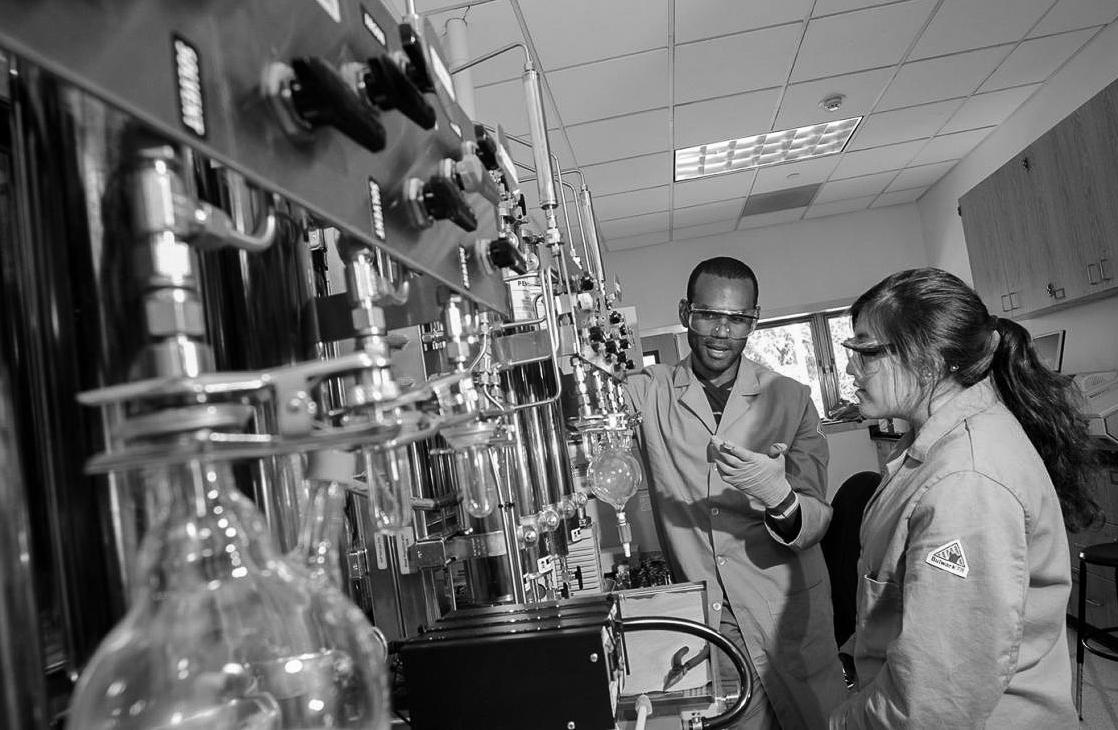
Making new medicines often relies on getting the right molecules to stick together — and that’s not always easy. At Pomona College, chemistry professor Nicholas Ball and his students are finding smarter, cleaner ways to do just that. Ball’s lab, which includes several undergraduate researchers, is showing that meaningful scientific breakthroughs can happen right here on campus.
Ball’s lab is developing a method that could change how scientists create sulfur-containing compounds. These new reactions can make it faster, cheaper and more sustainable to produce molecules that show up in everything from antibiotics to cancer treatments. The approach uses metal catalysts, substances that speed up reactions without being consumed, to help form bonds between sulfur and nitrogen atoms.
“I have always been fascinated by how chemists make molecules to affect human health,” Ball explained in an email to TSL. His inspiration came from a 2014 paper by two-time Nobel Prize winner K. Barry Sharpless on sulfur-fluoride exchange (SuFEx). Ball saw this technique as “a new way to make sulfur-based compounds often seen in drug molecules — in particular those with S[ulfur]–N[itrogen] bonds.”
This matters because these compounds are the backbone of many common antibiotics, anticonvulsants and other therapeutics. Current methods to create these
A Breakthrough in Efficiency In the world of chemistry, catalysts are like matchmakers — they bring molecules together without getting consumed in the process. But when these matchmakers cost Ball’s lab $44,000 per mole (a price that has now risen to over $82,000), chemists like Ball need to get creative.
The key innovation involves using what chemists call Lewis acids as a catalyst. These compounds are hungry for electrons and help speed up chemical reactions. In older methods, chemists had to use large amounts of expensive calcium compounds to make these reactions work. But Ball’s new approach, incorporating Lewis acids, uses a tenth of the catalyst.
“Catalysts are very useful in lowering the energy requirement for a reaction to occur. Importantly, you get the catalyst back after each transformation!” Ball wrote in the email. “The catalyst can also be very expensive, so using less of it saves material and money.”
In their recent paper, “Lewis Acid-Catalyzed Sulfur Fluoride Exchange,” Ball’s lab demonstrated that their method could create various sulfur-nitrogen compounds with yields as high as 99 percent. These compounds, known as sulfonamides,
sulfamates and sulfamides, form the backbone of many important molecules used in medicine.
The Silicon Solution
Beyond using less catalyst, Ball’s team also expanded the scope of starting materials that work in these reactions. They showed that compounds called silyl amines are particularly effective partners.
The innovation came from solving a fundamental problem. “After making an S–N bond, the calcium catalyst could not be regenerated,” Ball explained. “We believed this was because we were forming a strong calcium-fluorine bond, which made our catalyst inactive.”
Their elegant solution was to introduce silicon atoms through si-
Behind the scenes at Scripps Dances 2025
The audience filling the Garrison Theatre held its breath as the stage curtains drew open and this year’s Scripps Dances began. On the weekend of April 11, the Scripps College Dance Department welcomed family, friends and 5C community members to their annual spring showcase.
Recurring every year as a culmination of the department’s work, this year’s concert “Reflect[ed] a variety of contemporary dance styles ... celebrating identity, community and joy,” according to the department’s website.
Dance department lecturer, choreographer and educator Phylise Smith spoke about the process of putting together this year’s collection of dances, bringing together disparate pieces to create a cohesive production that explored themes of time, ancestry and power.
“Students worked on these themes and then came together to form a community: representing their dance, connected with the other [dances], and creating a unified whole: the concert,” Smith said.
The show began with a number titled “Shifting Consciously,” which brought to life the choreography of renowned artist Peter Chu, with the help of visiting artists and educators Krystal Matsuyama-Tsai and Waeli Wang. Following the opening performance was an exciting variety of student, visitor and faculty choreography. Ranging from the emotional and reflective “She’s My Mirror,” which grappled with self-image, relationships and sis-
terhood, to “Money Machine,” a high-energy performance with dancers in suits that resembled “The Wolf of Wall Street.”
Tierney O’Keefe SC ’25, who choreographed “Money Machine,” sought to match the energy of the piece’s backing songs through the movement of hip-hop and theatrics. Calling choreography a “mind-centered task,” O’Keefe elaborated on their process.
“Listening to the lyrics, I was really getting this sense of hedonism and money and power and trying to figure out the storyline that would go along with what I would be portraying on stage,” O’Keefe said.
Alongside student pieces were new works choreographed by Scripps faculty Suchi Branfman and Smith. The choreographers collaborated with dancers to realize pieces such as Branfman’s “Toward North Star,” which was created in solidarity with figures like Dajerria Becton, a Black woman who was violently arrested as a teenager at a pool party in 2015.
This piece “honors the mothers and grandmothers, the aunties, sisters and siblings who have carried the world on their shoulders,” according to the show’s program. In “Dance For The Ancestors,” a piece by Smith, dancers moved to a voiceover recording of each performer speaking about their love for dance, accompanied by traditional West African dance rhythms performed live on stage.
Smith described the piece as “an homage to Afro Beat, what dance represents to an individual
and a performance of traditional West African dance.”
It was clear that the dancers put measurable time and effort into their performances. They carried the show’s themes of identity, community and joy behind the scenes just as much as onstage.
O’Keefe shared that, when putting together an ensemble for “Money Machine,” they sought to “hone in on people’s personal strengths and create solos for people where their strengths would be highlighted.”
Smith detailed the harmony and community that were fostered during the making of the show, describing how students bonded through the shared experience of performing.
“Students are aware that they are in the performance together,” Smith said, stressing the sense of unity fostered between dancers both in rehearsal and behind the scenes.
Dancer Emma Wei SC ’27 described the hard work of rehearsal, as well as the fun and exciting environment backstage.
“For each dance, we generally rehearse once a week for one to two hours for the entire semester leading up to the show. A lot of jokes and general tomfoolery goes on behind the scenes, even right before we go on stage in the wings.”
Presenting a year’s worth of collaboration and choreography, this year’s Scripps Dances featured an abundance of creativity, passion and, at the heart of everything, a shared love for dance.
of reducing costs and waste while making important chemical building blocks could be substantial.
“Anytime we have more tools to make compounds, the more we can discover,” Ball said. “We hope our chemistry serves as a new, helpful tool.”
The findings could particularly benefit pharmaceutical research, where efficient methods to create diverse sulfur-containing compounds can accelerate drug discovery.
What’s Next?
Ball’s research continues to evolve.
lyl amines. “Silicon has a stronger bond to fluorine,” Ball explained. This prevents the unwanted calcium-fluoride bond from forming, allowing the catalyst to be regenerated over the course of the reaction and used again.
This silicon strategy had multiple benefits: “Using Si[lyl]-amines allowed our reaction to go faster and it allowed us to be able to use other Lewis acids like those with lithium ions,” Ball said. The lithium-based catalyst costs just a tenth of the calcium version.
From Lab to Real-World Impact
While their new research is promising, there’s still work to be done before this approach becomes commonplace in industrial settings. But the potential benefits
Nochella
“We have a whole pipeline of projects, including those that use machine learning,” he said. His team is exploring new catalysts to break bonds with sulfur compounds and looking to combine SuFEx with other reactions “to quickly get to complex molecules in an efficient manner.”
Ball emphasizes the value of undergraduate involvement in cutting-edge chemistry: “The privilege of having undergraduate students engage in research where they have ownership of their work is where I see my greatest impact. I am constantly inspired and amazed at the work they do!”
Through innovative chemistry and dedicated mentorship, Ball’s lab is proving that transformative scientific research doesn’t just happen at major research institutions — it’s thriving right here on campus.
Gabriel Brenner PO ’26 loves communicating science.
and Kohoutek shake up the music scene at the 5Cs
GRACE VALASHINAS & CORINA YI
As artists entered the main stage at Coachella in Indio, California, 5C students were celebrating music festivals of their own: Pomona College’s Nochella and Pitzer College’s Kohoutek.
Both long-standing festivals provide 5C students free on-campus alternatives to the music festivals that have come to dominate pop music culture every spring. Nochella, which is hosted annually by the student-run Pomona College Events Committee, took place on Saturday, April 12, at Sontag Greek Theater. This year’s festival was headlined by singer-songwriter Dreamer Isioma. Besides Dreamer Isioma, Nochella also featured performances by student artists and DJs.
Attendees at this year’s Nochella also enjoyed cotton candy, a photo booth, tattoos, henna and more activities stationed around the lawn. If you’ve seen anyone carrying a custom airbrushed tote bag around campus in the last week, chances are it came from Nochella.
Elle Desmarteau SC ’26 went to Nochella mainly to hear Dreamer Isioma’s performance.
“I was really excited to see the artist,” Desmarteau said. “I really like their new album, and they didn’t play songs from their new album … but otherwise, they were a great performer.”
Dreamer Isioma released this new album, StarX Lover, on April 4 — just a few days before their Nochella performance. They have been making music since 2018, but became more well-known after their song “Sensitive” went viral on TikTok in 2020. Since then, they have released four albums (including StarX Lover) and performed nationwide. Their musical and artistic style contains electronic, rock and Afrobeats influences, which lends well to an intimate concert setting like Nochella. At the beginning of their performance, Dreamer Isioma asked everyone sitting in the amphitheater to stand closer to the stage, forming a pit area. Though some attendees didn’t know any lyrics, most people danced along, even shouting to the artist between songs as they talked about the inspirations behind their new album.
One week after Nochella, Pitzer College’s Kohoutek offered a similar experience as a night festival on April 19. Besides bands and DJ sets, this year’s Kohoutek also featured art vendors, senior art students’
thesis exhibits and food provided by the Grove House.
Bright colorful lights and upbeat music filled the Clocktower Lawn as students sprawled across the grass, enjoying performances or walking around chatting with art vendors and friends.
Kohoutek featured live performers including student band ZZ and the Tops, as well as Ed Axel, Untitled (Halo), Mali Velasquez, Pretty Boy Aaron, Oblé Reed and DJ Kita. Each artist gave a unique performance across genres and styles, from Ed Axel’s upbeat hip-hop and rap to Pretty Boy Aaron’s groovy bedroom soul, ending with DJ Kita’s flashy rendering of dance music.
When asked which performance caught their eyes the most, art vendors Ishika Kolluru PZ ’26 and Luke Guyer PZ ’26 noted Ed Axel’s performance.
“I like how the bands have been changing … [my] favorite was the second one,” Kolluru said of Axel. “I like the type of music [he] performed.” Vendors at Kohoutek sold a range of items, including crochet crafts, ceramics and Kohoutek merch, alongside two senior thesis exhibits. One, a creature-like “trash monster” titled “Tender,” invited festival goers to think differently about waste and caring for garbage.
The sculpture’s artist, Cameron Macdonald PZ ’25, described their project as a process and product of collaborative imagination.
“[‘Tender’] is all about physical manifestation of community in different ways,” Macdonald said. “I specifically wanted to look at trash and unwanted and discarded and broken things as part of, like, college as a pressure cooker of becoming.”
Macdonald also expressed their love for the community at Kohoutek.
“For the last four years I’ve been watching [Kohoutek] get back on its feet as a tradition,” they said. “I love seeing people have fun. You know, that’s the point — my love for my community.”
For some, Kohoutek was a fun first-time experience, and for others, it meant returning to a long-held college tradition. Both Nochella and Kohoutek provided students with an accessible on-campus opportunity to enjoy live music and art.
JiAYiNG CAO • THE STUDENT liFE
ANSLEY MASHUDA
Culminating a year of collaboration, the Scripps College Dance Department held its annual showcase at Garrison Theatre over the weekend of April 11.
COUrTESY: pOMONA
pomona students and chemistry professor Nicholas Ball are developing smarter ways to make the molecules behind common medicines.
COUrTESY: pOMONA COllEGE
sanskriti 2025: everyone loves a love story
On the night of April 10, over 200 performers dazzled Big Bridges Auditorium for Claremont Tamasha’s annual Sanskriti performance. The largest student-run dance performance at the 5Cs, Sanskriti celebrates South Asian culture and community on campus.
Every year, the co-heads of Claremont Tamasha — the 5Cs’ Bollywood dance club — create a theme that ties the story and dances together. This year’s theme was “A Claremont Love Story,” a romance between a South Indian Pitzer College girl and a Pakistani Claremont McKenna College boy.
The two-hour performance featured around 15 dances and one solo intermission performance. Dances ranged between hip hop, Bhangra, Pakistani, South Indian, classical and more.
Dancers from each school performed a dance representing their home campus as part of the love story. Harvey Mudd College performed “Introducing the Groom,” CMC showcased “Love at First Sight,” Scripps College performed “The Bachelorette Party,” Pomona College performed “Sangeet” (a pre-wedding celebration) and Pitzer performed “Baaraat” (a wedding procession for the groom).
Claremont Tamasha’s co-presidents, Aru Warrier PZ ’25, Suhasini Singh PO ’25 and Siya Bhola PZ ’25, were excited that this year’s theme tied together 5C students.
According to Warrier, the love story was inspired by Bollywood movie plots, many of which center
around love stories, especially in movies from the late 1990s and early 2000s.
“It’s an epic tale about ‘love triumphs all,’ a common theme in South Asian movies,” Warrier said. “So this love story between two people, whose families conventionally would not want them to be together, we thought was representative of how not all our dancers are South Asian.”
Singh noted that having a love story theme would also keep the audience engaged and interested.
“We thought that everyone loves a love story and it would be really fun to showcase some of our culture through a love story,” Singh said. “It just makes things more interesting to watch rather than just watching a series of dances one after the other.”
Reina Bhatkuly HM ’25, one of the choreographers of the show, reflected on the choreography process as a fun and playful environment. Bhatkuly choreographed HMC’s dance and Garba, a traditional Indian dance commonly performed at festivals or other special occasions.
“Usually, we try to cater things to the lyrics and also to the varied dance experiences that we have because we’re not a competitive dance club,” Bhatkuly said. “For the school dances, we try to make them more simple and easier to follow along. For Garba, you have to be more intentional with your steps because there’s a lot more clapping and jumping around.”
Another part of the choreography process that Bhatkuly
appreciated was the supportive environment she has been a part of for at least three years at Claremont Tamasha.
Singh similarly noted that this sense of support includes welcoming dancers who come from differing backgrounds and levels of training.
“I hope that seeing all the dancers fumble and jumble and still have a good time teaches everyone that you don’t need any training to just have a good time,” she said.
Audience member and previous Sanskriti MC Shalini Shyam Kumar SC ’25 said that she enjoyed watching her friends dance and appreciated the feeling of home that Tamasha provides.
“It was absolutely beautiful,” Kumar said. “I’ve attended Sanskriti every year, whether performing or, like this time, as part of the audience. Beyond supporting my friends, it’s such a comforting reminder of home. It’s always heartwarming to celebrate South Asian music and culture right here in Claremont.”
For Bhatkuly, too, Tamasha has been a place to find home and connection on campus.
“Tamasha was that one constant that I had at the 5Cs that, regardless of the year I was in, they were always there and I could count on people always being welcoming, supportive and super fun and loving,” she said. “Tamasha is a piece of home that you carry with you.”
The evolution of our summer break farewell
NORAH MANNLE
When I was younger, the start of summer break signified the beginning of the best three months of the year. I couldn’t wait to finally hang out with my friends at the pool without homework to interrupt us. When I thought about the last day of each school year, summer break always meant goodbye, and most of the time, it was a happy one. During my childhood, saying goodbye to friends on the last day of school wasn’t hard. The summer swim team meant that I still got to see many of my closest friends almost every day. For my friends who lived a little bit farther from me, all it took was a five-minute drive to make the summer break “goodbye” seem less miserable.
However, after my freshman year of college, the goodbye was dejected. Going on summer break meant saying goodbye to Southern California weather, goodbye to the mountains, goodbye to my favorite coffee shops — but most of all, goodbye to my friends.
Unlike elementary and high school, college provides close relationships with students from all over the world. What makes college so special is that you can never predict the types of people you will meet or who will be standing by your side on graduation day. This makes saying goodbye on the last day of school even harder.
This May, I’ll be saying an even longer goodbye than last year. Similar to many other sophomores, I’ll be studying abroad in the fall semester. My best friends will be attending new schools in places all over the world: Vienna, Sydney, London, Rome. As for my remaining friends who are going abroad in the spring, I’m no longer just saying goodbye for three months but for over a year. There are so many things you may be saying goodbye to in the coming weeks. Not just your friends but also your sense of stability. For me, last summer didn’t mean only going back to D.C. and meeting up with my hometown friends but instead, heading to Santa Clara, where I
would once again be in a new place across the country, meet new people and simply bank on the possibility of making friends. Last year, summer break meant embracing the unfamiliar. Although I initially thought the goodbye would only be sad, it ended up becoming so much more layered than I would’ve thought. I can recall how nervous I was for my first internship last summer. I had never been in Santa Clara before or worked a “professional” job. Now, I was suddenly going to be doing it on my own without the safety net of orientation groups and school activities. Despite my nerves, last summer ended up being one of the most fun summers I’ve ever had. I explored San Francisco, met some new people and realized that I’d be okay after graduation without the security blanket of my friends surrounding me. This made my goodbye last year worth it: It was the necessary first step towards discovering my independence.
I’ve never left the continent before and I’m hesitant to study abroad in Prague next semester, as I’ll be the furthest I’ve ever been out of my comfort zone. Not only this, but I’m dreading hugging my friends goodbye in the coming weeks. I keep thinking about Santa Clara, though, and how I was able to make the most of my summer despite my initial reservations.
Anxiety, sadness and excitement are all feelings that may come to the surface when thinking about summer break. All of these feelings can coexist when thinking about the unpredictability of our futures and if anything, they’re what push us into adulthood. They’re our mind’s natural responses when we go after new opportunities.
I’ll be honest, I’m nervous when I think about this year’s summer break. The ability to persevere is one I have to constantly remind myself that I have. Fortunately, it’s one that I believe every person has, whether they’re aware of it or not. I hope that when the time comes to leave for summer break next month, we can reframe our goodbyes and think about the adventure that lies ahead.
Norah Mannle CM ’27 hails from the suburbs of Washington, D.C. In her free time, she enjoys long walks, critiquing new coffee shops and skiing.
Misty Copeland and her unexpected journey into dance
“[Dance is] resilience, grace, consistency, community, expression and processing,” Misty Copeland, the renowned ballet dancer, said. “It’s so important to … be one with yourself, and use your body and mind in a different way, and hear music.”
On April 15 at Scripps College’s Garrison Theater, Copeland spoke about her unexpected journey into the dance world and her work in making the arts more accessible. Copeland was the first Black principal dancer and soloist at the American Ballet Theater (ABT), performing iconic roles such as Odette in “Swan Lake” and Juliet in “Romeo and Juliet.”
Copeland’s film production company, Life in Motion Productions, which she co-founded with producer and former dancer Leyla Fayyaz, seeks to make a diverse range of art and stories accessible for the general public. In addition, Copeland has written several books, including an autobiography.
Abdiel Jacobson, an assistant professor of dance at Scripps, interviewed Copeland, followed by an audience Q&A. 5C students as well as young dancers from the Claremont area gathered in Garrison to listen and engage with the talk.
In her advice to young dancers, Copeland underscored the importance of trying to make the most out of feedback.
“It’s really useful to think outside of yourself … Take what you can from [feedback] because there will be value in it,” Copeland said. Coming from an unstable childhood, Copeland’s path to dance was exceptionally turbulent. She was homeless for years, and frequently moved — before the age of seven, she had attended seven schools. The trajectory of her life changed when she joined a Boys and Girls Club in San Pedro, California.
“That was the first time I felt like this is what a home is,” Copeland said. “It was somewhere I could consistently go to … It was the first time I experienced what mentorship was.” Despite being an extremely shy and introverted teen, Copeland decided to audition for captain of the dance team at 13, which she noted would become critical for her leadership development. Though she had never heard of ballet at the time, her coach encouraged her to take a free ballet class. To her surprise, the ballet teacher told her that she was a ballet prodigy. Four years later, she was dancing professionally at the ABT; from then on, her star continued to rise.
thought that was amazing … She [is] so famous in my world. And it seems like she’s really courageous about everything,” Witjas said.
Attendee Rebecca Witjas, a dance teacher at Cal Poly Pomona, was surprised by how humble Copeland was.
“She was very down-to-earth. I
Copeland reflected on the unique pressure of being the only Black woman in the ABT during her time there. During the company’s filming of “Swan Lake,” Copeland was taken out of the corps de ballet because she would “ruin the aesthetic” as the only Black ballerina among the white dancers. She would later go on to perform as Odette/Odile, the lead role in “Swan Lake.”.
“I thought, if I won’t do everything I can to push and accomplish as much as I can in my time, will there ever be another that will come after me?” Copeland asked. “I had to [understand that] I’m doing something valuable through my uniqueness.” These experiences motivated her to advocate for greater inclusivity in the arts. Copeland’s foundation, The Misty Copeland Foundation, offers the Be Bold Program, an introductory ballet initiative for students of color without access to quality after-school dance programs.
Copeland emphasized the difficulty of this work when institutions have different value systems that prioritize exclusion and elitism.
“During the pandemic and postGeorge Floyd, that was the biggest push I’ve seen in terms of having real conversations about the lack of diversity in this art form,” Copeland said. “There are so many talented dancers of color who need to be given an opportunity. Leadership should reflect who we want to see within the art form.”
After 2020, many ballet companies, including ABT, Pacific Northwest Ballet and the National Ballet of Canada, took steps toward supporting diverse dancers by commissioning Black choreographers and diversifying the training pipeline.
Attendee Alex Hamilton SC ’25 particularly appreciated this part of the discussion.
”I am a dancer myself, and especially as a Black woman, it was very inspiring to hear about … diversifying old areas of dance and how difficult that is to happen,” Hamilton said.
The audience seemed to find Copeland’s hopes for a more inclusive dance world insightful and profound, meeting her with four rounds of standing ovations.
GABi riCCiArDi • THE STUDENT liFE
KEEANA VILLAMAR
EMMA CHOY • THE STUDENT liFE
Claremont Tamasha — the 5Cs’ Bollywood dance club — showcased a
Claremont-centered love story on April 10 in Big Bridges Auditorium.
ANANYA VINAY
COUrTESY: SCrippS COllEGE
Copeland
Keith LaMar performs poetry from death row at Freedom First concert
On April 17 and 18, Keith LaMar called in to the 5C Prison Abolition Collective’s Freedom First concert series from death row in Youngstown, Ohio, to perform original spoken-word poetry.
“If I had to capture his essence in just a few words … Keith is love, light and laughter,” Ken Wright, a childhood friend of LaMar’s, said in a speech to concert attendees.
Wright was one of many who spoke and performed during the evenings of jazz, poetry and prose in Balch Auditorium. Abolitionist Poetry Night on April 17 featured performances by LaMar and five other poets, while April 18’s Freedom First Jazz Concert included LaMar reciting his poetry over live jazz music.
LaMar, who has been on death row for thirty-one years, is currently being held in solitary confinement and is scheduled to be executed by the state of Ohio on January 13, 2027. According to the Justice for Keith LaMar website, LaMar was wrongfully convicted by the state of Ohio following the 1993 Lucasville Prison Uprising.
From solitary confinement, LaMar has written an autobiography, titled “Condemned,” and organized book clubs in high schools and universities around the country, in addition to developing his practice as a poet.
LaMar and pianist Albert Márques produced their album “Freedom First” in 2022. At the Freedom First Jazz Concert, LaMar called in to perform his spoken-word poetry over the instrumentals of Márques and three other New York-based musicians — tenor saxophonist Salim Washington, drummer Zack O’Farrill and bassist Yosmel Montejo — in real time. According to LaMar’s campaign, the “Freedom First” album is the first in history to be recorded and released by an artist while on death row. Since 2022, it has been performed on three continents, and previously came to Claremont on Oct. 7, 2023. The instrumentalists and LaMar performed three pieces off the album — “Calling All Souls,” “Be Free” and “The Drowned and the Saved” — in addition to covering the John Coltrane pieces “Alabama” and “Acknowledgement.”
Mary Valdemar, a longtime community organizer in the Inland Empire affiliated with San Bernardino Valley College, opened the concert with reflections on the meaning of freedom.
“We’re here today to talk about freedom,” she said. “But we can’t do that until we get really honest … about who is free and who isn’t.”
Valdemar emphasized the need to center legacies of settler-colonialism in conversations about liberation like LaMar’s, while Lucy Waggoner-Wu SC ’25, a leader of the 5C Prison Abolition Collective, grounded LaMar’s fight in the prison abolition movement.
“Keith should not only be released because he is innocent and wrongfully convicted, but because prisons are unjust to their core,” she said.
Waggoner-Wu emphasized the power of the written word in
fighting systems of oppression.
“We find in writing our opportunity to create value that opposes mass devastation,” Waggoner-Wu said. “We believe that every attempt at expression is an attempt to survive.”
Jose Guttierez, a member of the Los Angeles chapter of the abolitionist organization Critical Resistance, highlighted the commonalities that unite LaMar’s story with millions of others.
“If Keith LaMar was here today, he would urge us to not only fight for his release, but for everyone,” he said. “Because we know that it’s not just about Keith LaMar. We know that it’s about … a bigger system that he’s a part of, and it’s about getting everyone free.”
According to the Prison Policy Initiative, U.S. criminal legal systems incarcerate nearly two million people.
Riker PZ ’28, a member of the 5C Prison Abolition Collective, spoke about her time in a book club hosted by LaMar in high school.
“More than anything, Keith has taught me that we can choose the people that we become and the ways we show up in the world,” she said.
Despite a sometimes-tenuous phone connection, LaMar’s voice was unwavering. He spoke directly to students in the audience toward the end of the performance.
“Remember your agency,” he said. “Check on each other. Show each other love.”
After the performance, Amy Gordiejew, campaign manager of the 501(c)(3) Justice for Keith LaMar, provided ways for audience members to become involved with the campaign. Márques encouraged listeners to use their voices in the service of liberation.
“I noticed talking to a few of you here that there have been serious attacks on freedom of speech,” he said. “And you have seen the consequences of fighting. I do believe that when you have this kind of retaliation against activism, it just confirms that you are doing the right thing.”
Frances Currie SC ’26, a member of the 5C Prison Abolition Collective’s steering team and one of the event’s organizers, said that they hope audience members are moved by Keith’s commitment to life.
“I really hope that people … recognize the life that is on death row and recognize that the state is trying to take away that life,” they said. At the end of the performance, Balch Auditorium erupted in an uproar of applause. Leila Riker PZ ’25, a leader of the 5C Prison Abolition Collective, took a photo of the standing, cheering audience to send to LaMar.
Pitzer’s fourth cohort reflects on their journey with the Inside-Out B.A. Program
A note from the Special Projects ed -
itors: The following piece is a letter to the 5C community from Cohort 04 of Pitzer College’s Inside-Out Pathway-to-BA program. This program allows incarcerated individuals at Norco’s California Rehabilitation Center (CRC) to obtain a Pitzer education through a year-long accelerated Bachelor’s degree program. With this letter, the authors hope to share their voices and reflect on their experience in the program as the cohort prepares to graduate.
On May 20, 2024, Pitzer’s fourth cohort of incarcerated students embarked on their academic journey from behind the walls of the CRC in the city of Norco. As the third cohort was coming to a close, they welcomed ten new members from Cohort 04 into a loving community of inside and outside students. Our names are Cody, Dontè, Flow, Jeter, Marcus, Rich, Ryan B., Ryan C., Terry and Theo, and we will be graduating at the end of this semester with degrees in Organizational Stud -
ies through Pitzer’s Inside-Out program. Over the course of our program, the prison walls that attempt to divide us only proved to be more porous than concrete — and, perhaps, more metaphoric than anything. Those of us on the inside built lasting relationships with one another, but we also forged meaningful connections with faculty and with students on the outside and across the 5Cs. Together, we have contributed to a burgeoning community of colleagues and companions that transcends the boundaries between inside and outside; many of us intend to maintain and expand these connections that we cherish so dearly.
Marcus and Theo strive to keep us all connected with a robust student alumni network that they are building with outside students Ben Brady PO ’25 and Kaitlyn O’Connor PZ ’25. Terry’s clothing brand, Wear My Pain, was already on campus on April 6 for Pitzer’s Storyteller’s Festival, and he is commit -
ted to partnering his brand with the Inside-Out program in order to raise funds for higher education programs in prison.
Dontè, Ryan C. and Ryan B. have been working with Pitzer Associate Professor of Organizational Studies Barbara Junisbai on a project called Practical Understanding of Reentry Education, also known as P.U.R.E., which will connect inside and outside communities through access to academic resources.
Rich plans to implement all that he has learned as an Organizational Studies major in order to create a mobile community resource center that will help youth from disenfranchised communities.
Jeter and Theo want to develop a proposal for an Inside-Out community center that will have a physical location on campus.
Lastly, Flow has forged the strongest connections between us, both inside and out, with the Wolf Pact, which he describes as “a symbol of culture creation, community care and expanded inclusivity.” Dozens of students
and several faculty members, as a part of the “pack,” are unified under a shared identity characterized by camaraderie and strengthened through empathic relationship-building. Flow has declared, quite passionately, that the Wolf Pact is not exclusive; he wants it to continue on the inside and hopes that it will continue expanding on the outside, long after Cohort 04 has graduated.
This has truly been an incredible year, and we can’t believe that it is almost over. Since we began last summer, we have said goodbye to Cody, who went home in February. Though he is dearly missed, we are always thrilled to have one of our companions return to his community where he belongs and is needed.
In just a few weeks, we will be bidding farewell to Ryan C. and Theo, both of whom will hopefully be walking on Pitzer’s campus during graduation. We are so excited for more of our cohort to be returning home, and we can’t wait to hear about the
warm welcome they will receive from students and faculty across the 5Cs.
There are so many beloved people that we, as Cohort 04, would like to acknowledge for the roles that they played in our academic journey. We would like to thank students and professors across the 5Cs, Pitzer’s administration, the Inside-Out program, the Justice Education Center, the cohorts that preceded us and the cohorts that will follow in our path. We hope that they will sustain the enriching communities all of us have built, as well as the transformative relationships that breathe life into them.
Thank you for investing in us instead of in the walls that confine us. To the individuals who made this happen and who changed us in ways that we couldn’t imagine: We love you, we cherish you and we will never forget the joy, laughter and memories that we built together. We hope to see you soon so that we can continue this incredible work, together, on the outside.
COUrTESY: AMY GOrDiEJEW
Maria
COUrTESY: piTZEr COllEGE
SpECiAl prOJECTS
pitzer College’s fourth BA cohort at the CrC in Norco.
On April 17 and 18, the 5C prison Abolition Collective hosted an abolitionist poetry reading and concert featuring the work of Keith laMar, an incarcerated man on death row who called in to the concert to perform his spoken-word poetry.
A reply from the ASPC elections commissioner
WILL DUNHAM
Luke Brown recently published an opinion piece outlining their dissatisfaction with their disqualification from the Associated Students of Pomona College (ASPC) presidential race, claiming ASPC has “a malicious disdain for being challenged, and [a] questionable practice of disqualification.” As the current elections commissioner and member of the elections committee, I find it necessary to correct the inaccurate statements in candidate Luke Brown’s opinion piece and provide transparency for what transpired.
What I write here is grounded in the elections code, which governs ASPC elections; violations of the code are reported to the elections committee, which excludes anyone running in the current election cycle. The elections committee makes rulings on complaints, which can be appealed to the full senate (again, not including those running in the current election cycle) in the case of disqualification, improper procedure, improper sanctioning or new evidence.
It is through this procedure that we, the elections committee, notified candidate Luke Brown of their multiple violations of the elections code. One of these violations is from a category named “questionable practices” that addresses campaign actions not enumerated in other sections of the code, in addition to running a “campaign before meeting with the elections commissioner.”
Brown writes in their piece, “They [the Senate] did not identify what questionable practices I engaged in.” Yet, in an email to the candidate, ASPC President Devlin Orlin wrote, “The Elections Committee has also received a complaint of ‘questionable practices’ (Elections Code Section 3) for your Instagram campaign posts directly discussing other candidates and making personal attacks.”
During Brown’s campaigning, their public Instagram campaign posts included: “[Candidate 1] is incredibly talented and goodheart-
ed — although a bit of a rules freak … I like [Candidate 2]’s campaign; I think it’s more than a little gimmicky, but I’m buying it … Finally, [Candidate 3] is God’s gift to the earth and the idea that he has an opponent means God is dead.” The original post included the full names of other candidates in this election cycle, which I have removed so as not to reproduce these comments.
To directly call a candidate a “rules freak,” or “more than a little gimmicky,” or state their existence as proof that “God is dead” are personal attacks that deeply concerned me, the elections committee and the senate. In speaking with the current
ASPC president, he mentioned never having seen such attacks on other candidates’ personal qualities by name.
Brown claims that “They [the Senate] did not identify what questionable practices I engaged in” is unequivocally false and is a misrepresentation of what occurred. In addition to the inaccuracies regarding the “questionable practices,” what I am more concerned about is the blatant omission of parts of the elections code and the election timeline in their article.
When Brown reached out to me to officially ask to be a write-in candidate in the spring elections cycle, I informed them that they
would be eligible to run “as long as you abide by the elections code.”
This phrasing was clear. Shortly after being granted permission to run, however, the elections committee received a complaint following the official start of their campaign. The complaint alleged that the candidate had been campaigning for days before officially asking to be a candidate for ASPC president, which is in violation of the elections code.
This violation is enumerated in the code as a reason for disqualification, as well as plagiarism and spending over the allotted amount on campaign materials, as specified in Article I, Section 5.
OFF THE RECORD
BEES
Brown claims that the rule the elections committee and I based our decision on “does not exist at all in the elections code.” This is false, as can be seen in Article IV Section 2, which states that candidates “may not begin to campaign before meeting with the Elections Commissioner.” They campaigned for days before asking to be added to the ballot as a write-in for ASPC president, and made personal attacks on other candidates. Given the severity of both violations, it was the judgment of the voting members of the senate that disqualification was the necessary sanction.
Brown was informed that “By a vote of 9-2 [not including the ASPC president as the non-voting chair], the senate has disqualified you from this election for your conduct in campaigning.” ASPC establishes the same standards for write-in candidates as candidates on the ballot so that a person cannot choose to be a write-in to circumvent election rules. Brown was disqualified from being a candidate for the same actions that would have warranted a disqualification had they been a regular candidate. To vote to disqualify a candidate is not a decision that senators take lightly, yet when I see multiple and egregious violations of the code that are then misrepresented publicly, it is my duty to speak up to uphold the integrity of ASPC elections. It is also important to keep in mind that this was also a decision made not by one person or committee, but by the full senate upon review of the appeal. I hope that this overview can be of use to the student body in illuminating what transpired during the election cycle, and as always, we welcome feedback on how the elections code can be more representative of our community’s values.
Will Dunham PO ’27 is from Maine, and is hoping to pass his finals so he can go back to the woods and listen to Noah Kahan in peace.
IN OUT THESIS
SCRIPPS POOL
SPRING 2025 TSL SENIOR STAFF
CLAREMONT COLD BLACKBERRIES
You should judge a book by its cover
ELIAS DIWAN
The shadow caught my eye. A dark hound lurking through a grainy background. It was menacing, but alluring. The simple title reinforced my interest — “Black Dogs.” I knew of Ian McEwan’s novel, but like most book recommendations, I forgot it twenty minutes after I was told I “had to” read it. But the hound was now in my sights, and I couldn’t tear my eyes from it. I checked out the book and read it in two days. “Black Dogs” is the best novel I’ve read in college. Thank god I judged it by its cover. The old metaphor “never judge a book by its cover” is built on a flawed premise. We judge book covers, and we are right to do so. Covers are designed to capture our attention and to signal book genre, tone and themes. Because those themes are stronger in better books, they tend to have better covers. My judgment has never failed. And here’s why. Book covers aren’t made in a vacuum. Publishing companies have a team of designers and marketers that create and ultimately choose a manuscript’s cover, not the author. These professionals are highly attuned to split-moment inferences people make when they see a book cover.
Penguin Random House, the world’s largest English-language trade book publisher, targets specific audiences depending on a book’s look. There is an entire industry built around creating a lasting impression through a book cover — an industry reliant on judging a book by its cover. Contemporary literary fiction book covers follow strict trends. The popular unicorn frappuccino and minimalist styles combine similar features to signal their modern-day relevance. Unicorn frappuccino covers — think Brit Bennett’s “The Vanishing Half” — have saturated swirls, wallpaper patterns and white sans serif text. Flat minimalist covers have two-dimensional figures, bright pastel colors and empty space. Conjure up any Sally Rooney cover. All of these books are somehow New York Times bestsellers, and are decent. Both styles are designed for the social media age, to be spread through Instagram and bought online. Their two-dimensionality and competing
colors translate effectively to a screen where they scream for your attention.
Self-help books all look the same (which helps me to reject them instantly). They have clean backgrounds and big, bold, all caps titles that you can see from across the store. The title is often complemented by a brief, functional subheading or a blatant symbol of learning: pencil, apple, classroom doodle. Another effect of the Instagram bastardization of literature is that these books try to be cool by swearing: “The Subtle Art of Not Giving a F*ck,” “Unf*uck Yourself,” “You are a Badass.” These individualistic manifestos are an underrated culprit for ruining our nation’s politics by destroying the value of the common good (on the left and the right). Instead of pushing us outside of ourselves,
all self-help books lead to the myopic ambition of dominating the workplace. Self-help book covers necessarily reveal their cards at first glance. Please avoid them.
Thankfully, we can judge great books from their covers, too. Classics are rightfully treated with care and, over time, gain beautiful covers to match their literary stature.
Evolving covers bring classics through the decades and allow new readers to rediscover great literature. Cover designer and novelist Peter Mendulsund has spoken about the abundant inspiration he finds when designing classics: “There’s one less person who has to approve what I do — that is the author, who doesn’t get a say because they are dead.”
On a more sincere note, I believe the quality of the book shows up on its cover. When a novel has stronger
themes, symbols and striking images to draw from, its cover is more memorable. Iron sharpens iron.
Mendulsund himself designed a stunning reinterpretation of Franz Kafka’s body of work. The visual motif of searing eyes captures the paranoia and uncertainty that mark Kafka’s tone. The hand-written font reflects the intimate feel of Kafka’s largely unpublished oeuvre.
Helen Yentus’ Albert Camus covers are striking. The monochromatic, geometric patterns are brooding and detached — a tailor-fit for Camus’ absurdism. Great books draw the focus of creative designers like Mendulsund and Yentus. The love people have for a great novel will inspire an attentive cover for it.
Sometimes, great books get the cover right on the first try. Joan Didion’s “The White Album” and “Slouching Towards Bethlehem”
use clever design choices that do a lot with limited variables. They are staples of the Big Book Look, reducing covers to the essentials of title and author on a blank background. The use of distinctive color and warped text makes Didion’s covers memorable despite their simplicity.
Designing a book cover is a rigorous process that is essential to its commercial success. By scoffing at covers, we not only ignore the role they play in defining a book but also the signals they offer readers. Judging a book by its cover is an important component of determining its quality, style and tone if you are attuned to the right clues. Keep your judging eye open, and good reads will follow.
Elias Diwan PO ’25 is from D.C. Not that you will listen, but he does genuinely recommend you read Black Dogs by Ian McEwan.
COU r TESY: POMONA CO ll EGE
By clarifying the integrity of the elections code and Brown’s violations, Will Dunham PO ’27 illuminates what transpired during the election cycle.
The 5Cs need to stop promoting AI
CELESTE CARIKER
The Claremont Colleges, as a conglomerate of liberal arts institutions, have disappointed me in the era of AI. Amid the rapid expansion of AI, the 5Cs have hosted workshops and dinners promoting the usage of AI without due caution.
Last semester, the Athenaeum held an event called “Navigating the AI-Driven Future: Innovation, Product Evolution, and the Future of Work,” where the hosts talked about “the practical ways companies like HP are integrating AI to design smarter products and streamline remote and hybrid work environments.”
It’s not up for dispute, AI is an up-and-coming industry and is becoming an even greater part of our lives every day. And there’s a reason why: because we use it, and because it is profitable.
That’s the problem: It’s too profitable.
Every AI development is a new avenue for the economically invested billionaire’s profit. The increasing profit of billionaires is inherent in further abuse and devaluation of the working class.
For example, Carl’s Jr. is sporting AI-powered drive-thrus, a marked step towards cutting out the worker and automating jobs rather than paying livable wages to real people (which is doable if we would stop letting companies jack up their expectations for profit margins). AI bots have become normalized in customer support sectors. Cars are even driving themselves and undermining workers in the ride-sharing industry.
AI replacement of workers is already a reality, and it will only get worse from here. The description of the Athenaeum event mentions “navigating ethical considerations,” yet there is nothing ethical about replacing workers with AI. Using AI to “streamline” labor worsens the existing climate of declining available positions that enable an economically reasonable quality of life for the working class, signified by “The Great Resignation.”
It is important to note that the profit of billionaires directly translates to expenses for the rest of us. Every dollar that climbs the ladder into the bank account of billionaires will not “trickle down.” Billionaires become billionaires because they hoard their wealth. The interests of billionaires are not in the interest of
anyone else, so when a man in a suit comes from a company like HP with a $32.51 billion valuation, let’s not fall for their talk about replacing people with robots “ethically.”
Millions of people every day are complacent in, or are even proud to use, AI engines. This presents a disappointing contrast between people’s tendency to so enthusiastically virtue-signal against billionaires versus what they are actually willing to do. AI is so convenient that we can’t escape it, and most people don’t bother to try, simply because boycotting AI would mean choosing inconvenience.
Sacrificing values has proven to be much easier than acting in alignment with them.
The AI issue, the likelihood of AI expanding and being used against the interests of the working class, starts with us. It starts with
and is enabled by AI usage on an individual level. Usage of engines like ChatGPT shows AI developers and billionaires that we are more than willing to forfeit our abilities to learn new concepts, form our own thoughts and produce original work.
Considering the unethical effects that AI has had and will continue to have on the job market and the environment, we should not be compliant with promoting AI usage to any population in any context. Liberals and conservatives both agree that creating more jobs is a priority. Most of us are in agreement over something for once, yet we are using the services of (and thereby supporting) AI companies that are actively working to reduce human labor positions.
I don’t know anyone who is happy to speak to a robot in place
of a real, human worker. But I know tons of people who regularly visit ChatGPT. Why use a product that is quite literally making a direct contribution to the downfall of society, to anyone outside of the top .01%?
I call on the 5Cs to acknowledge the dangers of AI and provide a well-rounded perspective on the industry for its students, especially such students who rampantly use AI. Each school has a strong platform, which they have so far used to promote AI. Despite the 5Cs painting themselves as a beacon of social responsibility, the schools have hypocritically neglected to criticize the AI issue. Beyond some HMC series criticizing AI as antithetical to writing and learning, there have been no concerted efforts critical of the harmful societal effects of AI at the 5Cs.
In the meantime, students will continue to use AI mindlessly with varying levels of awareness of its potential for harm. Students suffer from the pressure of college. The stakes are higher, and the pressure of producing perfection in college allows the convenience of AI to intervene seamlessly. As another sign of our consumer negligence and obsession with short-term gratification, AI has become the new, fun way to create yet another self-inflicted crisis. Will anyone ever organize with enough strength to convince the people who avoid accountability, the people who say, “Oh, but I just use it to save time,” that they, too, are a part of the grand problem?
Celeste Cariker PZ ’28 is terrified of robots with their own thoughts, late-stage capitalism and public speaking (which is why she writes articles instead).
Rethinking the Supreme Court
ALEX BENACH
The United States Supreme Court has, at best, a checkered past. Established in 1789 with the first bill introduced in the United States Senate — the Judiciary Act — the Supreme Court was initially composed of a chief justice and five associate justices. By 1869, the size had expanded to nine justices and has remained stagnant to the present day. Keep in mind, the population of the U.S. was 38 million then and is now 340 million. The current number of justices, given our current population, alone is a problem. But I am not advocating for a mere expansion or “packing of the court.” That does not go far enough. I propose something slightly more radical: We must completely rethink our conception of the Supreme Court and seriously amend the rules regarding the highest court in the land.
The Supreme Court, in its concep-
tion, was meant to act as a check on the other branches of government. But in the Founding Fathers’ attempt to bolster the Court’s influence, they created an institution that is fundamentally totalitarian.
The justices, despite their existing official methods for their removal, virtually answer to no one. In fact, a Supreme Court Justice has never been removed from office in the 236-year history of the Court. In addition, there are no term limits for justices. They never have to be reconfirmed and are never mandated to retire. In fact, only 39 of the 115 justices who have served on the Supreme Court have ever retired. An institution that allows for lifetime terms gives those justices — and those who appoint them — an exorbitant amount of power, kicking the door wide open for the abuse of that system. This is a problem plaguing justices on all sides of the aisle.
Ruth Bader Ginsburg faced calls to retire in 2013 and 2014 when Barack Obama was president and Democrats controlled the Senate because she was 80 years old. The line of reasoning was that in the scenario, a switch to the Senate or presidency occurred before she retired, a liberal justice could be guaranteed a spot on the Court. Otherwise, there was a risk that a conservative justice would replace her. In her choice not to retire, that exact fear was realized with her death in 2020 at 87, which led to Donald Trump’s appointment and eventual confirmation of Amy Coney Barrett, a conservative justice. Why would one ever retire from a job in which they enjoy immense power, make hundreds of thousands of dollars, notwithstanding book deals, other sources of income and enjoy generous gifts from Harlan Crow? It’s no wonder Clarence Thomas is still writing opinions.
Still, the problems of the Court are not simply related to its modern composition. The Court has long worked against the interests of the American people and, despite a few landmark cases here and there, has stood largely in opposition to progress. It is often federal or district courts, not the Supreme Court, that work to defend the Constitution. These institutions are more effective and more democratic than the Supreme Court, which is why a horizontal expansion of the federal judiciary is necessary. It’s time to do away with the “One Court to Rule Them All” system in place. The Supreme Court does not exist as an independent, honorable institution. It is a way for presidents to influence policy in the U.S. long past their time as elected officials, in a disproportionate abuse of power. The Supreme Court places nine people into excessive and
dangerous levels of power for their entire lives.
And, these people generally aren’t great. Currently, on the Supreme Court sit two men who have been credibly accused of sexual misconduct, a man who has come under constant scrutiny for taking luxury vacations funded by a billionaire Republican donor and a man who has repeatedly brandished white supremacist symbols at his homes (yes, plural). These justices are Brett Kavanaugh, Clarence Thomas, Clarence Thomas again and Samuel Alito, respectively.
So then, what are the steps we can take to improve the Supreme Court?
First, the Supreme Court must adopt a strict and binding code of ethics. Currently, the Court only adopted a code of ethics in 2023 (following backlash regarding Harlan Crow’s and Clarence Thomas’ relationship), which is largely symbolic and not at all legally binding.
Next, an expansion of the Court is long overdue. A court that was deemed representative of the population in 1869 cannot seriously be considered apt today. I propose a size of 15 — but this is just a suggestion, and the actual number is less important than ensuring that the Court expands in general. This will increase the number of individuals weighing in on serious cases and better represent the growing U.S. population. Lastly, and perhaps most importantly, we must set terms for Supreme Court justices. The time of justices abusing their power by staying on the Court for excessive periods of time has to end. If Supreme Court justices were subjected to re-confirmation every eight years, it would depoliticize the Court and allow for additional oversight of the Court by the other branches of government.
Along with improving the Court, we must advocate for an expansion of the federal judicial branch (currently there are only 1,770 federal judgeships to represent a population of over 340 million). It is worth further examination whether these judges should be allowed life terms, but that is a separate consideration. Lower courts must be empowered, and we should seek to continue to keep these courts, along with the Supreme Court, fair, free and independent. We can do better than our current system when conceptualizing the supposed emblem of law, justice and order in the United States. For our own sake, we must do better.
SCA rl ET JACOBSON • THE STUDENT li FE
SASHA MATTHEWS • THE STUDENT li FE
Pomona should reconsider its approach to its troubled musical legacy
ZENA ALMEIDA-WARWIN
Pomona College’s alma mater, “Hail, Pomona, Hail!” and “Torchbearers” are some of Pomona’s most popular songs. In 2008 and 2015, respectively, however, these glorified songs were banned.
Pomona’s website clearly describes why: The songs are rooted in Blackface minstrelsy and cultural appropriation. Even with Pomona’s attempt to acknowledge its faults, the alma mater’s historical meaning persists. Publicizing this history may damage Pomona’s progressive image, but the question of how Pomona should reckon with its alma maters will allow the student body to meaningfully engage with Pomona’s legacy and reignite the school spirit that alma maters are meant to inspire.
If Pomona truly values the communities it claims to support, it must engage students in discourse of Pomona’s history with alma maters, not erase the old one in private.
As a student recording engineer
for Pomona’s Music Department, I’ve had the privilege of spending hours engaging with the musical talent of Pomona’s musicians. In a recent shift, I looked through the college’s musical archives and reflected on school spirit at the 5Cs. “Torchbearers” and “Hail, Pomona, Hail!” stood out. These songs, frequently performed by the college’s choir and Glee Club at sports games, alumni gatherings and major ceremonies, evoked a collective pride I rarely witness today.
It is a pride that a scattered “Go Sagehens!” or “47” reference can hardly rival.
But the songs’ histories reveal troubling legacies. “Hail, Pomona, Hail!” was linked to Blackface minstrelsy, a form of 19th- and early 20th-century entertainment that dehumanized Black Americans, where White performers “portrayed racist stereotypes of Black people,” as described on Pomona’s website.
It’s worth noting, however, that
this practice wasn’t at all uncommon across our nation’s college campuses. The University of Texas’ alma mater, “The Eyes of Texas,” for example, had similar roots in Blackface. A group of the university’s football players requested the song’s suspension in June 2020. The university’s controversial response, however, was that the university would continue to sing it “with a redefined vision that unites our community.” This “redefined vision” proved merely a means of ignoring problematic ties for the sake of tradition.
“Hail, Pomona, Hail!” was last performed during a 2007 alumni weekend and was retired in 2008, following the anonymous distribution of flyers that raised widespread awareness of its racist origins. Prior to that, the history was previously only in songbooks and a few issues of the Pomona College magazine after 2000.
Then there was the “Torchbearers,” one of Pomona’s most celebrated songs.
“Torchbearers” was brought to Pomona by two professors interested in an Indigenous community native to the region, the Cahuilla. Pomona’s records show that the professors portrayed a romanticized narrative of harmony between settlers and Indigenous communities.
First introduced in 1895, it won the 1932 National Glee Club competition in St. Louis. Many criticized the piece as offensive to Native Americans and an “inappropriate validation of the nineteenth-century concept of manifest destiny that drove U.S. expansionist policies at the time.” The song was effectively phased out in 2016, and “Amazing Grace” was its replacement.
To be clear, I’m not nostalgic for these songs or suggesting they be revived. I also don’t expect that a student-driven alma mater would rekindle school spirit. That’s not the issue. What concerns me is the precedent set by administrative silence. Left without student input, the administration can only issue
a hasty replacement, like “Amazing Grace,” that isn’t representative of the student body.
Pomona has “reconsider[ed] the appropriateness” of these songs in recent years. In reality, they were phased out by then-President David Oxtoby, alumni associations and other members of the administration.
The lack of public visibility only continues today: Though publicly accessible, uncovering this information on the website still requires deliberate effort and the administration has not publicly addressed how it intends to move forward.
I’m not saying that Pomona should publicize every institutional quarrel. But in this case, students should have been informed of the meaningful discussions among the administration that led to the decision to ban and replace the song. Progressivism entails that decisions must be made for and with the input of the people that progressivism is meant to serve.
Our history mirrors that of collegiate institutions in the Northeast, and we should engage with their pasts. Harvard, for example, has published an extensive report on its legacy of slavery and racial injustice. A similar report at Pomona detailing the problematic parts of its legacy would be a helpful step forward.
Our discomfort around songs with troubling roots should be a catalyst, not a dead end. We shouldn’t bury these problematic histories out of shame. We should formally recognize them and engage students to create a new alma mater — or at least something that addresses the weight of these histories.
A student-driven alma mater could reflect the incredibly diverse, multi-talented student body we are today. It has the potential to unite students across class years, majors and social circles, reframing “school spirit” as something more than just party culture or athletic events. It might even set a precedent for the other Claremont Colleges.
We can preserve the significance of musical pride by using this controversy as a moment of intentional discourse and community revision, rather than a tool for institutional self-protection. Should we continue to censor artistic expression without incorporating our voices and opinions, Pomona risks alienating the very communities it seeks to protect.
Zena Almeida-Warwin PO ‘28 is from Brooklyn, New York. If she could, she’d bring back campus traditions of musical and athletic collaboration.
Replace reels with real life
XAVIER CALLAN
Sitting on the toilet and staring at my phone mindlessly — a continued pattern of replacing every quiet moment I have with content slop — I thought to myself, “What if I deleted my Instagram account? What would happen?”
A pang of fear hit me. I would lose all of the stories I’ve posted on my close friends. I would lose all of my mutuals, the primary method that people in my age group socialize now, and all the inspiring accounts I follow like @ botoxqueen1968 and @azure4001. The thought seemed impossible.
But, I thought to myself again, what has Instagram truly brought me? Phone addiction? Reels made by parents who content farm their children as income? An anxiety disorder? A situationship?
So I deleted Instagram.
Not because of how much time I spend on it; I don’t care how much time I spend on screens. I’ve had an iPad in front of my face since I was maybe five years old. I deleted Instagram, the last frontier of the doomscrolling apps that I use, because I realized I would genuinely do nothing else with my life if I had it on my phone. Social media — Instagram especially — has lowered the standards for everything: How we socialize and form relationships and, most crucially, how we spend our time.
Social media has destroyed my ability to be creative, something I used to devote all my free time to. I realized that the majority of my time is spent doing my work, socializing and sleeping, with my phone to fill all the gaps between these components of my life. None of my time goes to what I actually want to do, the things that give me purpose and actual fulfillment.
I like to think of myself as a creative person. But, why would I make a song, why would I read a book, why would I actually do an activity that has some kind of purpose or benefit, when I could scroll on the infinitely more stimulating Jungian horrorscape that is Instagram Reels?
More specifically, Instagram has warped, among many things, the process of being creative. When I tried to teach myself Ableton, I
found myself slowly falling asleep.
Thousand-yard staring into the distance of the PDF manual, and, eventually, I just went on my phone.
Instagram has a habit of displaying art as its final product, not as a process. The nature of being on social media is assembling an enormous smattering of the best work of thousands of different users, to make some huge collage of artistic endeavors that are simultaneously better than yours and completely effortless. With the crushing weight of displayed creativity, why would I endure the thankless process of writing a novel or composing an album, just for it to suck?
To me, it’s better to just post a cool digicam photo on my main story to a Snow Strippers song — because then I’d be guaranteed the immediate satisfaction of people liking my story. Ignorant of the fact that this cycle of gratification could inhibit me from ever making art again. I ultimately realized this after trying and failing to manage my screentime. I would still find a way to doomscroll even if I didn’t have the apps on my phone. I tried deleting them and redownloading them only on certain days of the week and times of day. Didn’t work. I would scroll through X on my laptop. I started watching TikToks and Reels on my fucking iPad. I’m sure I’m not the only one like this … maybe.
This may seem like a personal example that only applies to my situation. You may think you can have a healthy relationship with social media, that it benefits you, that I am an anomaly for letting my phone consume my entire life. But social media is, to its core, inauthentic, and spending time on it thus prevents any semblance of authentic living. Remember BeReal? Coined as “your daily dose of real life,” BeReal was an app where, at one random time every day, the user would have a 2-minute window to take a selfie of whatever it was they were doing at the moment. It could be any time of day, and missing a day would mean losing a streak.
Slowly, as BeReal’s user base grew, they added new features — most notably, you could take your BeReal outside of the two-minute window every day. This led to people staging their photos, retaking them, planning them, making a looming sense that our whole lives are performative. Is that not really strange? Extending the panopticon of social media as far as the mundane of our lives? Showing those in our circles not just what we want them to see, but sacrificing our privacy for the sake of authenticity. This specific social media app allowed others
to glimpse into our real lives, and then caused us to constantly perform for social media. Sure sounds authentic. If my biggest hope in deleting social media was that I would be able to resuscitate my creative self, then my fear was that I would become a hermit. After all, I used to post on my stories constantly, having an Instagram would give people I meet a point of reference —“hey I know you, we’re mutuals!”— and expand my social life beyond people who are my close friends. Is that what I want, though, to
have a social life dictated by social media? What if — apparently a radical stance — everyone deleted social media and started putting effort into living again? This goes for everything—stop doomscrolling. Go for a walk, watch a movie, draw a picture, write in your journal. Do something that requires you to actually improve and advance in some way, not just be a static figure floating through your daily routine. Xavier Callan PO ’28 wants you to know that he is returning the package he ordered.
A l EXAND r A G r UNBAUM • THE STUDENT li FE
EMMA CHOY • THE STUDENT
Akshay and Adrianne’s Crossword: Leaderboard
Simplicity 3. It’s negative or positive for a bacterium 4. Friendly 5. MSF and Oxfam, for two 6. Promissory payment 7. Lethargy-encouraging furniture 8. One-masted sailboat 9. Like a neoconservative 10. Undecided
Helper: Abbr.
Doing well, in modern parlance
Some short Bach compositions
Re-___
Dull, plodding person 35. Viking glyph
¿Cómo ___?
How studying in Scandinavia kills your ego — and why you should let it
MURPHEY
MOLLY
Copenhagen is having a bit of a moment. In 2024, it was ranked second in the Global Liveability Index, just behind Vienna. You’ve probably seen styles from Danish ready-to-wear brand Ganni or photos of Copenhagen’s colorful Nyhavn harbor on your feed. Maybe you’ve heard about its legendarily balanced work-life culture.
Each semester, the 5Cs send dozens of students to study in Copenhagen with the Danish Institute for Study Abroad. These students go to learn about sustainability or the new Danish architecture. They seek happiness, the good life and perhaps even some hygge — that hard-to-pronounce word that roughly translates to coziness.
Last fall, I was one of these students. While there was plenty of hygge to be had, study abroad’s biggest impact on me was that it killed my ego. I’m here to tell you why I think you should let it kill yours, too.
To understand Scandinavian culture, one must first understand the Law of Jante (Janteloven in Danish).
Janteloven finds its origins in a 1933 story by Danish-Norwegian author Aksel Sandemose, set in the fictional town of Jante, where the townspeople conform to a strict set of rules to maintain harmony.
Janteloven grew from Sandemose’s story into a social code for Scandinavia that endures today. It says: don’t stand out, don’t think you’re better than anyone else and prioritize collective prosperity over individual excellence.
If I imagined an environment that was the opposite of Jante, where everyone strived for individual excellence by standing above their peers, it would describe nearly every elite college in the United States, including the 5Cs.
I finished my sophomore year at Scripps College feeling burnt out. Like many of my peers, I was overloading on classes and overcommitting to extracurriculars at the expense of my mental and physical health. I applied to study abroad in the fall of my junior year because I needed a break.
During the first month of study abroad, I called home a dozen times, complaining of boredom. Why was everyone so lazy? I wondered. My
fellow students, Danish and American alike, were unwilling to work on school projects on weekends and never seemed stressed. I expected my fellow students to want to relax during their semester abroad, but this complacency seemed to extend to my instructors and other working Danes. Where was the hustle? The ambition? How did anyone feel fulfilled?
I began my semester wanting a break, without realizing that it would take some time to detach from the striving I had been trained for in my first two years of college. I quickly realized that my Danish instructors almost never handed out praise. At first, this made me insecure. I was used to frequent feedback from professors at the 5Cs, and I worried that my work wasn’t good enough. However, by the middle of
the semester, I realized that a lack of external validation forced me to take stock of my academic priorities. With less pressure to be perfect or earn praise, I cleared out some of the mental clutter that I had accumulated from stress. I found more space for community and novel cultural experiences. I became more patient. In short, I became more Danish.
It’s natural to wonder if Denmark’s seemingly utopian state, complete with universal healthcare and free college tuition, only works because it is one of the most homogenous nations in the world — 84 percent of people living in Denmark identify as ethnically Danish, and 72 percent are Evangelical Lutherans. It’s also natural to be suspicious of a connection between troubling aspects of Danish society, like strict
immigration policies and persistent Islamophobia, and its conformist norms.
These are valid critiques, and any American living in Denmark will confront them at some point. However, I argue one can embrace the best of Janteloven in a way that emphasizes respect for others and the strength of community above all.
The proof is right in Copenhagen. Anarchist commune Freetown Christiania is now a center for the city’s counterculture and a popular tourist destination. Nørrebro, Copenhagen’s most culturally diverse neighborhood, is renowned for its food, shopping and nightlife.
In the U.S., we’re taught that being successful means being the best among our peers. In Denmark, it is nearly the opposite: Success is
contributing to one’s community. The good news is that you don’t have to travel halfway across the world to embrace the best parts of Scandinavian modesty to support a diverse and strong educational community. We can monitor our airtime in class discussions, not for fear of looking like a know-it-all, but because we believe that when everyone contributes, our class becomes stronger. We can stop looking for validation in rave reviews from professors and instead proceed with humility. We can broaden our focus from being the best to making our community the best it can be.
Molly Murphey SC ’26 studied polar biology at DIS Copenhagen in the fall of 2024. She is happy to be back in Claremont and is no longer gaslighting herself into thinking she likes winter.
Stop the protein maxxing, start eating what you want
PARKER DEVORE
Life in our current protein bull market feels as if everywhere you look, someone is putting protein somewhere it didn’t belong a few years ago. The protein trend isn’t exactly new; athletes, particularly young male athletes, have been increasingly obsessed with protein over the last few decades.
We’ve probably all seen, and judged, a few bodybuilder breakfasts of a 12-egg-white omelette, unseasoned meat and rice boiled in the same pot with 10 clear condiments administered intravenously. These saucy beefcakes have always existed on the margin, but as of late, their protein-eating culture has beefed up from a scrawny sideshow to a strapping headliner, seemingly overnight. But why?
Food, especially in affluent America, is one of our largest cultural vectors for insanity. Remember blue zone diets? (So ubiquitous that they infiltrated Frank and Frary last year?) Superfoods, antioxidants and chia water? What about girl dinner or even white Americans’ “Slavic cleanse” diets, where they posted videos eating just beets and buckwheat and shit? Not to mention the people who only eat raw bull testicles
and butter. All the most recent, extremely online food trends can be easy to denounce as hyperreal, a distilled digital bioaccumulation of America’s collective food anxiety. Similarly, in the face of so much overt food insanity (“Slavic cleanse?” Really?) it’s hard to draw the connection between these extremes and the mainstream inoffensives of protein.
However, look closely and it’s plain to see that our most recent dietary idiosyncrasy — protein — is neither a strictly online phenomenon nor a new one. Instead, your meals fill you up on marketing speak. You can choose a recipe that’s fortified, workout, satiating, healthy and muscle-building, but if it’s protein-packed, it’ll always be restricting. America’s insecure calorie-phobia has been crudely repackaged as a protein product, but by shedding the label of “diet,” it has become beloved. Everywhere you look, you see articles about increasingly disguised, protein breakfasts, lunches, dinners, shakes, powders and potions. Gone are the days of 99/1 lean ground beef, Minute Rice, hot sauce called “Butt Twister Butt Blazin’ Fire
Sauce” and a preworkout called “Androgen Factory Roid Rage Trenberry Punch.” Protein is no longer a chore for meatheads. Chalky yet gourmet protein waffles, pancakes, pasta, cake, mixed drinks, beers, bars, snacks, salads and cereals are the updated pathways for our new culture.
Anyone can eat loads of protein and sometimes will enjoy it nearly as much as normal food.
But average Americans, even with their wildly dysfunctional diets, get double the protein recommendation of 50-60 g and have for decades. There is no protein crisis. So why is everyone telling you to eat more? Why are you doing it?
Americans have always been illogical eaters. Without a unified national food identity to restrain our diets, we are free to project our ever changing emasculations, embarrassments, patriotisms and aspirations into our daily eating in ways that few other nations can claim: In the 2000s, we were afraid of carbs; in the 1990s, we were so afraid of cholesterol that rappers beefed with it; in the early 1900s, we ate cereal for sexual temperance.
Ever notice how older relatives eat strange stuff? Canned peaches and cottage cheese?
Hot dogs by the pack? “I Can’t Believe It’s Not Butter?” The apparent mystery of their addled tastes can largely be explained by their earlier historical moments of food health alarmism.
If we aren’t vigilant, ours will affect us similarly. But our ahistorical understanding of food science and our blindness to patterns of irrational panic keep encouraging the average person to do injury to their body and mind in the name of health.
Of course, divergent taste isn’t unhealthy in and of itself. And some people just like steak.
For my part, friends comment on my passion for dried fruits and nuts; it’s been said I eat like a sparrow. I ritualistically gobble up McConnell’s banana bread and cream cheese frosting cake every single time they have it, especially at lunchtime. In short, I eat what makes me happy.
Optimizing for protein is joyless; few drink protein powders for the taste. Most tell themselves they are doing themselves a favor: eating foods that exist as a means of camouflaging whey, boiled chicken or any other less-than-appetizing ingredient, preferably the foods with the fewest carbs and fats possible, so you can eat as much as possible. It isn’t always fun.
Even if we enjoy them, privileging protein foods introduces ulterior motives for eating.
Leaning into this current food moment’s faulty logic, however well-intentioned, just stokes the fire of food fear. The obsession with proteins and any of their historical analogues bastardizes the purity of the element of human experience that is food. It makes what you eat a statement about who you are and who you want to be, your goals and your drive. You LinkedIn-ized lunch.
It’s OK to think about your health when eating, but hyperfocusing on protein is not a healthy way to do it. The quest for more protein has one logical conclusion: unhealthy and unappealing slop.
For the culture that lauds protein, eating is a zero-sum game, despite anything we hear about its benefits and nuances. Carbs were once on the chopping block — and so were fats — but even if we think we have moved beyond that false alarmism with protein, the subtext is the same: It is always about calories. If you are eating the same amount of
food, privileging one type necessarily comes at the cost of others. So, in light of all this, why should we believe that a whey shake breakfast, a protein bar snack, parmesan protein pasta lunch, chicken dinner and protein ice cream dessert is a balanced day of eating?
Carbs control your brain and fats control your hormones. You need them as much as you need protein.
Eating protein in and of itself is not bad, just like carbs, fats, sugars, salt, meat, ham, eggs, avocados, cacao nibs, butter, seed oil and so many other foods. Protein is just food. For the average person, most whole foods neither deserve any particular derision nor any pedestal. As much as it might be attractive to add protein to the list of things in your life you optimize, along with presumably every other thing that brings you joy, protein is not the answer. There is no macronutrient — and for that matter, almost no micronutrient — that requires special care and can make or break your diet. Not getting precisely 1.4562 g of protein per kilogram of body weight won’t instantly demolish your gains, and even if it doesn’t seem “optimal,” is your squat PR more important than your overall health?
As the ultra-processed foods that are shown time and time again to be awful for us are transformed, the label that advertises protein content acts as a wolf in sheep’s workout clothing. We need to recognize that there is a cause for alarm. These processed proteins can be bad for our nutrition, blood sugar and even lifespan. Eating protein should never come at the expense of other nutrients, with a cost of extreme processing and especially not sacrificing what matters most: a normal, balanced diet you enjoy. In its current state, protein culture threatens to damage our diet and our relationship with food as a whole.
So forget this food trend — and for that matter, any other. No matter your lifestyle, the healthiest diet is to eat what makes you happy. I won’t support any nutritionally related trend ‘til it’s making fiber uber-sexy.
Parker DeVore PZ ’27 is from the mean streets of Seattle and is actually a contrarian who has taken to getting his calories exclusively from alternating spoonfuls of lard and honey. He is sure it will give him turbo gainz.
EMMA CHOY • THE STUDENT
A Sagehen guide to summer fitness
As April comes to a close, the end of the semester looms. That means no more Tiernan pilates classes or access to gyms ten feet from your dorm. To help give tips and tricks for training, I interviewed athletes from Pomona-Pitzer (P-P) fall teams and Greg Hook PZ ’14, P-P’s strength coach, former track captain and three-time All SCIAC sprinter.
Zach Whitfield PO ’27, a member of the men’s water polo team, noted the importance of working hard throughout his offseason in order to set himself up for success during the year.
“It only takes about four days to lose a lot of the long-term swim conditioning you have built up, and it takes a very long time to build it back up to where you were before this break,” Whitfield said. “So, taking three months off for summer would lead to very poor performance for a very long time, spanning the entire fall season.”
Whitfield makes a good point about consistency, but consistent motivation can be easier said than done. P-P soccer player Hannah Hong PO ’26 expressed how important it is to surround herself with people who keep her committed.
“It definitely takes a lot more willpower and self-motivation during the summer than when I am on campus with my teammates,” Hong said in an email to TSL. “I’d say one thing that helps to keep myself accountable is to find friends to train/ workout with.”
For Whitfield, one thing that makes the summer easier than in-season months is the freedom he has in planning his workouts.
“I am able to plan my workouts and sleep around what I need for that given day, if I feel good, when the available time for the pool is, and what kind of workout I need to do,” Whitfield said. “I am able to do things at my own pace and change my workout if I think of a skill or muscle group that needs specific
improvements.”
Hook explained that balance is key to any summer program, and according to him, an hour of work a day, three to five times a week, is ideal.
“If you come into your competitive season hurt or injured because you went too hard over the summer, it is a tough hole to climb out of it,” Hook said. “Conversely, if you do zero training over the summer, then one of those early practices will put the athlete at risk for an injury.”
Hook, the author of almost all the varsity sport workout programs, sees the flexibility and balance in his training as a sign of improvement during his time at P-P.
“I struggled writing summer training my first years as a coach because I would give too much and had too high of an expectation on the consistency [with] which they would do the training,” Hook said. “Now the programs have much more athlete autonomy in that I give them plenty of options, and whatever they have time, energy, and the facility to train, they’ll do that workout.”
Having the ability to dictate their summers and take the time they need is paramount for athletes. Hong and Whitfield both described how they expect to take time for themselves in addition to training.
“As much as I am dedicating time preparing for our upcoming season, I am also enjoying the time I have to hang out with my family and rest,” Hong said. “I guess I just don’t let soccer get in the way of pursuing other things I’m passionate about.”
What these three current and former athletes have to say about how they spend their summers applies to anyone who wants to get in better shape, from a fall varsity athlete to a student who has never been to the gym: train hard, be consistent, find balance.
Women’s club volleyball wins Division 2AA national championships, battles for more funding
CHARLOTTE RENNER
The Claremont Colleges women’s club volleyball team took a trip to Phoenix, Arizona, and came back to Claremont with gold. On April 17-19, the Panthers attended the National Collegiate Volleyball Federation (NCFV) tournament and defeated American University in the final round to take first place in the Women’s Division 2AA National Championships.
Club volleyball practices span the entire school year, with preseason tournaments starting in the fall and regular season beginning in the spring. The team plays against schools in Southern California and the Western United States as a part of the Southern California Collegiate Volleyball League (SCCVL). Claremont club volleyball competed in three tournaments during the regular season that helped them qualify for the league championships, which took place the weekend before nationals.
The team went to nationals in 2022 and 2023 but were unable to emerge victorious. One of the senior captains, Angela Zhou SC ’25, credited part of this year’s difference to the new freshmen players who joined in the fall, as well as to the contributions of the practice players.
“We got a lot of freshmen and new players who just like, showed up to practice consistently and were just really passionate about playing, and that definitely helped with our practices and preparing for [the tournament],” Zhou said.
For Elena Miller HM ’26, a junior captain, it was both the freshmen and the seniors who made standout efforts to bring the Panthers the win.
“Having kind of the fresh energy from the freshmen who are amazing players and are always supporting the team,” Miller said, “And then the seniors who have been here for a while are also amazing players, have had time to get used to, like, the whole college club volleyball circuit.”
Mei Saphir SC ’28 was one of the freshmen additions this year. After playing volleyball competitively in high school, she was unsure of what to expect coming onto the club team.
“It was a little bit more like high intensity, more competitive,” Saphir said. “There were people there that, like, we wanted to get better. It kind of differentiated from what I originally thought a club sport would be, especially at like a smaller school.”
According to Zhané Moledina
PZ ’25, another senior captain, club sports present a unique challenge for the athletes. The level of competition is higher than intramural, but commitment can be spottier than varsity.
“I think like with club sports, it’s kind of a weird in between, where one year to the next, it can change drastically, just like the mentality of the team,” Zhou said. “Whether people are kind of like there to just be having fun, or there to really compete and win.”
For Saphir, who will be an underclassman captain next year, keeping up this balance is an important part of her goals for the team to succeed.
“I definitely want to continue, like, creating a little bit more of a more competitive atmosphere and like welcoming more people that want to contribute to the program and make it better and want to win,” Saphir said. “Not that I think it should be taken ultra seriously, because it’s still a club sport, but I think it’s fun to play at a high level and like compete at a high level and be proud of, like how you play.”
While trying to compete at a level worthy of nationals, the players and captains also have to worry about funding, or a lack thereof. The team tries to ensure that none of its members have to pay fees in order to play, which means repeated attempts to obtain more money from the five colleges.
“It’d be nice if it were, like, obviously, more funding, but also just like a more streamlined process,” Moledina said. “Because it does take up a lot of our time as captains, and it’s really fully up to us on, like, how much funding we do get, because how much we start with really isn’t near enough to get us through the season.”
According to Miller, the team was allocated $3,000 at the beginning of the year, which didn’t
even fully cover the trip to nationals, let alone the regular season tournaments and equipment needs. The budget defined for each club team doesn’t change based on season-to-season needs, such as new gear. As a result, the team was only able to attend two preseason tournaments in the fall. Miller described how petitioning for extra money can take a toll on the captains who are responsible.
“We’ve had to go to all the individual schools multiple times to ask them for money, which can be really hard on the captains, who are trying to also be students and play volleyball,” Miller said.
During nationals, when the libero’s jersey didn’t meet the standards for the competition, the team had to make one themselves instead of buying a new one, which they didn’t have the money for. Saphir described how this felt a little ridiculous as they competed against teams decked out with team warm-up shirts and backpacks.
“So we were playing with … five people with the same jersey and one person with a T-shirt with a number scribbled in Sharpie,” Saphir said.
The team was able to get more money for specific costs, but without alumni donors, the members have to continue fundraising to try to increase their budget and keep participation free.
Despite these challenges, the team has proved capable of competing at the highest level with teams from all over the country. Graduating this year, Moledina explained how her four years in college have been defined by club volleyball.
“Taking the time to like, be with friends, and like, do something you love, and like, get away from all the other chaos that’s going on has been really awesome,” Moledina said. “I mean, winning nationals was like an incredibly wonderful way to cap things off.”
Sagehens steal series from Stags en route to conference playoffs
In the world of 5C varsity baseball, no series is a better barometer for a team’s season than the annual duel on Sixth Street.
This year, the Sagehens defended the coop in a high-scoring slugfest versus Claremont-Mudd-Scripps (CMS) on April 12, taking two out of three against the Stags. With two weeks left in the season, only three games separate the third and fifth seeds in the SCIAC. With CMS sitting in third and Pomona-Pitzer (PP) just a single game behind them in fifth, both teams are carving out their paths back to the playoffs.
The victory over CMS was a much-needed series win for a Sagehens team that has struggled to live up to expectations following their appearance in the College World Series last year. Despite coming into the season ranked No. 8 nationally by D3Baseball.com, P-P was out of the top 25 entirely by week six.
“I think the team has felt the pressure a little bit of having to come back and reproduce what we did last year,” Sagehens left fielder Jack Gold PO ’27 said. “We were playing kind of afraid at the beginning. We were playing not to lose. Now we are finally coming together as a team.”
Gold is currently leading the conference with eight home runs and a whopping 1.684 on-base plus slugging percentage (OPS). He’s just one of many position players who have stepped up after the loss of last year’s senior class, which included the American Baseball Coaches Association’s 2024 Position Player of the Year Isaac Kim PO ’24.
“Isaac Kim, Nate [Jakobs PZ ’24] and all those other guys made it seem super easy to get to where we were in the World Series,” Gold said. “Those guys were in the cages,
they were off the field working on their bodies. Everyone’s now finally realized that that’s what it takes to get there.”
According to Gold, the team’s culture of leadership has continued through players like JC Ng PO ’25, helping pave the way for breakout seasons for underclassmen like himself and Cooper Berry PZ ’27.
Though the Sagehens have managed to retain their high-scoring offense from last season, injuries to their ace duo, 2024 All-Americans Jake Hilton PO ’25 and Hannoh Seo PO ’26, have dropped them from the top pitching staff in the SCIAC down to sixth. Starting pitcher Ethan Collins PO ’25 said he has “no expectations” for Hilton, who pitched just five games this season, and Seo, who has not pitched at all this year, to return this season.
“Everybody on the staff knew
going into this year was going to be different than how we originally planned it,” Collins said.
“We’ve had a lot of guys step into positions they didn’t think they would be in.”
With a 2.54 ERA, Collins has anchored a pitching staff that has had to operate largely by committee, leading to an inconsistent season on the mound for the Hens.
The team’s struggles hit their apex in March when La Verne beat them in a three-game sweep and outscored P-P 23-5 in the series. Gold called La Verne’s dominance a “wake-up call” heading into their series against CMS.
“Collectively as a group we [said], ‘we’re not going to lose this, we’re not going to go down without a fight,’” Gold said.
“Coming out of that with two big wins really brought us together, and now really propelled us into this later half of the season.”
The series may have truly lit
the spark under their feathers, as the Hens have won eight of their last nine conference games. They’ll need that hot streak to continue as they face their biggest challenge yet this coming weekend against California Lutheran’s elite starting rotation. Still, Collins is confident that P-P’s staff will help dethrone the Kingsmen.
“We’re going to do everything we can to limit the number of free passes we give them … we’re going to make them put a good swing on the baseball,” Collins said. “The older guys are ready to go in and give it their all in the last few weeks of regular season baseball we have.”
Much like P-P, injuries have been a daunting presence looming over the Stags. Captain Jack Potter CM ’25 medically retired after being hit in the head by a pitch on March 28. Andrew Mazzone CG ’25, arguably the conference’s best hitter, hasn’t stepped on the field since tearing his PCL on April 5. Even without two of their top hitters, the Stags outscored the Hens in the series, dominating them 15-4 in game one and holding close in both games of the Saturday doubleheader. Mazzone, currently second in the conference in OPS, described just how deep their offense is.
“It has been a really good showing of the guys in terms of their resilience without me,” Mazzone said. Despite 2023 SCIAC Player of the Year Julian Sanders CM ’24 graduating last year, this season, CMS’s offense has only improved. The Stags are the only team in the conference with a staggering six players hitting above a 1.000 OPS in overall play, including Dillon Martin CM ’27, Bryce Didrickson HM ’26 and Nate Seluga HM ’27.
“It really comes down to the success of last year, being able to kind of see and understand what it’s like to be on a team that you know constantly just hits the ball and slugs,” Mazzone said.
“Being a part of that culture, where guys who come here want to hit the ball, they want to rake.” The Stags haven’t had their own field in three years, and while this has caused difficulties, Mazzone explained that it has not stopped them from excelling. He suggested that playing “home” games at Redlands, La Verne and even Azusa Pacific has made them the most adaptable team in the conference.
“The countless hours that we spend in the cages because we don’t have a field, ironically really helps us get better,” Mazzone said. “It doesn’t matter where the game is. We are going to show up and we are going to hit.”
Though CMS will also face off against Cal Lu in their final series of the season starting May 2, Mazzone made clear they’re taking their matchup this week against Caltech just as seriously.
“Every team has an opportunity to beat another team, especially playing in these three-game sets,” he said. “If we want to continue being successful, we’re gonna have to play our hardest both this weekend and next week.”
Mazzone is hopeful that he will return to face off against the Kingsmen, and with their best hitter back in the lineup, the Stags are shaping up for a dominant postseason run.
“It’s my last year,” Mazzone said. “I want to do whatever the hell I can just to get back out there.”
ZACHARY LEBLANC
COUrTESY: ANGElA ZHOU
With the end of the semester on the horizon, pomona-pitzer (p-p) athletes and coaches offer a guide to staying fit over the summer.
The Claremont Colleges women’s club volleyball team won nationals this year, competing against teams from across the country to claim the title.
EMMA JENSEN • THE STUDENT liFE
BEN LAUREN
P-P sports expenses: How rosters and post season travel affect the budget
WILLIAM WALZ & JUN KWON
Pomona-Pitzer (P-P) athletics boasts some of the most competitive teams in Division III. Across 21 different teams competing in the Southern California Intercollegiate Athletic Conference (SCIAC), the Sagehens have earned 48 individual national titles and four team championships throughout their history.
To better understand the costs and factors that fuel a DIII powerhouse like Pomona-Pitzer, TSL researched and analyzed funding data for each of the 21 teams, including comparisons of funding fluctuations by year and disparities in funding between men’s and women’s teams.
A great deal of data can be accessed through an open-source database called Equity in Athletics Data Analysis. Powered by the U.S. Department of Education, the tool compiles funding data submitted annually by co-ed, postsecondary institutions that receive Title IV funding and have intercollegiate athletic programs. As required by the Equity in Athletics Disclosure Act, this data includes statistics on team expenses, coaching salaries and participation by sport and gender for a comprehensive look at how colleges allocate resources nationwide.
The collected data showed significant shifts, both in cost changes over two seasons and in the split between women’s and men’s programs of the same sport.
As for the cost of men’s sports expenses between the 2022-23 and 2023-24 seasons, football, basketball and baseball report the biggest gaps.
Football saw a decrease of $241,340 from one season to the next. The 202223 season’s expenses were $419,976 compared to the 2023-24 expenses of $178,636. Basketball’s expenses decreased by $215,408 in the same time. The 2022-23 expenses were recorded at a whopping $237,218, while the 2023-24 season’s expenses were just $21,810.
Football’s decrease was likely due to their extended postseason run in 2022-23, which included higher travel and lodging costs. In 2023-24, without a postseason appearance, expenses were significantly lower.
Baseball, however, saw a drastic increase. The 2022-23 season’s expenses were recorded at $36,485 compared to the 2023-24 increase to $169,505. The spike was mainly due to the team’s qualification for the College World Series, the NCAA Division III Baseball
Championship. The postseason brought additional travel costs, such as flights, lodging, meals and other expenses, which contributed to the overall expense increase.
Overall, of the ten men’s programs, five programs saw a decrease in expenses, and the other five saw an increase. The average increase in expenses was $38,787, and the average decrease was $105,538.20. This division highlights the varied financial impacts across different sports, suggesting that a combination of factors, such as postseason performance, travel costs and roster size adjustments, drive changes in funding. The women’s programs experienced less dramatic expense changes over the two seasons. One spike catches the eye, however. Women’s basketball saw a significant decrease in expenses, from $146,793 in the 2022-23 season to $21,801 in the 202324 season. This notable drop contrasts with the men’s teams, which experienced larger fluctuations ($237,218 to $21,810), particularly in football and baseball.
Of the eleven women’s programs at Pomona-Pitzer, five programs increased their expenses, and the other six programs decreased. Golf, lacrosse and basketball had their expenses cut by at least half. Track and field was the only program to double its expenses compared to the previous season.
These changes across men’s and women’s sports have multiple possible explanations, one of which is changes in roster size.
On the men’s team side, changes in roster sizes had mixed results that were not conclusive enough to explain drastic shifts in expenses, besides football. Football reduced its roster size by 19 athletes, which may partially explain the $241,340 decrease in expenses.
However, despite reducing its expenses by over $200,000, the basketball team’s roster size remained the same at 15 players. The same went for baseball — they held 35 players on the roster for both seasons despite a jump in expenses of nearly $130,000. This further cements that factors outside of roster size impact team expenses.
Some other noticeable roster size changes included cross country’s reduction by six runners and soccer’s increase by ten players. These changes do reflect changes in expenses
—
soccer’s expenses almost tripled in 2023-24, whereas cross country’s dipped by $5,560. The increase in soccer’s roster size led to additional logistical challenges, particularly with travel. Nicholas Mikhail PO ’25, a player on the team, reflected on how travel conditions changed between his sophomore and junior years.
“Comfort on the ride to a game is pretty important. A lot of people’s pregame routines start on that bus ride over,” Mikhail said. “We were all kind of used to getting our own seats for the most part. So being crammed for every away game — it was a big deal for a lot of people.”
He highlighted how the team downgraded from the charter buses to the Sagecoach bus, which required players to sit next to each other with less personal space. This change, along with the increased roster size, added to the team’s logistical challenges and contributed to the sharp rise in expenses during the 2023-24 season.
However, the program with the most significant decrease in expenses, basketball, did not show a significant change in roster size. In fact, despite reducing their expenses by over $110,000, the team added two additional players to the roster.
Women’s water polo and volleyball each added five more athletes, and cross country reduced its roster size by six. For water polo and volleyball, expenses increased by $5,798 and $14,219, respectively. Cross country also reduced its expenses by $8,239. For these three programs, a change in roster size also partially explained the change in expenses.
The respective changes in roster size and expenses by season allowed for a comparison of funding proportions between men’s and women’s teams for each sport. Lacrosse, softball, baseball and football were excluded from the data due to the lack of gender-equivalent programs.
The 2022-23 season features a greater imbalance in funding proportions, whereas seven of the eight teams in the 2023-24 season equally split the funding, with the only exception being cross-country.
The 2022-23 season saw a significant shift toward a 50-50 split in funding between men’s and women’s teams, with sports like basketball, soccer and track & field benefiting from this balance.
“In 2021-22, we were still manag-
ing the aftereffects of the pandemic,”
Athletic Director Miriam Merrill said in an email to TSL. “In 2022-23, it was the first year of full academic-year play; we could right-set spending in a more equitable way.”
This indicates that after the financial disruptions caused by the pandemic, the department took steps to ensure more balanced funding across all programs. However, according to Merrill, funding given to a team has no direct impact on the funding of other sports teams.
“No, NCAA tournament-related travel does not impact the budgets of other teams,” Merrill said.
In the 2022-23 season, the women’s team was allocated nearly 80 percent of the funding for soccer, and the men’s water polo team received around 75 percent of the funding. The three sports with funding closer to a 50-50 split were track & field, swim & dive and tennis. Despite the women’s success, these funding discrepancies reflect factors like discrepancies in roster size as the department continues its efforts to address equity across teams.
The presented data poses several questions.
Why did the football team’s expenses drop by more than half over the course of a single season? And why did baseball’s expenses increase by over 364 percent in that same timeframe?
Additionally, why did the men’s water polo team’s expenses equate to nearly 75 percent of all funding for water polo in the 2022-23 season, and how did such a polarizing split even itself out to 50-50 in just the next school year?
To explain the puzzling patterns of Pomona-Pitzer’s funding and expenses, Merrill was able to answer some questions and provide possible explanations for these developments.
“The overall differences can be pinpointed to travel and post-season play,” Merrill said. “Football took two overnight trips, which involved flights and lodging in 2022–23. They also made it to the NCAA postseason, which equates to another overnight trip. The following year, they only flew once and did not make it to the NCAA postseason.”
In addition to the explanation received for football’s decrease in expenses, baseball’s spike in funding was supported by their performance in the two seasons. The team had no travel or postseason in spring 2023.
But in spring 2024, they took an overnight regular-season trip and qualified for the College World Series.
Logistically, funding a trip to the College World Series can explain the increased expense for the program. In addition to flights for everyone on the travel roster, Pomona-Pitzer also provided support for additional gear, food and housing.
“For the Super Regional, we went to Texas and we had to pay for flights, hotels, food and the further we got, we got like 200 bucks to spend for food over there,” Hannoh Seo PO ’26, a pitcher on the baseball team, said.
That same line of reasoning applies to basketball — their most expensive season came with a deep postseason run. The 2022-23 season saw them take two trips: one to St. Louis, MO, and another to West Hartford, CT.
Disparities in performance can partly explain why certain teams received more or less funding on a season-to-season basis. But it would be quite a coincidence for men’s and women’s basketball to go from about a $90,000 gap in 2022-23 to exactly matching the expenses of $21,810 in 2023-24. The same goes for soccer: Both the men’s and women’s teams had a $50,000 difference in the 2022-23 season, but both coincidentally landed in the $38,000 range in 2023-24.
With such precise dollar amounts resulting in 50-50 splits for seven of eight Pomona-Pitzer programs across the men’s and women’s teams, it may be reasonable to wonder if any policy or regulation changes have led to such a drastic shift in funding allocation.
Regardless, both the data and Merrill’s responses seem to support the claim that postseason success and travel have a significant impact on funding. Teams that qualify for NCAA tournaments typically incur higher expenses for flights, hotels and meals.
Regular-season travel costs vary depending on whether teams take local bus trips or require flights. Sports with extended postseasons, such as baseball’s College World Series and football’s NCAA bracket, consequently receive more funding.
While the EADA data highlights key factors like travel, postseason performance and roster size changes, there are other variables, such as fluctuations in equipment costs, that are harder to capture. Merrill’s insights, along with these broader factors, explain most of the changes in Pomona-Pitzer athletic expenses, though some elements remain unclear.