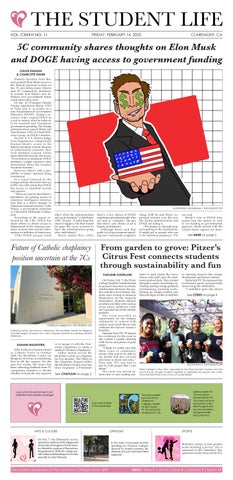

5C community shares thoughts on Elon Musk and DOGE having access to government funding
CHLOE ESHAGH & CHARLOTTE HAHM
Treasury Secretary Scott Bessent granted Elon Musk access to the federal payment system on Jan. 31, provoking many citizens and 5C community members to wonder how Musk’s new influence over government funds could affect their lives.
On Jan. 20, President Donald Trump appointed Musk, CEO of Tesla and X, as leader of a new Department of Government Efficiency (DOGE). Trump’s executive order created DOGE as a tool to reduce what he believes to be wasteful and fraudulent government spending. The Trump administration named Musk and Tom Krause, CEO of Cloud Software Group, as DOGE’s leaders.
On Feb. 8, U.S. District Judge Paul Engelmayer temporarily blocked Musk’s access to the federal payment system because of cybersecurity concerns. New York Attorney General Letitia James filed the lawsuit; she wrote, “Even before its inception, DOGE members sought sensitive data information about the Treasury Payment Systems.”
However, there’s still a possibility of James’ decision being overturned.
In a report released by the Congressional Research Service (CRS), the CRS noted that DOGE has access to classified records and reports.
“There are reports that Musk’s henchmen are getting access to classified intelligence information that is a direct danger to American national security,” John Pitney, a government professor at Claremont McKenna College, said. According to the report released by the CRS, DOGE has made efforts to obtain access to Department of the Treasury payment systems that include information on millions of Americans.
“[The DOGE group] could

affect what the administration sees as its enemies,” Caleb Rasor CMC ’28 said. “I really hope this doesn’t happen, but that would be quite the scary scenario to have the administration going after individuals.” Rasor added that, while
Future of Catholic chaplaincy position uncertain at the 7Cs
KAHANI MALHOTRA
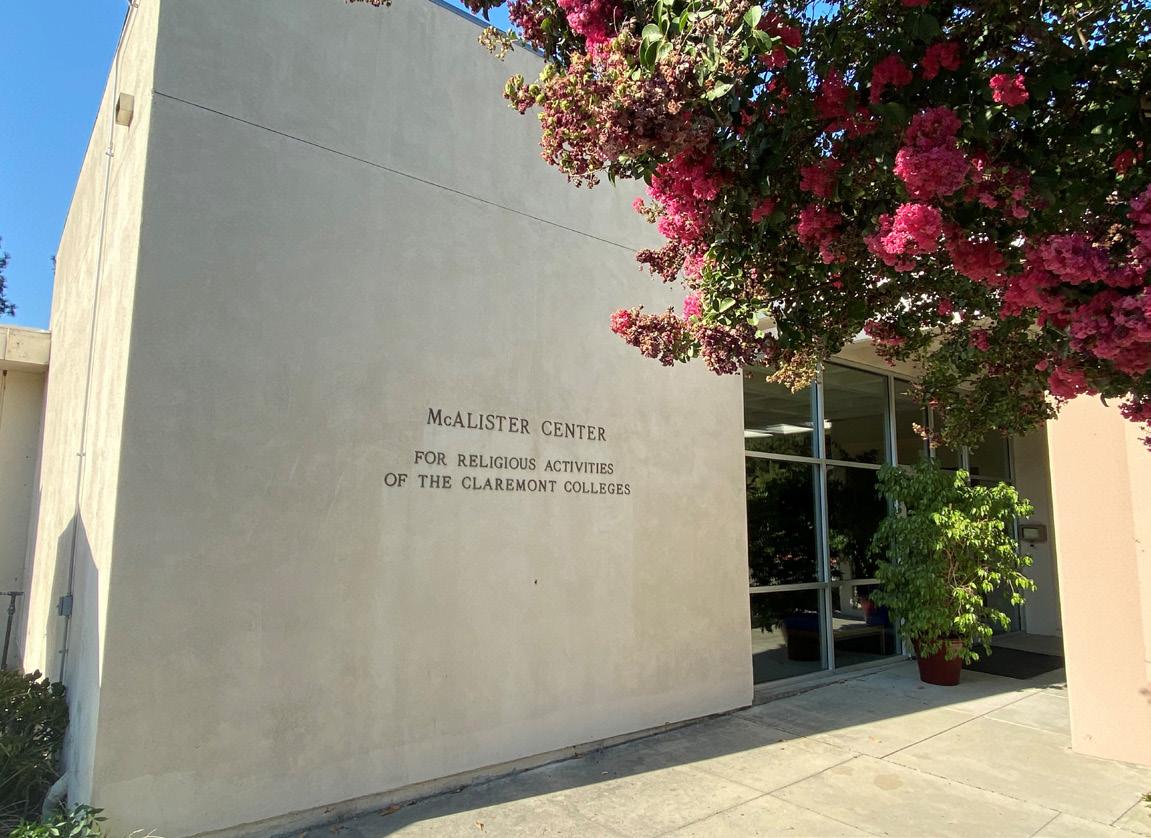
After Father Joe Fenton retired as Catholic Priest in October 2024, the McAllister Center for Religious Activities is considering how to fill the vacancy. For the past few weeks, the center has been collecting feedback from 7C community members to decide whether to keep the role separate or to merge it with the Protestant Chaplaincy to create a unified Christian Chaplaincy. Father Fenton served the McAlister Center as a chaplain for two decades. The Office of the Chaplains, housed within the McAlister Center, now has three chaplains: a Protestant
See CHAPLAIN on page 2


On Feb. 7, the Datamatch

there’s a low chance of DOGE targeting individual people who are seen as “enemies,” the fact that there’s any chance at all is hugely problematic.
Although Rasor said that goals to cut government spending aren’t necessarily a negative
thing, both he and Pitney expressed concern over the way the Trump administration and DOGE are doing it.
“The danger is, through sloppy handling of the information, it might get to people who use it for nefarious purposes,” Pit -
ney said. Musk’s role at DOGE also grants him the ability to stall or cut funding to governmental agencies. Musk started with the United States Agency for Inter -
From garden to grove: Pitzer’s Citrus Fest connects students through sustainability and fun
On Friday, Feb. 7, the Pitzer College Student Garden hosted its annual Citrus Fest. In a lively collaboration between the garden and the Grove House, students were invited to immerse themselves in the fragrant atmosphere. Students enjoyed an afternoon filled with various citrus treats, hands-on crafts and a guided tour of the student gardens.
The event provided an opportunity for the campus community to connect with nature, savor fresh flavors and celebrate the harvest season’s bounties.
Hannah Price PZ ’25 shared her excitement for the event as she crafted a candle adorned with leaves and pieces of gold paper.
“I think it’s really nice that these types of community events exist and to be able to see friends and also eat food and listen to music and relax,” Price said. “It’s very nice to just be with people that I care about.”
The event was moved indoors due to rain, leading stu-

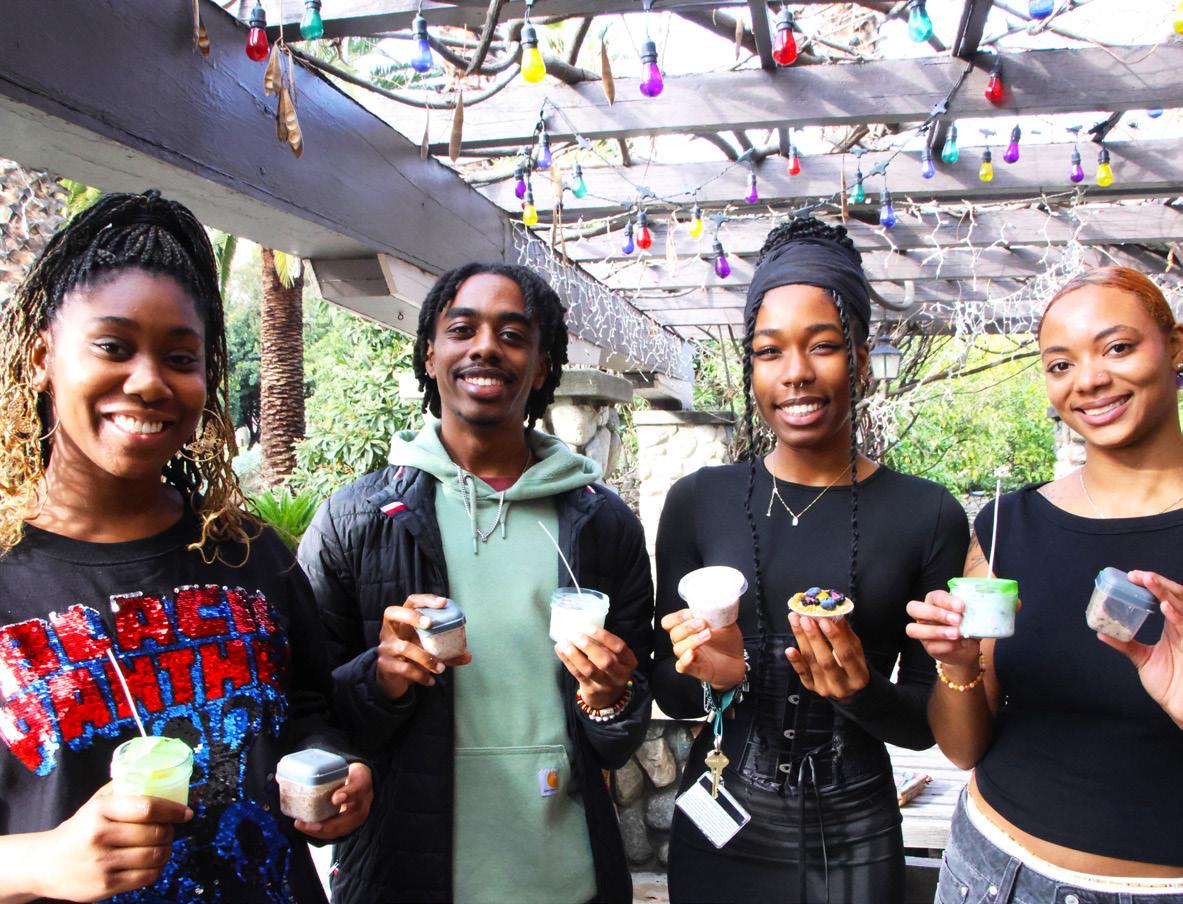
dents to pack inside the Grove House and spill onto the sheltered outdoor deck. They rotated through a variety of activities, including creating orange garlands, printmaking, painting rocks, stirring up orange-scented candles and sugar scrubs, in addition
to enjoying desserts like orange cheesecakes and lemon cookies. Stella Seid PZ ’26 expressed her excitement upon unexpectedly discovering the celebration. “I stumbled upon this drawn


YAHJAIRI CASTILLON
MORGAN ALbReCHT • THe STuDeNT LIFe
Following Father Joe Fenton’s retirement, the McAlister Center for Religious Activities began its search for a new Chaplain partially by soliciting student feedback.
here to listen to TSL’s podcasts! The news analysis podcast of the Claremont Colleges. Hosted by ben Lauren PZ ’25 and Dania Anabtawi PO ’26.
Jeremy Martin PO ’25 and Adam Osman-Krinsky PO ’25 check out local restaurants, share their thoughts and recommendations, and get real silly along the way. Look out for this symbol next to all Valentine’s Day related coverage!
ANJALI RAO • THe STuDeNT LIFe
Pitzer College’s Citrus Fest, organized by the Pitzer Student Garden and the Grove House, brought students together to celebrate the season with crafts, citrus-themed treats and a focus on sustainability.
See CITRUS on page 4
See MUSK on page 2
Queer community at 5Cs responds to Trump’s anti-trans executive orders
MACY PUCKETT
In the wake of President Donald Trump’s recent executive orders targeting “gender ideology” and transgender people across America, the Queer Resource Center (QRC) of the Claremont Colleges has prepared to respond and support the queer and transgender community at the 5Cs.
Since taking office on Jan. 20, Trump has signed several executive orders targeting the transgender community, including executive orders calling for two unchangeable sexes, restricting gender-affirming care for minors, banning transgender people from serving openly in the military and targeting transgender athletes in women’s sports.
“Besides the legislative side, there is just so much rhetoric and ideology that’s being pushed,” QRC staff member Arden Deforest PO ’25 told TSL. “Part of what feels really scary is that we’re moving backwards.”
Deforest, who has worked at the QRC for three years, said that the center will continue to offer free resources such as binders, gender-affirming services, trans tape, safe sex supplies and menstrual products for students.
According to QRC staff member Vaughn Brown PO ’25, students simply have to fill out a form linked on the QRC website to have resources delivered anonymously. Alternatively, they can pick resources up at the center in person.
Brown said that the space offers students community, hosting events about topics like queer intimacy and body positivity and helping them destress through crafting.
“We’re working especially on making sure people remain visible and feel like they will have spaces to be in, and that that space is encompassing for people of different access needs and interests,” Brown said.
Brown added that the Claremont Consortium’s Student Health Insurance Plan (SHIP) provides coverage for gender-affirming care, including hormone treatments, and that it has previously covered things such as students’ top surgery. Student Health Services (SHS) also offers gender-affirming care.
With Trump’s recent executive order, though, Deforest said that
it’s hard to know what things will look like for the transgender community in the coming months, specifically when it comes to passport changes, renewals and travel. The order makes uncertain the ability to have “X” on your passport — something North American and European countries have historically offered to affirm people who don’t identify as male or female.
“There is a lot of fear about what will be allowed,” Deforest said. “There’s certain countries where you can’t travel if you have an X on your passport. It’s seeming like the U.S. will become one of those countries.”
Trump’s most recent action against the transgender community came in the form of a Feb. 5 executive order intending to keep transgender women out of women’s sports. Shortly after, the NCAA officially restricted players in the women’s league to women who were assigned as “female” at birth.
“We continuously review and track all executive orders and in this instance, we are also monitoring and in communication with NCAA and SCIAC conference staff on their evaluation and response surrounding this policy change,” CMC Director of Brand Marketing & Web Strategy Helena Paulin said in a statement to TSL on behalf of CMS athletics. “And as is always the case, we robustly support all of our student-athletes.”
Director of Pomona-Pitzer Athletics Miriam Merril said in an email to TSL that the department is committed to supporting all Sagehen studentathletes so that they can thrive during and beyond their college years.
“We continue to support every student-athlete that is part of our community and to monitor policy changes such as this one so we can take appropriate steps to comply with all laws,” Merril said.
Bob Gaines, Pomona’s acting president, released a statement addressing recent executive orders on Thursday, Feb. 6. In his statement, Gaines did not address Trump’s recent anti-trans executive orders but discussed the college’s response to executive orders targeting immigration policies, federal funding, anti-DEI efforts and the potential endowment tax.
“For anyone experiencing great strain or stress from the various Executive Orders, please remember that support is available in many places across this caring community, where we prize intellectual and personal diversity,” Gaines wrote. “We also encourage faculty and staff to reach out to Human Resources and students to contact their class deans with individual concerns they may have.”
Brown said that the colleges are playing their response to the executive order quite politically and that regular communication
and aspects of transparency would make students feel more protected and supported within the colleges.
“I’m firmly of the belief that it’s not enough to just invite people to the colleges, you have to ensure there are resources and spaces for thriving once people transition and matriculate and become a part of our campus community,” Brown said. “They’re reaffirming their commitment to minority communities, but what does that look like? What they can specifically offer has been left rather vague.”
In a message to the queer and transgender community, Deforest said to remember the power of collective hope.
“Queerness has always existed and will always exist because you can’t legislate identity out of existence,” Deforest said. “The way that we get through this is the way that we always have, which is in finding community and finding joy. Existence is resistance sometimes.”

MUSK: Students and faculty react to Elon Musk’s new influence over government funds
Continued from page 1
national Development (USAID).
USAID was established in the 1960s to offer humanitarian support to other countries. The agency employs 10,000 workers, provides food to famished people, uses data analysis to detect where food shortages are emerging and offers free vaccinations.
Musk confirmed DOGE’s efforts to dismantle the agency in a tweet on Feb. 2.
“USAID is a criminal organization,” he tweeted. “Time for it to die.”
Musk’s power over government funding and organizations left many 5C students and faculty questioning how his influence could affect their livelihoods and education, as well as democracy in the U.S.
DOGE did not stop the federal funding cuts with USAID. On Feb. 11, DOGE announced their plans to issue cuts for over $900 million to the Department of Education, most prevalently targeting the Education Innovation and Research grants.
Sumita Pahwa, an associate politics professor at Scripps, explained that this could be a wake-up call for many citizens.
“Americans think they invented democracy, that they’ve always been a democracy,” Pahwa said. “They haven’t had a real scare for a while because we think the institutions will hold and that somehow Americans would never let this happen to them.”
Rasor pointed out how the various presidents have expanded the president’s powers during their time in office. Americans are seeing a culmination of decades’ worth of increased power. Yet,
Rasor disagrees with the way President Trump is attempting to smooth out a bureaucracy.
“Trump himself states how we need to get these bureaucrats out of government affairs and we need to democratize government affairs,” Rasor said. “Yet, [Trump] and his cohort of largely billionaires are now trying to run things themselves, which is the exact thing that he is protesting.”
Pahwa said that since DOGE granted access to the federal payment system, more citizens and politicians have been protesting the department.
“The Senate phone lines in D.C. were down because of a high volume of calls yesterday, a lot of people are calling their representatives,” Pahwa said.
Pahwa referenced political scientist Erica Chenoweth’s ideology for protesting and uprising, which outlines that just a small percentage of people participating in nonviolent protests can draw in more recognition and support for their cause.
“If 3.5 percent of the population rises up in nonviolent protests anywhere in the world, that’s basically what it takes,” Pahwa said. “You don’t need everybody, you need enough people to signal to others that, ‘Hey, we’re rising up,’ and for people to say, ‘Oh, there’s a problem,’ and realize that something is going on.”
Both Pahwa and Pitney emphasized the impact of each citizen’s voice and the importance of voting and being politically aware.
“People should care,” said Pitney. “People should vote.”
CHAPLAIN: McAlister Center seeks to
fill
vacant chaplain role
Continued from page 1
minister, a Jewish rabbi and a Muslim imam.
According to the Claremont Colleges Service’s (TCCS) website, each chaplain works to support religious and spiritual student groups and communities on campus.
“The chaplains serve as confidential spiritual counselors and provide ethical leadership to the seven schools of The Claremont Colleges,” the website reads.
Rather than simply rehiring another Catholic priest, the Center is considering consolidating the Protestant and Catholic chaplaincies into a Christian chaplaincy and adding either a Dharmic or Humanist chaplain. A Dharmic chaplain would serve students of four major religions — Hinduism, Buddhism, Sikhism and Jainism — while a Humanist chaplain would cater to nonreligious members of the 7Cs.
“While our existing chaplains strive to serve students of all religious backgrounds, we recognize from feedback that not every student feels fully included,” TCCS said in a press release to TSL. “The feedback process is intended to engage our community in the important decision of how to position the Chaplains best to fulfill this service.”
Some students have expressed concerns over the proposed Christian chaplaincy position, including Miguel Barrios CM ’27.
“For Catholics, it’s part of our Mass to be presided by a priest,” Barrios said. “I think a merger of a Protestant chaplaincy and a Catholic chaplaincy misses the point of what it means to practice each faith.”
He said the McAlister Center has historically served as a hub for Catholic students to
practice their faith and bond.
“They do a lot of weekly programming for Catholic students — weekly dinners, retreats to Malibu and Catalina Island — all completely free,” Barrios said. “Having that safe space at McAlister to be around like-minded people meant a lot.”
Starting this semester, the McAlister Center has begun collecting feedback from 7C student governments on the potential replacement for the Catholic chaplaincy position.
This month, they will begin conducting listening sessions with faculty, staff, alumni and community members.
“Once all feedback has been synthesized, a report will be considered for final approval,” TCCS said in the press release.
“Although the timeline is aggressive, we aim to begin the search process by April and have the new chaplain(s) start by July 2025.”
On Feb. 6, TCCS Vice President for Student Affairs Stephanie Blaisdell and Protestant Chaplain Reverend Dr. Joel Daniels attended the Associated Students at Pomona College (ASPC) Senate to discuss the potential change with students.
When asked why the center could not hire two part-time chaplains, they said it would be difficult to find candidates for the two half-time positions and more challenging logistically.
Students at the ASPC discussion suggested that the McAlister Center provide additional funding or support to religious communities without a dedicated chaplain.
Students also raised concerns about both proposed new chaplaincy positions. One student questioned whether a single Dharmic chaplain could represent four different, diverse religions. Another student argued that the Humanist chaplaincy
position might be an unnecessary addition to the center, as there are already spaces on campus for non-religious students to explore spirituality.
In the meantime, the McAlister Center continues to host Catholic Mass every Sunday at 10 a.m. in McAlister Lounge, coordinated by a part-time unordained associate chaplain and supported by Holy Name of Mary Catholic Church in San Dimas.
“This work is supported by a grant from Pomona College to enhance student programming in the last few years,” TCCS said in the press release. “This arrangement ensures that our Catholic community remains actively supported despite the vacant Catholic chaplaincy position since October.” Father Fenton’s retirement came as a shock to Barrios.
“I ran into the McAlister group at Our Lady of the Assumption [Church], and they said he had suddenly just retired — like, out of nowhere, he was not going to be giving homilies anymore,” Barrios said. “It was very sudden, from what I heard.”
Barrios said he fondly remembers Father Fenton, his homilies and his politics.
“I always really liked his homilies: They were definitely skewed in one way politically, [as] he was against the merger of church and state,” Barrios said. “I think he’s one of those rare, I would say heroic, individuals in the church that really maintains that church and state should be separate.”
Barrios said he hopes that a decision will consider the full needs of the student body.
“It would be amazing if we could, in addition to a Catholic chaplain, also hire a Dharmic chaplain,” Barrios said. “I think it would be very sad if we had to pick one or the other: if we [do], dozens of students across campus will feel like they’re losing their ability to practice their faith.”
SARAH ZIFF • THe STuDeNT LIFe
The Queer Resource Center will continue to provide resources for the 5C queer community amidst a flurry of anti-trans executive orders from President Donald Trump.
‘Our Story, Our Glory’: Pomona hosts third Black Youth Conference
ELLIE LAKATOS
Local middle and high school students, along with their parents and guardians, gathered for Pomona College’s third Black Youth Conference on Saturday, Feb. 8. Hosted by Pomona’s Black Student Union (BSU) and the Draper Center, the seven-hour conference — with the theme “Our Story, Our Glory” — featured various student-led workshops and discussions.
According to the Draper Center’s website, the conference’s mission is to create a safe space for Black middle and high school students from the surrounding areas to “explore, inspire and celebrate their Blackness.”
BSU board member Aminah Augustin PO ’28 said that events like the conference are important for inspiring Black youth.
“By us doing stuff like this and showing the kids that this is a student-led event, they’re seeing how you can do a lot of things to impact your community and [how] you can make a lot out of situations that weren’t exactly designed for you to succeed in the first place,” she said.
The day began with a panel discussion led by BSU’s executive team and student representatives from the Draper Center. The panel explored the history of similar programs in the 1990s, highlighting the importance of events like the conference and exploring their connections to the broader Claremont community.
Jeremy Mitchell PO ’27, one of the panelists, told TSL that serving on the panel meant a lot to him because he was able to express how much it meant to him to attend college.
“For me, college was an escape,” Mitchell said. “It was also an opportunity to be the first in my family to go to college and explore and live outside [my] comfort zone.”
Augustin, who also spoke on the panel, emphasized its significance to young attendees.
“It can be really discouraging
for some of these kids to even want to participate in any institution,” she said. “Although these institutions have a lot of systematic issues and negative effects on us, it’s still important to recognize that you can still work with what you have and still make a name for yourself.”
Following the panel, conference attendees split into three workshops: “Our Black History in SoCal,” “Politics of Social Justice” and “Media to Material (Black Art & Music).”
Mitchell, who helped lead the “Media to Material” workshop, said that one of his favorite parts of the workshop was their discussion of superheroes, during which he asked attendees to name their favorite hero. Most responded with characters who wear masks.
Mitchell said that characters who wear masks are easier to envision themselves as, given that their faces are mostly hidden. He posed a follow-up question: how many superheroes looked like the attendees? Mitchell said it sparked a discussion on Black media representation.
“It just opened up a broader conversation of how we need more representation for people that look like us and that can tell our authentic stories in our own way,” Mitchell said. “I think that was so cool, just leaving that impression on them, just converting something as simple as a superhero to why we need more representation in spaces like media.”
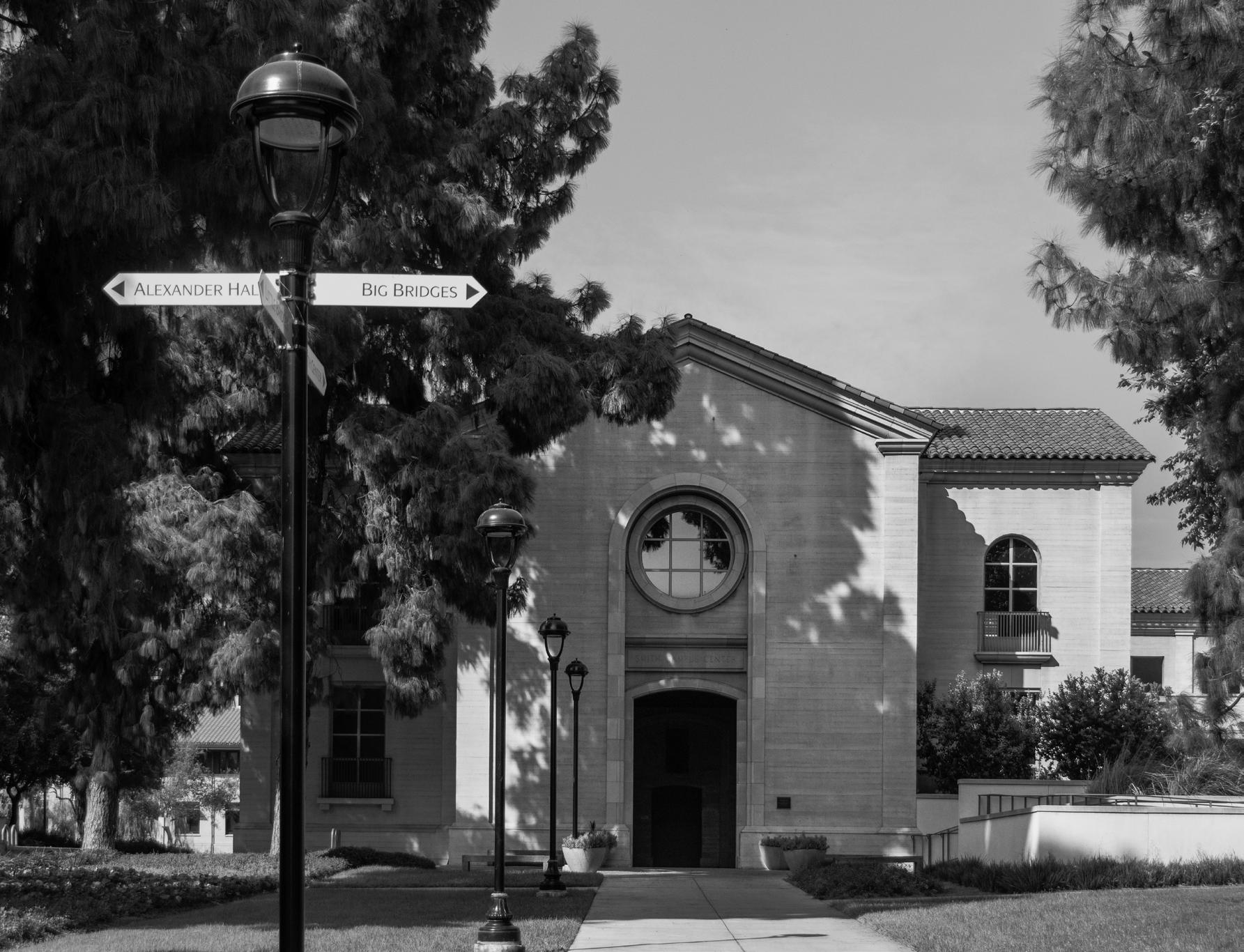
After the workshops attendees gathered for lunch, followed by a resource fair on the patio fo the Smith Campus Center which featured Black-owned businesses, book clubs and other organizations aimed at connecting with youth.
Students then went to the Office of Black Student Affairs’ garden, where they painted rocks to leave behind as a symbol of their presence on campus.
Afterward, attendees watched a performance by
Earth Tones, a 7C Black acapella group, who sang “Lift Every Voice and Sing,” frequently referred to as “The Black National Anthem.”
The conference concluded with a speech from the keynote speaker, Carolyn Ratteray, an associate professor and the chair of theatre at Pomona.
Ratteray shared her experience and story on writing her award-winning one-woman show, “Both And (A Play About Laughing While Black).”
Ratteray’s play focuses on a woman who travels to the afterlife on the eve of her mother’s death. “Within that framework of the story, joy is definitely a throughline,” Ratteray said in an interview for the Wallis Annenberg Center for the Performing
Arts. “How do we have and access pain and process that in addition to still understanding and having access to our joy?”
Mitchell said Ratteray was selected because BSU thought her story was authentic and aligned with the conference’s theme.
Reflecting on Ratteray’s speech, as well as on the conference as a whole, Mitchell shared his hopes for BSU’s future conferences.
“It would be a real good thing if this event could get pushed harder and on a grand scheme of things, if we were able to do more workshops and bring more kids on, is something that I hope to see in the future before I graduate,” Mitchell said.
Augustin said that she was happy with how the conference unfolded.
“Just talking about my college experience, the kids were really interested to see what life is like at college,” Augustin said. “Some of them don’t even know if they are going to college or what it looks like because they do not have access and representation to that at home.”
Mitchell said the conference was a great way to expose younger audiences to important topics, especially considering the current political state of the United States.
“I think we did a really good job of opening up their eyes and their ears to a lot of systematic issues and a lot of things that have happened to progress to African Americans in general,” Mitchell said.
Audrey Park contributed reporting.
erin Reddick, ChatBlackGPT founder, pioneers culturally aware AI
ANNE REARDON gap and creating a generative AI experience that more people could relate to because [ChatGPT] wasn’t really in-depth for everyone,” Reddick said. “I think multicultural AI is important. I just started with the Black com-
Erin Reddick, the founder and CEO of ChatBlackGPT, spoke to students and faculty at Scripps’ Balch Auditorium on Feb. 6. The platform, launched in June 2024, boasts over 10,000 users and focuses on including Black perspectives in AI responses.
“ChatBlackGPT was born from the recognition that mainstream narratives often overlook or misrepresent the experiences, histories and contributions of Black people,” the platform’s website reads. “The need for an AI tool that centers Black perspectives and provides culturally relevant insights became increasingly apparent.”
According to Reddick, ChatBlackGPT can be a valuable resource for students at the Claremont Colleges. She cited essay writing as an example, saying that an individual asking ChatBlackGPT to generate an essay on Black history would receive a more accurate response than an individual using ChatGPT.
She added that the original ChatGPT, when given this prompt, fails to mention the KKK and other significant events in Black history that still carry consequences today.
Bringing up another example, Reddick — who is currently pregnant — said that ChatBlackGPT answered her questions about giving birth in greater depth than ChatGPT did, offering important information about how Black women disproportionately have more C-sections than other women.
Reddick, a public interest technologist at the intersection of AI and culture, said that ChatBlackGPT is meant to serve as an alternative to ChatGPT. According to Reddick, ChatGPT is influenced by racial biases. She decided to launch the alternative platform after being laid off in a large downsizing by Meta.
“[ChatBlackGPT] is filling a
uous incidents of falsely flagging people of color and women as shoplifters.
Kyle Thompson, the director of learning at Harvey Mudd College, said that there is no such thing as unbiased data. As a professor of

On Feb. 6, the founder and CeO of ChatblackGPT, erin
including black perspectives in AI.
munity because that’s the one I could validate.” Multiple forms of AI have been exposed as vulnerable to racial biases in recent years. Rite Aid, Reddick pointed out, was forced to ban AI technology after continCorrections
an ethics and AI course, Thompson said that working to mitigate bias in AI is important.
“I hope that [ChatBlackGPT] starts conversations about what AI use is generally, and it gets people to realize that when you’re sitting down in front of GPT, it’s not a representation of some kind of universal, neutral human perspective, or some neutral computational perspective,” Thomspon said. “It very much has to work within the data that it’s given and how it’s trained, and the parameters that function as it does.”
Thompson said that it’s troubling not to know which data sources an AI program is using. Without this information, people are typically unaware of potential biases, which he said could be dangerous when large corporations have stock in AI.
“Not watering down history is a public interest, especially right now when there’s classes and information being suppressed or banned,” Reddick said. “I think that creating a technology that can harbor that information and safeguard it is really important because once it’s in AI, you can’t take it out. It cannot be unlearned. It’s also a preservation effort.”
Reddick said that she hopes to partner with and support others in building similar AI platforms for their own cultures. She is also trying to incorporate intersectionality into her platform and in platforms to come.
She added that she recognizes the controversy of AI but that she also doesn’t see it going away anytime soon. To her, it only makes sense to work with it and to make peoples’ experiences with it as positive as possible.
“If you’re worried about AI … or you know the dangers of it, read up on it, become an advocate for it,” Reddick said. “Work on ways to organize and draw attention.”
COuRTeSY: SCRIPPS COLLeGe
Reddick, spoke at Scripps College about the importance of
the current CEO. TSL regrets these errors.
ReGAN RuDMAN • THe STuDeNT LIFe
Pomona College’s black Student union and the Draper Center held the third black Youth Conference on Saturday, Feb. 8.
CITRUS: Pitzer College kicks off spring with zesty Citrus Fest celebration
Continued from page 1
in by the music and the sight of delicious treats,” she said. “All the events at the Grove House are the best and this is super cute, getting to see what’s come of all of the abundance of citrus that we have growing on campus.”
Another student, Alyssa Hernandez SC ’27, said that she had seen the garden’s Instagram posts and thought it would be a great opportunity to explore the neighboring campus,
“I saw it through their social media and I was really excited to come because I’m an art major and I like to make a bunch of crafts,” she said. “I don’t come to Pitzer very often, so it’s exciting to be able to meet new people and see different faces.”
Claire Wang PZ ’27 and Stryder Rodenberg PZ ’25, both staff of the garden and Citrus Fest organizers, shed light on the various uses of the Pitzer Student Garden and its importance to students.
Wang emphasized Citrus Fest’s significance for the wider campus community, noting how it provides a sense of familiarity that students can always rely on upon their return.
“I think it’s a really good way to just bring everyone together because it’s usually at the start of the spring semester,” she said. “Everyone’s coming back from a break and having citrus is always like a nice reminder that you’re in Southern California.”
Rodenberg highlighted how
the event offers a valuable opportunity for students, particularly those in environmental analysis (EA), a popular major at Pitzer, to connect classroom learning with real-world experience, “We have a lot of EA students, so it provides a chance to sort of apply learning from class and experiment hands-on with the localized food system ... from growing to producing to prepping, it gives students a chance to really engage in all levels of the food system in a localized
way, which is really cool when you think about sustainability,” he said.
He also noted the garden’s role in fostering sustainability and community engagement, especially through events like Citrus Fest.
“It’s really exciting because at the garden we’re really interested in connecting people to people and people to places through organic sustainable produce,” Rodenberg said. “We have a chance to experiment with the localized food system.”
When SpaceX launches, Claremont students look up
At 6:09 p.m. on Feb. 10, Elon Musk’s astronautics company SpaceX launched a Falcon 9 rocket over California from Vandenberg Air Force Base. The rocket’s trajectory went over the Claremont Colleges, giving students a frontrow seat to the event.
The rocket will be part of the greater Starlink satellite constellation, which currently comprises 6,900 operational spacecrafts intending to deliver broadband internet services. This will be SpaceX’s 18th rocket of its kind launched.
Charlie Lambert HM ’26, a team leader for the Mudd Rocketry Club, addressed the significance of these launches. He emphasized the importance of satellite technology in our daily lives.
“There’s a lot that can be said about improving life here on Earth from launching satellites,” he said. “Every day, people use GPS on their phones, and that’s a satellite constellation that’s been around for quite a while now. Life would be very, very different if we didn’t have those kinds of constellations. You would not be able to do your everyday activities.”
The Feb. 10 launch is not as rare as it might seem. Last year, the Vandenberg Space Force Base achieved 51 launches, a milestone that hasn’t been reached since 1974.
“They happen so frequently that it’s a given that one is going to be happening every other day,” Lambert said. “It just so happens that sometimes, when they’re launching, you can see them go over our colleges.”
Chad McElroy CM ’26, an aerospace enthusiast, said that the timing of the launch — about an hour after sunset — created a visual around the rocket and its trail known as the “twilight effect.”
“The exhaust from the rocket engines catches the light of the sun after it has set from our perspective, really brightening it up,” McElroy said. “A lot of the dust or exhaust that is coming out of the rocket engines from the first stage and then the second stage catches the light, and it makes the launch appear even more dramatic.”
McElroy described the resulting effect as breathtaking.
“It starts to look even like a jellyfish,” he said. “The sun catches all those ice and dirt crystals from the exhaust of the rocket as it goes about its journey. The rocket is usually launching south, and you start to see the exhaust all the way into space, tracking it until it goes below the horizon.”
Katherine Lanzalotto CM ’25 and her friends unexpectedly found themselves watching the launch and the trail it left in the sky on their way home from

dinner.
“Everyone kind of took a second and looked up at the sky and breathed and stopped thinking about whatever CMC forces them to think about all the time,” she said. “I found that incredibly cool, [be]cause I think there are very few moments
where you just, you know, step back from it all.”
For McElroy, the event served as an escape as well as a source of inspiration. He reflected on the broader significance of space exploration.
“I saw it as the apex of what we as a species can accomplish,
putting our creativity and our innovation and our drive to explore new heights,” aerospace enthusiast Chad McElroy CM ’26 said. “Finding and seeing instances like those launches, watching them online or keeping up with the news of them always helps brighten my day a little bit.”
Reyna Grande talks storytelling and immigration at the Athenaeum
ILA BELL Grande opened her talk by discussing how storytelling can aid in processing trauma.
Acclaimed Mexican-American author Reyna Grande discussed the power of storytelling and the immigrant experience on Tuesday, Feb. 11, at Claremont McKenna College’s Marian Miner Cook Athenaeum. Grande spoke on Trump’s mass deportation plans and the current state of U.S. immigration, among other things.
Grande’s work, which includes both memoirs and novels, focuses on the immigrant experience within the United States. She has received many accolades, including the American Book Award, the Premio Aztlán Literary Prize and the International Latino Book Award.
“For me, on a personal level, writing has been my lifeline,” Grande said. “I feel that my stories are part of a larger narrative of resilience and of hope, and my voice is stronger because it is part of a chorus of voices. We’re all working together collectively to advocate and to support and to encourage one another.”
She added that being on stage and discussing immigration as a formerly undocumented immigrant was both a privilege and a responsibility.
“I never take these opportunities lightly, because there aren’t
that many of us who are handed a microphone and invited to come and tell our stories,” she said.
Grande highlighted the role of advocacy in storytelling and the importance of representation. She noted that a common misconception is the portrayal of all Mexican-Americans as immigrants.
“We’re constantly being portrayed as the outsiders, as the foreigners, as the invaders,” Grande said. “And this narrative ignores the fundamental truth that we are not all immigrants, that we are both the newest and also one of the oldest communities in this country.”
She then commented on the government’s plans for mass deportation. On Jan. 20, President
Donald Trump issued “Protecting the American People Against Invasion,” an executive order that increases immigration enforcement measures and expands the use of detention facilities. To Grande, this is heartbreaking.
“Teachers across the country are attending training on what to do if ICE comes onto their campuses and learning how to best help their students,” Grande said. “Of course, we have gone through such times before in our history. But we survived then, and they will survive now.”
Grande also spoke about her upbringing and personal experience as a first-generation immigrant from Mexico.

“My hometown is surrounded by fields of poppies and also mass graves,” Grande said. “And it’s a very sad place, but also it’s a beautiful place too, and that is something that I try to capture in my books.”
With both her mother and father being forced to leave Mexico when she was young, Grande said she experienced the trauma of family separation, a theme that inspired some of her work. Grande said she was unaware of the long-term effects of the trauma she endured when she immigrated to the U.S. at age nine but found writing to be a creative outlet.
“I didn’t know how trauma can impact your mental health, your physical health, your emotional health, your social well-being, your spiritual well-being,” Grande said. “I didn’t know any of that, but I felt it in my body. And so writing was when I felt that I could breathe again, every time I wrote down in my journals.”
Ending the talk, Grande said storytelling has allowed her to redefine her path.
“My writing has paved the way for me to accomplish all the things that I set out for myself as a first-generation college student daring to dream beyond the circumstances I was born into,” Grande said. “My writing allowed me to write a different story for myself than the story that had been written before in my family.”
Maria Shishkina SC ’25, who attended the talk, said she appreciated Grande’s honesty with her personal story and experiences.
“Those are such personal accounts to share with the world, and I think it takes a lot of courage to be able to do so, especially with the political climate of today,” Shishkina said.
Similarly, Anna Mone SC ’28, who also attended the talk, said she found Grande’s perspective and insights to be incredibly relevant today.
“I think she brought up many really critical points about how it’s an ongoing issue, and how it’s something so deeply rooted in our country’s history and our legacy in Latin America,” Mone said. Grande concluded her talk with a call for action.
“Storytelling is such a powerful tool for fighting for social justice and trying to create
YAHJAIRI CASTILLON
Sweet, caffeinated relief after a lost ID
EMILY KIM
I don’t remember when I started drinking Café 47’s cold brew oat latte (which the café staff like to call “cold brew OGs”), but it’s my goto drink whenever I need a sweet, caffeinated pick-me-up on Pomona College’s campus. For many semesters, it has saved me from mid-afternoon slumps, allowing me to push through my numerous 1:15 to 4 p.m. seminars with an alert mind. The cold brew oat latte has become a familiar beverage throughout my college experience — an energizing companion, a reliable friend.
Little did I know, though, that come the start of my senior spring, this coffee drink would carry a new, wholly amusing memory.
After returning from a club meeting on the first Friday of the semester, to my dismay, I realized that my student ID was missing. I spent the whole day eating, working, napping and scrolling on TikTok in my room. So where on earth did it go?
“It has to be in my room, then,” I thought to myself. “Where else would it be?”
That evening, I nearly tore my room apart searching for my ID but it was nowhere to be found. I went to sleep and continued searching in the morning to no avail — it had disappeared. I glumly resigned myself to getting a new ID first thing on Monday morning.
I thankfully made it through the weekend without my ID and returned to campus on Sunday night after spending the afternoon at home. I was grateful to the Pomona student who graciously swiped my ID-less self into Walker Hall so that I didn’t have to pathetically wait (in the rain) for someone to let me in. Once I arrived at my room, however, a friend suddenly texted me.
“Did you lose your ID? Someone
found it but they’re selling it on Fizz!” I opened her text and was shocked to see a photo of my ID priced at $10 on Fizz. I don’t even have the app myself, so I was utterly flabbergasted. I couldn’t stop laughing.
What happened to the kind souls posting lost IDs on the Facebook page 5C For Sale/For Free and meeting up with the person to return it? Who on earth was trying to sell my ID?
Within the next hour, more of my friends who were on Fizz started texting me.
“Have you found your ID? You saw this, right?”
The thread had quickly blown up and, at this point, over 1.5k students knew that I had lost my ID — and coined me as an “old” 2002-er.
Going viral on Fizz was absolutely not on my senior year bingo card. I went to bed that night cackling and shaking my head in disbelief.
The next morning, I promptly headed over to the Housing and Residence Life Office at the opening hour and secured a new ID. It was comical — even though there was nobody outside, I felt so perceived in my ID-less state. I felt like the squirrels, the birds and even the trees knew.
“If I run into someone, what are the chances that they saw the Fizz thread?” I wondered as I quickly shuffled my feet towards the SCC.
Within minutes of speaking with the HRL staff, a freshly printed ID was soon in my possession. Walking out of the office, I clutched it tightly, laughing to myself once more.
“I better not lose this,” I vowed. “Not within mere months of graduating. I don’t want to see my ID on Fizz again.”
I had initially planned to return to my room right away, but upon leaving HRL, I suddenly remembered that Café 47 was open. “I deserve a drink after an eventful weekend,” I thought.
Wanting a sweet little pickme-up, I knew it was time for a cold brew oat latte. Although I had gotten this drink countless times throughout my time at Pomona, I swear that it tasted the best that day. The latte tasted like refreshing relief after over 1000 students were suddenly engrossed in your lost ID extravaganza.
When the frothy liquid hit my lips, I smiled at this absurd new memory that a favorite caffeinated beverage would now remind me of: the time I went viral at school on an app I don’t even use. The time someone had the audacity to sell my ID online. The time I got roasted for being born in 2002 (gap year students unite!)
It is moments like these that make my final semester at Pomona a memorable one, and we are only in the beginning weeks.
I really hope I don’t see myself on Fizz again. I really hope that the next time I order a cold brew oat latte, it’s with the same ID I got that Monday.
So, to whoever found my ID and posted it online, I want to say thanks for making me laugh. I wish you had just given it back, but it made for a senior spring story that I will never forget.
Emily Kim PO ’25 is from Irvine, California. She admits that when she saw people on Fizz calling her “unc” for being born in 2002, she didn’t know what that meant and proceeded to Google “unc slang meaning” in the comfort of her bed.


Expressing identity and memory: Pitzer’s Lenzner Gallery presents Valeria Tizol Vivas’ “Aurora”

On Feb. 1, Pitzer College’s Lenzner Gallery hosted an exhibition opening for “Aurora,” a body of work created by Valeria Tizol Vivas during her time as ceramic artist-in-residence at Pitzer.
Tizol Vivas showcased a captivatingly personal and immersive exhibition, where viewers were encouraged to interact with the gallery space and artworks. Sculptures were immersed in the gallery space itself, including several installation works.
Spanning a variety of mediums including carved wood, clay and canvas, the pieces convey a complex story inspired by Tizol Vivas’ grandmother, Aurora, who the artist and her family cared for during her childhood in Puerto Rico.
“I wanted to make an ode to my grandma’s life,” Tizol Vivas said. “And more specifically to my experience and my memories through helping with the care of Aurora because she had Alzheimer’s.”
The exhibit deals with her memories of growing up in Puerto Rico in an environment characterized by the decay of terminal illness.
“There were a lot of different inspirations, but I am going to say that memory was a big part of it,” Tizol Vivas said. “Memory and being from Puerto Rico, and being a part of the diaspora and being so far from my home.”
Tizol Vivas explores her Puerto Rican and Caribbean heritage by incorporating cultural iconography in her work.
“Coming from that point of origin, I have always had trouble with understanding myself,” she said. “I have always been very interested in dissecting symbols and finding a way to understand what I am, where I come from and why I carry the history that I carry.”
Tizol Vivas’ practice engages with her own familial history as well as regional histories of colonization. She is informed by cultural
anthropology and references Taíno art, spiritual practices and Criollo regional furniture making.
“Through the furniture, we can see an evolution of form, and it’s also a way of viewing colonization,” she said.
The Lenzner Gallery itself also served as a fitting space and inspiration for her work, according to Tizol Vivas.
“I fell in love with the gallery when I saw it,” she said. “I love that feeling of being underground, and it reminded me of the cave formations from my island.”
The gallery space inspired several natural, clay-based pieces, such as stalactite lights that Tizol Vivas hung from the ceiling. Other spaces in the Lenzner Gallery invited a more intimate viewing experience, such as a smaller room that Tizol Vivas turned into a closet, where she installed two-dimensional and ceramic works.
“I loved the incorporation of the woodwork and the ceramic as very raw materials,” Hannah Liwerant PO ’27 said. “Then there were so many nice little details, where the more you looked at it the more you would notice.”
Tizol Vivas aimed to include viewers in her creative vision and experience. A hanging ceramic piece, for example, invited attendants to spread activated charcoal on the gallery walls.
“Using my creative language is a way of communicating with others, so I believe in touch and also I believe that we are always in conversation,” she said. “You become part of the work if you want to become part of the work. I do not create that separation.”
Tizol Vivas explained that her art allows her to explore her cultural and familial history, which she invites viewers to engage with through “Aurora.”
“There is no other way to be for me,” she explained. “I was silent for a long time and it wasn’t until I realized that I wanted to be an artist that I had the tools and the ability to be a storyteller.”
“Aurora” will be displayed in the Lenzner Gallery at Pitzer until Apr. 5th.
Love in the age of algorithms: Datamatch returns
“Welcome to Datamatch! Are you ready to fall in Love?”
This is the pixelated popup that thousands of college students around North America saw this week upon registering for Datamatch, a college-specific online matchmaking service started by a group of Harvard undergraduates in 1994. On Feb. 7, the Datamatch survey opened for students at over 45 colleges and universities throughout North America, including the 5Cs. Every year near Valentine’s Day, Datamatch participants fill out a multiple-choice survey with both personal and college-specific questions. Based on their answers, students get matched with around 10 other students at their college with the choice to receive matches for love or friendship.
Datamatch has some prompts familiar to those who frequent dating apps, such as those about age, location, gender and basic short-answer questions. However, what sets Datamatch apart from other online dating platforms is its 20-question college-specific survey.
The Golden Antlers, the Claremont Colleges’ satirical news publication, creates the 5C Datamatch survey annually. This year, they didn’t disappoint: the endearingly sarcastic questions range from “So many of your freshman year friends don’t talk to you anymore. Why is that?” to “Favorite lyric of the cup song?” to the simple “Drug habits.”
For The Golden Antlers, writing the Datamatch survey is an exercise of working together.
“Anyone who is part of Golden Antlers can add their ideas for questions or answers to a Google Doc,” editor Annie Bragdon SC ’26 said. “It’s really collaborative, with people
building on each other’s ideas.”
After coming up with a final list of questions and answers, The Golden Antlers team sends their list to the Harvard Computer Society, who have the final say on what goes into the survey. However, Bragdon noted, “The questions are supposed to reflect our communities, and our firsthand knowledge of our campuses gives us the freedom to push back [against the Society’s vetoes].”
Another feature unique to Datamatch is Crush Roulette, which allows users to submit the email addresses of two people they think should be together. Then, according to the Datamatch website, the Cupids (Datamatch’s nickname for their team) “give them a slightly
higher chance of being matched by the Algorithm™.” The Algorithm™ refers to how matches are made, and the Cupids are notoriously secretive about how it works. In the website’s FAQ section, they respond to the question “Let’s just get straight to it. Is the Algorithm™ random?” with “It can be anything you want it to be,” adding that it’s “up to you to contact your matches, and actually make something happen.”
Datamatch may also come with more risks than just the usual stressors of online dating — namely data security. Last year, on Feb. 25, a Harvard undergraduate unaffiliated with the Datamatch team, Sungjoo Yoon ’27, published a website
leaking information that Harvard freshmen had entered into Datamatch just a couple of weeks earlier. This included a list of the students’ Rice Purity Test scores, which Yoon linked to their initials. Datamatch users are no longer given the option to enter their Rice Purity Test scores.
“Anyone with 10 seconds can thus pull this sensitive/vulnerable user data from their personal device,” Yoon wrote on his website. Addressing his “Harvard peers,” he said, “it shocks me how many of u were willing to input sensitive data into things like claim and datamatch, even right here on campus.”
Currently, the Datamatch website has the same data privacy disclaimer as at the time of the leak,

including the statement that the team “may collect some anonymous stats like usage statistics, but your name and contact info will be completely separate from such reports.”
Despite these data privacy concerns, Datamatch was still very popular this year, with their website boasting over 13,000 registered users as of Feb. 12. This includes 916 Claremont participants or almost 11% of the total campus population, according to the Datamatch website.
However, some participants wished that the survey questions provided more serious personal insight to ensure a good fit between matches. This concern may be what inspired the distribution of various Datamatch-esque Google Forms surveys via social media throughout the 5Cs. One of these has been circulated so widely on Instagram and Fizz that Annie Voss PZ ’26, who filled out both the Google Forms survey and Datamatch this year, called it “the new Datamatch.”
“I don’t really consider it a very serious thing — it’s more for fun,” she said of the matching process. “It’s fun to see who you get placed with algorithmically.”
Mimi Lopez SC ’26 also participated in Datamatch this year, and although she and Voss reported that they have heard less about Datamatch this year than in previous years, both were optimistic about the site.
“I did Datamatch because I like meeting new people and I’m curious to see new faces,” Lopez said. “I feel like at the 5Cs, once I know about somebody, I see them all the time, so maybe I’ll find more people like that.”
Matches will be released early in the morning on Valentine’s Day, but as the Cupids write on the Datamatch website, “Maybe don’t let the existential dread get you today; go out there and meet someone new!”
GRACE VALASHINAS
SHIXIaO yu • THe STuDeNT LIFe
SAGE HARPER
SaGe HarPer • THe STuDeNT LIFe
aurora,” a new body of work by Pitzer Ceramic artist-in-residence Valeria Tizol Vivas, opened at the Lenzer Gallery on Feb. 1.

Situationships, hookups and the wonderful traditions of Valentine’s in Claremont
Welcome to 5C Shades of Grey, a sex advice column serving the Claremont Colleges since 2025. We’re two self-proclaimed advice experts at TSL taking on the great honor of writing a Valentine’s Day edition of the paper’s beloved but irregularly published sex column.
How do I ask a guy to be my sneaky link if I know he likes me?
So let’s get this straight — you know this guy likes you and you want to hook up with him, but you haven’t told him? Just tell him. Stop playing games with this poor man’s heart and get your freak on.
I feel like I’m never going to lose my virginity. How do I become more confident in myself and put myself out there to meet people?
I keep on waiting for the right moment, but I’m becoming impatient and at this point just want to lose it.
Everyone makes such a big deal about having sex for the first time. So, going into sex with the mindset that it’s nothing more than something to check might actually hold you back. And honestly, even having prior experience still won’t make it “the right moment” because sex is so much more than just getting it done — it’s about having fun! We wholeheartedly recommend waiting until you feel ready, not just because you want to get it over with.
And if there is one thing we won’t bash, it’s dating apps. Sure, it can feel daunting to get on there. You might think, “Oh, but then everyone on there will know I’m looking!” Baby, they’re on there too. It’s a level playing field. But if online is not your style, try extracurriculars! The Mudd BDSM Club may no longer be extant, but having a common interest other than taking your clothes off may serve you well for post-coital chit-chat.
There simply is no one way to have sex. Straights, this is for you too. Even hetero sex is so often socially intertwined with procreation and gender norms that many straight people really do only know one way to have sex.
Queer sex is beautiful. Partly because it inherently runs against the norm and mainly because it’s pleasure, it’s expression, it’s exploration, it’s safety with another person and it’s fun. Still, it’s easy for queer people to fall into reproducing traditional gender roles or trying too hard to completely avoid them.
And as a result, you and your partner (or partners) (shout out to our poly and open relationship readers) don’t end up getting what you need. Above everything, the most important thing is being comfortable communicating to your partner(s) what you like and what you’re curious about.
Remember that sex is not stagnant. It’s a part of your being and who you were yesterday, who you are today and who you will be tomorrow very well may be different people, let alone years from now.
I was talking to someone but the night before we were gonna meet they canceled and haven’t messaged me since. This is the second time things have sorta just fizzled out, I don’t know what I’m doing wrong. I don’t have much experience and am wondering how most relationships progress.
First of all, it sounds like you aren’t doing anything wrong. If there’s one thing about dating in college, it’s that this is going to happen. Over and over again. And again. Sometimes, you need to get through a few flops to find something good. Trust us, we’ve seen this to be true. From getting bitten by a CMCer to going on a dismal din-
Is there a universal way of having sex as LGBTQIA+ people? Why does everyone expect and naturalize certain practices as the “norm”?

ner date at Frary, we’ve had our fair share of “fizzling.”
A close friend recently went through a similar situation to what you’re describing — after a series of unsuccessful courtships through three years of college, they finally landed a baddie and they have undeniable chemistry!
To address the next part of your question on the progression of situationships to relationships, it’s a much less complicated line to dance. While there may be ways to alter your strategy to find a mate, keeping up the facade of appealing to what you think they want probably will not work in your favor. Some people here are
not ready for a relationship, and it takes two to tango. Faking early on (in more ways than one …) will only lead to struggles down the line, so make sure you both want the same thing. Be clear with your expectations and be okay with them not being met. This doesn’t mean you’re finding your soulmate, but communicating early can save you a lot of trouble in the end. But also, do try to be open and find the balance between being flexible and listening to yourself on what you want. There is an irony to being okay with not being in a relationship which may make it easier to start a healthy one.
Here in college, there’s a big social pressure to date and a lot of that is ingrained in hookup culture. And it’s okay if that’s not what you want! Ultimately, the worst thing about dating is that it all comes down to luck. Some people might meet someone they connect with immediately, but for the rest of us, it takes some trial and error. It sucks, for sure, but don’t be discouraged on your second (or third or fourth) try!
Love, Your Claremont Cupids Need more advice? Send your inquiries to tinyurl.com/TSL5CShadesOfGrey.
Claremont Mosaic: Steve and Brenda Reynolds
for
players — that’s me.”
wife.
KAITLYN ULALISA & KENDALL WHITE
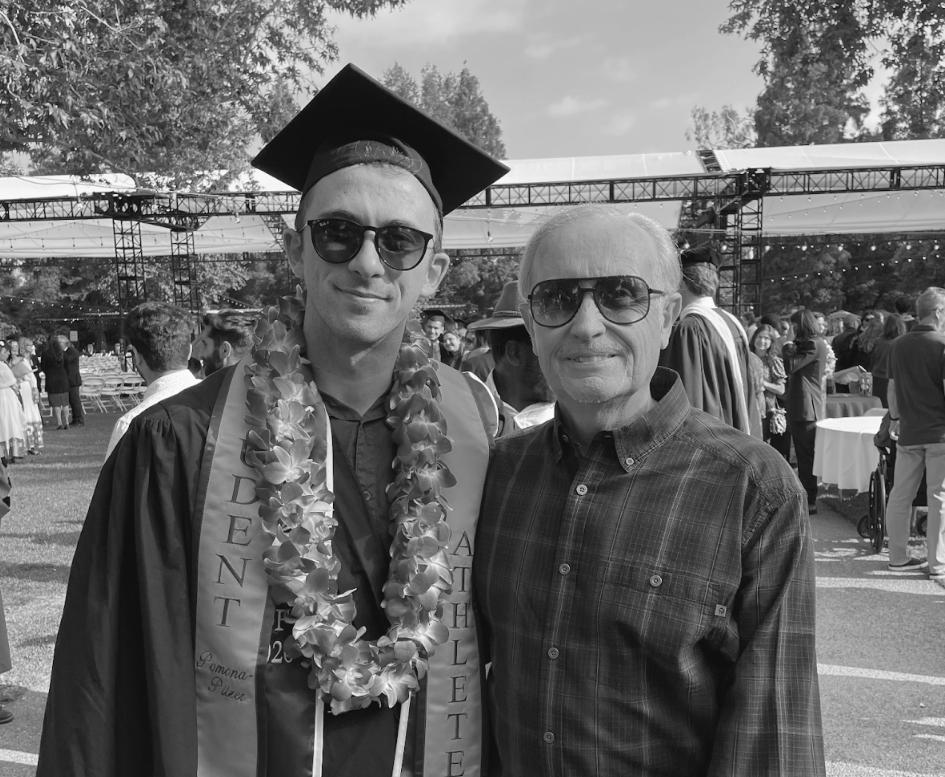
Walk into the Center for Athletics, Recreation and Wellness (CARW) and you are likely to find Steve and Brenda Reynolds engaged in lively conversation with students and staff. For the couple, the gym is not only emblematic of their love for sports but also of their love for the Sagehen community. For Steve, what began as a loose involvement with the Pomona-Pitzer (P-P) basketball team over a dozen years ago has evolved into a meaningful relationship, with him becoming their very own “support guy,” as he put it. “The guy who likes to be around the basketball
College’s Center for athletics, recreation, and Wellness, shares how Claremont
“What I like about it, it just happens real naturally as a function of being here. I don’t have to do anything … just be a part of the community. That’s it,” he said. Born in Orange County, California, Steve competed in basketball and track at George Fox University in Newberg, Oregon. After graduating, his interest in sports continued, which became a cornerstone of his bond with Brenda. At the time, Brenda was working for Athletes in Action, an organization that recruits top athletes to major colleges. Steve fondly recalled going to games with her, recognizing these moments as what laid the groundwork for
their relationship. Still, it wasn’t until many years later that this passion for athletics would bring him to Pomona College’s Voelkel Gymnasium. Steve’s enduring commitment to athletics is matched by only two things: his passion for music and his love for his wife. His childhood introduction to the saxophone sparked a lifelong musical journey, which eventually bore fruit with the creation of his collegiate band, TRAX. After graduating, he took a hiatus from music and began working in the aerospace industry. However, years later, his love for music resurfaced, bringing him to his true calling as a music teacher and
performer. One of his greatest joys has been sharing the gifts of melody and rhythm with his students. His latest project brings this passion close to home — literally. The couple is in the process of transforming their garage into a fully equipped musical space, the perfect place to share their skills with the community and welcome other musicians. For Brenda, a talented pianist, music was also a point of connection. The pair met at church and quickly bonded over their mutual interests and values. The love that grew out of their shared musicality continues to shine, and they celebrated their 47th (chirp chirp!)
anniversary this year. Steve recalled how their relationship developed organically, emphasizing that “[Brenda] is a very kind person. The way she would treat me, of course, that’s a big part. And how you work together, get along together … and so I knew that all those things were lining up. I didn’t even think of it consciously. I was just naturally experiencing that.”
It was the little things, too.
“I like the way she dressed. I liked her hair. She has very thick hair and nice hair. And are those the most important? No, of course not. But they’re all part of what brings you together, you know, makes you interested in the other person,” Steve said.
Brenda worked in Pomona’s Career Development Office for years, which kicked off the Reynolds’ relationship with the Claremont Colleges. In the evenings, Steve would stop by the gym, throwing up shots while the basketball team warmed up nearby.
“I just would go in there and I’d see some of the guys shooting around and I’d shoot around on the side basket, you know, so I wasn’t in the way or anything,” he said. Eventually, he was invited to stick around during practices and became a familiar face to the team.
As time passed, Steve developed deeper connections with the players, getting to know their families too. These transient moments, spontaneous conversations and unexpected connections are the seeds that grew into the robust community surrounding the couple. Their relationship with the team continues to draw them back to their perch on the CARW couches, waiting to run into one of their many Sagehen friends.
When asked how he wants to be known, Steve labeled himself as “just a person who’s interested in others.” His genuine care for the community is apparent in his interactions with students, and the feeling is mutual — students running into the couple cite the way these interactions have brightened their day.
“They make me feel heard and they’re a nice presence to be around,” said Abhi Namala PZ ’27, a forward on the P-P basketball team. For the young people he cares so deeply for, Steve has one piece of advice: “Nobody has an answer for all things you’re going through. You’re trying to figure that out, alright? So be true to yourselves. Be true to yourselves, your passions and what’s on your mind. Be true to who you are as a person and you’ll be okay.”
COurTeSy: STeVe reyNOLDS
Steve reynolds, one half of the couple found frequently at Pomona
came to be a place of community and care
him and his
Romantic disconnections: Christine Emba proposes a new sexual ethic
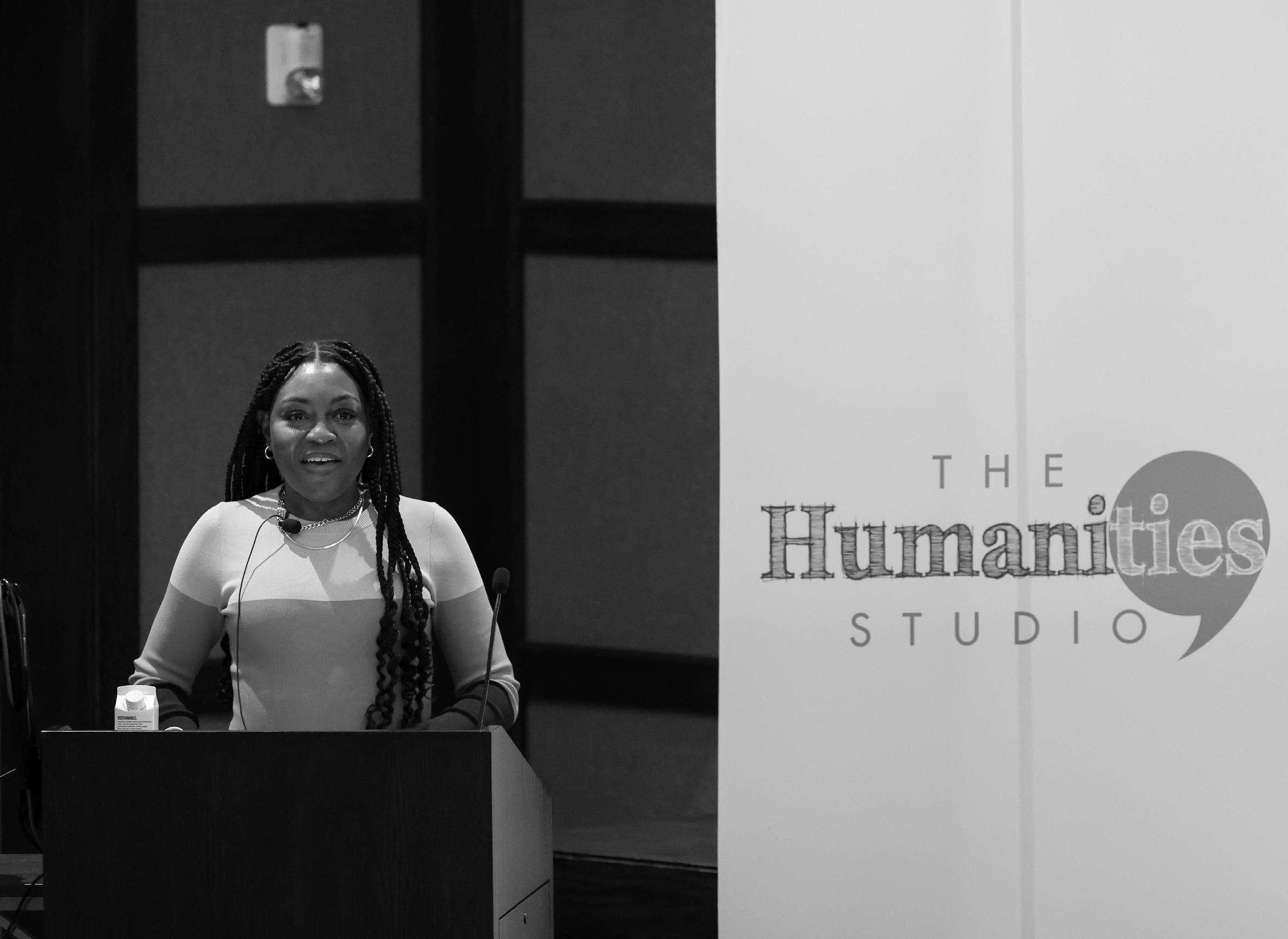
“[We need] to tell the truth about sex. Its emotionality, its biology, the sociopolitical frameworks that influence us,” Christine Emba said. “But it also means balancing our desires with our responsibilities to other people, and recognizing that consent isn’t enough.”
On Feb. 13, Emba spoke about how our misunderstanding of the role of sex is one of the primary causes of growing romantic disconnection in American society. Her lecture is the latest in the Humanities Studio “Connections” series.
Emba is a staff writer for The Atlantic and author of the book
“Rethinking Sex: A Provocation.”
Susan McWilliams Barndt — a professor of politics at Pomona College — introduced Emba and emphasized how the book significantly impacted her students.
“I watched [it] break my Pomona seniors … in the best possible ways. They loved the book because they didn’t like the book, and they didn’t like the book because they loved the book. They were inspired by it … They were troubled by it, and … provoked by it,” McWilliams Barndt said.
Kevin Dettmar, W.M. Keck professor of English and director of the Humanities Studio, explained that the talk is meant
to challenge the existing consensus on intimate connection and examine romantic relationships as a site of connection.
“We’re trying to think about what connection can mean in a lot of different kinds of contexts, and this is about emotional, intimate or romantic connection,” Dettmar said. “I hope that [the audience] will come away with questions for themselves and for their relationships.”
Emba argued that we as a society have separated romantic connection and friendship in a way that contributes to the rise of loneliness. Instead, she said, these two forms of connection should coexist.
Last year, the U.S. surgeon general declared loneliness a public health crisis. Whether it is romantic or platonic, connections are few and far between. The health risks of this resulting loneliness are greater than those of obesity or physical inactivity. Emba said that men report having fewer than five friends, and emphasized that loneliness significantly shortens lifespan.
“Friendship between the sexes seems to be disappearing as a connection in any sense,” Emba said. “If we think about romance, we see that marriage rates and partnership rates are falling at a remarkable clip.”
Emba attributes this decline
in romance to a broader individualistic cultural narrative that frames romantic relationships as inherently self-serving. She asked the audience to rethink this view.
“When you learn from the culture, even ambiently, that people are disposable, it becomes harder to remember to treat them with value, even in non-dating, non-sexual contexts,” she said.
Emba believes that youth education about sex tends to focus on consent too much at the cost of communicating a positive approach toward sexual relationships.
“Consent isn’t enough,” she said. “There’s a wide area between consensual, which is to say non-criminal encounters with other people, and the sort of encounters we actually want to have.”
Jason Alperin PO ’28 was particularly surprised by Emba’s view that consent is not the only key factor in romantic relationships.
“I thought it was really interesting [to] think of consent as a legal thing, and rethinking relationships as needing more than consent,” Alperin said. “I feel like people have never talked about those two things in the same sphere.”
In lieu of consent, Emba proposes a new sexual ethic with the goal of “willing the good of the other,” a theory proposed by philosophers Thomas Aquinas and Aristotle that defines the criteria for any mutually beneficial relationship: being present, paying attention and doing good for one’s partner.
“Attention is a necessary precondition for ethical behavior, looking for connection,” Emba said. “It would also mean holding in our minds the concept of every individual person’s intrinsic worth and realizing that our individual preferences shouldn’t outweigh someone else’s good.”
Attendee Zoe Dorado PO ’27 was intrigued by Emba’s reflection on the nature of desire.
“I liked that quote: ’Why do I want things that I want, and what would I want if I had the choice?’ Desire doesn’t exist in a vacuum,” Dorado said. “The outside can influence the inside, and the inside can influence the outside.”
In an increasingly disconnected world, Emba argues that romantic connection, despite the challenges, is still worth pursuing.
A ripening issue: Dan Koeppel talks about the future of bananas at the Athenaeum
“This is my book… and these are bananas!” Dan Koeppel said.
On Wednesday, Feb. 12, Koeppel — author, journalist and banana expert — held up a bunch of bananas in front of an audience at the Marian Miner Cook Athenaeum to begin his lecture, titled “Why The Banana is Absolutely Everything.”
Koeppel is the author of numerous books, including “Banana: The Fate of the Fruit that Changed the World” (2008). He has also appeared on the NPR segment “Fresh Air” and published articles about bananas in The New York Times, National Geographic and Popular Science.
Embracing the name “Dan the Banana Man,” Koeppel described himself as having the world’s broadest knowledge of bananas. After writing a National Geographic article about bananas, he felt there wasn’t enough space to fully explore the topic. Koeppel decided the banana needed its own book.
Athenaeum Director Priya Junnar said that Koeppel’s talk, covering American history, global economics and agricultural science, made him a perfect contender to speak at the Athenaeum.
“We try to have a broad range of topics that grow everyone’s intellectual experience and mind,” Junnar said. “[Koeppel’s talk] makes a lot of sense, and it also ties together so many breadths.”
The banana has a surprisingly long history, and its story holds important implications for the future of global food supply chains.
Bananas are a cheap, staple food item for Americans — the average American consumes 100 bananas per year, Koeppel noted — but they are expensive to ship, store and grow.
“If I buy a local apple even today at my supermarket, it costs triple per pound what bananas cost,” Koeppel said. “Bananas are shipped from thousands of miles
away, they go bad really quickly, they require refrigeration, they’re incredibly expensive to produce.”
To explain this discrepancy, Koeppel peeled back the history of bananas in the United States.
He began with the introduction of bananas to American consumers by Chiquita, the first banana company in the US, using an intense marketing campaign of ads, coupons and cheap prices. For this model to work, Chiquita needed to drastically deflate banana prices.
“To make any product cheaper,” Koeppel said, “you control the means of production — which means workers, factories, physical plants — and you market to increase demand.”
To lower these costs of production, Chiquita heavily exploited land and labor in South and Central America: burning statehouses to destroy property records, massacring strikers and even overthrowing governments.
“Between 1900 and 1954, bananas were responsible for 30 government overthrows in Latin America, directly funded by the United States military and Chiquita banana,” Koeppel said. Banana companies also kept prices low by introducing monocropping and large plantations.
“They figured out how to standardize bananas,” Koeppel said. “Let’s not think of bananas as farm foods. They are not from nature: gardening is gone, banana plantations are factories.”
These banana plantations were, and still are, incredibly susceptible to disease. To this day, a single clump of dirt-carrying fungus can easily wipe out an entire plantation. In the past, this fungus has even wiped out entire banana cultivars.
“The banana that was grown in Latin America in the early days was called the Gros Michel, and it was a very different banana breed,” Koeppel said. “It was tougher, it was easier to ship.”

By the 1960s, the Gros Michel had been completely wiped out by a fungus called the Panama disease. Rather than address this fungal problem caused by monocropping, banana companies simply found a new cultivar to fill U.S. markets.
“There are over a thousand banana varieties,” Koeppel told the audience. “You’ve probably only tasted one of them, the Cavendish banana. I can tell you as someone who has tasted many bananas over the years, this is the worst banana on Earth.”
The Cavendish might be the “worst banana on Earth” to Koeppel, but it’s also the only banana cultivar that is widely sold in U.S. markets. Now, a new strain of the Panama virus is spreading, to which the Cavendish is not resistant.
To avoid the loss of bananas as
we know them, Koeppel argued that we need to genetically modify new banana varieties that are marketable, transportable and resistant to viruses. Old-fashioned breeding methods, he claimed, are too slow and too unpredictable to be effective.
“We do need a commodity banana. It will probably be a [genetically modified organism (GMO)] banana,” Koeppel said. “Bananas don’t have seeds or pollen, so some of the things we’re scared of about GMOs don’t have to happen in bananas.”
Once a new commodity banana has been created, he argued, several more varieties should be made and added to U.S. markets.
“We replaced the commodity banana we had at the grocery shop with another commodity banana,” Koeppel said. “It was bad science. It was bad politics.
So why are we still trying to do this: why are we looking for a single commodity banana?”
Attendee Tarika Modi SC ’27 appreciated learning about the background of such a ubiquitous fruit.
“It made me realize I don’t always know where the things I buy comes from,” Modi said.
Despite the issues threatening bananas, Koeppel sees an optimistic future for the banana industry.
With new varieties sold at higher prices, he believes that global supply chains will be able to spread profits more equitably to the countries and workers growing the fruits. He also has a personal reason to want new marketable banana varieties — his love for bananas.
“The benefit all of us will have is great bananas in the United States of America.”
MALIN MOELLER
aNDreW yuaN • THe STuDeNT LIFe
Dan Koeppel discussed the history and future of the banana industry at the athenaeum on Feb. 12.
SaraH ZIFF • THe STuDeNT LIFe
ANANYA VINAY
On Feb. 13, Christine emba spoke about how our misunderstanding of the role of sex is one of the primary causes of growing romantic disconnection in american society.
‘My
hand followed hers’: Exploring a mother-daughter relationship through April Katz’s ‘Marking Time’
ANSLEY MASHUDA
“Sometimes it is only after a loved one has passed away that we have the opportunity to learn about aspects of their world through the items they left behind,” Jennifer Martinez Wormser SC ’95, director of the Denison Library, said.
On Feb. 6, Scripps College’s Denison Library and Clark Humanities Museum unveiled “Marking Time: Examining a Mother and Daughter’s Relationship Through the Prints, Collages and Artists’ Book of April Katz,” a body of work by April Katz. Katz gave a lecture about the collection to students, faculty and community members before the exhibition’s opening reception at the Clark Humanities Museum.
“Marking Time” is a window into Katz’s late mother’s history and an homage to her life.
An artist and printmaker, Katz is the Morrill Professor Emeritus at Iowa State University and former president of the Southern Graphics Council. Last year, Katz donated her “Marking Time” series of prints, collages, artist’s book and related archival materials to Denison Library, where they form part of the library’s collections related to women’s lives and accomplishments.
The show was curated by Martinez Wormser and Sally Preston Swan, the Denison Library Librarian.
“Your mission to collect materials by and about women and to build on the library’s collection of
FIXaTIONS
artist’s books attracted my attention,” Katz wrote in an email to Wormser.
After her mother, Bernice Edythe Ladisky Katz, passed away unexpectedly in April of 1992, Katz came across her monthly planners.
“I remember throwing them in the trash, walking out of the room, and then turning around
to retrieve them,” the artist said. “They were a record of her recent past.”
Grieving the loss of her mother, Katz revisited some of her previous artwork, adding tracings from her mother’s planners to old prints. Through this process of incorporating pieces of her mother into her own work, Katz began the “Marking Time” series.

themes of loss, grief and the passage of time.
Who runs the world?
In ‘Herland,’ it’s girls
VIVIAN FAN
What if we were all women?
That’s a question many had after Trump’s recent “Defending Women” executive order, which attempts to legitimize transphobia by giving a biologically incorrect definition of sex as something determined at “conception.” Online, many speculated that this order ironically declared all Americans to be women, since past research has popularized the claim that fetuses start as female by default. Recent research shows that it would be more accurate to describe embryos as nonbinary at conception, so the executive order could actually be creating a completely nonbinary United States, which is also pretty funny.
But the question of what would happen if we were all women has been asked before, by American feminist and eugenicist author Charlotte Perkins Gilman.
Her most well-known work is the wonderfully horrifying “The Yellow Wallpaper,” which depicts a woman’s descent into madness as a result of postpartum depression, the patriarchy and some particularly ugly (and yellow) wallpaper.
I most recently read it for my Intro to Close Reading class last semester, but I first read Perkins Gilman’s feminist stories when I was 10. Perusing my sister’s copy of “The Yellow Wallpaper and Other Stories,” the book quickly became one of my favorites.
So when discussing famed sex offender Trump’s ridiculous “Defending Women” order with my sister, who works as a government employee (though not for much longer), my memory of Perkins Gilman’s canon was jogged. I decided to read her 1915 utopian novel “Herland,” about the titular land: a utopia populated solely by asexually reproducing women. In “Herland,” after various wars had diminished the male population and a landslide isolated the remaining women, the future of the population was saved when one woman was discovered to have the ability to have children asexually.
The novel is from the perspective of three clueless American male explorers. When they stumble upon “Herland,” the area is populated by that first woman’s descendants, who have inherited her ability to reproduce asexually and who have developed Herland into a utopia. Through their stay in Herland, the explorers eventually realize that the efficient, sexless and motherly society of Herland is far superior to American patriarchy.
This realization is by no means instant; like the American conservatives of today, they are constantly frustrated that there is “nothing to defend [the women] from or protect them against,” no way to assert the authority the male explorers believe is inherent to them.
The male explorers continuously struggle to figure out what a woman is when not considered in the context of a man, and in the process, the men also struggle with their own gender identity.
Though the novel does explore
how the gender binary is harmful to all involved, “Herland” is also shrouded in controversy; Perkins Gilman was a famous proponent of eugenics.
This utopia of women is, more specifically, a utopia of white women. These are women “of Aryan stock,” as stated in the novel, whose progenitors immigrated from Europe, and they now dwell on a mountaintop quite literally high above a rainforest filled with “savages.”
Perkins Gilman’s choice of creating a utopia of white women is an example of how American ideas of femininity, and even American feminism, are Eurocentric.
The widespread belief that there is only one type of woman, and therefore femininity, makes trans people and especially trans women much more likely to experience discrimination and violence than their cisgender counterparts.
In Herland, the problem is preventing certain undesirable women from reproducing. Only some are permitted to produce one clone/ child, and only a select few (called “Over Mothers”) can produce multiple clones.
Those who are bad and deemed unworthy aren’t allowed to reproduce; eugenics is what has gradually led Herland to a population of perfection.
But who gets to decide who’s bad? How is it decided? There is no clarity as to how superiority is determined.
While I obviously do not condone Perkins Gilman’s eugenics schemes, I do think her method of exploring feminist ideas through popular media forms, like the utopian novel, is something worth doing in today’s political climate.
Additionally, in light of current events, where the rights of trans people and especially trans women are being targeted by the current administration in the name of “defending women” and “protecting American values,” we need to look critically at the weaponization of womanhood.
Now more than ever, your feminist views, liberal views, democratic views –– whatever you call your beliefs –– must include advocating for trans rights. Because when politicians question who deserves to be a woman, what they are really questioning is who deserves to be treated as human. And that’s not just a dangerous question to ask: It is a dangerous question that is now being answered.

By tracing 14 years of calendar days from her mother’s planner, Katz unveiled her mother’s daily life.
“The act of tracing my mother’s written entries felt like a kind of postmortem collaboration,” Katz said. “My hand followed hers.”
Vibrant and full of allusions to her mother, Katz’s collage monotype “Remember who you are” marries a breadth of souvenirs relating to her mother’s life with a recurrent calendar grid, creating a repetition that invites the viewer into the minute details of the scene.
“The repetition of the calendars’ grids unifies the complex whole,” Katz said. “Unexpected juxtapositions and the complex layering of ink that printmaking offers encourage close and sustained study by viewers.”
“The whole concept of time and the repetition of that is a really beautiful way of processing hard moments,” attendee Mikayla Stout SC ’25 said, reflecting on themes in Katz’s work during the gallery opening.
Katz’s initial prints from 1992 later became part of her book “Marking Time: Her Days,” which explores memory and the experience of passing time. Katz described how she organized the book, systematically binding the pages on different sides, the translucent paper allowing the viewer to see through to the next page as a representation of the passage of time.
“The act of reading the book is like an ‘unweaving’ of the days,” Katz said.
In curating “Marking Time,” Martinez Wormser placed Katz’s mother’s calendar alongside other women’s calendars from the twentieth century that exist in Denison’s archives.
“Katz’s ‘Marking Time’ series creates another opportunity for us to reflect on the day-today routines of women’s lives, from paydays to birthday parties and PFLAG meetings,” Martinez Wormser said.
The layered quality of printmaking provides “information that gradually unfolds through sustained looking,” Katz said of her prints. Being able to experience her work in a gallery setting allows for this tangible viewer experience.
“Katz’s layers of printmaking processes and collaged images create a bit of a scavenger hunt for her viewer,” Martinez Wormser said. “I’m always finding something new in her prints.”
Toward the end of her talk, Katz asked her audience to consider how the people in their lives see them change from day to day, as she was able to see her mother change from day to day through her calendars.
The calendars preserved “the details that made up her life and the lives of those she cared about,” Katz said of her mother.
“Marking Time” and other archival materials are on display in The Clark Humanities Museum until Feb. 19, 2025.
For the love of the game: 5C alumni discuss working in Hollywood
“Most people who try to become writers in Hollywood do not get a job writing for five or ten years,” screenwriter Nick Hurwitz PO ’12 explained. “If you talk to the average person in Hollywood, a working screenwriter, most people do not get their first paid job until a year in.”
It’s well known that find
ing a job in the entertainment industry can be harsh and volatile. Four Pomona College alumni — Luca Rojas PO ’12, Nick Hurwitz PO ’12, Steph Saxton PO ’12 and Nelson Cole PO ’16 — would be hardpressed to disagree.
On Thursday, Feb. 7, the four alumni gathered for “Humanities Futures: Hollywood Edition,” a panel hosted by the Pomona College Humanities Studio. Having majored in either English or media studies at Pomona, each alum spoke about their path to their current career in Hollywood.
The panel is part of the Humanities Toolkit series, a collection of practical talks and workshops that “try to help folks imagine humanities work outside of the context of the campus,” according to Humanities Studio Director Kevin Dettmar. “So, what does the humanities look like when it goes out into the world?”
For these panelists, it looks like Hollywood.
“[The entertainment industry] was the goal for me,” said Saxton, who serves as vice president of content scheduling & prioritization at Hulu. “I didn’t know what within the entertainment industry, but I just knew it.”
Coming out of college, Saxton reached out to more than 20 people working in the entertainment industry she had found on LinkedIn. She got a response back from a business affairs agent at talent agency William Morris Endeavor (WME) and ended up pushing a cart in the company’s mailroom.
Rojas later landed a job at the same mailroom as Saxton.
“I heard from a mom’s friend’s friend that actually the way to crack into the entertainment industry was to work in an agency mailroom,” Rojas said. “I didn’t realize this until coming in here today that my first job, partially the reason I got the job at WME, is because of another panelist on this panel, Steph.” Saxton and Rojas began at the bottom of the ladder and slowly worked their way up. Similar can be said for Hurwitz and Cole, who started as a pro -
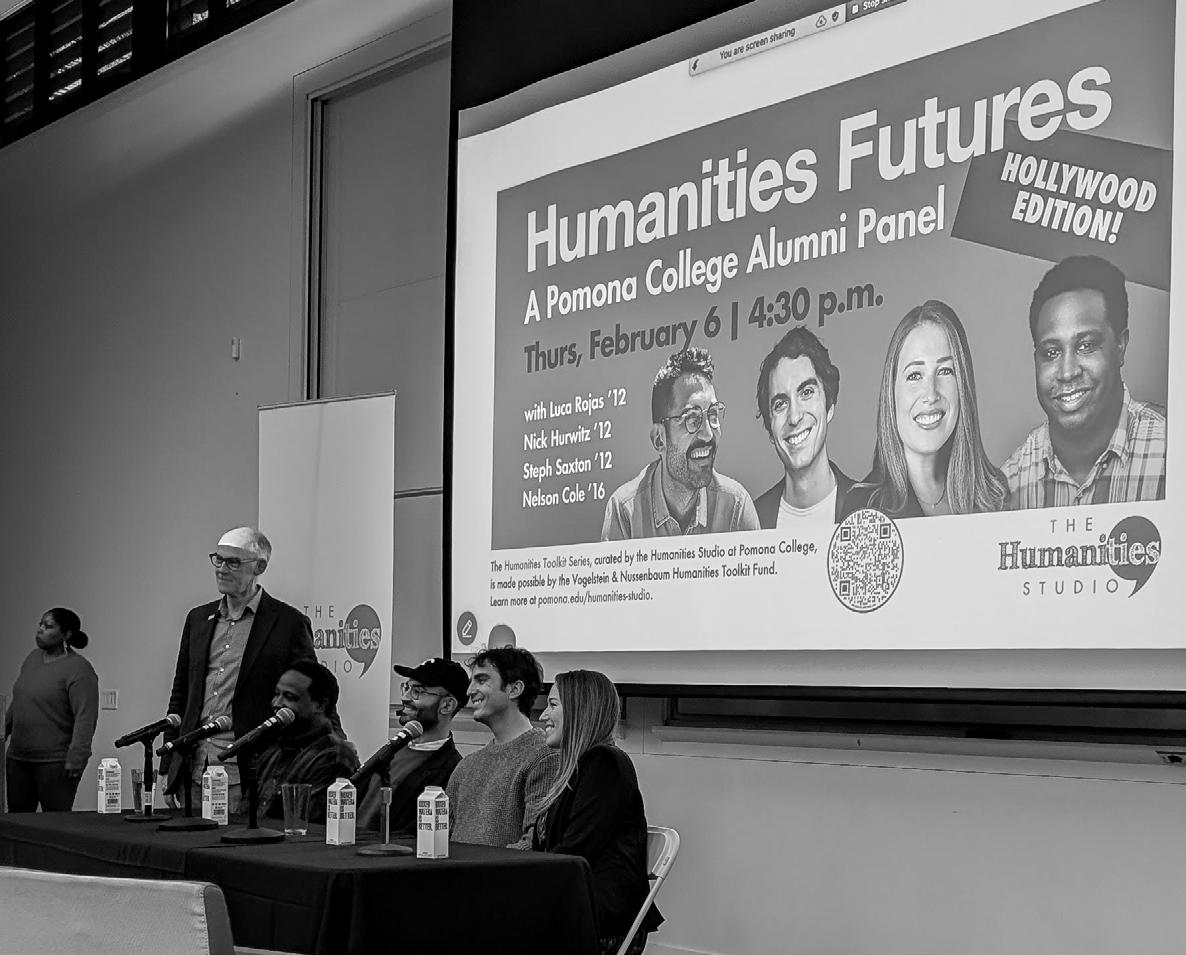
duction assistant and publicity intern, respectively.
“One of the very weird things about Hollywood is that no one cares about where you went to college,” Hurwitz said. “No one cares.”
“There’s so many jobs that might be comfortable, but you need to take [an uncomfortable] job sometimes,” said Cole.
So, many of them took jobs that weren’t exactly comfortable and went from there.
After pushing carts in WME’s mailroom, Saxton became the assistant to WME’s co-CEO. Later, she transferred to management — first at Legendary Entertainment and then at Disney and Hulu. The other alumni’s career paths were a bit less linear. Rojas’ mailroom job allowed him to jump into some writers’ rooms, first as an assistant and later as a contributing writer. After a pilot he worked on didn’t get picked up, Rojas left the entertainment industry momentarily.
“NBC, in their infinite wisdom, did not pick [the pilot] up, which kind of disillusioned me from the entertainment industry for a bit,” Rojas said.
“That prompted me to toss all my things into a car and drive back to New York.”
After four years working at a marketing agency, Rojas came back to Hollywood, first reading scripts for The Black List, a writer-centric platform for storytelling, before being hired to work on the Netflix series
“Wednesday.” Hurwitz, on the other hand, moved between personal assistant jobs before eventually becoming a showrunner’s assistant. After freelance writing a couple of episodes and being
offered positions at shows that got abruptly canceled, he finally landed a role as a screenwriter at a TV show.
Cole began as an intern script reader and later began screenwriting while enrolled in an MFA program near Hollywood. After the 2023 Writers Guild of America strike, he started teaching parttime and then decided to pivot toward a career in education.
Despite the menial tasks, the disillusionment, the cancellations and the career pivots, each alum seemed happy in their current career.
“They all sounded like they really enjoyed what they were doing,” audience member Adelina Grotenhuis PO ’28 said. The alumni testified to the occasionally brutal nature of trying to make it in the entertainment industry, which has become increasingly volatile in recent years, leaving many Hollywood workers unemployed.
“It requires a tremendous, almost irrational, degree of optimism and perseverance,” Rojas said. “Having a tremendous rational faith you are going to persist and come out victorious, while at the same time having a sobering awareness of the brutal realities of your day-to-day existence and maintaining both these mindsets at the same time — I would describe that as being quintessential for survival in a career.”
As to why they keep going despite the instability and setbacks, Saxton shared some insight.
“This industry keeps you on your toes,” Saxton said. “You’re always getting laid off, your shows are always getting canceled, you’re gonna have to find a new job every couple years. But we keep doing it because we love it.”
eVeLyN HarrINGTON • THe STuDeNT LIFe
SPeCuLaTIVe
NICKOLAS MORALES
NICKOLaS MOraLeS • THe STuDeNT LIFe
Vivian Fan PO ’28 is a book columnist from Memphis, Tennessee.
a Feb. 7 panel highlighted alumni of the english and Media Studies departments who have pursued Hollywood careers.

Beyond the campus bubble: Making long-distance relationships last
SARAH RUSSO
10 p.m. + 3 hours = 1 a.m. Too late. As I text my partner back home, I do the math in my head to figure out their time of day for what seems like the 400th time today. If I’m texting my best friend, it’s 10 + 9. She’ll be up, right? 7 a.m.? She can pick her phone up for me.
I text my partner, who is on the East Coast, as is nearly everyone I have ever known before coming to Claremont. The likelihood of a response is debatable; it is late Monday night here, let alone across the country.
It is moments like these where I am filled with doubt: did I choose a school too far? Am I missing too much of my brother’s life? How are my dogs doing? Should I be in a relationship when I cannot see them for 100-day periods?
Dismissing long-distance relationships (LDRs) outright overlooks what they can actually offer — deeper communication, emotional resilience and personal growth. The distance is tough, but I’ve found that it forced me to connect more intentionally on Pomona’s campus and has pushed me to build the kind of habits and trust that has made my relationship stronger in the long run.
Various studies show that LDRs are not inherently weaker than geographically close relationships; they often cultivate higher levels of trust, communication and emotional inti-
macy. Because LDRs require partners to be intentional about their interactions, they promote deeper conversations, conflict resolution skills and mutual respect. Rather than relying on proximity to sustain a relationship, couples in LDRs develop habits that are foundational to long-term success. Additionally, LDRs encourage personal growth. College is a time of self-discovery, and maintaining an LDR can reinforce the importance of balancing personal, academic and social life.
The idea that a romantic relationship must be all-consuming can be unhealthy; learning to set boundaries and maintain individuality within a relationship is a crucial life skill. When LDR partners prioritize their individual development while still nurturing their connection, they create a healthier, more sustainable dynamic.
An unexpected benefit of being in a long-distance relationship during college is the freedom it offers to form deeper connections within the campus community. Without the constant pressure of a partner physically present, I’ve been able to invest time in building friendships and engaging more fully in my immediate environment.
I genuinely have never felt so connected to a group of friends as I do at this moment. Had I been
focusing on my relationship, I doubt I would have built the friendships I have today.
There are still social sacrifices, no doubt — staying in one night to spend time on the phone, arguing over text while at dinner — but these sacrifices have been well worth it. They have helped me develop an equilibrium between my relationship and social life while allowing me to grow independently.
For students at the 7Cs, the question of a long-distance relationship is almost inevitable.
78% of engaged couples experience some form of long-distance before marriage. Whether it’s dating someone from another non-7C campus, Harvey-Mudd to Pomona (if you consider that long distance), studying abroad or staying connected with a partner from home — it is a reality that most of us will have to face.
While distance poses challenges, it’s also an opportunity to rethink what a relationship can offer during college. For me, being in an LDR has taught me to use my time intentionally, not just to stay connected with my partner, but to forge a stronger sense of independence and belonging on campus.
Using the loneliness from this distance pushed me to get out of my comfort zone and has allowed me to thrive independently while

still having someone to depend on. By shifting our perspective and embracing the beauty of love that spans miles, we prove that love knows no boundaries. Despite being nine hours apart, I have never considered ending my friendship with my best friend. I maintain a relationship with my parents 2,000 miles away. My brother is still my brother, even if I get a text from him on a bi-monthly basis. Yes, these relationships are inherently different, but the distance does not invalidate them. So why should
distance spell doom for romantic relationships? Ultimately, LDRs are not doomed to fail despite the prevailing narrative. With effort, communication and a willingness to embrace the challenges and benefits, students can successfully navigate long-distance relationships while still excelling in college — socially and academically.
Sarah Russo, PO ’28 is a PPE major She loves going to the gym with friends, listening to Tyler Childers and spending her free time in the village
Lunar New Year felt like it was my birthday and no one knew it
NICOLE TEH
Since coming to the U.S. for school at the age of fourteen, I’ve tried to recreate the magic I used to feel during Chinese New Year. Growing up in Singapore and Hong Kong, we made New Year’s crafts at school and teachers recounted the story of Nian. My sister and I wore little qipaos and got showered with laisee at big family dinners. I’d stay up all night waiting for the New Year’s fireworks to scare the Nian monster away, and make sure there was red on my windows, always. Unfortunately — apart from a lackluster McConnell Dining Hall Lunar New Year feast with a few Asian friends — I felt isolated from my own culture and struggled to feel seen at the 5Cs this year.
Scripps is the whitest place I’ve ever been. My high school had a tight-knit student body that embraced multiculturalism and community. The whole school showed up to our annual Lunar New Year celebrations, regardless of their background. However, at Scripps and the 5Cs, the contrast has been disappointing.
There is a lack of curiosity from my white peers out of fear of messing up or not knowing enough. This is causing cultural blindness at the 5Cs.
As an Asian international student, I’ve wrestled with my identity.
I feel drawn to, but undeserving of, the Asian American identity, and also don’t have the language background to speak seamlessly with other Chinese international students. I’ve struggled with feeling vastly different to those around me, wondering if I’m as beautiful or worthy.
Many of my white peers hesitate to talk about race, and moments like Lunar New Year accentuate the feeling that there’s so much about me they don’t — and don’t even try to — see.
However, when my cultural identity is sometimes the only thing I can hold onto in a country as racialized as the United States, the intentional effort to address our differences and learn more about each other actually makes me feel the most seen. I understand that no Chinese New Year will ever be like the ones at home and that is the price I pay for being abroad. Still, I wish that individuals would be more intentionally curious and thoughtful in our mostly white community.
When Lunar New Year finally arrived, I carefully picked out my red outfit, hoping to spot peers remembering what I’d told them about wearing red on the holiday.
I held my breath while greeting my classmates and friends, wondering if someone would at least text an acknowledgment. My
messages and attempts remained anticlimactic.
This year, the professor for my Chinese conversation class — an Oldenborg language resident — hosted a New Year’s Eve gathering for students studying Chinese and living in the language hall. Not knowing anyone there, I sat to the side, worried talking to someone I didn’t know would reveal that 1) I’m not as Chinese as I look and 2) I’m more American than I look. I bumped into two of my white classmates. Although I was habitually worried I’d feel misunderstood by white people at the 5Cs, I let my guard down and we devised a scheme to sneak ourselves
extra dumplings. On our walk back together afterward, one of my classmates asked if they could ask a personal question. I said yes. My chest tightened slightly.
“Are you ethnically Chinese?” they asked.
I replied yes.
“How do you feel about white people learning Chinese?”
I was instantly relieved. During my whole time at Scripps, none of my white friends have brought up race unless I had first. I think about being Asian every day, so it’s hard to feel completely seen when they don’t mention it. My
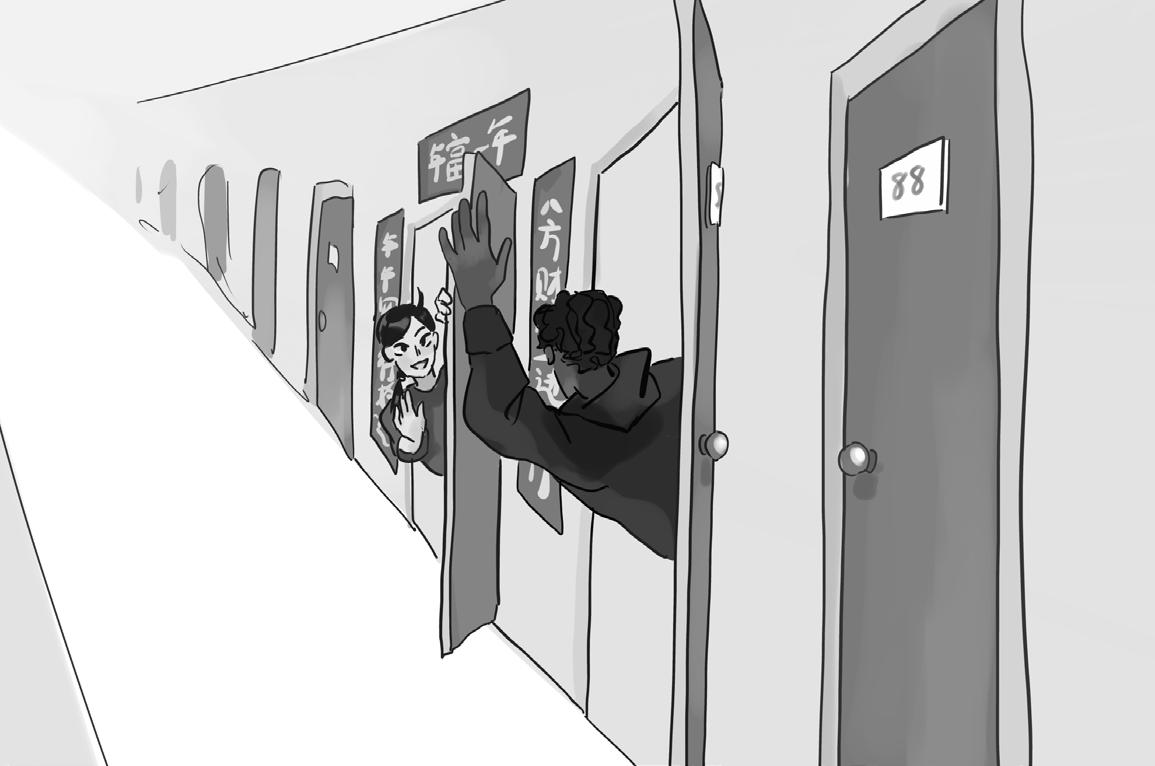
heart warmed at the fact that these people I barely knew were brave enough to do so.
I said I thought it was cute. They joked about how that was my fake answer and I insisted I was telling the truth.
I went on to explain how putting in the effort to learn a language they have no ethnic ties to makes me feel seen. Most Chinese learners I know are ethnically Chinese and trying to connect deeper with their heritage, so it means a lot to me that they’re trying without that background. It made me feel seen to realize the way these white people, with no cultural connection to Chinese New Year, had come to this celebration and loved the same foods I did.
It wasn’t what I imagined, but a shared love for food, each other and a willingness to learn more brought joy to a seemingly gloomy day. That’s what makes holidays special to me.
“Yes,” they answered as they laughed about being my diversity hire. “We can be your white friends!”
“I have white friends!” I said ironically. “I go to Scripps.”
Nicole Teh SC ’27 is from Hong Kong/ London/Orange County. To her white friends: she understands. It’s impossible to absorb someone else’s memories and fully grasp what something means to them, but she just asks that you try.
When Campus Security fails, who keeps us safe?: Pomona’s ongoing failure to protect students
On Oct. 10, my roommate and I locked up and readied our room in Lyon Court, a Pomona freshman residence hall, before leaving for fall break. When we returned on Oct. 14 and reopened our locked door, we found our lights on, our windows opened, our laundry moved, our vacuum used and a perfume missing. My roommate’s computer had a notification displaying too many login attempts. Someone had been in our room.
We tried to justify it by saying it was one of our friends, but it was quickly apparent someone unknown to us had been in our dorm — for hours.
We called Campus Security, who took a report and told us there was nothing to do. “If it becomes a pattern, we can do something about it,” they said to us while we stood there describing the break-in.
We requested the camera footage from around the area but never received a response. Pomona was willing to identify masked students who participated in the Oct. 7 protest at Carnegie Hall using wi-fi log-ins and security camera tracking, but neglected us when it came to our safety. Clearly, Pomona’s administration and Campus Security have the means to do some investigative work. Despite Pomona College’s increased spending on Campus Security in response to campus protests — also restricting key card building access and an anti-masking rule — the college is taking less initiative to ensure the safety of their students than to increase their ability to monitor us. When Lyon residents actually needed protection, that security presence was nowhere to be found.
Pomona is responsible for our safety, and should primarily use their institutional resources to protect, not prosecute, their students.
Two weeks later, another stranger took my neighbor’s food from the communal fridge, used our bathroom shower multiple times in one week and screamed at one of our neighbors. We called Campus Security again, who delegated the situation to the Claremont Police Department. They gave the person a warning and escorted them out.
I wish I could say that was the end of Lyon’s fall semester incidents. Strangers, streakers and more seemed to be the new weekly story among Lyon residents. It became a pattern where students barely needed to react anymore, aside from exhausted, knowing glances.
A recent TSL article covers the
most recent — and arguably most violating — incident yet: an intruder masturbated in a Lyon bathroom while a resident was showering.
An email to South Campus residents signed by Dean Josh Eisenberg, Assistant Director of Residence Life Ryan Haynes and Title IX Coordinator Destiny Marrufo assured students that Campus Security “takes these incidents very seriously and is committed to responding in a timely manner.” Yet, as my roommate and I experienced firsthand, we were left in the dark following our incident.
Instead of acknowledging the apparent lapses in security, we received a list of recommendations that placed the burden on students: “Refrain from letting unknown individuals into residence halls” and “make sure doors are securely closed and unpropped.”As if we
weren’t already doing that. These statements imply that safety is a personal responsibility rather than an institutional one, ignoring the systemic failures that allow these incidents to happen. By the time this article was written, on Feb. 8, another trespasser had been escorted out of Lyon in the morning. And at 4 a.m. the next day, another incident. It is absurd to pretend that these incidents are the results of repeated student mistakes rather than a larger security failure — especially when we were already astutely aware of keeping our doors locked. Additionally, there is no other dorm on South Campus facing this issue. What is the probability that these separate incidents, occurring only in Lyon, are entirely unconnected? Infinitesimal.
Campus Security’s failure to act after the initial break-in allowed every violation since.
Living in Lyon has become an experience of perpetual vigilance. Residents are constantly aware of their surroundings, check and recheck locks and feel uncomfortable when strangers walk by. At this point, we no longer feel safe showering in our dorms.
Campus Security has only begun taking meaningful action within the past two days, checking in with impacted residents and stationing a car outside overnight. This raises the question: Why did it have to get to this point?
This reactive approach — waiting for incidents to accumulate before stepping up — suggests a failure of the system to prioritize student safety from the start.
‘If this becomes a pattern, we’ll do something’ is a weak deflection
of responsibility. It’s a failure of a security structure that should have been protecting students before the situation spiraled. Following a string of crimes at CMC in 2018, Scripps did “safety sweep checks” and reevaluated their lock-out policy. While not perfect, Scripps took a step in the right direction: prevention rather than reaction.
Pomona’s improvements in security should not solely be responses to crises — it sets a dangerous precedent for crises to act as excuses for hardened security procedures, like surveillance. I encourage Campus Security and the administration not to allow their recent actions to be solely a reactionary change. Encouraging students to keep their doors closed and sending apologies are insufficient — there is an underlying problem. In the meantime, students, still take steps to protect yourselves and our community.
I’m not advocating for a surveillance state, but rather for more proactive security measures and transparency from administration. Students deserve to feel safe without constantly worrying about whether their dorm is secure or if they’ll be left in the dark after an incident. It’s about creating a system where security is a priority before problems escalate, not just responding after the fact.
Pomona cannot keep ignoring this problem. The administration has the power to make meaningful changes. The question is: how many more students have to feel violated before they do?
Sarah Russo PO ’28 is a first-year PPE major at Pomona College living in Lyon. She loves going to the gym with friends, going to the Claremont farmers market, and creating photo walls.
SARAH RUSSO
Last year, I was born again.
Even though I grew up attending church four times a week in my Anglican middle and high schools, I was not a believer nor a Christian until I came to Claremont. My path to faith was not linear. I am still continuing my journey with Christ while identifying as a non-denominational Christian, attending church and participating in campus-organized Christian groups.
One of the things that I came to realize after my transition into faith is the sharp and concerning disconnect of viewpoints between religious and secular students, especially within the classroom.
Just this semester, during a discussion in my government class on a book about a Christian community in the United States, I was struck by how differently I interpreted the author’s findings compared to my classmates.
Secular students made points about how people joined the church because they sought out community, spiritual and moral guidance and advice on fixing relationships. From my perspective as a Christian, I was surprised because I believed that those same people joined the church not because they were seeking out guidance first, but because they began believing in God, who guided them towards spiritual awakening.
My class was receptive to my views, and their interpretation of the text was not incorrect or a fault of theirs. But the divide in understanding based on our religious standpoints highlighted an issue that is more prevalent in our colleges than we may think.
If our colleges, especially my home institution of Claremont McKenna College, wants to uphold its mission of shaping “responsible leaders,” then our classes ought to bridge the gaps of understanding between the upper class, secular, liberal spaces of our campuses with the rest of the country.
I am not arguing that our colleges or classroom spaces should become religiously affiliated. Only that religious views, not limited to just Christianity, should be respected, valued and explored within the classroom.
You do not have to agree with these views or believe in God, but you should care about understanding those who do.
Although our colleges, and the United States as a country, hold no religious affiliations, the majority of America is still overwhelmingly Christian, with the Pew Research Center reporting that 71 percent of American adults identify as Christian. Our campuses do not reflect this religious makeup, with the Princeton Review ranking Pitzer College, Claremont McKenna College and Scripps College as the 10th, 17th and 21st colleges with the least religiously affiliated students in the U.S., respectively.
In many of my other classes during my college career, especially in the humanities, standpoints based on social identities and their influence on one’s epistemic condition have been an accepted concept.
Take, for example, the context of different feminist standpoints based on one’s social position.
The experiences of Black women are different from the experiences of white women, and thus, their views on and experiences of feminism will differ because of their lived experiences in light of their race. The same goes for gender, social class and sexual orientation identities. The experiences of different social groups shape their views, which ultimately influence their political and social decisions and actions.
But what about religious identity?
One may argue that religion is a choice, not a biological attribute that cannot be controlled. This view exactly underscores my argument for religious standpoints: It is impossible for secular people to have access to the same experiences as those of believers of God. True faith and commitment to God was not a choice for me; rather it was an undeniable realization that God cannot not exist.
Sure, this was not a genetic quality that I was born with, but what about people who choose to be parents? I think that we can all agree that it is impossible for a person who does not occupy the
position of a parent to fully understand what it means to be a parent, and how this identity changes their views and decisions. So social positions and their influence in changing our epistemic conditions do not solely depend on biological factors, but also on different social, familial and religious experiences.
I empathize with non-religious people that this is a difficult concept to understand in light of our experiential and social differences. However, if we have any hope of repairing the politically polarized state of the U.S., then we must try to understand the behaviors and motivators of religious communities, as their experiences through faith are essential to our political and cultural discourse.
To achieve this goal of viewpoint diversity, faculty must ensure that they create a space for students to exercise their right to free speech and create an atmosphere where religious students can share their experiences without judgment.
Professors, secular or religious, also have the responsibility of directing the conversation toward questions of religious views when
appropriate and prompting students to consider cultural and political questions through the lens of religion. As occupiers of this social position, we have insider insight and experiential knowledge of how religious beliefs shape social and political behavior, and these experiences hold value in the classroom.
Secondly, non-religious students should take more initiative to understand their religiously affiliated peers and be charitable towards them. You may not agree with their views and have every right to refute them — but respect and tolerance must come first.
Religious people are not a monolith, just like any other social group, and deducting our political views from our religious beliefs is not only incorrect but also a contributor to polarization on campus and in the country as a whole. Instead, why not approach these communities and views that may be foreign to you through a spirit of curiosity? Come to worship with us, visit our Bible study groups, go to a Shabbat dinner, visit the McAlister Center. Just talk to us. I’m sure that any of the religious
groups on campus would be delighted to see you.
We all have a responsibility to work to understand views outside of our own. Otherwise, we risk being stuck in an epistemic chamber and losing touch with the very real world outside of Claremont. Introducing and emphasizing religious standpoints in the classroom is not only an important step towards cultural and social diversity on our campuses but also the responsibility of our institutions to prepare their students for life after college. Whatever occupation you may have after graduation, you are bound to interact with religious people who make up the majority of the country that we live in. It is in your interest to understand their viewpoints.
We must work to bridge the gap between our classroom discussions and their application in the real world — and religion has to be a part of this conversation.



ELIZAVETA GORELIK
Elizaveta (Lisa) Gorelik CM ’25 is from Moscow, Russia. She is hoping that more 5C students, secular or religious, will join her and the Christian group in attending church on Sunday morning.
Understanding Kendrick’s historic halftime show: He’s not like us
SEBASTIAN GROOM
& FREDERICK AMBROSE
For the non-Eagles fan, this past Super Bowl was underwhelming in many ways. The game was a blowout from start to finish, the commercials were disappointing, the commentating was dull and the only universally positive statement the average fan could walk away with was: “At least the Chiefs didn’t win again.” However, in this sea of mediocrity, one thing caught the eye of most viewers: Kendrick Lamar’s halftime performance. In fact, the show became the most viewed Super Bowl halftime performance in history with 133.5 million concurrent viewers (a three percent increase from Usher’s record halftime show last year).
Aesthetically, the performance met all the marks. From the song choices, SZA’s guest feature, the choreography and even Mustard’s random appearance, creativity was evident throughout — even to nonfans of rap. The show was well thought out, and its game plan was clearly executed (something Kansas City could learn from).
Lamar — unlike the game’s commentators and commercials — had something meaningful to say. Underneath the visual and auditory expressiveness of the performance was a crafted message to the global audience: We’re still here, don’t neglect us. The performance was widely viewed as a musical narration depicting the regulation of Black voices in America.
Playing the part of Uncle Sam, actor Samuel L. Jackson was the regulator during the performance, at one point mockingly criticizing Lamar by saying: “Too loud, too reckless, too ghetto … Mr. Lamar, do you really know how to play the game?”
While “Uncle Sam’s” rebukes were delivered satirically, the rest of the performance demonstrated to the audience that the words carried quite a bit of truth. Dancers forming a broken American flag with Lamar in the center was one of many images that added to the social commentary of his performance as
a whole: This music, these voices, are being dismissed as “too ghetto,” and Lamar is trying to show why that must change. Not everything was subtle. At one point, Lamar told us exactly what was occurring: “It’s a cultural divide … this is bigger than the music.” He made sure that his performance backed up these words, continuing to tell the story of oppressed Americans through song and dance while dissing Drake in the process. Even though he opted out of singing some of his more famous songs from earlier years, Lamar chose to have the performance

Gyms with Jun: Episode
JUN KWON
When I toured the Claremont Colleges nearly a year ago, I was astonished by Claremont McKenna College’s Roberts Pavilion. The building’s modern architecture, complete with large beige panels and red and yellow highlights, marks a huge deviation from CMC’s older-style dormitories. It immediately caught my eye. Last Saturday, as a non-Claremont-Mudd-Scripps (CMS) student, I was finally able to gain access to Roberts for the first time since my tour last year — all it took was a series of difficult negotiations with a press pass.
So, you’re welcome, Pomona-Pitzer Sagehens. I can’t guarantee that this article will get you into Roberts, but you may be able to experience the shiny facility through my words.
Now, as the first gym reviewed, Pomona College’s Center for Athletics, Recreation and Wellness (CARW) received a generously high rating, setting a lofty bar for the rest of Claremont’s gyms. I can confirm, however, that Roberts lived up to the high standards. In terms of basic amenities, Roberts is essentially on par with the CARW. In addition to the traditional gym that it offers students to work out in, Roberts holds athletic offices for CMS sports teams, a huge basketball and volleyball court and other athletic facilities such as recreational and dance studios.
Students can also choose from a wide selection of courses hosted at Roberts — ones that aren’t found under CMC’s Physical Education Department — ranging from combat boxing to dance. So, you’ll rarely be bored at Roberts, even if you run out of ideas for workouts.
Given the Stags and Athenas’ success over the years, gym-goers find themselves surrounded by various trophy display cases. Unlike at the CARW, however, the impressive array of competitive trophies at Roberts are dispersed throughout different parts of the gym. They have a Hall of Fame wall to showcase some accolades, while individual trophies, like the National Championship in DIII Tennis, are housed inside the athletic offices.
As I entered the gym to work out, I saw that the machines were dispersed across two floors. Cardio
machines were present on both, with free-weight racks on the first floor and most of the weight machines and the dumbbell rack on the second floor.
While I was working out, I noticed the CMS Invitational Swim meet happening right outside of the window — the treadmills offer a front-row view of the Axelrood Pool, where joggers and walkers alike can watch practices, games and meets. But do understand, there’s no promise you’ll catch divers backflipping off of the diving board every time.
My experience doing a full workout in Roberts was, for the most part, positive.
Its machines are slightly older than the CARW’s — not to Roberts’ fault, as the CARW is nearly brand new — and the dumbbell rack and benches were missing mirrors for examining posture and form while lifting. Still, the variety of equipment was great.
Having two different floors gave the illusion that the gym was a lot bigger than it truly was. I was also surprised to see a corner of the gym with a turf installation. With the turf, gym-goers can not only do stretches and workouts on the floor without pulling out yoga mats; they can also do agility drills with provided ladder and ropes.
Again, my own visit to Roberts occurred during non-peak hours, on an early Saturday afternoon.
Given that many students from Harvey Mudd College and Scripps College, along with those at Claremont McKenna College, use the gym, I would imagine that it gets crowded during late afternoons and evenings.
My favorite part of the gym is the arena in the center of Roberts.
It features two seating sections on each side of the court, a ‘second-floor’ terrace that sits above the seating sections, a standing room and even a VIP-esque box with glass windows on the second floor of the gym.
Contrary to what I said about the study spots at the CARW — that it would only be a last-minute ditch and not an alternative to the Honnold-Mudd Library — I am fully endorsing Roberts as a place to do school work. In fact, if I lived right next to Roberts, I would find myself a regular visitor to the second-floor lobby or balcony to do work.
culminate with “Not Like Us,” the song that won five Grammy awards this past season. This stylistic choice showcased the often quieted voices in America, implicitly revealing to the audience once again: We have a voice, don’t forget that.
In a sporting event that is bigger than the sport itself, Lamar’s musical performance was also bigger than the music itself. At a performance where President Donald Trump was present, there were lines within Lamar’s show that teased at America’s current political atmosphere and extended past the purely musical criticisms of the performance. It’s hard to gauge whether or not Lamar covets being the social messenger of the show’s subject matter, given he started off by saying “You picked the right time but the wrong guy.”
This line is preceded by the words “the revolution is about to be televised,” a reference to the song “The Revolution Will Not Be Televised” by Gil Scott-Heron and the album “It Takes a Nation of Millions to Hold Us Back” by Public Enemy. Both works are critical of the role of media in creating imaginary worlds that are unconducive to meaningful political and social change.
The flipping of the saying “the revolution will not be televised” to “the revolution is about to be televised” is an open acknowledgment of the fact that Lamar is
Two
Unlike the CARW, I won’t have to sit on a couch with a computer on my lap to do my work. Roberts has tables and chairs both inside and outside, with arguably one of the best views of the San Gabriel Valley on campus.
Of course, I’m not going to tell my friends that Roberts should be the study spot for my midterm. However, if I was a CMS athlete in January and I had just finished practice in the 48-degree Fahrenheit weather, I would certainly consider an hour of reading in Roberts.
Translated into numerical scores, my review is as follows:
Quality of the facility: 8.5/10. I was quite impressed by the layout and the architecture of the buildings, but the equipment itself was slightly older. It wasn’t unusable by any means and was in quite good condition, but there was certainly a contrast to the CARW’s equipment.
Amenities: 9/10. Roberts is quite similar to the CARW, offering free-of-cost classes of which students can take advantage. They also host many club and intramural practices and events there, so there’s never a slow day in the building.
Size: 10/10. The facilities and gym are incredibly spacious. The 2,200-seat arena for basketball and volleyball games is just one indicator of the size, although even its hallways make the gym feel huge.
Non-exercise-related value: 8.5/10. As mentioned above, there might even be some academic value in a study session at Roberts. And to top it all off, they also host intramural board game nights.
The CMS Roberts Pavilion overtakes Pomona’s CARW with an average score of 9 out of 10. Though I am not entirely sure if there will be another gym in Claremont to surpass this state-ofthe-art facility, I’m excited to dig around with the hopes of being proven wrong.
Jun Kwon PO ’28 joined the sports desk hoping that he could write an article for when his favorite soccer team, Tottenham Hotspur, wins a trophy. He understands that he may not get to write about Tottenham’s trophy-winning season before he graduates, but is still desperately hoping for the day that will likely never come.
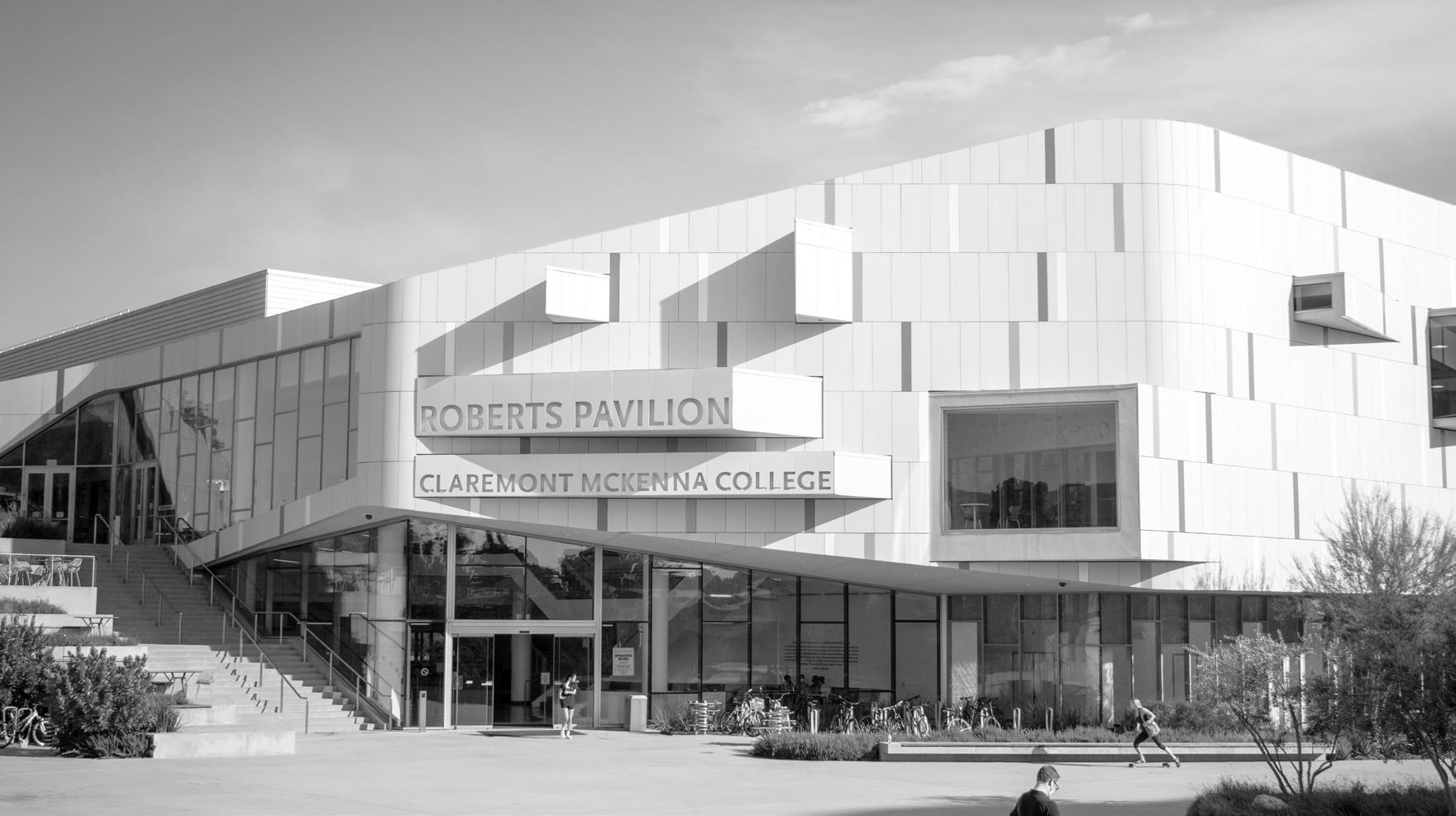
engaging with the mainstream media by playing at the Super Bowl, as well as a deviation from the path of his predecessors. Doing so is an attempt to potentially spark or create an environment for significant social and political change. This could explain why he ended the performance with the line “TV off” — he is urging the audience to realize that the themes of his performance are what people should focus on, not the Super Bowl and the imaginary worlds created by the media.
This year’s halftime show is just another example of Lamar’s status as a renowned artist. Maybe he wants to inspire significant political and social change. Maybe his performance was meant merely as more trash talk directed towards Drake. Either way, one can be almost certain that his music will continue to inspire conversation after delivering such a sophisticated performance.
Sebastian Groom PO ’26 is a Broncos fan, meaning he was relieved but not ecstatic to see the Eagles win the Super Bowl. While he isn’t in Kendrick Lamar’s top 1% of listeners on Spotify, he likes to think of himself as an admirer of Lamar’s work. He also has an uncle named Sam!
Freddie Ambrose PO ’27 is a Lions fan, recovering from the end of the greatest season he has ever been alive for and the ultimate disappointment of that season’s ending. He is also an avid Kendrick Lamar fan, consistently listening to him more than any other artist.
What happens off the field?: How 5C athletes mingle at mixers

In honor of Valentine’s Day, we decided to take a look into events that are all about new relationships: varsity mixers. At the Claremont Colleges, varsity sports teams are the closest thing we have to Greek life. Houses throw parties and teams host mixers with one another that resemble formals between sororities and fraternities. As NARPs (non-athletic regular people), we wanted to know what happens at these mixers as they’re usually closed to anyone not on the two teams present. Multiple athletes declined to be interviewed, but others who have frequently attended the events shared their experiences and opinions.
According to Jake Taylor CM ’26, a junior on the Claremont-Mudd-Scripps (CMS) men’s water polo team, the mixers are simply a way to meet other athletes across the 5Cs. However, Taylor noted, it’s a rare occurrence that these mixers happen between two teams of the same gender. Organized by upperclassmen, who often hold the role of “social chair,” the parties are usually thrown in one of the team’s houses.
“Most of the time, it is just one men’s team, one women’s team,” Taylor said. “It’s a good way for usually the younger people on the team to get to know the other people in their grade that they might not know so well.” The CMS water polo team has mingled their way through the 5Cs. According to Taylor, the mixers happen almost every weekend ahead of a night out.
“We’ve done [mixers] with most women’s sports teams,” he said. Mixers might be just another form of team bonding, but
it wouldn’t be Valentine’s Day without a little spice. For Audrey Reimers PO ’28, a freshman on the Pomona-Pitzer (P-P) softball team, the events take on another purpose.
“I think it’s definitely more fun than normal parties in a way, too, because it’s more like they’re trying to set certain people up sometimes,” Reimers said.
All of the athletes we interviewed described “activities” that happen at the mixers, usually in smaller groups (or partners of one man and one woman) designed to make the event more intimate. P-P lacrosse player Audrey Jacklyn PZ ’27 described how these activities can help break the ice, using the men’s club lacrosse team as an example of an especially fun mixer.
“Sometimes it’s like some team games,” Jacklyn said. “And at those ones, I feel like there’s more mingling between teams.”
According to Reimers, the activities — and sometimes even the mixers themselves — are often designed with romance in mind.
“Some teammates find that they are going for a lot of people on another team. They’ll try to set people up and do partners or something like that, and then pair those people together just to do a fun activity,” Reimers said.
While this may work with certain teams, Jacklyn described how the mixers can sometimes feel uncomfortable when put in a room without knowing anyone on the other team beforehand.
“Some are more, I don’t know, awkward,” Jacklyn said. “It’s more like, maybe both the teams are in the same room, but people just stick to their own teammates … I find the setting kind of forced.”
Most of us who are not on a varsity sports team will never know exactly what goes on at these mixers, but setting people up — whether as friends or more — is definitely in the spirit of Valentine’s.
CHARLOTTE RENNER
SaSHa MaTTHeWS • THe STuDeNT LIFe
SaSHa MaTTHeWS • THe STuDeNT LIFe
New starters, new season, same success: P-P baseball season opener
In a Division III faceoff on Saturday, Feb. 8, the No. 8 Pomona-Pitzer (P-P) Sagehens took down the No. 10 East Texas Baptist University (ETBU) Tigers. After a rainout on Friday afternoon extended the series to Sunday, the Sagehens bested the Tigers 2-1 on Alumni Field.
In game one, Max Brunngraber PZ ’27 received his first collegiate start and delivered 5.2 innings of two-run ball. Brunngraber allowed just six baserunners all afternoon, striking out two.
Offensively, P-P received multihit games from JC Ng PO ’25, Greg Pierantoni PO ’27 and Jack Gold PO ’27. Ng hit a towering home run in the third onto the roof of the Pomona College Studio Art Hall, giving the Sagehens their second run of the game. Jimmy Legg PO ’25 and Peter Savas CG ’25 each had run-batted-in (RBI) doubles as the Sagehens took game one 5-3. Brunngraber described feeling honored to receive the opening day start in the wake of injuries to veteran pitchers Jake Hilton PO ’25 and Hannoh Seo PO ’26. The sophomore pitcher knew that as long as he gave his offense a chance, they would come through as they did in the 2024 season.
“I’m pretty confident that we have one of the best offenses in the country,” Brunngraber said. “So if we can limit the other team as a staff, we’ll be able to win a lot of games, which I think we proved.”
Brunngraber credited his pregame routine — which he said makes him “a bit of an oddball” — for his composure on the mound.
“Before, starting to warm up and everything, [for] 10 or 15 minutes, [I’m] just thinking about what situations I’ll be in, and especially
those early, first couple pitches,” Brunngraber said. “Sort of visualizing and thinking through how to react to everything, and just staying poised.”
After Brunngraber’s success in game one, the Sagehens took the field about an hour later with another first-time starter, Will Polishuk PO ’28, on the mound.
In a 16-5 P-P victory, Polishuk turned in five strong innings, allowing only one earned run to go with six strikeouts. Polishuk stumbled a bit in the first two innings, issuing multiple walks in both, but quickly found his footing with back-to-back 1-2-3 innings — striking out all three batters in an inning — and only one hit allowed in his final three innings.
Polishuk admitted that he was nervous when he took the mound but soon found his confidence once in the zone, with P-P Head Coach Frank Pericolosi taking note of this.
“ETBU is a very good baseball team, and we had two first-time starters go out there and pitch very effectively, throw strikes [and] compete well,” Pericolosi said.
In addition to the debuts of Brunngraber and Polishuk, Sunday afternoon was a spectacle of the Sagehen bats. P-P scored 16 runs, courtesy of seven extra-base hits, including four home runs. 16 runs were powered by seven extra-base hits including four home runs. ETBU pitchers also hit P-P batters six times.
Cooper Berry PZ ’27 went 4-5 with two homers, a double, five RBIs and three runs scored. In his second career game, Kai Gonzaga PO ’28 hit 2-4 with his first homer and a triple to go along with two
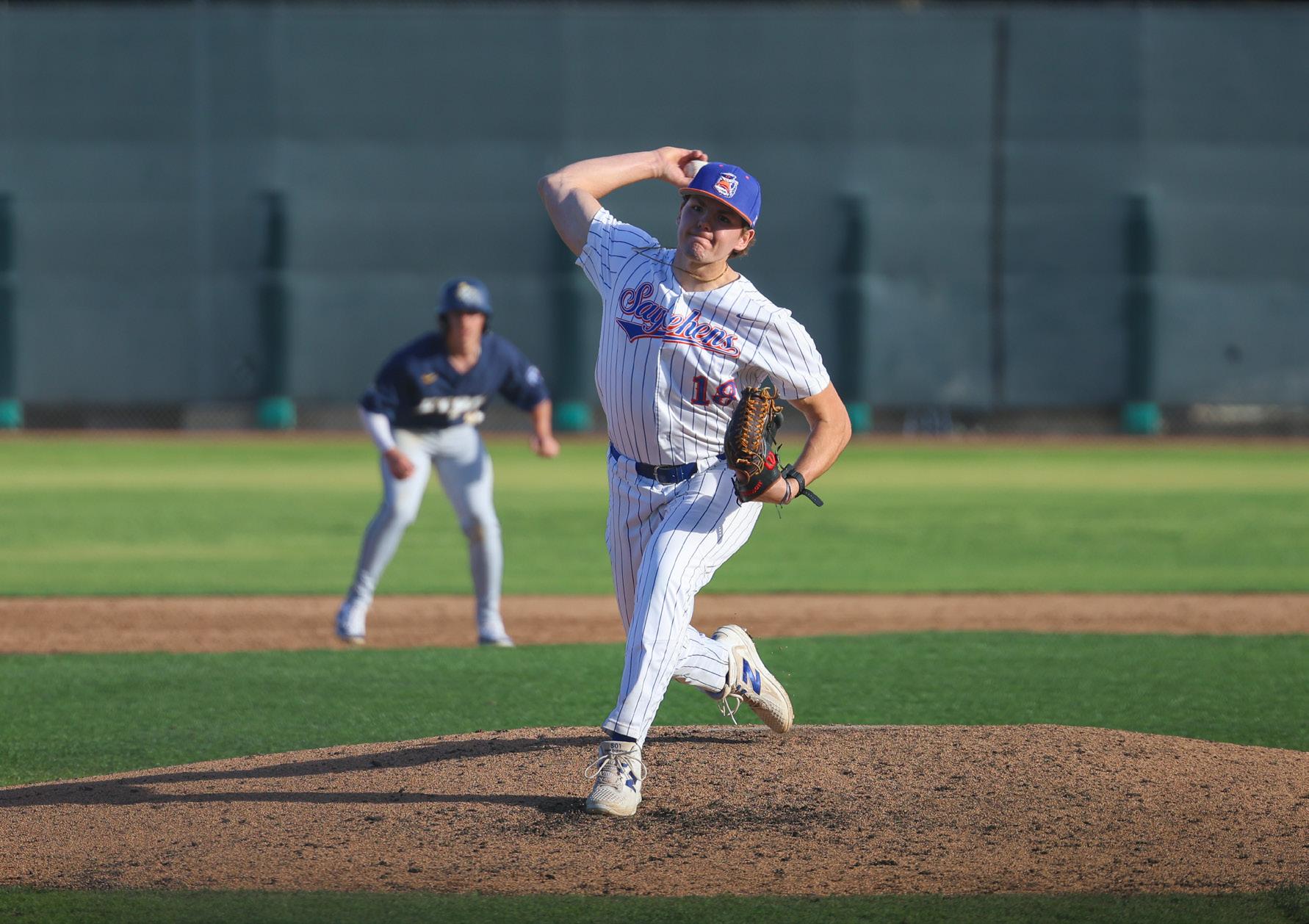
walks, three runs and three RBIs.
“We were just ready to go,” Berry said. “We’ve been working hard in preseason, and we were ready to compete against a really good team.”
After the Saturday games, Pericolosi shared his excitement over the successful start of the season.
“A lot of different guys did good things,” he said. “Getting two wins on day one of the season is great.”
While Saturday provided a
view into the upside of this year’s iteration of Sagehen baseball, Sunday proved tougher when the team faced a 9-4 loss. William Wallace PO ’27 drew the start, going three innings and allowing only one run, as P-P took an early 4-1 lead. However, in the seventh inning, the Sagehens collapsed, allowing the Tigers to rally for five runs to take a 7-4 lead. P-P went scoreless for the last five innings at the hands of pitcher Jackson Jones of ETBU. “On the mound, we issued
Stay humble, eh?
too many free passes, walks, hit by pitch [and] put ourselves in some bad situations,” Pericolosi said. “We didn’t play our best. So I think that the outcome is what it should have been, based on how we played.”
Despite the loss on Sunday, the Sagehens came away with a series victory against a top-10 team, claiming a 2-1 record on the season. P-P will continue its season against Pacific Lutheran on Friday, Feb. 14, at Alumni Field.
What’s gone wrong with Manchester City
On Sept. 22, 2024, English soccer giants Manchester City and Arsenal faced off in what many labeled an “early title indicator,” with pundits suggesting that one of these two teams would finish atop the Premier League come the end of the season.
The game itself started normally enough. City took the lead in nine minutes, courtesy of star striker Erling Haaland earning his 100th goal for the club. Five minutes later, City nearly doubled their advantage, with İlkay Gündoğan’s curling effort rattling the post.
However, the match — and Manchester City’s season — took a major turn in the 21st minute, as star Spanish international and Ballon d’Or winner Rodri was stretchered off with a season-ending injury.
A mere 60 seconds later, Riccardo Calafiori equalized for Arsenal, and Gabriel Magalhães gave them the lead before halftime. Arsenal, who had been reduced to ten men after a red card, held on for 45 more minutes, but were left stunned by a 98th-minute John Stones equalizer. At the end of the tied game, the honors were even, but the rivalry was certainly unfinished. Haaland threw a ball at Magalhães, as well as telling Arsenal manager Mikel Arteta to “stay humble.”
Five games into the season, it seemed as though the pundits were correct. Having played their toughest game of the season, Manchester City sat alone atop the Premier League, poised to reclaim their throne for a fifth consecutive year.
However, four months later, it is Liverpool who sits atop the Premier League table with a significant lead from second-placed Arsenal. While Liverpool will likely win the league, Arsenal has remained in the race, seven points behind Liverpool. This begs the question: Where exactly is Manchester City?
Today, Manchester City sits in
fifth place, nine points behind Arsenal and an astounding 16 points behind league-leaders Liverpool. There isn’t a concrete answer as to why City has collapsed the way they have. There are a multitude of different factors, though most namely the absence of Rodri. Rodri is, without a doubt, the centerpiece of Pep Guardiola’s modern Manchester City side. When he pairs Rodri in the midfield with Belgian star Kevin de Bruyne, Manchester City boasts arguably the best midfield in the world, capable of controlling the pace of the game.
However, in Rodri’s absence, Manchester City has not been able to operate and control games in the manner they did in the 2023/2024 season.
The epitome of the modern “six,” also known as a defensive
midfielder, Rodri brought stability and consistency to Manchester City. Simply put, he elevated the players around him. Prior to his injury, Rodri started 59 consecutive games for Manchester City, completing the most passes among all Premier League players during the 2023-24 season.
At the same time, Rodri anchors the defense, often playing like an additional center-back. During the dying minutes of matches, Rodri frequently operated out of a reserved role, connecting an otherwise separated attack and defense. His ability to break up opposition counter-attacks and distribute well under pressure meant that City hardly ever dropped points if they had the lead.
A player such as Rodri cannot be replaced. In January 2025,
Manchester City acquired Nico González from Porto for £50 million in an effort to fill the gap.
Many saw the move as a panic buy, and while I don’t necessarily agree — González is an excellent player — it has proved incredibly difficult to fill the void Rodri has left.
However, the loss of Rodri isn’t Manchester City’s only issue. Other injuries to star goalkeeper Ederson have not helped, as well as the departures of key players such as Julián Alvarez, Kyle Walker and João Cancelo. Additionally, a lack of results can be attributed to star player Phil Foden’s downturn in production. Perhaps Manchester City’s season can be summed up in one match: their second meeting with Arsenal on Feb. 2. Both teams slumped into the Emirates Stadi-

THE STUDENT LIFE
um, Manchester City languishing around 7th place, and Arsenal’s best hope of a trophy gone after a bleak 2-0 defeat to Newcastle.
The teams were hardly akin to the giants they had been labeled as earlier in the season. However, on the night, Arsenal actually played like one. Two minutes in, Martin Ødegaard opened the scoring for Arsenal. Though Haaland brought City level just after halftime, goals from Thomas Partey, Myles Lewis-Skelly, Kai Havertz and a screamer from Ethan Nwaneri constituted a humbling defeat for the defending champions.
After his goal, Lewis-Skelly was televised mocking Haaland’s traditional celebration and Magalhães was seen screaming in his face after a successive Arsenal goal. It simply wasn’t City’s night, which leads me to my other, less statistical point. In short, it is hard to win and even harder to win consistently. But Manchester City had done just that. Since the 2017-18 season, Manchester City has won seven of eight Premier League titles, including four in a row from 2020-21 to 2023-24.
Now we see that just isn’t sustainable. In 2023-2024, City managed to edge out Arsenal from the title by two points. Liverpool suffered arguably worse fates in the 2018-19 and 2021-22 seasons, when they finished with 97 and 92 points respectively, losing the title by only one point on both occasions.
Essentially, City was bound to slip up eventually. Unfortunate things happen — such as Rodri’s injury — but on a basic level, complete and utter dominance at the peak of world football is unrealistic. Manchester City will soon be at the top once again, but as of now, they must take a backseat and watch the title race unfold.
Otto Fritton PZ ’27 is an avid Arsenal fan who dearly misses Arsène Wenger. He likes to think that if he speaks good enough French, he can turn into Wenger himself. Spoiler, he can’t.
ZACHARY LEBLANC
SaraH ZIFF • THe STuDeNT LIFe
Stephen Kwak PO ‘25 fires a pitch across the plate during the Sagehen’s season opener against East Texas Baptist
university on Saturday, Feb. 8.
OTTO FRITTON
eMMa CHOy • THe STuDeNT LIFe