Pitzer College’s New Resources Program faces uncertain future after 50 years of success
CHLOE
ESHAGH & RHEA SETHI
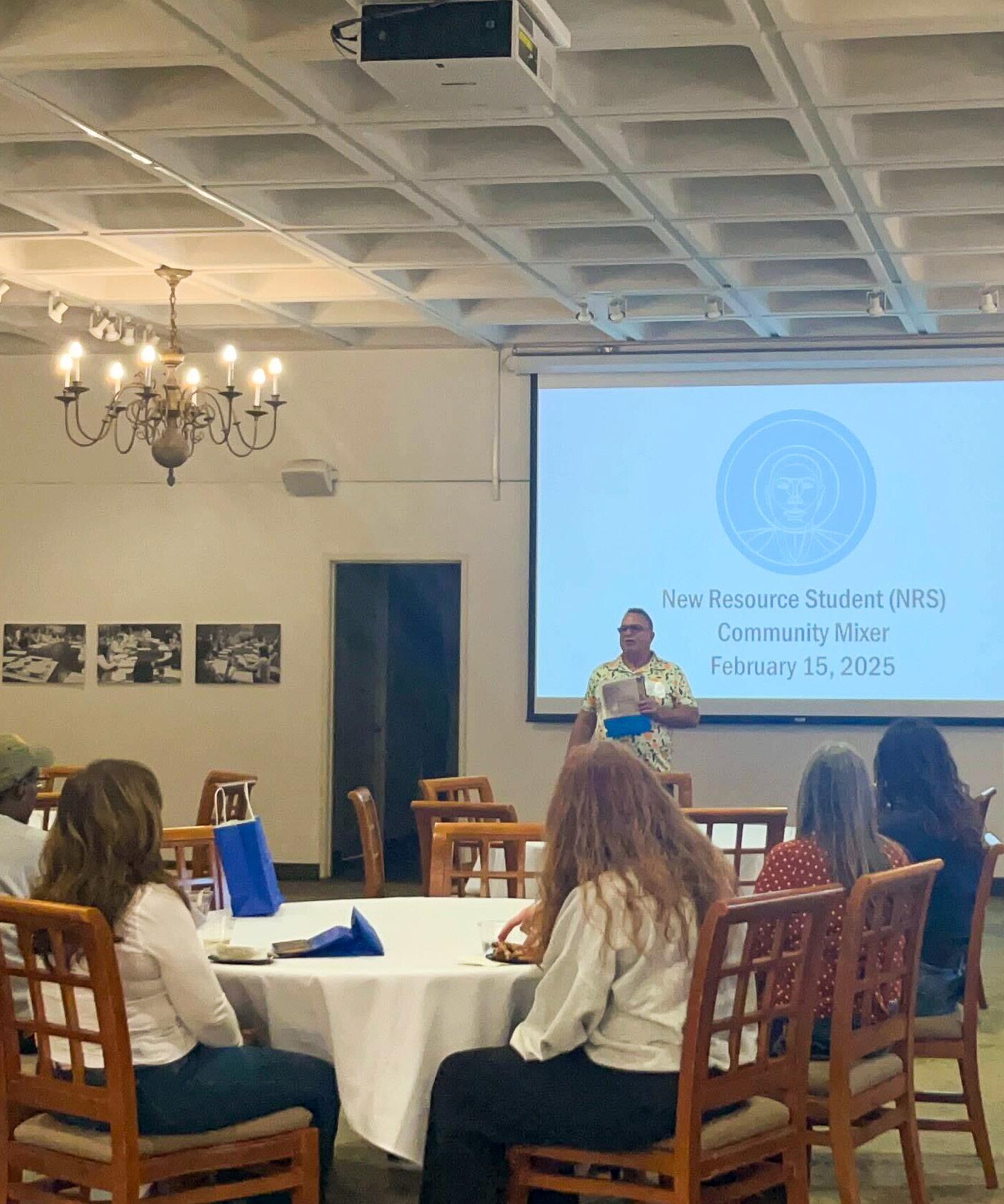
On Feb. 15, Pitzer College hosted a community mixer in the Founders Room, featuring alumni and current students from the New Resources Program (NRP). The community celebrated the program’s 50th anniversary and honored Al Schwartz, the first sociology professor at Pitzer College and the founder of the NRP.
The NRP allows non-traditional applicants to get an undergraduate education and a bachelor’s degree. Non-traditional applicants are usually of unconventional college age, typically 23 or older, and have had different life experiences before attending college. According to Ronnie Whisenant ’26, a current New Resources Student (NRS) and New Resources student senate representative, the program has supported over 400 non-traditional students.
Al Schwartz founded the NRP in 1975, giving non-traditional students the opportunity to attend a prestigious undergraduate college while diversifying the school with the students’ unique backgrounds, perspectives and interests.
Schwartz, who passed away on Dec. 9, 2023, was the first sociologist hired at Pitzer and served as the dean of faculty, dean of students and special assistant to the president for 30 years at the college.
“He’s changed my life,” Whisenant said. “It’s very rare that you find people that truly want to help other people, just for the sake of them being [benefitted], and we can learn something from them. We want to pay a little bit of honor to him and express how thankful we are for the opportunity that he’s given us.”
In recent years, the NRP’s enrollment has been dwindling due to a lack of advertisement and attention it has received from both
See PITZER on page 2
students and the administration.
According to Whisenant, the program hasn’t always been this way. In 2016, for example, the Pitzer Student Senate started an initiative to allocate $3000 for New Resources Student Lounge renovations.
“We had a lot of professors back then that were part of this program, that were promoting it, and we lost that,” Whisenant said. “If we don’t pick up the torch, nobody else is going to.”
The program currently supports less than 10 New Resources students, and with decreasing engagement, it’s at risk of being shut down after 50 years.
“This year, the institution is in an interesting place about whether or not they’re going to continue this program,” Tim Lewis, the Community Engagement Center (CEC) program coordinator, said.
“So the stakes are real.”
Organizers said that they hoped the community mixer would reinvigorate the program and return it to its former glory through increased publicity, especially because the NRP aligns closely with Pitzer’s values of social responsibility, intercultural understanding, interdisciplinary learning, student engagement and environmental sustainability.
During the mixer, approximately 35 people –- current traditional and NRS Pitzer students, NRS alumni, faculty members and potential NRS applicants –– came to discuss the history and future of the NRP. For potential applicants, the mixer also served as an information session about the program.
“I think having this program does contribute to social responsibility,”
Tricia Morgan, NRP alumni and current director of the CEC, said.
“It’s providing an opportunity for people to broaden their horizons that might not have otherwise had such an opportunity.”
Garett Staley PZ ’06, an NRS alumnus, is a current associate
On the evening of Thursday, Feb. 13, Harvey Mudd College’s Makerspace flooded an unprecedented amount in its four-year history, according to Makerspace management. The space was closed over the weekend as it underwent
reopening to 5C students on Tuesday, Feb. 18. Harvey Mudd Machine Shop Manager Drew Price, who works closely with Makerspace management, was at the workshop on Feb. 13. According to Price, unusually heavy rain loosened debris that
CHASe WADe • THe STuDeNT LIFe
CHLOe eSHAGH • THe STuDeNT LIFe
Pitzer College’s New Resources Program honored Al Schwartz at a community mixer and reflected on the legacy and impact the program has had on non-traditional students.
LYON: Students call for increased security following trespassing
Continued from page 1
concerns that have only escalated following the most recent trespassing.
TSL’s survey, which garnered approximately 50 responses, asked Pomona first-years to rate their sense of safety following the Lyon incident on a scale of 1 to 5, with 1 being the safest and 5 being the most unsafe. The results indicated some concern among students, with an average safety rating of 2.8 out of 5.
Despite a thorough search, Campus Safety was unable to identify the unauthorized individual, according to a representative in a Feb. 11 email to TSL.
“While it is unclear how this individual entered the building, our officers continue to check that all doors are securely closed and locked at night,” the email stated.
“Any issues, such as broken locks, are promptly shared with the facilities team for repair.”
Survey results demonstrated that students remained dissatisfied with the level of safety on campus; 75.5 percent of respondents rated their satisfaction with the college’s actions between 1 and 3 on a scale from 1 to 5, with 1 being extremely dissatisfied.
Following the incident, Lyon residents requested the installa -
tion of new self-closing doors and inspections of the lounge doors, according to an email to TSL from Josh Eisenberg, associate dean of students and dean of campus life at Pomona. The email stated that the doors were permanently locked on Feb. 10. Sarah Russo PO ’28 said her room was broken into last semester over fall break. Russo said she reported the incident to campus security, but that the person was not identified. Additionally, she noted that a different individual repeatedly used a Lyon bathroom over the course of a week or two last semester before eventually being escorted out.
Similarly, Emmet Bolls PO ’28 said that he saw a trespasser, appearing to be in their 30s or 40s, in the Lyon laundry room earlier this semester. He said the individual was escorted out. In response to safety concerns, Bolls said he and his roommate have become more cautious.
“If one of us isn’t there, we lock the door, which is something we weren’t really thinking about first semester,” Bolls said.
Russo said Pomona first-year students have repeatedly called for action from Campus Safety, the Housing and Residence Life Office and even the Claremont
Police Department. She said that despite their efforts, there has been little progress until now.
“Living in Lyon has become an experience of perpetual vigilance,” Russo wrote in an opinion for TSL advocating for a more proactive approach to campus security. “Residents are constantly aware of their surroundings, check and recheck locks and feel uncomfortable when strangers walk by.”
Russo said she thinks many of the incidents have occurred in Lyon because of its proximity to the Claremont Village and how it seems to be the easiest to navigate of the firstyear dorms.
additional lighting. Russo said she is happy with the changes that are now being made. “I feel a lot more satisfied than I did even a week ago and obviously right when my room was broken into, given I felt like I was left in the dark,” Russo said. “I do appreciate the change being made and the discussions that are happening. I just wish it didn’t take this long.”
I’m more aware when I’m out and about, especially late at night. My roommates and I have talked about locking our doors now, which we never thought about before the incident.
Anya
Offenbacher-Jones, PO ’28
In a meeting between Russo, Eisenberg and Assistant Director of Residence Life Ryan Haynes, Russo said they discussed potential future security measures including the installation of security cameras and
Anya Offenbacher-Jones PO ’28, a Lyon resident, claimed the incident heightened her sense of fear.
“I’m more aware when I’m out and about, especially late at night,” Jones said. “My roommates and I have talked about locking our doors now, which we never thought about before the incident.”
The school followed up with a response: Eisenberg provided a long list of measures post-incident in an email released to Po -
mona’s South Campus Community on Feb. 6. TSL’s survey also asked about potential security enhancements, such as installing security cameras by the entrance of Lyon and South Campus.
71.8 percent of first-year survey participants indicated they supported the installation of security cameras on South Campus dorms. 84.8 percent of respondents showed support for some form of increase in security infrastructure.
The survey also received several concerns, recommendations and possible solutions to increase the security of dorms around campus. Russo said that she liked Scripps College’s two-time free lockout policy, which allows students two free lockouts per year —for their third, all key services cost $25. She said that initiatives like these would allow students to feel more comfortable about locking their doors every time they exit the room, as some currently leave doors unlocked on purpose due to a fear of losing their key or getting locked out.
In addition to security cameras, students also indicated a desire to see more emergency call stations as well as a centralized system or mobile application to report all crimes to Campus Safety.
Pomona first-year students called for increased security after a man was found
MAKERSPACE: Harvey Mudd
Continued from page 1
to confirm that no further hazards existed and to resume operations.
Continued from page 1 clogged the water drainage ducts in front of the Makerspace. Without necessary drain access, water from the storm began to enter into the building.
“At the worst, there were several inches of water around the entrance and the Makerspace lobby,” Price said in an email to TSL. “I worked with several Makerspace stewards and others to identify and try to unplug the outside drains, and then to make sure no one entered the space or went into areas where the power was still turned on which would have posed a safety risk.”
HMC’s Office of Facilities and Management, The Claremont College Services Facilities Services and Campus Safety handled recuperation efforts throughout the night and into the weekend. They thoroughly cleaned and dried the space, namely the rainwater-saturated lobby carpet, furniture, rock garden and work areas. It was only after this long process that the Makerspace was able
To help prevent future floods, Makerspace Manager Kim Neal said that management plans to lay sandbags outside of the building, although this is just a short-term solution; a long-term plan has yet to be made.
“A lot of people are included in that conversation and it will take some time to develop,” Neal wrote in an email to TSL.
The Makerspace’s closure did not go unnoticed, according to students at the 5Cs. During those four days, Makerspace stewards were unable to work, students could not use workshop resources for projects and clubs typically held in the building weren’t able to meet.
Joaquin Gonzalez-Salgado
HMC ’28, a recent addition to the Makerspace steward team, said that some of his peers ended up losing their academic work during the flood.
“Someone in the Makerspace Discord was saying that they were
doing a project for their engineering clinic, like a senior capstone project, and it was in process in the 3D printer, and because of the flood, they had to unplug everything,” Gonzalez-Salgado said.
While the Makerspace is now back up and running, Gonzalez-Salgado said that there are still elements awaiting reconstruction. He said that some of the floor outlets and equipment in the 3D print room are out of commission.
“You wouldn’t really see that at first glance,” he said.
Gonzalez-Salgado added that the temporary loss of the Makerspace reminded him of its essentiality to the consortium.
“People wanting to go to the Makerspace — anyone from the 5Cs, for that matter — they weren’t able to have that availability to socialize, to work on projects, and they weren’t able to do the things they would typically do,” Gonzalez-Salgado said. “The Makerspace is a really valuable space.”
THE STUDENT LIFE
professor and program director of the drug counseling program at Mt. San Antonio College. Staley transferred to Pitzer College after attending community college for a year and attributed much of her success to the NRP.
“At first it was really scary, and I felt really out of my element,” Staley said. “I was in my early 30s when I was a student here, so I was quite a bit older than most of the student population. I am a first-generation college student, so this was very foreign for me, and really overwhelming.”
Despite her struggles with imposter syndrome, Staley appreciated the program for pulling her and her family out of poverty and creating a better life for her kids.
“I did the work, but if [Pitzer] hadn’t opened that door, and given the little extra support I needed to find that confidence and the understanding that I
could be successful, I don’t see [how] I would have achieved as much as I have,” she said.
In the closing remarks of the event, Lewis acknowledged all the faculty in the CEC who helped keep the program alive for the past 50 years and called for more people to support by donating and raising awareness.
“You look around and you see the impact this program has made,” Lewis said. “They’re not frequent, they’re not common. They’re very, very, very special.”
Whisenant shared the same sentiment and said that he hopes the program can continue to make an impact on non-traditional students seeking a liberal arts education.
“We’re trying to keep this going and hopefully spark a little fire,” Whisenant said. “[The New Resources Program] is something I don’t think should be allowed to die because it’s too good for everybody involved. Now, I feel like we have some kind of direction, so we’ve got work to do.”
‘Clutching at straws’:
Dining services and professors at the 5Cs weigh in on Trump’s executive order to ban paper straws
AVA FLEISHER
President Donald Trump signed an executive order on Feb. 10, directing government agencies to stop purchasing and distributing paper straws, while calling for a nationwide strategy to eliminate their forced use. Pomona College’s dining services and Bon Appétit, which manages three other colleges’ dining services, remain committed to sustainability efforts, maintaining that the order will not affect 5C dining.
In an effort to return to plastic straws, the order reverses former President Joe Biden’s plan to reduce single-use plastic products from all federal operations by 2035, which Trump’s order describes as “caving to pressure from woke activists who prioritize symbolism over science.”
Char Miller, an environmental analysis and history professor at Pomona, and Nikhil Schnieder, the assistant director of sustainability at Pomona, both called Trump’s executive order a way to “own the liberals” in separate interviews with TSL.
Miller said that he sees the executive order as more symbolic than effective. He said that since there is no budget to implement what the directives call for, it actually “[carries] no weight whatsoever.”
“They have no enforcement mechanism,” Miller said. “It is a statement of desire.”
Sean Diament, a politics professor at Pomona, also called the order symbolic, except for its potential influence in dining halls within federal buildings.
“The force of presidentially decreed law cannot compel you to buy plastic straws,” Diament wrote in an email to TSL.
Current policies surrounding plastic use at 5C dining facilities vary, since Bon Appétit manages Claremont McKenna College, Scripps College and Pitzer College’s dining services, while Harvey Mudd College and Pomona manage their own dining
services. In an email statement to TSL, Mark Gillera, a general manager from Bon Appétit, said that the company no longer provides plastic straws — an initiative that began in 2018 — except for people with “disabilities or access issues.”
At the three dining halls that the company manages, Gillera said that paper straws are provided under “certain circumstances.” The Hub at CMC offers them, while Collins Dining Hall only provides to-go
cups.
“My colleagues and I have collaborated with a variety of stakeholders on our campuses, including student groups, to make great strides toward reducing or eliminating single-use plastic waste,” Gillera wrote.
Gillera added that Bon Appetit has no plans to change its policies, as the executive order applies only to government agencies.
Jose Martinez, the general manager of dining services at Pomona College, said that they
have not yet discussed Trump’s order.
“This will not affect our services,” Martinez said in an interview with TSL. “If we make changes, it will be to further get us to the goal of carbon neutrality.” Martinez said that Pomona’s dining halls do not typically provide straws, except for people with “medical restrictions.”
These straws are made from agave and thus compostable. The only exception is when Pomona’s dining halls serve boba
tea, which requires larger straws.
Unlike Bon Appétit, which has found a compostable alternative, Pomona is still actively searching for its own. Boba tea, however, is only on occasion, resulting in minimal plastic straw usage, Martinez said.
Over the past several years, Pomona has shifted to more sustainable practices, like no longer offering single-use to-go boxes, which Martinez attributes to “a very strong sustainability goal” rather than government directives.
Additionally, Schneider said that the Office of Sustainability has worked with Pomona’s dining services to make their operations more environmentally conscious, including creating improved signage to help students properly sort compost, trash and recyclables.
Schnieder said that despite some straws — paper included — and other items being labeled compostable, that might not always be the case, as compost facilities don’t actually want them.
“They’ve all been treated with chemicals to make them waterproof or hold up against grease and liquids, and those chemicals are not great to be putting into soil that you’re growing food in,” Schnieder said.
Harvey Mudd’s independently managed dining facilities offer plant-based plastic straws from the company Eco Products, whose website says that the straws are compostable and “compliant with many straw bans.” The college’s dining services did not respond to TSL’s request for comment.
Miller said that Trump’s executive order reflects his reluctance to work with Congress to pass legislation that could actually impact nationwide plastic use, reinforcing its symbolic nature.
“This is just feel-good legislation for those who care about the things [Trump] cares about,” Miller said. “It’s a fool’s errand and the president is clutching at straws.”
Scrambling for time: Impact of egg shortage at the 5Cs
Take an extra moment to savor your omelets, pancakes and bagel breakfast sandwiches this week — a decline in the chicken population has led to an egg shortage across the United States, impacting corporate supermarkets and 5C dining halls alike.
Highly contagious outbreaks of avian influenza in December 2024 have led to a mass depopulation of birds, and in the past month alone, the cost of a dozen eggs has increased by 15 percent.
The general manager of dining services at Pomona College, Jose Martinez, said the egg shortage has not yet impacted services at dining halls Frank, Frary and Oldenborg.
Pomona receives its eggs from four local suppliers — Sysco LA, US FOODS LA, Nature’s Produce and Freshpoint Produce — and has set up contractual agreements to reserve and receive eggs through the end of the semester.
“We have a very good relationship with our prime supplier,” Martinez said. “We’re confident that our supplier will have enough stock to meet our demands.” Martinez said that despite the looming threat of an egg shortage, the college’s menus have not yet been impacted. The cost of eggs, however, has been rising. Particularly high egg prices have hit California, as 40 percent of the eggs consumed are produced in-state, and production has diminished significantly since the influenza outbreak.
At Pomona, dining halls are already seeing a five to eight percent increase in the price of eggs, according to Martinez.
“We are committed to providing the staples for the semester unless it becomes, like, a 30 to 50 percent increase on eggs,” Martinez said.
In previous years, Pomona has dealt with market crashes and egg product recalls by temporarily altering their menus until things returned to normal. If the current shortage were to worsen, Martinez said that a response could look similar.
“Perhaps not having liquid eggs, but we’d still have hard
shell eggs, or vice-versa,” he said. “We’ll work with our chefs and dieticians to find alternatives [that] will still deliver the protein value.”
The eggs used by Pomona dining halls include hard shell, liquid and hard-boiled. When asked about what alternatives might be used, Martinez mentioned Just Egg, a plant-based alternative to conventionally produced egg products, as an adequate replacement.
“They can actually make pretty good burritos,” he said, referring to the plant-based products. “[It’s about] getting creative and making items that are popular to students that can still deliver protein value.”
General Manager of Collins Dining Hall Shelby Walsh and General Manager of McConnell Bistro Miguel Menjivar provided identical email statements to TSL regarding the egg shortage situations at Claremont McKenna College and Pitzer College.
“While we are concerned about the potential supply chain impacts of Avian Influenza, thus far we have been able to maintain our regular menu offerings,” they said. “We review the need to [implement menu changes] daily.”
CMC and Scripps College said they have purchasing teams keeping in close communication with egg suppliers, distributors and purchasing partners regarding the outbreak. They also stressed the flexibility of their menus. Similarly, Harvey Mudd College informed TSL via email that the Hoch-Shanahan Dining Commons has “not been significantly impacted yet” by the shortage. Audrey Leatham PZ ’28 and Harper Riss PZ ’28 are chicken caretakers at the Pitzer Student Garden. Their jobs involve letting the six chickens out of their coops for 15 minutes during the day to range freely, giving them water and collecting their eggs.
The two said that apart from washing their hands before and after handling the chickens, there was no official policy regarding proper health practices. They also mentioned an infection that spread to approx -
imately three of the chickens over winter break.
“The chickens that got sick got really sick,” Leatham said.
Riss added that while they were not told what illness afflicted the chickens, some still had a noticeable limp because of it.
When asked what the next steps might be for the Pomona dining halls if the shortage were
to worsen, Martinez pointed out that California’s location makes it easy to access egg supplies from Mexico and other countries “down south.” Walsh and Menjivar, on the other hand, indicated that national issues with the shortage would be difficult to bypass.
“Avian influenza is impacting egg producers nationwide and any potential alternate sup -
pliers are experiencing the same issues,” CMC and Pitzer said in their identical statements. Despite the shortage looming over the horizon, Martinez has found a way to keep positive for these next few months.
“We’re keeping a very enthusiastic approach for the semester,” Martinez said. “We’re hopeful that things will get better by the summer.”
KAHANI MALHOTRA
SARAH ZIFF • THe STuDeNT
SASHA MATTHeWS • THe STuDeNT LIFe
CMC faculty votes to reconsider test-optional admissions policy; average composite scores increase
BRECKEN ENRIGHT
On Friday, Jan. 24, Claremont McKenna College faculty members voted in favor of a motion to recommend the suspension of their current test-optional admissions policy. In the wake of discussions surrounding this issue, TSL examined and compiled standardized testing data from CMC students before and after the college dropped its testing requirement.
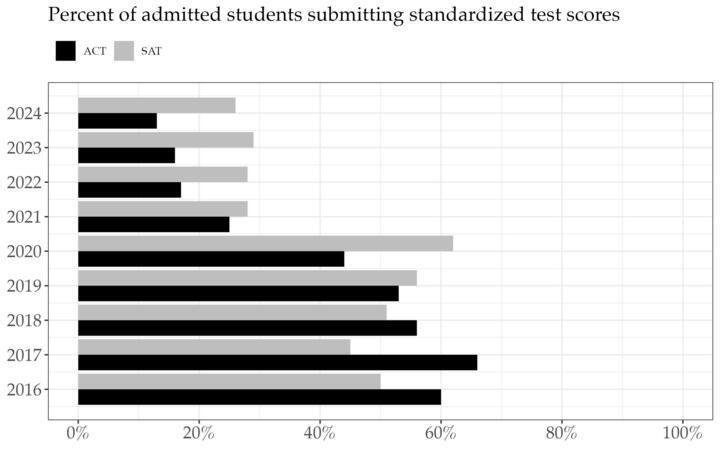
CMC temporarily implemented the policy in 2020 due to COVID-19, following national trends in response to a widespread lack of access to standardized testing. Since the requirements were lifted, the number of admitted
students who have opted to submit standardized test scores has steadily decreased. During the 2024 admissions cycle, only 26 percent of admitted students submitted an SAT score, and only 13 percent submitted an ACT score, according to TSL’s findings.
Henry Finna CM ’25 agreed with the goals of the faculty motion.
“I trust the Claremont faculty to make the right decision regarding the caliber of students they teach,” he wrote in an email to TSL. “If they believe, based on the information given to them, that the test-optional policy produced admissions outcomes that did not align with the academic standards
CMC should expect, then it makes sense to revert to requiring test scores.”
Eli Weiss CM ’25 said that he saw the benefits of standardized test scores but questioned what factors contributed to the faculty’s decision.
“I’d be curious to know what the faculty’s reasoning was,” he said. “I guess my attitude about it is that standardized tests actually serve a good purpose sometimes, and can be a good way to measure the quality of an applicant.”
Weiss did not submit standardized test scores when he applied to transfer to CMC in the fall 2023 term.
“I probably benefited from the
fact that CMC was test-optional when I applied because I wasn’t the best standardized test taker,” he said.
While the precise proceedings of the CMC faculty meeting are confidential, philosophy professor Dustin Locke recounted arguments he heard around campus both for and against test-optional policies.
Many people were concerned about long-standing issues regarding equity in standardized testing. However, according to Locke, “Proponents of the motion think that it is among the least biased ways of evaluating students.”
Finna is among those who believe that standardized test scores can serve as an objective metric to evaluate students for admission.
“The claims that standardized tests are biased have merit,” he wrote. “Students with greater access to test prep can raise their scores to a degree. However, the college admissions process is highly subjective, and standardized tests provide a universal metric that allows colleges to contextualize disparities between schools.”
Additionally, some were concerned that requiring standardized tests may dissuade prospective students from applying.
“There is also a worry that there aren’t many West Coast colleges that have brought the test back,” Locke said. “The worry is about reducing the number of applicants.”
The University of California campuses practiced test-blind admissions for applicants considered to be admitted in fall 2024. Stanford University, however, reinstated its standardized testing
requirement for students applying for entry in the fall 2025 term.
Finna, who applied to CMC in 2020 when standardized test scores were required, echoed this concern.
“I imagine if I felt no need to take the tests, but one school on my list required them, then I would not apply there,” he said.
However, those who support a standardized test mandate feel that such requirements may be attractive to applicants.
“The argument is that some students will [apply] because they want to be in a certain academic environment,” Locke said.
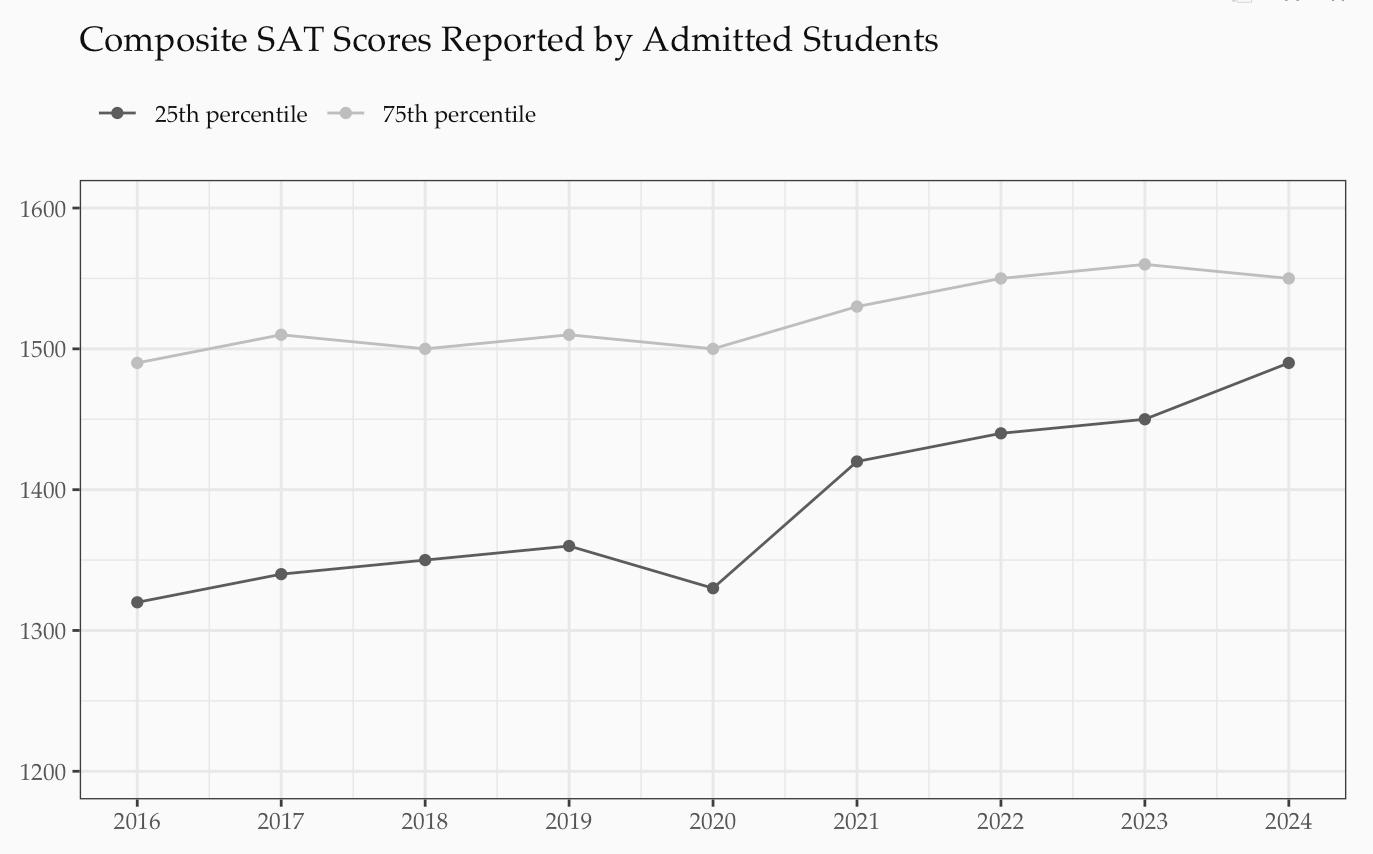
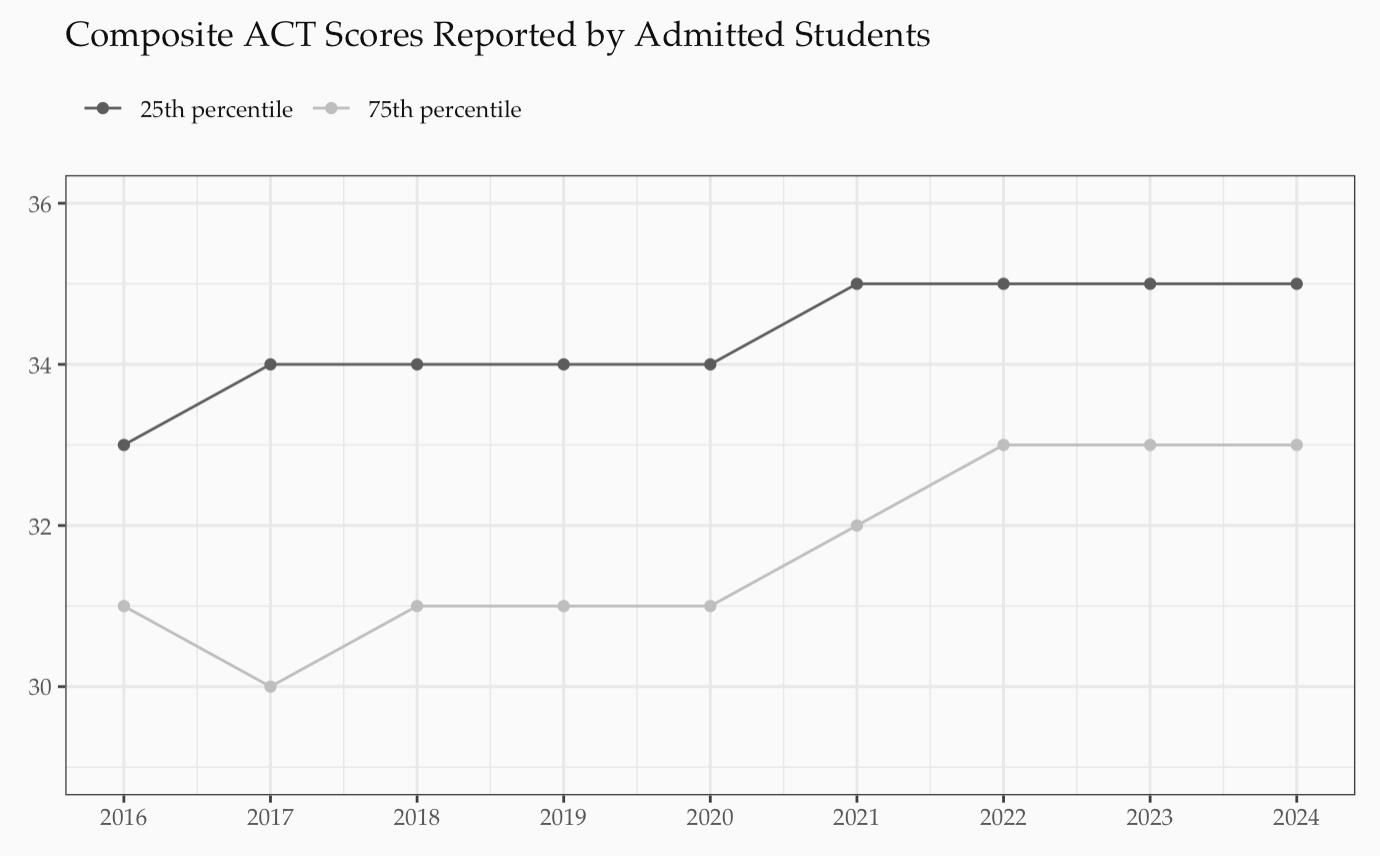
While fewer students submit test scores to be considered for admission, the averages of scores submitted have risen.
In 2020, the 25th percentile average composite SAT score was 1330, and the 75th percentile average composite score was 1500. During the last admissions cycle, those scores increased to 1490 and 1550, respectively.
Similarly, the 25th and 75th percentile average composite ACT scores each increased by two points between 2020 and 2024.
There is no straightforward answer as to whether the test-optional policy has affected student performance.
“COVID had a big impact on education,” Locke said. “It is impossible to separate out what are the effects of COVID versus what are the effects of requiring the test.”
While the future of standardized testing requirements at CMC remains to be determined, Scripps, Pomona and Pitzer Colleges have permanently dropped test requirements for admissions. Harvey Mudd is the only other Claremont College that is still reevaluating its test-optional policy.
bReCKeN eNRIGHT • THe STuDeNT
‘The
Lobster’ claws its way onto the 5C publishing scene
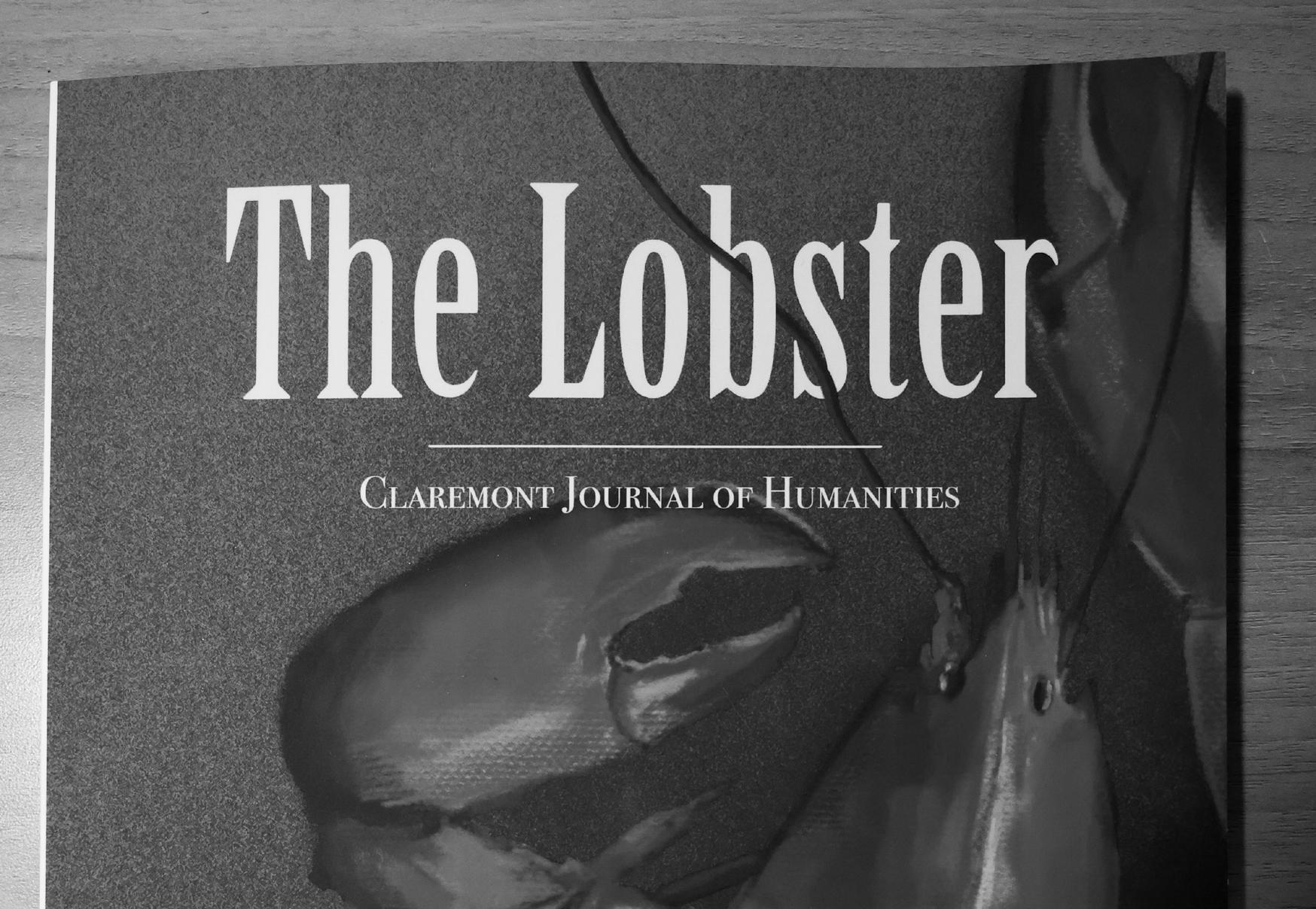
The 5Cs have student publications and journals covering a variety of individual subjects, from law and public policy to creative writing. But last semester, Olivier Rizvi PO ’27 realized that there wasn’t a home for wide-ranging published work in the humanities and so was born The Lobster.
“There wasn’t really a place for the nicher humanities subjects,” Rizvi said. “I wanted a bit more of a general paper.”
After securing funding from the Pomona History Department, Editor-in-Chief Rizvi and his soonto-be co-editors of The Lobster: The Claremont Journal of the Humanities were ready to fill this gap. They chose their titular crustacean as a nod to the late Pomona professor David Foster Wallace’s essay, “Consider the Lobster.”
The Lobster, the 5Cs’ newest student-run biannual journal, came to be in the fall 2024 semester. Its mission, according to its Instagram, is to “provide a platform for academic work initially written as assignments,” “foster interdisciplinary dialogue” and “provide a voice to all members of the 5Cs.”
Among the executive board’s first official tasks were soliciting submissions of student work and assembling a team of editors. They plastered informational posters around the 5Cs, submitted blurbs to student newsletters and became exceedingly well-versed in what Rizvi deemed “gentle coercion,” which often took the form of persuading peers in their classes to participate as writers and editors.
In its first issue, The Lobster published 17 pieces that students
had already written for their classes.
“The point of it is to celebrate student work for classes that we think should be read by a wider audience,” said Creative Director Aidan Ma PO ’27, who designed the journal’s cover and wrote its style guide.
After reading submissions and selecting which pieces to publish, the executive board then matched writers with one of 15 editors who helped each writer edit their piece for publication.
“None of us like rejecting people, because it’s such a terrible thing,” Ma said.
Rizvi added that the board held onto some of the pieces that they did not select for the first issue in the hope of finding places for them in future issues.
How the editors place pieces within the journal is particularly important, as The Lobster is organized by theme, not discipline. The themes of the last issue — perception, formation, survival, identity and autonomy — emerged naturally in the editorial process.
“We would look at … maybe three papers that worked really well together, and then … expand it to a broader theme,” Joseph Morco PO ’27, The Lobster’s director of communications, said.
Works within each theme varied immensely; in the “Formation” section, for instance, Yuhang Xie PO ’26’s paper “Forming a State: Order and Ideals” followed Bridget Brodie PO ’27’s “Can You Escape the State? An Analysis of Studio Ghibli’s Seita and Howl.”
The Lobster defines the hu -
manities expansively.
“I was going to say [we’re looking for] anything kind of human-centered,” Rizvi said. “But actually, if you wrote the history of Mozambique talking about clay, I think that would be a great paper.”
Pieces originating within disciplines outside the traditional humanities are also fair game for The Lobster.
“What we’re looking for doesn’t need to be human,” added Morco, referencing a data science paper about the demographics of food allergies that was submitted.
“We wouldn’t say we would never accept this subject,” Rizvi ultimately concluded. The only exception he makes is for “papers that are too inaccessible,” noting that philosophy papers can be “almost mathematical and hard to get through.”
Students gathered in the Pomona History Department library on Jan. 23 to celebrate the official launch of The Lobster’s first issue and pick up physical copies of the journal.
“It was a lot busier than I expected it to be,” said Treasurer Alyssa Lee PO ’28 about the gathering. Rizvi estimated that there were close to 50 people in attendance.
The board hopes to attract more students from across the consortium of varying class years going forward. Other hopes for the future include establishing a website as a digital archive and publishing artwork in the journal.
“The long-term goal is just to have it … keep going when we’re gone,” Rizvi said.
Album review of ‘Hurry Up Tomorrow’:
The Weeknd’s eulogy
“When today ends, I’ll discover who I am:” the final words in The Weeknd’s Instagram post in which he announced “Hurry Up Tomorrow” as the title of his sixth and final album. The album, released on Jan. 31, serves as the funeral for The Weeknd, as the artist – Abel Tesfaye, recognized that he has said everything he could under the persona he’s embodied since 2011. Initially, I didn’t believe this would be the end of The Weeknd as we know him — after all, many artists make similar claims only to return with new music later. Then, I thought killing his character was a clear marketing strategy, kind of like Duolingo’s style. However, after listening to the album, much of it made sense.
The Canadian R&B artist is one of the most streamed worldwide, and he’s been accumulating Billboard Hot 100 #1 songs throughout the years, including “The Hills,” “Can’t Feel My Face,” “Save Your Tears” and, the most streamed song in streaming platforms’ history, “Blinding Lights.” After past works focusing on drug glamorization, lack of emotional responsibility and meaningless sex, “Hurry Up Tomorrow” portrays the most vulnerable and intimate version of the artist up to date.
The album’s first single, “Dancing In The Flames,” was released on Sep. 13. Its synth-pop instrumental echoed much of his previous albums’ aesthetic, but it was found with such poor commercial reception that it didn’t make it to the final album cut. Thus, “Timeless” came to save the album. Much of its popularity should be credited to Playboi Carti’s feature, where he raps in two distinct voices for half of the track. The catchy R&B song saw phenomenal sales performance, but the lyrics, like much of his past work, revolve around womanizing and drugs — the exact behaviors The Weeknd regrets on “Hurry Up Tomorrow.”
The following single before the album, “São Paulo,” showcased the artist exploring Brazilian funk with Annita. Although The Weeknd experimenting with a new genre makes the track innovative and compelling, its lyrics focus on his enjoyment of sex, which has nothing to do with “Hurry Up Tomorrow’s” storyline. In other words, both singles completely misrepresented the album’s depth and fooled us into believing it would offer nothing new. It seems as though they were produced after the album’s completion to boost its popularity, despite feeling entirely out of place.
“Hurry Up Tomorrow” allows Tesfaye to uncomfortably reveal he’s much more than the image built under The Weeknd, and
ultimately leads to his alter ego’s suicide. In the track “Given Up On Me,” he confesses, “I’ve been always wasted, it’s too late to save me” and “Why won’t you let me leave? I’ve given up on me.” Similarly, in “Enjoy The Show,” he acknowledges that he could be healthy by stopping drug use if he weren’t hesitant to heal. “Cry For Me,” the third single and arguably the album’s best track, captures his painful regret over a relationship ending.
After years of crafting a narrative on him being heartless and unable to sacrifice for love, he finally admits to being a human who feels and suffers. Production-wise, the album masters maintaining thematic unity, with each song transitioning effortlessly into the next one, as can be appreciated between the skit “I Can’t Fucking Sing”– which refers to the time the artist lost his voice during a 2022 show — and “São Paulo.”
“Hurry Up Tomorrow” doesn’t hurry, and that’s its main drawback. The album feels extremely tedious and repetitive, having 22 tracks and lasting almost an hour and a half. Already in the album’s opening track, “Wake Me Up,” The Weeknd delves into being “alone when it fades to black” and running out of time. He could have cut out unmemorable songs like “Big Sleep,” “Give Me Mercy” and “Drive,” and we would still get that he is struggling with fame and loneliness and wants his alter ego to disappear. If you’re certain there’s no tomorrow, just be concise and go away.
Regardless, “Hurry Up Tomorrow” is a remarkable way to let The Weeknd rest in peace and lean Tesfaye toward fresh phases in his musical career. In “Red Terror,” he whispered, “I have only slipped away into the next room” and “Call me by the old familiar name.” Today ended and the artist can now move forward to reconnect with his true self.
Tomy Helman PO ’28 is a music columnist from Florida, Argentina. He’s interested in culture and politics, and currently speaks Spanish, English, French, Indonesian and Italian.
In between languages: Su Yeong Kim on language brokering in immigrant families
JOSEPH WOO CHAN
Su Yeong Kim discussed her research on the effects of language brokering among bilingual immigrant children at Scripps College’s Balch Auditorium on Feb. 18 for Scripps Presents’ Marion Jane Girard Memorial Lecture.
A professor of Human Development and Family Sciences at the University of Texas at Austin, Kim’s research examines the experiences of ethnic minority groups. In doing so, she also challenges common misconceptions — for example, the misconception that Asian American “tiger parenting” methods are most effective in producing child prodigies.
Kim discussed her findings from observing a group of more than 600 adolescents of Mexican descent who translate English to Spanish for their monolingual families and peers. Observing the group from their middle school years into young adulthood, Kim studied the effects that language brokering had on their mental health, as nearly 70% of immigrant Mexican adults report not speaking English “very well.”
Language brokering happens “in immigrant families, often new immigrant families, [where] the parents may not be very proficient in English, so they rely on their children to translate between English and their heritage language for the family,” Kim said.
Appearing in a wide range of proficiencies and modes, language brokering can include families where the parents speak basic English.
“Some kids may come from families that are actually pretty proficient in English, and they may not know
just a few words, and that’s also language brokering,” Kim continued. “But other kids may come from families where their parents don’t know any English. It’s a big range.”
Although language brokering is common, many people look
down on it.
“Because they’re children taking on the adult-like task of translating for their families, the dominant view about language brokering is that it’s very stressful and very burdensome on children,” Kim said.
In response, Kim argued that
kids who feel stressed and burdened are still reaping the same benefits from language brokering as children who don’t feel as negatively about having to do so.
“They’re getting a beneficial experience, especially if they feel a strong sense of alienation [from
family]” Kim said. As a result, she hopes to improve the morale and language brokering skills of these youth.
“They’re everywhere in our K-12 system,” Kim said. “My future goal would be to be able to develop an intervention to get almost every bilingual kid to feel [confident in their translating skills].”
Attendee Lauren Hwang PZ ’27 considered the ways in which language brokering may have played a role in her family’s experiences as Korean Americans.
“I found it interesting when she talked about some of the mental benefits of being a language broker,” Hwang said. “I know my parents are both fluent in English, but I’m sure that they had language brokers, or my grandparents did growing up, so I was really interested in hearing about that even though I’ve never personally had that experience.”
Another student, Arlen Alexander PZ ’25, was intrigued by Dr. Kim’s comments about the negative assumptions tied to language brokering.
“Something that stood out to me was that people are often seeing language brokering in a bad and negative light,” Alexander said. “They think, ‘Oh, it’s like adultification. It’s making kids do grown-up things, so that’s gonna put too much of a burden on them.’ But she’s really highlighting that it does have some good effects.”
In light of her findings which show the benefits of the practice, Kim expressed her hopes for a future in which language brokering is embraced by those who partake in it and admired by those who observe it.
COurTeSy: SCrIPPS COLLeGe
SaraH ZIFF • THe STuDeNT LIFe
TOMY HELMAN
eMMa CHOy • THe STuDeNT LIFe
In the fall of 2024, a group of Pomona students established The Lobster, The Claremont Journal of the Humanities, in hopes of creating a journal that published a diverse breadth of work from across the Claremont Colleges.
Dr. Su yeong Kim discussed her hopes for the future of language brokering among adolescents with monolingual parents.
Nicholas Kristof in conversation: Political lessons from reporting
ANANYA VINAY
“It’s a really good instinct … [to have] a sense of humility in approaching complex issues that we may not fully understand,” journalist Nicholas Kristof said.
Kristof, currently an op-ed columnist at The New York Times and a regular contributor at CNN, shared his approach to reporting on the Middle East which aims to strike a fine balance in the fundamental contradictions inherent to being a foreign correspondent.
“Being willing to unflinchingly proclaim your moral views [is critical],” he said, “while recognizing that later, you may actually think differently.”
On Feb. 20, Kristof discussed the future of the “Israeli-Palestinian conflict,” the Sudanese civil war, the question of what effective campus activism looks like and the future of the American left.
Kristof is a well-known journalist, political commentator and recipient of two Pulitzer Prizes for his work. He is also the author of several books, most recently “Chasing Hope: A Reporter’s Life.” He spoke to a packed audience at Pomona College’s Rose Hills Theater, with people even sitting on the floor of the room. The talk was organized by Haverim Claremont and the Jewish Student Union, led by Leo Kalb Bourke PO ’25.
Kalb Bourke said that Kristof’s experience reporting in both Israel and Palestine over the decades has been a valuable perspective on the current state of the conflict, particularly because of his humanitarian approach to reporting.
”I think he will be able to share with us his experience … of repre-
senting the Israeli and Palestinian perspective,” Kalb Bourke said. “But also in terms of ensuring that we are able to understand the complexity of the situation … and the human tragedy of it.”
Kristof shared his view on the current state of democracy in Israel. He believes that there are two Israels: Israel proper, which has an imperfect, robust democracy, and the West Bank, where Palestinians lack fundamental human rights.
“But civil society in Israel is truly robust and impressive. And then there is the other Israel that has been often brutally repressive,” Kristof said. “Especially in the West Bank
and more recently in Gaza, where Palestinians certainly don’t have anything remotely equivalent in human rights, and that is compounded now by the talk of annexation of the West Bank.”
The “Israeli-Palestinian conflict,” as Kristof referred to it, has caused a humanitarian crisis in which people in Gaza have limited access to food, water and electricity, and nearly 47,000 Gazans have been killed. Former President Joe Biden announced a ceasefire between Hamas and Israel on Jan. 19, 2025.
Kristof also spoke about the humanitarian catastrophe in Sudan, emphasizing the lack of international
‘Creating Pathways’: Black mathematicians share their stories
KEEANA A. VILLAMAR
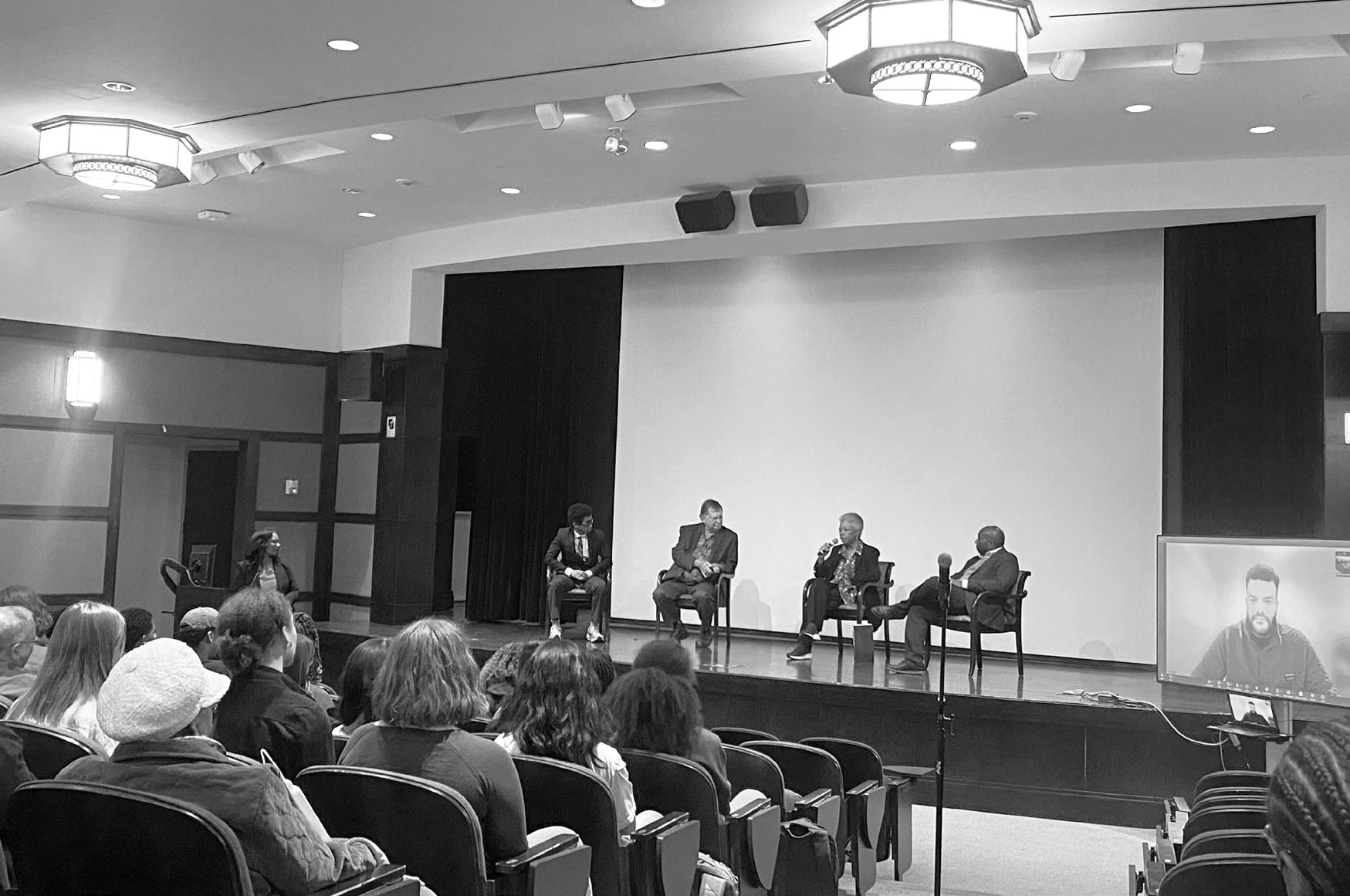
Over 80 students, staff and alumni gathered in Pomona College’s Rose Hills Theater on Feb. 19 to celebrate the documentary “Journeys of Black Mathematicians: Creating Pathways.”
The event included a reception with the film’s director, George Csicsery, a screening of the documentary and a panel discussion featuring several Pomona College alumni. With a career spanning nearly four decades, Csicsery has directed 36 films, including dramatic shorts, performance films and documentaries.
This is the second of two films in the “Journeys of Black Mathematicians” series and documents the experiences of Black mathematicians attending predominantly white institutions. Key themes include segregation and identity, diversifying the profession of mathematics and a recent decline in Black undergraduate students studying math.
In the film, Black mathematics professors across the country who represent colleges including Delaware State University, Loyola Marymount University and Rice University, narrate their journeys into higher education.
Professor Raymond L. Johnson, for example, was one of the first African Americans to be admitted into Rice University during the initial stages of desegregation in the 1950s. However, two alumni sued Rice University in an attempt to stop Johnson’s attendance. When he received his PhD, Johnson became the first African American to ever graduate from the university with a degree in mathematics. Among the professors in the
film, two currently teach at the Claremont Colleges. Professor Edray Goins has taught mathematics and statistics at Pomona College since 2018 and spoke about his experience in the “Racism in academia” section of the documentary.
Talithia Williams is a professor of mathematics and mathematics clinic director at Harvey Mudd College. In the section “Keeping students in Math,” she discussed possible reasons why there has been a recent decline in Black students majoring in mathematics.
“It’s really rare that a Black student is taught by a Black professor in Mathematics,” Williams said. “The inner voices might start to tell you that you don’t belong in a space when you don’t see yourself represented.”
Serena Lin PO ’25, one of the event organizers, enjoyed how Csicery’s film was able to reach a wide community.
“Looking around you can see how impactful it is to bring a community of alumni, students and faculty together to honor the achievements of these Black mathematicians in this space,”
Lin said.
Audience member Khalab Blagburn PO ’27 appreciated learning about the timeline of segregation in academia.
“I found it really powerful to watch the history of how the first Black mathematicians came to be,” he said. “It was fascinating to learn the process it took for them to be integrated into higher education.”
After the screening, Goins, Csicsery and Pomona alumni Onetta Brooks PO ’74, Michael Dairyko PO ’13 and Tesfa Asmara
PO ’24 took the stage to answer questions and give their reactions to the documentary, with Williams moderating the panel.
Regarding the goals and functions of the film, Csicsery said he hoped that the film would reach students when they feel like they need community.
“When I tell people why I took on this project, the most frequent question I get asked is, ‘Are there any Black mathematicians?’” Csicsery said. “This film is the answer to that question.”
In a follow-up question, Williams asked what inspired the panelists to pursue higher education specifically in mathematics.
“I was part of the ten percent admitted Black students at Pomona,” Brooks said. “Along came a professor who helped me pursue what I wanted to do.”
According to Brooks, there is a transformation that takes place when students come to college because of the community support they find there. Faced with the expectations of fitting into a predominantly white institution, students find relief from these pressures through their friendships.
“When we come in with certain expectations of where we want to be and how we want to grow, it’s our friendships that prepare us for whatever we do next in our life,” Brooks said.
Having a strong support system, the documentary and the panelists made clear, is foundational to success throughout college.
attention to the crisis due to double standards and the United State’s lack of political capital to have an impact on the conflict.
Since April 2023, Sudan has been facing a civil war between two rival factions of the military government, leading to mass murder and a refugee crisis, while simultaneously leaving Sudan on the verge of famine.
“One reason for the double standard is that our tax dollars as Americans are not going to fund the weapons that are massacring the Sudanese,” Kristof said. “And our tax dollars are going to provide the 2000-pound bombs that are being dropped on Gaza.”
With regard to campus activism, Kristof believes that the protests were actually ineffective in helping resolve the conflict and humanitarian crisis on the ground in Gaza.
In comparison, Kristof said that protests during the Vietnam War were less militant and helped to elect former President Richard Nixon.
“I was afraid that the militancy of the protests … was actually undermining the support and distracting from what was happening in Gaza … I do think that some kinds of protests that are less militant [and] more inclined to actually educate can be helpful,” Kristof said.
Kristof argued that there often tends to be a limited and binary view of compassion determined by “concentric circles of empathy,” and that it is necessary to rethink this view of human rights.
“At the end of the day, if you care about human rights only for Palestinians … or only for Jewish Israelis, you don’t care about human rights,” Kristof said. “You only care about one side.”
Attendee and Claremont local John Watts appreciated Kristof’s attention toward these “gray areas.”
“I felt he was exceptionally articulate, but I think he understood the nuances of some of these problems,” Watts said. “I appreciated the fact that he was working in those gray areas.”
Kristof claimed that the failures of the American left come from an excessive focus on values and terminology instead of outcomes, which can feel performative and feed a sense of exclusion.
“We often have this kind of purity, where we are so focused on our inputs that we don’t actually look at outcomes … We were trying to be inclusive, give pronouns and use terminology like pregnant people, etc,” Kristof said. “For a lot of Americans who do not live by words, this was excluding them.”
Referencing his childhood in Yamhill, Oregon, a small agricultural town, Kristof described the disenfranchisement of everyday life in the present state of economic and social distress.
“We have to recognize how much pain there is around the country,” Kristof said. “So many homes have been shattered by these interrelated pathologies of addiction and alcoholism and homelessness and mental illness and chronic pain and educational failure.”
Attendee Andrew Shelton PO ’27 echoed Watts’ view.
“[There were] some excellent points that were leveled and reasoned, and [the talk] contains some of the nuance that is highly necessary at this tumultuous time,” Shelton said. “I believe that Mr. Kristof was able to navigate the perils of such a divisive issue without disrupting the validity of his claims.”
Saying I love you via snacks
Each year in college, I’ve learned something new about myself. In my freshman year, I learned that I am capable of playing music in front of others without collapsing from nerves. Sophomore year, I learned that despite feeling jaded from my experience at my art high school, I still liked to draw. Junior year, I learned that my preferred alcoholic beverage is a nice glass of wine (and, when I was in the trenches, maybe a whole bottle or two). Now, in my senior year, I’ve learned that one of my love languages is gift-giving. Or, perhaps it is more accurate to say snack-sharing. It started one night in the fall when I brought some of my favorite candy to a Tuesday dinner that I regularly have with my friends. I placed a package on the table of li hing mui strawberry belts — chewy candy sprinkled with tangy li hing mui powder — that was recently gifted to me by a friend. As a candy that I was absolutely obsessed with as a teenager, I wanted everyone to try it. We passed the package around the table and each tore off a piece of the red gummy strips. This act of sharing something together made me smile. I felt warm and fuzzy inside.
Oddly enough, this moment reminded me of all the times my parents would have people over (sometimes even on the weekdays, which my elementary school self thought was so cool), cook something yummy and share a meal together.
After that day, I knew I wanted to continue to bring snacks to these dinners.
That weekend, I stopped by Trader Joe’s and H Mart, and emerged at our next Tuesday dinner with a whole bag of goodies in hand — everything from Trader Joe’s Takis and Cocoa Batons to chocolate churro and truffle-flavored Turtle Chips. Just like the moment with the li hing mui candy, seeing my friends pass around these snacks and enjoy them together filled my heart with delight.
In a college student-modified fashion, I felt like I could now understand why my parents loved hosting people for meals while I was growing up. There’s something rather special and intimate about sharing food, and though I may not necessarily be able to cook a whole meal for my friends here, I can still bring plenty of snacks to share.
From that Tuesday on, I started regularly bringing a bag of snacks to our dinners, and then even to the library where many of us would study after. It quickly became a tradition — one that I continue to this day — and it has brought so many sweet and silly memories throughout senior year.
Numerous times at school, I’ve chuckled at the memories of friends searching the depths of my bag for the last Taiwanese dried noodle snack pack, me
choking on a cough drop while midbite of a Turtle Chip and us plowing through Pocky sticks at 11 p.m.
All of these memories have stemmed from the simple act of sharing food, and I believe it has brought us closer, too.
In the spirit of Valentine’s Day month, I write about this tradition of care. My English class discussions on access intimacy and intimate labor have led me to wonder what acts of care look like for different people, and moreover, how do I show others that I care for them?
I believe that my answer changes with every season, but in this season of senior year (and now senior spring), my answer is this: I feel that I most tangibly show people that I care for them by feeding them. Through gift-giving in the form of their favorite snacks.
Care for me right now looks like bringing chocolate-covered powerberries and Scandinavian Swimmers to the library, knowing that friends’ faces light up at the sight of these candies. Care looks like buying a bag of gochujang-flavored shrimp chips during an H Mart run and always being on the lookout for the injeolmi-flavored Turtle Chips, hopeful that one day I’ll be able to surprise my Scripps friends with them. Care looks like texting in a group chat: “I’m on my way to Trader Joe’s — you have 10 minutes to tell me what you want!”
As spring semester hurries on, I look forward to continuing sharing snacks with my friends and regularly replenishing my bag with goodies to fuel us through our studies. I look forward to more moments of passing snacks around the table in a similar way to how my parents passed around food with friends during my childhood.
It is these moments that I cherish so deeply as I think about my upcoming graduation in May. So here’s to more moments of gift-giving, snack sharing and plopping down my Hello Kitty bag in the library for my friends to eagerly peruse its contents. As a matter of fact, I think I’m going to make another Trader Joe’s run this weekend. More chocolate-covered powerberries and Scandinavian Swimmers are on my list … What else do people want?
Emily Kim PO ’25 is from Irvine, California. Her current favorite item from her snack hauls is the chocolate churro Turtle Chips, which she believes is the perfect crunchy sweet treat.
SaraH ZIFF • THe STuDeNT LIFe
KeeaNa a. VILLaMar • THe STuDeNT LIFe
EMILY KIM
aLeXaNDra GruNbauM • THe STuDeNT LIFe
MOMeNTS TO SaVOr
Reassurance in my Trader Joe’s shopping cart
Last week, amid the chaotic pre-Valentine’s Day mood and the increasing intensity of my workload, I was looking to blow off some steam. So I resorted to my ultimate stress-releasing activity: going to Trader Joe’s. I lined up to buy snacks and, in an attempt of self-appreciation, some flowers. As the cashier was checking out my items, he gave me the most radiant smile.
“Hydrangeas and baby’s-breath? This is such a beautiful flower combination!”
Some time ago, a friend told me that Trader Joe’s cashiers are basically trained to compliment your groceries. Still, I left the store feeling pretty good about myself.
As I began my trek back to campus, I found myself thinking: Why, despite knowing what my friend said, did I feel so happy when the Trader Joe’s cashier complimented my flowers?
I broke down my question: What was he doing by complimenting my flowers (besides doing marketing for Trader Joe’s)? He was praising my choices. And what was this happiness that I felt? It was a validating feeling of reassurance.
Walking through the streets of Claremont, outlined with ornate houses and desert plants, I wondered: Why have I been seeking reassurance about my choices?
In those gap months between committing to Pomona and studying here, I was full of doubts. My mom passed away at the beginning of my senior year, so the process of applying to college had been kind of a blur. Though I’d always been a committed student who genuinely loved learning and dreamt of a future at a prestigious college, I suddenly saw myself drifting into a monothematic and monochromatic existence.
So when I got into Pomona, it almost felt like a miracle. Everyone
back home kept gushing with congratulations and comments about how my mom was most definitely proud of me.
My family and my teachers, though happy, had some doubts: Shouldn’t I take a gap semester to rest? Would I survive Pomona, as grief-stricken as I was?
My mom passed away in August 2023. In August 2024, I was coming to Claremont.
At first, I felt fine. The excitement of International Student Orientation paired with the day-long Orientation Adventure (OA) trips kept my mind off things.
However, as classes started, I saw my questions turn in a dangerous direction: Had I chosen the right college? Had they chosen the right student?
During International Student Orientation, an international upperclassman gave my doubts a name: impostor syndrome.
“In your freshman year, some
days you’ll wake up and think that you should be back home,” she told us during a panel. “When these days come, I want you to know that you’re wrong. You’re exactly where you’re supposed to be.”
During my first months here, her words echoed in my mind like a mantra. But after a while, her reassuring speech seemed to weaken. My freshman year imposter syndrome became denser and my burden felt bigger.
My questions went from “Did I choose the right place?” and “Did they choose the right person?” to “Am I coming to Pomona to escape my pain?” and “Am I qualified to be here or did Pomona only admit me because of my ‘sob-story’?”
As the semester went on, my doubts subsided. I was doing well in my classes, receiving positive feedback from my professors, being involved in a few clubs that I enjoyed and I was making lovely friends.
My problem was solved: I had proven to myself and everyone around me that I was, indeed, not a fraud.
But … not really. When I came back for the spring semester, even though I had continued to succeed academically and socially, those old doubts gradually resurfaced.
Something that’s unresolved will always find a way back into your life.
Over the past few months, I’ve been told I’m strong and vocal. But suddenly, I was like a little kid. I wouldn’t dare talk to my friends about it, feeling that I’d only bother them. And I didn’t want to worry my dad and my sisters back at home. So I sucked it up.
That was until I went to my professor’s office hours. After she asked me how I was doing outside of my academic life, I simply cracked. I told her about feeling like I was running away from home.
“You’re certainly not running away from it,” she told me, nonchalantly. “Here you are, telling me about it. And even if you were running away … I don’t see a problem.”
I had the strange feeling that I was failing at convincing her that I was a failure. So I told her about my most terrifying thought: that I had been accepted to Pomona on the basis of pity.
She looked at me kind of weirdly.
“Do you really think that?”
I nodded, shy and embarrassed.
“That might be one of the dumbest things I’ve ever heard,” she said, laughing.
Upon seeing my shocked expression, she continued.
“Let me tell you something: They admit students here for a bunch of weird factors. But I can assure you that pity is not one of them.” I left her office with the same feeling that I had when I was leaving Trader Joe’s: the sheer joy and relief of reassurance. In recent years, there’s been an emphasis on the self-love movement. While it’s a beautiful thing to be able to love and take care of oneself, there’s a limit to how much we can reassure ourselves internally.
Every once in a while, we need someone — be it a Trader Joe’s cashier or a dear professor — to provide us with some reassurance.
So next time I go to Trader Joe’s, even though I know it’s coming, I’ll continue to feel happy because of the cashier’s compliments. I did buy beautiful flowers after all. I’ll thank them, wish them a good day and walk back home, giddy and reassured.
Anna Ripper Naigeborin PO ’28 is from São Paulo, Brazil. Her favorite Trader Joe’s snacks are chocolate-covered raisins and dried chile-spiced mango.
Diagnosing the lack of style among 5C men
The CDC has just confirmed that a massive plague is sweeping across these campuses and no one is safe. The malady I’m referring to is of course the lack of quality looks in the department of male fashion at this very fine consortium. I consider myself a doctor in this matter and am here to offer up some lovely remedies for the men of these schools who are looking to vaccinate against this plague.
The first symptom of this horrific disease is a grievous error to a critical element of outfits written directly in the name … the fit. When it comes to clothing, unlike your water bottle cap, looser is better. Like Goldilocks, you are seeking the perfect medium. For jeans, denim and other pants, this is a straight leg, and for tops, this is a loose oversized silhouette.
Speaking of denim, the Levis 501 is a classic for a very good reason and I highly recommend that every man have one pair of light and dark wash 501s in their closet. The more vintage the feel, the better. Luckily there are men at these schools who have managed to steer clear of this illness, and to them, I am incredibly grateful and suggest that they help out their less stylish friends. It’s called public health for a reason.
While we’re prescribing pants for men, I have seen quite a few exquisite executions of Carhartt or similar carpenter-style pants. Shoutout to the Pitzer boy style, which is doing the Claremont Colleges a huge favor in the style department. A loose straight-leg pair of Dickies, corduroy pants, cargo pants, sweatpants or jeans is something that every man needs. Look for styles labeled as “relaxed,” “loose” and “straight.”
We need to disinfect against tight-fitting bottoms, and especially avoid an ankle-cinch.
Nothing kickstarts the style immune system like a good graphic tee and denim combination. A cool T-shirt or button-down is always a winner. That being said, if I may suggest that we as a society progress beyond the flannel, that would be great. As far as outerwear is concerned, a leather jacket in an oversized style
is a staple that everyone should invest in. A good relaxed denim and suede coat are also great choices.
The tried and true blue-collar boy Carhartt jacket is never a bad idea and I am also a fan of a good crewneck sweatshirt or quarter zip. All we must do to combat this plague is look towards history to inform us of the looks that transcend generations and excel in combining form and function, the most important being knits. A good crewneck sweater or maybe even a cardigan is a surefire way to stay warm and look your best.
The superb British publication SLMan suggests that the latest in men’s trends focuses on a return to the preppy aesthetic as exemplified by Jacob Elordi in “Saltburn.”
They highlight button-downs, crew neck sweaters, tailored pants and good loafers. I would have to agree with their stance that a tailored look can definitely be an amazing choice. A loose linen shirt or nice sweater are staples in both men’s and women’s wardrobes. Some brands to watch include Ralph Lauren, J. Crew, Uniqlo and Banana Republic. Second-hand shops are a mecca for unique stylings and the added sustainability factor is always a bonus. If you are looking to treat yourself to a little something new though, some brands I recommend browsing are Abercrombie, Cotton On, Gap, Zara, H&M and Kith.
How you walk through the day matters on so many levels, from heart to musculoskeletal health; with the most literal factor of your strut being, of course, your choice of footwear. I present to you a solution that has been clinically tested to ward off this critical virus: the cool sneaker. Any classic look is immediately brightened by a shoe with a fun pop of color. The New Balance 550, a tried and true Nike dunk, a high-top Converse Chuck 70, a Nike Blazer, Reebok’s Club C model; the list goes on. Adidas, the powerhouse of style-forward athletic wear, has a myriad of stellar sneaker styles including the OG Samba, Gazelle and the Campus, whose name
suggests it is perfect for my readerly demographic. It would be wrong not to acknowledge that medical professionals regard the shoe game at the 5Cs as quite healthy, and I have been seeing many a man trot to class with some praise-worthy kicks. My biggest tip for all those looking to level up their sneaker collection is to avoid a shoe that looks overly athletic. There is a time and a place for a running shoe … namely running. Men are, of course, not limited to sneakers, and there exists a plethora of footwear that is more polished than your traditional trainer. I have been seeing many men across the schools, I believe them to mostly be hailing from Mudd, who are expertly sporting Dr. Martens in a way that cultivates a perfect dark academia aesthetic. The Chelsea boot and Oxford shoe in black or brown are two of their best styles and pair tastefully with a loose-leg dark corduroy and sweater. Straight off the streets of Copenhagen, the Birkenstock Boston creates a
cozy and sophisticated look, particularly when married to loose light wash jeans and a graphic crew neck.
Neutrals may very well be the magic cure. This palette is the lightest and brightest thing of this day and age as showcased by the Dior men’s fall fashion show in 2025. Now, I’m not suggesting that you abandon all color in your life and go full minimalist, but a wardrobe of basics with the occasional colorful accessory is the perfect versatile formula for a curated look.
As far as accessories are concerned, the men of these campuses are quite healthy in this department, specifically when it comes to baseball caps. An important distinction between the successful sporting of a cap is that the brim not be flat. Further, a beanie is something that should be reserved for snowy weather only and is therefore not appropriate in Southern California. Take note when I say that a belt is something every responsible adult wears to diversify their look and create
interest. This piece was born from my utter frustration with the infestation of athletic wear I see men wearing on these campuses. Fashion is fun and expressive and I fear that many men are missing out on this by refusing to steer away from CMS-branded clothing that allows them to blend in. That being said … the only place I want to see a grown man in Nike shorts is at Roberts Pavilion.
If you are not actively working out then please stop being a clone of all your friends and try out a new style!
As always, this was written with much love and respect, and I offer my services to anyone who is looking to step up their outfits and improve their health. Please don’t hesitate to reach out to me and download the phenomenal app Pinterest for some inspiration!
Ellen Chapman SC ’27 was born in Germany and currently calls Swarthmore, PA home… GO BIRDS!! She loves skiing, traveling, chocolate, reading, procrastinating and quad-shot almond milk lattes!
ELLEN CHAPMAN
PJ JaMeS • THe STuDeNT LIFe
ANNA RIPPER NAIGEBORIN
CLareMONT CLOSeTS
Escaping solitude in art: ‘Parallel Play’ and
‘One Last Thing Again’ at the Benton Museum
and explore the intersections between writing and visual
with an audience and other artists in person.
“I actually love this kind of thing which we call programming, which accompanies an exhibition,” Jacquette said. “For me, it’s when I get to be out of the studio and talk about how the work was created.”
Lethem, Jacquette and Johnson all grew up with artists in their immediate families. Witnessing artistic practice through observing family members shaped their respective understandings of how to be artists. These legacies are also present in “Parallel Play,” which includes paintings by Lethem’s father and brother.
“Any creative endeavor that I had interest in was tremendously encouraged,” Jacquette said. “What a tremendous piece of luck to have somebody in my life where I could see how she operated in the world and what a studio practice was.”
Lethem often traded his writings for works of art created by his friends, or for minor works by bigger artists he wrote for, an exchange essential to the construction of both “Cellophane Bricks” and “Parallel Play.”
This curatorial process included some 5C students as well. Ava Monheit PZ ’27, one of the curatorial interns working at the Benton under Moore, assisted with artist research, developing the exhibit’s themes and organizing visits to the studios of exhibited artists.
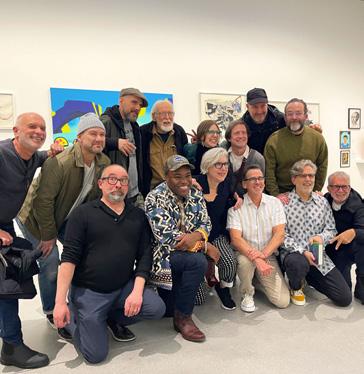
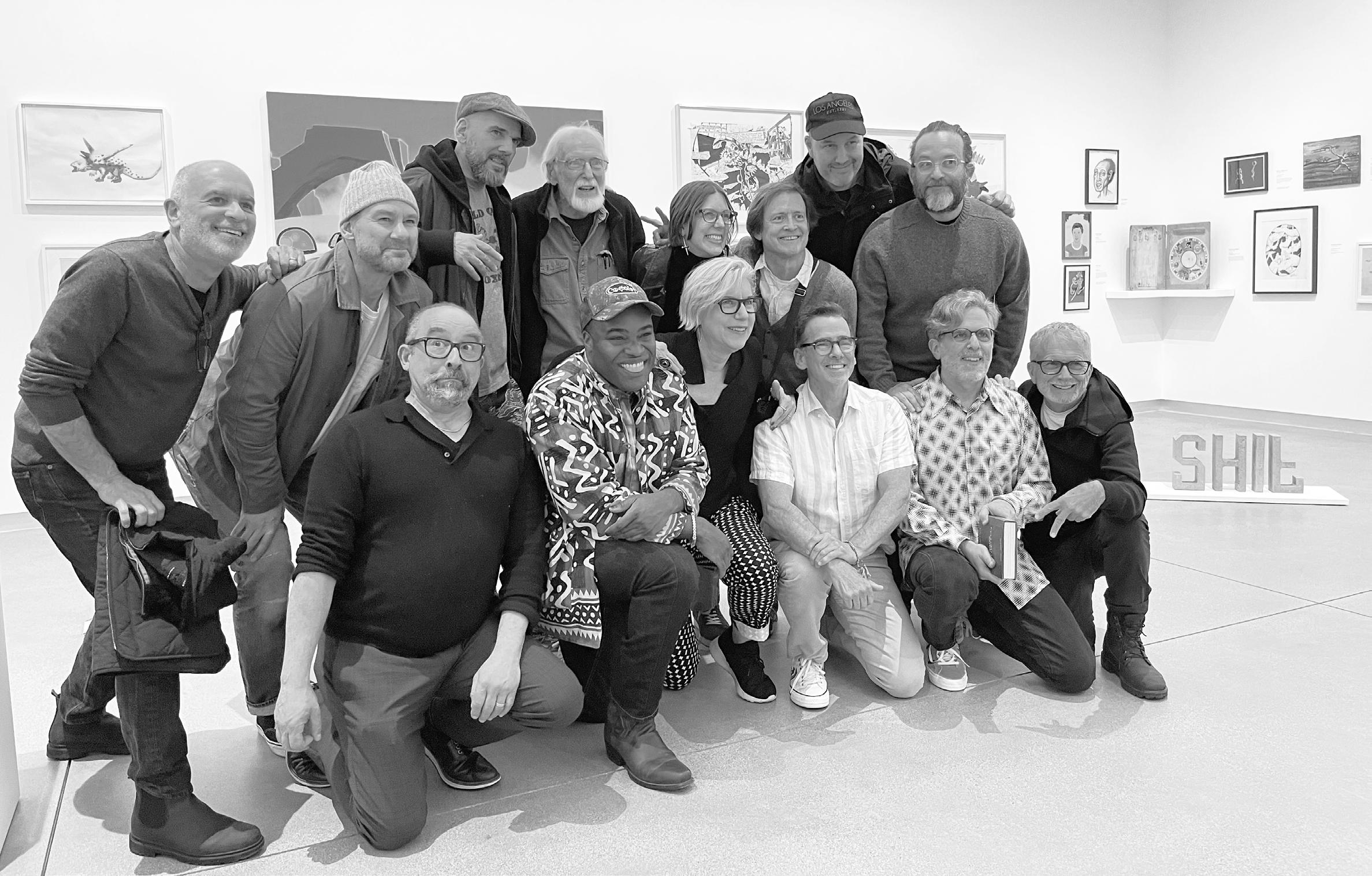
Making art can be a solitary experience, but human connection was essential to the creation and curation of “Jonathan Lethem’s Parallel Play” and “One Last Thing Again,” two exhibits that opened at Pomona College’s Benton Museum of Art on Feb. 13. At the center of a web of relationships sits Pomona professor, novelist and art writer Jonathan Lethem, whose most recent book, “Cellophane Bricks: A Life in Visual Culture,” provided the framework for “Parallel Play.” A collection of art writings spanning both commentary and fiction, the book provided an initial catalog for “Parallel Play,” which was then amended by co-curator Solomon Salim Moore.
The exhibit is premised on the human connection between words and art, as its title nods to.
“[‘Parallel Play’] is really about
art as a form of social transaction or a form of relationship,” said Lethem. “There is a dialogue or a give and take that describes almost every piece in that show.”
The walls of the “Parallel Play” gallery space are filled with dynamic and colorful paintings, drawings, prints and photographs, along with some three-dimensional works throughout the space.
The neighboring “One Last Thing Again” displays every edition of the periodical “THE THING Quarterly,” which was produced by visual artists Jonn Herschend and Will Rogan from 2007 to 2017. During its run, “THE THING” distributed a practical object and accompanying text, which illuminated some deeper or subversive train of thought about the object in question. Each issue of “THE THING” was conceived by a different contributor, usually a creative.
“Issue 7” was created by Lethem, and “One Last Thing Again” runs in conjunction with “Parallel Play.” The exhibit was curated by Herschend and Rogan, with Victoria Sancho Lobis, the Sarah Rempel and Herbert S. Rempel ’23 director at the Benton.
The Benton held an opening reception for both exhibits on Feb. 15, including an artists panel moderated by Lethem and Moore, featuring exhibited artists Julia Jacquette and Mark Johnson.
The group discussed the origins and meanings of the exhibit.
“Part of it was the occasion of ‘Cellophane Bricks’ the book, so [Lethem] would be the common bond there,” Moore said.
Lethem’s personal art collection and relationships with working artists inspired and provided the content for his book, and are also very present in “Parallel Play.”
“Most of what I do is totally
solitary,” Lethem said. “So everything that you can add to that fundamental fact that is interactive, that is connecting you to other people, is so precious.”
Lethem became friends with Jacquette during their high school years, and with Johnson while at Bennington College. Lethem and Johnson’s relationship is a mutually inspiring one; Lethem bought his first real painting from Johnson, a moment that changed each of their respective relationships to their careers.
“To me, that was probably the finest painting in my first one-person show,” Johnson said. “When [Lethem] bought this painting at a real proper price, we were both sort of like ‘We can do this.’” Jacquette echoed Lethem’s sentiments about escaping solitude and explained how attending the opening reception and speaking at the panel allows her to connect
“It’s honestly unreal. I feel like I’ve been looking at this exhibit in tiny paper cutouts,” Monheit said. “And walking in when it opened up was so incredible.”
While curating the show, Lethem and Moore strove to maintain conversations with students like Monheit and exhibited artists.
“It was really important to keep the process living and collaborative,” Moore said. For the artists, “Parallel Play” is a way to look back over their careers, and the web of relationships that connects each artwork.
“As a younger artist, I had doubts about whether there was a validity to what I was doing,” Johnson said. “And seeing it now as an older artist I’m like ‘What’s there to question? Everything is valid just by the fact that you’re doing it.’”
“Jonathan Lethem’s Parallel Play” and “One Last Thing Again” are on view at the Benton until June 29.
Creating resilience through holiday magic
These next two months are often considered the busiest part of the entire school year. With internship application deadlines, midterms, study abroad applications and upcoming summer plans, it can be difficult to create time for yourself to relax. As I sit at my desk writing this article, my head is swimming with the plethora of assignments I need to complete before I can go to bed for the night — and it’s already 10 p.m.
When mentally strenuous times hit, I turn to the thing I love most: holidays. Due to my deep belief in fairytales as a child, or the nostalgia that the holiday season brings as I leave my adolescence, I have always been enamored with the idea of beloved holiday icons. Nevertheless, even in my later years of high school, I always forced my entire family to celebrate multiple holidays with me throughout the year.
Valentine’s Day was never complete without a visit from Cupid. On New Year’s Day, Jack Frost was plastered across our kitchen windows with paper snowflakes. On Saint Patrick’s Day, my parents loved how I trashed the house and claimed, “That sneaky Leprechaun did it!”
My so-called “holiday antics” only got worse the day my dad approached me with the idea of excessively decorating for Halloween. October became our electric bill’s worst nightmare. My dad and I constructed a giant “BOO” sign and graveyard out of chicken wire, securing it in the middle of our front yard. Homemade tombstones littered the lawn, while ghosts and witches dangled from the trees. Eventually, the decorations became so extravagant that trick-or-treaters started to take photos in our yard as if my front lawn had somehow become a haunted tourist attraction.
The most infamous of all was Noriam: a holiday invented by me and my younger brother Liam, which we celebrated every September when we were in ele -
mentary school. The holiday was originally invented because I was a scared first-grader, anxious to go back to school and looking for a fanciful way to focus on the positive. Consequently, the seven nights of Noriam (Liam and I combined our names) was born. The “Great Eagle” would visit my brother and me each of the seven nights, leaving us presents beside a plush teddy bear lovingly placed on our dining room table. When we first brought this Christmas x Hanukkah-inspired holiday to life, both of us were too young and too cheap to actually buy each other gifts. Instead, we
gifted each other our own belongings, excitedly laying them out around the teddy bear. My brother and I’s ability to create a new holiday, and share in our collective imagination, is the type of joy that I aim to remember and recreate during my time in college. Advancing from a scared first-grader to a scared undergraduate student, I have made it a conscious practice to find moments and excuses to celebrate amid the ongoing dread of adult responsibilities. Although my stubbornness to uphold holiday traditions has wavered more in the past few years — as reality frequently sinks its claws even deeper into
my “adult brain” — I still create time to celebrate the things that evoke my enthusiasm. Whenever there’s a holiday coming up, I tell myself that if I finish my paper by a certain date, I can go and order holiday decorations from Amazon to liven up my dorm room. For example, despite the stress of this past week, the Valentine’s Day decorations I hung in my room lifted my spirits when I was worrying about my assignments. My mom even sent me a small gift from “Cupid.”
With the typical heavy workloads and high expectations of the 5Cs hovering over our heads, it’s easy for college life to lose
its spark. My point is, whether it’s something as seemingly insignificant as celebrating a holiday, find the one thing that will always make your life exciting and will help you bounce back when you’re struggling. It could be rewarding yourself with a chocolate chip cookie from Crème Bakery after a midterm or watching a football game with friends at the end of a long week. If that motivation happens to be an absurd holiday named after you and your sibling, then it’s even better! Norah Mannle CM ’27 hails from the suburbs of Washington D.C. In her free time, she enjoys long walks, critiquing new coffee shops and skiing.
NORAH MANNLE
SaSHa MaTTHeWS • THe STuDeNT LIFe
COurTeSy: JuSTINe bae bIaS
SAGE HARPER
“Jonathan Lethem’s Parallel Play” and “One Last Thing Again,” map a web of artistic relationships
art.
SCHOOL SurVIVaL GuIDe
Clean energy alone won’t save us
For decades, the United States has reveled in the notion of energy supremacy — first through oil and fossil fuel dominance, and now through the promise of a boundless renewable revolution. And that vision has largely been successful: In 2024, the United States installed more than 97.2 GW of solar energy capacity, enough to fully power 18 million homes. Additionally, wind energy, hydroelectric power and other sustainable energy sources now make up an increasing share of our energy usage year by year. That vision, and that realization of progress, have promoted many to call for an abundance energy revolution, in which clean energy sources replace fossil fuels and allow for utopian economic growth and consumption. It is a vision predicated on the idea of renewable energies being a miracle-like substance that will allow us to maintain our global competition and market advantage.
However, this idea is fundamentally flawed.
The first practical problem is that the vast majority of the energy we use still comes from polluting fossil fuels. In fact, the United States is still more dependent on fossil fuels than the other largest fossil fuel emitters, like China. But the more fundamental issue is the idea of “energy abundance.” Even renewable energy has environmental consequences, and an attitude of unchecked energy consumption and continued rampant consumption will continue to strain our depleted planet.
In its “2024 Renewables Report,” the International Energy Agency estimated that the world would add more than 5,500 gigawatts of renewable energy capacity between 2024 and 2030 — almost three times the increase seen between 2017 and 2023. This optimism and massive achievement masks a troubling reality: global fossil fuel consumptions, in fact, have continued to hit new highs, with 2024 seeing some of humanity’s biggest annual carbon releases ever.
Instead of forcing coal and oil into obsolescence, we’re merely adding more energy to the system — filling the gap with renewables while still burning record amounts of fossil fuels. This is the real danger of the “energy abundance” mindset: it assumes that a limitless supply of clean energy will eventually render fossil fuels obsolete. In reality, renewable energies are not replacing fossil fuels, but supplementing them, contributing to a continued pattern of broad energy consumption. As long as consumption continually increases, and as Americans continue to equate prosperity with
ever-growing production and consumption, we will continue to extract and burn whatever energy sources are available. Compounding this issue, the U.S. Energy Information Administration’s International Energy Outlook projects that rising global incomes and economic growth are projected to drive up energy demand, effectively nullifying the minute progress we’ve made by adopting cleaner technologies.
The idea that we can achieve sustainability solely through unlimited “clean” energy is not only misleading — it’s dangerous.
Instead, we must pursue energy security — ensuring reliable and affordable access to electricity. Energy security stabilizes our energy and provides affordable prices to American consumers while also enhancing our national security at large.
Renewability doesn’t give us the license to unscrupulously consume and produce energy without attention to consequences. It’s about reconsidering what we truly need, what we can cut out and how we can minimally use energy to sufficiently meet our energy needs without unnecessary overproduction.
True climate responsibility demands more than cleaner power; it requires a fundamental shift in how we use and understand energy. It’s a shift that begins with government action but is equally rooted in our own awareness of energy use and consumption. Everything we rely on — plastic, metal and even “eco-friendly” products — is produced using planet-intensive energy, ultimately derived from fossil fuels.
As students, we must hold our politicians accountable when they propose visions of a green future built on renewable energy abundance. Our activism and voices are crucial in ensuring that energy policies are pursued as a necessity for our survival, not merely to parade economic strength and innovation. Real change begins with taking responsibility for our own consumption, and a willingness to forgo what we do not truly need for the sake of our survival.
Our society is undeniably dependent on fossil fuels; that won’t change overnight. But every effort to reduce our own energy consumption brings us one step closer to a genuinely sustainable future.
Eric Lu PO ’28 is a politics major from Salt Lake City, Utah. He wants to explore ways to reduce his own overall consumption while at Pomona.
ZENA ALMEIDA-WARWIN & ANNA YOST
Beauty standards have always fluctuated, but we are entering a new era where they are being rewritten at the genetic level. As cosmetic procedures veer into bioengineering, the line between self-improvement and self-erasure continues to blur. The pursuit of perfection is no longer just about aesthetics — it’s about eliminating difference itself. We may all be accustomed to rhinoplasties, Brazilian butt lifts (BBLs) and tummy tucks, but the latest surge of new cosmetic procedures signals something more troubling. One of the most extreme is keratopigmentation, a procedure that injects a colored pigment into the cornea to permanently change eye color. Initially intended to restore “severely impaired eyes,” the surgery has recently gained traction in the cosmetic realm. Despite the $12,000 price tag and risk of vision loss, many patients express minimal hesitation to get the surgery.
There’s something more sinister about a surgery like keratopigmentation, in comparison to a BBL. Keratopigmentation modifies our genetic code, rather than a part of our body we could change naturally if we did enough split squats in the gym. The procedure reflects a deeper insecurity with identity. It’s not just that we want other people to see us differently, but that to our core, we think our natural
Contemporary art must put individual before identity
Sebastian Calfuqueo’s “Tray Tray Ko” is a six-minute film depicting the artist dragging an electric blue fabric through their native Mapuche land and into a waterfall. Why is this video worthy of an audience’s attention?
By “highlighting the interconnectedness of her own personhood and the landscape [Calfuqueo] resists the Chilean government’s efforts to destroy Indigenous homelands for commercial use,” according to the 2024 Whitney Biennial, the longest-running survey of American contemporary art. I cannot see how this work does any of these things.
Identity art derives its value from the artist’s identity rather than the quality of their work. This model, increasingly prevalent since the 2016 election, posits that displaying a marginalized individual’s work is a radical act of resistance against the predominantly white male spaces of art. While that concern is legitimate, the identitarian lens rebukes the fundamental pursuit of art — communication with the viewer — and reduces diversity by generalizing individual experiences under group identity. In prioritizing identity over dialogue, contemporary art risks losing what makes it compelling.
In the widely-read essay “The Painted Protest,” critic Dean Kissick argues that in prioritizing representation, contemporary art has sacrificed quality for identity. “If an artwork’s affective power derives from the artist’s biography rather than the work, then self-expression is redundant; when the self is more important than the expression, true culture becomes impossible,” Kissick writes.
Great art is not only about the artist. It’s about you too.
Great art implicates you, the viewer, in the artist’s vision. Identity art has little interest in second-person dialogue;
instead, it centers on the self or a generalized community. It erodes the primacy of physical form in mediating meaning between the viewer and the artist’s idea. Without this communication, the viewer cannot find meaning from the physical piece alone, and the art itself becomes superfluous.
Simone Leigh, a Black feminist sculptor, isolates the viewer from her ideas. At the 2019 Whitney Biennial, progressive protestors criticized her for prioritizing “inclusion, representation, and discussion” over “real politics.” Leigh shot back with a list of references that situated her work’s radicalism. Without an understanding of those references, Leigh argued, the viewer could not grasp its meaning.
Unfortunately, Leigh’s profound rumination on her identity is not reflected in its physical manifestation. At her LACMA exhibition, I struggled to connect the convoluted wall text to the art itself. Her work, devoid of this connection, feels politically empty — let alone radical.
By comparison, Arthur Jafa’s short film “Love is the Message, the Message is Death” shattered me with the intimacy of its universality. Jafa stitches together clips that show the centrality of Black ingenuity to American culture, interspersed with harrowing scenes of the violence the U.S. has inflicted on Black Americans. A woman confronts the viewer and asserts, “We are not aliens.”
Understanding Jafa’s piece doesn’t require you to share his identity. It requires your humanity. To quote artist Steve Locke, what you need to do is “open your fucking heart.”
Aside from de-emphasizing the primacy of form, identity art flattens interpretation.
The movement of identity art reels in contemporary art’s expansive intellectual approach in favor of a central narrative: A person’s identity shapes their art. This centripetal pull demeans minority artists by rendering them interchangeable.
Laughably, the main pavilion
The new cosmetic dystopia
features are flawed.
Some may argue that altering appearance is a personal choice, and to an extent, it is. But the choice reflects an adherence to the Eurocentric beauty standards these surgeries reinforce. At Alexander Movshovich’s Kerato eye center in New York, 90 percent of clients have naturally dark-brown eyes and 60 percent of patients are Hispanic or Black.
The overwhelming preference for light-colored eyes is a rejection of human diversity in favor of an aesthetic ideal. Movshovich notes that Hispanic patients most commonly request honey gold and green eyes, Black patients favor green eyes and white patients favor blue eyes. This trend reflects the ways in which Western standards have infiltrated mass self-perception, particularly in communities of color.
Procedures like these unravel the work we have done as a society toward embracing difference. Skin lightening is already a common practice in many South Asian countries, where colorism remains entrenched. The desire for Eurocentric features shouldn’t be seen as a passing trend; rather, it’s a symptom of racialized beauty hierarchies that continue to persist.
It’s not hard to imagine a world where parents genetically engineer their unborn children’s features, from height to hair color, further en-
trenching exclusionary beauty ideals. Black and Brown communities have already spent decades healing from violence and discrimination, and their features continue to be systematically devalued.
In the early 2000s, American beauty standards seemingly shifted away from the European craze. Suddenly countless celebrities like Kylie Jenner and Iggy Azalea underwent cosmetic procedures specifically mimicking Black features. Once deemed unattractive by the white public, these features became acceptable via their incorporation into and appropriation of beauty standards. Now, celebrities are getting their BBLs removed and lip injections dissolved. Biomedical advancements
cater to a singular aesthetic ideal: one that cherry-picks certain non-Eurocentric features, just to discard them in due time. The message is clear: whiteness and beauty remain synonymous. Widely used social media filters slim faces, slim noses, whiten faces and top it all off with a set of sparkly blue eyes. These digital enhancements normalize features only attainable through surgery, priming future generations to see extreme modification as a natural next step in the never-ending pursuit of beauty. This desensitization to European cognitive imperialism isn’t just about filters and fillers — it extends into the realm of genetic engineering. CRISPR, a revolutionary gene-edit-
of the
tingly exposed this contradiction by homogenizing its four distinct thematic subjects, “the queer artist; the outsider artist; the folk artist; the indigenous artist,” under the umbrella term “foreigner.” Art historian Darby English speaks of the shocking conclusion of this forced generalization: “If all Black artists do the same thing, then why should anyone take a given Black artist more seriously than they take an Advil?”
Artillery Magazine’s review of Aria Dean’s recent exhibition exemplifies this issue. The critic ignores Dean’s explicit request to focus on her piece’s form and instead interprets Dean’s omission of her Blackness as a commentary on race— encouraging viewers to only engage with Black artists through the lens of their Blackness. Because identitarian art derives its value by linking itself to a marginalized group’s history, it seems every show interrogates the past. Sean Monahan, founder of trend forecaster K-HOLE, describes the avant-garde as a shark: it dies when it stops moving forward. By going backward, identity art might have killed it.
The Hammer Museum’s “Now Dig This!” rejected the patronizing identitarian approach of wealthy museums that treat inclusion as an act of generosity. It instead declared that the margins are the center. That astonishing spatial inversion topples the conventional subculture versus culture dichotomy.
I’ve seen most 5C media studies and studio art shows travel down the worn identitarian path. I challenge 5C students to change it up. Present an unexplored vision, not one that affirms leftist postcolonial theory that we all already agree with. Start difficult discussions instead of broadening consensus. Reject generalization no matter its intent. Only then can we create something truly radical.
Elias Diwan PO ’25 is from D.C. He encourages you to please visit contemporary art shows. He is still uncertain of how to pronounce his own name (suggestions welcomed).
ing technology co-pioneered by Jennifer Doudna PO ’85, has the potential to cure genetic diseases like sickle cell anemia and cystic fibrosis. However, as with any powerful tool, misuse is inevitable.
What begins as a means to eradicate disease is also a gateway to “designer babies,” where wealth dictates access to genetic features, deepening social divides, reinforcing pre-existing hierarchies and reviving eugenic ideologies.
We must also think back to the principles of evolution: at its core, it thrives on genetic diversity. If we continue to accept the unattainable beauty standards drilled into our psyche, then we are spiraling into a grim fate.
Body modifications and surgeries have been around for thousands of years, and they aren’t going away any time soon. There will always be a new impossible standard of beauty. If we don’t break the cycle of homogenization, we may soon find ourselves living in a world where we engineer exclusionary beauty standards, watching ancestral features disappear and profit, not nature, drive evolution.
Zena Almeida-Warwin PO ’28 is on her self-improvement and beautification journey… natural style. Anna Yost PO ’28 is on a lifelong journey to embracing her
ERIC LU
ELIAS DIWAN
2024 Venice Biennial unwit -
Those with the most financial privilege have the least pressure to understand it — so they don’t. And at the 5Cs, they’re everywhere.
As Claremont College students, we think of ourselves as Renaissance men: We study languages and literature; we follow current events, politics and the economy. On this foundation, we fantasize about our illustrious careers; however, among this 10/20 vision, the average 5C student — particularly the wealthy ones that our schools have in abundance— has a blindspot the size of an 18-wheeler: They don’t (and don’t want to) come to terms with their financial privilege.
TSL’s incoming class of 2028 self-reported survey stated that 50% of respondents received no aid but only 33% estimate their parents’ made more than 250k a year — mutually exclusive yet coexisting figures. To me, these income estimations stuck out like men at the Motley but I suspect few stopped to think what the number they entered meant.
The top 10% net worth is, at minimum, a hair under a million dollars. Nationally, 31.2% of college students receive federal need-based aid, while Pomona sits in the mid-tens. This lines up with the fact that more than 15% of 5C students are part of the top 1%. Therefore, a lot of people are grossly underestimating their family’s economic situation while simultaneously underestimating the impact.
As a rule, I think that rich kids misjudge their parents’ wealth, not for a lack of information but for a lack of trying.
At the 5Cs, being successful is good but being rich is dubious. People establish that their family is comfortable and stop there because it’s the easy option.
If you pay no aid, first off, congratulations. You have what 99% of the planet longs for and I don’t think you should feel bad about it — save that for the heirs of the Dutch East India, Shein or Shell Oil fortunes.
You will probably go on to be very rich, which is dope. However, as karmic payment for it, you have a responsibility to try and understand, and subsequently admit, what it means for you.
People, both poorer and richer, mistakenly think that they are middle class. However, only 2% of Americans identify as upper class. Not for a lack of money but because it’s hard to see oneself rubbing elbows with Elon Musk.
Just like a problem, the first step of implementing a solution is realizing that you have one and the solution to the problems of an (icky) upper class must come from within. That, hopefully, starts with you.
Better understanding your family’s situation is simple. For example, those no-aid students should know that a bachelor’s degree from a private school costs, on average, around a quarter of a million dollars. With every one of the 5Cs’ tuition sitting in the upper echelon of national price tags — Mudd consistently ranking as the most expensive college in the world — this stands as a frankly conservative estimate. Attending a private high school in a big city, especially for multiple children, can cost just as much. Financial aid is based on more than just income, however. Net worth, another major factor, is just as important for understanding your position economically but can be hard to probe without looking at a balance sheet or talking to who your dad furtively calls your “stock guy.” Did your parents pay off the mortgage? Add about a million.
Your family owns stocks — and you have a few? That tracks. The top 10% in the US owns 93% of all stocks, worth more than $40 trillion. And that includes those with a net worth of less than a million dollars. The top 1% own about 70% of those trillions. So add some more.
Just like 98% of Americans, whether they are right or wrong, you probably still believe I’m talking about someone else. It’s easy to think that your parents’ wealth isn’t automatically yours, especially if all your parents talk about is ditching you and heading to blue zones. Maybe your trust fund isn’t all that big … and maybe it doesn’t even exist!
Saying “I’m not upper class; my parents are” is a nice thought but it doesn’t hold much water when it comes to your future. I’m sure this imagined difference motivates some of us but the fact is that your familial wealth is stickier than you realize. So what does all this mean? You
have more money familially than you probably thought. Great! … But why does it matter?
The reality is that your wealth is sticky because others’ poverty is too. In our growing oligarchy, the top 10% controls 60% of the wealth and many of you reading this article are poised to be or already part of that group. A peek at the Mudd and CMC average salary out of undergrad will tell you just as much. Today, our upper and ruling classes are essentially synonymous. Your views and actions matter more and have a greater impact on people, especially on the bottom. I don’t demand that you should try not to be wealthy, give away all your money or enter an enlightened Franciscan state of holier-than-thou destitution. It would be kind of cool … but when you do accept wealth, you must understand the weight of your position. Many at the Claremont Colleges have idealistic political, social and
economic views (perhaps minus choice CMCers) that we flaunt often, imparted upon us by our fiscally flush parents. However, the amount of influence we currently hold is so small in comparison to what we are positioned to wield at our parents’ age. Furthermore, as we get older and richer, we slide to the right fiscally, especially if born into wealth.
Only 4% of regular Americans think that taxes are too low (which they are, in terms of real tax rate) and more than 50% think that they are too high, strongly correlated with the amount that think taxes are unfair. Another strong 59% of Americans have favorable views of our brand of capitalism. Today, the already floundering institutions that were once tasked with enforcing social responsibilities have been old-yeller’d — and people are glad.
The rich, the only group today that can help — or stop hurting — the most vulnerable people stand to lose the most from doing so. To do what’s right takes concerted effort, even sacrifice.
However, the head that bears the crown is trying to pretend it doesn’t notice the weight. Many of us will benefit from conservative economic policies. To support them is one’s own prerogative. But when you sit on your mink-skin armchair and reminisce about your white rhino hunting days while signing your ballot, don’t delude yourself into believing you worked as hard as the next guy to get where you are. You’re rich; use your advantages but do it with humility.
Parker DeVore, PZ ’27 is from the dirty backwater of Washington state and is looking at photos of your family’s house on Zillow to see if they account for the 2006 remodel of the main bath into the price estimate.
PARKER DEVORE
Sub-varsity struggles: The chronicles of being a club athlete
This semester, my friend and I took photos and worked media for the Pomona-Pitzer (P-P) men’s soccer team. The difference between us two: One of us is a legit film studies student and the other is not — instead resigned to watching 11 people live out his dream of playing collegiate soccer.
Perhaps “dream” is too intense. It would be embarrassing to state that my only aspiration in life was to play soccer at the college level. Yet years ago — as I went through the soccer recruiting process for college — it was certainly something I looked forward to and thought about often.
Fast forward to today, where I’ve told my club soccer teammates I’m going to try to walk on about 500 times. It has become a running joke; my closest friends often ask me how the practice or meeting with the coach I never had was.
I find myself in this weird limbo phase. I’m a quality soccer player, but unless the Sagehens need someone to keep the bench warm and cozy, my efforts won’t be appreciated. While I hate to admit it, I’m not on the level of the five other P-P goalkeepers.
Half the time, I yearn for the level of competition I once had in high school and academy. Playing only twice a week and on the weekend through club often leaves me wanting more. But as I look at the P-P season schedule, which includes morning
lifts, practice, conditioning and more, I’m not sure I’m built for that either.
I’ve come to learn that not playing a varsity sport isn’t the end of the world. Two Saturdays ago, two of my closest friends –– who I met through club –– and I captained the “Pears” club soccer team to a thrilling 1-0 win against the previously undefeated league leaders. The game perfectly encapsulated everything I know and love about being a club athlete.
Playing club soccer is scrappy in a way that doesn’t exist on the varsity level. Though the Pears are high and mighty, we are also in debt. We can barely cover our league fees and have somehow lost all of the 12 balls we had at the start of this season. We’ve resorted to buying our own balls, which we now protect with our lives.
I see this part of club soccer as a bonding opportunity, something that has brought my teammates and me closer together. They are not just my teammates, but also my closest friends. As a Pitzer student, I never expected to spend so many nights introducing the “Mudders” to the Shakedown, kicking back at College Park during the weekends or even attending graduation for one of my close teammates.
Once I leave college, many of the memories I take with me will be from the Pears. These memories include traveling four hours to San Luis Obispo to find out our game was on the following
day, drawing 1-1 to California
State University Long Beach with only 10 players and eating a team dinner on the beach after drawing 3-3 against University of California Irvine. Club soccer has become ingrained in my life. I’ve come to realize that my reservations about trying out for varsity soccer aren’t simply because I might not be good enough, but also because of what I’d miss out on if I left the Pears. Club sports aren’t just a collection of ex-high school athletes; they are also a family. A dysfunctional family, in the case of the Pears, but a family nonetheless. If I’m being honest, my friends and peers can be pretty confident that they will never see me on the P-P men’s soccer team. Simply put, I’m not committed or dedicated enough. And maybe I’m not good enough — at least not as good as I was before. But like I said, the club sports life isn’t all that bad.
While I don’t play on the P-P varsity team, I’ve perfected the art of watching from the sidelines. I still see myself as a student of the game — one who studies them from a safe, non-exerting distance.
Otto Fritton PZ ’27 is an avid Arsenal fan who dearly misses Arsène Wenger. He likes to think that if he speaks good enough French, he can turn into Wenger himself. Spoiler, he can’t. He is also a self-proclaimed “mid-baller.”
So nice, they had to do it twice: Stags defeat the Sagehens 90-77
1,470 fans crowded into Roberts Pavilion on Saturday, Feb. 15, for a rivalry rematch between the Claremont-Mudd-Scripps (CMS) and Pomona-Pitzer (P-P) men’s basketball teams. The match ended in a 90-77 victory for the Stags on their senior day.
CMS Head Coach Ken Scalmanini described the intense atmosphere surrounding the rivalry.
“It’s an exciting game,” Scalmanini said. “They go to class together, the two different schools, so the element is a lot more exciting, a lot more pressure. They’re going to see each other the next day and know who played better.”
CMS took an early 11-4 lead. However, P-P responded with three-pointers from Matthew Diekmann PO ’28, Sam Lind PZ ’28 and Pete Boyle PO ’25, stealing the lead at 19-16 with nine minutes left in the first half.
CMS and P-P continued to go back and forth, but it was the Stags who secured a 39-33 halftime lead, partially thanks to 14 points from Neil Owens CG ‘26.
Though CMS started the second half hot, P-P managed to tie the game 58-58 with 10 minutes left. Despite this strong effort and a late push from the Sagehens, the Stags pulled away, winning 90-77 behind more late points from Owens, as well as Matt Meredith CM ‘25 and Will Householter CM ‘27. Owens achieved multiple major milestones in this game, scoring a career-high 31 points and surpassing 1,000 career points.
“I have to give credit to my team,” Owens said. “I think they found me at the right times. I don’t think I really had to take a dribble to score — just tried to find open spots, and my teammates were looking for me and it just happened to be a good shooting night.”
Caelan Jones CG ’25 also had a strong performance, posting 21 points along with seven defensive rebounds. Jones was efficient from behind the arc, going five for seven on three-point attempts.
CMS led P-P in points in the paint, points off turnovers, second-chance points, fast-break points, steals and assists.
“I think what we did the best was that we came ready to play and adjusted to what they were giving us,” Jones said. “For myself and Neil, we shot the ball when we were open and just kind of kept it very simple and the same goes for everybody else on the team.”
After falling 72-71 in double overtime in the first rendition of the rivalry game, the Sagehens again struggled to match the Stags’ rhythm, committing 12 turnovers and notching only nine assists. In stark contrast, CMS recorded 21 assists and only eight turnovers. Since the victory, CMS has defeated Caltech 90-66 and fallen to Cal Lutheran 68-63, now sitting at 17-7 overall and 10-4 in SCIAC. The Stags have clinched a spot in the league tournament and will look to finish a strong regular season with a road game against Chapman Feb. 22. As for P-P, they now sit at sixth place in SCIAC with records of 14-10 overall and 8-7 in SCIAC and will face La Verne on Feb. 22.
I dream of free streaming: How FloSports is buffering my 5C fandom
During my sophomore spring, my high school best friend and I — both sports editors of our respective campus papers at the time — compared our processes for reporting on games. As a Division I journalist, he viewed the action from the private media section and had to filter his post-game questions through the team’s PR manager. Meanwhile, as a Division III reporter, I would just plant myself in the stands right next to the players’ parents, walk onto the field and grab a few players for an interview.
This is why I love sports at the 5Cs: They’re the most accessible higher-level sports you may ever get. Every student can watch hundreds of live games among over a dozen sports from two of the top DIII programs in the country — for free. And when I learned that this extended to free streaming for all sports, I thought I was set for life.
But that was until this year.
Last summer, the SCIAC signed a five-year contract with FloSports to make the platform its sole streaming home, effective this season. FloSports is a streaming service with a dubious history of data collection and privacy violations that houses several DI, DII and DIII conferences in addition to a number of niche sports. However, this means that instead of watching every game for free, students are now being charged $9.99 a month, or $5.99 if they commit for the whole year. For parents, alumni and everyone else, it’s even worse, coming in at a whopping $19.99, or $8.99 if you subscribe for the whole year.
Why make this move? Well, if you ask SCIAC Commissioner Jenn Dubow, it’s all about a new “quality streaming experience.”
“FloSports has demonstrated a significant and sincere commitment to providing funding and exposure for small-school college sports in a collaborative way that can help
each of our institutions’ unique approach and goals to streaming and athletics communications,” Dubow said when announcing the partnership last June.
As my available time for attending games progressively diminished throughout college, my reliance on SCIAC streaming surged. Lacrosse during Wednesday night classes, baseball during beer league and football at house parties — I was locked in and I loved it.
This year though, I have not streamed a single game. That’s because, as I’ve said before, paying to watch DIII sports directly opposes why they are so great. Yes, subscribing also comes with the entire FloSports package, including plenty of college and other obscure sports goodies — but I don’t care about those. I care about the teams of people I go to school with: my friends and the parasocial relationships I’ve developed with athletes I’ve never met.
The SCIAC should know that the nicer camera angles would do little to wow me because DIII sports have never been about the comfort of the viewing experience.
One of my favorite teams to watch is Pomona-Pitzer (P-P) women’s soccer, and their field has no actual seating, just a big hill 100 yards away from the farside goal. Even still, I’ve been able to see enough to have my heart broken there as a fan two years in a row.
This is not a move made with students in mind. If a 5C sports sicko like me, who borrowed the ESPN+ account of a friend’s dad just to watch the P-P football team in the NCAA playoffs, is not willing to fork over the cash to FloSports, I am incredibly convinced that there is almost no one else who will.
The SCIAC made this plainly clear in their press release announcing the partnership.
“It’s more important than ever to provide a platform to these pro-
grams that will give them national and international reach with a vehicle to provide exposure for their many athletes,” Kolby Paxton, rights and acquisitions manager for FloSports, said. I’m curious: Beyond those with a direct connection to these schools, what could possibly be the national or international market for these teams? With thousands of games playing simultaneously and on-demand across the FloSports catalog, why would a random person be tuning into these games? And if it’s for scouting, wouldn’t they already know the program and be able to watch the games for free anyway?
I know from being the only person at many games with no personal relation to any of the players on the field that there isn’t much of a sports culture across the 5Cs.
Even when people show up for big Sixth Street matchups, it’s more of an excuse for liberal arts students to cosplay as rowdy Big Ten fans than about anything on the field. Still, to see the SCIAC acquiesce to FloSports feels like a concession to a dead sports culture in the conference.
If I were a parent or family member who couldn’t come to games, yes, I probably would spend some extra cash to get a better view of my child. But the issue is that now you have to pay to watch them at all. If this was simply an optional add-on for higher production and bonus content, I would not be writing this piece. Instead, this is a monopolization of many people’s only way to watch these games. I get this is about money. I’m not ignorant. Those chartered flights for the P-P football team and the
new Claremont McKenna College Sports Bowl — which you can name for just $75,000,000 — won’t pay for themselves. I know it is a better look for the conference if their highlights look better. I also know college sports have never been the morally righteous party when it comes to squeezing as much cash as they can from students already paying their schools tens of thousands of dollars in tuition.
However, DIII sports, especially programs like CMS and P-P, have had this capitalist influence significantly reduced from their big siblings in the Big Ten. For nearly every athlete at the 5Cs, there is no “Name Image” and “Likeness” money, no post-graduate professional or Olympic career and not even the thrill of being an on-campus celebrity (you’re all famous to me, though). They are playing here for the love of the game. And while I think they deserve to be loved back by us non-athlete regular people, I would much rather do that by cheering than handing over $70 a year to FloSports. For CMS and P-P, this is a condemnation coming from your self-proclaimed biggest fan. The end of the FloSports deal won’t be until the class of 2029 has graduated — students who aren’t even in college yet. By that time, no one will remember that streaming sports here was once free.
But maybe it can be again. I call on our athletics departments to remember that what sets us apart from many others across the country is simply our financial accessibility. I love these sports and always seek to share that love with my community. Unfortunately, it seems that this love is auctionable at under $5.99 a month.
Ben Lauren PZ ’25 is the former editor-in-chief of TSL and likes to think of himself as the biggest 5C sports fan on these campuses (he can say that confidently because Ansley Washburn SC ’26 is abroad).
OTTO FRITTON
COurTeSy: OTTO FrITTON
ANEESH RAGHAVAN
Otto Fritton PZ ‘27 considers the tradeoffs between varsity and club athletics while reflecting on his favorite moments with the Pears, the 5C men’s club soccer team.
CMS Stags double down on Sixth Street victory against P-P Sagehens on Saturday, Feb. 15.
SaraH
BEN LAUREN
eMMa CHOy • THe STuDeNT LIFe
Thea Pine named SCIAC Athlete of the Week on the road to starter-dom for the Sagehens
Thea Pine PZ ’27 of Pomona-Pitzer (P-P) women’s water polo received SCIAC Athlete of the Week after a standout performance against Division II Azusa Pacific University (APU) on Wednesday, Feb. 5, boasting nine saves as goalie and only allowing five goals en route to an 11-7 victory.
In her third game of the season as P-P’s second of four goalies, Pine entered the pool for the second half against APU after a strong start from first-string goalie Zosia Amberger PO ’25. Pine, who had 15 appearances in her first season, described how it can feel like she has big shoes to fill.
“When my coach told me I was getting put in, I was super nervous,” Pine said. “Zosia [Amberger] had a great first half … she set the bar super high. And then I went in and immediately let in three goals.”
Associate Head Coach Alex La watched unphased as Pine struggled to hold back APU.
“When APU caught up, I kind of just left her alone,” La said. “I didn’t really say anything to her, I wanted to let her figure it out.”
As it turns out, Pine did figure it out; making her first block was all it took to get the ball rolling. Pine explained how these moments gave her the confidence to keep pushing.
“Once I got my first block, I felt a little more confident, and then from there, I was, like, okay, let’s just keep going,” Pine said. “I ran with it and had a great game.”
Despite having played water polo since age twelve, Pine continues to find room for improve -
ment as a goalie.
“I want to have confidence from the second I jump in the pool — confidence without any tangible success like making a block or getting a steal,” Pine said.
According to Amberger, she and Pine frequently work together during practice to help each other develop new skills.
“Thea [Pine] really pushes me to be better, especially during my last season,” Amberger said. “Seeing her do stuff like coming out of the cage more, which is something I do less, inspires me to be like ‘I can do that, too.’”
For Pine, having an upperclassman like Amberger as a role model has been pivotal for her success in college athletics, especially with their different styles of play.
“Zosia [Amberger] is the exact opposite of me but has helped me improve,” Pine said.
“She always sets the bar, and she pushes me to get better.”
After playing as a starting goalie at Harvard-Westlake School, a competitive water polo powerhouse team led by former Division I coaches, Pine was presented with a new challenge upon arriving at P-P: the bench.
“This past weekend, we were in San Diego, and I didn’t even hop in the pool,” Pine said.
“Having to be hungry for improvement and for minutes was definitely the biggest adjustment coming here, and something I’m still dealing with.”
For La, a strong bench is the key to success as the Sagehens compete for a Division III national championship and look
to establish the program among big names in DII and DIII.
“In the beginning of our seasons, we’re playing a lot of opponents outside our conference and outside our division,” La
In recent games against Cal Lutheran and Caltech AJ Rohosy CG ’26 scored team highs with 29 and 21 points, also adding 7 and 3 rebounds respectively. Rohosy, a graduate student, is in his first year with the Stags, coming off two Division II seasons with the Washington State University basketball team. This season, Rohosy has scored 495 points, averaging 21.5 points per game. Additionally, he has totaled 48 assists, 25 blocks and 30 steals. Rohosy scored a season-high 36 points against Redlands in a 99-97 win on Saturday, Jan. 15. Prior to his collegiate career, Rohosy played at Marin Catholic High School, where he helped lead his team to a perfect 8-0 league record as a senior, also earning first-team honors.
said. “Whether or not she gets to start … [Thea Pine’s] always ready.”
As Pine’s game evolves, so does her position as a leader on the team.
“Last year, she just worked hard and wanted to play,” La said.
“But this year, I see her talking more, and being a leader and not just working hard but working hard by example.”
Fiona Lewis PO ’25 scored a teamhigh five goals on eight shots in Pomona-Pitzer (P-P) lacrosse’s season-opener win against Redlands on Wednesday, Feb. 19. Coming off of a strong 2024 season that culminated in an Elite Eight appearance, the Sagehens opened their SCIAC season with a dominant showing, trouncing Redlands 22-2. Last season Lewis merited a First Team All-SCIAC appearance, leading the Sagehens with 60 goals while also notching 10 assists. Lewis earned First Team All-SCIAC for the first time in 2023, where she once again led the Sagehens with 71 goals, assisting 13 more. As a freshman, Lewis appeared on the SCIAC All-Academic team, netting 52 goals and 17 assists in her first season. Prior to attending Pomona College, Lewis attended Sacred Heart Greenwich, where she captained the field hockey team, played lacrosse and swam.
Friday, February 21
Men’s Tennis vs. Trinity University @ ITa Division III Nationals
Men’s Swim and Dive
@ SCIAC Championships
Women’s Swim and Dive @ SCIAC Championships
baseball @ Occidental
Women’s Tennis vs. Brandeis University
Women’s Lacrosse vs. University of Chicago
Saturday, February 22
Men’s Tennis vs. ITA Division III Nationals
Friday, February 21
Women’s Swim and Dive
@ SCIAC Championships
Men’s Swim and Dive
@ SCIAC Championships
Softball vs. Brandeis University (Double header)
baseball @ Chapman
Men’s Tennis @ Cal Lutheran
Women’s Water Polo vs. UCLA @ barbara Kalbus Tournament
Saturday, February 22
Women’s Golf @ SCIAC No. 1
Women’s Water Polo vs. University of Toronto @ Tina Finali Tournament
Women’s Golf
@ SCIAC No. 1
Men’s Golf @ SCIAC No. 1
Men’s Swim and Dive
@ SCIAC Championships
Women’s Swim and Dive
@ SCIAC Championships
Men’s Track and Field vs. Rossi Relays
Women’s Track and Field vs. Rossi Relays
baseball vs. Occidental @ Whittier (Double header)
Men’s Golf @ SCIAC No. 1
Women’s Swim and Dive @ SCIAC Championships
Men’s Swim and Dive @ SCIAC Championships
Men’s Tennis @ Ventura College
Men’s Track and Field @ rossi relays
Women’s Track and Field @ rossi relays
Women’s Tennis @ Cal State Fullerton
Women’s Lacrosse @ Whittier
baseball vs. Chapman (Double header)
Women’s Tennis vs. Redlands
Women’s Water Polo vs. UC Merced @ Tina Finali Tournament
Women’s Basketball @ Chapman
Men’s Basketball @ Chapman
Sunday, February 23
Women’s Golf @ SCIaC No, 1
Men’s Golf @ SCIaC No, 1
Men’s Tennis vs. ITA Division III Nationals
Women’s Basketball @ La Verne
Men’s
Women’s
JOSH GEHRING
COurTeSy: POMONa-PITZer aTHLeTICS
Thea Pine PZ ‘27 recorded nine saves in Pomona-Pitzer’s (P-P) 11-7 victory over Azusa Pacific University (APU) to earn her Athlete of the Week.