Pitzer Fulbright semifinalists without update as Trump Administration threatens program
ADAM AKINS
Pitzer College, one of the nation’s top Fulbright producers, has been uniquely impacted by the Trump administration’s attack on international programs in the Trump-era shift towards America-first foreign policy and mass federal budget cuts.
On Feb. 13, 2025, the Bureau of Educational and Cultural Affairs (ECA) enacted a 15-day temporary pause on all grant funding disbursements.
“This effectively suspends international education and exchange programs, including Fulbright, the Gilman Scholarship program, the IDEAS program, and the Critical Language Scholarship Program,” an announcement by the NAFSA: Association of International Educators stated.
Recently, however, the ECA has repaid 85 percent of withheld funds, a promising bellwether. Nonetheless, two months without funding and continued spending cuts have left students, current and prospective, uncertain.
This uncertainty grew on March 13, when the Institute for International Education (IIE), the administrative body for Fulbright, furloughed non-essential staff, maintaining “limited program staff to carry out essential administrative responsibilities.”
At Pitzer, which sees a high volume of students apply to the Fulbright program, the community has been uniquely impacted. The Fulbright program is the flagship international academic exchange program sponsored by the United States government. Now, the future of this program could be in jeopardy.
Pitzer College has taken great strides to make international cultural exchange a cornerstone of the college experience, naming intercultural understanding a core value and supporting 53 percent of the student body to study abroad,
compared to the national average of two percent. Pitzer has flagship study abroad programs in Brazil, Costa Rica, Italy, Nepal, Southern Africa, Brazil and Vietnam, which provide many students with the
connections and experiences that they need to substantiate Fulbright profiles.
Pitzer maintains its commitment on campus, requiring classes that engage in intercultural understanding globally and
students
locally and integrating Fulbright into the curriculum through the Global Local Research Workshop, a half-credit seminar where students are guided through the development of proposals, personal statements and other items
required for a nomination.
This commitment has earned Pitzer national recognition as a top producer of Fulbright students for the past 15 years. Nine students
on page 2
U.S. Department of Education opens Title
On March 18, the U.S. Department of Education Office of Civil Rights (OCR) opened a Title VI shared ancestry in -
vestigation into Scripps College due to allegations of discrimination against Jewish and Israeli students. The investigation followed both the Feb. 24 Brandeis Center lawsuit against Scripps and the “failing” ranking of the
college’s responses to antisemitism by the Anti-Defamation League.
President Donald Trump’s Jan. 29 executive order, titled “Ad -
FULBRIGHT: Funding freeze threatens program grants
continued from page 1
were awarded fellowships in the 2023-24 cycle, and have been closely watching policy change while starting their research.
Among these Fulbrighters is Ava Francis-Hall PZ ’24 who has been conducting research on chronic kidney disease and dialysis access in rural communities with the National Kidney Center in Nepal.
She became interested in Nepal after spending a semester in Kathmandu through “Pitzer in Nepal.” Her cohort has been in close contact, gleaning most of their information from the Fulbright Reddit community.
“I found out about the IIE firings from Reddit,” Francis-Hall said. “Somebody who worked at IIE was like, ‘Hey everyone, by the way, we’re being laid off, I think we’re only working for the next three days, if you have any matters that you need to discuss with us you should send those emails, contact us right away.’”
Fortunately for Francis-Hall, her funding is already secured. Nonetheless, reliance on Reddit in the face of continuing institutional uncertainty has become a reality for some individuals participating in Fulbright.
Francis-Hall will still be able to present her findings to the Nepalese government, taking active steps to improve the quality of life of people suffering from chronic kidney disease, but she said that she is hurt by the possibility of being one of the last cohorts of Fulbrighters.
“It’s just really cool, getting to see what people’s niche interests are and how they’d go about exploring that in another country,” Francis-Hall said. “Seeing their passion for other countries and where that passion stemmed from. It would just be really devastating to see that cut off for no good reason.”
Back in the United States, no longer guaranteed funding, Fulbright applicants and organizers have been stuck in waiting. According to outgoing Pitzer Fulbright Di -
rector Nigel Boyle and Director of Fellowships Noosha Malek, 45 Pitzer students and alumni have been selected as semi-finalists for Fulbright awards.
“There’s a lot of people waiting,” Boyle said. “In a normal year, we’d be hoping at least half of those would win awards, but everyone is just waiting. That’s really the best we can do right now.”
In the standard cycle, semifinalists hear as early as late February and as late as June, but the funding freeze has resulted in a lack of news.
“Nigel [Boyle] is a semifinalist for a Scholar Award,” Malek said. “I’m a semifinalist for an international education award, we’re in it as well. To our many students that I know want to set their post-graduate plans, they deserve to know and I believe decisions will come out. It’s just that we have to practice resilience and patience and wait.”
Tania Azhang PZ ’25 is one of Pitzer’s 45 finalists. If selected, she would engage in anthropological studies of different Muslim subgroups in Paris, France, and examine how they practice Islam.
Since then, Azhang said that she has also relied on Reddit and watched the news carefully, but that she is worried about the cultural cost of America isolating its students. Like Francis-Hall, she discovered her area of research for Fulbright during her time abroad, and is worried about a future where students cannot grow their cultural understanding due to a lack of firsthand experience in new environments.
It’s just really cool, getting to see what people’s niche interests are and how they’d go about exploring that in another country. Seeing their passion for other countries and where that passion stemmed from. It would just be really devastating to see that cut off for no good reason.
Ava Francis-Hall PZ ‘24
“In December, I was notified of my semifinalist status,” Azhang said. “That is the only communication I’ve received from Fulbright just this year in general. Since then, Noosha Malek told us that this year’s cycle is going to be delayed because of the funding freeze.”
“I very keenly felt how ignorant Americans are of international politics, not only that, but Americans … we already feel really separate from the international community,” Azhang said. “But that sheltering [means] that we know so much less, we feel so much less, we feel less empathy for and understanding of the international community.” As these semifinalists continue to wait, Malek and Boyle argue that the education and the values offered by Pitzer’s commitment to intercultural understanding are of significant importance now, and that students should be steeled to continue working in the face of adversity.
“There’s a lot of advocacy taking place nationally, and it’s the line of work that I’m in, and I refuse to give up and feel pessimistic about it in any way,” Malek said. “The U.S. plays such an important role globally in every sense, and so I think we need to just keep pushing forward.”
TITLE VI: Antisemitism allegations prompt investigation of Scripps
continued from page 1
ditional Measures to Combat Anti-Semitism,” prompted the investigations. The order outlined his administration’s plan to eradicate “anti-Semitic harassment in schools and on university and college campuses.”
Scripps President Amy Marcus-Newhall stated in an email to the college community on March 19 that the college intends to “[cooperate] in the investigation process and welcomes the opportunity to respond.”
She also noted that the college received notice of the investigation on March 14, and that the OCR’s investigation was initiated in response to a complaint filed against Scripps by an “outside entity,” which is alleged to be the Brandeis Center.
Currently, 158 institutions are under open Title VI shared ancestry investigations by OCR, including Pomona College, whose investigation began in August 2024. Various educational levels and school districts, as well as individual schools, are featured on the list.
Under Title VI of the Civil Rights Act of 1964, shared ancestry discrimination refers to prejudicial treatment or harassment based on one’s shared ancestral heritage or ethnicity, which includes religion. OCR claims to “vigilantly enforce … federal civil rights laws in schools and other recipients of Department of Education funding throughout the nation.”
Despite the allegations, assertions of antisemitism at Scripps have been met with some disagreement. Sarah Gilbert, an associate professor of
art at Pitzer College, criticized the investigation in an email to TSL.
“Trump’s recent attacks on higher education are themselves deeply rooted in antisemitism, and the notion that the Trump administration is doing any of this to protect Jewish students should be patently absurd to anyone paying attention,” Gilbert wrote.
Commenting on parallels between Scripps and other institutions recently threatened by the Trump administration, Gilbert noted that the attacks on higher education set a precedent for negatively impacting “intersectional solidarities across oppressed groups.”
Gilbert claimed that while she and fellow professors want their students to feel safe, some Jewish students may not feel safe when they observe anti-Zionist speech on campus; however, Gilbert maintained that those feelings do not dictate whether protest activity is inherently antisemitic.
“Most examples of supposedly widespread antisemitic speech on campus rely on deeply dehumanizing stereotypes of Palestinians as inherently violent, just as much of the rhetoric around the perceived threat of students wearing masks and/or keffiyehs reveals widespread Islamophobia,” Gilbert wrote.
Speaking to her Jewish identity as a professor, Gilbert emphasized that the Trump administration’s attacks on the rights of marginalized groups have worsened her feelings of safety and well-being, expressing a desire for the safety of all students while also working to maintain personal liberties.
“Presidents at Wesleyan and Princeton have already called for collective action to protect free speech and academic freedom,” Gilbert wrote. “We should do everything we can to urge our Claremont Colleges administrations to join them.”
5Cs admit class of 2029; CMC to remain test-optional through fall 2027
As 5C students soaked in the last days of spring break, some of their future classmates learned that they might soon be calling Claremont home.
Harvey Mudd College was the first to send out admissions decisions on March 15, followed by Scripps College on March 19. Claremont McKenna College and Pomona College were next on March 21, while Pitzer College was the last to release decisions on March 22. On the same day that they released decisions, Pomona also published statistical information on their admitted class, which they described as “one of the most
academically accomplished to date.” Other schools have not yet published similar data.
Admitted Pomona students indicated a wide range of academic interests in their first-choice majors: 26 percent in natural sciences, 23 percent in both social sciences and interdisciplinary fields, 22 percent in humanities, and 6 percent undecided. According to a statement on Pomona’s website, the size of the applicant pool was unprecedented. “The 861 admitted students were selected from the largest applicant pool in the College’s history,” the statement reads. Additionally, a record-breaking 27 percent of Pomona’s admit-
ted students are first-generation college students. Several admitted students have roots in programs aimed at supporting those from diverse and underrepresented backgrounds, including 25 QuestBridge scholars, 21 Posse Foundation students and three Pomona Academy for Youth Success participants. 48 states are represented in Pomona’s newest class; additionally, international students, hailing from 45 countries, comprise 16 percent of the group.
“Reading the applications of these remarkable students has been a true honor,” Jonathan B. Williams, vice president and dean of admissions and financial aid, said in the statement. “We
can’t wait to welcome them to the flock.”
Joseph Pham PO ’29, a QuestBridge Scholar from North Carolina, recalled his excitement at seeing his acceptance.
“I opened [the letter], saw the ‘You Matched’ thing and jumped out of my chair,” Pham said. “Then I read further, saw Pomona and was like, ‘Oh my god, that’s one of my top schools.’ I can’t even explain [the feeling], just a plethora of happiness.”
He even started a group chat for fellow admitted students, which he said has seen substantial participation.
“I’m from North Carolina, between the suburbs and the rural area, and I don’t really like
it here,” Pham said. “Being in California seems super; I’ve always wanted to be there. The community seems really nice.”
Beyond the consortium’s setting, students also cited course offerings as reasons they chose their school.
Ahava Walpola SC ’29 said she was excited about Scripps’ interdisciplinary education as she is interested in studying economics with potential minors in music and Jewish studies.
“What initially drew me to Scripps was my cousin … She speaks so highly of it,” Walpola said. “I got into Scripps Regular Decision, and I was ecstatic. I was so happy.”
Walpola mentioned an informal visit she made to Scripps over winter break, citing how the architecture and warm community were “perfect.”
“I’m excited that it’s a consortium,” Walpola said. “Being able to experience all the different classes and all the different people from all five colleges … There are people all over that I could meet and enjoy time with.”
In another 5C admissions update, CMC said that it would extend its test-optional policies for those applying to enter until fall 2027.
The move followed a vote from the Board of Trustees, a decision that came in the wake of a faculty vote in February to suspend it. However, students who were just accepted into CMC and who chose to take standardized tests will eventually be asked to submit their scores to the school, assuming that they didn’t do so already in their application.
“Matriculating students to CMC who sat for the ACT/SAT exam but chose not to submit their scores for consideration in the admission process will be asked to submit their ACT and SAT scores to CMC post-enrollment for institutional research,” CMC’s website reads. “Please check back in the summer of 2026 for information about our policy beyond Fall 2027.”
CMC’s Office of Strategic Communication told TSL that data on the class of 2029 will be available “after the 12th day of the Fall 2025 semester.” They did not respond to TSL’s request for information on the extension of the test-optional policy.
KAHANI MALHOTRA
FLORENcE PUN • ThE STUDENT LIFE
Newly admitted 5c students look toward their addition to the claremont community.
SageTank offers students a shot at startup success
KALIA MANAYAN
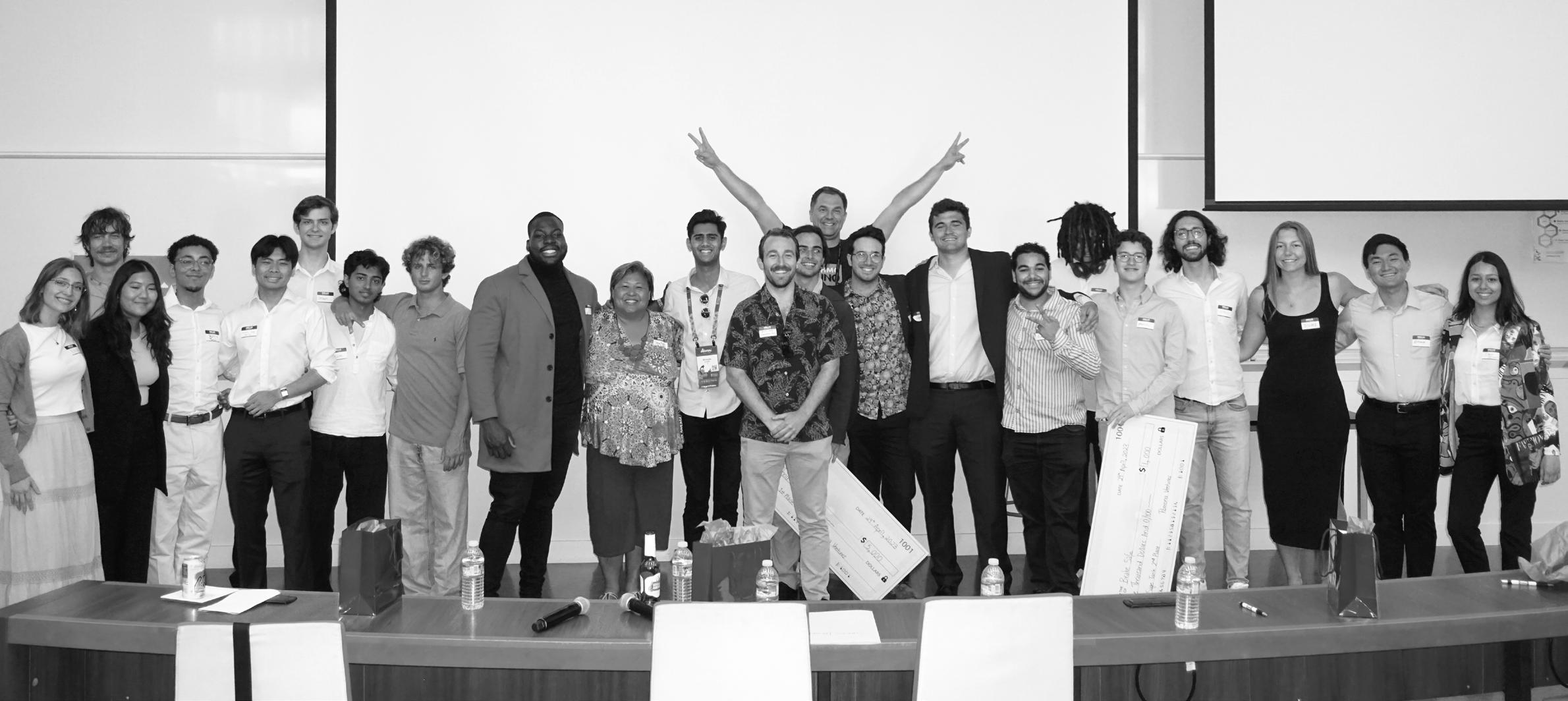
“SageTank,” the annual competition hosted by the Pomona Venture Club, will be held on May 3, offering prizes of up to $5,000. The online application form is due Sunday.
The competition is open to 7C students and alumni. According to SageTank’s website, teams must develop a startup idea or product and present their pitch to a panel of experienced judges.
These judges, chosen by the competition’s organizers, then select three winners to be awarded cash prizes and interviews with Venture Capital firms to launch their startups.
“We all have a lot of ideas growing up, and SageTank is a really great platform to potentially see our inventions come true,” Olivia Ma PO ’28, a member of the Pomona Ventures marketing team, said.
SageTank is a 5C take on the ABC TV show Shark Tank, giving Claremont students a similar yet more local opportunity to launch their entrepreneurial aspirations.
Jayhyun Suh PO ’26, vice president of Pomona Ventures, said the club aims to cultivate entrepreneurship within the 5Cs. He said that SageTank provides students with a means to strengthen skills in entrepreneurial pitching with the help of mentors.
“As beautiful and as great as the 5Cs are, they don’t have a really strong emphasis or focus on entrepreneurship,” Suh said.
“Especially for undergraduate students, it is a really good gateway into being an entrepreneur and startup founder.”
Similarly, Ma said that SageTank is a useful platform to am -
plify students with good ideas, initiatives and teammates. Before competition begins, Pomona Venture’s leadership team will conduct 30-minute interviews with the selected applicants, during which they will ask questions about the pitched business model and about how SageTank will help applicants’ professional journeys. Then, Pomona Ventures will provide resources and mentorship to enhance applicants’ pitches and presentations before the competition day on May 3.
Suh said the presentation preparation process in itself is a great learning experience.
“I know it sounds pretty
simple, but it’s actually a lot to organize and structure months of hard work into five minutes,” Suh said. “So that opportunity is really valuable, not just for the competition, but for the students at jobs and beyond that.”
According to Pomona’s twice-weekly “Chirps!” announcements, competing in the “5C’s biggest startup” pitching competition provides the opportunity to win interviews with venture capital firms, cash prizes and opportunities to attend venture capital-related conferences. The announcement stated that applications will be on a rolling basis and that teams will be paired with mentors as soon
as they are accepted, “so it’s beneficial to apply early!”
Additionally, the SageTank website states that the top three teams are guaranteed a oneon-one session with a venture capital firm that could invest up to $40,000 into the product or idea pitched.
Suh explained that, while Pomona Ventures awards a cash prize to winners, the goal of SageTank entrepreneurship is to identify and address material issues in the world. He said that the club encourages participants to approach their work with this mindset.
Last year, a group of Harvey Mudd students won the
Sage Tank competition. They developed a drone technology called “SafeLand Ukraine” for farmers that detects landmines in Ukrainian fields. The drones accomplish this by detecting the landmines’ magnetic field without the risk of dangerous manual inspection.
In reference to SafeLand Ukraine, Suh said the projects that succeed are projects that are rooted in solving real-world problems.
According to the initiative’s website, “Whether you just have an idea or a fully functioning organization, SageTank welcomes all to compete for cash prizes and network with mentors.”
HOUsING: scripps to demolish 240 House
continued from page 1
a house with multiple bedrooms and shared bathrooms, as opposed to the traditional college residence hall. The house offers living situations for up to twelve students at a time. In their email, Scripps Residential Life warned that students seeking housing next year may be involuntarily placed in off-campus, school-sponsored housing such as the Claremont College Apartments (CCA).
“Please start considering multiple backup options for housing selection next year, as the 240 House will be offline and bed availability will be limited,” the email wrote. “Planning ahead will give you the best chance of securing housing that meets your needs.”
In an email statement to TSL, Josh Reeder, executive director of facilities management and auxiliary operations at Scripps, said that the 240 House is being removed to build new academic buildings.
“Replacement beds are being pursued to offset the loss of beds, which will be in place for students for fall semester 2025,” Reeder wrote.
It remains unclear how and where these replacement beds will b put in place.
Maya Gutman SC ’27 lived in the 240 House last semester and said that she’s sad to see it go. She added that its location on the edge of campus offered residents a blend of residential and collegiate living.
“It’s really devastating,” she
said. “The girls that I was living with were planning on trying to live in it again their senior year and I was really excited for that.”
While she is disappointed that the 240 House will no longer be available as a housing option, Gutman said that she understands Scripps’ motivations.
“It’s surrounded by parking lots and so it’s a bunch of underutilized space … It makes sense that they want to develop it,” said Gutman.
Some students expressed concern about Scripps offering CCA as an alternative housing option, citing the impracticality of living off campus.
Talent Johnson SC ’27 currently lives in CCA. Located near the Claremont Botanical Garden, the apartments are around a 15-min-
ute walking commute from the center of the 5Cs.
“I went on the housing portal at my time and no housing slots were available — so I was on the waitlist the entire summer and I didn’t know where I was gonna stay — and then they randomly gave me a spot around early August and I had a spot in CCA,” Johnson said, recalling her experience securing housing for this year.
Johnson added that off-campus living is a very different experience from living on campus.
“I feel really isolated from my friends and I had to put in a lot of work, especially if you don’t have a car,” Johnson said. “The shuttle is inconsistent so you have to get your own methods of transportation, like a scooter or a bike.”
Study abroad students have also faced difficulties receiving housing on campus, according to Gutman. She said she is nervous that she might end up being placed in CCA after her study abroad due to housing shortages.
“I’m really hoping that doesn’t end up happening,” she said. “It’s largely out of my control at this point just because Res Life has said that they’re not going to release any information for us until, like, October. So at this point, I’m just kind of trying to relax and not stress too much about it.”
Housing selection is set to come out in the coming weeks for all of the 5Cs. With the 2025-2026 enrollment numbers still unknown, Residential Life has warned Scripps students to prepare to be placed in alternative housing.
THE STUDENT LIFE
COURTESY: POMONA VENTURES
Lady Gaga’s ‘Mayhem’ and its shallow chaos
On March 7th, pop artist Lady Gaga released “Mayhem,” following her Bruno Mars collaboration with “Die With a Smile,” the longest-running No. 1 hit on Spotify’s daily global chart. “Die With a Smile” won Best Pop Duo/ Group Performance at this year’s Grammy Awards and significantly boosted Gaga’s streaming numbers, placing her as the second most-streamed artist on Spotify currently. Did this signal Gaga’s resurgence in the contemporary music scene? Amidst fleeting artists and momentary hits, can a pop icon from the early 2010s rise again
after a Razzie’s “Worst Actress” nomination and an unsuccessful soundtrack album? “Mayhem” was released as an answer. Only a few songs come to mind when I hear campy lyrics and nonsense syllables over electro pop, synth-driven harmonies, and theatrical vocals — all of them Gaga’s classic hits. This was the style that characterized the artist’s early music and made her indistinguishable from her contemporary pop singers. As hinted by the singles “Disease” and “Abracadabra,” “Mayhem” was set to bring back the musical style of “The Fame” and “The Fame Monster,” the records that cemented her stardom back in
2009.
“The album started as me facing my fear of returning to the pop music my earliest fans loved,” stated Gaga in her album announcement.
“I did not want to turn it into anything artificial, I really wanted to allow myself to just follow the music,” Gaga said in an interview with Billboard. “By doing that, it started to slowly remind me of my earlier work.”
I approached “Mayhem” expecting to find her early signature that I couldn’t find in her latest albums. After first listening to the album, I could definitely grasp Gaga’s ideas. For example, when I first heard “Shadow Of A
Man” and “Don’t Call Tonight,” I couldn’t help but sing “The Fame Monster” hits “Telephone” and “Paparazzi” over them, respectively. I was disappointed to find out, however, that this album focuses so much on recreating the imagery and sounds of “The Fame” and “The Fame Monster” but abandons Gaga’s introspective and vulnerable themes.
Gaga compared “Mayhem” to “one night out” clubbing, and that’s precisely the feeling we get while listening to the album from beginning to end. We take over the dancefloor with “Disease” and live it up with “Abracadabra.” However, by the time we reach the fifth track, “Vanish Into You,” the album starts to feel endless and monotonous; we lose interest and step aside, no longer motivated to reconnect with its euphoric energy. Certain tracks reignite our energy at times, until the true nostalgic moment arrives with “Die With a Smile,” the final song, evoking the bittersweet end of a night out with friends.
Out of the 14 songs on “Mayhem,” seven illustrate scenarios of midnight desire: “Disease,” “Abracadabra,” “Killah,” “Zombieboy,” “LoveDrug,” “The Beast” and arguably, “How Bad Do You Want Me.”
“We’re about to be up all night, waking up a zombie / so put your paws all over me, you zombie-boy,” Gaga sings in “Zombieboy” — and essentially that’s the message of most songs on the album: dancing until dawn. The lyrics reveal little about Gaga herself; they feel generic and empty.
Think of the title tracks as metaphors for seducing a guy at a party: you’re diseased, the victim of an abracadabric spell, a zombie, a love drug, a beast. She wants you and she’ll take you to the Garden of Eden. That, in essence, is Lady Gaga’s album.
Some songs do showcase Gaga’s natural voice. The fan favorite track “Perfect Celebrity” shows self-reflectiveness, inspired by 90s alternative rock. It
addresses the struggles of fame:
“Find my clone, she’s asleep on the ceilin’ / Now, can’t get me down / You love to hate me / I’m the perfect celebrity.”
“Shadow Of A Man” also explores her experience as a female artist; lyrics like “I don’t wanna be the one to fall on the knife / To come alive” refer to the challenge of standing out in the music industry among her male predecessors and inspirations.
Profit-wise, “Mayhem” became her 7th No. 1 on the Billboard 200 chart and represented the biggest weekly sales sum for a female album this year. This commercial triumph demonstrated the 38-year-old singer winning over ageism, a common issue faced by music artists past their twenties.
“Even though the world might consider a woman in her late thirties old for a pop star, which is insane, I promise that I’m just getting warmed up,” she said, receiving the Innovator Award at the 2025 iHeartRadio Music Awards.
As Billboard editor Andrew Unterberger suggested, the album is a strong reclamation of Gaga’s pop legacy and confirms that she still has a long journey ahead in the music industry.
Ultimately, it’s clear Gaga paid tribute to her previous discography as the anti-aging recipe. In an interview with Elle, Gaga explained that the album’s title alluded to its chaos and her excitement in exploring imagery different from what she had done before.
Honestly, I couldn’t find that. I wish there had been more of this mayhem, that I could truly sense the chaos she describes, rather than the album’s shallowness and its monotonous rehashing of her early 2010s sound without any real depth.
Tomy Helman PO ’28 is a music columnist from Florida, Argentina. He’s interested in culture and politics and currently speaks Spanish, English, French, Indonesian and Italian.
Amy Cuddy in conversation: Confronting collective bullying
ANANYA VINAY
“I believe that we have been collectively bullied,” Amy Cuddy said. “We have been conditioned to shrink, to stay silent, to question our worth and to distrust each other.”
On March 27, Cuddy spoke at Balch Auditorium for Scripps Presents about the ups and downs of her career trajectory, the pervasive impact of a widespread bullying culture and how to reclaim personal power. Alex Hamilton SC ’25 moderated a discussion with Cuddy following the lecture.
A social psychologist, Cuddy researches power and its various manifestations. She is most wellknown for her TED talk on power posing, which stands as the second-most viewed of all time. Cuddy has also written several books, most recently “Presence” and the upcoming “Bullies, Bystanders, and Bravehearts.”
Cuddy introduced her interest in personal power stemming from her second year of college, when she experienced a severe head injury, which led to a significant feeling of powerlessness during the recovery process.
Cuddy defines power with three aspects: core identity, sense of safety and community. In order to rebuild her sense of personal power after the head injury, she had to accept that her old self was gone and take the chance to reinvent herself.
“Trying to get back to that old self is like holding on to a wet ball of sand that’s drying in the sun and it’s slipping through your fingers,” Cuddy said. “It is a leap of faith to leave that and hope that someone else is out there. For me, I had to believe that another me was out there for me.”
Years after Cuddy thought she had experienced the last of powerlessness, she experienced a period of her life more challenging than recovering from her brain injury.
In 2014, the day before her wedding, a study by Eva Ranehill et al. invalidated Cuddy’s work on power posing, sparking backlash about her statistical approach. The study eventually ballooned into significant scrutiny of her work, leading her to leave her position as a professor at Harvard Business School and become the scapegoat of the replication crisis in social science.
Verifications of power posing have been mixed, but the concept
has since been upheld by research. Cuddy was severely isolated from the academic community and subject to relentless academic bullying for four years. However, this experience gave her insight into the psychology of bullying.
“Bullying is a sustained effort to erode another person’s power … They gain power by manipulating perception, exploiting group dynamics and silencing dissent,” Cuddy said. “There’s no treatment plan for that kind of psychological and reputational and social injury.”
Attendee and community member Lori Michno was surprised by this particular part of Cuddy’s story. “I had seen her TED talk about
body language, but I didn’t know that part of her story and how she endured it and how that affects her research today,” Michno said.
The wider impact of bullying can be fatal. For example, the 1986 Challenger space shuttle explosion has been linked to cultures of bullying. Management bullied the shuttle’s engineers and contractors into agreeing to a launch in unsafe conditions.
Oversights from a culture of bullying can also be deadly in a hospital setting, as experiments where surgeons are presented with mock emergency procedures to save an infant prove.
“When these surgeons are in a bullying environment, that infant is more likely to die. Why?
Because they are afraid to ask questions because they don’t want to look stupid,” Cuddy said. “They’re afraid to share information because they have a scarcity mindset, and that leads to the worst possible outcomes.”
Cuddy reminded the audience that a bully only has power with our help.
“A bully without us is just another jerk,” she said.
Bullying, she continued, does not exist just on an individual, small group level.
“We have to accept that all of us have participated in [bullying], and all of us have been harmed by it, all of us. We are capable of something better. We can build what I’m calling a bravehearted
culture,” Cuddy said.
Attendee Anna Ravid SC ’25 found Cuddy’s thoughts on the collective nature of bullying to be particularly thought-provoking.
“Bullying takes a whole group of people … It’s a whole system of complicity,” Ravid said. “I thought it was a good way to view bullying and other social problems.”
To end her talk, Cuddy suggested several strategies that we can use to deal with cultures of stress and bullying. Deep breathing, slower speech, better posture and power posing are all ways to increase a feeling of power.
Cuddy challenges us to confront the bullying in our daily lives, to be the bravehearts and not the bystanders.
SAShA MATThEWS • ThE STUDENT LIFE
TOMY HELMAN
Poet Quan Barry on visualizing history through art
NICKOLAS MORALES
“Where do we learn the art of explication? What can our origins teach us about who we should be?” Quan Barry recited from her poem “The Excavated Foundations of the Salem Village Parsonage As Resipiscence.”
On March 25, the Benton Museum of Art held a poetry reading with Barry, a poet, novelist and playwright. Co-sponsored by the Pomona College English department, the event was related to the Benton’s “Black Ecologies in Contemporary American Art” exhibit currently on display. The exhibit, which the English department faculty helped curate, explores the Black body in relation to the natural environment.
Barry read from a diverse array of poems, with subjects ranging from a Vietnamese ghost story to the bodhisattva Quan Am to the Vietnamese boat people of the 70s and 80s.
Barry, a professor of English at the University of Wisconsin-Madison, was born in Saigon and grew up in Danvers, Massachusetts.
“Danvers is actually where the Salem Witch Trials began,” she explained. “Salem, back in 1692, used to be much bigger, and the town of Danvers used to be a part of Salem.”
This history informed Barry’s 2019 comedy fiction novel “We Ride Upon Sticks,” which is set in Danvers. The novel, which follows a girl’s field hockey team that dab-
bles in witchcraft as they work toward the state’s championship, was loosely based on Barry’s own experience.
“Generally speaking, I write very little about myself,” Barry admitted. When talking about the term “trauma,” she said, “I don’t like to use that word, but it’s probably the word that people would attach to the things that I write.”
Her writings in both fiction and poetry often use the backdrop of history to contemplate what it means to be a human.
“I am interested in telling stories not just about me personally but about things that have happened in the world and documenting them in certain kinds of ways,” Barry said.
Her depiction of Danvers in “We Ride Upon Sticks” explores the history of Salem whilst also critiquing the 1980s culture in which the novel is set.
“Even though it’s funny, there’s a lot of social criticism in it about the 1980s,” Barry said of the novel. “The 1980s were homophobic and racist, not that we’re not those things now, but there were ways in which it was more part of the culture.”
Barry similarly explores the histories and cultures of Vietnam and Mongolia in her books “She Weeps Each Time You’re Born” (2015) and “When I’m Gone, Look for Me in the East” (2022), respectively.
“In each one of my books,
I want [readers] to enjoy the story but I also want them to take something away from it,” Barry said.
Attendee Ely Tan PO ’28 found herself moved by Barry’s poetry.
“It felt ethereal in a way,” Tan said. “The way Professor Barry writes is so moving; I read her poetry book ‘Asylum’ [2001] and every single poem was just so well written.”
For another attendee, Yuankai Gao PO ’28, this event was the first time coming into contact with Barry’s poetry.
“It was incredible,” Gao said. “I felt like it was ephemeral, evocative and beautiful.”
“Some people say that art is to teach, to pass on traditions or what have you. Other people would say, ‘No, it’s art for art’s sake,’” Barry explained. “I don’t think you have to make distinctions because I think it’s all true.”
In confronting the often traumatic histories around her, Barry explores the very real human feelings that come with them.
“You oftentimes turn to art to find out how people were really feeling, not just what was happening,” Barry said.
For Barry, art is fundamentally human. “We create art now to show us ourselves, in a way, to know things about ourselves,” she said. “To document our very short periods of time here on this planet.”
Paint nights and soirées: Saturday evenings get more creative with the 5C Artists’ Coalition
On Saturday nights, you might find some students gathered to paint while watching rom-coms or sketching each other over bubble tea and snacks.
The 5C Artists’ Coalition (ArtCo) has been hosting weekly Saturday evening events where students can come together to make art in community. Recent programming has included three “Romcom & Paint” nights, “Blind Speed Dating” with contour drawing and a “Women’s Day Soirée” for International Women’s Day.
ArtCo’s mission is to “provide high-quality studio space, opportunities, supplies and resources where anyone can come together in community and engage with artmaking,” according to its website. “Above all, we seek to cultivate an environment of safety, belonging and care.”
Though the club has been around for several years — having been founded by Jenny Park PO ’22 — it started off close-knit and small, only becoming much more active this past year. Its most popular events have been attended by 50-60 students, according to club leaders.
The current executive board members of the club, including co-presidents Meghna Pamula CMC ’25 and Vanessa Ho PO ’25, aim to make it a significant community space for students who want to explore art in a collaborative and creative environment.
Pamula described the club as “a casual and welcoming space where creatives can gather.”
Events Coordinator Maggie Zhang PO ’26 emphasized ArtCo as a place where students can make connections over art that carry over beyond the club and art-making.
“We hope to cultivate spaces with more dialogue between artists on campus,” Zhang said.
“Not even dialogue necessarily about art, but just dialogue from being in community.”
Stylish stitches
Knitwear is arguably one of the only articles of clothing that can transcend decades, seasons, styles and the Claremont Colleges. From cozy cardigans to crochet tank tops, the stitched style options are endless and, thankfully, largely embraced by 5C students from every subsect.
Setting aside the obvious fact that knitwear is fashionable in too many ways to describe, part of what makes this category so enticing is the craft that is put into the art of knitting. From my grandmother to the girl sitting three seats down in my 8 a.m. class, the process of weaving intricate patterns with yarn withstands the test of time and is perhaps the true definition of a hobby.
Speaking with some knitters from across a range of backgrounds and ages, I can boil it all down to one thing: Knitting is fun! The expert needle-wielders that I spoke with tell me that there is great satisfaction in making something from scratch, especially an item that can be worn time and time again.
“I knit for a lot of reasons: One, because I love nice sweaters; two, because I love the process; three, honestly it’s so gratifying in this digital age when you can say you made something tangible and wearable instead of just a Word document of academic arguments,” Nichola Monroe SC ’27 shares.
My closet is stuffed to the brim with hand-knit sweaters that were gifted to me by my grandmother.
A large part of her motivation for knitting came from the joy others feel when given a product made
with love and care. So much so that the entire pile of sweaters from her comes tumbling down like an avalanche, burying me when I try to reach for one.
Beyond the simple sweater, recently I’ve been spotting a plethora of fun cardigans in a variety of colors, my favorite being a bright cherry red. I love seeing them styled in unique ways, such as only clasping the top button or rearranging the buttons to create an off-shoulder situation or reversing it for an interesting buttoned back.
Big chunky sweaters are all the rage across the schools and, as we all know, I am a fan of an oversized silhouette. Why not wear a comfy outfit to class that is far more stylish than the Minecraft flannel pajama pants some of y’all have been rocking up to afternoon classes in?
From a chunky Fisherman cable knit to a tight ribbed to a looser lace knitting to a bow tie, there are a plethora of patterns to try out. Like playing a fun game of Where’s Waldo, I’ve spotted possibly every type of knitwear in the 5C bubble. Cardigans, turtlenecks, wrap sweaters, scarves, hats, bags, sweater vests, pants, tank tops and more only begin to unravel the yarn ball of options. My eyes have been delighted to take in a myriad of loosely crocheted sweaters, a trend that I think will continue to take these campuses and the world by storm. A wide stitch is perfect for layering on top of simpler tops and adapts beautifully to the transitional weather we are starting to experience. Keep it up kids — the 5C knitwear game
is strong and most definitely worthy of my stamp of approval. For springtime, may I suggest you mimic the wildflowers and indulge yourself in a colorful pastel cardigan from Free People or Sèzane? I love a butter yellow or light pink to spice up a simple jeans and white tee look. I’m peering into my glass orb of future fashion trends and predicting a resurgence of sweater vests for springtime. The classic and nerdy look is perfect for when the weather gets warmer and paired with a t-shirt and loose jeans, creates the ultimate casual but sophisticated outfit. Winter has given us a plethora of triangular scarves tied
more for accessories’ sake than in an attempt to combat cold weather, a look that I love and will gladly carry with me into this new season. That being said, a chunky scarf is a practical purchase, adding some heat to any outfit, both literally and figuratively. I also look forward to spotting more crocheted headbands and other such yarned outfit accouterments.
According to my extensive research, namely browsing Pinterest, Vogue and every store’s website during class, a growing trend in knitwear revolves around tops with a built-in scarf or bow detail. Following this thread, I have noted that
Part of the strong community that ArtCo has built undoubtedly comes from the bond between the board members.
“It’s just an amazing, raw and all-around caring vibe to run this art coalition with them,” Vice President Jessie Zhang PO ’26 said about working with her fellow board members.
The executive board members are working on achieving expansive goals for the upcoming year, planning field trips, artists’ talks, workshops and weekly open studios. Other long-term projects include the launch of a 5C Art Magazine dedicated exclusively to student artwork and a biannual gallery show to share club members’ work with the wider Claremont community.
The leaders hope to “make the club truly more of an artist’s coalition for students on the 5Cs,” as Maggie Zhang explained. However, there are some setbacks the organization is facing, namely, space and funding. The club usually meets in the Smith Campus Center at Pomona but has no permanent location. The executive board members hope to obtain a permanent meeting space for the club and a larger budget in the near future.
ArtCo seems to be thriving despite its current constraints, with well-attended events, enthusiastic attendees and a healthy social media presence.
“The ArtCo ‘Clueless and Paint’ night gave me and my friend something to do that was both creative and engaging,” said member Eliza Levy PZ ’26. “And I talked to people I would never have met before.”
A key part of ArtCo’s presence on campus is in making art more accessible for students. By providing students with space, creative opportunities and materials, the organization allows those who might not be art majors or have a strong background in art to create together in a supportive environment.
Of this collective spirit, Jessie Zhang said, “There is no surveillance or excessive professionalism — only care and cooperation.”
many sweaters feature interesting necklines such as collars or one-shoulder silhouettes. Reformation, for one, is killing it in this department with its twist front sweater and variety of sweater tank tops.
Stores are keeping the cozy coming with knitted sets featuring a matching top and bottom. My favorites are from Gap, Alo, Aerie and Free People. Although I’m not entirely certain of my stance on this, there have been a lot of knitted shorts cropping up all over my feeds. I think a knit skirt could also be an interesting look for this new season, and I encourage those feeling brave to strut their knitted bottoms across these colleges. After all, with the semester halfway over, there is only so much time left to stun your classmates with your stylings. I look forward to beholding even more unique and cozy knitted masterpieces from all of y’all when I’m trotting to class. And hey, you knitters may even inspire me to one day pick up the needles and create a masterpiece — or more likely a knotted mess that resembles the ball of yarn I started with. So, I encourage my dear readers to try the craft for themselves, pull out their best knitwear, thank those who have hand-knit them something and, most importantly, create an ensemble that knits together confidence and style!
Ellen Chapman SC ’27 was born in Germany and currently calls Swarthmore, Pennsylvania home … GO BIRDS!! She loves skiing, traveling, chocolate, reading, procrastinating and quad-shot almond milk lattes!
ELLEN CHAPMAN
SAShA MATThEWS • ThE STUDENT LIFE
NIcKOLAS MOrALES • ThE STUDENT LIFE
GRACE VALASHINAS
cOUrTESY: 5c ArTcO
cLArEMONT cLOSETS
Poet, novelist and playwright Quan Barry spoke at the Benton Museum on March 25, reciting several poems and excerpts from her novels.
5c Artists’ coalition, an increasingly active and popular club, hosts regular paint nights and art socials for students.
TOM CAT
Don’t shit where you eat
One of the most prevalent pieces of dating advice my mom gave me is to never shit where you eat. If you’re not familiar with this saying, it basically means you shouldn’t cause trouble in places or within groups you are in regularly. After reminding me of this advice, she always follows it up with, “You know how I know? I’ve done it.”
In my opinion, this is the best reasoning you can get: Someone out there who knows your situation and, even if they’re not exactly the same, has been through it before. And now you get all the juicy details without having to shoot yourself in the foot.
Despite my efforts to follow my mom’s advice, I am guilty of shitting where I eat. My fling with Roddy was a prime example. At first, it felt exciting and convenient — mysterious even. But when things ended, I realized how impossible it was to create space when we were constantly in the same places and surrounded by our mutual friends. I couldn’t just move on in peace because reminders of him were everywhere. It made me understand firsthand why my mom told me this rule in the first place.
Even though I try my hardest to live by this saying, I can also admit that it is not as easy as it sounds. There’s a big difference between a relationship forming organically and seeking to date within a close circle. And sometimes I feel myself connecting with people I spend a lot of time around.
The main reason I avoid dating within my inner circles is simple: how often I have to see the people I shit with. I find it hard to move on from something when said thing is constantly around me.
I recently tried to hit up a friend of mine who isn’t in my immediate friend circle. We’ll call him Geronimo Stilton. Unfortunately, he did not pick up what I was putting down. But, if he did catch onto
FrEShMAN FILES
what I was saying and rejected me, then I’m fortunate enough not to have to interact with him on a daily basis.
Another reason I avoid dating within close friend groups is the aftermath of it. Even if the breakup wasn’t messy, there’s still an expectation that the friends will choose a side. This custody battle for friends can be a breeding ground for gossip, tension and people thinking they know everything about your relationship.
Don’t even get me started on workplace romances. Not only
do you have to navigate your emotions, but there are also power dynamics, professionalism and job obligations that make these relationships much riskier. If you burn that bridge, you can’t just mute them in the group chat, you still have to work together.
But of course, not all dating inside close circles stories end up as cautionary tales. I’ve seen plenty of people meet through work, start dating in friend groups and still thrive. They set clear boundaries, kept the drama to a minimum and somehow avoided making things
weird for everyone in a close vicinity. I respect it. Nay, I envy it!
Two friends of mine started dating freshman year but broke up a few years later. At first, it was slightly awkward, but that is to be expected. Months passed and now they are both on good terms with each other. They kept all of their friends, talked to each other daily and still hang out on occasion.
Through my singular shit where you eat experience, I learned that even though I know I have the ability to have a mature conversation and end things nice-
ly, I also know that it doesn’t matter what I believe. I can say or think anything I want, but my heart will feel whatever it wants to feel. And that alone is enough to make me stay away from these situations in the first place. With a grain of salt, of course, take this column as a sign to take caution when dating a coworker, a classmate or a teammate. You know how I know? Because I’ve done it.
Tom Cat might just shit where they eat soon oops. Awesome column content coming your way!
The beauty of ambiguity in romantic relationships
ANNA RIPPER NAIGEBORIN
Since publishing an article about freshman year situationships, I was surprised to have a few people reach out to me and seek out my advice about their relationships.
Though I was honored that they’d turned to me for help, I hoped that a sympathetic smile, some nods and gentle reassurance that “things will work out” would suffice. Truth is: I didn’t know what to tell them. Writing an article about my experience didn’t turn me into a relationship expert.
But, did I need to be a relationship expert to give good relationship advice? What if there were pressing thoughts about relationships that I had to share?
My eagerness to understand what “good relationship advice” meant led me to Rose Hills Theatre on Feb. 13 to hear renowned author Christine Emba talk about romantic connection. One of the main topics she touched on was consent. Emba talked about how a relationship primarily built on consent was not enough and how we should rethink our approach to consent.
While I thought Emba’s thoughts on consent were pretty obvious, some of my friends who went with me to the talk thought they were
groundbreaking and provocative. At that moment, I realized that I do have something to say about relationships.
After Emba’s talk, I was reminded of the beginning of my freshman year when, in addition to fulfilling a mandatory online module entitled “Sexual Assault Prevention Training,” we had a mandatory orientation session about consent and Title IX. Now, don’t take what I’m about to say the wrong way. Every college must have some sort of orientation about what to do in a sexual harassment or assault situation and how to make use of Title IX. Sexual discrimination and violence are some of the most heinous and terrifying crimes in the world.
Having said that, this Title IX session was one of the most bizarre moments I’ve ever had since coming to Pomona.
We were playing Kahoot — that whimsical song was playing while we were answering questions about sexual assault — and the following question came up: If you are making out with a guy and he asks you if he can take off his shirt and you want him to take off his shirt, which of these should you do?
a) Smile and nod
b) Say “Yes”
c) Say “No”
d) Say “Hell yeah, I thought you’d never ask!”
My first thought was that it is insane that there’s a “right answer” in that situation. But I tried to tackle the Kahoot pragmatically, to click the answer the orientation leaders were expecting rather than the answer that felt like a better fit for me. So I ignored my instincts to click a, which was curiously a popular choice amongst my fellow international friends, and went for b. It was straightforward and seemed right enough. I was surprised to see my phone screen turn bright red, indicating that my “safe answer” was wrong. The right answer, the main screen showed, was letter d) Say “Hell yeah, I thought you’d never ask!” The reason for it was an annoying concept called “enthusiastic yes.”
The concept works in theory — it emphasizes the presence of “yes” rather than the absence of “no.” But different people consent to things differently. You’d never catch me telling a guy, “Hell yeah, I thought you’d never ask me if you could take off your shirt!”
and if someone ever told me that, I’d probably feel the urge to put a jacket on. Why? Because there’s no charm, no mystery, no seduction, nothing!
A friend once told me that I’m constantly asking “why?” and that I get distressed when I can’t get to the bottom of something. But recently I’ve grown fond of the ambiguity of relationships. I like the moments before someone makes a move, when you attempt to be subtle enough to be cool, but not too subtle to the point that it seems like you don’t care at all. I like to feel all guarded and distant, and little by little inch closer to someone, letting them into my world and becoming a part of theirs.
“Enthusiastic yes,” though, focuses too much on verbal consent and overshadows surrounding non-verbal cues. A person can give you a yes, and still tense up when you get closer to them. Just like people have different ways of saying “yes,” people have multiple ways of saying “no.”
Ambiguity is not a bad thing. It makes you curious to learn more about someone and reminds you that relationships are adventurous, romantic connection is bewitching and dialogue is mystical.
I like that until something happens, you can’t know for sure if the other person is onboard with what you’re thinking. And as time goes by, you learn that sometimes they are, sometimes they’re not. Sometimes they thought they were, but they weren’t. It’s hard to understand where our desires lay. That’s another problem I have with “enthusiastic yes”: It’s okay to enter something not with a full-fledged “yes” but with a wholehearted “maybe.” As long as you feel safe that if that “maybe” becomes a “no,” you can stop. You’re not being a bad person or automatically hurting your partner if you’re not completely sure of what you hope to get. It’s okay to enjoy romance for the sake of romance — a boundless, pure romance is already so beautiful. Not every kiss leads to a make-out session; not every hook-up leads to a relationship. Romantic encounters aren’t logical and linear like that. Even if something does happen, you still don’t know what the other person’s thinking. You never can. So you need to pay attention; pick up on cues and try your best — that is, if you actually care for the other person (which you should; don’t be an asshole) and see beyond yourself.
But since ambiguity is not easy to navigate, we quickly give up on any attempt to do so. Some people try to extinguish it completely by giving their partners ultimatums and establishing labels. Come to think about it, “situationship” is simply our way of labeling a relationship that can’t be easily labeled. For some people, that works. Labels are helpful, practical and comforting. But I think there’s something valuable in slowly meeting someone and taking your time to know them, no pressure to name every single thing.
Still, the people who label are better than those who take advantage of ambiguity and use it to justify sexual violence. These people don’t want to flirt or get to know someone. In fact, they don’t care about their partner at all. All they care about is power and control. They taint the magic of ambiguity and make all of us more skeptical and disconnected from any possible romance.
So if there’s any advice you can take from this botched relationship guru is this: Look ambiguity in the face and don’t be scared. Have faith in your partner and, most importantly, have faith in yourself. There’s nothing wrong with entering something we don’t fully understand — does anyone even know what love or desire are, anyway?
Anna Ripper Naigeborin PO ‘28 is from São Paulo, Brazil. Her favorite rom-com is “27 Dresses,” and she’ll defend Jane to the end of time.
EMMA chOY • ThE STUDENT LIFE
Monique Saigal-Escudero: How her grandmother’s courageous act saved her from the Nazis
KAITLYN ULALISA
Seventy-three years after her grandmother entered the gates of the Auschwitz-Birkenau internment camp, Monique Saigal-Escudero saw what her history class had never covered.
She saw the rickety wooden structures that served as beds for prisoners where women slept side by side, often several on each plank. She walked through bathrooms made up of only a barren steel tub. It was a state Saigal-Escudero described as fit for animals, the lowest form of degradation a human could face.
As I sat across from Saigal-Escudero, an emerita professor of romance languages and literatures at Pomona College, she leaned over her laptop and pointed at a mounting pile of hair. Upon entering the internment camp, each prisoner was stripped and shaved; I was looking at the raw material for what would become German textile products, socks and rugs.
Grasping for the words to describe the experience, Saigal-Escudero paused. Silence hung in the air before she replied, “It was — I don’t know. [It] gave me goosebumps.”
The feelings that surfaced for Saigal-Escudero can be traced back long before her 2015 trip to the internment camp. Born in 1938 in Paris, France, World War I and World War II were enshrined in her childhood. German words glared from street names across then-occupied northern France. The Star of David soon took on an entirely new meaning in itself: All Jewish individuals over the age of six were required to wear it, soon transforming the symbol into the ultimate mark of ostracization.
This history is belied by the lively elder. With a petite frame and rosy cheeks, Saigal-Escudero is a jovial woman who speaks with a slight French accent. Often found at the French language table of Pomona’s Oldenborg Center, she can be seen engaging in lively conversation or, perhaps more often, breaking out in song. Still, her family’s rich history is a mere arm’s reach away for anyone who takes the time to listen.
Saigal-Escudero was only a few years old when her father died fighting in 1940 at the onset of WWII. Not long after, Saigal-Escudero’s mother attempted to enroll her in an organization dedicated to providing host families for children whose fathers had died in the war. She was denied because her family was Jewish.
Saigal-Escudero’s grandmother, Rivka Leiba, refused to accept this. In August of 1942, with threats from police against Jewish citizens, Leiba, fearful for her granddaughter’s life, took three-year-old Saigal-Escudero to the train station
and threw her on a train headed for Dax, France. The young Saigal-Escudero, engulfed in tears and utterly alone, exited the train and entered the small city. While groups of children entered the station to unite with their host families, Saigal-Escudero stood helplessly, 450 miles from home.
Her frazzled red dress and blond hair caught the attention of 20-year-old Jacqueline Baleste. Baleste arrived at the station that day with her father in search of a four-year-old boy who had never come. Unaware of who Saigal-Escudero was, Baleste quickly decided to take her in. Days later, informed of Saigal-Escudero’s Jewish identity, Baleste was far from deterred from adopting her as her own. To her, the young girl was nothing short of a gift from God.
“She saw me crying, so she came to me and she said, ‘An angel sent me to you,’” Saigal-Escudero recalled.
It wasn’t long before Baleste became her godmother.
Hundreds of miles north of Saigal-Escudero’s former home, her grandmother displayed a similar altruism: Nearly a month after she saved her granddaughter’s life, she did the same for her son.
On a September day in 1942, police arrived at Leiba’s apartment building in search of her. The concierge of the building informed police that Leiba was not there but was babysitting at the house of her daughter. Motivated by a reward for helping the police find Jewish individuals, the concierge gave the police the address.
Not long after, a hard knock came on the door. Terrified for her Jewish son’s life, who was at the house, Leiba quickly told him to hide under a bed. She then opened the door, the Star of David shining from her chest, and stood face to face with the police. She was told to pack a bag, that she wouldn’t be gone for long. In an act of defiance, she stood in the doorway and refused to move.
“To go where I’m going, I don’t need anything,” she said.
It was that moment that spared her son’s life. Had she entered the house to grab her belongings with the authorities behind her, her son would have been at the mercy of the police.
On Sept. 30, 1942, roughly a month after she saved her granddaughter and several days after she saved her son, Leiba was gassed at Auschwitz-Birkenau.
For Saigal-Escudero, it wouldn’t be until many years later, on her 2015 trip, that she came close to understanding the depth of her grandmother’s courage. Thousands of miles from the
internment camp, the young Saigal-Escudero was entirely unaware of her grandmother’s murder. She relished life in her new home. From the onset of her eight-year stay with the Balestes, she seamlessly integrated into the family, latching onto them with the same affection she once showed her grandmother.
Eyes wide and animated, she recalled, “The first time I opened my mouth [to the Balestes], I said … ‘We have to wait for daddy! Il faut qu’on attende Papa!’ I thought this was my father.” Catholicism became central to Saigal-Escudero’s upbringing with the Balestes. She attended church each morning and evening with the family and got baptized at a young age. Through religion, her passion for storytelling and song thrived.
Abruptly standing up from her spot next to me, she waddled to a bookcase in the other room, where she pulled out a hand-crafted book of songs and illustrations gathered from the church services she attended as a child. She laid down the booklet and suddenly erupted into a French melody, snapping along with the rhythm of her voice.
“I love to sing,” she said. It was the remnants of a habit that began as a child, when she first parroted her godmother’s singsongy disposition. The young Saigal-Escudero was entirely enamored by her godmother. Watching the work Jacqueline Baleste did as a social worker, Saigal-Escudero soon followed. She’d mimic her, inventing lofty reports of imaginary children who didn’t want
to go to school and craft elaborate documents on her fake trips to important places. There came a day later in Saigal-Escudero’s stay with the Balestes when her birth mother came to visit her.
Saigal-Escudero’s mother was notified of where her daughter was staying by Leiba, who informed her of the train she put Saigal-Escudero on.
To this day, Saigal-Escudero doesn’t know where her mother was staying before she made her visit, which didn’t last long; after a chance encounter with German soldiers, Saigal-Escudero’s Jewish mother fled in the night.
The next time Saigal-Escudero saw her birth mother was in 1950 when she was picked up from the Baleste house, uprooting the life Saigal-Escudero had come to know so well. On the cusp of her teenage years, she reunited with her sister and moved in with her mother and her American stepfather to the outskirts of Paris.
She spoke of the period with disdain. Her American stepfather brought milk with each meal and ketchup seemed to be everywhere. This resentment, coupled with a fractured relationship with her family, motivated her desire to escape Paris and pulled her to the United States.
After gaining American citizenship during a visit to Los Angeles in 1953, she returned there in 1956 at 17 years old. There, she moved in with her stepfather’s sister and worked as a nanny. It wasn’t long before she enrolled in community college at Los Angeles City College that same year and then transferred to the University of California, Los Angeles, where she obtained her bachelor’s, master’s, and doctorate in French literature — a decision that once again brought her grandmother to the forefront of her life.
When a teaching position in Pomona College’s language department opened in 1965, Saigal-Escudero filled the spot. She’d remain for 45 years, teaching Spanish and French literature, language and culture. Much of her love for languages, storytelling, and history would eventually come together in her two books: “L’écriture: Lien de mère à fille chez Jeanne Hyvrard, Chantal Chawaf, et Annie Ernaux” and “French Heroine 1940-1945.” The latter book tells not just of women’s courageous experiences during WWII — a journey that took the French professor around the globe — but is also a homage to her grandmother, whose courage is the ultimate reason for Saigal-Escudero’s ability to tell the story. This reminder lies on the book’s face, the premier image of a French hero: Rivka Leiba standing proudly, hand on her hip with a tight-lipped smile, forever embossed on its cover.
Mai Der Vang on the endangered saola and humankind’s relationship with nature
MALIN MOELLER
“Say to the saola: forgive us in our plea to love you, forgive that you give us meaning,” recited Mai Der Vang.
On March 26, Vang, a decorated poet, came to Pitzer’s Broad Performance Center to read from her newest collection, “Primordial,” which was published on March 4.
Vang’s first collection of poems, “Afterland” (2017), earned publication through the First Book Award from the Academy of American Poets. Her second book, titled “Yellow Rain” (2021), was a finalist for the 2022 Pulitzer Prize in Poetry. Vang currently teaches for the MFA Program in Creative Writing at Fresno State.
Vang’s poetry was centered around the saola, a critically endangered animal endemic to the Annamite Range between Laos and Vietnam. Since her parents were Hmong refugees from Laos, Vang feels a connection with this species and has centered many of her poems around it.
“I do feel a special form of kinship because this animal is one from an area of the world that is so wrecked by war,” Vang said.
In “Death in Captivity, a Surrender,” she writes about an animal that can be interpreted as either a saola or a human.
“An animal migrates into a new body, senses the impulse to leave,” Vang read. “Say to the animal: heavy is an apology inside the wind. Say to the animal: mor-
tality anchors us to this planet.”
One student who attended the reading, Sia Were PZ ’25, noted how these natural ele -
ments in Vang’s poetry spoke to her. “The poet had a way with words that was so powerful
and personal,” Were said. “For instance, there was a moment she said pomegranates and lemons and this just unlocked a memory hidden within me.”
Brent Armendinger, a professor of English and world literature at Pitzer, organized the Literary Speaker Series, which brought Vang to Claremont.
“I try to bring writers who are doing unexpected things with language and who are responding to the world and the problems of the world in meaningful ways,” Armendinger said.
Armendinger, who teaches the class Eco Poetry Workshop, is interested in highlighting writing that explores the environment in unique ways.
“I want students to think about how what we call the environment is not just pristine nature, it’s something that’s connected to everything else,” he said. “[Vang’s] book is also about refugee experience alongside the fate of this animal and the environmental situation.”
In her poem, Vang writes about a saola who died in captivity, examining humankind’s relationship with the ‘primordial’ species.
“Nothing survives in a menagerie of glaciers, not water dispensing from winter, nor the echo of a mammal’s lullaby,” she read. “You’ve lasted long enough to let yourself be witnessed by veterinarians, conservationists, villagers, to even permit a palms touch
along your brown fur.”
However, Vang did not want to write about saola as a window for her own experience but rather as its own being living alongside her.
“I was really careful in trying not to use saola as a metaphor for Hmong resilience,” she said.
“Because saola is not a metaphor, saola is a living, breathing animal with its own agency and autonomy. Who am I to just appropriate this animal for my own literary art purpose?” Because of this, Vang’s work about saola often addresses the animal itself, using a reverential tone. But in another poem, Vang uses the saola’s history to discuss climate change.
“You understand the fate of the saola is bound to the fate of the forest,” Vang read. “You understand the fate of the forest is bound to the fate of this planet. You understand the fate of this planet is bound to the fate of your body.” Because her first two books addressed the legacy of the Vietnam War, Vang intended to focus on a different topic for her third collection. Instead, she found that the saola connected her back to the war in a unique way.
“Something about the story of the saola and the conservation struggles around saola continue to invite another way of thinking about the war,” Vang said. “So here I am writing about saola, and here I am writing about another window into the war for me.”
cOUrTESY: MONIQUE SAIGAL-EScUDErO
MALIN MOELLEr • ThE STUDENT LIFE
At just three years old, during the peak of hitler’s reign in Europe, Monique Saigal-Escudero’s grandmother threw her on a train headed for a small city in Southwestern France: an act that ultimately saved her life.
Accessibility at the 5Cs requires more than just good intentions
ZENA ALMEIDA-WARWIN & JACKIE KOSTYUCHENKO
Jackie Kostyuchenko PZ ’28 and I, Zena Almeida-Warwin PO ’28, met early in our first semesters through the 5C New York network. I personally have had the privilege of paying little mind to accessibility in my day-to-day, but through befriending Kostyuchenko, who uses a mobility scooter, I have been made aware of accessibility shortcomings on campus. After an interview, we’ve decided to share Jackie’s experiences and shed light on accessibility shortcomings at the 5Cs.
Jackie Kostyuchenko:
For most able-bodied students at the 5Cs, navigating campus is a thoughtless routine. From attending classes to visiting friends’ dorms, few are forced to consider whether they’ll be able to effectively access a building or have adequate support to do so. For students with physical disabilities, campus accessibility is a daily obstacle that dictates where we go, what we can do and what we can participate in.
I use a mobility device that I transfer in and out of, limiting me to a small number of steps at a time. Living on campus, I have had firsthand experience with the challenges posed by inaccessible infrastructure and insufficient institutional support. While Pitzer College, the youngest of the consortium, has been a better experience for me in terms of accessibility, the same can’t be said for the rest of our consortium. Most dormitories at Pomona lack elevators. Scripps’ picturesque architecture relies heavily on staircases, forcing students with disabilities to take long-winded, inconvenient routes. Even when elevators and platform lifts are available, they are unreliable and many require key access.
Unreliable emergency support exacerbates these accessibility issues. When I found myself trapped in the basement of Pomona’s Thatcher Music Building due to an elevator shutdown, I did what any 5C student would do and reached out to Campus Safety for assistance. Despite explaining my urgent situation, I was met with inaction, which discouraged me from reaching out in the future. It was incredibly frus-
trating. It became clear to me that the operators were uninformed and ill-equipped to deal with my situation. At the time, my parents happened to be visiting for Family Weekend, so I was able to call them to assist me.
The Thatcher security guard informed me that Pomona “turns off” elevators in some buildings after 8 or 9 p.m., even though the buildings remain open late at night. For example, KSPC, where I’ve volunteered, has an office located in the basement of Thatcher and is completely inaccessible. This deliberate and scheduled inaccessibility is unacceptable, especially since information wasn’t readily available. Facilities managers should alert students to facility outages ahead of time, in addition to malfunctions and scheduled maintenance.
Housing remains a constant struggle. Pitzer’s Disability Services has a tendency to discard genuine input from students with disabilities. Despite requesting a roommate on the housing form and reiterating this over Zoom, Disability Services — under the inaccurate assumption that a single room would better accommodate my needs — assigned me a single just two weeks before moving in. Disability Services disregarded my word and autonomy. Instead, other people decided what was best for my disability.
Once they had corrected the mistake and given me a roommate, I requested one metal grab bar placed in the shower for me to lean on if needed. The grab bar never arrived. I am left marveling that Pitzer preaches social justice and diversity louder than most, yet they dismiss my needs.
Inclement weather presents the most dire situations. During a sudden downpour, I faced a 20-minute commute from Pomona’s Mason Hall to my dorm. Fearing the rain would damage my scooter’s battery and mechanics, my friends and I explained my situation to Campus Safety. They refused assistance, claiming they only respond to emergencies. After referring me to Pitzer’s Disability Services, they told me I should have scheduled transportation 24 hours in advance: a
policy that is plain impractical for unpredictable weather
The most unsettling moment came during our second call to Campus Safety. After another operator reiterated their refusal to assist, we overheard the previous operator say, “Well, if we do this for her, then we’d have to do this for everyone.” When I confronted this appalling remark, both operators fell silent. Seeking further clarity, I later contacted Pitzer’s Disability Resource Services again. Associate Director of Disability, Access and Success, Jessica Austin, was apologetic and contradicted the 24-hour advance notice claim, reassuring me that Campus Safety made it up as an excuse.
Zena Almeida-Warwin:
Inaccessibility often takes away one of the best parts of college: impromptu dorm hangouts. I live on the second floor of Pomona’s Wig Hall, so at least for the time being, I can’t host Kostyuchenko or our broader friend group. There have been many cases in which we’ve waited at the bottom of staircases during dorm hangouts, excluded from the conversations and connections happening above. We lose potential memories.
Thankfully, most academic buildings and public spaces across the 5Cs, such as dining halls, are accessible. Even while these areas are generally navigable, our administrations have displayed a pattern of lacking accountability and proactive support. As Kostyuchenko stated, Campus Security and Disability Services can be uninformed and inconsistent in their offerings. Additionally, outdated accessibility resources and frequent equipment malfunctions are a sign of systemic apathy that fosters a constraining environment for students with disabilities.
While it’s unrealistic to expect overnight infrastructural modifications, the 5Cs must prioritize long-term investments in accessible infrastructure. UC Berkeley, for example, is known for its accessibility despite its hilly terrain and early founding in 1868. Functioning elevators, ramps and automated doors are not luxuries — they are necessities. Additionally, Campus Safety and 5C Disability Resource Centers must implement comprehensive accessibility training to better support students in moments of need.
We propose an online platform where students can access up-
to-date accessibility maps as well as report inaccessible spaces, malfunctioning elevators or instances of inadequate support, with guaranteed follow-up and timely resolutions. A comprehensive 5C-wide reporting system for accessibility concerns, proactive management and transparent communication with students with disabilities is essential for fostering a more inclusive environment.
Students who feel passionate can also advocate for improved accessibility by participating in student government initiatives and engaging with the Disability, Illness and Difference Alliance (DIDA), and Pitzer College’s Chronically Ill and Disabled Student Alliance (CIDSA). A more accessible 5C community is possible, but only if we commit to systemic change.
Zena Almeida-Warwin PO ’28 is from Brooklyn, New York. She is hopeful to have an accessible dorm next year so the location of friend group hangouts and weekend festivities can diversify.
Jackie Kostyuchenko PZ ’28 is also from Brooklyn, New York. She is hopeful Zena has an accessible dorm so she can attend said friend group hangouts and diversified weekend festivities.
Pomona College’s Merritt Field transformation contradicts environmental commitments
Pomona College has made ambitious environmental commitments in its Sustainable Action Visible Effects (SAVE) plan, yet the gap between promise and progress continues to widen. Pomona College recently completed a $2.2 million transformation of Merritt Field, and despite the institution’s efforts to position itself as a pioneer of sustainability, this transformation is a symptom of misalignment between missions and action. While the college’s administration has celebrated the renovation, the decisions reflect a concerning pattern of environmental inconsistency, highlight the disconnect between sustainable action and policy and disregard broader ecological impacts.
Pomona College’s SAVE plan for “Buildings & Outdoor Venues” aims to “construct, operate and maintain efficient buildings and outdoor venues to “create healthy spaces and minimize environmental impact.” According to the 2024 SAVE Annual Report, while fertilizer use has been reduced by
59 percent since 2019, the college remains at 0 percent progress toward its goal of using 100% organic landscaping products. This year alone, a total of $9,511 has been spent on synthetic products, a purchase that poses tangible health risks to our community, including respiratory issues and potential endocrine disruption.
Pomona has decided to make a switch to synthetic grass despite mounting concerns that have led Los Angeles as the City Council’s Energy and Environment Committee to advance a proposal to ban synthetic grass citywide.
The committee cites serious environmental and health concerns, focusing on the presence of poly-fluoroalkyl substances (PFAS) and other disease-causing “forever chemicals” in artificial turf. Artificial turf not only produces more abrasions and “turf burns” compared to natural grass fields but also exposes athletes to increased risk of heat-related illnesses with the surface reaching significantly higher temperatures than natural grass under the same conditions.
Proponents of turf argue that it eliminates irrigation needs and reduces water use. They also claim it eradicates the need for pesticides and fertilizers, preventing toxic runoff. However, these supposed benefits rely on a narrow prioritization of water conservation and obscure the bigger picture. Artificial turf creates an ecological dead zone, restricting access to soil for essential organisms like burrowing insects and earthworms. It eliminates natural materials such as leaf litter and grass clippings that feed soil organisms and maintain soil health.
Synthetic turf also contributes to global warming by absorbing significantly more radiation than real grass and displacing plants that could remove carbon dioxide.
Additionally, artificial turf may not be as economically superior as supporters claim. As case studies reveal, artificial turf demands periodic reinvestment, with replacement necessary every 7-8 years at costs approaching
$800,000, compared to $1,800 per acre cost for natural grass.
These effects are exacerbated by the conventional lawn care practices employed throughout Pomona. This requires excessive water usage compared to native plant alternatives and simultaneously disrupts soil invertebrate populations and microbial communities essential for ecosystem health.
The investment in artificial turf and the use of synthetic pesticides to manage natural grass is particularly puzzling given the proven success of organic land care models, which have been effectively employed by other academic institutions across California and the country.
Organic land management is a science-backed approach focusing on soil health to create resilient landscapes with less pest pressure and lower costs. Practices that fall under this umbrella include aeration, overseeding, compost tea application and higher mowing heights.
Case studies conducted by
Herbicide-Free Campus found that Harvard University’s transition to organic landscaping reduced irrigation needs by 30%, saving 2 million gallons of water annually. Their strategic investment in composting eliminated $35,000 in annual landscape waste removal costs while generating an additional $10,000 in yearly savings. Similarly, Willamette University’s transition to organic practices ultimately reduced its annual maintenance costs by $2,000.
This past fall, Re:wild Your Campus worked with the Claremont Sustainability Consulting Group to assess Pomona College’s current land care practices. As corroborated by the 2024 SAVE report, students found that the Grounds Department has made commendable efforts in water conservation, reducing irrigation frequency from daily to weekly with complete winter shutoffs.
Harmful pesticides like RoundUp have been eliminated on Pomona’s campus and a significant amount of underutilized turf has been converted into organically managed, non-lawn areas, which help to promote biodiversity. Nevertheless, it remains clear that there is still a lot to do before the college reaches its goals.
The college itself has previously indicated a capacity for environmental leadership through initiatives like native plant landscaping, as documented in a 2023 article from TSL. However, the continuation of conventional practices and long-lasting moves with negative impact, like the installation of the Merritt Field, illustrates an institutional priority for short-term solutions over long-term environmental responsibility.
While the transition to organic practices requires initial investment and patience during the adaptation period, evidence shows that sustainable land management ultimately yields both environmental and financial benefits. As climate change intensifies and environmental concerns increase, Pomona must reconcile its actions with its sustainability commitments.
Katie Cline PO ’25 is a PPA/EA major from Austin, TX. She spends
KATIE CLINE
Shame on the governor: Gavin Newsom is his own worst enemy
AKSHAY SEETHARAM
Two weeks ago, California Governor Gavin Newsom utterly embarrassed himself in an hourlong episode of his new podcast, “This is Gavin Newsom,” with his inaugural guest, the famously small-faced Charlie Kirk.
Newsom has long been considered a contender for the 2028 Democratic presidential nomination, and has been not-so-subtly trying to build his national profile in recent times. Last year, for instance, he debated Florida’s Governor Ron Desantis on Fox News in a shitshow where neither man came out looking great.
Newsom did not learn his lesson, going out of his way to display his morally bankrupt, power-hungry nature once again. At least against DeSantis, Newsom stood by his positions and exhibited his apparent addiction to dismantling Republican talking points. But of his own volition, on his own show, he both betrayed much of his own party’s platform and seemed an incompetent debater incapable of defending his positions.
The one bright side is that this might finally end his chances of ascending to any higher office.
The most viral moment from the discussion is when Newsom completely capitulates on one of the right’s most treasured issues: directing the might of the federal government to ruin the lives of the minuscule number of transgender athletes (fewer than 0.002% of the NCAA) to quell a manufactured moral panic. Kirk spewed his talking points unopposed, with only the mildest of pushback from Newsom, which consisted of encouraging conservatives to have “a heart” for trans athletes. It should not need to be said that Kirk did not concede this point. Meanwhile, Newsom conceded that he is “totally aligned” with conservatives, while simultaneously touting his licensing of same-sex marriages decades ago during his time as mayor of San Francisco. It became clear that Newsom believes he can boost his chances in a hypothetical 2028 general election by throwing vulnerable Americans under the bus.
Newsom’s failure was not limited to just that issue. Not once did he attack Kirk for his history of anti-semitism, anti-vaccine fear mongering or destruction of public education. Instead, on each topic of discussion, he invariably adopted Kirk’s skewed conservative framing, eschewed potentially sensible rebuttals and positioned himself as a “uniquely reasonable” Democrat for having the temerity to question
supposed progressive orthodoxy. There’s a term for this duplicity: triangulation. Again and again, Newsom triangulates. Instead of standing by his historically well-articulated positions on criminal justice reform, Newsom called police reform “lunacy.” Despite designating California as a sanctuary state, he reassured a salivating Kirk that he was heavily cooperating with ICE in their efforts to abandon due process and carry out mass deportations; Newsom astonishingly acquiesced on what Kirk deems “quality of life,” remarking that he “agrees with [Kirk] especially.”
Now is a good time to remind the reader that consistently, states run by Democrats have higher quality of life (as measured by HDI), better healthcare outcomes, better public services and higher wages than those run by Republicans. For a potential
2028 candidate to suggest that Republicans are winning on “quality of life” indicates that the candidate might be better suited to run in a Republican primary. I will give Newsom the tiniest bit of credit for criticizing the unholy alliance between conservatives, like those on the Huntington Beach council who claimed to be environmentalists to block housing development. Kirk seemed legitimately uncomfortable with Newsom’s legitimate threats to sue cities for their “rank NIMBYism,” including those he deemed as “[Kirk]’s friends.” However, this section of the interview was relatively mild, and buried within another hour of conciliatory concessions — it is simply too little from a candidate who expects us to see him as a fighter. Like with Senator Chuck Schumer’s vote for the Republican continuing resolution, New-
som demonstrates a doomed strategy of appealing to fictional voters, which will not help him in the slightest. It is clear that voters are not on his side: Newsom is polling around 50% in his own state, after he polled at 27% when he was eyeing a presidential candidacy. While it is true that the Democratic Party is at a terribly low approval rating, this has been driven by Democrats dissatisfied with their party’s leadership. Democrats want a fighter, not a collaborator, with more than a 30-point swing since 2017. Here’s where the most annoying members of the media circus will jump in — isn’t it good to have conversations with people you disagree with? Isn’t it just so important that in America, you can vehemently disagree with someone and then agree to have a beer after? Newsom attempted to do
exactly that, but lacked the backbone to actually disagree with or challenge his guest. Let’s consider the more likely scenario here: Either Gavin Newsom is rediscovering the benefits of the Socratic method in reevaluating his personal political philosophy, which for the previous twenty years has been seemingly quite staunchly center-left, or he’s decided that it’s more politically expedient for him to pretend to be a Republican. I’ll say one thing in conclusion: Good luck in 2028, governor.
Akshay Seetharam HM ’27 is better known for making TSL’s crosswords every other week. He was quite dejected last November after California voters roundly rejected far-left, radical liberal propositions like “raising the minimum wage” and “banning slavery.” If you know Senator Whitehouse (D-RI), tell him to work on fulfilling the promise of his last name.
EMMA
5Cs add Womxn’s flag football to club team roster
When spring semester inevitably rolls around, there is a football-sized hole in the heart of the Claremont Colleges. But with the recent addition of Womxn’s Club Flag Football, football season is now every season at the 5Cs.
The team — whose inception follows the growing emergence of women’s flag football leagues on the collegiate and professional level — includes athletes from all backgrounds of club sport experience. Together, they aim to foster an inclusive environment and build a program that will last for years to come.
Starting from scratch hasn’t been easy for the club. Although they faced a tough 40-0 loss in their first game against Saddleback College on March 9, Coach Sam Winston
CM ’25 described how the athletes are making great progress on the field compared to preseason.
“At the beginning of the season, I definitely had to take a step back and focus on [coaching] the basics, but they’ve been picking up a lot more stuff recently, and I’ve been able to make the plays more intensive,” Winston said.
For captain and quarterback Ainona Black-Planas PZ ’25, any progress is significant for the team. Black-Planas described how, despite the tough start, players have made great strides throughout their first season.
“Every single person is new to flag football on the team, myself included,” Black-Planas said. “The
first few practices we had, no one knew how to catch a ball. We’ve seen exponential improvement in every individual and the team as a whole.”
Womxn’s flag football is entirely student-run, boasting student captains and a student head coach. Having played for Pomona-Pitzer (P-P) football for two and a half years at the start of college, Winston jumped at the opportunity to use his skills to coach flag football.
“I had to stop playing [football] due to injuries,” Winston said. “I’ve always been trying to find a way to get back into the realm of football, I played it for eight years of my life.”
Similar to Winston, flag football also allows snapper and linebacker Lily Camp SC ’27 to reconnect with sports after taking time off in high school while still making time for academics.
“I had missed playing sports in general, and I feel like all of the sports teams at the 5Cs were way too much of a commitment,” Camp said. “When I joined flag football, [the first few practices] were really fun — it was kind of just a bunch of people goofing around and learning the basics.”
While club flag football presents an opportunity for athletes to pursue sports with a less rigid practice schedule, Black-Planas described how this also creates a unique challenge in fostering engagement.
“Club sports have an interesting dynamic of trying to build
A look into the 2024-25 SCIAC All-Sport Standings
ANEESH RAGHAVAN
The 2024-2025 SCIAC allsports trophy race is shaping up to be one of the most competitive in recent years. As of the latest standings, PomonaPitzer (P-P) and ClaremontMudd-Scripps (CMS) are tied in first place with 83 points each for the all-sports combined standings.
The SCIAC All-Sport Standings are determined by a point system based on teams’ performances in different sports. Each sport has a point value assigned to it, and the teams earn points based on their standings in comparison to the other schools’ teams in the SCIAC conference. The school with the most points accumulated across all sports wins the SCIAC All-Sports Trophy.
On the men’s side, CMS holds a narrow lead with 45 points over P-P’s 43 points.
The Stags’ success was fueled by performances in swimming and diving (10 points), soccer (8 points) and basketball (7 points). On the women’s side, P-P tops the standings, with 40 points over CMS’s 38 points.
The Sagehens’ lead was driven by swim and dive (10 points), soccer (10 points) and cross country (8 points).
While CMS and P-P are alone at the top two spots, the middle tier consisting of Redlands, Chapman and Cal Lutheran remain closely matched. Redlands stands at 3rd place with 63.5 points. Despite ranking 6th in women’s categories, Redlands tied P-P for second place on the men’s side with 43 points. Their success on the male side was primarily
commitment and a team, while also acknowledging that it’s not going to be anyone’s top priority,” Black-Planas said.
One of the team’s greatest challenges so far has been trying to maintain that commitment. After seeing lots of interest during the fall preseason, the team lost significant numbers once official practice began in the spring.
“Getting commitment from players was definitely challenging at the beginning, and I think we’ve also had, over the course of the semester, a few players [lose interest],” Black-Planas said. “Nobody who joins this team is really familiar with the sport to begin with, so it’s not really something that they’re tied to.”
While unfamiliarity with the sport may contribute to lower numbers, it also creates a bond between athletes who share in learning something new. Camp described how, despite being new to flag football, she felt supported by her teammates who shared similar experiences.
“[Having mixed abilities] makes you feel comfortable if you don’t have a lot of experience,” Camp said. “I feel like it just makes the environment a lot more welcoming and inclusive.”
For Black-Planas, seeing athletes come together over a new sport has been inspiring and unexpected.
“I’ve been very pleasantly surprised with how people have embraced knowing absolutely nothing, and just kind of diving head first into it,” Black-Planas said. “That was something I didn’t really expect to see. All of us are kind of learning the sport together.”
5C Womxn’s Flag Football isn’t alone in navigating the challenges of competing in a newly developing sport. Winston describes how flag football is gaining momentum across colleges.
“It’s not just our first year in this league,” Winston said. “All the teams in our league, it’s their first year as well. I feel like it’s emerging more, and I hope it continues to.”
Womxn’s Flag Football will face off against schools including Arizona State University and Cal Lutheran in their first tournament of the season the weekend of Saturday, March 29.
Off to a hot start: Cooper Berry PZ ’27 emerges as a powerhouse of the Sagehen lineup
ZACHARY LEBLANC
Anyone who watched Sagehens baseball take on East Texas Baptist University on opening weekend knows the name Cooper Berry PZ ’27. Berry hit two home runs and drove in seven runs as the Sagehens topped the Tigers two games to one. While Berry’s bat may have shocked new fans, his success came as little surprise to his teammates and coaches.
Berry’s freshman season came and went with little fanfare as he battled through a significant back injury, causing him to struggle with his swing timing as he got back on the field. Still, Berry said that he believes the adversity he faced will ultimately have a positive impact on his career.
“Freshman year, that kind of led to some rough struggles, which I think, in turn, probably helped in the long run. Because you go through some struggles, you work to get better, you work through things,” Berry said.
After the Sagehens played in the College World Series, Coach Frank Pericolosi assigned Berry to Dansville, New York, to play summer ball. Berry relayed that the experience — playing baseball and living in a rural town down the road from an Amish community — gave him the confidence he now carries.
“I was never anywhere near the best player on my team, and [playing in the New York Collegiate Baseball League] was cool because I was one of the top performers up there,” Berry said. “And definitely it’s that confidence which I think has led into this season.” Now, in the midst of his second season with the Sagehens, Berry can rightfully be described as a star. He is batting .338 with a 1.159 OPS to go along with seven home runs and 24 RBIs. His teammate, batting cage partner and captain JC Ng PO ’25 sees Berry’s work ethic and mentality as the driving factors in his play.
“He’s an extremely hard worker, even throughout the entire fall and up until the spring, he’s one of those guys that is always taking his reps extremely seriously,” Ng said. “His mental strength is very, very strong as well.” Berry said that he plays with what he calls a “yes, yes, no” men-
tality, where his default is to swing at the majority of pitches. Unless Berry sees a pitch that he deems unhittable, he will swing.
“I think a huge part of it is just not overcomplicating things,” Berry said. “I think a lot of people, they get in there and they think too much in the box. One of the things I love about baseball is when you’re in that box and you’re about to get the pitch — your mind is never clearer any time in life.”
Berry has been a mainstay at the heart of the lineup this season, serving as a source of power.
“He’s a guy when he’s in the box, everybody kind of stops and watches,” Pericolosi said. “And if you’re in the stands, you should stop and watch, because it could go out. So that’s pretty cool to have a guy on your lineup like that.”
Beyond his efforts on the field, Ng said he just loves being Berry’s teammate and that he sees him as a positive force around the team — the glue that keeps the Sagehens together.
“He’s just a great all-around guy,” Ng said. “He brings a smile to my face whenever I see him. I learn a lot from him as a player, as a person … He’s one of the best guys on the team to be around.”
Berry, in reflection on what makes his time on the Sagehen baseball team special, pointed out the great energy and spirit on the team.
“Our whole team just loves being here,” Berry said. “They love hanging around the guys, and they love getting better. And our coaches, too, are always high-spirit guys. So I think a good part of it is, I just show up every day and I’m ready to have fun and have a good time.”
Not just a sports legend: How Lebron James is changing the masculinity game
fueled by soccer (10 points), water polo (9 points) and basketball (9 points).
In the overall rankings, Chapman sits in 4th place with 63 points, slightly ahead of Cal Lutheran, who has 60 points and sits in 5th place. Unlike Redlands, Chapman and Cal Lutheran were fueled by all-around consistent performances, rather than having certain top-heavy sports or an imbalance between genders.
The lower-seated teams are also fighting for final positioning. Whittier sits in 6th place with 42 points, followed by La Verne at 35.5 points, Occidental at 35 points and Caltech in last place with 33 points. While these schools showed promise in some areas, such as Whittier in women’s basketball (10 points) or Caltech in men’s cross country (7 points), they struggled to accumulate points in their sports throughout the season. These standings are not final and can still change; several sports remain to be played out in the spring season. On the men’s side, points are still up for grabs in baseball, golf, tennis and track and field. As for the women, golf, lacrosse, softball, tennis, track and field and water polo still remain unfinished. Until then, it remains to be seen whether P-P or CMS will come out on top as the overall SCIAC Champion, or if a dark horse like Redlands, Chapman or even Cal Lutheran can make a late-season push and close the gaps in the standings.
If you were to ask me, I would tell you that Lebron James is the GOAT. For basketball, I feel like that’s obvious, but I think he even has a case for the greatest athlete to ever live. This is high praise, but Lebron is the one who got me into sports in a lot of ways. My first pair of basketball shoes were a pair of Lebron Soldier VIIs, and I played in Lebrons for years following this purchase.
Lebron has been a foundational figure in the sports world for over twenty years, and his dominance has permeated the basketball world from the moment he stepped onto an NBA court. He entered the league in 2003, just months after I was born, placing himself at the forefront of the first generation of basketball fans that grew up online. This unique situation has cemented Lebron as a staple on the internet in the form of memes, hoop mixes and most recently, songs.
Over the past few weeks, my Instagram feed has been flooded with parody songs about Lebron by human creators and AI alike. According to Know Your Meme, these songs started on March 5, 2025, when a TikTok user by the name of @itsokayspade posted the first of many “Lebron Glaze Songs.”
The first song featured only the words “Lebron” and “James.” The video’s on-screen text read, “POV:
you try to make a song about LeBron but you can’t sing nothing else but his name cuz he da goat and stuff.”
In just a day, the video accrued over 2 million views. The trend has gone viral since then, with dozens of creators uploading similar videos.
This trend is certainly funny, but what I think makes it more interesting is the fact that so many sports fans, many of whom are hyper-masculine, are willing to put aside this masculinity to “glaze” their favorite player.
This is something that I can’t remember ever happening in my life, especially in the sports community. Even the term “glaze” was originally meant to be a negative term for overpraising someone, yet here we are in a time when men are making entire songs dedicated to Lebron. Some of the songs are more egregious than others, but here are lines from a few of my favorites: From a parody of “Not Like Us” by Kendrick Lamar: “Down 3-1 he came back and beat the sniper. He was so good Golden State needed KD. Bron is never stopping he’ll be playing till he’s 80.”
A parody of “Love Yourself” by Justin Bieber: “I don’t like you. I just like Lebron. And you cannot tell me that I’m acting wrong. And I’ve been so caught up with my fling didn’t appreciate my king, but now I know I better glaze him on my own.”
A parody of Panic at the Disco’s “I write Sins not tragedies”: “Lebron
James is a name that everybody has heard of. Better than Michael Jordan ‘cause MJ never had this kind of glaze, but it’s not glaze ‘cause it’s Lebron oh.” These songs, and many others, are different from the typical ways people are willing to discuss athletes. This shows a clear change in internalized perceptions of masculinity, even within the short time that words like “glaze” have been popularized.
The internet has changed what it means to be a man in many ways (both good and bad), and it seems that Lebron is part of that. If glazing Lebron doesn’t count because it’s Lebron, how long until mutual male admiration is the norm on the internet?
Potentially not as long as one would think. In an era where toxic masculinity runs rampant online, songs about your favorite player becoming commonplace could be a welcome addition to the internet and sports culture alike.
The other interesting thing that these songs are doing is giving a recap of Lebron’s career from fans’ perspectives. It is not uncommon for sports media personalities to rehash great players’ careers. Presumably, the people creating these parodies are not professional basketball analysts but rather normal fans sharing conversations between friends and fellow fans. Now let me get into the really important part of this trend. Nobody ever made songs about how deeply they loved Michael Jordan. Jordan never redefined masculinity in the way Lebron is doing right now. Jordan never came back from down 3-1. He never even sniffed 50,000 points.
This is yet another nail in the proverbial coffin that is Lebron James’s GOAT case. No other athlete has been loved, respected, and above all, glazed the way Lebron is. So as Uncle Shannon Sharpe
JOSH GEHRING
cOUrTESY: DOMINIQIc WILLIAMS
Womxn’s flag football joined the list of 5C club teams last fall, officially starting their season this semester.
SArAh ZIFF • ThE STUDENT LIFE
Cooper Berry PZ ‘27 is on a hot streak for Sagehens baseball.