Trump’s hiring freeze cancels student federal internships
MALHOTRA
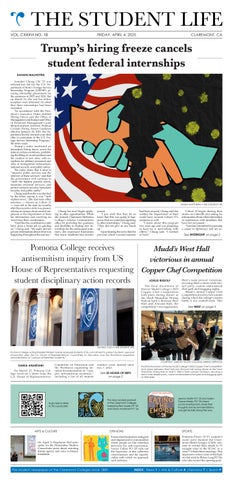
Annabel Chung CM ’27 was selected last fall for the U.S. Department of State’s Foreign Service Internship Program (USFSIP), securing internship placements for the summers of 2025 and 2026. But on March 14, she and her fellow acceptees were informed via email that their internships had been rescinded.
“In accordance with the President’s Executive Order entitled Hiring Freeze and the Office of Management and Budget and Office of Personnel Management’s joint Memorandum entitled Federal Civilian Hiring Freeze Guidance effective January 20, 2025, the Department hereby rescinds your final offer to participate in the U.S. Foreign Service Internship Program,” the letter reads.
Trump’s order instituted an immediate hiring freeze across the federal civilian workforce, prohibiting the filling of vacant positions and the creation of new ones, with exceptions for military personnel and roles in immigration enforcement, national security and public safety.
The order states that it aims to “improve public services and the delivery of these services” and that the government will continue to “meet the highest priority needs, maintain essential services, and protect national security, homeland security, and public safety.”
Chung said that she was shocked by the letter, saying it was “such sudden news.” She and forty other selectees — known as Cohort 12 — were left in the dark for months after the executive order was passed, relying on rumors from current employees at the Department of State for information and receiving no word from their coordinators.
“I feel like the coordinators could have done a better job in guiding us,” Chung said. “We really did not get any information about what was happening throughout this journey.”
Chung has now begun applying to other opportunities. While she praised Claremont McKenna College’s Scholar Communities office for providing her guidance and flexibility in finding new internships for the subsequent summers, she expressed frustration that many deadlines had already
passed.
“I just wish that they let us know that this was going to happen so that we could start applying to other internships,” Chung said. “They did not give us any heads up.”
Upon hearing the news that the previous cohort’s second summer
had been secured, Chung said she wished the Department of State could have secured Cohort 12’s summers as well.
“I knew about this program two years ago and was preparing so hard for it, networking with others,” Chung said. “I worked so hard.”
Cohort 12 began sharing their stories on LinkedIn and asking for information about other internships or experiences with deadlines that have not yet passed.
“I remain committed to pursuing a career in diplomacy and am ac-
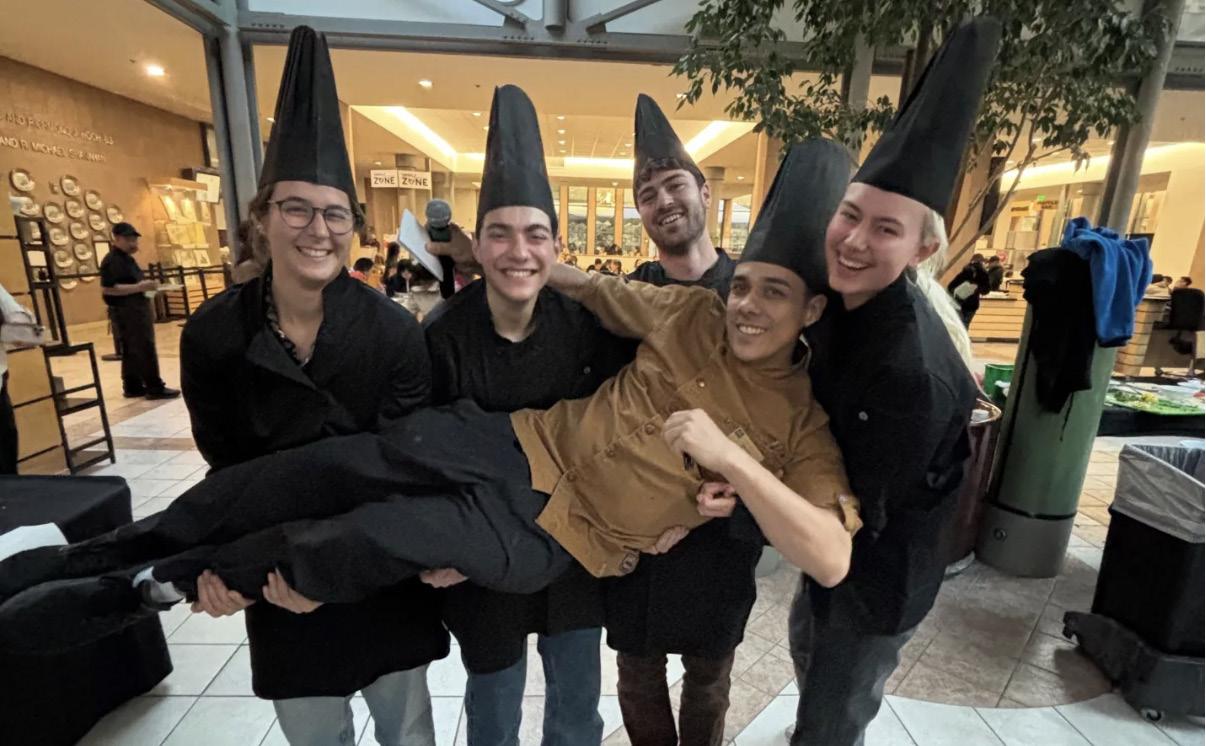
West’s team proved victorious, securing them a dorm-wide dessert party, custom embroidered chef garb and bragging rights. Mudd’s annual Copper Chef Competition involves two rounds during which the college’s dorms battle it out cookoff-style. This
Hall, the competition’s two opponents,
DANIA ANABTAWI
conduct cases opened since Oct. 7, 2023.
Continued from page 1
tively seeking new opportunities,” Chung wrote in a post on LinkedIn. “Although my USFSIP opportunity has been rescinded, I’m excited to see where this journey takes me next.”
One of Chung’s fellow cohort members and junior at Grinnell College, Isabella Flynn-Nesbeth, reflected in a similar post on LinkedIn about the importance of merit and needs-based opportunities like USFSIP.
“After my second cycle applying,
I was excited to finally participate in my dream program, working [at] the State Department and working towards my future career as an American diplomat,” Flynn-Nesbeth wrote in the post. “As a low-income college student, paid internships have provided support for my education and an opportunity to learn and work with incredible federal professionals.”
In an email to TSL, CMC Professor of Government and International Relations Jennifer Taw commented on how the rescinding
of these opportunities will impact the future training and hiring of diplomats.
“Qualified, committed people are being turned away and will find other ways to serve their communities and that will be a loss for State and for U.S. diplomacy,” Taw said. “[Alongside interns,] it’s thousands of people, many of whom gave years, if not decades, of their lives to building expertise, knowledge, credentials, networks, and experience and who now have been unceremoniously thrown out.
If losing interns is a big deal, losing THESE people is huge.” She also commented on the larger trend within U.S. foreign policy under the current administration. “It says something that a job that used to be considered secure and respected suddenly no longer is, that service and experience are not appreciated but instead smeared, that loyalty to an individual counts for more than loyalty to the country or constitution, and that the U.S. under this administra-
tion sees no value in diplomacy and soft power,” Taw said.
Chung, however, said she was not sure how faithful the order is to fulfilling its alleged purpose of improving public services for Americans and making the government more efficient.
“I feel like [with] the presidential executive order, they’re saying it’s for our economy or for the people,” Chung said. “But [by] canceling internships or scholarships or experiences, you’re killing the dreams of the future.”
US House of Reps: Pomona College
Continued from page 1
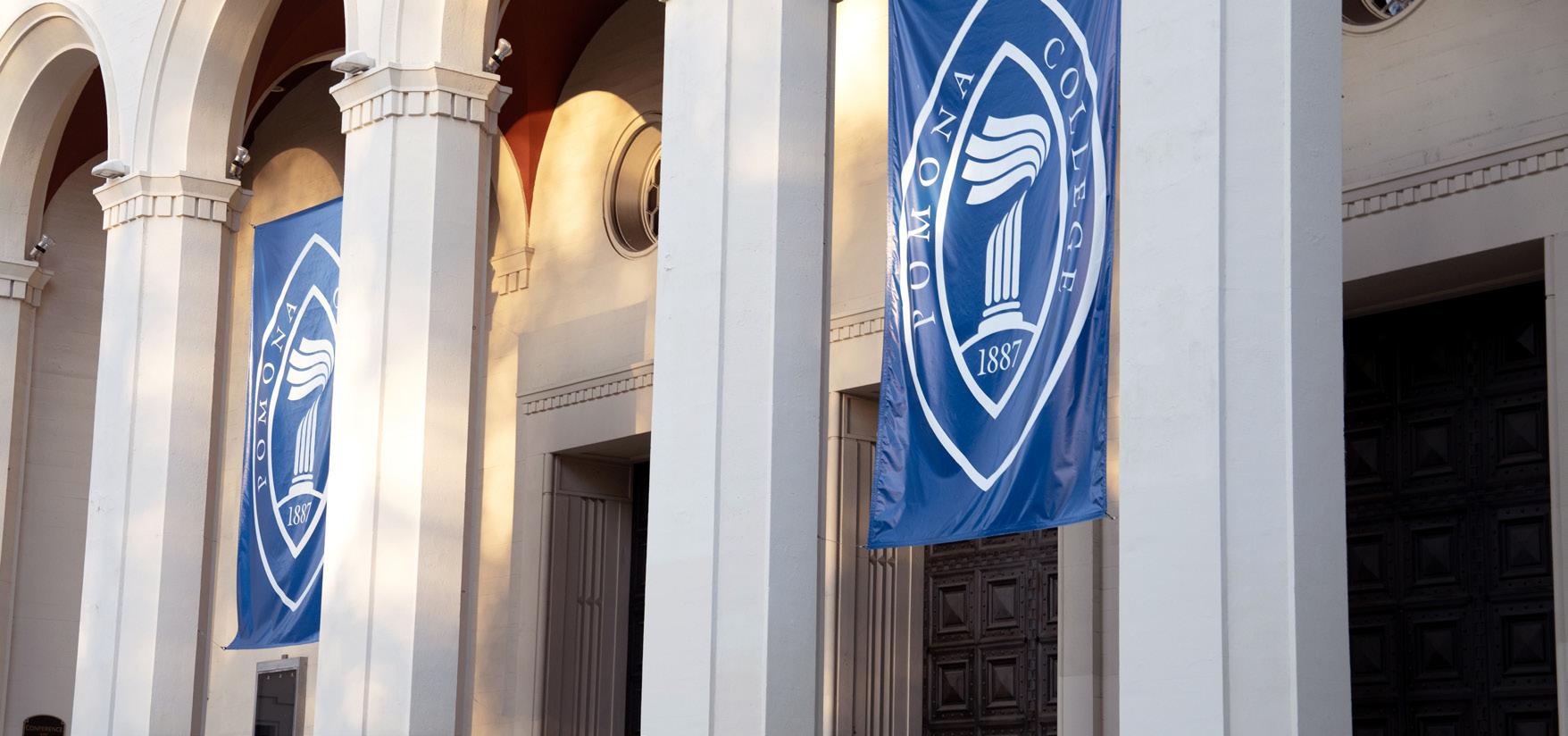
Signed by Rep. Tim Walberg (R-Mich.) and Rep. Burgess Owens (R-Utah), the letter cites key inciting episodes, including the Associated Students of Pomona College’s referendum on the Boycott, Divestment and Sanctions movement, the student occupation of Alexander Hall that led to the arrests of 20 students, the student demonstration outside of Pomona President G. Gabrielle Starr’s house, the graduation disruption facilitated by Pomona Divest from Apartheid and the student protest in and occupation of Carnegie Hall.
The letter follows a cascade of investigations and escalating concerns of antisemitism at Pomona over the last several months, including the “failing” ranking by the Anti-Defamation League (ADL), a warning from the U.S. Department of Education Office of Civil Rights and a lawsuit filed jointly by the Brandeis Center and the ADL.
The letter requested that Pomona respond with several specific documents by April 10 in order for the committee to evaluate on-campus antisemitic incidents and the college’s responses. These involve all documents related to disciplinary actions against students at the Carnegie protests and the demonstration outside President Starr’s house, including “suspensions, expulsions, and written or verbal reprimands.” It also asked for information on any reported antisemitic incident since Oct. 7, 2023, including the date, a description of the incident, the school of any involved students, the case status, any actions taken to date, the students’ standing and whether they had prior disciplinary actions.
In the face of this letter, Acting President Robert R. Gaines released a statement to the Pomona community on March 30 affirming the college’s plans to evaluate the committee’s re -
quests and to cooperate with the investigation.
David Menefee-Libey, Pomona politics professor, also responded to the letter in an email to TSL, referencing the Trump administration’s targeting of higher education and commenting on the danger that such an investigation poses to students.
“Those national government leaders are targeting all of us, but especially students and their freedom to study what they choose and to build safe, supportive communities of open and challenging inquiry,”
Menefee-Libey wrote. Ezra Levinson PZ ’27, an organizer with JVP at the Claremont Colleges, echoed this sentiment, citing concerns over the goals of the letter.
“This inquiry is clearly not about antisemitism,” she said. “It’s about investigating and stifling political dissent on university campuses and in this country.”
Levinson added that the letter sets a precedent for the 5Cs “to repress student speech … [and] the speech of its faculty and staff, and change itself to be a place where … dissent can no longer be practiced.”
The Academic Council of JVP similarly expressed concern over the message, addressing their concerns in a March 31 letter to Walberg and Owens that criticized their representation of antisemitism at Pomona.
“The charges are baseless and reflect a profound and materially harmful misunderstanding of antisemitism,” they wrote. The letter also asserted that their interpretation of antisemitism detracts from the ability of protesters “to advocate in solidarity with the urgent struggle for Palestinian freedom and equality.”
JVP is not the only group addressing the letter. On March 30, a petition calling on Pomona to protect the privacy of its
students following the release of the letter began circulating. It has been signed by 379 as of April 3, but aims to garner 10,000 by April 5.
The privacy of students is something that other community members have expressed concern over as well. Menefee-Libey noted that the letter “ask[s] for a large amount of information about individual students at Pomona College in a way that seems … to violate the Family Education Rights and Privacy Act, or FERPA.”
FERPA, passed in 1974, protects student information and upholds privacy in educational information. Although Gaines wrote in his statement that Pomona “has the important legal obligation” to protect student privacy, the college’s webpage on student records privacy details that Pomona may disclose information from a student’s educational records to third parties under certain conditions. According to Pomona’s policies, information such as student discipline files may be shared in the course of federal evaluations of educational programs. Despite this, Gaines wrote in his statement that the college would maintain student privacy.
In another statement released on March 31, Gaines reiterated that “the College will not expose student identities unless obligations to the law stipulate otherwise — and that is not the case at this time.”
This second statement follows the unauthorized distribution of flyers on campus alleging that Pomona planned to reveal the identities of students who had received disciplinary action to Congress, as well as the circulation of a Claremont Undercurrents Instagram post with the same claims. Gaines shared a third statement on April 3 emphasizing that the college would uphold privacy laws, including FERPA.
However, Gaines noted in his March 30 statement that Pomona cannot control what information is released online by news and social media outlets.
Those national government leaders are targeting all of us, but especially students and their freedom to study what they choose and to build safe, supportive communities of open and challenging inquiry.
David Menefee-Libey, Pomona College Professor of Politics
“I want to assure you that we will uphold Pomona’s unwavering commitment to protecting the release of personally identifiable student information consistent with the relevant privacy laws,” he wrote.
Pomona Vice President for Student Affairs and Dean of Students Avis Hinkson did not respond for comment when asked how Pomona plans to cooperate with the investigation while protecting its students’ identities. She also failed to respond when asked whether the disciplinary action information of non-Pomona 5C students who received campus bans after the Carnegie protest would be shared.
Similarly, the Dean of Students’ office at Scripps College did not respond for comment when asked if the institution would protect its students’
privacy. Pitzer College’s Dean of Students office pointed to Pitzer President Strom Thacker’s March 30 statement to the college community but declined to comment further on the matter.
In the message, Thacker wrote that the Pitzer administration “has been following the situation and its potential implications for our community closely.”
Thacker also assured the college’s commitment to protecting student privacy, when applicable, and explained that Pitzer intends to continue to uphold its core values.
Despite the concerns of a number of students and community members, the letter to Pomona has garnered positive support from some Jewish community members.
“Unfortunately, many Jewish students at the Claremont Colleges have felt that the colleges have become a hostile living and learning environment in the past few years,” Noah Rinsler PO ’26, the vice president of Haverim, said in an email to TSL. “We hope that putting a federal spotlight on universities’ handling of antisemitism will incentivize all universities, including the Claremont Colleges, to act more swiftly when antisemitic incidents occur and make a concerted effort to be welcoming places for Jewish students.”
The letter in particular has prompted discussion over the future of student protection both at Pomona and across colleges and universities in the United States.
“There is no need for the Congressmen to launch the intrusive, disruptive, and potentially illegal demands they make in the letter,” Menefee-Libey wrote. “I hope that the leaders of Pomona College will object, do their best to resist and slow this process down, protect all members of our college community as best they can, and reach out to allies in building support and protections for US higher education more broadly, not just Pomona.”
Registration opens March 24
Classes offered online and in-person
Three- and six-week courses
Taught by HMC faculty
$4,250 (3-credit course)*
$1,425 (1-credit course)*
hmc.edu/summer-session
Meet Harvey Mudd and Pitzer Colleges’ 2025-2026 student body leaders
Harvey Mudd, Pitzer and Claremont McKenna Colleges have elected their student body presidents for the 2025-2026 school year. TSL’s Macy Puckett sat down with Ella Hale PZ ’26, Aditi Bonthu HM ’26 and Simone Yang HM ’26 to discuss their goals and plans for the year ahead. Claremont McKenna College’s incoming president did not respond to a request for comment. Associated Students of Pomona College (ASPC) elections will be held on April 9, while voting in Scripps College’s elections takes place April 2 through April 4.
The statements provided below have been cut and edited for clarity. Ella Hale PZ ’26 is the incoming student body president of Pitzer Student Senate. She is currently serving as the Vice President of Finance.
What excites you most about being in this position this year?
“Everything! Particularly, I’m really excited to actually rebuild the way that Senate meetings run next year because I think there are a lot of nuances that are very hard to know unless you basically memorize the Constitution or the Student Code of Conduct. I’m also looking forward to strengthening the connection with senior staff and faculty through the College Council, which is basically where faculty come, the Senate is invited and they have a vote. I’m excited about that because I think right now is a very politically uncertain time for a lot of students and thoughtful collaboration is more important now than it [ever] has been. So using the actual structure of Senate to improve that, that’s what I’m really excited about. I’ve been in Senate forever; it’s kind of my bread and butter.”
What changes, if any, will you be making as this semester comes to a close?
“For my statement, I outlined a lot of goals and I want to accomplish all of them. So in McConnell, I think it could be really helpful to have a short blurb with [dining hall worker] names and maybe a fun fact about them. And so I was thinking, on one side we could do McConnell dining staff and on the other side a facilities recognition board. As students are waiting to get their food, being able to appreciate the people who put it in front of them is really helpful. I’m excited to fix some of the nuances that aren’t perfect with finances, not only at Pitzer but across the 5Cs. Right now, our six student Senate members get paid but it’s hard because you can’t pay the Inside-Out representative until they’re no longer incarcerated. So [we need] a way to track that more accurately and efficiently … Of course, my top priority is making sure that students feel supported, safe, heard and protected at Pitzer.”
What challenges are you anticipat-
ing in our final months, especially following federal administration targets to DEI and federal funding, that you may not have experienced last semester?
“I definitely anticipate all of those challenges. Those specific problems are urgent, real-world issues that I’m working with senior staff to address because they have more information than I do. Usually, I use what they tell me to then further communicate to students. The most important thing in my role is being communicative with people, being responsive to my email and talking to people in person if they’re concerned. We have group support hours for certain different issues that students can come to but that’s difficult because, then, students kind of have to out themselves. A lot of the work is being done over email, sending out links of how to get your real ID, communicating why you need it, when you need it, how that impacts flights, etc., etc. … Those challenges, a lot of them are unforeseen. A lot of them I can prepare for, though, and so I have been especially with the VP of diversity in these sectors.”
How will you continue to work with President Strom C. Thacker moving forward?
“I was on the cabinet for my first two years as treasurer and the VP of finance so I’ve been working with admin. I feel really blessed to have their personal phone numbers and I feel really blessed to be a part of their community. I think a lot of
the communication with senior staff and the communication I obviously have with students is really helpful to bridge gaps in understanding between the students and admin. The admin sometimes disagrees with students so having both perspectives and presenting a nuanced picture of both sides, I think, is my job. I intend to be really highly intentional about what I sponsor, author or co-author, especially when it comes to resolutions or statements. I want my role to elevate student voices and ensure that all sides of the issues are presented clearly and fairly so that Senators can make informed decisions. My continued relationship with admin is key to that process and to make sure the info I provide is accurate and complete.”
How do you plan to hear and address the student concerns you touched on a little bit?
“With an open heart and with an open mind. I’ll listen to however students want to share their opinions with me, whether that’s an email, in-person or through protests. I do believe that in-person dialogue is the most effective way to resolve conflict — and that’s how I’ve handled a lot of issues in my previous role on exec board or in my current role — and I’m going to continue to use that approach: engaging with groups in places on campus that are neutral and places where people can feel like I’m not just someone on Senate. I’m also a student and I hear your concerns and want to validate you. I want to respectfully provide information that I have, whether
that’s in support of you or communicating what senior staff know that students don’t, and then have students develop that and their perspective on the issue.”
AB: Aditi Bonthu, HM ’26 is the incoming president of the Associated Students of Harvey Mudd College (ASHMC). Bonthu has been involved with ASHMC since her sophomore year as Muddlife Director and as a dorm president this year.
SY: Simone Yang HM ’26 is the incoming ASHMC senate chair. Yang has been involved in ASHMC since her sophomore year as a two-year dorm president and a member of many assorted committees.
Bonthu and Yang, who work closely together on ASHMC, communicated with TSL via email.
What excites you most being in this position?
AB & SY: “Our onboarding has been really exciting. Learning about all the moving pieces involved in our leadership has been so insightful and we’re really grateful for all the work that [our predecessors] have done!”
What changes, if any, will you be making as this semester comes to a close?
AB: “In the process of onboarding, we’re focused on learning the ropes and fostering connections with all the new student leadership, faculty and staff that we’ll
get to work with next year. We also plan to reflect on what has worked well for our current leadership team and identify areas for improvement, ensuring a strong start in the coming semester.”
SY: “As the incumbent ASHMC President and Senate Chair, our duties this semester are focused on activities that affect the 2025-26 academic year: running elections and onboarding new leadership, coordinating summer storage and gaining familiarity with the many moving pieces involved in ASHMC Leadership’s responsibilities.”
What challenges are you anticipating in our final months, especially following federal administration targets to DEI and federal funding, that you may not have experienced last semester?
AB & SY: “Unfortunately, we have to anticipate new challenges while upholding our commitment to the interests of the Harvey Mudd students. Navigating policy changes requires constant communication between students, faculty and staff and the administration. We will do our best to represent the student body in these conversations.”
How will you continue to work with President Nembhard moving forward?
AB & SY: “We will continue to bring feedback from our anonymous forms and student representatives to our monthly meetings with President Nembhard. Additionally, through meetings with Cabinet members and other stakeholders, we will amplify student voices and ensure our messages are heard in meetings where we are not present.”
How will you continue to hear and address student concerns?
AB: “The priority of ASHMC leadership is to bring student perspectives into every conversation, meeting and policy decision we are involved in. We hope to build a legacy of transparency and communication between ASHMC and the student body. One facet of this is our weekly meetings with the Senate, composed of around 50 student representatives; in these meetings, we hear from dorm and class representatives about campus activities and current events and work with them to turn feedback into actionable steps.”
SY: “I also want to emphasize the importance of conversations outside of scheduled meetings and designated communication channels. Being engaged, available and paying consistent attention to discussions happening across campus are critical to representing student interests even when specific issues are not brought to us directly. We also plan to expand our outreach by holding office hours to reach students who may not engage through existing means.”
Continued from page 1
year, the first round took place on Feb. 26. The two winners, Atwood and West, graduated to Wednesday’s finale. Each team was required to produce an appetizer and an entree for judging. Contestants had an hour to produce their appetizer and then another 30 minutes to get out an entree, so they were working on both dishes simultaneously.
Similar to the nationally televised cooking competition Iron Chef, contestants in Copper Chef are given a secret ingredient that they are required to incorporate into each of their dishes. The secret ingredient for Wednesday’s finale was pea tendril.
West’s winning menu con -
sisted of a pea tendril, daikon and mango salad with soy sauce, garlic and black vinegar dressing, served in a bowl constructed of mango skin as their appetizer. Their entree was carne asada tacos with a pea tendril salsa verde, served with a side of esquites. With the exception of one ingredient that teams were allowed to bring from home, everything that they needed was provided by the Hoch.
“They have a table laid out with some meat options and a lot of vegetables and some spices,” Katrina Nelson HM ’25, a member of West’s winning team, said. “But you can go up and say, ‘Hey, my favorite Hoch employee, could we have this special ingredient that
isn’t on the table?’ And they’re very helpful. They blended our salsas and gave us some cheese and little plates.”
For West competitors, the key to success was a tight-knit and fun team.
“There were five of us in total, but only four of us at a time, just because people switched out,” Abdullah Fattahi HM ’26, another winning team member, said. He noted that his team was much smaller than those of his competitors, which on average had around seven or more people.
Although initially intimidated, West team members realized that their smaller numbers proved advantageous.
“I think the phrase ‘too many cooks in the kitchen’
is very real,” Fattahi said. “There’s some point where you just kind of are in the way and not doing much, and then it kind of becomes unproductive. So I think we had a perfect amount.”
In approaching the cooking competition, the team embraced improvisation, whereas other dorms had practiced beforehand.
“I think West has a tradition of kind of winging it, like really doing it for fun, but then [West] actually has won pretty regularly,” Nelson said.
Fattahi agreed, pointing out that West won Copper Chef two years ago using the same “thrown together” methods.
“Just being ready to adapt was good,” Fattahi said. “West
is always able to do things on the fly.”
The team said that they were surprised by the results, emphasizing that the competition was in no way a landslide.
“Before they announced that we won, they said it was really close, and I was like, wow, it’s impressive that we got that close to Atwood,” Ellie Sindler HM ’25, a West competitor, said. In a post-victory reflection, Fattahi noted that West started with an inherent disadvantage.
“We’re one of, like, three dorms that doesn’t have a single kitchen,” he said. “The rest of them do have kitchens, so it’s kind of embarrassing that none of them could beat us. But also, I think the other teams competed really well.”
EMMA CHOY • THE STUDENT lIFE
MACY PUCKETT
‘Finding hope through music’:
‘Reason to Be’ musical debuts at 5Cs
MALIN MOELLER
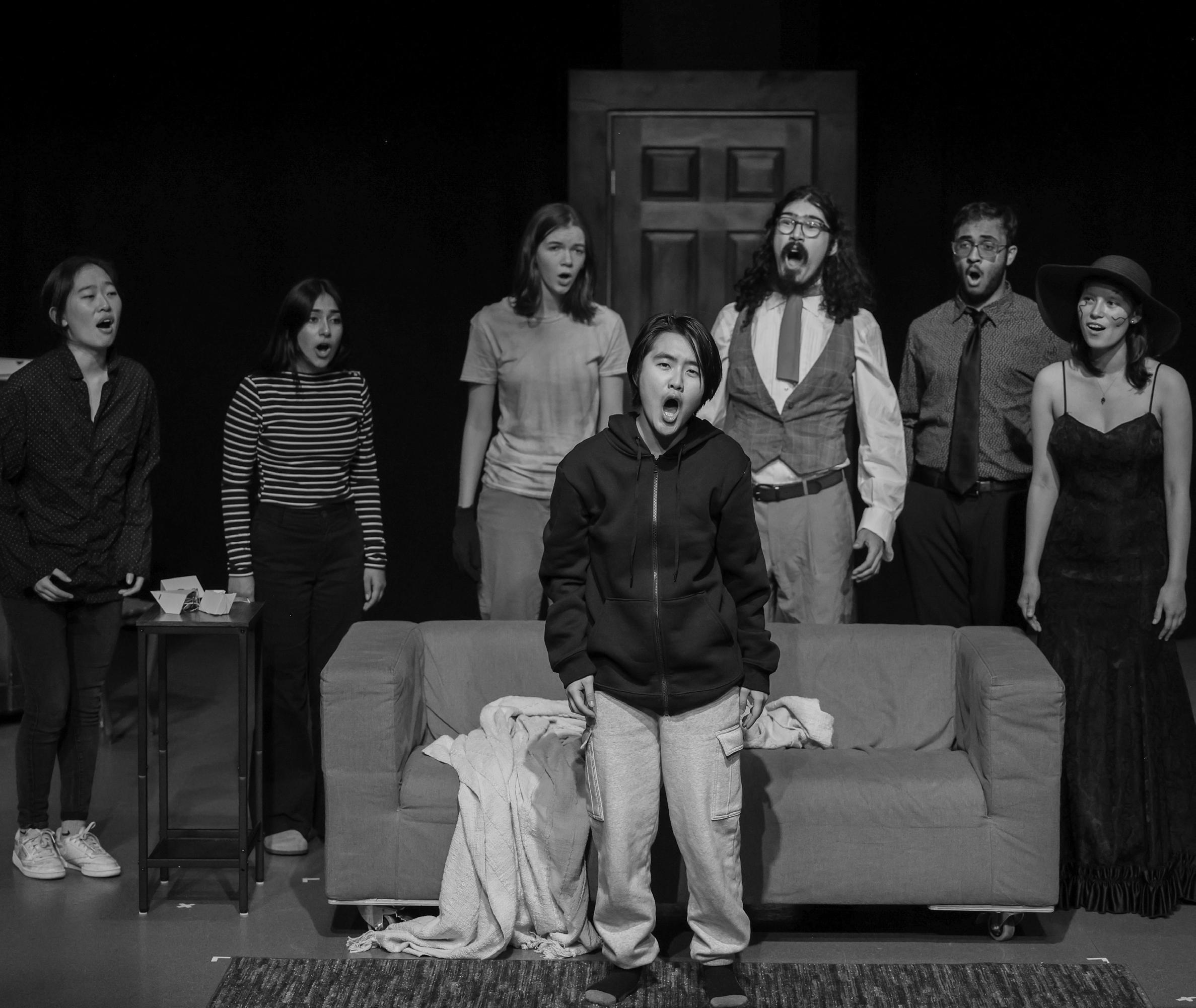
Devon Tao HM ’25 first began writing songs about climate change as a final project for a music class. These songs eventually formed the backdrop for their original musical “Reason to Be,” which opened at Seaver Large Studio on March 27 and ran through the weekend.
The musical follows an outof-work pianist in the year 2050, when AI has taken over the music industry. Debilitated by fears of the climate crisis, the musician seeks a reason to continue writing music and living life — a task his AI helper assists him with.
“‘Reason to Be’ is a story about finding hope through music in the face of seemingly insurmountable challenges,” Tao said.
Discussing why they wanted to produce a musical, Tao noted that music tells a story in a way words alone can’t.
“[Characters] sing because they’re so full of emotion that words aren’t enough,” Tao said. “I just felt like this is a story that sang.”
The production was directed by Aelin-Alexandria Nyx PZ ’26 and produced by Spotlight Musical Theater, the 5Cs’ student-run musical theatre company. Notably, “Reason to Be” is one of the first 5C musicals to be written by a Harvey Mudd student.
“There’s been Harvey Mudd-directed productions, but I don’t believe there’s ever been a Harvey Mudd-produced musical or one mostly by Mudders,” Tao said.
While Mudders are known mostly for their STEM skills, cast member Kishore Rajesh HM ’25 noted that Harvey Mudd students are often also quite good at music.
“Surprisingly, a lot of Mudders are singers,” Rajesh said. “I’ve been singing since I was a kid, but when I first came to Mudd, I joined choir, and I remember the first day when introducing everyone, I think two-thirds of the class was from Mudd.”
However, according to another cast member, Serena Mao HM ’25, several of the actors had little performance experience before joining the musical.
“It would be interesting coming [to rehearsal] knowing that a lot of us don’t have previous acting experience and seeing if that matches,” she said. “That’s
not something people would expect. One thing that really makes it work is that the actors put in a lot of time outside of rehearsal to practice.”
“We’ve met up so much outside of rehearsal and spent hours running lines and practicing blocking and making sure we get the rhythms and everything right for the music,” cast member Sage Wong-Davies
SC ’25 said, agreeing.
Parts of “Reason to Be” explored the intersections between science and music, which might be enjoyable for certain Mudders. One song, for
instance, rhymed “Claire de Lune” with “algae bloom.”
“It’s very climate oriented, which I think appeals to Mudd students,” Wong-Davies said. “Like, ‘The Greenhouse Effect’ is a song in the show and it’s a rap about the greenhouse effect, and I think Mudd people will understand that.”
The long process of rehearsing brought cast members closer together, creating a strong community where Mudd students interested in musical theater could connect and work together on a production.
“Ultimately, if you’re having
rehearsal three to four days a week for four hours a day, and then you get to tech week, the community just kind of forms,” cast member Rai Wandeler HM ’28 said.
Though Wandeler said that being involved in the musical while completing Mudd’s first-year course load was challenging, they believed it was ultimately rewarding.
“This musical provides a great balance to a lot of the academic work and makes your day more fulfilling,” Wandeler said.
The idea that music can make life more fulfilling is reflected in
the musical itself. Several songs describe music helping people through difficult times, using wide-ranging examples such as the struggles of a Victorian Era child laborer and Beethoven’s hearing loss.
In the end, the pianist uses music to deal with his fears about friendship and climate change, leaving the audience with a message of hope for the future.
“I think I have something very real and very important to say here,” Tao said. “We’re doing good work here, and I’m very proud of everyone in the cast and crew.”
Humanities Studio presents Stephanie McCarter on female agency in the classics
ANANYA VINAY
“Even when those in power try to silence them, female characters craft clever ways of recovering new and creative methods of bearing witness,” Stephanie McCarter said.
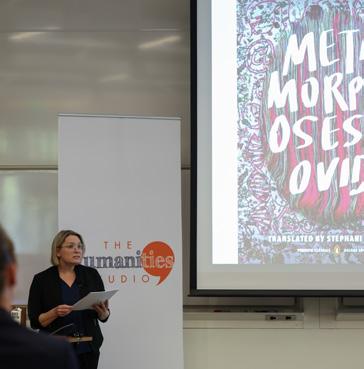
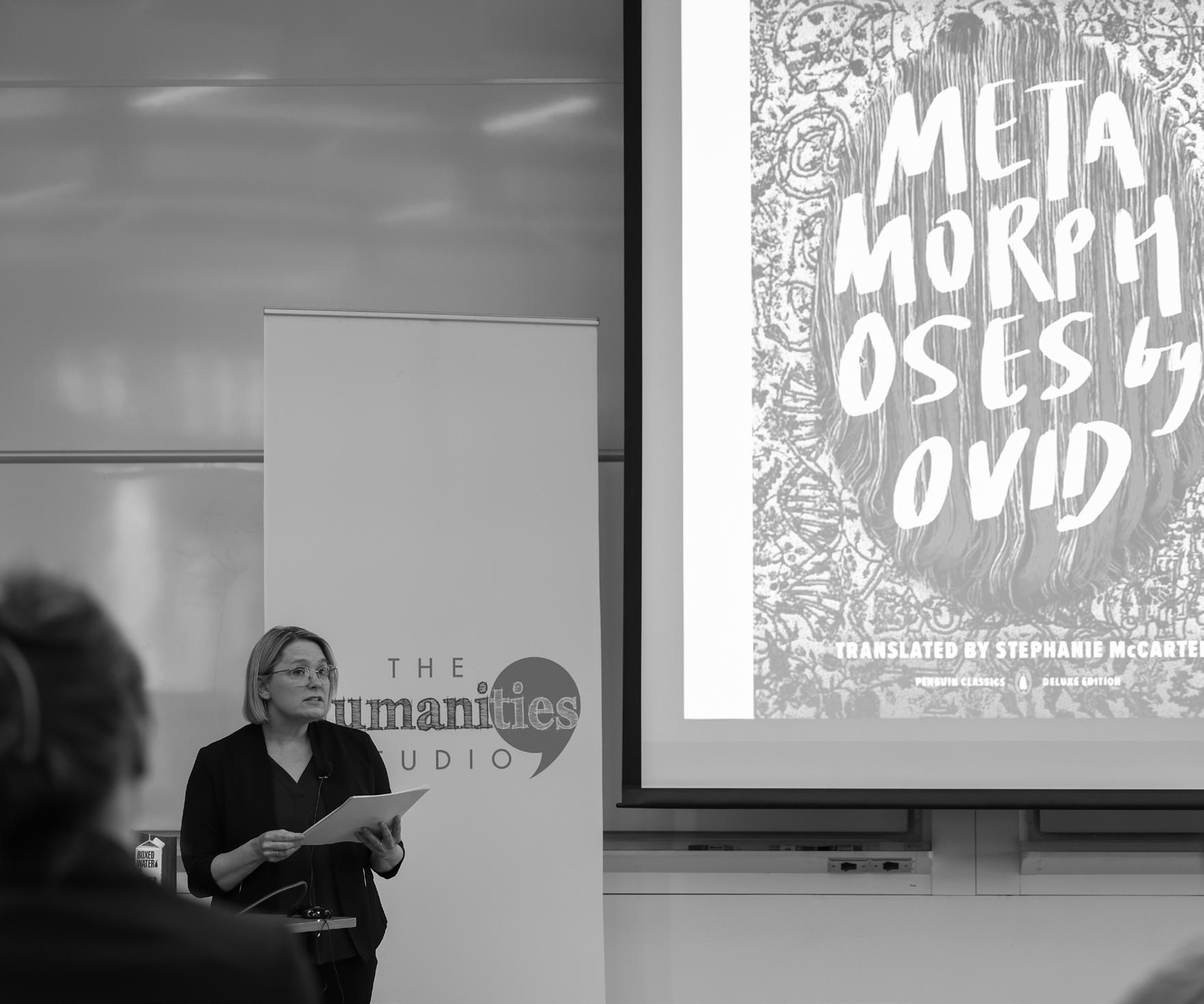
On April 3, McCarter spoke for the Humanities Studio’s Connections series about restoring female agency and voice in literary translation. McCarter is a classics professor at the University of the South in Sewanee and the author of several books, most recently “Women in Power: Classical Myths and Stories from the Amazons to Cleopatra.”
She is most well-known for being the first woman in 60 years to fully translate Ovid’s “Metamorphoses,” an 8 A.D. Latin epic poem about mythology.
Kevin Dettmar, professor of English and director of the Humanities Studio, considers McCarter’s work to be a contemporary rejuvenation of “Metamorphoses.”
“Within Ovid’s stories, we get tales of, to quote Dr. McCarter, ‘failed connections, physical connections, textual connections, visual connections,’” Dettmar said. “[Her] translation does an amazing job of bringing these 2000-plus-year-old stories back
to life with fresh language that makes the stories feel present.”
McCarter’s approach to “Metamorphoses” draws from film theorist Laura Mulvey’s theory of the male and female gaze, from her seminal 1975 essay “Visual Pleasure and Narrative Cinema.” Mulvey defines the male gaze as the looker having an active, masculine and dominating role, while the object of the gaze is sexualized and passive.
McCarter formulates her feminist, female spectator lens on “Metamorphoses” using this theory.
“A female spectator can place herself as an observer of the
whole process that takes place between male gaze and visual female visual object,” McCarter said. “These female spectators, in turn, can become narrators of the violence they have seen.”
Attendee Emrys King PO ’25 found this perspective to be particularly thought-provoking.
“I have some experience with translation theory, and it was refreshing to hear someone say that a rhetorical lens through which you want to analyze the text can be directly a part of the way that you translate it. I think that perspective is missing from a lot of translations,” King said.
McCarter’s first example of using this gaze was in translating the story of Callisto, a nymph and devotee of the goddess Diana who is raped by the god Jupiter. Callisto attempts to hide her loss of virginity from Diana, but her fellow nymphs realize what has happened through the “mille notis,” or 1000 marks, on her body.
“[Callisto’s] body itself … threatens to reveal the crime throughout the story… It is those with a discerning female gaze, one based in their own experiences of the world, who can interpret correctly,” McCarter said.
McCarter notes that sexual violence, no matter how much one denies it, transforms the body. With regard to the translation of “mille notis,” McCarter chooses to view this phrase both literally and metaphorically.
“Her body is therefore much like a text that does not lend itself to easy intelligibility and relies upon the witnessing eyes of knowing others,” McCarter said.
McCarter carefully chose words that do not romanticize sexual violence and avoided introducing sexualized language that is absent from the original text, which is not usually the case in canonical translations by people like Allen Mandelbaum and David Raeburn.
Attendee Clara Meyers PO ’25
found that the lecture completely changed her perspective on literary translation.
“I didn’t realize how wrong other translations were, and how much translators have historically inserted their own biases into the text, and just how vastly that changes the meaning of the work,” Meyers said.
Following an explanation of her approach to translation, McCarter presented a close reading of the myth of Apollo and Daphne. As Apollo chases Daphne, attempting to rape her, she runs toward the river and asks her father, the river god, to protect her. He turns her into a laurel tree.
In popular translations, translators use adjectives that objectify Daphne and overemphasize her beauty, creating a male gaze.
“Her story is about the danger of being viewed solely as a body and the dehumanizing violence of [this] … Translators objectify Daphne while she is a person, [but] they personify her once she becomes an object,” McCarter said. In her translation, McCarter protects Daphne’s agency. Near the end of the story, when Daphne is turning into a tree, most canonical interpretations translate “ora” as face or head — “Her face was lost in the canopy,” for example. McCarter chooses to translate this word as mouth — “The tree top takes her mouth.”
This choice allows the reader to be a witness to Daphne’s objectification by the male gaze, emphasizing the violence of losing one’s voice.
“‘Face’ and ‘head’ focused us on the experience of seeing Daphne as if we were Apollo, whereas ‘mouth’ suggests a function she has lost. It is this loss of voice that is the most psychologically devastating for the transformed [women] throughout the epic,” McCarter said.
While these small differences in word choice may seem trivial, they are critical to reimagining narratives under a female spectator lens.
SArAH ZiFF • THE STUDENT liFE
On April 3, McCarter spoke for the Humanities Studio’s Connections series about restoring female agency and voice in literary translation.
SArAH ZiFF • THE STUDENT liFE
“Reason to Be” follows the idea that music can make life more fulfilling, with several songs describing music helping people through difficult times.
The Claremont Art Equity Initiative: Bridging the gap between art history and economics
KEEANA VILLAMAR
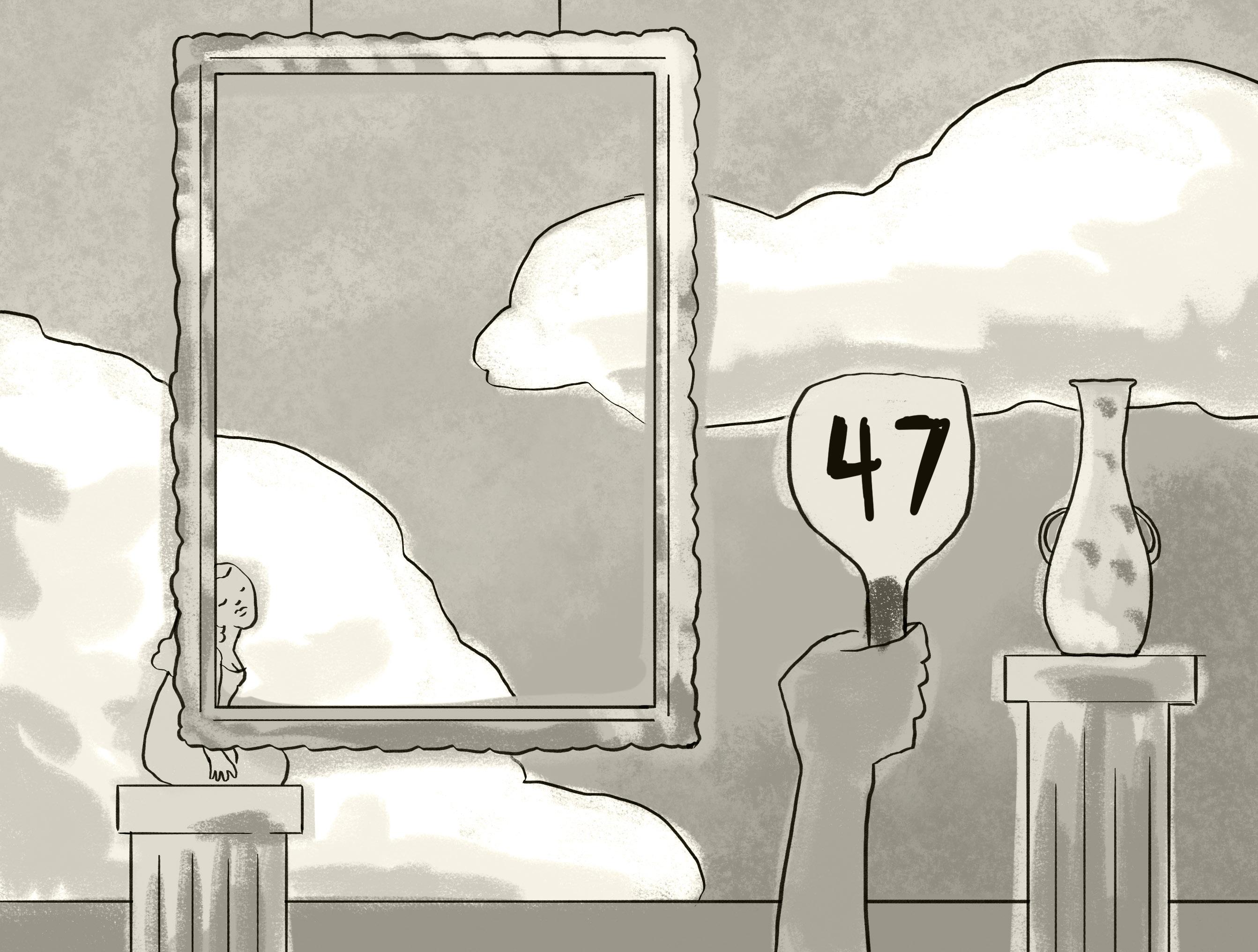
Saturday, March 29, marked the Claremont Art Equity Initiative’s (CAEI) first major event as a new and emerging club at the 5Cs. More than 75 guests, including students and the wider Claremont community, gathered on the rooftop of the Kravis Center for a silent auction of student artwork.
Guests milled around looking at students’ work, eating hors d’oeuvres and placing bids using the bid sheets beside each piece. Some artists stood by their pieces and answered questions as guests gathered around to observe.
The event featured around 25 pieces of art by 15 different student artists, with mediums spanning charcoal, oil, acrylic, ceramic and up-cycled materials, along with student photography and handmade jewelry.
The majority of proceeds from the auction will be donated to Free Arts, according to the event catalog. Based in Los Angeles, Free Arts is a nonprofit that helps children who face abuse, poverty, neglect and homelessness through art.
The event featured a wide range of work created in the last few years, including conceptual and abstract projects. Exhibiting artists came from across the Claremont Colleges, and ranged from first years to seniors.
Emily Gao PO ’26 showcased three ceramic sculptures that she made last semester. According to the catalog, her piece “David” is a perversion of Michelangelo’s original marble piece, “Mantle” is an oyster shell and “Untitled” is a ceramic eye.
“This was my first time making ceramic sculptures,” Gao said. “I’ve never participated in an art auction before, and I wanted to see what it would be like and support my friends.”
Attendee Daniel Bonilla PZ ’25 said he felt this event was a great outlet for students to showcase and be compensated for their artwork.
Another artist, Lue Khoury SC ’25, is a “conceptual artist working in the mediums of relational aesthetics and performance art,” according to the catalog. They exhibited three large-scale conceptual pieces, all over 84 x 39 inches.
“I love Lue Khoury’s work,”
SPECUlATiVE FiXATiONS
Bonilla said. “These big art pieces are theirs, and when art is really big, it always catches my attention. I think there’s a lot of depth within their work.”
The silent auction also featured live music. As guests enjoyed the artwork, a quartet of students from Pomona’s music department performed in the background.
“Part of supporting the arts is not just visual arts, but the performing arts,” Kenneth Knothe PZ ’25 said. “We love dance, and we love music, and that’s why we wanted them here for the event.”
Knothe and Tiffany Choi CMC ’27, co-presidents of the CAEI and hosts of the event, founded
the club this school year because of what they describe as a lack of existing clubs that bridge the gap between economics and art history, noting that there is no arts management undergraduate major at the 5Cs.
“We wanted to promote art business education within the undergraduate schools,” Knothe said. “They have an arts management major at the Claremont Graduate University, but if you want to go into art marketing work or art business work, you have to be like us and get two majors.”
One of the club’s initiatives is to propose Sotheby’s, one of the biggest art auction houses in
the world, as a study abroad opportunity for students. Sotheby’s currently offers study abroad collegiate programs available in London.
The club also hopes to collaborate with the wider Los Angeles community moving forward. They intend to host luncheons with professors, bring people who work in LA galleries to the 5Cs and collaborate with Pomona’s Rembrandt club to host gallery walks.
According to Knothe, CAEI members have memberships with the Rembrandt Club, an organization closely connected to Pomona’s art and art history departments, and to the Benton
Museum of Art. Founded in 1905 to support the arts in Claremont, the Rembrandt Club sponsors monthly lectures and teas, excursions, fundraisers and a variety of other events. At the end of the night, any unsold art pieces were returned to their artists. Choi credits a large part of the success of the event to the CAEI members who assisted in the process.
“It was a lot of work, and we could not have done it without our club members, who tried their hardest to make things work,” she said. “We’re really about bridging that art history and economics gap and bringing a difference to philanthropy.”
‘Stars Don’t Dream’: Is there optimism in extinction?
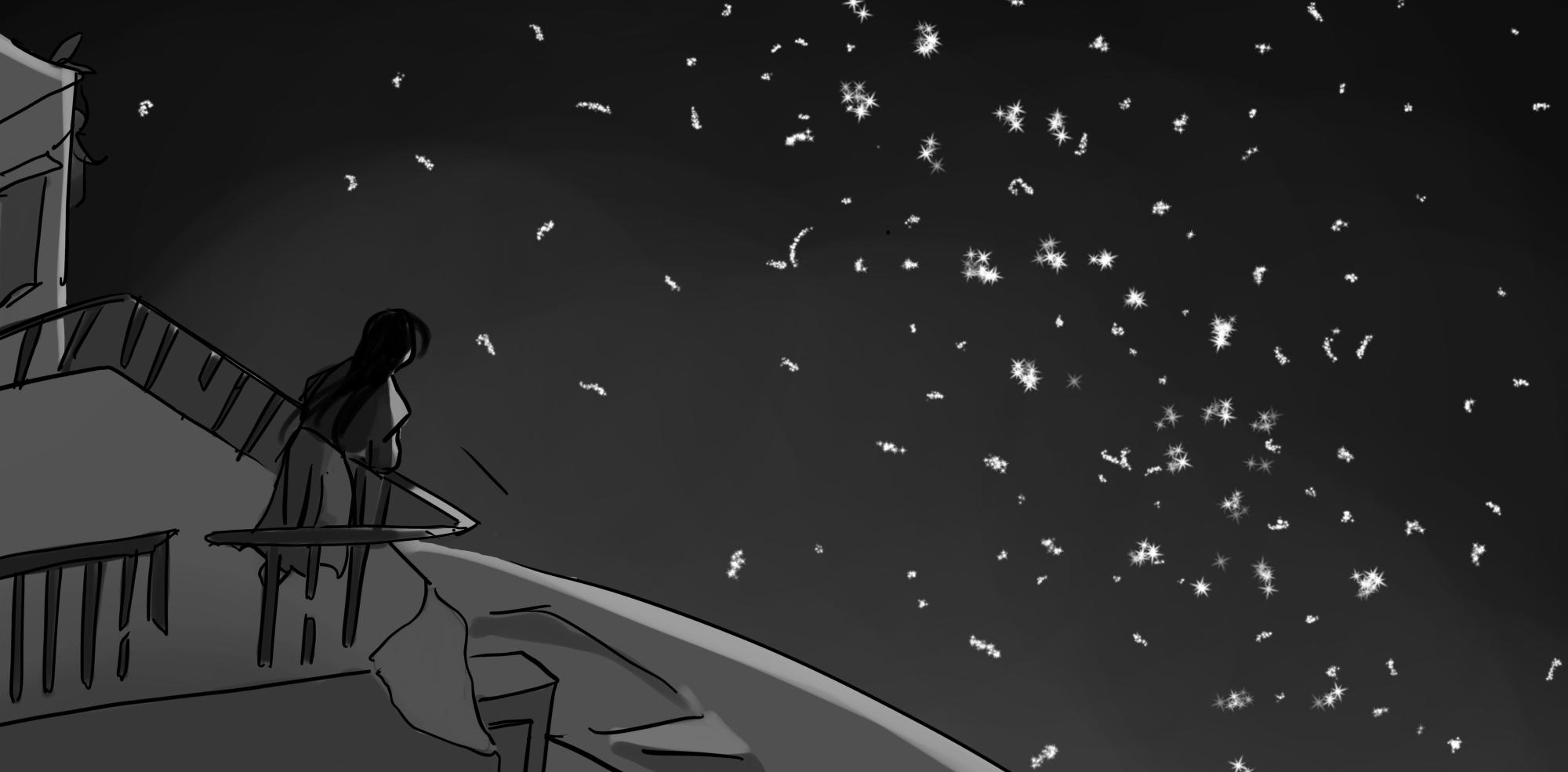
In five billion years, the expanding Sun will engulf the Earth, rendering it officially uninhabitable. Don’t worry — because of climate change, all life on Earth, including humans, will be gone long before then.
The 2024 science fiction novelette “Stars Don’t Dream” by Chi Hui, a story that spans three hundred million years, imagines a future where most humans choose to be trapped in dreams. Instead of facing the reality of living in an increasingly uninhabitable world, humans spend most of their time in the metaverse.
In the metaverse, a place so pleasurable that people interact with the physical realm as little as possible, “the illusions are boundless, but like an all-toowilling puppet, a joyful, flesh and blood, clockwork doll, you offer your bodily autonomy up on a silver platter.”
The wealthy leave their bodies in the care of robotic exoskeletons, which feed and exercise their bodies for them; the poor simply let their bodies rot away. Hui envisions a world where apathy, assisted by escapism, is humanity’s biggest problem. It’s a relevant prediction in the age of climate change; 36 percent of the world’s population is skeptical about climate change. Additionally, climate fatalism — the belief that even though climate change is real, it is too late to do anything about it — is on the rise.
Yet not everyone in the novelette’s world is enamored with the false dreams of the metaverse. “Stars Don’t Dream” focuses on five people who don’t opt into the metaverse, but instead choose to work on a dream rooted in the reality of a changing society.
Apathy may be the future’s main problem, but Hui doesn’t
envision it as a problem that’s unsolvable. In fact, it’s the apathy of others that motivates the main characters of “Stars Don’t Dream” to act.
Because if they don’t act, then who will?
“Stars Don’t Dream” is a story of quiet hope. Rather than feeling fatalistic about their insignificance on a cosmic scale, the main characters take their insignificance as motivation to try to do something significant together.
Their mission is to ensure that even when the Earth becomes uninhabitable, life in some form continues in the universe. It’s a project so long-term that “long” means they will be dead way before the hundreds of millions of years it will take to see whether or not the project is successful.
As a story about the far future, “Stars Don’t Dream” provides a rebuttal to current
climate apathy. Weaving together the stories of the five main characters who work together on the project, Hui proposes that there is a solution to apathy and extinction: collective dreaming.
Unlike the illusory, technology-assisted dreams of the metaverse, which encourage escapism and complacency, the characters’ dreams as they work together on the mission are positive and regenerative.
“Stars Don’t Dream” encourages us to look at humanity on a larger scale than the length of our individual lives. It’s an empowering reminder that no matter how insignificant or hopeless our efforts may seem today, they may prove impactful in the future.
I’d recommend this story because of its immersive prose and imaginative sci-fi concepts. What I like most about the “Stars Don’t Dream,” though, is
that it’s a story that dwells on the preciousness of small moments. The author’s blending of the mundane and the remarkable in the narrative, portraying the five main characters as realistic and not just idealistic, is what makes “Stars Don’t Dream” so special. For a story about extinction, it’s quite optimistic. As the readers, we get to see three hundred million years after the five dreamers die. If you read the story, you’ll find out if their mission succeeds or not. You should also read the story because, like our lives, it’s pretty short. It might even inspire you to take action. After all, even if it takes three hundred million years, your dreams can still have an impact.
Vivian Fan PO ’28 imagines a future in which you will read “Stars Don’t Dream.” It’s available online. She also recommends the Wikipedia page “Timeline of the Far Future.”
VIVIAN FAN
Reflections from a cafe in Taipei
This year’s spring break was probably my favorite of undergrad. I spent the week in Taipei and visited my friends who were studying abroad at National Taiwan University. The trip was filled with eventful moments of visiting sights, running around the city and eating delicious food. Even the quieter moments were quite memorable: On my last day in Taipei, I decided to head to a cafe to get some work done.
With Google Maps in hand, I meandered through the streets of Xinyi District in search of a place to get some writing done for my Creative Nonfiction and Diaries and Daybooks classes. The streets were bustling; though the first few days of my trip were especially rainy, the weather was beautiful today. People were out and about.
I weaved in and out through various quaint alleyways before coming across a small cafe. On the patio out front, some students were enjoying a cup of coffee with friends while others were typing away on their laptops. I
could hear the click-clacking of the keys as I approached the entrance.
“This seems like a good place to do some work,” I thought to myself as I headed inside.
I ordered an iced latte, flashing my usual apologetic smile and shaking my head when the baristas spoke to me in Mandarin. After some animated menu-pointing and the baristas rushing off to find their English-speaking coworker, the latte was successfully ordered. Drink in hand, I could finally sit down and work.
I pulled out my laptop and opened my assignments. Taking a sip of my latte and looking around, I felt altogether content.
As much as I loved running around and exploring Taipei throughout the week, this time in the cafe felt like a moment to breathe.
Before spring break, I had told my Diaries and Daybooks professor that I was excited to do exactly this. I love writing in new places because I always feel newly inspired. Finally, on my last day in Taiwan, it was my
chance to do so.
I sipped my drink and spent an hour working on my creative nonfiction piece about memory and my mother’s childhood stuffed bunny. Then I added some entries into my Diaries and Daybooks pillow book project, which is all about the practice of daily recording. Another hour went by and I didn’t even realize I had finished my drink. I was completely in the zone.
After putting my empty cup away, I ended up ordering a slice of tiramisu, which had been calling my name from the moment I stepped foot into the cafe. Though I was tempted to sit back down and just continue working, I made myself take a break. I looked around at the cafe once more: at all the customers chatting, typing or watching anime on their laptops. I smiled to myself, thinking about how I was presently at a cafe in Taipei working on assignments for two creative writing classes. About how I was taking two creative writing classes this semester. About how I was actually having fun writing while in
the moment. I thought about high-school me, who had an ambivalent relationship to writing: My 16-yearold self, for whom writing was fun but also scary because it seemed less clear than a math equation. I thought about how much I used to dread writing assignments because a blank Word document seemed so much more intimidating than a calculus worksheet. “What if I don’t come up with the right answer?” I would think to myself. “What if my answer is just dumb?”
As I sat in this cafe, I felt grateful for the English classes in college (Theories and Methods in Lit, Asian American Literary and Cultural Critique, Translation in the 21st Century, Jane Austen, to name a few) that softened my relationship with literature. These classes transformed me as a student. These classes are the reason why I am no longer afraid of writing but instead seek out cafes — like this one — to write in.
I eventually resumed working again, continuing to draft
my creative nonfiction piece and punctuating some poems in between bites of tiramisu. When I left the cafe, I felt content with the work that I accomplished and ultimately refreshed. For me, this was the perfect way to end my time in Taiwan.
As a senior, the weeks postspring break are full of reflection and both thinking back to the past and looking to the future. Looking towards my post-grad plans right now, they have nothing to do with literature. And yet, I know that my 5C experience has inspired me to do things outside of my career — for me, that means writing even on vacation!
It’s rather bittersweet to have your career be separate from something you love. But maybe I’ll just have to carve out time during grad school to sit at a cafe and write. Yes, maybe that’ll have to do.
Emily Kim PO ’25 is from Irvine, California. Her suitcase was brimming with six boxes of pineapple cake and too many Taiwanese 7-11 snacks on her way back home.
to approve renovations to the
In
side — the shop currently sells a limited selection of apparel and beverages.
Harvard & Yale has lofty aspirations beyond just coffee.
“A big part of what we’re trying to do here is bring the retail and coffee experiences together,” Frank Rodriguez, the owner of the shop, said. Rodriguez characterizes Harvard & Yale as a lifestyle brand. In addition to selling merchandise from brands like Stüssy, Carhartt WIP and New Balance, Harvard & Yale plans to highlight local artists.
“Students can come and meet other artists in the neighborhood, like Vince Skelly, like Tyler Morgan,” Rodriguez said. “We want it all to be visually appealing and just a space where kids can come to and enjoy.”
Rodriguez, who has a background in print and design and has lived in Claremont for the last thirteen years, is committed to the city’s coffee scene.
“[I] have been … supporting local companies like Augie’s, when they were here, to Iron & Kin and just love the community,” he said. “I saw an opportunity within the coffee space to just bring a different perspective on it.”
Harvard & Yale shares the Village with local and chain coffee shops, including the Claremont location of Philz which
opened last November, Some Crust, 42nd Street Bagel Cafe, Nosy Neighbors and more.
“In Claremont there’s two types of coffee shops,” Pomona resident Xochilt Cortes noted.
“There’s, like, small businesses like Iron & Kin, right? Compared to the chains like Starbucks and Coffee Bean.”
Julia Blakely PO ’27 appreciated Harvard & Yale’s community-centered atmosphere.
“I would say it feels warm, friendly and personable,” she said. “There is a ritual aspect of going to a coffee shop which I find comforting. I think Harvard & Yale is really making an intentional effort to foster community, not only with customers, but also artists and other business owners.”
Several customers expressed their satisfaction with Harvard & Yale’s coffee, while others had mixed reviews about the matcha. Sarah Chianglin PO ’27 said that she has found Harvard & Yale’s matcha to be inconsistent.
“I prefer drinking strong matcha, but on my recent visits, the matcha was clumpy and the milk overpowered the matcha flavor,” she said.
Whereas Pomona resident Xochilt Cortes appreciated the balance of flavors in her matcha latte.
Whether Harvard & Yale can actualize its grand aesthetic visions while delivering on consistency remains to be seen, but many Claremonters are rooting for the shop to succeed.
“It’s a little blossoming niche in the village,” Blakely said.
SCArlET JACOBSON • THE STUDENT liFE
EMILY KIM
The case for fleeing the country
ALEX BENACH
The first time Donald Trump won the presidential election, a quasi-joke emerged of liberals (predominantly white and welloff ones) moving to Canada due to dissatisfaction with American politics. As we enter the second Trump era, these conversations have reappeared at higher rates, and have been largely met with dismissal and eyerolls.
The Trump administration’s drastic actions since Jan. 20 have sought to shape America into a right-wing, Christian, ethnonationalist nation. This has been done through the targeting of queer identity, a massive escalation of deportations and a roll back of DEI initiatives. The American right wing has rejected the diversity that defines many people’s ideas of America in perilous pursuit of reverting America to traditionalist values.
This is not the country it once claimed to be. As sad as that fact is, we must rethink our perception of American exceptionalism and understand that the threats posed by the American government reflect the threats posed by other despotic nations around the world.
Just recently, Ranjani Srinivasan — an international student from India at Columbia University — fled to Canada immediately after learning that ICE was seeking to arrest her. This decision was not made lightly; it is not easy to abandon your educational institution, support networks and loved ones. But it was essential for her safety. This was not a knee-jerk or irrational reaction. There has been an entire dissolution of safety for immigrants through the deployment of hostile, armed, unidentified officers seeking to disrupt, kidnap and disappear persons.
Nonetheless, there has been considerable criticism of those who move. They are perceived as privileged, overexaggerating Trump’s threats and abandoning those in marginalized communities who need allies and support more than ever.
These criticisms are valid and should be heard and understood by those planning to leave the country. But that doesn’t mean it is immoral to leave, especially if you are under immediate threat by staying. Queer people, women, immigrants, political activists and many more are all groups under threat by the current administration. The U.S. has become more dangerous. The potential to be
labeled anti-American — and subsequently disappeared — has created a culture of fear and hiding.
It is no longer radical to advocate that people relocate for the sake of their own safety. People have fled authoritarian, oppressive and dangerous rule for much of human history. It was not immoral to do so then, and it is not immoral to do so now.
On March 27, Jason Stanley — one of America’s leading scholars on fascism and author of ““How Fascism Works: The Politics of Us and Them” — announced he was leaving the country due to developing political conditions. Two other Yale professors, Timothy Snyder and Marci Shore, are doing the same. I understand the difficulty posed by this. We are not all famous professors at Yale who can relocate to another top university if we wish. But it is a solution — hopefully a temporary one — that would provide a level of safety and security for those who have very valid fears right now.
I cannot overstate how serious the threat posed by Donald Trump is. A few days ago, Rumeysa Ozturk was kidnapped by ICE officials wearing plain clothing and masks. And the threat is here too. Pomona College recently made clear its intentions to “fully cooperate” with a congressional committee seeking information about students who had been disciplined due to involvement in pro-Palestine protests since April. This threat is not limited to immigrants. Transgender people have been targeted by a new policy at the State Department that issues passports with gender markers exclusively based on biological sex, creating dangers and risks for transgender travelers.
The U.S. has become more dangerous. The potential to be labeled anti-American — and subsequently disappeared — has created a culture of fear and hiding.
The United States was recently added to the Civicus Monitor Watchlist due to threats to civic liberties under the Trump administration. It is not an over exaggeration to compare the state of the current U.S. to those of other authoritarian countries, during which people have fled for their own safety. It is time we stop treating the conversation of leaving the country as an empty threat of coastal elite liberals, and seriously understand the idea that many may be forced to leave for safety. The U.S. was initially founded by people fleeing their country for a better life. This did facilitate horrific imperialism, genocide of Indigenous people and the enslavement of Africans, horrible aspects of our country’s founding
that should bear shame. Still, it is important that we remember political refugeeism as a fundamental aspect of American identity. We are not unique to those forces that compel people to move, and this is proven in our history.
I know many people who have left their home country for a better life. Much of what I love about America is that people can search for a better life. But among those people, I know some who have chosen to leave America now and seek safety elsewhere. People have long moved and changed locations for their own benefit and protection. The current moment is no different and Americans are no exception.
While it should be scrutinized when a well-off liberal declares their intent to move to Canada, this does not mean that emigration should be discouraged. When the state comes for you, you can — and maybe should — leave the state.
Alex Benach PO ‘28 is from Washington, DC, and plans on moving in with Ellen DeGeneres in the UK.
Hunter’s Crossword: Claremont Crawl
EMMA CHOY • THE STUDENT li FE
Lucy Liu SC ‘27
6TH PLACE
PARKER DEVORE
Go up to just about anyone on campus. Ask them about that person, or probably multiple people, they can’t stand. You will hear a familiar story: Picture this: Lying in grass, basking in the spring sun, perhaps reading something chic or maybe enjoying some bowl of healthy yet succulent fare from the Malott vegetarian section, alongside an oat milk cold brew. You have embodied the apex of unproblematic Claremont Contentedness.
Suddenly, we see them: that one guy who talks too much in my sociology class, that one person who said one terrible thing to my old roommate in second semester freshman year, the girl who barfed at my birthday party whose name I never learned.
We lock eyes. “Keel over keel over keel over,” I repeat under my breath. They offer a confused wave. I crush my reusable metal coffee thermos in my shaking fist; that’s it, day ruined.
I quickly send a volley of messages: to the group chat, a snarky comment about their villainy; to my professor, notice of my need of a mental health day; to the members of the Claremont Institute hitmen, their orders. Reason cited? Irreconcilable differences.
It’s possible this isn’t exactly a good-faith representation. Sometimes people in Claremont treat other people badly — and sometimes they are truly evil — but we don’t have to treat everyone with that same suspicion. Not everyone who has behaved badly is
Tolerate thy neighbor
rotten to the core. The norms of constant discourse, political, social or otherwise, perpetuated by our increasingly online world, have allowed us to bring the combative, polarized nature of our parasocial disputes into our real lives. This, along with the zeitgeist of psychologizing language, has turned us into a community of self-righteous seethers. This environment has deprived us of most opportunities for reevaluation and productive discourse. Once a thief, always a thief. But permanently relegating someone to your shit-list is almost always a mistake. You fight, you break up, but where’s the kiss and the make-up?
It seems like we’re increasingly delighted at the prospect of creating, mythologizing and spreading hardline demonizing narratives about people who, most of the time, are just (annoying) people. Simultaneously, in telling others our stories about the magnitude of our personal injustices, we revise and re-tell them to ourselves.
Most of the time, there is little benefit to anyone involved in holding a grudge and maintaining a stable of enemies. Some people, it’s true, are worse than we previously thought, but very few are irredeemably evil. You’re not gonna be best friends, but the sight of them shouldn’t ruin your day.
You don’t always have to take the high road. It’s not like you’re Michelle Obama. We all have a class
guy that we don’t like, who talks too much and we disagree with. I’m not mandating a heart-to-heart. He might kind of suck! However, being more active in civil discussion is precisely what we need to practice here in the comparatively low-stakes environment of school. Eventually, our absolutist ideology will have consequences. Our current political landscape is a consequence of absolutist parties bouncing stories back and forth about who killed whom. The New York Times recently captured a portrait of the Democrats in the wake of Trump’s inauguration and subsequent governmental bloodletting and beating. Among lamentations about tariffs and egg prices, we
see the same familiar, thinly veiled, self-satisfied, almost joyful superiority: We told you so. This attitude will clearly not win us any ground politically, and it might have lost us just enough ground last election. In the political environment, we clearly understand it as bad behavior. However, it’s this same dismissive storytelling that we allow ourselves here.
Just because the stakes on campus are awkward discussion groups or removing a friend from the group chat doesn’t make it more okay to give up on people because it’s easier and feels better. Reconciliation is a hard process by definition. It feels bad to hear bad things about yourself, and if you have the option
Confronting furry hate
not to, especially if the consequences are minimal, it’s tempting to take it; most do.
However, it’s our present social and future political responsibility to get off our high horse and meet at a middle ground, even though we don’t like it.
Harris’ electoral results make it painfully clear that, no matter how correct we feel on the left, the majority of Americans (even many those hung out to dry by the current regime’s policies) disagree. If we actually care about making change, we have to be willing to make sacrifices and hear how those we revile feel about us, especially now that they outnumber us.
If we hold our grudges, trash our enemies and enjoy it here — like when Republicans misstep and we celebrate — we care more about politics than policy. Being right trumps being happy. In your relationships, choose to lose politics, focus on your policies, and every once in a while, do the hard thing and reach across the aisle; you might see it show up in your approval ratings. Your enemies shouldn’t be opportunities for I-told-you-so’s. They should be chances for you to figure out if you are really as right as you think you are. In politics and in life, we need to catch more flies with honey than by gloating and virtue-signaling.
Parker DeVore PZ ’27 hails from the mean streets of Seattle, and to be honest, if he’s wrong, he doesn’t want to be right; he doesn’t want to talk if you don’t want to talk 2 him nice.
One time, my friend and I were in a craft store in San Francisco called Mendel’s. We discovered we were both furry apologists and think they are grossly misrepresented and mistreated in our culture. Immediately after I said the word “furry,” a staff member from an upstairs office peeked out their window, carefully tiptoed down the stairs and asked in a discreet manner — like we were trying to buy hard drugs or tell the password to some backdoor speakeasy — “Do you need help finding anything specific?”
Later, when randomly scrolling through the Google reviews of this place, I realized that basically 75 percent of them were from fursuit makers. Did we accidentally almost tap into the underground world of fursuit manufacturing? Are furries actually everywhere, and have they just been condemned so far underground that they have to be covert in their identities?
Furries emerged in the 1970s, growing out of a broader fascination with anthropomorphic animals in science fiction media. Over time, this niche interest has evolved into a subculture with hundreds of thousands to millions of people nationwide. Furries create and inhabit an alternate identity, a fursona. The desire to become a part of something larger than oneself and the pursuit of escapism have long been common themes across all subcultures. As phrased by
SARAH RUSSO
Reddit user and furry Environmental-Day778, “There are no set rules, lore, world building … There are no points to win. Nobody is in charge and nobody will tell you that you are doing the right thing the right way.”
Though this culture was largely defined by furry conventions — starting with the 1989 ConFurence, the first-ever annual furry convention — communities have become increasingly online-oriented. As furries have become more widespread, people have expressed their fursonas through self-insert art, online forums and, perhaps more notoriously, sexual expression.
Furries have always been maligned as a cultural taboo and it is largely because they’ve become associated solely with sexual practices. They’ve been outwardly criticized because certain people or groups in this community purvey particularly vulgar pornographic, fetishistic or otherwise sexual content.
As is the case with many communities that reject what is “normal,” it’s probably questionable to people outside the community why this kind of content is accepted within the community. Is it not reductive, however, to shame other people for their sexual preferences if it’s not actually harming others?
I’d go as far to say that condemnation of furries — even distinctly as a fetish practice — reinforces tenets of purity culture, sexual shame and sex-negativity, opening discourse toward the outward condemnation
of the kink and fetish culture that was foundational to the establishment of self-expression concepts — mainly LGBTQ+ self-expression — in American society. People treat furries with a hushhush, it’s-OK-but-don’t-do-it-infront-of-me attitude: They are tolerated as long as their presence doesn’t stray too far into mainstream spaces. Those in more progressive circles, like the 5Cs, claim they support self-expression yet are uncomfortable when authentic individuals actually express themselves. Self-expression is only clearly celebrated when it fits within socially acceptable boundaries. White, cisgender, heterosexual celebrities like Benson Boone can be on the cover of Rolling Stone wearing vaguely androgynous clothing. Religious fetishism is acceptable — as long as it’s post-ironically embodied by Addison Rae in a “Praying” bikini. Vague amalgams of androgyny and almost-subversions of sexuality can be expressed as long as they don’t go too far. It’s easy to superficially defend the right thing at the moment but avoid the risks inherent in effecting real change. People like to say they’re activists for self-expression, but when they’re actually confronted with something they’d be expected to defend — furries, an entirely authentic form of self-expression — they inadvertently stigmatize them by rejecting them.
In the words of Joan Didion, “It
is possible for people to be the unconscious instruments of values they would strenuously reject on a conscious level.” Furries are truly subversive because their self-expression doesn’t align with current trends and expectations of expression. Unlike Addison Rae and her Father, Son and Holy Spirit bikini, furries aren’t seeking cultural validation through their acts of subversion.
It’s just interesting to observe how, in our collective progressive social consciousness, we think we’ve shed more traditionalist ideas than we actually have. Our treatment of furries is a microcosm of structural violence against unconventional identities.
The vast majority of furries — online at least — are constantly maligned, either for being associated with a sexual taboo that people deem unacceptable or for originality that people also deem unacceptable. At a more basic level, they’re condemned for authentic acts of self-expression, regardless of how they manifest. Maybe we should reconsider what values are held in this regard: Is it not more meaningful to embrace actual authenticity, regardless of optics, rather than curate ourselves in an effort to fit within the limits of what our identities are allowed to be? Xavier Callan PO ’28 wants you to know that he’s really excited for the package he ordered.
Stop buying your books
Think about the last time you needed a book: maybe for school, or work, or simply personal pleasure. Did you borrow it from a library, share it with a friend or immediately buy a new copy online?
In a society where knowledge is increasingly treated as a private commodity, these seemingly small decisions quickly add up.
Mass overconsumption pushes us away from shared access and community, and toward individual ownership. As a result, society reframes education as a product instead of a public good. Libraries and other communal resources become undervalued, leaving those who cannot afford to buy a new book or bypass a paywall disadvantaged. How we access books is not just about convenience. Our decisions affect equity and access to education. Unfortunately, how you get every book you read and review makes a political statement; maybe not for you, but for someone else. To break the cycle that hinders individuals’ accessibility and equity of education for everyone, we need to stop buying new books. The rapid purchase of new physical books is a symptom of the overconsumption that plagues everyday life. Beyond just how we consume books, changing our habits is part of a larger, more urgent issue: the erosion of public resources, the weakening of educational equity and the growing belief that knowledge is a privilege rather than a right.
The social decline of libraries
only exacerbates this issue.
Part of a larger trend of social isolation — similar to how no one goes to church anymore — libraries are no longer a cultural third space or a site of cultural exchange, and with that, the community they provided becomes undervalued and underfunded.
A flywheel is forming, where bad actors are taking advantage of social isolationism and putting public resources under siege. Public libraries in the U.S. are an early victim, with Republican lawmakers slashing funding, forcing closures and imposing book bans as part of a continued effort to dismantle shared public goods.
In states like Florida and Texas, political battles over library
collections are restricting access to books, particularly those covering topics on race, gender and history. Lawmakers simultaneously continue to shrink library budgets, limiting their ability to provide free resources to their communities as we pull further into ourselves. Without free and accessible books, children and adults alike lack the resources to build literacy skills, engage with new ideas and participate fully in society.
For many Americans, access to books is not only a financial issue; it’s a geographical one. Book deserts — areas where printed reading material is scarce or inaccessible — are prevalent in low-income and rural communities. Studies have shown that there are about 13 books per
child in high-income neighborhoods, while in high-poverty areas, there is only one book for every 300 children. Furthermore, approximately 45 percent of U.S. children live in neighborhoods lacking public libraries, bookstores and/or homes where books are absent.
The growing expectation that individuals must personally own books instead of sharing them contributes to the privatization of learning. When we neglect shared sources of education, like public libraries, we weaken one of the last truly accessible educational institutions in our society.
Public libraries are more than just places to borrow books; they are essential community centers, offering free internet, research assistance and programming for people of all ages. When they disappear, it is the disadvantaged who suffer the most.
Across the 5Cs, we have access to an extensive library and rental system, yet students frequently opt to buy books instead. Beyond mere convenience, this trend in academia reflects a shift where individuals treat knowledge as a personal investment rather than a shared resource. The assumption that students should purchase their own materials reinforces economic inequality, disproportionately affecting those who cannot afford to do so.
If we want to push back against the privatization of knowledge, we need to rethink our habits and advocate for the institutions that make education accessible to all. Before purchasing a book, check if it’s available at a library. Many libraries also
offer interlibrary loans and digital borrowing options. Advocate for increased funding, push back against book bans and vote for candidates who prioritize public education.
What most inspired me to write this piece is the initiative my roommate, Molly Chakery PO ’28, took on move-in day, to make the various books we brought from home easily accessible and shareable to the incoming class. Chakery created a spreadsheet for people to “check” books out of, and add their own collection for people to use. The response was a heartwarming wave of positivity: New classmates eagerly knocked on our dorm, excited to share their collections. Not only did the spreadsheet create a list of fantastic book recommendations, but it created a community that was engaged and passionate about the books they were sharing — arguably what the very essence of books should be. While I expect her motivations were rooted more in kindness, she created an avenue for shared education, combating the issues of privatized education and overconsumption head-on, just from a spreadsheet.
I encourage you to do similar things. Whether copying Molly exactly, adding to the spreadsheet yourself, or searching for the shared resources before trying to find a private one, you can personally fight for equal access to education.
S arah Russo PO ’28 is a PPE major. She loves going to the gym with friends, listening to Tyler Childers and spending her free time in the village.
SASHA MATTHEWS • THE STUDENT li FE
XAVIER CALLAN
Losing? Haven’t heard of it: Athenas waltz past Warhawks 7-0 to continue strong start to season
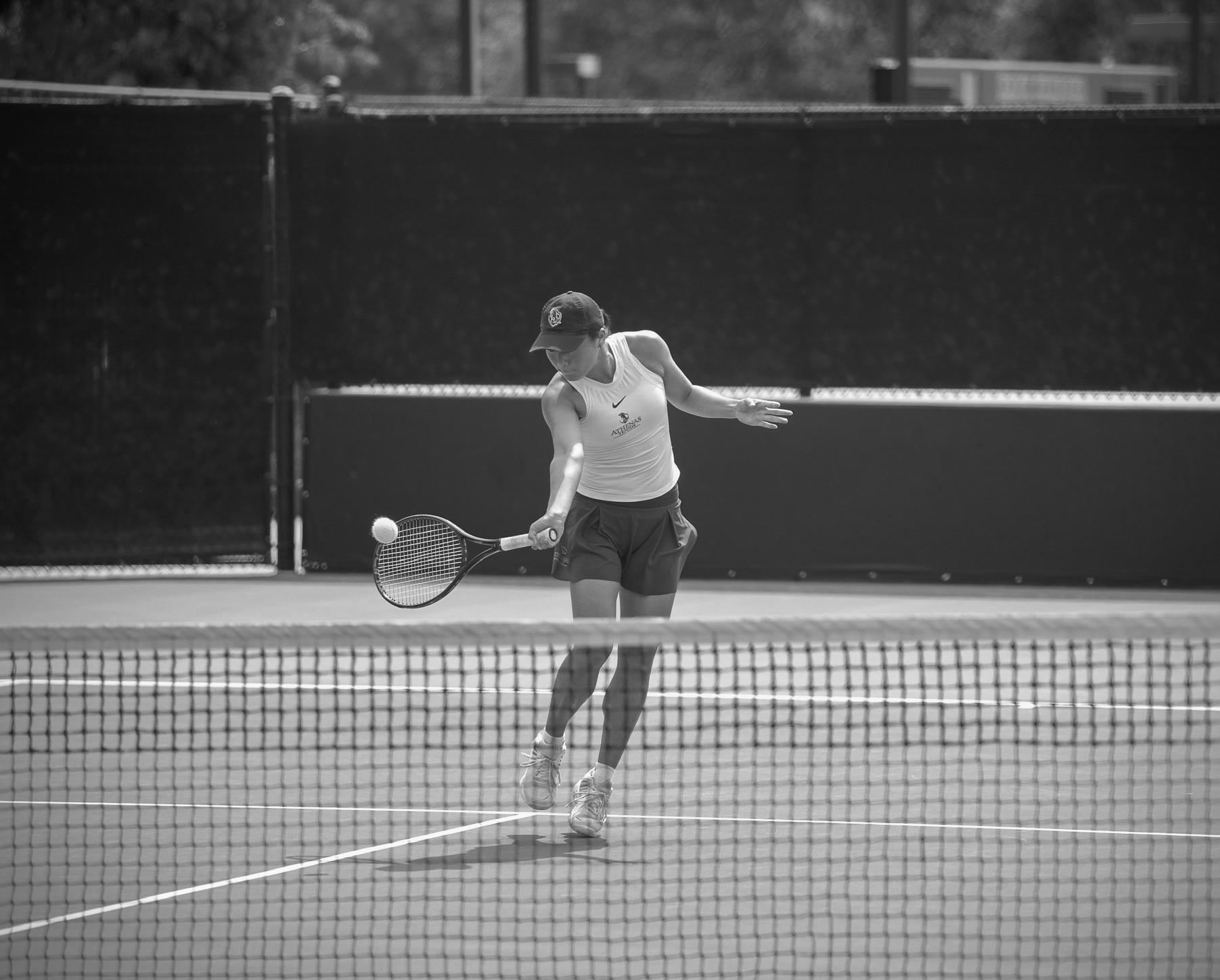
On March 28, #2 nationally ranked Claremont-Mudd-Scripps (CMS) Women’s Tennis dealt another ace to continue their hot streak for the season. The Athenas hosted the University of Wisconsin Whitewater at the Biszantz Family Tennis Center, ultimately waltzing to a 7-0 victory.
CMS has been wildly successful this season, winning 11 out of 12 competitions so far. This success continues a years-long pattern; the team won national championships in 2022 and 2023 and finished 21-2 overall in 2024.
At last Friday’s game, CMS took two out of the three matches in the doubles round, with wins coming from Lindsay Eisenman CM ’26 and Emily Ing HM ’28 (6-0) and Muduo Zhou HM ’27 and Celestina Cedillo CM ’28 (6-1). In the other match, Alisha Chulani HM ’25 and Rebecca Kong HM ’28 battled hard before eventually falling (4-6).
Despite her tough match, Kong said that the Athenas worked together consistently throughout, something that contributed to their overall success.
“We kind of work off each other,” Kong said. “I didn’t perform the best, but I know I could rely on my teammates.”
Friday’s game was the first time that CMS faced off against UW-Whitewater, but the Athenas did not allow unfamiliarity to keep them from bringing their best to the court.
“This is our first time playing this team, so we didn’t have the luxury of knowing any of the players or having a scouting report,” Ella Brissett CM ’25 said. “I’m proud of how everybody just went out and competed as if it might have been a familiar team.”
Chulani added that the team performed well even after an intense series of matches the week before.
tories in their matches (6-0, 6-1 and 6-3, 6-0, respectively). Other wins came from Cedillo (6-3, 6-1) and Kong (6-0, 6-2).
Wins came from anywhere and everywhere in the singles period, with CMS winning every singles match without going to a third set.
The biggest win of the day came from Zhou, who shut out her opponent (6-0, 6-0). Ing and Brisett similarly coasted to vic -
“We’re coming off a slew of very difficult matches of a lot of ranked teams over spring break, so our bodies are definitely right in the thick of season,” she said. “It was nice to have a match in the morning on Friday, nice weather out, and just really meet our level and perform well.” The singles round ended in a total shutout of UW-Whitewater, with CMS winning all six matches.
The closest game of the day was the final set between Eisenman and UW-Whitewater athlete Gracie Ha. The set continued long after the other matches had already been decided. After an intense, drawn-out fight, Eisenman prevailed (6-1, 7-5).
For Chulani, success on the day and the overall season comes from the rigor in each practice.
“Every time we’re at practice, we run for every ball, every single point,” Chulani said. “Every single ball counts, not only in the matches, but also in practice, and I think that’s the kind of mindset that really helps us be successful.”
After this rout, CMS has continued to fly high in their season. Two 6-1 victories against Caltech and Redlands have since improved the Athenas’ record to 12-1, with their sole loss coming on March 2 to #1 ranked UChicago. Looking to the future, the Athenas will host Occidental College on April 5 as they continue their SCIAC march. Further matches at Cal Lutheran and Chapman follow on April 11 and 19, respectively, before the team concludes their season with a Sixth Street showdown against the #5 nationally ranked Pomona-Pitzer Sagehens.
How March Madness streaming deals expose a deeper problem of sexism in sports
CHARLOTTE RENNER
Two weeks ago, one of the biggest sporting events in the country kicked off. I’m not a huge college basketball fan, but I tune in for the men’s and women’s NCAA March Madness tournaments every year and get extremely invested in my poorly researched brackets. This year, however, I missed out on the 63 women’s games because I don’t have ESPN2.
Four different networks are streaming the men’s tournament this year: TruTV, CBS, TNT and TBS. The games are available on Max and Paramount+, or through live streaming services including Fubo and Sling. For someone like me,
whose parents decided one day three years ago that we needed every streaming service imaginable, this was a pretty good deal. Though the games were divided between services, I was able to watch everything I wanted. When the women’s tournament started a day later, I expected the same situation. I was wrong. When I opened Max, I didn’t see any games advertised. On Prime, I ran into the same issue. Confused, I went online and was relieved to see the first round games available on the NCAA website, but my relief was short-lived. In order to watch the women’s games, I needed ESPN2. With my family’s multitude of
streaming services, of course, we have the Disney+/Hulu/ESPN bundle. But this doesn’t include ESPN2, which costs an additional $9.99 a month on top of ESPN. Because I didn’t see myself using ESPN2 ever again, I was unable to watch any of the women’s games.
I know I said I’m not a college basketball fan, but I am a fan of women’s professional and college sports in general. I’ve played soccer my entire life, and while I’m a die-hard fan of the Major League Soccer team, the Colorado Rapids, there wasn’t a National Women’s Soccer League team in Colorado until this year. I grew up seeing women’s sports receive less recognition than men’s sports, and have
seen talented female athletes dismissed or held to a much higher standard in the public eye simply because they are women.
In my extended family’s March Madness pool, my uncle only sent out a men’s bracket to enter. When I went to a bar with my friends, they were playing the pregame roster updates for a men’s game that started in 20 minutes instead of the four-point women’s Elite Eight game that was in the fourth quarter. It felt too blatant to be real, but no one besides me seemed to mind.
The opening day of the men’s tournament averaged 9.1 million viewers, whereas the women’s tournament averaged 367,000
viewers across the first round.
I’m sure Max, and every other streaming service showing the men’s tournament, thought they were making the financially smart decision. Why would they pay for the rights to the women’s games when they expect fewer people to watch? This is a reinforcing cycle that has plagued women’s sports in America. If women’s sports aren’t as readily available as men’s sports — if you have to have a niche and expensive upgrade of ESPN to watch them — then fewer people are going to watch!
I’ve heard the same arguments from my well-meaning guy friends: Women’s sports just aren’t as entertaining. This doesn’t just make me upset on a principled level. I also feel bad for these guys because they have closed themselves off to some of the most iconic moments in sports history: Brandi Chastain scoring the last penalty for the United States to defeat China in the 1999 World Cup final, Billie Jean King defeating Bobby Riggs in three sets or Sha’Carri Richardson running a 9.65 100m in the relay to win the United States a gold medal at the Paris Olympics. It’s going to take a systemic change to sway the hearts and minds of sports fans in America. If we simply accept the stereotype that women’s sports aren’t as good or fun to watch, then youth programs will be poorly funded and there will be fewer development opportunities for female athletes. Media companies and streaming services have the power to increase viewership for professional and collegiate sports, which in turn could increase sponsorship deals and salaries for female athletes. Before this systemic change happens, it’s up to individuals to support women’s sports, myself included. I could have emailed my uncle back and told him to add a women’s bracket and asked the bar to turn on the live game. And I guess I could have paid the $9.99 for ESPN2.
Charlotte Renner PZ ’27 is an allaround sports lover (except for hockey) and an obsessive Colorado Rapids fan who also just got season tickets to the Denver NWSL expansion team. She doesn’t follow basketball until March, when she becomes extremely competitive and invested in colleges she’s never heard of.
LAUREN HEWLETT
GABi riCCiArDi • THE STUDENT liFE
EMMA CHOY • THE STUDENT liFE
Emily ing HM ‘28 sets up a volley during the Athenas’ 7-0 sweep of the University of Wisconsin Whitewater on Friday, March 28.
Sagehens snap Athenas’ win streak in Sixth Street Rivalry to maintain SCIAC dominance
There is never a dull moment when the Sixth Street Rivalry happens in Claremont, and last Wednesday’s water polo rendition proved no different. Under the bright lights of Axelrood Aquatics Center, the Claremont-Mudd-Scripps (CMS) Athenas hosted the Pomona-Pitzer (P-P) Sagehens for their one and only regular-season SCIAC meeting of the season, ending in a 7-5 victory for the Hens.
The teams came to the pool with incredibly strong resumes from the season, both boasting perfect 7-0 records in the conference. One of the teams would leave the water with their first SCIAC season loss.
CMS entered the game with an 8-game win streak, and P-P had an impressive 72-game win streak in the SCIAC dating back to preCOVID seasons.
The stands were split between P-P blue and CMS red, while both a life-sized Stag and Athena welcomed the fans. All signs pointed to a closely contested Sixth Street classic. As expected, the teams delivered, playing in a back-and-forth nail-biter.
Brienz Lang PO ’26 broke the deadlock in favor of the Sagehens over six minutes into the game, ending the first quarter with P-P narrowly leading 1-0. Though chances were few and far between in the opening minutes, P-P goalie Zosia Amberger PO ’25 held a shutout through the first 11 minutes of the game.
“No one scored for six minutes of the eight-minute quarter,” Amberger said. “In those moments, it’s just important to keep going because we’re gonna score eventually, but we want to be the first to score.”
However, the Athenas did not let the stalemate discourage
Sophia Laudi CM ’28 Holmdel, NJ Track and Field
them. After Lulu Gaither PZ ’25 added P-P’s second with just under three minutes to play in the second period, two quick goals within a minute by Elise Power CM ’25 tied the game at 2-2. However, P-P’s Amberger continued to hold the Stags at bay, posting an impressive seven saves at half to accompany the goals conceded.
With three quarters played, P-P and CMS remained deadlocked, with the sides trading goals. In the third quarter, P-P saw two goals from Lang and one from Paityn Richardson PO ’27, while CMS struck back with a goal each from Caitlin Muñoz SC ’26 and Power.
P-P jumped ahead at 5-4 to end the third quarter amid heckling fans and incredible defensive showings from both teams. CMS struck back quickly to begin the fourth quarter — Muñoz neutralized the game at 5 with
Sophia Laudi CM ’28 broke a ClaremontMudd-Scripps (CMS) record in javelin that has stood for 16 years at the inaugural SCIAC Quad Cup, on March 29th, with a throw of 40.48m (132’ 10”). Along with this record-setting performance, she also took home fourth place in the shot put. She contributed 14 points to the Athena’s total on the day. She is having an impressive freshman campaign so far, with her recent recordbreaking throw ranking No. 4 in Division III this spring. Before her tenure at CMS, she attended high school at Marine Academy of Science and Technology in Holmdel, NJ. In New Jersey, Laudi was a dominant multi-sport athlete. She won a state championship with the Holmdel women’s soccer team along with a plethora of awards as a track and field athlete.
just over six minutes remaining.
However, miraculously, with just two minutes left on the clock, Kaylee Stigar PO ’25 rose to the occasion and scored a goal to put P-P ahead, shifting the momentum and bringing the Sagehens close to victory.
“I was just so excited,” Stigar said, recalling how she felt when she saw the scoreboard light up with 6-5. “Everything I do is for the team. We all love each other so much — when you do something, it’s for everyone. There’s no prouder moment than to see your team jump on the bench. No better feeling.”
Thanks to Stigar’s late-breaking goal and a follow-up dagger by Gaither to ice the game, the Sagehens defeated the Athenas 7-5.
While a hat-trick from Lang and eleven saves from Amberger marked the game, the players highlighted a group effort that allowed for yet another P-P victory.
“This whole season, we’ve been talking about pushing all four quarters … when we have those little wins in the pool, we really hype each other up,” Lang said. “Especially for this game, we talked about Benergy [bench energy], having a lot of energy on the bench when we’re out, to be able to encourage each other and just push as hard as we can.”
Even after the tough backand-forth rivalry match, the Sagehens kept their foot on the pedal and went for their regularly scheduled post-game laps in the pool.
“My philosophy is always to focus on ourselves and not focus too much on the other team,” coach Alex Rodriguez said in reference to the laps. “So, the
Luke Feng PZ ’26 Arcadia, CA Tennis
Friday, April 4
Women’s Track/Field at Triton i nvite (at UC San Diego)
Men’s Track/Field at Triton i nvite (at UC San Diego)
Softball vs. California l utheran University
Baseball at Whittier College
Men’s Tennis at University of r edlands
Saturday, April 5
Men’s Track/Field at Triton i nvite (at UC San Diego)
Friday, April 4
Men’s Tennis vs. Chapman University
Baseball vs. lewis & Clark College
Softball vs. Chapman University
Saturday, April 5
Women’s Golf vs. SCiAC ii
Men’s Golf vs. SCiAC ii
Women’s Track/Field at Triton i nvite (at UC San Diego)
Women’s Golf at SC i AC No. 2
Men’s Golf at SC i AC No. 2
Women’s Water p olo at California l utheran University
Women’s Tennis vs. Occidental College
Baseball vs. Whittier College (at l a Verne)
Softball at California l utheran University
Women’s
Women’s
Softball
Women’s
Men’s
team has created some goals that they’re trying to achieve. This was actually not my call. They said, ‘We gotta do it, let’s do it … we want to just get better every day and every game.’”
Stigar spoke about the team’s intensity in training that prepares them for the difficult matchups they face in the regular season.
“We say our team is the hardest people that you’re gonna play against,” she said.
Though CMS’s strong win streak ended in Wednesday’s affair, they still boast an impressive 7-1 record in the SCIAC. In the defeat, Mason Spencer CM ’26 and Natalie Stearns CM ’26 combined for six saves, and Muñoz and Power both finished with three points each.
Defensively, CMS was only the fourth team to hold the Hens to seven goals or fewer this season.
“We’re so grateful for the rivalry — CMS is a great team, and we’re also a great team,” Stigar said, reflecting on playing in one of the last Sixth Street games of her career. “I think it just makes us, and everyone, better.”
As April commences, just a handful of conference games remain before the SCIAC tournament and Division III Nationals.
The Sagehens will host a doubleheader at home versus Chapman University and Concordia University Irvine on Saturday, April 5. That same day, the CMS Athenas will travel to California Lutheran University for more SCIAC action.
Stigar was asked to provide a motto to live by in the P-P locker room in pursuit of another undefeated SCIAC title this season. She kept it short and simple:
“They’re hungry, but we’re starving.”
Luke Feng PZ ’26 was awarded the SCIAC Men’s Tennis Athlete of the Week for his outstanding performance over two competitions on Saturday, March 29. Feng went undefeated in both singles and doubles to help the No. 11 Pomona-Pitzer (P-P) Sagehens edge out both No. 15 Williams College and Occidental College. So far this season, Feng is 8-5 in singles competition and 8-4 with his doubles partner Sam English PO ’27. This season, Feng has played a total of 25 games, a big jump from only seven games in his 2023-24 campaign. During his P-P career he has been awarded the ITA Scholar-Athlete and Academic All-SCIAC honors.
Women’s l ax vs. Occidental College
Baseball vs. Whittier College (at l a Verne)
Softball at California l utheran University
Men’s Tennis vs. Occidental College
Men’s Tennis vs. Hope i nternational University (Calif.)
Sunday, April 6
Women’s Golf at SC i AC No. 2
Men’s Golf at SC i AC No. 2
Softball at Chapman University
Baseball vs. lewis & Clark College
Women’s Water polo vs. Concordia University irvine
Sunday, April 6
Women’s Golf vs. SCiAC ii
Men’s Golf vs. SCiAC ii
JUN KWON
SArAH ZiFF • THE STUDENT liFE
Gabby lewis pO ‘26 winds up a throw during the Sagehens’ 7-5 Sixth Street victory on Wednesday, April 2.