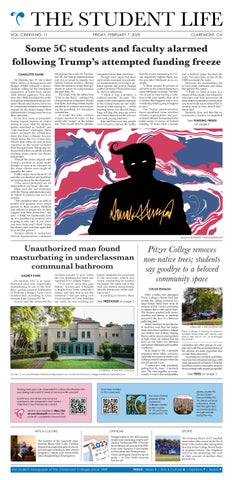
Some 5C students and faculty alarmed following Trump’s attempted funding freeze
On Monday, Jan. 27, the United States Office of Management and Budget (OMB) released a memorandum calling for the immediate suspension of funds from nationwide federal agencies. Two days later, the OMB rescinded the order in response to backlash from government officials and citizens; however, 5C community members continue to prepare for the future impact these administrative changes may have on their education.
CHARLOTTE HAHM throughout the week. On Tuesday, Jan. 28, the Trump administration sent out an email to roughly two million federal workers offering them the option to resign their positions in return for compensation through Sept. 30. The email, with the subject line “Fork in the Road,” outlined the changes federal workplaces should anticipate, including enhancing the standards of conduct and increasing the possibility for immediate termination.
In his first week as president, Trump signed dozens of orders aiming to erase what his administration described as “radical” and “anti-American” ideologies. These orders included the withdrawal from the Paris Climate Accord, which leaves the U.S. to join Iran, Yemen and Libya as one of four countries in the world excluded from the agreement. Trump also enforced restrictions on public schools teaching about critical race theory and gender.
Though the memo aligned with Trump’s promise to make major changes as soon as he assumed office, many citizens were caught off guard by the order.
Politics major Anna Mone SC ’28 said she was shocked and fearful after hearing about the development.
“[The news] definitely set off alarm bells in my head,” she said. Mone said she was frustrated with the Trump administration and its failure to protect and serve all citizens.
“The president takes an oath to protect and upstand every single person in their country. Millions and millions of people rely on their support and their protection,” she said.
“I think we traditionally look up to a president as someone who is going to take care of you when you need help, and I think Trump has shown time and time again that he is not that person.”
Trump’s efforts to restructure federal organizations continued
To accept this offer, workers simply needed to reply to the email with “resign” in the subject line. They would then be officially
terminated from their positions.
Though some argue that these early orders were part of a calculated demonstration of Trump’s political agenda and power, Scripps politics professor Thomas Kim said he views it differently.
“I think it was a mistake, a political mistake,” he said. “The reality is the vast majority of people in the United States are not really aware of what’s going on … so the funding freeze was like this huge, huge red flag that pops up across the United States for folks who are not really paying attention.”
Kim said that every day, people were forced to confront the reality
that the events happening in D.C. can negatively impact them, too. He provided Medicaid as an example.
“I think around 40 percent of all births in the United States have some Medicaid coverage,” he said. “So if you’re busy having a baby, busy with your family, then all of a sudden this happens and you’re wondering what’s going to happen to you.”
The Trump administration faced pushback from terrified citizens, organizations and government officials. In response to the initial memo to freeze all federal funding, 22 states filed a lawsuit
and a federal judge blocked the order. Two days later, on Jan. 29, the OMB rescinded the order.
However, the inconsistency led to even more confusion and chaos throughout the nation.
“I think it’s kind of scary as a citizen of this country knowing how uncertain and how precarious all these different initiatives are because you never really know where they’re coming from or how they’ll last,” Mone said.
Similarly, Kim said that the inconsistency further exemplified
See FUNDING FREEZE on page 2
Unauthorized man found masturbating in underclassman communal bathroom
AUDREY PARK
On Sunday, Feb. 2, an unauthorized man was reportedly masturbating in one of the firstfloor, gender-neutral bathrooms of Pomona College’s Lyon Court resident hall, according to Lyon resident Julia Aceron PO ’28. Aceron said she witnessed the
incident around 11 p.m. when she was brushing her teeth and reported it to Campus Safety.
“I’ve never seen this guy before,” Aceron said. “I thought it might have been someone’s friend, and they had to use the restroom. I was just acting as if it was normal. As I was brushing my teeth, he was washing his
hands. Suddenly, he went back to the restroom, which was weird, considering he washed his hands. He came out of the stall and started masturbating directly behind me while looking at me.”
According to Aceron, there
See TRESPASSER on page 3
Pitzer College removes non-native trees; students say goodbye to a beloved community space
CHLOE ESHAGH
After a fallen tree damaged Pitzer College’s Broad Hall last month, the college removed two large Italian Stone trees from its campus on Feb. 1 and 2, promising to replace them with native trees. The decision sparked both understanding and dismay as students mourned the loss of a beloved gathering spot.
Mark Crawbuck, senior director of facilities, said that the Italian stone trees have top-heavy foliage and shallow root systems, making them a safety concern during times of high wind. He added that the trees are not native to California and cannot withstand such weather conditions.
In an email to TSL, Crawbuck reiterated these safety concerns, especially since some students were walking around campus when the tree fell around 6 p.m.
“I cannot live with somebody getting hurt by trees,” Crawbuck said. “We came together as a community. I went to the sustainability
committee and other groups on campus, and with the recommendation of the arborist, it’s really important that we take these trees now.”
According to Crawbuck, past fallen trees have been chopped into logs, with some repurposed as mulch or benches and others used in community projects. He is working with campus groups like
NINA uDe • THe STuDeNT LIFe
Pitzer College is moving to replace its Italian Stone trees with native ones after a tree fall on Jan. 20 damaged broad Hall.
COuRTeSY: POMONA COLLeGe
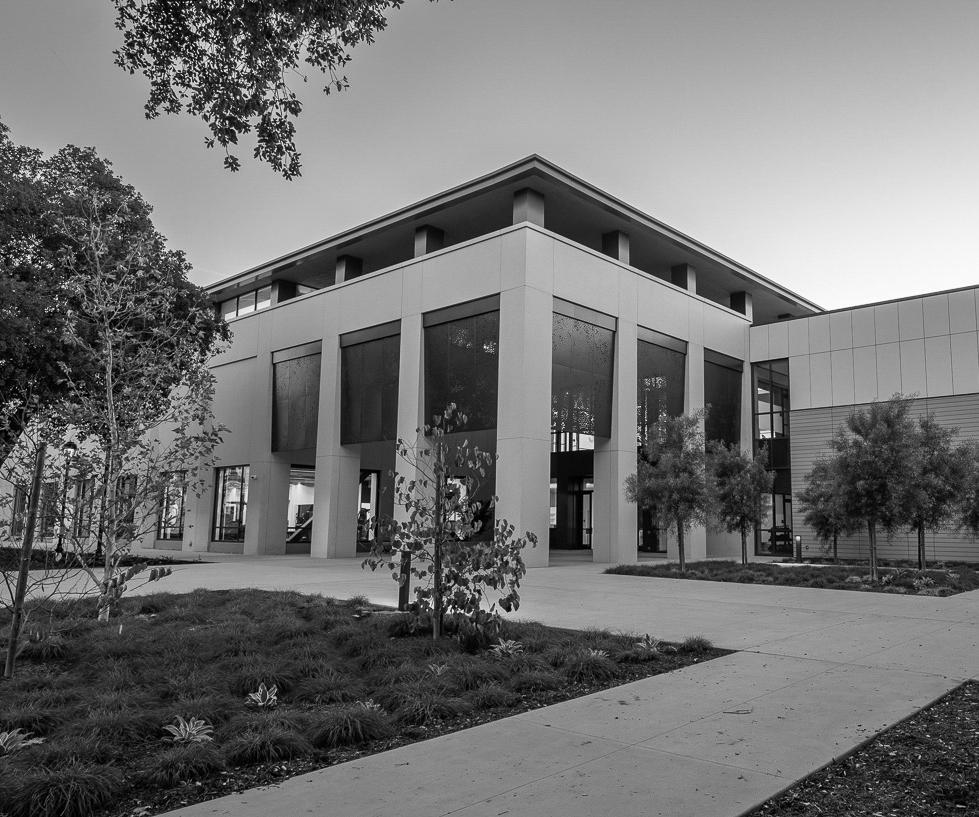
Pomona College residence hall bathroom.
‘Palestine as a Reproductive Justice Issue’: Teach-in examines reproductive justice through lens of Palestinian oppression
KAHANI MALHOTRA
On Tuesday, approximately 25 students and faculty members gathered in Pomona College’s Crookshank Hall for a teach-in and Q&A entitled “Palestine as a Reproductive Justice Issue.” The event was led by Heart to Grow Reproductive Justice Coordinator Anahita Farishta PO ’23 and Director of Movement Building Sahar Pirzada.
Assistant Professor of Asian American Studies M. Bilal Nasir, who helped coordinate the event, introduced the two speakers as staff members at Heart to Grow, a nonprofit seeking to secure reproductive justice for Muslims.
Farishta and Pirzada described reproductive justice as protecting four pillars: the right to have children, the right to not have children, the right to raise children in a safe and healthy environment and the right to bodily autonomy.
“We really resonated with the framework of reproductive justice versus just reproductive rights or reproductive health because it approaches things from a systems level,” Pirzada said.
The teach-in covered what the speakers described as the media’s skewed coverage of Israel and Palestine coverage. It also covered “pinkwashing”— a state’s appeal to LGBTQ+ rights to appear progressive and to divert negative attention from itself.
“When imperialism and coloni-
zation are present, there is reproductive injustice,” Pirzada said. “If we want to uplift the Palestinian feminist collective’s cause, we need to view this as a reproductive genocide.”
Pirzada and Farishta then introduced a report displaying various reproductive injustices committed in Gaza. The report states that over 710 babies have been killed, 35,000 children have lost at least one parent and 902 families have been erased from Gaza’s civil registry as of Aug. 2024, among other statistics.
The speakers then pointed to Israel’s bombing of Gaza’s largest fertility clinic in April 2024. They also highlighted the lack of access to adequate maternal healthcare for 60,000 women in Gaza, citing it as evidence of reproductive genocide.
In saying this, they referenced the Convention on the Prevention and Punishment of the Crime of Genocide, which was adopted in 1948 by the United Nations and which cites that “imposing measures intended to prevent births within the group” is an act of genocide.
Pirzada began drawing connections to the recent Southern California wildfires, which left tens of thousands of people displaced.
“The way that the destruction has happened in places like Altadena and the Palisades, it’s like a warzone … the toxins in the air will be harmful for generations to come,” Pirzada said. “It’s just unfathomable
that this is the daily life and the lived experience for so many children and families and individuals.”
Pirzada, a mother of two, described her gratitude for being able to evacuate her family to avoid the harmful effects of wildfire smoke.
“We’re getting an ounce – a glimpse – into what navigating that is like [in Gaza],” she said.
The speakers also discussed the punitive responses to student demonstrations across the U.S., highlighting the student protests and arrests at Pomona College in the past two semesters.
“We know how power operates, specifically when it comes to student activism,” Farishta said.
“We have seen how [Pomona] has
suspended students, cut off access to housing, education, food, health services.”
They concluded the event with a call to action, asking students to exercise community care and continue mobilizing against oppression.
“We know we can’t achieve reproductive justice without a free and liberated Palestine,” Farishta said.
FUNDING FREEZE: Reactions from 5C community
Continued from page 1
what he described as the Trump administration’s political incompetence.
The fluctuating orders continue to inflict anxiety and uncertainty throughout the nation, leaving citizens wondering how their livelihoods may be drastically altered at any moment. Kim said that he hopes to provide students in his politics classes with the skill sets needed to decipher how political power works in the United States.
Students at the 5Cs are certainly recognizing the need for such skills. Mika Ichikawa CM ’27 highlighted the fear and confusion instilled in many Americans as a result of the back-to-back memos, questioning the reasoning behind the quick turnaround of orders.
“I feel like his flurry of executive
orders is definitely creating a sense of fear among a lot of people,” Ikachiwa said. “But I also don’t think people realize that there are checks and balances, and he won’t be able to go through with a lot of these things.”
Ichikawa shared his own sense of confusion.
“When I heard he rescinded it, it made me question what his real motives are, what work he’s doing behind the scenes and who he’s working with,” Ichikawa said.
In addition, Ichikawa highlighted the importance of having access to federally funded physical and mental healthcare services, especially for students who are experiencing anxiety from schoolwork and the transition away from home.
Both Ichikawa and Mone said they were worried about how a
reinstated freeze would affect college students across the country, including at the Claremont Colleges.
“I know many people who rely almost entirely on FAFSA and support from federal funding [to go to school],” Mone said. “It’s really scary that everything they’re working for isn’t certain and could be taken away at any moment.”
Though FAFSA was supposedly unaffected by the memo, the uncertainty regarding future federal initiatives and changes remains at the forefront of many students’ minds. At an Associated Students of Pomona College (ASPC) meeting on Thursday, Jan. 30, acting Pomona President Robert Gaines shared his concerns and plans to protect student aid following the freeze.
Gaines said that he would prioritize students during these
uncertain times, announcing an effort to mobilize resources that will ensure all students receive the aid they need, despite federal instability.
In an email exchange with TSL, Gaines expanded on his words from the ASPC meeting.
“The College is also closely monitoring decisions that the new White House administration announces and carefully assessing potential implications of those decisions for our students, faculty, staff and the College itself,” he wrote. “We will continue to reach out to those who are directly affected by these decisions to offer information and resources.”
Gaines noted that the college has developed an action plan in response to the memo and will activate the plan if the funding freeze is reinstated. In addition, Pomona’s
administration is communicating with elected representatives about the problems a freeze enactment would create.
Though the federal funding freeze has been revoked, the changes to federal workplaces and resignation offers are still in effect and the conversations about the Trump administration’s exertion of power continue. As a result, Americans are left questioning what the future will hold and what federal changes to expect in the coming months.
“I’m interested to see what [Trump] continues to try to implement in a few months or in the next year,” Ichikawa said. “It’s only been two weeks of him being in office and already he’s done or said he will do so many things, but I’m wondering what will actually be carried out and how much he’ll be able to get away with.”
Meet TSL’s spring 2025 editorial board
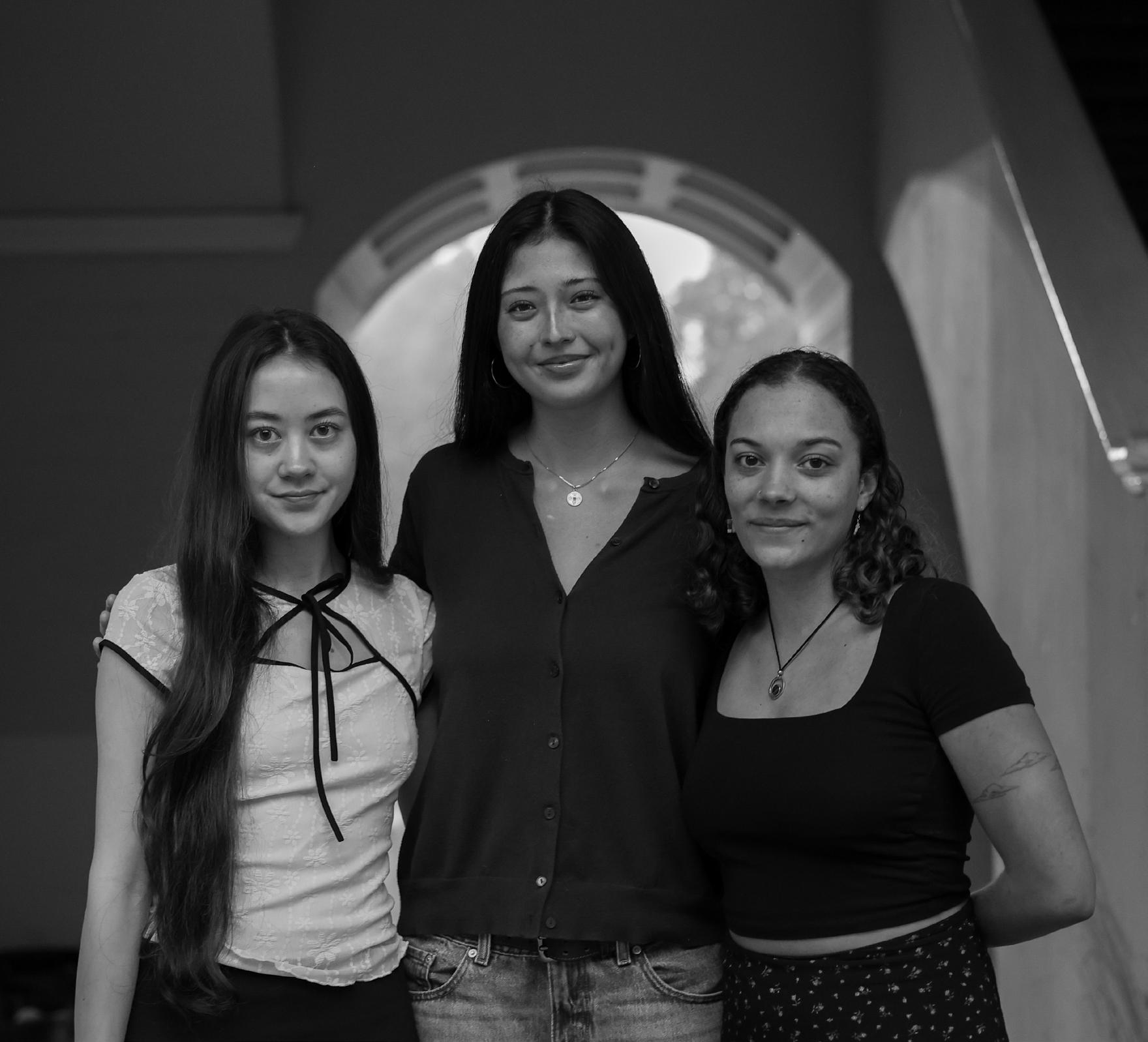
Following another semester of historic student organizing nationwide and a presidential election unlike any other, June Hsu PO ’25, Annabelle Ink PO ’26 and Jada Shavers SC ’26 are ready to lead TSL as its spring 2025 editorial board.
Hailing from Princeville, Hawaiʻi, Editor-in-Chief June Hsu is a public policy analysis major concentrating in politics at Pomona College. This marks her fourth semester at TSL: Hsu began as a news writer after being inspired by a journalism class at Claremont McKenna College with Claremont’s beloved journalism instructor Terril Jones.
MADELEINE FARR gen, Jada is entering her fourth semester at TSL. She previously worked as a writer for Arts & Culture as well as an editor for Opinions. Shavers is from Portland, Oregon, and is studying Anthropology and Writing & Rhetoric at Scripps College. Shavers said she is excited to finally oversee TSL’s production from start to finish, a key responsibility that the Editorial Board handles.
The editorial board agreed on the importance of keeping TSL in line with the larger industry’s
Hsu’s tenure at TSL is only the beginning as she intends to enter the journalism industry post-graduation. Hsu said that she initially discovered her love for editing as a news editor in her second semester at TSL. As much as she loves editing, though, Hsu explained that supporting her fellow team members and staff is an even more rewarding part of the experience — something she discovered as managing editor of News and Sports last semester.
“I honestly didn’t think I’d be on ed board,” Hsu said. “Then, I built a lot of connections in the newsroom and started to enjoy TSL more than anything else that I was doing at school and so I wanted to stay around. There hasn’t been a more rewarding experience than being able to take on more leadership at TSL.”
Ink, managing editor of News and Sports, is from Mililani, Hawaiʻi. She is bringing six semesters of TSL experience to the table, including three semesters as a news editor. Ink is an English major at Pomona and is interested in bringing what she learns here to the publishing industry.
Shavers is Ink’s counterpart as the managing editor of Arts & Culture and Opinions. Fresh from a semester abroad in Copenha -
direction given how many people consume news exclusively online today. However, they also agreed that nothing compares to compiling the print edition on Thursday production nights.
“Seeing that print issue Friday mornings is one of the most rewarding things,” Hsu said. “But I would also say that the one thing I’m super excited for … is trying out new things with each desk — like more multimedia and sports and polling and just working with everyone on TSL to move in a
digital direction that journalism is moving in.” While in agreement, Ink added how helping foster community is one of the other standouts benefits of being at TSL.
“I’m really excited to watch senior staff members get closer,” Ink said. “The past few semesters, we’ve had such a good team of senior staff and everyone has been so close and had such a good time. So I’m excited to see the dynamic between people as the semester goes on and we get more comfortable with each
other.”
Beyond the community in the TSL newsroom, Ink discussed the political context in which TSL will publish this semester. Many students returned to campus just in time for President Donald Trump’s inauguration on Jan. 20. Just five days earlier, the White House announced a ceasefire between Hamas and Israel, an important development to many student activists on campus.
“It’s easy to detach ourselves from what’s happening in the rest of the world right now because activism on campus is a bit quieter than it was last semester,” Ink said. “But students are still really passionate about a lot of the stuff going on outside of the 5Cs and I think it’s important that we cover that in some way and keep the conversation going.”
Shavers agreed, saying that, as managing editor of Arts & Culture and Opinions, she hopes to see the Claremont community — TSL staff and guest writers alike — use TSL as an outlet through which to react to the current political landscape.
Responding to criticism that TSL has received for its coverage of student activism in recent months, Shavers also emphasized that TSL is an independent, student-run organization.
“A lot of people definitely think that TSL is partnered with Pomona or partnered with admins,” Shavers said. “We are working to provide coverage and to allow for conversations and that’s what makes TSL so important, at least to me, is that it allows for people to talk about these things in a very real way.”
Hsu echoed these sentiments and said that TSL has a special place in her heart.
“Within the newsroom, I’ve made some of my best friends and some of my closest relationships at the 5Cs,” Hsu said. “That’s just been such an amazing experience, whether you want to go into journalism or not.”
KAHANI MALHOTRA • THe STuDeNT LIFe
Heart to Grow Reproductive Justice Coordinator Anahita Farishta PO ’23 and Director of Movement building Sahar Pirzada discussed reproductive justice and Palestine at Pomona College’s Crookshank Hall on Feb. 4.
TR esPA sse R: Unidentified male exposed himself and entered underclassman communal bathroom
Continued from page 1
have been multiple sightings of unauthorized individuals in Lyon, especially during the fall semester.
“These trespassers would do various things like go into bathrooms and break into other people’s dorms and just be really inappropriate, so that’s the beginning of it,” she said.
Another Lyon resident, Alessi Rodil PO ’28, said that her friend saw a man they had not seen before walking through the hallway with his private parts exposed. Rodil, who is Aceron’s roommate, said it is unfortunate that it took an incident as serious as the one Aceron experienced to finally prompt action.
“We are scared,” Rodil said.
“How many more of these incidents have to happen for actual change to be made and before it turns into actual assault or something even greater?”
Rodil said that she and Aceron “bombarded” Campus Safety with emails after the recent incident, urging them to take action.
Like Rodil, Aceron said she does not understand why it has taken so long for Campus Safety to take action, especially considering that there have been previous reports of unauthorized individuals in Lyon.
Aceron said her experience has left her feeling uneasy being in Lyon’s bathrooms.
“I’ve been more aware and cautious, and I get scared when someone opens the door and I’m in a bathroom stall,” Aceron said. “Or, if I’m showering and I hear someone come in, I get really tense. After that experience, I truly don’t know what could happen if
these uninvited people keep coming in.”
According to Pomona’s Dean of Campus Life Josh Eisenberg, Campus Safety responded promptly to the incident. “They take these incidents very seriously and are committed to responding in a timely manner,” Eisenberg wrote in an email sent to Pomona’s South Campus Community on Thursday, Feb. 6.
Eisenberg acknowledged that while the incident was addressed, such occurrences can have a broader impact on the residential community. He shared a list of ways to keep the Pomona community safe, including securely closing doors and reporting unusual behavior to Campus Safety or to the residential advisor on call.
Eisenberg concluded the email with a list of actions being taken in response to the incident, emphasizing ongoing support and safety measures for the residential community.
These actions include follow-ups with affected individuals to explore supportive resources, increased Campus Safety patrols in some areas on Pomona’s campus and nightly resident advisor checks to ensure doors are properly secured and unauthorized visitors are not present.
Eisenberg further stated that the Office of Housing and Residence Life, Title IX and CARES Office and Campus Safety will continue to collaborate on next steps to address community concerns and ensure student safety.
5C students
‘Unearthing the record of the dawn of life’: A lecture by Mary Droser
YAHJAIRI CASTILLON
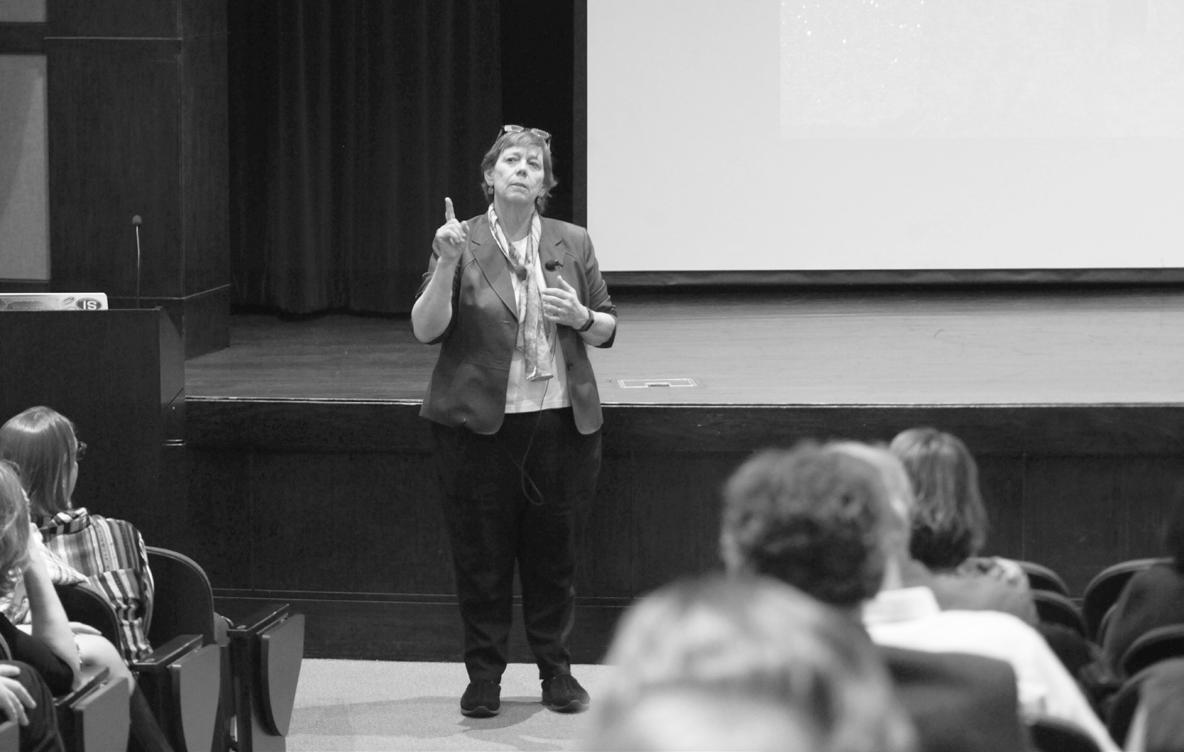
On Saturday, Feb. 1, Pomona College’s Geology Department hosted the 45th Woodford-Eckis lecture series in honor of its founder, Professor A.O. Woodford. The annual lecture hosts an outstanding geologist who presents their work at a major banquet talk followed by a research lecture and seminar the next day.
This year, the program invited Professor Mary Droser from the University of California, Riverside. Droser, recipient of the 2022 National Academy of Sciences Award in Early Earth and Life Sciences, presented a talk at Rose Hills Theatre, where she spoke about the dawn of all animal life on Earth.
The change Earth undertook to transform from a vacant hurtling rock to a vibrant life source is what geologists like Professor Droser seek to understand.
“The amazing thing is that we can go back and look at Earth at various times in its history, so we can go back in time and look at rocks and interpret that 3.5 billion years ago, Earth was a watery planet,” Droser said during the talk.
Droser’s previous work focused on the impact of animals on sediments. By looking at the sediments themselves and examining the fossils and patterns of sediment disturbance, she was able to record valuable information on early animal behavior and interactions with their ecosystems.
These findings included information on the oldest moving animals, complexities in genetics and early forms of reproduction. Among the organisms that Droser discovered were the “Obamus” — named after the 44th president — the beautiful and plentiful “Dickinsonia” and the asymmetrical bilateral “Ikaria.” This research reveals secrets about evolution and the rise of complex life on Earth.
Droser researched fossils that were part of the Ediacaran Biota, which were all once very similar
soft-bodied organisms. They were among the earliest animals on the planet and varied in size from millimeters to the size of a bath mat.
In Droser’s research, she found herself at one of the world’s best windows into the earliest animal ecosystems, the South Australia Nilpena Station, where she began a project that would last for over 25 years. At this site, she discovered entire ancient communities sealed exactly where they had lived over 500 million years ago.
“Most paleontology is done with ... the ‘clink, clink’ method,” Droser said. “You go out in the field, clink, clink, clink, clink, clink with your hammer, [then] take the specimen back to a museum or a lab because that’s the best way to look at it.”
Droser said that she did not have to use the method with the Ediacaran Biota fossils.
“We could actually pull these beds out, flip them over and look at these fossils [...] actually look at whole communities, literally excavate whole beds and put them back together like a jigsaw puzzle,” she said.
During the following Q&A period, one student questioned what sorts of creatures may have preyed
on the Ediacaran Biota. The student asked Droser if she had discovered any fossils that showed signs of deformities, injuries or bites in the original organisms. In response, Droser described a “beautiful world” where organisms lived in a virtual “Garden of Ediacar,” nobody had teeth and there was no evidence of predation — a world vastly different from today. For some students, the talk served as a way to relate their own studies to geology. Among the attendees was biology major Faben Tesfazion SC ’25. In an interview before the talk, she revealed that she had never taken a geology class.
“I don’t really know much about this, but [...] thought it was a cool mixing of the two different subjects and wanted to learn more,” Tesfazion said. Another community member in attendance, Raymond V. Ingersoll, a professor emeritus at UCLA, expressed similar sentiments.
“Philosophically, the most important thing about geology is the time frame,” Ingersoll said. “I’m used to thinking in terms of millions of years, hundreds of millions of years, and most humans are used to thinking 10 years, 100 years, maybe 1000. But to geology, those are insignificant amounts.”
mobilize to help those impacted by recent LA wildfires
Clubs and organizations
Even before returning to campus for the spring semester, students across the 5Cs mobilized to support those impacted by the deadly fires that ravaged Los Angeles County in the first weeks of January.
Student groups have taken the initiative to collect items and raise funds for those who suffered losses due to fires in Altadena, the Palisades and the greater Los Angeles area.
Pomona College First Year Class President Molly Chakery PO ’28 has spearheaded a new partnership between Pomona’s First Year Committee and LA-based nonprofit It’s Bigger Than Us. According to their website, the organization’s mission is to “connect communities with essential resources and support.”
“It’s Bigger Than Us stood out to me because not only were they helping families financially, [they were] providing them with water, food, resources, items for children and for women,” Chakery said. Chakery has been working with the rest of the First Year Committee since before the spring semester to raise money — something she has wanted to do since she was elected in the fall. Once Los Angeles County went up in flames, she said that it became obvious that fire relief would be a priority.
AVA FLEISHER first years are also being given the chance to donate on behalf of their dorms in competition with one another: whichever dorm raises the most funds wins a prize when the fundraiser ends. Pomona isn’t the only 5C joining forces to raise money. On Jan. 24, Scripps Associated Students (SAS) and Scripps Free Closet hosted an art market for those impacted by the fires. The market was originally suggested by Kimai McPhee SC ’25, with Quinn Dwyer SC ’26 bringing the idea of fire relief to the table. McPhee and Dwyer are both student organizations commissioners for SAS. The art market featured vendors doing tarot card readings, selling their art and providing color palette analyses in addition to live music and snacks. McPhee collaborated with Chakery to distribute vouchers at the market. Students who donated to the Associated Students of Pomona College’s relief fund with It’s Bigger Than Us could then claim the vouchers for discounts.
To help raise more money, Pomona
“I think the community was honestly more encouraged to engage and attend,” Dwyer said, speaking to how philanthropic efforts attached to the art market may have increased the event’s success. “It was really nice to both be supporting student artists but then also, there was an entire audience that was pulled specif-
ically for the fundraising element.”
This was not the first mutual aid market held by SAS and both Dwyer and McPhee said that it would not be the last.
“We’ve seen the success of those kinds of mutual aid art markets before, so it just made natural sense with what was happening on campus and the community needs that we were hearing,” McPhee said.
At Claremont McKenna College, Claremont Women in Business (CWIB) also contributed to fire relief efforts by collecting items to donate to those in need. An initiative led by Angie Zoric CM ’28, the club originally only sought to collect toiletries; however, after receiving feedback from the community, they decided to accept other items, like clothing, as well.
Although CWIB is still deciding which fire relief-focused charity they’ll donate to, Zoric said that she is leaning towards It’s Bigger Than Us, similar to Pomona’s First Year Committee.
For Zoric, a California native who’s lived in both southern and northern parts of the state, the recent wildfires hold a personal tie. She has several friends, both at the 5Cs and beyond, who have been affected by the fires and she wants to help in any way she can.
“Seeing Malibu completely destroyed, I think it was very much
a wake-up call for everyone,” she said, adding that she hopes that local authorities will work to improve fire response efforts in the future.” Some students in 5C-wide clubs have made similar efforts to aid those in LA County affected by the wildfires. 5C Environmental Justice Club, for instance, advertised a collection drive like CWIB’s, requesting supplies and clothing through their Instagram page and through flyers around campus. Other students have formed new clubs in response to the fires. Samson Zhang PO ’25 worked alongside several other students to found Clean Air Claremont, which seeks to bring clean air to people in and around the fire-affected areas. At The Hive and off-campus locations, the club has mobilized students and other L.A. residents to raise money and build air purifiers for donation over multiple club meetings.
Now, over three weeks after the fires began, firefighters were finally able to contain the largest of them — the Palisades Fire and the Eaton Fire — though thousands of residents are still displaced. Claremont student groups, consortium-wide and college-specific, have continued to organize and collect resources for impacted communities.
TREES: Pitzer College removes nonnative trees, changing campus community spaces
Continued from page 1
the Outback restoration class to do something similar now.
“I’m retaining as much as possible,” Crawbuck said in an interview with TSL. “We will turn them into student projects and so we’re trying to reclaim all the wood we can to reuse on campus.”
In place of the Italian Stone trees, Crawbuck said that Pitzer’s Department of Facilities and Sustainability Committee aims to plant native trees that match the majority of native fauna on the college’s campus.
Students had mixed reactions to the tree fall and to the subsequent steps taken by the college to cut down other trees. Student Kayla Gerayli PZ ’27 witnessed the initial fall on Jan. 20 while walking around the Pitzer mounds after dinner.
“The bottom of it just snapped,” Gerayli said. “It was really loud and it kind of just fell over and hit the building.”
Gerayli noted that the situation upset many students, as the trees hold sentimental value for some of them. However, she said that safety should be the priority.
“It’s not the end of the world,” Gerayli said. “You can get a new tree and put your slackline back. I would rather have healthy, better and native trees.”
The slackline, a staple leisurely activity on Pitzer’s campus, was attached to two removed trees. Many students can recall using the slackline and relaxing in the communal space. Some said that they were sad about losing it.
“I met some of my really good friends at the Pitzer slackline, and I feel like it’s a space where many different types of people can come together and have beautiful connections,” Elizabeth Zbaraschuk SC ’28 said.
Despite some negative reactions to the trees being chopped down, students have expressed understanding for the safety of others and the campus buildings.
“I’ve received nothing but support from our students, faculty, community members and staff. It’s really been very supportive,” Crawbuck said. “It’s a safety thing, so I think everybody’s really understanding what is going on here today.”
5Cs latest fashion trends
BREAKING NEWS: The Claremont couture-ists are back in full force post-break, strutting the campus runways, and I, for one, could not be happier. Stay safe, because I nearly got whiplash multiple times this week, turning to take in the latest musings of these colleges’ fashion aficionados.
The February trend forecast looks promising with lots of inventive and inspiring looks popping up all around the Claremont campuses. From chunky footwear to bag charms, the 5C stylish are dishing up some piping hot fashions that I am ecstatic to report on.
The latest footwear trends revolve around embracing chunky, clunky and down-right impractical silhouettes. Clogs have been sprouting up on every campus, from the laid-back Pitzer-boy Birkenstock Boston to an art-teacher-esque wooden styling from Scrippsies. This look, although not for all, can be incredibly effective when paired with an oppositional younger piece. A suburban-mom shoe has never looked better than when donned by a Scrippsie in a flowing midi-length skirt and baby-tee.
Following a similar aesthetic, the timeless Doc Marten has once again resurfaced in ’90s-centric silhouettes such as the iconic Mary Jane or Oxford. I’ve witnessed them in every shade with a multitude of groovy flower cutouts. The Bethan model has become a recent favorite of mine, especially when married to a chunky grandfather sweater. The revival of this British powerhouse is perhaps symbolic of Claremont students’ worldliness and appreciation for the classics.
For those of us looking for practicality in our footwear choices, I have noticed a plethora of Onitsuka tigers in both the mirrored-metallic and bright yellow trotting around. And may I say, I am certainly not mad about this. These are beautiful shoes and I support a fun colorway to add spice to a simple outfit.
Uggs, on the other hand, are a touchy subject for me. I would like to make an official statement regarding the archaic styling of the Uggs. I fear that, as a collective, we can do better than the exposed Bailey Bow Uggs and leggings combination. Let our middle school selves lie and step into your full fashionista potential. That being said, a pair of Uggs can be a tasteful style choice when paired with straight-leg denim or sweatpants so that only a hint of the shoe can be seen. Or, the slipon model is great when coupled with a cozy, laid-back sweat set or knitted co-ord.
On the topic of boots, nothing brings me more joy than seeing students strut around campus in elevated knee-high boots paired with a skirt. Be it a grunge aesthetic buckle and strap worn leather or a heeled suede, the boot is traipsing across runways from Harvey Mudd to Pomona.
A theme central to the Claremont closets is a favoring of thrifted and historically entrenched pieces. From a Rose Bowl Flea-find sweater to a smoke-stained leather jacket, what’s new is often old. Both my critical eye and the planet thank you all for that.
As long as cows have roamed the earth, so too have leather jackets and I thank none other than the biker community for that. (Now, this may not be historically accurate, but what can I say, I’m only a mere writing major).
Over the past two weeks, I have been blessed by a myriad of leather jackets trotting across the lawns of these fair schools. I stand by the statement that every outfit can be elevated with an interesting and perfectly oversized leather moment. I strongly urge the men of these campuses to give oversized leather a try.
The writers of Vogue and the students of this consortium are in agreement that loose-stitchedopen sweaters are the perfect spring staple. The rattier and
looser, the better, especially when coupled with a good pair of low-rise, wide-leg jeans and a simple top underneath.
Anna Wintour may consider this a sacrilegious offense but double-denim is coming in double-force at the consortium. From loose baggy jeans with an iron-on patch-coated denim jacket to a western blue jean button-down with straight-leg 501s, the Canadian Tux is classic and here to stay. I personally am the first to pray at this double-denim altar, and if my eyes don’t deceive me, then I am certainly not the only Claremont student practicing a denim religion.
Another denim comeback is the Rachel from “Friends”-inspired ’90s revival combination of light-wash denim overalls and a white top. To say obsessed is simply an understatement. This look is timeless, playful, classic, casual and perfect for the So-Cal fantasies we are all acting out in our heads.
And don’t forget about accessories. May I suggest the latest and most versatile trend of the bag charm? Silk scarves rescued from the bottom of the Goodwill bins, an iconic Coach cherry charm, ribbons and bows — the list goes on and on. This trend, in particular, is one of my favorites due to the endless shores of self-expression one can land upon. My top favorites include Jellycat bunnies, pearl lanyards and gold initials.
And lastly, style meets form and function with the belt, an accessory to break up a simple look. From your dad’s old leather to a bold gold buckle or silver studded strap, a belt elevates almost every outfit. The ones sitting in my cart waiting on my next paycheck are wide and feature a statement gold buckle, perfect for pairing with a simple satin slip dress.
I’d like to shout out the amazing professors who teach us not only important academic material but also the value of looking good while learning. One of my favorite professors once rocked up in gray silk pants, a sunset-colored mesh top and a gray blazer and like so many of her students, she chose to abandon binaries and pair the new with the classic, the male with the female, the casual with the elevated and style with academia. As a token of my appreciation, I leave you with the latest and greatest style superstar: the poncho. A cozy wool cape in a neutral color with or without some leather embellishments is the newest, most sophisticated addition to your Claremont Closets.
Ellen Chapman SC ’27 is a fashion columnist.
The Year of the Snake: Lunar New Year celebrations across the 5Cs
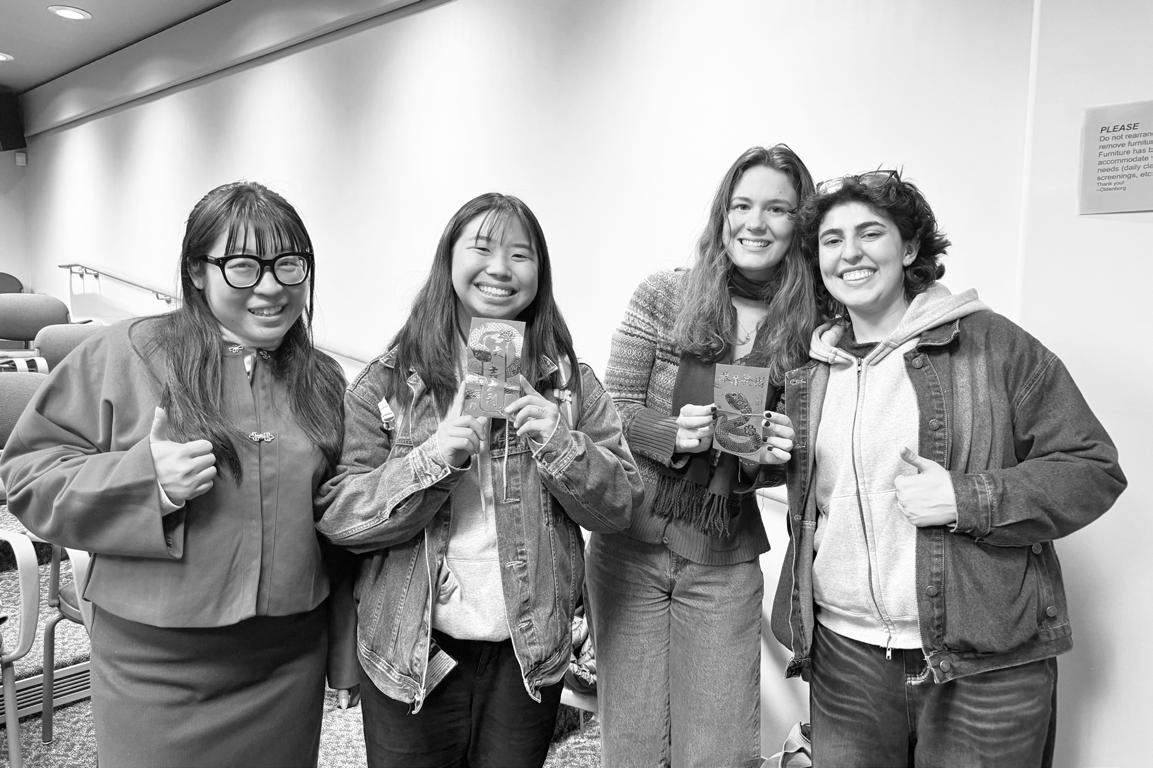
From attending Lion Dance performances to playing Mahjong, communities across the 5Cs came together to celebrate the Lunar New Year last week.
Festivities this year included a range of different activities, including a celebration at the Oldenborg Center, Mahjong night with the Claremont Cantonese Club and a lion dance performance from The Los Angeles Kun Seng Keng Dragon and Lion Dance.
Lunar New Year — which fell on Jan. 29 this year — is also commonly known as Spring Festival or Chinese New Year and marks the start of the new year on the lunisolar calendar. During this time, families all over the world gather together to bless each other with good fortune for the rest of the year.
Despite originating in China, the holiday is celebrated by many Asian countries, including Vietnam, the Philippines, South Korea, Singapore, Thailand, Cambodia, Japan, Malaysia, Indonesia and many more. Each year represents a different animal of the Chinese Zodiac based on Chinese mythology: As of Wednesday, Feb. 29, the Year of the Snake has begun.
Lunar New Year events at the 5Cs aim to foster community by creating spaces for students to celebrate the holiday away from home or for the first time.
On the eve of Lunar New Year, Chinese Language Resident Manxi Wang hosted an event at the International Theatre in Oldenborg Center where attendees cooked dumplings together and watched the Spring Festival Gala, a highly popular Lunar New Year television special. While only expecting
some people to attend, Wang was pleasantly surprised when a large number of students showed up.
“At first I thought it would just be a small gathering,” Wang said. “But then, more students came … It made the whole room so lively; there were so many people and they’re all my friends. I was so happy.”
Celebrations continued on the day of Lunar New Year when Pitzer’s Pacifika Asian Student Union (PASU) collaborated with Campus Life, International Programs, Center for Asian Pacific American Students (CAPAS) staff and the workers at McConnell Dining Hall for a special dim sum lunch event.
“I would definitely say it was a lot. It was definitely busier than like anything I’ve ever seen at McConnell,” said PASU Treasurer Carolyn Lau PZ ’26 of the celebration.
That evening, PASU continued celebrating at CAPAS, giving out noodles, egg tarts and other treats. Lunar New Year celebrations didn’t end there. On Friday evening, students at Collins Dining Hall were in for a treat when the Los Angeles Kun Seng Keng Dragon and Lion Dance (KSK) began a lion dance performance. A crowd gathered as the sounds of drums rang loud and the lions blessed everyone with good luck.
That same evening, the Claremont Cantonese Club met at Dialynas Lounge where they played Mahjong, watched Kung Fu Hustle and ate tangyuan. The club’s president Alistair Tan PZ ’25 noted how this event, along with past Mahjong nights the club had hosted, brought together both experienced players and students who were new to the game.
“A lot of the people who come to our events come to Mahjong events, including people who don’t know how to play or didn’t even grow up with that stuff. But then it’s really new for them,” Tan said.
Everyday sounds, extraordinary compositions:
The 33rd Annual Ussachevsky Memorial Festival of Electroacoustic Music
“Am I listening?”
Elainie Lillios, featured composer at the 33rd annual Ussachevsky Memorial Festival of Electroacoustic Music, finds herself asking this question constantly, whether it be while improvising with her colleagues, creating her newest composition or even at the dentist.
Although she doesn’t recommend asking oneself this question in such an uncomfortable setting, it’s one that Lillios suggests anybody who wants to “move toward a more meaningful engagement with the sound world that surrounds us” ask themselves, too.
The Ussachevsky Festival, named after celebrated electronic musician and composer Vladimir Ussachevsky PO ’35 and hosted by the Pomona College Department of Music, took place on Jan. 31 and Feb. 1. The event was attended by students, faculty and Claremont community members.
Throughout the weekend, guests attended a lecture by Lillios, who is an electronic music composer and a professor at Bowling Green State University, and two performances of the site-specific piece “Night Sky” at the James Turrell Skyspace. The final event of the festival was a concert called “Breathing Rooms,” featuring renowned performers Rachel Rudich, Genevieve Feiwen Lee, Yuri Inoo and Igor Santos, a visiting assistant professor of music at Pomona.
Lillios kicked off the festival with a lecture about her compositional process and goals, including her sources of inspiration. One tenet she returned to throughout the talk was the idea of imagining
all sound as musical sound — a thread evident throughout the works she presented at the festival.
Uma Kaler PO ’25, who is studying music composition with Santos, attended Lillios’ lecture and was inspired by “the manipulation of everyday sounds, like foley sounds, and how you can change a sound so much and morph it so that it sounds like music.”
To do this, Lillios uses everyday objects in unconventional ways — rubbing a credit card on a cookie sheet to create a scraping noise, for example — as well as standard instruments like pianos and flutes. By also using electronic manipulation methods, she produces interesting, avant-garde compositions.
She traced her interest in unique forms of music back to playing the organ and owning a transistor radio as a child, both of which heavily rely on physicality and space to produce sound.
Lillios’ unconventional influences can clearly be seen in “Night Sky,” the sound and light performance that she composed specifically for the James Turrell Skyspace at Rice University and presented at Skyspace. “Night Sky” is inspired by Don Bogen’s poem of the same name and was created in collaboration with Bogen. The piece played at sunset, allowing the audience to watch the sun lower through the open ceiling of Skyspace, while the surrounding lights slowly transitioned from a bright pink to a calming blue. At the same time, each of the four speakers positioned around Skyspace played
a different track, combining to create what Santos called a “spatialized piece.”
Attendees were invited to move around the space while listening to the auditory collage, which included several lines from Bogen’s poem “Night Sky,” various musical phrases and electronically edited and produced sounds.
The poem is an elegiac piece for Bogen’s late wife, exploring grief and loss among other themes; Lillios wanted to ensure that she maintained the vulnerability inherent in the poem when adapting it.
“It takes a lot of bravery to write that kind of poetry … and to make yourself vulnerable in that way,” Lillios said. “The fact
that [Bogen] trusted me, somebody he didn’t know at all, with this very special, personal piece of his, that means a lot to me. I tried very hard, in my own musical realization of his poem, to hold that space, and respect and acknowledge that space, in the world of sound.”
Besides “Night Sky,” other performances at the Ussachevsky Festival also experimented with unconventional forms of music.
The “Breathing Rooms” concert at Thatcher Music Hall, which included six pieces from various composers including Santos and Lillios, elevated “compositions that explore the human voice — through speech, breath and storytelling — and its connection to music and sound,” wrote Santos
in the concert catalog. Of the six pieces, many were multimedia performances, including aspects of video or speech that accompanied traditional instruments such as vibraphone, piano and flute in often unexpected ways.
“Voices and Piano,” a series by Peter Ablinger, combined speeches from well-known figures such as Angela Davis and Mother Teresa with a piano that followed the pitch of their speech. Ablinger described what followed as a “song-cycle, though nobody is singing in it.”
Speaking of her goal as the festival’s featured composer, Lillios said, “I hope that audience members feel that my music takes them on a journey … and that at the end of the day, they simply feel that it was time well spent.”
GRACE VALASHINAS
SArAH ZIFF • THE STuDENT LIFE
From Jan. 29 to Feb. 1, Pomona College hosted its 33rd Annual ussachevsky Memorial Festival of Electroacoustic Music. The event included numerous musical performances and concerts, as well as a lecture.
EMMA CHOy • THE STuDENT LIFE
ELLEN CHAPMAN
JOSEPH WOO CHAN
COurTESy: MANXI WANG
On Jan. 29, student groups across the 5Cs came together to celebrate Lunar New year.
Jalil Muntaqim’s insights on political education and abolition
“Whatever your native language is, I wish you peace and solidarity,”
Jalil Muntaqim said.
On Wednesday, Feb. 5, an expectant crowd of students waited in the Benson Auditorium to hear Muntaqim speak. A former member of the Black Panther Party and the Black Liberation Army, Muntaqim is an outspoken activist and educator. On parole as of 2020, Muntaqim had been incarcerated since age 16 — almost five decades.
Muntaqim was arrested in 1971 and charged with the murders of two NYPD police officers. He describes himself as a political prisoner.
During his years in prison, Muntaqim founded the Jericho Movement, which seeks amnesty for political prisoners and prisoners of war. He also earned two college degrees, wrote several books and taught classes to fellow inmates.
The event, titled “From Whence We Came — Which Way Forward,” was hosted by the 5C Prison Abolition Collective and co-sponsored by numerous departments and clubs across campus. The club’s mission is to “support Prison Industrial Complex abolition through political education, direct action and community engagement,” according to their Instagram.
At the door, attendees were asked to donate to The People’s Fund, “a collective of students and community members who aim to monetarily support people building power (through mutual aid) in Sudan, Gaza and Eastern Congo.”
Muntaqim’s passion for education became clear as he spoke conversationally to the audience, who responded to his questions and laughed along with his jokes. He spoke about his personal experience organizing for political change within the prison system.
“The penal system of the United States is a slave system,” he said. “I know — I was in there 49 years. And all the time I was in, I continued to resist, continued to fight, continued to organize.”
Muntaqim repeatedly referenced an anti-capitalist framework in his argument for the abolition of the prison-industrial complex.
“The system of capitalism is built off of two ideals: individuality and competition,” he said. “What’s the opposite of that? Cooperation and unity. That’s what we have to build.”
Muntaqim described corporate investment in the penal system as a main contributor to its continuation.
“If they knew the conditions existed, why not change the conditions?” he asked. “That would mean a reallocation of funds. They’re not gonna do that.”
Muntaqim claims “we have to decolonize our thinking,” by teaching “a new history that speaks truth
to power by recognizing America as an imperialist state.”
To illustrate this “new history,” Muntaqim projected an image of the 13th Amendment. Standing in front of the projection, Muntaqim asked the audience, “Mass incarceration, what’s that about?”
He then answered: “To maintain the system.”
He also projected several state vagrancy laws written in 1865, soon after the Emancipation Proclamation, which declared that a Black person could be arrested if unemployed and without a permanent address.
“Certain states put these laws
Overcoming spring semester blues
NORAH MANNLE
Three weeks ago I managed to experience both a snowstorm and 70-degree weather within the span of nine hours. I could already feel tendrils of dread unfurling within my stomach as my flight landed at Los Angeles International Airport from Washington D.C. I had an amazing fall semester, but I had just spent six peaceful weeks lounging around my home.
When it came time to say goodbye to my family, I was sad to leave for school. The nerves I had repressed on the plane ride to Los Angeles clawed their way into my mind when I remembered the five long months of independence that I now had ahead of me. It was the small luxuries I experienced over winter break that I mourned my first week back: the chopping sounds of the cutting board as my mom prepared dinner, my dog who always curled up by my feet on the couch and cocooning myself in blankets as snow fell outside my window.
There are so many things I adore about college, but when I’m home I can fully relax in a way that I can’t while at school. In the warmth of my childhood home, there are no cold walks in the dark to find a dining hall and no professor hounding me for a ten-page history paper.
For the six weeks that I was home, I was taken care of in a way that is impossible to replicate at school. It was reassuring to know that I could rely on the safety net of my parents instead of having to constantly problem-solve and provide for myself.
At home, I’m my parents’ daughter. At school, I’m an adult.
Despite everything I just said, I would actually consider myself someone who flourishes when faced with independence: I thrive on hard work and the validation that comes from achieving things through my own ambition. However, I would be lying if I said that I hadn’t found the task of stepping back into my “big-girl shoes” daunting.
There were a million anxious thoughts racing through my head during my first weekend on campus. Will my close friends and classmates be happy to see me after so many weeks? Would any of the plethora
of PERMs I had submitted before break finally be accepted? Which friends will be in my classes? Who — of the girls I regularly went to Hoch with on Wednesday nights last semester — would still be available for a “pasta-bar dinner”?
With so many moving parts, it felt impossible for me to ease myself into a new semester.
After a week of feeling disoriented I grew tired of feeling like the spring semester was tossing me around. I realized that to find my rhythm again, I needed to welcome the turbulence that spring semester could bring. I turned my attention to the one thing that I could control: Trying my best to have a great second semester.
Since the first week, I’ve made a persistent effort to make plans with old friends that I haven’t hung out with since freshman year. When I first came back to campus, my life felt like a mismatched puzzle with pieces spread all over the table. Now, I’m working to find new pieces to fit into the puzzle, with the hope that I will be able to expand the borders.
Every morning I list the things in Claremont I anticipate I will miss while at home: Sixth Street rivalry games, darties on Green Beach and trips to Iron and Kin for coffee. I still yearn for a shower where I don’t have to wear flipflops, but I must remind myself that every day becomes easier as I propel myself forward.
If anyone else is also struggling with the kick-off of the spring semester, just know that you’re not alone. Countless college students are grappling with this same adjustment right alongside you.
As the discomfort of the past few weeks gradually ebbs away, college life begins to become my own again. I may occasionally long for the nippy days I spent sledding down my neighbor’s yard every February, but I’m looking forward to sipping a latte at the Hub under the sunny sky of Claremont.
Norah Mannle CM ’27 hails from the suburbs of Washington D.C. In her free time, she enjoys long walks, critiquing new coffee shops and skiing.
together, these regulations, these policies, these ideas of maintaining the system of white supremacy,” he said.
Muntaqim drew parallels between American history and current policies.
“Most recently, the Supreme Court has made a ruling that stated if you are homeless and vagrant you can be arrested and put in prison,” Muntaqim said, referencing the June 2024 Supreme Court decision that allowed cities to punish unhoused people for sleeping in public spaces.
“Criminalizing poverty, criminalizing homelessness, vagrancy laws. This is the history of this country. This is what we’re confronting today,” he said. Lucy Waggoner-Wu SC ’25, who attended the lecture, was inspired by Muntaqim’s ability to connect American history to its modern-day politics.
“The way he talked about history shows a continuity with the present day,” Waggoner-Wu said. “[It] allows you to see things that otherwise seem accidental or a mistake or a failure instead as a continuation.”
“In Claremont, as on any college campus, there are so many people who are educating themselves in a way that you can’t really find anywhere else,” Ariel Dean SC ’27 said after Muntaqim’s lecture. “I think it’s important for someone like him who has learned a lot and has taught a lot to come to a place like Claremont.” Muntaqim ended his lecture with a rallying cry based on love and cooperation.
“We have to learn to love each other. We are in it together.”
80th Scripps Ceramic Annual traces landscape of West Coast ceramics
“There’s so much art in the world … so we’ll always miss stuff,” Alex Farac PZ ’25 said.
This sentiment is at the heart of “In the Hands of the Collector: The Fred Marer and Forrest L. Merrill Collections” at this year’s Scripps College Ceramic Annual.
“The show tonight is a very historical show about ceramic history,” said Reniel del Rosario, a ceramicist who was selected to curate next year’s event.
On Feb. 1, artists and art enthusiasts alike buzzed around the Ruth Chandler Williamson Gallery for the “Annual,” as some more seasoned gallery-goers called it. Now, in its 80th year, the show celebrates the pieces of history one fears losing.
Scripps’ art department has long been part of the lifeblood of California’s artistic movements. This year, all 102 works shown at the Annual were pulled from the personal collections of Forrest L. Merril and Scripps’ Fred Marer Collection of Ceramics.
The Marer Collection’s crown jewel remains the ceramic work of the West Coast “Otis Group,” of the Otis College of Art and Design, led by ceramics star Peter Voulkos. Even before Marer’s donation in 1978, Scripps College played an important role in California ceramics history. Paul Soldner — among Voulkos’ most famous students — joined the College’s ceramics faculty in 1956.
“This happens to be our biggest event of the year,” said gallery installer and ceramicist T. Pacini. “And of course, we’re the longest-running contemporary ceramic show in the country.”
The gallery space was packed
full of works reflecting a range of formal styles and moments in West Coast ceramic history. “Although it’s a visual treat for all those people who love ceramics, there’s a wide variety of works being shown … functional, vessel, reference, abstract and sculptural — it’s a little crowded,” Pacini said.
Both ceramic artists and art historians have served as past curators for the Annual, each having the freedom to showcase a theme or specialization of their choice.
“For 80 years, [the Annual has] been showing artists showcasing other artists, and it’s always unique every single year,” said del Rosario.
This year’s show was guest-curated by Nancy M. Servis, an art historian specializing in ceramics and the former president of the National Conference of the Education of Ceramic Arts (NCECA). Pacini explained that Servis worked directly with Forrest Merrill and the Marer Collection before curating the Annual. As an art historian, Servis set out to curate a collection that told the story of the history of ceramics in California.
“The role of a curator, as I see it, is a storyteller,” she said. “You come to a show with an idea and you want to make it as compelling and interesting and hopefully exciting as possible.”
The Merrill Collection was ripe for inspiration for Servis.
“[Merrill’s] got a great sense of connoisseurship,” she said. “He also likes to select works that are not necessarily the idea of what you think this artist would do. Which is a great way to collect the surprise pieces.”
According to Servis, there are certain pieces from the Marer Collection that get pulled for the Annual every year. The landmark
pieces of this year’s Annual include four by Peter Voulkos himself and one by another well-known member of the Otis Group, Jerry Rothman.
But Servis did not just want to highlight the landmark pieces. Her mission was to create a complete picture of West Coast ceramics, not just its most famous artists. As part of her mission to represent different perspectives, Servis took care to include women just as much as men in her selections.
“California is a state that is popular with many people who came from somewhere else, so that’s a consideration,” Servis said. “I think the diversity of what you see here is linked to the diversity of our population and how different traditions came to California.”
Looking around at the wide variety of ceramic works Servis selected, one would be hard-pressed to find a single commonality between all of them. And sure enough, attendees reported that they were pleasantly surprised by the unique personality of each piece.
“Most of [the pieces] are a very unique story where they kind of put their own character into each artwork,” said attendee Shasta Conner SC ’28.
Local artists also shared their appreciation for the ceramics.
“It’s interesting how you can go either abstract or realistic,” said sculptor and Scripps Fine Arts Foundation member Quincey Grace.
“There’s an interesting blend of both here.”
Reflecting on the legacy of California ceramics, del Rosario reiterated the importance of celebrating history with retrospectives like this year’s Annual.
“If you’re looking at contemporary ceramics, this is very, very, very different from what is going on in studios nowadays,” said del Rosario.
MALIN MOELLEr • THE STuDENT LIFE
MALIN MOELLER
Hosted by the 5C Prison Abolition Collective, former black Panther Jalil Muntaqim visited campus to give a lecture outlining a “new history” of the united States.
GEORGIA ALFORD & AMELIA BERTSCH
GEOrGIA ALFOrD • THE STuDENT LIFE
On Feb. 1, Scripps College opened its 2025 Scripps Ceramic Annual. The Annual showcased 102 works from the personal collections of Forrest L. Merril and Scripps’ Fred Marer Collection of Ceramics.
A closer look at the 67th Grammy Awards: Fair race or political claim?
TOMY HELMAN
Surprising performances, controversial winners and political messages were some themes of this year’s 67th Grammy Awards, making it undoubtedly 2025’s biggest night for music fans. Held at the Crypto.com Arena on Sunday, Feb. 2, the ceremony honored recordings released from Sep. 16, 2023 to Aug. 30, 2024. After startling winners, they prompted reflections and sparked debates beyond the realm of entertainment and artistry.
This year, the ceremony was presented as an opportunity to raise funds to support those affected by the wildfires in Los Angeles. Viewers could donate to MusiCares Fire Relief and the wildfires remained a recurring topic throughout the event.
The first Grammy of the event went to Doechii for Best Rap Album with “Alligator Bites Never Heal” — a well-deserved award that will hopefully boost the album’s popularity. Doechii received the award while crying, becoming the third woman to win Best Rap Album.
“I dedicated myself to sobriety, and God told me that I would be rewarded and that he would show me just how good it can get,” she said in arguably the most vulnerable speech of the night.
Chappell Roan’s number was the most remarkable. After being introduced by Olivia Rodrigo, she appeared on a giant pony accompanied by clown rodeo dancers to sing “Pink Pony Club.” She vividly portrayed her journey as an emerging LGBTQ+ artist from the Midwest to Los Angeles.
As a surprise for the night, the host, Trevor Noah, casually mentioned Benson Boone as one of the nominees for Best New Artist. Boone then stood up from his table and started to sing “Beautiful Things.” The song was one of the most streamed songs worldwide last year, yet disappointingly, it was not nominated for either Record of the Year or Song of the Year.
One of the best improvements to this year’s Grammys was showcasing the Best New Artists nominees through brief and engaging performances. From Boone backflipping on stage with an iconic jumpsuit to Raye’s impeccable vocals singing “Oscar Winning Tears” in front of an orchestra, this allowed viewers to experience each nominee’s unique talent while minimizing the downtime between acts.
Luckily, the Academy got it right for the first time in years and the Grammy for Best New Artist went to Roan. Her breakout into the music scene was undeniable, making her the clear choice. In her acceptance speech, she called out the music industry for offering more fair treatment for developing artists, remarking, “Labels, we got you, but do you got us?”
The climax of the ceremony came when Recording Academy CEO Harvey Mason Jr. took the stage to highlight the Academy’s efforts towards transparency in their voting process. “Music is a powerful force for good. It heals us, it unites us and we need that in this city right now,” Mason said before introducing The
Weeknd as the next performer.
Given that The Weeknd had accused the Academy of corruption in 2020 — sparking a feud that lasted four years — this was striking. This reconciliation with The Weeknd, Spotify’s second most-streamed artist globally, felt like a political statement. With this gesture, the Academy implied there is no time for grudges amidst fires destroying Los Angeles and the tumultuous political climate.
Kendrick Lamar’s “Not Like Us” winning both Record of the Year and Song of The Year was definitely unexpected. The track, a diss aimed at his ongoing feud with Drake, dropped during a time when social media craved celebrity gossip.
While the song was catchy and popular, it seemed an unlikely choice for such prestigious awards, especially considering the competition it faced from songs like “Birds of a Feather,” “Good Luck, Babe!” and “Die With A Smile.” It’s hard to believe a track with predominantly vulgar lyrics, backed by a sparse instrumental featuring finger snaps and repetitive synthesized strings, took home the win.
Even the Award presenters, Miley Cyrus and Diana Rose, appeared surprised.
The Academy’s decision to honor a rap song that explicitly condemned pedophilia — “To any bitch that talk to him and they in love, just make sure you hide your lil’ sister from him” — and calls out cultural appropriation — “You run to Atlanta when you need a few dollars; no, you not a colleague, you a fuckin’ colonizer”
Seeing a situationship in the light
On a random weekday afternoon, after I’m done with my classes, you’ll find me at the Pearsons Library. I’ll be sitting with a friend on the table next to the window, head stuck in my textbooks, absorbed in silence.
But if you’d walked into Pearsons last Monday, you would’ve found me with my textbooks closed, chatting passionately with my friend about one thing: my situationship.
“I just don’t understand,” I told my poor friend, who was hearing me talk about this for the thousandth time. “How did I let it happen in the first place?”
When I arrived at Pomona, my upperclassmen friends had warned me about the infamous freshman-year situationship, but I didn’t give it much thought at the time. I told my friends I was going to college to grow academically and that I’d never been a fan of romance anyway. Besides, I had bigger worries at hand like living in another country, speaking in a foreign language all of the time, following my lectures and overall surviving my freshman year.
Looking back, I think that’s exactly why I fell victim to the situationship.
College was my first time being so far from my family, so far from home. While navigating this newly found independence — one that is exhilarating but also terrifying — I was hoping to find traces of home in someone. Be it a roommate, a friend or … a guy.
I’ve heard about freshman-year situationships that last about a month. I’ve heard about some that transform into full-blown relationships and actually manage to last for more than a semester. Mine was a short one — it lasted only about two months — so why couldn’t I move on?
My friend tried to console me.
She told me that time was relative; in our freshman semester, a day felt like a week and a week felt like a month. Two months, then, must’ve felt like an eternity. I was convinced, but I kept talking anyway, feeling like there was something else I needed to get off my chest.
As I spoke, I fell back into the dangerous cycle of going over how things between us started, how things between us ended, what I could’ve done differently and then boom. It all went dark.
The lights went out and the previous silence (except for my constant chatter) in the room was replaced by the raucous sound of the generator. Sometime later we received a notification that Pomona was having an unexpected power outage.
Before that, when we were sitting in complete darkness patiently waiting for the lights to turn back on, we heard police officers enter the building, muttering something about a room filling up with smoke. A few moments later, we were told to evacuate the building.
“It seems like the universe is telling me to shut up and move on,” I told my friend as we left Pearsons.
“Or maybe, just maybe,” she joked, “the universe is telling you to stop blaming yourself.” I gave her a skeptical look. She rolled her eyes before speaking again.
“But imagine if the building exploded with us inside and that was the last thing we ever talked about?”
I imagined that scene: a memorial held for two Pomona students, two freshmen with bright futures and unfulfilled potential and no one would’ve known we were discussing my freshman-year situationship. Over dinner, I told my friends about my imagined scene, and we
all laughed at the thought. Sitting in the darkness of Malott’s Seal Court, I was reminded of the darkness back at Pearsons. I’d felt so guilty back then, bothering my friend to talk about a pathetic non-relationship. And now here I was, surrounded by all my friends, laughing about the whole thing.
Those moments of darkness, ironically, gave me a sense of clarity. As I heard my friends go on about their days, I realized that one, I wouldn’t get over the whole situationship thing so easily and two, I didn’t feel guilty about it.
I can’t really blame anyone who enters a situationship in their freshman year. It was lovely to be able to share my life with someone for a little while, to have someone to talk about my plans for the day in the morning and talk about how my day went at night. To find stability and routine in a moment of transition — that’s not pathetic. Despite its ending, I don’t regret anything I did.
It’s a joy to have friends who listen to you talk about a situationship thousands of times, who take your feelings seriously yet still laugh with you. Friends who don’t judge you, but take care of you.
When the lights go out, it’s okay to sit in the darkness for a little while in hopes that the light will return. But not when the building is filling up with smoke.
When that happens, you go out and look for a place with the lights on — or you go get an early dinner at Malott with your friends. Both options are good.
Anna Ripper Naigeborin PO ’28 is from São Paulo, Brazil. Her favorite flowers are hydrangeas — the white ones.
— was both a chance to recognize the genre and to signal their social consciousness — supporting Mason’s previous speech.
Beyoncé won the award for Album of The Year with “Cowboy Carter.” Her move to create a country album was impressive as it highlighted the genre’s roots in Black artists. That said, the album as a whole was not outstanding and it is a shame it has won against masterpieces like Billie’s “Hit Me Hard and Soft” and Chappell’s “The Rise and Fall of a Midwest Princess.”
“Cowboy Carter” didn’t even achieve the same cultural impact as most of its competitors. Aside from its main single, “Texas Hold ‘Em,” it lacked widespread recognition.
In 2024, while accepting the Dr. Dre Global Impact Award, Jay-Z criticized the Grammys for never awarding Beyoncé Album of the Year
despite her being the most-nominated artist in Grammy history. Moreover, recent social media conspiracy theories around her and Sean “Diddy” Combs put pressure on the Academy to award Beyoncé as a way to acknowledge her cultural mark, regardless of the album’s actual merit. The Album of the Year award is meant to recognize exceptional albums, rather than the broad career moves of an artist.
In the end, this raises the question of whether the Academy is genuinely honoring musical excellence or prioritizing political correctness over merit. It also prompts us to consider whether the Academy as a social institution is implicitly tasked with representing cultural values and responding to political pressures from the public.
Tomy Helman PO ’28 is a music columnist.
‘The New Code’: Creating more tables in tech at the Ath
“The issue when you think about creating space for people is that people automatically think they’ve lost a seat,” Cristina Mancini said. “I come from the belief that anytime I have space, I create more space … The more of us that are at the table, we start building more tables.”
On Feb. 3, Mancini, the founder of the nonprofit organization Black Girls Code, spoke with Ryan Patel at the Marian Miner Cook Athenaeum about the necessity of improving diversity in the technology industry. Mancini has had a variegated and fascinating career trajectory, with roles ranging from art direction for Warner Brothers to marketing for Salesforce. Since 2011, Black Girls Code has supported girls of color in tech through workshops, after-school programs, camps and mentorship. Patel, a senior fellow at the Drucker School of Management and one of the primary organizers of the event, emphasized the value of engaging with and learning from inspiring leaders like Mancini during uncertain times of political crisis.
”What her organization is doing for leaders, specifically women [in] tech, is so important when it comes to innovation and growth,” Patel said. Mancini said she is tired of navigating the current conversation around diversity, equity and inclusion (DEI), arguing that we have forgotten the true essence of inclusivity in the workplace and elsewhere. Recently, the White House has issued several executive orders to roll back existing DEI initiatives in higher education and the federal government, also resulting in many companies scaling back their DEI programs.
”We’re so busy deconstructing things without really understanding that we’re still talking about people creating space for people to feel comfortable where they are,” Mancini said.
“That they belong in the spaces where they are hired.” According to Mancini, her mission is to instill the belief that people of color belong in
the room where innovations take place. Her voice took on a tender tone as she spoke about the girls that she works with through Black Girls Code.
“One of the things that I teach our girls is that it’s not about making it in the Black community. By us, for everyone,” Mancini said. “It’s built with inclusion from the beginning … The face of tech cannot be one group of people. [They] do not have the right to code all of our futures without all of our input.”
During a Q&A after the discussion, Mia Nelson CM ’25 asked Mancini what values she thinks embody a leader. Mancini emphasized the importance of authenticity and building a supportive and encouraging team.
“When you step into new roles as a new leader, it is an opportunity for you to define at the beginning who you’re going to be and everyone won’t like it,” Mancini said. “Create space so you’re not uncomfortable walking in shoes that are left for you by someone else.” Given the current relevance of AI in the technology industry, Mancini advocated for thoughtful and careful use of current chatbots, especially when consumers are unaware of what is done with their data.
“I think that you should absolutely be playing with [chatbots] but be mindful of the technologies that you choose to play with,” Mancini said. “You need to pay attention because you don’t know what you’re uploading [or] what information you’re giving … It should be a tool.”
Attendee Maya Guice SC ’12 found Mancini’s optimism to be a refreshing perspective.
”She was very positive, especially [during] this time that’s quite dark,” Guice said.
Celina Steinberg PZ ’27 similarly appreciated Mancini’s hopeful viewpoint of the tech industry and was inspired by the wider impact of Black Girls Code.
”I felt it offered a fresh perspective on the development of artificial intelligence,” Steinberg said. “I was aware of these preparation initiatives but the extent of different nonprofits and organizations that are helping youth maintain a competitive advantage in the industry was cool to hear about … It’s really inspiring.”
ANNA RIPPER NAIGEBORIN
FrESHMAN FILES
ANANYA VINAY
ANDrEW yuAN • THE STuDENT LIFE
On Feb. 3, Cristina Mancini spoke with ryan Patel at the Athenaeum about the necessity of improving diversity in the technology industry.
ANDrEW yuAN • THE STuDENT LIFE
You are not TikTok’s Mother Teresa
Sometimes, when I am scrolling through Twitter, I snap out of it for a second and think to myself, “We have strayed too far from the light.”
I’m sure a lot of people think this. Sometimes I see a tweet like “Why don’t bodhisattvas become venture capitalist workaholics so they can liberate all people from suffering?”
A career path as a purveyor of nonsense has become an oversaturated field.
The greatest sickness in online culture is that everyone is now a self-ordained expert, critic, intellectual and artist. The structures of TikTok, X and Instagram have absolutely toppled the architectures of discourse.
One realm in which this phenomenon can be explained is the online film community. When I want to watch a movie — rather than, say, consult an increasingly out-of-touch institution like Rotten Tomatoes — I will probably go to Letterboxd, a film-centric social media app popularized amid the TikTok era.
The dissemination of cultural criticism in such cases is arguably more egalitarian. By establishing an online platform to discuss film, anyone can share their perspective and have access to countless others. This is perhaps more favorable than the traditional system in film criticism in which a single figure of authority, a cultural critic, dictates what a consumer watches. In this case, film
discourse is less dimensional in terms of intellectual diversity and the community associated with it. However, when this freedom goes unchecked, it has worrying consequences. Because anyone can relentlessly make their opinion on any subject known, and since their opinion is automatically deified, it can become a part of the discourse, regardless of whether or not it should. Because this new freedom is no longer in sole possession of the cultural elite, a new entitlement has risen where people think they also deserve the same authority over the culture.
It’s concerning enough when everyone feels entitled to try and make their opinion the most important of the masses, almost as if each user has their own megaphone to shout over others. Let us not forget, though, that this phenomenon transcends the scope of media discourse and is breaching all areas of our collective digital existence.
You no longer need to study for decades and go through residencies and fellowships to become a doctor. You can buy someone’s masterclass, become an ADHD coach on TikTok and speak with the conviction of a clinical psychologist. Critical analysis no longer exists; you only have to regurgitate the categorically “right” opinions of that one Substack essayist or freelance TikTok journalist to be intellectual. This new entitlement branches
How Trump masks his policy failures
On Jan. 27, the Idaho House of Representatives passed a resolution calling on the Supreme Court to strike down Obergefell v. Hodges, the landmark SCOTUS case that established nationwide recognition of same-sex marriage. The resolution still requires approval from the Idaho Senate before it would constitute an official request from the state, but Idaho’s motion against gay marriage threatens the marriage rights of at least 14 million queer Americans in the United States — a grave concern in itself.
However, the fear triggered by the conservative motion for Obergefell v. Hodges to be overturned is emblematic of a larger issue: the Trump administration’s calculated use of the political tactic “shock and awe.”
Originally a description of U.S. military strategy during the 2003 Iraq War, “shock and awe” in a political context refers to the U.S. government’s systematic use of public disorientation following times of collective shock. The goal is to disorient the public, exhaust opposition and push radical policies into law with minimal resistance.
The Idaho resolution comes only a week after Trump’s Jan. 20 anti-trans executive order, which officially limits gender recognition to either “male” or “female” and allows for the Executive Branch to enact “sex-protective laws.” Triggering outrage among queer communities, these anti-LGBTQ+ moves are especially shocking given that the Republican platform relaxed its stance on anti-gay legislation in the lead-up to the election.
While the GOP’s identitarian politics inadvertently distract Americans from other pressing issues, the Trump administration is deliberately leveraging these debates to deflect from its failures and broken campaign promises. Even Trump supporters find themselves shocked by his admission that his administration is struggling to lower grocery prices post-election, as well as by new policies that closely align with the largely condemned Project 2025 agenda. Though Trump previously claimed ignorance of Project 2025, current initiatives to pause federal funding, end diversity, equity and inclusion (DEI) policies and end birthright citizenship were all originally outlined in the Project 2025 playbook.
Some may argue that many policies were part of the GOP platform prior to the 2024 election and are not intended to create “shock and awe.” But the issue isn’t whether they were
to further and even absurd lengths. Are you a so-called creative? It doesn’t really matter if you have the vision, talent or, at the absolute least, the desire to make art. Instead, you can post fit pics with a Bladee song and photos of your unused DDJ-400 to be considered cultured; you can easily select and assemble the components of cultural cachet from TikTok’s undying machine of restatement and regurgitation. You can seem worldly without ever confronting your internal myopia.
This regurgitation eliminates the idea of anything that isn’t simultaneously shocking, new and in perfect alignment with the trends of discourse. Thus, there is no room for anyone who doesn’t align their ego with this anarchy of the internet. Every user must be all-knowing, on-trend, perfect and meet every demand of the machine. I am no Mother Teresa in spite of my argument. My daily average screen time this week is over four hours. I’ve written Letterboxd
reviews that push 500 words. I’m constantly tweeting and years of my life have been blood-sacrificed to TikTok. I was given an iPad at six years old and I ran with it, never looking back. My identity, like most others in my demographic, is undeniably enmeshed with my digital presence. To sever oneself from their digital presence would then be to sever oneself from a part of their external identity. So, in lieu of being entirely cut off from the current methods of discourse and, in turn, our online identities, we must escape the sea of algorithmic media overstimulation by embracing authenticity.
In an ideal world, one must conquer the urge to regurgitate the opinions, music, trends, pseudo-scientific theories, mental health infographics and self-referential post-ironic tweets of the algorithms. One must also stop consequently associating such things with their own knowledge, humor and taste. We must find ways to develop a symbiosis with our digital selves. Ideally, the over-repeated maxims borne of the digital age should actually mean something: Be your authentic self! Don’t let the opinions, statements and ideas of others control you! Don’t seek validation from strangers!
Again, in an ideal world.
Xavier Callan PO ’28 wants you to know that he loves his family and friends, watching movies and his bag that looks like a DJ controller.
Bag your own bags
The clock hits six o’clock and the line is Disneyland-esque. I’m working as efficiently as possible to scan items and I’m only midway through my shift. A customer — let’s call him Chad — slams his groceries on the conveyor belt like he’s preparing for a zombie apocalypse: 25 cases of beer, 30 packs of premium ribs and an unnecessary amount of potato chips.
While I’m scanning his items as quickly as I can, Chad stands idly, glued to his phone. I say politely, “Feel free to bag if you’d like.” He chuckles with his eyes still on his phone. “Nah, I’m good.” You know who’s not good, Chad? Me. I am not good. I was trapped bagging for twenty minutes before I could get to the next customer.
advertised — it’s that they are being enacted in far more extreme ways than originally proposed.
Republican officials have openly admitted to using this strategy.
GOP Senator John Barrasso, FOX News broadcaster Piers Morgan and GOP “border czar” Tom Homan have all publicly admitted to the Trump administration’s deployment of “shock and awe” tactics.
“When President Trump takes office … there is going to be shock and awe with executive orders,” Barrasso declared.
Sure enough, in his first week alone, Trump signed 36 executive orders.
Trump’s ultimate goal seems clear: overwhelm the public, induce feelings of helplessness and decrease oppositional forces whilst consolidating power for himself and other business leaders with governmental influence.
It’s honestly pathetic that the GOP is so forthright about their harmful political tactics and agendas, and we’re just letting it happen.
All three branches of government are dominated by Republican majorities overwhelmingly in support of Trump’s agenda, effectively undermining checks and balances. All the promises originally made by the Trump campaign during election season are either being completely abandoned or weakly attempted, while his administration actively creates mass hysteria. Without strong Democratic opposition, the Trump administration is likely to continue passing unpopular policies whilst ignoring the desires of the electorate.
This is a bipartisan issue. We are all collectively being overlooked in different ways: some are seeing their rights stripped away, while others are being completely forgotten. We can exercise our power as citizens by staying informed, letting ourselves rest, processing jarring information and continuing to advocate for issues that speak to us.
The minute we allow ourselves to be despondent is the minute the Trump administration escapes accountability. We must not fall into catatonia.
This scenario happens universally in every grocery store: long lines and overworked cashiers. Rush hour is every hour. This nonstop rush is made worse by entitled customers who think bagging their own groceries is beneath them. It slows down the checkout process, adds unnecessary stress to grocery workers and quite frankly, shows a lack of basic human decency.
I spent my winter breaks as a cashier at a local Asian grocery store, and the entitlement I’ve faced from customers was staggering. Customers came in with over 100 items, failing to even acknowledge my existence. As I scanned their items and prepared to bag them, the customer was always on a call or immersed in their phone, refusing to help. Even after I finished bagging, customers would complain to me saying I took too long or I didn’t bag the way they wanted me to.
Grocery store workers move as quickly as possible — meanwhile, customers look the other way, fully capable of helping but choosing not to.
Just a few years ago, we took the
time to honor those who kept society running. Now, we don’t even look them in the eye.
During the pandemic, there was a cultural moment where we celebrated and appreciated essential workers. Parades commended healthcare providers for treating us, grocery workers were praised for keeping the shelves stocked and delivery workers were recognized for delivering our necessities.
With our return to normalcy came a return to the status quo, causing that short-lived gratitude and respect to vanish instantly. The invisible workforce, the people who make society function at the crack of dawn, are once again neglected, underappreciated and disrespected.
In the U.S., where we commemorate the American Dream claiming anyone who comes to this country can succeed, we have forgotten the reality of labor that we depend on to achieve that success. This patriotic idealism promising an equitable shot at success, now intensifies class divides.
Our nation depends on unskilled workers — employees whose tasks require minimal education, like grocery cashiers or food delivery workers — and skilled workers — employees with special skill training, like doctors or professors. But the modern American Dream doesn’t teach us to respect these people equally. Instead, unskilled laborers have come to serve as warnings of what could happen if we don’t work hard enough.
We have been conditioned to view unskilled workers as warnings. We defend treating them as if they have no inherent value as people. The people who serve our
food in dining halls, clean our bathrooms and bag groceries are not stepping stones to someone else’s success story. They’re human beings who are essential to the function of our society.
Somewhere along the way, we forgot that grocery store employees and other essential workers are not personal assistants. This isn’t just about bagging groceries; it’s about how we truly value labor and the people who do it. We’ve built a social credit system in which we treat essential workers as expendables while depending on them completely. If we fail to forget the humanity of the labor that helps us, we’re heading towards a future where we will always value productivity over people. A future where we view people as unnecessary costs rather than essential contributors. Some may argue that “it’s not my job.” But this argument misses the whole point.
Sure, it’s their job, but that doesn’t mean we should be ignorant of the circumstances under which they work — demanding hours, low wages and little appreciation. Just because something isn’t contractually required doesn’t mean it isn’t the right thing to do. Helping bag a few items or saying hello to the worker isn’t about doing their job — it’s about recognizing the effort and the fact that we all benefit from their labor. At the Claremont Colleges, we belong to one of the most intellectual and privileged communities. Many of us will go on to become highly skilled workers. But let us not forget the responsibility of treating people with dignity regardless of profession. It’s time to make small, active changes in the way we treat workers. Start with something minute, like bagging your groceries. It’s basic decency.
Daniel Han Tae Choi PO ’28 is an economics major from Chino Hills, California. He loves going out to cafes, eating KBBQ and chilling at the beach.
XAVIER CALLAN
CELESTE CARIKER
DANIEL CHOI
Celeste Cariker PZ ’28 is from San Juan Capistrano, CA. She intends to major in political studies and has special interests in social justice and law. In her free time, she plays guitar, lifts weights and listens to music.
Your guide to the off-year 2025 elections
AKSHAY SEETHARAM
In the wake of a disappointing election — if your preferred candidate won on Nov. 5, I encourage you to stop reading and cancel your voter registration — the
It’s important to remember that the U.S. Supreme Court has limited bandwidth and simply refuses to hear most cases it receives. As a result, the rulings of the lower courts, often state supreme courts, hold significant weight.
In Wisconsin, Democratic Justice Ann Walsh Bradley has declined to run for reelection in April, leaving ideological control of the courts up for grabs with this year’s election (the remaining justices are evenly split, with three conservatives and three liberals).
New York’s mayoral election will likely receive the most media attention, thanks to the personalities involved. Eric Adams, the Turkish-bribe-accepting, pillow-inspecting incumbent who is somehow still effective on housing policy, is up for reelection. Though a Democrat will almost surely win this race — although it’s worth noting a Republican held this office as recently as 2013 — the rankedchoice Democratic primary will reveal how Democratic voters in the nation’s largest city view their party’s future after a crushing defeat in November.
The progressive lane is crowded, but ranked-choice voting (RCV) manages this threat: Progressive City Comptroller Brad Lander, State Sen. Jessica Ramos, State Sen. Zellnor Myrnie and Assemblyman Zohran Mamdani are all jockeying to carry the left-wing mantle. More centrist former City Comptroller Scott Stringer, who fought sexual misconduct allegations last time he ran, and Assemblyman Michael Blake will challenge Adams’ lane. Surprisingly, Andrew Cuomo’s shadow looms over the race. While he has not announced at the time of writing, polling indicates that he could be a serious
prospect of engaging with politics once again can be markedly unattractive. My outlook on Nov. 6, 2024, mirrored exactly those of Nov. 10, 2016, and Nov. 5, 2014. But with that disappointment comes a great deal of hope: off-year elections!
In Pennsylvania, where the state court has a 4–2 Democratic majority, three Democrats are up for reelection, which could potentially flip the court to a 5–1 Republican majority.
Wisconsin and Pennsylvania are bellwethers, so they’ll provide a good indication of the electorate’s direction after months of the second Trump administration. Obviously, if you reside in Wisconsin or Pennsylvania, vote for the liberal candidate judges.
contender despite his scan -
dal-ridden resignation.
The most important issue facing New York, as with all major urban centers in the United States, is the housing shortage. Supply has not kept pace with demand and real wage increases over the past few years have only accelerated the rise of housing prices. While temporary measures like evictions and foreclosure moratoria have been popular, they failed to address the root cause: There simply aren’t enough houses for the number of people in major cities. Unfortunately, many mayoral candidates focus instead on short-sighted, ultimately inflationary measures like rent freezes, subsidies and other demand-side policies that will only exacerbate the crisis. There are three candidates who seem to understand that we can only build our way out: Incumbent Eric Adams as well as state senators Jessica Ramos and Zellnor Myrnie. Given Adams’ terrible personal record, I would urge New York readers planning to vote in the Democratic primary to rank Ramos and Myrnie as your top two choices.
The final two elections I’ll mention are gubernatorial. In New Jersey, incumbent Democratic governor Phil Murphy is term-limited and many candidates are looking to take his mantle. Leading contenders include moderate Representative Rebecca “Mikie” Sherrill, the mayors of Newark and Jersey City, as well as obnoxiously centrist Democratic New Jersey Representative Josh Gottheimer, known for championing the SALT deduction, a giveaway to rich residents of blue states, and demanding university presidents resign over insufficiently pro-Israel statements.
I’d lean toward one of the
For more information, you can always check Ballotpedia or the demented community of Election Twitter, both of which have a glut of statistical analysis. Otherwise, see you at the ballot box!
Yes, that’s right — not every important American election happens in an even-numbered year. In fact, there are major bellwethers on the horizon before the next calendar change. First up: state supreme court elections.
mayors, but in any case, this primary will probably go to the most well-funded candidate.
Despite New Jersey’s Democratic lean, the state has been a target for ambitious conservatives in recent cycles — recall that Chris Christie was the former popular Republican governor. If Republicans can pull off an upset or even make it a closer race than expected, it will be seen as a major boon for Trump’s party.
The more competitive gubernatorial race is in Virginia, where the state’s unique ban on consecutive terms prevents popular Republican incumbent Glenn Youngkin from running again. In his stead, the likely party nominee is uber-conserva-
Akshay Seetharam HM ’27 is better-known for making the weekly crosswords. He is greatly saddened by how his last op-ed aged after California voters rejected radical, far-left propositions like “banning slavery” and “raising wages.” He is usually
tive Lieutenant-Governor Winsome Earle-Sears, who criticized Trump for being an electoral liability — before caving to endorse him last year. She’ll likely face Democratic candidate Abigail Spanberger, a former CIA officer and representative known for her pragmatic approach — or untrustworthy doublespeak, depending on whom you ask. Virginia is thought of as a safe Democratic state, so Youngkin’s election in 2021 was widely interpreted as a rebuke of the Biden administration propelled by suburban discontent with perceived left-wing educational policies. This year’s election will probably be analyzed in the same way.
The New York mayoral race
Stags stomp Beavers in dominant 29-point win with playoff hopes looming large
The Stags, stampeding their way through the season with records of 14-5 overall and 8-2 in SCIAC play, secured a 96-67 win against the Caltech Beavers on Feb. 1 at Robert’s Pavilion. Caelan Jones CG ’25 and AJ Rohosy CG ’25 led the Claremont-Mudd-Scripps (CMS) men’s basketball team with double-digit performances. After a slow start, the Stags put on a show in the second half to run away with the lead.
The Stags opened the scoring, with Jones claiming the first points of the night from a fast break assist by Reid Jones CM ’27. CMS continued to overwhelm Caltech with a fast-paced transition offense but had trouble containing their shooters on the other side of the court.
“I think we came out a little slow, especially defensively,” Neil Owens CG ’25 said. “We let them get a couple buckets that we usually wouldn’t allow.”
Caelan Jones, who scored 32 points in Saturday’s game, agreed that, despite the 29-point win, the team still left the court with things to work on.
“I think our biggest thing right now is playing harder together as a unit for the second half of league, and just trying to do that collectively,” he said. Entering the second half, the Stags brought a major shift in momentum. Reid Jones converted a steal into an assist to Rohosy, who slammed down the first dunk of the night and added to his total of 29 points. Reid Jones led the team with six steals, forcing turnovers and creating opportunities on offense, which earned him SCIAC Defensive Player of the Week.
Will Householter CM ’27, who sank three of the Stags’ seven three-pointers against the Beavers, explained what the win meant for the team.
“We really kind of clicked in the second half, which was great,” Householter said. “It was fun to see all the guys that worked hard in practice get on the floor too. It was a good game for us because hopefully we can carry its momentum. Even though [they’re] not the best team we’re gonna play, still a sizable win.”
The dominant win over the Beavers came after a double-overtime 72-71 defeat of Pomona-Pitzer (P-P)
the week prior. The intense rivalry victory gave the Stags momentum going into the rest of the season, helping some players feel prepared to face the Sagehens again next week.
“That game was all heart,” Caelan Jones said. “That is what the second half of league is going to be, and hopefully playoffs and further tournaments down the line. It’s all going to be who wants it more. So those games are super important.”
Early season success bodes well for the Stags’ playoff hopes and expectations, which are high after the team’s record-breaking run in last year’s NCAA tournament. CMS advanced to the Sweet 16 — the furthest in program history. According to Caelan Jones, the Stags are trying to focus on this season and use last year’s results to their advantage.
“I think it’s a pressure that we want because we have those similar expectations for this season as well,” he said. “It raises everyone’s bar.”
According to Householter, some losses early on helped alleviate the pressure of trying to replicate last season. He said that these losses were key in helping the team shape its approach to the new year.
“I think losing those games actually took a lot of the pressure off,” Householter said. “It was like all right, we don’t need to live up to the standard of the team before us, we’re our own team, a brand new group. So it was kind of about finding our identity within those lost games.”
With eight SCIAC wins under their belt, the Stags are poised to take on the second half of the season. And Householter claimed that while a conference championship is “goal number one,” he also has larger ambitions for the team.
“I really think we have the talent and the unity of this group to go further than that,” he said. “Why not set your eyes on the national championship?”
The Stags recorded their second conference loss against Redlands on Wednesday, Feb. 5, and will continue SCIAC play at Whittier on Saturday, Feb. 8.
Gyms with Jun: Episode One
Every January, countless declare: “To focus on my health and body, I’m going to the gym in the new year.” The retention rate for New Year’s resolutioners, however, is low, with ABC News reporting that around 80 percent of people lose motivation by mid-February.
Now, in good faith, let’s hope that everyone at the Claremont Colleges is having a successful start to their 2025 resolutions. To help, I’m starting a review series to determine which gym at the 5Cs can give you the best experience for achieving your New Year aspirations — if you can make it past the front desk.
For each gym, I’ll split my review into four categories: the quality of the facility, the offered amenities, the size and the non-exercise-related value. My first review is of Pomona College’s newly renovated Center for Athletics, Recreation and Wellness, commonly referred to as the CARW (CarDub).
The newly renovated center not only features facilities typical of a traditional gym, but also encompasses athletic offices, dance studios, a varsity gym for DIII athletes, and the Voelkel Gymnasium, home to the Sagehen volleyball and basketball teams.
Upon entering the CARW, students are greeted by a wall of NCAA and regional accolades the Pomona-Pitzer athletics program has collected throughout the years. Directly adjacent to it is a mural of athletes representing every sport in the program. Students can take a left turn to enter the main gym facility, where the free weights, machines and mats for floor exercises are located. Pomona’s gym is strong and mighty —
its equipment is shiny and new (for the most part), the space is reasonably ample and it’s rarely busy to the point of not having open machines.
In addition to having conventional weightlifting machines — the bicep curl, abdominal crunch and leg press to name a few — the gym boasts nine treadmills, four stair masters, four benches for free weights and six weight tracks for exercises with a barbell. Joggers and climbers can also walk up the stairs for ten additional cardio machines, including bikes and ellipticals.
My own visit to the CARW occurred during non-peak hours on a Sunday, meaning that I had unrestricted access to every machine and piece of equipment. However, many students advise against visiting during the late afternoon (4-5 p.m.) and evening (7-8 p.m.), as those hours happen to be many Sagehens’ favorite time to work out.
The CARW offers students more than just a place for a solo workout, though. Upstairs is a basketball court used primarily for recreational purposes — club basketball and volleyball, pickup games and intramural sports — all while boasting a beautiful view of Mt. Baldy.
Not a fan of playing sports or working out on your own? The CARW still has you covered. It offers a host of weekly classes, including yoga and pilates, that are led by certified instructors and free of cost. You can also sign up for physical education classes that meet for things like dance, tai chi and kickboxing in the center’s studios.
The CARW is also a semi-decent spot to get some work done, if necessary. Of course, no one says, “We should go to the gym to study for the midterm!” Still, I’ve found that this last-resort study spot is quite underrated. If you don’t want to make the trip up to the Honnold-Mudd
Library in North Campus and you don’t want to sit outside in the cold darkness at the Coop, the gym can be a perfect alternative. Additionally, the CARW provides a space for a fair amount of student events. The latest NCAA football championship was streamed in the lobby to showcase Ohio State’s victory. The CARW also streamed Pomona-Pitzer football’s trip up north to play Whitworth University for the NCAA tournament.
Translated into numerical scores, my review is as follows: Quality of the facility: 9/10, largely thanks to its newly renovated building and equipment. I deducted a singular point, as some machines can be broken (but are fixed quickly).
Amenities: 9/10. Yoga and pilates classes are free of cost, and being a host for many club and intramural sports makes the CARW a hub for Claremont’s best athletes.
Size: 9/10. The building has two floors, two basketball gyms and several large office spaces and studios. But there’s always room for expansion. Non-exercise-related value: 7/10. There are some watch parties and couches for last-minute studying, but its facilities aren’t necessarily anything special for non-athletic occasions.
The CARW starts the review series off strong with an average score of 8.75. In the following weeks, I will be going around to the other 5C campuses to create a comprehensive gym ranking. Stay tuned for the next gym review in the coming weeks.
Jun Kwon PO ‘28 joined the sports desk hoping that he could write an article for when his favorite soccer team, Tottenham Hotspur, wins a trophy. He understands that he may not get to write about Tottenham’s trophy-winning season before he graduates, but is still desperately hoping for the day that will likely never come.
Luka to the Lakers or Malott brunch to Pomona: NBA trades in 5C terms
It’s Feb. 2 at 7:32 p.m. and less than 24 hours ago, I was preparing to write a story about what 5C students and staff wanted to happen at the NBA trade deadline. This is no longer that story.
Luka Doncic, a top-three player in the NBA, just got traded from the Dallas Mavericks to the Los Angeles Lakers for Anthony Davis and one first-round pick. Then, just hours later, former all-star De’Aaron Fox got traded to the San Antonio Spurs to team up with last year’s rookie of the year (and arguably top-10 player in all of basketball), Victor Wembanyama.
All day around campus, I overheard people talking about the Luka trade, so I followed up with some of the same people I interviewed for my initial story. Here are their reactions to the past 24 hours of the NBA:
“I thought the trade [Luka Doncic to the Lakers] was fake when I first saw it,” Eli Roggen PO ’25 said. “In the morning, I tried to find an article or voice anywhere in the media that could explain Dallas’s logic but it seems like most insiders are as confused as I am.”
“I think the whole world was shocked by this Luka trade,” Edwina Polynice SC ’25 said. “I think that Luka was a true pillar of the Mavericks, and I’m not sure how [Anthony] Davis will fit on this new team… I can also totally see any Maverick fans burning their Doncic jerseys.” “It is just chaos,” Charlie Treene
PO ’26 said. “The Luka trade was predicted by no one, so surprising … A top-three player — and a young one at that — getting traded without knowing will likely never happen again for years to come. Also, the Fox-LaVine trade is exciting… Fox with Wemby will bring more eyes to San Antonio.”
“I can applaud [Lakers General Manager] Rob Polanco a little bit, I guess,” Powell Mathewson PZ ’26 said. “No, actually, that’s not even true. I can’t. This is pure malpractice on [Mavericks General Manager] Nico Harrison’s part. This is investigation worthy, arguably.”
“I thought Shams had been hacked when I first saw it!” Pitzer Director of International Programs Todd Sasaki said. “Unless Nico Harrison knows something big he’s not disclosing about Luka, it doesn’t seem to me to improve Dallas’s chances… that team is built to be maximized by Luka.”
Now for my take on the crazy situation. For one, the rich only get richer in sports, especially in Los Angeles. Shohei Otani came to the Dodgers last year and a championship followed. The Lakers have perennially had all-time great players, many of whom they did not draft,
like LeBron and Kareem (the two leading scorers in NBA history).
To give context to how insane the Luka to Lakers deal was, my mom asked me about it over the phone this morning. She doesn’t follow basketball and lives in rural Tennessee. Trying to put this trade into terms of things outside of the NBA is so difficult because players as valuable as Luka don’t get traded. I’ll try my best to put it in terms that any 5C student can understand. The Mavs traded Malott brunch with no line for a meal on the stage of Frary and a game of pickleball with your second favorite group project partner. It was basically an absolute fleecing. For the Dallas Mavericks, the move is devastating. There was even a protest outside of the Mavs’ stadium in Dallas the day after the trade.
The Mavs built a “win now team” by trading away their best player for an aging star. It is hard to make much sense of trading a 25-yearold five-time all-NBA player for a 32-year-old Anthony Davis. If the Mavericks don’t perform very well in the playoffs this year, Nico Harrison will most likely be unemployed by this time next year.
All of the talk about Luka to the Lakers is in some ways overshadowing what I think is the more impactful trade that went down in the last 24 hours: De’Aaron Fox to the Spurs. This trade is on a different level than the Lakers’ trade. The Spurs have the best up-and-
coming player since Lebron James and managed to pair him with an all-star point guard. Luka may set the Lakers up to build a dynasty over the next 10 years, but the Spurs just got the Tony Parker to their Tim Duncan. The league just got put on notice. The Spurs are no longer waiting for greatness to develop. They are going to grab it. Again, I will put this in 5C terms so that everyone understands. That cool freshman, from the Orientation Adventure trip your suitemate led, just teamed up with a senior from North Dorm at Mudd to compete in a beer pong tournament, and they are running the table. Needless to say, it will be a good decade to be a 5C student if you care about L.A. pro sports. Tickets may be pricey, but if the buzz around the Lakers is anything like it was around the Dodgers on campus this year, they’ll be worth paying up for. Now is the time to start following the NBA. The trade drama is electric, the talent is unparalleled and the closest stadium to Claremont will be the home of two of the most talented basketball players to ever touch the hardwood.
Mac Kelley PZ ’25 joined the sports desk in the fall of 2023. He is a
MACALLISTER KENNEY
COurTeSy: POMONa COLLeGe
CHARLOTTE RENNER
Jun Kwon PO ‘28 starts his journey to review all the 5C gyms with Pomona’s CarW.
eVeLyN HarrINGTON • THe STuDeNT LIFe
reid Jones CM ‘27 jumps for a layup during the Stags’ 96-67 victory over Caltech on Saturday, Feb. 1.
Sagehens baseball back in the nest after World Series and preparing for season opener
Following a record-setting performance last spring, the Pomona-Pitzer (P-P) baseball team will open their season as the No. 8 ranked team in the country across all divisions. On Friday, the Sagehens will face off against No. 9 East Texas Baptist — the same team they knocked out in the Super Regional round to punch their ticket to the College World Series a year ago.
But the Sagehens won’t let this sweet memory distract them from focusing on upcoming battles, according to first-year outfielder Kai Gonzaga PO ’28.
“Just focusing on what’s in front of you, not looking too far into the future,” Gonzaga said.
“One thing at a time, one pitch at a time, just taking it day by day.”
Unlike last season, when P-P came in as underdogs to win the conference tournament, they came in as SCIAC favorites
this year. Reigning West-Region Coach of the Year Frank Pericolosi knows the team is entering the season with high expectations, but he urges his players to keep their focus on the games at hand.
“We’re not going to surprise anybody, so we’re going to get everybody’s best coming at us,” Pericolosi said. “We did it last year, just trying to just focus on the moment.”
Aiding the team on their
In a highly competitive 9-5 loss against Concordia University, attacker Caitlin Muñoz SC ‘26 netted a hat trick for the Athenas. Claremont-Mudd-Scripps (CMS) women’s water polo has played top Division I Universities, garnering excitement about the prospect of topping its 20-win 2024 season. Muñoz will also be looking to improve on her strong 2024 campaign, where she tied the team-high of 39 assists. Additionally, Muñoz scored 31 goals in 2024, good enough for fifthhighest for the Athenas. As a freshman, she earned honorable mention distinction for All-American honors and made the SCIAC All-Academic Team, posting 30 goals — three of which came against P-P in the SCIAC Championship — and team-highs on 31 steals and 27 assists. Prior to attending Scripps College, Muñoz attended Harvard-Westlake School, where she earned Mission League MVP honors in 2022 and helped Westlake to both the CIF Southern Section title in 2020 and successive Mission League titles from 2020-2022.
Friday, February 7
Softball vs. a ustin College (Double header)
Women’s Tennis vs. Scranton u niversity
Men’s Tennis vs. Scranton u niversity
Friday, February 7
baseball vs. east Texas baptist university Saturday, February 8
baseball vs. east Texas baptist university (Double header)
Saturday, February 8
Women’s Golf vs. r edlands/Hope International
Women’s Swim and Dive vs. CMS Invitational
Men’s Swim and Dive vs. CMS Invitational
Women’s Swim and Dive vs. CMS Invitational
Men’s Swim and Dive vs. CMS Invitational
Men’s Track and Field @ Occidental
THE STUDENT LIFE
journey for another title run is an experienced cast of stars. Center fielder JC Ng PO ’25 and pitcher Hannoh Seo PO ’26 both return this year after All-American seasons in 2024. Pitcher Jake Hilton PO ’25 was last year’s SCIAC Pitcher of the Year, and seven of the nine players in the batting order from the World Series roster remain the same.
As one of the senior leaders on the team, Ng emphasized the importance of staying mentally sharp, even in the early-season games. “The message that we’re trying to send the team is to just kind of keep the energy and keep the competitiveness throughout the entire season,” Ng said. “I think one of the things that made us so successful throughout last year was the grit and competitive mindset that we stayed in throughout the whole season.”
Ng and Pericolosi both expressed optimism about a promising group of young position players. Hitters Cooper Berry PZ ’27, Jack Gold PO ’27 and Gonzaga are expected to become anchors in the lineup alongside Ng and veteran catcher Peter Savas CG ’25. Junior Will Kinney PZ ’26 will continue to be a defensive force at second base after turning a team-high 30 double plays and batting .300 last season.
On the mound, veterans Wade Lawson PO ’26, Ethan Collins PO ’25 and Eamonn Woods PO ’25 look to take the ball behind Seo and Hilton with help from young arms in William Wallace PO ’27 and Max Brunngraber PZ ’27. The Sagehens lost pitcher Ethan Prough PO ’24, who appeared in more games last year than any other Division III player in the country.
Gonzaga, Ng and Pericolosi all said that they appreciate the strong values of the team early in the season.
“Another emphasis on our team is team culture, being there for everyone on the team and supporting all our guys, regardless of whether or not you’re playing,” Gonzaga said.
After being part of a .500 record team his sophomore year and then a World Series team his junior year, Ng explained how important unity is during both winning and losing seasons.
“The underclassmen have gelled a lot more with the team than I saw in years past,” Ng said. “And I think for a large team, that’s a pretty huge thing when a team can all get going and moving in one direction together.” Pericolosi said that he found it encouraging to see how positive and upbeat the team is.
“We have good kids, good people out there that you like to come to the yard with,” he said. “I think our program, in general, has a good sense of humor. We love playing the game.”
The Sagehens’ first game Friday pits them against East Baptist — the highest-ranked opponent they’ll play this season. According to Pericolosi, the game will serve as a way to gauge the tough SCIAC schedule ahead. Ng encouraged his classmates to come out and support the team.
“Even though baseball may not be as fast-paced as other sports, I think the energy that the team brings and that spreads throughout the environment is unmatched compared to any other baseball team I’ve been on,” Ng said. “I think that we have a great group of guys that feed off each other, and that kind of feeds into whoever’s watching.”
Pomona-Pitzer
Joe Cookson PO ’25 scored a team-high 24 points in Pomona-Pitzer (P-P) basketball’s win against Caltech on Monday, Feb. 3. Coming off a double-overtime loss against Claremont-Mudd-Scripps (CMS) and a subsequent defeat to Cal Lutheran, P-P rebounded in style, sinking the Caltech Beavers 84-68 to improve to 12-9 overall (6-6 SCIAC). In 35 minutes, Cookson shot 8-13 from the field (3-5 from three-point range). He also added four rebounds, six assists and one block. This season, the senior is amassing career numbers, averaging 22.5 points, 3.0 assists and 7.4 rebounds per game. Cookson recently surpassed his record for points scored in a single season and will look to surpass the number before the end of the regular season. Prior to attending Pomona College, Cookson was a High Honor Roll student at Seattle Academy, netting two First Team All-League selections as well as a League Co-MVP.
Women’s b asketball @ Whittier
Men’s b asketball @ Whittier
Women’s Track and Field @ Occidental Softball vs. austin College (Double Header)