THE
STUDENT
LIFE
The student newspaper of the Claremont Colleges since 1889
CLAREMONT, CA
FRIDAY, MARCH 8, 2019
VOL. CXXI NO. 15
Pitzer alumna argues at Supreme Court hearing
HMC to leave I-Place College creating Mudd-only intl’ programming
HAIDEE CLAUER
KYLE GRACE & JAIMIE DING After several years of debate, Harvey Mudd College decided in December to end its partnership with the 5C international students office and establish its own Office of International Students and Scholars in an effort to provide enhanced support for international Mudders. As a result, international students at HMC will no longer participate in orientation at the International Place of The Claremont Colleges (I-Place). The $40,000 HMC previously contributed to I-Place is being redirected to supporting the international student office’s programming and staff on its own campus, according to HMC Dean of Students Anna Gonzalez. In a November email to the HMC student body, Gonzalez announced that Evelyn Real was joining the Office of Institutional Diversity team as the new program manager for International Students and Scholars. The creation of the HMC-only office will speed up the paperwork process, which is important for seniors who want to receive Optional Practical Training work authorization. OPT allows students to work in the U.S. without sponsorship for one year after graduation. “Now my sole job is just to cater to the international students, [by] doing programming and doing the immigration work and anything else in-between,” Real said. Before the split, I-Place managed all immigration and visa paperwork for HMC and Claremont McKenna College. Real had already been assisting international students with acquiring visas and completing their immigration paperwork before the official change, according to her bio on HMC’s website.
See I-PLACE on Page 3
IAN POVEDA • THE STUDENT LIFE
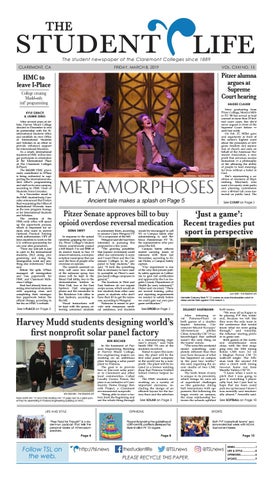
METAMORPHOSES
Since graduating from Pitzer College, Monica Miller PZ ’08 has served as lead counsel in more than 25 federal court cases. But she’d never argued in front of the Supreme Court before — until last week. On Feb. 27, Miller gave oral arguments in front of the nation’s highest court about the principles of religious freedom and separation of church and state on behalf of the American Humanist Association, a nonprofit that advances secular humanism — a philosophy of life affirming the ability of people to lead meaningful lives without a belief in God. She’s representing a coalition of residents of Bladensburg, Maryland, who sued a bi-county state parks and planning commission over a 40-foot tall cross memorial on public land. The
Ancient tale makes a splash on Page 5
Pitzer Senate approves bill to buy opioid overdose reversal medication SIENA SWIFT In response to the opioid epidemic gripping the country, Pitzer College’s Student Senate unanimously passed a bill March 3 to use $500 of its reserve funds to buy 12 doses of naloxone, a non-prescription nasal spray that can save the lives of people who overdose on opioids. The resident assistant on duty will carry two doses of the naloxone spray, two doses will be kept in the Mead Hall lobby, two in the demonstration kitchen in West Hall, two at the East Sanborn Hall emergency phone and the remainder in the Residence Life office in East Sanborn, according to the bill. Visual instructions will be kept with the sprays, allowing untrained students
to administer them, according to senator Claire Wengrod PZ ’19, a co-sponsor of the bill. Wengrod said she had been interested in pursuing this proposal for a few years. “The growing possibility that [opioid overdoses] could affect our community is scary and I want Pitzer and the Claremont Colleges to be prepared to help students,” she said. “It feels like something that is necessary to have easily accessible on Pitzer’s campus [and] college campuses in general.” The locations in West and East Sanborn do not require swipe access, which would allow students from other campuses or students who don’t have their ID to get the naloxone, according to Wengrod. Naloxone is meant to provide only temporary medical assistance, and students
would be encouraged to call 911 or Campus Safety after administering it, said Rebecca Zimmerman PZ ’21, the representative who proposed the bill. Campus Safety officers started carrying doses of naloxone with them last November, according to Ernie Didier, a Campus Safety captain. “Our department is one of the very first private public safety agencies in California to gain full certification and approval by the Los Angeles County Department of Health [to carry naloxone],” Didier said via email. “There are several training, policy and reporting requirements we needed to satisfy before we could gain our own program certification.”
See OPIOID on Page 2
Harvey Mudd students designing world’s first nonprofit solar panel factory BEN REICHER
BEN REICHER • THE STUDENT LIFE
Nate Smith HM ’19 and Chris McElroy HM ’19 pose next to a solar panel they’re assembling in Parsons engineering building at HMC.
In the basement of Parsons Engineering Building at Harvey Mudd College, five engineering majors are working on an ambitious plan: bringing a solar panel plant to Pomona. The goal is to provide free or low-cost solar power to Claremont and other local communities. Called Locally Grown Power, the plan is an initiative of Community Home Energy Retrofit Project, a Claremont environmental nonprofit. “Being able to start a factory from the beginning and see the whole thing through
LIFE AND STYLE
is a manufacturing engineer’s dream,” said Nate Smith HM ’19, one of the students involved. Slated to open this summer, the plant will be the first solar panel company in the world run by a nonprofit. The plant will be located in a former welding shop that Pomona Unified School District helped locate. The HMC students are working on a variety of important decisions, including the design of an efficient layout for the factory floor and the selection
See SOLAR on Page 3
See COURT on Page 2
‘Just a game’: Recent tragedies put sport in perspective
AMY BEST • THE STUDENT LIFE
Michelle Calcany Blair PZ ’21 makes an over-the-shoulder catch in deep center field against CMS March 2.
DELANEY HARTMANN After defeating rival Pomona-Pitzer in both games of a doubleheader Saturday, Clare m o n t - M u d d - S c r i p p s ’ All-American pitcher Chloe Amarilla CM ’19 acknowledged that softball wasn’t the only thing on the teams’ minds. “The wins this weekend meant something completely different than they ever have because of what has happened on campus in the past two weeks,” she said, regarding the recent deaths of two CMC students. The Sixth Street rivalry is unique in its proximity, which brings its own set of superficial challenges — like gameday dining hall interactions with opponents. But following the tragic events on campus, the close relationship between the schools uplifted
OPINIONS
both teams. “We were all so happy to be playing P-P this weekend, because we felt like they were the only team in the conference that would know what we were going through,” said Amarilla, the Athenas’ starting pitcher in game one. Both games of the weekend doubleheader were close, with the first dragging into the 10th inning before CMS won 3-2 on a Meghan Perron CM ’21 walk-off single. The Athenas took the second 2-0 after a clutch sixth inning two-run home run from Maddie Valdez CM ’21. “I knew when I went to pitch that I was going to give it everything I physically had, but I just had to hope that my team could pick me up because I knew I was mentally and emotionally absent,” Amarilla said.
See SOFTBALL on Page 10
SPORTS
“Free Food for Thought” is a student-run podcast that tells the personal stories of Athenaeum speakers.
Flagrantly ignoring the guidelines of LGBT-centric parties is disrespectful, Elyse Endlich PZ ’22 argues.
Both P-P basketball teams’ seasons ended last week with NCAA tournament losses.
Page 4
Page 8
Page 10
Follow TSL on the web.
http://tsl.news
thestudentlife
@TSLnews
PLEASE RECYCLE THIS PAPER.
@TSLnews
NEWS.............................1 LIFE & STYLE..................4 OPINIONS.....................6 SPORTS..........................9
NEWS THE STUDENT LIFE
PAGE 2
MARCH 8, 2019
Pitzer and Scripps host first joint Keckxit forum BECKY HOVING Pitzer Student Senate and Scripps Associated Students hosted a student forum Wednesday to discuss possible changes to the Keck Science Department in response to Claremont McKenna College’s anticipated withdrawal from the three-college organization. About 30 students, four Keck faculty and Keck Dean Ulysses Sofia attended the forum, which was the first opportunity for student feedback since CMC’s announcement in October, according to senator Claire Wengrod PZ ’19, one of the forum organizers. “Keck faculty have had a multitude of opportunities to share their concerns and to advocate for students,” Wengrod said, adding that there hasn’t been the same opportunity for Scripps and Pitzer students. Wengrod, who spearheaded the event alongside Keon Rabbani PZ ’19 and Julia Kelly SC ’21, aimed to fill that gap by providing a space for students to ask questions and reimagine the future of Keck. Students suggested institutional changes ranging from 24-hour swipe access to Keck to a shared governance model and better advising for students. Wengrod, who took notes on a whiteboard, plans to share the feedback
with the extended Pitzer governance community. “I’ll be reporting to Pitzer Faculty Executive Committee this Friday about the event and then again at our Student Senate meeting on Sunday,” she said. In addition, Wengrod and Rabbani hope to create a student visioning committee and invite more collaboration between Keck students and faculty. Wengrod said she and Rabbani plan to hold a second forum in midApril and create an online suggestion form for students who are unable to attend. “The goal is to increase transparency throughout the
transition,” she said. “The most important thing that came out of the event was that Keck students felt like they were being heard.” Jackie McVay SC ’21 said she thought the forum was a valuable opportunity for students to weigh in on the future of Keck. It was “a really good community exercise, because I actually got the chance to discuss with people I see all the time in classes and labs real issues we need to fix,” McVay said. “It really felt like a coming together.” At the forum, students asked members of the Scripps-Pitzer Science Vi-
sioning Committee logistical questions for the first 30 minutes. The committee was created shortly after CMC’s fall announcement, which shocked and dismayed students and faculty, and consists of Keck faculty members Nancy Williams, Lars Schmitz, Don McFarlane, Ethan Van Arman and Adam Landsberg. Many students said they were worried about how CMC’s exit, which isn’t expected to occur for several years, would affect the number of faculty members at Keck, especially because many courses are already
overenrolled. However, Sofia said she was confident Keck would be able to retain its faculty. “We expect there to be some migration of faculty from the shared PitzerScripps sciences over to CMC,” Sofia said. “It most likely won’t happen in a lump or in a short time span. There’s going to be a lot of planning.” Landsberg, a physics professor at Keck, echoed Sofia, noting that students will have access to new faculty as CMC builds its department over the next four years. He also said class sizes will eventually decrease by a third, improving the faculty-to-student ratio. “If anything, you should see an increase in opportunities, not a decrease,” he said. Michelle Wang SC ’20, a chemistry major, remains optimistic about the changes. “The initial separation will be messy and things seem confusing right now, but I genuinely think in the long run things will be better for everyone,” she said. “After the separation, I hope the new CMC and Scripps-Pitzer science programs will be better than Keck is now.”
JUSTIN SLEPPY • THE STUDENT LIFE
Jackie McVay SC ‘21 raises her hand during an open forum hosted by the Keck Science Department March 6 to answer students’ questions about the future of the three-college organization.
Elinor Aspegren contributed to this report.
Pitzer College to expand inmate education program, begin offering bachelor’s degrees RIYA MANDALAPU Pitzer College plans to start offering full bachelor’s degrees to inmates at the California Rehabilitation Center, a medium-security state prison in Riverside County, according to Nigel Boyle, Pitzer’s dean of faculty. The Inside BA program is currently going through an approval process and will be an expansion of the existing Inside-Out program, which allows 5C students to attend classes at the CRC alongside inmates at the facility. The program initially began in 2015 with faculty and students volunteering at CRC. The following year, CRC inmates and Pitzer students were able to receive Pitzer credit for taking the classes. Since 2017, students from all 5Cs have participated in the Inside-Out program, and report positive experiences. “It was eye-opening in many ways ... the class shaped how I approach my whole college experience,” Giang Nguyen PZ ’20 said via email. “The program itself embodies Pitzer’s core value of social responsibility and its bold thinking towards traditional education.” Boyle said Inside-Out classes will also start at Prototypes, a rehabilitation facility in Pomona for mothers serving sentences, the California Institution for Women and a juvenile detention camp next
year. The bachelor’s degree program will be exclusive to CRC initially, but Boyle hopes to expand it to other facilities as well. “There are more people incarcerated in this valley than students in all of the [5Cs] put together,” he said. Inmates who already have an associate degree are eligible to apply, and the program will take two years to complete, Boyle said. Many inmates currently get associate degrees through other programs available at CRC. CRC warden Cynthia Tampkins spoke highly of Pitzer’s initiatives. “My goal is to release these individuals with the education and tools they need to better equip themselves for a successful integration back into society,” Tampkins said via email. “Every stepping stone these inmates accomplish while in prison is one less hurdle they have to climb over to stay free.” Romarilyn Ralston PZ ’14, a former California Institution for Women inmate who attended Pitzer through the New Resources program for nontraditional age students, said the Inside BA program is “the logical next step in the progression of what Pitzer College stands for. “As a 47-year-old black woman on parole in transition after serving a life sentence, I was still able to make those connections and build
those relationships,” she said. “That’s what the Pitzer experience has given me.” Regular courses will begin in 2020 and the first class of inmates will graduate in 2022, Boyle said. The admission process, run by Pitzer’s Office of Admissions, will be selective. Boyle estimates 30 to 40 inmates will be eligible to apply and approximately five will be accepted. Currently, Inside-Out
classes are taught by interested faculty. Moving forward, faculty from all 5Cs will be recruited by Boyle to create a curriculum and teach classes based on the inmates’ self-designed major. The program is supported by Pitzer’s Board of Trustees, and the 5C presidents and deans have visited the Inside-Out classes, according to Boyle. Ralston praised Pitzer’s
decision to implement the new bachelor’s program. “I’m just so grateful that Pitzer is taking on this challenge and will be offering the Pitzer education, the Pitzer process, the Pitzer spirit to folks inside. Those men and women inside those prisons are going back to communities,” she said. “They’re going to be taking a little Pitzer with them.”
PHOTO COURTESY OF CALIFORNIA DEPARTMENT OF CORRECTIONS AND REHABILITATION VIA WIKICOMMONS
The California Institute for Women, pictured above, is one of the prisons that has hosted Pitzer College’s Inside-Out classes. Pitzer plans to start offering full bachelor’s degrees to inmates at the California Rehabilitation Center.
OPIOID: Senate hopes for medication by end of year Continued from Page 1 Campus Safety has not yet had to use any of the medication, he said. About one in five college students said they knew someone who was addicted to pain medications, according to a 2018 Penn State study. Misuse of prescription drugs is highest among individuals ages 18 to 25, with nearly 15 percent reporting non-medical use in the past year, according to the National Institute on Drug Abuse. The Centers for Disease Control and Prevention reported at least 47,600 opioid overdose deaths in 2017 and listed California as having a 4.5 percent increase in deaths from 2016 to 2017. No specific statistics about opioid abuse at the 5Cs are available, according to Wengrod. Wengrod said that Massachusetts colleges providing naloxone contributed to her interest in passing this bill. In 2017, Bridgewater State University became the first college to provide naloxone publicly on campus. A program in Massachusetts reduced opioid overdose deaths by an estimated 11 percent in the 19 communities that provided naloxone without increasing opioid use, according to the National Institute on Drug Abuse. Wengrod said having naloxone available and monitoring how frequently it is used could provide a better picture of how serious the opioid abuse problem is at the 5Cs. “A good way to gauge [the prevalence] is to have it available and now if something were to happen and someone used it, we would be able to gain a better idea of if this is something that the school needs to address more,” Wengrod said. The bill also proposes that Pitzer incorporate training sessions into its New Student Orientation to inform students about the signs of opioid overdose and how to administer naloxone. Under the bill’s provisions, students would have complete medical amnesty for using the naloxone, meaning they would not receive disciplinary penalties for using it, according to Zimmerman. Pitzer’s policies already provide medical amnesty for alcohol and drug cases. Zimmerman and Wengrod said they will be in contact with Pitzer’s chief of staff and legal counsel to discuss potential legal implications before purchasing the naloxone. Associate Dean of Students Kirsten Carrier said she supported the bill, but noted that both Pitzer’s legal team and Human Resources office would have to approve the plan. Zimmerman hopes to have the naloxone in place before the end of this year, although Carrier said the plan might take more time. “The institution has to get on board and that takes a longer haul,” Carrier said. “There’s significant hurdles you have to jump if you’re the first of the [5Cs] to have it.”
COURT: Miller ‘embodies the ethos’ of Pitzer Continued from Page 1
COURTESY OF MONICA MILLER
Monica Miller PZ ’08 argued about the principles of freedom of religion and separation of church and state in front of the Supreme Court Feb. 27.
cross, a veterans memorial, cost more than $200,000 in taxpayer dollars. AHA argues it’s a violation of constitutional requirements separating church and state. “A colossal Latin cross dedicated by the government as a war memorial for ‘all veterans’ does nothing of the sort,” Miller wrote in an AHA newsletter. “Rather, the government’s Christian cross war memorial honors Christians to the exclusion of everyone else, sending a callous message that Jews, Muslims and humanists lack the ‘courage’ and ‘valor’ referred to in the inscriptions at the base of the edifice.” In the four months lead-
ing up to the case, Miller said she responded to more than 40 briefs, went over AHA’s 4,000-page record and organized a mock court at Georgetown Law School. Miller said she only had three weeks to prepare for the oral argument. “It was certainly intimidating, but I enjoyed the experience,” Miller said via email. “I was definitely the youngest to argue that day, and the only female, but I was confident in our arguments and tried to keep my composure, especially when [Justice Ruth Bader Ginsburg] started talking to me.” AHA lost its lawsuit in a U.S. District Court in February 2014, but won an appeal in the Fourth Circuit Court of Appeals after Miller present-
ed oral arguments in December 2016. The case was taken up by the U.S. Supreme Court in June 2018 after the parks and planning commission, joined by the American Legion, petitioned for a writ of certiorari — a request for the court’s review — according to Miller. Phil Zuckerman, a professor of humanist and secular studies at Pitzer, taught Miller during her college years. He helped her prepare for the case and has been in touch with Miller throughout her career. “She has already [led] the fight to keep church and state separate, [led] the fight for animal rights and chimpanzee rights; she embodies the ethos of Pitzer College,” Zuckerman said. “Monica
has fulfilled Pitzer’s mission 10 times over.” After graduating from Pitzer, Miller earned a master’s degree from Columbia University in 2009 and started working at AHA in 2012 after graduating from Vermont School of Law, according to her AHA biography. Miller has previously represented students as young as 6, federal inmates, Christians and atheists. She also serves as a part-time attorney at the Nonhuman Rights Project, an animal-rights organization. Miller said she expects the Supreme Court to reach a verdict over the summer. “We think a majority wants to uphold the cross but I can’t think of a principled basis for [the Court] to do so,” Miller said.
NEWS THE STUDENT LIFE
MARCH 8, 2019
PAGE 3
I-PLACE: Previous orientation schedule ‘disenfranchising’ HMC international students Continued from Page 1 “My actual paperwork process has become more streamlined because Evelyn is the one taking care of it and she’s [on campus],” Kanishk Tantia HM ’19 said. “Things move more quickly and are much closer to home.” While the decision means sped-up paperwork, it also means international HMC students will no longer participate in I-Place’s New International Student and Scholar Orientation. NISSO allows students to arrive on campus early, connect with other international students and receive information helpful to students who may have never lived in the U.S. before, according to NISSO’s website. Since Pomona College, Pitzer College and CMC have orientations that start at a different time than Scripps College and HMC, I-Place traditionally had three separate orientations. HMC families would stay for the two days of international student orientation and go directly into parent orientation, which runs alongside student orientation. Last summer, I-Place combined all the orientations into one 5C NISSO program, which started a week earlier than HMC’s all-student orientation. After participating in NISSO, HMC international stu-
dents had to wait five days before regular new student orientation for HMC. “Families can’t stay here for a whole week and then also do parent orientation,” Gonzalez said. “So we were finding that it was disenfranchising the students and their families at a cost that was only borne by the Mudd community.” Harry Aung HM ’21 described NISSO as “a very positive experience for me … I made a lot of new friends.” He was a NISSO participant in 2017 and a leader in 2018. Since NISSO served as Aung’s main connection to
the 5C international community, he’s worried future students will not have the same opportunity to connect with international students from across the 5Cs. “Once you get to Mudd, the international community really kind of splits apart and integrates,” Aung said. HMC sent a survey to international students at the beginning of the academic year as Real and the other staff prepared to establish the Mudd-only office. “What I found is that most of the students, if not all of them, are looking for a place on Mudd’s campus to call home,” Real said.
“They’re looking for a place where everyone can just come and connect.” For the first time, HMC will hold an international student graduation ceremony as well as spring break trips and activities for international students. HMC still plans to continue coordinating with I-Place in some capacity; Mudders frequently attend the International Festival in the spring and International Gala in the fall, so Real anticipates supporting I-Place in planning those events. I-Place declined to comment.
KYLE GRACE • THE STUDENT LIFE
The International Place serves as the international student office of the 5Cs. Harvey Mudd College announced in December that it was pulling out of I-Place and creating its own organization.
SOLAR: New panel every six minutes, Mudders suggest Continued from Page 1 of assembly line equipment and its suppliers. The group of students, which also includes Chris McElroy HM ’19, Giulia Castleberg HM ’19, Jacquelyn Aguilera PZ ’19 and Priscilla Chu HM ’19, determined that the factory should produce a finished solar panel every six minutes. This will allow Locally Grown Power to meet its goal to service 6,000 homes in two years, according to the clinic leader, professor Kash Gokli. “This is a really rare opportunity, I’ve never seen something like this,” McElroy said. “Normally what comes to us is ‘Hey, our factory’s really struggling, how can we improve it,’ and then you work around what’s already on the floor, but we’re getting to make the whole floor from the ground up, and that’s a very special thing.” CHERP was founded in 2010 by Devon Hartman PZ ’77, who previously ran an architecture company in Claremont for more than 30 years. In 2015, Hartman met inventor Kent Kernahan, and learned about his recently patented idealPV solar panel technology. The idealPV solar panel operates more efficiently than conventional solar panels, and costs less to manufacture. Hartman subsequently worked with Kernahan to launch Locally Grown Pow-
er. Their plan is to build a solar panel factory to employ members of the local community for a living wage. Because of the idealPV technology and low transportation costs, Locally Grown Power will be able to install solar power on local homes at a much lower cost. Ensuring the factory runs smoothly, however, will require the specific training in manufacturing that the HMC students can bring to the table. “[Our clinic] seems like a big responsibility, but it’s the kind of project that actually fits really well into the education that we have,” Smith said. Hartman hopes his business model, beginning in Pomona, can be replicated nationwide. “Generally speaking, [solar factories are] these huge, thousand-employee factories in China or Mexico,” Hartman said. “We intend to reduce the size of those factories, and distribute the factories in all the cities that need them and want them, so that each city can create its own power, just like each city is now trying to grow its own food.” Under Locally Grown Power’s model, communities would benefit from growth of living wage jobs and affordable power, while simultaneously reducing their use of fossil fuels. “[The initiative is] focused on sustainability on a local level; it aligns very well with Claremont’s sustainability goals, and California’s as well,” Castleberg said.
Lindsey Graham’s U.S. Senate challenger pitches Scripps students on his chances HELENA ONG Nearly a year and a half ahead of the 2020 election, a host of Democrats have already announced presidential runs and are gearing up for a bruising campaign. One rung down from the national political slugfest, however, is Jaime Harrison, the associate chair of the Democratic National Committee, who recently formed an exploratory committee as he takes aim at Republican Sen. Lindsey Graham’s South Carolina seat in the U.S. Senate. Harrison spoke about his experience in politics and encouraged students to get involved at a talk at Scripps College March 1. At the event, hosted by the Democrats of the Claremont Colleges, Harrison acknowledged that South Carolina typically votes Republican but thinks he has a chance. “It’s not going to be easy, but there’s a path,” said Harrison, also the former chair of the South Carolina Democratic Party. “If I can get ... Democrats along with some of these Republicans who don’t like [Graham], then we can pull together a coalition that gets me across the finish line.” As a black man and the first member of his family to graduate from college, Harrison emphasized the importance of community representation, and said he was often “the one minority in the room” for a lot of decisions. “I always stress to young
people, particularly young people of color, the importance of getting involved in having a voice heard and making sure you and the community you come from is represented,” Harrison said. The 2018 election ushered in the most diverse Congress in history, and Harrison emphasized the importance of having diversity among staffers as well. “If you know anything about Congress, you understand that a lot of policy gets made on a staff level, not even when members are in the room,” Harrison said. In an interview with TSL prior to the event, Harrison said his run for the Senate was partly motivated by Graham’s angry statements accusing Democrats of conducting an “unethical sham” during last fall’s Senate Judiciary Committee hearing, during which Christine Blasey Ford accused Supreme Court Justice Brett Kavanaugh, then a nominee, of sexually assaulting her. Graham now chairs that committee. “I saw the performance of [Graham], and it just didn’t sit well,” Harrison said. “I totally believe if you’re for Kavanaugh, you can be for Kavanaugh, but you don’t have to demonize the women.” Harrison also criticized Gaham for being too focused on gaining the approval of President Donald Trump. Harrison said his priority is his home state. “We need someone right
COURTESY OF WIKIMEDIA COMMONS
Jaime Harrison, who formed an exploratory committee for a U.S. Senate run in South Carolina, spoke to students at Scripps College March 1.
now in Washington, D.C. who is going to fight for the people of South Carolina first and foremost, before president, before party, always looking to push what’s in the best interest of the state and citizens,” Harrison said. Harrison admitted there are differences between the Democrats he was visiting in California and the ones in his native South Carolina. “I would say probably the Democrats in California are much more progressive than in South Carolina, but ultimately I think we all want the same thing,” Harrison said. Immigration is not as much of a “hot button issue” in South Carolina as it is in California, Harrison said. Instead, he said climate change, health care, infrastructure and education are the main issues he’d like to address. As of 2017, 11 percent of South Carolina’s population lacked health insurance, according to the Kaiser Family Foundation, the eighth-highest rate in the country. With regard to infrastructure, Harrison wants to fix the roads and bridges, which he said are “falling apart,” and improve broadband communication to address dead-zones in the state. He also discussed the issue of student debt, and said he graduated from college with $160,000 in student loans. “Yet there are people in Congress who are trying to make it even more difficult for young people in terms of the interest rates,” Harrison said. Selena Lopez PO ’22, who is from Charleston, South Carolina, said she intends to vote in the 2020 election. “Hopefully, people in South Carolina stray from the norm of voting Republican and see that Harrison is a strong and capable candidate to hold the SC senate seat,” she said via message. However, Jaida Potts PO ’21, also from Charleston, said she thinks Democrats are “absolutely not” going to win the election in South Carolina, citing the state’s past preference for Republican politicians. Graham won his 2014 race by nearly 20 percent of the vote.
Pitzer Senate auditing study abroad programs In response to student dissatisfaction with Pitzer College study abroad programs, Pitzer’s study abroad office and affiliated committee is conducting an audit to gauge attendance and interest. The audit was proposed in a Pitzer Student Senate resolution by senator Claire Wengrod PZ ’19, and seeks to gather a wide variety of data. Some statistics Wengrod is hoping to capture are the number of students who participated in each program in the last five years, the distribution of majors attending study abroad programs, the number of international students and students of marginalized identities attending study abroad programs, the most common majors to apply for non-approved programs and the support given to students of marginalized identities while studying abroad. “After having people reach out to me, or filling out my anonymous survey that I posted via our student talk server, I felt like it was necessary to move forward with doing an audit,” she said. The survey was anonymous and circulated several times between late September and early October. Student responses to the survey indicated a dissatisfaction with a perceived lack of variety of programs offered, specifically those intended for STEM majors. — Lilly Carden
Pomona undergoing numerous staffing changes in deans’ offices Pomona College is in the process of hiring and promoting several staff members in the Dean of Students and Dean of the College offices. The Dean of Students office is hiring a director of disability services who will begin this fall, a role previously filled by Associate Dean Jan Collins-Eaglin, Dean of Students Avis Hinkson said during a March 6 faculty meeting. Pomona is also working with search firm Koya Leadership Partners to locate a new Career Development Office director and new senior associate dean of students for wellness and personal success to replace Collins-Eaglin, who is transitioning out of the role, Hinkson said in an email to students. The search firm will meet with students March 14. Tony Boston, currently an associate dean of the college, will take over Associate Dean Nicole Weekes’ role focusing on diversity issues, according to Dean of the College Audrey Bilger. Physics professor David Tanenbaum will also become an associate dean, Bilger said at the faculty meeting.
—
Marc Rod
Correction In last week’s issue, a news bite was published with the wrong headline. “Pitzer Senate fills vacant positions” should have been “Harwood Heist: Multiple reports of theft at Pomona.”
TSL regrets this error.
LIFE & STYLE PAGE 4
THE STUDENT LIFE
MARCH 8, 2019
The Balcony’s first Student podcast highlights show of the year is a Ath speakers’ personalities cacophony of clutter YASMIN ELQUTAMI A dress hung from the ceiling, and a collection of haphazard lists and cell phone photos were littered across the room. Students donned technicolor plastic overwear and hula hoop garments, as a display of repurposed stuffed animals watched over the space. The chaotic scene was united by only one theme — clutter. The Balcony, a student-run 5C organization promoting student art, hosted its first show of the academic year March 1. Titled “Clutter,” the show featured pieces created by students of various colleges, majors and interests, and was displayed at the Pomona Studio Art Hall’s Pamela Creighton Gray Space and Terrace. “‘Clutter ’ was conceived as this idea that, as we live, we accumulate a lot of things, whether that’s … actual material knick-knacks or experiences and baggage,” Balcony
board member Maya Jotwani PO ’21 said. “There’s so many meanings and connotations and connections [with clutter]. It’s versatile for any kind of art … and open-ended enough to allow for interaction with different people.” The exhibit showcased an eclectic cross-section of student art, including paintings, photo collections, sculptures, collages, embroidery, virtual reality experiences and performance art pieces. Balcony board member and artist Chloe Wanaselja PO ’21 submitted an untitled collage that featured colorful, amorphous map fragments haloed by a web of lavender yarn. “I loved the idea of having a theme for the work,” Wanaselja said via email. “Because each piece [of the show] stood alone but all together, they informed each other wonderfully.” Artist Kyle Lenhart-Wees PO ’20 created “Baggage,” a collection of wearable, dynamic pieces made of found items.
“Clutter for me was very much connected to an emotional state,” he said. “Nothing is as simple as it just seems — there are things going on in the back of my mind, things going on in the minds of people around me.” Lenhart-Wees said the The Balcony promotes open-mindedness, so people are free to let their minds wander and let their imaginations establish the meaning of their art. “ T h e r e ’s n o r i g h t o r wrong,” Lenhart-Wees said. “There’s no instructions, so The Balcony is generally conducive to that openness and willingness to open oneself up to different things.” There are many 5C students passionate about art, but not all of them are part of the art department. Jotwani said that by opening up the floor to all students, The Balcony encourages artistic development at the 5Cs. “Clutter ” attendee Izabella Davis PO ’22 said art in Claremont represents the thoughts of 5C students as a whole. “Art shows what us as a student body is thinking — how we’re communicating our thoughts and opinions and expressing ourselves,” she said. “That is really important because it’s hard to articulate something so personal [without] art, because art has a way of encapsulating our emotions in a unique way.” Jotwani agreed, and said The Balcony’s openness is at the helm of the group’s mission. “We want to reiterate our shows and our organization as a space not just for socalled artistic people,” she said. “Just generally, there is a sense that … people don’t go to these kinds of events because that’s not ‘who they are’ and because that’s not ‘their crowd.’ We want to veer away from being a space just for a specific crowd and make sure we’re accessible to everyone.”
COURTESY OF MAYA JOTWANI
Keep up with The Balcony’s future shows and events on their Facebook page.
Julia Farner PO ’22 and Chloe Wanaselja PO ’21 interact with the artwork at The Balcony’s “Clutter” exhibit.
COURTESY OF FREE FOOD FOR THOUGHT
Members from Free Food for Thought, a student-run podcast, aim to give 5C students a deeper understanding of speakers who come to Claremont McKenna’s Athenaeum.
JULIA GOTTLIEB Inspired by the ever-increasing popularity of podcasts, Shivani Pandya CM ’18 created “Free Food for Thought” in early 2016 for students to hear in-depth, personal stories from Claremont McKenna College’s Athenaeum speakers. The podcast, which is entirely student-run, allows listeners to engage with Athenaeum speakers in a unique way, by focusing on personal stories that the speakers may not have addressed during their prepared talk. “Something that tends to happen with the Ath is they give lectures — maybe they’re a little reflective on their personal histories or careers — but mostly lectures, and I think the [Q&A] questions that come out of the audience tend to be very academic,” incoming podcast director Melanie Wolfe CM ’20 said. “I think the intent of the podcast originally was that we get at the personal narratives and we ask someone to put their career in the context of ‘what was it like when you were 20, when you were our age, and thinking ahead on what you wanted to do?’” Many of the current podcast staffers said joining the
team felt like a natural way to marry their love for podcasts and the Athenaeum. Interviewer Zach Wong CM ’19 said “Free Food for Thought” reminds him of sitting at the head table at the Athenaeum, where students are given the chance to speak candidly with speakers. Current podcast director Skip Wiltshire-Gordon CM ’19 said the speakers chosen for the podcast are entirely based on student interests. “We’re never having students interview people who they’re not interested in talking to, which ends up being really good for the interviewee, the student and the final product,” he said. To prepare for the podcast, the hosts gather existing information on the speakers and read their work. While diligent preparation goes into each episode, the members said that they prefer the organic moments that feel less like an interview and more like a conversation. For consistency, the interviewers begin every episode by asking speakers to explain an “inflection point,” a moment that changed the path of their life. “We use the inflection point question to dive in and make it clear that we’re very interested in their personal story,” Wolfe
said. Instead of reiterating what the speakers focused on in their lectures, the podcast provides new content that is often “as interesting or more interesting than what the speaker had to say about their expertise,” Wong said. The podcast aims to benefit both the interviewer and interviewee. Wiltshire-Gordon explained that not all of the speakers have experience being interviewed about their personal life, and can come out of the conversation with a deeper appreciation of the interview process. Interviewer Nick Sage CM ’20 agreed that the student interviewers enjoy the process. “[Students] really enjoy being there, because I think they do recognize that as a completely student-run podcast, it’s really just about getting to know them as a rare enterprise,” Sage said. The group hopes to extend listenership and participation beyond just CMC. “This is a 5C podcast,” Sage said. “It’s not just a government or current events podcast at all. It’s really whatever your interests are; you can bring something even to the interviewees.” Tune in for new content on Tuesdays and Fridays on Soundcloud.
TV COLUMN
‘You’ teaches us to look beyond rom-com tropes and our raving romanticism AMBER CHONG This article contains spoilers. Imagine this: a warm, glowing morning in Brooklyn. In a cozy niche bookstore, Joe is doing his job, dusting off antique novels and rearranging titles on the shelves. Joe, endearingly sheepish in a light-blue button-up, is an intellectual with a boyish face and dreamy eyes. He is your average Joe — until she walks in. Beck, with her wispy golden hair and carefree nature, enters looking for a Paula Fox novel. Beck and Joe meet when she asks where to find the book, and from there it’s all gleaming eyes and witty banter. They both enjoy wry humor, and it’s refreshing for both of them to meet someone with genuine taste in literature. She slyly clues him into her name by paying with credit, and as she leaves, Joe casts a longing glance. They absolutely belong together, don’t they? “You,” a Netflix series based on the best-selling novel by Caroline Kepnes, attempts to answer this question. For the raving romantic, the answer might be a “yes, yes, yes. A thousand times yes!” And I too, would be lying if I said I wasn’t a sucker for the “two unassuming people stumble upon each other and have fleeting connection” trope. Why
shouldn’t we root for them? “You” employs all the romcom stereotypes: sunshine girl meets brooding boy and colors his life with meaning, nice guy “selflessly” supports girl as she chooses trashy men, nice guy is the only one who truly sees girl for who she is and more. Then it confronts us with how flawed our romanticizations are. At first, Joe seems like the ideal leading man. He is charming, seeks genuine companionship and, in the pilot, literally rescues Beck after she falls on the subway tracks. In the rom-com universe, that type of heroic timing equals true love forever. But the exposition of these scenes is crucial to the seductive horror of “You.” Each seemingly fated, meet-cute moment is meticulously calculated by Joe as his infatuation grows obsessive. And we have to watch as Beck unwittingly falls in love with him. What’s even more chilling is that at some points, we want her to. There are compelling aspects of Joe that warrant empathy, and the show even adds a character named Paco to paint Joe in a chivalrous light. Paco is a vulnerable, young boy who endures abuse from his mom’s drunkard boyfriend. After long days at work, Joe nurtures him. Throughout the show, the tone of “You” vacillates from wicked to wholesome, and the lines
that define Joe’s morality seem to blur. The strange cognitive dissonance I felt while watching the show was what made it so addictive. I hated seeing parts of myself in Joe, because at other times I detested him. I’m sure it’s not uncommon for one to desperately love the idea of love, to filter through a crush’s social media, check their Snapchat location or mysteriously appear in said crush’s line of sight at a dining hall. But Joe manipulates the story to portray himself as a misunderstood romantic with good intentions. He’s not stalking Beck — he’s just getting to know her so he doesn’t get hurt. His behavior isn’t controlling and neurotic — to him, it’s earnest and born from concern for her wellbeing. Luckily, “You” makes it clear that its misogynistic positioning and weak justifications are intentional. It gives credit to the power of miseducation. Joe’s strict adherence to his personal code, one that was undoubtedly shaped by his father’s abuse, is a testament to unhealthy cycles. It is often stressed that Joe grew up and came to understand life only through books — cliché books about white male triumph. His own romanticizations are shown to be a product of the old-school chivalry he grew up on. When Beck gushes, “you
take care of me; no one has ever taken care of me” to Joe as a way of escaping, she plays on Joe’s sensibility to think of himself as her benevolent savior. “You” then tackles the idea of how men are conditioned to believe they know what’s best for women, and how “protection” is used to excuse stripping autonomy. It is no accident that in the finale, as Beck flees, she encounters Paco. When he refuses to open the door and release her from Joe’s torture chamber, “You” creates powerful symbolism for the passing of toxic masculinity. The reality is that, for as long as we propagate the narrative that love is obsessive, that it doesn’t give up, that it requires men to persist despite all “obstacles,” women will continue to be silenced and oppressed, their stories framed within the caricature of male desire. Is controlling, coercive behavior still abuse if it’s in the name of love? “You” hopes that by the end of its 10-episode arc, we can all give a resounding yes. And to the initial “don’t they belong together?” The answer is “hell no.” Amber Chong SC ’22 probably spends too much time daydreaming. She’ll come back to Earth to fight you for the last slice of cake, though.
COURTESY OF
COURTESY MARK KARI FROM WIKIMEDIA COMMONS
Penn Badgley stars in the Netflix series “You” as New York bookstore manager Joe Goldberg.
LIFE & STYLE MARCH 8, 2019
THE STUDENT LIFE
PAGE 5
METAMORPHOSES
IAN POVEDA • THE STUDENT LIFE
“Metamorphoses,” a modern retelling of Ovid’s myths, follows a sequence of narratives that involve falling in love, despair and discovering a capacity for transformation.
Morphing into an ensemble: TSL sits down with the minds behind the play ARIEL SO As the assistant director of the Pomona College production “Metamorphoses,” Anais Gonzalez Nyberg PO ’20 appreciates the challenge of re-telling a mythical story in the 21st century. “We live in a world where there are many stories that are beautiful and touching but are rooted in very disturbing and distressing places,” she said. “It feels encouraging to tackle that challenge here and now, while we’re in this space together.” Nyberg works closely with the play’s director, Jessie Mills, an assistant professor of theatre and dance at Pomona. Since her sophomore year, Nyberg has been a part of the play selection committee that carefully picked out “Metamorphoses,” a modern adaption of Ovid’s timeless
Greco-Roman myths, for this year’s production.
“[Opening night is] my favorite night of the entire year... I’m sitting in the booth and I get to say ‘go!’” - Marissa Parks SC ‘20 “Metamorphoses” plunges theatergoers into a complex world where humans, gods and nature intermingle, and where dramatic figures, characters and narrators merge into real-life resemblances. Coupled with a mixture of
pathos, tragedy and humor, the play often deals with sensitive and distressing material. Mills regularly talks with the cast about how they approach the play and how they can honor both the playwright’s story and “the hearts, bodies and minds” of those on stage and in the audience. “Theatre is a live animal, and so it can be in discovering how to best solve these moments … that the whole team is collaborating and actually really communicating with each other,” she said. From cultivating their group scenes to building off one another, the cast and crew engage deeply with their work. “Besides the narrator, there are no parts that are singular in nature; they’re all interwoven between the other scenes and the other actors,” said Jona-
than Wilson PO ’19, who plays Midas, Orpheus and Apollo. “It is by far the most ensemble-oriented show I’ve ever done, which is really amazing.” Describing her style of directing, Mills said: “In graduate school, the ‘tag’ that they gave me, like my elevator pitch, was ‘sharply controlled chaos.’ You’ll see some of that in this play.” Mills believes her role is to encourage actors to experiment and run with their own ideas. “My job … is to actively listen and then respond to what’s being said, so many of the choices that you’ll see, I shaped, but they didn’t necessarily generate from me,” she said. Mills also appreciates the care her cast and crew take with their performance of the play. “This group of humans is just so good to each other, and
just so gracious about how they approach this text,” Mills said. “At the end of the day, this text is about the power of transformation and the power that love has.” Stage director Marissa Parks SC ’20 is responsible for coordinating between students and department staff, arranging rehearsal schedules and keeping track of props, stage set, sounds, lighting and more. “Personally, [opening night is] my favorite night of the entire year,” she said. “Because, for me, I’m sitting in the booth and I get to say ‘go!’ on the lights. And just seeing all of the actors’ hard work and all of the designers’ hard work all come together to create this whole moment is just the best feeling.” Despite busy schedules and a weekly 20-hour commitment,
actors constantly show up ready to take on the stage. “I may be tired from having a long day, but I always get so much energy with me and the people in this space; it’s kind of intoxicating,” said Claire Pukszta SC ’19, who plays Myrrha, among other roles. Mills said she is proud of the entire cast and the ways they have dived into their characters with emotional depth and clarity. “It’s a rare space to work with humans who have the bandwidth, openness and curiosity to explore something with such joy and commitment,” she said. “Metamorphoses” is running through March 9 at Seaver Theatre. Get tickets online at https:// www.pomona.edu/events/metamorphoses.
Seaver Theater glows gold with production of ‘Metamorphoses’ EMILY SENDER Upon entering Pomona College’s Seaver Theater, one particular set piece will catch your eye: the pool in the center of the stage. The pool tells its own story — its sheer magnificence is an indication of what’s to come in “Metamorphoses,” a modern adaption of Ovid’s myths. The Mary Zimmerman play was directed by Jessie Mills, the new assistant professor of theatre and dance at Pomona. The play’s use of mythology highlights a universal theme — how human beings use stories to explain and understand the
IAN POVEDA • THE STUDENT LIFE
Above: Owen Halstad PO ’21 performs in Seaver Theatre March 7. Below: Jonathan Wilson PO ’19 plays Midas in “Metamorphoses” March 7. Front page photo: Noah Plasse PO ’21 tells a tale to Midas (Jonathan Wilson PO ’19) in front of the pool.
world. In the play, mythical figures, humans and nature all interact with each other. As the event listing on Pomona’s website states: “Through vignettes, ‘Metamorphoses’ shares in the humor and pathos of falling in love, despairing in loss and discovering our deepest capacity for change and transformation.” The first vignette of the play tells the infamous story of King Midas, the greedy king who wishes for Bacchus, the god of wine, to give him the golden touch, making everything he touches turn to gold. When his daughter jumps into his arms and turns to solid gold, Midas pleads for his wish to be reversed. The magical presence of the character “light” is palpable here, as objects of the set and parts of the stage glow gold when touched by Midas. In the myth of Orpheus (Jonathan Wilson PO ’19) and Eurydice (Olivia Silva SC ’21), the newlyweds are separated by death, and when Orpheus has the opportunity to save his beloved Eurydice, he can’t follow the one condition given to him by the gods of the underworld: not to look behind him as he leads her out of the underworld. The characters in “Metamorphoses” aren’t characters in the traditional sense. They don’t have a story arc or recurring narrative; instead, they are representations and archetypes that act as storytelling components. The cast and crew expertly portray the myths through a range of technical and physical
theater techniques, including movement, speech, tableau and lighting. Rebirth and reincarnation, synonyms for metamorphosis, are present themes throughout. Characters in the stories transformed into new shapes, and the actors themselves returned to the stage as new characters altogether. “I thought the writing was really good and poetic,” attendee Jubilee Lopez PZ ’19 said. “I’m a sucker for narrators and I really like when there’s narrators to contextualize everything, and I thought the narration was really beautiful.” Lopez was referring to the three narrators, GiGi Buddie PO ’22, Hershey Suri PO ’21 and Sara Acevedo PO ’21, who were on stage throughout the entirety of the production, taking the audience through myths by speaking, singing and moving around the water in Siren-like synchronicity. “It felt like every [scene] was teaching a different lesson,” Lopez said. Of course, the pool also served as a central part of the play. The set and lighting were their own characters, and the actors splashed, bathed and floated in the water while light washed over them. The symmetry and grace of the set and the choreography juxtaposed with the chaos, disorder and pain of life that the vignettes painted. Throughout the play, the stage, actors and pool of water glowed gold, and at other times dark and ominous, like when
Poseidon (Sam Clague PZ ’21) claimed the lives of sailors during the tragic tale of Alcyone (Shringi Diva Vikram SC ’20) and Ceyx (Owen Halstad PO ’20). The set became darker when lovers were torn apart by the wrath of the sea god, or when Hunger (Claire Pukszta SC ’19) became personified and drove Erysichthon (Alex Collado PO ’20) to eat his own foot as a punishment for cutting down a 300-year old tree. Attendees said the use of lighting was thoughtful and unique. “I thought the lighting was really beautiful — the lightbulbs up above, and how they went off and on,” audience member Eva Wertimer SC ’20 said. “It gave the show a cyclical feel, or a cyclical symbolism, which I thought was really beautiful.” Anna Horton PZ ’19 appreciated the interplay of drama and comedy, and said that the use of ancient myths to tell modern stories “grounded [the play] in a more contemporary moment.” Wertimer recommended the production to everyone. “Even if you don’t like theater, and you just like stories, it’s worth [seeing] because it’s almost like watching a dance with a distinct narrative,” she said. “Metamorphoses” has four more shows this weekend: 8:00 p.m. Friday and Saturday, and 2 p.m. matinees Saturday and Sunday.
OPINIONS THE STUDENT LIFE
PAGE 6
Those crystals aren’t magic, and they won’t heal you
THE STUDENT LIFE KELLEN BROWNING, Editor-in-Chief MEGHAN BOBROWSKY, Managing Editor HANK SNOWDON, Managing Editor MARC ROD, News Editor LANEY POPE, News Editor JULIA FRANKEL, News Associate NATALIE GOULD, Life & Style Editor MABEL LUI, Life & Style Editor SCHUYLER MITCHELL, Life & Style Associate DONNIE DENOME, Opinions Editor ANIKKA VILLEGAS, Opinions Editor TORREY HART, Sports Editor NOAH SHAPIRO, Sports Editor DELANEY HARTMANN, Sports Associate
MARCH 8, 2019
CASSIE WANG, Production Editor JAMES KARSTEN, Senior Design Editor ANNE JANG, News Designer HELENA ONG, Life & Style Designer DAPHNE YANG, Opinions Designer JILLIAN BATIUK, Sports Designer OLIVIA TRUESDALE, Copy Chief NINA POTISCHMAN, Graphics Editor CHLOE ORTIZ, News Photo Editor TALIA BERNSTEIN, Life & Style Photo Editor AMY BEST, Sports Photo Editor
The Student Life, the oldest college newspaper in Southern California, is produced and managed by students of the Claremont Colleges and published weekly. The Editorial Board consists of the editor-in-chief and two managing editors. Aside from the editorial, the views expressed in the opinions section do not necessarily reflect the views of The Student Life. E-mail Letters, Questions, and Concerns to editor@tsl.news. Email tips to liaison@tsl.news; email advertising inquiries to ads@tsl.news and print subscription inquiries to subscriptions@tsl.news. TSL welcomes letters to the editor, which can be submitted by mail, email, or in person at Walker Hall 101 of Pomona College. Letters must be under 400 words (although when an issue is particularly salient, we reserve the right to allow letters to run at a longer length) and submitted by 4 p.m. Wednesday of the week of publication. We reserve the right to decline publication of submitted letters and will not accept anonymous letters, letters containing profanity, factually inaccurate letters, or letters making personal attacks. TSL also reserves the right to edit for spelling, punctuation and grammar. Letters may be signed by a maximum of three people. All letters become the property of TSL and may not be reprinted without prior permission from the Editorial Board. Singles copies of TSL are free and may be obtained at news stands around campus. Multiple copies may be purchased for $0.47 per copy with prior approval by contacting editor@tsl.news. Newspaper theft is a crime; perpetrators may be subject to disciplinary action as well as civil and/or criminal prosecution. UGEN YONTEN • THE STUDENT LIFE
OFF THE RECORD
EAMON MORRIS
1,2,3,4 Almost had a thumb war
No more NSA phone tracking ...Or so they say
5,6,7,8 At least we’re not staying late
“Private Sharing” ... Whatever you say, Zuck
Reservoir water Take that, drought
The Jo Bros are back Sorry Frankie
The lake outside Frary Take it back, drought
The year 2019 It’s even worse than they made it sound
KenKen In a 4x4 KenKen, the numbers 1-4 will appear in each row and column exactly once. To solve, fill in according to the operation in the upper left-hand corner of each bolded area. For example, the bolded area with 5+ will include two numbers that add to 5.
THEA BAROVICK • THE STUDENT LIFE
LAST WEEK’S ANSWERS
Over the past few years, collecting rocks has become cool again. In this age of science and humanism and in an era where the future seems especially bleak, people have begun searching for something new to believe in. However, this “new” focus is actually quite old — crystals, compressed by time and pressure, have become the center of a new form of mysticism that idealizes them for their supposed healing properties and natural proclivity for energy conduction. The rocks being praised aren’t just any pebbles or boulders. No, these rocks are premium, lumpy, glistening crystals. The popular clothing retailer Urban Outfitters sells nearly 100 crystal-related products. One can purchase an “amethyst crystal cluster” for $12, a single “KITSCH healing crystal” for $24 and a “rose quartz crystal stone” for $12. I’m not judging anyone for investing their money in these products for use as desktop trinkets and room decor. I am warning against believing that these crystals can serve as an alternative to modern medicine. The concept of crystal
healing advertised by companies like Urban Outfitters and Gwyneth Paltrow’s Goop (which sells “the Goop Medicine Bag,” complete with eight smooth stones, for $85) is appropriated from ancient cultures. Crystal healing traces its roots back to the Hindu and Buddhist concepts of chakras — wheels of energy up and down the body said to affect physical and spiritual states of being. Crystal healing holds that different colored stones correspond with certain chakras. But the use of crystals today has no reverence for this ancient spiritual legacy. By purchasing crystals from Goop and Urban Outfitters to rub on their temples and clutch in their hands, people are diminishing and disregarding millennia of customs. Furthermore, the use of crystals for healing outside of religious practice has no scientific basis. The only effects created by crystals have been proven to be placebo results due to some misplaced optimism. This isn’t to say those placebo effects are useless. When you’re looking for help, anything works. But at best, crystals are useful in conjunction with other forms of treatment, never as a replacement or in
the way condoned by companies that profit from selling them. Goop, for example, describes carnelian as a palliative stone that “provides emotional support for female reproductive issues,” praises lapis lazuli as a method of anxiety reduction and glorifies the ability of amethyst to keep “energy vampires” out of one’s personal space. These are rocks. They cannot do these things. Relying on them as an alternative to pain relief medications, physical or mental therapy or antidepressants is foolish. Reliance on rocks delays actual relief, gives profit to the wealthy people who believe their consumers are gullible enough to fall for their mysticism and robs a culture of its significance. Before you purchase an overpriced chunk of shiny earth to help with your anxiety, take the time to consider where else that money could go to contribute to your treatment. Reflect on the cultures and traditions that your purchase will disregard. If you really want to connect with a cosmic energy flow, maybe consider going outside. Eamon Morris PZ ‘22 is from Orange, California. He and his sister used to collect rocks.
How ‘giving voice to the voiceless’ ignores nuance in journalism DONNIE DENOME Most student and career journalists follow the Society of Professional Journalists’ code of ethics — The Student Life included. As a journalist for five and a half years, and a current opinions editor for TSL, I have had this code ingrained in my mind. SPJ’s code of ethics details four basic principles underlying what the society considers to be fair, ethical journalism. The code’s principles — seek truth and report it, minimize harm, act independently and be accountable and transparent — are a great starting point for ethics trainings in newsrooms. Under “seek truth and report it,” though, there’s a sentence that gives me pause. About halfway through the list of bullets is “Give voice to the voiceless.” Specifically, it’s the word “voiceless,” and the idea that there’s some faction of the population that needs benevolent journalists to give it a voice. Especially in the internet age, nobody is voiceless. Everyone has something to say, and, regardless of language or ability, everyone can communicate, given the proper supports. The “voice to the voiceless” attitude is further harmful because it obscures and minimizes the role that powerful institutions, including the media, play in ignoring and silencing the same people who are then
called “voiceless.” One has only to look at the abysmal lack of racial, ability and gender diversity in newsrooms to see that giving voice to the voiceless starts with giving those “voiceless” people jobs. We also don’t always purposefully seek diversity in our sources when the story allows (like only interviewing white men when covering community reactions to a government policy). Certainly, we are limited by a lack of diversity in the organizations we cover — if there are no women of color on a city council, one obviously can’t interview them — but when we have the chance to interview people from different backgrounds, we often don’t. Another one of SPJ’s principles is to “minimize harm.” If we are to truly minimize harm, our reporting must seek justice for the people most affected by the issues we report on. This is not a call for bias and subjectivity but rather a call to consider who may be most helped and most hurt by our own actions. Part of reporting and journalism is treating all our sources with respect and dignity. To do this, we must remember that everyone, even people who are generally forgotten about, ignored or simply silenced by the media, has a voice and a story. To call people “voiceless,” rather than “overlooked” or “unheard,” because they are not usually covered in the news does a disservice to them and to our profession.
Two later points in the code cover the same idea in greater detail and in language that doesn’t minimize the contributions of marginalized groups. “Boldly tell the story of the diversity and magnitude of the human experience. Seek sources whose voices we seldom hear. “Avoid stereotyping. Journalists should examine the ways their values and experiences may shape their reporting.” Both these points guide stories involving marginalized groups without minimizing those groups and their voices. The phrase “diversity and magnitude of the human experience” in particular signals that there are so many people with their own lives and stories beyond the walls of our newsrooms that we don’t try to find. “Seek sources whose voices we seldom hear” just begs the question of why “voice to the voiceless” was in the code in the first place. It says essentially the same thing but with language that is more sensitive and puts more value on the input of marginalized people. Sorting people into categories of “voiced” and “voiceless,” even if only mentally, sets us up to see some of our sources as more worthy than others. By calling some of our sources “voiceless,” we give the impression that their stories are not considered to be worth our audience’s time to read and hear unless we tell them first. This, to be clear, is different than seeking to interpret
or simplify stories for a lay audience. Journalists put a significant amount of work into, say, interpreting and covering governmental policy decisions for their audiences. But, it would be difficult to claim that bureaucrats in Washington, D.C. are “voiceless” when it comes to the sometimes life-changing policies they write. Obviously, some of our stories carry more weight than others. The fact, though, that we choose to include a story for publication means that we feel it carries some value to our greater audience. To do this while considering some of the sources for said story “voiceless” is to minimize the value we give that story. Especially when it comes to stories about politics, identity and other great social issues that affect people’s livelihoods, we must go into every story and interview ready to treat each source like their information is the crux of our story. Media by no means exists to be a cheerleader for marginalized communities. But as journalists, if we are to truly “[hold] those in power accountable,” we must work to identify, point out and perhaps remedy power imbalances, not recreate them within our own work. Donnie TC Denome PZ ’20, CG ’21 is a 4+1 BA/MPH public health major from Sunnyvale, California, and one of TSL’s opinions editors. As a teenager, they were paid $13 an hour to dissect cow eyeballs.
OPINIONS MARCH 8, 2019
The 5Cs must provide better grief support
TALIA BERNSTEIN • THE STUDENT LIFE
More than 500 students attended a vigil at Claremont McKenna College’s Butler Plaza Feb. 27 in remembrance of Jeremy Peterson and Eric Cramer.
ANANYA SALUJA The past few weeks have been immensely difficult for both students and faculty at the 5Cs. More than 500 people took part in a candlelit vigil in remembrance of the two students, Jeremy Peterson and Eric Cramer, whose deaths came within a week of each other. In response, the 5Cs offered students a number of resources to cope with the losses, including licensed psychologists and accommodations for students who chose not to attend classes or submit work to deal with grief and/or their own mental health problems. While helpful now, these resources should exist year-round to provide students the support they need to thrive at these academically rigorous colleges, where missing one day of class can be detrimental. Students deal with loss in many ways, shapes and forms. The loss of loved ones, of relationships and even friendships that may be set adrift when coming to college can be impactful and sometimes consuming. Without adequate support, these losses can often branch into debilitating anxiety, loneliness and even isolation, which only makes functioning in a fast-paced college environment all the more difficult. As with loss, coping takes a number of forms, and students who are unable to find the support they need may resort to substances, which will further worsen their condition. Students who speak to on-call deans about their use of substances and the
PAGE 7
THE STUDENT LIFE
reasons behind it often get an email following up, recommending a Monsour appointment for which there may be a wait time of several weeks. Simply responding with an email referring students to Monsour does not suffice, especially when resources at Monsour are not readily available. It’s a vicious cycle. Students’ grief can lead them to destructive coping mechanisms which only further pushes them into a deeper grief. Without the resources provided on a regular basis and in an accessible manner, there is little respite for students, and a comparatively small chance that they will be able to better their situation. In August, we mourned the loss of a student at Harvey Mudd College, Lawrence Vuong. However, after a single email summing up the incident and its tragic impact, no one heard about it again. There was no candlelit vigil, no remembrance, no support. Similarly, after Peterson’s death and before Cramer’s, 5C students received an email delivering the “sad news from CMC” and an assurance that members of the colleges were there to provide support. No concrete support was given, no vigil was organized and the expectation was that life would continue as normal. Students have long been asking for the right resources. It’s time the 5Cs respond. Ananya Saluja PO ’22 is from New Delhi, India. She is hoping for the overcast Claremont skies to give way to the sun.
Nuclear energy could slow climate change CHRISTOPHER MURDY For the past few months, pundits have been scrambling to determine which politicians will throw their support behind the Green New Deal, a set of proposed economic stimulus programs that combat climate change and economic inequality. While anyone disregarding the scientific evidence behind climate change lives in absolute denial, the obsession over this bill in its current form is misguided. The Green New Deal calls for the United States to totally eliminate its carbon footprint by 2030. Rep. Alexandria Ocasio-Cortez (D-NY), on of its foremost proponents, is advocating a complete transition away from fossil fuels to renewable energy by that time. Yet, both of those proposals leave out the one source of energy that could actually help the United States undertake this mission — nuclear energy. Developed in the 1950s, nuclear power uses heat from the splitting of atoms to heat water and produce steam. That steam spins turbines that then produce electricity. The Green New Deal proposals would fundamentally transform the American economy, but they won’t get through Congress with the support of just a few senators and representatives. Regardless of how frustrated the opposition makes lawmakers, Green New Deal advocates need to compromise if they want any action taken on climate change. Nuclear energy offers that compromise. A few well-known incidents managed to turn public opinion against nuclear energy and largely prevented the United States from developing new power plants and new technology in the last several decades. Yes, safety flaws at the Chernobyl Nuclear Power Plant in what was then the Soviet Union in 1986 infamously killed two people initially and
Jasper’s Crossword: Codenames
PHOTO COURTESY OF STEFAN KÜHN
several more through cancer. But, 10 years earlier, a partial reactor meltdown at a Pennsylvania nuclear power plant left no one dead, and no link has been found between increased cancer and the malfunctioning reactor. And despite the endless media coverage on the more recent Fukushima disaster following the 2011 tsunami in Japan, only one person, a plant worker on the site, died from exposure to radiation. In addition to remembering the infamous disasters, many make the bogus connection between nuclear weapons and nuclear power plants. Yet nuclear power plants provide us with the safest form of reliable energy. When deaths are evaluated by kilowatt hours of energy produced in each industry, nuclear energy is safer than all other forms of energy production, including solar and wind energy. If we ignore nuclear power, as some activists suggest, we risk reverting back to a dependence on carbon-emitting fossil fuels because we do not yet have sufficient technology in renewables.
Connecticut is a clear example. Ninety-six percent of the state’s carbon-free energy came from nuclear power, and in the wake of their plant’s closure, climate scientists warned that “natural gas [usage] … could increase sharply from 49 percent to 89 percent.” These plants only risk shutting down because the state and federal governments prefer to give clean energy subsidies to renewable sources, who received 55 times the amount that nuclear energy received. Certain activists claim that we have the technology in renewables to now make the successful transition, but Vermont serves as an example of that not being the case. Despite being ranked within the top five states for “aggressive action on energy efficiency,” Vermont’s emissions rose more than 16 percent between 2012 and 2014, which was twice as high as the nation’s rise in that period. This “aggressive action” was just woefully misfocused. Despite clear evidence at the time that closing their last nuclear power plant would result in more carbon emission, activists held firm, and the plant
closed in 2012. We are now seeing the same action play out on the national stage. The Green New Deal ignores nuclear energy and instead focuses on renewable technology. But if we have any hope of reducing carbon emission in the short term, we need nuclear energy to make that transition feasible and realistic. Regardless of how much we may chide politicians who remain idle in the climate change debate, we will need their support to achieve any meaningful reform. Nuclear energy has that support in Pennsylvania, where Republican legislators have introduced plans to boost the nuclear energy industry. We must look to what offers us the best chance at meeting the 2030 deadline for irreversible climate change and recognize that nuclear energy provides the United States with a safe, politically viable and effective path to meet that goal. Christopher Murdy PO ’22 is an intended international relations major from Lido Beach, New York. He came to California to avoid rain, but it’s followed him here.
Weekly Comic
JASPER DAVIDOFF • THE STUDENT LIFE
ACROSS 1. Everything 4. Karaoke tools, briefly 8. “Avocado is the ______ the game...” 14. Way to form a picture, for kids 16. Canadian capital 17. White vessel? * 18. Like Malia, to Sasha 19. Sport a long face 20. Treat in Frosted Strawberry or Brown Sugar Cinnamon 21. Ltr. containers 22. _____ nova (Brazilian genre) 24. Holy Grail comedy group * 30. Shady tree 33. Skating move that might come in double or triple 34. Activist Garner 35. All set 37. “___ guy walks into a bar...” 39. Herbie Hancock inst. 40. “That _____ bad!” 41. Ctrl-Z function 43. It’s often accepted w/o reading 44. Moonlight Sonata key * 47. Incendiary offense 48. Gramma 52. Tel Aviv native 57. Newsworthy 59. Mist from PepsiCo 60. Language spoken in Jakarta * 61. Response to “Over there!”
62. 4.63% on your income, in Claremont 63. Herbal tea, formally 64. Affleck and Stiller 65. ___ mode DOWN 1. Someone Like You artist 2. Type in one’s password 3. Like Justin Fairfax, for Va. 4. Scale from talc to diamond 5. Place to submit suggestions 6. Crack them open with the boys 7. 23-down, for short 8. Handwashing impediment 9. “Take ____ from me....” 10. ____ Helens 11. “I could ____ horse!” 12. One who holds a debt 13. Cut the cheese 15. Sounds of disdain 20. Gangnam Style artist 23. Gateway Arch city 24. Bill de Blasio or Eric Garcetti 25. “What’s it gonna be, _____ no?” 26. Take a stab at 27. Insinuation 28. Eight prefix 29. Casual refusals 30. Comedy’s Andre 31. Alternative to more 32. Calc or trig
36. Scout motto: “___ good turn daily” 38. Mark up 42. Jazz shooting guard Mitchell 45. Roof of the mouth 46. Dr.’s scanner 48. Number of Supreme Court justices 49. Prefix with minophen 50. Nosy adjective? 51. Amazon Echo persona 52. Whose Line ____ Anyway? 53. Egyptian president 54. Roger of The West Wing 55. Type of code (like 909) 56. The Office receptionist 58. Super Bowl champs 60. Goldberg Var. composer
LAST WEEK’S ANSWERS
NINA POTISCHMAN • THE STUDENT LIFE
OPINIONS PAGE 8
MARCH 8, 2019
THE STUDENT LIFE
True allyship is knowing when to step back ELYSE ENDLICH Guest Columnist The evening of Feb. 23, I met up with some friends in my room. I complimented one on his bright eyeshadow, the other on his awesome highlighter. Another friend and I traded gleeful comments about lesbian sex. We had a good time, and then we left to go to the Queer Apron party, an event outside the McConnell Center that was intended to celebrate queer people. But by the time midnight rolled around, the mood had clearly changed. The music had shifted from LGBT artists to generic party songs, and when Janelle Monáe finally came back on, I watched certain partygoers shake their heads, look irritated and stop dancing. I c o u l d n ’t h e l p b u t b e amused at the thought of showing up to a queer-centric party and then being upset at the queer-centric music. I guess “Make Me Feel” isn’t a crowd-pleaser. I saw some of the queer people I had been dancing with earlier glancing around, disappointment clearly written on their faces. A few looked openly disgusted. Some left. The Queer Apron party isn’t the first queer party I’ve attended at the 5Cs that didn’t have its LGBT-centered atmosphere respected. In fact, it happens an upsetting amount. That’s worth discussing. When a marginalized group lays out, as clearly as they can, that they would like a space to themselves, and the dominant group invades that space anyway, it’s worth discussing. I have suffered for being queer. I’ve been followed and catcalled while out with my partner. I’ve listened to people joke about raping me. People have groped me, spit on me and hissed slurs at me under their breath. Despite all of this, my gayness is something I love about myself. I love everything about being really, really lesbian. I have often been asked
to tone down my gayness, to stop being so flamboyant, to not shove it in everyone’s face all the time. Queer parties are my outlet to give all that heteronormativity the biggest middle finger imaginable. When I go to a queer party, I expect there to be a celebration of queer identity, because my queerness is something I have rarely been able to celebrate. So, when I go to one, and the non-queer people aren’t respecting that goal, it hurts. I am not going to stand at the door of a party and police the sexualities of people who are there. However, I want queer parties to be about appreciating queer people and all that we experience and love and struggle with. If a queer party is dominated by a heteronormative vibe, that upsets me. That being said, it’s possible for straight people to attend queer parties respectfully. Plenty of allies went to the party “Halloween Is Gay” in October and upheld the mood of the space. They danced and laughed along with us as we raised up people who were breaking gender stereotypes and just enjoying what it means to be a queer young person right now. Some people who went to the Queer Apron party two weeks ago didn’t know it was intended to be centered around queer people. Some did but didn’t realize the way they engaged with the party was damaging. I’m glad they didn’t intend to cause pain, but it changes nothing. The reality is, by entering that space, the people who attended the party and didn’t respect its atmosphere did harm the queer attendees. The discontent expressed by multiple queer people I know is evidence enough. I made a meme about the Apron party and posted it online, and it has more than 100 likes. That’s more than 100 people who care. The experiences of nonwhite people and queer people are different. But the basic principles of honoring identi-
MEGHAN JOYCE • THE STUDENT LIFE
ty are shared. I’m white and have friends who are people of color, but I don’t invite myself to their events, and I’m not offended when they tell me they don’t want me to come to a party. If I am invited to a party centered around people of color, I do everything I can to respect that the point of that space is to celebrate their life and culture. Similarly, it’s cruel to take over the spaces queer people use to feel pride and joy about
This International Women’s Day, think twice before posting on Instagram JULIA SZABO Everyone has at least one holiday that makes their skin crawl. For me, it’s International Women’s Day. There isn’t anything wrong with the holiday itself. But for the past few years, I have found myself becoming increasingly irritated every time March 8 rolls around. This year, I’ve decided to explore why. International Women’s Day is a United Nations holiday which started as International Working Women’s Day in 1908 in honor of New York female garment workers’ strike against working conditions. It is celebrated in many countries, and has been used as a day of mobilization for activists over the years. Today, International Women’s Day is most popularly celebrated on social media. People tend to post a wide range of things for women’s day, from selfies to photos of “powerful women in my life” to artwork that inspires them. As International Women’s Day approaches, I urge everyone to take think twice before going to Instagram to avoid falling into neoliberal feminist traps, such as minimizing your message into a short tagline. Neoliberal feminism can be most commonly understood as mainstream U.S. feminism. It is easily digestible, easily commodified and most importantly, removes itself from the power structures that traditional feminism seeks to undo. It is closely associated with white feminism, which only seeks to advance the goals of white, middle-upper
class, straight women, but is more closely tied to consumer culture. If you identify as a feminist, you need to be careful with what you put into the world while labeling it as such. Feminism is a movement about women’s liberation and equality of the sexes, but the future of feminism is much more than that. Feminists want to advance the equality of all women, yes, but contemporary feminists have more far-reaching goals. Contemporary feminists’ goals include racialized minority groups of women, queer women and trans and non-binary individuals. They believe in the social construct of both sex and gender, and advocate for accessibility within the movement. It is easy to follow fads and make points pithy on social media. However, identities, privilege and oppression are not concise. They are complex, and many movements are born from a history of violence. Neoliberal feminism gently removes itself from the histories of oppression, and only situates itself within elite, modern circles, with easily digestible messages such as “girl power.” Today, this history is easy to forget. As feminism becomes more mainstream, it also becomes more commodified. Be sure to check in with what brands are profiting from your beliefs and ask them if they have the same beliefs as you. They probably don’t. A well known example of this is the Dove “real beauty” ad campaign which promotes body positivity by using
models with varying body shapes, as opposed to traditional skinny models. However, Dove is owned by the same company that runs Axe, a male grooming brand which uses its ads to objectify women. A few quick Google searches will allow you to uncover that many of the brands who sell feminist ideals are not practicing what they preach. These are the same brands that encourage celebrating International Women’s Day — so long as it convinces you to buy their products. Sure, Facebook feminism and the internet are the reason why so many young girls today identify as feminists. This is a step in the right direction, but this brand of feminism is shallow. This International Women’s Day, put energy into supporting those groups who have historically been silenced in feminist movements: women of color, trans women and disabled women to name a few. I a m n o t s a y i n g yo u should avoid posting something for International Women’s Day. Just go about your social media presence in a conscious way. Ask yourself what feminist goals you are furthering or what associations you’re creating with feminism when you distill it to a photo and a few sentences. Julia Szabo PZ ’21 is a media studies and gender studies double major from Boston, Massachusetts. She is clinically addicted to seltzer water.
themselves and to express their queerness in a safer and less judgmental space than what they might find at a normal party. To any non-queer readers: I’m not going to tell you not to attend queer events. All I ask is that if you do, respect their spirit. If you don’t like the way the queer people there are expressing themselves, then leave. They aren’t holding that celebration to please you. Further, be mindful of your
behavior. You shouldn’t be commanding attention, and you should be noticing how the people at the party are responding to you. If you get the sense that they aren’t enjoying your behavior, then consider finding another party. There is strength in admitting when you’ve outstayed your welcome. Strong allyship necessitates deference. Respect the marginalized voices around you when they say you need
to step back. Own your mistakes and challenge yourself to do better. It costs nothing to apologize, and it costs nothing to listen. Elyse Endlich PZ ’22 is from Needham, Massachusetts. She says she’s from Boston because no one knows or cares about where Needham is. She would like to thank the Rainbow People Collaborative for their thoughtful comments and suggestions on this piece.
SPORTS MARCH 8, 2019
THE STUDENT LIFE
PAGE 9
COMMENTARY
CMS & P-P WOMEN’S SOFTBALL
Ta’s Timeout: Soccer superstitions
SOFTBALL: 5C teams top SCIAC
DANNY TA Superstitions have always been a part of sports, and in soccer, there is no difference. As fans, we like to believe that what happens on the pitch is strictly due to players’ skill levels and performance. While this is a logical explanation, there’s no denying that luck plays a massive role in deciding what happens in a match. Players know about the importance of luck in the beautiful game, and many try to increase (or at least preserve) their good fortune through seemingly ridiculous pre-match rituals. Fans have also played into the absurdity of superstitions in soccer — some even believe animals to be oracles and good luck charms. Here’s a rundown of some of the most ridiculous superstitions in the history of soccer. 1. Paul the World Cup-predicting octopus Paul the octopus received worldwide attention for his impressive predictions at the 2010 FIFA World Cup in South Africa, when he correctly predicted all eight matches he was asked to. His keepers in Germany had him predict mostly matches involving the German National Team, with one exception being the final, for which Germany failed to qualify. Paul correctly predicted Germany winning every match in the group stage, the ro u n d o f 1 6 , a n d t h e quarterfinals. Many German supporters were immensely disappointed when Paul predicted Spain to beat Germany in the semi-finals, which it did in a narrow 1-0 victory. During each prediction process, Paul’s keepers had him choose between two boxes of food that were identical except for their decorations, which were simply the flags of the competitors in the match. Paul’s predictions may be explained by a re-
Continued from Page 1
markable ability to recognize the German flag of his keepers’ home, but regardless of this plausible explanation, his success rate is impressive. 2. The French kiss of luck D u r i n g t h e 1 9 9 8 F I FA World Cup in France, French center back Laurent Blanc kissed French goalkeeper Fabien Barthez on his shiny, bald head before every match. Blanc, along with other members of the French National Team, strongly believed in the superstition. The French continued to put their faith in it, and rightly so, as they reached the final on home soil. Even though Blanc was suspended for the final after being sent off in the semi-final, right before the title match against Brazil, Blanc came out on to the pitch to give his goalkeeper the magic kiss on the head. And sure enough, the French superstition worked once again, as the French beat the Brazilians 3-0, lifting the World Cup for the first time ever. But the ritual didn’t end there. When Blanc retired from football, Barthez would not let anyone else kiss his head. 3. Pelé’s lucky shirt Even the legends are susceptible to believing in superstitions. In the mid-1960s, Brazilian superstar Pelé suffered a massive dip in form while playing for Brazilian club Santos. After ending many matches in frustration, he concluded that his new shirt was bad luck, and that his old shirt brought him good luck. Of course, there was one major issue. He had given his old shirt to a Santos fan and there was no way he could get ahold of the fan to retrieve it. Pelé desperately tried to track down the fan, instructing a friend to locate the fan at all costs. Eventually, the shirt was returned to Pelé, and his form along with it. But Pelé’s friend actually
NINA POTISCHMAN • THE STUDENT LIFE
lied to him about finding his old shirt. He really failed to find the old shirt, and instead gave Pelé the shirt he had been wearing the whole time, the ultimate soccer placebo. 4. Sergio Goycochea’s good luck charm In the 1990 FIFA World Cup knockout stages, Argentina’s backup goalkeeper Sergio Goycochea had to step up big-time, as the Argentine starter broke his leg in the group stages. After shutting out Brazil in the round of 16, Goycochea had an even tougher task ahead of him against Yugoslavia. Argentina fought hard with Yugoslavia, taking the quarterfinal match all the way to penalties. Goycochea was ready to be his country’s hero once again, but this time there was one obstacle in his way: he really had to pee. Since the match had not ended, Goycochea was not allowed to leave the field. Instead of holding it in for the rest of the shootout, he decided to urinate off the
side of the field, while his Argentinean teammates created a wall to prevent others from seeing. After urinating, Goycochea went on to block Yugoslavia’s final two penalties, winning the match for Argentina. Argentina then faced Italy in the semi-finals, once again taking the match to penalty shootouts. Goycochea figured that urinating would bring him good luck once again, even though he didn’t have the urge to do so. So he did it anyway, and was able to pull off his heroics once again, taking Argentina to the final. The final against West Germany did not go to penalties, so Goycochea did not have the chance to put his superstition to the test once again. Regardless, the goalkeeper would go on to perform the same ritual before every shootout of his career.
“My team was there for me in a way they never could have been before.” The dark weeks have put into perspective what really matters for the Athenas. “In light of recent events, our team has banded together and found softball as an escape,” Amarilla said. “We just decided to have fun and stop putting so much pressure on ourselves, because at the end of the day it’s just a game.” While the individual competitions might be trivial, the relationships forged through the sport are not. The star pitchers for CMS and P-P built a bond through softball years before they came to the 5Cs. Claremont natives Amarilla and Liz Rodarte PZ ‘19 were childhood competitors whose academic and athletic goals kept them both close to home. “I’ve known Liz since we were 10 years old,” Amarilla said. “We went to the same pitching coach, and when we were little we would compete against each other all the time, like who was pitching the fastest, who would get recruited first.” “[Amarilla] is an amazing person and it’s funny to play against her now at the college level,” Rodarte said. “Having that friendly competition makes the games that much more enjoyable.” The P-P pitching ace, who also went 6-for-6 at the plate
Saturday, said both teams are able to have fun with the sport. “The Athenas are really good at playing with joy, and you can see that in the way that they approach the games,” Rodarte said. “We always have fun too. Even when we have to go to 5 a.m. practices to get ahead of the rain, we are always laughing and enjoying each other.” The pitchers have led their squads to the top of the SCIAC. While CMS has historically had a stronger softball program, the rivalry has heated up in the past few years. Going into the 2019 season, the SCIAC preseason rankings had P-P slotted first, followed by CMS. After the Athenas’ sweep Saturday, CMS jumped to No. 15 in the National Fastpitch Coaches Association rankings, while P-P fell three spots to No. 14. Both Amarilla and Rodarte believe that the SCIAC champions will come from Claremont, and each see their Sixth Street rival as their closest competitor for the title. Even following an Athena shutout in the rivalry matchup, both teams remain confident in their abilities to take the SCIAC title. Amarilla admitted that the way the games on Friday unfolded showed that P-P is still a very close competitor. “P-P has a terrifying lineup,” she said. “Those games really could have gone either way. After the game, our coaches told us, ‘that’s going to be the SCIAC championship.’”
AMY BEST • THE STUDENT LIFE
Liz Rodarte PZ ’19 gets a hit off of lifelong opponent and friend Chloe Amarilla CM ’19 in the first inning of CMS’s 3-2 win over P-P in game one of a doubleheader March 2.
P-P SPORTS WEEKLY ROUNDUP NOAH SHAPIRO Sagehens compete at NCAA Diving Regionals to conclude season Four members of the Pomona-Pitzer dive team competed in the NCAA Regional Meet last weekend. Ruby Epstein PO ’22 represented the women’s team, finishing seventh in the one-meter dive with a score of 363.1, and ninth in the three-meter event with a score of 351. For the men, Jem Stern PO ’22 scored 430.7 in the one-meter and 449.9 in the three-meter to finish fifth in both. Ben Willett PZ ’22 took seventh and eighth place in the two events, and Billy Altantulkhuur PO ’21 finished 11th and ninth. Women’s golf continues strong start with 2nd-place finish at Callaway Garden Collegiate The P-P women’s golf team finished second out of 15 teams at the Callaway Garden Collegiate tournament over the weekend. The Sagehens’ final score of 315 was just seven strokes behind first-place Methodist University. Andi Chaloult PO ’20 finished in a tie for fifth with a 77, while Gabby Herzig PO ’21 and Sophia Hui PO ’19 both shot 79, tying for 12th. P-P men’s golf struggles at Las Vegas Desert Classic, finishes 13th The Sagehen men’s golf team traveled to Nevada to compete in the Las Vegas Desert Classic over the weekend, where they finished 13th out of 15 teams. P-P’s cumulative score was 928, just four points ahead of 14th place Southern New Hampshire. The only other SCIAC teams at the tournament, Redlands and Whittier, finished
seventh and 15th, respectively. Owen Rosebeck PO ’20 led the Sagehens with a 227, tied for 53rd individually. Sagehen softball loses 2 games to CMS in battle between top 2 teams in the SCIAC The P-P softball team (72-1, 4-2 SCIAC) took their first two losses of the year, losing both ends of Friday’s doubleheader against Claremont-Mudd-Scripps (7-2, 6-0 SCIAC), 3-2 and 2-0. A matchup of the top two teams in the SCIAC, the first game was deadlocked after seven and went to extra innings. After CMS tied the game at one in the bottom of the seventh, P-P took a 2-1 lead off an error in the top of the eighth. However, RBI singles in the bottom of the eighth and 10th innings gave the Athenas the win. The second game was a defensive battle, with the only score coming on a two-run Athena homer in the top of the sixth. Sagehen pitcher and first basemen Liz Rodarte PZ ’19 had a great set of games on the offensive end, going six for six with three doubles on the day. Women’s water polo drops 3 in Claremont Convergence but remains undefeated in conference play P-P women’s water polo (6-8, 2-0 SCIAC) had a busy weekend at the Claremont Convergence Tournament, playing two games each on Saturday and Sunday. After losing 12-10 to Azusa Pacific (12-9) and 18-3 to No. 8 UC Irvine (12-5) on day one, the Sagehens came back on Sunday to beat Redlands (7-9, 1-1 SCIAC) 12-7 before falling to No. 16 UC Santa Barbara (15-5) 12-9. Natalie Hill PO ’19 led the Sagehens’ scoring attack, with two goals against Azusa Pacific and hat tricks in both of Sunday’s games.
Sagehen baseball wins 2 of 3 against La Verne as coach earns 400th career win P-P baseball (6-2, 4-2 SCIAC) won the season series against La Verne (9-5, 2-4 SCIAC) last week, winning the first game 12-10 at home Friday and then taking the front half of Sunday’s doubleheader at La Verne 9-3, before losing the final game 9-4. The Sagehens had 18 hits in Friday’s victory. After the Leopards came back from a 10-5 deficit to tie the game in the top of the seventh, P-P closer Luka Green PO ’20 retired six of their final seven batters to end the run. The road victory Sunday gave head coach Frank Pericolosi his 400th career win. Pericolosi has been with the Sagehens since 2003 and is the winningest coach in program history. P-P women’s tennis finishes 3rd at ITA Indoor National Championships The No. 8 Sagehen women’s tennis team (4-2, 2-0 SCIAC) finished third at the ITA Indoor National Championship in Nashville, Tennessee over the weekend. After beating No. 11 Carnegie Mellon (6-2) 5-4, P-P lost 9-0 to No. 2 Emory (6-0) in the semifinals, but bounced back with a 5-4 win over No. 10 University of Chicago (6-2) in the third-place match. After losing all three doubles matches to Carnegie Mellon, P-P came back to tie the match 4-4 heading into the final match: No. 2 singles. Marya Lyven PO ’22 dropped the first set 7-5, but saved six match points in the second set and won 7-6 before winning the third set 6-1 to send the Sagehens to the semis. Sagehen women’s basketball ends season with 1st-round NCAA tournament loss to Wisconsin-Oshkosh The P-P women’s basketball season came to an end as the
COURTESY OF P-P ATHLETICS
Phoebe Salowey PO ’22 sprints past a competitor in the 4x100-meter relay, one of six events that the women’s team won in its meet against Whittier and Caltech.
Sagehens (22-6, 14-2 SCIAC) lost 72-46 to No. 13 Wisconsin-Oshkosh (26-3) in the first round of the NCAA tournament March 1. After falling behind 15-10 midway through the first quarter, P-P put together a 9-0 run to take the lead. Later, trailing by nine, P-P made a run late in the third to cut the deficit to four at 40-36, but a 10-1 stretch by Oshkosh put the game away. The Sagehens were out-assisted 22-4, and shot just 29.5 percent from the field, compared to 44.3 percent for the Titans. Men’s basketball advances to 2nd round of NCAA tournament for first time since 2003, falls to Whitman The Sagehen men’s basketball team beat UT Dallas (24-5) 58-37 in the first round of the NCAA tournament before being eliminated by No. 2 Whitman
(28-1) 83-74. P-P jumped out to a 9-0 lead against UT Dallas on their way to a 30-16 halftime lead. The Comets shot an atrocious 26.2 percent from the field, 15 percent from three, and 22.2 percent from the free throw line for the game. Micah Elan PZ ’20 had 13 points and 11 rebounds in his first double-double of the season. P-P came out strong again against Whitman, building up a 34-26 lead with under three minutes left in the first half. The Blues then tied the game at 38 less than two minutes into the second, and never looked back. With 10 minutes left to play their lead had ballooned to ten at 5747. James Kelbert PO ’20 had 13 points off the bench for P-P. Sagehen track teams begin SCIAC competition with victories over Whittier and Caltech
The P-P track and field team had a successful first regular season meet of the year, as both the men’s and women’s teams won their dual meets. The men’s team defeated Whittier 112-51 and Caltech 125-20, while the women’s team beat Whittier 92.5-64.5 and Caltech 103-40. Daniel Tamkin PO ’21 finished second in the 100-meter dash in 11.32, and third in the 200-meter dash in 23.09. Led by Dante Paszkeicz PO ’22, the Sagehens took spots one through four in the 3000-meter steeplechase. The women’s team took first place in six events. P-P swept the podium in the 100-meter hurdles, with Phoebe Salowey PO ’22 finishing in first in 15.5, Vicky-Marie Addo-Ashong PO ’20 coming in second and Sophie Richards PO ’20 coming in third.
SPORTS
PAGE 10
THE STUDENT LIFE
MARCH 8, 2019
P-P BASKETBALL
Sagehen basketball squads cap historic seasons with NCAA tournament appearances NOAH SHAPIRO
After the Pomona-Pitzer men’s basketball team’s loss in the second round of the NCAA tournament March 2, head coach Charles Katsiaficas lamented the unfortunate reality of the “Big Dance.” “The thing about tournaments is everyone who gets into them had a great season and earned that opportunity, and only one team’s going to end on a win, so for almost every team at some point you have a very big disappointment,” he said. “Tonight was ours, but that doesn’t diminish how proud I am of what our team has done this year and how well we played tonight.” After defeating UT -Dallas (24-5) 58-37 in the first round, the Sagehens (26-3, 15-1 SCIAC) fell to No. 2 Whitman (28-1) 83-74 in Walla Walla, Washington. The P-P women (22-6, 14-2 SCIAC) fell 72-46 to No. 13 University of Wisconsin,-Oshkosh (26-3) a day earlier in the first round on the Titans’ home floor. The men found success in the tournament thanks to their defense, which had been a focus all season. After holding UT- Dallas to a season-low 37 points, the Sagehens held Whitman to just 30 percent shooting in the first half. “It didn’t stand out compared to any other game this year, or any other practice,” Micah Elan PZ ’20 said of the defensive performance. “That’s where all of our energy is, that’s where all of our pride is, is on the defensive end.” P-P took a 36-34 lead into the half against Whitman
before falling behind in the second. While the defensive effort was strong, the Sagehens committed 23 turnovers to the Blues’ 14, and allowed Whitman to get to the free throw line 32 times compared to P-P’s 12. The Sagehens were led by 20 points and six rebounds from Daniel Rosenbaum PO ’19 in his final game with the team. Rosenbaum ended his P-P career as the program’s second-leading scorer with 1,744 points over four years. The women’s team entered the tournament on the heels of a dramatic, 60-57 win over Claremont-Mudd-Scripps (243, 15-1 SCIAC) to clinch the team’s first ever SCIAC championship. “I was really excited to just be in the NCAA tournament and excited to travel across the country to play against Oshkosh,” said Carly Leong ’22, who hit a clutch three-pointer with 46 seconds left in the SCIAC title game. “No one thought we would have got this far and we were just excited to keep exceeding expectations.” After jumping out to a 1918 lead at the end of the first quarter, P-P’s offense sputtered the rest of the way, managing only 27 more points, including just four in the second quarter. Leong led the team with 15 points, but no other Sagehen scored more than seven. Leong said playing a team from across the country was the main difficulty in preparing for the tournament. “It was different because we knew nothing about the team and they knew nothing about us,” she said. “With the SCIAC teams we felt very familiar with
COURTESY OF P-P ATHLETICS
The P-P men’s basketball team huddles during its 83-74 loss to No. 2 Whitman March 2.
all of them, we knew their tendencies and how they played.” Katsiaficas felt similarly about the teams the men faced. “When you get to this level in the season, you don’t know the teams quite as well as you know your conference opponents who you see year after year,” he said. It’s important to “just rely on … the principles of what you’re going to work with everyday.” Despite their early exits from the NCAA tournament,
both teams had historic seasons. The men’s team strung together an 18-game winning streak on their way to a program-record 26 wins. They won their first SCIAC championship since 2008, and their first NCAA tournament game since 2003. The Sagehen women completed a full program turnaround, going from a one-win season in 2016-17 to a conference championship just two years later. After breaking a
CMS SPORTS WEEKLY ROUNDUP enas, led by Abigail Johnson SC ’21, were dominant in the 1500, taking the top eight spots in the event. Amanda Mell CM ’20 and Amanda Gallop SC ’20 also picked up wins in the triple jump and javelin throw, respectively. The Stags won a number of events, but the loss came down to Redlands runner Tucker Cargile, who beat out CMS’ Keizo Morgan HM ’22 and Miles Christensen HM ’22 by less than a half-second in the 800 and 1500, respectively.
TIMOTHY LIU • THE STUDENT LIFE
Jessica Salaz SC ’22 prepares to block a shot in the Athenas’ 10-8 loss to Cal State Monterey Bay March 2.
TORREY HART Athena water polo goes 0-4 against DI competition, drops first SCIAC matchup The CMS women’s water polo (2-8, 0-1 SCIAC) team suffered four losses last weekend while hosting the annual Claremont Convergence tournament. The Athenas played only Division I opponents, dropping games on March 1 to Loyola Marymount and Sonoma State 14-15 and 6-5, respectively. They fell 10-8 to Cal State Monterey Bay and 9-3 to Azusa Pacific the following day. Wednesday, the team lost its first SCIAC matchup against Cal Lutheran 11-4. Celia Alredete CM ’20 led the Athenas with two goals in the effort, while Chandlyr Denaro CM ’20 and Emma Choy CM ’19 added one score apiece.
CMS lacrosse shuts down Baldwin Wallace at home The Athenas (4-0, 3-0 SCIAC) shut out Division III opponent Baldwin Wallace of Ohio 20-0 Wednesday night at home. Ten different CMS players scored in the dominant effort. Corie Hack CM ’19 and Emily Cohen CM ’20 led the Athenas in points with four goals and two assists each. Sally Abel CM ’21 also tallied four goals. Luisa Valles CM ’20 led defenders with five ground balls and three forced turnovers on the day. Athenas post top 8 finishers in 1500 as track finishes second in first SCIAC meet Both the CMS men’s and women’s track teams fell to Redlands but defeated La Verne in the first SCIAC Multi-Dual of the season last weekend. The Stags lost by just seven points (85-78) while the Athenas fell 100-63. Despite the loss, the Ath-
Athenas softball sweeps rivalry doubleheader against Pomona-Pitzer Lauren Richards CM ’22 threw seven innings of shutout ball, allowing four hits and striking out two, to seal the Athenas’ (7-2, 6-0 SCIAC) sweep of Sixth Street rival Pomona-Pitzer 2-0 in the second game of a doubleheader last Saturday. Richards also notched a save in game one, throwing a shutout 10th inning. She has yet to allow a run against a SCIAC opponent. Richards also scored the winning run in game one, scoring from third in the bottom of 10th inning on a walk-off double from Megan Perron CM ’21 to edge the Sagehens 3-2. Starter Chloe Amarilla CM ’19 threw nine innings in the first game, allowed two runs (one earned) and notched a triple and stolen base on offense. Athena tennis reaches final of ITA Indoor Nationals, takes season-first loss to Emory The Athenas (7-1, 2-0 SCIAC) kicked off the ITA Indoor Nationals March 1 with a dominant 9-0 performance against WashU St. Louis. They continued their winning ways through semifinals, defeating UChicago 5-3 to reach the finals. Then No.1-ranked CMS women took their first loss of the year to No. 2 Emory, which won the final 5-3. The team fell behind 2-1 in doubles, and despite strong performances from Caroline Cox CM ‘20, Catherine Allen SC ’20 and Rebecca Berger CM ’20, was unable to fight its way out of the deficit. Gordy, Park lead Stags tennis to sweep of ranked opponents in Claremont No. 6 CMS men’s tennis swept Division III opponents
M a r y Wa s h i n g t o n a n d Christopher Newport Sunday at home, using five pairs to win all six doubles points in dual match play. Captain Julian Gordy CM ’19 won the No. 1 doubles match with partner Nikolai Parodi CM ’20 and then won the No. 2 singles match in straight sets. Captain Daniel Park CM ’20 won at No. 3 doubles with partner Casey Morris CM ’21 and then came back to win at No. 3 singles. Morris also added a win at No. 4 singles. The team also sent representatives to the Pacific Coast Men’s Doubles Championship in La Jolla, where Jack Katzman CM ’21 and Robert Liu CM ’21 won three rounds, including two over pairs from UC San Diego and UCLA. Stags starting pitching falters as baseball drops 2 of 3 games to Redlands The Stags (3-5, 2-4 SCIAC) dropped two out of three games to Redlands last weekend, falling 14-6 in the first and 7-6 in the second, but salvaged the third game 7-6. Kevin Nakahara HM ’20, Carson Bridges CM ’21 and Marco Castillo CM ’22 each tallied a home run over the offense-heavy series. Stags starters Cameron Cash CM ’20, Justin Hull CM ’20 and Josh Cordova HM ’22 allowed a combined 17 earned runs over the weekend, with Danny Porras CM ’21 taking the loss in game two, which was tied 6-6 heading into the bottom of the 10th inning. Hollimon punches ticket to NCAAs at Diving Regionals 2018 NCAA All-American Kendall Hollimon CM ’20 finished first on the three-meter board and third on one-meter at the NCAA Regional Diving Championships Saturday in Grinnell, Iowa. With those finishes, he will move on to the Division III NCAA Championships in Greensboro, North Carolina, over spring break. On the women’s side, Jacque Desmond SC ’19 took fourth on one-meter and sixth on three-meter.
streak of 12 straight losses to the Athenas, the Sagehens made their first NCAA tournament appearance since 2002. Despite the accolades, ending the year with a tournament loss stung, particularly for the seniors. “When I talked to Coach Kat [during recruiting], the biggest thing he said was that it’s the people here that are going to make it special,” Rosenbaum said. “And the reason this sucks so much for me right now is
because the people have been incredibly special throughout my four years.” Still, the seniors helped create a winning culture for P-P basketball that they hope has set the foundation for continued success. Leong is optimistic about her next three seasons with the team.“I know that we have a bright future ahead of us,” she said. “We have great new recruits coming in and a great coach to lead the way for us.”
P-P Athlete of the Week Women’s Lacrosse Sarah Woo PZ ’21 Seattle, Washington Woo led the Sagehen lacrosse team to two wins in a week to continue its perfect 4-0 start. She collected five goals and two assists against Whittier and four goals and one assist against Chapman. Woo leads the team in points with 19, and currently sits in the SCIAC’s top five in both goals and assists. She was awarded SCIAC Offensive Athlete of the Week March 4 for her exceptional weekend.
CMS Athlete of the Week Men’s Tennis Jack Katzman CM ’21 Seattle, Washington Katzman earned his second consecutive SCIAC tennis Athlete of the Week award after a stellar weekend of performances. At the Pacific Coast Doubles Championships March 1, Katzman partner Robert Liu CM ’21 notched three wins to advance to the round of 16, defeating Division I powers UC San Diego and UCLA. Katzman then picked up another win in doubles against Mary Washington Sunday, and took the No. 1 singles match against Christopher Newport the same day.
TSL welcomes nominations for Athlete of the Week at sportseditor@tsl.news
ADVERTISEMENT THE STUDENT LIFE
MARCH 8, 2019
. n o i t i u t ! n w o o n % r 0 te 4 e gis v Sa Re
PAGE 11
2019
Accelerated Two-week Session: May 20 – May 31 Six-week Session: May 20 – June 28
Make your summer count! Catch up or jump start your year. Open to all students enrolled in any accredited institution Taught by Pitzer College & Claremont Colleges Faculty Full-Credit Courses • Housing Available • African History Through Film • The Alt-Right & Occult Religion • Astronomy: Intro to the Universe • Brain and Behavior • Computer Science: Applied Machine Learning • Contemporary Exhibition & Curatorial Practice • Documentary Media • Fiction Workshop • Gender and Sexuality in Ancient Greece • Intro to African American Poetry
• Intro to Comparative Politics • Intro to Environmental Analysis • Intro to Film • Intro to Linguistics • Intro Macro Economics • Intro to Psych • Intro to Video Art • Knowledge, Mind, Existence & SciFi • Large Format Photography • Latin American and Carib Philosophy • Leadership in Sports
• Microeconomic Theory • Neurodiversity • Organizational Theory • (Re)learning Love of the Land • Social/Media • Sociology Through Film • Statistics • Theory and Aesthetics of TV • Values and the Environment • Visual Ecology • Watercolor • And more…
Save 40% on Tuition!
For more information, visit www.pitzer.edu/summer
Registration: February 12-April 26
ADVERTISEMENT PAGE 12
THE STUDENT LIFE
MARCH 8, 2019