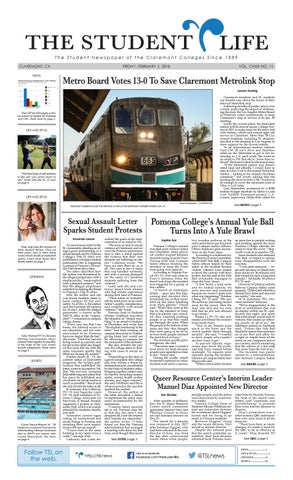
THE STUDENT
LIFE
The Student Newspaper of the Claremont Colleges Since 1889
CLAREMONT, CA NEWS
FRIDAY, FEBRUARY 2, 2018
VOL. CXXIX NO. 11
Metro Board Votes 13-0 To Save Claremont Metrolink Stop Lauren Koenig Claremont residents and 5C students can breathe easy about the future of their beloved Metrolink stop. Following months of public outcry over a study analyzing the impact of eliminating the stop, the Los Angeles Metro Board of Directors voted unanimously to keep Claremont’s stop in service at its Jan. 25 meeting. Under the current plans, the Metrolink station will be moved across College Avenue in 2021 to make room for the new Gold Line station, which will extend light rail service to Claremont. More than 50 Claremont residents, including 5C students, traveled to the meeting in Los Angeles to show support for the current station. As an international student, Salonee Goel CM ’20 can’t drive and therefore relies on the Metrolink to get to her internship in L.A. each week. She wrote in an email to TSL that she is “more than relieved” the board voted for the stop to stay. “If the Metrolink station was demolished [and not rebuilt], I would have to take an Uber/Lyft to the nearest Metrolink station ... adding to my already two-hour commute,” she wrote, adding that the funding she receives from CMC would not be enough to cover the increased costs of Uber or Lyft rides. Last September, prompted by a $300 million budget shortfall on Metro’s Gold Line Foothill Extension project, L.A. County Supervisor Hilda Solis called for
The GOP tax bill targets a critical source of income for Pomona and CMC. Read more on page 2.
LIFE AND STYLE
“The best kind of self-defense is the one you never have to use,” Emily McCabe SC ‘21 said on page 4.
LIFE AND STYLE Sarah Sundermeyer • The Student Life
Claremont residents await the arrival of a train at the Claremont Metrolink Station Jan. 31.
Sexual Assault Letter Sparks Student Protests Amanda Larson Snip, snip goes the scissors of these student stylists. They cut their peers’ hair in their dorm rooms which double as makeshift salons. Learn more about their thrifty hobby on page 5.
OPINIONS
Aalia Thomas PO ’21 discusses shifting conversations about consent from legality to morality in the wake of the Aziz Ansari assault allegations. Read more on page 8.
SPORTS
Claire Bacon-Brenes SC ‘20 breaks two Axelrood Pool records while leading Athenas’ swim and dive to 189-73 win victory over Loyola Marymount. See more on page 9.
An anonymous letter to the 5C community detailing an alleged gross mishandling of a sexual assault case by Pomona College’s Title IX office was published in a Scripps student publication Dec. 4, triggering a protest at Pomona’s Alexander Hall three days later. The letter described how the author was threatened by the alleged perpetrator with a double suicide, “made explicit with a planned weapon,” and that the alleged perpetrator admitted to making the threat to Pomona’s Title IX office. Still, the author said she was forced multiple times to leave campus for her own safety. As of Dec. 4, the author said she had been off-campus for 34 days, while the alleged perpetrator — known to the Title IX office as the “respondent” — remained on campus taking classes. “Every new day that I am home, not allowed access to my education, and not communicated to by Pomona hurts me deeper than the last,” she wrote. “I feel that I am not being treated as a person, and for me to stay silent any longer on this issue fills me with the same traumatic apathy that filled me during the assault.” Frankie Beach SC ’19, the content editor of [in]visible magazine, the Scripps publication that published the letter, wrote in an email to TSL that “the survivor contacted [in]visible mag and asked that her piece be published and circulated via social media as much as possible.” Beach said she did not edit the letter at all. In response, Kay Calloway PO ’18 and Sagarika Gami PO ’18, both members of Pomona College Advocates for Survivors of Sexual Assault, organized a protest at Alexander Hall, which was widely attended by students, faculty, and staff. Attendees carried signs calling for institutional and social change at Pomona and detailing their own experiences with sexual assault. “I have class in the same building as my rapist twice a week,” one sign read. Calloway and Gami de-
Follow TSL on the web.
scribed the goals of the demonstration in an email to TSL. “We want an end to sexual violence at Claremont, and we want the Pomona administration to take a stand against the violence that their own students are inflicting on others,” Calloway wrote. “We have not seen them do so at all. This case is one of many that was handled wantonly, and with a serious disregard for the safety of Claremont students suffering from this violence.” Gami said she and Calloway heard from alumni who had similar experiences during their time at Pomona. “These kinds of ‘mistakes’ tell the tired story of our institution’s apathy, complacency, and complicity with sexual violence,” she wrote. Pomona Dean of Students Miriam Feldblum described the situation as “deeply troubling” in an email to students in December, and wrote that “the student mentioned in the letter” had been residing off campus since prior to Thanksgiving break and would not be returning to campus for the remainder of the semester. She also detailed the process the college takes in dealing with cases of sexual assault. “Depending on the facts of a given complaint, the College also may initiate a threat assessment process, coordinated by the Dean of Students office, bringing together subject matter experts, including campus safety, mental health professionals, and legal counsel,” she said. Feldblum said this is what occurred in the case that sparked the protest. However, the author of the letter described a failure to implement the safety measures recommended by the assessment. “Campus Safety escorted me to my Pomona class later that day, but once I was dropped off, I saw the respondent outside my classroom,” the author wrote. “I later found out that the Pomona administration had arranged a meeting with them for that time, even though they knew See LETTER page 3
http://tsl.news
See METRO page 3
Pomona College’s Annual Yule Ball Turns Into A Yule Brawl Sophia Sun Pomona College’s annual Yule Ball party turned violent last December when physical conflict erupted between students trying to enter Frary Dining Hall and Campus Safety officers blocking the entrance to keep the event from going over capacity. According to Virginia Pascal PO ’21, who was close to Frary’s entrance when the brawl took place, the incident was triggered by a group of line cutters. “A bunch of seemingly drunk ... guys saw this happening and decided they would join too, so they stumbled up the stairs breaking even more glasses,” Pascal said. “When they were at the top by the entrance of Frary that was already very crowded, they [started] pushing people in so that they could get through the door. When the people at the bottom of the stairs saw this, they thought they were going to be let in, so even more people stormed the front level of Frary.” The situation quickly grew dangerous, she said. “The entire time I couldn’t even move my body because people were squished so close to me,” Pascal said. During the scuffle, which bystanders captured on video, students took down a decora-
tive wooden archway at the entry and tried to use it to push past Campus Safety officers. Others shattered glass decorations on the Frary steps. According to a statement by the Pomona Events Committee, which held Yule Ball, Campus Safety officers feared for their safety as the incident became violent. Officers were unable to block the crowds with their bodies, but the staff at the Yule Ball eventually managed to close the Frary doors. “I first heard a loud noise and we looked outside; we were nervous and confused because we weren’t quite sure what was happening,” Kristine Chang PO ’21 said. “We saw the archway was being carried away by the crowd. Then the door was shut and we were told that no one was allowed to go inside.” Emma Li PO ’21 also witnessed and filmed the incident from inside Frary. “Two of my friends were stuck in the front and the crowd pushed them through security,” she said. “I wanted to show people who couldn’t see how crazy it got.” To prevent injuries, organizers shut down the event, and had Frary cleared before midnight. No injuries were reported during the incident, Director of Campus Safety Stan Skipworth said. “When crowd safety became
an issue due to people rushing and pushing against the door, Pomona College officials decided to clear the event,” Skipworth wrote in an email to TSL. Some students who attended Yule Ball, or hoped to attend, were disappointed with the outcome. “I was quite annoyed … especially because we [had] only been inside for 30 minutes and had waited for such a long time outside,” Sei-kashe M’pfunya PO ’21 said. However, M’pfunya said she believes Campus Safety acted properly. “[They] did what they should have done and ensured our safety,” she said. In its statement, PEC criticized students’ behavior. “We’re disappointed at the level of entitlement that was on display within our 5C community last night, and upset that individuals would turn to violence that ended up reflecting poorly on all of us,” the statement posted on Facebook read. “Events like Yule Ball should be spaces that represent us at our best and allow for a night of respite from all the stress on our campuses and in our country, and it’s concerning that the actions of a few took that away from the rest of us.” The incident was partly caused by a miscommunication between Campus Safety See BRAWL page 3
Queer Resource Center’s Interim Leader Manuel Diaz Appointed New Director Erin Slichter After months of deliberation, the 7C Queer Resource Center search committee appointed Manuel Diaz and Pharalyn Crozier as director and assistant director on Dec.15. The search for a director was reopened in July 2017 after Jonathan Higgins, who had been selected as the new director in June, was fired the day after controversial tweets about white people,
Like us on facebook: facebook.com/thestudentlife
straight people, and the police were discovered by conservative media. Pomona College Dean of Students Miriam Feldblum denied any connection between the revelations about Higgins’ tweets and his firing in an email to Pomona students. Between Higgins’ firing and the recent decision, Diaz served as interim director. Despite the national pool that the search committee assembled, their final decision remained local. Pomona Asso-
@TSLnews
ciate Dean M. Ricardo Townes, the head of the search committee, said “consensus was overwhelming” to promote Diaz from interim director to director. Diaz’s promotion was a relief to many QRC staff members who were tired of all the turnover. “There have been so many changes, it’s made it hard for the QRC to be as effective as it could,” Elise Kuechle PO See QRC page 3 NEWS................................1 LIFE & STYLE.....................4 OPINIONS........................8 SPORTS...........................10
NEWS PAGE 2
FEBRUARY 2, 2018
THE STUDENT LIFE
False Hawaii Missile Alert Terrifies 5C Students Yasmine Razzak & Jaimie Ding Camryn Fujita SC ’21 had just come home after watching the sunrise Jan. 13 when she got the notification. At 8:09 a.m., her phone lit up with these words: “BALLISTIC MISSILE THREAT INBOUND TO HAWAII. SEEK IMMEDIATE SHELTER. THIS IS NOT A DRILL.” “It was a feeling of utter helplessness, isolation, and fear,” Fujita said. “I thought I was going to die that day.” Though there wasn’t actually a missile speeding towards Hawaii, an employee of the Hawaii Emergency Management Agency (HI-EMA) thought there was. According to The Washington Post, this individual confused a drill for an imminent attack and sent out
the alert, causing widespread alarm across the Hawaiian islands. Because she didn’t hear any sirens, Fujita’s mom began flipping rapidly through news stations and TV channels but found only regular programming. Still, the cell phone alert was more than enough to cause panic. Fujita called her grandparents and texted all of her friends. “It was awful, because everyone was saying ‘I love you’ like it was the last time we were going to talk to each other,” Fujita said. “What really hit me was when my mom was trying to reach my dad via text and he told her to tell me that he loved me.” Dayanita McCutcheon SC ’21 was the first to read the alert on her phone while her family was in a car with no shelter or
protection close at hand. While the news and shock sunk in, nearby cars began recklessly speeding, desperate to find an exit on the freeway, she said. Maj. Gen. Arthur Logan, the director of HI-EMA, contacted the U.S. Pacific Command and learned the alert was false two minutes after it was sent. He immediately got in touch with Gov. David Ige, but residents of Hawaii were left in the dark for 38 agonizing minutes, according to The Washington Post. Ana Lavongtheung SC ’21 was in Claremont warming up for a rugby game at the time of the notification. Eight minutes after the alert was sent, she opened her phone to a flurry of phone calls and texts from her friends and family on Maui. Gutted by the prospect of losing loved ones, Lavontheung’s only comfort was her brother’s hope that, because
no strike had occurred by that point, the message was a mistake. “It honestly just felt incredibly unreal, because in Hawaii we never really thought it would happen and for that split moment, it was happening,” Lavongtheung said. Ten minutes after residents received residents received the initial alert, HI-EMA and Hawaiian politicians posted on Facebook and Twitter that the alert was false, according to The Washington Post. However, many people did not find out there was no danger until 8:45 a.m. when a new cell phone notification was sent out, reading “False Alarm. There is no missile threat or danger to the State of Hawaii.” In the aftermath of the incident, HI-EMA’s administrator, Vern Miyagi, took full responsibility and resigned. The em-
ployee who sent the alert was fired. The agency also implemented measures to prevent similar missteps in the future, such as requiring a two-person confirmation process to send an alert and adding a pre-programmed cancellation alert. The incident left many wondering whether people would have been prepared for a real missile attack. Kyla Smith SC ’20, who was in Claremont at the time of the alert, found out about it after her family and others in Hawaii already knew it was false. What Smith found most troubling was residents’ lack of knowledge about protocol. Where were they supposed to seek shelter? How long would they have to prepare before impact? How would they be able to communicate with others? “I realized that if the threat
had been real, there was really honestly nothing we could have done,” McCutcheon said. “In that moment, the only thought on my mind was that if I died, at least I would die with my family.” At a time when U.S. tensions with North Korea — which has the capability to target Hawaii with a missile — are heightened and the threat of war seems less theoretical, Fujita believes that proper knowledge of emergency protocol is essential. “I think it is a good wake-up call for our local government and the rest of the island and across the nation that we need to know what to do in the case of a real threat,” Fujita said. “It’s sometimes easy to dismiss North Korea as a big joke, but that experience was definitely one of the worst moments of my life.”
Sarah Wong • The Student Life
GOP Tax Law Hits PO, CMC With Endowment Tax Samuel Breslow The GOP tax bill signed into law by President Donald Trump on Dec. 22 imposes a new tax on roughly 35 of the nation’s wealthiest private colleges, including Pomona College and Claremont McKenna College. Specifically, it includes a provision for a 1.4 percent tax on previously untaxed earnings generated by investing endowment funds at colleges with at least 500 students and endowments worth at least $500,000 per student. Pomona’s endowment, worth $1.3 million per student, easily surpases this threshhold. (Pomona is the fifth wealthiest college in the nation by this measure.) CMC’s endowment, worth $581,000 per student, also surpasses the mark. The perstudent endowments of Harvey Mudd College ($372,000), Scripps College ($347,000), and Pitzer College ($129,000) all fall below it, making them exempt from the tax. Pomona is heavily reliant on the investment earnings from its endowment, which fund 45-50 percent of its operating budget. “The $2 billion is not a checking account,” Pomona Treasurer Karen Sisson said. Sisson suggested that people “think of it as a savings account” in which one spends only the interest so that the savings can grow. She estimated that the tax could cost the college between $1.5 million and $3 million per year. CMC officials did not provide an estimate, but the college will likely have to pay roughly half as much as Pomona. The imprecise estimates result from the fact that the tax does not apply to assets “used directly” in carrying out a college’s educational purpose, but the IRS has not yet defined which assets qualify as such. “We would argue that everything we use the endowment for is an educational purpose,” Sisson said. She said Pomona is wellpositioned to weather the impact of the tax in the short term. If it falls on the low end, it could be largely absorbed by the college’s $1 million emergency contingency fund. If it falls on the high end or persists into the longer term, it could require modifications
Claremont McKenna’s ElectHer Conference Encourages Women To Run For Political Office Marc Rod
Sarah Wong • The Student Life
Lia Francis-Bongue • The Student Life
to the college’s operating budget. However, in that scenario, the college would attempt to make cuts “in areas that do not affect the student experience,” Sisson said. She emphasized that financial aid was a priority of the college and would not be cut. “There would be a lot of other places that the college would look before it would touch one penny of financial aid,” she said. Faculty and staff salaries are also most likely safe, she said. Instead, the budget might be slimmed by, for instance, delaying renovation of aging facilities by a few years. At CMC, endowment earnings fund around 30 percent of the operating budget. In lieu of an interview, CMC President Hiram Chodosh wrote an email to TSL. His statement did not address the potential cuts the college might have to make to accommodate the tax. However, Chodosh did write that the tax “punishes vital contributions that endowments make to our students and their families,
including direct support for financial aid, faculty and academic programs, and studentfacing services.” A CMC spokesperson also referenced an opinion column by CMC Trustee Harry McMahon published in The Wall Street Journal, in which McMahon warned that the tax could discourage donations, restrict financial aid, and force tuition hikes at many of the affected colleges. Chodosh referenced the same ambiguity Sisson identified as to which parts of the endowment were taxable. He wrote that the law “violates tax-exempt principles” that have traditionally shielded educational institutions. Both Chodosh and Sisson attributed the motivation behind the tax to resentment among the general public against the perceived elitism of wealthy colleges. Karin Johns, a tax policy lobbyist for an association of private colleges that includes all 5Cs, told Politico “it’s really just more of a punishment because they don’t like our sector.” Pomona’s president, G.
Gabrielle Starr, expressed similar views in a statement emailed to students Dec. 1. “I find this seeming devaluation of higher education deeply, deeply troubling,” she wrote. She warned that the tax puts the “ability of colleges as institutions to support our students, faculty, and staff ... at risk.” Former Pomona President David Oxtoby argued against taxing college endowments in a September 2016 column for The Hill. “College endowments are good and necessary investment vehicles that benefit students and the broader public,” he wrote. Harvey Mudd and Scripps would have been taxed as well under an earlier version of the tax bill that targeted all colleges with endowments above $250,000 per student, but they were spared when the cutoff threshold was raised in the final version. A controversial separate provision taxing tuition waivers for graduate students was also dropped.
5C students came together to hear from female political leaders, discuss their ideas for social change, and be inspired to take part in political affairs at Claremont McKenna College’s first ElectHer conference Jan. 19. The conference, modeled after a curriculum by Running Start — a nonprofit dedicated to bringing young women into politics and leadership positions — was designed to encourage more women to run for student government positions across the 5Cs. The conference featured an Athenaeum presentation by West Hollywood Counc i l w o m a n L i n d s e y H o rvath; a panel with current and former female student body presidents and vice presidents Hajar Hammado PZ ’18, Cristina Lee CM ’18, Lupe MacIntosh HM ’18, and Kelly Peng SC ‘18; and workshops with Running Start founder Susannah Wellford. Melanie Wolfe CM ’20 and Bryan Carlen CM ’20 devised the conference as a response to the 2017-2018 ASCMC election cycle, in which only eight people — all of them men — ran for seven positions on ASCMC, including president and executive vice president. “This event started as CMC-specific. In the last [ASCMC] election cycle, most candidates ran unopposed, and no women ran,” Carlen said. “That is a red flag for campus culture.” The ElectHer conference and accompanying Athenaeum presentation also came on the heels of a fall semester in which 38 of the 50 Athenaeum speakers were male. After Wolfe attended a Running Start conference led by Wellford, she proposed bringing ElectHer to CMC, an effort facilitated by funds from the 5C Women
and Gender Leadership Fund. With this funding, Wolfe and Carlen opened the conference to students from all 5Cs. The Athenaeum lunch talk was attended by about 60 students; approximately 16 stayed for the afternoon panel and workshops. Events like the ElectHer conference are critical for inspiring students — particularly young women — to become involved in politics and strive for leadership positions, Wellford said.
“
In the last [ASCMC] election cycle, most candidates ran unopposed, and no women ran. ... That is a red flag for campus culture.
”
- Bryan Carlen CM ‘20
“Women hold just 20 percent of leadership positions worldwide, including in politics and business ... and people don’t talk to young women about politics,” she said. “It’s so important to talk to college students, so that they can envision themselves as leaders.” “I hope the conference sparked interest in running for office or prioritizing … interest issues [that are important to them],” Wolfe added. Carlen hopes to expand the ElectHer conference and continue it in future years. “Most schools [that work with Running Start] hold the conference annually. We’re hoping that we can institute it as an annual event here too,” he said.
NEWS FEBRUARY 2, 2018
THE STUDENT LIFE
Thefts, Trespassing Rattle 5C Students Laney Pope In the wake of several recent robberies and break-ins on campus, some students are feeling rattled. On Dec. 11, three men not associated with the 5Cs approached a Claremont McKenna College student and demanded her cell phone. The next morning, a different man was arrested for burglary after sneaking into a residence hall at Scripps College. A group of Scripps students encountered the man earlier in the night at the Honnold Mudd Library. Vani Dewan SC ’21 and her roommate were studying in the library around 5 a.m. Dec. 12 when Dewan noticed a man pacing. “It was strange because it was five in the morning, and we were seeing a new face,” she said. Dewan grew more uncomfortable when the man started asking her questions, including where she lived and when she was leaving the library. The final straw for Dewan was when she saw the man hovering near her friend, who was asleep in a chair in the adjacent room. “At one point, it looked like he was touching her,” she said. Dewan woke up her friend and told her that it was time to leave. They hustled back to Scripps, locked the door, and went to sleep. When she woke up the next morning, Dewan heard that someone had broken into a student’s dorm room, so she
immediately called Campus Safety, and Claremont Police Department officers arrived soon after. The man was later identified as 20-year-old Corona resident Gaven Hughes, according to the Claremont Courier. Hughes was arrested that morning for prowling, burglary, and possession of a stolen student ID. CPD Lieutenant Jason Walters, who is investigating the incident, was unavailable to comment. No other property was stolen, but Dewan was shaken by the experience. “I think when the library is [open] 24 hours, they should check IDs, because then anyone can come in,” she said. Director of Campus Safety Stan Skipworth wrote in an email that the colleges work closely with the CPD and also share crime trends with other private and public colleges to prevent similar occurrences. “While the recent incidents are particularly unusual for our campuses, Campus Safety considers every crime a genuine concern,” Skipworth wrote. Scripps took additional steps — including conducting a “safety sweep” of the residence halls to identify any potential security breaches — following the recent crimes, Scripps spokeswoman Karen Bergh wrote in an email to TSL. The college is also reviewing its lockout fee policy, under which students are charged a fee if they are locked out of their room. “We have received feed-
back that these fees may be discouraging some students from locking their rooms upon leaving the space,” Bergh wrote. On Jan. 20, Jonathan Gunasti PO ’20 heard a knock on his door, and opened it to find a college-age man he did not recognize, he said. When Gunasti asked who the man was looking for, he said, “Sorry, I thought this was a girl’s room.” Gunasti asked which girl he was looking for, and the man responded, “I just thought a girl lived here.” The man told Gunasti that he was not from the 5Cs, and said he was “from Germany.” The man then pointed to the adjacent dorm room and asked, “Well, is that a girl’s room?” At that point, Gunasti contacted some other residents in the dorm, and they eventually got the man to leave. Earlier in December, Anna Barker PO ’21 said that, while working in the Coop Fountain, she noticed a man in his 30s staring at her. “He asked me if I had any lotion, and I didn’t know how to respond,” she said. Some of her friends at another table saw that Barker seemed uncomfortable, and told an employee at the Coop. Eventually, Campus Safety came and escorted the man out. “I was weirdly scared to walk home that night,” Barker said. “I had never felt that way before.”
Backup Generator Failure Leaves Pomona Students In The Dark Angela Tran
Power went out in most facilities on Pomona College’s South Campus Monday, including dorms, dining halls, and academic and administrative buildings, from the early morning until 2 p.m. Southern California Edison was scheduled to perform maintenance on the main power generator lines that serve all 5Cs, requiring SCE to turn off power to the colleges from 2 a.m. to 5 p.m. The colleges’ backup generators were expected to be able to meet the electrical demand. However, one of Pomona’s generators failed, causing a power outage that left students on Pomona’s South Campus in the dark for hours, wrote
Robert Robinson, the assistant vice president of facilities and campus services, in an email to TSL. “[The failure of] one of the generators … had a cascading effect that required the shutdown of the feeder that provides power to South Campus,” he wrote. Many South Campus dwellers woke up to pitch-dark hallways and a closed Frank Dining Hall, which Sarah Varenhorst PO ’20 said disrupted her morning routine. “[I] did essentially have to shower, brush teeth, etc. in the dark,” Varenhorst wrote in a message to TSL. Academic buildings such as Thatcher Music Building, Pendleton Dance Center, and Lebus Court lost power en-
tirely, while Hahn Hall, Lincoln Hall, Carnegie Building, Crookshank Hall, Mason Hall, and Pearsons Hall experienced repeated interruptions. Jessica Orvis PO ’21 attended class in Hahn Hall in the afternoon, which she said had many interruptions due to the outage. “We eventually had to stop using the projector altogether and I felt like we missed out on a part of class because of it,” Orvis said. Robinson apologized for the inconvenience caused by the power outage. “[Facilities] appreciates the patience, understanding, and efforts by the members of the Pomona College community… [during] this disruption,” he wrote.
QRC: Diaz and Crozier Promise 7C Engagement Continued from Page 1 ’21 said. Kuechle described Diaz as experienced, supportive, and welcoming. She said he already seemed well-established by October, with good goals and a strong vision. “I had worked with [Diaz and Crozier] before and they made a really good team,” Kuechle said. “I thought they would be able to make change faster than somebody new.” Though Townes was not involved in the previous search that resulted in Higgins’ selection, he acknowledged several critiques that search received and strove to avoid those issues this time. One such critique was that the search seemed Pomonacentric, even though the QRC serves all 7Cs. “I wasn’t going to repeat that,” Townes said. “I wanted people to see it like it was ... a 7C search.” To achieve this goal, the committee incorporated voices from every campus, including students and staff, Townes said. It also carefully worded the announcement for the director to make it clear it was a 7C position. Another critique of the previous search was that it involved insufficient communication with students. To avoid that issue this time, the committee held listening and Q&A sessions with students. Townes told TSL last September that he hoped the director position would be filled by Thanksgiving. However, it took additional time and effort to assemble a strong pool of candidates, even with the help
of a search firm, he said. Diaz, while studying at Claremont Graduate University, first became familiar with the QRC under former director Adriana di Bartolo and assistant director Al Forbes. After Higgins was fired, Forbes asked Diaz if he would serve as interim director, and he officially joined the QRC staff. As director, Diaz plans to make the QRC more of a presence on all the campuses. So far, he has worked to forge relationships between the QRC and LGBTQIA+ groups across the 7Cs and scheduled lunchtime office hours at every dining hall. He also plans to hold events on each of the campuses. Diaz’s other goals include holding four ally training sessions this semester, building a relationship with ASPC, making the QRC more welcoming through drop-in hours, an “open-door policy,” and providing a space for different LGBTQIA+ communities to meet. “I would love to have this center become nationally recognized as one of the premier LGBT centers for students in the country,” he said. Crozier, who worked previously at the QRC in the temporary position of student support manager, was appointed the new assistant director. Crozier echoed Diaz’s goals of building community and making the QRC a more welcoming place. “I want to see an increase of students really making the most of this space, because this space belongs to students,” she said. She also plans to hold en-
gaging educational events across the campuses to create an inclusive 7C LGBTQIA+ community. “I want us to be part of the bridge that creates that,” Crozier said. Students have been following the QRC director saga closely. Gabe Abdellatif PO ’21 became interested in the QRC after Higgins’s firing. “I think they made a good choice considering the fallout from that,” he said. Lillian Perlmutter SC ’21 said the QRC could do a better job of publicizing its events, and said she has broader concerns about the QRC as an institution. “I’ve never gone to a QRC event and that’s because it has to do with sexuality. … The idea of an event that has to do with sexuality being run by the administration is weird to me,” she said.
Courtesy of Cal Poly Pomona
Manuel Diaz served as interim director of the QRC before being appointed director Dec. 15.
PAGE 3
LETTER: Title IX Coordinator Reaffirms Committment To Students Continued from Page 1 my class schedule and the respondent was under severe restrictions to avoid my classes.” Additionally, the Campus Safety escort assigned to take the student from the class failed to show up, the letter said. Sue McCarthy, Pomona’s Title IX coordinator, reaffirmed her support for working collaboratively with students in an email to TSL. “We are committed to continuing to improve Pomona’s policies and procedures, as well as ensuring … safety for our students,” she wrote. “We have continued to meet with and work collaboratively with students, faculty and staff across campus.”
Ethan Ong • The Student Life
Pomona college students protest outside Alexander Hall on December 7 in light of sexual assault controversy on campus.
BRAWL: Conflict Caused By Miscommunication Continued from Page 1 and the organizers about the maximum number of people they could allow inside, said ASPC Vice President Andy Pelos, who helped organize the event. Without the miscommunication, Pelos said, Campus Safety could have allowed 100 more students inside.
“We were actually in the process of communicating with Campus Safety. If we [had had] five more minutes, the event [wouldn’t have had] to be shut down,” Pelos said. The day before the event, student organizers and Campus Safety staff met to discuss the number of Campus Safety officers needed for Yule Ball and finally agreed on using
six officers, Pelos said. Taking into account the fact that Yule Ball was open to all 5Cs, ASPC requested security based on a plan called “Pomona Plus Guests.” However, according to Pelos, an “unprecedented number of students” attended, perhaps because “Yule Ball was held at the end of the semester when everyone wants to relax.”
METRO: Task Force To Analyze Local Transit Continued from Page 1 a study to investigate the impact of eliminating Metrolink stations along the extension route. “When my office was first approached about the urgency related to procurement packages for the Foothill Gold Line, I was deeply concerned about some discussions that would eliminate this station. I sprang into action and requested an in-depth study that required community input,” Solis wrote in an email to TSL. The study investigated eliminating Metrolink stations in several cities, including Claremont. Demolishing the station instead of rebuilding it across the street would have saved approximately $40 million, but it would have left Claremont without
a train station from 2021 until the Gold Line extension opens in 2027. Hundreds of Claremont residents and 5C students filled a town hall meeting in December to voice their concerns about that possibility. Based on the outpouring of community criticism and the findings of the study, the Metro staff recommended to Metro’s Planning and Programming Committee that Claremont’s Metrolink stop be kept. The committee voted Jan. 17 to forward the recommendation to the Board, whose members made it official last Thursday. Katie Baughman SC ’18 attended the women’s march in L.A. on Jan. 20, and used Metrolink to get there. “Without it, I definitely wouldn’t have had as easy a time getting into the heart of L.A.,” she said. “It’s just nice
to have something so accessible and close to campus. … It would [have been] a shame if losing the Metrolink kept students from having that opportunity.” The Metro Board next plans to proceed with a staff-level task force, which will look at “how Metrolink, the Gold Line, and other transit services will complement each other to provide greater transit services along the rail corridor,” Claremont City Manager Tony Ramos wrote in his weekly update. The Gold Line Foothill Extension will parallel the Metrolink between Pomona and Montclair, offering faster service, easier transfers, and $1.75 fares to destinations like downtown L.A. and Pasadena. Meghan Bobrowsky contributed reporting.
After Destructive Hurricane Maria, Pomona Admits Two Visiting Puerto Rican Students For Free Semester Miranda Sheridan After Devastating Hurricane Maria, Pomona Admits Two Visiting Puerto Rican Students For Free Semester In light of the destruction from Hurricane Maria, Pomona College admitted two students from Puerto Rico in a visiting semester program for the 2018 spring semester, waiving their tuition as well as room and board fees and providing a $1,500 stipend. Wesley Sanchez, a senior at the University of Puerto Rico, Maragüez, is one of the participants in the program. “When my mother and I walked back to our house, and there had been landslides and fallen trees, we were in shock,” Sanchez said. “At one point, there were 18 people crowded into one house.” Sanchez said his family rarely had internet, so accessing the application during the hurricane was the most difficult part of applying to Pomona. He said technical issues, along with transferring schools so abruptly, have been his biggest difficulties so far. However, Sanchez said that Pomona students have been very friendly and that faculty correspond with him constantly, checking on his situation. The other participant in the program, Yarelis Marcial, is also from the University of Puerto Rico, Maragüez, where she’s a junior. Like Sanchez, she experienced many strug-
gles during Hurricane Maria. “I lived near a water reserve, so they would have to bring in trucks of water and cut off the surrounding area,” Marcial said. She said she is grateful for Pomona’s support and financial aid, as well as the warm welcome from administrators and fellow students. Adam Sapp, Pomona’s director of admissions, wrote in an email to TSL that the application process for the visiting semester program, which opened in November, was specifically designed to be accessible to undergraduates during the natural disaster. “The admissions office created a special application process for students applying from Puerto Rico,” he wrote. “We wanted to make sure we balanced our obligation to obtain appropriate academic and supplemental materials with the realities on the ground — access to power and internet for these students was very limited. In the end I feel we created a process that was accessible, flexible, and studentcentered.” The program could have accepted up to ten students, according to a press release published by Pomona in December, but spokesperson Marylou Ferry said the administration “was pleased with the number of students who applied and the number who accepted our offer of admission.” Sapp said he was not aware of any plans to extend the program beyond the end of this semester, which could potentially be a problem for Sanchez and Marcial if
recovery efforts in Puerto Rico are not completed by then. Although Sanchez expects to graduate this semester, he did lament that he cannot take advantage of Pomona’s internship resources. “I wish I could apply to the interesting internships they have over the summer,” Sanchez said. “But since I graduate in May, and I don’t technically go here, it’s unlikely that I will be able to take advantage of those opportunities.” Other Pomona students not part of the program were also affected by the hurricane. Jaime Gonzalez PO ’21 is from Dorado, Puerto Rico, and his family also had to ride out the hurricane. Gonzalez said he received a lot of empathy and compassion from fellow students and faculty, but felt regret at how helpless he was to assist them. “I wish I had taken more initiative,” he said. Sapp hopes the program will have benefits not just for Sanchez and Marcial, but for the broader Pomona community as well. “I am thrilled that the Pomona community will have the opportunity to engage and learn from our incredible students visiting from Puerto Rico,” he wrote. “I am also confident that these students will find their Pomona experience a valuable one and that they will thrive here — not just in the classroom, but outside of it as well.”
LIFE & STYLE PAGE 4
FEBRUARY 2, 2018
THE STUDENT LIFE
How Did Scripps Get Its Name Anyway? The Stories Behind The Names Of The Colleges And Buildings On Campus Glen Williams
How’d Scripps Get Its Name Anyway? The Stories Behind The Names Of The Colleges And Buildings On Campus What’s in a name? Sumner Hall, Denison Library, Benson Hall, Platt Campus Center, Pitzer College — there are many names of places heard by students every day. Yet, few know the meaning behind the names or the original intent behind these buildings. Pomona College Sumner Hall is deeply connected with the college’s history, though its original purpose wasn’t collegiate. “Built in 1887 … the Claremont Hotel (now known as Sumner Hall) was an ill-fated project that never truly served as a hotel,” according to the Pomona College Timeline. However, it was wellsuited for a new college in search of land and “the primary reason the institution ended up (in Claremont).” The name itself speaks to Pomona’s Protestant past. Charles Burt Sumner was the first pastor of Pilgrim Congregational Church in Pomona and a founding trustee for the College. Connections to that particular church extend beyond Sumner Hall. In 1929, with the school in need of a dining hall for the men (women ate at the Claremont Inn, a now-demolished local landmark), Frary Hall was constructed, funded “by Trustee George W. Marston, who insisted on anonymity at the time,” the Timeline states. Marston “suggested the hall be named for Lucien Frary, a Congregational minister who had taken over as pastor,” according to the Timeline. Mudd-Blaisdell is named, in part, after Pomona’s fourth President, James A. Blaisdell. Described by the Timeline as “one of the most influential and best remembered presidents in Pomona’s history,” he greatly expanded the school’s land and economic resources with his “Million Dollar Campaign.” Most importantly, he played a “key leadership role in founding the consortium known as The Claremont Colleges,” according
to the website. Though it shares its name with a county of the Holy Roman Empire and an important Scandinavian dynasty, Oldenborg Center was not named after a king but rather a generous businessman whose background inspired his philanthropy. “He had been a world traveler whose goal as a philanthropist was to ‘strengthen communication and understanding among nations and thereby contribute to world peace,’” according to the Timeline. It is typically assumed that donors have a strong personal connection with the institution they are donating to, but this was not the case with the donor for the Rains Center. In an unexpected gesture, Liliore Green Rains bequeathed $240 million to four schools, including Pomona, and two hospitals upon her death in 1986, according to The New York Times. While she was not an alumna of Pomona, one of her nephews had attended the school. Scripps College Scripps College was named after its founder, Ellen Browning Scripps, described by the school’s website as “a reporter, global suffragist, businesswoman, and philanthropist … an early and ardent supporter of women’s suffrage.” She was also integral to helping acquire the land for the other colleges beyond Pomona and setting up the consortium, alongside Blaisdell. The residence hall Susan Miller Dorsey was named in honor of “the first woman superintendent of schools in Los Angeles and one of the first trustees selected,” the Scripps College Timeline states. Typically, art is commissioned to fill a space, yet the opposite was the case with the Denison Library, which was made to display a specific piece of art. “A desire by the donor, a Denver philanthropist, to place a stained glass window on the Scripps College campus led to the building of the Ella Strong Denison Library in 1931,” the History of Denison Library reads. The beautiful Gutenberg displays “the evolution of the written word
Jordan Wong • The Student Life
and is dedicated ‘to the greater wisdom of women.’” Claremont McKenna College Originally known as Claremont Men’s College when it opened in 1947, Claremont McKenna College did not receive its current name until 1981, five years after it had become coeducational. It honors “the role of the founding benefactor and trustee Donald McKenna,” according to CMC’s college history. It also had the benefit of keeping the CMC acronym intact. Benson Hall was named after the first president of CMC, George Benson, a veteran of World War II, and his wife, Mabel Benson.
Harvey Mudd College Harvey Mudd College honors Harvey Seeley Mudd, who died the same year the college was founded. He was a mining engineer who co-founded Cyprus Mines Corp, an L.A.-based company that began with the development of copper mines on the island of Cyprus, according to the HMC website. Joseph B. Platt, after whom HMC’s campus center was named, was the founding president of HMC. “At the University of Rochester, he taught physics and helped develop night vision optical devices
Students On The Offense: 5C Self-Defense Classes Stephanie Du “No matter how tall you are, what your background is, your race or ethnicity, the wealth you have, you can easily be a victim,” self-defense instructor Lauren Froehlich SC ’20 said. Being a victim is something that nobody wants to think about, but in college settings where sexual assault and confrontations are a reality for many, the ability to defend oneself is essential. Luckily, a multitude of self-defense classes are offered across the 5Cs. From student-led sessions to P.E. classes offering credit, students can easily choose the class that is right for them. Each class has a different structure or focus. Alex McDonald CM ’21 teaches a class that interlaces intensive cardio with self-defense tactics. Others focus on empowering students, such as a women’s self-defense class led by Emily McCabe SC ’21. McCabe has assisted in women’s self-defense classes before and was excited to teach it to Scripps
College first-years. “I thought maybe self-defense could contribute to the culture of empowered awesome women,” McCabe said. Her first class taught how to block, palm strike, and escape chokeholds. Besides these basic techniques, the participants learned that self-defense relies on a quick reaction time, being loud, and being both strong and intentional with their movements. Class president Julia Kelly SC ’21 attended McCabe’s class and found it useful. Kelly believes Scripps students are individuals who feel “empowered intellectually and should also be met with that feeling of empowerment physically.” Self-defense skills give that sense of safety and capability. In the future, McCabe is interested in expanding the class to upper grades and other schools. “[Martial arts] tends to be a really positive force in people’s lives,” McCabe said. “It builds confidence, it’s really fun, and it’s a really valuable practical skill.”
Alex McDonald CM ’21 provides a different focus with his Mixed Martial Arts classes. What started as boxing classes quickly became MMA as more students started expressing interest. He believes that self-defense skills don’t just help in dangerous situations; they boost self-confidence, too. “It was only a matter of time before I started to expand the boxing club to be more self-defense centered,” McDonald said. McDonald’s classes are held at Roberts Pavilion on Mondays, Wednesdays, and Thursdays from 6 p.m. to 6:45 p.m. with the advanced classes on Saturdays 10:30 a.m. to 11:30 p.m. The classes are cardio intensive with drills involving practicing combos with partners and shadowboxing. McDonald said that all are welcome. MMA is his passion and he wants to see the club flourish at the 5Cs. Self-defense P.E. classes are also being held at the colleges and can be found through the student portal. Women’s Empowerment Self-Defense (PE J 028) has been taught at the 5Cs since the 1980s
and involves male instructors putting on 40-50 pounds of body armor, while the students practice self-defense tactics on them. Froehlich said that the class “gives tools to women that can help them take their own biological advantages and use it against the attacker, and use it to live without fear.” The class structure combines martial arts, military combat skills, criminology, and psychology, along with learning theories, including how the female and male brain work. It will be held on Feb. 3 and Feb. 10 as two ten-hour segments. The class costs $50 for 5C students and $475 for all other participants. Learning self-defense can seem intimidating, but it can save one’s life. These classes offered are practical, interactive, and empowering, providing 5C students with valuable skills. That said, “the best kind of self-defense is the one you never have to use,” McCabe said.
Talia Bernstein • The Student Life
Elisabeth Lawton SC ’21 breaks a board using a palm strike on Jaqua Quad on Jan. 27.
for use during World War II. He spent most of World War II at the radiation laboratory at The Massachusetts Institute of Technology, where he put his knowledge of radar devices to practical use for the United States Air Force,” according to his obituary on HMC’s website. Besides serving as HMC’s president for twenty years and increasing both faculty numbers and student enrollment, he was notable for his quirky physics classes. “Platt, who took up the guitar as a child, often played and sang short ditties laced with technical terminology to entertain his students and to teach scientific
principles,” according to HMC’s website. Pitzer College Not only is the name, but the very occupational industry of the honored man who named Pitzer College evident in the school’s logo and signature color. “Pitzer College was named for noted philanthropist and orange grower Russell K. Pitzer,” according to Pitzer College’s official history. In these and many other ways, each of the 5C colleges honors the enduring history of impactful individuals, waiting to be rediscovered each generation.
FILM COLUMN
“The Post”: A Film So Shallow And Useless, It Might Just Win Best Picture Ben Hafetz In 2018, the American public craves a film that rebels against the corruption of the Trump Administration and its repeated attacks on both the press and free speech. Enter Steven Spielberg’s newest film, “The Post,” with a plot centered on the true story of The Washington Post publishing the Pentagon Papers. With a plot supposedly focused on this successful attempt to expose the lies of the U.S. Government during the Vietnam war, “The Post” should champion the villainized press. Instead, Spielberg’s film fails not only as an act of resistance against the American government, but also as a work of art itself. While Katherine Graham (Meryl Streep) makes some mention of the loss of U.S. soldiers, “The Post” omits the massive atrocities that the United States committed against the Vietnamese people. This incomplete portrayal of the Vietnam War disqualifies the film from ever being considered a form of rebellion against the corruption of the U.S. government. The film’s script fails to engage the audience emotionally. One would expect a film about the Pentagon Papers to use the body count of the Vietnam War and subsequent lies of the U.S. government that prolonged the war as the film’s emotional core. Instead, “The Post” shallowly focuses on the story of Graham risking the ownership of The Washington Post and her personal relationships with Washington officials. By neglecting to fully critique the Vietnam War, the film does not portray the full significance of the press’s role in the Pentagon Papers, thus making the audience lose sight of why freedom of the press is needed in the first place. Graham’s bravery in publishing the Pentagon Papers is shown in tedious scenes taking
place in boardrooms, where bland investors question the profitability of The Washington Post, or even duller scenes where Graham must cope with betraying her war criminal friends involved in the Papers. These friends include people like Robert McNamara (Bruce Greenwood), who was heavily involved in lying to the American people in order to prolong the war. Graham herself is not even a compelling character; she is a multi-millionaire terrified of becoming just a simple millionaire. By centering the story around Graham, “The Post” becomes a film in which the lies of the government during the Vietnam War serve as background for the story of an absurdly wealthy mogul risking a fraction of her fortune. The immense amount of talent behind “The Post” only magnifies its failure. Most notably, of course, is Spielberg: a director whose mere involvement with a project thrusts it into the national spotlight. While Spielberg’s celebrity draws a noteworthy cast — including Streep, Tom Hanks, Bob Odenkirk, David Cross, Sarah Paulson, and Michael Stuhlbarg — none of the actors were able to save the deeply flawed material. Despite Spielberg’s prestige, this film marks the encroaching decline of his legendary career. In fact, the film’s cinematography parallels my own unabashed disinterest. Its monotony is epitomized in endless shareholder meetings where the camera seemingly falls asleep filming closeups of men explaining The Washington Post’s probability numbers. Ultimately, “The Post” is a shallow and rushed film, masquerading as important with the claim of good intentions. There is need for a film that resists the past and present corruption of the U.S. government and displays the power of the free press. “The Post” is not this film. Instead, I recommeand rewatching “All The President’s Men.” 2/5
LIFE & STYLE FEBRUARY 2, 2018
PAGE 5
THE STUDENT LIFE
Learning In Budapest: Student Pursues Teaching Passion Abroad Lauren Ison When Sophia Hui PO ’19 left for her study abroad program in fall 2017, she wasn’t sure if the Pomona College Study Abroad Office would approve the program. But even if it meant taking a leave of absence from Pomona, Hui was intent on attending the Budapest Semester in Mathematics Education program (BSME). “I knew I wanted to study abroad in general, but once I came across this program, there was no way I was going to do anything else,” Hui said. Hui first heard about the program from Erica Flapan, Pomona’s Lingurn H. Burkhead Professor of Mathematics. Flapan is Pomona’s liaison to the well-known Budapest Semester in Mathematics program (BSM), a program related to BSME. Unlike BSM, BSME is specifically focused on math education, although students can take BSM classes as well. According to the BSME website, “BSME is specifically intended for those who are not only passionate about mathematics, but also the teaching of mathematics.” For Hui, a math major with a longstanding interest in teaching, this program was the perfect fit, as well as a unique opportunity to learn about how math is taught outside of the United States. Last fall, Hui petitioned the study abroad office to approve her program, although she was unsure whether the office would approve a program with a slightly pre-professional angle. However, while Hui was in Budapest, Pomona’s Director of Study Abroad Nicole Desjardins Gowdy visited the BSM and BSME programs and later pitched the BSME program to the study abroad committee, which approved the program. Gowdy said that the math department’s support for the program, as well as Hui’s positive
review, contributed to the study abroad committee’s decision to make BSME an approved Pomona study abroad program. In addition, the Study Abroad Office determined that the courses were not too pre-professional in that they focused not only on specific skills but also on theory and reflection. The program was “in many ways ideal,” as it captured student interest while centering on the academic experience, Gowdy said. Hui’s courses included a research seminar focused on the gender gap in mathematics in Hungary as well as a practicum in which students visited a different high school each week to observe classes. At the end of the semester, BSME students taught a lesson at one of the Hungarian high schools. Hui said that the practicum was where she “really got the cultural aspect of the study abroad program.” Gowdy also cited the experiential component of BSME as one of the things that makes the program unique. “It’s really taking math as the lens and as the vehicle to learn about the culture, to learn about some of the differences in approaches to math, and some of the differences in problem solving and creativity in general,” Gowdy said. According to Hui, BSME students are exposed to the “Hungarian method” of learning math, which prioritizes critical thinking skills over computational problems and asks students to “apply concepts you’ve learned from all across mathematics to solve this one problem.” “I think it’s a really creative way to learn mathematics, and you just learn so many skills you can take away into your other pure or applied math classes,” Hui said. In addition, Hui said that she left BSME with more confidence
in her teaching abilities and a new desire to pursue teaching immediately after graduation, rather than waiting a few years until she had more experience. Hui’s Budapest teaching experience is especially valuable given that opportunities to study education are few and far between at the Claremont Colleges. Although Hui took an education-focused class at Claremont Graduate University, she doesn’t know of many education courses at the 5Cs, nor does she often hear about post-grad opportunities in education. “I feel like I hear more about grad schools, consulting, going into tech, especially in the math department,” Hui said. Like Hui, Allison Kirkegaard PO ’19 has found creative ways to pursue her interest in education. In addition to taking a course at CGU, she studied the impact of Confucianism on education in China as part of her Middlebury study abroad program last fall. However, Kirkegaard, a math and cognitive science double major, also said she would like to see more education-focused courses at the 5Cs, as well as more guidance from Pomona’s Career Development Office for pursuing careers in education. For now, education-oriented students have at least one new opportunity available: BSME, the only Pomona approved study abroad program with a specific focus on education and the second approved program with a math focus. Hui emphasized that BSME can appeal to students with a wide range of interests. “You don’t need to want to be a teacher to do this program,” Hui said. “If you’re just interested in how they teach math or how you can learn math differently, and if you’re interested in the broader field of mathematics education, then it’s the program for you.”
Thummim Mekuria • The Student Life
Sophia Hui PO ’19 is back from a math study abroad program that she helped design.
Say Goodbye To Salons And Hello To Student Stylists At The Claremont Colleges Mabel Lui Holding up a pair of typical craft scissors, Natalie Marsh SC ’19 smiled and shrugged as she told me her hair cutting tool of choice is a stationary drawer staple. Several students within the 5Cs have adopted hair cutting as a side hobby, delivering everything from trims and layers to undercuts and bangs. For 5C student stylists, hair cutting seemed to be a hobby that stemmed organically. Marsh, along with other student haircutters Minica Casbara PZ ’21 and Namrata Dev CM ’19, all developed their affinity for hair cutting before coming to college. Dev was put off by a bad haircut when she was about 12 years old, after which she promised herself, “‘I’m never going to the hairdresser again.’” Marsh, on the other hand, found inspiration from her mother, who would cut her bangs for her when she was younger. Since then, both Dev and Marsh have taken their hair into their own hands, finding additional motivation along the way. Dev began cutting hair in Claremont in hopes of receiving enough tips for a tattoo removal procedure, while Marsh believes that “some things
like [hair cutting] are just easy tasks that you can teach yourself in order to save a little money.” Once, Marsh caught a friend of hers checking himself out in the reflection of the china cabinet at her house saying, “I look like I have a mullet!” Marsh instinctively offered her services, and since then she’s been cutting her friends’ hair. For Casbara, a passion for art and customer interaction has led her to maintain hair cutting as a hobby. She radiated with pride as she explained what motivated her. “I like making people feel confident in themselves and their bodies and [making] them feel beautiful,” Casbara said. “When that happens, it’s just a very gratifying feeling.” Dev agreed, commenting that her favourite haircuts are the drastic ones. Technically, it is illegal to perform haircuts and receive compensation without a cosmetology or barber licence, so both haircutters simply receive tips. Dev receives tips of $5, inspired by the cheap hair cutting prices in her hometown of India, while Casbara generally receives tips of $10 for a full cut and $7 for bangs, trims, or other touch-ups. “The dorm that I’m in really
inspired the idea to cut hair here,” Casbara said of her single room at Pitzer College, where all her hair cutting takes place. “The space I have is perfect because it’s halfcarpeted, and the other half is cement, with a sink and a big mirror. So, I just set the chair in front of [that area].” Marsh has largely adopted a do-it-yourself approach. Like the stationary scissors, her setup is impromptu. She uses tapestries to protect her clients’ clothing and trashbags to cover the floor. While Marsh has cut short hair before, she prefers cutting long hair because she needs less equipment. In contrast, Casbara finds that short-haired clients usually become her regulars since their style requires more maintenance. Her expertise also includes undercuts, fades, and even eyebrows. According to Casbara, cutting one’s hair is a significant stylistic personal choice. “You can change up hair any way you want to,” Casbara said. “You can dye it, you can cut it, you can shave it.” Casbara feels lucky to be the person who helps create that change and have such a good rapport with clients. Many of them leave her makeshift salon not only with a new haircut, but a new
friend as well. “To have people trust me enough to be able to cut their hair, to get them to that stage— I’m honored to be able to do that,” Casbara said. Student feedback has also been overwhelmingly positive. Of a haircut done by Dev, another student Alice Chen CM ’19 said, “My hair was really long and I was in desperate need of a haircut. ... It honestly looked like I went to a salon or something. Very well done; exactly what I wanted.” For now, both Marsh and Casbara are happy with their skill set and don’t have plans to venture into other types of hair styling. Dev, on the other hand, hopes to take a proper cosmetology course and possibly a hair dyeing course in the future. For aspiring hair cutters, both Dev and Marsh recommend watching YouTube tutorials and following Instagram pages. Casbara believes in just diving in, scissors-first. “Don’t be afraid,” Casbara said. “You learn so much when you’re working with different people and their different hair, and I would definitely recommend it.”
Maya Jotwani • The Student Life
Natalie Marsh SC ’19 enjoys giving her friends haircuts on campus.
Becoming Positive About Sex Positivity Mona Lott CW: Mention of sexual trauma, slut-shaming I’m going to let you in on a little secret: I don’t masturbate. Now, as a self-proclaimed p r o g r e s s i ve wo m a n l i v i n g in the 21st century (and in a single room), I realize how odd that may seem to those who rub one out on the daily. It may also appear contradictory when one looks at my tracklist of sexual endeavors, with hit features such as BDSM, public sex in garages, and “that one time I tried anal and realized it wasn’t for me.” I’m a sexual person, and I love sex in (almost) all forms, but I’ve never learned to be comfortable with sex with myself. When I would masturbate, it was usually for the viewing or listening pleasure of my partner at the time. It never occurred to me that while I defined myself as “sex-positive,” I was still missing that integral part of self-love. I can attribute that to a lot of reasons: Maybe it has to do with the fact that I’ve dealt with a lot of sexual trauma in my life, or the fact that I grew up in a country where slutshaming is prevalent and enthusiastic conversations about sex are considered taboo. Either way, I’m growing a little weary of letting my past restrict my sexual experiences, or of only having “sleepgasms” (Yes, females actually do this, even if their experience may be a little less “wet”!). While my journey to selfpleasure is just starting, here are a few things I’ve learned and am looking forward to try: 1. Body positivity can help, A LOT. Although that manifests in different ways for different people, I highly recommend getting reacquainted with your body in all its naked glory. I personally feel much more at peace with my sexuality when I’m able to strip down and stare seductively at myself in the mirror. I especially love throwing on my beloved white-lace, barely there lingerie and swaying my hips to the beat of my favorite bedroom jams. Call it cliché or a bizarre exercise in narcissism, but there’s something about this that really gets me going.
Forget about your infamously bad dorm room lighting. Put on some sexy tunes, and revel in your nudity (or semi-nudity). 2. Get excited about toys! I’m sad to report that there i s n o t a s i n g l e s e x t o y c u rrently stashed in my underwear drawer (or anywhere else). That obviously has to change, right? Luckily, I chanced upon what could potentially be my Holy Grail — Spectrum Boutique, a sex-positive toy store based in Detroit that is inclusive of all identities. Their website is funky, bright, and reminiscent of ManRepeller.com, another site I frequent often. This comforts me a lot. As I’m scrolling through their merchandise, I’m drawn to the sleek dildos that scream “G-spot heaven” to me. Or the N o va l D u a l r a b b i t v i b r a t o r, which promises to consistently stimulate the clitoris while providing penetration. (As a double-whammy type of gal, I’m definitely hooked.) 3. Educate yourself. It’s unfortunate that many sex-ed classes are sorely lacking in the how-to-pleasure-yourself department, but it’s never too late to learn! If you’re having sex with other people, try to take note of what pleasures excite you the most, then apply the same techniques to yourself. I never even knew the knee-buckling, breathtaking potential of having my G-spot tickled until I started having regular sex with a partner who, bless their soul, really knows what they’re doing. You can also take advantage of the Internet, which is full of people sharing different techniques that work for them, some of which will hopefully work for you, too. I recently invested in a subscription of something aptly named OMGYes, a site aimed at “exploring how [vagina-owners] can find greater sexual fulfillment.” I n o w h a ve a c c e s s t o 6 2 refreshingly explicit videos of wo m e n t e a c h i n g m e h o w t o masturbate, demonstrating techniques that I haven’t even heard of. It’s awesome. My only wish is that they could be more inclusive, like Spectrum Boutique is. That’s my journey so far. I’m now waiting not-so-patiently for my toys to arrive in the mail and can’t wait to continue sharing my experiences in the articles to “come” (wink).
LIFE & STYLE PAGE 6
FEBRUARY 2, 2018
THE STUDENT LIFE
FILM COLUMN
Worthy Nominations Lead This Year’s Diverse Oscar Pack Victoria Anders
CW: Mentions of sexual assault and harrassment “The Shape of Water ” leads the Oscar pack with 13 nominations and a pretty high chance of winning at least a few of the gold men. (Stay tuned for my Oscar predictions to come in a future TSL edition.) Here, I’ll take a closer look at who will and won’t be attending on March 4. The Winners Guillermo del Toro, director of the aquatic-monster-meetslove-story “Shape of Water,” was already on a high from winning his first Golden Globe earlier this month and is now up for three different Oscars: Best Director, Best Original Screenplay, and Best Picture. Not to mention its supporting actress, Octavia Spencer, who is now tied with Viola Davis as the most nominated black woman in history. “Dunkirk” was recognized for its prowess behind the camera with nominations in eight categories including Best Picture, but none in the acting categories. Christopher Nolan’s film went with the bare minimum of a script and three overlapping geographybased storylines: the evacuation mission by air, sea, and land of
the namesake French seatown in World War II. It was certainly a cinematographic accomplishment above any other. On the other hand, the grab-you-and-neverlet-go small-town crime drama “Three Billboards outside Ebbing, Missouri,” featuring Best Actress favorite Frances McDormand, was rightfully handed acting nominations for three of its stars (the other two being Woody Harrelson and Sam Rockwell). The acting categories display both the predictability and the newfound social responsibility that Oscar voters are feeling. The Best Actor category features three long-time acting favorites (Daniel Day-Lewis, “Phantom Thread”; Gary Oldman, “Darkest Hour”; and Denzel Washington, “Roman J. Israel, Esq.”) and two younger upand-comers (Daniel Kaluuya, “Get Out”; Timothée Chalamet, “Call Me by Your Name”) who starred in films taking on social issues long ignored in Hollywood. Meryl Streep’s unnecessary nomination aside (“The Post”), the Best Actress category is almost entirely representative of the Best Picture category. All but Margot Robbie’s film “I, Tonya” are nominated for the night’s top prize. The final three nominees, Sally Hawkins (“Shape of Water”), McDormand, and Saoirse Ronan
Grammys Disappoint Viewers Once Again Will Gottsegen Another year, another Grammys at the mercy of its own critical missteps. Jay-Z, whose album “4:44” was a stunning late-career addition to a legendary rap oeuvre, was nominated for eight awards. He won none. SZA’s sophomore effort “Ctrl” earned her five nominations. She won none. In the wake of Sunday night, indie musicians like Robin Pecknold (of Fleet Foxes) and Justin Vernon (of Bon Iver) have taken to social media to air their general annoyance. In an Instagram story, Pecknold wrote that “to give it all to Toys R Us Gap Band is pretty ridic.” And for Vernon, “[the] Grammies are still something serious musicians should not take seriously!” At this point, we’re used to being disappointed by wins in the major categories. And after last year’s “Lemonade” snub in favor of Adele, Bruno Mars’ Album of the Year victory over Kendrick Lamar was almost an inevitability. That the cultural impact and critical reception of “Damn.” didn’t earn the title of Album of the Year, over what is essentially an uninspired album-length recreation of “Uptown Funk,” is a testament to the Recording Academy’s persistent tone-deafness. And this sense of tone-deafness extends clumsily and selfconsciously into the Grammys’ political overtones. By channeling the Golden Globes’ “Time’s Up” movement with white roses as symbols of support, the Grammys had a chance to make a serious political statement and reclaim their fast-fading cultural relevance (this year’s show put ratings at an all-time low). But the roses and apparent solidarity from the music community stood in stark contrast to the statistics: only 17 percent of winners were women, and only one woman (Alessia Cara, snubbing SZA) accepted a televised solo award. Lorde, the only woman nominated for Album of the Year, was also the only nominee in that category not asked to perform. The Recording Academy drove the point home by awarding Ed Sheeran Best Pop Solo Performance, in a category for which he was the only
man nominated. How can we account for the failings of the 60th Annual Grammy Awards? In an entertainment culture so dominated by Harvey Weinsteins and Dr. Lukes, the Grammys represent an egregious misstep in our collective societal reckoning with abuse. To eschew actual support for femme artists in favor of spoken-word recordings of Michael Wolff’s “Fire and Fury” is both a ridiculously shallow mode of critique and an eminently safe move for the Grammys. The upsets and snubs surrounding the awards themselves are a secondary issue, but they nonetheless affirm the Recording Academy’s commitment to bolstering mediocre artistry in an attempt to attract viewers. None of this is the fault of the artists, or of the music community as a whole. It’s not up to Bruno Mars to follow in Macklemore’s footsteps with a virtue-signaling apology text. No, in terms of who we should blame, the Grammys actually provided a wonderful scapegoat in the figure of Grammy President Neil Portnow. Variety reports that when asked about the glaring disparity in gender representation during the televised awards, Portnow responded that women “who want to be musicians, who want to be engineers, producers, and want to be part of the industry on the executive level… (need) to step up.” Year after year, the Grammys prove themselves hilariously tone-deaf to the desires of their audience and the needs of their community. They’ve embraced a politics that’s moderate enough so as not to appeal to its target audience (adults aged 18-49) but that involves just enough Trumpbashing to alienate Nikki Haley. Even Kanye, who at one point cared enough about the Grammys’ cultural influence to enter a selfimposed exile and record the best hip-hop album of the millennium, has lost interest. It’s safe to say that Justin Vernon is right to claim serious musicians should stay away from the Grammys. But I would argue that at this point, the average musiclover and awards-show viewer should steer clear, as well.
Sean Ogami • The Student Life
(“Lady Bird”) will share in some tough competition with no clear winner (but if Streep wins, my eyes will roll further into my head than ever before). On the screenplay side, real-life couple Emily V. Gordon and Kumail Nanjiani received the ultimate validation for their own relationship’s story portrayed in “The Big Sick.” British period dramas “Victoria and Abdul” and “Darkest Hour” received creativity points with costuming and makeup nods. The Surprises The happiest of surprises was the inclusion of Jordan Peele’s horror “Get Out” (recognized as a ‘comedy’ at the Golden Globes) among the ten Best Pictures that bent the racial status quo in horror film, the portrayal of liberal racism, and the meaning and effect of satire as a genre. Peele became the first black actor to be nominated for directing, producing, and directing in the same year. However, in the same top category, more neutrally surprising were the inclusion of “Darkest Hour” and “Phantom Thread,” which have not, as films, received much attention or accolades at other awards shows (Globes, Critics Choice, SAGs, or Baftas) and were perceived as a showcase of their lead actors (Oldman and Day-Lewis, respectively)
more than their production quality. “The Florida Project” is, in my opinion, one of the most relevant and creatively poignant films of the year but only received one nomination: Willem Dafoe (“The Grand Budapest Hotel”) for Best Supporting Actor as the manager of an Orlando, Florida motel inhabited entirely by low-income, extended-stay residents. Not so much a surprise due to ability and film quality, but due to the nominee herself, “Mudbound” cinematographer Rachel Morrison (“CAKE,” “Fruitvale Station”) became the first woman ever nominated in the Cinematography category. The film’s directorscreenwriter Dee Rees was also given a historic nod as the second black woman nominated in Best Adapted Screenplay category, after Suzanne de Passe’s 1972 “Lady Sings the Blues.” The Losers Best Original Score is riddled with repeated nominees and winners (Hans Zimmer, John Williams, and Alexandre Desplat). However, Williams was nominated for the less memorable tunes in “The Last Jedi,” and not those in “The Post.” Fan- and critic-favorite “Wonder Woman” was entirely left off the docket. And “Call Me By Your Name’s” secondary lead Armie
Hammer, 2017’s triple-dipper Michael Stuhlbarg (“Call Me By Your Name,” “The Shape of Water,” and “The Post”), and even 7-yearold Brooklynn Prince from “The Florida Project” were similarly missing. But you gotta make cuts somewhere ... Using the term “loser ” or “snub” likely isn’t the best in the case of James Franco, the director and lead in “The Disaster Artist.” The film remakes large portions of and provides context for Tommy Wiseau’s 2003 cult film “The Room,” commonly deemed one of the worst movies ever made. Franco, winner of the Golden Globe for Best Actor in a Motion Picture Comedy for the role and previously nominated for Best Actor (“127 Hours”), was notably left off both the Best Actor and Best Director categories for this 90th show. Two days following his Golden Globes win, a Los Angeles Times report brought about accusations from five women of sexual misconduct, sparking trending stories about the hypocrisy of his wearing a “Time’s Up” pin on the ‘Night Hollywood Wore Black.’ Rumors that his conduct led to his absence from two of the year’s most coveted prizes would be promising (if true), but seem unlikely to be the case given the fact that the accusations came only one day before Oscar
ballots were due from Academy members. Casey Affleck, last year’s male acting winner for “Manchester by the Sea,” announced last week that he will not be attending this year’s event, a rarity as it is typically protocol for the current Best Actor to present the next Best Actress award. His original win was somewhat contested, as it was revealed in 2016 that Affleck had settled two sexual harassment cases filed in 2010 out of court — accusations which he still denies. His decision has brought about discussions on accused perpetrators of sexual harassment treating news of their accusations as solved by lowering public visibility, rather than coming to terms with their actions publically. The Roundup We will have to wait and see how the Trump Administration and host Jimmy Kimmel (whose day job “Jimmy Kimmel Live!” takes place right across the street from the Oscars’ Dolby Theater) responds to the #MeToo movement as well. Either way, it will be an entertaining follow-up to the comically relentless but needed grip that Golden Globes host Seth Meyers had during TV’s and films’ biggest night in early January.
OPINIONS FEBRUARY 2, 2018
THE STUDENT LIFE MEGHAN JOYCE Editor-in-Chief KELLEN BROWNING Managing Editor ARIEL SO Managing Editor
PAGE 7
THE STUDENT LIFE
SAMUEL BRESLOW, News Editor MARC ROD, News Editor SAMANTHA RESNICK, Life & Style Editor MEGHAN BOBROSKY, Life & Style Editor DONNIE DENOME, Opinions Editor ANIKKA VILLEGAS, Opinions Editor HANK SNOWDON, Sports Editor DAPHNE YANG, Senior Design Editor MADELINE MCCLUSKEY, Production Editor MIN HYUNG LEE, News Designer CHRISTINE LIN, Life & Style Designer KELLY HO, Opinions Designer CASSIE WANG, Sports Designer JILLIAN BATIUK, Design Associate
OLIVIA TRUESDALE, Copy Chief EMILY JIANG, Copy Editor LORELEI BIVINS, Copy Editor JAMIE REID, Copy Editor SARAH TRAN, Graphics Editor LUKE MEARES, Photo Manager LAURYN CRAVEN, Photo Editor CHRISTOPHER HU, Distribution Manager PETER YAN, Business Manager FAITH MCDERMOTT, Business Manager
The Student Life, the oldest college newspaper in Southern California, is produced and managed by students of the Claremont Colleges and published weekly.
TSL welcomes Letters to the Editor, which can be submitted by mail, by email, or in person at the Fishbowl in Walker Hall. Letters must be under 400 words (although when an issue is particularly salient, we reserve the right to allow letters to run at a longer length) and submitted by 4 p.m. Wednesday of the The Editorial Board consists of the Editor-in-Chief and two week of publication. We reserve the right to decline publication Managing Editors. Aside from the editorial, the views exof submitted letters and will not accept anonymous letters, letpressed in the opinions section do not necessarily reflect the views of The Student Life. ters containing profanity, factually inaccurate letters or letters making personal attacks. TSL also reserves the right to edit for E-mail Letters, Questions and Concerns to editor@tsl.pomona. spelling, punctuation and grammar. Letters may be signed by edu. email tips to liaison@tsl.pomona.edu; email advertising a maximum of three persons. All letters become the property of inquiries to ads@tsl.pomona.edu. TSL and may not be reprinted without prior permission from the Editorial Board.
EDITORIAL BOARD
Bringing The News To You In 2018
This past Saturday, TSL’s editorial board traipsed down to Laemmle Theatre in the Village to get inspired by watching “The Post,” which dramatically retells the story of the Pentagon Papers — military documents leaked to newspapers during Nixon’s presidency that revealed top secret information about the Vietnam War. The movie did not disappoint: Meryl Streep and Tom Hanks captivated us with their gut-wrenching, potentially world-altering decisions about whether to print government secrets, and we left the theater feeling journalistically energized. Of course, as reporters and editors of a student newspaper at a time when journalists are constantly questioned, criticized, and derided as “fake news,” a clash with the government over the First Amendment is right up our alley. With the new semester well underway, the movie’s message
reaffirmed our commitment to TSL’s missions: to tell the truth, empower students, hold administrations accountable, and give voice to the voiceless. We’re also constantly seeking to improve our newspaper and increase access to the stories that our hardworking staffers write each week. Claremont students are avid readers of the print edition of TSL, and we’ve listened to their suggestions. We’ll be working to identify more locations to distribute our weekly paper around all 5Cs and have hired a full business team to assist with increasing our readership. In this increasingly digital era, we’ve struggled to keep up online over the last few years. It’s time for that to change. We’re renovating our website, so bid farewell to the quaint — and archaic — homepage of tsl.news. Look for our new and improved site to launch in a few weeks, with an improved submissions page for anonymous tips and letters to the editor, for non-TSL
TSL SAYS
Response to State of the Union Joe Kennedy’s shiny, shiny lips
members. Watch also for weekly highlights to be delivered straight to your inbox in the near future — TSL’s newsletter will provide the top hits and need-to-know news, so you don’t have to click through our website if you’re in a rush. Similarly, we plan to push our stories out via social media more actively, especially on Facebook and Instagram. Simply put, you don’t have to come to us — we’ll come to you and keep you informed about your community. Those are some of our ideas, but they’re by no means the limit on what’s possible this semester. So we want to hear from you, loyal TSL readers. What changes do you want to see? What do you want us to cover? How can we best get the news of the day to you in a convenient way? We, as journalists, are here to serve. Meghan Joyce SC ‘20 Ariel So SC ‘20 Kellen Browning PO ‘20
Power Outage Found energy conservation!
State of the Union Take a shot every time Trump says “America”
Those Bathroom Lights that Go Off Automatically I’m not done, I’m just snapchatting!
Motley Re-opening TSL gets its life source back
Super Blue Blood Moon Space is cool!
R.I.P. FLEX Do you take Bitcoin?? How ‘bout crypto???
Blue Blooded Bourgeoisie Elon Musk, we’re lookin’ at you
It’s Not About The Money: Reframing Immigration Discourse Jolo Labio Columnist In response to Trump’s latest barrage of xenophobic comments against Haitian and El Salvadoran migrants, many liberals have defended immigrants by citing their contributions to the American economy. For example, the Economic Policy Institute argued that immigrants contribute over $700 billion to the economy every year. Similarly, a CBS News piece stated that 51 percent of companies valued over $1 billion were founded by an immigrants. In fact, in my first opinions column, I myself made the economic case for immigration: in 2011, immigrants accounted for 28 percent of small business employees. Eleven point six billion dollars. Fifty-one percent. Twenty-eight percent. It is often almost instinctive to equate immigrants with numbers in an economy. Even immigrants themselves, in their defense against the administration’s racist tirades, have internalized this rhetoric. In the aftermath of Trump’s remarks on “shithole countries,” Haitian and South Sudanese immigrants tweeted their career aspirations and academic credentials: “I’m a future doctor. … I have 3 degrees. … I’m from a #ShitHole country,” said one. “I’m a future news editor. … I speak 6 languages. … I’m from a #ShitHole country,” said another. “I’m a publicist at Buzzfeed. I’m a college graduate. … I’m from a #ShitHole country,” said another. While these tweets were inspiring displays of self-empowerment,
they represented perceived obligation to assert productivity as a means of obtaining legitimacy. We must question the rhetoric of ‘productivity’ that pervades discourse on immigration. In particular, we should reflect on what constitutes productivity, who “productivity” excludes, and who this categorization ultimately benefits. Just two weeks ago, the Trump administration proposed a “meritbased” immigration system aimed at recruiting “skilled” — or rather, productive — workers into the United States. In particular, Trump singled out Norwegians and “Asians” as ideal candidates. Trump’s comments not only idealized whiteness, but also invoked the model minority myth: the belief that (typically East) Asians are law-abiding and productive citizens, thus situating other racial minorities as the opposite. In effect, Trump used white and Asian immigrants as a wedge against Black and Latinx communities, where “Asian” is coded as “productive” but “Haitian” and “El Salvadoran” is coded as “shithole.” In addition to racial hierarchy, socioeconomic class also constructs notions of productivity. For example, the H1B work visa — a status desired by many international students — is granted to college-educated individuals seeking specialized employment in the United States. While the H1B visa encourages racial diversity in America’s workforce, it privileges middle-to-upper class migrants, like myself, who have had access to secondary and tertiary education in our home countries. Subsequently, H1B visa holders become “productive” workers in Silicon Valley or Wall Street, thus contribut-
ing to the United States’ overall gross domestic product. It is no surprise that purportedly pro-immigration articles only seem to highlight the narratives of “productive” middle-to-upper class immigrants: the founder of a tech startup, the successful doctor, or the owner of a flourishing business chain. The “shithole” narratives of working class immigrants — of those who migrate out of survival, not out of choice — have been duly erased. The construction of “productivity,” as opposed to “shithole,” is representative of the international division of labor in a globalized economy. The United States’ hegemony is contingent upon the exploitation of cheap labor in the Global South, particularly in countries like Haiti and El Salvador and recruitment of specialized labor in relatively-industrialized countries. Justifying immigration solely in terms of “productivity” and “economy” reifies migrants’ roles as commodities in global capitalism. Instead of emphasizing immigration’s monetary benefits, we should focus on migrant experiences — especially those of working class, Black, and/or Latinx backgrounds. If we are to truly advocate for immigrants, we should listen to their motivations behind their decision to leave their home countries, the difficulties they have encountered, and the assistance they need in navigating legal and economic obstacles. After all, migrants are more than just a $700 billion contribution to the American economy. They are human beings — ones whose worth cannot be defined by a mere price tag. Jolo Labio PO ’20 is a history major from Manila, Philippines. If you find his ID, please return it to Oldenborg 108.
Meet Lizzy, The Newest Symptom Of Claremont Consumerism Malcolm McCann Columnist This January, Pitzer College students returned from break to find a large, metal box implanted in concrete next to McConnell dining hall. In the top right corner, the inanimate object is personified to the passerby as they read its introduction, “Hello my name is Lizzie.” Pitzer’s Lizzie is the fourth addition to the ever-growwing fleet of Amazon Lockers on 5C campuses. Elix is the box who lives on CMC, whereas Frary and Smith live on Pomona College’s campus. While on the surface the lockers have names and are innovative, there is a dark underlying nature to their presence. Before winter break, a Pitzer student sent an open letter to the Pitzer’s student email forum titled “Stop the Amazon Locker from Coming to Pitzer,” which was addressed to Dan Hirsch, the Associate Dean of Students for Campus Life. In short, the letter expounded on the past and contemporary well-documented instances of exploitative policies perpetuated in Amazon “fulfillment centers” (warehouses), and suggests Amazon does not coincide with Pitzer’s core values of Social Responsibility. As reported by Salon, in the past, many of Amazon’s warehouses did not have air conditioning, which, when paired with their policy to close their doors for fear of theft, is inhumane. In 2011, for example, when faced with a heatwave in Allentown, Pennsylvania, rather than close down that facility, Amazon stationed
ambulances outside their facilities for when employees suffered heat stroke. While Amazon has since added air conditioning to all facilities, Amazon continues to exploit their workers by pushing them beyond their limits with low wages. Warehouse workers are often forced to wear wristband trackers to maintain surveillance, penalizing them for not reaching “target times,” a policy that will inevitably cause overworking. Unfortunately, simply removing the Amazon Locker is not the solution. As Hirsch points out in his response, the Amazon Locker serves to meet the demand of the students explicitly by the will of the Pitzer College Student Senate, but mainly implicitly by the sheer quantity of Amazon packages the mailroom receives. According to Hirsch, an average of 100 to 125 Amazon packages are delivered to the mailroom each day, and the quantity increases to 350 to 500 Amazon packages daily during the beginning of a new semester or the holidays, which, on top of mail from other carriers, is overwhelming for the mailroom staff. Given Pitzer’s small size of 1,000 students, such a rate of consumption is astounding. The Amazon Locker is thus not simply a place for students to pick up packages, but rather a physical manifestation of the new age of mass consumerism in America and its permeation throughout the 5Cs. Mass consumption and, in turn, mass production, is a malevolent force in American culture, a force prevalent in the 5C community. Exploitation, as mentioned previously, occurs when corporations
feel comfortable placing their profit margins above their workers’ physical safety and well-being. Mass consumption commonly leads to the exploitation of workers in that, as with Amazon, as the task grows larger and larger, instead of hiring new workers, corporations instead push their employees beyond humane conditions. Furthermore, the environmental cost of mass consumption is extraordinary. The mass production and packaging of objects expend natural resources at an incomprehensible rate. This is further exacerbated by the shipment of those goods across the country. Moreover, as the product falls into the hands of the consumer, it is only a matter of time until the cheap manufacturing or planned obsolescence renders that object as waste. It is impossible to reconcile these costs when one realizes the emptiness of consumerism. It is based in the delusion that non-essential goods are essential, or that they will vastly improve quality of life. Almost like an addiction, consumption works as a series of highs; purchasing of an item, receiving a message of its arrival, and opening a package are all moments which emanate excitement and happiness. Yet, those are just moments, unconnected to a deep, existential satisfaction in life. Consumerism is a culturally ingrained modern life. Whether college students can rise above this desire, and thus diminish its normalization, is the true question of whether mass consumption will ever see its end. Malcolm McCann PZ ‘21, is from the Boston area, and enjoys reading and hiking in his leisure time.
Making A Scripps Home At CGU Apartments Rui-Jie Yew Columnist When I meet someone new at Scripps College, our first conversation will typically wander to our living situations. At the inevitable reveal that I live off-campus at the Claremont Collegiate Apartments of Claremont Graduate University, I am often met with emphatic gasps of horror. While I do appreciate the sense of righteousness and the standards that Scripps students have for their college, living at CGU has not been as terrible as people have made it out to be. In fact, I’ve come to appreciate the home that CGU has become for me. Yes, as an institution that prides itself on the residential experience it provides for its students, boasting awards such as the #1 ranking for “Best College Dorms” Princeton Review, Scripps was unreasonable in its
decision to move its first-years off-campus. On the college’s website, the CGU apartments were never listed as a housing possibility, which was misleading to first-year’s students and could still be misleading for prospective students. Living on campus at Scripps connotes having the resources and the proximity to students necessary to building a community. We, CGU residents, do not have a recreation room to ourselves, which isn’t very conducive to the spontaneous late-night gatherings and conversations advertised as typical to the experience of college students, nor do we have the luxury of rolling out of bed and going to class or late-night snack. However, I’ve found a sense of community: while waiting for the 1:50 a.m. shuttle back to CGU, while studying at the library with fellow CGU residents because of the shuttle break, while having
friends who live on Scripps campus come over to both play Cards Against Humanity and watch movies (and the kitchen in every apartment at CGU means easy access to freshly-popped popcorn). Additionally, I think that the physical separation between school and “home” has been beneficial to my mental health. I take the shuttle to Scripps to attend classes and complete my assignments, and I come back to CGU to relax and wind down. Ultimately, CGU is a 12-minute walk from campus, and I appreciate that Scripps utilized funding to provide a shuttle running every day from seven in the morning to two at night. Scripps also offered free bicycles and helmets to students for the duration of their stay at CGU and a stipend of $2000 for a laptop or summer internship. Like at the other dorms at Scripps, there are individuals who strive to make CGU feel like a community. During finals week
last semester, the employees at the CGU community center consoled us by filling up our feelings of emptiness with snacks and caffeinated beverages every night of reading period. Our residential advisors host events such as “Board Game Night” and “Smoothie Study Sessions.” Our shuttle drivers ensure we get to classes safely and on time. We communicate with administration to voice concerns and suggest improvements to the housing situation. Scripps’ decision to move its first-year students off-campus likely could have been avoided with better planning. But, in light of this decision, the college has taken strides to ensure a safe and communal residential experience for its first-year students living at CGU. Rui-Jie Yew SC ‘21 is from Fremont, California. She intends on majoring in computer science/ mathematics.
Molly Antell • The Student Life
OPINIONS PAGE 8
FEBRUARY 2, 2018
THE STUDENT LIFE
Shifting Consent Dialogue From Legality To Morality Aalia Thomas Columnist
Nina Potischmanvv • The Student Life
In the weeks after Babe.net published an anonymous account of a 23-year-old woman’s date with Aziz Ansari, op-ed writers wrote up a flurry of responses criticizing the article, drowning out the voices of many women who identify with the experience shared by the woman with the alias “Grace.” Grace’s story is significant and merits our attention. Her date with Ansari devolved into aggressive advances, during which he continuously ignored her multiple expressions of discomfort. Coming from anyone, the actions Ansari took that night would be saddening and disappointing. Coming from a man who has created a persona for himself as a feminist and an expert in the world of dating, they are especially shocking. In the face of the allegations against Ansari, op-ed writers from the New York Times, the Washington Post, and the Atlantic disparaged Grace and her choice to share what she went through. Many of these writers debated the legality of Ansari’s actions and focused on whether they qualify as assault, rather than discussing whether they were acceptable. The women among them attempted to distance themselves and the #MeToo movement from Grace. Babe.net reporter Katie Way’s informal tone at certain points in the article undercuts the influence of its own message. For example, critics were quick to point out Way’s mention of how Ansari chose white wine for their dinner date — “I didn’t get to choose and I prefer red, but it was white wine” — questioning the relevance of such a detail to the overall story. Babe.net also neglected certain
Within the last decade, colleges across the nation have instituted various practices and policies on campus to accommodate transgender, non-binary, and genderfluid students. The 5Cs are no exception to this process, but they can do more to protect students outside the gender binary. In my first week of classes at Scripps College, some of my professors asked everyone to include their pronouns in their introduction to the class. As a Two-Spirit student, I was struck with terror over the realization that I had to come out to an entire room of strangers. Two-Spirit is a term used to unite various gender identities of indigenous and first-nations peoples. The term is interpreted based on an indigenous person’s specific tribal and cultural history. I am a descendant of the Serrano people, specifically the Yuhaaviatam band, who are indigenous to Southern California. My Two-Spirit identity is informed by the stories of different gender practices that I have learned from my elders. I would describe myself as being able to speak in the language of wahiyam (coyotes) who have expressions of masculinity and the language of tukutaam (wildcats) who have expressions of femininity. My understanding and expression of gender is specific to me and the traditional stories of my people. In contrast to the gender binary presence in the English language, gender pronouns do not exist in my native language Serrano. I learn more about my traditions and my people’s history to understand more about my gender experience. My journey of gender does not end once I step foot on campus. Once inside the classroom, I often become hyper-
aware of my gender in relation to other students and faculty. The classroom pronoun introduction practice is not presented as being optional or provided in a more discreet manner, such as writing your pronouns on a sheet of paper to be given to the professor. Instead, everyone is instructed to “share their pronouns” out loud and being the only student in the room to not comply may be misinterpreted as being transphobic, not understanding the exercise, or being trans. Professors can attempt to make a safer space for trans students by prefacing introductions with a statement to share what you feel is relevant. It is next to impossible to make every space, especially classrooms, safe for everyone. Nevertheless, we can try to make things safer for marginalized individuals. Professors that specifically emphasize that sharing pronouns is optional can provide trans students more comfort in choosing not to disclose pronouns. After all of the focus in the room is usually diverted to me once I have stated my pronouns, I come to the realization I may have just revealed myself as a target for violence. This can be difficult for students who do not ‘look like’ or ‘pass for’ what cisgender people expect our gender to look like. While I am certainly proud to be out with my Two-Spirit identity, it is certainly not without its costs. The 5Cs exist within a settler colony — thus, the burden of educating settlers about TwoSpirit’s history of gender fluidity falls upon me. Once I have disclosed my pronouns and gender identity to the class, I sometimes feel the forced responsibility to become the representative of Two-Spirit people. My gender identity is unique to my cultural history and is not representative of another tribal person.
However, my process to become comfortable enough to be out of the closet was a journey of self. Because professors typically only ask for pronouns once a semester, students who are questioning or gender-fluid may feel immense pressure to make a decision that could affect them for the rest of the semester. My gender pronouns change as my feelings and emotions evolve. However, pronoun introductions in classrooms are almost always done at the beginning of the semester and never spoken of again. Pronouns are not finite for all trans people, and when professors only discuss pronouns in the first class, it communicates the lack of awareness regarding trans students’ experiences. Though I might have said my pronouns are they/them/theirs in one class, my pronouns will often change. Offering students the opportunity to disclose their pronouns when they decide over the course of a semester can normalize and create a safer space for trans students. The emotional labor of educating cisgender people on pronouns should not be the sole responsibility of trans students. We are already attempting to minimize the barrage of violence and aggression we experience in our day-to-day life. To become better allies and accomplices (people committed to dismantling structures of oppression) to trans students, cisgender people should routinely evaluate their practices of pronoun introductions. After another first week of classes passes by, I am stuck wondering what we could do to make the lives of trans students like mine feel more valued. Carolann Duro SC ’20 is a sociology major interested in decolonization and digital art. You can find them jammin’ on their planner outside Pitzer College’s Pit Stop Cafe.
TSL is hiring! We’re looking for: News writers Sports writers Graphic designers Photographers Videographers
Email jobs@tsl.news for more information or to apply.
ance has led to skepticism among students regarding the efficacy of Teal Dot and Haven. The power that social expectations can hold during sexual encounters is often dismissed by those who believe that coercion can only occur by forceful or physical means. In reality, sometimes the “bad guy” is someone a person might have initially liked who pushes past the boundaries that person set up. Experiences like Grace’s can be traumatizing, but they are rarely talked about, making those who go through them feel confused, isolated, and even guilty about their own trauma. Close friends of mine have told me that, until the Ansari story broke, they felt like they couldn’t talk about their own similar experiences, even with those they trusted. We’ve been conditioned to think Ansari’s behavior is normal, even justifiable, so people are fixating on whether or not it’s legal and whether the allegations against him really fit in to the cause being addressed by the #MeToo movement. But as Samantha Bee recently said in response to #MeToo backlash, “It doesn’t have to be rape to ruin your life, and it doesn’t have to ruin your life to be worth speaking out about.” It’s hypocritical to present oneself as a feminist then take advantage of patriarchal standards when suitable. It’s pathetic to pretend that one thinks everything is perfectly consensual when one’s partner is protesting or upset. And it’s wrong for society to continue silencing women who go through trauma under the pretext that others have been through worse. We’re not going to slowly chip away at the silence anymore. It’s time to shatter it. Aalia Thomas PO ‘21 is an L.A. local originally from New Delhi. She loves dog-spotting.
Weekly Crossword
Problematic Pronoun Policies Pressure Students to Define Gender Identity Carolann Duro Columnist
journalistic standards in its publishing process. For example, its editorial team gave Ansari six hours to respond to their notice before publishing, rather than the typical 24. Matters of journalistic integrity such as these have left the article vulnerable to accusations that its intent was to attract readers, rather than publish a serious report contributing to an important national conversation. However, it is likely that the reason people have denounced Grace lies in the compulsion that many women feel to accommodate men’s wants during sexual situations, and the shame that often follows it. A gendered power dynamic existed in Grace’s situation which paved the way for Ansari to pressure her into doing what he wanted. The normalization of such a mindset is the reason why, even in conveying her sympathy for Grace, the Times’ Bari Weiss puts her experience in the category of mere “lousy romantic encounters.” It’s the reason why Caitlin Flanagan of The Atlantic referred to those who relate with Grace as a “whole country full of young women who don’t know how to call a cab.” Our society has progressed such that we can publicly acknowledge that women shouldn’t be coerced into sex or physical intimacy. Conversations on sexual misconduct are becoming increasingly present in the national conscience. Discussion is especially necessary on college campuses, where hookups often take place between strangers and under the haze of inebriation. Although Teal Dot bystander intervention trainings and online Haven courses begin to address the issue, they tend to depict it in a one-dimensional way that does not account for the grayer areas of sexual misconduct. This lack of nu-
1
3
4
5
6
2 7
9
8
10
11
12
13
14
15 16
17
19 18
20
21
22
23 Jaimie Ding SC ’21
Across 1 . Wa r m , p u f f y jacket and a rodent 2. _ _ _ O, U 5. _ _ _ _ H, SOUTH 7. Mouse, rat, capybara 8. Patty cake, patty cake, ____ me a cake 10. Chickens at Pitzer, a fountain at Pomona 11. British Rita 14. New semester, new hair? 15. Like an anteater, but not 16. A term of endearment; also pinto, black, kidney 18. Neil Arm-
strong….conspiracy theory?! 22. Things that m a k e y o u c r y, class registration edition 23. Late-stage = evil? Down 1. Rupi Kaur; also, bubble tea 3. Working men of all nations, unite! 4. Iconic blue, orange, and white company 5. Her face made the State of the Union worth watching 6. Trump (alterna-
tive to a combover) 8. In middle school, Dynamite by Taio Cruz 9. Stubbed it 12. Disappearing every year off the coast... 13. Would have b e e n M r. V i c e President 17. Fancy word for boredom 18. K-, Wal-, KwikE19. Without 20. Glazed, powdered, jelly-filled 21. Adorable Star Wars creature
SPORTS FEBRUARY 2, 2018
Sports Calendar
Feb. 2 - Feb. 8
Pomona-Pitzer
PAGE 9
THE STUDENT LIFE P-P BASEBALL
Pericolosi, Pomona-Pitzer Baseball Look To Reclaim SCIAC Title In 2018 Campaign
Women’s Water Polo Cal St. Monterey Bay At Whittier Whittier Invitational 2:40 p.m.
Friday, Feb. 2 Baseball Lewis and Clark At P-P 2:00 p.m.
Men’s Tennis Occidental At P-P 3:00 p.m.
Saturday, Feb. 3 Women’s Water Polo China At Whittier Whittier Invitational 9:20 a.m.
Women’s Basketball At Redlands 4:00 p.m. Sunday, Feb. 4
Men’s Tennis Irvine Valley College At P-P 10:00 a.m. Men’s and Women’s Swim and Dive Cal Luthern and CalTech At P-P 10:30 a.m. Baseball Whitman At P-P 11:00 a.m. and 2:00 p.m. Men’s Basketball At Redlands 2:00 p.m.
Baseball Williamette At P-P 11:00 a.m. Wednesday, Feb. 7 Men’s Basketball At CMS 7:00 p.m. Thursday, Feb. 8 Women’s Basketball At CMS E 7:00 p.m. PDITOR’S
ICK
Liam Brooks • The Student Life
Last year, Nolan McCafferty PO ‘20 and Cade Hulse PO ‘17, far left, were congratulated by teammates after scoring on April 1. McCafferty and teammates are aiming for conference championship after last year’s disappointing campaign.
Noah Shapiro
Claremont-Mudd-Scripps Friday, Feb. 2
Men’s Basketball Occidental At CMS 5:00 p.m.
Baseball Williamette At CMS 2:00 p.m.
Women’s Basketball Occidental At CMS 7:00 p.m.
Women’s Tennis At Azusa Pacific 2:00 p.m.
Sunday, Feb. 4
Saturday, Feb. 3
Baseball Whitman At CMS 11:00 a.m.
Men’s and Women’s Track and Field CMS Alumni Meet Time TBA Men’s and Women’s Swim and Dive At Chapman 10:00 a.m. Women’s Tennis CalTech At CMS 10:00 a.m.
Monday, Feb. 5 Women’s Basketball Cal Lutheran At CMS 7:00 p.m. Wednesday, Feb. 7
Baseball Lewis and Clark At CMS 11:00 a.m. and 2:30 p.m.
Men’s Basketball P-P At CMS 7:00 p.m.
Women’s Water Polo Carthage At CMS 1:00 p.m.
Thursday, Feb. 8
Women’s Tennis UC San Diego At CMS 2:00 p.m.
Women’s Basketball P-P At CMS 7:00 p.m. E DIT
PICOKR’S
Scores Pomona-Pitzer
Claremont-Mudd-Scripps
Women’s Water Polo
Women’s Swim and Dive
P-P 9 Concordia 8 USC 21 P-P 3 Women’s Basketball P-P 67 UC Santa Cruz 64 P-P 61 CalTech 52 Men’s Basketball P-P 78 CalTech 61
A new season of Pomona-Pitzer baseball begins on Feb. 2, as the Sagehens will host the Lewis & Clark Pioneers in their opener. Typically a SCIAC powerhouse, P-P finished last season with a record of 20-19, not good enough for a spot in the conference tournament. This year, the Sagehens aim to get back to the top of the standings. In his 16th season as head coach, Frank Pericolosi looks to augment his program-record 372 career wins. The Sagehens captured four SCIAC championships in his first eight years with the team, but have failed to win one since 2010. Pericolosi is excited for this year’s team.
“We have a good mix of veterans and young players and some freshmen pitchers who should contribute immediately,” he said. Although the team lost star Tanner Nishioka PO ’17 to graduation and the MLB Draft, several key players are returning to the team, including Bryce Rogan PO ’18, who was second on the team last year in both hits and home runs. This year, Rogan and a new crop of seniors are ready to lead the team. “Our role as seniors is mostly just to show the underclassmen the standard we hold ourselves to both on and off the field as a part of the program,” Rogan said. Ryan Long PO ’21 is one of the freshmen pitchers Pericolosi is looking forward to seeing in action this year. Long said he and the other freshmen have felt welcomed by the
older players. “The culture of the team is great because the seniors and the other leaders on the team make everyone want to work hard, while still keeping it a loose and fun atmosphere,” Long said. Players have had plenty of time to get to know each other due to their demanding practice schedule. The team practices eight times a week early in the season, yet the real work began months earlier. “For us, the season unofficially started in the fall so we’ve been working together as a team the entire year. This really helps us come together as a unit before official practice even starts,” Rogan said. This much practice is necessary, and Pericolosi knows his team must play well to compete in the conference. “We’re hoping to pitch better
and continue to play good defense. SCIAC should be a very competitive conference once again this year so each weekend will be great challenge.” Cal Lutheran is certainly the favorite to win the conference this year — the Kingsmen won the national championship last year and enter the season as the No.2 team in the country. If the Sagehens hope to compete for a conference championship, the road will likely lead through the Kingsmen’s home field in Thousand Oaks. Pericolosi is approaching this season with a familiar mindset, because the team’s goals “tend to be the same each each year: to have a winning season and compete for the SCIAC regular season and conference championship, while getting better every day as a team.”
CMS WOMEN’S SWIM AND DIVE
Bacon-Brenes’ Two Axelrood Pool Records Lead CMS Women’s Swim And Dive Past Loyola Marymount Delaney Hartmann
The Claremont-Mudd-Scripps women’s swim and dive team showed confidence and strength during a dominant 189-73 win over Division I opponent Loyola Marymount University at a Jan. 27 dual meet. The Athenas won 12 of the 14 contests, and Claire Bacon-Brenes SC ‘21 shattered two Axelrood pool records. Bacon-Brenes broke her own pool record of 1:05.21 in the 100yard breaststroke, finishing in 1:04.85 on Saturday. She also grabbed the pool record in the 200-yard breaststroke in 2:21.91, topping the previous time of 2:22.61, a 10-year-old mark held by former NCAA national champion Annie Perizzolo. Even after rewriting the record
books, Bacon-Brenes admitted that claiming Perizzolo’s record was likely not even the best part of her day. “I was maybe more excited that (Perizzolo) followed me on Instagram,” Bacon-Brenes said. “I want to meet her sometime.” Unlike most meets, Saturday was a women-only competition. Even though the Stags didn’t race, most of the men’s swim team attended to support the women, and showed their team spirit by painting ‘Go Athenas’ in CMS colors on their chests. “It was really empowering to just have the Athenas swimming, but also have so much support from the Stags,” Bacon-Brenes said. Other Athenas stood out Saturday: Mia Syme CM ‘21 picked up two wins, in the 500- and 1,000-yard freestyle, Natalia Orbach-Mandel
HM ‘21 claimed the 50- and 100yard freestyle, and CMS scored onetwo-three sweeps in the 100-yard backstroke, 100- and 200-yard butterfly, and the 200-yard individual medley. “It’s exciting to see so many Athenas post season-best times versus LMU on Saturday,” head coach Charles Griffiths said. “We’re going in the right direction, and the best is still yet to come.” After a rocky start to the season and a loss to lower-ranked PomonaPitzer, the Athenas have continued to improve and show promise ahead of the SCIAC championships. Griffiths emphasized the importance of the winter training camp in the forward momentum of the season. “We put in a lot of good work (in camp) and had fun, enjoying
the simplicity of Claremont without classes,” he said. As the work of training camp begins to pay off, the Athenas are “excited to sharpen our racing skills and get ready for the conference meet,” Griffiths added. Star swimmers like BaconBrenes are looking forward to the SCIAC championship and postseason meets; Bacon-Brenes said her biggest goal is for the Athenas to repeat as SCIAC Champions. Griffiths is also looking to continue to build on the momentum of the LMU meet. “We’re looking forward (to) peak performances at the SCIAC and NCAA meets,” he said. “If we’re able to bring our ‘A’ game for each swim and every dive over the fourday competitions, the places and scores will show it.”
CMS 189 Loyola Marymount 73 Women’s Water Polo Loyola Marymount 11 CMS 5 Azusa Pacific 11 CMS 5 Women’s Basketball CMS 69 Cal Lutheran 52 CMS 80 La Verne 77 Men’s Basketball CMS 76 Cal Lutheran 57 CMS 72 La Verne 53
Chloe Ortiz • The Student Life
Swimmers dive into the water to begin the 50-yard freestyle at the Athenas’ home meet on Jan. 27.
SPORTS PAGE 10
FEBRUARY 2, 2018
THE STUDENT LIFE
P-P WOMEN’S BASKETBALL
Clutch Plays From Godfrey, Bayangos Help Sagehens Outlast Banana Slugs Jacinta Chen
With the Pomona-Pitzer women’s basketball trailing by three points with just a minute and half remaining, Emma Godfrey PO ’21 had the ball in her hands and wasn’t going to let another game slip away from her team. The Sagehen forward scored six straight points, including two layups and two clutch freethrows, to give the struggling P-P women (5-14, 2-8 in conference) a much-needed 67-64 win over the University of California, Santa Cruz (4-11) on Saturday, Jan. 27. “I think the biggest play of the game was when Emma Godfrey scored to put us up by one [point] with 40 seconds left,” Alexa Bayangos PO ’21 recalled. But it was Bayangos herself who sealed the deal for the Sagehens, blocking her Banana Slug opponent’s three-point attempt, which would have sent the game into overtime, in the final seconds. “Coach [Jill] Pace told us to body up and not let the other team get any threes off,” Godfrey said. “Bayangos’ stellar defense at the end of the game [kept] UCSC from getting a three.” Renae Tamura PO ’21 was thrilled with her teammates’ lock-down defense at the end of the game. “Our team knew we had to stop UCSC on defense and we were all completely focused on doing that,” Tamura said. “They did not even get a shot off and it was a great play to seal the win.” Godfrey led the Sagehens with a a number of impressive plays — 30 points and 13 rebounds — while Anita Romero PZ ’19 scored 12 points. Keilani Ikehara PZ ’19 and Tamura bagged nine each. Though the Sagehens led 25-18 at the half, Tamura said her team was “not completely in the game” early on. “We realized this at half-
PO ‘21 Lafayette, CA
Audrey Simmons • The Student Life
time and made adjustments,” she said. “We came out with intensity in the second half and were able to get the win.” The game’s third quarter saw a huge uptick in scoring, but the Sagehens still led 45-39 entering the final frame. UCSC went on a run with three three-pointers, multiple successful layups, and some solid free throw shooting, tying the game at 57 with three minutes remaining. Riding their surge of momentum, the Banana Slugs retook the lead and pushed ahead of P-P 64-61. Despite this, P-P pulled ahead to secure the win within the last couple minutes. After losing three conference games within the last month by four points or fewer, Bayangos was pleased with the clutch victory. “Pulling out the win in tight games like these are huge confi-
dence boosters for the team and will hopefully give us the momentum we need to finish out the season strong,” she said. The win was only the Sagehens’ fifth of the season, out of nineteen games. “Obviously the season has been tough on paper,” Godfrey said. “However, our team right now compared to the beginning of the season is unrecognizable. We have had numerous games within three points that could have gone either way. The second half of SCIAC is our time to get those wins.” Tamura agreed. “Although our record may not reflect it, our coaches have led us to be competitors in every game that we play. We continue to grow every day, and I am excited for the future of the program,” she said. As first-years, Godfrey, Tamura,
and Bayangos have appreciated the “love and respect” from all the staff. In particular, Godfrey has loved how much “P-P athletics has created a home away from home.” With six conference games remaining, Godfrey hopes the team can maintain its recent intensity. “We need to treat every opponent like they are our SCIAC rival,” Godfrey said. “We are trying to win. … No matter who we are playing, we need to bring the same intensity.” With a lowly 2-8 SCIAC record, P-P is a long shot to make the playoffs, but Saturday’s game was a positive sign. Bayangos believes the team is “very capable” of sneaking into the playoffs, and said the “ultimate goal is to finish strong.”
Men’s Basketball
Last year, Marko Mandic PO ‘18 returned the ball in a doubles match against Caltech April 8.
lot of visualization work to help us build our confidence and mentally prepare for matches.” In addition, the women have a weekly practice dedicated entirely to team-building. “In order to build a strong team, each player must help all of their teammates cross the finish line,” assistant coach Jamie Solomon said. “Our mission is to produce good people, not just good tennis players.” The women’s ultimate goal for the season is lofty: win the national championship. “Last season proved that this team is amongst the elite in the country,” Solomon said. “We are strong enough to beat the best and win a national championship.” The men’s team graduated five seniors last years, but features eight new players, including top recruit Jed Kronenberg PO ’21. They will have to lean heavily on these new players in order to enjoy a successful season. “We’ve got six new first-years and two transfers, and all of them have been easy to get along with
and have been quick to become an important part of the team,” senior Kalyan Chadalavada PO ’18 said. Head coach Steve Bickham’s team made the conference semifinals last year, and Bickham is optimistic about the future. “The team is working harder than ever and I am happy with the progress,” he said. “While most think this will be a building year for us, we are confident that we can continue the successes of the past few years.” The objective for the men’s team is close to home — just across Sixth Street. “CMS has gone undefeated in the SCIAC many years in a row, so a big goal I have for our team is beating CMS,” Kronenberg said. The men will follow last weekend’s alumni match with home matches this Saturday against Irvine Valley College and Occidental College. The women’s first match is Feb. 23, when they will face off against Hope International University and Bates College at home.
Kendrick Morris CM ‘18 Houston, TX
The men’s basketball team enjoyed a perfect January, going 8-0 thanks in large part to the play of senior center Kendrick Morris CM ‘18. In the Stags’ two victories this past week, a 76-57 beat-down of Cal Lutheran Jan. 27 and a 72-53 drubbing over La Verne Jan. 31, Morris led the Stags with back-to-back double-doubles. He scored 10 points and tallied 11 rebounds vs. Cal Luthernan, and stuffed the stat sheet Wednesday night, dropping 22 points and adding 13 rebounds. Morris will look to continue his stellar play as the second half of the SCIAC season rolls on for the Stags, who remain in pursuit of a conference championship.
CMS MEN’S AND WOMEN’S TENNIS
After Falling Just Short In 2017, Stags and Athenas Aim To Claim NCAA Championships This Season Danny Klain
Austin Huang • The Student Life
In two victories this week, freshman phenom Emma Godfrey PO ‘21 continued her stellar rookie campaign, posting consecutive double-doubles in wins over UC Santa Cruz and Cal Tech. She scored 30 points and added 13 rebounds on the way to defeating the Banana Slugs Saturday night, and scored 18 points with 10 boards against Cal Tech Wednesday. In 14 games played on the season, Godfrey is averaging 19.1 points, a stellar amount for a first-year player. She will look to continue to produce at a high rate when P-P travels to play at Redlands Saturday.
CMS Athlete of the Week
Renae Tamura PO ‘21 looks to pass in the Jan. 27 game against UC Santa Cruz.
Men’s Tennis Wants Revenge Against CMS, Women Eye National Prize
Both of Pomona-Pitzer’s tennis teams have undergone significant changes since last season, and as their first big matches approach, the men’s and women’s team have set big goals and see clear paths to achieving them. Almost almost all the women from last year ’s elite team that reached the NCAA quarterfinals are returning to the court. However, though the team is familiar, the returning Sagehen women have a new coach at the helm. Former Middlebury College coach Mike Morgan succeeds Ann Lebedeff, who retired this offseason after 19 years coaching the Hens. One of Morgan’s main goals has been to strengthen team unity by preparing more off the court. “From the beginning, Mike has really put an emphasis on us getting stronger physically and tougher mentally,” Emily Chen PO ’18 said. “We’ve spent a lot of time lifting to help us get stronger and avoid injuries. We’ve also done a
Women’s Basketball Emma Godfrey
P-P MEN’S AND WOMEN’S TENNIS
Lauren Stanislaw
P-P Athlete of the Week
After years of continuous SCIAC dominance, the ClaremontMudd-Scripps men’s and women’s tennis teams will try keep their dynasties alive in 2018. The Stags have enjoyed 12 consecutive undefeated seasons in the conference, while the Athenas have won six SCIAC titles in a row, and were undefeated in five of those seasons. The men finished finished No.2 in the nation last year after falling to Emory University in the NCAA Division III national championship, and there’s no doubt the loss is still in the back of team members’ minds. “Being that close to winning the championship, it stung, so as a team I️ think we will be playing with a chip on our shoulder and more motivated this season,” top singles player Nikolai Parodi CM ’20 said. Though the Stags graduated some key seniors, expectations are high this spring. “Our ultimate goal is to win the team championship,” Parodi said. A preseason poll released by ITA Tennis kept the Stags at No.2 nationally to start the season.
Athletes like Julian Gordy CM ’19, Daniel Park CM ’20, and Parodi were key players in last year’s campaign, and highlight a roster complete with veteran experience. The addition of first-years Jack Katzmann CM ’21 and Casey Morris CM ’21, as well as sophomore transfer Oscar Burney CM ’20, only pad the depth of this talented roster. The past season’s near national victory may haunt the program, but the team is excited for the matches on tap this year. Before they head into conference play, the Stags will face off in a rematch of last year’s national semifinals against Middlebury College, and will also play prestigious programs like Tufts University, Amherst College, and Williams College. “I am most excited for Middlebury and Pomona because those are our two biggest rivals and they are some of the most intense matches we had last year,” Parodi said. The Athenas were also stunningly successful last year, trampling through the SCIAC with an undefeated record en route to a national semifinal berth. CMS lost to the Emory Eagles in the semis, finishing with a No.3 national ranking. Returning six of their seven national semifinal competitors, the Athenas believe they can continue
to build on last season. Led by two expert seniors, Lindsay Brown CM ’18 and Kyla Scott HM ’18, the team is supported by a strong sophomore class that features some of their top singles and doubles players. “I believe that we have an abundance of talent and a team of extremely hard workers, and there is huge potential to go even farther,” sophomore Catherine Allen CM ’20 said. The Athenas’ schedule this season is tough — in the span of two weeks, they’ll face five of the current top seven programs in the country. The other team in the top seven is Pomona-Pitzer, which plays CMS April 12. “It’s fun to compete against rivals and test your abilities,” Allen said. “After being defeated by Emory last year in the semifinals, I think it’s beneficial for us to play them in the regular season to get more practice,” Allen said. At the end of the season, the CMS tennis programs will host the NCAA national championship. “We are extremely excited to be hosting the national championship this year,” Parodi said. “Last year we didn’t lose a match at home. While other teams will have to adjust to our courts, we won’t,” Parodi said.
Austin Huang • The Student Life
Last year, Nicole Tan CM ‘20 served in a doubles match against Williams College March 25.