Sports
Opinions
Aseal Birir PO ‘18 makes history as the Sagehens’ all-time career rushing leader after running 119 yards.
Isabel Simon PO ‘19 critiques the hypermasculinity of gym culture. Page 8
Page 10
THE
STUDENT
LIFE
The Student Newspaper of the Claremont Colleges Since 1889
CLAREMONT, CA
FRIDAY, SEPTEMBER 22, 2017
VOL. CXXX NO. 2
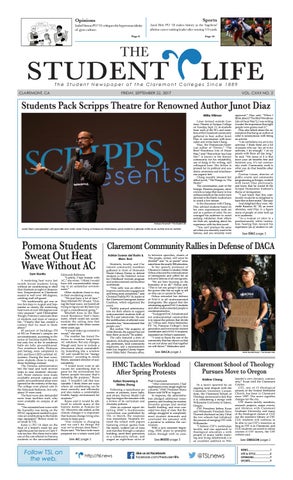
Students Pack Scripps Theatre for Renowned Author Junot Díaz Millie Hillman
Akshaya Amarnath • The Student Life
Junot Díaz’s conversation with journalist and writer Jade Chang at Scripps on Wednesday gave students a glimpse at life as an author and an activist.
Lines formed outside Garrison Theatre at Scripps College on Tuesday, Sept. 21, as students from each of the 5Cs and members of the Claremont community gathered to hear author Junot Díaz in conversation with journalist and writer Jade Chang. Díaz, the Dominican-American author of “Drown,” “The Brief Wondrous Life of Oscar Wao,” and “This is How You Lose Her,” is known in the literary community for his relatability, use of slang in his writing, and colloquial tone. His fiction is praised for its political and academic awareness and simultaneous organic feel. Chang recently released her debut novel, “The Wangs vs. The World.” The conversation, part of the Scripps Presents program, drew crowds so large that many in line without tickets to the event were directed to the Balch Auditorium to watch a live stream. In his discussion with Chang, Díaz advised students based on his own experiences with art and as a person of color. He encouraged his audience to avoid seeking validation from others for their art, speaking about his experience with his first novel. “You can’t produce the same art when you sincerely want to be famous, and you sincerely want
approval,” Díaz said. “When I think about [“The Brief Wondrous Life of Oscar Wao”], I was writing it under the impression that eight people were gonna read it.” Díaz also talked about the assumption that being an author of color is synonymous with being an activist. “I do not believe my art is my activism. I think there are a lot of people who say ‘my art is my activism, I do enough.’ I sit on panels with them all day long,” he said. “My sense of it is that since your art benefits first and foremost you, it’s not community work. Community work is what you do that benefits other people.” Corrina Lesser, director of public events and community programming as Scripps, worked with Junot Díaz previously, and knew that he would fit the Scripps Humanities Institute’s theme of immigration. “I just knew that this community would be so delighted to have him in their midst,” she said. And delighted they were. Michelle Ramirez SC ‘20, an event attendee, said Díaz is a figure many of people of color look up to in academia. “As a woman of color in a predominantly white institution, hearing him recount his experience [as a] student in col-
See DÍAZ page 3
Pomona Students Claremont Community Rallies in Defense of DACA Sweat Out Heat Wave Without AC Adrian Suarez del Busto & Marc Rod
Sam Norrito
A week-long heat wave last month forced students living without air conditioning to shed their blankets at night in desperation. Temperatures in Claremont soared to well over 100 degrees, catching staff off-guard. “We traditionally get one or two hot days in August and September so clearly the week-long heat wave of over 100 degrees was very unusual,” said Christopher Waugh, Pomona’s associate dean of students and dean of campus life. “Clearly that has created a context that we need to think about.” 85 percent of buildings (70 of 83) on Pomona’s campus are air-conditioned, according to Director of Facilities Judith Brown, but only five of the 16 residence halls are fully air-conditioned. Two residence halls, Dialynas and Sontag, were completed in 2011 and have LEED certified AC systems. During the heat wave, some students chose to sleep in those buildings instead. The Pomona administration felt the heat and took several steps to ease students’ discomfort. Water stations were made available around campus and public air-conditioned areas were opened for the entirety of the day. The college even placed cots in the Edmunds Bedroom, but only about 15 were used. The heat wave also demanded more from facilities staff, who were available on campus at all times. “The extended heat wave with the humidity was taxing on the HVAC equipment needed to provide air conditioning to the buildings equipped,” Brown wrote in an email to TSL. Katie Li PO ‘18 slept on the floor of a friend’s room for one night because her dorm in Clark V was too hot. She chose not to take one of the cots offered to Pomona students in the air-conditioned
Edmunds Ballroom. “Luckily, I had friends with AC,” she wrote. “I think I would have felt uncomfortable sleeping in an unfamiliar environment.” Other students chose to stay in their sweltering rooms. “We just have a lot of fans,” Skye Mitchell PO ‘20 said. “During the heat wave, we [were] all trying to figure out the best way to get a cross-[breeze] going.” Mitchell lives in the Harwood Residence Hall’s basement, which could not accommodate the ceiling fans that were added to the other rooms three years ago. “I would wake up covered in sweat,” she said. The weather has forced Pomona to examine long-term AC solutions. But any changes, Waugh said, have to include a discussion about sustainability. Something like a window AC unit would be too “energy intensive,” according to Alexis Reyes, assistant director of sustainability. “I would never want to advocate for something that is great for the environment but harms people because that’s defeating the purpose,” Reyes said. “I wouldn’t call that sustainable. I think there are ways where air conditioning can be done correctly and efficiently and also makes a comfortable, livable, happy environment for students.” Reyes said it would be difficult to retrofit many of the historic dorms at Pomona for AC. However, she added, as the climate changes it is important that humans change living situations to keep pace. “Our climate is changing and we can’t do things the way we’ve always done them,” Reyes said. “We have to be more prepared for a whole week [of]
Follow TSL on the web.
See AC page 2
Students, faculty, and Claremont community members gathered in front of HonnoldMudd Library Friday to defend students in the Deferred Action for Childhood Arrivals program and undocumented communities worldwide. “This rally was an effort to improve community engagement and bring more awareness,” said Christian Padilla PO ’18, leader of the Claremont Immigrant Justice Coalition, which organized the event. Padilla praised administrators for their efforts to support undocumented students both at the 5Cs and nationwide. He said the mobilization of affected communities has “demonstrated that people care.” But within “the majority of white liberals, the support has not been there as much,” he added. The rally featured a slew of speakers, including student leaders, professors, local community organizers, and a representative from Los Angeles County Supervisor Hilda Solis’ Pomona office.
In between speeches, chants of “the people, united, will never be divided” and “sí, se puede” emanated from the nearly 300 attendees. In her speech, professor of Chicano/a Latino/a studies Gilda Ochoa criticized the criminalization of immigrants and called for an inclusive defense of all immigrants. “We are here focusing on the humanity of us all,” Ochoa said. “This is not one group’s land and the power elite has no right to tell us who can or cannot be here.” Ochoa extended her defense of DACA to all undocumented immigrants. She argued that discriminating against DACA students and other undocumented people is counterproductive. “To support DACA students and not undocumented communities is to repeat the policies that divide us,” Ochoa said. Maria Melendrez PZ ‘16, Pomona College’s first generation and low-income student coordinator and a DACA recipient, expanded on Ochoa’s statement. “I want to thank the rest of the community that has shown us that we are not alone and that together we will thrive,” Melendrez said.
See DACA page 3
HMC Tackles Workload After Spring Protests Kellen Browning & Shirley Zhong Following a tumultuous semester of protests, town halls, and sit-ins, Harvey Mudd College has begun the semester with a review of its curriculum and diversity policies. After an external report detailing HMC’s burdensome curriculum was published by TSL in March, the response was immediate. Students littered the school with papers featuring critical quotes from the report, walked out of class and marched through a campus building, aired their grievances at a community forum, and staged an eight-hour sit-in of
http://tsl.news
Platt Courtyard. “After commencement, I had nightmares every single night for a month,” HMC President Maria Klawe told NPR in August. In response, the administration pledged additional transparency and funding for student diversity groups and mental health funding, and even canceled two days of class. But the college struggled to completely meet student demands and concluded the semester with a promise to address the curriculum. With a new semester beginning, HMC plans to promptly follow through with its com-
See MUDD page 3
Like us on facebook: facebook.com/thestudentlife
Sarah Sundermeyer • The Student Life
Claremont School of Theology Pursues Move to Oregon Kristine Chang In a move spurred by an ongoing land dispute with the Claremont University Consortium, the Claremont School of Theology announced in July that it is considering a merge with Willamette University in Salem, Oregon. CST President Jeffrey Kuan and Willamette President Steve Thorsett disclosed on July 3 that the two schools had initialized the process of merging CST with Williamette. “I believe CST’s world-class faculty and our approach to theological education – with people of many faiths learning and living side-by-side – is an excellent addition to Wil-
@TSLnews
lamette’s own dynamic community,” Kuan told the Claremont Courier. CST, one of 13 theological schools of the United Methodist Church, has been in Claremont since 1957. The move signifies changes for the city. CST shares faculty members, research projects, major events, and libraries with Claremont Graduate University, and many of the theological classes at CGU use the extensive library at CST. CGU students will continue to be able to use CST’s resources as long as CST is in Claremont, and CGU students can enroll in online courses if CST moves, the CST website said.
See OREGON page 2 NEWS................................1 LIFE & STYLE.....................5 OPINIONS........................7 SPORTS.............................9
NEWS PAGE 2
SEPTEMBER 22, 2017
THE STUDENT LIFE
AC: Admins Consider Sustainable Solutions Continued from Page 1 triple digits.” Waugh plans to meet with residence hall staff next week to “debrief the heat wave.” In addition to installing ice machines and water dispensers in every residence hall, the agenda for the meeting includes discussion about the installation of AC units in every residence hall on campus. “After that conversation, I’m going to take the content of what we talked about to [the Associ-
ated Students of Pomona College] and to share the ideas floated by staff and to ask for continued input and ideas from the students as well,” Waugh said. “I think it’s really important we talk about this as a community in terms of what is the best approach.” Pomona students aren’t the only ones who sweated out the heat wave. Toll Hall at Scripps College is also yet to be renovated with AC. “It was the worst,” Elle Solomon SC ‘21 said. “It was beastly hot.”
To cope, Solomon bought three fans, which she has little use for now that the weather has cooled off. Toll residents were also offered cots in the air-conditioned common room of their dorm. At Claremont McKenna College, 10 of the 14 residence halls are air-conditioned, and seven of Scripps’ nine have AC. All of Harvey Mudd and Pitzer College’s residence halls have air conditioning.
Which Pomona College Dorms Have AC?
Katie Erickson & Dominic Frempong • The Student Life
Controversy Over Free Airport Ride Program Takes Off Marc Rod With eye-catching headlines warning of free transportation “for marginalized students only” and for “illegal immigrants – paid for by students,” The Claremont Independent and The Daily Caller recently stoked controversy about an Associated Students of Pomona College pilot program providing free transportation from airports to campus for firstyears and transfer students on move-in day. ASPC President Maria Jose Vides PO ‘18 claims much of the criticism is overblown and comes from outside Pomona College. “A lot of this ‘controversy’ mainly came from individuals not affiliated to the college or the student body. I represent students,” Vides wrote in an email to TSL. This pilot program ultimately had only 15 users, but ASPC plans to offer airport transportation for the entire Pomona student body at the beginning and end of future semesters. One paragraph in ASPC’s initial advertisement, which was posted to its Facebook page and in the Pomona College Class of 2021 Facebook group, was largely responsible for the outcry. “For the launch of this program, we are prioritizing students from low-income, first-generation, DACA/undocumented, mixed (immigration) status family, and/or ‘non-traditional’ family structure backgrounds,” ASPC wrote in the posts. The Claremont Independent and Daily Caller articles questioned whether all of the categories of students specified in the advertisement needed free transportation. “The program was heavily
flawed because while its intention was to help financially with transportation to move-in day, many of the categories used to prioritize students were not relevant to determining financial need,” wrote William Gu PO ‘20, who wrote the Independent article and serves as the Independent’s publisher, in an email to TSL. The Daily Caller’s article further criticized ASPC for using an annual student fee that funds ASPC programs to pay for a supposedly “exclusive” program. Vides said the program was never intended to be selective, and that ASPC had no plans to deny rides to any students who requested them. The only limitation on the program was that, due to their earlier arrival date, only first-year and transfer students would be able to use it. “We asked students to selfidentify their needs and didn’t say we wouldn’t be providing rides to those who could afford it,” she wrote. “We only mentioned we would like to prioritize the needs of those who couldn’t.” The entire program ultimately cost $340, less than the $355 annual fee each Pomona student pays to ASPC. Nevertheless, after the Independent and Daily Caller published their articles, angry commenters flooded the ASPC Facebook page, many of them unconnected to the 5Cs, alongside confused Pomona students seeking clarification about the program. In an effort to clear up misunderstandings and mitigate the controversy, Vides published a response to a series of ques-
tions she received from the Independent on the ASPC Facebook page and answered individual student questions in comments on the page. In her responses, Vides acknowledged that the Independent article highlighted some wording in the initial advertisement that may have caused confusion about the program. “There were some concerns presented by the [Independent] in terms of different understandings of definitions. However, I do hope my open statement served to clear up any misunderstandings,” Vides told TSL. Pomona’s administration has been largely supportive of the way Vides and ASPC have managed the controversy. “I admired [Vides’] approach to put the questions/critiques and answers about the program on the ASPC website,” Dean of Students Miriam Feldblum wrote in an email to TSL. “I thought that was a very good approach, as is her commitment to welcome and work with students from across the community.” However, Feldblum believes future ridesharing programs should be targeted at students traveling by themselves. “In reality, the key is whether the student is traveling alone, and I would encourage ASPC – as I told [Vides] – [to focus] on students traveling alone, without family members, and how we can support their transition,” Feldblum wrote. Feldblum added that her office would be happy to collaborate with ASPC on programs to support unaccompanied student travelers.
Citing No Call to Disperse, Pomona Will Not Sanction Heather Mac Blockaders
OREGON: Land Dispute May Force CST Away From Claremont Consortium Continued from Page 1 CST also maintains a relationship with local churches, such as the Claremont United Church of Christ. “The transfer of Claremont School of Theology to Oregon will be a loss to the Claremont community, as their presence has historically contributed to our community’s rich environment of learning, diversity, and civic engagement,” Claremont United Church of Christ’s pastors Jacob Buchholz and Jen Strickland wrote in an email to TSL. “We send CST off with blessings for a strong and fruitful future. We cherish the history we share and the lasting imprint they have left on our community.” The potential merging of CST and Willamette occurs after a period of financial struggle for CST. According to the Claremont Courier, CST was placed under review in 2015 for accreditation by the Western Association of Schools and Colleges, which certifies institutional eligibility for federal funding. Because of CST’s financial situation, WASC recommended that the graduate school sell excess lands that were underutilized. Last fall, CST made a move to sell 10.5 acres of the 16.4-acre campus for $25 million, keeping only the classrooms and administrative and faculty offices. Because of language in a 1957 agreement, in which CUC sold the land to CST, CUC had the right of
first refusal – a contractual right that allowed CUC to enter a business transaction with CST before a third party could be involved. CUC deemed the land worth $4 million, a number from the original sale agreement. The clause in question said that CUC could use a specific formula to calculate the amount that the land was worth. The formula adds the initial cost of the land – $110,000 – to the amount of added assets or facilities, minus depreciation. The final offer that CUC made to CST ended up being $14 million. “We offered CST significantly more than the amount stipulated by the grant deed,” CUC spokeswoman Kim Lane wrote in an email to TSL. “The figure was based on a current market value provided by an externally hired contractor. We also offered to renovate and bring up to code some existing student housing units on the property and provide CST with the option of continuing to house students there.” However, CST and CUC could not come to an agreement on the value of the land. CST filed a complaint in August 2016 in the Los Angeles Superior Court against CUC in an effort to resolve the conflict, stating that CUC was offering far below market value for the land. The trial date is set for March 2018. “Our first preference is to sell to the consortium, but we believe that CUC’s offer did not constitute a fair price,” an FAQ document
on the CST website said. “After negotiations broke down, CUC notified us that it will take action to assert its claim to the property at the formula price in the 1957 deed. We disagree with CUC’s contention that the 1957 deed clause, which contained a formula for calculating the price of the property, controls the sale process. We believe that clause, under California law, expired in 1987, and cannot be renewed.” Kuan and CST spokesman Kim Edwards declined to comment. With payment for the land on hold, CST is pursuing the merge with Willamette for financial and ideological reasons. “Willamette is one of few United Methodist universities in the western United States, which makes it possible for CST to retain both its affiliation as a United Methodist seminary and its reputation as an excellent academic program with a renowned Ph.D. program and library,” the CST website said. The merge between CST and Willamette is currently in the process of due diligence, defined by the Willamette website as “an important process to evaluate whether embedding would be mutually beneficial and successful – strategically, financially, and legally. In addition, CST and Willamette hope to provide opportunities for students, faculty and staff members from both institutions to connect with one another.”
Courtesy of Claremont School of Theology
The Claremont School of Theology is pursuing a move to Willamette University in Salem, Oregon.
Liam Brooks • The Student Life
In a sharp contrast to Claremont McKenna College, Pomona College will not impose sanctions on participants in a blockade of Heather Mac Donald’s talk in April.
Elinor Aspegren, Liam Brooks & Kellen Browning Pomona College students who blocked access to conservative commentator Heather Mac Donald’s speech at Claremont McKenna College in April will not be punished, the college announced Monday. After an investigation using “photographs and information” provided to the college by CMC, Pomona concluded that its students did stop people from entering building where Mac Donald was to speak, but “there was no evidence that participants were instructed to disperse,” Associate Dean of Students Ric Townes wrote in a campus-wide email. “Further, there was no indication of property damage or physical altercations.” Pomona’s response to the policy violation stands in stark contrast to Claremont McKenna, which suspended five students and placed two more on conduct probation this summer for participating in the blockade. The contrast lies not only in the decision to sanction or not to sanction, but in the interpretation of the demonstration policy — specifically, whether it matters if blockaders were instructed to disperse. While Pomona explicitly mentions the lack of dispersal instructions as a reason not to sanction involved students, CMC did not claim it to be factor. In the college’s own timeline
of the events of April 6, officers are not explicitly said to have informed blockaders that they were violating policy. The shared campus demonstration policy states that “ignorance of this policy or lack of intent to violate this policy is not an acceptable justification for violating it.” However, the policy also states that “all individuals who are engaged in disruptive or non-peaceful action will be notified that they are trespassing,” and that students may be charged “if an officer or designee of an affected College or CUC informs individuals in a given area that their collective actions are judged non-peaceful or disruptive and that they should disperse.” The policy does not specify if this instruction is required for students to be charged, but it does not explain other ways for students to be charged that do not follow a procedure that includes such instruction. Furthermore, participants in the protest would also have been responsible for not violating CMC’s own code of conduct while on CMC’s campus. When CMC announced sanctions on its own students, it was unclear whether the punishment was in reponse to a violation of CMC policy, the demonstration policy, or both. At the time, spokesperson Joann Young declined TSL’s request for clarification. Regardless, Pomona’s approach to policy violations has been to “engage in conversations
with students” and “provide notice... that future violations could result in more severe disciplinary action,” Townes wrote. Pitzer College announced in August that they had concluded the majority of investigations into violations by Pitzer College students, and had concluded that “while evidence shows Pitzer College students did block access to buildings, no evidence of damage to property” was found, according to an email sent out by Vice President for Student Affairs Brian Carlisle. Carlisle wrote that the college would review one reported incident involving a student who allegedly threatened the safety of others. “Demonstrations and protests have been powerful public testaments of our commitment to our core value of social responsibility,” Carlisle wrote. “While demonstrations by their very nature are designed to create disruption, complying with our College and Consortium policies is critical if we are to promote individual and community safety and to maximize the protection of our coveted freedom of speech.” Harvey Mudd College and Scripps College previously told TSL that they are conducting their own reviews of information about the protest and alleged policy violations by their students. Samuel Breslow contributed reporting. This is a developing story, and will be updated as more information becomes available.
NEWS SEPTEMBER 22, 2017
THE STUDENT LIFE
PAGE 3
MUDD: Students Optimistic, But Much Still to be Done DACA: County Supervisor Rep Supports Cause Continued from Page 1
Liam Brooks • The Student Life
Harvey Mudd College students participate in a walkout and rally organized by Black Lives at Mudd in March in response to the leaked Wabash report.
Continued from Page 1 mitments from the spring, said Patrick Little, the chair of the Faculty Executive Committee and an engineering professor. “We have to really keep the pressure on ourselves to be able to make it so that we don’t just say, ‘Oh, well, we’ll fix this and it’ll take six years,’” said Little. “That means that several classes came through and never saw a thing.” HMC had already committed earlier to a review of the Core curriculum, a set of classes every Mudd student has to take, but Little said last semester’s events gave the review a sense of urgency. The review began over the summer and is ongoing. Little said it will likely be completed by the end of the calendar year and expects that it will aim to make the workload more manageable. “Our intent is to … preserve those parts of the Core that the community believes are most important while at the same time addressing some serious shortcomings and defects that have already been identified,” he said.
Additionally, an FEC subcommittee is working with Mudd’s Office of Institutional Diversity to help “make the move from diversity to inclusion,” Little said. “I think we’re really naive in our expectations of what it really means to have a diverse, inclusive, and equitable campus,” he said. “We just thought, ‘Oh, you get the numbers in and it takes care of itself. We’re special.’ We brag about ourselves about being an awesome place. We tell everyone in the country there’s no place like us. Well, all of that may be true, but the reality is that there’s hard work that everybody has to do.” Little said the subcommittee’s work includes determining what sort of diversity training might be appropriate, how to hold faculty and staff members accountable, and a system to make it easier for students to report mistreatment, which might take the form of an ombudsman or communication with the Human Resources Department. “I don’t want us to just simply write a white paper … and then
just say, ‘There, we addressed that,’” Little said. “The reality is that we’re looking at cultural shifts.” Associated Students of Harvey Mudd College diversity director Ronak Bhatia HM ‘19 believes HMC needs to teach students not only to become better engineers, mathematicians, and scientists, but also better people. “A part of understanding the impact we make is creating mathematicians and scientists who acknowledge diversity and understand why diversity makes our community stronger,” Bhatia said. “That is our responsibility.” ASHMC wellness director Siena Guerrero HM ‘20 said there are still professors whose outlooks remain unchanged. However, Guerrero said, awareness of the heavy workload and related conversations have increased. “I’m optimistic that progress can be made in this area,” she said. “I have seen the work professors have made to attempt to reduce workload, or at least make it more manageable.” Sol Cruz HM ‘20 said it’s not
DÍAZ: Students of Color Relate to Author’s Experiences Continued from Page 1 lege really resonated with me,” Ramirez said. “Just to see that he’s coming back and giving [students of color] that incentive to keep going in academia, that was really powerful to me, and I really enjoyed how honest and how raw and how genuine he was.” Jaicel Ortega SC ‘18 agreed, and noted a similarity between her experiences and Díaz’s. “I think Scripps is doing well with their [Scripps Presents] series in terms of encouraging dialogue on campus, but as a student of color here on campus, it’s important to come and show support, because that’s the only way Scripps will continue to host speakers like this,” she said. “When [Díaz] spoke about his
experience, in a primarily white, neoliberal institution, especially his analysis of being poor and a first-gen college student, that gave me a lot of the strength I needed to finish my last year here at Scripps.” Díaz also discussed President Donald Trump’s administration and the fear many students of color feel in the wake of the election. “Despair is very easy and very attractive,” Díaz said. “But I’ve always liked the idea that, unless you can see the future, there really isn’t a reason for us to despair. This idea that you only fight when victory seems certain, that you only fight when things are going your way, that’s the talk of our victimizers, that’s the narrative of the people who predate us.” He told students not to lose hope. “We have to always fight from
the losing position, and often we have won,” he said. “We do not have a democracy in this country because the powerful and the triumphant were able to have their way; we have a democracy in this country because the most marginalized, the most denied fought for it against all odds, and overturned the nightmarish regime that held a huge part of the population down.” Emeka Ochiagha PZ ‘18 appreciated this sentiment. “I think that a lot of the wisdom [Díaz] came with was very relatable, very needed, very on time,” Ochiagha said. “I think for me personally what he was talking about in terms of not defaulting to despair in this very dark time was super inspirational.”
Akshaya Amarnath • The Student Life
Junot Díaz takes a selfie with a fan after a talk that spanned his experiences with art, race, and fame.
just the administration that needs to improve. “A lot of students on campus would need to change their views on people of color,” she said. “There were definitely a lot of students who were against the changes to help the diversity of things.” Now that Bhatia has completed the Core curriculum, he said he has more freedom to do what he enjoys but is still affected by other students’ workloads. He hosted a social justice club event at the beginning of the year but said many students who were interested didn’t come because they had homework. “I feel like Core really ruined my Mudd experience,” Bhatia said. “I didn’t have time for things. I didn’t have time to care about things. I didn’t want to care about things ‘cause I was just stressed out all the time.” Cruz described the atmosphere in Mudd as “if you don’t do it, it’s your fault.” “There are still students who are very stressed and very unhappy here,” she said.
Assistant professor of psychology and Chicano/a Latino/a studies Guadalupe Bacio shared a message of togetherness and mutual care. “This is part of a struggle that has been ongoing for many years, so we need to take care of ourselves and we take care of each other,” Bacio said. Bacio encouraged attendees to consider how they can use their personal resources to help their fellow community members. Eva Thiel-Maiz, the county supervisor representative, read a statement highlighting immigrants’ positive impact on the American economy and encouraging those in need of support to contact the Office of Immigrant Affairs. Thiel-Maiz also announced that Los Angeles County implemented a one-year travel restriction for county employees on official business to the nine states that threatened legal action if the Trump administration did not end DACA: Alabama, Arkansas, Idaho, Kansas, Louisiana, Nebraska, South Carolina, Texas and West Virginia. Alex Sanchez, the founder of the Defend Movement, which rallies in support of marginalized communities in the Inland Empire, encouraged student activists. “I love the fact that I see so many young people here because you are tomorrow’s leaders and I know we are in good hands,” he said. Daniela Sada Doan PO ‘19, the head mentor of Improving Dreams Equality Access and Success, gave some advice for people seeking to support their undocumented peers. “Make sure when you’re organizing events to support the undocumented community to actually consult them because
sometimes things don’t get to us,” she said. She recommended that students organizing such events contact IDEAS, and also warned students to be mindful of what they share on social media and to avoid sharing sensitive information or causing panic within the undocumented community. Shayok Chakraborty PO ’19, a lead organizer of the College Community Action Network, used his speech to call students to action and to join CCAN. “What we need to do is build power so we can fight back, and determine our own destinies and defend ourselves and take what is rightfully ours,” he said. Padilla wrapped up the rally by encouraging students to take their activist work beyond the walls of the 5Cs after graduation. “We need people in the 5Cs who will likely go on to some position of power to be advocates, not only for immigration justice but for general justice,” he said. Next to the demonstration, CCAN raised funds to cover the $495 DACA renewal application fees for Pomona Unified School District high school students. CCAN is collaborating with Uncommon Good, a local charity working to “break the intergenerational cycle of poverty and to work for the restoration of our plain,” to organize a legal clinic in the city of Pomona. “We saw this as a good opportunity to fundraise for our upcoming DACA legal clinic because these are all students who are invested in immigration issues,” said Isaac Harris PO ‘18, who was collecting donations for CCAN. Pomona College President G. Gabrielle Starr also attemded the rally. “It is important for us with the privilege to show that we care,” she said.
Corrections In the September 15 issue: This year’s turf dinner didn’t actually take away a meal swipe. In the article “Mudd Awarded $400,000 in Federal Grants,” Professor Van Hecke’s name is misspelled twice. TSL regrets these errors.
Senate Briefs Nastia Kourotchkina & Angela Tran & Leah Kelly Scripps Associated Students With seven candidates for first-year class president and six applications for secretary, Scripps Associated Students (SAS) is in the mist of a dynamic election season. Flyers have been posted around the Scripps College campus and all the residence halls, including the off-campus collegiate apartments, where 38 first-year students are housed this year. Speeches took place this Tuesday in the Student Union, and the 24-hour online voting took place afterward. Alix Hunter SC ‘20, the Faculty Staff Relations chair, reported about a possible collaboration with the Dean of Faculty Office. Hunter met with Dean of Faculty Amy Marcus-Newhall last week to discuss curricular diversity and procedural items. She also added that the Barbara and Scott Bice Faculty-Student Dialogue Fund, a Scripps fund that promotes student-faculty interaction outside of the classroom, will be releasing applications next week. Nastia Kourotchkina SC ‘20 Pitzer College Student Senate The meeting opened with a presentation by a student representative from the Pitzer Psychological Student Association (PPSA). The club intends to be a collective space for intended or declared psychology majors to access potential employment or higher-education opportunities. The Senate voted on the approval of the new club, and PPSA was chartered. Next, Office of College Advancement staff member Nancy Treser-Osgood presented on the two-year continuation of Switchboard, a Pitzer student-alumni network app that provides resources and opportunities such as internships and job offers. 54-B-01, a bill to establish and allocate $10,000 for the Student Initiative Fund, was then passed
with a simple majority. 54-R-01, a resolution to support DACA recipients and the undocumented community, was passed with a simple majority. 54-R-02, a resolution in support of establishing trigger warnings in classes at Pitzer, was introduced. Vice President Lora McManus PZ ‘18 declared that 54-R-02 on trigger warnings will not be a mandate but a recommendation, and the proposition will be voted on next week, and that she is working to gather faculty input. McManus added that on Oct. 19 a speaker will be invited to talk about healing on sexual violence. Next, the Communications Secretary Anna Frietas PZ ‘20 organized a vote on the vacancy for the diversity commitee; Mariah Jenkins PZ ‘20 was elected. Secretary Kamyab Mashian PZ ‘19 spoke about meeting attendance. Treasurer Jacquelyn Aguilera PZ ‘19 presented on the recent Budgetary Committee’s funding of several student organizations and individual student activities, such as providing a $300 fund to the Claremont Journal of Law and Public Policy and a $300 fund to a student attending the 2018 global herbalism conference. A representative from the Women’s Brewing Club presented on prospective activities of her club. The Senate approved the charter of the club with a vote. Angela Tran PO ‘21 Associated Students of Harvey Mudd The Associated Students of Harvey Mudd College (ASHMC) voted last Sunday to give some or all of the budget money requested to the following clubs: Engineers Without Borders, Gymnastics Club, Skate Club, Bobbing Along (Sewing) Club. It declined a budget request from the Claremont Journal of Law and Public Policy. The ASHMC will also be paying for the umbrellas and part of the Turf Dinner fees from the club fair last week, and for food at the upcoming club leader training session. Additionally, ASHMC voted to
add a rule to the college’s noise policy prohibiting the use of speakers in public without permission. ASHMC will also be responsible for managing the money the administration is giving to each community group on campus ($2000 each). ASHMC will be allocating funds from a process called studentselected funding, through which each member of the Harvey Mudd student body can choose to donate 10 percent of student use money, or about $25, to one of five major student organization categories. The funds are then distributed proportionally among all the clubs. Last year only 37 percent of the student body used student-selected funding, but ASHMC believes that if more students are made aware of it this year, more will contribute. Leah Kelly PZ ‘21 Associated Students of Claremont McKenna The Associated Students of Claremont Mckkenna (ASCMC) met on Monday and discussed the introduction of a major events calendar. The calendar would include all of the dates of upcoming large events on campus, which would keep students informed and help them plan event attendance. The committee members creating the schedule are planning to collaborate with multiple Claremont McKenna College organizations, including College Programming Board, Arts Council, Kravis Leadership Institute, International Place, CARE Center, Soll Center, and Roberts Pavilion. The collaboration would require the organizers to do more planning in advance. Some board members expressed a concern that major events around the 5Cs constantly switch, and it would be hard to provide accurate information on the calendar. Nevertheless, the potential calendar could help promote events around the 5C campuses. As of now, most information about those is spread through Facebook, other social media platforms, or word of mouth. The calendar will help create a more transparent and organized picture of the social scene. Nastia Kourotchkina SC ‘20
NEWS THE STUDENT LIFE
PAGE 4
Pomona Commits to Carbon Neutrality
SEPTEMBER 22, 2017
Q&A: New Pomona President Reflects on First Month Leah Kelly
Raine Kaplan • The Student Life
Karen Song Pomona College announced progress on its sustainability initiatives earlier this month, declaring a commitment to achieve carbon neutrality by 2030 through a movement dubbed CN 2030. Its initiatives, dubbed the Sustainability Action Vision Education, began as a movement in the sustainability office to enforce a healthier and more eco-friendly environment on campus. If conducted as planned, both initiatives would mean a zero net carbon footprint by 2030, but the practicality of this project is up for debate. Divest Pomona, a student group advocating Pomona cut ties to fossil fuel companies, claims that Pomona has not taken steps to divest, but would not provide additional information. Nevertheless, many students have faith in Pomona’s plan for environmental sustainability. Abby Lewis PO ’19, who has been an active member of the sustainability office since her first year, believes the SAVE plan is feasible. “Within the student body and from the administration there’s a lot of interest in environmental issues, and people really recognize the importance of getting to this point,” Lewis said. “With that
commitment, it will definitely be possible to reach carbon neutrality by 2030.” Of course, this does not mean there are no potential obstacles. “One of the setbacks is making sure everyone is on board, whether that is with getting every department to purchase sustainable paper or getting students to reduce their water usage,” Lewis said. “It requires the cooperation of everyone on campus, and not just a central commitment by the office.” The SAVE plan isn’t the only initiative boosting environmental sustainability awareness at Pomona. According to Lewis, groups like EcoReps – which designates one student in each first-year dorm to serve as a resource for first-years to learn about sustainable living – have strengthened on campus, and their yearly meetings with sponsor groups during orientation have ensured that every firstyear has the opportunity to get involved. Head EcoRep Alex Seidel PO ’18 said one of the biggest goals for the sustainability office is eliminating all types of waste, including food and electricity. “Energy is one of the biggest components of our carbon foot-
print on campus,” Seidel said. “EcoReps do a lot to contribute to that – whether it be through the drying rack [rental] program or the Power Down competition across the 5Cs.” Seidel said it would be difficult to create a 5C-wide movement to reduce the schools’ carbon footprint, because many of the programs are focused on infrastructure, which differs drastically among schools. But “as members of the 5Cs, we can all individually work to reduce our energy use,” she said. Each school has its own take on environmental consciousness and what that entails. Scripps College has the Scripps Edibles program, Pitzer College employs the Green Bikes program, and Claremont McKenna College and Harvey Mudd College have schoolwide movements to reduce carbon emissions. Lewis said the best way to reduce the 5C carbon footprint is through individual choices. “Personal changes are important to increase awareness for bigger issues,” she said. “When you reduce water, you also think about how the institution using water and how global water systems operate.”
Pomona College’s 10th president G. Gabrielle Starr is a recognized scholar of English literature, neuroscience, and the arts, and the former dean of the College of Arts and Sciences of New York University. Starr arrived on campus in early July. TSL spoke with Starr soon after the start of the year to discuss her adjustment from New York to California, reflections on Pomona students and community, and thoughts on the most pressing issues currently facing the college. TSL: How are you adjusting to your new home at Pomona? What do you like the most about Claremont and California in comparison to New York? G. Gabrielle Starr: I haven’t had the time to miss New York at all because things are really busy. Right now, I like almost everything. I like the fact that I’m meeting new people. I like the fact that Pomona is full of brilliant, charming, challenging students. This is a dream come true. TSL: At convocation, you mentioned that we should not settle for “silent acquiescence.” Can you explain that? GGS: It’s very easy coming into a new place and thinking that everyone has something figured out, or that what you see is wrong is supposed to be that way. It is challenging sometimes to find ways to speak out about what you see is unusual, or what you think is different. I’ve been experiencing that myself coming here, wondering why things are done the way they are done, trying to figure out a bit as to why people make structures or choices. I think it is good to wait and listen, but it is also good to stand up to act. I think this is a moment for all of us to be very intentional about what we open our eyes to, what we close our eyes to, what do we think is okay, what behavior we think is acceptable, and how do we try to collaborate instead of pushing each other apart. One of my big hopes for this year is that we, as a campus community, can model that kind of engagement. TSL: Is there anything specific that you recommend Pomona students to do in order to conquer silent acquiescence and promote progressive conversations on campus? GGS: I think starting off with a question is always good, a question that doesn’t assume the answer that someone is going to have or their position. I’ve had experiences when people are just so sure that they know what the answer is going to be, so they
Mudd President Awarded $500,000 From Carnegie Foundation Helena Ong The Carnegie Corporation of New York named Harvey Mudd College President Maria Klawe one of seven honorees for the 2017 Academic Leadership Award last Tuesday. The award recognizes American university and college presidents and provides $500,000 to the recipient’s academic initiative. The Academic Leadership Award specifically noted Klawe’s work to increase student diversity. During Klawe’s time as HMC president, the college’s female student population has increased from 29 percent in 2006 to 48 percent this year. Today, African Americans make up four percent of the student body and Hispanics make up 20 percent, up from one percent and seven percent respectively in 2010. Klawe emphasized the importance of the institution’s role over the individual president in achieving this progress. “Presidents get all the credit and all the blame, and neither is completely deserved,” Klawe said. She cited the college’s associate deans for their work on a range of programming for attracting both a diverse pool of students and potential faculty members. “A president can’t be successful unless the faculty, staff, and students are really aligned in doing the work,” she said. However, this progress has not come without its challenges. “Some parts of the college have moved faster than others,” Klawe said. “When I arrived ... people would say things like, ‘We’re a merit-based institution, and if we become more diverse it would mean lowering standards.’” While the initiative to increase diversity of both the gender and racial makeup of the student population began more than 10 years ago, Klawe admits the college
made very little progress racially for the first six years. “It took a lot longer for us to make progress on race than it took for us to make progress on gender, even though we were working on both of them at the same time,” Klawe said. “Sometimes people interpret what happened at [HMC] was, ‘Well they decided to fix gender first, then they turned to race.’ But it’s not true.” Different strategies were used to attract African American students and Hispanic students to HMC’s application pool. Klawe cites the lesser-known reputation of HMC at the time as a factor in college decisions among high achieving African American students who were admitted by the college but chose to go elsewhere. “We had to find a way to become better known,” Klawe said. “Both in general and also within the African American community.” Despite the large population of Hispanics in the local region, the college was wary of regional public schools’ standards of education, Klawe said. Instead, the college focused on admitting and increasing support for students who may be entering college less prepared. “When you make that kind of progress there is going to be a lot of things you find out about in the culture that is not going to be supportive of those students as it is for your traditional students, which for us was white male,” Klawe said. “How do you not privilege the student who went to [Philips] Andover or Exeter versus the students who went to Montclair High School? How do you set things up that they are just as likely to succeed as others?” HMC has worked to expand support systems for students, including the academic excellence
program, peer academic liaisons, companion classes, workshops, and tutors. Additionally, the college has redesigned curriculae in computer science and engineering to serve students of varying experience levels and with more handson implementation. “One of the things that makes [HMC] so successful is that we’re willing to say we aren’t perfect and it is so much easier to change an institution if you’re willing to admit you’re not perfect,” Klawe said. “The world is changing and if we’re really serious about giving students the best education we can, we have to change.” The role of support systems for students has become a prominent
issue on Mudd’s campus. Last semester, HMC faced a number of student protests and a two-day class cancellation as a result of a TSL article that detailed the Wabash report, an external review of the curriculum commissioned by the college that was leaked to TSL. The report concluded HMC’s workload was excessive and didn’t leave any free time for students. “It was like the place boiled over,” Klawe said. “We were incredibly worried that one of our students or one of our faculty would have a nervous breakdown or commit suicide or something terrible would happen. It just felt there was too much pain
already have a frame that prevents them from listening to what people have to say. So starting with a question is a really great way to begin. TSL: What do you believe is the most pressing issue currently facing Pomona? GGS: I do think that we still have an inclusiveness challenge in terms of people being able to fully grab what’s available at Pomona and to be themselves as fully as they can be. I think we have a challenge in that sometimes students spread themselves too thin, and I think we need to take more breaths, frankly. I think we have an opportunity, though, to reach out to one another constructively. And we’ve seen that very clearly with DACA and DACA students when, we realize,that, having been complacent about the status quo, that yesterday is a model for tomorrow is not functional. We have a collective responsibility to figure out how we can plan for uncertain but consequential and powerful problems and possibilities. We have a community fully capable of that, but we have to hold hands and do it together. TSL: What do you look forward to the most at your inauguration on Oct. 14? GGS: One of the things that I am most excited about is that there will be lots of poetry and lots of music. I just got a list of the music today, and the music is going to be extraordinary. It shows the talent and creativity that the college has to offer, and I just can’t wait to see that. The most I will look forward to is hearing what people say is
best about Pomona, because, to me, that’s what the inauguration is about. This will tell me what the next 10 years are going to be about, and how we are going to get there. TSL: Do you have any advice for the incoming class of 2021? GGS: Yes! Of course I do. First I would say one great thing you can do this year would be to build a meaningful relationship with someone you never thought you would have a relationship with, or to someone very different to you in whatever way, and taking advantage of that new start that you have. And the second thing I would say is look for ways to have very intense intellectual experiences outside of class, and be creative about that. The third thing is don’t do what I did: Don’t shrink all of your clothes freshman year! I shrank all my clothes freshman year and I couldn’t buy more, so I had two inches of sleeve for eight months. The dryers are horrible. Dry on low. TSL: How about for the juniors and seniors who are about to enter society? GGS: Don’t be afraid. You actually have every single tool that you need. Be aware that your next stop is only your first stop. Nothing is preordained at this point in time. Opportunity is going to come in unexpected ways, and think laterally, don’t think linearly. Realize that before you go, please try and do something to make it better for the people who are still here. This interview has been edited for clarity and length.
Courtesy of Pomona College
PZ President Diagnosed With Protein Disease Liam Brooks Pitzer College President Melvin L. Oliver has been diagnosed with AL amyloidosis, a disease that causes abnormal protein production in bone marrow, he wrote in an a campus-wide email Tuesday. In Oliver’s specific diagnosis, protein chains have attached to his heart, and “are causing fatigue and shortness of breath,” he wrote. Oliver will continue to fulfill his duties via “video and audio conference calls” as he begins weekly chemotherapy in Santa Barbara. He will additionally consult with the Amyloid Center at Stanford University, one of the largest treat-
ment centers for amyloidosis in the nation. “The prognosis for a quick, full recovery is excellent and I should return to full strength in two to three months,” Oliver wrote. “I often speak of our core and community values, including the importance of community, diversity and intercultural understanding. Now is indeed a time for community. I hope the entire campus - faculty, staff, students, trustees, alumni, parents and friends - will work together during these upcoming months for Pitzer’s continued success.” This is a developing story, and will be updated as more information becomes available.
CRIME REPORT Between 1 p.m. and 2 p.m. on Sept. 4, a theft occurred at Pitzer College’s West Residence Hall. No arrest has been made. The afternoon of Sept. 5, a thief was arrested at Harvey Mudd College’s Shanahan Center. The morning of Sept. 8, a bike was stolen outside of Pomona College’s Sontag Residence Hall. No arrest has been made. On Sept. 9 at 1 p.m., a trespasser was arrested at Pomona’s Alexander Hall. The morning of Sept. 11, a trespasser was arrested at Pitzer’s Benson Auditorium. While many students searched for clubs at Turf dinner on Sept. 12, a 27-year-old man was found lying down near Steele Hall at Scripps College. He was arrested for trespassing. Around 3:30 p.m. on Sept. 13, a theft occurred at Harvey Mudd’s Shanahan Center. No arrest has been made. At 12:35 p.m. on Sept. 14, a bicycle was stolen from Claremont McKenna College’s Biszantz Tennis Courts. The thief has not been caught. Around noon on Sept. 16, a theft occurred Harvey Mudd’s Hixon Court. No arrest has been made. - Compiled by Adam Starr PO ‘18 Courtesy of Harvey Mudd College
LIFE & STYLE PAGE 5
THE STUDENT LIFE
SEPTEMBER 22, 2017
Playboy Bunnies to Princesses: A Fresh Look at Gender Politics Carmin Sherlock “In every sense, as a mother, as a wife, as a sexual being … it was hard to answer the question: What does it mean for a woman to be free and autonomous and really in charge of herself?” And so began Carina Chocano’s examination of today’s sexual politics, put forth in her new book, “You Play the Girl: On Playboy Bunnies, Stepford Wives, Trainwrecks, & Other Mixed Messages.” On Tuesday, Sept. 19, Chocano sat down at the Hampton Room with Piya Chatterjee, Chair of Scripps College’s Feminist, Gender, and Sexuality Studies department, to discuss the changing landscape of feminism. “I was trying to find a historical context for my feelings,” Chocano said. “What drew me was my curiosity about why I felt this uncomfortable cognitive dissonance. Why did this idea of what it means to be a woman in society feel so confusing?” Chocano began as a television and film critic, but later moved to freelance writing. She is now a contributing writer for the New York Times. Her book is a close examination of her life, beginning with childhood. “I start [the book] when I’m six years old,” Chocano said. “I tried to go back to those specific times and really think about everything I was looking at.” Discussing her exposure to Playboy magazines and models as a child, Chocano said that she “knew, and everyone else knew, that only girls were sexy. Sexiness was girls; it was exclusively female. Playboy’s idea of a ‘woman’ was a naked fairytale princess – a young, dumb, defenseless, easily trusting woodland creature … She could not learn, grow, or change; she could not really exist.” This “Playboy culture” Chocano encountered influenced the way she later examined women’s often compromised roles in the world. In reference to Hugh Hefner’s infamous comment Chocano said “we are not interested in the
mysterious, difficult woman – the femme fatale who wears elegant underwear with lace; she is sad and somehow mentally filthy,” unpacking the damaging feminine ideal. “Society implies that in order to be listened to, a lady should be nice to look at; there should be no doubt as to her sexual desirability, though this will undermine her argument no matter sophisticated it is. We are not interested in sadness, sophistication, or experience; we secretly believe that female subjectivity is filth. And it’s not just sexual autonomy. It’s any kind of experience. Women’s adulthood is sexualized and made bad. Young, innocent sexuality is good, but you can’t grow. You can’t grow up. It’s about power.” This conversation is one of three to come this fall, focusing on feminism and gender through conversations with prominent writers and activists. The series was organized by Scripps’ Director of Public Events and Community Programs Corrina Lesser, who is passionate about spreading ideas through intimate settings. “I think, as an audience member, you get something much more special when you put someone on stage with an interlocutor,” Lesser said. “It’s a chance to pair people up who you think will have something to say to each other. I really try to program events that I’m passionate about. I want to be able to stand behind my choices and provide a forum for creativity and conversation that I want to be a part of as a member of the community.” The second conversation will be held on Oct. 12, featuring the editors of the anthology Nasty Women along with Chocano and Scripps’ Associate Professor Kimberly Drake. Chocano also discussed the issue of modern pop culture, examining Disney princesses like Sleeping Beauty and Alice in Wonderland, who fill the lives of many young girls, including Chocano’s daughter. “As little girls, we’re trained
Amanda Han • The Student Life
Scripps students and members of the community alike gathered in the Hampton Room in Scripps College for “Nasty Women: A Tuesday Noon Conversation with Carina Chocano,” to listen to Carina Chocano read excerpts from her book, “You Play the Girl,” and answer questions about her life and views on the current political climate.
to love these princess characters who are very unconscious most of the time – asleep – and we really like them because they’re pretty, quiet, docile, and passive. Alice is rude. She talks too much. She goes up against people. She questions them, criticizes them. I think we’re told early on that this is not a good way to be – that nobody likes her.” But it’s not just Disney princesses: harmful media bombards young girls in many ways. “Almost all of the programs with girls in them have these bizarre social dynamics: she’s the smart one, she’s the pretty one
… ,” Chocano notes. “I’m really sensitive to all these narratives dividing women [and on] how women should hate each other. It’s what keeps us out of power.” With an almost all-female audience Tuesday, one attendee asked how the concept of slutshaming has evolved today. “We seem to go from slut shaming and ‘women-aren’tallowed-to-have-sex’ straight to transactional sex, performing for many, and trading bodies for money,” responded Chocano, drawing from her experience as a journalist covering a conference on feminism and pornography. “I
MOVIE COLUMN
Love, Loss, and Love in “The Big Sick” Victoria Anders “The Big Sick” is the deserving winner of my Film of the Summer award. A story built from Kumail Nanjiani’s true life story that bridges the binary between truth and fiction, the film gives the romantic comedy genre a brand-new go. The first hour or so consists of the gushy, awkward humor for which you would normally turn to a Jennifer Aniston movie on Netflix: Nanjiani (whose character goes by the same name) meets a graduate student named Emily (Zoe Kazan) at a bar. They push past their initial commitment to just hook up into a full blown relationship, and Nanjiani almost loses Emily because of it. The sentimentality goes so far as to include a Love Actually-esque montage. At one point while watching it, I blurted out in vain, “That’s what I want my romantic life to be like!” Then comes the twist, foreshadowed by the movie’s title, but no less jolting: after Emily realizes Kumail hasn’t told his family about her and the pair breaking up, Emily gets a flu that
leaves her with a life-threatening infection in the ICU. Called in by one of Emily’s friends who can’t stay with her in the hospital anymore, Kumail is left to sign a form allowing for Emily to be put in a medically-induced coma. “But wait, aren’t there SNL comedians in this movie,” you might ask? Emily’s parents (Holly Hunter and Ray Romano, who exhibit strength in their parental vulnerability) come into town to care for her, and though they are initially ice-cold to Kumail (Emily told them everything – something I could relate with), Kumail eventually realizes how big of a mistake he made in keeping his love for Emily, and now her family, a secret. But he makes his realization while Emily is asleep. Kumail lives two lives he works hard to keep separate. By day, he is a momma’s boy, son of Pakistani immigrants who only want their children to be good Muslims and comply with an arranged marriage to a Pakistani woman (and become a doctor, but they’ll look past that). But by night, he’s a budding comedian, a regular at a Chicago club along with his fellow comedian-friends
(real-life jokesters Aidy Bryant, Bo Burnham, and Kurt Braunohler) who are all vying to make it big. His main source of material is his own cultural background, filling his sets with sharp and poignant jokes, and slipping some terrorism-related comedy, as if trying to reach that punchline before anybody else. Oh, and he dates American women, keeping in his room a collection of the rejected headshots of the Pakistani suitors his mom chooses for him. He lives with the entrenched belief that should his American and Pakistani lives cross, he would have to lose one. And he nearly loses both. Nanjiani teamed up with his real-life wife, Emily Gordon, who did in fact become hospitalized four months after they met, to write the movie. To me, the timing of the film was its key to success: providing for that slow lead-in on the quality of Kumail and Emily’s relationship gave the audience a desire to see the pair work out, but with Emily bedridden and literally silenced halfway through, the focus shifts onto Kumail entirely. Influenced by Emily’s parents, as well as his
own emotional reactions to seeing Emily in a hospital, he discovers his deep love for her. The timing also allowed the comedy and the tragedy to coexist without seeming forced or hard to follow. It really was a story of love formed, interrupted, and found again. Nanjiani and Kazan’s chemistry is also undeniable, and yet different from that in most rom-com couples: it’s imperfect, sometimes uneven but never clichéd, and never forced. Kazan even looks pretty similar to real-wife Gordon, a sign of good casting, though I do feel like I’ve seen Kazan in very similar ‘quirky girl gets heartbroken by a clueless guy’ roles many times before. That by no means means she’s not impressively effective in just that character; quite the opposite is true here. “The Big Sick” is a film to watch in many contexts, as it is placed within many contexts. Relevant in every issue from illness to family dysfunction to Islamophobia, it’s a resounding big hit.
MUSIC COLUMN
If the Artist is Trash, So is the Art Schuyler Mitchell This article discusses sexual assault and domestic violence. The year 2017 saw a remarkably quick rise to fame for underground rapper XXXTentacion. Known for his warped lo-fi sound, XXXTentacion has been the subject of critical acclaim and increasing fan devotion over the past year. His SoundCloud followers have skyrocketed from 20,000 to 1.29 million, and he has over 15 million monthly listeners on Spotify. Last month his debut album “17” premiered at No. 2 on the Billboard 200 chart. Oh, and one more thing – in October 2016, he was arrested and charged with aggravated battery of a pregnant woman, domestic battery by strangulation, false imprisonment, and witness-tampering. A trial is set to begin next month. On Sept. 8, the popular music magazine Pitchfork released
details from the deposition of XXXTentacion’s ex-girlfriend, in which she describes disturbing acts of domestic violence that he committed while the two were in a relationship. The article has caused many people to speak out in criticism of the rapper. However, this news is not new. These charges have been public information for months, yet they haven’t hindered XXXTentacion from ‘blowing up’ in the public eye. It should not have taken a gruesome testimony to make people care about XXXTentacion’s abuse. Although the latest details have caused public opinion to shift, the rapper’s monthly Spotify listeners have only continued to grow. Many of his Twitter fans have continued to support him. The public’s apathy toward the XXXTentacion case is only one example in the long history of the music industry’s – and society’s –
tolerance of abusers. In November 2016, rapper Kodak Black was arrested for sexual battery. Instead of shunning him, Twitter took to the hashtag #FreeKodak. Earlier this year, his latest mixtape “Project Baby 2” debuted at No. 2 on the Billboard 200. In July 2017, BuzzFeed published an article with allegations that R&B singer R. Kelly was holding young women against their will in a “sex cult.” Even without this recent development, the singer has faced a multitude of previous sexual assault and harassment charges. Furthermore, in 1994, R. Kelly married 15-year-old singer Aaliyah. He was 27. Current musicians are not the only culprits of sexual misconduct. David Bowie, Jimmy Page, and many other classic rock stars, were known for statutorily raping their underage groupies. All of these examples raise the question: Can we separate the
art from the artist? How do we reconcile our love for the music of abusers with their history of abuse? I don’t think it can be reconciled. We are, quite clearly, living in a rape culture – a society that normalizes sexual assault and violence against women. If you truly identify as a feminist or even just believe that women should be treated as equals, do not give these artists your money. Do not attend their shows, do not buy their albums. If you must, listen to their music in ways that won’t provide a profit to the artists. It’s hard, I know. I’m notoriously a huge fan of R. Kelly’s “Ignition” myself. Art cannot and should not be separated from the artist that creates it. If you cannot hold celebrities accountable – people who you haven’t even met – how can you be expected to hold accountable the people closest to you?
always felt there was something missing in between. The good girl and the whore have been combined as a kind of consumer product.” Chocano’s refreshingly personal narrative style and keen observations are invaluable in today’s turbulent and nuanced field of gender politics, especially when limited examples of women’s lives are portrayed in the media. “One of the reasons that I think it’s so important to have more women telling their own stories and not just putting out these same archetypes is that for young
women, you never see the narrative move past a certain point,” Chocano said. “The traditional ‘happily-ever-after’ happens at a very young age; at the end, you’re just supposed to get married in your early 20’s? It’s constructed as if that’s when your life ends, when you’ve barely been an adult. When does your life get to happen? We never see that. When we look out, we’re not given trajectories.” But, Chocano is changing that. “[Writing the book] made me understand my story. It made me feel like, ‘Yeah, I did have a trajectory.’ But I had to tell it myself.”
MOVIE COLUMN
Jennifer Lawrence Navigates a House of Horror in “Mother!” Lauren Churchwell “Mother!” is not the movie you’re expecting it to be – the marketing is leading you astray. If you’re anticipating a rehash of “Rosemary’s Baby” or “The Strangers,” then you’ll end up getting your metaphorical socks knocked off. For viewers of the 21st century, a lot of what we see in film is based heavily on the surface-level text, but does carry sub-textual meanings for those who wish to consider what’s going on beneath the surface. In “Mother!,” this is completely reversed: the story lives in subtext and allegory. The surface text is an effective horror thriller, but it gains so much more significance and satisfying sense of discovery once you start to peel back the layers. Some of the story does rely on old horror story beats to achieve its goals. There is, of course, an older, slightly unsettling man, a young ingénue, and a creepy house with a tragedy. It incorporates more modern fears to effectively scare today’s audience. While unexpected friendly visitors may have seemed innocuous to the ’70s New Hollywood crowd, the hint of anyone having the audacity to knock on your door feels like a horrifying violation of privacy. Aronofsky goes to eerie heights by taking a party gathering, with friends and family bearing gifts and food, and painting it into a claustrophobic nightmare. I’m not being facetious; moments that would be happy or even banal in any other movie are filled to the brim with unbearable tension. Turning away from the plot, the technical aspects of the film are fantastic. Aronofsky’s camera stays tight on Jennifer Lawrence’s face, creating a dizzying sense of anxiety as you feel her helplessness and her inability to escape as she winds around the Borgian labyrinth of the house. The color palette and lighting in the film run in opposition to the unnatural tightness of the camera. The film’s muted colors mimic contemporary
movies that only treat viewers to a bland landscape of greys, browns, and blacks, but in a way that accentuates the brightness of daily life without feeling showy. Performances throughout the film are varied with Javier Bardem and Jennifer Lawrence giving the strongest performances. While I am not usually entirely entranced by Lawrence’s acting or her persona, her performance makes me wonder why I had never seen her in a horror movie before. Her sense of anxiety, terror, and mania feels so real that you can’t help but sympathize with her. Michelle Pfeiffer and Ed Harris also give fantastic showings alongside what I would call a surprise appearance by Domhnall Gleeson. However, some of the other characters were hit or miss, including a cameo made by Kristen Wiig that felt less like a performance and more of a chance to say “ Oh look! It’s Kristen Wiig not being Kristen Wiig!” “Mother!” will definitely not be everyone’s cup of tea. Even I, who liked the film, sometimes felt that Aronofsky’s use of allegory felt less like a mature and nuanced perspective than a way for him to rant and rail like a teenager who has decided to hate “the man.” Also, while I myself love horror movies and thrillers, “Mother!” is a difficult film to stomach with some movements going beyond scary and disturbing into outright scarring its viewers. However, if you can stomach it, I would recommend the film for horror lovers as well as those who like a good puzzle.
Jordan Wong • The Student Life
LIFE & STYLE PAGE 6
THE STUDENT LIFE
SEPTEMBER 22, 2017
A Mother, a Daughter, and The Evolutionary, Psychological Validity Behind Buddhism Women’s Liberation in Turn-of-the-Century China Whitney Wachtel
“There have been many men who died for the revolution … but we have not heard of a woman yet, an embarrassment for all of us women,” wrote Qiu Jin, a feminist and revolutionist against the Qing Dynasty, in a letter to a friend. On Sept. 14, Professor Ying Hu of University of California, Irvine, held a lecture at Hahn Hall at Pomona College on the famous Chinese revolutionist and feminist’s pursuit of self-independence and relationship with her family under the context of May Fourth Movement era, and her daughter, Wang Canzhi. Before the lecture began, several Pomona students shared their own reasons for going to the lecture. “Four of us are from the East Asian Gender Feminism class, and our professor strongly recommended us to come to the lecture today,” Eugine Choo PO ’19 said. “We are currently learning about the May Fourth Movement and its relationship with women’s liberation. Qiu was an important figure during that era and I hope to see some of her writing works during the May Fourth Movement, and figure out the academic writing styles,” Laurel Hilliker PO ’18 said. Professor Hu began the lecture with the play “A Doll’s House,” in which the female character Nora Helmer decides to leave her family in order to pursue her own independence. Professor Hu then introduces Qiu by comparing the similarities between the Western feminist and Eastern feminist, both of whom are expected to be wives and mothers. “Different from other young women who are ‘allowed to have’ the right to pursue their love and freedom, Qiu seemed to be restricted by her identity as a mother,” Professor Hu told TSL. The ideology of the May Fourth Movement is to prompt young women to challenge the tradition of arranged marriage imposed by their parents and pursue their own careers and educations. However, “the May Fourth Movement doesn’t mention the freedom of married wives,” Professor Hu said. “It is very immoral for a married woman to leave her family and [abandon] her children for her own sake.”
In reality, Qiu did choose to leave her family in 1904 to receive Western education in Japan. In 1905, she joined the anti-Qing group Tongmenghui, led by Sun Yat-sen to rebel against the Qing Dynasty, who ruled China at the time. After returning from Japan, she visited her family in Hunan once a year, but she never reunited with the family again. She was captured and beheaded by Qing rulers in 1907. Qiu’s death poses a huge influence on her daughter Wang, who strives to become a good daughter and promote her mother’s ideas. Growing up without a mother’s care, Wang had a pitiful childhood. After her father sent her to be raised by family friends, she was sent to her grandmother, who strongly favored her brother, due to the general affection of boys over girls. Wang strived to show filiality to her mother for her entire life. Filiality is an important connection between parents and children in China. Obedience, emulation and sacrifice toward parents are all reflections of filiality. However, Wang didn’t have many chances to learn from her mother in person, obey her wishes, or make sacrifices. Wang was conflicted because she tried to be a filial daughter when there were no models for her to follow. She had to find a way for herself. Unlike many Chinese women during that time, Wang decided to petition funds from the government to study in the U.S. and Japan. In 1928, she went to New York University to learn about the manufacturing of aircrafts and aeronautics. She came back to China in 1930 and became China’s first female pilot. In New York, Wang met her mother in a dream. “In swaddling clothes, I was parted from my mother, until last night suddenly her spirit came to me in a dream, telling me the events of her sacrifice of yesteryear. [Waking] up, my clothes soaked red with tears of blood.” In this poem, Wang expresses her longing for her mom while in New York. Like her mother, she made a brave decision of going to a foreign country to receive modern education., She also chose the most adventurous career for women at that time, a pilot. Even
without her mother’s company, she always tried to approach the image of an independent wom-
“
In swaddling clothes, I was parted from my mother, until last night suddenly her spirit came to me in a dream.
“
Juanita Man
an, as her mother advocated. During the lecture, Emily Dillemuth PZ ’18 asked, “Did Canzhi ever complain about her mother’s absence in her life?” “Contrast to what some people might suspect, Wang never complained about her mum’s absence in her life and she never use a disrespectful word towards her mother in her writing, partly because of the moral restriction that children cannot show any disrespect to parents,” Professor Hu answered. It is hard to tell what exact emotions Wang had for her mother. But from her writing and her pursuit of modern education and career choice, we can tell that Qiu’s spirit deeply played a positive role in Wang life, prompting her to strive for her own freedom as a person, instead of only a wife devoted to household. After the lecture, Samuel Fiske CM ’21 shared his feelings towards the lecture. “I am taking elementary Chinese course and my Chinese teacher suggested me to come to the lecture. It is so fascinating to see the parallel relationship between Western feminism and Eastern feminism,” he said. Fiske also appreciated that more Asian women have pushed against traditional gender roles in academic fields. “The number of working class women in Japan has increased dramatically in the professional field, and probably exceeds the Western standard,” he said. Choo ended the discussion saying, “for me, feminists don’t necessarily need to be an activist in a feminism constitution. It is more about the small actions or steps you are taking to improve things, like the the social relationship around you everyday.”
On Tuesday, Sept. 19, New York Times bestselling author and Pulitzer Prize finalist Robert Wright delivered a presentation about his newest book, “Why Buddhism is True.” Drawing a crowd of students, faculty, and community members alike, Wright’s discourse was followed by a Q&A session. Originally planned to be given at Claremont McKenna College’s Athenaeum after the dinner discussion, the presentation was moved to Pickford Auditorium. Wright’s speech focused mostly on the concepts in his book, including meditation, natural selection, and evolutionary psychology. At the beginning of his presentation, Wright clarified that his view of Buddhism does not include the ‘supernatural’ or ‘mystical’ parts of the practice, such as reincarnation and rebirth. However, his conception of Buddhism is a ‘naturalistic’ perspective, meaning that he supports the secular and philosophical aspects of the doctrine. Much of the presentation concentrated on the complementary nature of Buddhist
philosophy and evolutionary psychology. Wright said that this form of psychology can diagnose various medical conditions, but does not offer tangible solutions. However, he attested that Buddhism offers relief from illness, namely in the form of meditation such as therapy. Furthermore, Wright argued that evolutionary psychology supports ‘emotional skepticism,’ which is a key facet to Buddhist teaching. Wright also spoke about his experiences with meditation. He explained that the practice of meditation allows people to become increasingly “indifferen” to emotion, enabling people to observe their feelings without being blindly affected. This transformation, Wright said, eventually permits people to realize that “the essence in which we see things is illusionary.” Wright concluded his presentation by mentioning global politicalization and shared his belief that the ‘psychology of tribalism’ is the most pressing issue facing the world. He believes that mindfulness meditation can erode the cognitive biases inherent to society’s increasingly divisive nature. Not all in attendance were familiar with Wright’s work.
Klaudia Dziewulski CMC ’18 was introduced to Wright’s arguments during this event and shared that while she had hoped the talk focused more on “specifically Buddhism,” his lecture was “more about incorporating Buddhism into the modern world.” Nonetheless, Dziewulski said that she found the lecture “interesting.” Claremont Graduate University alumna Vanessa Kettering and CGU student Rhonda Rodgers had previously taken Wright’s online course, Buddhism and Modern Psychology, a few years ago. They both continue to follow his work and shared their fondness for Wright’s presentation. “I really liked the political message that he had,” Rodgers said. “I thought that was a great way to tie in the book, his understanding of Buddhism, and its social relevance to what’s going on around the world.” Director of Land of Enlightened Wisdom Geshe Tenzin Sherap agreed with Kettering’s and Rodgers’ analyses, by stating his admiration for Wright’s “clean” and “easy-to-understand” explanation of Buddhism. For more information about Wright or “Why Buddhism is True”, visit whybuddhismistrue.
Serene Harb • The Student Life
Robert Wright, author of “Why Buddhism is True,” speaks at Claremont McKenna College’s Athenaeum on Tuesday, September 19th.
“The Ethicist”on Human Spirit, Narrative, and Universal Political Morality Ariel So British-born Ghanaian-American philosopher and New York University professor Kwame Anthony Appiah, best known as the writer behind the New York Times’ weekly “The Ethicist” column, shared a fresh perspective on 21st century moral and political theory at Scripps Presents on Sept. 14. A leader in scholarly research, Appiah focused his lecture on ethical ideas surrounding class, culture, race, and identity, evaluating “what makes us a people” from collective histories, narratives, and genetic inheritances that bind individuals together. The event was packed with 5C students and staff at Scripps College’s Hampton Room as Professor of Philosophy Rivka Weinberg introduced Appiah as a renowned professor who received his bachelors, masters, and PhD degrees in Philosophy from Cambridge University. “Professor Appiah is known for a particular brand of cosmopolitanism, which acknowledges the universality and the particularity of human experience,” Weinberg said. “What I find so refreshing about this approach is that it acknowledges lived reality as well as human ideals. We recognize that we may not have our tribal affiliations, but we are also all humans, and that gives us both the natural and a moral commonality.” Weinberg further elaborated that Appiah’s perspective showcases the roots of people’s common humanity. She pointed toward the importance of needing to hold onto individual characteristics while sharing one’s idiosyncrasies with others. “If we narrow our worlds to those exactly like [ours], we deprive ourselves of much that we can learn, enjoy, and partake of in human culture,” Weinberg said. “We restrict ourselves to our particularities, and [thus] risk not giving those outsiders moral respect, human empathy, and care that we all deserve from each other. But if we err in the other direction and deny our
Courtesy of Scripps Presents
particularities, it’s unrealistic and can deprive us of the special bonds we may share with those who can understand just where we’re coming from.” Throughout the talk, Appiah surveyed what ‘human culture’ constituted, investigating the ideologies of various historical figures – such as the founder of cultural anthropology Edward Burnet Tylor, who believed it was absurd for a person to lack culture, and Matthew Arnold, an English poet and cultural critic who asserted that culture was the ‘pursuit of total perfection.’ Appiah also referenced Romantic philosophers who argued that the ‘spirit’ embodied in a person came above all else in language and literature. He discussed some of the ways in which people’s identities can be formed by the stories passed
on from different generations. “Identities can be held together, in short, by narratives – without essences,” Appiah said. “We don’t get to be called ‘English’ because there’s an essence that this label attracts. We’re ‘English’ because we have rules that determine that anyone with the collective base called ‘England’ is entitled to that label.” From shifting to Western culture, Appiah bluntly asserted that “if Western culture were real, we wouldn’t spend so much time talking it up.” Appiah holds the belief that what glues modern culture together today are the traditions – such as dress and greetings – and behavioral habits that continue to influence people’s relationships. More importantly, Appiah noted the need to establish a political structure in society based on merit,
rather than “reducing people to a single measure” of their contribution to the economy. “Even a wholly democratic [society] is still a system of class,” Appiah said. The alternative that Appiah suggests is to urge society to acknowledge that ‘human worth’ has no comparative ranking, explaining that each person comes equipped with different talents and is born into different circumstances. “There is no sensible answer to the question if one person meets one challenge better than the other,” Appiah remarked. “Did Bertrand Russell achieve more than Mozart? The only sane answer is that Russell was a better philosopher and that Mozart was a better musician.” During the Q&A portion, Appiah admitted that challenging
society’s reward systems would be “a task for the imagination.” However, he said that if society were to continue weighing every form of accomplishment in terms of money, such a social structure would deplete “all other kinds of significance.” Audience member Spencer Louie PO ’19, currently in the class “Ethical Theory: Ancient to Early Modern” taught by Professor of Philosophy Julie Tenenbaum, spoke highly of Appiah’s lecture. He commented on Appiah’s “pragmatic approach” toward resolving difficult ethical problems. “[Appiah] definitely has a compelling argument about equality and how to address that, [along with addressing how] we view each other in terms of identities, [while] weaving into that historical
narrative of class, gender, race, etc,” Louie said. While Semassa Boko PO ’18 agreed that he enjoyed Appiah’s discourse on nation states, civilization, and how those social structures contributed to people’s ideas of identities, Boko said that he disagreed with some of Appiah’s conclusions. “I think he glosses over a lot of the brutality and violence that went into constructing a number of nation states,” Boko said. “And he focuses more on the consensus [of narratives], which I think is an idealistic view.” Boko also further indicated the discrepancies between Appiah’s desire “to imagine something close a radical change in values” and the limitations of material structures in society.
OPINIONS SEPTEMBER 22, 2017
Havoc Strikes at Pitzer’s “Office Space”
THE STUDENT LIFE LIAM BROOKS Editor-in-Chief KATIE BAUGHMAN Managing Editor CHRISTOPHER ESKILSON Managing Editor GRACE OZONOFF-RICHEY Production Editor LAUREN ISON Editor-at-large
ELINOR ASPEGREN, News Editor KELLEN BROWNING, News Editor SEAN OGAMI, Life & Style Editor ARIEL SO, Life & Style Editor JOLO LABIO, Opinions Editor TIARA SHARMA, Opinions Editor HANK SNOWDON, Sports Editor SABRINA WILK, Sports Editor DAPHNE YANG, Senior Design Editor MADELINE MCCLUSKEY, News Designer SARAH TRAN, Life & Style Designer NOOR DHINGRA, Opinions Designer CASSIE WANG, Sports Designer CAROLINE ALBRO, Design Associate
DONNIE DENOME, Copy Chief OLIVIA TRUESDALE, Copy Editor PRIYA KARETI, Copy Editor SAMHITA KADIYALA, Copy Editor PEGGY CHOU, Copy Editor
Malcolm Mcann Guest Columnist
DOMINIC FREMPONG, Graphics Editor MEGHAN JOYCE, Photo Manager ADELA PFAFF, Photo Editor IRIS SHI, Distribution Manager ANNIE WAN, Business Manager
The Student Life, the oldest college newspaper in Southern California, is produced and managed by students of the Claremont Colleges and published weekly.
TSL welcomes Letters to the Editor, which can be submitted by mail, by email, or in person at the Fishbowl in Walker Hall. Letters must be under 400 words (although when an issue is particularly salient, we reserve the right to allow letters to run at a longer length) and submitted by 4 p.m. Wednesday of the The Editorial Board consists of the Editor-in-Chief and two week of publication. We reserve the right to decline publication Managing Editors. Aside from the editorial, the views exof submitted letters and will not accept anonymous letters, letpressed in the opinions section do not necessarily reflect the views of The Student Life. ters containing profanity, factually inaccurate letters or letters making personal attacks. TSL also reserves the right to edit for E-mail Letters, Questions and Concerns to editor@tsl.pomona. spelling, punctuation and grammar. Letters may be signed by edu. email tips to liaison@tsl.pomona.edu; email advertising a maximum of three persons. All letters become the property of inquiries to ads@tsl.pomona.edu. TSL and may not be reprinted without prior permission from the Editorial Board.
EDITORIAL BOARD
With Storms Raging on, Remember Puerto Rico The hurricane season in the Atlantic has been an active one, to say the least. Storms like Harvey and Irma ravaged the Gulf Coast in Texas and Florida, washing away the homes of thousands of Americans and uprooting their lives. As these storms fizzled out, the internet was filled with links to the Red Cross, the SPCA, and dozens of local humanitarian organizations to help those of us who’d lost everything. Hurricane season is not over. On Wednesday, Hurricane Maria consumed almost all of Puerto
Rico, causing widespread flooding and leaving the entire island of 3.4 million without power with 155 mph winds. The Category 4 hurricane is the strongest in nearly 90 years. With outstanding infrastructure problems before the storm and economic hardships, due largely to the disinterest of distant U.S. policymakers, the territory faces a painfully drawn-out recovery process. Though American Airlines, Delta, and Jet Blue have scheduled trips to San Juan to provide
food, generators, and aid workers, Puerto Rico’s location presents logistical challenges for relief efforts and limits the available support. Excessive flooding and destruction has forced the country to close its international airports since Wednesday. The barrage of this month’s natural disasters can fatigue any avid newsreader. Nevertheless, it’s crucial to remember the suffering of Puerto Rico. Just like any Texan or Floridian displaced by the recent deluges, these Americans deserve our compassion and support.
LETTER TO THE EDITOR To the wonderful students I teach at the Bernard Field Station, I feel I have let you down. I have been blinded by my faith in Pitzer College and my hope for sustainability. In the last few weeks you have started work at dawn for several consecutive days to carry out conservation research. You have found ways to study the elusive bobcat. You have spent hours in the heat patiently observing bird behavior. I told you that this is what it takes to work for conservation. All the while, bulldozers and trucks have been roaring by us to build Pitzer’s Robert Redford Conservancy for Southern California Sustainability. I thought that each impact was an oversight and would be the last but the destruction continues. This building replaced the abandoned infirmary that stood on the site. Pitzer has broken its promise to the students and faculty who use
TSL SAYS
PAGE 7
THE STUDENT LIFE
the adjacent Bernard Field Station for study and research because the footprint of damage goes way beyond the previously existing building. Currently a new “path” (5 ft. wide road) is going in through endangered California Sage Scrub habitat. The new “path” is being built despite the existing, perfectly usable, paved road that goes directly to the building. The Conservancy is landscaped with pavement and mulch (which introduces seeds of invasive species). Sprinklers are in place. Lights are beaming into the night around the building. Light pollution is serious—migrating birds will be disoriented and fly into windows at night. Nocturnal predators need the dark to be able to forage. The loss of habitat is unforgivable (including the cutting down of trees where birds were known to nest). This week Pitzer is furiously digging a trench just outside the fence along Foothill Boulevard
Seeing iPhone X on Campus
Seeing your Ex on Campus
for fiber optic cables for the new building— endangered Federally listed plants were narrowly saved by the actions of people who reported the unexpected construction activity. Yesterday there was a new level of destruction; the branches of the plants cut down for this trench were thrown inside the fence on top of other endangered plants. This hostile act has created a fire hazard, is crushing rare plants, and is introducing invasive plants to the imperiled habitat. There is too much is at stake here; we can’t let things get worse! Robert Redford, a fellow movie star named the Lorax wants to talk to you.
The 1999 film “Office Space” depicts the essential frustrations of cubicle life: the mundanity of the tasks, the meaningless of the work, and the existential threat of termination from a job that you hate but need. The main character, Peter Gibbons, lives an unsatisfactory life working for Initech, a large corporation with no explicit product, purpose, or contribution to society. The initial scene presents Peter living in his own personal hell: his cubicle neighbors are loud and his boss harasses him over a trivial error. The camera cuts to Peter’s coworkers as they deal with perhaps the most excruciating life experience, an utterly irritating fiasco, a calamity with apocalyptic implications, the opic of this banal yet important article: a stubborn printer. On four different occasions throughout the film we see Peter and his coworkers struggle to successfully use the printer and their sanity is put to the test. The printer becomes a symbol of the frustrating work environment at Initech. Much has changed in technology since 1999. It must be hard to relate to a world of TPS reports and dinosaur computers when today’s coding jobs are thought of as creative and innovative. Nowadays, big tech corporations are not like the banal evil of Initech but are supposed bastions of free spirit and passion like Google and Facebook. Yet, here we are 18 years later, and “Office Space” is not culturally obsolete. The film is considered a relatable cult classic, not because most people work at places like Initech, but because life and work can still be frustrating. For example, printing is still a universal aspect of life. Paperwork is the backbone
of modern society; governments, corporations, and individuals rely on keeping hard copy records and the printers from the 90s eerily resemble the printers today. The madness of printing, it seems, has transcended time. The sheer frustration of converting an online document or image into a physical print copy is common, and it’s certainly wellunderstood at Pitzer College. In an online survey conducted by TSL, students were simply asked, “Do you think it is easy to print at Pitzer?” Of the 77 respondents, 82 percent of students found it difficult to print at Pitzer. Respondents were also given the opportunity to freely expand on their thoughts of the printing system. Many expressed concerns regarding the reliability of the printers in the residence halls, saying such printers are often out of paper, have no ink, or do not work at all. A number of students noted their dissatisfaction with the fact that printing costs money at a school with tuition nearing $70,000. One respondent put it simply: “Printing at Pitzer is the greatest nightmare known to humankind.” Excluding the computer lab in Bernard Hall, there are nine printers always available for public use. These printers are often unreliable and faulty, and even if they are working at all, they are often not well stocked and low on ink. Students often find themselves traversing campus to the computer lab, the only reliable place to print documents. The printing process requires each student to first log into the school’s desktop computer, a rather frustrating step given that almost every student does their work on their own personal computer. Because students cannot connect their laptops directly to the printers, they must endure the glacial process of first logging into the school’s desktop computers.
Printing is also a costly endeavour. Each student has a $15 print credit at the beginning of the semester. Each page costs $0.05, which gives each student 300 free pages for the semester. While 300 pages may be enough for a semester (it often is not), the concept that printing costs money is absurd considering both that professors consistently assign supplementary readings online and Pitzer’s tuition is over $65,000. Students are taxed for a mundane task that is required for their classes. A professor who assigns 20 pages of reading and requires their students to bring the assignment to class is virtually asking each student to take a $1 bill from their wallet, light a match, and watch that dollar burn into the atmosphere. Given the exasperating printer system, students might be better off pooling money to buy their own printer, ink, and paper and print directly from their room. It would save them a walk to the computer lab, as well as a lot of stress and grief. Three simple changes would make printing significantly better. First, abolish the print credit system. Second, strive to better maintain the printers across campus. And third, upgrade the systems to allow students the convenience of printing from their personal computers. In “Office Space,” after being fired from their jobs, the three main characters steal the printer from their office, take it to an empty field, and bring a violent revenge upon the machine. If the flaws in the printing system at Pitzer persist, the college should hope its students do not do the same. Malcolm Mcann (PZ ‘21) is from Newtown, Massachusetts. He is a rock climber. He is an intellectual. He is a modernist. An absurdist. But most importantly, he is a writer for The Student Life.
Nina J. Karnovsky Associate Professor of Biology Pomona College 909-607-9794
Rocket Man
Ruining Elton John’s Songs
Meghan Joyce • The Student Life
Weekly Comic: Get Out of Claremont
TSL is hiring! We’re looking for: News writers Sports writers Grphic designers Photographers
Email jobs@tsl.news for more information or to apply.
Audrey Jang • The Student Life
OPINIONS PAGE 8
SEPTEMBER 22, 2017
THE STUDENT LIFE
Heavyweights Only: Body Exclusion in the Weight Room
Isabel Simon Columnist I am not a professional fitness expert, but I am plenty competent in a gym. But when I go to the weight room at the Rains Center, more often than not, I get nervous. I feel like a different specimen, disrupting the prototypically masculine, testosterone-infused space. I feel uncomfortable in my own skin, hyper-aware of my every move and pressuring myself not to mess up. On top of all that, I also fear unwanted conversation, perhaps other gym-users, probably men, telling me how to better my form or complimenting me on an exercise. For most of my life, I avoided weight rooms entirely. It was not a space where I felt welcome. I saw very few women or non-stereotypically male bodies in weight rooms. Women in the gym stayed almost exclusively on cardio machines, so that’s where I went. In college, I became interested in lifting weights. I would sometimes see women in the weight room, but not often. It took two years of college before I worked up the courage to venture into that
space. To this day, I maneuver the weight room with anxiety. This experience is not unique to me. For a while, I would lift weights only with my other female-identifying friends. We went in solidarity. Because we previously had experiences of feeling ostracized and uncomfortable in the weight room, we used strength-in-numbers to ease ourselves into a space dominated by bodies unlike ours. We prefer to go to the weight room at non-peak hours, particularly when the male varsity teams are not present. When we go, we assume a certain level of vulnerability. If we want to lift weights, we have to accept or ignore this feeling. The exclusivity of the weight room has been documented more generally, too. A Guardian article highlighting the health benefits of weightlifting for women begins “weights areas in gyms have long been viewed as intimidating, testosterone-drenched spaces,” and a Reddit thread on fitness agrees: “I am a little bit tired of women’s experiences being ignored. I’m tired of women being told that they are being sensitive.” But the exclusivity of the weight room is not just about male bodies excluding female bodies. It is more nuanced. It is about the exclusion of certain types of bodies, specifically bodies that stray from gendered and racialized norms. Accordingly, the weight room often denies bodies that deviate from the dominant standard of white, cisgender, heterosexual, male, muscular bodies. Moreover, the association of “healthy” and “fit” with skinniness is over-emphasized. Thin does not necessarily equal fit, says cardiologist C. Noel Bairey-Merz
of Cedars-Sinai Heart Institute, yet bigger bodies are often ostracized in the gym. While Western cultures overwhelmingly view exercise as a means to weight loss, exercise offers well-documented health benefits like reducing risk of lifethreatening diseases, and improving mental health. For those who wish to exercise, access to gyms should be unrestricted physically and emotionally. While there are no posted rules barring certain bodies from entering the weight room, there is a tacit atmosphere that discourag-
es these bodies from working out. The colleges advertise inclusivity (whether or not they achieve it is a different question) in classrooms and clubs. Therefore, public spaces like Rains and other gyms should welcome all, not just those who fall into a certain physical category. Completely changing the environment of these spaces would require a huge societal shift in the construction of gender norms, and that is no easy task. So how can we feasibly increase inclusivity in the weight room? I can only think of changes that would have made my friends
Simone Bishara Columnist It seemed painfully ironic that just two short weeks after I completed a school project on undocumented immigrants and their families, the Trump administration repealed DACA. Documentation status was never something I thought much about. My parents both were naturalized long before I was born, and although their paths to citizenship were different, the legality of either path was never questioned. My first exposure to immigration issues involved sitting down to talk to mothers with undocu-
often fail to use an intersectional approach and, in turn, fail to mobilize resources for the most affected communities. Immigrant justice extends beyond amnesty or policy reform. It means creating an environment that people feel welcome migrating to. We must recognize why people leave their countries in the first place and ensure that we do not perpetuate these same conditions. According to Asian Americans Advancing Justice, of the undocumented community in the United States, 11 percent are Asian American, 20 percent of whom are protected under DACA stipulations. These people are regularly excluded by thousands of people from the conversation surrounding immigration, thus invalidating their narratives. Immigrants do not solely come from Asian and Latin American countries. According to the U.S. Citizenship and Immigration Services, Jamaica and Nigeria, predominantly black countries, are also top sources of immigrants. Like their domestically born counterparts, black immigrants
are also victims of racism. President Trump conflation of the influx of black immigrants with the increase in crime in certain cities highlights the intersection between anti-blackness and xenophobia. Imperialism is alive and well, directly causing the conditions that result in immigration. For example, due to U.S. trade deals with Mexico, irresponsible companies can take advantage of inhumane labor conditions (and hence Mexican workers). This exploitation prompts workers to look for better life options that are supposedly promised to American workers. Immigrant justice is a powerful force against U.S. imperialism. But it will never stand a chance against fascist policies and administrations if we do not recognize the commonalities in our experiences as immigrants and descendents of immigrants. The people, united, will never be divided. Simone Bishara is a fourth-year at Pitzer College studying Sociology. She hopes to one day pursue a career in juvenile justice.
Holding Higher Education Institutions Accountable
Sydney Osterweil-Artson Columnist Early European colonists funneled indigenous children into boarding schools under a mask of religious charity. In the United States, education was a means of colonization and eradicating Native culture. The trauma of colonization led to Native peoples’ distrust for non-Native educational institutions and government agencies. What remains is intergenerational trauma and a gaping hole in opportunities for Native youth. Across the nation, colleges and universities have few Native students. There is minimal funding and programming that encourages Native youth to pursue higher education. Worse, the few programs that do are generating false hope. “Because of the history of American Indians and education, there is a lack of Native Americans at higher institutions,” Assistant Director of
the Pitzer College Native American Initiatives Scott Scoggins told me. “Pitzer and the Claremont Colleges aren’t the only ones that have less than 1 percent.” Pitzer’s Native Youth to College Program is a college preparatory initiative that motivates and supports youth through the college application process. The initiative’s Board of Directors is comprised of tribal leaders, faculty from the Claremont Colleges, and representatives from high schools such as Noli Indian High School and Sherman Indian High School. Native Youth to College is inclusive of Native cultural practices and traditions. The program, however, does not guarantee acceptance into Pitzer College or other ‘selective’ higher education institutions. Selectivity is defined by the quantity of students an institution rejects, as explained by Laura Colarusso. By boosting the number of applicants, institutions of higher education increase the pool of rejected students. Selectivity feeds the commercialization of education, a process in which individuals invest in education for profit and treat students as consumers. According to political commentator Robert Reich, the commercialization of education means “college and university administrators have incentives to spend more resources to attract those whom they consider [the] best students, rather than accommodating more lowerincome students whose credentials and test scores do not add to an institution’s luster.” This requires costly marketing and recruiting on behalf of the institution, in part funded by
These are all actions, some subconscious and others conscious, that can create an exclusive atmosphere. They are actions that cause discomfort, and may discourage some from even entering the weight room. Not everyone enjoys working out, and some may never set foot into the gym, and that is more than ok. But for those that want to lift weights, let’s all try to make that not only possible, but also comfortable. Isabel Simon is a Pomona College senior from Mill Valle, CA. She loves dogs.
Sophie Reingold • The Student Life
The Lack of Intersectional Discourse Surrounding DACA mented family members. I quickly learned about the complexities of legality, the question of citizenship, and the various ramifications of even being marginally associated with immigration. Through course readings, personal anecdotes, and some extensive research, I put together a project about the impacts of documentation status on young children. This sparked my interest in immigrant justice. No one was truly prepared for the repeal of DACA, but I believe that it was my privilege that allowed me to be so willfully ignorant up to this point. Moving forward, I vowed not to turn a convenient blind eye. The more I researched, the more I realized that there was more diversity amongst DACAmented folks than I had previously assumed. In fact, large portions of DACA recipients already belonged to communities that I had experience organizing with. They dealt with all-too-familiar issues and -isms that we don’t typically associate with undocumented communities. Despite the large activist presence on our campuses, we
and I feel more welcome in the space. Underlying these thoughts, though, is an overarching theme: who is taking up space and how they are doing it. If you feel at ease in the weight room, think about the space you might be taking up. Are you making excessive noise (you know what I mean: grunts, groans, moans, etc.)? Are you using a larger-than-necessary swath of floor space for your exercise? Are you invading others’ privacy (whether you mean to or not) by staring at them or commenting on their bodies and routines?
application fees and students paying full tuition. By charging application fees, colleges profit from students who would never be accepted in the first place. In fact, institutions know “with a high degree of accuracy whether a student is admissible before the application.” Furthermore, “the increasing competition – to be selected and to be selective – will exacerbate the widening inequalities that are raising the stakes in the first place.” The repercussions of selectivity can be seen at both the individual and group level. Many Native Youth to College participants have applied to the Claremont Colleges, yet only two participants have enrolled in Pitzer. Scott Scoggins is adamant that Pitzer applies “genuine effort to learn and work with this unique population.” Dwayne Okpaise, an admissions counselor at Pitzer, said staff members are encouraged to reach out to “high performing students from diverse backgrounds.” “We do not actively try to recruit students we feel would not be admissible to the college, but I also do not think it is our place to actively discourage any student to apply,” he said. Okpaise corrected “a common misunderstanding about college access outreach work,” saying that when admissions works with “Native youth, or students from any underserved population, [they try] to show them a wider landscape of higher education so [students] can be empowered to make informed
decisions on their educational futures.” While admissions staff may genuinely work to inspire and empower youth, these interactions may not adequately acknowledge and combat the repercussions of selectivity. In short, Pitzer has a vested interest in motivating students to apply even if they will not be accepted. This cycle of selectivity contradicts the social justice principles at Pitzer’s core. Considering the United States’ history of colonization and massacres of indigenous peoples, the discriminatory structures that determine opportunity for youth, and the uneven playing field of selectivity processes, universities need to counteract this false hope. Since the Claremont Colleges are on Tongva land and surrounded by networks of indigenous people, programs such as Native Youth to College and Indige-Nation are necessary. These programs are indispensable because they create meaningful partnerships, decolonize frames of thought, and provide support for Tongva communities. Existing efforts, collaboration, and communication are applaudable. However, Pitzer admissions staff must assess the responsibilities that come with recruiting student applications. They must develop an ethical selectivity process rooted in the actualization of core values, not the performance of these values. Sydney Osterwell-Artson is a junior at Pitzer College.
Weekly Crossword
Simone Bishara PZ ’18
Across
1. ___ and Don’ts: Tips for College 4. Or ____, playground threat 8. Imitated 12. Annoy 13. Plant baby 14. Cooking fat 15. Due times 3 16. Lots 17. “___ She Lovely” Frank Sinatra 18. Hook brand popular for dorm décor 20. Laptop brands 21. Had dinner 22. Toga attire 24. Start of an essay 27. Color tint 28. Cheese or 7 layer 30. Spoiled child 31. Writing instrument 32. Skywalker or Bryan 33. Last part of the receipt 34. Male sheep 35. Binder filling 36. Some patches 38. Who you should probably call more often 39. Pop a squat 40. Aretha Franklin spells it out for you 44. URL starter 46. Visited 47. Narcs 48. Billion ending 49. Slowly and surely 50. 31 Across liquid 51. Trucks or trains for 23 Down 52. Practice fight 53. Mai ___ cocktail
Down
1. CD rom 2. Vegan snack cookie 3. A type of milk or how you do your readings 5 minutes before class 4. Large property 5. Sierra ___ 6. Button on Messenger app 7. Mister ___ or ___ Sheeran
8. She fell down a whole and met a pressed for time rabbit 9. When you aren’t considered for a job 10. North or south ending 11. Silent Spring pesticide 19. Chocolate or liquor 20. HEO employee 22. Common brunch day, abbr. 23. Kiddo 24. Insta post of yourself as a baby 25. Purple flower 26. Common (sometimes appro priative) dorm room addition 27. Skirt finish 29. MPH word 31. Pot relative 32. Desk light 34. What your food will do if you leave it out 35. Wall art 37. Clorox brand of these will be a life saver 38. Smart people association 40. Harvest 41. Change and omit a written piece 42. John that was turned into a meme 43. Spicy chip 44. Head topping 45. Uncle, sp. 46. Anderson, director
Answers to Previous Puzzle
SPORTS SEPTEMBER 22, 2017
Sports Calendar
September 22 - September 28
Pomona-Pitzer Friday, September 22nd Men’s Water Polo MPSF Invitational Stanford At USC 3:30 p.m. Women’s Volleyball At Redlands 7:00 p.m. Saturday, September 23rd EDIT OR’S
Women’s Golf PIC K CMS Invitational At Los Serranos 8:00 a.m.
Men’s Water Polo MPSF Invitational TBA At USC Wednesday, September 27th Women’s Soccer Whittier At P-P 4:00 p.m.
Men’s Soccer Cal Lutheran At P-P 11:00 a.m.
Men’s Water Polo CMS At P-P 7:00 p.m.
Women’s Volleyball CalTech At P-P 2:00 p.m.
Liam Brooks • The Student Life
Turf promises environmental sustainability and easy maintenance, but brings with it high costs and potential health risks. Today, only one of 13 fields at the 5Cs is synthetic, a number which may change to help maintain playing surfaces in the hot, parched conditions of Southern California.
Gianluca Minardi
Women’s Soccer At Redlands 7:00 p.m.
Claremont-Mudd-Scripps Friday, September 22nd
Sunday, September 24th
Women’s Volleyball La Verne At CMS 7:00 p.m.
Women’s Golf CMS Invitational At Los Serranos 11:15 a.m.
Saturday, September 23rd
Wednesday, September 27th
Men’s and Women’s Cross Country CSU San Bernadino Invitational At CSU San Bernadino 8:00 a.m.
Men’s Soccer At Occidental 7:00 p.m. Women’s Soccer Occidental At CMS 7:00 p.m.
K
Women’s Volleyball At Chapman 6:00 p.m. Women’s Soccer Chapman At CMS 7:00 p.m.
Scores Pomona-Pitzer
Claremont-Mudd-Scripps
Women’s Volleyball P-P 3 East Texas Baptist 1 Southwestern (TX) 3 P-P 0 Wisc. Whitewater 3 P-P 0 Trinity (TX) 3 P-P 0 P-P 3 Cal Lutheran 2
Women’s Volleyball CMS 3 Juniata 0 Emory 3 CMS 1 Lee 3 CMS 0 CMS 3 CalTech 0
Mens’s and Women’s Cross Country UC Riverside Invitational Men’s Water Polo P-P 11 Chapman 6 P-P 23 Riverside CC 7 Whittier 7 P-P 6 Women’s Soccer P-P 4 CMS 1 P-P 2 La Verne 2 Men’s and Women’s Golf CA State Championship Football Lewis and Clark 40 P-P 29
Synthetic grass appears to be the future of sports. Slowly but surely, professional teams are replacing natural grass with artificial grass in their playing fields, like in the $1.3 billion MercedesBenz stadium in Atlanta. At first, the change seems reasonable. Synthetic grass demands less water in its irrigation than natural fields do. Nonetheless, cost and potential health risks make the switch to artificial turf a bigger debate, especially in the 5Cs where only one out of 13 fields is artificial. For campuses that work together to achieve better sustainability, shifting to more artificial grass fields seems like a plausible
and efficient way to save water while helping the environment. According to Cornell University’s sports field analyses, in order to stay healthy, regular grass football fields demand about 40,000 gallons of water every week—much of which does not come from rainfall in Southern California. The Sacramento Bee also cited that a synthetic grass football field, which would still need to be watered – especially on warm days to cool off the grass’s heat – would only need about 7,000 gallons of water every week, saving valuable water. Finally, synthetic grass fields are an efficient solution to recycle waste tires, since the black rubber pieces in synthetic grass are actually made out of crumb rubber, the
material used in car wheels. Nonetheless, sustainability comes at a high price. According to Cornell University’s sports field analyses, normal grass fields can cost $150,000 to install, with a maintenance cost of about $40,000 for 10 years. At the same time, synthetic grass company Field Turf estimates their installation cost to be about $320,000 with a total maintenance cost of $50,000 after 10 years. Additionally, as reported by the University of Arkansas, synthetic turf needs to be renovated every 8 to 10 years, with disposal costs that can reach $130,000. Furthermore, there has been a lot of talk regarding synthetic grass’ potential harm. Some people fear the effects on people who
come in contact with the recycled crumb rubber in synthetic grass, which contains a very small quantity of lead and other chemicals. Others have raised the concern that synthetic grass can cause an increase in injury rates. The scientific community generally fails to reach a consensus on these concerns as various studies counter each other on the subject. However, it is something to consider. At the 5Cs, this issue has become a matter of trade-offs. When looking at whether or not to implement synthetic grass across the schools, administrations must consider if the benefits to sustainability are worth the added cost and possible dangers of synthetic grass.
CMS V. P-P WOMEN’S SOCCER
Men’s Water Polo At P-P ED ITOR ’S 7:00 p.m. PIC
Women’s Golf CMS Invitational At Los Serranos 11:15 a.m.
Turf Wars: The Grass Awakens
Women’s Golf CMS Invitational At Los Serranos 8:00 a.m.
Men’s Soccer At La Verne 7:00 p.m.
Men’s Soccer At CalTech 11:00 a.m.
COMMENTARY
Sunday, September 24th
Men’s Water Polo MPSF Invitational TBA At USC
Men’s Soccer Occidental 3 P-P 0
PAGE 9
THE STUDENT LIFE
Sagehens Defeat Athenas 4-1 in Statement Win Bryan Williams In a hard-fought rivalry women’s soccer match this past Saturday, the Claremont-MuddScripps (CMS) Athenas suffered a 4-1 loss to the Pomona-Pitzer (P-P) Sagehens. It was still fresh on the minds of both teams that last year, while CMS may have won SCIAC, P-P ended CMS’s run in the NCAA tournament in November with a resounding 6-0 victory. With that in mind, the stage was set for a captivating game from the beginning. After the first whistle blew, the Sagehens (3-3-0, 1-1-0 SCIAC) maintained possession and created multiple scoring opportunities. The Athenas (1-4-1, 0-2-1 SCIAC) marked up well at first, but after relentless pressure the Sagehens finally opened the floodgates, as Lily Gane PZ ‘20 went toe to toe
with the keeper and scored a goal after 18:08 minutes of play. The momentum shift became evident as the Sagehens quickly went on a scoring rampage. At 20:29, Chloe Hamer PZ ‘21 struck the ball off a cross from the right side of the box and found the back of the net. Just when the fans’ voices had recovered from cheering for the first two goals, a rebound goal off a freekick opportunity by Abby Onderwyzer Gold PO ‘18 at 24:00 made the sidelines erupt. The Sagehens stayed up 3-0 until the end of the half. But the Athenas did not go down without a fight. After getting no shots in the first half, CMS controlled the second half in terms of pressure and possession, as they took 8 shots with 4 on target. “In the second half, we really dominated with possession,” Wren
Osler SC ’18 noted. “We just were unable to find the outsides and get shots on goal because we held the ball for too long.” While CMS’s second half didn’t quite counter P-P’s domination of the first half, their persistence eventually paid off. After 50:45 minutes of play, Rhiann Holman CMC ‘20 gracefully shot with her back to goal over the keeper into the right side of the frame. CMS seemed determined to force themselves back into the rivalry game after this point and continued to put on the pressure and push for a second goal, forcing keeper Isa Berardo PZ ‘20 to make some impressive saves. The P-P bench was noticeably quiet after this point, perhaps sensing a potential comeback. However, Abby Onderwyzer Gold PO ’18 put the final nail in CMS’s coffin when she buried her
second goal at 83:25. “The game went exactly how we wanted it to go,” Onderwyzer said after. “We had high energy and intensity from every single player. Moving forward, we want to continue the way we ended the game against CMS. That game really inspired us to keep working hard.” After the game, new CMS coach Jennifer Clark, who previously coached the team from 2000-2003, said that looking toward the future is “hard with a new coach and a new system. We’re still trying to figure out everything, and I’m still trying to figure out where people play best. We just want to keep building. We have the right pieces in place.” Despite the tough first 45 minutes, Holman is optimistic about the future. “The issues in the first half are definitely things we can work on and fix before the next game,” she said.
Men’s and Women’s Cross Country UC Riverside Invitational Men’s Water Polo CMS 14 CalTech 6 CMS 18 Riverside CC 9 Women’s Soccer P-P 4 CMS 1 CMS 1 Cal Lutheran 1 Men’s and Women’s Golf Cal State Intercollegiate Football Washington and Lee 24 CMS 14 Men’s Socer Chapman 1 CMS 0 Redlands 3 CMS 2 Lusajo Mwakibete • The Student Life
Pomona-Pitzer forward Vanessa Blaylock (PZ ‘20) maneuvers to avoid opponent Claremont-Mudd-Scripps midfielder Rhiann Holman (CM ‘20) in their game on Sept. 16. PP won the game 4-1.
SPORTS PAGE 10
SEPTEMBER 22, 2017
THE STUDENT LIFE
P-P FOOTBALL
Birir Claims Pomona-Pitzer Rushing Record
Dayla Woller • The Student Life
David Berkinsky (PO ‘19) makes a run against Lewis and Clark at the Pomona-Pitzer football game on September 16th at Parents Field.
Noah Shapiro For Pomona-Pitzer’s running back Aseal Birir PO ‘18, Saturday, Sept. 16 was a day of mixed emotions. Even as the Sagehens (1-1-0) fell 40-29 to the Lewis and Clark Pioneers (1-1-0), Birir made history in the P-P football program, running for 119 yards to become the Hens’ All-Time Career Rushing leader. “It feels good to get the record, but wasn’t nearly as satisfying as a win would have been,” Birir said, attributing the new rushing-yard best to the team’s efforts during his time at Pomona. “I think [the
record] is big reflection of the successes the whole team has had over the past four years.” Birir, who entered the game needing 22 yards to eclipse Luke Sweeney’s PO ’13 mark of 3,004 career yards, surpassed Sweeney on a 13-yard run at the end of the first quarter, setting the new rushing mark at 3,101 yards with seven games left in the regular season. Unfortunately, the record was one of the game’s lone bright spots. The Sagehens’ problems started early when Lewis & Clark scored on its first drive. Following a three and out, a Sagehen
fumble gave the Pioneers the ball at the six yard line, leading to an early 14-0 lead. Aided by a 58-yard kickoff return by Levon Lester PZ ‘21, the home team was able to get on the board early in the second quarter. Quarterback Edward Sias PZ ‘19 found Karter Odermann PO ‘20 on a crossing route for a 16 yard touchdown. Another Lewis & Clark touchdown followed by a field goal put the Sagehens down 24-7 at halftime. However, similar to last week at Rhodes, the Sagehens were unwilling to let their opponent hold onto a large lead. On the first play from
scrimmage of the second half, Birir took the ball up the middle for a 59 yard score. Later in the quarter, Sias logged his second touchdown of the day as David Berkinsky PO ‘19 took a short pass down the sideline forward 14 yards and into the end zone. The closest the Sagehens got to the lead was three points. But two turnovers led to 17 unanswered points by the Pioneers. A 4th quarter score by Jacob Fowler PZ ‘18 proved to be too little too late, and brought the final score to 40-29. This was the second straight week that the Sagehens have gotten off to a slow start and been
CMS WATER POLO
CMS Water Polo Completes Saturday Sweep Blaise Malley
The Claremont-Mudd-Scripps (CMS) men’s water polo team (3–5–0, 1–0–0 SCIAC) came into their Sept. 16 double-header at Axelrood Pool after facing tough competition this season. Losing to Division-I teams such as the University of California, Los Angeles Bruins (8–0, 0–0 Conf.) and the University of Southern California (USC) Trojans (10–0, 1–0 Conf.) earlier this month raised the bar and forced the CMS Stags to prove their mettle early on. This weekend’s doubleheader was their first home match, and
CMS was able to reverse its earlyseason trend. The Stags got off to a quick start against the California Institute of Technology Beavers (3–4, 0–1 SCIAC), nabbing a goal less than 40 seconds after the game started, with Noah Deer CM ’18 finding the back of the net. CMS proceeded to blow Caltech of out of the water. Despite a relatively quick equalizer by Caltech, the Stags then scored six unanswered goals, with Deer adding two more goals and two assists from Robert Driscoll CM ’21. CMS climbed out of the pool with a sturdy 14–6 victory under their belts.
P-P Athlete of the Week Women’s Volleyball Jessica Finn PO ‘18 Beaverton, OR
Jessica Finn PO ‘18 plays a double role for Pomona-Pitzer athletics: dominating the volleyball court in the fall, and intimidating her javelin opponents on P-P’s Strehle track in the spring. Most recently, on Tuesday, Sept. 19, she played a key role as P-P volleyball (4-10, 1-1 SCIAC) conquered California Lutheran University (4-8, 0-3 SCIAC) for the first time since 2009. Supporting teammates Julia Zwaal PZ ‘19 and Isabel Kelly PO ‘20, along with Finn’s season-high 28 assists, helped pressure the Regals through a tension-filled five sets to the eventual P-P victory. Finn leads the team in assists with 241 and has scored 30 points for the team this season.
Three hours later, the Stags took on the Riverside Community College Tigers (4–3, 1–0 Conf.). Riverside managed two goals late in the half, but the Stags already rattled off eight goals for a comfortable 8–3 lead by halftime. In the second half the Stags’ lead only grew, as Ethan Lewis CM ’20 and Christian Thornton CM ’21 each tacked on two goals. A crucial mid-game run was equally critical in the Stags’ second win against the Tigers. CMS held only a 4–3 lead after the first quarter, but a 7–0 run in the second quarter gave them a far more comfortable 11–3 advantage. Zach
Rossman CM ‘21 scored two of the goals during the run. The Stags fought off another comeback from Riverside, and retaliated by clinching a 50 run for the 18–9 blowout. The games’ goal totals – 14 and 18 – were by far CMS’ most potent attacking performances of the season thus far. The Stags’ regular season will kick into gear following an extended game break. Their next game will be against their cross street rivals, the Pomona-Pitzer Sagehens (2–5, 1–1 SCIAC), at Pomona College on Wednesday, Sept. 27.
CMS Athlete of the Week Men’s Golf Jonathan Shaw CM ‘18 Mill Valley, California
Defending SCIAC individual co-champion Jonathan Shaw CM ‘18 led the field at the California State Intercollegiate Sept. 18-19, becoming the individual medalist with an 11-under 36 hole score of 133 (66, 67). He beat the next best golfer by four shots in the Stags’ first tournament of the year, as Arizona Christian’s Nick Norton came the closest to challenging Shaw’s individual victory with a 7-under 137. While Shaw won individual honors, the Stags finished fifth out of twelve teams in the tournament, with an overall team score of +2. They finished just nine shots behind first place Ottowa University (AZ). The Stags will next compete in a match against LaVerne Sept. 29 at Los Serranos Country Club.
forced to fight their way back into the game. Last week at Rhodes, they fell behind 28-7 before rattling off 31 straight points en route to a 38-31 victory. While the Sagehens weren’t able to come out on top this time, their ability to play hard from behind bodes well moving forwards. “I think the team played with a lot of effort and intensity throughout the game but early mistakes are what killed our momentum and put us in a tough spot,” Birir said, adding, “If we can limit the early mistakes such as penalties and turnovers, I think everything else will fall into place and we can
string together a more consistent four quarters.” Sias finished with 212 yards passing and two touchdowns, while Birir led the team on the ground with 119 yards rushing. Birir, who currently sits at fourth all time in rushing touchdowns, has seen the program transform from one that won only one game his freshman year to one that finished third in SCIAC and last year had its first winning season since 2003. Pomona-Pitzer has a week off before diving into conference play. The Sagehens will take on the Chapman Panthers (0-1-0) at home on Sept. 30.
COMMENTARY
Kendrick’s Korner: Baseball’s Millennial Problem Kendrick Morris Major League Baseball has finally overcome its millennial problem. Historically, baseball has provided a form of entertainment that is incompatible with millennialism. While young fans now understand sporting events through condensed highlights on social media, baseball offers a slow-moving, strategy-based game that is best consumed through a Sunday afternoon radio broadcast. When thinking about current viewing habits, excluding the comedy film “Major League,” when was the last time people actually cared about following a Cleveland Indians game in the middle of September? This season has provided progress toward baseball’s adjustment to modern entertainment, Netflix-style consumption habits. Baseball’s own millennials have led this evolution in the league with their intensity, charisma, and, most importantly, home runs. “Five-tool” players (who hit for average and power, and field, throw and run well) like the Nationals’ Bryce Harper and the Angels’ Mike Trout relate to multiple generations of fans with their old-school hustle, jaw-dropping catches, and mammoth swings. From viral hair flips to emphatic bat flips, Harper in particular plays with a passion that is recognized even by fans with the shortest of attention spans. Videos of him flipping his hair in the All Star Game and throwing a helmet at San Francisco Giants pitcher Hunter Strickland have led to countless tweets, YouTube
videos, and memes. His popularity can be explained by a simple recipe that has worked since the days of ancient Rome, and continues to be used by professional sports leagues, such as UFC and the NFL. People, and especially millennials, love watching actionpacked sports where athletes passionately put their bodies on the line and achieve improbable physical feats for the sake of competition. Perhaps no other players in professional sports today embody these modernized gladiators better than Aaron Judge and Giancarlo Stanton. With physical statures somewhere between an ideal video game create-a-player and an NFL tight end, both players have been launching baseballs out of stadiums at historic paces. Judge has secured a spot in Yankees lore as he continues to set rookie batting records with over 45 home runs. Similarly, Stanton is catching up to another great Yankee, trailing Roger Maris by five in the all-time single season home run list. Both players have surged in popularity, reminiscent of the 1998 McGuire-Sosa race. As made evident by Roy Hobbs in “The Natural,” there is some sort of mythical aspect to watching an offensive juggernaut sometimes literally knock the cover off the ball. With a plethora of talented young players, rising overall home run numbers, and rumoured pitch clocks to shorten game times, Major League Baseball seems to be in better position with its young generation of fans. The extent to which the league can market the game’s evolved play and captivating stars to millennials while maintining the integrity of the game will be the biggest determinant in whether baseball will continue to be America’s pastime.