Opinions
Sports
The Claremont Lions Men’s Rugby Team continues their pattern of dominance in the PacWest tournament last weekend.
Jo Nordhoff-Beard SC ‘19 explains why clothing brands should provide more options for plus-size individuals. Page 8
Page 12
THE
STUDENT
LIFE
The Student Newspaper of the Claremont Colleges Since 1889
CLAREMONT, CA
FRIDAY, APRIL 14, 2017
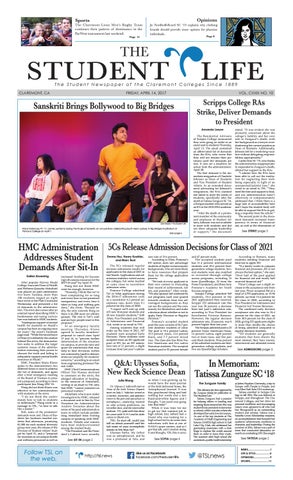
Sanskriti Brings Bollywood to Big Bridges
VOL. CXXIX NO. 10
Scripps College RAs Strike, Deliver Demands to President Amanda Larson
Liam Brooks • The Student Life
Rahul Nalamasu PZ ‘17, center, performs during the finale of Sanskriti, an annual show celebrating South Asian culture, in Big Bridges Auditorium at Pomona College on April 7. See page 6
The Residential Advisors of Scripps College announced they were going on strike in an email sent to students Thursday, April 13. The email contained an abbreviated list of demands from the RAs, who wrote that they will not resume their positions until the demands are met. It also set a deadline for action from the administration: April 20. The first demand is the immediate resignation of Charlotte Johnson as Dean of Students and Vice President of Student Affairs. In an extended document advocating for Johnson’s resignation, the RAs claimed she failed to meet the needs of students, specifically after the death of Tatissa Zunguze SC ’18, a Scripps student who served as an RA in the 2015-2016 academic year. “After the death of a prominent member of the community and employee of Student Affairs, Johnson was not available to meet with students and did not show adequate leadership or support,” the document
stated. “It was evident she was primarily concerned about the college’s liability and her own role in Zunguze’s death, with her background as a lawyer overshadowing her current position as Dean of Students. Additionally, Johnson left for a week-long vacation without delegating responsibilities appropriately.” Caitlin Kim SC ’19, who thinks the administration inappropriately responded to Zunguze’s death, offered her support to the RAs. “I admire how the RAs have been able to call out the institution for neglecting their wellbeing especially in light of an unexpected/painful loss,” she wrote in an email to TSL. “They need the time and support to heal, and our administration hasn’t effectively or compassionately addressed that. I think there is a huge lack of accountability here and I hope the student body will be able to support the RAs in getting a response from the school.” The second point in the document demands increased transparency in terms of financial aid, as well as the elimination of
See STRIKE page 3
HMC Administration 5Cs Release Admission Decisions for Class of 2021 Addresses Student Demands After Sit-In Emma Hsu, Henry Koehler, and Marc Rod
Kellen Browning After popular Harvey Mudd College Associate Dean of Health and Wellness Qutayba Abdullatif was placed on paid administrative leave Tuesday, more than 100 students staged an eight hour sit-in in the Platt Courtyard Wednesday and presented a list of demands to the administration. The sit-in also comes after an external report describing HMC’s burdensome and taxing curriculum was leaked to HMC students. “Inadequate support of mental health for students on Mudd’s campus has been an ongoing issue for years,” the event’s Facebook page read. “While the forced leave of Dean Q is definitely the catalyst behind this sit-in, the demonstration seeks to address the larger systemic issues of the administration exercising their power to obscure the truth and failing to adequately support mental health resources at Mudd.” HMC President Maria Klawe spoke to the demonstrators two different times — once to address the list of demands, and again after a brief emergency meeting of the Board of Trustees to present a proposal, according to sit-in participant Jess Wang HM ’18. Wang did not think Klawe was effective in her communication with students at the sit-in. “I do not think she understands how to talk to students or millennials,” Wang wrote in a message to TSL, “or how to talk like a leader.” Still, some of the protesters’ demands were met. Dean of Students Jon Jacobsen emailed students that afternoon, promising $1,500 for each student diversity group next year, the release of the Division of Student Affairs’ budget by April 21, and a “proposal for increases to on-campus health and wellness personnel as well as
increased funding for [accessing] off-campus resources for the 2017-18 year” by April 19. Wang did not think HMC went far enough, however. “Honestly, I think that we’ve been complaining for so long and every time we are promised transparency and every time it takes so long and nothing gets done,” she wrote. “Because really, the only concrete thing on there is $1,500 more for affinity groups. The rest is ‘let’s wait and see how people react to this proposal.’” At an emergency faculty m e e t i n g T h u r s d a y, K l a w e agreed to faculty members’ proposal to cancel class April 17 and 18, to “prevent further deterioration of the situation on campus, to provide time and space for interactions that may help to heal divisions within our community, [and] to demonstrate our empathy for students’ concerns,” according to an email from engineering professor Patrick Little. HMC Chief Communications Officer Tim Hussey declined to comment on the sit-in, the pledged allocation of funding, or the removal of Abdullatif, writing in an email to TSL only that HMC “cannot comment on personnel matters.” Abdullatif, who is now under investigation by HMC, released a document sent to him by Vice President for Administration Andrew Dorantes about the terms of his paid administrative leave — which include prohibiting Abdullatif from visiting campus or speaking with HMC students. Details and rumors have been widely-circulated among the student body. “The President and the President’s Cabinet have recently
Follow TSL on the web.
See SIT-IN page 2
The 5Cs released regular decision admissions results for applicants to the class of 2021 in late March. Applications and admissions statistics varied across the colleges, but some reached or came close to record-low admission rates. Pomona College admitted 741 of 9,046 applicants during the 2016-17 admissions cycle — a record-low 8.2 percent acceptance rate, down from 9.1 percent for the class of 2020. “I expect we’ll end up with 415 new first-year students and 20 new transfer students,” Seth Allen, Vice President and Dean of Admissions and Financial Aid, wrote in an email to TSL. Among students that will make up the class of 2021, 187 students were accepted Early Decision. These students were accepted from an ED applicant pool of 891 for an ED admission rate of 21 percent, a slight increase from last year’s admis-
sion rate of 19.4 percent. According to Allen, Pomona’s ED option does not advantage students of higher socioeconomic backgrounds, who are more likely to have resources that prepare them for the college application process. “We look at every applicant in their own context in evaluating their record of achievement, talent, and potential,” Allen wrote. “We also sponsor fall weekend fly out programs each year geared towards students from less advantaged backgrounds so they can see the campus and the community for themselves and make a decision about whether or not to apply Early Decision or Regular Decision.” Pomona’s accepted student pool this year consists of 56.7 percent domestic students of color. The pool is 19.4 percent Latino, 15.9 percent Asian, 12.6 percent black, and 7.7 percent mixed race. The class also has three Native Americans and five native Hawaiian students. The accepted student pool is 53 percent female
Q&A: Ulysses Sofia, New Keck Science Dean Julia Wang Dr. Ulysses J. Sofia will start as Dean of the Keck Science Department on July 1. Sofia has served as a teacher, researcher, and administrator in the past and specializes in astrophysics, conducting research on solar activity predictions, interstellar dust, and the interstellar medium. TSL spoke with him about his career with NASA and his dedication to liberal arts. TSL: To start off, could you tell us about yourself and detail some of your accomplishments in life thus far? Ulysses Sofia: My father was an astrophysicist, and he was a professor at Yale, and
http://tsl.news
so when I was growing up he would have the main journal of the field delivered home, the Astrophysical Journal. It was this gray-bound thing and had nothing but words and a few black-and-white figures and I thought, “I am never ever going into that field.” When it was time for me to get my first summer job in high school, [my father] had a friend who was looking for a high school kid to do some data reductions with him at one of NASA’s space centers, and so I got that job, and I started doing it and thought, ‘Oh, this is actu-
See SOFIA page 4
Like us on facebook: facebook.com/thestudentlife
and 47 percent male. The accepted student pool has 11.4 percent international students and 20.4 percent firstgeneration college students. Several students were also matched or recruited through college access programs, including 16 from QuestBridge, 22 from the Posse Foundation, and three from Pomona’s Academy for Youth Success program. Scripps College admitted 949 students, 33.4 percent of the 2841 applications they received. Scripps’ ED admission rate this year was 38 percent, a decrease from last year’s admission rate, according to Vice President for Enrollment Victoria Romero. However, the regular decision admission rate, 33 percent, was 8 percent higher than last year. The Scripps admitted pool is 23 percent Asian American/Asian, 14 percent Latina, eight percent two or more races, and five percent black students. Nine percent of the admitted students are firstgeneration college students, and two are Questbridge Scholars.
According to Romero, many students needing financial aid tend not to apply ED. “If a family wants to compare financial aid processes ,ED is not always the best option,” she said. “Over half of the pool applied for financial aid and nearly half received financial aid.” Pitzer College saw a slight increase in the acceptance rate from last year. Pitzer accepted 584 of a total of 3,753 applicants, or 15.56 percent, up from 13.4 percent for the class of 2020, according to Vice President for Admission and Financial Aid Yvonne Berumen. The combined early decision acceptance rate also rose to 34.4 percent for the class of 2021, up from 30.8 percent for the class of 2020, giving ED applicants slightly more than double the chance of being admitted compared to regular decision students. “ED students are generally students that have shown the most interest; they have toured, interviewed and attended events
See ADMISSIONS page 3
In Memoriam: Tatissa Zunguze SC ‘18 The Zunguze Family This obituary has been approved by the Zunguze family for publication in The Student Life. Tatissa Zunguze had a passion for helping others — leading and inspiring those around her. She was student body president in elementary school, which was also where she developed her early love for science. As one of the top students at The Academy of Math Engineering and Science (AMES) high school in Salt Lake City, Utah, she addressed her graduating classmates with a challenge to explore the world around them in order to leave their mark. The summer after high school she undertook a public health internship
@TSLnews
at Johns Hopkins University, a trip to Europe with People to People, and was Miss Utah Teen USA runner-up. Tatissa enrolled in Scripps College in fall 2014. She was beloved at Scripps, and throughout The Claremont Colleges, and her drive for personal excellence and encouraging nature were apparent to all who met her. Recognized as an outstanding student and scholar, Tatissa was a Samella Lewis Scholarship recipient, an accomplishment that honored her academic achievement, excellence in character, and leadership. During the summer of 2016, Tatissa was a part of team that conducted laboratory research on combatting HIV. She sought
See TATISSA page 2
NEWS................................1 LIFE & STYLE.....................5 OPINIONS........................9 SPORTS...........................11
NEWS PAGE 2
APRIL 14, 2017
THE STUDENT LIFE
TATISSA: Zunguze Remembered for Scripps Leadership, Passion for Social Justice Continued from Page 1 to combine her perspectives in queer and feminist people of color studies into her research. Without exception, Tatissa’s professors recognized her as a rising star in STEM. In addition to her academic achievements, Tatissa was a student leader, mentor, and advocate who worked to create a more equitable community on campus. Along with other students, Tatissa’s advocacy facilitated expansion of Scripps program and resources for first-generation students and the preservation of the Scripps Communities of Resources and Empowerment (SCORE) focus on social justice and equity. Her classmates and fellow Wanawake Weusi members considered her an integral and esteemed member of the group and a role model for other students. Even those who did not know Tatissa well were touched by her generous and compassionate spirit and her genuine care for others. Tatissa’s leadership extended to Scripps Associated Students (SAS), where she was involved in student governance and served as the chair of the SAS Faculty/Staff Relations Committee, helping to organize Staff of the Year awards and create connections among students, faculty and staff. As a Resident Assistant (RA), Tatissa was a familiar and dependable resource for students seeking information, support, and insight into life at Scripps. In her role as an office assistant for SCORE, she was a strong advocate for its leaders and the student constituencies it serves. Tatissa was passionate about social justice and advocated for creating space and voice for the underserved and marginalized. Her commitment to her fellow students was unsurpassed. Tatissa was a consistent voice for impactful structural change, fearless in her insistence that Scripps be a place of sustenance and support for all its students. Tatissa is missed and leaves behind scores of family members, friends and people who admired her irrepressible spirit. She will be remembered for her infectious smile, her playfulness, her personal excellence, adventurousness, and her ability to bring people together through her compassion.
Courtesy of Jessica Padover
Tatissa Zunguze SC ‘18 passed on March 4, 2017. She will be remembered for her infectious smile, her playfulness, her personal excellence, adventurousness ,and her ability to bring people together through her compassion.
Poem: “& it’s still murder”
Eliamani Ismail
Artist’s Statement: Many times throughout this semester the Claremont Colleges, through institutional indolence, has proved it’s complacency in the ongoing mental, emotional, and physical deterioration of its students of color. Though the official cause of death for Tatissa Zunguze was a suicide, it is of no great mystery for POC students or white students in POC proximity that these institutions played a major role in her passing nonetheless. This poem was written with the intention of placing responsibility where responsibility is due. & it’s still murder I. i don’t know what death looks like i can barely fiction up the way the dark shrouds and never peels back i’m a fairy tale of a being a disciple of the bible and I am still waiting on the fate of Lazarus for Tatissa for her body to rise four days after the burial for black jesus to put a foot down on the disappearance of his daughters to march into the dean of students and tell them about themselves finger wagging and fire in tow. damnation on the fraud of this place for ‘here begins a new life’ ( but i’ve never seen so many dead brown bodies on a campus) never knew it was possible to be gutted out and still standing is this what they meant when said ‘Scripps girls fight back’? is this a battle staged? some sort of tuskegee toxicity? I ain’t think it was possible to live like this and then you don’t. and then she doesn’t. and you learn toxic and lethal are synonyms i still have never known death but i’ve dipped my fingers into the hole it leaves in the night i’ve seen it’s shadow too many times here it double dutches between the cross section of black and women like child’s play II. i know what she looked like i knew the venus in her skin and the saturn in her smile i knew of how the planets aligned and on the quad every afternoon after class on days the sun couldn’t find a clear stay in the sky it would instead settle for the apples of her cheeks she was the first black girl I saw here. we didn’t even speak that day. they say most of human communication is non-verbal the exchanged black girl smile was enough to say everything that needed speaking. I glad to see you I understand Good luck. III. let’s talk about irony i go to see Get Out and leave excited to talk about a tale of fiction i enter the suite and hit drowning waters ain’t this what it is to hit home? when a horror movie would be better escape than reality. to not need news to tell you bout latest brown body the girls in the suite eyes are dried out from crying and outlined in red adorned with diamond pupils ain’t that why this college love them so? they the crystals on the front page of the brochure diamond black girls. yea, they strength... but why they test them like this? Last night they accounted for their comrades This morning they could only Dip their fingers in the holes one left And promise to paint the ashes everywhere.
SIT-IN: HMC Places Health and Wellness Dean on Administrative Leave Continued from Page 1
become aware of concerns that you may have taken certain actions inconsistent with the role and responsibilities of your position at HMC; undermined the credibility and effectiveness of the Division of Student Affairs in serving and working with students, faculty, and staff; and undermined the ability of [Monsour Counseling and Psychological Services] to be the principal counseling resource for our students,” the letter read. “In addition,” the letter added, “your relationship with MCAPS has deteriorated to the point where Denise Hayes, Vice President for Student Affairs for the Claremont University Consortium, has asked for the second time in four months that
HMC appoint another person to be the College’s liaison because they can no longer work cooperatively or constructively with you.” Though Abdullatif at times throughout the past few days appeared as though he would respond to the letter and his removal from campus, he eventually concluded in a Facebook post that he could not. “I was advised that I am not allowed to communicate with current HMC students nor am I allowed to defend myself regardless of how much information I have,” a post on his Facebook account read. Wang said she wouldn’t be surprised if his relationship with workers at MCAPS had deteriorated, or if he had violated students’ confidentiality — another
allegation that has circulated among students. Regardless, Wang, like other students, felt that Abdullatif had the students’ best interests in mind. “In all honesty, I think MCAPS is bullshit,” she wrote. “Appointments with MCAPS [are] built into Harvey Mudd tuition, but it takes weeks to get appointments with them and they really don’t help a lot of students that go there. And Dean Q has had, on multiple occasions, to call and tell them to see a student right away. “Dean Q was sick and tired of things being covered up, [the Office of Health and Wellness] not being funded,” Wang added. “His entire career here was a fight, a fight for funding, for power, for the students.”
Meghan Joyce • The Student Life
Harvey Mudd College students and faculty gather for a community meeting in Platt living room on March 29.
NEWS PAGE 3
THE STUDENT LIFE
APRIL 14, 2017
Through Bonfire, Mudd Students Protest Mental Health Practices
Adela Pfaff • The Student Life
Adela Pfaff Students at Harvey Mudd College have been speaking out against the unsafe mental health practices their school cultivates; many brought homework assignments and essays to destroy in the court-
STRIKE: RAs Demand Resignation of Dean of Students, Restructuring of RA Role Continued from Page 1 financial policies that penalize students for obtaining private funding for tuition in the form of merit scholarships and crowdfunding. The document supports this claim by citing that multiple Scripps students have had to terminate their enrollment at Scripps due to financial aid packages that do not adequately adjust to meet increases in tuition and room and board over the course of their four years. Sofia Padilla SC ’19 said she has had her own experiences with inadequate financial aid. “I believe that one of the most jarring aspects of attending an expensive private institution is entering the community and realizing that coming up with the funds needed to take care of everyday mishaps and even simply paying for tuition is is much harder than the school makes it out to be,” Padilla said. “Students should come to campus understanding [what] it’s going to take for them to stay here and succeed, and while some have this knowledge, it’s important that the school puts in more effort to fully support and educate students reliant on financial aid.” In relation to mental health, the RAs demand that Scripps update emergency preparedness plans for when students endure life-threatening events, as well as establish an official procedure for supporting students in a mental health crisis. They also demand an increase in subsidies for students seeking off-campus therapy given the eight-session limit, a requirement that stipulates that students are limited to only eight sessions with a therapist at Monsour. Additionally, the document demands a restructuring of the RA role, and says the duties of RAs at Scripps do not embody the principles of restorative justice. The document condemns the fining of students for multiple
lock-outs and for staying past the residential hall closing time for breaks, both of which are duties that RAs are expected to carry out. In the extended list of demands, the RAs expressed their willingness to take part in the restructuring of the role. “The RAs believe that there are several ways to make sure that the time and energy of students and staff is better spent so that all programming and office hours can be beneficial for more members of the Scripps community,” the document said. “We encourage you to reach out with suggestions, and listen to the ones we are willing to provide as well. We will no longer carry out mundane tasks that are of no value to our community.” The Scripps Dean of Students Office is waiting to find appropriate coverage for the residence halls before addressing the RAs’ demands, Associate Director of Media and Public Relations Karen Bergh wrote in an email to TSL. “The College’s immediate focus is on ensuring we have appropriate coverage for the residence halls,” Bergh wrote. “To that end, the Dean of Students is developing a plan to ensure the health and safety of our student body and to cover the critical functions of residential life for the duration of the semester. Once that work is complete, the president and leadership will review and respond to the RAs’ concerns.” The Scripps RA strike comes on the heels of an open resignation letter from a Pomona College RA. In this anonymous letter, the RA cited the administration’s failure to “value us or acknowledge our intersectional identities and struggles when making decisions and responding to our needs or your mistakes.” The letter has sparked complaints from Pitzer College RAs about the Pitzer Housing Office’s lack of transparency.
yard of West Dorm on Wednesday, April 12. Some students dumped entire stacks of old homework and study guides into the fire, while others let the fire gently grab at their papers and drag them down into the blaze. For students who didn’t bring materials to burn, Madi Pignetti HM ‘17 and her
partner, Marisol Beck HM ‘17, provided the growing crowd with paper alphabet letters, which passersby could toss into the fire. They advised students to “burn memories, pieces of yourself, [and] pieces of others,” but some students just stopped by to watch.
ADMISSIONS: Admissions Officials Report Strong 2021 Applicant Pool
Continued from Page 1
on campus,” Berumen wrote in an email to TSL. “All applicants are admitted under the same criteria.” According to Berumen, the class of 2021’s admitted student pool is 13.5 percent Asian, 6.9 percent black, 13.5 percent Hispanic, and 9.6 percent two or more races. 12.8 percent of accepted students are firstgeneration college students, and 42 percent will receive financial aid. The average financial aid package for the class of 2021 will be $46,388. Claremont McKenna College received 6,350 applications for the class of 2021, and accepted 657 applicants, or 10.35 percent. According to CMC Vice President for Admission and Financial Aid Jeff Huang, this was the second-largest applicant pool in CMC’s history. CMC admitted 207 of 667 ED applicants, for an ED admission rate of about 31 percent, slightly down from last year’s 31.9 percent early decision admission rate. CMC admitted 450 applicants in the regular decision admission cycle, amounting to 8 percent of the regular decision applicant pool. This was higher than last year’s 7 percent rate. “Students admitted through Early Decision are similar to students admitted through Regular Decision,” Huang wrote in an email to TSL. “Our standards remain the same. We have a high proportion of recruited student-athletes who are admitted in ED.” CMC was unable to provide demographic data about their admission pool to TSL. Harvey Mudd College accepted 566 of 4,078 applicants for a 13.88 percent acceptance rate. The admission rate was slightly higher for the class of 2021 than for the class of 2020, according to Vice President for Admission and Financial Aid Thyra Biggs. “We are looking for a slightly
Audrey Hector • The Student Life
larger class” this year, Biggs wrote in an email to TSL. The early decision rate, however, was relatively consistent. HMC accepted 81 of 503 ED applicants, or 16.1 percent. HMC keeps its ED admissions rate relatively low because the ED applicant pool lacks diversity, Biggs wrote. Overall, HMC’s accepted student pool is 10.6 percent first-
generation college students, 17.1 percent Hispanic/Latino, 20 percent Asian or Asian American, 7 percent black or African American, and 13 percent multiracial. Fifty international applicants were admitted. According to Biggs, the strength of HMC’s applicants makes selecting which applicants to admit difficult.
“We continue to be humbled by the strength of our applicant pool,” Biggs wrote. “We estimate that almost 80 percent of the students who apply would be great at HMC, and so, like our sister colleges, we have to make some hard decisions. This year’s admitted students are as remarkable as those that came before them.”
NEWS PAGE 4
APRIL 14, 2017
THE STUDENT LIFE
SOFIA: New Dean of Keck Science Discusses Plans, Advice for Students Continued from Page 1 ally kind of fun.’ So that’s how I actually got into this field. That first one started me off and after that I just kept on going. TSL: So, having had so much experience early on, were you sure going into college that you wanted to study astrophysics? US: No, I wasn’t sure. When I applied to college I knew I wanted to study the sciences, so I was actually thinking chemistry, but the summer before college I did my second year at NASA with my mentor there. After working with him for a second summer, I knew this is what I wanted to do. During my first two years of college, I was working on a payload to go up on a space shuttle, and so I got involved in that instrument during my freshman year. And that was right before the Challenger blew up. In fact, our payload was the one that was supposed to be the one going up after the Challenger, so that was kind of a bummer that I never got to see that go up, and when it finally did go up years later, I had already moved. TSL: After college, then, how did you end up in teaching and education? US: I [studied at] Wesleyan University in Connecticut. It was a liberal arts institution where I got to interact with the faculty and I felt like I could ask questions in class, and I was encour-
aged to do research and worked on a telescope on campus and was working with the mentor I had at NASA. It was an atmosphere that was perfect for learning. At that point, there was no question that for the rest of my life, my goal was to get to a high-quality liberal arts institution. TSL: What in particular sets aparts the Claremont Colleges from other institutions? US: One thing in particular that I love about the Keck program that’s different from a lot of the sciences is how integrative they are. They are leaders in integrating the sciences, and that’s something that I’d wanted to do more with the positions I’ve been in, but that’s a very expensive thing to do, and it’s hard to do. It requires really good cooperation among the faculty and you have to be willing to put faculty together in a small class of students — and it could work well, but it could also go horribly. The ability of the Claremont Colleges to make this integration work is not just in the classes, but in the way they do their research too. That’s incredibly attractive to me. It’s important because when you talk about any science these days, there’s almost nothing that’s pure physics or pure biology. Everything’s a mix of these things. If you look at some of the biggest concerns we have now, like climate change, you have to come together with all the sci-
Claremont Food Justice Series Promotes Sustainable Practices Julie Tran To promote awareness of food justice, students at the Claremont Colleges organized the Claremont Food Justice Series during the week of April 10. The week was comprised of workshops and speakers that advocated for the reform of the current food system by increasing awareness and organizing first-hand experiences with a variety of foods from various sources. The Food Justice Series included events about the history and origins of food and suggestions for how to reform the food system so that it is healthy, cost-effective, and ensures that no individual is left hungry. Alex Kleinman PO ’20, who organized the Future Meat Panel, said that he is most interested in animal agriculture and its relationship with environment, food access, food transparency, animal welfare, and public health, as well as exploring alternatives to meat, such as lab-grown or plant-based substitutes. The definition and breadth of food justice varies. Anne Shalamoff SC ’20 attended the Chai Decolonized event, where attendees were able to taste chai, which was altered when the British decided to add milk and sugar to it, in its most natural form. “Food justice is reclaiming the culture and knowledge associated with growing and making your own food,” Shalamoff said. “It’s about making fresh, healthy food accessible to more people while making sure workers get fair treatment and the environment isn’t neglected.” Teague Scanlon PO ’19, the student organizer of the Fermentation Workshop, shared the reasons behind his belief for the need to reform the current food system in an email to TSL. “Our food system right now is built on the foundations of decep-
tion, racial injustice, corporate monopoly, and the separation of people from the source of their nourishment,” Scanlon wrote. Scanlon wrote that his passion for food justice is inspired by growing ignorance about the origin of our meals. “There is a value to seeing meals from the seed to the decorated plate, because we are able to see just how incredible the earth is,” Scanlon added. “[The earth] is literally pushing out incredibly healthy and nourishing food to whoever wants to claim it, but when most Americans have never picked a vegetable or planted a seed, it’s easy to become removed from that process and not have an incredible amount of admiration for the natural world.” “I think governmental policy needs to be changed to pass power down from big food corporations to sustainable, personally-managed farms and businesses,” said Olivia Whitener PO ’17, an event organizer. “The politics surrounding food is very messy, with some very big players profiting while other consumers and producers have to deal with the consequences.” During another event in the Food Justice Series, journalist, writer, and activist Raj Patel spoke about how the existence of the food system has impacted the world socially, politically, and economically. Patel defined food justice as the dedication to “an end to poverty, and an end to inequality.” “We should work toward a world where no one goes hungry,” Patel wrote in an interview with TSL. “Food justice is an invitation to dream much bigger than we normally do, and you are more powerful than you have been told. Dream the world that you really want to live in.”
Romario Quijano • The Student Life
Raj Patel, academic, journalist, writer, and activist, lectures about the formation of modern agriculture’s infrastructure, the impact of monocrop farming, and its quotidian impacts on April 12 in Pomona’s Rose Hills Theatre.
ences to find a solution. There are so many institutions right now where ‘integration,’ ‘multidisciplinary’ — those are some of the buzzwords, but Keck has been doing it for years. They’re really at the lead of this. TSL: As the dean of the department, you’ll be carrying out a lot of the administrative details. Do you still plan on interacting with students directly? US: I hope so; that’s a big part of why I wanted to come back to a liberal arts institution. I don’t know how much I will be teaching, but I would definitely like to work on research with students. TSL: What advice do you have for students who are interested in research but are perhaps intimidated about getting more involved? US: The faculty at a place like the Claremont Colleges are here to help you explore, so we don’t expect you to come in to have great expertise or to know everything. We know you’re coming in without that experience and that you’re here to get it. So, don’t think there are a bunch of expectations for what you do or what you know; the whole point is to give you that experience. TSL: Do you have any other general advice for college students, and in particular those who are trying to figure out what to major in? US: Test things out. That’s the best way of doing it. If you think
Courtesy of Jacqueline Lunguze
Ulysses Sofia will join the Claremont consortium as the Dean of Keck Science in July.
you have an interest in something, then do it. That’s the best way to figure out if you like it. And do things early. If you don’t do
it early, then you might get in a spot where you’re like, “Oh, now I don’t have time to do that anymore because I spent too much
time doing this other thing.” So explore early on. This interview has been edited for clarity and length.
LIFE & STYLE APRIL 14, 2017 SEX COLUMN
THE STUDENT LIFE
PAGE 5
At Least I’m Probably Not Pregnant?
Content warning: contains graphic sexual content. There I was, lying on my bed, rubbing my knee, and faking another orgasm, waiting for him to complete his 6-minute post-coital ritual of masturbating and finishing on my boobs. He did this every time we had sex. For some reason, he “just couldn’t” come inside me, so we’d have sex, and then he’d jerk off over me while I pretended to play with myself (at his request) until he ultimately ejaculated onto my breasts, without looking at me, without kissing me, barely even touching me. I wanted to cry. We had been dating for eight months, and he had never finished inside me, not once. Half the time, he never even came. Did he realize how badly this hurt
my feelings? We used protection, and I was on birth control — why couldn’t he just come inside me? Apparently, I was the ninth girl he’d slept with, so he was a self-proclaimed “sexpert.” Well, I thought, if he’s the sexpert, there must be something wrong with my vagina — which was deflowered by him! I’m young, I’m tight … what more could he want? I know what you’re thinking. He just wanted sex, even if it sucked. Then why would he bother being my boyfriend for eight months, and talking to me on the phone every day when I was studying abroad, and including me at both of his family Christmas celebrations? Would a guy bother to introduce the girl to the dying great-grandmother just to have shitty sex for eight months, interrupted by a four-month period of study-abroad
“Trojan Women” Strikes Seaver Theater: War-Torn Women Fight Back Schuyler Mitchell Queer feminist utopias. Tarot cards. BDSM. What do all of these things have in common? They’re all topics featured in the Pomona College Department of Theatre and Dance’s latest play, “Trojan Women: A Love Story,” performed from April 6-9 at Pomona’s Seaver Theatre. Written by Charles L. Mee, “Trojan Women: A Love Story” is an adaptation of the play “Trojan Women” by Euripedes. According to the playbill, Mee posted scripts for “Trojan Women” on his website, “the (re)making project,” and encourages people to “use them freely.” Director Joyce Lu collaborated with the cast of the play in order to interpret and mold Mee’s work into their own projects. The result is a beautiful and experimental production, full of the “sharp edges” that Mee praises. While not exactly a musical, the play featured songs that were selected by Lu and the cast. The songs were molded into the world of “Trojan Women” based on the actors’ experiences of the show throughout the production process. “Trojan Women” features two acts, though there isn’t an intermission explicitly dividing the first half from the second. Instead, the stage shifts before the audience’s eyes. The first act is a more direct interpretation of Euripedes’ “Trojan Women,” graphically depicting the horrors of war after all of the men have been killed off and only the women remain. The second half of the play takes place in a spa in what seems to be a parallel world. In this act, the women live in a sort of all-female utopia that some battle-ravaged men stumble upon after losing their war. Berto Gonzalez PO ’20, who played Talthybius, said that the actors all researched their characters in order to create their own backstories. This is called “devised theater,” in which the script grows from the collaboration of the actors rather than a direct interpretation of the script. This collaborative, experimental element is threaded throughout the play. When speaking about the
final product of the show, Barbara Peisch PO ’19, who played Cassandra, said, “This was a really abstract, experimental show and maybe what is fulfilling about it isn’t necessarily a storyline, but rather the imaginative approaches of interpreting ancient storylines.” Gonzalez and Peisch both spoke to the rewarding and unique aspects of drama at Pomona College. “Theatre at Pomona has a really supportive community,” said Peisch. “It doesn’t feel really competitive or intense, which is awesome.” Gonzalez added that theater at Pomona is different from theater elsewhere because “it’s more of an academic process.” The actors put in work outside the theater, researching the characters and creating a more authentic final product. “Playing a darker character has been a new experience for me …I ’ve been able to explore myself a little bit more as an actor here because of that,” Gonzalez said. “Becoming someone who is very much not me … someone who is very outside of myself, has been the best part of theater at Pomona.” Rachel Tils PO ’19 was striking in her role as Helen, though she expressed her reservations about the production: “I think the bottom line is that the show was way too ambitious for our school. The script is complicated, requires huge, vastly different sets, and contains some very violent, graphic imagery about war, violence, and especially violence towards women that I feel our cast was not prepared to tackle in a meaningful way,” Tils said. It is without a doubt that “Trojan Women” was a highly unusual production, tackling some very difficult and complicated topics, and might not have been accessible to as broad of an audience as past Pomona College productions. Nevertheless, despite its confusing moments, “Trojan Women” was thoroughly enjoyable to watch as its characters came to life on stage.
celibacy (unless he cheated, which is possible)? I don’t know, but I doubt it. If this was the case, more power to him. More power to him, because goddamnit, I was in love with him. He was bad in bed, and refused to do foreplay. He never admitted to being wrong. He called me an obligation, forgot to text me goodnight, and never wanted to cuddle after sex. Sometimes, he didn’t even bother to kiss me before he had sex with me — he just went inside. He said every vagina tastes awful, including mine. He was always tired and grumpy. He said I’d better stay faithful during study abroad, because he’d “managed to not cheat on way shittier girls” than me. He took me out to dinner once in eight months, but always had money for beer with his friends. He said he liked me “even though” I’m not
Barbara Peisch PO ‘19 (Cassandra) glows in a red gown onstage in “Trojan Women.”
to close my eyes. A second later, I heard a weird noise, and suddenly my nose was covered in whipped cream. I looked up to see him smiling at me — a smile I’ll never forget. “There’s, umm, something on your nose,” he told me, as he leaned in to kiss the whipped cream off my face. I couldn’t stop laughing. “What on earth are you doing?” I said between giggles, trying in vain to snatch the can away and get him back. “Well,” he said, looking up at me, “I knew you were upset, so I wanted to cheer you up.” Then he sighed and flopped back down on the pillow. I knew what was coming — I knew he was about to break up with me because of my anticlimactic performance. “Connie,” he said, looking at me intently, “I … I think it’s too early to say this, but … I think I love you.”
“You — you do?” I said as hope filled my heart. “Well, I don’t want to jinx it, but I think I might love you too.” These days, he “breadcrumbs” me. He’s a news producer, so he sends me the occasional TV clip that he produced. I’ll send back several compliments, and he’ll read them and not reply. My family and friends say he’s an emotional manipulator. I know he is, and I know he knows he controls me. I hope someday I’ll find someone else. Wait. I know I will. Will he ever change, or will his future fuck buddy be eternally doomed to a cleavage full of cum? If she wants babies with him, will he have to jerk off into a turkey baster and use it as a proxy? Who knows! -Connie Lingus
TV COLUMN
Italian Tween TV is a Confusing and Wild Ride (but I Love it Anyway)
Lauren Churchwell If I’m being honest, my experience with Italian TV has been extremely limited during my time abroad. My Italian isn’t great, so I’ve been watching the same thing for the past three months: “Alex & Co,” an Italian Disney Channel production that actually reminds me a lot of the old shows we watched like “Zoey 101” or “Life with Derek” –– the good stuff. However, watching this show has gotten me to reconsider if these programs were actually good, or if I’m just looking at the past with rose-tinted glasses. “Alex & Co” would feel right at home with those American shows and their plots, but the way the Italian versions turn up the drama is unbelievable for a 20 minute show marketed to the 8-to-12 demographic. The show is about a group of high schoolers who form a band that they have to keep secret, because singing is banned in Italy (sorry, that’s totally not true -- I just don’t remember why). The high school is Americanized to the nines with lockers, mean girls, and even a school soccer team, which actually is not very Italian at all. Even their songs are in English, and while my host sisters love to sing along, I have to admit as an English speaker, all of the show’s music is made up of absolute word salad. It’s like the song writers are throwing an Italian/ English dictionary in your face, but the dictionary has all the words in the wrong place, and then for some reason it’s your job to unscramble them. For example, the show’s theme song “Music Speaks” tells us: “If I cannot sing a single song that I’ll understand and sing along.” Yeah it’s not great, and I didn’t even touch upon the worst parts. That being said, the 13-year-old in me is revived by the show, or maybe this show is
secretly a work of genius — but either way, I’m hooked. All of the characters are terrible, especially our main character, Alex, who is this artsy fifteenyear-old that thinks his creative talents give him a free pass to shirk all educational, personal, and professional responsibilities. He completely forgot about his six-month anniversary date that his girlfriend slaved over because he was writing a song, for God’s sake. I would like to take this time to note that I know for sure everyone in my host family is obsessed with this show, because when my host dad found out that this happened on the show he had a full-on freak-out. However, no
matter how bad Alex or any of the other characters get, I cannot stop watching. Apparently, neither can all Italian girls that I know between the ages of 2-12, either. We have serious conservations about the show, too. Okay maybe not conversations, but discussions. Okay maybe not discussions, but just one discussion. Okay it’s not a discussion, it’s a question: Hey, can you tell me what’s happening? I have no idea what they just said ( Ehe, potete dimmi che cosa ha sucesso adesso, non l’ho capito). The show takes so many twists and turns that I don’t remember even my childhood dramas taking. For example, in the 40-some episodes I’ve watched, there
have been music competitions, plagiarism, paternity accusations, grandmas falling, moms falling, break-ups, make-ups, the cutest nerd couple ever, stolen diaries, girls with secret pasts, and now, Alex is pretending to be two people to further himself creatively but also to hook up with one girl and his ex at the same time –– he really is the worst. What I’m trying to say is that even though this show isn’t the height of the ‘golden age of television’ that we currently live in, it’s done a lot for me: It’s sustained me every night at 9:30, helped me bond with my host family, and given me some great memories. It’s weird, but I think I’m going to miss it when I get back home.
Anikka Villegas & Dominic Frempong • The Student Life
Middle East Expert Laments Failures of International Law Shringi Diva Vikram
Courtesy of Michele Miner
skinny (size 10, you bastard!). He never picked me up because his license was taken away when he got a DUI before we met, which he lied to me about (his mom told me by mistake). He illegally cheated on a drug test to get his new job. Somehow, I’m still glad I lost my virginity to him. It was a perfect night. We were home alone, and we went swimming and watched a movie, and even cooked dinner naked. When the sex part started, he took it slow and got consent at every step. He’s huge and I’m tight, so nothing fit, and it was the most stressful two hours of our relationship. Neither of us finished, and eventually, we gave up. As I curled up in bed, ready for him to dump me, he left the room. Then, he reappeared, hiding something behind his back, and told me
“Walls, Borders and Fences,” the spring 2017 speaker series sponsored by the Scripps Humanities Institute, shifted its focus to the Mediterranean as Dr. Lori Allen, an expert of the Middle East, discussed the relationship between international law, investigative forces, and Palestine in Scripps College’s Balch Auditorium on April 11. The series of talks has explored the effects of social and political divisions in diverse historical and geographic locations, and has featured discussions on how borders change contemporary power relations in places like the United States and Mexico, Europe, apartheid South Africa, Kashmir, and even Los Angeles. Allen completed her Ph.D. at the University of Chicago and won the Association for Political and Legal Anthropology Book Prize for her book on occupied Palestine. Currently, she is a Senior Lecturer of Anthropology at SOAS University of London. According to Allen, interna-
tional committees from Western countries like the United Kingdom and the United States attempt to persuade what we label ‘third world nations’ that international law uses only objective reason and democratic, humanitarian means to solve conflicts and create an international system. She also said that international powers justify their presence in the Middle East by claiming that they will eradicate the violence and pain the people there have already experienced. Allen made it clear that while the West is violent, its domination and violence goes unremarked upon. “I was thinking throughout about just how influential external nations are,” audience member Leah Rosenspike PO ’19 said. “They [have] so much power.” According to Allen, nations exist in a historical cycle in which they put their faith in international commissions, lose that faith, and then regain that faith. “Most speakers [in the series] laid an emphasis on both learning and unlearning in history,” said Elena Dypiangco SC ‘19, a student worker at the Humanities
Institute. Allen traced the historical situation in Palestine from a little before World War II, adding that although that period may now seem ancient, the political decisions made for refugees and the interplay of compassion, violence and international law is still present in immigration situations today. According to Allen, many Arabs in the region opposed the Zionist demand and promised the Jews equal rights with Arabs, only opposing a space in which the Jews were given unique power. They preferred that the U.S. intervene because they believed in the Unied States’ disinterest in the region, failing to recognize that the United States cared little for the region’s settler-colonial history and had a history of Islamophobia, Allen said. Allen added that in 1948, on the recommendation of the U.N., Israel was given to the Jewish people. The U.N. Charter promised to judge international disputes on the basis of fundamental human rights and self-determination, and created institutions to pro-
mote goodwill between the Arab nations and the U.S. Large-scale conflict between the Arab states and Israel then followed. The U.N. failed to prevent the formation of Israel and the outbreak of war. According to Allen, international bodies just apply the norms they had created to every situation, without understanding it, in a system similar to colonialism. “We think of international law as the be-all end-all,” said Dypianco, “but that obviously provides false hope for a lot of people.” However, Allen said that the Palestinians were not naïve to believe in every new move but simply had enough faith to continue their momentum towards what they wanted. Allen added that although humanitarian systems were ineffective, she wonders where we would be without them. She ended by noting that on most days, however, she is completely against the international system and thinks that it must be eradicated. She said an alternative to international peace organizations is mobilizing international solidarity.
LIFE & STYLE PAGE 6
THE STUDENT LIFE
APRIL 14, 2017
Sanskriti Showcases Diversity of South Asian Culture
Liam Brooks • The Student Life
Students perform at Sanskriti, an annual student-run show celebrating South Asian culture, in Big Bridges Auditorium at Pomona College on April 7, 2017. Top left: Students from the dance group Groove Nation Bottom left: Students perform Bhangra during Sanskriti
Tarini Sipahimalani I remember the days when my parents would take me to watch a Bollywood movie in theatres. It was a big deal (well, inside my young mind) because we didn’t do it often. Most of the times, if we were to watch a Bollywood movie, it would be at home on the television if something happened to be showing. We only watched a few films in theatres if they were deemed blockbusters. Watching Sanskriti, the 5C South Asian Culture Show, on Friday night reminded me of a Bollywood movie, as the show featured overdramatic storyline filled with emphatic dance sequences to supplement the underlying conflict — everything one loves and expects from Bollywood. My eyes were met with energetic dancers wearing bright orange costumes and dancing under orange lights, building up spirit with their rhythmically zealous moves while also appealing to the audience’s humor with fills of classic butt-shaking. Sanskriti definitely met the expectations of many other audience members. Hannah State PO ’20 said that she especially enjoyed the national dance of the Philippines; while the dancers made it look simple, you could tell that it took a lot of skill. “I also thought it was interesting to see a mix of traditional Indian dance [as well as] modifications of traditions; [some were] mixed with hip hop or modern dance,” State said. “It looked like everyone was having such a fun time that it made you happy to watch it.” The show included popular dance styles, such as Bhangra, Dandiya, and Bollywood’s classic
“It’s the time to Disco” hit from “Kal Ho Naa Ho.” Tamasha, the 5C competitive Bollywood dance group, also made an appearance to show off their moves. Sanskriti included a balance of multiple art forms; there was a poetry reading as well as two musical vocal performances, one of which beautifully communicated the elegance of Indian classical ragas. Divya Ryan PO ’20, who performed in Sanskriti, said that she loved the energy the audience exuded. “I heard laughing and cheering and applauding from backstage, which was heartwarming,” she said. Ryan acknowledged that though the storyline might have come off as cheesy, mimicking the movie “Bride Wars,” the filmy aspect did bring in “modern perspectives [like a lesbian couple] that Bollywood movies are still uncomfortable with doing.” “Culturally, it was really touching for me to see so many non-South Asians participating and wearing South Asian costumes and the like. I know there is a huge deal about cultural appropriation here in the United States, and I felt that some people might disagree with how some of these people did that,” she said. “But as someone from Singapore, where celebrating racial harmony includes demonstrating acceptance by wearing ethnic clothing from other ethnicities, it was amazing to see people who are not of South Asian descent wearing the clothes of my culture and participating in Sanskriti, especially when they looked like they were having so much fun doing so.”
LIFE & STYLE APRIL 14, 2017
THE STUDENT LIFE
TR A N S P O RTATI O N
I NTR O TO AFFO R DAB LE C O M M UTI N G
Today’s lesson is in comfort, convenience and value. When you ride Metrolink, you’ll enjoy having time to connect with friends via social media, or catch up on your latest TV shows on your tablet. Choose the Quiet Car for finishing homework, or even some extra time to study. Purchase your tickets at ticket vending machines or on your smartphone through the Metrolink App which makes taking the train even easier. All this, while saving some serious cash!
metrolinktrains.com/studentyouth
metrolinktrains.com/app *Except Weekend Day Pass.
PAGE 7
LIFE & STYLE
PAGE 8 FASHION COLUMN
APRIL 14, 2017
THE STUDENT LIFE
Student Fashion Spotlight: Ruben Murray PO ‘19
Charlie Kolbrener For many people, fashion is a constant evolution. The things we find cool are constantly in flux as trends change. I’ve fully discarded pieces in the past, deeming them uncool, only to find them buried in my closet years later and absolutely love them. In retrospect, some trends are perceived as juvenile, but it’s always important to remember that fashion is cyclical. I doubt that in the 2011 peak of skinny jeans people foresaw the current burgeoning trend of straight fit jeans and slacks. People evolve, and the clothes they wear evolve simultaneously. This week I spoke with Ruben Murray PO ‘19. Ruben recalled his self-proclaimed ‘hypebeast’ days at his Parisian high school, and discussed his new style philosophy. Although he has evolved towards a more minimal, laid back approach to fashion, Ruben’s style certainly remains noteworthy. Draped in his yellow Nike bomber, Ruben rocks a look that is unquestionably cool. Check out his instagram, @ rubenmurray, to observe his style. TSL: How did you become interested in fashion? Ruben Murray: Well, I always wanted to be different from the other kids. And my difference — I grew up in France — so my difference was to be more oriented to what was American at the time. That’s what was cool for me. So, instead of soccer, I got interested in basketball, in wearing basketball shorts and Timberlands. And my dad would bring me cool stuff from New York that I’d wear in school. So that was elementary school, that idea of what was American and what was cool. And then when I grew up, I started dancing a lot. Dance and style, there’s a big relation between the two. So, I started dancing when I was maybe 12 or 13. Every Saturday I’d go to a dance meetup and you would show your moves and show your gear. You’d need to be fresh in what was cool at the time. And it just continued. What I realized in the last five years: a lot of my friends that I went to school with, or friends that I met from dancing, would transition themselves, recycle this into fashion. A lot of them are now working in fashion, studying fashion. I used to be like really into fashion. I used to camp out
for the latest pair of shoes. And I just detached myself two, three years ago, and decided I wanted to do something else. I think the peak was high school. It was all about wearing Supreme, wearing the latest Air Maxes. I was one of those kids in high school. TSL: What are your favorite brands? Who inspires you? RM: I’m going to do a plug, but my sister is actually really into fashion. She’s the one you should interview! She’s part of this crew called the Gucci Gang. They’ve been featured on Vogue. They DJ at the fashion weeks. And she’s only fifteen. So her and her friends do that. It’s funny, she got her inspiration from me when I was a teenager. And she’ll still wear my jackets for photo shoots. From that inspiration, she grew into something way out of proportion. She’s going to art school right now. She was just in the latest Converse ad. So that’s my little sister, @crystalmrr. Basically, when I left for school here, I realized I hang out with the same type of people. Have the same friends. I used to model. Two of my friends started a clothing line and I used to model for them. They would give me gear and I’d wear it for them. So my inspiration would be anything that is simple and casual. I really like very minimalist stuff. Like Uniqlo, which is great because I can afford it. COS too, whenever there’s a sale, I jump on that. All of those brands, kind of laid back, good quality. I basically stopped buying clothes when I got to college. Because I had so many clothes that I could live off of. But yeah, my inspiration would be dancers when I was a teen, dancing. They use to put their pants on backwards and two different shoes. And I thought it was really cool when I was thirteen so I did it a couple times. And as for fashion I don’t think I have a fashion inspiration because I don’t follow trends that much. I don’t like the Yeezy trend. I don’t think I have a personal … I wouldn’t say Kanye West is my fashion icon, basically. Maybe like in 2008, I really liked what he wore. Working jackets and pastel colors were cool. TSL: What is your creative process like for design/putting together outfits? RM: Well, in high school, I used
Lusajo Mundigile Mwakibete• The Student Life
Former model Ruben Murray PO ‘19 models his everyday style and vibrant vintage Nike bomber.
to be one of those kids that would carefully choose what to wear. What shoes would go with what shirt. The peak of my hypebeast days, I used to wear bape camo and the bape shoes that go with it. So that was me in high school. Right now, if I have to dress nice to go somewhere, I’d put some dark jeans on, either leather boots or white shoes, white shirt, and a pullover. I think what defines me, I guess, as a person, is the jacket I wear. I have a lot of jackets. Kinda like my mother, she has a lot of jackets too. I think I got it from her. The jacket would make the difference. Which is kind of a pity, be-
Q&A: Journalist Conor Friedersdorf Talks Campus Politics Samuel Breslow Conor Friedersdorf PO ’02 is a journalist at The Atlantic, where one of his areas of expertise is campus politics, which he covers from a civil libertarian perspective. He recently visited campus to participate in a Pomona Student Union panel entitled “Actualizing Free Speech: The Regulation of Student Voice on College Campuses.” TSL: What do you see as the state of free speech at campuses like the Claremont Colleges? Conor Friedersdorf: I think that a generation of students has lost sight of the arguments for broad free speech laws and norms. Free speech is indivisible. Any restrictions on free speech or expression are ultimately going to end up doing harm and especially undermining the core rights of marginalized communities who are out of power. Power will always find a way to repress the speech of marginalized groups if there are any speech restrictions allowed at all. Also, on campuses in particular, I would say we’re trying to educate people who are going to be the next generation of political leaders, business leaders — who are going to exist in a polity with the first amendment and broad free speech rights. And it’s important that they learn how to operate in a system with those rules. TSL: Do you see the desire for free speech as something to balance with the desire to curtail hate speech, and if so, how do you strike that balance? CF: I’ve never been to a campus like Pomona or Middlebury or Swarthmore where the actual problem on campus is that people are going around using racial slurs. What I have seen is instance after instance of something being labeled hate speech that doesn’t really seem like it’s hate speech to me. Heather Mac Donald is a pretty good example. I do not think what Heather Mac Donald says is hate speech. I think Heather Mac Donald in her heart of hearts wants a fair and just society. She earnestly thinks that police are the greatest protectors of black lives in America. I disagree with her. I don’t think she’s being hateful when she says it. But that’s the kind of speech I see being shut down. TSL: What about speech that doesn’t rise to the level of hate
speech but still causes harm? CF: Do I think that the fact that people with Heather Mac Donald’s views exist and inform policy causes harm? Sure. I think that their policies are wrong. Do I think that Heather Mac Donald speaking at Claremont McKenna causes harm? I don’t know. Tell me how. TSL: The argument is that it would give her a platform. CF: Heather Mac Donald has much larger platforms. If she spent the time she was at CMC writing an article that was published in City Journal, it would probably cause more harm than speaking at CMC. TSL: As someone who presents as a white man, do you consider yourself qualified to speak to issues of identity? CF: Well, first I’ll say the thing I don’t feel qualified to do, which is to speak to the internal experiences of others. I think, whether you’re talking about race or gender or even other individuals of the same race or gender, part of being an empathetic person and someone who’s trying to think accurately about the world is recognizing that almost everyone has radically different experiences. All of that said, what I do feel qualified to do is participate in this public conversation that democracies have to have about all of the issues that confront us. And I don’t think that there are any issues that belong to any one group, however defined.
I think that the most controversial things — the treatment of Native Americans, slavery and Jim Crow, all of the biggest crimes in American history — they’re things that everyone owns. Insofar as they echo down and have unjust consequences now, it’s not the job of a particular group to fix them. It’s everybody’s job to grapple with them, to talk about them, to work through them as best you can. And one of the frustrations I have with the way that discourse is on a lot of college campuses are claims about who is allowed to speak about an issue and what viewpoint they’re allowed to express. TSL: What would you do if you were a college administrator right now? CF: If I were an administrator, I would make it very clear in the application process that Pomona is a place that puts a high value on diversity of opinion, and that we are intentionally trying to have not only class diversity and race diversity, but also diversity of viewpoint. And we’re going to recruit for all of those things, and if you come here, you are buying into the idea of this project where we’re going to try to live and learn together, and listen to everyone’s viewpoints and not stigmatize anyone for trying to earnestly engage in conversation. This interview has been edited for length and clarity. For a longer version, please visit http://tsl.news.
Adela Pfaff • The Student Life
Miranda Joseph and Conor Friedersdorf PO ’02 discuss the state of free speech on college campuse on April 11.
cause here it’s so hot all of the time. TSL: How would you describe your personal style? RM: It depends on location I guess. My everyday for school: I have two pairs of shorts I wear, a white shirt, I always wear the same Nike Cortez. I’ve been wearing those since I got them. So I guess my campus style is pretty chill, pretty comfortable. And when I go to parties I wear my best clothes. I like to mix dress pants and some nice Nike shoes, a black shirt — I don’t like graphic shirts — so a plain shirt, and maybe a trench coat. Something that’s very versatile. What people would
wear and feel comfortable. Like nice Nike and a nice coat. You can basically go anywhere with it, and you aren’t constrained to a certain demographic. TSL: What are your favorite pieces? RM: I have maybe two or three jackets that I really like. I remember when A$AP Rocky, I think around 2012, started wearing leather jackets. During that period, he and Kanye West made Perfecto leather jackets cool. So I got a Perfecto. I’ll wear it to school and it’ll be totally okay. So I really like that piece, I still have it here so sometimes I wear it out.
And I have another vintage Nike jacket. I think I got it back in 2014. I got it from basically French craigslist. And I got it for like $20. And I got stopped on the street twice at fashion weeks by people saying, “I would spend like $200, $300 on that jacket.” It’s a bomber jacket, a bright yellow one with the Nike on the back. I’ve tried to find it but can’t find it on the internet. So yeah, I think that’s my favorite piece. I left it in my closet for a year and a half and only brought it this winter. And my sister rocked it in this feature of her on different magazines.
Ye Olde Student Life When one looks through TSL’s archives, it’s easy to see that Claremont today is a very different place than it was in the mid-twentieth century. Cigarette ads no longer appear in every issue. Women are no longer called “coeds.” Fraternities and the football team no longer dominate coverage. However, one can go back as little as a decade and still encounter a campus very different from the one we inhabit today. Case in point: this column from the pre-Spotify epoch, published in TSL’s April 2, 1999 issue. - Compiled by Samuel Breslow MP3 Format Revolutionizes Music Options Jay Marietta, Arts & Features Associate How many of you have run through this before? A friend plays the “what’s that song?” game, attempting to recite the melody or lyrics from a tune of the past. Brittany Spears, for instance: “Bay-bay bay-bay, do do do-do doo, do do.” You know the song, he or she knows the song, but you’re both mutually dumbfounded and tortured by this fleeting notion. There’s only one cure to the mind-plague, you have to hear the song. The other day this classic bubbled up into my friend’s consciousness: “Back in the daaay/ when I was young/I’m not a kid anymore/But some days/I sit and wish I was a kid again.” Of course I know that song. After some bitchin’ brainstorming I got it, Ahmad! Now where the heck does one go to hear Ahmad’s (or Tom Cochran’s or Temple of the Dog’s or Young MC’s) only hit single? Try your nearest pimped-out computer. Yep, all those obscure, invaluable joints that you’ll never get your hands on are out there if you’ve got the megabytes. The MP3 is conquering the world. I’ve tried to ignore this revolution; last year I dismissed the format as just another nerdy hobby of my roommate, but you can’t deny the two most impressive aspects of the MP3: it’s music, it’s free. Every week I notice a new track I like turning up on the 100-or-so-song mix one of my (new) roommates has programmed into his computer, and I listen to some obscure stuff. I’m paying to own these songs on vinyl, and he’s getting them for free? What’s the deal? “MPEG 3 Layer 1,” to be exact. That’s the audio coding technology that converts large amounts of digital data (the songs) into manageable sizes for transfer via internet. What ought to take a few hours only lasts a matter of minutes, so that one can go out to eat dinner and have Sublime’s new album (I don’t know how it’s possible either) waiting on the hard drive by dessert. Not bad. The phenomenon has become so widespread that several companies have produced walkman-style MP3 players for portable listening. With so much attention and potential, it was only a matter of time before the music industry’s men in black suits took notice. The RIAA (Recording Industry Association of America) has taken time out of its busy schedule of shutting down production plants for pressing compact discs with unauthorized samples (author’s note: this is a very sketchy issue) to spearhead the charge against the current state of MP3 technology. Most recently, the RIAA issued an injunction against Diamond Multimedia’s “Rio” MP3 player, claiming that it violated record labels’ control over artist distribution. Lucky for cyber-discophiles everywhere, Diamond came out on top of the dispute. Piracy, however, poses the most salient threat to the life of the MP3. Illegal sites offering licensed artists’ music often move on and off the web in matters of days. Recently a selection of unreleased tracks from Columbia recording artist Nas’ new album turned up on the net. As is the case with most things on the information superhighway, this mess is far from being sorted out. Plans are in the works for an RIAA/IFPI (International Federation of the Phonograph Industry) initiative which will support the demand for convenient access to music, ensure quality recordings, and preserve the copyright protection for artists’ work. The initiative will work in some form of compensation for the artists and (of course) the record companies. Such a plan may not ring true with those MP3 fans who currently enjoy free reign in downloading new tracks. Remove the “free” from this equation and suddenly it’s much less intoxicating. The consumer isn’t the only beneficiary in the scenario, either. The unsigned little guys who might otherwise be kicked to the side by uberlabels like Columbia and IGA Group (part of the recent merger between Universal and Polygram Recordings) have an outlet for their music which certainly reaches farther than dealing tapes from the trunks of their cars. Essentially they are handing out thousands of promotional copies of their work on sites like MP3.com. But despite the small victories of companies like Diamond over juggernauts such as the RIAA, it seems inevitable that some form of profit-producing “regulation” will be established regarding the distribution of licensed artists’ music in the future. “I think [MP3s] are the best thing ever. Free music is great.” states Derek Walters ‘01. Although MP3 web scourers like Derek may be disappointed in the future, at this stage the computer collections are piling up faster than your Columbia House CDs, and you can always find that song that’s stuck in your head somewhere out there.
OPINIONS APRIL 14, 2017
PAGE 9
THE STUDENT LIFE
The Politicization of Queer Bodies
THE STUDENT LIFE SEAN OGAMI, News Editor KELLEN BROWNING, News Assignment Editor ELINOR ASPEGREN, News Associate LIAM BROOKS SAFA ARSHADULLAH, Life & Style Editor Production Editor SOPHIE PETERS, Life & Style Editor ANIKKA VILLEGAS, Life & Style Associate CHRISTOPHER ESKILSON KATE DOLGENOS, Opinions Editor Content Editor JO NORDHOFF-BEARD, Sports Editor CLAIRE WENDLE, Sports Editor LAUREN ISON Editor-in-Chief
GRACE OZONOFF-RICHEY, Senior Design Editor ELIZABETH LEADER, Senior Design Editor DAPHNE YANG, News Designer MEGAN ROBALEWSKI, Life & Style Designer NOOR DHINGRA, Opinions Designer CHRISTINA BECK, Sports Designer The Student Life, the oldest college newspaper in Southern California, is produced and managed by students of the Claremont Colleges and published weekly. The Editorial Board consists of the Editor-in-Chief and two Managing Editors. Aside from the editorial, the views expressed in the opinions section do not necessarily reflect the views of The Student Life. Email letters, questions and concerns to editor@tsl.pomona. edu. Email tips to liaison@tsl.pomona.edu; email advertising inquiries to business@tsl.pomona.edu.
MATTHEW LEE, Senior Copy Editor DONNIE DENOME, Copy Editor ANDREW MEDINA, Copy Editor DOMINIC FREMPONG, Graphics Editor ALYSSA ALFONSO, Photo Editor MEGHAN JOYCE, Photo Manager DONOVAN NEW, Video Director MONICA ACOSTA, Distribution Manager WESLEY LIANG, Business Manager ALEXA STRABUK, Senior Advisor
TSL welcomes Letters to the Editor, which can be submitted by mail, by email, or in person at the Fishbowl in Walker Hall. Letters must be under 400 words (although when an issue is particularly salient, we reserve the right to allow letters to run at a longer length) and submitted by 4 p.m. Wednesday of the week of publication. We reserve the right to decline publication of submitted letters and will not accept anonymous letters, letters containing profanity, factually inaccurate letters or letters making personal attacks. TSL also reserves the right to edit for spelling, punctuation and grammar. Letters may be signed by a maximum of three persons. All letters become the property of TSL and may not be reprinted without prior permission from the Editorial Board.
EDITORIAL BOARD
In Solidarity with Scripps RAs
We support the resident advisors at Scripps College. We support the work they do as well as their right, and need, to not do that work — we support the strike. However, without working RAs, there are many important responsibilities not being fulfilled at Scripps, as detailed in the list of RA demands. It makes us uncomfortable to know that there are now fewer people who will respond to emergencies, serve as as resources for students in need, or be present as symbols of safety and authority in difficult times. It’s awful to think about a student who doesn’t feel supported
because other people aren’t doing their job. But it’s even more awful to know that a student who doesn’t feel supported is expected to support dozens of other students on their floor. It’s especially terrible when that student goes to hours of meetings each week while not being paid fairly, because most of their payment goes to living in residence halls furnished by prison labor or is fed back into contractors — including Sodexo — in the form of food that some RAs can’t even eat. (See Demand 4, fourth paragraph.) This lack of support is compounded by the fact that many RAs at Scripps — as well at other
Claremont Colleges — are people of marginalized identities, specifically low-income and of color. Students are often tracked into positions as RAs because it’s one of the only on-campus jobs that pays a decent wage, even if much of that wage, as we’ve said, goes straight back into room and board. Being an RA shouldn’t be another way to be failed by an institution that claims to consider you an asset. Indeed, given what we expect from RAs, they should be the best-supported people on campus. We stand in solidarity with Scripps RAs and all other RAs at the Claremont Colleges.
Donnie Denome Columnist I think it’s safe to say that I am a political football right now. Key parts of my identity get tossed around by lawmakers all across this country. When I turn on the news or scroll through different media apps, I am inundated with stories about how people who will never have my identities and experiences want to restrict those identities. Take, for example, nearly every single ‘bathroom bill’ discussed in legislatures all over our nation. In an effort to “protect women and children” or whatever nonsense excuse they’re using this week, cisgender politicians want to legislate away trans people’s right to safely use the bathroom. And, by extension, our right to exist in public. If I don’t have a safe place to do my business in a building, I’m not going in that building. I am not the main target of this bill because I’m not the image of a trans person these lawmakers have in their heads when they spill harmful transphobic rhetoric all over their papers. I’m a tiny, white nonbinary trans man. I am not what lawmakers mean when they say “men in women’s restrooms.” And yet these bills put men in women’s restrooms because that’s what you get when you misgender trans people. That’s what you get with whatever HB2-lite law North Carolina is on now. My very existence is political. My body is a battleground for lawmakers to take their frustrations and fears out on. I can’t just turn off the news like my mother tells me to when the latest assault on the rights of my communities are trampled. For
TSL SAYS
I’m writing as a follow-up to the March 9 opinion piece about gender and women’s studies. I have a deep personal and professional commitment to GWS. I know Pomona College has a deep commitment as well, and I wanted to offer some additional clarifying information the author may not have been aware of. The College added a full-time tenure track line to GWS in 2015. A search was conducted earlier this academic year, and I am happy to
report that the position has recently been filled by Professor Aimee Bahng, a specialist in transnational Asian/American literature, feminist science and technology studies, and queer theory. Professor Bahng will begin July 1. The position for a visiting professor in GWS remains in place as well and, as the author noted, additional resources also are available elsewhere in the consortium. GWS is an important field of study, one that is deeply valued by the College, and I hope this additional information helps
clarify our commitment. As part of my role as the academic officer of Pomona College, I meet with students on a regular basis. Students are always welcome to meet with me to discuss their concerns and ideas about Pomona academics. Sincerely, Audrey Bilger Vice President for Academic Affairs & Dean of the College Pomona College
Moab Hi Sam Mclaughlin PO ‘16
MOAB Why we gotta fuck shit up
Being good at your job Shoutout to Scripps RAs
Being bad at your job Hi, Sean Spicer
I am positive from the way some of Congress talks that much of the hatred and vitriol towards queer and trans people stems from ignorance. I believe people can truly hate that which they do not understand. The solution is to teach tolerance. People are more understanding if they can link intangible concepts to actual people they know. But it’s difficult for me and other marginalized people to try and embrace that solution. It’s not my job to be someone’s teacher. I’m not a textbook or Google. Just because I am a political object and a political being does not mean that I owe anyone an explanation of my life. I don’t owe anyone a lesson in decency and my identity, especially if they’ve been horrid to my communities. Because, of course, it is possible to be confused and ignorant and still be kind. But nearly every day I hear about people like me being debated over in great halls of government. North Carolina’s HB2. Texas’s SB6. Gavin Grimm’s legal quest to use the boy’s bathroom at his high school once — just once — before he graduates. My body and identity and the bodies and identities of those like me have been politicized since before I was born. Before bathroom bills, it was marriage equality. Before that, it was anti-sodomy laws. Look at contemporary reactions to the riots at the Stonewall Inn, Compton’s Cafeteria, and Cooper’s Donuts. Look at the Lavender Scare (which lasted much longer than its better-known sibling, the Red Scare). Such ignorance, panic, and hatred towards queer and trans people in the political sphere has been going on forever. And I for one am damned well sick of it.
Trump’s War on the Humanities
Letter to the Editor Dear TSL Editor:
every issue covered by the media for five days to two weeks, a community lives in fear for much longer. It’s baffling to me how those in power react when marginalized communities fight against our oppression in a political way. What, were you expecting us to be silent while you turned us into talking points on the House floor instead of humans? If my body, my identity, and my human rights are going to be turned into a political object for lawmakers to argue over and TV talking heads to “show both sides of the story,” I will be political. I will vote, protest, write, call, and damned well run for office if I have to. I am not going to stand idly by while some of my core identity is debated in Congress for constituent votes and media coverage. (I am a constituent and I am a member of the media. Hear me roar.) I have so often heard the excuse from lawmakers and supporters of these anti-queer, anti-trans bills that it’s not about hating people like me. “I don’t hate queer people. I just don’t support marriage equality.” “I don’t hate trans people. I just want to keep women and children safe in bathrooms.” Ah, such lovely “love the sinner, hate the sin” rhetoric. If you’re complaining about me because my room is the messy room from Hell, that’s an appropriate tactic. If you’re denying me my fundamental rights because of parts of my identity that I cannot and will not change, not so much. I wish these lawmakers would just admit they have some vendetta against queer and trans people. I have a tiny speck of respect for the ones that do: at least they’re honest. But this coddling of their hatred in paper-thin excuses makes me so angry.
Tiara Sharma Columnist On March 16, Donald Trump released his first federal budget plan — “America First” — becoming the first president to propose fully eliminating the National Endowment for the Arts and the National Endowment for the Humanities. This plan would also privatize the Corporation for Public Broadcasting, which funds vital public television and radio stations such as PBS and NPR. With the funds saved from cutting the NEA and NEH, Trump proposes that Congress boost military spending by 10 percent, or $54 billion. He also insists on a six percent increase in funds for the Department of Homeland Security, including $2.6 billion to begin construction on his infamous border wall. The total annual budgets for both the Arts and Humanities endowments are approximately $300 million, a small fraction of Congress’ $1.1 trillion of annual discretionary spending. It is nothing short of remarkable to think that a politician could entertain the thought of slashing this $300 million in order to build a wall that represents everything that art and the humanities force us to unlearn. The NEH and NEA give grants to countless local stations, art
groups, and non-profit organizations who mobilize communities around art, music, literature, and theatre. In a report advocating for the elimination of the NEH and NEA, The Heritage Foundation, a conservative political think-tank called the endowments “welfare for cultural elitists.” However, the local organizations that benefit from the Endowments must match their federal grants with their own private fundraising. Therefore, the federal grants are simply a way to incentivize and support community efforts to fund public art and humanities. As an English major, I am a firm believer in the ability of literature and art to open our eyes to the complexity and resilience of communities. The narrative that art is a means to unite people has been regurgitated over the centuries. While I do not disagree that art has the unique ability to facilitate connection and understanding, I think this can be a limited evaluation of art’s potential. The humanities push people to become better thinkers and creators and to see the world through a critical eye. They also provide a unique perspective into the crossroads of fields such as politics, religion, art, literature, and philosophy, ensuring that we constantly examine our surroundings through a pluralistic lens. The humanities are symbolic of the fact that no art is entirely singular and monolithic; writers and artists constantly influence each other, thus making the study of intertextuality so enriching. A text or piece of art can at once embody innovation and tradition, contemporaneity and antiquity. What fascinates me more is how art has served as a tool of resistance for marginalized communities, a conduit for survival under conditions of oppression, and a assertion of ownership of both one’s own identity and one’s production of art. One of the NEH’s and NEA’s most important roles consists of dismantling the myth that art is only for the privileged and granting margin-
alized communities the ability to participate in the arts. In fact, 40 percent of NEA-supported organizations are based in high-poverty neighborhoods and 33 percent of NEA grants serve low-income audiences. This year, 3Arts, an organization that offers fellowships for disabled artists among its programs, the Chicago Hip-Hop Day Festival, and Project STEP, which teaches classical music to children of color in Boston, all received NEA grants. In addition, the NEA awarded a fellowship to Lin-Manuel Miranda to help him write “Hamilton”. Although the NEA and the NEH should increase the number of grants that benefit low-income communities, abolishing these Endowments, contrary to what The Heritage Foundation believes, ensures that art will cater only to the elite. Any president with common sense and any concern for the nation’s future would strive to reform the Endowments to implement even more outreach programs instead of abolishing the Endowments altogether. The NEA and the NEH are two of the most valuable investments this country has made. Millions of Americans turn to their local public radio stations to stay informed about local, national, and international news and to access free news and cultural programming. The NEA’s and NEH’s funding actively shapes the lives of individuals of all ages in thousands of communities across every Congressional District in the nation. In the words of Glenn Seaborg, head of the Atomic Energy Commission in 1965, “We cannot afford to drift physically, morally, or aesthetically in a world in which the current moves so rapidly perhaps toward an abyss. Science and technology are providing us with the means to travel swiftly. But what course do we take? This is the question that no computer can answer.” Tiara Sharma SC ‘20 is from Boston, Massachusetts. She plans on majoring in English and maybe Philosophy.
Weekly Comic
Sophie Reingold • The Student Life
OPINIONS PAGE 10
APRIL 14, 2017
THE STUDENT LIFE
Plus-Size Women Need More Clothing Options When I was in middle school, H&M was my favorite clothing store. One opened in the mall near my house when I was in seventh grade, and the first time I went in I thought I was in heaven. There were at least five different colors of every item, T-shirts (my favorite clothing item) were relatively inexpensive, and their clothes were not particularly trendy. The one problem I had with the store was that they did not sell clothes over a size 12, and already, at the age of thirteen, I couldn’t fit into their clothes. Throughout middle school and high school, finding clothes was and continues to be a struggle. I couldn’t go to the mall and wander through multiple stores to find a plethora of options readily available to me because of my weight. The very few plus-size clothing options were always bright colored, printed, or super trendy — not clothes I would want to wear once the trend passed. Once I discovered the online British plus-size clothing mecca of ASOS Curve during my junior year of high school, things got a little better, but the clothes available were unreasonably expensive and I wished for a cheaper, more accessible alternative. Clothing retailers are missing out on creating an H&M-like store for plus-size
people, an untapped market in the mainstream commercial clothing scene. According to Bloomberg News, plus-size clothing sales increased by 17 percent from 2014 to $20.4 billion in 2016, despite the fact that clothing sales are decreasing overall. Plus-size clothing sales have outpaced overall apparel sales, which only rose by seven percent that year. Brands fail to recognize this burgeoning clothing market by not providing the same amount of options as they do for ‘normal sized’ clothing. Only 8.5 percent of Nordstrom’s clothes and 16.5 percent of JC Penney’s clothes are plus-size. This does not make sense when considering that the average American woman is plus-size, and that the average American weight is increasing as well. Plus-size clothes are also even harder to find in department stores. I went to Nordstrom over spring break to get more professional clothes and shoes for a networking trek. Once I got to Nordstrom, I discovered that that specific Nordstrom store did not carry plus-size clothes — only two Nordstrom stores in the Los Angeles County area did. The store also had a very limited wide shoe selection, which I need for my long, kite-shaped feet. I left the store disgruntled and frustrated at how not all women have the opportunity to shop at
every Nordstrom store. If I had not had a car and been able to drive to the other Nordstrom, which required driving for 30 minutes, I would not have been able to get clothes in time for the trip. Although the way in which people define plus-size is shifting, the majority of American women fall into this category. As of 2014, 62 percent of women were overweight and 34 percent were obese.
“
Clothing retailers are missing out on creating an H&M-like store for plus-size people, an untapped market in the mainstream commercial clothing scene.
“
Jo Nordhoff-Beard Guest Columnist
There is a large disconnect between what retailers are willing to provide and the size of the audience to which they could potentially market. Many brands believe that having plus-size lines will denigrate their overall brand presence and cause them to lose money, but once they try out a plus-size line, they will then understand its lucrative potential. Brands should present plus-size clothes to women in a positive way by making clothes that reflect all aspects of fashion, like classic and
fashion-forward pieces. Plus-size clothes should also be put in the front of the store or integrated in with the rest of the store’s clothes. These clothes are often in an awkward back corner, where customers feel insecure going because they don’t want the other people in the store to know that they have to go to a separate area because of their body type. Eliminating the corner would help to diminish a lot of plus-size people’s anxieties when shopping and make people feel more comfortable in stores — myself included. As a 20-year-old who has had to endure awkward, anxiety-provoking experiences shopping for clothes in malls, constant judgments from my peers about my weight, and pressure from my parents to lose weight, it frustrates me to know that I will continue to face these struggles trying to buy clothes for the rest of my life unless the fashion industry makes major changes in the way they market to women. The fashion industry is greatly misguided in the way in which it thinks of female bodies, and its rejection of plus-size bodies as a valid identity highlights the unacceptable and prevalent discrimination that plus-size people face on an everyday basis. Jo Nordhoff-Beard SC ‘19 is from Seattle. She enjoys Sam Hunt, almond croissants, and women’s sports.
Annika Sophia Villegas • The Student Life
Weekly Crossword
The Moral Bankruptcy of Law and Order Politics Shayok Chakraborty Guest Columnist On April 6, Heather Mac Donald was scheduled to speak at Claremont McKenna College. Mac Donald has emerged as the academic center of the anti-Black Lives Matter (BLM) movement. Despite her repute, a close analysis of her claims reveals that Mac Donald peddles a morally bankrupt and deeply racist ideology, rooted fundamentally in half-truths and sometimes outright lies. Mac Donald’s central thesis is that crime is a greater threat to black lives than police, and that police are in fact the most “pro-Black Lives Matter” institution in America, because they fight crime. If we look at the numbers in a vacuum, it is true that more black people die from homicide than to officer shootings. However, this fundamentally misses the point of BLM and oversimplifies the issue of crime. Several studies point to the role of concentrated poverty, unemployment, and general deprivation of opportunity in creating high crime rates. These socioeconomic factors erode informal social controls, community cohesion, and collective efficacy that would ordinarily control crime and deviant behavior. The source of this poverty and unemployment is fundamentally in systemic racism. One extremely influential example of this is the steady leak of manufacturing jobs from black urban neighborhoods, and the systematic denial of educational and worker retraining opportunities to black people which left many of
them jobless. BLM stands firmly against such systemic racism — according to their website, their mission is to “[broaden] the conversation around state violence to include all of the ways in which Black people are intentionally left powerless at the hands of the state.” Mac Donald simply prescribes more police, ignoring the systemic causes of crime and poverty in favor of more punishment. Mac Donald makes other severely inaccurate claims about police violence. For example, she claims that the disproportionately high amounts of police shootings and use of force on black people are a result of higher crime in those neighborhoods. However, studies by the Center for Policing Equity in 2016, and by UC Davis in 2015, have found “no relationship” between rates of levels of violent crime by race and racial bias in police shootings, and that high-crime cities did not necessarily experience more shootings than low-crime cities. A 2016 Harvard study found that police officers were significantly more likely to use nonlethal force on black citizens, whether the black person was compliant with the officers’ orders or not. This is only the violence that is recorded in some way by police. Police departments across America have a severe lack of accountability structures and effective civilian oversight, the “blue code of silence” that encourages officers not to “snitch” on each other, and a lack of transparent, reliable use of force data.
This cultivates a highly permissive environment for misconduct. Mac Donald ignores the abusive culture and lack of community control of so many police departments, which has its most severe effects on marginalized communities that cannot fight back. Mac Donald also claims that “Broken Windows policing” is a necessary crime-fighting tactic that saves black lives. Broken Windows has a definitively racist impact, punishing poor communities of color for activities virtually decriminalized in white neighborhoods. Broken Windows aggressively targets low-level offenses like drug possession, marijuana usage, biking on the sidewalk, turnstile jumping, etc. to send a deterrent message to would-be criminals. However, these “offenses” occur virtually everywhere, meaning police have broad discretion in who they target. The racism in police departments at both a policy and individual bias level guides officers to use their discretion to target poor communities of color. The Police Reform Organizing Project reports that in 2015, 92 percent of farebeating arrests and 92.5 percent of marijuana arrests were of people of color, and a CUNY Law School study found that between 2008-2011, there were eight court summonses for biking on the sidewalk in white Park Slope, but 2,050 in black Bedford-Stuyvesant. Unless we are prepared to believe that for every white sidewalk cyclist, there are 250 black sidewalk cyclists, Broken Windows is clearly applied in a discriminatory way.
There is also no reason to believe it is particularly effective in eliminating crime. Mac Donald cites the favorite example of Broken Windows advocates — Mayor Giuliani’s use of Broken Windows in the 1990s, when crime dropped precipitously in New York City. She neglects to mention that crime began to drop shortly before Giuliani came into office, and kept dropping long after he left; that similar crime drops were occurring nationally, for example in cities like San Diego that used a totally different policing strategy; and that a 2016 Inspector Generals’ report found that while Broken Windows-style quality of life arrests have dropped dramatically from 2010-2015, felony crime has continued to drop as well. What is most astounding is Mac Donald’s utter lack of historical awareness regarding the problem of racialized police violence. Black people have been calling attention to police violence against their communities from the origins of American police departments in slave patrols, to the Black Panther Party and the Watts Riots, to Black Lives Matter today. MacDonald’s twisting of the data and narratives implies something quite dire about her: she willfully and callously blinds herself to those most targeted by racist state violence in this country for the sake of making a point. Shayok Chakraborty PO ‘19 is a Public Policy Analysis-Politics Major from Los Angeles, California. He has a pretty good beard.
In Defense of Free Speech and Open Discourse Kellen Browning Guest Columnist Last Thursday, 5C students swarmed Claremont McKenna College’s Athenaeum, where conservative commentator and author Heather Mac Donald was to speak in defense of police officers and argue against the Black Lives Matter movement. The roughly 300 protesters claimed that Mac Donald was a racist and should not be allowed to speak, blocking access to the building and forcing Mac Donald, already inside, to speak to a nearly empty room and an audience watching via livestream. But no matter what Mac Donald’s views may be — even if she has opinions that one finds personally abhorrent — her right to express those views must be defended at all costs. Free speech is protected by the all-important First Amendment, and the right to express one’s beliefs should be celebrated and encouraged, not condemned. As a journalist, my profession is protected under the same tenet, and I will always come to the defense of free speech. Unfortunately, somewhere in college students’ ongoing crusade to combat bigotry and hatred, they have begun refusing to listen to anyone whose views and ideas differ from their own. If you’re not ultra-liberal and progressive, they’ll bury their heads in the sand — and your head too. In the real world, not everyone
is going to agree on everything. Isn’t the point of a college education to stretch your mind, consider new vantage points and listen to different points of view? Last week’s TSL editorial, “Ath Talks Aren’t Neutral,” claimed that allowing Mac Donald to speak at the Athenaeum entailed “amplifying her voice and enhancing her credibility.” “There’s no way to truly support the Black Lives Matter movement while fetishizing the First Amendment into an excuse for supporting racists,” the Editorial Board wrote. First of all, what’s wrong with amplifying her voice? Some people might be interested in hearing what she has to say and allowing her to challenge their views. Mac Donald influences Americans, no matter whether we choose to drown her out with protests or not. So why not listen to what she has to say? You don’t have to agree with her, but maybe you’ll learn something interesting. TSL’s Editoral Board claimed that people are free to read about or listen to Mac Donald on their own, but by CMC inviting her, it is legitimizing her views. And that’s fine — by inviting her, the college is acknowledging that she has a following, and that some people think like her; it isn’t necessarily endorsing her values. It is simply saying that people have different perspectives on issues; the college is encouraging students to hear a range of those perspectives. As for the accusation that pro-
ponents of free speech support racists — I certainly support racists’ right to free speech. Contrary to popular belief, hate speech is protected by the First Amendment. According to the Newseum Institute’s First Amendment Center, a nonpartisan forum studying free speech issues, there are nine categories of unprotected speech: obscenity, fighting words, defamation, child pornography, perjury, blackmail, incitement to imminent lawless action, true threats, and solicitations to commit crimes. It doesn’t sound like Heather Mac Donald was planning to commit perjury, blackmail anyone, or incite the crowd to beat up black people in the audience. Short of such immediate, incendiary language, she should have been allowed to make her case. Free speech doesn’t only apply to speech with which you agree. If people get to arbitrarily decide what speech is permissible and what isn’t, you could very quickly find that your own beliefs and opinions are censored, depending on who is making those decisions. Just as abolitionists censored by early 19th century gag rules successfully argued that their freedom of speech was being violated, the Ku Klux Klan and Neo-Nazis must be allowed to march through towns and hold speeches — look at landmark free speech Supreme Court cases Brandenburg v. Ohio and National Socialist Party of America v. Village of Skokie. You don’t have to like what they say, but you should defend their right
to say it. Over winter break, I was in Davis, California, when far-right commentator Milo Yiannopoulos came to speak at UC Davis. Interested in hearing from someone who espouses what could be called extreme and provocative views, I waited in line to hear Yiannopoulos, only to be disappointed when protesters caused the event to be canceled. An opinion piece published in TSL earlier this year titled “Milo’s Hate Speech is Not Free Speech,” argued that “by continuing to fund speakers like Yiannopoulos, colleges like our own are not advocating for free speech; they are encouraging a type of ill-informed, hateful discourse that has no place on our campuses.” This discourse is going to occur somewhere, whether you like it or not. Would you rather be informed, or would you prefer to defy the First Amendment, stay trapped in the college bubble, and bury your head in the sand? Not only is preventing fellow students from listening to a speaker unconstitutional, it’s a futile effort to keep people blocked off from conflicting views. We should want to be challenged by controversial viewpoints, not sheltered from the world around us. Kellen Browning PO ‘20 is TSL’s News Manager, and is on a mission to visit every boba vendor in Claremont. Follow him on Twitter @ kellen_browning.
Simone Bishara PZ ’18
Across
1. Casual greetings 5. Quick, attention grabbing finger motion 9. Common snow activity 12. Machine found in 42 Down 13. Presidential promise 14. After the beginning and middle 15. Facebook’s color 16. Disney’s ____ and Stitch 17. Wide shoe size 18. Common gas saving action 20. First hit on Frank Ocean’s newest album 22. Cold War initials 23. Perfect score 24. Proceeding, abbr. 26. Paul of Swiss Army Man (2016) 29. Compassionate sounds 33. Mail host with popular chat feature 34. Armed conflict 35. Head related accessory 36. Football rule enforcers 38. Mother’s sister 40. US tax collection agency 41. Ocean hit, Scripps building covering 43. Ingest sustenance 45. Feature on reprise of 5 down, ____ 3000 48. Visual Frank Ocean release 52. West, She Done Him Wrong (1933) actress 53. Met _____, fundraising event for the Metropolitan Museum 55. Realization sounds 56. Common airport group 57. Friend or supporter 58. Study of the physics of fission 59. FAFSA summary 60. Uses vision 61. Numbers on screens at the airport
Down
1. Large banking and financing organization 2. Her, SP. 3. “Be _____”, Blonde hit about the dangers of drugs 4. What your Fitbit counts
5. Ocean song immediately following 3 down 6. Found on a toe or finger, may be painted 7. Georgia’s capital, abbr. 8. Mobile communication device 9. Look for 10. Larger leg joint 11. ___ of March, March 15th 19. Chicago O’Hare airport, abbr. 21. 1952 law consolidating legislation on immigration, abbr. 23. Ripped 24. Golf goal 25. Sushi topping 27. Not here 28. College in The Grand Canyon State 30. Pen correcting fluid 31. Hearing organ 32. Interdisciplinary, intercollegiate major focusing on the intersection of STEM and the public 37. Title bequeathed by the Queen of England 39. Popular conference host 42. 21st birthday locale in Nevada, Las ____ 44. Synonym for 5 down 45. Sums 46. Organization that send people into the Universe 47. Advice column, ____ Abby 48. Lifestyle magazine 49. Negative votes 50. Iconic Beatles’ (credited on one of Ocean’s Blonde tracks) venue 51. Types of identification 54. Beer synonym
Answers
SPORTS APRIL14, 2017
PAGE 11
THE STUDENT LIFE
Sports Calendar
April 14 - April 20
Editor’s Picks FRIDAY, APRIL 14 P-P Women’s Tennis v. Whittier The No. 5 Sagehens will hopefully continue their SCIAC dominance as they take on the Whittier Poets on Friday, April 14 at 3 p.m.
SATURDAY, APRIL 15 CMS Softball v. La Verne In a rematch of the 2016 SCIAC Tournament, the CMS Athenas softball team hopes to maintain their win streak and overtake the La Verne Leopards in a doubleheader on Saturday, April 15.
CMS TRACK & FIELD
CMS Track Breaks Record at P-P Invitational
Blaise Malley The Pomona-Pitzer Invite had a crowded field this year. Along with the regular 26 colleges of all levels that participated, there were also participants from the paralympics as well as representatives from five different countries at the Saturday, April 8 meet. Jackson Cooney CM ’18, a pole vaulter who finished seventh in the meet, said that the wide field provided “really good competition for our athletes.” Malea Martin CM ’19 added that “as an invite, it doesn’t count towards conference points, so I would say a meet like this is slightly more individually focused than team focused, at least compared to a dual meet.” Although there were some
difficult conditions to deal with, specifically wind in the second half of the event, both the Stags and Athenas experienced relative success. However, the meet itself focused solely on individual events, and there were therefore no team rankings with which to gauge CMS’ overall success. Cooney said that it was “overall a good meet” for the team, partly because it was an opportunity for certain athletes who had missed significant amounts of time due to injury to compete. The No. 2 nationally ranked Athenas also had a strong showing. Two CMS records were set during the meet. Tyra Abraham SC ‘18 set an impressive one in the 200 meter race. Her time of 24.36 seconds was both a CMS record and a Division III best. Overall, she finished fourth, but second among
CMS Lacrosse v. Whittier The CMS Athenas lacrosse team will continue their tear through the SCIAC Conference and maintain their first place in the standings as they play the Whittier Poets on Saturday, April 15.
college athletes and first among those from Division III. Abraham had an almost equally impressive performance in the 100-meter dash, once again finishing fourth and second in terms of overall and collegiate performances, respectively. “Overall, the girls’ track team is amazing,” Cooney said. “They win every meet.” Martin echoed that sentiment, saying “the Athenas haven’t run into much trouble so far at dual meets.” Vaiva Palunas SC ’17 had another notable performance and also set a CMS record with her hammer throw of 56.59 meters. She was also the fourth overall and second collegiate level finisher in her event. Carmen Mejia SC ’17 won the 800-meter run for the collegiate athletes and placed second overall. For the Stags, the strongest showing came from the distance runners, which Cooney describes as the program’s strength. Joshua Sealand HM ‘17 and Ben Iten HM ‘19 had especially strong showings. Sealand won his 800 meter
race overall, coming in with a personal best time of 1:51.38. Iten, like many of his teammates, was the second collegiate finisher and fourth overall in his event, the 5000-meter race. The fortunes for the Stags and Athenas have differed throughout this season. While the Stags have had a few struggles, including a tough loss in a dual meet to Sixth Street rivals Pomona-Pitzer, Cooney believes that if each individual performs to the best of his abilities, a SCIAC title is still within reach. On the women’s side, the Athenas have blown opponents out of the water in the majority of their meets this season. This continues a recent stretch of dominance by the CMS women, who are looking to put the cap on their third consecutive undefeated dual meet portion of their schedule. The final SCIAC dual meet of the 2017 season, where CMS will compete against Occidental College, California Lutheran University, and University of Redlands, takes place this Saturday at Occidental.
CMS Women’s Tennis v. Occidental The no. 2 nationally ranked Athenas tennis team will look to extend their SCIAC first place margin when they play the Occidental Tigers on Saturday, April 15. CMS Water Polo v. Caltech After a disappointing loss against their Sixth Street rivals the Pomona Pitzer Sagehens, the CMS Athenas water polo team will hope to redeem themselves against the Caltech Beavers on Saturday, April 15. SCIAC Multi-Dual Meet Pomona-Pitzer men’s and women’s track teams will host Whittier, La Verne and Chapman at home in their final SCIAC multi-dual track meet at 10 a.m. P-P Baseball v. La Verne After a strong showing against their rivals CMS, the P-P baseball team will have another shot to bolster their record in their series against La Verne on April 14 at home at 11 a.m. and 2:30 p.m. P-P Water Polo v. Chapman The Sagehens women’s water polo team have had a strong performance in SCIAC so far this season, and they aim to maintain that momentum on April 14 at 11 a.m. at home against the Chapman Panthers.
Scores Pomona-Pitzer
Claremont-Mudd-Scripps
Softball Redlands 2 P-P 0 Redlands 5 P-P 2 P-P 4 Chapman 2 P-P 7 Chapman 3
Women’s Tennis CMS 9 Redlands 0 CMS 9 Whittier 0 CMS 7 Pt. Loma 2
Baseball P-P 9 CMS 8 P-P 8 CMS 3 P-P 7 CMS 5 Women’s Golf 2nd place Men’s Golf T-6th place Lacrosse Chapman 16 P-P 10 CMS 18 P-P 6 Women’s Water Polo UC San Diego 7 P-P 5 P-P 11 CMS 3 Women’s Tennis P-P 9 Caltech 0 Men’s Tennis P-P 8 Caltech 1 Azusa Pacific 5 P-P 4
Men’s Tennis CMS 7 Redlands 2 CMS 9 Whittier 0 CMS 8 Pt. Loma 1
Alyssa Alfonso • The Student Life
Justin Estrada CM ‘20 receives the baton from Matthew Guillory CM ‘19 in the 4x100 meter relay during the P-P Track Invite on Saturday, April 8.
P-P MEN’S TENNIS
Sagehen Tennis Splits with Azusa Pacific, Caltech Jack Carroll
The No. 11 Pomona-Pitzer men’s tennis team continued their impressive play this past we e k e n d i n t h e i r m a t c h e s against Azusa Pacific University and Caltech. Despite the loss to Azusa Pacific, which ended their four-match winning streak, the team displayed top-notch form and looks to be in a good position as conference playoffs approach. Azusa Pacific is a division two team, so the Sagehens did well to keep the score close in their 5-4 loss. Graham Maassen PZ ’17 and Quinn Hirsohn PZ ’20 aided the score with their 8-6 wins in the No. 2 doubles match. Avery Bicks PO ’20 dominated the No. 3 singles match, and Marko Mandic PO ’18 took the No.4 singles match. Josh Kim PO ’17 also performed well in his No. 2 singles match, getting the win for the Sagehens, but in the end it wasn’t enough to secure the team win. Any doubts about their division three competence were put to rest when they dismantled Caltech 8-1 later in the day. About three-quarters of the Sagehens saw playing time in
P-P BASEBALL
Lacrosse CMS 13 Redlands 7 CMS 18 P-P 7 Softball CMS 6 Redlands 2 CMS 2 Redlands 1 Men’s Golf T-4th place, 609 Women’s Golf 2nd place, 627
their second match-up of the day, and almost everyone was on the winning side of at least one match. Sam Gearou PO ’19 contributed a win in the No. 6 singles match, and Mandic and Bicks both dominated their respective singles matches at the No.3 and No. 4 slots. Other highlight performances were senior Anthony Bello’s PO ’17 game-clinching win against Caltech in No. 2 singles and Maassen’s No. 1 slot straightset win. Hirsohn also got his own singles victory in three sets at No.5. Mandic and Bicks smashed their No. 2 doubles match, and Michael Poeschla PO ’18 and Parth Desai PZ ’19 won in No. 3 doubles. While they may not get the most playing time, Poeschla and Desai have yet to lose in the doubles matches they have played in this year. As a matter of fact, Desai has never lost in his entire NCAA career, making him the only unbeaten Sagehen. Following the weekend, the Sagehens moved to 16-8 for the season and 4-1 in SCIAC. Their next match is today at Whittier before a big rivalry matchup versus ClaremontMudd-Scripps next Wednesday.
Austin Huang • The Student Life
Marko Mandic PO ‘18 returns during a doubles match against Caltech on April 8.
P-P Baseball Takes Down Rival CMS
Ellie Thompson
Baseball P-P 9 CMS 8 P-P 8 CMS 3 P-P 7 CMS 5
MJ Coppock• The Student Life
The smell of freshly mown grass, the wet dirt, and well-worn gloves; baseball was in the air this weekend. Saturday marked yet another exciting faceoff between the Claremont-Mudd-Scripps and Pomona-Pitzer baseball teams. With the Sixth Street rivalry renewed and two games played, Pomona-Pitzer carried the day, beating CMS 8-3 in the 11 a.m opener and then again 7-5 in the 2 p.m. rematch, taking the series. It was a dark day for the Stags as they saw their record deteriorate to 12-16 while the Sagehens improved to 15-15 on the season. Pitcher Jeremy Jess PZ ’20 pitched a beautiful complete game to improve his record to 4-1. Jess faced just 35 batters in nine innings, surrendering only four hits and giving up three earned runs on a home run to the Stags’ Trey Smith CM ’18 and a sac fly to Emmett Covello CM ’20. The P-P Sagehens managed to put up 14 hits against CMS pitching in the convincing win.
Game two was closer but not close enough for the Stags. The score was 6-3 after the third inning, and P-P never looked back, cruising through the rest of the game to the comfortable 7-5 win. P-P’s Bryce Rogan PO ’18 was on base six times between the two games to lead the Stags, while Nicholas Radich PZ ’18 improved his record to 5-4 with a solid six inning performance as pitcher. “Despite the outcome of the games, we showed a lot of grit,” Pat Shore CM ’19 said. “Each time they scored and we were down, we were able to punch back and score runs in response. That’s something we’ve been struggling with this season, so it was good to see the bats finally come alive when we needed them to. We played well defensively, especially in the last game, so I have high hopes for our success in the weeks following.” When asked about the effect of the rivalry on his team’s performance, Jack Savard CM ’19 noted that “the rivalry positively affects our performance because it gives us extra motivation to play our
best. It’s not just a win that’s on the line, but also our reputation. Each game we play against Pomona has a higher level of energy that pushes every player to try his hardest.” Although this is the last time the Stags will take on the rival Sage-
hens this season, that momentum is sure to carry through when they face off next year. CMS will take to the field again at 3 p.m. on Friday at home to kick off their series against Chapman University.
Meghan Joyce • The Student Life
Justin Hull CM ‘20 pitches for Claremont-Mudd-Scripps in a Sixth Street Rivalry game against Pomona-Pitzer on April 8.
SPORTS PAGE 12
APRIL 14, 2017
THE STUDENT LIFE
CMS MEN’S RUGBY
Claremont Lions Men’s Rugby Rucks Their Way to NCAA Championships Torrey Hart
“We are advancing to Colorado with only 160 minutes of rugby standing between us and a national title,” rugby player Sean Pyn CM ’17 said. “Anytime you can say something like that, I think you have to be happy with the result.” And the Claremont Lions should be happy. On April 8 and 9, the Lions won two games in one weekend to take them to the national championship. The Lions beat the University of Dallas Ground Hogs in the PacWest Regional Tournament semifinal 45-19 on Saturday to take them to Sunday’s final. Although Claremont got the win, they failed to capitalize on a number of scoring opportunities and had some sloppy moments. “We faced some very talented teams this weekend, programs that play the game the right way and respect it,” Brendan MacDonald CM ’18 said. “I am proud of the way we played but I am definitely looking forward to our performance in the coming weeks.” In Sunday’s final, the Lions trounced the California State University, Maritime Academy Keelhaulers 28-7. While the Keelhaulers certainly put up a fight, the Lions were able to remain calm under pressure. “Without fail, when I could feel our mood going into the red, someone relieved the pressure with a big play,” Pyne said. While the weekend was a success, it gave the Lions a clear idea of what they need
to do to prep for the championship. The rugby team is composed of primarily football players, many of whom are rivals during football season. The club brings together Stags and Sagehens alike and is led by coaches Jeremy Ognall, Ray Eagan, and forwards coach Scott Bracken, who played for the U.S. National Team. “That [CMS/P-P] rivalry almost completely disappears on the rugby team and makes our football game in November that much more competitive and fun,” Pyne said. “Everyone comes out for different reasons, but everyone stays for the same thing, and that’s the guys on the team.” As the Lions prepare for Nationals, they will take note of how they prepared for last weekend’s games. The players attribute their success to the coaches, who focus on training the players to make smart decisions in the moment. “We knew that we were going to be facing good rugby teams so we kind of had our work cut out for us,” MacDonald said. “What we really needed to focus on was our personal play.” Last year, the Lions advanced to both the 15s and 7s rugby national championships, and won the 2010 Division II 15s National Championship. The Lions will hone in their focus for championship games on April 29 in Glendale, Colorado, when they play in the final four of the National Small College Rugby Organization 15s rugby tournament.
Courtesy of Tina Ognall MJ Coppock• The Student Life
From left to right, Brendan MacDonald CM ‘18, Abraham Asante PZ ‘20, Andrew Frick CM ‘18, and Connor Lehner CM ‘20 after the PacWest Rugby tournament on April 8 at Parents Field.
P-P WOMEN’S GOLF
P-P Women’s Golf Upsets in SCIAC II
P-P Athlete of the Week Women’s Tennis Caroline Casper PO ‘19 Santa Cruz, California
The Sagehens women’s tennis team had a smashing performance this past weekend against the California Institute of Technology Beavers, and Pomona sophomore Caroline Casper dominated the court. She began her successful day competing in doubles play with her partner Arianna Chen PO ‘19 in the No. 2 spot, scoring 8-2 against their opponents. She carried that momentum through to the No. 1 singles match, quickly putting away her Caltech competitor 6-0, 6-2. Casper has become a pivotal part of the Sagehen squad in her two years at Pomona, and she has two more years to continue to make an impact.
CMS Athlete of the Week Women’s Lacrosse
Courtesy of Pomona-Pitzer Athletics
Andi Chaloult PO ‘20 sets up her stroke at the SCIAC II Tournament on April 8.
Claire Wendle The Pomona-Pitzer women’s golf team followed through in their play this past weekend at the SCIAC II tournament in the South Hills Golf Course in West Covina. The Sagehens finished second overall with a score of 612, 20 points behind Redlands, and narrowly beat their Sixth Street Rivals CMS by just one point. Sophia Hui PO ’19 led P-P by shooting a 78 and a 75 for an overall score of 153, and finished in fourth place at the end of the weekend. “After the first round, we already had a small lead over CMS; however, we all knew how fickle golf was, so we couldn’t get ahead of ourselves. All we could do was
just focus on our shots and aim to improve, even by just one stroke,” Hui wrote in an email to TSL. “That was how I played the entire day, so I didn’t even think about scoring or beating CMS. It was a nice surprise when we found out that we did end up beating them by one!” Valerie Wang PO ’20 followed close behind her teammate, as she tied for sixth place, with scores of 81 and 76 for a total of 157 overall. Catherine Lott PO ’19 also putted her way to a top 20 finish with a round one score of 83, a round two score of 81, and 164 overall to tie for 18th place. Jennifer Kim PO ’17 scored an 84 and an 81 for a total of 165 and a 20th place finish. The team was rounded out by Andi Chaloult PO ’20, who finished in 21st with a 77, an 89, and
an overall 166. As for their great play this weekend, Hui wrote that team spirit on and off the golf course is essential. “Since we are such a small team (we only have 6 girls on the team this season), it is even more important for all of us to support one another on and off the golf course … During an entire 5-hour golf round, we may only see each other once or twice, but it is always a great feeling to know that no matter what happens, your team has your back and will shower you with unconditional love and support,” wrote Hui. As they prepare for SCIAC Championship Round 1, P-P is ranked third overall in the SCIAC standings, trailing CMS in first and
Redlands in second. “We are definitely going to be hold[ing] each other more accountable for practicing and to make sure that each practice is valuable, whether it is playing more on the golf course or creating fun little competitions within the team,” Hui wrote. “However, at the end of the day, golf just boils down to your mental state and confidence on the tournament day. Therefore, we will also be focusing on building confidence that we have what it takes to play well as a team.” The Sagehens will hit the links again on April 23 at 8:00 a.m. for the first leg of the SCIAC Championship Tournament at Los Serranos Golf Course, where they hope to take down the Athenas.
Emily Cohen
CM ‘20 Seattle, WA
This Wednesday against the Pomona-Pitzer Sagehens, Emily Cohen CM ‘20 scored four goals, one of them being the first goal of the game. Cohen has scored four goals in each of the past three games and leads the team in goals scored with 30 and total points with 38. A first year, Cohen has made an instant impact in the lineup by starting every game and scoring at least one goal in every game except for one. Cohen is a relentless midfielder who attacks the goal with blazing speed. Look for her to be a perennial star for the Athenas lacrosse team.