Sports
Opinions
The first iteration of the Sixth Street rivalry was a nail-biter between CMS and P-P Men’s Basketball. Find out what happened in the Sports section.
Columnist Jolo Labio condemns President Trump’s immigration ban as xenophobic and details the stories of some of its victims. Page 9
Page 12
THE
STUDENT
LIFE
The Student Newspaper of the Claremont Colleges Since 1889
CLAREMONT, CA
FRIDAY, FEBRUARY 3, 2017
VOL. CXXIX NO. 1
Students Push for Claremont to Declare Itself a Sanctuary City Jonathan Azterbaum
Donovan New • The Student Life
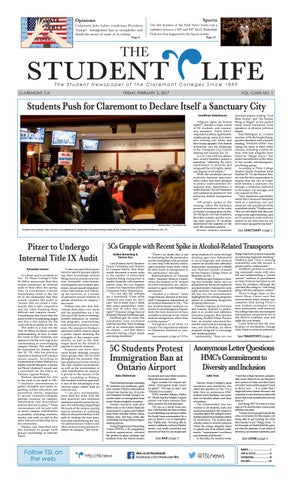
Students and faculty from the 5Cs and residents of Claremont and surrounding areas fill the Claremont City Council chamber on Jan. 24.
Pitzer to Undergo Internal Title IX Audit Amanda Larson In a letter sent to students on Dec. 15, Pitzer College’s Title IX Office announced that they would commence an internal audit of their office this spring. Title IX Coordinator Corinne Vanderkamp wrote in her letter to the community that they would conduct the audit to “ensure that we create a community that is safe, responsive and fair when handling these difficult and complex issues.” Vanderkamp also wrote that the audit is still in its planning stages and that a full outline for the audit will be available on Feb. 24. The audit is a way for the Title IX Office to obtain a better understanding of how to meet the needs of their students, and appears to be the next step in accommodating an ever-changing campus climate. The audit will be conducted by Tiombe Wallace SC ’95, who has previous experience dealing with campus sexual assault. According to Vanderkamp’s letter, Wallace is a highly trained therapist, a trainer for Pitzer ’s Judicial Council, and a consultant for the Office on Violence Against Women. Wallace described her role in the audit in an email to TSL: “I facilitate conversations to gather thoughts and needs regarding current education and prevention efforts, responses t o s e x u a l v i o le n c e / i n t i m a t e partner violence on campus, remediation and misconduct policies that are in place.” These conversations will be held with as many campus stakeholders as possible, including students, faculty, and staff, as well as the other resource centers that serve the community. Wallace also described how she planned to gauge each group’s knowledge of relevant topics.
“I often use specialized questions for specific groups regarding their knowledge around things such as primary prevention, bystander intervention, investigation and conduct processes, sexual assault response/ crisis intervention and followup for survivors, or a climate of pervasive sexual violence in certain situations on campus,” she wrote. Wallace also asks that individuals share their own needs and the possibilities for a follow-up in the form of training, student education or orientation programs, cross-training, and revision of politics or practices. The answers to Wallace’s questions will be used to shape a public report detailing the strengths of the campus community, as well as the challenges faced by the school in regards to sexual violence. Students can have their voice heard through various focus groups that will be held throughout the semester. Wallace emphasized in her email to TSL that student involvement, as well as the involvement of other stakeholders on campus, is pivotal to the success of the audit. According to Wallace, this student-centered approach is one of the advantages of an internal audit, rather than an external one. “I can give recommendations from my work with the best practices and technical assistance experts across the nation, but ultimately, [regarding] the needs of the campus, paying special attention to centering folks of all positionalities is the path to finding the best practices and transforming the way we address sexual violence and other forms of interpersonal violence on campus,” she wrote.
Follow TSL on the web.
“Migrant rights are human rights!” chanted a large crowd of 5C students and community members. “USA! USA!” responded another, significantly smaller group, many of its members wearing red, white, and blue Trump apparel. This heated interaction was the landscape of the Claremont City Council meeting last Tuesday, Jan. 24. In a 3-1 vote with one abstention, council members passed a resolution “affirming the city’s commitment to diversity and safeguard the civil rights, safety and dignity of all people.” While the resolution did not explicitly mention sanctuary cities (cities that have pledged to protect undocumented immigrants from deportation), it states that the City of Claremont will continue its practice of “not enforcing federal immigration law.” 109 people spoke at the meeting, where the resolution proved contentious in the wake of Trump’s inauguration on Jan. 20. Filling the city hall chambers, the lobby outside, and the viewing room upstairs, 5C students represented the majority of the over 200 attendees present. Several audience members
clenched posters reading “God Bless Trump” and “No Human Being is Illegal” as the packed room heard testimony from speakers of diverse political beliefs. Raul Rodriguez, Jr., a Latino member of We the People Rising, greeted attendees with a banner reading, “STOLEN LIVES.” Featuring the faces of three white citizens, including a police officer, who had allegedly been killed by “illegal aliens,” this poster was reflective of the views of the vocally anti-immigrant, pro-Trump group. According to Pitzer College Student Senate President Josue Pasillas PZ ’19, the Student Senate was the first organization to request that the city of Claremont become a sanctuary city through a resolution delivered to the mayor, city manager, and city council on Dec. 4. “Our resolution specifically asked that Claremont designate itself as a sanctuary city, and sanctuary city was left out of the resolution totally,” Pasillas said. “But we still think that this was a step in the right direction, and we’ll continue to work with city leaders to see what else we can do to stand up against any hate.”
See SANCTUARY page 2
5Cs Grapple with Recent Spike in Alcohol-Related Transports Kellen Browning & Emma Hsu Last October, the 5C StudentDeans Committee and Director of Campus Safety Stan Skipworth discussed a recent spike in the number of intoxicated students being transported to nearby hospitals with representatives from the Los Angeles County Fire Department and the Claremont Police Department. “It’s not like the colleges are a free-for-all: ‘Come drink whatever you want, we don’t care,’ but in some ways I think that when paramedics come, that may be what they see, right?” Pomona College Dean of Students Miriam Feldblum said. Feldblum got the sense that paramedics were frustrated with the fact that “they’re taking care of an intoxicated student on campus ... and then there’s someone having a heart attack and dying elsewhere.”
“There’s no doubt that it can be frustrating for the paramedics and the firefighters who are asked to come help with heavily intoxicated students when there could be other kinds of emergencies in the community,” she said. Representatives of Pomona Valley Hospital Medical Center, where the majority of 5C student alcohol-transports are taken, seemed to agree with Feldblum’s assessment. “Alcohol is a choice,” wrote Angie Besiant, director of the hospital’s emergency department, in an emailed statement to TSL. “The less alcohol-related incidents we receive in our Emergency Department, the more resources we have available to dedicate to our critical medical emergencies, where time is of the essence.” Firefighters at all three LA County Fire Department stations in Claremont declined to comment. Last semester, a total of 13 Po-
5C Students Protest Immigration Ban at Ontario Airport Alex Kleinman Three hundred people, including 5C students and professors, gathered outside Ontario International Airport last Sunday, Jan. 29 to protest President Donald Trump’s executive order on immigration from seven Muslim-majority countries. Trump’s executive order prohibits entry to the United States for citizens and U.S. green card holders from Syria, Somalia, Sudan, Libya, Yemen, Iran, and Iraq, while also indefinitely banning Syrian refugees seeking asylum. Young Progressives Demanding Action (YPDA), a 5C progressive student organization, initiated the protest to allow students and residents from the Inland Empire
http://tsl.news
to connect and voice their concerns about the executive order. Signs outside the airport declared, “Immigrants make America great!,” “No hate no fear,” and “Muslim lives matter.” YPDA member Sahana Mehta SC ’20 felt that the Ontario Airport protest was more intimate than other protests she had attended. “For me, as a South Asian person, I felt that this hit close to home in an interesting way because within the South Asian communities I’m a part of, there’s a lot of Islamophobia,” Mehta said. “So being able to stand in solidarity with my Muslim family was really powerful and showed me that we can escape and
See BAN page 3
Like us on facebook: facebook.com/thestudentlife
mona students (11 under the legal drinking age) were transported to local hospitals and medical centers for alcohol and substance intoxication, according to a Health and Wellness Update released by the Pomona College Deans of Students on Dec. 8. Feldblum said Pomona is looking into possible causes and explanations for the recent uptick in alcohol-related transports--only eight students were transported the last two fall semesters--but highlighted the existing programs aimed at combating dangerous drinking behaviors. Pomona requires all first-year and transfer students to participate in an alcohol and substance education program that includes Teaching Alcohol Abuse Prevention, an alcohol education/bystander intervention training session, and AlcoholEdu, an online program designed to encourage safe drinking habits. Additionally, “there are two
things that have positive impact[s] on reducing high-risk drinking,” Feldblum said. “One is reducing availability and the second is greater policy enforcement.” Feldblum pointed to restricting weeknight events with alcohol and implementing a “points system” method of punishment as steps Pomona has taken to address the problem, although she said that the college is “still struggling with the substance culture.” Pitzer College Dean of Students Moya Carter said that conversations about alcohol consumption held during Pitzer ’s new student orientation have been particularly well-received; the college had only one transport last semester, compared to five in the 2015-16 academic year and eight the year before. Carter believes that the combination of AlcoholEdu, Orange After Dark--a series of substance-
See TRANSPORTS page 2
Anonymous Letter Questions HMC’s Commitment to Diversity and Inclusion Julie Tran Harvey Mudd College’s racial awareness and sensitivity was called into question on Dec. 9 in a letter from an anonymous HMC student to Jon Jacobsen, vice president for student affairs and dean of students. The letter—which was forwarded to all students, staff, and faculty—expressed the student’s concerns about the college’s insufficient support for minorities within its community. The student specifically refers to several instances where the college allegedly failed to uphold one of its mission statements: “unsurpassed excellence and diversity at all levels.” In the letter, the student wrote,
@TSLnews
“I feel like college has been considerably more difficult for me because I am a person of color, and that I have not really received the support I need to thrive here … It is unfair that I might fail some classes because I am a student of color that has to deal with issues that most students here do not have to.” Jess Wang HM ’18 wrote in a message to TSL that the letter voiced some familiar concerns. “I think a lot of people had left the office of diversity for this reason, not being able to get funding for what they needed to do,” Wang wrote. “A lot of people at Mudd hold the opinion that the pretense of our office of diversity, our mission statement, and
See LETTER page 3
NEWS................................1 LIFE & STYLE.....................4 OPINIONS........................8 SPORTS...........................10
NEWS PAGE 2
FEBRUARY 2, 2017
THE STUDENT LIFE
Maria Tucker Leaves Behind Draper Center and Vibrant Legacy Emily Diamond Maria Tucker, former director of the Draper Center and associate dean of students at Pomona College, left her position on Jan. 31 after 11 years of working at Pomona. She departs to be the dean of students at Colby College in Waterville, ME. Sefa Aina, former associate dean and director of Pomona’s Asian American Resource Center, will act as interim director of the Draper Center. Tucker began working at Pomona in 2005 after Pomona President David Oxtoby developed a task force with the aim of connecting Pomona with the surrounding community. Tucker, who was a first generation, low-income student, said she wanted to give back to the community. In 2009, she became the founding director of the Draper Center, Pomona’s community and education-outreach program. As detailed on the center’s website, Draper staff “connect with community members, students, faculty, and staff in support of educational outreach, community-based research and learning, and other community engagement activities.” These communities include local organizations and K-12 schools. “[Our partners] tell us a lot about the needs and histories of their community and give us a sense of their lived experiences in ways that we might not know by ourselves,” Tucker said. According to Tucker, the majority
of the programs are student-initiated. One such program is Pomona College Academy for Youth Success (PAYS), which helps prepare firstgeneration, low-income students of color in the Los Angeles and San Bernardino County areas to attend selective colleges and universities. Teofanny Saragi PO ’18 has been a student coordinator at the Draper Center since her sophomore year and participated in the PAYS program in high school. “I’ve known Dr. Maria since I was 13,” Saragi said. “She and the PAYS program got me into Pomona.” Saragi stressed Tucker’s influence on Pomona’s culture. “PAYS was the reason Pomona started being such a strong leader in advocating for undocumented students,” she said. Students and coworkers believe Tucker’s work also drastically improved the diversity of staff and faculty and added an element of compassion to the school’s culture. “The PAYS program empowers, grounds, and gives hope to students and community members,” Aina said. “Thirty children each year come through this program. The potential for 30 families to be transformed, it’s amazing. And that’s what Maria does.” Saragi attested to that sense of hope and purpose Tucker provided. “The Draper center, Dr. Maria’s presence, and what she has brought to the college is what lies at the heart of my values and keeps me going,”
she said. Dean of the College Audrey Bilger also said that Tucker’s personal traits have influenced Pomona. “She is a passionate advocate for diversity and inclusivity,” Bilger wrote in an email to TSL. “Her warmth, empathy, and leadership will be greatly missed.” Though Tucker’s absence will be “a huge loss for the campus,” according to Assistant Director of the Draper Center José Ramirez, students and faculty are excited to see how Aina will maintain and improve upon the Draper Center’s programs and values. “[Aina] brings a lot to the table, including his passion for doing community work,” Ramirez said. “Especially in light of our current political time, it’s of utmost importance that we ensure that we’re becoming a voice of reason against this chaos. I know he will do just that.” Since Aina has worked at Pomona for as long as Tucker, he already has a working knowledge of the college and said he will not “miss a beat.” “[The Draper Center] does such good work that even maintaining it is a goal of mine,” Aina said. “A bad day here is a good day everywhere else, not that we’re going to have a bad day!” Aina plans to create more community-based learning courses, have a larger presence in the city of Pomona, and make the center even more visible and accessible.
Courtesy of Jeff Hing
Maria Tucker, founding director of the Draper Center for Community Partnership, worked at Pomona for 11 years.
“This is part of filling out the dream of the Draper Center,” Aina said. “There is no other place in the West like Pomona in terms of resources, diversity of students, the commitment to community and one another,” Tucker said. “I’m going to miss all of that, but most especially,
I’m going to miss my relationships with students and alumni.” Tucker left her position this past week, but her impact on Pomona and the greater community still remains, according to those who know her. “Dr. Maria has set a precedent for many generations of conscientious
engagement with surrounding communities and has definitely changed the DNA of Pomona,” Saragi said. “Pomona is not the same Pomona, and it’s better for that.”
Where do 5C Trustee SANCTUARY: Claremont Passes Resolution Affirming Diversity Political Donations Go? Continued from Page 1
Jack Carroll Trustees from the Claremont Colleges asserted themselves into politics/campaign finance during the 2016 election cycle. Federal Elections Commission (FEC) data published by the Center for Responsive Politics shows that multiple 5C trustees gave major contributions (defined as over $2,700 to candidates or campaigns). Trustees at Claremont McKenna College gave the most, followed by Pitzer College and Pomona College. Donations by trustees from Scripps College and Harvey Mudd College were unlisted or did not cross the $2,700 threshold to be considered major donations. The leading contributors were Henry Kravis CM ’67, who gave $448,200, Robert Day CM ’65, who gave $331,731, G. Jeffrey Records Jr. CM ’81, who gave $193,900, Susan Pritzker PZ ’93, who gave $188,111 (not counting the contributions of her family, which totaled over $22 million), William Podlich CM ’66, who gave $70,300, George Roberts CM ’66, who gave $52,500; Louise Bryson, a Pomona trustee, gave $32,000. These seven donors were the only 5C trustees to contribute more than $2,700 in political donations. CMC trustees gave almost exclusively to Republican causes, while Pritzker and Bryson gave to Democratic causes. CMC trustees, however, did not donate to Donald Trump or any group or organization that aided his campaign, save Records, who donated to Trump. All of the CMC trustees gave to other GOP candidates early in the primary season and directed/diverted their funds elsewhere when Trump was nominated. This seemed to be a trend among notable GOP donors. In an email to TSL, Jack Pitney, a professor of Government at CMC, wrote, “Trump had some big donors, but some sat out the presidential race. I suspect it’s because they actually know Trump.” This was the first election cycle in which CMC trustees did not give more than $2,700 to the Republican nominee for president
since at least 1996. Many trustees diverted large portions of their funds to Senate and House races. Day, Kravis, and Roberts gave more than $50,000 to the Republican National Congress Committee, the National Republican Senatorial Committee and PACs like the Senate Leadership Fund. Pritzker also got involved in congressional races and contributed to the Democratic Congressional Campaign Committee as well as the Planned Parenthood Votes PAC. 2016 was the first cycle since at least 2007 that trustees from Pomona’s board did not make major contributions, aside from Bryson’s comparatively small $32,000 donation. Former trustee Andrew Barth contributed a total of $457,800 from 2007-2014 but without his contribution this year, the overall total plummeted. The school does not track the political contributions of trustees, according to Vice President and Chief Communications Officer Marylou Ferry. Political donations by 5C trustees mirrored donation patterns from the rest of the country. Here, as elsewhere, the biggest GOP donors tend to be white men above the age of 50. Older women, (like Pritzker) on the other hand, are split more evenly. As for younger donors, Pitney said, “Wealthy young people lean heavily Democratic. In large part, that’s because wealth is increasingly tied to professional education, and highly educated professionals lean to the left.” Shawn McFall CM ’18, president of the Claremont Colleges Republicans, agreed that conservative representation among college students has been weak. “The future of Republican donors will heavily depend on the success the Republican party has in fostering a pro-business community,” he said. “That includes a shift in immigration policy and deregulating the gig economy. These policies will ultimately help foster younger donors, as well as diversify the Republican donor pool.”
Senate Secretary Shivani Kavuluru PZ ’19 co-authored the sanctuary city resolution with Pasillas. Kavuluru also works with the 5C student group Damage Control Action Network (DCAN), “a student political organization dedicated to countering harmful policies in Trump’s agenda at the local governmental level, dealing primarily with the Claremont and Pomona city councils, through student mobilization and coalition building with existing community organizations,” according to their Facebook group description. Kavuluru reaffirmed her resolve to pass the resolution in the wee hours of Wednesday morning: “I’m here today, and I will keep coming again and again, because I believe that the city of Claremont has a responsibility to protect all of its community members,” Kavuluru said at the meeting. Many students from DCAN, Young Progressives Demanding Action (YPDA), and allied students demanded that the city pass an ordinance to protect undocumented people in the city of Claremont. Having assembled over 900 petition signatures to support the creation of an official ordinance, DCAN organizer Shayok Chakraborty PO ’19 and others were resolute about this goal. “We want assurances that local police and agencies won’t go after undocumented students,” Chakraborty said. “They’re talking about affirming diversity and all that kind of stuff, but it’s just weak. Honestly, it’s weak as hell. In [the city of] Pomona, they had a similar resolution pass, and they’re still cooperating with ICE [Immigration and Customs Enforcement],” he said. “So while Claremont doesn’t do that, we don’t want to have that risk. We’re trying to get an ordinance passed that is strong
of immigrant struggles to the Claremont Colleges,” according to their Facebook page. Sada also mentioned that the event was dominated by “allies,” leaving her unable to reach the signup forms which would have given her the opportunity to speak at the event. “My friends who know I’m undocumented looked at me in the eyes and pushed me away. It was really upsetting,” Sada said. “It’s great that there were allies there to voice their concerns and to witness something happen and to show their support. But there were other allies who ended up taking too much space, like physically, emotionally, and voice-wise.” Sada also shared her concerns about the rising “sanctuary city” trend, pointing to some of the flaws that she and her undocumented peers feel about the phe-
nomena. “Everyone’s like, ‘yip yip hooray sanctuary city!’ but in reality, it doesn’t mean anything … We’re really scared that the sanctuary city thing is a fad—that we have to be one of those hip places that supports undocumented students. I’m scared that it will become a nationwide fad, and that’ll be where it stops,” she said. “Even after the ‘sanctuary city’ vote thing, I don’t feel much safer. I really don’t. I’m glad to see that there’s so much overwhelming support,” Sada said. “But it’s a momentary satisfaction, and I still feel like I’m in so much danger.” Claremont Mayor Sam Pedroza is slated to sign the resolution in a formal ceremony this Friday, Feb. 3 at 12 p.m. at Pitzer College. Congresswoman Judy Chu will also attend the ceremony.
Donovan New • The Student Life
Claremont community members listen to statements during last week’s city council meeting at town hall.
TRANSPORT: Colleges, Fire Dept. Call for Safe Drinking Continued from Page 1
Audrey Hector • The Student Life
and effective, that keeps Claremont from cooperating with the federal government on immigration,” Chakraborty said. With numerous scuffles between students and members of Upland for Trump, We the People United, Beach Cities Republicans, and allied attendees, the meeting at City Hall proved especially difficult for undocumented people present. “There was a guy with a ‘Make America Great Again’ hat who literally pushed me and yelled at me … We ended up warning the people of IDEAS to stay away until the actual item came up,” said Daniela Nicole Sada PO ’19, president of Improving Dreams, Equality, Access, and Success (IDEAS), a 5C student organization aiming “to foster a vibrant community for immigrants and help bring increased awareness
free nighttime events--and prohibiting student activities fees from being used to purchase alcohol for events “has contributed to the reduction in overconsumption transports.” “Pitzer students have always been very community-based and certainly look out for each other,” Carter wrote in an email to TSL, “and I expect some peerto-peer convos happen that may lead a student to make a different decision regarding their personal alcohol usage.” Claremont McKenna College Dean of Students Sharon Basso also weighed in; her college saw 11 transports throughout last September and October, but
hasn’t recorded any since. Basso said the main cause of these transports is “pre-partying behavior” before 5C events. “We have taken targeted steps to work with students on effective prevention,” Basso wrote in an emailed statement to TSL. “Administrators and students are working together to consider new strategies to promote personal and student responsibility.” Associated Students of Pomona College President Christina Tong PO ’17 credits the “Good Samaritan/Medical Amnesty” policy, in use at Pomona, Claremont McKenna, and Scripps College, for enhancing safety. Under the rules of the policy, students are responsible for the “safety and welfare of their fellow students,” and failing to uphold
this responsibility would result in various sanctions, Tong said. A d d i t i o n a l l y, “ i n m e d i c a l emergencies ... sanctions are not imposed on students who seek or need medical attention,” according to the Pomona College student handbook. Tong thinks the policy has a “positive effect on students seeking help during substance consumption,” while Feldblum and Basso believe the rule could be one of the reasons for the high number of transports from their colleges. “Transports save lives and we want to encourage everyone to call for help,” Basso wrote. Feldblum said, “I think the question is: What kind of metric is alcohol transports? It could be that more reporting sometimes is
better--people are actually calling.” Similarly, Carter acknowledged that Pitzer’s solo transport does not necessarily mean all is well. “Our low numbers could also mean that students are not requesting medical assistance when one of their peers may need it, choosing to ‘take care of them,’ which if true speaks to a different challenge,” she said. According to Scripps Dean of Students Charlotte Johnson, Scripps had nine student alcoholtransports last semester. In the 2015-16 academic year, the college had 12 transports, and five the year before. Harvey Mudd College deans did not respond to requests for statistics about alcohol transports.
NEWS FEBRUARY 3, 2017
THE STUDENT LIFE
PAGE 3
Claremont Colleges Commit to Supporting Undocumented Students Marc Rod Following President Donald Trump’s election and inauguration, all of the Claremont Colleges have promised to support students targeted by his rhetoric and policies. On Nov. 30, Pitzer College President Melvin Oliver and the Pitzer Board of Trustees declared Pitzer a sanctuary college, and Scripps College President Larissa Tiedens and the Scripps Board of Trustees followed suit on Dec. 11. According to their respective presidents, Scripps and Pomona College also revised their harassment and non-discrimination policies to protect students from questions about immigration status. “We pledge to seek opportunities to protect all members of our community within the confines of the law, especially those who are most vulnerable, from persecution and violation of their human and civil rights,” Tiedens wrote in a statement published on Scripps’s website on Dec. 11, announcing that Scripps was a “sanctuary center of higher education.” Each of the Claremont Colleges will refuse to either comply with federal requests for information about students’ immigration status or permit immigration enforcement activities on campus unless legally required to comply with court order. Campus Safety officers have also been instructed not to ask anyone on campus about their immigration status, according to a statement from Pomona President David Oxtoby. In recent statements to the Pomona community, Oxtoby promised to provide emergency grants for student legal fees and wrote that the college has organized a pro-bono alumni legal aid network for students and their families. Oxtoby also wrote that the administration will provide grants to replace work-study financial aid requirements if students’ Delayed Action for Childhood Arrivals (DACA) work permits are revoked, as well as to maintain Pomona’s policy of evaluating undocumented admissions and financial aid applicants as domestic applicants. “Pomona is doing a lot for us and I personally appreciate it. It is going beyond what any other institution is doing,” Maria Vides PO ’18 said.
College administrations are not the only body involved in aiding undocumented immigrants on campus. Improving Dreams, Equality, Access, and Success (IDEAS), a 5C organization that supports undocumented students, is also working with the college administrations to provide resources and support for undocumented students. IDEAS organizes weekly meetings to provide information, coping mechanisms, and stress relief to undocumented students, as well as a mentoring program, fundraisers, and awareness programs throughout the year. According to IDEAS co-president Daniela Hinojosa Sada PO ’19, IDEAS helps Scripps, Pitzer, and Harvey Mudd College administrators provide resources for undocumented students. “It’s not just a club for fun, it’s also a means by which undocumented students can find out emergency information,” Sada said. Despite the resources Pomona is providing, some undocumented students believe that the Pomona administration and community could do more to support undocumented students. “We need qualified mental health assistance, people who have worked with undocumented students before,” instead of nonspecialized mental health counselors for specifically traumatizing days, Sada said. Vides believes that Pomona could be doing more to promote and assist student activism. “It feels like a lot of the movements that have happened are very student-organized, and I think that there’s more that the institution could do to relieve that burden,” Vides said. “Having administrators facilitate that can make a huge difference for mental health and academic performance.” Vides and Sada also said that allies outside of the undocumented/DACAmented community should support this community. “ I f a l l i e s h a v e re s o u rc e s , whether it’s monetary, legal, mental, they should share them with their friends. And also just checking in on friends, that really helps a lot,” Sada said. Among undocumented students, there is significant debate about whether the “sanctuary
Liam Brooks • The Student Life
Students make signs in the Hive before protesting President Donald Trump’s election in the Claremont Colleges United Against Hate march on Nov. 11, 2016.
college” label is meaningful or helpful. “Even if we don’t have a sanctuary name, we have all the protections of a sanctuary institution, and protections that none of these other schools have,” Vides said, in reference to Pomona. At the same time, Vides asserted, “the name can be very symbolic. To know that Pomona supports us [publicly] is very important.” Meanwhile, Sada believes that “calling it a sanctuary institution could cause complacency.” She also fears that labeling Pomona as a sanctuary school could make it a more obvious target for ICE investigations. According to Oxtoby, Pomona has not declared itself a sanctuary campus because “we don’t hold the same legal powers of the federal, state, and city governments, so it’s a term that offers a promise we may not be able to keep.”
Senate Briefs Pitzer College Student Senate The Pitzer College Student Senate Jan. 29 meeting began with Executive Board Reports. Senate President Josue Pasilllas PZ ’17 said that Senate will be developing a program to pay work-study students for their work on Senate. Senate Secretary Shivani Kavuluru PZ ’19 said that all clubs would be audited, to insure that clubs are meeting and using funding reasonably. Bowling and Making Friends again was approved, as was Middle Eastern Student Association. Bill 53-B-1, a bill in support of becoming a member college of the Associated Student Senate of the Claremont Colleges, was repealed because of opposition from Harvey Mudd College. Resolution 53-R-9, a resolution endorsing Resolution R16-01, a Pitzer Staff Council resolution requesting faculty handbook changes, was introduced. Resolution 53-R-10, a resolution requesting the correction of the timing of the Brant Clock Tower, was also introduced but was tabled indefinitely after Dean of Students Brian Carlisle an-
nounced he would be changing the clock tower time the next day. Resolution 53-R-11, a resolution requesting the removal and ban of all roosters from the chicken coop in the garden, was introduced, due to a rooster having been thrown over the fence into the chicken coop two months prior. During the meeting, the resolution was met with opposition from Dana Nothnagel PZ ’19, who was referenced in the bill without her knowledge. The bill stated that funds for the Garden Club, of which Nothnagel is the leader, would be frozen if the rooster was not removed. Nothnagel accused the authors of the resolution of lacking integrity. The resolution was tabled indefinitely. Senior Class Representative Chance Kawar PZ’17 called for adjournment prior to completing the agenda items. -Elinor Aspegren PZ ‘20 Scripps Associated Students (SAS) No chickens were present at the Jan 29 SAS meeting. Sustainability Chair Mia Fargo-Iwamasa SC ‘17 hosted the first sustainability com-
mittee meeting this semester and is preparing for the Power Down Challenge starting Feb. 13. Class representatives are in the process of coordinating programming— notably, the Senior Class Presidents will co-host a networking event with the Career Planning and Resources Office. Spring Fling is tentatively set for April 7-9. Student Activities Chair (SAC) Jewels Tambone SC ’17 intends to use the event-filled weekend to highlight student talents and achievements. The board voted to pass several motions to approve funding for 5C events. The Student Union lives! After being closed over winter break, the designated student study space received new flooring and a fresh layer of paint. New furniture is in the process of being ordered and will arrive in March. SAS bylaws were updated to fit the SAC’s new role. SAC will now fund 5C events open to Scripps students but will not provide funding to ticketed events. -Grace Ozonoff-Richey SC ‘19
Sudoku
By Elizabeth Leader SC ’19
On Nov. 21, Oxtoby published a letter in support of DACA, which Oliver, Tiedens, Harvey Mudd College president Maria Klawe, Claremont McKenna College president Hiram Chodosh, and 615 other college and university presidents signed. The DACA program, which was implemented by an Obama executive order, allows undocumented immigrants who arrived in the United States as children to gain renewable two-year amnesty from deportation and work permits. Trump criticized DACA on the campaign trail, sparking fear that he might eliminate it. “DACA should be upheld, continued, and expanded,” Oxtoby wrote in his letter. “Since the advent of [DACA] in 2012, we have seen the critical benefits of the program for your students and the highly positive impacts on our institutions and communities.”
Oxtoby wrote the letter to take a strong stand in support of Pomona’s undocumented students and those at institutions across the country. “I believe the College must take a stand when our values are put to the test,” Oxtoby wrote in an email to TSL. “The impacts reach far beyond our campus so it makes sense to pursue a strategy of engagement across the country.” Despite signing Oxtoby’s letter, Chodosh expressed some reservations about the letter’s comment. “I believe that the statement’s specific advocacy for DACA may … compromise non-partisan values vital to higher education,” Chodosh wrote in an email to the CMC community. Oxtoby traveled to Washington, D.C. with other college and university leaders last week, meeting with members of Con-
gress to advocate for DACA and immigrant students and support the bipartisan BRIDGE Act, which would preserve DACA for at least three years. In recent days, in response to Trump’s executive order restricting immigration, Oliver, Oxtoby, Tiedens, and Klawe issued statements reaffirming their commitment to helping their students, promising that their respective schools would assist students in counseling resources. Pitzer, Pomona, and Scripps will also help students in need find legal aid. CMC’s Media Relations office could not confirm whether Chodosh had issued a statement regarding Trump’s executive order before press time. “We will not back down and we will not rest. Together, our campus community can and will make a difference,” Oxtoby wrote in an email to TSL.
LETTER: Anonymous Writer Asks HMC to Improve Support for Minority Students Continued from Page 1 the Mudd’s diversity statistics are a whole bunch of baloney.” “I agree mostly with this sentiment,” she added. In an email to TSL, Jacobsen acknowledged that HMC has grappled with issues of institutional diversity. In order to ensure a more supportive and welcoming campus, Jacobsen has expanded the Office of Institutional Diversity and increased the hours for its graduate assistants in order to “provide more programming and support”. Jacobsen wrote, “We try to do the best we can to support our students within the means we have available.” The anonymous student also claimed that HMC “supports and
advocates for companies that benefit from the oppression of minorities, and until recently, has forced students to do work for them.” They went on to share concerns about the alleged underfunding of the Office of Institutional Diversity and racially-oriented groups such as Black Lives and Allies at Mudd, Asian Pacific Islander Sponsor Program at Mudd, and Society of Professional Latinos in STEM. Jacobsen refuted this particular claim, saying that these organizations receive more funding than most clubs on campus. The student also wrote in the letter that HMC’s culture of academic rigor inclines students not to discuss race and diversity with one another or with the administration. Regarding the student workload at HMC, Jacobsen wrote, “Workload
is a key aspect of why we are currently engaged in a careful process to review HMC’s Core Curriculum.” Jacobsen added that HMC is implementing a speaker series, dedicating deans to the health, wellness, and academic affairs of students, and supporting student-led organizations, such as the Associated Students of Harvey Mudd College, that are primarily focused on supporting students and fostering wellness in the student body and in the HMC community. “We have been regularly increasing our resources devoted to student engagement, mental health and wellness and diversity and social justice—all critical aspects of providing a better educational experience and environment to support our mission,” Jacobsen said.
BAN: Students Organize to Support Immigrants Continued from Page 1 dismantle the Islamophobia that exists in American, Indian, South Asian, and white contexts.” Other YPDA members expressed similar feelings about the protest. For Priya Prabhakar SC ’20, the protest allowed her to meet “others who share [her] pain and sense of activism, but also, it’s about agitating the status quo at its very core, which is incredibly important, and that’s what these protests do.” YPDA member Ian Schiffer PO ’17 said that protesting is not the only way to voice dissent, however. “There’s a myth that protests are
the only way to fight,” Schiffer said. “But fighting can be in your pocketbook; fighting can be in your rhetoric; fighting can be making nonwhite spaces for people of color. It starts with yourself and [the branches in] other groups.” According to Prabhakar, the YPDA approach is to “agitate, educate, and organize” by hosting workshops, forming issue-specific committees, distributing weekly action emails, and coordinating with other 5C groups. YPDA also connects students with community social justice organizations because – according to Schiffer, “To exist in this campus, in a bubble,
is to not truly get an education, and I think we need to be working with local organizations. Especially now.” For Mehta, the YPDA approach is about “keeping the momentum going and making sure people don’t lose energy or fall into a fake sense of ‘we’re okay’ when we’re not,” as well as understanding that “these problems didn’t start a week ago, and they don’t end in two or four years.” As the protest came to an end, students and community members joined hands, formed a circle, and sang, “We shall not be moved; just like a tree standing by the water, we shall not be moved.”
Reserve your Airport Shuttle! Go to: www.SuperShuttle.com use code: FPCS2 Receive 10% off
LIFE & STYLE PAGE 4
THE STUDENT LIFE
FEBRUARY 3, 2017
San Diego Activist Addresses Human Rights at the Border Ariel So Christian Ramírez, Director of Human Rights for Alliance San Diego and Director of the Southern Border Communities Coalition, came to Scripps College for a talk on “The Struggle for Human Rights in the Southern Border” on Tuesday, Jan. 31. California, Arizona, New Mexico, and Texas are some of the most militarized border areas in the hemisphere and are threatened by various U.S. immigration policies, according to Ramírez. Born in Tijuana, Mexico, Ramírez said that many people ignore the fact that his hometown is a border city just south of the United States. There has been a long history of racial profiling and targeting of both Mexican Americans and other border communities. According to Ramírez, in the past, the United States has blamed Mexican Americans for bad policies that led to the Great Depression, and although Mexican American soldiers were drafted to fight in World War II, many of them were deported once the war ended. Ramírez noted in his talk that the kind of racial targeting happening today is “nothing new to border communities” and “definitely nothing new to [his] family.” Among the deportees were, in 1920, his great-grandfather, born in San Francisco, and in 1967, his grandfather who worked in the Central Valley of California, Arizona, and New Mexico, but died while still being owed around $3,000 by U.S. companies who refused to pay his backwages. Oppression, racism, and excessive use of force toward Mexican Americans were part of the everyday conversation for Ramírez growing up in San Diego. Running away from border patrols was so normalized in his daily life that it became one of the games he would play as a child. In fact, he and his family often slept through the sound of undocumented immigrants running through their backyard, the lights of helicopters shining, and the barking of dogs. When he was in high school, the people in Ramírez’s community would often be handcuffed and detained by border patrols, under the office of California Governor Pete Wilson, who launched “racist,” “xenophobic,” and “anti-
MOVIE COLUMN
Victoria Anders A little less than a year ago, soon after the 2016 Oscar nominations were announced, #OscarsSoWhite started trending on Twitter. None of the 20 nominees in four acting categories were people of color. One week later, the University of Southern California released a study that found an “epidemic of invisibility” of diversity across the board not only at the Oscars, but in all of Hollywood. NPR suggested a revision to the trending hashtag: #HollywoodSoWhite. The analysis looked at more than 21,000 characters and backstage workers from over 400 films and TV shows released in the 20142015 season. The results showed that just 33.5 percent of speaking characters were female, and even fewer speaking characters were from non-white backgrounds, 28.3 percent. In a push for diversity, the Academy of Motion Picture Arts and Sciences (where the term “Academy Awards” comes from) sent invitations to 683 actors, directors, cinematographers, and others throughout the moviemaking industry to become new voting members of the institution. Of those who accepted the invitation, 46 percent were female and 41 percent were persons of color. Brie Larson, Michael B. Jordan, Idris Elba, and Emma Watson were among them. The overall Academy membership remains at 27 percent female, and 11 percent POC, however. In the Academy’s New Membership Announcement, Academy president Cheryl Boone Isaacs called for Hollywood to “open its doors wider, and create opportunities for anyone interested in working in this incredible and storied industry.” It seems that at least some of Hollywood caught the drift. Films released in the Oscar-contending movie release season since late 2016 have featured much higher representation and inclusion of women and actors of color. As the Oscar nominations rolled out last week, this became even clearer: 7 of the 20 acting nominees are
immigrant” campaigns, Ramírez said. Ramírez added that under the democratic administration of Bill Clinton, “Every day became a repressive state in my community … [as] the status-quo of heavy-handed, iron-fisted border enforcement began to consolidate itself.” The narrative of U.S. lawmakers tells those outside the region that the border regions are lawless, barren lands filled with drug dealers, gun runners, and undocumented immigrants. Ramírez probed at the fallacy in this rhetoric, pointing out that El Paso, Texas, a U.S. border city neighboring Ciudad Juarez—one of the most dangerous cities in the world—is the safest city in the United States, while another border city of San Diego is the third safest city in the country. According to Ramírez, most border communities actually contribute to the economic well-being of the United States. In fact, four out of every 11 jobs in this country depend exclusively on the trade between Mexico and the United States, Ramírez said. “Despite all of these facts, facts don’t matter and have not mattered to policymakers, whether Republican or Democrat, because the notion is that in this lawless land, the Constitution does not apply here,” Ramírez said. “If folks are strong enough to endure crossing the border for three or four days crossing the mountains, [they will] end up perhaps cleaning your campus here this afternoon,” Ramírez said. “That is not the American dream, but ... the American nightmare. And that is the worst strategy of labor selection that we are seeing in the twenty-first century today.” Today, the situation is even worse, according to Ramírez, as border patrols are permitted to set up checkpoints or detain others based on racial profiling—one’s skin color, attire, or proficiency in English. However, Ramírez noted that the “silver lining” is the younger generation. “You have in your hands the fight of your lifetime no matter where you stand,” he told the audience of students and community members. Although Ramírez said that customs border protection is the largest body law enforcement in the United States, he urged students to engage in the political
Tiffany Park • The Student Life
Christian Ramírez discusses the struggles of people living in communities near the U.S.-Mexico border in the Scripps Hampton Room on Jan. 31.
dialogue in order to make democracy work. “Be mindful that we did not elect a king last November,” Ramírez said. “It is we the people who, at the end, will determine how he governs.” Students from the 5Cs said that the talk opened up their perspective on the issue. Annika Mammen SC ‘20 said
that she was surprised by the extent to which the government racially targeted border communities, as the border patrol can enter private properties 100 miles from any border and has a history of murdering members of border communities. “If the government itself is against immigrants … then that sentiment seeps through the
ranks, right down to the general population,” Mammen said. “When America is basically a land of immigrants, how can we prevent other immigrants from coming here in search of a better life?” Leah Shorb SC ’20 echoed the same sentiment, as the talk made her realize the degree to which even democratic administrations
have mistreated various border communities. She also thought it was important that Ramírez brought up the idea of not “normalizing” the discrimination. The lecture gave Shorb a new “level of knowledge” and a sense of “urgency,” as conflicts today are not only more relevant, but more intense and more frequent for larger amounts of people.
Moving On From #OscarsSoWhite non-white (one for Best Actor, one for Best Actress, two for Best Supporting Actor, and three for Best Supporting Actress). While I am not asserting that this in any way calls for an exclamation of “yay! the inclusion drought is over!,” this is clearly a huge improvement from one year to the next. One does not only have to look to the names that will be read off on Feb. 26; just look at the movies in theaters right now. One of the films Oscar-nominated films released last fall, Loving, tells the story of the couple that invalidated state laws prohibiting interracial marriage through the 1967 United States Supreme Court decision Loving v. Virginia, a suitably named lawsuit. Richard (Joel Edgerton) and Mildred (Ruth Negga) Loving grew up in poor, Southern families, both unlikely figures to become so central to civil rights history. Negga and Edgerton provide a deeply subtle yet passionate portrayal of the Lovings’ fight for their “right to be let alone.” Hidden Figures, which also takes place in segregated Virginia, tells the story of the overlooked portion of NASA and aerospace travel history–the black (and white) women who worked as ‘computers’ in the American side of the Space Race, calculating and analyzing huge amounts of data every minute. The three main scientists and mathematicians–Katherine Johnson, née Goble (Taraji P. Henson), Mary Jackson (Janelle Monáe), and Dorothy Vaughan (Octavia Spencer)–truly do overcome all forms of discrimination, subjugation, and insults while each trying to get their offices out of the segregated and distant “West Area Computers” building to have a seat at the same table as the white men who led NASA. Not only do the women achieve promotions to positions neverbefore held by women of color; they are also the first women of any race to hold them. Hidden Figures is pure empowerment cinema; a feel-good film that makes anyone who sees it feel the need to do more when it comes to working past barriers of diversity and integration. It
Courtesy of Lincolnblues via Flickr/Creative Commons
is such required viewing that numerous people across the country have started GoFundMe’s to give young girls, especially black girls, the chance to see it for free. Fences, starring Denzel Washington and Viola Davis and directed by Washington himself, is a story of missed opportunity forced onto a Pittsburgh waste collector by the “color line” in Major League Baseball, which excluded blacks from playing in major and minor leagues until the 1940s. Troy Maxson (Washington), feeling stuck in a working class life, makes several irrevocable decisions that affect his relationship with his family members–effectively building fences
between them. The fact that the three previous films each take place in 1950s and 1960s America is an interesting contrast to the white nostalgia presented in La La Land – the two main characters (played by Emma Stone and Ryan Gosling) express a desire to return to old Hollywood and old “pure” Jazz as opposed to their present-day realities, without recognition of the social context for those phenomena. Moonlight and Lion, the latter starring Dev Patel, are the two films nominated for Best Picture with non-white actors in leading roles set in the present-day. Mahershala Ali and Janelle Monáe
bridge between two POC-led films, starring in both Moonlight and in supporting roles in Hidden Figures. Ali plays a crack dealer caught between seeking a life free of drugs and making a living, and Monáe his girlfriend in Moonlight; Monáe is an aspiring engineer at NASA, and Ali a military officer who falls for Taraji P. Henson’s character in Hidden Figures. Both films involve only actors of color in the leading roles; Moonlight is directed by Barry Jenkins, a newcomer now nominated for Best Director. We will have to see at the Academy Awards ceremony, hosted this year by Jimmy Kimmel, how
much the increased inclusion of actors of color and stories of persons of color in this years’ major film releases is rewarded with top awards, and whether it will remain a top priority for Hollywood executives in years to come. If this season’s preceding awards shows--like the Golden Globes where Moonlight took home the top prize and Viola Davis another (not to mention the recognition Atlanta received), and the Screen Actors Guild Awards where Hidden Figures, Denzel Washington, Mahershala Ali, and Viola Davis won big, are any indication--there’s a whole lot of appreciation of black excellence just around the bend.
LIFE & STYLE FEBRUARY 3, 2017
PAGE 5
THE STUDENT LIFE
FOOD COLUMN
Dining Hall Dilemmas: Discussing the 5C Food System Molly Edison
The one factor that impacts our daily lives the most, regardless of who we are and where we come from, is food. As students, we can sometimes lose track of how important food is. Thrice a day, every day, I take time out of my life to sustain my body. But I would be kidding myself if I believed meals were simply about getting calories in. From the moment I took my first bite, I was part of the food system. Be it a vegan burger, organic tomatoes, a farm to table salad, or my Friday night In-N-Out, I am turning the cogs of the institution of food production. Countless factors go into each bite we take. Through this column, I will be unpacking some of the ways in which we interact with food--beyond just eating. 5C campus life revolves around food. We hang out with those who have time to grab lunch with us, we go to dinner depending on when we have class and club meetings, and we take time out of studying to go to snack. With seven different options to chose from, we eat better than many other liberal arts college students. Our dining halls offer so many options, combinations, and varieties. We have even more options considering that we can take away fresh fruit, veggies, and other basics, as well as the fact that most dining halls have a kitchen. In our current political climate, environmental sustainability is an issue we cannot afford to ignore. One the largest factors in a person’s carbon footprint is their diet. At the 5Cs, dining services do their part to provide sustainable options. McConnell Bistro sources from a community garden in Ontario—Huerta del Valle. McConnell Bistro and Collins Dining Hall’s provider company, Bon Appetit, provides a variety of local and sustainable options. McConnell, Frary Dining Hall, and Frank Dining hall all practice pre-consumer composting. Beyond choices we make on campus, we have a million opportunities to impact the environment through what we eat. 5C food culture is just as much about what we eat as it is about who we eat with. Fat-talk, foodshaming, diet-idea sharing, and changing attitudes towards food all become much more prominent when we are living away from home. Eating disorders affect college-age students at the highest rates. Conversations between friends about food and while eating shape how we view food and ourselves. Before college, I never felt either judged for what I ate or influenced to eat certain things because of what the people around me might think.
Ellen Duanmu • The Student Life
Nina Zietlow SC ‘20 fills her plate at Pitzer College’s McConnell Bistro.
After moving to Southern California, the capital of tanned and toned bodies, and starting to eat every meal with my peers, I really felt the impact of 5C eating ideas. Seeing all of your friends eating only salad by no means directly causes eating disorders, but everything you hear in the dining hall and outside can affect how you feel about food and your body. Most 5C students don’t think about where their next meal will come from. I tap my card as I walk into the dining hall and eat how-
ever much of whatever I want. That is the farthest thing from reality for so many people, even as close as Claremont’s surrounding areas. Areas with poor food security are scattered across the Los Angeles area and throughout the Inland Empire. Southern California’s landscape and water availability don’t lend themselves well to agriculture. Relying mainly on food grown in the Central Valley makes Southern California vulnerable to food scarcity. Supporting community gardens and shifting
priority towards sustainable food production in Southern California are steps toward increasing our food security for the future. Eating off-campus is a treat for most 5C students. The places at which 5C students choose to dine will likely be places at which many 5C students choose to dine. Menu options, proximity to campus, price, and a variety of other factors go into determining where we spend our money. With so many options, many 5C students still tend to spend their time and
money eating at a lot of chain restaurants and coffee shops. If we explore more options just outside of the Claremont village, we can save money, support local business, have a more varied diet, and share food experiences with friends and classmates. We shouldn’t be afraid to try momand-pop brunch places, tiny taco shops, and hidden boba shops that only sell tea and cigarettes and feature a list of rules. You really are what you eat. Food requires intentionality and
thought, especially in our fast moving lives as college students. We should continue to take a step back and consider all of the steps that went into the bite we are eating. How can we better take advantage of the options our dining halls present? What can we do to ensure our food is environmentally sustainable? How can we be intentional about fat-talk? What does food security look like in Southern California? How can we expand beyond Starbucks and In-N-Out?
Exiled Professors Consider Academic Freedom in Turkey and Syria Sadie Fisher Professors Eda Erdener and Ahmad Adib Sha’ar spoke on academic rights violations at Pomona on Feb. 1, as part of the lecture series entitled “Lived Experiences: Free Speech, Academic Freedom and Scholars at Risk in Turkey and Syria.” Both professors are members of Scholars at Risk, an international network that connects threatened scholars with safe institutions. Currently, Erdener and Sha’ar are visiting scholars at Pomona and Harvey Mudd College, respectively, and are the only two program participants at the 5Cs. Students and alumni attended the event for a variety of reasons. Geneva Miller HM ‘18 explained that she was not even sure of her reasons for coming. “I’m hoping to learn something unexpected,” Miller said. The following lecture set certainly fulfilled this expectation for her and the rest of the audience. A short introduction was given by Pardis Mahdavi, the chair and associate professor of anthropology and the dean of women at Pomona. She said that academics and scholars at risk are especially vulnerable today, due to the climate of international conflicts, the state of terrorism, and a lack of international discourse. Next, the talk’s focus turned briefly to the potential consequences of the Executive Order recently passed by President Donald Trump, limiting immigration from seven Muslimmajority countries. “Academic freedom is under attack everywhere and we have a collective responsibility and right to protect it and amplify diverse voices such as these,” Mahdavi said. Erdener started the programming by discussing the Novem-
ber 2015 recount election of President Recep Tayyip Erdogan in her home country of Turkey. In the aftermath of the election Erdener, along with 1,127 other scholars, signed a petition, Academics for Peace, calling to end the violence and oppression in Turkey. The petition brought the signatories under unexpected levels of scrutiny when Erdogan said they were “as guilty as terrorists.” “There are two camps now. Pro-Erdogan or coup-supporter and terrorist. Our President has allowed no middle ground,” Erdener said. Sha’ar then spoke to the current climate of his home in Aleppo, Syria, explaining that the current Assad regime is ineffective and dangerous, although he maintains some hope. “Syrians have the right to hope for a democratic, non-corrupt regime,” Sha’ar said. However, the current regime still practices a double standard: expressing a belief in the ideals of academic freedom and freedom of speech, but behaving in the opposite manner, according to Shaar. After a brief Question and Answer session, the scholars were surrounded by curious audience members. Jeremy Tepper PO ‘19 said that his original reason for attending the event was to learn more about academia in societies in which institutions of higher education like ours were not as high of a priority. However, he ended up drawing many parallels, even if they are to a lesser degree, between the state of academic freedom here and abroad. “I think it’s really important for us to understand the [Syrian] conflict on a personal level at events like these ... their courage to stand up against what’s wrong is commendable,” Tepper said.
Austin Huang • The Student Life
Adib Sha’ar, Visiting Scholar at Risk at Harvery Mudd College, addresses the audience in Pomona College’s Hahn Hall on Feb. 1.
LIFE & STYLE
PAGE 6
THE STUDENT LIFE
FEBRUARY 3, 2017
Author Marlon James Connects Fiction and History at Athanaeum
Adela Pfaff • The Student Life
Jamaican author Marlon James discusses the parallels between fiction and history at CMC’s Marian Miner Cook Athenaeum on Feb. 1.
Tarini Sipahimalani Jamaican novelist Marlon James filled Claremont McKenna College’s Marion Miner Cook Athenaeum on Feb. 1 with his discussion of the interconnections between fiction and history and how the line between fact and narrative is more blurred than we know, in novels as well as the world we live in today. Jamaican-raised, James got his undergraduate degree in English Literature at the University of the West Indies, and later, his master’s at Wilkes University. He currently teaches English at Macalester
College. “I want to talk about writing and novels and history,” he said. “I’ve never considered myself a historical novelist but I’ve always been called that … I already get more invitations from history departments than English departments.” Many view history and fictional narratives as polar opposites. Much of the time, we narrate real-life events relevant to the world we live in, while fiction tells stories taken from the corners of worlds that transcend ours. But James took time to contest this notion during his Feb. 1 talk.
“Just the fact I’m a novelist makes me a historical novelist. You’re always given alternative facts,” he said, explaining that because each fact originates from a particular opinion, it is not facts we want, but stories. To James, this is the era of stories. “We don’t want facts, we want narratives … but any narrative will do,” he said. “Death penalties [are] a narrative, black violence is a narrative,” James went on. “If you keep adding narratives, you get alternative narratives. If you keep adding alternative narratives, you get alternative history.”
SEX COLUMN
Ordinary is No Less Extraordinary
The Student Life’s Sex Columnist wasn’t something I ever imagined I’d put on my resume. When I applied for a position this semester, I thought I’d ask to write a column about “campus culture,” something covering the antics of those living in Claremont. However, when I showed up to my interview with a malformed idea and fuzzy head from too much wine the night before, I ended up pitching my idea saying something along the lines of: “it’ll be kinda like the sex column, but, you know, like not really.” I share this anecdote because it’s reflective of the way I often approach sex. I don’t wear my sexiness on my sleeve, so to speak. I don’t have a great sense of style, I don’t have great posture, and I’m notoriously clumsy. While I’m outspoken among my friends, I don’t know how to comfortably assert my beliefs and opinions with large groups of people. Any stereotypes you might have in your head about a “girl who is comfortable asserting her sexuality” don’t quite fit me. That said, I do think about sex, a lot. I talk with my friends about sex a lot. I worry about my sexual health a lot. I get angry when others try to police my sexuality by telling me boys would like me better if I made them wait longer, or by making me worry about “my number”. I am furious with political and religious groups that think they should be making my sexual decisions for me. Sex is an important part of my life. You couldn’t tell by looking at me. I wear jeans when it’s cold out and sundresses when it’s warm. I take classes in economics and compete on a sports team. I don’t look like that kind of girl. The crux of the matter is: there are many girls who are sexual girls, and many people who are sexual people, but we don’t all act and dress the same. It’s not
just the girl with the punk haircut inviting you to Motherfucker, or the girl in the crop top dancing at a north quad party. It’s the girl who wears the same Patagonia almost every day, the girl who works at the bike shop, and the girl who asks a lot of intelligent questions in your Intro Bio class. It’s many, dare I say most, girls, and people. So why do I choose to hide it? Why don’t I choose to lead with my sexuality, something that is so deeply integrated with my core being? First, I hide it because I don’t want to be judged. I remember the first time someone else called me a feminist and meant it as an insult. I remember how much it stung to be looked down upon for simply caring about my own rights and well-being. I remember retracing my steps, trying to pick out which arguments I’d like to take back. I remember the first time I “overshared” about a sexual experience and the wave of shame that ran through my body as I was told it was “too much information”. As much as I intellectually believe that embracing female sexuality is good, my conditioning often takes over. So I choose to blend in instead of challenge the norms of female silence surrounding sex. Many of us do. Second, I don’t feel like I’m good enough at sex to express my sexuality. I don’t have a ton of sex. I do have it, sure, but most of my close friends get laid way more frequently than I do. I’ve also never been in a relationship, so I’ve never had a consistent, monogamous partner with whom I could really learn how to move. It’s somewhat difficult to reconcile how sexual of a being I am, all the while admitting to myself that I’m inexperienced, that I don’t have as much of or as good sex as I’d like, and that sex has led me to pain and rejection.
Third, I like to keep some parts of myself hidden to the outside world, available only to those who know me best. This is perhaps my only somewhat decent reason for refraining from expressing my sexuality. I do believe it’s nice to reserve parts of your person only for those who take the time to get to know you. That said, there is societal pressure on girls to reserve this particular side of themselves, their sensual side, which can be a significant aspect of their identities. It’s reminiscent of an era in which women were told to tone down their intelligence and gregariousness to make room for those of men. I told my friends that I would be writing this column and they were ecstatic. When I told them I wasn’t sure if I was going to actually mention sex, they were less so. They thought it was boring, a cop out, almost cowardly. After picking my brain for a few minutes, I realized they were right. People like talking and reading about sex--more so than they will allow themselves in public. By skirting around the subject, I was perpetuating the awkwardness and shame that surrounds something most of us enjoy. My girlfriends and I have started subtly challenging the norms of silence surrounding sex. We might bring up birth control in front of male friends, or try to speak less euphemistically and more candidly about our one night stands. Our methods are slow going, but we do think we’re helping those we engage with become more comfortable with a necessary cultural change. And it empowers us, too. Talking about sex is talking about ourselves, our whole selves. It lets go of shame and brings in self-acceptance. -Jill Unexpected
To James, history is constantly molded, biased, contorted in so many ways that it is difficult to know how much of it actually represents truth. There are always sides to history, often with those in power dominating the narrative. “Coming from the Caribbean, this is not something new to us,” the author said. “We write the stories that aren’t told, [the stories that] slip through the cracks, [the stories that] will never be told or are simply told wrong,” James said. “To be a writer is to rectify.” James believes that the reason people need to tell their own story
is because if they do not, others will tell it for them. “I don’t trust people to tell my story in any other way,” he said, because through narratives, we are “writing ourselves into being.” The author elaborated that even those who have come up on top should be able to tell their own stories. We need to be critical of our sources, critical of all the ‘facts’ we are told and the information we hear. “Newscasts alone aren’t going to save us. Social media is as real as it is fake.” James said. “Truth becomes something that you have to seek rather than something
that is just handed to you. That’s something we have to go back to.” Claire Yi PO ’20 found it interesting that James spoke about fiction as a narrative that was as authentic as history. “I’ve always thought of them as complete opposites, yet they are very closely linked because history itself is biased and contains some facets of ‘fiction,’” she said. Yi was overall pleased with the event, but would have liked to hear “how he thinks we should distinguish facts from biased opinions, and how we can figure out truth … but I suppose it’s difficult to do so.”
LIFE & STYLE FEBRUARY 3, 2017
THE STUDENT LIFE
Andrea Hernandez Claremont Market Shares celebrated its first market day of the semester this past Thursday, Feb. 2. The group is a student-run food distribution program that works with sustainable, ethical farms in nearby areas to offer affordable boxes of produce to Claremont students, staff, faculty, and the community every week. The farms that Claremont Market Shares works with include the Huerta del Valle community garden in Ontario and the Sage Mountain farm in Anza, which both harvest organically grown and fresh produce every week. “A lot of the farms we work with are too small to have their own market shares,” said Claremont Market Shares’ market day coordinator Mallory Mackey SC ’17. “We connect them together and overall we are able to have a CSA (Community Supported Agriculture) program”. This week the shares contained a variety of fruits and vegetables such as grapefruits, tangerines, mixed lettuce boxes, turnips, kale,
finger length potatoes, and spaghetti squash. The boxes include six to eight food items, which are enough to feed 2-4 people weekly. “Our group is open to everyone, and we specifically love offering our services to the Claremont staff,” purchasing coordinator Sally Vandenberg CM ’17 said. “Our prices are really affordable and it’s on a sliding income scale, which means that the price you pay is determined by your income level. We also have subsidised shares which we put together through donations, fundraising, et cetera, and these help cover the costs of some of the boxes for the people who need it.” What sets the group apart from other similar groups is their ethical practices and the freshness of their produce. “We also put a lot of money back into the economy,” Mackey said. “We make sure the farms we work pay their workers a fair wage. Sometimes, even in farmer’s markets, that’s not something that you can be completely sure of, because it’s not included in the definition of ‘fresh produce’.”
This year the group extended their services to Claremont Graduate University students, offering subsidized shares to ensure everyone has access to their program. Johari Du Point, a CGU student and first time shareholder, said that what attracted her the most is “the group’s transparency about the farmers’ fair wages and where the money is going. By buying their produce I know that it is going to local farmers and helping to support them.” The variety of the produce is another attraction for some shareholders. “Usually the produce from other market shares is very monotonous, but here it is very diverse, and it includes things which you can’t get from grocery stores or other places,” said one Pitzer professor who has been a shareholder for over a year. Claremont Market Shares runs on a weekly basis, every Thursday from 12-5 p.m. at the Shakedown Café.
Students Talk Trump-Era Reproductive Rights Cleo Forman Planned Parenthood’s chapter of the Claremont Colleges, “Ignite at Scripps,” and the Laspa Center for Leadership at Scripps College hosted “Healthcare: What’s Next After the Election” in Vita Nova Lecture Hall at Scripps on Wednesday, Feb. 1. Scripps professor of public policy Vanessa Tyson and Los Angeles Planned Parenthood representative Ariana Bentz held “a panel discussion and answered questions about how to move forward with the new administration” with regards to reproductive health services, specifically access to birth control and abortion, according to the Facebook event. Ignite at Scripps is a branch of the Ignite national nonpartisan organization, which is dedicated to increasing women’s political power and civic engagement. Sondra Abruzzo SC ‘19, a member of the Laspa Center, said that she felt the partnership between Ignite at Scripps and Planned Parenthood was extremely fitting and timely. “There are so many questions people have, so many uncertainties about what our future could look like with regards to women’s health and their access to birth control and abortion,” Abruzzo said. The event was unexpectedly
popular, with the line for the free Chipotle out the door of Vita Nova. Abruzzo asked Bentz and Tyson a series of questions centered around how Trump’s actions would affect Planned Parenthood. Tyson offered input on the history of the policies and how it would affect people in different sub-populations.
“
Politics surrounding women’s health is incredibly complicated, but I feel like the event explained how women in California and al over the world will be affected by the new administration. Megan Marshall
“
Claremont Market Shares Delivers Sustainability, Ethics Right to Your Door
PAGE 7
According to Abruzzo, the event had two main goals. First, it focused on explaining the effect the Trump
administration may have on reproductive health issues, such as how the administration would repeal Obamacare or defund Planned Parenthood, and how these policy changes would affect people across the nation. Secondly, it addressed how college students can help defend reproductive rights. According to Megan Marshall PO ‘20, the event achieved these objectives. “Politics surrounding women’s health is incredibly complicated, but I felt like the event explained how women in California and all over the country will be affected by the new administration”, Marshall said. “I was surprised to learn that even though California’s state legislature is protecting Planned Parenthood, it will still be most affected by federal de-funding since most Planned Parenthood customers are from this state.” However, Bentz made sure to reassure the crowd that Planned Parenthood will not be closing its doors anytime soon and will do everything in its power to continue providing reproductive health services to people of all socioeconomic backgrounds across America. If you are interested in getting involved with events like this in the future, Abruzzo recommended joining the Planned Parenthood at the Claremont Colleges Chapter or Ignite at Scripps.
SCIENCE COLUMN
Ye Olde Student Life President Trump’s executive order this week banning immigration from seven majority-Muslim nations was viewed by many 5C students as xenophobic. I unearthed in TSL’s February 13, 1943 issue another instance where we rebelled against the xenophobia of the nation as a whole, which during World War Two resulted in the internment of over 110,000 Japanese Americans via an executive order signed by President Franklin Delano Roosevelt. --Compiled by Samuel Breslow PO ‘18
In Limbo: Using Liminality Theory To Explore Abstract Spaces Helena Shannon My study abroad group left Paris for a weekend to travel to Avignon, a small town in the south of France. We left early in the morning, which meant that I had to wake up at five in the morning, or, put simply, too early. As the train rolled through the French countryside, I watched a lone car meander down the highway, lights briefly illuminating the still dark landscape. I was reminded of a very odd sensation some may have felt before. It’s the feeling of interrupting your road trip to stop off at an empty gas station to buy gum at three in the morning. Perhaps it is leaving an academic building at 4:14 a.m., and seeing nary a living soul on your bleary-eyed, freezing walk home. Or, perhaps it is the morning after your high school or college graduation when you wake up and ask yourself, “so, what am I now?” These situations can all be described as liminal. Both liminal and liminality come from the Latin word limen, meaning “threshold. ”Liminal” first appeared in psychologist Arnold Van Gennep’s 1884 publication Les Rites de Passage. In his essay, Van Gennep discussed the three-part process of societal rituals: separation,
liminal period, and reassimilation. High school graduation marks the initial separation from the status of the graduate as a “high schooler,” as the graduate is removed from the group they previously identified with. When the student begins college, they begin the phase of reassimilation, where they are placed into a new identity group, and grow to learn a new set of societal rules. But what happens in between? What about the summer where the student is neither high schooler nor college student? This, Van Gennep would say, is the liminal period. The notion of liminality was not further developed until the late 20th century when cultural anthropologist Victor Turner further explored Van Gennep’s liminal period. For him, liminality was the ambiguity of an individual’s place in the duration of a social ritual. It was, essentially, what Britney Spears might have felt when she sang “I’m not a girl, not yet a woman.” And yet, of these examples of liminal situations, only the last applies to social rites of passage. The other two deviate from the concept of rituals and from Turner’s original definition. In fact, liminal theory hasn’t just deviated in one way; it has deviated in many ways. The concept of ambiguity and liminality has been adopted by many fields. The field of folklore
studies has adopted liminality to explore the myth of the morallyambiguous trickster figure that exists in most of cultural folklore. Western religious studies has picked up the theory to explain and explore varying concepts of Purgatory as a liminal location. And amongst a younger group, Liminal Theory has been taken quite literally. Rather than being abstract spaces between one stage of life and another, liminal spaces have become physical ones. The gas station in the morning where you buy gum during a road trip, for instance, is a place between your starting point and your destination. As are the buildings you see on your walk home from your study spot. They are liminal, some have speculated, because they serve no purpose in themselves. They are just the meaningless space between your meaningful point A and point B. Other frequently named liminal spaces include airports in the wee hours of the morning, diners in the last hours of the night, and laundromats in either of the two. And often, these types of liminal spaces include a specific reference to time. Not much has been written on this subject of “liminal time,” though if I may pose my own speculation, the specificity of the hours may be a result of duplicating the liminality of the space, because those “late night/wee morning”
hours are, themselves, liminal. Unless you are an insomniac or a CS student at the 5Cs, these hours are reserved for sleep. We’re not meant to be going to laundromats at three in the morning, or passing through gas stations at four. By placing those odd spaces in an odd time, the notion of liminality intensifies. Though the concept of liminal spaces is interesting, it’s a very theoretical concept. Not much scientific literature has been written on it, and discussion of liminal spaces has been contained mostly to popular culture. Despite the highly theoretical nature of the idea, the history of the word itself is interesting. What started out as anthropological terminology with practical applications has been claimed and reworked frequently and by many different disciplines, all of which are searching the answer to their own “ambiguous” question. The folklorists seek to classify a figure that evades classification, and the religious scholars seek to do the same with Purgatory—perhaps one of the most vague religious concepts. Liminal is indeed meant to describe the ambiguous, the “betwixt and between,” as Turner once wrote. Yet, these transformations of the word have left it so estranged from any formal usage that it has now become what it was meant to define: ambiguous, betwixt, and between.
Audrey Jang • The Student Life
OPINIONS FEBRUARY 3, 2017
THE STUDENT LIFE
PAGE 8
THE STUDENT LIFE SEAN OGAMI, News Editor KELLEN BROWNING, News Assignment Editor ELINOR ASPERGREN, News Associate LIAM BROOKS SAFA ARSHADULLAH, Life & Style Editor Production Editor SOPHIE PETERS, Life & Style Editor ANIKKA VILLEGAS, Life & Style Associate CHRISTOPHER ESKILSON KATE DOLGENOS, Opinions Editor Content Editor JO NORDHOFF-BEARD, Sports Editor LAUREN ISON Editor-in-Chief
GRACE OZONOFF-RICHEY, Senior Design Editor ELIZABETH LEADER, Senior Design Editor DAPHNE YANG, News Designer MEGAN ROBALEWSKI, Life & Style Designer NOOR DHINGRA, Opinions Designer CHRISTINA BECK, Sports Designer
MATTHEW LEE, Senior Copy Editor DONNIE DENOME, Copy Editor ANDREW MEDINA, Copy Editor DOMINIC FREMPONG, Graphics Editor ALYSSA ALFONSO, Photo Editor MEGHAN JOYCE, Photo Manager DONOVAN NEW, Video Director MONIICA ACOSTA, Distribution Manager WESLEY LIANG, Business Manager ALEXA STRABUK, Senior Advisor
The Student Life, the oldest college newspaper in Southern California, is produced and managed by students of the Claremont Colleges and published weekly.
TSL welcomes Letters to the Editor, which can be submitted by mail, by email, or in person at the Fishbowl in Walker Hall. Letters must be under 400 words (although when an issue is particularly salient, we reserve the right to allow letters to run at a longer length) and submitted by 4 p.m. Wednesday of the The Editorial Board consists of the Editor-in-Chief and two week of publication. We reserve the right to decline publication Managing Editors. Aside from the editorial, the views exof submitted letters and will not accept anonymous letters, letpressed in the opinions section do not necessarily reflect the views of The Student Life. ters containing profanity, factually inaccurate letters or letters making personal attacks. TSL also reserves the right to edit for E-mail Letters, Questions and Concerns to editor@tsl.pomona. spelling, punctuation and grammar. Letters may be signed by edu. email tips to news@tsl.pomona.edu; email advertising a maximum of three persons. All letters become the property of inquiries to ads@tsl.pomona.edu. TSL and may not be reprinted without prior permission from the Editorial Board.
EDITORIAL BOARD
After the Marches
Thank you for joining us for the first issue of TSL in the new year. We’re happy to have a fresh batch of editors, writers, photographers, and graphic artists this semester alongside plenty of returners. We welcome our new student-journalists, and as we do so, we recognize that it’s an especially strange and important time for students and for journalists in the United States. Within the first few weeks of Trump’s presidency, we’ve seen a resurgence of protests in the capitol and on streets across the country that mimics the spike in student activism we saw in the latter half of 2015, from Mizzou to Claremont McKenna College. But even as older and younger generations begin to turn out to march, student activism still drives a large part of the national dialogue —especially when it comes to the rhetoric and reality of violent protest. Earlier this week, a demonstration by students at University of California at Berkeley against a
scheduled speech by Milo Yiannopoulos—a white supremacist known for his classification of feminism as “cancer” who bullied a trans student out of the University of New Mexico last year—resulted in the event being cancelled. During the protest, a portable light went up in flames, leading to the standard think-pieces proclaiming that “violence is not the answer” for social change. It’s important to consider what exactly we mean when we use the word “violence.” As the definition slips into including smashed windows and spray paint, it draws attention from other more literal acts of violence. Taking away someone’s healthcare without a suitable replacement is violent. It leaves that person vulnerable. Turning away refugees hoping to settle in a safer country is violent. It places them back into warzones and death. In recent years, we haven’t seen a violent protest at the 5Cs,
by a narrow or wide definition of the word. But in the past several months, we have seen an expansion of the scope of our protests’ causes, moving beyond a college’s lack of institutional support for students of color, to the election of the 45th President of the United States and the very presence of hate itself, in all its forms. We’ve seen marches and “action fairs” that prompt questions about the role of student activism, and the strategy that comes along with it — how, why, and in what way to advocate and demonstrate. In the coming months, we at TSL hope to report on these events and actions as they unfold across the campuses, informing students on the mobilization of their faculty and peers. As always, we also commit ourselves to being a space for dialogue and discussion. Mobilizations and demonstrations don’t happen in a vacuum, and neither does social change. We hope we can host the conversation.
On Reconciling an Intelligence Gap in a Relationship Adela Pfaff Guest Columnist Let me preface this by saying that I believe the concepts of IQ, knowledge, and genius are all rooted in ableism and a need to subjugate the ‘feeble-minded’–or whomever seems like a threat to those in power. But I’m sure everyone knows someone they’d consider a genius. Be it a figure from history, a friend, or even yourself, someone’s face appears in your head when you hear the word “genius.” My partner is a genius. My partner, I should clarify, is a genius in their field. They’re an uber-critical, well-read student with an excellent memory for anything that has to do with their area of study. They’ve gotten jobs at high-profile institutions with high-profile individuals. They inspire me to take my own scholarly pursuits more seriously and to seek out opportunities I never considered possible for someone my age. But they’re always one step ahead of me. It doesn’t help that they’re a year above me in a college ranked higher than my own. Every article I send them is one they’ve already read. At the gym, they can always run farther and faster than I can. Whereas I’m doing a major and a minor, they’re practically finished with their double major. The problem isn’t necessarily that I feel stupid, however, but that we’re studying completely different things. While our non-academic interests intersect at almost every point (music, television, video games, books), our class schedules could not be more different. They’re in the humanities, I’m in the sciences. They write papers, I take tests. Their classes are all discussion, mine are all lecture. I recently shocked them by throwing away a source because it was written before 2010. “It needs to be current,” I said,
changing my date range on Google Scholar. My partner laughed. “Ten years to a historian is one hundred to a psychologist.” This ignorance regarding one another’s field is mutual, however. No matter how many times we talk about politics, my partner always mentions a name I’ve never encountered or a law I only vaguely remember. For example, I spent years assuming that Marbury v. Madison was a court case in the capitol of Wisconsin. My partner, on the other hand, mixes up the Stanford Prison Experiment with the Milgram Obedience Study. But we’re both trying. In a time of political unrest, however, knowing how a Supreme Court Justice is appointed is probably more useful than being able to rattle off Piaget’s stages of development, and I find that almost every conversation I have turns to political critique at some point. I’m constantly reminded of my partner’s eerily perfect grasp of anything and everything political, as well as my own ineptitude in that area. “You have to teach me about America,” I once pleaded with a friend of mine, also a history student. “There’s an entire century of presidents I can’t name.” This raises the question: how much do partners need to have in common in order to be happy? Although it’s sometimes difficult for my partner and I to discuss our classes, what we have in common is our intense passion for academics of all kinds. We’re united by a love of learning and an excitement about our future professional pursuits. We also share common interests in our extracurriculars and a similar political persuasion. What if we shared the same career, too? The idea of the ‘power couple’ has taken over TV and movies, exemplified by characters like the Underwoods from House of Cards, Leslie and Ben from Parks and Recreation, or Cookie and Lucious from Empire. Power couples exist in real life, too. Both of my parents have
Ph.D.’s in molecular biology. Both of my partner’s parents went to law school. A close friend’s parents run a law firm together. Another friend’s parents are both high school math teachers. These couples have each been together for more than twenty years. It seems logical to assume that sharing the same career path would bring my partner and I closer together. But as a jealous person, I think it would tear us apart. Although a partner in your field may fully understand your jobrelated problems, it may be difficult to leave your work at the door when you come home. A study done at the University of Bedfordshire found that couples in the same profession tended to work harder and longer than couples with different jobs and were more likely to let work invade their personal life (Gilman 2012). As someone with a competitive streak, I’d be worried about compromising a relationship because my partner advanced when I didn’t. What I really love about my relationship is that my partner’s achievements truly make me happy. We’re never fighting for internships or classes, and we’re able to support each other’s pursuits without letting them get in the way of our own. We may not be experts in each other’s field, but that just means that we get to learn new things every day. If you feel distanced from your partner because of your differing interests, take it as an opportunity to introduce them to something you’re passionate about. Or, experience something new by trying something neither of you has done. The key to a connection is facilitating an environment where a connection can grow. In other words, if you don’t try to connect, you never will. So, to all the people out there who feel stupid because they don’t know anything about their partner’s field: Keep loving and keep learning. Adela Pfaff PZ ‘19 is a psychology major from San Diego. Their future aspirations include running a lab, giving a TEDtalk, and hand-feeding sharks.
A Note From the Opinions Editor
TSL SAYS
I applied to become the opinions section editor this semester for the same reason I applied to a liberal arts college four years ago: I deeply value dialogue, even when I disagree with the opinions presented. The Student Life’s Opinions section should reflect the remarkable diversity of thought in Claremont’s student population. At the same time, TSL is committed to respecting students and complying with basic journalistic ethics. While the role of the opinions section is to present a smorgasbord of student view-
points, including those considered controversial or uncommon, the opinions staff and I will work to ensure that identities are respected and privacy is not violated. Although I am devoted to presenting alternative viewpoints, I do not hide that I hold my own strong opinions. These opinions will remain separate from my work as opinions section editor. TSL, and the opinions section in particular, has a responsibility to facilitate dialogue. I take that responsibility extremely seriously. I fundamentally believe that
Flipping the iceberg True fans were there before Disney
Bye bye puffles They died all the time anyway, right?
engaging with viewpoints different from one’s own is vital to a liberal arts education. I have no wish to censor anyone’s viewpoints, and I invite any student with an opinion to share to email me at opinions@tsl.pomona.edu. Anyone with an ethical objection to content in the opinions section should also email me at this address; I cannot promise that I will agree with your critique, but I will listen to it. Kate Dolgenos PO ‘17 Opinions Section Editor, Spring 2017
Beyonce’s twins You mean Destiny’s Twins?
Blue Ivy’s inheritance $333 million instead of a billion
Anikka Sophia Villegas • The Student Life
Weekly Comic: Dance Your Heart Out
Sophie Reingold • The Student Life
OPINIONS FEBRUARY 3, 2017
PAGE 9
THE STUDENT LIFE
The Metal Cage: Xenophobia in America Jolo Labio Columnist For many of us, an airplane’s touchdown is the end of a journey. For Zabihollah Zaripisheh, a sixty-year-old Iranian, it is merely the beginning of a grueling struggle. He flew to New York to celebrate the birth of his granddaughter, only to be caged inside suffocating rooms and cold walls for over twenty-four hours. Most of us breeze through airport security checkpoints, free from suspicious glares and rough hands. Nisrin Elamin, a thirty-nine year old Sudanese graduate student, was not so fortunate. To her, security checkpoint officers were puppet masters, toying with her every joint and limb. The Stanford University Ph.D. student was handcuffed and aggressively examined upon her arrival in New York. W h e n we e x c i t e d l y wa l k through an airport’s glass doors, big suitcases in tow, we are often greeted by bright eyes and brimming smiles. Hamdiyah Al Saeedi, a sixtyfive year old Iraqi who has not seen her son in years, was denied this privilege. Ali Alsaeedy thought his mother had trouble with directions, until authorities notified him of his mother’s possible deportation. For Zabihollah, Nisrin, Hamdiyah, and the tens of thousands seeking entry to the United States– those bombastic, one hundred and forty character threats from President Trump’s Twitter page have
metamorphosed into a frightening reality. On Jan. 30, Trump signed an executive order that blocked entry for 218 million people from seven Muslim-majority countries: Iran, Iraq, Libya, Somalia, Sudan, Syria, and Yemen. Immigrants are typically attracted by the financial mobility that the United States offers, which usually involves various occupational and educational opportunities. However, for some, the United States is a place of refuge from socio-political strife in their home country. In Aleppo, Syria, an ongoing six-year conflict has unleashed a sea of firebombs and bullets, razing homes and villages to the ground. Meanwhile, Trump refuses to bat an eye–choosing instead to build an empire of glossy skyscrapers and gaudy casinos. This hypocrisy is further exacerbated by the persistent oppression the Muslim community has already faced since the September 11 attacks. Red ink defiles pristine mosque walls. Blood of peaceful men trickles down concrete streets. Slanderous caricatures plague mass media. On top of this, there is a dehumanizing immigration ban: one that has unfairly victimized Zabihollah, Nisrin, Hamdiyah–and thousands more–because they practice their faith in a different way. Ultimately, the sheer cruelty of the immigration ban is what renders it unconstitutional. According to the Immigration and Nationality Act of 1965, “no person should receive any preference...or be discriminated against in the issuance of an immigration because of
a person’s race, sex, nationality, or place of birth.” By disregarding these principles, the Man Who Likes Walls builds a precedent for a divided, hateful America–one that preserves white supremacy at the expense of ethnic minorities and immigrants. Many support the immigration ban in the name of security against terrorist attacks. However, these allegations are unfounded. According to an article from The Economist, there have been zero fatal terrorist attacks carried out by citizens from the seven-country immigration blacklist in the last 40 years. Following this line of logic, Trump should issue a ban on cows and fireworks–both of which are more likely to kill Americans than a terrorist attack. There is also an economic case for Muslim immigrants. According to an article from The Atlantic, it is both the innovative brains and resilient hands of immigrants that boost the American economy. In 2011, immigrants accounted for 28 percent of small businesses employees. In addition, 40 percent of start-up companies in Silicon Valley have founders born outside of the United States. Consequently, the presence of immigrants generates greater jobs and revenue. Chances are, Americans are far more likely to benefit from Muslims immigrants than get hurt by them. In fact, the immigration ban can prove counterproductive to security. It fuels the fire of radical terrorist groups–a provocative propaganda tool that can be used to recruit new members. If Trump truly wants to keep America safe,
Alexa Strabuk • The Student Life
he should address gun violence– a cold-blooded killer that claims ninety three lives daily. Ironically, Republicans in Congress continue to shut down legislative measures that expand background checks and close gun show loopholes. The bigotry and xenophobia that pervades Washington’s upper echelons have degraded America into a complete antithesis of the
Take Trump to Task on Israel-Palestine Jesse Lieberfield Guest Columnist Passionate displays of solidarity with the Israeli and Palestinian people are quite common in Claremont. Achieving justice in the region is of special importance to many in our community, with over 60 students in Claremont’s three registered organizations devoted to Israel-Palestine. Each of these organizations advocates Palestinian statehood, in opposition to the Trump administration. We must, therefore, unify in pressuring our leaders to reverse this stance before all opportunities for a just settlement are lost. For the first time in decades, the President of the United States belongs to a party whose platform rejects support for a Palestinian state and asserts that Israel is not an occupying power. The effects were immediate: Since Trump’s inauguration, Israel approved a settlement increase of 5,000 housing units in the West Bank–merely a “taste” of what is to come, according to Israeli Prime Minister Benjamin Netanyahu. Indeed, several Israeli lawmakers have already proposed a bill to begin annexing the settled areas of the West Bank, a move which would severely inhibit the prospects for any lasting peace. Trump has since said that such settlements “might not be helpful,” but has taken no action to stop their construction. As the only country impacting Israeli policy, the United States has a special duty to combat the ceaseless abuse of Palestinians, in which “Gazans are virtually sealed within the [Gaza] strip, while West Bankers, their lands dismembered by relent-
less Israeli settlement, will continue to be penned into fragmented geographic spaces, isolated behind and between walls and barriers,” according to Sara Roy, a Palestinian specialist at Harvard University’s Center for Middle East Studies. The Israeli blockade and settlements create a formally segregated West Bank, which forces Palestinians to use separate and unequal facilities from the settlers living beside them and traps Gazans in a virtual openair prison. Aid from the United States enhances Israel’s capability to settle the West Bank. The U.S. government has also provided diplomatic cover for these atrocities by blocking Palestinian statehood at the UN since 1976. Despite this, American supporters of Israeli policy disclaim responsibility for remedying this crisis. When Republicans rejected their 2012 platform, which envisioned “two democratic states—Israel with Jerusalem as its capital and Palestine—living in peace and security,” many supporters of the Israeli government dropped all pretense of supporting Palestinian self-governance. Despite the endorsement from the American Israel Public Affairs Committee (AIPAC)—an Israeli advocacy group—of two states on its website, AIPAC spokesman Marshall Whitman applauded Republicans for “taking a strong pro-Israel stand” by rejecting a two-state solution. David Friedman, Trump’s nominee for ambassador to Israel, agreed, asserting that “the Israelis have to make the decision on whether or not to give up land to create a Palestinian state... [Trump] does not think it is an American imperative.”
This stance serves only the U.S. and Israeli governments. The claim that the occupation is necessary for Israel’s security is entirely meritless. Security concerns are no excuse for imposing human rights abuses on a population, and the occupation also endangers Israeli civilians. It is absurd to suppose that terror attacks on Israeli civilians will decrease when they are incentivized to live on land obtained by destroying Palestinian communities. Nor do the global images of the United States and Israel benefit from being complicit in such atrocities. This destructive stance will continue unless we compel our government to change it. Organizations identifying as “pro-Israel” share the responsibility for bringing such pressure. Groups like AIPAC can no longer proclaim support for a Palestinian state while opposing any measure that might lead to one. They must choose between being pro-Israeli government and pro-Israeli population. If they are serious about peace, they must call on the United States to support full settlement withdrawal, removal of the barriers and segregated roads fragmenting the West Bank, removal of the blockade of Gaza, and a fully independent Palestinian state. This entails endorsing the annual “Peaceful Settlement of the Question of Palestine” UN resolution, which would implement the globally accepted arrangement: Israeli sovereignty within its pre1967 borders, with the remaining area constituting an independent Palestine. It involves tying U.S. aid to Israeli recognition of Palestinian statehood and opposing U.S. government association with compa-
nies providing equipment used in worldwide human rights abuses, including the occupation. It is abundantly clear that the current American and Israeli administrations have no intention of recognizing Palestinian statehood. It is, therefore, impossible to both support a Palestinian state and tolerate these administrations’ stances. Despite being accepted by virtually the entire world for forty years, the two-state solution is no longer a bipartisan issue in the United States, and refusing to take any action that might upset our ruling party cannot continue. To those who believe that taking Trump to task would jeopardize the United States-Israel relationship, I ask: would the United States-Israel relationship be healthier if Trump was not held accountable for his actions? Is it strengthened by allowing Israel’s government to be as aggressive as it wants, without accountability to the United States or the rest of the world, as Trump and Friedman appear to advocate? And, above all, are threats from powerful interests ever an excuse to refuse to stand up for those in need? We face a choice: prioritize Israeli expansion above all else in the name of an imagined existential threat to one of the most powerful nations on Earth, or join the rest of the world in supporting self-determination for all peoples. We must quickly and decisively choose the latter path. Jesse Lieberfeld PO ‘17 is a Philosophy, Politics, and Economics major from Pittsburgh, Pennsylvania. He loves sugary snacks and salty Supreme Court opinions.
Imposter Syndrome and Women of Color Simone Bishara Columnist Last fall, I signed up to write a guest opinions piece for The Student Life on a whim. I had never written for a school newspaper before, and I definitely hadn’t written an opinions column. I had no idea what to think when I submitted my draft. The editor was great and coached me through some grammar and organizational matters. And all of a sudden it was Friday morning and my column was on the front page. I didn’t really believe it until I could get my hands on a copy, for which I waited a solid week. My parents and friends were proud, but I laughed it off. There was no way that I could have written well enough to deserve such an esteemed spot. It wasn’t until a friend sent me a link about imposter syndrome and women of color that I realized my denial wasn’t based on an actual deficit on my part, but a reaction to a socialized belief that I had about my ability. In 1978, Dr. Pauline Clance and Suzanne Imes wrote “The Imposter Phenomenon in High Achieving Women: Dynamics and Therapeutic Intervention” and coined the term ‘imposter phenomenon,’ which would later become imposter syndrome. The study analyzes highly
qualified, decorated women who consistently downplay their own successes as luck or situational effort. These women routinely choose to make excuses for their achievements instead of accepting that they deserve the opportunities afforded to them. The imposter syndrome has been written on numerous times, in respected outlets like The New York Times, Slate, and even the American Psychological Association. Each of these discusses the ways in which Clance and Imes’ original study excludes men and their equal chance of experiencing these feelings of fraud. Research has proven that successful men are as likely as women to feel like imposters. So, if there are no gender-based differences, are there differences in how imposter syndrome manifests? The authors of the original study claim that there are three main reactions to imposter-related feelings. These reactions aren’t mutually exclusive, but they typically happen one at a time. The first reaction is one of persistence. People who suffer from imposter syndrome often work especially hard to avoid being found out. The second reaction is avoidance. Imposters will not talk about their own thoughts or feelings in an attempt to avoid conflict. The third reaction is related to garnering approval. Imposters will go to
extremes to earn approval from others–for example, volunteering to do research with a professor. Most of these behaviors actually reinforce the imposter syndrome, creating a cycle of increasing doubt. However, there is a thin line between doubt and denial. Doubting yourself can negatively affect your work. But doubt can be remedied by displays of ability. When TSL published my front-page column, my success should have alleviated my doubt. But imposter syndrome is more complicated than that. In imposter syndrome, success is explained away, leaving lingering feelings of doubt. In their minds, sufferers generate endless excuses for their accomplishments, potentially hindering their success in the future by increasing their fear of failure. Clance and Imes’ study has been reproduced to test for a number of variables, including occupation, age, and gender. These studies have shown that there are increased rates of imposter feelings for people who perceive themselves to be outside the majority. Success is easier to explain away when there is no one that looks like you in your surroundings. Regardless of how or why imposter syndrome manifests, it’s no surprise that at colleges like these there are rampant feelings of doubt and denial, especially for the women
of color who are consistently reminded that they’re lucky to be here. With so few people of color (and even fewer women of color), a lack of economic diversity, and fledgling institutional support, it’s no wonder that some of us suffer from imposter syndrome. After my friend told me about imposter syndrome, I realized that what I had seen as deep-rooted flaws were really projections of this condition. I had to ask myself hard questions. Was I facing my fears? Was I growing? Ultimately, I realized that I wasn’t lazy or unfocused. I simply couldn’t bring myself to risk failure. Even as a junior, I started to forget that Pitzer is lucky to have me, that I positively contribute to the community, and that my success here is all my own. Imposter syndrome is ultimately a natural result of my surroundings. I’m glad that mainstream news is willing to cover these issues and that studies have been done to follow up and expand the ideas originated by Clance and Imes. At the end of the day, my achievements can’t be explained away, and imposter syndrome is just a small part of my academic journey. Simone Bishara is a third-year at Pitzer studying Sociology. She hopes to one day pursue a career in juvenile justice.
democratic principles it endeavors to espouse. As university students, we must fight back. We must stand in solidarity with the thousands upon thousands of Muslims who are trapped in cold rooms, violated in security checks, and separated from their loved ones. Someday, I hope Zabihollah Zaripisheh can break free from his
metal cage. I want Nisrin Elamin to cut loose the puppet strings that hold her down. I wish Hamdiyah Al Saeedi can freely run into the warmth of her son’s embrace. Jolo Labio PO ‘20 is from Manila, Philippines. Catch him every Monday-Thursday at 7:59 AM, furiously sprinting to his 8AM at Mason.
Weekly Crossword
Simone Bishara PZ ’18
Across
1. Parks, Civil Rights leader 5. First letters of the alphabet 8. The first mass production of these was done by Oldsmo bile 12. “Excuse me” 13. None 14. Against 15. Fish with a bad fin and protagonist in Pixar film 16. Not yet determined 17. Brown breads 18. Smile 19. Question about subject or person 21. Mom’s mom 24. What the seniors will be in June 28. Craigslist ad might read “Rooster for sale. Can’t sleep. ___” 31. Red lights or loud sound 34. may be accompanied by a pan 35. Charged particle 36. Walk with style 37. The origins of refined metal 38. White fish 39. Type of dog famous for viral videos of their butts 40. Financial plan suggested by Lenin 41. Film type that captures details 43. Position specifically 45. Plays that happen after the regular playing time 47. Thought 51. Not closed 54. Spanish bull greeting
57. Take a trip around 58. A first that J. Cole sang about in “Wet Dreamz” 59. First month of the year 60. Folk stories 61. Elphaba does this to graityity 62. One Australian boot 63. Love god
Down
1. Called up 2. Michael, subject of Blind Side 3. Type of truck 4. With 5. Small picnic like insect 27. An important first for a baby 28. Things saved in your phone gallery 29. Often swam in 30. Reverse or erase 32. Make a mistake 33. Floor coverings 42. Cash 44. Beginning of essay, usually 46. Korean liquor 48. Entrance or exit feature 49. UK dollar 50. God of war 51. Price of car right after the lot 52. Cherry or apple 53. Also known as radiation, abbr. 55. Leave behind 56. First language of much of America
SPORTS PAGE 10 SPORTS COLUMN
THE STUDENT LIFE
FEBRUARY 3, 2017
Has the Super Bowl Become Too Politicized? Kendrick Morris
Dominic Frempong • The Student Life
From the ancient Olympic games to Colin Kaepernick’s recent kneel, sporting events throughout history have proven to be powerful political platforms. This year’s Super Bowl LI, likely the most watched sporting event of the year, will be no exception. In the week leading up to Sunday’s game, questions of American politics, particularly related to the recent election, have been repeatedly raised by the media. Many commentators have expressed concerns about the adequacy of the stadium’s security amidst both large political protests and terrorist threats. New England Patriots’ quarterback Tom Brady’s political stance has been a subject of major debate after he was seen wearing an infamous “Make America
Great Again” hat after a game last season. In the first week of the first 100 days of Trump’s presidency, executive orders have marginalized Muslims, women, and refugees, among others. Stories about the president’s lack of preparedness and foreign intelligence knowledge now seem commonplace and unfazing. Politics have infiltrated every aspect of the media. The intense emphasis on politics has unsurprisingly made its way into the Super Bowl itself. According to rumors, Lady Gaga, a very vocal supporter of Hillary Clinton’s campaign and one of the halftime show’s main performers, might address Trump’s recent executive order regarding immigration. During the game’s notable commercial breaks, which are often the reason that non-football fans watch the game, the Ameri-
can beer company Budweiser intends to spread a message about immigration in the name of corporate responsibility. Even President George H.W. Bush, a notably conservative figure and publicly disliked president, is set to perform the game’s opening coin toss. These occurrences will likely spark viewer reactions reflecting the current political polarization of the nation. For this reason, we should ask: has the Super Bowl become too politicized? The Super Bowl has by no means ever been free of political discourse. Commercials like Tim Tebow’s controversial antiabortion message have covered a wide array of relevant political issues of the time. Likewise, halftime performances, notably U2’s post-9/11 emotional performance of “Where the Streets Have No Name,” have never shied away
from society’s current issues. However, in a time when politics have severely divided the nation and anyone can voice an opinion online, this year’s game has reached a new level of political injection. Perhaps now is the time for us to look to the game itself, a game that is uniquely American in character, to provide a rare sense of pride and collective enjoyment for its national audience. Even in its simplest state, Super Bowl LI, a game of professional football between the New England Patriots and the Atlanta Falcons, can act as a powerful political platform for urgently needed national bipartisanship. Millions of Americans will gather in their homes on Sunday evening with friends and family to watch a game that, regardless of which team wins, will create two and a half hours of national unity.
P-P SWIM & DIVE
Sagehen Swim Reflects on Season, Makes a Splash at Penultimate Meet Melissa Petito With the rainy season subsiding and the California sun emerging from hiatus, the Pomona-Pitzer swimming and diving team took to the pool on Saturday, Jan. 28, for their long awaited Senior Day against University of La Verne. With excitement in the air, the Sagehens celebrated their long season of victories before they took to the pool and earned another win. The hours of training have proven fruitful as the Sagehens approach their last season meet before SCIAC championships with an undefeated record. The Sagehens brought their A-game as many shattered some of the program’s existing records set in Haldeman Pool. Notable records included Ellen Wang PO
’20, who set a new record in the three-meter dive, earning a score of 293.16 which qualified her for the NCAA Championships. The relay team of Danny Villars PO ’17, Samuel To PO ’18, Nick Lewis PO ’19, and Adrian Hui PO ’19 also set a Haldeman Pool record in the 200-yard freestyle with a new record time of 1:25.78. Overall, the women’s swim team collectively earned first place in 10 events, both individually and in relays, and top spots in other categories. Notable events included the 200-yard medley relay, the 1000-yard freestyle, and the 200-yard freestyle. The Sagehens defeated the Leopards 211-116. The men’s team pushed to earn 11 first place races, also earning top spots throughout the day. At the end of the day, the Sagehens
were victorious over the Leopards 200-120. Sarah Jin PO ’19 shared insights to her team’s dynamics heading into these meets, saying that the team “constantly challenges one another to be the best version of ourselves both in and out of the pool.” Heading into future meets, the Sagehens hold excellence close to their hearts, as they strive to “work hard in silence and let success do the talking,” Jin said. What made this meet especially important, however, was the ability to honor the graduating Sagehens. Nathan Hahn PO ’19 remarked how it was an honor “to recognize the seniors for all of their commitment to the team that is often overlooked” but greatly appreciated by their community.
Both the men’s and women’s teams will be heading to SCIAC Championships, and the Sagehens are ready to push harder than ever. Jack Swanson PO ’19 said that the Sagehens’ goal is to make history by winning the first team SCIAC Championship since 1958, since the team’s recent championships were Pomona-Claremont. This Saturday, the Sagehens will make the uphill trek across Sixth Street to face their archrivals, the Claremont-Mudd-Scripps Stags. The team has “been dropping solid times over the last few weeks, but is expecting some breakthrough swims this coming weekend against CMS, as well as at SCIACs,” Nick Lewis PO ’19 said.
Clockwise from top left: Tommy Turner PO ‘17 hugs swim coach Nathan Harding before the PP-LaVerne swim meet on Sunday, Jan. 28; Kay Sterner PO ‘17 runs through a tunnel of her teammates; backstroker Daniel To PO ‘17 excitedly runs past supportive teammates at Haldeman Pool; the seniors of the Pomona-Pitzer Swim & Dive team pose in their bucket hats minutes before the meet. Photographs by Alyssa Alfonso • The Student Life
SPORTS FEBRUARY 3, 2017
PAGE 11
THE STUDENT LIFE
Sports Calendar
February 3 - February 9
Pomona-Pitzer Friday, February 3rd Softball V. PLU 12:00 p.m., 2:00 p.m. Baseball V. UPS 2:00 p.m. Saturday, February 4th Swim & Dive At CMS 10:30 a.m. Men’s Tennis V. Gustaphus Adolphus At Walla Walla 8:00 a.m. V. Whitman 4:00 p.m. Women’s Basketball At Cal Lutheran 2:00 p.m. Men’s Basketball At Cal Lutheran 4:00 p.m. Women’s Tennis V. Occidental 10:00 a.m. EDIT PICOKR’S V. CSULA 2:00 p.m.
Women’s Water Polo V. Cal Baptist 4:30 p.m. Sunday, February 5th Men’s Tennis V. Pacific At Walla Walla 10:00 a.m.
CMS SWIM & DIVE
CMS Swim and Dive Powering to Season’s End
Blaise Malley The Claremont-Mudd-Scripps men’s and women’s swimming and diving teams had an undefeated season in SCIAC play. On Saturday, Jan. 28, the Stags and Athenas continued their strong seasons with wins in meets against California Lutheran University and California Institute of Technology, 153-68 and 170-40, respectively, for the Stags, and 173-64 and 197-30 for the Athenas at Axelrood Pool.
“We have a good group of high quality student athletes that are willing to work hard, and they love to get up and race when it’s time to race” head coach Griffiths said when asked about the key to his teams’ success. The teams have found consistent success all year, and this past weekend, CMS set three pool records. In the women’s one-meter diving event, Maia Presti SC ’18 broke her own pool record (a score of 273.83 earlier this season) by registering a score of 318.00. The next four spots
were also taken by CMS divers. The Athenas also had the four highest scoring totals in the three-meter event. In the men’s 100-yard breaststroke, both Aaron Lutzker HM ’19 and Tyler Welty CM ’19 came in under the previous pool record of 57.90, with Lutzker winning the event at 57.72. The third pool record was set by Matthew Williams CM ’17 in the 200-yard freestyle event with a time of 1:41.23. The Stags also won a handful of other events, including the 200-yard freestyle relay,
Baseball V. Willamette 11:00 a.m. Tuesday, February 7th Men’s Basketball At CMS 7:00 p.m. Wednesday, February 8th Women’s Basketball At Chapman 7:00 p.m. Meghan Joyce • The Student Life
Thursday, February 9th
Maia Presti SC ‘18 dives for Claremont-Mudd-Scripps in the 1-meter event at Axelrood Pool on Jan. 28.
Men’s Basketball At Chapman 7:00 p.m.
the 1650-yard freestyle (also won by Lutzker), and the 500-yard freestyle (won by Ben Culberson CM ’20). “It’s a sign that we’re performing well as we’re getting towards the end of the season, when we want to be at our peak,” Griffiths said. “Now that we’re into the start of second semester and the workouts are a little bit shorter, they get to feel a bit fresher and swim really fast.” Griffiths also pointed to the balance present in the roster as a key for the team, saying that the pool records this weekend were set by a senior, a junior and a sophomore. He added that first-years also set pool records earlier in the season, including Jocelyn Crawford CM ’20, who this weekend was 0.03 seconds off breaking her own pool record in the 100-yard backstroke with a time of 58.02. Overall, the Stags and Athenas dominated the meet on Saturday, with both teams winning the majority of events. “[The team] focuses a lot on the process and trying to get everyone to swim as well as they can and dive as well as they can,” Griffiths said. “If we’re able to do that we’ll be in position to compete for championships and have people make NCAAs and stand out there,” he said. The road to that ultimate goal is fast approaching, as the Stags and Athenas finish their regular season schedules against Pomona-Pitzer at 10:30 a.m. on Saturday, Feb. 4, before moving on to the SCIAC and NCAA championships over the course of the next month and a half.
CMS WOMEN’S BASKETBALL
Athenas Triumph Fourth Year in a Row Over Rival Sagehens Natalie Lillie
Claremont-Mudd-Scripps Saturday, February 4th
Tuesday, February 7th Men’s Basketball V. P-P 7:00 p.m.
Swim & Dive V. P-P PICK 10:30 a.m. EDIT OR’S
Softball At Vanguard 12:00 p.m., 2:00 p.m. Women’s Water Polo V. Chapman At Whittier 3:00 p.m. V. Occidental 7:15 p.m. Women’s Basketball V. Redlands 5:00 p.m.
Wednesday, February 8th Women’s Basketball V. Whittier 7:00 p.m. Thursday, February 9th Men’s Basketball V. Whittier 7:00 p.m.
Men’s Basketball V. Redlands 7:00 p.m.
Scores
Jai Dungca CM ‘17 sealed the deal with two seemingly effortless free throws to cement a 46-35 Claremont-Mudd-Scripps Athenas basketball victory over their Sixth Street rivals, the PomonaPitzer Sagehens, on Saturday, Jan. 28. With this momentous win, not only will CMS hold onto their first place spot in the SCIAC Conference, as they are currently 8-2 in season, but the Athenas will be able to celebrate their eighth straight victory in four years over their Sixth Street rivals. The CMS squad played confidently, with zero lead changes and a consistent cushion of about 10 points the entire game. “The beginning is what set us apart … we came out really strong the first couple plays,” said captain Jai Dungca CM ’17. “Kris [Brackmann CM ‘17] had the first seven points of the game, so getting the ball to her was crucial.” Captain Aly Young CM ’17 did credit the Sagehens with doing their research on how to beat a formidable CMS team. “They came out, they scouted us, they did everything they could to come at us,” she said. They did a really good job.” Alaina Woo PO ’18 was crucial for the Sagehens and gave the Athenas a run for their money, scoring 10 points by herself. “We definitely outsize [the Sagehens], so crashing the boards and getting rebounds was something we knew we could control,” Dungca said. Claire Donnelly CM ’17 said that while her CMS team might have had a tough game offensively (shooting 39.6 percent of
Romario Quijano • The Student Life
The Pomona-Pitzer Women’s basketball team regroups before their loss to the CMS Athenas on Jan. 27.
field goals), “having prioritized a defensive game … is crucial to being able to pull through and offset the offensive game.” Senior forward Donnelly added: “Playing Pomona is always really exciting. We treat each game the same and prepare hard for all of them, but this rivalry game is always a fun atmosphere and has an extra air of excitement to it. We were happy to pull out the W.” With only six games and 23 guaranteed days of seasonal play
left, the Athenas are running hard into the home stretch. With the majority of the roster spots taken by seniors and first-years, the seasoned saying ‘out with the old and in with the new’ has bittersweet meaning for the CMS team. “We have a really confident, strong, and capable freshmen class,” Young said. Donnelly added: “Everyone brings something different to the team ... We’re all close, so at the end of the day we can play well
together and have fun.” Part of having fun for this strong Athena squad is continuing their SCIAC Championship streak. They’ve won the conference the past three years in a row, and “the ultimate goal this year for sure is to win SCIAC,” said Young. In their next game, the CMS Athenas will play the Whittier College Poets at home at Roberts Pavilion on Saturday, Feb. 8 at 5 p.m. You won’t want to miss watching these superstars in their element.
Pomona-Pitzer
Claremont-Mudd-Scripps
P-P Athlete of the Week CMS Athlete of the Week
Women’s Swim & Dive P-P 211 La Verne 116
Men’s Swim & Dive CMS 153 Cal Lutheran 68 CMS 170 Caltech 40
Men’s Basketball
Women’s Swim & Dive CMS 173 Cal Lutheran 64 CMS 197 Caltech 30
Corbin Koch
Men’s Swim & Dive P-P 200 La Verne 120 Women’s Water Polo CSU Bakersfield 10 P-P 8 LMU 13 P-P 6 Women’s Basketball CMS 46 P-P 35 P-P 71 La Verne 67 Men’s Basketball CMS 73 P-P 67 La Verne 105 P-P 104
Women’s Basketball CMS 46 P-P 35 CMS 51 Caltech 38 Men’s Basketball CMS 73 P-P 67 CMS 66 Caltech 61
Women’s Swim & Dive Maia Presti
PO ‘19 Palo Alto, California
SC ‘17 Pueblo, Colorado
This year’s first iteration of the Sixth Street Rivalry men’s basketball match was as close as it could be. Corbin Koch PO ‘19 was the highest scorer, posting a career high 28 points and 6 rebounds in the loss. The game was close from the beginning until the end, but CMS kept hitting too many threes for P-P to overtake them. In their game against La Verne on January 31, Koch scored 20 points. He has started all 17 games this season for the Sagehens and has averaged 16.4 points and 24.3 minutes per game.
In the CMS swim meet against Cal Lutheran and Caltech last Saturday, January 28th, Scripps senior Maia Presti SC ‘17 set the Axelrood Pool record in the one-meter springboard diving event with a score of 318.00, breaking her own previously set pool record of 273.83 earlier in the season. Presti has already qualified to the NCAA National Championships and has steadily improved this season along with the other exceptional CMS diving team members. She previously qualified to the NCAA Championships in 2015 on the one-meter event. This week, Presti hopes to win the event again in the Sixth Street Rivalry matchup against Pomona-Pitzer.
SPORTS PAGE 12
FEBRUARY 3, 2017
THE STUDENT LIFE
CMS MEN’S BASKETBALL
Stag Guards Power Top-Ranked Men’s Basketball Team Past Sagehens Kellen Browning With the Sagehens trailing by 11 with about a minute left in the second half, guard Corbin Koch PO ‘19, who scored a career-high 28 points, hit back-to-back threes to cut the gap to 66-61 and give Sagehen fans something to cheer about. P-P was unable to get a stop, though, and guard Michael Scarlett CM ‘18 made 5 of 6 free throws in the final minute to seal the win for the No. 15 nationallyranked Stags. “We’d love to get a steal, but we didn’t have time to do much if we didn’t get the quick steal, so just steal or foul, pretty much,” Sagehens head coach Charles Katsiaficas explained as he recalled the final minute. “We were in a little bit of a desperation mode,” Katsiaficas
“
The Stags’ offensive was red hot, but their defense was no less impressive, forcing turnovers and and limiting the Sagehens’ drives to the basket.
“
Lia Francis-Bongue• The Student Life
Jack Boyle PZ ‘20 ignores CMS fans at the Sixth Street Rivalry game at Rains Center on Sunday, Jan. 28.
said, “and we were trying to make things happen fast. We were able to make a little run at it, but when you’re having to foul and do that sort of thing, you need a little bit of Lady Luck and they made good free throws, which kept the cushion pretty safe for them.” The sweet-shooting guard duo of Miles President HM ‘20 and Evan Davis CM ‘19 poured in a combined 35 points to lead the Stags; President’s 18 points and Davis’ 17 were both career
highs. The pair combined to go 9 of 12 from beyond the arc, in some cases shaking free from a defender for just a moment before launching a perfect shot. The first half was a back-andforth affair, but CMS consistently stayed a few points out of reach. The Stags’ offense was red-hot, but their defense was no less impressive, forcing turnovers and limiting the Sagehens’ drives to the basket, which caused P-P to take poor attempts from deep as the shot clock expired. CMS, on the other hand, had no trouble getting into the paint. Center Kendrick Morris CM ‘18 chipped in 16 points--eight in the first half--from a combination of layups and hook shots, and was 8 of 9 from the field. Things were looking up for the Sagehens midway through the game. Forward/center Glenn Leininger PZ ‘18 tipped the ball in right before halftime to cut the deficit to four, and guard Daniel Rosenbaum PO ‘19 kept the strong play going in the second half, making a one-handed dunk off a fast-break that brought the P-P crowd to its feet. Koch drained a 3-pointer right after to make it a 1-point game. But the Sagehens could not consistently connect from behind the arc at the same clip as the Stags, and the PresidentDavis combo continued burying 3-pointers to help CMS gradually pull away. Stags head coach Ken Scalmanini said he’s especially proud of his team considering they’re playing without injured guard Scott Lynds CM ‘17, who is averaging 14 points per game this year for the Stags. “I think the team really battled back,” he said. “A lot of guys contributed…Evan and Miles were at the forefront of it.” CMS will next face University of Redlands at home at 7 p.m. on Saturday, Feb. 4, while P-P travels to California Lutheran University at 4 p.m. the same day.