Opinions
Life & Style
Take an exclusive first look front and backstage at “Cabaret”
Zachary Freiman PO’ 20 criticizes exorbitant textbook prices across the 5Cs
Page 8
Page 6
THE
STUDENT
LIFE
The Student Newspaper of the Claremont Colleges Since 1889
CLAREMONT, CA
FRIDAY, OCTOBER 27, 2017
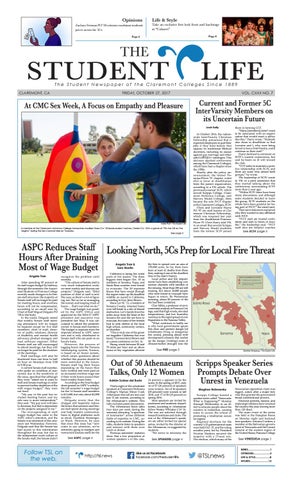
At CMC Sex Week, A Focus on Empathy and Pleasure
VOL. CXXX NO. 7
Current and Former 5C InterVarsity Members on its Uncertain Future Leah Kelly
Adela Pfaff • The Student Life
A member of the Claremont McKenna College Advocates Madison Shea CM ‘20 leads student Zachary Clarke CM ‘20 in a game of “Pin the Clit on the Vagina” during the Sex Carnival held on Thursday. See page 3
In October 2016, the nationwide InterVarsity Christian Fellowship announced that it expected employees to quit their jobs if they hold beliefs that oppose its traditional Biblical doctrines, including its stance against gay marriage and other anti-LGBTQIA+ ideologies. This decision sparked controversy among the Claremont Colleges, which have had a chapter since the 1950s. Shortly after the policy announcement, the former Pomona-Pitzer IV chapter voted 45-3 in favor of disaffiliation from the parent organization, according to a TSL article. The previously-named 3CIV, which served Scripps College, Claremont McKenna College, and Harvey Mudd College, then became the sole IVCF chapter at the Claremont Colleges, 5CIV. Chris and Lorraine Harry PO ‘97 are staff leaders of Claremont Christian Fellowship, which was renamed last year from the disaffiliated PomonaPitzer IV. Chris Harry told TSL in an email that several Scripps and Harvey Mudd students from the former 3CIV joined
them in forming CCF. “Many [members] didn’t want to be associated with an organization that would enact a policy like this,” Harry wrote. “Students also chose to disaffiliate so that Lorraine and I, who were being forced to leave InterVarsity, could continue as their staff.” Harry declined to comment on 5CIV’s current controversy, but said he bears no ill will toward the club. “CCF seeks to maintain a positive relationship with 5CIV, and there are some who attend both groups,” he wrote. The leadership of 5CIV wrote to TSL in a joint statement that they started talking about the controversy surrounding ICVF more than a year ago. “Within 5CIV there have been many discussions, and although some students decided to leave the group, 5CIV students on the whole have been grateful for being part of IVCF,” the email said. Their joint statement explained why they wanted to stay affiliated with IVCF. “IVCF staff are trusted confidants and aids in times of trouble,” the leadership said. “IVCF staff also are helpful coaches
See 5CIV page 3
ASPC Reduces Staff Looking North, 5Cs Prep for Local Fire Threat Hours After Draining Most of Wage Budget Angela Tran & Sam Norrito
Angela Tran After spending 85 percent of its staff wages budget by halfway through the semester, the Associated Students of Pomona College recently made changes to its Senate staff structure: the majority of Senate staff will no longer be paid for meeting hours, and overtime hours will not be compensated, according to an email sent by Chief of Staff Miguel Delgado PO ’20 to the body In the email, Delgado stated that weekly Senate staff meeting attendance will no longer be required except for five staff members: chief of staff, director of public relations, director of disability and mental health advocacy, product manager, and lead software engineer. Other Senate staff are still encouraged to attend meetings, but they will no longer be paid for the duration of the meetings. Staff meetings will also be shortened from one hour to half an hour on Mondays from 5:00 to 5:30 p.m. A current Senate staff member, who spoke on condition of anonymity due to the sensitivity of the issue, specified that although they were “asked not to come to staff and Senate meetings in order to prevent further depletion of the staff wages budget,” they were not fired. “My pay in the past has included meeting hours, and my role now is more independent,” they said. “My pay now will likely decrease, but that is dependent on the projects assigned to me.” The over-spending of staff wages budget has come to the ASPC office’s attention, and the Senate was informed of this situation last Wednesday. However, Delgado said that the Senate has had access to this information throughout the year, but due to the independent work culture of the Senate staff, the Senate didn’t
recognize the problem until recently. “The culture of Senate staff is very much independent work; we meet weekly and discuss our projects,” Delgado said. “[My] position of chief of staff is new this year, so there’s a lot of figuring out. But as far as managing the money and keeping track of hours … that’s not what we do.” The wage budget was granted by the ASPC Office and approved by the 2016-17 ASPC president and executive vice president last May. It was calculated to afford the predetermined 14 Senate staff members. The budget is separate from the stipends offered to ASPC senators and is only distributed to Senate staff who are paid on an hourly basis. However, the process of logging hours into the Pomona timekeeping system, Kronos, is based on an honor system, which raises questions about whether this process should be more restricted in the future. Senate staff log their hours depending on the hours they have worked and were paid on an increased overtime wage rate if their work hours exceed their fixed weekly hours limit. According to the final budget sheet posted on ASPC’s website, the fall semester’s wage budget for the 14 Senate staff members is $13,680, but only about $2,000 remains. D e l g a d o w ro t e t h a t t h e changes will hopefully reduce the hours that senators and Senate staff spend during meetings and help transfer communications to digital platforms such as email, Facebook Messenger, or Slack. However, he says that since this issue has “now come to our attention, we’re definitely going to readjust and restructure [Senate staff] for the
Follow TSL on the web.
See ASPC page 4
California is facing the worst parts of fire season. The three biggest fires began Oct. 15 as residents of Sonoma, Napa, and Santa Rosa counties were forced to evacuate. The 20 separate blazes that have swept through the region make up the deadliest wildfire on record in California, according to Gov. Jerry Brown. Elena Lev SC ’21, a resident of Sonoma County, returned home over fall break to a site of blazed destruction. Lev’s family lives five miles away from the heart of the Sonoma fire and did not have to evacuate, but some of her friends had to seek shelter at the local high school, community centers, or churches. “This is truly one of the greatest tragedies California has ever faced,” Govenor Jerry Brown said at a press conference on Oct. 16. Strong winds between 50 and 79 miles per hour and an abundance of dry vegetation allowed
the fires to spread over an area of 170,000 acres. So far, there have been at least 42 deaths from these fires, making it one of the deadliest fires in the state’s history. Local police and fire departments have been establishing connection channels with families of the missing. More than 280 are still missing, but about 20,000 people who were forced to evacuate have begun to return. By Wednesday morning, about 80 percent of the fire had been contained. Char Miller, a professor of environmental analysis at Pomona College, said that high winds, elevated temperatures, and low humidity were key to the rapid spread of conflagrations in the Sonoma Valley. “What continues to baffle me is why local governments ignore this clear and present danger [of inhabitants living in dangerous fire zones], pressing ahead with development schemes that ratchet up the danger. [Adding] years of climate-fueled drought into the
See FIRE page 3
Out of 50 Athenaeum Talks, Only 12 Women Adrián Suárez del Busto Thirty-eight of the scheduled speakers at Claremont McKenna College’s Marian Miner Cook Athenaeum this fall are men and just 12 are women, according to the Athenaeum’s website. This tally excludes panel discussions. The Athenaeum hosts talks four days per week during the semester, attracting “a spectrum of luminaries” across different fields of expertise to CMC, according to its website. During the talks, students listen to speakers and interact with them over lunch or dinner. Previous semesters’ statistics show that a low proportion of women speakers – in this case,
http://tsl.news
24 percent – appears to be the norm. In the spring of 2017, only 16 of 57 (28 percent) of speakers were women. Ten of 36 speakers (28 percent) were women in fall 2016, and 17 of 58 (29 percent) in spring 2016. Most speakers are invited by professors and academic departments, according to Athenaeum fellow Wesley Whitaker CM ‘18. The rest are solicited through research institutes and clubs. The rest of the Athenaeum’s speakers are either invited for special series, invited by the director of the Athenaeum, or suggested by students. “We strive to diversify the
See SPEAKERS page 4
Like us on facebook: facebook.com/thestudentlife
Dominic Frempong • The Student Life
Scripps Speaker Series Prompts Debate Over Unrest in Venezuela Meghan Bobrowsky Scripps College hosted a speaker series called “Venezuela: What is Happening?” Monday through Wednesday in an effort to educate people about the country in transition, causing some to accuse the school of promoting a totalitarian socialist regime. Regional elections for the country’s 23 gubernatorial seats were held Oct. 15, and the ruling socialist party led by President Nicolás Maduro secured the majority with a 17-seat win. The election, which many of the
@TSLnews
Venezuelan opposition claim was rigged, comes after a major July vote that granted the government broad constitutional powers. Electoral protests, famine, and triple-digit inflation have wracked the country this year, leaving more than 120 dead. The main event of the series was held in the Hampton Room on Monday night and featured four speakers: Antonio Cordero, a member of the Bolivarian government of Venezuela and the Consul General of the western region of the United States; Pomona College
See VENEZUELA page 2 NEWS................................1 OPINIONS........................5 LIFE & STYLE.....................8 SPORTS...........................12
NEWS PAGE 2
OCTOBER 27, 2017
THE STUDENT LIFE
VENEZUELA: Sen. Rubio Criticizes Scripps For Pro-Maduro Speakers Continued from Page 1 history professor Miguel Tinker Salas; Jeanette Charles SC ’10, a contributor to the news website Venezuela Analysis; and Pambana Bassett SC ’13, a graduate student at the University of the West Indies. Scripps history professor Cindy Forster, who co-sponsored the speaker series with the Chiapas Support Committee, Scripps Latin American and Caribbean Studies, and the Harper Fund, required her core class to attend at least one of the events or an alternate Scripps event on Thursday. She said the series is “one-ofa-kind, in a milieu in which the media has joined Trump’s calls for a U.S.-backed invasion of Venezuela” and said the events “signaled the willingness of Scripps to engage in larger debates about history and politics.” Eve Kaufman SC ’21, who attended the Monday night event, said she doesn’t know what to believe. “I would like to believe that this new government could be good,” she said. Kaufman admitted there is still a lot of turmoil under the Maduro administration, which has jailed opposition leaders and threatened to put more members of the opposition, news media, and congress in prison. Additionally, violent clashes between protesters and authorities have increased within the country. As for the talk itself, it was “totally normal and vaguely promoting socialism,” Kaufman said, adding that most things at Scripps tend to support socialism, “unless it’s the Motley.” In Forster ’s class, Kaufman said ‘there’s no diversity of opinion, [which is] blinding to us and not helpful.” Zaidee Hedges Laughlin SC ’21, who also attended the Monday evening talk for class, characterized it as “a peaceful, powerful event.” She said the speakers all spoke in general terms, so “it was hard for me to gauge the truthfulness of what they were saying.” “It’s hard to wrap your mind around ideas that are so different from what you’ve been raised thinking,” Hedges Laughlin said, referring to the traditional Ameri-
can view that supports capitalism. Jonathan Azterbaum PZ ‘20, a member of the Chiapas Support Committee, traveled to Venezuela in August, and said the speaker series is necessary because the mainstream media spews “complete lies about what’s happening.” “When you go there, it’s seriously ridiculous how different it is compared to what people say it’s like,” Azterbaum said. “The quality of life has improved dramatically.” The event flier boasts of “an electoral system that experts believe to be the most transparent in the world,” likely in reference to a statement by Venezuela Electoral Campaign Chief Jorge Rodriguez. Smartmatic, the company that provided 24,000 voting machines used in the July election, reported that voting totals were “tampered with,” but Azterbaum said “these elections were deeply, deeply democratic. If this is a dictatorship, what a beautiful dictatorship.” In search of the real truth in today’s Venezuela, Kaufman suggests looking at economic reports “because statistics can be fudged less than personal opinions.” Zach Wong CM ’19 was appalled when he heard about the speaker series. “This was a blatant attempt at spreading propaganda in Claremont without acknowledging any of the human rights violations that are well-documented by journalists from major news outlets,” Wong said. “If the purpose of the event was to explain what is currently happening in Venezuela, the last thing I think you would want is to have the oppressing party explain what is going on.” Charlie Harris CM ’19 agreed with Wong. He described the series flyer as “something pumped out by a ministry of propaganda” that “does not seem to be a genuine attempt at diagnosing and fixing the problems facing Venezuela today.” “I respect the rights of these student organizations to host events on whatever they want to, but I’m worried that students, by no fault of their own, could end up just hearing and believing the propaganda of the Venezuelan
Photo Courtesy of @andresAzp on Flickr
Political unrest in Venezuela has caused a number of protests.
government,” Harris said. According to Azterbaum, however, “all [students] have been able to ask their questions.” Azterbaum said much of the backlash against the series is coming from Venezuelans in the U.S., many of whom who aren’t part of the working class. Bassett, the graduate student speaker, said “as black people,
North Korean Defectors Share Personal Stories at Pomona Talk
we saw it [as] really important [to host the events].” “It’s incredibly important because [perceptions about what’s happening have] deterred people from traveling there,” Charles added. “The conversation has gone beyond Venezuela. [It’s about] what different types of societies we can explore.” The speaker series prompted
Ian Poveda• The Student Life
Karen Song The 5Cs hosted a dialogue with defectors from North Korea for the first time last weekend. Bluebird NK, a nonprofit organization dedicated to empowering defectors as “the first citizens of a unified peninsula that has yet to come,” hosted the event in Edmund’s Ballroom at Pomona College as part of the “Free Speech in a Dangerous World” speaker series. The defectors, Shin DongHyuk and Kim Hak-Min, spoke of their individual experiences in North Korea, escaping the Kim family regime, and adjusting to their new lives in South Korea. Shin presented his story as an analysis of the international perspective, saying he had lost faith in humanity upon witnessing what he described as the blissful ignorance of America and South Korea alongside the suffering in North Korea. “Where is the international community when North Koreans are dying and starving?” he asked. “How many more must die before we achieve peace?” Kim, whose story was also central to the New York Times bestselling novel “Escape from Camp 14,” shared a slightly more optimistic tale. Despite having
seen his own mother and friends die of hunger at home and in labor camps, he resisted and fought for his own happiness out of North Korea. “Life is too sad to live for oneself alone,” he said. He expressed enthusiasm for seeking careers and a family in South Korea. The dialogue was preceded by a talk by Tom Le, an assistant professor of politics at Pomona, who spoke about the role of the international community in building a shared understanding of North Korea. “The North Korean crisis is the most complex issue of international relations today, and often the most simplified,” he said in his speech. In an interview with TSL after the event, Le also spoke directly to a lack of knowledge among people in the United States. “The issue is still a very small part of the public consciousness,” Le told TSL. “Most people think in terms of popular stereotypes in the media, and some Americans don’t even know the difference between North and South Korea.” One attendee of the event, Rose Kim PZ ‘21, said the event was successful in highlighting the humanitarian crisis and spreading college within the campus community.
“It was really great that the event shed light on the fact that people are still suffering in North Korea, rather than the international nuclear problem,” she said. “Many people are still unaware of the reality of the situation in North Korea. It is often seen as a joke in the media and many people have yet to hold strong opinions on the political or social issues taking place.” John Park PO ‘19, founder of Bluebird NK and the primary organizer of the dialogue, was excited about the turnout and hopeful about the conversations that it was able to spark. “This is an amazing opportunity for Pomona students. By giving these defectors a platform to share their lived experiences, I think we were able to get more people involved, or at least interested, in the cause,” he said. Park went on to highlight the relevance and significance of the North Korean crisis. “This is an incredibly intersubjective issue that encompasses everything from individual human struggle and human societies to totalitarian regimes and nuclear warfare,” he said. “It is a historical issue to be. It could either be the greatest tragedy or the greatest success of our century.”
ponents, or allow drug lords like @dcabellor to control govt.” The other events, “Black Liberation and Reparations at the Heart of Venezuela’s Revolution,” “PEOPLE’S POWER in Venezuela, the Highest Power in the Land,” and “Paramilitarism from the Right versus building the Communal State from Below,” were held over the next two days.
Scripps Tightens Public Lecture Security Following Audience Disruption Sam Norrito
North Korean defector Kim Hak-Min shares a personal anecdote with the audience about life in North Korea at a panel on Saturday, Oct. 21, in Edmunds Ballroom at Pomona College for Claremont City Council.
a tweet from Sen. Marco Rubio (R-FL), who was responding to an article on the series in The Daily Caller. “Crazy but true, a $69k a year college funds lecture series touting ‘success’ of #Venezuela @ Nicholas Maduro regime,” Rubio wrote Wednesday. “Wonder if part of lecture series is about how to destroy economy, imprison op-
After three protesters disrupted a Tuesday Noon talk by Hussam Ayloush, the executive director of the Council on American-Islamic Relations, earlier this month, Scripps College has instituted new security measures at all lectures open to the public. While the events will remain open, video recording them is now prohibited, and at the start of each lecture the guidelines for audience engagement will be announced, Scripps Dean of Faculty Amy Marcus-Newhall wrote in an email to the Scripps community on Oct. 18. “Although there is no requirement to open events to the public, doing so often allows for deeper conversations and allows us to build bridges with our surrounding communities,” MarcusNewhall wrote. In the case of events with more controversial speakers, like Ayloush, the college will work with Campus Safety to develop a security plan. “We don’t expect that our colleges would change their long history of making many of these events open to the public,” director of Campus Safety Stan Skipworth wrote in an email to TSL. “We support them in the
preventive security measures they are looking at … while we work collaboratively and with vigilance about the right approach to safety and security for each and every event.” At events where such “diverse perspectives and ideas” are represented, Skipworth said, there must be a balance between creating a safe, successful event and “respecting the constitutional rights of those in attendance.” The new security measures include training the student ushers on staff at Scripps events, according to Tori Smith SC ‘20, an usher at the Garrison Performing Arts Center. Smith said the ushers were told how to respond if another group tried to disrupt the event. “We are now using an acronym – ATM – ask, tell, make,” Smith wrote in a message to TSL. “Step one is to ask the person to stop, step two is to tell them to stop and step three is to make them stop, although, at the third level, we are supposed to get one of our bosses involved.” Ushers were also given photos of the protesters from Ayloush’s talk in case they appeared at last week’s Humanities Institute lecture by Angelica Salas, the executive director of the Coalition for Humane Immigrant Rights Los Angeles.
“We separated students, faculty, and staff into one line, and the general public into another, just to make sure the same man would not show up again,” Smith wrote. “I think [increased] security is never a bad thing, and it has not changed the job of the usher, it has only made us more aware of how to handle [an] unexpected situation,” Smith wrote. The policy changes come at a time when the 5Cs are facing more disruptions and contending with a more politicized college environment, wrote Karen Bergh, associate director of media relations for Scripps. “We feel called more than ever to present the models for civility and mutual respect, and call on our visitors to do the same wherever possible,” Scripps wrote in a statement to TSL. Marcus-Newhall expressed a similar sentiment in her email. “Inviting outside speakers to present their ideas, scholarship, and life stories is essential to providing the rich intellectual environment that we seek,” she wrote. “Faculty, students, trustees, and the administration bring speakers to campus with the goal of creating opportunities for us to think more deeply and more broadly about a wide array of questions, problems, and ideas.”
Corinne Mitchner • The Student Life
A community member involved in protesting a Scripps College talk about Islamophobia, interrupts speaker Hussam Ayloush.
NEWS OCTOBER 27, 2017
THE STUDENT LIFE
Fun and Games: A New Approach to Sex Education in Claremont
5CIV: Former InterVarsity Leader Felt ‘Ostracized’ for Sexuality Continued from Page 1
Adela Pfaff• The Student Life
The Claremont McKenna College Advocates display sex toys, like the Fleshlight, and give demonstrations of use and care.
Kristine Chang The Claremont McKenna College Advocates for Survivors of Sexual Assault and Violence hosted the 5Cs first ever Sex Week from Oct. 23 to 27. The event was created to educate and promote safe sex and consent through a sex-positive, intersectional lens, said Zippy Wilson CM ‘18, a CMC Advocate and one of the event’s main organizers. The Advocates are a group of students that provide confidential support to survivors of sexual violence. “We wanted to make education surrounding sex the focus for a brief period of time,” Wilson said. “Hookup culture at CMC is not conducive to consent and pleasure. We need to work on decreasing stigma around desiring sex and increase respect for partners by promoting conversation.” Wilson said Sex Week was inspired by the Survivor Support Week, which was created by Kay Calloway PO ‘18 in 2016 to focus on supporting survivors of sexual violence at the 5Cs. Sex Week included a speaker series, discussions, workshops, and a carnival. According to the CMC Sex Week Facebook page, the activities were meant to provide all 5C students with access to information regarding consent, safe sex, and pleasure in a fun and educational manner. Speakers ranged from pornstar Mia Lin to doctor and stand-up comedian Priyanka Wali, and discussion spanned topics including sexual intimacy, queer sex, and an introduction to BDSM. Wilson said that the Advocates selected speakers who represented
queer people and people of color to cover a wide array of topics with the underlying theme of consent and communication. Lin, who spoke about decentralizing the orgasm as the purpose of sex, said, “Sex Week is inspiring to me as someone who isn’t a college student because what everyone is doing here will be passed down from generation to generation in regards to behavior and ideas. This is going to change so much, because we are normalizing good things versus normalizing violence.” Students who attended the talks received tickets to use at Thursday’s carnival, which featured a ferris wheel, a sex toy raffle, a comedy show, anatomy quizzes and games, inflatable penis jousting, a bouncy house, and a bake sale. Students could also get tested for sexually transmitted infections for free on Thursday and Friday. In regards to 5C response, Wilson said, “students across the board have been thrilled; attendance so far exceeded our wildest expectations. [Associated Students of Claremont McKenna College] and Senate supported us both with money but also as people, promoting the events and helping us make sure everyone know what was going on.” Sophia Sun PO ‘21, who attended one of Lin’s events, said, “I appreciate this event because the speaker was so candid and straightforward about her sexual experiences. It made me realize that sex isn’t something to avoid talking about but to openly address.” Warren Chen CM ‘19 said “I think Sex Week is very good to have. When I first heard about it, I was skeptical. But I gave it a shot and went to one
of the events. I thought a lot of the talks were informative and came from a healthy point of view, which can be helpful to people don’t have access to that type of information.” There have been efforts in the past on 5C campuses to raise awareness about sexual violence. In 2014, groups such as the Personal and Social Responsibility Committees, ASCMC, and the Center for Civic Engagement — in addition to Advocates — held events to foster a consent-positive community. However, Sex Week is the first event on 5C campuses to also focus on sex in terms of pleasure and empathy, not just consent. According to the CMC Forum, the event was funded and supported by CMC Title IX Coordinator Lynzie Deveres, Director of CARE Center Vince Greer, Director of EmPOWER Center Rima Shaw, CMC Assistant Dean of Students for Student Activities and Orientation Devon MacIver, and the Marian Miner Cook Athenaeum, in addition to a $5,000 grant from ASCMC. Extra funding came from O.school, an online platform that teaches sex education through live streaming and moderated chat, and SAFE, an STI verification app. Wilson said CMC administrators were supportive of Sex Week, from protecting Advocates from legal issues to helping them coordinate the event. Kenlyn Mirback CM ‘21, an Advocate, said, “I think Sex Week is really awesome because it brings up subjects we don’t really talk about but that we need to talk about. The event empowers people to take control of their bodies and sex life.”
for students as they care for their friends, providing mature perspectives on situations, and connecting students to support services on campus.” In addition, the email said, IVCF helps 5CIV students uphold important religious morals. “[IVCF] continues to teach basic Christian values of social justice, racial reconciliation, and fighting against all forms of discrimination (socio-economic, gender, sexual orientation, race/ ethnicity, immigration status),” the 5CIV leadership wrote. Rachel Geller SC ‘18, a former 5CIV student leader, said she was “ostracized as one of the only queer students and the only queer leader” after IVCF’s policy announcement prohibiting its employees from displaying pro-LGBTQIA+ beliefs. Geller said she joined 5CIV during her first year and became very involved. By her junior year she was a group leader for one of its small Bible studies, and by that point she was spending “about 20 hours a week” doing activities with the club. However, Geller said that as she came to terms with her own sexuality, she began to realize that some people in 5CIV did not share her beliefs on homosexuality. “I started having some difficult conversations with people I was close to,” she said. “When the policy became public I was really appalled and distressed.” Geller said she and several oter leaders who opposed the policy change tried to start conversations within 5CIV about the issue, but it was hard to get members to engage. “I think part of it was some people did agree with [the policy], and didn’t want to have to defend it to us, and other people were afraid,” she said. “It was a really a negative experience for my mental health and I felt really betrayed and rejected by people that I thought were supposed to love me unconditionally.” Kate Vosburg, one of 5CIV’s staff members, said 5CIV is open to LGBTQIA+ students and tries to maintain a respect-
FIRE: 12-Month Fire Season “Not a Surprise”
Photo courtesy of Glenn Beltz on Flickr
One of the many California wildfires this year ravages a Whittier forest.
Continued from Page 1 mix, we should not be surprised that the fire season is now a twelvemonth-long event,” Miller wrote in an email to TSL. Mass destruction of the landscape, buildings, and residences took a great toll on the Sonoma Valley area. “We all wear masks when going outside now because the air quality is really poor,” Lev wrote in an email to TSL. “The community has come together in a remarkable way,” she added. “All schools in the county have been closed this past week, and the kids have poured themselves into the volunteer opportunities.” The evacuation centers near Lev’s residence have received donations of pet carriers, books, and games, and many residents are volunteering at the closest evacuation
centers. For now, residents aren’t focusing on rebuilding. “We’re all still recuperating and picking up the pieces,” Lev wrote. In an area where earthquakes are the most common natural disaster, the fires surprised county residents. First responders and neighbors traveled door to door to alert residents to the fires as they began. “My family didn’t have much of an established fire plan,” Lev wrote. “Because we are in an earthquakeheavy area, that’s what we planned for.” Fire departments in southern California have been increasing awareness on this issue, and Campus Safety has re-examined its wildfire emergency protocol, especially after the Bernard Field Station brush fire in May. The chance of a wildfire originating from one of the campuses is slim, Director of Campus Safety
Stan Skipworth said. However, if there was a brush fires on or near campus, Campus Safety would evacuate the community if necessary, according to its safety directives. “Campus Safety would remain in close contact with the Los Angeles County Fire Department, the California Department of Forestry, and the Claremont Police Department to make sure we have the most current information,” Skipworth said. According to Marc Los Huertos, a professor of environmental analysis at Pomona College, the Claremont Colleges are quite fire resistant. But even though “there are defensible spaces, a lot of irrigated land, and very few wood buildings ... it is incorrect to say that the Claremont Colleges are immune to fire,” he said. Los Huertos suggested a few
PAGE 3
things students need to be concerned about. “First, make sure that if there is a fire, students should stay indoors and avoid breathing smoke because it is a dangerous carcinogen. If there is an evacuation order, you should take that seriously and move quickly,” Los Huertos said. He also advises students to be familiar with the on-campus emergency response flip-charts and establish meeting points near the colleges where their family can contact them when communication channels fail. For students living close to forests and areas of high wildfire risks, Los Huertos recommends them to have an emergency backpack that they can grab to-go in an immediate situation, especially at this time of the year when the Santa Ana winds can quickly severe any small fire.
ful dialogue for students with a variety of beliefs. “People with LGBTQIA+affirming theology have been welcomed into the 5CIV community,” Vosburg said in an email to TSL. “Although [InterVarsity] has a traditional theology of sexuality, we have never required that members or student leaders share that theology.” Vosburg said 5CIV has worked to make its members more aware of LGBTQIA+ issues and try to include more programs for LGBTQIA+ members. “IV[CF] leaders have been through QRC Ally training to be more aware of homophobia and heteronormativity,” she said. “For several years, [5CIV] had a Bible study just for LGBTQIA+ people so that students knew that was a safe space for them.” Geller said it’s difficult to call out 5CIV’s actions because of its nondiscrimination clause and official policy that any student can be a member and a leader. “What’s so frustrating about this whole situation is that they explicitly can say, ‘We welcome everyone, we wouldn’t discriminate against you,’ but the environment itself is so hostile it was hard to feel comfortable,” Geller said. Professor David Vosburg, another of 5CIV’s staff advisers, is also a member of the 7C Chaplains’ Advisory Board and the 7C Committee on Religious Activities. He wrote to TSL in an email that 5CIV complies with 5C nondiscrimination policies, and that IVCF is continually “a blessing to black, white, Asian, Latino, female, male, trans, queer, straight, poor, rich, domestic, and international students.” The 5CIV leadership agreed with Professor Vosburg’s opinion that it is making a positive impact on the 5C community. “5CIV empowers students to have spiritual conversations and it adds to the diversity of thought that the Colleges seek to promote,” they wrote to TSL. Kate Vosburg told TSL in an email that while paid IVCF staff are required to agree with the organization’s ideologies, student leaders are not. She also explained that while paid IVCF staff are required to agree with its theologies, they can still identify
as LGBTQIA+. “The IV policy is about theological beliefs only, it is not about identity or orientation,” she said. “One can be a an IV staff or student leader and be LGBTQ.” However, Geller said the organization would not have wanted her to express her sexuality. “The official position of [IVCF] and its staff is that acting on same-sex desire would be sinful,” she told TSL. “If I wanted to be a leader, I had to agree that I would not promote my own theological viewpoints.” Eventually, Geller said, “I got tired of debating my own humanity.” She quit leadership and cut ties with the organization. Geller said that she thinks 5CIV should not receive funding from the colleges, but that from a legal standpoint, it has not done anything to warrant revoking its charter. “Unfortunately, a club’s internal environment cannot be evaluated when considering whether or not they’re discriminatory, only their official policies and actions,” she said. She also understands that 5CIV provides a safe haven for its members. “Part of me wants to say that I wish they would [revoke the charter], but I also think that I’m sympathetic to the challenges that conservative students face on the campuses, and I know that a lot of people who are still part of the 5CIV probably don’t feel like there would be another community if 5CIV didn’t exist,” she said. Vosburg also believes that some 5CIV students face challenges at the colleges due to their religious beliefs. “I am very discouraged by the repeated religious discrimination that 5CIV students and other students of faith regularly face at the Claremont Colleges,” he wrote to TSL. “The emotional toll that religious students are forced to bear … is inexcusable.” In the end, Geller ’s recent experience with 5CIV was not a positive one. “It’s really hard as a queer person to be told that something is wrong with you,” she said.“I didn’t want to be told that I was sinful for just trying to be who I was.”
Senate Briefs Pitzer College Student Senate At the Senate’s Oct. 22 meeting, economics professor Maya Federman gave a special presentation on the Judicial Reform Committee. The committee is working towards increasing consistency and transparency in the Pitzer judicial system. Environmental analysis professor Susan Phillips then presented the possibility of creating a Bias Incident Report Team for the college. This team would deal with Pitzer students who experienced bias-related incidents. Although Pitzer does not define bias-related incidents in their student handbook, this decision is likely in response to Pomona’s statement on a secret meme group, which defines incidents as bias-related when they “are expressions of hostility against another individual (or group) because of the other person’s (or group’s) race, color, religion, ancestry, national origin, disability, gender identity or expression and sexual orientation, or because the perpetrator perceives that the other person (or group) has one or more of these characteristics.“ During executive board reports, Treasurer Jacqueline Aguilera PZ ‘19 briefed the Senate on the recent budget committee meeting. Among other items, the budget committee approved funding to send a student to a writing conference and denied funding to a student to present research at the 2017 Israeli-American National Conference. A member of the Senate called a motion to overturn the decision to deny funding to that student. After a lively discussion, the Senate voted on the motion. With 14 out of 30 votes, this motion did not pass. On Saturday at 3 p.m., California State Assemblyman Anthony Portantino will be speaking in Skandera Hall as a part of the Mindful of the Future series. There was a town hall meeting in the McConnell Living Room at 10 a.m. to discuss the Title IX audit. In response to the decision by the Pitzer Board of Trustees to rescind a budgetary amendment made by the Senate, there will be a town hall meeting Nov. 3 at 2 p.m. in the Gold Center multi-purpose room. –Jojo Sanders SC ‘20
Scripps Associated Students At the Oct. 26 meeting of Scripps Associated Students, members provided updates regarding the SAS website, 5C events, commencement speakers, meetings, and events. Treasurers Grace Wang SC ’19 and Romanshi Gupta SC ’19 updated the board on new reimbursement forms, Venmo, and budget request planning. The Board voted on the budget for 5C Halloween Party and Mudd Fun Ball. Additional Senate updates included 5C student government bonding. The board also discussed 5C Christian InterVarsity Group, noting that they have not been funded by SAS for several years but that student governments legally cannot discourage 5CIV to disaffiliate from the national organization. The Senate agreed to follow up on a Latinx student organization budget request as well as creating a map of student resources on Scripps campus. –Helena Ong PO ‘20 Associated Students of Claremont McKenna College On Oct. 23, the Associated Students of Claremont McKenna College met with Assistant Vice President of Diversity and Inclusion and Chief Civil Rights Officer Nyree Gray and 5C Christian InterVarsity staff member Kate Vosberg. They discussed the college’s nondiscrimination clause and the national organization’s approach to LGBTQIA+ issues. Clubs and Organization Chair Chloe Amarilla CMC ‘19 gave a presentation about giving the Clubs and Organization Chair voting power in the Executive Board. Additional updates included Consortium Affairs Chair Elijah Jackson CMC ‘19 discussing a weekly information message about 5C events. Committees updated the board on Career Services mentorship, funding advertisements, and the heat wave. The Environmental Committee discussed reducing paper waste in the computer labs and mailroom as well as an event with Pitzer regarding waste produced at the dining halls. Executive Vice President Patrick Elliott CMC ‘19 also updated the body that the Hub will extend its hours on Thursdays to midnight. –Helena Ong PO ‘20
NEWS PAGE 4
Local Grade Schoolers Find Their Inner Writers in 5C Workshop Becky Hoving On any other day of the week, Miranda Moreno, a sixth-grader at Lexington Elementary in Pomona, can be found daydreaming about mermaids and pirates. But on Mondays from 4:30 to 6:30 p.m., Moreno is putting her imagination into practice, penning stories at the Weekly Writing Workshop (3W) held at The Hive. 3W, a partner of the Claremont non-profit Uncommon Good, runs a 9-10 week long writing workshop for students grades four to nine in both the fall and spring semesters. The program is designed for underprivileged students from Claremont, Pomona, Montclair, and Upland, according to Elena Dypiangco SC ‘19, who serves as one of two student coordinators of the program. Dypiangco’s position involves drafting lesson plans and directing activities for nearly 20 students within the fourth through sixth-grade age group. Each semester brings a new theme for its students, who participate in a free-write, engage in a lesson led by student mentors, and work on the culminating goal of the series: one long piece of writing that will be published and distributed in a program-wide literary magazine at the end of the semester. “The theme for this semester is scriptwriting,” said Dypiangco, who has been involved with 3W for two semesters. “We’re teaching the kids the fundamentals whether it be for plays, TV shows, movies, and giving them the toolset to tackle this alternative form of writing.” She also noted that this semester’s culminating project asks students to produce
OCTOBER 27, 2017
THE STUDENT LIFE
a script with three short scenes. Chris Angel, a sixth grader from Vejar Elementary School in Pomona, has been coming to 3W for two years, and he says his favorite part is the opportunity to experiment with different types of writing than those normally taught in school. “I really didn’t know how to write a script when we first started and what it meant, but now I am getting the hang of it,” Angel said. “I like to watch movies so it’s cool to be able to see where they come from when I write.” Aliyah Qurashi PO ‘20 echoed Angel’s sentiments, emphasizing that the individual attention and resilience enforced in the program exposes students to alternative writing styles in a comfortable environment. “Sometimes school isn’t necessarily a safe space to make mistakes or learn at a slower place,” she said, adding that most of the students come from families where English is not their first language. “Their parents do not speak English fluently and might not be able to help as much in subjects like English and Writing.” At 3W, students are connected with a mentor from the Claremont Colleges that stays with a group of four to five other students for the entirety of the semester and gets to know each of their mentees on a personal level. Mentors are uniquely positioned to observe the students’ progress, and are able to provide much more attention than a classroom teacher. Georgia Godlee-Campbell SC ‘19, who has been a student mentor for three semesters, has had the
opportunity to watch returning students grasp new concepts and become more engaged in the classroom environment over multiple semesters. “One mentee of mine in particular describes herself as quite shy,” Godlee-Campbell said. “But over the course of the past two semesters, I’ve witnessed her really come into her own and gain confidence with public speaking which has been amazing.” Dypiangco believes that the students’ learning extends far beyond writing and confidence-building, but that the program builds a curiosity inspired by accessibility to a college campus. “Interacting on a weekly basis with college students is a big component,” she said. “I get questions every week about Scripps and my college experience. The kids are just genuinely curious about what it is like to be in college, so hopefully that will continue when it comes time for them.” Moreno, though, is content simply to imagine elaborate stories of pirates and mermaids searching for gold, and she doesn’t think much about the future. She just knows she loves to write. “In fiction, it’s like your own world, you get to create everything, you have a power to make things as you like,” she said. But the best part for Moreno is holding up her finished product. “It feels good. It kind of feels like when you make artwork. You look at it and you admire it. But instead of looking at it, you read it and feel proud.”
Courtesy of Will Gottsegen
The Hive at Pomona College is a 5C resource for creative collaboration.
If Not Student Fees, What Funds Alcohol At Campus Parties?
Liam Brooks • The Student Life
Parties like “Mudd Goes Madd” in 2015, pictured here, have provided beer and other alcoholic beverages to students above 21.
Daisy Ni The Pitzer Student Senate proposed a bill earlier this month that would temporarily permit the use of student activity funds for alcohol. Although the bill was tabled due to conflicts with the Pitzer student handbook, alcohol is already commonly seen at student events across the 5Cs. Who pays for it? According to the bylaws and constitutions of 5C student governments, none of the colleges are allowed to use student activity funds to purchase alcohol. Beyond that, college policies are varied. Elizabeth Amezcua, director of Health Education Outreach for the Claremont University Consortium, wrote in an email to TSL that “these policies are developed and implemented with the safety of students in mind.” She said they are all created in adherence to local, state, and federal laws regarding alcohol and drugs. Associate Students of Harvey Mudd College treasurer David Olumese HM ’19 expanded upon the reasoning behind this policy. “The majority of the student body cannot legally consume these substances, so as to be in accordance with state and federal law, we do not fund them,” Olumese wrote in an email to TSL. “Any dorm or student organization that throws a non-dry event cover[s] the alcohol expenditures using private funds.”
SPEAKER: Ath Fellow Says ‘Systemic Barriers’ to Blame for Lack of Representation at Talks Continued from Page 1 lineup across ideas, topics [and] experiences,” Athenaeum director Priya Junnar wrote in an email to TSL. Whitaker said that the speaker’s identity is taken into account, but it is not the main focus of the Athenaeum when scheduling talks. “We are looking for diversity of topics and experiences, but that doesn’t always boil down neatly into categories that you can check off a box,” he said. Whitaker said that broader disadvantages women face in their careers are to blame for the disproportionately low number of female speakers this semester. “There are systemic barriers for women to become leaders in their fields and so when the Ath looks at the thought leaders in different industries, there are necessarily less women than in the overall population,” he said. Jackie Siegler CM ‘19, co-founder and co-director of Power of Women, a club focused on raising awareness on campus about women’s issues, did not believe there’s a lack of qualified women available to speak at the Athenaeum. “Of course there are enough qualified, interesting women or with different gender identities that could come speak,” she said. Siegler argued the predominance of male speakers in the Athenaeum’s speaker series limits the diversity of voices that the Athenaeum so cherishes. “If the norm today is for speakers to be majority men, even if they work in different industries and have different political stances,
they have an intrinsic male perspective, which creates a very homogeneous climate for discourse,” she said. Dina Rosin CM ‘21 thinks having female speakers at the Athenaeum provides encouraging role models for women on campus. “When you see someone like
you being successful and accomplished, it makes you believe that you can do that too,” she said. On the other hand, Gayle Lee CM ‘20, vice president of Power for Women, argued that female speakers should not be seen only as representatives of women in their industry.
“If they do bring in a female speaker, there will always be a tendency to ask: ‘What is it like to be a female in this profession?’” she said. “It’s important to go beyond the question of their gender and to value them for their work and what they have brought to their field.”
8
Olumese emphasized that there are benefits to this system as well, such as “creating a more inclusive environment and encouraging events where all members of the community can choose to participate.” Scripps College, Claremont McKenna College, and Pitzer College have similar motivations. Scripps Associated Students cotreasurers Romanshi Gupta SC ’19 and Grace Wang SC ’19 wrote in an email to TSL that this policy “helps to ensure more equitable spending so that [clubs and organizations] are encouraged to utilize their funds to do things other than host parties.” In the case of non-dry events, however, Gupta and Wang wrote that “funds for alcohol must be fundraised independently and serving the alcohol must pass through the approval of the Dean of Students.” The Associated Students of Claremont McKenna College executive board operating procedures list ticketed social events, yearbook, and merchandise sales as avenues to support expenditures on alcohol. Pomona College is the only memeber of the consortium that contains a separate fund for alcohol specifically while still adhering to student government bylaws, as Associated Students of Pomona College Executive Vice President Carlos Hernandez PO ’18 explained. “We use profit from vending machines and the Amazon program that we have in place to put in a fund we call the alcohol fund,” he said.
The alcohol fund is used to sponsor alcohol at events upon requests by student organizations and approval by John Lopes, the assistant director of the Smith Campus Center. There is a limit to the alcohol that can be provided through applying to the fund—one keg or twenty bottles of beer under five dollars each—but student organizations can also fundraise additionally or use alumni donations to supplement what they receive from ASPC. Additionally, Hernandez explained that although historically the alcohol fund could only be used for events happening on campus, ASPC is trying to be more lenient in terms of execution. “We have been more understanding,” he said, citing one case in the past year in which an organization was allowed to use funds off campus after confirming there was no safety issue. Hernandez also said that the “alcohol fund at Pomona has been decreasing quite a bit.” The fund fell from $10,000 from the 2013 to 2014 school year to less than $5,000 in 2015, a trend which results from the decreased usage of vending machines. “To be fair,” Hernandez added, “very often we don’t end up spending it all.” Regarding the impact of the alcohol fund on the Pomona community, Hernandez said that “if we can provide a space where people come to drink for quality, that’s a positive change.”
ASPC: Hours Cut for Senate Staff Continued from Page 1 rest of the semester and next semester.” Another Senate staff member, who also spoke anonymously, said that because of a lack of communication, it was very easy for things to go wrong. “There is a divide between the people in ASPC this year who have experience and those [who] don’t,” they said. “They don’t really seem to want to talk to each other, people who are experienced are willing to help, but those [who] aren’t as experienced aren’t willing to listen.” The staffer also clamied that there have been cases of Senate bylaws violations, such as
new Senate staff members being paid before their hirings were approved by the Senate, and Senate staff members being removed from their positions by the executive board without a vote from the Senate. “These are minor procedural things. They seem small in the eyes of the inexperienced, but they can turn into something very major,” they said. Although the key causes to the wage budget’s overspending are yet to be determined by the Senate, Delgado mentioned that the hourly wage for Senate staff is raised this year from minimum wage to $15 an hour, a change that can cause overspending. This is a developing story, and will be updated as more information becomes available.
Got a news tip? Some of the reporting in this issue started with a quick, confidential tip in our inbox. If you have the next big story, message us on Facebook or use one of our secure channels:
tsl.news/page/tips securetsl@gmail.com Megan Robalewski • The Student Life
OPINIONS THE STUDENT LIFE LIAM BROOKS Editor-in-Chief KATIE BAUGHMAN Managing Editor CHRISTOPHER ESKILSON Managing Editor GRACE OZONOFF-RICHEY Production Editor
ELINOR ASPEGREN, News Editor KELLEN BROWNING, News Editor MARC ROD, News Associate SEAN OGAMI, Life & Style Editor ARIEL SO, Life & Style Editor JOLO LABIO, Opinions Editor TIARA SHARMA, Opinions Editor HANK SNOWDON, Sports Editor SABRINA WILK, Sports Editor DONNIE DENOME, Copy Chief OLIVIA TRUESDALE, Copy Editor PRIYA KARETI, Copy Editor SAMHITA KADIYALA, Copy Editor PEGGY CHOU, Copy Editor
DOMINIC FREMPONG, Graphics Editor MEGHAN JOYCE, Photo Manager ADELA PFAFF, Photo Editor
IRIS SHI, Distribution Manager ANNIE WAN, Business Manager LAUREN ISON, Editor-at-large
TSL welcomes Letters to the Editor, which can be submitted by mail, by email, or in person at the Fishbowl in Walker Hall. Letters must be under 400 words (although when an issue is particularly salient, we reserve the right to allow letters to run at a longer length) and submitted by 4 p.m. Wednesday of the The Editorial Board consists of the Editor-in-Chief and two week of publication. We reserve the right to decline publication Managing Editors. Aside from the editorial, the views exof submitted letters and will not accept anonymous letters, letpressed in the opinions section do not necessarily reflect the views of The Student Life. ters containing profanity, factually inaccurate letters or letters making personal attacks. TSL also reserves the right to edit for E-mail Letters, Questions and Concerns to editor@tsl.pomona. spelling, punctuation and grammar. Letters may be signed by edu. email tips to liaison@tsl.pomona.edu; email advertising a maximum of three persons. All letters become the property of inquiries to ads@tsl.pomona.edu. TSL and may not be reprinted without prior permission from the Editorial Board.
EDITORIAL BOARD
A Halloween Lesson on Fact and Fiction
Halloween is here, and we’re talking about it because people still haven’t gotten the memo that cultural appropriation is bad. But it’s especially disconcerting, and especially fitting, to talk about costumes in the Trump era. Looking at the holiday as a lesson in fakery can teach us something about truth, and remind us to take reality seriously. Some of the most important arguments that arise around Halloween have to do with costumes, from decrying those that are culturally appropriative to reminding each other that a sexualized costume does not imply consent. At their core, these arguments are about separating facts from fiction — what is an act, and what is real? More importantly, who gets to decide? As Donald Trump has settled into his presidency, fact and fiction have begun to ooze into
each other like a decaying jack-olantern. But even as the boundary between fake and real starts to fade, the definition of real itself is not weakened. On the contrary, it is strengthened and expanded. Reality comes to include the lies and half-truths, because they affect policy and impact real people’s lives. It is not enough to tear off masks; we must see them, confront them, and feel they are made of plastic and string. We perceive the realities and personas we create in wearing these costumes to be fake, scaffolded by the calendar date and a campy lack of accuracy. But they are just as real as the alcohol and the loud music and the candy. For a time on Tuesday, things will truly not be what they seem, and we will accept that. Fictional characters will come to life, inanimate objects and puns will materialize in flesh, and some
people who forget to wear a costume at all will be read as archetypes, constructions, and meta-disguisers. But come the next day, they may be read as misguided, fraudsters, fakers. After all, what good is a costume if you never take it off? We are lucky to live in an era when we can so easily express ourselves with little mediation between thought and share. Halloween is a lesson in context. There is a time and place for play, so the holiday says. Subsequencely, the pronouncement forms a time and place for seriousness, authenticity and responsibility. When it comes to discourse, we could do well to examine Halloween as a structured time for disbelief, a space for lying without bad intent, an opportunity to be scared for the scare itself.
Halloweekend Heatwave We were going to forgo clothing anyways...
U.S. Baseball Team Finally worth watching!
Another Heatwave It. Is. October. (PSA: Climate change is real!)
U.S. Men’s Soccer Team Never worth watching
CMC Sex Week Coming to sex-positive events! CMC Sex Week Finishing Before You Do Will it even call?
Self-Care in Solitude: The Value of Alone Time
DAPHNE YANG, Senior Design Editor MADELINE MCCLUSKEY, News Designer SARAH TRAN, Life & Style Designer NOOR DHINGRA, Opinions Designer CASSIE WANG, Sports Designer CAROLINE ALBRO, Design Associate
The Student Life, the oldest college newspaper in Southern California, is produced and managed by students of the Claremont Colleges and published weekly.
TSL SAYS
PAGE 5
THE STUDENT LIFE
OCTOBER 27, 2017
Isabel Simon Columnist College is weird. It is perhaps one of the few environments wherein we (I speak for myself, but I think this applies to many college students, particularly on small campuses like those of the Claremont Colleges) are surrounded by other people, in some capacity, at almost all moments of the day, every day. Being in the company of others thus becomes the norm. Spending time alone deviates from this norm, and it can be a challenge to make space and time in order to truly feel alone. Even if we find this time and space, the state of ‘being alone’ is stigmatized. The nature of college, the sheer quantity of people present within a small-ish radius, seems to render ‘alone time’ unnatural. A recent study at the University of Virginia even found that people would rather subject themselves to an electric shock than spend time on their own. I am currently a senior and have been grappling with the theory and practice of alone time since the start of my college
career. Speaking with the conviction of experience, one of the most valuable lessons I have learned in the past three-and-a-half years is the importance of taking time for myself: closing the door – physically and figuratively – on everything happening around me at all times, and spending time alone. What exactly does this alone time look like? Of course, it is different for every individual. It might mean going on a solo walk or run, eating alone, getting off campus by yourself (whether that be going to The Village or Los Angeles), or hanging out on your own in your room (this can be difficult logistically for those not living in singles), etc. The common thread, I believe, is simply choosing to go at it alone. It is finding a break from the intense social matrix of college. Only recently have I gotten the hang of this skill, and I certainly have yet to master it. Sometimes, I still feel an obligation to be with others – or maybe it is more accurate to say ‘be seen with others’ – even if I would prefer to be alone. For example, I did not feel comfortable eating by myself in dining halls until fairly recently. But when I am able to take time for myself, I am reminded of how important that time is. For me, alone time can be restorative for my mind and body; it gives me space and time to engage in and explore hobbies (like doing crossword puzzles). It allows me to check in with myself physically and emotionally. It can also be an opportunity to get non-schoolwork tasks done, such as cleaning my room. Sociologists and psychoanalysts agree that spending time alone has its benefits. These include increasing productivity and
creativity and fostering self-exploration and discovery. Alone time provides a unique opportunity to look inwards. As sociologist Jack Fong explains in a very informative Atlantic article, “when people take these moments to explore their solitude, not only will they be forced to confront who they are, they just might learn a little bit about how to out-maneuver some of the toxicity that surrounds them in a social setting.” The science behind the benefits of solitude is still young, and hard evidence of these benefits continues to grow. Regardless of any scientific corroboration, I can say that alone time is some of my favorite time. I feel most in touch with myself during alone time. I also feel most in touch with the world around me during alone time. I suppose we have to know ourselves first in order to be able to know other people, much less an entire community or an entire world of other people. So, if you can, take time to be alone. It might take effort, but close your door, go on a walk, sit by yourself. Embrace the discomfort that you might feel; I know I felt it and still feel it at times when I am alone. I will not be in college for much longer; I will not always be in this odd environment, constantly surrounded by other people. But I am grateful to have learned, perhaps out of necessity, the value of alone time. In college, it has been a source of much-needed rejuvenation, but I think it will always be, no matter where I am, a helpful skill to have in my back pocket. Isabel Simon is a Pomona College senior from Mill Valle, CA. She loves dogs.
Milk + Honey s/o to Rupi Kaur! (and student entrepreneurship)
The Motley Berry manilows :’( Elisabeth Lawton • The Student Life
Weekly Comic
Sophie Reingold • The Student Life
OPINIONS PAGE 6
THE STUDENT LIFE
OCTOBER 27, 2017
Why Am I Spending Three Hundred Dollars on a Textbook?
Zachary Frieman Columnist Pomona College’s endowment is two billion dollars. You did not misread that. Two. Billion. Or, to put it another way, Pomona College has the fifth largest endowment-to-student ratio of any college or university in the United States. Pomona finds many ways to spend its unfathomably large treasure trove, from throwing elaborate inaugurations, to uprooting entire buildings and placing them across the street. On top of its endowment, Pomona has one of the most expensive tuitions of any college in the nation: nearly $65,000 per student annually and rising. Some of Pomona’s splurges make sense. Subscriptions to newspapers keep the student body informed; free wifi enables students to browse the internet and submit assignments; on-campus concerts and parties boost morale and entice new students. Yet, despite all of Pomona’s extravagances, one actual necessity is not covered by tuition, endowment, or the like: our textbooks. Textbooks can cost an ungodly amount of money. I’ve had to purchase textbooks for anywhere from $20 (a paperback novel) to $300 (they’ll throw in a CD for an extra $100!). Why are these educational essentials not provided by the college? Why must students, on top of the tens of thousands of dollars we already pay to attend the institution, cough up another $500, $600, or $700 a school year to purchase reading materials that are used for four months and
never touched again? For many students, it is a struggle to acquire the funds necessary to purchase their required textbooks. Yazmin Maza PO ‘20, the co-president of the Questbridge program for low-income and first generation students, worries that a student’s inability to purchase a required textbook could be detrimental to their education. Even if low-income students work multiple jobs to ease the financial burden, by the time they purchase textbooks, they have already fallen behind, Maza said — mainly due to the significant time gap between the start of the semester, the beginning of the hiring process for on-campus jobs, and the processing of a first paycheck. Johny Ek PO ‘19, co-president of Questbridge, wrote in an email to TSL that “if Pomona wants to level the playing field, then it should provide students with all the tools they need to succeed, which includes textbooks.” While some students can afford a textbook’s newest edition, others rely on second-hand or library copies. According to Jovani Azpeitia PO ‘19, the Questbridge Academic and Professional Events committee leader, this disparity compels him to feel “more conscious of [his] socio-economic status,” for, “every time ... [he has] to go to the library to read [the textbook], [he’s] reminded that [he] can’t afford [it].” Students can apply for limited emergency funds to purchase textbooks, but at its current maximum of $350, the fund would hardly cover the cost of an entire semester’s worth of required reading materials, let alone the additional costs of school supplies, laundry expenses, and other living expenses. In some cases, Azpeitia says that “professors are understanding” of one’s inability to spare hundreds of dollars on any given textbook. Juan Jaramillo PO ‘18, a cohead of the Questbridge mentorship program, says that professors also put books out on loan at libraries or specific department lounges. Yet due to limited library
hours, time constraints on book loans, and high student demand, the availability of loaned textbooks is scarce at best. In my high school, and in many others across the United States, textbooks were loaned to students for the semester and then returned at its end. If one were lost or damaged, students were responsible for reimbursing the cost for the book. Otherwise, no student was forced to pay hundreds of dollars to use a biology textbook that could just have easily been passed down from the previous class. This system ensured that household income had no relevance in the classroom. Starting with our reading materials, all students were given an equal opportunity to succeed in class. An entire industry thrives off the convoluted college textbook market: the firsthand seller, the used seller, the sites to track down the best deals, and our very own Huntley Bookstore. The textbook industry is designed to make money off the backs of students trying to succeed. Need the newest addition of a textbook? Be prepared to spend hundreds of dollars to get it. Required to purchase a book with an online database? It will cost extra and expire after four months. Pomona must put an end to this system of exploitation. Ultimately, we must ask ourselves ‘what is the purpose of spending a two billion endowment on social events, elaborate renovations, and other extravagances if students can’t even afford the textbooks required for class?’ First and foremost, Pomona is an academic institution. As such, prioritizing the needs of the classroom should come first. It is crucial that Pomona actualize its commitment to accessible education for students of all socioeconomic backgrounds by reallocating a portion of its vast endowment to alleviate the burden of textbook purchase. Zachary Freiman PO ‘20 is a prospective Music and Public Policy Analysis double major from Sleepy Hollow, NY. He dreams of one day meeting Oprah Winfrey.
Elodie Arbogast • The Student Life
Future teachers, counselors, and principals:
Earn Your Master’s Degree and Credential at Azusa Pacific
Eastvale STEM Academy, Medical Biology Class, Director: Kim Lu Lawe, Ed.D. ’16
Benefit from a more than
95%
in-field job placement rate
Source: School of Education survey respondents
California’s teacher shortage means qualified educators are in high demand. Azusa Pacific University’s School of Education prepares educators to see and cultivate the potential in every student. Join a legacy of graduates making a lasting difference in their classrooms and communities. Start your master’s degree or credential in education at APU and become the next great teacher, counselor, or administrator who transforms lives.
Now enrolling for three start dates throughout the year. Apply today! apu.edu/education
School of Education 21660
OPINIONS OCTOBER 27, 2017
PAGE 7
THE STUDENT LIFE
A False Summit: The Pitfalls of Competition in Sport Malcolm McCann Guest Columnist When I was an elementary school kid, four feet tall with platinum blonde hair, I attended the Marcus Lewis Day Camp during my summers. I would board a yellow school bus and, an hour later, arrive in the vast land of Western Massachusetts to participate in classic American camp activities, such as arts and crafts, archery, fishing, and, my personal favorite, climbing. The camp was situated near a military training ground where a large wooden structure stood 100feet tall, covered in polyurethane hand holds, ready to be climbed. I found great joy in climbing at the Marcus Lewis Day Camp – I could transcend my small stature and use my light weight to my advantage. Aside from the occasional indoor climbing birthday party, I did not climb until many years later. Fortunately, as a lover of the outdoors and outdoor recreation, I had the opportunity to attend a private high school that had a vast outdoor program which offered climbing as a seasonal sports credit. I climbed three times a week both in the local climbing gyms and the nearby outdoor rock faces. The program head and some climbing-enthusiast teachers would often lead multi-pitch weekend trips in New Hampshire. Each year, the program offered a spring break climbing trip, where I scrambled around Joshua Tree and explored canyons in Zion. I found outdoor climbing a marvelous world of infinite enchantment. Holding onto a naturally occurring handhold is a sensation no human could ever recreate.
Reaching the top of a route leaves feelings of pure accomplishment and self-affirmation. Outdoor climbing is about using the rock to defeat gravity and doing what seems impossible with the support and company of your friends. It provides the opportunity to exist and appreciate the natural world, an opportunity to push your limits and your bounds of ability. The history of rock climbing tells many stories similar to mine. Since the 1400s, people have pursued their love for ascending rock faces, pushing themselves to new heights. Mountaineering to the tops of the largest mountains in the world, people accessed areas where no one had been before, spots that had once been abstractly viewed from down below. Hundreds of years later, in 1985, a group of people organized a gathering of the best climbers in the world for an event called SportRoccia held at a natural crag in Valle Stretta, located in the Olympic town of Bardonecchia, Italy. Thousands of spectators watched as climbers competed against one another in the event. This would be known as the first official climbing competition. Last August, the International Olympic Committee decided to add competitive climbing to the 2020 Summer Olympics in Tokyo, Japan. Many viewed this announcement as a great honor and accomplishment in the world of rock climbing, yet it is far from it. The Olympics’ composite format of speed climbing, bouldering, and sport climbing has sparked much conversation and controversy. For those unfamiliar, bouldering is climbing a relatively low wall without a rope and sport climbing
is climbing a high wall with a rope; both can be done outside in nature, whereas speed climbing involves the climber racing to ascend a high wall with standardized holds. Many of the best outdoor climbers are considering forgoing the Olympics due to its inclusion of speed climbing. Speed climbing has little to do with conventional rock climbing beyond the virtue of vertical ascension. Indeed, it’s exciting to watch, but it’s nonsen-
sical to mandate that all climbers, most of whom do not speed climb, participate. Climbing is being marketed to a mainstream audience as a sport that values speed and fierce competition. As sponsors and advertisers rush into the new realm, the once countercultural hobby will now become commercially exploited. The most skilled climbers in the world will vie for corporate endorsements, rather than ascend-
Recently, in a compelling article titled Heavyweights Only: Body Exclusion in the Weight Room, Isabel Simon PO ‘18 outlined the pressures she and other women face in the weight room. She explained how the gym’s “tacit atmosphere” discourages those with bodies who deviate from the male, thin, muscular ideal from working out. In her article, Simon laudably focuses on the atmosphere’s negative impact on the people it marginalizes. I believe the absence of hyper-masculine men in conversations about hypermasculinity perpetuates this unsafe culture. When I discussed the article with friends who use the weight room regularly and benefit from its norms, I was frustrated, but not surprised, to hear them voice disapproval. They felt attacked by the “political correctness” of the gym. These men recognized the pressures of gym culture. However, they did not recognize their role in perpetuating that culture, nor did they see its effects on women and people of color. Simon had explained the system that fueled these men’s frustrations with the
gym, but it was not an explanation they could palate. Here, I should acknowledge that from my vantage point as a straight, white male, I cannot speak to the full extent of harm caused by problematic gym culture or for people of marginalized gender identities who feel unsafe in the gym. However, I believe I can speak to the need to engage the “hypermasculine men” in conversations about toxic masculinity. While there are those who actively oppose attempts to rectify the injustices of gender hierarchy, there are also men who identify pressures of toxic masculinity but recoil when these pressures are articulated in progressive, academic vocabulary. Many men who are privileged by gym culture also complain about grunting in the weight room, recognize unachievable male beauty standards, and lament the performative aspects of weight-lifting. However, when they hear these issues expressed as symptoms of “toxic masculinity” and “systems of gender-based power,” they grow confused, defensive, and combative. Their misconceptions about the current conversations on masculinity in progressive and academic spaces,
prevent these men from engaging in any conversations about masculinity. When these men do not engage in critiques of masculinity, the problems of toxic manhood persist. Affirmative consent and problematic gym culture can never be addressed if the main perpetrators of these issues do not have space to discuss them. Thus, the status quo is preserved. I believe these men could, and need to, productively join the dialogue. However, the burden of teaching cisgender men should not fall on those with a marginalized gender identity. The burden should be on men who inhabit hyper-masculine spaces, but who have also gained an awareness of the systems that enable the gym atmosphere and rape culture. These men have not absolved their complicity by learning about gender injustice. As the best-equipped to engage the hypermasculine in productive discourse, the “aware” men have a duty to create spaces where other men can investigate manhood. This new discourse may take place in formal spaces, like a sports team, or more casually, within
friend groups. These discussions would complement the existing efforts of various campus groups to investigate masculinity. They can provide men, who are not yet equipped to enter more academic discussions, with a platform to do so later on. Men and their friends, teammates, and coaches must initiate this discourse with the help of ourinstitutions’ resources. Indeed, the capacity to create a space that hyper masculine will find most accessible lie with those who inhabit hypermasculine communities. These are people who should claim responsibility for perpetuating hypermasculinity and for addressing it. I hope that once the precepts of academia are stripped away and critiques of masculinity are delivered more accessibly, men who originally derided theories of toxic manhood will recognize it, unlearn it, and hold each other accountable for it. I hope that, in the future, the silence of cisgendered men will not be out of disinterest or dismissal, but out of reflection, listening, and deference to marginalized voices. Peter Heckendorn PO ’21 is a first-year at Pomona College. He plays soccer and enjoys hiking and cooking.
Critiquing Call-Out Culture: The Need For Intersectional Education
Sydney Osterweil-Artson Columnist Call-out culture demands accountability in a society where bigotry is institutionally protected and legalized. By publicly calling out peers, marginalized students demand change from their privileged counterparts. This public intervention is a means of selfassertion amidst social inequality and marginalization. Articles such as the “White Girl, Take Off Your Hoops,” the accusation that specific students (identified in the call-out) perpetuate rape culture, and the recent exposé response on the limits of empathy towards a previous Claremont Independent writer are all public manifestations of call-out culture. However, call-out culture estranges student groups when students “call out” for social gratification. Pitzer students places immense value on their engagement with social justice. This evaluation encour-
ages some students to do social justice work only for social acclamation. Social justice warriors, who are predominantly white, operate under the guise of being socially aware for the sake of validation and in an attempt to nullify personal privilege. The appropriative aspect of the social justice warrior’s “calling out”’ betrays the empowerment and the importance of marginalized students’ “calling out.” Call-out culture uses the threat of social debasement to deter students from voicing problematic views. This evasion does not correct internalized bigotry or make students more conscious. After all, if students don’t express these views in the first place, they won’t be called out or held accountable. To be clear, neither hate speech nor bigotry are political opinions. Views that problematize entire groups of people are not political opinion, but rather forms of assault and dehumanization. The social position of calledout students may bar them from acknowledging and understanding the adverse affects of their actions and language. They tend to avoid accountability by placing blame on intervening students through tone-policing or refusing to do their own research. These students may justify their called-out behavior as an expression of their political stance, as opposed to utter discrimination. This displaced responsibility indicates a general unwillingness to disrupt privileged social realities.
may not be an entertaining image for a wide audience, it should be the focus of every rock climber. Instead of watching the new Olympic event, those who enjoy climbing should think about what rock climbing truly is: an opportunity to spend time with friends and connect with nature. Malcolm McCann PZ ‘21 has not played a formal sport since the eighth grade and enjoys reading Modernist literature in his free time.
Sarah Wong • The Student Life
Holding the Hypermasculine Accountable Peter Heckendorn Columnist
ing remote, unfinished outdoor routes. Rock climbing is not a competitive platform. It is not about speed, and it is not about winning a gold medal. It is about refining your technique and strength to approach the wall with confidence. The true victors are not the ones who finish first – or even the ones who finish at all – but those who feel a greater connection to the rock and themselves. And while that
Although it is natural for a called-out person to feel defensive and uncomfortable, this discomfort cannot incite a defense of ignorance. It is certainly not intervening students’ obligation to expend emotional labor and educate calledout students. To take the burden off of marginalized students, the Claremont Colleges should offer structured, supportive educational spaces for all students. One avenue of campus change is intersectional education, which articulates the complex realities of oppression as ingrained in identity politics. “Education” can be comprised of academic courses, as well as any other formal or informal learning, such as study abroad, social interactions, and majors. Majors generally dictate how students confront their identities. “Social justice” majors, such as Anthropology or Sociology, are self-selecting since they attract only those prepared to feel uncomfortable or personally challenged. Other “social justice” opportunities outside of the classroom are similarly self-selecting, and I notice entire groups of the student body absent, particularly the called-out students, from these campus spaces. The self-selecting characteristic of “social justice” majors at the Claremont Colleges suggests that intersectional education must be institutionally mandated. All students would benefit from training on social inequality and positionality. These trainings could start in a
student’s first year – perhaps in lieu of Pitzer’s current First Year Seminars - and continue throughout students’ college careers. The Claremont Colleges must institutionalize trainings that teach all students how to interrupt subtle and blatant manifestations of bias and how to engage political debates without requesting emotional labor. Each college must teach their students how to center discourse around victims, survivors, and marginalized individuals. Students must recognize whose narratives are mislabelled “too emotional,” “over-dramatic,” or “not true”; whose voices are given power and authority; and how language perpetuates institutional oppression. Claremont College members must recognize that the exclusion of any single student identity entirely undermines campus cohesion. By creating supportive and structured spaces for all students, the Claremont Colleges transforms the climate that compels students to feel so marginalized, suppressed, and harassed that they must publicly call-out others. The Claremont Colleges have a profound opportunity to institutionalize intersectional education for all students and to consequently redefine how 5C students navigate identity politics and repudiate hegemony. Sydney Osterweil-Artson is a senior at Pitzer College.
Your Political Ignorance is Not a Costume
Corinne Mitchner Columnist 364 days out of the year, I wake up and drag myself out of bed. Throw on some clothes. Attempt to make my face look a little less sleepy before tossing my bag over my shoulder and heading to breakfast. But one day out of the 365 (now two? three? four? College is different), this routine changes. I can become something entirely different. I am no longer Corinne. I am an Olympian. I am Barbie. I am a box of Nerds. Halloween allows you to be someone you’re not, and it’s a thrilling prospect. For one night, through changing your outward appearance, you can embody someone or something else. But it becomes a dangerous prospect when, for a few hours, you use a person’s lived experience as a costume. Talk of cultural appropriation typically spikes around Halloween, only potentially rivaled by festival season, yet, year after year, it continues to be an issue. Whether it be a “Native American Beauty” costume or a dreadlocks wig, the marginalized person you’re becoming for the night has a lived experience you most likely have never, and will never, experience. And, unlike you, this lived experience isn’t something that person can take off and throw in their laundry basket post trick-or-treating. Like many college campuses, the Claremont Colleges have experienced their fair share of culturally appropriative costume scandals, including one in 2015 that featured stereotyped “Mexican” costumes worn by two white students. It cannot be stressed enough that this is disrespectful and unacceptable, especially at an institution of higher learning that touts itself as open-minded
and inclusive of all identities. And, given the increasingly divided and tense national climate, this critique of Halloween should extend to not only culturally appropriative costumes, but also those that instill fear amongst marginalized communities. Halloween is a fun, lighthearted holiday, and the costume you wear should be equated with fun and lightheartedness. Donald Trump and border control are not. Dressing up as a person who represents misogyny, racism, and homophobia – which have tangible consequences on the lives of marginalized communities in the U.S. – trivializes the systematic oppression that they face. In addition, dressing up as a police officer actively evokes the fear associated with police brutality, which has disproportionately affected black and brown communities for centuries. The lived experiences and privileges of white people lead to an entirely different perception of the police. Therefore, they are responsible for critically thinking about how their wearing a police uniform to a party could make other partygoers uncomfortable. So, come your first Halloween event this weekend, how do you ensure that your costume is good to go? The biggest idea to consider is intent versus impact. Take a step outside yourself and personal experience. Ask yourself, “How may others, particularly marginalized communities both within and outside the 5Cs, interpret your costume?” Some may read this and decry “liberal snowflake!” I call it having respect and empathy for fellow people, many of whom have experienced systemic discrimination due to their race, gender, and class. Wearing a costume that represents these identities only serves to perpetuate the oppression these people experience. Halloween is not the time for your attempt at political satire. No costume, whether in jest or not, is worth more than your classmates’ sense of safety. Let’s keep this holiday a fun and safe night (or weekend, or week) for everyone. This is a holiday that gives people the opportunity to be someone they’re not. But don’t let your ignorance ruin Halloween. Think long and hard about your own identity before slipping into a new one for the night. Corinne Mitchner is a freshman at Scripps College.
LIFE & STYLE PAGE 8
THE STUDENT LIFE
OCTOBER 27, 2017
Life is a Cabaret, Old Chum The “Cabaret” Cast Speaks on Becoming Personally, Politically Charged Characters Shringi Diva Vikram “Cabaret” Previews A Heavy, Shock-Filled, Insightful Night An adaptation of John Van Druten’s play “Cabaret” premieres at Pomona College’s Seaver Theatre from Oct. 26 to Oct. 29. The musical compares today’s reality with Berlin’s pre-World War II condition. An American writer visits Berlin, Germany and is guided through the dazzling Kit Kat nightclub, and becomes – at instances – the unwitting pawn of the rising Nazi party. The play was roused on the mainstage by the Director Giovanni Ortega, an Assistant Professor of Theatre and Dance at Pomona, and the Musical Director Janice Rogers Wainwright. Cast and crew were comprised of students and a few other faculty members. The musical showcased Juan Zamudio PO ‘18, strapping across stage in high heels and glittery outfits as the emcee of the dreamlike night club, claiming again and again that “Life is a Cabaret.” A posse of Kit Kat girls and boys in raunchy outfits follow him and their leading club star, Sally Bowles, played by Amy Griffin SC ’18. In the world outside the club, an old woman (Emma Elliot SC ’19), who rents out house rooms, hesitantly romances a venerable man (Roei Cohen PO ’21), who brings her gifts of pineapples and pears. Griffin said that her favourite part of rehearsal was watching all these colorful comedic sections materialize. “We got to add in lighting, technical elements, and costumes, after just doing plain acting for so many weeks, and I feel as if I can actually see what the play will look like now.” But this color and vibrancy is all interwoven with impenetrable skeins of social turmoil and the rise of the Nazis, as Clifford Bradshaw (Evan Fenner PO ’18) and Ernst Ludwig (Tomas Negritto PZ ’19) demonstrate what could happen amid a fanatically rising ideology. Life, as this musical demonstrates, is certainly not a cabaret for many of the people who, holed in a nightclub, treat life like entertainment. The Cast Speaks on Becoming Personally, Politically Charged Characters In the midst of trying on their wacky Kit Kat club costumes over tech-week, five members from the large cast commented on the musical “Cabaret.” Emma Elliott SC ’19 (Fraulein Schneider), Tomas Negritto PI ’19 (Ernst Ludwig), Hershey Suri PO ’21 (Lulu), Regina Famatigan SC ’21 (Fritzie), and Amy Griffin SC ’18 (Sally Bowles) – discussed the implications of the show’s music, their acting process, and the political space of the production. TSL: Intercollegiate theatre here does not produce musicals as often
as other plays. How do you think this musical genre affected the production? AG: We made a lot of creative choices by adding new characters, such as cabaret patrons, to the storyline. I think those choices added variation and vibrancy to the musical numbers and to the show in general. I think [every] character has strong moments, if not singing, then dancing or in spoken word. TM: The songs aim to be wacky, sexual, flamboyantly choreographed, very show-like representations of different human desires. I think the audience is going to be like “what is going on?!” but will enjoy it. TSL: The play, considering its setting in pre-World War II Germany, deals with some provocative and difficult political situations. What do you think about the play’s ultimate vision and its importance to you? RF: The rise of Nazism in this musical, and the way it considers anti-Semitism, racism, and homophobia can be applied to today’s social and political situation. I hope the audience recognises that this same hate and apathy does exist now, that they leave the theatre dissatisfied and upset with the situation, inspired to fight it and not let history keep repeating itself… I think the show does do a good job fighting society. I appreciate so much, for example, the pure diversity of the cast members working together for the play’s vision, especially being a person of colour myself. Not only is it made up of representatives from the different colleges, but it also has varying races, sexualities, religions, etc. HS: I belong to a religion called Sikhism, which is very underrepresented in the colleges and in the world in general I think. People mistake it for Islam and direct Islamophobia to us as well. My family has
dealt with being targeted my entire life, more intensely in the post 9/11 period.… In the play, I’m playing a similar [discriminated] side... So, playing this and simultaneously telling people that this situation is not right, is in a small way, liberating. It makes me feel like I’m doing something about all the instances of racism that I’ve pushed away in the past. AG: We’re trying to portray every situation in a way that doesn’t gloss over any part of history or present reality today – a lot of it is in your face, and horrifying, and representative of its immediacy. We’ve talked a lot about how to do this respectfully. I don’t want anyone in the audience to feel that their identity was pushed away or misrepresented. TSL: A lot of the characters in the play uphold Nazism. How did you construct those characters? TM: I play a full-blown Nazi, who’s very passionate about his politics. I felt like I had to be proud of what I was saying if I was going to have any impact in the play’s overall vision. But every time, I started to put myself in his shoes and make myself a fanatic, I felt horrible inside. It was a difficult process, and I had to talk with Giovanni, our director, a lot before I felt like I was convincing. At one point in the show, I sing the Nazi anthem which basically talks about Nazi’s taking over the world and everyone else dying. I’ve learnt to let my character embrace the song’s lyrics enough to convey his beliefs – and not too much because then it gets to me pretty badly. EE: I play a woman who steps aside and lets the Nazis rise, who does not stand up to them. I think I built my version of her character by making her motive for her actions the struggle she thinks she has, and rooting her in the large part of the population that still stands in
the side-lines. I had to force myself to recognise the same passivity in today’s people, and in myself sometimes… I guess what I wanted this character to do was to force the audience into being honest with themselves and maybe recognise similar tendencies in themselves. HS: People usually say, “oh it’s so much fun to play the bad guy”, but in this show the villain is society, and we all recognise that we’re living it, outside the setting of the show too. Suddenly it’s not so much fun anymore. Griffin: A large part of the process involved just checking in with other cast members and making sure they were okay, while trying to embody these characters. TSL: What was the best part of the process for you? HS: The cast and crew are very supportive and kind. I did theatre for a long time before coming to college and this cast has been the most genuinely beautiful that I’ve come across. They each have a specific strength and it’s made dealing with the provocative topic so much easier. I feel like the theatre department has given me some direction; I would have been kind of swimming around as a freshie still without it. RF: The creative process has been amazingly informative. This is my first experience with college theatre and I’ve learnt a lot about the sheer energy put into the show by every member in the cast and crew, as well as about creating my own character.
LIFE & STYLE OCTOBER 27, 2017
THE STUDENT LIFE
PAGE 9
Political Art For “Conversation, not Confrontation” A Conversation with the Director of “Cabaret” Ariel So “I always tell my cast that if we could just change one life from the production, then we’ve done our job.” Having directed since 2008, Director Giovanni Ortega, an Assistant Professor of Theatre and Dance at Pomona College, has been putting together this year’s musical “Cabaret” for the past few months. Originally from Chicago, with a Master of Fine Arts degree from University of California, Los Angeles, Ortega has taught at Pomona for the past five years and directed three shows in a row, including “Urinetown” and “House of the Spirits.” With over 80 hours of work put in for “Cabaret,” Ortega noted that while the process is “exhausting, the fruits of your labor are what’s most important.” Even with rehearsing the equivalent hours of two semester courses every Monday through Friday from 6:00 p.m. to 10:00 p.m., Ortega asserted that seeing the amount of community created behind this production was one of the biggest highlights for him. “These students have worked so hard,” Ortega noted. “ ... I just want everybody to see the work that these Claremont College students have done. Their commitment is above and beyond.” In preparation for this show, Ortega has not only seen film and live productions of “Cabaret,” but also visited Berlin, Germany to perform in a role himself and toured around the neighbourhood of where this story took place. Ortega said he needed to “come from a very blank state,” so as not to start “impos-
ing my own [and other people’s] ideologies.” Through examining the historical context of the Nazis in Germany, Ortega hopes that the musical will enable others to “first and foremost, never forget what happened.” He stressed the importance of creating “conversation, not confrontation” about the “phobia” that remains in our world today – whether that is “homophobia, islamophobia, antisemitism, [or] racism” – in order to ensure that history does not repeat itself. “There are other moments where you will see – and what I have done to state – that this story permeates to what’s happening right now,” Ortega said. “When I got back from Germany … two weeks later, Charlottesville happened. That’s how deep this show is … What I’ve always said, actually in the cast list, there’s a sign that says, ‘Don’t be complicit or complacent. Eradicate hate at all cost.’” Ortega noted the importance of having found a group of diverse, multi-faceted people to represent different backgrounds. “Multicultural casting is imperative in my work,” Ortega said. “If I don’t see in myself as a Filipino Asian Hispanic, if I’m not visible, then I don’t exist.” Following his four tenants of directing – vision, community, nurturing, and decisiveness – Ortega has committed himself to engaging with the cast, crew, and audience through transformative theatre. He noted that while a show can be “thought-provoking” or triggering in emotions, actors in theatre “become mirrors to society, you become this parallel to the world you’re liv-
ing in, regardless if it’s in the past, or in the present, or in the future.” Ortega shared his wish to instill knowledge that his previous mentors have taught him. “In activism, you don’t want to go to a space, a country, for instance, a third world country, create change and then leave,” Ortega said. “You want it to be sustainable. Therefore, when you do transformation theatre… [my job] is to go there, investigate, do research, get to know the people, live with the people, work with them, and then come back, and then say, ‘How can you make this continue?’” Despite his immense dedication and contribution, Ortega expressed humility in his role as a director. “I’m just kind of like a ringmaster putting things together, acquiring the talents of other people, and then creating this structure,” Ortega said. ‘You know, the director, they say, is an architect, so their job is to create a three-dimensional piece.” Nonetheless, Ortega has brought the production alive, even from the first night of preview as he watched his work unfold, while sitting with the audience. Ortega looks forward most to welcoming his audience for their final performance week. “I think the most rewarding thing is when the audience arrives and sees what you’ve been a part of this whole time,” Ortega said. “What I want the audience to take away from the show is that we are one human family. You must be able to converse and talk it through because all our differences, at the end of the day, [and at] our core, is [that] we just want to be loved and to connect with each other.”
Stage Threads The Story Told in Fabric Molly Edison
The Invisible Cast The “A Little A Lot” Given Backstage To Make the Show Run Jaimie Ding In addition to the talented cast and backstage crew of “Cabaret,” there are three people involved in stage managing, who are just as crucial to the show’s success: assistant stage managers Madeleine Kerr HM ’20 and Akari Ishida PO ’20, as well as head stage manager Ross Wollman PO ’18. The three are there for all the rehearsals, helping with auditions and communicating with the cast. Kerr described them as “the bridge between the rehearsal space and the rest of the production team,” including costume, set, lighting, and sound. During the show, these three work their magic backstage. The stage manager calls the cues, while the two assistant stage managers ensure that all the actors are entering at the right time with the props they need and that the stage is set up for each scene. Participating in theater requires a great deal of commitment and dedication. Rehearsals for the musical run from 6:00 p.m. to 10 p.m. every day of the week, but as assistant stage manager, Kerr usually arrives 30 minutes before to help set up, and stays behind to clean up and lock up the theatre afterwards. “So, it’s a little a lot,” she laughs. For Kerr, opening week was also midterm week – she had three midterms to study for in the midst of the show’s final preparations. “I’ve had to sacrifice a lot of things like cleaning my room or spending time with other people ... I just study the whole
time,” she admitted. So, what makes it worth it? Kerr answered: “A love for theater, a love for the cast, and I think most importantly with this show ... the importance of this story and the relevance of this story, and the ability for it to be thought-provoking as a piece of theatre and as a piece of art in general [and the] interaction with the audience.” Though Kerr participated in theater in high school as an actor, this is her first time participating in a production role at Pomona College. Being part of the crew, “you get to see all the different aspects come together, and especially as an assistant stage manager, that is sort of unifying,” Kerr said. As “Cabaret” is finally unveiled over the next few nights, Kerr said that her only small concern is the audience’s reaction. “The energy of an audience can make or break a show, [but] I think the cast members love each other so much that their mutual energy will uplift each other,” she said. Hopefully, after preview and opening night, they will have a better idea of what to expect. “Cabaret” is a particularly challenging production because of how difficult it is to tell a story with such a heavy message. “I think the most important thing is that they are such incredibly kind people, and they are telling a story that necessitates being told by kind people, people with a conscience, and people who care about society and the direction of society,” Kerr said. “And all of the people in the cast fall under that
Behind the scenes of “Cabaret” is the incredible work put into costume, makeup, and set design work, which all contribute to ensuring a beautiful, seamless final production. Costume and makeup designer for “Cabaret,” Devon Horn PO ’18, is in charge of how all the cast members look from head to toe. She drew, designed, and sewed each of the costumes from start to finish through her own creative production. In the costume shop, Horn does her part in contributing to the construction of all of the costumes. She has to make sure that all of the costumes not only fit the story and other character’s costumes, but with the actors’ bodies. Horn has been working in theater since middle school and has been designing costumes for herself for even longer. As a theater major, she is doing this work for “Cabaret” as her senior thesis project – as she hopes to go into a career in costume design. “Cabaret” is the first main stage production her costumes have been featured in. “It’s really hard to do a show, especially a musical, without costumes,” Horn said. She explained that costumes are important to the production because they help actors get into character, put the show into historical context, and make the show feel more real. Cabaret has been harder for
Horn than other productions that she has been involved in, mainly because of the sheer volume of the show – with more than 100 costumes involved. The fact that this show touches on issues that are important and central to people’s lives makes it feel more important to Horn, but also puts a lot of pressure on her. “We have Jewish actors who are in the show who have to wear Nazi armbands, being sensitive of that [is a challenge],” Horn said. Elliot Joyce PZ ‘18, a stagehand working in both tech and set for the “Cabaret,” has been working in theater for over eight years and, like Horn, is a theater major. Joyce plays an essential for “Cabaret,” as the show invovles a lot of props that need to be in the right place at the right time. Joyce’s favorite part of any show are “the ‘Aha!’ moments when a scene that you’ve been working on for a long time goes perfectly,” Joyce wrote in an email to TSL. For Joyce, having an audience see that for the first time is rewarding. “You can perform to an empty room as many times as you like, but the thrill of knowing there’s people watching you live is intense,” Joyce wrote. The historical context that “Cabaret” exposes is important, according to Joyce. “[The plot] is set against the rise of Nazi Germany and touches on very dark but important issues … ‘Cabaret’ has a lot of resonance for current times … When I saw the ending, I was floored,” Joyce wrote.
Clockwise from top left: “Cabaret” emcee, Juan Zamudio PO ’18, sings with the musical ensemble during dress rehearsal on Oct. 24 at Pomona College’s Seaver Theatre. (Meghan Joyce • The Student Life) “Cabaret” Director Giovanni Ortega. Courtesy of Giovanni Ortega. Amy Griffin SC ’18, playing Sally Bowles, and the Kit Kat Girls perform “Don’t Tell Mama” in the “Cabaret” dress rehearsal on Oct. 24 at Pomona College’s Seaver Theatre. (Meghan Joyce • The Student Life) Emcee of “Cabaret,” Juan Zamudio PO ’18, sings with rest of the ensemble during dress rehearsal. (Meghan Joyce • The Student Life) Amy Griffin SC ’18 as Sally Bowles. (Meghan Joyce • The Student Life) Juan Zamudio PO ’18, playing the Emcee, perform “Money” with the rest of the company of “Cabaret.” (Lauryn Cravens • The Student Life) Amy Griffin SC ’18, playing Sally Bowles, and Evan Fenner PO ’18 as Clifford Bradshaw, dance together looking into each other’s eyes for their duo performance piece. (Meghan Joyce • The Student Life) Fraulein Schneider (Emma Elliott SC ’19) stay in the loving arms of Herr Schultz, played by Roei Cohen PO ’21. (Lauryn Cravens • The Student Life)
LIFE & STYLE PAGE 10
OCTOBER 27, 2017
THE STUDENT LIFE
FOOD COLUMN
A Look Behind the Counter of Claremont’s Student-Run Cafés Molly Edison
The dining hall is the staple of most Claremont College students’ diets. But sometimes with our busy lives, the limited hours and meal swipes make eating there unrealistic. A fun, often easier, option is on-campus eateries Some, including Jay’s Place and the Pit Stop are run by the institution’s dining service and don’t involve or employ students. Others are completely managed and operated by 5C students. I have worked at the Grove House all four of my years at Pitzer. I’ve worked and eaten so many meals there, and for the most part, know how we do things. I’ve also eaten at the other student-run cafes, but know very little about how they are run. Each kitchen runs a little bit differently and fills a different role on each campus. Each cafe faces different hardships and successes, and coming from one student cafe, I wanted to learn a bit more about others. I had conversations with student managers from four studentrun cafes on campus: The Motley, Coop Fountain, Shakedown Cafe and Grove House. I spoke with a friend and fellow Grove House student manager, Jenna Loesberg PZ ’18 about her experience. Loesberg is the lead baker in the Grove House kitchen, which employs around 25-30 students, 2/3 of whom Loesberg would estimate are on federal work study. Grove House employees not paid through federal work study receive payment through operating budget and profits. Restrictions regarding volunteer labor lessened the number of employees from previous semesters. This has been the biggest problem since the Grove House’s opening, according to Loesberg. Though the Grove House lacks consistent staffing, Loesberg says that it excels at freshly baked bread and “the best cinnamon rolls you’ve ever had.” To the general student body, the Grove House serves not only as a cafe, but an event venue, hangout, study spot, and meeting space. The Shakedown Cafe at Pitzer College employs around 30 stu-
Jordan Wong • The Student Life
dents, who are paid through federal work-study money. According to general manager Eliza Schmidt PZ ‘20, the Shakedown also has a number of managers who are paid through their operating budget. It prides itself on being student-run with different student managers involved in various business activities. The same restrictions that have impacted the Grove House’s staff have also reduced their employee numbers. All things considered, Schmidt described the beginning of the semester and opening for the Shakedown positively. “Bringing back pizza is always fun,” she said. Having new management leaders, new customers, into the space, and new music have been major highlights this year. Schmidt admitted that the Shakedown opened late
“I Feel Strange” Gives Student Musical Ambitions Apotheosis Whitney Wachtel The Pomona College student band I Feel Strange has entered into the 5C limelight in recent months – performing pop-punkinfluenced covers and original songs. Comprised of drummer Cary Friday PO ‘19, bass player Coleman Solis PO ‘20, and guitarist/ singers Olivia Wood PO ‘20 and Tim Curtis PO ‘20, I Feel Strange has performed at various 5C campus events, including Farm Fest, Nochella, and the Motleyland. Typically, the band has one music cover per set, which is currently “Psycho Killer” by Talking Heads. The band was originally formed by Solis and Wood, who started playing music together during the second semester of their freshman year. While other people would join their sessions, Solis and Wood expressed that these collaborations were not conducive to their goal of creating a band. However, when Friday and Curtis showed up for practice one day, something just “clicked,” Wood said. I Feel Strange’s first performance was last March at Scripps College’s Motley Coffeehouse, which was a short time after their establishment as a band. While they were billed as “Admins,” they asked the crowd whether they liked that name or “I Feel Strange,” during the set, and decided upon their name due to the audience’s resounding encouragement. Friday, Solis, Wood, and Curtis all grew up playing music. Friday started playing the drums in fifth grade, when her drums teacher at the time emphasized “playing with other people” over learning with traditional instruction. Solis was first introduced to the bass in elementary school because he was “the only fourth-grader tall enough to play [the instrument],” Solis said. Since his first exposure to musical instruments, he has played in multiple bands, including his sixth-grade band, Isosceles. As he was just four years old, Curtis began playing the piano. Music later transformed into a therapeutic method, as he recalled: “Whenever I have been bored or anxious or anything, I will always
play music.” After receiving a guitar for his fourteenth birthday, Curtis noted that he has since been writing songs everyday in his room. Similar to Curtis, Wood has also been dedicated to writing music, which she started doing in the fifth grade. Wood was initially introduced to the piano during this time; she also learned how to play the ukulele in high school, but she has only been playing guitar for the last two-and-a-half years. Wood admitted that her “songs derive power from speed and volume over being intricate,” leaning on her passion for the guitar over complex techniques. With regards to their musical collaboration as a band, Wood expressed that I Feel Strange is “one of the best things [she’s] done at Pomona [College] so far” – a realization of her lifelong aspiration to join a band during college. Curtis agreed with Wood’s positive reflection, adding that the practice room has become a “place of interface,” rather than “an escape” from the rest of the world. “I can’t think of a better way of being with other people than playing music,” said Curtis. Wood and the other band members laughed at how they are “always late” to practice. Their practice schedule is contingent on their upcoming shows, but they try incredibly hard to regularly meet at the practice room in the basement of Walker Hall in order to run through the set list at least once. While the band members acknowledged the existence of a practice schedule, they admitted to veering off from their plans, frequently improvising music for an hour over the original scheduled practice time. I Feel Strange’s official Facebook page is their primary source of publicity, but they shared their desire to expand their online presence in the future and potentially upload songs onto SoundCloud. In the coming weeks, I Feel Strange will be performing at Pomona’s Doms Rock on Friday, Nov. 11.
and is, in fact, still in the process of fully opening and is prioritizing creating a positive and welcoming environment. The Shakedown serves primarily as a restaurant and study/ hangout spot to students. Its hope moving forward, Schmidt said, is to bring in more events, club meetings, art projects, and create more of a community aspect. The Coop Fountain has a larger operation than either Pitzer eatery, open longer hours and with significantly more staff. Students from Pomona, Pitzer, Scripps, and CMC all work at the Coop Fountain with a total of nearly 45 employees. As the Coop Fountain isn’t a Pomona College owned eatery, students are paid through the operating budget that falls under ASPC accounts, and none of
their employees are paid through federal work-study money. Hiring and training new employees and opening up was a challenge for the Coop Fountain in the same way it has been for other student cafes. As general manager of the Coop Fountain, Devin Mercier, PO ‘20, wrote in an email to TSL, “there are a lot of nuances and things to know while working at the Coop and it is a lot to get used to.” Mercier feels that the Coop Fountain really excels at being a comfortable space for everyone to hang out. It’s a go-to spot after late night parties. The Motley Coffeehouse is a small and intimate establishment that has so much hard work standing behind it. Megan O’Brien, SC ’19, head manager at the Motley explained some of the workings
of the Motley that a casual Matcha ChaCha drinker might not appreciate. The Motley employs around 60 students total, over half of which are paid through federal work-study. Many students wonder why Motley opens so late in the semester. O’Brien explained that eight out of ten of their managers and over half of their staff was new this semester. Training all of these people takes time. The Motley’s entire operation is student-run, including their finances, ordering, sourcing, and so many other responsibilities. Employees at the Motley learn far more than just making coffee. The Motley is known as a great study and hangout space, but Motley managers hope to move towards having more events,
more community organizing, and further engagement in the future. O’Brien added that the Motley recognizes and always takes into consideration the history of the space and who is welcome. Diversity and inclusion and making all people feel comfortable and welcome is a big priority for the Motley. Working in a student cafe is a unique experience on a college campus. Employees at The Grove House, the Shakedown, the Coop Fountain, and the Motley work with their peers to serve their peers – and it can be both challenging and rewarding. The semester has been slow to start for each of the cafes with hiring and training in new employees and other bumps in the road, but all are learning, growing, and expanding as the study body does.
B-Boys Break Down Gender Binaries With Body Movement Juanita Man When mentioning breakdancing, people mostly think of hard and masculine movements. A guy who dances “softly” or “smoothly” will be called out for being “sexy” or “sexual” in the dance battle. On Oct. 20, Amy O’Neal, a dancer from Seattle provided a live performance called “There is No Other,” at Scripps College’s Richardson Dance Studio. In the performance, Amy and her dance partner Michael O’Neal (no relation) attempted to use their body movement to break down the gender stereotypes and demonstrate the gender binaries in b-boys. The show began with a documentary of Amy’s work, “Opposing Forces,” which uses various kinds of contemporary performances to expose fears around feminine qualities in American culture through the hyper-masculine dance style of Breaking. In the documentary, the five world-class breakdancers uncovered binary perceptions of gender using a diverse range of dance contexts. One of the performers, Alfred “Free” Vergara shared his challenges with breakdancing: “Breaking is really a male-dominated dance, which [forces you] to limit yourself ... At first, I just don’t feel right to move in that way, and we could be called out being ‘soft’ or ‘sexual’ during a battle,” Vergara said. Their concerns motivated Amy to initiate more conversations with the five dancers about practicing dance. “The reputation is really an issue,” Amy said. “I am trying to be open-minded and ask them to share their opinions toward the meaning of masculinity and femininity.” After the documentary, Amy and Michael began their performance. The first part of their dance was an exploration of new ideas: The pair improvised three out of four of their pieces and incorporated new concepts while performing. “[The dance] is more about exploring fusion of jazz, hip-pop, breaking, and contemporary ballet,” Amy said.
During Michael’s solo part, Amy claimed that he started to dance in a “sexy way” to show the opposing forces of gender stereotypes. Followed by the sound of water, the performance came to its second part-mystery. The duo started to “pull” each other with an invisible string. “I was very intrigued by the string part,” said Elena Lev SC ‘21. “I am wondering what the string signifies. [Amy and Michael] seemed to manipulate and follow each
other’s movements at first, while later the strings seemed to be broken, and they started to both follow and lead at the same time.” The adaptation of a partner’s emotion is an important theme of Amy’s performance. The two dancers observed and tried to imitate each other’s movements, and absorbed each other’s emotions and integrated their own. “[The dance] is like a back-and-forth conversation,” she said. After the performance, the
dancers took part in a Q&A session in which students and faculties had the chance to ask questions and talk to the dancers directly about their dance. At the end of Amy’s documentary about “Opposing Forces,” Vergara shared his expectations toward the work. “I hope the work encourages people to move in different ways,” Vergara said. “b-boys can still move softly or smoothly, and at the same time, be masculine.”
Meghan Joyce • The Student Life
Amy O’Neal and collaborator Mike O’Neal perform a duet dance during an event at Scripps College’s Richardson Dance Studio on Oct. 20.
LIFE & STYLE OCTOBER 27, 2017
PAGE 11
THE STUDENT LIFE
FASHION COLUMN
The Inspiration Behind Jacob Shwarz’s Chameleon Fashion Charlie Kolbrener
“My style is just me.” Fashion is a malleable outlet through which people are allowed to express themselves. In this column, I set out to unpack the ways that people approach fashion. Some view it as artistic expression, while some perceive at as just the skin they wear every day. Fashion, and the concept of clothing in general, provides an interesting subject for understanding the way we choose to present ourselves. It is perhaps an installation of who we are. This week, I sat down with Jacob Shwartz PZ ‘20. On my walk to the Margaret Fowler Garden to meet with Jacob, I had cursed the heat, knowing how it could potentially hinder his wardrobe choices. I came into the garden to find him in a sleek white tank top, Americana-inspired black boots, and a shimmering, reflective lavender suit. He was certainly not inhibited by the heat; it was a wonderfully vivid, weather-appropriate outfit. We sat together in the serene Margaret Fowler garden, listening to the trickling of the fountains as we talked. TSL: How did you become interested in fashion? Jacob Shwartz: I’ve always used clothing as a tool to assert my identity or to assert my feelings, or just my mood or my thoughts. But I think that my interest within when I really started thinking about it more, was probably when I was around 13 or 12, something like that. I don’t really remember a specific thing that caused it to happen. I remember the things I became interested in first. I remember – so I’m from New York – I remember at that time, there was the really famous exhibit at the Met, Savage Beauty, which was Alexander McQueen. If you know his work, everybody knows he’s just an absolutely amazing, brilliant genius. So I would say that. TSL: What people inspire you in the way you dress? JS: I would say the people that inspire me the most, in terms of style, are the people that are bold with their style. Just follow no rules at all ... So like Michéle Lamy or Lynn Yaeger, who’s a writer, I think she was at “The Village Voice,” I don’t know where she’s at now. Who else? Bjork, Lady Gaga, David Bowie, Prince. It’s a massive list, it just goes on. TSL: Are there any brands that have impacted your style? JS: I think I go through phases where I get inspired by certain designers. I would say Acne Studios
or, who else? SKODIA I really like. There have been times with, like, Helmut Lang from the late ’90s. TSL: What is your creative process like for getting ready in the morning? JS: I don’t really put that much thought into it. I guess I do think about shape and sometimes color. But I think that generally my color palette is, it’s sort of like, muted color is a good way to describe it. I don’t want to mix a lot of colors into it, but I do want to use color I would say. And also shape, which is sort of how I want my body to be. And also it’s my feelings... my feelings are definitely the major factor
in what I choose to wear. TSL: What are your favorite pieces in your wardrobe? JS: I think that changes a lot. My favorite piece of all time that actually has been destroyed, it was a pair of pink faux latex pants that I bought in San Francisco. But they’ve been destroyed, they just ripped completely. But I would say now, I have these thigh high high-heeled boots that I just love so much. I never really wear them, but I just love them. I have this pearl choker that I’m a big fan of. And I’m always wearing my rings... while I don’t think this is necessarily a certain item, a staple of my
“As an Ovarian Psyco, I give my word/palabra, to live my life with my feet firmly planted on my pedals, with mad heart for my sisters, my hood, and my people – and with my spirit always rebellious.” – Ovarian Psycos Bicycle Brigade Such is the pledge of the Ovarian Psycos Bicycle Brigade, according to their official blog, a feminist collective of Latinx women formed in Boyle Heights in 2010 with a mission to fight social and racial injustice and build community in East Los Angeles. According to their official blog, the group’s “political views are feminist ideals with indigena understanding and an urban/ hood mentality.” Ovarian Psycos’ founding members, “Xela de la X” and “Joss the Boss,” aired their film “Ovarian Psycos” at Scripps College’s Garrison Theatre on Oct. 25, as part of the fall 2017 Scripps Presents speaker series. The group exists out of necessity; L.A. is a car city, but many people rely on bikes for low cost transportation. However, bike culture in Los Angeles, and nationwide, is overwhelmingly dominated by upper-middle class white men as an expensive hobby rather than primary transportation. “Ovarian Psycos” premiered in March 2017 as a documentary about the women at the heart of this movement, which itself is comes from a long legacy of Chicanx civil rights movements in East L.A. The film focuses on the personal stories of its founding members: Xela, a poet, emcee, and activist, and Andi Xoch, a young street artist.
Marielle Meyer On Thursday, Oct. 19 at 7 p.m., people congregated in the Motley for the open-mic event, Brown Noise. The Motley’s warm colors, homey brick walls, and wooden beamed ceilings makes one feel that they are in someone’s home rather than on a college campus. That night, the feeling of homeliness was a bit stronger as the lights on the stage and the close gathering of people made us feel connected to one another. Brown Noise is a series of open mics aiming to create a safe space for POC performers to share their work. The open-mic event is presented by Motormouth, the Claremont College’s slam poetry organization for young artists to further develop their craft, which puts on events once a month at the Motley. Elliamani Ismail’s SC ‘18 voice was warm in the same way. As the co-founder of Brown Noise, she welcomed us to the event, invited those who had never been to spoken word before to interact with the audience, and made me–someone who had never been to a spoken word event before–feel welcomed and embraced. I was able to speak to Ismail, who co-founded the group with friend Avery Jonas PO ‘19, over the phone after the event. Her speech was similar to her poetry: eloquent, decisive, and sharp. Ismail explained that since Brown Noise’s first event last October, the event had become very well-established. In fact, Ismail explained that the first Brown Noise event last October was so packed there were “random people filling out the space and they were just standing outside the door.” Since then, Motormouth has garnered national attention, and receives several requests for poets to
share their work in other venues. She referred to a quotation by Audre Lorde that began by saying that “poetry is not a luxury.” Western academia instills the belief that poetry is flowery, emotional, and unstructured. According to Lorde, poetry’s structure is the lack of academic structure that some people, often POC, don’t have access to. This in itself creates a feeling that defines spoken word and poetry. What makes up this feeling? It is concepts, not words, and emotion, not work. After Ismail’s introduction, we heard about the charity the event was for. Brown Noise Presents: Black Action, A POC Open Mic served as a fundraiser for the Garifunia people of Honduras. The Garifunia are indigenous black populations of Central America who have been violently persecuted, imprisoned, and murdered by their government as their lands are seized. Proceeds go to ORFENAH, one of the leading organizations of the Garifuna liberation fight. Poetry topics included experiences as a black women, queer intimacy, and heartbreak. Ismail explained that although a large part of poetry is education, at the end of the day it is a personal outlet. “It’s better when the poet can hear they are resonating in terms of going through the same thing and feeling the same thing, versus hearing their word structure, rhythm, or another technicality,” she said. This response is what makes the difference: feeling that “at the end of the day, you’re not alone because that’s what’s going to soothe you.” For this reason, Ismail focuses on “black womanism” and “writing black woman like [herself ] into existence.” Poetry is not just hearing, she said. It is “hearing, seeing, and reverberating. Even if you don’t want to.”
TSL is hiring! we’re looking for: news writers photographers videographers Serene Harb • The Student Life
FMI: jobs@tsl.news
Jacob Shwartz PZ ‘20 models his experimental style in the Margaret Fowler Memorial Garden at Scripps College.
Ovarian Psycos Frame Their Own Narrative Lia Francis Bongue
wardrobe is just black jeans. I had a uniform in high school, and that was my little way of breaking the uniform code. TSL: How would you describe your personal style? JS: With my personal style, I always think that people’s style should be a bold representation of the individual that they are. I don’t want to agree with the philosophy that we should dress according to trends. I think it should all be your own choice and what you want. So I think that my style is just me. And I think that I change as I think everyone changes.
‘Poetry is Not a Luxury:’ Brown Noise Examines the Unstructured Nature of the Spoken Word
Despite the film’s positive critical reception, the original Overthrowing Vendidxs, Authority & the State (O.V.A.S.) are not fans of the film. According to Xela and Joss, the film did not honor the promise of transparency, as “Ovarian Psycos” is now shown on airlines, and is reportedly negotiating a deal to become streamed through Netflix. In short, the film is being commodified, Xela and Joss said. In fact, they were hesitant to consent to the documentary in the first place, when originally contacted by the two white female filmmakers Joanna Sokolowski and Kate Trumball-Lavalle. However, when the O.V.A.S. were presented with what was framed as an opportunity to provide an example of a sisterhood of women of color to young girls outside of East Los Angeles, the Ovarian Psycos agreed – with the condition of complete transparency from Sokolowski and Trumball-Lavalle. Xela, Joss, and the other O.V.A.S. members want to reframe the film’s narrative on their own terms. The Q&A session held along with the documentary is a part of this new curriculum surrounding the narrative the Ovarian Psycos are seeking to create. “We are looking for a part two [of the narrative]” said Xela hoping to reconstruct a portrayal without the white gaze on her community. The film itself features shots of women smoking and drinking, which arguably overplay their tough “hoodness;” in fact, Xela said the beer shown in the film had been provided by the filmmakers. This is just one
example of what she feels is a portrayal of specific archetypes regarding Latinx women. Xela also believed that the “crying shots” were similarly overdone to play into the construction of victimization. The film is undoubtedly beautiful, dramatic artwork, filled with moving images of empowered bikers. However, Joss said that this may blur the line between a realistic portrayal of the work it takes to self-organize in a community and a romanized depiction of important work being boiled down to a few large and emotionally powerful events. For instance, according to Joss, the movie didn’t feature the hours and hours of physical and emotional labor involved in self-organizing. Despite these issues, audience members made a point that the film also instills a sense of pride in the conversation following the screening. While feeling empowered by the cycling brigade, Xela noted the difference between “those who made [the film] and those that didn’t; those who continue to do the work and those who made a business out of it.” Even with the gentrification in Boyle Heights and the surrounding neighborhoods forcing them out of their original space since filming, the O.V.A.S. have remained committed to self-organizing in their community and in transforming pride into useful community action. “You have to be a hundred percent engaged in your community; it’s not enough to see it from a distance,” Xela said.
MOVIE COLUMN
Watch “Victoria & Abdul” for Judi Dench, not Compelling Colonial Critique Victoria Anders
An unlikely friendship between the second-longest reigning monarch of England and an Indian Muslim servant in “Victoria and Abdul,” directed by Stephen Frears, provides the exhilarating backdrop for an otherwise underwhelming, even disappointing, broad retrospect on British court, Empire, and the beginnings of diaspora. Following “A United Kingdom” and “Viceroy’s House” in the newest half-colonial critique, half-nostalgia for the British Empire film installment, in strolls “Victoria & Abdul.” Verging on problematic, the film tries incredibly hard to sarcastically critique the repressive white order of nineteenth-century British Empire as if the postcolonial fallout were now widely accepted. Judi Dench seamlessly plays the infamous aging Queen Victoria, notorious in the history books as on the screen, as the Queen embarks on a controversial friendship with an Indian servant, played by actor Ali Fazal. The film’s opening reads, “Based on real events… mostly,” accompanied by perky sitar music and a title card that transposes the film’s name in English and Urdu. Shaky shots of “chaotic” Agra, India in 1887 as seen from Abdul Karim’s (Fazal’s) view introduces the audience to his world prior to that of the British Queen. The prison clerk is quickly summoned to the colonial metropole as the “tall and handsome” exchange-servant for the Queen’s Golden Jubilee. A dizzying array of royal etiquette and instructions throw Abdul into a six-course luncheon surrounded by dull, pale nobles and a bored, decrepit Queen. Disobeying the number one rule of the Queen’s court (to never to look at her), his dark eyes lock with her translucent blues for a gaze reminiscent of love
(or fascination) at first sight. Seeking excitement (meaning, exotic wonders) and child-like adoration (meaning, a devoted servant), the Queen slowly, but surely, pushes the limits of royal standards to ultimately install Abdul as her Munshi (teacher). He subsequently becomes a member of her Royal Household for the last 14 turbulent years of her life. Surrounding the burgeoning friendship – an indeed platonic mother-and-son love – are the relentlessly bigoted, colonialist members of the Household. The Queen’s private secretary (Tim Pigott-Smith), physician, (Paul Higgins), and heir (Eddie Izzard) become the bumbling racist trio disapproving of the Queen’s decision to learn Urdu (called Hindu, Hindi, and Hindustani intermittently), understand and be inclusive of Islam (such as Abdul’s fully-veiled wife), and showcase Indian art and culture – all within the walls of Buckingham Palace, in efforts of proving herself as Empress of India. While an effective tool of colonial commentary on the “oppressors of the entire Indian subcontinent,” as Abdul’s fellow traveling servant Mohammed (Adeel Akhtar) asserts, this also brings about a paradoxical problem. Highlighting the xenophobia of everyone around the accepting Queen, in turn, presents her as progressive, unprejudiced, and culturally curious in comparison – as seeking to be one with her billion subjects. However, this was certainly not the case (the Queen, for example, considered her last Prime Minister Gladstone “soft” on India compared to his forbearer, Disraeli) and unjustifiably washes her hands clean of the Empire’s dominance. Every one of the Queen’s push-backs on colonial rule and white supremacy (“I can take a Muslim, wherever I like”) is at the detriment of the ruling class, which she inherently sits atop. The Queen’s ignorance is high-
lighted by her plain lack of knowledge of the Indian Rebellion of 1857 (“the mutiny”) and the subsequent incorporation of the Indian subcontinent into the Empire. After publicly asserting the Munshi’s telling of the Rebellion as the violent suppression of Muslims on the subcontinent by the British and Hindus alike, to which her Household strongly counters that the Muslim minority was actually the aggressor, Victoria displays her naiveté while also realizing the subjectivity of Abdul’s teachings. Abdul is, in fact, primarily there on a mission to climb up the social ladder. His constant, at times infuriating, devotion culminates in Victoria’s unprecedented announcement of Abdul’s forthcoming Knighthood. In real life, Karim, remembering this story is a true one, relentlessly lobbied for his own Knighthood for over ten years, a fact only known since the release of his diaries in 2010. The proclamation brings about more desperate attempts from the bumbling trio and others in the Household to get rid of the dreaded Munshi, all of which Abdul is similarly irritatingly passive about. Abdul’s own resignation to the Queen’s rule over him and his home, turn him into a fly on the wall of the open bigotry he faces. The Vulture’s film critic David Edelstein put it best – “Victoria & Abdul” is a sort of “Driving Queen Victoria” in reference to the movie “Driving Miss Daisy,” in which the old woman is enchanted by dark, handsome man’s every movement. Above all of the shallow narrative failings, Dench is truly in her element as a Queen who had lost the will to live enlightened by the beauty, colors, and flavors of a young man and his culture (including that of a mango; “What is a Mango?!” reminiscent of Maggie Smith’s “What is a Weekend?” from the drama series “Downton Abbey”).
SPORTS PAGE 12
OCTOBER 27, 2017
THE STUDENT LIFE
Sports Calendar
October 27 - November 2
Pomona-Pitzer Friday, October 27th Swimming and Diving Cal Baptist At P-P 3:00 p.m.
COMMENTARY
Mr. 400: Sagehen Soccer Coach Bill Swartz Achieves Career Milestone
Women’s Soccer Occidental At P-P 11:00 a.m. Men’s Water Polo At CMS EDIT 11:00 a.m. PICOKR’S
Women’s Volleyball Chapman At P-P 7:00 p.m.
Men’s Soccer Chapman At P-P 3:00 p.m. Football At Redlands 7:00 p.m.
Saturday, October 28th Swimming and Diving Pomona-Pitzer Relays At P-P 11:00 a.m.
Men’s Water Polo Pepperdine At P-P 7:00 p.m.
Men’s and Women’s Cross Country SCIAC Championships At Prado Park 8:00 a.m. Sarah Sundermeyer • The Student Life
Claremont-Mudd-Scripps Friday, October 27th Women’s Volleyball At Whittier 7:00 p.m.
Saturday, October 28th Men’s and Women’s Cross Country SCIAC Championships At Prado Park 8:00 a.m.
Men’s Water Polo Pepperdine At CMS 3:00 p.m. Football At La Verne 5:00 p.m. Women’s Volleyball Cal Lutheran At CMS 6:00 p.m. Women’s Soccer Redlands At CMS EDITOR’S 7:00 p.m. PICK
Men’s Water Polo P-P At CMS 11:00 a.m. Men’s Soccer At La Verne 11:00 a.m.
Wednesday, November 1st Men’s Water Polo At Occidental 4:00 p.m.
Swimming and Diving At UC San Diego 12:00 p.m.
Scores Pomona-Pitzer
Claremont-Mudd-Scripps
Women’s Volleyball P-P 3 CalTech 0 CMS 3 P-P 0 La Verne 3 P-P 0
Women’s Volleyball CMS 3 Chapman 0 CMS 3 P-P 0 CMS 3 Occidental 0
Men’s Water Polo P-P 10 Whittier 9
Men’s Water Polo CMS 13 CalTech 6
Women’s Soccer Whittier 2 P-P 1 Cal Lutheran 2 P-P 1
Women’s Soccer CMS 1 Occidental 1 CMS 5 CalTech 2 CMS 1 Whittier 0
Men’s Soccer P-P 5 CalTech 0 Redlands 1 P-P 0
Men’s Soccer Whittier 1 CMS 0
Swimming and Diving Malibu Invite
Football Redlands 42 CMS 25
Bill Swartz celebrates 31 years of coaching the Pomona-Pitzer men’s soccer team.
Noah Shapiro With a 2-1 victory over the Claremont-Mudd-Scripps soccer team earlier this month, Pomona-Pitzer coach Bill Swartz hit another milestone in his storied career, joining the exclusive 400-win club after 31 years coaching the Sagehen men. Swartz said he grew up in Connecticut, where soccer wasn’t very popular. As a boy he played with and against other kids in Connecticut soccer leagues, before heading to Southern Connecticut State. After a successful collegiate career, Swartz said he heard about an open coaching position at Fitch High School, near where he grew up. He was hired and given the tall order of creating a high school soccer team from scratch. Swartz proved up to the task, spening eight years at Fitch as head coach and history teacher. Looking back on the decision to leave, Swartz said, “as any young person you always think there’s more, at Fitch we had good success, we created a very good program.” After eight years at the school, Swartz decided to move into college coaching. In 1981 he became the head coach at Thomas College in Maine. After five successful years with his team, Swartz felt the pull of the west coast. So, in 1986, Swartz was interviewed by Pomona-Pitzer and offered a one year contract. “At first of course you’re never sure, it’s a new environment,” Swartz said of arriving in Claremont, “I found some very good faculty mentors in Bill Webley, Steve Koblick, and Eleanor Brown.” Swartz has certainly found a way to fit in and excel. Over 31 years, his teams have been remarkably consistent, finishing above .500 on 23 occasions. One of his favorite memories in Claremont occurred in his fourth year with the team. 1990 was the senior season for Swartz’s first recruiting class, and they were able to win the SCIAC Championship
by beating CMS in overtime. Swartz was sure to note that Don Walcott scored the game-winner, an incredible shot that proved the team could be great. In 2013, Swartz spent a year in England with the Tottenham Hotspur organization. “You want your research to inform your teaching, and I’ve been fortunate to be around some of the best soccer minds in the world,” he said about the opportunity. Swartz says that he’s been able to maintain the team’s success by adapting his coaching style to the times: “I think my game is not US-centric, I have of an open view about how the game has evolved
and keeps evolving.” While coaching styles are important, Swartz said he believes none of his success would have come without his players. “I don’t think you do anything without people wanting to be led, if you want to be a leader you need people who want to follow you,” he said. Swartz is quick to share the credit to his 400 wins. He says he owes most of it to the support of his assistant coaches, as well as the administration, the trainers, and the faculty for being flexible with his players. In the end, it is the students who Swartz appreciates most. This appreciation is not one sided. Another one of Swartz favorite moments is
when a former player of his, Joey Greenwald, organized a string quartet to play at Swartz’s daughter’s wedding. “To have people around you who can do varied things like that is one of the reasons I’ve enjoyed being here, it’s really an interesting community,” Swartz said. With such a stellar career, Sagehen soccer fans will be happy to know Bill Swartz doesn’t plan on leaving anytime soon. “I think I’ll know when it’s time,” he said. “I’m not one to look too far in the future and I don’t look backwards. My goal at the end of this season is to work hard to do better next season.”
Dominic Frempong • The Student Life
CMS MEN’S SOCCER
CMS Men’s Soccer Falls to Whittier on Senior Night
Bryan Williams As the men’s soccer season comes to a close, it was especially unfortunate to see ClaremontMudd-Scripps (3-11-1 SCIAC) suffer a 1-0 loss to Whittier (4-9-0 SCIAC) last Saturday evening on their senior night. Despite the result, the Stags played with athleticism and finesse that could have very well resulted in a win. “[Our ] final pass and final product is what kept the ball out of [Whittier’s] net, which is the story of our season, really,” defender Will Birchard CM ‘21 observed. From the very first pass, the Poets tried to break through the Stags’ seemingly impenetrable
back line. All of Whittier’s passes were met with textbook clearance. CMS demonstrated technical prowess, turning these clearances into quick, intelligent counterattacks. But, as Birchard noted, the only element absent from the formula was the final product. The first half found numerous scoring opportunities for CMS with an impressive volley shot at 4:55 by Justin Gadalla HM ‘20, a beautiful cross on the ground that only just rolled past the target man at 22:55, and a series of three close corner kick chances at 29:33. Inevitably, the ball would fly past the keeper soon. It just wasn’t the one the fans were hoping for.
With just 1:02 remaining in the half, Whittier foward Alejandro Trujillo took advantage of confusion surrounding a potential foul that wasn’t called with a breakaway run, slotting the ball past the fingertips of Daniel Cui CM ‘18 into the left hand side netting. “We thought there was a whistle and there wasn’t,” CMS coach Matt Edwards remarked. “That’s on us.” The second half told the same story as the first half for CMS – intense effort to reach the final third of the field followed by squandered finishes. Spectators on both sides held their breath multiple times as the Stags continued pressing offensively. There were three near-goals that soared just past the top left of
the frame at 59:13, 60:44, and 61:29. But it just wasn’t enough. In the wake of the loss, the fans were not discouraged from cheering on their senior Stags. “For the seniors tonight, it’s been an interesting path,” Edwards reflected. “We thank them for all their service and their commitment and they will be missed dearly.” It must be disappointing for these seniors that they did not reach the playoffs. However, it’s important to acknowledge that when one door closes, another opens. “Looking forward, it’s gonna be a good four years,” Will Birchard CM ‘21 commented optimistically. “We have a lot of talent and if we keep pushing forward, it’s gonna be hard to stop us.”
SPORTS OCTOBER 27, 2017 P-P SWIM AND DIVE
COMMENTARY
MLS Decision Day Creates Excitement, Drama and Heroics Danny Klain On Sunday, Major League Soccer’s (MLS) final day of the regular season, also known as “Decision Day,” brought all the action a soccer fan could ask for: red cards, beautiful goals, and plenty of late drama as teams fought for playoff spots and positioning. In the Eastern Conference, the playoff teams had already been decided, with New York City FC (NYCFC), Chicago Fire, Atlanta United FC, and Columbus Crew SC each clinching a spot. The four teams still battled for seeding, including the right for a first round bye. The Crew faced NYCFC in the most impactful match of the conference. The scoring started in the 11th minute when Crew star Federico Higuaín played a beautiful chip ball over an NYCFC center back for goal scorer Ola Kamara, who shot it into the back of the goal. However, NYCFC captain and reigning league MVP David Villa carried his team back into the lead, quickly responded with a header goal off a corner kick in the 18th minute. Villa then added to his heroics, scoring again just before halftime with a near post shot that squeezed by Crew goalie Zack Steffen. Columbus tied the game back up in the 58th minute when center back Josh Williams beat NYCFC goalie Sean Johnson to a corner kick and headed the ball in. Villa was looking for a hat-trick, the lead, and a first place tie in the Golden Boot Race (MLS’ leading goalscorer ). He had one final chance after NYCFC drew a penalty in the 90th minute. However, the penalty kick, a low driven shot to the bottom left corner, was saved by Steffen and the game ended in a 2-2 draw. Meanwhile in the rest of the
PAGE 13
THE STUDENT LIFE
conference, first place Toronto FC looked to finish up a historically dominant season with a win against the successful expansion team Atlanta FC. Atlanta scored first on a penalty kick, after a video review revealed that a Toronto FC defender hand-balled midfielder Yamil Asad’s header attempt. Asad converted the penalty and Atlanta took the lead. In the second half, Atlanta goalie Brad Guzan hesitated on coming out for a through ball and forward Jozy Altidore poked it past his former USMNT teammate to tie the game. In the 73rd minute, Atlanta responded when forward Josef Martinez stunningly back-heel flicked a well driven low cross into the back of the net. Toronto FC star Sebastian Giovinco one upped Martinez in the 83rd minute when he curled a beautiful free kick from about 30 yards out into the upper left corner, for what will surely be a goal of the year candidate, and the game ended in a 2-2 tie. Toronto finished the season with an MLS record 69 points. With these two ties, the Eastern Conference shook out so that NYCFC secured second place and a first round bye, while the Chicago Fire will be facing the New York Red Bulls, and Atlanta United will host Columbus Crew in the knockout round. Elsewhere in the Eastern Conference, DC United played its final game at the historic RFK Stadium. While the stadium does have its problems, it has played host to some of the most historic games in US Soccer history and some of soccer’s greatest legends. In the Western Conference all eyes were on FC Dallas, Real Salt Lake, and the San Jose Earthquakes as they fought for the last spot in the playoffs. FC Dallas, facing LA Galaxy, took care of
business and crushed the Galaxy 5-1, but still needed help from San Jose and RSL to secure the sixth seed. However, RSL took care of their business, beating Sporting Kansas City 2-1 with goals from Luis Silva and Brooks Lennon, eliminating Dallas. RSL then had to watch and see San Jose’s result, as an Earthquake win would give themselves an automatic bid to the playoffs, regardless of the other results. All San Jose needed to do was beat expansion team Minnesota United, a team that had no chance of making the playoffs with arguably nothing to play for. San Jose forward Danny Hoesen quickly got the ball rolling, poking a bouncing ball past stumbling Minnesota defender Francisco Calvo to get a one-on-one opportunity with Minnesota goalie Bobby Shuttleworth and buried it. However, Minnesota did not back down. Jeremy Thiesson curled a beautiful shot from the right hand side of the 18 yard box into the upper left corner in the 36th minute to tie the game. The second half proved to be even more entertaining after Hoesen curled a low pass in between two Minnesota defenders and veteran poacher Chris Wondolowski tapped the ball in to regain the lead in the 55th minute. This is where things got interesting. Despite the Earthquakes’ knowledge that a win would secure a playoff spot, they did not play careful defense after taking the lead, and in the 81st minute they were punished when Calvo rose up on a corner kick and sent a looping header over the goalie to tie the game. San Jose’s season looked all but done, and with time ticking down they got desperate, looping unsuccessful crosses from barely inside Minnesota’s half.
The team’s frustration and panic was clear, but 12 year MLS veteran Chris Wondolowski had one final say. In the 93rd minute, Victor Bernardez tapped a ball forward into the box for forward Quincy Amarikwa. Amarikwa fired a low driven shot across the box but Shuttleworth was able to quickly react and save. However, the rebound was loose and it fell to none other than Wondolowski. Although Shuttleworth was out of position still from saving the shot, Wondolowski had a tight angle with defenders covering much of the goal. Without blinking, Wondolowski played the ball back across the box for Marco Ureña, who was standing at the corner of the six yard box. Ureña fired the ball into the goal and the Earthquakes and the San Jose crowd lost their minds. Two minutes later, the final whistle blew, the Earthquakes came out victorious, and they received their first playoff appearance since 2012. In the rest of the Western Conference, the Portland Timbers beat the Vancouver Whitecaps to earn first place in the Western Conference, win the coveted Cascadia Cup, and send the Whitecaps down to third place. With the playoffs starting this week, fans across the country are thrilled with some exciting matchups to look forward to. In the end, I personally would be surprised to see any Western Conference team top either the three headed monster of Michael Bradley, Jozy Altidore, and Sebastian Giovinco that runs Toronto FC, or the high powered offense of Atlanta United, lead by Miguel Almirón and Josef Martinez, but I look forward to seeing them try.
Astros-Dodgers World Series is Perfect Sabermetric Storm to End Drought Torrey Hart Leading up to the Fall Classic that started on Tuesday, it had been a long, long time since the Dodgers were in the World Series – 29 years. And the last time the Astros won a single World Series game? Never. While baseball is one of the more stagnant games on-field, what has changed in front offices since those drought milestones cannot be exaggerated. The sabermetric movement, named for the Society for American Baseball Research (SABR), began with pioneer Bill James in the late 1970s. Since then, it has advanced due to the pitching analytics work of Voros McKracken, Nate Silver’s pre-FiveThirtyEight PECOTA system for predicting MLB performance, and a number of other contributors. No one has embraced the movement more than the last two last teams standing: the Houston Astros and the Los Angeles Dodgers. If you are even a casual baseball fan, you probably read the book or saw the movie “Moneyball.” This would have given you a pretty good introduction into the central tenet of sabermetrics: finding hidden value in players through analysis of advanced statistics. While the Moneyball Oakland Athletics put sabermetrics definitively on the map, a Moneyball sequel would show that they did it wrong: the club has only made it past the division series once in the 21st century. What’s particularly intriguing about this year’s matchup is that the two teams took very different routes to get where they are today, neither of those were similar to Moneyball. As the league’s most aggressively saber-inclined team, the Astros essentially tanked their seasons for years in the name of
picking up coveted prospects in the draft and by other means that favor worse teams. The Astros successfully completed the elusive roster “rebuild,” and are proof that stats are the way of the future. The Dodgers took the opposite approach, pouring a borderline disgusting amount of money (depending who you ask) into creating baseball’s largest analytics office. For reference, the team employs nearly 50 people in its Baseball Operations sector, and over 20 of them work under the auspices of research or analytics – almost as many as the number of players on the regularseason roster. This method has created baseball’s largest payroll by nearly $40 million. Also diametrically opposed are the team’s on-field strengths: the Astros rely on their bats, and the Dodgers on their pitchers’ arms. The Astros hit the second-most home runs and hit for the highest OPS (on base percentage plus slugging percentage) by 50 points in the Majors this year. Even more impressive is that their biggest star – Jose Altuve – is literally baseball’s smallest, at 5-feet 6-inches tall. How can you root against that? Conversely, the Dodgers pitching staff leads the league in opponent OPS (as in, opponents have their lowest OPS against them). The staff includes not only Clayton Kershaw, the greatest pitcher of this generation, but also Rich Hill, a 37-year-old who has been in and out of the Majors and independent leagues for the past 15 years. Oh, and earlier this season he threw nine no-hit innings and still lost. How can you root against that? The Astros and Dodgers have commenced a series 40 years in the making, and no matter who prevails in the epic matchup, it will be on the backs of the saber-slanted minds who preceded them. So, who ya got?
CMS FOOTBALL
Redlands Hands Stags Second Straight Loss Blaise Malley The Claremont-Mudd-Scripps football team (3-3, 2-2 SCIAC) dropped a second consecutive crucial game this past Saturday in a game that could have put the Stags in second place in their conference. The Stags blew a five-point halftime lead against the Redlands Bulldogs (4-2, 3-1 SCIAC), who outscored the Stags 17-0 in a decisive fourth quarter to take the 42-25 win. CMS’ loss now puts even more
pressure on the final three games of the season as they continue to battle for a spot in the SCIAC playoffs. After a hard-fought first half, where the Stags ended up 17-12, aided by the Redlands’ failed twopoint conversion attempt. CMS gave up two touchdowns in the first ten minutes of the third quarter. The Stags had already fought back once, when they turned an early 6-0 deficit into a 17-6 lead, buoyed by a 26-yard touchdown pass from quarterback Sam Healy CM ’18 to wide receiver Trey Smith
CM ’18. But after giving up 19 unanswered points, the Stags needed to to catch up again. They did just that with a run-heavy drive that ended in a 23-yard touchdown carry by Garrett Cheadle HM ’20, with Nick Wheeler CM ’18 hauling in an impressive diving catch from a Healy throw to tie the game with a two point conversion. “The guys showed a lot of fight, which is always good,” said head coach Kyle Sweeney, noting the unstoppable effort his team put
forth throughout the game. But despite the team’s competitive spirit, the final quarter did not go according to plan. Each of the Stags’ four fourth quarter drives led to turnovers, with two interceptions, a lost fumble, and a turnover on downs. Sweeney recognized that the defeat was disheartening to the team and acknowledged that “if three of four plays had gone our way, we could have won that game,” but is now focusing on ways to learn from the team’s mistakes.
“The talent is clearly there, we just need to find that consistency,” he said. “We can’t have eight or nine good snaps in a row and then one bad one.” The turnovers, clearly the Stags’ Achilles’ heel throughout the match, will be a point of emphasis going forward, according to Sweeney. The Bulldogs relied heavily on quarterback Levi Plante, who completed 21 of 34 passes for 298 yards and three touchdowns and added 143 yards on 15 carries. The Stags responded with a strategy based
on successful runs. The Stags ran the ball 29 times for 220 yards as a team, led by 13 carries for 44 yards and a touchdown from Spencer Sheff CM ’20, as well as 50 yards on two carries from Christian Curcio CM ’20. Saturday’s loss means that CMS will next play an immensely important game against the La Verne Leopards (2-3, 1-2 SCIAC). A win would keep the Stags in fourth place, while a loss could drop them as low as seventh, outside of a coveted top four spot.
Meghan Joyce • The Student Life
Claremont-Mudd-Scripps running back Jordan Leonard CM’ 21 evades University of Redlands opponents in their game on Oct. 21 at Zinda Field.
SPORTS PAGE 14
OCTOBER 27, 2017
THE STUDENT LIFE
COMMENTARY
P-P Athlete of the Week Pomona-Pitzer Swim and Dive Commences Season at Malibu Invitational Men’s Soccer Jacinta Chen
Last weekend, the PomonaPitzer men’s and women’s swim and diving teams began their 2017-18 season competition at Pepperdine University’s Malibu Invitational, facing off against Division I, II, and III programs. The Sagehens had a phenomenal start to the season, with a particularly strong showing from the newest additions to their teams. On Friday, Bilguun Altantulkhuur PO ‘21 began his P-P career with the highest score in the D-III one- and three-meter diving events. Despite going into the competition relaxed after his coach told him the meet was more of an “introduction to the season,” the first-year diver still managed to emerge with scores of 164.35 and 158.45. In the one-meter event, Altantulkhuur was followed by Michael Schuur PZ ‘19, who placed second with a score of 164.35. In the women’s diving competition, Emma van der Veen PO ‘21 jumped to first place with scores of 196.15 in the one-meter and 192.35 in the three-meter events. “I came within one point of a [D-I] girl from Pepperdine in the threemeter competition, which was surprising and makes me want to try to get to that level of competition if I can,” she said. With this goal in mind, she added that she wanted to work on her “consistency and pushing [herself] to learn new, harder dives.” On Saturday, P-P swimmers continued to produce thrilling results. For the men, Lukas Menkhoff PO ‘21 recorded the fastest Division III times in the 200 yard freestyle, 50 breaststroke, and 100 freestyle events. “Coming into the meet, I had high expectations for myself despite being only three weeks into the season,” he
recalled. “My goal at every competition is to swim as close to, or exceed my personal best time.” For Menkhoff, who had military service commitments in Singapore for the past two years, swimming had “become a monotonous drawl … especially after not being able to train full-time.” He was excited by the prospect of the change that swimming with P-P would bring: “I could not wait to experience a fresh perspective on swimming, from the change in competition length (from meters to yards), a renewed experience of team spirit, to the sense of pride and togetherness I strongly desired in a team,” he said. The Sagehens’ “team camaraderie” has not disappointed him. “I’ve never experienced anything like it, from the way we encourage and support each other throughout practice, at meets and even out and about around campus,” he added. The Sagehens’ success extended to Greg Havton PZ ‘21, first-place finisher in the 50 butterfly and second in the 100 butterfly, Nikhil Kundu PO ‘21, who raced to first in 50 backstroke and second in the 100 individual medley (IM) and 200 backstroke events, and Conner Wells PZ ‘21, who landed in first of the 100 breaststroke. Meanwhile, Will Abele PO ‘19 placed first in the 200 butterfly and third in the 100 butterfly. Right behind Abele in the 200 butterfly was Samuel To PO ‘18, who also won the 50 freestyle and 100 individual medley. Coming first in the 100 and 200 breaststroke was Nathan Hahn PO ‘19, while Liam O’Shea PO ‘20 won the 100 and 200 backstroke and finished as as runner-up in the 50 freestyle and in third in the 200 freestyle and 100 IM events. In the women’s races, Kirsten
Mortimer PO ‘21 kickstarted her time as a Sagehen with a first place finish in the 200 freestyle and second place finish in the 100 freestyle. Her teammate Mikaela Nishida PO ‘21 also performed well with a first place finish in the 100 butterfly. Veteran P-P swimmer Angela Ling PO ‘18 had a stellar day in the pool, taking first in the 50, 100 and 200 backstroke events. Sabrina Kwan PO ‘20 outswam teammate Anna Newman PO ‘21 by two seconds, while also taking first in the 100 IM and second in the 50 butterfly, right behind teammate Madison Kauahi PZ ‘19 who won the 50 and 100 freestyle events. Hannah Dorris PO ‘20 also had a strong outing, earning two second-place finishes in the 50 and 100 breaststroke races. With three teams in the men’s 300 freestyle relay event, Menkhoff led teammates Ryan Drover PZ ‘19, Nick Lewis PO ‘19, and Erik Garcia PO ‘19 to a first place finish among all Division III teams, while also swimming an individual leg of 21.35, faster than any of the Division II and III swimmers in that event. Relay success continued into the women’s 300 freestyle event as all three Sagehen teams ended up on the podium. The fastest P-P team was comprised of Kauahi, Kwan, Seidel, and Kate Denend PO ‘21. Kauahi cruised through the race with the lowest time of 24.96 for an individual leg of Division I, II, and III female athletes. In fact, like Menkhoff and Kauahi, multiple P-P swimmers and divers outperformed their Division I and II counterparts. “This was incredibly inspiring to me and proves just how much talent and potential [the] team holds, especially with this year’s incredible group of freshman swimmers,” said Menkhoff.
Of P-P’s results as a whole, Seidel remarked, “The first couple of meets of the season are more about strategy and swimming the race well, as opposed to swimming best times. So the times aren’t there yet, but we had a great attitude and presence on deck which made for a really fun meet.” Agostini elaborated on how the team had “[come] off a difficult week of training, so everyone was fairly exhausted going into the meet.” However, she was confident in the current team culture’s ability to guide them to strong results. As the only sport with co-ed training, “the men’s and women’s team are always together and supporting each other. That translates to our training and competition in a lot of ways. Whether it be a teammate encouraging to finish strong during a hard set, or someone cheering for you during a race, we take pride in the fact our priority is to support each other.” With solid results to start off the season, the P-P swim and dive team hopes to capture the SCIAC title in February. “We were very close last year, and this year we intend to take it all the way,” said Altantulkhuur. “As a team, we’re focusing on being mindful and doing the little things right,” Seidel added. “I think it takes a special kind of person to do what we do – to get up before the sun to hop in a cold pool and have our face in the water for the majority of practice, for what seems to be gazillion times a week sometimes – and to be smiling and giggling with your teammates the whole time.” P-P’s swimmers and divers will be hosting Cal Baptist University in the afternoon on Friday, Oct. 27.
Angela Ling
PO ‘19 Lodi, California
At the Malibu Invitational swim and dive competition on Oct. 20 and 21—the first PomonaPitzer swim meet of the 2017-18 season—Angela Ling PO ‘19 flew past her competitors to place first in the 200 backstroke (2:13.57), 100 backstroke (59.41), and 50 backstroke (27.37), as well as helping the 300 freestyle relay to a second place finish. Ling is no stranger to speed: Last season, she, along with teammate Sarah Jin PO ‘19, broke a program record in the 100 backstroke at the NCAA Championships. She also swam with the women’s 200 medley relay team to a seventh-place finish in the 2017 NCAA consolation final.
CMS Athlete of the Week Women’s Volleyball Gabrielle Clouse
CM ‘20 Santa Monica, California
On Sun. Oct. 22 Gabrielle Clouse CM ‘20 scored two goals in a women’s soccer game against Cal Tech, pushing CMS to a 5-2 win on the road over their SCIAC foe. The pair of goals were her first goals of the season, and they couldn’t have come at a better time for the Athenas as the win kept them in contention for the SCIAC postseason tournament. The Athenas sit at 6-6-5 with one game left in the regular season, Sat. Oct. 28 vs Redlands at Pritzlaff Field.
Empower Others Through Psychology Various fields within psychology are quickly growing and call for dedicated professionals ready to make a difference in the lives of others. Prepare for these opportunities and advance your career with a master’s degree from Azusa Pacific. Benefit from a blend of classroom learning and practical application led by experienced faculty-mentors who integrate a Christian perspective in the field. M.S. in Child Life Prepare to become a qualified, compassionate child health care professional and help support children and their families facing challenging experiences, particularly traumatic medical situations.
M.S. in Research Psychology and Data Analytics Cultivate advanced knowledge of social, behavioral, and psychological processes to prepare for the growing field of research and data analysis, and complete your degree in just one year.
Learn more: apu.edu/childlife
Learn more: apu.edu/researchpsych
GET STARTED TODAY!
Call (626) 815-4570 or email gpadmissions@apu.edu. 21652