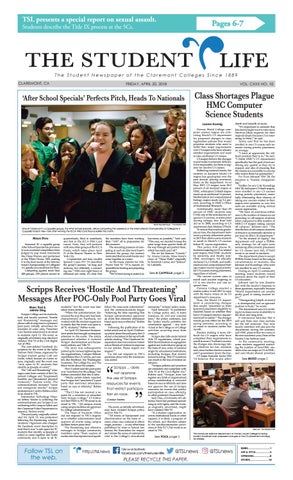
TSL presents a special report on sexual assault.
Pages 6-7
Students describe the Title IX process at the 5Cs.
THE STUDENT
LIFE
The Student Newspaper of the Claremont Colleges Since 1889
CLAREMONT, CA
FRIDAY, APRIL 20, 2018
VOL. CXXX NO. 10
‘After School Specials’ Perfects Pitch, Heads To Nationals
Class Shortages Plague HMC Computer Science Students Lauren Koenig
Sarah Sundermeyer • The Student Life
One of Claremont’s a cappella groups, the After School Specials, will be competing this weekend at the International Championship of Collegiate A Cappella finals in New York after winning the ICCA Wild Card Round earlier this month.
Maya Zhou
quarterfinals, third in semifinals, and first in the ICCA Wild Card round. Next, they will perform with nine other groups at the ICCA Finals, which takes place April 21 at the Beacon Theater in New York City. Co-president and bass vocalist Spencer Louie PO ’19 described the group’s journey “as long and arduous, but definitely a rewarding one.” With over eight hours of rehearsal per week, it’s clear that
Seasoned 5C a cappella group After School Specials has previously won a national competition, been judged by pop music luminaries like Diane Warren, and performed at the White House. Still, making it to the final round of the International Championship of Collegiate A Cappella is no small feat for them. Competing against more than 400 groups, ASS placed second in
the members have been working their “ASS” off in preparation for this moment. The mounting pressure of competing at such an elite level hasn’t deterred the group, but instead motivated them to work harder and come together as a team. As the music director for ASS, Perrin York SC ’19 is mainly responsible for leading and preparing the group. “We’ve been trying to make it as
low-stress as possible,” York said. “This year, we decided to keep the same songs from quarter finals all the way through and perfect them, which has really paid off.” The set list features “Greedy” by Ariana Grande, Moss Kena’s cover of “These Walls” originally by Kendrick Lamar, and “Jealous” by Labrinth.
See A CAPPELLA page 5
Scripps Receives ‘Hostile And Threatening’ Messages After POC-Only Pool Party Goes Viral Marc Rod & Jaimie Ding
Scripps College and its students, staff, and faculty received “hostile and threatening” messages and phone calls in response to a planned pool party initially advertised for students of color only, President Lara Tiedens announced in an email to students April 13. The event, as originally advertised, may also have violated Title VI of the Civil Rights Act of 1964. The now-deleted Facebook description for the event at the Sallie Tiernan Field House, organized by Scripps student group Café con Leche, which focuses on Latinx issues, originally said the event was “only open to 5C students that identify as [people of color].” The “vile and threatening” messages came from outside of the Claremont Colleges and “[expressed] hostility and [threatened physical violence],” Tiedens wrote. The communications included “racist and misogynist insults,” Scripps spokesperson Carolyn Robles added in an email to TSL. Information Technology Director Jeffrey Sessler is collecting the communications and Scripps is coordinating with Campus Safety and the Claremont Police Department to respond, Tiedens wrote. The pool party, originally scheduled for April 13, was postponed following the threatening communications. Organizers also changed the Facebook event description to read that it was “a safe space for 5C students that identify as [people of color] to come together and build community and is open to all 5C
students,” but the event was later taken down entirely. “When the administration discovered the way the party had been characterized on Facebook, we worked with the student organizers to clarify that the event was open to all 5C students,” Robles wrote. An April 12 Claremont Independent article first brought widespread attention to the event. The article questioned whether it violated Scripps’ discrimination and harassment policies and Title VI. The story was subsequently picked up by various right-wing media organizations. Campus Reform republished the CI’s article, and outlets like Breitbart, the Washington Examiner, The College Fix, and The Blaze wrote about the subject. The CI article said the pool party was “sanctioned by the college,” but Robles contended that this is false. “Media outlets falsely reported that Scripps had ‘sanctioned’ a pool party that restricted attendance based on race or ethnicity,” Robles wrote. “The CI has not received a request for a correction or retraction from Scripps College,” CI Editorin-Chief Will Gu PO ’20 wrote in an email to TSL. “All campus events using campus facilities are approved by college administrators.” The Dean of Students Office did not respond to TSL’s inquiry as to whether administrators must approve all events using campus facilities before press time. The threatening and offensive messages to Scripps community members came “from readers of media sites that reported and repub-
Follow TSL on the web.
lished the inaccurate information” and the communications began “following the false reporting that Scripps administration approved an event that restricted attendance based upon race or ethnicity,” Robles wrote. Following the publication of its initial article and an April 13 followup article about the pool party, the CI added a disclaimer at the top of both articles reading “The Claremont Independent does not condone violent acts or threats of violence in response to our articles. Please respect our request.” Gu did not respond to TSL’s questions about why the disclaimer was added.
Scripps ... does not approve the use of Scripps resources for events that restrict participation on race. -Carolyn Robles
The event, as initially advertised, may have violated Scripps policy and/or Title VI. “All forms of harassment and discrimination on the basis of … creed, color, race, national or ethnic origin, ancestry … or any other basis prohibited by state or federal law destroy the foundation for respect and violate the sense of community vital to the College’s educational
http://tsl.news
enterprise,” Scripps’ policy reads. Such behavior “is prohibited by College policy and, in some instances, by civil and criminal laws,” the policy continues, and the “policy strictly prohibits discrimination against ... any individual at the College or at College activities occurring away from campus.” Scripps also falls under federal Title VI regulations, which prohibit discrimination or segregation against any individual or group on the basis of race, color, or national origin by educational institutions, including Scripps, that receive federal funding. Title VI violations can result in the loss of federal assistance. “Scripps policies and practices are consistent and compliant with Title VI of the Civil Rights Act,” Robles said. “Scripps does not register any [club or organization] whose membership is restricted based on race or ethnicity and does not approve the use of Scripps resources for events that restrict participation on race, ethnicity, or other protected characteristic.” Jack Chin, a University of California, Davis law professor specializing in civil rights, said the event, as originally advertised, might have violated Title VI. “If a student organization receives institutional funds or other support, it is likely a program of the school, and therefore subject to the nondiscrimination provisions of Title VI,” Chin wrote in an email to TSL.
See POOL page 2
Like us on facebook: facebook.com/thestudentlife
Harvey Mudd College computer science majors are criticizing Mudd’s CS department for proposed changes to class registration policies that would prioritize students who need to fulfill their major requirements over CS majors who have already satisfied requirements and want to take additional CS classes. CS majors believe the changes would make it extremely difficult, if not impossible, for them to register for elective CS classes. Reflecting national trends, the number of declared Mudd CS majors has quadrupled over the past decade, placing enormous strain on the department. As of May 2017, CS majors were 20.2 percent of all declared majors at HMC, while joint CS Math majors made up an additional 14 percent. Mathematical and computational biology majors made up 3.4 percent, according to HMC’s Office of Institutional Research. Additionally, more than 85 percent of HMC students take CS 60, one of the introductory sequence CS courses, at some point during college; less than half did so in 2006, according to CS department chair Melissa O’Neill. To ensure that students graduate on time, the department instituted a priority placement policy in 2015 that allows some students to enroll in Mudd’s CS courses before 5C course registration. This policy first places 5C students majoring in CS or related joint majors, then HMC students by seniority, and finally nonHMC non-majors. All officially declared CS, CS Math, and mathematical and computational biology majors receive equal priority for CS courses during placement, regardless of school. The current system aims to enroll each student majoring in CS in one elective and one required class. Pomona College enacted a similar policy in fall 2017 to cope with the heavy strain on its CS department’s resources. Now, the Mudd CS department is considering changes that would “prioritize or limit [priority] placement eligibility to students based on whether they have CS [major] elective requirements left to satisfy.” The changes would go into effect for the 2019 spring semester, according to an email to students earlier this month. Besides making it more difficult for CS majors who have completed their requirements to enroll in more CS-related courses, the changes also discourage taking electives for fun, students said, since further elective courses aren’t guaranteed down the line. CS major Kanishk Tantia HM ’19 believes this would affect
See MUDD page 2
Alec Lei • The Student Life
The computer science department at Harvey Mudd College is facing student backlash over proposed changes to the CS placement strategy for classes.
@TSLnews
PLEASE RECYCLE THIS PAPER.
depth and breadth of study. “It’s important to consider that [students] might want to take more electives [than required for their majors] simply because CS is interesting to them,” he said. Tantia said that he has been enrolled in one CS course each semester during priority placement, on average. “I kind of appreciate the difficult position they’re in,” he said. “I think HMC’s CS department specifically has the goal of not sacrificing any quality as they try to expand, and also of ensuring that the classes are accessible to anyone who wants them for graduation.” For Evan Johnson HM ’20, the situation is “frankly disappointing.” Neither he nor Cole Kurashige HM ’20, both joint CS Math majors, were enrolled in any CS courses during priority placement, essentially eliminating their chances of taking any courses related to their majors next semester, as very few seats are available during normal course registration. “We have an enormous imbalance in the number of classes we are providing to off-campus students when compared to [the number of HMC] CS majors taking courses off campus,” Johnson said. “The distribution of off-campus students at Mudd is so internally skewed to put load on [the CS] department.” “In the interest of equity,” the department will adopt a PERMonly strategy for all open seats remaining after priority placement for CS classes next fall, O’Neill wrote in an email to students. The department plans to accept PERMs Friday based on the unique circumstances of students, like Johnson and Kurashige, who were not enrolled in any CS courses. During an April 12 community meeting, many students voiced concerns about the depth of their CS education. Johnson said he was dissatisfied with the faculty’s response to these questions, especially because “Mudd departments are usually pretty good at taking student input.” “Disregarding [depth of study] ... is disrespectful and an ignorant position to hold,” he wrote. The department says it is working to increase course availability in the short and long term. It announced Saturday that it will add three new class sections for the fall semester. Two new faculty members will also join the department during the summer, and HMC plans to hire two more in the next academic year, Dean of the Faculty Lisa Sullivan said. At the community meeting, some students suggested restricting the number of non-HMC students who can major in CS at HMC, and said Mudd should prioritize
@TSLnews
NEWS................................1 LIFE & STYLE.....................3 OPINIONS........................8 SPORTS...........................10
NEWS PAGE 2
APRIL 20, 2018
THE STUDENT LIFE
MUDD: Department’s Dilemma ‘Not An Easy Problem’ To Solve Continued from Page 1 supporting HMC students. Kurashige said the registration of off-campus students should be addressed, but he doesn’t believe it is the biggest issue with CS registration at HMC. “I don’t think it’s fair to blame them for all, or even most, of the problems,” he said. “Don’t forget we take many humanities offcampus. ... Off-campus students deserve fair treatment, especially given how interconnected the 5Cs are.” O’Neill said changing this policy would unfairly offload students onto Pomona’s CS department — the only other CS department at the 5Cs — which already faces similar limits on its resources. “It’s not an easy problem to solve, especially considering the rate of interest in CS is much higher than the rate at which new professors can be hired,” Celena Chen HM ’20 said. “But I’m hopeful, especially as the CS department seems receptive to student feedback, that a long term solution ... can be found.” Students and faculty have sug-
gested a number of potential solutions, such as increasing class size or making curriculum resources, like homework and other materials, available to all students. The latter change could be implemented at a relatively low cost to the department, students said during the meeting. “There is a transition going on right now,” O’Neill wrote in an email to TSL. “Computing is becoming like math: something everyone needs to know, majors and non-majors alike. I think the ultimate future for CS will be a lot like the current present for math.” She doesn’t think an increased demand for CS is antithetical to ideals of a liberal arts education. “Arguably, many facets of the situation would not exist in a less liberal-arts style world ... where students were focused on only their major and arrived at college having selected their major,” she said. “The extent of the growth is partly due to [the colleges’] culture. We all hugely value that culture and the ideals of the consortium.” Erin Slichter contributed reporting.
After Outcry, PO To Fly Puerto Rican Flag At Commencement Erin Slichter
Pomona College has agreed to fly the flag of Puerto Rico alongside flags of other graduating students’ home countries at this year’s commencement. The decision follows an outpouring of student support after Pomona initially declined a Puerto Rican student’s request to have the U.S. territory’s flag displayed. Pomona began flying the flags of graduating students’ home countries at commencement last year, but during the class of 2018’s senior dinner March 23, at which the flags were also displayed, Victoria Anders PO ’18 noticed that the flag of her home country, Austria, was missing. Anders, a head mentor for the International Student Mentor Program, reached out to her class on Facebook to compile a list of other missing flags of students’ home countries to be flown at commencement. “I got about 10 to 15 requests, mostly from non-territory states,” Anders wrote in an email to TSL. “I got two requests that did not fit this normative/classic description, from students belonging to Indigenous tribes who wanted
POOL: Unclear If Event Broke Law Continued from Page 1
Café con Leche does receive funding from SAS — $5,000 this year — and is a registered Scripps organization, but it is unclear whether these conditions would qualify it as receiving “institutional funds or other support.” “Private, non-disruptive discrimination by individual students or groups of students is not covered
by Title VI,” Chin added. “If a group of students decided to start an informal single-race, religion or sex swimming group, there would be no violation. This would be true even if they used publicly available facilities of a school or government entity.” It’s fairly common for student government-funded clubs and organizations across the 5Cs to organize events open only to students of specific identities, like students of color,
but most have not attracted the same level of scrutiny as the pool party. For example, Pitzer College’s Climbing Club hosted a people of color-only climbing event April 12. TSL contacted the Department of Justice and Department of Education about whether the event, as initially described, would have been a Title VI violation, but did not receive responses by press time.
Corrections In the article titled “Are Harvey Mudd’s Tough Grades Failing Students?” TSL mischaracterized the contents of an email from Judy Fischer. Fischer provided employment statistics for recent Harvey Mudd graduates but did not make any claims regarding the ease or difficulty alumni have finding employment. In the photo for the article titled “P-P Baseball Takes Weekend Sweep Over CMS,” TSL provided an incorrect caption that did not describe the image that was printed.
TSL regrets these errors.
FIRE Assigns CMC Favorable Free Speech Rating Christine Lin Claremont McKenna College became the first college in California to earn the Foundation for Individual Rights in Education’s (FIRE) highest “green light” rating for free speech last month. FIRE, a nonprofit organization that describes its mission as defending freedom of speech on American campuses, rates the speech codes of more than 450 colleges and universities “based on the extent to which [they] imperil constitutionally protected expression,” said Laura Beltz, an author at FIRE. Thirty-nine institutions have achieved a green rating, but CMC is the first liberal arts college to do so. Although private colleges nationally are not legally bound by the First Amendment, which only prevents the government and state universities from restricting free speech, most private colleges still uphold principles of free expression. In California, private and public colleges and universities are bound by the the Leonard Law, which compels them to comply with the First Amendment in protecting speech. CMC’s debates about free speech ramped up last April, when 5C students blocked attendees from entering the Athenaeum for conservative political commentator Heather Mac Donald’s talk. In February, Romi Ferder CM ’20, Charlie Harris CM ’19, Sophia Helland CM ’20, and Joe Noss CM ’20 presented a campus survey of free speech at the Athenaeum. According to the survey, 72.5 percent of the 120 students that responded think that the environment on campus restricts students from saying things they believe because others might be offended, while 27.5 percent think the environment on campus does not. “There’s definitely things I’ve held back in a classroom setting because I knew it wouldn’t be incredibly palatable to the group I’m
with,” Joe Noss CM ‘19 said. “But if limits on free speech means you not saying something because you fear social ostracization, I don’t think that’s a bad thing, because there are some things you shouldn’t say.” George Thomas, government professor at CMC, said he finds overly restrictive college hate speech policies problematic. “It worries me when offensive or uncomfortable speech gets characterized as hate speech,” he said. “I’m worried students are going to shut up, silence themselves, and not even think about certain issues because they don’t want to make one misstep or they’re worried any statement they make is going to be taken as offensive.” FIRE maintains a disinvitation database that keeps track of attempts by students or faculty to disinvite speakers with whom they disagree. Disinvitation attempts at the 5Cs include the 2014 disinvitation of conservative political commentator George Will from Scripps, student criticism of 2016 Scripps commencement speaker Madeline Albright, and student criticism of Pomona’s hiring of sociology professor Alice Goffman last year. According to FIRE, disinvitation attempts and college speech codes are examples of a growing “culture of censorship on college campuses over the last 15 years.” Currently, Pomona College, Pitzer College, Scripps College, and Harvey Mudd College all have harassment policies, internet usage policies, posting and distribution policies, or policies on bias and hate speech that FIRE rates as yellow. A yellow rating means policies “restrict a more limited amount of protected expression or, by virtue of their vague wording, could too easily be used to restrict protected expression,” according to FIRE. One reason Pomona, Pitzer, Scripps, and Harvey Mudd have yellow ratings is that all four schools have similar bias-related incident protocols in the student handbook that define bias-related incidents as “expressions of hostility,” which
FIRE considers overly an broad definition that includes protected speech. “CMC worked with FIRE to revise policies on disorderly conduct and internet usage to First Amendment standards,” Beltz said. “CMC also explained that the school does not utilize the bias incident policy enforced at the other Claremont Colleges ... assuaging our concerns about that policy for CMC.” Pomona, Pitzer, and Scripps countered Beltz’s claims and affirmed their commitments to protecting free speech on campus. “Pomona College strongly supports free speech, academic freedom and open dialogue. Our commitment to those values is enduring,” Pomona spokesperson Mark Kendall wrote in an email to TSL. Pitzer spokesperson Anna Chang focused on the Pitzer community, rather than ratings systems like FIRE’s, in an email to TSL. “External ratings do not define the principles, ethics, and proven scholarship that guide our support for Pitzer community members who express themselves with respect for others. Nor will they supersede our commitment to our institutional mission and values,” Chang wrote. Scripps spokesperson Carolyn Robles also emphasized the college’s commitment to free speech. “Scripps believes that learning and teaching thrive in an environment conducive to freedom of belief, inquiry and speech,” Robles Wrote. Recognizing that such expressions may offend, provoke, and disturb, Scripps affirms its dedication to encourage rather than limit expression.” Harvey Mudd College did not respond to a request for comment.
their tribes’ flags flown, and from a Puerto Rican student.” Anders presented the list to the Dean of Students Office, and said she was told that the requests for the Indigenous nations’ flags were being considered, but that President G. Gabrielle Starr had denied the request for the Puerto Rican flag because Puerto Rico is not a sovereign nation. The Dean of Students Office notified the Puerto Rican student who initially made the request, and the student reached out to ASPC President Maria Vides PO ’18 for help. The student in question could not be reached for comment. Vides and the Latinx Alliance executive board drafted a petition addressed to Starr and acting Dean of Students Janet Dickerson April 9 to fly the flag. The petition garnered 369 signatures (a little over half of which were from Pomona students, with most of the remainder coming from the other 5Cs) in two days, and was presented to Starr and Dickerson by the Latinx Alliance April 11. Dickerson said she and Starr had continued to discuss the issue after the initial decision, and had decided to reverse it and let the flag fly before they received the petition. “It was not intended to be a controversy or have anyone feel
excluded,” Dickerson said. “[Starr] was not unsympathetic to the argument in the first place.” Although she was upset with the administration’s initial decision, its reversal is a step in the right direction, Vides said. “I am simply excited to know that … we will be honoring and celebrating our Puerto Rican community, their resilience, and culture by flying the flag,” she wrote in an email to TSL. “I believe the administration was successfully able to take a step back, engage student responses, and act in a way that honors the experiences of our community and the college’s commitment to diversity through representation, even if only symbolic.” The petition argued that the administration’s initial denial of the student’s request was a disrespectful act that built on colonial history. “Choosing not to represent our peers visibly with the flag that they most identify with is both an act of disrespect and erasure,” it read. “The College contributes to the ongoing erasure of a distinct national identity that has maintained itself over 120 years of colonization through historically violent repression by the United States government.”
The petition also said that, given the recent event of Hurricane Maria and the federal government’s “inadequate response” to the disaster, the administration’s action was particularly disrespectful “at [a] time when Puerto Ricans already feel unheard.” Vides thinks the administration’s reasoning for its initial decision not to fly the flag is unjustified because “we were presented with the idea that we can only fly the flags of ‘sovereign’ nations without any critical analysis of what that means in the context of Claremont and the world beyond. “Understanding sovereignty requires conversations on historical construction and colonialism, its legacy, and modern manifestations — all of which I believe were devoid in the [administration’s] response,” she wrote. Dickerson said the decision to fly the flag of Puerto Rico raises larger questions about Pomona’s flag policy. “Would we fly [the flag of] China and [the flag of] Taiwan if they don’t recognize one another? Is Scotland under the Union Jack, or does it have its own independent flag?” she said. “You could think about ways to ask the question in a broader and broader situation.”
Scripps Revamps Residential Life Positions Erin Slichter Scripps College will be restructuring the student positions in its residential life program next year in an effort to address criticisms voiced during a nearly two-week resident advisor strike last April. The college will be reducing the number of RAs and their responsibilities as well as adding several new community coordinators. The RAs and CCs will work together to build community next academic year, leaving policy enforcement to professional Residential Life staff, Director of Campus Life Brenda Ice wrote in an email to TSL. Scripps currently has 20 RAs on staff, and will drop to just six next year, with the addition of 27 CCs. Ice also wrote that RAs’ time commitments will be reduced, and the position will be limited to juniors and seniors only. “With the policy management happening at the professional staff level, RAs and CCs can focus their energies on building community such that students begin to develop their own community standards and expectations of one another that should ultimately require less assistance from the [Residential] Life staff,” Ice wrote in an email to TSL. CCs will be responsible for engaging students with the residential community by planning social events, Ice wrote. CCs will receive
a $5,000 stipend, and their time commitments will be fewer than those of an RA. These changes are the result of discussion by the Residential Life Review Committee — a committee made up of faculty, staff, and students — that met last year to discuss potential changes to Residential Life. The Review Committee also took into account criticism that the RA position was too demanding and didn’t consider RAs’ academic and personal obligations, which surfaced during the RA strike last April. “We demand that Scripps College restructure the Residential Advisor role so it is more sustainable for students, and more closely embodies restorative justice,” the 2016-2017 RAs wrote in a letter the RAs delivered to President Lara Tiedens last year during the strike. The letter specifically highlighted the 15-25 hours RAs were required to work per week, and their responsibilities to be on-call to aid students in emergency situations, which they described as “draining for even the most capable RAs.” It also discussed RAs’ roles as policy enforcers, and stated that Scripps disciplinary policies “[affect] marginalized students more than students with money and privilege.” Additionally, it stated that RAs are required to organize
events that “are often redundant and unengaging for other students.” Tova Levine SC ’21, a CC for next year, said she is glad Residential Life is focusing on community building next year, because the residential community hasn’t felt robust to her this year. “It’s so quiet. There’s no buzz of activity that you’d expect at a college campus,” she said. “[Brenda Ice, the director of campus life,] is just trying to make it a more stimulating community where people are brought together.” Lindsay Canaday SC ’21 said she thinks adding CC positions is a good idea in theory, but worries the changes will not adequately reduce RAs’ time commitments.
It’s so quiet. There’s no buzz of activity that you’d expect at a college campus - Tova Levine
“I’m afraid that the fewer RAs will still be held accountable for the responsibilities that the current RAs have, so they will be put under more stress, even though they have the support of community coordinators,” she said.
Student Orchestras And Choirs Hold Concerts
The Pomona College Choir and Orchestra, and the Claremont Concert Choir and the Claremont Treble Singers all performed last weekend. In the Pomona College Choir and Orchestra’s fourth program of the year, voice teachers Hayden Eberhart and Scott Graff performed solos, along with faculty conductors Donna Di Grazia and Eric Lindholm. The longest work performance included Ralph Vaughn Williams’ 1936 cantata “Dona Nobis Pacem,” a plea for peace. The Claremont Concert Choir and Claremont Treble Singers is a joint music program composed of mostly students from Claremont McKenna College, Harvey Mudd College, Scripps College, and Pitzer College. Their program included pianist John Gilmour and conductor Charles W. Kamm. — Laney Pope
HMC Students Receive NSF Grants
National Science Foundation Graduate Research Fellowships have been awarded to two Harvey Mudd College seniors. The Grant includes an annual stipend of $34,000 for three years as well as $12,000 towards tuition. The grant program “helps ensure the vitality of the human resource base of science and engineering in the United States and reinforces its diversity,” the NSF website reads. The grant recipients include Jessica Lupanow HM ’18, Kemper Ludlow HM ’18, and three HMC alumni. Four HMC seniors were also award honorable mentions. Ludlow will start research at Cornell University in “experimental soft matter physics combined with biophysics,” the HMC website reads. Lupanow will be working at University of Southern California and will research “how to use computational tools and techniques to enable socially assistive human-robot interaction for the elderly, children with autism, stroke patients, and children in the classroom,” the HMC article added. — Laney Pope
Advocates March To Fight Rape Culture
The Pomona Women’s Union and the Pomona Advocates for Survivors of Sexual Assault hosted their annual Take Back the Night march April 7 as part of Survivor Support Week. The march, which attracted about 40 attendees, was for “those who feel unsafe at night, those who are made to feel unsafe at night, and our supporters,” the Facebook event page read. Prior to the march, students performed spoken word poetry at the EmPOWER Center, and following it a closing gathering was held at the Motley Coffeehouse. The event was open to the public, and intended “to display our anger at the gross injustice occurring on our campuses and campuses across the nation,” the Facebook page read. — Laney Pope
LIFE & STYLE APRIL 20, 2018 SEX COLUMN
Micaela Macagnone I only recently gained the ability to partake in hookup culture. For all of middle school and the first half of high school, I couldn’t make eye contact with boys/men because I did not want to be looked at. I hated the way I looked, and, even more, hated my inability to socially please the men with whom I spoke. Lucky for me, I had a fantasy that provided relief. In it, I had many friends, and a lot of money. I was hot. I didn’t care about boys, but many of them were attracted to me. All of this could not have been further from reality. Throughout the three months before eleventh grade, for a variety of reasons, I gained a lot of confidence. No longer viewing myself as repulsive, I set out to rectify the tattered image of a Micaela who had felt so worthless as an adolescent. Rectifying meant proving that I could hookup with, or get attention from, whomever I wanted. That rectification process was cut short by my finding a boyfriend, whom I loved a lot. When I got to college, and lost that relationship, it was that same fantasy I’d created as a 12 year old that again helped me to cope. For example, sometimes I would cry while running on the treadmill at Rains. During those unfortunate instances, I would envision myself as independent, carefree, and sexually liberated (see: androcentrism), a fantasy that would dry the tears off my face and make me feel more hopeful. Though I am no longer crying on the treadmill at Rains and am now happy here at Pomona College, the fantasy remains a source of empowerment. However, my fantasy days are numbered. Though it is a source of motivation in hard times, it now
PAGE 3
THE STUDENT LIFE
Tackling Insecurities In Hookup Culture does not align with what I actually want; most notably, these days I care less about having people attracted to me, and care more about having people maintain an emotional interest in me. I suffer because I took on a challenge of fulfilling my initial fantasy of physical attraction, while also getting people to emotionally invest in me. This is exemplified well by a recent hookup of mine, which, at face value, fit the fantasy perfectly. He was far removed from my life, a freshman with a completely different social circle and interests, the perfect low-stakes hook up. I assumed I wouldn’t be upset if we only hung out once. When he came over, we spoke for a very long time. I liked talking to him because he was kind of weird, but in a way that was funny and calming. The way he spoke, with soft s’s and lots of eye contact, was so incredibly swoon-worthy that I feel ill when I think about it. He is also very beautiful. It is always the talking that seems to disrupt the fantasy. I find myself often having prolonged conversations prior to hooking up. I frequently mistake these long conversations as emotional, when really the other person is just being polite, trying to make me comfortable. These conversations are often just a means to an end. Though I knew he just wanted a hookup, the talking made me want to pursue him. I texted him a few days after I saw him, and he did not respond. I became sad and obsessive. I try to emotionally invest in people whom I know from the start are just looking to hookup. I seek out these people because my 12-year-old self would be proud to see me with them: They usually fit conventional beauty standards, have social capital,
Sophie Reingold • The Student Life
and hook up with a lot of people. My game of trying to get hookup partners to emotionally invest in me is one that I am losing and will continue to lose. I am looking for something in people who absolutely did not sign up to give me anything. Perhaps my fantasy is something I can use as an energetic outlet but is not something I need to practice.
#Adulting Part IV: Handling Old Friendships, Losses, And Maintenance
In reality, I am not okay with hooking up with someone once, then not speaking to them again. However, it will take some time for me to dislodge my current desire for the attention of hot bros who just want to hook up. While I work on that, I would like to make the rejection experience less painful. During my freshman year, I
Sean Ogami • The Student Life
Daisy Ni My relatives had long warned me that it was natural to fall out with high school friends in college. Entering Pomona College last August, however, I knew that wasn’t going to be the case for me. Fresh from the lingering memories of high school adventures, I was confident in the strength of my friendships, which I believed would last forever. But in adjusting to the busy schedules of orientation, of new college friends, and of college life, it was easy to become distracted from returning a text from my exboyfriend or a call from my mom. Slowly, as school started across the nation, my friends, too, turned toward their new starts. I remember returning home for the first time for Thanksgiving and meeting up with a few of my closest friends, and how jarring the reunion felt. It seemed to me that we were coming back as separate and distant people, trying to fit together in a puzzle that has outgrown its edges. It was strange how we were each other’s focal points for so long, but now were only a side. I started to feel out of place. Pomona wasn’t home to me yet, and all I had to ground me at college was faith in my old friends, and those ties, too, seemed to be
slipping away. When I complained to my mom, she told me, “You need to learn how to be alone.” (I hung up. Because what kind of advice is it to resign yourself to your situation?) But, now, as second semester has progressed and I become more comfortable with my surroundings, I find myself grudgingly admitting she may be right. Becoming an adult is oftentimes accompanied by the loss of the familiar. Through leaving home and charging ahead with my future, I realized I am the only constant in my life. I realized the importance of being able to rely on myself for my own happiness and feeling secure enough in my own self-worth without the need to constantly surround myself with others to feel validated. I value my friendships deeply and hold them close, but in the end, I learned I cannot depend on others to have faith in myself. Simultaneously, I realized that just because my friendships have changed, it doesn’t mean I have lost my friends. Perhaps we may never return to the same dynamics as we did in high school, but being friends means supporting each other in our adventures of self-discovery and exploration. After all, I have changed, too. It’s unrealistic to expect things to
remain the same. (In fact, the value of reminiscence seems to lie partly in the fact that the good old days are now in the past and unattainable.) A part of growing up means being okay with the fact that things can, and will, evolve. The crux of my friends’ identities stay constant, and I have to force myself to remember the same kind of blind conviction I had coming into college. More importantly, college has shown me the commitment necessary to maintain friendships. Keeping in touch can be hard, and it’s easy for me to forget, or lose the time, to respond and do my part. It is true that with some of my friends, I can go months on end without speaking to them and reunite to find nothing has changed. For the majority, however, friendship is a continuous time commitment. It means setting aside a chunk of time to FaceTime or chat — similar to any other assignment from class — and sometimes making the decision to prioritize or choose between academics and personal relationships. After all, college can symbolize a new start. But with the right balance, it doesn’t have to mean discarding all connections past.
doing, and how I was feeling. These days, whenever I begin to obsess about these people who reject me, I try to do the same. I remind myself to dedicate my time here to focusing on myself. Now, I remind myself to think critically about what I actually want, versus what I have wanted for so long in my fantasy.
Different Cultures Converge At 40th International Festival Mabel Lui
Courtesy of BagoGames
would cry in my room nearly every day, usually thinking about the boy I dated in high school — how many girls he was hooking up with, how many friends he had, and how perfect his GPA must be. When I would start to obsess about him, I would remind myself not to worry about him, and instead focus on where I was, what I was
People buzzed around the numerous stalls, holding Thai boba tea in one hand and beef empanadas in the second. Others crowded around the stalls, where festival-goers found their fortune with Japanese omikuji and learned new Swahili words at Kenya’s stall. Held Saturday April 14 at Claremont McKenna College’s North Mall, the 40th International Festival was hosted by International Place of The Claremont Colleges (also known as I-Place) and attracted students and families alike. I made my way around the 22 cultural booths, impressed by the range of nationalities and countries represented (though my home city of Hong Kong was sadly missing). At the Indonesian stall, student representatives donned clothes of traditional batik, a textile technique that uses wax-resist dyeing to create patterns on cloth. Those running the France stall embraced their globalized image by wearing berets and red scarves. The food presented at each stall was just as diverse. The Japanese stall offered four mochi flavors, while the Italy stall offered authentic tiramisu. Alongside each food was an activity at play. At the South Korea stall, my friend and I learned how to fold and play ddakji, a traditional South
Korean game that uses folded paper tiles. We each took turns throwing our own tile on the table to try and make the other tile flip over, though we were not successful unfortunately. We also tried our hand at writing our names in Bhutanese and received Henna tattoos at India’s stall. “In my high school, we used to have International Day. … The India booth always had henna going, so I would get it every year,” said Mimi Thompson CM ’21. “And then knowing that the International Festival would be here, obviously I was excited to continue the tradition.” At the Thailand booth, people sprayed water at each other, emulating Songkran, a Thai water festival. “It’s an April festival where everyone goes out into the streets and throws water at each other,” said Thompson, who helped organize the booth. “It’s traditionally [done] to wash away the bad spirits and negativity, because Songkran is the Thai New Year.” On the front stage, a range of entertainment took place. The Vietnamese Student Association performed a Vietnamese fan dance, while the Shogo Taiko group drummed their way through three strong routines. The Umzwilili (meaning to chirp or tweet in Zulu) group also sang for the audience, displaying their beautiful voices to the Claremont community. The event was lively and busy,
and I was pleasantly surprised by the feeling of hospitality present in all the stalls. Even as people began packing up, representatives were still gracious in sharing their international delights. The Taiwan stall offered free samples of herbal jelly, while one member of the Saudi Arabia stall offered dates to everyone. This type of camaraderie is what makes the International Festival a continually successful event. “[At] every International Festival, I’ve learned a lot more about working with people,” said Emily Khouw SC ’20, who helped managed the Indonesia booth. Before we left, my suitemate discovered that the drink stall was selling her favorite Brazilian drink, Guaraná Antarctica, and proceeded to buy three cans. Her excitement is reflective of why international cultures and events like the International Festival must continue to be represented. “I think that the international student community at The Claremont Colleges is a very active community, but it is sometimes an invisible community,” Program Coordinator of I-Place Jenna Bustamante said. “So I think it’s important to give students an opportunity to show how proud they are of where they come from, and their cultures.” After all, people enjoy learning about cultures aside from their own, and I know that I will be definitely be back next year, boba tea in hand.
Tumisang Mosedame CM ’21 poses for a quick shot while working the South Africa booth.
Maya Jotwani • The Student Life
LIFE & STYLE PAGE 4
APRIL 20, 2018
THE STUDENT LIFE
Doubtful Of Netflix Original Movies? Check These Out Karen Song In last week’s issue, Victoria Anders PO ’18 discussed the ambitiously up-and-coming Netflix independent film industry, stating that she had no doubt Netflix would continue to produce original content, and gain more accolades as the company develops their independent programming. That being said, most people, including TSL film columnist Ben Hafetz PZ ’20, are less than enthusiastic about the range of original movies on Netflix. While it’s true that Netflix’s movies have received much less popular attention and critical acclaim than their TV shows, I think a lot of their feature length films deserve more recognition. So, without further ado, these are my top five Netflix original films that I think you should check out: Okja (Drama/Sci-Fi/Comedy) Directed by one of my favorite Korean directors, Bong Joon-ho (“Snowpiercer,” “Mother”), “Okja” will probably go down as one of my favorite movies, not just favorite Netflix originals, of all time. The story follows young Mija (Seo-Hyeon Ahn) on her quest to save Okja, a “super-pig” that she has grown up taking care of, from the malevolent Mirando company (headed by character Tilda Swinton) who wants to mass-produce Okja meat. Though the premise sounds like simply a sweet story of love, friendship, and revenge — and while the movie does touch on all these things — Bong explores heavy themes of corporate corruption, media intervention in our society, and the horrible reality of the meat industry. The film has, and will, inevitably make viewers a little uncomfortable, as many of Bong’s films do, but it is also extremely heartfelt and has moments of hilarity sprinkled in between each teary scene. Mudbound (Historical Drama) If you’ve heard of any Netflix original films in the past year, it’s probably “Mudbound.” Securing four Academy Award nominations, including Best Cinematography
Courtesy of Netflix
TSL film columnist Karen Song PO ’21 gives her recommendations about Netflix Original films, including “Okja,” the 2017 South Korean and American action-adventure film directed by Bong Joon-ho.
(with Rachel Morrison being the only female cinematographer nominated in the category) and Best Supporting Actress for Mary J. Blige’s groundbreaking performance, the movie deserves all the acclaim it has received and more. The film, which portrays the coexistence of a black family and a white family in the South during the Jim Crow era, explores pervasive racial tension and the narrative of injustice that has dominated so much of our history (and our present). As David Sims, a senior associate letter from The Atlantic, put it best, “‘Mudbound’ is the kind of movie that deserves a huge audi-
ence, which its release on Netflix may help secure.” I Don’t Feel At Home in This World Anymore (Drama/Crime) This one’s pretty quirky, and your response can range from “Wow, I’m not sure what just happened” to “I wish they made more movies like that.” The protagonist Ruth Kimke, portrayed by Melanie Lynskey, is 160 percent fed up with humanity after her house is broken into and decides to take matters into her own hands when the police do nothing to catch the perpetrator. It’s not your average vigilante
HOLLYWOOD COLUMN
Courtesy of BagoGames
Courtesy of ABC Studios
“Roseanne” (2018) was rebooted, but TSL hollywood columnist Ben Havetz PZ ’20 says that was not for the best.
How many times after the election did you hear the words “at least comedy will be good for the next four years”? Claims like these were made by many as a way of coping with the looming threat of four years of President Donald Trump, as well as an odd Bush-era nostalgia for the height of “The Daily Show” and “The Colbert Report.” A year into the Trump presidency this claim has at least been partially true. Television shows are using the Trump presidency as material, but none of it is very funny. The problem with these comedic takes on the Trump presidency is that the comedians’ natural opposition to Trump often results in jokes that are just good points. However, with ABC’s recent controversial “Roseanne” revival, it seems that we are getting the first non-oppositional, mainstream comedy of the Trump era, and the results are equally unfunny and morally concerning. “Roseanne” (2018) takes place years after the original “Roseanne” created by Roseanne Barr. The show follows Roseanne and her husband, Dan (John Goodman) continuing to struggle with balancing how to take care of their large family with the socio-economic pressures of working class life.
1922 (Horror/Psychological/ Thriller/Period Piece) As a self-proclaimed Stephen King superfan, I can safely say this is one of the best adaptations of his novels I’ve seen in recent years (others including “Gerald’s Game” and the Hulu series “11 22 63”). Thomas Jane’s performance as Wilfred, a man tormented by his own thoughts, sends chills up my
spine just thinking about it. The movie revolves around Wilfred after he murders his wife (this is not a spoiler; you find out within the first 10 minutes), and how he comes to terms with his actions through the confession he is writing. It’s tremendously terrifying, and the psychological horror that is the final act might keep you awake for a couple of nights — viewer discretion advised. The Fundamentals of Caring (Drama/Comedy) On a slightly brighter note, if you aren’t already in love with Paul
Rudd, I implore you to check out this film. While I do agree with a lot of the reviews, that this movie has its cliches and problematic moments of forced empathy, I can’t argue with the fact that Rudd gives yet another great performance. His character, Ben, makes a life-changing decision to give up everything he knows and become a caregiver to 18-year-old Trevor, who has Duchenne muscular dystrophy. The movie explores the complexities of caring for someone in a variety of human relationships, and ultimately, results in a slightly unrealistic but nonetheless heartwarming story.
FILM COLUMN
‘Roseanne’ 2018: How To Spit On The Legacy Of Working Class Sitcom In 30 Minutes Or Less
Ben Havetz
heroine story, and the action isn’t of epic scale. But the underlying narrative of Ruth and her day-today interactions with people she disdains ultimately lends itself to a refreshingly dark thriller comedy.
In many ways, the mere fact that the new “Roseanne” attempts to continue the legacy of depicting the struggles of American working class life — as present in the show’s original form — is admirable. The current landscape of network family sitcoms has abandoned even attempting to address economic concerns in favor of progressive social issues. Progressive sitcoms like “Blackish,” “Modern Family,” and “Fresh Off the Boat” deal with issues of race, gender, and sexuaility. But the families of these shows seamlessly have a endless supply of wealth that negates any possible class issues. This is not to say that these shows should not be commended for dealing with the social issues of American life. However, the American sitcom has a rich history of dealing with class issues, evident in classic shows like, “Good Times,” “All in the Family,” and even the original “Roseanne.” It is clear that the new “Roseanne” is attempting to revive the concept of the American working class sitcom. The four available episodes riff on concepts like healthcare, lack of affordable housing, and inadequate minimum wage. Unfortunately, this welcomed return to working class issues of the show’s original incarnation is completely undercut by Roseanne Conner’s support for Trump.
The fictional Roseanne Conner’s portrayal as a Trump supporter is most likely due to the real world Roseanne Barr being an outspoken Trump supporter, conspiracy theorist, and member of the Alt-Right. Since the election of Trump almost two years ago, there has been a massive amount of discussion on the white working class’ support of Trump. The media’s portrayal of Trump being a candidate of a negative working class base would line up perfectly with the portrayal of Trump supporters in “Roseanne” if the idea of Trump being a working class candidate was true. However, Trump was, and is not, supported heavily by the working class. He was, and is, still a candidate of wealthy whites. Trump’s voter base was widely similar to every other republican candidate: rich, white, and conservative. This narrative of Trump being elected by the working class is a myth perpetuated by wealthy, white Trump supporters, like Barr adopting working class aesthetics, similar to those in the current “Roseanne” show. The new “Roseanne” is deceitful, immoral, and painfully unfunny. In other words, it is the most emblematic show of the Trump era.
‘Chappaquiddick’ Shows An Old Kennedy Trope And A New Family Mystery Victoria Anders
“Chappaquiddick,” the newest installment of Kennedy family history put on film, gives an account of the true, yet still misunderstood events that occurred June 18, 1969 on Chappaquiddick Island, Massachusetts. The film plays a balancing act of ’60s nostalgia, privilege critique, and moral drama — quite effectively taken on by director John Curran. That same night, Sen. Edward M. Kennedy (Jason Clarke) hosted an extravagant, intimate dinner party, where the guests included the Boiler Room Girls, a group of six single female staff members on Ed’s brother Robert F. Kennedy’s campaign staff in their 20s, and four older, married men. Following the gathering, the senator ran his sedan off a bridge and crashed into the water below. Mary Jo Kopechne (Kate Mara), one of the Boiler Room Girls, died in the car, while Kennedy did not ask for help or report the accident for over a day. The local police never got a complete timeline of events (a recent Boston Globe article provides an extensive fact-check). First-time screenwriters Taylor Allen and Andrew Logan pose a possible version of events. Here, Kopechne remains trapped in the car, alive and suffocating while the senator stands by without offering real help. Much of the true melodrama ends there, as the film reveals noth-
ing more than a cordial relationship between Kennedy and Kopechne, the two brought together by a shared lasting grief over the death of Robert Kennedy in 1968. The remainder is, rather, a deep character study of the youngest, and longest living Kennedy brother who ultimately died in 2009 from brain cancer. Portrayed as sensitive and somewhat unpoised, it is clear he lives in the shadows of his three older brothers who have all passed on. Clarke is skilled in blending the lack of confidence, total privilege and power, and fear of loss of reputation, which haunt and drive Kennedy. Also notable is Ed Helms (Andy Bernard from “The Office”) as Joe Gargan, a most loyal Kennedy cousin willing to do anything to help the family in their grieving process, and to ensure Ted’s continued political career. It is somewhat interesting that this film would come out at this time of year, removed from the running for any 2018 film awards; Helms could have a relatively good shot at Best Supporting Actor as the character portraying the emotions felt in the audience (i.e. playing the audience surrogate). Allen and Logan were intentional in their portrayal of Kopechne, giving her an equal character role and development as that of Kennedy and the many other men in the cast. From the outset, she is most energetic in spearheading efforts for Ted’s presidential campaign, clearly seeing continued
political prospects for herself given the abrupt end to Robert’s career. The only further glimpse of soap opera comes with the men-insuits villains in the form of Robert McNamara (Clancy Brown), Ted Sorensen (Taylor Nichols), and the Kennedy patriarch Joe (Bruce Dern) who seek to cover up the incident, dragging down Ted’s pride and character in the process. They also systematically dehumanize Kopechne, going well beyond the victim trope to one of malicious intent. Sen. Kennedy ultimately pleads guilty to leaving the scene of the crash causing personal injury, leading him to decide against campaigning for president in 1972 or 1976, while he had been widely expected before the incident. While it disturbed his career, it did not end it (Kennedy served in the Senate until his death). Labeled “compulsive Kennedyism” by some, Hollywood’s grim fascination with each and every aspect of the Kennedy family is almost as aggravating as the large slew of animated and live action remakes teeming through movie theaters. To its credit, “Chappaquiddick” strays from the sensational and takes hold in the characters it portrays, while still basing itself in plausible fiction rather than known facts (of which there is little in the realm of deep Kennedy family life).
Courtesy of Entertainment Studios
“Chappaquiddick,” the latest installment of Kennedy family history put on film, recently hit theatres, giving audiences a new family mystery to dive into.
LIFE & STYLE APRIL 20, 2018
PAGE 5
THE STUDENT LIFE
You’re Addicted To Your Phone, But There’s Plenty You Can Do About It
A CAPPELLA: 5C Group To Compete In Final Round
Liam Brooks
Maya Zhou
“Drop the ‘the.’ Just ‘Facebook.’ It’s cleaner.” This line from (fictionalized) Sean Parker in “The Social Network” is one of the most quoted lines in the movie. But it’s more than just a good quip. Debates about phones in Claremont often become about communication styles (What’s different about texting vs. calling vs. just talking in person?) or issues of self control (What does it take to quit Facebook?). The question that those debates miss is a larger one: What are our phones, really? To answer that question, we have to go back to the “the.” If we were to boil down Facebook—, and the smartphone in general—, to something specific enough to warrant a “the,” what would that be? And once we know that, what role should we welcome that to play in our lives? There is a concept from economics and political science called “path dependency” that determines how present choices are restricted by past decisions. The advertising model that Facebook chose, for example, makes it difficult for the company to simply stop collecting data from users. But path dependency affects more than just the products and services at the center of the conversation. More importantly, it affects how, and why, we have those conversations in the first place: the questions we might ask and the urgency with which we consider them. Therefore, to move toward a more healthy relationship with our phones and social media, we need to start on the right path. These are no longer communications devices. Or to be more precise, the problems that we need to solve when it comes to phones and social media are not communications problems. I’m not offering advice for people who take too long (or too little time) to text back, or who look at their phone during meals. Instead, let’s treat the problem with phones for what it really is: an addiction. The trick to curing it is to stop believing that addiction is an accident. With all that in mind, here are a few ways to reign in phone addiction, without treating it like a communication issue:
York believes that keeping the set consistent is what has allowed them to perform so well at ICCA this year. As a result, rehearsals have also been more focused. “We’ve been running specific parts over and over again,” York said. “We’ll do the chorus of a song and the choreography, and say stuff like ‘let’s do it again, we need to sing with more dynamic,’ or ‘we need to look more confident when we walk from here to there.’” While being the director of a group is not an easy role, York said it’s been helpful getting input from all the members on how to approach and prepare for ICCA Finals. “We’ve tried to strike a balance between working hard and not stressing so much that we won’t enjoy the moment,” Louie said. “We’re definitely rehearsing a lot, but we’re trying to work smarter, not strictly harder.” As a first-year in ASS, mezzo vocalist Anya Zimmerman-Smith CM ’21 sees the older members as “a bunch of big brothers and sisters” who she can depend on when things get stressful. “Even though sometimes, things may get strained, we will always be there for each other and be able to have a good time
Jaimie Ding • The Student Life
Internet columnist Liam Brooks PZ ’18 discusses the ways in which technology fosters a societal dependency that is harmful to both health and relationships.
1. Notifications Keep track one day: Out of all the times your phone buzzes or beeps, how many 1) require your immediate attention and 2) are the result of another human attempting to communicate with you? For all the push notifications that don’t fit those two categories, I recommend turning them off. I bet you won’t feel like you’re missing out on much. If you want to go a step further, you can turn your phone on to Do Not Disturb by default, and add exceptions for select contacts. At the very least, I plead with you: Turn off vibrate for emails. We get too many in Claremont. Way too many. 2. “Going gray” One of the reasons phones are addictive in the first place is pretty simple: They’re very fun to look at! No matter what you’re doing, chances are the colors and shapes popping up on screen have been carefully chosen to catch your eye and keep you hooked. Neutralizing this part of the addiction threat is actually pretty simple: Just go into your accessibility (Apple) or developer (Android) settings and turn on grayscale mode. Although this can make some apps
a bit tricky to use, the payoff is clear. Without slick blues and pops of red, nothing looks quite as enticing. Embrace the frustration, and just put your phone away if it’s now annoying to use. Entering personal information into government documents is boring, too. Oh, and everyone’s Instagrams instantly become artsy. You’re welcome. 3. Better media, not less media There are only so many hours in the day, and let’s be real: Most of the important work we do isn’t on a phone. We attend classes, read and write hundreds of pages of text (not texts), and attempt to squeeze in all the other ingredients for a balanced life into an increasingly constricted space-time-burrito: exercise, sleep, socializing, relaxation, medical care, relationships. The role of the infinite-scroll from social media plays a major role in the “relaxation” component that I will not deny. It simply feels good to zone out for an hour or two, to relish in being unproductive, so much so that it can feel like a radical act (at least for Claremont) — as if scrolling mindlessly is a way to exit the capitalist pipeline for a bit. But the thing is, that endless scrolling actually is productive in
King Of Style: Pitzer Junior Pushes Boundaries Of Fashion
Maddie Wilson
Bashel Lewis PZ ’19 made his fashion debut in a royal blue suit, stunning his fellow classmates at junior prom in high school. Since that night, he has continued to develop his style choices, taking his selfdescribed “clean, color-coordinated, and bold” fashion in stride. A victim of bullying, Lewis looked to fashion as a creative outlet, and found solace in continuing to experiment with his style. For him, fashion provided constant support and unbridled creation. “I got into fashion because I realized how much people respected me for how I looked,” Lewis said. “It was a way to cope.” Since then, he has cultivated a vibrant presence on Instagram (@ King_Bashel) and COPE, his own website. As the first in his family to own a passport and travel abroad, he went to the United Kingdom and decided to document his international experiences through his blog. As for producing website content, Lewis spots trends via Instagram, takes his own photos with his iPhone, and reaches out to photographers around the 5Cs. His mission statement for his blog is a highly notable one: “Because fashion is the best way to deal with your problems!” Not only does this declaration ring true for Lewis, but it also acts as a reminder to continue to preserve and develop his artistry. Lewis’s first job — working at an after-school preschool program — propelled his fashion finesse. Through a melange of lifestyle advice, style trends, and mini-lookbooks, Lewis curates his art with the millennial generation in mind. Along with a variety of personal articles consisting of “10 Things To Do In College,” “Favorite Black-Owned Clothing Brands,” and “Winter Essentials Guide,” Lewis is determined to keep his content fresh and innovative. In terms of the blog’s success, Lewis’ hope is to use his insight and knowledge about style to encourage his readers to push the boundaries of fashion. “I want to continue to inspire people and live my life through [COPE],” Lewis said. While it has proven difficult to
Courtesy of Marcus Polk
Bashel Lewis PZ ’19 explains that for him, fashion is more than a creative outlet; it’s a way of coping, finding one’s unique style, and being comfortable in it.
manage the blog in addition to his major, minor, and participation in various school-run shows and performances, Lewis posts consistently on the first and third Wednesdays of every month. When asked about the blog’s future, he expressed interest in making a transition over to YouTube. “On YouTube, I would try to do segments about being in college, but it [would] be a web series, so it [would] be like a comedy-type thing,” Lewis said. Over the past year, becoming invested in the brand’s evolution has proved to be a highly rewarding experience for Lewis. Among many of his findings throughout the process, he has come to recognize fashion as more than just following the latest trends. To him, it’s about honing one’s unique style. “I think it’s more about being who you are and rocking it in a certain way,” Lewis said. Lewis’ definition of style stems from a deeper idea of being comfortable and confident in individual fashion choices. With the help of social media,
Lewis has been able to build his most authentic persona online. In the development of his fashionforward character, he has found his account to be an excellent way of connecting and reaching out to his audience. Additionally, Instagram has proved to hold a great amount of marketing value for the young fashionista. He’s had the opportunity to work with companies like Jeepers Peepers, a sunglasses company based in the UK, which launched around late March and was cited in his “Spring Essentials of 2018” post. “I take so much pride in my Instagram account because I get to layer it a certain way, and I put a lot of thought into it because that’s how people are getting paid these days,” Lewis said. Moving forward, Lewis is working toward a career in marketing and brand management, and advancing his eternal thirst for innovation. “Whatever I do, I need to be creative,” Lewis said.
the most capitalist way: It is labor that is alienated from you both technologically and economically. The data generated by your behavior in apps is how those companies make money. If you were sitting in a coffee shop just idly grinding beans and sorting change from the tip jar, it wouldn’t take very long before you’d want some compensation other than the right to purchase refills. One solution? In this case, you can fight the symptom, not the cause. We need a break from “tough” media like academic articles sometimes, but infinite scrolls aren’t the only “easy” media you can turn to. There are centuries worth of books, “trashy,” and otherwise, waiting to be read. Netflix is making money off your data, too, but they make a lot from subscription fees and don’t serve you ads that could install the United State’s latest version of a fascist government (yet). I’m not recommending you to stop scrolling mindlessly through those apps. I know I still do. But try to categorize them a bit differently: a trip to the casino, a two-dollar scratch-off, or an amusement park with a lackluster Health and Safety rating. Partake accordingly.
together, which is a really sweet reassurance to have,” she said. For many college a cappella groups, performing on Broadway is a lifelong dream. York expressed her amazement at how far ASS has come, explaining that making it to finals is “a really special form of validation for everyone.” She is excited to meet Ben Bram, a Grammy award-winning a cappella producer who has arranged a final song for the competing groups to perform together. Louie is looking forward to meeting the other competitors and reconnecting with old friends from Upper Structure, an a cappella group from the Berklee School of Music. “I think going to finals in itself is a huge accomplishment,” Louie said. “Regardless of outcome, we’re hoping to record our ICCA set and maybe even create a music video.” Hailing from New York, alto vocalist Langa Chinyoka SC ’21 is excited to be able to share her hometown with the other members. She also sees the finals as a valuable learning opportunity. “Our set has gotten so much better with each competition,” Chinyoka said. “Making it to finals was kind of unprecedented, so we definitely want to give it all we have and make ourselves proud.”
Sarah Sundermeyer • The Student Life
Featuring a set list comprised of “Greedy” by Ariana Grande, Moss Kena’s cover of “These Walls” originally by Kendrick Lamar, and “Jealous” by Labrinth, the After School Specials aimed to perfect these songs rather than change their set list from quarter finals, which they think helped lead to their national run.
BOOK COLUMN
The Perennial Importance Of Fiction Tarini Sipahimalani
As college students, when our focus yields to academic material and research, there is a general inclination toward academic journals, news articles, autobiographies, reports — any deviant from pure fiction. These scholarly texts begin to situate themselves above our fiction novels, and our immersion into our vocational pursuits gradually alters our perceptions of fiction: a less revered form of writing, reserved solely for leisure. This transition from fiction to nonfiction makes logical sense, as it mimics our own transformation in cognitive development from child to adult. As children, fictional stories formed the world we lived in. Winding lines of fallen leaves would become the trail for Hansel and Gretel, the ladder in the playground would lengthen in our childlike eyes into a thick beanstalk. Stories straying farthest from reality would make a mark on our curious minds and infiltrate our own lives as we were said to “play pretend.” But these stories didn’t solely serve as mere entertainment. Rather, this mystical fiction aided our cognitive development. It was through these implicit portrayals and our ability to expand and interpret from our imagination that our cognitive abilities were strengthened, suggesting that there is more to fiction than just “pretend reality.” But there is something to be said about fiction that relays a lot of the information we may find in nonfiction implicitly. Fiction not only seems to convey these ideas in a purer form but also allows readers to sort through their own thoughts, free from the influence of authority. Walter Benjamin posited that the act of translation is merely a form of the original, but that one must return to the original to truly comprehend the material in its honest presentation. This translation is akin to the recall and dissemination of knowledge in nonfiction texts. There are some discreet nuances of the information that are lost through the retelling of knowledge. It is difficult to convey a poem through another’s rewording of the text, other than by
Nina Potischman • The Student Life
recounting the exact words that lay on the page, because that is what creates the true aura of the poem. Anything else tarnishes it. While fiction and poetry are also a shadow of the natural world, they lose less information than explicit retelling does, as some of the nuances are captured in the story that is emotionally felt — just as Sigmund Freud claimed dreams are an image sequence of our worries — rather than explicitly told. Fiction goes through one phase of translation, while nonfiction experiences multiple layers. Fiction tacitly informs us about the human condition, gives us insight into historical events and cultural norms, and most importantly gives us insight into our own character. “Fiction’s what it is to be a fucking human being,” David Foster Wallace once said. Margaret Mitchell’s “Gone With The Wind” tells the story of Southern Belle Scarlett O’Hara during the Civil War, and her journey in not only finding the true strength lying within her, but also the man who loves her for herself, and not her superficial presentation. O’Hara isn’t the typical lady. Throughout the novel, she defies social norms surrounding what it means to be ladylike, and the role that is expected of her as a woman. Her resilience when she loses almost everything and her manipulation of events for her own benefit rebuke the image of the quiet, compliant woman who stayed at home and followed the movements of her husband — a popular societal ideal during the 1800s. “Gone With The Wind” not only
transports us to a period in history, but also presents the breaking of a social barrier, as we experience the changing ideal of what it means to be a woman. In fact, even the language written by Mitchell’s pen informs us of how times and norms have changed if we compare it to a more contemporary novel, like Rosalie Ham’s “The Dressmaker.” The language in “The Dressmaker” and “Gone With The Wind” is separated by cultural differences in jargon, as the former is an Australian novel, while the latter is American. Even more so, the style of writing, created by specific terms relevant to the differing time periods, implicitly details the fine subtleties of what each historical period was like. As English writer Samuel Johnson argues in the preface to his dictionary, there are many words that come and leave, and alter with time. Fiction and poetry are creative pieces that convey more than the explicit words printed on the page. They tell us something about ourselves as well as who we are specifically in the moment that we are reading the poem. Each time we read, we have the potential to find something different. Despite our findings not being what the author intended, the space of ambiguity bound to the story form provides readers with the opportunity to read themselves into it, finding a place of self-reflection in the text. Be it feelings of loneliness, anxiety, unrequited love, or confusion, fiction holds up the mirror to that emotion and plays out the scene that will soothe its worries.
SPECIAL REPORT PAGE 6
APRIL 20, 2018
THE STUDENT LIFE
Survivors Speak Out About 5C T Title IX Process Difficult For All, Flawed
For survivors who do choose to report, the Title IX process can be challenging — and in some cases, retraumatizing. CW: Sexual violence, sexual assault “Your narrative is being put on Editor’s note: In this article, asterisks indicate trial, essentially, and you’re going that names have been changed to protect the to have to relive it and tell it and hope that whatever systems are privacy of students discussing their experiences put in place, it’s going to turn with sexual violence. Please read clockwise. out in your favor, and you’re going to tell it in a way that’s believable, and you’re going to tell it in .Claire* said she was sexually assaulted and from reporting Title IX a way that’s punishthreatened by a Pomona College student last October. violations to the colleges. able,” Coffin said. About seven weeks after she reported the assault to All the colleges’ poli“There’s not an her college, Claire, who attended one of the other cies share definitions for easy part of it, 5Cs, said she was asked to leave campus because of terms like affirmative consent, I would say.” the perceived threat to her safety. non-consensual sexual contact, Some Rebecca*, a Claremont McKenna College student, and sexual assault, but their prostudents told CMC a stranger exposed himself to her on cedures for Title IX investigations w h o Platt Boulevard near Harvey Mudd College. Mudd vary considerably. went investigated the incident, and soon after, the police At Pitzer, a panel of students and arrested her alleged assailant, Rebecca said. faculty determines responsibility in cases Madeline Hauenstein PZ ’18 reported a sexual of sexual assault or misconduct, while a assault to Pitzer College, and said her respondent two-step administrative review process is was found responsible for sexual assault but stayed used to determine consequences for less severe in her class after the investigation concluded. Title IX violations. Nicole Zwiener CM ’16 said she was sexually asAt CMC, Scripps College, Pomona, and Mudd, saulted by an acquaintance in her junior year. The external investigators contracted from outside firms police arrested her alleged assailant, and the college conduct investigations and present their findings to began an investigation that led to his expulsion. a decision-making body. All these students went through investigation At CMC, the decision-maker who determines procedures governed by Title IX, a federal law that responsibility and consequences for respondents prohibits gender-based discrimination and harass- is Vice President of Student Affairs Sharon Basso ment at institutions that receive federal funding, for student respondents, and Director of Human including The Claremont Colleges. Resources Andrea Gale for staff or third-party reUnder federal guidance initiated by the 2011 spondents. Pomona uses an external adjudicator, “Dear Colleague” letter, colleges are obligated to typically a former judge or justice. A panel of faculty respond promptly to reports of sexual misconduct, and staff make the call at Scripps, while at HMC, the which can include sexual violence, dating/domestic decision-maker is Dean of Students Leslie Hughes violence, and stalking. or a three-person panel to which Hughes delegates Nationally, Title IX policies have been widely responsibility. criticized, both for failing to uphold the rights of Emily Coffin PO ’19, a member of the Pomona complainants — the Title IX term for individuals Advocates for Survivors of Sexual Assault — a group who report sexual misconduct — and for violating dedicated to helping students heal from sexual asthe due process rights of respondents — individuals sault — said she frequently gets confused about 7C accused of sexual misconduct. Title IX procedures. In interviews with TSL, students said the wide “Even as an advocate, I find myself constantly disparity in Title IX practices across The Claremont having to go back to the books of like, ‘okay, what Colleges can lead to confusion and dissuade students are these policies, and what are people really entitled to,’” Coffin said. The situation is complicated by the fact that investigations frequently involve students from more than one college. In cases where the complainant and respondent are from different colleges, the investigation is conducted by the respondent’s college.
through the Pomona and CMC Title IX processes described the second interview with external investigators as the most trying part of the process. In this interview, the external investigator goes over the respondent’s testimony with the complainant, asking them to comment on it and resolve discrepancies between the respondent’s version of events and their own. Zwiener, who reported an assault by a CMC student in fall 2014, said her interview was “almost as horrible as the assault, because you have this woman interviewing you, and she’s coming at you with all of these weird questions, like, ‘Oh, did you scream his name? Oh, did he touch you here? Did you like it when he did this?’ … So you get defensive, you cry.”
“
“
Special Report By Lauren Ison
“[The interview was] almost as horrible as the assault ...you get defensive, you cry.” Nicole Zwiener CM ’16
Nonetheless, Zwiener said there was nothing the college could have done to improve her experience of the interview; she saw it as a necessary part of the process. And Rebecca, who went through the HMC Title IX process in summer 2017, said the external investigators who interviewed her were professional and respectful. However, Sarah*, a Pomona student, said that when she was a witness in a Pomona Title IX investigation, she felt uncomfortable sharing “harrowing details” about “something that’s really Matraumatic” with an external investigator ria*, a who is unfamiliar with campus culture. Scripps “I think in some ways, these exterstudent nal investigators don’t really know who said she [about] the situation they’re assesswa s s e x u a l l y ing, and that makes me uncomassaulted by a fortable,” Sarah said. CMC student as a Coffin agreed that external first-year, chose not adjudicators do not always to report the assault “understand Pomona’s through Title IX partially dedication to individubecause she didn’t want alism and identity. to go through the Title IX “For a school process at CMC. that’s so diverse “I think the fear is there that in sort of every the school would try to protect single way, I its own student if I were a student think that from another campus,” she said. “I bringfeel like the lack of a unified code or a ing way of dealing with things really makes things a lot more confusing for students who have been assaulted by a student from another college.” Nine percent of students who responded to the 2015 Higher Education Data Sharing Consortium Sexual Assault Climate Survey said that they had experienced sexual assault. Only 13.1 percent of the student who said they had been assaulted reported the assault to their college’s Title IX Coordinator, according to the survey.
someone in who doesn’t really understand that … can definitely play a role in how some of these cases are tried,” Coffin said. Pomona Title IX Coordinator Sue McCarthy said external adjudicators “have training on Title IX, on the impact of trauma. “In terms of selection of external adjudicators and external investigators, we’re looking at their experience, we’re looking at what kind of things they’ve handled before, we’re looking at what kind of training they’ve had,” McCarthy said. Claire, who published an open letter in December about her experience with Pomona Title IX, wrote in an email to TSL that McCarthy has little power to protect or support students during the Title IX process. “The IX coordinator is just that — a coordinator — administering a policybook, and in order to appear fair, they can only watch as survivors fall down the policy’s systemic chasms,” Claire wrote. “In my case, I was given no advance notice for the process of the hearing. This was because Pomona itself did not know the process of the hearing; according to the policy, it is up to the external adjudicator hired by Pomona to run the hearing how they would like.” Claire wrote that she was “not told ahead of my hearing that I would be questioning the witnesses myself, that I would need an opening and closing statement, nor that I would be made to answer written questions from the respondent. “I was also forced to answer questions about my sexual history from the respondent, something that is illegal in the United States court system under the [Violence Against Women Act] of 1994,” she wrote. “My heart starts pounding today just thinking about the adrenaline and anxiety I felt for the total duration of the seven-hour hearing due to poor protocol.” McCarthy said respondents and complainants can participate in Title IX hearings by phone or Skype. Additionally, “parties can ask questions through the external adjudicator, and if there are questions that are deemed not appropriate by the adjudica-
Students Call For Unified 7C Policy, Reform Many survivors said they would like to see improved transparency and accountability from their colleges, as well as greater clarity and consistency in policies across the 5Cs. Rebecca had a relatively positive experience as a CMC student going through the HMC process, but still thinks the colleges should unify their policies and procedures. “It feels super strange that I would have to report to my Title IX coordinator first and then have my entire case thrown to another campus without necessarily being informed before that about the process,” Rebecca said. Zwiener agreed the colleges should unify Title IX policies. “We have one campus security, we should have one Title IX,” Zwiener said. Claire said miscommunication between the colleges complicated her cross-campus case. “In my case, the two colleges both hired separate risk assessors. So when the professional hired by my college found it too unsafe for me to be on campus and I was evacuated to a safe house, Pomona was able to disagree with this assessment using their own professional,” Claire wrote. Feldblum wrote in a Dec. 3 email that the respondent in Claire’s case would “not be coming onto the campus” for the remainder of the fall semester. “Since the time the complaint was made to the Title IX Coordinator, safety considerations have been regularly and consistently under review,” Feldblum wrote. Coffin said she and another Pomona student pushed the administration to consider a unified Title IX policy across the 7Cs last year. “[Sexual assault is] a consortium issue at the end of the day,” Coffin said. “So I felt strongly that there has to be some sort of policy, procedure, transparency, that is clear to all Claremont Consortium students.” Pomona Acting Dean of Students Janet Smith Dickerson wrote in an email to TSL that although she did
not know about past conversations, “the Pomona administration is open to this proposal and the members of the Student Deans Committee (7C) have actively discussed it.” Scripps Title IX Coordinator Sally Steffen wrote in an email to TSL that 7C Title IX Coordinators “are working to expand existing protocols for managing cross-campus cases.” This is one of the goals under the grant that The Claremont Colleges received from the Department of Justice’s Office on Violence Against Women in 2016, according to Steffen. Vorenkamp said there are “ongoing conversations” about whether a unified policy is feasible. Although Title IX processes do vary between colleges, the “nuts and bolts” of the policies are the same, she said. “There’s an intake, there’s an assessment, there’s an investigation, there’s a decision-making process, and the rights of each student along the way are pretty much identical in all of that,” Vorenkamp wrote. Hauenstein said she thinks Pitzer has improved its support for survivors of sexual assault since she reported to Title IX two years ago. Pitzer made two major changes to Title IX policy earlier this year, following the internal Title IX climate audit Pitzer conducted last spring, Vorenkamp said. One of the changes is that expulsion is no longer a mandatory sentence in cases of non-consensual sexual intercourse at Pitzer. “It doesn’t mean that expulsion isn’t ever going to be appropriate, but there were a lot of concerns that having that as a mandatory sanction was really a deterrent to students reporting where they wanted something to happen but felt that [expulsion] was more than what was appropriate,” Vorenkamp said. “It was also a concern among Judicial Council that it could impact decisionmaking; there were situations where they might want to make a decision but expulsion seemed not to really
be the most appropriate resolution.” Pitzer also changed the appeal structure for Title IX investigations involving students. As of this year, the president of the college no longer has the power to grant or deny appeals of Judicial Council decisions. Instead, appeals of Title IX decisions are decided by the vice president of student affairs, in consultation with the associate dean of the faculty responsible for diversity. “There are ongoing conversations about how to improve policies and procedures to ensure that they are really responsive to student needs, and still maintain a process with integrity and fairness and equity for everybody involved,” Vorenkamp said. But students at Pomona have called for more mandatory sanctions, not fewer. In the No Red Tape Demands published in spring 2017, a group of Pomona students demanded the college “clarify enforcement mechanisms to ensure the policy works as written, including minimum sanctions for interpersonal violence.” The demands also told the college to revise policy language to make it more accessible, “respect and respond to complaints and issues with external adjudicators” and stop “encouraging survivors to take leaves of absence during Title IX processes.” Pomona President G. Gabrielle Starr recently announced the creation of a Sexual Assault Task Force that will make recommendations for improving Title IX policy. “I do feel that Pomona heard our voices at the protest [last December], and will be changing policy moving forward,” Claire wrote. Coffin said she is cautiously optimistic that the working group will be able to effect change, but has been disappointed in the past by what she perceives as the administration’s focus on preserving the college’s reputation. Rather than pretending that sexual assault isn’t happening on their campuses, colleges should acknowledge the problem and take steps to solve it, Coffin said. Coffin served on the Pomona Title IX Advisory Committee for two years, and said the committee focused more on improving perceptions of Title IX policy than substantially improving it. “Colleges should start having this transparency and being like, ‘look, this is It can be difficult for people to behow many cases we’re trying currently, and this is how seriously we’re taking it,’” lieve that someone they know personCoffin said. “Not, ‘we’re sweeping it under the rug and really trying to avoid that ally is a perpetrator of sexual violence, it’s happening, trying to deny that its happening on our campuses.’” students say. Julia Thomas and Erin Slichter contributed reporting. “I feel like there’s a lot of silencing, because it just doesn’t seem like there’s like a safe space for victims to talk about their experiences or to warn other people [about assaulters],” Maria said. Maria said the day after she was assaulted, she saw messages on Yik Yak, an anonymous messaging app that has since shut down, accusing her assailant of assault and harassment. The messages discouraged her from reporting her assault, Maria said, because she saw that Yik Yak seemed to be the only place where victims like her were able to speak about their experiences. “I wish there was a place, a platform for me to warn other people and let other people know, ‘Hey this is happening, and this person’s walking around the campus,’” she added. Some students have found ways to share information about alleged perpetrators. In fall 2016, Pitzer students wrote the names of alleged perpetrators on a bathroom wall. During her time in Claremont, Sam compiled a list of alleged perpetrators and circulated it on social media and among friends. “I thought if the school’s not gonna keep us safe, and other women aren’t gonna keep me safe, I’m gonna keep everyone safe,” Sam said. Sam said she initially started the list to keep track of individuals who had assaulted her and two or three of her friends, but soon other individuals were asking to add to the list and see it, and it “snowballed from there.” Even though she no longer lives in Claremont, Sam said people still ask her for access
Campus C Ri
SPECIAL REPORT APRIL 20, 2018
THE STUDENT LIFE
PAGE 7
Title IX Sexual Violence Policies For Many
Survivors Often Dissatisfied With Title IX Results, Delays
For many students, waiting tor they won’t be asked.” for results can be a challenging Pitzer’s Title IX process does not use an external adjudicator, part of the Title IX process, esbut the involvement of students on Pitzer’s decision-making pecially when investigations take panel raises concerns for some survivors about confidentiality longer than expected. and potential conflicts of interest. Federal guidance from the “Dear “I am so happy that my perpetrator was from [CMC] and Colleague” letter recommends colnot from Pitzer, because thinking about going through Pitzer’s leges complete Title IX investigations process scares the shit out of me,” Zwiener said. within 60 days, but they often take Pitzer Title IX Coordinator Corinne Vorenkamp wrote in longer. an email to TSL that “Pitzer students who’ve been through “[Sixty days is] our policy baseline a Judicial Council process have expressed their support for as well,” McCarthy said of Pomona. “It’s having their peers on hearing panels. not a hard, rigid requirement because of “Sometimes cases may involve issues that students unthe fact that we need to allow for a lot of derstand and assess better due to contemporary norms, variance. So a case might take longer to language, or practices,” Vorenkamp wrote. “Although investigate if there are, for example, a lot of nationally many schools have moved away from havwitnesses.” ing students on Title IX hearing panels, there is not a Claire said her Pomona investigation took uniform ‘best practice’ in this area.” six months. She ended up transferring because Hauenstein said that when she reported through she could “no longer trust the administration,” Pitzer Title IX in February 2016, Marni Bobich, the she wrote. Title IX coordinator at the time, failed to adequateZwiener, whose CMC investigation took about ly inform her about the availability of academic four months, said “the hardest part was waiting to accommodations and emotional support. hear the next step. “I don’t think that there was enough follow“Those business days, it takes a long fuckin’ time. up institutional support until it got to the point You have weekends, you’re anxious, and you’re just where I was completely melting down, having waiting for these things to come out,” she said. a hysterical crying fit at the end of my sophoErica*, a Pomona student who reported an assault more year,” Hauenstein said. “There weren’t by a Pomona professor in fall 2016, said the investigation enough preventative steps to try and catch took about four months and was a time-intensive process. someone before they completely spiraled “I was trying to graduate, and this shit kept happenout of control.” ing,” Erica said. “Also there were times when it was like Bobich could not be reached for comanother class: the lawyer would email me five times a week, ment. like, ‘can you send me more text messages with Alan*, [your] and Alan’s text messages don’t match at this point.’” Survivors must also consider the possibility that the investigation won’t result in the outcome they desire. Hauenstein said that although the respondent in her Pitzer Title IX case was found responsible for sexual assault, his only punishment was housing probation, which Hauenstein said was “a slap on the wrist.” In the months after the investigation concluded, Hauenstein remained in the same class as the respondent, despite the no-contact order that was part of her case’s resolution. Hauenstein said the assailant sat behind her in class and attempted to contact her friends, an experience she said wreaked havoc on her physical and mental health, causing her to lose 10 percent of her body weight and experience panic attacks. “It’s a danger to the campuses that you have people who are found responsible … and it’s not bad enough for them to leave campus,” Hauenstein said. “When you have someone who has been found responsible of predatory behavior and just allow them with no real disciplinary action back on campus, what do you expect to happen?” Coffin said Pomona has
granted conditional expulsions and suspensions to respondents found responsible for Title IX violations, allowing them to return to campus after the survivor graduates. “There’s something that just sits so wrong with me about that,” Coffin said. “It makes it feel like the reason that they can’t be on campus is because of one person, instead of recognizing this is an act of violence against the community, and there is a communal loss when we are allowing students to be harmed in this way.” McCarthy, who became Pomona’s Title IX coordinator in October 2017, said she was not aware of conditional expulsions at Pomona. Claire said the colleges failed to provide for her safety during her Title IX investigation in fall 2017. “Domestic violence and assault cases have urgency involved, and the Title IX system is unequipped to handle this urgency safely,” Claire wrote. Pomona needs to institute “a zero tolerance policy for violence” if it wants Title IX to be effective, Claire wrote. “Even if the respondent is found guilty after a thorough investigation and hearing, there is still a range of sanctions, with expulsion being rare and extreme,” she wrote. “This simply confuses me. What would be the college’s interest in having a violent student return to their campus?” However, the Title IX process can also yield desired results for sur-
vivors. The respondent in Zwiener’s case was expelled from CMC. Zwiener encouraged survivors to report through Title IX, which is “really hard, it’s really long, but it’s worth it, because the school’s on your side. No matter what.” Sam* CM ’17 is more skeptical of CMC’s approach to survivors of sexual assault. “I basically learned on day one that the school doesn’t give a fuck about anyone that’s been sexually assaulted, and they’d rather that you shut up or leave than ever even slap a perpetrator on the wrist,” Sam said. “I don’t know a single person who went through the Title IX process who was at all happy about the outcome or felt the outcome was just,” she added. “I don’t even know someone who knows someone who felt satisfied with the outcome of their Title IX process. And I’ll say, having been sexually assaulted, honestly multiple times, during my time at CMC, it never even occurred to me that I would report it.” CMC spokesperson Peter Hong wrote in an email to TSL that “CMC is deeply committed to preventing sexual misconduct. “Our Title IX representatives and Dean of Students staff are actively engaged with student efforts to prevent sexual violence and misconduct and are always available to respond to any specific concerns or needs of individuals or groups,” Hong wrote.
Social Support, Resources Impact Survivors’ Experiences The perceived challenges of said. reporting through Title IX may disThe process “takes a lot out of you — it’s long and its uncertain.” suade some students from doing so Coffin said. “I think that people need to be in a place where they have in the first place. an incredible support network, where they have a capacity of mental “It’s been very, very heartbreaking, health, of emotional health, and stamina to endure it, because I think discouraging to hear all these stories [at it really is a game of endurance.” the No More Violence rally last semesSarah said students from disadvantaged communities may have ter],” said Maria, who chose not to report less access to the social support needed to report sexual violence or her sexual assault. “I think it definitely adds seek out resources. to the general mistrust of administration Students from wealthier socioeconomic backgrounds may have on campus.” parents who are “heavily involved with every aspect of their college Another student, Laura*, said experience” and able to be advocates for their students in college that after reporting a sexual as- processes, Sarah said. sault through Pitzer Title IX her Zwiener said she didn’t want to go to the hospital or report her sophomore year, she decided assault, but her friends pushed her to visit the hospital for a forensic not to report a rape her junior exam and her parents encouraged her to go to the police. year because she didn’t think the stress of the process were worth the potential outcomes. Survivors’ decisions about reporting through Title IX often depend on their perceptions of the costs and benefits of reporti n g , C o ffin including sessions on Title IX, interpersonal violence, sexual relationships, health services, bystander “When I told my mom, I was like, ‘It’s fine, I went to the hospital, intervention, ally training, diversity we’ll forget about it, it’s okay, I’m sorry that I had to go to the hospital, and inclusion training, and personal I don’t know if it was my fault, I invited him back to my room,’” and social responsibility.” Zwiener said. “But my parents were really the ones to push me to Coffin said rape culture can also be go to the police.” more insidious, especially on a campus like Erica said her parents’ support and legal resources also Pomona where “it isn’t necessarily always played a role in her decision to report through Title IX. the fraternity scene, we don’t really have the Both respondents and complainants can hire lawyers to … media-perpetuated representations of rape represent them in Title IX investigations, and some law culture. firms specialize in defending students accused of sexual “I think that’s what makes it a little more danmisconduct. gerous, in the ways that [rape culture] performs in Coffin said she proposed to the Pomona admina much more nuanced way that administration, or istration last year that Pomona offer pro bono legal even students on campus, aren’t as willing or as quick counsel to complainants in Title IX cases, but the to acknowledge and really see,” Coffin said. administration was “not super excited” about In a Dec. 5 email to students, former Dean of Students the idea. Miriam Feldblum wrote that Pomona “is fully committed to McCarthy was not aware of the previous preventing and intervening in all forms of sexual harassment discussion about providing pro bono legal and violence and ensuring prompt and equitable resolution counsel, she said. of complaints.” Sexual assault can be an isolating experience for many students, especially those who do not receive validation or support from peers, friends, and family. Hauenstein said she had a strong support network, but some of her friends and family members assumed that her experience was “less bad” because she only experienced sexual assault, not penetrative rape. “I think there’s really this narrative that there’s this hierarchy of
Culture Puts Students At isk, Students Say to the list. Maria said she thinks the dynamic between Scripps first-years and CMC upperclassmen makes students vulnerable to assault. “I think Scripps first-years especially feel a lot of pressure to kind of party hard and live up to their reputation, whether it’s good or bad,” Maria said. “And then, on CMC’s side, having that stereotype in their mind also might make it easier for certain people to take advantage of other people. “I don’t want to overgeneralize or point to stereotypes, but I feel like there is a shared knowledge at Scripps that CMC is not a safe place to be,” she added. Sam said that when she was a first-year in 2013, CMC’s first-year orientation leaders had an “unofficial motto.” “I forget if it was ‘first come, first serve’ or ‘first dibs,’ but the idea was that they were basically entitled to the freshmen,” she said. Sam thinks hookup culture contributes to rape culture. “I remember arriving at CMC … and going to my first party and just being overwhelmed with the sense that if you didn’t go home with someone, you had failed,” Sam said. “And that led to … [my friends and I] going home with guys, not that it was our fault that we did this, but basically getting into situations that predators knew to take advantage of.” Hong wrote that CMC has a number of educational and training programs aimed at preventing sexual assault and supporting survivors. “We are committed to a fair and equitable grievance process for all parties,” he wrote. “Since 2014, our First Year Guides receive eight days of training,
sexual assault, where rape is the worst, and then sexual assault, and then verbal harassment and other things, when each instance can have different impacts on a survivor,” Hauenstein said. “You’re constantly made to doubt yourself [in the Title IX process], and I had a lot of people who supported me and supported my conviction, but if you don’t, you always are second-guessing yourself.” When alcohol or other substances are involved in an assault, survivors may encounter more doubts about the validity of their experience, Maria said. “I feel like a lot of people see that as kind of making a situation more hazy or ambiguous,” Maria said. “But I think it’s important for us to acknowledge that consent is very much about power dynamics and about how capable you are of giving consent in that very moment.” Vorenkamp wrote in an email to TSL that “there are a multitude of reasons why a student may not want to report having experienced sexual assault, dating violence, or stalking.” “Some key factors are often the feeling of shame or embarrassment, or fear of being judged and blamed,” Vorenkamp wrote. “Another reason why someone may not report right away may include the time it can take for someone to process a traumatic event.” Erica said she might have been more hesitant to report her assault if the people in her life did not clearly perceive it as “wrong.” “I knew that my parents and my faculty and any of my friends who found out about it would also think that it was wrong,” she said. “If [my assaulter] had been a student, and it was one of those things that people might doubt more, or that might have harmed me socially or something, I might have been reluctant also.” Rebecca said her friends’ reactions when she told them about her assault motivated her to report. “They were like, ‘oh my god, you should totally report this, this is definitely an incident worth reporting. You shouldn’t feel like no one’s going to believe you, we all believe you, you should definitely talk to your Title IX coordinator about it,’” she said. “It took me a little while, but then I ended up doing it.”
Graphics by Sarah Wong Spread Design by Cassie Wang
OPINIONS APRIL 20, 2018
THE STUDENT LIFE MEGHAN JOYCE Editor-in-Chief KELLEN BROWNING Managing Editor ARIEL SO Managing Editor
SAMUEL BRESLOW, News Editor MARC ROD, News Editor LANEY POPE, News Associate MEGHAN BOBROWSKY, Life & Style Editor SAMANTHA RESNICK, Life & Style Editor WHITNEY WACHTEL, Life & Style Associate DONNIE DENOME, Opinions Editor ANIKKA VILLEGAS, Opinions Editor HANK SNOWDON, Sports Editor DAPHNE YANG, Senior Design Editor CASSIE WANG, Senior Design Editor MIN HYUNG LEE, News Designer KELLY HO, Life & Style Designer CHRISTINE LIN, Opinions Designer JILLIAN BATIUK, Sports Designer
The Student Life, the oldest college newspaper in Southern California, is produced and managed by students of the Claremont Colleges and published weekly. The editorial board consists of the editor-in-chief and two managing editors. Aside from the editorial, the views expressed in the opinions section do not necessarily reflect the views of The Student Life. Email letters, questions, and concerns to editor@tsl.news, tips to securetsl@gmail.com, and ad inquiries to ads@tsl.news. Single copies of TSL are free and may be obtained at news stands around campus. Multiple copies may be purchased for $0.47 per copy with prior approval by contacting editor@ tsl.news. Newspaper theft is a crime; perpetrators may be
OLIVIA TRUESDALE, Copy Chief AKSHAYA AMARNATH, Copy Editor EMILY JIANG, Copy Editor LORELEI BIVINS, Copy Editor JAMIE REID, Copy Editor SARAH WONG, Graphics Editor LUKE MEARES, Photo Manager LAURYN CRAVENS, Photo Editor CHRISTOPHER HU, Distribution Manager PETER YAN, Business Manager JACINTA CHEN, Social Media Manager
subject to disciplinary action as well as civil and/or criminal prosectuion. TSL welcomes letters to the editor, which can be submitted by mail, by email, or in person at the Fishbowl in Walker Hall. Letters must be under 400 words (although when an issue is particularly salient, we reserve the right to allow letters to run at a longer length) and submitted by 4 p.m. Wednesday of the week of publication. We reserve the right to decline publication of submitted letters and will not accept anonymous letters, letters containing profanity, factually inaccurate letters or letters making personal attacks. TSL also reserves the right to edit for spelling, punctuation and grammar. Letters may be signed by a maximum of three persons. All letters become the property of TSL and may not be reprinted without prior permission from the editorial board.
A Great Week for MusicTM We await your return, Mr. West
TSL SAYS
PAGE 8
THE STUDENT LIFE
No One Appreciates The Walker Pianist Hearing Chopin 300 times at 2 a.m. keeps us alive
Korea Peace Talks Armageddon (maybe possibly kinda not really) successfully avoided
Bombs Honestly, for real. Cut this sh*t out
Mudd ofo Shrine It’s great that you’ve moved past the unicycle
5C Hill No wonder Lance was doping
Changing your major for the PERM “Hello professor, I am very interested in the theology of microbiology...”
Registration times after 8AM 5 p.m. Thursday registration time reax only :’(
Navigating Health Insurance Still Proves Challenging For Trans People Donnie Denome Guest Columnist My IUD cost $1,500. The complications from my IUD cost over $7,000. I know all of this because Aetna Student Health Insurance Plan — student insurance from the 5Cs — sent me a bill for both of them. They wouldn’t pay, they said, because the “procedure code is not consistent with the patient’s gender.” Fast forward seven months, I had a gynecologist appointment. Aetna refused to pay again. Both times, I waited on the phone, listened to the taunting hold music, and outed myself to multiple customer service representatives who shuffled me around until I reached someone who could help me. Both times, every customer service rep I spoke to seemed intrigued and a bit confused by my plight. It was like I was the one who had to explain and fix things for those reps, not the other way around. I spelled out what being trans was and what body parts I still had for every person I spoke to just to make sure they knew what to do. I still have a uterus, I told Aetna. They understood and reversed their decision, paying for the procedures, but it was still a headache — especially the first time, when I was dealing with Aetna and the hospital while lying on my side with a heating pad clutched to my cramping abdomen. I have, in my short life, dealt with health insurance an awful lot. I saw more doctors before the age of 10 than most people will see in their entire lives. In my first two weeks of life, I racked up half a million dollars in hospital bills. By the time I reached adulthood, I was a pro at talking to doctors. I can rattle off my medications list from memory, tick off my diagnoses on my fingers, and know exactly how tall I am and how much I weigh. I’ve been inoculated to finger pricks, blood draws, and injections. I no longer cringe at awkward questions about my sex life. It’s all become part of my life. Most doctors and medical offices I’ve been to understand that my body doesn’t fit the “typical” model of maleness and are accommodating of that. At the very least, nobody’s denied me medical care because I am trans.
Insurance is another matter, though. For an industry that deals with paying for people’s medical issues and health problems, medical insurance really doesn’t like when patients fall outside pre-set boxes. I can have a brain injury, a developmental disorder, multiple mental illnesses, and a truly unruly uterus, but if I label myself as male and need a Pap smear, somehow that’s an issue. I understand Aetna’s concern: Healthcare fraud is a real issue. A gynecologist billing services for a patient with a male gender marker looks like fraud at first glance. It would be a transparent, weak attempt at fraud, but fraud all the same. It’s not fraud in my case, which is my issue. I understand their position but it’s difficult to deal with being called a fraud when I’m just trying to access health care. Additionally, gynecological care (the only medical care that causes “gender inconsistencies”) makes me incredibly dysphoric and can cause depressive episodes that last days. Being reminded that the very care that worsens my mental health is also a burden for insurance to cover exacerbates this. When I went through the first round of Aetna refusals, my mother told me I shouldn’t have changed my gender marker until I “fully transitioned.” Ignoring the fact that “fully transitioned” means something different to every single trans person, there are definite legal drawbacks to being “visually” male and legally female. I have a salpingo-oophorectomy and total hysterectomy (the removal of the Fallopian tubes, ovaries, cervix, and uterus) scheduled for late May. Once it’s over, I’ll never need another Pap smear, contraceptive method, or yearly gyno exam. Aetna will no longer need to cover all the procedures they find “not consistent with [my] gender code.” Perhaps they’ll let up after that. They’ve been surprisingly good with transition-related healthcare; the biggest problem I’ve had is that they refuse to cover more than a month’s worth of testosterone at a time. Nevertheless, every time this happens, I have to out myself to a random stranger who, for all I know, is a vicious transphobe who might scream at me about how I’m a degenerate and a freak (not to mention, the fear and waiting until the problem is fixed). I believe the issue here is twofold. One, healthcare in the United States is ridiculously ex-
pensive. There’s no reason that an IUD insertion should cost $1,500; it’s a piece of plastic with some hormones in it, and the insertion and observation period take an hour at most. If healthcare wasn’t so expensive — and people weren’t therefore forced to rely on private companies with their own agendas for care — I wouldn’t be so resigned to throwing myself to the mercy of Aetna’s uncaring judgment. Two, medical insurance coverage shouldn’t be based in morality judgments and assumptions about what bodies “should” look like and what care people “should” need. Being transgender is considered a pre-existing condition in many cases, and it’s only because of the Affordable Care Act that Aetna can’t deny me coverage altogether for being trans. We have a ways to go, and I don’t have a perfect solution. Nationalized, universal healthcare might take care of the expense issue, but it leaves trans people and other marginalized groups at the mercy of the government for our healthcare. Insurance companies setting clear policies for how trans and gender non-conforming people can get the healthcare we need would also help, but that puts the onus on companies that may not comply. A permanent solution isn’t likely to arise without significant government intervention and industry reform, alongside continuing pressure from patients, healthcare workers, and patient advocates. It’s a huge step forward that can’t be accomplished by any one person, least of all college students. Still, we are not powerless. Part of allyship is listening, offering support, and commiserating when necessary. I’ve found some of my best support on this issue from venting to and with other people who have had insurance denials for necessary procedures as well — mostly cis people who were willing to listen to my experiences as a trans person. Healthcare reform is far in the distant, and the forecast isn’t looking good given the current political climate. In the meantime, we can all be here for each other, supporting one another through medical complaints and insurance journeys. Donnie TC Denome PZ ’20 is a public health major from Sunnyvale, CA. Their greatest achievement in college so far is either becoming a GLAAD Campus Ambassador or breaking 5’3” in height.
Weekly Comic: Stepping Outside The Box
Puzzle
Sarah Wong • The Student Life
Jordan Wong • The Student Life
OPINIONS PAGE 9
APRIL 20, 2018
THE STUDENT LIFE
My Sin, My Soul: Controversial Art Kindles Conversation Samantha Resnick Guest Columnist CW: Sexual assault, abuse It can be hard to love “Lolita.” Vladimir Nabokov’s novel tells the story of middle-aged Humbert’s sexual abuse of a 12-year-old girl. The first-person perspective of the novel — which is presented as if Humbert himself is the author — thrusts the reader into the mind of a monster. He kidnaps Lolita. He claims she seduced him. He repeatedly rapes her. It’s no surprise, then, that I oftentimes find myself on the defense when I (sheepishly) admit that I can’t put the book down, that I’ve read it 10 times, that I have the first page memorized. I’ve repeatedly asked myself, “Am I betraying women and sexual assault victims everywhere by loving ‘Lolita’?” To borrow Humbert’s words, I present to you, ladies and gentlemen of the jury, this “tangle of thorns.” Since its 1955 publication, “Lolita” has become an international bestseller. The novel’s influence continues to ripple through modern culture, from film adaptions to ballets to pop stars touting heartshaped glasses and wet, cherry lips. That being said, “Lolita” has walked a rocky path. Mainstream publishers like Simon & Schuster refused to publish it at first, forcing Nabokov to turn to the french Olympia Press, “three quarters of [whose] list was pornographic trash,” according to Brian Boyd’s biography of Nabokov. The backlash continues today, with its critics citing the novel as pornographic at best, and a glorification of sexual
abuse at worst. This age-old critique of “Lolita” fits in with the current debate in Hollywood. As more and more directors and actors are accused of heinous crimes, one is left wondering what to do about the art they leave behind. Netflix canceled House of Cards after actor Kevin Spacey was accused of sexual advances against a teenage boy, producer Harvey Weinstein was forced out of the Academy of Motion Pictures Arts and Sciences after repeated claims of sexual assault, and HBO canceled a comedy special from comedian Louis C.K due to sexual harassment allegations. The question remains whether there is value in art that is morally ambiguous, either due to its content (as in the case of “Lolita”) or the crimes of its creator (i.e. the controversial media in Hollywood). Lolita, standing “four foot ten in one sock,” patiently waits with the answer: yes. Exhibit A: Writing itself can be appreciated purely on an aesthetic level. There is no denying that the “fancy prose style” pops and sizzles and burns in its beauty. The sheer skill of Nabokov in his ability to make readers feel sympathy for such a horrifying protagonist is impressive in its own right. I can admire the words without condoning the actions of the monstrous man at their center. Exhibit B: I firmly believe good books make you uncomfortable. I am made uncomfortable by how easily I fall under the sway of Humbert’s silky justifications and erudite elucidations, to the point where I forget what he has done, and the traumatized girl he has left behind. In modern society, too many
times the siren song of the attacker seduces, which leads to placing blame on the victim or protecting Hollywood stars, such as Weinstein, because of their stardom. “Lolita” forces one to reckon with this impulsive desire to ignore certain truths that are painful, but vital, to face. I’m not arguing that “Lolita” should be required reading for elementary schools, and I’m not arguing that one should forgive the actions of Humbert or the men mentioned above. One shouldn’t. What I am arguing is that these books and films are important not just because art is valuable in and of itself, but because they spark conversation. Ignoring, boycotting, or banning art like “Lolita” is akin to ignoring the societal ills they grapple with in the first place. More than that, it represents a refusal to entertain the conversation. I first read “Lolita” in a high school English class. That class became the first time I had ever discussed the topics of sexual assault and consent in an academic setting. “Lolita” made those vital dialogues happen. So, yes — “Lolita” is my favorite book. And no, I don’t (and won’t ever) find Humbert’s actions morally acceptable. But art, once created, becomes more than just the artist or its subject. Works such as Nabokov’s novel force us to question our own complicit cooperation in a society where Lolita is not just a fictional character. Samantha Resnick is a linguistics major at Pomona College. She likes reading words, and sometimes, she likes writing them, too.
Elodie Arbogast • The Student Life
Reliance On Food Makes Sub-Free Events Inaccessible Jo Nordhoff-Beard Columnist I’m someone who has always had a problem with eating in public. I eat more than the average person because of my body size. I do not always eat enough vegetables or the healthiest food. And sometimes, I feel insecure about what I eat when coupled with my lack of exercise. I’m also not super into drinking or partying. In the past, I have wanted to attend Scripps College’s substance-free events, but there, I was faced with every single unhealthy snack I could think of. At events designed to destress, I felt more stressed because all I saw were foods that I loved, but were not kind to my body. As a Peer Mentor last year, we struggled to get people to come to substance-free events that we hosted; unlimited free snacks were our principal method of appeal. We had crafts and activities available like coloring pages, Mario Kart, board games, and wreath making, but the free and usually delicious foods were why people came. While substance-free events are important for everyone at Scripps to have a place in the community, they fall short by not accounting for
those who want to destress in other ways besides eating, such as going on a walk, having a conversation with a friend, journaling, listening to music, and watching TV. Even though there are alternative activities, eating is the primary one at these events. That runs the risk of making people more uncomfortable than they should be. I’m all for relaxing. School at the 5Cs is academically rigorous, and it is hard to recognize when to take a break while I always feel like I could be studying more. At Scripps and the 5Cs as a whole, I constantly feel like I have so much more to learn, which is both a blessing and a curse. I think I might like relaxing too much, to the detriment of my physical fitness level. Scripps always has so many events every week to attend, probably too many. Every event email we receive on Sundays and Wednesdays lists cool talks, weekend parties, and multiple substance-free events put on by different clubs. There are a lot of similar choices. Activities Team or A-Team, provides substance-free events like Wonderfest and trips to Dodgers games or beach bonfires for Scripps students; Scripps Associated Students, which hosts Spring Fling and a series of mostly substance-free
events; and New Student Program, which hosted a substance-free event every Saturday last year. The amount of choices can seem overwhelming. For one thing, the timing of substance-free events needs to change in order to make people want to go. There are other organizations at Scripps like Scripps360, a transitional experience for first-years, and other residence hall related programming that seek to create a welcoming environment for Scripps students in a way that does not involve alcohol. The main tactic, providing a surplus of food, is inviting to some, but marginalizing to others, particularly those with eating disorders, diet allergies, and food intolerances. We always had vegan and gluten free options available, and put an email at the bottom of Facebook events if anyone had any access needs but still wanted to come. However, the vegan and gluten free options were mostly hummus, vegetables, popcorn, and fruit, which are all delicious but not as exciting as fondue or glazed donuts. Our events, as New Student Program mentors, were always set from 7 p.m. to 9 p.m., which is right after dinner and not necessarily the
time to eat a lot of snacks. Even though I was in charge of putting them on, they felt a lot like forced bonding events despite our efforts to make them the opposite — and not real, organic ways for people to make friends and enjoy being together. We often also bought so much food, more than we ever needed because not that many people came to our events. We had to carve out a solid amount of time to go to Costco and buy food in bulk. The amount we had contributed to overeating and having leftovers which, I felt, was wasteful. We could have done a better job evaluating how many people realistically came to each event, and how much food we needed to buy from there. I don’t regret being a Peer Mentor because I learned a lot about myself and the 5Cs, and thought that mentoring firstyears was incredibly rewarding. At the same time, I think that the program’s purpose should be readjusted to think more of community events that revolve around something other than food. Jo Nordhoff-Beard SC ’19 is an English major from Seattle. She misses The Hills, obsesses over different pens, and loves avocados.
Cassie Wang • The Student Life
5Cs Must Honor Holocaust Remembrance Day Zachary Freiman Columnist This past week, we recognized Yom Hazikaron laShoah ve-laG’vurah, which translates to “the day of remembrance for the Calamity and for heroism,” but which is commonly known as Yom HaShoah or Holocaust Remembrance Day. Not a organized group at the 5Cs, including the multitude of Jewish organizations, ran a program, event, commemoration, or memorial in the day’s honor. In conversations with Jewish leaders across the campuses, I was stunned at the abject dismissal of Yom HaShoah programming. The excuses ranged from the hosting of other events, such as retreats, or a general lack of proactivity, preparation, or time which doomed any potential openings for an event. All are thoroughly unacceptable and, frankly, pitiful justifications for any Jewish organization’s decision not to put on a commemoration for Yom HaShoah or, at the very least, send out a public message. In fact, as far as I can tell, the only attention paid to Yom HaShoah this year was a Facebook post by the campus group Claremont Progressive Israel Alliance. (In the interest of full disclosure, I sit on the board of the C.P.I.A.) Remembrance is at the core of who we are as Jews. From our holidays throughout the year to our liturgy and cultural environment, an integral theme is the importance of recalling our suffering and salvation and passing it onto the next generation of Jews — a concept known as L’dor Vador. It is downright irresponsible for a Jewish organization to prioritize a recreational social gathering over Yom HaShoah. Holocaust Remembrance Day should be the lynchpin of the semester around which all other events are coordinated and organized. Honoring the six million members of our family whom the Nazis and their collaborators targeted and eliminated is paramount to the survival of their legacy. Coinciding with this year’s Yom HaShoah, a groundbreaking study produced by The Conference for Jewish Material Claims Against Germany — the preeminent organization working toward justice in the form of compensation and restitution for Holocaust victims — revealed that understanding and basic knowledge of the Holocaust in the United States is rapidly declining and, in many instances, nonexistent. The worst offenders are aged 18 to 34, according to their survey. The Claremont Colleges have an enormous opportunity to insist Holocaust remembrance be appre-
ciated among an institution teeming with 18 to 34 year olds. As of now, the colleges themselves are failing mightily. Yom HaShoah isn’t even marked on the colleges’ calendars. As if that isn’t negligent enough, in response to recent anti-Semitic episodes — including the removal and theft of students’ ritual Jewish prayer encasements affixed to doorposts known as mezuzot or mezuzah — Pitzer College chose to host a mezuzah-making event on Yom HaShoah. Pitzer College band-aiding its abysmal track record of combating anti-Semitic sentiments on campus by scheduling a non-related event to coincide with Holocaust Remembrance day is so ironic it is almost laughable. Despite Pitzer’s presumed wellintentions, its actions indicate a lack of Holocaust awareness. On the other hand, one exception to the consortium-wide disregard for Holocaust remembrance was a Harvey Mudd College event featuring the child of a Holocaust survivor earlier this semester. One need not speak with one of the 400,000 living Holocaust survivors worldwide or, as I have, visit Auschwitz or Majdanek and witness the preserved horrors firsthand to appreciate the importance of Yom HaShoah. The reality of burgeoning antiSemitism, from college campuses to right and left wing parties across the globe to Jewish murders on grounds still wet with the blood of the Holocaust, makes clear why Holocaust remembrance is not only crucial for the sake of sentimentality, but also for current peril facing the Jewish community across the globe. Yom HaShoah is the ideal date for the Colleges to prove that they take Holocaust education and awareness seriously. No, education is not the exclusive solution to anti-Semitism; the German Empire was the leading educational powerhouse in Europe at the close of the nineteenth century. But, I invite you to consider how many college students are knowledgeable of, or could properly explain, the Warsaw Ghetto Uprising, an unparalleled act of Jewish heroism during the Holocaust to which Yom HaShoah is partially dedicated. Education, in conjunction with an emphasis on tolerance and respect, is an effective apparatus for weakening the stranglehold of hate. Those who learn of the Holocaust are responsible to fortify a frontline against tyranny. The Colleges, as distinguished institutions of higher learning, must observe Yom HaShoah as a day of reflection, action, and learning. Zachary Freiman PO ‘20 is a Music and Public Policy Analysis double major from Sleepy Hollow, NY. He dreams of one day meeting Oprah Winfrey.
SPORTS PAGE 10
THE STUDENT LIFE
COMMENTARY
NBA Playoffs: Intriguing Matchups Should Lead To Exciting Finishes Kellen Browning
The NBA playoffs are in full swing, and most of the first-round matchups have been as exciting as advertised. Competition was unusually evenly matched in both conferences this season, with nearly all of the seedings — and one of the playoff spots — determined on the final day of the regular season. But now, with one week of the playoffs gone by, let’s talk about what we know and predict the outcome of each series. Western Conference No. 1 Houston Rockets vs. No. 8 Minnesota Timberwolves I had hoped the Timberwolves, back in the playoffs for the first time since 2004, would put up more of a fight. Yes, they kept it close in game one, but lost by 20 in game two despite presumptive MVP James Harden shooting 2-of-11. Karl-Anthony Towns has been a non-factor through two games with 13 points total; unless he turns it around, Houston fans can bust out the brooms for a sweep. Rockets in four. No. 2 Golden State Warriors vs. No. 7 San Antonio Spurs The Warriors’ streak of good luck in facing undermanned opponents in the playoffs continued this postseason; the Spurs are probably the weakest team they could have drawn. Without Kawhi Leonard — who also missed most of last year’s series between these two teams — the aging Spurs clearly don’t stand a chance. LaMarcus Aldridge, enjoying a career year, has averaged 22 points and eight rebounds in the first three games for the Spurs, who have also gotten help from Rudy Gay and Patty Mills, but their ancient offense — they were third in the league in mid-range shots attempted this season — just can’t keep up with the efficient Warriors juggernaut, which focuses more on threes, layups, and dunks. The Spurs have built a reputation for stout defense over the years, but without Leonard, they have no answer for Kevin Durant or Klay Thompson. Warriors in four. No. 3 Portland Trailblazers vs. No. 6 New Orleans Pelicans Shockingly, the Pelicans have seized a commanding 3-0 lead over the Blazers, thanks to All-Star-caliber offense and lockdown defense from Jrue Holiday. When Anthony Davis is still playing like a star but is suddenly the second-best player on your team, you know things are going well. Holiday is averaging 23.3 points in the series, and more importantly, limiting Portland’s guard duo of Damian Lillard and CJ McCollum to an average of just 39.3 points combined. Lillard is a putrid 18of-55 from the field through three games, and scored just seven points on 2-of-18 shooting when guarded by Holiday through the first two games. Pelicans in four. No. 4 Oklahoma City Thunder vs. No. 5 Utah Jazz The Thunder and Jazz won an equal number of games in the regular season, but the Thunder, led by dynamic point guard Russell Westbrook and bolstered by the additions of star forward Paul George and used-to-be star forward Carmelo Anthony, had much greater expectations. Despite their high ceiling, the Thunder have been wildly inconsis-
Courtesy of Jason Miller via Getty
One of the many exciting first-round matchups this NBA postseason is superstar LeBron James’ Cleveland Cavaliers against the up-and-coming Indiana Pacers.
tent — their “big three” combined for just two points and were 0-of-14 from the field in the fourth quarter of game two, as Utah made its comeback. And Thunder center Steven Adams may have met his match in defensive anchor Rudy Gobert, who is listed at 7-foot-1 but must be at least nine feet tall. The Jazz have potent offensive weapons as well, in crafty point guard Ricky Rubio, sharpshooter Joe Ingles, and dazzling rookie Donovan Mitchell, who is averaging 27.5 points and eight rebound so far. Still, the Thunder’s star power and home court advantage should eventually propel them to victory, assuming they can get their act together. Thunder in seven. Eastern Conference No. 1 Toronto Raptors vs. No. 8 Washington Wizards Two teams plagued by heartbreaking playoff defeats meet in the first round, but the Raptors have made improvements, while the Wizards have regressed. DeMar DeRozan’s and Kyle Lowry’s postseason woes are welldocumented, and neither particularly impressed in game one, but the difference this time is that Toronto has enough depth that a poor game from one or both of its two All-Stars won’t doom them like in the past. Serge Ibaka led the Raptors with 23 points last Sunday, and Jonas Valanciunas had 19 in game two. Plus, DeRozan scored 37 points in game two, so maybe he’s shaken his playoff issues. When the Wizards inevitably bow out of the playoffs, it might be time for Washington’s front office to do some serious thinking. The Wizards without John Wall moved the ball more and seemed happier. There’s no denying Wall’s ability — he’s averaging 26 points and 12 assists this series — but if he, Bradley Beal, and Otto Porter can’t get it done, something needs to change. Raptors in five. No. 2 Boston Celtics vs. No. 7 Milwaukee Bucks One of the best games of the first round so far came Sunday in Boston, when the scrappy Bucks nearly stole one from the injury-plagued Celtics, eventually falling in overtime. Khris Middleton’s last-second three was exhilarating, and the Bucks clamped down on defense in the fourth quarter, but their late heroics can’t mask the fact that Milwaukee just isn’t on the same level as Boston. Without Kyrie Irving, the Bucks have the best player on the floor in Giannis Antetokounmpo and a
quality support cast in Middleton, Jabari Parker, Eric Bledsoe, and Malcolm Brogdon. But the Celtics are deep too: Al Horford, Terry Rozier, Marcus Morris, Jayson Tatum, Jaylen Brown, and Greg Monroe are all quality role-players. Plus, Marcus Smart says he could be available for a potential game seven. I don’t think that will be necessary, though. The Celtics took care of business 120-106 in game two and seem in-control. Celtics in five. No. 3 Philadelphia 76ers vs. No. 6 Miami Heat No team has been as exciting to watch lately as the Sixers, who have gone from NBA laughingstock and lottery mainstay to potent playoff team. Without big man Joel Embiid and his dominant interior presence, Philadelphia struggled to contain Miami and its cast of wily veterans, but Ben Simmons is playing like a star, and Embiid provided 23 points and seven rebounds in his game three return. Plus, Embiid’s big man counterpart, Hassan Whiteside, has been nearly invisible for the Heat. Yes, Dwyane Wade can still knock down jumpers and drive to the basket when called upon — he had 28 points in game two and held off a Philadelphia comeback — but the 76ers have a better team. Aside from Simmons and Embiid, who could return later in the series, Robert Covington is a great defender, Dario Saric is a reliable scorer, and JJ Redick and Marco Belinelli are three-point threats. Philadelphia in six. No. 4 Cleveland Cavaliers vs. No. 5 Indiana Pacers If I were writing this before the playoffs began, I would have predicted a sweep for LeBron James, who had won 21 straight first-round games before Sunday. Yes, the Cavs have been inconsistent offensively and dismal defensively this year, but they “flipped the switch” last playoffs — why not again? Instead, the Pacers obliterated the Cavaliers 98-80 in game one, thanks to 32 points from the season’s breakout star, Victor Oladipo, and solid defense from Lance Stephenson, James’ kryptonite. In game two, it took a ridiculous 46 points from LeBron and foul trouble for Oladipo for the Cavs to eke out a 100-97 win. Still, it’s LeBron James. You really think he’s going to lose in the first round? Come on. Cavs in seven.
APRIL 20, 2018
CMS MEN’S TENNIS
Riding 13-Year Conference Win Streak, Stag Tennis Team Prepares To Host NCAAs Bryan Williams
After steamrolling conference competition match after match, the Claremont-Mudd-Scripps men’s tennis team (24-3, 6-0 SCIAC) has found itself at the top of the SCIAC standings once again — something that is becoming habit for the Stags, who are ranked sixth in the nation. Veteran coach Paul Settles is glad his high expectations for the team continue to produce results. The “SCIAC is one of the three best tennis conferences in the country, so to be on top heading into the final weekend of play is a great accomplishment,” Settles said. “April 15, 2005 was our last SCIAC loss, so we’re savoring a good run.” Last Saturday, the Stags clinched a spot in the SCIAC tournament, routing Cal Lutheran University (4-11, 2-3 SCIAC) with a 9-0 sweep. This victory came only a few days after outmatching No. 12 Pomona-Pitzer (14-8, 5-1 SCIAC) with another 9-0 win. “Our formula for success this season has been great doubles and singles toughness,” Settles said. “We’ve won all three doubles points in more than half of our dual matches this spring and only trailed in two matches after the doubles.”
Settles said young players have been key to the Stags’ recent success. “After graduating four seniors from our starting lineup a year ago, we’ve been dependent on lots of new faces this season,” he said. “Jack Katzman CM ’21 at No. 2 singles and No. 2 doubles, and Robert Liu at No. 6 singles and No. 3 doubles have been really consistent as all-court players.” Liu, who won his most recent doubles match alongside partner Jake Berber CM ’20 against Cal Lutheran 8-1, thinks the Stags are in a good spot. “I am extremely confident and proud of the team’s success this season,” Liu wrote in a message to TSL. “[Settles] is really strict with us and instills really strong work ethic in each of us. We put so much effort into our team and I am certain that it greatly contributes to how well we’ve done thus far.” As the regular season wraps up, the Stags have eyes on the NCAA Tournament, which they feel they have a chance to win. “[We are] hosting the final rounds this year, so it’s going to be really cool to be playing on our home courts,” Liu said. “We also always contend for the title so knowing that we have the potential to win it is incredibly motivating.” Captain Julian Gordy CM ’19 agreed with Liu.
“We are just focused on practicing well everyday and making sure that we are as fit as possible at the end of the season,” he said. “Everyone on our team believes we are capable of winning the title this year, and we are very pleased with the level we’ve been playing at.” CMS will likely have the chance to face top teams No. 1 Emory University, No. 2 Bowdoin College, and No. 3 Middlebury College in the tournament. The Stags have faced all three of the top teams this season, and have shown they can compete with the best. Though they fell 7-2 to Bowdoin, they defeated Middlebury 8-1, and only lost to Emory 5-4. Settles is sure the Stags can make a title run, but recognizes there will be steep competition. “If we can win our last three SCIAC matches, we’ll enter the NCAA tournament as no worse than a No. 3 seed overall,” Settles said. “With a chance to play every NCAA tournament match on our home courts, we know we can beat the best. However, this is an unprecedented era of parity in D-III tennis, so nearly every team from the round of 16 on will have a real chance to vie for the title.” The Stags hope to continue their years-long conference winning streak this Saturday in the SCIAC regular season finale against Caltech (10-5, 4-1 SCIAC).
Ian Poveda • The Student Life
Robert Liu CM ’21 smashes a serve in a match against Hope International University April 14.
Sagehen Women’s Water Polo Extends Undefeated Conference Record
Meghan Joyce • The Student Life
Hank Snowdon Crystal Huang PO ’20, pictured above, scores one of the Sagehens’ (18-10, 13-0 SCIAC) 18 goals in a blowout victory over winless California Institute of Technology (0-22, 0-14 SCIAC) Wednesday night. The team clinched the regular-season SCIAC title for the second year in a row with the blowout 18-1 win. Hank Snowdon • The Student Life
The Sagehens got off to a fast start and didn’t let up throughout the entire game. They led 11-1 at the half, and never let the Beavers back into it. P-P was led by Huang, who tallied six goals while adding an assist and a steal. Five of her six goals came in a stretch where Huang scored five straight times midway through the second half, which put
Caltech away single-handedly. This is the second straight year the Saghens have taken the regular season SCIAC title. This time, they also hope to do what they couldn’t do in 2017 — go undefeated in the conference. They will have a chance to secure that undefeated record Saturday, when they take on Chapman University (10-16, 6-7 SCIAC) at home in their last regular season game.
SPORTS THE STUDENT LIFE
APRIL 20, 2018 P-P SOFTBALL
CLAREMONT CLIMBING CLUB
Reaching For New Heights: Claremont Climbing Team Ascends To Nationals
Sagehen Softball, Clinging To Top SCIAC Spot, Drops Three Of Four Noah Shapiro
After tearing through the SCIAC and amassing a 13-3 record in the conference entering last weekend’s home matchups against Occidental College (11-18-1, 16-4 SCIAC) and La Verne University (20-12, 15-5 SCIAC), the Sagehens softball team (25-9, 16-6 SCIAC) hit a roadblock. P-P dropped both games of Friday’s doubleheader, losing 4-2 and 14-3. Saturday, the Sagehens fell to the Leopards 3-2 in game one, before coming back to win the last game of the challenging weekend 7-5. The Sagehens were in first place in the SCIAC and entered Friday’s matchup riding an eight-game win streak.It appeared the team was more than ready for the doubleheader against the Tigers. They weren’t. The Sagehen offense started out slow against Oxy in the first half of the twin bill. They were unable to get on the board until the sixth, when Natalie Ireland PZ ’18 hit a two RBI single into left field, cutting the Tigers’ 4-0 lead in half. But that was all the offense the team could muster. In game two of the doubleheader, the Tigers kept the pressure on P-P, putting up three runs in the first inning. The Sagehens cut the lead to 4-2 in the second inning, but from that point on it was all Oxy. “Unfortunately, we were unable to prevent their runners from advancing while on defense and struggled ourselves with getting on base and scoring runs to chip away at their lead,” Olivia Campion PZ ’20 said. The Tigers continued to extend their lead with five runs in the third, and four more in the sixth, putting the game out of reach for the hosts. The 11run defeat was the largest of the year for the Sagehens.
After the back-to-back losses, P-P faced a much more formidable opponent in La Verne in two games the next day. The Leopards were nipping at the Sagehens’ heels in the SCIAC standings, sitting only a game out of first place. “The entire team knew that the level of performance against Oxy could not be carried into our games against La Verne the following day i f
we wanted to keep our spot at the top of SCIAC,” Campion said. Despite their renewed motivation, the Sagehen offense once again sputtered to a start; P-P didn’t score its first run until the fourth, which tied the game. In the top of the seventh, the Sagehens took their first lead in their last 20 innings, as Campion’s sacrifice fly drove home Baleigh McCuskey PO ’19. “I was really just trying to hit a good pitch to the right side and get the run across,” Campion said. “It was an extremely tight game so I knew that getting the run across was
PAGE 11
important but I did not think that it would determine the outcome of the game.” But the Leopards weren’t done. A double from Justice Borden to open the bottom of the seventh set up the tying run, and Rachel Ogata’s single brought her home. Two batters later, the Leopards drove in Ogata and secured the walk-off victory. With the SCIAC standings tied at the top, P-P was slow to recover from the late loss and once again fell behind early in game two. The Sagehens were trailing 4-0 entering the fourth inning, when Liz Rodarte’s PZ ’19 two-run shot over the right field wall woke up the offense. Later in the inning, Julia Maya PO ’21 sent Kendall Kipper PO ’20 home from second with an RBI double to pull the Sagehens within one. “I think the home run definitely started a spark in our team and showed them that if we start chipping away at the score we can make a comeback,” Rodarte said. Alondra Reynoso PZ ’20 picked up three quick outs on the mound for the P-P, and the Sagehens bats stayed hot in the top of the fifth. After Rodarte singled to bring in the first run of the inning, Izzy Deatherage PO ’20 hit her fifth home run of the year, bringing home Rodarte and Campion, and give the Sagehens a 7-4 lead. La Verne managed one solo home run in the bottom of the inning but couldn’t score the rest of the way. “It was so important to us to get a win after three losses to keep our spirits up,” Rodarte said. “It kept us believing in ourselves knowing that we belong at the top and d e s e r v e to stay there.” With the win P-P, regained control of the top spot in the SCIAC. The team will next face Whittier College (19-12-1, 12-8 SCIAC) on the road Friday. Photo: Liz Rodarte PZ ’19 Talia Bernstein • The Student Life
Stephanie Du
This weekend, three 5C students will take on some of the nation’s best climbers and scale some of the toughest rock walls. The Claremont Climbing Team, a new 5C club dedicated to rock climbing, is proud to have Cyrus Moassessi PZ ’20, Alex Goldstein HM ’18, and Laurel Melton PZ ’20 competing at the USA Climbing Collegiate National Championship in Houston. All three athletes placed in the top 10 at a regional competition in March, which qualified them for nationals. Moassessi and Goldstein will compete in bouldering, while Melton will compete in bouldering and speed. Bouldering is a form of rock climbing that doesn’t use ropes or harnesses. In competitions, bouldering focuses on the number of climbs completed in a given timeframe. The fewer attempts it takes a climber to finish, the more points the climber receives. For speed competitions, climbers have to race to the top of a 50-foot wall. Moassessi was introduced to climbing two years ago when his family friends took him to a climbing gym. “I ended up falling in love with the sport instantly and carried that into college,” he said. This is Moassessi’s first year climbing competitively, and he is excited to represent Pitzer at the national championship. “I’m really only going to nationals for the fun of it, not necessarily just to compete.” Moassessi said. “It is a goal of our team to create a fun climbing environment where people can just show up and climb for the fun of it, because climbing is fun.” The climbing club was founded this semester by Melton, who has been climbing since fifth grade. “I was looking to switch from gymnastics to a new sport, so
I tried out for the youth team at my local climbing gym,” she explained. “I loved it from the first day and have been climbing ever since.” In seventh grade, Melton qualified for nationals for the first time. She has competed in nine youth nationals and three adult nationals during her climbing career. Melton said her personal goals are to eventually be in the top 10 for bouldering and make the U.S. climbing team by getting her climbing speed under 12 seconds. Her current record is 13.53 seconds, but Melton is confident that she can reach her speed goal. At a climbing competition last year, Melton realized she didn’t really know the other competitors, which gave her the idea of starting a team at the 5Cs. “Climbing is a good way to meet people and build an inclusive group,” said Elena Cox PZ ’20, the team’s outreach director. “[Melton] wanted to create an official group of people who could climb together, be serious about climbing, and get better.” Practices are held three times a week for an hour and a half at a
time at Hangar 18, a gym in Upland, but Cox said many climbers usually come in early or stay late to practice more. Practices involve different workouts focusing on endurance, speed, or skill. Team members also work on climbs they want to improve. “Sometimes we have to stay on the wall or do a challenging climb for a certain amount of time,” Cox said. “It really pushes us to our limits.” The climbing competitions are “red point” style, meaning climbers are given a specific amount of time to try to finish climbs of varying levels of difficulty. Each climb is worth a different number of points based on its difficulty. “There are usually a few very difficult climbing sets, usually three to five for bouldering competitions.” Melton said. The top five climbs are scored by judges. The process is intense, but Moassessi also described it as “a very calm and inclusive environment.” “You don’t have to be a nationally ranked climber to join the climbing team,” Cox said. “Anyone can try it.”
Courtesy of Claremont Climbing Club
The Claremont Climbing Team, a new 5C club dedicated to rock climbing, is sending Cyrus Moassessi PZ ’20 (pictured), Alex Goldstein HM ’18, and Laurel Melton PZ ’20 to the USA Climbing Collegiate National Championship in Houston.
COMMENTARY
After A Brief Pause, The Yankees-Red Sox Rivalry Is Back And Better Than Ever Danny Klain
Sometimes when life gets boring, it’s good to break up old habits. Tired of doing the same thing over and over? Try something new! Even going back to your old ways may create a spark for you. Look no further than the Boston Red Sox and New York Yankees. For the past decade or so, one of the most historic rivalries in sports seemed to have lost its spark. But with the beginning of this season, they turned back the clock — just like an old married couple trying to create some romance — and got back to what they do best: hating each other with all their might. All it took was a little bench-clearing brawl. Two weeks ago, the Red Sox and the Yankees met for their first matchup of the season. Without even meeting, tensions were already pretty high for both teams; the Yankees, considered the favorite to win the AL East, were off to a mediocre 5-5 start. And most importantly, newly acquired superstar outfielder Giancarlo Stanton was struggling offensively, striking out five times on two separate occasions in a week (which has never been done before). Meanwhile, the Red Sox were coming in hot, taking a chip-ontheir-shoulder attitude (despite having the highest payroll in baseball), and winning seven of their first eight games. With their loaded starting rotation featuring aces Chris Sale, David Price, and Rick Porcello, the Red Sox quickly showed they were serious about contending for the AL Pennant. This brought us to April 10 at Fenway Park, where Chris Sale faced Luis Severino. In what should have been a marquee prime-time matchup, it wasn’t even close. Mookie Betts, Andrew Benintendi, and Hanley Ramirez practically beat the cover off the
P-P Athlete of the Week Men’s Basketball Ian McCafferty
PO ‘20 Woodinville, Washington
With one out in the bottom of the tenth, the Sagehens (21-12, 11-7 SCIAC) had their backs to the fence, trailing Pacific Lutheran University’s baseball team (22-14) by two. However, all that changed with one swing of the bat, as Nolan McCafferty PO ’20 drilled a no-doubter three-run home run to walk off the victory for P-P. His game-winning shot was the culmination of an incredible performance at the plate, as McCafferty ended the day 4-7 with eight RBI.
Courtesy of Winslow Townson - USA TODAY Sports
CMS Athlete of the Week Softball
Tensions between the New York Yankees and Boston Red Sox have been rekindled with a new season, which is exactly what the MLB needs.
ball, combining for eight hits and nine RBI. Betts’ grand slam was the cherry-on-top of an eight-run sixth inning that gave Sox fans bragging rights to start the year. The Yankees clearly took it personally. In the game the next day, with runners on first and second in the third inning, Yankees second baseman Tyler Wade laid a sacrifice bunt down the third base line. Red Sox third baseman Rafael Devers threw to Brock Holt at second. DH Tyler Austin, looking to break up the double play, slid hard and late into second base, lifted his lead leg high and away from the direction of the base, and clipped Brock Holt’s foot, even though it was clearly off the base. That’s where things got chippy. Benches cleared and greeted at second base, where pleasantries were exchanged.
In Austin’s next at-bat, in the words of Ron Burgundy, “things escalated pretty quickly.” In the second pitch of the atbat, Joe Kelly threw a 98 mph slider inside, almost hitting Austin. Two pitches later, Kelly went back with the same pitch, and this time connected and hit Austin in the side. From there it was on. Austin slammed his bat down and took a few steps toward the mound before charging. Benches cleared, hands were thrown, players were ejected and suspended in the following days. You’ve seen it all before: A-Rod getting in Varitek’s face, Pedro Martinez throwing down Don Zimmer; I’ve even watched the all-out brawl between Thurman Munson and Carlton Fisk on YouTube. History will forever link these two clubs.
I’m not going to lie — the fight was entertaining content. I’m not even a Yankees or a Red Sox fan, but I can’t help but get a little excited when I see benches clear in a Yankees-Red Sox game. No one enjoys watching battles between the rivals just to see the two parties amicably go along with their season. Fans want to see passion and intensity; it creates entertaining content, and can push athletes to their best level. Thus, this rejuvenation of one of the league’s best rivalries is exactly what the MLB needs. Leagues get more interest when their biggest rivalries are heating up; loyal fans will always stick to their teams, but bring back a stapled rivalry and the average casual fan will be more likely turn on his or her television on a Wednesday night.
Anna Gurr
CM ‘18 Soquel, California
Starting pitcher Anna Gurr CM ’18 continued her dominant senior season this past weekend and helped the CMS softball team (24-10, 13-9 SCIAC) get back to its winning ways. The Athenas swept doubleheaders against Chapman University (14-18, 7-13 SCIAC) and Occidental College (1118-1, 6-14 SCIAC), and Gurr appeared in three of the four victories. In 15 innings pitched, Gurr notched 13 strikeouts and collected two wins and a save, all while allowing no earned runs. The four wins pushed the Athenas into third place in the conference, and they are now primed for a SCIAC title run.
ADVERTISEMENTS SPORTS PAGE 12
THE STUDENT LIFE
APRIL 20, 2018
! w o N r e t is g Re
2018
Accelerated Two-week Session: May 14 – May 25 Six-week Session: May 14 – June 22
Save 25% on Tuition
Make your summer count! Catch up or jump start your year. For a full list of classes and descriptions, visit www.pitzer.edu/summer or email summersession@pitzer.edu
Registration: February 12-April 20