THE STUDENT
LIFE
The student newspaper of the Claremont Colleges since 1889 CLAREMONT, CA
FRIDAY, DECEMBER 7, 2018
VOL. CXXXI NO. 10
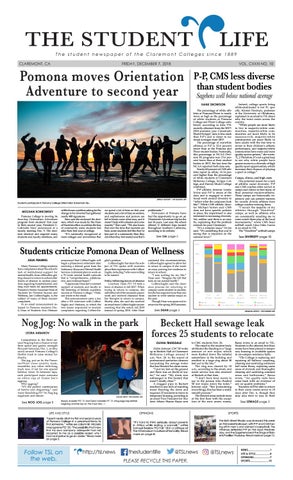
Pomona moves Orientation Adventure to second year
P-P, CMS less diverse than student bodies Sagehens well below national average HANK SNOWDON
JEREMY SNYDER • THE STUDENT LIFE
Students participate in Pomona College Orientation Adventure trip.
MEGHAN BOBROWSKY Pomona College is moving its four-day Orientation Adventure program from students’ first year to their second year, President G. Gabrielle Starr announced at a faculty meeting Dec. 5. The decision shocked and angered many students and faculty members, and
within hours a petition asking for the change to be reverted had gathered nearly 400 signatures. Starr said she endorsed the decision, which was made by the Dean of Students office, to address the loss of community some students feel after their first year of college. “It’s nationally recognized at most colleges and universities that
we spend a lot of time on first year students and a lot of time on seniors, and sophomores and juniors are left to kinda come what may, and it doesn’t help with cohesion and community,” Starr said. “We also know that over the time that students are here, some students feel like they’re less part of a community than they did when they first started and that’s
problematic.” First-years at Pomona have had the opportunity to go on an Orientation Adventure trip for the last 24 years. Last year, the school offered 11 different trips located throughout Southern California, according to its website.
See OA page 2
The percentage of white athletes at Pomona-Pitzer is nearly twice as high as the percentage of white students at Pomona College and Pitzer College combined, according to data TSL recently obtained from the 20172018 academic year. ClaremontMudd-Scripps’ data is less stark than P-P’s and is closer to national averages from 2017. The percentage of nonwhite athletes at P-P is 33.6 percent lower than at the Pomona and Pitzer student bodies. Nationally, this percentage at NCAA Division III programs was 15.6 percent lower than at their student bodies in 2017, the last time the NCAA reported both data sets. Nearly 60 percent of CMS athletes report as white, 16.14 percent higher than the percentage of white students at Claremont McKenna College, Scripps College, and Harvey Mudd College combined. P-P athletic director Lesley Irvine said P-P is aware of the data and is engaged in intentional work around diversity to “reflect what the campuses look like.” While CMS athletic director Michael Sutton said CMS does not have specific policies in place, the department is also interested in increasing diversity. Yet, neither said there is an easy fix, explaining that the problem extends far past Claremont. “It’s a complex issue,” Irvine said. “It’s something that you’re seeing that is impacted on the national level.”
Indeed, college sports being white-dominated is not 5C specific. Kirsten Hextrum, professor at the University of Oklahoma, explained in an email to TSL about why the trend exists across the country. “White people are more likely to live in majority-white communities, majority-white communities are more likely to be resource-rich, majority-white communities are more likely to have adults with the free time to invest in their children’s athletic performance, and majority-white communities have more and more quality sports options,” she wrote. “[...] Therefore, it’s not a great leap to see why white people have greater access to a diversity of high quality sport opportunities, which increases their chances of playing a sport in college.” Camps, clinics, and high costs One potential reason for a lack of athletic racial diversity: P-P and CMS coaches often recruit at camps and clinics to find many of their potential student-athletes. These camps are historically expensive and can present barriers for racially diverse athletes from college coaches noticing them. “I recruit the majority of my athletes through ‘Headfirst’ camps, as well as athletes who are consistently emailing me to come watch them play at the local tournaments,” wrote CMS head softball coach Gina Oaks Garcia in an email to TSL. The “Headfirst” softball camps
See DIVERSITY page 10
Students criticize Pomona Dean of Wellness JULIA FRANKEL Many Pomona College students have complained about the school’s lack of institutional support for mental health, from difficulties getting cleared to return to school after leaves of absence to unclear practices regarding hospitalization and long wait times for appointments. Pomona’s Senior Associate Dean of Students for Personal Success and Wellness, Jan Collins-Eaglin, is the subject of many of these student complaints. In an email announcement released to Pomona students Dec. 6, Dean of Students Avis Hinkson
announced that Collins-Eaglin will begin a phased-out retirement after receiving a federal grant from the Substance Abuse and Mental Health Services Administration to work on a 7C-wide mental health network that is “comprehensive, collaborative, and evidence-based.” “I appreciate Dean Jan’s constant support of students and faculty in the fostering of holistic academic success at Pomona College,” Hinkson wrote in the email. This announcement came a day after a TSL interview with CollinsEaglin and Hinkson, in which the two deans responded to student complaints regarding Collins-Ea-
glin’s position. Collins-Eaglin has been the subject of TSL spoke with students about their experiences with CollinsEaglin, including 7 who were willing to be named. Policy following leaves of absence Courtney Dean PO ’19 took a leave of absence in fall 2017. When trying to return to campus, she submitted all of the necessary paperwork and received clearance from her therapist to return to campus. Shortly after, she said she received an email from Collins-Eaglin recommending that she return fall 2018 instead of spring 2018. After Dean
Nog Jog: No walk in the park
See NOG JOG page 5
See DEAN page 2
OLIVIA TRUESDALE
CHLOE ORTIZ• THE STUDENT LIFE
Bukuru Anaclet PO ’21 and Dylan Madden PZ ’21 chug egg nog before begining another lap on the track Dec. 1.
LIFE AND STYLE
Zubin Jotwani CM ’20 woke up in Beckett Hall at Claremont McKenna College around 8 a.m. Nov. 26. to the sound of professional sanitation cleaners vacuuming the sewage water that had flooded his dorm room. “I put my feet on the ground and there was an [inch] of water,” he said. “My dorm was submerged in this [water] that wasn’t totally clean.” A clogged pipe in Beckett resulted in one inch of standing water flooding the dorm and required 25 residents to move to temporary housing, according to an email Vice President for Student Affairs Sharon Basso sent
to CMC students Nov. 26. The email to the student body attributed the flooding to a “large amount of wet wipes which were flushed down the toilet(s) somewhere in the building and resulted in a large clog about 30 feet out in the line.” The clog was cleared by 10 a.m., according to the email, and water service was also renewed at Beckett at that time. “I don’t have kind words to say to the person who flushed 50 wet wipes down the toilet,” Jotwani said. “But [considering everything], this has been a really smooth process.” The flooded areas include most of the first floor with the exception of the west annex rooms,
OPINIONS
“I spent nearly all of my first and second years at Pomona College in a perpetual frenzy to find someone,” writes sex columnist Micaela Macagnone PO ’20. “The possibility that I now find my own company adequate had not occurred to me as a possible reason why I had no impetus to go on dates.” Read more on page 5.
Follow TSL on the web.
MEGHAN JOYCE • THE STUDENT LIFE
Beckett Hall sewage leak forces 25 students to relocate
LEORA AKBAROV Competitors in the third annual Nog Jog had a chance to test their speed and gastric strength this past Saturday, Dec. 1, as they raced around Pomona College’s Strehle track to raise money for charity. The jog, put on by the Pomona-Pitzer cross country team, resembles any other mile-long track race, if not for one special holiday twist: In between laps, each participant must consume an entire cup of Trader Joe’s eggnog. Why eggnog? “It’s the perfect combination of festive and disgusting,” said Andy Reischling PO ’19, Nog Jog organizer and emcee.
contested this recommendation, Collins-Eaglin agreed to allow her to return to campus if she wrote an essay proving her readiness to return to school. “I was writing for my life,” Dean said. “Imagine the toll that took on my mental health.” Collins-Eaglin said the clearance process for returning to campus varies student to student, but she has required more than one student to write similar essays in the past. Though Dean was approved to return for the spring 2018 semester,
http://tsl.news
See SEWAGE page 3
SPORTS
“It’s hard to think seriously about poverty in Africa while eating a cannoli,” writes Samuel Breslow PO Fall ’18 in a critique of the Athenaeum’s culture of formality. Read more on page 8.
thestudentlife
Basso wrote in an email to TSL. Students in the affected first floor rooms have been placed in temporary housing in available spaces in on-campus residence halls. “The College is replacing and repairing all hallway carpeting, cleaning and sanitizing residence hall room floors, replacing some areas of drywall, and thoroughly cleaning and sanitizing common areas and bathrooms,” Basso wrote. “Air quality tests have come back with no evidence of any air quality problems.” Students will be able to return to their dorm rooms seven to 10 days after Dec. 6, though they may also elect to stay in their
@TSLnews
PLEASE RECYCLE THIS PAPER.
The Sixth Street Rivalry was renewed this week on the basketball court, with P-P and CMS facing off in men’s and women’s basketball. The Athenas defeated P-P on the road Wednesday, and the Sagehens beat the Stags at Roberts Pavillion Thursday. Read more on page 12.
@TSLnews
NEWS................................1 LIFE & STYLE.....................4 OPINIONS........................7 SPORTS...........................10
NEWS PAGE 2
DECEMBER 7, 2018
THE STUDENT LIFE
OA: Decision shocks, angers students, faculty Continued from Page 1 The discussion about moving OA initially began after several students and professors expressed “a sense of exhaustion” after completing all 10 days of orientation, Starr said. The Orientation Steering Committee, which is made up of eight Pomona staff members and one faculty member, reviews orientation every year, and this year looked into complaints about its extensive duration. Ken Wolf, the professor on the OSC, said the committee discussed various ways to shorten orientation including moving OA to January for first-years, having first-years take four smaller OA trips throughout the year, or shortening OA to two days. The committee also discussed moving OA to students’ second year, but Wolf said none of the committee members seriously considered this idea. The OSC’s final recommendation, sent to various deans Nov. 1, does not suggest taking OA out of orientation, he said. “After discussion, the Orientation Steering Committee supports shortening orientation while preserving OA in its current format,” Wolf said, quoting from the memo. After sending the memo, Wolf said he didn’t hear about OA again until Dec. 3, when he found out about the decision. He was shocked. “I asked, ‘Could we just wait a year and roll this out in a year after we have the opportunity for the faculty and the students and the staff to all weigh in together?’” Wolf said. “But the answer that I got was that
‘no, the decision has been made.’” Dean of Students Avis Hinkson was one of the primary people who made the decision. “[It’s] not something that I’ve taken lightly, but something that I have given a lot of thought to and heard from a lot of people about what they get from the different experiences,” she said. She declined to specify which groups she discussed moving OA to students’ second year with beside students and faculty, but said most were “very surprised” about the idea because it wasn’t something many people had been thinking about. Martin Crawford, the director of Pomona’s Outdoor Education Center, which runs OA, wrote in an email to TSL that he is excited about the opportunity to work with second-years. But he also acknowledged the OEC will need to advertise its resources to the incoming class a lot more. “It is possible that many firstyears on south campus will not fully understand the resources of the OEC without first being exposed to the center through OA,” he wrote. “We could get students who did not grow up connecting to nature and may not actively seek out an outdoor center, since they won’t have the OA trip to shatter the misconception that the outdoors is only for a select few.” Hinkson said there are still many decisions to be made about how to implement OA into students’ second year, and that she is looking forward to getting input about implementation from students, faculty, and staff.
The announcement made to faculty at the meeting Dec. 5 was met with mixed reactions, Starr said. Politics Department Chair Susan McWilliams said most faculty members were dismayed that “a decision was made without a discussion, or to the extent there was a discussion, nobody involved in the discussion thought that the outcome of their deliberations would look anything like that.” Students also expressed concerns about the decision. “I feel like past freshman year, a lot of people have already made some genuine bonds, and I think OA is kind of an important way to give people a structured experience in order to bond with their classmates,” Ethan Ashby PO ’21 said. “And I feel like during sophomore year, these bonding experiences may need to be a little less contrived and a little more natural in terms of people getting involved in things they’re interested in.” John Zuk PO ’20 echoed Ashby. “I really enjoyed my own OA trip. I went on beach OA, and since I am from Oklahoma, I had not had many opportunities to be by the water or to enjoy activities like sailing and paddle boarding until my Orientation Adventure,” he wrote in a message to TSL. “Having the chance to do that only a couple of days after arriving at Pomona was amazing.” But Starr sees the decision as an opportunity to welcome change and create a stronger community at Pomona. “My sense is that change can be
JEREMY SNYDER • THE STUDENT LIFE
Pomona College President G. Gabrielle Starr announced Dec. 5 that Orientation Adventure is being moved to students’ second year instead of their first.
really good and we should sometimes embrace it and see what new can come. But I think that if you ask a lot of people who’ve been here over the years, some people think Orientation Adventure should never change,” she said. “And some people found it alienating and some people found it not the best thing. And I really do worry that we welcome people so beautifully and then they don’t
see each other again as a group until graduation.” Hinkson stressed that this decision is not about a budget, but instead about adding a sophomore experience. “It’s not the end of the world,” Wolf said. “It’s just that we have [a program] that we were one of the first to develop, and it developed naturally here, and people look at us and copy us.”
Next year, first-year orientation will begin Aug. 27 and end Sept. 1, Hinkson wrote in an email to Pomona students. Students will have a day off before classes begin. OA for the class of 2023 will be held in August 2020, she wrote. Since next year is the 25th anniversary of OA, Pomona will have a campus-wide celebration throughout the year with trips and other opportunities.
DEAN: Practices unclear to students Continued from Page 1
Claremont McKenna Colleges’ Jeff Huang to become St. Paul’s School president Jeff Huang, vice president for admission and financial aid at Claremont McKenna College, will be leaving later this year to become president of St. Paul’s School, a private independent school in Brooklandville, Maryland, according to an email President Hiram E. Chodosh sent to the CMC student body Dec. 6. Huang has been a part of the CMC community since 1995, serving in various roles such as the associate dean of students and dean of campus life, as well as the dean of students and vice president for student affairs before assuming his current role. In addition to his numerous administrative roles, Huang has been teaching the course “Philosophical Questions” for 35 semesters since 1997. “Jeff has been a source of inspiration and support to the entire community for nearly three decades,” Chodosh wrote in the email. A celebration will be held in the spring before Huang’s departure. — Becky Hoving
Pitzer College Academic Planning Committee publishes green paper The Pitzer College Academic Planning Committee released a paper assessing Pitzer’s financial situation and academic opportunities for students in an email sent to the Pitzer student body Dec. 3 by Student Senate representative Isaiah Kramer PZ ’20. The paper discusses some of the challenges Pitzer has been facing, including retention rates, advising, students getting into classes for their major, and faculty overload. According to the paper, Pitzer has an endowment of $135 million, which translates to only $124,000 per student, the lowest of the 5Cs. Pitzer also has the highest student to faculty ratio of 11:1 at the 5Cs and an enrollment deficit — students need to enroll in more classes than are offered — of 1,877, which is covered by students taking classes at other schools in the consortium. The paper also discusses issues such as “mismatch between student interests and faculty interests, the mismatch between the number of major advisors and majors, the class size imbalance across fields, and imbalances in focus and governance.” The paper is a “tentative report for debate and discussion,” and the APC “remains uncommitted to these ideas, but we have been discussing them.” — Jaimie Ding
Trump administration removes environmental protections for Sagehens Pomona-Pitzer’s mascot, Cecil the Sagehen, is technically a sage grouse, a near-threatened bird species that lives in sagebrush steppes throughout the west. The Trump administration announced Dec. 6 that it plans to remove protections for the sage grouse, opening nine million acres of land to mining and drilling, The New York Times reports. “Sagehens are strong, loyal and smart birds,” wrote Pomona College President G. Gabrielle Starr in a statement to TSL. “Our beloved mascot is an important part of the West. Let’s speak up for the Sage Grouse and the decades of work to protect its habitat!” — Samuel Breslow
Former Pomona College President Oxtoby named director of American Academy of Arts and Sciences David Oxtoby, who served as Pomona College’s president from 2003-2017, has been appointed the next director of the American Academy of Arts and Sciences, the academy announced Dec. 3. The academy is one of the oldest honorary societies in the United States. It sponsors lectures and gatherings, provides nonpartisan policy advice to decision-makers, and produces several academic publications, according to its website. — Samuel Breslow
she was told by Collins-Eaglin that she could only return as a part-time student. However, Dean returned as a full-time student, with the caveat that she had to see Paola Beas, an assistant dean and case manager, upon her return to Pomona. She was cleared in March to study abroad for fall 2018, but received an email over the summer from Janet Dickerson, then-acting dean of students, stating that Dean would no longer be allowed to study abroad because she was on “social supervision.” “I looked in every policy in the student handbook,” Dean said. She was unable to find a clear definition for “social supervision.” Currently, Section 7 of Pomona website’s “Selection Process” page for study abroad lists being on “social supervision” as a disqualifying status for study abroad, but does not define the term. Dean said both Collins-Eaglin and Dickerson claimed that meeting with Beas, as Dean had been required to do, had placed Dean on “social supervision.” “Essentially, because I took a leave of absence, I couldn’t study abroad,” Dean said. On Dec. 5, Collins-Eaglin said her office relies exclusively on the professional opinion of the student’s therapist when evaluating student clearance for study abroad programs. Hinkson added that a main concern is ensuring continued care is available to students in their study abroad program of choice. Hospitalization practices unclear to students Like Dean, Samantha Borje PO ’19, former ASPC director of disability and mental health advocacy, has struggled with Collins-Eaglin in the past. Borje was hospitalized at Aurora Charter Oak Hospital in fall 2015 at the recommendation of Monsour Counseling and Psychological Services. “My first concern was that I did not want my family to know,” said Borje, citing an abusive relationship with her parents. Borje said she was informed by Collins-Eaglin that the office had no legal obligation to tell Borje’s parents of her hospitalization, as Borje was over 18. “She looked me in the eyes and agreed not to tell them,” Borje said. Two days later, Borje received a call from her parents, who knew she had been hospitalized. Borje wrote a guest opinions piece for TSL in April 2016, detailing her experience at Aurora Charter Oak. Within the same month, Collins-Eaglin wrote a letter to the editor, addressing student concern with mental health on campus with explanations of campus policies and procedures. In the Dec. 5 interview, CollinsEaglin said she is required to inform students’ parents of any change in status, including hospitalization, even if the student is over 18. The office will only withhold information from parents, Collins-Eaglin said, if she receives a note from the student’s therapist. But, Borje said she was not no-
tified that she needed a therapist’s note. After receiving clearance from Aurora Charter Oak to return to campus and hearing from CollinsEaglin that Pomona was willing to accept her back, Borje was told by her case manager that he had received a call from Pomona saying that Pomona was not yet ready to receive Borje. She remained in Aurora Charter Oak’s custody for an additional three days. Collins-Eaglin denied ever having called any hospitals to stop a student’s discharge. “The hospital hospitalizes students, and they’re the ones that discharge students,” she said, adding that once a student is discharged and returns to campus, they are evaluated by Monsour. “If the recommendation is that the student is not ready to return, then I have to abide by that recommendation,” she said. Sherwin Shabdar PO ’18, former president of 5C Mental Health Alliance, said Collins-Eaglin was “reticent and unhelpful” regarding student concerns surrounding hospitalization. “Pomona does not have a consistent policy with regards to informing parents about hospitalization,” he said, adding that his attempts to discuss this matter with Collins-Eaglin were met with “ignoring the idea and tailing it.” Academic accommodations and therapy Students needing academic accommodations and assistance finding off-campus therapy options have also reported difficulties with Collins-Eaglin. Preet Khowaja PO ’20 struggled with mental health toward the end of spring 2018. She wrote an email to Collins-Eaglin and was informed that she would need to get clearance for academic accommodations from her therapist. Khowaja secured clearance in a day but was told by Collins-Eaglin that she had to schedule an appointment in order to move forward, as was protocol. The next appointment with Collins-Eaglin was two weeks from the date of Khowaja’s email. “At that point, I wasn’t going to classes because I couldn’t leave my room, and it was hard for me to get meals. How could I be expected to go see Dean Jan?” Khowaja said, explaining why she did not attend her appointment with Collins-Eaglin and did not get accommodations that semester. “In the end, I got so fed up that I didn’t care if my grades fell.” Collins-Eaglin said she is required by law to record an intake of all the student academic accommodations she grants in-person. While the college’s AIM accommodation management system allows students with a history of accommodations to quickly get them again, students with no previous history of accommodations must get a written note from a physician, therapist, or psychiatrist in order to get accomodations and must meet with the dean of wellness. Noor Dhingra PO ’20, like Khowaja, struggled with Collins-Eaglin’s response time. Searching for offcampus therapy options, they tried to set up an appointment with
Collins-Eaglin, and were told that the next available appointment was two weeks later. Dhingra successfully found offcampus therapy. However, an email sent to students from the Dean of Students office Sept. 4 announced that changes were being made to the out-of-network therapy system. Dhingra was unsure if their therapy would be covered under the new policy. They reached out to CollinsEaglin, who referred them to Paola Beas, associate dean and case manager. But after attempting to contact Beas, Dhingra found her unavailable this semester. Dhingra sent CollinsEaglin a follow-up email asking to meet, but Collins-Eaglin never responded, so Dhingra still has not seen a therapist this semester. “I wish she was transparent with students,” Dhingra said. “She should give us more information and be clear about what she’s doing instead of redirecting students to people [who aren’t available].” Response time and communication Some students reported positive experiences working with CollinsEaglin in response to physical health concerns but still complained about unresponsiveness. Spencer Barsh PO ’22 suffered migraines and had a fractured ankle this semester. He reached out to Collins-Eaglin to assist him in obtaining a motorized wheelchair. “If you can get to see her, she’s amazing, but it’s the actual process of getting to see her that’s difficult,” he said. “It’s clear that Pomona needs more people handling this. We need a faster line of communication because a lot of time, students need quick responses. The main problem is communication and the initial poor communication dissuading future communication.” Maddie Jones PO ’22, who uses a wheelchair, agreed. “I think the wellness department is really small, and Dean Jan specifically just has a lot to do,” she said. Collins-Eaglin said her student appointments were often back-toback, sometimes every 15 minutes, and urgent matters often disrupt scheduled appointments. “Sometimes, students will need to wait. … [Other times], urgent matters take precedence over day-to-day appointments,” Collins-Eaglin said, explaining that if there are pressing matters, there is an on-call Dean and a system in place to respond immediately. Dean Hinkson added that the office is in the process of hiring another dean of students, but that having only one dean does mean it takes longer to meet with students. Collins-Eaglin attributed student reports and complaints to general associations students make regarding her role as dean of wellness. “All kinds of things get conflated — attitudes, feelings,” CollinsEaglin said. “This all gets attributed to me … I try as hard as I can to separate and unpack complaints, but sometimes the students are here, they’re angry, and that anger doesn’t go away.” She clarified her role as dean of wellness. “I’m not the therapist of record,” she said. “Really, I’m a conduit, a message-person.”
NEWS PAGE 3
THE STUDENT LIFE
DECEMBER 7, 2018
5C dining halls respond to SEWAGE: CMC romaine lettuce E. coli outbreak to replace damaged items JENSEN STEADY & KIRA MATTHEWS
Dining halls at the Claremont Colleges acted promptly in removing romaine lettuce during the recent E. coli outbreak earlier this October. Forty-three people have fallen ill from the Shiga toxin-producing E. coli O157 linked to romaine
lettuce from the Central Coastal growing regions in northern and central California, according to the Center for Disease Control and Prevention. The outbreak has become a threat in the United States and Canada. Pomona College Dining Services receives vendor notifications and CDC notifications regarding food products, and “decided to
pull out all romaine lettuce in this case,” General Manager Jose Martinez explained in an email to TSL. After receiving the notifications, romaine lettuce was removed in the middle of lunch service. Martinez personally checked to make sure all staff were notified and “all romaine was put away [and] discarded.” Martinez said Pomona is at-
JAIMIE DING • THE STUDENT LIFE
A cautionary sign regarding romaine lettuce was posted at McConnell Dining Hall salad bar Nov. 30.
tempting to source romaine from Arizona, which is safe to eat, and ensuring that until then, the dining halls are free of romaine. He said romaine may be introduced when dining services are notified by their produce vendor that romaine is safe to eat, and the “growing region is clear from any possible outbreak,” noting that “safety is priority.” At Pitzer College’s McConnell Dining Hall, all employees were issued a “product suspension” alert by their parent company’s Quality Assurance Red Alert team at approximately 1 p.m. Nov. 20, General Manager Cindy Bennington wrote in an email to TSL. This was followed by an alert from Bon Appétit, Pitzer’s dining management company. Workers in the dining hall removed and discarded all romaine from all food service and preparation areas at McConnell. No romaine has been served or purchased since it was discarded Nov. 20, Bennington wrote. Other lettuces are currently being substituted for romaine. Bennington wrote that romaine will be reintroduced when the corporate purchasing team is able to clear the vegetable using source and harvest date labels that will be checked upon delivery. Bennington estimates that romaine will be reintroduced next week. Harvey Mudd College’s Hoch-Shanahan Dining Hall immediately removed all romaine lettuce when they received notice from its Food Safety Division as well as the Los Angeles County Department of Health, HMC spokesperson Judy Augsburger wrote in an email to TSL. “As an added precaution, we washed, rinsed and sanitized all surfaces and storage containers that may have come in contact with the product,” she wrote. The Hoch-Shanahan will not reintroduce romaine lettuce until they are given clearance to do so. Both Claremont McKenna College’s Collins Dining Hall and Scripps College’s Malott Dining Hall could not be reached for comment before press time. Malott and the Hoch-Shanahan are both managed by Sodexo, and Collins and McConnell are both managed by Bon Appétit.
CHLOE ORTIZ • THE STUDENT LIFE
Beckett Hall at Claremont McKenna College was flooded with one inch of water due to pipes clogged with wet wipes Nov. 26.
Continued from Page 1 temporarily reassigned housing until the semester ends, Basso wrote. Jotwani anticipates being able move out of his temporary housing at Crown Hall soon. “It’s a new dorm,” he said. “I don’t know anyone there. It’s a bit of a disruption, but we hopefully should be back in Beckett before finals.” CMC has made a complete inventory of the flooded rooms and will be replacing students’ damaged items or professionally cleaning them as needed. Basso wrote that the cost of repairs is unclear, and the college has insurance for this type of event. Kelly Lyons CM ’21 was also forced to move out because of the flooding. She said the day after the flooding, a dean met each student in their room in Beckett after normal business hours to discuss items that had been affected by the water. “They were really diligent about recording the costs and what it would take to replace
those items,” Lyons said. “We are in the process of finalizing those claims and working with the school to get compensation to replace those items.” Lyon said her room had three to four inches of standing water, so many of her belongings were lost. “It was a little harder than expected [to inventory my things]. I think a lot of us thought that more of everybody’s stuff can be saved,” she said. “But given the water damage and where the water was from, it seemed that the best option for everybody’s safety was just to remove it.” Despite the move and ongoing cleaning process, both Jotwani and Lyons were satisfied with the Dean of Students Office’s response to the incident. “How [DOS] has communicated the steps they are taking throughout this process [makes me] confident about moving back in,” Lyon said. “It seems like they’re really going through the steps to make sure that everything is safe and clean and that we feel comfortable in our space again.”
Students, alumni seek to be more involved in debate over Pitzer motion to suspend University of Haifa program HAIDEE CLAUER Pitzer College students and alumni expressed concerns over the lack of transparency and procedural ambiguities of a controversial faculty motion to suspend a Pitzer study abroad partnership with the University of Haifa. The motion discussed by students and faculty at a Pitzer College Council meeting Nov. 26 was originally intended for a vote in a Nov. 8 faculty meeting but was brought before the larger community when a procedural contradiction was found. Immediately following the Nov. 8 faculty meeting, Pitzer Student Senate members proposed a resolution to condemn the faculty motion. The resolution states that it “denounces the Faculty’s desire to suspend the study abroad program at the University of Haifa and the Faculty’s decision to act unilaterally without regard to Student Voice, which constitutes an abuse of power and rebuke of Pitzer’s tradition of shared governance.” Kamyab Mashian, PZ ’19, the vice president of internal affairs for Pitzer Student Senate, said the faculty motion was largely intended to be unilateral. “This whole process has been really tricky for students to even know what’s going on … We kind of had to push our way in,” he said. Students have previously brought forward motions for the College Council. “The faculty have in the past set a very high standard for students in the past,” Mashian said. “I think it’s odd that the faculty were expecting that from us but didn’t seem to have done that for us in this case,” he said. Dan Segal, a professor of anthropology and history and member of the Study Abroad Faculty Committee, disagreed with that characterization of the faculty motion. Citing a year-long working group that hosted a public forum and discussions on the program with students, he said that students have been “brought into the conver-
sation for over a year.” The resolution, which has been twice postponed due to low attendance, is on the agenda for a vote in an upcoming Student Senate meeting Dec. 9. Claire Wengrod PZ ’19, a Student Senate representative who sponsored the resolution condemning the faculty motion, said that it encourages “student participation and makes it so that students need to be involved in the process of creating policy change in the college.” “According to Pitzer’s process of shared governance, students, staff, and faculty are supposed to have a role and a voice in policy changes in the college,” she said. Though the vote on the Student Senate resolution is on the agenda for the upcoming meeting, Mashian said it is likely to be tabled for further amendments addressing broader student input. Peter Yan PZ ’21 said students should be more involved in decisions regarding educational opportunities. It’s not the first time the study abroad committee has blocked outside educational programs, Yan said. He said another student “felt betrayed” when she tried to petition to participate in a Silicon Valley program but was told it “didn’t fit Pitzer’s core values.” Mashian also worried about voices being left out of the debate. “A lot of students are pretty hesitant to be in a situation where they could be blacklisted,” he said. “As Student Senate, it is our priority to protect those students.” He said faculty are unlikely to speak out, especially since Pitzer President Melvin Oliver condemned the faculty motion. “It’s really hard for someone who’s going to be judged by their peers on whether or not to get tenure to stand up and speak their voice,” Mashian said. Oliver spoke at the beginning of the College Council meeting discussion to decry “the substantial and unnecessary damage” of the faculty’s motion.
COURTESY OF WIKICOMMONS
Pitzer Student Senate will vote again on its resolution to condemn the faculty’s motion to suspend the study abroad program at University of Haifa.
Pitzer spokesperson Anna Chang wrote in an email to TSL that “President Oliver felt it was important to provide an alternative viewpoint for the community to consider and discuss” and that he chose not to speak at the end of the meeting because “his remarks might be perceived as invalidating or vetoing the forgoing comments.” In addition to issues surrounding the process by which the motion
has been addressed, students and alumni have many opinions on the motion itself. “I’m from China, and Trump is the president of the United States … By the professor’s [Segal’s] same logic, I should not be here,” Yan said, mentioning political tensions between China and America. “But I feel like education is education.” Sara Farooqi PZ ’08 wrote an email to Oliver in support of the
faculty motion and “to convey [her] extreme disappointment” regarding his remarks at the Pitzer meeting. “Your actions clearly demonstrate that you value certain students’ experiences over others and are willing to erode Pitzer’s democratic principles to maintain this discriminatory reality,” she wrote. “Furthermore, I am disturbed by reports I am hearing that faculty, especially non-tenured faculty, and
staff who are advocating on behalf of students, are being intimidated and made to feel concerned about their job security. This is totally unacceptable … [I] have no confidence in you or the Board to represent Pitzer’s core values of social justice and inclusivity.” The motion to suspend the Haifa program is scheduled for a vote at the next College Council meeting in February 2019.
LIFE & STYLE PAGE 4
THE STUDENT LIFE
DECEMBER 7, 2018
BOOK COLUMN
Novelty brings insane to the sane
HUMANITIES COLUMN
‘The opposite of play is depression,’ and other theories on gamification BLAKE PLANTE CW: Mentions of depression
EMMA LI • THE STUDENT LIFE
TARINI SIPAHIMALANI Warning: This column contains spoilers. “Gone Girl” by Gillian Flynn begins: “When I think of my wife, I always think of her head. The shape of it, to begin with. And what’s inside it. I think of that too: her mind. Her brain, all those coils, and her thoughts shuttling through those coils like fast, frantic centipedes. Like a child, I picture opening her skull, unspooling her brain and sifting through it, trying to catch and pin down her thoughts. What are you thinking, Amy?” Within the realm of psychological thrillers, the domestic thriller has been on the rise since the publication of “Gone Girl.” The subgenre of domestic thrillers, by definition, focuses on interpersonal relationships. It sifts through the dark secrets, twisted psychological states, and disturbances between two individuals.
For me, the reason for a domestic thriller’s burst in popularity can be whittled down to one chief element: the novelty of ideas and events in the genre’s narrative arc. Domestic thrillers are marked by absurd events. Though the opening of “Gone Girl” provides an initial frame of mundane life, reeling us in with some commonality, the writing’s literary construction gives way to a domestic eeriness; Nick’s analysis of his wife’s impenetrable thoughts involves chilling images of fossils, skulls, dissection, and coiling centipedes. The admiration in his tone also conveys a somewhat psychotic effect. These ideas create a novel representation of what could otherwise be normal and mundane, such as someone’s internal thoughts, and this novelty is taken to extremities as the book progresses. Amy frames her husband for murder, then plans on drowning herself so that her body can wash to the Gulf of Mexico. But
when her plan is foiled, and she finds herself penniless, she sleeps with her ex, only to kill him later and beat herself up to concoct a story of abuse. These events are psychologically bizarre and not easily relatable. Experiencing such ideas stimulates regions of our brains. And though many great writers aspire to depict the obvious in a way that inspires and demonstrates originality, psychological thrillers — appallingly violating expected norms of behavior — seem to achieve this by illustrating a novel absurdity that is universally stimulating. Beyond the thrilling absurdity of the events that prompt this kind of mental stimulation, as readers, we are placed into a neurologically turbulent mind. Amy’s heightened and unstable state that propels her toward extremely perturbing acts insinuates her brain’s somewhat dissimilar, or insect-like, wiring. By placing ourselves into the mind of a character like her, a mind that
doesn’t adhere to our typical mental norms, or our typical inhibitions of behavior and feeling, we are looking through a lens that is likely neurologically incongruent to ours. Being placed into the head of “all those coils shuttling like fast, frantic centipedes,” we copy those experiences into our own, and this tracing and its effects are, to us, a completely new and innovative experience. With this extreme novelty, we are able to experience a dissolving sense of reality: a distancing from our own lives as we’re absorbed into another. And really, isn’t that a purpose of all stories? We read to get away. Psychological thrillers may just be able to get us there faster. Tarini Sipahimalani is an English major at Pomona College. She enjoys drawing, singing a cappella, and tennis, but mostly for social purposes.
SCIENCE COLUMN
Forecasting the future of climate change: What next? D’MAIA CURRY 5C students joined Pomona geol5C students joined Pomona geology professor Robert Gaines in a discussion on the future of global warming and climate change last Wednesday, as part of the Pomona Student Union’s Chat and Stew series. The discussion stemmed from a recent Global Warming report published by the Intergovernmen-
tal Panel on Climate Change. The IPCC is a climate assessment body composed of 100 scientists from around the world. Using criteria like sea level rise, drought and excessive moisture, and ocean acidification and extinction, the report investigated the different effects of global temperature rising to 1.5 degrees Celsius (34.7 degrees Fahrenheit) above pre-industrial levels, instead of the currently
COURTESY OF POMONA COLLEGE
Pomona geology professor Bob Gaines joined the Pomona Student Union for a “Chat & Chew” discussion on Climate Change Nov 28.
projected 2 degrees Celsius (35.6 degrees Fahrenheit) increase. “They found that there are considerable benefits to try and arrest warming at 1.5 degrees Celsius, that the consequences in each criteria are significantly worse at 2 degrees Celsius than they are at 1.5 degrees Celsius,” Gaines explained. Limiting warming to 1.5 degrees Celsius would lead to lower projected species loss and extinction, a reduction in the number of people exposed to climate-related risks and diseases, and a reduction in extreme weather patterns and events, like excessive drought or precipitation. The report suggests that it is still achievable to hit 1.5 degrees Celsius if global society reaches net zero carbon emissions between 2030 and 2050. In order to reach the zero net emissions goal by as early as 2035, our “energy infrastructure would have to move to non-carbon sources like nuclear and renewables” very quickly, Gaines explained. Gaines outlined that some of the most important advances that could help us get to zero carbon emissions are breakthroughs in solar power. Solar panels work to convert the sun’s rays into energy. Efficient conversion is essential for establishing a sustainable, efficient, and extensive solar energy network. “Solar is really dependent on the ability of the [solar] panels to harness that energy,” Gaines said. “So our investment in that [research], industry’s investment in that [research], government’s investment in that research will be huge toward making solar a more viable source of energy.” There is also a lot that can be done on the individual level to reduce carbon emissions. “I think one of the most important things that individuals can do is be politically aware and politically active, and to try and use your vote to do things that encour-
age these newer technologies,” Gaines said. According to Gaines, it is also important to limit our overall consumption. This can mean being intentional when ordering items on the internet, and making sure to bundle your orders so that delivery trucks do not have to commute to campus again and again. Taking public transit will not only help save fuel, but will benefit and support ridership on Southern California’s public transit system, Gaines said. “The meat industry has a pretty heavy carbon footprint, so trying to reduce meat and dairy to the extent that it works for your body is something to consider as well,” Gaines explained. Gaines has noticed that students on campus are conscious of their water bottle usage. Plastic water bottles are one of the most carbon intensive products as emissions are produced from shipping the water, creating the plastic, recycling the plastic, and moving the bottles from place to place. All of those processes have a big carbon footprint. Measures to reduce this emission are already seen on campus with the proliferation of water bottle filling stations and the widespread use of reusable water bottles. Only time will tell whether society is able to limit global warming to 1.5 degrees Celsius and the effects it will reap on the environment. The report does not outline the feasibility of reaching zero carbon emissions, but it does state that the plan will need to be an interdisciplinary and collaborative initiative — between scientists and politicians, individuals and states — which supports innovations and policy that will safeguard the environment. D’Maia Curry is a geology major at Pomona College. She loves dancing, reading, and looking at really cool rocks.
In “Ender ’s Game,” kids play war games under the expectation that they are training. In reality, they are fighting a war. Without knowing it, they commit xenocide. What are the real stakes to the games we play? Dr. Jane McGonigal, director of game research and development at the Institute for the Future, and C. Thi Nguyen, assistant professor of philosophy at Utah Valley University, spoke at Pomona College and Scripps College, respectively, on the sociological and philosophical implications of gamification. McGonigal’s book, “Reality is Broken,” joins the debate about the future of our world in the hands of generations of gamers. On one end, if people migrate entirely from the real world to the virtual, society is not expected to be able to endure, and a degradation or collapse might be imminent. On the other, as people synthesize learning in the virtual and real worlds, they might engage, coordinate, collaborate, and communicate in enhanced ways that could make us better than before. McGonigal argues for the second vision. Speaking on the event “How Video Games can Change the World” at Pomona’s Big Bridges Auditorium, McGonigal stated that “all of the neurological and physiological systems that underlie happiness — our attention systems, our reward center, our motivation systems, our emotion and memory center — are fully activated by gameplay.” In this state, we think better, are more positive, make social connections, and build personal strengths. “Gaming,” she said, couching her arguments in a comfortably inspiring catchphrase, “can help us become ‘super-empowered hopeful individuals.’” Recent research on play corroborates her claims. Video games, as high feedback environments, fire up the hippocampus to learn and process information. They engage the caudate and thalamus, which grow with anticipation and help us stay engaged. Play, it is being said, is the opposite of depression. McGonigal pointed to shifts in gaming culture, where gaming in the proximity of others is becoming more popular. Within a few minutes of playing, both players start to sync up in odd ways: making similar facial expressions, breathing at a similar rate, adopting similar heart rates, and feeling more empathy for the other person. “Try this simple thought experiment,” she said. “What would happen in your workplace if you could apply just some of the insights from gaming? When we’re playing a well-designed game, failure doesn’t disappoint us, and people work hard and love even mundane tasks.” McGonigal recommended, very enthusiastically, what she calls the “game transfer effect”: to “play for 10 minutes, then
tackle a real-world challenge.” Nguyen, author of “Games: Agency as Art,” is concerned about parts of this framework. “Game attitude is an all-consuming instrumentalizing attitude. You have one goal, you instrumentalize everything else, everybody else, everyone in the game you use,” he said. “If that attitude leaks outside of the game, that’s terrible. I am less worried that games will make serial killers, and more concerned that games will make uncontrolled Wall Street capitalists.” The attitude of instrumentalizing everything in the game as if it were disposable has the potential to leak into the way we interact with and control the world. Speaking on “Games, Gamification, and Autonomy” for the Scripps philosophy colloquium, Nguyen argued that “games are the art form of agency because they shape the experience of agency.” The experience is not necessarily about the game’s visual display, but about the aesthetic experience of acting and doing. According to Nguyen, games offer more sharp experiences of agency and functional beauty because they are designed to. Game designers determine ingame values and goals, abilities of the in-game agent, and the environment that the in-game agent operates in. Ingrained in here is, of course, something more hopeful and more insidious: While games with disposable ends communicate modes of agency and can help us develop our autonomy, these behaviors are not isolated to disposable gaming experiences. Nguyen offers a game: When encountering someone at a party who has a braggadocio habit of name-dropping celebrities they’ve met, try to see how many names you can get them to drop. Twitter, Instagram, and Facebook can become games too, where our experiences may become ends that can be manipulated for the purpose of maximizing likes/ follows. To what extent, then, do the games that we participate in consist of choices we are able to make? Nguyen is, ultimately, optimistic. “Games are good when they’re games,” he said, adding that people can take any activity as a game if they do it for the sake of overcoming obstacles rather than for achievement. What distinguishes games from regular life is that they let us inhabit a world that’s ”easier to make sense of,” where the values are “clearer, simpler, and easier to apply,” he said. Games can oversimplify, but they can also teach us that we are capable of submerging ourselves into alternate modes of thinking, acting, and deciding, and that we can put them all away when the game is over. “Games teach us,” Nguyen concluded, “that our agency is notably fluid … that we can create an archive of agencies … we can experience different ways of being.” Blake Plante PO ’19 is an English major. He is most commonly spotted scribbling into an all-weather notebook at all events.
COURTESY OF ED SCHIPUL VIA WIKIMEDIA COMMONS
Jane McGonigal speaks at eTech in 2009.
LIFE & STYLE THE STUDENT LIFE
DECEMBER 7, 2018
PAGE 5
NOG JOG: Charity run is Claremont’s most nauseating
CHLOE ORTIZ • THE STUDENT LIFE
(Left) Patrick Schlosser PO ’20 is dressed for the season at the Nog Jog event Dec 1. (Right) Students help set up cups of egg nog in preparation for the third annual Nog Jog.
Continue from Page 1 “We hope [that] will not only make the event a staple of the colleges’ holiday events, but also for an entertaining spectacle. Normal races are incredibly boring, but a race where the runners have to drink eggnog each lap? That’s something people will pay to see!” Participants must pay a $10 entrance fee, but Reischling said the race also receives many contri-
SEX COLUMN
MICAELA MACAGNONE CW: Perceived negative relationship dynamics My parents’ opposing personalities frequently put them at odds with one another — something that can, in an oversimplified way, be seen as my dad often treating my mom horribly, but also loving her more than I have ever seen anybody love another person. My sibling likes to talk about how we are both “relationship-fucked-up” as a result of growing up around this dynamic. Watching their behavior my whole life has influenced my perception of what is “normal” in a relationship and therefore what I expect for myself. I see two main trends in my college-age approach to relationships. First, I am only interested in people with qualities similar to my dad’s: outgoing, popular, desirable, and charming. Second, I tolerate and often try to gain the love of people who sometimes treat me poorly. These two trends, which I am sure will ebb and flow as I mature, have left me feeling particularly “stuck” this semester. Though I realize dating is a necessary component of meeting new people and finding someone who is “good” for me, the effort required fills me with dread, to the point that I do not date. This phenomenon leaves me feeling trapped, as if I have closed the door on potential happiness. Not meeting new people also leaves me infatuated with previous hookups, even when they have made their disinterest clear. I have spent a lot of time concerned about my waning interest in dating. I worried that perhaps I was losing my sex drive, but there are people I want to hook up with. I worried that maybe I had gained some new debilitating anxiety, but this semester I had still gone through with hookups even if I was anxious beforehand. I worried that I was still not over the high school boyfriend, but I felt my lingering interest in him plummet when he invited his girlfriend to Thanksgiving dinner at my best friend’s house. I was excited to realize that my lack of desire to pursue new people was not a sign of something “wrong” with me, but instead a sign that I am okay being alone. I spent nearly all of my first and second years at Pomona College in a perpetual frenzy to find someone,
butions from non-racers. This year the event raised around $500 for the Pomona Economic Opportunity Center, a non-profit committed to connecting day laborers with responsible employers. Day laborers are people that work on a temporary basis and are often immigrants, prevented from finding steady work due to current employment regulations. The PEOC writes on their website that their mission is “to provide
an opportunity for day laborers to find safe work at a fair wage, to organize and advocate for themselves, to obtain new trades and skills that improve their employability and quality of life, and to improve the overall conditions for all immigrant workers.” Though the jog is open to everyone, the race itself is not for the faint of heart (or stomach). Bukuru Anaclet PO ’21, cross country runner and Nog Jog par-
ticipant, said the race can get a little competitive, considering the winning time for the men’s race was 5:06. On the whole, however, Anaclet said, “Most of us are just here to have fun and raise money for an organization that we really care about.” Reischling said he hopes the event will continue to grow and incorporate a more inclusive community. “As of now, it’s mostly athletes
with a few community participants,” Reischling said. “However, the crowd of people that come and watch gets bigger every year. Ideally in the next couple of years, the race itself will be more a community event with on-campus and off-campus runners.” If you’re wondering how it feels to sprint a mile with a quart of eggnog in your stomach, the answer is: not good. Anaclet said that he “doesn’t re-
ally like eggnog” and that he found the race difficult because he “could feel the egg nog in [his] stomach every step he took.” Joe Hesse-Withbroe PO ’22, the men’s champion, expressed that throughout the race, he was mainly “focusing on not puking.” On the matter of illness, Reischling said: “Yes, people get sick during and after the race. We’re very careful to provide enough trash cans.”
Single and in good company so the possibility that I now find my own company adequate had not occurred to me as a possible reason why I had no impetus to go on dates. I recently had a hookup experience that exemplified this revelation. Over Thanksgiving break, I hung out with a 28-year-old whom I have had a crush on for three years. He is the embodiment of every quality I reluctantly, yet inexorably, find attractive. His good looks and charm, coupled with his ability to make me feel chosen, made it easy for me to become obsessed. Over the summer, I would
speak to 10-20 people everyday who felt the same way I did. Some would cry based entirely on how he decided to look at them on any given day. I set my sights on him. Though I would usually try to date someone with qualities like his, this time I was only interested in hooking up. Hooking up with him was an overwhelmingly positive experience. My understanding of my newfound willingness to be alone arose the next day. Normally after any hookup, I immediately start to obsess over whether or not the person will want to see me again. Instead,
the day after hanging out with him, I thought, “Wow, I just had sex with a 28-year-old man who doesn’t care about me at all. I am truly so alone.” That thought may sound negative, and to be honest, it did feel terribly lonely in the moment. But for me, having that thought instead of wanting to pursue him, was significant personal progress. I opted not to pursue someone who I knew wasn’t good for me, and who would almost certainly reject me in the future. Though I definitely am currently “relationship-fucked-up” with my attractions, my recent willingness to not pursue them,
and instead be alone, is a step in the right direction. In retrospect, I realize that the way I felt and behaved during the hookup was different than usual. I did not spend a lot of time talking to him, I was confident in what I wanted that night, and I did not sleep over. The fact that he was grown, and also sometimes outwardly misogynistic, certainly aided in this “distance,” but in the end, I was there for sex just as much as he was. I always thought that I would measure my ability to get away from my parents’ relationship by dating a “nice” guy as different as possible from the men in my family. However,
I realize now that such a goal focuses much more on someone else than it does on me. I think that progress can show itself in subtle ways that are easy to miss. However, counting the small steps, like honestly labeling your experience rather than decorating it with your anxieties and wishes afterward, is important, too. Micaela Macagnone PO ‘20 is an international relations major. She is from New York City and misses bacon eggs and cheese sandwiches everyday.
NINA POTISCHMAN • THE STUDENT LIFE
LIFE & STYLE MUSIC COLUMN
Shh, secret playlists for food poisoning ANNA KOPPELMAN Tonight I put on a sad song and give myself to it. It is Saturday and I am wearing a food-poisoning-induced existential crisis. There’s something about vomiting that I think both metaphorically and literally brings up everything toxic. Which is how I am justifying why I find myself lying here, the first semester of college winding down to its natural conclusion, questioning everything. My friends: How preposterous is it that they’d rather watch a movie than sit with me between my cold sweats and hot flashes? (I write in a mostly sarcastic tone.) My school work: How has my life turned itself into a directionless tangent? I mean, I’ve spent four whole months in this institution. Shouldn’t I know exactly where I am meant to be in five to 10 years? Taking three English classes and a media studies course next semester certainly won’t get me in to medical school. Not that I even want to be a doctor, just that my options suddenly feel limited and suffocating and my heart feels like it’s beating out of my chest. Is this a panic attack? Nope. It’s indigestion. The lull of the sad song meets me where I am and tells me to stay complacent. You are all alone, it whispers, unloved, by yourself. The nausea is all-encompassing. A tear rolls down my cheek. I know the answer to my predicament. Usually, I wouldn’t tell you
DECEMBER 7, 2018
THE STUDENT LIFE
PAGE 6
this — seriously, this is a secret that I planned to take with me to my grave. Admitting this dreadful secret could put my entire reputation (of the cool angsty girl who listens to Phoebe Bridgers and doesn’t smoke cigarettes but, like, possibly could) at risk. But I’ve decided that tonight will be the night I admit it. The secret to my sanity on a sad night is blasting “Ho Hey” by the Lumineers. And sometimes, when I am stressed, I will also put on “Drops of Jupiter” by Train — I know the lyrics make no sense (“she acts like summer and walks like rain,” what?), but on the worst nights when misery is my best friend and loneliness surrounds me, I need Harry Styles to tell me it’s okay to cry … because crying, as Styles would put it, is the “Sign of the Times.” Bad pop songs by artists who are relatively hot are the cornerstone to my mental sanity (I mean, along with therapy). And as I sit here, throwing up, I have decided to liberate myself. In my darkness, boy bands save me. I will no longer sit in shame with this secret. If this gets my music columnist card revoked, so be it. Anna Koppelman is a first-year at Pitzer. You can either find her reading poetry, hanging out with friends, or ranting about how long it’s taken for Vampire Weekend to release a new album.
NATALIE BAUER • THE STUDENT LIFE
Outwit, outplay, outlast: Who will be the final 5C Survivor?
CHLOE ORTIZ • THE STUDENT LIFE
Brandon Piel CM ’21 founded the reality TV show-inspired 5C Survival Club.
KYLA WALKER Sixteen students competed in various challenges testing the limits of their bodies in the new 5C Survivor Club this semester. Inspired by “Survivor,” the CBS reality television show that began in 2000, Brandon Piel CM ’21 decided to bring the competition to the 5Cs the summer after his first year. “It’s collaborative and competitive at the same time,” Piel said. “I don’t think there’s anything else on campus that tests you physically, mentally, socially, and strategically all at the same time. It’s a unique experience.” Piel grew up watching the show and became a huge fan. His goal is to eventually be a part of the real show one day, but after seeing similar versions of the game filmed on other college campuses, he knew he could first host the competition at the 5Cs and air it for all to enjoy. “Obviously, I’m a huge ‘Survivor’ fan,” Piel said. “I’ve been watching the show since I was very little. I went on YouTube and found that University of Maryland was doing something very similar. I binged all
four seasons. At that point, I really wished I could participate in something like [that] ... I wanted to give people the opportunity to do this and to see how it goes.” After developing the idea further and getting a film crew together, he began to search for contestants. Piel publicized the new club with posters around campus and participated in club fairs early in the semester. The club, open to all 5Cs, was mostly filled with CMC students. The potential contestants all went through an interview process, where Piel obtained a better sense of the personality each student would bring to the show. “I think it’s very easy to be someone different outside the game and bring a character to the game,” he said. The 5C Survivor Club follows the format of the television show for the most part, with a few Claremont twists. It starts with the contestants being divided up into tribes that undergo challenges each week. The losing tribe then participates in tribal council, where they vote for one of their team members to be eliminated. Once the teams dwindle down to a small number, the tribes merge and each competitor competes in challenges individually,
against everyone remaining. At the end, every contestant that was eliminated returns to become part of the jury that determines the final champion of Survivor. “I thought it would be a lot about who is the most skillful at the challenges we are doing,” said Adrienne Kafka CM ’21, 5C Survivor contestant. “But since we have lives outside the game, a lot of it has depended on the relationships that people are able to build inside the game.” The challenges are filmed each week and take about an hour to complete, but footage also consists of confessionals by contestants that break the fourth wall to give the reality show internal perspectives. Kafka became a contestant initially because Piel highly recommended the show to her, and the club seemed to be a special experience. “I think it’s really cool because a lot of extracurriculars are super pre-professional and have a really specific purpose in the minds of students … But [Survivor] is just a club to have fun doing something that everyone enjoys,” Kafka said. “And it’s also pretty cool that we are making our own reality TV show.” The show is developed through significant group effort, as it is
spearheaded by Piel, produced by Ally So CM ’21, directed by Tyler Welty CM ’19, and edited by a film crew of six students, including Maxwell Fisher CM ’21. “It’s really interesting to see a social and psychological experiment unfolding in Claremont’s backyard, which is what Survivor is basically,” Fisher said. “There is just a ton of creativity and effort that goes behind making such an intense TV show and producing it without too many resources, and Brandon has done really well leading it so far.” The filming of the first season will most likely finish by the end of this semester, and will ideally air on YouTube in early 2019. Even though Piel will be studying abroad next semester, he has high hopes for its continuation in the spring, and for the club to ultimately become a lasting legacy that continues even after he graduates from CMC. “I hope that [the club] will continue to be a consistent club on campus … And I think people will be excited when the episodes start coming out,” Piel said. “This definitely won’t be the only season. So if you’re interested, just be aware and keep an eye out for the next season.”
Creating without fear: ‘Art for Healing’ reduces stress, reinstills agency ELINOR ASPEGREN CW: Mentions of sexual assault, dating/domestic violence, stalking Maddy Gould PZ ’19 unfurled student art on a table that was made in the Empower Center’s event “Art for Healing,” a lunchtime activity designed to provide healing and support to survivors of sexual assault, dating/domestic violence, and stalking. Many are just watercolor scribbles, others are scenes from nature, and others
have self-care mantras. “I’m trying to create a space for expression and release without too much overthinking,” Gould later wrote in an email to TSL. “If all else fails, the event simply acts [as] a space for some intentional self-care and a reprieve from stress.” Gould runs “Art for Healing,” which she started in her sophomore year with a senior because they “felt like a space centered around creativity could be incredibly helpful for survivors.” “Art for Healing” takes place
in the Empower Center, which provides 7C confidential support to students impacted by sexual assault, dating/domestic violence, and stalking. They also promote collaborative, educational programming. Although “Art for Healing” is open to any student who attends the Claremont Colleges, the event is mostly geared toward survivors, aimed towards allowing them to share, express, and emote without judgement, according to Gould. Gould, who is also an Advocate
for Survivors of Sexual Assault at Pitzer, leads students through trauma-based art activities, which consist of a “number of different activities in the space, ranging from expressions of self, to activities about release, visual representations of past, present, and future narratives, reflections on childhood.” In her training for Advocates, Gould said that trainees emphasize “re-instilling agency” in survivors by providing them with a space to share their experiences and express
themselves without judgement, concrete advice, or interrogation. “‘Art for Healing’ tries to provide that space. It’s about expressing and creating without fear,” Gould said. “The activities we do can also be done individually, so I try to emphasize that folks can use art as a form of self-care at home and can integrate the practice into their lives if it serves them.” According to Rima Shah, the head of the Empower Center, “Art for Healing” provides a space to further deal with trauma.
“‘Art for Healing’ is one of our key programs and is part of our efforts to provide holistic support and care to our students,” Shah wrote in an email to TSL. Shah added that the Empower Center is busy planning events for next semester, including a new weekly support group for survivors, programming with athletics, bi-weekly Masculinity Mondays sessions at CMC’s CARE Center, and a 5C-wide online survey about the Teal Dot bystander intervention program.
ELINOR ASPEGREN • THE STUDENT LIFE
(Left) Maddy Gould PZ ’19 lays out watercolor pictures, created in the lunchtime ‘Art for Healing’ activity. (Right) Maddy Gould PZ ’19 works in the Empower Center, which works to support survivors and educated allies. There, she runs the “Art for Healing” program, mostly focused on providing self-care techniques to survivors.
OPINIONS DECEMBER 7, 2018
THE STUDENT LIFE ARIEL SO Editor-in-Chief MEGHAN BOBROWSKY Managing Editor HANK SNOWDON Managing Editor
PAGE 7
THE STUDENT LIFE
JAIMIE DING, News Editor OLIVIA TRUESDALE, News Editor SAMUEL BRESLOW, Senior News Adviser BECKY HOVING, News Associate NATALIE GOULD, Life & Style Editor MAYA KLEIMAN, Life & Style Editor MABEL LUI, Life & Style Associate DONNIE DENOME, Opinions Editor ANIKKA VILLEGAS, Opinions Editor KELLAN GRANT, Sports Editor NOAH SHAPIRO, Sports Editor BERGEN CARLOSS, Video Editor EMILY PUGH, Podcast Editor SAFIA HASSAN, Business Manager ANGELA TRAN, Business Manager OWEN WANG, Business Associate MAYA ZHOU, Communications Director WHITNEY WACHTEL, Web Developer AMBER CHONG, Copy Chief
The Student Life, the oldest college newspaper in Southern California, is produced and managed by students of the Claremont Colleges and published weekly. The Editorial Board consists of the editor-in-chief and two managing editors. Aside from the editorial, the views expressed in the Opinions section do not necessarily reflect the views of TSL. Email letters, questions, concerns, and tips to editor@tsl.news, advertising inquiries to ads@tsl.news, and print subscription inquiries to subscriptions@tsl.news.
EDITORIAL BOARD
BROOKE SPARKS, ADITYA GANDHI, LAUREN KOENIG, JAMIE REID, NADYA SIRINGO, Copy Editors CASSIE WANG, Production Editor JAMES KARSTEN, Senior Design Editor MADELINE MCCLUSKEY, Design Consultant QUIN FRALEY, News Designer HELENA ONG, Life & Style Designer SHAY LARI-HOSAIN, Opinions Designer JILLIAN BATIUK, Sports Designer CHRISTOPHER HU, Distribution Manager MEGHAN JOYCE, Graphics Editor CHLOE ORTIZ, Photo Manager TALIA BERNSTEIN, Photo Editor ALICE SHINN, Social Media Manager MAX OBER, Social Media Associate GRACE OZONOFF-RICHEY, Development Manager JULIANA ROMEO, Development Manager
TSL welcomes letters to the editor, which can be submitted by mail, email, or in person at Walker Hall 101 of Pomona College. Letters must be under 400 words (although when an issue is particularly salient, we reserve the right to allow letters to run at a longer length) and submitted by 4 p.m. Wednesday of the week of publication. We reserve the right to decline publication of submitted letters and will not accept anonymous letters, letters containing profanity, factually inaccurate letters, or letters making personal attacks. TSL also reserves the right to edit for spelling, punctuation and grammar. Letters may be signed by a maximum of three people. All letters become the property of TSL and may not be reprinted without prior permission from the Editorial Board.
TSL SAYS
Single copies of TSL are free and may be obtained at newsstands around campus. Multiple copies may be purchased for 47 cents per copy with prior approval by contacting editor@tsl.news. Newspaper theft is a crime; perpetrators may be subject to disciplinary action as well as civil and/or criminal prosecution.
Standing up for Sagehens If we don’t, who will?
Yule Ball We’re Frary excited, even though it’s in Edmunds
Oil companies Why do you hate Cecil?
Yule Brawl Please, not again
BOLD decisions Giving us something to write about
Grass It looks good when it’s not dead
BAD decisions Oops
Rain I thought it wasn’t supposed to rain in Cali?
Who we’re covering, who we’re not: Analyzing our coverage and how to do better In an effort to be transparent, we analyzed our coverage from the past semester and looked at the students we are covering. In an ideal world, we would cover each school proportionally to its student body. However, our data shows that we overcover Pomona College and undercover both Pitzer College and Harvey Mudd College relative to their student body sizes. We cover Scripps College and Claremont McKenna College a proportional amount. In comparing our coverage to the makeup of our staff, some correlations arise. Our staff is almost 41 percent Pomona students, which likely accounts for some of our overcoverage of them. However,
even though almost 32 percent of our staff is from Scripps, we cover the school appropriately. In the News section, we are overcovering Pomona, with 47 percent of students mentioned in all articles. This is somewhat due to an article about Sparkathon that mentioned 19 different Pomona students. Even without that article, we tend to cover Pomona more than we should. Now that we’re aware, we can make a more concerted effort to cover the other four schools next semester and beyond. In Life and Style, we overwhelmingly mention Scripps a n d Po m o n a s t u d e n t s . I n Sports, we are covering CMS athletics slightly more than P-P. That is partially due to
CMS winning the SCIAC in volleyball and football, while having a commanding season in men’s soccer. Nonetheless, our coverage should be more balanced. In Opinions, we barely mention students from any school, and the results are statistically insignificant. It is important to mention that we are only looking at coverage from this semester, which comes down to nine weeks — of roughly 35 articles an issue. However, it does give us a good idea of how we can better represent our community. We are committed to giving each of our college communities the coverage they deserve and will work to better do that moving forward.
Weekly Comic: Flossing
JORDAN WONG • THE STUDENT LIFE
Loud hands are proud hands: The joy, freedom, and pain of stimming DONNIE TC DENOME CW: Anti-autistic ableism and mentions of self-harm There’s a beauty in my hands moving in front of me: short, jerking motions that remind me of my brief foray into conducting music in middle school band. As my hands move back and forth, I begin to rock forward in the same internal rhythm. Maybe it’s the beat of the music I’m listening to; maybe it’s the tick of the clock. I stim: performing repetitive motions as a form of sensory-seeking and self-grounding. Stimming is incredibly common among autistic people — to the point that it is one of the key diagnostic criteria for autism. For as long as I can remember, I have had to move in some way to keep myself calm. I tap my fingers against my face, bounce my leg up and down, make random noises with my mouth, and fidget with small toys I keep with me. I can’t describe how exactly stimming feels but I can describe what it feels like to not be able to stim. Holding still makes my skin crawl and makes me feel like there’s lead in my bones. It’s unnatural to me. I’ve had people assume that stimming means I am anxious or that I am upset over something. Quite the opposite: It’s a normal, healthy, automatic action for me. I don’t notice I’m stimming most of the time unless someone points it out to me. Being forced to hold still makes me more anxious than stimming ever will. The way stimming is often treated as a distraction and as unacceptable simply for existing, though, hurts me. I am fully aware of competing access needs — the idea that what one person needs to function in a space interferes with what another person needs — but the situation is never presented as one of access needs. Instead, it’s presented as one of professionalism. Being professional means I need to make eye contact, hold still, communicate using spoken language, be relaxed (but not overly relaxed), and adhere to a flexible (but not too flexible) schedule.
Negotiating these boundaries, especially when they’re a hidden curriculum, is difficult for me. Then, when faced with the difficulty of navigating a world that doesn’t make space for people like me, I fall back on stimming as a way to relax and calm myself. But stimming is “unprofessional,” and the cycle begins again. The controversy that nonautistic people kick up around stimming (despite the fact that everyone stims) is emblematic of how disabled people’s coping mechanisms are often treated by non-disabled people. The methods we use to keep ourselves calm and interact with a world that isn’t built for our needs are dismissed as unsuitable and immature. In almost every case, there isn’t the option of “Just have different coping mechanisms.” For me, as an adult who has spent years testing the limits of which coping mechanisms actually help me and which ones are too noticeable for comfort (mine or others), the stims and other coping skills I have worked out are the only ones I can use. If criticism of stimming was only “Please tone it down in professional situations,” I might be able to tolerate it (although that disadvantages autistic and disabled adults). It’s not, though. Many autistic children are taught from a young age that they need “quiet hands” in order to participate in class. Quiet hands don’t fidget; they don’t tap; they don’t move; they don’t skim their fingers over surfaces to feel the textures and take in the world. Quiet hands sit, silently, and autistic children with quiet hands appear as non-autistic as possible. Which, frankly, is bullshit. I have yet to meet a child who didn’t run around, flailing wildly, and touch everything they could if given the chance. All children stim, all children have loud hands, all children act out because they’re children and don’t have the most developed self-control. But if you’re autistic, excess energy is a pathology. Cue “quiet hands” and cue being held down, lectured, denied breaks, slapped, and possibly shocked with electricity for doing something that comes as naturally and as neces-
ANIKKA SOPHIA VILLEGAS • THE STUDENT LIFE
sary as breathing. People often bring up questions like, “But what if a child is stabbing themselves with scissors?” Take away the scissors and try and redirect their attention and sensory-seeking to something less dangerous! This is the same advice often given for people looking to redirect self-harm urges; yet it feels like people who work with autistic children are painfully unaware of it. My work as an autistic and disabled self-advocate centers around radical change of oppressive social structures, including the idea that stimming is wrong or needs to be fixed. I believe that nobody is too disabled for self-advocacy and that everyone deserves a chance at the life they want. When stimming is called “disruptive” or “improper” simply for existing, so are autistic people who stim. I can, if I want to, put together a passable non-autistic work persona. I’ve taught myself to feign eye contact, to speak as naturally and relaxed as I can, to be available as much as possible even when I’m burnt out from social interaction. It takes a toll on me, though, and that’s where stimming comes in. To be “professional,” I give up so much of what is natural for me. To give up stimming as well would leave me unable to function.
As Julia Bascom, the director of the Autistic Self-Advocacy Network, puts it in her poem “Quiet Hands”: “[Until] I move 97 percent of the way in your direction you can’t even see that’s there’s a 3 percent for you to move towards me.” Autistic people are so often asked to “meet in the middle,” when in reality, it’s not really the middle at all. It’s 95 percent or 97 percent or 100 percent of the way to where non-autistic people are. There are no perfect solutions here, but a start is to be more understanding. Don’t assume someone is not trying to be professional or is trying to be a distraction. Accept people for who they are, stimming, fidgeting, and all. Stimming is a way of processing and being that is core to the autistic experience. Autistic people cannot stop it, and in many cases we cannot “turn it down.” I guarantee we are trying to be as unobtrusive and quiet as possible. The world has already taught us to be that way. Donnie TC Denome PZ ’20, CGU ’21 is a 4+1 Bachelors/Masters public health major from Sunnyvale, CA and one of the TSL Opinions editors.Their favorite thing about the winter holidays is the availability of peppermint-flavored beverages.
Don’t take Orientation Adventure out for first-years JASPER DAVIDOFF I arrived at Pomona College on a Saturday last August having traveled 2,000 miles from home, familiar with practically no one on campus and terrified of the journey I was about to start. Two days later, I hopped on a bus and spent four days backpacking in Sequoia National Park. I’m not exaggerating when I say it was one of the most fun and transformative outdoor experiences I’ve ever had. During my Orientation Adventure, I grew intimately close to my group members and leaders — many of whom remain my best friends here. I saw sequoia trees for the first time, climbed mountains, and swam in beautiful lakes. It was the best welcome to campus and to California that I could have dreamed of. I’m saying this to add mine to the overflowing list of OA success stories. When I heard this week the Pomona administration plans to take OA away from first-years, I was dismayed. It’s a change that’s profoundly misguided and threatens to eradicate the most meaningful pillar of the first-year orientation experience. Moving OA from students’ first to second year would devastate its impact. OA was the first significant way I met my classmates, and those interactions were crucial in getting me through orientation and the first couple weeks of class. Sophomores don’t have nearly the need for that kind of social support. OA taught me there were people here in college who cared about me, were there for me, and wanted me to succeed. Those lessons have reverberated throughout my first semester. You only get one chance to make that the lens through which students view their new community. In an email announcing the change, Dean of Students Avis Hinkson expresses two valid reasons to alter the orientation experience. She writes, “students are: 1) exhausted by the time classes begin, and 2) they are eager to register and begin their academic journey.” While I appreciate that the administration is working to improve first-years’ first days on campus, these concerns do not merit removing OA, and removing OA would not significantly address these concerns.
If any part of orientation needs rethinking, it is the hours upon hours students spend sitting in Bridges Hall of Music hearing from panels and staring at slides. While many of these sessions contain useful information, they’re undoubtedly much more mentally and physically trying than a nourishing, invigorating trip hiking in Sequoia or paddling down the Kern River. Simply nixing OA, instead of meaningfully addressing the question of which orientation elements serve students most and which can be condensed or spaced out throughout the year, seems like an impetuous cop-out on the part of the administration. I acknowledge I was eager to start my academic journey when I arrived in August — but, to be honest, I was eager to start my academic journey the second I said yes to Pomona last spring. Four days, especially four days as important as these, aren’t an impediment worth removing. There are ways the administration could jumpstart the registration process if it wanted to — introducing students to their advisers earlier, perhaps — but simply pushing students’ slated arrival time three days later, as is currently planned, and forgoing a critical part of their move-in are not the right answers. OA is indispensable. Researchers at Appalachian State University who studied their school’s outdoor orientation program found that students thought the program prepared them for college’s challenges, helped them transition, challenged them intellectually, and encouraged them to engage on campus significantly more than that of traditional academic orientation programming. That’s not to mention students who participated in outdoor orientation programs had higher average GPAs than those who didn’t. Make no mistake, this change will affect students’ well-being for the worse. Orientation Adventure is the most important experience I had in my first month at Pomona — possibly in my entire first semester — and it will be a disservice to future first-years to take that experience away from them. Hinkson and her colleagues should listen to the resounding opposition coming from their student body and leave this excellent program alone. Jasper Davidoff PO ‘22 is from Evanston, Illinois. On principle, he only puts on long pants if it drops below 50 degrees.
OPINIONS PAGE 8
DECEMBER 7, 2018
THE STUDENT LIFE
Breaking free of the Athenaeum mold On the importance of teaching philosophy CHRISTOPHER SALAZAR
MEGHAN JOYCE • THE STUDENT LIFE
SAMUEL BRESLOW Sociology tells us everything we do is dictated by the invisible social norms that permeate our world. When I go backpacking, this is brought into relief. I cannot worry, for instance, about being judged for violating the norm that compels us to shower daily when no shower exists for dozens of miles in any given direction. The constraints of backpacking are simply incompatible with many of the norms in “civilized” society, which causes them to melt away, revealing just how artificial, arbitrary, and often unnecessary they truly are. It is for this same reason that I have strong reservations about the culture at Claremont McKenna College’s Marian Miner Cook Athenaeum (often shortened to “the Ath,” since 10 syllables is too many and no one really knows who Marian Miner Cook is, anyway). Whereas backpacking implicitly attacks norms, the Ath implicitly celebrates them. On its face, the Ath is a building where fancy meals are served and speakers give lectures. However, it’s also a powerful social institution that shapes attendees’ behavior into an artificial CMC mold of formality and sophistication. The Ath’s assault on freedom of expression begins before one even enters the dining room chamber. A strict dress code advises: “Guests are expected to dress appropriately in all dining rooms. Shorts, jeans, and t-shirts are not acceptable at dinner … No bare feet at any time.” Bare feet? The horror! Take a moment to consider what the problem would be with allowing jeans at the Ath. Sure, it might look a little out of place, but where is the actual problem? No one questions exactly why rules enforcing formality are necessary, since everyone knows
at some level that they are the farthest thing from necessary. I can speak to the fact that they are enforced, though. The first time I signed up for a meal there, I neglected to note the dress code, and when I entered the building dressed appropriately for the 90-degree weather, I was summarily spit back out with instructions to go change. I have eaten dozens of meals at the Ath since that first visit and gradually familiarized myself with its many norms. Unlike the dress code, most of these are unstated. The internet, with its billions of pages, contains not a single one that explains that one orders tea at the Ath by placing one’s cup sideways. Instead, this knowledge, like most norms at the Ath, is passed down between generations of Ath-goers. The charitable explanation is that this dynamic is intended to foster a sort of mystique of tradition, which itself is stifling to progressive change (I don’t anticipate that people will introduce themselves with their pronouns at the Ath anytime soon). The less charitable explanation is that it is intended to create a sense of exclusivity that allows those who are privy to the secret teaordering mechanism to bask in the assurance that they are part of the sophisticated in-group. Of course, it also functions to make the Ath unwelcoming to newcomers, but this is a necessary cost: An in-group requires an out-group, and there is no way to brand them as such unless they are confused about how to order tea. The micro-hazing of newcomers at the Ath wouldn’t be so problematic if it applied equitably. It doesn’t. The norms of the Ath are an intensified version of those of highclass American society, and they
are not kind to people who don’t fit that mold. There are no exceptions to the dress code for those who cannot afford to buy formal attire. (Athenaeum Manger David Edwards told me that the Dean of Students office could provide a grant to such a student, but that he didn’t know if that offer is “ever articulated anywhere.”) There is no way for someone with tattoos or pink hair to fit in with the aesthetic fostered by the bland corporate artwork on the Ath’s walls that communicates nothing of substance except “we had the money to purchase this.” Unsurprisingly, the dress code has conservative roots: Edwards said Donald McKenna, when he envisioned the Ath in the late 1960s, asked for all meals to require coats and ties, presumably as a contrast to hippie attire like bell bottoms. The formal environment works to acculturate Ath-goers into elite circles, ensuring they will end up on the privileged end of systems of oppression; it does nothing to challenge those systems. “We’re big into business here at CMC,” Edwards said. “A lot of business is conducted over meals, so you have to learn which fork to use.” What’s kept me coming back to the Ath despite all this is the fascinating talks, which explore a diverse array of issues. But even here, the Ath’s formality encourages a sense of detachment from some of the very same topics its talks seek to examine. For instance, it’s hard to think seriously about poverty in Africa while eating a cannoli. (Abstract graphs about “economic development” are much more palatable, and often suffice.) Likewise, a gorgeous sliced fruit platter embodies its ideal form so closely that it fails to prompt any sort of consideration about the natural origins of its
contents and the labor that went into its preparation. It’s also easy not to notice that over half the speakers this semester presented as white men in the sort of setting where such demographics are typical. “We’re cognizant of the fact that people are always looking — and we’re looking, too — to get more diversity in the speakers,” Edwards said. Conversation at the Ath is often engaging, but being surrounded by people in business attire can intensify CMC’s already-intense pre-professional mindset. I have had dinner with some people there who seem incapable of viewing social interaction as anything other than a networking opportunity. Once, upon meeting a professor there and introducing myself, I was immediately told that I had erred in not giving him my last name because he would need it were he ever to name-drop me to a potential employer. Challenging norms is hard work; socialization makes it difficult for us to even recognize where they operate, let alone to decide to stop abiding by them. This allows norm-heavy environments like the Ath to offer a welcome relief from the burden of choice: Why grapple with complex decisions about how to behave when you can conform to a ready-made option guaranteed to play well during an interview with Goldman Sachs? Because it is necessary. The choices we make about how to live our lives are ultimately a reflection of our values. Formality is not a value; it’s a costume. Samuel Breslow PO Fall ’18 is a sociology major and TSL’s Senior News Adviser. He grew up in New Hampshire and is pursuing a career in Oxford comma defense.
Philosophy, much to the chagrin of the scientistic intelligentsia, is inescapable. The study of life’s animating questions protects the mind against the tyranny of common opinion, certainty, and the pitfalls of post-truth politics. Philosophy should be taught in the elementary, middle, and high school curriculum. It’s an inexpensive way to equip burgeoning students with the mental fortitude to prevail in their pilgrimage from delivery to dissolution. But it’s not sexy. Unlike science, technology, engineering, and mathematics — philosophy is less concerned with tangible results. Whatever benefits people accrue from a life of the mind, society still prioritizes material advance. People, induced to think in concrete terms, eschew what’s abstract. This dynamic is particularly potent in the United States. Democracies are, as the French political theorist Alexis de Tocqueville understood, agitated. A porous class system requires that people make something of themselves, so the Yankee ethos tends toward pragmatism. Yet, intellectual life often belies such inclinations. In this vein, philosophy is typecast as a baseless inquiry at worst and entertainingly ruminative at best. Progress, goes the dictum of convention, belongs to scientists and engineers. Students are encouraged to study practical subjects because their return on investment is more immediate and outperforms the humanities and social sciences. But the narrative surrounding education is insidious. The essentialist, teacher-centered model revolves around a core curriculum and the belief that institutions of learning should focus on preparing students for life beyond the classroom. In theory, the notion is attractive. In practice, the intrinsic worth of education is superseded by the exigency of cultivating a livelihood. As a result, curriculums accommodate in vogue professions so their students are better prepared for the workforce. Technology and society change at a frantic pace. So, it’s difficult — if not impossible — to prepare students for jobs that don’t yet exist. However, learning to break large, complex problems into smaller, more manageable components; to locate and clarify ambiguity and logical inconsistency; to argue and communicate ideas effectively will always be in demand. Rigorous, nuanced thought that develops the capacity to focus on what’s important takes practice. This is where the liberal arts cliche about “learning how to think” comes into play. Granted, it’s a hackneyed phrase, but it unveils a profound idea: Immunity (to the degree it’s possible) from the angst of death and suffering requires the ability to wrest meaning from experience. To study literature, history, philosophy, and art is to appreciate the human condition and its context within the development
of civilization. A narrow focus on STEM fields leaves people bereft of a holistic perspective and the capacity to construct meaning. Sure, philosophy may not offer anything immediately recognizable as practical in the way mathematics, science, and engineering do. But that’s a shallow appraisal of value — of what makes human life sustainable, worthwhile. In this regard, philosophic instruction is too important to delay until college. The earlier students are introduced to its content and method, the sooner people and society benefit. Consider that nine and 10-year-old children who studied philosophy once a week performed better in math and English. For those who share an affinity for the subject, this is not surprising. Math is a form of logic. English is reading, writing, and speaking. Philosophy, essentially, confers an amalgamation of the skills math and English teachers impart. To talk about truth, justice, beauty, knowledge, mind, and being requires a dispassionate, logical approach. To do it well, students need to listen and reason with their peers. To avoid the calamitous consequences of rhetoric and emotional appeal, a healthy appreciation for skepticism and the Socratic method need to be taught early. Intelligent thought is, for better or worse, a public as well as private endeavor. Though the philosopher is often portrayed in lonely contemplation, this is only partly true. While isolation is requisite, philosophy always occurs in dialogue. As a species, we are too prone to bias. Here, two or more heads act as a bulwark against the limits of atomized intellectualizing. Reason, Aristotle thought, was a natural inclination. But he was wrong. British philosopher Bertrand Russell was more correct when he quipped that “most people would rather die than think, and many of them do.” To avoid that tragedy, we should keep Marlboro in mind and hook ‘em while they’re young. Children are insatiably curious. Philosophy is a means to reward their innate inquisitiveness and introduce them to the weighty topics they’ll invariably contend with as adults. What’s more, it better prepares students to study STEM in college and grapple with the unsettling fact that our technology develops far faster than our moral compass. Technology will continue to disrupt society in unforeseen ways. Enduring the turbulence requires, in part, the aid of navel gazing wisdom seekers. In 2011, at Google’s annual Zeitgeist Conference in Hertfordshire, England, the late astrophysicist Stephen Hawking proclaimed philosophy dead. He was dead wrong. Philosophy is perennial and belongs in the elementary, middle, and high school curriculum. A life well lived isn’t found in equations or regurgitated answers. Instead, it’s realized in the questions people learn to ask themselves. Christopher Salazar PZ ’20 is a philosophy major from La Verne, CA. He’s not one to proselytize, but he believes whiskey on the rocks is sacrilege.
Jasper’s Crossword: Eight Nights ACROSS 1. Org. looking for aliens 5. Government org. concerned with flights 8. “Do ____ others...” 12. NBC’s The ____ Place * 13. One who gives a hoot * 14. Close to you 15. Sprite or 7UP 17. Humane society 18. Wily hotel brand? 19. Educate, informally * 21. Peruvian capital 23. Symbol for element 113, before it became Nh 24. Mile 26 of a marathon, perhaps 27. What a dog might fetch * 30. “Either she goes ___ go.” 31. Make law 33. “Sprechen ___ Deutsch?” 34. Its speed is 299,792,458 m/s * 36. Tony Stark alter ego 38. “Psych!” 39. Found clownfish 40. Eyesight * JASPER DAVIDOFF • THE STUDENT LIFE
43. Part of a club 47. Personalities 48. Most rough in texture 50. Defeat decisively 51. Result of three strikes * 52. Today’s is December 7, 2018 * 53. They go with crafts 54. Opposite of NNW 55. Like the Paleozoic and Mesozoic DOWN 1. One dollar bills (abbr.) 2. Skin care product: vitamin ____ 3. “Skip ____ Lou” 4. He’s taken care of: “______ with him” 5. Royal servants 6. Car feature useful in snow 7. “Oh, woe...” 8. Open, in a negative sense 9. Current White House personnel issue 10. Medium for carnitas
11. Dentist’s branch of health 16. Dagger or heel 20. Black Friday participant 22. Once more 24. Texter ’s response to a joke 25. NPR’s Shapiro 26. Logs off 28. Spy org H.W. led before becoming VP 29. Documentarian Burns 32. Reduce to ashes 35. Raises (as a flag) 37. Pen names: ______ plume 40. Skin care product: aloe ____ 41. Frankenstein’s lab assistant 42. Enlisted military leaders (abbr.) 44. UC Berkeley mascot 45. ____ bien 46. Hwys, like 66 49. Suffix with danger or hazard
OPINIONS DECEMBER 7, 2018
PAGE 9
THE STUDENT LIFE
Edit and delete: How Standard English grammar promotes silence LILY BORAK Things that make my skin crawl: nails on a chalkboard, loud gumchewing, and hearing someone say “less” when they really should have said “fewer.” With a former English professor for a mother, my latter pet peeve makes sense; ‘proper’ grammar has always come easily and been important to me. As a child, I constantly corrected friends for using “I” instead of “me,” or “who” instead of “whom.” Later, peer review sessions in high school English classes provided my platforms for policing. With pen in hand, I tore apart every vague pronoun, dangling modifier, and unparallel sentence I could find. Now, I question my urge to correct. And, to my fellow grammar freaks, I encourage you to do the same. In the academic setting of a college campus, students and professors alike are encouraged and expected to correct the words of others, perpetuating the prominence of Standard English. While grammatically ‘correct’ writing may indeed aid students in the numerous fields they choose to pursue, we must acknowledge the plurality of languages and dialects quashed and silenced by striving for ‘Standard English.’ The United States constitutionally does not have an official language. Nonetheless, systematic linguistic hegemony permeates U.S. history. Enslaved Africans were restricted from speaking their native languages. In the late 19th century, indigenous children were forcibly enrolled in English-taught boarding schools where use of their native language resulted in punishment. The government-sponsored Americanization Movement of the early 20th century pushed immigrant assimilation through pressuring immigrants to enroll in English language classes. If language has historically been used as a political tool to protect
the dominance of U.S.-born white people, then grammar acts as a secondary divider to determine whose English-spoken words may be accepted as valid and whose may not. Academia — in its expectation of Standard English, in its condemnation of ‘improper’ grammar and ‘incorrect’ spelling — may then be viewed as the covert cousin of codified linguistic discrimination. Nonstandard English grammar can stem from a host of factors: people with learning difficulties and disabilities, people who speak English as a second language or grew up in a household where pidgin languages were spoken, or people whose English dialect simply diverges from Standard English may all approach written and spoken English differently. Moreover, class differences in public school districts further contribute to disparities in written and spoken English. Public schools in wealthier communities can spend a higher amount of money per student. These predominantly white, wealthy communities — comprised mostly of students who speak English as their first language — have greater resources for ensuring the academic success of their students within a system based on Standard English. Most four-year institutions still use standardized test scores as a component of their admission process. Such tests rely heavily upon the test-taker’s comprehension of and proficiency in Standard English. Moreover, most college professors take grammar and spelling into account when grading their students’ work. Admission to and success in many four-year institutions therefore seem difficult for students without strong Standard English. People who are barred from higher education due to language barriers are also barred from highsalary jobs. The U.S. Bureau of Labor Statistics reports that higher levels of education correlate with higher
JORDAN WONG • THE STUDENT LIFE
paying jobs. Additionally, a 2013 study conducted by Grammarly found people whose LinkedIn profiles had fewer grammatical errors achieved higher positions and more promotions. The importance of proficiency in Standard English extends outside of the United States as well. In an increasingly globalized society with increasing numbers of Englishspeakers, English solidifies as the language of the educated and, for
many, serves as an indicator of status worldwide. Evidently, proficiency in Standard English serves as cultural capital in academia and in the workplace in the United States and in the world. But, the language of success in the United States, and now the world, has a history of cultural genocide. As English thrives, countless other languages and dialects hover on the verge of extinction. Ultimately, the dialogue sur-
rounding grammar must be shifted from fixing and correcting students’ speech to providing Standard English as somewhat of a second language. Thus, success in the current system and cultural vitality need not be mutually exclusive. Standard English exists as a privilege to those who speak it and a roadblock to those who do not. While ‘proper’ grammar facilitates understanding for some, acceptance of only one form as ‘proper’ silences
countless voices. Yes, this article has been heavily edited to abide to the rules of Standard English. But, by considering the history and implications of Standard English, perhaps the current system of silencing may itself be edited, too. Lily Borak PZ ’21 is a neuroscience major from Newton, Massachusetts. She loves telling everyone Boston sports teams are the best despite never really watching Boston sports.
Be careful with how Regarding immigration, our humanity must transcend borders you criticize Ivanka BEN REICHER In my senior year of high school, our school’s FREE Club (Friends of Rights, Emancipation, and Equality), a student-led social advocacy group, devoted the year to promoting student awareness of President Donald Trump’s then-recent rescission of DACA. Their campaign included a map of the world hung in the main school hallway, where people could stick thumb tacks to signify their family’s place of origin. I put one at Chernivtsi, Ukraine, where my grandparents are from. At the time, I viewed the map as a political statement, one that I was proud to join; almost all of us have an ancestor who found refuge in the United States, so we should extend that opportunity to those who are just like our ancestors. Now, reading about our current border crisis, I think the map made a different and far more important statement. Not that immigrants are people like us, but that they are people. Perhaps nothing has defined Trump’s presidency as much as his penchant for dehumanizing immigrants at every turn. One of his first statements on the campaign trail was to equate immigrants with rapists. (“And some, I assume, are good people.”) He would later say, “These aren’t people. These are animals.” Even if he were referring only to undocumented immigrants, as he claimed, these comments would be no less repugnant. But it’s clear he makes no distinction between documented and undocumented. His tendency toward dehumanization has become evident in his reaction to the group of Central American migrants who are currently camped in Tijuana, planning to exercise their legal right to claim asylum. His desire to make the asylumseekers wait in Tijuana while their claims are processed, which can take years, furthers his effort to portray them as subhuman. Trump hopes dragging this excruciating story out will make the American public forget and become indifferent to their suffering, and soon the media will move on to something else. His thinking (very appropriately for the host of “The Apprentice”) is that if you’re invisible, if you’re not on the nation’s TV screens, then you don’t exist. Ironically, his rabid xenophobia may be a big part of why these migrants are on America’s TV screens in the first place. If he just let them claim asylum and enter the country, without trying to seize the opportunity to promote his anti-immigrant
Trump’s emails EAMON MORRIS
KATIE ERICKSON • THE STUDENT LIFE
agenda, he wouldn’t have the problem of America watching Border Patrol tear gas children. The asylum-seekers, like so many before them, would have vanished into the years-long asylum process, and they really would have been invisible to many Americans. But, if he let them in, the majority of them would have shown up for their court dates and some might actually get asylum, and he can’t have that. It’s possible Trump believes he can only hold his base together if he restricts immigration. The problem is, most of the old canards against immigrants don’t pack the punch they used to. Gallup reports that a record high 75 percent of Americans say immigrants benefit the country, and 84 percent say the same about documented immigrants, which the Tijuana asylumseekers would be. Immigrants (documented and undocumented) commit crimes at a lower rate than native-born Americans, and make up a smaller proportional share of the prison population. There is no evidence immigrants take away jobs or depress wages. (Trump’s trade agenda has that covered). Although I can name one job that an immigrant took from a native-born American: being Trump’s wife. Well, they say immigrants take the jobs Americans don’t want.
So, if Trump is to dehumanize immigrants, he doesn’t have that many talking points. If a chance at dehumanization comes with the cost of drawing increased media attention to the group in Tijuana and exposing his administration to public censure, that’s a price he’ll pay. After all, his anti-immigrant message was always meant to appeal to a small segment of Americans. Even Trump’s usage of the word “caravan” to describe the asylumseekers, which I have avoided in this article, is part of this strategy of dehumanization. A caravan brings to mind an endlessly wandering people, different from all they encounter, who have no home and do not want one. They may have some exotic appeal when they pass through town, but they can never be trusted, simply because no one knows where they come from. And it’s definitely not the same place as you. Such a characterization as the eternal “other” has been used to justify atrocities against many groups of people in the past — including Jews, the Roma people, and Native Americans. Of course, the caravan wants nothing more than a home. And they do come from the same place, or rather places, as us. However, the emphasis that immigrants are “like us” because
of our common backgrounds implies that the only reason we care about immigrants is because we personally identify with them. This not only is disingenuous (We’re not going through what they’re going through, after all), but suggests a mindset not that different from Trump’s favored tactic of othering, where anyone different from you is a threat. For an example of a better way to defend immigrant communities, read an April 2018 announcement from Pomona College President G. Gabrielle Starr, about Pomona signing an amicus brief in a court case seeking to protect DACA. It begins simply, “Pomona stands united with all DACA and undocumented students … Dreamers’ aspirations speak to the highest ideals of the United States.” Starr doesn’t go to great lengths to justify why the aspirations of DACA and undocumented students are worth defending. That’s because, ultimately, justification isn’t needed. Because they are people just as much as we are, who have the same fundamental rights to those aspirations. Ben Reicher PO ‘22 is a contributing writer from Agoura Hills, CA. He joined his high school newspaper in ninth grade because he loved to argue, and hasn’t stopped since.
On Nov. 19, journalists at the Washington Post reported that Ivanka Trump (daughter and close advisor of President Donald Trump) had used a personal email account to send several hundred government-related emails. Anyone who followed the 2016 presidential election can see the irony here. Ivanka Trump, arguably one of the closest individuals to the president, did nearly the same thing as Trump’s opponent Hillary Clinton, whose actions were the subject of large-scale vilification by the media and the Trump campaign. It’s a twist worthy of a reality show. And as any reality TV fan knows, a twist prompts immediate uproar. In the case of the Ivanka Trump email scandal, politicians and social activists on the left of the aisle should avoid feeding the flames. It’s tempting of course, and perhaps it’s even deserved. But if liberal and progressive-minded people want to cultivate their image as tolerant and just, they should avoid bashing Ivanka at all costs. There’s a problem with this, of course. Taking the high road often doesn’t get you far when the people on the other side don’t recognize you for it. The alternative, however, is taking the low road. If an attempt is made to share the low road with the right, it’s almost certain they will demonize the left for it. While doing good doesn’t necessarily get you far in the eyes of your opponents, taking the route of shaming and mocking only gives the right legitimacy in their attacks on the left. It’s important to clarify the logistics of what exactly Ivanka did. Essentially, she sent emails to members of the cabinet and various aides from a personal account. Her husband, Jared Kushner, did something similar over a year ago. Ivanka apparently told her aides she was unaware of the federal records rules that bar the sending of emails via a personal email account or a private server — which is what Hillary Clinton used to send over 30,000 government related emails during her run as Secretary of State. Ivanka’s excuse is a lie, considering the level of publicity her father gave to his opponent
during the 2016 election. And if it wasn’t a lie, I would consider it a problem that an advisor to the most powerful man in the country was unaware of the rule. But this article isn’t about whether Ivanka was aware of the rules. This article is about how we approach her breaking them. Immediately after Ivanka’s email troubles were exposed, she received harsh criticism. Several Democratic lawmakers seized on the scandal to attack Ivanka. Rep. William Lacy Clay, D-Mo., tweeted a story about Ivanka Trump’s email and commented, “Karma has a sense of humor.” Obviously, Ivanka is worthy of some of the criticism, and a sense of humor is often necessary to cope with our political climate. But this criticism and humor become a problem once they equate to the level of extreme derision displayed by the President and his supporters before and after the 2016 election toward Clinton. I’m referring to the calls for Clinton’s imprisonment. For the informed, the phrase that comes to mind is “Lock her up!” This phrase has been echoed at countless Trump rallies and continues to be a popular chant today. It was also referenced by Rep. Joyce Beatty, D-Ohio. “Cue the chant?” Beatty tweeted after the news broke. That’s a bad idea. When we call for the incarceration of people without the full story and without a fair trial, we’re doing the same thing the President did. In an interview with ABC news, Ivanka claimed there was no equivalency between what she did and what Clinton did. She then claimed that “lock her up” didn’t apply to her because of that apparent lack of equivalency. Technically, she’s right. Clinton used a private server, while Ivanka used a personal email address. But to be honest, there is a degree of equivalency present. Both Clinton and Ivanka displayed a level of ignorance that is concerning for high-profile government employees. Yet, “lock her up” doesn’t apply to either of them — at least not yet. When we make snap judgments and make fun of people, we’re betraying democracy and the ideals of progressivism. After all — when they go low, we go high. Eamon Morris PZ ’22 is from Orange, CA. He is more coffee than human.
SPORTS PAGE 10
DECEMBER 7, 2018
THE STUDENT LIFE
Sports Calendar
Dec. 7 - Dec. 21
Pomona-Pitzer Saturday, Dec. 8
Wednesday, Dec. 12 Women’s Basketball Knox At P-P 7 p.m. Thurday, Dec. 13 EDIT
PICOKR’S
Friday, Dec. 14 Men and Women’s Swim and Dive Lancer Invitational 2 p.m. Saturday, Dec. 15 Men and Women’s Swim and Dive Lancer Invitational 9 a.m. Sunday, Dec. 16 Men’s Basketball UC Santa Cruz At P-P 1 p.m.
Claremont-Mudd-Scripps Sunday, Dec. 9 Women’s Basketball UC Santa Cruz At CMS 3 p.m.
EDIT
PICOKR’S
Men’s Basketball UC Santa Cruz At CMS 5 p.m. Wednesday, Dec. 12 Men’s Basketball Miramar University At CMS 7 p.m. Saturday, Dec. 15 Women’s Basketball La Sierra At CMS 7:30 p.m.
Scores Pomona-Pitzer
Claremont-Mudd-Scripps
Men’s Basketball P-P 88 Alma 76 PP 73 CMS 65
Men’s Basketball CMS 96 West Coast Baptist 51 PP 73 CMS 65
Women’s Basketball P-P 81 Caltech 56 CMS 85 P-P 74 Women’s Swim and Dive CMS 195 P-P 158 Men’s Swim and Dive P-P 203.5 CMS 149.5
CMS women, P-P men victorious in Sixth Street swim and dive battles DELANEY HARTMANN
Women’s Basketball UC Santa Cruz At P-P 5 p.m.
Men’s Basketball Bethsda University At P-P 7 p.m.
CMS AND P-P SWIM AND DIVE
Women’s Basketball Chapman 64 CMS 55 CMS 85 P-P 74 Women’s Swim and Dive CMS 195 P-P 158 Men’s Swim and Dive P-P 203.5 CMS 149.5
The Claremont-Mudd-Scripps and Pomona-Pitzer swim and dive teams battled in the Sixth Street meet Nov. 30 and Dec. 1, in a meet that holds extra emotional investment for many of the athletes. Ultimately, the CMS women and P-P men ended the two-day meet on top. The Athenas triumphed over the Sagehen women, winning 12 out of 15 events and finishing with a lead of 195-158. The first day of women’s competition was highlighted by Jocelyn Crawford’s CM ’20 shining performance in the 50-yard freestyle, where she not only won, but beat her own school record in the event. The Athenas also pulled out individual wins in the one-meter dive, the 500-yard freestyle, 200yard IM, and 200-yard freestyle relay. The meet had more energy and excitement than usual, as the rivals are so evenly matched this season. “The meet didn’t feel like a regular dual meet because the teams are closely matched in terms of talent and ability,” Mia Syme CM ’21 said. “It made every race exciting.” This was the first time back in the pool for Syme, after being out with an injury. Syme is the CMS school-record holder in the 500 and 1,650 meter freestyle. She explained she was nervous to compete against P-P after missing previous meets. Being injured “was discouraging because it felt like I wasn’t able to contribute to my team doing well,” she said. However, Syme wasted no time in coming back and making important contributions to the team win, finishing third in the 500 on Friday, and coming back the next day to comfortably win the 1,650. Syme emphasized that the Athenas’ toughness in close races were instrumental to their win. “The Athenas swam with grit
and found ways to get their hands to the wall first,” she said. “The [firstyear] class played a critical role in helping us win the meet with some very inspiring performances.” On the men’s side, the Sagehens won the meet over CMS 203.5-149.5. A large part of the P-P victory was due to Paddy Baylis PO ’22, and his decisive win and new program record in the 1650 with a time of 15:56.77. The Sagehen men also enjoyed wins in the one meter dive, 200 Backstroke, 100 Breastroke, 100 Butterfly and the 200 Medley Relay. “I think what really made the difference was the extra hustle to gain points throughout,” Baylis said. “Whenever our swimmers were in a close race, they would fight for it, and even if it only made a one point difference, that added up.” Baylis reiterated Syme’s sentiments that the Sixth Street rivalry is incredibly different from a normal dual meet. “The energy was amazing,” he said. “As a [first-year], there’s been a lot of build up to this meet, as most of the upperclassmen have been mentioning it since we first got to campus.” The Sagehens indicated that the route to success is a close-knit team dynamic that makes it easy to want to work hard for each other. Baylis describes the team as a “family” and explains “there’s a really good culture of working hard and making the right choices, and that is always a good sign in terms of success.” Both teams are closely matched on the men’s and women’s sides and the victorious parties understand that they cannot take their success for granted. “I’m expecting Pomona-Pitzer to come away fired up for the next competition, so we will have to step up as well,” Syme said. Similarly, Paylis affirmed, “CMS is a really strong team and they’re absolutely gonna be coming away from this meet motivated to try and beat us come SCIAC time, so we need to be ready for that.”
CHLOE ORTIZ • THE STUDENT LIFE
Kiubon Kokko CM ’21 drops from the three-meter board at the Sixth Street Rivalry swim and dive meet Dec. 1.
The Athenas and Stags look forward to a winter training camp to prepare for the SCIAC Championships and a pause from meets for
the next month. The Sagehens will compete in one more meet Dec. 13 and Dec. 14 at the Lancer Invitational before winter break.
DIVERSITY: P-P committed to solutions Continued from Page 1 cost $750 to attend in 2018, according to their website. “There is only so much ground a single coach with limited assistant help can cover,” Sutton wrote in an email to TSL, explaining why coaches recruit at camps. “Finding the talent that also broadens diversity is the challenge.” Recruiting networks Hextrum’s research shows that knowledge of the recruitment process also helps athletes get recruited, especially to elite institutions. She explained that many coaches at small colleges rely on networks of “recruiting agents,” typically composed of high school, club, or private coaches. Students from less diverse backgrounds typically have better access to these agents, she said. “Coaches are permitted to have relationships across college, high school, club, and national team networks,” Hextrum said. “Through these networks, they can readily identify and recommend potential recruits. If you as an athlete are part of this network, your chances of recruitment go up.” Valerie Townsend, P-P women’s volleyball head coach, said much of her recruiting goes through these networks. “The majority of my studentathletes are recruited through their interest in the schools and through my contacts at various clubs/high schools that know the type of student-athletes I am looking for,” she wrote in an email to TSL. Early decision incentives Another possible reason for the lag in diversity at P-P and CMS centers on the nature of recruiting at elite Division III schools. In Division III athletics, recruits cannot make a binding commitment to their teams because schools cannot offer athletic scholarships. For DIII coaches, early decision is the only contract they can use to secure their recruits. “Most of my athletes ap-
ply early decision, and I highly encourage them to do so,” CMS head softball coach Gina Oaks Garcia wrote in an email to TSL. “This way, I know they are wanting to commit to our colleges, and once accepted, I have an idea of what my roster will look like for the following year.” This desire to sign their athletes incentivizes P-P and CMS coaches to recruit students who can apply early decision. However, athletes who need financial aid could be disincentivized from applying early decision because they don’t receive their financial aid award until they are admitted through early decision, according to the admission offices at all five colleges. Each school has a “financial aid calculator,” but it only provides estimates, officials said. With high tuition costs at the 5Cs and potential pressure to apply before schools release financial aid decisions, people of color, who are more likely to have lower socioeconomic backgrounds according to the U.S. census, may choose to play elsewhere. Not typical Division III campuses Both ADs also mentioned the role of academic rigor at the 5Cs. “The admission rate at these schools are low, they’re highly academic,” Irvine said. “You’re looking for the student athletes who fit that academic profile, who also happen to be really good student athletes.” Sutton agreed. “A small group ‘eligible’ for admission who can also be successful on our teams, coupled with the many opportunities available to the students we can recruit, creates the obvious challenge,” he said. At many Division III institutions, colleges rely on athletics to boost enrollment and retention rates, Irvine said. At these schools, athletic departments have significant influence over admission decisions. However, at highly academic institutions like the 5Cs, coaches have far less pull. “We don’t have structures in place, where I can just say ‘this student is coming here,’” she said. “ [...] We get input, we get
to advocate, but ultimately these are admissions decisions.” Steps toward becoming more diverse Irvine said, in an effort to increase diversity, P-P is actively engaged in encouraging other forms of recruiting. P-P received a $2 million grant from the Bill & Melinda Gates Foundation in 2016, which included increased funds for recruiting. With the additional resources, P-P coaches can recruit more actively and find recruits in new places, Irvine said. She believes the best way to increase diversity is to “diversify the way our coaches identify talent.” “You cannot even begin to think you’ll impact diversity if you’re not willing to get out on the road and recruit,” she said. A byproduct of more active recruiting is P-P coaches are exposed to more total athletes, which in turn helps them find better student-athletes, she said. She hopes with better recruits, P-P teams will improve, which will attract more diverse recruits, as more potential recruits will know about P-P. Sutton also discussed how CMS is looking to improve its recognition nationwide. “The more well-known our campus becomes, the more likely we are to have contact with the wider population and perhaps greater success in gaining more racial and socio-economic diversity on our teams,” Sutton said. Other than attempting to increase its name recognition, Sutton said CMS does not have any concrete strategy to increase racial diversity among their athletes. “There is no articulated policy,” he said. “The challenge is to get the most talented scholarathletes to ‘choose us.’” Sutton said, while CMS understands the challenge of recruiting more diverse athletes, they recognize athletics is only a part of their student athletes’ experience on campus, and they are surrounded by a diverse student body every day. “On the plus side, our student athletes do not live in isolation on campus,” he said. “Rather
their room[mates], dorm[mates] and classmates are the broader student population. They live and engage in this community for a much larger percent of their time on campus than they do in their athletic environments. Athletics are an important component of the educational experience, but just a portion of the total.” Gloria Bates CM ’20, a guard on the CMS women’s basketball team who identifies as a black American, doesn’t think CMS needs to make a more concerted effort to recruit more diversely. “I think that the racial makeup of CMS athletics reflects the racial makeup of the middle and upper classes of America,” she wrote in an email to TSL. “Kids from lower classes can’t afford such a massive time commitment without financial compensation the way we at CMS can, so those who are good enough tend to play DI or DII; others quit basketball and choose on campus jobs, internships or paid research to occupy their time instead.” She added: “If CMS wanted to address the diversity within their athletic ranks, their efforts would best be used shaping policies to support kids from lower socioeconomic backgrounds — [for example], ensuring all necessary gear doesn’t come out of their pockets, or coordinating alumni networks for potential career opportunities.” Sagehen volleyball player Zaza Chaplin PO ’20, who identifies as black, said while she has found P-P to be inclusive toward people of color, she thinks P-P should continue to try to recruit more diverse athletes. “I always think there is more work to be done,” she said. Irvine said P-P continues to search for solutions to this challenge. “We really pride ourselves, being at the DIII level, and being an institution such as ours, we want to be leaders and trendsetters around problem-solving for this,” she said. “[...] At the end of the day, what I can confidently say, is that we are focused on solutions.” Samuel Breslow contributed reporting by obtaining racial diversity data from Pomona-Pitzer.
SPORTS THE STUDENT LIFE
DECEMBER 7, 2018
PAGE 11
P-P WOMEN’S WATER POLO
Sagehen women’s water polo looking to go beyond a SCIAC three-peat SEAN LEE The Pomona-Pitzer men’s water polo team (24-9, 14-0 SCIAC) capped off an undefeated run in the SCIAC with a comfortable 11-4 victory against Sixth Street rivals Claremont-Mudd-Scripps (16-11, 10-4 SCIAC) Nov. 18, to win their third straight SCIAC championship. However, water polo at P-P is far from over this year; in fact, it is only beginning for the women’s team, which is currently in the process of training and playing their preseason schedule before the season officially commences in January. Much like the men’s team, t h e wo m e n ’s t e a m h a s b e e n dominant in the SCIAC over the last several years, having won back-to-back championships, including six of the last seven. “Last year was the most dominant team I’ve ever seen in SCIAC … To have a majority of that team returning is exciting,” head coach Alex Rodriguez said. The team is focused on bringing home yet another title this season, but perhaps more important to the players is winning the NCAA tournament play-in game. The play-in game is played by the SCIAC champion — usually against a strong Division I team — and is an obstacle the Sagehens have not been able to overcome yet. Last year, P-P fell 16-2 to UC Irvine in the play-in game, despite having an impressive season in which they went undefeated in the SCIAC and even beat the Chinese national team. “We lost pretty handily last year, and I think that it has ignited this deep drive to win,” Morgan Stockham PZ ’19 said. Although achieving this goal will definitely be a challenge, the Sagehens are more than ready to prepare to the best of their ability. “This year’s going to be different than any other year, and
we’re going to go far,” Janelle “Gigi” Lewis PO ’19 said. Of course, part of that preparation comes before the season, and the athletes have been doing their part in making sure that they enter the season as ready as possible, with many of them choosing to both lift and swim on their own to keep in shape during the offseason. The men’s and women’s water polo teams this season have implemented mental coaching as part of their training, bringing in coaches to help specifically with the mental aspect of gameplay. “How to mentally prepare for a competition, how to mentally prepare to be able to work through games and championship moments, I think that’s something we’re striving for,” Rodriguez said. Both the players and coaches understand that this year’s team is a unique group. Specifically having lost two key seniors from last year, the team has had to adapt and develop a new playing style. “We’ve had to evolve to become more of a driving team and be quicker with a lot more movement, ” Crystal Huang PO ’20 said. In addition to the more teamoriented approach in the pool, perhaps the defining characteristics of this season’s group of players are the special closeness and strong chemistry that have already developed in the preseason. “All the stuff that we do as a team solidifies the dynamic of the team so that when we go into the season, we all work well with each other,” Allison Sullivan-Wu PO ’22 said. So far, the preseason has yielded some positive results, including a 12-10 win against Division I team Marist College Nov. 11 at the USA Water Polo Collegiate Cup. P-P will begin its regular season next semester.
P-P Athlete of the Week Men’s Swim and Dive Paddy Baylis PO ‘22 Rotorua, New Zealand
COURTESY OF P-P ATHLETICS
ELLA HARRIS • THE STUDENT LIFE
(Top) In the spring 2018 season, the P-P women’s water polo team were SCIAC champions. (Bottom) The Sagehens compete in a women’s water polo game in the spring 2016 season.
In the zone: Pomona-Pitzer athletes use mindfulness meditation to enhance performance GABBY HERZIG
Baylis had a huge meet this past weekend against CMS, setting a program record in the 1,650-yard freestyle with a time of 15.56.77. His efforts helped the Sagehens defeat the Stags by a score of 203.50149.50 in the Sixth Street Rivalry meet. Baylis was awarded the SCIAC Athlete of the Week honor, and his race time proved to be the fourth fastest in Division III this season. The Sagehens will be back in action Dec. 14 when they race at the Lancer Invitational.
CMS Athlete of the Week Women’s Basketball Corinne Bogle CM ‘19 San Juan Capistrano, California Bogle was a key component in the Stags victory over the Sagehens on Wednesday, scoring a career-high 31 points. She shot an impressive 63% from the field and was also two for three from the three point line. Bogle’s night was led by a huge showing in the fourth, putting away four of her five shots to score 11 points in the quarter and help the Stags runaway with the lead. The game finished with CMS defeating P-P with a score of 85-74. The Stags hope to continue with this momentum when they take on UC Santa Cruz this Sunday.
Before hitting every shot, the PGA Tour professional and former No. 1 golfer in the world, Jason Day, steps back from his ball, and strangely begins to close his eyes. For 10 seconds, Day pictures the exact swing, ball-flight, and landing spot of the shot that he is about to hit. This routine is a mini-meditation, of sorts. In 2014, the U.S. winter olympic team brought nine sports psychologists to the Sochi games to aid athletes in focused meditations and pre-competition imagery. Even the legendary basketball coach Phil Jackson ingrained the practice of mindfulness into the daily routines of many of his players, including Kobe Bryant. My father, who rowed crew for Dartmouth College in the ’80s, recalls his team taking time to visualize exact strokes in preparation for races. The idea that sports are more mental than physical is a widely known concept. Meditation and mindfulness have been proven as beneficial to both individual and team sports. If this is the case, why don’t more athletes actually partake in these practices? It turns out that several Pomona-Pitzer athletes are ahead of the game. This fall, Joe Antonellis PO ’21, a former member of the P-P football team, founded the 5C Mindfulness club. Antonellis left the team so that he could focus on spreading his passion for mindfulness full time; however, his extensive athletic experience has given him a first-hand look into the advantages of meditation in sports. “What meditation does is it allows you to throw yourself into a moment and rely on your true nature, or your natural instincts,” Antonellis said. “In that situation, you’ll know what works best for you and you’ll just do it, and you won’t have to think. Meditation
clears your mind of all those distracting thoughts.” Earlier this fall, when I attended a 30-minute meditation session, guided by Antonellis, we were instructed to let all of our thoughts and worries float away from us, in order to focus solely on our breath. In any athletic competition, this zeroed-in and calm mentality is vital. “If you’re taking a free throw in basketball, for example,” Antonellis continued, “the crowd isn’t going to disrupt you, and your past free throw experiences aren’t going to disrupt you. Instead, you’re going to be totally in that ‘now’ moment.” P-P women’s volleyball player Isabel Kelly PO ’20 also has a strong ongoing relationship with meditation and visualization, sparked by her use of the popular app Headspace. Kelly now meditates for at least an hour every morning, as well as periodically throughout the day. “When I would visualize for volleyball, I wouldn’t only visualize my arm swing or wrist snap,” Kelly said. “I would visualize celebrating a point with my team; I would visualize the feeling of the success of a win.” Training the mind to intricately plan out intended results and reactions has benefitted Kelly immensely. Jason Day’s pre-shot routine is based on the same concept. “In giving yourself the ability to create the experience of success within your mind,” she continued, “not just thinking about it, but actually putting your consciousness in a place where you can truly imagine it as if it’s already happened, you are creating a standard for yourself which you will now strive to play at.” In addition to the manifestations of mindfulness in game-time situations, Lukas Hackett-Provenzano PO ’22, a current member of the P-P football team, explained how meditation has helped boost his healthy lifestyle overall.
“During meditations, I have had realizations that give me the motivation to change my daily habits to be more conducive to elite athletic performance,” HackettProvenzano said. “I eat much healthier and sleep more consistently. These habitual changes have helped me play at a higher level and remain injury free.” Jack Lafferty PO ’21, another P-P football player, enjoys going to meditations with the 5C Mindfulness club, but finds it difficult to carve out dedicated time to the practice in-season. Meditations are a time-commitment, and as Lafferty explained, you have to be
aware of what you are doing. “You can’t meditate without understanding the purpose,” Lafferty said. It is clear that mindfulness can be extremely advantageous to both athletes and non-athletes. Concentration, visualization, and mentalrelaxation are all valuable tools to bring to the court or onto the field. However, they are also vital assets to have in the classroom, on stage, or in a work environment. If you would like to explore mindfulness meditation, the 5C Mindfulness club meets every weekday at 7 a.m. and 4:30 p.m. in the McAlister Center.
DIAMOND PHAM • THE STUDENT LIFE
SPORTS PAGE 12
DECEMBER 7, 2018
THE STUDENT LIFE
P-P AND CMS WOMEN’S BASKETBALL
Athenas defeat rival Sagehens for 11th straight time NOAH SHAPIRO The stands were packed at Voelkel Gym Wednesday night as the Sagehens (5-3, 2-1 SCIAC) hosted the Athenas (5-2, 1-1 SCIAC), hoping to break a 10game Claremont-Mudd-Scripps winning streak in the Sixth Street Rivalry. Corinne Bogle CM ’19 led visiting CMS with a career-high 31 points, as they took home the 85-74 win. The Athenas got out to a strong start on both ends, holding the Sagehens to just 10 points in the first quarter on their way to a 4229 halftime lead. In the third, the Sagehens made a push and were able to cut the lead to four at 53-49, before the Athenas regained control to close out the quarter, taking a 61-53 lead into the final frame. Every time the Sagehens got within striking distance, the Athenas calmly stuck to their game plan and continued to put points on the board. CMS dominated Pomona-Pitzer on the boards,
out-rebounding the Sagehens 4219. On the offensive glass, they secured 21 rebounds, leading to a 28-6 advantage in second chance points. In the fourth quarter, the Sagehens continued to hang around, and a three from Cameron Edward PO ’22 brought the score to 78-74 with 50 seconds remaining. However, as the Sagehens began to intentionally foul down the stretch, CMS was able to make enough free throws and secure enough offensive rebounds to pull away down the stretch. CMS left the door open for P-P, only making 11-20 free throws in the fourth quarter. However, the Sagehens were still unable to do anything about the Athena’s rebounding advantage. Multiple times, CMS missed their second free throw, but P-P couldn’t come up with the loose ball and capitalize on the miss. The Athenas’ eight offensive rebounds in the quarter were more than P-P had on both sides of the floor combined, which comprised of six rebounds.
Bogle’s 31 points were a career high, and she did it on an efficient 12/19 shooting from the floor. The Athenas also received a big contribution from Maya Love CM ’20, who finished with 13 points and 10 rebounds. In addition to a big night from Anita Romero PO ’19, who had 19 points, two first-years for the Sagehens put up strong numbers, as Kamil English PO ’22 and Cameron Edward PO ’22 had 18 and 17 points, respectively. The Sagehens and Athenas each have two more home games on their schedule before winter break, as P-P takes on nonconference opponents UC Santa Cruz (4-2) and Knox (5-3), while CMS will be playing UCSC and La Sierra (3-8). Wednesday’s game was an early season glimpse at two of the strongest teams in the SCIAC. The Athenas and Sagehens will next meet at Roberts Pavilion on Jan. 24, in a game that will likely have large implications in the conference standings.
ADAM KUBOTA • THE STUDENT LIFE
P-P AND CMS MEN’S BASKETBALL
P-P avenges last season’s losses, defeats CMS KELLAN GRANT The Pomona-Pitzer men’s basketball team (6-1, 1-0 SCIAC) defeated Claremont-Mudd-Scripps (3-3, 0-1 SCIAC) 73-65 in Roberts Pavilion on Thursday night in a high-energy Sixth Street Rivalry matchup. P-P was looking to avenge their three losses to the Stags from last year, including the SCIAC title game, and relied on an all-around team effort to defeat CMS. The game was a story of two halves. At the end of the first, center Jeremy Horn CM ’20 led all scorers with 10, and CMS led 30-29. But the second half saw the Sagehens open up the scoring, largely led by Daniel Rosenbaum PO ’19 and Micah Elan PZ ’20. The two finished the game with 20 and 18 points respectively and shot the ball efficiently throughout, shooting 57 and 50 percent from
the field. A strong effort on the boards also proved to be key to P-P’s success: The Sagehens reeled in 41 rebounds compared to the Stags’ 35. Elan and Alex Preston PO ’21 led the Sagehens on the boards, both pulling down seven rebounds. CMS did not go down without a fight, and attempted to close a double-digit deficit with the clock winding down. Mark Sui CM ’19 led the charge for the Stags in the final minutes and finished the game with 18 points. Their final effort proved to be too little too late, however, and the Stags couldn’t find a way to overcome the deficit. With the win, P-P continued a hot start to the 2018-19 campaign. They defeated No. 4 Whitman Nov. 24. The Stags are left still trying to figure their young team out as they head deeper into the season. The two teams will face off again at P-P on Jan. 21, when the Stags will look to split the season series.
TALIA BERNSTEIN • THE STUDENT LIFE