THE STUDENT
LIFE
The Student Newspaper of the Claremont Colleges Since 1889 CLAREMONT, CA
Pitzer begins strategic planning for future
FRIDAY, OCTOBER 5, 2018
VOL. CXXXI NO. 3
Scripps College to eliminate Writing 50 requirement
Three strong victories over SCIAC opponents extend Stags’ winning streak DELANEY HARTMANN
ALAN KE Pitzer College is working with a consulting firm to develop a plan for the college’s strategic priorities over the next five to seven years, President Melvin Oliver announced in an email to Pitzer students Sept. 25. As outlined in the project brief shared in the announcement, goals will be set with community input, and distinctive qualities of the college will be determined and preserved accordingly. “Strategic planning is more than developing ‘wish lists’ of our favorite projects; it requires us to make choices and set priorities,” Oliver wrote in the email. “It offers both responsibility and opportunity for us to create a shared vision for the future of Pitzer College.” Pitzer is working with the firm Keeling & Associates, which specializes in assisting colleges and universities through strategizing, professional development, organizational effectiveness, and searching for executives. Among the many colleges the group has partnered with, several are also small liberal arts colleges, such as Amherst College and Grinnell College, according to Dean of Faculty Nigel Boyle. “K&A understands and appreciates Pitzer ’s core values, including the importance of an inclusive process where all voices have the opportunity to contribute,” Oliver wrote. Political studies professor Sharon Snowiss, a member of the committee responsible for the selection of K&A, said the previous strategic plan ended four years ago. Pitzer has been without a
See PLAN page 2
DIAMOND PHAM • THE STUDENT LIFE
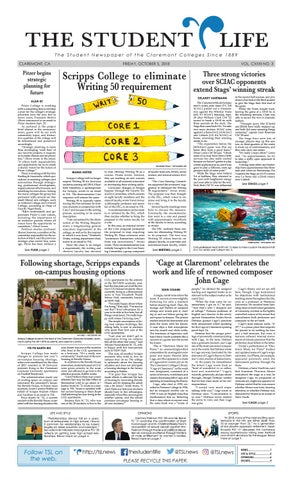
MARIA HEETER Scripps College will no longer require Writing 50 for first-year students starting fall 2019, Elizabeth Hamilton, a spokesperson for Scripps, wrote in an email to TSL. The three-semester Core sequence will remain the same. Writing 50 is typically taken during the first semester by firstyear students in conjunction with Core 1 and focuses on the writing process, according to its course description. “I am devastated by the elimination of the Writing Requirement, a longstanding general education requirement at the college, as well as by the manner in which it was done,” Kimberly Drake, writing department chair, wrote in an email to TSL. Since the class is no longer a requirement, the writing and rhetoric faculty has decided
to stop offering Writing 50 as a course, Drake wrote. Instead, they are working on new courses available to all students interested in developing their writing skills. Curricular changes at Scripps happen through the Faculty Executive Committee, which consists of eight faculty members and the dean of faculty, wrote Yuval Avnur, a philosophy professor and member of the FEC, in an email to TSL. A recommendation can be made to or initiated by the FEC, which then decides whether to bring the proposal to the entire faculty for a vote. In this case, an external review of the Core program prompted the proposal to stop requiring Writing 50. These reviewers were “prominent humanities scholars from top universities,” Avnur wrote. Their recommendation was initially brought to the Core Steering Committee, a group composed
of faculty from arts, letters, social science, and natural science divisions. “The Core Steering Committee supported the reviewers’ suggestion to eliminate the Writing 50 requirement,” Avnur wrote. The proposal was then brought to the FEC, which voted to endorse and bring it to the faculty for a vote. Several faculty meetings were held to discuss the measure. Eventually, the recommendation went to a vote and passed with approximately two-thirds of the faculty in favor, according to Avnur. The FEC outlined three reasons for eliminating Writing 50 in its proposal. The first was Writing 50 relied heavily on adjunct faculty, or part-time and non-tenure-track faculty, which
See WRITING page 2
AMY BEST • THE STUDENT LIFE
Scripps College students who lived at the Claremont Graduate University apartments during the 2017-2018 academic year pose for a photo.
PEI PEI BARTH WU Scripps College has made changes to address last year ’s on-campus housing shortage, when over-enrollment for the class of 2021 resulted in 38 first-year students living in the Claremont Graduate University apartments on Foothill Boulevard. The administration made use of existing space on campus and renovated the president’s house, the Revelle House, to house more students, wrote Carolyn Robles on behalf of Scripps Student Affairs and Facilities in an email to TSL. Priya Kareti SC ’21, a current resident of the Revelle House, is satisfied with her housing situation this
year. Kareti was one of the students who lived at the CGU apartments as a first-year. “It’s a really nice community,” Kareti said of the new housing in Revelle House. In addition to the Revelle House renovation, students housed at CGU were given priority in the room draw and allowed to go first in the selection process, Robles wrote. “I don’t believe there was a more efficient/fair way for [the Office of Residential Life] to go about it,” Justine Iwata SC ’21 wrote in a message to TSL. Iwata is satisfied with her current housing in Mary Routt Hall following her year living in the CGU apartments. Breanna Kim SC ’21, who was one of the 28 students to live in the
LIFE AND STYLE
Follow TSL on the web.
CHRIS NARDI • THE STUDENT LIFE
CMS goalkeeper Noah Smith HM ’22 looks to make a pass in the second half of a 16-6 victory over Caltech Oct. 3.
SEAN OGAMI A single, numb note enters the room. It wavers ever-so-slightly, flickering for only a moment before steadying itself. Then, the twangs and flutters of conjured strings and winds join it, darting in and out before giving the note space to deepen. The pianist reaches inside his instrument and plies the wires with his hands. A man slips a thin microphone into his mouth and clicks wetly. The frontman of legendary rock band Sonic Youth scrabbles like a raccoon at a guitar lain flat across his knees. This is “Electronic Music for Piano,” an unassumingly-titled composition by avant-garde composer and music theorist John Cage, and the capstone to a week of Cage-centric events put on by The Claremont Colleges Library. “Cage at Claremont,” as the week was designated, consisted of a series of lectures, workshops and classes discussing John Cage, and applying or examining his theory. Cage, who died in 1992, enrolled in Pomona College in 1928, but he dropped swiftly out in 1929. It was an English class that disillusioned him so. Believing that a class where everyone read the same book was a “waste of
people,” he shirked the assigned reading and ingested books as irrelevant to the subject matter as he could find. “When the time came for examinations, I got an A,” he said. “And that’s why I dropped out of college.” Pomona professor of English and director of the newly opened Humanities Studio Kevin Dettmar quoted Cage’s anecdote with amusement while speaking for the Cage at Claremont opening panel Sept. 24. Dettmar had the unique privilege of personally communicating with Cage. At the time, Dettmar was a graduate student, and Cage one of the most renowned composers in the world. But Dettmar wrote to Cage anyway, fascinated by the relevance of Cage’s theory to Dettmar’s own studies of James Joyce. At the panel, he remembered the letters Cage wrote back as “kind of wonderful — or rather, kind and wonderful.” Cage’s warmth, generosity, and joy shone through, though Dettmar wishes that he had done more in his correspondence. “I would very much enjoy talking with you,” Cage wrote to Dettmar once. “Conversation is so rare.” Dettmar never steeled the nerve to visit, and then Cage was gone.
OPINIONS
“Relationships always fall on a spectrum of seriousness. In high school, I found it common for relationships to be based largely on close proximity and boredom.” Sex columnist Micaela Macagnone PO ’20 reflects on getting over high school relationships. Read more on page 4.
http://tsl.news
See STAGS page 9
‘Cage at Claremont’ celebrates the work and life of renowned composer John Cage
Following shortage, Scripps expands on-campus housing options CGU apartments for the entirety of the 2017-2018 academic year, had the first pick out of all the former CGU-housed students. She is currently living in a three-person suite in Nan Elizabeth Walsh Schow Hall, commonly known as NEW Hall. “I’m really happy about where I’m living,” Kim said. “I’m kind of sad that I lived off-campus for a year to be able to live here, but all things considered, I’m really happy with where I’m living now.” The simple convenience of living near campus buildings, like dining halls, is new to students who spent their first year at the CGU apartments. “Last year we didn’t get to experience living on campus like all the other first years,” said Miriam Hauer-Jensen SC ’21, who is happy with her four-person suite in NEW Hall. This year, all enrolled Scripps students who wish to live on campus may do so. The college is optimistic about the housing situation and does not anticipate a housing shortage in the future, according to Robles. “I’m glad that Scripps has made efforts to alleviate the lack of housing by renovating Revelle House and by keeping the admit rate a bit lower,” wrote Iwata. “I don’t think any first-year students should have to live off-campus, especially when they are not given another option, and the school promises on-campus housing to all new students.”
The Claremont-Mudd-Scripps men’s water polo team (7-1, 6-0 SCIAC) pulled out a dramatic win against the Whittier Poets (4-8, 2-1 SCIAC) Saturday, Sept. 29 after William Clark CM ’22 scored to break a 10-10 tie with three seconds on the clock. The Stags then came back Oct. 3 to take two more decisive SCIAC wins against La Verne (3-12, 2-3 SCIAC) and Caltech (1-9, 0-4 SCIAC) at home, extending their winning streak to six. “The expectation before the [Whittier] game was that we knew they were a good team,” Ethan Lewis CM ’20 said. “I think some of us may have been a little nervous but also really excited because we haven’t gotten to play a team as physical as us, and it was good to play a different, more aggressive style of water polo.” While the Stags were behind 5-4 at halftime, they returned to the pool with heightened energy and were able to rally for the win. Nick Britt CM ’21 was influential
in the second half success, and produced a hat trick in the third quarter to give the Stags their first lead of the game. While the Poets fought back, leaving the game at a 10-10 tie in the remaining minutes, Clark was able to secure the win in dramatic fashion. “Younger guys like [Clark] and [Britt] have really stepped up, and both did some amazing things yesterday,” captain Zack Rossman CM ’20 said. The Stags have seen lots of younger players step up this season, as three-quarters of the roster is made up of underclassmen, and they only carry one senior. “It’s really a team effort,” Lewis said. “As upperclassmen, we try to take a really open approach to leadership.” A strong team effort and leadership from upperclassmen like Rossman and Lewis on Wednesday, Oct 3 earned the Stags an (11-7) victory over La Verne and a (16-6) victory over Caltech.
See CAGE page 3
SPORTS
Zachary Freiman PO ’20 and Lily Borak PZ ’21 examine the confirmation of Brett Kavanaugh and Dr. Christine Blasey Ford’s accusation of sexual assault against him: Freiman through the lens of political discussion on campus and Borak through the lens of male entitlement to women’s bodies. Read more on page 7.
thestudentlife
Cage’s theory and art are still here, though. Cage maintained his objections with institutional teaching styles throughout his life, even as a professor at Wesleyan University. He recoiled from lionizing ideas of individual greatness of virtuosity, evident in the tightly controlled nature of his music that subordinates both performer and composer to the art itself. Cage’s most famous work, “4’ 33”,” is a piano piece that requires the pianist to do nothing for four and a half minutes. But even it features unheard internal movements of minute precision that the performer must follow to the letter. Friday’s performance of “Electronic Music for Piano” bucked and updated some of Cage’s original intent. An iPhone, for example, appeared pointedly amid the instruments partway through the show. Dettmar, a Sonic Youth fan, said that frontman Thurston Moore centralized the stage in a way he imagined Cage, no proponent of virtuosic art, might not approve of. Dettmar added that he was unsure whether Moore was truly drawing attention, or whether Dettmar was distracted by Moore as an avatar of Sonic Youth.
@TSLnews
PLEASE RECYCLE THIS PAPER.
“In 2018, many of the most exciting quarterbacks in the NFL are either older than 35 or younger than 25.” As a generation of star players approach retirement, Noah Shapiro PO ’21 discusses the numerous young quarterbacks taking over football and what it all means for the league. Read more on page 9.
@TSLnews
NEWS................................1 LIFE & STYLE.....................3 OPINIONS........................6 SPORTS.............................9
NEWS PAGE 2
WRITING: Not all faculty support removal of Writing 50 Continued from Page 1 is “economically exploitative,” according to the report. The heavy reliance on adjunct faculty also “significantly increases the ratio of courses taught by non-full-time faculty at Scripps,” which negatively impacts Scripps’ national standing, the committee wrote in the proposal. There is uncertainty on the standing of the Writing 50 adjunct faculty and if any will be fired as a result. “We don’t know absolutely what will happen to all of the Writing 50 adjunct faculty,” said Glenn Simshaw, assistant professor of writing and director of the Writing Center. The second reason outlined was the time commitment required to take both the Core sequence and Writing 50 — a total of four courses, equivalent to an entire semester’s workload. The proposal specifically stressed the burden on science majors, who “are at a particular disadvantage because they cannot start a sequential course of study in their first semester,” according to the proposal. “[This] can place Scripps students a year behind those from the other Claremont Colleges pursuing the same major.” The third reason outlined was the cost of hiring adjunct faculty to teach Writing 50 classes. The proposal states that the elimination of Writing 50 would potentially provide more funding to the writ-
ing department at Scripps, and that the dean of faculty had agreed to reallocate a portion of the funds used for Writing 50 accordingly. The fourth and final reason in the proposal advocating for the removal of Writing 50 was the curricular overlap between Writing 50 and the Core program. The FEC committee wrote in the statement that “the quantity of required writing in the Core Program is already high, and it would be wise to focus on the quality of instruction to ensure that writing is taught responsibly and effectively, both in Core and throughout the curriculum, rather than continuing to require additional writing courses.” Corie Astroth SC ’21 agreed that there is an overlap between Writing 50 and Core 1. “In my experience, I felt like the objectives of both [Writing 50 and Core 1] were very similar,” Astroth said. “I will say I think I had more helpful feedback in my Writing 50 class than I did in my Core 1 class, but I think that was due to the professor and not the course itself.” Several faculty expressed concerns with the results of the proposal as well as the way the proposal was initiated. “The reasons noted in the proposal, including that adjunct instructors lower the college’s national standing and that the college has too many GE requirements, could have been addressed and resolved in a number of different ways, but we were only presented
with one proposal that came out of a Core review,” Drake wrote. “Given the importance of writing in our students’ college careers, the process of rethinking the Writing Requirement should have included a much more lengthy and thorough discussion, one involving the input of all parties concerned,” she added. Drake wrote that the Director of the Writing Program was not a member of either the Core review committee or the FEC, and had no input on the proposal to cut Writing 50. Faculty and students also expressed concerns with the loss of the specific writing instruction offered in Writing 50. “One argument [against the proposal] was that the composition instruction in Writing 50 differs from, and can’t be replaced by, that in Core,” Simshaw wrote. “Another was that the requirement was being eliminated without a plan to replace it.” Lianne Sturgeon SC ’19 said Writing 50 helped her transition from high school to college writing. “[In] Core, you just hit the ground running; they don’t give you as much support,” Sturgeon said. “But [in] Writing 50, you take everything step-by-step.” Kang was unable to comment at this time on what changes will be implemented to the Core curriculum. The faculty are currently discussing what additions will be made to the Core curriculum, and the changes will be finalized in the spring.
Clery reports show overall increase in reported sexual violence at the 5Cs ELINOR ASPEGREN CW: sexual violence, sexual assault The Claremont Colleges released their 2018 Clery Reports on crime Oct. 1, which indicated, among other statistics, an increase in reported cases of sexual violence at Pitzer College, Harvey Mudd College, and Scripps College. Pomona College’s former Title IX Coordinator Daren Mooko explained in 2016 that an increase in reported assaults is not inherently negative. In fact, when the number
OCTOBER 5, 2018
THE STUDENT LIFE
of reported cases went down at Pomona in 2015, Mooko expressed concerns. “I think we need to look at that number very critically and not jump to the conclusion that the actual number of assaults went down on campus, but rather that the number of people who’ve come forward to make a report went down,” Mooko said in 2016. “It’s that latter dynamic that’s concerning to us.” Every college in the United States that receives federal financial aid is mandated by the Clery
Act to compile and release an annual campus security report detailing the numbers of certain types of crimes reported to the college during each calendar year. Across the 5Cs, 30 rapes and 11 cases of fondling — nonconsensual touching — were reported in 2017. The Clery Reports also indicate there were 30 burglaries, nine motor vehicle thefts, four instances of dating violence, and seven incidents of stalking reported at the 5Cs in 2017.
In Memoriam: Professor Arthur ‘Art’ Horowitz
HAIDEE CLAUER
Arthur “Art” Horowitz, a professor of theater at Pomona College who taught for over 14 years, died suddenly June 16 while on sabbatical in New Orleans. “The loss has been vast,” said Theater Department Program Administrator Cathy Seaman. “I’m still trying to grasp it. I still think I’m going to hear him come through the door with his great, ‘Hi. How’re you doing? How’s life?’ [He always] want[ed] to put forth his very best. When he was here, he was here.” After graduating from Hofstra University, Horowitz taught high school English classes for 20 years. He then got his doctorate at the University of California, Davis, in 1997. Before coming to Pomona in 2004, Horowitz taught at several California universities. “When he asked about something, he meant it,” Administrative Assistant of Theatre Mary Rosier said. “He just had a true, genuine care [...] And [he] was like that with the students — he would take a deep personal interest in them, even outside college.” As early as his first year in Pomona’s theater department, Horowitz manifested his creativity in several plays, including a production of Michael Frayn’s “Copenhagen,” about WWII nuclear physicists and performed inside of Millikan Laboratory’s physics auditorium. He also directed the production of Martin McDonagh’s “The Pillowman,” a dark comedy about an interrogation room set in a storage room in the basement of Harwood Court. Christina Hurtado-Pierson PO ’06, now a theater professor at Pomona, was one of Horowitz’s students. She praised his dedication to helping students apply for graduate schools and fellowships. “He was convinced he was teaching the next generation of leaders and geniuses,” she said. “He really went above and beyond to connect students to work that would inspire them, to people in the field to talk to, just to tell you that he believed that the work you were doing as an artist was valid and important.” An expert in classics, Horowitz was awarded a grant from the Folger Institute for Shakespeare Studies National Endowment for the Humanities Institute Project in 2011 to study international interpretations of Shakespeare. Horowitz had a passion for “the value of interpretation and cross-cultural interpretations,” according to Hurtado-Pierson. He was a dramaturge who loved piecing together the social and historical backgrounds for both classical and developing plays
CMC alumna talks partisanship, journalism, and Trump era at Athenaeum BECKY HOVING When Tina Nguyen CM ’11 applied for her job at Vanity Fair, she did not network or flood Human Resources with messages. She was not even responding to a job posting. Instead, she drafted a cold email, erased half her resume, and pressed “send.” Nguyen, who served as news editor for the Claremont Independent and a fellow at the Henry Salvatori Center for the Study of Individual Freedom in the Modern World, admitted that landing a job at Vanity Fair just a few years out of college was equally unexpected as it was out of character. She recounted her story to a full house at the Marian Miner Cook Athenaeum Sept. 27. “It is stunning to me and virtually everyone I’ve ever talked to that I ended up at Vanity Fair — of all places,” she said. Before assuming her current position at VF, Nguyen tried her hand at a number of conservative media outlets, making something of a name for herself among the rightwing circles. “When I was in college, I actually smoked cigars with Andrew Breitbart once,” Nguyen said. The crowd erupted in laughter. After graduation, Nguyen worked for the Daily Caller, The Franklin Center, Mediaite, The Braiser, and one she describes as a “defunct paper based out of Colorado that asked [me] to write hit pieces on Democratic candidates.” She quit after a week. That being said, Nguyen admitted she does not generally agree with right-wing media organizations. “I can’t take much of an opinion anymore,” Nguyen said. “The best way to describe it is that my impulse to describe [Trump’s America] overrides any sort of feeling I have to agree with [the right wing], or disagree.” However, Nguyen said her time spent reporting for right-wing
about how to navigate today’s political climate. Josiah Tarrant CM ’22, who has a background in student journalism, attended the talk and hoped to learn from an expert in the field. However, Tarrant said he wished Nyugen focused more on discussing the future of journalism. “I saw Tina speak because
“
I became [Vanity Fair’s] conservative whisperer. I am something of a safari guide to the right. - Tina Nguyen CM ’11
PHOTO COURTESY OF VANITY FAIR
Last week at the Athenaeum, Tina Nguyen CM ’11 spoke about journalism, partisanship, and reporting in the Trump era.
media organizations situated her to be more apt to write coverage of the Trump administration that she believes distinguishes herself in a unique way. “I was able to describe [Trump’s America] in a way that a lot of my peers, who came up through mainstream publications, just can’t,” Nguyen said. As Trump’s candidacy and, ultimately, presidency, leapt onto the forefront of the 24-hour news cycle, Nguyen used the background she had from right-wing publications to inform both her editors and her readers through her reporting at VF. “I became [Vanity Fair’s] conservative whisperer,” she said. “I am something of a safari guide to
the right.” In reference to her transition between the right-wing media world and a mainstream publication, Nguyen said she was not upfront about her previous journalism experience during the hiring process at VF. However, with time, her editors learned of her experience and grew to see her background as an invaluable asset to covering the Trump administration. “I was lucky that when [Vanity Fair editors] found out, they saw it as an asset and not as a reflection of who I was,” Nguyen said. With the element of partisanship weighing so heavily on journalism in the Trump era, many students peppered Nyugen with questions
”
journalism has gotten a lot of backlash in the current political environment, and I wanted to hear a current journalist’s take on it,” Tarrant said. Tova Cohen SC ’20, who attended the talk for her Post Holocaust Response Theory class, similarly hoped for a call to action from Nguyen’s presentation. “I really think that the young people in this country are the ones who are gowing to make lasting change, but we need guidance from somebody who has some experience in the political arena,” Cohen said. “I would have loved to have heard just how we can start making these changes.” In response to student commentary and requests for advice after she finished her presentation, Nguyen said she could not speak for the political journalism climate that current students may enter upon graduation. “I was not about to enter a giant hell arena when I was your age,” Nguyen said.
COURTESY OF POMONA COLLEGE
Arthur Horowitz, a professor of theatre at Pomona, passed away in New Orleans June 16, at the age of 73.
“
He left an indelible mark on my life. He never failed to lift me up when I needed it, and did so with a smile and a laugh. - Oliver Shirley PO ’15
”
within the Claremont Colleges, Los Angeles, and Pasadena communities, Hurtado-Pierson said. “A light was flipped on when he interacted with students — [they] immediately engaged,” said Seaman, the theater department administrator. “The excitement carried through so that they could believe themselves indomitable. They could do anything. He was an advocate for the students, he was a mentor, he was a friend, and they were simply mesmerized.” Oliver Shirley PO ’15 acted under Horowitz’s direction in a 2014 production of Anton Chekhov’s “Uncle Vanya.”
“He left an indelible mark on my life,” Shirley wrote in a message to TSL. “He never failed to lift me up when I needed it, and did so with a smile and a laugh. He will be greatly missed.” Before his death, Horowitz was writing a book about the renowned playwrights Chekhov and Carlo Goldoni. He also wrote in several journals and published a book, “Prospero’s ‘True Preservers’: Peter Brook, Yukio Ninagawa, and Giorgio Strehler — Twentieth-Century Directors Approach Shakespeare’s The Tempest.” “I’ve known him for 14 years, and the worst thing I’ve ever heard him say was, ‘Somebody learned a lot this semester and grew,’” HurtadoPierson said. “He believed so much in the potential of his students, and he made it known: ‘Theater needs your voice’ [...] Especially for women artists and people of color, whose voices have so long been silenced.” Hurtado-Pierson continued, “The hardest part of losing him is that the one person who, throughout my career, always believed in me, is gone.” A memorial service for Horowitz, which will include time for friends and family to share words and memories, will be held Dec. 1 at 1:30 p.m. at Pomona’s Seaver Theater.
PLAN: Pitzer hires outside firm to help set priorities Continued from Page 1 strategic plan since then. “But it’s important when you’re making decisions about the direction of the college to have something in mind beyond just maintaining the status quo,” Snowiss said. In this interim between strategic plans, the college still had a master plan that focused on streamlining the accessibility of the college’s campus and facilities. Pitzer Chief of Staff Jamie Jorgensen wrote in an email to TSL that a new strategic plan is being worked on “to ensure that the college is aligned with its core values and future potential.” The upcoming changes to the strategic plan are a response meant to reflect the college’s evolution as an institution. “The college has changed a lot over the last 10 or 20 years,” Boyle said. “The admit rate has fallen dramatically. There’s a mix of student interests now. About a quarter of our students are STEM majors. And the faculty have changed.” Pitzer aims to finish the strategic plan and develop an implementation plan by the end of this academic year, so they can begin executing their strategic initiatives in fall 2019, according to Oliver, who characterized the timeline as “ambitious.” In September 2017, Pitzer faculty held a retreat, during which the topics of financial aid and economic sustainability were discussed. “Pitzer doesn’t have the endowment to support the sort of financial aid that we would want,” Boyle said. “If we had more money, we could offer
more financial aid to the sorts of students we want to attract. ... Rather than trying to do lots of new flashy initiatives, it’s about how we can sustainably maintain what the college has done.” One of the changes put forth by the new strategic planning model is platforms for student input. Boyle said there will be an eight-person strategic planning committee consisting of “two students, two faculty, two staff, and two trustees.” The students who will take part in the committee are Brendan Schultz PZ ’19 and Matthew Brunstad PZ ’20. “Working groups are going to be built on our existing governance system where there is student representation,” Boyle said. “One of the working groups is going to be on the academic program, on which there are four faculty and four students, so students will be fully represented.” While the role of Pitzer students has been finalized, the “intercollegiate role” has not, according to Boyle. “We’ve got lots of students from across the 5Cs who are not just taking classes here, but they’re [majoring at] Pitzer,” Boyle said. “[These] students would have a legitimate interest in Pitzer’s strategic orientation.” Boyle brought up the example of Pitzer’s Organizational Studies department, a Pitzer major popular among students from the other 4Cs, as one such area where non-Pitzer students “should have a voice.” Oliver encouraged students to be involved in the process. “The success of our strategic planning depends on our whole community being engaged, and I urge all of you to join in the process,” he wrote.
LIFE & STYLE OCTOBER 5, 2018
PAGE 3
THE STUDENT LIFE
SCIENCE COLUMN
Is ‘Pseudonocardia’ the next superhero? CAITLYN FICK At the W.M. Keck Science Department, professor Ethan Van Arnam’s lab is working with real-life superheroes. Located on the second floor in a newly remodeled lab, members of this group work with leaf-cutter ants. While these insects might not seem particularly exciting, the bacteria that grows on their backs are actual superheroes. The bacteria create their own antibody that help the ants defend themselves. “[The ants] need antibiotics to help fight off diseases, and the bacteria are right there producing them for the ants,” Van Arnam said. This mechanism, where bacteria help an organism defend itself, is defined as defensive symbiosis and has been found in many other systems, including other insects and plants. Working with ants is new to Keck, as Van Arnam, a chemical ecologist, just started teaching in Claremont last fall. He said that “starting a lab from scratch is a real undertaking.” Even though the lab has only been working for a year, they have already started characterizing properties of a new antibody that they believe is entirely unique. The lab has been working earnestly on this part of the project, which has large implications for the world of medicine. “What I like about [the project] is how close the parallel is to human medicine,” Van Arnam said. “It’s pretty directly analogous to what the ants are doing.” When discussing this project’s relation to the medical and pharmaceutical fields, both Rose Kim PZ ’21 and Krithika Rao SC ’19, other members of the lab, mentioned that antibiotic resistance is a large problem in the world today. “[For] every single antibiotic that is currently used in medicine, we’ve
been able to find bacterial pathogens that are resistant to those antibiotics,” Rao said. Thus, it is becoming more and more important to find new antibiotics that can fight off infections. Additionally, Van Arnam noted there is a desperate need for more antibiotics. “Antibiotic resistance is constantly rising in bacteria that infect people, and as a result, the antibiotics that we have lose their usefulness over time,” he said.
The idea behind the lab is that by learning more about how these antibiotics function in nature, there is the potential to learn more about how they could be applied to medicine. This idea of looking at nature, particularly bacteria, as educators is one that Van Arnam believes is very useful. “We have a lot to learn about chemistry from bacteria,” he said. “Bacteria have been synthesizing really complex molecules, which
include antibiotics … for hundreds of millions of years at least.” Bacteria have become experts at creating potent antibiotics, and by looking to them as chemical superheroes and teachers, researchers can learn more about how they actually create these desirable molecules. Caitlyn Fick is a chemistry major at Scripps College. She enjoys mountains, trees, water, and dogs.
JULIA READ • THE STUDENT LIFE
CAGE: Former Pomona student’s legacy lives on Continued from Page 1 Nathan Freide PO ’22, a Sonic Youth (and John Cage) fan, agreed that he paid somewhat more attention to Moore than the other musicians — in fact, he attended the concert for Moore — but not so much that he felt distracted from the concert as a whole, which he loved. “I think pretty much everyone has the same experience with John Cage,” Freide said. “They hear about 4’ 33”, they say ‘this can’t possibly be real,’ and then [slowly come] to terms with the fact that 4’ 33” is a real piece of music.” Ably listing off scores of postmodernist contemporaries and counterparts to Cage, Freide said, “I don’t think Cage is by any means accessible, but I do feel that his music is accepting to the naïve approacher.” That said, some approaches may be too naïve. During the concert, one man departed about 40 minutes through with his elementary-age daughter in tow. Freide also mused that much of the value in Cage’s music comes from the theory it enacts. “Electronic Music for Piano,” for example, was born by placing musical bars across a sheet of cheap typing paper to turn spots of wood pulp into notes. On aesthetics alone, however, his work may seem more challenging than welcoming. Or, in the words of one Pomona sophomore who attended, “What fresh hell is this?” The weeklong celebration of Cage seems nearly oxymoronic in light of Cage’s postmodern philosophy and his abbreviated time spent in Claremont. “It’s kinda curious the interest the college
PHOTO COURTESY OF WIKI COMMONS
John Cage, a former Pomona College student, had his work celebrated at ‘Cage at Claremont’ last week.
takes in a dropout,” Dettmar said in an interview with TSL. “I mean, he didn’t find what he needed here, and he left.” Dettmar noted that Pomona College Magazine refers to Cage as “John Cage PO-32,” tying him to the graduating year of the class he dropped out of. Ultimately, however, Dettmar praised the impact of the week’s events. “I love the small scale [of Pomona], and I love that we stay connected to people who have come through here,” he said. Pomona’s eagerness to celebrate Cage — a posthumous and perhaps unrequited love — has had a concrete upshot. Cage at Claremont illuminated a fascinating thinker and artist whose relationship with Pomona could perhaps continue to guide the future of the institution.
Claremont’s new bakery is the Crème of the crop STEPHANIE DU On Sept. 19, a new bakery called Crème Bakery opened its doors to the Claremont public. Located on Harvard Ave in the Village, it is a short walk and definitely a must try. When I walked in, I felt like I was transported to a bakery in Europe. Fresh pastries and other baked goods were arranged aesthetically behind pristine glass displays. Large loaves of freshly baked bread — from walnut wheat to brioche to rosemary sour-
“
I wouldn’t make something that wasn’t delicious.
“
- Erica Hartig Dubreuil
dough — lined the tall shelves. The skylight, marble counter, orchids, and ornate gold frames contributed to a chic and modern look. However, the peacock blue ‘baguette’ seating gave the whole bakery a more intimate feel. Erica Hartig Dubreuil is the owner of Crème Bakery. With her family having been in town for generations, she wanted to open up a bakery in Claremont because
she believed it had the “type of energy” where “people go walk, visit, live, and shop.” As a firm believer in the providing the best ingredients and products, she ensures all the products in the bakery are baked fresh daily. “I want to make sure that we [can] offer very high quality items at a fair retail price, covering a spectrum of food that children through seniors would enjoy, something as simple as a chocolate chip cookie, to an elegant croissant,” Dubreuil said. Dubreuil added that the croissant line is intended to be authentic to Paris. “I definitely think that the croissant line we have is extraordinary,” she said. “We make our dough from scratch everyday, and you don’t see that in most of the small shops here.” I tried the almond croissant. It was golden brown and sprinkled generously with almonds and powdered sugar. I could hear the crunch as I bit in. Like Dubreuil had promised, the croissant was scrumptious. It was buttery, wondrously flaky, and had sweet and fragrant notes of almond. During our interview, Dubreuil mentioned she had been working on a vegan chocolate chip cookie, and had whipped up the perfect batch. Curious, I tried it and loved every bite of it. As a huge chocolate chip cookie aficionada, it had everything I
looked for: crisp on the outside, chewy on the inside, and gooey chocolate chips all around. When asked about other vegan products, Dubreuil pointed me to the line of vegan muffins available. She also said that the Crème team was working on expanding
CHLOE ORTIZ • THE STUDENT LIFE
The new Claremont Crème Bakery sells fresh pastries, breads, and other baked goods.
the line for vegan baked goods, including items like a vegan biscuit. Of course, I also had to try the regular chocolate chip cookie. I simply could not resist the giant cookie almost as big as my face. Unlike a lot of bakery cookies, this one was thin and crispy. It melted right in my mouth with heavenly notes of butter and sugar. Although delicious, I honestly preferred the vegan option. The apricot danish was something Dubreuil highly recommended. It is one of her favorite pastries. It has a flaky croissant base filled with slightly sweetened cream cheese and a juicy apricot in the center. It is definitely one worth sampling. Dubreuil is excited for Crème’s future. She grew up loving to share good food with people, and that has extended into her professional life. She hopes the bakery will run for the next 30 years or so, and promises that the bakery will continue to create new, tasty pastries. “I wouldn’t make something that wasn’t delicious,” Dubreuil said.
CHLOE ORTIZ • THE STUDENT LIFE
(Top) Crème Bakery owner Erica Hartig Dubreuil opened her new Claremont shop Sept. 19. (Bottom) Cinnamon rolls sit on a shelf at Crème Bakery.
LIFE & STYLE OCTOBER 5, 2018
THE STUDENT LIFE
PAGE 4 SEX COLUMN
MICAELA MACAGNONE CW: mentions of disease/illness, verbal abuse, and drug usage. In my first year at Pomona College, I would sob on every flight from New York City to Claremont. Each minute that passed ripped me further and further away from someone who I felt I could not exist without. Three years later, the same flight from JFK to LAX no longer fills me with panic, but instead overwhelmingly with relief and comfort. Relationships always fall on a spectrum of seriousness. In high school, I found it common for relationships to be based largely on close proximity and boredom. Others, like mine, were more serious, and therefore particularly challenging to extricate from because the relationships were so closely linked with personal, cultivated identities. A great amount of self-development takes place in high school. In adolescent developmental research compiled by the Konopka Institute at the University of Minnesota, two of the major changes cited in regard to late adolescence are: 1) “defining a personal sense of identity,” that is more than just an extension of one’s parents’ identities, and 2) “adopting a personal value system.” Most of my friends spent their solitary leisure time developing that identity: putting together their repertoire of interests and figuring out what they cared about. Because I spent a huge amount of my non-social ‘alone’ time with the boy I dated in high school, my interests and abstract thoughts were incredibly linked to him. One arrives at college with an identity they’ve created and developed. What happens, then, if your identity is based largely on someone who is not around? I ‘broke up’ with my high school boyfriend the night before I came to Pomona. Our relationship, which had already been problematic, escalated into a catastrophe in the months that would follow. For much of my freshmen year, I did not think I was ever going to feel better. I cried so often that my face stopped looking different after crying. Though everyone told me I would get over it, I did not believe them. Because my relationship was so interdependent, I was sure it would be the exception to the typical ‘get over it and move on’ narrative.
Really, ‘You’ll get over it’ Part of this codependency came from my experience with a lot of hardships in late high school, where I felt he was the way I got through it all. In senior year alone, I got semievicted; my loose cannon sister had a baby, her boyfriend overdosed and died a few days later; and my father was first diagnosed with cancer. This was all just on top of my typical daily travails: financial insecurity, witnessing verbal abuse between my parents on a weekly basis, along with my own personal emotional woes, from body image problems to social anxiety and college applications. Because I went to a small high school, and everyone’s personal information was on blast 99 percent of the time, I had a lot of support. However, the support received from the boy I was dating was somehow different and profound to me. Perhaps this is because no matter how horrific I was feeling, his presence was legitimately always uplifting. Our relationship was also a symbol of hope to me. If I was with him, I would surely get out of my current conditions and live a life that was happy, motivated, and normal. When I was dating him, I had no doubt that I would eventually move past my present emotional hardships. When I got to college and we began speaking less, suddenly, the doubt that I would eventually feel better enveloped my entire being. I cried all the time for a lot of reasons: because I missed having him around, because we fought over the phone constantly, because I was jealous. However, my biggest cause of tears was a fear that I would never feel better. My intense fear was unnecessary. No matter the circumstances of the relationship, with effort, anyone can get over any kind of break up. I’ll illustrate. In my first year at college, my biggest fear in all of life was that he would get a girlfriend. I could not fathom something that could make me feel worse. Though that is obviously delusional, I mention it to express just how tethered I was to him. This past July, he finally did. At that time, we were back to talking, and had been going back and forth for months about possibly getting back together. Receiving that news from him, and learning that he had been hooking up with this other girl all summer
NINA POTISCHMAN • THE STUDENT LIFE
(and probably prior to the summer as well), was my biggest fear realized. I had pre-existing plans to hang out with another boy the night I found out. I was unsure about going because I felt upset, but I ultimately went. On the train ride to this person’s apartment, I definitely felt emotional, but I also felt overwhelmingly free. Because the exboyfriend’s attainment of a new girlfriend was so next-level terrible to me, I, for the first time, no longer wanted anything to do with him. An experience that I had for so long assumed would be my downfall actually felt good. Though I am definitely not prescribing hooking up with someone the same day you get pseudo-broken-up with (again), I was fortunate that the subsequent time spent with the apartment boy was pleasant.
The following morning I was lucky enough to go back to a job I loved, where I socialized with people that made me feel good about myself, and appreciated every day of my summer break. I certainly cried here and there, but I was absolutely not heartbroken all over again. In the past three years, my feelings toward my high school boyfriend have fluctuated dramatically. There have been weeks when I cried to Drake on a daily basis, to weeks when I focused entirely on other relationships, and to weeks when I thought only of myself. Throughout this time, I came to appreciate the people who filled the space he left. Though I valued my friendships during high school, it was not until I was alone that I was able to fully value my friends. I came to also appreciate the people I hooked up with, because each
one exposed me to a new, positive experience that I had not known existed prior. For example, one of the people I hooked up with toward the end of my first year was interested in me at a time when I was quite sad and had zero self-esteem. Not only did I appreciate him for being interested in me when I felt like no one else was, he was also free in his expressions of affection and care, teaching me to give and to expect such things. Similarly, over the summer I had a gigantic crush on someone I worked with. He gave me nearconstant attention, but made it clear that nothing was going to happen because he was significantly older than me. His clarity allowed me to have a crush that, for the first time, did not make me miserable. Over the summer, I cared about
myself and my friends. I looked forward to going to work because he would flirt with me, but was not heartbroken at the end of the summer when nothing actualized. I learned that I could be interested in someone without it occupying my mind constantly. On the flight back out to Pomona this year, I ate a bag of SunChips while laughing out loud at “Rampage.” Wherever you are at in your relationships, I urge you to do what you want and what feels right to you. If things are not working out the way you would like them to, just keep me in mind. If I could get over it, you will too. Micaela Macagnone is a third year at Pomona College majoring in international relations. She is from New York City, and misses bacon egg and cheese sandwiches everyday.
STUDY ABROAD COLUMN
‘Are classes abroad really easier than the 5Cs?’ MARC ROD “Classes are so much easier abroad!” This is a common refrain from students recently returning to campus after studying abroad, and is perhaps one of the most consistent observations among them. But is it true? Not exactly. A l t h o u g h m y p r o g r a m ’s schedule requirements limit the amount of free time I have for homework and other activities, this situation is mostly unique, and I have found that the amount of work assigned for each class is often less than at the 5Cs. However, classes abroad involve new and distinct obstacles which have, in some ways, made them more challenging. Instruction abroad, particularly in Europe, is generally more lecture-based than at American liberal arts colleges. Even in my program, which holds its own courses independent of any local university, the teaching style is vastly different. While some professors attempt to engage students by posing factual questions about discrete points in readings, I have had many course sessions that consisted of 90 minutes of uninterrupted lecturing. Some students may enjoy this, but I personally prefer active learning and discussion — one of the reasons I chose to attend Pomona College. While listening and taking notes, rather than engaging my critical analysis skills regularly in the classroom, may sound
like less effort, adjusting to a new lecture-based style of learning is also difficult. Staying focused through a 90-minute lecture is a challenge. At the 5Cs, discussing and analysing material with my peers and professors helped me understand and absorb it. The lack of opportunities to do so abroad has often made classes in Germany harder. Add on my professors’ thick accents and occasional gaps in English proficiency, and remaining engaged becomes even more arduous. Even when professors hold class discussions, the change in format can make them more challenging. They usually do not participate in or facilitate the conversation. Additionally, my classmates come from a wide variety of colleges and universities across the United States, some of which emphasize lecture over discussion. This makes some of them — through no fault of their own — more hesitant to participate. These factors combined can make discussions less fruitful than an average class discussion at the 5Cs. The heavy lecturing and lack of significant class discussions has, however, pushed me to contribute more in class when given the opportunity, and do more critical thinking on my own. It has also been more difficult to find help from professors, even outside of classes. At the 5Cs, I greatly value the amount of engagement I am able to have with professors as well as their willingness to meet with me and discuss topics from class. Their
thoughts on my personal work and performance have always improved my academic experience. Here, none of my professors offer open office hours. They will occasionally arrange time to meet with students, but usually have limited availability. This lack of engagement has been a challenge, which in turn has forced me to become more academically selfreliant. Exposing myself to different forms of learning and instruction is by no means negative. Nor are additional obstacles in the classroom inherently bad. Both factors have forced me to think and absorb information in different ways. These experiences add to my analytic and academic toolbox, which will serve me well both back at the 5Cs and in the future. However, becoming accustomed to these changes does take time and effort. It can be exhausting and, at times, frustrating or disappointing. Even when the out-of-class workload is smaller, study abroad can require additional work within the classroom. Students going abroad — many of whom, like me, chose the 5Cs at least in part because of their liberal arts focus — should be cognisant of the academic differences they will face and prepare for them accordingly, rather than expecting an effortless semester. Marc Rod is an international relations major at Pomona College, studying the European Union in Freiburg, Germany. Fittingly, he enjoys travel and journalism.
HOUSE CLEANER / HOUSEKEEPER URGENTLY NEEDED This will be a part time, live-out position from Tuesday to Friday. The position includes childcare and light housekeeping Must be able to interact with children Speak English, and non smoker $800 weekly, 6 to 7 hours daily MUST HAVE REFERENCES You can reach Mrs. Claudia at claudiapredacoop1960@gmail.com
LIFE & STYLE OCTOBER 5, 2018 MUSIC COLUMN
BOOK COLUMN
Felly matures and streamlines work in latest release ELLA BOYD Although “Surf Trap” is the first album for Felly under a major record label, he does not reinvent himself in his latest release, but rather matures as an artist while keeping the fun, youthful elements of his music alive. “Surf Trap” is a compilation that proves Felly knows himself, knows his audience, and knows that he’s doing what he loves. This is precisely why the album is so contagious and versatile, even though the sound remains relatively consistent from song to song. The opening track, “Dying To Tell You,” is filled with quintessential elements of Felly’s persona and sets the tone for the rest of his album. Filled with lyrical bits about love (while still bragging about the attention he receives from women), “Dying To Tell You” is Felly’s ultimate confession that fame has not changed him. If anything, Felly’s new success allows him a more streamlined and polished production for the same music he’s always created. Felly began releasing music in 2011 while still in high school, growing a fanbase through YouTube and eventually touring the United States. Though he hails from Connecticut, he attended the University of Southern California (and yes, he did finish school before focusing solely on his music career). Historically, Felly’s sound has been laid-back: a mix of trap,
jazz, and light guitar, with (usually) upbeat lyrics about being young and enjoying life. The visual aesthetic of “Surf Trap” is much like its sound: a carefully crafted, well-thought-out piece masked by a veneer of fun, energetic, seemingly uncaring effort. The retro album art for “Surf Trap” depicts Felly on a tropical beach, dressed as the grim reaper, staring blankly into the camera. This is very much the ‘cool kid’ vibe of today: not so invested as to seem straightforwardly cool, but cool enough to still score points for style and color choices that make up a theme (for Felly, this is a faded mint green and washed out blue, both of which fill his website from font to background). Also noteworthy is the inability to read Felly’s facial expression on the cover: his unkempt, curly hair blows to the side, keeping a vagueness about him. “Surf Trap” is the latest addition to a fairly large discography: Felly has released 12 albums and numerous singles. Some of these albums are more roughly compiled than others, but even so, there have been many years in which Felly released more than one album in the same year. “Surf Trap” is more energetic and more streamlined than his older releases. There are no songs on “Surf Trap” that feel incomplete, but there is also less of a sense of personal communication and connection to Felly himself. The album feels best suited to fun, relaxed
DIAMOND PHAM • THE STUDENT LIFE
Ella Boyd is a first-year from Maine who attends Scripps College. She traded alpine skiing for writing for the student paper, and enjoys creating art through film, music, and poetry.
COURTESY OF @FELLY ON INSTAGRAM
The album cover of Felly’s latest release, “Surf Trap.”
BEN HAFETZ There are films that are great because they challenge the audience, develop fully three-dimensional characters, and are remarkably crafted. Then there are films that are great because they are dripping in absolute style. Panos Cosmatos’ sophomore film “Mandy” is the latter. “Mandy” follows Red (Nicolas Cage) as he resorts to extreme acts of violence to avenge the murder of his girlfriend, Mandy (Andrea Riseborough), by a demonic cult led by Jeremiah Sand (Linus Roache). As simple as the plot of the film is, the various vignettes of violence and absurdity are so captivating that they hold the audience’s attention throughout the film. These moments includes things like The Cheddar Goblin, Nicholas Cage snorting a Scarface-level amount of cocaine after decapitating a demon biker, an extended drug trip sequence, and a chainsaw fight. These unmistakably unique and incredible moments are caught by Cosmatos’ grandiose camera that paints the film’s visuals in a sea of crimson and purple, giving the film a pulpy feel I have
Let the brows run wild: a defense of lowbrow literature
situations like driving with the windows down or hanging out with friends. In the same song where Felly alludes to getting “played [by a girl] like the Migos,” Felly sings “don’t go catchin’ feelings, I’m already emo,” communicating, maybe, that he is ready to shed his more transparent self and become his own idea of a star, almost as if he is stepping more into a famous character and out of his old ‘normal’ self. Stardom, for Felly, began the day he signed to Sony Entertainment. One song off “Surf Trap,” titled “Reinvention,” speaks to this switch up: “it’s an addiction, this self-affliction / I’m on a mission.” In an interview with Billboard, Felly said: “I appreciate [Sony’s] intense belief in me as an artist and human being. Now it’s time to carry out my vision with some more ammo behind me.” “Surf Trap” definitely continues Felly’s vision, only this time, with higher production quality and catchier hooks. Will this ultimately have a price, sacrificing meaningful lyrics and a sense of storytelling in Felly’s music? “Surf Trap” indicates it won’t, but only time will tell.
MUSIC COLUMN
FILM COLUMN
PAGE 5
THE STUDENT LIFE
SAMANTHA RESNICK Richard Steele, an 18th century Irish writer who always looks like he just ate something sour, wrote: “Reading is to the mind what exercise is to the body.” Well, Richard, sometimes my body doesn’t want to wake up at 6 a.m. to go on a run before my 8 a.m. class. Surprisingly, my mind doesn’t always want to muscle through the mental weight-lifting it requires to read certain books, either. The concept of reading-asexercise often pops up among the literati in what has been termed “The Battle of the Brows.” There is highbrow literature: the crème de la crème of books, written with artistic intentions so pure that the beating of the writer’s heart pulses on the page. Highbrow lit intends to make the reader reflect and question, stretch and stride. Some examples are “Infinite Jest” by David Foster Wallace, “The Trial” by Franz Kafka, and “The Stranger” by Albert Camus. And then, there is lowbrow lit — gross entertainment for the masses. A guilty pleasure. The literary equivalent of binge-watching “The Bachelorette” after running out of episodes from “Keeping Up with the Kardashians.” The term “lowbrow” is slung like an insult at genre fiction, such as science fiction, fantasy, and romance. Some beloved personal favorites include “Harry Potter” by J.K. Rowling, “Ready Player One” by Ernest Cline, and “The Da Vinci Code” by Dan Brown.
At its heart, the Battle of the Brows calls for readers to throw down their bookmarks in support of either reading-as-exercise (highbrow) or reading-as-relaxation (lowbrow). And here I am, wondering why the only option is to be ‘unibrow.’ I have nothing against highbrow literature itself — in my last column, I wrote about how my long-distance boyfriend and I are reading Fyodor Dostoevsky’s “The Brothers Karamazov” together. Exercise, both for the body and the brain, is an essential part of life. I am in college, after all; I’m here to learn. No, what bothers me is not the existence of highbrow lit, but rather the inferiority assigned to its lowbrow cousin. The prestige associated with highbrow books stems all the way back to the birth of the use of brows to describe pop culture. In phrenology — yes, that phrenology — a high brow was considered a sign of intelligence according to German physician Franz Joseph Gall. This was the same argument used to paint white people as genetically superior. While this lovely branch of science has supposedly died down, or at least gotten a lot quieter, the terms “highbrow” and “lowbrow” have stubbornly survived. Even if I put aside the classism, racism, and let’s add in a whiff of pretentiousness associated with the origin of the terms, I still can’t prescribe to the philosophy that reading is only reading if I feel tired afterward. Every brain needs a break — mine certainly does. I don’t always
want my entire life philosophy shredded to shards when I read (I’m looking at you, Albert Camus). I don’t always want the author to reinvent the English language either (Anthony Burgess), or write poetry with their prose (Vladimir Nabokov). Sometimes, I just want a story that’s juicy. A story that sucks me in, or lets me be lazy. I want to read simply because it is fun. Full disclosure, I have a friend for whom “fun” means battling through the maddening thicket of a philosophy scroll, sword in hand. And all the power to her. I’ll be in my room reading “Game of Thrones.” Or, if I’m particularly tired that day, maybe even that new YA series about vampires who fall in love with werewolves who are also secretly vampires. There is nothing wrong with lowbrow lit. There is also nothing wrong with highbrow lit. Lowbrow, highbrow, low-high-mid brow — the border is blurring, and authors, such as Jennifer Egan and Pomona College’s own Jonathan Lethem, are increasingly seen as softly swaying between the two. Readers need to stop shaming other readers for having a healthy appreciation for both. In my book, cries of literary crimes should only be reserved for burning written works. Besides, I’ve always been a letyour-brows-run-wild kind of gal. Samantha Resnick is a linguistics major at Pomona College. She likes reading words, and sometimes, she likes writing them, too.
‘Mandy’: dripping in absolute style never seen before. For all the film’s insanity, its pacing is rather subdued. While the film is often balls-to-the-walls crazy, it also contains long shots of serene and genuine beauty that give the audience some breathing room, in the midst of the film’s outrageous violence and demented concepts. However, none of the film’s marvelous moments and style would work quite as well as they do without the lead performances from Nicholas Cage and Andrea Riseborough. Cage is an actor whose sheer commitment and lunacy in his performances can often lead to unintentional comedy, but in “Mandy,” Cage’s bizarre nature and broad range of emotions match the exact mood and visuals of the film. His in-your-face nature leads to what can only be described as the best performance of an often misunderstood career. On the other hand, Riseborough, a relative newcomer, brings a sense of warmth and love that grounds the audience in the emotional core of the film’s otherwise insane viewing experience. At the end of the day, what
makes “Mandy” such an incredible experience is quite simple. The film absolutely rules — it slaps, bangs, hits, and rocks. Everything
about the film’s style and craft are uniquely strange and incredibly engrossing. “Mandy,” is not only the coolest film of the year; it is also
A dramatic chainsaw fighting scene in Panos Cosmatos’ “Mandy.”
possibly one of the best. 4.5/5 Ben Hafetz is a media studies and
politics double major at Pitzer College. He likes to not only see movies, but also tell his friends why they should or should not like certain ones.
COURTESY OF IMDB
OPINIONS THE STUDENT LIFE ARIEL SO Editor-in-Chief MEGHAN BOBROWSKY Managing Editor HANK SNOWDON Managing Editor
PAGE 6
THE STUDENT LIFE
OCTOBER 5, 2018
JAIMIE DING, News Editor OLIVIA TRUESDALE, News Editor SAMUEL BRESLOW, Senior News Adviser BECKY HOVING, News Associate NATALIE GOULD, Life & Style Editor MAYA KLEIMAN, Life & Style Editor MABEL LUI, Life & Style Associate DONNIE DENOME, Opinions Editor ANIKKA VILLEGAS, Opinions Editor KELLAN GRANT, Sports Editor NOAH SHAPIRO, Sports Editor BERGEN CARLOSS, Video Editor EMILY PUGH, Podcast Editor SAFIA HASSAN, Business Manager ANGELA TRAN, Business Manager OWEN WANG, Business Associate UDDHAV GUPTA, Business Associate MAYA ZHOU, Communications Director WHITNEY WACHTEL, Web Developer
The Student Life, the oldest college newspaper in Southern California, is produced and managed by students of the Claremont Colleges and published weekly. The Editorial Board consists of the editor-in-chief and two managing editors. Aside from the editorial, the views expressed in the Opinions section do not necessarily reflect the views of TSL. Email letters, questions, concerns, and tips to editor@tsl.news, advertising inquiries to ads@tsl.news, and print subscription inquiries to subscriptions@tsl.news.
AMBER CHONG, Copy Chief BROOKE SPARKS, ADITYA GANDHI, LAUREN KOENIG, JAMIE REID, NADYA SIRINGO, Copy Editors CASSIE WANG, Production Editor JAMES KARSTEN, Senior Design Editor MADELINE MCCLUSKEY, Design Consultant QUIN FRALEY, News Designer HELENA ONG, Life & Style Designer SHAY LARI-HOSAIN, Opinions Designer JILLIAN BATIUK, Sports Designer CHRISTOPHER HU, Distribution Manager MEGHAN JOYCE, Graphics Editor CHLOE ORTIZ, Photo Manager TALIA BERNSTEIN, Photo Editor ALICE SHINN, Social Media Manager MAX OBER, Social Media Associate GRACE OZONOFF-RICHEY, Development Manager JULIANA ROMEO, Development Manager
TSL welcomes letters to the editor, which can be submitted by mail, email, or in person at Walker Hall 101 of Pomona College. Letters must be under 400 words (although when an issue is particularly salient, we reserve the right to allow letters to run at a longer length) and submitted by 4 p.m. Wednesday of the week of publication. We reserve the right to decline publication of submitted letters and will not accept anonymous letters, letters containing profanity, factually inaccurate letters, or letters making personal attacks. TSL also reserves the right to edit for spelling, punctuation and grammar. Letters may be signed by a maximum of three people. All letters become the property of TSL and may not be reprinted without prior permission from the Editorial Board.
Single copies of TSL are free and may be obtained at newsstands around campus. Multiple copies may be purchased for 47 cents per copy with prior approval by contacting editor@tsl.news. Newspaper theft is a crime; perpetrators may be subject to disciplinary action as well as civil and/or criminal prosecution.
TSL SAYS
Bye, bye ’Borg Head start on deconstruction
Sewage Shit really hit the fan
Paint Party! Easier way to tie-dye
Fish oil paint No vegans allowed
Suite Life “No running in my [Toll] lobby”
Dark past Vehicular manslaughter
More bat flips “Let the kids play”
Roberto Osuna in the playoffs MLB cares more about steroids than assault
Scripps’s support of prison labor is shameful SEAN BURKE Let’s talk about something I love: food. No, just kidding. Today, we’re actually talking about prisons, something I manifestly do not like. However, the special relationship between these two things might shock you. Reader discretion is advised. The contractor behind Scripps College’s Malott dining hall, Sodexo, should be fidgeting right now. Our ‘friends’ in the multinational giant have other loves besides outdoor seating for those unfortunate nights when you make eye contact with your ex in the veggie line: private prisons. The problem with prisons, of course, is that they are institutions that drive vulture capitalism, white supremacy, and slavery in the 21st century. These are quite bold claims, and thus some background is warranted before the Claremont Independent takes that quote way out of context. Though slavery was formally outlawed by the 13th Amendment, a market-friendly provision is made: Enslavement is legal “as a punishment for crime whereof the party shall have been duly convicted.” When a predatory private sector realized it could exploit this tiny clause in the constitution to swallow up human bodies for cheap labor (which it needed after abolition), it set its sights on the convict leasing system, a blatant iteration of slavery and a failure of Reconstruction. This, too, was done away with, but the market demand for such unfree labor did not disappear. From here, private prisons emerged. The ensuing mass incarceration, which found its heyday in the ’90s (at a time when crime was actually decreasing), was fed by the fear of racial minorities so becoming of the cocainefriendly business executives and pilates moms of white America. The main reason for a person’s imprisonment was, of course, drug offenses. People of color were targeted and nabbed and thrown into warehouses for doing the things everyone else was doing with impunity.
When one in four black men can expect to be imprisoned at some point in their lives, it doesn’t take a W.E.B. Du Bois to fill in the dotted line of historical continuity from the slave trade to the chain gangs. Imprisoning poor people soon became a lucrative industry. (They are also exploitative to the nth degree, rife with sexual abuse and textbook-case extortion). Corrective institutions opened up a wide pool of cheap labor to private companies. Guess which contractor got the bid: the one with a strong union and benefits for its salaried employees, or the one that uses modern day slavery? (Hint: It’s the bad one). The school-toprison pipeline feeds this penal system, which shores up its investors’ assets. As any professor of economics will tell you, human behavior is all about incentives, and this time the incentive is coerced human capital. As a classic example, the Corrections Corporations of America has spent millions on lobbying efforts to keep the law tough on crime, as leniency “could affect the number of persons arrested, convicted, and sentenced, thereby potentially reducing demand for the correctional facilities to house them.” That’s right, the bankers are bankrolling for-profit prisons in the inner cities, not schools. Schools simply just don’t produce workforces of politically impotent, easily exploitable laborers. So, we now can recognize why the rich want to build more prisons. However, it’s curious that townies would allow, much less subsidize prisons being constructed within their city limits, as penitentiaries somewhat lack the charming aesthetic of smalltown America. As it turns out, there are other factors involved in municipal decision-making. I am, of course, referring to the inverse of the NIMBY principle, the some what less nimble-on-the-tongue Y I M B Y B M AW O LW R T N B A F POTBDATDYSAPWBTJBTFSD (Yes In My Backyard Because My Hometown And Way Of Life Was Reduced To Nothing But A Flaming Pile of Tires By Deindustrialization And Those
Damned Yankees Say A Prison Will Bring The Jobs Back To Fuckneckville, South Dakota) principle. Desperate times call for desperate measures. Which brings us back to the Scrippshank Redemption. Sodexo continues to hum along in the backgrounds of Malott’s administrative affairs. The conglomerate currently manages 122 prisons in a wide range of countries. Other fun factoids about Sodexo include its lax regulations pertaining to horses in the beef factory and their HMP Northumberland penitentiary in the U.K. apparently having devolved into some Lord of the Flies-esque dystopia. The irony of ironies here is that Scripps’ core curriculum includes “Are Prisons Obsolete” by Angela Davis, a seminal texting breaking down the prison-industrial complex and the racism that is inextricable to its maintenance. Let’s not fool ourselves. Sodexo’s contract with Scripps is coming up in 2020. We, as students, have purchasing power. W h e n Po m o n a C o l l e g e s t u dents made a fuss, Sodexo was dropped. In fact, it is because of massive student protests in the ’90s that Sodexo sold its shares in the CCA and hightailed it to France, where it is now overseeing its massive operations with a cigarette in one hand and a baguette in the other. Who knows? Maybe we can push Sodexo to terminate their operation of private prisons. We have a real chance to effect a genuine change again, and if we make enough of our voices heard, the powers that be will listen. If they do not, then I hope you all will join me in the Frary omelette line. *Important note: Sodexo manages the dining hall, but the cafeteria workers (all very lovely people) are employed by Scripps and thus unaffiliated. Remember to be mad at the right people. Sean Burke PZ ’21 is a cranky id-machine from the North Shore of Massachusetts. One time, his old band, Rarig’s Kid, almost played at a Jill Stein rally, but she heard their music and summarily rescinded the invitation. He can be reached on Twitter @RachaelRaytheon.
Being quiet about your beliefs doesn’t make you a peacemaker. It makes you apathetic. EAMON MORRIS Here’s an unpopular opinion. People aren’t peacemakers for not wanting to discuss politics. They’re either the sort of person who is so incredibly set on their opinion that they aren’t willing to change, or they’re the sort of person who recognizes their beliefs are so intrinsically incorrect or offensive that they’re almost ashamed of them. This reminds me of a quote I find extremely interesting: “If you don’t show up to debate, you lose.” I sat with it for a while. I shared it with some people. I cited it in class discussions. Then I looked it up and found out that it was attributed to Milo Yiannopoulos. For those of you who don’t know, Yiannopoulos is an alt-right, anti-feminist provocateur who ranks pretty high on the list of people I strongly dislike. I felt betrayed by this quote, but I also think it proves an interesting point. Accepting things for what they are, not asking questions, and keeping one’s thoughts to oneself can lead to ignorance — the sort of ignorance that entails parroting off a quote that sounds interesting without realizing that the person who said it is prejudiced and inflammatory. That’s why it’s important to ask questions and participate in debates. Even if you lose a battle, there’s something to be said for defending and fighting for your opinions. You might learn something. I know many people who fail to discuss their ideas. They refuse to talk about their political views because they know they’re more conservative than I am. When I probe them on issues like immigration or access to affordable healthcare, they shut down. I tend to discuss my views with a lot of passion. It takes a lot for me to resist sighing, shaking my head, and shouting during a heated argument. Still, I think I bring up good points. I back up what I say with research, and I never make ad hominem attacks. I think that when I discuss politics with people (particularly those on the right)
I give them a new perspective. Sometimes, I even change their mind. Other times, debates can be hurtful. They can be hard. One can feel overwhelmed and outnumbered. There are also times when issues can be extremely difficult to discuss. They hit far too close to home and give flashbacks to traumatic memories. Sometimes people call names and laugh or yell during debates. Still, even these petty acts serve a purpose for personal growth.
They illustrate how one’s beliefs might make others feel, and thus give them reason to reconsider their views. Actively engaging in discussion with people of opposing views requires a great deal of emotional labor, especially when the issue affects you personally. Sometimes, it’s necessary to disengage and head home to fight another day. It’s perfectly acceptable to avoid sensitive topics if talking about them hurts you. But, when political views don’t trigger trauma or
exacerbate exhaustion, it’s the responsibility of individuals to discuss them. Failure to do so creates a sort of partisan deadlock where the right and the left are both trapped in the chokehold of the other side, unable to communicate with each other. When we accept what we hear at face value, whether it be from our parents or from the news or even from the mouth of our president, we isolate ourselves. We inhibit our ability to interact with others, and we continue on a
path that is either wildly isolated, shockingly incorrect, or full of intellectual homogeny. There are two ways to go about remedying this. One can expose themselves to differing viewpoints and broaden their perspectives on their own, which avoid the negative drawbacks of conflict. However, a mutually beneficial interaction results when two people engage with one another. The viewpoints and perspectives are live, and the emotional reactions are instantaneous and visible. This
is the way humans are better able to work together, by explaining themselves, asking questions, and reacting honestly. You can believe whatever you want. It’s your right to do so. Yet, just as it is your fundamental right to believe what you want, it is your fundamental responsibility to justify your beliefs and discuss them with others. Eamon Morris PZ ’22 is from Orange, CA. He drinks too much coffee and should probably stop.
KATIE ERICKSON • THE STUDENT LIFE
OPINIONS PAGE 7
THE STUDENT LIFE
OCTOBER 5, 2018
KAVANAUGH HEARING
National events need to break through our Claremont bubble Sept. 28 was a whirlwind I’ll never forget. Over the span of 12 hours, the country watched as a Supreme Court nominee and his accuser testified before the Senate Judiciary Committee. It was heart-wrenching; Christine Blasey Ford’s harrowing account of sexual assault at the hands of a young Brett Kavanaugh and his friend, Mark Judge, dramatically clashed with Judge Kavanaugh’s repeated denials and pleas of innocence. As a result of her lasting trauma and paranoia from the attack, Ford said she installed two front doors. Kavanaugh’s primal cries of indignation were forceful, if not hysterical. No matter whom you believed, both accounts were compelling. I would venture a guess that the majority of 5C students were
able to take in the events of the day as they were ongoing. I was not. By the time my 9:35 a.m. class
“
Except in instances in which I personally brought up the day’s events in class, there was not even a mention of it. This is wrong.
“
ZACHARY FREIMAN
rolled around, Ford had barely made it halfway through her testimony. As is always the case (with
the exception of rare and extenuating circumstances), I went to class. Luckily, it was physical education, so I listened to the hearing while participating in my physical activity of the day. The three-hour time difference will inevitably have an impact on our ability to participate in events occuring on the East Coast. But, as a collective community, we should work to minimize the effect of this timezone delay. Unfortunately, I’m afraid most students were unable to do the same as I was and absorb Ford’s testimony Thursday morning. In the afternoon, I had to attend classes and was only able to catch glimpses of Judge Kavanaugh’s testimony during breaks. Except in instances in which I personally brought up the day’s events in class, there was not even a mention of it. This is wrong. Continuing on with daily stu-
dent life while world-altering, historic events are taking place just a phone’s tap away not only does a disservice to us as students, but as members of society. We ought not to be educating ourselves in a vacuum. One of my professors was an outlier. Commenting the day following the hearing, he said, “There are things much larger than this class happening right now.” He was right. Classes should not have continued on as normal. Had I had this professor’s class on Thursday, it very well might not have. Beyond politics classes, physics, dance, and economics alike should be put on hold to focus on such momentous and extremely consequential events. I recognize there are other concerns to focusing our class time on this particular event. More than just issues of time and schedule, the hearings can force individuals to relive trauma. Without a doubt, it is just as important to make sure all discussions of traumatic occurrences are framed respectfully and with that in mind. Nevertheless, it is unacceptable to fail to discuss or engage with difficult subject matter, particularly when it’s this important, out of fear of the anguish it may cause some students. A cautious approach can alleviate much discomfort and benefit the rest of the class as well. Although the hearings are not directly related to some classes, it is even more important to pause regular activity and turn our attention to a flashpoint in American history and, therefore, our own. A STEM major is not absolved of the same duty to society. It may be even more essential to disrupt those classes — for each student, regardless of what the individual is studying, must be treated as if this directly impacts the individual’s life, because it does. The Supreme Court is not an abstract institution. In addition to shaping the direction of this country, its nine members shape our lives. To witness and influence the confirmation of one of its members is to mold our own future. Ford stated it was her civic duty to come forward as a survivor to tell her story. It’s our duty to listen.
COURTESY OF MOBILUS IN MOBILI
COURTESY OF NINIAN REID
Zachary Freiman PO ’20 is a music and public policy analysis double major from Sleepy Hollow, NY. He seeks retribution for Merrick Garland in everything he does.
COURTESY OF SPENCER PLETCHER
A painting at Pitzer College’s free wall urges support for Christine Ford.
EMMA LI • THE STUDENT LIFE
Anger, arrogance, and the absence of accountability: why Kavanaugh’s demeanor was unsurprising but still not appropriate LILY BORAK The Kavanaugh hearing was viscerally upsetting to watch. While Christine Blasey Ford remained calm before a nation ready to doubt and disprove, Brett Kavanaugh exhibited the boiling belligerence of a man realizing his thick-walled privilege may not protect him this time. As a woman in Trump’s America, nothing surprised me about Kavanaugh’s demeanor during last Thursday’s hearing. Trumpian machismo relies on a foundation of arrogance and entitlement — and that was exactly what Kavanaugh displayed. Many people have discussed
the contrast between pre-hearing Kavanaugh and last Thursday’s Kavanaugh, how the hotly enraged and bitterly defiant Kavanaugh from the hearing was unlike the one we had seen in previous weeks. Choir-boy Kavanaugh was replaced with a contemptuous, reactive man who dodged questions and howled his innocence — all in a desperate display of entitlement. It’s not surprising that Kavanaugh’s demeanor in court changed so drastically. Before the hearings, we had seen a man whose privilege was going to award him even more power. On Thursday, we saw his reaction when the prospect of accountability threatened to halt his rise
to power. With quintessentially Trumpian nostalgia, Kavanaugh looked back on the glory days. “I was focused on trying to be number one in my class and being captain of the varsity basketball team and doing my service projects, going to church,” Kavanaugh explained to a concerned Martha MacCallum on Fox on Sept. 24. “The vast majority of the time I spent in high school was spent studying or [being] focused on sports.” Privilege plants the seeds of entitlement during formative years. From a life of comfort grows the guise of meritocracy: I have what I have because I worked hard for it and therefore deserve it. According to Kavanaugh, his admission to Yale Law school followed the same pattern. “I got into Yale Law school. That’s the number one law school in the country,” he said in response to one of Sen. Mazie Hirono’s questions. “I have no connections there. I got there by busting my tail in college.” I do not doubt Kavanaugh received good grades throughout his years of schooling. I do, however, doubt the Bethesda-raised, prep-school graduate reached his prestigious institution solely by “busting [his] tail.” Sure, Kavanaugh may not have had connections at Yale, (besides his grandfather, ) when applying. But at Georgetown Preparatory School, one of the most selective boarding schools in the country, students receive ample resources and, generous college counseling, and exist in
an environment where attending top-tier schools is the norm — all privileges that contribute to the ease and success with which one navigates the college process. Kavanaugh fully disregards the way his lifelong privilege helped carve him a clear path to power. For someone who so deeply believes that his hard work produced all of his success, it is no wonder he is so shocked to find roadblocks on his path now. From interrupting Sen. Dianne Feinstein (D-Calif.) to asking Sen. Amy Klobuchar (D-Minn.) if she ever blacked out from drinking, Kavanaugh answered questions with hostility and brashness. I understand frustration with the process, but the arrogance with which he answered questions, the disdain, the disrespect, the refusal to cooperate, all sent a glaring message: I believe I am above this. Such a mentality should not shock us when our current president often acts as though he himself is above the law. All in all, Kavanaugh neglected to tame the way he presented himself because he does not know the fear of being labeled “overly emotional,” “overly impassioned,” or “too angry.” He could give a tantrum-like testimony where Ford surely could not. Ford was eager to ensure her answers were as clear and helpful as possible. “Is this good?” she asked as she leaned into the microphone. “Does that work for you?” she responded when Sen. Chuck Grassley (R-Iowa) asked if
she needed a break. In the midst of interrogation, Ford was cooperative, while Kavanaugh was combative. So, to those still saying, “How dare Ford ruin his life like this!” I ask for recognition of the irony in that statement. I ask for contemplation of the impact an experience such as Ford’s has on one’s life. I ask for acknowledgment of the frustration and shame felt by one speaking their truth and being met with doubt and disbelief. I ask you to consider what makes you so confident in Kavanaugh’s innocence. Kavanaugh’s privilege and positionality will help him weather this storm. I have seen much of this country give
him the benefit of the doubt while giving Ford constant disparagement — sometimes even death threats — since she came forth with her story. As numbingly unsurprised as I was by Kavanaugh’s anger during last week’s hearing, and as predictably Trumpian his aggression and arrogance were, I will forever be astounded by the viciousness with which our country has reacted to survivors who share their story. How little has changed in the 27 years since Anita Hill stood in Ford’s position. Lily Borak PZ ’21 is a neuroscience major from Newton, MA. She loves telling everyone Boston sports teams are the best despite never really watching Boston sports.
MEGHAN JOYCE • THE STUDENT LIFE
OPINIONS OCTOBER 5, 2018
PAGE 8
THE STUDENT LIFE
We ought to emphasize public speaking skills CHRISTOPHER MURDY Vedika Khemani HM ’10 sums up the aim of many liberal arts colleges in a New York Times blog post as “mold[ing] their students into well-rounded, wellinformed global citizens with a wide skill set.” She argues that the “the ability to communicate effectively and work well on a team” has become a key necessity to succeed in today’s global economy. With this in mind, it comes as no surprise that each of the 5Cs emphasizes the importance of public speaking in its general education requirements. Pomona College requires the most of its students, mandating one “speaking-intensive” course be taken before graduation. The other 4Cs emphasize the importance of public speaking and assert that their general education
requirements naturally foster “communication skills.” Sometimes overlooked for more pre-professional styles of higher education, liberals arts colleges now have quantitative data upholding the importance of instilling public speaking skills in its students. As such, other larger institutions should start paying attention to the types of well-rounded students that graduate from liberal arts colleges. Better yet, high schools ought to give students the exposure to speaking publicly in front of an audience. Quantified Communications, an analytics platform led by Noah Zandan, conducted a study of over 100,000 presentations given by a wide range of professionals from the business world to the realm of politics. His team found that the use of clear, concise language in corpo-
rate earnings calls leads to a 2.5 percent movement in the price of that company’s stock. In terms of engaging an audience, simply switching up 10 percent of the “volume, rate, and cadence” in one’s voice can greatly affect how closely an audience listens to and retains the message being expressed. Furthermore, appearing more authentic to an audience allows a speaker to appear 1.3 times more trustworthy and persuasive. The Association of American Colleges and Universities recently compiled research of hiring managers and found that they considered oral communication to be the most highly soughtafter skill in the job market. The art of rhetoric takes many different forms, and as certainly evident from the 2016 presidential elections, those varying forms are appealing to different
groups of people. Regardless of how one views his policies, President Trump’s signature brash rhetoric certainly tapped into the feelings of many in America. R e m a r k a b l y, m a n y w h i t e working-class people in the rustbelt felt that Trump resonated with them, despite the fact that he never spent anything close to a day in their shoes. His unique, more simplistic style of speech gave people the impression that he was different from any other politician. Research done by Carnegie Mellon University found that Trump often spoke at a level below that of a sixth grader and that his style of public speaking led other candidates to speak more simplistically as well. On the other side of the spectrum, the research found that Hillary Clinton often changed her style of speaking depending on her
audience, “confirm[ing] the perception of [her] as a chameleon.” Political rhetoric in the 2016 presidential election took a turn for the worse, regardless of political party. The reason for this could very well be that the average citizen today, who had not been exposed to public speaking skills in school, has become more susceptible to this more simplistic style of speech. While some may make the argument that there is no ‘proper’ way to articulate the English language, there exists a certain style of speech, supported by the aforementioned study, that stands above the rest and has the greatest power to inform and persuade. While recent political candidates may have excelled in being relatable, this has resulted in a loss of respect of others in the political sphere due to perceived ignorance.
Obviously, as college students, our opportunities for encouraging public speaking in high schools may seem limited. That, though, does not stop many of us from volunteering as mentors and teaching assistants in local underprivileged high schools in an effort to improve study skills or test scores. Schools that lack additional resources can have difficulty finding the time or money to devote toward public speaking. Whether it be through volunteering in these local schools or broader efforts, we ought to use this art we have learned here at the 5Cs and bring it out of our bubble. Christopher Murdy PO ’22 is an intended international relations major from Lido Beach, NY. He has yet to be convinced West Coast beaches are better.
Crossword: S.B. ACROSS 1. Track athlete’s strongest feature 4. One whose gender identity matches their assignment at birth 7. With facto, by that fact 11. Chamber __ secrets 12. Seward’s Folly 15. Fish stick? 16. Multitool 18. Est or es 20. Indefinite article 21. 2017’s highest-paid actress Stone 22. Silverbeet 25. Backcourt baller 27. __-GYN 28. Love sickness? 29. Geneva native, or word preceding 16, 22, 25, 40, 48, and 51-across 30. Troops’ roadside hazard 32. A note to follow so 33. Islands or Girl Scout cookie 37. Topic of a Nietzsche warning re. gazing 40. Battleship failure 41. Dorm enforcer 42. West’s latest iteration 43. Like an ideal parka 47. Turkish spiritual leader 48. It’s frequently captured in snapshots 50. You 51. It follows stop and drop 52. Reason for repetition 53. Weaver DOWN 1. Controversial Sans 2. Texter’s emphasis 3. A long, long way to run 4. Non-Metrolink ticket out of Claremont 5. Doctrine 6. Color of blue 8. At first 9. Until now 10. Beethoven wrote one to joy 13. Come to earth 14. Where Kavanaugh frequently took a stand? 17. Texter’s response to “what’s up?” 19. What Hamilton wouldn’t give up 20. With “-15”, rifle used in recent mass shootings 23. Six-pack muscles 24. Ecstasy 26. Category of many a dumb joke 28. . . . - - - . . . 31. 5C students’ desired midterms 34. Friend in Madrid 35. Jim Mattis’ station 36. Coop Store org. 37. Barks, in onomatopoeia 38. Frequent result of 4 years at any 5C except Mudd 39. IV bag contents 43. Antithesis to peace 44. Greek letter that represents density 45. 5C spot to rent camping gear 46. It calls itself the “definitive record of the English language” 49. Chapo article 50. It connects sea and shining sea JASPER DAVIDOFF • THE STUDENT LIFE
WEEKLY COMIC
ASHLEY HSIEH • THE STUDENT LIFE
SPORTS OCTOBER 5, 2018
THE STUDENT LIFE
CMS MEN’S WATER POLO
P-P WOMEN’S SOCCER
STAGS: Close-knit team off to red-hot start in conference play
CHRIS NARDI • THE STUDENT LIFE
Sean Pine CM ’21 guards a Caltech player during the men’s water polo match Oct. 3.
Continued from Page 1 Lewis and Rossman highlighted a new emphasis on recruiting that has allowed the team to start with strong first-years, and that will continue to support the growth of the program. The pair also stressed the hard work the team puts into practice to achieve their goals. “I’d say our fitness is one of our biggest assets,” Lewis said. “Our coach does a really good job in practice having us wrestling and working on functional skills.” “In practices, our scrimmages are really intense, and we practice hard against each other,” Rossman said. “Our team’s depth with all the young players and the freshman
COMMENTARY
PAGE 9
who are all really good helps make practice like a gamelike scenario.” While the Stags are competitive in practice and games, they are also a very close-knit team outside of the pool. “Everyone is super close, not only because we are on the team together, but we also spend a lot of time together outside of water polo, going to meals and studying,” said center CJ Box CM ’21. This combination of strong team chemistry and hard work has brought the Stags to first place in SCIAC. They are riding a sixgame winning streak, which they hope to extend when they face Navy (11-6) and Penn St. Behrend (11-7) at home Friday, Oct. 5.
P-P women’s soccer defeats Chapman, falls to top-ranked Occidental NOOR TAMARI The Pomona-Pitzer women’s soccer team (8-2-1, 5-2-1 SCIAC) shot their way toward victory Sept. 29 with a 4-2 win over the Chapman Panthers (5-8, 2-6 SCIAC). The Sagehens got off to a slow start against the underdog Panthers, yet managed to head to halftime with a 1-0 lead. During the second half, however, the Sagehens picked up momentum and Megan Kuo PO ’20 scored a penalty kick in the 49th minute. This then led to two more goals in the span of five minutes. With a four goal lead, the Sagehens’ defense seemed to become more relaxed. This allowed the Panthers to score two goals in the span of only one minute. In doing so, they became the only team so far this season to score more than one goal against the P-P soccer team. Head coach Jennifer Scanlon emphasized the importance of playing strong for all 90 minutes of the game, saying that commitment would be crucial in the Sagehens’ next match against Occidental (6-0-3, 5-0-3 SCIAC). The visiting Tigers entered the game as the top ranked team in the conference, setting up a clash against the second ranked Sagehens that could foreshadow the conference championship in November. “Our talent only takes us so far,” Scanlon said. “The execution, the heart and pride, that’s the stuff that will allow our talent to be fully utilized and help us reach our potential.”
However, P-P was unable to maintain their five-game unbeaten streak going against Occidental on Wednesday. Despite having 11 shots on target, the Sagehens lost 1-0 to the Tigers. For much of the game, the Sagehens appeared to be in control, overwhelmingly outshooting the Tigers on the offensive end. However, they had trouble putting shots away and found themselves facing a 1-0 deficit that they would not be able to overcome after a converted penalty shot in the 71st minute. This game was the P-P’s sec-
ond loss of the season, dropping them to 8-2-1 overall and 5-2-1 in SCIAC. Forward Lily Gane PO ’20 described Occidental as organized on defense, dynamic on attack, and committed to playing the entire game with intensity. “I think we can improve on making sure we’re at our best for the entire 90 minutes because, at times, we can slip up,” Gane said. With 10 freshmen and only two seniors, the P-P Soccer team is young and still improving at showing that commitment for an entire match. Yet, Scanlon stressed that a huge part of their
success has come from the new dynamic and team chemistry. “It became obvious early on that we have more depth in this program than we have ever had, and we’ve had some really good teams here the last few years, so that is saying something,” Scanlon said. “We are just trying to learn and grow and get better every day so we can reach our potential.” The P-P Sagehens will hope to redeem themselves Saturday, Oct. 6 in a match against Caltech (1-8, 0-8 SCIAC).
ADAM KUBOTA • THE STUDENT LIFE
Anna Ponzio PZ ’22 cuts inside on an Occidental player during the Sagehens’ soccer game vs. Occidental Oct. 3.
NFL’s passing of the torch: A new generation of quarterbacks has arrived
NOAH SHAPIRO On Sunday afternoons this fall, a TV remote feels like a time machine. Switching between football games feels like stepping into different decades. First, 24-year-old Marcus Mariota leads Tennessee on a game winning drive in overtime to take down Carson Wentz, 25, and the reigning Super Bowl Champion Philadelphia Eagles. Immediately afterwards, Drew Brees, 39, and Eli Manning, 37, face off in an impressive win for Brees’ Saints. When Manning won his first Super Bowl with the Giants, beating the undefeated Patriots in 2008, Mariota and Wentz were still underclassmen in high school. The NFL is in the midst of a generational shift at the quarterback position. The older group is made up of players from the 2000-2004 NFL Drafts who played in an era largely defined by the greatness of Tom Brady and Peyton Manning. The remaining stalwarts from this golden age of gunslingers are Brady, 41, Drew Brees, 39, Eli Manning, 37, and Ben Roethlisberger, 36. Although there are 22 players on the field at any given moment, no position determines the fate of a team quite like the quarterback. These five players — the older Manning brother included — have a combined total of 18 Super Bowl appearances and 12 Lombardi trophies over the past 17 seasons. Somehow, this core group has ruled the NFL for nearly two decades, and their dominance has gone relatively unchallenged, as new great quarterbacks have been few and far between in recent years. However, the quarterback drought appears to be over and just in the nick of time. In 2018, it seems as though the most exciting players at the position are all either older than 35 or younger than 25. This is the blur between eras in sports when fans get to see matchups like Kobe Bryant versus Michael Jordan, or Mike Trout against Derek Jeter. The last four NFL Drafts have featured numerous young prospects who have shown promise over their first few seasons. 2016 produced Wentz, who was leading the Eagles to the Super Bowl last year before tearing his ACL, as well as Jared Goff and Dak Prescott. Goff has come into his own over the past two seasons surrounded by talent on a stacked
MEGHAN JOYCE • THE STUDENT LIFE
LA Rams team, while Prescott has found success in Dallas alongside fellow 2016 draftee Ezekiel Elliott. 2017 saw two more rookies spend some time in the spotlight. Mitch Trubisky started 12 games in Chicago and showed potential despite some inconsistency. However, this past Sunday, Trubisky threw for 354 yards and 6 touchdowns, giving Bears fans hope for a breakout sophomore season. Deshaun Watson only played seven games last year for the Texans before tearing his ACL, but he was off to one of the best starts by a rookie in NFL history, tearing up defenses and dominating fantasy leagues. On Sunday, Watson led Houston to a dramatic overtime victory in Indianapolis for the team’s first win of the year. With so many young prospects
already in the league, the 2018 NFL Draft only raised the stakes as a record four QBs were taken in the top 10 picks. Baker Mayfield, Sam Darnold, Josh Allen, and Josh Rosen have seen varying levels of action so far this year, but have their respective franchises thrilled about the future. Through four weeks, we’ve already seen the six-foot-seveninch Allen hurdle a defender, Darnold get through a game without throwing an interception, and Mayfield lead the Browns to a win, their first in 635 days. Then, there’s Patrick Mahomes III. Mahomes was drafted 10th overall by Kansas City in 2017, but spent last year on the bench behind Alex Smith. With Smith gone, however, Mahomes has
taken the starting spot and ran with it. The Texas Tech product set an NFL record for the most touchdowns through the first three games of the season with 13, then orchestrated a gutsy comeback victory for the Chiefs in Denver on Monday night to improve to 4-0. Mahomes is an example of why this new generation of quarterbacks is so exciting. Playing with offensive guru Andy Reid and running the spread offense, the young quarterback has had the chance to shine and put up monster stats. The league is in the midst of a strategic shift toward pass-heavy offenses, which will likely bring higher scoring games and more eye-popping stats. Just as Steph
Curry revolutionized the use of the three pointer in the NBA, Mahomes could be at the forefront of a pass-happy revolution in the NFL. This renaissance at the game’s most important position couldn’t come at a better time. Despite still dominating television markets, the NFL’s average viewership has dropped each of the past three seasons. Additionally, the league has been criticised for its poor handling of players accused of domestic abuse, as well as its stance on political activism. Oh yeah, and Colin Kaepernick is still being exiled by all 32 teams. If anything is going to save the NFL and begin to improve its damaged public image, the young generation of quarterbacks
poised to take over the league is the group to do it. Fresh faces representing the sport can help change the narrative surrounding football, and move the focus back to the field and to new star players. The group leaving the NFL is the best the game has ever seen. The Manning brothers, Brady, Brees, Roethlisberger, and Philip Rivers are all in the top 10 all time for passing yards, completions, and touchdowns, and will be first-ballot Hall of Famers when they retire. Yet, as their illustrious careers begin to wind down, the influx of young talent should leave fans assured that the NFL is in good hands. Maybe 15 or 20 years down the road, the record books will be rewritten once again.
ADVERTISEMENT PAGE 10
BUsiness phOne (909) 607-6709
THE STUDENT LIFE
Visit Us Online at www.tsl.pOmOna.edU
OCTOBER 5, 2018
e-mail: tsl@pOmOna.edU