South Florida Community Voice_Jan 29

Page 1


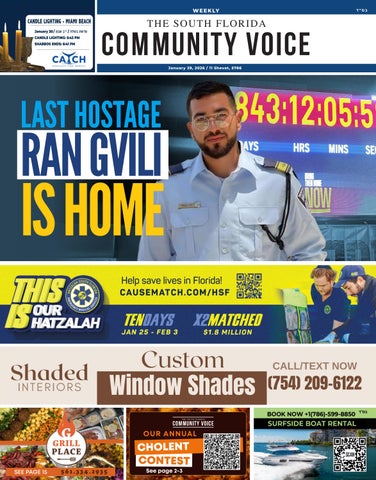
LAST HOSTAGE

SRULY MEYER DONNY MILLER

© The South Florida Community Voice Magazine. All rights reserved. Reproduction in printed or digital form in whole or in part in any form without prior written permission is prohibited. The publisher reserves all right to edit all articles for clarity, space and editorial sensitivities. Submissions cannot be returned to sender. The South Florida Weekly Magazine is not responsible for the cash flow of any advertised product or service that appears in these pages. The South Florida Community Voice Magazine assumes no responsibility for the content of articles or advertisements in this publication, nor for the content of books that are referred to or excerpted herein.

Community Voice magazine is not responsible for the Kashrut or services provided by the advertisements. It is up to the consumer to verify the information.

Chaim Rubinov Trumpeter
Paul Shewchuck Bassist

Beyond the Headlines

A weekly glimpse into the Israel you won’t read about in the news

Alexander’s Story

I received the following note from Devori Kleytman, who asked me to share the story of her fatherin-law, Alexander Kleytman, one of the victims of the terrorist attack in Bondi Beach, Australia.

“My beloved father-in-law, Alexander, was 87 years old, a Holocaust survivor whose family fled to Siberia when he was still a child. They endured years of hunger and bitter cold. They survived, and eventually returned to Ukraine.

“Later, Alexander and his wife, Larisa, applied to emigrate to Israel. They were refused. For many long years they lived as refuseniks, trapped behind the Iron Curtain, longing to leave and longing for Zion.

“Alexander was a man of integrity and a proud Jew. He loved the Land of Israel and the Jewish people. He wrote two books about his Holocaust experiences, and he would often say that we must remember the Holocaust, not only as history, but as a moral obligation so that we know how to stand up to our enemies.

“He was deeply connected to faith. In recent years he began wearing a kippah and putting on tefillin.

“Alexander was murdered while doing what he loved most: living as a Jew, among his people. He died while protecting his wife, Larisa, who survived the attack. Alexander and Larisa were devoted to one another for more than fifty years, and they were blessed with chil-

dren and grandchildren.

“We believe that Alexander’s story is not one that began under Nazi persecution and ended with Islamic terror. His story is about life, love, faith, and holiness. We look forward to continuing his legacy, and we ask anyone reading these words to do one good deed today in memory of Alexander ben Simcha.”

Happy Tu BiShvat!

A teacher once told me that four words, in her opinion, define the times we live in: “I,” “here,” “now,” and “everything.” That is why Tu Bishvat, the festival of trees that begins next Sunday night, is one of the most important days of the year. It stands in quiet opposition to those four words.

It’s notable that Tu BiShvat is celebrated not in spring, but in winter. Not when everything is already blooming and ripening, but specifically when we don’t yet see flowers or fruit. We are not receiving everything here and now. We

are investing in what will be.

For now, all we can do is prepare the ground, plant, water, believe, hope…and wait.

Nature teaches us that some of the most important processes are slow and hidden. There is growth beneath the surface. Not everything is visible, not everything is immediate, and that is precisely why we must keep nurturing with patience.

This is true in raising children, in marriage, in every meaningful area of learning and building. It was especially true during the year of Covid, when we went indoors into a kind of hibernation or dormancy, hoping that, from within that quiet, good things would emerge and develop.

In a generation that grows restless after five seconds if two blue check marks don’t appear on WhatsApp, Tu Bishvat returns once a year to remind us of what we truly need: restraint, perseverance, long-term investment, dedication. These are the qualities that, in the end, produce real growth, and ripe fruits.

Parashat B’Shalach: What Is Your Dream?

Once upon a time there was a king who lived in a palace with his family. The king’s son, the prince, behaved in an inappropriate and unworthy manner, until the king decided to banish him from the palace. The prince wandered the streets and deteriorated into poverty and distress.

One day, when the king’s longing for his beloved son grew strong, he asked his servant to search for him and see how he was doing and how he could be helped.

The servant set out and traveled throughout the kingdom. He began in the large cities and wealthy neighborhoods, and eventually reached the poorest places in the realm, far from the palace. There, in the corner of a dark street, he found the prince, hungry and neglected, sitting on the sidewalk, wearing torn clothes, without shoes, begging for alms.

The servant was saddened to see the king’s son like this. He approached him and said, “The king has sent me to you. He misses you and asks to know what you want, what you are lacking.”

The poor prince thought for a

moment and said, “You’re asking what I want? Well, I would be very happy to receive a new pair of shoes and a good sandwich.”

The servant looked at him, disappointed. “That’s all? Is that what interests you, such small, temporary things? Have you forgotten that you are the son of a king? You could have asked the king to bring

you back to the palace. You could have asked for anything imaginable, and this is what you choose to ask for?”

This story is, of course, a parable about us. In this week’s portion, we leave Egypt, fulfilling a great dream of generations. But it’s not only Pharaoh who must agree; we must want it too. The Jewish people must dream, aspire, pray. Dare to move toward a different reality, one that is new and greater. What would we ask the servant for, a sandwich or a palace? What are our dreams, and are they big enough?

Alexander Kleytman zl helping another Jew lay tefillin.
Translated by Yehoshua Siskin and Janine Muller Sherr Want to read more by Sivan Rahav Meir? Google The Daily Thought or visit sivanrahavmeir.com

Tessa Veksler: From UCSB Student Leader to National Voice Against Antisemitism

When the world shifted after October 7, 2023, one young leader found herself at the intersection of personal conviction and national scrutiny. Tessa Veksler, a graduate student activist, has become a compelling and widely recognized voice in the fight against rising antisemitism on college campuses and beyond. What began as an unexpected journey of identity has turned into a mission she never anticipated — but now embraces fully.

Born in 2002 in San Francisco to parents who emigrated from Odesa, Ukraine, Veksler grew up in a Russian-speaking, secular Jewish household in California’s East Bay. Her family’s immigration story — driven in part by a desire to escape antisemitism and compulsory service in the Soviet Union — shaped her worldview even before she understood her Jewish identity.

“I didn’t feel super connected,” she told The Jewish Standard. “I felt very confused moving between different Jewish environments, and it wasn’t something I spoke about much with my friends.”

A Transformative Trip to Israel

Everything changed at 17, when Veksler attended The Jerusalem Journey (TJJ) through NCSY — a trip designed to introduce Jewish teens from secular backgrounds to Israeli life and Jewish learning. Though reluctant at first, she spent a month in Israel, and the

experience was life-altering. She returned home observant, keeping Shabbat, and more connected to her heritage than ever before.

Back in California, she founded her high school’s first Jewish Student Union — a bold step that hinted at her natural leadership. “I’ve always been like this,” she said. “I’ve always been a natural leader.”

After high school, Veksler spent a gap year in Israel through a program at Bar-Ilan University, all during COVID, balancing remote Israeli classes with UC Santa Bar-

bara coursework. She eventually began her undergraduate degree in Political Science and Communication at UCSB — a path that led her directly into student government.

Leadership at UCSB and Rising Tensions

At UCSB, Veksler joined student government first as a senator and later was elected Student Body President in May 2023. She also led Students Supporting Israel on campus, blending Jewish leadership with broader student

MY ISRAEL HOME

TUESDAY, FEBRUARY 3, 2026 Program will begin at 8:00 pm

WEDNESDAY, FEBRUARY 4, 2026 Program will begin at 7:30 pm

engagement.

Just days after returning from summer break in October 2023, the Hamas terror attacks shook Israel and the Jewish world. Veksler’s semester — and her role as president — would never be the same.

In the weeks that followed, she faced intense backlash for publicly condemning the attacks. Flyers circulated calling her a “Zionist dog,” and signs at UCSB’s Multicultural Center declared “Zionists not allowed” — a chilling message targeting her identity directly.

In one widely shared moment, she stood in front of those signs and posted a photo online with the hashtag #WeAreNotGoingAnywhere. Her candid posts quickly went viral, thrusting her into the national spotlight as both a student leader and Jewish advocate.

Resilience Under Fire

The pressure didn’t stop. A recall attempt against her presidency followed — fu-

eled largely by opposition to her statements about Israel. The vote narrowly failed, but the emotional toll was severe. Veksler later described the experience as relentless, with antisemitic harassment coming from peers and on social media. “I wasn’t going to give up my identity,” she said.

Her advocacy during this period is now documented in the documentary film October 8, which explores the surge of antisemitism on American campuses after the Hamas attacks. Released nationally in 2025, the film aims to expose audiences to the lived realities of Jewish students facing discrimination.

Despite the personal cost — including anxiety and PTSD from the harassment — Veksler has continued to grow as a public speaker and activist. She has been invited to speak at the White House, United Nations, and a variety of Jewish and interfaith forums. She now works in public relations and strategic communications

Remarks from Rabbi Mark Rose

gion

Rabbi Mark Rose underscored the broader vision behind JSU and its growing national impact on Jewish teens.

“JSU gives students a genuine sense of belonging within their Jewish communities,” Rabbi Rose said. “It’s a platform that strengthens Jewish identity and builds a meaningful relationship with Judaism. We equip teens with the knowledge and practical tools to combat antisemitism, while creating a strong bridge between high school and the college campus experience. That bridge is critical—it sets the stage for confident leadership and a vibrant Jewish future.”

Looking ahead, Rabbi Rose highlighted JSU’s ambitious growth plans. “Over the next three years, with the support of partners and investors, our goal is to expand JSU to reach 100,000 Jewish teens across the country. This vision reflects both the urgency of the moment and our commitment to preparing the next generation.”

He also emphasized the importance of authentic role models at JSU summits. “We’re fortunate to have a very warm and collaborative partnership around these programs. Through the summits, students encounter powerful advocacy, honest dialogue, and leadership they can relate to.”

Referring to Tessa Veksler’s involvement, Rabbi Rose added, “She brings lived experience, courage, and clarity. Her advocacy for the Jewish people and for Israel resonates deeply with teens. She is a powerful mentor, helping students navigate differences, face criticism, and stand confidently in who they are.”

COMMUNITY NEWS

in New York while traveling the country to speak about antisemitism and Jewish identity.

From Student Government to National Influence

Veksler’s leadership now bridges generations. She serves as National Ambassador for the JSU Facts Initiative, a program tied to NCSY designed to prepare Jewish high-school students confronting misinformation, bias, and anti-Jewish narratives as they transition to college campuses. The initiative aims to equip teens with critical thinking tools and confidence rooted in truth and Jewish pride. (JSU Facts also focuses on identity, community building, and leadership development — goals

Veksler clearly champions.) Looking ahead, the program has set a goal to reach 100,000 Jewish teens nationwide within the next three years, expanding its impact significantly.

At a recent summit in Tampa, hundreds of students and parents gathered to engage in discussions about Jewish pride, preparedness, and power — three hallmarks of Veksler’s message to the next generation. For her, it’s not only about defending Jewish communities; it’s about building leaders who can thrive in a challenging world.

A Message for the Future

Reflecting on her journey — from reluctant high-school student to national advocate — Vek-

sler stresses that leadership is about consistency, courage, and conviction. “It wasn’t a calculated decision; it was a natural continuation of my values,” she has said of her public advocacy.

Her advice to young people is simple yet powerful: “Get comfortable being uncomfortable.” Embrace discomfort as growth, pursue truth with rigor, and shine unapologetically as your full self in every space you occupy.

In a world where antisemitism and misinformation are on the rise, voices like Tessa Veksler’s are being heard not because they seek attention, but because they stand firm in conviction and purpose — a lesson in leadership for any generation.

Yeshiva Day School Excellence: It’s all about Leadership

Over the years, I have had the privilege to mentor and coach many yeshiva day school executives – from experienced and well established heads of school and principals to novice and aspiring professionals in desperate need of training.

My quest for determining why and how people aspire to become yeshiva and head of school senior professionals has motivated me to view the field and the leadership profession through a wide array of professional lenses and perspectives.

A deep-dive into these observations reveal several challenges and opportunities, include the need for more well designed comprehensive leadership training to the establishment of accelerated leadership mentoring and coaching tracks and, internships. These are in addition to the unswerving need for increased financial remuneration, incentives and benefits, including housing subsidies and sign-on bonuses.

As we know, our Jewish day school community is currently experiencing a leadership vacuum, exacerbated by fewer senior educators entering the field. To be sure, many of those who do occupy these critically important leadership positions were (at one

point in their careers) outstanding teachers….but, unfortunately they were rewarded for their classroom teaching excellence by being “promoted out of the classroom” to higher paying leadership (read administrative) posts.

This reality is not a very promising or bright prospect for the future of our day schools, or for creating career paths or ladders for our yeshiva/day school teachers or administrators.

Today, our yeshiva day school heads of school and principals are only beginning to enjoy better compensation packages than ever before in history. Nevertheless, our communities are still unable to attract and retain high quality professional leadership. This may be due in large measure to a lack of professional expectations, skills-set, training and experience; as well as a lack of support and understanding regarding the daily roles, demands and responsibilities of the today’s Jewish day school heads and principals.

Yeshiva/Day School Leadership: Strengths, Weaknesses and Opportunities

When painting a portrait of the ideal yeshiva/day school principal or head of school, one begins to appreciate the fact that being an effective and high-performing principal or head of school is one of the most challenging, stressful, demanding, rewarding and exhilarating positions in the world of Jewish nonprofits. It is for this very reason that many

great principals and school heads spend a tremendous amount of time and energy responding to the expansive and evolving needs of students, faculty, parents and community members.

Another important characteristic of an effective principal or head of school is his/her ability to inspire a positive school climate, culture and environment of educational excellence through modeling, and by providing best practice opportunities in leadership and school management. But above all, in order for the leader to succeed, he/she must have a burning passion, affinity for student learning, growth and development as well as for model teaching and instruction. This is especially critical in today’s Jewish day school or yeshiva where Jewish values, norms, standards, hashkafa and educational philosophy are paramount.

It is important to note that an effective principal/head of school should always focus on the quality of instruction. In fact, this focus is viewed as one of the most essential aspects of a principal’s or head of school’s commitment to educational excellence – whether it be in Judaic or general studies. The “curriculum” should be viewed not only as a singular classroom activity, but as an important metric indicator reflecting the school’s hashkafa, philosophy, mission, vision and direction.

These activities include public expressions of derech eretz, ex-

COMMUNITY NEWS

emplary middot, kavod, ahavat yisroel, chesed, shmirat haLashon and being a yirat shamayim.

All of these values must be exemplified by the school’s faculty and staff…and modeled by the school’s head of school or principal. They are yet another series of important responsibilities, obligations and commitments which are intrinsic to the head of school or principal’s leadership and influence in the school.

Research in education supports the contention that outstanding professional school leadership require five discrete yet interrelated areas or disciplines.

They include: vision, culture, delegation, instruction and data driven policy and decision making.

Many of these characteristics are learned through experience or through an innate ability to lead, inspire and manage. Fortunate are the yeshiva and day school heads who possess this ability and capacity to understand, appreciate, and celebrate these important dimensions of their work.

Finally, the success of the Jewish day school/yeshiva principal or head of school will greatly depend upon his/her training and experience as well as an ability, capacity and bandwidth to multitask throughout the day. In fact, leaders who are single=minded or focused will have a very difficult time trying to succeed in an ever-changing multi-dimensional time-consuming dynamic environment.

The ever-increasing demands now being placed on the head of school and principal (as leader, manager, counselor, surrogate parent, etc….) are daunting at best. They represent a microcosm

of the challenges and exigencies now being confronted in our society, communities and homes.

A school’s responsible approach to the challenges of social media technology, single-parenthood, the over indulgent behavior of the privileged, students with exceptionalities, families living at the poverty level and mental health concerns on the student and faculty levels – are just a several of the ever-increasing challenges facing 21st century day schools and yeshiva leadership. Not a very easy task to say the least.

The evolving role of the principal or head of school is not about being an expert in every discipline, but rather to have the ability, creativity, knowledge and wisdom to identify appropriate resources and leadership expertise in response to these ever growing concerns.

At the Crossroads:

Whether one is a seasoned head of school or principal, or a novice administrator just entering the

leadership field – the underlying challenges are basically the same.

So as long as leadership demand outweighs supply, its incumbent upon our communities to ensure that we have the “best and brightest” leading our schools.

Anything less should not be acceptable or negotiable.

We must accept the reality that securing the right leader for our schools will always be a challenge. And one which will probably continue in perpetuity.

About the Author

Dr. Chaim Botwinick is a senior executive coach and an organizational consultant. He served as president and CEO of the central agency for Jewish education in Baltimore and in Miami; in addition to head of school and principal for several Jewish day schools and yeshivot. As an Influencer, he has published and lectured extensively on topics relating to education, resource development, strategic planning and leadership development. Dr. Botwinick is co-director of LEV Consulting Associates and creator and host of the Chinuch Horizons podcast series. He is author of “Think Excellence: Harnessing Your Power to Succeed beyond Greatness”, Brown Books, 2011.

As We Celebrate The Return of Remains Of Ran Gvili, Say No To Palestinian Statehood

NEW YORK – Following the recovery of Staff Sergeant Major Ran Gvili’s remains 843 days after the Hamas-led invasion of Israel, a leading pro-Israel organization has declared that the time has come to put an end to all talk about Palestinian statehood. Americans for a Safe Israel (AFSI) has stated that one thing that must be learned from October 7 is that no Palestinian Arab state can be allowed to be created anywhere alongside Israel.

Israeli President Isaac Herzog tweeted on X: “Ran Gvili, the hero, returns to his homeland’s landscape after 843 days! The Yamam fighter who went out to save lives - finally returns to his country, his family, and his land. An entire nation is moved to tears.”

Just one year ago, President Isaac Herzog, speaking at the World Economic Forum in Davos, said: “The idea of the two-state solution is something which, on record, I supported in the past, many times. But I had a wake-up call following October 7.”

“Not surprisingly, most Israelis see the idea of a Palestinian state

differently than the New York Times, NPR and the BBC,” stated Moshe Phillips, Chairman of Americans for a Safe Israel. “Even before October 7, polls consistently showed that most Israelis feared a Palestinian state would be used as a springboard to attack Israel, especially at its most vulnerable nine-mile-wide points along the coast. After October 7, the idea of a Palestinian state seems to most Israelis to constitute a direct threat to Israel’s existence. The best way to make sure Israeli families do not

suffer for 843 days the way the Gvili family has is to prevent a Palestinian state.”

About Americans For A Safe Israel: Established in 1970, Americans For A Safe Israel (AFSI) is one of the oldest and most influential pro-Israel organizations in the United States. Its advocacy and educational campaigns serve as a potent counterweight to the rising tide of anti-Israel propaganda. AFSI is not affiliated with any political party in the United States or Israel. AFSI’s website is www.afsi.org.

A Promise Kept — and a Question Answered

Mrs. Wise still remembered the first day she met her friend.

They were little girls then, sitting next to each other in primary school, sharing crayons and giggles. As the years passed, that friendship only deepened. They went to the same schools, the same high school, the same seminary. People often joked that they were more like sisters than friends. When they both got married within a short time of each other, the bond only grew stronger.

Life moved on, as it always does. Children were born, families grew, responsibilities multiplied. After a few years, Mrs. Wise moved out of town, but the distance never weakened the connection. They spoke regularly, shared simchos and worries, and continued to be there for each other through every stage of life. Even now, decades later, they were both grandmothers — and that childhood promise they once made still echoed clearly: “No matter what happens, we’ll always be there for each other.”

One morning, Mrs. Wise’s phone rang early.

On the other end was her friend’s daughter — crying uncontrollably.

“Mrs. Wise,” she managed to say, “my mother… she’s in the hospital. She’s not doing well.”

Without hesitation, Mrs. Wise replied, “I’m coming.”

Within hours, she made the necessary arrangements, packed a small bag, and booked the first

flight she could find. She slipped her Tehillim into her purse, already planning how she would sit by her friend’s bedside and daven with all her heart.

The trip was long and exhausting. Mrs. Wise arrived at the hospital and was quietly guided into the room, her breath caught.

She couldn’t believe her eyes, the woman lying before her — once so full of warmth, laughter, and strength — seemed distant, almost unreachable. Machines surrounded the bed like silent sentries, their steady beeping marking time in a way that felt both comforting and terrifying. Tubes and wires traced paths she didn’t recognize, each one a reminder of how fragile life truly is.

Mrs. Wise stood there for a moment, unable to move.

So many memories flooded her mind at once — whispered conversations, shared milestones, countless phone calls over the years. This was the woman who had stood beside her at life’s happiest moments. And now, she lay still, not lucid, unable to return her gaze.

Mrs. Wise slowly pulled up a chair and took her friend’s hand. It felt warm — familiar — and yet painfully different. She tried to steady herself, whispering silently, I’m here. I kept my promise.

Then she noticed it.

A catheter bag hung discreetly behind the bed, connected by a tube.

Mrs. Wise froze.

She knew there were halachic issues related to davening in the presence of bodily waste. Was she allowed to say Tehillim here? Could she daven at her friend’s bedside like she had hoped?

Her heart ached. She opened her Tehillim… and then slowly closed it again.

What do I do now? she thought. If ever there was a time to daven, it’s now.

Feeling drained and unsure, she stepped out and made her way to the Bikur Cholim room. She needed a moment — maybe something to drink, maybe just a chance to gather her thoughts.

As she stood by the refrigerator, her eyes caught a magnet.

“Refuah B’Halacha Center — Answers Medical Halachic Questions.”

Mrs. Wise stared at it for a second, then said, “Baruch Hashem!” She dialed the number.

A rav answered, and she explained the situation — the machines, the catheter, her uncertainty, and how badly she wanted to daven for her lifelong friend.

The rav listened carefully and then reassured her.

He explained that while Chazal indeed prohibit davening in the presence of exposed waste, many contemporary poskim discuss hospital situations where the waste is contained and covered. Rav Moshe Feinstein, in Igros Moshe (Orach Chaim, chelek 1,

siman 27), addresses cases where a catheter bag is present but concealed. He rules that when the waste is fully enclosed and not emitting odor, and when the person is not directly facing it, davening is permitted.

Similarly, Shu”t Ba’er Moshe (chelek 4, siman 7) discusses hospital rooms and rules that when the catheter bag is placed behind the bed or otherwise covered, and the room itself remains clean, one may say Tehillim and tefillos there.

“In your case,” the rav said gently, “you may absolutely daven by her bedside.”

Mrs. Wise felt the weight lift instantly.

She thanked the rav again and again, hung up, and returned to the room.

This time, she pulled out her Tehillim without hesitation.

She sat quietly, pouring every ounce of hope, memory, and love into her tefillos. She thought of two little girls in school, of a promise made long ago, and of a friendship that had not weathered or distanced even through the decades.

She davened that the promise would not end here.

And she thanked Hashem — not only for the strength to be there — but for the guidance that allowed her to be there halachically, when it mattered most.

Refuah B’Halacha Hotline: 732 755 0851 or email us at www. refuahbhalacha.org

Our Rabbanim;

R’ Yaakov Forchheimer shlit”a

R’ Noach Isaac Oelbuam shlit”a

R’ Shmuel Fuerst shlit”a

R’ Uri Deutch shlit”a

R’ Micha Cohen shlit”a

R’ Moshe Zev Feldman shlit”a

R’ Baruch Hirshfeld shlit”a

R’ Daniel Neustadt shlit”a

R’ Avrohom Yaged shlit”a

We specialize in Mental health, Shabbos, Treatment issues, Hospital stays, Fertility Kashrus

We are here Sunday through Friday 8:00 am till 10:00 pm and erev Shabbos 10 minutes before candle lighting.

Refuah B’Halacha Hotline: 732 755 0851 or email us at www. refuahbhalacha.org

RELAX MORE trav l s

The perfect summer recharge is close to home. Spend more time in the pool, at the beach, and sleeping in. Just pack your bag and unwind. Whether you join us for shabbos or during the week, experience a quiet, restful staycation.

Escape from the everyday, without the jetlag.

Finding Happily Ever After

Steve Eisenberg Presents The International Shabbaton 2026

From California to Chile, Puerto Rico to Panama, mention the name Steve Eisenberg and the response is strikingly consistent: admiration, gratitude, and respect. Personable and unpretentious, Eisenberg has spent decades strengthening Jewish identity and creating meaningful connections—between Jews, communities, and future families.

“I was raised in a home steeped in Torah values and chesed,” Eisenberg shares. “My parents lived what they believed. Community involvement, ahavas Yisrael, and responsibility for other Jews weren’t ideas—they were a way of life.”

Those values continue to shape Eisenberg’s life mission.

Deeply influenced by the Lubavitcher Rebbe, Rebbetzin Esther Jungreis, and Rabbi Ephraim Buchwald, Eisenberg discovered early on that his calling lay in igniting the pinteleh Yid—helping Jews rediscover pride, purpose, and connection. A defining moment came when a close friend announced his engagement, only to reveal that his fiancée was not Jewish. That painful encounter crystallized Eisenberg’s resolve to confront assimilation not through protest, but through inspiration.

His response was to create authentic Jewish experiences that are warm, joyful, and compelling.

Eisenberg is the director and co-founder of Jewish International Connection NY (JICNY), which began in December 2000 with a single Shabbat dinner for young Australians and South Africans living in New York. From that modest beginning, JICNY has grown into a global network of over 8,000 participants, with dozens of marriages resulting from connections made through its programs.

Through weekly Torah classes, immersive Shabbat experiences, international travel programs, and large-scale events, JICNY brings together young professionals from across continents, cultures, and levels of observance. Eisenberg has led 19 Birthright trips to Israel, co-founded Shabbos Across America, hosted thousands of Shabbat meals, and facilitated hundreds of introductions—many of which became lifelong partnerships.

The International Shabbaton

From March 5–8, 2026, Jewish young professionals ages 25–42 will gather in Miami Beach for the International Shabbaton, hosted in partnership with Chabad of Bal Harbour. The Shabbaton is not a conference and not a lecture series—it is a fully immersive Shabbat experience designed around connection and commu-

nity.

The weekend includes a vibrant Thursday night kickoff, gourmet Friday night Shabbat dinner with open bar, a lavish Shabbat day Kiddush luncheon, structured icebreakers and facilitated social experiences, musical Havdalah on the beach, a high-energy Saturday night singles event, and additional Friday and Sunday morning programming.

Over the past four Shabbatons, more than 1,000 participants from 30 cities and 13 countries have attended, supported by experienced facilitators and shadchanim. Engagements, friendships, and business partnerships have emerged naturally—without pressure, simply by bringing people together in the right environment.

“Everyone talks about the shidduch crisis,” Eisenberg notes, “but there’s no single solution. We all must do our hishtadlus— and then trust Hashem.”

In a post-COVID, post–October 7 world, genuine human connection has never been more vital. Even those who don’t meet their future spouse leave with new friendships, renewed Jewish pride, and a strong sense of belonging.

Registration Information

Dates: March 5–8, 2026

Ages: 25–42

Pricing: $245 until January 15 | $275 until February 19 | $350 thereafter Early registration is strongly encouraged.

Operation Inspiration: The “I” of the Beholder

I have an old friend who is the rabbi of a large congregation, and he gives many classes and shiurim throughout the week. One day, at a gathering for women, there was a platter of fruit on the table, and after the class, he reached for a piece.

He made a loud, clear bracha of Borei Pri Ha’adama, and took a bite. One of the women who had been at the class asked him, “Is there a special bracha for all foods? I thought the only bracha we make on food is the Hamotzi on the bread on Shabbat!”

He was surprised, but, as a rabbi, you learn to expect that people don’t know everything, and appreciate that it’s your opportunity to teach them. Without any judgment, he replied, “Yes! There are berachot for everything we eat and drink. Would you be interested in learning about them?” The woman said she would, very much, like to learn them.

He paused, and then looked around and asked the remaining women at the class, “Is there anyone else here who would like to learn the different blessings for food and drink?” Every woman stayed. He ended up giving a lesson about all the different brachos, and these women learned something they’d never known.

When he told over the story, he remarked with awe how it was solely the zechus of the one woman who spoke up and admitted she didn’t know something, but would LIKE to, that all the other women got to learn it. Had she not been willing to confess her lack of

knowledge, they likely would not have done so. Because she was not embarrassed to ask, she and all the rest got to grow and learn.

I was impressed with his story and the lesson, and I told him so. A day or so later, though, I reached out to him again to tell him what I’d realized. He pointed to the zechus of the woman who asked for more information. But I went back further. I looked at the catalyst for her question.

Had he grabbed a piece of pineapple, mumbled a bracha and shoved it in his mouth, the woman would probably not have noticed, or maybe she would have noticed, but not realized what was happening. However, because he took the time to make a loud, clear bracha, with appreciation and reverence, she took note.

She said to herself, “Look at this holy rabbi! He blesses G-d all the time! I want to be like that. I want to know more.” So she asked him.

From this, sprang a class where multiple women began to learn and recite blessings on food and drink. Maybe they asked what else we make brachos on, and learned

even more. Maybe they decided to ask about other mitzvos they might not know about. Hopefully, they began making these brachos themselves, bringing more Kedusha into their homes, their families, and the world. Their children will now know that Hashem is an endless source of bracha and goodness, and that we have not only the mitzvah, but the good fortune, to be able to praise Him for this goodness.

Do you see what setting the right example can do?! And he wasn’t trying to set an example. He didn’t know these women were uninformed about brachos. He was trying to eat a piece of fruit, but before he did so, he infused it, and himself, with holiness, by making a bracha with thought and purpose. From that properly done bracha, grew many more mitzvos and praises of Hashem.

R’ Yaakov Kamenetsky z”l was asked, “How does one train their child to properly make brachos?” R’ Yaakov responded, “I don’t know. We never trained our children to make brachos. I made a bracha properly, and my wife made a bracha properly. The children watched us and they made brachos properly.”

This is just one small way we can enlighten others by our behavior, but there are so many more ways. When people see our davening, our Chesed, the way we interact with others, be they Jewish or not, it makes an impression. If it is a positive one, that means we’re doing it right.

If people come to love Jews and

Hashem more because of how we act, then we are fulfilling the commandment of “V’ahavta es Hashem Elokecha,” which the Gemara teaches is to be understood as, “shetehai shem Shomayim misahev al yadcha, that the name of Heaven should become beloved

through you.”

If we could all be cognizant that, wherever we go and whatever we do, people are watching and taking note, we would certainly be on our best behavior and set the best possible example. What a bracha that would be!

2025 – All Rights Reserved Did you enjoy this column? Feedback is welcome and appreciated. E-mail info@JewishSpeechWriter.com to share your thoughts. You never know when you may be the lamp that enlightens someone else.

DON’T WAIT FOR TO GIVE

Is it even worth Dollar-A-Day?

I'm sure there are plenty of other people supporting TorahAnytime...

Someone else will give.

Wait... if we all assume 'someone else' will give, then no one is actually giving! I have to step up.

Hey, TorahAnytime literally changed my life. I got off YouTube, I’m learning every day, my whole mindset shifted... I can’t even tell you how much I benefit

Wow,amazing!that’s

Hi. This is TorahAnytime. Can you please consider donating a Dollar-A-Day if you benefit from using the platform?

Sorry, I wasn’t thinking. I’d love to join the Dollar-A Day program. If I’m not gonna join, who is?

Wow...this class is exactly what I need to hear.

Another pop up? I’ll donate later.

IF IT'S PART OF YOUR DAY, MAKE IT PART OF YOUR GIVING. Funny... TorahAnytime never says "later" when I need it.

A Nation Unpins Its Heart: The Return of Ran Gvili and the Quiet End of Israel’s Hostage Vigil

For 843 days, a small yellow pin carried enormous weight.

Pinned to jackets, backpacks, prayer shawls, and lapels across Israel and Jewish communities worldwide, it symbolized a collec tive promise: Bring them home. That vigil quietly ended with the return of Ran Gvili, the last Israeli hostage held in Gaza.

Gvili, a 24-year-old Master Ser geant in Israel’s Special Patrol Unit, rushed to the front lines on October 7, 2023, despite recovering from a shoulder injury. He was killed in battle and taken into Gaza. For more than two years, his name remained on the list — the final unresolved absence. When his remains were returned to Israel on Monday, January 26, the nation exhaled, not in celebration, but in solemn closure.

pins. So did ordinary citizens. But the most powerful moments came from those who knew captivity firsthand.

was over, and sorrow that it ended

Elkana Bohbot shared a video of himself slowly removing the yellow pin from his shirt, explaining that until Gvili came home, the struggle had never truly ended — even after his own release. The pin had been a reminder that freedom was incomplete while others remained behind.

Across Israel, the symbolic clock at Hostages Square stopped. Officials removed their yellow

Former hostages marked the moment through deeply personal acts — quiet gestures that reflected both relief and grief. Segev Kalfon wrote that Gvili returned “not with a smile, not with a future, not with a hug — only with silence.” His words captured the emotional complexity many survivors felt: gratitude that the wait

Brothers David Cunio and Ariel Cunio, who survived captivity together, addressed Gvili directly in a short message: an apology that it had taken so long to bring him home. Their words reframed the pin as a shared responsibility — one survivors carried long after their return.

Others chose privacy. Some former hostages said the Shehecheyanu blessing before unpinning the ribbon. Others folded it carefully and placed it among mementos from captivity. There were no

COMMUNITY NEWS

cheers, no declarations of victory. Only quiet acknowledgement.

By the time Gvili was returned, all Israeli hostages taken on October 7 had been accounted for — some alive, many not. The yellow pin, once a symbol of urgency, had become a marker of endurance. Removing it did not erase memory; it signaled a transition from waiting to mourning, from public demand to private healing. Israeli leaders echoed this tone. President Isaac Herzog called Gvili a hero who “went out to save lives and finally returned to his country, his family, and his land.”

Around the world, Jewish communities removed their pins in unison — not because the story no longer mattered, but because

this chapter had closed. The yellow pin was never just metal and enamel. It was a prayer made visible, a demand for accountability, and a thread that bound strangers together in

shared responsibility. Its removal does not mean forgetting. It means remembering differently. The vigil is over. The obligation to remember — and to protect life — remains.

Our Why, Our Way Forward

Every January, millions of people make resolutions. We promise ourselves we’ll exercise more, eat better, learn something new. Behavioral scientists tell us most fail by February. A big reason? We focus on the what without understanding the why.

Organizations face the same challenge. We articulate mission statements, list programs, catalog achievements. But if we lose sight of fundamental purpose—our why—we drift.

Jewish tradition teaches us l’dor v’dor— the carrying of tradition and practice from generation to generation. What endures isn’t just memory, but purpose. At ADL, that purpose has remained constant for more than 112 years: we exist to protect the Jewish people.

ADL was created at a time when the Jewish people were vulnerable and their future in the U.S. was uncertain. The tactics evolve. The threats change form. But the why never wavers. It is timeless, forged at our point of origin.

That clarity matters now more than ever. Our Global 100 Survey found that 46 percent of adults worldwide hold significant antisemitic beliefs—an estimated 2.2 billion people. That percentage is nearly double what we saw a decade ago.

In 2024, ADL recorded 9,354 antisemitic incidents across the U.S.—the highest number on record since ADL began tracking antisemitic incidents nearly 50 years ago. Antisemitic incidents

are up 900 percent over the past decade and 344 percent over the past five years.

Now more than ever, let’s be clear: if we don’t stand up for the Jewish community and fight antisemitism, who will? It’s no surprise that half of Jewish Americans believe most people in the broader community would not stand with them against antisemitic threats.

The question, then, isn’t whether threats exist, or should we respond. The question is how best to do so. There are lots of debates about how, which makes sense because there is no single answer, no silver bullet, to end the crisis of antisemitism.

For ADL, we return to a framework honed across generations: protect, advocate, educate. Three pillars. Three responsibilities. One purpose.

First, we protect.

At a time when the Jewish people face threats on all sides, it has never been more important to defend, not just our basic rights, but also our physical being. Antisemitism is not a hypothetical concern but a clear and present danger. We need to resource to the threat.

For decades, the vast majority of extremist-related murders have been committed by white supremacists and their ilk. The list is long: Overland Park, KS; Charlottesville, VA; Lake Forest, CA; Pittsburgh, PA; and Poway, CA, let alone Charleston, SC; El Paso, TX; and Buffalo, NY.

At the same time, we have seen anti-Jewish homicides at the hands of other types of extremists, from religious fanatics to leftwing radicals to Islamist militants to those without a clearly defined ideology. The list is long, spanning

murders in Jersey City, NJ; Monsey, NY; Thousand Oaks, CA; El Cajon, CA; Washington, DC; and Boulder, CO.

But it often starts with words.

In New York City—home to the largest Jewish community in America—elected officials who are animated by animosity to the Jewish state are gaining power. We are monitoring to protect Jewish residents as New York City’s incoming administration brings officials with troubling records into power and an apparent unwillingness to call out indisputable examples of antisemitism.

In the year ahead, we may face challenges that would have seemed unthinkable just years ago.

Protecting the Jewish community means building tools for response before a crisis hits. It means ensuring that when Jewish Americans face discrimination, harassment or violence, they have access to serious legal representation. For example, ADL pioneered the innovative Legal Action Network, a nationwide consortium of the top law firms in the country whose attorneys have committed to taking cases pro bono. We have filed cases in the past year against private businesses and public companies, large universities and local school districts, white supremacist groups and anti-Zionist actors, including a lawsuit to hold the primary architects of the 10/7 terror attacks accountable.

It also means equipping communities with training and re-

sources to protect themselves. Protection isn’t a passive reaction. It’s active preparation backed by institutional experience.

Second, we advocate.

Yes, that means in state capitals where, for instance, we supported New York as they worked to pass a bill that protects our community from masked intimidation and hate. In California, we advocated for a law that counters antisemitism in K-12 schools. And in Washington, ADL is fighting for more Non-Profit Security Grants and accountability for antisemitism on college campuses.

We’re also challenging social media platforms whose algorithms reward conspiracy theories, appearing in courtrooms to hold perpetrators accountable, and working in classrooms to ensure Jewish students can learn without fear.

Third, we educate.

College campuses saw an 84 percent increase in antisemitic incidents last year. Jewish students face harassment for simply expressing their identity. The next generation shouldn’t have to choose between feeling secure on campus and receiving a quality education.

Change requires accountability. When universities know they’re being measured, they act. Our second annual Campus Report Card shows what’s possible: following ADL engagement, more than onethird of schools improved by a full letter grade when they strengthened policies, mandated antisem-

itism education, and improved bias reporting systems.

We’ve also created the ADL Ratings and Assessment Institute, which is standardizing our approach to utilize rigorous data-driven evaluations to assess a wide range of sectors such as state governments, public companies, professional associations and more.

And we’re strengthening partnerships with other Jewish communal organizations such as Hillel International, local Jewish federations, and a range of college and high-school-focused student organizations, providing resources so the next generation can carry this work forward.

This is how purpose translates to action.

While our mission has never changed, our strategies will change and adapt to the times. But our core purpose endures l’dor v’dor. That’s the difference between what we do and why we do it.

It may seem like a small distinction, but it’s actually huge. In uncertain times, clarity of purpose matters. It focuses our work. It guides our decisions. It reminds us why we show up.

As we enter this new year, the threats are real. But so is our resolve. We know our why. Now, we execute.

Solomon Leadership Program: Pillar of Vision

Planting the Seeds of Tomor row

A vision is not merely the abil ity to see what lies ahead; it is the courage to believe in a future not yet visible and to live today in a way that brings it closer. This timeless Jewish truth stands at the heart of the Solomon Leadership Program at The Shul of Bal Harbor, under the leadership of Rabbi Zalman Lipskar. Gathering outstanding high school students for ten eve ning sessions throughout the year, the program cultivates thoughtful, ethical leaders through its seven core leadership pillars. This week, the pillar of Vision came alive, rooted deeply in Torah, illuminat ed by contemporary role models, and internalized through mentor ship and reflection.

The session opened with our chapter director, Rabbi Shaya Farkash, and assistant director, Avromel Hayman, who framed vision through a Torah lens. Drawing from this week’s parsha, they reminded us that the Jewish people’s survival in Egypt was not sustained by strength alone, but by vision. The Midrash teaches that when Yaakov descended to Egypt, he carried with him an awareness of the prophecy that foretold both exile and redemption. With that future in mind, Yaakov planted trees upon his arrival—cedars meant for the Mishkan that would one day be built in the wilderness. Those trees stood silently through generations of bondage, living symbols of hope and destiny. They whispered to a weary nation: This is not the end.

In moments of darkness, vision becomes a lifeline. It anchors the present to a promised future and gives suffering meaning by placing it within a larger story. The Jews in Egypt endured because they could imagine redemption. So too, we are taught, must we cultivate a vision that sustains us through our own challenges.

From Torah to the World of Action

The power of vision was further explored through the words of our guest speaker, Noah Elbogan, who challenged us to think about vision not only as an idea, but as a call to action. He shared the story of Ron Shaich, founder of Panera

the lives of others and elevate standards across an industry.

Elbogan emphasized that true vision begins with discovery: uncovering what truly matters, committing to truth, and then doing the hard work to bring that truth into the world. Vision guides decisions, steadies leaders through setbacks, and defines success in terms far richer than financial gain. Especially for young people, he stressed, vision must be paired with service to community, to values, and to something greater than oneself.

These ideas found their way from theory into lived experience during our mentorship circles. Guided by our mentors—Mrs. Dina Kranz, Mr. Diego Goldfarb, Mr. Jake Bengio, Mr. Alexander Rindner, and Dr. Sarah Rosanel— we explored how vision shapes

COMMUNITY NEWS

everyday life. In our group with Mr. Bengio, we discussed how vision is not just about what we see, but how we choose to interpret reality. The way we frame obstacles determines whether we remain trapped by frustration or use challenges as stepping stones for growth.

We examined contemporary visionaries such as Jeff Bezos, whose dream was to make shopping easier and more accessible, and Elon Musk, whose ambitions center on sustainable energy and innovation. While their fields differ, their common thread is clear: vision provides direction. It requires courage, resilience, and a willing ness to learn from failure. Vision transforms imagination into im pact.

Carrying Vision Forward

The Solomon Leadership Pro gram teaches us that vision is not reserved for prophets or pioneers alone. It is a responsibility we each carry. Like Yaakov’s trees in Egypt, our visions may take time to bear fruit, but when grounded in Torah values, they have the power to sustain us and those around us.

Noa Lamet

Noa Lamet is a 16-year-old junior at Sha’arei Bina Torah Academy for Girls. Born in New York and raised in Florida, she enjoys piano, skiing, hanging out with friends and family, and art.

Photography: Ariel Rosanel, @photos_byariel

Adina Shagalov

Adina Shagalov is a 17-year-old junior at Hebrew Academy. Born in Brooklyn, New York, and raised in Florida. She loves playing tennis, reading, writing poetry, surfing, and hanging out with friends and family.

Photography: Ariel Rosanel, @photos_byariel

Dr. Sarah Rosanel, MD, FACC Concierge Cardiologist & Internal Medicine Physician

Specializing in Longevity, Prevention, and High-Acuity Home Care

Born in Casablanca and raised in Paris, she completed her medical training in New York and Israel. She holds leadership roles with the American College of Cardiology, the American Society for Preventive Cardiology and serves on the advisory boards of JOWMA, Magen David Adom, and United Hatzalah of Florida.

As we left this session, we were reminded that leadership begins long before titles or accomplishments. It begins with the ability to see beyond the present moment, to envision a better future and to take steps, however small, toward making it real. In a world that often feels uncertain, vision gives us clarity. It reminds us who we are, what we stand for, and where we are going.

May we merit to be leaders who see not only what is, but what can be and to build that future with faith, purpose, and courage.

Arielle Gad

Arielle Gad is a 16 year old junior at the Jewish Leadership Academy. Born and raised in New York, she moved to Miami five years ago. Arielle enjoys playing piano, volleyball, and writing, and brings creativity, discipline, and thoughtfulness to everything she does.

Photography: Ariel Rosanel, @photos_byariel

An associate professor at Yeshiva University’s Stern College and a mentor in the Solomon Leadership Program, Dr. Rosanel guides future medical professionals. As a speaker, South Florida Magazine contributor, and moderator of complex cardiac cases at the national ACC conference, she shares her expertise globally. Her honors include the Women in White Coats Heroes Award, JOWMA’s Physician Leadership Award, and selection to the Cardiovascular Business Forty Under 40 Class of 2025, Dr Rosanel was also recognized as a Featured Doctor in Cardiology and Internal Medicine by Best in Florida Magazine – 2025!

Dr. Rosanel resides in Miami with her husband, Yossi, and their three children, Ariel, Zev, and Shirley.

YACHAD

Hours

S: 10AM - 4PM

M-TH: 9:30AM - 7PM

F: 9:30AM - 2PM

CLOSED ON SHABBOS

Sunday to Thursday: 12pm - 10pm Friday: 11am - 3:30pm OPENING HOURS Scan the code to order!

This Is Our Hatzalah

This is our home. It is where families live, where children grow, and where people vacation, relax, and enjoy time together. It is where simchas are celebrated, guests are welcomed, and families gather around the Shabbos table.

And this is our Hatzalah.

From January 25 through February 3, the community is coming together for HSF’s ten-day annual crowdfunding campaign. This is not just another appeal or one fundraiser among many. This is HSF’s main campaign of the year and the primary source of funding that allows Hatzalah South Florida to operate. These ten days are what sustain the organization and make everything possible.

Hatzalah South Florida exists for one reason. When help is needed, Hatzalah is here. Not later. Not eventually. Right now.

Today, HSF operates 20 fully equipped ambulances and 22 ERU response vehicles, creating a rapid-response network that blankets the community. More than 350 volunteer EMTs and paramedics power this system, responding to thousands of emergency calls every year. These volunteers leave work, family, sleep, and Shabbos meals because someone in the community needs immediate medical care. Running an operation of this scale and readiness requires an annual budget of over four million dollars. Every dollar supports lifesaving equipment, advanced medical supplies, ongoing training, vehicle maintenance, fuel, insurance, dispatch systems, and the infrastructure required to ensure

that help is always moments away. When Hatzalah says community, Hatzalah means you.

Hatzalah is here for parents when urgent care is needed. Hatzalah is here for children when something goes wrong. Hatzalah is here for neighbors, guests, and loved ones.

South Florida is home to a large, vibrant, and growing community. It is where families live year-round, where children attend school, and where daily life unfolds. HSF carries the responsibility of protect-

ing this community every single day, across neighborhoods, shuls, schools, and homes, ensuring that help is always close at hand.

In addition, the Orlando area has become a major destination for thousands of families during Yom Tov and throughout the winter and summer months. This seasonal influx creates an enormous undertaking, requiring expanded readiness, coordination, and resources. HSF rises to that responsibility, working tirelessly to ensure that everyone in the Orlando area is protected and cared for.

There is something deeply reassuring about knowing that when the sirens sound, they are coming from people who understand the rhythm of Jewish life, the sensitivities of Shabbos and Yom Tov, and the urgency of the moment. Volunteers who know the neighborhoods, the buildings, and the fastest way to reach those in need—volunteers who treat every patient as if they

COMMUNITY NEWS

were their own family.

Hatzalah asked people who were helped to share their stories and what HSF means to them, and many emotional responses were received. Here are just a few. These stories are all thanks to volunteers and community support:

“I want to tell you what happened to me while I was on vacation in Florida. What was supposed to be a relaxing trip suddenly turned frightening. I began feeling extremely weak, dizzy, and confused. It became clear that I was severely dehydrated, and being in an unfamiliar place made it all the more overwhelming. I called Hatzalah, and within minutes, they arrived. From the moment they walked in, I felt reassured. They were calm, professional, and incredibly compassionate. They assessed me quickly, treated me with dignity, and made sure I received immediate care. When we arrived at the hospital, I was taken straight in because of their clear communication and fast response. What could have been terrifying became manageable, and I cannot express enough how grateful I am. Hatzalah was here for me when I needed them most, and I know their presence saves lives every single day.”

“I also want to share what happened to my daughter just before Shabbos. She was four years old, swimming in the pool with her older sister. At one point, she took off her floaties to go to the bathroom, and when she came back, she forgot she wasn’t wearing them and jumped into the pool. She went under for about forty-five seconds before her sister screamed for help. I jumped in and pulled her out, terrified and panicked. We called

Hatzalah, and they arrived in just about ninety seconds. I cannot describe the relief I felt. Hatzalah was already in control, stabilizing my daughter and getting her safely to the hospital. Baruch Hashem, she was fine, and I cannot imagine what would have happened if they had not been there. Hatzalah was here, and Hatzalah saved my daughter’s life.”

These stories are not isolated. They are reminders of why Hatzalah exists and why readiness matters. When seconds count, when panic sets in, when families are at their most vulnerable, Hatzalah is here.

This campaign is the backbone of funding. It is what keeps ambulances on the road, ERU vehicles responding within minutes, and volunteers equipped and trained. Rising costs, increased call volume, and growing populations mean the demands on HSF continue to increase, but the expectation never changes.

Hatzalah must always be ready. And Hatzalah is ready because of the community.

This campaign is not about a small group stepping up. It is about

everyone participating. Hatzalah belongs to the entire community, and participation matters just as much as the amount given. When thousands come together, it sends a powerful message that the community stands united and takes care of one another.

This is the safety net. This is the emergency response. This is the peace of mind.

And peace of mind is priceless.

The calls are not slowing down. The responsibility is only increasing. To continue operating at this level, to continue being here for families and for the future, HSF urgently needs every member of the community to be part of this campaign.

January 25 through February 3 is the moment.

This is not someone else’s responsibility. This is not a campaign to scroll past. This is the main campaign, and it directly impacts the ability to save lives throughout the year ahead.

For ten days, the community has the opportunity and the obligation to ensure that HSF has what it needs to remain strong—to fund the ambulances, the ERU vehicles, the equipment, the training, and the readiness that protect everyone.

This is our Hatzalah. This is where families live. This is for the community. And this is on all of us.

Hatzalah needs everyone to join and support HSF today. Community contributions keep volunteers on the road, ambulances ready, and ensure that help is always here when it matters most. Please give generously at causematch.com/ hsf. Every donation counts—together, lives are saved.

• DINE-IN

• SUSHI PLATTERS

• CATERING SETUP

• LIVE SUSHI STATION

• DELIVERY & PICKUP 10% DISCOUNTIF YOU BRING IN THE COMMUNITY VOICE MAGAZINE

KIDS ZONE KIDS ZONE

FACTS ABOUT PANAMA DID YOU KNOW THAT...

1. Two oceans, one day In Panama, you can watch the sunrise over the Atlantic and the sunset over the Pacific on the same day.

2. The Panama Canal is one of the world’s greatest shortcuts

It saves ships about 8,000 miles compared to sailing around South America.

3. Panama City is the only capital with a rainforest

A real tropical rainforest (Metropolitan Natural Park) sits right inside the city.

4. Panama hats aren’t from Panama Plot twist: they’re actually from Ecuador—they just became famous after being sold in Panama.

5. It’s one of the most biodiverse countries on Earth

Panama has more bird species than the U.S. and Canada combined.

6. The U.S. dollar is basically the local currency

Panama uses the Balboa, but paper money is almost entirely U.S. dollars.

7. No hurricanes—almost ever

Panama sits outside the main hurricane belt, making it a calmer tropical destination.

8. You can see ships “climb” mountains

Canal locks lift ships 85 feet above sea level using only gravity and water.

9. Home to some of the world’s happiest people

Panama often ranks high on global happiness and expat-satisfaction lists.

10. Indigenous cultures are alive and thriving

Groups like the Guna are famous for colorful handmade textiles called molas.

KIDS ZONE KIDS ZONE

FIND THE MISSING PIECE

UNSCRAMBLE THE FOLLOWING WORDS RELATED TO PANAMA

LANAPMA
LANACA
BALOBA
COEAN
SDNALIS
RNAITSOFER
UNGA
CROLPITA
LAMOS

Celebrate the New Year of the Trees with a gorgeous 7 Species Challah. Impressive and delicious, this challah recipe is truly a delicious way to celebrate nature and Israel.

Modern bread making utilizes a sponge instead of old-fashioned “proofing yeast”. Modern yeast is mostly reliable, making that step unnecessary. A sponge yields a flavorful and better textured end result.

Cultivated yeast is a “magnet” for wild yeast (which is literally everywhere) and adds flavor and density to loaves, also allowing you, the bread baker, to use less yeast in your recipe. Less yeast means your loaves won’t stale as quickly as commercial loaves or those that don’t utilize a sponge.

Ingredients SPONGE

• ½ cup warm water

• ½ cup pomegranate juice at room temperature

• 2½ teaspoons yeast

• 1 cup bread flour

• 2½ teaspoons kosher salt

CHALLAH DOUGH

• 1 cup barley flour

• ½ cup extra virgin olive oil

• ⅓ cup silan date (honey) syrup

• 2 whole eggs

• 3 egg yolks

• 4 – 5 cups bread flour

• ½ cup raisins

• ½ cup dried figs stemmed and chopped

EGG WASH

• 1 whole egg

• 1 tablespoon water

7 Species Challah

Preparation

SPONGE:

1. In a mixing bowl for a stand mixer, combine water, pomegranate juice, yeast, bread flour, and salt. Cover and allow to rise for 1 to 3 hours. The surface of the sponge will appear puffy and spongy in texture with bubbles and divots. The sponge will also smell rich and yeasty with a bit of an alcohol aroma. Those are the flavor building blocks for good bread!

DOUGH:

1. Add barley flour, evoo, silan, whole eggs, yolks, flour, raisins, and figs to sponge. Knead until a dough that is slightly tacky forms. You don’t want to add too much flour to produce a dry dough. Flour needs to rehydrate and a tacky dough allows enough moisture to do that.

2. Either cover and refrigerate dough overnight or cover and allow to rise

about 2 to 3 hours in a warm spot before braiding. If you cover and refrigerate, the next day allow dough to come to room temperature before braiding.

3. Once dough has risen, braid or pan as desired on a greased baking sheet or pan. Cover and allow to rise at least 2 to 3 hours. A long second rise gives the dough better flavor, so do not rush the second rise!

EGG WASH:

1. Preheat oven to 350°F.

2. Whisk egg and water.

3. Brush egg wash on challah. Allow to “set-up” on dough for 10 minutes. Brush dough a second time for a lacquered effect.

4. Bake at 350°F for 12 to 15 minutes, rotate baking pan, and bake an additional 12 to 15 minutes or until you hear a hollow sound when bread is thumped gently.

Jamie Geller is the Chief Media and Marketing Officer at Aish. She is also a bestselling cookbook author, celebrity chef, television producer, and businesswoman. She’s the author of eight cookbooks and the founder of Kosher Media Network.

BUSINESS DIRECTORY & CLASSIFIED

CUSTOM MADE FOOT ORTHOTICS

Low bulk, dynamic and comfortable. Excellent for balance, sports & pain relief. Adults & Children

Rochelle Silberman-Jawitz, Concierge Orthotist (917) 494-1111

SEAMSTRESS

Alterations, Dressmaking, including wedding clothes. Phone: (646) 413-4542

Wine News!

The new ‘Noble Wines’ catalog has arrived, featuring our latest selection of premium wines. Request your free copy by mail. Just text or email your address and we’ll deliver it straight to your door.

Text: (845) 716-8306 or email: news@noblewinesinc.com

Seeking 5–10k SF warehouse within one hour of Miami port. Must have 1–2 loading docks. Please call Nathan at 845-764-1755.

Top Handyman & Construction

848-318-6976, nikabrmv711@gmail.com

BUSINESS DIRECTORY & CLASSIFIED

List your local business, services available, real estate opportunities, Help Wanted, & more!

Basic listing: $10/weekName, number and email address

Enhanced listing: $25/weekUp to 25 words (additional words $1/each)

Deadline:

Tuesday at 4pm for next week's issue

Contact: andrea@tsfcommunityvoice.com

In-Home Private Pilates for women to strengthen, realign, and ease pain. Personalized sessions and private events + Kosher Healthy Meal Prep. WellnessRena.com 305-404-3904 | WellnessRena@gmail.com

Computer, Laptop, iPad & iPhone Repair 954-367-3215

Free-Pickup-in-Aventura.FL

Coolstar Air

Service llc A/C Install & Repair (954) 200-1369 | coolstarair@yahoo.com

IT Tech Support & Low Voltage Services 561-331-1680 | barry@navonpro.com

MOVE TO NORTH FLORIDA

Most affordable housing in the entire state Esformes Hebrew Academy of Ormond Beach NOW HIRING

• Elementary teacher • Office manager • School Event Coordinator • Drama & Music, Coach Part-time and full-time positions

Quiet suburb School and shul community EsformesHebrewAcademy.org Email resume to chanidaytona@gmail.com

Bringing Sensitivity To The Mental Health Needs Of The Jewish Community

RAFAEL JAMES LCSW PSYCHOTHERAPIST (561) 903-2950

EMAIL: centerforempathyandhealing@gmail.com Florida Medicare & Florida Blue accepted

To place a Business Directory/Classified Listing contact: andrea@tsfcommunityvoice.com

Buying In Israel: What’s Your Goal?

People often reach out to us for guidance on buying a home in Israel - where to buy, what to buy, and how to navigate the process. Many already have a preferred city in mind, but if you’re unsure, how do you decide?

The first step is defining your goal. Are you making Aliyah, seeking a vacation home, or investing? Your answer will determine location, size, and other key factors.

Aliyah

If you’re planning to make Aliyah, your home will be the hub of your daily life, so size matters – within reason, get as much space as your budget allows. Just as important is finding a neighborhood where your family will feel at home. We recommend reaching out to locals in the community you’re considering to get a sense of the neighborhood’s hashkafa (religious outlook) and values. If you have young children, schools and extracurricular options should be a key part of your decision, as they’ll shape your family’s daily routine.

Vacation Home

Buying a vacation home is different. While community is still valuable, location and lifestyle often take priority. For most people, proximity to religious sites, cultural landmarks, entertainment, and dining matter more.

Two real-life examples highlight the difference between buying a vacation home and a primary residence:

(1) A young retiree couple initially planned to purchase a 2-bedroom pied-a-terre in Baka or the German Colony. But when their daughter

made Aliyah, they decided to follow. Now needing a permanent home, they expanded their search and, for the same price, secured a spacious 4-bedroom apartment in the beautifully planned Givat Hamatos neighborhood, currently under construction.

(2) A young family sought a vacation home in central Jerusalem, prioritizing walkability to the Kotel and cultural attractions. However, after October 7th, they pivoted, and chose to make Aliyah. To better fit their long-term needs, they bought a house under construction in Rav Rosner’s Nofei Hashemesh community in Beit Shemesh, where they found the ideal mix of community, education, spirituality, and space.

Investment

All buyers are investors at some level, as everyone wants to “buy right” and purchase a property with strong upside. But if profit is your primary goal, your investment horizon is key.

For long-term investors (8+ years), one attractive option is Pinuy Binuy – Israel’s largest urban renewal program. Pinuy Binuy means to evacuate (pinuy) and tear down older buildings, and construct (binuy) new higher-density housing. Many investors buy

apartments in aging buildings slated for redevelopment, eventually trading them for brand-new, larger apartments at no extra cost – plus developers cover relocation expenses (i.e. pay you a monthly rent during construction). This strategy has also been a blessing for people with timing flexibility but limited budgets, enabling them to acquire apartments in prime locations at lower prices.

For shorter-term investors, buying an existing apartment or “on paper” in up-and-coming areas adjacent to established communities is a winning strategy. Over the years, we have worked on many projects in emerging neighborhoods that were initially priced significantly lower than nearby desirable communities. These areas quickly became sought-after “destinations,” and prices rose dramatically. Additionally, developers often offer financial incentives, such as favorable payment terms.

Final Thoughts

Whatever your buying goal, I offer you two key recommendations: (1) Surround yourself with knowledgeable, trustworthy professionals to educate you and help you choose wisely. (2) If you can afford it, buy now. You can always upgrade later, but getting into the market today enables you to lock in 2026 prices. As my friend said to me immediately before signing a contract, “The best time to buy real estate in Israel was ten years ago. The second-best time is today.”

Eucalyptus in Nofei Hashemesh (Avner Shlomi)
Gedaliah Borvick will be in South Florida on February Feb. 3-4, running private meetings and public presentations. Contact him at gborvick@gmail.com for details.

Making Aliyah Is a Financial Transition, Not Just a Geographic One

Practical Planning After the Decision Is Made

Last week, we discussed key financial considerations for families thinking about making Aliyah. Many readers followed up with the same question: “We’re committed to the move. Now what?”

That question marks an important shift. Once the emotional and spiritual decision is made, the focus turns to execution. This is where thoughtful financial planning becomes essential, not to complicate the journey but to support it.

At G Wealth Strategies, we work closely with families alongside their CPAs and tax attorneys to help ensure the transition is handled with clarity, coordination and foresight.

Timing Often Matters More Than the Decision Itself

The financial impact of Aliyah frequently depends less on what you do and more on when you do it. Residency status, Israel’s 10-year foreign income tax exemption and evolving reporting requirements are all tied to timing.

Income events, asset sales and retirement distributions can be treated very differently depending on when they occur. Families who plan early often preserve flexibility that is difficult to recover later.

Residency Changes Create Hidden Gaps

Becoming an Israeli resident while remaining a U.S. citizen introduces a dual framework that requires coordination. Bank accounts, investment platforms, in-

surance coverage and estate documents may all need review.

Some U.S. institutions limit services for non-residents. Some Israeli financial products are not suitable for U.S. taxpayers. Without proactive planning, families can find themselves unexpectedly restricted.

Estate Planning Does Not Stop at the Border

A common misconception is that existing estate documents automatically work internationally. In practice, wills, powers of attorney and beneficiary designations should be reviewed when relocating.

Israeli inheritance rules, U.S. estate tax exposure and cross-border asset ownership can intersect in ways that affect outcomes. Jewish values emphasize emet v’seder, truth and order and a coordinated plan provides both.

Liquidity and Coordination Matter

Many families making Aliyah are asset-rich but cash-light. Planning ahead helps ensure expenses are covered and reduces the risk of rushed financial decisions during the transition years.

The most effective plans are

also the simplest. When financial advisors, CPAs and legal counsel are aligned, complexity decreases and clarity increases. At G Wealth Strategies, we often serve as the coordinating point to keep strategies consistent and intentional.

A Final Thought

Aliyah is a powerful expression of values and identity. Financial planning should never overshadow that meaning. When done thoughtfully, it supports it.

The families who experience the smoothest transitions are those who plan early, ask the right questions and surround themselves with experienced guidance. With clarity and coordination, Aliyah can be both a meaningful move and a financially confident one.

About the Author

Glen R. Golish is the Founder and CEO of G Wealth Strategies and a Forbes-recognized Top Financial Security Professional. He works closely with families on comprehensive financial and estate planning, including cross-border considerations for those navigating U.S. and Israeli planning needs. Important Disclaimer

Please seek qualified legal and tax advice before implementing any planning strategies, in conjunction with guidance from G Wealth Strategies.

Contact Information

3010 N. Military Trail, Suite 318, Boca Raton, FL 33431

Office: 561-869-4600 | Cell: 561-239-9400

www.gwealthstrategies.com

Investment Advisory Contact

Yosef Benson yosef@gwealthstrategies.com 786-376-3548

Property & Casualty Insurance Contact

Rafi Benzaquen rafi@gwealthstrategies.com 516-476-6742

Do As I Do, Not As I Say

I recently learned a powerful lesson, one that reinforced the difference between true due diligence and genuine expertise.

I spent over a year eyeing a large multifamily investment. I stress-tested every scenario, added frugal assumptions, built in vacancy reserves, and then further cut the net profits after all my conservative accounting. On paper, it checked out strongly. I had an accepted offer, and I was ready to move forward.

Something wasn’t sitting well in my gut. Before signing, I did something that ultimately changed the outcome. I reached out to someone who came highly recommended, someone with deep, hands-on experience in that specific market and at that scale. I asked for his honest opinion and offered to compensate him for his time.

A few days later, he came back with an assessment that no spreadsheet could have captured. On paper, he agreed, the deal looked very good. In reality though, it was something else entirely.

Every time a tenant moved out, substantial cash would need to be poured into renovations just to keep the units rentable. Those costs wouldn’t be recovered quickly, if at all. Because of the location, appreciation wouldn’t support the level of reinvestment the property demanded.

The returns were technically there, but the long-term risk outweighed the short-term returns. I walked away.

Since then, I’ve watched the property sit on the market, and the price has been reduced more than once. I’m so glad that I trusted my intuition, but even more grateful for the expert opinion.

We live in a complex, layered world. Good intentions and surface-level advice don’t count for much when real money is at stake. Family members and friends often mean well, but they don’t replace professional, situation-specific guidance.

Even experienced people have blind spots. The smartest investors aren’t the ones who know everything. They’re the ones who know when they don’t.

That experience reinforced a principle I try to live by, not just talk about. Seek real guidance, ask a lot of questions, and invite perspective from people who understand the details you might be missing. I take pride in being a resource, but I take just as much pride in knowing when

to bring someone else into the conversation. If I’m not the right person for a particular need, I’ll help connect you with someone who is.

No one benefits when advice is forced. The goal isn’t to move fast or look decisive. It’s to make decisions you won’t have to undo later, and that almost always starts with the right guidance at the right moment, from the right person.

Shmuel Shayowitz (NMLS#19871) is a highly regarded Real Estate & Finance Executive, Writer, Speaker, Coach, and Advisor. He is President and Chief Lending Officer of Approved Funding, a privately held national mortgage banker and direct lender that has facilitated over $3 billion in mortgage funding. Shmuel has over twenty years of industry experience and holds numerous licenses and accreditations, including certified mortgage underwriter, licensed real estate agent, residential review appraiser, and accredited investor, to name a few. Shmuel has successfully navigated through many changing markets and business landscapes, making his market insights and experience well-coveted within the real estate industry. He can be reached via email at Shmuel@ approvedfunding.com.

Turn static files into dynamic content formats.

Create a flipbook