COMMUNITY NEWS
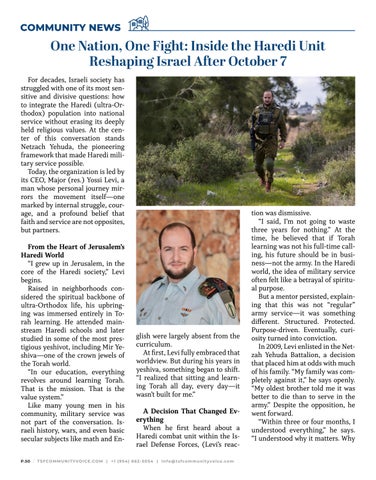
One Nation, One Fight: Inside the Haredi Unit Reshaping Israel After October 7 For decades, Israeli society has struggled with one of its most sensitive and divisive questions: how to integrate the Haredi (ultra-Orthodox) population into national service without erasing its deeply held religious values. At the center of this conversation stands Netzach Yehuda, the pioneering framework that made Haredi military service possible. Today, the organization is led by its CEO, Major (res.) Yossi Levi, a man whose personal journey mirrors the movement itself—one marked by internal struggle, courage, and a profound belief that faith and service are not opposites, but partners. From the Heart of Jerusalem’s Haredi World “I grew up in Jerusalem, in the core of the Haredi society,” Levi begins. Raised in neighborhoods considered the spiritual backbone of ultra-Orthodox life, his upbringing was immersed entirely in Torah learning. He attended mainstream Haredi schools and later studied in some of the most prestigious yeshivot, including Mir Yeshiva—one of the crown jewels of the Torah world. “In our education, everything revolves around learning Torah. That is the mission. That is the value system.” Like many young men in his community, military service was not part of the conversation. Israeli history, wars, and even basic secular subjects like math and En-
glish were largely absent from the curriculum. At first, Levi fully embraced that worldview. But during his years in yeshiva, something began to shift. “I realized that sitting and learning Torah all day, every day—it wasn’t built for me.” A Decision That Changed Everything When he first heard about a Haredi combat unit within the Israel Defense Forces, (Levi’s reac-
P.50 / T S F C O M M U N I T YVO I C E .C O M | +1 ( 9 5 4 ) 6 6 2 - 5 0 5 4 | I n f o @ t s f c o m m u n i t y v o i c e . c o m
tion was dismissive. “I said, I’m not going to waste three years for nothing.” At the time, he believed that if Torah learning was not his full-time calling, his future should be in business—not the army. In the Haredi world, the idea of military service often felt like a betrayal of spiritual purpose. But a mentor persisted, explaining that this was not “regular” army service—it was something different. Structured. Protected. Purpose-driven. Eventually, curiosity turned into conviction. In 2009, Levi enlisted in the Netzah Yehuda Battalion, a decision that placed him at odds with much of his family. “My family was completely against it,” he says openly. “My oldest brother told me it was better to die than to serve in the army.” Despite the opposition, he went forward. “Within three or four months, I understood everything,” he says. “I understood why it matters. Why
COMMUNITY NEWS it’s important to protect our people. Our families. Our country.” Becoming an Officer—and Something More What began as enlistment quickly turned into leadership. Levi volunteered for command school, then officer training, ultimately serving five years as an officer in Netzach Yehuda. Later, in reserve duty, he commanded a special forces unit and held senior operational positions during some of Israel’s most complex security periods. Before October 7, he served as a deputy battalion commander— placing him at the intersection of infantry combat, special operations, and national responsibility. “The army didn’t just give me skills,” he explains. “It gave me identity.” “The Army Made Me More Jewish” Perhaps the most unexpected part of his story is how profoundly military service strengthened his Jewish identity.“For the first time, I learned Jewish and Israeli history,” he says. “I learned that Israel fought seven major wars. I didn’t know that before. No one taught us.” A defining moment came during a delegation to Poland, visiting Nazi concentration camps— this time wearing an IDF uniform. “Standing there in uniform, I understood what it means to be Jewish. What it means to protect ourselves. That moment changed me.” Levi is careful not to criticize Haredi society. “There is a strategic educational philosophy behind it,” he says. “I still believe deeply in Haredi values. I’m still part of that
world.” But he is clear: knowledge, responsibility, and service do not weaken Judaism—they deepen it. “I became more connected. More Jewish. More responsible.” What Is Netzach Yehuda—Really? Netzach Yehuda is often misunderstood. The framework began over 25 years ago, when a group of rabbis approached the IDF with a radical proposal: create a military unit that allows Haredim to serve without compromising religious standards.“ At first, everyone said no,” he recalls. “The Chief of Staff, the Defense Ministry—everyone.” After years of pressure, the first unit was approved. Today, Netzach Yehuda and its sister frameworks ensure: • Three daily prayer services • Mandatory Torah study
P.52 / T S F C O M M U N I T YVO I C E .C O M | +1 ( 9 5 4 ) 6 6 2 - 5 0 5 4 | I n f o @ t s f c o m m u n i t y v o i c e . c o m
• Rabbinic supervision • Strict religious standards • Full combat training “This is not about melting people into something else,” Levi emphasizes. “It’s about letting them serve as who they are.” Answering the Critics Critics often argue that military service pulls Haredi soldiers away from religious life. His response is blunt. “Academia is far more dangerous to religious values than these units,” he says. “And everyone knows it.” Levi notes that thousands of Haredim already leave yeshivot every year—often without structure, guidance, or support. “Our framework gives them a safe environment, spiritually, socially and personally.” Behind the scenes, many senior rabbis quietly support the model,
COMMUNITY NEWS even if they cannot do so publicly. “They understand reality,” he says. “They know this is better than abandonment.” October 7 and a National Wake-Up Call Two weeks before October 7, Levi was called to a meeting with senior IDF leadership. “They asked me to help bring more Haredim into the army,” he recalls. “We talked about increasing numbers.” Then the war began. What followed changed everything. “After a few months, I looked around and realized—only 20,000 Haredim serve, including reserves. Out of a population of 1.4 million. That’s not sustainable.” The Next Phase: Education, Service, and Healing
Today, Netzach Yehuda operates on three major fronts: 1. Pre-Army Education Programs that prepare Haredi youth—religiously, emotionally, and academically—before enlistment. Since the war began, over 500 students have entered these tracks. The goal: 5,000. 2. Active Service with Full Support Soldiers serve in uniform, in combat and technology units, with ongoing rabbinic and emotional mentorship. 3. Veterans and Mental Health Perhaps the most urgent mission: Thousands of reservists— many from Netzach Yehuda— were tasked with body recovery units after October 7. The psychological toll has been devastating. “We’ve already lost soldiers to
suicide,” Levi says quietly. “Close friends.” The organization is now building dedicated mental-health and reintegration programs to help veterans return to normal life with dignity. A Message to the Diaspora For readers in South Florida and beyond, Major (res.) Levi’s message is clear: “Israel has two existential challenges,” he says. “External enemies—and internal division.” Unity, he believes, is impossible without shared responsibility. “We must hug the Haredi world—and also ask it to stand with the nation.” Faith and service, he insists, are not contradictions. “They are the bridge. And building that bridge is how we win—together.”
Labels. Decals. Window Graphics From storefront to shelf - we print what sells Label Sheets Label Rolls Custom Shape Labels
Floor Graphics Wall Decals Window Clings
Business Cards Menus Postcards
P.54 / TSFCOMMUN I T YVO I C E .C O M | +1 ( 9 5 4 ) 6 6 2 - 5 0 5 4 | I n f o @ t s f c o m m u n i t y v o i c e . c o m16101 NE 11th Court - NMB, Florida 33162 305.940.8973 - copymastersnmb@gmail.com