How AI technology is helping to bring Jewish babies into the world A Discussion Hosted by PUAH: Where Reproductive Technology and Halacha Meet
As Torah Jews, we are instructed to enjoy the blessings of this world, within the parameters of halacha. Yet while we know where to turn to determine if our food is kosher, how do we know about the kashrus of a cutting-edge medical technology?
That’s where PUAH comes in.
“For me, the biggest privilege in working for PUAH – as meaningful as it is to help bring Jewish babies into the world – is the opportunity to see the eternal wisdom of Hashem’s Torah,” says Lea Davidson, executive director of PUAH USA. “Every time a new technology comes out and our PUAH rabbanim find exactly where this case is discussed in our halachic literature, I’m inspired all over again.”
Discovering halachically acceptable ways to use complex medical technologies is exactly why PUAH was founded.
When the first IVF baby was born in 1978, the assumption in the Torah-observant world was that the serious halachic issues posed by this revolutionary technology made it forbidden. But Rav Mordechai Eliyahu ztz”l insisted that if Hashem gave us the wisdom to develop a technology, it’s our job to research it and determine how it may be used in a halachically-acceptable way. He charged his close talmid, Rav Menachem Burstein, shlita, with this task. Thus, PUAH was born – opening the door for thousands of Jewish couples to
NIGHT GREEN on the
THE LAUNCH OF PUAH’S FLORIDA
SUNDAY, FEBRUARY 22ND • TOPGOLF POMPANO
been identified, but after sequencing its entire genome, they’ve discovered that their daughter will develop rheumatoid arthritis at age 40. Should the doctor edit out this gene?
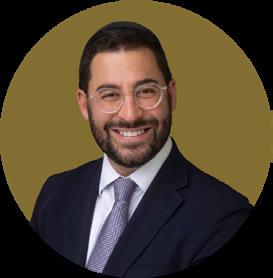
Such a scenario is only a few years from reality, according to Dr. Alan Copperman, FACOG, Managing Director and CEO of RMA
doctor anxiously. Is there hope? He listens carefully, asks questions, and enters the information into his computer. The machine runs the data through its system, analyzing every facet of this couple’s medical background, and spits out a response.
“Here’s your customized treatment protocol,” says the doctor.
COMMUNITY NEWS
“Your highest statistical shot of having a baby.”
For couples who know the agony of the fertility journey, the roller coaster of hopes rising only to be dashed once again, this scenario may sound like a pipe dream. Yet, thanks to modern technology, such precision-targeted treatments are increasingly happening.
Welcome to the wonders of artificial intelligence – the latest frontier in the rapidly-evolving field of fertility medicine.
“Back in the 90s my surgical training involved sewing tubes together with sutures,” relates Dr. Copperman. “Today, no one’s doing tubal surgery. We threw out our sutures and went to laparoscopy. Then we threw out the laparoscopes and went to robotics. We threw out the robots to do surgery in a dish. Now we’re talking about using molecular scalpels to edit the genome. I read sci fi as a kid but I never thought we’d be where we are now.”
He adds, “We’ve gone from studying cells and organ systems to subcellular to genetics. Today, we’ve moved beyond the genome into big data, looking at zeros and ones, at mathematical models to drive treatment. And this infinite universe of information will drive us into the next century.”
AI in Action
What does this mean practically?
“When a couple comes in, we start with the simple questions. Sometimes, simple, low-tech solutions like pills are all that’s needed. But when it’s more complex, that’s where the magic begins, as science and technology translate into helping to create human lives.”
AI, he says, optimizes every aspect of the treatment process. Unlike the trial-and-error that has characterized IVF until now, AI analyzes the data of millions of patients to discover what worked best with patients whose full medical picture most closely aligns with yours. What medication protocol did they use? What dosage? On which days? It can also determine the most optimal lab conditions –the perfect air quality, culture media, PH levels, incubators, etc. - for your specific embryo to successfully develop.
Rabbi Segelman noted that the description of AI’s big data system reminded him of PUAH. “This is what we do as an organization. When a couple calls us for advice, we access our many years of experience helping thousands of couples to advise them which doctor to speak to, which treatment to pursue, helping them create the optimal plan.”
Dr. Copperman explained that this highly tailored tool takes into account all individualized factors – not just the patient’s age, BMI and hormone levels, but also their personal goals. “Someone who’s 26 and wants one child will need a completely different journey than someone who’s 38 and wants five children.”
He added that AI can even help frum patients avoid Shabbos egg retrievals – earning him applause from Rabbi Segelman. “We’ve used machine learning to help us optimize days of the week so that the patient’s retrieval will fall out on a day that makes her comfortable.”
We’ve only scratched the surface of AI’s capabilities, which Dr. Copperman says are being developed as we speak – for example, in
the above-mentioned area of gene editing. “We’re already seeing the potential with technologies like CRISPR, a ridiculously cool technology where we can basically do a ‘find and replace’ on the cellular level, substituting abnormal parts of the nucleotide sequence – say, that which causes Tay Sachs – for normal ones. I believe we’re only a few years away from being able to do this on the embryonic level, editing the entire genome.”
Discussing the seeming limitless potential of AI begs the same question that has been raised in other fields: Is there a fear that machines will replace fertility doctors?
“Only if we lose our heart and our compassion,” Dr. Copperman says. “Computers haven’t quite figured that one out yet. Medicine isn’t just about processing data; it’s about listening to the patients, hearing their goals, their concerns, their dreams, making sure their needs are met.”
In other words, we need to feel cared for. To feel that there’s someone at our side who’s not just capable of harnessing the universe’s infinite information to give us our longed-for baby, but will hold our hands along the journey.
That’s what PUAH is here for.
As we prepare for Purim, a period of revealed miracles, let’s know above all that our Father is all powerful, that He has given us the miracle of medical technology, that He will always carry us through our life’s journey, and that yeshuos can come in the blink of an eye.
May this year be the year.
Contact PUAH: Rabbi Elan Segelman , Rabbinic Director USA Questions@puahfertility.org 888.993.7824