In Dialogue with Motti from South Florida Community Voice
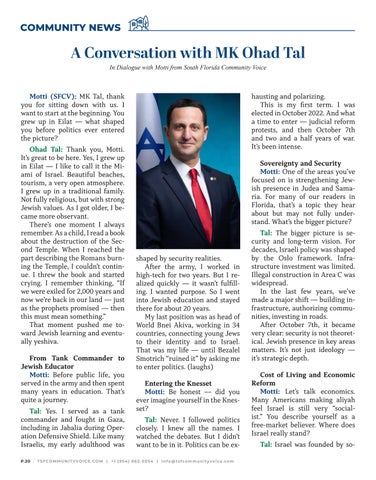
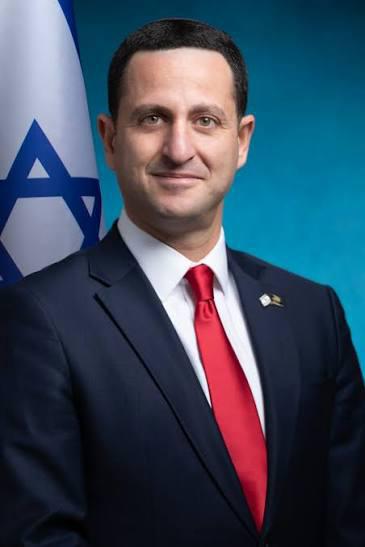
Motti (SFCV): MK Tal, thank you for sitting down with us. I want to start at the beginning. You grew up in Eilat — what shaped you before politics ever entered the picture?
Ohad Tal: Thank you, Motti. It’s great to be here. Yes, I grew up in Eilat — I like to call it the Miami of Israel. Beautiful beaches, tourism, a very open atmosphere. I grew up in a traditional family. Not fully religious, but with strong Jewish values. As I got older, I became more observant.
There’s one moment I always remember. As a child, I read a book about the destruction of the Second Temple. When I reached the part describing the Romans burning the Temple, I couldn’t continue. I threw the book and started crying. I remember thinking, “If we were exiled for 2,000 years and now we’re back in our land — just as the prophets promised — then this must mean something.”
That moment pushed me toward Jewish learning and eventually yeshiva.
From Tank Commander to Jewish Educator
Motti: Before public life, you served in the army and then spent many years in education. That’s quite a journey.
Tal: Yes. I served as a tank commander and fought in Gaza, including in Jabalia during Operation Defensive Shield. Like many Israelis, my early adulthood was
shaped by security realities.
After the army, I worked in high-tech for two years. But I realized quickly — it wasn’t fulfilling. I wanted purpose. So I went into Jewish education and stayed there for about 20 years.
My last position was as head of World Bnei Akiva, working in 34 countries, connecting young Jews to their identity and to Israel. That was my life — until Bezalel Smotrich “ruined it” by asking me to enter politics. (laughs)
Entering the Knesset
Motti: Be honest — did you ever imagine yourself in the Knesset?
Tal: Never. I followed politics closely. I knew all the names. I watched the debates. But I didn’t want to be in it. Politics can be ex-
hausting and polarizing.
This is my first term. I was elected in October 2022. And what a time to enter — judicial reform protests, and then October 7th and two and a half years of war. It’s been intense.
Sovereignty and Security
Motti: One of the areas you’ve focused on is strengthening Jewish presence in Judea and Samaria. For many of our readers in Florida, that’s a topic they hear about but may not fully understand. What’s the bigger picture?
Tal: The bigger picture is security and long-term vision. For decades, Israeli policy was shaped by the Oslo framework. Infrastructure investment was limited. Illegal construction in Area C was widespread.
In the last few years, we’ve made a major shift — building infrastructure, authorizing communities, investing in roads.
After October 7th, it became very clear: security is not theoretical. Jewish presence in key areas matters. It’s not just ideology — it’s strategic depth.
Cost of Living and Economic Reform
Motti: Let’s talk economics. Many Americans making aliyah feel Israel is still very “socialist.” You describe yourself as a free-market believer. Where does Israel really stand?
Tal: Israel was founded by so-
COMMUNITY NEWS
cialists — that’s true. But today, we’re much more market-oriented. And we need to continue that shift.
I’m currently leading reforms in two major areas:
First — the dairy market. Three companies control most of the market. Prices are high. Competition is limited. We’re working to open the market.
Second — the banking sector. We have very few banks. That means limited competition and higher costs. We’re pushing reforms to allow new banks to enter the system.
Despite two years of war, our economy is strong — low unemployment, strong currency, tech investment growing. But we must reduce regulation and increase competition.
And honestly? We need more olim from America bringing business culture and free-market thinking.
Israel and America — A Strategic Alliance
Motti: Here in South Florida, support for Israel is strong. But sometimes it feels like support depends on who’s in power in Israel. Does that concern you?
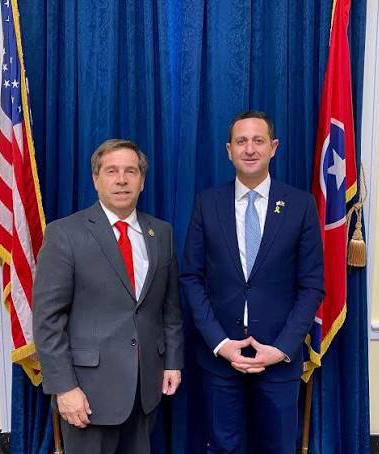
Tal: Very much. Support for Israel should not depend on which government is in office.
I’m concerned about trends on both sides in America — the progressive left becoming more hostile to Israel, and some voices on the right becoming isolationist or even drifting into antisemitic narratives.
That’s dangerous.
Motti: So let’s flip the question — why should Americans care about Israel beyond emotional connection?
Tal: Because it’s strategic.
Israel provides more actionable intelligence to the U.S. than all NATO countries combined. That saves American lives and billions of dollars.
Israeli defense technologies are manufactured in the U.S., creating American jobs.
Israel fights Iran, Hezbollah, Hamas — forces that openly chant “Death to America.” We are on the front line.
America First should not mean America Alone. Strong alliances protect American interests.
The Role of the American Jewish Community
Motti: What role do you see for American Jews in this moment?
Tal: A crucial one. The Jewish
COMMUNITY NEWS
community must fight extremism on both sides — the extreme left that disconnects from Israel, and the extreme right that distorts the alliance.
Political leaders should feel that supporting Israel is politically beneficial, not risky.
October 7th — A Personal Reality
Motti: We can’t not talk about October 7th. Where were you?
Tal: My family lives in the south. My 84-year-old father had to run from synagogue while terrorists were shooting nearby.
Every Israeli knows someone killed, wounded, or kidnapped. It’s personal.
For years, we wanted to believe peace could be achieved through concessions, economic incentives, walls. October 7th shattered that illusion.
Iran had built forces around us — Hezbollah in Lebanon, militias in Syria and Iraq, Hamas in Gaza, Houthis in Yemen.
The goal wasn’t harassment. It was annihilation.
By God’s grace and through enormous sacrifice, we pushed back. We’ve weakened Iran’s regional network. We’ve strengthened alliances.
If the Iranian regime eventually falls, it will change the Middle East entirely.
We have no issue with the Ira-
nian people — only with a regime that chants “Death to Israel” and “Death to America.”
Closing Thoughts
Motti: Final thought — after everything Israel has gone through, where do you see the country heading?
Tal: Israel has always turned tragedy into growth. We are resilient. We are innovative. We are purposeful.
As I felt as a child reading about the destruction of the Temple — there is meaning to our return. There is responsibility.