We treat every patient like family. Our heart badges symbolize our commitment to providing expert care with uncommon compassion. We understand that every patient is someone’s parent, friend, or loved one, and we care for them with that in mind. Every day, AdventHealth ER nurse, Taylor, wears her commitment to caring for patients like she would her daughter, with love and expertise.
We’re here to deliver personalized, lifesaving care when every minute counts.
CONTRIBUTORS
Linda List, Writer and Photographer
Linda List’s career was spent in the food industry, often surrounded by chocolate and candy. Retirement and the Tryon Daily Bulletin have provided the opportunity for her to share her writing. Growing up in New York on the Canadian border, she lived most of her adult life at the foot of the Rockies in Golden, Colo. And is now enjoying life in Landrum the foot of the Smokies.
Kirk Gollwitzer, Writer and Photographer
Kirk Gollwitzer is a freelance writer, musician, photographer, videographer, and real estate broker specializing in buying and selling homes and horse properties. A former key figure and co-founder of the Tryon International Film Festival, he has done several documentaries and has written two novels.
Storme Smith, Writer and Photographer
Storme Smith is a writer who lives in the Foothills of North Carolina. He is the co-founder and publisher of Buno Books, and has a passion for the arts. He also enjoys writing about the history, sports and unique people and places of our area.
Pebbles, Writer
Pebbles is the “spokespony” for HERD, or Helping Equines Regain Dignity, a local nonprofit that saves equines from dire conditions and in many cases slaughter. She dictates her monthly columns about her adventures, and what a rescue organization does, to Heather Freeman. Pebbles and Heather can be reached through HerdRescue.org
Allison Publisher
ON THE COVER
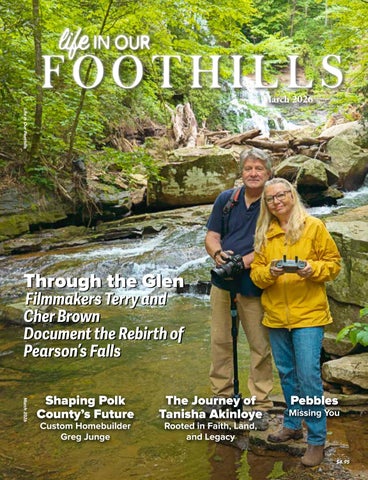
March arrives with subtle signs of renewal across our foothills— longer days, early blooms, and a quiet reminder that recovery and growth often unfold side by side. In this issue of Life in Our Foothills, we celebrate the people who are documenting change, building community, and preserving the stories that make this place home.
This month, we spoke with Terry and Cher Brown, two creative minds who have been documenting the ongoing restoration of Pearson’s Falls and Glen after it suffered severe damage during Hurricane Helene. Through their production company, Keva Creative, they focus on documentary storytelling, conservation projects, and mission-driven visual work, and they share with us the transformative experience of witnessing how this beloved natural landmark continues to evolve.
Additionally, we are introduced to Greg Junge of Junge Construction, who brings a thoughtful approach to custom home design while helping shape the youth of Polk County through mountain biking. As his reputation for craftsmanship grows, Greg reflects on the initiatives and community connections he is most passionate about. We also visit with Tanisha Twitty Akinloye, founder of Pea Ridge Partnership and Empowering Through Beauty, Inc., who shares her inspiring journey rooted in faith, land, and legacy.
And of course, we hear from our resident “spokespony,” Pebbles!
You’ll find all of this and more in this month’s edition of Life in Our Foothills. As always, I encourage you to share your thoughts, story ideas, and local highlights with me at jeff. allison@tryondailybulletin.com.
By Kirk Gollwitzer
Thanks for reading,
Jeff Allison Editor
Jeff
Publisher & General Manager
Jeff Allison
Graphic Design
Nathalie Adams
Marketing
Lynn Cromer
Stacey Cullen
Distribution
Jamie Lewis
Austin Heffner
Administration
Jennifer Sattler
FOOTHILLS life IN OUR STAFF
Life in Our Foothills is published monthly by Tryon Newsmedia LLC. Life in Our Foothills is a registered trademark. All contents herein are the sole property of Tryon Newsmedia LLC. No part of this periodical may be reproduced without written permission from the publisher. Please address all correspondence (including, but not limited to, letters, story ideas and requests to reprint materials) to Manager, Life in Our Foothills, 16. N. Trade St., Tryon, NC 28782, or email to jeff.allison@ tryondailybulletin.com. Life in Our Foothills is available free of charge at locations throughout Polk County and Upstate South Carolina, and online at www.tryondailybulletin.com. Subscriptions are available for $30 per year by calling 828-859-9151. To advertise, call 828-859-9151.
Tryon Builders takes pride in creating exceptional equestrian facilities that blend timeless craftsmanship with thoughtful functionality. Every aspect of our barns is meticulously designed with the horse and owner in mind, ensuring the highest quality materials, and seamless efficient layout.
Our
CALENDAR OF EVENTS
MARCH 12-15
Dirty Rotten
Scoundrels
March 12-15, 7:30 p.m.
Tryon Little Theater at TFAC 34 Melrose Ave., Tryon
Foothills Memory Café
March 6, 2 to 3 p.m.
Landrum Library 111 Asbury Dr., Landrum
Columbus Indoor Market
March 7 & 21, 10 a.m. to 1 p.m.
Iron Key Brewing Company 135 Locust St., Columbus
Opening Reception - Feeling Good
March 7, 5 to 7 p.m.
TPS Gallery 78 N Trade St, Tryon
TFAC at the Movies - Lawrence of Arabia
March 10, 7 p.m.
Tryon Theatre 45 S. Trade St, Tryon
MARCH 12
Opening Reception - Rosa & Winton Eugene Exhibit
March 12, 5:30 to 7:00 p.m.
Tryon Arts & Crafts School 373 Harmon Field Rd, Tryon
Filmmakers Terry and Cher Brown Document the Rebirth of Pearson’s Falls
By Kirk Gollwitzer
Ifirst met Terry and Cher Brown when they arrived in Tryon the way so many good stories in small towns seem to begin, quietly and without much fanfare, carrying something larger than anyone quite realized at the time.
It was 2022, and they had entered a short documentary called Tidal Alert into the Tryon International Film Festival. They had recently made their way from Florida to North Carolina and, almost by coincidence, landed in a home that had previously been owned by a close friend of ours. They were not local celebrities or established names in the region yet, just two filmmakers who had relocated north, following family and opportunity, and decided to submit their work. Their film, which explored water quality and its impact on North Carolina fisheries, ended up winning Best Short Documentary. I remember thinking at the time that it felt almost ironic, local filmmakers arriving in a new town and quietly walking away with one of the festival’s top awards. But it also felt right. The film was thoughtful, visually strong and quietly urgent in the way the best environmental storytelling tends to be. It did not preach. It observed. More than anything, Terry and Cher struck me as deeply grounded people. No bravado. No ego. Just two professionals who seemed to care more about the stories they were telling than about themselves.
Terry Brown’s path to filmmaking is anything but linear. He grew up outside Columbia, South Carolina, in the small town of Chapin and attended Brevard College before transferring to the University of South Carolina. He left in his senior year, not for
academic reasons, but because he was offered a job on the road as a sound engineer for a touring band out of Atlanta.
“I didn’t graduate,” Terry says. “I left my senior year to go on the road with a group as their sound engineer. That launched my recording and music career.”
He worked with the Pat Terry Group, whose frontman later became a successful country songwriter for artists like Travis Tritt and Tammy Tucker. From there, Terry transitioned into a long corporate career with AT&T, where he spent nearly 15 years before the massive industry downsizing of the late 1990s. Somewhere in between, he trained as a certified tennis professional, a career cut short by a serious back injury.
“I blew my back out,” he says. “After back surgery, I went into journalism.”
That shift would end up defining the rest of his professional life. While recovering, Terry taught himself how to build a newspaper from scratch, launching a small tennis-focused publication as a way to stay engaged while healing. What he had studied at USC, journalism, filmmaking and multimedia production, finally began to converge.
He later went on to work in corporate communications for one of the largest hospice organizations in the country, where he transitioned traditional print storytelling into visual and documentary formats.
“I won a lot of awards for the storytelling we were doing there,” he says. “It was about moving from print into visual storytelling, helping people see what they were feeling.”
Cher Brown’s path was different, but no less layered. She grew up in Grand Rapids, Michigan, and studied marketing, advertising and public relations at Hope College and Grand Valley State University. Her early career unfolded in human resources and corporate management.
“When Terry and I met, I was working in HR,” she says. “I had a very corporate background.”
It was Cher, however, who would eventually become the technical engine of their filmmaking partnership, particularly in drone cinematography.
“In 2016, I discovered that to fly commercially, you had to be FAA certified,” she says. “We already had a drone and were flying it in parks, totally unaware.”
Rather than dismiss it, Cher dove into the certification process and became one of the earliest pilots certified under the FAA’s new Part 107 rules, and one of a very small minority of women in the field.
“Women represented about 5.6 percent of certified pilots at the time,” she says. “Today it’s around eight percent. It’s still a very male-dominated industry.”
When clients asked technical questions, they often directed them at Terry.
“He’d say, ‘You need to talk to her, she’s the drone pilot.’” Cher smiles at that. “My focus is cinematography and ethics. A lot of people fly illegally. I take it seriously.”
Together, they founded Keva Creative, a boutique production company focused on documentary storytelling, conservation projects and mission-driven visual work. Their ethos emphasizes ethical filmmaking, environmental responsibility and what they describe as purpose-driven media. They are not interested in spectacle. They are interested in meaning.
When Hurricane Helene moved through Western North Carolina, the devastation was both immediate and invisible. Immediate in the sense that roads collapsed, trees fell and entire landscapes reshaped themselves overnight. Invisible because
many of the most affected areas, including Pearson’s Falls, were suddenly inaccessible and closed to the public.
Pearson’s Falls sits between Tryon and Saluda, tucked into a steep glen just off Highway 176. For generations, it had been one of the region’s most visited natural landmarks, a short walk down a narrow trail leading to a dramatic waterfall. For decades, the experience was essentially the same. Park. Walk. Arrive.
“After Hurricane Helene, we were very careful,” Cher says. “We wanted to fly our drone so badly, but ethically it didn’t feel right. People were traumatized. We didn’t want to exploit suffering.”
So they waited. They did not launch the drone, document anything or post images.
Cher said they wanted to be especially careful in those early weeks, mindful that many people in the region were still processing loss and disruption. “We saw a lot of people out there taking pictures,” she says, “and for us it was important to step back and think about the impact. We didn’t want to be part of anything that might feel intrusive or exploit someone else’s suffering.”
In late November, Terry received a call. Someone from Pearson’s Falls asked if they were still doing film work and whether they would be interested in documenting the restoration project. At first, the request was modest, a five- or six-minute video to show members what was happening on the property.
But the Browns did not yet understand what they were walking into.
When they first walked the property, they did not make it to the falls.
“We were shocked,” Terry says. “The landscape had completely changed. Landslides on both sides. Picnic tables rolled over. Trees, boulders, sediment everywhere. The creek had reshaped itself. Trails were gone. Railings washed out.”
One of the early walks took four hours to reach the falls, a distance of only a quarter mile. They climbed over fallen trees and massive boulders, navigating muddy slopes with backpacks, holding onto branches to avoid sliding.
“We couldn’t even reach the falls safely until February,” Cher says.
It was not just debris. It was geology. “Boulders the size of boxcars had come down over the falls,” Terry says. “At the base, where there used to be open water, there was now a 25-foot pile of rock and debris.” Water had found a new path. The glen itself had been reshaped.
At one point, Terry tried to put the scale of the storm into perspective for me. He described the total volume of rainfall that had fallen into the glen and surrounding watershed, then paused and offered an analogy that stopped me cold. If that amount of water were spread evenly, he said, it would have been enough to cover the entire United States. It was the first time I truly grasped the magnitude of what had passed through this narrow mountain corridor, not just a storm, but a force large enough to redraw a landscape.
Habitat Cabinets by Design @ the Landrum ReStore!
We offer high quality cabinets at an affordable price, designed specifically for your project by our cabinet specialists. Cabinets will be shipped to you in as little as 4 5 weeks
132 North Trade Ave., Landrum, SC Monday ~ Saturday: 10 ~ 5:00pm Scan or visit: habitat-hvl.org
Boulders, trees and debris scoured the glen of vegetation and rechanneled the water, creating new and dramatic water features along
And yet, somehow, the waterfall still existed.
Before the Browns were officially hired, they were asked why they wanted to do this project.
Cher answered without hesitation.
“This place is sacred to us,” she said. “Nature heals. Nature is a place all of us can go to when we lose everything. It nourishes us. It gives back if we stop long enough and listen.”
She remembers looking up and seeing tears in the eyes of the people across the table.
“That was a powerful moment,” she says. “We all felt the same thing.”
As the project stretched from weeks into months, Cher began to describe this period of her life as her “year of the Fire Horse,” a phrase from the Chinese zodiac associated with momentum and transformation. She said she felt strangely aligned with it, as if the work at Pearson’s Falls required exactly that kind of energy. “Fire Horse years are about movement,” she said. “They’re about not waiting for change, but moving through it.”
For her, the project became more than a film. It became a reflection of where she felt she was standing in her own life. Initially, the board wanted a short piece. But as Terry and Cher kept returning, month after month, it became clear that Pearson’s Falls was not being repaired. It was being reborn.
“Their approach was conservation, preservation, ethics, legacy,” Cher says. “They didn’t want to destroy ecosystems. They wanted to honor the founders’ vision.”
Across the road, another cleanup operation was underway, aggressive and mechanical.
“That’s when I really understood what Pearson’s was trying to do,” Cher says.
“They weren’t here to gut it. They were here to protect it.”
By spring, the Browns had renegotiated the scope of the project.
“Originally they wanted a short film,” Terry says. “Now we’re working on
something longer that allows us to tell the full story.”
They would love to see the Pearson’s Falls project eventually reach a larger audience, not for recognition, but because they believe the story carries meaning well beyond this single place. Perhaps the most surprising thing they discovered was that Pearson’s Falls was no longer just a waterfall.
“The big surprise is that it’s not just about the waterfall anymore,” Cher says. “It’s about the glen.”
A glen, she explains, is the ecosystem between two mountain slopes, usually with a creek running through it. Before Helene, visitors walked a narrow path. Now the space has opened into something immersive, with trails on both sides, wide views and a full landscape experience.
“This is a place to meditate,” Cher says. “To think. To recenter. Nature heals.”
She pauses.
“It’s not just Pearson’s Falls anymore,” she says. “It’s the Glen at Pearson’s Falls.”
I never walked those paths with them. I was not allowed to. The roads were closed. The area restricted. The danger too real.
Which means everything I know about Pearson’s Falls after Helene comes from Terry and Cher, from their words, their images, their drone footage and their exhaustion. In a strange way, that makes them not just filmmakers. It makes them translators.
They stood in the middle of a landscape none of us could enter and came back with something more than footage.
They came back with meaning.
And that may be the real story. Not that Pearson’s Falls was damaged. Not even that it was restored.
But that two people were there to witness its transformation and understood, instinctively, that what had been lost was not replaced.
Junge Construction specializes in building custom homes.
Building Legacy
How Greg Junge is Shaping Homes, Community, and Polk County’s Future
By Storme Smith
Whether overseeing a custom home build or coaching kids on the Little White
Oak Mountain trails, Greg Junge approaches both with the same steady focus that has made him a trusted figure in the Foothills.
As founder and CEO of Junge Construction, Greg has earned a reputation for meticulous craftsmanship, intentional design, and an unusually personal approach to homebuilding. Licensed in both North and South Carolina, he operates with a clear philosophy: quality over quantity, relationships over transactions, and purpose over profit.
“I don’t want to just build houses,” Junge says. “I want to create places of belonging. Homes that mean something. Homes that families pass down.”
Though he wasn’t born in Polk County, Junge considers it home in every meaningful sense. His family relocated from New York in 1994, and he has lived
in the area for more than 30 years. His roots here run deep, personally, professionally, and emotionally.
“I was raised here,” he says simply. “This place shaped me.”
Junge’s path into construction began early, earlier than most. At a young age, he was already working weekends alongside his father, Cato Junge, a general contractor and local business owner.
Those early experiences weren’t glamorous, but they were foundational. Junge learned the rhythms of a job site, the importance of showing up, and the pride that comes from building something tangible.
“My dad taught me work ethic, but he also taught me craftsmanship,” Junge says. “I learned that how you do something matters. Details matter. People matter.”
He attended Polk Central and later Polk County High School, balancing academics with hands-on experience that set him apart long before adulthood. “School gave me structure,” he says. “Construction
Greg Junge with his father, Cato Junge.
Junge has spent his life around construction sites.
gave me purpose.”
After years of working in specialized trades, Junge realized something wasn’t sitting right.
“I learned a lot by focusing on one trade,” he explains. “But I didn’t want to just do a small portion of the job anymore. I wanted to see the whole picture.” That realization became pivotal. Junge noticed that many of the problems on construction sites stemmed from miscommunication between trades. No one was overseeing the entire process from start to finish.
“When you’re a general contractor, you’re often coming in to fix problems that five other people created,” he says. “I wanted to be the person who prevented those problems in the first place.”
Becoming a custom home builder gave him the control he craved, not out of ego, but out of responsibility.
“I like things done right,” he admits.
Their offices were built in the last few years.
“And I like accountability.”
Before launching Junge Construction, Junge spent over a decade running a successful garage door service company he founded in 2004. While it may seem like a detour, he credits that experience with shaping his customer-first mindset.
“That business taught me how to serve people,” he says. “How to listen. How to communicate. How to run a company.”
As his garage door business grew, so did his construction work, until construction became his clear calling. Around 2019, he officially founded Junge Construction and eventually moved away from the garage door business to focus fully on building homes.
“I realized construction was dominating everything else,” he says.
“And honestly, it’s what I loved.” What sets Junge Construction apart isn’t just craftsmanship, it’s intention.
“My ‘why’ is everything,” Junge says. “Construction can be lonely. Business can be isolating. But what I love is helping people take something they can’t quite see and turning it into reality.”
Clients often come to Junge with abstract ideas, feelings, visions, and aspirations, rather than fully formed plans. “They’ll say, ‘I don’t know exactly what I want, but I’ll know it when I see it,’” he
says. “And that’s my favorite challenge.” He describes the process as almost magical.
“They tell me their dream in words,” Junge says. “And then one day they’re standing inside it.”
Junge refers to his projects as “legacy homes,” structures built not just to last, but to matter.
“These homes should be passed down to your great-grandchildren,” he says.
“They’re not disposable.”
He approaches each project with a
deeply personal mindset, viewing homes as emotional spaces as much as physical ones.
“A house is where life happens,” Junge says. “It’s where families grow, where kids are raised, where memories are made. That responsibility is huge.” That mindset has earned him trust throughout Polk County and beyond, including work in high-end communities like Bright’s Creek. While licensed for commercial construction, Junge focuses primarily on custom residential homes.
“I could do commercial work all day,” he says. “But that’s not where my heart is.”
Junge’s impact extends beyond private homes. He’s known for stepping outside his job description when something bigger is at stake. While helping Mike Hrobak with the construction of the Livery Purhouse in Tryon, he took the extra step of advocating for safer sidewalks on Pacolet St. That instinct mirrors his broader view of success.
“If something needs to be done, I don’t just walk past it,” he says. “I get involved. I don’t measure success by square footage, I measure it by impact.”
Eventually, Junge found himself searching for deeper motivation, not just in work, but in life.
“I was on a personal journey to find a stronger ‘why,’” he says.
That search led him back to two wheels. A former motocross racer, Junge turned
The Trailhead for the Little White Oak Mountain Trails.
One of the beautifully designed trails on Little White Oak Mountain.
The map for Little White Oak Mountain Trails.
to mountain biking as both a physical outlet and a mental reset. What started as a personal pursuit soon evolved into something much larger.
“Competition saved me,” he admits. “I fought depression by putting a race on the calendar. When the trails at Little White Oak Mountain started becoming a reality, everything clicked. I thought, what if we could do something for kids here?”
Junge founded the Polk Wolverines Mountain Bike Team as part of the North Carolina Interscholastic Cycling League (NICA), giving local youth access to a sport often limited by geography and cost.
“I wanted to support kids’ energy and give them something meaningful,” he says. “Something that builds confidence.”
The Polk Wolverines Mountain Bike
Junge and other members of Friends of Little White Oak Mtn. during the construction.
Team has expanded rapidly in its first seasons, nearly doubling in size and producing consistent podium finishes at state-level races.
Here’s to serving the Foothills with today and every day!
“I never started this to chase trophies,” Junge says. “But when kids show up, commit to the work, and start believing in themselves, success tends to follow.”
He points to moments like the time an inexperienced rider struggled, only to reach the top in time with the help of two coaches pushing him along.
“That was a bigger victory than any medal,” Junge recalls. Practices emphasize fundamentals, safety, and resilience over speed alone, yet the results speak for themselves. Riders from the team now compete confidently across North Carolina and beyond, earning recognition not just for performance, but for sportsmanship, discipline, and growth, a reflection of Junge’s belief that the true win happens long before race day.
The team practices right behind Polk County Middle School, where the Little White Oak Mountain Trails are located, eliminating one of the biggest barriers to youth sports: transportation.
“The trails are the lifeblood of the team,” Junge says. “Without them, the team doesn’t exist. We’re growing athletes and mountain bikers for life. Not just racers.”
The Little White Oak Mountain Trail system has become a cornerstone for both the team and the broader community.
Junge sees it as a catalyst for Polk County’s future. He’s also a key contributor to Friends of Little White Oak Mountain is a volunteer-led nonprofit dedicated to building, maintaining, and protecting, which is currently working toward Phase 2 for the trails expansion.
“These trails will one day be just as well-known as horses are here,” he says. “Mark my words.”
Beyond recreation, Junge believes the trails bring sustainable economic impact without sacrificing the county’s identity.
“People come, they ride, they eat, they leave,” he explains. “It supports local businesses without changing who we are. I see
Mountain biking is a passion of Greg’s.
the team helping grow the trails, and the trails helping grow the team. It’s a win-win.”
Whether he’s overseeing a custom home, coaching young riders, or advocating for community resources, Greg Junge approaches everything with the same philosophy: show up fully, care deeply, and build something that lasts.
“I wake up every day wanting to make something better than I found it,” he says.
In Polk County, that mindset is leaving its mark, one home, one trail, and one kid at a time.
For more information on Junge Construction, visit Jungeconstruction.com. And to learn more about the trails or volunteer to help, visit littlewhiteoakmountain.org.
Junge recently spoke at the Foothill Chamber’s Thrive Talks.
Members of the Polk County mountain biking team.
Creator’s Vault in Tryon is a creative space and empowerment center.
The Journey of Tanisha Akinloye
Rooted in Faith, Land, and Legacy
By Storme Smith, Photos courtesy of Tanisha Akinloye
Some people leave home to discover who they are. Others have to return to understand it. For Tanisha Twitty Akinloye, coming back to the Foothills, back to Pea Ridge Road in Mill Spring, was not a nostalgic gesture or a retreat from a larger life. It was a response to a call that had been quietly building for years. Founder of Empowering Through Beauty Inc. and creator of the Pea Ridge Partnership Initiative, Tanisha is a cultural preservationist, community organizer, and storyteller whose work is rooted in faith, Black landownership, and the belief that dignity begins with knowing where you come from.
“I don’t think of my life as a story of resilience,” Tanisha says. “It’s obedience. Everything in my life has come from listening and responding.”
She was born and raised on Pea Ridge Road, the only girl among five brothers, in a three-bedroom trailer that held eight people and very little privacy. What it lacked in space, it made up for in structure and love.
“We didn’t have a lot,” she says. “But we didn’t know that. What we knew was love, discipline, faith, and togetherness. Even when my parents struggled, they never let those struggles break the family.”
Her mother was a pastor, and her father was the quiet anchor of the household. Faith wasn’t something practiced only on Sundays; it was lived daily.
“I was only days old when my mother received her first pastoral appointment,” Tanisha says. “Sundays meant getting up early, long drives through the mountains, and watching ministry happen in real time.”
She remembers sitting between her parents in the front seat or squeezed in the back with her brothers, absorbing what leadership looked like before she
Tanisha near where she was raised.
had words for it.
“I didn’t know it then, but I was learning how you show up for people,” she says. “How you carry responsibility even when you’re tired.”
When Tanisha was about eleven or twelve, her father noticed that, as the only girl, she needed space of her own. With his own hands, he built an extra bedroom onto the trailer.
“That room is still standing today,” she says. “It was dignity. It was protection. It was intentional fatherhood.”
While Polk County grounded her, the church expanded her sense of possibility. As a youth delegate for the Blue Ridge Conference, she traveled to different cities, including repeated trips to New York City.
“Those trips showed me that calling isn’t limited by geography,” she says. “You can come from a rural place and still be meant for big work.”
Her path, however, was not straight-
Tanisha with members of the North Carolina Department of Natural and Cultural Resources
forward. While in college, Tanisha became pregnant and left school. “For a lot of people, that would’ve been the end of the story,” she says. “For me, it became a turning point.”
After having her baby, she enrolled in cosmetology school. There, she discovered that beauty could be a form of restoration rather than vanity.
“I realized beauty could be healing,” she says. “It’s about confidence. It’s about helping people see themselves again.”
Marriage followed, and then a move to Connecticut. Tanisha enrolled at the University of Bridgeport and earned a degree in psychology. She spent eight years as a stay-at-home mother, raising three children.
“That season grounded me,” she says. “My husband and my kids are my biggest supporters. Everything I do, I do with them in mind.”
Eventually, she opened her own beauty business, which grew into Empowering Through Beauty Inc., a nonprofit she has led for more than 14 years. The organization restores dignity through beauty services, wellness initiatives, and compassionate outreach. Her work gained national attention, leading to two TEDx talks.
One of her proudest moments came when she delivered her first TEDx talk back home in the Foothills.
“That was ancestral ground,” she says. “My family built busi-
Question: I have struggled to find an effective solution for my sciatica pain. Can
I’ve been dealing with TMJ pain for a while and can’t seem to find lasting relief. Can acupuncture help? : Q
acupuncture help?
Question: My back always hurts, but I don’t want surgery. Can acupuncture help? I’ve been dealing with TMJ pain for a while and can’t seem to find lasting relief. Can acupuncture help? : Q
Absolutely, yes! Sciatica pain, caused by irritation or compression of the sciatic nerve, can be excruciating and disruptive to daily life. And unfortunately, many people suffer for months or even years with this debilitating condition. Acupuncture is an effective, drug-free option for managing this challenging ailment.
1. Reduces Pain Intensity
Here’s how it works:
Acupuncture, a cornerstone of traditional Chinese medicine, has garnered increasing attention in Western healthcare for its potential to alleviate back pain. Recent studies provide evidence supporting its efficacy. Here are five scientifically backed ways acupuncture can help manage back pain:
Reduces Inflammation- Acupuncture stimulates specific points on the body, prompting the release of anti-inflammatory chemicals. This helps reduce swelling and pressure on the nerve, alleviating pain.
2. Improves Mobility
Absolutely! TMJ pain—whether it’s jaw tightness, clicking, headaches, ear pain, or just a constant ache, can be exhausting. Caused by tension, inflammation, or misalignment of the jaw joint, TMJ can be incredibly uncomfortable—making it hard to talk, eat, or even relax. Many people struggle for months or years before finding a solution. Acupuncture is an effective, drug-free way to manage this challenging condition. Finding relief for my own TMJ pain is what first led me to acupuncture. The difference it made in my life was so profound that it inspired me to become an acupuncturist and help others find the same kind of healing.
•Boosts Blood Flow – Increased circulation brings fresh oxygen and nutrients to the area, speeding healing and reducing pain.
Acupuncture has been shown to significantly decrease pain levels in individuals with chronic low back pain. A systematic review and meta-analysis found that acupuncture led to a clinically meaningful reduction in pain both immediately after treatment and in the intermediate term .
Beyond pain relief, acupuncture contributes to improved physical function. Studies indicate that acupuncture provides clinically relevant improvements in functional measures for chronic low back pain .
Here’s how it works:
Promotes Blood Flow- Acupuncture improves blood flow to the affected area, aiding in the healing of damaged tissues and reducing muscle tension.
effects by modulating the release of certain neurotransmitters. Research has shown that acupuncture can influence the release of adenosine, a neurotransmitter that acts as a potent antiinflammatory agent .
Relaxes Tight Muscles- Muscle tightness can cause sciatica flares, and sciatica flares can cause muscle tightness. This cycle is what allows sciatica to persist. Acupuncture targets trigger points to ease muscle tension to break this cycle.
5. Offers Long-Term Relief
•Calms the Nervous System – Stress is a major trigger for jaw clenching and grinding. Acupuncture helps balance the nervous system, reducing stress and preventing flare-ups.
Long-Term Relief- Unlike temporary solutions like painkillers, acupuncture offers long-lasting benefits for many sciatica sufferers. Regular sessions prevent flare-ups by maintaining proper nerve function, reducing inflammation, and promoting overall musculoskeletal health.
The benefits of acupuncture may extend beyond immediate symptom relief. A randomized controlled trial found that acupuncture had beneficial and persisting effects on chronic low back pain, with significant improvements observed at both 8 and 48 weeks post-treatment.
•Supports Long-Term Relief – Unlike temporary fixes like pain medication or mouth guards, regular acupuncture sessions address the root causes of TMJ pain, helping prevent recurrences and improving overall jaw health.
•Reduces Inflammation – By stimulating specific points, acupuncture helps trigger anti-inflammatory responses in the body, reducing swelling and easing joint irritation.
3. Enhances Effectiveness of Standard Treatments
When combined with conventional treatments, acupuncture can amplify their therapeutic outcomes.
4. Modulates Neurochemical Activity
Releases Endorphins- Acupuncture stimulates the nervous system to release endorphins, the body’s natural pain-relieving chemicals.
•Calms Jaw Muscle Tension – Tight jaw, neck, and facial muscles often drive TMJ pain. Acupuncture targets these trigger points, helping muscles relax and restoring natural jaw movement.
Acupuncture exerts analgesic (pain-relieving)
If you’re seeking a natural, non-invasive solution, acupuncture offers a holistic, evidence-based approach to your pain management.
If you’re seeking a natural, non-invasive solution, acupuncture offers a holistic, evidence-based solution for TMJ pain.
Acupuncture presents a multifaceted approach to managing back pain, offering benefits that range from immediate pain reduction to long-term functional improvements. Its integration into care plans should be considered for back pain treatments.
If you’re seeking a natural, non-invasive solution, acupuncture offers a holistic, evidence-based solution for TMJ pain.
A Black History event organized by Pea Ridge Partnership Initiative.
nesses there. We built community there.”
Despite her success, Tanisha felt a persistent pull toward home. “I kept feeling this call to return,” she says. “Not just to visit, but to come back and do the work.”
That return became the Pea Ridge Partnership Initiative, named for the road where she was born and raised. The initiative formally began in 2021, though it was delayed when Tanisha became severely ill with COVID and spent nearly two weeks hospitalized, followed by months on oxygen.
“I had to pause,” she says. “Healing came first. But the assignment didn’t disappear.”
When she began researching her own family history, she uncovered truths she had never known. Her great-grandfather, once a sharecropper, purchased more than 60 acres of land on one side of Pea Ridge Road. His brother purchased nearly the same amount on the other side.
“I didn’t know any of this growing up,” Tanisha says. “I never knew my family were the first landowners on both sides of that road.”
Her great-grandfather farmed, fished, raised animals, and sold food throughout the community.
“They didn’t have to go anywhere,” she says. “They grew their own food. They bartered eggs for sugar. They traded milk.
Tanisha and her husband, Charles.
They took care of each other.”
Many Black families still living on Pea Ridge Road reside on land her ancestors sold or stewarded.
“If I hadn’t come back,” she says, “a lot of that history would’ve died with the elders.”
Tanisha began her preservation work by going door to door, sitting in living rooms, and listening.
“I started with the elders,” she says. “I went into their homes. I listened.”
Her first interview was with Ruby Miller, who had lived on Pea Ridge for over 70 years.
“They were excited,” Tanisha recalls. “Excited that someone cared. That someone wanted to hear their stories.”
She recorded memories of Fourth of July celebrations in sheep pastures, Thanksgiving turkey shoots, Easter egg hunts at Green River Plantation, and everyday life shaped by cooperation and joy.
“People think our history is only about pain,” she says. “But there was joy. There was laughter. There was community.”
Today, the Pea Ridge Partnership includes historical tours, storytelling gatherings, writing workshops, and community conversations. Tour stops include Rosenwald school sites, historic Black churches, cemeteries, and Green River Planta-
Preservation project on Pea Ridge Rd.
tion, where Tanisha’s mother was born.
“Preserving history isn’t just about buildings,” she says. “It’s about people living long enough to tell their stories.”
That understanding led her to work in environmental and health advocacy, including clean water education. “When I started listening, people told me what was making them sick,” she says. “You can’t preserve a community if you ignore what’s harming it.”
During Hurricane Helene, Tanisha made sure numerous historically Black churches in the area received generators. “The church has always been the backbone,” she says. “We have to protect it.”
Her work eventually led to partnerships with the North Carolina Department of Natural & Cultural Resources and to leading a Pea Ridge tour for the National Trust for Historic Preservation. That moment carried deep personal meaning.
Nina Simone’s mother, Rev. Mary Kate Waymon, mentored Tanisha’s mother. “I learned from both women as a child,” Tanisha says. Years later, in a full-circle moment, Tanisha’s daughter, the owner of Creator’s Vault, hosted members of the Nina Simone Childhood Home team in her space.
Much like her mother’s work, Creator’s Vault is about creating room for people to be seen and heard. “Watching my daughter build something of her own has been one of the greatest confirmations of this work,” Tanisha says. “It tells me that returning home, preserving this history, and standing firm in who we are didn’t stop with me. It carried forward.”
In Creator’s Vault, Tanisha sees the same values her ancestors lived by, self-determination, stewardship, and care, reimagined for a new generation. “That’s legacy,” Tanisha says. “That’s generations speaking to each other.”
More recently, Tanisha experienced another revelation
A community award event hosted by Creators Vault.
when she was invited to visit the plantation where her father’s family first originated in Polk County, land she had never known before.
“Standing there completed something in me,” she says. “It reminded me that obedience keeps revealing what history once held in silence.”
Today, Tanisha Twitty Akinloye is recognized for her work in empowerment and preservation. Yet recognition is not what she measures her life by.
“My greatest achievement is coming back,” she says. “Honoring my ancestors. Making sure the next generation knows who they are and where they come from.”
On Pea Ridge Road, she walks on land secured by people who believed ownership was a form of freedom. By listening, recording, and returning, Tanisha has ensured that what was once nearly lost now has a future and that the road she grew up on continues to lead forward.
Nina Simone Childhood Home team
A Sunday’s Blessings event.
Missing You
Mia at Barrington Hill Equestrian with trainer Franny Rampolla
By Pebbles
“How does she stand it?” That is a question I am asked frequently. The concern is for my mistress, Heather Freeman, and her emotional journey with our equine rescue, HERD. With the help of dedicated volunteers and loyal supporters, Heather saves horses from dire situations. Under our watchful eye here on the ranch, these animals are nourished. We restore their bodies and broken souls. With time, we gain their trust. Most of these equines live here with us for three years, as many are born under our watch. The foals are gifts from pregnant mares we saved from the slaughter pipeline. The weanlings and yearlings that arrive as orphans are so frightened of everything. They are missing their mothers and their herd. Each pony, donkey, and horse has its own unique story to share.
These downtrodden animals become part of our extended family. It takes real commitment from every team member to feed and care for over 20 equines each day. Then comes the really hard part of this effort. When the equines reach their third birthday, if they are sound and ready, they must leave us. These equines are in excellent health and gentle to handle. It is the years of groundwork and obstacle training here that make them solid citizens.
Mia at two months old, growing up at HERD
Mia with her pasture pal Zippy
Then there is the challenge of the trailer loading to leave us. Despite all the practice with these young horses using Heather’s three-horse trailer, there can be challenges. Walking up a ramp onto a bigger rig is scary business. Of course, we know they are going to a safe place. But they are not so sure. They are saying in their hesitancy, “Please, I don’t want to leave you, I love it here, this is my home.”
And of course, we who adore them are thinking, “I hate to see you go, we all love you so much.”
These tearful farewell scenarios punch a big hole in our hearts. It is with mixed emotions that we witness their bon voyage send-off
Mia with Franny Rampolla inspecting the trailer ramp for her departure ride from HERD
as these young horses are driven out of the double gates. They are calling out to us, goodbye. Their pasture mates gallop out in the pastures as the trailer passes their fenceline. They respond in highpitched calls. “Where are you going? I will be missing you.” Mia just left us. HERD saved this dark bay filly, with her mother, Grace, three years ago. Sweet Mia was born in a kill pen. She arrived to us on a trailer when she was two weeks old. Her sponsor, Lenora Brooks, named her. She came to visit her shortly after Mia’s arrival.
After her weaning, Mia resided with pasture pal, Midas. It was a good match for the two-year-old and weanling. They stayed together for a full year. However, Midas needed to enter training. So, last summer, after being started under saddle, he moved to Ruffin, North Carolina. He is preparing for an eventing career with talented trainer Sierra Severt and is currently up for adoption. Mia needed a new pasture mate. It was young gelding Zippy, born in our rescue, that moved in with her upon Midas’s departure. The two bonded instantly. Zippy, like Midas, possesses an easy-going personality. Now it is Mia’s turn to leave the rescue to find her new path. She is a pretty mover and 14.1 hands, like her mother, Grace, who was adopted and now lives in Georgia. We have high hopes that Mia will go on to be a fancy sports pony as she excels in her under-saddle training. HERD volunteer Celeste Chaput has been Mia’s special person for two years. There is a deep connection between the two of them.
TRYON PAINTERS AND SCULPTORS
al personality makes her a good candidate for Barrington Hill’s Step Up for Students program, helping eligible families access quality educational and enrichment opportunities through working with horses.
On the scheduled date, a new, unfamiliar horse trailer arrived, causing quite a commotion. The horses residing in their pastures galloped around as the trailer pulled into the loading field. They are wondering who might be arriving or departing.
“Pebbles, do you know who is coming or going today?’ asked my companion pony, Sedona. While we are expecting three foals to arrive later this week, this trailer is dedicated to Mia’s transport. She heads to Barrington Hill in Dade City, Florida.
Celeste went out to catch Mia in her pasture. Heather brought out horse feed for the transition and Mia’s paperwork. Something is different for Mia as she inspects this new trailer. It has a steep loading ramp, which she is not accustomed to seeing. Our trailer is a step-up model with no
Mia learning about the bank jump challenge with volunteer Celeste Chaput
ramp. Thanks to all of Celeste’s patient training over obstacles and in the round pen, Mia’s exit was a success without incident. Mia examined the ramp with caution. Then she bravely walked up and entered the stall for the trip south. Happily, she had other equines to keep her company for the journey south to her new foster home. As the trailer left our property, we could all hear Mia nervously calling. “What is happening and where am I going?”
Zippy galloped to his back fenceline as the trailer passed by the pasture he had shared with Mia. He answered his friend with a heartfelt and sorrowful cry of anguish. His dear friend’s whinnies grew fainter as the driver moved down our lane. I admit, these goodbyes are tearful occasions. However, if they don’t leave us, we cannot welcome newcomers and save more lives. Celeste, Heather, Zippy, and I will miss Mia intensely, like a desert that misses a quenching rain. And alas, dear Zippy, in another year and a half, we’ll see you off on your new journey. Then we will miss you.
The Courtyards
New cottage-style apartment homes surrounded by a landscaped common courtyard with livable porches to enhance outdoor recreation and socializing.
Schedule your tour!
Enjoy an independent lifestyle without a large up-front entrance fee. Rental apartments from 740 - 1,018 SF are designed for maximum flow and natural light. 864.599.8600 or CareSolutionsUpstate@LHomes.org RoseCrest.org/courtyards-rosecrest 200 Fortress Dr., Inman, SC 29349
Mia enjoys the obstacle training at HERD
QUICK BITES
Create your own portable energy booster right at home
Protein bars are a convenient energy booster that’s easy to carry. That portability makes protein bars a go-to for outdoor enthusiasts who enjoy activities like hiking that burn lots of calories. Though it’s easy to pick up a protein bar at the store, it’s also possible to make your own at home. Anyone interested can try their hand at this recipe for “Homemade Protein Bars With Peanut Butter and Hemp Protein,” courtesy of Lines+Angles.
Homemade Protein Bars With Peanut Butter and Hemp Protein Makes 8 bars
• 13 ounces peanut butter, no added sugar, divided
• 2 ½ ounces pure maple syrup
• 3 ounces almond flour
• 3 ounces coconut oil
• 6 ounces chopped dark chocolate, at least 70 percent cocoa, divided
• 3 ounces hemp seeds
• 1 pinch salt
1. Grease and line the base and sides of an 8-inch baking dish with parchment paper.
2. In a large mixing bowl, thoroughly stir together 1 cup of the flour with the maple syrup and almond flour until well combined. Transfer to the baking dish and press it evenly across the base. Cover and chill until needed.
3. Meanwhile, combine the remaining 1/2 cup of peanut butter, coconut oil, half the chocolate, hemp seeds, and salt in a heatproof bowl. Set the bowl over a half-filled saucepan of simmering water, stirring until smooth.
4. Remove from the heat and pour the mixture over the chilled base. (Keep the water simmering.)
5. Place the remaining chocolate in a clean bowl. Set it over the simmering water, stirring until melted.
6. Drizzle the melted chocolate over the topping in the tin. Cover and chill until set, about 4 hours.
7. When ready to serve, cut into slices and turn out.
A hearty stew tailor-made for St. Patrick’s Day celebrations
St. Patrick’s Day is a festive day in which people from all walks of life embrace Irish culture. Celebrated right in the middle of March, St. Patrick’s Day calls for hearty fare that those who have been to the Emerald Isle know is a staple of the Irish diet. This year, anyone looking to celebrate St. Patrick’s Day and stay warm in the process can enjoy this recipe for “Irish Stew With Lamb and Potatoes” courtesy of Lines+Angles.
Irish Stew With Lamb and Potatoes Serves 6
• 3 tablespoons vegetable oil
• 1 ¾ pound lamb neck, on the bone, thickly sliced
• 4 small onions, diced
• 2 carrots, sliced
• 6 cups beef stock
• 8 to 10 small waxy potatoes, halved or quartered depending on size
• 1 to 2 tablespoons chopped parsley
1. Heat the oil in a large pot and sear the meat. Remove from the pan and set aside.
2. Cook the onions and carrots in the pan for 3 minutes. Return the meat to the pot, season with salt and ground black pepper, and deglaze with the stock. Cover and simmer on a low heat for 40 minutes.
3. Add the potatoes to the pot, cover, and cook for another 30 minutes until the potatoes are soft. Season to taste and serve garnished with parsley.
OPEN 7 DAYS A WEEK!
1005 South Trade St., Tryon, NC 28782
OVER 26,000 SQ FT, LARGE PARKING LOT, & WHEELCHAIR ACCESSIBLE
With over 500 rented spaces, the Tryon Antique Mall & Marketplace makes the perfect shopping experience. We are a one stop shop for all! We offer vintage, antique, and primitive items, and much more! Some of the retailers available in the mall include Wet-It, Danica Designs, RADA, Umgee, Smoky Mountain Roasters, and Skinny Syrups, along with many more!
A nutritious, flavorpacked pasta primavera
Pasta is the foundation of many a delicious meal. When pasta is paired with nutritious ingredients, the result is a flavorful meal that won’t compromise anyone’s diet. Light fare that’s nutritious and filling is an ideal meal option any time of year. As people seek to eat healthily, they can consider this flavorful recipe for “Pasta Primavera With Asparagus, Peas, Leek, and Tomatoes” from Lines+Angles.
Pasta Primavera With Asparagus, Peas, Leek, and Tomatoes
Serves 6 to 8
Your dream. Our mission.
If you are a resident of Polk County or Rutherford County, your tuition could be free with the Powers Promise!
For the pasta:
• 16 ounces fusilli pasta
• 3 tablespoons olive oil
• 1 small leek, thinly sliced, washed and drained
• 9 ounces asparagus, trimmed and halved
• 11 ounces frozen peas, thawed
• 8 ounces cherry toma-
toes, quartered
• Salt
• Freshly ground black peppercorns
To serve:
• 5 tablespoons grated parmesan, for sprinkling
• 1 sprig thyme
1. For the pasta: Cook the fusilli in a large saucepan of salted, boiling water until al dente, about 8 to 10 minutes.
2. Meanwhile, heat the oil in a large saute pan set over medium heat until hot. Add the leek and a pinch of salt, and sweat for 5 to 6 minutes until softened.
3. Add the asparagus and peas, and cover the pan with a lid. Cook for a further 3 to 4 minutes until the green vegetables are tender to the point of a knife. Drain the fusilli, reserving 1 cup of the cooking liquid.
4. Add the fusilli to the vegetables along with the cherry tomatoes, some salt and pepper, and a splash of the reserved cooking water.
5. Cook for a further 2 minutes until the pasta looks glossy.
6. To serve: Divide between bowls, sprinkle with the parmesan and garnish with some thyme.
Marketplace
Bill the painter for all your painting needs! Also do drywall repair and wood repair! 32 years experience. Like Bill the Pinter on Facebook 828-8992647
Home for Sale Oneof-a-kind sanctuary situated on 21 secluded acres with pond. 5,200 suare foot gated estate.
$1,850,000 Lane Robbat 828.817.4663
DILL PLUMBING
Specializing in small repairs, Water Heaters, Well Pumps. Serving Polk County for 34 Years Licensed and Insured NC & SC 828817-1327
DIXON AC &
HEATING • Your HVAC Service & Repair Expert
• Serving the Tryon area for 30+ years. Call (828)863-0555
Epperson’s Tree Service • Complete Tree Service
•Dangerous removals
•View Cutting
•Lot Clearing •Tree
Trimming •Crane Removals Serving NC for 25yrs Fully Insured
ISA Certified Arborist (828)606-4980
GOCO Contracting
Trusted.Reliable.
Local. residential upgrades, repairs and restorations. Serving Western NC and Upsate SC. Based
out of Tryon NC Call GOCO- The Contractor You Can Trust. 828899-7290
GOOD BY STUMPS
Stump Removal
Quantity Discounts on 50+ Stumps! As low as $10 each! Call for pricing. Fully insured. Free Quotes! Call Ron at 828-447-8775
HANDYMAN SERVICES
SPECIALIZING IN DECKS, PAINTING, CARPENTRY, AND HOME
MAINTENANCE. “1 CALL DOES IT ALL.” CALL CHRIS AT (828)388-2503
HOME IMPROVEMENT
PAINTING FLOORING AND MORE!
CALL TODAY 828999-0302 Serving Columbus, Tryon, and Hendersonville
Lake Pointe Landing, A Century Park Community. Lake Pointe Landing is not just a great place to live, but a great place to work as well! We are currently looking for nursing staff including CNAs, RNs and LPNs, offering competitive pay and benefits. Visit www. centurypa.com today to explore available positions and apply online! Or stop by out facility to fill out a paper application.