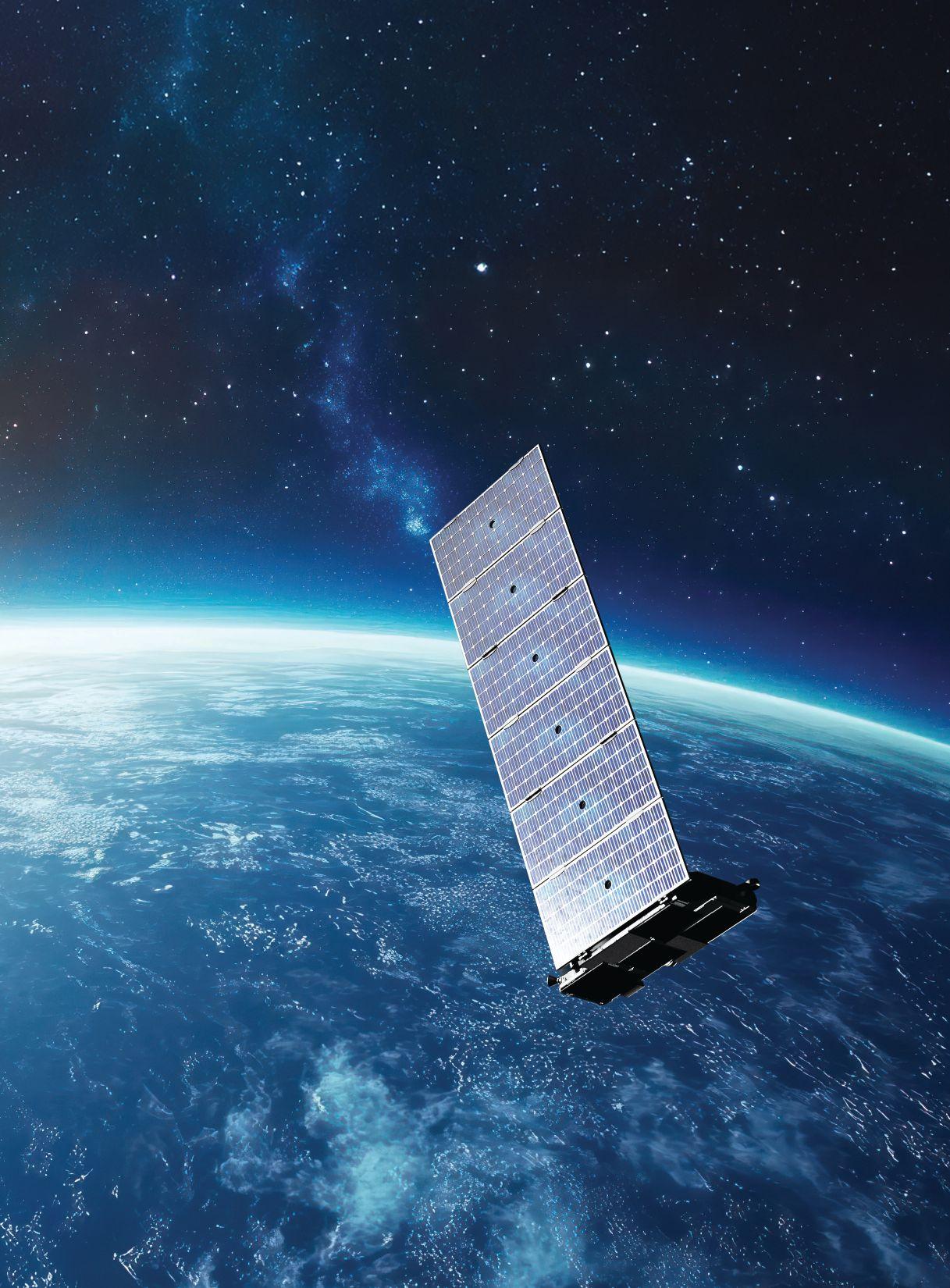


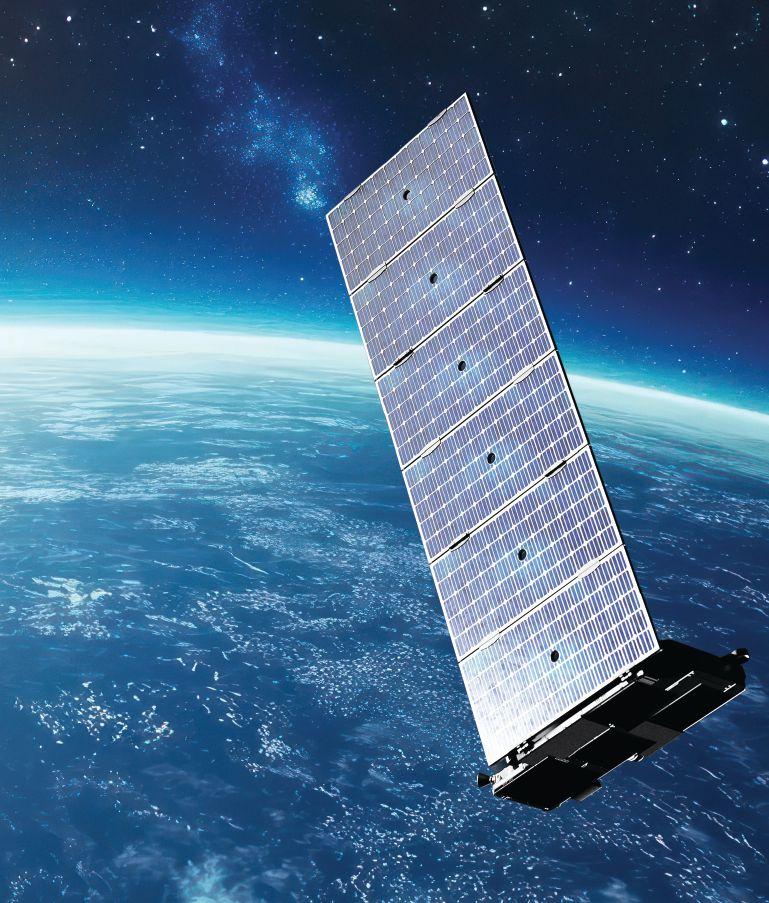


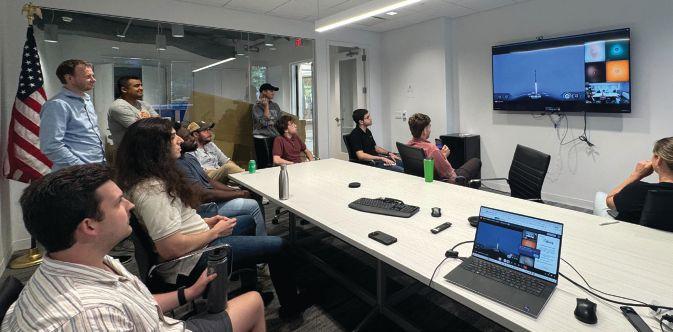
TrustPoint recently launched its third satellite into low Earth orbit and plans to build out to 300 satellites in the coming years, leveraging the unique benefits of C-band.
RENEE KNIGHT

The
See Additional News Stories at www.insidegnss.com/news
• UK and France Renew Ties, Resilient PNT, eLoran a Key Part
• GOOSE-VTL Project Attacks Urban GNSS Limitations
• GNSS Interference in Ship Collision, Fires, Grounding
• Safran Launches Dual PNT Breakthroughs for Navigation in Contested Airspace
Today’s GNSS disruptions go beyond just losing a fix for a few seconds here or there, or signals dropping out when users drive through a tunnel. ose who rely on GNSS are now regularly confronted with persistent and even complete loss of services, a costly and dangerous problem. is new reality has shi ed the industry focus to finding diverse, complementary solutions that add resiliency to fight against multipath, spoofing and jamming, ultimately enabling a more layered approach to PNT.
TrustPoint is among the companies leading the complementary PNT (CPNT) charge, with the team putting their efforts into signal diversity. From the start, TrustPoint has been a C-band centric company, Founder and CEO Patrick Shannon said, with the focus on developing a dual-use low Earth orbit (LEO) PNT system and C-band service. Low-cost microsatellites will power the service, leveraging commoditized space platforms, rideshare launch services, and patented innovations in navigation signal generation and processing at the RF physical and navigation data layers.
TrustPoint recently launched its third satellite, Time Flies, and successfully established fi rst contact. e satellite,
which represents the continued evolution of the company’s C-band mission, is substantially smaller than heritage GNSS systems and carries a digitized GNSS payload. It’s a culmination of design work and lessons learned from the two previous satellites—It’s About Time and Time We’ll Tell launched in 2023—and boasts more power, channels and autonomy than its predecessors.
“ ose capabilities in particular are the steppingstone to mass production and getting to a point where TrustPoint can pivot from launching one or two satellites at a time to batches or tranches,” Shannon said, noting increased autonomy is key to meeting commercial and national security requirements. “So for us, it’s a pathfi nder to production.”
ere’s a reason TrustPoint has been all in on C-band from the start. Leveraging a signal that’s so different from L-band has many benefits, starting with added resiliency. C-band is at a frequency that’s four times higher than L-band, and at more than 5 Gigahertz, is pretty far away. So, systems designed to optimize jamming in L-band won’t be effective in C-band. And if you do lose L-band, you’ll still have C-band to fall back on.

“ That resilience from frequency diversity is very meaningful to the commercial market. The ability to steer a ship, fly a plane, use the apps on your smartphone are all experiences that will benefit from C-band joining the portfolio.”
Patrick Shannon, Founder and CEO, TrustPoint
“That resilience from frequency diversity is very meaningful to the commercial market,” Shannon said. “The ability to steer a ship, fly a plane, use the apps on your smartphone are all experiences that will benefit from C-band joining the portfolio.”
Technology at C-band is also incredibly small, Shannon said, and is often about the same size and weight as a coffee coaster, drawing only a few watts of power, for the most sophisticated receiver types. That means controlled reception pattern antenna (CRPA) apertures, which are historically expensive, large and high power, can be reduced by an order of magnitude or more—opening up “incredible antijam performance” to a large community of users it wasn’t accessible to before.
That, combined with the fact the U.S. State Department has relaxed ITAR export controls on CRPA antennas, is a “massive enabler” for C-band, Shannon said.
C-band also isn’t as susceptible to ionospheric effects and solar storms as other frequencies, which is promising for efficient single channel performance.
“What was before outages or degradations, we won’t see in the same way with C-band,” Shannon said. “So, it’s building in this layer of resilience.”
Unlike traditional GNSS, the TrustPoint satellites will operate in LEO, where “the opportunity for commercial innovation becomes big.” Operating in middle Earth orbit (MEO) or geostationary orbit (GEO) is both complex and expensive. LEO satellites are much more affordable, Shannon said, so “you can iterate on the technology fast.” With LEO, it’s possible to build very low cost systems so you can proliferate many more satellites at an affordable cost.
That, Shannon said, has opened the door to commercial innovation.
“The heritage systems are fantastic sets of technology that were born from tremendous innovation at the time,” he said. “But the community that gets to work on GNSS when you open the door to commercial expands exponentially.”
This accessibility also enables innovation on the transmit side of RF systems, Shannon said, similar to how
TrustPoint’s commercial, dual-use LEO PNT system and C-band service will enable:
• Rapid time to first fix
• Meter and centimeter-level positioning accuracy
• Improved jamming resistance made possible by frequency selection, diversity and increased signal strength
• A spoof-tolerant signal with built-in authentication and state-of-the-art security for all users.
commercial companies have driven innovation on the receiver side.
Because there’s “now a bigger tent with more players,” TrustPoint and other companies exploring signal diversity can do so in a more meaningful way, Shannon said. The heritage systems only have so much funding and so many resources, and there’s also something to be said for the benefit of clean sheet designs and a fresh start.
“In the beginning, we said, hey, we’re going to take 50 years of lessons learned from GPS but throw out the rule book and design something from a clean sheet,” Shannon said. “If we were to start over today, what would GPS look like, taking into account new technologies, new threats and new requirements. All these things that are drivers in the market, but weren’t in the conversation in the 1970s and 1980s when the early work was being done.”
At more than 200, there are plenty of L-band satellites in orbit transmitting PNT signals today—which is one of the reasons Shannon didn’t put his focus there. Instead, he wanted to leverage the unique strengths C-band offers, a different approach to PNT. Right now, there are only a few C-band satellites in orbit, but TrustPoint plans to eventually grow that number to north of 300.
The learnings that come out of the Time Flies launch will immediately go into technology, production and testing upgrades, Shannon said. As it stands, the team is almost ready for large scale production of 50 to 100 satellites. While they’ll continue to iterate and advance the technology, the start of that initial large scale launch is likely less than a year away.
Once they achieve that goal of 300, Shannon expects the service to address 99% of users and their needs, including last mile and urban mobility applications. C-band in LEO is attractive for urban users as the angular velocity of the LEO satellites, the higher signal frequency, and the way the signals bounce off buildings all help to reduce multipath.
But, of course, there will be a progression of capability before they get there. TrustPoint will turn on the satellites the minute they’re in orbit for users to start listening to—and some will benefit right away from C-band augmentation and the anti-jam security that will come with one-to-two satellites in view anywhere globally, or about 100 satellites.
Once satellites are in the mid-200 range, users with a wide view of the sky like maritime, commercial agriculture and aviation, will have a full C-band PNT
solution, Shannon said. That mid 200- to mid-300 range is where they’ll start closing the gap for more urban environments.
From the beginning, TrustPoint has educated the PNT community, including manufacturers, about C-band’s benefits and why its their focus. They started by showing them the math, Shannon said, the analysis, the paperwork, and then moved to simulations through internal and external third party testing. TrustPoint, for example, is working with Safran to incorporate the signal in the Skydel simulation portfolio, and will make other joint announcements soon.
TrustPoint has formed a partnership with Hexagon | NovAtel and plans to announce several existing partnerships, while also continuing to grow their ecosystem of collaborators. Those third parties will test Time Flies, so there will be “quite a few folks receiving live sky signals from TrustPoint from this third satellite,” a fundamental mission objective.
“The urban availability problem is a known problem,” Shannon said, “and if I can show initial math and then simulation and then live sky signals from
The TrustPoint GNSS payload includes an in-house designed ensemble clock, Shannon said, to keep time onboard the spacecraft. The team also has developed a ground segment that will handle time transfer independent of GPS. Called the Low Earth Orbit Navigation System (LEONS), it’s basically an inverted GNSS, broadcasting signals from the ground up so satellites can resolve time and positioning by looking toward the Earth instead of toward MEO or GEO. TrustPoint plans to go global with the system, which will be proliferated, and open it up to the wider LEO satellite community.
space that solve that problem, people are ready to see it. People are ready for it.”
While C-band is different from L-band, it’s still RF, and can be reduced to known semiconductor methodologies. It doesn’t require new manufacturing or production approaches, making it an easy layer to add.
TrustPoint’s focus always has been on resilience. The accuracy will come, no doubt, but the performance must be there. The signal must be available when it’s needed through all conditions and all terrains, and that’s been the goal all along.
Of course, there is no one system that provides everything PNT users need; it’s just too expensive and difficult to build out. Users require a layered approach that includes diverse solutions like L-band GNSS, C-band GNSS, C-band LEO, optical, radar, INS and dead reckoning. Each one brings different strengths and weaknesses, but when used together, can provide the resiliency needed to build a more robust PNT.
“That’s the beautiful complementary nature of our frequency selection,” Shannon said. “We spend a lot of time talking to optical, INS, quantum navigation, magnetic navigation, and there’s some really nice partnerships between those technologies. We’re finding almost all of them pair incredibly well with TrustPoint. And as you aggregate them, you get an aggregation of their strengths and a reduction of their weaknesses. And that synergy will allow us to address long tail reliability.”