Fision fiber-powered communities. Board tested. Resident approved.

Hotwire Communications partners with HOAs to deliver futureproof technology, transparent contracts, and concierge-level customer service that keeps residents connected and boards confident.
Choosing a telecom provider is one of the most important decisions a board can make. With a 99% renewal rate nationwide, communities trust Hotwire to deliver unmatched performance and white-glove support year after year.

Our 100% fiber-to-the-home network ensures symmetrical speeds, guaranteed reliability, and no data caps—while our dedicated account managers provide the concierge-level customer service boards and residents deserve. Independent rankings by PCMag and Consumer Reports confirm what our partners already know: Hotwire is the fastest and most trusted ISP in the market.
Let’s Build Something Better, Together.


Innovative and comprehensive security solutions for condominiums and HOA properties
As a leading security provider for residential properties across South Florida, Orlando and Tampa, GardaWorld Security goes beyond everyday security services by delivering innovative and integrated solutions.
Concierge services
Security guards
Mobile patrols
AI video surveillance
Remote monitoring
Security risk and threat assessments

TALK TO AN EXPERT
David Fambrini Business Development Manager
David.Fambrini@garda.com | (561) 698-1014
Get Board Certified in Just 4 Hours — On Your Schedule
Take the course online with the flexibility to pause and resume at any time. At the end of the class, you will be able to download or print a certificate of completion verifying your attendance, and CEU credit for CAMs will be processed expeditiously.

FEATURED CLASS

4 hour class
1 OPP, 1 HR, 1 IFM, 1 ELE Certificate of Completion
Provider #0000811 Course #9630156

If you are planning to serve on your homeowner’s association board, you will need to comply with Florida’s certification requirements. Becker’s 4-hour course is approved by the DBPR and contains educational content as required by law. More importantly, it will provide the tools and information you need to perform your job and avoid any potential liability.
Did you know Becker offers approximately 30 DBPR approved online classes for both Homeowners’ Association and Condominium continuing education, which can be taken at your convenience?
To view our entire on-demand class roster, visit www.beckerlawyers.com/classes


What is Budgetbliss?
Budget Bliss Insurance is a first-of-its-kind insurance solution designed exclusively for Florida community associations. By providing certainty that adopted budgets will be funded, Budget Bliss helps associations reduce financial risk, promote fairness among owners, and operate with confidence.
Budget Bliss delivers meaningful protection and peace of mind to associations, boards and their owners through:
Budget Certainty – Ensuring the association has necessary funds to meet its approved financial obligations
Protection Against Neighbor Non-Payment –Helping prevent paying owners from bearing the financial burden created by non-paying owners
Reduced Risk of Special Assessments –Supporting financial stability when cash-flow interruptions occur
Enhanced Fiduciary Protection – Helping boards fulfill their financial oversight and fiduciary responsibilities
Fairness and Equity for Owners – Preserving balance and predictability across the community


Budget Bliss Insurance is surprisingly a ordable and underwritten by insurance carriers rated A- (Excellent) by AM Best.
Florida community associations finally have a viable insurance solution to protect the budgets they adopt and move forward with confidence.
Policies available Spring 2026. Visit our website to learn more today.


Welcome to Budget Bliss
—

Journal Notes
There are many questions asked and answered in the April issue of FLCAJ. On page 8 Florence King, Esq., with Becker asks, “Is Electronic Voting Right for Your Community?” She provides the downsides and the upsides for your community to consider, and in summary, she says, “Therefore, in spite of the potential drawbacks, a community will be well served by the added participation that electronic voting can bring.”
On page 12, Jeffery Rembaum, Esq., with Kaye Bender Rembaum poses the question, “Beauty Is in the Eye of the Beholder, or Is It?” He lays out the legal considerations for communities when making landscaping decisions. Several court cases and their implications for HOAs are examined. Rembaum states, “With all of the above in mind, given the increasing scrutiny by unit owners and the varied circumstances reflected in arbitration decisions, boards would be well advised to proceed cautiously regarding landscaping changes.”
Turn to page 18 to read the Florida Law column by Michal J. Gelfand, Esq., with Gelfand & Arpe. He asks, “Which Came First: Flooding or Wind?” He is addressing the post-storm chaos and an association trying to identify whether wind, water, or both are specific causes of damage. It is a convoluted situation, and you will need to read to get the full details of the case and what was decided, but the following lessons shared by Gelfand should be learned: community associations need to understand their insurance policies and beware also of the danger of settling too quickly with one insurer when there may be additional damage to consider.
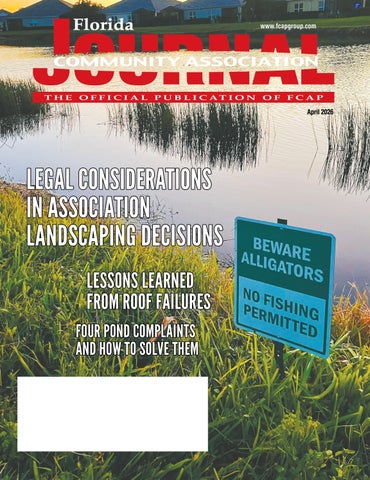
Other articles in this issue address the importance of wellness, lessons learned from roof failures, the technology gap in HOA governance and how boards can close it, strategies to address resident pond complaints, steps to take to build thriving communities, and a roadmap for effective governance.
FLCAJ is proud to provide this helpful April issue.

Editor
Publishers Richard Johns Dana Johns
Editor Michael Hamline
Art Director Nick Walker
Advertising Sales Phone: (800) 425-1314 Email: info@fcapgroup.com
Circulation/Accounting Tammy Hanner
Phone: (800) 443-3433
Fax: (501) 280-9233
Editorial Phone: (800) 443-3433 Fax: (501) 280-9233
Florida Community Association Journal is published monthly by True Source Publishing LLC 1000 Nix Road Little Rock, AR 72211-3235
Email: info@fcapgroup.com Website: FCAPgroup.com
Copyrighted by Florida Community Association Journal. Reproductions of any part of this publication without written permission of the publisher are prohibited.
Subscription Rates
$24 for one year, $48 for three years. Back issues are $5 each plus postage. Group rates for 3 or more people are available at $12 per person.
The publisher and editor(s) of this magazine do not accept responsibility for the content of any advertisement, including statements made by advertisers herein, or for the opinions expressed by authors of by-lined articles. The publisher and editor(s) also reserve the right to reject any ad or article for objectionable content in verbiage or images. The intent of this publication is to provide general information only and is not intended to provide specific advice or recommendations. Appropriate legal, financial, or engineering advice or other expert assistance should always be sought from professionals.
Postage paid at Little Rock, AR and additional offices (permit #1085).
Postmaster
Send address changes to: Florida Community Association Journal 1000 Nix Road Little Rock, AR 72211-3235 or email info@fcapgroup.com


CORAL GABLES!


Ansbacher Law, with board certified partners, 12 attorneys and over 0 professionals, is available to serve your community throughout
•Full service law firm for your Condominium or Homeowners Association.
•Florida’s leading construction defect team - Full contingency available, no fees or costs unless you win.
•Collections handled on deferred and contingency fee arrangement.


Hannah Rullo
Zach Roth
Barry Ansbacher
Emily Dominguez
Alejandra Gonzales


Is Electronic Voting Right for Your Community?
BY FLORENCE KING, ESQ.
The 2015 legislative session introduced electronic voting for condominiums, cooperatives, and homeowners’ associations. Then, in the spring of 2016, the Department of Business and Professional Regulation (DBPR) adopted administrative regulations to implement the new electronic voting statutes for community associations. However, now, more than ten years later, associations are still skeptical about whether or not electronic voting is a viable option for their community.
One of the biggest drawbacks of electronic voting is the potential for tampering. We live in a very technologically advanced time, where technology touches every aspect of our lives. This has made computer viruses and malware a real threat
Photo by iStockphoto.com/rattapol tassavong
to all aspects of life. Therefore, it is not too farfetched to believe that hackers could exploit a security weakness in a community association online voting system. Owners see the wide-scale technological pitfalls in their day-today lives. It is no surprise that they would be skeptical about using online voting for their community association, thus making e-voting a challenge to implement in community elections as each owner must consent to participate in e-voting.
This leads to a second drawback of electronic voting, which is a lack of trust in an electronic voting system. When members attend a community meeting with in-person voting, they get to physically inspect the counting of votes. Also, the ballots are available for the members to review at a records inspection for the next year. However, with electronic

FLORENCE KING, ATTORNEY AT LAW, BECKER
Florence King concentrates her practice on the representation of condominium, homeowner, and cooperative associations in the state of Florida. Her experience includes handling collections and foreclosures, vendor contracts, drafting and amending governing documents and enforcing association covenants, assisting associations with management issues and other association-related matters. Ms. King is also a licensed mediator and a community association manager. A member of the Florida Bar since 2006, she is also licensed to practice in all three U.S. Districts in the state of Florida. For more information, please visit beckerlawyers.com
voting, homeowners may worry about what happens to their vote after clicking a button. How can they know it really gets counted? The electronic voting system requires anonymity, which means owners can never verify the votes cast electronically. They are required to trust the voting system selected by the association. That blind trust is not easy to come by.
One final drawback of electronic voting is the barriers to access. While the younger generations are quite tech savvy and understand the ins and out of technology, there are still several generations of owners who are not as tech savvy or have problems accessing the internet. For example, older residents in retirement communities may not be familiar with online voting methods.

That said, despite these drawbacks, there are many benefits to electronic voting that an association should also consider. First, electronic voting offers a more convenient platform for owners to participate in association affairs. Most homeowners are busy with their lives and families and find it difficult to make time to attend community meetings. Therefore, an online voting platform makes it easier for people to vote on community-related matters. Every person with access to a smartphone or computer can easily cast a ballot with a few clicks. This eliminates the need to personally attend meetings or complete and submit proxies.
This convenient method of voting therefore allows for wider participation of members in community affairs. Most voting platforms are willing to provide support for associations by educating members on how their electronic platform works,
including free support for members to assist them with casting their votes online. Therefore, once members have an opportunity to get familiar with online voting it will enable associations to receive more participation from its members in community affairs.
Finally, a reputable electronic voting system enables seamless, fast, and accurate vote counting. Electronic voting eliminates the headaches of counting paper ballots. For example, no one has to discern voter intention on a poorly marked vote. Plus, results are much faster with computer tabulations.
A community is strengthened by the participation of its members in the affairs of the association. Therefore, in spite of the potential drawbacks, a community will be well served by the added participation that electronic voting can bring. n
FINALLY, A REPUTABLE ELECTRONIC VOTING SYSTEM ENABLES
SEAMLESS, FAST, AND
ACCURATE VOTE
COUNTING. ELECTRONIC VOTING ELIMINATES THE HEADACHES OF COUNTING PAPER BALLOTS. FOR EXAMPLE, NO ONE HAS TO DISCERN VOTER INTENTION ON A POORLY MARKED VOTE. PLUS, RESULTS ARE MUCH FASTER WITH COMPUTER TABULATIONS.

Switching to fiber internet is easier than you think!
Partner with Blue Stream Fiber to ensure a smooth transition for your community.
Our guarantee:
5-star service — Guaranteed speeds and uptime, plus 24/7/365 technical support from a U.S.-based team that answers the phone in under a minute.


White glove support — Stress-free installation, community-friendly construction, resident training, and a dedicated account manager to oversee every phase of your transition.
Personalized approach — We provide tailored solutions best suited for your community’s needs—and we’re fully committed to building a state-of-the-art network the right way.
Proven partnership — We’ve earned the trust of 385,000+ community residents and the decision-makers of 500+ communities through our industry-leading service and support.
“Our relationship with Blue Stream Fiber is an asset to our community because our residents get reliability, service and support that is above and beyond anything that would usually be expected of a service provider.”
– Rich Bobker, President, Kings Point in Tamarac (4,869 units)
Don’t wait to give your community the internet they deserve!
C ontact us today for a FREE network evaluation.

Beauty Is in the Eye of the Beholder, or Is It?
Legal Considerations in Association Landscaping Decisions
BY JEFFREY A. REMBAUM, ESQ.
It is often said that beauty is in the eye of the beholder, and nowhere is this more evident than in the realm of community landscaping. Among the many benefits of residing within a community association is the expectation of consistently maintained and harmonious landscaping throughout the property. But, when does a change in common area/ element landscaping become a material alteration requiring a vote of the membership?
As a general rule for a Florida condominium association, pursuant to §718.113 Fla. Stat., material alterations or substantial additions to condominium common elements require approval by 75 percent of total voting interests unless the declaration of condominium dictates a different procedure. But, as applied to a Florida homeowners’ association, the outcome is diametrically opposed because material alteration decisions are left to the board unless otherwise required by the governing documents.
Photo courtesy of Kaye Bender Rembaum
REMBAUM'S ASSOCIATION ROUNDUP
Before continuing, the questions as to what constitutes a material alteration must be addressed. The authoritative definition of “material alteration” originates from Sterling Village Condominium Association, Inc. v. Breitenbach, 261 So. 2d 685 (Fla. 4th DCA 1971), which explains the term as follows:
To palpably or perceptively vary or change the form, shape, elements, or specifications of a building from its original design or plan, or existing condition, in such a manner as to appreciably affect or influence its function, use, or appearance.
Courts have generally afforded significant deference to association boards operating

JEFFREY REMBAUM, PARTNER, KAYE BENDER REMBAUM
Attorney Jeffrey Rembaum has considerable experience representing countless community associations that include condominium, homeowner, commercial, and cooperative associations throughout Florida. He is a board-certified specialist in condominium and planned development law and is a Florida Supreme Court circuit civil mediator. Every year since 2012 Mr. Rembaum has been inducted into the Florida Super Lawyers. He was twice awarded as a member of Florida Trend’s Legal Elite. Kaye Bender Rembaum P.L. is devoted to the representation of community and commercial associations throughout Florida with offices in Palm Beach, Broward, Hillsborough, and Orange Counties (and Miami-Dade by appointment). For more information, visit kbrlegal.com
under the business judgment rule when performing their maintenance, repair, and replacement responsibilities. For example, in the seminal case Tiffany Plaza Condominium Association, Inc. v. Spencer, 455 So. 2d 454 (Fla. 2d DCA 1982), the court upheld the board’s decision to construct a rock revetment to protect the beachfront from erosion without owner approval when otherwise required, finding it to be a required maintenance-related action such that even if was a material alteration, the board made the correct decision. In other words, to quote John Wayne, “A man’s gotta do what a man’s gotta do.” However, a board should be reticent to rely on the “Tiffany Plaza doctrine,” as it is often referred to, without a written legal opinion from the association’s lawyer in support of the action.

As owners have become increasingly vocal and litigious regarding landscaping choices, it is prudent to examine relevant arbitration decisions of the Division of Condominiums, Timeshares & Mobile Homes. Although such decisions are not binding precedent, they provide useful guidance on when owner approval may be required both in the context of condominium and homeowners’ associations.
One of the most cited landscaping cases is Girsch v. Whisper Walk Section E Ass’n, Inc. (ARB. Case No. 970305) November 26, 1997. Here the arbitrator rejected an owner’s challenge to the board’s decision to replace a hibiscus hedge with a ficus, concluding that determinations of shrubbery type fall within the board’s business judgment. The arbitrator noted that requiring owner votes for such routine decisions would undermine the basic structure of association governance and held in pertinent part that, “to permit the arbitrator to substitute his judgment for the board in this range of business decisions would add great instability to the
In Howard Feldman v. Sunset Harbour Condominium Association, Inc. (ARB. Case No. 2015055381) March 24, 2016, an owner objected to the removal of two palm trees and the planting of three different palms elsewhere on the property, asserting loss of view, shade, and property value. The arbitrator disagreed, finding that the landscaping changes were modest, tasteful, and had no appreciable effect on the building’s aesthetics. The decision also referenced Mueller


The future is a seamlessly connected community.

At Fibernow, we deliver 100% fiber connectivity right to your community. And with our full range of fiber services, we have what it takes to bring you customized bulk packages tailored to the unique needs of your residents.
Part of the largest fiber company in the world.
We’re backed by DigitalBridge, a world-class digital infrastructure network that allows us to ensure the highest levels of network performance.
Doubling up on fiber to double down on reliability. By running two fiber lines to your property for added redundancy, we’re able to provide guaranteed network uptime for your residents.
Personalized support is less than a minute away. Our 100% U.S.-based customer service team answers calls in less than 60 seconds on average.

Talk
us
(ARB. Case No. 2013040108) May 1, 2014. There, the board undertook a renovation that removed lush landscaping at the driveway entrance and replaced it with stone. Because the association failed to demonstrate that no reasonable alternatives existed to address the issue of petrelated damage, the arbitrator found that the radical step of removal of landscaping and replacing it with such a different item required owner approval.
Another instructive case is Trio Englewood, Inc. v. Fantasy Island Condo. Ass’n, Inc. (ARB. Case No. 984670) April 16, 1999. The arbitrator noted that the removal of two uniquely significant Norfolk Island pine trees could potentially constitute a material alteration, although the matter required further factfinding.
With all of the above in mind, given the increasing scrutiny by unit owners and the varied circumstances reflected in arbitration decisions, boards would be well advised to proceed cautiously regarding landscaping changes. Although most landscaping decisions seem to fall under the board’s routine maintenance authority, radical or highly distinctive changes likely trigger the statutory material alteration threshold, thereby possibly requiring owner approval depending on the unique facts and circumstances and the unique requirements set out in the association’s governing documents. Boards may find it beneficial—though not legally required—to periodically solicit owner input through surveys or questionnaires when contemplating notable landscaping modifications. Ultimately, before undertaking substantial changes, the board should consult association counsel to ensure compliance with statutory requirements and governing documents. n
WITH ALL OF THE ABOVE IN MIND, GIVEN THE INCREASING SCRUTINY BY UNIT OWNERS AND THE VARIED CIRCUMSTANCES REFLECTED IN ARBITRATION DECISIONS, BOARDS WOULD BE WELL
ADVISED TO PROCEED CAUTIOUSLY REGARDING LANDSCAPING
CHANGES


BY MICHAEL J. GELFAND, ESQ.
T Insurance Coverage Reviews
he new year has brought insurance coverage reviews to many association agendas, including for Florida residential condominium associations a statutory review of insurance policy deductibles. This year started with the courts providing some direction and warning to Florida community associations, including two January decisions.
WHICH CAME FIRST: FLOODING OR WIND?
Chaos follows a storm. Associations struggle to evaluate, to contract, and to reconstruct.
Compounding these fundamentals, associations now face an increasingly longer list of legal issues, some with consequences that may last far longer than the storm.
Florida community associations responding to post-storm chaos are
Photo by iStockphoto.com/Jacob Wackerhausen
increasingly being forced to decide up front the specific cause of damage: wind, water, or both.
Forced by many insurers, associations may find that identifying and isolating a specific cause is difficult, if not impossible. The situation may be further complicated by the fine print of a policy, whether a named peril or an all peril policy.
Do you throw up your hands and just file claims with all insurers?
A recent Florida appellate court decision limited casualty insurance benefits available for hurricane property damage. The facts in Kapson v. Homeowners Choice Property & Casualty Insurance Company, 51 Fla. L. Weekly D 111 (Fla. 3rd DCA, January 14, 2026), indicate that after their home was destroyed by Hurricane Irma, the property owners sought coverage under insurance policies issued by Homeowners Choice for their home damage.
The property owners paid for three policies: a flood policy, a standard hazard policy, and a

MICHAEL J. GELFAND, ESQ., SENIOR PARTNER, GELFAND & ARPE, P.A.
Michael J. Gelfand, Esq., the senior partner of Gelfand & Arpe, P.A., emphasizes a community association law practice, counseling associations and owners how to set legitimate goals and effectively achieve those goals. Gelfand is a dual Florida Bar board-certified lawyer in condominium and planned development law and in real estate law, a certified circuit and county civil court mediator, a homeowners’ association mediator, an arbitrator, and parliamentarian. He is a past chair of the Real Property Division of the Florida Bar’s Real Property, Probate & Trust Law Section, and a Fellow of the American College of Real Estate Lawyers. Contact him at ga@gelfandarpe.com or 561-655-6224.
wind policy. The flood insurer paid $222,800 without any dispute. Homeowners Choice property/casualty insurer acknowledged roof and truss damage and paid $38,122.67.
The property owners sued Homeowners Choice for breach of contract, claiming that all damages were covered because wind destroyed the home before flooding occurred. As one might expect, Homeowners Choice defended against the claim. The insurer maintained that the remaining unpaid damages were from flood and storm surge, which were not covered by the policy. At trial, a jury found that the homeowners did not prove that the loss was caused by wind. The trial court entered final judgment for Homeowners Choice.
The Florida appellate court agreed with the decision of the trial court. The appellate court explained a significant difference in types of policies. In an “all perils” policy, once a loss is determined to be the result of a storm, the policy owner generally does not have to identify the specific cause, whether wind or rain caused the loss.
But, if there is a different type of policy, labeled a “named peril”


YOUR ASSOCIATION BANKING LENDER
FLORIDA BASED, FLORIDA FOCUSED
LOCKBOX SERVICES
CASH MANAGEMENT AND ONLINE PAYMENTS
ICS® & CDARS® DEPOSIT SOLUTIONS
ASSOCIATION LOANS
RECERTIFICATION
RESERVE LENDING
IMPROVEMENTS AND REPAIRS
You will enjoy how simple and easy we make banking for Homeowner Associations and Prroperty Managers with a suite of products developed uniquely to meet your needs and a level of service that consistently reminds you of how important you are to us at U.S Century Bank.


Rick Alfonso


policy, then the property owner must prove what was the cause. The additional proof requirements are because the “named peril” policy may only cover one cause of loss, such as only rain or perhaps only wind.
The difference in policies, and the impact on claims, became clearer when the property owner in this case made a claim to two insurers for the same storm. The insurers provided coverage for different perils or types of losses. The property owner received benefits from the flood policy that the Homeowners Choice wind policy specifically excluded.
The insurer, Homeowners Choice, sought to introduce to the jury that the property owner not just sought but obtained a recovery from the flood insurer asserting the flood loss was from a cause excluded from the Homeowners Choice policy. The appellate court held that the evidence of the flood policy “is relevant to show that the loss was caused by an excluded peril rather than a covered one.” The court further stated, “[Homeowners Choice] directly rebutted [the homeowners’] all-ornothing theory of the case.”
This decision reminds Florida community associations of the need to understand their insurance policies, including which policy covers which type of loss. Thus, when a claim occurs, take care to ensure that the claim is reported to the proper insurer using proper language.
Beware also of the danger of settling too quickly with one insurer when there may be additional damage to consider.
Especially as many associations start the year confirming coverages and deductibles, it is more important to consult with your insurance broker.
OOPS! THOUGHT YOU HAD COVERAGE BUT CLAIM DENIED?
Fear. Fear of the unknown. You have a piece of paper, or perhaps an email, that you believe confirms insurance coverage. What happens when an owner has property that is damaged and only after the damage finds out that the insurance policy does not provide coverage for that damage? What if you find out that coverage you sought from the broker did not exist? Is the insurance broker who earned a commission when selling you the policy responsible?
Recently a Florida appellate court held in Brown & Brown of Florida, Inc. v. Houligan’s Pub & Club, Inc., 51 Fla. L. Weekly D 49 (Fla. 5th DCA, January 2, 2026), that proof of available insurance coverage is not necessary when suing a broker when a policy did not provide anticipated coverage.
The facts in this case reveal that a commercial property insurance broker obtained commercial property insurance for two restaurants through policies underwritten by Lloyd’s of London. After Hurricane Matthew hit, sewage entered the restaurants through floor drains, causing substantial damage. The restaurants filed claims with Lloyd’s. Lloyd’s defended the claims and obtained a declaratory judgment that the damages were excluded under the policies.
The restaurants then sued the insurance brokerage firm for negligent failure to procure insurance, breach of fiduciary duty, and negligent misrepresentation. The jury found in favor of Brown
WHAT HAPPENS WHEN AN OWNER HAS PROPERTY THAT IS DAMAGED AND ONLY AFTER THE DAMAGE FINDS OUT THAT THE INSURANCE POLICY DOES NOT PROVIDE COVERAGE FOR THAT DAMAGE? WHAT IF YOU FIND OUT THAT COVERAGE YOU SOUGHT FROM THE BROKER DID NOT EXIST? IS THE INSURANCE BROKER WHO EARNED A COMMISSION WHEN SELLING YOU THE POLICY RESPONSIBLE?

HEALTHY LAKES EQUAL HAPPY COMMUNITIES
Keeping your lake clean and healthy can feel like a never-ending challenge. We know how discouraging it is when algae and weeds keep coming back. That’s why our team uncovers the root of the problem and delivers lasting solutions that keep your water and community beautiful, so your residents can enjoy it with pride.


Photo by iStockphoto.com/Dilok Klaisataporn
& Brown on the negligent procurement claim but found that the broker breached its fiduciary duties and made negligent misrepresentations. The court awarded Houligan’s $647,400 and awarded Ormond Wine’s $314,511.60.
On appeal, the broker agreed that it breached its duty to the insureds and that it made negligent misrepresentations. The broker only contested the damages awarded. The Florida appellate court sent the case back to the trial court for a new trial but limited only to determine a revised dollar amount for monetary damages.
What persuaded the court? The court explained that proof of available coverage is not required for breach of fiduciary duty and negligent misrepresentation claims. Even if the insured wanted certain insurance that was unavailable in the marketplace, the insurer should notify the insured of alternative options. “It would have been improper, however, to limit Brown & Brown’s potential liability under the fiduciary duty and negligent misrepresentation claims to the existence of an insurance policy in the marketplace when a broader measure of damages, if proven, is allowable.”
However, the court determined it was error to allow the jury to calculate damages based on a policy that did not provide coverage; thus the court remand, or return to the trial court, for a new determination of monetary damages.
This decision reinforces the need to work closely with your insurance broker, ensuring that the broker understands your needs and ensuring that the policy includes the coverage sought. n


RELIABLE COMMUNICATION THAT’S
Readers' Choice Award Spotlight

Editor’s Note: FLCAJ would like to congratulate these four outstanding 2026 Readers’ Choice Awards winners! (For a full list of 2026 RCA winners, please read the March 2026 issue or visit www.fcapgroup.com/flcaj/readers-choice/

Absolute Patio Furniture
Diamond Level Winner—Lakes, Pools, and Outdoor (Winner 2026 and 11 previous RCA wins)


Absolute Patio Furniture has been in the business of manufacturing commercial and residential outdoor furniture since 1984. Our collection of new furniture includes sling furniture, strap furniture, beach beds, umbrellas, tables, hand sanitizer stands, accessories, and more. We offer a wide variety of frame and fabric options, so browse our selection and customize a perfect new addition for your property.
Absolute Patio Furniture has proudly served South Florida and the Caribbean for 35-plus years. Our
customer base includes commercial and residential properties (homes, apartment complexes, condominium communities, homeowner associations, hotels, theme parks, water theme parks, and resorts).
In addition to manufacturing our own furniture, Absolute Patio Furniture also offers patio furniture restoration services, which includes powder coating frames and installing slings, vinyl straps, and cushions. Our dedicated patio furniture restoration division serves hotels, country clubs, HOAs, and private homeowners. Our restoration process takes place in our 30,000-square-foot facility in Pompano Beach, FL, and involves sandblasting, chemical pretreatment, and two-stage powder coating systems. We offer sling replacement, strapping services, and cushion/pillow replacement using Sunbrella fabrics. We are certified warranty refinishers for some of the largest furniture manufacturers in the country and are certified by the American Architectural Manufacturers Association (AAMA). If you’re not in the market for brand new furniture, let Absolute Patio refinish your furniture, transform your outdoors, and save you money—your old patio furniture will be transformed and look brand new!
Visit our website absolutepatiofurniture.com For a new quote call 954-419-3194 or email tammy@ absolutepowdercoat.com.
GCI Consultants
Diamond Level Winner—Construction, Engineering, and Building Services (Winner 2026 and nine previous RCA wins)

GCI Consultants is an engineering consulting firm specializing in every aspect of the building envelope. We offer expertise in building envelope engineering and consulting; construction defect litigation; storm damage claims; forensic investigations; and new construction consulting, quality assurance inspections, and performance field testing. The team has spent more than 36 years identifying and helping solve complex building envelope problems for commercial, institutional, and residential clients. Our accreditation by the Fenestration and Glazing
Industry Alliance (FGIA) as a certified AAMA field test agency and approval as a testing laboratory by Miami-Dade add another layer of confidence to our clients seeking the highest level of quality assurance in building envelope performance.
GCI’s building envelope professionals are qualified to provide the following services:
• Building envelope engineering and consulting
• Storm damage evaluations and claims support
• Construction monitoring
• Design assistance and peer review of construction documents
• Due diligence surveys
• Expert witness and litigation services
• Façade, roofing, and waterproofing condition assessments
• Performance field testing
• Forensic evaluations
• Quality assurance (QA) inspections
• Review of shop drawings and calculations
• Water leakage investigations
For more information on GCI Consultants, please call 561-872-2994 or visit www.gciconsultants.com

Kings III Emergency Communications
Diamond Level Winner—Elevators, Safety and Security, and Technology and Communications (Winner 2026 and eight previous RCA wins)

Kings III Emergency Communications has been a leader in emergency phone solutions for over three decades, providing reliable, code-compliant systems for elevators, poolside areas, stairwells, and parking facilities. Our all-inclusive solution includes equipment, installation, maintenance, and 24/7 dedicated response for one low price. With over three decades of experience and over 145,000 phones monitored nationwide, Kings III is the original elevator telephone-line cost eliminator in Florida.
Our in-house elevator code experts hold key certifications and have a large presence on governing regulation committees, so we’re able to guide you through timely concerns, such as replacing your landlines or meeting newly

adopted video and two-way messaging codes in your elevator, providing a customized solution that’s compliant and reliable.
Florida has adopted ASME 2019, which can bring about significant changes for your elevator phones. The new code includes requirements regarding how the person answering an entrapment call communicates with those in the elevator for all new builds and any elevators that are being modernized. The summary is as follows:
Authorized personnel must be able to communicate with trapped passengers who cannot verbally communicate or hear.
Monitoring parties must be able to notify those in the elevator that help is on the way.
Kings III’s best-in-class solution and in-house code experts are here to help you seamlessly navigate these updated requirements. Learn more about Kings III by calling 833-206-0804, or visit go.kingsiii.com/vms-solution


Leland Management
Diamond Level Winner—Management Companies (Winner 2026 and 12 previous RCA wins)


Celebrating 27 years of awardwinning service, Leland Management is the industryleading, full-service association management firm specializing in managing Florida condominium and homeowner associations. With 12 offices statewide, we are proud to partner with more than 400 associations exclusively in the state of Florida. Our team of professionals takes great pride in delivering the best-quality service to the communities we serve. We
have over 100 licensed community association managers who average more than seven years of experience, and many carry advanced professional designations. To bring it all together, we have honed an effective system for sharing this expertise both within the company and in our communities.
Our superior accounting strategies, dedication to lifestyle, and always-local resident support call center are just a few of the standards you can expect from a partnership with Leland, but we don’t just talk the talk. Evidence of Leland’s walk can be seen in consistently being named Central Florida’s Top Workplace and the Orlando Business Journal ’s Best Place to Work by our team year after year.
Although we are large enough to have all the resources necessary to meet the needs of any association, Leland remains a local, family-owned and -managed firm to better meet the individual needs of each community. We understand that building solid, lasting relationships is of utmost importance to delivering the best quality of service and the continued success of our company.
For more information, call 888-255-8577 or visit www.LelandManagement.com. n


Community Community
Florida Community Association Professionals (FCAP) primarily publishes the Florida Community Association Journal, the leading resource for Florida community association managers, service providers, and board members. Through our publication, we provide education, industry insights, and resources to support the professionals who serve Florida's community associations.
Contact us at 800-443-3422, info@fcapgroup.com , or www.fcapgroup.com for more information.
BECAUSE YOU ASKED
By Betsy Barbieux, CAM, CFCAM, CMCA

Betsy,
It doesn’t seem that many board members take their fiduciary duties seriously. Besides the requirements to take a class and sign the “division certificate,” is there anything else that can be done to elevate the significance and importance of their positions?
— James
James,
For years, I have included in my board certification resource manuals a sample directors’ code of ethics and a sample directors’ pledge. Perhaps during the board organizational meeting, there needs to be a “swearing in” of the returning and new board members. Here is a reprint of that sample pledge.
— Betsy
Directors’ Pledge (Sample)
I understand the policy of ABC Association, Inc., is that directors, officers, management, and employees will work together in a cooperative spirit for the best interests of all the members of the association. Therefore, I promise to carry out the following:
• maintain a positive attitude toward my position as a director and toward my fellow board members
• maintain a positive and professional attitude toward our employees so as to maintain morale and promote efficient employee performance
• refrain from harassing, intimidating, or publicly making derogatory comments about fellow board members, association members, guests, employees, or manager,
• work with my fellow directors in a cooperative manner
• represent the total community and not any special interest group, and
• use my influence to enhance the reputation of the association and maintain the mutual respect that currently exists between the members of the association and the board of directors.
Dated:_________________
Board member
Betsy,
Our board imposed a special assessment in the amount of $150,000 for repairs to two buildings; this was after we were told the estimated cost would be $108,000. The board is not responding to the question, why are you asking for $42,000 more than is required? There was no special assessment meeting. We know the money is required, but we need to know why such a large buffer. Are we obligated to pay without getting an explanation?
— Helen
Helen,
As I recall, you are a condominium association. There are statutory requirements for board meetings that impose special assessments.
Section 718.112(2)(c)(1), says in part,
…Written notice of a meeting at which a nonemergency special assessment or an amendment to rules regarding unit use will be considered must be mailed, delivered, or electronically transmitted to the unit owners and posted conspicuously on the condominium property at least 14 days before the meeting. Evidence of compliance with this 14-day notice requirement
Betsy Barbieux
must be made by an affidavit executed by the person providing the notice and filed with the official records of the association.
3. Notice of any meeting in which regular or special assessments against unit owners are to be considered must specifically state that assessments will be considered and provide the estimated cost and description of the purposes for such assessments. If an agenda item relates to the approval of a contract for goods or services, a copy of the contract must be provided with the notice and be made available for inspection and copying upon a written request from a unit owner or made available on the association’s website or through an application that can be downloaded on a mobile device.
There should have been a board meeting with a 14-day written notice to the owners along with an explanation of the special assessment and the estimated amount. If the board is signing a contract associated with the project(s), copies must also be provided to the owner. The statute does not address refusing to pay because the board failed to do a proper notice and meeting. Likely, your best remedy is filing a complaint with the Division.
—Betsy
WHAT CYCLISTS CAN TEACH HOA BOARDS ABOUT PERFORMANCE
By Marcy Kravit, VP HOA Regional Account Executive, smartstreet (powered by Banc of California)

Marcy L. Kravit
I rode with the Weston Warriors for more than a decade. That is in the past tense as I don’t ride anymore because injuries from a crash ended that chapter. But I’m still here, and what I learned in those years on the bike, especially in those final terrifying seconds on State Road 84, taught me more about leadership and performance than any boardroom ever could.
This is the story of the day my cycling career ended and why it matters to every HOA and condominium board member.
THE CRASH THAT CHANGED EVERYTHING
We were in a tight paceline, flying down State Road 84 at 22 to 24 miles per hour. I was second wheel, tucked in close, saving 30 percent of my energy by drafting. That kind of riding is built entirely on trust: trust that the rider ahead will maintain pace, signal changes, and communicate clearly.
That morning my teammate lost momentum. Not dramatically, just a subtle slowdown, but he didn’t signal—no hand back, no call, nothing. I was inches from his wheel. My front tire clipped his back tire, and suddenly I was airborne. I hit the asphalt hard, tumbling like a bowling ball. The road tore into me: skin, gear, everything.
When I stopped rolling, I was lying in the middle of the street dazed and bleeding. Seconds later my teammates dragged me to safety. A Mack truck thundered past exactly where I had been. If they had hesitated, I would not be here.
My helmet cracked in three places. My body never fully recovered. Cycling was gone, but the lessons weren’t.
Every day since, working with HOA boards, I have seen the same dynamics that put me in that hospital bed: communication failures, lack of preparation, and teammates who don’t step in when someone falters.
SIGNAL IMMEDIATELY OR EVERYONE CRASHES
Slowing down is not the problem. Riders slow all the time. The problem is failing to communicate.
Boards crash the same way—
• A treasurer quietly stops processing invoices. Vendors are delayed in getting paid, some walk, and liens loom.
• A president disengages from a renovation project. Deadlines implode. Contracts collapse.
• A committee chair goes silent. Applications stall. Residents fume.
When you are moving fast and working close, communication is not optional. It is survival. If you are overwhelmed, changing direction, or stepping back, you must signal it immediately, not at the next meeting nor when it becomes obvious, but immediately. Because silence does not just slow progress. It creates catastrophe.
BUILD A CULTURE THAT SAVES EACH OTHER
When I hit the pavement, I could not save myself. My teammates did instantly. That was not luck. It was culture. We had drilled what to do when someone crashed. We had one rule: no one gets left behind.
Boards often lack this culture. Instead, members retreat saying, “This is not my committee,” or, “This is not my responsibility.”
But governance is not about lanes. It is about team survival. High-performing boards are the ones where members abandon their lane in a heartbeat to pull a teammate out of danger. Say it out loud at every meeting: “We are a team. When one of us struggles, we all step in.” Then live it.
CHECK YOUR HELMET BEFORE THE CRASH
My helmet saved my life. It absorbed the impact, so my skull did not.
Boards ride without helmets all the time in the following ways:
• Outdated insurance policies
• Reserve studies from a decade ago
• Governing documents that do not match current law
• Deferred maintenance ignored until disaster strikes
You do not check your helmet after the crash. By then it is too late.
Your board’s helmet is insurance, reserves, legal documents, and maintenance protocols. Review them regularly. Update them constantly. Invest in quality. It is tedious work. But when the crash comes, and it will, you will be grateful you did.
PREPARE FOR EMERGENCIES BEFORE THEY HAPPEN
I did not choose the day I crashed. But my team had prepared for emergencies in general. We had protocols, contacts, medical information, and a culture of response.
Boards often operate in reactive mode, scrambling midcrisis. That is like deciding your crash protocol while you are already airborne.
You cannot control when disaster strikes, but you can control whether you are ready. Write emergency action plans. Define spending authority. Keep contractor contacts handy. Draft communication templates. Practice scenarios. Preparation feels unnecessary until the truck is bearing down. Then it is the difference between survival and catastrophe.
DATA DOES NOT LIE, BUT YOU HAVE TO LOOK
After my crash, the data was clear: I could not ride competitively again. Ignoring it would have destroyed me further.
Cycling taught me the power of objective truth. Power meters do not lie. Boards, however, often operate on “feel.”
• They think residents are happy but never survey them.
• They feel maintenance is fine but do not track response times.
• They assume budgets are sound but never benchmark reserves.
Data reveals reality. Survey residents, track metrics, and benchmark finances. Measure vendor performance. Gut feelings will not save your community. Data will.
WHAT I LOST AND WHAT BOARDS CAN LEARN
I lost cycling, but I gained perspective.
Boards operate like pacelines: close formation, high stakes, and dependence on each other. One missed signal, one lapse in preparation, one failure to step in, and the crash comes.
The boards that thrive are the ones that do the following:
• Communicate instantly
• Build cultures of mutual support
• Maintain their helmets
• Prepare for emergencies
• Trust the data over your gut
Performance is not about never falling. It is about building a team that pulls each other out of the street before the truck hits.
That is what cyclists can teach HOA boards. That is what lying on asphalt taught me. And that is why, even though I cannot ride anymore, I am grateful for every lesson those years gave me.
THE FINAL LESSON
Cycling taught me that crashes are inevitable, but survival depends on preparation, communication, and teamwork. HOA boards face the same reality. You cannot control when the unexpected happens, but you can control how ready you are, how clearly you signal, and how quickly you step in for each other.
The strongest boards are not the ones that avoid every fall. They are the ones that rise together, protect each other, and keep moving forward no matter what obstacles appear.
So, ask yourself: is your board signaling clearly, checking its helmet, preparing for emergencies, and listening to the data? If the answer is yes, you are building resilience. If the answer is no, the time to change is now.
Because when the crash comes, and it will, then the difference between catastrophe and survival will be the strength of your team.
I lost cycling, but I gained perspective. And I can tell you with certainty: the boards that embrace these lessons will not just survive. They will thrive.
I am still here and grateful for the opportunity to share my experiences. Make sure your community can say the same.
VOLUNTEERING IN YOUR COMMUNITY
by James Mercready & Paul Infante
Some retirees look for opportunities to be more active and purposeful. They will choose a variety of ways to volunteer, so why not volunteer in your own community!
Back in 2017 a group of residents in the Ocean Palms Homeowners Association community, located in Saint Augustine, created the Tuesday Work Crew (TWC). Embarking on their 10th year, the residents gather every Tuesday morning and volunteer a few hours to complete a variety of projects. These projects include pressure washing, painting, landscaping, and vegetation removal, just to name a few. The community volunteers have amassed over 9,000 hours, saving the community hundreds of thousands of dollars! It should be noted the TWC completed these projects for the cost of materials only. To support the efforts of the TWC, a group of residents created the Friends of the Tuesday Work Crew, providing breakfast prior to the start of the TWC’s day.
This year alone, led by the Associations Maintenance Technician, the Tuesday Work Crew completed the following four major projects.
CONSERVATION EASEMENT RESTORATION PROJECT
The TWC removed twelve invasive Brazilian pepper trees from a conservation easement. This project took approximately ten weeks to complete. Approximately 100 Cordgrass (Spartina) grasses were planted to restore the area to its original,


Crossover Bridge completed.
Crossover Bridge project. Berm project.
natural condition. As a result, native vegetation has been propagating on its own in the area as well, including marsh elder and saltwort plants. This project was enthusiastically approved by the St. Johns River Water Management District.
PERGOLA RESTORATION PROJECT
The TWC completed a multi-week project to rehabilitate a pergola at the community pool. New pressure-treated lumber was installed to replace compromised lumber.
BERM RESTORATION PROJECT
The TWC completed a multi-week project that fortified a berm near a tidal creek adjacent to a retention pond. The project consisted of adding soil from a pool excavation to raise the elevation of the berm. The increase in elevation should help with salt water intrusion into the retention ponds. The second phase of the project involved placing 17 yards of oak mulch, donated by a local vendor.
Cordgrass was planted on the berm to help stabilize and limit any erosion. Sprinklers were added and adjusted to irrigate the new cordgrass with irrigation water provided by a few residents’ irrigation systems.
CONSERVATION EASEMENT CROSSOVER BRIDGE RESTORATION PROJECT
The rehabilitation of the Conservation Easement Crossover Bridge Project started mid-June and was completed late August 2025. Similar to the Pergola project, this involved the installation of new pressure-treated lumber as well as polymer lumber. Certain sections of the crossover bridge needed to be rebuilt. The TWC volunteered 413 hours just on this project alone!


If you have a desire and questions on how to start a work crew in your community, please contact Jim Mercready at jpm937@aol.com or Paul Infante at paulinfante88@gmail.com. n

Easement Restoration project.

We’ve Got You – And Your Car –COVERED.
Protect your vehicles from Florida’s harsh environment with Mullet’s Aluminum’s award-winning carports. Ideal for condominium, apartment and commercial properties, our structurally superior, site-specific systems are engineered for long-term performance, reducing vehicle heat and enhancing interior comfort.
With over 45 years of experience in manufacturing and installation, Mullet’s Aluminum is one of the largest architectural aluminum manufacturers in Florida - so don’t worry, we’ve got you covered.
Call for a free quote or visit our website.


Photo by iStockphoto.com/peterschreiber.media
The Growing Importance of Wellness in Florida Community Living
BY JORGE LARRIEU
The concept of “wellness” is evolving from a desirable amenity into a defining framework for residential design and operations across Florida’s high-rise condominium and large-scale homeowners’ association communities. What was once expressed through a fitness room or spa is now influencing how buildings are planned, constructed, and managed. For association board members, this shift is more than a design trend—it represents a long-term operational standard that communities will increasingly be expected to understand, support, and sustain.
Resident expectations have changed significantly in a relatively short period of time. The pandemic accelerated awareness around health, indoor environments, and daily lifestyle patterns. Residents today are not simply asking whether a building offers wellness amenities; they are asking whether the building itself supports long-term physical and mental well-being. This shift reflects a broader societal move toward preventive health and
longevity-focused living. Residents increasingly recognize that the places where they live influence sleep quality, stress levels, respiratory health, and overall vitality. Wellness is no longer viewed as an optional luxury but as an essential component of quality residential life.
For association boards this change signals an important transition: wellness is moving from an amenity to a governance consideration.
WELLNESS AS A HOLISTIC STRATEGY
Traditional amenity packages focused on discrete spaces such as gyms, pools, or relaxation areas. The emerging wellness model is fundamentally different because it integrates health-supportive elements into the building’s core infrastructure

JORGE LARRIEU, DIRECTOR OF SALES FOR DEVELOPER SERVICES, KW PROPERTY MANAGEMENT & CONSULTING
Jorge Larrieu is a director of sales for developer services of KW PROPERTY MANAGEMENT & CONSULTING. KWPMC is one of Florida’s largest residential property management companies, with more than 2,900 employees and more than 100,000 units under management. Its portfolio includes upscale high-rise towers, townhome communities, and homeowners’ associations. Visit kwpmc.com for more information.
from the earliest stages of planning. This approach considers the following:
• Indoor air quality and purification systems
• Water filtration and delivery systems
• Non-toxic and low-emission building materials
• Acoustic comfort and lighting design
• Spaces designed to support recovery, movement, and mental restoration
• Operational policies that reduce environmental stressors When wellness is embedded at the systems level, residents benefit simply by living in the building. The environment itself becomes a
Planning for the future is complicated. Your reserve study shouldn’t be.

We help associations maintain physical and financial health through education, ongoing support, and reserve studies tailored to your community’s unique priorities.
Contact us at reserveadvisors.com or (800) 980-9881.

supportive framework for healthier daily living rather than a collection of optional services.
EARLY PLANNING DECISIONS THAT SHAPE LONG-TERM OUTCOMES
When wellness becomes a guiding principle during predevelopment, it influences decisions that boards may later inherit responsibility for maintaining. Site orientation, ventilation strategies, mechanical systems, and materials selection are evaluated through a health-focused lens. Partnerships may include health consultants, environmental specialists, and operations advisors alongside traditional design professionals.
From a governance perspective, this means boards increasingly oversee communities designed with performance expectations related to environmental quality. Understanding these systems—and the intent behind
them—is critical to preserving their value over time.
Another notable shift is the movement from static wellness spaces to dynamic wellness programming. A fitness room alone does not create a wellness-oriented environment. Programming, such as guided movement classes, recovery routines, educational workshops, and lifestyle services, transforms physical space into an active component of resident life.
Operational practices help sustain this experience. Scheduling, staffing, and community engagement all influence whether wellness features are used meaningfully or remain underutilized. Boards and managers play a central role in supporting programming decisions, budgeting for services, and evaluating resident participation.
Maintaining a wellness-driven environment can involve using cleaning protocols that prioritize non-toxic products, providing staff training on environmental health practices, performing preventive maintenance on air and water systems, adopting procurement policies that consider material health impacts, and consistently evaluating indoor environmental performance.
Without operational continuity, wellness-focused design can gradually lose effectiveness. For boards, this underscores the importance of policymaking and vendor selection in sustaining community standards.
RESIDENT DEMAND AND MARKET RESPONSE
Residents increasingly recognize and seek environments that support health and longevity. Conversations about lifestyle benefits—improved sleep, reduced stress, enhanced vitality—are more common during the purchasing process. Buyers are not only evaluating square footage and views but also the building’s impact on daily well-being.

Communities that maintain wellness-oriented environments may experience measurable advantages, including stronger resident satisfaction. These outcomes are particularly relevant for association boards responsible for long-term community stability. Although wellness-integrated design and operations may involve higher upfront costs, evidence suggests that these environments can support long-term value preservation. Enhanced resident experience, increased engagement with shared spaces, and improved perception of building quality contribute to sustained demand.
For boards, the key takeaway is that wellness is increasingly viewed as a performance factor rather than a discretionary enhancement. Boards should evaluate wellness investments through the lens of long-term operational feasibility and resident benefit rather than short-term novelty.
One of the most effective aspects of wellness-oriented communities is their subtle influence on daily habits. Thoughtful design can encourage movement, social connection, and restorative routines without requiring conscious effort. Access to natural light, comfortable gathering spaces, and environments that reduce sensory stress all shape resident behavior in meaningful ways. This behavioral dimension highlights the intersection between design, operations, and governance.
FROM DIFFERENTIATOR TO EXPECTATION
As more residential developers incorporate wellness principles into new projects, the concept is steadily shifting from competitive advantage to baseline expectation. Communities that understand and maintain wellnessoriented systems will be better positioned to meet evolving resident stan-
dards. For association boards, this trend signals a strategic responsibility: to view wellness not as an amenity to manage, but as an operational framework to steward.
Over the next decade residential environments are likely to move further toward preventive health and longevity support. Buildings may increasingly function as platforms that promote resilience, recovery, and longterm vitality through integrated design and operations.
For Florida’s condominium and large-scale HOA communities, the trajectory is clear. Wellness is becoming a defining dimension of residential quality. Board members who develop familiarity with these concepts today will be better equipped to guide their communities through the next phase of residential living. n

BEYOND MANAGEMENT BEYOND MANAGEMENT


For more than 30 years, Vesta Property Services has proudly served Florida communities, protecting and enhancing property values through professional, proactive association management
For more than 30 years, Vesta Property Services has proudly served Florida communities, protecting and enhancing property values through professional, proactive association management.


FLORIDA’S PREMIER PARTNER IN COMMUNIT Y EXCELLENCE
Vesta Property Services is dedicated to supporting boards with clarity, accountability, and local expertise, backed by statewide operational strength and regulatory expertise.
CUSTOM SOLUTIONS
FINANCIAL INTEGRITY AMENITY EXCELLENCE
Tailored plans that respect and protect your community’s unique culture. Transparent reporting and rigorous fiscal oversight at every location From facility maintenance to lifestyle programming, we elevate the experience.
THE VESTA ADVANTAGE
Localized Expertise: Regional offices across Florida Full-Service Integration: Management, maintenance, and amenities Regulatory Mastery: Navigating evolving laws.
Vesta has done an outstanding job and continues to adapt to the ever-changing environment and needs of the community and its residents.
– J. Davidson, Board President


From Deferred Maintenance to Emergency Replacement: Lessons HOA
BY JENNIFER RICHARDS
Boards Can Learn from Roof Failures
E
very HOA board has faced it—or will. A call comes in after hours. Water is dripping into a unit. Ceiling stains have suddenly appeared. Residents are upset, managers are scrambling, and the roof that “wasn’t a problem” yesterday has now become the only problem anyone is talking about.
Most roof failures don’t start with a storm or a single bad decision. They start quietly—years earlier—through a series of small deferrals that feel reasonable at the time. Understanding how those moments add up can help boards avoid turning manageable roof issues into expensive emergencies.
Photo by iStockphoto.com/gorodenkoff
THE SLOW SLIDE FROM MANAGEABLE TO URGENT
Roof failures rarely happen overnight. They develop gradually, often without visible warning signs from the ground. Florida’s climate accelerates wear and tear in ways many boards underestimate. Relentless sun, humidity, heavy rains, and seasonal wind events all take a toll on roofing systems long before leaks appear inside units.
In many communities, the early signals, such as the following, are subtle:
• Minor leaks that appear during heavy rain but then disappear
• Repairs made in the same areas year after year
• Aging materials that have quietly exceeded their expected service life

JENNIFER RICHARDS, OWNER, ALL AREA ROOFING AND CONSTRUCTION
Roof Talk with the Roof Diva is an ongoing educational column focused on helping HOA boards and community managers navigate roofing decisions with clarity, foresight, and confidence. Jennifer Richards, known across the region as “The Roof Diva,” is a trailblazer in Florida’s roofing industry and the proud owner of All Area Roofing and Construction. With over 20 years serving the Treasure Coast and Palm Beaches, Jennfer Richards, a 2nd generation roofing contractor, has built her reputation on quality, integrity, and community service—always with a little Roof Diva flair. For more information, visit www.allarearoofinginc.com.
• Inspection reports that note “monitoring recommended,” but no follow-up occurs
Individually, these issues may not seem urgent. Collectively, they are often the prelude to failure.
WHY DEFERRED MAINTENANCE FEELS REASONABLE—UNTIL IT ISN’T
Boards rarely defer roof maintenance out of neglect. More often it happens because budgets are tight, other projects feel more pressing, or the
Florida’s Roofing Partner for Communities and HOAs
• Respected Leader in Florida Roofing since 2005
• Proactive Roof Maintenance Programs
• Emergency Response & Storm Preparedness
• Insurance, Reserve Study, & Compliance Assistance
• Clear Communication with Boards & Residents


CURRENT COMMUNITY
ASSOCIATION CLIENTS
OF SERVICE
RECOVERED IN CONSTRUCTION DISPUTES SINCE 2018
COMMUNITY ASSOCIATION LAW SERVICES:
Covenant enforcement
Covenant amendments
Contract review/negotiation
Collection of assessments
Meeting package preparation
Attendance at meetings
Legal counsel on all day-to-day operational decisions
Review and negotiation of loan/line of credit documents
General litigation
And more!
TURNOVER & CONSTRUCTION DEFECT SERVICES:
Turnover meetings
Review of turnover documents
Assisting in the selection and hiring of turnover auditors, engineers and other consultants
Chapter 558 inspections and procedures
Negotiating repair protocols
All aspects of state/federal litigation for construction warranty claims, from settlement negotiations through trial
7 board certified attorneys in condominium & planned development law
5 board certified attorneys in construction law
Recognized by Chambers & Partners, Super Lawyers, Best Lawyers
*Information for results/recognitions referenced can be provided upon request
roof “still looks fine.” Without an active leak forcing action, roofing decisions are often pushed down the priority list.
The challenge is that roofing decisions are usually judged by what hasn’t happened yet, rather than by what is likely to happen next.
When a roof finally does fail, the costs extend far beyond the roofing system itself. Emergency replacements often involve premium pricing due to urgency, increased risk of interior damage, resident disruption, and significant stress for boards and managers forced to make fast decisions.
EMERGENCY REPLACEMENT VS. PLANNED REPLACEMENT
A planned roof replacement and an emergency roof replacement may result in the same outcome, but the path to get there is dramatically different.
Planned replacements allow boards to align projects with reserve studies, evaluate multiple options, schedule work strategically, and communicate clearly with residents well in advance.
Emergency replacements compress timelines and choices. Decisions are made under pressure, residents demand immediate answers, and costs rise quickly.
From a governance standpoint, planned projects are easier to document, justify, and defend.
INSURANCE IS NO LONGER A SAFETY NET
Many associations still assume insurance will step in when a roof fails. That assumption has become increasingly risky.
Insurers are scrutinizing roof age, condition, and maintenance history more closely than ever.
Associations that cannot demonstrate proactive roof management may face higher premiums, coverage limitations, or
nonrenewal—often discovered only after a claim is submitted.
Maintaining inspection reports, repair records, and maintenance documentation is now an essential part of risk management, not just good housekeeping.
INSPECTIONS ONLY WORK IF THEY LEAD TO ACTION
Professional roof inspections are one of the most valuable tools available to HOA boards, but only if the information is used.
Too often inspection reports are reviewed, filed, and forgotten. Over time, recommended maintenance items accumulate while roof conditions quietly worsen. When inspections are paired with follow-up planning, they help boards track deterioration, prioritize repairs, update reserves, and make informed decisions before problems escalate.
COMMON ASSUMPTIONS THAT LEAD TO TROUBLE
Many roof failures can be traced back to a handful of well-intentioned assumptions:
“It’s not leaking, so it’s fine.”
“We’ll handle it next year.”
“Repairs are cheaper than replacement.”
“Insurance will cover it.”
Each of these assumptions carries risk when applied without professional evaluation and long-term planning.
A PROACTIVE APPROACH PROTECTS THE COMMUNITY
Communities that manage roofing proactively experience fewer surprises

and smoother projects. Best practices often include scheduled inspections based on roof age, routine maintenance, coordination with reserve studies, and longterm planning for replacement rather than reactive decision-making.
This approach gives boards control over timing, budgeting, communication, and outcomes— rather than reacting under pressure.
LOOKING AHEAD
Roof failures do not define a community. Preparation does.
Early in the year is an ideal time for associations to review roofing strategies, evaluate inspection schedules, and align long-term planning with financial realities. Thoughtful decisions made today can prevent costly emergencies tomorrow and reinforce a board’s commitment to responsible stewardship. n


The Technology Gap in HOA Governance and How Boards Can Close It
BY CAMILLE MOORE
A
cross every industry, technology has reshaped expectations around speed, access, and transparency. Residents can check bank balances instantly, track deliveries in real time, and access documents from their phones within seconds. These experiences shape how people expect all organizations to operate, including their homeowners’ association. Yet many communities still rely on manual processes, disconnected systems, and delayed reporting. This growing disconnect has created a technology gap in HOA governance: the difference between modern expectations and legacy operations.
For boards, closing that gap is becoming an essential part of effective governance.
Photo by iStockphoto.com/Fokusiert
EXPECTATIONS HAVE SHIFTED PERMANENTLY
The rise of digital platforms and artificial intelligence has not just introduced new tools; it has reset the standard for responsiveness and visibility.
Residents increasingly expect the following:
• Immediate access to documents
• Clear, timely financial reporting
• Digital payment options
• Faster responses to requests
• Transparency in how decisions are made
Boards that recognize this shift are better positioned to build trust and operate efficiently.
WHERE THE TECHNOLOGY GAP APPEARS
The gap often shows up in subtle but important ways.
REALMANAGE—A STRATEGIC PARTNERSHIP FOR YOUR COMMUNITY

At RealManage we specialize in helping boards navigate their responsibilities with confidence. As a trusted and innovative leader in bespoke community association management, RealManage delivers full transparency and personalized solutions that empower boards to drive peak performance and long-term success in their communities. Ready to experience a new standard of HOA management? Contact RealManage today at www.realmanage.com/lp/proposal-request and discover what’s possible for your community.
Delayed or Inconsistent Reporting
If financial reports vary month to month, require manual formatting, or arrive late, boards spend valuable time interpreting information instead of making decisions.
Fragmented Systems
When accounting, communication, document storage, and payments operate in separate platforms, data becomes siloed. This creates inefficiencies and reduces visibility.
Manual Administrative Processes
Paper-based approvals, email chains, and spreadsheet tracking increase the risk of error and slow response times.
Go Green with Commercial Saline Systems! Save money, make your own Chlorine, enjoy a mineral pool!


Call us today for your FREE on-site evaluation!

• Water Management Programs for over 8,000 municipal & condo pools since 1983.
• Experts in chemistry controls, treatment, heating, heat retention, Ozone, UV & Saline.
• Master Distributor & Factory Service Center for over 10,000 parts & accessories.
• Leaders in Proven Green Technologies saving electricity, gas, water, and chemicals.
• Low cost monthly water quality programs starting at $89 a month. 888-299-2782
www.Aqua nity.com Commercial Grade Saline Systems pay their own way giving owners years of guaranteed water quality and chemical savings.

Limited Data Visibility
Without centralized systems, it becomes difficult to quickly identify trends in delinquencies, expenses, or operational risk.
None of these challenges stem from lack of effort. They stem from outdated infrastructure.
WHY THIS MATTERS MORE IN THE AI ERA
Artificial intelligence is accelerating how organizations process information, automate workflows, and analyze data. Even if a community is not actively using AI tools, the broader shift still matters.
Why?
Because AI systems depend on clean, connected, and standardized data. Communities that operate on fragmented systems will struggle to adapt as expectations continue to evolve.
In other words, AI readiness begins with foundational technology.
Boards do not need to rush into adopting emerging tools, but they do need to ensure their current systems are structured to support speed, integration, and scalability.
BUILDING A STRONGER FOUNDATION FOR THE FUTURE
Bridging the gap does not require chasing trends. It requires thoughtful modernization.


EVALUATE CURRENT INFRASTRUCTURE
Boards should ask the following questions:
• Is our data centralized?
• Are reports standardized and delivered on time?
• Can board members access what they need without manual compilation?
• Do residents have secure, convenient access to information?
Clarity starts with assessment.
PRIORITIZE INTEGRATION
An integrated system provides a single source of truth for financials, documents, and communications. When systems are connected, boards gain a clearer picture and reduce inconsistencies.

With over 70 years of experience, All Florida Urethane has the expertise to save thousands on an energy efficient and wind resistant roofing installation with minimal disruption to residents.


C elebr ating 2 5
Ye a rs!


W i n d o w C l e a n i n g
S Q U E E G E E S Q U A D . C O M
H O A ' s A r e O u r S p e c i a l t y !
C o m m e r c i a l H i g h r i s e

B u i l d i n g R e s t o r a t i o n / C a u l k i n g
C O M M E R C I A L
,
W i n d o w C l e a n i n g - P r e s
B u i l d i n g R e s t o r a t i
C O N T A C T
S Q U E E G E E S Q U A D T O D A Y !
P r o u d l y S e r v i n g A l l o f
G r e a t e r F l o r i d a

P r e s s u r e W a s h / S o f t W a s h
M o r e t h a n 1 1 5 , 0 0 0
c u s t o m e r s s e r v e d !

S Q U E E G E E S Q U A D
8 0 0 - 7 8 3 - 5 8 1 2
F l o r i d a @ S q u e e g e e S q u a d . c o m
STRENGTHEN DATA CONSISTENCY
Standardized reporting improves oversight and audit readiness. Consistency builds confidence among board members and residents alike.
EXPAND SECURE SELFSERVICE
Portals that allow residents to access documents, submit requests, and make payments digitally reduce administrative burden while improving satisfaction.
PLAN FOR SCALABILITY
Technology decisions should account for long-term growth and evolving capabilities. Communities with a strong digital foundation will be better positioned to adapt to future innovations, including automation and AI.
THE MOST EFFECTIVE BOARDS LEAD WITH VISIBILITY
Effective governance depends on reliable information. The strongest boards operate with the following best practices:
• Real-time visibility into financial performance
• Consistent, standardized reporting
• Secure document access
• Connected systems that reduce manual workload
The goal is not to implement technology for technology’s sake. It is to create operational clarity and resident confidence.
The technology gap in community association governance is not about keeping up with trends. It is about fulfilling fiduciary responsibility in a world where expectations continue to rise.
Boards that invest in integration, transparency, and data consistency today are building a foundation for the future, one that supports speed, accountability, and long-term community stability.
The question is no longer whether technology matters. It’s whether your community’s systems are built for what comes next.
CLOSE THE GAP WITH THE RIGHT PARTNER
Effective governance does not require boards to become technology experts. It requires the right infrastructure and the right partner.
Communities operate more confidently when financials, documents, communications, and payments are housed within one connected system. Integration reduces delays, eliminates inconsistencies, and provides clearer visibility into performance. n


Your Legal Resource for Florida COAs and HOAs.

Our local, Naples-based team provides comprehensive legal services to boards and property managers, including:
■ Practical answers to both everyday and complex association questions.
■ Certification and continuing education programs.
■ Ongoing guidance on changing Florida laws and regulations.
■ Additional legal support from our full-service, 190-attorney law firm.


Top Four Pond Complaints from Residents and How to Solve Them
BY DYLAN CAISON
Imagine walking a prospective resident through your community, pointing out the manicured landscaping, well-maintained buildings, and outdoor amenities. You only get one chance to make a stellar first impression, so the last thing you want them to see is a neglected pond. Even if everything else is on point, few things are as distracting as algae, crumbling shorelines, and “rotten egg” odors emanating from your water body. You work hard to maintain your property, and your water body should reflect that same level of professionalism and care. Recognizing common pond issues—and how to address them—can help prevent minor complaints from escalating into alarming, costly, or dangerous concerns.
Photo courtesy of SOLitude Lake Management.

SOLITUDE LAKE MANAGEMENT
Everyone wants a beautiful lake and achieving clean water is hard, which is why SOLitude Lake Management uses science-backed solutions to take care of algae, weeds, shoreline erosion, and other water quality issues so clients can avoid the frustrations and have more time to enjoy their water. SOLitude is a nationwide environmental firm with local offices throughout the country, and partners with commercial, residential, and municipal clients. For more information, visit www.solitudelakemanagement.com.
THE SHORELINE LOOKS “UGLY”
Cause—Most community water bodies are man-made to collect and divert water during rainstorms. Soil naturally deteriorates over time, but maintaining turf to the water’s edge, mowing too close, and frequent foot traffic can accelerate deterioration.
Short-term Risks—Brown or


Raul Delgado
Vice President (305)767-9322
raul.delgado@westernalliancebank.com
Stacy Dyer
Senior Managing Director, East Region (843)637-7181
sdyer@westernalliancebank.com
westernalliancebank.com/associations


cloudy water is a common sign of erosion. When shoreline soil deteriorates, it can remain suspended in the water column. Patchy grass and exposed tree roots are also subtle indicators. Long-term Risks—Shoreline deterioration increases the risk of shoreline collapse, injuries, and even potential lawsuits. Sediment accumulation can also reduce a stormwater pond’s capacity to hold water, leading to dangerous flooding during heavy storms. Moreover, a loss of valuable waterfront square footage also impacts property values. A study by the U.S. Geological Survey suggests these losses could be as high as $10,000 per linear foot of property1 Solution—Healthy water bodies start at the shoreline. Cultivating a buffer of native vegetation can help stabilize soil and deter foot traffic. In more advanced cases shoreline restoration may be required. Bioengineered shorelines are the gold standard due to their lasting stability and aesthetics.
THE POND SMELLS BAD Cause—Foul odors are typically caused by bottom muck—
decomposing organic material that accumulates in low-oxygen conditions. As muck breaks down, anaerobic bacteria release gases.
Short-term Risks—In addition to bad smells, muck can cause cloudy water and create a slippery bottom around the perimeter.
Long-term Risks—Foul-smelling, cloudy water isn’t just an aesthetic issue; one study found that just a threefoot decrease in water clarity resulted in a loss of nearly $700 per foot of shoreline frontage2. As muck continues to accumulate, a stormwater pond becomes shallower, increasing flood risks during rainstorms. Dredging may become the only option to restore its original depth, but such projects come at a steep price.
Solution—Fountains and aerators help increase oxygen levels, allowing bacteria to decompose muck more efficiently. Consistent circulation also prevents gases from building up. Likewise, an advanced solution called TryMarine is designed to break down nutrient-rich muck and increase oxygen in bottom sediments. This solution can help reduce pond nutrients by 50 percent or more.
THE WATER IS GREEN
Cause—Green water is typically caused by algae or nuisance aquatic weeds, which thrive in nutrient-rich environments. Nutrients often enter the water in the form of fertilizers, pet waste, and organic debris.
Short-term Risks—In addition to provoking complaints, stringy weeds and mats of algae can also clog vital stormwater pipes and equipment.
Long-term Risks—Certain types of algae, such as cyanobacteria, can produce toxins that could harm people, pets, and wildlife. In fact, homes adjacent to lakes with frequent cyanobacteria blooms sell for 22 percent less than those on clear lakes3.
Solution—Nutrient


Take our quick reader survey and enjoy a free subscription to the

management is necessary for long-term prevention.
Lanthanum-modified clay is an eco-friendly solution that binds with and “deactivates” nutrients so they can no longer fuel nuisance growth. TryMarine may also be used to break down any muck.
THE FOUNTAIN ISN’T WORKING
Cause—Fountains and surface aerators play a critical role in water quality, but they’re vulnerable to clogging from aquatic weeds, lawn debris, or trash like plastic bags.
Short-term Risks—Motors can overheat, and water quality can become imbalanced due to a lack of circulation and oxygenation.
Long-term Risks—Without intervention, equipment can become permanently damaged and require replacement well before the end of its expected lifespan.
Solutions—Routine inspections, seasonal maintenance, and proactive aquatic weed management help protect equipment. Installing trash receptacles near water bodies and using responsible landscaping practices like bagging leaves and debris can further reduce clogging issues. When you’re juggling countless responsibilities, it can be easy to overlook smaller pond issues. Working with aquatic experts who specialize in year-round preventive maintenance can allow you to focus on maintaining a desirable, high-value property without water-related complaints.
SOURCES
1 Coastal Erosion of Southern Lake Michigan | U.S. Geological Survey
2 Lakeshore Property Values and Water Quality | Mississippi Headwaters Board, Bemidji State University
3 Bloom and bust: Toxic algae’s impact on nearby property values | Ecological Economics n
SCAN NOW
The Best Lifestyle
When it comes to managing large-scale, master-planned communities, no one’s done it longer, and no one does it better.
For more than 50 years, CCMC has been delivering world class property management service tailored to each community’s unique needs, providing expert guidance, engaging lifestyle programs, and a dedicated team that builds strong relationships with homeowners and boards alike.
98% community retention rate, many communities with us for 20+ years
94% HOA Board satisfaction rating
Average tenure of community managers is 2x industry standard
5x+ Community Management Company of the Year Awards – and growing!

This spring, we will be holding exclusive events in your area. We hope you’ll join us for some HOA Board education mixed with great hospitality. Sign up today to be the first to be notified of upcoming events, plus get instant access to a range of on-demand educational materials.


Building Communities That Thrive: How Vesta Property Services Helps Florida Associations Flourish
BY KIKI JIMENEZ
W
hat does it take for a community to truly flourish? The answer goes beyond manicured lawns and freshly painted curbs. A thriving community is one where residents feel heard, amenities are well maintained, finances are transparent, and neighbors genuinely look out for one another. For homeowner associations (HOAs) and condominium associations across Florida, Vesta Property Services has made this vision a reality, one community at a time.
Founded on the belief that professional management should empower communities rather than simply administer them, Vesta Property Services has become a trusted partner for associations seeking not only stability but genuine growth. Their approach integrates proactive communication, strategic amenity oversight, and financial stewardship into a cohesive management philosophy that puts residents first.
Photo by iStockphoto.com/Who_I_am
THE CHALLENGE: FROM REACTIVE TO RESILIENT
Many associations face similar challenges: aging infrastructure, inconsistent enforcement of governing documents, deferred maintenance, and residents who feel disconnected from the decisions shaping their neighborhood. Left unaddressed, these issues erode property values and community trust alike.
One such community, a 220-unit master-planned neighborhood in the greater metro area, approached Vesta after years of self-management had left them with a depleted reserve fund, a backlog of maintenance requests, and an amenity center that had fallen into disrepair. Resident satisfaction surveys revealed deep frustration, not just with the physical state of the community but with a persistent sense that no one was accountable.
The first step was to carry out a comprehensive community assessment. Over the course of 30 days, the
KIKI JIMENEZ, MARKETING MANAGER, VESTA PROPERTY SERVICES

Kiki Jimenez is marketing manager for Vesta Property Services. For more information about Vesta Property Services and how they can help your community flourish, visit vestapropertyservices.com.
team evaluated the physical condition of all common areas, reviewed existing vendor contracts, audited the association’s financials, and conducted resident listening sessions to understand the community’s priorities from the ground up.
THE STRATEGY: A COMMUNITY-FIRST MANAGEMENT MODEL
Armed with that data, a multi-year management plan was developed that was built around three pillars of success: financial health, operational excellence, and community engagement. Each pillar was designed to reinforce the others, creating a cycle of investment and trust.
On the financial side, Vesta restructured the reserve funding plan, renegotiating vendor contracts that freed up annual operating costs without sacrificing quality. They implemented a transparent monthly reporting system that gave board members and residents alike a clear window into where every dollar was going.
Operationally a digital work order system was introduced that allowed residents to submit and track maintenance requests in real time. Response times


dropped within the first quarter. Preventive maintenance schedules were established for all major systems including HVAC, pool equipment, irrigation, and roofing, dramatically reducing emergency repair costs.
For the community featured in this case study, the amenity center rehabilitation was a centerpiece of the turnaround. Vesta oversaw a phased renovation of the clubhouse, pool area, and fitness center, managing the bidding process, contractor oversight, and resident communications throughout.
Beyond the physical upgrades a programming calendar for the amenity spaces fitness classes, seasonal events, and holiday gatherings was introduced that transformed underused facilities into vibrant community hubs. The result was not just better amenities but a stronger sense of shared identity and belonging among residents.
FREQUENTLY ASKED QUESTIONS
Residents and prospective association boards often have the same questions when considering professional management. Here are some of the most common questions Vesta’s team encounters and their answers.
Q: What does a professional property management company actually do for our association?
A: A professional property management company handles the day-to-day operations of your community so your volunteer board can focus on governance and vision. This includes vendor management, financial reporting, maintenance coordination, rule enforcement, and resident communications. Think of us as the operational arm of your board; you set the direction, and we execute.
Q: How will management affect our community’s culture and feel?
A: Thoughtfully managed communities tend to become stronger, not more corporate. Vesta works to amplify what’s already great about your community while addressing friction points that keep neighbors from connecting. Our managers become familiar faces at community events and board meetings, not distant voices on the phone.
Q: How does Vesta handle maintenance requests from residents?
A: Our digital portal allows residents to submit requests, upload photos, and track status updates in real time. Requests are triaged by priority, with emergency issues addressed within hours and routine matters handled within two business days. Every


CURRENT HOA BOARD STUNTING YOUR GROWTH?


grow something great, together.


Invisible Problems lead to Visible Disasters
Protect your community's investment with our non-disruptive trenchless solutions that cost less than traditional repairs, extend inf rastructure lifespan, and prevent the catastrophic failures that lead to emergency assessments and resident complaints.


request is logged, and detailed reports are provided to the board monthly.
Q: Can we maintain local vendor relationships we’ve already built?
A: Absolutely. Relationships that are working well for your community are valued. We’ll evaluate existing vendors as part of the transition process and work to retain those who meet our standards for quality, pricing, and responsiveness. In some cases we can negotiate better rates on your behalf by leveraging our network, but we never push associations toward vendors who aren’t the right fit.
Q: What does effective amenity management really involve?
A: Great amenity management starts with knowing what you have and what it will cost to
keep it. Detailed maintenance schedules and capital improvement timelines are developed for every amenity in your community. We manage vendor relationships, ensure regulatory compliance (particularly for pools and fitness centers), and work with the board to program spaces in ways that drive resident engagement. The goal is always to protect your investment while maximizing the value those amenities deliver to residents.
Q: How do you keep residents informed and involved?
A: Transparent communication is a cornerstone of our approach. We provide monthly financial reports, maintain community websites and online portals, send regular email updates, and facilitate board meetings and annual meetings. We also help associations build robust committee structures so that residents who want to contribute have meaningful ways to do so.
THE RESULTS: A COMMUNITY TRANSFORMED
Two years after engaging Vesta Property Services, the community at the center of this case study looks and feels like a different place. The work done in this community illustrates a principle that guides everything the company does: communities don’t flourish by accident. They flourish when the people who care about them have the right support to the professional infrastructure, the proactive planning, and the steady hand of experienced management to turn their vision into reality.
For associations ready to move from surviving to thriving, Vesta Property Services stands ready to help build something lasting. n


The Right Stuff How HOAs Can Select Their Service Providers
The Importance of Choosing the Right Property Management Partner
By Castle Group

Selecting the right property management partner is one of the most important decisions a homeowner association board can make. A strong management company supports the board with clear communication, consistent guidance, and reliable expertise, allowing volunteer leaders to focus on strategic priorities rather than day-to-day operations. The right partner brings proven processes for financial management, vendor oversight, maintenance planning, and compliance, helping protect both property values and resident satisfaction.
Equally important is a management team that understands the unique culture of the community. Effective managers tailor their approach to the needs of the association, provide proactive recommendations, and respond quickly when issues arise. Transparency, technology, and a commitment to exceptional service should be non-negotiable criteria. When these elements come together, associations benefit from smoother operations, stronger financial health, and a more harmonious living environment.
To learn more about how Castle Group can serve your community, request a proposal at https://castlegroup.com/request-a-proposal/.
Selecting the Right Technology Partner: Best Practices for Boards
By Fibernow

For Florida community associations, technology is essential infrastructure, not a luxury. Residents rely on fast, reliable connectivity for work, entertainment, security systems, and daily communication. Choosing the right partner requires thoughtful evaluation beyond price alone.
First, assess the underlying infrastructure. Fiberoptic networks provide greater speed, reliability, and long-term scalability than legacy systems. Next, evaluate service and accountability. A dedicated support team and local support directly impact resident satisfaction.
Boards should also consider future-readiness. Bandwidth demands continue to increase, and agreements should support evolving technology without constant reinvestment. Finally, ensure the provider understands your community’s unique needs, offering transparent terms and customized solutions.
A strong technology partner does more than deliver service—they help protect property values, enhance resident experience, and support long-term financial health. Taking a strategic approach today ensures your community remains connected and prepared for tomorrow.
Visit fibernow.com to learn more and schedule a consultation today. n

G E N E R A L G E N E R A L
Milestone inspections and SIRS aren’t optional they ’ re Florida law. HOAs and CAMs face strict deadlines, DBPR penalties, and insurance pressure. Statewide licensed contractor support mobilized fast for compliance and restoration
Pre-assessment site reviews to prepare for engineering inspections

Milestone & SIRS coordination with our licensed engineers
Concrete and structural restoration that meets Florida’s strictest codes
Trenchless pipe & Infrastructure repairs (NASSCO/ASTM standards)
CCTV pipe inspections and GPR/X-ray concrete scanning for hidden issues
MEP upgrades for aging systems
Transparent board-level reporting to document compliance
Pli-Dek Certified decking, balcony & walkway resurfacing
Site Assessments + engineering + post repair compliance reporting
Licensed upgrades to aging systems, codecompliant retrofits.
Concrete, structural, facade, waterproofing, spalling remediation, Pli-dek systems.
Drain & water systems, trenchless lining, foundation, MEP retrofits.

FACES FACES

GARDAWORLD SECURITY
GardaWorld Security provides professional, residential security services tailored specifically for condominiums, high-rises, apartment buildings, and gated communities across Florida.
Our security professionals go far beyond greeting residents, staff, and visitors or managing deliveries. They act as the eyes and ears of a building, playing an integral role in maintaining 24/7 safety and security for residents.
Our residential services include front desk and concierge security, patrols, access control, emergency response, and tailored solutions for gated and multi-family communities. All services are supported by
G-Track, our real-time incident and activity reporting system, providing transparency and accountability.
As a Certified Great Place To Work®, GardaWorld Security focuses on hiring, training, and retaining high-quality security professionals. For property managers and board members, this translates into lower turnover, consistent staffing, and familiar faces who understand your community, your residents, and your rules.
For more information about GardaWorld Security, contact David Fambrini at David.Fambrini@garda. com or call 561-698-1014. n


BY BETSY BARBIEUX, CAM, CFCAM, CMCA
S Choose the Harder Right Instead of the Easier Wrong
erving on the board of a Florida community association is often described as a thankless job. You are a volunteer, a neighbor, and—legally speaking—a fiduciary. In Florida, where Chapter 718 (Condominiums), Chapter 719 (Cooperatives), and Chapter 720 (HOAs) govern the daily lives of millions, the pressure to be “well-liked” often clashes with the duty to be “right.”
The phrase “choose the harder right instead of the easier wrong” isn’t just a moral platitude; it is a roadmap for effective governance. In a community setting the “easier wrong” is the path of least resistance— avoiding conflict to keep the peace at the mailbox. The “harder right” is the disciplined adherence to the governing documents and Florida law, even when it results in a cold shoulder from a neighbor.
Photo by iStockphoto.com/ALLVISIONN
THE FIDUCIARY TRAP: DUTY VS. POPULARITY
The most fundamental shift board members must make is understanding their fiduciary duty. Many directors believe they were elected to represent a “constituency”—the group of neighbors who voted for them or share their grievances.
However, Florida law is clear: your primary duty is to the corporate entity and the preservation of property values. This means maintaining the common elements and enforcing the governing documents without bias.
FEALTY TO THE DOCUMENTS OVER PERSONAL OPINION
The “easier wrong” is to ignore a rule because you personally find it outdated or trivial. The “harder right” is recognizing that you do not have the authority to selectively enforce the law. If the Declaration prohibits certain fences, you must deny the modification request, even if you think the fence looks great. Your loyalty belongs to the documents, not your aesthetic preferences.
Nothing tests a board’s

BETSY
BARBIEUX, CAM, CFCAM, CMCA, FLORIDA CAM SCHOOLS
Betsy Barbieux, CAM, CFCAM, CMCA, guides managers, board members, and service providers in handling daily operations of their communities while dealing with different communication styles, difficult personalities, and conflict. Effective communication and efficient management are her goals. Since 1999 Betsy has educated thousands of managers, directors, and service providers. She is your trainer for life! Betsy is the author of Boardmanship, a columnist in the Florida Community Association Journal, and a former member of the Regulatory Council for Community Association Managers. Subscribe to CAM MattersTM at www.youtube.com/c/cammatters. For more information, contact Betsy@ FloridaCAMSchools.com, call 352-326-8365, or visit www.FloridaCAMSchools.com.
resolve like money. To keep neighbors happy, boards often succumb to the “easier wrong” of keeping assessments artificially low to avoid “burdening” the community.
RAISING ASSESSMENTS AND IMPOSING SPECIAL ASSESSMENTS
Choosing the “harder right” means acknowledging the reality of inflation, aging infrastructure, and skyrocketing insurance premiums.
The harder right—Raising regular assessments or imposing a special assessment to fully fund reserves or repair a crumbling roof.
The easier wrong—Deferring maintenance or underfunding reserves to keep monthly dues low, which ultimately leads to a catastrophic financial collapse or a “Surfside” scenario.
THE PAIN OF COLLECTIONS, LIENS, FINES AND SAYING NO
It is gut-wrenching to move forward with a lien against a neighbor.
The easier wrong—Let a delinquency slide because “they’re going through a tough time.” However, every dollar not paid by one owner
Home Auto Business Flood


must eventually be covered by the others.
The harder right—Following the statutory collection process strictly, including suspending voting rights for delinquencies over 90 days. This protects the association’s cash flow and ensures fairness for those who pay on time. Order in an association is maintained through the consistent application of rules. When boards get “soft” on enforcement, the community’s character begins to erode. Having a written collection policy and a written violations policy are vital.
Imposing a fine against a neighbor for a rules violation or denying an ARC (Architectural Review Committee) modification is socially uncomfortable. You might see that neighbor at the pool the next day.
The easier wrong—Approving an unpermitted patio because the owner is “nice.”
The harder right—Issuing the denial because the modification violates the community’s uniform scheme. Consistency is the only legal defense against a claim of selective enforcement.
MANAGING THE MEETING AND RECORDS
The “easier wrong” is allowing a board meeting to devolve into a town hall where owners speak over the board.

The harder right is stopping an owner from bringing up an item not on the agenda. Florida Statutes require specific notice for agenda items so all owners know what will be voted on. Keeping the meeting on track isn’t “rude;” it’s a legal necessity.
Similarly, when owners request access to records, the “easier wrong” is to provide everything immediately via text or personal email.
The harder right is to impose strict policies on record inspection requests. This ensures that the association maintains a clear paper trail, protects sensitive information (like attorney-client privileged docs), and prevents the harassment of management.
One of the most difficult habits to break is the desire to be the “neighborhood oracle.” When a neighbor stops you while you’re walking your dog to ask a complex question about the budget, the “easier wrong” is to give an off-the-cuff personal answer.
The harder right is to refer the owner to management. By directing inquiries to the community association manager (CAM), you ensure the answer is documented, accurate, and provided through official channels. This protects you from personal liability and ensures that one board member isn’t “going rogue” with promises the full board can’t keep.
Choosing the harder right requires thick skin and a clear understanding of the law. In Florida the stakes are high—mismanagement can lead to lawsuits, loss of property value, and community unrest. When you sit at the board table, you must take off your


“neighbor” hat and put on your “director” hat. By prioritizing the health of the association over the comfort of the individual, you aren’t being a “bad neighbor”—you are being a responsible leader. You are ensuring that the community remains a viable, beautiful, and legally sound place to live for years to come. n


ACCOUNTING/AUDITING

ACCOUNTING/CPA
Devin & Associates 360 Central Avenue, Suite 800 Saint Petersburg, Florida 33701
727-290-2578
jjaram@devinandco.com devinandco.com


Bank OZK 100 5th Street South St. Petersburg, Florida 33701 844-905-6975 www.OZK.com/association services

Cogent Bank 407-545-2662 www.cogentbank.com Moving You Forward FirstBank Cash Management and Lending Solutions for HOAs 305-577-6000 ext. 888 flcashmanagement@firstbankfla. com 1firstbank.com/fl
Popular Association Banking 7920 Miami Lakes Drive W. Miami Lakes, Florida 33016 800-233-7164 www.popularassociation banking.com Serving the community association industry exclusively.

Truist Association Services 12485 28th Street N St. Petersburg, FL 33716 727-549-1202 or 888-722-6669 www.Truist.com/ AssociationServices


125 SE Tesoro, Ste. 107 Port St. Lucie, FL 34984 772-461-6040 www.Acentria.com


LEGAL SERVICES


Gelfand & Arpe, P.A. 1555 Palm Beach Lakes Boulevard, Suite 1220 West Palm Beach, Florida 33401 561-655-6224 www.gelfandarpe.com


Siegfried Rivera 201 Alhambra Circle, 11th Floor Coral Gables, Florida 33134 800-737-1390 www.siegfriedrivera.com Experience Personalized Professionalism.
Tripp Scott Law Firm 110 SE 6 Street Fort Lauderdale, Florida 33301 954-525-7500 www.trippscott.com
For over 50 years, Tripp Scott has served our community. Varnum LLP 4501 Tamiami Trail North Suite 350 Naples, Florida 34103 239-241-7380 varnumlaw.com


Our Group Subscription reduces the $24 annual subscription to $12 each per year!
The Group Subscription is for groups of 3 OR MORE. Copies may be sent to different addresses, but there is to be ONE PAYMENT for the Group Subscription, by credit card or check (all addresses must be within the
U.S., and payment must be included).
The low group subscription rate makes it affordable for all the members and board members of an association to receive a copy of Florida Community Association Journal magazine.
SUBSCRIPTION FORM
Subscription Contact: ________________________________ Title: _________________________ Tel: ________________ Association Name: ___________________________________ Email: Street: ______________________________________________ City/State/Zip: _______________________________________
MAIL WITH CHECK TO: Florida Community Association Journal
True Source Publishing 1000 Nix Road Little Rock, AR 72211-3235
PAYMENT BY CREDIT CARD OR CHECK
Name: Unit: Address: City/State/Zip: Name: Unit: Address: City/State/Zip:
Name: Unit: Address: City/State/Zip:
Total Number of subscribers: _______ x $12.00 = Amount Enclosed: $_________ Check #_______ Date ___/___/
Credit card #
Printed name on credit card: __________________________________
Billing address for cardholder:
Credit card expiration date: ____/____
Signature Required
*For more than 4 subscriptions, please attach a separate page with the additional names and addresses.
MANAGEMENT CO. DIRECTORY


Allied Property Group Inc. 12350 SW 132 Court, Suite 114 Miami, Florida 33186 305-232-1579; 239-241-6499 www.alliedpropertygroup.net
service to South Florida since 2003.


Miami-Dade, Broward and Palm Beach Counties
Contact Kristin Dumornay at 954-845-6102 or kdumornay@miamimanagement.com www.miamimanagement.com

Qualified Property Management 5901 US Highway 19, Suite 7 New Port Richey, Florida 34652 877-869-9700
www.QualifiedProperty.com
Proudly Serving HOA, COA, Co-ops, Master Planned Comm. Assoc.

Sign up for our Newsletter fcapgroup.com/nl-sd 5523 W. Cypress Street, Suite 102 Tampa, Florida 33607 866-403-1588
MAY Management Services, Inc. 5455 A1A South St. Augustine, Florida 32080
904-461-9708
www.maymgt.com
Over 20 years in Northeast Florida!

Sign up for our Newsletter fcapgroup.com/nl-sd

www.RealManage.com
Serving Orlando and Tampa Communities.
Sign up for our Newsletter fcapgroup.com/nl-sd

www.towerspropertymgmt.com


Products and Services Directory
ACCESS CONTROL, SECURITY AND CUSTOM GATE AUTOMATION


AIR DUCT CLEANING
Air Duct Aseptics
Certified Air Duct Cleaning, Dryer Exhaust Cleaning repair & replacement. Mold testing 888-707-7763 www.adaflorida.com
ALARM MONITORING

ALUMINUM RAILING
Mullets Aluminum: 941-371-3502; nate@mulletsaluminum.com; www.mulletsaluminum.com
ASPHALT REPAIR/ REJUVENATION
Asphalt Restoration Technology: 800-254-4PDC (4732); www.asphaltnews.com.
BALCONY INSPECTIONS
Howard J. Miller Consulting Engineers: 561-392-2326; www.HowardJMiller.net


Promar Building Services LLC: Alfredo Amador; 561-598-4549; info@promarbuilding.com
CONCRETE RESTORATION PROJECT MANAGEMENT
Daniello Companies: 888-370-4333; www.concreterepairing.net.
CONSTRUCTION
General Construction & Development: 239-790-8729; build@generalconstructioncorp. com; generalconstructioncorp.com
EDUCATION

ELECTRIC
Hypower Electrical & Utility Contractor 888-978-9300; www.hypowerinc.com
ELEVATOR SERVICE/REPAIRS
Connections Elevator: Elevator maintenance agreements, repairs and modernizations; 954-792-1234; www.ConnectionsElevator.com.
ENGINEERS
Consult Engineering, Inc: 941-206-3000; www.consultengineering.com.
Howard J. Miller Consulting Engineers: 561-392-2326; www.HowardJMiller.net
NV5: 954-495-2112; nv5.com
PEGroup Consulting Engineers, Inc.: 800-698-2818; 305-655-1115; www.pegroup.com.

Swaysland Professional Engineering Consultants (SPEC): 954-473-0043; 888-264-7732.
FENCING AND GATES

FIRE
Bass United Fire & Security Systems, Inc.: 954-785-7800; www.bassunited.com.


Dommek: HOA & condo document management; 251-336-6635 dommek.com
GENERAL CONTRACTORS
Hartman & Sons Construction, Inc.: 407-699-4549; fax: 407-6990919; Serving Central FL INTERNET/TELEVISION/ VOICE SERVICES

Stream Fiber 888-960-2855 www.bluestreamfiber.com


Lake Management: 855-908-5828; solitudelakemanagement.com
JANITORIAL
PAINTING AND WATERPROOFING


Promar Building Services LLC: Alfredo Amador; 561-598-4549; info@promarbuilding.com
PATIO FURNITURE REPAIR
Sarasota Patio Furniture Repair: 941-586-6917; saraso tapatiofurniturerepair.com
PEST/ANIMAL CONTROL


PIPELINING SOLUTIONS
Trenchless Sewer Line Repairs: 786-322-4600; trench less-repairs.com
ROOF COATINGS

info@AllFloridaUrethane.com 321-684-8139
www.allfloridaurethane.com
Polo International: 954-7825851; www.polo14.com
ROOF MANAGEMENT & CONSULTING

ROOFING
All Area Roofing and Construction: 772-464-6800; allarearoofinginc.com
SPF Systems, Inc.: (866) 5613626; HurricaneProofRoof.com. Sutter Roofing: 800-741-0090 or 941-377-1000; sutterroofing.com


Sign up for our Newsletter fcapgroup.com/nl-sd

Sign up for our Newsletter fcapgroup.com/nl-sd

SEALANT
Pecora Corporation: 800-5236688; freemana@pecora.com
SECURITY
Security solutions for condominiums and HOA properties
David.Fambrini@garda.com (561) 698-1014 | garda.com
Ramco Protective: 888-3989700; www.ramcoprotective.com.
SOFTWARE
UpperBee Software: mark@upperbee.com, upperbee.com
SWIMMING POOLS


Sign up for our Newsletter fcapgroup.com/nl-sd


AND REPAIR WATER, SEWER AND DRAINAGE—INSPECTION AND REPAIRS

Hinterland Group: 561-6403503; hinterlandgroup.com
WEBSITES
Florida Condominium Association Websites: 954-662-0356; CondoAssociationWebsites.com WINDOW CLEANING
Squeegee Squad: 305-897-1310; marcellomagno@squeegeesquad. com; squeegeesquad.com

Sign up for our Newsletter fcapgroup.com/nl-sd