Cleaner Times — February 2026

Page 1


Editor’s Note

Troubleshooting Equipment

Elevate 2026: PWNA Annual Convention Show Guide

ELEVATE Exhibitor Spotlights What Is Value Chain Analysis and Why Is It Important?

CETA Edge: Membership— Something to Be Proud Of Product News Using Value Chain Analysis

EDITOR’S NOTE

Well, 2026 is already flying by as we enter into February. While none of us can know what ups and downs the year will bring, we can still work to be prepared for what comes our way and to handle it with joy and grace.

On page 6, Diane Calabrese has written about “Troubleshooting Equipment.” She shares when it’s appropriate to fix it yourself or to seek out a knowledgeable service technician.

Bruce Tassone is president of HydraMotion Cleaning Systems in Pottstown, PA, and he shares about the importance of thinking about equipment repair and longevity before making an equipment purchase. He comments, “Any equipment used in the pressure washer industry should be easily repaired by a local distributor or owner.”

Terry Lee Bosma is president of Pressure Services Inc. in Rapid City, SD. He says, “We do not offer free troubleshooting support to DIYers who did not purchase equipment from our company,” and he adds, “It should not be the role of a service center to train others to conduct repairs properly.” There again is evidence that a contract cleaner should think carefully about where he purchases his equipment from as he might need future help from a local service technician, but this may not be feasible if the equipment has been purchased elsewhere.

Hopefully you have made plans to attend ELEVATE 2026, the PWNA Annual Convention. Turn to page 10 to see the Show Guide and see when events will take place as well as educational courses and social gatherings.

On page 16 there are some exciting spotlights about some of the exhibitors who will be attending ELEVATE 2026, and they are taking time to offer a little more information on their companies and what they can provide.

Cleaner Times hopes you have a wonderful February!

Tammy Hanner accounting@fcapgroup.com

Cleaner Times (ISSN #1073-9602) is published monthly by True Source Publishing, LLC 1000 Nix Rd, Little Rock, AR 72211 (800) 525-7038 • (501) 280-0007 Fax: (501) 280-9233 www.cleanertimes.com © Copyright 2026

The publisher and editor(s) of this magazine do not accept responsibility for the content of any advertisement, including statements made by advertisers herein, or the opinions expressed by authors of by-lined articles. The publisher and editor(s) also reserve the right to reject any ad or article for objectionable content in verbiage or images. The intent of this publication is to provide general information only and is not intended to provide specific advice or recom-mendations. Appropriate legal, financial, or engineering advice or other expert assistance should always be sought from professionals.

HOW TO REACH US

Times 1000 Nix Road Little Rock, AR 72211 www.cleanertimes.com

SUBSCRIPTION RATES One Year, $24 U.S. and $75 Canada. Back issues are available for $8 each. Reproductions of any part of this publication without the written consent of the publisher is prohibited.

Photo

Desire and enthusiasm often do not match up with knowledge and skill.

Our aspirations—be they concert pianist, downhill skier, rocket scientist, or fill-in-the-blank— must be tempered by reality. Do we know enough and are we proficient enough to excel in an area, such as repairing our equipment?

We all look at equipment that’s not functioning optimally and say, “I wonder whether I can fix it,” or, “I should be able to fix it” once the problem is identified. And that’s how we back right up to our knowledge—or lack thereof—in troubleshooting.

Fortunately, manufacturers and distributors in our industry do all they can to equip their customers with the knowledge required to do basic troubleshooting. The equipment owners simply must take the initiative in consulting the information they receive.

“Sidewinders and surface cleaners are accessories that can be maintained by contractors with any level of experience,” says Bruce Tassone, president of HydraMotion Cleaning Systems in Pottstown, PA, which makes the

pressure should always be checked as your initial assessment,” says Tassone. “This holds true for pressure washers and surface cleaners.”

If water flow is not restricted and filters are free and clear, then it’s time to move to more complex issues. The equipment owner need not make guesses.

“Our company has a user’s manual that shows a complete parts breakdown to guide owners on how the unit is assembled,” says Tassone. “The manual includes a section on common issues that can be addressed in the field.”

To augment the manual, Tassone’s company offers video guidance via its YouTube channel. It also offers technical support by phone.

Even with a full understanding of what must be repaired and how to repair the component, a contractor ought not simply forge ahead. The tool(s) used must be appropriate for the task.

“Using the wrong tool for a specific repair is always a problem,” says Tassone. Always wait until the repair can be done properly to avoid doing damage.

In the worst DIY scenario, equipment may be so damaged that the cost of a repair does not make economic sense. Think carefully before starting a DIY repair. In fact, prudence should begin when a piece of equipment is being evaluated as an addition to the roster.

“The contractor and owner should take a moment to think about repair and longevity even before they make their final equipment purchase decision,” says Tassone. “Any equipment used in the pressure washer industry should be easily repaired by a local distributor or owner.”

And take another more important step before buying equipment, says Tassone. Determine how costly it is to maintain the unit, and assess its longevity.

TIME IS MONEY

Pressure Services Inc. in Rapid City, SD, has been in business for more than 40 years. Terry Lee Bosma is company president.

Bosma’s company is involved with automated wash systems that incorporate many levels of technology. It

TROUBLESHOOTING EQUIPMENT

named equipment. “As an example, if a spray bar is not spinning, the first step is to check if there is any flow and if the nozzles are clogged.”

There’s a progression to follow if the nozzles are not clogged. And it leads to ensuring a unit is receiving sufficient water pressure and flow. “In all cases sufficient inlet water flow and

Service technicians have skilled hands when manipulating wrenches and the like. Equipment owners may inadvertently overtighten components and assemblies, explains Tassone. Not only is self-inflicted damage frustrating to the do-it-yourself (DIY) repairer, but it can increase the cost of the repair at a service center.

currently works with more than 400 vendors.

Contractors taking on DIY repairs may need assistance. Providing such assistance is a cost center for a dealer.

“We do not offer free troubleshooting support to DIYers that did not purchase equipment from our company,” says Bosma. “It should not be

the role of a service center to train others to conduct repairs properly.”

Bosma explains that once started down the path of free advice, it is not easy to break the trend. But customers receive free technical support while equipment is under warranty.

“Once equipment is off warranty, the least expensive option customers have is phone tech support,” explains Bosma. “This option really helps to support remote sites as well as customers who purchased equipment elsewhere.”

Fee-basis phone support begins with a set charge per incident, which is the least expensive option. A service call is billed hourly and may include mileage beyond city limits.

The model Bosma uses for service and assistance ensures that time is compensated, whether it’s helping someone by answering questions or offering advice about equipment problems. “I explain to the DIYer that we have customers in our service

queue waiting for service and willing to pay hourly rates for repairs,” says Bosma.

“Since we will not interrupt a tech while he’s charging another customer to work on their equipment, phone tech support is as time allows,” explains Bosma. He adds that his company is not saying no to the customer and understands the customer trying to save money with a DIY repair.

The per-incident charge structure means that if a customer calls because their pump is cavitating and sucking air due to an open chemical metering valve that puts the chemical line in an empty bucket, that’s one incident (cause established and fix recommended). “If the customer informs us they also have an intermittent burner issue, that’s a separate incident and a new charge,” explains Bosma.

If an incident cannot be resolved over the phone, the fee for the phone tech support will be credited to the bill for a technician to work on the

equipment. The layered approach that Bosma uses has been well-thought-out.

“For customers that drop equipment off, requesting we just check it out but not repair it, we charge a 30-minute minimum labor rate,” says Bosma. Structured but flexible to a degree sums up the approach to handling requests for help but not necessarily repairs.

“Obviously, there are exceptions to every situation,” explains Bosma. “And they must be reviewed on an individual basis.”

BASICS AND BEYOND

Yes, owners of equipment should know when to seek expert help. Yet there are a few kinds of trouble that pressure washer owners should be able to identify quickly without help.

“If the model has a float tank, and the pump is cavitating, do you have enough water?” says Bosma. “If you have enough water, is your chemical metering valve open with your bucket of chemical empty?”

Then, there’s the burner. “If it’s an oil-fired model and their burner isn’t working, we suggest they check if they have enough fuel,” says Bosma. And if there’s enough fuel, they should remove the spray tip and determine whether the burner works without a tip in it.

Bosma says that although DIYers can damage equipment, there’s more to be concerning than that. “For me it’s not so much about the damage a DIYer can do, but rather the liability they expose themselves, owners, and co-workers to.”

Some examples of errant “repairs” that increase liability? “Removing GFCI cords, rewiring a unit and bypassing safety components to get the unit to run, forcing a burner to stay on with the intent to get the water hotter,” says Bosma.

Being cautious about helping an equipment owner troubleshoot is a priority, explains Bosma. One, the owner is not a service technician, and

there is no way to know the owner’s level of expertise. Two, insurance companies have increased scrutiny of their policy holders.

Bosma gives us an example of the caution that transcends troubleshooting. “We will not ask an owner or one of their employees to troubleshoot a high-voltage electrical issue.”

What Bosma’s company representative will do is recommend the owner call a licensed electrician. The electrician and a service tech will work in concert.

There are changes that could be made across the industry that would make troubleshooting equipment much simpler, says Bosma. “I would like to see a combined collaboration between component suppliers, pressure washer manufacturers, and distributorships to be able to offer a true extended warranty which has value to the end customers who rely on pressure washers.”

Such a tight collaboration would bring value to both manufacturer and

distributor, explains Bosma. And it would alleviate the need for thirdparty extended warranty companies whose representatives may be offering scripted responses.

“Equipment designs hopefully will advance to the point that there are more available methods to troubleshoot issues by retrieving fault codes, fault codes only accessed by a certified technician while employed by a participating distributorship on behalf of a manufacturer,” says Bosma.

The guides that OEMs [original equipment manufacturers] provide with their equipment often include troubleshooting tips. The rationale is two-fold: to encourage understanding of the mechanics of the machine and to discourage unwarranted interventions.

In fact, a statement such as “if X seems to be the problem, contact an authorized representative” for help or repairs is a common OEM advisory. “Jump right in and try to fix it” is not. CT

ELEVATE 2026

PWNA EXHIBITOR SPOTLIGHT

Photo

AHATTEK

508-459-9420

www.ahattek.com

Booth #115

Stop burning money on slow, risky, labor-heavy building maintenance. Transform your business with AhatTek, the drone that pays for itself fast by slashing labor, equipment, and downtime costs while delivering spotless windows and façades. We’re 10 times faster than traditional methods and $20K less than the competition.

AhatTek’s advanced modular drone technology reaches the toughest, highest, and most hard-to-access surfaces without scaffolding, ropes, or ladders, cutting risk and disruption while boosting profit on every job. Our true two degrees of freedom movement delivers precise, agile cleaning competitors simply cannot match, turning maintenance from a cost center into a powerful profit engine.

If your current approach needs more people, more time, and more gear just to keep up, it’s draining your margins. Choose AhatTek to protect your bottom line, elevate your services, and outpace the competition with every project.

APELLIX

904-647-4511

info@Appellix.com

www.appelix.com

Booth #313

Apellix Power & Soft Wash Drone—Clean faster and more efficiently with our patented drones—they can pressure wash and soft wash facades, windows, solar panels, ships, above-ground storage tanks, and just about anything.

Efficient & Cost Effective—Our drones can clean large areas quickly and efficiently, significantly reducing the time and manpower required to complete the task. Setup is quick and easy. You’ll be cleaning within minutes of arriving on the job. No need for a costly setup of lifts or scaffolding, Unpack the Apellix Power Wash Drone, connect the hose and power tether, and you are ready to clean.

Autonomous Technology—Our drones are engineered with fully autonomous features to make flying easier and safer. Certain models feature obstacle avoidance, front distance hold, collision detection, and automatic landing.

Remove Workers from Dangerous Heights—No need for costly lifts, rope access, or scaffolding. Our drones enable you to safely clean high and hard-to-reach places while keeping workers safe on the ground, reducing the risk of injury.

KLEEN-RITE

800-233-3873

www.pressure washersupplier.com

Booth #409

Kleen-Rite Corp. is a reliable supplier of pressure washers and surface cleaners that meet the demands of professional pressure washing businesses. You can also shop hoses, wands, spray guns, and other accessories you need to optimize performance. We offer trustworthy products from top brands like BE Pressure, Pressure Pro, Suttner, Mosmatic, and AR North America. Make sure to browse our unmatched selection of high-quality pumps from leading manufacturers like CAT, Giant, General Pump, AR North America, and more!

Kleen-Rite Corp., the largest family-owned car wash distributor in the country, has been a reliable supplier to the car wash industry for over 60 years. They have an extensive selection of car wash equipment including repair parts, pumps, towels, soaps, and more. Additionally,

they offer supplies for pressure washing and auto detailing segments. Kleen-Rite’s corporate office is in Columbia, Pennsylvania. Distribution centers are located in Pennsylvania, Texas, Nevada, and Missouri.

POWER WASHERS OF NORTH

AMERICAN (PWNA)

800-393-7962

www.pwna.org

Booth #411 & 413

safety education, and practical business resources that help members grow profitably and sustainably. Members gain access to expert instructors, technical support, environmental best practices, vendor discounts, and marketing tools that set them apart in their local markets. PWNA also advocates for the industry with regulators and municipalities, promoting responsible water recovery and compliant chemical use. Whether you are launching your first rig or leading a multi-crew company, PWNA connects you with a community that focuses on professionalism, profitability, and long-term success in the exterior cleaning industry.

Power Washers of North America (PWNA) is the premier trade association for professional pressure washing and exterior cleaning contractors and industry partners across the U.S. and Canada. Since 1992 PWNA has been committed to raising industry standards through hands-on training, certifications,

PRESSURE SYSTEMS INNOVATIONS

561-249-2830

sales@pressuresystemsinnovations.com

BanditBeltDrive.com

Booth #206 & 207

Pressure Systems Innovations (PSI) manufactures high-quality pressure washers in South Florida, the birthplace of the U.S. cold-water pressure washer market. Built

with meticulous attention to detail, every PSI pressure washer is 100 percent factory tested and precisely set to en-sure consistent performance and longterm reliability.

Founded on the principle that professionals deserve competitively priced equipment from true industry experts, PSI delivers durable machines designed to meet real-world cleaning demands. Just as important as the equipment is PSI’s unmatched dealer network. Authorized PSI dealers bring decades of experience, deep knowledge of local regulations, and extensive inventories of equipment, accessories, and parts. They provide hands-on demonstrations, setup, training, certified repairs, and even 24-hour emergency on-site service. PSI’s commitment extends well beyond the initial purchase—offering dependable equipment, expert local support, and long-term value before, during, and years after the sale. The result is one of the best pressure washer buying experiences in the industry.

VELOCI PERFORMANCE PRODUCTS

866-686-4020

www.vppdealers.com

Booth #213

Veloci Performance Products is a leading provider of professional-grade soft wash and pressure washing systems trusted by contractors, detailers, and industrial cleaning professionals nationwide. Known for precision engineering and uncompromising quality, Veloci supplies the equipment that powers efficient, reliable cleaning in demanding real-world environments.

Veloci’s product lineup includes industry-proven Udor Zeta pump, precision HydroJet soft wash guns, highperformance ER shooter nozzles, and American-made Prima stainless steel fittings, all designed to maximize power, durability, and control. Their AJH adjustable nozzles and sodium hypochlorite filters further support safe, effective chemical application,

helping professionals protect equipment while delivering consistent results on every job.

With a strong focus on manufacturing excellence, technical expertise, and contractor education, Veloci Performance Products continues to set the standard for soft wash and pressure washing systems. From system design to the smallest fitting, Veloci equips professionals with cleaning setups they can trust to perform day after day.

WHISPER WASH

727-577-1292

whisperwash@gmail.com

www.whisper-wash.com

Booth #119, 121, 218, 220

Whisper Wash is proud to be an exhibitor at this year’s PWNA & IWCA ELEVATE Show celebrating 30 years of Americanmade excellence in the pressure washing industry. As a family-owned company based in St. Petersburg, Florida, we specialize in manufacturing high-performance surface cleaners built to last in the toughest cleaning environments.

ELEVATE provides a chance for us to listen, learn, and share the innovations we’ve been developing to make surface cleaning faster, easier, and more efficient. We value the feedback we receive from users in

the field—it drives the improvements you see in our products year after year.

Our team is excited to meet both longtime customers and new faces. Whether you’re running a single machine or managing a fleet, stop by Booth 218 to explore our full line of surface cleaners, including the latest models equipped with our all-new Hydro-Flow and XFORCE spray bars.

At Whisper Wash, we don’t just manufacture equipment—we build tools that professionals trust. Come talk shop with us and see how we can help elevate your cleaning game . CT

WHAT IS AND WHY IS IT IMPORTANT?

VALUE CHAIN ANALYSIS

Soybeans have been getting a lot of attention—not because huge swaths of the world’s population acquired a taste for the cooked beans but because of the way soybeans get bandied about in discussions of tariffs.

People may not consume many soybeans in their original state, but said legumes are the starting point for products ranging from tastier foods to degreasers. (Methyl soyate contributes to low VOC [volatile organic compound] degreasers used in our industry.)

A standing crop of soybeans has value. So does the acreage on which it grows, the water that hydrates it, and the energy required to harvest it.

When a buyer in China purchases soybeans from one of the big producers (Argentina, Brazil, or the United States), the price established reflects the sum of the value chain (to that point).

The chain continues as the buyer uses the beans to feed livestock or make other products. By analyzing a value chain, we get a clearer understanding of not only the costs to make a product that has value but also of the interconnectedness of everything. And make that interconnectedness at the global level.

Tariff discussions become wearying, yet we note that value chain analysis has utility in determining the size and placement of tariffs.

Here we focus on what value chain analysis is and why it’s important.

In a companion article, we consider some of the many uses of value chain analysis—yes, including use by the U.S. Bureau of Economic Analysis (BEA) that weighs in regarding tariffs.

A NAME OF ITS OWN

Michael Porter is credited with introducing the term “value chain” in 1985. A professor at Harvard Business School, Porter used the term in his book, The Competitive Advantage: Creating and Sustaining Superior Performance

The Harvard Business School itself makes freely available a primer titled What Is a Value Chain Analysis, which was primarily authored by Tom Strobierski in 2020 and updated in May

2024. (See https://online.hbs.edu/blog/ post/what-is-value-chain-analysis .)

Before we continue along the “what is” path, however, let’s pause to consider whether the name launches the concept or the concept antedates the name. From our perspective, in one way or another, value chain analysis has been part of doing business for as long as there have been individuals selling products and services.

Make that millennia. Farmers had to account for the amount they paid for manure and the cost of hiring helpers when they set the price on a bushel or bag of crops. Thus, they were analyzing the value chain.

In the same way, individuals who gathered manure and hauled it to

farmers’ fields were adding the cost of maintaining their horses (or other draft animals) and wagons or skids to the price they charged farmers. Today, most definitely, the value chain moniker and value chain analysis apply to both products and services.

So, value chain analysis is not new. And it’s not actually a difficult concept. In house, a business owner operates on a similar track when evaluating cost centers and profit centers.

In some ways value chain analysis is the global level application of a local level process. As such, it’s not surprising that the concept of value chain analysis overlaps with the kind of financial analysis that businesses do with benchmarking tools.

The quest for specificity in the monetary value that should be assigned to every part of a chain leading to a product or service exists because the knowledge can be tapped to make adjustments—and in the words of Professor Porter, gain a “competitive advantage.”

That advantage may be refined by any adjustment in the chain. The adjustment could be changing a supplier, garnering more repeat customers, or changing a process that’s integral to the chain.

As every business owner knows, the theory of business and the practice of business frequently diverge. But it’s fun to look at some of the models that the value chain analysis concept has inspired.

Snake, spider, and “sniker” [snake plus spider] sum up three models. The snake symbolizes addition of value in a sequential way. The spider symbolizes input to a core (spider body) via several routes (spider limbs). And, yes, the sniker is a hybrid of the two models.

Models of all sorts can be found. Some such as the spider with only six limbs will make some skeptical. (Spiders have eight appendages,

insects have six.) The point is made, though, that theory and practice often diverge.

Does that mean that value chain analysis isn’t useful? Quite the opposite given that any method that encourages a business owner to take a closer look or gain a fresh perspective on costs in and value out is informative.

In fact, a member of our industry endorses the approach, and he tells us why.

AN INDUSTRY ENDORSEMENT

“In my opinion, the Harvard Business School three-step value chain analysis is exceptionally valuable for the cleaning equipment industry because it provides a clear, disciplined way to understand where we create real value across manufacturing, distribution, service, and customer support,” says Gus Alexander, CEO of FNA Group in Pleasant Prairie, WI. And he goes on to emphasize differentiation as advantageous.

“By breaking down our operations into core activities; examining the true drivers of cost, performance, and service quality; and identifying where competitive advantage is strongest, the model reveals exactly where we can differentiate—whether through better engineering, smarter supply chain decisions, stronger distributor partnerships, or superior after-sales support,” says Alexander.

“In an industry where margins are tight, customer expectations are rising, and technology is accelerating, the threestep analysis gives us a practical, factbased roadmap to eliminate inefficiencies, invest in the right innovations, and elevate value across the entire chain,” explains Alexander. “It turns strategy into actionable decisions that directly improve reliability, dealer satisfaction, and long-term competitiveness.”

Seeing parallels between evaluating cost centers (the traditional approach to business monitoring and planning) and value chain analysis (dissecting the value to the bottom line contributed by each cost center}, we ask Alexander where he sees the differences and similarities.

In the traditional approach, cost centers are often measured in isolation, explains Alexander. The typical question answered is whether something stays within budget.

“[Value chain analysis] measures value creation relative to cost,” says Alexander. “Does it improve competitiveness, profitability, or customer value?”

It’s important to be able to control spending but not to the extent of putting a halt on creation. Alexander explains,

“In short, traditional cost-center evaluation asks, “Are we spending wisely? Value chain analysis asks, “Are we creating maximum value?”

In the 1969 movie version of Hello, Dolly!, Dolly Levi used a metaphor to impress on Horace the importance of extracting maximum value. She said that money is like manure: it must be spread around to make the most of it.

Determining how much and where to spend gets easier when coupled with value chain analysis. For instance, the analysis may encourage investment in high-impact areas even if costs are higher, explains Alexander.

Shift in focus away from cost control to value creation is just one of the “main strategic implications” of value chain analysis, says Alexander. Others include utility of the method in the exposure of inefficiencies and opportunities across the entire chain, illumination of where resources are wasted, alignment of departments around customer value, and optimizing decisions.

Exposure of inefficiencies and opportunities across the entire chain is a thread that returns us to the example of soybean tariffs. When China imposed a huge tariff on U.S. soybeans, all parties that contributed to the value of the beans that languished were affected.

Businesses that sold fertilizer to soybean farmers, businesses that sold equipment or did transport for soybean farmers, etc. were all affected. So, too, were contract cleaners who washed farm equipment and trucks used in the sector.

In other words, and this is something BEA is studying, the effect of a sudden perturbation to a value chain— whether tariffs or cataclysmic crop loss—diminishes value realized by each of the contributors to the final product (soybeans). If buyers stop buying, the value contributed by each link in the chain cannot be realized.

And that’s because the value of the final product cannot be realized. Of course, beans could be sold elsewhere, but if sold for less in a new market, all those who contributed to the chain must reconfigure.

While the endpoint—the product or service—may receive the focus, value chain analysis clarifies the components that contribute to the value of the endpoint. Moreover, components are not static.

“Activities” go into each component. For instance, procurement of a particular component for the final product or service involves everything from evaluation of suppliers and shippers to ascertaining the

quality of the component. In that context, it may be possible to reduce the cost of a component because one supplier charges less for shipping, but how reliable is the lower-cost shipper?

“Highly impactful” is the phrase Alexander uses to sum up value chain analysis. And “Using Value Chain Analysis,” the companion article to this one, will explore some of the impactful results of using the analysis. CT

MEMBERSHIP

SOMETHINGTO BEPROUDOF

Photo

Let’s be blunt or at least matter of fact. Pragmatic to be sure. A business owner can find any number of vendors offering financial analytics, choose one, make a contract, and go from there. But a member of CETA [Cleaning Equipment Trade Association] has another option.

A CETA member can participate in a benchmarking program as one of the many benefits of membership. An important one, but just one of many.

Staying current with all that is ongoing and keeps coming in the sphere of commerce has become more challenging than ever. Steadiness is essential, and CETA makes maintaining that steadiness easier.

Be it regulations, standards, technology, or methods, the colleagues (and competitors) who join together as CETA make a strong, cohesive force for dealing with all that affects their businesses. In fact, though, the whole that results from those in the association goes well beyond the specific issues that confront industry members each day.

Let’s review a few derivatives of membership.

“One of the greatest rewards of being part of CETA has been getting to know the people in the industry,” says Karl Loeffelholz, distribution division manager at Mi-T-M Corporation in Peosta, IA. “There are so many talented professionals who are willing to share ideas from a wide range of perspectives—whether from the equipment, service, chemical, or parts side.”

Collaboration and cooperation build a formidable structure that fortifies each member. CETA facilitates and promotes that structure.

“Each dealer is always looking for better ways to operate and grow while also creating a comfortable work environment and enjoying life,” says Loeffelholz. “Being surrounded by people who are collaborative, open, and committed to improvement has been incredibly valuable.”

Peer-to-peer interaction is integral to the philosophy of CETA, which is now in its 36th year. The ability to learn from someone who has resolved a similar problem is always welcome.

Then, there’s just the opportunity to keep learning in formal and informal settings. Through its annual PowerClean® meeting and tradeshow, regional meetings, and

digital communication across the year, CETA ensures that members can easily keep pace with regulatory and technical developments.

It’s never too early to plan, so we pause to mention that PowerClean 2026 will be held October 8–11 in Orlando, FL.

“There are a lot of people in this industry who do a great job running their businesses, and I have learned more because of them than I ever would have on my own,” says Greg Sprunk, president of Superior Cleaning Equipment Inc. in Phoenix, AZ. “And I appreciate that probably most of all in being part of CETA,” he says.

Sprunk explains that being part of the association provides a wide outlook on a vibrant industry. The association offers “good exposure and good people” in every direction.

Yes, many members are competitors. Manufacturer and dealer alignments differ. But the differences add to strength in the association.

The significance of “the relationships with not only fellow dealers but also vendors cannot be overstated,” says Sprunk. He adds, “It really opened my eyes to see what was out there.”

It’s not always easy to work with ease across the business-to-business chain. But being part of an association that brings together the manufacturers, distributors, and suppliers fosters understanding.

Belonging to CETA has given Sprunk more insight into the entire industry. “It is good to have a broader scope and gain knowledge and relationships and peace of mind.”

Sprunk explains that he is gratified to see dealers inside and outside his own network succeed. Each successful member business adds to the vigor in the industry.

And that returns us to a few more words about the benchmarking program, a program that enables participants who want to sharpen their understanding of cost and revenue centers. For example, the results from benchmarking can be used to optimally structure approaches to sales.

If other companies have more sales per sales representative, perhaps it’s time to think about reconfiguring the sales force. Of course, it’s not just a matter of more sales but also their magnitude.

Members who participate in the CETA benchmarking program submit data about financial and organizational structure

(e.g., cost per sales employee), which is analyzed by an outside party.

Companies participating are not identified. A participating company receives a profile that indicates how it performs in comparison to its competitors.

Whether building a year-over-year profile to inform business planning or fueling a competitive spirit or both, members of CETA who participate in benchmarking find it an important tool. It is a tool, not a last word or the only word, but a great benefit of membership. We can assign it to the tangible side of the benefits ledger.

Of course, the tangible and intangible benefits are often intertwined. And that’s a good thing.

Ask any CETA member about the most significant gain from membership and expect a heartfelt answer. “One of the most important rewards our company has gained is the strength and influence that comes from being part of a unified voice,” says Gus

Alexander, CEO of FNA Group in Pleasant Prairie, WI.

“Individually companies can struggle to be heard; however, through CETA’s collective membership, CETA has been able to shape regulations, influence industry standards, and protect our members’ business interests in ways that no single company could accomplish alone,” explains Alexander. Collective strength is the result.

“This collective strength has delivered several tangible benefits, such as real regulatory impact whereby CETA has successfully represented member interests before agencies and regulators, ensuring that new rules and standards reflect real-world operational needs,” says Alexander.

Sharing real-world knowledge with regulators takes time and dedicated members of the association but brings results. “This has protected us from unnecessary costs and helped create fair, practical guidelines,” explains Alexander.

A unified voice also has led to “industry standards that improve quality and trust,” says Alexander. Among the standards is the CPC 100, updated and revised by the association’s technical committee.

“Work on equipment standards has improved consistency across the industry, strengthening customer confidence and helping members differentiate themselves from unregulated competitors,” explains Alexander.

Product validation through commitment to standards always gets the attention of customers, and that’s positive attention.

The pluses that accrue to CETA members are too many to list here. But consider a few more.

There are “training, technical education, and the PowerClean event,” says Alexander, all of which have helped build partnerships, develop best practices, and uncover new revenue opportunities.

“The relationships formed within CETA are key,” says Alexander. “Manufacturers, distributors, suppliers, and service professionals often become long-term sources of support, collaboration, and growth.”

The inextricable tie between the tangibles, such as staying current with regulations, and the intangibles, such as getting advice on compliance (how to succeed with it), is always in sight. “CETA successfully focuses on members’ real-world operational needs,” says Alexander

Members of CETA have realized protection from unnecessary costs and benefited from fair, practical guidelines thanks to their unified voice, explains Alexander. “Relationships within CETA with other manufacturers, distributors, suppliers, and service professionals have become long-term sources of support and collaboration.”

Not taking advantage of the numerous benefits of membership? Lapsed member? Join/rejoin today by visiting the CETA.org website.

Final word? “We are proud to be a member of CETA,” says Alexander. CT

PRODUCT NEWS

COXREELS ® UPGRADED MULTI-LOBE SEALS

Coxreels is proud to announce a seal upgrade to the nitrile 1.5 in. and 2 in. inline swivels with advanced multi-lobe sealing technology. The enhanced seals are designed to maximize seal integrity, improve overall seal performance, and maximize seal life. In-depth testing has shown that the performance of the multi-lobe seals exceeds that of the standard O-ring, cup, and T-seals for large capacity fluid handling and high-volume delivery in both high- and low-pressure applications. Additionally, the new seal geometry has a better resistance to compression set, which is a leading cause of premature seal failure.

Coxreels has remained steadfast and focused on manufacturing highquality, professional-grade hose, cord, and cable reels since 1923. Offering a full product line serving the industry in every channel and application, Coxreels takes great pride in designing,

Note: Product News submissions should be emailed to jkidder@cleanertimes.com. Please be sure that your product announcement is accompanied by a high-resolution photo of the product CT

building, and supporting all of their products right here in the U.S.A.

For further information on the Coxreels upgraded multi-lobe seals, contact customer service at 800-269-7335 or visit www.coxreels.com

USING

VALUE CHAIN ANALYSIS

Photo by
Bushko

It’s not just the product or service that has value. Every contribution made to the final product or service does.

Identify the links in a chain that leads to a product or service, and if nothing else, there’s a better understanding of all that went into arriving at the end point. The better the links are understood, the more they are appreciated.

As we wrote in the companion article to this one, “What Is Value Chain Analysis, and Why Is It Important?” something as straightforward as changing the price of a product or service affects the value of every part of the chain.

A contractor adds 10 percent to the price per square foot of an exterior house wash. The contractor has calculated that although business may drop by five percent, the net will be a plus.

So far, so good. But if the contractor does five percent fewer exterior house washes, there will be a chain reaction (however small or large) that will include buying less chemical and less fuel.

The chemical and fuel suppliers will sell less, and they will buy less from their suppliers. And the contractor may extend the life of equipment enough by doing less and earning more, which means a loss of sales for a distributor.

Value chain analysis reminds us that no decision made in the realm of economic activity stands alone. Is it important to acknowledge that? Yes, because doing so helps to bring logic to a discussion of everything from tariffs to taxes.

In mid-December, the mayor of Chicago advanced an idea to raise more revenue. The idea—still floating around as we write—was to levy a $33 per employee monthly tax on every business with 500 or more employees.

A business with 500 employees would suddenly owe $16,500 per month to the city in addition to other taxes. Where will the business get the money to meet the tax? We all know the alternatives.

One of the most important aspects of value chain analysis is that it discourages shortsightedness in the assignment of value. It forces a thoughtful approach to making changes.

Think it through. Slow down. Avoid hasty decisions. Such admonishments are taken seriously by theoreticians who advocate the use of value chain analysis.

What about practitioners? Successful business owners usually deploy a version of value chain analysis as a matter of good business planning without getting mired in theories.

For instance, a manufacturer might wonder whether offering its main pressure washer line in a new striking color would add value to the final product. Perhaps.

But what will it cost to change the color? Can the color paint be supplied by the current paint supplier for the same price? Has the color been tested for wear? How many buyers choose equipment on the basis of color—and some do—all else being equal?

For a manufacturer, a change in paint color may seem like a minor one in the context of its operations. But if a change requires a switch to a new supplier, a supplier that may be less reliable than the one in place, it becomes a problem.

Moreover, the original supplier may become unhappy with the reduction in orders (even though the manufacturer is still buying other paints) and in the perturbed state, raise prices on other items.

There are many ways that a value chain can be broken down for analysis. Michael Porter, who gets credit for naming the concept, used five subdivisions: inbound logistics, operations, outbound logistics, marketing and sales, and post-sale services (and a reminder that Porter’s 1985 book is titled Competitive Advantage: Creating and Sustaining Superior Performance).

As we look at the five categories, we realize they are useful for manufacturers, distributors, and contractors alike. Post-sale services may be one of the most interesting parts of the value chain in 2026 because the emphasis on customer relationship management is intense.

So intense that almost any purchase results in some follow-up from the seller requesting completion of a survey

or inviting the submission of an online review. Does asking the buyer to contribute time in this way add value to the product, or does it discourage a repeat purchase?

On the other hand, speeding access to parts, repairs, and routine maintenance will get the sort of word-of-mouth accolades from customers that elevate the value of the product in the minds of would-be buyers. It’s about sorting through the chain to make certain that each link is as strong as it can be and no links are twisted.

COMPLEMENT TO BENCHMARKING

At the level of a single company, once a business plan is implemented, there are various ways to run checks on it. A business can benchmark in two ways. One, it can check its outcomes in each category it wants to assess (e.g., sales, sales per sales representative, year-over-year increase in sales).

Two, the business can allow its data to be aggregated with similar companies so that it gains insight into where it fits. Are similar companies doing more with fewer employees or with less square footage or with fewer vehicles, etc.?

Many financial analytical firms offer fee-based benchmarking. In our industry, the Cleaning Equipment Trade Association (CETA) offers benchmarking as a part of membership to those who wish to participate.

Benchmarking is business-centric. One business learns how it stacks up against others.

Value chain analysis evaluates all the factors that go into the value of the product or service a business offers. It is product or service focused. Again, what all went into that product or service?

Because all that went into the final product or service may reach across many places, global value chain analysis has become a pervasive term. As we wrote in the companion piece to this article, as discussions of tariffs multiply, so does the recognition that value chains offer a way of understanding just how much integration there is among the contributions to a product or service of value.

The term “supply chain,” which value chain has largely supplanted, focused on the logistics involved in making a final product. It suggested a linear progression from raw material to the deliverable to an end user.

There are elements of a supply chain in a global value chain. But they may be offshoots or appendages that feed into the main chain.

To summarize, value chain analysis is the stuff of business theory. At the company level, it’s all about practice with theory helping to refine ideas and practice.

WHO’S INTERESTED?

A 2020 a Congressional Resource Service (CRS) report written by Liana Wong titled Global Value Chains: Overview

and Issues for Congress (https://www. congress.gov/crs-product/R46641 ) gives us much to consider in terms of why so many seem suddenly so interested in the concepts of value chain analysis and global value chains (GVCs).

According to the CRS report, each year two-thirds of world trade takes place via GVCs. By overlaying GVCs with advantages realized from reduced trade barriers and global communication networks, companies can choose to link with businesses in developing countries (for one).

By building a final product or service via GVC, one that includes new contributors, a company in a developed country may help to bring economic opportunity to the country of a new contributor. Such analysis informs the way congressional representatives formulate policy on exports and favored trading partners.

On a parallel track, the U.S. Bureau of Economic Analysis (BEA) has been working to quantify the way imported global content combines with U.S. content and production to produce U.S. exports. In June 2025, BEA introduced an interactive Trade in ValueAdded (TIVA) tool.

Using the TIVA tool, a user can generate a custom table to better understand export data. For example, how much of the export value was contributed by imports to the United States?

Federal entities dealing with everything from agriculture to trade use value chain and GVC analyses. One analysis in 2008 came down on the side of killing poultry instead of trying to treat for highly pathogenic avian influenza (HPAI).

Some viewed the extermination (and others since) as extreme when a pharmaceutical intervention was possible. But by analyzing the contributors to the final poultry product, the killand-start-over approach was determined to be the better choice.

There was competitive advantage to be gained in killing instead of treating chickens—advantage because it

was an expedient way to regain the trust of consumers. The faster trust was reestablished, the faster all those who contributed to the value chain— feed suppliers, bedding suppliers, contract haulers, etc.—could again be engaged.

Too much of a good thing applies everywhere, including in the use of value chain analysis. Often, common sense could get a company to the same decision point.

And there’s a risk that a company will become so consumed with dissecting the contributors to final value of service or product that it wastes time, money, and energy without realizing any competitive advantage for its efforts.

Persimmon-colored pressure washers may be nice, but wholly unnecessary in gaining competitive advantage. Common sense and experience are also allowable tools to continue to use along with helpful new metrics. CT

INDUSTRY NEWS

CLEANING EQUIPMENT TRADE ASSOCIATION (CETA) ANNOUNCES INTENT TO FILE AMICUS BRIEF IN CARB LITIGATION

Date: December 12, 2025

The Cleaning Equipment Trade Association (CETA) announced today that it will file an amicus curiae brief supporting the Outdoor Power Equipment Institute (OPEI) in its legal challenge to the California Air Resources Board’s (CARB) new regulations restricting internal combustion small off-road engines.

CETA represents manufacturers, distributors, contract cleaners, and service providers in the commercial and industrial cleaning equipment industry, sectors significantly affected by the new regulations. “These rules impact more than lawn and garden equipment,” said Gus Alexander, president of CETA. “Commercial cleaning equipment has unique power and run-time requirements that current zero-emission technologies cannot yet meet. Our role is to ensure the Court understands the real-world implications for the businesses that keep America’s industrial and commercial facilities safe, clean, and operational.” The amicus brief will provide factual information regarding feasibility, safety, economic impacts, and national supplychain considerations. CETA will coordinate with OPEI’s legal counsel in its filing.

For more information, contact Debbie Murray, Managing Director, debbie@ceta.org CT

TROUBLED BUSINESSES PROPER HELP FOR

Photo

The reports of restaurants and retailers entering into bankruptcy continue to multiply. Bankruptcies are also on the upswing among pressure washing businesses. Fortunately, the options for troubled businesses aren’t limited to bankruptcy, even with the new bankruptcy program aimed at smaller businesses.

Bankruptcy is a legal process for dealing with overwhelming debt through liquidation or reorganization designed to give the business a “fresh start.” Despite its negative reputation, however, bankruptcy can often mean a new start for any troubled business.

BANKRUPTCY 101

The specific bankruptcy options available depend on the pressure cleaning operation’s legal structure and, of course, whether the owners, partners, members, or shareholders want to continue operations.

A pressure cleaning business may operate as a sole proprietorship or under a separate legal structure such as a corporation or limited liability company (LLC). The critical difference is that a sole proprietor is personally liable for any business debts since there is no legal distinction between the individual owner and the business.

In contrast, a corporation or LLC is a business entity that exists separately from the owner—even if they’re the sole shareholder or member.

Both individuals and business entities can use Chapter 7 bankruptcy, the so-called “liquidation” bankruptcy, where a court-appointed trustee takes possession of the debtor’s assets, liquidates them, and uses the proceeds to pay off creditors as much as possible. The bankruptcy court will then usually discharge the remaining debts.

With Chapter 7 bankruptcy, businesses, corporations, and LLCs cannot use any exemptions. Thus, a sole proprietor who files for Chapter 7 may still be able to protect some business assets through personal exemptions while an LLC must liquidate everything.

Chapter 11 can be used by both individuals and business entities and is designed to facilitate the reorganization of businesses. While admittedly among the most complicated to use, when a business or individual files for Chapter 11 bankruptcy, debts are restructured and a repayment plan is worked out. But, most importantly, the debtor’s assets are protected to prevent them from being sold off to pay creditors.

Chapter 13 is only available to individuals, not business entities. A sole proprietor can keep all of their assets under Chapter 13 while submitting a repayment plan to the court for dealing with any outstanding debts. In some cases a debtor must use Chapter 13 because they have too many assets to qualify for Chapter 7.

RECOVERING VIA SUBCHAPTER V

Subchapter V is a streamlined, small business version of Chapter 11 bankruptcy. It was created by the Small Business Reorganization Act (SBRA) of 2019 and designed to offer a faster, cheaper way for individuals and small businesses to reorganize, keep control, and reduce their debt by eliminating creditor committees and streamlining confirmation of the plan, with a trustee guiding the process.

The debt limit for those taking the Subchapter V path was reduced last year to about $3,424,000, making it harder for bigger businesses to qualify. However, instead of slowing the program’s growth, the number of filings has increased. Eligible pressure cleaning businesses will find that Subchapter V offers the following:

• A streamlined process—It is faster than traditional Chapter 11, with shorter deadlines for filing plans (often within 90 days).

• Debtor-friendly plan filing Only the debtor can propose a plan, and it can be confirmed without unanimous creditor consent (unlike standard Chapter 11).

• No creditor committees—It eliminates the costly and timeconsuming requirement for unsecured creditor committees.

• Subchapter V trustee—A trustee is appointed to work with the debtor and creditors to facilitate a consensual plan, unlike typical Chapter 11 cases.

• Retention of ownership—Equity holders can retain ownership if the plan is fair and equitable.

THE DOWNSIDE TO BANKRUPTCY

Although a hit on the reputation of a business (or individual) working things out via bankruptcy is long past,

PROGRAMS OFFERED THROUGH ORGANIZATIONS SUCH AS THE SMALL BUSINESS ADMINISTRA-

TION CAN PROVIDE FAVORABLE TERMS AND HELP ANY BUSINESS EXPERIENCING FINANCIAL DIFFICULTY. THERE IS ALSO THE DO-IT-YOURSELF APPROACH TO DEBT RELIEF.

there are quite a few negative consequences, including the following:

• Credit damage—Business bankruptcy (Chapter 7 or Chapter 11) severely lowers business credit scores and makes access to bank loans, vendor credit, and favorable financing terms difficult for years. Personal credit may also be affected if debts were personally guaranteed.

• Loss of assets—In liquidation (e.g., Chapter 7), most of a business’s assets are sold to pay creditors. Even in reorganization, assets may be encumbered or sold as part of a plan.

• Contractual consequences—Contracts, leases, and licenses can be rejected, terminated, or altered in

bankruptcy. Landlords and suppliers may demand immediate cures or accelerate obligations.

• Tax consequences—Bankruptcy can create taxable income (e.g., cancellation of debt income) unless exceptions apply.

• Administrative and legal costs— Bankruptcy is expensive— attorneys, administrators, trustees, accountants, and court fees add materially to costs and can consume resources.

• Business disruption—Creditor actions pause or accelerate operations; customers, suppliers, and employees may lose confidence, causing order cancellations, supply refusals, and staff departures.

• Termination of lines of credit and insurance—Lenders typically call loans or stop further advances; insurance providers may change terms or cancel coverage, and

• Difficulty obtaining vendors and customers—New trade credit is

scarce; customers may avoid firms in bankruptcy, especially B2B clients who need stability.

MORE PALATABLE ALTERNATIVES

Obviously, there are other options for achieving debt relief. But, it should always be kept in mind that the primary goal of any debt relief program is to help the business manage, reduce, or eliminate its debt.

Every pressure washing business owner must understand the full range of debt relief options available—especially those that can be pursued before resorting to more drastic debt measures of bankruptcy programs such as Chapter 7, Chapter 11, Chapter 13, or even Subchapter V bankruptcy. Among the alternative options are the following:

• Debt restructuring—Debt restructuring involves negotiating with creditors to alter the terms of the debt. For example, they may be able to extend the repayment period,

secure a lower interest rate, or even reduce the principal amount owed.

• Debt consolidation loans—Debt consolidation loans are used to combine multiple debts into one loan and to make one monthly payment. Yes, loans. Debt consolidation loans are often available with favorable interest rates.

• Debt management plans—Debt management plans (DMPs) are often administered by credit counseling agencies to help businesses get debt relief. These plans help small businesses create a structured repayment plan to pay off debt over a specified period, usually with lower interest rates negotiated by the agency.

• Negotiating payment plans with creditors—Many business owners negotiate directly with creditors to create new payment plans. Creditors may be willing to extend payment terms, reduce monthly payments, or lower

interest rates if it increases the likelihood of being repaid.

• Equity financing—Raising capital through equity financing involves selling shares of the pressure cleaning business to investors. This can provide a significant influx of cash without increasing debt, but it does dilute ownership and may involve giving up some control over the business.

• Government assistance programs— Various government programs offer grants, low-interest loans, and other financial assistance services to help businesses manage debt. Programs offered through organizations such as the Small Business Administration can provide favorable terms and help any business experiencing financial difficulty. There is also the do-it-yourself approach to debt relief.

HOME-GROWN DEBT RELIEF

Any pressure cleaning business facing financial difficulties might benefit from cutting costs. That costcutting might include moving to more affordable premises, laying off staff, reducing expenses, switching to more affordable utility providers, selling unused equipment, negotiating a lower rent on your existing premises, etc.

Selling any non-essential business assets can generate cash to pay down debt. This might include selling equipment, real estate, or other valuable assets that are not critical to the core operations of the business.

REORGANIZATION

Would the pressure washing operation benefit from reorganization, or should it be liquidated? Reorganization can’t create a market, increase gross revenue, or make up for a poor fit between the skills available and the skills required to operate the business. Reorganization under the bankruptcy laws could, however, free up cash from servicing the old debt to permit current operations, permit rejection of restrictive or expensive leases or contracts that are no longer advantageous, or prevent the loss

of vital assets or cash to a creditor. This relief could go a long way toward paying taxes or unpaid salaries while sale of the business could provide ongoing jobs for the work force under new ownership.

IN THE END

Ignoring the debt piling up is never a solution to the problem. Some debt relief plans can provide a business with a viable path towrd rescue and repay-

ing debt over time. If, however, debt relief can’t be achieved with cost cutting or other do-it-yourself alternative options, bankruptcy may be the answer. Like it or not, bankruptcy remains an option that can provide breathing room to reorganize and create a plan to move forward to profitability. Despite its negative connotation, filing for bankruptcy may be the best course of action for any debt-ridden pressure cleaning business—or its owner—to take. CT

RESPONDING TO CUSTOMER CONCERNS

Photo

Exit or voice? It’s the dichotomy that many scholars use when evaluating the likely actions of customers who have concerns.

The exiting customer will not return to buy another day, whereas the customer who gives voice to concerns may be persuaded to buy again.

Of course, addressing the concerns of customers who give voice to them takes time. And an exit is still possible. Worse, the customer may voice concerns to the world instead of just to the business.

The connected-everywhere-all-the-time digital sphere makes it difficult to contain concerns and complaints from unhappy customers. Consequently, at the first level doing all that’s possible to promote customer satisfaction is essential.

Customers evaluate their experience based primarily on outcome. If they contract for a job that brings the results they want, they will generally overlook process issues that may have impeded the job.

Process issues include things like a delayed start date for residential cleaning or a delayed delivery of parts. If there’s a reasonable explanation, such as disruptive weather, the customer will not complain.

A good outcome and a reasonable process satisfy most customers. Yet there will be buyers who complain about other issues.

We might assume customers will compare prices before they contract for a service job or an equipment purchase, but that’s a bad assumption. There are individuals who will compare prices only after the job has been completed and then decide they have paid too much.

The foregoing is the broad view of responding to customer concerns. In all cases, the response should be specific, not a generic apology.

RECIPROCITY

To ensure that expectations, outcomes, and processes are satisfactory throughout a transaction, both buyer and seller must be participants. We know there are expectations for the seller—expectations sometimes set by regulating entities.

Expectations for the buyer are rarely regulated, but they should be self-imposed. A successful transaction requires customer participation.

For instance, if a customer ignores the routine maintenance schedule on a piece of equipment, the distributor and/or manufacturer cannot be blamed for the problems the neglect may cause, but there will be customers who do assign such blame.

In fact, as we ran through the possible concerns of buyers, including processes and price, we should have added another. “The most difficult customer concerns to address are the ones that stem from lack of equipment maintenance,” says Michayla Thomas, sales supervisor at Pacific Bay Equipment in Modesto, CA.

“When maintenance is neglected—like not changing the oil, for example—the equipment naturally won’t perform at its best, and customers can become disappointed or think the machine is at fault,” explains Thomas “We handle this by educating them on the importance of regular maintenance and encouraging them to sign on for our maintenance plan with our service department.”

The approach Thomas’s company takes is simultaneously gentle and profound. That’s because it balances responsiveness from the seller with engagement of the customer.

Customers benefit. “The service plan keeps their equipment running efficiently, protects their investment, and prevents avoidable issues down the line,” says Thomas.

ONE TIME-TESTED BIT OF

ADVICE

ABOUT DEVELOPING A CUSTOMER BASE IS TO BE ACTIVE IN THE COMMUNITY. A BUSINESS OWNER IMMERSED IN COMMUNITY ACTIVITY MEETS WOULD-BE BUYERS AND FRIENDS AND RELATIVES OF WOULD-BE BUYERS. THE IMMERSION ALSO HELPS TO PROTECT A BUSINESS FROM BEING PREYED ON BY FRAUDSTERS.

Some customers that voice concerns can be very unhappy. Let them know they are being heard.

“The best way to begin is to start by listening,” says Thomas. “Most customers simply want to feel heard and understood before anything else.”

Listening is important. “I begin by letting the concerned customer explain the situation without interruption, acknowledging their frustration and showing empathy,” explains Thomas. “Once they know I’m genuinely listening, it becomes much easier to address the issue, find solutions, and rebuild trust.”

Not all concerns can be addressed by a business owner. “One example is when the customer’s expectations are based on factors completely outside the company’s control,” says Thomas.

“If a customer is upset about things like supply chain delays, manufacturer backorders, or industry-wide price increases, the business owner can’t personally change those circumstances,” explains Thomas. “In those situations, the most important thing we can do is

communicate clearly and be honest about the situation.”

A business owner cannot provide a resolution for every customer concern, but the owner can be engaged. “Even if we can’t fix the issue itself, we can always make the customer feel respected, informed, and supported,” says Thomas.

COST

Responding to customer concerns takes time. A business owner wants

to promote goodwill with customers by being responsive. Yet there must be limits on how much listening can be done. Team members who are listening to customers vent frustrations about everything from the economy to the weather will not be able to pursue the tasks they were hired to do.

Response to concerns is a must. Not being disadvantaged by a customer who consumes time with much venting is a must too.

It’s always good to have some ready, comforting but candid phrases ready to use to end conversations with customers who can be helped no more. They can be as simple as. ‘I think we have looked at the issue from every angle. I know you want to get on to other things, so I will say goodbye.”

Going round in circles with a customer who cannot be helped, such as an individual angry about a new regulation in his or her community, will eat up time, money, and energy. Finding the perfect equilibrium point that allows for extraction from a concerned voice without impoliteness is the goal.

Clarity is key. It’s the same clarity required to respond to individuals who want equipment support but do not want to pay for it. “The question becomes, with offering [any type of support], how do you justify it, who pays for it, and who will be hired to do it?” says Terry Bosma, president, Pressure Service Inc. in Rapid City, SD.

“AI may be an option but has limitations, which is a good thing or dealerships and distributorships would not be necessary,” explains Bosma. “Quality service support with a real person is one of the few things the internet has not taken away.”

Responding to customers wanting service, expressing concerns, or otherwise taking time that does not result in a sale must be considered as part of the cost of doing business. And accounted for.

“Every successful business reviews the margins they need to operate by,” says Bosma. “Businesses that factor in the margin needed to cover overhead, then spend the next however many years devaluating that margin by providing free technical support, will be challenged to succeed and maintain a healthy business.”

Quality service and quality products give brick-and-mortar shops a competitive edge over exclusively online retailers, explains Bosma. Don’t dull the edge by crossing the boundary to too much free assistance.

MOON AND SKY?

Overpromising may not be the surest way to generate concerns among customers, but it’s high on the list. Contractors who advertise outcomes such as “like new” or say that “satisfaction is guaranteed” invite problems.

Something is either new or it’s not. Because individuals gauge their satisfaction differently, such an emotional reaction cannot be guaranteed.

Similarly, advertising the performance of a machine beyond its capabilities will only encourage an operator to push the limits and harm the machine. Instead of overpromising, owners should advertise the way their machines are tested and cite the way they adhere to the best industry standards (and name the standards).

There’s a genuine hunger for honesty in 2026. Include it in discussions with prospective buyers. No one can deliver the moon and the sky to a

buyer. But trustworthy companies will deliver the outcome—in service and/ or product—they commit to deliver when the purchase is made.

Exceed expectations whenever possible. That will bring the best kind of customer feedback.

In a time when we must inject the word honesty in a discussion of buyer and seller interactions, we cannot ignore the most alarming sort of customer concern. That is the concern (or complaint) from an individual who is a fraudster.

The extent to which fraud runs through every part of the economy still remains unfathomable to many. A quick visit to the FBI portal headed Common Frauds and Scams (https:// www.fbi.gov/how-we-can-help-you/ scams-and-safety/common-fraudsand-scams) provides enlightenment.

Some buyers complain in order to have the bill for all or part of a service (that they say they found lacking) cancelled. And some express concern

about equipment so that they can obtain an upgrade replacement at no or reduced cost.

One time-tested bit of advice about developing a customer base is to be active in the community. A business owner immersed in community activity meets would-be buyers and friends and relatives of would-be buyers. The immersion also helps to protect a business from being preyed on by fraudsters.

Now more than ever, a business owner must have feet firmly planted on planet Earth. Listen to concerns, correct problems that can be corrected, but ensure the customer is an active participant in working on a resolution.

A seller who becomes so solicitous of a customer who voices and revoices concerns beyond reasonable limits takes time from operations; it is pos sible to be too accommodating. Allowing the time-consumer to exit may be a better strategy. CT

Photo by

Lucky for Voyager 1 that it transmits most information back to Earth via X-band frequency. (It also uses S-band for some communication.)

Did NASA scientists anticipate how crowded the radio spectrum would be as time passed, or was it all a lucky guess?

By late 2026 Voyager, which launched in September 1977, will be one light day (16 billion miles) from Earth, still moving and transmitting (all interested parties trust). Each day, however, the crowded spectrum through which Voyager’s highly focused and weak radio signals move gets more crowded.

How saturated is the radio spectrum? Sufficiently so that it’s an impediment to security of data going in all directions.

So crowded that the clutter opens many doors for cyber criminals. Encrypted data is only as good as its carrier wave.

If the encrypted data is diverted from its destination, it can be collected and tampered with just as a safe can be stolen intact, ferried away, and broken into later.

So crowded is the radio spectrum in some places that false signals can be put in the mix and used as a way to divert attention from the legitimate signal. No problem if the signal is only an encrypted message from Aunt Mary who is trying out her coding skills, but quite another if the message carries confidential financial information from a bank.

When data traveling from a spacecraft with 49-year-old technology has a level of fidelity that data speeding in all directions on Earth does not, then we, not Houston, have a problem. Moreover, it’s a problem increasingly acknowledged but simultaneously ignored.

If there is a reader at this juncture who has not had personal experience with a hack, credit card theft, or worse (e.g. identity theft), know that odds are long it will not happen in the future. Not a cheery thought, but a factual appraisal.

Incoherent is the best descriptor of the approach of the federal government to bringing security to digital tools and online banking. “Scattered” might be a better term.

CISA [Cybersecurity and Infrastructure Security Agency] was created in 2018 to bring coherence to dealing with threats. It issues warnings and issues updates on its initiatives, but on the surface seems to be ineffective in stopping threats. (See CISA.gov .)

Electronic deceivers keep multiplying, and so do initiatives by government agencies to combat them. But success from the initiatives seems elusive at best as agencies offer mostly bromides.

For instance, the FBI has an Internet Crime Complaint Center (IC3. gov) that aims to assure those who have “suffered from a cyber-enabled crime” to know that they “are not alone.” And the Consumer Protection Financial Bureau, CPFB, ( Consumerfinance.gov ) offers guidance in the many types of fraud and scams.

The list of trouble spots keeps growing. For example, phishing emails have their match in spoofing phone calls. A spoofer can change the information seen on a caller ID screen to look like the call originates from a bank.

There are risks aplenty in the digital sphere. The sphere once labeled the new Wild West is just wild.

Should we shun digital tools or online banking? Impossible.

Instead, we must acknowledge the risks, be alert to them, and treat maneuvering in the sphere very much like we do driving an automobile.

Careful drivers focus on what they are doing. Everyone carrying a digital wallet, traditional credit card, etc. must also focus. (And always have a lock on mobile phone or other digital device just in case it’s stolen or lost.)

NO GOING BACK

It’s a given that digital IDs will become the norm everywhere soon. Will

is irrefutable proof that the customer has paid,” says Bruno Ferrarese, copresident of Idrobase Group in Borgoricco PD, Italy.

And the greatest downside? “The disadvantage is for companies that do not want to leave a trace of their payments,” says Ferrarese.

The downside to digital banking goes beyond any concern over making

they finally put an end to the massive amount of cyber fraud? No, of course not, especially with AI being able to speed through multiple levels of encryption; but such IDs may abate it for a time. Meanwhile, use of digital tools and online banking requires caution. The idea is to consider the risks, exploit the rewards, and remain realistic about the inability to protect against every eventuality.

Where are we right now? Two members of our industry share some incisive observations.

Start with one of the greatest upsides to a digital payment tool. “It

theft easier. It includes the severing of human contact.

Human-to-human contact, which is important, is lost in e-banking. “The disadvantage is that you do not have a person, a bank employee, in front of you to explain and/or help you with transactions such as bank transfers, etc.,” says Ferrarese.

“For purely practical reasons,” however, it’s not necessary to have a humanto-human based relationship with a banker in 2026, explains Ferrarese. “For consulting, especially strategic consulting, I would say that face-toface meetings are the best solution.”

The dual track of digital connections and human interaction that Ferrarese outlines likely will persist. The weight given to one or the other will depend on the context.

“You will always need support during business growth or challenges,” says Doug Rucker, owner of Doug Rucker Store and Clean and Green Solutions in Porter, TX. “Whether financing equipment, adding a new service truck, or managing cash flow during slow seasons, a personal banker who understands your business can offer solutions that an app can’t.”

Suppose there are “fraud flags, chargebacks, or payment disputes— events that can delay funds needed for jobs or inventory,” explains Rucker. “Having a real contact and personal relationship at the bank can often help issues get elevated and resolved quickly.”

Then, there’s the knowledge base established. “A banker who knows your history can vouch for you,” says Rucker. That testimony can lead to better rates, credit lines, or approvals when expanding a company.

There’s a long list of positives tied to digital tools, says Rucker. “Faster cash flow and convenience for customers, professionalism and trust, and better recordkeeping and automation are three things that come to mind.”

And convenience also applies to the business owner. “Whether you’re completing a house wash or selling equipment online, digital payments allow customers to pay instantly— speeding up revenue collection and reducing the wait on checks or invoices,” says Rucker.

“Being able to securely accept credit cards, mobile payments, and online invoicing signals a modern, trustworthy business, which is important for both homeowners hiring a service provider and contractors buying equipment,” says Rucker. “Payment tools that connect with accounting, CRM, or invoicing systems reduce admin work.”

Automated, integrated systems mean it’s possible to track sales,

taxes, job details, and inventory without manual entry, explains Rucker. “That’s especially helpful when managing both service jobs and product sales.”

But there are some negatives that creep in. “Credit card and online payment platforms charge transaction fees, which can reduce margins on both service jobs and equipment sales, especially for larger ticket items like soft wash systems or surface cleaners,” says Rucker.

Reliance on digital tools demands a reliable internet service provider (ISP). “If internet service fails, the on-site or payment platform experiences glitches, work can slow down or a customer may delay purchases,” says Rucker.

An ISP failure is “not ideal when working at a customer’s home or running a busy retail shop,” says Rucker. Then, there are the security issues.

“Handling digital transactions means staying on top of fraud prevention, data protection, and secure systems,” explains Rucker. That means adding complexity that small business owners may not always be prepared for.

Assessing the good outcomes and the potential problems with digital tools and online banking keeps a business owner grounded. “Personal support [is best] for complex issues like when dealing with large equipment purchases, financing, or even disputes. Online-only communication can slow down getting solutions—sometimes you just need a real banker who understands your business,” says Rucker.

“Then you also have cybersecurity concerns,” explains Rucker. “Any time you move money online, there’s a risk of fraud or account breaches— something that can impact payroll, vendor payments, or funds needed for upcoming jobs.”

And it’s not just a security or technical issue at the owner’s place of business that’s a concern. “Untimely system outages can stop business tasks in their tracks,” says Rucker. “If the

bank’s platform goes down, you may not be able to transfer funds, pay suppliers, or deposit checks, which can delay equipment orders or payroll for employees.”

A WONDER AND A WORRY

The Federal Deposit Insurance Corporation ( FDIC.gov ) scrutinizes banks, including the way the banks handle online and mobile banking. With its commitment to insure

$250,000 per depositor per bank, FDIC has good reason to evaluate bank security carefully.

Backing to the crowded radio spectrum again, we mention the FDIC warning that rogue cell towers built to hijack transmission signals must be added to the ever-growing list of security worries.

Nothing is perfectly safe. But is the digital world so perilous that we should worry more? CT

ZONE 1

American Waterworks, Inc. 13250 Weidner St. Pacoima, CA 91331 818-252-0706

www.americanwaterworks.net

Custom trailer system sales & service.

Nor Cal Pressure Washer Equipment

250-G S. Maple Ave. S. San Francisco, CA 94080 (866) 554-6601

www.norcalpressurewash.com

Hydro Tek Sales & Service, Industrial/Commercial.

Pacific Bay Equipment 609 G Street Modesto, CA 95354 (209) 578-3925/fax (209) 578-3120 www.pacificbayequipment.com

SF Bay area: 28301 Industrial Blvd. Hayward, CA 94545

ZONE 4

Pressure Systems, Inc.

1646 E. Jefferson Street Phoenix, AZ 85034 (602) 253-9579

www.pressuresystemsinc.com

Experience Makes a Difference. Working With Water & Finding Solutions Since 1965.

Superior Cleaning Equipment

4422 E. University Dr. Phoenix, AZ 85034 602-257-1357 sceclean.com

ZONE 5

American Cleaning Systems 5261 W. 42nd St. Odessa, TX 79764 (800) 205-7797

www.amcleaning.net

Pressure Washers, Soaps, Degreasers, Hot Shot

Alklean Industries, Inc. 2111 Catalina Dr. Pasadena, TX 77503 (281) 479-5966 www.alklean.com

Hotsy, Mi-T-M, Hydro Tek, Alkota, KEW, Alto, plus many more. POWERWASH.COM 2313 Cold Springs Rd. Fort Worth, TX 76106 (800) 433-2113 www.Powerwash.com

Pressure Washer Sales & Service, Parts, Chemicals. River City Pressure Cleaning Equipment 7306 NE Loop 410 San Antonio, TX 78219

(888) 889-WASH (9274) www.rcpce.com

Industrial Pressure Washer Sales, Service, Parts, Detergents, & Diesel-Powered Equip. Available. Sellers Sales Co. Inc. Pumps & Equip 1904 So. Loop Drive Waco, Texas 76704 (254) 754-5761

info@sellerspump.com

Cat Pumps dist for 50 years. Pump Sls/Parts/Repairs/Cstm Built Pump Pkgs

ZONE 6

AaLadin Central Pressure Washers & Supplies 2339 East Front Street Kansas City, MO 64120 (816) 221-1007

www.aaladincentral.com

Aaladin Elite Dist. Sales, Service, Parts, Soap for all brands. Chappell Supply & Equipment

• CETA Certified Distributor 6509 W. Reno Ave. Oklahoma City, OK 73127 (405) 495-1722

service@chappellsupply.com

1-Stop-Shop for Industrial Cleaning Equip. Needs.

KO Pressure Supply 2950 E. Division

Springfield, MO 65803 (888) 301-3005

www.kopressuresupply.com

Quality Parts, Equipment, Chemicals, and Service.

ZONE 7

Omega Industries, Inc. 11317 W 47th St. Minnetonka, MN 55343 (952) 988-8345

http://omegaindustriesinc.com

Sayers Wash Systems 21020 Cambodia Ave. Farmington, MN 55024 (800) 456-9840

www.SayersWashSystems.com

Servicing Virtually All Brands of Pressure Washers.

ZONE 8

Michigan Power Cleaning 2101 Palmer Avenue Kalamazoo, MI 49001 (269) 349-3656

MichiganPowerCleaning.com

35y+ Parts/Service Cat General Hydrotek and Other Brands.

ZONE 9

Pressure Washer Supply Center 480 Hylton Rd. Suite D Richmond, VA 23238 804-708-9851

pressurewashersupplycenter.com

Commercial Pressure Washer Sales, Service, Parts, Chemicals & Repair.

Pressure Washer Supply Center 110001 Houser Dr. #13 Fredericksburg, VA 22408 (804) 708-9851

pressurewashersupplycenter.com

Commercial Pressure Washer Sales, Service, Parts, Chemicals & Repair.

ZONE 10

American Water Works East 3000 Nuzzo Ln. Conway, SC 29526 843-399-1055

www.americanwaterworks.net Delco of Knoxville 6675 Clinton Hwy Knoxville, TN 37912 (865) 938-4486

Sales. Parts. Service. Rentals. Etowah Chemical Sales & Service

• CETA Certified Distributor 1706 Rossville Ave. Chattanooga, TN 37408 (423) 756-5763

www.etowahchemicals.com

Quality Chemical & Equipment Solutions Since 1980. Etowah Chemical Sales & Service

• CETA Certified Distributor 5720 A Middlebrook Pike Knoxville, TN 37921 (865) 584-7477

www.etowahchemicals.com

Quality Chemical & Equipment Solutions Since 1980.

ZONE

11

Etowah Chemical Sales & Service

• CETA Certified Distributor 878 Davis Dr. (Atlanta) Conyers, GA 30094 (770) 760-7031

www.etowahchemicals.com

Quality Chemical & Equipment Solutions Since 1980.

Etowah Chemical Sales & Service

• CETA Certified Distributor 206 5th Ave. SW Cullman, AL 35055 (256) 734-1208

www.etowahchemicals.com

Quality Chemical & Equipment Solutions Since 1980.

Etowah Chemical Sales & Service

• CETA Certified Distributor 7688 Spanish Fort Blvd. (Mobile) Spanish Fort, AL 36527 (251) 621-1901

www.etowahchemicals.com

Quality Chemical & Equipment Solutions Since 1980.

Etowah Chemical Sales & Service

• CETA Certified Distributor 3521 Richard Arrington Blvd. Birmingham, AL 35234 (205) 323-6441

www.etowahchemicals.com

Quality Chemical & Equipment Solutions Since 1980.

Etowah Chemical Sales & Service

• CETA Certified Distributor

2618 Forrest Ave. Gadsden, AL 35904 (256) 547-7527

www.etowahchemicals.com

Quality Chemical & Equipment Solutions Since 1980.

Etowah Chemical Sales & Service

• CETA Certified Distributor 1624 ½ Hamilton Road LaGrange, GA 30240 (770) 668-6319

www.etowahchemicals.com

Quality Chemical & Equipment Solutions Since 1980.

GCE, Georgia Chemical Equipment 1580 Beaver Ruin Road Norcross, GA 30093 (770) 921-0397; (800)762-7911

https://georgiachemical.com

Sales, Service, Chems, Rentals Repairs on Nat Brands.

North Georgia Airless 2126 Hilton Drive Gainesville, GA 30501 (770) 532-4442

www.NorthGeorgiaAirless.com

Trusted Sales, Rental, Parts and Repair Center.

Power Cleaning Equipment, Inc. 5020 Hwy 157 Florence, AL 35633 (800) 423-8605

joe@power-cleaning.net

Full-service P.W. Dist & Chem. Mfg. (TN also)

ZONE 12

Faitella Enterprises

• CETA Certified Distributor

Ft. Pierce, FL (800) 874-0607

www.faitellaenterprises.com

Since 1976, Sales & Service at Your Location or Ours.

Florida Pressure Washing Equipment & Supplies 671 Progress Way Sanford, FL 32771 (407) 688-4532

www.floridapressurewashing equipment.com

Mi-T-M Dist. Seal´nLock, PW Sales, Service, Parts.

ZONE 13

ETS, Equipment Trade Service Co. Inc. 20 East Winona Ave. Norwood PA. 19074 (610) 583-7657

www.etscompany.com

All PW’s! Sales, Repairs, Rental, Parts, Chems, Since 1970.

Hydro-Spray

2928 Washington Avenue Clearfield, PA 16830 (800) 528-5733

www.hydrospray.com

A full-service car wash & pressure wash equip provider.

Kepner Equipment, Inc. 2365 Firehall Rd. Canandaigua, NY 14424

888-895-2632

www.kepnerequipment.com

Helping You Clean Up Your Act Since ‘92! Sales, Service, Detergents Portage Power Wash 814 736-6288

217 Main St. Portage, PA 15946

www.portagepowerwash.com

We are a family-owned business that has over 40 years of experience.

ZONE 14

New England Cleaning Equipment (formerly Cape Cod Cleaning Systems) 49 North Main Carver, MA 02330 96 Moore Road Weymouth, MA 02189 508-947-0570

rnissi@registeredchemicals.com

Since 1948 now covering all of New England. Sales, Parts & Service Center. Also extensive Chemical offering.

ZONE 15

PSC Pressure Systems Company, Inc. 3300 Steeles Ave. W Concord, ON, L4K 2Y4 www.pscclean.com (800) 246-9689

Manufacturing, Sales, Parts and Service, since 1969.

PRODUCTS AND SERVICES DIRECTORY

ACCESSORIES

Accessories: Schedule 80 Aluminum Wands, cut & threaded. Call for price, 800-874-0607.

PA SpA: +39 0522 623 611; www.pa-etl.it.

Steel Eagle: 800-447-3924; www.steeleagle.com.

ACCESSORIES AND PARTS

Barens, Inc.: 800-676-0607; www.barens.com.

ASSOCIATIONS

CETA: 800-441-0111; www.ceta. org.

PWNA: 800-393-7962; www. pwna.org.

BUSINESS FOR SALE

CAR WASH

J.E. Adams: 319-363-0237; www. jeadams.com.

Veloci Performance Products: 952746-4825; www.vppdealers.com.

CHEMICALS

Etowah Chemical Sales & Service: 800-848-8541.

ITD Chemical: 800-472-1233; www.itdinc.biz.

COILS

Coils-R-Us: 479-549-3880; www. coils-r-us.com.

DRONES

AhatTek: 508-459-9420; www. ahattek.com.

EQUIPMENT

Aaladin Industries: 605-356-3325; www.aaladin.com.

American Washall: 833-645-4275; AmericanWashall.com.

BE Pressure Supply, Inc.: 800663-8331; www.bepressure.com.

Cam Spray: 800-648-5011; www.camspray.com.

Dultmeier Sales: 402-333-1444; www.dultmeier.com.

Epps Products: 888-826-9191; www.eppsproducts.com.

Mi-T-M Corporation: 800-5539053; www.mitm.com.

PowerJet Pressure Cleaning Systems: 877-765-9211; www. powerjetpressure.com.

Powerwash.com: 800-433-2113; www.powerwash.com.

Midland Industries: 800-8215725; www.midlandmetal.com.

Equipment Trade Service Co.: 877-824-7763; www.taginator.com.

Graffiti Solutions: 651-777-0849; www.graffitisolutions.com.

JTI Trade, Inc.: 360-226-3637; www.val6.com. HOSE REELS

Hannay Reels: 727-835-0674; hannayreelsales.com.

CSC Insurance: 724-929-2300; cscinsurance.com.

Joseph D. Walters: 800-878-3808; www.josephdwalters.com.

Pressure Systems Inc.: 602-2539579; www.pressuresystems inc.com.

NOZZLES

Arthur Products Co.: 800-3220510; www.arthurproducts.com.

Chappell Supply & Equipment Company: 405-495-1722; www. chappellsupply.com.

PRESSURE WASHERS

Alkota: 800-255-6823; https:// alkota.com.

Dyne Power Packs: 772-332-1662. Idrobase Group: www.idrobasegroup.com.

Kärcher North America: 800444-7654; www.kaercher.com/us.

Pressure Systems Innovations: 561-249-2830; https://pressure systemsinnovations.com.

PSC Cleaning Systems: 800246-9689; www.pscclean.com. Ramteq: 713-983-6000; www. ramteq.com/en.

Spraymart: 800-752-0177; www. spraymart.com.

VPW Enterprises LLC: 540-8792180; vapressurewasher.com.

PUMPS

Valley Industries/Comet USA: 800-864-1649; www.comet pump.com.

PUMPS AND ACCESSORIES

AR North America: 763-3982008; www.arnorthamerica.com.

STEAM CLEANING

Steamericas: 844-877-8326; https://steamericas.com.

SURFACE CLEANERS

Whisper Wash: 727-577-1292; www.whisper-wash.com.

THERMOSTATS

Cotherm North America: www. cotherm.com.

TRAILERS

Universal Trailer: 818-252-0706; www.americanwaterworks.net.

TRAINING

VALVES

Midland Industries: 800-8215725; www.midlandmetal.com.

WASTEWATER CAPTURE SYSTEMS

WASTEWATER CAPTURE RECLAIM SYSTEMS

Vacu-Boom | Spartan Mfg. Corp.: 336-996-5585; www.smcwashers.com.

WATER TREATMENT

Scaltrol, Inc: 800-868-0629; https://scaltrolinc.com.

WOOD STAINING

Wood Defender: 817-658-KOTE (5683); wooddefender.com.

ASSOCIATIONS

WJTA-IMCA: 314-241-1445; www. wjta.org. WATER BLASTING

Turn static files into dynamic content formats.
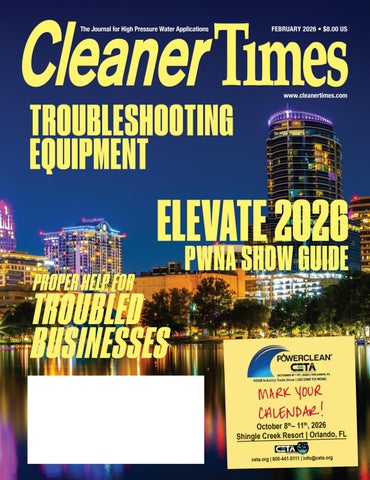
Create a flipbook
Issuu converts static files into: digital portfolios, online yearbooks, online catalogs, digital photo albums and more. Sign up and create your flipbook.