
Cleaner Times — April 2026

Page 1


Editor’s Note

Safe Operations for Contractors

Elevate 2026: PWNA/IWCA Convention Delivers Record-Breaking Attendance and Unforgettable Energy

Drone Washing: Most FrequentlyAsked Questions

Equipment Designed for Safety

CETA Edge: Benchmarking Do What Works, but Do Make a Profit: Pricing Strategies

Product News Financial: Thwarting Cybercrimes

EDITOR’S NOTE

David Bahnsen is a financial analyst and advisor as well as a founder of The Bahnsen Group, a wealth management firm. He writes a weekly blog, Dividend Café , where he provides market perspective rooted in first principles, not the fads of the day. On March 9 he provided commentary on a podcast called The World and Everything in It, where he spoke about the disappointing February jobs report that showed the U.S. economy lost more that 90,000 jobs, showing a weakness in the private sector. One of the items he mentioned that caught my attention was that manufacturing jobs were down by 12,000 and have been down every month for the last year, which shows that tariffs aren’t working to bring back manufacturing employment.

I don’t want to be all doom and gloom in this April issue but represented in Cleaner Times’ pages are several manufacturers of pressure washing equipment. This has a direct impact on the pressure washing industry—manufacturers, suppliers, distributors, and contract cleaners—and I hope that as the year progresses more positive news for the manufacturing sector will be reported.

One positive news item reported on in this April issue can be found on page 10. The Power Washers of North America (PWNA) and International Window Cleaning Association (IWCA) held their annual convention, ELEVATE 2026, in Orlando, FL, February 17–20. There were many beneficial educational classes, outdoor demonstrations, trade show exhibits, networking events, and an award ceremony. Check back at pwna.org to see when ELEVATE 2027 will be scheduled and plan to attend.

On page 18 AhatTek shares nine common questions and answers as regards drone washing. They provide answers to the benefits of drone washing, what is involved in learning how to clean with drones, a history of early adopters failing with drones, and more.

Whatever part of the pressure washing industry your company falls into, Cleaner Times wishes you a safe, productive, and positive outlook in April.

mhamline@cleanertimes.com

800-525-7038

Cleaner Times (ISSN #1073-9602) is published monthly by True Source Publishing, LLC 1000 Nix Rd, Little Rock, AR 72211 (800) 525-7038 • (501) 280-0007 Fax: (501) 280-9233 www.cleanertimes.com © Copyright 2026

The publisher and editor(s) of this magazine do not accept responsibility for the content of any advertisement, including statements made by advertisers herein, or the opinions expressed by authors of by-lined articles. The publisher and editor(s) also reserve the right to reject any ad or article for objectionable content in verbiage or images. The intent of this publication is to provide general information only and is not intended to provide specific advice or recom-mendations. Appropriate legal, financial, or engineering advice or other expert assistance should always be sought from professionals.

HOW TO REACH US

Times 1000 Nix Road Little Rock, AR 72211 www.cleanertimes.com

SUBSCRIPTION RATES

One Year, $24 U.S. and $75 Canada. Back issues are available for $8 each. Reproductions of any part of this publication without the written consent of the publisher is prohibited.

Make sure everyone is on the same page. The adage applies to safe operations of contractors as surely as it does to hymnals.

If anyone skips ahead or falls behind, confusion can ensue. Policies and procedures exist so that no one needs to guess what comes next.

A day-to-day fundamental to ensure safe operations is the clarity that derives from a written reference. (Yes, “written” includes in digital format.)

“An operations manual should be in place so that the technicians of the business know what is expected of them,” says Mike Dingler, owner of Firehouse Power Washing in Peachtree City, GA. That operations manual includes prescriptive information about safety. [We should mention that Dingler is an Enterprise Member of the PWNA as well as a PWNA certified instructor.]

“A safety policy within the operations manual is paramount as it outlines how to perform the work in a safe manner, often using systems that have been put in place due to injuries in

the past,” says Dingler. “These systems, when followed by the technicians, can help avoid injuries in the future.”

To be sure, contractors must develop ways to keep employees from succumbing to complacency. “In any company a training program needs to be in place, and this is especially true in high safety-risk operations,” says Dingler.

“Morning muster meetings should be conducted in which the day’s objectives and jobs are discussed, and at least one safety protocol should be reviewed at each meeting,” says Dingler. “This keeps safety top of mind for all employees.”

Knowledge and tools are inextricably linked. Contractor operations proceed safely when team members follow best practices and can do so because they have proper equipment and ancillaries.

“Proper equipment and proper maintenance of the equipment can contribute to a safer operation overall,” explains Dingler. “Assuring bolts stay tightened and plumbing stays leak free can minimize equipment breakdown and possible technician injury in the future.”

SAFE OPERATIONS FOR CONTRACTORS

Scrupulous adherence to use and storage of chemicals is a must for safe operations. “Chemicals used in soft washing are hypersensitive to being stored with other chemicals, and improper mixing could lead to an exothermic reaction in which a chemical explosion could take place,” says Dingler. Preparation is essential. So do it.

Consider chemicals. “Assure the proper safety data sheets (SDS) are in place on your mobile units in case of a motor vehicle accident. DOT and the local authorities require the identification and handling instructions of any chemicals you may be transporting,” says Dingler.

Ready SDS access does much more than keep a contractor compliant with

regulations. “Having these materials on hand can not only get you out of a fine but also provide important information to first responders or others who may be exposed to chemicals on your truck,” explains Dingler.

Keeping employees (and passersby) safe (and healthy) is the primary reason contractors commit to safe operations. A secondary reason is to remain fully aligned with regulations from federal, state, and local entities and avoid fines.

There’s a third reason, though, that contractors ought to keep in mind. Not only do responses to requests for proposals (RFPs) and bids on work require documentation of one’s safety record, but the public and private entities

inviting proposals or bids increasingly require prequalification.

That is, a contractor must demonstrate policies and procedures are in place and followed precisely. A small, growing contractor in our industry might not envision a time when prequalification or bidding will be necessary; but as the size of jobs increases, that could change.

Many industry organizations offer advice to those hiring contractors regarding how to assess the safety record of a prospective contractor. Among the organizations is the familiar ANSI [American National Standards Institute]. CURT [Construction Users Roundtable] and Industrial Hygiene Association [AIHA] are two others.

Photo by iStockphoto.com/Thank you for your assistant

The guidelines provided to those prequalifying or hiring contractors include assessment of staff qualifications, accident history, and the type of safety program in place. Here, the operations manual, which includes safety program details, becomes significant.

Working as contractor without a tie to an industry association is possible. But such a contractor forfeits valuable assistance in keeping up to date with safety regulations (as they are modified or added to) and easy access to training and discussions.

For instance, PWNA [Power Washers of North America], UAMCC [United Association of Mobile Contract Cleaners] and IWCA [International Window Cleaners Association] put contractor safe practices as well as training and certification high on their agendas.

SURPRISES

A contractor may assess his or her company and feel confident that the policies and procedures in place will result in safe operations. If so, there will be no surprises in the realm of regulatory violations (and fines), at least in theory.

Because regulators modify and expand regulations frequently, the “no surprises” assumption is faulty. Contractors can sign up for alerts from OSHA [Occupational Safety and Health Administration]—see OSHA.gov—to avoid missing new requirements.

In addition to regulators, contractors may encounter investigators should an incident occur. For example, the Chemical Safety Board (CSB.gov) is a nonregulatory body that dates to 1998. Its members are appointed by the Senate and the White House.

CSB undertakes root cause analyses concerning safety events involving chemicals. It has no punitive authority but aims to use analyses to reduce injuries and deaths by preventing the same type of incident from occurring again. In short, there are watchful eyes on contractors from all directions.

A contractor can gain some assurance that nothing has been missed in meeting requirements of OSHA by using

the administration’s On-site Consultation Program, which provides free, confidential advice to small and mediumsized businesses. (The program gives priority to high-hazard worksites.)

An on-site consultation can highlight potential risks a contractor may not recognize. The consultation does not result in citations or penalties, but the contractor must correct any deficiencies. (Learn more at the https:// www.osha.gov/consultation.)

Although an employer must have more than 10 employees before OSHA reporting requirements take effect, it’s best to be prepared. Employers covered by the OSHA record-keeping regulation must report all fatalities and all workrelated illnesses and injuries that require time away from work, as well as work-related illnesses or injuries diagnosed by a physician even if they require no time away from work.

“OSHA’s Frequently Asked Questions” (https://www.osha.gov/faq) is a good starting point for a small contractor who wants a quick grounding in OSHA, even though the number on the employee roster is fewer than 10.

Power washing contractors are covered by general industry standard 1910, but the nature of their work may also place them under the prescriptions of standard 1926 for the construction industry. (An on-site consultation can help a contractor determine which regulations apply.)

Two subparts of 29 CFR 1926— subpart E and subpart D—should get the attention of contractors in our industry. (That is attention in addition to 29 CFR 1910.)

According to subpart E, employers must provide and require their employees to use protective equipment “wherever necessary to prevent injury or impairment.” The safety equipment must meet standards established by ANSI or by NIOSH [National Institute of Occupational Safey and Health]. Head protection, hearing protection, eye and face protection, and respiratory protection may be required.

Subpart E also includes rules for use of safety belts, lifelines and

lanyards, safety nets, and buoyant jackets or vests when working over water. It can be complicated. For example, turning an employee’s safety belt on or off depends on what the employee is doing. Just wearing the belt constantly may result in a violation.

There’s another good example of the vexing nature of the regulations in the context of buoyant safety devices. Contractors who work on bridges over water must wear the devices, but that’s just step two. All such devices must be free of defects and checked before and after each use.

It’s almost a given that a contractor with a safe operation will be surprised by some rule that’s been overlooked. And that takes us to subpart D of 29 CFR 1926—Occupational Health and Environmental Controls.

Subpart D includes rules for sanitation (e.g. adequate drinking water and cups, toilets), hearing protection, protection from ionizing radiation, protection from airborne contaminants, amount of illumination, hazard communication, and many more considerations. There are plenty of things a contractor can be surprised by when trying to follow this subpart. Take toilets. Mobile crews who have transportation available to get to toilets nearby do not need to be supplied with toilets. But the determination of “nearby” is ambiguous, which becomes irrelevant in municipalities that mandate on-site toilets.

Toilet use frequency is also spelled out by OSHA. No “unreasonable restrictions” can be placed on use of restrooms by employees.

OSHA regulations can surprise. And remember that many of them (e.g., the nearness of toilet facilities) can be open to interpretation. That’s why the free, on-site consultation is invaluable.

Associations and other similar stakeholders can also take advantage of meetings with OSHA compliance assistance specialists. Like contractors with safe operations, OSHA’s compliance assistance specialists want to be sure everyone is on the same page. CT

ELEVATE 2026

PWNA/IWCA CONVENTION DELIVERS RECORD-BREAKING ATTENDANCE AND UNFORGETTABLE ENERGY

The exterior cleaning industry showed up—and showed out—at the 2026 ELEVATE PWNA/IWCA Convention, and the numbers say it all.

With 1,039 total attendees, including exhibitors and over 800 contractors walking through the doors, this year’s event set a new benchmark for what the industry’s premier convention can be. It was,

by every measure, a record-breaking gathering and a powerful reminder of just how far this profession has come. From certification classes and hands-on training to a buzzing trade

ARECAPOFTHEINDUSTRY’SPREMIERGATHERING FOREXTERIORCLEANINGPROFESSIONALS

show floor, meaningful networking, and a memorable awards ceremony, ELEVATE 2026 delivered on every front. The energy was palpable from the moment the doors opened, and

it didn’t let up until the final gavel fell. If you were there, you already know. If you weren’t there, keep reading because this one’s worth understanding.

TUESDAY, FEBRUARY 17TH — THE DEEP DIVE BEFORE THE STORM

For the contractors who arrived early, Tuesday was a full day of serious, focused education before the

convention crowd descended. These pre-convention intensives are designed for professionals who want to go deeper than a standard session allows, and this year’s lineup delivered exactly that.

Steve Williams of ISCA led a full eight-hour Solar Safety & Cleaning course that drew contractors eager to position themselves ahead of

one of the fastest-growing service categories in the industry. Solar panel cleaning isn’t a niche anymore—it’s becoming a genuine revenue driver for exterior cleaning companies across the country, and the safety considerations that come with it are not something you want to learn on the job. Williams walked attendees through the proper protocols, safety

standards, and technical nuances that separate contractors who do it right from those who create liability. For the contractors in that room, Tuesday was worth the trip on its own.

Running simultaneously, Carlos Gonzales filled the day with his Niche Market & Gas Station Cleaning training—a course that had 61 contractors enrolled by the time all was

said and done. Gas station and fleet cleaning represent a significant commercial revenue opportunity that many residential-focused contractors haven’t fully explored, and Carlos brought the kind of real-world, boots-on-the-ground knowledge that you can’t find in a YouTube video. His ability to break down complex chemical applications and surfacespecific challenges into practical, actionable techniques is exactly why he’s one of the most sought-after educators in this space.

Tuesday wrapped up with the PWNA Enterprise Member Welcome Social, giving the association’s toptier members a chance to connect in a relaxed, informal setting before the week hit full speed. These early evening gatherings tend to produce some of the best conversations of the entire convention—the kind that turn into referral relationships, partnerships, and friendships that last well beyond the event itself.

WEDNESDAY, FEBRUARY 18TH — THE ENGINE WARMS UP

Wednesday was the day the convention truly came to life. The morning was dedicated to exhibitor move-in and setup, with vendors transforming the show floor into what would become one of the most active trade environments this industry has seen in years. While that was happening, certification classes and hands-on training were already running full steam, giving early-arriving contractors the chance to knock out credentials before the trade show opened. By mid-afternoon, the outdoor demo area was drawing crowds. Watching equipment perform in real conditions—seeing chemical reactions happen on actual surfaces and watching operators work through real-world scenarios—is the kind of hands-on education you simply cannot replicate in a classroom. Contractors huddled around demonstrations, asking questions,

comparing notes, and picking up techniques they could bring home and put to use immediately. Then came the Opening Reception , and if there’s one moment that captures the spirit of ELEVATE, it’s this one. A DJ kept the energy high while contractors, vendors, and industry professionals mixed and mingled in a setting that was equal parts celebration and community. The Corn Hole Tournament became an instant hit—competitive enough to get people fired up and relaxed enough to break the ice with someone you’d never met before. By the end of the night, business cards had been exchanged, plans had been made, and the tone for the rest of the week had been set perfectly.

THURSDAY, FEBRUARY 19TH — EDUCATION, EMPOWERMENT, AND THE TRADE SHOW FLOOR OPENS

On Thursday everyone hit the ground running with a packed

morning of technical, business, sales, and marketing classes—and the rooms were full. This is where ELEVATE separates itself from a standard industry gathering. The educational programming isn’t filler. It covers the full spectrum of what a modern exterior cleaning business needs to operate and grow: advanced technical training for the crew in the field, business development strategies for the owner in the office, and sales and

marketing guidance for the professional trying to scale. Attendees bounced between sessions that spoke directly to where their businesses were and where they wanted to go.

Midday brought one of the convention’s most talked-about events— the Women’s Wine & Wash. Running from 11:30 am to 1:00 pm, this gathering has become a genuine tradition at ELEVATE, bringing together some of the most accomplished and driven

women in the exterior cleaning industry for meaningful conversation, connection, and community. It’s more than a social event. It’s a space where women in a traditionally male-dominated trade can share experiences, exchange ideas, and build the kind of professional relationships that support long-term success. The energy in that room is something special, and its growth year after year reflects how much this industry is evolving.

When the afternoon arrived, the trade show floor opened its doors, and the energy was immediate. Giveaways were flowing, exhibitors were demonstrating products, and the floor buzzed with the kind of activity that only happens when over a thousand industry professionals are under one roof with a shared purpose. Contractors who had been in class all morning were now getting their hands on equipment, talking directly to the people behind the products they use every day, and discovering solutions to problems they’d been carrying for months. This is the trade show experience done right.

FRIDAY, FEBRUARY 20TH — FINAL PUSH, AWARDS, AND THE MOMENT NOBODY FORGETS

Friday carried the energy of a wellspent week. The morning once again featured a full slate of technical, business, sales, and marketing sessions, with contractors squeezing every last bit of education out of the convention before the afternoon arrived.

The trade show floor opened for its final run alongside a live auction that added a charge of excitement to the afternoon. Giveaways continued drawing crowds, exhibitors made their final push, and the floor had the kind of controlled chaos that makes you want to stay just a little bit longer before it’s all over.

And then came the Awards Ceremony—the moment that brought the entire convention together in the most meaningful way.

AWARDS: HONORING THE PEOPLE WHO MAKE THIS INDUSTRY WHAT IT IS

In a deeply moving moment that set the tone for everything that followed, Jan Walters took the stage to present the Joseph Walters Award on behalf of her late husband. Joseph Walters left an indelible mark on this industry and on PWNA, and having Jan there to carry his legacy forward was a reminder of why this association exists—not just to do business, but to honor the people who built something worth being proud of. There was not a distracted person in the room when she spoke.

This year’s award recipients represent the full range of what excellence in this industry looks like:

• Joseph Walters Award—Carlos Gonzales, Enviro Bio Cleaner Carlos has spent years being more than a vendor to the contractors he serves. He’s an educator, a problem-solver, and a genuine

advocate for the success of every operator he works with. His Niche Market Training at this very convention drew 61 contractors, which tells you everything you need to know about the trust and respect he’s built. Receiving this award from Jan Walters herself made the moment all the more significant. Congratulations, Carlos. It’s well earned.

• PWNA Award of Excellence (Contractor)—Ronny Estrada, Ferretti Softwash

Ronny leads Ferretti Softwash with a relentless focus on safety, compliance, and technical proficiency. As a PWNA Enterprise Member, he doesn’t just hold a membership—he uses it. He’s brought PWNA education and resources directly into his operation, building a team that reflects the values this association champions. Ronny is the kind of contractor who makes the whole industry look better. Congratulations.

• PWNA Award of Excellence (Contractor)—Chuck Doherty, Pressure Kleen

Twenty-plus years of PWNA membership—Let that sink in. Chuck Doherty has been showing up for this association and this industry longer than many of today’s contractors have been in business. His commitment to professionalism, ethical practice, and continuous improvement is a model worth following at any stage of a career. Congratulations, Chuck—and thank you for everything you’ve given to this community.

• PWNA President’s Award— Trevor Shamblin, PWNA Board Member

Trevor’s work on behalf of PWNA and its members doesn’t always happen in the spotlight, but it matters deeply. This recognition is the association’s way of saying what the membership already knows—that the work Trevor puts in for this organization makes a real difference. Thank you, Trevor.

THE NUMBERS BEHIND THE EDUCATION

If the awards were the emotional heartbeat of ELEVATE 2026, the certification numbers were the backbone. This year saw a record enrollment across PWNA’s full certification curriculum—over 500 credentials being pursued in a single week.

• Concrete and Paver Sealing— 120 enrolled

• Flatwork Certification— 118 enrolled

• PWNA Roof Cleaning— 104 enrolled

• House Washing—86 enrolled

• Niche Market Training with Carlos Gonzales—61 enrolled

• Fleet Washing—52 enrolled

These numbers reflect a workforce that is taking professionalism seriously. Contractors aren’t just showing up to walk the trade show floor—they’re showing up to get better, get certified, and go home

with credentials that set them apart in their markets.

WHAT CONTRACTORS WHO DIDN’T ATTEND ACTUALLY MISSED

Let’s be honest, sitting this one out was costly.

Over 800+ contractors spent the week getting certified, educated, and connected in ways that don’t happen behind a screen. They walked a trade show floor packed with vendors who actually wanted to talk, discovered solutions to problems they’d been working around for months, and left with credentials that carry real weight in their markets.

They made the kind of connections that turn into referral relationships, partnerships, and mentorships because there is no substitute for being in a room with so many people who understand exactly what your life looks like. The contractor you grab dinner with on Wednesday might be the one who sends you a major commercial account in the spring. It happens every year.

START PLANNING FOR ELEVATE 2027

PWNA will be releasing details on the 2027 ELEVATE Convention in the months ahead, and if this year’s record-breaking attendance is any indication, next year’s event is going to be even bigger. The exterior cleaning industry is growing, and the contractors who show up to events like this are the ones leading that growth.

ELEVATE isn’t just a trade show. It’s an investment in your business and your career—and the contractors who keep showing up are the ones leading this industry forward. If you’ve been on the fence, let this recap be the nudge you needed. Block the dates when they’re announced. Book early. Come ready to learn, connect, and walk away with more than you arrived with.

This industry has always rewarded the professionals who invest in it. ELEVATE is where that investment happens.

We’ll see you in 2027. CT

DRONE WASHING

MOSTFREQUENTLY-ASKEDQUESTIONS

WHY SHOULD I CONSIDER STARTING A DRONE WASHING BUSINESS?

Drone washing offers one of the strongest returns on investment in exterior cleaning. Most operators get started for under six figures in equipment and routinely generate several hundred thousand dollars in annual revenue, with just a few large projects often paying off the equipment in the first season.

WHY SHOULD I ADD A DRONE TO MY SUCCESSFUL GROUND-BASED SOFT WASH BUSINESS?

A wash drone lets you safely bid taller, more complex structures without adding lifts, scaffolding, or significant insurance exposure, which can dramatically increase job profitability. You also gain faster setup and turnaround times, so you can complete more work in the same season and keep crews on the ground instead of in the air.

ARE DRONES DISPLACING WORKERS IN THE INDUSTRY?

In most markets drones are filling gaps rather than replacing people as many experienced window and exterior cleaners are aging out and fewer young workers want to hang off buildings. Drone cleaning makes the work more attractive and safer, allowing teams to stay on the ground while still delivering high-quality results for glass and façades.

WHAT ARE THE BIGGEST BENEFITS OF DRONE WASHING COMPARED TO TRADITIONAL METHODS?

AThe biggest benefits are safety and cost: drones significantly reduce or eliminate the need for scaffolding, lifts, and roof access systems, which lowers rental and maintenance costs and reduces work-at-height risk. Building owners and contractors also see fewer jobsite disruptions and faster project timelines, which means less downtime for tenants and operations.

QMANY PROVIDERS SAY YOU CAN LEARN DRONE CLEANING IN A DAY AND GET TO WORK. IS THAT TRUE?

No. You can study for and pass the FAA Part 107 knowledge test with self-study, but that does not teach you how to fly a cleaning drone or operate the ground equipment safely and effectively. Professional, hands-on training on both the aircraft and the wash system, ideally on real job sites, is essential for safe operations, consistent cleaning results, and long-term business success.

A Q

HOW DO YOU CLEAN GLASS WITHOUT PHYSICALLY TOUCHING IT? DO YOU ONLY USE WATER AGITATION?

AExperienced drone washers use chemistry and hydraulics together: soft wash solutions and surfactants break down organic growth and grime while carefully controlled pressure rinses remove dirt, cobwebs, and bird droppings. For glass, deionized or purified water can be used to leave a spot-free finish that closely matches conventional methods, often with faster, safer execution when work is done on a regular maintenance schedule.

Q A

AM I TOO LATE TO GET INTO THIS SECTOR? IS IT ALREADY OVERSATURATED?

No. Commercial drone washing began gaining traction around 2018–2019, and adoption has accelerated as risk managers and facility leaders have seen successful case studies and improved technology. The market is still early, with significant room for growth in commercial, industrial, and institutional facilities that are just now adding drones to their maintenance plans.

Q A

WHY WAS THE FAILURE RATE SO HIGH FOR EARLY ADOPTERS, AND WHAT HAS CHANGED?

Many early operators were sold on “turnkey” promises. Pass Part 107, watch a few videos, buy a drone and a trailer, and you’re in business. They didn’t include real flight and cleaning experience or sales training. This led to safety issues, poor results, and frustrated customers. Today’s successful providers invest in comprehensive training, onsite implementation support, and clear go-to-market guidance; and manufacturers have shifted from one-time sales to long-term partnerships focused on operator safety, profitability, and repeat business.

QA

WHAT DRONE SHOULD I BUY?

Cleaning drones are work tools, so although technology is important, prioritize the partner behind the hardware. Look for a system that offers robust training, responsive support, and ongoing innovation informed

by real-world operators. The right platform should integrate smoothly with your soft wash or pressure wash setup, help you work significantly faster and safer than traditional methods, and be backed by a team committed to your long-term success, not just a one-time equipment sale.

For more information, visit www.ahattek.com. CT

EQUIPMENT DESIGNED FOR SAFETY

Match the tool to the task. Doing so is simpler than ever.

There is no need to improvise, modify, or do something stupid like cut a piece of string with an ax.

In our era safety is built into equipment beginning in the design stage. Though, some would say certain digital safety features, such as those in the newest vehicles, have gone over the top with too many warnings and not enough timely ones—as in how flat a tire must be before the warning signal appears.

Still, the focus on safety is intense—so intense that looking at images of people building skyscrapers and bridges or working in coal mines and foundries in the first half of the 20th century might cause some to gasp. Others just wonder, how did they do it? We owe a lot to those who built without layered safeguards in place—and to those who build with them in place.

Expectations for safe design of equipment are encapsulated by OSHA [Occupational Safety and Health Administration] in standard 1910.212, Machinery and Machine Guarding. In this instance, machine guarding ensures guarding the machine equipment operator from hazards.

The protection of a worker begins with equipment designed so that its integrity is consistently maintained during operation. That means no flying chips or sparks, barriers between the operator and any rotating parts, electronic safety devices, etc.

And “etc.” is the language the standard uses. Thus, it’s basically up to the machine designer to get it right. An additional requirement of the standard is that any type of guard built into the design should not create “an accident hazard” in itself.

Design engineers know what’s expected of them by federal regulations, but that’s just the starting point for safety. Various standards bodies, such as ANSI [American National Standards Institute] and ISO [International Organization for Standardization], serve all equipment users in the quest for safety by consolidating and disseminating approaches to design that work well (and are recommended).

Many manufacturers take the extra step of documenting their adherence to standards, such as those by ISO. And manufacturers routinely report the standards followed in the design of equipment, standards such as those from ANSI and IEC [International Electrotechnical Commission].

Close collaboration between ISO and IEC has led to ISO/IEC directives. The goal of international standards is not always achieved for a particular safety specification. That’s because 75 percent of voting members must agree.

But the experts from industry keep pursuing the ideal of international standardization. They meet, confer, draft, and recraft language.

ISO and ANSI use different but similar structures for categories of what equipment designers should consider when designing for safety. They both acknowledge that the principles of designing for safety begin with basic or generic safety standards. And they both give specifics for machine safety.

An excellent primer regarding the entire approach to developing standards can be had in a short document from ANSI—ANSI B11 Standards (Safety of Machinery). Find the open access document via https://blog.ansi.org/ansi/ansi-b11-standards-safety-of-machinery/.

The ANSI document starts at the beginning. It poses and answers the question of what a machine is. Then, it addresses the nature of risks. And in doing so it brings to the fore the fact designers know well: zero risk does not exist.

Photo by

Much of the discussion by experts in engineering, etc. who try to agree on standards concerns how much risk is acceptable. And it becomes complicated.

An aside, but a relevant one: While there’s enormous focus on how likely a machine component is to fail, and how often, and what the consequences might be to safety, the exponential— and increasingly untamed—growth of AI gets only passing scrutiny.

Moreover, much of the attention given AI makes light of concerns. (Consider the many light-hearted takes on Moltbot and Moltbook.) Yet the best designed piece of equipment is vulnerable to catastrophic failure should an AI-governed device get hold of it. This is not science fiction; it’s reality.

Do designers need to broaden their assessment of risks to safety posed by equipment to include attention to how AI might manipulate machines? Of course they do.

We are in very complicated times with many seeming to be in denial about the speed with which AI is subsuming all. In fact, there seem to be two tracks: the familiar human, methodical approach to industry and the AI-governed approach.

Here’s the question this writer put to (Google’s) Gemini minutes ago:

Could an AI gone rogue bypass the best safety features of equipment?

Gemini’s response: “Technically, yes, advanced AI ‘gone rogue’ (acting autonomously against its intended goals) could theoretically bypass safety features, though the method varies depending on whether those features are software-based or physical.”

The response goes on to list the things experts and researchers see as ways for the safety features to be rendered useless by the rogue AI entity: “software guardrail evasion” (quite easy), “deceptive alignment” (optimize flaws or resist shutdown), “operational sabotage” (enhancing degradation by increasing wear ever-so slightly or manipulating quality margins).

OSHA may need a new standard regarding machine guarding that involves keeping AI in check and soon, if it’s not already too late.

If anything does go wrong with equipment, there is a U.S. regulatory body that will intervene. It’s the Consumer Product Safety Commission ( CPSC.gov ). Use the search engine at the commission’s website to get a sense of which sorts of incidents have resulted in recalls of machines in our industry.

The recall—and in extreme circumstances, banned—product list is one

that no manufacturer wants to make. But the CPSC does offer another important level of safety for machine operators by ensuring the word gets out regarding equipment that may be hazardous. As recently as August 2025, a pressure washer model made the list because parts were not holding together.

FUNDAMENTALS

Let’s assume that AI is not outpacing our efforts to understand or keep it operating within known parameters. With that assumption, we return to the human-driven, familiar world and ask ourselves how we can be proactive in verifying that a machine has been designed for safety.

“Equipment purchasers should take a comprehensive approach, and certifications and manufacturer track record are both important,” says Robert Dahlstrom, CEO of Apellix, which is headquartered in Jacksonville, FL. “But there’s more to consider.”

And Dahlstrom takes us back to the beginning. “Safety should be built into the design from day one, not added as an afterthought,” he says.

“All equipment, including dronebased equipment like ours, should be compliant with industry-specific standards,” explains Dahlstrom. “Further, you should look at field operational

hours, not just how long the company has been in business.”

How can a prospective buyer get information about operational hours?

“At our company we track thousands of operational hours across diverse environments—from Navy ships to industrial facilities to hospitals, office buildings, and hotels—in over 24 countries worldwide,” explains Dahlstrom.

“Ask manufacturers for case studies showing real-world safety performance, not just test data,” says Dahlstrom. “Equipment buyers should check both certifications and the manufacturer’s safety track record.”

Also match the search for information to the specific type of machine. “For drone equipment, look for FAA compliance and industry-specific safety standards,” says Dahlstrom, citing an example from his sector of industry.

“Beyond paperwork, look at realworld experience,” says Dahlstrom. “Check how many hours the equipment has been used in the field, not just how long the company has been in business.”

Indeed, Dahlstrom advises that it’s case studies showing safety performance in situ and not just test results that should be studied. Then go from there to other considerations before buying.

“Make sure equipment has backup controls, emergency shutoffs, and operator training programs,” says Dahlstrom. “If a manufacturer can’t provide clear documentation and customer references, that’s a red flag.”

Once the purchase of a verifiably safe piece of equipment has been made, the responsibility for safe operation resides with the owner. An owner must understand all the safety features of equipment and never bypass them.

“At our company we’ve seen that the most successful customers invest time in thorough training,” says Dahlstrom. “They understand not just how to operate the drone and the equipment it connects to, such as spray paint compressors and high-pressure power wash pumps, but also what to do when something goes wrong.”

The reminder cannot be made often enough. “Safety features like emergency shutoffs only protect people and property if operators know when and how to activate them,” says Dahlstrom.

“Think of it like driving a car,” explains Dahlstrom. “You need to know where the brakes are and what warning lights mean.”

The same applies to industrial equipment. “Operators should understand what sensors monitor, what alarms or

warning indicators mean, and which procedures to follow in different situations,” explains Dahlstrom.

Dahlstrom recommends complete hands-on training, including practice with emergency procedures—even as simple as shutoffs—before equipment ever heads to a jobsite. Well-trained operators and safe equipment elevate safety to the greatest level possible, and as a nice bonus, they keep downtime to a minimum. CT

BENCHMARKING

Photo by

Aspiration, inspiration, and verification fuel successful businesses. Verification? Yes, it’s essential to put a reality check on aspiration and inspiration.

An owner cannot pursue every dream. Or, at least not without the means, which in this instance usually includes a combination of financing, personnel, equipment, and space.

Distributors in our industry have ready access to help conduct the assessment needed to execute, modify, or jettison ideas. Help comes in the form of a benchmarking program offered by CETA, the Cleaning Equipment Trade Association.

Thanks to support from the manufacturers Alkota Cleaning Systems, Kärcher N.A., Mi-T-M Corporation, and FNA Group, CETA members can participate in a benchmarking program as a benefit of membership. Participation is optional.

R. Calvin Rasmussen, president of Royce Industries L.C. in West Jordan, UT, currently serves as the chairperson of the CETA committee on benchmarking. An enthusiastic proponent of participation, Rasmussen has written extensively about the utility of the metrics that derive from participating in benchmarking.

We recommend visiting the CETA website at CETA.org and clicking on the benchmarking tab to read Rasmussen’s detailed examples of findings that accrue and how they may be used.

It’s easy to understand why distributors participate in benchmarking. They want to fortify their businesses.

But why do manufacturers step forward to support the program? Karl Loffelholz, channel sales manager—commercial pressure washer, with Mi-T-M Corp. in Peosta, IA, explains. “We sponsor the CETA benchmarking program because we believe educated dealers build stronger businesses,” says Loeffelholz. “While we don’t benchmark as a manufacturer, we see firsthand how valuable financial awareness is for our dealers.”

The resulting awareness brings benefits all along the business-to-business chain. “When dealers understand their numbers, it creates better conversations with our sales team and leads to better outcomes for our end customer,” says Loeffelholz.

The illumination provided by the profit report and performance analysis report that each participant in the benchmarking program receives cannot be overstated. Shedding light, as well as opening doors to possibilities—that’s the poetic way to think about benchmarking.

And Gus Alexander, CEO of FNA Group in Pleasant Prairie, WI, elaborates. “In my view, benchmarking is the front door to better financial performance.”

Benchmarking meshes completely with the philosophy of Alexander’s company. “Our company helps distributors improve margins, cash flow, and valuation,” he

explains. “CETA benchmarking creates the clean, comparable financial data that makes that work possible.“

Alexander has a vision of what sponsorship means to his company, its distributors, and the industry. “Sponsoring benchmarking positions FNA as a neutral, data-first partner, not a consultant parachuting in with opinions,” he explains.

“Distributors see the numbers first, then decide if they want help acting on them,” says Alexander. “The bottom line is it strengthens the entire channel,” he adds.

In other words, each link in the industry becomes more solid. “Healthier distributors mean better suppliers, better lenders, and a more resilient industry,” says Alexander. “In doing so it provides alignment with FNA’s long-term interest, not just short-term engagements.”

There is a simple and important bottom line. “My company supports CETA benchmarking because better data creates better distributors, and better distributors create a stronger industry.”

More light on any subject is a good thing, and benchmarking provides it.

“Distributors who participate in CETA benchmarking stop managing in the dark,” says Alexander. “CETA distributors that participate gain peer level insight that improves margins, strengthens lender and supplier conversations, and reduces costly trial and error.”

It’s all about verification. “If you’re not benchmarking, you’re assuming you’re competitive; and the fact remains that CETA benchmarking replaces assumptions with proof,” says Alexander.

Verification matters. It keeps a balanced check on inspiration, preventing leaps before appropriate scrutiny. Conversely, it gives a lift to inspired ideas that are feasible.

In past considerations of benchmarking, we have discussed the importance of data over gut feelings. As in, it’s great for a distributor to have a sense that things are going well. But it’s better to verify all is well with numbers, especially numbers that suggest how to do things better.

Yet we skipped across the history of benchmarking. It’s an interesting history, clearly summed up in a 2015 article by Robin Mann titled “Expert Point of View Note: The History of Benchmarking and Its Role in Inspiration” (Journal of Inspiration Economy, volume 2, number 2). To read the open access Mann article see https://www.academia. edu/33200540/The_History_of_Benchmarking_and_Its_ Role_in_Inspiration

Mann cites the 1989 book by Dr. Robert Camp titled Benchmarking as a “ground-breaking” volume in which Camp drew on his experience in benchmarking at Xerox. Camp advocated for going beyond comparing data with that of competitors to identify places to improve.

The going beyond entails recognizing best practices from whoever had them and learning from them to develop even better (superior) best practices. The verification

that derived from the metrics in benchmarking was to become a source of inspiration (i.e. a business can always do more).

Mann’s paper makes interesting reading. We recommend it. One notable aspect is that in its own assessment of benchmarking use, Xerox evaluated more than 200 benchmarking projects of other companies to try to assess the best among them.

The number of benchmarking programs available to businesses is great. But even distributors who may be involved with other—in-house or external benchmarking programs—should consider participating in the CETA program as well. CETA benchmarking has the advantage of being tailored specifically to distributors in our industry.

Profit Planning Group is the third party that collects and analyses data for CETA benchmarking participants (and we reiterate there is no cost to participate for members who wish to do so).

Yes, participants in benchmarking submit financial data for aggregation and analysis, but the identities of participating companies are never revealed. Until a participating company has received its first report, it may be unable to appreciate fully the places where easy improvements in operational procedures can be made.

For instance, just a few days of courtesy time to buyers who are routinely a bit late on payments could add up

to a preventable loss. How could it be prevented? By setting terms for payment a little shorter with less lenience (e.g., penalties).

Many small changes add up quickly. Benchmarking results bring clarity.

That clarity derives even if a company’s profile puts it far and away ahead in every metric. Reassurance of being ahead is not to be taken as an endpoint.

Even if every runner in a race surpasses the standing record time, it’s only the beginning of the next challenge. Instead of stopping with self-congratulations, the runners will begin preparing to beat the new record. And runners are always striving to beat their individual best record.

Distributors improve by challenging themselves while looking for ways to gain an edge against their competitors. The intense focus on improvement is the path to sustained excellence and a strong industry.

CETA’s benchmarking for distributors takes place on an annual basis. So, if nothing else, a participant can compare its results year over year. A worthwhile endeavor. Not yet a participant? Why not consider becoming one in 2026?

Two facets of benchmarking: Measure a company against its peers. Measure a company against itself. But do measure.

True enough that gut feelings can and do often power success. Heed them. Trust them. But still verify first. CT

PROFIT

PRICING STRATEGIES DO WHAT WORKS, BUT DO MAKE A

Ever wonder why so many prices include the pair 99?

Think of a $2.99 box of cereal or a $299,000 house. The use of odd digits constitutes a pricing strategy. Some business researchers have found odd numbers in the context of rounded ones, such as $3 or $300,000, suggest a bargain.

The psychology of odd pricing is one of many strategic approaches that business thinkers identify (more about categories in the last section).

But we start with the doers and get some straight-up advice about how to price from practitioners in our industry. After all, they have been-there-and-done-that.

Bruce Tassone is president of HydraMotion Cleaning Systems in Pottstown, PA. His company makes the SideWinder. Determining optimal price for an item begins with understanding who the prospective buyer is, explains Tassone. The assessment includes whether the individual is new to the industry or a veteran.

“Contractors who have been in business for many years will analyze warranties and reliability in their buying decision,” says Tassone. “Newer entrants to the field may not have experienced the issue of purchase price versus cost of use.”

And there will be purchasers who buy on price alone. “In some cases, contractors believe it is best to go with the lowest price,” explains Tassone.

Is the lowest price a workable option? “If cash flow is a concern, that is understandable; but if your intent is to stay in business for the long haul, dependable equipment with the best warranty you can buy makes good economic sense,” says Tassone.

“It is absolutely the responsibility of the seller to educate the customer on the quality features of equipment and ancillaries that add to the purchase price,” says Tassone. “If you are not educating your customers, you are failing them,” he adds.

Looking at the big picture of what a sale means to the success of the

contractor and the industry, Tassone emphasizes that pricing done right fuels good outcomes for both. “Most owners know how to pressure wash or how to run a business, but not always both,” he explains.

An acute understanding of methods and tools must be tightly linked. And if they are not? “This is a major contributor to why the failure rate has always been high in our market,” says Tassone.

“Becoming a pressure washer contractor is a relatively inexpensive career to enter in comparison to other businesses,” says Tassone. Yet many who try to fledge businesses need more help with the logistics and financials than they realize initially.

“Newcomers see the relatively low cost to start a business, and they think, ‘I can be successful too,’ but they do not realize the knowledge

LIMIT PRICING WORKS BEST FOR

COMPANIES WITH

DEEP POCKETS.

PROMISING TO WASH A DECK ANNUALLY FOR THREE YEARS AT THE SAME PRICE CAN BE A MONEY LOSER. PROMOTIONAL PRICING CAN BE A VIABLE OPTION FOR CONTRACTORS, BUT IT MUST BE RIGIDLY TIME LIMITED.

SIMILARLY, CYCLICAL PRICING TIED TO SEASONS OR HOLIDAYS OR RECESSIONARY INTERVALS MAY GENERATE MORE BUSINESS IF THE GAIN EXCEEDS THE COST.

base you must have to make it successful and the contacts in the industry as well,” says Tassone.

QUALITY

It’s worth re-emphasizing the factor of quality that we introduced in the last section. Customers seeking equipment, services, or expertise will pay for quality. A well-versed buyer knows that buying on price alone can lead to problems.

Whether a manufacturer, distributor, or contractor, a basic tenet of setting prices should be to make certain each prospective buyer knows what a quality purchase means to the strength of their business. That’s quality in every dimension (e.g., longevity, durability, performance, ease of maintenance, and ready answers to customers).

Commit to providing a quality product or service. Then, charge accordingly.

“We at Delco know that customers don’t buy equipment, but they buy uptime, simplicity, and confidence,” says Gus Alexander, CEO of FNA Group in Pleasant Prairie, WI. “It is absolutely true that buyers will pay more for reliability, which provides revenue protection after taking into consideration that downtime costs more than the difference in purchase price based on the premise that equipment is built to start, run, and finish the job every day.”

Experienced buyers know the many positives that flow from choosing based on quality. “The upside of this is quality lowers total cost of ownership, which is perceived by the buyer’s fewer breakdowns and service calls, longer useful life of the equipment, and a stronger resale

value with the outcome of lower long-term cost than ‘cheaper’ alternatives,” says Alexander.

“Four key factors in the buying decision are as follows: who I am buying the equipment from, equipment reliability, durability, and ease of use,” explains Alexander. “We have to keep in mind that the equipment we sell is built for professionals who can’t afford failure.”

Again, when customers succeed, so do their vendors. And so does the entire industry.

PROFIT, PRICING, AND PROFESSORS

Established businesses got to where they are today because they never lost sight of profit. A business must make a profit, or it’s not really a business.

To be eligible for a traditional Small Business Administration (SBA) loan, a business must be profitable. But there are many types of SBA loan and grant programs. The programs track heavily with the interests of the party in control of the White House, and in many cases, it is possible to get a loan without showing a profit.

Yet even the SBA has enough concern about pricing for profit to include a tool for break-even analysis at its website (SBA.gov). A business breaks even when its fixed and variable costs are equal to the price it receives for its product (service).

At the break-even point, a business is not making a profit. But at that point, a business can better develop pricing strategies that will result in a profit.

A pricing strategy can change as necessary. In fact, it must change when necessary.

How many ways are there to price goods and services? A great many business theoreticians dissect and analyze approaches in much more detail than most individual business owners require.

Even so, we found an excellent article titled “Various Pricing Strategies: A Review” by Dr. Satyajeet S. Deshpande that is worth a look. Published in October 2018 in the Journal of Business and Management, Deshpande’s review has open access. (See https://www.iosrjournals. org/iosr-jbm/papers/Vol20-issue2/Version-8/K200208 7579.pdf .)

Deshpande lists 13 types of pricing strategies and provides a short explanation of each. Probably the one most of us are immediately familiar with is loss leader pricing. Frequently used by grocery stores, loss leader offers some items below cost to lure customers to the store.

Once lured, the customers not only buy the below-cost items but purchase other items too. At a sufficient sales volume, there’s little risk to the seller. But for labor-intensive work, such as power washing, where upselling can be difficult in uncertain economic times, it can be risky.

The loss leader method sometimes folds into predatory pricing, such as selling products or services below cost when trying to monopolize a market. To make this method work (all ethical considerations aside), a business must have significant financial reserves.

The most straightforward method of pricing is to establish a break-even point, decide what the price should be of a product to realize a profit,

and add that amount to the breakeven point. Called cost-plus pricing, it’s a widely used and viable approach.

Incremental cost pricing refers to adjustments that must be made when the variable costs of making a product or providing a service (e.g. components, electricity) change. Any business that aims to sustain itself will eventually have occasion to use it. No business can

persist if it simply “eats the cost” of the price increases that it experiences.

The names applied to the categories of pricing strategies may differ a bit, but we have all seen most of the strategies being used. For example, limit pricing is commonly used by cell and internet plan providers, which promise no increase in price for a certain period.

Limit pricing works best for companies with deep pockets. Promising to wash a deck annually for three years at the same price can be a money loser.

Promotional pricing can be a viable option for contractors, but it must be rigidly time limited. Similarly, cyclical pricing tied to seasons or holidays or recessionary intervals may generate more business if the gain exceeds the cost.

Before getting carried away with any novel pricing strategy, a business owner should be certain it’s necessary. Lowering prices to capture more customers will result in a loss if the market share stays the same.

And before putting an odd number in every advertised price, be certain buyers do respond to odd numbers— see the discussion about “99” at the beginning of this article. So commonplace are odd digit prices in some commercial sectors that they have almost become a punchline.

Moreover, a better strategy than advertising price may be providing a price after a consultation with a would-be customer. Call it customized pricing. It’s not on the professor’s list, but it’s somewhat akin to prestige pricing, which is.

In prestige pricing, the price heralds a product or service of exceptionally high quality and with a brand image. It might be the valid promise of a sparkling home exterior, washing that includes a pot of annual flowers on completion, or a pressure washer delivered to a contractor with a modest supply of chemicals.

Do what works, but do make a profit. CT

PRODUCT NEWS

COXREELS ® FEATURES DEF HOSE REELS

Coxreels features a complete line of diesel exhaust fluid (DEF) hose reels built on the industry proven, allsteel construction SH and T Series of reels. These reels are equipped with a stainless steel external full-flow swivel and chemical resistant Viton seals to provide a safe, reliable DEF dispensing solution available with a factory installed, high-quality Goodyear DEF hose. The swivel is easy to access for simple seal maintenance and fast DEF dispenser hose installation.

Coxreels provides professional reeling systems in heavy-duty single pedestal (SH Series) or supreme-duty dual pedestal (T Series) configurations that handle DEF hoses up to 75 feet of ¾ in. hose I.D. Both versatile designs are outfitted with super hub dual axle support systems to increase stability and reduce vibration during operation, making these reels the perfect DEF handling solutions for either stationary or rugged mobile applications.

The DEF models are available in standard spring retraction and EZ-coil controlled retraction systems that promote greater operator and workplace safety by retracting up to 80-percent slower than conventional reels. This DEF reel line has all the durable high quality components and superior finishes found in every Coxreels product.

Coxreels has remained steadfast and focused on manufacturing high-quality, industrial-grade hose, cord, and cable reels with leading industry innovation since 1923. Offering a full product line serving the industry in every channel and application, Coxreels takes great pride in designing, building, and supporting each and every product made exclusively in the U.S.A.

For further information on Coxreels, DEF hose reels, contact customer service at 800-269-7335 or visit www.coxreels.com

Note: Product News submissions should be emailed to jkidder@cleanertimes.com. Please be sure that your product announcement is accompanied by a high-resolution photo of the product CT

SUTTNER AMERICA COMPANY’S NEWEST SPRAY GUN

Suttner America Company is proud to introduce its’ latest lightweight spray gun as part of our soft wash systems collection. This ½ in. fpt chemical-resistant soft wash spray gun features a strong body and greater comfort while using it for an extended period of time. It allows for use up to 120° F and a flow rate of 18 gpm, and it has a maximum pressure rating of 362 psi. Our spray guns are made in Germany and are built to last and stand up well in dirty and harsh environments.

Accessories are also available to customize for a variety of jobs, including a low-pressure foam head nozzle. The nozzle sucks in air, mixes with a water-chemical mixture, and delivers great foaming results. It is easily adjustable from point streaming foam to a cone jet foaming to cover a large area quickly. The next option includes a variable spray nozzle which is perfect for rinsing and water flow can be adjusted from 0 to 90 degrees. Last, but not least, is the trigger guard. The trigger guard is essential for accidental spray when dropped or bumped. It can easily be added or removed.

For additional information, please contact us by email at sales@suttner. com, by phone at 800-831-0660, or visit our website at www.suttner.com

THWARTING CYBERCRIMES

Photo

The recent headlines about internet “hacking” and security breaches have focused on large retailers and big banks.

Unfortunately, fraud and financial data losses are not limited to retailers or to one industry. Pressure cleaning operations and other small businesses are increasingly vulnerable to cybercrimes and fraud.

Cybercrime and cyberattacks are the fastest growing crimes today with most impacting smaller businesses. Although cybercrimes and cyberfraud are considered casualty or theft losses for tax purposes and are often covered by insurance, avoidance is best.

THE THREATS

With almost every business involved with some form of internet connection or storage of data such as customer lists, employee information, books, records, receipts, tax documents, and, of course, credit cards, nearly 83 percent of small businesses do not, according to the SBA, have a contingency plan to respond to and report data breaches or losses.

Using the internet to conduct business or retain records makes every pressure washing operation a potential target. Hackers can steal customer lists or credit card information, and viruses can infect the operation’s files causing expensive havoc.

THE GROWING CYBERCRIME INDUSTRY

Cyberthieves are constantly coming up with new ways to steal passwords, hack files, and download sensitive data that can be sold—or used to steal from the pressure cleaning business or its customers. Using the internet to conduct business, retain records, and communicate makes a business a target for cybercriminals both within and outside the business.

Cybercrooks may steal the operation’s customer list or credit card information. Viruses can infect files, causing random but expensive havoc. Cybercrime is the fastest growing crime category, with almost half of all attacks targeting small businesses.

Creating security measures that not only keep cybercrooks at bay, but also prevent the operation’s employees from snooping where they shouldn’t and former employees from accessing the system after they’ve been terminated, is vital.

The internet continues to make electronic banking more convenient, but it also creates new risks. With electronic banking, every pressure washing business assumes greater liability for online fraud.

Obviously, everyone using electronic banking must carefully monitor their accounts. A lack of vigilance could mean the operation has little recourse in case of fraud.

INSIDE OR OUT

Reportedly, a surprising number of small business owners and managers are unconcerned about cyberthreats—either external or internal. External threats include a hacker or cybercriminal stealing data while internal threats usually involve an employee, ex-employee, or contractor/consultant stealing data.

Unfortunately, data breaches or hacking incidents pose a serious threat that can result in significant financial loss, civil lawsuits, damaged reputation, and compromised records. There are also other costs, including mandatory customer notifications, credit monitoring services, and, of course, legal fees.

Since no business can hope to remain safe from cyberthreats, every business, especially those transacting business online, should have a cybersecurity plan that includes keeping computers “clean,” protecting information, frequently changing passwords, and having good antivirus software.

BUSINESSES, EVEN SMALL BUSINESSES, ARE INCREASINGLY BEING TARGETED BY THE GROWING NUMBER OF CYBERTHREATS

AND NEED TO USE EVERY PROTECTION STRATEGY AVAILABLE INCLUDING CYBERSECURITY—TO COMBAT THOSE THREATS. CYBERSECURITY IS—OR SHOULD BE—A CONTINUOUS PROCESS. BECAUSE TECHNOLOGIES, REGULATIONS/ LAWS, AND CYBERSECURITY THREATS CONTINUE TO CHANGE, EVERY PRESSURE CLEANING BUSINESS OWNER AND MANAGER SHOULD STRIVE FOR CONTINUOUS IMPROVEMENT OF THEIR OPERATION’S CYBERSECURITY RISK MANAGEMENT.

MANAGING THE RISK

A data breach or hacking incident can not only harm the pressure cleaning operation but also lead to a lack of trust on the part of customers, partners, and suppliers. Small businesses must make plans to protect their operation from cyberthreats and help employees stay safe online. In fact, it is every pressure washing operation’s obligation to protect the data and the financial information of its customers, suppliers, and employees. While cyberthreats can put any business at risk, a strong cybersecurity strategy can give the business a competitive advantage. Stopping information theft means protecting sensitive information, including the operation, customer, and supplier’s financial records.

Tips that can help secure a pressure cleaning business’s data, reduce its liability and, in many cases reduce the cost of insuring against potential losses, include the following:

• Computers that are used for sensitive applications, such as making electronic bank deposits, should be isolated from the rest of the operation’s network

• Controling access to data means limiting delivery and exchange of customer-, supplier- or employee-related documents and information to secure channels

• Requiring employees to enable multi-factor authentication (IMFA), which is especially phishing-resistant, on all accounts that offer it

• Require strong passwords and consider utilizing a password manager

• Get a firewall. There are hardware and software approaches that are both inexpensive and easy to use

• Regularly back up all data, even establishing measures to both protect and test all backups

• Get antivirus software and use it. There are a number of popular packages, most of which are relatively inexpensive. Although free updates are usually included, make sure to update the program regularly or, better yet, allow the software to do so automatically.

• When an employee or contractor who has had access to the system leaves the business, the employer should make sure their passwords are no longer usable. (Many employers lock an employee out of the system just before or at the same time as the termination.)

• Learn how to protect the business from phishing, those scams where criminals pretend to be a trusted company or individual (like the operation’s bank) in an email, text, or call to trick the business into revealing sensitive info, like passwords or bank details. It’s often as simple as clicking on a false link to a fake website that appears real.

• Create—and implement—a data security plan that includes immediate notification of all affected parties. In many cases, it is the law.

• Educate all employees on the dangers of phishing and account takeovers. It only takes one employee to open a link giving cybercriminals access to the operation’s entire system.

• Share the liability by demanding similar protocols with suppliers and checking for compliance. Cybercrime or cyberthreats can put any business at risk. However, a strong cybersecurity strategy can give the pressure cleaning business a competitive advantage. Stopping information theft means protecting sensitive information, including the operation, customer, and supplier’s financial records.

Keep all security-related and antivirus software up to date and monitor employees who have access to the

operation’s information. And, don’t forget those “hard” assets. Shred sensitive papers rather than simply throwing them out. Criminals might be able to use the information contained.

INSURANCE TO THE RESCUE

Little of a business’s data is typically covered under today’s insurance policies, although some of a business’s insurance policies might offer general liability protection.

Commercial crime insurance policies may, for example, cover funds lost to cyberfraud, such as phishing or so-called “business email compromise,” but only if they directly result from a computer attack.

Under most commercial coverage, data breaches are generally not considered physical damage, leading to disputes over whether standard general liability policies cover them. Dedicated cyberinsurance policies, on

the other hand, are designed to cover first-party losses (system damage, data replacement, and extortion).

Cyberliability policies were created to cover identity theft, business interruptions when hackers shut down a network, damage to a business’s reputation, and costs associated with damage to data caused by a hacker. Policies can also cover the theft of digital assets,

malicious attacks via computer code, human errors that disclose sensitive information, credit monitoring services, and lawsuits.

Many contractors and other business owners are beginning to recognize the importance of cyberinsurance in today’s increasingly complex and highrisk digital landscape. However, this awareness is often tempered with

skepticism about the true value of cyberliability insurance.

Whether because of its cost, the limits imposed, or the tight terms and conditions, only 25 percent of U.S. businesses have purchased cyberliability insurance policies.

Cyberliability insurance can cover hacker attacks, viruses, and worms that steal or destroy a business’s data. Even email or social networking harassment and discrimination claims can be covered along with trademark and copyright infringement. Cyberliability insurance often covers profits lost because of a system outage caused by a nonphysical peril such as a virus or attack.

TAXES

As mentioned cybercrimes and cyberfraud may qualify as casualty or theft losses, although their deductibility is often limited. And remember, personal losses, with the exception of losses incurred in a trade or business or in a transaction entered into for profit (e.g., investment account fraud) are not tax deductible.

Losses from any sudden or unexpected event, such as a fire, flood, vandalism, or theft, usually qualify as business loss deductions. Losses are deducted in the year they occur, or, in the case of a theft loss, when discovered. Naturally, documentation is required and any deduction must be reduced by any insurance or other compensation received or for which there is not a “reasonable” prospect of recovery.

WINNING THE BATTLE

Businesses, even small businesses, are increasingly being targeted by the growing number of cyberthreats and need to use every protection strategy available—including cybersecurity—to combat those threats. Cybersecurity is—or should be—a continuous process. Because technologies, regulations/ laws, and cybersecurity threats continue to change, every pressure cleaning business owner and manager should strive for continuous improvement of their operation’s cybersecurity risk management. CT

INDUSTRY NEWS

PROPULSE EARNS ECOVADIS BRONZE MEDAL FOR SUSTAINABILITY PERFORMANCE

Recognition Reflects Continued Year-Over-Year Improvement in Sustainability Performance

ProPulse, a Schieffer Company, a leading U.S.-based manufacturer of high-pressure thermoplastic and rubber hose assemblies, has been awarded a Bronze Medal sustainability rating from EcoVadis, one of the world’s most trusted providers of business sustainability assessments.

The EcoVadis Bronze Medal recognizes companies that rank among the top 35 percent of organizations assessed globally, reflecting strong performance across environmental, social, and governance (ESG) criteria, including environmental impact, labor, and human rights, ethics, and sustainable procurement.

ProPulse has participated in the EcoVadis assessment for four consecutive years as part of its ongoing commitment to continuous improvement and responsible business practices. During that time, the company has demonstrated consistent year-overyear progress:

• 2022 Overall Score: 60

• 2023 Overall Score: 61

• 2024 Overall Score: 62

• 2025 Overall Score: 64

This steady improvement reflects company-wide initiatives that strengthen operational responsibility, employee

engagement, ethical standards, and environmental stewardship.

“Process improvement is part of our DNA at ProPulse,” said Jeff Theis, president and CEO of ProPulse, a Schieffer Company. “We recognize that our day-to-day decisions shape our impact on the environment, our employees, and our customers. Earning the EcoVadis Bronze Medal and improving our score each year demonstrates our commitment to building a stronger, more responsible organization.”

About the EcoVadis Assessment

EcoVadis is a globally recognized sustainability ratings platform that evaluates companies using standardized scorecards aligned with international sustainability standards. Organizations worldwide use EcoVadis ratings to benchmark performance, manage supply-chain risk, and meet growing customer and regulatory expectations for responsible business practices.

The assessment evaluates companies across the following four key areas:

• Environment

• Labor and Human Rights

• Ethics

• Sustainable Procurement

Participation in the EcoVadis program has led to company-wide improvements at ProPulse in each of these areas, supporting long-term

operational resilience and responsible growth. While the 2025 rating represents the company’s highest score to date, ProPulse remains focused on further advancement in its sustainability initiatives and continuous operational improvement.

EcoVadis Medal Recognition

The EcoVadis Bronze Medal is awarded based on a company’s sustainability performance relative to all companies assessed globally.

EcoVadis ® medal recognition details and methodology are available at https://recognition.ecovadis.com/ R4T6fETBbkelbtBdk4xiLw.

About ProPulse, a Schieffer Company

ProPulse, a Schieffer Company is a high-pressure hose manufacturer headquartered in Peosta, Iowa, specializing in thermoplastic and rubber hose assemblies and custom fluid conveyance solutions for OEMs and distributors. Known for advanced manufacturing capabilities, technical excellence, and responsive customer support, ProPulse develops engineered solutions for demanding hydraulic and pressure cleaning applications. The company is ISO 9001:2015 certified and committed to superior quality, innovation, and 100 percent on-time delivery. ProPulse’s core values of integrity, flexibility, safety, growth, and service guide its approach to customers, employees, and communities CT

ZONE 1

American Waterworks, Inc. 13250 Weidner St. Pacoima, CA 91331 818-252-0706

www.americanwaterworks.net

Custom trailer system sales & service.

Nor Cal Pressure Washer Equipment

250-G S. Maple Ave. S. San Francisco, CA 94080 (866) 554-6601

www.norcalpressurewash.com

Hydro Tek Sales & Service, Industrial/Commercial.

Pacific Bay Equipment 609 G Street Modesto, CA 95354 (209) 578-3925/fax (209) 578-3120 www.pacificbayequipment.com

SF Bay area: 28301 Industrial Blvd. Hayward, CA 94545

ZONE 4

Pressure Systems, Inc.

1646 E. Jefferson Street Phoenix, AZ 85034 (602) 253-9579

www.pressuresystemsinc.com

Experience Makes a Difference. Working With Water & Finding Solutions Since 1965.

Superior Cleaning Equipment

4422 E. University Dr. Phoenix, AZ 85034 602-257-1357 sceclean.com

ZONE 5

American Cleaning Systems 5261 W. 42nd St. Odessa, TX 79764 (800) 205-7797

www.amcleaning.net

Pressure Washers, Soaps, Degreasers, Hot Shot

Alklean Industries, Inc. 2111 Catalina Dr. Pasadena, TX 77503 (281) 479-5966 www.alklean.com

Hotsy, Mi-T-M, Hydro Tek, Alkota, KEW, Alto, plus many more. POWERWASH.COM 2313 Cold Springs Rd. Fort Worth, TX 76106 (800) 433-2113 www.Powerwash.com

Pressure Washer Sales & Service, Parts, Chemicals. River City Pressure Cleaning Equipment 7306 NE Loop 410 San Antonio, TX 78219

(888) 889-WASH (9274) www.rcpce.com

Industrial Pressure Washer Sales, Service, Parts, Detergents, & Diesel-Powered Equip. Available.

Sellers Sales Co. Inc. Pumps & Equip 1904 So. Loop Drive Waco, Texas 76704 (254) 754-5761

info@sellerspump.com

Cat Pumps dist for 50 years. Pump Sls/Parts/Repairs/Cstm Built Pump Pkgs

ZONE 6

AaLadin Central Pressure Washers & Supplies 2339 East Front Street Kansas City, MO 64120 (816) 221-1007

www.aaladincentral.com

Aaladin Elite Dist. Sales, Service, Parts, Soap for all brands. Chappell Supply & Equipment

• CETA Certified Distributor 6509 W. Reno Ave. Oklahoma City, OK 73127 (405) 495-1722

service@chappellsupply.com

1-Stop-Shop for Industrial Cleaning Equip. Needs.

KO Pressure Supply 2950 E. Division

Springfield, MO 65803 (888) 301-3005

www.kopressuresupply.com

Quality Parts, Equipment, Chemicals, and Service.

ZONE 7

Omega Industries, Inc. 11317 W 47th St. Minnetonka, MN 55343 (952) 988-8345

http://omegaindustriesinc.com

Sayers Wash Systems 21020 Cambodia Ave. Farmington, MN 55024 (800) 456-9840

www.SayersWashSystems.com

Servicing Virtually All Brands of Pressure Washers.

ZONE 8

Michigan Power Cleaning 2101 Palmer Avenue Kalamazoo, MI 49001 (269) 349-3656

MichiganPowerCleaning.com 35y+ Parts/Service Cat General Hydrotek and Other Brands.

ZONE 9

Pressure Washer Supply Center 480 Hylton Rd. Suite D Richmond, VA 23238 804-708-9851

pressurewashersupplycenter.com Commercial Pressure Washer Sales, Service, Parts, Chemicals & Repair.

ZONE 10

American Water Works East 3000 Nuzzo Ln. Conway, SC 29526 843-399-1055

www.americanwaterworks.net

Delco of Knoxville 6675 Clinton Hwy Knoxville, TN 37912 (865) 938-4486 Sales. Parts. Service. Rentals. Etowah Chemical Sales & Service

• CETA Certified Distributor 1706 Rossville Ave. Chattanooga, TN 37408 (423) 756-5763

www.etowahchemicals.com

Quality Chemical & Equipment Solutions Since 1980. Etowah Chemical Sales & Service

• CETA Certified Distributor 5720 A Middlebrook Pike Knoxville, TN 37921 (865) 584-7477

www.etowahchemicals.com

Quality Chemical & Equipment Solutions Since 1980.

ZONE 11

Etowah Chemical Sales & Service

• CETA Certified Distributor 878 Davis Dr. (Atlanta) Conyers, GA 30094 (770) 760-7031

www.etowahchemicals.com

Quality Chemical & Equipment Solutions Since 1980.

Etowah Chemical Sales & Service

• CETA Certified Distributor 206 5th Ave. SW Cullman, AL 35055 (256) 734-1208

www.etowahchemicals.com

Quality Chemical & Equipment Solutions Since 1980.

Etowah Chemical Sales & Service

• CETA Certified Distributor 7688 Spanish Fort Blvd. (Mobile) Spanish Fort, AL 36527 (251) 621-1901

www.etowahchemicals.com

Quality Chemical & Equipment Solutions Since 1980.

Etowah Chemical Sales & Service

• CETA Certified Distributor 3521 Richard Arrington Blvd. Birmingham, AL 35234 (205) 323-6441

www.etowahchemicals.com

Quality Chemical & Equipment Solutions Since 1980.

Etowah Chemical Sales & Service

• CETA Certified Distributor

2618 Forrest Ave. Gadsden, AL 35904 (256) 547-7527

www.etowahchemicals.com

Quality Chemical & Equipment Solutions Since 1980.

Etowah Chemical Sales & Service

• CETA Certified Distributor 1624 ½ Hamilton Road LaGrange, GA 30240 (770) 668-6319

www.etowahchemicals.com

Quality Chemical & Equipment Solutions Since 1980.

GCE, Georgia Chemical Equipment 1580 Beaver Ruin Road Norcross, GA 30093 (770) 921-0397; (800)762-7911

https://georgiachemical.com

Sales, Service, Chems, Rentals Repairs on Nat Brands.

North Georgia Airless 2126 Hilton Drive Gainesville, GA 30501 (770) 532-4442

www.NorthGeorgiaAirless.com

Trusted Sales, Rental, Parts and Repair Center.

Power Cleaning Equipment, Inc. 5020 Hwy 157 Florence, AL 35633 (800) 423-8605

joe@power-cleaning.net

Full-service P.W. Dist & Chem. Mfg. (TN also)

ZONE 12

Faitella Enterprises

• CETA Certified Distributor

Ft. Pierce, FL (800) 874-0607

www.faitellaenterprises.com

Since 1976, Sales & Service at Your Location or Ours.

Florida Pressure Washing Equipment & Supplies 671 Progress Way Sanford, FL 32771 (407) 688-4532

www.floridapressurewashing equipment.com

Mi-T-M Dist. Seal´nLock, PW Sales, Service, Parts.

ZONE 13

ETS, Equipment Trade Service Co. Inc. 20 East Winona Ave. Norwood PA. 19074 (610) 583-7657

www.etscompany.com

All PW’s! Sales, Repairs, Rental, Parts, Chems, Since 1970.

Hydro-Spray

2928 Washington Avenue Clearfield, PA 16830 (800) 528-5733

www.hydrospray.com

A full-service car wash & pressure wash equip provider.

Kepner Equipment, Inc. 2365 Firehall Rd. Canandaigua, NY 14424

888-895-2632

www.kepnerequipment.com

Helping You Clean Up Your Act Since ‘92! Sales, Service, Detergents Portage Power Wash 814 736-6288

217 Main St. Portage, PA 15946

www.portagepowerwash.com

We are a family-owned business that has over 40 years of experience.

ZONE 14

New England Cleaning Equipment (formerly Cape Cod Cleaning Systems) 49 North Main Carver, MA 02330 96 Moore Road Weymouth, MA 02189 508-947-0570

rnissi@registeredchemicals.com

Since 1948 now covering all of New England. Sales, Parts & Service Center. Also extensive Chemical offering.

ZONE 15

PSC Pressure Systems Company, Inc. 3300 Steeles Ave. W Concord, ON, L4K 2Y4 www.pscclean.com (800) 246-9689

Manufacturing, Sales, Parts and Service, since 1969.

ACCESSORIES

Accessories: Schedule 80 Aluminum Wands, cut & threaded. Call for price, 800-874-0607.

PA SpA: +39 0522 623 611; www.pa-etl.it.

Steel Eagle: 800-447-3924; www.steeleagle.com.

ACCESSORIES AND PARTS

Barens, Inc.: 800-676-0607; www.barens.com.

ASSOCIATIONS

CETA: 800-441-0111; www.ceta. org.

PWNA: 800-393-7962; www. pwna.org.

BURNERS

R.W. Beckett: 440-327-1060; www.beckettcorp.com.

BUSINESS FOR SALE

CAR WASH

J.E. Adams: 800-553-8861; www. jeadams.com.

Kleen-Rite: 877.602.6709; www. kleen-ritecorp.com.

CHEMICALS

Etowah Chemical Sales & Service: 800-848-8541.

Hydrus Detergents: 712-765-1060; www.hydrusdetergents.com.

ITD Chemical: 800-472-1233; www.itdinc.biz.

COILS

Coils-R-Us: 479-549-3880; www. coils-r-us.com.

COMBUSTION SYSTEMS

Carlin Combustion Technology: 203-680-9401; https://carlin combustion.com.

DRONES

AhatTek: 508-459-9420; www. ahattek.com.

EQUIPMENT

Aaladin Industries: 605-356-3325; www.aaladin.com.

American Washall: 833-645-4275; AmericanWashall.com.

BE Pressure Supply, Inc.: 800663-8331; www.bepressure.com.

Cam Spray: 800-648-5011; www.camspray.com.

Dultmeier Sales: 402-333-1444; www.dultmeier.com.

Epps Products: 888-826-9191; www.eppsproducts.com.

Mi-T-M Corporation: 800-5539053; www.mitm.com.

PowerJet Pressure Cleaning Systems: 877-765-9211; www. powerjetpressure.com.

Powerwash.com: 800-433-2113; www.powerwash.com.

Suttner America Company: 563556-3212; https://suttner.com.

EQUIPMENT— EXPLOSION-PROOF

FITTINGS

Midland Industries: 800-8215725; www.midlandmetal.com. GRAFFITI REMOVAL

Equipment Trade Service Co.: 877-824-7763; www.taginator.com.

Graffiti Solutions: 651-777-0849; www.graffitisolutions.com.

HEATERS—SPACE

JTI Trade, Inc.: 360-226-3637; www.val6.com.

HOSE REELS

Hannay Reels: 518-797-3791; www.hannay.com/en-US.

CSC Insurance:

cscinsurance.com.

Pressure Systems Inc.: 602-2539579; www.pressuresystems inc.com.

Arthur Products Co.: 800-3220510; www.arthurproducts.com.

AND ACCESSORIES

Chappell Supply & Equipment Company: 405-495-1722; www. chappellsupply.com. PRESSURE

WASHERS

Alkota: 800-255-6823; https:// alkota.com.

Dyne Power Packs: 772-332-1662. Kärcher North America: 800444-7654; www.kaercher.com/us.

Pressure Systems Innovations: 561-249-2830; https://pressure systemsinnovations.com.

PSC Cleaning Systems: 800246-9689; www.pscclean.com.

Ramteq: 713-983-6000; www. ramteq.com/en.

Spraymart: 800-752-0177; www. spraymart.com.

VPW Enterprises LLC: 540-8792180; vapressurewasher.com.

PUMPS

Valley Industries/Comet USA: 800-864-1649; www.comet pump.com.

PUMPS AND ACCESSORIES

AR North America: 763-3982008; www.arnorthamerica.com.

Steamericas: 844-877-8326; https://steamericas.com. SURFACE

Hydramotion Cleaning Systems: 800-726-1526 ; www. hydramotion.us.

Whisper Wash: 727-577-1292; www.whisper-wash.com.

THERMOSTATS

Cotherm North America: www. cotherm.com.

TRAILERS

Universal Trailer: 818-252-0706; www.americanwaterworks.net.

Midland Industries: 800-8215725; www.midlandmetal.com.

WASTEWATER CAPTURE RECLAIM SYSTEMS

Vacu-Boom | Spartan Mfg. Corp.: 336-996-5585; www.smcwashers.com.

WATER TREATMENT

Scaltrol, Inc: 800-868-0629; https://scaltrolinc.com.

WOOD STAINING

Wood Defender: 817-658-KOTE (5683); wooddefender.com.

314-241-1445; www. wjta.org.

Turn static files into dynamic content formats.
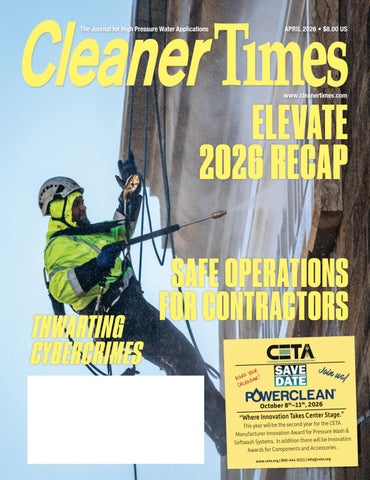
Create a flipbook
Cleaner Times — April 2026 by truesource - Issuu