23
A FIRM NUDGE Politics of ‘Ethical’ Reform Through ‘Native Arts and Crafts’ in Dutch-Occupied Indonesia Rosa te Velde
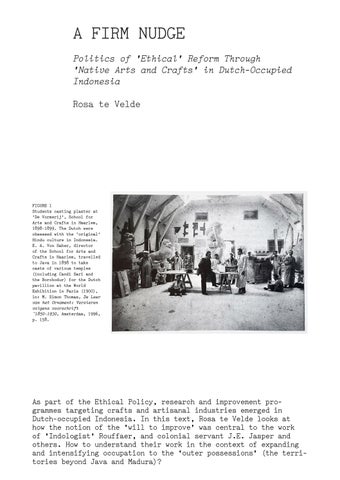
FIGURE 1 Students casting plaster at ‘De Vormerij’, School for Arts and Crafts in Haarlem, 1898–1899. The Dutch were obsessed with the ‘original’ Hindu culture in Indonesia. E. A. Von Saher, director of the School for Arts and Crafts in Haarlem, travelled to Java in 1898 to take casts of various temples (including Candi Sari and the Borobodur) for the Dutch pavillion at the World Exhibition in Paris (1900), in: M. Simon Thomas, De Leer van het Ornament: Versieren volgens voorschrift ~1850–1930, Amsterdam, 1996, p. 158.
As part of the Ethical Policy, research and improvement programmes targeting crafts and artisanal industries emerged in Dutch-occupied Indonesia. In this text, Rosa te Velde looks at how the notion of the ‘will to improve’ was central to the work of 'Indologist' Rouffaer, and colonial servant J.E. Jasper and others. How to understand their work in the context of expanding and intensifying occupation to the ‘outer possessions’ (the territories beyond Java and Madura)?