

The HOUSE WINS
Feedback
Australian Conveyancer welcomes feedback about any aspect of its activities and appreciates suggestions for future editorial coverage.
Contact the team: editorial@australianconveyancer.com.au
Contact the publisher: tony.gillies@australianconveyancer.com.au +61 414 320 487
LinkedIn: linkedin.com/australianconveyancer
What does Powered by triSearch really mean?
Australian Conveyancer strenuously preserves its editorial independence. We engage experienced editors, journalists and freelancers not afraid to ask the difficult questions and report without fear or favour. Our editorial charter of independence is formulated in the spirit of balance, fairness and accuracy. We think we owe that to the industry.
The involvement of triSearch allows this privilege by providing the resources needed – the financial and technical infrastructure. It does not expect or receive editorial favouritism in return. If it matters to the industry and if it promotes a constructive conversation, then we will report it.
Advertising
Australian Conveyancer incorporates paid advertising in its publication and other media entities as a part of its business model. Advertisements from all parts of the sector are welcomed into this environment. Advertising and editorial in this publication are separate functions, meaning an advertiser is not given preferential editorial considerations because it has a separate commercial arrangement. Editorial content is treated solely on news value and public interest.

Scan QR code
FROM HOT TO COLD
At Australian Conveyancer, we get a front-row seat to the rises, falls and ongoing challenges of the Australian property market. Call it complacency, but real estate has been regarded as a hot commodity for years, particularly in places such as Sydney, which is one of the most expensive cities in the world to live.

Values have been on the rise and rise, which is great if you own a place or are maybe looking to sell, but not so much if you’re trying to get into the game. Without meaning to state the bleeding obvious, the gulf between the ‘haves’ and ‘have-nots’ has widened to the point where it’s all become too hard and depressing for first-home buyers.
Federal and state governments have spent a ton of money and expended a lot of political energy to address the issue. Incentive schemes for individuals, things such as infrastructure funding for councils and rule changes to cut red tape are all well and good, but one wonders whether these “fixes” are merely a bandaid on an arterial wound. Underpinning the outgoings on these measures are hard calls on taxes. These have been hard for Aussies to swallow and even harder for the Federal Government to sell to the public. The race to fix the problem quickly – and within short political terms – is a recipe for mistakes, wasted money and for the system to be abused.
Conveyancers have been vocal in their contempt for the capital gains tax changes, claiming they will hinder investment, while analysts say they will ultimately lead to higher rents and push cash-strapped Aussies even further away from their dream of ownership. Yep, we are in a world of pain.
Rising interest rates, investment tax reforms, lower consumer confidence and the high cost of living all hurt. The country is a trillion dollars in debt. Financial observers showcased in this edition of Australian Conveyancer (from page 12) suggest the problems we are now seeing are the result of a long run-up.
Australia’s economy is one of the worst performers of all OECD nations. We are effectively in a recession: we don’t manufacture enough goods for growth, monolithic entities thwart competition and the big players get the big tax breaks, leaving ordinary folk to carry the can.
The commentary inside this edition gives a lot of food for thought.
Tony Gillies, Publisher
Your Australian Conveyancer team:

Tony Gillies Publisher





Richard Cunningham Associate Editor
Tony Thomas Production Editor
James Dore Marketing Manager
Naomi Green Events & Partnerships
Chloe Goodwin Marketing Assistant
STORIES
Leigh Reinhold
David Simon
Dr Sherman Chan
PHOTOS
Toby Zerna
Neil Bennett
Fine balancing act for housing
REIT CEO Russell Yaxley assesses the future of Tasmania’s property market
Bracing for Budget impact
What the Government’s plan means for investors, taxation and house prices
Housing downturn: Budget slams the brakes on property price growth
The great divergence: How prosperity for some caused an affordability problem for others
The 2026 Federal Budget: What does it mean for property?
The coming of age
Push to open up more retirement living options for older Australians
A new lease on life
Octogenarian Jan Littlejohn shares her experience living in a retirement village
The decision to downsize
A retired Sydney couple reflect on how they decided when to make the move
Figures that moved the dial
Game-changing words and numbers that impacted the industry this month
Investing in people
Bathurst conveyancer Kristy Bell on the ethos that drives her success

Meet Eddie Dilleen, a residential property inspiration. From humble beginnings, raised by a single mum in a housing commission home in Sydney’s Mount Druitt, Dilleen started working at 14 and bought a home at just 18 years of age. Now in his mid-30s, Dilleen owns more than
200 residential properties… and counting. How did he do it? What advice does he give to others trying to crack the property market? And how will the Federal Government’s tax changes affect his business?
For his amazing story, please see page 8.
“Long-term, I am optimistic for Tasmania’s property market but also clear about the conditions required to be met for that optimism to be justified.”
– Russell Yaxley


By LEIGH REINHOLD
Fine balancing act for housing
The advantages of living in Tasmania are clear to REIT boss Russell Yaxley, but so are the challenges that lie ahead for its congested property market
The “big call” in the 2026 Federal Budget to “realign and remap” the country’s housing market through landmark changes to negative gearing and capital gains tax (CGT) is essential to bring more balance to the property sector, says an industry expert.
“This is an attempt to activate the supply side and point private capital toward actually building homes rather than competing for existing ones,” Russell Yaxley, president of the Real Estate Institute of Tasmania (REIT), told Australian Conveyancer
“In Hobart we currently have a 0.3 per cent vacancy rate and average rent has increased 6.7 per cent this year, indicating intense competition for existing stock.
“That situation is unsustainable for renters and something had to give. The settings needed to change and these CGT and negative gearing changes are the government’s attempt to do that.
“The move to shift both levers toward new builds shows positive intent and a genuine attempt to drive supply into the market.”
With negative gearing on residential property restricted to new builds from July 2027, Yaxley said the tax advantage that has supported investors in holding existing stock for decades is gone.
Yet, he added, property investors should be seen as an important part of the solution to the country’s supply crisis and they now have three options: Pivot out of property entirely, which only adds more pressure to an already stretched market; Keep grandfathered existing holdings at 50 per cent and wear the 30 per cent CGT moving forward; or Do what the budget measures are designed to activate and pivot toward new builds to maintain their CGT advantage.
“For an investor to maintain the 50 per cent CGT, they need to sell existing
property, buy land and build,” said Yaxley, who adds he will be interested to watch how this strategy plays out over the next year or so.
“The foreseeable blockages will be planning approvals, fast tracking, finding builders to actually build and headworks infrastructure to unlock the land,” he said.
“The scale of investors willing to make that pivot is the real challenge and that is what I will be watching. We will know a lot more in about 400 days.”
Upbeat about the prospect of a prosperous Tasmanian real estate market over the next decade, Yaxley nonetheless warns the state’s population needs to grow at a faster rate and young, skilled Tasmanian
What does the REIT think needs to be done to keep up with housing demands in the Apple Isle?
1. Genuine planning reform: Reduce approval timeframes, cut complexity and give certainty to developers who are willing to invest.
2. Protect property investors: Investors are not the enemy, they are a core part of the housing system, providing the rental stock that a significant portion of Tasmanians depend upon. Any policy move that discourages investment reduces rental supply and makes life harder for renters.
3. Incentivise downsizing: We have older Tasmanians living in homes larger than they need and younger families who cannot find suitable housing. Providing better downsizer incentives, both at a state and federal level, can help move that stock.
TASSIE: WHERE TO MOVE AND WHAT TO MISS
The REIT believes major works projects will be the shape of things to come for Hobart, helping the city maintain its buoyancy and upward momentum
The new Bridgewater Bridge connecting the Hobart suburbs of Granton and Bridgewater, the “progressive development” of the Macquarie Point precinct near the Tasmanian capital’s waterfront, combined with continued rezoning in growth areas, are game changers for the city, said REIT president Russell Yaxley.
“Hobart is in a constructive phase, with values rising steadily and rentals remaining tight, but conditions may cool as borrowing constraints bite,” he said.
“The inner-south suburbs like Sandy Bay, Battery Point and South Hobart have historically held value well but, at these price levels, there is limited upside without meaningful income growth to support it.”
According to the REIT, in 2025 listing numbers across Tasmania dropped by approximately 21 per cent year-on-year, creating a scarcity of stock which coincided with renewed buyer interest.
“Interstate migration continued to push demand, particularly in regional areas, where lifestyle appeal and relative affordability drew buyers from the mainland,” Yaxley said.
“Investor activity also surged, spiking in northern Tasmania and driven by mainland buyers seeking affordability and strong yields.”
However, Yaxley warns investors who have their eyes on buying into some of Tassie’s idyllic seaside areas should beware the hype.
“The areas I would watch most carefully for overheating are popular coastal lifestyle pockets where demand is emotional and supply is structurally capped,” he cautioned.
In terms of undervalue, Yaxley said the smart property buyer should be looking at Tasmania’s north-west coast.
“The most affordable areas remain in the west and north-west regions, with prices ranging from $400,000 to $570,000, which is excellent value and offers the strongest growth potential,” he advised.
“Compared with the south, Launceston and its surrounds also remain genuinely accessible for buyers, with improving infrastructure investment supporting long-term fundamentals.”
workers need to be retained for sustained growth to occur.
“Long-term, I am optimistic for Tasmania’s property market but also clear about the conditions required to be met for that optimism to be justified,” he said. “Tasmania has structural advantages with our lifestyle appeal, relative affordability against the mainland, a growing reputation for food, tourism and the arts and university cities in Launceston and Hobart that anchor a knowledge economy.
“But we need the state to grow its population at a faster rate. Our retention challenge is real, we train young Tasmanians and too often watch them leave for mainland opportunities.”
Yaxley believes providing adequate housing choices is key to retaining the best and the brightest.
“Housing that is available, affordable and well-located is part of what makes people stay,” he said. “Get supply right and I believe Tasmania can sustain steady, healthy growth for a decade. Fail on supply and we risk pricing out the very people we need to build our future workforce and community. We must act now.”
Yaxley said housing supply is the “most serious and critical issue” facing his state, along with affordability, while regulatory and compliance burdens on industry professionals are impacting workers.
“Our first problem is we’re simply not building enough homes to meet demand and the gap between what we need and what we have keeps widening,” he said.
“The second problem is affordability and the squeeze on first-home buyers, who are still finding it hard to enter the market – even with government assistance – because investors are competing strongly.
“And the third hurdle is the regulatory and compliance burden on industry, particularly with the rollout of the AML/ CTF Tranche 2 reforms, which is requiring significant adjustment from agents, property managers and conveyancers alike.
“All three of these issues are connected. Fix supply and you ease affordability. Simplify compliance frameworks and you free up industry to focus on serving their clients well.”
Yaxley said the single biggest bottleneck to improving housing supply is planning.
“The combination of labour shortages in the building trades and restrictive planning processes extends approval timelines and increases costs, discouraging developers from starting new projects,” he added.
“Building approvals in Tasmania are at their lowest level in five years, hitting the state particularly hard given its already constrained housing supply.
“We have developers who want to build, we have buyers who want to purchase, but what stands in the middle too often is a planning system that moves slowly, adds costs and creates uncertainty.
“Planning is what we need to fix first. It’s not [the] council’s issue, they are enforcing the rules that the state has set up.
“Fail on supply and we risk pricing out the very people we need to build our future workforce and community.”
– Russell Yaxley
“I believe large investment into funding the council planning teams, and increasing headcount, will alleviate much of the bottleneck and streamline processes.
“In fact, there should be an increase in funding along the whole chain. For instance, I’ve heard that the Land Titles Office has only two people issuing titles for the whole of the state. It’s simply underfunded and over-complicated.”


HOUSE RULES: HOW HUMBLE BEGINNINGS FUEL EDDIE’S PROPERTY PORTFOLIO
By RICHARD CUNNINGHAM
Photos TOBY ZERNA
Hard work and savvy purchases have taken Eddie Dilleen from a childhood in a housing commission property to a career as one of Australia’s most successful property investors
Ask Eddie Dilleen what he thought of the May 12 Federal Budget and the answer is, shall we say, negatively geared.
He believes it had little to offer first-home seekers.
“If anything, it’s making it harder for young people to get into the market,” he said.
Dilleen feels the changes to CGT and negative gearing could push investors to raise rents, leaving tenants scratching to save a deposit on a place of their own. As he did, in the not-so-distant past.
In his mid-30s, Dilleen is now a mega-landlord and one of Australia’s most successful property investors.
He owns more than 200 properties worth at least $150 million.
At our interview, he wasn’t sure exactly how many. “205, 206… something like that.”
Not bad for a bloke from humble beginnings, raised in a housing commission property by a single mother on a modest pension.
That was in Mount Druitt, 45km west of the Sydney CBD. An area with a reputation.
“It was extremely rough,” he told AC
“We wouldn’t be allowed to go out in the front yard because there would be drug needles all over it.


“I
didn’t want that to be my future. I realised that people who don’t live in nasty areas owned property.”
– Eddie Dilleen

“I didn’t want that to be my future. I realised that people who don’t live in nasty areas owned property.”
Dilleen’s upbringing was similar to that of Anthony Albanese, who also lived with his single, pensioner mum in council housing in Sydney’s inner west.
Albo went into politics, became leader of the Labor Party and, eventually, Prime Minister.
Dilleen went to work at a local McDonalds from age 14, saved $200 a week and within a few years had enough for a 10 per cent deposit on a NSW Central Coast unit.
“I got turned down by 12 to 13 banks,” he said ruefully. But he persisted and still owns that first property.
“It was in a place I knew about, because we used to go camping there. It was the only holiday my family could afford.”
More purchases followed, initially in Queensland and South Australia, often sight unseen. He aimed to buy “metro” or within an hour of a city centre.
“A lot of people go buy a house in the middle of nowhere, with small populations and high vacancies,” he said.
“I’d rather buy a villa, a unit, a townhouse.
“You can still buy affordable properties
like that in Melbourne, for $450,000 to $500,000.”
In 2016, he founded Dilleen Property, acting as a buyer’s agent, teaching his methods and writing inspirational books such as 30 Properties Before 30 and How to Buy 10 Properties Fast.
And practising what he preached by snapping up undervalued houses and units with high rental yield, often in unpopular suburbs.
An old real estate adage said never buy a house you can’t personally visit.
It’s a chance to check for structural flaws, assess the neighbourhood, see what local traffic and parking is like.
Dilleen Property Founder and Director Eddie Dilleen.
“If you’re looking at property from a wealth creation perspective, you’ve got to take the emotion out of it and keep it simple, as much as you can.”
– Eddie Dilleen
Dilleen feels that’s not strictly necessary, so long as you have good people to do it for you.
“When people buy stocks and shares, it’s not like you’re going to walk into that company and go behind the counter to see how everything’s operating,” he argued.
“If you’re looking at property from a wealth creation perspective, you’ve got to take the emotion out of it and keep it simple, as much as you can.”
To that end, he’s assembled a team of trusted advisers: building inspectors, property managers, mortgage brokers and accountants.
“You definitely have to have the right professionals around you,” he said.
Those include conveyancers: “An absolutely crucial part of the team”.
“I’ve used conveyancers and solicitors for every single purchase. I would never recommend people try to do it themselves: that would be crazy.”
Dilleen said it’s never too early to engage a conveyancer, ideally from the moment you start shopping for a home.
“The more time they have to know that you’re in the market, the more they’re going to be able to save you time, energy, effort and money,” he said.
Perhaps surprisingly for an investor, he feels many conveyancers are selling themselves short.
“They should be charging more for the amount of time, energy and effort they put in,” he said.
“They’re the kind of referee that keeps everything going along, putting out fires.
“It seems like a very difficult industry to be in, so yeah, if anything they’re underpriced.”
Like conveyancers, Eddie’s business as a licensed real estate buyer’s agent will be subject to AML/CTF regulation from July 1.
“More compliance, more hurdles, it’ll slow down operations, make things harder, but we still have to do it,” he said.
‘This home holds some of my best memories’ There’s no place like home, so buying the family house made perfect sense
One of Eddie Dilleen’s favourite buys is a sentimental one: his childhood home in Mount Druitt in Sydney’s west.
It’s one that predates his parents’ divorce and his subsequent housing commission experience.
More than 25 years after they sold the house for $97,000, he bought it back this April for a little under $1 million.
That was about 19 times the $51,000 his parents paid for the property back in 1985.
Dilleen had been keeping an eye on the three-bedroom home
just in case it came up for sale.
When he saw it listed, he felt “an overwhelming rush of excitement”.
“This home holds some of my best memories, and some tough ones too,” he wrote online.
“But today, it represents something completely different. It’s proof that where you start doesn’t define where you finish.”
And no, he doesn’t plan to rebuild or turn it into an Eddie Dilleen shrine.
It’s reliably tenanted and staying that way. Dilleen may be sentimental, but he’s not silly.

Eddie Dilleen at his family home in Mount Druitt in Sydney’s west.
The BUDGET UNPACKED
The Federal Government’s latest changes aim to support more Australians and address the gap between housing supply and demand. Here’s what they mean for property prices, taxation and the future of the economy

UNPACKED

Housing downturn
The Albanese Government has taken a lot of flak for its May 12 Budget and, publicly, it’s been on the defensive.
But if the aim was to slam the brakes on property price growth, it has certainly succeeded.
Thanks to the tax changes, rate hikes, unemployment, global instability, fuel and living costs, Australia’s housing boom has all but stalled.
Inflation is 4.6 per cent, the jobless rate 4.5 per cent, variable mortgages over 6 per cent and lenders imposing tougher serviceability rules.
Sydney prices are down 0.9 per cent in the last quarter, Melbourne off by 1.5 per cent.
“Sentiment has fallen off a cliff,” Cotality Research Director Tim Lawless said pre-Budget.
As of May 25, the auction clearance rate had remained under the 60 per cent benchmark for six of the past eight weeks. Sydney’s rate was 56.9 per cent in the post-Budget week. Melbourne 60.2 per cent, Brisbane 45.7 per cent, Canberra 54.3 per cent, Perth just 38.9 per cent. Adelaide was the highest at 72 per cent but down from 75.7 per cent the week before.
The combined capital average was 58.2 per cent. For comparison, at the height of the property boom in March 2021, clearance rates were above 80 per cent.
Most economists agree the market is in a downturn, but has it “tanked” as some claim?
Louis Christopher, from SQM Research, said: “The national housing market has turned, and the downturn is now broadening.
“We now expect Sydney to fall by as much as 9 per cent and Melbourne by as much as 7 per cent for 2026.”
AMP chief economist Shane Oliver sees the overall property market easing throughout the year, but not by as much as SQM.
“Australian home price growth this year is likely to slow to around 3 per cent and could go negative over the year ahead,” he said.
Financial services company Morgan Stanley, on the other hand, tips a price slide of 5 per cent to 10 per cent by year’s end. It says a 10 per cent decline would be the sharpest in at least 40 years.
The biggest fall in recent history was 7.7 per cent during the recession of 1981-82.
“Proposed tax changes to capital gains and negative gearing fundamentally change the asset allocation decision for Australian households,” chief economist Chris Read said.
“This is particularly the case for housing: the previous model of high leverage, cash flow losses and large expected capital gains is meaningfully challenged.”
But first-home buyers won’t necessarily find any joy in the property downturn.
“A weaker housing market will drive a broader economic slowdown, with policy implications,” Morgan Stanley added.
A recent uptick in properties going to auction could suggest owners rushing to get the best prices before things get worse.
Or owners might simply decide not to sell at all.
That would not only reduce supply, but affect state government stamp duty
revenue, even income for conveyancers and other property professionals.
Experts such as Ray White’s chief economist Nerida Conisbee call it the “willingness to transact”.
“Volumes fall when households or investors have a reason to wait, and uncertainty is often enough to slow the market,” she said.
“Volumes fall when households or investors have a reason to wait, and uncertainty is often enough to slow the market.”
– Nerida Conisbee
“Buyers may pause while they work out whether the changes will affect prices, rents and investor demand.
“Sellers may delay if they are unsure how deep the future buyer pool will be.
“Investors have even clearer reasons to sit tight: existing investors may avoid selling if it means giving up
grandfathered treatment, while new-build investors may hold longer if resale narrows the future investor buyer pool.”
Conisbee said the Budget also does little to encourage downsizing, leaving another source of established housing stock constrained.
“When policy change creates uncertainty and rewards waiting, fewer homes come to market, even if prices hold up,” she added.
Then there’s that knock-on effect of a slump in sales.
Everyone from renovators to removalists gets hurt… tradies, building inspectors, lawyers, valuers... and yes, conveyancers.
“A home sale is not just a transfer of ownership,” Conisbee said. “It is the start of a chain of economic activity.”
State governments depend on conveyance stamp duties for an average of around 20 per cent of total taxation revenue.
“When fewer properties transact, that revenue stream becomes more vulnerable,” she added.
At a personal level, five cash rate hikes by August would see the borrowing capacity of an average earner contract by close to $60,000.
That’s maybe 10 per cent of their buying budget… tending to negate any 10 per cent fall in prices.
The can we kicked has hit the gutter
By DAVID SIMON Principal Advisor, Integral Private Wealth
This was a once-in-ageneration Budget, not because it offered a painless fix, but because it finally admitted what Australia had spent more than 20 years avoiding.
The economy had become too dependent on rising property values, cheap debt and population growth.
That model built wealth for those already inside the housing market and left too many others locked outside the gate.
The great divergence
For more than 20 years, Australia treated housing as the safest and most protected path to private wealth. We encouraged households to borrow more, rewarded investors for carrying debt, restricted new supply through slow planning and weak infrastructure delivery, then called it prosperity when the same homes kept rising in value. The result was “Two Australias”. Existing owners experienced rising prices as wealth. Their equity expanded and banks lent more against it.
Aspiring buyers experienced the same prices as exclusion. The deposit moved further away, the mortgage became larger and rent consumed more income.
The Budget papers put the history in blunt terms.
Since the Howard Government introduced the 50 per cent capital gains tax discount in 1999, house prices have risen by more than 400 per cent, almost twice as fast as average full-time earnings.
Over the same broad period, home ownership among 25 to 34-year-olds fell by seven percentage points from 2001 to 2021.
That is not a small affordability problem. It is a generational rupture.
The productivity gap
The turning point was around 2000, when the 50 per cent capital gains tax discount replaced the old inflation-based model.
Combined with negative gearing, falling interest rates, easier credit and limited housing supply, it made leveraged property investment even more attractive.
More money chased the same limited stock of well-located housing. Land became more expensive, but the economy did not become more productive. That distinction matters. Rising land values create private wealth for owners, but they do not automatically create national prosperity. They do not make workers more efficient, lift business investment or build enough homes.
Too much capital flowed into bidding up existing assets, while too little flowed into better businesses, infrastructure, skills and productive capacity.
The illusion of growth
For years, headline GDP concealed the weakness. The economy kept growing because the population kept growing.
More people meant more consumption, more jobs, more construction, more government revenue and more activity. GDP per person told the more honest story.
Australia’s experience in 2024 was particularly stark. The country avoided a technical recession because total GDP kept edging higher, but the average Australian went backwards. In the March quarter of 2024, GDP per capita fell for the fifth consecutive quarter which is a deep per capita recession.
The scoreboard said the economy was still growing, as
“More money chased the same limited stock of well-located housing. Land became more expensive, but the economy did not become more productive.”
– David Simon

the public sector was helping hold up the numbers, while each person’s share was shrinking.
That is why so many Australians felt poorer even when politicians said the economy was growing. The national accounts looked respectable, but household budgets told another story. Families carried high mortgage debt, absorbed higher repayments and watched wage gains disappear into housing, tax and basic living costs.
Structural reform
This is where the Budget clawback should be understood. It is not simply a tax grab. It is a delayed correction to a system that became too generous to asset owners and too harsh on wage earners.
From July 1 2027, negative gearing for residential property will be limited to new builds. Existing arrangements will remain unchanged for properties held before Budget night.
GDP PER CAPITA RANKING
Investors who buy established housing after that point will still be able to deduct losses against residential property income, but not against other income such as wages.
The Government will also replace the 50 per cent capital gains tax discount with inflation adjusted indexation and introduce a minimum 30 per cent tax on gains from July 1 2027.
A new model
The logic is clear. Buying an
Sources: OECD Economic Outlook, interim report, March 2025.
Australia Italy Spain Denmark Norway Sweden Netherlands Korea Japan Canada
UK
France
Germany
USA
Australia is in an individual recession, with GDP per capita contracting while most advanced economies continue to grow. In 2025, Australia is the only major advanced economy in this comparison experiencing negative GDP per capita growth, meaning living standards are falling while peer nation continue to expand.
The Budget: What it means for property
By SHERMAN CHAN Chief Economist, Australian Property Institute
The Australian Property Institute’s Australian Property Market Outlook has identified the persistent gap between the demand and supply of housing as a key driver of residential property price growth.
Treasurer Jim Chalmers’
fifth Federal Budget introduced major tax changes that aim to support first-home buyers by reducing tax concessions for property investors.
Tax reform
The 50 per cent CGT discount will be replaced with an
established dwelling from another owner does not add to housing supply. Building or buying a new dwelling does.
The Government says the reforms will support around 75,000 more Australians into home ownership over the next decade and help redirect capital towards new supply.
It is unlikely the reform will make housing cheap or undo 25 years of inflated land values. It will not solve the rental shortage by itself.
But it does mark a serious admission that the old model failed. Australia cannot keep pretending rising house prices are the same as rising prosperity.
True prosperity means workers produce more, earn more, save more and buy a home without life bending debt.
It means young people can build a future through work, not only through inheritance.
It means national growth comes from productivity and real income growth, not just population growth and bigger mortgages.
The issues that were postponed around the year 2000 have now opened a battered can of worms, presenting complex challenges for Australia.
The current decision is whether to continue delaying action or to establish an economy founded on productivity, sustainable real income growth, and sufficient housing for its residents.
inflation-based discount from July 1 2027; there will be a minimum tax of 30 per cent.
Investors in new dwellings will have the option of the 50 per cent discount or the new inflation-based discount.
Negative gearing will be limited to new dwellings from July 1 2027. Properties held before Budget night (May 12) are not affected by the change.
Potential impact
These tax changes are designed to curtail investor behaviour (hopefully) without affecting the pipeline of new housing.
If all goes according to plan, property investors will shift their focus to new dwellings for tax advantage and their now-elevated appetite for new dwellings will support new development (i.e. additional housing supply), while competition for owner-occupiers in the market of established dwellings will be greatly reduced.
The Government has estimated that the tax changes would help 75,000 new homeowners in the next decade. However, there are risks behind these tax changes.
With a presumably smaller
pool of interested buyers, the market of established dwellings will soften.
Government modelling suggests house price growth will be reduced by 2 per cent over a couple of years (compared to no tax changes), which will also slow housing supply by 35,000 over a decade.
“A $2 billion package is intended to enable state and local governments to build infrastructure to support an estimated 65,000 new homes in the next decade.”
– Sherman Chan
One scenario that cannot be ruled out is that some investors will make wholesale revisions to their portfolio strategy, shifting their preference to non-property assets.
Cost-of-living support
The Working Australians Tax Offset will provide an annual tax cut of up to $250 from 2027-28, which will benefit 13 million workers.
As announced in the previous Budget, the tax rate on the lowest bracket ($18,201 to $45,000) will drop from 16 to 15 per cent in 2026-27 and then 14 per cent from 2027-28, which equates to a tax cut of up to $268 for 2026-27 and a further $268 from 2027-28.
As proposed during the 2025 election campaign, the $1000 instant tax deduction will start in 2026-27, delivering an average tax saving of $205 for 4.2 million workers.
While these tax cuts offer welcome news from a

cost-of-living perspective, they are unlikely to have a material impact on working Australians’ borrowing capacity.
Therefore, these measures alone are not sufficient to boost overall demand for property.
Infrastructure fund
A $2 billion package is intended to enable state and local governments to build infrastructure to support an estimated 65,000 new homes in the next decade.
This initiative will unlock more land for residential development and accelerate housing delivery.
However, the above estimate of new homes will be partly offset by the expected downside impact of the tax reform, resulting in a net boost of 30,000 homes.
This will have only a modest impact on the housing shortage, as our calculation indicates that housing completions were already 90,000 behind the National Housing Accord target for the first 18 months.
Red tape removal
Measures include streamlining and speeding up approvals
across different layers of government, providing free access to all standards referenced in Australian legislation (saving organisations or tradies up to $1600 a year), and removing barriers to modern methods of housing construction.
Reducing delays in planning and construction will, in theory, lower construction costs and accelerate housing delivery. The ultimate impact will depend on how effectively these changes are implemented.
Construction workforce
The Budget includes an $85.2 million investment to accelerate skills assessment of migrant trades workers and occupational licensing.
An injection of skilled workers would provide more stability to construction activity and ease wage pressures which have been contributing to surging construction costs and putting a dampener on business confidence.
Implications for property professionals
It is too early to assess the net impact of the various Budget
measures on the property market. A key trend to watch is how investors respond to the CGT and negative gearing reforms.
Are they going to shift their focus to new dwellings and subsequently encourage new developments, or are they going to revise their portfolio strategy and favour non-property assets? Time will tell.
Based on the Government’s own estimates of the impact of the new measures, the ongoing housing shortage is unlikely to materially improve.
Which means that there will continue to be structural upward pressure on property prices in the medium term. This will also limit the impact of any immediate downward pressure.
Demand for property valuation is likely to increase due to the CGT reform.
As the new regime applies only to gains from July 1, 2027, for assets held prior to but sold after this day, investors will have to seek a valuation of the asset as at July 1 2027 or use a specified apportionment formula to estimate the asset’s value.
Australian Property Institute Chief Economist Sherman Chan.

The COMING of AGE A NEW LOOK FOR THE GOLDEN YEARS
By LEIGH REINHOLD
Demand for retirement housing in Australia is projected to rise sharply over the next 15 years, but experts say current planning regulations are holding back much-needed projects

With the population of Australians aged over 65 projected to grow to 6.66 million by 2041, the Retirement Living Council says we are lagging behind in the construction of retirement housing required to meet the need.
“Australia is ageing rapidly, yet we’re still not building enough retirement housing for the next generation of retirees,” Retirement Living Council Executive Director Daniel Gannon told AC
“Demand is rising quickly, but supply is not keeping pace. By 2040, Australians aged 75+ will grow from around two million to 3.7 million – an 85 per cent increase in just 15 years.
“Meanwhile too many projects are stuck in planning purgatory. We hear of villages taking up to five years to secure full approval – far too long, and far too costly – when delays push older Australians further from the housing and care options they need.”
CONTINUED ON PAGE 20
“When older Australians are better connected and supported to live independently for longer, it reduces pressure on hospitals and delays entry into residential aged care – delivering better outcomes and better value for taxpayers.”
– Daniel Gannon
Gannon said retirement communities are part of the solution to Australia’s housing, health and aged-care pressures.
“When older Australians are better connected and supported to live independently for longer, it reduces pressure on hospitals and delays entry into residential aged care – delivering better outcomes and better value for taxpayers.
“Our Better Housing for Better Health report found retirement villages reduce government aged-care expenditure by $945 million a year by delaying entry into residential aged care, while also helping avoid thousands of hospitalisations.
COMMUNITY BENEFITS
The Retirement Living Council says if older Australians make the right informed choices for their retirement living, the upsides can be compelling: Residents are 15 per cent more physically active and report being 41 per cent happier, with stronger physical and mental health outcomes.
Within the first nine months of living in a village, residents are 20 per cent less likely to be hospitalised, five times more socially active and twice as likely to catch up with family or friends.
Moving into a village means a purpose-built home, less maintenance and more day-to-day connection, often with better lifestyle and health outcomes as a result.
The latest PwC–RLC Retirement Census also found the average price of a two-bedroom independent living unit is 41 per cent lower than the median house price in the same postcode.
“What we need is more supply, and fewer roadblocks. We need simpler, faster planning pathways so new communities can get out of the ground sooner, and we need policy settings that make it easier, not harder, for older Australians to rightsize into age-appropriate housing.
“Right now, some federal policy settings actively discourage downsizing –outdated pension thresholds and obsolete Commonwealth Rent Assistance caps among them. Targeted reforms would help more people move earlier, which in turn frees up much-needed family homes and eases pressure across the housing system.”
Currently, there are approximately 2,500 retirement villages and 900 land-lease over-55s communities across Australia. A quarter of a million older Australians live in retirement villages, with an estimated 130,000 residents living in the rapidly growing land-lease sector.
“At its best, retirement living helps people stay independent, connected and well for longer,” Gannon said.
“It’s not just a housing choice – it’s a lifestyle choice that can replace isolation in an unsuitable home with a community designed for the next stage of life.
“Retirement living is also doing more of the heavy lifting in care than many people realise, with 79 per cent of villages now offering regulated home care services.
“And, with the Commonwealth acknowledging Australia will need the equivalent of a new aged care facility every three days for the next 20 years, villages are a crucial part of the health and ageing system.
“Governments should treat retirement living as essential social infrastructure, not an afterthought.”
Gannon said the role of conveyancers and lawyers in helping retirees make considered choices for their future is crucial.
“Prospective residents should understand the offer, the true costs over time,

and whether the lifestyle is the right fit,” he advised. “That means reading the contract closely, asking direct questions and getting independent legal and financial advice, because village contracts are not the same as a standard property purchase, and people need to be clear on the terms, fees and processes before they sign.
“Governments should treat retirement living as essential social infrastructure, not an afterthought.”
– Daniel Gannon

“That’s also why the sector has a Code of Conduct – to lift transparency, set clearer expectations for operators and ensure prospective residents can access the information they need to make an informed decision.”
Sydney Wyvill, Senior Solicitor at bytherules conveyancing, with offices in NSW and Queensland, said clients delaying seeking legal advice when entering into retirement villages and land-lease communities can face serious financial and lifestyle consequences.
“One of the issues we often see is that a client does not obtain timely legal advice,” Wyvill said.
“This may result in a client, who no longer wishes to proceed with their purchase, losing the right to terminate the contract under the statutory cooling off period.
CONTINUED ON PAGE 22
ON THE FENCE
Is it better to buy into a retirement village or a land-lease development? Victorian conveyancer Tania Gooley, the founder of Chambers Conveyancing, said both models have their advantages:
A land-lease arrangement can work well for clients seeking a supportive lifestyle environment, with the added benefit of community living and services included. In a land-lease model you enter into a long-term lease or licence agreement and pay ongoing fees. While this often results in a lower upfront cost and no stamp
A quarter of a million older Australians live in retirement villages.
duty, it also means less control and ongoing financial commitments that can increase over time.
With a strata property (standalone unit in a retirement village) you are on title. You own the property, which means you can sell on the open market, benefit from any capital growth and deal with the property much like a traditional home.
“Ultimately, neither model is ‘better’ as it depends on the client’s priorities,” Gooley said. “The decision comes down to lifestyle priorities vs long-term financial and ownership considerations.”
“Further, there could be special conditions or different by-laws for the particular village that the client cannot comply with (allowing pets, visitors, car parking arrangements, etc.).
“Also, conveyancers should refer the client to obtain independent financial and estate advice to ensure the client has considered their taxation, pension and estate implications.”
Victorian conveyancer Tania Gooley, the founder of Chambers Conveyancing, said conveyancers should look out for the possible traps for a client buying into a particular retirement property.
“Contracts may include buy-back provisions, fixed resale pricing or commissions payable to the operator, all of which can impact a client’s exit outcome,” she said.
“It’s also important to review maintenance funds, understand what services are included vs user-pays (such as medical services) and ensure the client assess their position whether ongoing costs are sustainable long-term.
“Common pitfalls include misunderstanding what is actually being ‘owned’.
“Clients may overlook Deferred Management Fees and underestimate ongoing service charges. Exit provisions can also be problematic, particularly where resale is delayed or proceeds are reduced.
“Clients are additionally often unaware of their potential responsibility for refurbishment or reinstatement costs when they leave the property.”
Daniel Gannon said moving into a retirement community is not a “one-size-fits-all decision”.
“Lifestyle preferences, care needs and contract options vary,” he cautioned.
“So prospective residents should compare options carefully and get independent legal and financial advice before committing.”
HIDDEN COSTS
Sydney Wyvill, Senior Solicitor at bytherules conveyancing, said there are red flags every conveyancer should point out to a client before they lock into a retirement or land-lease contract and she advises her clients to:
Be aware the range of fees that will apply when you purchase, the ongoing costs, and the costs upon exiting the village (including to your estate).
Consider the general lack of control over affairs a client may relinquish because of restrictive by-laws.
Ask if there are any mandatory health requirements necessary to remain in your choice of property.
Making life easier for an ageing population
By RICHARD CUNNINGHAM
Five years after
he
planned to retire, John Carfi is at the helm of one of Australia’s biggest lifestyle community operators
WHEN Aussies quit working, there’s often one of two RVs in their future.
One is a Recreational Vehicle: a caravan or campervan for the Grey Nomads. The other is a Retirement Village.
There’s another option: a “lifestyle community.” Not necessarily retired, just over 55.
One of the biggest operators in that field is Ingenia, an ASX-listed company with about 100 properties owned or operated across NSW, Queensland and Victoria.
In charge of the portfolio is 60-year-old chief executive John Carfi.
And before you ask whether he’d live at one of his company’s properties, the answer is, “In a heartbeat!”
Well, he would say that. But Carfi really means it. “The question most of our customers ask themselves is, ‘Why didn’t we do this earlier?’”
Ingenia’s nearly $3 billion investment includes holiday parks and rentals. But the focus of this article is the over-55 downsizers.
Which is ironic, as that’s the age at which Carfi originally planned to retire.
Born in Italy, he migrated with his family to Melbourne at the age of two and a half.
They moved around but settled in country NSW where his dad restored classic cars (“a rusted-on Ford family”).
Carfi started as a cadet engineer with Lend Lease, rising to operations manager, switched to Mirvac and became CEO of residential development.
Then he moved to Dubai with Emaar Properties, developer of the Burj Khalifa, the world’s tallest building.
“An absolute ball,” he said, “because you got to play with big toys and build a lot of stuff.”
Semi-retirement to non-executive roles didn’t suit. He joined Ingenia two years ago.
“You spend the best part of 30 years learning something,” he said. “It seemed a shame to shelve it.”
He found booming demand, with Australia’s population rapidly increasing and ageing. But also some mistrust about retirement housing.
He found booming demand, with Australia’s population rapidly increasing and ageing. But also some mistrust about retirement housing.

Ingenia CEO John Carfi.
Complaints included complex contracts, monthly costs, end-of-term refurbishment, and exit fees: Deferred Management Fees.
A DMF is a percentage of the entry fee retained by the operator when the occupant leaves, sometimes up to 60 per cent.
Ingenia’s solution is the land-lease model. That’s where you pay upfront for the house, but not the land.
There’s a monthly or weekly rental to cover council rates, maintenance of grounds, clubhouse, pool, gym, tennis court and a community manager.
You pay your own utilities and insurance. But no stamp duty, no strata levies and no DMF (except at certain Victorian properties).
“When you exit, you sell the house and take the full capital gain,” Carfi explained. “If you buy for $500,000 and someone’s prepared to pay $600,000, that’s $100,000 you’ve made.”
Typical purchasers are a couple in their late 60s moving from a home of say, 40 years, where maintenance is a burden and the neighbourhood perhaps not so neighbourly.
Prices range from $475,000 to $1.8 million, plus up to $10,000 a year or $833 a month in rent.
Carfi reckons it’s a good deal. “If you think of the council rates you’re no longer paying, maintenance and all that, your outgoings aren’t all that significant.”
And, about a third of Ingenia’s clients qualify for government rent assistance.
There are no refurbishment charges on departure. If owners die, the property becomes part of their estate.
WEATHERING THE STORM
The retirement housing industry has seen some bad press over the years.
It includes a 2007 Parliamentary Inquiry, the Royal Commission into Aged Care from 2018-21, and the ABC’s 2024 “Retirement Rip-Off” report.
Many complaints involved exit fees and refurbishment costs: neither is charged under Ingenia’s land-lease system.
John Carfi feels operators have been tarred with the same brush despite differing business models.
“We wear the stigma of any misunderstandings or bad experiences
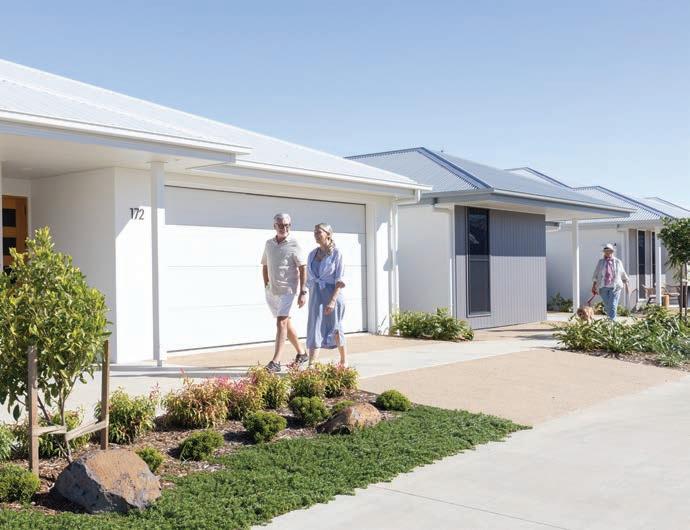
There is no transition to nursing home care. But Ingenia offers free help with the available options.
“When you exit, you sell the house and take the full capital gain. If you buy for $500,000 and someone’s prepared to pay $600,000, that’s $100,000 you’ve made.”
– John Carfi
in retirement,” he said. “The media doesn’t distinguish between independent land lease and retirement villages. The industry to some extent from an advocacy point of view didn’t distinguish.
“I’m sure some of those criticisms were well-founded, and some probably blown up.
“When you look at what we provide, and you look at previous complaints, we don’t cross over: we’re not managing your life, we’re not dictating terms to you.
“We’re not the sheriff. It’s independent living. You pay a fee to
Carfi accepts that many will resist a move to retirement living. They worry about the cost and hassle of selling up, separation from family, friends and neighbours.
“The biggest obstacle, to us, is people doing nothing,” he said. “‘Oh, I’ll wait another year’. They’ve got to make the lifestyle decision. What prevents them from doing it earlier, is this stigma that a) they’re caravan parks and b) there’s a hidden fee. There isn’t: it’s completely open.”
One possible selling point is that lifestyle community owners could have longer, healthier lives.
Not just that they’re safe, with less work, but with more activity and social interaction.
occupy. If you don’t see value in the fee, you can move out without being penalised.
“You’ve probably made a capital gain, there’s no stamp duty.”
Carfi said the vast majority of Ingenia customers are happy with their new house, new friends, and the opportunity for a carefree life. “As I’ve said… I would move into any of our communities tomorrow.”
But it’s important to get independent advice before committing. Perhaps from a conveyancer or lawyer with experience in the field.
Community focus provides a new lease on life
By LEIGH REINHOLD
With a range of entertainment and conveniences, as well as health services on call, living in a retirement village can offer an upgrade for older Australians
Octogenarian Jan Littlejohn loves living in her retirement village among the gum trees on Sydney’s Northern Beaches, because it gives her peace of mind as she cares for her husband.
Ten years ago the couple bought into Minkara Resort – an Aveo village with more than 200 residents – and Jan tells AC it was the best move they could have made after selling their family home in Mona Vale with its many stairs.
“My husband has Alzheimer’s and dementia and it is safer living here than our old home,” explained Jan, whose selling agent suggested they buy into a village and helped the couple transition by finding them a home for sale at Minkara Resort. “There are no stairs here. And, if my husband goes for a bit of a wander there’s always someone to find him and bring him home.
“It’s paradise here, like living in the country. I can look out my windows and there’s the waters of Pittwater.”


“We have that peace of mind that there are carers on the premises, so, if anything happens, we can just press our call button.”
– Jan Littlejohn
Jan, who is a marriage and funeral celebrant, is also an active member of the Minkara Resort community, calling bingo for the residents of the village’s Endeavour Lodge, which caters to high-care residents, providing carers and nurses on demand.
“If the time comes when my husband and I need more help, Endeavour Lodge has full-time carers and a nurse three or four days a week,” she said.
“And, even though we’re currently living independently, we have that peace of mind that there are carers on the premises, so, if anything happens, we can just press our call button and someone will come and assist us.”
Jan said paying monthly fees of around $700 suits her, and her only out-of-pocket expenses are for her phone and electricity.
With weekly excursions, keep fit classes, a walking group, chair exercises, indoor bowls, water aerobics classes and a bus to take her shopping twice a week, Jan is delighted with life at Minkara Resort.
“If I was still living in our family home or an apartment I wouldn’t have so many options to keep me entertained and healthy,” she said.
And she has a piece of advice for those considering retirement village living: “Make the move by the time you’re 70,” she counsels. “And that way you have the time to make the adjustments and settle in to your new life.”
Minkara Resort resident Jan Littlejohn.
Finding the right time to make a move
By LEIGH REINHOLD
For one Sydney couple, the decision to downsize was an easy choice once they found the ideal home in a new community under development
Retired couple Margaret and Tony Playle spent 40 years bringing up their family in the one house in Sydney’s north-west before deciding last year it was the right time to make a move.
“We were in a two-storey home on a quarter-acre block, so it was starting to be a bit of a problem,” said Margaret. “We also had a swimming pool that we hardly used. The appeal of moving was to get something a bit smaller, a bit less yard work.”
“It’s called downsizing to a more appropriate and lovely home,” added Tony, a former home loans manager, who was impressed with the opportunity to buy an ex-display home in the newly opened Halcyon Gables, a development by Stockland.
Having moved in mid-March, the couple are some of the first residents of Halcyon Gables, which will eventually become an estate of 200 homes.
“It’s a land-lease set-up,” said Tony, “so Stockland own the land and we own the house.”
“And we pay a service fee per week,” said Margaret. “They maintain the grounds at the front of our house and we don’t have to pay any money to use the facilities, that’s all included in our fee.”
Drawing on the experience of some of their friends who have relocated to retirement villages, Margaret said the land-lease model suited them better and they called on a conveyancer to go over the finer details of buying their new home.
“Halcyon Gables appealed to us because there is no exit fee if you decide to leave,” she said. “A lot of places take 30 per cent of your selling price, but here whatever you sell your house for, you get back.
“Halcyon Gables appealed to us because there is no exit fee if you decide to leave. A lot of places take 30 per cent of your selling price, but here whatever you sell your house for, you get back.”
– Margaret Playle
“We made the decision because our kids will get more of the money when we’re gone.”
The couple are looking forward to being involved Halcyon Gables community members. Tony, a “pushbike fanatic”, has already palled up with other residents interested in bike riding, and Margaret can’t wait for the anticipated June opening of the community’s facilities.
“They’re building a 35-seat cinema, a pickleball court, a gym, a heated swimming pool, a craft room, a men’s shed and a community room if you want to throw a party,” she said.
With a shopping and medical centre just 800m from their front door, Tony is sold on his new home and said, “It’s already really wonderful living here. A place to start our new lives.”


Moving the dial
Game-changing words and numbers that impacted the industry this month
Australia’s population hit a major milestone this month, according to the Bureau of Statistics. Growth calculated with the registration of births, deaths and people permanently relocating to the country.
By partnering with councils on infrastructure delivery, we’re creating more opportunities for people to live and work in our regional communities.
– Minister for Regional NSW Tara Moriarty on the release of $12 million for low-cost loans.
50.4%
Changes to negative gearing and capital gains tax were announced in May, coinciding with nationwide auction rates dropping to 50.4 per cent the week ending May 17.
28,001,328 4.5%
Australia’s unemployment rate as of April 2026
-0.9%
Dwelling values fell 0.9 per cent in Sydney and 0.8 per cent in Melbourne during May, according to data from research agency Cotality.
That will be bad for productivity. That will be bad for competitiveness. It will be bad for the future growth of the Australian economy.
– Andrew McKellar, chief executive of the Australian Chamber of Commerce and Industry, on the capital gains tax reforms.
This is a bill for workers, for firsthome buyers and for future generations.
– Treasurer Jim Chalmers introducing the tax reform bill in the House of Representatives.

28,001,328 5% - 10%

“THERE
The amount that financial institution Morgan Stanley predicts national house values to fall as a result of Federal Budget measures
ARE NOT ENOUGH HOMES FOR OUR EXISTING POPULATION AND WE CANNOT TAX OUR WAY TO INCREASED HOUSING SUPPLY.”
– Tim Reardon, chief economist for Housing Industry Australia.
4.2%
Consumer Price Index (CPI) annual change to April 2026

-1.1%
In April 2026, household spending fell 1.1 per cent month-on-month on a current price, seasonally adjusted basis, but rose 4.9 per cent compared with April 2025.
“PART OF THE AUSTRALIAN DREAM HAS ALWAYS BEEN TO BE ABLE TO GET AHEAD AND KEEP MOST OF WHAT YOU HAVE CREATED FOR YOURSELF AND NOT HAVE IT CONFISCATED BY AN EXTORTIONATE GOVERNMENT, AND THAT’S WHAT ANTHONY ALBANESE IS NOW DOING.”
– Former prime minister Tony Abbott, who is now the new Liberal Party president.
-6.7%
The number of new owner occupier first-home buyer loan commitments for dwellings fell 4.3 per cent in the quarter while the value fell 6.7 per cent.
-6.2%
The total number of new loan commitments for dwellings fell 6.2 per cent in the March quarter 2026 while the value fell 3.8 per cent.

$26.44 per hour
The new minimum wage in Australia, handed down by the Fair Work Commission in June. This is is $1,004.90 per week for a 38hour week.
“I AM READY TO SERVE AS PRIME MINISTER.”
– One Nation leader Pauline Hanson after polling published in The Australian Financial Review had the 72-year-old’s party claiming 31 per cent of the primary vote, Labor 28 per cent and the Coalition 20 per cent. It is the first time One Nation has led Labor.

Dwelling values
Date range 12 months to May 31, 2026
The housing market continues to weaken, with Cotality’s Home Value Index flat (0.0 per cent) for May. Sydney and Melbourne were leading the downturn, values falling by 0.9 per cent and 0.8 per cent respectively. The ACT fell by 0.2 per cent. Other capitals managed modest rises, Perth and Darwin both with 1.5 per cent. “The direction is becoming more consistent, with most markets losing momentum,” said research director Tim Lawless. The nation’s median dwelling price sits at $941,864.
Sydney’s median dwelling price is now $1,282,020, down 0.9 per cent for the month, up 2.3 per cent for the year. The median house is $1,579,396, a unit $904,326. Significant May sales included 5 Kulgoa Rd, Bellevue Hill for $8,475,000.
Melbourne residential property values are 3.2 per cent below their March 2022 peak. The median price of a dwelling is now $812,621, a house $958,361, a unit $636,769. 76 Park Road, Middle Park sold for $4,350,000.
Brisbane dwelling values were up 0.9 per cent in May. The median price for a Brisbane dwelling was $1,126,149, a house $1,232,690 and a unit $884,881. South of the city, 36 Jenkins Court, Upper Coomera sold for $8,000,000.
Adelaide property values slowed, dwelling values up 0.5 per cent in May. A dwelling sold for a median $950,703, a house for $1,013,138 and a unit $697,499. 17 Stephens Avenue, Torrensville sold for $2,925,000.
Perth remains the strongest for annual home price growth. A median dwelling is $1,050,354, up 0.5 per cent in May, a house $1,197,164 and a unit $768,808. 23 Mary Street, Watermans Bay sold for $2,670,000.
Hobart values are now 1.4 per cent down on their March 2022 peak. A median dwelling is $752,398, a median house $807,533 and a unit $580,265. 99 Hampden Road, Battery Point sold for $2,075,000.
Darwin is still the most affordable capital city, with annual growth second only to Perth. A median dwelling is $634,368, a house $759,997 and a unit $461,472. 26 Gulnare Street, Millner sold for $1,465,000.
A median dwelling price in the nation’s capital was $890,555 as of the end of May. A house was a median $1,040,041 and a unit $598,931. Top sales included 10B Emery Street, Chapman for $2,080,000.
‘Learn the law deeply, but learn the people more’
Kristy Bell is the owner and one of six licensed conveyancers at Bell Conveyancing, with offices in Bathurst and Orange, NSW. She has 25 years experience in the property industry, including five in real estate. Kristy completed an Associate Degree in Law at Southern Cross University in 2012. Her firm won “Best in Conveyancing Services” at the 2026 Australian Small Business Champion Awards
I came into conveyancing in 2001 at 18. I had no grand plan. I was working in a small Bathurst office, filing paperwork and learning the language of property. The work pulled me in slowly. Property is the most personal financial decision that most people ever make, and being trusted to guide someone through it is a privilege that does not wear off.
I am a fifth-generation Bathurst local, and that has shaped how I practise. In 2017, I opened Bell Conveyancing from my spare bedroom. I was a newly divorced single mother with a laptop, a short list of referrers from my real estate days and a need to build something of my own. I did reception, the admin, the research, handed out the advice and the marketing. There were nights when I wondered if I had made a mistake. I had not. The firm now operates across Orange and Bathurst with a team of nine, and I’m still as invested in every matter as I was in week one.
The hurdles were the ones every founder will recognise. Cash flow and saying ‘yes’ too much. And hiring. I learnt to hire ahead of the curve, before the work was piling up on the desk and there was no time to train properly. I also learnt to
invest the hours in training people the right way from day one, because it’s very hard to change someone once wrong habits have set in. Build the systems, document everything and trust your standards more than your sympathy.
If I could speak to my younger self, I would say learn the law deeply, but learn the people more. A contract review is not a tick-and-flick exercise. Each one carries someone’s savings, someone’s retirement, someone’s first home. Care about that and the rest of the practice tends to look after itself.
To anyone starting out, don’t wait for permission to lead. Build your reputation in the small jobs. And network. Network, network, network. The referrers who helped build Bell Conveyancing were real estate agents, mortgage brokers, accountants and former clients who remembered being treated well. Relationships are the long game. Get comfortable with technology, too, but none of it replaces judgment or care.
The rewards are quieter than people imagine. A clean settlement. A repeat client on their third matter. A junior who grows into a leader. That’s the work, and after 25 years it still feels like a privilege.


Kristy Bell Owner, Bell Conveyancing