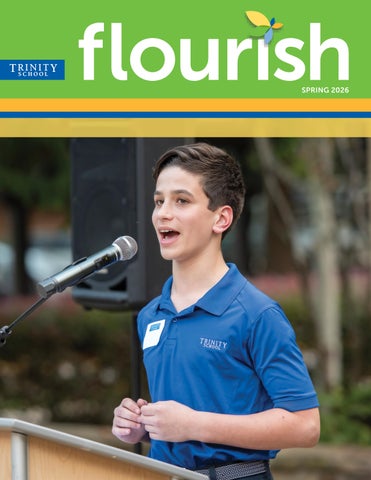
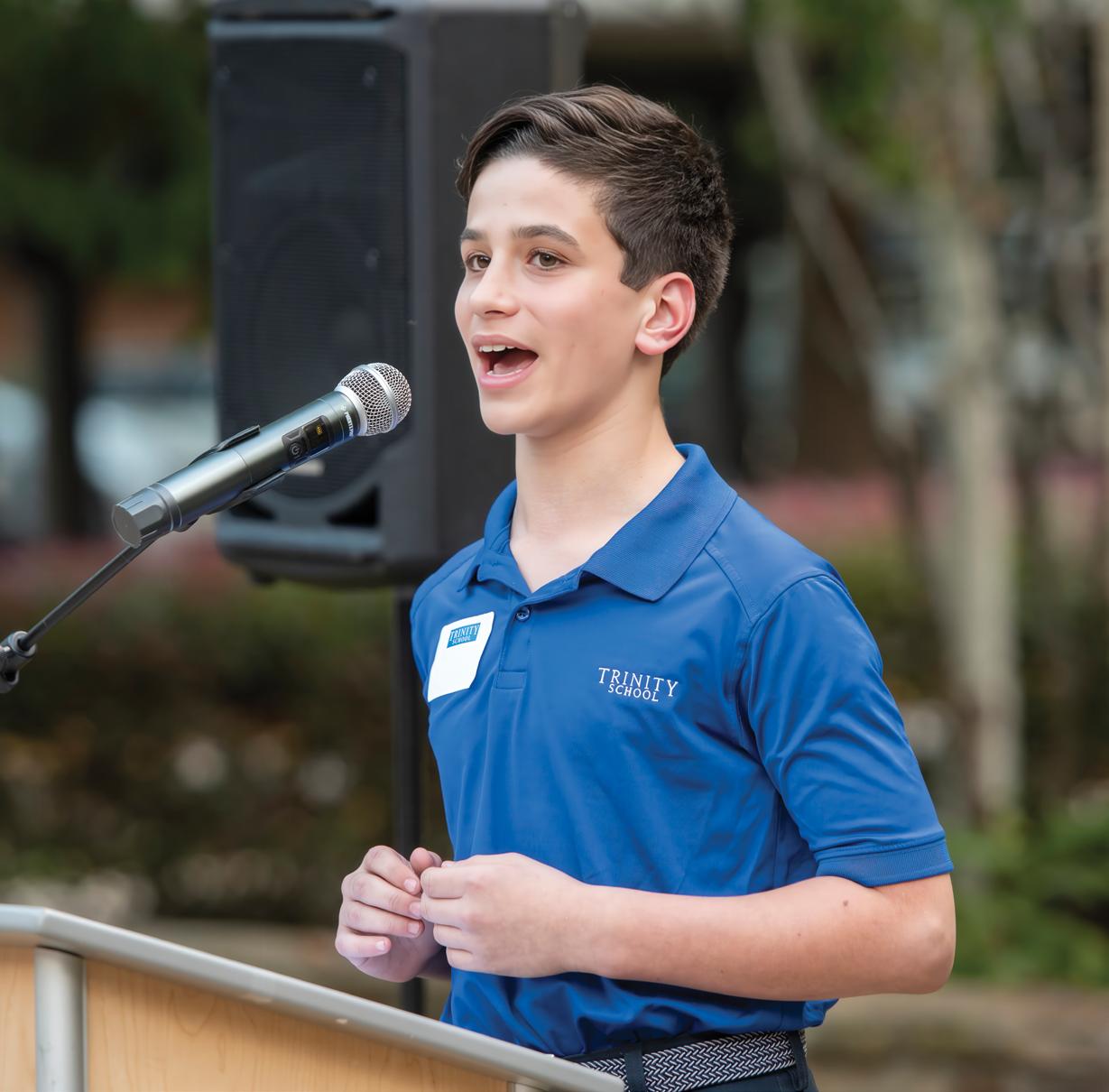
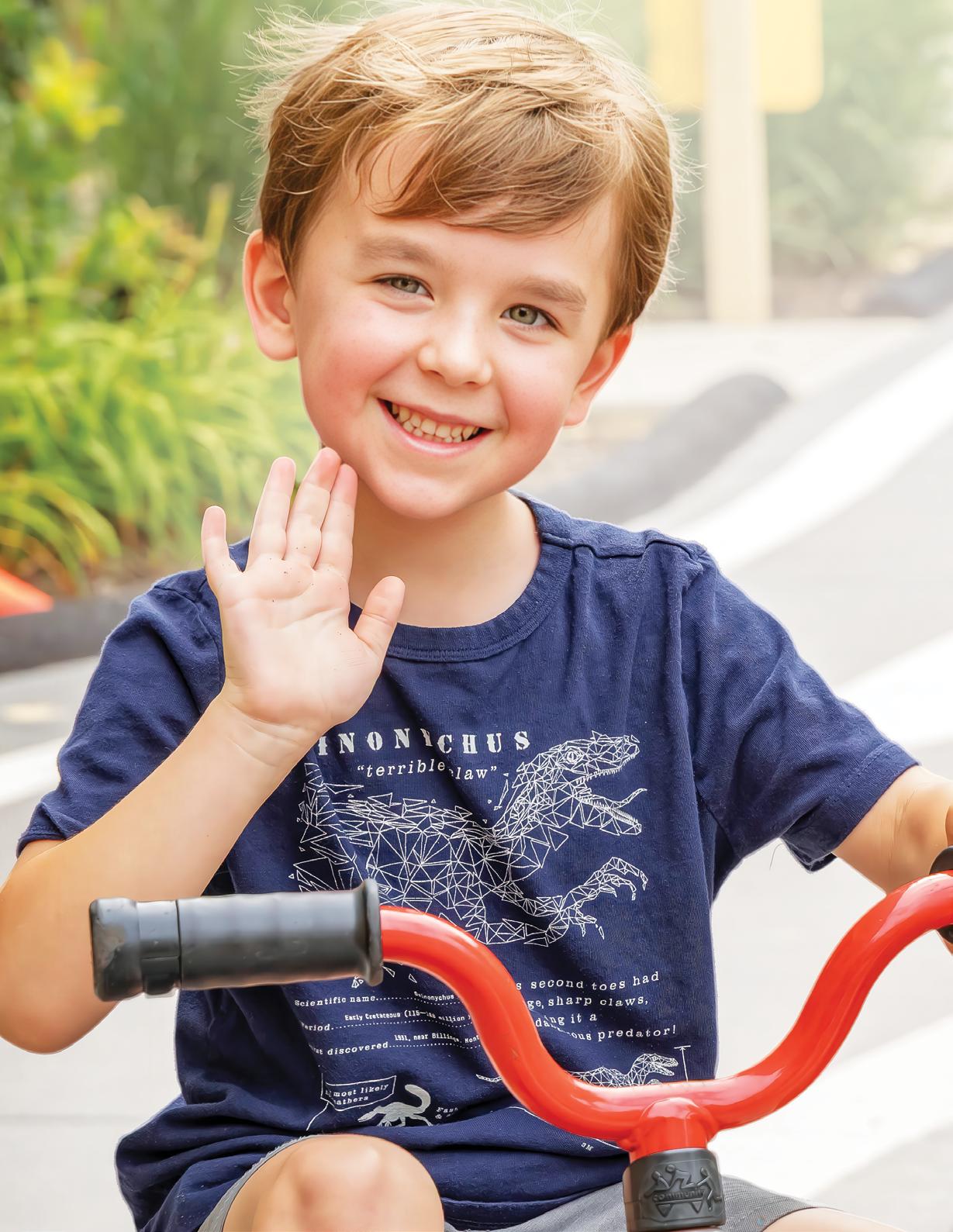
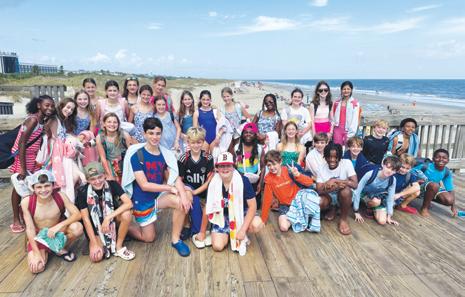
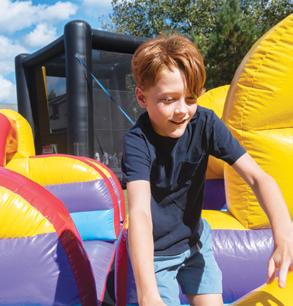
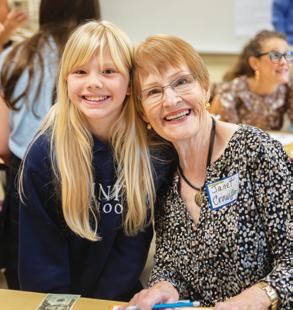
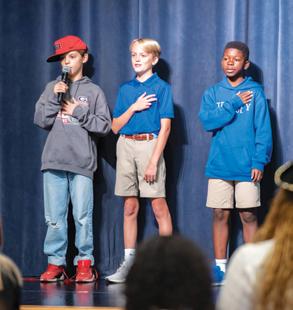
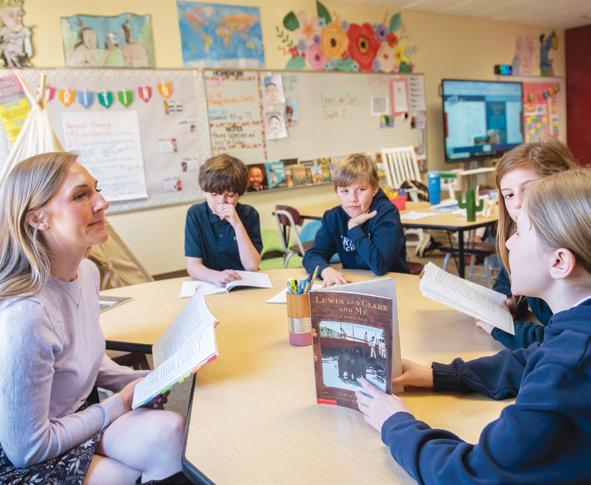
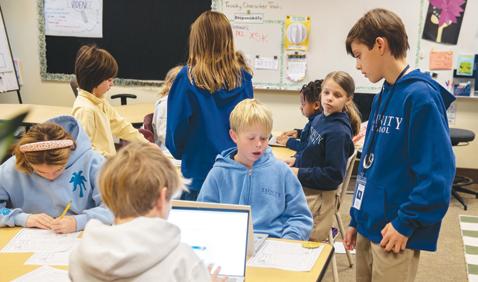
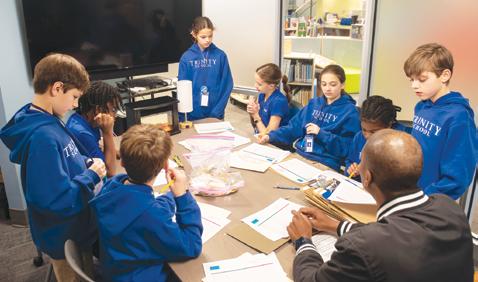
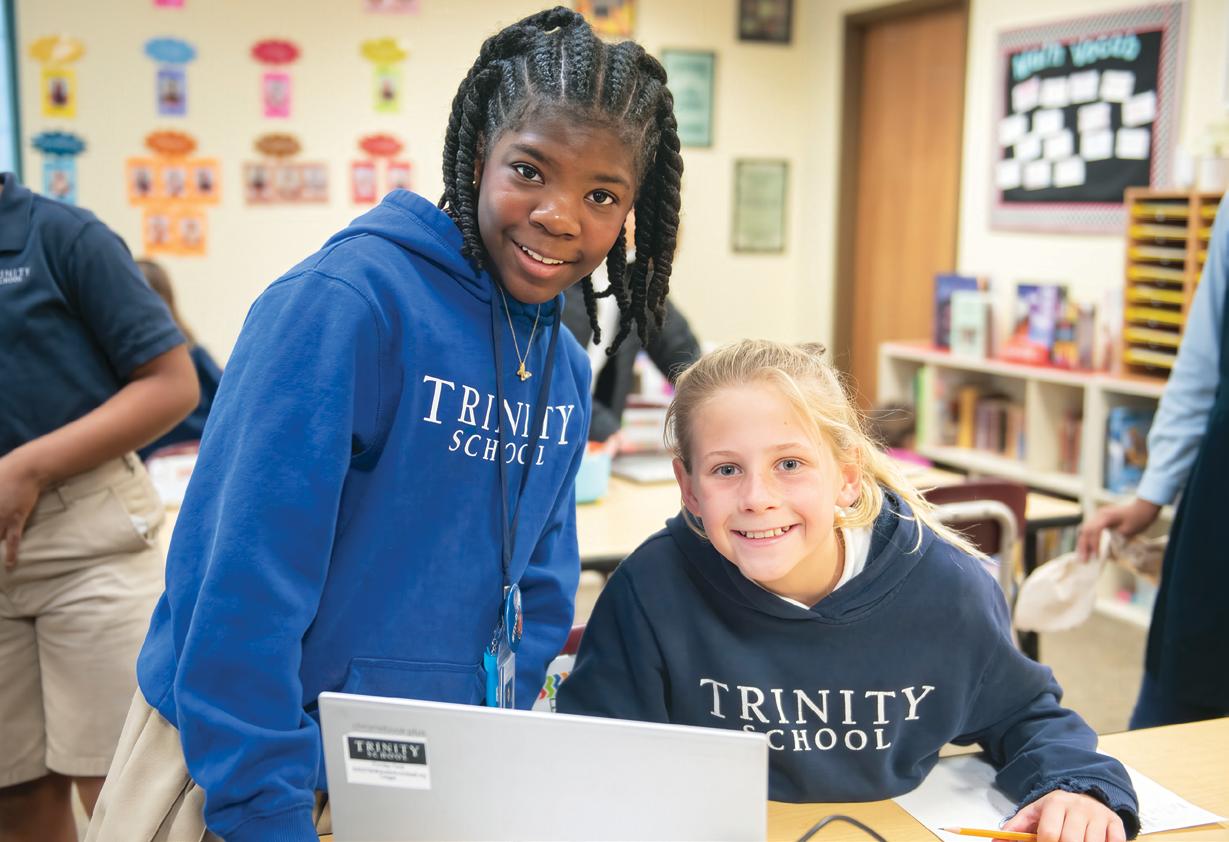
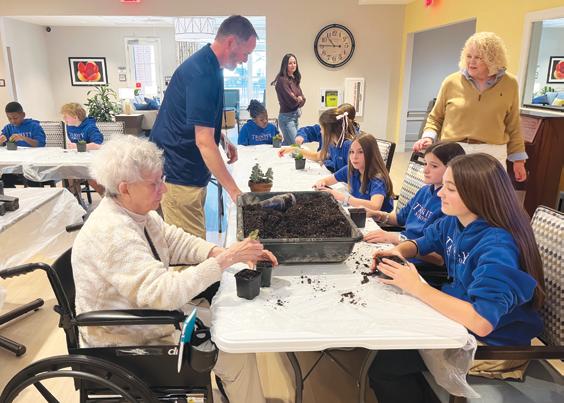
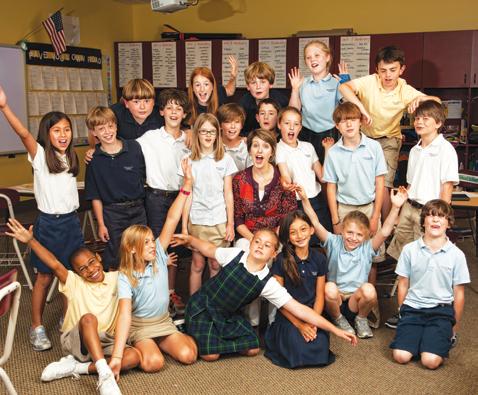
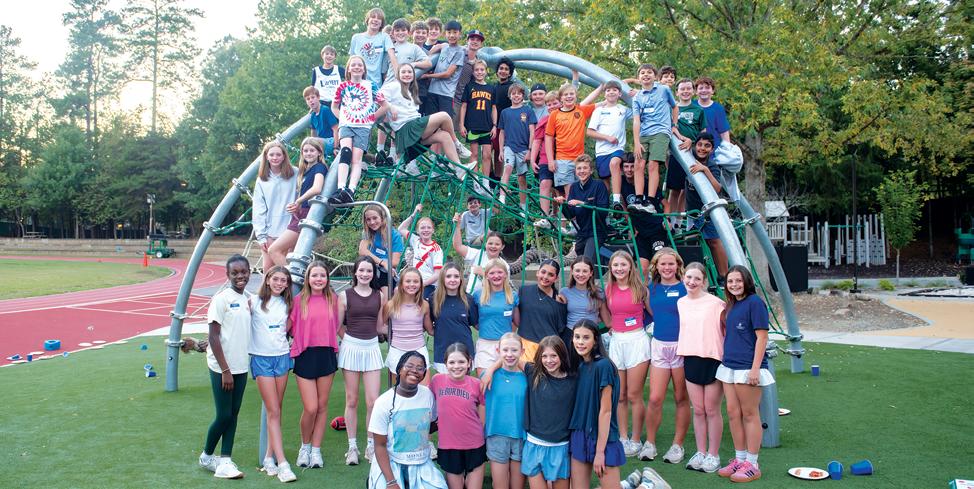
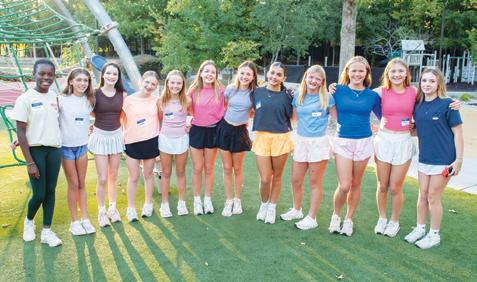
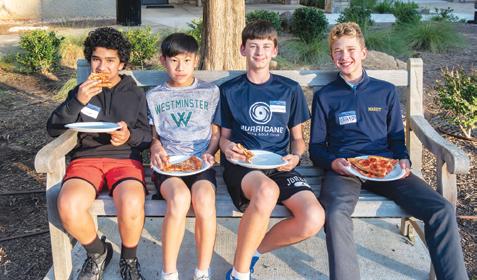
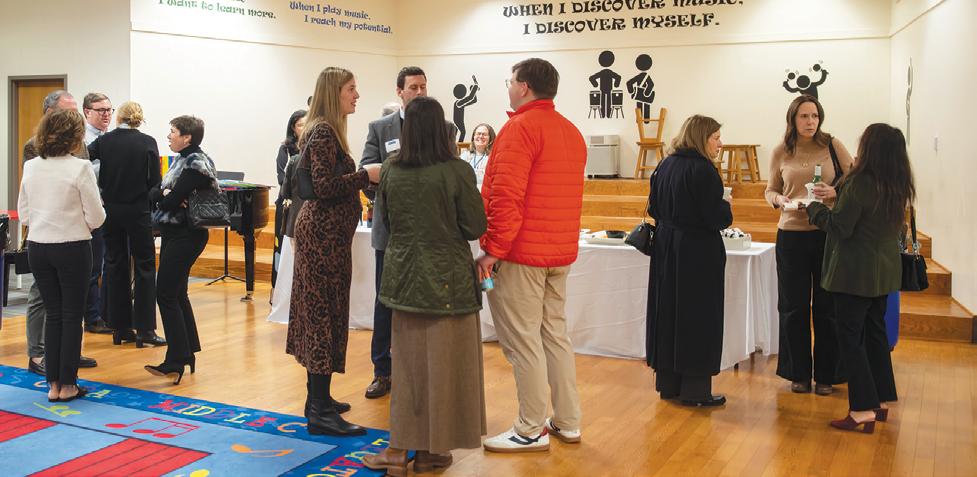
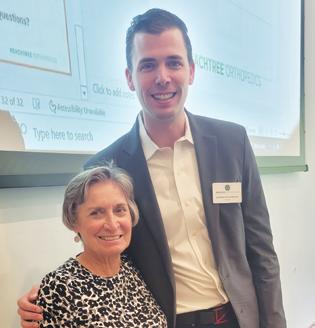
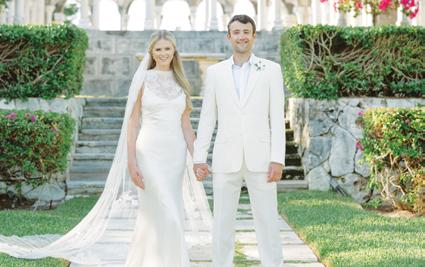
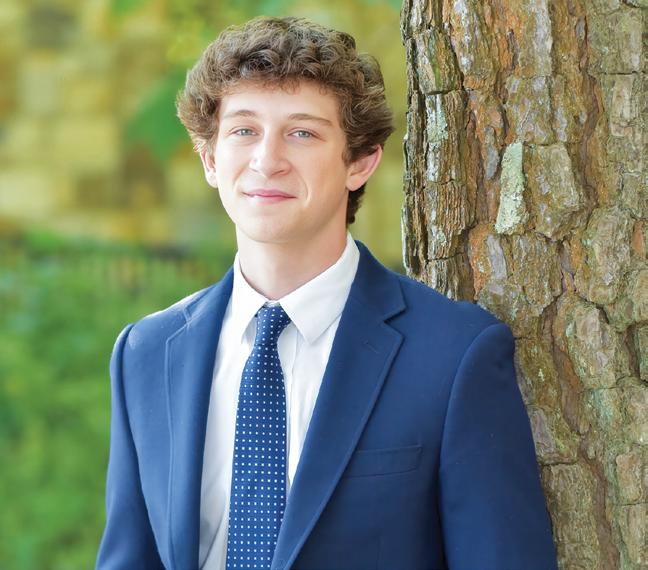
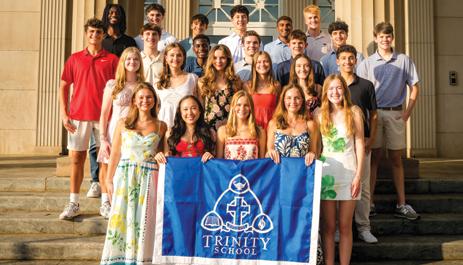
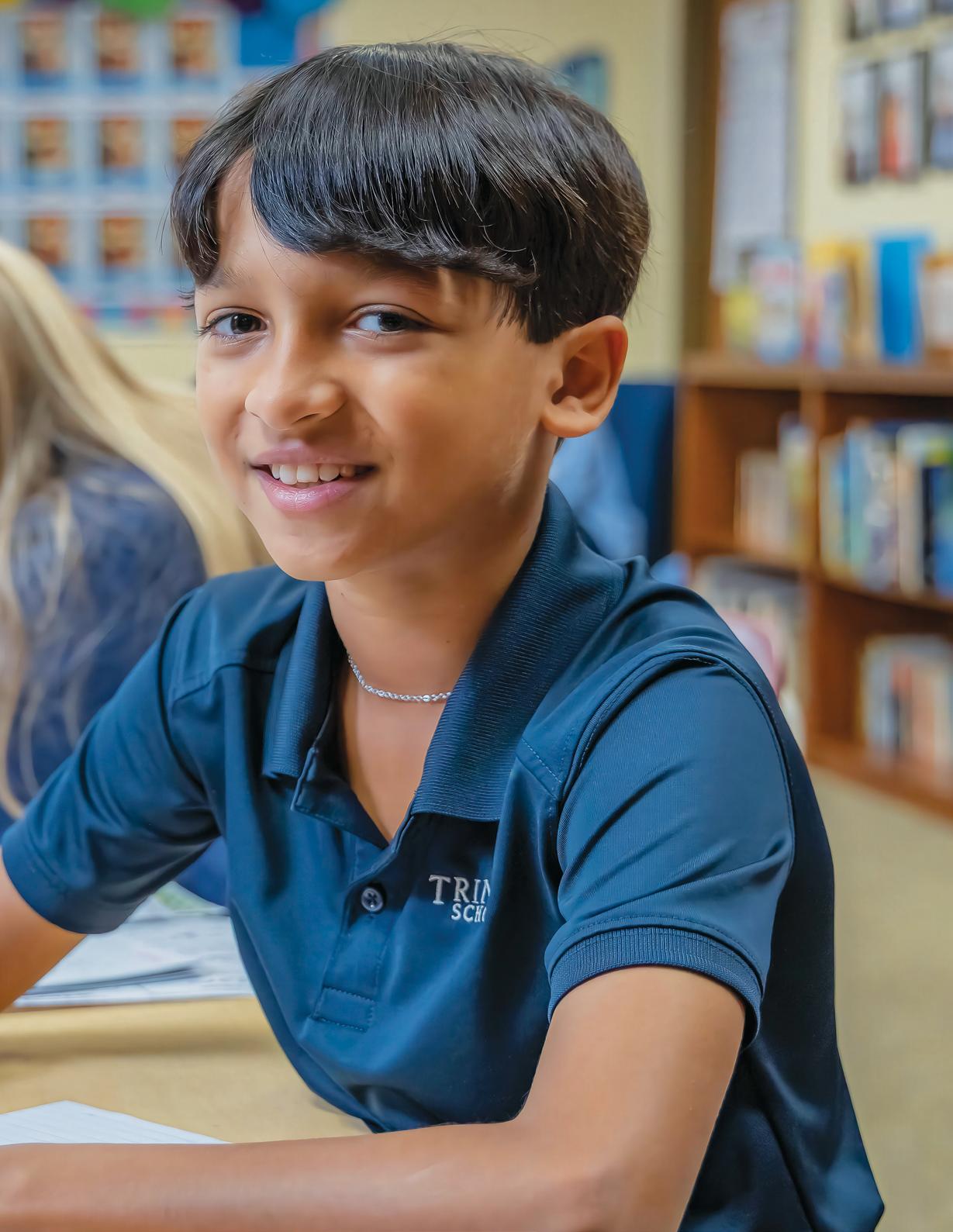
Sixth Grader John Wyatt reflects on his experience in the Leadership Class and shares favorite Trinity memories during the Gates Leadership Society Reception on September 17, 2025.
To support Trinity School, please contact Margaret Douglas, Director of Advancement 404-240-9446 | mdouglas@trinityatl.org trinityatl.org/give
Please send address changes to changeofaddress@trinityatl.org
Comments? Contact the editor at nfash@trinityatl.org
Mission Statement
Serving children age three through Sixth Grade, Trinity School creates a community of learners in a diverse and distinctly elementary-only environment, in which each child develops the knowledge, skills, and character to achieve his or her unique potential as a responsible, productive, and compassionate member of the School and greater community.
Non-Discriminatory Statement
Trinity School does not discriminate based on race, color, gender, religion or creed, national or ethnic origin, sexual orientation, or family composition in the administration of our admission and educational policies, in the extension of financial assistance, or other schooladministered programs.
Program and Pedagogy Pillars
Celebrating the present and preparing our students for the future within a nurturing and caring educational environment, we:
• Cherish Childhood
Provide joyful experiences that include play- and passion-based learning
Ensure developmentally appropriate experiences
Design experiences around what is important in the life of a child
• Deepen Students’ Educational Experience
Develop creative and critical thinking and questioning skills
Value both process and product of learning
Connect learning vertically, horizontally, cross-curricularly, and globally
• Empower Students in Their Learning
Foster a growth mindset
Cultivate voice, choice, and self-reflection
Promote leadership
So that our students:
• Build Academic Foundation
Establish proficiency in essential knowledge and skills
Embrace diverse experiences of a well-rounded education
• Develop Character Foundation
Exhibit ethical skills, habits, and attitudes of empathy, integrity, and respect
Demonstrate performance skills, habits, and attitudes of accountability, persistence, and resilience
• Exhibit Continued Curiosity, Creativity, and Confidence
Imagine, discover, and experiment independently and collaboratively
Adapt to new situations and a changing world
Leadership Team
Joe Marshall, Head of School
Ken Bomar, Director of Finance
Sarah Morgan Bonham, Director of Outplacement and Re-enrollment
Brad Brown, Upper Elementary Division Head
Lauren Darden, Director of Admissions
Margaret Douglas, Director of Advancement
Sheree Du Preez, Early Elementary Division Head
Nicole Fash, Director of Marketing and Communications
Jill Gough, Director of Teaching and Learning
Reginald Haley, Director of Operations
Marsha Harris, Director of Curriculum
Jeff Morrison, Director of Education Technology
Ginny Perkinson, Assistant to the Head of School
Kayleen Whitmer, Director of Extended Programs
2025–2026 Board of Trustees
Winnie Smith, Chair
Libby Barge
McKnight Brown ’92
Kate Nellis Burns ’95
Catherine Humann Callaway ’97
Janica Campbell
Kristin Carothers
Jackie Coleman
Erica Cummings
Isha Damani
Cindy Couch Ferguson ’78
Casey Flanagan
Zenobia Godschalk
Nathan Hartman
Scott Hawkins
Russ Herakovich
Chris Kirtley
Carrie Lanier
Melissa Moseley
Joel Murphy
Street Nalley
Jack Norton
Charlie Ogburn
Kim Pearce
Shazeen Porbandarwala
Stephanie Stephens
Kisha Williams
Lead Editor and Writer
Nicole Fash
Art Director and Design
Cheryl Beverly, Ridge Creative, Inc.
Associate Editor
Margaret Douglas
Writers
Nina Chamberlain
Koby Collins
Kerry Coote
Emily Davis
Jill Gough
Marsha Harris
Patricia Keaten
Cathryn Lager
Pam Lauer
Andrene Leslie
Joe Marshall
Robin Martin
Anne Torrey McCuean ’08
Rosalyn McLean
Katie Rosengren
Claire Snyder
Leisy Stevenson
Photographers
Stephanie Selman
Michie Turpin
Flourish magazine is published biannually by the communications department at Trinity School and mailed to parents, alumni and their families, grandparents, and friends of Trinity.
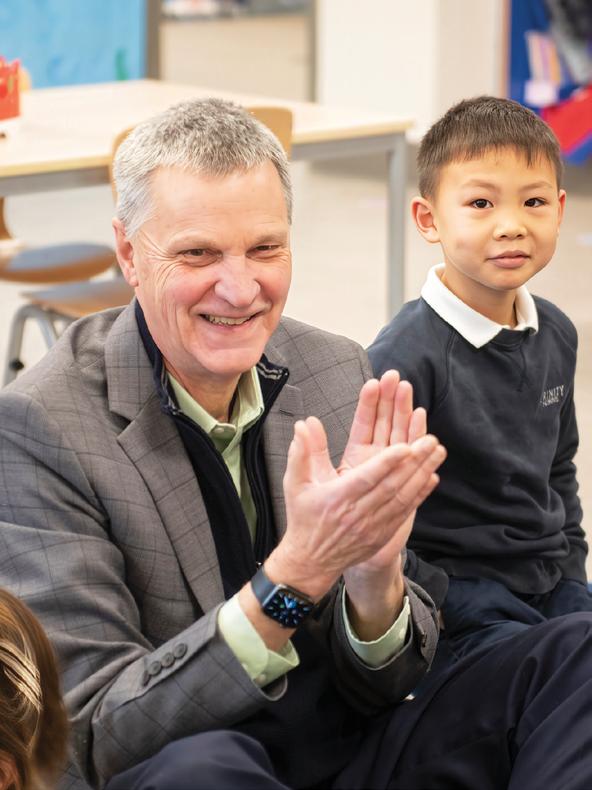
Joe applauds for a student speaker while First Grader Legh looks on.
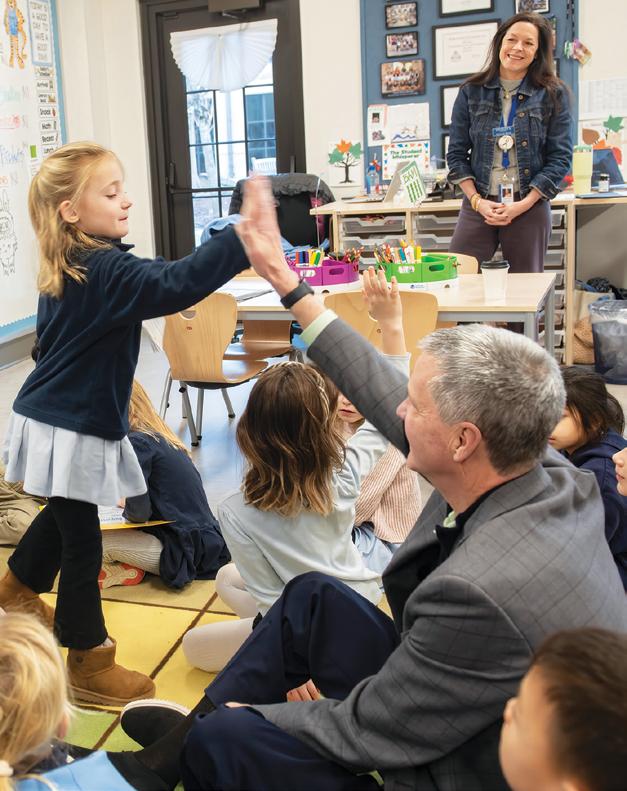
Joe gives First Grader Virginia a congratulatory high five after she finishes her presentation.
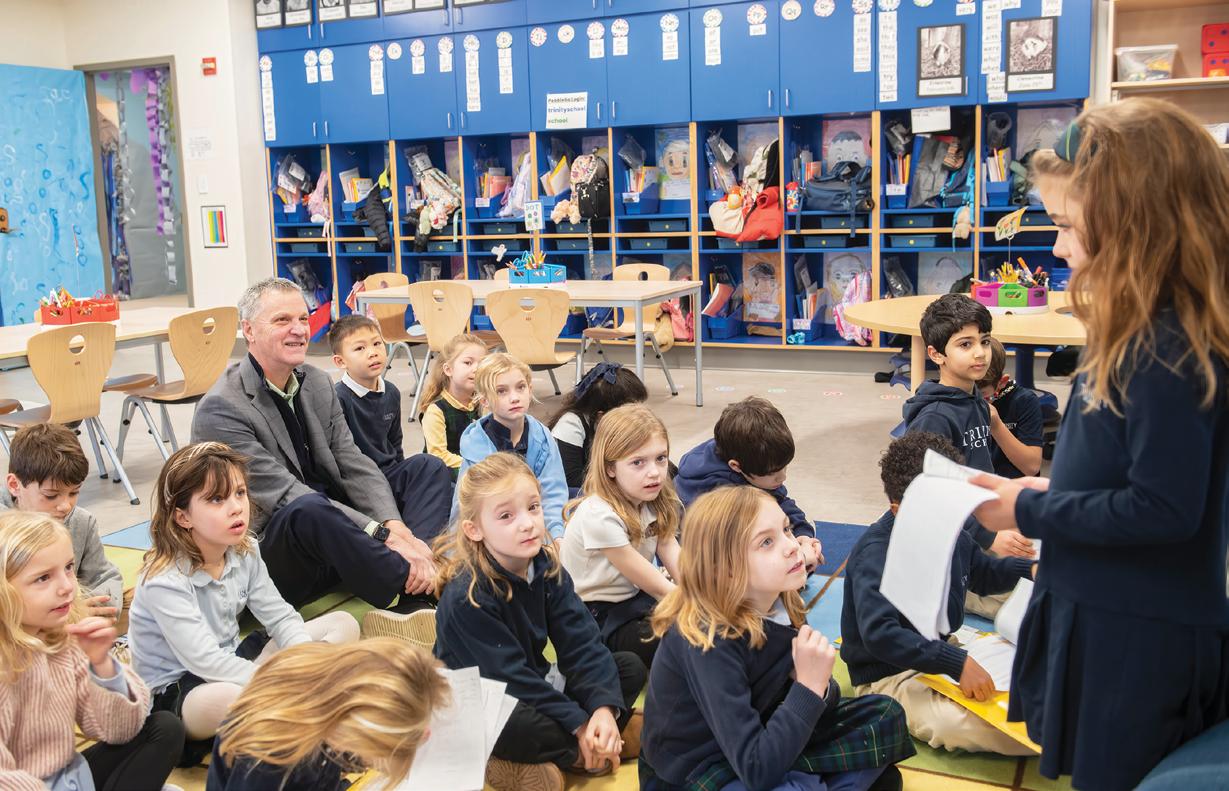
First Grader Olivia presents fun facts about her researched zoo animal while Joe and her classmates listen intently.
Dear Trinity Community,
When I interviewed at Trinity 14 years ago, I was immediately struck by the School’s deep commitment to continuous improvement. Many well-established schools can become stagnant, reliant on outdated practices, while others fall prey to chasing the latest educational trends. Trinity impressed me because its leadership and faculty struck a rare and powerful balance: they were proud of the School’s history and enduring traditions, clear about its mission and whom it served, and firmly committed to remaining current by embracing research-based, mission-appropriate initiatives that strengthened students’ experiences and learning.
Preeminence is defined as sustained excellence over time, and it is precisely this balance—honoring the past while remaining open to new ideas—that has kept Trinity at the forefront of elementary education.
Edgar Allan Poe famously argued that a great short story achieves a unity of effect, in which every word serves a purpose. Similarly, an independent school’s mission should clearly define its how, what, and why, while distinguishing it from its peers. Trinity’s mission captures this clarity and purpose, particularly in the phrase, “creates a community of learners.” Here, learning extends beyond our students alone; faculty, staff, and even parents are called to ongoing growth.
Having spent more years at Trinity than at any other school, I have personally benefited from that expectation and encouragement. Through professional development opportunities, such as conferences, workshops, and travel; through local, regional, and national exchanges with colleagues from other schools; and through reflective
conversations about Trinity’s vision and direction with faculty, administrators, and Trustees, I have become a more informed and confident educator. My continued professional growth, even well into my fourth decade in education, is a direct result of Trinity’s culture of high expectations.
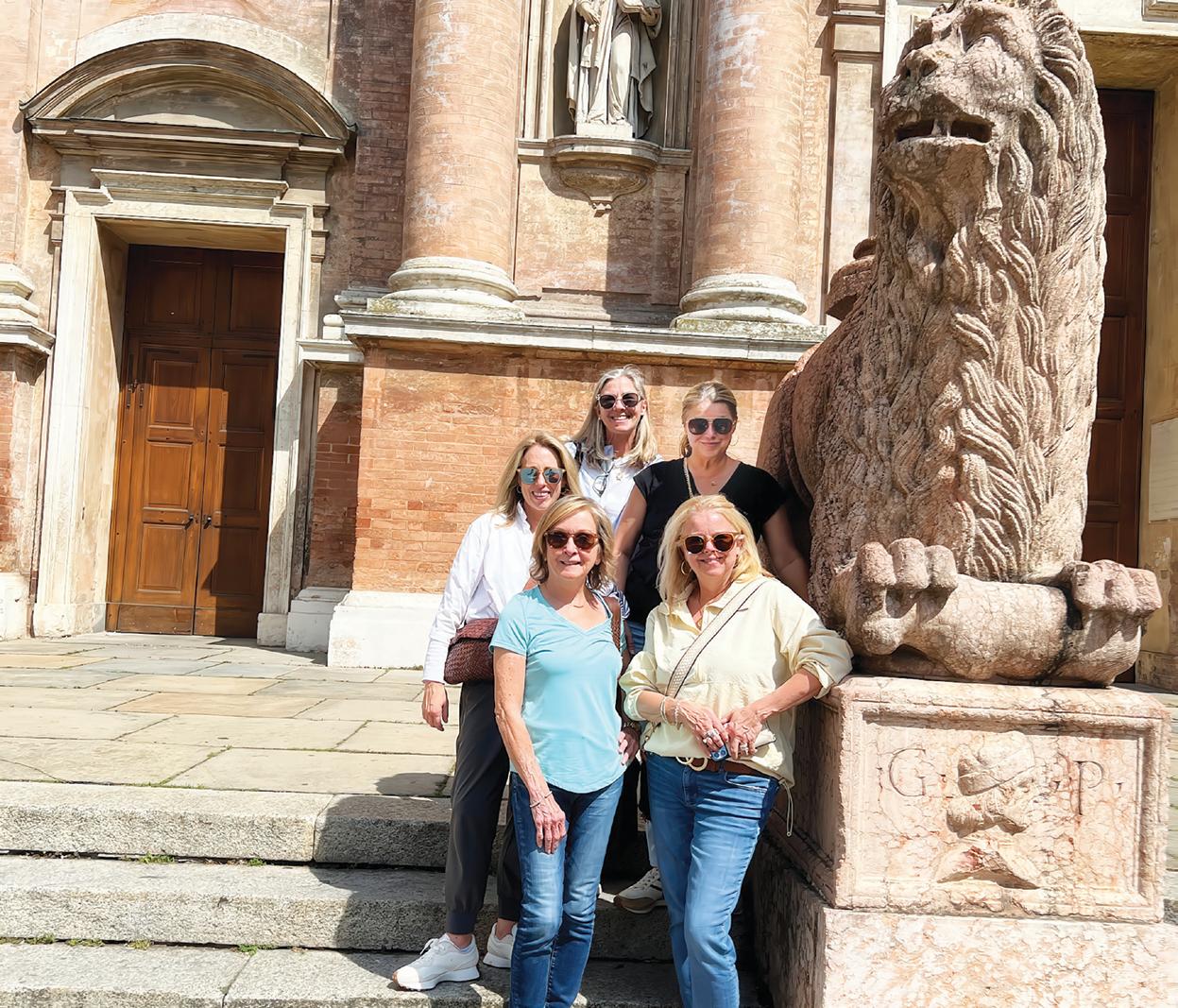
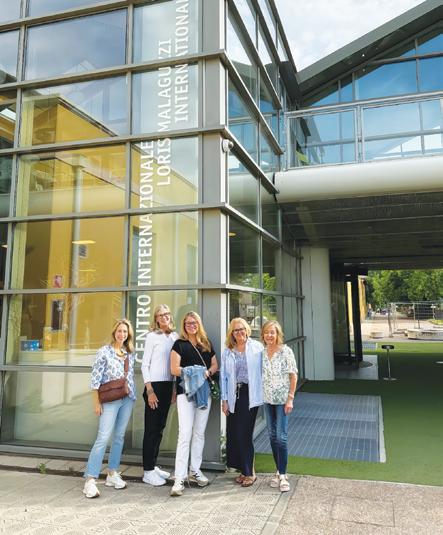
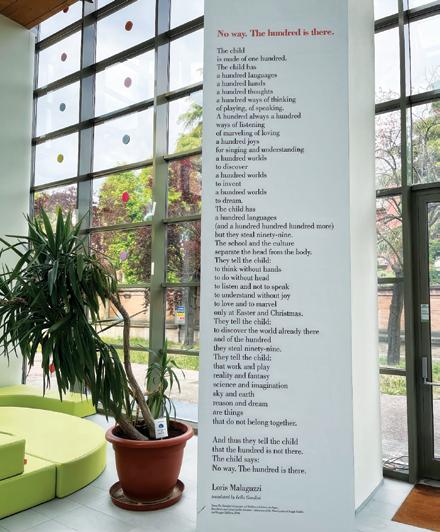
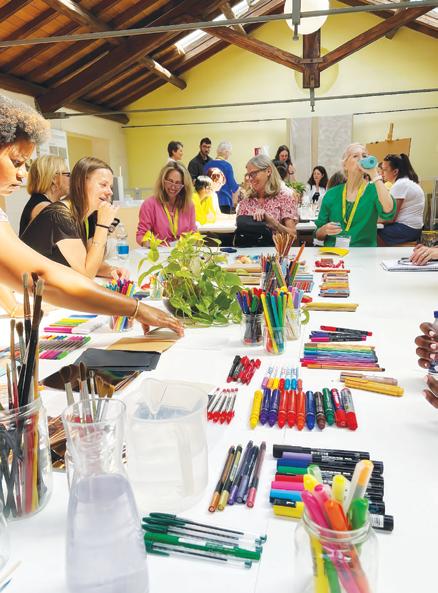
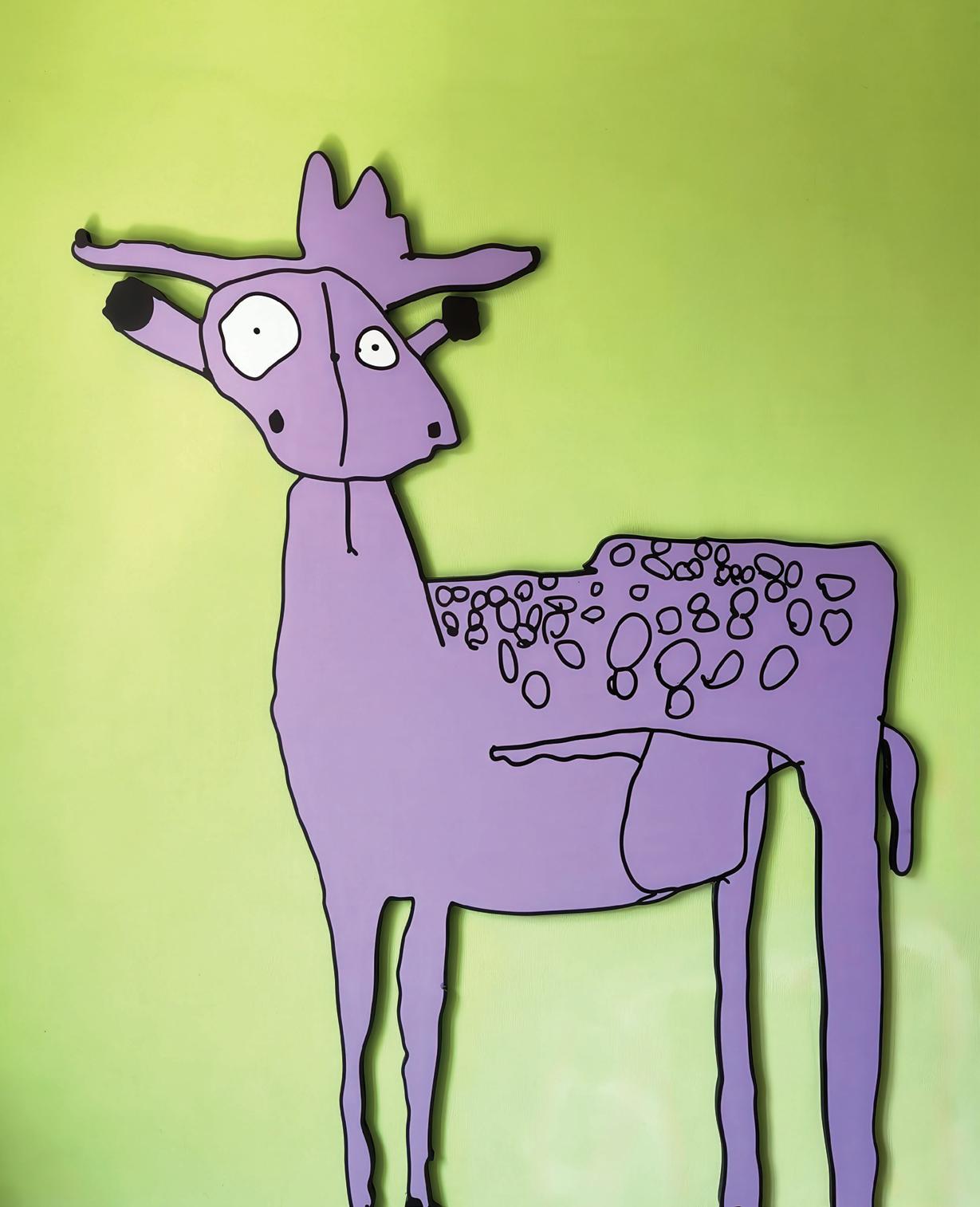
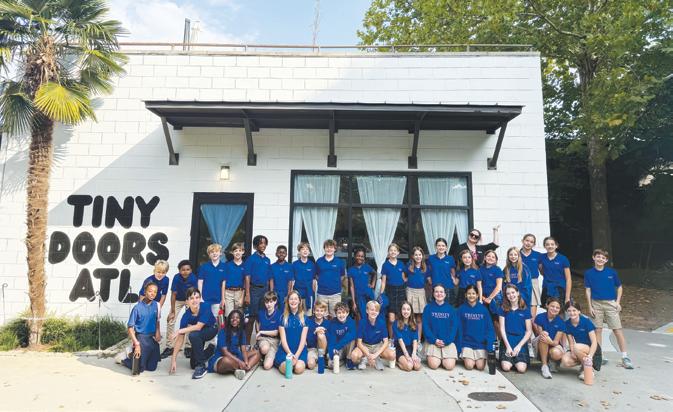
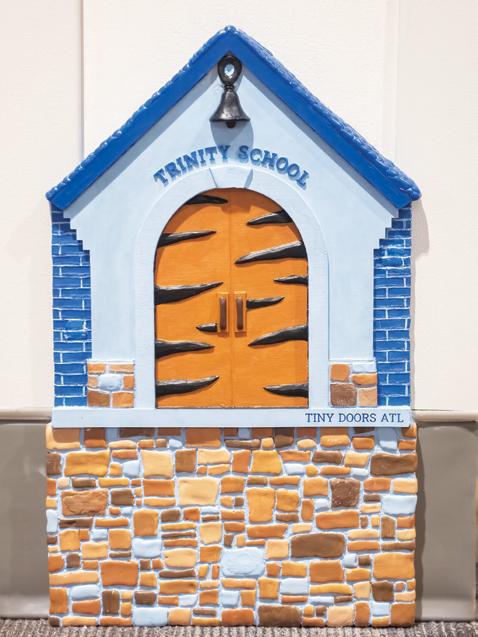
This issue of Flourish highlights the many ways Trinity empowers its community members to be continuous learners, open to new ideas and experiences. This commitment is reflected in faculty travel made possible through endowed funds—to places such as Reggio Emilia, Italy, and Kingston, Jamaica—in the ways Trinity nurtures and supports faculty and staff professionally; in time-honored grade-level traditions that continue to evolve while preserving their original essence; in the articulation of the Trinity Way, capturing qualities once thought ineffable; in the ongoing evolution of our academic bull’s-eye—literacy and numeracy—guided by research on how students learn best; and in our most recent Artist-in-Residence Karen Singer, who is behind the iconic and fitting Tiny Doors ATL.
Trinity is a dynamic place. As we proudly approach our 75th anniversary this September, we celebrate our history even as we look ahead—never resting on our laurels and always striving to be stronger tomorrow than we are today.
Preeminent indeed.
Sincerely,
Joseph P. Marshall Head of School
Contributors
Nina Chamberlain
Early Elementary Division Art Teacher
At Trinity since 2009
Bachelor of Arts in K-12 Art Education
Winthrop University
@miss.nina.art
Q: What’s the best advice you’ve ever received?
A: In college, a drawing professor once told me, “Ninety percent of drawing is erasing.” It profoundly stuck with me. Not only do I teach this reminder to our Trinity students, but I also try to apply that forgiving philosophy to all aspects of my life.
Koby Collins
IT Support Specialist
At Trinity since 2020
Bachelor of Arts in Elementary Education
Western Governors University
Q: What is your favorite memory from elementary school?
A: Overnight trip to Washington D.C.
Kerry Coote
Mathematics Instructional Specialist
At Trinity since 2012
Instructional Leadership Certificate
Harvard Graduate School of Education
Master of Arts in Teaching Mathematics
Mount Holyoke College
Bachelor of Science in Early Childhood Education
Kennesaw State University
Bachelor of Science in Electronics and Physics
The University of the West Indies
Q: What’s the most interesting place you’ve ever visited?
A: The Great Wall of China.
At Trinity since 2023
Master of Arts in Art and Design with Concentration in Art Education
Kennesaw State University
Bachelor of Arts in Women’s Studies Appalachian State University
@art.at.trinity
Q: What’s the best advice you’ve ever received?
A: What you allow continues.
Margaret Douglas Director of Advancement
At Trinity since 2008
Bachelor of Arts in Spanish University of Georgia
Q: What’s one thing you always carry with you?
A: Chapstick.
Emily Davis
Upper Elementary Art Teacher
Nicole
Fash Director of Marketing and Communications
At Trinity since 2016
Master of Arts in Media and Cultural Studies
University of Sussex, Falmer, England
Bachelor of Arts in Public Relations and Spanish Shorter College
@trinityschool
/trinityatl
@trinityatl
Q: What’s a book you recently enjoyed and would recommend?
A: The classic And Then There Were None by Agatha Christie.
Jill
Gough Director of Teaching and Learning
At Trinity since 2012
Master of Combined Sciences in Mathematics and Computing Science
Mississippi College
Bachelor of Science in Mathematics
Mississippi College
@jplgough.trinityatl
Q: What’s an activity you’ve always wanted to try but haven’t yet?
A: Tai Chi, because it is considered meditation in motion.
Marsha Harris Director of Curriculum
At Trinity since 2008
Certificate in School Management and Leadership
Harvard Graduate School of Education
Master of Education in Instructional Technology
Lesley University
Bachelor of Arts in Elementary Education; Bachelor of Arts in Drama in Education
University of Windsor, Canada
@mharris.trinity
Q: What was your first job?
A: I worked in the concession stand at the hockey arena, was a cashier at Canadian Tire, and a lifeguard on the shores of Lake Huron.
Patricia Keaten
Early Learners
Associate Teacher
At Trinity since 2024
Bachelor of Arts in Early Childhood Education and Art History
Mary Baldwin College
Grand Diplome
French Culinary Institute, New York
Q: What’s a fun fact about yourself that not many people know?
A: I went to culinary school in New York.
Cathryn Lager
Early Learners Lead Teacher
At Trinity since 2023
Bachelor of Arts in Psychology
Florida State University
Q: What’s an activity you’ve always wanted to try but haven’t yet?
A: Sewing.
Pam Lauer
Early Learners Lead Teacher
At Trinity since 2008
Bachelor of Science in Marketing Indiana University
Q: What’s a fun fact about yourself that not many people know?
A: I went skydiving in Thomaston, Georgia. Once was enough for me.
Andrene Leslie Third Grade Lead Teacher
At Trinity since 2017
Bachelor of Education in Early Childhood
Shortwood Teachers’ College, Kingston, Jamaica
@leslie_thriving_third
Q: If you could instantly become an expert in anything, what would it be?
A: Motivational speaking.
Joe Marshall
Head of School
At Trinity since 2013
Master of Science in English Education Hofstra University
Bachelor of Arts in History Franklin and Marshall College
@joepmarshall1958
Q: What’s a fun fact about yourself that not many people know?
A: As a 10-year-old, I attended Super Bowl III.
Robin Martin
Early Learners Lead Teacher
At Trinity since 2009
Master of Education in Counseling and Psychological Services
Georgia State University
Bachelor of Science in Elementary Education University of Georgia
Q: What is your favorite Flik meal?
A: Lentil soup and homemade potato chips.
Anne Torrey McCuean ’08 Advancement Associate and Alumni Relations
At Trinity since 2022
Bachelor of Arts in Education Furman University
@trinityschoolalums /trinityalums
Q: If you could instantly become an expert in anything, what would it be?
A: American history.
Rosalyn McLean Second Grade Associate Teacher
At Trinity from 2018–2020; most recently since 2022
Master of Arts in Teaching in Elementary Education
University of Chicago
Bachelor of Arts in Marketing
Michigan State University
Q: What’s an activity you’ve always wanted to try but haven’t yet?
A: Ziplining; the idea of soaring through the treetops, feeling the wind, and gaining a new perspective sounds exciting and refreshing.
Katie Rosengren Associate Director of Advancement
At Trinity since 2003
Bachelor of Arts in Economics
Washington and Lee University
Q: What’s one thing you always keep in your workspace?
A: Sparkling water.
Stephanie Selman Communications Manager
At Trinity since 2019
Bachelor of Science in Interdisciplinary Studies
Kennesaw State University
@trinityschool
/trinityatl
@trinityatl
Q: If you could have dinner with any person, living or historical, who would it be?
A: Celine Dion.
Claire Snyder Second Grade Lead Teacher
At Trinity since 2019
Master of Arts in Teaching in Early Childhood Education
University of Georgia
Bachelor of Arts in Early Childhood Education
University of Georgia
@wondersanddiscoveries
Q: What’s an activity you’ve always wanted to try but haven’t yet?
A: Making sourdough bread.
Leisy Stevenson Director of Spotlight on Art and Special Events
At Trinity since 2018
Bachelor of Arts in Psychology
Rhodes College
@spotlightonart
/TrinitySpotlightOnArt
@spotlightonart
Q: What’s an activity you’ve always wanted to try but haven’t yet?
A: Playing Mahjong.
Embark on an unforgettable experience at Trinity School
Summer Camp!
Trinity School Summer Camp offers a variety of academic, specialty, and sports camps for children ages 4 to 13. From art to Legos, science to sports, select your child’s summer adventure from our weekly camps that will run June 1–26* and July 27–31. They can join us in Before-Camp Care, Activities in the Afternoon, and After-Camp Care to extend their summer fun to a full day, from 7:30 AM–4 PM!
Register today as many camps are full! www.trinityatl.org/summercamp
Contact Kayleen Whitmer, Director of Extended Programs, at kwhitmer@trinityatl.org for more information.
*Trinity School will be closed on June 19 in honor of Juneteenth; no camps will be offered on that day.
News
Seven teachers win professional development travel awards
By Katie Rosengren, Associate Director of Advancement
Twice a year, Trinity’s Academic Leadership Team (ALT) is excited to have the opportunity—due to generous support of the endowment—to celebrate employees who have demonstrated extraordinary dedication and commitment to Trinity. During pre-planning in August, ALT recognized distinguished recipients from three endowed funds—the Rollins Quest for Excellence Grant, The Hartman Family Fund for Faculty Excellence, and the Stephen G. Kennedy Fund for Faculty Excellence—each of which includes a financial award for outstanding service.
In December 2025, the team was proud to recognize the devoted employees who received awards from The Childress Family Fund for Faculty Excellence, the Teacher Opportunity Fund, and The Chambers Medical Foundation Fund for Faculty Excellence. These endowed funds support faculty and staff by reimbursing travel opportunities for professional growth and learning, which they will bring back to share with Trinity students and colleagues.
Established in 2013, The Childress Family Fund for Faculty Excellence provides faculty members with funds to pursue innovative programs to increase awareness, knowledge, and proficiency or insight that will be applied in the classroom and shared with Trinity colleagues. This year, Fifth Grade Lead Teachers Kathy Bruyn and Kate Burton and Associate Teacher Sarah Grace Barr ’13 received awards from that fund to enhance the Fifth-Grade unit on World War II.
These esteemed teachers will further their education on the events that occurred in the Pacific region of the United States by traveling to Hawaii to visit the site of Pearl Harbor and to California to experience the Rosie the Riveter World War II Homefront Museum in Richmond and a preserved internment camp in Manzanar, where Japanese Americans were held. During their meaningful exploration, the teachers hope to gain firsthand experience and gather stories to enrich their teaching about this important time in history.
Through professional development travel awards made possible by the Teacher Opportunity Fund, Fourth Grade Lead Teachers Heather Parker and Matt Scott are looking to strengthen their unit on Western Expansion with a trip to the American West. After gaining firsthand knowledge, they want to bring history to life for their students, deepen their own historical understanding, and create engaging, experience-based lessons from which all Fourth-Grade classrooms can benefit.
The Chambers Medical Foundation Fund for Faculty Excellence was established in 2018 to recognize and honor exceptional teachers with awards to pursue new and innovative teaching practices that they will bring back to the classroom. After receiving the award, Chambers grant recipient and Upper Elementary Art Teacher Emily Davis traveled to Japan in March to study how traditional Japanese art forms are being combined with contemporary technologies. She experienced firsthand how artists keep cultural traditions alive while experimenting with new digital and interactive approaches. The second Chambers grant recipient, Upper Elementary French Teacher Sarah Meurisse, will travel to France and Belgium to learn more about the French school system and enrich her lessons with personal experiences.
We are immensely grateful for all that Trinity Teachers do for our students and feel so fortunate to be able to honor them with awards to support continuous growth and development. We look forward to seeing what these exceptional educators bring back from these valuable professional development opportunities.
Top Row: Emily Davis, Matt Scott, Heather Parker, Sarah Meurisse; Bottom Row: Kate Burton, Sarah Grace Barr ’13, Kathy Bruyn
23 employees reach milestone years of service
By Nicole Fash, Director of Marketing and Communications
Each year at Trinity, we prioritize recognizing the individuals whose steady presence shapes the life of our school. This year, 23 faculty and staff members are celebrating milestone anniversaries—marking five, 10, 15, 20, and even 25 years of service. Together, they represent decades of commitment, care, and consistency for our students, families, and employees.
Milestone years are honored in tangible ways. At five and 10 years, employees receive engraved gifts. Beginning at 15 years—and at each fifth year thereafter—those milestones are recognized with a monetary award. These moments of celebration reflect the School’s long-standing tradition of honoring dedication and the daily investment our employees make in this community.
In 2023, Trinity deepened that commitment when the Board of Trustees unanimously approved the allocation of $2.5 million from operational reserves to the School’s endowment to establish The Faculty/Staff Years of Service Fund. The interest it generates provides an annual bonus to all full-time employees, an enduring expression of gratitude that is structured to reward longevity. Bonuses increase across three service tiers: one to four years, five to nine years, and 10 or more years.
Notably, this year 42 percent of employees have served the School for a decade or longer, which is an extraordinary reflection of the strong culture, shared mission, and sense of belonging that define Trinity.
“Through both our long-standing tradition of recognizing milestone years and the bonuses made possible through the endowed Years of Service Fund, we annually reaffirm our commitment to the people who make Trinity what it is,” says Head of School Joe Marshall. “I am very grateful to lead a school that rewards the dedication and professionalism that our faculty and staff bring to their work each day.”
We extend our heartfelt congratulations and thanks to the individuals recognized on the following page. Their years of service tell a powerful story of loyalty, excellence, and a deep love for this community.
These eight dedicated faculty and staff members are marking 15, 20, and 25 years of service—milestone anniversaries that reflect more than a decade of commitment to Trinity. Top Row: Margaret Abernathy (15), Sarah Morgan Bonham (15), Sarah Kerr (15), Jeff Morrison (15) Bottom Row: Ginny Perkinson (25), Jedd Austin (20), Debra Swann (20), Anthony Taylor (15)
Trinity’s 143 full-time employees have amassed 1,317 years of dedicated service to our school.
25 Years
Ginny Perkinson
20 Years
Jedd Austin
Debra Swann
15 Years
Margaret Abernathy
Sarah Morgan Bonham
Sarah Kerr
Jeff Morrison
Anthony Taylor
10 Years
Gretchen Blake
Brad Brown
Lauren Darden
Nicole Fash
Katherine Goldberg
Karen Johnson
Leah Lenhardt
Brian Toth
5 Years
Kyra Campbell
Sarah Cascone
Robyn Denson
Sheree Du Preez
Reeves Holden
Annie Jacobs
Jessica Lyles
Faculty and Staff Milestones
Join us as we celebrate the personal milestones of Trinity School’s employees in this recurring feature.
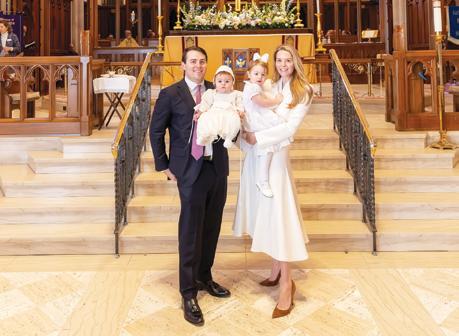
At Trinity since 2016, Director of Admissions Lauren Darden, and her husband, Tad Darden, welcomed Grace McClelland Darden on October 9, 2025. She joined proud big sisters Annie and Haisten.
Second Grade Associate Teacher
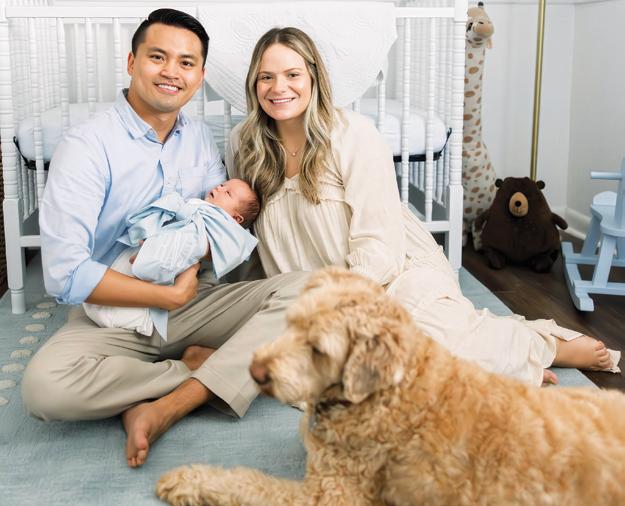
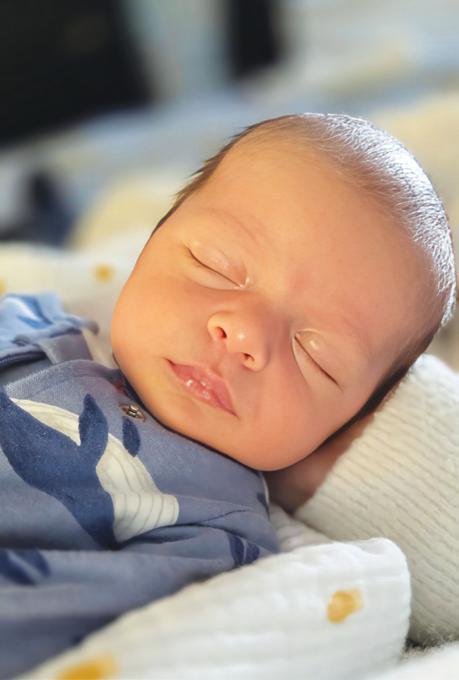
Courtney Nguyen, who has been at Trinity since 2023, and her husband, Peter Nguyen, welcomed their first child, Roman Jase Nguyen, on November 11, 2025.
Highlights
Trinity Tidbits
By Nicole Fash, Director of Marketing and Communications
Sarah Grace Barr ’13 earns master’s degree in Elementary Education
Sarah Grace Barr ’13, who has served as a Fifth Grade Associate Teacher since 2024, completed her Master of Arts in Teaching in Elementary Education from Mercer University’s Tift College of Education in December 2025.
“Earning my master’s degree in Elementary Education was important to me because I really appreciate the lasting impact teachers can have on their students,” says Sarah Grace. “As a Trinity graduate, I was shaped by thoughtful, caring educators who inspired me to become the kind of teacher my students deserve. Through this program, I deepened my understanding of building strong relationships, creating hands-on learning experiences, and honoring the many ways children learn. Lifelong learning is a core value of mine, and the love of learning Trinity instilled in me continues to guide my work as an educator. I look forward to continuing to grow and learn alongside my students in the years ahead.”
Trinity welcomes two new team members
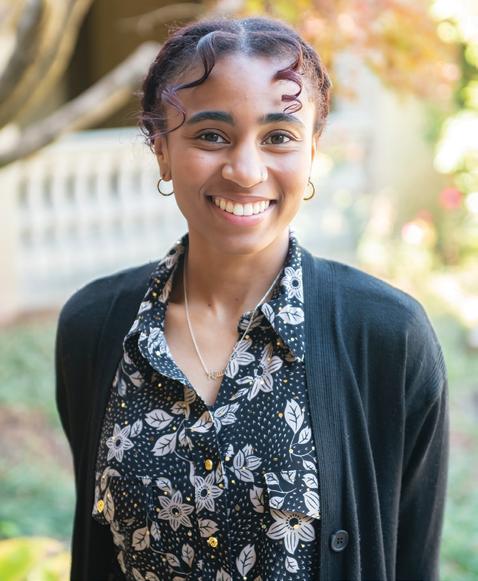
Azia Samuels joined Team Trinity in November 2025 and serves as our Receptionist four days a week. Azia brings more than four years of experience in education, program coordination, and client engagement. Before joining Trinity, she taught at Green Acres Elementary, Wolf Creek Elementary, and St. Martin’s Episcopal School, where she was known for her logistics management, creative problem solving, and communication skills. Azia holds a Bachelor of Arts in Music Education from Georgia State University and is pursuing an Associate of Applied Science in Occupational Therapy at Chattahoochee Technical College.
When asked why she wanted to work at Trinity, Azia responded: “I wanted to work at Trinity because of its strong academic reputation and its focus on developing students’ character alongside their education. I really admire how the School values both excellence and personal growth.”
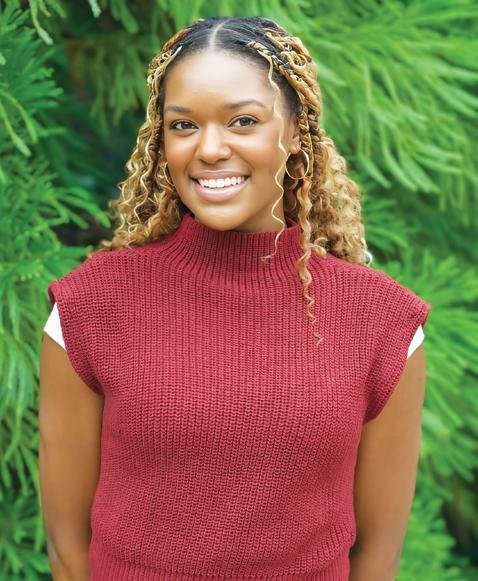
Sierra Payton joined Trinity in January as an Extended Programs Lead Teacher. She brings experience in early childhood education, team leadership, and community engagement. Most recently, Sierra served as a Garden Teacher at Little Scholars Academy in Atlanta, where she designed hands-on learning experiences for young children and collaborated closely with fellow educators. Previously, she held assistant managerial roles at Biofuel Oasis Cooperative in Berkeley and Alameda Point Collaborative’s Farm2Market program, supervising staff and volunteers, managing daily operations, and supporting youth and community programming. Sierra holds a Bachelor of Science in Media Studies with minors in Film Studies and Urban Agriculture from the University of San Francisco.
When asked why she wanted to work in education, Sierra responded: “I have been around early childcare since I was little, and one of my dreams has always been to be a teacher. I would play pretend school with my little brother when we were younger and make him do homework, which he did not enjoy but I thought was pretty fun.”
Trinity students donate 412 pairs of pajamas
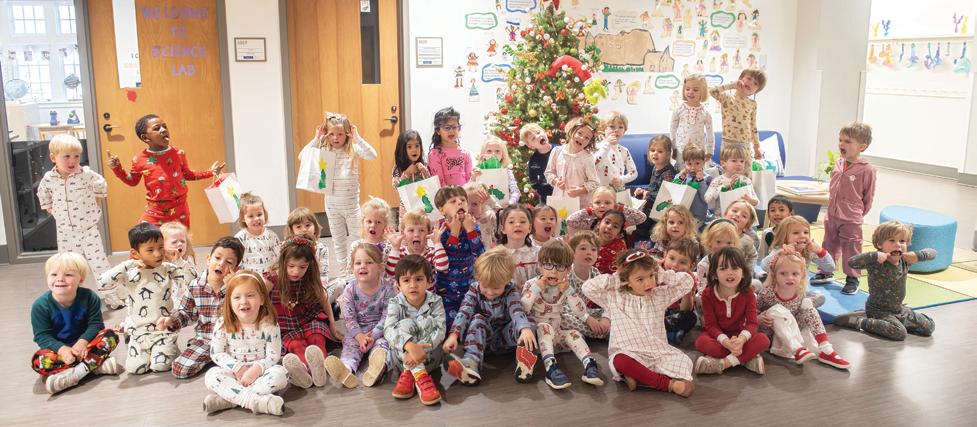
Now in its 14th year, Trinity’s Early Learners and Pre-K classes continued a cherished tradition of caring for others through the Warmth Project. During the month of December 2025, families contributed new pajamas for children facing difficult circumstances, helping students connect classroom conversations about comfort and security with real-world action. Through Trinity’s partnership with Pajama Program—a nonprofit focused on promoting healthy sleep for children nationwide—students see how even small acts of generosity can have lasting impact. This year, the children gathered 412 pairs of pajamas, and the milestone was marked with a festive Pajama Day celebration on December 12.
Fifth Graders participate in Brindemos Felicidad project
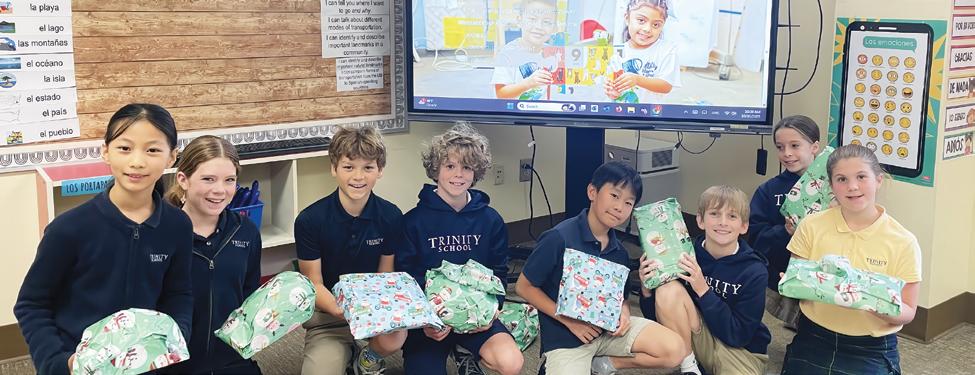
In December 2025, Fifth-Grade students in Señora Lily Catano’s Spanish class participated in what she dubbed Brindemos Felicidad, or Bringing Happiness in English. As part of the project, students wrapped gifts brought in by Señora Catano for children enrolled in the Early Literacy program at Los Niños Primero, a metro Atlanta nonprofit that provides educational, social, and leadership programs for Latino children and their families. This community service experience emphasized compassion, kindness, and awareness of others, while helping students understand the importance of giving back. The project held special meaning for Señora Catano, who has served as Los Niños Primero’s Family Engagement Coordinator since 2019.
Disney characters go on parade
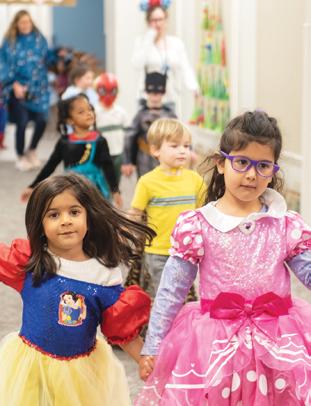
One of the most magical events of the school year took place on December 5, 2025, when Extended Programs hosted its annual Disney parade for Early Learners who attend Lunch Bunch. Trinity’s youngest students dressed as their favorite Disney characters and paraded around campus as members of the school community cheered them on.
Sixth Graders dive into the science of flavor in STEAM Lab
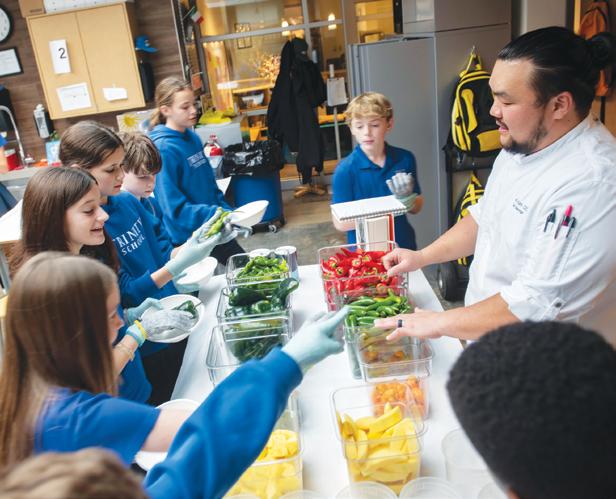
On December 2, 2025, Sixth Graders took their STEAM learning to a new level as they explored the art and science of lacto-fermentation with Mr. Pileggi, Mr. Valentine, and special guest Chef Josh Kim. Students examined how fermentation works and why it matters, then applied their knowledge by making their own hot sauce. From selecting peppers and chopping with precision to calculating the ideal salt percentage for a brine and sealing their jars, the experience blended chemistry, math, and culinary creativity. The project offered a dynamic hands-on learning opportunity, and the results had plenty of kick.
Fifth Graders turn learning into impact at Freshwater Fair and Walk for Water
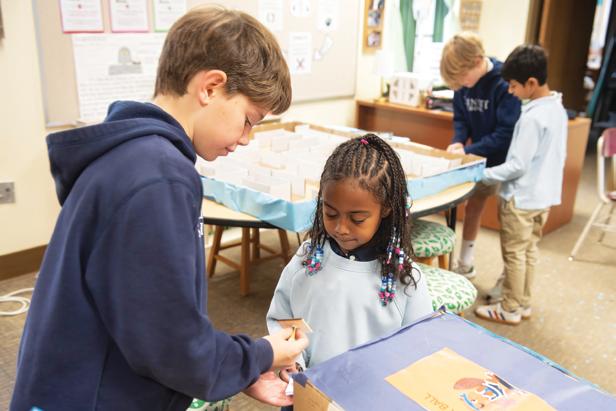
On December 4, 2025, Fifth Graders brought learning and service together through their annual Freshwater Fair and Walk for Water, deepening their understanding of global water access while making a tangible difference. At the Freshwater Fair, students hosted hand-crafted games and shared researched facts about animals from around the world, inviting classmates, employees, and families to participate through five-coin donations. Students also raised a record-breaking $25,729.14 in support of Start With One Kenya through their walk-a-thon. When combined with $832.64 raised at the Freshwater Fair, the total funds are enough to purchase 664 life-saving Uzima Water Filters. Each filter provides clean drinking water for a family for up to 10 years, extending the impact of the Fifth Grade’s work well beyond campus.
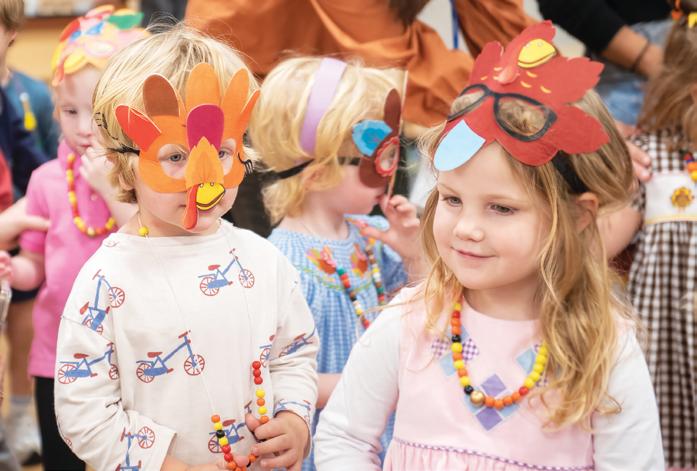
Early Learners celebrate connections at Friendship Feast
Early Learners gathered on November 20, 2025, for their annual Friendship Feast, a beloved tradition that highlights the importance of kindness and community. Students sang songs, exchanged necklaces, and shared a meal together, enjoying a joyful celebration of friendship.
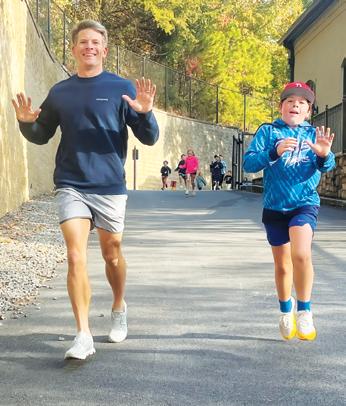
Trinity Turkey Trot brings families together for fun and fitness
On November 15, 2025, Trinity families gathered on the Trinity Track for this school year’s Turkey Trot, a one-mile Fun Run/Walk that has become a favorite school tradition. Runners and walkers of all ages enjoyed a beautiful fall morning on campus, followed by light refreshments at the finish line. The event continued to strengthen community spirit while encouraging healthy habits for the whole family.
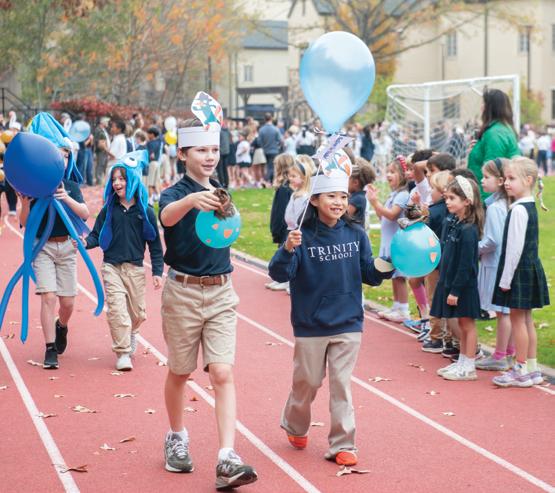
Third Graders celebrate Thanksgiving with Balloons Over Trinity parade
The Third Grade’s Balloons Over Trinity parade returned on November 20, 2025, continuing a festive tradition inspired by the book Balloons Over Broadway that began in 2020. Students designed and created their own balloon puppets, combining creativity with STEAM learning as they brought their creations to life in an outdoor procession around the Trinity Track. With teachers and staff members joining in the fun, the parade was a joyful celebration of imagination, collaboration, and Thanksgiving cheer.
Highlights
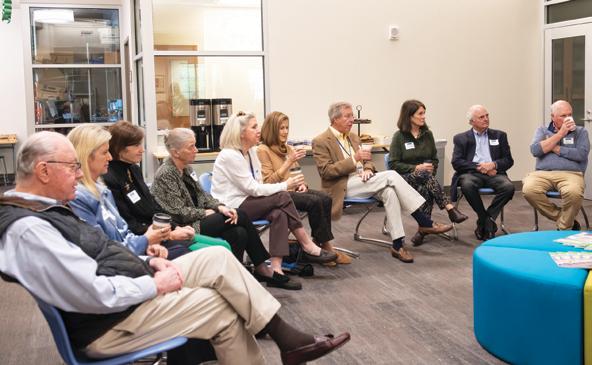
Former Trustees reconnect and reflect at Coffee and Conversation
Former Trustees returned to campus on November 20, 2025, for this year’s Coffee and Conversation gathering, where they joined current Board members and the Head of School for a morning of reflection and looking ahead. The group discussed Trinity’s history and plans for the upcoming 75th anniversary. The event offered a meaningful opportunity to honor longstanding leadership and strengthen ties across generations of Trustees.
Trinity community supports Kate’s Club
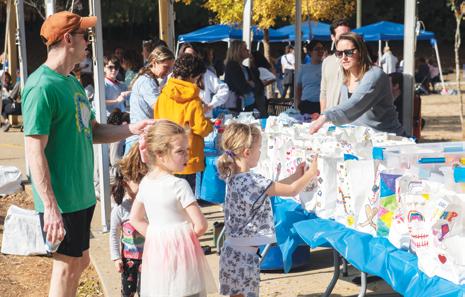
Trinity’s 13th annual Day of Service took place on November 9, when students and families joined Kate’s Club for its 2025 Memory Walk: A Circle of Connection. The event brought together children and families who are grieving the death of someone important to them, offering space to honor loved ones while being supported by a compassionate community. In the weeks leading up to the walk, Early Learners–Fourth Grade students decorated grab-and-go snack bags and collected snack items, while Fifth and Sixth Graders assembled the bags and contributed fruit donations. On the day of the event, Trinity volunteers participated in the walk and distributed the snack bags to attendees. The partnership reflects Trinity’s ongoing commitment to service and to supporting organizations that strengthen and uplift children and families.
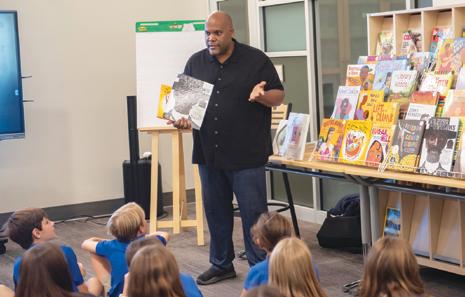
Visiting illustrator R. Gregory Christie inspires students
On October 22, 2025, Trinity’s Fifth and Sixth Graders had the incredible opportunity to hear from awardwinning children’s book illustrator R. Gregory Christie. Mr. Christie shared insights into his creative process, showcased examples of his artwork, and inspired students with stories from his remarkable career.
Mr. Christie has illustrated several dozen books and his many honors include a Caldecott Honor, six Coretta Scott King Honor Awards, an NAACP Image Award, and a nomination for the Astrid Lindgren Memorial Award.
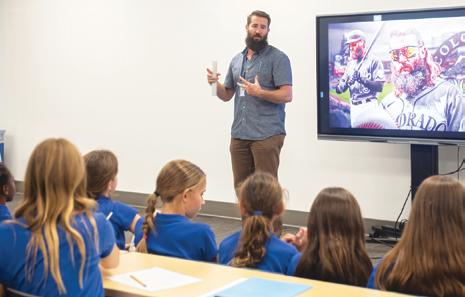
The Leadership Class welcomes Charlie Blackmon
As part of the Sixth Grade Leadership Series, former Major League Baseball player and Trinity parent Charlie Blackmon, who spent his 14-year Major League Baseball career with the Colorado Rockies, met with Sixth Graders on October 20, 2025, to share his inspiring journey of perseverance and leadership. Charlie spoke about working hard in the classroom and on the field to pursue his dream of playing baseball for Georgia Tech. He was initially not offered a scholarship to Tech, so he attended Young Harris College, where he focused on building his strength, sharpening his skills, and continuing to excel academically. His dedication paid off when he earned a scholarship to play for Georgia Tech, where he attended his junior and senior years, flourishing both athletically and academically. Charlie encouraged students to lead by example and to stay committed to their goals, on and off the field. Sixth Graders asked thoughtful questions and were excited to receive autographs at the end of his visit.
Sixth Graders explore history and nature on fall Outdoor Education trip
From October 6 to 9, 2025, our Sixth Graders embarked on their annual fall Outdoor Education trip. Students explored marine life at the Tybee Island Marine Science Center, took a dolphin cruise, and experienced the local ecosystem firsthand. In Savannah, they toured the Massie Heritage Center, historic squares, and the First African Baptist Church, and visited Fort Jackson and the National Museum of the Mighty Eighth Air Force to learn about pivotal moments in history. The trip also included a picnic at Forsyth Park and a stroll along the River Walk, offering students a mix of learning, adventure, and lasting memories.
Jill Gough leads CPAM Leadership Seminar at NCTM annual meeting
In advance of the National Council of Teachers of Mathematics (NCTM) annual meeting in Atlanta, Jill Gough, Trinity’s Director of Teaching and Learning since 2012, led the twenty-first CPAM Leadership Seminar, made possible by a grant from Texas Instruments. Held on October 15, 2025, Jill’s session, “Visualization in a Language-Rich Mathematics Class, K–12,” invited educators to examine how students build, retain, and transfer mathematical understanding across grade levels. She guided participants in exploring how to connect prior knowledge to new learning along the K–12 trajectory, apply orthographic mapping to strengthen memory and reduce relearning, and use retrieval practice and high-quality feedback to deepen understanding. Jill is a past recipient of the Presidential Award for Excellence in Mathematics.
Trinity’s annual School Festival brings fall fun to campus
Trinity’s annual School Festival on October 19, 2025, was a day full of fun, fall-themed festivities! Families enjoyed rides and activities, including the Mountain High Epic Slide, Ballistic Swing Ride, Pirate Ship Ride, hayrides, bounce houses, inflatable obstacle course, carnival games, and more. A special thank you to Dr. Anuj Patel and PA Molly Williams of Piedmont Orthopedics for sponsoring the beloved fake cast station. Festive concessions, face painting, glitter tattoos, and DJ-hosted music added to the excitement, with an optional pumpkin patch making the day even sweeter.
Celebrating grandparents at Trinity
On October 17, 2025, Trinity welcomed grandparents and special friends to campus for a joyful Grand Day celebration. The morning began with a warm reception and a heartfelt performance by the Harmony Choir, setting a festive tone for the day. Guests then visited classrooms to see firsthand the incredible work their grandchildren have accomplished this year. Grandparents and special friends are cherished members of the Trinity community, and Grand Day is a wonderful opportunity to celebrate the important role they play in our students’ lives.
Second Graders learn about Southeastern Native tribes
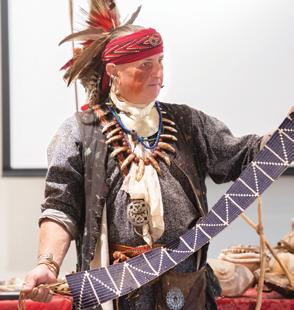
On October 5, 2025, our Second Graders enjoyed learning from special guest Jim Sawgrass, a native Floridian of Muscogee Creek (Mvskoke) descent and living historian of the tribes of Florida, Georgia, and Alabama. Mr. Sawgrass taught them about the culture of Southeastern Native tribes, sharing insights into tools, housing, clothing, and the evolution of daily life in these communities. The students also explored the history and significance of Native American powwows, learning about the various dances and their meanings. This enriching visit complemented their Native American Social Studies unit.
Lunch Bunch goes on safari
On October 3, 2025, our Early Learners who stayed for Lunch Bunch set off on a campus-wide safari adventure, one of Extended Programs’ annual traditions. Armed with curiosity and big imaginations, the children journeyed through Trinity in search of friendly “wildlife” along the way.
Fifth Graders step back in time with Kennesaw Mountain rangers
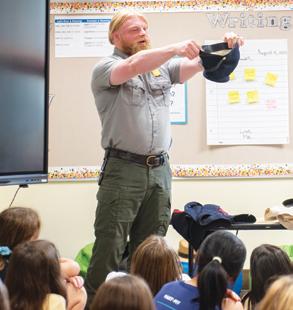
On September 29, 2025, Fifth Graders had an exciting opportunity to explore Civil War history with Jacob Boling, Education Coordinator, and James Pratt, Interpretive Ranger, from Kennesaw Mountain National Battlefield Park. Students got handson with fascinating artifacts, from canteens and cannon balls to bullets and uniforms, bringing history to life right before their eyes. Thanks to the rangers for inspiring curiosity and making the past come alive for our young historians.
Fifth Graders explore and connect during Outdoor Education trip
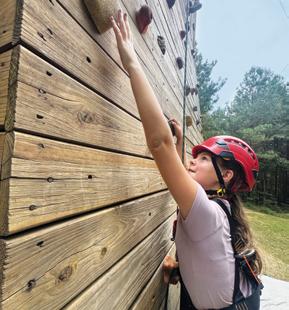
On September 25 and 26, 2025, our Fifth Graders embarked on their annual Outdoor Education adventure at Camp Twin Lakes. Students participated in hands-on activities, including team-building games, fishing, archery, canoeing, rock climbing, and crafting. The trip offered students opportunities to challenge themselves, collaborate with classmates, and make lasting memories. These outdoor experiences continue to build confidence, foster growth, and strengthen friendships and are an unforgettable highlight of the Trinity Experience.
Sixth Graders learn lessons in grit from Mark Bowen
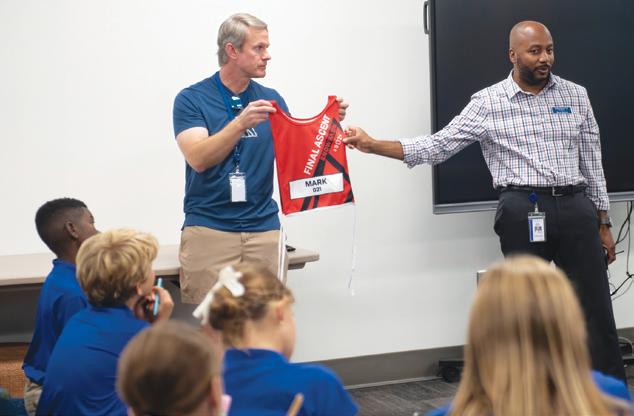
On September 8, 2025, the Sixth Grade Leadership Class welcomed Trinity parent Mark Bowen, who shared valuable lessons on perseverance, adaptability, and determination. Drawing from his experience training for and completing the 29029 challenge—a grueling endurance event that requires participants to hike the vertical equivalent of Mount Everest— Mr. Bowen encouraged students to embrace challenges with a positive mindset and apply those same qualities to their final year at Trinity and beyond.
Honoring Trinity’s roots at Founder’s Day Assembly
Our Sixth Graders led the Trinity community on a memorable journey through the School’s rich history during this year’s Founder’s Day Assembly on September 29, 2025. Together, we celebrated the many decades of Trinity and honored our visionary founder, Allison Williams, whose legacy continues to shape and inspire our community today. A heartfelt thank-you to the Sixth Grade for reminding us of our roots and encouraging us to look to the future with joy and pride.
Trinity Traditions
Trinity School’s rich history began in 1951. While the campus has moved twice since its founding and the School’s programming is continually enhanced, Trinity also maintains numerous gradelevel, division-wide, and school-wide traditions that reinforce the School’s identity, curriculum, and values. This section is dedicated to highlighting some of the many special events that our students look forward to every year.
Sixth Graders’ First Day Caravan
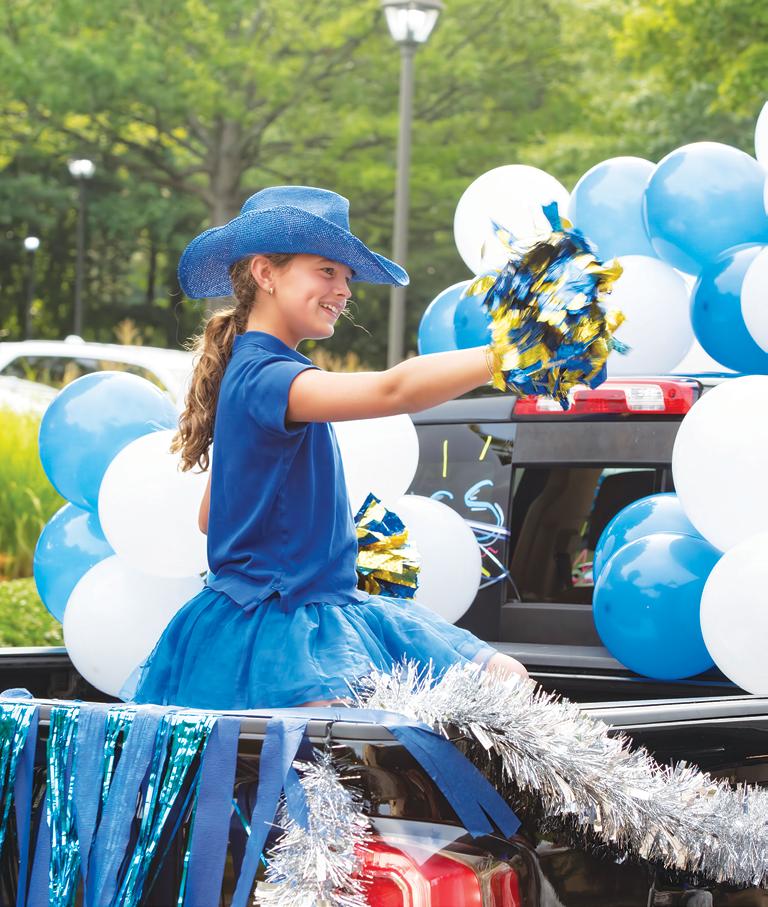
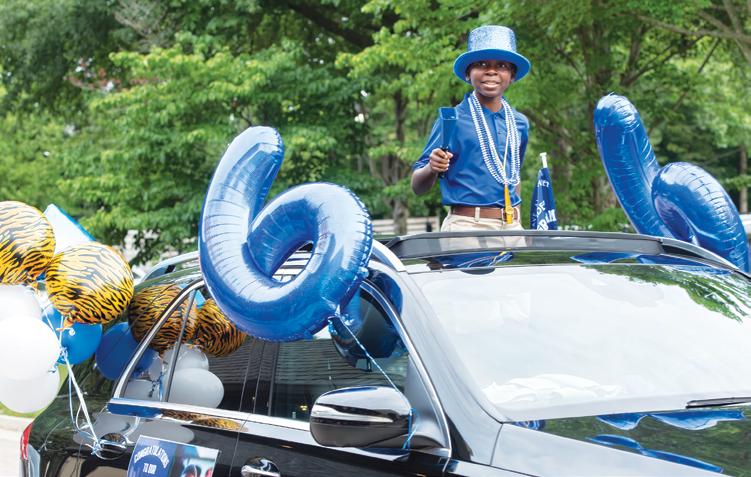
The first day of school is important for all students, but there is something extra special about the Sixth Graders’ carpool caravan.
Gingerbread Man Hunt
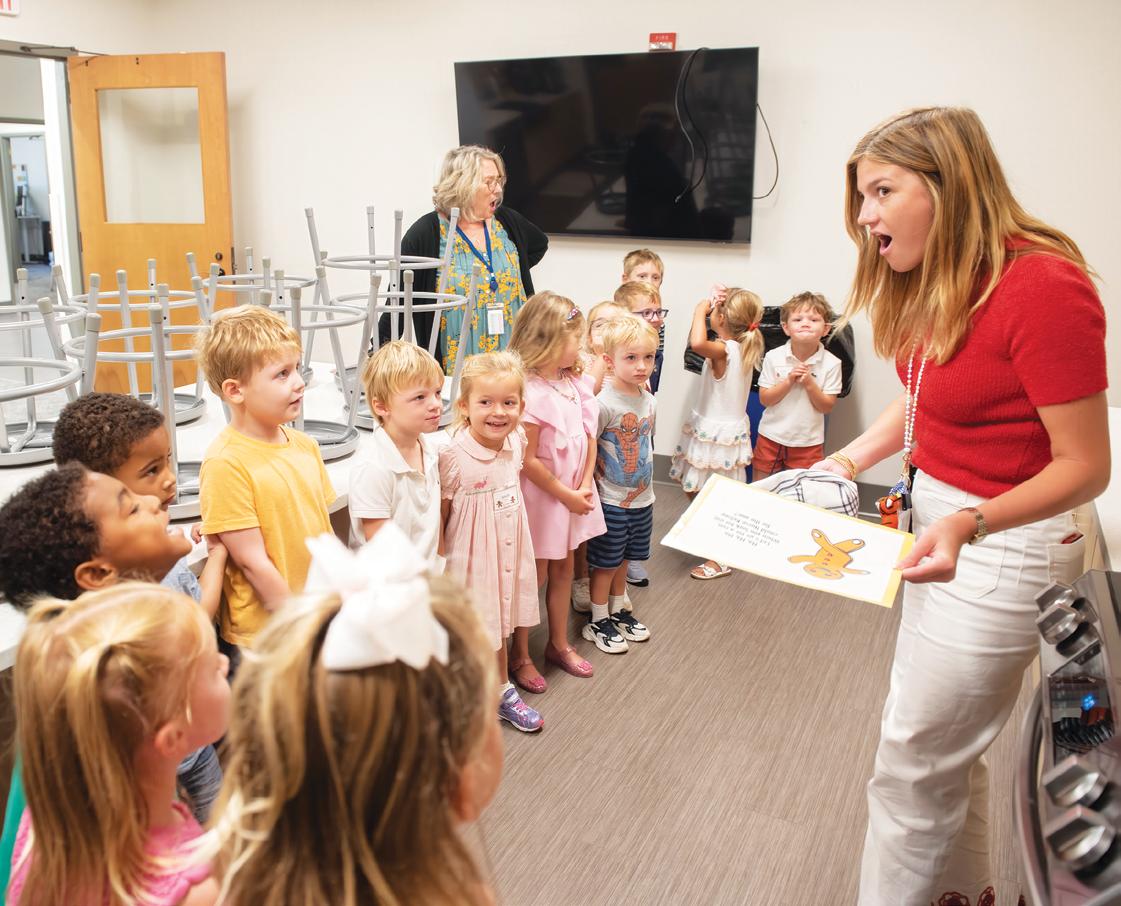
At the beginning of the school year, Pre-K students once again found the runaway Gingerbread Man while becoming acquainted with all the faces and places at Trinity. Staff and faculty from all over the campus provided students with clues to find the elusive cookie.
Pirate Week Treasure Hunt
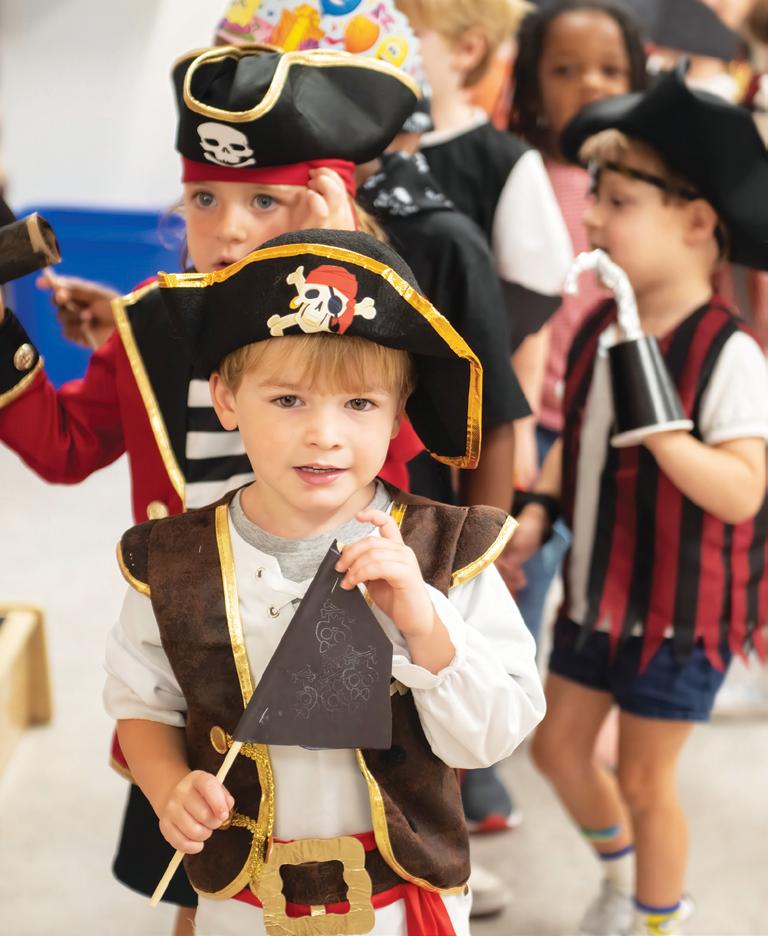
In late September, Early Learners wrapped up Pirates Week and their Shapes unit of study with a real-life treasure hunt.
Halloween Parade
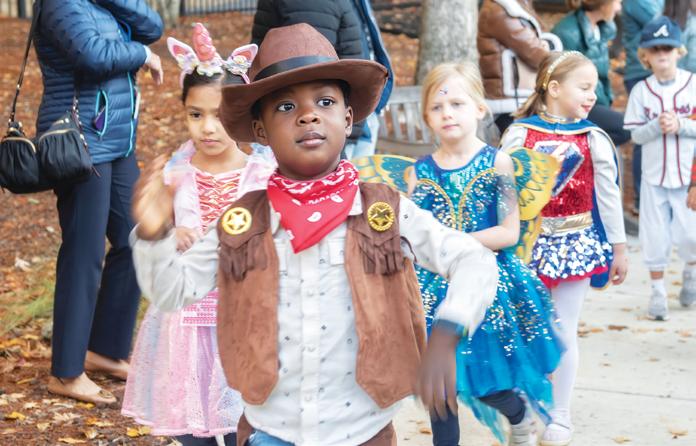
Early Elementary students and faculty donned fantastic costumes and put the Trinity community in a spooky mood during the annual Halloween Parade.
Patriotic Performance
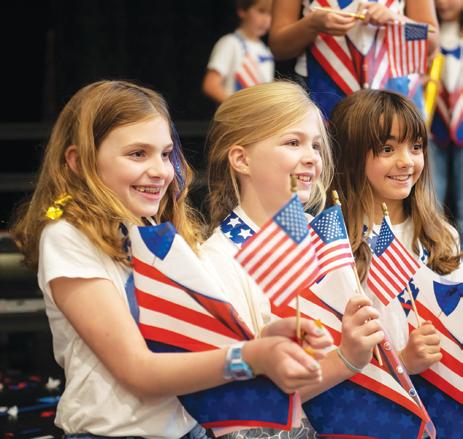
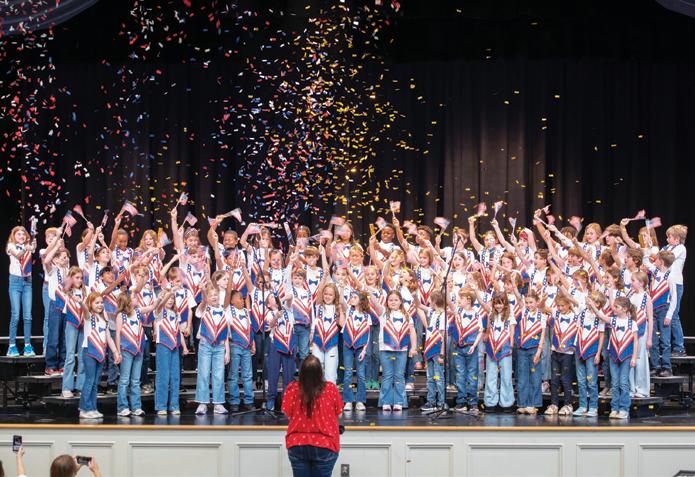
During the annual Patriotic Performance, our Fourth Graders celebrated patriotism and Veterans Day by singing songs and honoring our community’s veterans and military service members during a very moving all-school assembly.
Thanksgiving Program
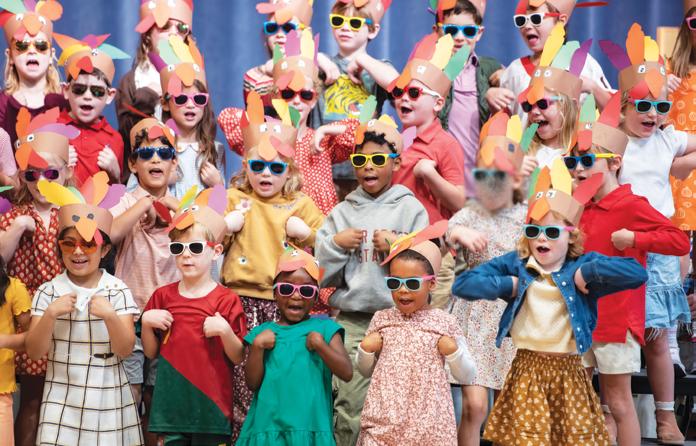
All students and teachers came together and celebrated the Thanksgiving season with musical performances during a special all-school assembly.
The Nutcracker
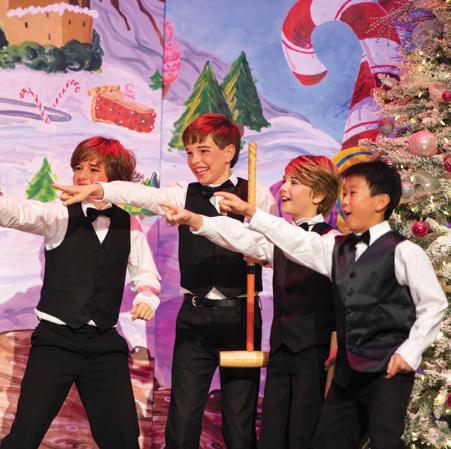
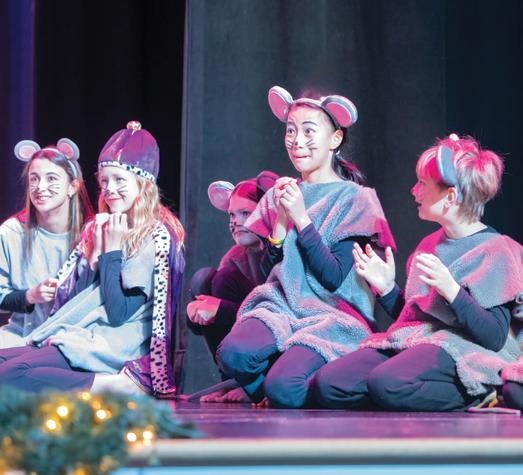
Presented every year by Fifth Graders, the much-anticipated performances of The Nutcracker were set to Tchaikovsky’s classic score and included dancing, elaborate costumes and set design, and epic battles.
Holiday Program
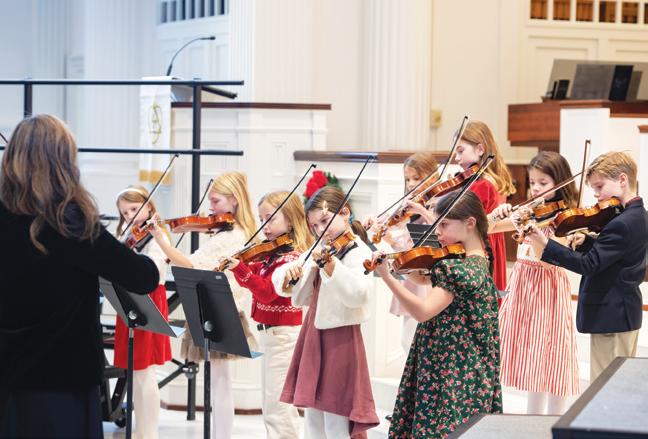
The Upper Elementary Division students put everyone in the holiday spirit by presenting a special musical performance of Christmas and Hanukkah songs at Trinity Presbyterian Church.
All traditions occurred during the first half of the 2025–26 school year.
Patriotic Performance
Holiday Program
Pirate Week Treasure Hunt
The Nutcracker
5. Gingerbread Man Hunt
6. Sixth Graders’ First Day Caravan
7. The Nutcracker
8. Patriotic Performance
9. Halloween Parade
10.
11. Halloween Parade
12. Thanksgiving Program
13.
14.
Gingerbread Man Hunt
Pirate Week Treasure Hunt
Sixth Graders’ First Day Caravan
Features
At Trinity School, our students have innumerable opportunities to discover and explore. Their innate intellectual curiosity is sparked in an academically challenging environment. Grounded in our mission and program and pedagogy pillars, The Trinity Way explains our unique approach to celebrating the present and preparing our students for the future within a nurturing and caring elementary-only educational environment.
Children don’t just grow at Trinity – they flourish.
The Trinity Way
Trinity students’ love for learning is apparent as they run into classrooms each day, looking forward to new experiences and challenges. Trinity School guides students to take charge of their learning, encouraging them to pursue their interests in a safe and nurturing environment.
Trinity Teachers build upon students’ innate curiosity and design joyful learning experiences that are meaningful and memorable in the life of a child. We cherish the wonder of childhood, building confidence by having students try new things, cheering mightily when they triumph, and supporting and redirecting them when they struggle.
Trinity prepares its students for the future, helping them build the critical academic and character foundation needed for success and happiness in middle school and beyond. We layer knowledge, concepts, and strategies to grow intellect and empathy, strengthen reasoning and retention, and cultivate new learning cumulatively and patiently, day after day and year after year. Teachers utilize highly complex and systematic instruction in a language-rich environment that looks like play but is so much more. For elementaryaged children, this learning-to-play and playing-to-learn is essential to deep engagement and understanding. Playing with ideas, words, and numbers deepens academic comprehension and flexibility. Playing with friends develops social-emotional wellness, growing students’ sense of self and sincere care and concern for others.
We set high expectations for our students, both academically and socially. Trinity celebrates each student’s individuality and value and believes that differences and diverse perspectives enrich our community. Students know that they are loved, accepted, and included at Trinity, safe to take risks and make mistakes. They fulfill classroom responsibilities; collaborate in pairs, in small groups, and with their teachers; self-reflect; and develop their growth
mindset. This awareness of community and belonging helps them learn at an early age what it means to be a classroom citizen, a grade-level citizen, a Trinity citizen, and ultimately citizens of the world.
Trinity Teachers meet students where they are and differentiate learning experiences to help them reach their unique potential. By building strong relationships with our students, we design intentional scaffolding to support and challenge them to further the development of their academic and social-emotional foundation. They have the freedom to become confident, curious learners who can assess where they are, ask questions to further their learning, and take action to deepen understanding. Results guide our decisions, and we design and use formal and informal assessments to determine what our students know and to plan next steps of instruction. As one measure of academic success, we use standardized tests to show that our students, individually and collectively, are achieving age-appropriate benchmarks, which they consistently exceed. Our students finish their Trinity journey prepared to flourish academically and socially.
A community in every sense of the word, Trinity embraces our students’ parents, who are invested and, like their children, appreciated, known, and loved. Crucial to our student and school success, our families are our greatest advocates. They support and promote the School’s mission, programming, and educational philosophy; they give of their time and their resources; and they participate in parent education and classroom events throughout the year.
Trinity graduates are known for being hard workers; selfadvocates; academically prepared; and kind, compassionate, and empathetic individuals ready to improve the world around them.
Counting
Numeracy and fluency: Beyond fast facts
By Jill Gough, Director of Teaching and Learning
When most of us think about “being good at math,” we often imagine speed: answering quickly and recalling facts instantly. Many of us remember flash cards and timed tests that rewarded how fast we could respond.
However, as educators, parents, and family members, we now recognize that genuine mathematical fluency extends beyond speed alone. It’s about understanding numbers and using them flexibly. When we describe someone as fluent in a language, we don’t mean they can recite words or phrases
by heart; we mean they can use language to express ideas, make meaning, and adapt in conversation. The same is true for mathematics. Fluency grows from comprehension, not just memorization, and when we view it through the lens of The Trinity Way—a philosophy that cherishes childhood, fosters agency, builds community, and values growth—a richer picture of numeracy comes into focus.
Mathematical fluency includes four interconnected dimensions:
During a
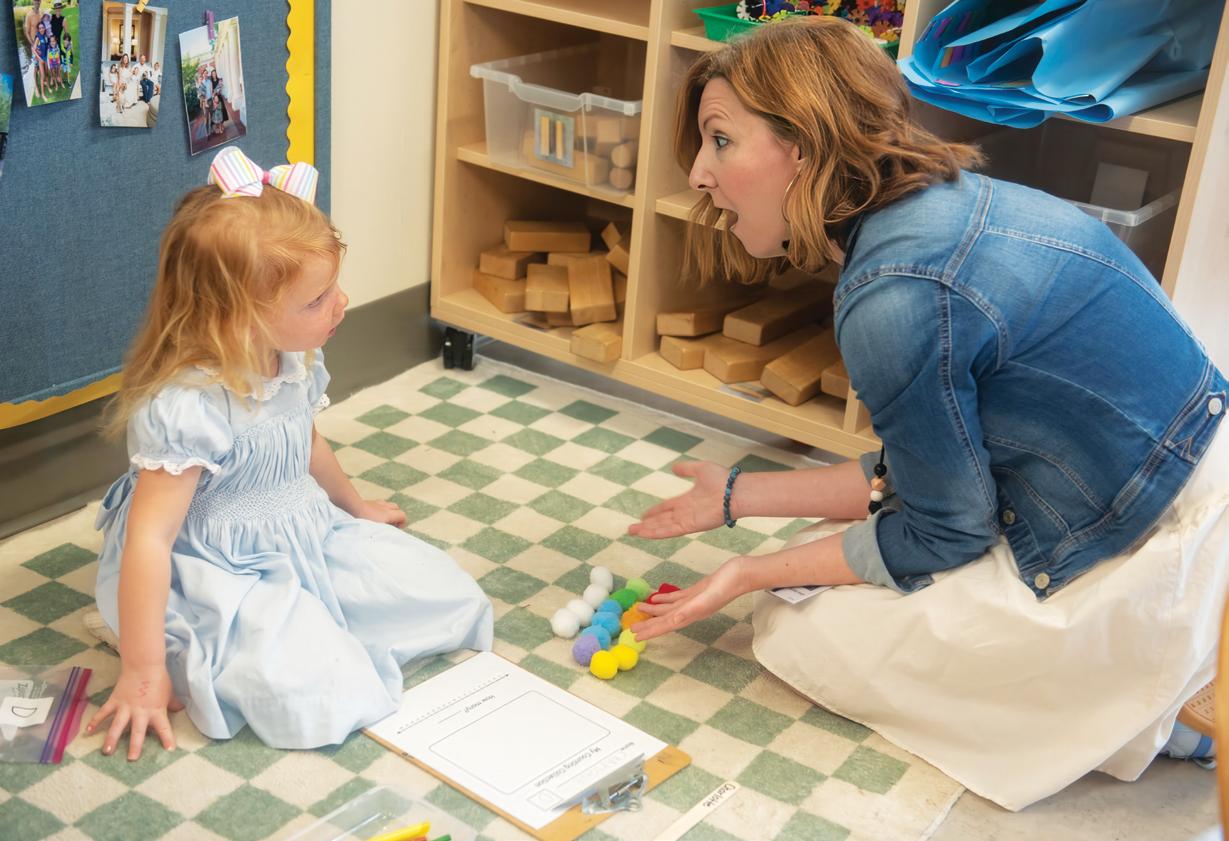
Collection, Pre-K student Charlotte excitedly shares with Ms. Sarah her realization that she can use colored pencils to record her pom poms just as she organized them by color.
1. Comprehension: understanding what numbers mean, how they relate, and how operations affect them.
2. Accuracy: reaching correct answers through reliable reasoning.
3. Flexibility: seeing multiple ways to solve a problem and choosing a method that fits.
4. Efficiency: solving problems in ways that are both accurate and practical for the situation.
Growth over time
Organizations such as the National Council of Teachers of Mathematics and National Council of Supervisors of Mathematics encourage a shift toward deep numerical understanding. From the earliest experiences with our youngest students, through the culminating projects of Grades 5 and 6, fluency develops as a continuum of exploration, reasoning, and reflection. We have replaced rote drills with number talks, visual models, and rich tasks that invite students to think critically, explain their ideas, and connect them to one another.
In Early Learners and Pre-K, students lay the foundations of numeracy through play: counting blocks, sorting objects by color and size, noticing patterns in nature, and using language such as “more,” “less,” and “same.” These playful, sensory-rich encounters with quantity form the building blocks of number sense. As students grow, those intuitive understandings evolve into symbolic reasoning and more formal problem solving.
In Kindergarten–Second Grade, fluency begins with number sense: seeing five as “a group of two and three,” or ten as “two fives.” It is about decomposing numbers with a strong understanding of place value: 120 can be decomposed as “60 + 60” or “ 100 + 20.” It’s not about writing numbers quickly but about seeing relationships and patterns. When children use manipulatives, count aloud, subitise (recognize small quantities instantly), and explain their thinking, they are laying the foundation for fluency.
By grades 3–6, students begin using numbers in more complex ways: adding and subtracting within larger ranges, multiplying, dividing, and working with fractions and decimals. A fluent student might explain that:
●• “8 × 7 = 56 because 8 × 5 is 40 and 8 × 2 is 16, and 40 + 16 = 56.”
Or:
●• “I know 7 × 7 is 49, so 8 × 7 is one more group of 7, which makes 56.”
These examples show flexibility: different paths to the same correct conclusion. Fluency allows students to choose strategies based on what makes sense to them in the moment. It’s creative, adaptable thinking—not rote recall.
There’s nothing wrong with knowing math facts by heart; recall is helpful and can free up mental space for more complex problem-solving. However, when memorization becomes the primary goal rather than a byproduct of deep understanding, we risk limiting what it means to be successful in math. Timed drills and fact races can cause anxiety for many children, especially when they equate speed with intelligence. Some students—especially those who pause, think, and reason—may begin to believe they’re “not good at math,” simply because they don’t answer quickly.
As our Math Specialist, Kerry Coote, always reminds us, “Speed is a result of fluency, not a prerequisite for it.”
Fluency built on understanding, by contrast, promotes confidence. When children explain why a strategy works, when they model it with drawings or manipulatives, and when they connect it to patterns they notice, they’re developing number sense that leads naturally to efficient recall over time. This practice of “try, redirect, keep playing with ideas” reflects The Trinity Way and is exactly what supports flexible, deep numeracy.
How to support numeracy development
Additionally, The Trinity Way explicitly names parents as “our greatest advocates … they support and promote the School’s mission, programming, and educational philosophy.” As a family member, you play a powerful role in shaping how children think and feel about math. The good news is that supporting numerical fluency at home doesn’t require worksheets, only curiosity, conversation, and play.
We have several recommendations for how parents can support numeracy development at home:
• Talk about numbers: Ask open-ended questions that encourage reasoning, not just answers: “How did you figure that out?” and “Can you think of another way to show that?” Counting, organizing, measuring, comparing prices, estimating time or distance—all of these are authentic opportunities for children to see numbers as part of the world around them.
• Play to Learn: Play games like Yahtzee, Uno, Prime Climb, Connect Four, or Dominoes to help children practice number relationships, patterns, and logical thinking without the pressure of formal math. Dice or card games naturally invite children to add, subtract, and reason about probability.
•● Encourage visual and verbal thinking: Listen carefully when a child explains how they solved a problem, which is evidence of comprehension. Ask them to draw or model their thinking. Respond with appreciation—“I love how you saw that pattern”—rather than evaluation— “That’s right” or “That’s wrong.”
•● Focus on growth, not speed: Celebrate persistence and reasoning. Remind your child that mathematicians often pause, wonder, and try multiple approaches before arriving at a solution. Quick recall will come, but it’s not the only—or the most important—measure of progress.
Redefining success in mathematics
As a community, we can help redefine what success looks like in math learning. Success is not just “getting it right the first time” or “finishing quickly” but also being willing to explore, reason, and persevere, seeing mistakes as part of learning and questions as opportunities to think more deeply. In line with The Trinity Way, success is also about community and belonging: students working in pairs or groups, discussing numbers, feeling valued for their thinking, not just their answers.
A child who says, “I tried this way, but it didn’t work, so I tried another,” is demonstrating the essence of mathematical fluency. This flexible, reflective mindset is exactly what we want our students to carry into more advanced mathematics, and into life.
Numerical fluency is not a race to memorize facts; it’s a journey of sense-making. It begins with curiosity, grows through exploration, and strengthens through reflection. When children develop comprehension, accuracy, flexibility, and efficiency, they don’t just do math—they understand it. And when our families and educators, grounded in the values of The Trinity Way, partner to nurture this kind of fluency, we are helping students become confident, capable problem-solvers who see mathematics not as a test to pass, but as a language for understanding their world. We are helping them flourish.
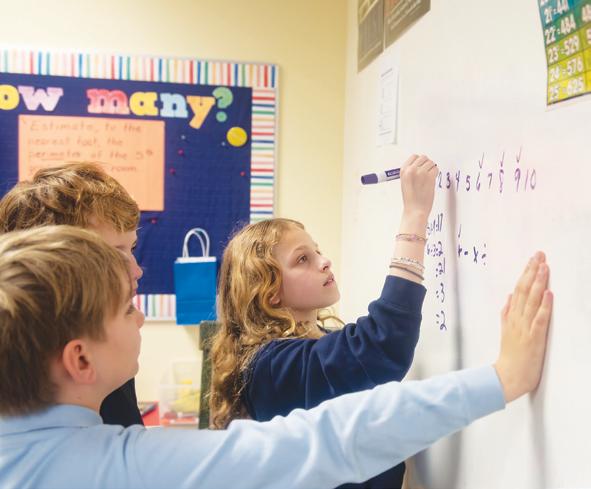
Fifth Graders James, Walker, and Hannah work at the board to create equations using the digits 1–10 only once, building five expressions that match given answers using all four mathematical operations.
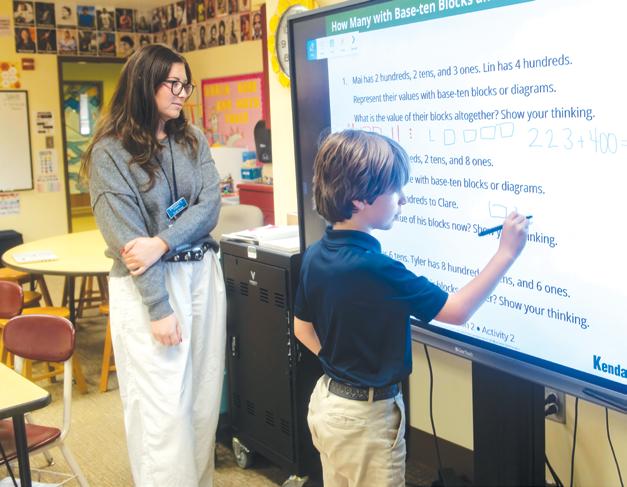
deepens his understanding of place value by representing a three-digit number with a place value drawing.
Ms. Snyder looks on as Second Grader Hoyt
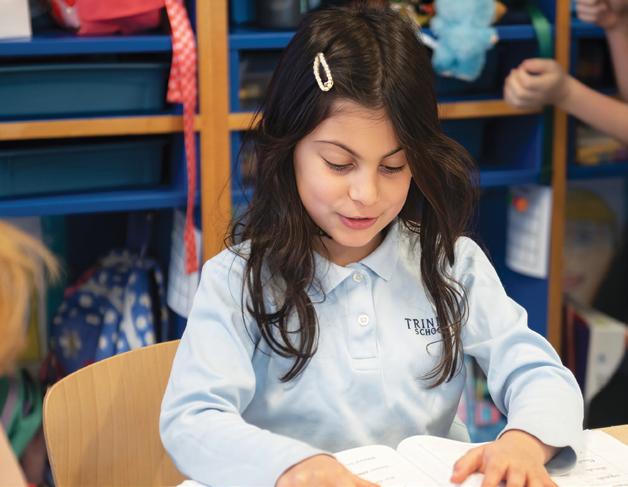
After she practices spelling words that follow a new spelling pattern, First Grader Lara builds fluency by “scooping” words into phrases as she reads.
Why fluency is the key to unlocking literacy
By Marsha Harris, Director of Curriculum
As a former classroom teacher, I spent many years administering reading assessments and running records. I would sit down one-on-one with my First-Grade students, listening to them read and assessing their rate, accuracy, self-corrections, fluency, and comprehension. Some children would sound out every other word, such as “b r ō k ən” and “bī sə kəl,” struggling to blend the sounds. By the end of the sentence or passage, they could barely recall what they had just read and struggled to respond to basic comprehension questions.
In contrast, other children read with a natural rhythm, paying attention to punctuation, pausing when appropriate, and inflecting their voices at question marks and during exciting moments. This group of students created a vivid movie in their minds, leading to a deep understanding of the text they engaged with. This group of students was able to not only decode automatically but also understand how writing mechanics and text features play a critical role in reading comprehension.
The difference between these two readers is not just speed; it is fluency.
At Trinity School, our commitment to understanding the Science of Reading helps drive our literacy programming.
Fourth Graders practice oral reading fluency with Ms. Payne as part of their small group literacy rotations.
We’re dedicated to explicitly teaching phonics, and the culminating skill of being a proficient reader is demonstrated through comprehension. As Dr. Timothy Rasinski, a leading literacy expert and researcher, says, “Fluency is the bridge to comprehension.” We discuss this with our faculty—why it matters and how it’s crucial to scaffold these skills for our students—as we continue to hone and enhance our curriculum and practices.
If it’s not speed reading, what is fluency?
One of the biggest misconceptions about fluency is that the faster you read, the more fluent you are. The foundational research of Dr. Jan Hasbrouck—a leading educational consultant and author—defines fluency not just by speed, but by the combination of three essential skills.
1. Accuracy: Reading words correctly without frequent errors.
2. Rate: Reading at a conversational pace that flows appropriately.
3. Prosody: Reading with expression, proper phrasing, and intonation that reflects the meaning of the text.
Fluent reading should sound more conversational when these three elements are aligned and secure. But the importance of fluency goes far deeper than just sounding good—it is about freeing up cognitive load to bridge decoding and comprehension.
American psychologist and literacy expert Dr. Hollis Scarborough’s Reading Rope model allows us to visualize the two crucial components of reading: the marriage of language comprehension and word recognition develops and becomes increasingly strategic and automatic. When those skills are secure, students become more fluent readers, which ultimately leads to skilled reading and comprehension.
Cognitive demand: Freeing the brain to think
The most critical conversation for fluency instruction lies in Cognitive Load Theory, developed by educational psychologist John Sweller in 1988. Understanding that the human brain has limited “bandwidth” available for processing information and completing tasks is important for emerging readers, writers, and mathematicians.
For an emerging reader, decoding text (matching letters to sounds) is cognitively demanding. When young students dedicate 90 percent of their mental energy to decoding individual words, they have only 10 percent left to understand what those words actually mean. So a child may be able to read a passage accurately but struggle with comprehension and understanding the story’s gist. The cognitive demand on the reader has been overloaded. We call this “word calling.” This can be frustrating and is a clear indication that reading comprehension is complex, which is why we spend so much time developing and mapping phonics skills throughout Third Grade. We want our students to become automatic decoders and readers.
When a student achieves automaticity—the ability to recognize letters, sounds, and words instantly and effortlessly—that cognitive burden is lifted. Their brain power shifts from “How do I say this word?” to “What does this sentence mean?” As adults, our eyes move faster, and our brain has been trained to read automatically as we prepare for meaning. Even when adults read aloud, we know how to interpret the meaning for our listeners because we have automaticity, pace, and prosody in our reading.
This automaticity also transforms writing and spelling. When a child is fluent in letter-sound correspondence, they don’t have to labor over how to form a ‘b’ or what sound ‘th’ makes. This frees up their working memory to focus on composing thoughts, organizing ideas, and using
descriptive vocabulary. Fluency in writing is critical for our young learners. They hold on to a tremendous amount of information when they compose. The basic skills of matching letters to sounds, forming those letters correctly, and combining them into words and sentences—all while holding on to their creative thoughts—are incredibly taxing for our young learners. Intentional scaffolding and explicit instruction help free up the cognitive demand.
Scaffolding fluency: A Trinity roadmap
At Trinity, fluency is not a skill that appears overnight. It is built systematically and intentionally. We view it as a ladder with specific rungs, and we ensure students are secure on one rung before reaching for the next.
In Early Learners, students focus on recognizing the sounds and symbols of frequently encountered letters.
In our Pre-K and Kindergarten classrooms, the work begins with the foundation. Using the proven literacy programs Heggerty and Fundations, we focus on sound and letter naming fluency.
• The goal is for students to rapidly name letters or produce sounds instantly for letters like “sh” or “th.” If they pause to recall that “b” says /b/, their working memory is interrupted before they even begin to blend the word.
In Kindergarten and First Grade, the focus shifts to word reading fluency.
• Teachers guide students through blending sounds into words. We practice nonsense word fluency (words like zop and chim) to ensure students are decoding, not guessing. Simultaneously, we build real word fluency to help students “orthographically map” high-frequency words into their memory for instant retrieval.
In First and Second Grade, we move to sentence and phrase fluency.
• A teacher might pause during a Fundations lesson and say, “Listen to how I scoop these words.” Instead of reading robotically (The... dog... ran...), the students practice reading in meaningful phrases ([The dog] [ran] [to the park]).
From Second Grade through Sixth Grade, we aim for passage fluency.
●• Using our Bookworms curriculum and intentionally designed novel studies, students engage in shared reading. They learn that punctuation is like a stage direction. A whisper, a shout, or a pause adds meaning.
If a student reads “I can’t believe you did that!” in a monotone voice, they miss the sarcasm or anger. This is where fluency directly feeds comprehension.
Our method: Systematic, direct, and explicit instruction
At Trinity, fluency is not something we hope students simply “pick up” through exposure. It is taught through direct, explicit instruction. This means our teachers leave nothing to guesswork. We use a clear modeling cycle from educational consultant and author Dr. Anita Archer—often referred to as “I Do, We Do, You Do”—to demonstrate exactly what fluent reading sounds like.
The best form of explicit instruction is when teachers read-aloud to students. They model fluency, talk out loud, identify text features, and discuss the author’s craft. All of this brings students closer to the text and allows them to practice those skills with a partner or independently.
Our students engage in specific activities designed to boost fluency, all of which rely on that explicit modeling.
• Choral Reading: The whole class reads a passage aloud together, providing a safety net for reluctant readers.
• Echo Reading: The teacher reads a line with perfect expression, and the students mimic it back, following the clear auditory map to “try on” the prosody.
• Repeated Reading: A cornerstone of Dr. Rasinski’s approach, re-reading a familiar text multiple times allows the student to master the mechanics of that specific passage, giving them the confidence to focus on expression and “deep reading.”
We are continually monitoring this growth. We use standardized screeners like DIBELS to measure metrics such as correct words per minute, and we view this data alongside the oral reading norms established by Drs. Hasbrouck and Gerald Tindal.
But numbers only tell part of the story. Our teachers are constantly conducting informal assessments: listening during instructional time and small groups, conferring one-on-one, and observing that magical shift where a child stops decoding the words and starts reading the story.
The family partnership
As children’s author Emilie Buchwald says, “Children are made readers on the laps of their parents.” So, how can parents help their children at home?
• The “I Read, We Read” method: Read a page of a book
aloud to your child to model what fluent reading sounds like. Then, read the same page together. Finally, have them read it to you.
• Don’t rush the rescue: If your child struggles with a word, give them a moment to decode it. Once they solve it, ask them to re-read the whole sentence. This helps them place the difficult word back into the meaning of the story.
• Audiobooks are great: Listening to audiobooks helps children hear proper phrasing and expression, even for books that might be above their current reading level. If you have an Audible account, it’s a great way to listen to books in the car or follow along in a chapter book.
• Praise specific skills, not just speed: Instead of saying “You read that so fast,” try saying “I loved how you made your voice sound like a grumpy bear when you read that part!”
• Build background: Before reading a story, discuss the content with your child so they have an understanding of what’s coming. When they can make connections to a topic, their fluency will improve. For example, if you read Tops and Bottoms by Janet Stevens, you might discuss different kinds of vegetables, how they grow, and how they’re harvested before you read.
• Re-read: Re-reading favorite books over and over again promotes fluency. It is a pathway to success if the child knows the words that are coming and understands the story from previous reads.
Fluency fuels a lifelong love of reading, which becomes enjoyable when it is effortless. By focusing on foundational skills now—from recognizing letters in Early Learners to the expressive reading of novels in the Upper Elementary Division—we are ensuring that our students have the cognitive freedom to become critical thinkers, creative writers, and avid readers.
Stepping up: How Sixth Graders became tech leaders
By Koby Collins, IT Support Specialist
The Tech-Teer Program began with a simple observation. In classrooms across Trinity, I noticed students quietly stepping up to help one another and their teachers with Chromebook hiccups. They offered guidance without being asked and showed patience beyond their years. I began to see an opportunity to not only preserve instructional time but also cultivate student leadership. What became clear was not a need for more rules or reminders but for greater presence: an additional set of eyes, ears, and hands in classrooms in the form of students who could notice problems early, reinforce technology expectations kindly but confidently, and support others consistently. Just as importantly, I wanted to empower those who were already tech-savvy or naturally patient, kind, and teachable—students with what I often call the heart of a teacher.
From that vision, the Tech-Teer Program was launched at the beginning of this school year.
Sixth Graders apply for the Tech-Teer role through a formal job application process. Many applicants were already the quiet helpers in their classrooms. The application process gave their strengths recognition and purpose, while also making clear that the role carries real responsibility.
At its core, the program engages Sixth-Grade student volunteers to support our school’s technology operations through weekly Chromebook care checks and peer support. Each Wednesday morning, technology volunteers,
a.k.a. Tech-Teers, rotate through Upper Elementary classrooms, assisting with basic troubleshooting, identifying device concerns early, and modeling responsible technology use. While they primarily help students, they also assist teachers when requested.
Before beginning their fieldwork, Tech-Teers complete an onboarding process focused on technology language, appropriate leadership tone, and basic device assessment and problem solving. We discuss how to help without taking over and how to remain calm and respectful under pressure. This foundation matters. It ensures that support is consistent, appropriate, and skill-building rather than disruptive.
The impact became clear quickly: device downtime dropped, technology-related classroom disruptions decreased, and repairs were addressed earlier, before issues escalated. Most notably, the number of Chromebooks needing replacement has dropped 88 percent since the program was implemented. This reduction reflects stronger stewardship of our shared resources and, more importantly, fewer interruptions to learning.
Tech-Teers wear a specially designed badge featuring Stripes the Tiger, reserved exclusively for them. To cultivate responsibility and recognize growth, I developed a badge color system inspired by my background in martial arts, where advancement is earned through skill,
Sixth Grader Brooks helps Third Grader Chase troubleshoot his laptop.
Members of the Tech-Teer team meet with Mr. Collins to discuss their plan for the morning.
consistency, discipline, and respect. I wanted that same mindset applied here. Students progress through badge colors that reflect their level of responsibility and care. Orange represents the beginner stage, Yellow signals rising progress, Green reflects All-Star performance, and Blue denotes mastery.
Advancement is earned, and to support accountability and growth, Tech-Teers use a structured checklist with a clear rubric and scale. Students are evaluated over time rather than on a single moment, making expectations visible and progress measurable.
In addition to our appointed Sixth Graders’ support, each Second–Fifth-Grade classroom has a student who serves as in-room support when the Tech-Teers are not present. These members of the Tech Patrol, identified by a Blue badge, assist with the weekly technology maintenance, such as restarting devices, implementing critical updates, and sanitizing Chromebooks. Tech Patrol students are selected by Tech-Teers, reinforcing trust and leadership within the system.
All of this work would not be possible without the help and support of our community. Thank you to the base teachers who have consistently supported the program and affirmed our students. A special thank you to members of the technology department—Director of Education Technology Jeff Morrison, Information Systems Manager Karen Johnson, and Security System Administrator Anthony Taylor.
The Tech-Teer Program supports Trinity’s commitment to intentional, balanced, and safe technology use. What began as a response to damaged devices has evolved into a program defined by stewardship, service, and community pride. Our Sixth Graders model leadership in visible ways: younger students look up to them and gain confidence from their guidance, teachers rely on their steady presence, and the Tech-Teers themselves learn that leadership is less about authority and more about service, consistency, and care. Watching these students embrace those responsibilities has been one of the most meaningful parts of my work.
Tech-Teer McKinley helps Fourth Grader Finnley with her Chromebook.
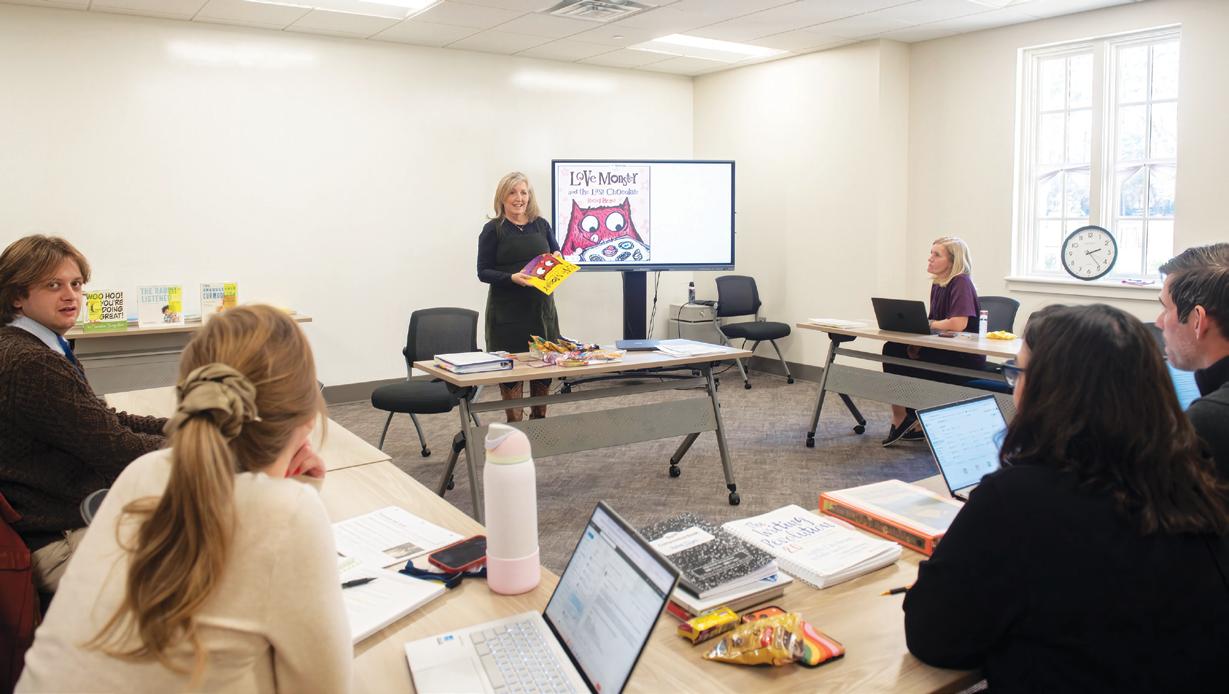
During The Writing Revolution, Jill Gough leads a discussion on making thinking visible, using writing routines to check for comprehension.
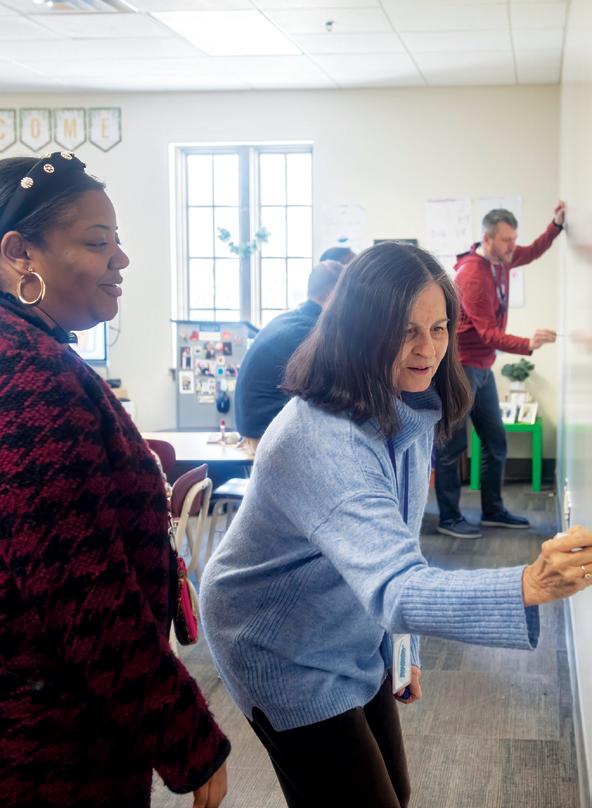
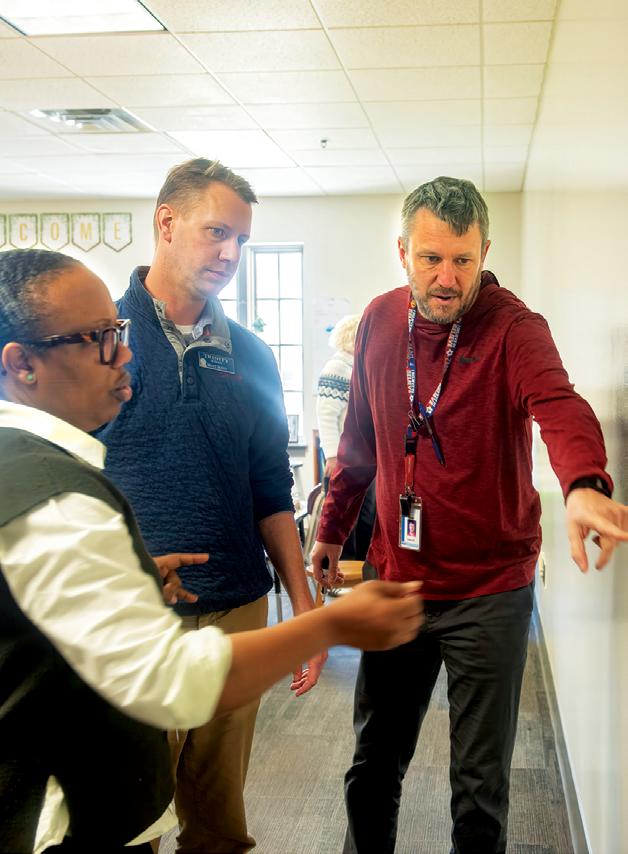
During Building Thinking Classrooms in Mathematics, teachers collaborate on a math task to step into the student perspective, strengthening how they give feedback that extends thinking and deepens understanding.
Thinking, writing, and growing together: Strengthening Trinity’s learning community
By Jill Gough, Director of Teaching and Learning
At Trinity School, learning is a shared journey grounded in curiosity, collaboration, and growth. This year, interested teachers are exploring two transformative frameworks— continuing The Writing Revolution and a new session on Building Thinking Classrooms in Mathematics—to deepen students’ thinking and strengthen our vibrant learning community.
Through The Writing Revolution, faculty are exploring how writing clarifies and expands students’ thinking. From crafting precise sentences to explaining ideas across subjects, writing becomes a tool not only for demonstrating understanding but also for creating it. This intentional practice helps us nurture confident, flexible thinkers who communicate thoughtfully and lead with purpose.
Building Thinking Classrooms in Mathematics complements this work by emphasizing teamwork and problem-solving. Students work in collaborative groups, talk through their reasoning, engage in meaningful tasks, and learn through productive struggle. Learning becomes social, visible, and joyful, an experience that empowers students to take ownership of their ideas and grow as resilient thinkers.
Together, these frameworks highlight a shared truth: people learn best in community, as demonstrated by how both writing and thinking flourish when students exchange ideas, revise their work, and tackle challenges together. Teachers model this same spirit through ongoing professional learning, and families strengthen it by fostering reflection, curiosity, and conversation at home.
Parent partnership plays a central role in strengthening Trinity’s mission. Here are simple, powerful ways to nurture your child’s growth:
• Encourage reflection. Ask your child to write a few sentences about something they learned or wondered about that day.
• Celebrate revision and persistence. Show that revising writing, or rethinking ideas, is a sign of strength, not a sign of struggle.
• Ask deeper questions. Try questions like:
“What made you think today?”
“How did you solve that?”
“What did you learn from someone else?”
• Read, talk, and wonder together. Conversations about stories, articles, or real-world experiences give children material for thinking and writing.
• Let your child see you being a learner. Model curiosity, writing, problem-solving, and reflection in everyday life.
Through the trifecta of ongoing teacher development, innovative classroom practices, and family engagement, Trinity nurtures strong thinkers and clear communicators: students who can make sense of complexity, express themselves with clarity, collaborate with others, and contribute meaningfully to their world. In our community, learning is a shared journey where ideas grow, understanding deepens, and everyone thrives.
From Trinity to Jamaica: A journey of teaching, learning, and connection
Written
by Math Specialist Kerry Coote, Third Grade Lead Teacher Andrene Leslie, Second Grade Associate Teacher Rosalyn McLean, and Second Grade Lead Teacher Claire Snyder
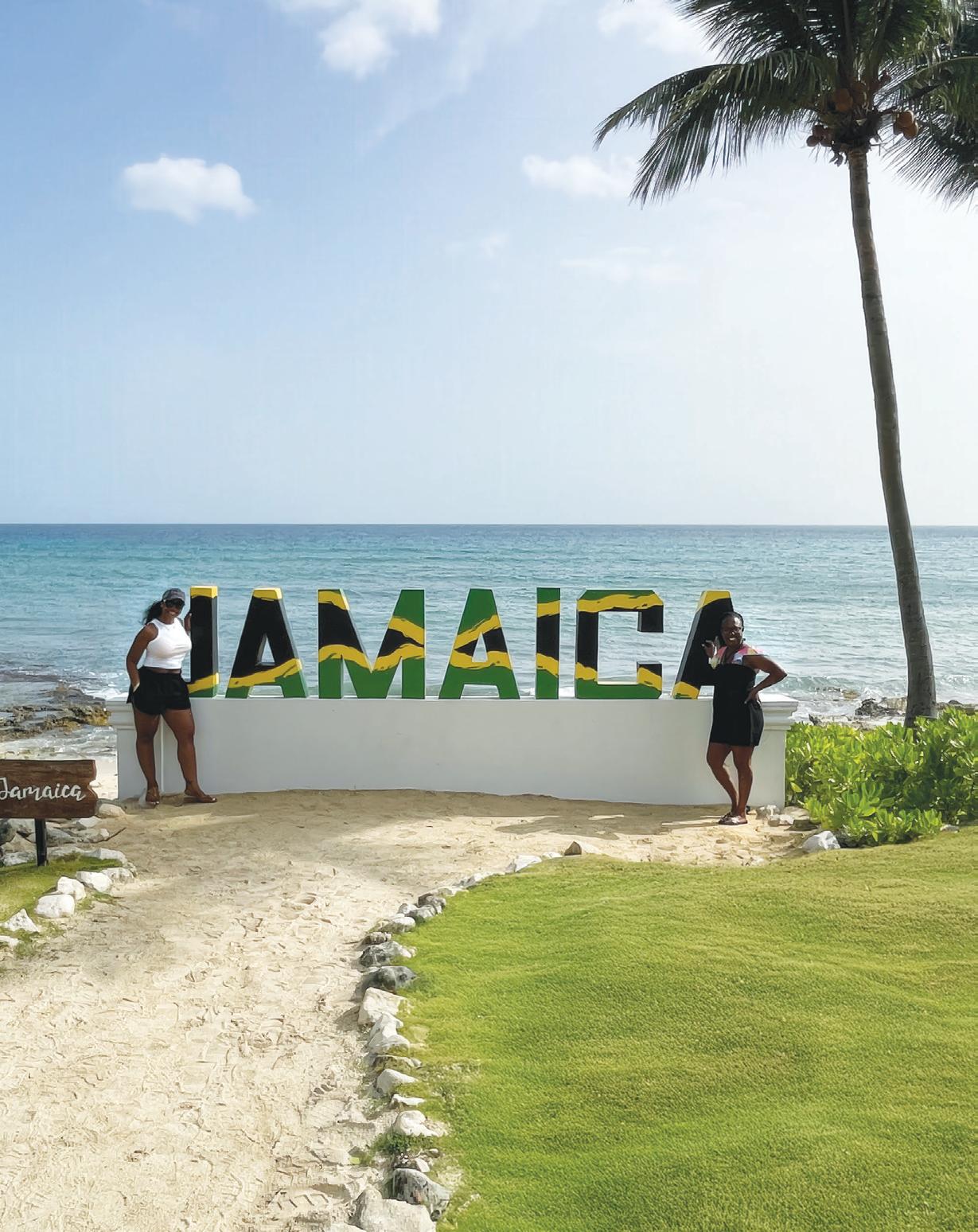
Andrene Leslie and Kerry Coote pause for a photo on their hotel grounds in Jamaica.
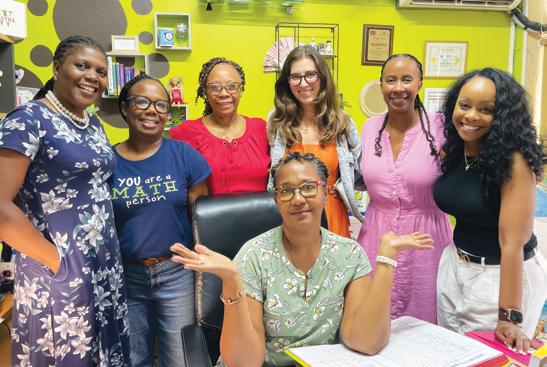
From the moment we began working at Trinity School, we were united by a shared sense of sisterhood and a desire to grow as thought leaders. We were driven not only to deepen our own learning but also to share our knowledge and expertise with educators in our school community, locally, and around the world. We often spoke about traveling abroad to learn from other cultures, explore how mathematics and other subjects are taught, and contribute our expertise in meaningful ways. At the heart of these conversations was a shared belief that one of the greatest influences on student success is strengthening teachers’ knowledge, confidence, and effectiveness across all disciplines.
At Trinity, that kind of professional growth is highly encouraged and supported through endowed funds. Guided by this culture, we came together to design a proposal for a travel program centered on three key pillars: service learning, educational sustainability, and global engagement. With that vision in mind, we set our sights on Jamaica, Andrene and Kerry’s homeland. We believed that starting at the school where Andrene had taught before relocating to the United States would be a meaningful and authentic place to launch a journey rooted in growth, empathy, and purpose.
We were thrilled to receive both a Teacher Opportunity Grant and The Chambers Medical Foundation Fund for Faculty Excellence, two of the School’s endowed awards that support faculty in pursuing professional development that deepens learning and strengthens classroom practice.
Welcome to George Headley Primary School
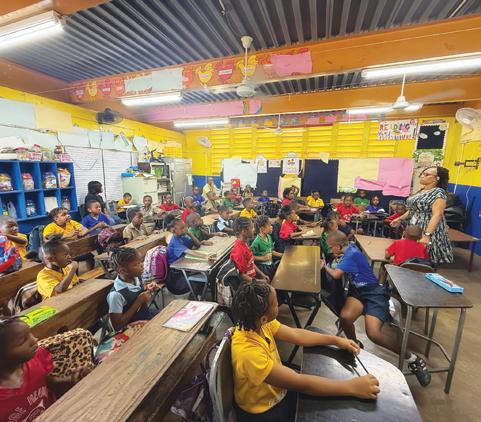
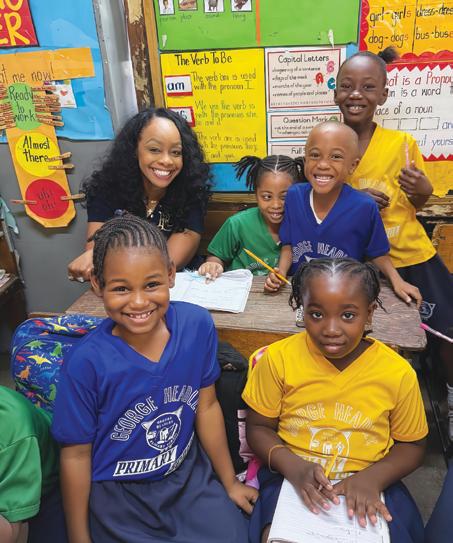
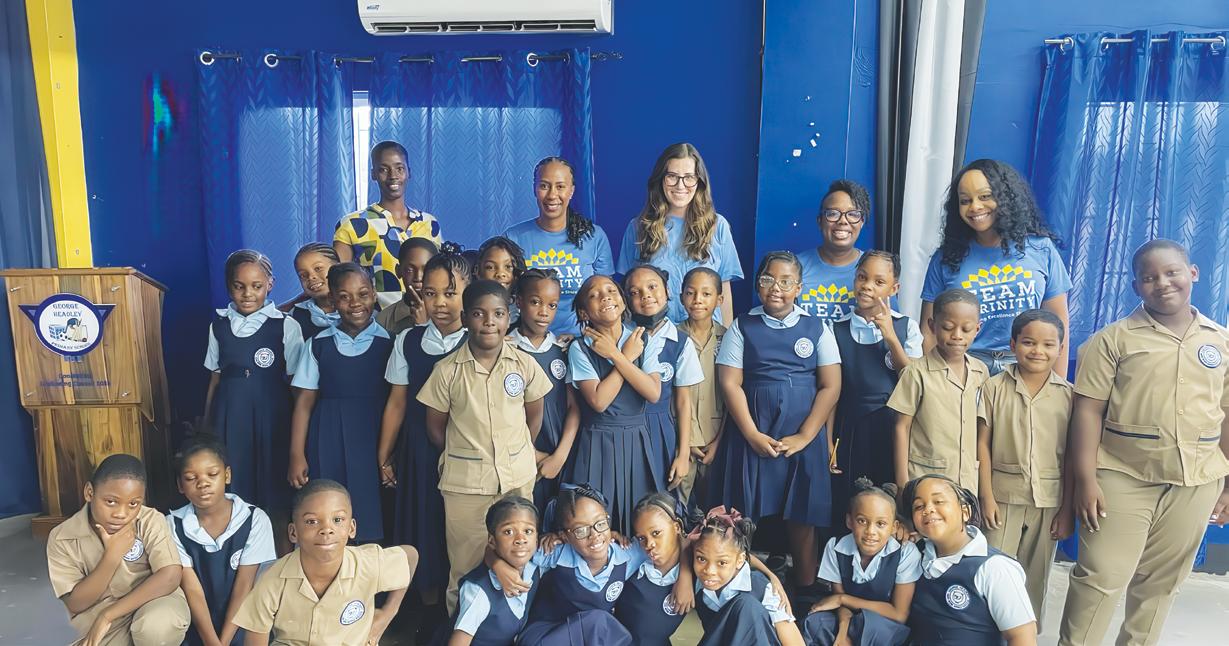
Over the course of nine days, we immersed ourselves in both the educational and cultural life of Jamaica. We began our journey at George Headley Primary School in Kingston, a coeducational institution serving more than 1,500 students in grades 1–6 that sits at the heart of a close-knit community. From the moment we stepped on campus, the shared commitment between educators and parents to support each child’s growth was clearly visible, creating a unified and welcoming school environment.
That first morning, warm breezes surrounded us as we stood beside the principal, Aretha Willie, and watched students between the ages of six and 11 eagerly make their way to their classrooms. Parents walked their children onto the school grounds, pausing to offer hugs and kisses before exchanging heartfelt greetings with teachers on welcome duty. Laughter, conversation, and words of encouragement filled the air. Many students cheerfully greeted us with a “Good morning, visitor,” while also acknowledging each teacher they passed. Throughout this time, Mrs. Willie offered gentle reminders, such as tucking
in shirts and refraining from eating while walking. These simple routines reflected the school’s culture of respect, pride, and responsibility.
The ringing of the bell signaled the official start of the school day, followed by a quiet classroom devotion that provided students with a calm and meaningful transition into learning. As we visited classrooms in each grade level, instruction quickly came to life. In every room, students respectfully stood and greeted us in unison, demonstrating a strong sense of unity and tradition. Teachers delivered spelling, reading, and mathematics lessons with enthusiasm and energy. The limited space and tightly arranged seating—with some rooms accommodating nearly 50 students or sharing space with another class—did not hinder participation. Children confidently stepped to the front of the room to share their work, eager to demonstrate their learning and willing to take academic risks. Teachers enthusiastically responded to our questions, demonstrating a genuine willingness to reflect, learn, and continue growing in their practice.
Throughout the day, students proudly opened their notebooks, explaining their thinking with excitement and confidence to both visiting teachers and classmates. In a Sixth-Grade classroom, students actively asked questions and sought clarification, showing deep engagement in their learning. We even observed a teacher dancing and singing during instruction, bringing joy and energy into the lesson. Student curiosity was consistently encouraged in classrooms that felt collaborative and centered on learners.
Teaching across borders
In addition to observing classrooms, we taught interactive mathematics lessons and led a two-part professional learning workshop for early and upper elementary teachers focused on collaborative math routines, amplifying student voice, and deepening mathematical reasoning. In our roles at Trinity, we have seen how students thrive when they are given opportunities to show what they know and when teachers meet them where they are. Teaching at George Headley reaffirmed this belief. We were reminded that learners, regardless of economic status or country of origin, share the same needs: to be valued, heard, and offered multiple ways to engage in problem-solving.
On our first day, as we listened closely to student voices, engagement grew quickly and naturally. Students were eager to sit on the floor, turn and talk with classmates, and share different approaches to solving problems. This celebration of multiple ways of thinking in the classroom was both joyful and inspiring. We were humbled by what we experienced and looked forward to continuing our work with teachers.
The next day, Kerry opened the professional learning workshop by asking teachers, “What does it mean to be a math person?” Anticipating a range of responses, we guided the conversation toward unpacking common misconceptions about mathematics. Some teachers shared the belief that math ability is innate: you’re either a “math person” or you’re not. Others reflected that with the right instruction and meaningful experiences, all individuals can develop mathematical understanding. Together, we explored the idea that a math person is someone who engages openly and deeply with mathematical concepts, patterns, and problem-solving.
Teachers leaned in throughout the workshop sessions, taking notes, asking thoughtful questions, and actively engaging with the content. Many took videos and photos of the modeled routines to revisit and implement in their own classrooms. By the end of the sessions, teachers expressed excitement about incorporating these strategies into their daily instruction. When we invited participants to reflect on their experiences, their responses were both affirming and encouraging:
“The mathematics workshop conducted by the Trinity team from the USA in May 2025 was very interactive and informative. The strategies presented to introduce topics in the classroom were engaging and centered on students. It prompted me to reflect on my current practices and identify areas for improvement to ensure all learners benefit. The presenters were clear in their explanations and took the time to address my questions. I appreciated how they shared their personal growth journeys in mathematics and how the strategies contributed to their development. I am looking forward to applying the lessons learned and continuing my growth in mathematics.”
“The mathematics seminar was a very informative one as it allowed me to learn numerous ways to understand mathematical concepts, as well as being able to execute the same with my students. It also solidified the ideology that I had about mathematics: there are numerous ways that we can attack a math problem. I had always formulated different ways of doing so mentally, but I always had a problem with bringing these thoughts to fruition with my students.”
“The mathematics session reinforced that data is a tool for improving instruction rather than evaluation. It increased confidence in making instructional adjustments and highlighted the value of ongoing formative assessment and collaborative data discussions.”
A typical First-Grade classroom at George Headley Primary School.
Kerry, Claire, Rosalyn, and Andrene pose for a photo with school vice presidents Charnette GoodallWright and Judith Adams, as well as principal Aretha Willie.
First Graders demonstrate their work to Andrene.
By the end of our visit, it was clear that George Headley Primary School is a place where teachers work tirelessly, students engage wholeheartedly, and a shared love for learning is felt throughout the school. We left feeling deeply connected to our colleagues across borders.
Global awareness and cultural understanding
Outside the classroom, our learning continued through meaningful engagement with Jamaica’s culture, history, and environment. In Kingston, visits to various landmarks provided powerful insights into the nation’s past and present. At Devon House Mansion, we learned about the legacy of George Stiebel, Jamaica’s first Black millionaire, and reflected on how the site symbolizes resilience and entrepreneurship. Devon House also holds special significance for Jamaicans at home and abroad, serving as a gathering place where locals and visitors alike enjoy what is known as the fourth-best ice cream in the world, featuring rich flavors such as mango, Devon stout, and soursop.
A visit to the Bob Marley Museum further deepened our understanding of Jamaica’s global impact, illustrating how music, activism, and identity intersect to shape cultural narratives far beyond the island.
Our time in Montego Bay highlighted Jamaica’s stunning natural landscape. We traveled to Ocho Rios in Saint Ann to hike Dunn’s River Falls, where we were awed by the cascading water, lush greenery, towering rock formations, and coastal views.
Throughout the trip, we sampled traditional Jamaican cuisine, including the national dish, ackee and saltfish served with green bananas and fried dumplings; jerk chicken with festival; and escovitch fish with bammy. We also enjoyed a variety of local fruits such as June plum, papaya, and naseberry. We explored local markets and engaged with community members, which deepened our global awareness and cultural understanding.
We left Jamaica with a renewed appreciation for flexibility, creativity, and collaboration in education, as well as the power of relationships, teacher-driven professional learning, and the universal joy found in seeing students flourish. We felt rejuvenated, with a deeper understanding of the “island vibe,” recognizing how a culture’s essence is shaped by its people, food, music, and natural resources. We were reminded that teaching is a deeply human endeavor built on connection, curiosity, and the belief that all students, no matter where they are in the world, deserve meaningful learning experiences.
We are grateful to Trinity School for making this opportunity possible and to our colleagues at George Headley Primary for opening their doors and their hearts to us. Together, we reaffirmed that teaching is not just a profession. It is also a shared journey of growth, empathy, and purpose.
Members of Team Trinity gather with Second Graders for a group photo after Claire and Rosalyn lead a lesson.
Early Learner teachers are inspired by Reggio Emilia
By Early Learner Teachers Patricia Keaten, Cathryn Lager, Pam Lauer, and Robin Martin
As Early Learner educators, we daily embrace Trinity’s Program and Pedagogy Pillars, especially deepening students’ educational experiences while cherishing
childhood. Young children are naturally curious and creative learners, so we continually seek new thinking and best practices to empower them in their learning.
Paticia, Pam, Robin, Cathyrn, and Sheree pause beside one of the iconic marble lions in Piazza San Prospero—one of Reggio Emilia’s central piazzas, often called the “living room” of the city.
Knowing that the Reggio Emilia philosophy emphasizes the use of real-life experiences and materials over a “pretty,” mood board-inspired approach, we decided to apply for one of the School’s professional development endowment awards to attend the North American Reggio Emilia Alliance (NAREA) Study Group in the town of Reggio Emilia, Italy.
In December 2024, four of us received awards from The Childress Family Fund for Faculty Excellence and made immediate plans to travel to Italy with our Division Head, Sheree Du Preez, that upcoming summer.
We wanted to experience the Reggio approach firsthand and understand why this philosophy, 35 years after it was recognized in Newsweek magazine as the most advanced early childhood education in the world, remains strong today. When we arrived in Reggio Emilia and began the conference on May 26, 2025, we were surprised to see so many educators from across the United States, especially many from preschools here in Atlanta. The four-day conference became a wonderful opportunity to engage in conversations with our American colleagues about how the Reggio approach can be utilized in the U.S., and since returning home, we have stayed in touch with our Buckhead counterparts and toured their schools.
The Study Group was held at the Loris Malaguzzi International Centre, named for the Italian educator and psychologist who founded the Reggio approach to education. His philosophy views children as competent, inquisitive and capable and emphasizes a child-focused learning environment to stimulate curiosity, social interaction, and collaboration. The children’s work was
showcased everywhere, both within the Centre and outside on a piazza in one of the town squares.
Also displayed within the Centre was a large sculpture outlining the “100 Languages of Children.” Coined by Malaguzzi, the 100 Languages is a powerful metaphor that refers to the numerous ways in which children learn, think, and express themselves beyond spoken or written words.
Sheree, Patricia, and Robin participate in a mosaic workshop in the Malaguzzi Center.
We participated in several lectures that outlined specific examples of those languages and how local children pursued them, expressing their questions and knowledge through various modalities, such as art, music, play, science, and math. The Reggio approach emphasizes the value of nurturing all of these forms of expression equally, rather than focusing solely on traditional academic languages. Their learning was documented in photographs and in the children’s own words.
We had the opportunity to experience the 100 Languages through hands-on workshops during which we used mosaic, painting, clay, and gears to express ourselves. We were particularly excited about the mosaic workshop, which was set up with a wide variety of high-quality art materials on two large tables, one featuring color and the other black and white. We were greeted by the Atelieristas, teachers in Reggio Emilia who are responsible for the ongoing projects and the associated materials. Before starting, we were encouraged to discuss certain provocations and our reactions to the materials. We were also encouraged to explore the materials with intention and think outside of the traditional ways of using them (e.g., spraying water on a charcoal drawing to see how it transforms). We further explored our creations under a digital compound microscope to see them at a granular level.
During the conference, we had the opportunity to see the Reggio approach in action at multiple schools, which all featured beautiful spaces with a lot of natural light, natural materials, and a direct link to the outdoors. The Reggio philosophy views the children’s environment as the “third teacher,” so the spaces are set up very intentionally with a focus on project-based learning, collaboration, and documentation. We were able to observe projects firsthand in their various stages, many of which are ongoing and can last throughout the year.
We were excited to return to school in August to implement many of the ideas we had seen during our time in Italy. Cherishing childhood and giving children a foundation to love learning is deepened by providing them with the opportunity to pursue topics that interest them, ask questions, and express curiosity, thereby driving the direction of their learning. Particularly for Early Learners, who are ages three and four, this focus on curiosity and deep learning sets the stage for an enjoyment of school. The Reggio philosophy stresses “nothing without joy” in learning and helping children to “push the boundaries of what is real to what is possible.” This school year, we have emphasized documenting the children’s project progress by capturing their voices, photographing the learning process, and providing high-quality, diverse materials for them to bring their visions to life.
Trinity’s support of our trip to Reggio Emilia demonstrates the School’s genuine investment in every teacher—from Early Learners through Sixth Grade—and its commitment to professional development. We were encouraged to step out of our classrooms, learn alongside educators from around the world, and reflect on and refine our classroom practices. In doing so, we model lifelong learning for our students: staying curious, pursuing knowledge, and always growing.
Pam experiments with paint during her workshop
After observing some flowers, Early Learner Tuck uses various materials to make a stilllife drawing.
WHAT WE HEARD AND LEARNED
• It’s the children’s work.
• Follow their sustained interest in a topic.
• Represent in various mediums.
• The environment is “the third teacher.”
• We have to be amazed; we have to wonder like the children.
• Learn to listen.
• We don't just look for answers, we create questions.
• Failure is viewed as the growing process, not defeat.
• Push the boundaries of what is real to what is possible.
Children’s artwork, like this interpretation of a giraffe, are enlarged and displayed throughout the Malaguzzi Centre.
Every three years, Trinity students are immersed in the experience provided by the Miriam Griffin Artist-inResidence Program, which alternates between music and the visual arts. Established in 1976 by Amanda Griffin Hyatt in honor of her mother, Miriam M. Griffin—who is remembered as Trinity’s first head of school though she formally held the title of director—this endowed program remains an important part of the School’s art curriculum.
Through this residency, students work side by side with accomplished artists, learning through observation as well as creation and collaboration. Over the years, students have experienced paper-making, printmaking, sculpture, storytelling, dancing, songwriting, puppetry, and more. These projects provide students with concrete examples of the many ways practicing artists operate and demonstrate how the wide spectrum of creativity can influence their own growth and learning.
When choosing an artist for the 2025–26 school year, Upper Elementary Art Teacher Emily Davis and I were intentional about finding someone who would help our elementary students see themselves represented in the artwork they would help create. We hoped to partner with a local artist committed to inclusive public art—work that invites participation and belonging. It was then that the idea to host Tiny Doors ATL snapped into place. Karen Anderson Singer, the creative force behind this project, was exactly who we had in mind.
In 2014, the first Tiny Door was installed next to the Krog Street tunnel. The inconspicuous door, only a few inches in height, joined the other public art that decorates Cabbagetown, with full understanding from Anderson Singer that it could be destroyed or painted over within days. Instead, Anderson Singer found that the door was adopted by the community and often the recipient of whimsical additions, including a minuscule handmade newspaper left on the door’s steps or a collection of cat figurines gathered around the entrance.
Tiny Door, big impact
By Early Elementary Art Teacher Nina Chamberlain in collaboration with Upper Elementary Art Teacher Emily Davis
Sparked by the reaction to her artwork, Anderson Singer continued making Tiny Doors all across Atlanta. Each one is unique to its environment, incorporating purposeful details from the surroundings into the door and its frame. More than 800,000 residents and visitors alike have followed the online map-based scavenger hunt to find the 30+ public doors.
Tiny Doors also works with private institutions and residences. Over the last decade, Anderson Singer has worked with cultural powerhouses like the Botanical Gardens, the Georgia Aquarium, and the fabulous Fox Theater. She recently finished an enormous collaboration with Google in Midtown and is poised to work with the City of Atlanta on a project downtown that will be featured in the city’s advertising during this summer’s FIFA World Cup.
Enter the students of Trinity School.
During a school-wide Trinity Together Time assembly introducing Tiny Doors ATL on August 29, 2025, Anderson Singer tasked all the students with designing a door of their own. She asked them to reflect who they are in their designs: what makes Trinity special to them, their favorite subjects, their favorite places on campus, and their favorite gradelevel events.
“Public art is brave,” she told them. “Think about your community and the common threads you see appear.”
The next week, during their art classes, every single student designed and drew a door for Tiny Doors ATL. Early Elementary students used markers and crayons, while Upper Elementary students used colored pencils.
The artwork was then compiled in two enormous binders, one for each division. Despite the diverse experiences and backgrounds of the students at Trinity School, the results were astoundingly similar: tiger stripes, pointed arches, stone foundations, shady forests, and tire swings. There were a few outliers, of course: a two-story water slide, a field
Sixth Graders visit the Tiny Doors ATL studio.
of tulips, and even sophisticated stained-glass windows. For the next few weeks, the Tiny Doors ATL team spent hours poring over the students’ drawings. They identified similarities, pulling together a cohesive theme for their initial design proposal. Once the mock-up was approved by Trinity’s Leadership Team and the art department, Tiny Doors ATL began a six-week journey to create the bespoke mold and frame and to color-match the details of the final piece to the surrounding architecture.
Meanwhile, Mrs. Davis and I set out to plan new lessons that would deepen students’ understanding of public art. Sixth Graders worked collaboratively on an informational bulletin board to teach the community about Tiny Doors ATL and in September, were lucky enough to take a field trip to the Tiny Doors ATL working studio in Reynoldstown. Third, Fourth, and Fifth Graders designed and hand-built Tiny Doors out of clay this past winter, and First Graders will paint cardboard doors based on their favorite subjects this spring.
Once the artwork was completed in-studio, the installation of the door could take place. Given the industrial-strength materials needed to allow the Tiny Door to withstand the curiosity of 602 students, the door needed time to set. So a plan was hatched to install on the Friday evening before Thanksgiving break, after every student left campus for an entire week.
The Monday students returned, Trinity’s Tiny Door was unveiled without fanfare. Standing less than a foot tall, it almost blends into the wall, as if it were always part of the architecture. As morning carpool began and students began to file in, many stopped in their tracks the moment they noticed the new Tiny Door. Excited chatter filled the air.
“Whoa! It’s done already?”
“It looks just like the one I drew!”
“Guys, look, our Tiny Door!”
“Did you know I made the stripes on the door?”
“The Tiny Door! I found it!”
Each day, amid hallways buzzing with curiosity and excited shrieks, the Tiny Door is doing what it was meant to do: bring people together through playful discovery and connection. Not a gilded monolith that inspires awe, but a small frame standing with quiet resilience—it is a subtle reminder of the students’ creative power, making inspiring ripples in their daily lives. It proves that art does not have to be loud and grand to be impactful. Like our youngest students, even the tiniest steps can make a lasting difference.
Early Learner Chandler works on his own Tiny Door drawing.
Spotlight on Art’s
44th year breaks the record again
By Leisy Stevenson, Director of Spotlight on Art and Special Events
For 44 years, Spotlight on Art has celebrated creativity, community, and philanthropy at Trinity School. What began as a simple art auction has grown into a unique series of events that brings exceptional artists and guests from across the country to our campus and serves as one of Trinity’s most significant fundraisers. Just as importantly, Spotlight fosters deep connections within our parent community through volunteer commitment and collaboration.
Neiman Marcus Fashion Show
The Spotlight on Art season began on October 1, 2025, with the annual Neiman Marcus Fashion Show. The event featured a fall fashion trends presentation by Neiman Marcus Public Relations Manager Rebecca Brodnan, along with shopping, light bites, and bubbly.
Pop-Up Shop at Trinity School
Held during fall conferences on October 27 and 28, 2025, the Spotlight on Art Pop-Up Shop offered a curated selection of tabletop artwork, jewelry, and home décor. Timed for early holiday shopping, the Pop-Up provided parents and visitors an opportunity to support Spotlight while discovering local artists and merchants.
Trinity’s Tiny Doors ornament
This year’s Spotlight ornament was specially designed by Trinity’s 2025 Artist in Residence, Karen Anderson Singer of Tiny Doors ATL. The door was painted in varying shades of blue and featured a paw print, a nod to Trinity’s mascot, Stripes the Tiger.
2026 Nonprofit Beneficiary: A.G. Rhodes
Continuing Spotlight’s service-learning tradition, Trinity’s Sixth Grade Leadership Class selected A.G. Rhodes as this year’s beneficiary. A portion of Spotlight proceeds will support A.G. Rhodes’s mission of providing compassionate care to seniors in the Atlanta community. In addition to making a donation to the organization, our Sixth Graders had the opportunity to volunteer at one of the nursing home locations.
Gala and Auction
The Spotlight season culminated on February 21 with the annual Gala and Auction at the Atlanta History Center. The sold-out event welcomed more than 400 parents, faculty, staff, and special guests for an evening of celebration and generosity. Guests enjoyed a seated dinner catered by Bold Catering & Design, cocktails, silent and live auctions, and live music by We Got the Beat.
Another record-breaking Artists Market
This year’s Artists Market was once again held in the Allison Williams Activity Center (AWAC), transformed into a 6,000-square-foot gallery space. More than 400 artists were featured, representing styles from realism and contemporary art to fine jewelry.
Shifted from a six-day to a five-day schedule due to icy conditions in Atlanta, the Market ran January 27–31 and proved that not even a winter storm could dampen the spirit of Spotlight. VIP Early Access on Monday, January 26, moved to an afternoon timeslot, and the Market opened to the public the next day at 8 AM and ran through 9 PM, with the Opening Night Celebration moved to that evening. Cocktails and Canvases on Friday capped the week in style, maintaining Spotlight’s signature blend of art, community, and celebration.
Even on the final day, more icy weather required the Market to close an hour early. Yet through it all, volunteers, artists, and guests brought boundless energy and flexibility, ensuring everything unfolded seamlessly. By the close of the Market, more than $2.2 million in artwork had been sold, setting a new record.
Thank You, Volunteers
Spotlight on Art thrives because of the dedication of Trinity volunteers. We are especially grateful to this year’s Spotlight leadership team, pictured from left to right—Artists Market Co-Chair Kim Freisem, Spotlight Chair-Elect Rebecca Cummiskey, Gala and Auction Co-Chair Pierson Thornton, Spotlight Chair Jaci Shanks, Artists Market Co-Chair Natalie Miller, Gala and Auction Co-Chair Ashley Cronk, and Artists Market Co-Chair Kwynn Everest—whose countless hours of planning and coordination brought each event to life. Their leadership, along with the support of more than 100 volunteers, made the 44th season of Spotlight on Art a remarkable success. Thank you for helping make this year truly special.
Alumni
During his first trip to Belize in 2019 with PRUMC as a high school student, Leighton poses with fellow Trinity School alum Connor Flournoy ’14 and Obi and Caleb (then 12 and 10), two of the minister’s children; he now lives with their family.
Catching up with Leighton Dickson ’14
By Anne Torrey McCuean ’08, Advancement Associate and Alumni Relations
I recently had the opportunity to connect with Leighton Dickson, a Trinity graduate from the Class of 2014. Leighton’s story of following his calling to help others is inspiring, and we are proud of his efforts to make the world a better place. He shared that the values taught at Trinity guided him toward a career he is truly passionate about.
Q: When you think back on your time at Trinity, which moments or experiences come to mind first and why?
A: So many come to mind when I think of my time at Trinity. From the Turkey Dance to the Greek Olympics, it was all a fantastic experience! I’ll never forget the Sixth-Grade production of The Magic Flute, where I played the role of Papageno. I still remember all 73 lines and nine solos and duets. Out of all the events and memories, the ones I truly cherish are those with my peers and teachers. I am still very close with many of my Trinity classmates, and I can still name each one of my amazing teachers. The community was unmatched for a child at that age.
Q: Which Trinity Teacher left a lasting impact on you?
Can I say all of them? If I were to pick one, it would be Kato Nims. She was my Fourth-Grade teacher, and she was the best. She came to school each day with the same happy, loving smile and truly made school fun, regardless of what was going on in her life. It may have been the only school year when I genuinely didn’t look forward to the weekend. I was a bit of a hyper child, and I’ll always remember her timing how fast I could run from my desk, down the stairwell, back up, and then back into my desk. The whole class cheered me on while I raced up and down the stairs, and she kept my record in the top corner of the whiteboard throughout the school year. It was a good trick to keep me still for the next hour or so. I’ll always remember her, and I hope she’s doing well.
Q: How did your education and career unfold after Trinity?
A: After my years at Trinity, which I attended from Kindergarten through Sixth Grade, I went to Holy Innocents’ Episcopal School, where I played football and lacrosse. I then graduated from Rhodes College, where I majored in
Leighton smiles for a photo with three of the women who work at one of his favorite restaurants in Belize.
Leighton is pictured bottom right in this 2012 class photo with Fourth Grade Teacher Kato Nims, who made a lasting impact on him.
Religious Studies and continued to play lacrosse. I now work with the youth group at Peachtree Road United Methodist Church (PRUMC). I have also coached lacrosse at North Atlanta High School and with the youth programs Surge and Thunder. After a mission trip to Belize, I fell in love with the place and have worked in the villages of Libertad and Concepcion at two schools and a church while also teaching lacrosse to the kids since November. When I return home from Belize this summer, I hope to attend the Candler School of Theology at Emory University to continue my education.
Q: How would you describe the role Trinity played in shaping that path and who you are today?
A: Trinity taught me at a young age that regardless of what others around me are doing, I should do what I love and be myself in the process. It was something that was constantly encouraged at Trinity, anywhere from music class to science lab. My Trinity Experience definitely shaped the person I am and the career that I chose. While most of my college friends went into business, sales, and medicine, I decided to go down the path that brought me the most joy. I genuinely love going to work and what I do, and I believe that happiness is more valuable than a paycheck. I am two years into this career and am proud of my decision.
Q: What inspired your decision to leave home and begin a new chapter in Belize?
A: I had come to Belize on a mission trip with PRUMC as a student in 2019 and loved it. I was blessed to return as a staff member this past summer, and once again, it was an incredible experience. That second trip was very different from my first experience as a student six years prior. I reconnected with a family that I had met on my first trip. The mother was the pastor of the church we were building, and the father works on the border of Belize. Their kids were one, seven, 10, 12, and 16 years old when I met them. When I came back this past summer, they were all grown up, and we reunited as if I had seen them last week.
After showing the family the pictures I had with one of my friends—a Trinity friend, in fact—and two of their children, they asked me what I had been up to since the last time I saw them. I told them about my job, and the mother immediately asked if I’d like to do the same thing there in Belize. She said I could teach them the sport of lacrosse and work in the church with her as a youth director. At first, I took it with a grain of salt and jokingly brushed it off. I realized she was serious when she brought it up again later that week. We exchanged numbers and stayed in touch. After a little more convincing, I decided to give it a shot. I felt a real calling to Belize and this family, and I knew it would be an opportunity to help others through my own journey. I had met so many adorable kids in Belize and thought I could help some of them break generational cycles and have the opportunity to go to college. At the same time, I realized that this would be difficult. I didn’t have the money or resources needed to pull this off. I was honestly waiting on a red flag to tell me that it wouldn’t work, but God opened doors and showed me one green flag after another. After receiving a sponsorship to go to Belize, I realized this was the path for me. I knew I was called to go, and now I had been shown it was possible.
Q: What has surprised you most about life in Belize— personally, professionally, and culturally?
A: Personally, I've been lucky enough to spend time with many wonderful people in Belize, and the relationships I have made will last a lifetime. Generally speaking, while people in Belize have very little compared to life in America, they are much happier. It really makes you think about what is important in life. Professionally, I’ve noticed how hard the people in Belize work. Even when they finish their usual nine-to-five workday, they come home and do something else to bring in income for their family. This also goes for the kids after school. They are constantly busy and have the best work ethic out of any community I’ve ever seen. Culturally, I’ve been surprised at how close everyone is to one another. Everyone knows everyone in the village, and they are always willing to help each other out. It can be as small as pulling
Leighton was asked to speak at the Presbyterian school’s spelling bee in February, which also included students from other neighboring schools.
A recent photo of Leighton with Caleb and Obi, now 16 and 18, and their parents, Veronica, who is a minister, and Gustavo.
the car over to pick up someone who was walking down the road or as big as taking a day off work to help build your neighbor’s shower. They are truly willing to do anything for one another! I think that is something our community could take note of.
Q: What do you hope for in your future?
A: I hope to make a difference here in Belize and have lacrosse be an alternative to potentially unproductive habits after school. I also hope to see at least one kid receive a lacrosse scholarship in America one day. I know that just one will go a long way. After Belize, I hope to begin seminary and continue working at PRUMC. While in graduate school, I hope to figure out what I’d like to do with my career in the church, as there are many facets to choose from. I would love to continue coaching after school as well.
Q: If you could give your Trinity-aged self one piece of advice, what would it be?
A: Remember to stick with what makes you happy. It doesn’t matter what other people around you are doing; follow your heart, and you will end up in the right spot. I’d also advise myself to keep friendships and mentors close. It’s too easy to lose touch with people who feed positivity into your life. Those people are hard to find, so when you find one, keep
In preparation for the Methodist school’s barbecue, Leighton learned how to make tortillas from scratch.
The children at the Presbyterian school were excited to give Leighton a warm welcome upon his arrival.
Alumni Events
By Anne Torrey McCuean ’08, Advancement Associate and Alumni Relations
Seventh Grade Reunion
On October 15, 2025, we welcomed the Class of 2025 back to campus for their first Trinity reunion. Students who were ever part of this class and their families were invited to reconnect with former classmates and teachers. Our youngest alums and their families loved catching up, sharing stories of their new schools, and reminiscing on their days at Trinity. The group enjoyed a beautiful night of fun and laughter back on campus.
Morgan Coote, Elle Bickerstaff, Mary Carlyle Mills, Whitney Street, Eliza Inman, Ellie Bryan, Quincy Wall, Mira Sood, Elsie Adams, Milly Davis, Mamie Woods, and Harper Allegra smile for a group photo.
Zavien Umlani, Liam Lee, Jack Reynolds, and Grayson Pearce enjoy catching up over a slice of pizza. Alumni
Members of the Class of 2025 gather for a photo on the Upper Elementary Playground.
Alumni and Parent of Alumni Cocktail Hour
On January 30, we celebrated the culminating night of the 2026 Spotlight on Art Artists Market with a special cocktail hour for alumni 21 years and older and parents of alumni. The evening was filled with joyful reunions and time spent reconnecting with former classmates and longtime friends before checking out the Market.
Alumni and parents of alumni enjoy catching up during the Cocktail Hour.
Former Trinity Teacher Grace Granade Riley ’03 and her husband, Tim, smile for a photo.
Parents of Alumni Anne and Dave Genova, Kim Hockstein, and Molly and John Jamieson reminisce on their days as Trinity parents.
Class Notes
Compiled by Anne Torrey McCuean ’08, Advancement Associate and Alumni Relations
After 10 years in Investment Banking in New York City, Leslie Harwell ’97 co-founded a Venture Capital fund in 2017 focused on technologies for sustainability in fashion, home goods, and footwear. The fund has now invested in 18 companies and works with many of the world’s largest brands and manufacturers to help the industry transition to a better future. Leslie moved to Litchfield County, Connecticut, in 2022, where she purchased a historic home that was a tavern in the late 1700s. Leslie enjoys spending her time between Connecticut, New York City, Atlanta, and Tuscany, where she inherited her mother’s home.
1
Patrick Shields ’99 and his wife, Elif Shields, welcomed their son, Tate Turk Shields, on January 21. One person who was especially excited was Tate’s grandmother, former Trinity P.E. Teacher Roie Shields.
2
George Fryhofer ’02 is an orthopedic spine surgeon in Atlanta. After graduating from Trinity, George attended The Westminster Schools. He matriculated to Harvard University, where he majored in Chemical and Physical Biology and graduated magna cum laude. George attended the University of Pennsylvania for both medical school and his residency in orthopaedic surgery. He subsequently completed his spine surgery fellowship at Rush University in Chicago before returning to Atlanta to join Peachtree Orthopedics. This past July, George was conducting a presentation in Atlanta where he unexpectedly saw former Trinity P.E. Teacher Roie Shields in the audience. The two joyfully reconnected and posed for a photo.
3
Sandra Lynne Fryhofer ’02 married Nick Wellkamp on January 18, 2025, in Costa Rica with fellow Trinity alums George Fryhofer ’02 (Sandra Lynne’s twin brother) and Tindall Sewell Hein ’04 in attendance. That same year, Sandra Lynne and Nick also welcomed their first child, Nicholas Andrew Wellkamp Jr., on November 7.
4
Caitlin Paulette Namnoum ’03 and her husband, Spencer Namnoum, welcomed their second daughter, Isabelle “Sawyer” Namnoum, in March 2025. This past fall, the couple relocated from Silicon Valley to Atlanta, where Caitlin works for Meta and Spencer works for Google. They are thrilled to be back close to family and friends.
5
Lee Caswell ’05 married Marianna Guerrero on January 19, 2025, in Oaxaca, Mexico. The wedding party included Lee’s younger sisters, Grace Caswell Marchesini ’07 and Sarah Caswell Canale ’09, and close friends Jack Kidd ’05 and Shepard Parke ’05
6
While Rob Franklin ’05 has been writing fiction and poetry since high school, he only began pursuing a career as an author in his mid-20s, after receiving a Master of Fine Arts in Creative Writing – Fiction at New York University. It was there that he wrote his debut novel, Great Black Hope, which follows a Black twenty-something named Smith as he navigates his race/class identity as well as questions of belonging in a story that spans New York City, The Hamptons, and the American South. A national bestseller, Great Black Hope has been nominated for the Center for Fiction First Novel Prize, the Barnes and Noble Discover Prize, and the Andrew Carnegie Medal for Excellence and named a “Best Book of the Year” by TIME, Vogue, National Public Radio, and Vanity Fair
7
Sara Lynn Been Hill ’05 and her husband, Jackson Hill, welcomed Elizabeth “Libby” Shelton Hill on February 28, 2025.
8
Ellie Locklear Austin ’05 and her husband, Seth Austin, welcomed twins Emma Rose Austin and Scott Convery Austin on October 29, 2025. Emma and Scott joined proud big sister Ella.
1 2 3 4 5 6 7 8
Submit Class Notes and update contact information.
Photo by Unbridled Media
Photo by Unbridled Media
9
Savannah Borders Smith ’06 and her husband, Kyle Smith, welcomed their daughter, Margot Collier Smith, on August 13, 2025.
10
Margot Williams ’07 married Blake Maum on October 25, 2025, at Peachtree Church in Atlanta, with a reception following at Piedmont Driving Club. The wedding party included Margot’s sister and brother, Kelly Williams Twardzik ’06 and Wells Williams ’09 Trinity alum Carly Herbert ’07 was in attendance.
11
Sarah Caswell ’09 married Philip Canale on June 28, 2025, in Islamorada, Florida. The wedding party included Sarah’s brother and sister, Lee Caswell ’05 and Grace Caswell Marchesini ’07
12
Wells Williams ’09 married Madie Wirz on April 25, 2025, on Paradise Island in The Bahamas. The Williamses live in Nashville, Tennessee.
13
Ella Anne Williams ’20 has concluded a highly successful junior career in equestrian sport and is stepping into her next chapter as an adult amateur. Ella Anne served as co-captain of the Lovett School’s Equestrian Team in 2022, leading the team to a Regional Championship title. Throughout her junior career, Ella Anne qualified for premier competitions including the Capital Challenge Horse Show, Junior Hunter Finals, the Pennsylvania National Horse Show, The National Horse Show, and the Devon Horse Show. She earned national rankings of 5th and 6th in the 3’6” Junior Hunters (16–17), as well as 2nd and 3rd in the 3’3” Junior Hunters. Ella Anne capped off her junior career with a standout finish, ranking 5th nationally in the Junior Jumpers, competing at the 1.15-meter level in October 2025. In addition to continuing her riding career, she will begin attending the University of Mississippi (Ole Miss) in the fall.
14
Members of the Trinity Class of 2020 who are current seniors at The Westminster Schools gathered in front of Westminster’s Askew Hall for a group photo in October 2025.
Row 3: Jack Velarde, Ethan Kittredge, Caleb Patterson, Landon Cummings, Brent Karasick, Aditya Kaul, Mac Hartley
Row 4: Christopher O’Mard, Lincoln Jabren, Hunter Oskouei, Robert Suh, Vikas Reddy, Clark Jordan
15
Finn Graber ’20 and his doubles partner, Grayson Cooke, co-founded Serve First to address equitable access to tennis across socio-economic backgrounds. Serve First is committed to growing the game by collecting donated equipment for young tennis players within Atlanta Public Schools. The pair felt moved to support underresourced tennis programs after meeting an opposing team that did not have basic equipment. Finn and Grayson organized an equipment drive and fundraising campaign and joined forces with Dick’s Sporting Goods and the nonprofits Most Valuable Kids of Greater Atlanta, Field of Dreams Academy, and The Agape Tennis Foundation to supply lessons and gear. The two were honored as Rough Draft Atlanta’s 20 under 20 honorees for 2026.
16
Anselm and Max Bell ’21 have been hard at work raising awareness and speaking up for the necessary resources that serve students with dyslexia. The twins created WriteToRead, bringing attention to literacy equity for every student. Their commitment to serving the dyslexic community has garnered more than 3,000 postcards sent to local and national government officials to encourage legislation that will directly impact dyslexic students. Anselm and Max were recognized as Rough Draft Atlanta’s 20 Under 20 honorees for 2026.
Follow @trinityschoolalums on Instagram to keep up with alumni news, events, and more!
You fund
The Trinity Fund is the foundation of philanthropic support for our students and everything they experience here. Gifts to this annual initiative address the School’s immediate needs, such as curricular enhancements, classroom upgrades, faculty salaries, technology, and need-based financial assistance. Your support helps us elevate the Trinity Experience from great to exceptional.
Make your Trinity Fund gift today at trinityatl.org/give
100% Trustee participation 95% parent participation last year 602 students are impacted by The Trinity Fund 100% of your gift is tax deductible $1,430,153 raised last year