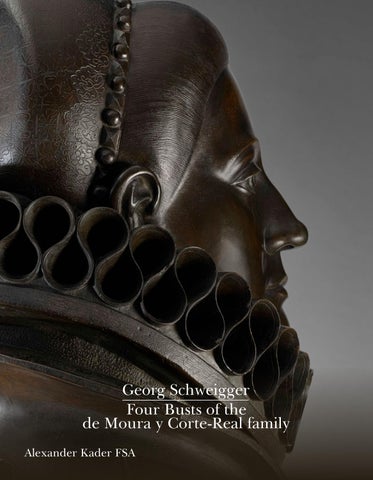
Attributed to Georg Schweigger (Nuremberg, 1613 – 1690), cast by the Balthasar Herold (Nuremberg, 1620 – Vienna,1683)
A Group of Four Bronze Busts of the de Moura y Corte-Real family: Francisco de Moura y Corte-Real, 3rd Marquis of Castelo Rodrigo, 1st Duke of Nocera and 4th Count of Lumiares (1610–1675); Manuel de Moura y Corte-Real 2nd Marquis of Castelo Rodrigo and 1st Count of Lumiares (1590-1651); Cristóbal de Moura y Távora, 1st Marquis of Castelo Rodrigo (1538-1613); Margarida Corte-Real (1547-1610)
Bronze, with metal-clad wooden socles 80 cm., 73.5cm., 75cm., and 76cm. respectively
Provenance:
Francisco de Moura y Corte-Real (1610–1675), commissioned after 1651; 1675: by descent to Leonor de Moura y de Aragón (1642?-1706), 2nd Duchess of Nocera; 1706: by descent to Juana de Moura Corte Real y Moncada (d. Venice 1717) married to Gilberto I Pio di Savoia; 1717: Francesco Pio di Savoia (1672-1723); Thence by descent to the Pio di Savoia family, later Falcò Pio di Savoia; Alfonso Falcò Pio di Savoia (19031967);
Sveva Colonna Falcò Pio di Savoia (1910-1999); Thence by descent to private collection, Monaco
Exhibited:
Milan, Brera, 1872, Catalogo delle Opere d’Arte Antica esposte del Palazzo di Brera, 25 August - 7 October 1872, pp. 12-14, 19, cats. 49, 60, 62, 109.
Literature:
Alfonso Danvila y Buguero, Don Cristóbal de Moura, Premier Marqués de Castel Rodrigo (1583-1613), Madrid 1900, frontispiece; José Louis Barrio Moya, ‘Las colecciones de pintura y escultura de Don Francisco de Moura, tercer marqués de Castel Rodrigo (1675)’ in Boletín de la Real Academia de Bellas Artes de San Fernando, 82, 1996, pp. 295-332; María Teresa Fernández Talaya, El Real Sitio de La Florida y La Moncloa: evolución histórica y artística de un lugar
madrileño, Madrid 1999; David Garcia Cueto, ‘Mecenazgo y representación del Marqués de Castel Rodrigo durante su embajada en Roma’ in Roma y España un crisol de la cultura europea en la Edad Moderna edited by Carlos José Hernando Sánchez, Madrid 2007, II, pp. 695-716; Kelly Helmstutler Di Dio and Rosario Coppel, Sculpture Collections in Early Modern Spain, Farnham, 2013, pp. 257262 and 269-270; David Garcia Cueto, ‘Estrategia familiar y prestigio cortesano en los retratos de Don Manuel de Moura y Corte Real, Il marqués de Castel Rodrigo’ in Actas do IV Congresso de História da Arte Portugesa em Homenagem a José-Augusto França, Lisbon, 2014, pp. 421-427.
Related literature:
Erica Tietze-Conrat, ‘Zwei Porträts Kaiser Ferdinands III.’, Jahrbuch der kunsthistorischen Sammlungen des allerhöchsten Kaiserhauses, Vienna; Bd. 28, 1910, I–III; Charles Avery, ‘François Dieussart (c.1600-61), Portrait Sculptor to the Courts of Northern Europe’, in Studies in European Sculpture, London 1981, 205-235; Paulo Varela Gomes, ‘Damnatio Memoriae. A arquitectura dos marqueses de Castelo Rodrigo’, Arte y diplomacia de la Monarquía Hispánica durante el siglo XVII, Madrid 2003, pp. 351-375; Herbert Herold, Die Giesserfamilie Herold aus Nürnberg und ihre Produkte,
Göttingen 2006; João Paulo Salvado, ‘An Aristocratic Economy in Portugal in the First Half of the Seventeenth Century: The House of the Marquises of Castelo Rodrigo’, in e-Journal of Portuguese History, 2011, no. 2, vol. 9, pp. 35-67; Santiago Martínez Hernández, ‘Aristocracia y anti-olivarismo: El proceso al marqués de Castelo Rodrigo, embajador en Roma, por sodomía y traición (1634-1635)’ in La Corte En Europa: Política Y Religión (Siglos XVI-XVIII), José Martínez Millán, Manuel Rivero Rodríguez, Gijs Versteegen (eds.), Madrid 2012, vol. 1, pp. 1147-1196; Yolanda Gil Saura, Una Nueva Personalidad Para Juan Melchor Pérez, Scultore E Tragettatore Al Servicio Del Vii Duque De Montalto Y Juan José De Austria’, Archivo Español De Arte, XCI, 362, 2018, pp. 101-112; Santiago Martínez Hernández, ‘Between Court and Village: The Evolution of Aristocratic Spaces in Early Modern Spain’, in Renaissance and Reformation, Special Issue: Spaces of Power of the Spanish Nobility (1480–1715), 2020, Vol. 43, No. 4, pp. 19-53; Leonhard Kern und Europa. Die Kaiserliche Schatzkammer Wien im Dialog mit der Sammlung Würth Kunsthalle Würth, Schwäbisch Hall, 2021, pp. 99-100; Carolin Ott, Georg Schweigger (1613–1690) Das Werk des Nürnberger Bildhauers im Spiegel der DürerRezeption des 16.–20. Jahrhunderts, Heidelberg, 2023, pp. 254-258.


INTRODUCTION
In January 1651, whilst serving as Philip IV of Spain’s ambassador in Vienna, Francisco de Moura y Corte-Real, 3rd marquis of Castelo Rodrigo received the news of his father’s death back in Madrid. Some months later he lamented to Gaspar de Teves y Tello de Guzmán (1608-1673), 1st Marquis de la Fuente, then the Spanish ambassador in Venice, that he only had one ‘not very excellent’ portrait of his beloved late father, but that he would make a copy of it to send to the ambassador.1
It is proposed here that this moment in time is the context for Don Francisco deciding to commission an ambitious group of bronze portrait busts of himself, his immediate progenitors, and two of their principal patrons, namely Philip IV of Spain and Charles V, Holy Roman Emperor. Conceived in Vienna in the early 1650s, the commission would logically have led Don Francisco to seek out the foremost sculptor active at the imperial court who had a proven skill in this genre, and where better to turn than an artist who was then engaged on a portrait of the ruling Holy Roman Emperor, Ferdinand III: Georg Schweigger. After the Peace of Westphalia in 1648 brought renewed political and economic stability, Schweigger’s practice shifted from small-scale works to major ecclesiastical and court commissions.2 This study argues that the de Moura y Corte-Real busts represent one of his major commissions of this period and that for Don Francisco the commission functioned not only as a commemoration, but as a carefully staged assertion of dynastic continuity at a moment of political uncertainty.
Although there is no existing documentary evidence of Francisco de Moura commissioning works from Georg Schweigger, an examination of the facture and a stylistic analysis of the present four busts when compared with Schweigger’s signed Bust of Ferdinand III 3 and the Bust of Karl X Gustav of Sweden 4 attributed to him - as well as other bronze busts connected with him and his associates - cumulatively build a compelling case for the attribution to Schweigger and his circle.
This study assesses technical and stylistic evidence and examines this in the historical context of the remarkable story of the noble PortugueseSpanish de Moura y Corte-Real family from the 1570s to the 1670s. During this era of immense turbulence in the Iberian Peninsula, and indeed across Europe, the family faithfully served the Spanish Habsburg rulers. Through their service as ambassadors for the Spanish crown Don Francisco and his father influenced, and were influenced by, European courts from Sardinia to Flanders. They were involved in many of the key historical events which brought an end to the Thirty Years’ War and the War of Devolution. As patrons of the arts, they were deeply impressed by the art and architecture of Italy and Don Manuel was instrumental in enriching the Spanish Royal collections with works by the most important Roman painters and sculptors.5 Back in Portugal and Spain, the de Moura y Corte-Real were preeminent aristocratic collectors with palaces and artistic collections that rivalled even the royal collections. During the tumultuous century under consideration the family built and lost, and built again extraordinary collections in Lisbon and Madrid that have been the subject of numerous academic studies.6
These exceptionally fine portrait busts are glorious reminders of the refinement of bronze casting north of the Alps around the middle of the 17th century, highlighting the skill of founders in southern Germany and Austria. They evoke the dynastic ambition of a major noble family during an era of political upheaval, offering rare material evidence of one of the grandest aristocratic collections in the Iberian Peninsula. Although they are documented from as early as 1669, the inventories do not record the name of the sculptor who made them, however, pioneering technical examination has confirmed a location for their production in southern Germany and compelling stylistic comparisons conclude that these busts can be firmly attributed to Georg Schweigger, active in Nuremberg, who would have collaborated on the casting with the Herold family, specialists in casting bells and cannon in both Nuremberg and Vienna. These busts offer a fascinating glimpse into the complexity of an aristocratic commission, at a time when patrons were constantly moving across Europe and the production of such sophisticated bronzes required several specialists to bring such a major project to fruition.

GEORG SCHWEIGGER: BILDTHAWER IN NVRNBERG

Today Schweigger’s international reputation is perhaps founded on his beautiful small scale sculptures in hardwood and Kelheim stone carved at the start of his career. Some of these are portraits, such as those of Martin Luther or Erasmus, and from the 1640s he made several series of religious and mythological narrative reliefs. These refined and expensive works were acquired by collectors from across Europe. However, after the end of the Thirty Years’ War, Schweigger received more large-scale commissions, beginning in 1649 with a bronze portrait bust of Queen Christina of Sweden (now lost) and the above mentioned busts of Karl X Gustav, King of Sweden from 1654 to 1660, and Ferdinand III. He made large bronze crucifixes for churches in Bannino-Anzino, Koblenz and Graz. The scale of his work became monumental when he collaborated on the ephemeral triumphal arch erected in Nuremberg in honour of Leopold I, Holy Roman Emperor in 1658. The last part of his career was dedicated to his masterpiece, the Neptune Fountain, begun in 1660 and completed posthumously in 1694. Originally intended for the Hauptmarkt in Nuremberg, it is formed of larger than life figures of Neptune surrounded by mounted seahorses, nymphs, putti, sea creatures and children. Schweigger worked on the models with Christoph Ritter and the bronzes were cast by Wolf Herold. Whilst the fountain made Schweigger famous in his own day, the fountain was never erected in Germany and was eventually sold to Russia, being finally installed in Peterhof, outside St Petersburg.7 Diemer has described the Neptune Fountain as ‘among the most important achievements of the early Baroque style in Germany’.8
THE ATTRIBUTION
The attribution rests on five interlocking strands of evidence: chronology, alloy analysis, casting technique, stylistic comparison, and workshop
practice. The attribution of formulaic dynastic portrait busts presents many challenges. The physiognomies often follow a standard period type and the costume or armour denote rank and aspiration, rather than individuality. Nevertheless, with the alignment of the date and place of production with the known sculptors active at that moment certain stylistic idiosyncrasies, and anomalies, can build a strong attributional argument. In recent years, advances in the scientific

analysis of alloys and casting techniques have built sufficient credibility, both in the accuracy of the readings and the validity of the database of comparable results, to provide vital evidence in making an attribution when assessed alongside stylistic and historic observations. Both these lines of examination are elaborated below.


In December 2025, XRF analysis was conducted to determine the alloy of the busts and the bases, alongside a visual examination of the casting technique.9 This concluded that ‘the four busts were made of mixed brass alloys with zinc (7-10%) tin (3-4%) and lead (24%). Significant levels of antimony (0.7-1.5%), arsenic (0.4-0.6%) and nickel (0.6%) indicate the use of a mid-quality type of copper, which was commonly used in brass foundries in the Netherlands and South Germany during the mid-17th century. This type of alloy was persistently used by members of the Herold foundry family, who were scattered over places [such] as Nuremberg, Dresden and Vienna. They may have shared a common source of raw materials or a ‘family recipe’ for alloy preparation’.10 Interestingly, the alloy of the unusual metal-clad wooden socles of the three male busts is different and is a form of brass alloy used in the Netherlands from the mid-17th century to the beginning of the 19th century. Furthermore, the brass sheet used on the base of the bust of Doña Margarida is different again and is more consistent with Italian 19th century comparables. This spread of locations will be shown to make sense in terms of the known movements of Don Francisco and the history of the busts after his death.
The method of casting, repair and finish of all four busts is identical. The casting is virtually flawless. Threaded plugs were used to repair the holes left by the core pins. From the appearance of the insides of the bronzes, it is apparent that the cores were prepared before the models and investment moulds in a manner reminiscent of the so-called cutback core technique. The same technique was known as Lehmteilformerei (loam piece mould casting) in Germany and, significantly, has its origins in bell and mortar foundries.11 The large diameter threaded plugs that were used here to repair holes are rarely observed in German or Netherlandish sculpture of the period and indicate a founder who was aware of Italian techniques.
Both the form of the alloy and the Lehmteilformerei method of casting are consistent with sculpture in Southern Germany and Austria. Comparable
alloy results are recorded in Georg Schweigger’s bronze base in the Nationalmuseum, Stockholm (NMsk 353) and with several works by members of the Herold family. In addition, a bust of Ferdinand III in a private collection, which may be identified with the bust of this subject that Balthasar Herold is documented as making in 1657 (see below), appears similarly to be cast with the cut-back core technique.12

Georg Schweigger’s portrait busts provide clear stylistic references for the de Moura y Corte-Real busts. The formula of the armoured body with a broad sash of drapery is consistent between the bust of Don Francisco and Schweigger’s busts of Karl X Gustav and Ferdinand III, but also with many other busts of the period. However, there are notable affinities in the way Schweigger handles the


drapery in long, tight folds across the body and the unusual circular arrangement of rivets on Karl X Gustav’s armour that link directly with these busts.
Although the armoured bust format appears conventional at first glance, Schweigger demonstrates awareness of generational variation in the type of armour. The different
style of collars from the full ruff of Don Cristóbal to the stiff collar of Don Manuel and the soft lace trimmed collar of Don Francisco could be said to be taken from engravings, which the sculptor would surely have referred to for the likeness of Don Francisco’s father and grandfather, but the armour is totally different from the engraved sources and suggests the sculptor’s technical understanding of the construction of real armour. Don Cristóbal’s crenellated edging to the pauldrons compares to the form worn in the Bust of Karl X Gustavus, whereas Don Manuel’s armour is much plainer. Don Francisco’s armour is the most elaborate with a


decorated circular edging to the pauldron which compares well with Schweigger’s Bust of Ferdinand III in Vienna. The latter is noticeably less ornate in the chasing of fine decoration than is apparent on the Bust of Don Francisco and especially the Bust of Doña Margarida. These differences can be explained by the involvement of a specialist founder in the casting of the de Moura y Corte-Real busts.
Fig. 5: Paulus Pontius, After Rubens (?), Portrait of Manuel de Moura y Corte-Real, ca. 1630, engraving
Fig. 6: Anselm van Hulle, Portrait of Francisco de Moura y Corte-Real, nd., engraving


Carolin Ott has demonstrated Schweigger’s modus operandi of involving several specialist craftsmen/sculptors in the production of his larger scale works.13 This is documented in the case of Schweigger’s first portrait, the Bust of Johann Schlütter, for which Christoph Ritter provided the wax model and Johann Wurzelbauer cast the bust.14 Other craftsmen were responsible for the overall design of the monument and for details such as the lettering. Schweigger is known to have collaborated with Wolf Herold in Nuremberg on casting of his magnum opus, the Neptune Fountain. Since the likely place of production for the de Moura y Corte-Real busts is in Vienna where Don Francisco was based at the time, the work of Balthasar Herold presents a more likely collaboration for the present busts than does his brother Wolf.
The Bust of Archduke Leopold Wilhelm by Balthasar Herold in Vienna provides a very close parallel with the chased decoration discussed above.15 Here Herold is again working on the model of another sculptor, adding his own style into his version of the original bust of the Archduke in marble (KK 8932) carved by Jerome II Duquesnoy (1602-1654) in 1650. The chased decoration on the collar and armour compares well with the Bust of Doña Margarida in particular. This point is further reinforced by comparison with another version of Schweigger’s Bust of Ferdinand III in a European private collection. In this cast the portrait of the emperor depends on Schweigger’s Vienna bust, but the form of the armour and sash are different, and, above all, the whole surface of the breast plate is elaborately chased. This strongly suggests that this bust can be associated with the bust that Balthasar Herold is recorded as having made of Ferdinand III in 1657, mentioned above. A second cast of the Bust of Archduke Leopold Wilhelm in the same private collection reinforces this proposition.
The elaborate patterns on the snood, chemise and collar worn by Doña Margarida are executed with the precision of a goldsmith and it is known that Balthasar Herold worked with the goldsmith Johann Philipp Barth on the Vienna Bust of Archduke Leopold Wilhelm. This stylistic leitmotif strongly suggests that the de Moura y Corte-Real busts were made by Balthasar Herold, based on the model of Georg Schweigger and, probably assisted by Johann Philipp Barth.
A FLEMISH ELEMENT
As mentioned above, the technical analysis has revealed completely different metal alloys used for the busts and the socles. The socles are unusual in that they are made of wood clad in sheet metal. They are also interesting because their particular shape is strongly associated with a type of socle used repeatedly by the famous Flemish sculptor, François Dieussart.16
Since the de Moura y Corte-Real busts are stylistically quite similar to Dieussart’s work and the alloy is equally consistent with usage in the Netherlands, the possibility that they are by a Flemish sculptor should be considered. In the early 1650s Dieussart was working at the court of Friedrich Wilhelm von Brandenburg in Berlin and around 1656 he moved to Brussels. It is, therefore, conceivable that Don Francisco could have reached out to Dieussart for the commission. However, Dieussart’s busts are generally more elaborate in their combination of armour and drapery, and are more dynamic in overall conception. They also lack the refined surface chasing seen on the de Moura busts. When compared with Dieussart’s


most famous bronze portrait, the Bust of Christian IV of Denmark, in Rosenborg Castle, Copenhagen, the difference in style is evident.17
An explanation for the ‘Dieussart-style’ socles may be found in Don Francisco’s departure for Sardinia in 1656. It might be supposed that had the commission of the eight busts not been completed before Don Francisco left Vienna, he may have been obliged to take them and finish them at a later date. As the alloy of the socles is inconsistent with the busts themselves, and unlike other works by Schweigger, it is tempting to believe that Francisco was only able to have these added to the bust after his arrival in Brussels in 1664. Here he was supplied with generic socles from someone who was inspired by Dieussart’s work.18
A further indication that the busts were made before Don Francisco left Vienna can perhaps be determined by the display of military orders. Don Cristóbal wears the Cross of the Order of Alcântara of which he was made Grand Commander by Philip II in 1582 and Don Manuel wears

the Cross of the Order of Christ of which he was also Grand Commander. On the other hand, Don Francisco wears no order. Since an engraving of the latter dated 1657 shows him wearing the Cross of the Order of Christ, it might be assumed that the sculptor of the bust created his model before this date, in other words when Don Francisco was still ambassador in Vienna.19
THE DE MOURA Y CORTE-REAL FAMILY: A CENTURY OF SERVICE TO HABSBURG SPAIN
These busts represent Don Francisco de Moura y Corte-Real, his father, Don Manuel and his grandparents, Don Cristóbal and Doña Margarida. Loyal to the Spanish crown, these Portuguese noblemen served as courtiers and diplomats to the Habsburg rulers of Spain, Philip II, Philip III and Philip IV.
Don Cristóbal was the preeminent Portuguese political figure during the struggles between Spain and Portugal around 1600, serving as Spanish viceroy in Portugal on three occasions. Whilst the origins of the de Moura family date back to the end of 13th century, their fortunes waned after the Battle of Aljubarrota in 1385, yet they always remained key figures in the Portuguese court. As a teenager Don Cristóbal served Joanna of Austria (1547-1578), daughter of Charles V and Isabella of Portugal, and moved with her retinue to Castile in 1554 after the death of her husband, João Manuel Hereditary prince of Portugal. Don Cristóbal quickly became a close confidant to Joanna of Austria and used his knowledge and connections in Portugal to safeguard her interests there. Don Cristóbal went on further to cement his position in the Spanish court through his assistance to Philip II in his dealings with Sebastian of Portugal in 1576. Despite accusations of treason, Don Cristóbal fervently and effectively promoted Philip II’s control of Portugal, culminating in the Spanish victory at the Battle Alcântara in August 1580. The following year Don Cristóbal married Margarida Corte-Real, daughter of the very wealthy Portuguese nobleman, Vasco Anes Corte-Real. After the death of her only brother in 1578, she became the heir to the family fortune. The marriage was in part a strategic move on the part of Philip II who by arranging this union was


able to bring the rebellious Portuguese provinces run by the Corte-Real under the control of his most loyal ally. In adopting his wife’s name Don Cristóbal thus assumed many of the family’s titles and privileges.
Don Cristóbal and Doña Margarida commissioned a fabulous palace in Lisbon on the Corte-Real land next to the royal palace, later destroyed in 1755. The palace became a model for aristocratic buildings in Lisbon. It was a quadrangular structure, formed of four floors with the top floor forming the piano nobile. There was an inner courtyard and two parallel three-story sections on the south facade, leading to the Tagus river, with four turrets with pyramidal roofs. The palace had 185 rooms and 18 state rooms. The building was designed as a symbol of the de Moura y Corte-Real power and influence in Portugal. In the decade before Philip II’s death in 1598, Don Cristóbal was at the zenith of his career and was central to every aspect of the Spanish crown’s rule of Portugal. Whilst his relations with Philip III of Spain were not so intimate, he continued to be indispensable in the rule of Portugal, and the new king made him 1st Marquis of Castelo Rodrigo on 27 December 1598.20
Don Manuel was born into the courtly circles of Madrid when his father’s influence over Philip II was at its height. After 1598, however, the family returned to Lisbon as the situation changed under the new king. His father further embedded his son in Portuguese society in arranging Don Manuel’s marriage to Leonor de Melo to expand the family’s Portuguese network. With the death of his mother when he was twenty and his father three years later, Don Manuel inherited a vast fortune and a raft of titles. As a Grandee of Spain he became a gentleman of the chamber to Prince Philip of Austria, later Philip IV and set about transferring his main residence to Madrid. At the same time Don Manuel was crucial to the success of Philip III’s only visit to Portugal in 1619. With his increasing power and influence, Don Manuel became a threat to his court rivals, most significantly Gaspar de Guzmán, the Count-Duke of Olivares (15871645) and this intrigue worsened with the ascension of Philip IV. Don Manuel was sent back to Lisbon in 1629 and was proposed as the new viceroy. After his refusal, he was sent to Rome in 1632 as Philip IV’s ambassador to the Holy See.

During his more than fifteen years in the Eternal City, Don Manuel flourished in the cultured Roman artistic environment, becoming a renowned patron of the arts. He personally financed the construction of the cloister in the convent of Santo Isidoro al Monte Pincio. He was one of the most important patrons of the architect Francesco Borromini and commissioned eight marbles from the sculptor François Duquesnoy for the Monastery of São Bento in Lisbon (lost). On behalf of Philip IV he acquired works by Claude Lorrain and Nicolas Poussin for the Buen Retiro Palace in Madrid. Yet still the rivalry with the Count-Duke of Olivares persisted and is believed to have been the root of the accusations of disloyalty and sodomy that were made against Don Manuel and his household in 1634. Philip IV took the accusations very seriously and dealt with the case firmly, but discreetly. With the restoration of Portuguese independence in 1640, he not only lost his titles and lands in Portugal, but lost his position as Spanish ambassador in Rome. Unable to return to Madrid, he was sent as extraordinary ambassador to the Diet of Regensburg and settled in Vienna as the king’s representative to Ferdinand III, Holy Roman Emperor. On the completion of this mission in 1644, still unable to return to Madrid, Don Manuel was sent to Brussels as Lieutenant General and Governor of the Spanish Netherlands where he played a central role in the Peace of Münster. Philip IV acknowledged his loyalty and granted him two Neapolitan duchies, and after the arrival of Archduke Leopold Wilhelm in Brussels, he was allowed to return to Madrid. Whilst he never regained his influential position at court, Don Manuel was able to enjoy the splendour of the Quinta de la Florida where his fabulous collection took pride of place.21
Born in Madrid, Don Francisco spent his youth in Rome during his father’s tenure as ambassador. Just as Don Francisco’s political career was to follow that of his father, so his education in the Eternal City under the tutelage of his cultured parents, had a formative influence on his refined artistic taste, which was manifested in his development of the villa La Florida and the commissioning of these bronze busts.
In 1639, he married Ana María de Aragón Moncada y de la Cerda (1616-1651) with whom he had two daughters. Back in Madrid, Don
Francisco was appointed gentilhombre de la camara del Rey in 1645. Two years later he purchased the estate of La Florida to the west of Madrid for 14,000 ducats, where he would build his famous palace to house his family’s growing collection. The following year, at the age of twenty five, he was appointed ambassador to Vienna, as his father had been before him, tasked with arranging the marriage between Philip IV and Mariana of Austria (1634-1696). At the same time, Don Francisco proved himself a skilled diplomat in the peace negotiations between the Ottomans and Venice. He also played a pivotal role in the election of Ferdinand IV as king of the Romans, in 1653, which was recognised by an income of 100,000 florins. Don Francisco subsequently served as viceroy of Sardinia from 1656 to 1662 and viceroy of Catalonia from 1662 to 1664, before his last major diplomatic role in the Spanish Netherlands.
On his arrival in Flanders, Don Francisco was charged with reinforcing the army, but with little support from Madrid his creative efforts in sourcing former imperial troops who had fought against the Ottomans, as well as German and Walloon troops, and finally enlisting mercenaries from Münster, proved in the end insufficient and the French invasion of 1667/8 was deemed une promenade militare. Don Francisco subsequently signed the Treaty of Aix-la-Chapelle, which ended the War of Devolution, before returning to various positions back at the Spanish court and the development of his villa La Florida outside Madrid where these busts are first recorded in 1669.22
THE DE MOURA Y CORTE-REAL COLLECTIONS AND VILLA LA FLORIDA
With the loss of their prestigious houses in Lisbon after Portuguese independence, the Quinta de La Florida, purchased by Don Francisco, became a symbol of the family’s wealth, standing and sophistication in Spain. Don Cristóbal had invested vast sums in the Corte-Real palace and in the Quinta de Queluz to demonstrate their dominant position in Portuguese society. So too, his grandson created a showcase for his family’s collection, which he no doubt considered also as an homage to Don Manuel’s renowned connoisseurship and appreciation of Italian painting and sculpture. Both the 1669 and 1675 inventories of the collection give an indication of its size and range, but sadly these documents lack detail, most importantly there are no attributions.23

The 1675 inventory of the collection took a year to complete. It involved 12 experts for each specialist section from clock makers to goldsmiths and master embroiderers to painters. The first, and most important part, was done on 4 February 1675 by the court painter Francisco Rizzi who described and valued 576 paintings. It is worth noting that Don Francisco owned a sizeable collection of painted portraits, both of his extended family and major Spanish and international political figures. On 30 December José Ibáñez valued 39 bronze sculptures, but his trade is described as a tinsmith and his descriptions, consistent with the
other sections, lack any real depth and no attributions. Other sculptures in the garden were described by Tomás Román on 15 June 1676.
In terms of the sculpture in the collection, the influence of Italy is preeminent. Perhaps the most extraordinary group were 20 full-length marble mythological figures including a seven-foot centaur, a six-foot Venus and two satyrs and a Ganymede of similar dimensions. Many works are described as made of Genoese marble. In addition, there were 25 bronze busts of Roman Emperors and ten other bronze portrait heads, including the group that is the subject of this paper. Of note also is the group of 11 plaster figures representing Mount Parnassus, with a wooden Pegasus, and other plaster figures in niches. There were also large and small marble and alabaster sculptures, both secular and religious, and a large Venus fountain and another Fountain of Orpheus in the garden.
Without male heir, the de Moura y Corte-Real properties were inherited by Don Francisco’s two daughters, Leonor and Juana de Moura y de Aragón. These busts were inherited by the elder, Leonor, 2nd duchess of Nocera, and subsequently passed to her sister. They have descended until today in the Pio di Savoia and subsequently Falcò Pio di Savoia family.

16: Pio di Savoia villa, Mombello, sala dei Busti (hall of the Busts), photograph taken from Ville e Castelli d'Italia published in 1907