TRINITY ^/ewsletter COLLEGE
A PUBLICATION OF TRINITY COLLEGE WITHIN THE UNIVERSITY OF MELBOURNE
AROUND THE WORLD IN SEVENTY DAYS
By the Warden, Dr. Evan L. Burge.
The idea of a Trinity Dinner in London had been in the air for some time and had the enthusiastic support of Tony Buzzard ('60), the energetic Secretary of the Union of the Heur-de-Lys. Mark Johnson ('58), who was chosen to organize it, had been in the news for some months as the man about to establish Australia's newest bank. The College Council decided the Warden should attend, a date of 7th November 1980 at Boodles was set, and Boyd Munro ('61) generously made a comfortable company house in Fulham available as a London base.
It seemed a long and expensive way to go just for a Dinner, even if that Dinner was destined to be a great success. A period abroad studying Collegiate accomodation seemed a good idea, with special reference to financial support in hard, inflationary times. And so I decided to visit the other Trinity Colleges around the world on my way to Dinner, to make contact with as many of our own Trinity members as I could, and to do one or two useful things on the side — such as taking the advice of Norman Canyon ('57) to visit
the Alumni Office at the Harvard School of Business Administration.
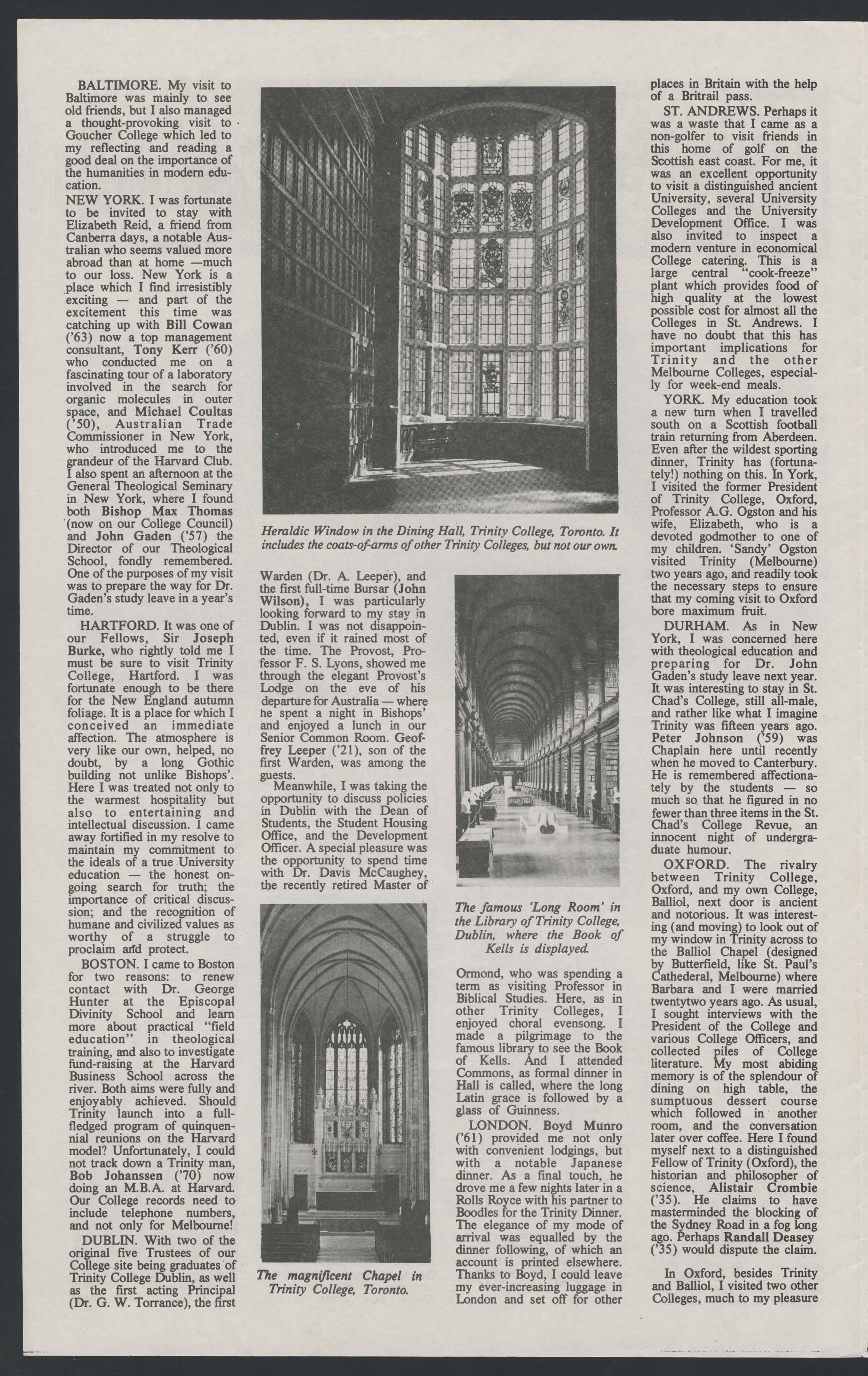
There are Trinity Colleges in Melbourne, Toronto, Hartford (Connecticut), Dublin, Oxford and Cambridge. One day, I hope, we'll display the six coats-of-arms in a window over the high table in Hall along the lines of a splendid heraldic window I saw in Trinity College, Toronto. In every Trinity College I found myself welcomed as an honoured guest, overwhelmed with hospitality, and put in touch with lively and stimulating people. I came away from each of them enlightened in some way, feeling both admiration and affection. We all have much in common, as members of a world-wide family.
As well as to the five major Trinity Colleges, my travels took me, after two restful days in Hawaii, to Los Angeles, Vancouver, Toronto, Baltimore, New York, Hartford, Boston, Dublin, London, Oxford, Cambridge, Lincoln, York, Durham, St. Andrews, Paris, Rome, Jerusalem, Manila, and back to Melbourne.
Twenty major centres is a lot to cover in seventy days, and yet I found it far more stimulating than wearying. Here, in brief, is what I did in each place.
LOS ANGELES. Peter Barbour ('47) ending his time as the Australian ConsulGeneral in Los Angeles, generously gave a day to showing me the city, including a memorable lunch at Adriano's, a delightful Italian restaurant in the suburbs, and an eye-opening visit to a huge student residence at ULCA. I left with ideas of how, in time, we could elevate the beds in the small but tall rooms of Clarke to give more free floor space.
VANCOUVER This was a Sunday. I saw my first woman priest celebrate the Holy Communion in the Cathedral. (It seemed just as natural and inevitable as having women students in Trinity, including four women theologs to date Then I made a bus tour of this beautiful city's glorious parks, finishing with a visit to several student residences at the University of British Columbia. My only known Trinity member here, David Hornsby ('65) of the Mineral Engineering Department, could not be found in the local phone-book.
TORONTO. Trinity College, . Toronto is a most impressive place with a soaring Gilbert Scott Chapel where I attended Wednesday choral evensong, very like our own in Melbourne. Among other things, I learned how computers can be used to teach Greek, how useful library
space can be created in basements (? under Behan), and above all how to develop a first-rate Alumni and Friends Association and Development Office. Philip (`Geordie) Wilson ('50) was unfortunately away in Boston on business so we could not relive his famous leap from a window in Behan. Nor could I find Dr. James Oldham ('62) by telephone. I did, however, have a most enjoyable lunch with Penelope Sanderson, Robert Sanderson's ('45) daughter who is pursuing a post-graduate work in psychology. Among other worthwhile things, I noticed a `Rhodes Room' magnificently furnished by a graduate in honour of past and future Trinity College Rhodes Scholars.
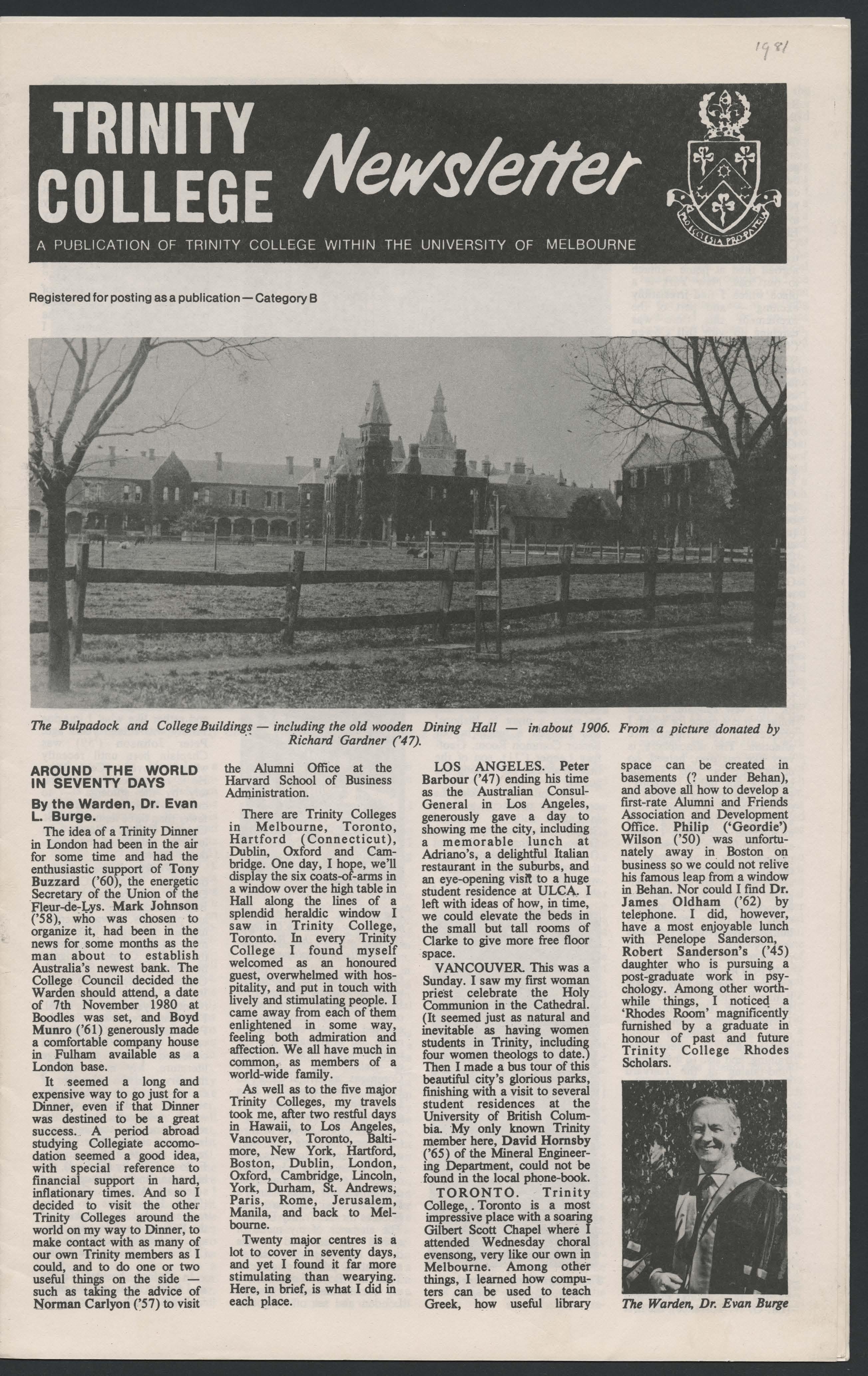
The Warden, Dr. Evan Burge
The Bulpadock and College Buildings — including the old wooden Dining Hall — in about 1906. From a picture donated by Richard Gardner ('47).
BALTIMORE. My visit to Baltimore was mainly to see old friends, but I also managed a thought-provoking visit to Goucher College which led to my reflecting and reading a good deal on the importance of the humanities in modem education.
NEW YORK. I was fortunate to be invited to stay with Elizabeth Reid, a friend from Canberra days, a notable Australian who seems valued more abroad than at home —much to our loss. New York is a place which I find irresistibly exciting — and part of the excitement this time was catching up with Bill Cowan ('63) now a top management consultant, Tony Kerr ('60) who conducted me on a fascinating tour of a laboratory involved in the search for organic molecules in outer space, and Michael Coultas ('50), Australian Trade Commissioner in New York, who introduced me to the grandeur of the Harvard Club. I also spent an afternoon at the General Theological Seminary in New York, where I found both Bishop Max Thomas •(now on our College Council) and John Gaden ('57) the Director of our Theological School, fondly remembered. One of the purposes of my visit was to prepare the way for Dr. Gaden's study leave in a year's time.
HARTFORD. It was one of our Fellows, Sir Joseph Burke, who rightly told me I must be sure to visit Trinity College, Hartford. I was fortunate enough to be there for the New England autumn foliage. It is a place for which I conceived an immediate affection. The atmosphere is very like our own, helped, no doubt, by a long Gothic building not unlike Bishops'. Here I was treated not only to the warmest hospitality but also to entertaining and intellectual discussion. I came away fortified in my resolve to maintain my commitment to the ideals of a true University education — the honest ongoing search for truth; the importance of critical discussion; and the recognition of humane and civilized values as worthy of a struggle to proclaim acid protect.
BOSTON. I came to Boston for two reasons: to renew contact with Dr. George Hunter at the Episcopal Divinity School and learn more about practical "field education" in theological training, and also to investigate fund-raising at the Harvard Business School across the river. Both aims were fully and enjoyably achieved. Should Trinity launch into a fullfledged program of quinquennial reunions on the Harvard model? Unfortunately, I could not track down a Trinity man, Bob Johanssen ('70) now doing an M.B.A. at Harvard. Our College records need to include telephone numbers, and not only for Melbourne! DUBLIN. With two of the original five Trustees of our College site being graduates of Trinity College Dublin, as well as the first acting Principal (Dr. G. W. Torrance), the first
Warden (Dr. A. Leeper), and the first full-time Bursar (John Wilson), I was particularly looking forward to my stay in Dublin. I was not disappointed, even if it rained most of the time. The Provost, Professor F. S. Lyons, showed me through the elegant Provost's Lodge on the eve of his departure for Australia — where he spent a night in Bishops' and enjoyed a lunch in our Senior Common Room. Geoffrey Leeper ('21), son of the first Warden, was among the guests. Meanwhile, I was taking the opportunity to discuss policies in Dublin with the Dean of Students, the Student Housing Office, and the Development Officer. A special pleasure was the opportunity to spend time with Dr. Davis McCaughey, the recently retired Master of
The magnificent Chapel in Trinity College, Toronto.
places in Britain with the help of a Britrail pass.
ST. ANDREWS. Perhaps it was a waste that I came as a non-golfer to visit friends in this home of golf on the Scottish east coast. For me, it was an excellent opportunity to visit a distinguished ancient University, several University Colleges and the University Development Office. I was also invited to inspect a modern venture in economical College catering. This is a large central "cook-freeze" plant which provides food of high quality at the lowest possible cost for almost all the Colleges in St. Andrews. I have no doubt that this has important implications for Trinity and the other Melbourne Colleges, especially for week-end meals.
YORK. My education took a new turn when I travelled south on a Scottish football train returning from Aberdeen. Even after the wildest sporting dinner, Trinity has (fortunately!) nothing on this. In York, I visited the former President of Trinity College, Oxford, Professor A.G. Ogston and his wife, Elizabeth, who is a devoted godmother to one of my children. `Sandy' Ogston visited Trinity (Melbourne) two years ago, and readily took the necessary steps to ensure that my coming visit to Oxford bore maximum fruit.
DURHAM. As in New York, I was concerned here with theological education and preparing for Dr. John Gaden's study leave next year. It was interesting to stay in St. Chad's College, still all-male, and rather like what I imagine Trinity was fifteen years ago. Peter Johnson ('59) was Chaplain here until recently when he moved to Canterbury He is remembered affectionately by the students — so much so that he figured in no fewer than three items in the St. Chad's College Revue, an innocent night of undergraduate humour.
The famous 'Long Room' in the Library of Trinity College, Dublin, where the Book of Kells is displayed.
Ormond, who was spending a term as visiting Professor in Biblical Studies. Here, as in other Trinity Colleges, I enjoyed choral evensong. I made a pilgrimage to the famous library to see the Book of Kells. And I attended Commons, as formal dinner in Hall is called, where the long Latin grace is followed by a glass of Guinness.
LONDON. Boyd Munro ('61) provided me not only with convenient lodgings, but with a notable Japanese dinner. As a final touch, he drove me a few nights later in a Rolls Royce with his partner to Boodles for the Trinity Dinner. The elegance of my mode of arrival was equalled by the dinner following, of which an account is printed elsewhere. Thanks to Boyd, I could leave my ever-increasing luggage in London and set off for other
OXFORD. The rivalry between Trinity College, Oxford, and my own College, Balliol, next door is ancient and notorious. It was interesting (and moving) to look out of my window in Trinity across to the Balliol Chapel (designed by Butterfield, like St. Paul's Cathederal, Melbourne) where Barbara and I were married twentytwo years ago. As usual, I sought interviews with the President of the College and various College Officers, and collected piles of College literature. My most abiding memory is of the splendour of dining on high table, the sumptuous dessert course which followed in another room, and the conversation later over coffee. Here I found myself next to a distinguished Fellow of Trinity (Oxford), the historian and philosopher of science, Alistair Crombie ('35). He claims to have masterminded the blocking of the Sydney Road in a fog long ago. Perhaps Randall Deasey ('35) would dispute the claim.
In Oxford, besides Trinity and Balliol, I visited two other Colleges, much to my pleasure
Heraldic Window in the Dining Hall, Trinity College, Toronto. It includes the coats-of--arms of other Trinity Colleges, but not our own.
established Hebrew as the spoken language of the Israelis. Unfortunately I did not realize at the time that David Goss ('52) is currently Australian Ambassador in Tel Aviv. As well as exploring Jerusalem I joined excursions to Galilee and Bethlehem. I came as a tourist, I stayed as a pilgrim. For a Christian and a lecturer in Biblical Studies there can be few things as inspiring as a pilgrimage to the Holy Land. The political tensions of the country and the tawdry commercialism of some of the shrines are as nothing compared to the ancient beauty of the land in which, above all other, man and God have met.
and profit. In Magdalen a considerable Trinity community is led by John Feltham ('50). The Secretary of the Middle Common Room is Charles Sampford ('71) and the post-graduate students include Peter Robinson ('75) and Elsdon Storey ('73). John Glover ('73) was not there since he was recovering from a car accident in which he was involved during an American trip. He has subsequently returned to Melbourne is now one of our nonresident law tutors, and will return to Oxford in due course.
For one night, I was the guest of John Shepherd ('60) and his wife, Joy. John has moved from Cambridge to complete a doctorate in music and theology while Chaplain in Christ Church.
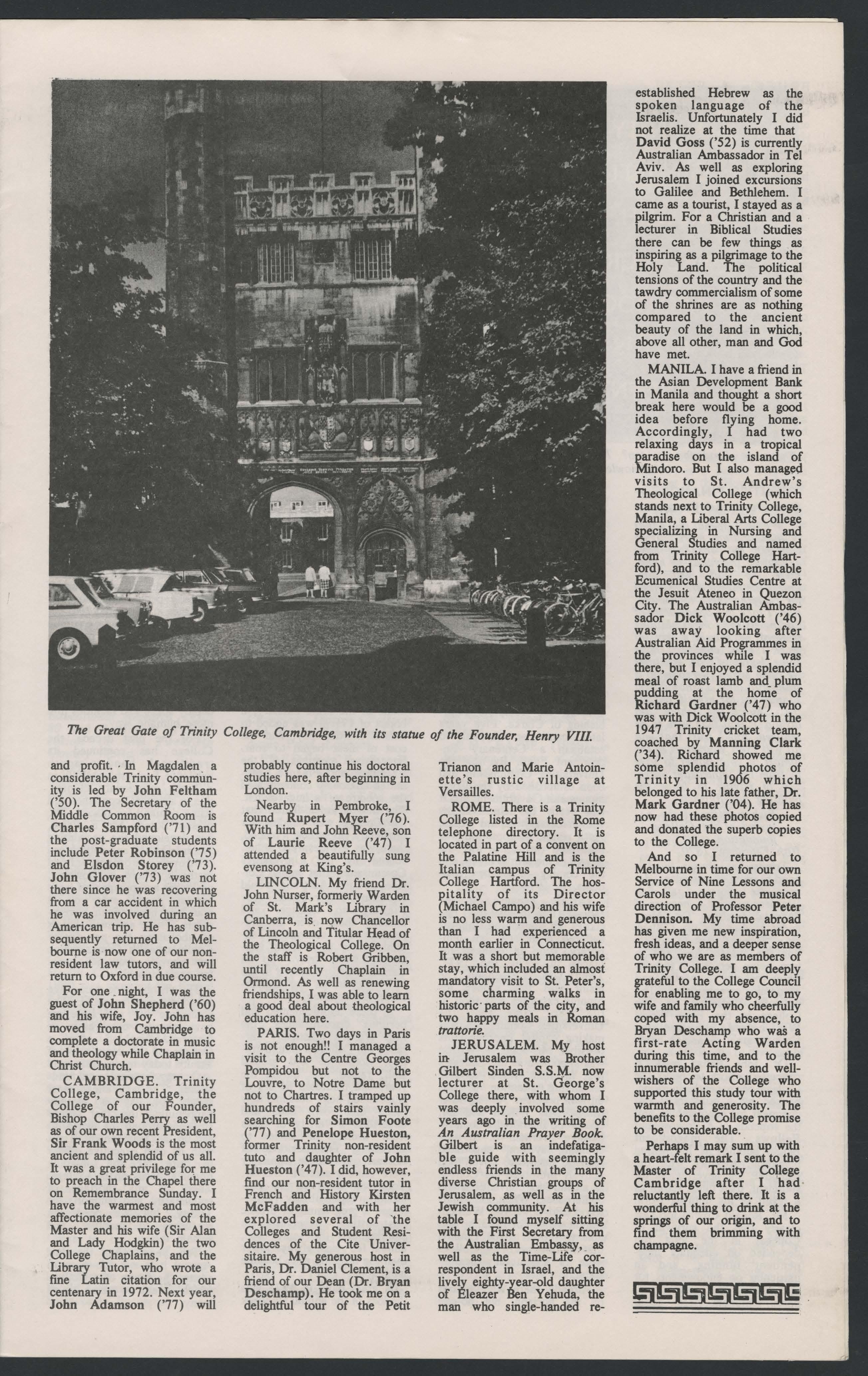
CAMBRIDGE. Trinity College, Cambridge, the College of our Founder, Bishop Charles Perry as well as of our own recent President, Sir Frank Woods is the most ancient and splendid of us all. It was a great privilege for me to preach in the Chapel there on Remembrance Sunday. I have the warmest and most affectionate memories of the Master and his wife (Sir Alan and Lady Hodgkin) the two College Chaplains, and the Library Tutor, who wrote a fine Latin citation for our centenary in 1972. Next year, John Adamson ('77) will
probably continue his doctoral studies here, after beginning in London.
Nearby in Pembroke, I found Rupert Myer ('76). With him and John Reeve, son of Laurie Reeve ('47) I attended a beautifully sung evensong at King's.
LINCOLN. My friend Dr. John Nurser, formerïy Warden of St. Mark's Library in Canberra, is now Chancellor of Lincoln and Titular Head of the Theological College. On the staff is Robert Gribben, until recently Chaplain in Ormond. As well as renewing friendships, I was able to learn a good deal about theological education here.
PARIS. Two days in Paris is not enough!! I managed a visit to the Centre Georges Pompidou but not to the Louvre, to Notre Dame but not to Chartres. I tramped up hundreds of stairs vainly searching for Simon Foote ('77) and Penelope Hueston, former Trinity non-resident tuto and daughter of John Hueston ('47). I did, however, find our non-resident tutor in French and History Kirsten McFadden and with her explored several of the Colleges and Student Residences of the Cite Universitaire. My generous host in Paris, Dr. Daniel Clement, is a friend of our Dean (Dr. Bryan Deschamp). He took me on a delightful tour of the Petit
Trianon and Marie Antoinette's rustic village at Versailles.
ROME. There is a Trinity College listed in the Rome telephone directory. It is located in part of a convent on the Palatine Hill and is the Italian campus of Trinity College Hartford. The hospitality of its Director (Michael Campo) and his wife is no less warm and generous than I had experienced a month earlier in Connecticut. It was a short but memorable stay, which included an almost mandatory visit to St. Peter's, some charming walks in historic parts of the city, and two happy meals in Roman trattorie.
JERUSALEM. My host in Jerusalem was Brother Gilbert Sinden S.S.M. now lecturer at St. George's College there, with whom I was deeply involved some years ago in the writing of An Australian Prayer Book. Gilbert is an indefatigable guide with seemingly endless friends in the many diverse Christian groups of Jerusalem, as well as in the Jewish community. At his table I found myself sitting with the First Secretary from the Australian Embassy, as well as the Time-Life correspondent in Israel, and the lively eighty-year-old daughter of Eleazer Ben Yehuda, the man who single-handed re-
MANILA. I have a friend in the Asian Development Bank in Manila and thought a short break here would be a good idea before flying home. Accordingly, I had two relaxing days in a tropical paradise on the island of Mindoro. But I also managed visits to St. Andrew's Theological College (which stands next to Trinity College, Manila, a Liberal Arts College specializing in Nursing and General Studies and named from Trinity College Hartford), and to the remarkable Ecumenical Studies Centre at the Jesuit Ateneo in Quezon City. The Australian Ambassador Dick Woolcott ('46) was away looking after Australian Aid Programmes in the provinces while I was there, but I enjoyed a splendid meal of roast lamb and_ plum pudding at the home of Richard Gardner ('47) who was with Dick Woolcott in the 1947 Trinity cricket team, coached by Manning Clark ('34). Richard showed me some splendid photos of Trinity in 1906 which belonged to his late father, Dr. Mark Gardner ('04). He has now had these photos copied and donated the superb copies to the College.
And so I returned to Melbourne in time for our own Service of Nine Lessons and Carols under the musical direction of Professor Peter Dennison. My time abroad has given me new inspiration, fresh ideas, and a deeper sense of who we are as members of Trinity College. I am deeply grateful to the College Council for enabling me to go, to my wife and family who cheerfully coped with my absence, to Bryan Deschamp who was a first-rate Acting Warden during this time, and to the innumerable friends and wellwishers of the College who supported this study tour with warmth and generosity. The benefits to the College promise to be considerable.
Perhaps I may sum up with a heart-felt remark I sent to the Master of Trinity College Cambridge after I had reluctantly left there. It is a wonderful thing to drink at the springs of our origin, and to find them brimming with champagne.
The Great Gate of Trinity College, Cambridge, with its statue of the Founder, Henry VIII.
TRINITY'S FINANCES —
Overview and Prospect
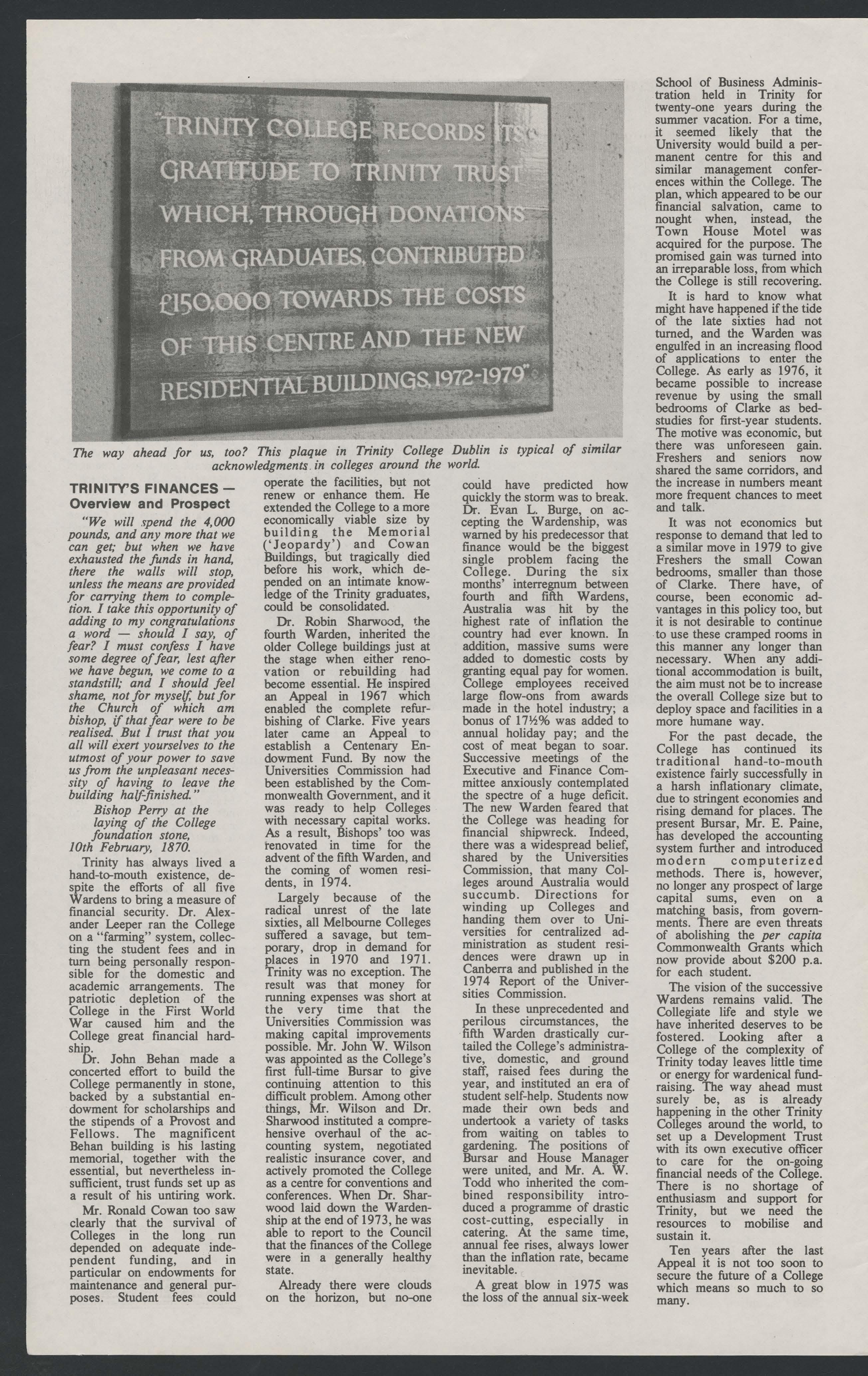
"We will .spend the 4,000 pounds, and any more that we can get; but when we have exhausted the funds in hand, there the walls will stop, unless the means are provided for carrying them to completion. I take this opportunity of adding to my congratulations a word — should I say, of fear? I must confess I have some degree of fear, lest after we have begun, we come to a standstill; and I should feel shame, not for myself but for the Church of which am bishop, if that fear were to be realised. But I trust that you all will exert yourselves to the utmost of your power to save us from the unpleasant necessity of having to leave the building half-finished."
Bishop Perry at the laying of the College foundation stone, 10th February, 1870.
Trinity has always lived a hand-to-mouth existence, despite the efforts of all five Wardens to bring a measure of financial security. Dr. Alexander Leeper ran the College on a "farming" system, collecting the student fees and in turn being personally responsible for the domestic and academic arrangements. The patriotic depletion of the College in the First World War caused him and the College great financial hardship.
Dr. John Behan made a concerted effort to build the College permanently in stone, backed by a substantial endowment for scholarships and the stipends of a Provost and Fellows. The magnificent Behan building is his lasting memorial, together with the essential, but nevertheless insufficient, trust funds set up as a result of his untiring work.
Mr. Ronald Cowan too saw clearly that the survival of Colleges in the long run depended on adequate independent funding, and in particular on endowments for maintenance and general purposes. Student fees could
ATES.
`R N TH~
operate the facilities, but not renew or enhance them. He extended the College to a more economically viable size by building the Memorial (`Jeopardy') and Cowan Buildings, but tragically died before his work, which depended on an intimate knowledge of the Trinity graduates, could be consolidated.
Dr. Robin Sharwood, the fourth Warden, inherited the older College buildings just at the stage when either renovation or rebuilding had become essential. He inspired an Appeal in 1967 which enabled the complete refurbishing of Clarke. Five years later came an Appeal to establish a Centenary Endowment Fund. By now the Universities Commission had been established by the Commonwealth Government, and it was ready to help Colleges with necessary capital works.
As a result, Bishops' too was renovated in time for the advent of the fifth Warden, and the coming of women residents, in 1974.
Largely because of the radical unrest of the late sixties, all Melbourne Colleges suffered a savage, but temporary, drop in demand for places in 1970 and 1971. Trinity was no exception. The result was that money for running expenses was short at the very time that the Universities Commission was making capital improvements possible. Mr. John W. Wilson was appointed as the College's first full-time Bursar to give continuing attention to this difficult problem. Among other things, Mr. Wilson and Dr. Sharwood instituted a comprehensive overhaul of the accounting system, negotiated realistic insurance cover, and actively promoted the College as a centre for conventions and conferences. When Dr. Sharwood laid down the Wardenship at the end of 1973, he was able to report to the Council that the finances of the College were in a generally healthy state.
Already there were clouds on the horizon, but no-one
could have predicted how quickly the storm was to break.
Dr. Evan L. Burge, on accepting the Wardenship, was warned by his predecessor that finance would be the biggest single problem facing the College. During the six months' interregnum between fourth and fifth Wardens, Australia was hit by the highest rate of inflation the country had ever known. In addition, massive sums were added to domestic costs by granting equal pay for women. College employees received large flow-ons from awards made in the hotel industry; a bonus of 171% was added to annual holiday pay; and the cost of meat began to soar. Successive meetings of the Executive and Finance Committee anxiously contemplated the spectre of a huge deficit. The new Warden feared that the College was heading for financial shipwreck. Indeed, there was a widespread belief, shared by the Universities Commission, that many Colleges around Australia would succumb. Directions for winding up Colleges and handing them over to Universities for centralized administration as student residences were drawn up in Canberra and published in the 1974 Report of the Universities Commission.
In these unprecedented and perilous circumstances, the fifth Warden drastically curtailed the College's administrative, domestic, and ground staff, raised fees during the year, and instituted an era of student self-help. Students now made their own beds and undertook a variety of tasks from waiting on tables to gardening. The positions of Bursar and House Manager were united, and Mr. A. W. Todd who inherited the combined responsibility introduced a programme of drastic cost-cutting, especially in catering. At the same time, annual fee rises, always lower than the inflation rate, became inevitable.
A great blow in 1975 was the loss of the annual six-week
School of Business Administration held in Trinity for twenty-one years during the summer vacation. For a time, it seemed likely that the University would build a permanent centre for this and similar management conferences within the College. The plan, which appeared to be our financial salvation, came to nought when, instead, the Town House Motel was acquired for the purpose. The promised gain was turned into an irreparable loss, from which the College is still recovering. It is hard to know what might have happened if the tide of the late sixties had not turned, and the Warden was engulfed in an increasing flood of applications to enter the College. As early as 1976, it became possible to increase revenue by using the small bedrooms of Clarke as bedstudies for first-year students. The motive was economic, but there was unforeseen gain. Freshers and seniors now shared the same corridors, and the increase in numbers meant more frequent chances to meet and talk.
It was not economics but response to demand that led to a similar move in 1979 to give Freshers the small Cowan bedrooms, smaller than those of Clarke. There have, of course, been economic advantages in this policy too, but it is not desirable to continue to use these cramped rooms in this manner any longer than necessary. When any additional accommodation is built, the aim must not be to increase the overall College size but to deploy space and facilities in a more humane way.
For the past decade, the College has continued its traditional hand-to-mouth existence fairly successfully in a harsh inflationary climate, due to stringent economies and rising demand for places. The present Bursar, Mr. E. Paine, has developed the accounting system further and introduced modern computerized methods. There is, however, no longer any prospect of large capital sums, even on a matching basis, from governments. There are even threats of abolishing the per capita Commonwealth Grants which now provide about $200 p.a. for each student.
The vision of the successive Wardens remains valid. The Collegiate life and style we have inherited deserves to be fostered. Looking after a College of the complexity of Trinity today leaves little time or energy for wardenical fundraising. The way ahead must surely be, as is already happening in the other Trinity Colleges around the world, to set up a Development Trust with its own executive officer to care for the on-going financial needs of the College. There is no shortage of enthusiasm and support for Trinity, but we need the resources to mobilise and sustain it.
Ten years after the last Appeal it is not too soon to secure the future of a College which means so much to so many.
The way ahead for us, too? This plaque in Trinity College Dublin is typical of similar acknowledgments. in colleges around the world.
NEWS OF TRINITY MEMBERS
CYRIL JOSEPH TONKIN (1913), a retired physician, has now achieved the age of 92 years.
RALPH SIWARD GIBSON (1924) has published One Woman's Life: A Memoir of Dorothy Gibson.
MAYNARD HEDSTROM (1927), who was awarded a knighthood (K.B.E.) in June, 1980 has retired, and is living in Suva.
HERBERT MALCOLM FRANKLANDS (1927) retired in 1974 as Deputy Director-General of the Commonwealth Department of Health. He now has a wooden leg.
JOHN I. HAYWARD (1928), retired cardiothoracic surgeon, is part-time Medical Officer with the Department of Veterans' Affairs.
W. BALCOMBE GRIFFITHS (1928) retired from Yuncken Freeman, Architects, is now with his son, Balcombe Griffiths, Architects. He is President of the E. S. Hughes Club for the support of rowing in Trinity.
F. DOUGLAS STEPHENS (1931) is Professor of Surgery and Urology, Northwestern University Medical School, Chicago:
WILLIAM F. CONNELL (1935), Emeritus Professor and Fellow of the Faculty of Education, Monash University, has had two books published recently:
The Australian Council for Educational Research 193080 and A History of Education in the Twentieth Century World
ROBERT BARRIE McMILLAN (1935) is temporarily in "Camberlea" Private Hospital, a fellow inmate of Sir EDMUND HERRING (1911).
AUBREY SINGLETON (1935) has retired from his last appointment as Chaplain of the Repatriation Hospital, Heidelberg. He visits the College regularly as a member of the Mollison Library Committee.
A.W. RODWELL (1936), Chief Scientist of Animal Health, CSIRO, in September 1980 was awarded the Emmy Klieneberger Nobel Award for contributions to the field of Mycoplasmology.
PHILIP WILLIAM ATKINS (1936) has retired from medical practice. He has sent the College some fascinating photos of the Behan era: the return of the Colours to the Chapel 1937; and a composite photo of the head of Dr. Behan on the body of Jim Guest.
A. G. L. SHAW (1935) has published a life of Sir George Arthur 1784-1854. As President of the Australian Academy of Social Sciences he led a delegation in 1980 to China to be guests of the Chinese Academy of Social Sciences. He was also Australian delegate at the Fifteenth World Congress of Historical Sciences in Bucharest.
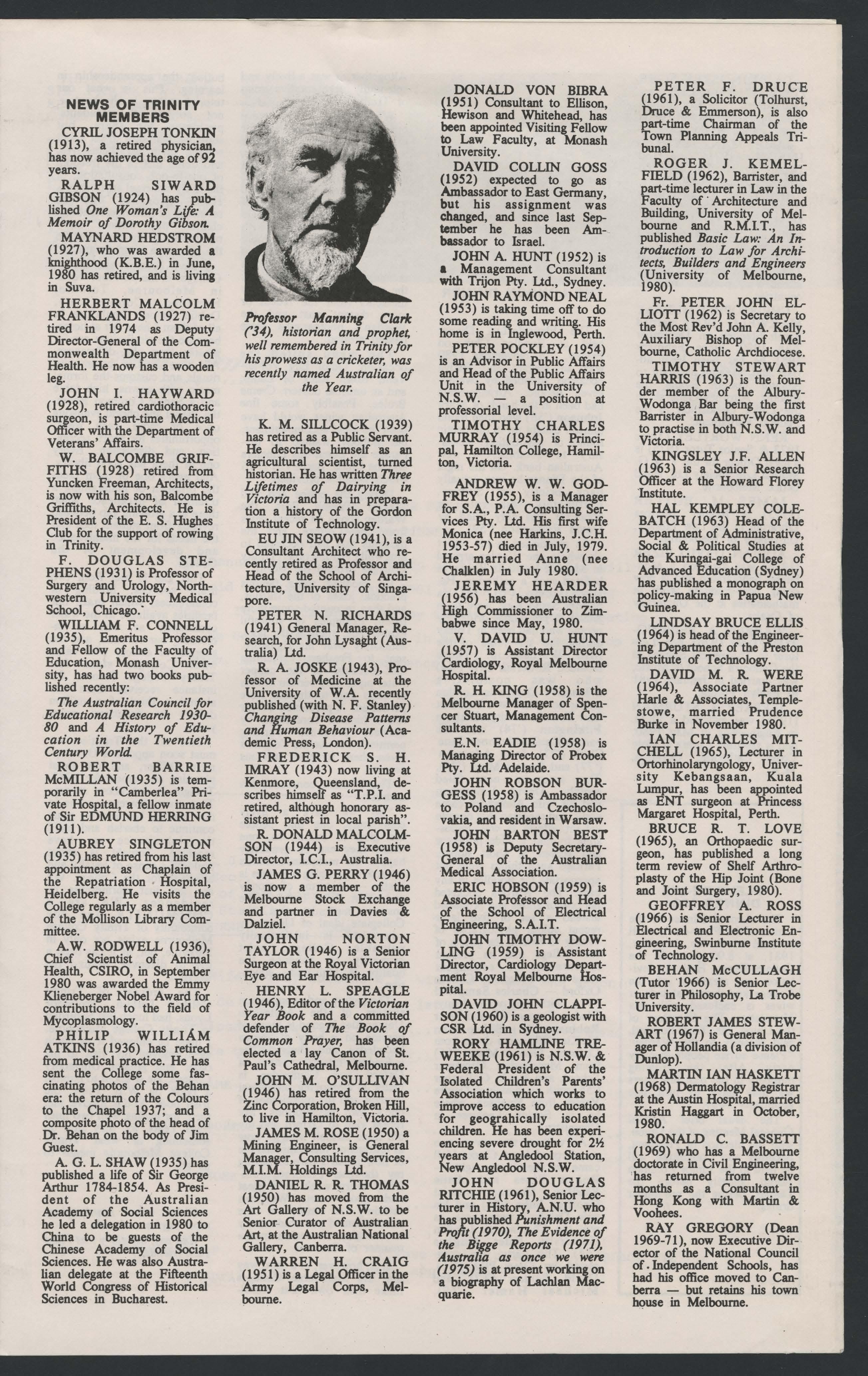
Professor Manning Clark (34), historian and prophet, well remembered in Trinity for his prowess as a cricketer, was recently named Australian of the Year.
K. M. SILLCOCK (1939) has retired as a Public Servant. He describes himself as an agricultural scientist, turned historian. He has written Three Lifetimes of Dairying in Victoria and has in preparation a history of the Gordon Institute of Technology.
EU JIN SEOW (1941), is a Consultant Architect who recently retired as Professor and Head of the School of Architecture, University of Singapore.
PETER N. RICHARDS (1941) General Manager, Research, for John Lysaght (Australia) Ltd.
R A. JOSKE (1943), Professor of Medicine at the University of W.A. recently published (with N. F. Stanley) Changing Disease Patterns and Human Behaviour (Academic Press, London).
FREDERICK S. H. IMRAY (1943) now living at Kenmore, Queensland, describes himself as "T.P.I. and retired, although honorary assistant priest in local parish".
R DONALD MALCOLMSON (1944) is Executive Director, I.C.I., Australia.
JAMES G. PERRY (1946) is now a member of the Melbourne Stock Exchange and partner in Davies & Dalziel.
JOHN NORTON TAYLOR (1946) is a Senior Surgeon at the Royal Victorian Eye and Ear Hospital.
HENRY L. SPEAGLE (1946), Editor of the Victorian Year Book and a committed defender of The Book of Common Prayer, has been elected a lay Canon of St. Paul's Cathedral, Melbourne.
JOHN M. O'SULLIVAN (1946) has retired from the Zinc Corporation, Broken Hill, to live in Hamilton, Victoria.
JAMES M. ROSE (1950) a Mining Engineer, is General Manager, Consulting Services, M.I.M. Holdings Ltd.
DANIEL R. R THOMAS (1950) has moved from the Art Gallery of N.S.W. to be Senior Curator of Australian Art, at the Australian National Gallery, Canberra.
WARREN H. CRAIG (1951) is a Legal Officer in the Army Legal Corps, Melbourne.
DONALD VON BIBRA (1951) Consultant to Ellison, Hewison and Whitehead, has been appointed Visiting Fellow to Law Faculty, at Monash University
DAVID COLLIN GOSS (1952) expected to go as Ambassador to East Germany, but his assignment was changed, and since last September he has been Ambassador to Israel.
JOHN A. HUNT (1952) is a Management Consultant with Trijon Pty. Ltd., Sydney.
JOHN RAYMOND NEAL (1953) is taking time off to do some reading and writing. His home is in Inglewood, Perth
PETER POCKLEY (1954) is an Advisor in Public Affairs and Head of the Public Affairs Unit in the University of N.S.W. — a position at professorial level.
TIMOTHY CHARLES MURRAY (1954) is Principal, Hamilton College, Hamilton, Victoria.
ANDREW W. W. GODFREY (1955), is a Manager for S.A., P.A. Consulting Services Pty. Ltd. His first wife Monica (nee Harkins, J.C.H. 1953-57) died in July, 1979. He married Anne (nee Chalklen) in July 1980.
JEREMY HEARDER (1956) has been Australian High Commissioner to Zimbabwe since May, 1980.
V. DAVID U. HUNT (1957) is Assistant Director Cardiology, Royal Melbourne Hospital.
R H. KING (1958) is the Melbourne Manager of Spencer Stuart, Management Consultants.
E.N. EADIE (1958) is Managing Director of Probex Pty. Ltd. Adelaide.
JOHN ROBSON BURGESS (1958) is Ambassador to Poland and Czechoslovakia, and resident in Warsaw.
JOHN BARTON BEST (1958) is Deputy SecretaryGeneral of the Australian Medical Association.
ERIC HOBSON (1959) is Associate Professor and Head of the School of Electrical Engineering, S.A.I.T.
JOHN TIMOTHY DOWLING (1959) is Assistant Director, Cardiology Department Royal Melbourne Hospital.
DAVID JOHN CLAPPISON (1960) is a geologist with CSR Ltd. in Sydney.
RORY HAMLINE TREWEEKE (1961) is N.S.W. & Federal President of the Isolated Children's Parents' Association which works to improve access to education for geograhically isolated children. He has been experiencing severe drought for 2/ years at Angledool Station, New Angledool N.S.W.
JOHN DOUGLAS RITCHIE (1961), Senior Lecturer in History, A.N.U. who hasublished Punishment and Profit (1970), The Evidence of the Bige Reports (1971), Australia as once we were (1975) is at present working on a biography of Lachlan Macquarie.
PETER F. DRUCE (1961), a Solicitor (Tolhurst, Druce & Emmerson), is also part-time Chairman of the Town Planning Appeals Tribunal.
ROGER J. KEMELFIELD (1962), Barrister, and part-time lecturer in Law in the Faculty of • Architecture and Building, University of Melbourne and RM.I.T., has published Basic Law: An Introduction to Law for Architects, Builders and Engineers (University of Melbourne, 1980).
Fr. PETER JOHN ELLIOTT (1962) is Secretary to the Most Rev'd John A. Kelly, Auxiliary Bishop of Melbourne, Catholic Archdiocese.
TIMOTHY STEWART HARRIS (1963) is the founder member of the AlburyWodonga Bar being the first Barrister in Albury-Wodonga to practise in both N.S.W. and Victoria.
KINGSLEY J.F. ALLEN (1963) is a Senior Research Officer at the Howard Florey Institute.
HAL KEMPLEY COLEBATCH (1963) Head of the Department of Administrative, Social & Political Studies at the Kuringai-gai College of Advanced Education (Sydney) has published a monograph on policy-making in Papua New Guinea.
LINDSAY BRUCE ELLIS (1964) is head of the Engineering Department of the Preston Institute of Technology.
DAVID M. R WERE (1964), Associate Partner Harle & Associates, Templestowe, married Prudence Burke in November 1980.
IAN CHARLES MITCHELL (1965), Lecturer in Ortorhinolaryngology, University Kebangsaan, Kuala Lumpur, has been appointed as ENT surgeon at Princess Margaret Hospital, Perth.
BRUCE R. T. LOVE (1965), an Orthopaedic surgeon, has published a long term review of Shelf Arthroplasty of the Hip Joint (Bone and Joint Surgery, 1980).
GEOFFREY A. ROSS (1966) is Senior Lecturer in Electrical and Electronic Engineering, Swinburne Institute of Technology.
BEHAN McCULLAGH (Tutor 1966) is Senior Lecturer in Philosophy, La Trobe University
ROBERT JAMES STEWART (1967) is General Manager of Hollandia (a division of Dunlop).
MARTIN IAN HASKETT (1968) Dermatology Registrar at the Austin Hospital, married Kristin Haggart in October, 1980.
RONALD C. BASSETT (1969) who has a Melbourne doctorate in Civil Engineering, has returned from twelve months as a Consultant in Hong Kong with Martin & Voohees.
RAY GREGORY (Dean 1969-71), now Executive Director of the National Council of . Independent Schools, has had his office moved to Canberra — but retains his town house in Melbourne.
Dr. KINGSLEY GEE (Tutor 1971-74) is Chairman, Department of Community Medicine, University of Papua New Guinea at Boroko.
JAMES MANTHEY ROBINSON (1971) married Dianne Louise Batchelor on 20th September, 1980.
JOHN W. T. BOURNE (1971) now with Wallace McMullin & Smail was recently in London and delivered a paper on Australian Taxation to the firm's international Tax Conference in London, attended by partners from 16 countries.
CHRISTOPHER MURRAY MAXWELL (1971) married Sarah Stephen on December 20th 1980. Since February 1981 he has been legal adviser and research assistant to Senator Gareth Evans, the shadow Attorney-General in the Labor Opposition in the Federal Parliament.
RENN WORTLEY (Tutor 1973 & Senior Tutor 1976) is a legal Officer for the T. & G. Mutual Life Society Ltd. Head Office Melbourne.
JAMES M. BUTLER (1973) is Reader Services Librarian in the Law Library, University of Melbourne.
ADRIAN DAVID PIZER (1976) was awarded a Monbusho Scholarship and is now doing post-graduate work in mathematics at the University of Osaka.
WARREN A. BEBBING'TON (Tutor 1976), now Lecturer in Theoretical Studies at the Canberra School of Music, was married in January 1981 to Evelyn Portek.
JEFFREY J. STURMAN (1976) was awarded a Ph.D. in Engineering in May 1980, and is assistant Curate at Holy Cross Cathedral, Geralton, W.A.
FLEUR-DE-LYS DINNER 1981
The Annual Dinner of the Union of the Fleur-de-Lys will be held on Friday, May 1st, 1981, at 8.00 p.m., in the College Dining Hall. An invitation to members of the College and their husbands or wives is enclosed with this Newsletter. The Secretary of the Union, Mr. Tony Buzzard, said recently to the Warden: "Please advise people to reply early. After the growing numbers in the past few years we may have to turn late applicants away."
The usual brief Annual General Meeting of the Union, with the election of President, Secetary and Committee, will be held in the Junior Common Room shortly before the Dinner, during the pre-dinner drinks.
THE LONDON DINNER
The Fleur-de-Lys Dinner held at Boodles Club on Friday, 7th November 1980 was an elegant and festive occasion attended by twentyseven people. Arrangements had been in the hands of Mark Johnson ('58) who then found himself caught up in the hectic round of negotiations necessary to establish a new Australian bank. On the night of the Dinner he was actually back . briefly in Sydney. Fortunately, his role as organizer was ably filled by David Emmerson ('59).
As mentioned in his report elsewhere, the Warden arrived in Mayfair by Rolls Royce as befitted such a gathering. He, Boyd Munro, ('61) and his partner Sarah Key, were soon joined at pre-dinner drinks by people who had been in Trinity during the six years of the fifth Wardenship. These included Roderick Lyle ('74) who was completing a Master's Degree in London and is now back as a Resident Law Tutor in Trinity, Graham Pilkington ('74) and his partner Denise McInnes, Jane Clark ('77), John Adamson (17) and Rupert Myer ('76). The anteroom now filled rapidly. David Emmerson and his wife Alexandra came early, and reported that despite valiant efforts it was impossible to find a slide projector and screen at short notice. Perhaps such things were not appropriate for Boodles in any case. The Warden pocketed his box of slides and produced instead a set of five large recent colour photographs of Trinity to remind the gùests of the College and its present appearance. A contingent came from Magdalen College Oxford — Charles Sampford ('71) with his wife Jenny, Elsdon Storey ('73) and Peter Robinson ('75). Bishop John McKie ('28) came down from Coventry, George Myers ('65) from Manchester Grammar Schopl, and Kevin Gallagher ('55) with his daughter Deidre Vaizey from Swansea, where he is Senior Lecturer in Chemistry.
As well as the wives, two members of Janet Clarke Hall came in their own right — Robyn Vines and Anne Skelley. Concert pianist Geoffrey Saba ('64) and his wife Delphine were there, as was the Chaplain to London University Peter Hughes ('64). The party was completed by Glen Pike ('66), David Fenton ('62), and Michael Hamer ('69).
Altogether, it was a lively and splendidly representative group of Trinity supporters.
When the doors were opened to the room set for dinner, what a splendid sight it was. The room itself is large, beautifully proportioned and decorated in the classical style. A classicist might have noticed some influence of the House of the Vettii in Pompeii. A single long polished table with rounded ends was handsomely set with fine silver. Sounds of festive conviviality were soon echoing through the building as the party remembered Trinity incidents from the recent or more distant past and the Warden's photographs were passed around.
The menu suited the occasion; Quail Egg Vol-auVent; Roast Rack of Lamb; and an unusual dessert, Creme Brulee. Possibly some fine Australian wines would have been the ideal accompaniment, but nobody wanted to disparage the Coeur des Lanciers and the Ch.de. Barbe CB 1976 which Boodles provided.
During the coffee and Old Master Tawny Port, the Warden spoke on recent news from the College, and the thoughts that had occurred to him while visiting other Trinity Colleges around the world.
He recalled some famous practical jokes of the thirties, and then recounted some more recent examples of youthful exuberance, such as the note, ostensibly over his signature, sent to Freshers explaining that because of the copper water pipes only certain brands of soap and toothpaste were permitted. A perplexed Bursar found himself confronted by earnest students wanting permission to use the Colgate's given them by their anxious parents.
The Warden concluded his address:
"So we have a lively community, one that people are glad to belong to, one where they can be genuinely happy. To maintain it in its attractive but aging buildings is costly — in terms of money and effort. Why bother? The answer must be that the Collegiate ideal of University education is intrinsically valuable. Colleges exist primarily to enhance the quality of University education.
The lecture and examination system of the Australian Universities is good in terms of passing on a body of known knowledge and theory. The individual tutorial system of Oxford and Cambridge is better at provoking individual thought and the questioning of one's own assumptions. My recent visit to Oxford and my old tutor Russell Meiggs, now in retirement, has reminded me of how much I owe to having my thoughts examined ruthlessly every week by a great and good man. We can certainly do more in the stimulation of our students by encouraging discussion in the manner of Socrates.
It is, however, in a third way that the Melbourne Colleges make their own best contri-
bution: the apprenticeship in learning. This is what our tutorial system is all about — not solving the students' problems for them, but showing them how to set about solving them for themselves, and doing this in the freedom of one-to-one consultation, or the fairly informal small group. Here ignorance can be revealed, or misunderstandings cleared up, without one's reputation being tarnished in the eyes of a future examiner.
I have been in six Trinity Colleges in the past four weeks in Melbourne, Toronto, Hartford (Connecticut), Dublin, Oxford, Cambridge. In all of them I have felt at home, because the similarities are far greater than the differences. All have similar community rituals and customs-the formal meals with gowns, high table and a Senior Common Room, the chapel and choral evensong once or more each week, opportunities for sport, recreation, and discussion. Every one of them has good library. And every one of them faces the problem of maintaining a tradition of excellence when there is a growing gap between revenue from student fees and the needs for the maintenance and development of the College.
This gap is met from two main sources: holding of conferences, which make our facilities available to the wider community as well as increasing our revenue, and the support of donors who value what Colleges stand for. Trinity College Toronto for instance receives from her alumni a third of a million dollars in donations every year.
Like all the Trinities, we must soon appoint a Development Officer, and set about planning an Appeal for 1982. Tonight is not about money. That must, however, come in due course, because we must continue to cherish and build the inheritance we have received. Tonight is about building a sense of loyalty and affection for the College. We are not just dormitories or residences. We are a COMMUNITY and the community of Trinity College Melbourne exists not only in Parkville, but, as it has been a joy to discover, around the world.
The provost of Trinity College Dublin, Professor Lyons, had lunch last Saturday in Trinity College Melbourne. I hope he enjoyed it as much as I enjoyed my visit to his older and greater University College. He is about to publish a book on W.B. Yeats, the Irish poet. You'll forgive me, then, for ending with two lines from Yeats, for they sum up something of what Trinity College Melbourne means to us all.
Think where man's glory most begins and ends, And say, mì glory was I had such friends.'
THE RIGHT REVEREND
SIR FRANK WOODS
K.B.E., D.D. Lambeth, M.A.
Cantab., Hon. LL.D. Monash
Sir Frank is a member of Trinity College, Cambridge, a former Archbishop of Melbourne, and the longest serving President of the Trinity College Council ex officio, 1958-1977. From 1971 to 1977 he was Primate of Australia. In spite of the enormous load of other commitments he regularly presided over College Council meetings giving attention to detail and the overall formation of College policy such as would have been worthy of a man able to give these things his undivided attention. Since his retirement he has maintained a special interest in the work of the Theological School. He has been a leader, not only in the Anglican Church but in the ecumenical movement, where he has inspired others through his generous and open personality, his deep spirituality, and his profound commitment to the cause of Christ. He holds Trinity in special affection.
THE TRUTH WILL OUT: WHO MOVED THE STONE?
Here is my account of the Behan Foundation Stone incident It is exactly as I wrote it at the time, except that I have condensed the part about the tutors' return which though it added greatly to the excitement then seems less important now.
In explanation, the new building (Behan) blocked the other path to the hostel (J.C.H.), but at that stage it was possible to return to the college by approximately the same route by coming through the open northern end of the
cloister. There was then no connection between the Behan and Clarke cloisters.
A big mound of earth had been heaped up in front of the cloister and covered with builders'lanks to form a platform for the ceremony. In fact this mound was eventually incorporated with the grassed slope along the whole length. The outer walls, and some of the inside walls of the ground floor were complete and the stone was in the first room to the right of Staircase A on the Sydney Road side, which had a ramshackle temporary door with a padlock.
For the moment I have no further reminiscences to offer and unfortunately my diary goes no further back than 1934. I think the events of 1933 which led to the dissolution of the Fleur-de-Lys Club and the closure of the buttery would be worthy of a historian's research as they did make a great di ference to the nature and quality of college life. The strange selfimposed monasticism that prevailed then would seem incomprehensible in today's undergraduates, but after 1933 something vital was suppressed that did not reappear in my time. Possibly our effort with the foundation stone was a gesture.
The idea had hatched itself some days before, and after Hall on Friday, April 27th 1934 we gathered in Parson's study in Upper Clarke. Peter Parsons, Jack Voss-Smith, Doug Leslie, Jack Millar, Dasher Hodge, John Stawell and myself. Somewhere about 8.30 we went to investigate the new building, and found the door of the room where the stone was quite easy to break open. We had not seen the stone before and it seem tremendous. We recruited Jamie Newton to lend his strength and somehow it was manhandled through the door and placed on a two-wheeled trolley on the cloisers. There were still a lot of people about and in any case we didn't then know where we were going to
hide it. So we went back to Clarke for talk and supper till about 12.30. Newton had gone to bed, but Checker Hughes had joined us and he and VossSmith acted as look-outs while the rest of us worked. We lifted four planks of the platform built for the ceremony next day and Jack Millar and I began to dig, the earth being put in bags which the others carried away and dumped behind Clarke. It was pretty cold and unpleasant working in stockinged feet and the earth was very hard. Digging took a long time and we wanted to be absolutely sure that the stone would fit in the hole. Finally it was finished (about 2.30) and we began cautiously to wheel the trolley along the cloisters. Just then Hodge and Leslie, who were emptying the last bag of earth came hurrying back to warn us that Alcock and O'Brien (tutors) were returning some women to the Hostel so we took cover, leaving the stone on its trolley in the middle of the cloisters.
I was pressed into the angle of one of the pillars and had a nasty moment when they crossed the Clarke's end of the cloister, but they went into the Clarke's door .... , and we did too, but by way of lower Clarke II and so up to Parson's and Voss-Smith's study where we sat in the dark by the fire and wondered what to do. However, about half an hour later scouts reported O'Brien leaving and Alcock going to bed, so we stole forth again. We wheeled the thing into position and set it up beside the hole. Very carefully we lowered it in, and then by bad luck one end of the hole caved in under the weight, and one corner of the stone was left sticking up about four inches. We burrowed under it and jumped on it and finally got it down and covered it with a sack. Then we replaced the planks, swept the platform and stowed everything away leaving no trace, and went to bed. (I was then living in Vatican).
Next morning at breakfast everyone was talking about it.
Someone said the workmen had said that moving it would mean breaking it, and fragments had been found. The general idea was that it had been broken, and nobody knew where it was. Doug Leslie and I retired unobtrusively to the Anatomy School where gradually the troops assembled (except for Jack Voss-Smith who was still in bed) reporting that the Warden was frantic and was digging up the jumping pit and had ordered a new stone to be cut. He was said to have been coming from Chapel with Palfreyman (tutor) who jestingly suggested it might have been stolen, so they went to have a look. The Warden then became frantic, rushed to the Chapel, searched the incinerator, the new cellars, and the other college grounds. What we had to decide now was how to bring the affair to a satisfactory conclusion. We decided that we'd had our bit of fun, so Jock might now be allowed to have his. In the end we made a telephone call to the Lodge suggesting that he be told to look under his feet (i.e. under the platform) and when we returned to Trinity it was all over.
The ceremony was a great success and a happy time was had by all, including the Warden and the conspirators.
The "Star" that evening had a poster and heading "Trinity Foundation Stone Stolen", and all the papers reported it in good spirit. Next day the Warden put up a notice thanking all who had helped to make the ceremony a success, which one of us souvenired. It was amusing afterwards to listen to people's theories.
I write this as a personal record of what will, I suppose, become a memory, a tradition, and then be forgotten.
We are grateful to Dr. David C. Jackson ('32) for the vivid account above. Could anyone take up his suggestion and write about the closure of the Buttery? It would be good too, to hear about College Initiations — what happened, and how they were abolished?
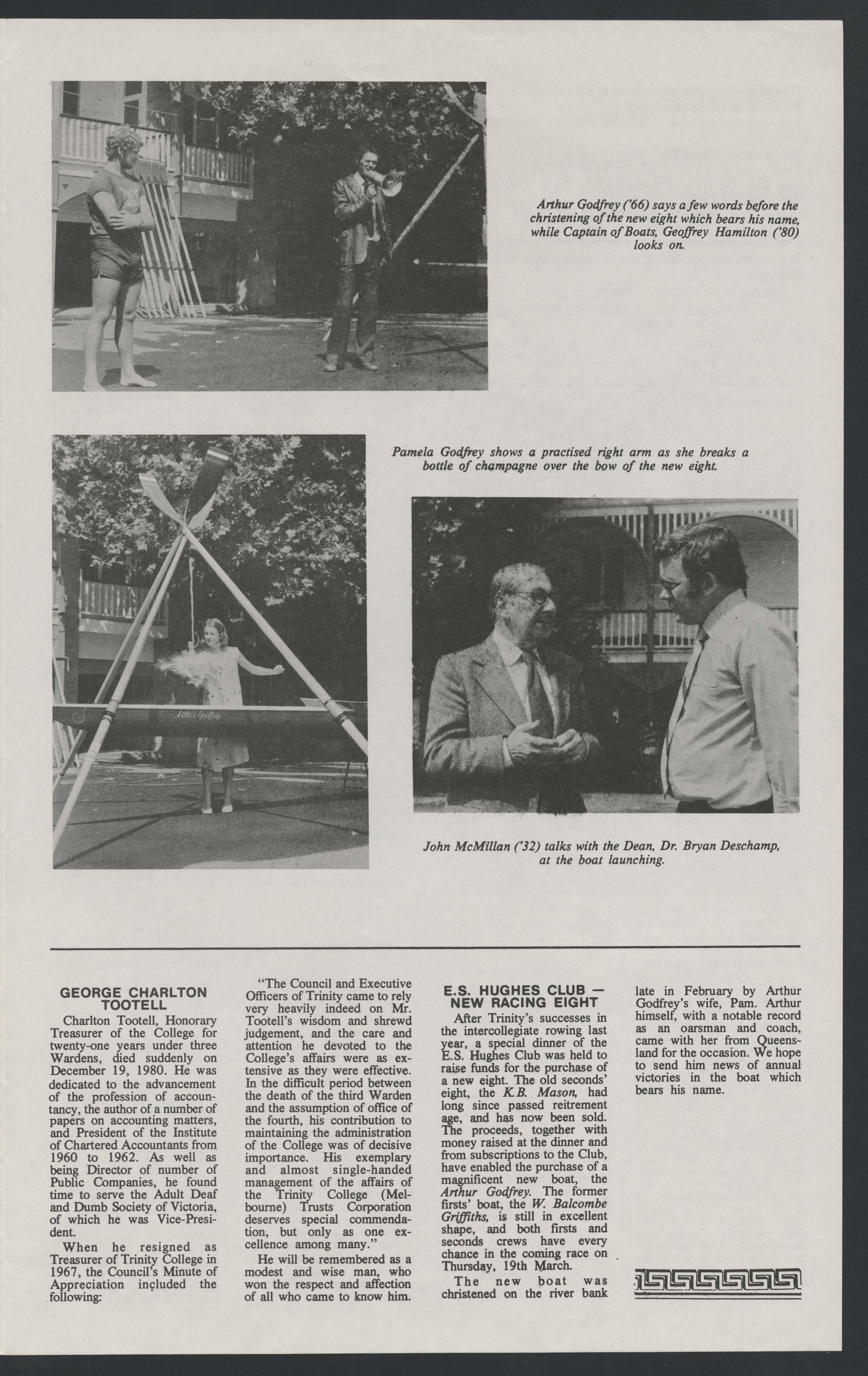
The Behan Building, where the foundation stone was once missing, in a sketch (on sale from the College) by David Cole ('73).
NEW FELLOWS APPOINTED-
The first Fellows of the College under the new. Constitution were appointed by the Council last November. The Constitution provides for a maximum of twenty Fellows to be appointed for life. The Fellows must be people who have achieved distinction in academic, ecclesiastical, or public life and who have contributed (or who are believed likely to contribute) to the life and work of the College. It is proposed to hold a service for the Recognition of Fellows in the College Chapel at 5.30 p.m. on Wednesday, May 6th 1981, followed by Dinner in Hall.
Those appointed include the three men who had been Fellows under the old Constitution: Professor Poynter, Bishop Grant and Professor Burke. The full list is as follows:
DAME MARGARET
BLACKWOOD D.B.E., Ph. D. Cantab. M. Sc. Melb.
In 1980 Dame Margaret was elected the first woman Deputy Chancellor of the University of Melbourne. She was Chairman of the Council of Janet Clarke Hall from 1961 (when it became an autonomous College) to 1974 and is a Founder Fellow of J.C.H. At the University of Melbourne she has had a distinguished career in Botany as well as being actively involved in the administration. Since 1975 she has been a member of the University Council.
SIR JOHN BUNTING
K.B.E., B.A. (Hons.) Melb.
Sir John enrolled in Trinity in 1937 and was resident to 1940. After being Secretary of the Prime Minister's Department and Cabinet in Canberra, he became Australian High Commissioner in London in 1975. After his return with his voice reduced as the result of an operation, he has helped to organise in Canberra two dinners arranged by the Union of the Fleur-de-Lys. He was also involved in arranging the dinner held in London last November, and is currently President of the Union.
SIR JOSEPH BURKE
Emeritus Professor of the University of Melbourne
K.B.E., M.A., Hon. D. Litt. Monash, F.A.H.A.
•Sir Joseph was appointed Herald Professor of Fine Arts, University. of Melbourne and is now Emeritus Professor. He took up residence in the College as a Fellow of Trinity in 1974 and is now a nonresident Fellow under the new Constitution. He is a regular visitor to the College for guiding Fine Arts students, but enjoys his contact with a wide variety of people, within the College and in the wider community.
SIR RODERICK CARNEGIE B.Sc., M.A. Oxon., M.B.A. Harvard
Sir Roderick was in College in 1951-53, and then went to New College, Oxford, and the Harvard School of Business Administration. After a time
with McKinsey & Co. in Melbourne and New York he developed his interests in mining, and is now Chairman and Chief Executive of Conzinc Riotinto of Australia Ltd. His interest in the College has been continuous, and he has played an important role in bringing to members of the College an appreciation of the national issues with which he is vitally concerned.
SIR RUPERT CLARKE Bt. M.B.E., M.A. Oxon.
The third Baron of Rupertswood is a graduate of Magdalen College, Oxford. He represents the third generation of a family which has been an outstandingly generous contributor to the College — as witness the Clarke building and what is now the Music Room (originally a laboratory). Janet Clarke Hall is named after Janet, Lady Clarke.
Sir Rupert is closely connected with Trinity. He served on the Council for a period of ten years — up to the date when the new Constitution came into force.
MR ALAN MORTON
CUTHBERTSON M.B., B.S., F. R.C.S., F. R. A.C.S., F.A.C.S., (John Holmes Shaw Fellow from 1961).
Mr. Cuthbertson is a distinguished surgeon with a world reputation who has given very generously of his time and knowledge in tutorials to senior Trinity medical students. He has been elected by the College over a series of years to the John Holmes Shaw Fellowship.
PROFESSOR PETER
JOHN DENNISON B. Mus. Syd, M.A. D.Phil. Oxon. M.A., Ph.D. Cantab. F.RC.O.
Professor Dennison holds a chair in the Faculty of Music in the University of Melbourne and enjoys an international reputation as an authority on Purcell. As Director of Music, Trinity College, in 1978 he established the Choir of the Trinity College Chapel on its present basis with twenty choral scholars and an organ scholar. He had previously established such a choir in Clare College, Cambridge. Evensong is now sung by this choir on Mondays and Wednesdays in term time, and outstanding music is provided for special College occasions.
SIR CLIVE HAMILTON FITTS M.D. F.R.C.P., F.R.A. C.P., D.T.M.
Sir Clive was resident in College 1919-1926 and tutor in Medicine from 1936 to 1951, except for the break during the War years. He is a distinguished physician with wide interests — President of the Friends of the Baillieu Library, Chairman of the Felton Bequest Committee, and a member of the Commonwealth Drug Evaluation Committee. He is noted for his broad, humane approach and his interest in the English language, and his ability as a public speaker. Sir Clive has also maintained a life-long interest in the Union of the Fleur-de-Lys and in College life.
THE
RIGHT REVEREND
JAMES ALEXANDER
GRANT
B.A. Th.L., B.D.
Bishop Grant has been Assistant Bishop in the Diocese of Melbourne since 1970. He enrolled in Trinity in 1957 for his theological training. Since being appointed Chaplain in 1970 he has continued his vital interest in the College. Both the Leeper and the Mollison Libraries have been his special concern, and the welfare of the Theological School. As Honorary Director of the Theological School Centenary Appeal he has shown unflagging energy in establishing the means for further development — notably the Stewart Lecturer's House and the new Moorhouse Building. He is the author of the College's centennial history, Perspective of a Century, and a confidant of two successive Wardens.
THE HON. RUPERT
JAMES HAMER, E.D., LL.M.
Mr. Hamer, who has achieved distinction in public life as Premier of Victoria since 1972, was a resident member of the College 193539 and a member of the College Council 1948-63.
LIEUTENANT - GENERAL HON. SIR EDMUND FRANCIS HERRING
K. C. M. G., K.B.E., D.S.O., M.C., E.D., K.St.J., M.A. B.C.L. Oxon. Hon. M.A. B. Hon. LL.D. Monash Q.C.
Sir Edmund enrolled in Trinity as a resident member in 1911, and later studied as a Rhodes Scholar at New College, Oxford, of which he is also a Fellow. He is the longest serving member of the Trinity College Council having been a member from 1925 to 1979. After distinguished service in the two great wars (he was G.O.C. of the First Australian Corps) he was appointed Lieutenant-Governor of Victoria from 1945 to 1972. He was Chief Justice of Victoria from 1944 to 1964. He has also been Chancellor of the Diocese of Melbourne from 1941 until recently. He has rendered outstanding service to Australia in education, the Church, the Armed Forces, and in Public Life, and always maintained a lively interest in the life of the College.
JOHN T. HUESTON
M.B., B.S., F.R.C.S., F.R.C. S.
Mr. Hueston enrolled in 1947 and was a resident medical tutor 1951-52. He has been a non-resident tutor almost continuously for nearly thirty years. He has shown a consistent interest in the College, not only in its medical programme, but also in its artistic and musical life. As a plastic surgeon he is honoured around the world, especially for his pioneering work on the human hand.
PROFESSOR JOHN RIDDOCH POYNTER M.A. Oxon., B.A., Ph.D. Melb. F.A.H.A., F.A.S.S.A. Professor Poynter is Deputy Vice-Chancellor (Research) in the University of Melbourne. He enrolled in Trinity in 1948
and was resident until 1950. As 1951 Rhodes Scholar he studied at Magdalen College, Oxford. He was Dean of Trinity from 1954 to 1958 and from 1960 to 1963. With Dr. Barry Marshall he was Joint Acting Warden 1964 - 1965 between the third and fourth Wardens. In 1965 he became the first Fellow of Trinity College. He has a lively interest in music as well as history, and serves on a variety of Trusts and Committees, including the Council of Trinity College.
ROBIN LORIMER SHARWOOD B.A., LL.B. Hons Melb., LL.M. Caljj, S.J.D. Harvard
Dr. Sharwood, after a period as Senior Tutor at Ormond College, postgraduate studies in America, and lectureships at London School of Economics and the University of Melbourne, was appointed Professor of Law in the School of General Studies, A.N.U. in 1963. From there he became Fourth Warden of Trinity from 1965 until his resignation at the end of 1973. Since then he has been Executive Director of the Victoria Law Foundation. Apart from his scholarly attainments and his service to the Church as Chancellor of the Diocese of Wangaratta and member of the Canon Law Commission, he is known as an urbane and witty speaker. Since 1980 he has been President of the Graduates of the University of Melbourne.
PROFESSOR ALAN
GEORGE LEWERS SHAW
B. A.Melb. M.A.Oxon., F. A. H. A., F. A. S. S.A. Professor Shaw enrolled in Trinity in 1935, was tutor in History from 1941-46 and Dean from 1946 to 1950. He is now Professor of History at Monash University after holding lectureships at Melbourne and Sydney. He is President of the Academy of the Social Sciences in Australia, Fellow of the Australian Academy of the Humanities, and Fellow of the Royal Australian Historical Society. He has continued a close association with Trinity for many years, as a member of the Council until 1979, and as a deeply interested friend of the College.
THE HON. SIR REGINALD SHOLL M.A., B.C.L. Oxon., M.AMelb. Sir Reginald enrolled in Trinity in 1920 and was the 1924 Victorian Rhodes Scholar which enabled him to study at New College, Oxford. He was Justice of the Supreme Court of Victoria from 195066 and was then appointed Consul-General in New York between 1966 and 1969. Until his retirement to Queensland in 1979 he was Advocate of the Diocese of Melbourne from 19'69. He has been, until recently, a member of the councils of many schools, and various educational and charitable institutions. His continued interest in Trinity was manifest most recently in his work in drafting constitutions for the Union of the Fleur-de-Lys and for the College itself, with a view to its incorporation by Act of Parliament in 1979.
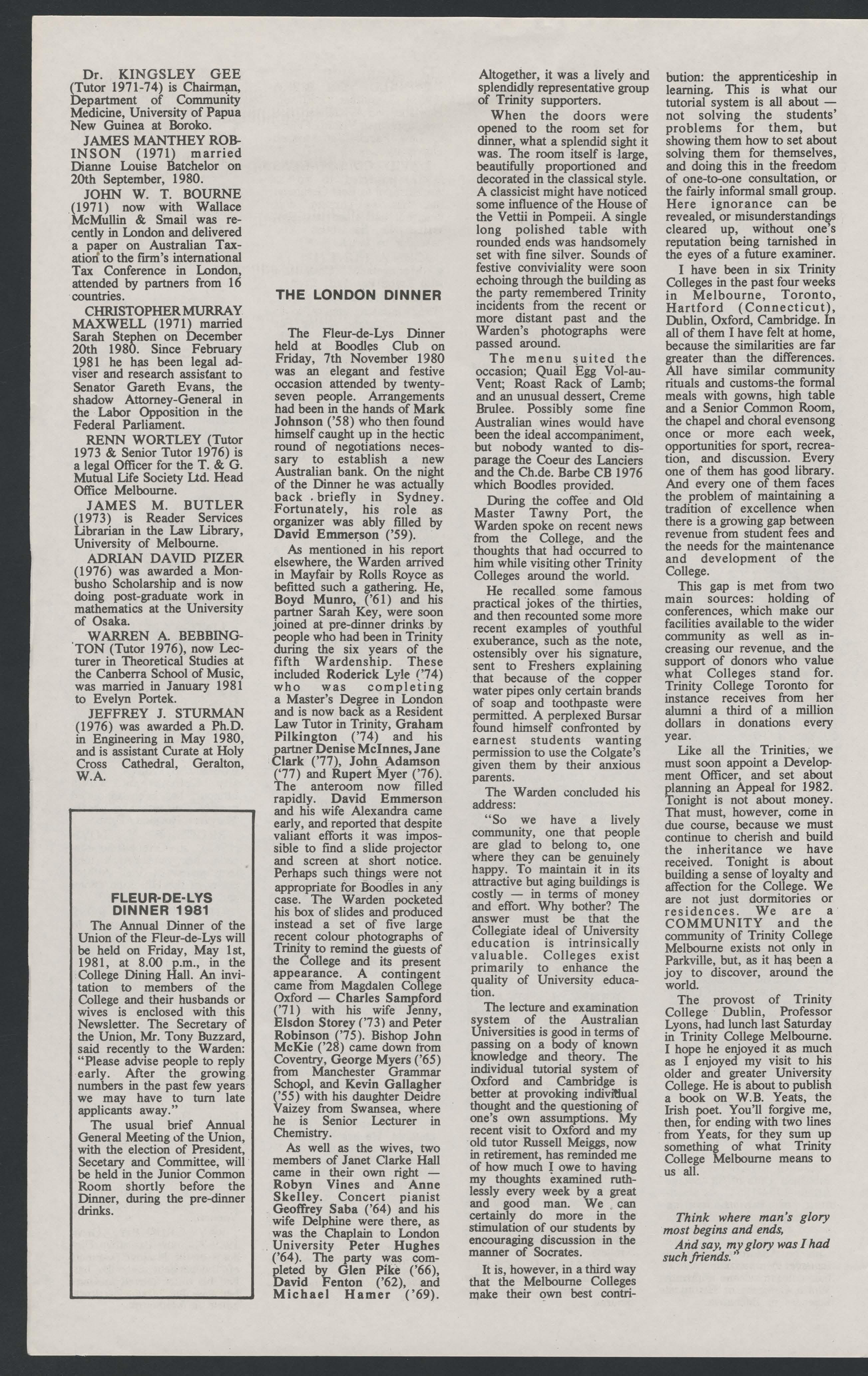
Arthur Godfrey ('66) says a few words before the christening of the new eight which bears his name, while Captain of Boats, Geoffrey Hamilton ('80) looks on.
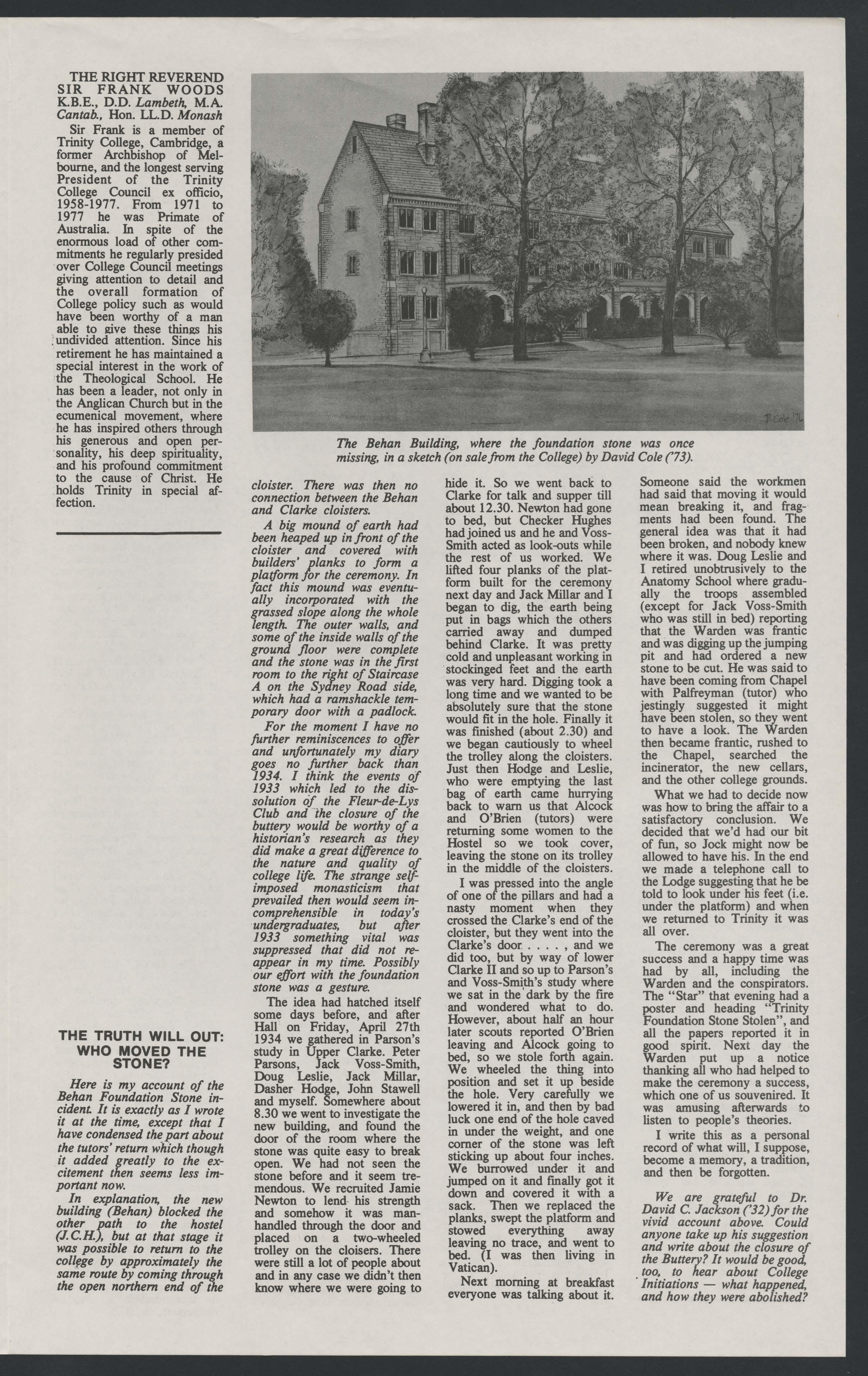
Pamela Godfrey shows a practised right arm as she breaks a bottle of champagne over the bow of the new eight.
GEORGE CHARLTON TOOTELL
Charlton Tootell, Honorary Treasurer of the College for twenty-one years under three Wardens, died suddenly on December 19, 1980. He was dedicated to the advancement of the profession of accountancy, the author of a number of papers on accounting matters, and President of the Institute of Chartered Accountants from 1960 to 1962. As well as being Director of number of Public Companies, he found time to serve the Adult Deaf and Dumb Society of Victoria, of which he was Vice-President.
When he resigned as Treasurer of Trinity College in 1967, the Council's Minute of Appreciation inçluded the following:
"The Council and Executive Officers of Trinity came to rely very heavily indeed on Mr. Tootell's wisdom and shrewd judgement, and the care and attention he devoted to the College's affairs were as extensive as they were effective. In the difficult period between the death of the third Warden and the assumption of office of the fourth, his contribution to maintaining the administration of the College was of decisive importance. His exemplary and almost single-handed management of the affairs of the Trinity College (Melbourne) Trusts Corporation deserves special commendation, but only as one excellence among many."
He will be remembered as a modest and wise man, who won the respect and affection of all who came to know him.
E.S. HUGHES CLUB — NEW RACING EIGHT
After Trinity's successes in the intercollegiate rowing last year, a special dinner of the E.S. Hughes Club was held to raise funds for the purchase of a new eight. The old seconds' eight, the KB. Mason, had long since passed reitrement age, and has now been sold. The proceeds, together with money raised at the dinner and from subscriptions to the Club, have enabled the purchase of a magnificent new boat, the Arthur Godfrey. The former firsts' boat, the W. Balcombe Griffiths, is still in excellent shape, and both firsts and seconds crews have every chance in the coming race on Thursday, 19th March.
The new boat was christened on the river bank
late in February by Arthur Godfrey's wife, Pam. Arthur himself, with a notable record as an oarsman and coach, came with her from Queensland for the occasion. We hope to send him news of annual victories in the boat which bears his name.
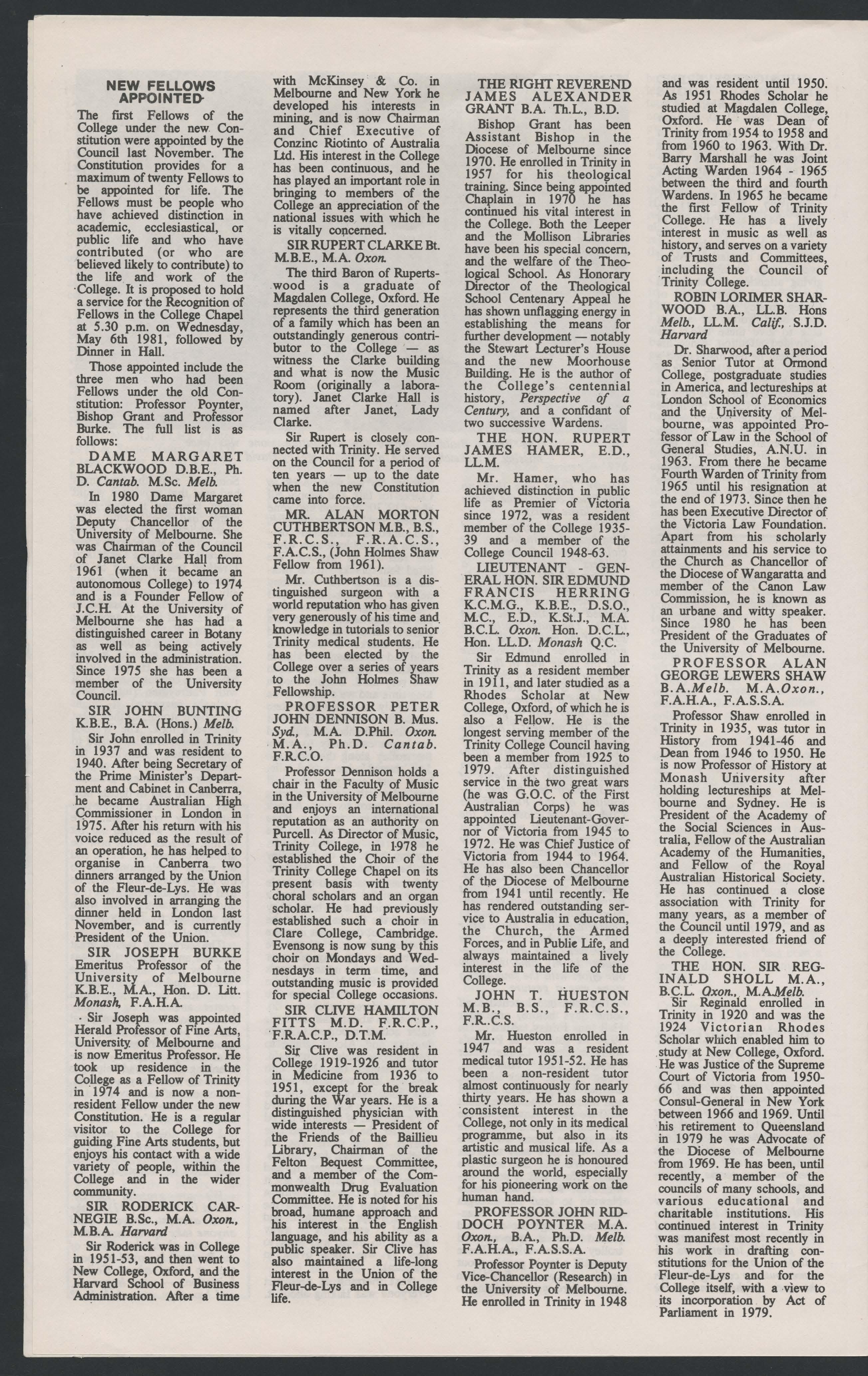
John McMillan ('32) talks with the Dean, Dr. Bryan Deschamp, at the boat launching.
We congratulate Harold Murray KNIGHT (1948). D.S.C., Knight Commander of the Order of the British Empire, for services to banking.
Maynard HEDSTROM (1927). Suva, Knight Commander of the Order of the British Empire.
Dr. Margaret BLACKWOOD (Fellow of the College). Dame Commander of the Order of the British Empire.
The Rev. Dr. Peter Frederick CARNLEY (1962). Elected Archbishop of Perth.
The Venerable Owen Douglas DOWLING (1959). Appointed Assistant Bishop of Canberra-Goulburn.
We regret the deaths of the following members of the College:
Charles Ellis DAVIES (1963)
Alan Sutherland FINLAYSON (1928)
Horace Arthur WIMPOLE (1928)
Geoffrey Tremayne SAMBELL, Archbishop of Perth, Member of the College Council 1960-69.
George Charlton TOOTELL, Hon. Treasurer 1946-67.
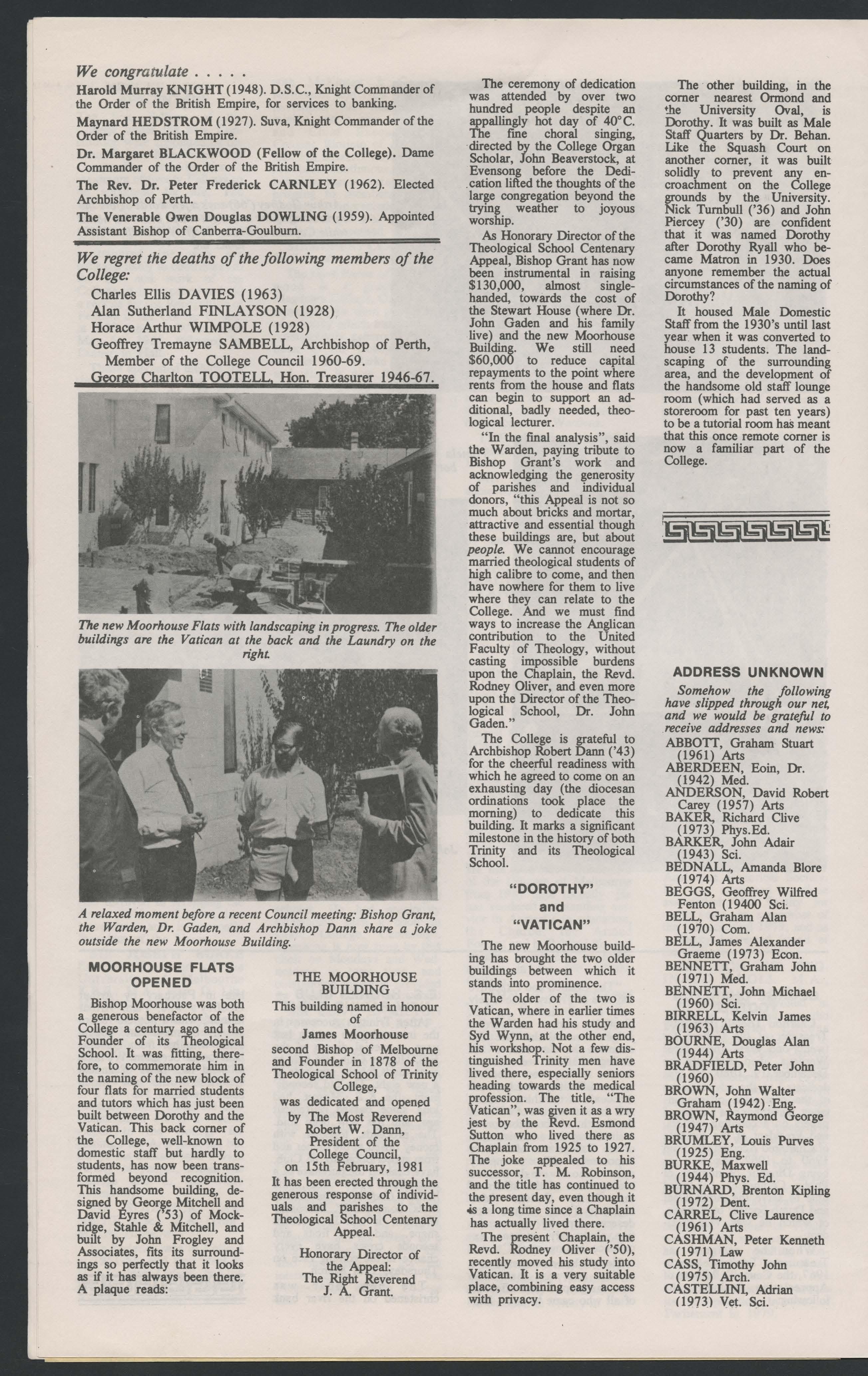
The new Moorhouse Flats with landscaping in progress. The older buildings are the Vatican at the back and the Laundry on the right.
The ceremony of dedication was attended by over two hundred people despite an appallingly hot day of 40°C. The fine choral singing, directed by the College Organ Scholar, John Beaverstock, at Evensong before the Dedication lifted the thoughts of the large congregation beyond the trying weather to joyous worship.
As Honorary Director of the Theological School Centenary Appeal, Bishop Grant has now been instrumental in raising $130,000, almost singlehanded, towards the cost of the Stewart House (where Dr. John Gaden and his family live) and the new Moorhouse Building. We still need $60,000 to reduce capital repayments to the point where rents from the house and flats can begin to support an additional, badly needed, theological lecturer.
"In the final analysis", said the Warden, paying tribute to Bishop Grant's work and acknowledging the generosity of parishes and individual donors, "this Appeal is not so much about bricks and mortar, attractive and essential though these buildings are, but about people. We cannot encourage married theological students of high calibre to come, and then have nowhere for them to live where they can relate to the College. And we must find ways to increase the Anglican contribution to the United Faculty of Theology, without casting impossible burdens upon the Chaplain, the Revd. Rodney Oliver, and even more upon the Director of the Theological School, Dr. John Gaden."
The College is grateful to Archbishop Robert Dann ('43) for the cheerful readiness with which he agreed to come on an exhausting day (the diocesan ordinations took place the morning) to dedicate this building. It marks a significant milestone in the history of both Trinity and its Theological School.
The other building, in the corner nearest Ormond and the University Oval, is Dorothy. It was built as Male Staff Quarters by Dr. Behan Like the Squash Court on another corner, it was built solidly to prevent any encroachment on the College grounds by the University. Nick Turnbull ('36) and John Piercey ('30) are confident that it was named Dorothy after Dorothy Ryall who became Matron in 1930. Does anyone remember the actual circumstances of the naming of Dorothy?
It housed Male Domestic Staff from the 1930's until last year when it was converted to house 13 students. The landscaping of the surrounding area, and the development of the handsome old staff lounge room (which had served as a storeroom for past ten years) to be a tutorial room has meant that this once remote corner is now a familiar part of the College.
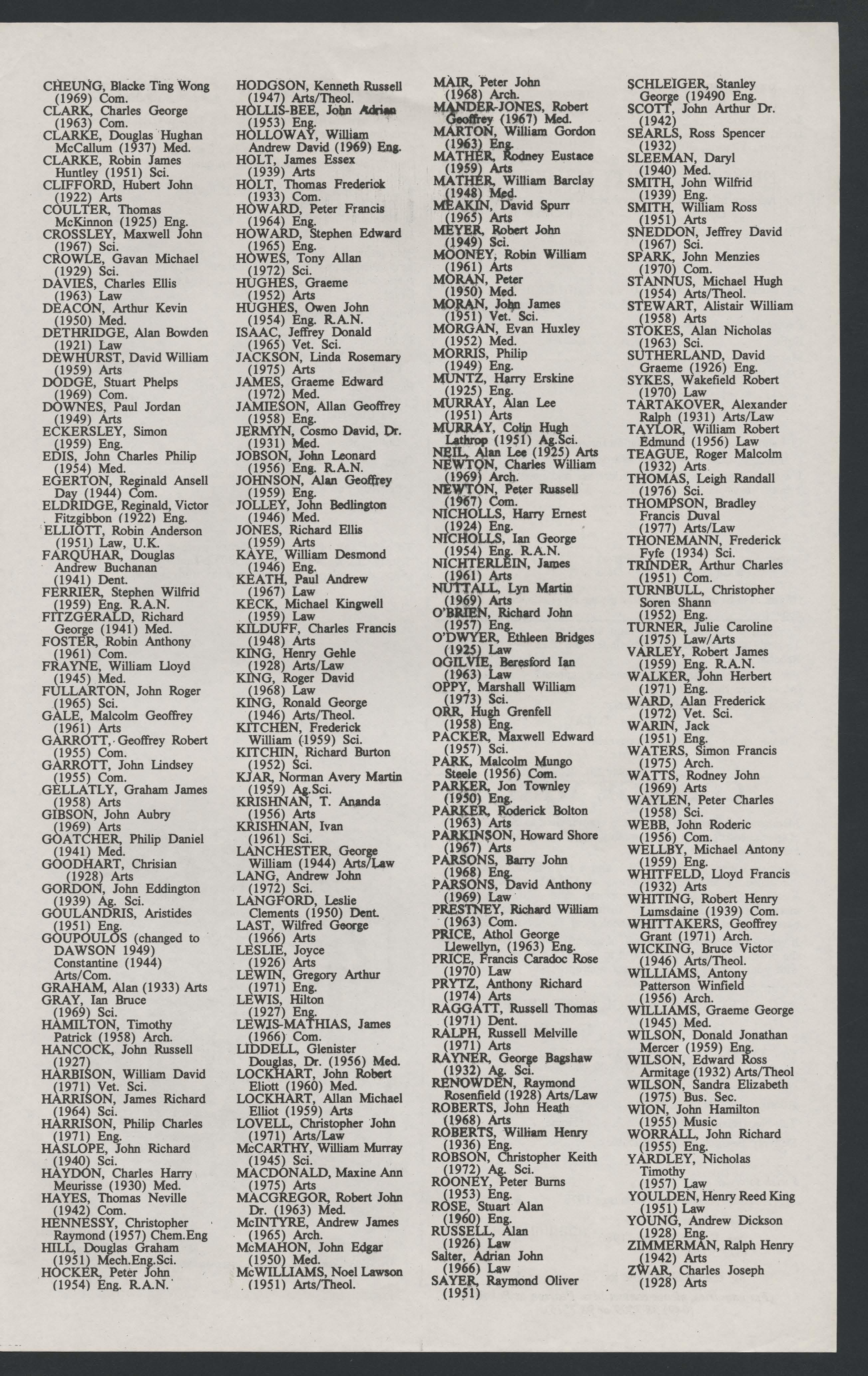
A relaxed moment before a recent Council meeting: Bishop Grant, the Warden, Dr. Gaden, and Archbishop Dann share a joke outside the new Moorhouse Building.
MOORHOUSE FLATS OPENED
Bishop Moorhouse was both a generous benefactor of the College a century ago and the Founder of its Theological School. It was fitting, therefore, to commemorate him in the naming of the new block of four flats for married students and tutors which has just been built between Dorothy and the Vatican. This back corner of the College, well-known to domestic staff but hardly to students, has now been transformed beyond recognition. This handsome building, designed by George Mitchell and David Eyres (53) of Mockridge, Stahle & Mitchell, and built by John Frogley and Associates, fits its surroundings so perfectly that it looks as if it has always been there. A plaque reads:
THE MOORHOUSE BUILDING
This building named in honour of James Moorhouse second Bishop of Melbourne and Founder in 1878 of the Theological School of Trinity College, was dedicated and opened by The Most Reverend Robert W. Dann, President of the College Council, on 15th February, 1981 It has been erected through the generous response of individuals and parishes to the Theological School Centenary Appeal.
Honorary Director of the Appeal: The Right Reverend J. A. Grant.
"DOROTHY" and "VATICAN"
The new Moorhouse building has brought the two older buildings between which it stands into prominence.
The older of the two is Vatican, where in earlier times the Warden had his study and Syd Wynn, at the other end, his workshop. Not a few distinguished Trinity men have lived there, especially seniors heading towards the medical profession. The title, "The Vatican", was given it as a wry jest by the Revd. Esmond Sutton who lived there as Chaplain from 1925 to 1927. The joke appealed to his successor, T. M. Robinson, and the title has continued to the present day, even though it is a long time since a Chaplain has actually lived there.
The present Chaplain, the Revd. Rodney Oliver ('50), recently moved his study into Vatican. It is a very suitable place, combining easy access with privacy.
ADDRESS UNKNOWN
Somehow the following have slipped through our net and we would be grateful to receive addresses and news:
ABBOTT, Graham Stuart (1961) Arts
ABERDEEN, Eoin, Dr. (1942) Med. ANDERSON, David Robert Carey (1957) Arts
BAKER, Richard Clive (1973) Phys.Ed. BARKER, John Adair (1943) Sci.
BEDNALL, Amanda Blore (1974) Arts
BEGGS, Geoffrey Wilfred Fenton (19400 Sci. BELL, Graham Alan (1970) Com. BELL, James Alexander Graeme (1973) Econ. BENNETT, Graham John (1971) Med.
BENNETT, John Michael (1960) Sci.
BIRRELL, Kelvin James (1963) Arts
BOURNE, Douglas Alan (1944) Arts
BRADFIELD, Peter John (1960)
BROWN, John Walter Graham (1942) Eng.
BROWN, Raymond George (1947) Arts
BRUMLEY, Louis Purves (1925) Eng.
BURKE, Maxwell (1944) Phys. Ed.
BURNARD, Brenton Kipling (1972) Dent.
CARREL, Clive Laurence (1961) Arts
CASHMAN, Peter Kenneth (1971) Law
CASS, Timothy John (1975) Arch. CASTELLINI, Adrian (1973) Vet. Sci.
CHEUNG, Blacke Ting Wong (1969) Corn
CLARK, Charles George (1963) Com.
CLARKE, Douglas Hughan McCallum (1937) Med.
CLARKE, Robin James Huntley (1951) Sci.
CLIFFORD, Hubert John (1922) Arts
COULTER, Thomas McKinnon (1925) Eng.
CROSSLEY, Maxwell John (1967) Sci.
CROWLE, Gavan Michael (1929) Sci.
DAVIES, Charles Ellis (1963) Law
DEACON, Arthur Kevin (1950) Med.
DETHRIDGE, Alan Bowden (1921) Law
DEWHURST, David William (1959) Arts
DODGE, Stuart Phelps (1969) Corn
DOWNES, Paul Jordan (1949) Arts
ECKERSLEY, Simon (1959) Eng.
EDIS, John Charles Philip (1954) Med.
EGERTON, Reginald Ansell Day (1944) Corn
ELDRIDGE, Reginald, Victor Fitzgibbon (1922) Eng.
ELLIOTT, Robin Anderson (1951) Law, U.K.
FARQUHAR, Douglas Andrew Buchanan (1941) Dent.
FERRIER, Stephen Wilfrid (1959) Eng. RA.N.
FITZGERALD, Richard George (1941) Med.
FOSTER, Robin Anthony (1961) Corn.
FRAYNE, William Lloyd (1945) Med.
FULLARTON, John Roger (1965) Sci.
GALE, Malcolm Geoffrey (1961) Arts
GARROTT, - Geoffrey Robert (1955) Corn.
GARROTT, John Lindsey (1955) Corn.
GELLATLY, Graham James (1958) Arts
GIBSON, John Aubry (1969) Arts
GOATCHER, Philip Daniel (1941) Med.
GOODHART, Chrisian (1928) Arts
GORDON, John Eddington (1939) Ag. Sci.
GOULANDRIS, Aristides (1951) Eng.
GOUPOULOS (changed to DAWSON 1949) Constantine (1944) Arts/Com.
GRAHAM, Alan (1933) Arts
GRAY, Ian Bruce 1969) Sci. L
HAMILTOONN, Timothy Patrick (1958) Arch.
HANCOCK, John Russell (1927)
HARBISON, William David (1971) Vet. Sci.
SON, James Richard (1964) Sci.
HARRISON, Philip Charles (1971) Eng.
HASLOPE, John Richard a940)) Sci.
YDON, Charles Harty Meurisse (1930) Med.
HAYES, Thomas Neville (1942) Corn.
HENNESSY, Christopher Raymond (1957) Chem.Eng
HILL, Douglas Graham (1951) Mech.Eng.Sci.
HOCKER, Peter John (1954) Eng. R.A.N.'
HODGSON, Kenneth Russell (1947) Arts/Theol.
HOLLIS-BEE, John Achim (1953) Eng.
HOLLOWAY, William Andrew David (1969) Eng.
HOLT, James Essex (1939) Arts
HOLT, Thomas Frederick (1933) Com.
HOWARD, Peter Francis
HO(1964) Eng.
WARD, Stephen Edward (1965) Eng.
HOWES, Tony Allan (1972) Sci.
HUGHES, Graeme (1952) Arts
HUGHES, Owen John (1954) Eng. R.A.N.
ISAAC, Jeffrey Donald (1965) Vet. Sci.
JACKSON, Linda Rosemary (1975) Arts
JAMES, Graeme Edward (1972) Med.
JAMIESON, Allan Geoffrey (1958) Eng.
JERMYN, Cosmo David, Dr. (1931) Med.
JOBSON, John Leonard (1956) Eng. R.A.N.
JOHNSON, Alan Geoffrey (1959) Eng.
JOLLEY, John Bedlington (1946) Med.
JONES, Richard Ellis (1959) Arts
KAYE, William Desmond (1946) Eng.
KEATH, Paul Andrew (1967) Law
KECK, Michael Kingwell (1959) Law
KILDUFF, Charles Francis (1948) Arts
KING, Henry Gehle (1928) Arts/Law
KING, Roger David (1968) Law
KING, Ronald George (1946) Arts/Theol.
KITCHEN, Frederick William (1959) Sci.
KITCHIN, Richard Burton (1952) Sci.
KJAR, Norman Avery Martin (1959) Ag.Sci.
KRISHNAN, T. Manda (1956) Arts
KRISHNAN, Ivan (1961) Sci.
LANCHESTER, George William (1944) Arts/Law
LANG, Andrew John (1972) Sci.
LANGFORD, Leslie Clements (1950) Dent.
LAST, Wilfred George (1966) Arts
LESLIE, Joyce (1926) Arts
LEWIN, Gregory Arthur (1971) Eng.
LEWIS, Hilton (1927) Eng.
LEWIS-MATHIAS, James (1966) Corn.
LIDDELL, Glenister Douglas, Dr. (1956) Med.
LOCKHART, John Robert Eliott (1960) Med.
LOCKHART, Allan Michael Elliot (1959) Arts
LOVELL, Christopher John (1971) Arts/Law
McCARTHY, William Murray (1945) Sci.
MACDONALD, Maxine Ann (1975) Arts
MACGREGOR, Robert John Dr. (1963) Med.
McINTYRE, Andrew James (1965) Arch.
McMAHON, John Edgar (1950) Med.
McWILLIAMS, Noel Lawson (1951) Arts/Theol.
MÀIR, Peter John (1968) Arch.
$R-JONES, Robert ey (1967) Med.
MARTON, William Gordon (1963) Eng.
MATH R, Rodney Eustace (1959) Arts
MATHER, William Barclay (1948) Med.
MEAKIN, David Spurr (1965) Art s
MEYER, Robert John (1949) Sci.
MOONEY, Robin William (1961) Arts
MORAN, Peter (1950) Med.
MORAN, John James (1951) Vet. Sci.
MORGAN, Evan Huxley (1952) Med.
MORRIS, Philip (1949) Eng.
MUNTZ, Harry Erskine (1925) Eng.
MURRAY, Alan Lee (1951 Arts
MU Y, Colip Hugh Lathrop (1951) Ag.Sci.
NEIL, Alan Lee (1925) Arts
NEWT N, Charles William (1969 Arch.
NEWT N, Peter Russell (1967) Com.
NICHOLLS, Harry Ernest (1924) Eng.
NICHOLLS, Ian George (1954) Eng. R.A.N.
NICHTERLEIN, James (1961) Arts
NUTTALL, Lyn Martin (1969) Arts
O'BRIEN, Richard John (1957) Eng.
O'DWYER, Ethleen Bridges (1925) Law
OGILVIE, Beresford Ian (1963) Law
OPPY, Marshall William (1973) Sci.
ORR, Hugh Grenfell (1958) Eng.
PACKER, Maxwell Edward (1957) Sci.
PARK, Malcolm Mungo Steele (1956) Com.
PARKER, Jon Townley (1950) Eng.
PARKER, Roderick Bolton (1963) Arts
PARKINSON, Howard Shore (1967) Arts
PARSONS, Barry John (1968) Eng.
PARSONS, David Anthony (1969) Law
PRESTNEY, Richard William (1963) Corn.
PRICE, Athol George Llewellyn, (1963) Eng.
PRICE, Francis Caradoc Rose (1970) Law
PRYTZ, Anthony Richard (1974) Arts
RAGGATT, Russell Thomas (1971) Dent.
RALPH, Russell Melville (1971) Arts
RAYNER, George Bags haw (1932) Ag. Sci.
RENOWDEN, Raymond Rosenfield (1928) Arts/Law
ROBERTS, John Heath (1968) Arts
ROBERTS, William Henry (1936) Eng.
ROBSON, Christopher Keith (1972) Ag. Sci.
ROONEY, 13eter Burns (1953) Eng.
ROSE, Stuart Alan (1960) Eng.
RUSSELL, Alan (1926) Law
Salter, Adrian John (1966) Law
SAYER, Raymond Oliver (1951)
SCHLEIGER, Stanley George (19490 Eng.
SCOTT, John Arthur Dr. (1942)
SEARLS, Ross Spencer (1932)
SLEEMAN, Daryl (1940) Med.
SMITH, John Wilfrid (1939) Eng.
SMITH, William Ross (1951) Arts
SNEDDON, Jeffrey David (1967) Sci.
SPARK, John Menzies (1970) Corn.
STANNUS, Michael Hugh (1954) Arts/Theol.
STEWART, Alistair William (1958) Arts
STOKES, Alan Nicholas (1963) Sci.
SUTHERLAND, David Graeme (1926) Eng.
SYKES, Wakefield Robert (1970) Law
TARTAKOVER, Alexander Ralph (1931) Arts/Law
TAYLOR, William Robert Edmund (1956) Law
TEAGUE, Roger Malcolm (1932) Arts
THOMAS, Leigh Randall (1976) Sci.
THOMPSON, Bradley Francis Duval (1977) Arts/Law
THONEMANN, Frederick Fyfe (1934) Sci.
TRINDER, Arthur Charles (1951) Com.
TURNBULL, Christopher Soren Shann (1952) Eng.
TURNER, Julie Caroline (1975) Law/Arts
VARLEY, Robert James (1959) Eng. R.A.N.
WALKER, John Herbert (1971) Eng.
WARD, Alan Frederick (1972) Vet. Sci.
WARIN, Jack (1951) Eng.
WATERS, Simon Francis (1975) Arch.
WATTS, Rodney John (1969) Arts
WAYLEN, Peter Charles (1958) Sci.
WEBB, John Roderic (1956) Corn.
WELLBY, Michael Antony (1959) Eng.
WHITFELD, Lloyd Francis (1932) Arts
WHITING, Robert Henry Lumsdaine (1939) Corn.
WHITTAKERS, Geoffrey Grant (1971) Arch. WICKING, Bruce Victor (1946) Arts/Theol.
WILLIAMS, Antony Patterson Winfield (1956) Arch.
WILLIAMS, Graeme George (1945) Med.
WILSON, Donald Jonathan Mercer (1959) Eng. WILSON, Edward Ross Armitage (1932) Arts/Theol WILSON, Sandra Elizabeth (1975) Bus. Sec.
WION, John Hamilton (1955) Music
WORRALL, John Richard (1955) Eng.
YARDLEY, Nicholas Timothy (1957) Law
YOULDEN, Henry Reed King (1951) Law
YOUNG, Andrew Dickson (1928) Eng.
ZIMMERMAN, Ralph Henry (1942) Arts
ZWAR, Charles Joseph (1928) Arts
Please cut and return to:
The Revd. Alfred Bird, Records Officer, Trinity College, Parkville, Victoria, 3052.
NEWS OF TRINITY MEMBERS
The Address to which this Newsletter was sent was: ❑ Correct ❑ Incorrect
The correct address is:
My telephone numbers are: ( ) ( ) Home Business
Recent Personal News:
Births:
Marriage to: on
Other Personal News:
❑ I should appreciate an invitation through Nick Turnbull to lunch in College with the Warden.
I wish to supply the following addresses and news of other Trinity Members:
Name Signed Please print Date:
(If you wish to include a donation please leave attached to the above).
Enclosed please find my donation as follows: Towards the cost of this Newsletter and the$ Records Officer
For the Theological School Centenary Appeal$ (Moorhouse Building)
For use at the Warden's discretion $ TOTAL $
(Please make all cheques payable to Trinity College, Melbourne). All_knatism are_inconit.lia de ictilj.,
COLLEGE WINE
Members and friends of Trinity are again invited to take advantage of special bottling of premium quality wines arranged with Tyrrell's Hunter Valley Vineyards.
The new wines, a 1980 Seinillon and a 1978 Hermitage, can be purchased in unmixed dozen lots at $27.50, delivery free in Victoria. They feature appropriate and attractive labels incorporating an illustration of Bishops'. The bottling has again been arranged to benefit the Theological School Appeal.
If you would like to avail yourself of this offer, you should complete the order form below and send it to Tyrrell's Vineyards Pty. Ltd. with your cheque for the amount appropriate to your order.
TRINITY COLLEGE WINE OFFER ORDER FORM
To: TYRRELL'S VINEYARDS PTY. LTD. POKOLBIN, New South Wales, 2321.
Name:
Address:
Tel. No. (Business) (Home)
Delivery Instructions (If applicable):
I wish to order.
doz. Hunter Red Hermitage 1978 $ ($27.50 per doz.)
doz. Hunter Semillon 1980 $ ($27.50 per doz.)
My cheque is enclosed for $
(For enquiries, please contact Mrs. Pearson at Pokolbin (049) 98 7509 or 98 7516).
TRINITIANA ON SALE
The College has for sale the following attractive reminders of your time in Trinity:
Prints of Pen and Ink Drawings (for framing)
David Cole (1012 ins. x 12 ins.), on quality art paper:
• The Chapel, seen across the Bulpadock
• The Behan Building
• Bishop's Tower
$4.00 each
Trinity Fleur-de-Lys Ties $7.00 each
Perspective of a Century, a beautifully produced$7.00 each hard-cover history of Trinity's first one hundred years, with colour plates (202 pp.), by James Grant
Trinity Coat-Of-Arms: Cuff-links
$4.00 each
Bar Brooches
Lapel Stick Pins
Fine White China with Coat of Arms:
Ash Trays
$2.00 each
$2.00 each
$4.00 each
Tea Cup and Saucer $5.00 set
Coffee Cup and Saucer
Coffee Mugs
$6.00 set
$4.00 each
Other items are available, up to a complete Dinner setting. (62" side plate; 9" plate; 10" plate; 51 dessert bowl; coffee cup and saucer).
24 piece $100.00
36 piece $140.00
48 piece $175.00
To order any of the above, please write to the Secretary, Trinity College, Parkville, Vic., 3052. Include your address and telephone numbers (day and evening).