Subject Selection
STAGE 6 (YEAR 11 & 12) 2027
STAGE 6 (YEAR 11 & 12) 2027
Congratulations on reaching this milestone!
You are about to embark on a journey into senior school to attain your Higher School Certificate (HSC). There are many pathways to attain this qualification and we encourage you to carefully consider the pathway that provides you with the most options to explore at the completion of your final school year.
This Subject Selection Guide is designed to provide information for you and your family with accessible information to ensure informed decision-making. At Trinity, we are proud to offer a broad selection of courses to select from that aims to cater to your individual talents and interests, at a level you will handle competently.
All courses offered in Years 11 and 12 (known as Stage 6) are considered to be academic courses. They will demand you to establish effective patterns of study, complete set tasks, adhere to deadlines, problem solve, work independently and to work collaboratively with your peers and teachers who will support you every step of the way!
The Subject Selection Guide is divided into three key areas to assist you with your decision making - Consider / Explore / Decide.
Consider courses that interest you. This is your chance to shape your pattern of study around subjects that build on your passions and interests. Choose subjects that you enjoy and you will be more likely to find success.
Consider courses that challenge you and provide a stimulus for your learning growth. We encourage you to be a resilient learner and strive to overcome the challenges in your learning, to be an active participant in your own learning journey.
Consider courses with a realistic perspective. Be realistic about your abilities and choose subjects because you are interested in the possibilities. Your decisions should not be based on peer groups or who the teacher might be. This is an individual choice based on an honest reflection of ability and personal interest.
Explore the range of subjects that are offered. This guide provides a summary of each subject, course fees, topic areas, student suitability and relevant career pathways for you to consider.
This guide should also be closely read with university guides, TAFE information and advice from the College’s Career Advisor and Heads of Department.
Decide which subjects you would like to study. It is wise to have multiple options that increase your chance to pursue a variety of careers or further study options beyond HSC. Using the subject selection template, you can explore a pattern of study to suit, ensuring that you add your subjects in preferential order.
Whilst we will do our best to ensure that you receive your first preferences, there may be occasions when this is not possible, and in some instances, subjects may not be offered if there is insufficient interest. Please take careful note of the subject selection timeline.
Important
Term 2, Week 7
Term 2, Weeks 8-9
Term 2, Week 9
Term 2, Week 9
Subject Selection Information Session and Edval Online subject selection portal opens (Wednesday 3 June)
Subject Selection meetings with students and House Mentors
Edval Online subject selection portal closes (Friday 19 June)
Edval signed subject selection confirmation form due (Monday 22 June)
On behalf of the Trinity community, we wish you every success with your future studies.
Stephanie Davis Dean of Studies – Senior School
HSC students must study a minimum of 12 units in Year 11, and a minimum of 10 units in Year 12.

In Year 11 students must study a minimum of 12 units, with the option of studying 13 units
Two units of English is compulsory Mathematics is recommended
Students select at least three courses of two-unit value from at least four subject areas
In Year 12, most students will study 10 units
In almost all cases, the courses that students select in Year 11 flow into courses studied in Year 12.
Two units of English is compulsory
Students select at least three courses of two-unit value from at least four subject areas
Within an HSC subject area (eg Mathematics) there may be several courses (eg. Mathematics Standard 2, Mathematics Advanced, Mathematics Extension 1, Mathematics Extension 2). If a student studies, for example, Mathematics Extension 1, Mathematics Extension 2, English Advanced, English Extension 1 and Biology they will not meet the four subject area requirements because they have only studied three subject areas: Mathematics, English and Biology.
Likewise, if a student studies English Advanced, English Extension 1, English Extension 2, Mathematics Extension 1, Mathematics Extension 2, Modern History and History Extension, they have only studied three subject areas: English, Mathematics and Modern History. History Extension does not count as an additional subject area.
Extension subjects in Years 11 and 12 are one-unit subjects, and are taught off-line. Under these circumstances, extension subjects will have classes that take place before or after school. Students selecting these subjects must be committed to either starting their school day earlier or completing it after the scheduled 3.10pm finish. The days and times of these ‘off timetable’ classes will be published to students when the classes are finalised.
1. Just about any combination of courses can lead to a good ATAR. It all depends on how well you do in all your courses in comparison to other students.
2. If you want to get an ATAR, make sure you refer to page 4 for eligibility.
3. Choose HSC courses that you are good at and interested in, and that will lay a foundation for your future plans. Choose courses that will prepare you well for the areas of university of study you’re planning to pursue.
4. If you are not sure what level of Mathematics and English to take, choose the level that suits your ability and future plans, rather than trying to take advantage of how courses are scaled. You will not necessarily get a higher ATAR just by studying a lower level course. Also, be aware that while universities often increase the selection rank in recognition of your performance in particular HSC courses (usually Band 5 & 6), they do not always reward your performance in the lower level courses, no matter how well you do.
5. Make the link between your choices now and where you want to go after Year 12.
6. Check if the university you want to attend, or the course you want to do, has prerequisites and assumed knowledge. These can include a high-level Mathematics or English course.
7. To make good choices about what to study, work to the best of your ability and focus on your goals for life after school.
Visit the NESA website for more advice on subject selection

when you start your university course. If you haven’t completed the specified HSC course, you can still be selected for the university course, but you may have some difficulty coping with your studies. The university may suggest you enrol in a bridging course to gain basic knowledge of the subject.

English Board Developed Courses
English Studies
English Standard
English Advanced
English Extension 1 (1 unit)
French Continuers
Mathematics Board Developed Courses
Mathematics Standard
Mathematics Advanced
Mathematics Extension 1 (1 unit)
Science Board Developed Courses
Biology
Chemistry
Physics
Technologies Board Developed Courses
Design and Technology
Engineering Studies
Enterprise Computing
Food Technology
Human Society and Its Environment (HSIE) Board Developed Courses
Ancient History
Business Studies
Geography
Legal Studies
Modern History
Society and Culture Studies of Religion
Creative and Performing Arts Board Developed Courses
Dance
Drama
Music 1
Visual Arts
Personal Development, Health and Physical Education (PDHPE) Board Developed Courses
Community and Family Studies
Health and Movement Science
Sport, Lifestyle and Recreation (Board Endorsed Course)
Vocational Education and Training (VET) Course
Construction
TVET TAFE NSW
Distance Education
English Board Developed Courses
English Studies
English Standard
English Advanced
English Extension 1 (1 unit)
English Extension 2 (1 unit)
Mathematics Board Developed Courses
Mathematics Standard 1
Mathematics Standard 2
Mathematics Advanced
Mathematics Extension 1 (1 unit)
Mathematics Extension 2 (1 unit)
Science Board Developed Courses
Biology
Chemistry
Physics
Technologies Board Developed Courses
Design and Technology
Engineering Studies
Enterprise Computing
Food Technology
Human Society and Its Environment (HSIE) Board Developed Courses
Ancient History
Business Studies
Geography
History Extension (1 unit)
Legal Studies
Modern History
Society and Culture Studies of Religion
Creative and Performing Arts Board Developed Courses
Drama
Music 1
Visual Arts
Personal Development, Health and Physical Education (PDHPE) Board Developed Courses
Community and Family Studies
Health and Movement Science
Sport, Lifestyle and Recreation (Board Endorsed Course)
Vocational Education and Training (VET) Course
Construction
TVET TAFE NSW
Please

Term 2, Week 7
Term 2, Weeks 8-9
Term 2, Week 9
Term 2, Week 9
Subject Selection Information Session and Edval Online subject selection portal opens (Wednesday 3 June)
Subject Selection meetings with students and House Mentors
Edval Online subject selection portal closes (Friday 19 June)
Edval signed subject selection confirmation form due (Monday 22 June)
Deputy Principal - Senior School: Kathy Fletcher
Dean of Teaching & Learning K-12: Nash Clark
Dean of Studies - Senior School: Stephanie Davis
Dean of Students - Senior School: David Smith
Careers Advisor: Mark Dicketts
Academic Administration: Victoria Fordham
Heads of Department:
HSIE: Matthew de Koeyer
English: Jessica Alvey
Science: Beth Yarker
PDHPE: Carissa Furze
Mathematics: Tristan Patralakis
TAS & VET: Samantha Morley
CAPA: Sarah Bradbury
Distance Education: Stephanie Davis
Senior School Learning Support: Aaron Culligan
Heads of House
Hoffman: Ben Tari
Kelton: Davina Gibb
Kimball: David Miles
Lankester: Alison Barrett
Petts: Kimberley Graetz
Rosborough: Elizabeth Williams
kathy.fletcher@trinityac.nsw.edu.au nash.clark@trinityac.nsw.edu.au
stephanie.davis@trinityac.nsw.edu.au david.smith@trinityac.nsw.edu.au mark.dicketts@trinityac.nsw.edu.au academicadmin@trinityac.nsw.edu.au
matthew.dekoeyer@trinityac.nsw.edu.au jessica.alvey@trinityac.nsw.edu.au beth.yarker@trinityac.nsw.edu.au carissa.furze@trinityac.nsw.edu.au tristan.patralakis@trinityac.nsw.edu.au samantha.morley@trinityac.nsw.edu.au sarah.bradbury@trinityac.nsw.edu.au stephanie.davis@trinityac.nsw.edu.au aaron.culligan@trinityac.nsw.edu.au
ben.tari@trinityac.nsw.edu.au davina.gibb@trinityac.nsw.edu.au david.miles@trinityac.nsw.edu.au alison.barrett@trinityac.nsw.edu.au kimberley.graetz@trinityac.nsw.edu.au elizabeth.williams@trinityac.nsw.edu.au

English Studies
English Standard
English Advanced
English Extension
French Continuers (Year 11 only)
English Studies 11–12 provides students the opportunity to explore the ideas, values, language forms, features and structures of texts from a range of contexts. Through responding to and composing texts, students strengthen their ability to access and comprehend information, assess its reliability and synthesise the knowledge gained from a range of sources for a variety of purposes.
Through the study of English Studies 11–12, students will:
develop and use communication skills for a range of purposes and audiences find information and perspectives that will inform their understanding of ideas make inferences about the meaning of language based on context express personal experiences and opinions and develop skills as independent learners.
Number of Units:
Marks available:
Exclusions:
Contribution to the HSC and ATAR:
Suitability:
Career Pathway:
English (Advanced); English (Standard); English (ESL); English (Extension)
Satisfactory completion of English Studies will fulfill the pattern of study requirements for the HSC English Studies students can elect to take the HSC Examination to receive the ATAR.
Students who complete the course can be eligible for the calculation of the ATAR
Students who consistently maintained a grade below C in Year 10 English. If you find extended reading and writing challenging, this is a better English course for you.
Students who undertake the English Studies course can explore relevant careers here
English Standard 11–12 provides students with the opportunity to analyse, study and enjoy a breadth and variety of English texts, to become confident and effective communicators. Students develop the knowledge to analyse, reconsider and refine meaning, and to reflect on their own processes of responding, composing and learning.
Through the study of English Standard 11–12, students will:
develop clear communication skills for a range of purposes and audiences find information and perspectives to develop their understanding of ideas learn to make assumptions about the purpose and meaning of language based on context express personal experiences and opinions and reflect on skills as independent learners.
Number of Units:
Marks available:
Exclusions:
Contribution to the HSC and ATAR:
Suitability:
Career Pathway:
English (Advanced); English (Studies); English (ESL); English (Extension)
Satisfactory completion of English Standard will fulfill the pattern of study requirements for the HSC Students who complete the course can be eligible for the calculation of the ATAR.
Students who consistently achieve a C or B grade in Year 10 English This course is suited to students who like to read shorter but still complex texts and like to refine their writing to be cohesive extended pieces.
Students who undertake the English Standard course can explore relevant careers here
English Advanced 11–12 provides students the opportunity to refine their understanding of the dynamic relationship between language, texts and meaning through critical study, and the skilful and creative use of language forms, language features, and structures of texts composed for different purposes in a range of contexts. Students develop the knowledge to question, reconsider and refine meaning through language, and to reflect on their own processes of responding, composing and learning.
Through the study of English Advanced 11–12, students will:
use clear written and verbal communication skills for a range of purposes and audiences seek and evaluate information and arguments to inform their understanding of ideas make inferences about the intention and meaning of language based on context confidently express personal experiences and opinions and develop knowledge and skills as independent learners.
English Extension Year 11 and English Extension 1 Year 12 provide students with the opportunity to extend their use of language and self-expression in creative and critical ways. Students engage with increasingly complex concepts through a broad range of literature from different contexts. Through this, they refine their understanding and appreciation of the significance of texts, and the way that literature shapes and reflects the world.
English Extension 2 Year 12 extends students’ conceptual understanding of the ways literature is read and written through their consideration of authorship and their authorial role. Students develop their understanding of the composition process to create a substantial and original Major work
What students learn
Through the study of English Extension, students will:
learn to use clear written and verbal communication for a range of purposes and audiences interpret and evaluate information and arguments for clarity, precision and effectiveness make inferences about intention and meaning of language based on contextual clues explore using verbal and written language to confidently express personal experiences and opinions, and reflect on development of knowledge and skills as independent learners.
Extension courses are taught outside the normal timetable and require a commitment to class either before or after school.
The French Stage 6 courses provide students with the opportunity to develop their skills in listening, speaking, reading and writing in French. The courses are designed for students who are interested in language learning, communication and understanding different cultures. Through engaging with a range of texts and contexts, students develop their ability to use French effectively in real-life situations while gaining insight into the cultural perspectives of French-speaking communities.
The courses enable students to extend their communication skills and intercultural understanding by engaging with increasingly complex language and ideas. Students develop confidence and fluency in expressing themselves, interpret a variety of spoken and written texts, and compose their own texts for different purposes and audiences. They explore contemporary and personal topics, deepening their understanding of how language reflects culture and identity. The courses foster independence, collaboration and critical thinking, building skills that support further study, travel and a wide range of career pathways in a global context.

Year 11
Mathematics Standard Mathematics Advanced
Year 12
Mathematics Standard 1 Mathematics Standard 2
Mathematics Advanced Mathematics Extension 1
Mathematics Extension 2
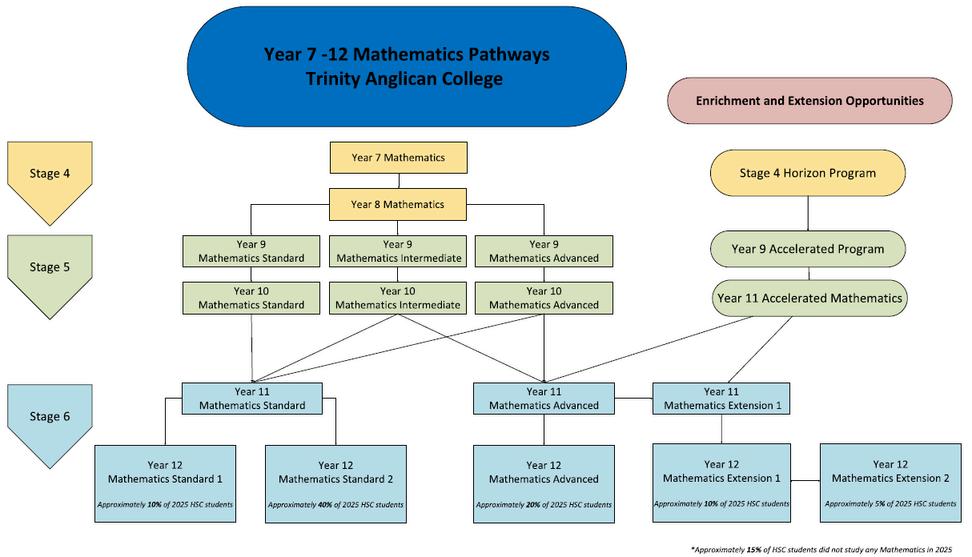
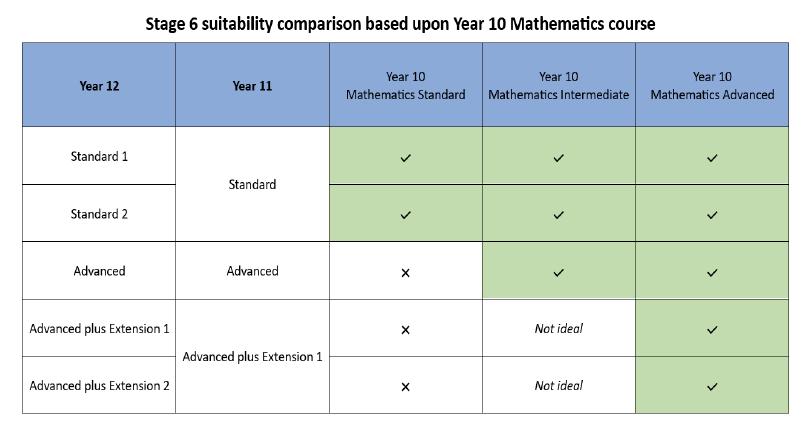
The Mathematics Standard Courses are focused on enabling students to use Mathematics effectively, efficiently and critically to make informed decisions in their daily lives. They provide students with the opportunities to develop an understanding of, and competence in, further aspects of Mathematics through a large variety of real-world applications for a range of concurrent HSC subjects. Students who have completed the Mathematics Standard Course in Year 9 and 10 will find Mathematics Standard a suitable, relevant and useful HSC Mathematics course. This is a noncalculus course.
The Mathematics Standard Year 11 course is a common course for all students studying the Mathematics Standard syllabus. In Year 12 students can elect to study either the Mathematics Standard 1 Year 12 course or the Mathematics Standard 2 Year 12 course.
Mathematics Standard 1 is designed to help students improve their numeracy by building their confidence and success in making Mathematics meaningful. Numeracy is more than being able to operate with numbers. It requires Mathematical knowledge and understanding, Mathematical problem-solving skills and literacy skills, as well as positive attitudes. When students become numerate, they are able to manage a situation or solve a problem in real contexts, such as everyday life, work or further learning. This course offers students the opportunity to prepare for post-school options of employment or further training.
Students studying the Mathematics Standard 1 course may elect to undertake an optional HSC examination. To be eligible for an ATAR, students studying the Mathematics Standard 1 course must undertake a pattern of study to satisfy the ATAR requirements and complete the optional HSC examination.
Number of Units:
Marks available:
Exclusions:
Suitability:
Two for each of the Preliminary Course (Year 11) and HSC Course (Year 12)
HSC examination of 100 marks for the HSC Course (Year 12). This is optional for students wishing to use Mathematics towards their HSC.
Mathematics Standard 2, Mathematics Advanced, Mathematics Extension 1, Mathematics Extension 2
Students who consistently achieve below a C grade in Year 10 Mathematics Standard.
The Mathematics Standard Courses are focused on enabling students to use Mathematics effectively, efficiently and critically to make informed decisions in their daily lives.
They provide students with the opportunities to develop an understanding of, and competence in, further aspects of Mathematics through a large variety of real-world applications for a range of concurrent HSC subjects. Students who have completed the Mathematics Intermediate Course in Year 9 and 10 will find Mathematics Standard a suitable, relevant and useful HSC Mathematics course. This is a non- calculus course.
The Mathematics Standard Year 11 course is a common course for all students studying the Mathematics Standard syllabus. In Year 12 students can elect to study either the Mathematics Standard 1 Year 12 course or the Mathematics Standard 2 Year 12 course.
Mathematics Standard 2 is designed for those students who want to extend their Mathematical skills beyond Stage 5 but are not seeking the in-depth knowledge of higher Mathematics that the study of calculus would provide. This course offers students the opportunity to prepare for a wide range of educational and employment aspirations, including continuing their studies at a tertiary level
Number of Units:
Marks available:
Exclusions:
Contribution to the HSC and ATAR:
Suitability:
Career Pathway:
Mathematics Standard 1; Mathematics Advanced, Mathematics Extension 1, Mathematics Extension 2
Satisfactory completion of Mathematics Standard course fulfill the pattern of study requirements for the HSC. Students who complete either or both courses can be eligible for the calculation of the ATAR.
Year 10 Mathematics Standard and studetns who consistently achieve below a C in Mathematics Intermediate
Students who undertake Mathematics Standard courses can explore relevant careers here.
Mathematics Advanced is a course that develops concepts which have been studied in the Year 10 course. It is expected that students have demonstrated general competence in ALL the skills at Year 10 Mathematics Advanced. Outstanding students in the Year 10 Mathematics Intermediate could also consider the course.
Mathematics Advanced is the minimum requirement for a number of Mathematics-based tertiary courses, including The University of Melbourne. Mathematics Advanced is recommended for all students undertaking HSC Physics and Chemistry.
The Mathematics Advanced Year 11 course has been developed on the assumption that students have studied the content and achieved the outcomes of all sub-strands of all Mathematics Intermediate/Advanced core and path topics including:
Algebraic techniques B + C
Equations B + C
Linear relationships C
Non-Linear relationships C
Polynomials
Functions and other graphs
Trigonometry C + D
Mathematics Extension 1 is focused on enabling students to develop a thorough understanding of and competence in further aspects of Mathematics. The course provides opportunities to develop rigorous mathematical arguments and proofs, and to use Mathematical models more extensively. Students of Mathematics Extension 1 will be able to develop an appreciation of the interconnected nature of Mathematics, its beauty and its functionality.
Mathematics Extension 1 provides a basis for progression to further study in Mathematics or related disciplines in which Mathematics has a vital role at a tertiary level. An understanding and exploration of Mathematics Extension 1 is also advantageous for further studies in areas as Science, Engineering, Finance and Economics.
Mathematics Extension 2 is designed for students with a special interest in Mathematics who have shown that they possess special aptitude for the subject.
Mathematics Extension 2 provides students with the opportunity to develop strong Mathematical manipulative skills and a deep understanding of the fundamental ideas of algebra and calculus, as well as an appreciation of Mathematics as an activity with its own intrinsic value, involving invention, intuition and exploration. Mathematics Extension 2 extends students’ conceptual knowledge and understanding through exploration of new areas of Mathematics not previously seen.

Biology Chemistry Physics
Biology is the study of life, focusing on the evolution, diversity and functioning of living organisms and their interactions with the environment. The course explores concepts including heredity, biodiversity, disease and biotechnology, with an emphasis on real-world applications in health and sustainability. Students develop an understanding of biological systems and their importance in a rapidly changing world.
The study of Biology builds a deep knowledge of living systems, from the molecular level to whole ecosystems, and highlights the interconnectedness of life. Students engage with contemporary issues such as genetic technologies, environmental conservation and disease prevention, while developing an awareness of Aboriginal and Torres Strait Islander Peoples’ knowledges relating to environment, health and sustainability.
What students learn
Biology develops students’ Working Scientifically skills through practical investigations, fieldwork and data analysis. Students strengthen their problem-solving, reasoning and communication skills, enabling them to interpret evidence and draw informed conclusions. The course provides a foundation for further study and careers in health, environmental science and research, and supports students in becoming scientifically literate citizens.
Number of Units:
Marks available:
Contribution to the HSC and ATAR:
Suitability:
Career Pathway:
Satisfactory completion of the Biology course fulfills the pattern of study requirements for the HSC and can be eligible for the calculation of the ATAR
Interested students who have consistently achieved a C grade or higher in both Year 10 Science and Year 10 English.
Students who undertake Biology can explore relevant careers here
Chemistry involves using differing scales, specialised representations, explanations, predictions and creativity, especially in the development and pursuit of new materials.
It requires students to use their imagination to visualise the dynamic, minuscule world of atoms in order to gain a better understanding of how chemicals interact.
The Year 11 course develops the knowledge, understanding and skills in relation to the properties and structure of matter, the types and drivers of chemical reactions and how we measure the quantities involved in these processes.
The Year 12 course builds on the concepts introduced in year 11 by examining particular classes of chemicals, processes and a variety of chemical reactions which incorporate organic compounds and acid/base equilibrium reactions. The course challenges students to apply this knowledge to the investigation of a range of methods used in identifying and measuring quantities of chemicals, which leads to an understanding of the structure, properties and trends of and between classes of chemicals.
Number of Units:
Marks available:
Contribution to the HSC and ATAR:
Suitability:
Career Pathway:
marks for the
Satisfactory completion of the Chemistry course fulfills the pattern of study requirements for the HSC and can be eligible for the calculation of the ATAR
Interested students who have consistently achieved a B grade or higher in both Year 10 Science and Year 10 English. It is essential that students have strong mathematical skills e g 5 3 Mathematics Students need to be prepared for a significant amount of learning to be conducted at home on a weekly basis to support the classroom learning.
Students who undertake Chemistry can explore relevant careers here.
Physics is the study of matter, motion and energy across space and time, spanning areas from subatomic particles to the structure of the Universe. The course explores key concepts such as forces, energy, waves and fields, with applications to real-world technologies and phenomena. Students develop an understanding of how physical principles explain the natural world and underpin modern scientific advancements.
Through the study of Physics, students use observations to develop and apply quantitative models, identify relationships between variables and make predictions supported by evidence and theory. They engage with both qualitative and quantitative data, solving problems and forming explanations for complex physical systems. The course also recognises the contributions of Aboriginal and Torres Strait Islander Peoples’ Knowledges, providing cultural context to scientific understanding.
What students learn
Physics develops students’ Working Scientifically skills through investigation, data analysis and mathematical reasoning. Students learn to think critically, solve problems and communicate scientific ideas effectively. The course provides a strong foundation for further study and careers in engineering, technology, research and data science, while supporting students to become informed and scientifically literate citizens.
Number of Units:
Marks available:
Contribution to the HSC and ATAR:
Suitability:
Career Pathway:
Satisfactory completion of the Physics course fulfills the pattern of study requirements for the HSC and can be eligible for the calculation of the ATAR
Interested students who have consistently achieved a B grade or higher in both Year 10 Science and Year 10 English. It is essential that students have strong mathematical skills e g 5 3 Mathematics Students need to be prepared for a significant amount of learning to be conducted at home on a weekly basis to support the classroom learning.
Students who undertake Physics can explore relevant careers here.

Design and Technology
Enterprise
Computing
Engineering Studies
Food Technology
The Year 11 course involves the study of both designing and producing. This is explored through areas such as design theory and practice, design processes, environmental and social issues, communication, research, technologies, and the manipulation of materials, tools and techniques. The Year 11 course includes the completion of at least two design projects. These projects involve the design, production and evaluation of a product, system or environment and includes evidence of the design process recorded in a design folio. The design folio can take a variety of different forms.
The HSC course applies the knowledge and understanding of designing and producing from the Year 11 course. It involves the development and realisation of a Major Design Project, a case study of an innovation, along with the study of innovation and emerging technologies. The study of the course content is integrated with the development of a Major Design Project, worth 60% of the HSC mark. This project requires students to select and apply appropriate design, production and evaluation skills to a product, system or environment that satisfies an identified need or opportunity. A case study of an innovation is also required with students identifying the factors underlying the success of the innovation, analyse associated ethical issues and discuss its impact on Australian society.
Number of Units:
Marks available:
Contribution to the HSC and ATAR:
Suitability:
Satisfactory completion of the Design and Technology course fulfills the pattern of study requirements for the HSC and can be eligible for the calculation of the ATAR
Students who are creative problem solvers, who are organised, selfmotivated and are able to maintain a continuous level of commitment over long periods for project work
The Year 11 course provides students with the opportunity to develop and apply an understanding of enterprise computing systems in the safe and secure usage and storage of data. This is done by manipulating tools and resources while being aware of their social, ethical and legal implications.
Year 11 Course Structure:
Interactive Media and the User Experience
Networking Systems and Social Computing
Principles of Cybersecurity
The Year 12 course provides students with the opportunity to extend their knowledge and understanding of enterprise computing systems. This will then be applied to the development of a major enterprise project using project management skills.
Year 12 Course Structure:
Data Science
Data Visualisation
Intelligent Systems
Enterprise Project
Number of Units:
Marks available:
Contribution to the HSC and ATAR:
Career Pathways:
100
for the
Satisfactory completion of the Enterprise Computing course fulfills the pattern of study requirements for the HSC and can be eligible for the calculation of the ATAR
Students who undertake Enterprise Computing can explore relevant careers here.
The Engineering Studies Stage 6 course is designed towards the development and application of mathematical, scientific and technological skills and their integration with business and management. It provides students with skills, knowledge and understanding associated with a study of engineering, its practices and associated methodologies.
The subject promotes environmental, economic and global awareness, problem-solving ability, engagement with information technology, self-directed learning, communication, management and skills in working as a team.
Year 11
Engineering Fundamentals
Engineering Products
Braking Systems
Biomedical Engineering
Number of Units:
Marks available:
Contribution to the HSC and ATAR:
Year 12
Civil Structures
Personal and Public Transport Systems
Aeronautical
Telecommunications
Suitability:
Career Pathways:
100 marks for the
Satisfactory completion of the Engineering course fulfills the pattern of study requirements for the HSC and can be eligible for the calculation of the ATAR
Students who consistently achieve a C grade or higher in Year 10 Mathematics. The study of Stage 6 Mathematics Advanced is advantageous
Students who undertake Engineering Studies can explore relevant careers here
The Year 11 course will develop knowledge and understanding about food nutrients and diets for optimum nutrition, the functional properties of food, safe preparation, presentation and storage of food, sensory characteristics of food, the influences on food availability and factors affecting food selection. Practical skills in planning, preparing and presenting food are integrated throughout the content areas. Assessments in Food Technology include a mix of practical, research and examination formats.
The HSC course involves the study of: sectors, aspects, policies and legislations of the Australian Food Industry; production, processing, preserving, packaging, storage and distribution of food; factors impacting, reasons, types, steps and marketing of food product development; nutrition incorporating diet and health in Australia and influences on nutritional status. Practical experiences in developing, preparing, experimenting and presenting food are integrated throughout the course.
Number of Units:
Marks available:
Contribution to the HSC and ATAR:
Suitability:
Career Pathways:
100 marks for the HSC
Satisfactory completion of the Food Technology course fulfills the pattern of study requirements for the HSC and can be eligible for the calculation of the ATAR
The study of Stage 5 Food Technology would be advantageous.
Students who undertake Food Technology can explore relevant careers here

Ancient History
Business Studies
Geography
History
Extension
Legal Studies
Modern History
Society and Culture
Studies of Religion 1 & 2
Number of Units:
Marks available:
Contribution to the HSC and ATAR:
Two units for each of the Preliminary Course (Year 11) and HSC Course (Year 12)
100 marks for the HSC Course (Year 12)
Satisfactory completion of the Ancient History course fulfills the pattern of study requirements for the HSC and can be eligible for the calculation of the ATAR
Suitability:
Career Pathways:
Students who have an interest in investigating the past, and a willingness to develop writing skills
Students who undertake Ancient History can explore relevant careers here
Business activity is a feature of everyone’s life. Throughout the world, people engage in a web of business activities to design, produce, market, deliver and support a range of goods and services.
Business Studies focuses on the nature and role of business, the internal and external factors of a business environment, the functions and processes of businesses, and the responsibilities of management.
Students investigate business information and issues, communicate in appropriate formats and apply the mathematical concepts related to the business world.
Students use case studies of small and global businesses to identify and discuss the essential concepts of a business, from implementation to management and expansion of the operations. Additionally, students identify business issues, analyse problems and propose solutions.
Number of Units:
Marks available:
Contribution to the HSC and ATAR:
Suitability:
Career Pathways:
Satisfactory completion of the Business Studies course fulfills the pattern of study requirements for the HSC and can be eligible for the calculation of the ATAR
Students who enjoyed studying Commerce and would like to learn more about how businesses operation and interact with our society.
Students who undertake Business Studies can explore relevant careers here
Geography is the study of places, people and environments, and their interrelationships, that integrates knowledge from the natural sciences, social sciences and humanities. It develops students' sense of curiosity about the places, environments and cultures that make up our world, enabling them to be more attuned to its diversity and complexity. Geography promotes understanding of the role of natural systems and human activity in shaping the world and how they may vary from place to place.
Integral to the discipline of Geography is the investigation of spatial patterns and distributions across the Earth's surface, at varying scales of study. Geography considers how different processes and influences interact to form and transform particular places, environments, and natural and human phenomena. It involves inquiry into the ways in which people, places and environments are interdependent, and the nature, rate and extent of change that is shaping our world. It has a critical role to play in proposing options and evaluating responses to contemporary challenges, many of which are increasingly global, to inform effective long-term management.
Students complete a Geographical Investigation in Year 11 and undertake 12 hours of fieldwork in both Year 11 and Year 12.
Number of Units:
Marks available:
Contribution to the HSC and ATAR:
Suitability:
Career Pathways:
Satisfactory completion of the Geography course fulfills the pattern of study requirements for the HSC and can be eligible for the calculation of the ATAR
Students who show a sound ability in Year 7-10 Geography and enjoy learning about the world.
Students who undertake Geography can explore relevant careers here
History Extension provides students with opportunities to examine the way history is constructed and the role of historians.
Students investigate the nature of history and changing approaches to its construction through sampling the works of various writers, historians and others involved in the practice of history. Students apply their understanding to undertake an individual investigative project, focusing on an area of changing historical interpretation.
Number of Units:
Marks available:
Exclusions:
Suitability:
Career Pathways:
50 marks for the HSC Course (Year 12)
Must be studying Ancient History and/or Modern History
Students who achieve high results in Preliminary Ancient or Modern History and demonstrate ability to conduct independent inquiry
Students who undertake History Extension can explore relevant careers here.
Our society is regulated by a complex set of rules and regulations which both guide and protect individual and community rights. Being well informed about legal issues, including the rights and responsibilities integral to our society, is part of being an active and informed citizen.
Legal Studies students will develop an understanding of legal concepts and the way the law functions in our society. The syllabus focuses on the way in which law is generated, how it is structured and how it operates in Australian and international contexts. Learning about our legal system will allow students to investigate the way our society operates and the influences that shape it.
Students will develop an understanding of the implications that legal decisions can have for Australian society and the ways in which the legal system can affect the lives of Australian citizens. A critical understanding of the processes of reform and change will help students to contribute to making our society more equitable for all.
Number of Units:
Marks available:
Suitability:
Career Pathways:
100 marks for the HSC
Students who have an interest in studying how law governs society and the way we live
Students who undertake Legal Studies can explore relevant careers here.
The study of Modern History engages students in an investigation of the forces that have shaped the world, based on the analysis and interpretation of sources. It offers students the opportunity to investigate the possible motivations and actions of individuals and groups, and how they have shaped the world politically, culturally, economically and socially. Modern History stimulates students’ curiosity and imagination and enriches their appreciation of humanity by introducing them to a range of historical developments and experiences that have defined the modern world. Modern History enables students to trace the historical background of contemporary issues and to explore the significance of individuals, events and ideas. It equips students with knowledge, understanding and skills to help them examine and make sense of the world around them.
The study of Modern History requires students to understand and use historical concepts and apply skills in their investigation of people, ideas, movements, events and developments of the modern world within personal, local, national, regional and global contexts. Students are introduced to the complexities associated with the changing nature of sources, their expanding quantity, range and form, and the distinctive characteristics of modern historical representation. Students are encouraged to interpret sources for evidence, establish which evidence is relevant to an inquiry, and use evidence to construct and analyse historical accounts
Number of Units:
Marks available:
Suitability:
Career Pathways:
Students who have an interest in investigating the past, and a willingness to develop writing skills
Students who undertake Modern History can explore relevant careers here.
The central goal of Society and Culture is the development of social and cultural literacy and a clear understanding of the interaction of persons, societies, cultures, environments and time. The influence of other aspects of societies and cultures – including power, authority, identity, gender, technologies and globalisation – is also central to the course. Society and Culture draws on cross-disciplinary concepts and social research methods from anthropology; communication; cultural and media studies; philosophy; social psychology; and sociology.
Society and Culture encourages students to manage their own learning, including opportunities to experience working within teams. In allowing students to study in areas of direct relevance to their lives, Society and Culture contributes greatly to the promotion of lifelong learning, providing opportunities for students to acquire a range of skills to support such learning. The study of Society and Culture prepares students for adult life by developing knowledge, understanding, skills and other qualities associated with effective citizenship at local, national, regional and global levels.
Number of Units:
Marks available:
Suitability: Career Pathways:
marks for the
Students who enjoyed learning about different cultures and societies in 7-10 History and Geography and are willing to use or develop high level reading and writing skills
Students who undertake Society and Culture can explore relevant careers here.
Religion has been and is an integral part of human experience and a component of every culture. An appreciation of society is enhanced by an understanding of religion, it’s influence on human behaviour and interaction within it’s culture. The stage 6 Studies of Religion syllabus acknowledges religion as a distinctive answer to the human need for meaning in life. An understanding of religion provides a perspective for the human view of reality and deals with daily living as well as with the ultimate source, meaning and goal of life. Religion is generally characterised by a worldview that recognises a supernatural dimension – belief in divinity or powers beyond the human and/or dwelling within the human.
The Studies of Religion Syllabus acknowledges that there are many ways of studying religion. It investigates the significance of the role of religion in society and, in particular, within Australian society. It recognises and appreciates the place and importance of Aboriginal belief systems and spiritualities in Australia. This syllabus enables students who live in a multifaith and multicultural society to progress from a broad understanding of religious traditions to specific studies within these traditions. The syllabus provides a focus on religious expression in Australia and, also, investigates religion’s place within the global community.
Extension courses are taught outside the normal timetable and require a commitment to class either before or after school.
Number of Units:
Marks available:
Suitability: Exclusions:
Career Pathways:
Students consistently achieving at an A-B range in English. Students enrolled in this subject, must be committed to attending off timetable classes
Studies of Religion 2
Students who undertake Studies of Religion can explore relevant careers here
Studies of Religion 2 promotes an awareness, understanding and application of the nature of religion and the influence of religious traditions, beliefs and practices on individuals and society, with an emphasis on the Australian context.
Studies of Religion emphasises the development of skills of analysis, independent research, collaboration and effective communication. These skills empower students to become critically reflective life-long learners. There is a focus on religious expression in Australia’s multicultural and multi-faith society since 1945, as well as an appreciation of Aboriginal spiritualties and their contribution to an understanding of religious beliefs and religious expression in Australia today.
Students will also develop a comprehensive view of religious traditions as living religious systems that link directly with the life of adherents. Elements of a religious tradition raised in the Year 11 course are covered in greater depth in the HSC study. In a Religious Tradition Depth Study, the particular focus is on the ways in which a religious tradition, as an integrated belief system, provides a distinctive answer to the enduring questions of human existence.
The Studies of Religion 2 course has additional content material in both the Year 11 and Year 12 courses to the Studies of Religion I course.
Number of Units:
Marks available:
Suitability: Exclusions:
Career Pathways:
Students consistently achieving at an A-B range in English.
Studies of Religion 1
Students who undertake Studies of Religion can explore relevant careers here.

Dance
Drama Music
Visual Arts
The Dance course provides students with the opportunity to develop their skills in performance, choreography and critical appreciation through both practical and theoretical study. The course is designed for students who are interested in movement, creative expression and analysing dance as an art form. Through engaging with a range of dance styles and contexts, students refine their understanding of how dance communicates meaning and reflects cultural, social and historical influences. Students develop physical awareness, technical skill and expressive capability, while also learning to interpret and evaluate dance works using appropriate terminology.
The course enables students to extend their creative and critical thinking by exploring increasingly complex concepts in dance. Through the composition process, students create original choreographic works and develop their personal movement style. They analyse prescribed works and influential choreographers, deepening their understanding of artistic intent and the role of dance in the wider world. The course fosters independence, collaboration and discipline, while building confidence and resilience. These skills support students in further study and a wide range of career pathways, both within and beyond the creative industries.
Number of Units:
Marks available:
Suitability:
Career Pathways:
for
Students who like to work collaboratively and independently in an active classroom, who are creative, imaginative and organised and enjoy sustained engagement in physical activity and movement. All students suitable for the subject, no prior learning required
Students who undertake Dance can explore relevant careers here
Students in Drama study the practices of making, performing and critically studying. Students engage with these components through collaborative and individual experiences.
Content comprises an interaction between the components of Improvisation, play building and acting, elements of production in performance and theatrical traditions and performance styles. Learning comes from practical experiences in each of these areas.
Australian Drama and Theatre and Studies in Drama and Theatre involve theoretical study through practical exploration of themes, issues, styles and movements of traditions of theatre, exploring relevant acting techniques, performance styles and spaces. Learning comes from practical experiences in each of these areas.
The group performance (3-6 students) involves creating a piece of original theatre (8–12 minutes duration). It provides an opportunity for each student to demonstrate his or her performance skills.
For the individual project, students demonstrate their expertise in a particular area. They choose one project from Critical Analysis or Design or Performance or Scriptwriting or Video Drama
Number of Units:
Marks available:
Suitability:
Exclusions:
Career Pathways:
Students who like to work collaboratively and independently in an active classroom, who are creative, imaginative and organised and enjoy sustained engagement in project-based learning driven by areas of personal interest Students who are receiving a C grade or higher in English would be most suitable for this course
Projects developed for assessment in one subject are not to be used either in full or in part for assessment in any other subject.
Students who undertake Drama can explore relevant careers here
The Year 11–12 Music 1 course is designed to develop musicianship through informed listening and engagement in creative practice. It provides opportunities for students to engage in practices such as improvisation, digital and technological experimentation, and community or cultural music-making. Students develop a broad musical understanding through engagement with diverse repertoire, strengthening their ability to adapt their knowledge and skills to support them in situating their own practice within the broader cultural landscape. Students engage with music through aural, oral and symbolic forms, making use of digital technologies to create, explore, shape and communicate musical ideas. The course enables students to develop skills through critical listening, analysis and creative practice encouraging exploration, collaboration, and problem-solving.
Develop creativity and confidence through performance
Build skills in composing, arranging and using music technology
Explore a wide range of musical traditions, styles and contemporary practices
Develop a deeper understanding of music’s role across cultures and history
Prepare for pathways in the music industry, creative arts, media, production and further study
Number of Units:
Marks available:
Prerequisites:
Suitability:
Career Pathways:
This course assumes no prior knowledge of musical notation beyond the basic introduction in the Years 7–10 Mandatory course It recognises that students who have had no further involvement in Music beyond their introduction in the Mandatory course will need to revisit elementary musical skills and understanding.
Students who have experience and have previous study in Music; who like to work collaboratively and independently; are creative, organised and prepared to engage in sustained instrumental practise outside of school hours. Students selecting Music 1 are required to keep a portfolio of the development of each of the components Core Composition and Elective Composition.
Students who undertake Music 1 can explore relevant careers here
Visual Arts involves students in artmaking, art criticism and art history. Students develop their own artworks and art images culminating in a ‘Body of Work’ in the HSC course. Students critically and historically investigate artworks, critics, historians, artists from Australia as well as those from other cultures, traditions and times. The subject rewards individual thinking in the representations of students’ ideas, both aesthetically and persuasively.
Builds upon the skills and knowledge of the Stage 5 elective course but does not exclude students who did not complete the Stage 5 elective. Students engage in the production of artworks in at least two expressive forms and use a process diary. The course and assessment are comprised equally of art making - practical, and art criticism and art history - theory.
Extends on the Preliminary course through a focused study of Practice, Conceptual Framework and Frames in relation to at least five critical and historical case studies. Students will develop their artmaking practice through a ‘Body of Work’ in one of the 12 expressive forms over the course. This independent art making is progressively assesses for internal school assessment as well as externally assesses for the HSC examination. Course work and assessment is comprised equally of art making - the Body of Work, and art criticism and art history - theory.
Number of Units:
Marks available:
Suitability:
Career Pathways:
Students who are creative, imaginative and enjoy representing, discussing and writing about ideas presented in visual forms Students must be organised, independent problem solvers, and willing to engage with artmaking in a sustained manner Students who consistently achieve a C grade or above in English would be most suitable for this course.
Students who undertake Visual Arts can explore relevant careers here

Community and Family Studies (CAFS)
Health and Movement Science
Sport, Lifestyle and Recreation
Community and Family Studies is designed to develop in each student an understanding of the diverse nature and interdependence of families and communities, within Australian society. The course enables students to plan and manage resources effectively in order to address contemporary issues facing families and communities.
Year 11 - the course consists of three mandatory modules:
Resource Management
Individuals and Groups
Families and Communities
Year 12 - the course consists of three mandatory modules plus one option:
Research Methodology
Groups in Context
Parenting and Caring
Options: students study either Family and Societal Interactions, Social Impact of Technology, or Individuals and Work.
Number of Units:
Marks available:
Suitability:
Career Pathways:
Two units for each of the Preliminary Course (Year 11) and HSC Course (Year 12)
100 marks for the HSC Course (Year 12)
Students who are community based minded and show interest in concepts relating to well-being, needs, resources or welfare of families, communities, individuals and children CAFS is suited to occupations such as: social worker, early childhood and infant’s teacher, counselling, psychologist and other human resources roles.
Students who undertake CAFS can explore relevant careers here
Year 11 - the course comprises four components. Students are required to study all four components of the course:
Health for individuals and communities
The body and mind in motion
Collaborative investigation
Depth studies
Year 12 - the course comprises three components. Students are required to study all three components of the course:
Health in an Australian and global context
Training for improved performance
Depth studies
Number of Units:
Marks available:
Suitability:
Career Pathways:
This course enables students to further develop their understanding of and competence in a range of sport and recreational pursuits. They are encouraged to establish a lifelong commitment to being physically active and to achieving movement potential. The course features a highly practical focus: physical activity being both an area of study and a medium for learning.
The course provides the opportunity to specialise in areas of expertise or interest through optional modules such as:
Aquatics
Athletics
Dance
First Aid and Sports Injuries
Fitness
Games and Sports Applications
Gymnastics
Healthy Lifestyle
Individual Games and Sports Applications
Outdoor Recreation
Resistance Training
Social Perspectives of Games and Sport
Sports Administration
Sports Coaching and Training
Vocational Education and Training (VET) and TVET
Courses
Certificate II in Construction Pathways and Statement of Attainment (SOA) Certificate II in Construction
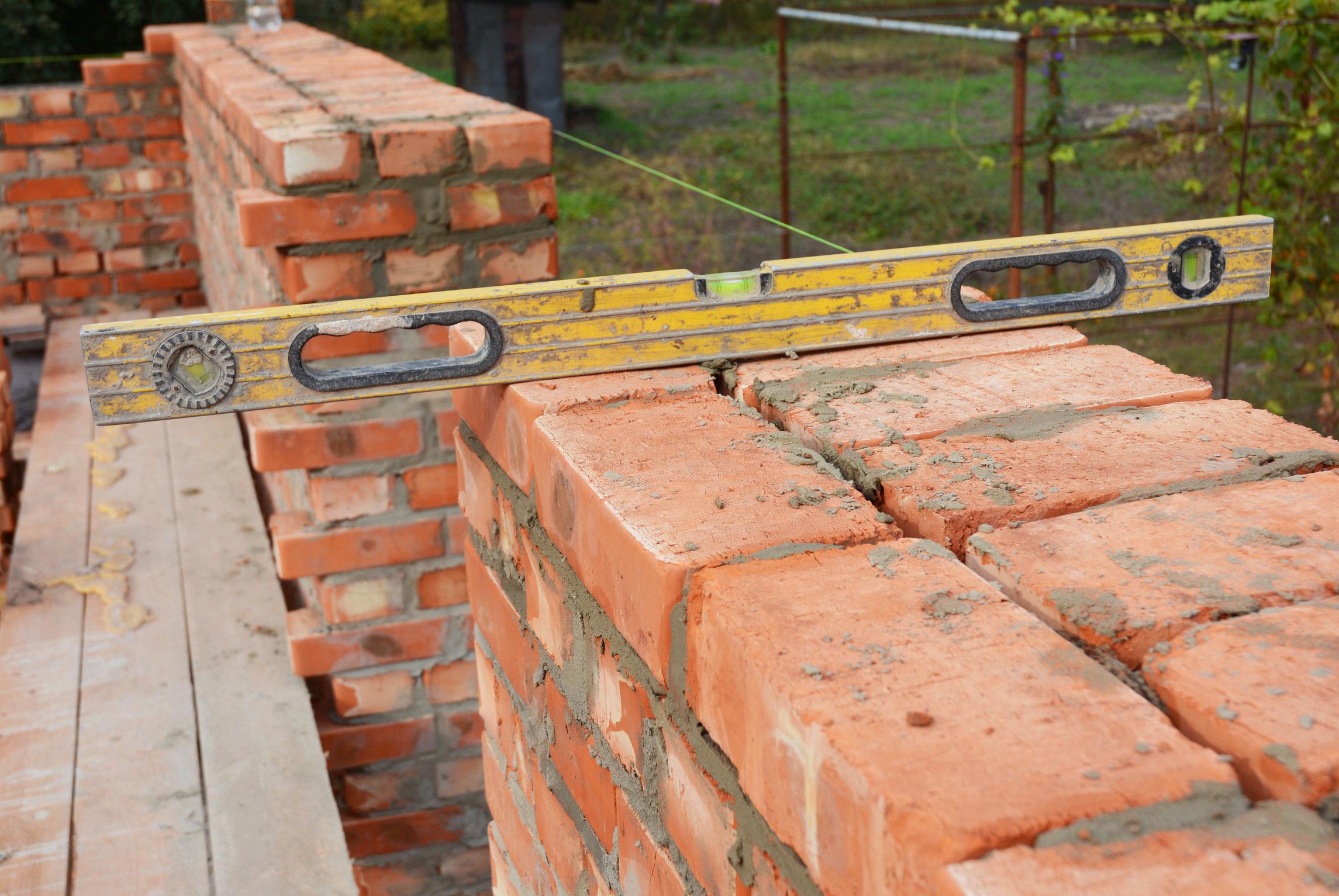
This course provides students with the opportunity to obtain national vocational qualifications for a career pathway to the primary trades in the construction industry (with the exception of plumbing).
This Certificate II is designed to introduce learners to the construction industry and has the core units of competency that are required in most Certificate III qualifications. This course allows for inclusion of skills suited for entry to occupations such as carpentry, bricklaying and other occupations in general construction.
Completion of all units of competency and mandatory course requirements is required to achieve the full VET qualification. Where requirements are not fully met, students will receive a Statement of Attainment for completed units. Participation in mandatory work placement is a compulsory component of these courses.

RTO:
AQF VET Qualification:
Marks available:
Suitability:
Career Pathways:
90413
CP20220 & CPC202120 CertificateII in Construction Pathways and Statementof Attainment (SOA) in Certificate II in Construction
Two Units for both the Preliminary Course (Year 11) and HSC Course (Year 12) This is a Content Endorsed Course Students have the option to sit the HSC Exam which will contribute towards the ATAR
Those who wish to pursue a career in the Building and Construction Industry.
Students who undertake VET Construction can explore relevant careers here
TVET or TAFE delivered vocational education and training courses give students a head-start toward a career by completing a TAFE NSW course whilst still at school. TVET courses are available to students in Year 11 and Year 12 and count towards the HSC, with some contributing towards the ATAR. By successfully completing a TVET course, students gain an additional qualification in addition to the HSC.
All TVET courses attract additional course fees that vary between courses and will be advised on confirmation of enrolment. Course fees are subsided by the College and the Federal Government.
TVET Course Delivery Options
On-site course delivery:
All face-to face courses are conducted at TAFE NSW Albury, Poole Street, Albury on Wednesday afternoons 1 30pm – 5 30pm
Students will leave the College at the end of Period 3 and can either catch the College operated bus or make their own way to the TAFE campus It is the student’s responsibility to liaise with their teacher/s to catch up on the work missed during Period 4 & 5
Work placement is a mandatory part of each course
TVET courses only run subject to sufficient enrolments at the beginning of the course
TAFE NSW Albury are intending to offer the below TVET Courses in 2027:
Animal Care (National Environmental Centre – Thurgoona)
Automotive
Community Services
Electrotechnology
Early Childhood
Beauty Services: Make-up
Salon Assistant Hairdressing & Barbering
Human Services: Allied Health
Information and Design Technology
Plumbing
Online course delivery:
TAFE NSW Schools Online is a different way to think about school and TAFE-delivered Vocational Education and Training (TVET) These virtual courses combine teacher-led virtually delivered classrooms with workshops and work placements across a range of exciting career areas within growth industries
Teacher-led virtual classes are conducted between 12pm and 3pm every Wednesday (online) Students will be required to complete work placements
Some courses require students to attend workshops held at a TAFE NSW location (which may include school holidays).
Virtually delivered courses suit individuals who can work independently
Online option TBC for 2027. See below for previous options:
Game Design
Entrepreneurship
Robotics
Real Estate
Business Operations
Horticulture

The College works with an external provider to enable students to study Stage 6 Language courses that cannot be accommodated within the school timetable. Places are limited and enrolment is subject to approval by the external provider.
Our main providers are NSW School of Languages and Finigan School of Distance Education.