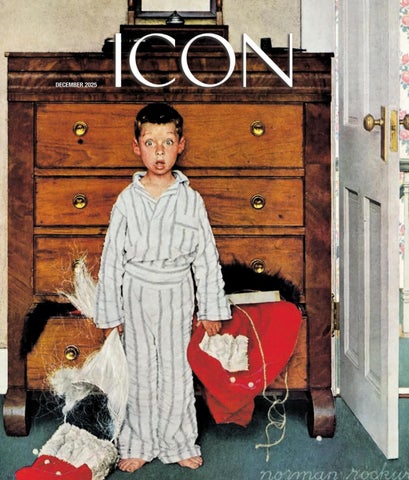
From Dusk ‘til Dawn Silverman Gallery 4920 York Rd., Holicong, PA
The Discovery (Boy Discovering Santa Suit, Bottom Drawer)
Saturday Evening Post cover, Dec 29, 1956. The Saturday Evening Post published a Norman Rockwell Christmas cover every year from 1919 through 1942, and its appearance on America’s newsstands was an annual tradition. Rockwell had actually intended this scene of disillusionment for a fall publication date, but the Post’s editors held it for the December holiday. It would be Rockwell's final Christmas cover.
Darkman (1990)
(1931
(1969)
Lehigh Valley advertising Raina Filipiak filipiakr@comcast.net
HOW I ROLL
I broke my ear. Not something in the ducts, canals, and bitsy pieces inside, or the one that looks like a sea creature. I mean those flappy things hanging on the side of our head that resemble squashed paper cups.
I don’t really know what an ear is made of. I assume it’s cartilage covered with skin, and I say that without knowing what cartilage really is. I’ve sat in many doctors’ offices in my life with charts on the wall explaining in detail the inner workings of hands, feet, backs, eyes, teeth, various organs and systems, and even the whole kaboodle at once, but I don’t recall having seen
CONTINUED ON PAGE 28
Robert Beck is a painter, writer, lecturer and ex-radio host. His paintings have been featured in more than seventy juried and thirty solo gallery shows, and three solo museum exhibitions. His column has appeared monthly in ICON Magazine since 2005. www.robertbeck.net
Shawn Theodore, A Reason To Be Wynter Gallery
4 S. Union St. 2nd floor, Lambertville Thurs.–Fri. 12–6; Sat 12–5
Holiday Open House 12/12 from 6–8
On view until Dec. 20, 2025
Shawn Theodore (b. 1970) is an interdisciplinary artist whose work merges photography, theory, mythmaking, and creative writing to reimagine Black presence as sovereign, eternal, and uncontainable. Theodore learned early to navigate contrasts—rural stillness and urban urgency, ancestral memory and contemporary life—that continue to shape his vision.
Small Works Holiday Art Market
AOY Art Center, 949 Mirror Lake Rd, Yardley
December 6-20
Fri, Sat, Sun 12-5 aoyarts.org
Reception 12/5, from 6-8
Explore original works under 11x14 and under $300, by AOY’s talented artists. From paintings and intricate jewelry to ceramics, glass, and mixed media, there’s something unique for every style and budget. Purchases can be taken the same day—making it easy to find thoughtful gifts.
From Dusk ‘til Dawn Silverman Gallery
4920 York Rd., Holicong, PA 215-794-4300 silvermangallery.com
December 13 – January 18
Openings: 12/13, 5–8, and 12/14, 1-4
Wed.-Sat. 11-6, Sun. 11-4 and by appointment.
Night scenes are always popular in Bucks County, especially in winter, and The Silverman Gallery is hosting a special nocturnethemed group exhibition by all of the gallery’s 12 artists.
Janis Schimsky “The Tailor,” mixed media collage, 11 x 14
Yvonne Reyes “Posy Cozy Collage 1”; mixed media paper vase
Jim Rodgers, Macy’s Evening, NYC, 24 x 20, oil on board
Jean Childs Buzgo, Midnight Bouquet III, 18 x 14, mixed media on canvas panel
the art of poetry
The Berean Baptist Church
I came upon a stand of trees That towered over all, A church stood silent in their midst Its steeple rising tall.
How perfect, I thought, nature’s grace Extends by hands man made, A cypress bends, a penitent, Inside, believers prayed.
Evangelicals, from its pews, I hear their voices rise, Outside the wind-song whispers ‘hush’ As if to hear their cries.
Such harmony, for me alone, Perchance, how to capture This perfect blend, a fellowship Paired in natural rapture.
Just then I saw a distant light Below, our river town, I packed my easel and my paints And slowly headed down.
Such beauty passes only once, An instant, now, forever — Lasting is the moment’s truth, And the art to treasure.
DAVID STOLLER
Daniel Garber (1880-1958) was one of the most important painters of the New Hope School, and more broadly, a key figure in 20th century American art. Born in Indiana, he first studied at the Art Academy of Cincinnati before moving to Pennsylvania, where he studied with Thomas Anshutz, who encouraged him to enroll in the Pennsylvania Academy of the Fine Arts, where he later became a prominent instructor and taught for forty-one years. Over the course of his career, he received many of the most prestigious awards and honors bestowed on an American artist and is collected in more than thirty museums nationally.
The subject painting, Berean Baptist Church at Stockton, was one of several paintings by Garber that featured the church, built in 1860, even as the roof and steeple were remodeled over
time. While he had no known affiliation with the church, he clearly liked the building. None of his paintings featured the front of the building, instead viewing it from the back and setting the church in a woody landscape, omitting any evidence of the town of Stockton, which lies directly behind the building.
I wrote my poem, Berean Baptist Church, with a nod to the master English Romantic poet John Keats. His poem, Ode on a Grecian Urn, is known famously for its concluding lines: “Beauty is truth, truth beauty, that is all Ye know on earth, and all ye need to know.” My poem is structurally quite different, but I tried to find a similar interplay among the art (there an urn, here a painting), the narrator (in my case, the artist) and the poem, bringing to mind the Latin phrase, well-known to the Romantic poets, “Ut pictura poesis”—as is painting so is poetry. n
Stoller has had a career spanning law, private equity, and entrepreneurial leadership. He was a partner at Milbank Tweed and led various companies in law, insurance, live entertainment, and the visual arts. David is an active art collector and founder of River Arts Press, which published Finding My Feet, a collection of his poetry.
David
WHICH ARTWORKS MATTER?
As an artist, which artworks really matter? Of course, there are different criteria that apply to different works. For instance, this one might have been the first in a series that later grew exponentially, or that one might have been influenced by who we were at the time, or because of a close friend’s participation. Therefore, we may retain various categories of images for different reasons. And, especially with advances in digital storage, it is increasingly easy to keep everything. Many of us do keep everything, regardless of whether we’ve questioned its value. We never know what we’ll want to revisit next year. If we leave the mess for our heirs to sort out, they’ll likely end up feeding a landfill.
But, as an artist, which artworks really matter? For those of us who are older, we think of our legacy. How will we be remembered? Which are the images that might transcend our time on this planet? Diluting our strongest pieces with mediocre ones undermines one’s impression of the overall collection. Far better to prune one’s portfolio now, shaping and sharpening one’s successes.
Younger artists might not think this question applies to them. (And I encourage young artists not to be rash. Don’t thoughtlessly discard early work. You may circle back to your ‘failures’ and view them with a different eye, not necessarily one that recognizes their greatness, but
one that better understands how and why they failed. Seeing the work clearly helps uncover the successful path.) But the question does apply to younger artists, whether they realize it or not. Artists who can’t edit their work risk boring their audience, and most audiences are usually too polite to say so. They’ll move on, or change the subject, long before a strong piece buried in the presentation rises to the top. By the time you reach something worthy of their attention, their interest has evaporated.
Critics, even if few in number, evaluate art objects from a different perspective. Artists would do well to see as critics see. If we can satisfy a cold-eyed critic, we can develop a following for our work in our lifetime. This achievement benefits us in the present and promotes longevity in our artwork.
A critic’s first determinant of value is very simple. “Whose artwork is it?” We artists can all create reasonable variations of colleagues’ works, and all of our variations will look nice above our couches. These pieces may also have personal meaning for reasons suggested above. But will these artworks outlive us? Will they matter to future strangers? With a cold-eyed critic’s perspective, I say: An artwork matters when you are the only person who could have made it. n
PHOTOGRAPH AND ESSAY BY RICARDO BARROS
Ricardo Barros’ works are in the permanent collections of eleven museums, including the Smithsonian American Art Museum and the Philadelphia Museum of Art. He is the author of Facing Sculpture: A Portfolio of Portraits, Sculpture and Related Ideas
LAMBERTVILLE
December is upon us, ushering in festivities, anniversaries, and many giftshopping options in the local area. Currently, there are at least 15 art galleries and art-related businesses in Lambertville. Two of the oldest art galleries, The Union Gallery and The Artists’ Gallery, are celebrating their 30th anniversaries. The Artists’ Gallery, a cooperative, is celebrating its anniversary with a group show running through Jan. 4, 2026. This show features the work of all 16 members, many of whom have been with the gallery for decades. Alan J. Klawans has been a member for 25 years, Joe Kazimierczyk and Carol Sanzalone, members for 20 years, and Beatrice Bork, a member for 19 years. Other long-standing art galleries include: Jim’s of Lambertville, which opened in 1994; A Mano Gallery, which opened in 1996; and the Gordon Haas Gallery, which opened in 1998.
Many of these art galleries contain the studios and the work of individual artists. One of them is the Eleanor Voorhees Fine Art Gallery. In 1998, she began painting full time, and in 2012, opened her art studio and gallery on the 3rd floor of the People’s Store. Before Lambertville, Eleanor lived in the East Village, where she worked as a children’s book designer and painted residential murals. She loved living in the East Village in the 90s because she was drawn to the grittier side of the city. “Architecture has personality,” she explained, “and that’s because people live in it.” The sounds, visuals, and energy of the East Village are brought to life in her mixed-media paintings. Her work captures the city’s movement, energy, and color. In addition to her paintings, Eleanor also creates wearables, including tote bags and vintage, recycled jean jackets with copies of her city paintings sewn on. Her gallery also has one-of-a-kind recycled clothing designed by Eleanor’s daughter, Eve. 28 N. Union Street, Lambertville, NJ 908-399-4449. eleanorvoorhees.com
Next door to Eleanor is the CSM Gallery/Studio. Here, Christina S. MacKinnon creates, exhibits, and sells what she describes as abstract maximalist paintings. Her work is bold, energetic, and bounces with color. “I paint big,” she said, “because the large size allows me to let go of restraint and engage in intensity, while the painting and I are in constant motion. Painting is the essence of each of us.” Christina’s contrasting color palettes, gestural marks, shapes, and patterns express not only nature but also her energy, and tireless work ethic. “Eleven years ago,” she
said, “I began my journey toward self-understanding and reclaiming my identity. Painting has offered me a calm contrast to my restless, nonlinear mind. When I paint, everything slows down. I’m fascinated by how color can evoke emotion and memory, bridging the space between conscious thought and what lies beneath.” Today, her work includes what she refers to as “portals,” open spaces within the complexity of her paintings. The People’s Store 28 N. Union St., 3rd floor, Lambertville, NJ 908-432-8582 christinamackinnon.com
Engraving is an art that is about 500,000 years old. Certified engraver Sadie Mininni opened her store, Unforgettable Engraved Gifts, in 2023. Through personalized engraving, Sadie expresses her artistic skills. Sadie studied at the School of Visual Arts in New York, and expanded her skills at the Jewelry Institute of America in Houston, where she earned her engraver’s certification. “My goal,” she said, “is to create a store with a collection of curated, engravable, one-ofa-kind gifts for my customers.”
She offers historic-quality American brands, USA-made goods, and handcrafted creations. Engraving is about artistically imbuing an object with sentiment and significance. Some of Sadie’s clients include Ralph Lauren, the White House, and international film festivals. Her shop is filled with nostalgia and warmth. Sadie offers a variety of services and engraving techniques on a broad range of materials: metals, glass, crystal, wood, leather. 56 Coryell Street, Lambertville, NJ. 609-483-5282. unforgettableengraving.com. n
award-winning English teacher.
MERLE CITRON
Merle Citron, originally from Hoboken and Bayonne, NJ, has lived in Lambertville for 45 years. When she arrived in 1978, she immediately knew Lambertville was/is her forever home. Her varied background includes: artist, writer, public speaker, athlete, pianist, singer, actor, potter, state/federal education project director, and
One Day, 36X36, acrylic, charcoal on canvas
Lispenard St., Tribeca, NYC, oil on cavas 78X48”
conversation
EELI BAUMAN
Best known for his work on the Obama 2008 campaign and as a television writer, Bauman is taking on the world of theater as the writer, composer, director, and producer of 44—The Musical
If you were a wry, caustic comedy writer with a scintilla of musical knowledge in your childhood who then spent the better part of 2007–2008 working to get Barack Obama elected as president, you, too, might have crafted something lively and satirical based on the momentum you shared with your campaign buddies and the oh-so-wrong humor that came from that hotly politicized moment. But you didn’t. Writer-director Eli Bauman did, and now his first shot at major OffBroadway success, 44—The Musical, has just extended its run OffBroadway at The Daryl Roth Theatre in New York City through January 4, 2026; this after spending 2024 touring the country in time for the November elections.
A.D. Amorosi: Consider your roots in politics, theater, or music before 44. Who are you? Do you have a band, scores of successes as a comedy writer, or a history of campaigning behind you?
Eli Bauman: [laughs] Who are you is such an existential question. The real answer is that I was all over the place. Primarily, I was a TV writer doing all sorts of stuff, comedy, variety, and drama. That said, the first time I thought I could DO THIS at all was when I got a job on the series Maya & Marty that starred Maya Rudolph and Martin Short under the SNL umbrella. They were looking for a comedy writer who could also write music, and they asked me if I was interested. Of course, I was, so I told them yes. So they asked if I had something that I could send them to that effect. I said, “Yes, sure,” and asked for a few days to clean “something” up, as I had absolutely nothing. I hadn’t written any songs since middle school. I had been the frontman for weird cover bands in college. That was the extent of it. So, I raced home, figured out how to pluck away at some chords—I hadn’t taken a piano lesson since the age of 11—fudged my way through something that I had my friend record, submitted it, and then… I was hired AND had to start in two weeks in New York. So, I got married on a Saturday, moved to New York for work on a Sunday, began on Maya & Marty on Monday, and the production on Tuesday. They asked me if I could write two to three new songs a week, I said yes, and—don’t worry: it’s all just in front of Maya Rudolph, Martin Short, and Lorne Michaels. No problem. I did it all out of total fear. And, in fact, the first song that I
pitched to Maya Rudolph that she turned down is now in 44, exactly how I wrote it originally when I conceived it all in a dead panic over that first weekend.
A.D. Amorosi: And politics? Campaigning for Obama?
Eli Bauman: That happened almost eight years to the day before I started writing this musical. I was 25 when I started on the Obama campaign, a perfect age because you have just enough experience to be competent and not enough experience to have dropped your whole life to move to Las Vegas on a whim. I was also at a perfect age—33— to write the musical because I had had enough of a career, already, to know that I didn’t want to have regrets if I didn’t do it. It didn’t have to be perfect, just perfect enough to have said I tried it.
“Always idealistic. Definitely always politically involved. But I never had any ambitions or desires to work in politics. I was one of many people who got into politics because of Obama, specifically, feeling inspired, as if this was something I needed to be a part of.”
A.D. Amorosi :Before you got to Obama, were you a particularly idealistic or even politicized person?
Eli Bauman: Always idealistic. Definitely always politically involved. But I never had any ambitions or desires to work in politics. I was one of many people who got into politics because of Obama, specifically, feeling inspired, as if this was something I needed to be a part of. That said, my political career ended in 2009 when he took the oath of office. The prospect of actually working in politics in Washington, DC, did not appeal to me. I made it through the inauguration, and that was it. I wasn’t cut out for it. Who knows what down the line—it’s a long road ahead of me.
A.D. Amorosi: You certainly had enough respect for who Obama was and what he represented to work to get him elected. When did it become apparent to you that something of this was humorous in a broad sense and that you respected him enough to poke fun at him, of the thing you love?
Eli Bauman: It’s always best to poke the most fun at the things that you love. If satire doesn’t come from a place of love or, at least, respect and admiration, there’s no pedestal to knock something down from. Mitch McConnell, is the prime antagonist in 44, and I have a very begrudging respect for him, in the same way that I have respect for a great white shark, in that there is a perfection in their creation—that
Bethlehem has a rich holiday heritage that dates to the 18th century, when the Moravians who settled the city christened it “Bethlehem” on Christmas Eve, 1741. Since 1937, the city has officially been known as Christmas City, USA. From guided walking tours of the city's Historic Moravian District, one of the finest collections of 18th Century Germanic-Style architecture in the nation and home to the newest World Heritage Site in the US, to Christkindlmarkt market place and Christmas Carriage rides through the city. There are dozens of attractions and activities for all ages.
CHRISTKINDLMARKT AT STEELSTACKS
Dec. 4-7, 11-14, 18-21. Thurs. & Sun. 10-6, Fri. & Sat. 10-8. FREE admission Fridays 58. One of the best holiday markets in the U.S. by Travel + Leisure. PNC Plaza at SteelStacks, 645 East First St., Bethlehem. christmascity.org. (877) 212-2463
CHRISTMAS CITY FOLLIES XXVI
December 4-21, Thurs.-Sat., 8, Sun. at 2. Additional shows on Sat., Dec. 13 & 20 at 2, and Wed., Dec. 17, at 8. Touchstone Theatre’s Holiday Variety Show has been singing, dancing, and laughing for audiences
for 26 years. Touchstone Theatre, 321 East 4th St., Bethlehem. touchstone.org. (610) 867-1689
ADVENT AND CHRISTMAS CONCERT
Dec. 6, 1:30, in the Sanctuary, Central Moravian Church. Enjoy the sounds of Church Choir and Mainstreet Brass. Central Moravian Church, 73 W Church St., Bethlehem. centralmoravianchurch.org. (610) 8665661
CHRISTMAS CONTEMPLATIVE SERVICE
Dec. 8, 7:00, Old Chapel. A candle-lit stillness, while listening to contemplative arrangements of carols. Central Moravian Church. centralmoravianchurch.org. (610) 866-5661
HANDMADE HOLIDAY GIFT SHOP
Through Dec. 12. Reception Dec. 6, 11:301:30. Galleries will be filled with handmade items from over 50 of our region's artists and crafters. The Baum School of Art 510 Linden St., Allentown. (610) 433-0032. Baumschool.org
NAZARETH CENTER FOR THE ARTS
Dec. 10, Open Mic Dec. 12,,Winter Exhibit Open House, 5-7
Dec. 13, 4:00, Egner Chapel, Muhlenberg College, Allentown. Be transported to 300 years ago, through the dramatic arc of advent and the joyous arrival of Christmas. The ultimate Christmas-time celebration. Bach Choir of Bethlehem Tickets: (610) 866-4382, x 115/110. Bach.org
ZOELLNER ARTS CENTER
Lehigh University
Dec. 13-14, 12 & 4, PA Youth Ballet
The Nutcracker, with a live orchestra. Dec. 19, 7:30, Vienna Boys Choir
Dec. 14, 4:00, First Presbyterian Church, 2344 Center St., Bethlehem. Be transported to 300 years ago, through the dramatic arc
of advent and joyous arrival of Christmas. The ultimate Christmastime celebration. Bach Choir of Bethlehem. Tickets and info: (610) 866-4382, x 115/110. Bach.org
CHRISTMAS CITY VILLAGE
Through Dec. 21, Fridays to Sundays. Wooden huts filled with unique holiday gift ideas. Free. Sun Inn Courtyard in Historic Downtown Bethlehem, Main Street. LehighValleyChamber.org
PEEPSFEST®
Dec. 30 & 31, 3-6:00. Enjoy indoor and outdoor fun, live music, themed Peeps®themed games and crafts from local nonprofits. Don't miss the iconic drop of a 400 lb., 4’9” Peeps® chick, followed by fireworks. Presented by JustBorn. ArtsQuest, 25 W 3rd St., Bethlehem. For more information and tickets: (610) 332-1300 or visit artsquest.org.
CHRISTMAS PUTZ
Star & Candle Shoppe
Through Dec. 31. The Christmas Putz is a retelling of the story of Christ's birth through narration and music. Central Moravian Church, 73 W Church St., Bethlehem. centralmoravianchurch.org. (610) 866-5661
VALLEY
Michael Che is the slyly subversive co-anchor of Saturday Night Live’s “Weekend Update.” He loves to drop a comic bomb on a squeamishly sensitive subject, wait as it explodes in the audience, and plaster a shit-eating grin until he’s about to detonate with giggles. A master at defusing everything from race to law & disorder, he especially enjoys swapping jokes with coanchor Colin Jost, his tag-team news & views partner for 11 years. Che has balanced his sit-down act with stand-up specials on Netflix, an HBO series and special-correspondent gigs on The Daily Show and WrestleMania. He’s also the rare SNL cast member raised in the show’s home borough of Manhattan, where he was born Michael Che Campbell, son of a father who admired Che Guevara, patron saint of funny T-shirt martyrs. (Dec. 10, State Theatre, 453 Northampton St., Easton; 610-252-3132; statetheatre.org
The Bach Choir of Bethlehem is doing its level best to siphon the spirit of a J.S. Bach Christmas at his church in his hometown of Leipzig, Germany. This month the choir will perform two of his Advent cantatas, including the one with “Jesu, Joy of Man’s Desiring,” one of his most uplifting themes, and his Christmas Cantata, one of his most joyful compositions with his most joyous title “May Our Mouths Be Filled with Laughter.” Also on the bill is a new carol by composer/teacher Larry Lipkis, a veteran lecturer in the choir’s annual Bach festival. (Dec. 13, Egner Chapel, Muhlenberg College, 2400 Chew St., Allentown; Dec. 14, First Presbyterian Church, 2344 Center St., Bethlehem; 610-866-4382; bach.org)
Meredith Willson is best known for writing “The Music Man,” a perenni-
Geoff Gehman is a former arts writer for The Morning Call and the author of five books: Planet Mom: Keeping an Aging Parent from Aging, The Kingdom of the Kid: Growing Up in the Long-Lost Hamptons, and Fast Women and Slow Horses: The (mis)Adventures of a Bar, Betting and Barbecue Man with Willi Mayberry. geoffgehman@verizon.net
ally popular musical about a flim-flamming instrument salesman flipped to decency by decent citizens. He also musicalized Miracle on 34th Street, where Kris Kringle is confirmed in a court of law not to be a Clausian con artist. A minor, eight-month Broadway hit 60 years ago, the show is touring the country in a bid to become a holiday staple along with its most familiar song “It’s Beginning to Look a Lot Like Christmas.” The publishing rights for “Beginning” and other Willson tunes are owned by none other than Paul McCartney, who as a Beatle crooned “Till There Was You,” the Music Man valentine. (Dec. 10-14, Wind Creek Event Center, 77 Wind Creek Dr., Bethlehem; 610-2977414; windcreekeventcenter.com)
Another holiday contender-in-waiting is Kate Hamill’s stage adaptation of Little Women, Louisa May Alcott’s evergreen novel about four sisters jockeying for sense and sensibility during a Civil War Christmas. Hamill has made her bones by adding playful feminist tilts to such classics as The
Scarlet Letter, Dracula and the Sherlock Holmes stories. In her version of Pride and Prejudice she co-starred with Jason O’Connell, her real-life amiable companion. (Dec. 5-7, 12-19, 19-21, Pennsylvania Playhouse, 390 Illick’s Mill Rd., Bethlehem; 610-865-6665; paplayhouse.org)
Sean Heely’s Celtic Christmas showcases the champion fiddler, singer and harpist leading a clan of instrumentalists, singers and dancers in contemporary and ancient tunes stretching from Yuletide to Winter Solstice with Irish, Scottish and Galician accents. Heely’s credits include performing for the British Embassy Scottish Affairs Office and being named male musician of 2023 by Irish radio judges. (Dec. 20, Zoellner
GEOFF GEHMAN
Michael Che
Award-winning bass-baritone Daniel Lichti, Bach Festival soloist
Maggie Thompson, Liz Mikel and Pearl Rhein. Photo by Karen Almond.
Center for the Arts, Lehigh University, 420 E. Packer Ave., Bethlehem; 610-7582787; zoellner.cas.lehigh.edu)
The Allentown Art Museum is pairing two imaginative crisscrossers with impressive track records. Ellen Berkenbilt contributes painted, collaged scenes of strikingly colored, sharply angled women and animals, some animating an immersive installation. The Clouds Are Luminous is the first solo museum exhibit for the Guggenheim fellow, whose process was filmed in a Drawing Center commission. Amanda Valdez’s Aftertouch contains 20 vivid, vibrant canvases cut up, sewn, embroidered, painted, oil sticked, and dyed. Perceptions about gender and power surface among the radiating patterns and spooning forms by a former Yaddo and MacDowell retreat resident. (Dec. 6-May 17, 31 N. Fifth St.; 610-432-4333; allentownartmuseum.org)
I’ve been a Foreigner fan since 1977, when I spun “Cold As Ice” and other taut, tough tracks from the band’s first album during my first year as a DJ for Lafayette College’s WJRH. A more commercial, more eclectic Bad
Company, the group has wormed my ears with the boiling “Hot Blooded,” the entrancing “Waiting for a Girl Like You” and the rousingly spiritual “I Want to Know What Love Is.” Empowered by last year’s long-delayed entrance into the Rock and Roll Hall of Fame, Mick Jones and the boys are touring their entire fourth album, a multi-platinum seller powered by “Juke Box Hero” and “Urgent.” Some numbers will be sung lustily by guest Lou Gramm, co-founder and co-writer whose band departures were triggered by solo projects, arguments with Jones and a benign brain tumor. (Dec. 7, Wind Creek Event Center, 77 Wind Creek Dr., Bethlehem; 610-297-7414; windcreekeventcenter.com) n
Amanda Valdez (American, b. 1982), Silent Shell, 2025, embroidery, hand-dyed fabric, and canvas. Collection of Amanda Valdez.
Boz Burrell, Mick Ralphs, Paul Rodgers, Simon Kirke. Photo by Carl Dunn
CITY
None of our 2025s have been altogether great or nice or generous of spirit or free from boast or brutality. Seriously. So let’s get the f$#%k out of this year alive, kiss someone you at least like on New Year’s Eve’s midnight drum roll, go see the Mummers, and figure on voting our way out of this mess in 2026. Seriously.
The best bit of big, holiday-centric Center City Philadelphia news comes with the revival of the old Wanamaker’s (or Macy’s if you really want to be like that) and its sold-to-New-York-realtors renewed Hall of the Mountain King space, newly opened to pop-up events like opera singing Fringe Fest fanatics, ballet dancing Sugar Plum fairies, and old silent films with
live organ music. And now, for the Christmas holidays, the historic Wanamaker Grand Court will come back to life with its colorfully electric mega-light snowman and reindeer show, its John Facenda, I mean Julie Andrews voice-over narration, and scores of sacred and secular organ music. That’s a must for December, especially as once the new owners start turning it into condos, you’re not going to see the Wanamaker’s bronze Eagle or hear Julie Andrews for eons.
provised music, the Ars Nova Workshop’s Solar Myth on S. Broad Street on December 11. Miss this at your free musical peril.
The Broadway Cabaret Series at Garth Weldon’s Rittenhouse Grill–you know, the old Prime Rib restaurant which was once the even older, decadent Elan nightclub off Locust Street at the Warwick Hotel–has become a cool, curious respite of old school soigne showiness, poignant humor, and solidly sleek vocals dedicated to theater, art, and stately jazz song. Then there is Mark Nadler, the 21st century’s Mr. Showbiz answer to the question”what if Al Jolson never did the dreaded blackface?” As a pianist and as a singer, Nadler usually goes for the obvious laugh and leaves no tastefully tasteless joke stone unturned. And he’s so good at it all, while maintaining the sad, sour sensitivity of a Sylvia Plath, that you’re never exactly certain as to what emotion you’re feeling or he’s espousing. And on December 15, he’s appearing at the Rittenhouse Grill with vocalist and Broadway actor Stephanie Pope for Christmastime in the City, their holiday-themed cabaret event. Enjoy.
2025 has been a great year for genre-jumbling improvisational music, of which Los Angeles’ SML reigns supreme. Nearly without rival when it comes to free falling musicians and musicianship, bassist Anna Butterss, synthesist/synthesizer player Jeremiah Chiu, saxophonist Josh Johnson, percussionist Booker Stardrum and guitarist Gregory Uhlmann make noise that, like their handle, is small, medium and large all at the same time, and contains all of the multitudes of dub, funk, punk, Krautrock, ambient electronica, glitch hop and avant-garde jazz without any of the fat. And now the LA ensemble brings their scorched earth sound to Philly’s home of im-
Even if you don’t like mainstream rock on the radio, you would have to have been deeply in love with ‘citizen’ Pierre Robert, his gentle demeanor, his giving heart, and his woolly bear beard and long hair. He was literally the nicest guy on the planet—a beloved FM radio host who always had time for his fans, whether they were loud, drunk stoners from the Northeast or giddy giggly girls from Cherry Hill and South Philly. And friends like the late Jerry Blavat, all of the Hooters, and every fellow radio jock and music journalist. His sudden death several weeks left a hole in the vortex of the Philadelphia broadcasting, music and arts & entertainment continuum, and those who seek to mourn his passing can do so with the rest of us at The Fillmore Philadelphia on December 17 with the aforementioned Hooters, their drummer David Uosikkinen’s”In the Pocket” Philly cover music ensemble with its floating membership, members of Collective Soul, and more. Be there, and be healed, I hope. n
A.D. Amorosi is a Los Angeles Press Club National Art and Entertainment Journalism award-winning journalist and national public radio host and producer (WPPM.org’s Theater in the Round) married to a garden-to-table cooking instructor + award-winning gardener, Reese, and father to dog-daughter Tia.
film roundup
Hamnet (Dir. Chloé Zhao). Starring: Jessie Buckley, Paul Mescal, Jacobi Jupe. What fools the mortals be in director Chloé Zhao’s fan-fictiony adaptation of Maggie O’Farrell’s novel about Will Shakespeare (Paul Mescal), his wife Agnes (Jessie Buckley) and the son, Hamnet (Jacobi Jupe), whose death may have inspired one of his greatest plays. (Titus Andronicus? Othello? Ooo...it’s on the tip of my tongue.) Sarcasm aside, this shameless piece of bathetic awards-bait should have you crawling out of your skin with the historical liberties it takes to elicit a good cry (Shakespeare reciting the “To be or not to be...” speech while contemplating suicide is some kind of beyond-barrel-scraping low), not to mention the overemphatic asks it demands of Buckley whose nearevery scene requires her to unconvincingly scream, howl, and—as another UK poet once wrote—rage against the dying of the light. Zhao certainly loves her luminescent compositions: treacly, sun-dappled imagery so Terrence Malick-derived he should sue. And yet the movie
Keith Uhlich is a NY-based writer published at Slant Magazine, The Hollywood Reporter, Time Out New York, and ICON. He is a member of the New York Film Critics Circle. His personal website is (All (Parentheses)), accessible at keithuhlich.substack.com.
only achieves all-time nadir status with a gob-smackingly wrongheaded finale (one clearly influenced by Zhao’s time in the Marvel Studios stable) that somehow turns one of the Bard’s most multifaceted works into a shallow vehicle for communal grief. [PG-13] H
Marty Supreme (Dir. Josh Safdie). Starring: Timothée Chalamet, Gwyneth Paltrow, Odessa A’zion. Benny Safdie put The Rock through his paces in the MMA biopic The Smashing Machine. Now his brother Josh takes a turn running an awards-hungry Timothée Chalamet through a fictionalized gauntlet, an anti-triumphal sports saga about a 1950s ping-pong whiz kid, Marty Mauser, trying to take home gold against all odds. As in previous Safdie joints like Uncut Gems and Good Time, the obstacles are omnipresent and ever-escalating. If it isn’t an unexpectedly pregnant girlfriend (Odessa A’zion) it’s a brokenarmed wiseguy (played by the great film director Abel Ferrara) who wants his missing dog back come hell or high water. Marty himself is his own worst enemy—a rat-like sociopath who seduces his way into the fleeting graces of people with money and influence. Goop CEO Gwyneth Paltrow stands on one end as an aging movie actress looking for a good part and a better, younger lay, while Trump-supporting
KEITH UHLICH
Canadian businessman Kevin O’Leary stands on the other as a psychotic tycoon who likes nothing more than bringing Marty to his knees. The soundtrack is anachronistically filled with 1980s pop hits, situating this strange beast within the realm of that era’s cinematic sports dramas. It’s a spiritual Rocky sequel designed to make you feel like garbage, which...yeah, no thanks. [R] HH
The Secret Agent (Dir. Kleber Mendonça Filho). Starring: Wagner Moura, Alice Carvalho, Udo Kier. The terrific Brazilian writer-director Kleber Mendonça Filho helms this immersive, eras-spanning drama about a 1970s government tech worker (Wagner Moura) hiding out in the city of Recife from the political foes who would like to murder and disappear him. The film has a similar leisurely vibe as Quentin Tarantino’s Once Upon a Time in Hollywood, though its overall outlook is much more measured and serious. Cinema is an important narrative
sub-thread, with much of the compelling inaction centered around an old Recife movie palace. The very sense of waiting—for possible escape, for impending death—is palpable and Moura’s multi-monikered character passes the time by building friendships with fellow victims of the Brazilian dictatorship, all of whom find a day-by-day will to live despite the doom-and-gloom spectre of the regime haunting them. Filho tends to tell potently metaphorical ghost stories of this kind (see also his terrific 2016 drama Aquarius), ones that still manage to shift and widen thematically, as this tale certainly does, in thrillingly unpredictable ways. [R] HHHH
Sentimental Value (Dir. Joachim Trier). Starring: Renate Reinsve, Stellan Skarsgård, Inga Ibsdotter Lilleaas, Elle Fanning. For the followup to his award-winning drama The Worst Person in the World, cowriter-director Joachim Trier sets his piercingly humane sights on a family of Norwegian artists. Worst Person star Renate Reinsve is stage actress Nora, forever living in the shadow of her film director father Gustav (Stellan Skarsgård) who feels like he has one more movie in him. Perhaps a semi-autobiographical piece in which his prickly offspring could star? It’s a long road to what is, admittedly, an inevitable point of deep connection and muted reconciliation between father and daughter. Yet Trier and his cast approach the material with the perfect amount of affection and insight so that even the most familiar beats feel fresh. Skarsgård is especially excellent, mining similar veins of regret and reminiscence as Antonio Banderas in Pedro Almódovar’s own self-analytical metafiction Pain and Glory. Trier’s movie is more gentle in tone (more Nordically chill, you might say), but that doesn’t make it any less poignant. [R] HHHH n
Wagner Moura in The Secret Agent. Photo courtesy of Cannes Film Festival
film classics
Darkman (1990, Sam Raimi, United States)
In the wake of the mega-blockbuster that was Tim Burton’s Batman (1989), the no-less idiosyncratic Sam Raimi brought forth his own tortured superhero. Liam Neeson, along with his inimitable vocal stylings, plays scientist Peyton Westlake who is left for dead in his lab one evening by a cadre of criminals. One massive explosion later and he is resurrected as Darkman, a facially scarred, massively strengthened freak of nature with a hunger for revenge. The sociopathic tendencies that make Batman such a compelling antihero are externalized to an often comical degree, but Raimi—as anyone who’s seen his wackadoodle Evil Dead movies knows—is more than at home with such cartoon operatics. Neeson somehow makes his character’s pathos grounded and believable, particularly in the scenes he shares with a grief-stricken romantic partner played by Frances McDormand. And the film has a superb antagonist in Larry Drake’s Durant, a kind of business mogul Joker minus the clown makeup and with the psychosis turned up past 11. (Streaming on Peacock.)
Dr. Jekyll and Mr. Hyde (1931, Rouben Mamoulian, United States)
There have been many onscreen incarnations of Robert Louis Stevenson’s man-beast, but few attain the classic stature of the 1931
effort helmed by director Rouben Mamoulian and featuring an Oscarwinning turn by Fredric March as the doomed doc Jekyll and his monstrous alter-ego Mr. Hyde. This being a Hollywood movie made in the years before the censorious production code, there’s a frankness to the sexuality and the violence that later versions (like the 1940s effort starring Spencer Tracy) had to tone down. March deservedly won that gold statuette, both his “characters” slotting nicely into his typically big and blustery wheelhouse. Aiding immensely is the makeup by Wally Westmore, which turns Hyde into a memorably monkey-like mutant with his carnal grunts and appetites. And the transformation scenes, accomplished through clever visual trickery with body doubles and mirrored sets, have a skin-crawlingly visceral quality that show up many of our more modern F/X-heavy horror movies. (Streaming on HBO Max.)
My Night at Maud’s (1969, Éric Rohmer, France)
The king of chatter, French writer-director Éric Rohmer, broke through with this centerpiece film in his “Moral Tales” cycle. Catholic engineer Jean-Louis (Jean-Louis Trintignant) is longing to settle down into married life. But before he does that, he discusses faith and other big subjects at length with both his childhood friend Vidal (Antoine
KEITH UHLICH
Fredric
March and Miriam Hopkins in Dr. Jekyll and Mr. Hyde.
Vitez) and Vidal’s acquaintance, the atheist pediatrician Maud (Françoise Fabian). Both challenge Jean-Louis’s sense of self, spirituality and propriety, and he gives back as good as they give. It’s easy to see how the failed promise of how the film was sold (as a kind of explicitly erotic tête-à-tête) still managed to implicitly stoke its audience’s libidinal urges. There is, indeed, something so inimitably seductive about Rohmer’s way with words, not to mention how he and his ace cinematographer Néstor Almendros photograph the people speak-
ing those words. Rohmer’s cunning linguistics are worth a thousand au naturel anatomies. (Streaming on Criterion Channel.)
The Strange Love of Martha Ivers (1946, Lewis Milestone, USA)
This twisty, and twisted, early noir feature traces the unraveling fortunes of a small-town entrepreneur clan. Fate and karma both play heavy parts, evident from the moody prologue in which a diabolical matron played by Rebecca’s Judith Anderson suspiciously falls to her death on a mansion stairway. This dark secret undergirds the rise of
Martha Ivers (Barbara Stanwyck) who runs her family’s milling enterprise with an iron fist and pushes her husband Walter (Kirk Douglas, in his film debut) to run for political office. But her consolidation of power is threatened when an old acquaintance, Van Heflin’s streetwise Sam Masterson, passes through town and dredges up the past. It must be admitted that Lizabeth Scott is a weak link as the female ex-con, Toni Marachek (Lizabeth Scott), with whom Sam strikes up a romance. But the film still builds up a beautifully atmospheric and melodramatic head of steam, one that comes to an explosive head in a most memorable finale. (Streaming on Prime.) n
Jean-Louis Trintignant and Françoise Fabian in My Night at Maud’s (1969)
Van Heflin and Lizabeth Scott in The Strange Love of Martha Ivers (1946)
Answer to BODY MODIFICATIONS
one devoted to the Auris Externa. A trip to Wikipedia gave me a paragraph and a drawing that looks like it was made by da Vinci. I suspect there’s not a lot of cutting-edge medical research being done in this area. What you see is what you get.
My ear broke in the back near where it meets the skull. Da Vinci calls this the Concha. I can't see any damage, but there is a distinct spot inside the dished portion that hurts like hell when I lay my head on my pillow or when I’m pulling at the rim to get my hearing aid into the hole.
I broke it by whacking my head getting into my car. The parking slot was tight, and I couldn’t open my door wide enough to slip in cleanly. That little spot on my ear took the full force of my ten-pound skull hitting the edge of the roof—an impact I calculate at a zillion pounds per square inch. It really hurt, and I was surprised when I put my hand back there that it didn't come away soaked in blood.
There have been other times I miscalculated while getting into the driver’s seat and whacked my head. More than once, I did a doubletap, hitting the roof first then recoiling into the top of the door. Babam. I once completed the triple, slamming back into the roof again. Ba-ba-bam.
These aren’t the only self-generated vehicle injuries I’ve sustained in my lifetime. I grew up in an age when it was not uncommon to work on your car, which provided plenty of opportunities to “auto-inflict.” Back then, cars were built so you could reach right in there with a wrench, back into those dark spaces where knuckles are busted. Down behind the manifolds, where the cuts and burns are located. My peers will remember sitting on the fender with our legs inside the engine compartment, fiddling with the carburetor linkage, or rolling underneath on a creeper. Everything was metal, and lots of it was sharp. Not the place for the soft skinned. If you were working on a car, you were asking for it.
My broken ear happened during everyday operations. Today, it would be labeled avoidable, like that matters. I have neglected to dodge many avoidable misfortunes in my time. Like in my teens, when my motorcycle fell on me in the dairy bar parking lot, right in front of the dining area window. Four-hundred pounds of Triumph, some of it quite hot. I was being young and boneheaded, concentrating on making my arrival appear sufficiently Easy Rider-ish, and I neglected to put the kickstand out. It became clear I was going down just as I passed the point of no return. I got away with a bruised leg, and a traumatized ego. It’s hard to be cool, pinned under your motorcycle while the encircling crowd licks their waffle cones. I have memories of lying there in my jean jacket and leather boots, surrounded by little wood spoons and sour-smelling napkins. I extricated myself, with the help of a sympathetic guy holding a milkshake in one hand and lifting a handlebar with his other. People today remember hearing the story from their grandparents: “Then he got on his motorcycle and just rode off, without even getting some ice cream.” Yes, that was me.
As with any athlete, these accomplishments take their toll, and now I have to modify my vision of the future to include a broken ear. I suppose it’s a small price for living a life able to travel the landscape at will in my personal vehicles, something others feel is their right, but I recognize as a privilege. At least until somebody decides it's time to take my keys away. n
of a master predator. That’s why he’s the most fun of antagonists to play with, and why I don’t wish to ever write a thing about our current president at all. I do not find anything funny to grab onto there, to then knock down. It’s all preset.
A.D. Amorosi: It’s all bad, and it’s all sadly comic. Where were you when you said to yourself that it’s time to start writing 44?
Eli Bauman: It was November 5 in a sad airport lounge in 2016, another eight years after Obama’s election. I worked for a week total on the Hilary Clinton campaign, had a sinking feeling that it was going to turn out as it turned out, and, after scratching my head at that election’s results, started laughing, then began to write. I had to get through the idea of why and how we went from eight years of one great feeling to the extreme of where we suddenly were in November 2016. It was insane. Or was it insane? Could we have seen it all coming during the campaign? Was it the Obama-Trump voters? I met many of them. I thought about my good buddy Mitch and began to see how so much of the foundations got laid—that “just win it, baby” attitude.
unlocks the show are the Mitch McConnell and Joe Biden characters, and in its casting, I went against type and found someone very chiseled who can moonwalk and is vital. He’s the narrator of the show, the Biden character, and that gives us amazing creative license to go wherever we want. Same with McConnell, actually. My whole life, I never heard Mitch saying anything, and the actor we have goes a million miles a minute.
A.D. Amorosi: What was the first chunk of 44 that you wrote?
Eli Bauman: The central theme of the show, my very favorite chorus, was the one that went “muthafuckingObama.” You’ll hear that phrase a lot during the show, and those words came to me immediately when I started the writing process. Because I have two young kids, I have to steal time, here and there, to write, but things really flooded in during that first month—like six songs that stayed in the show.
A.D. Amorosi:Creating a character based on the man that you loved and respected: how far afield from his reality, from his presence in your life, were you willing to go for a laugh? 44 is not an impersonation or anything like that.
Eli Bauman: To some extent, I didn’t think that much, at all. I just went. The beauty of not knowing what you are doing. It’s also the same for what you are not supposed to do. You don’t know what to do or not do, and that was a gift this whole time. Because I was also never a musical theater junkie, and had no training in that direction. The writing was just all guts and instinct. And for all practical purposes, the character of Obama is actually the straight man in 44. He’s the sun—a fixed object—with everyone else orbiting around him. What or who
A.D. Amorosi: And TJ Wilkens, your Obama— how did you come to cast him, and how does he become your 44?
Eli Bauman: Excellent question. TJ is an awesome singer who came highly recommended by a friend. I needed someone to sing the song “How Black is Too Black” that wasn’t me, and we fell platonically in love from the moment we met. He can sing his face off. TJ owns the room, and he could probably run for office and win.
A.D. Amorosi : You guys performed 44 during Joe Biden’s 2024 run, or rather Kamala Harris’ presidential run. What did you hear about your satirical political process while a real one was underway, and not in such a great way?
Eli Bauman: Obviously, there was a nervousness in Democratic circles. We did try not to take shots that weren’t necessary—only Ted Cruz gets real dirt kicked on him. But there was a real sense that we were a problem, mostly from pearl-clutching far-left types. They found our portrayal of Biden, on occasion, worrying. He moonwalks and is most people’s favorite character, no matter your political leaning, though there is a moment when he very slooowly descends the stairs. The Republicans loved the show, though. So did most Democrats. There were also more nervous laughs between the first debate and the next one. That’s when you could hear pins dropping. Look, everyone had eyeballs. I wasn’t breaking news that Biden had lost a step. Or six. And I wouldn’t insult an audience by pretending not to see what we all were seeing.
A.D. Amorosi: I know you said that you are not a theater musical nerd or a Broadway baby. Would you work on the Great White Way, or the Off White Way, if given another chance? You don’t have to do Polk or Garfield.
Eli Bauman: I’m working on another musical—nothing political as yet. No matter what I do, though, even by accident, it’s just what I spark to. n
From top: Chad Doreck, T.J. Wilkins and Jenna Pastuszek in 44 the Musical. Photo by Bella Marie Adams.
FINDINGS
Algal blooms, whose growth is being accelerated by climate change, appear to trigger Alzheimer’s-like brain changes in Florida dolphins, which may be causing them to strand themselves. Seven of seven sampled saltwater fish species in the Cape Fear River were found to contain forever chemicals, as were twenty-four out of twenty-four European environment officials. Australian regulators approved the University of the Sunshine Coast’s vaccine for koala chlamydia. Texas scientists confirmed evidence of interbreeding, driven by atmospheric warming, between blue and green jays. Aloe vera was determined to be the plant most commonly used by central Ugandan farmers to treat chicken diseases. Video footage of trees swaying can be used to evaluate forest health, and tree plantations are more prone than natural forests to wildfires. The interconnected climate systems of the Greenland ice sheet, the Atlantic meridional overturning circulation, the Amazon rainforest, and the South American monsoon are destabilizing. Physicists urged a biogeographic approach to protecting alien planets from contamination, and the rogue planet Cha 1107-7626 in the constellation Chamaeleon appears to be consuming 21.6 trillion tons of matter every hour. Hot wind is coming out of the Milky Way’s black hole.
Mushrooms evolved the ability to make psilocybin twice, the ants whose microbiomes catalyze traditional ant yogurt must be alive, and adult chimpanzees consume 1.4 alcoholic drinks a day. Racehorses may ingest banned steroids from black nightshade and lamb’s-quarters. The presence of microplastics in human bones may worsen osteoporosis, and human bones modified by the Liangzhu people exhibit low nutritional health and were likely obtained nonviolently. The nest hoards of bearded vultures in southern Spain, where the species is extinct, were found to harbor such human artifacts as a crossbow bolt, a slingshot, a wooden lance, and a shoe with an approximate age of 675 years. A Parthian man buried in the Liyarsangbon cemetery with a poorly constructed jar containing bird parts and soot was found to have a three-bladed arrowhead lodged in his right tibia. Southeast Asia’s prehistoric mummies were smoked. Chinese and Mongolian scientists warned of toxic jerky. A roughly 126,000-year-old impression preserved in stone is presumed to have been made by a rock hyrax dragging its buttocks.
Scientists discovered why most belly buttons are innies. Early and late autism diagnoses correlate with divergent genetic profiles. Depression is associated with irregular menstruation but not with flatulence. Thirty-two percent of Israeli physicians and zero percent of German physicians polled reported that the request of a family caregiver was sufficient for them to euthanize a patient with dementia, and court-appointed Israeli psychiatrists find Jews unfit to stand trial for homicide at a much higher rate than they do Arabs. Researchers tested the psychometric properties of the Anal Sex Stigma Scale (ASSS) on black American men and the Dream Incubation Attitude Scale (DIAS) on Hong Kongers. A multidisciplinary team attempted to induce dreams of flight in adults. Unemployed people report more work-related dreams. Suicides declined worldwide between 1990 and 2019 by an average of 30 percent but rose by 30 percent during that period in the United States. U.S. senators’ equity trades prior to legislative events yield outsized returns that are further increased if the senator wields significant legislative influence. Financial firms’ purchases of Toronto-area residential units from small private landlords lead to a 485 percent increase in evictions. The ancestors of leeches were unlikely to have sucked blood. n
INDEX
% of Americans who say that having a “strong leader” is more important than having a democracy : 33
Who say they would be open to suspending Congress for multiple years : 28
To arresting critics of the government : 15
Portion of Democrats who say that Fox News should be “heavily restricted or shut down”: 1/2
Portion of U.S. undergraduates who said in 2020 that violence could ever be an acceptable way to prevent speech : 1/5
Who say so now : 1/3
% of college freshmen in 1974 who said that being rich was very important: 54
Of those in 2024 who said so: 87
% of undergraduates in the class of 2024 who applied for an internship by February of their sophomore year: 10
% of those in the class of 2027 who did: 28
Portion of Americans aged 12 to 16 who earned income through an online “side hustle” in 2024: 1/3
Who did in 2025: 1/2
Est. chance that a person alive today subscribes to MrBeast’s YouTube channel: 1 in 18
Portion of Americans under the age of 18 who are the sole or primary user of a smart tablet: 2/3
Portion of these users who were given their first tablet before the age of 6: 2/5
% of Americans aged 8-12 who would rather play with friends outside than online: 72
Who say they aren’t allowed to play outside unsupervised, even at home: 21
Portion of U.S. parents who say that two 10-year-olds playing in a park unsupervised would likely get hurt: 3/5
Who say that they would likely be abducted: 1/2
Number of public-urination tickets issued by NYPD officers in 2022: 2,129 In fiscal year 2025: 10,003
Average age at which a person experiences life’s deepest despair, according to a 2018 estimate: 53
According to a 2024 estimate: 23
% of Americans aged 60-78 who recall their parents’ relationship as “happy and healthy”: 52
Of those aged 18-29 who characterize it as such: 37
Portion of NYC residents over the age of 60 who report regularly feeling lonely: 1/6 Who lack stable housing: 1/4
Number of U.S. households whose members lived full-time in an RV in 2021: 168,000 In 2025: 486,000
Number of Americans projected to enter poverty next year because of tariff-related price hikes: 875,000
Estimated % of companies that reduced their engagement with Pride Month: 39 That increased it: 0
Chance that a U.S. company allows plus-ones at its office holiday party: 1 in 3
% increase in Yelp searches for “liquor stores” on Christmas Day last year: 160 For “Chinese restaurants”: 789
Portion of the continental U.S. that was covered with at least half an inch of snow on Christmas Day in 2010: 1/2 In 2024: 1/4
% of Americans who say that children should not believe in Santa Claus by the time they turn 6: 13
Who say that children should never believe in Santa Claus: 6
5ources: 1–3 Centers for Violence Prevention at the University of California, Davis; 4 Bright Line Watch (Hanover, N.H.); 5,6 Foundation for Individual Rights and Expression (Philadelphia); 7,8 Higher Education Research Institute at the University of California, Los Angeles; 9,10 Handshake (San Francisco); 11,12 Whop (Brooklyn, N.Y.); 13 Harper’s research; 14–19 Harris Poll (NYC); 20,21 New York City Police Department; 22,23 David G. Blanchflower, Dartmouth College (Hanover, N.H.); 24,25 Match.com and Kinsey Institute (Dallas and Bloomington, Ind.); 26,27 New York City Department for the Aging; 28,29 RV Vehicle Industry Association (Herndon, Va.); 30 The Budget Lab at Yale (New Haven, Conn.); 31,32 Gravity Research (Washington); 33 Challenger, Gray & Christmas (Chicago); 34,35 Yelp (San Francisco); 36,37 National Snow and Ice Data Center (Boulder, Colo.); 38,39 YouGov (NYC).