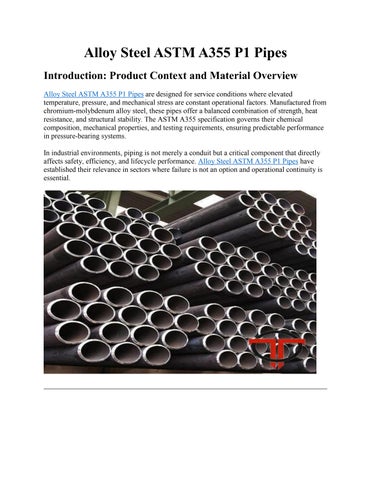
Alloy Steel ASTM A355 P1 Pipes Introduction: Product Context and Material Overview Alloy Steel ASTM A355 P1 Pipes are designed for service conditions where elevated temperature, pressure, and mechanical stress are constant operational factors. Manufactured from chromium-molybdenum alloy steel, these pipes offer a balanced combination of strength, heat resistance, and structural stability. The ASTM A355 specification governs their chemical composition, mechanical properties, and testing requirements, ensuring predictable performance in pressure-bearing systems. In industrial environments, piping is not merely a conduit but a critical component that directly affects safety, efficiency, and lifecycle performance. Alloy Steel ASTM A355 P1 Pipes have established their relevance in sectors where failure is not an option and operational continuity is essential.
Importance of the Industrial and Manufacturing Sector The industrial and manufacturing sector is foundational to infrastructure development, energy production, and material processing worldwide. Industries such as power generation, oil refining, petrochemicals, and heavy engineering depend on complex piping networks to transport steam, gases, and fluids under controlled conditions. As industrial systems become more efficient and compact, the operating parameters of pressure and temperature continue to rise. This evolution places greater demands on materials used in process equipment. Alloy Steel ASTM A355 P1 Pipes address these demands by providing consistent performance, compliance with international codes, and long-term operational reliability.
Role of Key Industries Using Alloy Steel ASTM A355 P1 Pipes Power Generation Industry In thermal power plants, piping systems are exposed to continuous high-temperature steam and fluctuating pressure cycles. Components such as boiler headers, superheater lines, and auxiliary steam piping require materials that resist creep and thermal fatigue. Alloy Steel ASTM A355 P1 Pipes are commonly selected for these applications due to their stable metallurgical structure and ability to retain strength over extended service periods.
Oil and Gas Industry The oil and gas sector operates across upstream, midstream, and downstream environments, each with demanding service conditions. Refinery process lines, heater connections, and pressure piping are subject to heat, pressure, and chemical exposure. The chromium-molybdenum alloy content of Alloy Steel ASTM A355 P1 Pipes enhances resistance to oxidation and hightemperature degradation, supporting safe and efficient operations.
Petrochemical and Chemical Processing Chemical and petrochemical plants require materials that offer predictable behavior under aggressive operating conditions. Reactors, distillation units, and heat exchangers rely on piping systems capable of handling thermal loads without distortion. Alloy Steel ASTM A355 P1 Pipes
provide controlled composition and uniform mechanical properties, making them suitable for critical chemical processing equipment.
Heavy Engineering and Equipment Manufacturing Heavy engineering industries manufacture boilers, pressure vessels, and industrial heaters that operate under regulated conditions. Material selection directly affects fabrication efficiency and in-service reliability. The weldability and formability of Alloy Steel ASTM A355 P1 Pipes support complex fabrication requirements while maintaining compliance with engineering standards.
Connection Between Industries and Alloy Steel ASTM A355 P1 Pipes Across industrial sectors, there is a shared emphasis on safety, durability, and compliance with global standards. Alloy Steel ASTM A355 P1 Pipes connect material science with real-world industrial performance by offering a standardized solution for high-temperature and pressure applications. Their consistent quality allows engineers to design systems with confidence, while standardized testing ensures traceability and reliability. This alignment between industry needs and material capabilities explains the continued use of Alloy Steel ASTM A355 P1 Pipes in critical infrastructure projects.
Benefits of Alloy Steel ASTM A355 P1 Pipes Across Industries Strength and High-Temperature Performance The presence of chromium and molybdenum improves tensile strength and resistance to thermal deformation. This allows Alloy Steel ASTM A355 P1 Pipes to perform reliably in continuous high-temperature service environments.
Safety and Operational Reliability Industrial safety standards require materials that behave predictably under stress. These pipes undergo stringent mechanical, chemical, and non-destructive testing, supporting their use in pressure systems where failure can have serious consequences.
Compliance with International Standards
Alloy Steel ASTM A355 P1 Pipes conform to ASTM A355 requirements and are commonly accepted under ASME pressure piping codes. Material equivalents are often aligned with UNS K11522 and comparable DIN and JIS alloy steel grades used for elevated temperature applications, supporting global project compatibility.
Fabrication and Installation Efficiency From a manufacturing perspective, these pipes offer favorable welding characteristics when appropriate procedures are followed. This reduces fabrication complexity, minimizes installation challenges, and supports consistent joint integrity.
Lifecycle and Cost Efficiency Although alloy steel materials involve higher initial investment compared to carbon steel, their resistance to heat-related degradation reduces maintenance frequency and extends service life. Over time, this results in improved cost efficiency and operational stability.
Industry Applications of Alloy Steel ASTM A355 P1 Pipes Alloy Steel ASTM A355 P1 Pipes are widely used in applications where temperature and pressure control are critical:
High-pressure steam lines in power generation plants Boiler tubes, headers, and superheater connections Refinery process piping and heater assemblies Petrochemical heat exchangers and reactors Pressure vessels and industrial heating systems Thermal oil and high-temperature fluid transport lines
These applications demonstrate the adaptability of the material across diverse industrial environments while maintaining consistent performance.
Conclusion: Long-Term Value and Future Relevance As industries continue to evolve toward higher efficiency, stricter safety regulations, and longer equipment lifecycles, material selection remains a strategic decision. Alloy Steel ASTM A355 P1 Pipes offer a proven balance of mechanical strength, thermal resistance, and standards compliance that aligns with modern industrial requirements. Their continued use across power generation, oil and gas, petrochemical processing, and heavy manufacturing highlights their enduring relevance. With increasing focus on reliability and
sustainable operation, Alloy Steel ASTM A355 P1 Pipes are expected to remain an essential material choice for critical industrial piping systems well into the future.