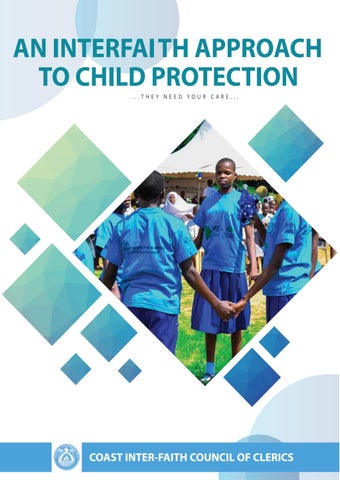
...THEY NEED YOUR CARE...
COAST INTER-FAITH COUNCIL OF CLERICS
CHAPTER FOUR
ACKNOWLEDGEMENT CHILDREN This Booklet is the result ofRIGHTS hard work, support and commitment of many clerics. We would like to thank the religious leaders in Malindi and Mombasa who helped in one way or another in making this simple theological document possible. Who is a child?
We are especially grateful to Conven�on the Malindi CICC leaders lead by Rev. Paul Mutunga and Sheikh The United Na�ons’ on the Rights of the Child2 Abdurrahman Ahmed Badawy for under their the constant reminders and reviews of material from Malindi, defines a child as a person age of 18 unless Kakuyuni, Msabaha, Gede and Watamu na�onal laws state otherwise. Theproject Africanareas. CharterThey on also provided �mely communica�on by protec�on. We very much appreciate their sharing with us their experience and prac�ce on child the Rights and Welfare of the Child3 states contribu�on. “a child is any human being under the age of 18. ’
We would also like to thank the Coast Interfaith Council of clerics Trust Board Members who sat at In Kenya, to the Act4, Special a child is men�on includes Bishop Amos Lewa, Sheikh various mee�ngs toaccording fine tune, theChildren document. anyone under the age of 18. Zeinudin Ali, Bishop Jeremiah Kesekwah, Fr. Laurent Mu�sya and Rev. Stephen Anyenda. Last but not least, our apprecia�on goes to the staff of CICC led by the Chief Execu�ve Officer, Rev. Stephen Anyenda for their effort and input in making sure that we come up with this document to help rights the are rights en�tlements are accorded to every the clerics inHuman advancing of the that children at the coast region. person as a consequence of being human. Children rights are also included in these rights. Children rights are categorized as follows: – Protec�on from Harmful cultural prac�ces economic exploita�on – Par�cipa�on so that their rights are enforced – Promo�on of the rights to life, care and educa�on. – Preven�on from interfering with the children rights
Legal Framework of Child Protec�on in Kenya are: – The Children’s Act (2001) – The Sexual Offenses Act (2006) – The Gender Policy in Educa�on (2007) – The Disability Act (2006) – The Refugee Act – Kenya Cons�tu�on 2010 – Penal Code
The United Na�ons Conven�on on the Rights of the Child h�ps://www.unicef.org/crc/files/Rights_overview.pdf African Charter on the Right and Welfare of the Child h�ps://www.unicef.org/esaro/African_Charter_ar�cles_in_full.pdf
R
EXECUTIVE SUMMARY
eligious leaders are uniquely placed to protect the rights and meet the needs of the most vulnerable in their communi�es. They have profoundly deep, trusted rela�onships and links with their communi�es and o�en dictate which behaviors are prescribed or prohibited. With their widespread influence they can mo�vate changes in thinking, foster dialogue, set priori�es for their communi�es, ensure increasing competency in their congrega�ons to meet community needs and mobilize their congrega�ons to do so. Especially in fragile contexts, they have a further reach than nongovernmental organiza�ons and even governments.
Religious leaders are not automa�cally equipped to further the cause of the most vulnerable in their communi�es. They speak against gender inequality, s�gma, discrimina�on, gender-based violence, poor health- seeking behavior, child marriage, harmful tradi�onal prac�ces, and more – when they hold to mistaken beliefs, myths and misinforma�on about cri�cal social issues. Therefore they became drivers of development. This document is primarily intended to strengthen the work of the religious leaders and make them even more effec�ve as we work together to improve children’s lives. It provides valuable informa�on about religious tradi�ons, iden�fying the diversity of perspectives that o�en exist even within the same tradi�on. It includes useful examples of various religious teaching on child protec�on, educa�on, health and nutri�on among others. We at Coast Interfaith Council of Clerics Trust (CICC) believe that it is a moral obliga�on for us to provide an environment that enables children to fully explore their innate poten�al with human dignity, and the Conven�on on the Rights of the Child is the major vehicle to accomplish this essen�al task. Thank you,
DR. REV. STEPHEN G. ANYENDA CHIEF EXECUTIVE OFFICER COAST INTERFAITH COUNCIL OF CLERICS TRUST DATE:…………………………………..
TABLE CONTENT
CHAPTER 1
ACKNOWLEDGEMENT EXECUTIVE SUMMARYINTRODUCTION Brief of Coast Interfaith Council of Clerics
CHAPTER 2
Dialogue and Ac�on Project Who is this document for?
CHAPTER 3
Child protec�on by Religious Communi�es
CHAPTER 4
Children Rights
CHAPTER 5
Theological perspec�ve of child protec�on Introduc�on Islamic View The basic rights of the child in Islam Child protec�on in Islam
CHAPTER 6
Introduc�on Chris�an View Biblical principles Jesus Verse Children Child Marriage
CHAPTER 7
Introduc�on Child Protec�on Child Marriage is NOT allowed
CHAPTER 8
Conclusion Africa Tradi�onal Perspec�ve
INTRODUCTION CHAPTER FIVE osques, churches, shrines and temples o�en provide children the first point of contact with thedeser community immediate and with the of wider ins�tu�on. and ng thembeyond withouttheir paying a en onneighbors to who should take care themsocial or giving them up to a Their children learn not only religion but also important lessons about morals, social known person or ins tu on. behavior and their own value as human beings. They also learn subtle messages about whether theMARRIAGE world is a safe place, how to be a good person and what their responsibili�es 5.4 CHILD are as of do a religious developing religious iden�ty becomes part of found Islam hasmembers nothing to with the group. customTheir of child marriage;a reference to early marriages can be the wider,nowhere collec�veiniden�ty and binds children together a people having a sense of is the the Qur’an. Instead of an and age adults limit, we find aninto unchangeable standard, which collec�ve meaning andofplace in theThe world. a ainment maturity. fact remains that where custom encourages early marriage, the prac ce stems from nothing but the norms of the people. Sharia has nothing to do with it. Such a custom is not The Conven�on on the Rights socie of the es, Child thebeen mostknown widelyinaccepted human rights treaty in the world, par cular to Muslim but,has many other cultures. reflects deeply held value embedded within religious tradi�ons that uphold the inherent dignity of every child and the of the family inthat building strong communi�es. Thecentrality interna onal consensus the procedural defini on of childhood should apply to humans up to the age of 18 years has not come from a void. This reflects a convic on that is based on The Almighty The Conven�ons on the the Child express a age holis�c Allah says: TheRights Quran of equates marriageable to a mature and sound judgment: vision of the child that is informed by and reflects on values “And test the orphans [in your charge] un they reach a marriageable age; then, if you find them to be “It is a moral obligation for shared with the world major religious tradi�on such as: to them their mature of mind/sound in judgment, hand over possessions…” (Quran, 4:6). us to provide an environment Fundamental beliefmarriage in the dignity of the child The Quran terms as a solemn oath: And how could take it away (marital gi ) er you Thatyou enables children to fully High priority given to children and theand idea have given yourselves to one another, shethat hasall received a mosttheir solemn pledge from you? (Quran, explore innate potential members of society have rights and du�es toward with human dignity, and the 4:21) Convention on the Rights of them. the Child is the major vehicle to A holis�c of the play. child Itand a comprehensive Marriageno�on is no child’s demands a huge amountaccomplish of responsibility from bothtask.” individuals. Quran this essential understanding of his or her physical, economical, makes no compromises on this fact, terming marriage — a “most To suggest that Allah Globalsolemn Networkpledge.” of Religions for Children social and spiritual needs. would even allow, leave aside encourage, an individual to get into a “solemn pledge” without The importance given to the as the bestphysical, place and social perspec ve is nothing short of insul ng discovering themselves fromfamily a psychological, forthe bringing children. idea ofup crea on.
The processes of reflec�on dialogue, are of inherent within much religious prac�ce, provide Muslim tradi on isand rooted in thewhich concepts social jus ce and serving others. The Qur’an and the opportuni�es for child protec�on actors to par�cipate in the types of community processes that lead to Sunnah put great emphasis on these important commitments, as well as on the idea that all people are concrete equal. changesProphet in a�tudes and taught ac�ons.kindness, Religious communi�es have deep long-range Muhammad mercy and compassion towardand all people, especially philosophical frameworks that shape the call to service into long-term commitments; not necessarily women, children, orphans, elderly and refugees. Islam establishes a legal framework designed to protect driven by the short-term nature of the humanitarian funding and assistance. human rights, including right to live in a secure society, free from violence and exploita on. For theservice utmostto importance. Prophet’swithin teachings and the Holy Qur’an children, security Religious communi�es tendistoofsee vulnerableThe individuals larger commitments suchemphasize as ending of oppression and protec ng the vulnerable in the society. peace, jus�ce and reconcilia�on. They have well-established structures of authority in most environments that a child protec�on actor might make use of.
The Conven�on on the Rights of the Child. h�p://www.ohchr.org/Documents/ProfessionalInterest/crc.pdf. Or h�ps://www.unicef.org/crc/files/Rights_overview.pdf (2016)
51
CHAPTER ONE
6
BRIEF OF COAST INTERFAITH COUNCIL OF CLERICS TRUST
C
oast Interfaith Council of Clerics Trust (CICC) is a clerical organiza�on dedicated to using intra and interfaith dialogue to promote peace, security and development in the coastal region of Kenya. CICC is led and governed by a board of senior religious leaders represen�ng:1) The Catholic Church, 2) The Council of Imams and Preachers of Kenya (CIPK), 3) The Evangelical Alliance of Kenya (EAK), 4) The Hindu Council of Kenya (HCK), 5) The Na�onal Council of Churches of Kenya (NCCK), 6) The Organiza�on of African Ins�tuted Churches (OAIC) 7) The Supreme Council of Kenya Muslims (SUPKEM) and 8) The African Tradi�onal Religions (ATR),
OUR MISSION
OUR VISION
A divinely peaceful, just and harmonious Kenyan Society
To be a reputable interfaith organiza�on that supports the growth and maintenance of a culture of peaceful co-existence amongst all people and the environment through interfaith dialogue in Kenya.
OUR VALUES In upholding all the posi�ve values enshrined in the sacred wri�ngs, scriptures, cultures and tradi�ons of the member organiza�ons of CICC Trust, CICC shall be guided by the following values: i) Fear of God: CICC believes in and seeks God’s guidance and interven�on in all its endeavors. ii) Non-partisanship: In all dialogue and arbitra�on processes CICC remains unbiased. iii) Religious tolerance: CICC accommodates its members regardless of their religious affilia�ons in line with its cons�tu�on. CICC is not an ins�tu�on for religious conversion. iv) Integrity: CICC is commi�ed to and prac�ces a culture of honesty, transparency, accountability and 6 professionalism. v) Social responsibility: CICC supports community-based ini�a�ves that promote the welfare of communi�es.
CHAPTER TWO
7
DIALOGUE AND ACTION PROJECT The Dialogue and Ac�on Project (DAP ) focuses on suppor�ng religious and community leaders from the various faith communi�es on the Kenyan coast to adopt an interfaith approach to eliminate child marriage and sexual abuses. The project is supported financially and technically by the Catholic Relief Services (CRS/K) and being implemented by Coast Interfaith Council of Clerics Trust (CICC). The project focuses on strengthening and expanding child protec�on mechanisms that have proved effec�ve in past interac�ons of the DAP. It is being implemented in Malindi Sub-county of Kilifi County. WHO IS THIS DOCUMENT FOR This document has been developed for clerics working in the DAP III. It seeks to help, guide the facilita�on of interfaith, child protec�on, clerics, teachers, trainers and other child protec�on stakeholders. This document can also be used for the training of members of Parent Teacher Associa�ons (PTAs) and community-based child protec�on groups on interfaith child protec�on
CHILD RIGHTS EXPRESSED BY A BUDDHIST MANTRA
CHAPTER THREE
CHILD PROTECTION BY RELIGIOUS COMMUNITIES
..................................................................................................
R
eligious communi�es in this document refers to both male and female religious actors, systems and structures that ins�tu�onalize belief systems within religious tradi�on at all levels for example local worship centers, denomina�onal leaders, scholars, theologians and religious educators, mission workers, youth faith or interfaith groups,women of faith network and other interfaith ins�tu�ons.
TRUE INTERFAITH DIALOGUE CAN OCCUR ONLY WHEN: (1) Each person is persuaded of the inherent validity and integrity of all of the faith groups involved and that no group possesses total and absolute truth, and (2) No par�cipant is seeking to persuade or debate with others about their beliefs.
8
FOUNDATIONS FOR INTERFAITH DIALOGUE
.................................................................................................. Interfaith dialogue is all about increasing our understanding of and our respect for other religious systems and our apprecia�on of their values on child protec�on. We do dialogue so that we may learn from one another in order to change and grow. In addi�on, good dialogue will serve to deepen our own faith and sharing faith with others. Sharing and leaning equals to dialogue.
PIX 1: ON THE LEFT RELIGIOUS LEADERS IN A DIALOGUE MEETING . ON THE RIGHT - CHILDREN IN ONE OF T HE JUSTICE AND PEACE SCHOOLS . P IX BY : R ICHARD M UTINDA -CICC.
CLUB SESSION IN
CHAPTER FOUR
CHILDREN RIGHTS Who is a child? The United Na�ons’ Conven�on on the Rights of the Child2 defines a child as a person under the age of 18 unless na�onal laws state otherwise. The African Charter on the Rights and Welfare of the Child3 states “a child is any human being under the age of 18. ’ In Kenya, according to the Children Act4, a child is anyone under the age of 18.
Human rights are en�tlements that are accorded to every person as a consequence of being human. Children rights are also included in these rights. Children rights are categorized as follows: – Protec�on from Harmful cultural prac�ces economic exploita�on – Par�cipa�on so that their rights are enforced – Promo�on of the rights to life, care and educa�on. – Preven�on from interfering with the children rights
Legal Framework of Child Protec�on in Kenya are: – The Children’s Act (2001) – The Sexual Offenses Act (2006) – The Gender Policy in Educa�on (2007) – The Disability Act (2006) – The Refugee Act – Kenya Cons�tu�on 2010 – Penal Code
The United Na�ons Conven�on on the Rights of the Child h�ps://www.unicef.org/crc/files/Rights_overview.pdf African Charter on the Right and Welfare of the Child h�ps://www.unicef.org/esaro/African_Charter_ar�cles_in_full.pdf
9
CHAPTER FIVE
10
THEOLOGICAL PERSPECTIVE OF CHILD PROTECTION
ISLAM PERSPECTIVE 5.0
INTRODUCTION
slam is an Abraham monotheis�c religion teaching that there is only one God (Allah) and that Muhammad is the messenger of God. It is the world's second-largest religion and the fastestgrowing major religion in the world, with over 1.8 billion followers or 24.1% of the global popula�on, known as Muslims. Islam teaches that God is merciful, all-powerful, and unique and has guided mankind through prophets, revealed scriptures and natural signs. The primary scriptures of Islam are the Quran, viewed by Muslims as the verba�m word of God, and the teachings and norma�ve example (called the sunnah, composed of accounts called hadith) of Muhammad (c. 570–8 June 632 CE). 5.1 ISLAMIC VIEW In Islam, children are gi�s and awards from the Almighty Allah; they are a trust in our custody. People must therefore care well for them and preserve them by implemen�ng the teachings of Islam, and following what has been stated in the Noble Qur’an and what the Noble Prophet – Peace Be Upon Him – has guided in his pure Prophe�c tradi�on, where he says: “Each of you is a shepherd, and each of you is accountable for his or her flock.” In its legisla�on and jurispruden�al laws, Islam pays special a�en�on to children and childhood. Jurists and scholars in Islam agree that the Islamic Sharia is aimed at accomplishing five objec�ves or purposes for humanity. These are: The safeguarding of progeny, The safeguarding of life, The safeguarding of sanity, The safeguarding of property and The safeguarding of faith. 5.2 THE BASIC RIGHTS OF THE CHILD IN ISLAM
And Allah has made for you azwaj [mates or wives] of your own kind, and has made for You, from your wives, sons and grandsons, and has bestowed on you good provision. Do they then believe in false dei�es and deny the favor of Allah [by not worshipping Allah alone]… (Al-nahl, or the bees, verse 72)
CHAPTER FIVE
and deser�ng them without paying a�en�on to who should take care of them or giving them up to a known person or ins�tu�on. 5.4 CHILD MARRIAGE Islam has nothing to do with the custom of child marriage; reference to early marriages can be found nowhere in the Qur’an. Instead of an age limit, we find an unchangeable standard, which is the a�ainment of maturity. The fact remains that where custom encourages early marriage, the prac�ce stems from nothing but the norms of the people. Sharia has nothing to do with it. Such a custom is not par�cular to Muslim socie�es, but has been known in many other cultures. The interna�onal consensus that the procedural defini�on of childhood should apply to humans up to the age of 18 years has not come from a void. This reflects a convic�on that is based on The Almighty Allah says: The Quran equates marriageable age to a mature and sound judgment: “And test the orphans [in your charge] until they reach a marriageable age; then, if you find them to be mature of mind/sound in judgment, hand over to them their possessions…” (Quran, 4:6). The Quran terms marriage as a solemn oath: And how could you take it away (marital gift) after you have given yourselves to one another, and she has received a most solemn pledge from you? (Quran, 4:21) Marriage is no child’s play. It demands a huge amount of responsibility from both individuals. Quran makes no compromises on this fact, terming marriage a “most solemn pledge.” To suggest that Allah would even allow, leave aside encourage, an individual to get into a “solemn pledge” without discovering themselves from a psychological, physical, and social perspec�ve is nothing short of insul�ng the idea of crea�on. Muslim tradi�on is rooted in the concepts of social jus�ce and serving others. The Qur’an and the Sunnah put great emphasis on these important commitments, as well as on the idea that all people are equal. Prophet Muhammad taught kindness, mercy and compassion toward all people, especially women, children, orphans, elderly and refugees. Islam establishes a legal framework designed to protect human rights, including the right to live in a secure society, free from violence and exploita�on. For children, security is of the utmost importance. The Prophet’s teachings and the Holy Qur’an emphasize ending of oppression and protec�ng the vulnerable in the society.
12
CHAPTER FIVE
CHILD
MARRIAGE
13
CHAPTER SIX
CHRISTIAN PERSPECTIVE 6.0 INTRODUCTION Chris�anity is the religion based on the person and teachings of Jesus Christ, or its beliefs and prac�ces. Chris�ans believe that Jesus Christ is the Messiah, sent by God. They believe that Jesus, by dying and rising from the dead, made up for the sin of Adam and thus redeemed the world, allowing all who believe in him to enter heaven.
6.1
CHRISTIAN VIEW
From beginning to end, God speaks about the importance of children through his Word. Because children are important to God, children are important to us. Children are an important and valuable part of God's Kingdom. Knowing what the Bible says about children will help us pass the accurate informa�on and connect with God's heart and the children in our lives, which is always a good thing. To help the user of this booklet on Chris�an view of children, we have compiled this list of Bible verses that speak to children as a blessing in our lives and to how God asks us to relate to and regard children. 6.2
BIBLICAL PRINCIPLES
In Chris�anity, human beings are created in the image and likeness of God and look to the example of Jesus to live their lives. Care of children was central to the work of Jesus (Luke 18:16) and he taught that those who perform acts of love are recognized as if they had directly served God “For I was hungry and you gave me something to eat, I was thirsty and you invited me in, I needed clothes and you clothed me, I was sick and you looked after me... I tell you the truth whatever you did for one of the least brothers of mine, you did for me.” Mathew 25:35-40. GOD’S VIEW OF CHILDREN In the scriptures, God unfolds a rich theology of children and their special place in His sight. From the Bible’s opening chapter, God declares the value and dignity of children as human beings made in His own image (Genesis 1:27). God affirms that the children of his people are members of his covenant and one of His most precious gi�s (Genesis 17:7; Psalm 127:3). God priori�zes children’s spiritual development by outlining the responsibili�es and efforts Chris�an communi�es must devote to children (Deuteronomy 6:4–9). Jesus’ life demonstrates God’s love for children, placing children at the center of his kingdom. Mark 10:13–16 says “People were bringing li�le children to Jesus for him to place his hands on them, but the disciples rebuked them.
www.dic�onary.com/browse/chris�anity Unless otherwise stated, all Bible quotes are from the New Interna�onal Version Bible.
14
CHAPTER SIX
When Jesus saw this, he was indignant. He said to them, “Let the li�le children come to me, and do not hinder them, for the kingdom of God belongs to such as these. Truly I tell you, anyone who will not receive the kingdom of God like a li�le child will never enter it.” And he took the children in his arms, placed his hands on them and blessed them. Conversely, Jesus reserves some of his harshest words for those who diminished the value of children. Jesus publicly rebuked His disciples in righteous anger when they tried to prevent children from coming to him (Mark 10:14). He pronounced the most serious woe upon those who would cause a child to stumble, saying, “It would be better for him to have a great millstone fastened around his neck and to be drowned in the depth of the sea.” (Ma�hew 18:5–6). The act of harming a child is a direct affront to the God who made that child in His own image. Chris�ans believe human beings are created in the image and likeness of God (Genesis 1:27) emulate the example of Jesus in their life. Jesus always treated the vulnerable with love and compassion. 6.3 JESUS VERSES CHILDREN The recorded interac�on between Jesus and children portrays kindness and respect, and reported words i.e. “About causing children to stumble (Mathew 18:6), and the consequences for doing so are among the strongest in the New Testament. When Jesus set a li�le child in the midst of the disciples and said “the kingdom of God belongs to such as these” (Mark 10:14). He demonstrated enormous regard to children. By blessing and laying His hand on children, Jesus recognized them as people in their own right. He gave them status and dignity (Mark 10:16). The vulnerable: The bible says that “Religion that God our Father accepts as pure and faultless is this: to look after orphans and widows in their distress and to keep oneself from being polluted by the world. (James 1:27). A woman giving birth to a child has pain because her �me has come; but when her baby is born she forgets the anguish because of her joy that a child is born into the world. (John 16:21) 6.4 CHILD MARRIAGE Child marriages disrupt educa�on, limit girls’ economic poten�al, and correlate with high levels of sexual abuse and violence. Early marriage is also associated with increased rates of maternal and infant mortality. All of this perpetuates the cycle of poverty, reinforcing it, and making it hard to escape, and ul�mately contribu�ng to regional instability. Genesis tells us that females are made in the image of God and that they share with males the mandate to have dominion over the earth. We demonstrate that we are fulfilling this mandate when we use our influence to bring about global good in the name of Christ—doing jus�ce. (Mic. 6:8) He has told you, O man, what is good. And what is Jehovah requiring of you? Only to exercise justice, to cherish loyalty, modesty and to walk in modesty with your God) and speaking up for those who have no voice.
15
CHAPTER SIX
16
Prov. 31:8–9 talks of being a keeper for the vulnerable, children fall in the category of the vulnerable “Speak up for those who cannot speak for themselves, for the rights of all who are destitute. Speak up and judge fairly; defend the rights of the poor and needy.” Chris�an tradi�on is rooted in values of compassion, serving others, love and social jus�ce. These concepts are informed by Biblical teaching and the instruc�ons of Jesus Christ to his disciples and followers. Jesus taught that all people are of equal value in the sight of God, and that followers must “love your neighbor as yourself” (Ma�hew 22:39). This theme is con�nued in the Gospel of Luke when Jesus gathered children around Him, fed them, and told his followers that it would be be�er for them to have a millstone around their necks than to bring harm to children. In Hebrew Scriptures, Micah 6:8 states: “He has told you, O mortal, what is good; and what does the Lord require of you but to do jus�ce, and to love kindness, and to walk humbly with your God?” Therefore, the call of a Chris�an is to both compassion and to ac�on. Chris�anity teaches that what pains the heart of God must pain the heart of His followers; therefore, the call to do jus�ce and work to eradicate violence is a mandate. This is the responsibility of those who profess Chris�anity, as directed in Scripture: “Speak up for those who cannot speak for themselves, for the rights of all who are des�tute. Speak up and judge fairly; defend the rights of the poor and needy” (Proverbs 31:8-9).
FOUNDATIONS FOR INTERFAITH DIALOGUE
.................................................................................................. Interfaith dialogue is all about increasing our understanding of and our respect for other religious systems and our apprecia�on of their values on child protec�on. We do dialogue so that we may learn from one another in order to change and grow. In addi�on, good dialogue will serve to deepen our own faith and sharing faith with others. Sharing and leaning equals to dialogue.
PIX 1: ON THE LEFT RELIGIOUS LEADERS IN A DIALOGUE MEETING . ON THE RIGHT - CHILDREN IN ONE OF T HE JUSTICE AND PEACE SCHOOLS . P IX BY : R ICHARD M UTINDA -CICC.
CLUB SESSION IN
CHAPTER SEVEN
AFRICAN TRADITIONAL PERSPECTIVE
I 7.0
INTRODUCTION
n African Tradi�onal belief, a child’s life starts immediately during concep�on. In this, the tradi�on recognizes the unborn and warns against abor�on because abor�ng is killing. The development of children con�nues un�l the child reaches puberty age and has gone through all the appropriate training for adulthood preparedness. There are five major African ini�a�on rites which are fundamental to human growth and development. These rites were originally established by African ancestors while they were living in order to link the individual to the community and the community to the broader and more potent spiritual world. The rites which are birth, adulthood, marriage, eldership, and ancestor ship represented an integrated ini�a�on system that has given indigenous African cultures the stability and longevity to provide a model of consistency and inter-genera�onal unity. They represent a complete set of devices that prevent the inherent conflicts between various age groups or the systema�c ill treatment of women, children, or elders. We are only going to analyze the right of birth. The Rite of Birth is the first of the major African ini�a�on rites and it involves ini�a�ng the infant into the world through a ritual and naming ceremony. Nearly all African cultures hold that the infant has come from the spirit world with important informa�on from that world, and is bringing unique talents and gi�s to offer to the community. The infant, in fact, is believed to have been commissioned to come to the world and accomplish a par�cular mission or project, and o�en has a great message to deliver. Therefore, it is the responsibility of the family and community to discover the infant’s unique mission through consulta�ons with a diviner and to have rituals and a birth chart done. This is done to clearly determine the new community member’s mission in order to guide him/her through their life path. The infant’s name is given a�er the determina�on of the mission and it is a reflec�on of the infant’s personality or the life mission itself. The unborn ensured a child, without this stage then there would be no society. Pregnant women were very much protected from even things like evil eye and so on. Once children were born, they were protected and it was the community’s responsibility to ensure proper upbringing of the child. There were taught roles to ensure con�nuity. The society’s history was passed to the children, without them then it was impossible for a society to have con�nuity.
17
CHAPTER APTER FIVE SEVEN 7.1
CHILD PROTECTION
The presentation here was from the Mijikenda tribes and will keenly focus on Giriama sub tribe as narrated by Elder Emmanuel Munyaya- Chairman, Malindi District Cultural Association (MADCA) INTRODUCTION THEOLOGICAL PERSPECTIVE OF CHILD PROTECTION In tradi�onal way of living, the child was well protected. Their rights were considered and delivered. For example: all ladies were le� with their mothers, under care of their grandmothers. They were trained to know their responsibili�es in their social life. They were taught about core values that is respect, obedience, trustworthy, honest and general care of the society. The youth were le� with the ISLAM PERSPECTIVE and were prepared to take responsibili�es as men and women. They were taught about 5.0grandparents INTRODUCTION values, to be responsible members of the society. proven were to beand Tradi�onal slam is an Abraham monotheis�c religion teaching The that therechildren is only oneini�ated God (Allah) leaders and clergymen. that Muhammad is the messenger of God. It is the world's second-largest religion and the fastest-
growing major religion in the world, with over 1.8 billion followers or 24.1% of the global 7.2 popula�on, PROPHESIES known as Muslims. Many years ago, the �me of prophetess Mepoho and Meka�le wa Menza of the Mijikenda society Islam teaches thethat God ischanges merciful,ofall-powerful, andsaidunique and come has a guided mankind prophesized dras�c lifestyle. She “There shall time when you shall see through prophets, revealedpregnant. scripturesIfand signs. primary scriptures of deaths Islam are the Quran, young people getting younatural see this, youThe shall experience many of young ones across viewed by Muslims as the verba�m word of God, and the teachings and norma�ve example (called the land. Some shall drink poison and some shall hang themselves. And this shall happen due to the theviolation sunnah, composed accounts calledYou hadith) of leave Muhammad (c. 570–8 June 632 CE). and follow foreign life of cultureofand traditions. shall your own way of life, values styles.” 5.1 ISLAMIC VIEW In Islam, children are gi�s and awards from the Almighty Allah; they are a trust in our custody. People must therefore care well for them and preserve them by implemen�ng the teachings of Islam, and following what has been stated in the Noble Qur’an and what the Noble Prophet – Peace Be Upon Him – has guided in his pure Prophe�c tradi�on, where he says: “Each of you is a shepherd, and each of you is accountable for his or her flock.” In its legisla�on and jurispruden�al laws, Islam pays special a�en�on to children and childhood. Jurists and scholars in Islam agree that the Islamic Sharia is aimed at accomplishing five objec�ves or purposes for humanity. These are: The safeguarding of progeny, The safeguarding of life, The safeguarding of sanity, The safeguarding of property and The safeguarding of faith. 5.2 THE BASIC RIGHTS OF THE CHILD IN ISLAM
And Allah has made for you azwaj [mates or wives] of your own kind, and has made for You, from your wives, sons and grandsons, and has bestowed on you good provision. Do they then believe in false dei�es and deny the favor of Allah [by not worshipping Allah alone]… (Al-nahl, or the bees, verse 72)
The Mijikenda is a Kenyan coastal Bantu tribe that consists of nine closely related sub-tribes.
Maka�lili wa Menza was a Kenyan woman leader, who led the Giriama people in a rebellion against the Bri�sh Colonial Administra�on and policies ac�vely in 1913 – 1914.
10
18
CHAPTER SEVEN
7.3 CHILD MARRIAGE IS NOT ALLOWED In tradi�onal way of life and religious ceremonies, child marriage was not allowed. It could only be allowed under the following context: During great famine. The poor families could nego�ate with rich families and exchange the young child with foodstuffs or animals. But when the child is sent to that rich family, the child is le� with old women and would not be given to the ‘husband’ un�l she reaches maturity age. The child could be le� to play with other children in the family and could not realize she was married that par�cular family. The women of that �me strictly cared for that par�cular girl. The man en�tled for that girl was warned to wait un�l he got permission from the older women. The girl could be subjected to wait for a young man who is yet to mature un�l he was ready to marry. It was great respect and honor to the grandmother who would take care of a girl un�l she got married according to the tradi�onal customary way. The grandmother would be honored with presents.
PIX: 2: GIRIAMA TRADITIONAL LEADERS POSING FOR A PHOTO AFTER A TRADITIONAL LEADERS MEETING IN MALINDI- PIX BY CRS/K
19
CHAPTER EIGHT CONCLUSION
W
orking together as religious leaders to advance the rights of the children will be appreciated. In par�cular, religious leaders can use their religious pla�orms to Interpret child protec�on principles in a language that is meaningful and appropriate to their communi�es, thus raising greater awareness of key child protec�on issues. The sacred religious text that emphasis child protec�on in worship services, religious educa�on and in the proceeding of special religious events such as holiday and rites of passage plays a crucial role in sensi�zing the community on their need to protect the children. In spite of the posi�ve roles the religious leaders play, it is also important to acknowledge that there are some�mes concerns in their opera�ons. Although the fundamental values of all the major religious tradi�ons uphold the dignity and right to well being of children, some beliefs, al�tudes and prac�ce associated with religion promote or condone violence and discrimina�on against children based on their race, color, religion and physically appearance. More so, religions leaders can lead in: Advocacy: for the prohibi�on of physical and humilia�ng punishment in all se�ng. Clarifica�on: Those cultural prac�ces harmful to children such as Female Genital Mu�la�on are not part of religious beliefs and prac�ces and advocate for their abandonment. Lend their moral influence to campaigns in addressing child protec�on issues and advocate for favourable change in policy and legisla�on to strengthen legal and monitoring system to be�er protect children. Mobilize communi�es to take ac�ons to protect children and assess their need Promote educa�on and training for families, teachers and other in the community in addressing all forms of violence against children. Speak out against all forms of violence against children including sexual abuse of girls and boys in their communi�es and beyond.
20
+254 (0) 726 752633 cicc@swi�mombasa.com or cicc@cicckenya.org cicckenya.org