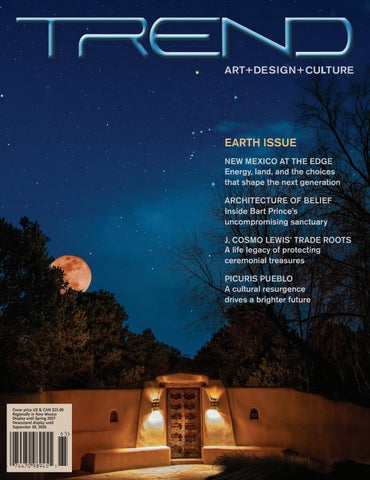
EARTH ISSUE NEW MEXICO AT THE EDGE Energy, land, and the choices that shape the next generation ARCHITECTURE OF BELIEF Inside Bart Prince’s uncompromising sanctuary J. COSMO LEWIS’ TRADE ROOTS A life legacy of protecting ceremonial treasures PICURIS PUEBLO A cultural resurgence drives a brighter future
Cover price US & CAN $25.00 Regionally in New Mexico Display until Spring 2027 Newsstand display until September 30, 2026
ANNUAL 2025 VOLUME 26 Cover price US & CAN $25.00 Regionally in New Mexico Display until Spring 2026 Newsstand display until September 30, 2025
Trailblazing Works Here. Santa Fe County is a paradise for outdoor enthusiasts and entrepreneurial spirits.
In Santa Fe County, your business and your passions don’t just coexist—they thrive in a landscape built for the bold.
Whether you’re inspired by the region’s natural beauty, rich cultural heritage, or spirit of innovation, this is a place where you’ll find the resources, connections, and support to help your business grow— alongside a community that values sustainability, creativity, and quality of life.
Discover more at EncantadoNetwork.com
Where Creative Businesses Thrive
MASTERS OF CRAFTSMANSHIP
Architect: RMKM Architecture P.C. Photographer: Kirk Gittings Photography
PRULL.COM
ARTIST ATELIER I cannot believe it has been 30 years since the beginning of Patricia Carlisle Fine Art and the David Pearson journey. My wife, Dana, and I met David and Patty over 25 years ago when we visited the gallery and fell in love with David’s sculptures. Since then we have acquired 16 pieces for our personal collection and facilitated the purchase of 10 life-size pieces for the City of Edmond, Oklahoma’s, Art in Public Places program. The last piece acquired for public art is Aswan, which will be placed in the new Uncommon Ground sculpture park to open in the fall of 2026 in Edmond, Oklahoma. David’s Silent Desert, historic
already located in
downtown, will be relocated to the
Uncommon Ground, a 62-acre sculpture park Delfina 30” high edition of 9
being built by a private individual that will be conveyed to a City of Edmond Oklahoma public trust. It is scheduled to open along historic Route 66 in the fall of 2026, which will also be the 100th anniversary of that historic road. The park will have at least 60 sculptures when it’s opened and also be the home of the Fine Arts Institute of Edmond, a nonprofit art teaching facility. The purchase of ten works for public art is a testament to the universal appeal of David Pearson’s sculptures, as each was purchased as part of Edmond’s public/private program, i.e. a private donor picked the piece and paid half of the price and the City matched the other half. This past summer, we were invited to the New
Mexico
Governor’s
Mansion
to
hear
David Pearson talk about his inspirations and influences when he creates his sculptures. It was attended by many notables in the Santa Fe art world. What an honor for David to Silent Desert 5’2” high edition of 12
be the first artist of the season to be invited. —Randel Shadid
Patricia Carlisle Fine Art & David Pearson Studio Celebrate our 30th Anniversary
carlislefa.com • 5 Sculpture, Santa Fe 87508 • 505.820.0596
Photos by Addison Doty
Aswan 5’ 7” high Edition of 9
STAN BERNING
Blue Vista / East, watercolor/gouache, 22” x 30”, 2026 Blue Vista / South East, watercolor/gouache, 22” x 30”, 2026 Blue Vista / South, watercolor/gouache, 22” x 30”, 2026
Stan Berning’s ART BOX | 901 Canyon Road | Santa Fe, New Mexico 87501 stanberningstudios.com | stan@stanberning.com | 928-460-2611
Winter / Dusk / Black Mesa, oil on panel, 36” x 48”, 2026 View to the Lake / Pedernal, oil on panel, 36” x 48”, 2026
50 YE AR S 150 WEST MA RCY STREE T - AT LINCOLN & MA RCY SA NTA FE NM 87501
D A V I D R O TH E R M E L C ONTEMP ORA RY
575 - 6 42- 4981 • ROTHERMELFINE A RT@GMAIL .COM D RCONTEMPOR A RY.COM
Candyce Garrett Granite Sculpture
575.937.1486 candycegarrett.com
ADVERTISEMENT
O
Opposite: “Target” • Zimbabwe Black Granite and Texas Red Granite from Fredricksburg • 8-1/2’ high x 6’ wide x 2’ deep
n the sculpture scene, there are millions of stone carvers. A fraction of those work in granite. Of that small slice of artists, there is but ONE WOMAN who has achieved the mark of monumental sculptor of granite: Candyce Jones Garrett.
This page upper left: “Broken Ladder” • California Academy Black Granite and Sunset Red Granite • 6-1/2’ x 5’ wide x 30” deep
Ancient Egypt, Asian, and Mesoamerican cultures are known for their lasting contributions in marble, limestone and basalt, but with the exception of Machu Picchu, none of these constructed such megaliths in granite. Due to its hardness and consequent ability to outlast erosion for millennia, it is often chosen for smaller monuments and headstones, but these same qualities also mean granite is one of the most difficult stones to work on the planet.
Lower right: “Hope, Honesty, and Friendship” • Memorial commissioned by invitation of the premier Japanese granite sculptor Keizo Ushio for the 2011 Tōhoku Tsunami Victims • Japanese Pink Granite • 6’high x 50” wide x 12” deep
Working with a chisel, hammer, and grinder, Candyce creates fantastic monumental pieces that tower over her and weigh tons per piece. Her creations grace the halls of museums, corporate courtyards, University commons, and private estates across the globe. She has been invited to contribute work from the shores of Japan to the charming mountain village of Gstaad, Switzerland. The sheer size of Candyce’s work is daunting. Combine that heft with the fact that her talent and creativity are unmatched in the world of stone sculpture. Then coat the result with the fact that such creations are brought to light by a woman of slight build, and sneaking up on the upper end of her seventies, and you have what most could only consider a complete marvel of the imagination.
Upper right: “Moving Target” • California Academy Black Granite, Texas Red Granite, and Zimbabwe Black Granite • 12’ x 6’ wide x 30” deep
What if community isn’t something we inherited— but something we build together? Creative Santa Fe creates brave spaces where curious and caring minds gather—to listen, to learn, to connect—across sectors, across differences. We design gatherings where we practice belonging to one another.
·
Bring your curiosity + care. We’ll meet you there. CREATIVESANTAFE.ORG
MALIBU SKIN S A N T A
F E
WHERE CALIF ORNIA GLOW MEETS NEW MEXICO SOUL
Schedule Online
Professional Make up application, Luxury Facials, Hydrafacial 518 Old Santa Fe Trail, Suite 4 Santa Fe, NM | 505-464-2477 | malibu-skin.com
ETHELINDA
FIRE HORSE Chinese New Year 36x48 oil on canvas
123 West Palace avenue • 505.986.0440 • WWW.manitougalleries.com
121 EAST PALACE AVENUE SANTA FE, NEW MEXICO | LANCASTERYORKSF.COM | 505.984.1577
DAN N A M I N G H A
BUTTE AND BLUE HORIZON Acrylic on Canvas 20˝ X 70˝ Dan Namingha ©2023
MICHAEL NAMINGHA
ARLO NAMINGHA
YUPKOYVI 8 UV Cured Ink on Collaged Dibond Panels in Artist’s Frame Edition of 2 58˝ X 58˝ X 2˝ Michael Namingha ©2025
HOPI Mixed Media Triptych 36˝ X 38˝ X 2˝ Arlo Namingha ©2025
Representing Dan, Arlo, and Michael Namingha 125 Lincoln Avenue • Suite 116 • Santa Fe, NM 87501 Tuesday–Saturday, 10am–5pm 505-988-5091 • nimanfineart@namingha.com • namingha.com •
A R C H I T E C T S H O R N S P E A R S
natural / healthy design
spearshorn.com santa fe . nm 505.983.6966
S P E A R S
H O R N
A R C H I T E C T S
BADLANDS BILLIARDS & HOT TUBS
SOAK IN THE MOMENT. Ready to Soak?
Scan Here.
1930 San Juan Blvd. Suite D, Farmington, NM www.badlandsinc.com • 505.444.3967
Nureteka
nuretekasf
the art of desIgn A Collaborative Partnership
[
]
FPO
The Collaboration is a multidisciplinary partnership comprising Lisa D. Martinez Design LLC, + B Constructiv LLC, Martinez Design Group, and
Five-Ten Architecture + Design. Offering comprehensive services, from
land-use planning and architectural design to construction and project
management, the firm delivers projects across a spectrum of traditional
and contemporary styles. Its work has been recognized with numerous industry awards at both regional and state levels.
O
mtzarchitecture.build Lisa D. Martinez Contractor | Designer Lisa D. Martinez Design LLC + B Constructiv LLC, Design, Construction & Consulting Conpanies
in collaboratIon with fivetenarchitecture@gmail.com
505.470.7888 Daniel J. Martinez Architect | NM + Texas Five-Ten Architecture + Design
K r y s t een Wa sz a k
Contemporary Original Plein Air Oil Paintings
Deep Canyon Blues 30 x 48 Plein Air Oil On Canvas Colorist Krysteen Waszak, is a dedicated and adventurous plein air oil painter whose color explorations take her all over the Land of Enchantment and beyond. Waszak’s contemporary painting style, large canvases and color handling have a surprisingly modern feel, nontraditional in plein air. Painting quickly and confidently, Waszak creates a story scape of fresh, vivid moments in time. See website for upcoming events, available works and studio visits. Participant #37 in Santa Fe Studio Tour, June 20-21 and June 27-28, 2026.
Studio visits by appointment in La Mesilla and Taos, NM. 505-250-0455 www.krysteenwaszak.com krysteen@krysteenwaszak.com instagram@krysteenwaszakart
ALBERT HANDELL
“Mystery Light” by Albert Handell oil 22x26
1109 Don Gaspar Avenue Located in the South Capitol District A very short drive from the Plaza
STUDIO VISITS WELCOME Albert Handell cell 505 603 1524 Linda Wells cell 512 963 4630 www.alberthandellstudio.com
WILLISON W#S2 World-class recycle art. Unique handmade gifts. Unmistakable Santa Fe style.
Mon: closed Tues: closed Wed: 9:00 - 2:00 Thurs: 10:00 - 6:00 Fri: 10:00 - 6:00 Sat: 10:00 - 5:00 Sun: closed
1189 Parkway Dr #E4 Santa Fe, NM
WillisonWest.com
CONSIGNMENT VINTAGE WESTERN
320 Aztec St, Santa Fe, NM santafedoubletake.com 505-989-8886
138
108 The Mountain People Rise Again
Not survival—revival. At Picuris Pueblo, centuries of resilience fuel a cultural resurgence shaping the future. By Daniel Gibson | Photography by Kitty Leaken
116 Powering the Future
New Mexico stands at an energy crossroads. Will the state cast its lot with oil or plan an alternative energy future? By Melissa Troutman
122 Wild at Heart
154 DESIGNSOURCE Red Drums on the Ridge In Mountainair, Bart Prince builds in red drums. A sculptural refuge that frames the desert in light, horizon, and trust. B y Brett Trusko | Photography by Robert Reck
195 PASSION OF THE PALATE
Every rescue is a race against time. Inside the urgent world of those dedicated to saving New Mexico’s most vulnerable wildlife. By Joan Conrow
The Pleasure of Feeding People Chef Chris Maher and wife Valerie cook with purpose. Travel, shared meals, and a table that brings community together. B y Gussie Fauntleroy
128 The Man Who Walks Between Worlds
206 Riparian Feast at Los Luceros
Part preservationist. Part storyteller. J. Cosmo Lewis safeguards the materials—and meanings—behind Native craft traditions. By Brett Trusko | Photography by Daniel Quat
36
138 Loving the Land Four photographers. One landscape. Infinite meaning. A visual and emotional journey through Northern New Mexico’s fragile beauty. By Joan Conrow | Photography by Peter Ogilvie, Lonnie Schlein, Jim Cox, and Douglas Merriam
Trend 2026
At Los Luceros, past and future converge. Farming traditions meet regeneration, community, and a revived Rio Grande landscape. B y Amy Boaz
PETER OGILVIE
features
ASPECTS OF LOVE, ACRYLIC WITH GOLD ON CANVAS, 58" X 50"
PURE SENSUOUS COLOR
BETTE RIDGEWAY
RidgewayStudio.com
40
PUBLISHER’S REFLECTIONS
41
FROM THE EDITOR
48
FLASH SITE SANTA FE builds momentum toward its 2026 exhibitions and the next International Biennial; Indigenous architects at MASS Design Group shape community through ceremony and relational responsibility.
52
ECOSOURCE The RainCatcher rethinks urban runoff through regenerative design in Santa Fe by Indigenous architects. By Dezbaa’
54
IN MEMORIAM Robert Redford’s love for New Mexico By Joan Conrow Photgraphy by June Pagliuso
58
GREEN ENERGY New Mexico’s Next Energy Frontier Beneath New Mexico’s familiar energy landscape, geothermal is promising. By Haven Lindsey
60
WILDLIFE Rhythms of the Mesa They were never meant to survive. Yet they do. New Mexico’s wild horses endure against all odds—offering a raw lesson in resilience, coexistence, and the cost of freedom. By Haven Lindsey
38
Trend 2026
58 68
TAOS Where Sky Meets Earth: Tatanka A return once thought impossible is happening now. Buffalo are coming back to Taos Pueblo—reviving the land, identity, and a way of life lost to history. Story and Photography Bill Curry
77
True West at the Legacy Café Where strangers become regulars— and stories become family. In Taos, one café turns food, memory, and love into a living community. By Lynne Robinson Photgraphy by Bill Curry
85 ABIQUIÚ Collector of Vanishing Cultures What happens when a culture disappears—but the artifacts remain? Inspired by Edward Curtis, John Bosshard has spent a lifetime preserving what time threatens to erase. By Amy Boaz Photography by Robert Reck
98
168 174
ART MATTERS Southside Alchemy Steel, fire, and imagination collide. In a South Santa Fe workshop, Calli Beck is redefining fabrication as an act of creativity and inclusion. By Harry St. James Photography by Lonnie Schlein
184
ARTIST STUDIO Of Sheep, Spiders, and the Loom Diné artist Kevin Tsosie weaves ancient knowledge into contemporary expression—one strand at a time. Story by Michele Potter Photography by Bill Curry
190
ARTIST STUDIO Earth, Assembly, and a Life Shaped by Material Limits What if constraints are the source of creativity? Richard Morrow’s work challenges convention—using the Earth itself as both medium and message. By Brett Trusko Photography by Lonnie Schlein
ALBUQUERQUE Into the Woods Where shadow meets first light, nine artists reimagine the landscape as a space of memory, history, and belonging. By Logan Royce Beitman
168
TUNES Michael Hearne’s Big Taos Legacy A festival built on something deeper than music. Micheal Hearne transforms friendship and place into one of Taos’s most enduring traditions. By Bill Nevins Photography by Bill Curry
ABOUT THE COVER: J. Cosmo Lewis’ entry gates to his home and garden. See feature on page 128. Cover by photographer Daniel Quat with Boncratious
TOP LEFT: TONY BONANNO. RIGHT: COURTESY OF STARK RAVEN FABRICATION
departments
g ather e d hi sto ry
Daniel Quat Photography
4 5 y ea r s o f s o u r c i n g a n d c u r at i n g g lo b a l a n t i q u es Furnishings • Architectural Elements • Textiles • Ceramics
500 Market Street in the Railyard District of Santa Fe 505-365-2607 www.sunnysidetradingco.com
FROM THE TREND PUBLISHER TEAM
B
eth “Birdie” Miller, who died last year, lived as if the future were sitting at her table, waiting to be welcomed in. As a mentor and friend, she influenced not only the course of my work, but the way I understood what environmental leadership could be. Sol y Sombra, the Santa Fe estate where Georgia O’Keeffe spent her final years, became Beth’s canvas for a new kind of environmental living. Beth and her husband, Charles Miller, purchased the 20-acre property from the artist’s estate in 1987. While honoring O’Keeffe’s legacy of fearless creativity, Beth began to transform the estate into a living laboratory for ecological design, community, and spiritual inquiry, while protecting wildlife habitat. It was at this gathering place for global environmental dialogue that I first met Beth. My husband was the property’s master stonemason, and I would visit the estate with our newborn daughter, Amber Joy. From the quiet vantage point of nursing my baby and caring for Beth’s aging mother, I witnessed the constant flow of artists, activists, spiritual leaders, and visionaries who streamed through her doors. In those early years—long before I founded Trend magazine and became a publisher—Beth mentored me in subtle but indelible ways, speaking about what truly mattered and modeling a life fully aligned with purpose. As a young mother, I felt her sowing seeds in my heart that have now blossomed into this “Heartbeat of the Earth” issue, a magnum opus celebrating nearly three decades in print and a future that she helped me dare to imagine. At Sol y Sombra, Beth created a landscape of hospitality and regeneration. She planted sequoia trees in the high desert, added a community dining area, and developed greenhouses and permaculture gardens that fed guests from the land. Her home became the setting for intimate, culture-shaping gatherings—including a private celebration of the release of The Milagro Beanfield War—where art, land, and justice met around one table. Beth’s vision showed up in every detail at Sol y Sombra. Working with master blacksmith Tom Joyce on sculptural entry gates, she treated the threshold itself as a work of art and intention—a portal of forged iron that welcomed guests into a living experiment. Sol y Sombra evolved into a dry mountain botanic garden and permaculture landscape, with water harvesting earthworks, a constructed wetlands system that treated wastewater and fed vegetation, and an organic farm anchored by a passive solar greenhouse designed in collaboration with architect Edward Mazria. Beth’s environmental imagination was inseparable from her sense of hospitality. She understood that people change not because of data and policy, but experience: a shared meal grown on site, a walk through a living watershed, a conversation that stretches late into the night under New Mexico stars. Sol y Sombra hosted events, concerts, and retreats that
40
Trend 2026
brought together politicians, scientists, artists, and spiritual leaders, making the property itself a catalyst for dialogue and transformation. Many came away with a new understanding of what “sustainability” could look like in practice, long before the word entered the popular lexicon. Beth also helped convene and support environmental efforts tied to the Sundance and Windstar foundations founded by Robert Redford and John Denver, respectively, and collaborated with Paul Allen’s philanthropic world and the Texas banking communities connected to her husband. She recognized that lasting land protection and climate action required aligning capital markets, philanthropy, and grassroots vision, and she moved fluently in all three arenas. Through Charles’ connections in the banking and investment sectors, Beth brought decision-makers into direct contact with the living systems their choices affected, asking them to see land not as an abstract asset but a breathing partner. Beth’s leadership of the Sol y Sombra Foundation intersected with national and global conversations about climate change, influencing policy debates far beyond New Mexico. She was part of a loose network of ecologists, scientists, and educators who, even in the late 1980s and early ’90s, warned of the planetary stakes and proposed integrated responses that bridged disciplines and ideologies. In that same spirit, Beth brought spiritual and political leaders, including the Dalai Lama and Mikhail Gorbachev, into dialogue at Sol y Sombra, pressing for visionary environmental frameworks when such conversations were still rare. Those gatherings were not symbolic photo opportunities, but working sessions aimed at reimagining our relationship to Earth in both moral and practical terms. Sol y Sombra became a place where inner work and outer action finally met. Beth mentored me by example: the way she listened, curated people, and insisted that design, culture, money, and ecology were inseparable. She invited me into conversations at Sol y Sombra that stretched my sense of what a magazine, a business, or a single person might achieve. Beauty, in her world, was a way of telling the truth about our bond with the earth. As publisher of TrendMagazineGlobal.com, I see her fingerprints in every story that connects beauty to responsibility and local voices to global futures. Our commitment to covering regenerative design, land stewardship, and visionary philanthropy is, in many ways, an outgrowth of the questions she posed and the example she set. In honoring Beth Miller, we celebrate a woman who leveraged her home and resources in service to the earth—while teaching many of us how to do the same. Her life reminds us that courage can look like opening our gates to others, setting one more place at the table, and planting trees whose shade we may never enjoy, fulfilling our responsibility to the future she trusted us to protect. —Cynthia Canyon, Publisher
FROM THE EDITOR
BILL CURRY
T
here are places that reveal themselves immediately and others that resist—places that ask for patience before they offer anything in return, places that ask for millennia instead of hours. Northern New Mexico has always belonged to the latter. It does not perform, nor does it explain itself. And yet, for those willing to stay with it—to look longer, to listen more carefully—it becomes something far more complex than landscape or culture alone. It becomes relationship. This issue of Trend is about that relationship. Across these pages are artists, makers, musicians, and stewards working not simply in Northern New Mexico, but in response to it. Their lives and practices are shaped by forces older, slower, and far less negotiable—land, water, and climate. These are not backdrops. They are active participants. In Mountainair, Bart Prince’s red masonry forms rise just enough to frame the horizon, then settle back into it—an architecture that resists spectacle in favor of belonging, The house does not dominate the land; it listens to it. These landscapes are not just captured— they are earned through time, light and attention. That idea of attention—of staying long enough for meaning to emerge—runs through the entire issue. At Los Luceros, centuries of cultivation meet a renewed commitment to regenerative practices, where farming becomes continuity rather than production. Along the Rio Grande and across the mesas, the land carries both abundance and fragility, demanding humility that modern systems often struggle to maintain. That same tension appears in return of the buffalo to Tribal lands—a story that is ecological, cultural, and deeply restorative. It is most visible in the fragile balance between human life and the wildlife that shares this region. In this issue, that relationship comes into sharp focus through the work of those dedicated to rescuing and rehabilitating New Mexico’s original inhabitants. From raptors to foxes to the endangered Mexican gray wolf, their efforts reveal a complex web of interdependence—one where even small disruptions carry lasting consequences, and where recovery requires both science and care. These stories remind us that continuity is not automatic. It must be carried. At Picuris Pueblo, that work is visible in the restoration of language, land, and the ways of life—an ongoing act of resilience shaped by both history and forward vision. In Taos, the Legacy Café reflects that same continuity in a more intimate form, where memory is embedded in daily life and shared experience. Chef Chris Maher builds community through the table, while Michael Hearne gathers it through music— each creating spaces where connection becomes the work itself. Calli Beck’s workshop, alive with transformation, reflects another dimension of that same impulse: ideas moving rapidly from concept to form within a culture of making. Creation, in this place, is rarely decorative; it is consequential. J. Cosmo Lewis reminds us that belonging is not claimed but earned—through time and trust. Kevin Tsosie’s work carries an unbroken chain from sheep to loom, where making is inseparable from land, language, and inheritance. Across all these stories, one idea returns again and again: nothing here exists in isolation. The land shapes the people. The people shape the work. The work, in turn, becomes part of a continuous story. New Mexico is not a place of easy narratives. It is a place of long views. And if there is a thread that binds the issue together, it is this: in Northern New Mexico, meaning is not given. It is built—slowly, deliberately, and always in relation to something larger than oneself. —Brett Trusko, Editor
trendmagazineglobal.com
41
CONTRIBUTORS
30 years
DezBaa’ is born for the Nooda’í Dine’e (Ute clan) and is of Diné and Basque, Spanish, and Mexican descent. An actor, screenwriter, director, and independent film producer, she is best known for portraying Helen Atcitty for four seasons on AMC’s Dark Winds. DezBaa’ holds a bachelor’s degree in geology from Amherst College and two Master of Fine Arts degrees from the Institute of American Indian Arts (IAIA). She lives in Santa Fe with her family, including a newly minted teenager, a dog, and two cats.
of hands-on learning with nutritious, affordable foods
33 schools in northern New Mexico this school year
8,000+ kids building confidence, skills, & healthy habits
Joan Conrow has been writing and editing professionally for more than 40 years, primarily about environmental issues, climate change, wildlife conservation, and land use. Reporting assignments have taken her to India, Africa, East Asia, and the South Pacific. Conrow is also a multimedia producer and communications consultant specializing in food and agricultural innovations. Her favorite pastimes include yoga, Sanskrit chanting, hiking, hanging with friends and family, and loving on her two rescue dogs.
Learn • C o o k • Give cookingwithkids.org
42
Trend 2026
TOP: JEN STILIONS. BOTTOM: KATHY HIRSHON
As a boy, Robert Reck had a penchant for completing tasks as precisely as his civil engineering father and speech clinician mother. The answers to those problems were always in the details. Understanding how those details manifest required close observation and concentration. Today, as a professional architectural photographer, those character traits remain important. Reck has an MFA from the University of New Mexico, spent 25 years as a staff photographer for Architectural Digest, and traveled internationally for luxury resorts, homes, hotels, and magazines, all while based in New Mexico.
Daniel Quat has been a professional photographer for over 40 years. His work in New York City included corporate portraits, annual reports, products for advertising agencies, magazines, and department stores. In Santa Fe, he specializes in portraits, events, and storytelling—branding photography for individuals and corporations. Quat loves to connect with his subjects, which helps him capture their true essence in his portraits. In his spare time, he loves hiking, swimming, riding horses, and dancing Nia.
TOP: SVEN DOORNKAAT
Michele Potter has been a ski instructor and English/American studies professor in Taos for 30 years. She’s written for numerous magazines and literary journals about nature and culture. She posts regularly on Substack about travel, This World of Ours Today, and moving the metaphorical and literal furniture (@oneLmichele). She’s finishing a memoir/history book about passing on what’s important among five generations of women in her family, titled Keep a Light On.
Bill Curry likes to tell a story about a renowned fashion photographer dining with a three-star Michelin chef at his Paris restaurant. After dinner, the chef said, “Your work is sublime and painterly—you must have a wonderful camera.” The photographer smiled and replied, “Chef, that award-winning ‘five ages of Parmigiano Reggiano’ was divinely inspired. You must have a really good pan.” Curry keeps the story close as a reminder that cameras, like pans, are just tools. What matters is the creative passion: seeing from the heart with deep gratitude when dancing with the light. trendmagazineglobal.com 43
TEAM TREND
PUBLISHER AND FOUNDER Cynthia Marie Canyon EDITOR Brett Trusko ART DIRECTOR AND DESIGNER Janine Lehmann COPY CHIEF Joan Conrow PRODUCTION MANAGER AND ASSOCIATE DESIGNER Tim Wise PHOTO PRODUCTION Boncratious CONTRIBUTING WRITERS Amy Boaz, Logan Royce Beitman, Joan Conrow, Bill Curry, DezBaa’, Gussie Fauntleroy, Daniel Gibson, Haven Lindsey, Michele Potter, Lynne Robinson, Harry St. James, Melissa Troutman, Brett Trusko CONTRIBUTING PHOTOGRAPHERS Jim Cox, Bill Curry, Audrey Derell, Kirk Gittings, Kitty Leaken, Douglas Merriam, Peter Ogilvie, Jane Pugliosi, Daniel Quat, Robert Reck, Lonnie Schlein, Mark Steven Shepherd ACCOUNT REPRESENTATIVES Mary Doeffinger, Heidi Mayfeild, 505-470-6442 NORTH AMERICAN DISTRIBUTION Disticor Magazine Distribution Services, disticor.com ACCOUNTING Patricia Moore SUBSCRIPTIONS Bettina Lea NEW MEXICO DISTRIBUTION Ezra Leyba, 505-690-7791 NATIONAL NEWSSTAND DISTRIBUTION Dawn Cressor, Disticor PRINTING Publication Printers. Denver, CO publicationprinters.com Manufactured in the United States All rights reserved. No part of Trend may be reproduced in any form without prior written consent from the publisher. For reprint information, please call 505-470-6442 or email santafetrend@gmail.com. Trend art+design+culture ISSN 2161-4229 is published online throughout the year and in print annually (20,000 copies), distributed throughout New Mexico and the US. To subscribe, visit trendmagazineglobal.com/subscribe-renew. To receive a copy of the current issue in the US, mail a check for $35.00 to PO BOX 1951, Santa Fe, NM 87504-1951 or go online to subscrib to the next issue at trendmagazineglobal.com/ subscribe. Find us on Facebook at facebook.com/magazineTrend and Instagram at Instagram.com/santafetrend and Instagram.com/trndabq.
Clockwise from top: Publisher Cynthia Canyon with Subscriptions Manager Bettina Lea; Ezra Leyba, New Mexico Distribution; Patricia Moore, Accounting; Tim Wise, Production Manager; Associate Designer
44
Trend 2026
We’re seeking new and diverse voices! If you are a writer or photographer interested in contributing, please visit trendmagazineglobal.com/contribute and send your story pitches to santafetrend@gmail.com. Trend, P.O. Box 1951, Santa Fe, NM 87504-1951 505-470-6442, trendmagazineglobal.com
TOP: MARK STEVEN SHEPHERD
Copyright 2026 by Santa Fe Trend LLC
FPO SOMERSRANDOLPH.COM 505-690-9097
“When I was 14 years old, I stood quietly in front of a painting I had just
By eleventh grade, I knew the direction my life would take. I made an
finished. The room was still as I studied the colors and shapes that had
inner declaration that after graduating high school, I would pursue
come from somewhere deep within me. Then something happened
fine art seriously. Choosing a major for college was not a struggle.
that I have never forgotten. I heard a male voice speak clearly and
Instead, it felt more like acknowledging something I had already
deliver a simple message: One day, I would be a known painter.
decided within me.
I did not fully understand the meaning of those words, but the
I enrolled at CalArts, majoring in graphic design. My thinking was
experience stayed with me. It felt real and steady, as if something had
practical: By working in a creative field, I could support myself while
been placed gently but firmly into my life. From that moment on, art
continuing to paint. Painting had never been a hobby, but something
carried a deeper significance. Whenever I visited museums, I found
much deeper. It was my safety, my sanity, and my truth. It felt innate
myself drawn repeatedly to abstract paintings. Their freedom and
and necessary—something I could never truly set aside.
emotion spoke to me in a way that words never could. I fell completely
After college I moved into full-time design work, but balancing a
in love with abstract art.
career and painting proved more difficult than I expected. Weekdays
ADVERTISEMENT
were consumed by deadlines and client work, leaving only weekends
Soon, my work began entering strong galleries, and opportunities
to paint. I tried to make those hours count, but it never felt like enough.
appeared that I had once only imagined. My career began to blossom.
The work I wanted to create needed more time and space to develop.
Today I feel deep gratitude for that moment long ago when I stood in
Eventually, I transitioned into freelance design so I could work from
front of a painting and heard that unexpected voice. Whether it was
home. That decision changed everything. Suddenly there were more hours in the day, and many of them could belong to painting. With that additional time came growth. I experimented, explored, and allowed
intuition, destiny, or something beyond explanation, it set my life in motion. Now each time I step into my studio and face a blank canvas, I know the journey is still unfolding—one painting at a time.”
my work to evolve naturally. Slowly, a voice began to emerge in my paintings, along with the beginnings of a signature style. As the years passed, design work faded further into the background while painting moved steadily to the center of my life. Before long, I found myself working full-time in my studio. The quiet promise I had carried since I was 14 had become my reality.
Rose Masterpol
•
Santa Fe, NM
masterpol.com
FLASH
SITE SANTA FE Looks Ahead
Digitized footage from Spiderwoman Theater, as seen here in a performance of Lysistrata Numbah! in Denmark, is a key element of the Indian Theater exhibition at SITE SANTA FE. 48
Trend 2026
Yet its arrival in Santa Fe carries special significance. The exhibition’s conceptual foundation traces back to a treatise written in 1969 at the Institute of American Indian Arts (IAIA), giving the Santa Fe presentation a sense of cultural homecoming. The exhibition explores Indigenous performance, visual art, and storytelling traditions through the work of contemporary Native and Indigenous artists. Unlike earlier iterations, the SITE SANTA FE presentation will place a strong emphasis on performance. Live performances and artist activations will unfold throughout the summer of 2026, transforming the exhibition into a dynamic environment where installation, performance, and community engagement intersect. SITE SANTA FE will also host its Annual Benefit on July 1, one of the organization’s most important fundraising events. The 2026 benefit will honor curator Candice Hopkins, who organized Indian Theater and has longstanding ties to New Mexico. Hopkins is widely recognized for her work exploring Indigenous art histories and contemporary cultural narratives and has previously collaborated with SITE SANTA FE on earlier exhibitions and biennials. In October, the museum will shift to a major fall program featuring three simultaneous solo exhibitions opening October 16.
Among them is a solo exhibition by Larry Bell, the legendary Light and Space artist whose luminous glass sculptures and immersive installations have influenced generations of contemporary artists. The exhibition program also includes Sayre Gomez and Sarah Genn. Each artist will occupy a dedicated gallery at SITE SANTA FE, allowing visitors to encounter three distinct artistic worlds during a single visit. Planning is already underway for the 2027 International Biennial, with organizers expecting to announce the curatorial theme, participating artists, and citywide venues by October 2026. As in previous years, the biennial will extend beyond the museum’s walls, activating spaces across Santa Fe and drawing the international art community to the city. But before that global spotlight returns, SITE SANTA FE is focused squarely on the year ahead. With a major Indigenous-centered summer exhibition, a compelling trio of fall solo shows, and a growing calendar of performances and public events, the institution continues to demonstrate why it remains one of the Southwest’s most vital contemporary art organizations. In a city famous for its artistic heritage, SITE SANTA FE keeps reminding the world that Santa Fe is a place where art history lives and the future continues to unfold. —Brett Trusko
COURTESY OF SITE SANTA FE
S
anta Fe has long been known for its artistic traditions. But in the Railyard District, one institution has spent nearly three decades expanding the city’s cultural conversation far beyond the Southwest. SITE SANTA FE has become a rare bridge between the global contemporary art world and the creative energy of Northern New Mexico. Founded in the mid-1990s as a biennial-driven organization, SITE SANTA FE quickly earned international attention for exhibitions connecting emerging and established artists from around the world. Today, under the leadership of Phillips Executive Director Louis Grachos, the institution is preparing an ambitious slate of exhibitions for 2026 while building momentum toward the International Biennial, scheduled to open in June 2027. Grachos himself is deeply tied to the organization’s history. He helped launch SITE SANTA FE and spent more than a decade shaping its early direction before leaving to lead major institutions, including the Buffalo AKG Art Museum, the Contemporary Austin, and the Pérez Art Museum Miami. His return to Santa Fe reinforces a renewed commitment to artist-centered programming and the institution’s role in the international art world. While the upcoming International Biennial will once again place Santa Fe in the global spotlight, SITE SANTA FE emphasizes that the years between biennials are anything but quiet. Each season brings exhibitions, performances, and public programs that connect artists and audiences in new ways. The centerpiece of the 2026 season will be Indian Theater, which runs through September. The exhibition arrives in Santa Fe after earlier presentations at Bard College’s Hessel Museum of Art in New York and the MacKenzie Art Gallery in Canada.
BUILDING HOPE: Architecture as Ceremony
COURTESY OF MODEL OF ARCHITECTURE SERVING SOCIETY (MASS) DESIGN GROUP
A
t Model of Architecture Serving Society (MASS) Design Group in Santa Fe, Indigenous architects ref lect the firm’s founding philosophy. Its inaugural project—a hospital in Butaro, Rwanda—was designed around the umuvumu, a medicinal fig tree that serves as a community gathering place. For Celina Brownotter, a MASS designer who is both Hunkpapa Lakota and Diné, architecture begins with place. “Sustainability is not just about energy systems or technical performance,” she says. “It’s about relational responsibility—how you design and think about long-term impact.” Brownotter’s interest began in early childhood, building miniature settlements for her Barbie dolls—an instinct that later shaped her professional path. One of her most meaningful moments came when she returned to Lakota country to help design a cultural center. Her approach reflects a worldview in which land is a living relative, not a resource. Architecture, in this context, must reflect community values, resilience, and the ways people live. Joseph Kunkel, a citizen of the Northern Cheyenne, serves as a principal at MASS and directs the Sustainable Native Communities Collaborative (SNCC) Lab in O’ghe P’oghe, the original Tewa word for Santa Fe. He was inspired by his adoptive grandfather, a Capuchin friar at St. Labre Indian School who built many of the mission’s buildings. Watching construction unfold sparked a vision: one day, he would build for his own people. That vision led him to co-found SNCC, which addresses the housing crisis in Indian Country by helping tribes develop culturally grounded projects. Initially offering technical assistance, SNCC now
collaborates directly on design and construction. For Kunkel, accessibility is key. He wants Native communities to have safe, affordable, and thoughtfully designed housing and public spaces. “We all deserve beauty,” he says. He also challenges conventional ideas of sustainability, advocating a broader view rooted in reciprocity—relationships connecting communities, land, and resources in ways Western planning often overlooks. Chandler Willie, Diné, serves as a business development manager at MASS. He discovered architecture during a road trip with his father, who explained the Beauty Way—a Diné principle of balance and harmony. A visit to an architect’s home left a lasting impression. Later, Willie began to see parallels between Western design traditions and Diné philosophy, including ideas of balance expressed in form. In the Diné creation story, songs exist for many aspects of life, including blessing a home. Willie views architecture as part of that continuum. “We fit ourselves to meet our environment and meet our reality,” he explains. “It may seem mystical to some
people, but it’s actually a process.” That perspective is reflected in the recently completed Caddo National Child Care Center in Hinton, Oklahoma. Finished in late 2025 with support from SNCC, the facility places children at the center of community life. Built by Arrowood Kakinah Enterprise—a construction company owned and operated by the Caddo Nation—the center includes playgrounds, native landscaping, and a courtyard that connects to trails, forests, and a nearby pond. Solar panels generate more than 90 percent of the building’s energy, and rainwater harvesting systems support long-term sustainability. The center now serves 82 children and their families. Across New Mexico’s 23 federally recognized tribes, cultural teachings vary, but many share a common idea: spaces designed for ceremony, gathering, and remembrance of the relationship between sky, earth, and community. Through projects like the Caddo center, MASS and SNCC are ensuring that tribal sovereignty, cultural identity, and Indigenous knowledge are foundational to design—not afterthoughts. —DezBaa’
Caddo National Child Care Center. Hinton, Oklahoma trendmagazineglobal.com
49
PRESCOTT GALLERY and SCULPTURE GARDEN
Full page ad p.50 Prescott kinetic sculptures on safari Opposite left: Moose on the Loose, kinetic sculpture, 8.5’ tall Opposite right: Rockin’ Rooster, kinetic sculpture, 10’ tall
clear coat protects the work from the weather if it is to be
id-steel sculptures are truly one of a kind. Engineered to
displayed outdoors.
move in the wind or be activated by hand, they combine
The enormous works are transported all over the country,
reality with fantasy in an ever-evolving variety of magical
strapped down on a huge trailer hooked onto a big truck, to
images. There are 30-foot-high giraffes alongside pink fla-
be exhibited in museums, public parks, schools, galleries,
mingos, elephants, seahorses, dinosaurs, dragons, and many
and private homes. Prescott is also open to commissions
other real and imaginary creatures.
and over the years has completed many, including some for
Everything is created in a 30,000-square-feet studio in
celebrities such as Michael Jordan and Steven Spielberg.
Santa Fe. The process is inevitably complex, starting with a
The gallery on Siler Park Lane is currently showing a ret-
drawing transferred to a computer and then on to a machine
rospective, with photographs and early works that demon-
that cuts sections in steel. The pieces are then powder coated
strate Prescott’s artistic evolution over the years. One may
with a spray gun, sandblasted, and then fired in a massive
wonder: After a career that spans more than 50 years, has he
oven that heats the environmentally friendly powder paint
ever run out of ideas? “Never,” he says. “The problem is too
up to 500 degrees, melting it into a glossy finish. A final
many ideas and not enough time.”
prescottstudio.com | 1127 Siler Park Ln, Santa Fe, NM 87507 | 505-424-8449 | prescottstudio@gmail.com
TOP: GABRIELLA MARKS PHOTOGRAPHY
F
redrick Prescott’s larger-than-life, brightly colored, sol-
ADVERTISEMENT ADVERTISEMENT
ECOSOURCE
Rerouting Water in the Developed World BY DEZBAA’
52
Trend 2026
lation grows—and suburban development expands to meet demand—so does the fear that this expansion will deplete clean water resources. Cities designed solely for population and industrial growth often sprawl with no concern for the natural environment until a resource is no longer capable of meeting the residents’ needs.
Baker wants to shift Santa Fe’s approach to development away from designs that have reduced the functionality of the million-year-old ecosystems that were in place prior to anthropogenic industrial advancement. He argues that sustainability is not enough—cities must move toward regenerative systems and more holistic
A raingarden fills with rainfall that has flowed into a curb cut, diverting water from roadways, irrigating roadside landscapes, reducing heat, creating habitat, and slowing the flow that contributes to erosion. Top: An urban Zuni bowl fills with monsoon rainfall around meandering elm logs that have been inoculated with fungi spores.
TOP: LINNE LALIRE. BOTTOM: ESHA CIOCCHIO
R
eese Baker is seeking to restore ecological balance to Santa Fe’s concrete jungle through The RainCatcher, a landscaping, water recycling, and irrigation company grounded in permaculture principles that he founded in 2001. His fascination with the environment and desire to serve can be traced to his childhood in Colorado, where he often ran off into the woods to create habitat for salamanders and frogs by rerouting water into pools. Now, armed with more than just a willingness to help, Baker, a doctoral student at the University of New Mexico, is on the verge of changing Santa Fe’s relationship with its most prized natural resource. No, not chile, but water. As the city continues to annex parts of Santa Fe County, expanding urbanization poses a threat to clean water supplies. In response, Baker’s mushroom microclimate project is turning urban runoff into less contaminated water that can recharge our sacred aquifer. As one of the country’s driest municipalities, averaging just 14 inches of annual rainfall, it’s possible that “where’s the water coming from?” might be the secondmost asked question in Santa Fe after “red, green, or Christmas?” As the city’s popu-
ESHA CIOCCHIO
Turkey tail and oyster mushrooms sprout on moist elm logs seeded with spore plugs and protected from Santa Fe’s hot sun. Insert: A raingarden designed by Reese Baker diverts stormwater through a series of basins, where it is purified by both plants and fungi. Based on permaculture design, the garden supports many perennial edibles, including currants and oyster mushrooms.
practices in urban design. Repurposing Newton’s third law of motion, Baker believes that “any action that we put into the environment is going to create an equal and opposite reaction. If we can turn that reaction back into something positive, then you create a feedback loop that regenerates itself.” With the help of his 36 employees, Baker creates mushroom microclimates in sidewalk verges, office accessways, and parking lot medians throughout the city. Once built, the microclimates can regenerate themselves, even in our high desert climate. Baker envisions them as an alternative to the city’s current streetscape designs, which typically flood with thousands of gallons of water during monsoons, carrying debris and contaminants onto the streets. During heavy rainfall, the mushroom microclimates come alive as Zuni bowls fill with water before spilling over media luna waterfalls into a maze of grasses and Siberian elm logs plugged with tiny cotton-swab-sized saprophytic fungi. The water flows over rock-lined channels, escaping under existing sidewalks only to reappear on the other side where
the process happens all over again. Thick layers of organic mulch framing these pools slow evaporation and absorb rainfall. These green spaces provide oxygen and cool the air, in direct contrast to the concrete and gravel xeriscaping that contributes to urban heat. The permaculture design incorporated into these myco-microclimate islands functions to care for Earth and the people. It utilizes substances that may be toxic to human health, but serve as a food source for certain plants, bacteria, and fungi. Microbes and fungal mycelium detoxify our urban runoff systems, cleaning our polluted water before it continues its path underground. Baker, who believes “there’s no waste in nature,” wants to ensure that every drop of water that lands in Santa Fe is captured and scrubbed clean before it’s returned to the earth. Baker’s stewardship works to subtract anthropogenic contamination from the equation, facilitating a more efficient and ecologically sound pathway. In the process, it makes water more available to all living things, creating greater abundance for the City of Santa Fe—and perhaps, one day, beyond. R
trendmagazineglobal.com
53
A Full Service Interior Design Firm Specializing in Multi-family, Senior Living and Residential Design
Visit Us
Shops at the Design Center 418 Cerrillos Rd., Suite 18, Santa Fe, NM partnersindesignllc.com • 760.271.3977
IN MEMORIAM
ROBERT REDFORD Modeling a life for loving, protecting Earth
I
t was winter, circa 1980, when Robert Redford sat down next to me on the bench in a Vail, Colorado, ski shop to be fitted for rental boots and skis. By then, Redford was an international celebrity, his rugged features, windswept hair, and piercing blue eyes already legendary. My own eyes were averted after that first close-up look at a bona fide movie star, though my ears followed his easy banter with the excited salesmen. Relaxed, casual, low-key, down to earth, Redford was simply one of the boys, one of the crowd, one of us. Until a woman approached and thrust a pen and sheet of paper in his face. “Can I have your autograph?” He sized her up silently and returned his attention to his boots. “I don’t do that,” he replied
54
Trend 2026
quietly, head down. His comment wasn’t arrogant, or dismissive, or even annoyed. It was humble, like he couldn’t fathom why he should be singled out for such a request. Redford, who died at the age of 89 on September 16, 2025, at his home at Sundance in Provo Canyon, Utah, deftly mastered the balancing act of superstar and regular guy. Perhaps that’s because he was a son of the West—born and raised in Santa Monica, California—and imbued from birth with its egalitarian ways and informal friendliness. Redford had a longstanding and deep love for the Southwest, especially New Mexico, which began as a young boy while taking summer vacations with his parents. In the forward to The Rio Grande: An Eagle’s View, Redford re-
counted his first childhood sighting of the Rio Grande flowing through “a surprisingly wide, green valley backed by sandy mesas and imposing mountains, with summer thunderheads in skies like I’d never seen.” He was hooked on the Land of Enchantment. A decade later, another road trip took him back to the Southwest, where he came to understand the value of water—especially rivers—to the landscape and its inhabitants. Upon visiting Native American communities, he wrote, “I realized I was among people who regarded the Rio Grande as sacred and who considered any deliberate defiling of a river a sacrilege.” Redford’s time with Native Americans in New Mexico and Utah had a profound
JEAN PAGLIUSO
BY JOAN CONROW
JEAN PAGLIUSO
effect on his worldview. As he told Orion in an interview shortly before his death, “I developed a respect for their deep spiritual and cultural connection to the land; they are part of the land. They understand if we care for and respect nature, the land will support us, too.” His trademark activism and environmentalism took root in those early visits to the Southwest and went on to define his work, philanthropy, and stewardship, as well as his legacy. Many of those efforts were directed at New Mexico, a place he considered home. “I have a great love for this state,” he said in a 2010 interview. “It has a soul that I connect to.” Redford was a true friend to New Mexico, which he expressed in numerous ways. He was a strong supporter of the state’s film industry, starting in 1986 with The Milagro Beanfield War, which he directed in Truchas while living in Tesuque—years before New Mexico’s
film incentives helped transform the state into one of the country’s leading production hubs. The film reflected his political and environmental views, telling the story of farmers rising up against developers to protect water and their way of life. By then Redford had already founded the Sundance Institute, a nonprofit guided by the vision that “a story driven by an individual, authentic voice can awaken new ideas that have the power to delight and entertain, push creative boundaries, spark new levels of empathy and understanding, and even lead to social change.” Milagro reflected those principles, as did The Solar Film, a prescient 1979 short movie he co-financed to spread the word about reducing dependence on fossil fuels by embracing solar energy. Redford went on to launch a 2010 workshop in Española that trained
Hispanic and Native American filmmakers and later advocated for New Mexico’s film tax credit, touting the state’s beauty and rich culture to others in his industry. His final project in the state was serving as executive producer of Dark Winds, the acclaimed series based on Tony Hillerman’s novels and deeply rooted in Navajo culture and the landscapes of Northern New Mexico. Many of its scenes were filmed among the dramatic landscapes of Ghost Ranch. It was through his environmental advocacy, however, that Redford made his greatest contribution to the land and people he loved. “The environment—the air, water, and land—needed protection,” he told Orion. “It felt to me that nature was not valued or protected.” Redford sought to use the most powerful tools he had—his celebrity and filmmaking skills—to raise awareness and drive conservation. As his son, Jamie,
Robert Redford poses with some cast members from The Milagro Beanfield War. Opposite: Robert Redford sits horseback during filming as the Truchas Mountains rise behind him.
trendmagazineglobal.com
55
Robert Redford prepares to ride onto a set as a cameraman gets into position.
recounted, “I heard my dad say many times, ‘Art and nature combined makes the world a better place.’” Though he later acknowledged that he paid a professional and personal price for his activism—in 1979, Utahans burned him in effigy for derailing a power plant in the southern part of the state—Redford never hesitated to speak up. He penned opinion pieces for the Santa Fe New Mexican that opposed a 33-mile electric transmission line on acreage managed by the federal Bureau of Land Management, called for protecting Chaco Canyon and other sacred sites, and argued against the 1,110-acre Cow Creek project in rural San Miguel County due to its likely adverse impact on an important watershed and shallow aquifer. 56
Trend 2026
He also teamed up with the late Gov. Bill Richardson to reject President George Bush’s policies, asserting in a 2004 interview that “they seem to almost enjoy dismantling the environment. The future of this country is going to be coming from the bottom up because it’s sure not coming from the top down until this administration is removed.” Richardson and Redford later started the Foundation to Protect New Mexico Wildlife, aiming to protect wild horses and the state’s diverse wildlife. Redford was a passionate advocate for wild mustangs, which he viewed as “really symbolic of the American West.” He was an early supporter and board member of Return to Freedom, which runs a California sanctuary for about 500
wild horses and 50 burros, and worked to raise public awareness about the capture and slaughter of these animals. To keep the spotlight on the horses’ plight, Redford used his Hollywood prowess to produce The Mustang, a 2019 film about a convict participating in a program to train wild horses, and a 2020 documentary, The Mustangs: America’s Wild Horses, that outlined how different groups were helping these animals. In addition to working in the state, Redford maintained deep personal ties to Santa Fe, where he lived for many years on a 250-acre ranch with his second wife, Sibylle Szaggars Redford, a multimedia artist who still maintains a gallery of her work in town. But he never lost interest in Utah, where he used conservation easements to preserve over 1,200 acres in the North Fork Canyon Area and some 70 percent of the 3,800-acre Sundance Ranch near Provo. He was also reportedly instrumental in securing conservation easements that protect in perpetuity over 2,800 acres northwest of Santa Fe near Jemez and the Valle Caldera Preserve. Redford recognized that wild lands, particularly in the West, were fast disappearing, and that protecting them from development was the best way to preserve wildlife, cultural sites, watersheds, and scenic landscapes. He understood the urgency of that effort and was an early and unwavering advocate for the environment. “This is our only planet, our only life source,” he says in a video outlining the efforts of the Redford Center. “This may be our last chance. The most sacred thing we ever had was choice. And that’s where it all begins.” Throughout his life, Redford made choices that reflected his values, integrity, and deep love for the lands and people of the Southwest. His passing serves as reminder that our actions— and most importantly, our choices—can make a real difference in protecting the past and shaping the future. R
JEAN PAGLIUSO
IN MEMORIAM
GREEN ENERGY
BY HAVEN LINDSEY
In New Mexico’s familiar energy landscape, a quieter resource is emerging—one that may reshape how the state powers its future.
I
n New Mexico, energy has long been defined by what lies out of sight. Pumpjacks move steadily across the Permian Basin. Solar panels stretch toward the horizon. Wind turbines mark the skyline. Yet the state’s next major shift may come from something more important. Heat—long present, largely untapped—is beginning to emerge as one of the most promising energy resources of the moment. Geothermal energy is not new. For decades, its use depended on rare geological conditions—places where heat, water, and naturally occurring fractured rock aligned close enough to the surface to be economically viable. Those conditions supported early projects like the Lighting Dock geo-
58
Trend 2026
thermal plant in southwestern New Mexico, which has supplied power to the grid for years. But those systems were limited, bound by geography and chance. What has changed is not the resource, but the ability to reach it. “Geothermal used to require very specific conditions,” says Rebecca PuckStair, who oversees New Mexico’s Energy Conservation division. “With advances in drilling, we can now work with just hot rock.” Those advances are rooted in techniques refined over the decades in oil and gas. Directional drilling allows operators to move deeper and more precisely through the subsurface. Stimulation methods can create pathways in otherwise impermeable rock, allowing fluids to circulate and carry heat back to the surface. Instead of searching for ideal natural systems, developers can now build them. This new approach—often referred to as advanced geothermal—includes engineering reservoirs, where rock is
intentionally fractured to improve flow, and closed-loop systems, where fluid circulates through sealed wells without interacting with surrounding formations. Some concepts remain experimental, including supercritical wells designed to reach extreme temperatures and dramatically increase energy output. Together, these technologies are expanding geothermal from a niche resource into something far more flexible. New Mexico is particularly well positioned for this shift. The state’s subsurface heat is both abundant and relatively accessible, and its workforce is already experienced in complex drilling environments. The transition from oil and gas to geothermal, in many ways, is less a reinvention than an evolution. “There is a lot of favorable geology here,” Puck-Stair says, “and we already know how to drill in these environments.” Drilling rig at the Lightning Dock geothermal field in New Mexico
COURTESY LIGHTNING DOCK GEOTHERMAL
New Mexico’s Next Energy Frontier
That technical readiness is being matched by policy. In recent years, New Mexico has begun to move beyond broad clean energy goals and toward more targeted support for geothermal development. The state’s requirement for carbon-free electricity by 2040 has created urgency, but it is the alignment of legislation, funding, and institutional backing that is accelerating progress. Shari Kelley, lead research scientist at New Mexico Tech, sees that alignment as a turning point. “In recent legislative sessions, New Mexico has put real structure behind geothermal development—funding research, streamlining permitting, and creating grant and loan programs to support projects across communities, universities, and Tribal nations,” she says. “It passed with broad bipartisan support, which is critical for long-term energy investment.” That structure is increasingly tangible. State-backed programs now provide direct funding for geothermal research, offer grants and low-interest loans to support new projects, and introduce tax incentives designed to reduce early-stage risk and attract private investment. What was once an emerging idea is becoming an organized effort. The combination of technical capability and policy support is beginning to draw attention outside the state. Companies focused on advanced geothermal—many of them built by veterans of the oil and gas industry—are looking to New Mexico as a place where ideas can move quickly from concept to application. At the same time, the tools used to locate geothermal resources are evolving. Artificial intelligence can now analyze vast geological datasets to identify areas where heat may be accessible. Satellitebased measurements detect subtle shifts in the earth’s surface that signal underground activity. High-resolution subsurface imaging allows developers to map potential reservoirs before drilling begins. These methods are uncovering what are often called hidden systems— resources that would have gone unnoticed a decade ago. The broader implications are visible
elsewhere. In Nevada, advanced exploration has expanded geothermal production well beyond traditional fields, turning the state into one of the country’s leading producers. In Europe, geothermal has taken on a different role, particularly in countries like Germany and the Netherlands, where it is used to heat entire districts, circulating warmth through networks that serve homes, offices, and public buildings. There, geothermal is not a distant power source but a part of the everyday infrastructure. New Mexico’s path will likely be its own. The state’s population is more dispersed, and its energy systems are shaped by wide distances and varied terrain. But the underlying lesson holds: when technology and policy align, geothermal becomes far more than just a niche solution. That alignment is already producing results. Companies such as XGS Energy and Zanskar are focusing on advanced geothermal projects that build on existing sites while applying new techniques. At Lighting Dock, for example, recent improvements in drilling precision have allowed a single well to generate significantly more output, reducing both cost and surface impact. Innovations such as polycrystalline diamond compact drill bits and carefully engineered well paths have cut drilling time dramatically. The appeal of geothermal lies not only in its potential, but in its consistency. Unlike solar and wind, which fluctuate with weather and time of day, geothermal energy can operate continuously. That reliability makes it an essential complement to other renewable sources, helping stabilize the grid as more intermittent energy comes online. “Geothermal is available all the time,” Puck-Stair notes. “It is one of the few clean resources that can provide consistent power.” It is also remarkably compact. A geothermal facility can produce substantial energy with a relatively small surface footprint, making it easier to integrate into existing landscapes and infrastructure. In a state where land use, cultural preservation, and environmental considerations
intersect, that efficiency matters. For New Mexico, the opportunity extends beyond energy production. Geothermal development offers a pathway to build on existing strengths. It leverages a skilled workforce, repurposing knowledge from oil and gas, and creating new economic opportunities in both rural and Tribal communities. It also introduces the possibility of reusing existing wells and infrastructure, reducing costs while extending the life of prior investments. Developers are increasingly working in partnership with Tribal nations, recognizing both the cultural significance of the land and the economic potential of collaboration. The state’s 23 federally recognized tribes represent not only deep-rooted stewardship but also a growing and dynamic presence in the region’s future. Roger Frague, a partner at Cota Holdings, frames the opportunity in terms of balance rather than replacement. He notes that geothermal and other renewable resources can complement the state’s existing energy strengths, while partnerships with Tribal communities— whose populations and economies continue to grow—offer a path toward more inclusive development. The more New Mexico can align its natural resources with its values, he suggests, the stronger its long-term position becomes. Challenges remain. Geothermal projects require significant upfront investment, and subsurface conditions are not always predictable. Geothermal fluids can contain fluoride and toxic heavy metals that could contaminate aquifers and other water sources, while drilling can lead to increased seismic activity, similar to fracking. Some technologies are still evolving, and early-stage projects carry inherent risk. But the trajectory is becoming clearer. What was once constrained by geography is now being unlocked by engineering, data, and policy. Beneath New Mexico’s landscape, the heat has always been there. What is changing is the ability to reach it— and the growing recognition that it may define how the state powers its future. R trendmagazineglobal.com
59
WILDLIFE
BY HAVEN LINDSEY
O
n the rim of a high desert mesa in Northern New Mexico, a band of wild horses moves as one. The lead mare instinctively guides her family with quiet authority while the stallion, steady and vigilant, brings up the rear. Wild horses were built to roam, and each band is a family unit, traveling together with its rhythms and roles. Groups of bands form a herd. Their hooves stir dust, dry and fragrant, tracing the contours of a landscape shaped by drought, fire, grazing, and centuries of human activity. When a band is free to graze and roam, the land responds. Horses that appear healthy and hydrated are signs that the land is the same. Their strength and condition echo the delicate nuances of the ecosystem. When the horses are thin or scattered, a similar fragility is
60
Trend 2026
written plainly in the soil, revealing the subtle stresses of the rangeland. Wild horses share this high desert with countless other lives, each responding to the pulse of the land. The herds move alongside deer and elk grazing in stands of piñon and juniper, while bobcats and coyotes thread through shadowed draws etched in the rocky soil by intermittent water flows. Drought thins the grasses, and sage slowly claims the open meadows. Fires sweep across basins and slopes, leaving blackened reminders of what the earth can and cannot sustain. Human choices, from grazing sheep and cattle to off-road tracks and diverted water, mark the terrain in ways visible to those who closely observe. Yet the horses, tough and tenacious, endure. Each step leaves a trace, but no scar remains on the soil—a testament to the subtle pace
of life here. Their presence suggests lessons the land has always offered, though we are often slow to notice. For generations, we were taught a tidy tale that simplified something far more complex: horses arrived in North America with the Spanish in the 1500s. The land and its creatures, however, tell a different story. Fossils and DNA show that for millions of years, horses’ ancestors roamed this continent shaped by ice and drought, by mountains rising and rivers slowly changing course, long before humans set foot on these high deserts. Indigenous oral histories have long described horses as native to North America, and peer-reviewed research aligns with those accounts. Modern wild horses carry that legacy in their bodies—living echoes of landscapes that existed long before fences, cattle, or villages.
BILL CURRY
Mexico’s wild horses offer a blueprint Rhythms of the Mesa New for stewardship and coexistence
TONY BONNANO
Humans pose the greatest threat to New Mexico’s wild horses. Opposite: A family band of mustangs pauses on a Northern New Mexico mesa, embodying the balance between freedom, land, and survival in the high desert.
trendmagazineglobal.com
61
Human law caught up with this legacy in 1971, when Congress passed the Wild Free-Roaming Horse and Burro Act, recognizing these horses as wild rather than feral and placing them under federal protection on public lands. Yet the question of their true status—native wildlife or livestock gone astray—remains under debate. Many agencies classify them as non-native, focusing on ecological management and Cowboys pursue three wild mustangs through the harsh New Mexico terrain that has supported these animals for centuries.
62
Trend 2026
minimizing populations. Advocates and scientists, however, point to the long evolutionary history of Equus in North America. Domestication may have paused their story, but did not erase it. When free to roam, wild horses instinctively return to ancient social structures and survival strategies. For the horses, these debates are irrelevant. They do not know the law or textbooks, only the land and seasons. Their presence, shaped by millennia of adaptation and resilience, reminds us that the high desert has its own measures of balance. What humans call wild is often
simply what the land has always allowed. As the land reacts to heat and drought, the horses move with determination. Their tracks weave through juniper groves and sage f lats, over dry washes and rocky ridges, tracing paths carved by memory and necessity. They stop where water shimmers, grazing where grasses cling stubbornly to soil, and move on before the land can no longer bear them. In their patterns, one can read the well-being of the desert, where resilience endures, pressure mounts, and life often teeters on the edge. Watching them, their movements
TONY BONNANO
WILDLIFE
reveal that guardianship of the land is a responsibility shared by every creature. The horses are careful observers, balancing survival with subtle restraint. Each choice, each step, is a lesson written in dust and hoofprints, one the land teaches and the horses carry forward. Humans, however, have rarely been gentle with the land. Fences cut across ancient paths. Herds of cattle and sheep reshape and destroy the natural grasses, often inviting invasive plants that fail to sustain the wildlife that depends on them. Water diverted for human use alters the flows to mesas and basins. For centuries, the high
desert has borne the imprint of choices made without regard for the quiet measures of balance that the horses carry in their bodies. Even well-intentioned actions ripple unexpectedly through the land, subtly altering patterns of movement and grazing. Yet, in the same terrain, there are those who watch and learn rather than control, treading lightly and listening to what the land has always known. At Sky Mountain Wild Horse Sanctuary, Director and Co-Founder Karen Herman observes the horses with patient attention. “They are built to roam,” she explains. “These horses are place-based. They know
their territory and they know the band members they roam with.” Across 1,000 acres, she reads the land in their movements, noticing the density of grass, the sheen of water in a dry wash, the places a band lingers and the paths it avoids. Even horses who have experienced trauma from human hands may regain a sense of self and curiosity when allowed to roam freely, guided by instinct and social memory. In their interactions and behaviors, Herman sees both resilience and history, from Indigenous stewardship to ranching, fire, and the quiet passage of time, all written into the contours of mesas and basins. “Everyone on our team has a deep respect and love for wildlife and wild land,” Herman says. “We abhor suffering, and humans have a history of causing these wild horses to suffer.” That awareness and compassion means leading with a new path forward—a path that begins with respect for all wildlife and the land they depend upon, and with the understanding that meaningful change requires perseverance and a fundamental paradigm shift. At Sky Mountain Wild, immunocontraception science, technology, and adaptive strategies are the path toward a sustainable future. Through careful observation of wild horses, humans can learn to follow rather than dominate, support rather than impose. The horses teach that freedom and place-based knowledge are inseparable, and that life thrives when it moves according to its own measures. Watching a band navigate drought-thinned meadows or skirt scorched slopes, we can home in on the subtle message the land is sending and observe the quiet ways life adapts, recovers, and endures. In these moments, humans can tune into the land’s message without disturbance and instead be fully present and unobtrusive. Today, organizations like Sky Mountain Wild honor the long history of horses on these lands while guiding a future in which humans and wild horses can coexist without domination. Located in northeastern New Mexico, Sky Mountain Wild offers sanctuary to mustangs while protecting the health of the land and the
trendmagazineglobal.com
63
Wild mustangs graze at the Sky Mountain Wild Horse Sanctuary in Taos.
broader ecosystem, including all wildlife that share the sanctuary. Sky Mountain Wild is working to improve the health of both the horses and the land with deep respect for these native wild animals and the terrain they call home. Helping them remain where they belong protects their freedom and supports the broader balance of the ecosystem itself. “When mustangs have healthy land, they thrive,” Herman says. “We are working to protect vulnerable mustangs by keeping the land and horse healthy.” The biggest current threat to wild horses is humans. As Herman notes, “The absolute number one challenge is habitat loss and climate chaos, and due to human behavior, wild horses are simply running out of land to roam.” From expanding development and livestock grazing to prolonged drought intensified by climate change, the land available for wild horses continues to shrink. As water sources diminish and forage thins, competition intensifies, and fragile desert systems strain under cumulative impact. Once land has been degraded beyond recovery, wild horses have no sustainable way to live and may ultimately starve. “There is a different path forward rather than sole reliance on roundup and removal,” Herman explains. Hun-
64
Trend 2026
dreds of thousands of wild horses have been removed from public lands across the West over the past decades, often to make way for industry and livestock grazing. Many mustangs spend years in holding facilities, their freedom seldom returned. “The reality is, the resources and money are out there” to create a better future for these iconic animals, Herman says. “The challenge is for more of us to understand there is a different way forward that will fundamentally shift the paradigm for these animals and the land.” Sky Mountain Wild employs immunocontraception science to balance herd numbers with the land’s ability to sustain freedom for wild horses. This innovative method slows reproduction without stopping it, helping herds remain wild in numbers healthy for them, the land, and other wildlife. This approach marks a shift from removal, confinement, and the very real risk of slaughter, a fate that awaits many mustangs when their habitat is lost. At the same time, limiting reproduction gives the land time to recover, water the chance to linger where it can, and grasses and wildlife the opportunity to thrive, creating a quiet partnership that sustains life for generations to come.
The immunocontraception used by Sky Mountain Wild is a vaccine administered to mares in the field, allowing bands to remain socially intact. “We can better balance the number of horses on the range, which is good for the horses and the fragile ecosystems,” Herman says. The only noted side effect is occasional swelling at the injection site. “We do not do anything with an animal that would diminish their quality of life,” she adds. “This is a vaccine that slows reproduction. It does not stop reproduction.” Herman is careful to emphasize that immunocontraception is not a singular solution. “We need nuance, and this is a complicated, multifaceted issue,” she says. “This offers a new path forward that is sustainable.” Working across public, Tribal, and private lands, Sky Mountain Wild views its approach as a model that protects vulnerable mustangs while prioritizing the health of wild horses and the ecosystem. “The future rests on the human animal respecting this wildlife species, changing our behavior, and adopting immunocontraception science and technology as a different way forward.” Watching a band at the sanctuary, one sees the harmony between instinct and environment, and the guidance humans can offer when they pay attention and listen. Through their movements, wild horses show us balance, resilience, and that freedom is inseparable from understanding place. Life, when allowed to follow its natural inclinations, can endure even the harshest terrain. For those who see and learn, the wild horses of New Mexico offer a blueprint for coexistence: respect, patience, observation, and humility. Though humans represent the biggest threat to these animals, we are also key to their survival. Every decision we make—how we use the land, manage herds, and protect their habitat—directly shapes the lives of the wild horses and the health of the ecosystem. The land and the mustangs respond to our choices. Their future rests in our hands. R
COURTESY SKY MOUNTAIN MUSTANG SANCTUARY
WILDLIFE
Discover our collection of contemporary and historical arts from cultures of the Southwest
One of the preeminent public collections of northern New Mexico santos in the world
MillicentRogers.org • (575) 758-2462 • 1504 Millicent Rogers Rd, El Prado, NM
FLY TO AND FROM TAOS, NEW MEXICO Touch down at Taos Regional Airport and immerse yourself in adventure, transformative culture, and world class art.
Photo Credit: Taos Ski Valley
#TaosTrue
TAOS
68
Trend 2026
BILL CURRY trendmagazineglobal.com
69
TAOS
Where Sky Meets Earth: Tatanka A photographer explores the return of buffalo to Tribal land
BY BILL CURRY “What is life? It is a flash of a firefly in the night. It is the breath of a buffalo in the wintertime. It is the little shadow which runs across the grass and loses itself in the sunset.” —Crowfoot, Siksika, 1870
I
t begins with a strange, almost mystical thought drifting across the west mesa outside of Taos, New Mexico—a place where late November sharpens the air and turns the light into a honed, white clarity. The horizon stretches so far and wide it feels like a test of perception, and the Sangre de Cristo Mountains rise sacred above Taos Pueblo, close enough to feel present, though miles away. In such a landscape, the thought that one might be “walking in the sky” does not feel impossible. The mesa encourages that kind of relationship with the world.
70
Trend 2026
From the rim of the Rio Grande Gorge, the earth opens into an 800-footdeep cleft, a monumental wound carved over eons. One morning, as the gorge holds its silence, a glint of white moves swiftly above the river. At first, it looks like a duck catching the sun. Then its form sharpens—the bright tail of a bald eagle gliding south along the silver coil of the Rio Grande. The scene rearranges itself: sky layered above water, water flowing through earth, and the great bird riding the currents between worlds. It feels like “sacred-nicity”—a cosmic stacking of realms converging on the moment. Beyond the gorge, Taos Mountain holds its familiar posture. Beneath it, the Pueblo of the Red Willow people rests in thick-walled adobe, their sacred Blue Lake hidden deep in the wilderness, protected and revered. Sage covers the mesa, and big horn sheep wander freely, unencumbered, untamed. Somewhere in the quiet space between land and sky, another realization surfaces: buffalo will again inhabit this mesa, and eventually all of Turtle Island. The insight carries the weight of a truth resurfacing. The search to understand this vision leads to knowledge. A book by Steven Rinella, American Buffalo: In Search of a Lost Icon, offers history, reverence, and sorrow. It details the buffalo’s long relationship with First Nations, the brutal slaughter that nearly ended the species, and the endurance of both buffalo and the peoples who lived with them for millennia. More reading follows: Tribal traditions, ceremonies, names—tatanka in Lakota; kahn’ehn’na in Tiwa; iinniiwa in Blackfoot; ivanbito in Navajo; Crow, bišée; Apache bi.shish.jik; Comanche tasiwóo; Nez Perce qoq’a’alx. Names that all sound like thunder from far away. The historical record reveals the violence plainly. Once—in about 1830— an estimated 30 to 50 million buffalo roamed the western plains. Fifty years later, just a few hundred remained. The devastation was not natural but engi-
neered. As Lieutenant Colonel Richard Dodge said in 1867, “Every buffalo dead is an Indian gone.” Secretary of the Interior Columbus Delano argued that removing buffalo would force Tribes into confinement. General William Tecumseh Sherman believed destroying the buffalo would break the spirit of the Plains tribes more effectively than any war. These were not personal sentiments— they were U.S. policy. Though history rarely grants reprieve once such destruction occurs, the buffalo’s continued survival is one of those rare instances. Today, Yellowstone’s genetically pure bison are transferred to Tribes through an innovative conservation program that replaces slaughter with rematriation, going beyond the mere return of the animals to their traditional habitat to encompass a process of cultural continuity. The Bison Conservation and Transfer Program, in partnership with the National Park Service and Tribal Nations, relocates healthy bison—the scientific name for animals that North America’s Indigenous people typically call buffalo—to Native lands where they can shape ecosystems and restore ancestral relationships. Animals that wander beyond the park’s bound-
aries—once doomed to be killed—now have a path to a new home. Documentaries illuminate this revival: Homecoming: Buffalo Return to Indigenous Lands; Bring Them Home; Journey of the Bison; and the short film, Iniskim, where Heavy Runner, a young Blackfoot girl recovering from loss, says, “When the buffalo was wiped out, they didn’t just leave the land. They left us. When they disappeared, a storm came and fell on our spirits. A cold that has been here ever since.” These films reveal that restoring buffalo is not only for ecological purposes, but spiritual, cultural, and intergenerational healing. Plains Tribes historically found more than 150 uses for buffalo—food, clothing, shelter, containers, utensils, tools, fuel. Nothing was wasted. A Blackfoot elder named Ervin explained it simply: “I always talk about how us, as a Tribe, many people being one is the same as buffalo.” Another elder, Helen Augere, said, “They taught us how to live. Now Pages 62-63: Christmas Eve bonfires are an annual celebration of community practiced for hundreds of years by Taos Pueblo. Buffalo managed by the Eastern Shoshone Tribe graze on the Wind River Reservation in Wyoming. Opposite: A massive buffalo forages on grazing land managed by Taos Pueblo.
trendmagazineglobal.com
71
TAOS
Dwight Concha observes the Taos Pueblo buffalo herd. Opposite top: Jason Baldes, founder and executive director of the Wind River Tribal Buffalo Initiative, also serves as vice president for the InterTribal Buffalo Council. Opposite bottom: Genetically pure wild bison graze at Yellowstone National Park.
the question is how we will take care of them.” One figure appears often in these films: Jason Baldes, an Eastern Shoshone buffalo restoration leader whose life has been shaped by this work. As a young man traveling with his wildlife biologist father in Tanzania and Kenya, he witnessed the wildebeest migration. That vision changed his life. He returned home committed to buffalo restoration, earned degrees in environmental science, and later helped build the Wind River Tribal Buffalo Initiative. His words carry clarity: “To restore buffalo to our communities means we can begin to heal.” Buffalo culture, he reminds listeners, is matriarchal. Restoration is rematriation—the return of land, responsibility, and knowledge.
72
Trend 2026
In New Mexico, buffalo restoration thrives. Though Puebloans did not follow the buffalo, the animals were part of their culture, as evidenced by the buffalo dance still performed by some pueblos. Currently, at least 12 pueblos participate in the InterTribal Buffalo Council. Taos Pueblo’s herd, rooted in animals gifted in 1929 from the Goodnight lineage, now numbers around 150 and grazes on expansive Pueblo lands. In April 2024, Taos Pueblo received ten young, pure Yellowstone bison—five cows and five bulls. Plans to build a 5,000-acre pasture near the gorge signal a commitment to restoring native grasses and renewing an ancient relationship. Federal recognition is beginning to align with Tribal leadership. The Indian Buffalo Management Act aims to secure
consistent funding for Tribal herds, reflecting a long-overdue understanding that Tribes have always been the rightful stewards of buffalo. Photographing buffalo at both Wind River and Taos Pueblo reveals something beyond natural beauty. Their silhouettes dissolve against the horizon like beings crossing between eras. They are often called “ghost beings”—not because they are missing, but because they have returned, carrying memory from the edge of disappearance. One image captures that sentiment perfectly: a solitary figure standing near the Taos Pueblo herd, transfigured by the golden light, appearing almost like a guardian. In that moment, the possibility of 5,000 future kahn’ehn’na roaming the mesa feels not just imaginable, but inevitable.
Across the continent, progress continues. Conservationist Ted Turner manages 50,000 bison across nearly a million acres. The Nature Conservancy oversees more than 6,600 buffalo on 130,000 acres, including the Joseph H. Williams Tallgrass Prairie Preserve. Roughly 5,400 wild bison still roam Yellowstone. Private, public, and Tribal herds together total around 400,000 animals—still far from the millions that once grazed the wild lands of North America, yet a testament to resilience. The buffalo’s return is deeply cultural. It is the rebirth of ceremony, song, and story. Mohawk musician Robbie Robertson captured this in “Ghost Dance,” his 1994 creation honoring Indigenous resistance and the promise of renewal. The song speaks of sky, drums, ancestors, prayer, buffalo—and a future where the return of buffalo signals the return of his people. Its closing refrain echoes the movement unfolding across the plains and mesas today: “We shall live again.” R
trendmagazineglobal.com
73
Living Fantasies
Jerry Rhodes Raku Ceramics Chris Taylor Copper Plate Etchings June 13th thru July 26th
Jerry Rhodes
Chris Taylor
114 Este Es Rd, Taos, NM www.TaosCeramics.com
TCCGallery Taos Ceramics Center
©
A Life Their Own
Ellen Schechner Johnson Ceramics / Mixed Media
August 8th thru September 19th
Ellen Schechner Johnson
114 Este Es Rd, Taos, NM www.TaosCeramics.com
TCCGallery Taos Ceramics Center
©
M. Oliver
Abstract expressionist and the last of the Taos Moderns
The Hammer: Mjölnir 60” x 60” Mixed Media on Canvas 2026
To inquire about this painting or view other work of Marcia Oliver’s, please contact Jules Epstein of the TCC Gallery at 575.758.2580 or email moliverart@gmail.com
True West at Legacy Café Where history and love meet to create a community café museum
M
BY LYNNE ROBINSON | PHOTOGRAPHY BY BILL CURRY
cCarthy Plaza stretches along the east edge of Taos Plaza, threading from the historic square through the narrow alley into the parking lot beyond—an unassuming passage that has quietly anchored generations of activity in the heart of town. The McCarthy family’s imprint remains visible here, not as a marker of ownership so much as continuity: a corner of the plaza that has evolved alongside Taos itself, adapting to changing storefronts and rhythms while remaining rooted in the everyday life of the community.
The Legacy Café is the first space to greet visitors on this well-tended corner of the Historic District’s center. From early morning onward, it draws locals and tourists alike into a steady rhythm of conversation and coffee. The café is a veritable cabinet de curiosité; step inside and one is met with relics, fragments of history, and ephemera chronicling the past century in Taos. And yet the present is very much alive inside a space that hums with activity, its rhythms ebbing and flowing with breakfast and lunch traffic. trendmagazineglobal.com
77
78
Trend 2026
enough to glimpse possibility without ever fully claiming it. The following years were spent auditioning, which landed her a few roles. She downplays her time in Hollywood, noting that her unwillingness to compromise her own boundaries ultimately narrowed the roles available to her. She married a professional boxer, became a kickboxer herself, and raised her sons in Hollywood, returning to Taos for family Christmases and occasionally in the summers to spend time with her parents. Long before the café took shape, the
McCarthy name was already woven into the fabric of Taos. “The McCarthy family has been serving our community in Taos’ Historic District continuously since 1904,” she explains. “We strive to keep the history and stories of our many cultures alive.” Her parents, Tom and Barbara McCarthy, grew up on the same block in the Historic District of Taos. The Casa Benavides Inn, which Historic and McCarthy family photographs grace the walls of Legacy Café in Taos. Previous page: Michael Martin Murphey, left, visits Ruthann McCarthy and her father, Tom, at Legacy Café.
COURTESY PHOTOS
Ruthann McCarthy decided to open the café after returning to her hometown of Taos from Los Angeles, where she had lived her entire adult life, raising her sons. The decision marked less a reinvention than a return—to place, to memory, and to unfinished ties. McCarthy, who grew up here, was studying theater and dance at the University of New Mexico in Albuquerque in the early 1980s when she flew to L.A. to audition for the short-lived, but much-hyped, Los Angeles Express (USFL). She got the job. Like many who passed briefly through Hollywood, she came close
continuing the family’s mercantile legacy in Northern New Mexico. The Legacy Café is a testament not only to Ruthann McCarthy’s family history, but also the history of downtown Taos. Many of the restaurant’s fixtures and furnishings come from former businesses in the vicinity. A replica of Taos Pueblo that occupied the Kachina Lodge bar for years, a small model of the Tío Vivo that sits on McCarthy Plaza during fiestas, plus countless photographs of Taos and its inhabitants spanning the 20th century cover the walls like Taos’ on very own Sardi’s. Together, these objects function as a public memory—less about nostalgia than continuity. On a busy holiday-season morning, McCarthy and her partner, Brad Hockmeyer, sat together in a booth at the café as locals and visitors filled the room. Both are striking, marked less by age than by the histories that tether them to their places of origin. Hockmeyer is best known in Taos for founding KTAO (KTaos), the world’s first solar-powered radio station, more
they started, incorporates both of their original family homes. Tom and Barbara were born as the country still reeled from the effects of the Great Depression, during which time their parents had established successful businesses in Taos. Tom’s grandfather arrived in Taos in 1904, joining with George and Frank Bond and Gerson Gusdorf to help establish Bond, Gusdorf, McCarthy Company on Taos Plaza. Tom and Barbara’s families lived close to one another in homes on Kit Carson Road, forging a childhood friendship that turned into a high
school romance and continued as a lifetime of love and marriage. In 1989, the couple bought the Lewis Art Gallery building, originally built by Barbara’s father, Carlos Benavides, on Kit Carson Road. The gallery, along with three adjacent homes built by Benavides and the original McCarthy family home, were converted into living quarters and guest rooms at the Casa Benavides Inn. Tom and Barbara also bought the McCarthy family business, El Mercado, and opened the Old Mexico Shop, Village Weavers, and the Clotheshorse,
Brad Hockmeyer serves as master of ceremonies at an annual Big Barn Dance Festival. Above: Brad Hockmeyer and Ruthann McCarthy attend a summer event at KTAO radio.
trendmagazineglobal.com
79
than three decades ago. Though other stations are now powered by the sun, Hockmeyer was in the vanguard of the sustainable energy movement when he decided solar was the way to go. Between the two of them, they have good reason to be concerned with ensuring their respective legacies in Taos continue. “We created Legacy Café for locals who want to bring their out-oftown friends to get a feel for what Taos is all about,” McCarthy explains. “When I grew up, it was the Plaza Café, so when this space became available, it seemed like we needed to do something to bring the plaza back to life.” Hockmeyer concurs. “When I first moved here in 1979, Taos plaza was the center of activity. Through the ‘80s and into the ‘90s even, the plaza was where all the locals hung out.” He was born just outside of New York City, back in the 1950s, and spent many nights at the legendary Fillmore East, soaking up the music that was changing
80
Trend 2026
the world. Hockmeyer attended Emerson College in the early ‘70s but dropped out after his sophomore year, joining a commune in Vermont and immersing himself in the counterculture. “During the ‘70s I began my radio career at WRUV, the University of Vermont’s radio station, and WNCS, a commercial station in Montpelier,” he explains. “When my ex-wife and son moved to Santa Fe in 1978, I followed them out a couple of months later.” While living in Santa Fe he drove up to Taos one day, tuning in to KXRT, which sounded very similar to the station he’d worked at in Vermont. He applied for a job shortly afterwards and started work in the summer of 1979. In 1986 he and the late Bill Whaley co-founded KTAOS, under different call letters. The radio station was housed in a mobile home on Blueberry Hill Road. “We were known as the ‘hippies on the hill,’” he says, “and I sought to change that image by cutting my hair,
wearing a jacket and tie, and joining the Taos Chamber of Commerce, where I was elected president in 1991.” It was an evolution that mirrored Taos itself—idealistic at heart, but increasingly fluent in how to sustain that idealism. In 1991, KTAOS received FCC approval to increase its broadcast power from 3,000 to 50,000 watts and relocated its tower to Picuris Peak. On Thanksgiving Eve that year, KTAO became the world’s first solar-powered radio station. “While living in Vermont I had attended multiple music festivals and I wanted to present a music festival in Furnishings in the Legacy Café include (left) a mariachi suit worn by Gene Sanchez when he was two years old and Barbara McCarthy’s wooden horse, which used to be part of the Tío Vivo (carousel) set up on McCarthy Plaza during Fiesta; rosary beads (right) adorn a 1600s statue once owned by a Spanish priest and Benevides family ancestor who came to Taos. Opposite: Ruthann McCarthy and Brad Hockmeyer hold court at the “family” table that welcomes new and old friends.
Taos, powered by the sun, that would draw attention to both Taos and solar energy,” Hockmeyer remembers. With the help of Dawn Richardson, a promoter, and Luis Reyes at Kit Carson Electric, his dream was soon manifest. The KTAO Solar Music Festival, featuring Michael Franti & Spearhead, Eliza Gilkyson, and Robert Mirabal, among others, was held on the 1997 summer solstice at Mike Reynolds’ Greater World Earthships Community. Long before sustainability became a talking point, Taos was already dancing to it. Soon the station had outgrown the trailer on Blueberry Hill Road, and he began to look for a location that would accommodate a growing staff and provide space for community gatherings. “I bought the Solar Center in 2004 and KTAO immediately began hosting concerts, as well as fundraisers where the community could come together,” Hockmeyer says.
In 2010 he sold the station to longtime employee Katie Speirs, who still runs it with her husband, Dave Darus, the station’s general manager. Hockmeyer went on to act in films and continues to have an on-air presence at KTAOS, where his alter ego, Johnny Ray Rawhide, spins alt-country on Saturday mornings. As Hockmeyer built his own considerable legacy in Taos, McCarthy remained in Los Angeles while her kids attended school, staying even after her marriage ended. But when her mother passed, she decided to move back home to care for her elderly father. Shortly after her arrival, McCarthy and Hockmeyer met, and as they tell it, the attraction was instant. As two mature adults, theirs is a partnership shaped by long histories—Hockmeyer brings a life marked by deep personal experience—mutual respect, and a shared sense of responsibility to place. The Legacy Café, then, is a love story
built on a love story—two generations of commitment converging at the same corner of Taos Plaza. It is the result of a continuum that feels aligned, not forced; a meeting place that builds on the relationship that was the foundation of Tom and Barbara McCarthy’s legacy. Returning after decades in Los Angeles, McCarthy discovered Taos had been rediscovered yet again, this time by a younger demographic of digital nomads driven out of the cities by the pandemic in search of a new life. They brought different standards and lifestyles—off the grid in spirit, but with amenities—in a quest for their version of the “true West.” At the café, those newcomers sit beside lifelong residents, sharing tables that quietly bridge decades. With their combined experience in the entertainment business, the couple are familiar with these cosmopolitan refugees fleeing urban life, and they include the newcomers in their broader vision of Taos’ future.
trendmagazineglobal.com
81
“Taos has always attracted creative young people who love the artistic culture here,” Hockmeyer says. “This is a community that encourages the arts, from painting and pottery to theater and live music. There is no end to the creativity here.” McCarthy agrees, but her concern is more about the town itself, such as the last city administration cutting down a cottonwood tree on the ancient Taos Plaza without duly consulting residents. McCarthy took it upon herself to have several local artists make art from the trunk of the tree, auctioning it off to bring awareness to the government’s lack of transparency in this case, as well as the importance of community. For her, stewardship is not symbolic; it is active, participatory, and rooted in accountability to the community. McCarthy’s legacy is forever tied to the community itself. The weekly roundtable sessions she hosts have become less a forum than a civic commons—neutral ground for shared concerns and collective imagination. “I want to give a platform to community members, to give them a voice,” she explains as one of the café’s waiters comes to retrieve her. “They need my help,” she says with a smile, rising from the table as gracefully as a dancer, moving through the quickly-filling restaurant while greeting customers and bussing tables as she heads for the kitchen. Hockmeyer remains at the booth, signing paychecks for McCarthy, who had recently broken her wrist and was unable to write. “I have seen Taos go through many changes over these past 40-plus years,” Hockmeyer says, “and I am excited about the future.” He reminisces about a day in the fall of 2025 when he sat at this very same booth with Charlie Crockett and the great Joe Ely, who died later that year. To him, the past and the future of country music coming together at the Legacy Café seemed more than a coincidence; it was perfectly aligned. Taos was once again in conversation with itself—and listening. R
82
Trend 2026
Orchestra
String Quartets
Bach Festival
Baroque Holy Week SFPROMUSICA.ORG
ABIQUI Ú
PHOTO BY ROBERT RECK
Your Abiquiú
Full page ad art adventure
awaits p.86
Photo by Mario Manzo
th
October 10
th
- 12
2026
*Limited stops open on Monday, 10/12 • Check map & website upon release
Discover one of the most beloved art events in the Southwest — the Abiquiú Studio Tour, a self-guided journey through studios, galleries, and creative spaces set against the breathtaking Chama River Valley of Abiquiú, NM. Wander through a landscape of golden cottonwoods, dramatic geology, and expansive skies while meeting the artists who bring this region to life. Scan QR code to learn more or visit www.abiquiuartscouncil.org
Ad paid for by Rio Arriba County Lodger’s Tax
2026
Abiquiú Studio Tour
Full page ad p.87
Step inside the studios and spaces of Northern New Mexico’s most inspiring artists Follow the journey @abiquiuartscouncil
ABIQUIÚ
Collector of Vanishing Cultures JOHN BOSSHARD: Keeping Tribal art from passing into history BY AMY BOAZ PHOTOGRAPHY BY ROBERT RECK
88
Trend 2026
E
dward Curtis has often been described as a “keeper of secrets,” the groundbreaking photographer of Native America. As an ethnographer, anthropologist, and historian, Curtis captured images of ancient cultures that were losing the battle against “progress” and technology. Many of those tribes were on the cusp of profound transformation at the turn of the 20th century, when Curtis painstakingly sought them out for photographs. His work helped transform the way Native Americans were perceived by the broader American public. More than a century later, Abiquiú gallery owner and artist John Bosshard emerges as one of Curtis’ most dedicated admirers. His influence is evident in Bosshard’s lifelong commitment to preserving the cultures that Curtis sought to document. Bosshard himself has become a steward of stories, histories, and human relationships embedded in the objects he preserves. That dedication is evident in his vast assemblage of Native wares and antiques, gathered over two decades of global travel and now displayed in an historic adobe warehouse on Abiquiú Plaza. Bosshard’s reverence for Native American culture is heartfelt, reflecting a life shaped by responsibility rather than acquisition.
Navajo weavings, Hopi kachina, and a shield painted with a turtle emblem are among the many Southwest art pieces on display at Bosshard Gallery. Left: Large clay pots mark the entrance to Bosshard Gallery, located next to Georgia O’Keeffe’s home on the AbiquiÚ Plaza. Page 84: John Bosshard’s home overlooks the Rio Chama Valley and AbiquiÚ.
trendmagazineglobal.com
89
ABIQUIÚ
“He led a life of adventure and danger that was the result of his dedication and passion for documenting and preserving the traditional culture of every Native American Tribe west of the Mississippi and also Canada and Alaska,” explains Bosshard, a tall, rangy man whose steel-gray hair curls crisply at his neck beneath a Western fedora. “He knew that traditional Native American culture was passing into history and he wanted to portray them as a noble and proud people. He left behind a legacy that today is recognized even by Native Americans as the most accurate and comprehensive document of their culture.” Bosshard’s dusty, cavernous showroom is a kind of museum of Native cultures, including some that are nearly lost. The main 5,000-square-foot space contains treasures from Asia, Africa,
90
Trend 2026
and South America that he personally selected over the decades, while other rooms are crammed with antiques from Native Americans and Southwestern Native communities in the form of Navajo weavings and Hopi pottery. Tribal sculptures from the pre-Inca Wari and masks from the Dogon people of West Africa confront viewers with a ferocious life of their own. Bosshard is deliberate in distinguishing his work from extractive collecting. He does not speak in terms of ownership, but responsibility—of holding objects long enough to protect their stories, and of sharing them in ways that preserve rather than erase important context. What matters to him is not accumulation, but continuity—ensuring that what has been carried across generations is not reduced to décor or commodity.
The items are showcased in a building that dates from the 1880s and once housed landowner Miguel Gonzales’ Gonzales y Bode Mercantile, a thriving enterprise at an early Abiquiú intersection of Hispanic, White, and Genízaro cultures. Built on ancestral Tewa ground, it later became a jumpoff point for westward migration to California along the Old Spanish Trail. Local history in New Mexico can be fragmentary, but accounts suggest that until the construction of the Abiquiú Dam in the 1950s, Gonzales and his German partner, Martin Bode, operated the warehouse as a general store, post office, and stagecoach stop before Bode later relocated the business to the nearby highway crossroads. When Bosshard bought the building in 2005, he discovered a cellar
stuffed with wooden boxes holding the secrets of a Wild West past—mostly alcohol, ammunition, and explosives once shipped by rail from around the world (Argentina, Kansas City, Chicago) to meet the critical needs of Western settlers. Bosshard has the boxes stacked high in his back room, alongside other utilitarian remnants of that era, such as a Fairbanks commercial scale, installed in the 1880s, that would “weigh your goods and your children,” as Bosshard likes to recount. The freight elevator, equipped with a dazzling system of counterweights allowing a worker to move stock between floors single-handed, still functions flawlessly, an early engineering marvel. These objects were tools of necessity—not nostalgia. Bosshard delights in these early artifacts of 19th-century rural life. “It was
Wooden boxes holding alcohol, ammunition, and explosives shipped by rail to early settlers were unearthed from the gallery’s cellar, providing a historic backdrop for Southwestern pottery and collectible hats. Top: Colorful Indian rugs brighten the spacious main room of Bosshard Gallery.
trendmagazineglobal.com
91
ABIQUIÚ
difficult living out here,” he muses. “It was boom or bust. Life out here was a tenuous affair. There are the examples of Carol Stanley, whose husband informed her he won Ghost Ranch in a card game, and Louisa Wade Wetherill, who ran trading posts in Navajo country in Arizona and was so beloved by Chief Hoskinini. We had three cultures, all in competition. You’ve heard people say, ‘Whiskey’s for drinking, water’s for fighting.’ People forget that now. I hate to see people judge this culture by the comfortable standards of today.” Was it similarly difficult for the gallery owner when he first arrived? “I’ve been very, very fortunate,” he replies. Bosshard grew up in Wisconsin. He contracted polio at age five and was paralyzed from the waist down. Confined to bed, he entertained himself with illustrated books about Native
92
Trend 2026
American children and cultures, stories that took an early hold. Against expectations, he recovered and went on to become a devoted trekker, traveling widely and covering thousands of miles on foot. He studied art at the University of Wisconsin and the Art Institute of Chicago, then moved west, working to expand the hip record store chain Licorice Pizza in Los Angeles. “I also believe music is transformational,” he notes of his work then. It was good money and being in the West allowed him to indulge his yen for the outdoors—skiing, river rafting, trekking. Eventually he took a trip to Taos that changed everything. “It spoke to me,” Bosshard says of his first encounter with Taos Mountain in the mid-1970s. “There is a tradition that certain mountains emanate spiritual
energy. I was so moved by Taos Mountain. I used to do drawings about it with the energy emanating from it. If you shut up and listen, it will speak to you.”
LO NN I E SCHL E I N
September 2–October 3 Artist Reception, September 11 5PM - 8PM
THE MAD HATTER GALLERY 221 N. Main Street Las Cruces, New Mexico 575.528.9297
The gallery’s plaza-facing façade pays homage to images by artist Harold Joe Waldrum. Opposite top: Books representing just a small portion of Bosshard’s extensive library are stacked on a table in his home alongside framed prints by photographer Edward Curtis. Bottom: A buffalo kachina is one of many quirky treasures tucked within artifacts from an earlier time at Bosshard Galley.
He built a house off Blueberry Hill, which he called Rock Garden Gully (a name stolen from a Taos Ski Valley run), neighboring Indian land. He recalls how the Taos Pueblo youth rode through the land on horseback, hunting rabbits by whacking the scattering hares with their clubs. “I had a whole collection of rabbit clubs,” he says fondly. For more than 25 years, Taos served as his base. He operated an art gallery out of artist Emil Bisttram’s former studio on Ledoux Street, next to the Harwood Museum, which then housed the town’s library. Bosshard recalls meeting journalist and author John Nichols conducting research for his novels in the library. R.C. Gorman’s gallery was next
door to Bosshard’s, and other casual friends and customers included Elizabeth Taylor’s brother, Howard, as well as actors Dennis Hopper and Clint Eastwood. Bosshard remembers running into painter Dorothy Brett in the town’s art galleries. Other mountains beckoned, such as the Four Sacred Mountains marking the traditional homeland of the Diné (Navajo) and Mount Kailash, the 21,778-foot-tall Himalayan peak most sacred to the Tibetan Buddhists. From 1986 until 2020, when COVID-19 restrictions took hold, Bosshard made annual “mountain pilgrimages,” finding spiritual sustenance in places from the Himalayas to the Andes while building connections with
trendmagazineglobal.com
93
ABIQUIÚ
John Bosshard’s charming two-story home is located near his Abiquiú gallery. Bottom: Bosshard leans on a leather-braided staff that was a gift from a longtime friend.
artists and bringing back antiques and textiles for his gallery. “When I first visited these remote places, many of them had seen very few Westerners...and the people I encountered still lived without electricity, running water, or modern conveniences,” Bosshard recalls, relaying his travels to Ecuador and Peru to study Inca and pre-Inca history. “I lament the fact that those cultures which I experienced and was enriched by are now quickly disappearing, and our children and grandchildren will not be able to see them as they once were, with all their rich cultural texture, traditional way of living, and spiritual beliefs. They now are impatient with their traditional
94
Trend 2026
way of living and are enticed by the modern world and all they think it has to offer them.” Bosshard’s hobby of buying and selling old adobes eventually lured him to Abiquiú, where he bought what he describes as the “shipwreck” that was the old Gonzales y Bode mercantile warehouse. Located next to Georgia O’Keeffe’s property on Abiquiú Plaza, he initially used the structure to house his growing collection of global wares. Within two years, he consolidated his Taos and Santa Fe galleries into the space. Bosshard and his Thai wife, Daeng, a former textile artist who now fashions replicas of Anasazi pottery and sells them at Santa
Fe’s El Museo Cultural, inhabit the charming two-story adobe next door, circa World War I construction. Their house is perched overlooking the expansive Rio Chama valley with the russet cliffs of Abiquiú, famously rendered by O’Keeffe, beyond. Historically, Native tribes (Navajo, Ute, Apache, Comanche) used the river valley to raid settlements, Bosshard explains. An apple orchard occupies the lower level of the backyard, while the higher land next to the house is shaded by a huge black locust tree and commanding box elder. A dainty model-size Thai shrine called a spirit house is where the “ghosts live,” Bosshard says, adding that plenty of ghosts are still about. A yellow-haired cat named Tong, meaning “golden” in Thai, slinks underfoot. Their house is furnished in a graceful extension of Bosshard’s assemblage of Southwestern furniture and exotic objets d’art, including many rare and valuable prints by Curtis and books about the photographer. He pauses to dwell on one treasure, evidently his favorite, a book about Curtis’ lifelong and often unappreciated mission to document 80 Native American tribes—a mission that ended in obscurity and debt. Bosshard often returns to Edward Curtis’ work, not out of nostalgia, but recognition. Curtis understood that entire worlds can vanish within a lifetime. Standing in Abiquiú, surrounded by objects that have crossed continents and generations, Bosshard knows that truth firsthand. He has lived long enough to watch cultures, landscapes, and ways of life recede before his eyes—and to understand that preservation, at its core, is an act of attention in the present. Editor’s note: Important books supporting this piece include Timothy Egan’s Short Nights of the Shadow Catcher: The Epic Life and Immortal Photographs of Edward Curtis (2012) and Lesley PolingKempes’ Ladies of the Canyons: A League of Extraordinary Women and Their Adventures in the American Southwest (2015). R
trendmagazineglobal.com
95
City of Albuquerque
Public Art Urban Enhancement Division
Supporting artists and arts organizations for over four decades
Since 1978, the Albuquerque Public Art Program has purchased and commissioned works of art for public spaces in the city of Albuquerque. Learn more at www.cabq.gov/publicart
The Urban Enhancement Trust Fund (UETF) funds arts and cultural projects and programs through a two-year cycle.
2/3 page ad
Learn more at www.cabq.gov/uetf
Stay Up to Date with Public Art and UETF! SOCIAL MEDIA IG: @ABQPublicArt and @ABQUETF FB: @Albuquerque Public Art
E-NEWSLETTER
Sign up for the Public Art Urban Enhancement e-newsletter!
PODCAST Check out Take Another Look - available on all podcast platforms and YouTube
A rare opportunity along the flowing Big Tesuque Stream and acequia, complete with valuable water rights. This iconic compound has been thoughtfully restored and sits on 3.75 acres, featuring two homes, a spacious portal, and a dedicated art studio. The property also includes RV hookups and a beautifully remodeled 1969 vintage Airstream. Set within a lush greenbelt, this one-of-a-kind retreat offers exceptional privacy and a true sense of sanctuary.
A True Legacy Estate. $3,950,000 Call 808.345.4044
From Foundation to Finish.
full remodels, residential and commercial construction. Chris Roybal | painteddesertnm@gmail.com | 505.553.1557
ALBUQUERQUE
Into the Woods Black artists explore nature and belonging in Albuquerque Museum show BY LOGAN ROYCE BEITMEN
98
Trend 2026
KIRK GITTINGS
W
hat comes to mind when you hear the phrase “the woods before sunrise”? Outdoor-oriented individuals may recall sensations of damp soil, brisk air, and the delicate sounds of life awakening. For others, the dark woods are a place of danger best avoided. Who belongs in that liminal space between darkness and light? Who feels at home there, and who feels exposed? And what histories shape that sense of belonging or exclusion? A new exhibition at the Albuquerque Museum, The Woods Before Sunrise: Environment and Place in New Mexico’s Black Contemporary, features work by nine New Mexico-based artists with differing relationships to nature. The title comes from George Washington Carver, who was born enslaved but became one of the most prominent agricultural scientists of his generation. “Nothing is more beautiful than the loveliness of the woods before sunrise,” Carver once wrote. “At no other time have I so sharp an understanding of what God wants to do with me as in those hours of dawn.” Carver’s spiritual connection to nature is well documented, yet it remains striking that he felt comfortable in the woods at night, given the fraught histories of slave patrols, post-Civil War lynchings, and
MINDY MCDANIEL, COURTESY OF THE FRANCIS YOUNG TANG TEACHING MUSEUM AND ART GALLERY AT SKIDMORE COLLEGE
sundown towns, all of which he lived through. Even today, racial violence in wilderness areas persists. People have had guns pointed at them and police called on them simply for hiking, camping, or birdwatching while Black. Experiences of surveillance, discrimination, and outright violence shape how and whether Black individuals move through natural environments. In recent years, scholars and activists have also pointed to the so-called “nature gap,” a persistent disparity in access to green space and outdoor recreation for Black Americans. Studies have shown that predominantly Black communities are significantly less likely to have access to nearby parks or wilderness areas— largely because of past segregationist policies, such as redlining. Albuquerque Museum Curator William T. Gassaway says he and co-curator Nikesha Breeze, who is also a participating artist, chose Carver’s quote as a conceptual foundation for the exhibition, in part for its poetic resonance, but also to ground the show in history. Gassaway considers Carver an early environmentalist, as well as “a great advocate for the upliftment and self-empowerment of African Americans.” Considering the many ways Black Americans have been, and continue to be, excluded from natural spaces, Carver provides a counterexample of radical belonging. Breeze is an internationally known artist who was widely praised for their contribution to Australia’s 2026 Biennale of Sydney. Their sculptural installation, The Arc of Return, is one of the show’s most striking works. A life-sized rowboat encased in scalloped copper armor reminiscent of pangolin scales, The Arc of Return is a mythopoeic object of desire and yearning. “The boat is both a symbol of eternal return for African diasporic bodies and an active site of Black perpetuity,” Breeze says. Each copper scale is hand-etched with Afrofuturist symbols and writing codes, including mediumistic “spirit writing,” representative of attempts to communicate mys-
tically with long-departed ancestors. The “arc” of Breeze’s title suggests the path a boat would travel from North America to Africa, following the curvature of the earth. It also suggests an arc of time—the journey from past to future, from captivity to liberation. Inside the boat is a 72-inch copper plate etched with a three-headed figure that Breeze calls “The Black Goddexx of Time” and likens to an “Afrofuturist ‘Harriet Tubman,’ ferrying us across the treacherous and potent waters of our histories.” Gassaway acknowledges the “complicated, complex, and difficult histories” encoded in Breeze’s work, saying, “Museums need to be venues for these kinds of conversations.” One of the exhibition’s quiet anchors is the work of Rein Whitt-Pritchette, a Colorado-born artist who, after serving as a radio operator in the Vietnam War, settled in Albuquerque and was a respected figure in the local arts com-
munity until his death in 2024. His prints are deceptively simple: grayscale cactuses framed by Roman arches and trimmed in gold. Yet the restrained elegance of his compositions is undercut by a subtle visual joke. The gilded borders do not hold; they sag, slip, and collapse into ribbon-like strands that fall across the image plane. In one print, the gold ribbon snags on a cactus spine, as if the frame itself has entered the scene and suffered the consequences. What begins as wit opens into something more philosophical. By foregrounding the frame—making it visible, unstable, even ridiculous—Whitt-Pritchette reminds us that no frame is ever neutral. The act of framing is always an act of interpretation, of containment, of control. The philosopher Jacques Derrida famously argued that the frame is not external to the artwork but constitutive of it; once introduced, the frame becomes inseparable from the image it
Paula Wilson’s Remodeled, 2007, a woodcut, offset lithograph, and serigraph with collage and hand coloring in the artist’s collection. Opposite: Trees grow toward the light in an Albuquerque bosque, or woodland.
trendmagazineglobal.com
99
The Arc of Return sculptural installation is centered on a life-sized rowboat encased in scalloped copper armor reminiscent of pangolin scales and enclosed by The Sanctuary of Wound, a 20-foot vertical partial enclosure made of 108 yards of loose weave cotton—the equivalent to a single day’s work for an enslaved Black ancestor. 100
Trend 2026
BYRON FLESHER, COURTESY OF FORM & CONCEPT, AND KATE RUSSELL
ALBUQUERQUE
encloses.” Whitt-Pritchette’s drooping, failing frames stage this insight in visual terms. They do not simply surround nature; they interfere with it, collapse into it, and ultimately fail to contain it. If we imagine these ribbon-like frames as literal objects strewn across a desert landscape, they become waste or litter. They might make us think of police tape and the visual language of restriction: cactuses as crime scenes. Nature is not only framed but violated, marked off, and surveilled. The failure of the frame becomes an allegory for the failure of any system that attempts to neatly separate the human and natural worlds. Whitt-Pritchette’s art may seem superficially pretty, but it poses troubling questions, as does that of Albuquerque-based artist and sustainable designer Jakia Fuller. Though there is no evidence that Fuller was directly influenced by
Detail from The Arc of Return. Top: A performance component featuring the artist and exhibit co-curator, Nikesha Breeze, brings The Arc of Return to life.
trendmagazineglobal.com
101
ALBUQUERQUE lates information into form through hand-embroidered dotted lines stitched across a Cubist-inspired assemblage of blank canvases. The soft, rhythmic flow of the stitched lines denotes the graceful movement of marine life, while the rigid, intersecting planes of the canvases interrupt that flow with jarring force. Even without parsing the underlying data, the viewer experiences the piece as a total gestalt, and the meaning is clear. Straight lines rarely occur in nature but are everywhere in the human-built environment, so the hard-edged canvases become a poignant metaphor for the human-driven environmental destruction wrought by people.
If Whitt-Pritchette and Fuller interrogate the frame as a boundary between human perception and the natural world, Paula Wilson complicates that boundary further by multiplying it. Born in Chicago and trained in New York City before relocating to the remote desert town Carrizozo, New Mexico, Wilson has long explored the intersections of identity, environment, and representation. In her work, frames proliferate. Images are nested within images, surfaces layered upon surfaces. The effect is not simply visual complexity but a kind of recursive looking, in which the act of viewing becomes inseparable from the structures that shape it. Figures merge into land-
Maurice Burns’ A Letter from Home, 1989, oil on canvas, at Gerald Peters Contemporary in Santa Fe.
102
Trend 2026
COURTESY OF GERALD PETERS CONTEMPORARY
Whitt-Pritchette, her black-and-white cactus drawings bear an obvious visual resemblance. Both artists juxtapose organic forms against sharply defined geometric backdrops rendered in bright colors. In both cases, the geometric precision makes the viewer aware that the image is a constructed vision, rather than an unmediated encounter with nature. Fuller extends this inquiry in her ambitious project Migratory Cartographies, which she developed during a 2025 virtual residency with Moku Art Studio, an environmental arts organization. Drawing on two decades of data on the disrupted migratory patterns of whales and other marine species, Fuller trans-
COURTESY ALBUQUERQUE MUSEUM
scapes, and landscapes are swallowed up within concentric frames, such that we don’t ever know where reality ends and representation begins. That’s an exciting, if somewhat disorienting, place to be. Karsten Creightney’s large-scale 2018 mixed-media work, Black Hills, brings together mountains and hills from many disparate locales into a single fantastical meta-landscape. Using collage, watercolor, acrylic, oil, and wax, Creightney builds up a surface of gorgeous blues, greens, and tans, which, nevertheless, feels deliberately unsettled and unsettling. “Karsten, who’s from here originally, is really interested in issues of sovereignty and marginalization across the U.S., not just here in New Mexico,” Gassaway says. “So, he incorporates mountain ranges from a wide array of locations around the world, including Mount Everest but also the Black Hills and other ranges across the U.S., into this amalgam of stony landscape, in which you can see, just emerging from out of frame, some tourists who are having fun in lands that have been,
Rein Whitt-Pritchette’s Black Cactus Against a Yellow Sky, ca. 1988, a 21-color serigraph on paper gifted to the Albuquerque Museum by an anonymous donor in honor of the artist. Top: Ron Adams’ A Frog in the Hand, 1992, a framed pen and ink on paper on display at the Albuquerque Museum.
for centuries or millennia, the sovereign homelands of Indigenous peoples.” The tourists, clipped from magazines, wear cowboy hats and ride horses. “He intentionally shows them proceeding west to underscore the historical Manifest Destiny aspirations of Americans who were colonizing this country in its early days,” Gassaway says. Black Hills is part of the museum’s permanent collection, and it was one of the first pieces the curators selected for the show. Gassaway says that whenever he was asked what the museum wanted to do for the 2026 United States Semiquincentennial—the 250th anniversary of the Declaration of Independence—he pointed to Black Hills and said, “This is what I want to show. More of this. These are the stories that need to be told.” This sense of unresolved history resonates in the work of Ron Adams, whose Endangered Species series reframes Black subjectivity through the language of ecological precarity. Adams’ figures of Black
trendmagazineglobal.com
103
ALBUQUERQUE bled—not in a violent and destructive way, as in Creightney’s Black Hills, but in ways that are psychologically healing. In Burns’ A Letter from Home, deserts transform into African vistas. Volcanic mountains become pyramids. Palm trees and a camel emerge. A woman with an ancient Nubian or Egyptian headdress merges into the landscape, her lapis lazuli shadow unfurling into a sea of stars. Most Black Americans don’t know which parts of Africa their ancestors
came from, rendering literal repatriation impossible. But between simply sitting around thinking about Africa and actually going there, exists a third possibility—an in-between space of creative fabulation, where one may simply walk alone through a landscape and imagine that one is walking elsewhere. Humans are able to project tremendous psychological depth onto landscapes, turning dead sand into living whispers of other times and places. Africa is not over there, across the sea, but a right-
Karsten Creightney’s Outskirts, 2018, comprising collage, acrylic, oil, and wax on canvas in the collection of Ryan and Carri Holler.
104
Trend 2026
KARSTEN CREIGHTNEY
men crowned with birds look physically and emotionally uncomfortable and out of place. Who are the “endangered species” here? Is it the birds or the men? The language of conservation becomes a lens through which to understand structures of racist violence and human vulnerability. For Maurice Burns, the landscape becomes a site of imaginative return. His dreamlike paintings meld New Mexican terrain with African imagery, suggesting that geography itself can be reassem-
COURTESY OF JAKIA FULLER
here, right-now proposition—just as it is in Breeze’s Arc of Return. A related exploration appears in Jackie Mitchell Edwards’ Abstract-Expressionist-influenced paintings, which capture the energy of dust storms, monsoon rains, and other dramatic weather events while imbuing them with her own psychological and emotional subjectivity. If Edwards and Burns turn inward, Noé Barnett looks outward, bringing the visual language of the street into the museum. The curators invited Barnett, a respected local muralist, to spray-paint a new piece directly onto a wall of the gallery. Gassaway says he put very few parameters on the artist, telling him, “This is yours to make whatever you want.” Barnett paints mind-blowingly photorealistic images using a modern, industrial medium—spray paint—that’s as far removed from organic pigments as you can get. His work questions long-held assumptions about what’s natural and what’s not, showing how nature can be reimagined or remembered even within urban settings. Gassaway says the nine artists in the show tell “a story without a single vantage point, without a stable frame, and without a clear boundary between past and present, nature and culture, self and environment.” Although the artists do not deny the weight of history, they gesture toward a vision in which Black presence in the landscape is neither exceptional nor precarious, but fundamental, and nature is something lived, felt, remembered, reconstructed, and transformed through the power of the imagination. In their hands, the woods before sunrise are a place of shadows, where real objects remain hidden and imaginary ones appear as hallucinations. It’s a place of danger but also inspiration. R The Woods Before Sunrise: Environment and Place in New Mexico’s Black Contemporary runs from June 20 through October 18 at the Albuquerque Museum.
Jakia Fuller’s The Acceptance and Surrender of the Hollyhock’s Ongoing Growth, 2023, ink on textured paper in collection of the artist.
trendmagazineglobal.com
105
Building Quality Collections for 50 Years
Historic Pueblo Pottery
The Vanishing Legacy: 10,000 Years of Pueblo Pottery For ten millennia, the Ancestral Pueblo people of New Mexico have transformed raw earth into functional art. What began as a vital necessity 10,000 years ago has evolved into one of the most resilient and celebrated artistic traditions in North America. This collection captures a pivotal moment in that timeline—the bridge between the ancient world and the modern era. From Utility to “National Treasure” Until the 1930s, pottery remained a staple of daily life in the Pueblos. However, as commercial pots and pans became widely available, the traditional ceramic vessel faced a crossroads. Fortunately, astute merchants in Santa Fe and surrounding trade hubs recognized the intrinsic beauty of these pieces, championing their production as fine merchandise for New Mexico’s growing number of visitors. The vessels in this collection represent both sides of this historic shift: • Utilitarian Masterpieces: Authentic pieces crafted for traditional home use. • Early Trade Ware: High-quality examples produced for the early 20th-century market. A Closing Window for Collectors Spanning from circa 1850 to 1920, these examples are now rightfully regarded as “national treasures.” Yet, for the private collector, the opportunity to own them is shrinking. Every year, significant portions of this limited heritage are donated to museums, permanently removing them from the private market. We are approaching a day when these vessels will be found only behind museum glass. To acquire one today is not merely to buy a ceramic jar—it is to secure a fragment of a dwindling legacy before it disappears from the market entirely.
221 Canyon Road, Santa Fe
adobegallery.com
505.955.0550
The Mountain People Rise Again Picuris Pueblo charts a renewed path forward—restoring culture, land, language, and community with resilience and quiet strength BY DANIEL GIBSON | PHOTOGRAPHY BY KITTY LEAKEN
P
PHOTOS RIGHT AND OPPOSITE: T.J. KNITTER
icuris Pueblo, the smallest of New Mexico’s 19 Pueblo communities, was once among the mightiest. Located about 60 miles north of Santa Fe in a valley at the foot of the Sangre de Cristo Mountains, it flourished during the same period as the world-renowned Chaco Canyon culture. Its trade routes stretched south into Central America, east onto the Great Plains, and west to the Pacific. When the Spanish explorer Gaspar Castaño de Sosa visited in 1591, he described adobe structures rising seven to nine stories high and estimated the population at 7,000. Fields of corn, beans, and squash once sprawled across miles of ingeniously engineered hillside terraces designed to capture moisture and soil. These monumental works are believed to have required placing about 40 million pounds of rock along the slopes overlooking the Rio Pueblo and Rio Santa Barbara valleys. Game was abundant, art thrived, and tribal runners carried out rituals along raceways that tied the movement of the sun to communal prosperity. The arrival of the Spanish in the 16th century brought disease, disruption, and cultural upheaval. American forces followed in the mid-19th century, tightening their hold on the region during the Mexican–American War. Together, these occupations devastated the Picuris. Parts of their lands were abandoned, and even the sacred site where they gathered micaceous clay for pottery was lost to a mining
operation in the late 1900s. Poverty and dissolution eroded what had once been a vibrant community. Yet the people who call themselves Pin, wel, ene—“mountain people”—have begun a remarkable resurgence. The roughly 300 members of Picuris are reclaiming cultural, economic, and environmental foundations long under threat. They have launched new enterprises, restocked their fishing pond, established a health clinic and youth-centered recreation complex, created a small but comprehensive museum, and built enough solar capacity to be energy self-sufficient. Tiwa, their traditional language, is taught in the elementary school. Ceremonial dances are thriving again, pottery is being fired once more, and access to micaceous clay has been restored through both traditional and newly discovered sources. The pueblo has also asserted its water rights and is the first federally recognized Native American Tribe or Pueblo in the U.S. to lead its own DNA analysis to deepen understanding of its origins and lineage. Picuris has even gained visibility as the owner and operator of Santa Fe’s only Native-led lodging, Hotel Santa Fe. “Resilient—that’s how I like to think of our people,” says Governor Wayne Yazza. “We’re fighters. We may be the smallest pueblo in New Mexico, but being small has allowed us to think creatively and to take care of our people.” Water remains central to this reemergence. On the f lanks of sacred Jicarita Peak, in the Sangre de Cristos,
The Matachines Dance unfolds amid pitch wood bonfires before San Lorenzo Mission Church on Christmas Eve 2023. Alexis Vigil, dressed in white, portrays La Malinche, leading the procession surrounded by dancers carrying palmas, three-pronged wands symbolizing the Holy Trinity. Opposite: Picuris Pueblo members perform the Matachines Dance on their plaza on Christmas Day 2023. Rooted in 17th-century Spanish-Moorish tradition and interwoven with Indigenous symbolism, the dance takes place before San Lorenzo Mission Church. trendmagazineglobal.com
109
110
TREND 2026
PHOTOGRAPHER UNKNOWN; COURTESY OF THE HOTEL SANTA FE
Picuris Governor Joe Quanchello, flanked by Michael Perez and Wayne Yazza, unties handmade ceremonial sashes marking the May 17, 1991, grand opening of Hotel Santa Fe, the city’s only Native-owned hotel. Top: The moon rises over an adobe kiva no longer in use at Picuris. Known as the Painted Kiva, it was filled in following an excavation in the 1960s.
Picuris people maintain shrines, while just below lies Serpent Lake, the headwaters of the Rio Pueblo that once watered expansive farmlands. Many of those fertile acres were lost beginning in the early 1700s, and today the pueblo finds itself fighting for even a small share of the watershed’s natural bounty. This is one of several complex challenges they face. “It’s an ongoing battle,” Yazza says. “We like to say the Santa Fe Ring still lives,” referring to the long-entrenched network of politicians, land speculators, and attorneys who manipulated legal systems during the Territorial period, often to the detriment of Native communities. Lt. Governor Craig Quanchello explains that after the 2022 Hermits Peak/Calf Canyon Fire, federal assistance directed to communities on the Mora side of the divide inadvertently strengthened efforts by some residents to divert water from the Rio Pueblo watershed eastward. “The headwaters have been completely diverted through a large concrete headgate high in the watershed,” he says. “There’s no decree spelling out the acre-feet they can take. It operates year-round, and sometimes it takes nearly all the water. The Rio Pueblo turns into puddles, and the fish are killed.” If the issue ends up in court, the pueblo will need to quantify historical and potential water use—a significant challenge. “There’s an inherent difficulty in determining how much water was used in the past, how much is available now, and how much the pueblo might put to use,” Quanchello says. The pueblo has encountered fewer obstacles in its pursuit of energy independence. “We’re on the final part of phase two of our solar project,” Yazza says. With assistance from the U.S. Department of Energy, the pueblo installed new solar arrays, upgraded inverters to transform collected electricity into usable current, and is completing a battery storage facility. “It’s the end of a long dream,” Yazza says. “Being self-sufficient goes a long way toward putting money back into Tribal households
TOP LEFT: HERBERT W. DICK. BOTTOM RIGHT: CARLOS VIERRA, COURTESY OF THE PALACE OF THE GOVERNORS PHOTO ARCHIVES (NMHM/DCA) 000738.S. ALL OTHERS: KITTY LEAKEN
Clockwise from upper left: Picuris is renowned for its micaceous pottery. The late Cora Durand, one of the most celebrated Picuris Pueblo potters, works on her pottery outside her home in August 1958. Image digitized by the Southern Methodist University Archaeology Research Collections from original black-and-white negatives. Former Lt. Gov. Anthony Knitter in front of the Tribal museum in August 2025. Pueblo member Braylon Quiver curated the micaceous pots now on display at the Picuris museum, including many made by her great great-grandmother, Cora Durand. Picuris pottery featured prominently at the first Santa Fe Indian Market, then known as the Santa Fe Indian Fair, held at the Armory in 1922. Cora Durand (Picuris Pueblo), Jar, c. 1990s, micaceous clay, 3 3/8 × 4 1/4 in. Bequest of Dr. John James Bodine, received at IARC in 2000. Collection of the School for Advanced Research, Santa Fe, NM, catalog number SAR.2000-4-1. trendmagazineglobal.com
111
and reducing or eliminating utility bills.” The system also ensures stable power for residents dependent on oxygen machines or other medical equipment. In recent years, outages lasting up to four days disrupted emergency communications, spoiled food, and left homes cold in winter. “We wanted redundancy—to keep the lights on—and now we have it.” The COVID-19 pandemic hit Picuris particularly hard, with high infection rates and prolonged periods of isolation. During that time, officials recognized the need for more on-site recreational facilities, especially for children and teens. “We wanted to give the youth a head start, things we never had growing up, to keep them engaged and out of trouble,” Yazza says. Using Tribal funds and grants, Picuris built a recreation center that now includes a skateboard park, basketball and volleyball courts, a BMX course, a trampoline area, hiking and walking trails, exercise equipment, and an indoor pool. “The pool is a great safety feature—now we can teach swimming and offer lifeguard certification, which could provide good summer jobs,” Yazza says. The facility is open to residents across the valley, including the nearby community of Peñasco. “We’re all in this valley together. We’re neighbors.” The pueblo recently established an on-site health center, also open to valley residents. “This is an important step,” Yazza notes. “It means people don’t have to travel to Taos or Santa Fe, or even Albuquerque, which can be especially difficult in winter.” Cultural preservation is advancing alongside infrastructure.
112
TREND 2026
In August 2025, Picuris opened a comprehensive museum that presents the pueblo’s history, values, and aspirations. Displays and photographs depict a once-mighty people reclaiming their heritage, resources, and identity. “It feels good to have a place where our people can learn about where we came from,” Yazza says. “And we can use it to educate visitors as well. We’re not a gaming tribe, so we need new sources of revenue.” The museum features Chaco-style pottery that demonstrates ancient cultural ties, as well as micaceous pottery created over the past century. Apparel, tools, baskets, and other material objects illustrate a richly developed prehistoric past. Notably, the museum highlights the pueblo’s extensive permaculture farming history, including a settlement on a mesa called Crow Pile, dating back to at least 900 AD. There, 39 kilometers of rock terraces and about 100 pithouses formed one of the largest Upper Rio Grande communities of its time. As one interpretive sign notes, “The entire Picuris Valley was one giant, carefully managed garden.” Many artifacts on display come from major archaeological excavations conducted in the 1960s in the oldest part of the existing pueblo—a collection unusually extensive for a Native community, given that many tribes forbid such work. Plans are underway to expand the museum to include a cultural education center with state-of-the-art communications technology for Tiwa classes, pottery and regalia making, craft instruction, and conferences. A small on-site restaurant is a long-term goal.
JOHN COLLIER
Picuris children swim in the Rio Pueblo in the 1950s. Flowing through “Hidden Valley,” the river has at times been reduced to a trickle in recent years.
T.J. KNITTER
Picuris Matachines dancers and musicians begin their procession inside San Lorenzo Mission Church, the Pueblo’s Catholic Church, before emerging onto the plaza. Top: San Lorenzo Mission Church at Picuris, rebuilt entirely by the Pueblo in the 1980s and ‘90s, is finished with a dazzling exterior coating of micaceous clay.
trendmagazineglobal.com
113
114
TREND 2026
COURTESY OF HOTEL SANTA FE
From top left, clockwise: Carl “Cat” Tsosie of Picuris lends a hand during the rebuilding of San Lorenzo Mission Church in the early 1990s. Picuris Pueblo leaders don traditional Pendleton blankets at the groundbreaking for Hotel Santa Fe on Feb. 17, 1990. From left: Joe D. Martinez, Gerald Nailor Jr., Joe Archuleta, Leonard Archuleta, and Richard Mermejo. Tribal members and visitors gather at the recently opened Picuris tribal museum. A pottery display reveals the co-existence of Picuris and Chaco Canyon culture circa 1,000 AD, proving Picuris’ ancient roots.
Picuris also stands apart in the realm of genealogical research. While many tribes avoid DNA studies for fear of misuse, Picuris authorized a comprehensive project analyzing ancient DNA from 16 individuals buried at the pueblo 500 to 700 years ago, alongside genomes from 13 modern members. Comparing these with 590 ancient and modern genomes from the Americas and Siberia, researchers determined that Picuris descends from some of the earliest Indigenous peoples of North America, with genetic links to the 13,000-year-old Clovis culture and to individuals buried at Pueblo Bonito in Chaco Canyon between 800 and 1130 AD. “Because of our DNA project, we now have a legal basis to be part of discussions about proposed oil and gas drilling around Chaco Canyon,” Quanchello says—a significant consideration as federal agencies debate protections in the surrounding buffer zone. Across cultural, economic, environmental, and scientific domains, Picuris Pueblo is charting a path forward. Born of this land and shaped over millennia, the people of Picuris are overcoming past hardships and reclaiming their role as enduring contributors to New Mexico’s evolving story. Every August 10, the pueblo celebrates San Lorenzo Feast Day with footraces, arts and crafts, food booths, ceremonial dances, and the traditional pole climb—an occasion that brings together Native and non-Native communities in a powerful affirmation of continuity, identity, and cultural resilience. R
A painting by Picuris Tribal member Gerald Nailor, who played a key role in the successful opening of Hotel Santa Fe, portrays a Matachines Dance at Picuris. The work is found in the hotel’s public art collection. Top: Dance of the Mountain Spirits, a life-size bronze sculpture by the late Allan Houser, a renowned Chiricahua Apache artist, greets visitors to Hotel Santa Fe, which is characterized by Native American art, design, and décor.
trendmagazineglobal.com
115
Powering the Future Will New Mexico perpetuate the energy status quo or take a new, more inclusive approach?
I
n 2026, the state of New Mexico sits at the threshold of two possible futures. One future amplifies the healing of the land and people, turning a deeply unjust legacy of toxicity and harm into resilient communities with agency over their own well-being. An alternative future perpetuates the current system of extraction, pollution, and dependence upon entities with the power to manipulate the land and its people. The choices made and the resources allocated over the next few years will determine which of these futures becomes real and to what extent. New Mexico is uniquely perched at this tipping point. Within its borders lie incredible diversity, wisdom, and opportunity. It is home to immense reserves of energy and mineral resources, leading the nation in the growth of crude oil production while simultaneously generating most of its own electricity from renewable sources. No other state has more uranium—the critical component of nuclear power and weapons—and
116
TREND 2026
only a handful of other states can match its geothermal potential. Research and development for advanced technologies like quantum artificial intelligence and fusion energy add to the mix of priorities competing for access to and allocation of New Mexico’s land, water, and public resources. New Mexico may be the site of the world’s first atom bomb detonation—where residents still suffer the consequences today—but it’s also home to Acoma Pueblo, the oldest continuously inhabited community in what is now the United States. And despite centuries of European settlement, many Native peoples still inhabit their ancestral lands. This means that in spite of harsh, unjust conditions perpetrated by colonists, technologists, and climate change, the traditions indigenous to this bioregion are still alive. Today, they are being woven together with modern tools in response to the current moment, when the consequences of industrial society and modern lifestyles have caught up to us.
Still, the modern industrial era shows no signs of slowing its consumption, and New Mexico is central to growing global fossil fuel use. The Permian Basin in southeast New Mexico and west Texas is the highest producing oilfield in the world, generating extensive harmful emissions and polluting the landscape. Workers and people living near these operations are routinely exposed to a hazardous mix of chemicals, including benzene, formaldehyde, and hydrogen sulfide. These exposures can pose acute and chronic health risks, and many workers have reported a lack of transparency around what they are exposed to and its full impacts. As wildfires, heatwaves, and floods decimate communities and wildlife, New Mexico’s oil production is growing faster than that of any other state during the hottest years on record. Despite passing the Energy Transition Act in 2019, which developed renewable electricity standards and assistance for workers displaced by the closure of coal plants, New Mexico’s oil and gas
MARK STEVEN SHEPHERD
By Melissa Troutman
MELISSA TROUTMAN
A wind turbine in eastern New Mexico contributes to the state’s renewable energy supply. Opposite: Solar panels generate electricity that helps to meet demand locally and in neighboring states.
trendmagazineglobal.com
117
production still grows at nation-leading rates. This has been an economic boom for some counties in the Permian Basin that now rely on the industry for over 70 percent of their annual budget to fund schools, clinics, roads, and social services. Forcing these communities to transition away from oil too soon could destroy them, leaving families unemployed and potentially unhoused. As policymakers and advocates look toward a fossil-free future, much care must be taken to ensure that oil communities have resources to assist with a transition. Some help could come in the form of enforcement, to keep pollution from oil and gas extraction abated while production is high. Yet in 2025, the oil and gas industry reported over 38,000 toxic spills and climate-harming methane leaks in New Mexico, and nearly all this pollution has gone unpunished. Furthermore, these spills are not accounted for in the state’s “nation-leading” methane standards to address climate change, and the air quality in the Permian Basin continues to plummet below national health standards. Other local impacts of this industry unfold in real time. Hotel clerks in Carlsbad track earthquakes caused by oil and gas operations with phone apps, while area nurses describe the respiratory ailment suffered by
118
TREND 2026
visitors as the “Carlsbad cough.” In the case of the Permian, like the uranium mines and oilfields in northwest New Mexico, the true costs of energy extraction and production are clear. But just because a problem is in your own backyard doesn’t mean you’re more likely to fix it. Last year, the federal government announced plans to resume uranium mining in New Mexico, even though contamination from former uranium mining has yet to be remediated. In 2026, the state Legislature voted down the Clear Horizons Act, which would have codified state climate standards and limited emissions. That same Legislature also failed to pass a bill to hold fossil fuel “microgrids” to renewable energy standards, including grids proposed to power data centers, some of which plan to emit more greenhouse gas pollution than New Mexico’s largest cities combined. The failed microgrid bill also would have protected consumers from rate increases resulting from the data center buildout. These signposts don’t point to encouraging trends in New Mexico’s energy and climate future, which is directly tied to its economy, food, water, and well-being. But promising signs are also popping into the picture, like Rio Grande Community Farm in Albuquerque, which
employs agrivoltaics to help meet local energy and food needs. Sovereign Energy, based in New Mexico and led by Indigenous women, is building Tribal energy self-determination through community solar across the Southwest. Mothertree Food and Forest, a nonprofit teaching agroecology in New Mexico and West Texas, is building food forests and repairing ecosystems, which in turn can restore water cycles, cut energy costs, and create climate resilience. These efforts and many more are rooted in deep, equitable relationships with the land and all who live upon it. And those roots are spreading. But as these community efforts multiply, big plans for big tech from big pockets keep large-scale energy grids and the power behind them growing, too. What policies are needed to shape modernity within ecological boundaries? And how can all this happen justly, with consent—a critical element that social, economic, and political systems in the U.S. too often neglect—to ensure that those contributing the least to our climate crisis are not the ones doubly harmed in the quest to solve it? As New Mexico grapples with its own future, its energy and economic choices will impact people around the world. Which of New Mexico’s abundant resources, knowledge bases, and
MELISSA TROUTMAN (2)
Though legacy energy systems, like oil and natural gas, have powered New Mexico for decades, pipeline leaks and oil field flaring contribute to environmental pollution.
economic pathways will be prioritized? Who will benefit? Who will pay the costs? And perhaps most importantly, who will get to decide? These questions are essential to any review and analysis of energy projects under way in New Mexico. Wind power has become one of the fastest-growing sectors of the state’s energy economy, with the eastern plains delivering some of the nation’s most consistent wind resources. Energy analysts and state officials frequently rank eastern New Mexico among the most promising wind corridors in North America. The large-scale wind farms that have been constructed currently generate electricity for New Mexico, as well as neighboring states across the Southwest. Solar energy is expanding just as quickly. With more than 300 days of sunshine each year, New Mexico has long been considered ideal territory for solar development, according to state energy officials and federal renewable energy assessments. Utility-scale solar projects are appearing across the state, while rooftop systems are increasingly visible in cities like Santa Fe, Albuquerque, and Las Cruces. Community solar and agrivoltaics, the practice of growing crops and grazing livestock between solar panels, are gaining momentum as well. For many people, these projects represent a glimpse of a different energy future—one less dependent on fossil fuels and more aligned with the state’s abundant renewable resources. Yet renewable energy raises some of the same important questions that fossil fuels do—what are the impacts and who will bear them? Solar infrastructure requires massive quantities of silver, copper, silicon, and aluminum, mostly mined in far-off places. Who is living near and working in those mines? Wind farms change the visual character of rural landscapes and require hundreds of tons of concrete and steel for a single wind turbine. Who breathes the emissions from the cement and steel factories? Transmission lines
must cross vast distances to deliver power to distant markets. Who lives in those pathways, and will their land be taken through eminent domain? In a state shaped by land theft and mining contamination, with deep cultural connections to the land, these questions are critical to any path forward. Across New Mexico’s Tribal lands, energy development has historically occurred without meaningful local control. Uranium mines and coal operations that generated wealth for companies have left lasting environmental impacts. Many who live in Navajo land still lack electricity and running water. Today, Tribal communities are working to reshape this dynamic. Renewable energy projects offer the potential for greater Tribal ownership and economic benefit, particularly through microgrids and community-scale solar systems that make it easier to generate and control local electricity. The U.S. Department of Energy’s Office of Indian Energy has identified Tribal renewable energy development as one of the fastest-growing areas of energy investment in the Southwest. These efforts are about more than power generation. They are about sovereignty. In a state with 23 recognized tribes, those efforts could have lasting implications, not just for future generations, but for the region’s overall energy landscape. Meanwhile, scientists and engineers across New Mexico are exploring technologies that could reshape the way energy is produced and stored. Sandia National Laboratories and Los Alamos National Laboratory are conducting research on advanced grid systems, battery storage technologies, and hydrogen fuels that promise to transform the nation’s energy infrastructure. Both laboratories have become central players in the national effort to modernize energy systems and develop large-scale renewable technologies. But large-scale energy infrastructure, while necessary to some degree, can leave local
communities reliant on centralized systems and detached market forces that tend to treat them as numbers rather than neighbors. Researchers at universities throughout New Mexico are also contributing to the transition effort with new approaches to solar technology, geothermal exploration, and grid resilience. These innovations could help address one of the biggest challenges facing renewable energy: reliability. Energy storage systems and advanced grid technologies are becoming essential tools for managing the fluctuations inherent to wind and solar harvesting. Central to any conversation about energy, however, is water, which is quickly becoming a limiting factor in the arid Southwest. Determining how a particular energy source relates to water is key as New Mexico faces ongoing challenges related to drought and climate change. Oil, geothermal, and hydrogen production need steady sources of water to operate, while wind and solar do not. Water reliability is shaping energy choices just as much as battery storage. Researchers and engineers are leaning on two controversial sources to meet future water needs: brackish water, which is salty groundwater that lies deep below freshwater sources; and produced water, which is toxic oil and gas waste. In recent years, these two previously dismissed sources have been sold as solutions to New Mexico’s diminishing fresh water supplies—provided they can be adequately treated. Millions of public funds have been funneled into research to develop complex, energyintensive treatment technology to “clean up” brackish and produced water. Meanwhile, fundamental water conservation efforts to maintain and restore New Mexico’s current freshwater sources remain unfunded and largely ignored. New Mexico may indeed hold vast reserves of brackish groundwater, and the state’s oil and gas industry produces over two million barrels (84 million gallons) of wastewater per year. Researchers
trendmagazineglobal.com
119
120
TREND 2026
ROBIN REINDLE (3)
Top: A truck is loaded with freshly picked apples that will be pressed into juice. Lower left: Garden gate invites one to explore the hidden treasures within. Lower right: Mouthwatering bowl of freshly picked strawberries reflects the abundance of a regeneratively tended patch.
MELISSA TROUTMAN
Rural communities typically experience the biggest impacts from both fossil fuel and renewable energy projects.
at the U.S. Geological Survey, New Mexico State University, Sandia National Laboratories, and elsewhere suggest that large brackish aquifers across the Southwest and the oil industry’s waste could provide new water resources for industrial and energy applications if treatment technologies continue to improve. But focusing on potential fixes for the sake of large-scale development bypasses many of the critical questions posed earlier. They do not require consultation and consent and are a far cry from the democratized solutions that build local sovereignty and restore ecosystems. Some analysts believe New Mexico could become a major exporter of renewable electricity to neighboring states, particularly as demand grows across
the Southwest for low-carbon power. Large wind and solar projects could supply power to growing cities across the Southwest, turning the state into a hub of regional energy production. But for many people, sustainable energy is about much more than replacing one energy source with another. For them, the goal includes building an energy system that supports comprehensive, long-term community and environmental health—not just continued opportunity for growth. Politicians like to say that balancing these interests requires careful planning and collaboration among state officials, local communities, Tribal governments, and private industry. But the real balancing act also requires something often left aside—a deep understanding and
equitable relationship with the land, the water, and all the beings who dwell within. Only then can anyone truly know what is and is not appropriate. For more than a century, oil, water, uranium, wind, and sun have shaped the state’s identity, culture, and economy. Now they are shaping something else: a moment of decision. New Mexico’s energy future depends upon many things, but a just and sustainable future will require consent, bioregional boundaries, ecological knowledge, and healing the harms of the past. These guardrails require a renaissance of responsibility— to ourselves, each other, and natural limits—that can only be realized when we are in closer, kinder relationships with everything around us. R
trendmagazineglobal.com
121
WILDatHEart
By Joan Conrow
122
TREND 2026
O
n a typical Monday afternoon, Lori Paras makes the 112-mile roundtrip from her home in El Rito to Santa Fe to pick up a fresh supply of live rats. Unless she can delegate the task to a volunteer, it is a trek she simply can’t postpone or miss. The eagles, hawks, owls, and other birds of prey in her care at the Santa Fe Raptor Center depend on those rodents— raised by “the Rat Man”—not only for food, but a chance to practice the hunting skills critical to their ultimate release. Paras is among a small but dedicated cadre of Northern New Mexico residents who go to great lengths to ensure a second chance for injured, orphaned, or, in the case of prairie dogs, beavers, and the critically endangered Mexican gray wolf—el lobo—maligned wildlife. Though they work or volunteer for different organizations, these wildlife champions and caregivers are guided by the shared tenets of rescue, rehabilitate, and release: returning a healthy animal to the wild is the ultimate goal. They are similarly joined by the deep awareness, understanding, and belief that wildlife—from the lowly toad to the mighty eagle—matters. “More and more—globally, nationally, and regionally—we’re recognizing we’re just a small part of a web of life that has been evolving for millions of years,” says Leia Barnett of WildEarth Guardians, a Santa Fe-based organization working to protect and restore the
JIM CLARK, U.S. FISH AND WILDLIFE SERVICE, PUBLIC DOMAIN
The transformative power of reconnecting injured and orphaned animals with their natural habitats
ARTIST UNKNOWN, PUBLIC DOMAIN
wildlife and wilderness of the American West. “We can’t be so disease. Though lobos once numbered in the thousands, they ignorant and arrogant as to assume we can remove parts of that were nearly eradicated by the mid-1980s, with just seven web without dire consequences.” animals left to restore the species. Their offspring have been Paras cites the symbiotic relationship between prairie dogs slowly reintroduced to the wild, but aside from the genetic and burrowing owls as one striking example of that web. The limitations, the species face “coexistence issues with the cattle small owls are given a place in active prairie dog holes, and industry,” Barnett says. the two species warn one another of predators. Burrowing When northern gray wolves were returned to Yellowstone, owls can mimic the sound of a rattlesnake to scare off badshe explains, just 20 percent of their original reintroduction gers, while prairie dogs maintain sentinels atop the burrows, area was grazed by cattle. Lobos face much tougher odds, as raising the alarm when predators draw near. “Prairie dogs are they are released primarily onto public lands heavily used not loved but they’re an important food for eagles and hawks for ranching. “Yellowstone was a success, and wolves in New and they improve the soil by aerating it,” she explains. “And Mexico and Arizona continue to suffer,” she says. “We’ve the owls need their burrows.” done a lot of polling, and the Many Native Americans, majority of New Mexicans love including the Pueblo Indians lobos and want to see them of the American Southwest, fully recovered in the landhave long embraced a worldscape. But the cattle industry view that values the concepts has an outsized voice that is of interconnectedness, respect, loud and fear mongering.” and reciprocity—a belief sysThe 2025 wolf census counttem that extends to animals. ed 286 lobos in Arizona and Aside from providing food and New Mexico, including Asha, clothing, many animals had who was twice captured by special ceremonial and ritualisNew Mexico Fish and Game tic powers as family members, on behalf of the U.S. Wildlife teachers, and messengers, and Service for traveling north of they were considered equal to I-40. The first time she was human beings in a complex caught she was relocated furweb of life. As a quote attribther south. The second time uted to the late Russell Means, she was held in captivity until a member of the Oglala Lakota she bred, then released into Nation, observes, “If all our the wild. “We were advocating relatives who crawl and swim for Asha to be free to roam The Aztec god Xolotl may have been based on the Mexican wolf, not a dog as previously believed. Opposite: A rare Mexican and live within the earth were from the get-go,” Barnett says, gray wolf, el lobo, runs free in the wild. taken away, there could be noting the organization also no life. But if all the human opposed the recent relocation beings were taken away, life on Earth would flourish. That is of Taylor, a northern gray wolf that wandered into New how insignificant we are.” Mexico from Colorado, apparently seeking a mate. “Let the Though humans may be insignificant in the overall wolves roam where they need to roam.” scheme of things, they pose an outsized, if typically inadverWhile WildEarth Guardians takes a multipronged approach tent, threat to wildlife. Most rescued wildlife are the victims of that includes legal action, political advocacy, and land protechuman-caused harm: collisions with cars, barbed wire fences, tion, the New Mexico Wildlife Center in Española focuses and windows; ingestion of poison bait or lead shot and sinksolely on rehabilitation and education. The center cared for ers; attacks by pet dogs and cats; disruption of their natural some 1,000 animals from 160 different species in 2025, says habitat. Wolves may be killed for habitually preying on liveExecutive Director Matthew Miller. About 70 percent were stock or captured and relocated if they roam past state lines or birds, but other patients included a tarantula, a butterfly, two Interstate 40—a boundary designated by federal officials as baby bobcats, and a coyote with a severe case of mange. “We the northernmost range of the lobos, which now inhabit only literally never know what’s going to be brought through the southwestern New Mexico and Arizona. front door,” Miller says. They even rehabilitate skunks and bats, “Wolves don’t know political boundaries,” Barnett asserts. the only organization in the state to do so. About 80 percent WildEarth Guardians advocates for letting wolves roam, of the animals they treat are rescued by the public, with the primarily so they can find mates to help broaden the genetic remainder transferred from other organizations, municipal bottleneck that leaves the small population vulnerable to animal control, and Tribal, state, and federal wildlife agencies.
trendmagazineglobal.com
123
124
TREND 2026
COURTESY NEW MEXICO WILDLIFE CENTER (3); COURTESY SANTA FE RAPTOR CENTER (FALCON)
Clockwise from left: Pepper, an ambassador raccoon, moves through his enclosure at the New Mexico Wildlife Center; Caroline Cohen, a wildlife rehabilitator at New Mexico Wildlife Center, tends an injured bird; this peregrine falcon got a second chance at the Santa Fe Raptor Center and was released after recovering from his injuries; Juniper, a gray fox illegally taken from the wild as a kit, will live out her life at the New Mexico Wildlife Center.
ROB GIBSON
“It’s very exciting work,” says Izzy Willard, a Santa Clara resident who interns with the center. Willard, who graduated from Colorado State University in May 2024, is considering a career in wildlife work, so she was thrilled to land the position in the fall of 2025. “I like being here, learning about the animals I live around, getting up close and personal, and making them feel better.” With its fulltime veterinarian, advanced X-ray and surgical center, intensive care unit for raptors, diagnostic lab, state-certified pharmacy, numerous enclosures, the center is well-equipped to meet the medical needs of its patients. But staff face different challenges than a typical veterinary clinic because the clientele is wild and must stay that way. Destressing the animals is a crucial element of care, Miller says. “They don’t know we’re trying to help them. They think of us as a predator. We don’t cuddle them, name them, coo at them. We joke, ‘they hate us, but that’s great.’” Though rehabbers strive to maintain the distance needed to ensure their patients are successfully returned to the wild, the work can take a heavy personal toll. Mortality rates are high among injured wildlife, especially in the first 24 hours, and providing intensive care is physically demanding. At the Wildlife Center, baby birds may need feeding every 15 minutes, and Paras regularly tends eagles that could rip off her nose with their beaks or break her arm with the force of their talons. And then there are the federal and state regulations that must be learned and followed, plus the annual reports, site visits, and reviews required by permitting agencies. “Sometimes it seems almost impossible, but that’s the caliber of our staff,” Miller says. “Burnout is real,” adds Anna Tobin, director of the New Mexico Wildlife Center’s ambassador animal program. “A lot of times you just grit through because of the animals. But we put in a lot of effort to make sure it’s a healthy workplace with a healthy environment. We want people to enjoy being here.” The primary concern, however, is the animals’ well-being. Every patient has its own medical chart, as well as a personalized plan for exercise and enrichment that is regularly re-evaluated. On a recent visit to the Wildlife Center, Pepper, a rescued raccoon who can’t be returned to the wild, was walking around on paint poured on paper, an enrichment exercise that lets him experience different textures on his feet. His resulting creations are sometimes sold in the gift shop. For other animals, food may be hidden beneath branches or served in unusual containers that prompt exploration and discovery. “They need novelty and stimulation to stay mentally and physically engaged,” Tobin explains. “We always try to optimize choice and control of their surroundings. We give them the ability to influence their environment.” As one example, the center built an aquatic species enclosure featuring a 6,000-gallon water tank with various hides, perches, shelters, and basking areas that appeal to its inhabitants. Miller and Paras say they often reconfigure existing enclosures to best serve the needs of their changing clientele.
Santa Fe architect James Horn is enjoying the challenge of planning a 10,000-square-foot wildlife recovery center at the Living Desert Zoo and Gardens State Park in Carlsbad that can accommodate a wide range of animals, from reptiles and birds to bears and elk, as well as the infrastructure that supports them. That includes ensuring sufficient room to bring in containers holding live cargo or food and creating transport corridors that allow animals to be moved without encountering other creatures. Horn says the project fits well with the firm’s overall emphasis on modern regionalism, historic preservation, and landscape. Though Spears Horn Architects has not previously designed shelter specifically for wildlife, it has drawn up plans for many equestrian barns and dog runs. Horn further relied on personal experience gleaned from playing bluegrass banjo for festivals at the Wildlife West Nature Park in Edgewood, which houses non-releasable wildlife native to New Mexico, and visiting zoos. He also learned about animal shelter and behavior when his children, now grown, raised chickens and bees, as well as pigs for 4-H. To gain insights into the specific requirements of wild animals, Horn is consulting with a zoo architect in Seattle and New Mexico parks rangers, whom he describes as “extremely knowledgeable.” For instance, he was advised to make sure wildlife wouldn’t be looking at glass doors, which could trigger a desire to escape, and that hoofstock, like elk, need a lot of clearance because they can rear and jump very high.
Injured animals, like this great horned owl that suffered a serious eye injury after getting tangled in a barbed wire fence, should be placed in a cardboard box and transported as quickly as possible to a rescue center. He was successfully rehabilitated at the Santa Fe Raptor Center and returned to the wild.
trendmagazineglobal.com
125
Wildlife Center, the menu may include mealworms, crickets and other insects, fresh produce, some commercial food, and frozen mice, rats, and chicks. Paras spends about $30,000 per year, while Miller supplements his budget with donations from Beck & Bulow, a butcher in Santa Fe, as well as wild game from hunters and fishers and fruit and vegetables from home gardeners. Diet, like enrichment plans and medical care, is highly personalized. Though it’s challenging to figure out exactly what an animal needs, rehabbers find it highly rewarding. “Every bird that comes in here has a unique personality and issues,” Paras says. “It’s a troubleshooting thing. I love being flexible and willing to learn.” Tobin agrees. The field of wildlife rehabilitation is rapidly advancing, she says, leading to greater understanding of how to assess an animal’s quality of life. Notes Miller: “We’ve learned so much about stress levels and chronic pain.” That awareness has led to more rigorous assessments of when humane euthanasia is preferable to a life in human captivity, which itself is a stressor. “Anthropomorphizing is one of the biggest risks to wildlife, pushing our own needs and
COURTESY LEIA BARNETT, WILDEARTH GUARDIANS
“I am planning to do simulated rusted metal, insulated concrete, and other cleanable, sprayable, durable materials,” he says. The architectural firm is also proposing a design that retains the indigenous f lora, with no imported plants, and avoids “a gentrified look” in the landscaping and signage. And since the facility will not be open to the public, the design will blend in with the natural environment. Horn, who fell in love with “the beautiful Chihuahua Desert landscape” as a child, says he is very excited about this opportunity. “It’s not about making a big splash with the building, but how to fit in,” he says. “It’s really for the recovery of animals, which I appreciate and support.” Rehabbers typically seek to replicate the life an animal would experience in the wild. “I’m always trying to imitate nature as close as I can,” Paras says. “I will have people find a baby owl and say, ‘I can raise it myself,’ and I say, ‘No, you can’t. They need bone, gut, fur, feathers to be healthy. If you’re feeding it hamburger, you’re killing it.’” That’s where the rats come in. Food is a big-ticket item for these organizations, which are funded entirely by caring citizens and small grants. At the
126
TREND 2026
Though nearly all wildlife rescue work in New Mexico is done by nonprofits and volunteers, the state contracted with Spears Horn Architects in Santa Fe to design these plans for a new wildlife recovery center at the Living Desert Zoo and Gardens State Park in Carlsbad.
COURTESY SPEARS HORN ARCHITECTS
Opposite page: The Gila Wilderness and National Forest in southern New Mexico provides critical habitat and a rare safe haven for the endangered lobo.
expectations on them,” Tobin says. Even doing something as seemingly innocuous as petting a white-tailed deer could cause the animal to die of stress, she cautions. At both the Raptor and Wildlife centers, some animals, like a peregrine falcon with a damaged wing named Horus, and Juniper, a gray fox illegally picked up as a kit by people who mistook it for a Chihuahua puppy, can’t be released in the wild. They may become animal ambassadors, helping to educate school children and adults about New Mexico’s unique wildlife, or serve a vital role as foster parents, modeling behavior that can help orphaned animals learn critical survival skills like pouncing and stalking. Education is key to protecting wildlife, their champions agree, and it can start with simply noticing the animals that share our world. This can lead to helpful measures like avoiding the use of poison and glue traps, putting deflectors on windows to prevent bird strikes, minimizing outdoor lighting, keeping pets under control, and growing native plants instead of a lawn. If an injured animal is found, keep it quiet, don’t give it food or
water, and call a wildlife center for help, they advise. Though these wildlife advocates face many obstacles, they are driven by a strong sense of purpose and their affinity with animals. “I wanted a job where the emphasis was on life with a capital L,” says Barnett, who recalls grasping “the inherent sentience and importance of this species” while watching three lobos trot through her camp in the Gila Wilderness. “I feel like I’m working for something much bigger than me.” While the toughest part of Miller’s job is telling a person the animal they rescued didn’t survive, he finds real joy in “seeing that light bulb go off when people make that connection to the natural world and learn new things. And it happens with kids all the way up to senior citizens.” Paras, who abandoned a desk job for wildlife rehabilitation 26 years ago, is still brought to tears when she recalls the first time she felt an eagle’s heartbeat while assisting in its care. “Some energy spun through me, and I’ve never been the same. The day I don’t feel that same awe is the day I need to quit. And that’s not happening any time soon.” R
trendmagazineglobal.com
127
The Man Who Walks Between Worlds A lifelong trader of sacred feathers, stones, and shells honors Earth’s gifts through relationships, patience, and the quiet discipline of trust
S
BY BRETT TRUSKO | PHOTOGRAPHY BY DANIEL QUAT
ome people move through life in straight lines. Others—rarely, deliberately—move in circles, returning repeatedly to the people and places that once opened a door. J. Cosmo Lewis is such a man. He has walked roads shaped long before he arrived: routes made not of asphalt or signage, but of trust, obligation, and memory. Roads where knowledge is not extracted but entrusted, acceptance is never assumed, and belonging is never claimed. He has lived long enough on those kinds of roads to know the difference between being near a community and being responsible to it. That distinction is embedded both in the man and in the authentic raw materials, fetishes, carvings, jewelry, and curiosities that comprise his extensive Santa Fe-based Trade Roots Collection. But Santa Fe is neither the beginning nor the end of his story. It is where many of its threads meet. Lewis does not narrate his life so much as trace it, following its bends the way water snakes through land. When he speaks, stories fold into one another, names become landmarks, and geography becomes lived experience. Hopi and Zuni communities figure prominently in the telling as pivotal places where he transcended the designation of visitor or observer and became someone who stayed. Zuni Pueblo, he recalls, is where his life unfolded. His daughter was born there. He worked and learned there. Lewis was a consistent presence for years, immersed in daily rhythms, responsibilities, and relationships. His days were shaped by the obligations of showing up.
J. Cosmo Lewis stands with his daughter, Crystal Maya, outside Trade Roots in Santa Fe, where decades of travel, sourcing, and relationship-building converge. Opposite: Feathers sourced and preserved through long-standing trade relationships are representative of the materials that form the foundation of Lewis’ Trade Roots Collection. trendmagazineglobal.com
129
Clockwise from top left: Lewis and his wife, Isabella, share time and everyday routines at their home in Santa Fe.
Figurative works from a collection gathered over years of careful sourcing are displayed along a beam inside Lewis’ home. Objects and materials are stored within daily living spaces, emphasizing use, care, and continuity rather than formal display. Lewis restores an interior wall using traditional materials and techniques, reflecting the same patience applied to his broader work.
130
TREND 2026
trendmagazineglobal.com
131
Artist George Rivera, Crystal, and Lewis review materials together. Bottom: Rivera and Lewis discuss craftsmanship and material quality, with attention to origin and sustainability, for contemporary Native work.
Nothing was rushed. Nothing was performative. Time moved according to its own logic. He describes being taken in by the Zuni—meals and tasks shared, long stretches where learning was quiet. The ordinary was his apprenticeship: driving into canyons, helping where needed, waiting without insisting. Importantly, Lewis also assumed a practical responsibility that became central to his life’s work: helping Zuni artists sustain access to raw materials—the coral, shells, and semiprecious stones essential to their art. He describes how, over
132
TREND 2026
years, he took on the mission of establishing and securing sources “because what earlier generations could access through older networks had become difficult, expensive, and increasingly closed.” The scope of that responsibility is startling when he describes it. Lewis isn’t talking about a few bags tucked into his closet, but materials measured in tons—procured through long relationship-building and stored in warehouses. The purpose is continuity—so younger artists won’t have to
spend their lives reclaiming what was once easily available through older pathways. He talks about how hard it can be “just to find a source” today, and how the logistics of packing and moving goods become their own barrier—especially for anyone without capital, time, or the right introductions. It was not romantic work. It was logistical, relational, and precise. It demanded trust, accountability, and consistency over years—not moments. And it required understanding that the object is never just the object. That obligation continues into the present. Contemporary Native American jewelers such as George Rivera—featured in TREND Volume 26—still rely on materials that are increasingly difficult to source through conventional channels. Rivera’s work depends on trade materials that are not simply rare but embedded in long-standing cultural lineages. Lewis is one of the few people Rivera trusts to supply those materials. In a world where provenance is often obscured and shortcuts are tempting, trust remains the most valuable currency because materials carry histories, move through lives, and create obligations.
Lewis organizes turquoise and other stones as part of the ongoing work of sorting, storing, and maintaining material sources. Bottom: Abalone shell and turquoise pieces await sorting, illustrating the scale and variety of materials that Lewis manages.
If the Zuni grounded Lewis in daily life, his relationship with the Hopi taught him something else entirely. “Hopi was a pure spiritual relationship,” Lewis says. His tone changes when he talks about it: careful, restrained, protective. He understands the difference between what can be shared and what must remain where it belongs. Lewis describes a period of being “a curiosity”—of walking mesas, accepting invitations into homes, hearing many voices. Over time, the learning narrowed into a more focused apprenticeship with a teacher. The pattern is familiar in the Southwest, he says: first you hear everyone, then you learn to listen to the one voice that is asking something of you. As Lewis recounts in his book Trade Roots, a pivotal relationship with Hopi elders set him on a decades-long journey retracing pre-Columbian trade routes between the American Southwest and Central America. The undertaking eventually expanded to Indonesia, the Mediterranean, and the South Pacific, reviving old pathways and establishing new ones to secure sacred macaw feathers and other essential materials for
trendmagazineglobal.com
133
Artist Doug Coffin joins jeweler Doug Magnus and his wife, Karen, in a gathering of friends at Lewis’ home, reflecting the social dimension of a life shaped by hospitality and long-term relationships. Top: A courtyard garden at Lewis’ Santa Fe home is designed to capture limited rainfall and support long-term planting.
134
TREND 2026
Stone paths and planting beds are designed over time to work with local conditions and available water.
trendmagazineglobal.com
135
Kachina figures on display indoors are part of the collection maintained with attention to context and care. Bottom: A polished stone object from Lewis’ collection is representative of materials sourced through extended trade networks.
Pueblo artisans, all told through a cast of elders, jewelers, river runners, smugglers, and lifelong companions who shaped the work along the way. He doesn’t romanticize the Southwest so much as treat it as a living system of relationships, layered through time, with boundaries that matter. When asked about fitting in, Lewis returns to a single through-line: “Trust is not an attitude; it’s a history. And history is made in repetition—showing up again, doing what you said you would do, learning what not to ask, and understanding that a welcome is never something you can demand.” Lewis’ early life unfolded across regions and rhythms: coastal towns and rural communities of New Jersey and the Carolinas, and long drives where listening mattered more than speaking. He learned early that attention was a form of respect, and that presence was something you earned, not announced. He learned to watch for small signals—who speaks first, who waits, who is invited into the kitchen, who stays on the porch— and to understand that every place has its own grammar. After Army service and a period of searching that left him unmoored, Lewis moved west with an openness that would
136
TREND 2026
prove decisive. He did not yet know what he was looking for, only that he needed to be available when something asked him to stay. He describes a season where the future felt unclaimed, where the usual markers of identity—title, trajectory, certainty—fell away. It was a vulnerable place to stand, and, paradoxically, a powerful one: “When you stop defending a story about yourself,” he explains, “you can hear what the world is offering.” Lewis’ work eventually carried him far beyond the Southwest—into the jungles of Central America and Southeast Asia. Through Isabella, his wife and muse of 34 years, Lewis gained entry to Europe—again, not as a destination, but as a new set of relationships, another geography where trust, cultivation, and long memory mattered. If the Southwest taught Lewis how to listen to the land and community, Isabella and Europe taught him how lives are shaped slowly, through shared vision. In his telling, the extensive travel was never about collecting objects or experiences but maintaining relationships and sustaining continuity: learning how and why things move, what trust looks like in different places. This is how he frames trade—not as commerce alone, but as character tested over time. “In many parts of the world, you don’t do business first—you spend time together, you eat, you drink, you play a game, you learn each other’s temperament. You show who you really are. Only then do you talk terms.” His own circumstances were humble in the early days when those relationships were forming. “I was still on food stamps, and I was paying $25 a month rent at a small place on Apodaca Hill,” he recalls. That detail matters to Lewis because it undercuts the usual romance of the “collector” story. He arrived not with money and status, but time, sincerity, a willingness to work hard without theatrics, and a keen awareness that people sense motives quickly. “I wasn’t there for any kind of financial gain,” he asserts. “I went there for spiritual gain.” Others no doubt resonated with his striking hospitality, which Lewis practices not as a sentiment, but as a discipline. Everywhere he went, “there was always someone who took me in.” That line bears the weight of decades. It also carries obligation: being taken in is not an ending to a story, but the beginning of responsibility. That sense of responsibility now extends to his daughter, Crystal Maya, who has grown up inside the rhythms of this work, immersed in the care required to source and store materials responsibly. Over time, she will assume stewardship of the rare materials Lewis has spent decades assembling—not as possessions to be dispersed, but as obligations to be protected. In that way, his work continues not as a legacy, but as continuity. These days Lewis lives quietly, attentive to place rather than possessions or his own advancing years. “If you are doing what you love, you don’t age,” he observes. The extensive gardens and terraces surrounding his Santa Fe home—shaped over decades and inspired by Isabella—are
Lewis reads from his book, Trade Roots, in an event at Travel Bug in Santa Fe.
not decorative statements, but lived landscapes, cultivated with the same patience and restraint that mark Lewis’ relationships elsewhere. What matters is not the visible act of repair, but the discipline behind it: patience, humility, and the willingness to do work that draws no attention. “We get an inch of rain a year, but all you have to do is channel it—make a small catchment— and that’s where you plant.” In that sense, the ethic that shaped him elsewhere continues in Santa Fe. It is an ethic of restraint: refusing to fake familiarity or hurry intimacy, of learning what a place or a relationship requires before deciding what you want from it. Lewis does not claim to be what he is not. He does not repeat what was given in confidence. He does not reduce complex cultures to something meant for quick consumption. He understands that the deepest knowledge often arrives as a boundary: this is yours to carry, and this is not. He walks the old roads because others showed him where to place his feet, and because he understands the responsibility that comes with that knowledge. He has lived long enough to know that the Southwest’s most enduring truths and stories live not in books, but in relationships maintained over time and the people careful enough to carry them forward. R
trendmagazineglobal.com
137
Loving THE
Land Four photographers reflect on the beauty of Northern New Mexico’s vistas
138
TREND 2026
By Joan Conrow Photography by Peter Ogilvie, Lonnie Schlein, Jim Cox, and Douglas Merriam
PETER OGILVIE
N
ew Mexico has long enthralled artists, photographers, sightseers, and those whose aesthetic sensibilities extend to Earth’s own creations. They typically wax rhapsodic about the clear light, the vast sky sheltering a great expanse of open land, the remarkable cloud configurations, rock formations best described as otherworldly. But those who truly know the Land of Enchantment understand that it is much more than a pretty place. Its landscape is unique, diverse, shaped on the surface primarily by volcanoes, wind, and rain, and deep below the Earth’s crust, the movement of the Rio Grande Rift, which runs vertically through the state and birthed its mighty namesake river. New Mexico is one of the most geologically active areas in the Lower 48, a distinction evident in its signature mesas, buttes, cinder cones, boulders, and glittering white gypsum dunes. It is not frozen in time but continues to evolve at a pace barely fathomable by humans. As a three-decade resident of Kauai who spent considerable time on other dreamy South Pacific islands, I was no stranger to scenic beauty when I first experienced New Mexico. Suffering from a surfeit of lushly green tropical vegetation that could at times feel claustrophobic, I reveled in the tawny, dry spareness of the high desert; the elegant Ponderosa forests crawling up the slopes of gently rounded mountains; the narrow rivers that supported cottonwoods, alfalfa farms, and wildlife; the surprising pockets of cool green in the far reaches of a box canyon; the fragrance of sage and chamisa after a blessed rain. I found it reassuring to be in a place where Nature mostly reigned supreme, to see millions of acres of forest and sand seemingly untouched by humans. Of course, humans have been altering New Mexico’s landscape for time immemorial, primarily to maximize its most precious resource: water. The ancient Puebloans—deeply aware that water means life—began by capturing rainfall and runoff with grid gardens, reservoirs, and check dams. They then moved on to manage the mighty Rio Grande through diversion channels that delivered water to their farms. The Spanish brought the acequia ditch system to support agriculture. In more recent times, humans concerned with flood control imprisoned nearly all the state’s major flows behind some 500
trendmagazineglobal.com
139
PETER OGILVIE (3)
Clockwise from left: North Clear Creek Falls, which feeds the Rio Grande near its Colorado headwaters, is a nesting site for rare black swifts; the Rio Grande flows fast and strong through Wagon Wheel Gap in Colorado; photographer Peter Ogilvie and his wife, Susan, spend extensive time in scenic landscapes with the help of a pop-up camper van. Previous page: The water in this lake, located on a private ranch near Estancia, New Mexico, dried up about 8,500 years ago, leaving a half-meter-thick layer of gypsum and magnesite on the surface.
140
TREND 2026
trendmagazineglobal.com
141
142
TREND 2026
LONNIE SCHLEIN
LONNIE SCHLEIN
Jemez Springs is known for both primitive hot springs in the wild, like these reached via hiking trails, and commercial bathhouses in town; the Gilman Tunnels (left), hand-cut in the Jemez Mountains in 1920 for the Santa Fe Northwestern Railway to transport timber, were later widened to accommodate trucks and cars.
dams. The Rio Grande, tapped by 15 dams and hundreds of diversions that deplete its dwindling flow, still creeps through the desert, the stands—bosques—of cottonwood along its banks but one testament to its life-bringing properties. Though the New Mexico landscape may look tough, it’s fragile, vulnerable to overuse, exploitation, disrespect, and now the vagaries of a changing climate. “Balancing our needs with the resilience of natural systems is the trick that I think we’re figuring out as a species,” says Steve Bassett, a Santa Fe-based planner and spatial scientist for The Nature Conservancy who works to ease conflict at the interface between nature and society. “Humility is essential. We don’t know everything about how these systems work. If we overuse our rivers, or if we damage our forests so they can’t grow back in the long term, we’ll bear those consequences, or future generations will bear those consequences. If we don’t take care of the natural resources that have sustained our communities, then we can’t count on them, especially as
climate change makes weather patterns less predictable, fire weather worse, droughts longer.” Though he recognizes the myriad threats that humans pose to the environment, landscape photographer Peter Ogilvie eschews “the current art world dogma that in a postmodern world, you’re supposed to show man’s effect on the landscape, and in a negative way, usually. But that doesn’t interest me. I’m supposed to inspire people instead of depress them. I’m just not interested in showing man’s destruction.” What does intrigue Ogilvie is “capturing not necessarily a spiritual quality, but sort of the mystery and magic of land and sky. I often wonder what it would have been like to have been a Native American and walk everywhere, live outside, and look at the stars at night. I like spareness, to have a fairly neutral or simple landscape and a dramatic sky. I think they complement each other in a very nice way. And New Mexico has some of the most amazing skies, I think, of any place I’ve ever been.” Photographer Douglas Merriam agrees. “The light
trendmagazineglobal.com
143
144
TREND 2026
LONNIE SCHLEIN
TOP AND BOTTOM LEFT: LONNIE SCHLEIN.
From top, clockwise: Kasha-Katuwe Tent Rocks National Monument, managed by the Bureau of Land Management and Cochiti Pueblo, is known for its dramatic rock formations and excellent hiking; photographer Lonnie Schlein is usually on the other side of the camera; Ponderosa pines line the banks of the shallow, fast-flowing Pecos River. Opposite: The Jemez River flows through the narrow and craggy San Diego Canyon. trendmagazineglobal.com
145
JIM COX
146
TREND 2026
JIM COX
The headwaters of the Rio Grande, as seen from the historic Lobatos Iron Bridge, with Blanco Peak rising 14,351 feet in the distance. Opposite page: Big Arsenic Trail in the Wild Rivers Recreation Area near Taos starts at the top of the gorge before descending steeply down to the Rio Grande.
is harsh here, and landscapes can look boring if you’re shooting at the wrong time of day. We get over 300 days of sunshine here, so any kind of inclement weather is a great time to go out and shoot because the lighting can change quickly and dramatically.” Lonnie Schlein, now retired from his post as New York Times photo editor, describes New Mexico’s light as “extraordinary. It’s been a photographer’s dream since the mid-to-late 1800s. But capturing the light as naturally and spectacularly as it looks is not easy.” Schlein, who lives in Dallas, makes regular excursions to photograph New Mexico, driven by nostalgia for the landscapes and people he encountered as a boy while riding the Santa Fe Railroad. “I got my first sight of Native American Indians when we stopped in Gallup. I still have a set of very small kachina dolls, about ten of them, that I bought through the train window. It’s a very special place and I just can’t get enough. I keep coming back for more.”
Photographer Jim Cox is similarly fascinated by New Mexico’s rich past and the way it endures in the arid landscape. “I have had the privilege of walking and photographing the same creek beds and trails where Cabrillo and Coronado rode their horses some 500 years ago. Everyone can see the cuts on the earth’s surface where oxen-drawn wagons journeyed through the east side prairie lands on the Santa Fe Trail.” Cox, like the others whose work is featured here, has traveled widely. But it’s rare, he says, to find New Mexico’s winning combination of “history, scenic beauty, vibrant colors, magical landscape, breathtaking sunrises/sunsets, and Indigenous culture. There is no other place on Earth like this.” Ogilvie recalls marveling at his first experience with the City of Rocks, near Deming. “It’s just this collection of giant boulders and it’s very surreal. Thousands of years ago, a volcano exploded, blasted these rocks up hundreds
trendmagazineglobal.com
147
148
TREND 2026
JIM COX (2)
of feet in the air, and then they all kind of came down together. Well, that’s kind of amazing, you know, when you think of the creation of the world.” Merriam was similarly enthralled by the Bisti Badlands, officially known as De-Na-Zin Wilderness. “It’s unlike any other landscape in the country,” he explains. “There are some bizarre rock formations that seem otherworldly, like you’re on another planet. You’re in a very harsh, dry climate, so it’s hard to imagine that you’re also in an ancient swamp formed 75 million years ago, and dinosaurs once roamed here. It’s kind of crazy, and it’s so visually interesting.” Cox chose to photograph the Rio Grande, New Mexico’s iconic waterway. “The Rio has a vibration,” says the avid fisherman, who lives near the river’s headwaters. “As you hike down the path on the walls of the gorge, you will see changes in vegetation and much wildlife, including big horn sheep, and golden eagles and bald eagles flying through the gorge. Hiking from the rim to the waters, every step is visual candy to your eyes.” Schlein, who made his first trip to Jemez in search of photos for this collection, was struck by the region’s “scenic beauty, natural history, and hot springs. New Mexico is a gateway to so much outdoor recreation, which I love.”
TOP: JIM COX. BOTTOM LEFT: DAPHNE THOMAS; RIGHT: SAJIT GREEN
Photographer Jim Cox shows off a rainbow trout landed after a hard fight; Cox and his dog, Baby Blue, frequent the Rio Grande, where he happily catches—and mostly releases—fish all day. Top: The world-famous Rio Grande Gorge Bridge is the secondhighest bridge in North America and has appeared in numerous movies. Opposite top and bottom: A magnificent royal buck mule deer rests near a wall at the bottom of the Rio Grande Gorge; bighorn sheep frequent the rim of the Rio Grande Gorge.
trendmagazineglobal.com
149
DOUGLAS MERRIAM
Black and white is an expressive medium for photographing the ever-changing skies over the geologically dramatic and remote Bisti Badlands, officially known as De-Na-Zin Wilderness.
150
TREND 2026
DOUGLAS MERRIAM
Petrified logs strewn among eerie rock formations are all that remain of the ancient forest that covered the De-Na-Zin Wilderness millions of years ago.
trendmagazineglobal.com
151
152
TREND 2026
DOUGLAS MERRIAM
Left: Photographer Doug Merriam is drawn to the otherworldly rock formations and hoodoo that characterize the Bisti Badlands, where he sometimes leads photographic workshops and enjoys a scenic change of pace from his usual assignments of shooting food, restaurants, and people.
DOUGLAS MERRIAM
Though Ogilvie is particularly captivated by the dramatic rock formations at Ghost Ranch, he leaves few routes untraveled in his quest for images. “I mean, you’re basically a hunter. Instead of hunting an elk or something, I’m hunting light, landscapes. Because I’m out searching, I’ve been on roads that people never heard of here.” All four photographers say they prefer capturing New Mexico’s light at the beginning and end of the day, with Cox especially drawn to sunrise. “Sitting along the Rio Grande Gorge, watching sunlight as it creeps up the side walls, one can see life beginning the day. Then, of course, many landscape colors thrill one’s eyes to the magnificent beauty that surrounds us all.” R
trendmagazineglobal.com
153
DESIGNsource Inspired partnerships inform Santa Fe’s built environment
Full page ad p.154
A steel entry gate opens into the courtyard of a Mountainair, New Mexico, home designed by architect Bart Prince. Photo by Robert Reck
154
Trend 2026
HOOPES ARCHITECTS takes great pride in welcoming Andrea Caraballo and Alejandro Solórzano as partners in the firm. Their creativity, dedication, and vision have contributed immeasurably to the firm and will continue to shape the future.
Photo: Katie Johnson
ANDREA CARABALLO
Craig Hoopes ad p.155
ALEJANDRO SOLÓRZANO
DESIGNING YOUR DREAMS 505.986.1010 | HoopesArchitects.com | 333 Montezuma Avenue Santa Fe, NM 87501 | studio@hoopesarchitects.com
AWARD WINNING CUSTOM HOME DESIGNER-BUILDER PALO SANTO DESIGNS OFFERING NEW CUSTOM HOME TO BE BUILT FOR SALE. COMPLETION SLATED FOR 2027 ON 10.6 ACRES WITH STUNNING 360 VIEWS
PALO SANTO DESIGNS IS AN AWARD-WINNING SANTA FE BASED DESIGN-BUILD FIRM SPECIALIZING IN THE ARCHITECTURAL DESIGN AND CONSTRUCTION OF ONE OF A KIND CUSTOM HOMES, LARGE REMODELS, AND BOUTIQUE COMMERCIAL DEVELOPMENTS.
FOR SALE
64 CHISHOLM TRAIL, SANTA FE, NM 87506 • 3,374 SQ.FT. HOME WITH CASITA $3,925,000. • 3 BED 3 ½ BATH • LARGE OUTDOOR COVERED LIVING AREAS WITH SWEEPING VIEWS • 3 CAR GARAGE • IN-FLOOR RADIANT HEAT WITH MINI SPLITS FOR ADDED HEATING COOLING • EXPOSED VIGAS CEILINGS, KIVA FIREPLACE AND TRADITIONAL PLASTER • LOT PRICING $375,000
INQUIRIES: LESLIE GIOGETTI OWNER BROKER
505.670.7578
STUDIOS AT PARKWAY
Join The Studios at Parkway, Santa Fe’s newest Flex-Use Condomnium Development in the Art & Warehouse District of Rufina/ Siler. Phase II of the development shall be completed Spring 2026.
DISTINCTIVE SPACES FOR WORK AND PLAY 1189 PARKWAY DRIVE FOR SALE $525,000
IN SANTA FE’S ARTS AND WAREHOUSE DISTRICT RUFINA/SILER COMMERCIAL CONDOS | 1587 SF
Existing Businesses
Keller Williams Realty
Leslie Giorgetti Owner/Broker 505.670.7578 | giorgettirealty@gmail.com
El Cyclery
Uncommon Market
Wild Leaven Bakery
Willison West Art Space
Faded Barbershop
Human Rights Alliance
Ray’s Training Club
Amy Van Winkle Studio
Four Paws Pub Boutique & Mobile Grooming
Keller Williams Realty,
130 Lincoln Ave Suite K, Santa Fe, NM 87501
StudiosatParkway.com
Red Drums on the Ridge In Mountainair, New Mexico architect Bart Prince composes a cluster of red masonry cylinders that frame the desert in bands of light and horizon—an uncompromising refuge shaped by trust.
O
BY BRETT TRUSKO | PHOTOGRAPHY BY ROBERT RECK
n a rise outside the tiny town of Mountainair, where the land loosens into scrub and distance, a cluster of red masonry cylinders gathers the sky. From certain angles, the house designed by Albuquerque architect Bart Prince feels almost concealed—its mass low and continuous with the earth. As Prince noted of another of his projects, if you were “just off a mile you probably wouldn’t even notice the house was there.” That instinct—to let a building belong to its terrain rather than shout above it—carries forward here. The site is pure New Mexico: wide, spare, and oriented to long views. When asked why Mountainair, Prince’s answer is disarmingly simple: “It’s in New Mexico.” But that simplicity masks a deeper logic. For him, projects often emerge just beyond the tightly regulated cores of Santa Fe and Albuquerque, in landscapes that allow architectural freedom and for clients willing to embrace it. Many people come to this state, he suggests, “because of the wide-open spaces.” This house stands squarely in that lineage. The site is part of the Deer Canyon Preserve—an environmentally focused development committed to protecting the surrounding land and wildlife. It was this setting that first drew homeowner Richard Fagerstrom to the area—a place where architecture could exist within a broader ethic of stewardship. The preserve has quietly attracted residents from across the country who share that sensibility.
158
TREND 2026
The red masonry cylinders of a Bart Prince-designed home merge with the high desert landscape as Chupadera Mesa rises in the distance. Top: An aerial view of the house, looking north.
trendmagazineglobal.com
159
The home’s two-story living room permits expansive views of the sky and land from the extensive windows. Bottom: A glass-lined corridor winds past a central courtyard to the guest bedroom suite.
Fagerstrom sought refuge—but more than isolation, he was drawn to a place where the land itself was being protected. More radical still, the client granted Prince complete trust—no hovering, no constant site visits, no incremental redesigns. The architect was given the land and the brief and left to respond. In an era defined by committees and compromise, that degree of faith feels almost anachronistic. It is visible in the clarity of the result. When discussing the Mountainair project, Prince explains his point of departure without hesitation: “I start with the client and the land.” From this site, he notes, “you see the red hills.” Orientation mattered. “You look into the red hills,” he says simply. The house turns westward toward the view, its tallest elements calibrated to the horizon. The plan gathers itself around a central courtyard. Early sketches show the orientation clearly—courtyard at the center, cylindrical volumes—thick drums of red split-face masonry that anchor the structure to the earth—radiating outward. The geometry
160
TREND 2026
The courtyard offers access to the ground floor of the living room, where a circular staircase ascends to a balcony and beyond that, the rooftop deck. trendmagazineglobal.com
161
A spacious hallway leads to the master suite, with the living room off to the left. Top: Simple furnishings characterize the living room balcony, with its unique open beam ceiling. Opposite: The music room offers distant views of the west for sunset-watching.
162
TREND 2026
trendmagazineglobal.com
163
has prompted speculation. Viewers often project symbols or metaphors onto Prince’s forms, but he resists such readings. “I don’t do that,” he says of symbolic intent, though he allows that others may see what they wish. The shapes arise not from abstraction but from response. That response is most evident in the cylindrical drums. “We made our own masonry curve,” Prince notes of the construction process. The color is not incidental; it echoes the hills beyond. The masonry’s granular texture catches the desert light, holding shadow in its seams and glowing at dusk against the deepening sky. Between the heavy cylinders, thin charcoal roof plates extend horizontally, their edges improbably slender. The contrast— mass below, lightness above—creates lift. In profile, the house feels as if it is both settled and hovering, grounded in geology yet tracing a delicate line against the horizon. Windows are deployed with precision. Vertical slits slice through the cylindrical walls, admitting controlled shafts of light while preserving the integrity of the curves. Elsewhere, horizontal bands of glazing frame the landscape as an extended
panorama. Standing inside, one experiences not a static room but a continuous alignment with terrain and sky. The interior continues the monolithic language. The red masonry wraps without apology, forming curved walls, thickened columns, and intimate enclosures. Dark tile f loors provide a cool counterpoint. Cabinetry is restrained, warm in tone, allowing the architecture to carry the emotional weight. Iconic furnishings—low modern seating, sculptured chairs— sit within the rooms like quiet punctuation. The courtyard at the center becomes a moment of release. Circular stepping pads rest in gravel, echoing the geometry of the surrounding drums. Juniper branches press close to curved walls. Movement through the house traces arcs and tangents rather than right angles. Space unfolds gradually, without abrupt corners. A spiral stair ascends to a rooftop belvedere—an elevated vantage point from which the full sweep of the landscape reveals itself. From here, the red hills extend eastward in layered bands. The horizon stretches, uninterrupted. The house becomes less an object and more an instrument for seeing.
An exterior view of the courtyard entrance, with the master suite beyond. Opposite: The red masonry exterior glows in the late afternoon light.
164
TREND 2026
Prince’s willingness to work outside heavily regulated contexts has shaped his career. In Santa Fe, he long encountered friction with historic review processes and rigid interpretations of tradition. He describes the city as once having been “a free kind of creative place,” adding that in recent years, architecturally, “it’s been really scary.” Such constraints often push innovation outward, towards site like Mountainair where design can respond more directly to land than to ordinance. Here, freed from those pressures, Prince returns to first principles. He is not chasing fashion. He is not referencing style. He is aligning architecture with earth. The red masonry echoes the soil. The cylinders suggest watchtowers without becoming literal. The horizontal roofs mirror the distant horizon. Builder Kory Baker translated that intent into craft. Constructing curved masonry walls with precision requires patience and discipline. Aligning slender glazing within thick cylindrical forms demands technical rigor. The junctions throughout the house feel deliberate—nothing casual, nothing unresolved. Light animates the architecture across the day. Morning slides along the curved walls, softening their mass. At noon, thin roof edges cast crisp shadows that articulate each volume’s edge. By evening, interior illumination turns the cylinders into lanterns across the darkening desert. The house reads as a quiet constellation on the ridge.
Yet despite its formal clarity, the Mountainair house is not austere. The curves humanize the scale. Rooms feel protective rather than imposing. The courtyard invites pause. The rooftop offers contemplation. The refuge the client sought is not achieved through isolation but through alignment—alignment of view, material, and mass. Trust made that possible. Without constant oversight or revision. Prince could hold a singular vision from conception to completion. The result is architecture without dilution. There are no extraneous gestures, no concessions to trend. The repetition of cylindrical volumes is unwavering. The material palette remains disciplined. Ultimately, the Mountainair residence stands as a reminder of what can happen when architect and client meet the land first. “I start with the client and the land,” Prince insists. From that starting point, geometry emerges, orientation clarifies, material finds its logic. On the high desert, red masonry meets red hills. Cylinders gather around a courtyard open to sky. Within Deer Canyon Preserve, that belonging extends beyond the house itself—into a shared commitment to the land it inhabits. Rooflines trace the horizon. The house does not impose itself upon the landscape; it converses with it. In Mountainair’s wide-open quiet, refuge is not enclosure—it is belonging. R
trendmagazineglobal.com
165
© Wendy McEahern
Dr. Jodi Medell, DPT, FMACP Suite A206 505.490.0607 myhealingcontinuum.com
Custom Window Coverings, Limited Suite A101 505.820.0511 cwcsantafe.com
Sweetwater Harvest Kitchen Suite B101 505.795.7383 sweetwatersf.com
Urbanna Landscaping Suite D207 505.919.8222 urbannalandscaping.com
Pella Windows & Doors Southwest Suite D107 505.474.4112 pellabranch.com
Tierra Concepts, Inc. Suite D206 505.989.8484 TierraConceptsSantaFe.com
PA C H E C O
PA R K Located in the heart of Santa Fe, Pacheco Park is an inspired community of businesses offering a superb array of design, beauty, art, styling, food, furnishings and more! 1512 Pacheco St, Ste D206 • Santa Fe 505.660.9939 • OfficeSpaceSantaFe.com
Archaeo Architects Suite A105 505.820.7200 archaeoarchitects.com
Victoria at Home Suite A103 505.365.2687 victoriaathome.com
Stonewood Flooring Suite D105 505.416.8250 stonewoodnm.com
The Coffee Trust Suite A204 505.699.7682 thecoffeetrust.org
La Luz artful lighting
Kitchen Bath Hardware for the Stylish Home
Santa Fe By Design Suite D101 505.988.4111 santafebydesign.com
H and S Craftsmen, LLC Suite C204 505.988.4007 handscraftsmen.com
Counter Intelligence, LLC Suite C204 505.988.4007 ci4usantafe.com
La Luz Artful Lighting Suite C203 505.954.1149 laluzsf.com
TUNES BY BILL NEVINS PHOTOGRAPHY BY BILL CURRY
Michael Hearne’s Big Taos Legacy How one songwriter turned songs, friendships, and a high desert gathering into a lasting cultural institution
M
ichael Hearne—wearing his trademark tilted-back white Stetson and backed by songsmiths Jimmy Stadler and Eliza Gilkyson—launches into his signature song, “New Mexico,” at a packed late-December house party in Arroyo Seco near Taos. The audience sings along on the chorus and some wipe away tears. It’s a chilly Northern New Mexico night but warm feelings run deep. Hearne is a Taos local hero who is also known nationally for writing classic-sounding, often-covered songs about Northern New Mexico, such as “New Mexico Rain,” “Red Willow Way,” and the award-winning Sight & Sound album. Hearne’s legacy is one of bringing people together through heartfelt, danceable music, creating an institution in Taos with the Big Barn Dance that champions regional Southwest talent and beloved Americana traditions. Hearne’s Big
168
Trend 2026
Barn Dance Festival started a quarter-century ago as informal dances at local Taos restaurants. It evolved over years into an award-winning three-day festival each September that feels like a family reunion for musicians and fans, attracting attendees from around the world. The autumn festival brings top-shelf singer-songwriters to Taos and both new and repeat audiences who also enjoy Taos’ unique hotels, fine dining establishments, art galleries, and extraordinary scenery. The famed Taos Inn outdoor patio is walking distance from the festival grounds, and the town is surrounded by beautiful mountain ridges under a magnificent sky. Hearne personally hosts the festival and performs onstage along with such stalwart musical comrades as Don Richmond, Shake Russell, Eliza Gilkyson, Chuck Cannon, Walt Wilkins, Gary P. Nunn, and his uncle, Bill Hearne. At 70 years
of age, Hearne is ref lective in an interview with TREND about his life’s accomplishments and prospects for the future. They include two grown children—his son, Marine veteran Travis, and daughter Sarah—several grandkids, many hit songs and albums, and many close friends and fans. And of course, the beloved Big Barn Dance in Taos’ Red Willow Park that annually celebrates Americana, folk, and country music under a huge tent with songs, dancing, and the incomparable camaraderie of the Southwest. “Well,” Hearne begins, “we can start with what’s going on lately. I have toned down my touring career, and I have been writing a lot. Working with Don Richmond, we have about eight new songs completed for our next album. I wrote a song ‘Viva Terlingua Nights’ with Bob Livingston, who played with Michael Murphey and Jerry Jeff Walker back in the days of the Lost Gonzo Band and the Viva Terlingua album. I had the idea for this
song because in 1973 when that album came out, I was in the beginning of my musical career, although I didn’t graduate high school until 1974. That album had Ray Wylie Hubbard’s song ‘Redneck Mother’ and Jerry Jeff’s ‘London Homesick Blues’ on it. And Bob Livingston was there for the whole thing. I had heard stories about the making of that album and so I got together with Bob and Ray Wylie and Don Richmond here in San Marcos, Texas, to record this new song. I really like it. I just had my 70th birthday party with a lot of friends and family here in San Marcos and we had a country boil [a classic one-pot Southern meal] and we all sang that new song. “I am spending time in San Marcos, Texas, with my wife, Becky, where we live on 88 acres,” Hearne continues. “We got married in October. We spend summers in Santa Fe and in Angel Fire, New Mexico, and of course we love to visit Taos, where I lived for 40 years.” Hearne is proud of his Big Barn Dance
history. “If I were to go to a festival as a fan or a dancer, I would want to go to the Barn Dance, and not just because my name is on the door. Taos is so beautiful and people come and stay for a week or more, and we have the big Desert Rhythm free show and the Art Gallery Stroll in the days before it.” Hearne is quick to praise his musical pals and collaborators. “Jimmy Stadler is the hardest working man in show business. He is a schoolteacher in the day, and he plays so many nights that I don’t see how he does it. He’s a good friend and essential to my band, South by Southwest, and the dance scene that we helped create in Northern New Mexico in the mid-1970s, which keeps going to this very day. And Michael Martin Murphey
Jim Bradley, Don Richmond, and Rod Taylor of Northern New Mexico’s Americana music scene join forces to perform as The Rifters at the Big Barn Dance. Previous page: Michael Hearne loses himself in the music during a solo set.
trendmagazineglobal.com
169
TUNES
Clockwise from top: Don Richmond supports different musicians by playing mandolin and other stringed instruments; Michael Hearne adds his voice and guitar to Michael Martin Murphey’s band; Max Gomez embraces his mentor, Joe Ely, after performing together; Michael Hearne and his daughter, Sarah, thank all the volunteers who make the Big Barn Dance a success; Michael Martin Murphey is a frequent performer at the popular dance and music festivals; Carin Mari sings and plays guitar with Michael Martin Murphey’s Rio Grande Band as Jimmy Stadler performs on piano.
170
Trend 2026
is now 80 years old, and he was amazing at the last Barn Dance. I played lead guitar with Murphey for years and we played Red Rocks and Carnegie Hall with Tammy Wynette and Johnny Rodriguez.” TREND talked with Stadler, Richmond, Gilkyson, and Bill Hearne, all of whom expressed the highest professional respect and personal affection for Hearne. “What Mike has done for Taos is incredible,” Stadler says. “He’s brought Joe Ely and so many other great performers to Taos. And he is such a great songwriter, who really does chase the song.” Richmond recalls that he met Hearne “in about 1979 when he first came to the area. He was in his Great American Honky-Tonk Band in Red River, and they were getting ready to work in a movie with Michael Martin Murphey and they borrowed our band’s equipment for their rehearsal. I became both a fan and a friend of Hearne’s right off. It’s been a joyful thing all along. I’ve played since around 1990 with his band South by Southwest many times, and we’ve recorded several of his albums and of course the Big Barn Dance. It really feels like a family playing with Mike and the other Taos musicians. There’s no competition. There is an air of generosity in the whole scene and that can be traced back to Hearne.
A couple happily shows off their Western wear finery at a Big Barn Dance. Top: Chairs are cleared from the big tent to provide plenty of room for dancing on the final night of the music festival, which draws musicians and cowboy country music fans from far and wide.
trendmagazineglobal.com
171
TUNES
“Mike fills in whenever one of us can’t make it to a gig,” Richmond continues. “It really seemed like Mike invented a genre of music that I call Southwest Americana, with influences from Texas, country, folk—all over, with this kind of airy gentleness to it, in the high elevation of Taos and Red River. People would come to Taos and stay at the Sagebrush Inn just to hear Mike and South by Southwest. The economic impact of what the Barn Dance has brought to Taos is impressive. People who come there for the Barn Dance are generally fairly well off and they spend quite a lot of money in the town each year.” Gilkyson adds: “I’ve been a fan of Michael’s since before the Old Blinking Light in Taos days. He sang on a recording I made in the early ‘80s at a little makeshift recording studio we had down in Pilar. His voice is such a beautiful mix of hard living and tenderness—it just hits you in the gut. His guitar playing is innovative, spontaneous, and rootsy. Add to that the fact that he is just an incredibly decent human being. I feel fortunate to know him.” Hearne notes that the name of the former Kit Carson Park, where the Barn Dance was long held, has been changed to Red Willow Park. “It’s a good name. I wrote a song called ‘The Red Willow Way’ and Robert Mirabal from Taos Pueblo played on that song. The Taos Pueblo, home of the Red Willow people, goes back in time long before Kit Carson came along.” His daughter, Sarah Hearne Naftis, CEO of the Big Barn Dance, is doing a lot of the management, he says. “Yes, she makes sure the tent and everything else is ready. One time, when we used to do the Barn Dance at the KTAOS radio station, we had a tent blow over and it went right onto the nearby Pueblo lands. So, Sarah and Max Gomez had to run out and retrieve it. She’s been holding things together for us ever since. And, of course, now Max is a national music star himself.” 172
Trend 2026
Musician Eliza Gilkyson, who has performed at many of the Big Barn Music Festivals, relaxes in the living room of her home near Taos Mountain, a place that features in her 2022 album.
In a phone chat from her Texas home, Naftis confirms that her plans for the future of the Big Barn Dance will focus on keeping it as “friendly and intimate as we can. Taos loves the festival and we love Taos.” Hearne recalls the hard work that went into his award-winning Sight & Sound album. “It was quite a project focused on celebrating art through music. There are 11 songs where every song was written about a painting. I hope in the back of my
mind to do a Sight & Sound 2 sometime in my future.” Asked what he is doing now when not writing songs or performing, Hearne laughs. “I watch TV sometimes. The news and some documentaries. And I help Sarah book the Big Barn Dance. We want to keep it intimate. There’s a limited number of tickets to keep that quality and still make some money for everybody, and have it keep being the Taos lovefest that it is.” R
SANTA FE-GROWN, SIBLING-LED
Native plants, natural methods, hardscaping handcrafted and mindful services 505.629.6032 • desertkin.com • info@desertkin.com
ART MATTERS
BY HARRY ST. JAMES PHOTOGRAPHY BY LONNIE SCHLEIN
SOUTHSIDE ALCHEMY Inside a 5,000-square-foot workshop on Santa Fe’s south side artist-maker Calli Beck leads a creative haven where giant sculptures, bold ideas, and a fiercely supportive community come to life.
174
TREND 2026
PHOTO BY KEIRA HAND, COURTESY OF STARK RAVEN FABRICATION
I
n the industrial stretches of southside Santa Fe, where sparks flare behind warehouse doors and ideas seem to take physical form from midair, Stark Raven Fabrication hums with possibility. The air inside carries a faint metallic warmth—cut steel, dust, and the low electric buzz of machinery—an atmosphere that feels both industrial and strangely alive. At the center of the creative storm stands Calli Beck—part maker, part mentor, wholly original. Beck’s business card states only her first name, phone number, and website. It says nothing about who she is, or what she does, because, like the card itself, Beck is unconventional. For those familiar with her work, there are clues, like the black raven hovering over a couple of hand tools, on the back. The card—round, made of wood, and hand-painted—is more talisman than marketing material. People often pause when she hands it to them, rolling the small wooden disc between their fingers as if trying to understand how something so simple can feel so intentional. “I used to give workshops on how to design business cards that would be noticed,” she says. Across cultures, the raven often symbolizes transformation—a fitting emblem for her work. For Beck, the raven echoes the many reinventions she’s made over the years—shifting identities, rising from old versions of herself, and stepping into ever bolder creative territory. “Our mission statement is fostering community and building great art,” she says, adding, “and by great, I mean amazing, awesome, massive, mind-bending art.” Stark Raven Fabrication’s 5,000-squarefoot workshop functions as an art space, fabrication shop, and creative refuge. It’s a place where people bring ideas they don’t yet know how to execute, and find the guidance, tools, and problem-solvers to make them real—from enormous metal
BOTTOM: PHOTO BY KEIRA HAND, COURTESY OF STARK RAVEN FABRICATION
A concept rendering of a tree in progress before fabrication begins. Top: Calli Beck develops engineering plans for a future tree installation. Opposite: Calli Beck sits inside Tigre Mashaal-Lively’s Facing the Fearbeast during installation at Art City, Tucumcari, New Mexico.
trendmagazineglobal.com
175
ART MATTERS
Clockwise from top: Calli Beck moves between mentorship and making in the artist intern and apprentice area, an ecosystem built on shared knowledge; Sheldon McClendon, one of Stark Raven’s permanent resident artists; steel meets computer code as Calli Beck guides the computer numerical control plasma cutter through a cut sequence during fabrication. Opposite: Annual maintenance is conducted on the 40-foot Electric Oak Tree, installed and maintained by Stark Raven at the Creekside Infield in Parkville, Missouri. Liz Butler, Cameron Krow, and Joseph Blake perform routine maintenance 40 feet in the air on the Electric Oak Tree in Parkville, Missouri.
176
TREND 2026
PHOTOS BY KEIRA HAND, COURTESY OF STARK RAVEN FABRICATION (2)
sculptures to small 3D-printed objects. Half-finished pieces rest beside welding torches and spools of filament—a landscape where raw materials seem to wait, suspended, for their next transformation. An accomplished artist herself, Beck has never focused on promoting or selling her own, highly original artwork. “After graduating from art school, I thought, ‘You want me to be successful with these tools you’ve given me? How do I make this work? I don’t even know where to start.’” Still, she sensed that her future lived somewhere beyond traditional career paths, in a place where ideas could take shape through sweat, improvisation, and scale. Long before art school, Beck had been gathering the skills that would later define her. Her parents, professional massage therapists in the 1980s, taught her self-reliance, craft, and deep relationship with nature. Born at a hot springs spa in Idaho where they lived and worked, she grew up surrounded by forests, mountains, and especially birds—creatures now etched across her skin in the form of tattoos. At eight, her family moved to Colorado, where she took a series of hands-on jobs after high school. Construction, tile work, and manual trades gave her a practical fluency with materials she didn’t yet know she’d rely on. These years also revealed something else: a life she wasn’t meant to stay in. “We were probably on track to be married,” she says of a long-term relationship, adding with a wry smile, “I was trying so hard to be normal, but I was bored to tears.” A friend’s invitation to a Tennessee music festival cracked the door open. “We drove down there in his VW van and had a great time. When I came home, my first thought was, ‘I’m bored.’” When that same friend invited her to Burning Man a few months later, she didn’t hesitate. “During those three months I completely uprooted my life. I broke up with
trendmagazineglobal.com
177
my boyfriend, moved out of the house, sold everything, packed what was left into my car, and went off to Burning Man.” Out there, surrounded by light, fire, and improbable structures, she felt creative oxygen. It changed everything. She’s been back every year since. The following year, she met a group of creatives from San Franciso, who invited her to come and join them for Halloween. “I had a blast. After I got back, I just knew I had to move there. That move is what got me into art.”
178
TREND 2026
San Francisco widened her world in ways she couldn’t have predicted. What started with a single invitation to a desert festival became a decade-long immersion into dance communities, warehouse collectives, and late-night build sessions where the line between art and living blurred. Her nights often ended in sprawling warehouses where music, metalwork, costume-making, and experimental art collided, each moment reinforcing that she’d found her people. Sewing costumes for friends led to a
business making dancewear, especially for men who had few options beyond jeans and T-shirts. That work led her to pursue a degree in menswear fashion at the Academy of Art University. Menswear might seem an unlikely route to large-scale sculpture, but it taught her how flat patterns became three-dimensional forms—a skill that now defines her monumental metalwork. After a stint at Levi’s, she moved into event production and became part of a warehouse community. “That community led to the opportunity, a few years later, that kicked off my Stark Raven business.” Her career took off. By 2019 she was traveling internationally, building large-scale installations for major companies. In 2020 she was on schedule to install work at the Olympics in Japan. Then the pandemic hit. “I was in Las Vegas, installing a big, fake tree, when the shutdown happened,” she says, “and I watched the entire strip go dark. It was wild.” Santa Fe had already begun whispering to her. The desert’s scale and creative energy had taken hold during earlier visits, including a six-month consulting stint with Meow Wolf. With her schedule wiped out, the timing finally aligned. She moved to New Mexico at the end of 2020, settling into a one-car garage studio in Lamy with her dog and an old Airstream. “I was watching my savings dwindle and wondering what to do when the phone rang.” A friend working for Neuralink had a question: Would Beck be interested in designing and building a cyberpunkthemed bar for the company’s new Austin facility? “I asked what the budget was, and she said there wasn’t one. I just needed to let them know what it was going to cost.” It was a surreal offer— one of those rare calls that seem to split life into a before and after. Beck brought in her friend Lucas Janowski a master fabricator, who had been working closely with another gifted
PHOTO BY KEIRA HAND, COURTESY OF STARK RAVEN FABRICATION
ART MATTERS
TOP, LEFT AND CENTER RIGHT: PHOTOS BY KEIRA HAND, COURTESY OF STARK RAVEN FABRICATION (2)
Top, left, and center right: Set painter, designer, and carpenter Montigue Eaton works in the Stark Raven wood shop on installation components for the New Mexico Museum of Art’s Gustave Baumann exhibition; lead fabricator Andrew Harvey at work in the metal shop; Sounds Unlimited installation from the 2025 Burning Man; Andrew Harvey welding in the metal shop; Beck operates the CNC plasma cutter as Andrew Harvey and artist Grace O’Grady look on; Calli Beck and Nate Angrick move material through the workshop; Opposite: Stark Raven Fabrication installed Museum of No Spectators at Tucumcari, New Mexico.
trendmagazineglobal.com
179
ART MATTERS
artist, Tigre Mashaal-Lively, whose studio happened to be the garage next door. The three formed a team and began designing, engineering, and fabricating the entire environment during a time of pandemicdriven supply shortages. They navigated closed warehouses, back-ordered materials, and improvised solutions, all while holding onto the creative exhilaration that comes with building a world from scratch. They built everything from exact architectural specs. Working day and night, they created everything, from color-shifting lighting and scratch-resistant panels to three-dimensional, multilayered holographic wallpaper. After four months, they packed a 26-foot box truck and drove to Austin to install it over the next three weeks. The project is documented in a short video that can be seen on the Stark Raven website. Thanks to the Neuralink project, Beck was able to secure a larger workshop. “I found this space in January 2022 and moved in at the end of February,” she says. “Then I just kept getting phone calls.” The new workshop filled quickly with the smell of cut steel and the hum of welders. One of the first major projects completed there—Facing the Fear Beast, a massive creature built from recycled motorcycle tires, steel, and resin—was a vision of Tigre’s, partially funded by Burning Man. A core team of 14, plus 30 volunteers, brought the piece to life. Towering and unsettling, the creature’s tire-ribbed body and steel spine gave it a presence that felt simultaneously post-apocalyptic and strangely beautiful. Tragically, Tigre died soon after the sculpture was completed and installed. The loss devastated the community and Lucas returned to California. Beck suddenly found herself the sole steward of Stark Raven Fabrication. What she has created since feels like the warehouse community she once loved in San Francisco. Stark Raven welcomes artists, interns, and students
180
TREND 2026
CENTER AND RIGHT: PHOTO BY KEIRA HAND, COURTESY OF STARK RAVEN FABRICATION (2)
Opposite: A community tea session brings Joseph Blake, Emily Lauren Burg, Grace O’Grady, Andrew Harvey, Nate Angrick, and Calli Beck together over conversation, an essential infrastructure. Top: Teaware created by former resident artist Jonathan Steele is in daily use in the shop’s tearoom, a quiet ritual embedded in the workday.
from the Institute of American Indian Arts (IAIA) and the School for the Arts and Sciences in Santa Fe. She welcomes students, teachers, retirees, and anyone seeking help with a project, large or small. “We once had a sculptor who suffered from arthritis and wasn’t able to weld the large, metal piece she was working on, so we did the welding for her.” Everything is word of mouth. As a board member of MAKE Santa Fe, Beck draws people from across the city’s creative ecosystem. “All ages are welcome,” she says. “We have 16-year-old summer interns and CEOs learning to use tools. Some come seeking guidance, others arrive with nothing more than
curiosity. But all of them find a space where experimentation feels welcome.” As for what comes next, Beck is exploring how to expand the shop’s footprint, build out studio spaces, and create an artists’ cooperative. The dream is simple: help more people make extraordinary things. “I’m not a salesperson,” she says. “I never have been. If I can use my connections to support the people around me and make it possible for them to achieve their goals and dreams, that’s what I am going to do. That’s how I operate my business.” Her philosophy is simple: art doesn’t grow in isolation. It expands when people share materials, space, and the courage to attempt something bigger than
photo : Joseph Valentine
From left: So Be It, See to It by Tigre Mashaal-Lively stands guard at the entrance to the Stark Raven Fabrication warehouse; a six-foot interactive brain sculpture with illuminated LED “flowers” invites participants to plug in and activate different regions; one of Calli Beck’s Icosal Shadow lamps brightens Stark Raven’s front yard.
Life-Coach & Astrologer Guiding life transitions with clarity, depth, intuition, and refined insight. 30-year film and television professional with a background in creating elevated, visually compelling environments. Creative, empathic, and results-oriented.
S
tark Raven would like to expand: Moving from a one-car garage toward a potential 25,000-square-foot warehouse in less than four years signals a remarkable trajectory for any creative enterprise. The prospect of such a space suggests a new level of possibility—one where scale begins to match imagination. An expanded footprint would open room for artists to experiment, introduce dedicated bays for large-format fabrication, and create opportunities for residencies, community builds, and cross-disciplinary collaboration. For Beck, the vision is clear: a place where emerging makers work alongside seasoned fabricators, where ambitious ideas unfold without spatial constraints, and where the energy of Santa Fe’s creative community gathers under one roof in fresh, dynamic ways.
heidielizabethmayfield.com trendmagazineglobal.com
181
heidielizabetha@gmail.com
Center Photo ad p.182
visit our design galleries:
Stonewood Flooring, llc 1512 Pacheco St, Suite D105 Santa Fe, NM 505.416.8250
Stonewood Flooring, llc 3700 Rutledge Rd. NE Suite A Albuquerque, NM 505.938.3125
ARTIST STUDIO
BY MICHELE POTTER | PHOTOGRAPHY BY BILL CURRY
OF SHEEP, SPIDERS, AND THE LOOM
At a remote sheep camp near Chinle, Navajo artist Kevin Tsosie follows an unbroken chain of making, from sheep to loom
F
ifteen miles out of Chinle, Arizona, is a sheep camp. Here, on the Navajo Nation Reservation, artist Kevin Tsosie stays alone, four days at a time, in the quiet company of his family’s dogs and a few cows and goats. Sheep, too—maybe 80 of them, down from the 10,000 or so his grandfather purportedly had. His solitude
184
Trend 2026
among the land and stars is interrupted by a truck that comes to deliver water for the animals, a service not needed in his ancestors’ time. What does Tsosie think about during those days and nights without internet beneath the tough old stars? What does his brain imagine; what thoughts, patterns, images come to mind, handed down by the land, people, and animals over time? Tsosie says he “paints the landscape with his loom.” His pieces “reveal the experience of our desert sheep camp as a whole. I can create a canvas to use and wear. It’s something
that comes from the desert, but it also protects from the desert because I can wear it for shelter, I can wear it for warmth, I can make a shelter from it, I can rest on it.” Tsosie’s vision has a soul with a depth and breadth born of these plains and the mountains to the west, and the fact that this place has belonged to his ancestors through time. Though he prioritizes weaving, he is passionate about building that is either traditional (absent modern technology) or adobe (made from patience and earth). Then, too, there’s his silversmithing,
From bottom to top: Kevin Tsosie has been restoring this Diné hooghan, built by his grandfather’s family, back to its original condition; a fourth-generation sheep camp on traditional Diné grazing lands outside of Chinle, Arizona; Kevin Tsosie stands with the Suffolk black-faced sheep that produce wool for his weaving; a natural wonder near the sheep camp is aptly named Tse’binika’hooda’ani in Diné, or “Hole in Rock.” Opposite page: Kevin Tsosie weaves a rug at Futuros Ancestral, where he is co-director and artist-in-residence, in Talpa, New Mexico.
and even painting on adobe. Perhaps the land and sheep are in his blood. His weaving comes here as well, in true sheep-to-loom fashion. There are sheep to be shepherded and sheared, plants to be gathered for dyeing, and then wool cleaning and spinning. Some of it is collective. “Weavers gather, then they go out and pick plants or herbs for dyes and bring them back,” Tsosie says. “We work and share stories.” Ultimately, it amounts to a time-consuming and patience-building process that eventually creates a woven piece. Tsosie’s work is not always traditional, crafted instead with an element of surprise, the avant-garde thrown in for good measure. In 2025, he came to the Taos Wool Festival where he met other wool aficionados and photographer Bill Curry. In nearby Talpa, Tsosie is one of 25 artists-in-residence and a teacher for Futuros Ancestral, a nonprofit cultural and arts organization that supports Indigenous arts and crafts. It’s a frosty morning at their site in Talpa, with lemony light slanting low trendmagazineglobal.com
185
ARTIST STUDIO
Clockwise from above: Kevin Tsosie works on a weaving inside the Futuros Ancestral hacienda as his mother, Hilda Yazzie, and Michele Potter (standing) look on; a detail of Kevin Tsosie’s 64-per-inch tight-knot original design rug called “Grandfather and Grandchildren”; Kevin Tsosie gives a weaving demonstration at a wool festival; Tsosie begins weaving a new design. Opposite page: Kevin Tsosie wove this bag, which features fringe and wool from rare Diné churro sheep. 186
Trend 2026
through the pine trees on the smooth sides of their five adobe buildings. Tsosie has brought not only his own wool but his mother, Hilda Yazzie, and his own earth, which feels cool and slippery beneath the hand. It’s part of an experiment to see which soil mixtures work best in the horno, an earthen oven used for baking traditional foods. Tsosie loves working with adobe, which he sees as part of a constant renewal, the great “circle of life” taught in Navajo philosophy. Tsosie articulates his ideas more easily while weaving, as if the words, too, must come from the loom. As his hands move back and forth, it’s as if another kind of consciousness comes through, perhaps from the ancient myth of Spider Woman (Na’ashjé’ii Asdzáá), the wise woman who brought weaving to the world. Neuroscience has found that spiders are more ancient than dinosaurs, older than trees, and
that their consciousness is embodied in such a way that spinning their webs is not really something they do; it is who they are. Around Tsosie’s neck is a remarkable, multistranded silver and beaded coral piece given to him by his mother. It is a stunning piece, with real weight and actual gravitas. “It took me two years to make that,” Yazzie says. Her stories reach further back in time. She remembers being sent out alone as a child to herd sheep for days. When she and her siblings grew hungry, they figured out how to kill and eat one of the animals. She speaks to the false dichotomy about whether art should be useful or beautiful. “My grandmother insisted that things be used. If she made you a saddle blanket, she’d say, ‘You’re not going to hang that on the wall, are you? Show me in two years what you’ve done with it. Then I’ll know how to mend it.’”
“Some weavers take more honor in having their work used,” Tsosie adds, pausing to search for the proper explanation. “Like you’d want a child to grow up and learn to be purposeful, like nourishment.” One might say that Tsosie is a “bornagain” weaver. Having learned to weave at Diné College in his home of Chinle, he studied the art form, then proceeded to forget about it. His grandmother, suffering with dementia, brought it back. He gave her a loom that helped her remember her past and provided her hands with a purpose. In that way, weaving was returned to Tsosie. Yazzie explains how weaving has always been part of their family. Her grandmother specialized in large rugs and would supervise her daughters in order to keep the overall pattern going. Another relative who lived near Monument Valley was known for rugs, too, particularly the motif of the region, trendmagazineglobal.com
187
ARTIST STUDIO
which was woven in, like a souvenir of the place. “It was the trading post owners who must have thought it had to be women’s work,” Tsosie notes. “That’s a myth. Sometimes at our gatherings, it’s all male.” Weavers, even those who are highly skilled, may choose not to show or sell their work. “Some of the most famous weavers never wove” is a way of saying that some of the best weavers remained anonymous, he explains. The piece Tsosie is weaving at Talpa is exuberant and contemporary, with wildly
Kevin Tsosie carries the “Grandfather and Grandchildren” rug, which took him seven months to weave and required him to tie 38,000 knots and affix 76,000 individual pieces of fringe, to the 2025 third annual Taos Wool Festival. 188
Trend 2026
audacious colors of pink and neon green and lemon. Tradition remains as part of the whole, yet it is not a boundary to be obeyed. Innovation offers another kind of freedom to explore. A case in point: Tsosie’s sister, who lives in Denver, integrates his woven pieces into the leather computer bags she makes. Other pieces, like some of his rugs, integrate knottying techniques borrowed from Persian weavers. Some of his woven rugs have knots tied in, a highly labor-intensive technique that Tsosie couldn’t resist. The results are dazzling. Tsosie has won several awards, including one at the prestigious Gallup Inter-Tribal Indian Ceremonial. He is more inclined to take things slowly than rush his creativity. These days, he’s happy to be at his place in Chinle,
working through his wool supply in the adobe studio he built. He looks forward to teaching again at La Cumbre, one of Futuros Ancestral’s sites near Taos. There, he’ll meet and teach with others wanting to learn traditional arts, like horno-building, cinch-weaving, adobe architecture, and, of course, weaving. In the meantime, technology allows Tsosie to keep to an ancient rhythm while selling his work in his own way on Instagram. His frequent photographs offer glimpses of daily life on the Navajo Nation: wool laid out to dry, looms midway through the weaving process, sheep moving slowly across the open ground, light shifting across adobe walls. In this way, technology enables him to do what he loves best: Staying put. R
photo: Ro’tography Images | model: Ashley Miles
I create one-of-a-kind pieces that carry the essence of my people from time immemorial. Foxfire is more than a name, it holds my ancestry, culture, and traditions, woven into every piece. Each creation carries meaning, blending memory and heritage with modern life, so anyone who wears it represents our history.
FoxFire Designs by Cathleen Lopez-Booth
FOXFIRE DESIGNS
FOXFIRE INDIGENOUS SCHOLARSHIP
trendmagazineglobal.com
189
ARTIST STUDIO
BY BRETT TRUSKO | PHOTOGRAPHY BY LONNIE SCHLEIN
Earth, Assembly, and a Life Shaped by Material Limits Working with earth, metal, and generative form, New Mexico artist Richard Morrow explores how matter moves through life and non-life, shaped by lived experience that both resists and produces coherence
T
he first thing you notice in Richard Morrow’s studio is not the multimedia art, but how little it tries to help you understand it and its creator. Objects sit where he has placed them, without explanation or invitation. Glass vessels hold earth in muted tones—reds, grays, near-blacks—not labeled, not arranged for visual harmony. Beetles are reconstructed without gloss or disguise. Metal pieces carry their own density, neither polished nor softened. The studio does not guide interpretation. It leaves you
190
Trend 2026
to work it out. Morrow has spent most of his life creating this way, and his work carries that posture. It does not seduce; it confronts. Some pieces land quietly; others feel abrupt, even intrusive—like encountering something you were not meant to. The jolt is part of his method. Morrow’s materials arrive with their own history, and he makes little effort to make them comfortable to a viewer. New Mexico mattered early to Morrow’s work, not because the place is poetic, but
because it is unforgiving. Materials here do not tolerate abstraction. Dirt stains. Clay cracks. Metal oxidizes. Weather exposes what failed. Living and working in this environment taught him attention to consequence. If something does not hold, it breaks. If it survives, it does so visibly. That directness shaped how Morrow learned to make things. It also shaped how he speaks: elliptical, technical one moment and abruptly philosophical the next. His interviews can feel disjointed, even chaotic. His worldview did not arrive fully formed; it accumulated through experience. The objects themselves supply the continuity that conversation often does not. The studio is where fragments are organized. His studio feels less like a workshop than a testing ground. Materials are handled slowly and repeatedly, then left to answer for themselves. Beetles, bees, and small birds are dismantled, cleaned, and reconstructed without varnish, lacquer, or fixative. Nothing is added to simulate vitality. Nothing is disguised to soften reality. “When they were alive,” he says, “that was all there ever was.” What remains is structure, not sentiment. This refusal to soften the work carries across mediums. Morrow collects— sometimes obsessively—strange, precise, and often unsettling remnants: specimens, fragments, materials most people would discard or avoid. He treats collecting as inventory, not nostalgia. The studio becomes a ledger of what Earth produces, what bodies carry, and what time leaves behind. Paintings return again and again to a single form: the Yoni, an ancient Sanskrit term that symbolizes the goddess Shakti—the divine feminine power. But in Morrow’s work, it is neither symbolic nor erotic. It is functional. To him, it marks the point where matter organizes itself into life—egg and sperm, vessel and seed. A convergence that is biological before it is philosophical. His works are not about sexuality; they are about assembly. If the imagery is jarring, it is because the subject itself is jarring: the raw mechanics of continuation stripped of metaphor and comfort. Just
as he refuses gloss on the beetle’s shell, he refuses a softened story about origin. In his work, the Yoni functions as a reminder that life is not created from nothing. It is rearranged from what already exists. Minerals, fluids, trace elements, and energy align according to physical laws that predate belief, culture, or narrative. What we call origin is simply the moment when organization holds long enough to become visible. This view runs through all of Morrow’s work. Animate and inanimate are not separate categories. They are phases. Matter moves in and out of life. Energy passes through bodies and exits them. Nothing disappears; it changes form. In the language of physics, energy is conserved. In the language of the studio, it is redistributed—through heat, pressure, motion, stillness. A body is one temporary arrangement. A beetle’s wing is another. A vessel of soil is another.
That belief system did not come from theory, but a life shaped by instability, movement, and environments that demanded adaptation. Morrow left home young. He learned outside conventional structures. Jewelry became an early focus not because it was decorative, but “because it was portable—because it could be made, carried, traded, and worn” without permission or infrastructure. It allowed work to continue regardless of circumstances. Art-making had to move with him. New Mexico remained a constant reference point, even as his life moved elsewhere. Santa Fe, with its shifting art economy and appetite for narrative, taught him how quickly story can overtake material. He ran galleries. He showed work. He watched how context alters meaning and how easily objects become props for identity. The lessons stuck. So did the driving. Years spent behind
the wheel of a taxi gave him a different understanding of the city—one based less on presentation than repetition. Long hours. Short conversations. The rhythms of a place revealed not through exhibitions, but through movement. “A person can learn a lot about an ecosystem by watching what it asks people to do simply to get by.” Other environments were more extreme. Living in caves—particularly in Hawaii—was not an aesthetic choice for Morrow, but an extreme one. Volcanic caves offered shelter, but little else: limited light, persistent dampness, isolation, and constant exposure to the mechanics of survival. Food, water, rest, and safety were not abstract ideas. They were immediate, physical problems to be solved every day. Almost no one would choose such an existence, which is precisely what made it
Richard Morrow relaxes in his technology-free home art studio amid meticulously organized journals and supplies. Previous page: Morrow’s Flash Craft, acrylic on canvas.
trendmagazineglobal.com
191
ARTIST STUDIO
Clockwise from top left: Richard Morrow used mixed-media to make the 8-inch-tall Crock Pot; the artist’s unique jewelry employs gold, silver, gems, and beetle specimens preserved through taxidermy; Morrow sits at the apex of two walls that display his earth art—paintings crafted from earth-based materials that he creates. Opposite page: Richard Morrow’s She Shells, acrylic on canvas.
192
Trend 2026
so formative for Morrow. Living this way stripped life down to conditions rather than narratives. There was no infrastructure to lean on, no external rhythm imposed from outside. Time collapsed into necessity. Work happened when it could. Rest happened when it was possible. The distinction between comfort and discomfort dissolved; there was only what held and what failed. In that environment, the difference between animate and inanimate ceased to feel philosophical to Morrow. The cave was not a backdrop—it was a system. Stone regulated temperature. Moisture dictated movement. The body adapted or suffered consequences. Survival became a continuous negotiation with matter. That experience fed directly into how Morrow understands the Yoni—not as a symbol, but as an environment. Enclosure was no longer metaphorical; it was lived. Containment, pressure, limitation—these were not ideas but conditions. Life persisted only when the circumstances aligned precisely enough to allow it. When they did not, nothing happened. That lesson never left his work. Assembly, for Morrow, is not optimistic. It is conditional. This is why his Yoni paintings sit alongside insects, soil, and metal without hierarchy. To him, they are not a thematic departure. They are another phase in the same cycle. Earth gives rise to body. Body becomes a temporary structure for energy. Energy moves on. Matter remains. Micro-taxidermy reinforces this logic. Preservation, in Morrow’s hands, is not an attempt to stop decay. It is an examination of structure after animation had passed. Beetles hold their form. Birds often do not. Each body determines what is possible. Failure is not corrected; it is recorded. His work can be unsettling. A beetle from Madagascar sits beside one from New Mexico, intact and finite. There is no attempt to make them palatable. They
do not perform. They do not explain themselves. They simply occupy space as evidence of what once moved. What the viewer feels—fascination, discomfort, refusal—is part of the encounter. The work does not mediate that response. Metal introduces another form of resistance. Unlike soil or organic matter, metal does not yield easily. It must be negotiated with—heated, fractured, tested, revisited. Over decades, Morrow developed proprietary alloys combining platinum, palladium, gold, copper, and silver. These choices are behavioral, not symbolic. Gold carries warmth. Copper carries redness. Silver acts as a counterweight. Balance here is physical, not metaphorical. Some alloys took years to stabilize. Others never did. Metallurgy, in this practice, is not mastery but endurance— the willingness to accept failure as information. In Morrow’s art, masculine and feminine forces appear not as ideas, but
as properties: hardness and malleability, conductivity and resistance. In this experience, domination collapses structure. Cooperation allows it to hold. Jewelry emerges from this process not as ornament, but as compression—earth condensed into something that can be carried. Its portability matters to Morrow because it reflects a life spent adapting, continuing to work when circumstances shift, and refusing to wait for ideal conditions. Even preciousness is complicated here: beauty is present, but tethered to abstraction, transformation, wear, and eventual return. Morrow never committed to a single medium because his life did not allow for that kind of stability. Painting, sculpture, jewelry, and object-making appear when necessary and recede when exhausted. His eclecticism is not a brand. It reads more like survival. There is a temptation—especially in an Earth issue—to turn this kind of practice into a fable about harmony or connection. Morrow’s work resists that. It insists on the harder version. The Earth is indifferent. Bodies are temporary. The boundary between living and non-living is porous. What changes is arrangement—what holds together, what breaks apart, what gets recycled into the next form. Nothing in Morrow’s studio suggests permanence. Earth dries. Metals tarnish. Organic forms fail. Energy disperses. But this is not framed as tragedy or transcendence, but as fact. Morrow does not argue with that reality. He works inside it. Ashes to ashes. Dirt to dirt. Earth gives rise to form. Form holds briefly. Then it yields. Energy moves. Matter reorganizes. Egg and sperm meet. Metals agree. Bodies assemble just long enough to function. Nothing escapes the cycle. What remains is not resolution, but trace. A vessel of earth. A form where elements converged. Evidence that, at some point, matter held together—and then moved on. R
trendmagazineglobal.com
193
Katherine Maxwell Design Hand Loomed Textile Art & Fashion katherinemaxwell.com | infokmdesigns@gmail.com
Passion of the Palate
Monika Neuland holds a salad she made from her kitchen and garden for a potluck gathering of Los Luceros friends and neighbors at the Heritage Kitchen. PHOTO BY PETER OGILVIE 195
DOUGLAS MERRIAM (3)
326 S Guadalupe St, Santa Fe, NM 87501 505-772-0192 | capitalcoalneighborhoodeatery.com
Passion of thePalate
The Pleasure of Feeding People
Chef Chris Maher and his wife, Valerie, turn cooking, travel, and shared meals into a way of building community—one table at a time BY GUSSIE FAUNTLEROY | PHOTOGRAPHY BY AUDREY DERRELL
I
t’s one of Chef Chris Maher’s’earliest memories: sitting beneath the family’s wooden kitchen table with a coloring book while the women chatted and rolled grape leaves for dolmas above him. Born and raised for his first ten years in Alexandria, Egypt, he was the youngest child with much older siblings, and his mother, grandmother, and the family’s cook allowed him to hang out in the kitchen. “I made messes and played with food, but mostly what I learned was by osmosis,” he says. His mother prepared French and Italian dishes while his paternal grandmother focused on Egyptian food, with deep roots in Turkish cuisine. “Growing up in the eastern Mediterranean, I was exposed to a lot of different foods. When I teach cooking I have a bit of an encyclopedic knowledge of food, accumulated over the years,” he says. Today that knowledge of fine food and cooking, along with a lifelong delight in people, finds expression in the trio of programs Chef Maher and Valerie, his wife and business partner, offer through Cooking Studio Taos. They lead small groups on culinary and cultural adventures to destinations around the world, create pop-up Secret Suppers in Taos, trendmagazineglobal.com
197
Clockwise from top left: The Mahers guide a wine tasting for culinary travel guests in Umbria, Italy; Chris Maher prepares to dig into a platter of oysters on a gourmet sojourn in Kinsale, Ireland; Chris and Valerie Maher enjoy a Michelin-starred restaurant during an epicurean trip to Carcassonne, France; Chris Maher entertains friends at the couple’s home in Carcassonne. Previous page: Chef Chris Maher holds a tortilla español made by a visiting family in a holiday cooking class at Cooking Studio Taos.
Santa Fe, and elsewhere, and offer individualized cooking classes—including New Mexican, Egyptian, Cuban, French, German, Greek, Moroccan, Italian, Turkish, and Thai cuisine—at the couple’s home just outside of Taos. None of this was Maher’s first career path. He began as an actor. But cooking and sharing food is clearly his heart’s choice. As he says, the kitchen is the hearth of the home— even when that sense of home extends to kitchens and people around the globe.
198
Trend 2026
After his family moved from Egypt to Toronto, Canada, Maher found himself fascinated with cinema and filmmaking during high school. His father hoped he would go into medicine like his two older brothers, so following graduation he enrolled in pre-med. But he soon realized it wasn’t his passion. Instead, he finished his undergraduate degree in humanities, including a theater course where student actors worked with professional directors. In the middle of rehearsals for his first play, Maher recalls turning to the
CLOCKWISE FROM TOP LEFT: COURTESY COOKING STUDIO TAOS; COURTESY VALERIE MAHER; COURTESY PHOTO; VALERIE MAHER
Passion of thePalate
JAMES YOUNG
director and saying, “I’m doing this for the rest of my life.” He didn’t, of course—but the instinct was telling. But after studying at the prestigious Neighborhood Playhouse School of the Theater in New York, he enjoyed a long, successful acting career there and in Los Angeles, appearing on stage, in 20-plus feature films, and in countless pilots and episodes, beginning with the soap opera Another World. Today, his penchant for being in front of an audience is satisfied by pointing out culinary and cultural points of
Pepper crostini with anchovies stars in one course of a dinner with friends at the Mahers’ Carcassonne home.
interest to participants spending time with him and Valerie in such places as Mexico, Morocco, Portugal, or Italy. Or in standing by the stove or the expansive island in his teaching kitchen with enthusiastic hands-on cooking students, because he believes people learn best by doing. Valerie, who complements Maher’s food talents with business and organizing acumen, cites her husband’s passion for people, teaching, and communication as central in their work. Maher’s kitchen confidence took root while he was an acting student in New York. He and friends—all young and with good taste in food, but little money—would pool funds for ingredients and Maher would shop and cook. Or a friend might say, “My aunt’s having a dinner party. Could you cook for her?” After moving to L.A. Maher spent hours at a bookstore called The Cook’s Library, which specialized in cookbooks. “I would read recipes and then go home and make it my own way.” He hosted a weekly open house and created elaborate meals for his friends. “They all said, ‘You should open a restaurant,’” he recalls. “But I said, ‘No, I’m an actor!’” For a time, he did both. In fact, at one point he simultaneously owned and ran three highly regarded L.A. restaurants and a catering business while also doing television and film. He served private dinners for such figures as George H. W. Bush, Bill Clinton, and His Holiness the Dalai Lama. “When I was young my mother told me I was lazy, so I’ve spent the rest of my life overcoming that,” he says, laughing. In 1989 Maher visited Taos for the first time on a ski trip. He instantly fell in love with the Northern New Mexico landscape and “the Wild West spirit,” as he puts it. He purchased land just northeast of Taos and in 1993 built a home. In 1999 he settled there full time. He opened Momentitos de la Vida, a high-end restaurant that earned AAA Four Diamond Awards of Excellence seven years in a row. It was there, appropriately, that he met Valerie. Visiting from Dallas, she took the advice of her parents, who lived in Taos, and stopped in for a meal. Normally Maher would not have been working on a Sunday, but his manager had to be off, so the owner/ chef was on the floor. He and Valerie quickly discovered they made an amazing team, both personally and professionally.
trendmagazineglobal.com
199
Passion of thePalate
In 2005, Maher was recognized by the James Beard Foundation as “one of the great regional chefs in America,” an honor that included producing a seated six-course dinner at the James Beard House in New York City. The sold-out dinner took place on April 14. The couple were married in New York the next day. That same year they sold the Taos restaurant and turned their attention to other food-related ventures, including a food products line and the cooking school. Reflecting on what makes them such great collaborators, Maher smiles and says, “We think the same things and feel the same way about things, all the time—it’s almost scary. Also, I trust her instincts.” For her part, Valerie notes that along with dividing up tasks according to their individual strengths, she and Maher travel well together and always have fun, even when they’re working hard. Scouting trips
200
Trend 2026
LEFT: COURTESY PHOTO; RIGHT: COURTESY OF COOKING STUDIO TAOS
Chris and Valerie Maher explore Marrakech, Morocco, where they regularly lead excursions. Bottom: Traveling foodies join an olive oil tasting in Puglia, Italy.
for the culinary travel program, which they initiated in 2016, can mean four extremely packed days in a location, searching out the perfect lodging and food venues to share with their guests. For the seven-day, all-inclusive culinary sojourns, participants—only ten per trip—stay in rooms in the same memorable accommodations, often a luxurious estate or chateâu. During their stay, Maher teaches two or three cooking classes in the region’s cuisine and takes the guests to top Michelin-starred restaurants and the best street food he and Valerie found while scouting. Free time allows the guests to visit local markets and explore the area, often led by specialists and local guides the Mahers hire to provide in-depth knowledge of places, such as ancient sites or cities with cultural significance. The Mahers’ 2026 travel schedule for winter and spring included Oaxaca, Mexico; Marrakech, Morocco; and Carcassonne and Bordeaux, France. In May they were in Kinsale, Ireland, and their destination in September is Aegina, Greece. Valerie notes that she and Maher must be very excited about a location and its food and culture to choose it as a destination. Maher adds that much of the pleasure in this kind of activity is the “freshness of being in a different country, a different world, and immersing our guests in the culture, not just the food.” He quotes his “old pal,” the late food-and-travel enthusiast Anthony Bourdain, who described travel as “the only thing you buy that makes you richer.” Clearly this strikes a chord with guests, a number of whom have joined the Mahers on multiple trips. Taos area residents Yvette Wiltgen and Louis Phillips have taken part in culinary trips to Mexico, Greece, Portugal, France, Italy, and Turkey. The region of Umbria, known as the “green heart of Italy,” was among their favorites,
Egyptian Megadara koshari is served to a vegan guest at a Secret Supper in Taos; Cooking Studio Taos hosts a Secret Supper at Atelier 111, an art and event space in Taos.
trendmagazineglobal.com
201
Passion of thePalate
As delighted guests look on, Valerie Maher serves a candle-adorned dessert to a guest celebrating their birthday at Secret Supper.
Wiltgen says. The group stayed in a beautiful historic villa on a hill overlooking the verdant countryside and within walking distance of a nearby town. Phillips and the others enjoyed roasting a wild boar on an outdoor spit. Travel participants are given recipes of the dishes Maher will teach during their stay, with the option of choosing hands-on aspects they’re particularly interested in, for example, making pasta from scratch in Italy and rolling it out by hand with a mattarello (rolling pin). Those who take part in Maher’s cooking classes in Taos also take recipes home. “I have a whole notebook of them, and I use them,” Wiltgen says. “I’ve always been able to follow a recipe, but with Chris I’ve learned concepts, chef-y things.” Some travel guests, including Wiltgen and Phillips, occasionally also attend the Mahers’ Secret Suppers: pop-up, semi-private dinners usually hosted in Taos-area homes. Invitations go out to the Cooking Studio Taos email list, with 20 to 40 invitees generally attending. The secret part of the extravagant five-to-six-course dinner is the location and menu, which are not disclosed until the day of the event. One recent Secret Supper was held at Atelier 111, a dramatic, spacious art and event studio in downtown Taos. The dinner featured cumin-scented lentil soup, roasted winter vegetable salad with French vinaigrette, wild cod with pearl couscous and saffron chipotle crema, and Merlot Tunisianspiced beef brisket with root vegetable mash and organic
202
Trend 2026
green beans. Maher’s cheesecake topped off the meal, which was served with complementary wines. “It’s always gratifying. It’s really my gift to Northern New Mexico,” the chef says. Valerie adds that she and Maher are “most proud of the sense of community and the connections” that emerge from all the events they offer, through which they have formed lifetime friendships. Back at home on an ordinary weeknight, dinner for the couple is often impromptu and based on whatever they’re craving at the moment, perhaps pasta with chicken Milanese (one of their comfort foods) or Egyptian cabbage rolls. For a casual dinner with friends Maher might start with a pâté followed by cheese fondue. “It’s weird, my body gets tired of standing up, but I never tire of cooking,” he says. In part, he believes, that’s because innovation and imagination are always involved. “I’ve written hundreds of recipes, but if I were to write the same one a week later, something about it is going to be different. When I’m at the stove or the prep table, I get ideas. I teach people to cook that way. It keeps life interesting.” Food, for Maher, has always been a language. From a broader perspective, Maher sees the sharing of food-related experiences as integral to his personal spiritual practice, which includes the growing awareness, as he puts it, that “it’s about love. In this universe there’s only love, and cooking for people is about expressing that love.” R
© Jon McCormack © Chris Mortenson
SEE WORLD-CLASS PHOTOGRAPHIC EXHIBITIONS
© Cousineau Studios
SHARE YOUR PHOTOGRAPHIC PROJECT AT REVIEW SANTA FE
CONNECT WITH EDITORS, CURATORS, & PUBLISHERS At CENTER, we support visual stories that change the world. From $5,000 grants for works-in-progress to our world-renowned Review Santa Fe Photo Symposium, we provide the platforms to elevate your vision. Join our 2026 programs at CENTERSANTAFE.ORG.
505.933.9146 • 1570 PACHECO ST., UNIT B1, SANTA FE, NM • @CENTERSANTAFE
MICHAEL AUSTIN WRIGHT ART/DESIGN AND GENERAL CONSTRUCTION
Michael Wright’s art/design firm in Santa Fe helps homeowners develop aesthetic and spatial designs that will transform their living spaces. We draw from a wide variety of styles and techniques to customize the look according to the clients’ needs and tastes. Visit our art studio in Madrid to watch as Wright fabricates sculpture, art, and metal design components. Counter clockwise from top: Sky Dancer, Mixed media welded metal 18x20 with stone base; 1800 sq ft. home for Curtis/Vanacker in the Ortiz Mtn’s Cerrillos NM; Kachina Light; 3000 sq ft house, Lamy, NM, Jarl and Patty Salmela
michaelaustinwright.com
2785 State Highway 14, Madrid, NM 87010 | 505-577-4907 (call for appointment)
BY AMY BOAZ | PHOTOGRAPHY BY PETER OGILVIE
Riparian Feast at Los Luceros At Los Luceros Historic Site, centuries of farming traditions meet regenerative agriculture, community cooking, and the revival of a historic Rio Grande Landscape
T
wo burros and a f lock of churro sheep have the run of Los Luceros Historic Site. The jennies—Sunflower and Luna—serve as vigilant guardians of the flock. With coyotes prowling these verdant farmlands just north of Española, New Mexico, and a mountain lion recently sighted along the river, the burros know their role. Their defense is swift and decisive. Thousands of years of farming have occurred on this land by generations of Native American, Hispano, and Anglo inhabitants, and it is easy to see why. Neatly cleared and leveled fields shaded intermittently by towering poplars and 206
Trend 2026
cottonwood trees abut the gently rolling Rio Grande; the land is fertile, with a high-water table. Acequias run full each spring thanks to snowmelt from the Sangre de Cristo Mountains. Before it became Los Luceros—a 148acre historic site managed by the New Mexico Department of Cultural Affairs— the idyllic spot enjoyed a succession of “stewards of the soil.” For centuries, farmers here cultivated the floodplain of the Rio Grande. Tewa communities left traces of their presence in petroglyphs and potsherds discovered along the riverbank. Much later came Mary Cabot Wheelwright, the Boston-born philanthropist and anthropologist who
acquired the property in 1923 through a complicated chain of descendants from the early land-grant families. In 2010, the late actor and filmmaker Robert Redford floated a vision of turning the property into a riverside filmmaking institute—Milagro at Los Luceros—but it was never realized. Despite its attributes, few could actually make the land work economically. Early Comanche raiding parties came through during times of drought and distress, stealing women, children, and cattle. Many Hispanic families lived together on the land granted originally by the crown to the Sebastián MartínSerrano family in 1703, when the site
was known as La Soledad and encompassed 50,000 acres. The land passed to the Lucero family through descendants of Martín through marriage, becoming known as Plaza de Los Luceros and then Los Luceros Ranch by the 19th century. The central 5,700-square-foot plantation hacienda, called the Casa Grande, reveals the layers of the site’s history like an architectural palimpsest as it undergoes yet another renovation. It used to be a simple adobe, then an administrative center for the alcalde (mayor), and later a courthouse and jail. A second story was added in the mid1800s, with wraparound porches and a large sala upstairs, supported by heavy vigas. It served as the entertainment room. Side patios opened to luxuriant gardens, enjoying river breezes and bucolic views. But when Wheelwright first saw the Territorial-style house in 1923, riding out as a guest of Carol Stanley and Roy
Pfäffe’s San Gabriel Ranch in Alcalde, the hacienda stood in a sorry state of disrepair, the gardens overgrown. Like many of the so-called “ladies of the canyons”—Eastern women, such as Dorothy Kent, Marie Garland, and Mabel Dodge Luhan, drawn to Northern New Mexico in the early 20th century— Wheelwright found living in New Mexico a more “authentic” experience than life back East. She spent the better part of the next 20 years at Los Luceros. Refurbished extensively in the Spanish-Pueblo Revival style then in vogue in Santa Fe, the hacienda during her ownership was painted white with dark “Yankee green,” trim, according to author Lesley Poling-Kempes. Wheelwright’s longtime ranch manager and president of the local irrigation association, Marie Chabot, was also an associate and friend of Georgia O’Keeffe. Upon Wheelwright’s death in 1958, the ranch, though not the house, was deeded
to Chabot. However, Chabot was unable to keep it up and pay the taxes. She soon sold the place to Charles and Nina Collier, well-connected cultural attachés and art collectors who took over the whole property. The Colliers planted the apple orchard in the 1960s and Nina’s headstone—she died in 1973—stands behind the capilla (chapel) that is now under the aegis of the Archdiocese of Santa Fe. More changes of stewardship followed. The 1999 purchase of Los Luceros Foundation was funded by Frank and Ann Cabot, relatives of Wheelwright. Los Luceros was ultimately designated a State Historic Site in March 2019 to ensure its permanent preservation. Flowers flourish again on the side patios in the spring. A separate and very lovely River House, now the caretaker’s quarters and administrative offices, was constructed on the riverbank in 1993. What now strikes a visitor taking a tour led by John Anthony Perrotto, the
Churro sheep graze on the Los Luceros grounds and provide fertilizer for the alfalfa fields that feed them. Opposite: An arched opening in an adobe wall welcomes visitors to Los Luceros Historic Site in Alcalde, New Mexico. trendmagazineglobal.com
207
Massive vigas characterize the extensive second story that served as the entertainment room for the Casa Grande hacienda at Los Luceros. Top: In 1923, previous owner Mary Cabot Wheelwright transformed the original 5,700-square-foot Territorial-style house at Los Luceros into this rendition of the Spanish-Pueblo Revival style fashionable at the time; an orchard of 1,000 apple trees blooms in the spring at Los Luceros Historic Site, which encompasses 148 acres.
208
Trend 2026
Top: A handmade garland of dried apple and lemon slices festoons the Heritage Kitchen dining room for Trend’s riverside feast. Clockwise: Monika Neuland brings an ube Bundt cake to the feast; Morris Kaufman bears a fresh fruit plate; Kirsten Trusko displays her contribution to the meal; Sarah Wrenn Weaver pauses on a bench with her Caprese salad before joining the other diners; local vegetable farmers Karen Hampton and her son, Brandon, share some of their harvest.
trendmagazineglobal.com
209
Los Luceros Historic Site includes this small capilla (chapel), which was built in the late 1800s by Luis and Eliza Ortiz to replace an earlier chapel destroyed by a flood. Top: The chapel interior includes wooden pews and an elaborate altar. Opposite: A shaded balcony at the elegant River House, which now provides accommodations for the caretaker and office space, offers lovely views of the Rio Grande.
210
Trend 2026
COURTESY OF MONIKA NEULAND
site manager and supervisor of cultural programs who serves as its present caretaker, is the orderly expanse of 1,000 apple trees, which yield a copious harvest of Red Delicious, Golden Delicious, and Winesap in the fall. Inmates from the Penitentiary of New Mexico are periodically brought in to clear the acequias, and thanks to a FEMA grant, much of the bosque walk along the river is being scoured of rotted trees, leaving massive stumps lying about. By early March, the acequias begin to run, fed by the nearby 5-mile-long Acequia Madre. Los Luceros is still a working farm, and it strives to be self-sustaining. Alfalfa is cultivated,
providing winter feed for the sheep, whose manure is spread over fields that grow hardy crops like carrots, corn, winter wheat, and—in an experiment— melon, explains groundskeeper Miguel Romero. The folks at New Mexico Historic Sites have put together an extensive online field interpretive guide to identify the profusion of plants, wildflowers, trees, and shrubs found on these pastoral acres. Red-tailed hawks soar overhead and by June, monarch butterf lies gather on the milkweed that dots the fields—alongside busloads of excited schoolchildren. Sandhill cranes are frequently seen in their annual migration.
The Heritage Kitchen, built as an auxiliary function next to the visitor’s center, offers a place for the community to gather and celebrate locally. Inaugurated last fall at the Rio Grand Sky Fiesta balloon launch, the space has a large commercial kitchen and sunny dining room. An horno, or beehive-shaped mud oven introduced by the Spanish, was recently built on the patio for traditional baking and more modern fare like pizza. Administered under the umbrella of the Northern Rio Grande National Heritage Area (NRGNHA), the Heritage Kitchen at Los Luceros “is part of an effort to position the State Historic Site as an active cultural and educational trendmagazineglobal.com
211
212
Trend 2026
COURTESY OF MONIKA NEULAND
In the McCarthy-Neuland neighboring farm kitchen, dried herbs and spices line the apothecary cabinet, along with cherished family photos.
BOTTOM: COURTESY OF MONIKA NEULAND
setting,” according to Monika Neuland, the group’s director of development and programs. Serving as a venue to showcase and educate people about native foods and locally produced agriculture, the whole harmonious operation is envisioned as a “living cultural campus.” Trend had the chance to experience the Heritage Kitchen firsthand. Thanks to Neuland’s organizational savvy, publisher Cynthia Canyon and editor Brett Trusko, along with his wife, Kirsten, broke bread there on an unusually springlike winter’s day. “Hospitality is our religion,” noted Neuland, who is Czech and hails from Chicago. Wearing a vibrant fiesta dress, she strung garlands of dried apple and lemon slices around the dining room and decorated the sidebar with dainty vases of pink roses. Her ube Bundt cake, made from the Filipino yam, was purple in color and dotted through with candied ginger and other surprises. “I never make the same cake twice,” she explained. Some local growers joined the meal, bearing their favorite dishes—crunchy and wholesome to be sure—while the jennies trumpeted merrily in the corral next to the dining portale.
Samuel McCarthy inspects the soil-building red wiggler worms that he raises in the nearby La Mesilla neighborhood of Española. Top: Burros Sunflower and Luna stand guard over churro sheep at Los Luceros.
Ensuring the regeneration of the soil was a key topic of conversation among the farmers, including Karen Hampton and her son, Brandon. Their nearby farm, Click & Clack, is two and one quarter acres, slightly removed from the river, and vulnerable to the relentless New Mexico winds. When they first started farming vegetables four years ago, the land needed extensive enrichment to become workable soil. Originally from California and a fiber artist by profession, Hampton and her son, who does the tractor work and sets up irrigation drips, hit on the Johnson-Su method of no-turn composting. Originally developed by soil scientists David Johnson and Chen Su Johnson, the composting method relies on nurturing microbial life rather than heavy tilling. Applied as a liquid compost “tea,” the technique has helped the Hamptons steadily expand their growing fields. Vermicomposter Samuel McCarthy, coming from his nearby two-acre parcel in the La Mesilla neighborhood of Española, grows the red wiggler worms (Eisenia fetida) that help transform lifeless dirt into the living soil that the Hamptons and other area farmers need. A 26-year veteran seller at the Santa Fe Farmers’ Market, McCarthy preaches the gospel of regenerative farming practices
and how to “make the soil come alive.” He and Neuland live on the worm farm and together have taken land stewardship to a new level of “creative hermitage,” as she called it. McCarthy shared the key components of soil fertility, moisture retention, and nutrient availability with the group. Bringing a knockout Caprese salad, Sarah Wrenn Weaver channeled the importance of healthy eating habits from her work as a development director for the nonprofit Cooking with Kids, operating out of Santa Fe since 1995. She works with 33 schools in Rio Arriba, Santa Fe, and San Miguel counties, helping young people build confidence in the kitchen and teaching cooking skills and smart eating practices for the future. “We help children slice, dice, and chop their way out of food insecurity,” Wrenn Weaver said in sharing the organization’s mission. A spirited conversation about soil, food, and farming continued throughout a luminous afternoon. Editor’s note: History was drawn from Lesley Poling-Kempes’ book Ladies of the Canyons (2015), official Los Luceros websites, and El Palacio, the magazine of the New Mexico Department of Cultural Affairs.R trendmagazineglobal.com
213
Photos: Boncratious
JOIN US THIS SUMMER, FALL, AND WINTER IN OUR BAR AREA. 901 West San Mateo, Santa Fe 214 Trend 2024 | 25th Anniversary Reservations 505-820-3121
FPO The Company We Keep
CCA
EXHBITIONS
CINEMA
CENTER FOR CONTEMPORARY ARTS SANTA FE
PERFORMANCE
PUBLIC PROGRAMS
ccasantafe.org | 505.982.1338
SERVING ARTISTS AND AUDIENCES SINCE 1979
ALBUQUERQUE LUXURY
SITUATED AT THE BASE OF THE MAJESTIC SANDIA MOUNTAINS, GREEN REED SPA IS MORE JUST A SPA — IT’S AN ESCAPE INTO SERENITY AND RENEWAL OF ONE’S MIND, BODY AND SPIRIT.
Framed by sweeping high-desert vistas and featuring an earth and sky inspired design, Green Reed Spa offers a transformative experience where nature, luxury, and wellness converge. Upon entering, soothing earth tones and soft lighting invite you to let go of the outside world. Green Reed Spa draws deeply from the Southwest’s natural elements where custom massages and rejuvenating facials are infused with desert botanicals and tailored to your skin’s unique needs. Couples can retreat to an exclusive suite for side-by-side therapies enhanced with champagne toasts, a secluded outdoor hot tub, and a private steam shower creating an unforgettable journey of connection and renewal. Every detail speaks of indulgence. Fourteen distinctive treatment rooms, soak tubs, and tranquil indoor-outdoor areas invite deep unwinding. Men’s and women’s amenities feature hot and cold plunge pools, steam rooms, dry saunas, and private lockers. At Green Reed Spa, salon services go beyond Under the directive of manager Melanie Hentschel, beauty—with luxurious a seasoned professional with 15 years of expertise in the spa & wellness industry, Green Reed Spa has manicures and pedicures evolved into the destination spa of the Southwest. to enhance your outward Melanie’s curation of a full-service menu, signature radiance as well as restore product line and luxurious spa experiences, such as balance and rejuvenation the exclusive “Journey for Two,” are just a few items which distinguish Green Reed Spa in a class by itself. from within.
Full page ad
Give the gift of luxury. Perfect for a personal wellness reset, a romantic escape or a girlfriends’ getaway, Green Reed Spa redefines the ultimate in Albuquerque luxury. Whether you’re a guest of Sandia Resort & Casino or visiting for the day, seasonal specials and innovative treatments await to help you relax, restore, renew, and rediscover yourself.
G R E E N R E E D S PA R E S E R VAT I O N S 505.798.3980
I-25 & T R A MWAY
•
ALBUQUERQUE
•
SANDIACASINO.COM
Comme des Garçons | Rick Owens | Tibi | Junya Watanabe | LEMAIRE | Ann Demeulemeester
SANTA FE’S PREMIERE SELECTION OF MEN’S AND WOMEN’S CLOTHING W D E PA R T M E N T. C O M
|
505-954-9500
|
THE PLAZA
|
5 4 ½ L I N C O L N AV E N U E
|
S A N TA F E