namibia travel
travelnam.com
Spring 2026 | Vol 34 No 6
UNIQUE STAYS
Off the beaten track
u r g , g w ed an d a relen tless R
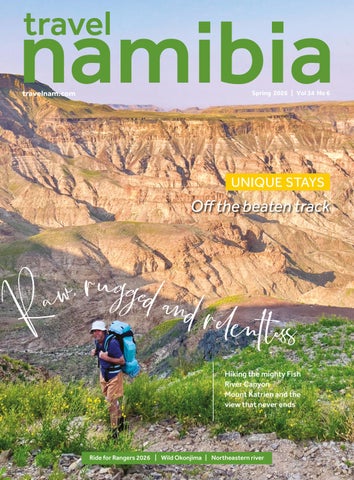
Hiking the mighty Fish River Canyon Mount Katrien and the view that never ends
Ride for Rangers 2026 | Wild Okonjima | Northeastern river
Live the wild life at Ongava. By putting nature first at Ongava, we set the scene for a renewed understanding and appreciation of the importance of wildlife conservation.
ongava.com
is published by Venture Media in Windhoek, Namibia www.thisisnamibia.com Tel: +264 81 285 7450, 5 Conradie Street, Windhoek PO Box 21593, Windhoek, Namibia EDITOR Elzanne McCulloch elzanne@venture.com.na PUBLIC RELATIONS Elzanne McCulloch elzanne@venture.com.na PRODUCTION Liza Lottering liza@venture.com.na
Spring 2026
LAYOUT & DESIGN Silas M. Nangolo silas@venture.com.na CUSTOMER SERVICE Bonn Nortjé bonn@venture.com.na TEXT CONTRIBUTORS Elzanne McCulloch, Pompie Burger, Madeleen Duvenhage, Suné van Wyk, David Penda, Anja Denker, Marc Springer, Marita van Rooyen, Ron Swilling
Subscribe on
PHOTOGRAPHERS Suné van Wyk, Pompie Burger, Elzanne McCulloch, Anja Denker, Marc Springer, Le Roux van Schalkwyk, Marita van Rooyen, Ron Swilling, David Penda, Gmundner Lodge, Liam Compion Travel Namibia is published quarterly, distributed worldwide via Zinio digital newsstand and in physical format in southern Africa. The editorial content of TN is contributed by the Venture Media team, freelance writers and journalists. It is the sole property of the publisher and no part of the magazine may be reproduced without written permission from the publisher.
THE WORLD’S LARGEST DIGITAL NEWSSTAND
Industry partners:
All information and travel details are correct at the time of going to press. Due to uncertain circumstances, this may have changed after the date of publication. Please check businesses' individual websites for up-to-date details.
ADVERTISE WITH US To advertise in Travel Namibia or any of our other publications, contact Elzanne McCulloch +264 81 367 3583 | elzanne@venture.com.na | www.venture.com.na
TRAVEL NAMIBIA SPRING 2026
1
ANGOLA
BOTSWANA
2
EXPLORE
MORE TO
SOUTH AFRICA TRAVELNAM.COM
ZAMBIA
Venture Media is the pioneer of Namibia tourism promotion. We are the leader in spreading the tourism word around the world. We distribute accurate, credible, up to date and regular tourism-related information on paper, in social media, on the World Wide Web, and on mobile apps. We have reached hundreds of thousands over three decades. Be part of our community and let’s do it together.
TELL, GROW, SHARE YOUR STORY WITH US IN 2021
We focus on telling and sharing STORIES THAT MATTER across our various magazines and digital platforms. Join the journey and share your stories with audiences that understand and value why certain things matter. Why ethical business, conservation, tourism, people and communities matter. How these elements interrelate and how we can bring about change, contribute to the world and support each other. Whether for an entire nation, an industry, a community, or even just an individual.
WWW.VENTURE.COM.NA
or email us at info@venture.com.na for a curated proposal
In 2021, we're focussing on telling and sharing STORIES THAT MATTER across our various magazines and digital platforms. Join the journey and share your stories with audiences that understand and value why certain things matter.
DISCOVER GOANIKONTES Why ethical business, conservation, tourism, people and communities matter. Experience the world of
How these elements interrelatecheetahs and how we can bring about change, contribute to the world and support Discover each other. Whether for an entire nation, the world of conservation justjust 44kman individual. an industry, a community, or even outside of Otjiwarongo. Visit the renowned Cheetah Conservation Fund for unforgettable cheetah encounters, great food, unique attractions, or an overnight stayfor in beautiful or email us at info@venture.com.na a curated proposal surroundings.
ories that matter
WWW.VENTURE.COM.NA Bookings: ccf@exclusive.com.na www.cheetah.org +264 61 237 294 +264 81 127 4584 visit@ccfnamibia.com www.cheetahecolodge.com
Where rugged desert landscapes meet a green oasis.
GPS: -22.665017, 14.815321 Goanikontes Oasis + 264 64 405 976 | + 264 64 405 979 | + 264 81 47 47 429 info@goanikontesoasis.com
TRAVEL NAMIBIA SPRING 2026
3
WHERE THE RIVER
Sets the Pace
DISCOVER THE UNTAMED BEAUTY OF NAMIBIA'S ICONIC KAVANGO RIVER.
Simanya River Lodge rests on the banks of the Kavango River, where luxury accommodation meets one of Namibia’s most remarkable natural settings. Set within a lush riverside landscape, it offers a tranquil retreat where guests can unwind, reconnect, and experience the gentle rhythm of river life from the comfort of beautifully appointed surroundings.
4
THE ACCOMMODATION EXPERIENCE The lodge's spacious river-facing rooms are thoughtfully
designed to bring comfort and nature together. Elegant interiors,
generous living spaces, and private verandas create a seamless
connection to the outdoors. Guests can relax while overlooking
the water, watching abundant birdlife along the riverbanks and
enjoying uninterrupted views that change beautifully with the light throughout the day.
THE RIVER EXPERIENCE Beyond the comfort of the lodge, the Kavango River invites exploration and discovery. Scenic river cruises reveal spectacular
sunsets, rich wildlife, and the vibrant ecosystem that makes this region unique. Fishing enthusiasts can enjoy world-class angling,
including the opportunity to pursue the legendary tiger fish, while tranquil boat excursions offer close encounters with river birds, local culture, and the timeless beauty of Namibia’s perennial river.
PLAN YOUR EXPERIENCE
+264 83 288 8352
Book your stay and explore our experiences.
www.simanya.com.na
reservations@simanya.com.na
TRAVELNAM.COM
Your Journey Starts Here... From Inland Woodlands...
To the Eternal Kawango
EDITOR'S LETTER
Unique. Untamed.
ON THE COVER
A
s I write this, I am sitting atop a mountain range in Lesotho. The wind is cold and insistent. The mountains roll away in every direction, immense and rugged, their folds cut by rivers and roads that seem impossibly small from up here. Somewhere below, horses pick their way along a mountainside. Smoke curls from a village in the distance. And I am reminded, once again, why I love to travel. I love that feeling of arriving somewhere I have never been before. Of turning a corner and seeing a landscape I could not have imagined. Of unfamiliar smells, different light, strange weather. Of meeting people whose lives look nothing like mine and yet finding, within minutes, something that connects us. A laugh. A story. Every new place I discover, every wild corner, every smiling face and genuine connection makes me reassess what an extraordinary privilege it is to travel. Through rugged terrain and crystal-clear waters, the Fish River Canyon reveals a wilderness that rewards every step. Read more on pg 44.
Perhaps that is what makes travel unique in the first place. We often use the word “unique” to describe the spectacular. The lodge on the edge of a cliff. The tent beneath an ancient tree. The room overlooking a waterhole. The cabin so remote that the night sky seems to belong entirely to you.
Image: Anja Denker
And there are plenty of those places in this issue. But sitting here in the mountains, I find myself thinking that uniqueness is not necessarily about luxury, architecture or even location. It is about how a place makes you feel.
FOLLOW US ON
The sound of something moving beyond the canvas of your tent at night. The person who remembers how you take your coffee. The unexpected conversation around a fire. The road that took far longer than expected, but became one of the best parts of the journey. It is the stories you bring home.
@thisis_namibia
Lesotho and Namibia could, on the surface, hardly seem more different. One is a kingdom in the mountains, green and grey and sometimes covered in snow. The other is a country of deserts, immense horizons, sun-bleached plains and some of the oldest landscapes on Earth. And yet, up here, Namibia does not feel very far away. There is the same wild freedom in the landscape. The same sense that nature is still very much in charge. An untamed quality that is increasingly rare in our world. In this Spring issue of Travel Namibia, we celebrate the stays with character and soul. The ones that could exist nowhere else.
Etosha Pan filled with water - Our favourite place in Namibia during the rainy season.
Small beneath a mountain. Alive beneath an enormous sky.
@elzanne_mcculloch
gloriously
LISTEN TO THE
And wonderfully, untamed.
BEST STORIES
Connected to someone we had only just met.
TRAVEL NAMIBIA SPRING 2026
5
CONTENTS LEAVE ONLY TRACKS BEHIND p12 The RMB & Wilderness Ride for Rangers 2026
FOLLOWING THE BEEP p28 Okonjima: Where Namibia’s wild still writes its own story
RAW, RUGGED AND RELENTLESS p44 Hiking the mighty Fish River Canyon
6
ROMANCING THE RIVER p62 The Namushasha River Villa
38 THE LUXURY OF REST | Why Wilderness Damaraland Camp remains one of Namibia’s most remarkable stays
TRAVELNAM.COM
L PARK - DAMARALA
ND
-E
RO
SK E L E T ON C OAS T
NS - FISH RI VER CANY
THIS |
TAI OUN
-B
N TA A BW
NA ATIO
OM NG
WA
Vast distances, quiet corners — a country made to be travelled
O
|THAT
N-
LÜ
DE
RI T
Z
BUFFALO TENTED CAMP | FISH RIVER LODGE | GOERKE HAUS | GROOTBERG LODGE | HOADA CAMPSITE | KREPLIN HAUS | ONDUDU SAFARI LODGE | SHIPWRECK LODGE
We plan the journey that takes you to every corner of Namibia
linktr.ee/journeysnamibia
CONTENTS
36
70
10
BUSH TELEGRAPH | News from the tourism industry
22
OFF THE BEATEN TRACK | Where every road leads to
26
MOUNT KATRIEN | The view that never ends
36
GUTEN MORGEN EATERY & THE FLOWER FARM |
52
IF LIMESTONE WALLS COULD TALK | A timeless escape
58
EARTH’S CANVAS | Where heritage meets the horizon
68
UNDER CANVAS, UNDER STARS | Explore the Meerkat
70
BIRDING WITH POMPIE | Go Green
79
BOOK REVIEW | Namibia’s Namib: Mammals & Birds
80
THE ART OF SPOTTING SOMETHING THAT ISN’T THERE | The unwritten rules of safari spotting
adventure
Where flowers, food and community bloom
into Namibia’s past
Outdoor Range
9
22
TRAVEL NAMIBIA SPRING 2026
BUSH TELEGRAPH
News from the tourism industry
WILDERNESS SERRA CAFEMA TO REOPEN IN DECEMBER
MORE INTERNATIONAL AIR CAPACITY FOR NAMIBIA IN 2027 Namibia’s international air connectivity is set to receive another boost in 2027. Following the launch of Edelweiss’ Zurich-Windhoek service, Discover Airlines has announced it will increase its Munich-Windhoek service from three to five weekly flights next year, while maintaining daily flights from Frankfurt. In further good news for the tourism sector, Condor has also revealed plans to return to Namibia.
The additional capacity is expected to improve accessibility, strengthen competition and enhance Namibia’s appeal as a global travel destination. The announcement comes as industry and government continue collaborating to improve visitor experiences, including the rollout of frontline hospitality training for immigration officials. Together, these developments signal growing confidence in Namibia as one of Africa’s leading tourism destinations.
GRANIETKOP’S REVIVAL HIGHLIGHTS THE POWER OF COMMUNITY TOURISM A brand-new Toyota Hilux parked outside the Doro !Nawas Conservancy office is more than just a new vehicle: it is a symbol of what community tourism can achieve. Purchased entirely from the profits generated by Granietkop Campsite, the Hilux reflects the remarkable turnaround of a tourism enterprise that, just over a year ago, had no income, no visitors and little prospect of a future.
Elzanne McCulloch
10
Wilderness has confirmed that Serra Cafema will officially reopen on 1 December 2026, with bookings now open for stays from that date. Following the fire earlier this year, restoration work is progressing well, and the iconic camp is preparing to welcome guests back to the banks of the Kunene River in Namibia’s remote Hartmann’s Valley. Renowned for its unique blend of desert landscapes, river adventures and authentic cultural experiences, Serra Cafema remains one of the country’s most extraordinary safari destinations.
TRAVELNAM.COM
WILDLIFE RELOCATION
After being closed for almost two decades, Granietkop Campsite was fully refurbished in 2024 through funding from ultimate.earth, the Conservation Travel Foundation and the Community Conservation Fund of Namibia (CCFN). Since reopening, ultimate.earth has worked alongside the conservancy on a pro bono basis to provide business mentorship, marketing support, an online booking system and management guidance, with the aim of building a financially sustainable, conservancy-owned enterprise. The results have exceeded expectations. In just over a year, Granietkop has created four permanent jobs, generated enough revenue to cover its operating costs and maintenance, and accumulated sufficient profits to purchase the Hilux outright. “Granietkop belongs to our conservancy, and seeing it succeed is something our entire community can be proud of,” said Doro !Nawas Conservancy Chairperson Anna Haraes. “This vehicle is the result of hard work by our team and the support of partners who believed in our ability to make this business work.” While Namibia’s communal conservancies are internationally recognised for successful tourism joint ventures such as Onduli Ridge, Granietkop demonstrates the equally important role of conservancy-owned enterprises. By managing its own business, the conservancy is building practical skills in hospitality, financial management and entrepreneurship that will strengthen future tourism initiatives. “The Hilux is wonderful, but it isn’t the biggest achievement,” said ultimate.earth Managing Director Tristan Cowley. “The real success is seeing a conservancy-owned business become financially sustainable while developing the people and systems needed to run it successfully.”
Namibia’s efforts to restore wildlife populations and strengthen community conservation have received renewed momentum following the successful translocation of 575 animals from Etosha National Park to conservation areas across the country, including communal conservancies in the Kunene Region. Led by the Ministry of Environment, Forestry and Tourism, the initiative aims to restore biodiversity, rebuild wildlife populations, improve ecological balance and strengthen ecological resilience, while supporting the long-term benefits that communitybased conservation and nature-based tourism provide to rural communities. The operation, valued at approximately N$6.7 million, was supported by a partnership between government, communities, conservation organisations and private conservation partners, with the Conservation Travel Foundation, the non-profit conservation arm of ultimate.earth, facilitating approximately N$2.7 million in support through its partnership with the Lion Recovery Fund. In the Kunene Region, one of Namibia’s most remarkable conservation landscapes and home to free-ranging black rhino, desert-adapted elephants and lions, restoring healthy prey populations is essential for maintaining ecological balance and helping mitigate predator human conflict. The translocation also highlights the importance of large, connected conservation landscapes where wildlife can recover, move freely and contribute to ecological and economic resilience. As Tristan Cowley, founder of the Conservation Travel Foundation, noted, Namibia’s conservation success is built on partnership, with government providing leadership and stewardship, communities serving as custodians of these landscapes, and conservation organisations and responsible privatesector partners contributing resources, expertise and support. CTF and ultimate.earth’s involvement forms part of their ongoing commitment to practical conservation initiatives that protect biodiversity, strengthen community conservation, promote sustainable relationships between people and nature, and support sustainable generational rural development across Namibia. TN
Today, the Hilux stands as a symbol of four new jobs, a revived tourism enterprise and a community investing in its own future. Most importantly, Granietkop demonstrates how collaboration between communities, conservation organisations and the private sector can create lasting economic opportunities while supporting conservation. For more information about Granietkop Campsite, visit www.granietkop.com.
TRAVEL NAMIBIA SPRING 2026
11
12
TRAVELNAM.COM
Leave only tracks behind
The 2026 RMB & Wilderness Ride for Rangers 13 ELZANNE MCCULLOCH IMAGES | SUNÉ VAN WYK
“Ons is gemaak om spore te los.” (We are made to leave tracks behind)
TRAVEL NAMIBIA SPRING 2026
E
lvis Blue sang those words somewhere in the darkness of Damaraland, beside a campfire beneath a sky so crowded with stars it felt almost close enough to touch.
Spore.
Tracks. Traces. The evidence that something, or someone, has passed this way. It is a beautiful word in Afrikaans because it can mean so much more than footprints. It is the tracks of an animal across the sand. The faint impression of a tyre on a gravel road. The signs a tracker reads in the earth. And, perhaps, the mark we leave behind after we have gone. By then, we had left plenty of tracks of our own.
14
For three days, twenty of us had pedalled through the rugged northwest of Namibia, riding roughly 45 kilometres a day through the extraordinary landscape north of the Huab River and around Krone Canyon. There is something about seeing Damaraland from a bicycle. There is no glass between you and it. No air conditioning. No engine carrying you effortlessly over the next rise. You feel every kilometre.
TRAVELNAM.COM
The loose rocks. The sand. The climbs that seem perfectly reasonable when viewed from a distance and considerably less so when you are halfway up them. The cold of those first mornings when adding a little Jameson to the coffee at our first stop suddenly seemed less like indulgence and more like excellent expedition planning. And then there were the landscapes. Red mountains opening suddenly onto vast plains of golden grass. Dry riverbeds lined with enormous trees. Unexpected dunes rising out of rocky country. Giraffe watching our strange little procession from a distance. Springbok scattering across the plains. The kind of country that changes around every bend. The kind that makes 45 kilometres feel simultaneously very long and nowhere near enough. But Ride for Rangers has never really been about riding bicycles. The bicycles simply take us where we need to go.
FOLLOWING TRACKS One afternoon, we left them behind entirely. We set off with trackers and guides from Save the Rhino Trust to find one of the black rhinos that still roam freely across this landscape. There is something profoundly humbling about following a tracker through wilderness. What looks like sand and stone to most of us is a page filled with information to someone who knows how to read it. A footprint. A broken branch. Dung. The direction of travel. How recently an animal passed. And so we followed. Until eventually, there he was. A black rhino standing in the enormous landscape that generations of trackers and conservationists have fought to keep wild enough for him to exist in. We watched from a respectful distance.
15
No fences. No guarantees. Just an animal where an animal is supposed to be.
TRAVEL NAMIBIA SPRING 2026
Later, still carrying that feeling with us, our tracking excursion ended in a considerably less expected way: with a surprise gin stop as the sun sank across Damaraland. Glasses appeared. Ice clinked. The mountains changed colour. Conservation, it turns out, can occasionally come with tonic. But what stayed with me was not only the rhino. It was the people who knew how to find him. KNOWING THE LAND That evening, after a successful rhino track, our Save the Rhino Trust guide explained the hows and whys of this method of conservation. Tracking and monitoring as the cornerstones of landscape-level protection. Data as your silver bullet.
16
Kelsey Prediger of the Pangolin Research and Conservation Foundation followed his very informative session. She spoke to us about another animal that moves through Namibia largely unseen.
this country in ways outsiders cannot. In Nyae Nyae, formerly known as Bushmanland, San trackers carry generations of knowledge about the landscape and the animals moving through it. That knowledge matters.
Conservation cannot simply be parachuted into a landscape.
Because conservation is not only technology and GPS coordinates and scientific papers. Sometimes it is knowing how to read a footprint. Knowing which way an animal moved. Knowing what belongs here and what has changed. Knowing a landscape because your own tracks have crossed it a thousand times before. The rangers and trackers protecting Namibia’s wildlife do exactly that. Day after day, they walk.
It has to understand it.
Across rock.
The people who have grown up in Namibia’s northwest know
Across sand.
The pangolin. What became particularly fascinating was hearing about the importance of local knowledge in protecting them.
TRAVELNAM.COM
Through riverbeds and mountains and heat. Leaving footprints that the next wind will erase, while ensuring that the tracks of rhino, pangolin, elephant and so many other species will still be there for someone else to find tomorrow. TAKE ME ALONG On our final day, our own tracks took us through De Riet. We rode into the small community on our bicycles, this colourful, dusty procession suddenly appearing in the middle of an otherwise ordinary day. Children came running. One little boy latched onto our group and began running alongside a bicycle. “Vat my saam!” he shouted.
To bring people into landscapes they may otherwise never experience. To introduce them to the people protecting them. To connect a cyclist with a rhino tracker, a traveller with a pangolin ranger, a sponsor with a women’s sewing project in a tiny village in Damaraland. Because conservation cannot exist separately from people. At De Riet, we saw this in practice. We visited projects supported by Children in the Wilderness, including a small women’s sewing initiative where women create cooking bags, backpacks and other products from a single sewing machine in a modest room. We saw the community garden. The chicken and egg project. The craft centre and tea room.
Take me with you. “Vat my saam!” He kept running. For a while, all there was was the sound of bicycle tyres, laughter and this little voice insisting that wherever we were going, he wanted to come too. There was something wonderfully uncomplicated about it. Take me with you. And perhaps, in some small way, that is exactly what Ride for Rangers is trying to do. To make the circle bigger.
TRAVEL NAMIBIA SPRING 2026
17
We learned about the elephant water points that help the people living here share an extraordinarily dry landscape with desert-adapted elephants, providing water for wildlife while reducing damage to the water infrastructure communities themselves depend upon.
Because we do go together. For more than a decade, we have done so. Twenty riders. Rangers. Trackers. Conservationists. Musicians. Wilderness teams. Support crews. Sponsors. Communities.
And then, almost as if the landscape had decided to finish telling the story for us, we encountered some of those elephants as we left.
18
Humans and elephants. Rangers and wildlife.
Some could cycle faster than others. Some could definitely climb hills faster than others. But nobody was really there to get to the end first. We If you want to go fast, go alone. If were there because there was a reason to ride. you want to go far, go together.
Guests and communities. All of us moving through the same landscape. GO TOGETHER At some point during the journey, Ralph Ellinger from CYMOT stood up to speak and quoted the well-known African proverb: If you want to go fast, go alone. If you want to go far, go together. There could hardly have been a better description of the RMB & Wilderness Ride for Rangers.
TRAVELNAM.COM
And somewhere between the cold morning coffee stops, the warmer mid-morning beer stops, the aching legs, the rhino tracks, the gin at sunset, the little boy running beside a bicycle, Rhona’s incredible meals, Jean’s perfectly paired wines, and Elvis Blue singing beside the fire, that reason became clearer again. Never lose sight of purpose. It is surprisingly easy to do. We get caught up in events and logistics and kilometres and fundraising targets. In organising vehicles and camps and bicycles and people.
But purpose is the thing underneath all of it.
And then he sang Spore.
Why are we here?
Ons is gemaak om spore te los.
Why do we ride?
We are made to leave tracks behind.
Why do people spend their lives walking enormous distances through these landscapes?
By then, the words meant something different. Perhaps we are all made to leave tracks. The question is what kind. When we enter wilderness, we are taught to leave nothing behind. Take nothing. Disturb nothing. Leave only footprints in the sand and let the wind sweep even those away.
Why protect a rhino most people will never see? Why train a ranger to find a pangolin?
But there are other kinds of tracks worth leaving. Why help a community build a water point for elephants? A ranger’s footprints beside those of a rhino. Why buy a bicycle ticket into the middle of nowhere and willingly pedal it over 120 kilometres of rocks?
Knowledge passed from one generation of trackers to another.
Because we can leave something behind. SPORE On our final evening at Wilderness Damaraland Camp, Elvis Blue sat beside the fire with his guitar. Elvis is one of South Africa’s best-known singer-songwriters, but he is also a passionate cyclist and someone who clearly feels something for these Namibian landscapes.
A sewing machine in a room in De Riet that allows a woman to earn an income. A water point that makes it possible for elephants and people to continue sharing the same dry landscape. A group of people who came to this rugged corner of Namibia to ride and went home understanding a little more about what it takes to protect it. Funds that remain after our tents have been packed away and our tyre tracks have disappeared. That is the privilege of the RMB & Wilderness Ride for Rangers. We come into these wild places knowing that our physical tracks should disappear. The wind will take care of those. But if we have done it right, something else remains. Something tangible. Something useful. Something that makes it a little easier for the people who walk these landscapes every day to continue doing what they do. Ons is gemaak om spore te los. We are made to leave tracks behind. Let us make sure they lead somewhere that matters. TN
TRAVEL NAMIBIA SPRING 2026
19
STEP BACK IN TIME AT
THE HOME OF ROCK ART
Ai-Aiba – The Rock Painting Lodge rests among towering granite boulders, overlooking the magical Erongo Mountain range. Home to countless ancient rock art sites, Ai-Aiba offers an unforgettable journey into Namibia’s timeless wilderness. Guided nature walks, scenic drives, visit to the San Living Museum and mountain biking adventures reveal a landscape rich in history, culture and natural wonder.
+264 (0)61 239 199 | info@aiaiba-namibia.com | www.aiaiba-namibia.com www.bigsky-namibia.com
www.naturallynamibia.com LODGES
WHERE MAN TREADS LIGHTLY AND NATURE IS RESPECTED At the foot of the Grootberg massif, among the ancient Etendeka lava flows of northern Damaraland, Etendeka Mountain Camp and the Etendeka Hiking Experience immerse guests in a remote wilderness shaped by silence, space and raw natural beauty.
+264 (0)61 239 199 | info@etendeka-namibia.com | etendeka-namibia.com | etendeka-hikes.com www.bigsky-namibia.com
www.naturallynamibia.com LODGES
beaten track Off the
22
MARC SPRINGER
Namibia’s roads are more than a connection between geographically separate points. They often lead through remote and fascinating landscapes, making the destination less important than the joy of the journey getting there.
TRAVELNAM.COM
23
TRAVEL NAMIBIA SPRING 2026
T
hey come in different guises and have a variety of names. Depending on location and condition they are graded in five categories and rated from excellent to poor. Covered in anything from asphalt, sand, salt, gravel or stones, Namibian roads all have something in common: apart from the bitumen highways, they are difficult to negotiate. Yet they offer a unique driving experience through untouched nature away from crowded tourist hotspots. Namibia’s road network is rated among the best in Africa and covers 48,900 km comprising about 8,000 km of bitumen, 26,000 km of gravel, 14,000 km of earth and 300 km of salt roads. Excluding the 40% tarred roads linking major towns and comparing favourably to any highway in industrialised countries, most streets are classified as rural or district roads, covering sparsely populated areas and varying considerably in quality.
24
For discerning tourists spoilt by a closely knit network of freeways at home, the end of the bitumen surface signals the start of everything considered cross-country and adventurous. As locals know and visitors quickly learn, not all things off-road are equal, however. Though dust and the ever-looming danger of tyre punctures may be a joint feature of all unsealed roads, they differ greatly in composition and condition, depending on their surface, traffic volumes and the amount of maintenance invested.
that form following a heavy downpour tend to flow over them and erode their surface. This leaves inconspicuous but deep ditches (locally referred to as “dongas”) behind that often scar gravel roads in otherwise good condition, leaving motorists who drive at a high speed unable to break in time. The same applies to the faint and hardly visible trails, fondly referred to as “plaaspad” (farm road), leading through dense vegetation. These tracks are not only hard to detect among the surrounding bush, but they are often characterised by a peculiar elevation running between the two lanes of the pathway, locally referred to as the “middleman”, and proving an insurmountable obstacle for sedan vehicles with little ground clearance. The various sections of sand road covering long sections along the coast and through the desert can usually only be traversed in 4x4 vehicles and pose their own set of challenges. Driving on them not only requires skill, concentration, experience, caution and endurance but, above all, patience. Deflating tyres may increase their surface area and with it their traction but that does not guarantee smooth passage or prevent what is an integral part of any motorised quest in Namibia: getting stuck and using unconventional tools like stones, logs and hands to free the vehicle.
The anticipation of wondering what lies behind the next bend.
While some unsealed roads barely deserve the name, being little more than tracks that developed over time through repeated use and where obstacles like rocks are not removed but circumnavigated, others are more sophisticated. Although these roads are classified as “good” on maps and GPS devices promising rapid progress, they are often badly corrugated, reducing traction, slowing speed and forcing graders (locally known as “padskrapers”) to work overtime. Furthermore, all these roads are vulnerable to moisture and get softened by rain. Pools of stagnant water develop on the surface, making the road unpredictable and greasy. This poses the danger of inexperienced drivers losing control of their vehicle. Additionally, they often lead through ephemeral rivers that only flow after heavy showers, forcing drivers to wait for the flood to subside or risk being swept away during an ill-advised crossing attempt. Sporadic showers also create another hazard for unsuspecting tourists. Since most unsealed roads are not elevated above the surrounding area, small streams
TRAVELNAM.COM
Perhaps that is the very reason why travelling through Namibia is so unique. The journey is seldom predictable or easy but often treacherous and demanding. Obstacles are bound to appear, testing the stamina and skill of both the driver and the passengers. Travellers must expect the unexpected, whether it be animals crossing the road, flooded rivers causing delays, mechanical problems needing repairs or dust storms reducing visibility. Maybe that is what makes Namibian roads so special. The prospect of escaping the familiar and facing the unknown. The promise of being tested and overcoming difficulties. The anticipation of wondering what lies behind the next bend. The curiosity of not knowing what follows ahead. After all, it is not the smooth ride but the triumph over adversity that people remember when returning from an inspiring journey. It is the memory of overcoming challenges that lingers in the mind long after the voyage has ended. It is the stories of hardship, dust, heat, sand, bruises and inconvenience that are shared with friends and family back home. People do not recall traversing a dual carriageway stretching straight ahead through monotonous surroundings. It is the accomplishment of braving harsh terrain through rugged mountains, over steep dunes or past unexpected
25
obstacles that capture the imagination. It is the team effort of freeing a stuck vehicle. Or the collective feeling of success after filling a ditch that prevented passage. These are the unforgettable events that unite fellow travellers and give them a topic of conversation long into the future. In that sense, it is the often-underrated roads, labelled as “bad” in terms of quality, that offer the most rewarding experience by way of making memories, bringing travellers closest to nature and making them appreciate the true essence of Namibia: a wild, inhospitable, untamed and beautiful place. TN
TRAVEL NAMIBIA SPRING 2026
26
Mount Katrien and the view that never ends ELZANNE MCCULLOCH
T
here is a particular kind of silence that exists just beyond the edge of Windhoek. Not far in distance, but far enough to feel that the city is slowly sliding off your shoulders. Mount Katrien is one of those places – close enough for a spontaneous weekend away, yet distant enough to feel like you have crossed into another world entirely. We were a group of friends chasing exactly that feeling. Just two nights away, nothing complicated. The drive into the Khomas Hochland is gentle at first, winding through farmland and familiar bushveld, until you pass the farmhouse and notice something unexpected: an intriguing metal structure shaped like a giant pangolin. It sits quietly in the landscape, almost daring you to ask questions. We did not stop this time, but it planted a seed of curiosity strong enough to guarantee a return visit.
TRAVELNAM.COM
THEN COMES THE CLIMB. The road gets steeper as you wind your way up the koppie, each turn revealing wider and broader views until, suddenly, you arrive at the top. And that is when it hits you: the view that never ends. The house sits right on top of the summit, completely exposed to the surrounding nature, with Mount Fanie rising proudly across the nearest ridge. It is the kind of arrival that makes you stop mid-step; breath held for just a second longer than usual. Inside, the villa feels as though it has been built around the horizon itself. Everywhere you turn, there is a window. It feels less like entering a house and more like stepping into the landscape, the lines between indoors and outdoors softened by glass and light. The interiors are warm and thoughtful, the kitchen fully equipped, and yet the true uniqueness lies in the feeling of being left alone on top of the world. For a brief moment, it feels as if we might be the last people on earth –
adjacent Mount Fanie, having spent the night in the safety of its higher reaches. A nature walk down the slope followed our fourth cup of coffee. Among us were seasoned birders and a few who had never truly understood the appeal of standing still to stare at distant branches. It created a familiar and amusing tension – that fine balance between enthusiastic identification and the occasional sigh from the less patient amongst us. “Another bird,” someone would mutter, half joking, half surrendering to the rhythm and reality of it all.
Storm clouds gathered in dramatic layers, rolling across the horizon and swallowing distant hills in sheets of silver rain.
BUT EVEN THE SCEPTICS FOUND THEMSELVES DRAWN IN. Vultures circled high above, riding invisible thermals. Eagles traced wide arcs across the sky, and there was genuine excitement when a Verreaux’s Eagle was finally identified after much debate, Roberts’ scrutinisation and eyes glued to binoculars to find just one more distinguishing trait. Sitting on Mount Katrien often means watching birds from above rather than below, a subtle shift in perspective that makes you feel more part of the landscape than a mere observer of it. The walk itself was rewarding in quieter ways too. A klipspringer appeared briefly on the mountainside, pausing in the middle of the road – just long enough to study us as we studied it – before bounding away effortlessly across the rocks. Later, from the comfort of our stoep, we watched a myriad of wildlife in the bushveld from our higher vantage. I cannot say that I have ever experienced such a successful “stoep safari” before. Gemsbok, giraffe, kudu and sable appeared amongst the thick bushveld and in open clearings – moving shapes against the vast canvas of the Hochland. Wildlife here does not feel staged; it feels discovered. THEN CAME THE SUMMER RAINS. Storm clouds gathered in dramatic layers, rolling across the horizon and swallowing distant hills in sheets of silver rain. When the weather pushed us indoors, we embraced the moment with glasses of red wine in hand and conversations stretching lazily into the afternoon. There is something deeply comforting about being warm and sheltered while the landscape outside shifts and breathes with the elements.
and if that were the case, there could hardly be a better view from which to watch the end. Life settles into an easy rhythm here. Braais in the evenings under impossibly bright stars. The gentle crackle of firewood and laughter, carried across the mountain air. We made good use of the KolKol hot tub, sinking into the warmth as the sky stretched endlessly in all directions. The following morning began with coffee on the wraparound porch and the quiet of a nature that is only interrupted by birdsong and the muffled sound of hooves as a herd of Hartmann’s mountain zebra makes its descent down the
By the final evening, Mount Katrien had settled into us. Another braai under a clear sky. Another quiet morning with coffee on the deck. More silence than sound. It felt less like a destination and more like a retreat – a temporary bubble where the world felt paused and uncomplicated. Mount Katrien is not about activities or itineraries. It is about space. About stillness. About gathering people you enjoy and placing them somewhere so vast that everyday worries feel small by comparison. And perhaps that is its greatest gift – the rare chance to step away from noise, climb a mountain and simply sit with a view that never ends… TN
TRAVEL NAMIBIA SPRING 2026
27
28
TRAVELNAM.COM
FOLLOWING THE BEEP Where Namibia’s wild still writes its own story SUNÉ VAN WYK IMAGES | SUNÉ VAN WYK & LIAM COMPION
T
here is a peculiar kind of silence that belongs to Namibia.
It settles over golden winter grass, lingers in the crisp air before sunrise and stretches across endless plains where nature continues its rhythm, whether we’re there to witness it or not.
Emails and deadlines immediately felt distant as a towering sign rose from the landscape, marking the entrance to a reserve renowned for its leopards, brown hyenas and pangolins. These are not animals that appear simply because you have arrived, however. They are creatures of shadows, instinct and luck, and finding them requires patience.
An envelope waited on the bed containing a leopard poster and a handwritten note to take home. It was a small gesture, but one that hinted at something much bigger. The story began decades ago, when the Hanssen family found themselves dealing with leopards preying on livestock. Rather than continuing the familiar cycle of predator and farmer, they chose a different path: coexistence. That decision eventually led to the creation of the AfriCat Foundation and decades of research into Namibia’s big cats, helping transform animals once considered a threat into ambassadors for conservation.
Fortunately, there was plenty to discover before we even reached our room at Okonjima Nature Reserve. Gemsbok grazed beside the road, a zebra mare kept a watchful eye on her foal and, in an unexpected introduction to the reserve, a giraffe rested peacefully in the grass. It was the first time I had seen one sitting down, and somehow that small, ordinary moment felt like the perfect beginning. At reception, warm smiles and familiar Namibian hospitality made us feel at home. Our room overlooked an open plain where warthogs and jackals wandered past, making sitting on the patio far more appealing than unpacking.
TRAVEL NAMIBIA SPRING 2026
29
After coffee and a snack in hand at reception, our guide had already begun introducing us to that world. Beneath the trees a map unfolded showcasing overlapping leopard territories, names and histories, and the tracking programme began to make sense. Then came the part we had been waiting for. The receiver crackled.
30
A magnificent young male leopard sat beside an anthill. Cameras appeared almost instinctively. Shutters clicked. Then even those stopped. There are moments when a photograph feels inadequate, and this was one of them. We had spent the afternoon following a series of beeps through the bush only to arrive at something that required no explanation at all.
Static. We just watched. A pause. Then a beep. We drove on, listening carefully. The signal strengthened, faded, then returned. It was almost like following an invisible thread through the bush. Slowly, the receiver became clearer and our guide slowed the vehicle.
TRAVELNAM.COM
By sunset, we had moved to a hill overlooking an endless sweep of wilderness. Drinks in hand and treats being passed around, we watched the landscape change as the sun slipped lower, turning the grass and distant hills gold, pink and orange. Namibia has never struggled to put on a sunset.
The cold of early morning was broken by steaming hot chocolate warming our hands as the reserve slowly stirred around us. Ponchos pulled tight against the winter chill, we spotted a movement high above us. A female leopard lay draped across the branches of a tree, a fresh kill balanced in front of her cub. She fed contentedly while she shifted carefully along the branches. Below them, a brown hyena waited patiently, hoping something might fall from above. Another cub rested nearby in a neighbouring tree, adding another layer to an already remarkable scene. The leaves rustled in the breeze. Birds called. The hyena waited. The leopard watched. The cub shifted position. We stayed. Sometimes a sighting becomes memorable precisely because nobody is chasing the next one. We did something even more radical that afternoon - nothing. Birds gathered around the waterhole while we stretched out on the day bed, sharing a cheese board and a bottle of wine. Across the plains, giraffes moved slowly through the grass. There was nowhere else we needed to be. By dinner, warmed by the fire and greeted again by familiar, friendly faces, the day felt complete. Over breakfast, we chatted about the morning’s brief encounter with two brown hyena mothers and their four impossibly fluffy cubs. The youngsters had tumbled over one another, stopped for a quick drink and disappeared back into the safety of the burrow while their mothers headed off to forage. It had lasted only a few minutes, but it was no less special for its brevity. The afternoon unfolded beside the waterhole at Bush Camp as a Grey Heron picked its way through the shallows, moving with the patience of a hunter waiting for exactly the right moment to strike.
TRAVEL NAMIBIA SPRING 2026
31
What followed felt less like a game drive and more like an unscripted wildlife documentary unfolding around us.
32
TRAVELNAM.COM
33
By now, the reserve had changed the way we looked at it. It was no longer just the big sightings. The changing colour of the grass. Birds flickering through the trees. The warmth of the winter sun. The details began to matter just as much as the animals we had come hoping to see which made our final afternoon particularly appropriate. We had become accustomed to the reserve revealing something extraordinary whenever we went looking for it. The wilderness had other ideas. The tracking signal grew stronger through the static, only to fade again as we worked our way around dense bush. Daylight was slipping away. Despite decades of research, experienced guides and sophisticated tracking equipment, the wilderness determined to keep this leopard just beyond our reach. It seemed as though our final evening might end without another sighting.
What followed felt less like a game drive and more like an unscripted wildlife documentary unfolding around us. She lay stretched along a low branch, her cub resting below, while a brown hyena fed on their kill. Another hyena soon joined the scene, sending the cub retreating as the two animals began to squabble over the carcass. Dust rose from the riverbed as they chased one another, while the female watched from above, waiting for an opportunity to reclaim what was hers. She had barely reached the ground when a third hyena charged at her. By now, darkness was settling over the riverbed. A fourth hyena appeared, and for a moment the scene seemed to have reached its limit until a large male leopard emerged from the shadows. He strode into the riverbed with the unmistakable confidence of an animal that knew exactly where it stood. The hyenas that had been terrorizing the female only moments earlier backed away as he approached the carcass. The entire dynamic shifted in an instant.
As if the reserve had been waiting for the very last moment, another female was spotted nearby.
TRAVEL NAMIBIA SPRING 2026
Someone in the vehicle quietly whispered, “Nobody is going to believe this.” It was hard to disagree. And as if the evening had not already given us enough, a bat-eared fox appeared on the drive back. Dinner was served privately beside the waterhole. Candles flickered on the table while the fire crackled nearby, and we lingered over every course, replaying the past few days’ extraordinary events, listening to the sounds of the wilderness around us.
34
The drive out felt like one last opportunity to take it all in. Zebras stood beside the road. A tiny Damara dik-dik paused in the grass before disappearing. Then the towering Okonjima sign came into view. Only this time, it wasn’t welcoming us. It was saying goodbye. What stayed with me most is not simply the leopards, the brown hyena cubs or the comfort of the lodge. Not even the unbelievable final encounter in the riverbed. It was the feeling of having been allowed, for a few days, to slow down enough to notice. At Okonjima, the wild does not perform on schedule. You follow a beep, wait for a signal, sit beside a waterhole and sometimes find exactly what you came looking for. Other times, you find something you never expected. Perhaps that is the real magic of exploring a place like this. You arrive hoping to see Namibia’s wild. You leave having watched it write its own story. TN
TRAVELNAM.COM
35
ADVENTURE AWAITS!
Tel: 264 61 232871 | 24hr emergency no: 081 129 3355 Email: info@africa-on-wheels.com www.africa-on-wheels.com
Scan the QR code to access the website
TRAVEL NAMIBIA SPRING 2026
Guten Morgen Eatery & The Flower Farm MADELEEN DUVENHAGE IMAGES | DAVID PENDA
36
Some ideas announce themselves with fanfare and dazzling lights. Others settle surreptitiously and stubbornly refuse to leave.
L
eanne and her husband first noticed the improbable German name at a quaint cafe while travelling in Bali. It lingered long after the trip ended. Guten Morgen. Good morning.
Despite not being a German speaker herself, Leanne felt the name encapsulated exactly what they wanted to offer: a cheery greeting that is commonly understood in Namibia. Signalling a new day. Hopeful. Inviting. The original vision was simple: a flower farm. A timely niche in a market where Namibia’s florists remain heavily dependent on South African suppliers for fresh flowers. But, as with many good ideas, it soon grew into something more: an eatery. A gathering place. An experience grounded in the celebration of flowers, of people and of community. Today, Guten Morgen Eatery and The Flower Farm sit right at the entrance of Yellowstone Trails, the family and petfriendly hiking and biking trail just outside Windhoek. Both fall under the same innovative management that brought the trail to life nearly five years ago. For co-owner Leanne Mitchell and her husband Steve, the project feels like a natural continuation of a lifestyle built around the outdoors, family spaces and shared experiences.
TRAVELNAM.COM
Step inside and time unspools into something softer and gentler. Early afternoon light streams through broad-framed windows. Wooden, farmhouse-style doors are swung open, generous in their welcome. Uncluttered. Natural. Influences from the couple’s extensive overseas travels reveal itself in the minute details. Wooden beams installed high across the airy ceiling echo design inspirations from Japan. Sturdy, rattan-woven chairs nod towards Indonesia. The simplicity hints at Nordic minimalism but never feels staged. Tidy, symmetrical lines anchor the decor, yet the interior is far from clinical. Baskets, plump with plants, sit at the entrance. Scatter cushions are casually arranged on patterned benches. Greenery pushes and leaps into corners and along windowsills, buffering edges and filling gaps. Even the landscaping tells a story of patience and foresight. Leanne explains that planting was timed in such a way that by the time the windowpanes were installed, wild grasses and flowers would already be shooting along the frames, blurring the boundary between the in- and outdoors. From mustard-yellow aprons worn by the waiters to textured counters displaying home-grown flower bouquets, every detail feels carefully considered yet familiar. Like stumbling onto a cosy farmhouse after a long commute through steely skyscrapers and concrete slabs. There are small touches of personality throughout, such as Watchdog merchandise available for dog lovers, or quiet weekday nooks perfect for busy digital nomads working remotely. Outside, a large canvas tent stretches wide, casting shade over broad wooden tables set out on a lawn overlooking the surrounding Khomas hills. Here, families and friends gather for elaborate, unhurried feasts. Dogs weave comfortably between chairs, while two playground areas keep older children and toddlers entertained. Seating accommodates up to 80 guests, and the space is already building momentum as an events venue for both intimate and corporate functions.
In the creative pipeline for 2026 is an outdoor, Argentinestyle barbeque area where guests will be able to choose their preferred cut of meat and watch it sizzle over open flames before being plated. Leanne, who has always had green fingers, is also planning another growing tunnel dedicated to dahlia flowers. Weekends carry their own rhythm and novelty. Steve once prepared smoked meats on site during a Sunday, followed by a sprawling buffet filled with fresh bakes and locally sourced meat. The menu shifts constantly, adapting with ideas and curiosity. There is a playfulness here. Flower-inspired drinks – warm and cold – are experimented with by Leanne, her mother and their team of ten staff members working between kitchen and waitering. I am served a lilac-pink Bloody Rose that tastes uncannily like Turkish Delight. The menu also features a warm elderberry drink, a cinnabon iced coffee and even a cookies-and-cream-infused iced coffee for those wanting something more indulgent. Having met Leanne a mere ten days after the official opening weekend in January, she still sounded somewhat surprised by the response garnered so far. “Just this weekend, we served 800 coffees in one day!” Perhaps that is the real story of Guten Morgen. Not just a place built with intention, but a place people seem to have waited for. A place where mornings stretch into afternoons. Where flowers bloom alongside conversations. Where families gather, children play and time eases just long enough to let you breathe again. Saying good morning to something new has never felt this natural, even if it is already well past noon. Curious when to drop by next? Their Instagram has all the details. TN
@gutenmorgeneatery
TRAVEL NAMIBIA SPRING 2026
37
38
e h T Luxu
TRAVELNAM.COM
ry of Rest
Why Wilderness Damaraland Camp remains one of Namibia’s most remarkable stays ELZANNE MCCULLOCH
T
here are places in Namibia that impress you immediately. Places of towering dunes, dramatic wildlife encounters and landscapes so vast they seem almost impossible.
And then there are places that settle into you more slowly. Wilderness Damaraland Camp is one of those places. Perched among the weathered red hills of northern Damaraland, just beyond the Huab River valley, the camp occupies a landscape that feels as though it was shaped by patience itself. Rocky ridges rise around it, softened by time and wind. Below, the broad valley stretches towards the ephemeral river, where ancient ana trees mark the course of water that may flow only briefly each year. Desert-adapted elephants move quietly through this landscape, following routes older than memory.
TRAVEL NAMIBIA SPRING 2026
39
Scan to discover Wilderness
40
TRAVELNAM.COM
After a good rainy season, the Damaraland Camp feels deeply surrounding plains transform. Unlike many safari lodges where personal. Grasses turn gold beneath the service is polished but anonymous, sun and the valley floor seems to Damaraland Camp feels deeply glow. Here and there, small dunes personal. The staff are not simply emerge unexpectedly among the employees of a tourism operation. hills, formed over decades by wind carrying sand against the Many come from the surrounding Torra Conservancy and rocky escarpments. carry with them an authentic connection to the landscape and its stories. It is a landscape of contrasts. Harsh and gentle. Arid and alive. There is a warmth here that is difficult to manufacture. Yet what makes Damaraland Camp remarkable is not only where it is. Guests are welcomed not with performance, but with genuine hospitality. Conversations feel natural. The It is what it represents. atmosphere feels relaxed. By the second day, it often feels less like staying at a lodge and more like being welcomed Long before community conservation became a global into a home. case study, Damaraland Camp pioneered a new model for tourism in Namibia. Established in partnership That sense of belonging extends into the design itself. between Wilderness and the Torra Conservancy, it became the country’s first joint-venture lodge, creating a The rooms are beautiful in their restraint. Built from natural blueprint that would later be replicated across communal materials and inspired by the colours of the surrounding conservancies nationwide. landscape, they do not compete with the scenery. Instead, they frame it. Today, that model is recognised as one of Namibia’s greatest conservation success stories. Revenue Earthy tones mirror the rocks outside. Canvas and timber generated through tourism helps support conservation soften the edges. Large openings invite the landscape initiatives, community development projects and in. The same philosophy shapes the camp’s central area. local livelihoods. It demonstrated that wildlife and wild Open, airy and connected to its surroundings, it directs landscapes could create tangible value for the people who your attention outward. Toward the hills. Toward the valley. live alongside them. Toward the endless Namibian sky. Nearly three decades later, the partnership remains intact. You can feel that history in the camp.
And always toward the view.
TRAVEL NAMIBIA SPRING 2026
41
THE PEOPLE OF DE RIET A community shaped by two homelands Just a short drive from Damaraland Camp lies the settlement of De Riet, home to many members of Namibia’s Riemvasmaker community. Their story begins not in Damaraland, but hundreds of kilometres south near Riemvasmaak in South Africa’s Northern Cape. In the early 1970s, apartheid authorities forcibly removed the people of Riemvasmaak to make way for a military testing area. Families were separated and dispersed according to racial classification. Those identified as Nama were relocated north into what was then South West Africa, settling in communities around Khorixas, De Riet, Vrede and Bergsig.
42
From the deck, the Huab Valley unfolds below in layers of gold, green and red. It is the kind of view that encourages stillness. One more cup of coffee. One more hour with a book. One more sunset. In a tourism industry increasingly defined by itineraries and activity lists, Damaraland Camp offers something rarer. Space. Yes, there are nature drives in search of desert-adapted elephants. Guests can track black rhino alongside the dedicated teams of the Save the Rhino Trust. Guided walks reveal hidden details of the landscape. Trails wind through the surrounding hills. But these experiences feel secondary to something more important. Damaraland Camp reminds you that travel does not always have to be about movement. Sometimes the greatest luxury is simply having the time and space to stop. To sit quietly above a valley. To watch shadows move across distant hills. To listen to the wind. To rest. And perhaps that is what makes Wilderness Damaraland Camp one of Namibia’s most unique stays. Not because of what happens there. But because of what happens to you while you’re there. TN
TRAVELNAM.COM
For people whose lives had long been tied to livestock farming and the rugged landscapes of the Northern Cape, the move was traumatic. Yet over time they adapted to their new home in northwestern Namibia, building communities and establishing a distinct identity as Riemvasmakers. Today, many families trace their roots directly to those displaced communities of the 1970s. Following the end of apartheid, South Africa restored land rights to the original Riemvasmaak community, and many families returned. Others chose to remain in Namibia, creating a unique cultural bridge between two countries and two landscapes. Today, descendants of those families continue to live across Damaraland, preserving traditions, stories and a strong sense of community. Their story mirrors the broader story of conservation and tourism in this region: one of resilience, adaptation and belonging. It is also one of the reasons Damaraland Camp feels so deeply connected to its surroundings. Many of the people who welcome guests here are not simply employees of a lodge. They are custodians of a living history, rooted in both the landscapes they left behind and the one they now call home.
the
Come on an audio adventure with us as we bring our favourite travel stories to life, inviting you to listen, dream, and fall in love with the magic of Namibia.
43
TRAVEL NAMIBIA SPRING 2026
Raw, rugged and relentless:
Hiking the mighty
Fish River Canyon
44
ANJA DENKER
C
utting a dramatic swathe through southern Namibia, the mighty Fish River Canyon is one of the world’s most impressive geological marvels. Stretching some 160 kilometres in length and up to 27 kilometres at its widest point, this ancient canyon bears testimony to millions of years of geological history. The Fish River itself flows for approximately 650 kilometres from its source east of the Naukluft Mountains before joining the Orange River. When I received a last-minute invitation to join a small group of close friends on the legendary five-day Fish River Canyon Hike – with only a month to prepare – I did not hesitate. I jumped at the opportunity.
TRAVELNAM.COM
45
TRAVEL NAMIBIA SPRING 2026
46
TRAVELNAM.COM
Amongst hiking enthusiasts, the Fish River Canyon hike is regarded as the holy grail of hikes. People speak about it in almost reverential tones: a challenge reserved for the fittest, requiring at least three months of preparation, experience carrying a fully loaded backpack and exceptional stamina. Did that describe me? Or most of us? Certainly not. What we did have was enthusiasm, a reasonable level of fitness and the confidence that came from passing our compulsory medical examinations. Apparently, that was enough. Adding to the excitement were recent reports of severe flooding in the canyon, the dramatic helicopter evacuation of 94 stranded hikers and the temporary closure of the trail. None of this dampened our enthusiasm. Instead, stories of crystal-clear water, lush vegetation and spectacular scenery – conditions rarely seen in the canyon – only fuelled our anticipation. A full moon was forecast during our hike, and after securing a new booking one week later than originally planned, we soon found ourselves heading south with camping gear, borrowed backpacks, dehydrated meals and only the most rudimentary preparations. Confidence and enthusiasm would have to make up for everything else. Our overnight stop at Gondwana’s Canyon Roadhouse provided the first indication that this would be an extraordinary experience. The usually stark, arid landscape of southern Namibia had been transformed by exceptional rainfall into carpets of green, dotted with wildflowers and flowering shrubs. Our spirits soared – we had certainly chosen the perfect time for this adventure.
47
Early on Monday morning we completed the necessary formalities at the Namibia Wildlife Resorts office at Hobas, handing in our indemnity forms, medical certificates and hiking registrations before continuing in our shuttle to Hiker’s Point, some 12 kilometres away. Nothing could have prepared us for the breathtaking panorama that unfolded before us. The canyon stretched endlessly before us, its ancient rock walls glowing in shades of lilac, blue and soft pink beneath the morning light. Standing on the edge, looking down into one of Africa’s greatest natural landscapes, we felt very small indeed. After one final group photograph, we began our descent into five unforgettable days of wilderness. The descent into the canyon is often described as one of the toughest sections of the hike. As someone who suffers from vertigo, I approached it with more than a little apprehension. Fortunately, handrails and chains – of which one came loose – provided some reassurance during the steepest sections, and with the help of a hiking pole, it proved manageable – albeit slow going. The sweet scent of wildflowers drifted through the air as we carefully negotiated the rocky path, taking it one step at a time. Three hours later we reached the canyon floor.
TRAVEL NAMIBIA SPRING 2026
Our reward was immediate: soft sand beneath our feet, our first proper rest stop and an exhilarating plunge into the cool, emerald waters of the Fish River. The water is perfectly safe to drink, and we filled our bottles near the rapids before continuing to our first overnight campsite, aptly named Spring in the Reeds.
48
our sleeping bags. We had decided not to carry tents and instead sleep beneath the full moon, imagining a romantic wilderness experience. Reality was slightly different. The moon was spectacular, but also incredibly bright, and the cold gradually crept in. It was beautiful – but a little less comfortable than expected.
Reaching it was far from easy. The terrain constantly changed Nevertheless, we woke up in good spirits the following between enormous boulder fields, deep sand, steep climbs morning. After coffee and a quick protein bar, we slowly and muddy reed beds. Sturdy hiking settled into the rhythm of breaking boots or trail shoes with excellent camp. grip are indispensable, while a Sturdy hiking boots or trail shoes hiking pole quickly becomes your The first two days are widely with excellent grip are indispensable. regarded as the toughest, and best friend, easing pressure on tired joints and helping with balance our bodies certainly agreed. Every across uneven terrain. muscle protested. Carrying my DSLR camera did not help either. By the time we eventually pitched camp, we had covered The recommended backpack weight should not exceed only 6.5 kilometres, yet we were utterly exhausted. A quick 20% of one’s body weight – mine almost certainly did. dehydrated meal was followed by immediate retreat into
TRAVELNAM.COM
Fortunately, the magnificent surroundings distracted us from our growing aches. Before long we reached the famous Vespa Scooter, one of the canyon’s most photographed curiosities. In 1968, six members of the Cape Town Vespa Club achieved the seemingly impossible by hoisting disassembled parts of three scooters into the canyon, leaving one behind as a lasting reminder of their extraordinary adventure. Day two also introduced us to what would become a defining feature of the hike: river crossings. Over the course of the trek we would cross the Fish River 27 times. Each crossing followed the same routine – remove the backpack, take off hiking boots, change into water shoes, carefully balance across slippery rocks, avoid falling in with all your gear, dry your feet thoroughly, and reverse the entire process before continuing. Repeating this every one to three kilometres quickly became exhausting. The reward, however, was unforgettable. Cool, crystal-clear water provided the most refreshing foot spa imaginable for hot, blistered feet. That evening we camped at Sulphur Springs (commonly known as Palm Springs), where natural hot springs emerge beneath towering palm trees – an extraordinary sight amid the rugged canyon landscape. Sitting around the campfire with a hot meal while sharing stories from the day was the perfect reward. The cold persisted throughout the second night, reinforcing one valuable lesson: never underestimate the importance of a warm sleeping bag and thermal liner.
TRAVEL NAMIBIA SPRING 2026
49
The third morning dawned icy cold, beginning with an immediate river crossing that instantly awakened stiff muscles.
50
Soon afterwards we spotted an African Fish Eagle perched high on the canyon cliffs. Its haunting call echoed through the towering rock walls, sending shivers down our spines. Golden sunlight gradually illuminated the canyon peaks, reflecting like molten gold in the still waters below. It was one of those rare moments when everyone instinctively fell silent. There are precious few places left where one can experience complete wilderness without another soul in sight. By midday, however, reality caught up with me – my back was hurting badly. Muscle spasms made every step painful, and during a river crossing I found myself sitting on a boulder, wondering whether I could continue. That was my Waterloo, but that was when our team rallied around me. They redistributed weight from my backpack, produced Cataflam from the medical kit and, perhaps most importantly, offered unwavering encouragement. Their support transformed both my outlook and my ability to continue. We pushed on. It became our biggest day on the trail – 22 kilometres over almost twelve hours of hiking. Darkness eventually caught us as we made our way through Vasbyt Bend under the glow of the full moon before reaching the 40-kilometre mark and our third campsite. Barn Owls called softly through the night while the gentle murmur of the river lulled us to sleep. Although the temperatures again dropped sharply, gratitude outweighed discomfort. We were privileged to experience a place of such extraordinary beauty. By day four, one thought dominated every conversation: the Pink Palace.
TRAVELNAM.COM
An initiative by the owners of White House Guest Farm, this tiny pink building has become a beloved landmark for hikers – a small oasis offering food, refreshments and the luxury of sitting in a proper chair. The promise of real food propelled us out of our sleeping bags before sunrise. Along the way, we were rewarded early with the sighting of two wild horses, healthy and content after the exceptional rains. The trail became easier, following flatter terrain and open plains, although one final climb at Vasvatnek reminded us that the canyon was not finished with us yet. Passing Four Finger Rock and the historic resting place of Lieutenant Thilo von Trotha, we finally reached the Pink Palace just before 18:00.
Never has a simple can of Coca-Cola tasted so good. Neither had burgers and chips. Sitting on an actual chair with our boots off and feet up felt nothing short of luxurious. We pitched camp right there. At that moment, all was right with the world. The final morning arrived far too quickly. We had 17 kilometres to cover before our shuttle departed from Ai-Ais, so there was no time to linger. The trail took us over Bandage Pass, past Fool’s Gold Corner and across the open plains of Skaapskraal before reaching one of the canyon’s most picturesque locations: Bikini Beach. A sweeping stretch of white sand beside turquoise waters, it looked almost tropical in the middle of this rugged wilderness. The final kilometres through Big Bend and eventually the last crossing, known as Last Rest, were tough. The midday heat, tired legs and soft sand tested every ounce of remaining energy. The last half kilometre of soft sand into Ai-Ais felt like the canyon’s final challenge – a reminder that nothing about this hike comes easily. And then, suddenly, it was over. Ai-Ais. Five days, four nights. Twenty-seven river crossings. Sore feet, tired muscles and unforgettable memories. The Fish River Canyon does earn its reputation. It is raw, rugged and relentless. It challenges your body, tests your determination and occasionally questions your sanity. But it also rewards you in ways that are difficult to describe. It is when a sunrise becomes a gift, a swim in the river pure joy, a simple meal a feast. It is friendships forged stronger through hardship and the feeling of achievement having pushed through and earned every step of the way. TN
TRAVEL NAMIBIA SPRING 2026
51
52
If limestone walls could talk MARITA VAN ROOYEN
T
he year is 1923. Stephen John Galloway was injured and broke from defending the British Empire in both the Anglo Boer War and World War I. In a desperate act to survive, he packed up his family in Cape Town and moved northwards across the Orange River. He scraped together the little he had left and bought a barren piece of land just west of Okahandja. His dream was to earn a new living from farming cattle, but as resources were limited, had to come up with creative means to sustain his family. So he turned to what he had had plenty of in his new surroundings – limestone.
TRAVELNAM.COM
Stephen built a limestone kiln and started mining the chalky white rocks that scattered the land. The slaked lime, a material used in construction, was then sold to builders across the country, and as could be expected, used to whitewash his own house and outbuildings. The natural putty not only held an aesthetic appeal, but was also eco-friendly and carbon neutral, and acted as a breathable binder that allows walls to release trapped moisture and heal its own micro-cracks. The result was a charming little limestone house that has endured the weathering, erosion, and oftentimes hostile conditions for which the Namibian environment is so well known.
And it is here where our story returns to modern-day life at Elizabeth Hill Farm. What was initially a two-roomed dwelling – which has housed a variety of different occupants since construction, including a herd of goats – is now a well equipped farm house, open for visitors from all corners of the globe.
The beauty of Limestone House is that it remains almost exactly as it was 100 years ago. There is no electricity, and therefore no luxuries like electric lights, aircons, toasters or blow-dryers – as a matter of fact, there is not one single power plug in the house. Warm water is generated by stoking a wood-fired donkey, and light is created through oil and solar lamps. Food is kept cold in the outside cold-room, which still operates as it did when it was built a century ago, with water that runs through charcoal-filled
Open for visitors from all corners of the globe.
That said, don’t come with the expectation of finding all the creature comforts you’re accustomed to at home.
TRAVEL NAMIBIA SPRING 2026
53
54
brick walls and relies on the physics of evaporation. An added bonus is the gas freezer, which works surprisingly well for something that dates back to a life none of us have probably ever known. Mealtimes are spent around the open fire pit, or on cold winter nights, gathered around the coal stove. There are, however, a few modern fixtures that make life easier in the farmhouse: that of a gas stove – key for a quick cup of coffee – running water, and flushing toilets.
TRAVELNAM.COM
Apart from its historical charm, Limestone House offers the additional benefit of being family focused. There’s a nature trail for little explorers, guided rides on Prinsie the Pony, a tiny mud kitchen – complete with pots and pans, a wooden swing overlooking the farm dam, a “help yourself” veggie garden, splash pool, and ample farm animals and space to explore for curious little minds. And because the parents came here to sit back and relax, it is worth noting that Esmi, the friendly house manager, comes in once a day to hand out smiles and do the dishes (yes, all of it). You can also order a freshly baked wholewheat loaf or decadent chocolate cake from her. Farm eggs and rusks
55
come as part of the welcome package. Activities for grown-ups include 4x4 trails, a self-guided game drive, cycling paths (bring your own bike), and a lookout point for sundowners. Limestone House offers a unique and unsurpassed step back into Namibian farm life, dating back more than a century. Find Limestone House on Airbnb. TN
TRAVEL NAMIBIA SPRING 2026
Namibia the way it was meant to be seen
56
Namibia is a country of vast distances and unforgettable contrasts – from towering red dunes and ancient rock formations to wildlife-rich savannahs and the cool Atlantic coast. FlyNamibia Safari was created to help travellers experience more of this remarkable country, seamlessly and comfortably, in a way that makes sense for long-haul journeys.
www.flynamibiasafari.com.na
TRAVELNAM.COM
The mark in remarkable
EARTH’S CANVAS Where heritage meets the horizon DAVID PENDA IMAGES | SUPPLIED BY GMUNDNER LODGE
58
TRAVELNAM.COM
T
he first thing you notice as the dust settles from your journey to Gmundner Lodge is not the architecture, but the silence – a vast, melodic quiet that stretches across the Namibian horizon. Here, luxury is not about gold leaf finishes; it is about the golden sun setting over the savanna and the realisation that you are a small, cherished part of an ancient landscape.
59
This lodge is the result of a personal story of “love at first sight” for owner Markus Friesacher, the head of the historic Austrian company Gmundner Keramik. This connection creates a unique cultural bridge between the centuries-old tradition of Austrian craftsmanship and the raw beauty of the Namibian wilderness. Guests dine using the finest ceramic tableware, a brand with a history dating back to 1492, which brings an unexpected touch of European elegance to the Kalahari. The heritage here is literally handmade. On site, a dedicated ceramics room allows guests to engage in the tactile art of pottery, but the project goes far deeper than a simple workshop. In a profound cultural exchange, the lodge facilitates a creative collaboration where guests and local San artists from the Donkerbos and Drimiopsis settlements work together. This partnership provides a vital livelihood for the San people while blending their traditional motifs with original Gmundner Keramik techniques, creating a visual language that belongs to both worlds.
TRAVEL NAMIBIA SPRING 2026
60
TRAVELNAM.COM
Gmundner Lodge serves as living proof that high-end wilderness tourism can exist in total harmony with the environment. The entire lodge is a self-sufficient ecosystem, operating fully on solar energy to minimise its carbon footprint. The architecture itself is designed to disappear into the scenery, utilising sustainable materials like river sand and recycled composite decking to protect the fragile ground. This philosophy extends to the Gmundner Farm, the heartbeat of the property, which follows a strict “from producer to consumer” guideline. Guests can wander through the greenhouses and gardens that supply the kitchen with organic produce to witness firsthand how the luxury they experience is literally rooted in the local soil. The lodge acts as a masterclass in perspective, perched where rugged mountains meet rolling plains. Each suite is a private retreat housed in billowing canvas, with walls that roll away to reveal an ever-changing exhibit of wild, untamed views. Whether you are waking up to the violet hues of a dawn over the plateau or watching a lone gemsbok silhouette against a burning orange sky, the lodge ensures that there is no barrier between the indoors and the outdoors. It offers a natural tapestry woven from the sheer scale of the Namibian sky. The modern traveller seeks a journey of replenishment that gives back to the people and the land. Through its commitment to conservation and deep-rooted social projects, Gmundner Lodge stands as a beacon of this new era. It offers more than a bed for the night; it offers a frontrow seat to the timeless rhythm of Earth, inviting you not just to enjoy the view, but to become an active participant in its preservation. TN
TRAVEL NAMIBIA SPRING 2026
61
Romancing the river
The Namushasha River Villa RON SWILLING 62
An idyllic houseboat retreat on the Kwando River in Namibia’s lush Zambezi Region.
T
he boat weaved through the shimmering waterways, flanked by phragmites reeds and a swathe of long butter-coloured grass nourished by a generous summer season. It slowed as it entered a secret channel of the river, as if pulled by gravity… and the lure of magic. The Namushasha River Villa came into view.
In the distance, an elephant bull shook his gargantuan head, ears flapping, as if to warn us that the border between our everyday existence had been crossed. We had passed through the invisible boundary where we leave behind everything we know and enter into a realm far from the madding crowds; a place where the first memories of the planet still resound. We approached the double-storey houseboat, which radiated with a grand and understated beauty, and disembarked. Our guide opened the doors, welcoming us in. We tiptoed behind her in awe. After a brief tour, she smiled and waved goodbye. The boat left a wake of ripples behind it and was gone. The pocket of ordinary existence between us closed. We were on our own. Or were we? The sound of birds trilled around us, the grass danced, the water sparkled and the blue sky formed a dome of protection. We were home. We kicked off our shoes and breathed sighs of relief as we let the wilderness and enchantment into our lives. We had two days to luxuriate in Kwando’s loveliness and do exactly as we please.
TRAVELNAM.COM
63
TRAVEL NAMIBIA SPRING 2026
BOOKS, BINOCULARS AND PEACE The Kwando River, originating in the Angolan Highlands, flows southwards into Namibia’s far northeastern corner – the Caprivi of old, now known as the Zambezi Region – becoming the Linyanti Swamps as it journeys eastwards and then the larger Chobe River that meets the Zambezi further on. It holds gentle and sweet delights, birdsong and waterlilies, and a wildness that belies its benign appearance. Twenty-five kilometres south of Kongola, overlooking the Kwando, lies Namushasha River Lodge and its River Villa. It is part of Gondwana Collection Namibia’s “Secret Collection” – a collection of special stays positioned in pristine locations around the country. It was time to explore our new home, the bedroom and en-suite bathroom upstairs and the lounge, fully equipped kitchen and well-stocked bar below. Plus the indispensable balconies for outdoor barbeques and ample pleasure. The River Villa exudes an atmosphere of homeliness and comfort, a place where books and binoculars have a prime place and where you want to curl up on the couch and let all of life’s stresses dissipate into thin air.
64
It holds gentle and sweet delights, birdsong and waterlilies, and a wildness that belies its benign appearance.
We opted to recline on the chairs on the outside deck, first filling plates with the delectable snacks from the fridge and glasses of craft gin from the bar. Clinking glasses and ice cubes, we settled in to watch the sun’s journey as it slowly made its descent for a rendezvous with the land. Across the water, a family group of elephants glided slowly through the trees, next to us small crocodiles sunned themselves on an island and in the long grass around us red lechwe appeared and disappeared like apparitions from another dimension. We breathed it all in and fell into a reverie where we knew that life was the attraction and we had the best seats in the house. When the sky transformed into shades of rosy pink and the first stars twinkled up above, we explored the delicious supper spread prepared for us and filled glasses with good wine as the chortling of hippos wafted towards us on the breeze. Sleep? Well, we were treated to the sleep of innocent babes wrapped in blankets of peace. And when the swamp boubous called across the water in the morning and the coppery-tailed coucals’ rolling du-du-dus drifted towards us, we sat in bed with steaming cups of coffee and watched the pastel shades colour the sky and the golden beams of the sun invite the day to play.
TRAVELNAM.COM
DIPPING INTO THE JOY OF A WILD WATERWAY The day was ours and we first opted for a boat trip to watch the plethora of birds that make this African water world their home. Pied kingfishers balanced briefly on reed stalks before diving headfirst into the water with a short splash, wings whirring. Bee-eaters flitted from branch to branch like lively rainbows. Fish eagles surveyed the surroundings majestically from treetops before bursting into a flight of freedom, wings outstretched, letting their quintessential call of Africa soar into the sky.
everything that we had the good fortune of encountering on our path. Lady Luck was with us and we came across a family group of elephants making their way across the grassy savanna, moms keeping their calves close by. The sweetness of a troop of baboons foraging in the sand warmed our hearts and kept us glued for a while and, keeping our distance, we watched an elephant bull on the track ahead. At Horseshoe Bend, an oxbow lake in the Kwando River, we stood on the bank and raised glasses, drinking in the “tonic of wildness”, as Henry David Thoreau had cleverly called the healing balm of the natural world.
Crocodiles eyed us warily, water monitors scurried into the undergrowth and pods of hippos slept peacefully on the bank or poked their heads out of the water momentarily and then submerged, leaving ripples in the water and our hearts racing. Beauty and blessings were there for the taking, or rather for the appreciating and loving. With our paraphernalia from the 21st century neatly packed away, nature had our rapt attention. Although the River Villa offers Wi-Fi, we had decided prior to the trip that the times designated to reconnect to the pulse of life and recalibrate are the times to disconnect from everything else. It was simply time to reboot, and this was our moment. Nature had patiently been waiting in the wings. A “TONIC OF WILDNESS” Lunch was calling, as was our beautiful river home until the late afternoon, when a trip to the Bwabwata National Park, only a short distance across the Kwando waterways, was on the cards. It was an opportunity to cruise through the towering teak, sausage and leadwood trees and enjoy
TRAVEL NAMIBIA SPRING 2026
65
When the ruby sun started to sink in the sky, we returned to the river, pausing for zebras, elephants, a sable antelope and buffalo kicking up clouds of dust, making it back to the boat with just enough light to reach our river hideaway. The sun splashed its splendour across the sky before the stars and moon took the next shift, dazzling us with their brilliance. We had our supper feast to enjoy and a good night to savour, sitting outside, relishing the great outdoors and our time in it together. When the air cooled and with our stomachs filled and souls brimming over with love and gratitude for the life-affirming tonic of the wild, we padded upstairs to bed, curled up under the blankets and succumbed to a deep sleep of contentment. TN
66
Scan to explore Gondwana Collection
TRAVELNAM.COM
WHEN LUXURY IS THE DESTINATION Experience the ultimate in luxury with Westair’s Private Charter flights seamlessly taking you to any destination in Namibia and beyond.
t +264 839378247 w westair.com.na e reservations@westair.com.na PO Box 407, Aviation Road, Eros Airport, Windhoek, Namibia
Under Canvas, Under Stars Why camping will always be one of my favourite ways to experience Namibia ELZANNE MCCULLOCH
68
TRAVELNAM.COM
ADVERTORIAL
I
have been fortunate enough to experience some extraordinary places across Namibia. Beautiful lodges, remote camps, spectacular views and the kind of hospitality our tourism industry does exceptionally well.
But give me a tent, a campfire and a patch of wilderness, and I am very happy. I love camping. There is something about stripping travel back to its simplest form that changes the way you experience a place. You hear more. You notice more. You become acutely aware of the temperature dropping as the sun disappears, the first bird calling before sunrise, the wind moving through the trees and whatever mysterious creature is scratching around outside your tent at 2am. Camping removes the barrier between you and the landscape.
So our new partnership with Bushtec and its Meerkat outdoor range feels like a particularly natural fit. The Meerkat philosophy is wonderfully uncomplicated: “Gear up. Get out. Explore.” That is exactly what we intend to do. Over the coming months, the Venture team will be taking Meerkat gear with us on adventures across Namibia, putting it to use in the places for which good camping equipment really matters. Pack a 45-litre Cooler Box, a canvas firewood bag, some proper camp chairs and one of their heavy-duty, waterresistant travel bags, and suddenly a weekend somewhere far beyond cellphone reception starts sounding very tempting.
Give me a tent, a campfire and a patch of wilderness, and I am very happy.
But this partnership is ultimately about more than gear. It is about getting out there.
And Namibia is made for it. From the riverine forests of the Zambezi to the granite outcrops of Damaraland, the red dunes of the Kalahari, the wild Atlantic coastline and those enormous open spaces in between, this is a country that rewards travellers who are willing to slow down, set up camp and stay awhile. At Venture Media, travel has always been more than something we publish. We travel Namibia constantly. We photograph it, write about it, drive its gravel roads, get dust into absolutely everything and regularly find ourselves planning the next adventure before the current one has ended.
One of the great privileges of living in Namibia is that adventure is remarkably close. Sometimes all it requires is choosing a road, packing the vehicle and going. Camping gives us permission to linger in these landscapes rather than simply passing through them. So this is our invitation, to ourselves as much as anyone else: camp more, explore further and spend more nights under Namibian skies. There are stories waiting out there. We intend to go and find them. TN
Scan to explore the Meerkant Outdoor Range
TRAVEL NAMIBIA SPRING 2026
69
G o Gr
e
en
70
TRAVELNAM.COM
POMPIE BURGER
71
“And God made the wild animals according to their kinds... And God saw that it was good.” Genesis 1:25
E
ver wondered why only birds with greencoloured feathers often have an iridescent reflection? To be quite honest, I never realised it until I had to select all my green bird photographs. Apart from a few, all green birds have this special colour variation.
Purple-banded Sunbird
Curious to know what the reason behind this iridescent shine is? I do not know the answer to this, and nobody else seems to know either. My personal theory is that they all have a solar battery inside, with the solar panel on their back to generate power for flying and reflection.
TRAVEL NAMIBIA SPRING 2026
African Green Pigeon
72
Camouflage is the most important function of the colour of a bird’s feathers. This helps them to blend into the surrounding habitat and prevent predators or bird watchers from spotting them. Klaas’s Cuckoo
The plot thickens further insofar as the iridescent reflection is known to increase the body temperature of a bird by three degrees Celsius. It also reduces the efficiency of shedding water from the feathers. Camouflage is the most important function of the colour of a bird’s feathers. This helps them to blend into the surrounding habitat and prevent predators or bird watchers from spotting them. No wonder that most of the green birds in Namibia occur in the north, where green is the colour to blend with. Water birds are the exception as far as this is concerned, but in their case the green reflection from the water plays an important role, as well as the vegetation cover often seen on and along waterways. The habitat again plays an important role in their distribution. Apart from the camouflage effect, these different habitats are obviously rich in food for these birds, of which most are fruit and insect eaters.
TRAVELNAM.COM
Collared Sunbird
BIRDING WITH POMPIE
Apparently, there is no known food that plays a role in the colouration of the feathers, except for flamingos. The colour/iridescent reflection is caused by microscopic prism-like structures in the feathers rather than pigments, which reflect and scatter the light. One reason why feathers appear coloured is that the reflection/iridescent metallic colour is produced by a substance called keratin. Non-iridescent colours are produced through the scattering of light when it passes through minute air-filled cavities within keratin – in this case, not according to the angle at which the light hits the feathers. The pigment that causes the bright green colour is called turacoverdin.
Marico Sunbird
Apart from camouflage, feathers also provide insulation, water resistance, temperature control and flight. During display, the weight of a bird’s feathers is more than twice the weight of its skeleton. The number of feathers on a bird varies from only 940 in a certain hummingbird to over 2,500 in a Whistling Swan.
73 Enough scientific stuff. The most well-known birds with iridescent green colouring are the sunbirds. Little wonder that they are called sunbirds and why they are one of the most spectacular birds in nature. The female sunbirds are unfortunately rather drab in colour. Only two of the Namibian sunbirds are found outside Afromontane forests (see Zambezi Region). The Marico Sunbird is probably the most common and well-known species in the family, the other being the Whitebellied Sunbird.
White-bellied Sunbird
The next rather spectacular green birds are part of the cuckoo family. The Diederik Cuckoo is the most common and is seen almost throughout Namibia. Unfortunately, the most beautiful cuckoo, the African Emerald, is limited to the Zambezi Region. This is probably the most spectacular bird in the world, so if you have not seen one, you need to plan your next trip to the Zambezi Region during summertime because they are migrants. Klaas’s Cuckoo have a little wider distribution but is not as common as their look-alike family member, the Diederik. All the cuckoos are indeed migrants to Namibia.
Diederik Cuckoo
TRAVEL NAMIBIA SPRING 2026
Madagascar Bee-eater
Emerald-spotted Wood Dove Emerald -spotted Cuckoo
74
The bee-eater family is also packed with green birds. The Swallow-tailed, Little, White-fronted, Blue-cheeked and Madagascar Bee-eater are all non-iridescent. All of them have green backs and then variable other colours to complete the picture. As one can expect, most occur in the north and northeast, except the Madagascar Bee-eater, which occurs only in the northwest, and the Swallow-tailed Bee-eater, which can be found throughout the country. The colourful parrots are another species that provide us with some green feathers, although no iridescence. The well-known Rosy-faced Lovebird occurs almost throughout Namibia, while the Meyer’s Parrot is a “wet” habitat bird, and its counterpart, the Rüppel’s Parrot, is from the drier western part, which has no green. Habitat
Meyer’s Parrot
TRAVELNAM.COM
and lack of green make it easier to distinguish between these look-alike birds. A very interesting variant to the other iridescent green birds are some of the water birds, which have minimal green, mainly spots or a few green feathers. The most beautiful goose is the African Pygmy Goose, which has an iridescent green hindneck and back. The “green-spot” ducks are the South African Shelduck, Knob-billed Duck, Cape Teal and Egyptian Goose. The Allen’s Gallinule and African Swamphen both have elaborate green backs. An unexpected addition to the green birds are the two pigeons: the completely green African Green Pigeon and the Emerald-spotted Wood Dove, which has six green
African Pygmy Goose
BIRDING WITH POMPIE
Comb Duck Schalow’s Turaco
75 Hadeda Ibis Allen’s Gallinule
iridescent feathers on each wing. Both are also more common in the northern part of Namibia. Probably two of the most beautiful and extremely uncommon green birds are the Narina Trogon and the Schalow’s Turaco. Neither of them is iridescent, but they make up for the lack of iridescence with a variety of spectacular other colours. Both are very rare, even in their normal habitat in the Zambezi Region. The Green-backed Heron has changed its name to Striated Heron because nobody has ever found a single green feather on any of them. Multiple DNA studies have
confirmed suspicions about their real colour. Especially after they have come face to face with a Hadeda, which has iridescent wings, they have decided to rather join the striated team. The clear message is that if you eat berries and insects, you have a good chance of becoming an iridescent green person, especially if you move to greener pastures. Unfortunately, you will not automatically qualify as a Greenpeace member. TN
TRAVEL NAMIBIA SPRING 2026
76
TRAVELNAM.COM
LOCAL IS
ST! BE
#b
u y n a m ibi
an
PROUDLY NAMIBIAN. READY FOR THE WORLD. BUILT FOR ADVENTURE.
GEAR THAT TAKES YOU FURTHER. Premium outdoor & camping equipment for every journey.
HOME OF GREENSPORT
OUTDOOR & CAMPING SOLUTIONS FOR EVERY EXPLORER. OFF-ROAD EQUIPMENT
Suspension, recovery, navigation & more. Go further. Travel safer.
KITCHEN & COOKING
Everything you need to cook great meals anywhere.
From weekend getaways to extreme expeditions, CYMOT equips you with premium gear you can trust - wherever the journey takes you. OUTDOOR LIGHTING
TENTS & SHELTERS
Light your adventure with reliable, high-performance lighting.
CAMPING FURNITURE
CYCLING EQUIPMENT
FISHING EQUIPMENT
Rest easy. Sleep warm. Wake rested.
Top brands. Superior performance. Built for any terrain.
Quality gear for every and any cast.
Shelter from the elements. Built strong. Made to last.
GADGETS
Versatile. Durable. Always ready.
LUGGAGE & STORAGE
Smart storage solutions. Organised and protected.
TRUSTED BRANDS. EXPERT ADVICE. GEAR YOU CAN RELY ON. PREMIUM BRANDS Quality you can trust.
EXPERT ADVICE From people who love the outdoors.
TESTED & PROVEN Gear that performs in any conditions.
WIDE RANGE The best from near and far.
VISIT CYMOT TODAY
ADVENTURE IS EVERYWHERE. BE PREPARED. Explore further.
In-store. Online.
(083) 295 6000
info@cymot.com
www.cymot.com
LOCAL SUPPORT Proudly Namibian. We are here for you.
78
The Namibia Travel Market is a dedicated B2B platform bringing Namibia’s tourism industry together to connect, collaborate and do business. Meet tourism operators, accommodation providers, travel professionals, suppliers and industry partners, discover new opportunities, build valuable relationships and be part of the conversations shaping the future of tourism in Namibia.
18-19 Nov 2026 Windhoek, Namibia
travelnam.com
TRAVELNAM.COM
Ministry of Environment, Forestry and Tourism
powered by
BOOK REVIEW
Namibia’s Namib:
MAMMALS & BIRDS ELZANNE MCCULLOCH
T
here are few landscapes that appear as empty as the Namib, and perhaps even fewer that are quite so full of life.
Namibia’s Namib: Mammals & Birds, the second book in the Namibia’s Namib series, invites readers to look beyond the vast horizons and seemingly barren plains of one of the world’s oldest deserts and discover the extraordinary creatures that have learnt not only to survive here, but to thrive. Written by Namibian naturalists and guides Sean, Dayne and Steve Braine, the book draws on decades of intimate knowledge of the Namib. This is not simply a catalogue of species. It is an exploration of how life works in a landscape defined by extremes. The first section turns its attention skywards, exploring the birds of the Namib Desert and coastline, from endemic and near-endemic species to the remarkable adaptations that allow birds to regulate heat, find water, feed and breed in such unforgiving conditions. The second half moves into the world of mammals, introducing both the iconic and the easily overlooked. Gemsbok, springbok, Hartmann’s mountain zebra and desert-adapted elephants share the pages with golden moles, gerbils, bats and other small desert specialists.
shade beneath rock overhangs, becoming active after dark, regulating body temperature or making use of ephemeral rivers as vital corridors through otherwise arid country. These details transform the desert from scenery into a complex, interconnected living system. Generously illustrated with photography, the book manages to be scientifically informative without losing the sense of wonder that makes natural history so compelling. The authors’ experience as guides is evident throughout. They do not simply identify what lives here, but help the reader understand why it lives here, and how. As Book 2 of 3, Mammals & Birds builds beautifully on the first volume, Namibia’s Namib, while standing confidently on its own. Together, the books offer a growing portrait of a landscape whose apparent emptiness has always been an illusion.
Both volumes are available for purchase from venture.com.na/publications.
Some of the book’s most fascinating passages deal with behaviour and adaptation: animals seeking
TRAVEL NAMIBIA SPRING 2026
79
something that isn’t there
80
E
very safari has one. The person who sees something that nobody else can.
It usually begins innocently enough. A vehicle slows slightly, perhaps because someone thought they saw movement in the grass. Then comes the moment – the finger extends dramatically, cutting through the air with the confidence of someone who has discovered gold.
Le Roux van Schalkwyk
The art of spotting
thoughtfully, pretending you too can see the magnificent creature that currently exists only in the imagination of one overly confident passenger. Minutes pass. Silence settles. Doubt creeps in. Then comes the inevitable shift in tone. “Hmm… maybe it moved.”
“There!” they whisper urgently. “Next to that bush!” All heads turn. Now begins the performance. Everyone squints. Bodies lean forward in synchronised anticipation. Cameras are lifted cautiously, as if the mere act of breathing too loudly might cause the invisible animal to vanish. You stare. Hard. You look at the bush. Then the bush behind that bush. Then the rock that might be mistaken for a bush. Your eyes scan desperately, hoping that at some point, the creature will reveal itself – if only to spare you the embarrassment of admitting you see absolutely nothing.
Ah yes. The animal that existed moments ago has now conveniently vanished. Eventually, the guide clears their throat – gently, professionally – and delivers the verdict. “It’s a rock.” And just like that, reality returns. But here is the thing: spotting something that isn’t there is not a failure. It is part of the rhythm of safari. It sharpens the senses. It trains the eye. It teaches patience, humility, and the quiet understanding that the bush does not reveal itself easily. Because sometimes, between all the rocks that pretend to be rhinos, there really is something watching back.
“Do you see it?” the spotter asks. There is only one acceptable answer. “Yes,” someone lies bravely. Safari etiquette demands loyalty. You never want to be the first person to admit defeat. Instead, you nod
TRAVELNAM.COM
And when that day comes, when the shape in the grass turns out to be real, you will never again doubt the power of a pointed finger. Even if it does occasionally lead you straight to a rock. TN
DISCOVER NAMIBIA
7 6 8
9
4
5
2
1
3
10
22 21 23
11
12 13
25 14
26 16 17 15
18
19
20
Contact us:
1. 2. 3. 4. 5. 6. 7. 8. 9. 10. 11. 12. 13. 14. 15.
Popa Falls Resort Onkoshi Resort Namutoni Resort Halali Resort Okaukuejo Resort Olifantsrus Camp Dolomite Resort Terrace Bay Torra Bay Khorixas Camp Waterberg Resort Gross Barmen Resort Mile 14 Campsite Sun Karros Daan Viljoen Sossus Dune Lodge
16. 17. 18. 19.
Sesriem Campsite Naukluft Camp Hardap Resort Fish River Canyon & Hobas Camp 20. /Ai-/Ais Hotsprings Spa 21. Mile 72 22. Mile 108 23. Jakkalsputz 24. Boplaas Campsite 25. Von Bach Tungeni Resort 26. Dead Valley Lodge & Oshana Sesriem Campsite
24
+264 61 285 7200
reservations@nwr.com.na
www.nwr.com.na